Every Circles question from past JEE Main and AIEEE papers, with options and answers. Newest first.
200questions
157papers covered
3.3%of Mathematics questions, 2019–2026
2002–2026years
Guide at a glance
Circles forms the central pillar of conic geometry under Unit 10: Coordinate Geometry in the Class 11 curriculum, placing it at rank 17 among the 29 chapters in the subject.
Let C be a circle having centre in the first quadrant and touching the $x$-axis at a distance of 3 units from the origin. If the circle C has an intercept of length $6\sqrt{3}$ on $y$-axis, then the length of the chord of the circle C on the line $x - y = 3$ is :
Let P be a moving point on the circle $x^2 + y^2 - 6x - 8y + 21 = 0$. Then, the maximum distance of P from the vertex of the parabola $x^2 + 6x + y + 13 = 0$ is equal to:
Let the point P be the vertex of the parabola $y = x^2 - 6x + 12$. If a line passing through the point P intersects the circle $x^2 + y^2 - 2x - 4y + 3 = 0$ at the points R and S, then the maximum value of $(\mathrm{PR} + \mathrm{PS})^2$ is :
Suppose that two chords, drawn from the point $(1, 2)$ on the circle $x^2 + y^2 + x - 3y = 0$ are bisected by the $y$-axis. If the other ends of these chords are R and S, and the mid point of the line segment RS is $(\alpha, \beta)$, then $6(\alpha + \beta)$ is equal to:
Let a circle pass through the origin and its centre be the point of intersection of two mutually perpendicular lines $x + (\mathrm{k} - 1)y + 3 = 0$ and $2x + \mathrm{k}^2 y - 4 = 0$. If the line $x - y + 2 = 0$ intersects the circle at the points A and B, then $(\mathrm{AB})^2$ is equal to :
Let $y = x$ be the equation of a chord of the circle $\mathrm{C_1}$ (in the closed half-plane $x \geq 0$) of diameter 10 passing through the origin. Let $\mathrm{C_2}$ be another circle described on the given chord as its diameter. If the equation of the chord of the circle $\mathrm{C_2}$, which passes through the point (2, 3) and is farthest from the center of $\mathrm{C_2}$, is $x + ay + b = 0$, then $a - b$ is equal to
Let the circle $x^2 + y^2 = 4$ intersect x-axis at the points A(a, 0), $a > 0$ and B(b, 0). Let P($2\cos\alpha$, $2\sin\alpha$), $0 < \alpha < \dfrac{\pi}{2}$ and Q($2\cos\beta$, $2\sin\beta$) be two points such that $(\alpha - \beta) = \dfrac{\pi}{2}$. Then the point of intersection of AQ and BP lies on :
Let a circle of radius 4 pass through the origin O, the points $\mathrm{A}\left(-\sqrt{3}a, 0\right)$ and $\mathrm{B}\left(0, -\sqrt{2}b\right)$, where $a$ and $b$ are real parameters and $ab \neq 0$. Then the locus of the centroid of $\Delta$OAB is a circle of radius
If the points of intersection of the ellipses $x^2 + 2y^2 - 6x - 12y + 23 = 0$ and $4x^2 + 2y^2 - 20x - 12y + 35 = 0$ lie on a circle of radius $r$ and centre $(a, b)$, then the value of $ab + 18r^2$ is
Let the set of all values of $r$, for which the circles $(x + 1)^2 + (y + 4)^2 = r^2$ and $x^2 + y^2 - 4x - 2y - 4 = 0$ intersect at two distinct points be the interval $(\alpha, \beta)$. Then $\alpha\beta$ is equal to
Let PQ and MN be two straight lines touching the circle $x^2 + y^2 - 4x - 6y - 3 = 0$ at the points A and B respectively. Let O be the centre of the circle and $\angle\mathrm{AOB} = \pi/3$. Then the locus of the point of intersection of the lines PQ and MN is :
Let $\vec{c}$ and $\vec{d}$ be vectors such that $|\vec{c} + \vec{d}| = \sqrt{29}$ and $\vec{c}\times(2\hat{i} + 3\hat{j} + 4\hat{k}) = (2\hat{i} + 3\hat{j} + 4\hat{k})\times\vec{d}$. If $\lambda_1, \lambda_2$ ($\lambda_1 > \lambda_2$) are the possible values of $(\vec{c} + \vec{d})\cdot(-7\hat{i} + 2\hat{j} + 3\hat{k})$, then the equation $\mathrm{K}^2x^2 + (\mathrm{K}^2 - 5\mathrm{K} + \lambda_1)xy + \left(3\mathrm{K} + \frac{\lambda_2}{2}\right)y^2 - 8x + 12y + \lambda_2 = 0$ represents a circle, for K equal to :
Let $C_1$ be the circle in the third quadrant of radius 3, that touches both coordinate axes. Let $C_2$ be the circle with centre (1,3) that touches $C_1$ externally at the point $(\alpha, \beta)$. If $(\beta - \alpha)^2 = \frac{m}{n}$, gcd(m,n) = 1, then $m + n$ is equal to
Let the line $x + y = 1$ meet the circle $x^2 + y^2 = 4$ at the points A and B . If the line perpendicular to $AB$ and passing through the mid point of the chord $AB$ intersects the circle at $C$ and $D$, then the area of the quadrilateral ADBC is equal to :
Let a circle $C$ pass through the points $(4, 2)$ and $(0, 2)$, and its centre lie on $3x + 2y + 2 = 0$. Then the length of the chord, of the circle $C$, whose mid-point is $(1, 2)$, is :
Let the equation of the circle, which touches $x$-axis at the point $(a, 0), a > 0$ and cuts off an intercept of length $b$ on $y$-axis be $x^2 + y^2 - \alpha x + \beta y + \gamma = 0$. If the circle lies below $x$-axis, then the ordered pair $(2a, b^2)$ is equal to
Let circle $C$ be the image of $x^2 + y^2 - 2x + 4y - 4 = 0$ in the line $2x - 3y + 5 = 0$ and $A$ be the point on $C$ such that $OA$ is parallel to $x$-axis and $A$ lies on the right hand side of the centre $O$ of $C$. If $B(\alpha, \beta)$, with $\beta < 4$, lies on $C$ such that the length of the are $AB$ is $(1/6)^{\mathrm{th}}$ of the perimeter of $C$, then $\beta - \sqrt{3}\alpha$ is equal to
Let the parabola $y = x^2 + \mathrm{p}x - 3$, meet the coordinate axes at the points P, Q and R . If the circle C with centre at $(-1, -1)$ passes through the points $P, Q$ and $R$, then the area of $\triangle PQR$ is :
A circle $C$ of radius 2 lies in the second quadrant and touches both the coordinate axes. Let $r$ be the radius of a circle that has centre at the point $(2, 5)$ and intersects the circle $C$ at exactly two points. If the set of all possible values of r is the interval $(\alpha, \beta)$, then $3\beta - 2\alpha$ is equal to :
Let a circle passing through $(2, 0)$ have its centre at the point $(h, k)$. Let $(x_c, y_c)$ be the point of intersection of the lines $3x + 5y = 1$ and $(2 + c)x + 5c^2y = 1$. If $\mathrm{h} = \lim_{c \to 1} x_c$ and $\mathrm{k} = \lim_{c \to 1} y_c$, then the equation of the circle is :
Let the circles $C_1 : (x - \alpha)^2 + (y - \beta)^2 = r_1^2$ and $C_2 : (x - 8)^2 + \left(y - \frac{15}{2}\right)^2 = r_2^2$ touch each other externally at the point $(6, 6)$. If the point $(6, 6)$ divides the line segment joining the centres of the circles $C_1$ and $C_2$ internally in the ratio 2 : 1, then $(\alpha + \beta) + 4\left(r_1^2 + r_2^2\right)$ equals
Let a circle $C$ of radius 1 and closer to the origin be such that the lines passing through the point $(3, 2)$ and parallel to the coordinate axes touch it. Then the shortest distance of the circle C from the point $(5, 5)$ is :
Let $ABCD$ and $AEFG$ be squares of side 4 and 2 units, respectively. The point $E$ is on the line segment AB and the point F is on the diagonal AC. Then the radius r of the circle passing through the point F and touching the line segments BC and CD satisfies:
Let the circle $C_1 : x^2 + y^2 - 2(x + y) + 1 = 0$ and $C_2$ be a circle having centre at $(-1, 0)$ and radius 2 . If the line of the common chord of $C_1$ and $C_2$ intersects the $y$-axis at the point P, then the square of the distance of P from the centre of $C_1$ is :
A square is inscribed in the circle $x^2 + y^2 - 10x - 6y + 30 = 0$. One side of this square is parallel to $y = x + 3$. If $(x_i, y_i)$ are the vertices of the square, then $\boldsymbol{\Sigma}\left(x_i^2 + y_i^2\right)$ is equal to:
Let $C$ be a circle with radius $\sqrt{10}$ units and centre at the origin. Let the line $x + y = 2$ intersects the circle C at the points P and Q. Let MN be a chord of C of length 2 unit and slope -1. Then, a distance (in units) between the chord PQ and the chord MN is
Let $C: x^2 + y^2 = 4$ and $C': x^2 + y^2 - 4\lambda x + 9 = 0$ be two circles. If the set of all values of $\lambda$ so that the circles $C$ and $C'$ intersect at two distinct points, is $R - a, b$, then the point $8a + 12, 16b - 20$ lies on the curve:
Let the locus of the mid points of the chords of circle $x^2 + y - 1^2 = 1$ drawn from the origin intersect the line $x + y = 1$ at $P$ and $Q$. Then, the length of $PQ$ is:
If one of the diameters of the circle $x^2 + y^2 - 10x + 4y + 13 = 0$ is a chord of another circle $C$, whose center is the point of intersection of the lines $2x + 3y = 12$ and $3x - 2y = 5$, then the radius of the circle $C$ is
Let the tangent and normal at the point $(3\sqrt{3}, 1)$ on the ellipse $\frac{x^{2}}{36} + \frac{y^{2}}{4} = 1$ meet the $y$-axis at the points $A$ and $B$ respectively. Let the circle $C$ be drawn taking $AB$ as a diameter and the line $x = 2\sqrt{5}$ intersect $C$ at points $P$ and $Q$. If the tangents at the points $P$ and $Q$ on the circle intersect at the point $(\alpha, \beta)$, then $\alpha^{2} - \beta^{2}$ is equal to
Let the centre of a circle $C$ be $\alpha$, $\beta$ and its radius $r < 8$. Let $3x + 4y = 24$ and $3x - 4y = 32$ be two tangents and $4x + 3y = 1$ be a normal to $C$. Then $(\alpha - \beta + r)$ is equal to
A line segment $AB$ of length $\lambda$ moves such that the points $A$ and $B$ remain on the periphery of a circle of radius $\lambda$. Then the locus of the point, that divides the line segment $AB$ in the ratio $2 : 3$, is a circle of radius
Let the ellipse $E: x^2 + 9y^2 = 9$ intersect the positive $x$- and $y$-axes at the points $A$ and $B$ respectively. Let the major axis of $E$ be a diameter of the circle $C$. Let the line passing through $A$ and $B$ meet the circle $C$ at the point $P$. If the area of the triangle with vertices $A$, $P$ and the origin $O$ is $\frac{m}{n}$, where $m$ and $n$ are coprime, then $m - n$ is equal to
Let $O$ be the origin and $OP$ and $OQ$ be the tangents to the circle $x^2 + y^2 - 6x + 4y + 8 = 0$ at the points $P$ and $Q$ on it. If the circumcircle of the triangle $OPQ$ passes through the point $\left(\alpha, \frac{1}{2}\right)$, then a value of $\alpha$ is
If the tangents at the points $P$ and $Q$ on the circle $x^2 + y^2 - 2x + y = 5$ meet at the point $R\left(\frac{9}{4}, 2\right)$, then the area of the triangle $PQR$ is
Let a circle $C_1$ be obtained on rolling the circle $x^2 + y^2 - 4x - 6y + 11 = 0$ upwards 4 units on the tangent T to it at the point 3, 2. Let $C_2$ be the image of $C_1$ in $T$. Let $A$ and $B$ be the centers of circles $C_1$ and $C_2$ respectively, and $M$ and $N$ be respectively the feet of perpendiculars drawn from $A$ and $B$ on the $x$-axis. Then the area of trapezium AMNB is:
The set of all values of $a^2$ for which the line $x + y = 0$ bisects two distinct chords drawn from a point $\mathrm{P}\left(\frac{1 + a}{2}, \frac{1 - a}{2}\right)$ on the circle $2x^2 + 2y^2 - (1 + a)x - (1 - a)y = 0$, is equal to :
Let the tangents at the points $A(4, -11)$ and $B(8, -5)$ on the circle $x^2 + y^2 - 3x + 10y - 15 = 0$, intersect at the point $C$. Then the radius of the circle, whose centre is $C$ and the line joining $A$ and $B$ is its tangent, is equal to
The points of intersection of the line $ax + by = 0$, $(\mathrm{a} \neq \mathrm{b})$ and the circle $\mathrm{x}^2 + \mathrm{y}^2 - 2\mathrm{x} = 0$ are $A(\alpha, 0)$ and $B(1, \beta)$. The image of the circle with $AB$ as a diameter in the line $\mathrm{x} + \mathrm{y} + 2 = 0$ is :
The locus of the middle points of the chords of the circle $C_1:(x-4)^{2}+(y-5)^{2}=4$ which subtend an angle $\theta_i$ at the centre of the circle $C_i$, is a circle of radius $r_i$. If $\theta_1=\frac{\pi}{3}$, $\theta_3=\frac{2\pi}{3}$ and $r_1^{2}=r_2^{2}+r_3^{2}$, then $\theta_2$ is equal to
Let $C$ be the centre of the circle $x^{2}+y^{2}-x+2y=\frac{11}{4}$ and $P$ be a point on the circle. A line passes through the point $C$, makes an angle of $\frac{\pi}{4}$ with the line $CP$ and intersects the circle at the points $Q$ and $R$. Then the area of the triangle $PQR$ (in unit$^{2}$) is
If the circle $x^2 + y^2 - 2gx + 6y - 19c = 0$, $g, c \in \mathbb{R}$ passes through the point $(6, 1)$ and its centre lies on the line $x - 2cy = 8$, then the length of intercept made by the circle on $x$-axis is
A circle $C_1$ passes through the origin $O$ and has diameter 4 on the positive $x$-axis. The line $y = 2x$ gives a chord $OA$ of a circle $C_1$. Let $C_2$ be the circle with $OA$ as a diameter. If the tangent to $C_2$ at the point $A$ meets the $x$-axis at $P$ and $y$-axis at $Q$, then $QA : \ AP$ is equal to
A point $P$ moves so that the sum of squares of its distances from the points $(1, 2)$ and $(-2, 1)$ is 14. Let $f(x, y) = 0$ be the locus of $P$, which intersects the $x$-axis at the points $A, B$ and the $y$-axis at the point $C, D$. Then the area of the quadrilateral $ACBD$ is equal to
Let the abscissae of the two points $P$ and $Q$ on a circle be the roots of $x^2 - 4x - 6 = 0$ and the ordinates of $P$ and $Q$ be the roots of $y^2 + 2y - 7 = 0$. If $PQ$ is a diameter of the circle $x^2 + y^2 + 2ax + 2by + c = 0$, then the value of $a + b - c$ is
Let the locus of the centre $\alpha, \beta$, $\beta > 0$, of the circle which touches the circle $x^2 + y - 1^2 = 1$ externally and also touches the $x$-axis be $L$. Then the area bounded by $L$ and the line $y = 4$ is
Let the tangent to the circle $C_1 : x^2 + y^2 = 2$ at the point $M(-1, 1)$ intersect the circle $C_2 : (x - 3)^2 + (y - 2)^2 = 5$, at two distinct points $A$ and $B$. If the tangents to $C_2$ at the points $A$ and $B$ intersect at $N$, then the area of the triangle $ANB$ is equal to
Let a triangle $ABC$ be inscribed in the circle $x^2 - \sqrt{2}(x + y) + y^2 = 0$ such that $\angle BAC = \dfrac{\pi}{2}$. If the length of side $AB$ is $\sqrt{2}$, then the area of the $\triangle ABC$ is equal to:
If the tangents drawn at the point $O(0,0)$ and $P\left(1 + \sqrt{5}, 2\right)$ on the circle $x^2 + y^2 - 2x - 4y = 0$ intersect at the point $Q$, then the area of the triangle $OPQ$ is equal to
The set of values of $k$ for which the circle $C : 4x^{2} + 4y^{2} - 12x + 8y + k = 0$ lies inside the fourth quadrant and the point $\left(1, -\frac{1}{3}\right)$ lies on or inside the circle $C$ is
Let $C$ be a circle passing through the points $A(2, -1)$ and $B(3, 4)$. The line segment $AB$ is not a diameter of $C$. If $r$ is the radius of $C$ and its centre lies on the circle $(x - 5)^2 + (y - 1)^2 = \frac{13}{2}$, then $r^2$ is equal to
Let a circle $C$ touch the lines $L_1: 4x - 3y + K_1 = 0$ and $L_2: 4x - 3y + K_2 = 0$, $K_1, K_2 \in R$. If a line passing through the centre of the circle $C$ intersects $L_1$ at $-1, 2$ and $L_2$ at $3, -6$, then the equation of the circle $C$ is
Let $x^2 + y^2 + Ax + By + C = 0$ be a circle passing through $(0, 6)$ and touching the parabola $y = x^2$ at $(2, 4)$. Then $A + C$ is equal to ______
A circle $C$ touches the line $x=2y$ at the point $(2,1)$ and intersects the circle $\mathrm{C_1}:x^{2}+y^{2}+2y-5=0$ at two points $P$ and $Q$ such that $PQ$ is a diameter of $\mathrm{C_1}$. Then the diameter of $C$ is :
Two tangents are drawn from the point $P(-1, 1)$ to the circle $x^2 + y^2 - 2x - 6y + 6 = 0$. If these tangents touch the circle at points $A$ and $B$, and if $D$ is a point on the circle such that length of the segments $AB$ and $AD$ are equal, then the area of the triangle $ABD$ is equal to:
Let $P$ and $Q$ be two distinct points on a circle which has center at $C(2, 3)$ and which passes through origin $O$. If $OC$ is perpendicular to both the line segments $CP$ and $CQ$, then the set $\{P, Q\}$ is equal to
Let $A = \{(x, y) \in R \times R \mid 2x^2 + 2y^2 - 2x - 2y = 1\}$ $B = \{(x, y) \in R \times R \mid 4x^2 + 4y^2 - 16y + 7 = 0\}$ and $C = \{(x, y) \in R \times R \mid x^2 + y^2 - 4x - 2y + 5 \leq r^2\}$. Then the minimum value of $|r|$ such that $A \cup B \subseteq C$ is equal to
Consider a circle $C$ which touches the $y-$ axis at $(0, 6)$ and cuts off an intercept $6\sqrt{5}$ on the $x-$ axis. Then the radius of the circle $C$ is equal to :
Let the circle $S : 36x^2 + 36y^2 - 108x + 120y + C = 0$ be such that it neither intersects nor touches the co-ordinate axes. If the point of intersection of the lines, $x - 2y = 4$ and $2x - y = 5$ lies inside the circle $S$, then:
Let $r_1$ and $r_2$ be the radii of the largest and smallest circles, respectively, which pass through the point $(-4, 1)$ and having their centres on the circumference of the circle $x^2 + y^2 + 2x + 4y - 4 = 0$. If $\frac{r_1}{r_2} = a + b\sqrt{2}$, then $a + b$ is equal to:
For the four circles $M$, $N$, $O$ and $P$, following four equations are given: Circle $M$ : $x^2 + y^2 = 1$ Circle $N$ : $x^2 + y^2 - 2x = 0$ Circle $O$ : $x^2 + y^2 - 2x - 2y + 1 = 0$ Circle $P$ : $x^2 + y^2 - 2y = 0$ If the centre of circle $M$ is joined with centre of the circle $N$, further centre of circle $N$ is joined with centre of the circle $O$, centre of circle $O$ is joined with the centre of circle $P$ and lastly, centre of circle $P$ is joined with centre of circle $M$, then these lines form the sides of a
The line $2 x-y+1=0$ is a tangent to the circle at the point $(2,5)$ and the centre of the circle lies on $x-2 y=4$. Then, the radius of the circle is:
Two tangents are drawn from a point $P$ to the circle $x^2+y^2-2 x-4 y+4=0$, such that the angle between these tangents is $\tan ^{-1}\left(\frac{12}{5}\right)$, where $\tan ^{-1}\left(\frac{12}{5}\right) \in(0, \pi)$. If the centre of the circle is denoted by $C$ and these tangents touch the circle at points $A$ and $B$, then the ratio of the areas of $\triangle P A B$ and $\triangle C A B$ is :
Let the tangent to the circle $x^2+y^2=25$ at the point $R(3,4)$ meet $x$ -axis and $y$-axis at point $P$ and $Q$, respectively. If $r$ is the radius of the circle passing through the origin $O$ and having centre at the incentre of the triangle $O P Q$, then $r^2$ is equal to
Let the lengths of intercepts on $x$-axis and $y$-axis made by the circle $x^2 + y^2 + ax + 2ay + c = 0$, $(a < 0)$ be $2\sqrt{2}$ and $2\sqrt{5}$, respectively. Then the shortest distance from origin to a tangent to this circle which is perpendicular to the line $x + 2y = 0$, is equal to :
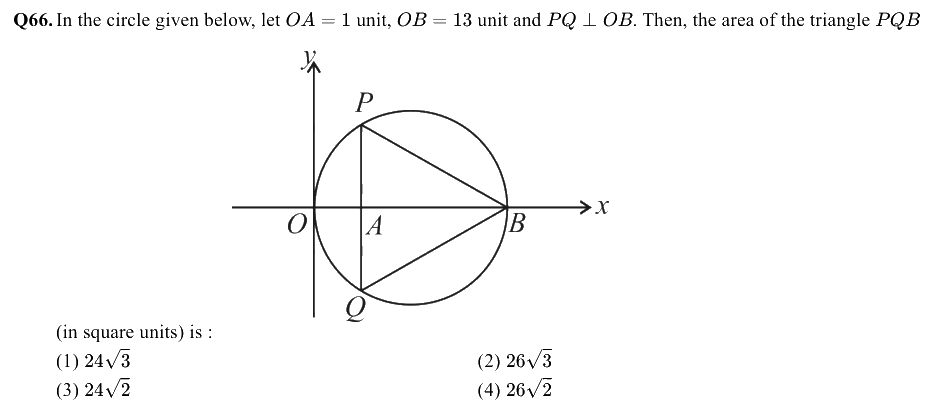
In the circle given below, let $OA = 1$ unit, $OB = 13$ unit and $PQ \perp OB$. Then, the area of the triangle $PQB$ (in square units) is : (see the figure above)
If the locus of the mid-point of the line segment from the point $(3, 2)$ to a point on the circle, $x^2 + y^2 = 1$ is a circle of radius $r$, then $r$ is equal to
Let $A(1, 4)$ and $B(1, -5)$ be two points. Let $P$ be a point on the circle $((x - 1))^2 + (y - 1)^2 = 1$, such that $(PA)^2 + (PB)^2$ have maximum value, then the points, $P$, $A$ and $B$ lie on
The circle passing through the intersection of the circles, $x^{2} + y^{2} - 6x = 0$ and $x^{2} + y^{2} - 4y = 0$ having its centre on the line, $2x - 3y + 12 = 0$, also passes through the point :
Let the latus rectum of the parabola $y^{2} = 4x$ be the common chord to the circles $C_1$ and $C_2$ each of them having radius $2\sqrt{5}$. Then, the distance between the centres of the circles $C_1$ and $C_2$ is :
A circle touches the y-axis at the point $(0, 4)$ and passes through the point $(2, 0)$ . Which of the following lines is not a tangent to this circle?
If a line $y = mx + c$, is a tangent to the circle $(x - 3)^2 + y^2 = 1$, and it is perpendicular to a line $L_1$, where $L_1$ is the tangent to the circle $x^2 + y^2 = 1$, at the point $\left(\frac{1}{\sqrt{2}}, \frac{1}{\sqrt{2}}\right)$, then
If the angle of intersection at a point where the two circles with radii 5 cm and 12 cm intersect is $90^\circ$, then the length (in cm) of their common chord is:
If the circles $x^{2} + y^{2} + 5Kx + 2y + K = 0$ and $2\left(x^{2} + y^{2}\right) + 2Kx + 3y - 1 = 0,\ (K \in R)$, intersect at the points P and Q, then the line $4x + 5y - K = 0$, passes through P and Q, for:
The locus of the centres of the circles, which touch the circle, $x^{2} + y^{2} = 1$ externally, also touch the $y$-axis and lie in the first quadrant, is:
A rectangle is inscribed in a circle with a diameter lying along the line $3y = x + 7$. If the two adjacent vertices of the rectangle are $(-8, 5)$ and $(6, 5)$, then the area of the rectangle (in sq. units) is:
The sum of the squares of the lengths of the chords intercepted on the circle, $x^2 + y^2 = 16$, by the lines, $x + y = n$, $n \in N$, where $N$ is the set of all natural numbers is:
The tangent and the normal lines at the point $\sqrt{3}$, 1 to the circle $x^2 + y^2 = 4$ and the $x$ -axis form a triangle. The area of this triangle (in square units) is:
Let $C_1$ and $C_2$ be the centres of the circles $x^2 + y^2 - 2x - 2y - 2 = 0$ and $x^2 + y^2 - 6x - 6y + 14 = 0$ respectively. If $P$ and $Q$ are the points of intersection of these circles, then the area (in sq. units) of the quadrilateral $PC_1QC_2$ is :
If a variable line $3x + 4y - \lambda = 0$ is such that the two circles $x^2 + y^2 - 2x - 2y + 1 = 0$ and $x^2 + y^2 - 18x - 2y + 78 = 0$ are on its opposite sides, then the set of all values of $\lambda$ is the interval :
If a circle of radius $R$ passes through the origin $O$ and intersects the coordinate axes at $A$ and $B$, then the locus of the foot of perpendicular from $O$ on $AB$ is :
A square is inscribed in the circle $x^2 + y^2 - 6x + 8y - 103 = 0$ with its sides parallel to the coordinate axes. Then the distance of the vertex of this square which is nearest to the origin is:
Two circles with equal radii are intersecting at the points (0,1) and (0,-1) . The tangent at the point (0,1) to one of the circles passes through the centre of the other circle. Then the distance between the centres of these circles is:
The straight line $x + 2y = 1$ meets the coordinate axes at $A$ and B. A circle is drawn through A, B and the origin. Then the sum of perpendicular distances from A and B on the tangent to the circle at the origin is:
A circle cuts a chord of length 4 a on the $x$ -axis and passes through a point on the $y$ -axis, distant 2 b from the origin. Then the locus of the centre of this circle, is:
If a circle $C$ passing through the point $(4,\ 0)$ touches the circle $x^2 + y^2 + 4x - 6y = 12$ externally at the point $(1,\ -1)$, then the radius of $C$ is:
If a circle $C$, whose radius is 3, touches externally the circle $x^2 + y^2 + 2x - 4y - 4 = 0$ at the point $(2, 2)$, then the length of the intercept cut by this circle $C$ on the $x$-axis is equal to
The tangent to the circle $C_1: x^2 + y^2 - 2x - 1 = 0$ at the point $(2,1)$ cuts off a chord of length $4$ from a circle $C_2$ whose centre is $(3,-2)$. The radius of $C_2$ is
If two parallel chords of a circle, having diameter 4 units, lie on the opposite sides of the center and subtend angles $\cos^{-1}\left(\frac{1}{7}\right)$ and $\sec^{-1}(7)$ at the center respectively, then the distance between these chords is:
Equation of the tangent to the circle, at the point $(1,\ -1)$, whose center, is the point of intersection of the straight lines $x - y = 1$ and $2x + y = 3$ is:
If one of the diameters of the circle, given by the equation, $x^2 + y^2 - 4x + 6y - 12 = 0$, is a chord of a circle $S$, whose centre is at $(-3,\ 2)$, then the radius of $S$ is
If the tangent to the conic, $y - 6 = x^2$ at $(2, 10)$ touches the circle, $x^2 + y^2 + 8x - 2y = k$ (for some fixed $k$) at a point $(\alpha, \beta)$; then $(\alpha, \beta)$ is
The set of all real values of $\lambda$ for which exactly two common tangents can be drawn to the circles $x^2 + y^2 - 4x - 4y + 6 = 0$ and $\mathrm{x}^2 + \mathrm{y}^2 - 10\mathrm{x} - 10\mathrm{y} + \lambda = 0$ is the interval:
If the point $(1,\ 4)$ lies inside the circle $x^2 + y^2 - 6x - 10y + p = 0$ and the circle does not touch or intersect the coordinate axes, then the set of all possible values of $p$ is the interval
Let $C$ be the circle with center at $(1, 1)$ and radius = 1. If $T$ is the circle centered at $(0, y)$, passing through the origin and touching the circle $C$ externally, then the radius of $T$ is equal to
Statement 1: The only circle having radius $\sqrt{10}$ and a diameter along line $2x + y = 5$ is $x^2 + y^2 - 6x + 2y = 0$. Statement 2 : $2x + y = 5$ is a normal to the circle $x^2 + y^2 - 6x + 2y = 0$.
A
Statement 1 is false; Statement 2 is true.
B
Statement 1 is true; Statement 2 is true, Statement 2 is a correct explanation for Statement 1.
C
Statement 1 is true; Statement 2 is false.
D
Statement 1 is true; Statement 2 is true; Statement 2 is not a correct explanation for Statement 1.
If a circle of unit radius is divided into two parts by an arc of another circle subtending an angle $60^\circ$ on the circumference of the first circle, then the radius of the arc is:
If a circle C passing through $(4, 0)$ touches the circle $x^2 + y^2 + 4x - 6y - 12 = 0$ externally at a point $(1, -1)$ , then the radius of the circle C is :
If two vertices of an equilateral triangle are $\mathrm{A}(-a, 0)$ and $\mathrm{B}(a, 0), a > 0$, and the third vertex C lies above $x$-axis then the equation of the circumcircle of $\triangle \mathrm{ABC}$ is :
If each of the lines $5x + 8y = 13$ and $4x - y = 3$ contains a diameter of the circle $x^2 + y^2 - 2\left(a^2 - 7a + 11\right)x - 2\left(a^2 - 6a + 6\right)y + b^3 + 1 = 0$, then :
The equation of the circle passing through the point $(1, 2)$ and through the points of intersection of $x^{2} + y^{2} - 4x - 6y - 21 = 0$ and $3x + 4y + 5 = 0$ is given by
If $P$ and $Q$ are the points of intersection of the circles $x^2 + y^2 + 3x + 7y + 2p - 5 = 0$ and $x^2 + y^2 + 2x + 2y - p^2 = 0$, then there is a circle passing through $P, Q$ and $(1, 1)$ for
Consider a family of circles which are passing through the point $(-1, 1)$ and are tangent to $x-$ axis. If $(h, k)$ are the co-ordinates of the centre of the circles, then the set of values of $k$ is given by the interval
Let $C$ be the circle with centre $(0, 0)$ and radius $3$ units. The equation of the locus of the mid points of the chords of the circle $C$ that subtend an angle of $\frac{2\pi}{3}$ at its centre is
If the circles $x^{2}+y^{2}+2ax+cy+a=0$ and $x^{2}+y^{2}-3ax+dy-1=0$ intersect in two distinct points $P$ and $Q$ then the line $5x+by-a=0$ passes through $P$ and $Q$ for
Consider the circle $\mathrm{C}: x^2 + y^2 - 6x - 8y - 11 = 0$. Let a variable chord AB of the circle C subtend a right angle at the origin. If the locus of the foot of the perpendicular drawn from the origin on the chord AB is the circle $x^2 + y^2 - \alpha x - \beta y - \gamma = 0$, then $\alpha + \beta + 2\gamma$ is equal to ________.
Numerical answer type: type your answer in EdLoop to check it
Let the centre of the circle $x^2 + y^2 + 2gx + 2fy + 25 = 0$ be in the first quadrant and lie on the line $2x - y = 4$. Let the area of an equilateral triangle inscribed in the circle be $27\sqrt{3}$. Then the square of the length of the chord of the circle on the line $x = 1$ is ________.
Numerical answer type: type your answer in EdLoop to check it
Let the line $x - y = 4$ intersect the circle $\mathrm{C}: (x-4)^2 + (y+3)^2 = 9$ at the points Q and R. If $\mathrm{P}(\alpha, \beta)$ is a point on C such that PQ = PR, then $(6\alpha + 8\beta)^2$ is equal to ________.
Numerical answer type: type your answer in EdLoop to check it
Let a circle C have its centre in the first quadrant, intersect the coordinate axes at exactly three points and cut off equal intercepts from the coordinate axes. If the length of the chord of C on the line $x + y = 1$ is $\sqrt{14}$, then the square of the radius of C is ________.
Numerical answer type: type your answer in EdLoop to check it
The absolute difference between the squares of the radii of the two circles passing through the point $(-9, 4)$ and touching the lines $x + y = 3$ and $x - y = 3$, is equal to ______
Numerical answer type: type your answer in EdLoop to check it
The focus of the parabola $y^2 = 4x + 16$ is the centre of the circle $C$ of radius 5 . If the values of $\lambda$, for which $C$ passes through the point of intersection of the lines $3x - y = 0$ and $x + \lambda y = 4$, are $\lambda_1$ and $\lambda_2$, $\lambda_1 < \lambda_2$, then $12\lambda_1 + 29\lambda_2$ is equal to
Numerical answer type: type your answer in EdLoop to check it
Let the centre of a circle, passing through the points $(0, 0), (1, 0)$ and touching the circle $x^2 + y^2 = 9$, be $(h, k)$. Then for all possible values of the coordinates of the centre $(h, k)$, $4\,(h^2 + k^2)$ is equal to ______
Numerical answer type: type your answer in EdLoop to check it
Consider the circle $C: x^2 + y^2 = 4$ and the parabola $P: y^2 = 8x$. If the set of all values of $\alpha$, for which three chords of the circle $C$ on three distinct lines passing through the point $(\alpha, 0)$ are bisected by the parabola $P$ is the interval $(p, q)$, then $(2q - p)^2$ is equal to ______
Numerical answer type: type your answer in EdLoop to check it
Let the maximum and minimum values of $\left(\sqrt{8x - x^2 - 12} - 4\right)^2 + (x - 7)^2$, $x \in \mathbf{R}$ be M and m, respectively. Then $M^2 - m^2$ is equal to ______
Numerical answer type: type your answer in EdLoop to check it
Let the line $L: \sqrt{2}x + y = \alpha$ pass through the point of the intersection $P$(in the first quadrant)of the circle $x^2 + y^2 = 3$ and the parabola $x^2 = 2y$. Let the line $L$ touch two circles $C_1$ and $C_2$ of equal radius $2\sqrt{3}$. If the centres $Q_1$ and $Q_2$ of the circles $C_1$ and $C_2$ lie on the $y$ - axis, then the square of the area of the triangle $PQ_1Q_2$ is equal to ______ .
Numerical answer type: type your answer in EdLoop to check it
Consider two circles $C_1: x^2 + y^2 = 25$ and $C_2: (x - \alpha)^2 + y^2 = 16$, where $\alpha \in (5, 9)$. Let the angle between the two radii (one to each circle) drawn from one of the intersection points of $C_1$ and $C_2$ be $\sin^{-1}\frac{\sqrt{63}}{8}$. If the length of common chord of $C_1$ and $C_2$ is $\beta$, then the value of $(\alpha\beta)^2$ equals ______.
Numerical answer type: type your answer in EdLoop to check it
Equations of two diameters of a circle are $2x - 3y = 5$ and $3x - 4y = 7$. The line joining the points $\left(-\frac{22}{7}, -4\right)$ and $\left(-\frac{1}{7}, 3\right)$ intersects the circle at only one point $P(\alpha, \beta)$. Then $17\beta - \alpha$ is equal to
Numerical answer type: type your answer in EdLoop to check it
Consider a circle $x - \alpha^2 + y - \beta^2 = 50$, where $\alpha, \beta > 0$. If the circle touches the line $y + x = 0$ at the point P, whose distance from the origin is $4\sqrt{2}$, then $(\alpha + \beta)^2$ is equal to ______.
Numerical answer type: type your answer in EdLoop to check it
Two circles in the first quadrant of radii $r_1$ and $r_2$ touch the coordinate axes. Each of them cuts off an intercept of 2 units with the line $x + y = 2$. Then $r_1^2 + r_2^2 - r_1r_2$ is equal to ______.
Numerical answer type: type your answer in EdLoop to check it
Consider a circle $C_1 : x^2 + y^2 - 4x - 2y = \alpha - 5$. Let its mirror image in the line $y = 2x + 1$ be another circle $C_2 : 5x^2 + 5y^2 - 10fx - 10gy + 36 = 0$. Let $r$ be the radius of $C_2$. Then $\alpha + r$ is equal to ______
Numerical answer type: type your answer in EdLoop to check it
A circle passing through the point $P(\alpha, \beta)$ in the first quadrant touches the two coordinate axes at the points $A$ and $B$. The point $P$ is above the line $AB$. The point $Q$ on the line segment $AB$ is the foot of perpendicular from $P$ on $AB$. If $PQ$ is equal to 11 units, then the value of $\alpha\beta$ is ______ .
Numerical answer type: type your answer in EdLoop to check it
Let the point $(p, p + 1)$ lie inside the region $E = \{(x, y) : 3 - x \le y \le \sqrt{9 - x^2},\ 0 \le x \le 3\}$. If the set of all values of $p$ is the interval $(a, b)$, then $b^2 + b - a^2$ is equal to ______ .
Numerical answer type: type your answer in EdLoop to check it
Let $P(a_1, b_1)$ and $Q(a_2, b_2)$ be two distinct points on a circle with center $C\left(\sqrt{2}, \sqrt{3}\right)$. Let $O$ be the origin and $OC$ be perpendicular to both $CP$ and $CQ$. If the area of the triangle $OCP$ is $\frac{\sqrt{35}}{2}$, then $a_1^2 + a_2^2 + b_1^2 + b_2^2$ is equal to ______ .
Numerical answer type: type your answer in EdLoop to check it
A circle with centre $(2, 3)$and radius 4 intersects the line $x + y = 3$ at the points $P$ and $Q$. If the tangents at $P$ and $Q$ intersect at the point $S(\alpha, \beta)$, then $4\alpha - 7\beta$ is equal to
Numerical answer type: type your answer in EdLoop to check it
Points $P(-3,2)$, $Q(9,10)$ and $R(\alpha,4)$ lie on a circle $C$ with $PR$ as its diameter. The tangents to $C$ at the points $Q$ and $R$ intersect at the point $S$. If $S$ lies on the line $2x-ky=1$, then $k$ is equal to ______ .
Numerical answer type: type your answer in EdLoop to check it
Let the mirror image of a circle $c_1 : x^2 + y^2 - 2x - 6y + \alpha = 0$ in line $y = x + 1$ be $c_2 : 5x^2 + 5y^2 + 10gx + 10fy + 38 = 0$. If $r$ is the radius of circle $c_2$, then $\alpha + 6r^2$ is equal to ______.
Numerical answer type: type your answer in EdLoop to check it
Let $AB$ be a chord of length 12 of the circle $x - 2^2 + y + 1^2 = \frac{169}{4}$ If tangents drawn to the circle at points $A$ and $B$ intersect at the point $P$, then five times the distance of point $P$ from chord $AB$ is equal to ______.
Numerical answer type: type your answer in EdLoop to check it
Let the lines $y + 2x = \sqrt{11} + 7\sqrt{7}$ and $2y + x = 2\sqrt{11} + 6\sqrt{7}$ be normal to a circle $C : (x - h)^2 + (y - k)^2 = r^2$. If the line $\sqrt{11}y - 3x = \dfrac{5\sqrt{77}}{3} + 11$ is tangent to the circle $C$, then the value of $(5h - 8k)^2 + 5r^2$ is equal to ______.
Numerical answer type: type your answer in EdLoop to check it
If one of the diameters of the circle $x^{2} + y^{2} - 2\sqrt{2}x - 6\sqrt{2}y + 14 = 0$ is a chord of the circle $\left(x - 2\sqrt{2}\right)^{2} + \left(y - 2\sqrt{2}\right)^{2} = r^{2}$, then the value of $r^{2}$ is equal to
Numerical answer type: type your answer in EdLoop to check it
A rectangle $R$ with end points of the one of its sides as $(1, 2)$ and $(3, 6)$ is inscribed in a circle. If the equation of a diameter of the circle is $2x - y + 4 = 0$, then the area of $R$ is ______ .
Numerical answer type: type your answer in EdLoop to check it
A circle of radius 2 unit passes through the vertex and the focus of the parabola $y^{2} = 2x$ and touches the parabola $y = \left(x - \frac{1}{4}\right)^{2} + \alpha$, where $\alpha > 0$. Then $(4\alpha - 8)^{2}$ is equal to ______ .
Numerical answer type: type your answer in EdLoop to check it
Let a circle $C$ of radius 5 lie below the $x$-axis. The line $L_1 = 4x + 3y + 2$ passes through the centre $P$ of the circle $C$ and intersects the line $L_2 : 3x - 4y - 11 = 0$ at $Q$. The line $L_2$ touches $C$ at the point $Q$. Then the distance of $P$ from the line $5x - 12y + 51 = 0$ is
Numerical answer type: type your answer in EdLoop to check it
Let the abscissae of the two points $P$ and $Q$ be the roots of $2x^2 - rx + p = 0$ and the ordinates of $P$ and $Q$ be the roots of $x^2 - sx - q = 0$. If the equation of the circle described on $PQ$ as diameter is $2\left(x^2 + y^2\right) - 11x - 14y - 22 = 0$, then $2r + s - 2q + p$ is equal to ______ .
Numerical answer type: type your answer in EdLoop to check it
Let a circle $C : (x - h)^2 + (y - k)^2 = r^2$, $k > 0$, touch the $x$-axis at $(1, 0)$. If the line $x + y = 0$ intersects the circle $C$ at $P$ and $Q$ such that the length of the chord $PQ$ is $2$, then the value of $h + k + r$ is equal to ______ .
Numerical answer type: type your answer in EdLoop to check it
If the variable line $3x + 4y = \alpha$ lies between the two circles $(x - 1)^2 + (y - 1)^2 = 1$ and $(x - 9)^2 + (y - 1)^2 = 4$, without intercepting a chord on either circle, then the sum of all the integral values of $\alpha$ is ______
Numerical answer type: type your answer in EdLoop to check it
Let $B$ be the centre of the circle $x^2 + y^2 - 2x + 4y + 1 = 0$. Let the tangents at two points $P$ and $Q$ on the circle intersect at the point $A(3, 1)$. Then $8\frac{\text{area }\Delta APQ}{\text{area }\Delta BPQ}$ is equal to ______.
Numerical answer type: type your answer in EdLoop to check it
Let the equation $x^2 + y^2 + px + (1 - p)y + 5 = 0$ represent circles of varying radius $r \in (0, 5]$. Then the number of elements in the set $S = \{q : q = p^2$ and $q$ is an integer$\}$ is ______
Numerical answer type: type your answer in EdLoop to check it
Two circles each of radius 5 units touch each other at the point $(1,2)$. If the equation of their common tangent is $4x+3y=10$, and $C_1(\alpha,\beta)$ and $C_2(\gamma,\delta)$, $C_1\neq C_2$ are their centres, then $|(\alpha+\beta)(\gamma+\delta)|$ is equal to
Numerical answer type: type your answer in EdLoop to check it
The locus of a point, which moves such that the sum of squares of its distances from the points $(0,0),(1,0),(0,1)(1,1)$ is 18 units, is a circle of diameter $d$. Then $d^{2}$ is equal to
Numerical answer type: type your answer in EdLoop to check it
The minimum distance between any two points $P_1$ and $P_2$ while considering point $P_1$ on one circle and point $P_2$ on the other circle for the given circles' equations $x^2+y^2-10 x-10 y+41=0$ $x^2+y^2-24 x-10 y+160=0$ is ______.
Numerical answer type: type your answer in EdLoop to check it
Let $A B C D$ be a square of side of unit length. Let a circle $C_1$ centered at $A$ with unit radius is drawn. Another circle $C_2$ which touches $C_1$ and the lines $A D$ and $A B$ are tangent to it, is also drawn. Let a tangent line from the point $C$ to the circle $C_2$ meet the side $A B$ at $E$. If the length of $E B$ is $\alpha+\sqrt{3} \beta$, where $\alpha, \beta$ are integers, then $\alpha+\beta$ is equal to ______.
Numerical answer type: type your answer in EdLoop to check it
Let the normals at all the points on a given curve pass through a fixed point $(a, b)$. If the curve passes through $(3, -3)$ and $\left(4, -2\sqrt{2}\right)$, given that $a - 2\sqrt{2}\,b = 3$, then $(a^2 + b^2 + ab)$ is equal to ______.
Numerical answer type: type your answer in EdLoop to check it
If one of the diameters of the circle $x^2 + y^2 - 2x - 6y + 6 = 0$ is a chord of another circle 'C', whose center is at $2, 1$, then its radius is ______.
Numerical answer type: type your answer in EdLoop to check it
Let a point $P$ be such that its distance from the point $(5, 0)$ is thrice the distance of $P$ from the point $(-5, 0)$. If the locus of the point $P$ is a circle of radius $r$, then $4r^2$ (in the nearest integer) is equal to ______.
Numerical answer type: type your answer in EdLoop to check it
If the area of the triangle formed by the $x$-axis, the normal and the tangent to the circle $(x - 2)^2 + (y - 3)^2 = 25$ at the point $(5, 7)$ is $A$, then $24A$ is equal to ______.
Numerical answer type: type your answer in EdLoop to check it
Let $PQ$ be a diameter of the circle $x^{2} + y^{2} = 9$. If $\alpha$ and $\beta$ are the lengths of the perpendiculars from $P$ and $Q$ on the straight line, $x + y = 2$ respectively, then the maximum value of $\alpha\beta$ is ______
Numerical answer type: type your answer in EdLoop to check it
The numbers of integral values of $k$ for which the line, $3x + 4y = k$ intersects the circle, $x^{2} + y^{2} - 2x - 4y + 4 = 0$ at two distinct points is....
Numerical answer type: type your answer in EdLoop to check it
If the curves, $x^2 - 6x + y^2 + 8 = 0$ and $x^2 - 8y + y^2 + 16 - k = 0$, $(k > 0)$ touch each other at a point, then the largest value of $k$ is ______.
Numerical answer type: type your answer in EdLoop to check it
Circles forms the central pillar of conic geometry under Unit 10: Coordinate Geometry in the Class 11 curriculum, placing it at rank 17 among the 29 chapters in the subject. Across the 162 papers conducted between 2019 and 2026, the examination contained 149 questions from this chapter, representing 3.3 percent of all mathematics questions. It appeared in 121 of those 162 papers and has been tested every year since 2019. Over the recent 2024 to 2026 testing period, 45 questions were asked across 58 papers, averaging 0.8 questions per paper with a 2.9 percent subject share. Comparing the earlier 2002 to 2018 share of 3.9 percent against 2024 to 2026 indicates that its long-term share is down, while comparing 2019 to 2026 with 2024 to 2026 shows it is about the same. Across the complete archive from 2002 to 2026 spanning 200 papers, 200 questions were asked in 157 papers, with 45 numerical answer questions appearing between 2019 and 2026.
The annual question tallies for 2024, 2025, and 2026 were 19, 10, and 16 questions respectively.
Examiners frequently combine circles with lines, parabolas, and ellipses. Questions commonly ask for the locus of a moving geometric point or investigate mutual intersection properties between two circular boundaries, demanding both algebraic speed and geometric intuition.
Most-asked topics
Questions in this chapter divide across three central thematic areas:
1. Equation of a Circle (55 questions, 2019-2026; 77 total, last asked 2026) Focuses on general second-degree equations representing circles, finding centres and radii, equations of circles passing through three non-collinear points, diametric forms, intercept lengths on coordinate axes, and parametric representations.
2. Tangents & Normals (48 questions, 2019-2026; 56 total, last asked 2026) Involves conditions of tangency where the perpendicular distance from the centre matches the radius, equations of tangents in slope and point forms, lengths of tangents from an external point, chords of contact, and normals passing through the centre.
3. Family of Circles & Two Circles (46 questions, 2019-2026; 67 total, last asked 2026) Covers relative positions of two circles, conditions for internal and external contact, number of common tangents, equations of common chords, radical axes, orthogonal intersection criteria, and families of circles passing through the intersections of a circle and a line.
What the questions look like
Examiners test circle geometry using several recurring problem templates:
Tangency Condition via Distance Formula: A line touches a circle if and only if the perpendicular distance from the centre equals the radius. Many problems use this condition to establish relations between unknown slope or intercept constants.
Two-Circle Interaction and Common Tangents: Evaluating the distance between centres relative to the sum and difference of their radii to determine whether two circles intersect in two distinct points, touch at one point, or remain mutually disjoint.
Locus of Chord Midpoints or Tangent Intersections: A chord subtends a given angle at the centre, or tangents drawn from an external point meet at a fixed angle, requiring the locus equation of the external intersection point.
Circle Through Conic Intersections: Determining the radius or equation of a circle that passes through all four points of intersection between two concentric or confocal ellipses.
Questions to try first
Test your circle fundamentals with these recent examination problems:
Mastering circle problems requires blending pure geometry with coordinate methods:
Prefer pure geometry over calculus: To find the equation of a tangent or normal to a circle, avoid differentiating the implicit equation. Always use the geometric criterion: the perpendicular distance from the centre to the tangent line equals the radius, and every normal passes through the centre.
Leverage the diametric form: When given two opposite endpoints of a diameter, write the circle directly as the product of x minus x1 and x minus x2 plus the product of y minus y1 and y minus y2 equals zero, saving multiple steps of finding the midpoint and squaring the radius.
Use the circle-line family formulation: To write the equation of any circle passing through the intersection points of a circle S and a line L, use S plus lambda L equals zero. The single scalar parameter lambda is determined by enforcing a point constraint or centre locus.
Exploit common chord properties: Subtracting the equations of two circles with unit leading coefficients immediately gives the equation of their common chord or radical axis without calculating individual intersection coordinates.
Frequently asked questions
How do I determine the number of common tangents between two circles?
Compute the distance d between their centres and compare it against the sum and difference of their radii. If d is greater than the sum of the radii, there are four common tangents. If d equals the sum, three tangents exist. If the absolute difference of radii is less than d and d is less than the sum, there are two common tangents. If d equals the absolute difference, one tangent exists, and if d is less than the difference, no common tangents exist.
What is the condition for two circles to cut orthogonally?
Two circles intersect orthogonally if the square of the distance between their centres equals the sum of the squares of their radii. In general second-degree coefficients, this translates to twice the sum of g1 g2 plus f1 f2 equaling c1 plus c2.
Why do normals always pass through the centre?
By the fundamental geometric symmetry of a circle, the tangent at any point is perpendicular to the radius drawn to that point. Because the normal is by definition perpendicular to the tangent at the point of contact, the normal line must coincide with the radial line, passing directly through the centre. Step-by-step solutions for each one are in the EdLoop app.