Every Differential Equations question from past JEE Main and AIEEE papers, with options and answers. Newest first.
255questions
191papers covered
4.6%of Mathematics questions, 2019–2026
2002–2026years
Guide at a glance
Differential equations is a prominent calculus chapter under Unit 9: Differential Equations in the Class 12 curriculum, securing rank 8 among the 29 chapters in the subject.
Let $y = y(x)$ be the solution of the differential equation $\frac{dy}{dx} = \left(1 + x + x^2\right)\left(1 - y + y^2\right)$, $y(0) = \frac{1}{2}$. Then $(2y(1) - 1)$ is equal to
If the curve $y = f(x)$ passes through the point $(1, \mathrm{e})$ and satisfies the differential equation $dy = y\,(2 + \log_e x)\,dx$, $x > 0$, then $f(\mathrm{e})$ is equal to :
Let $y = y(x)$ be the solution curve of the differential equation $(1 + \sin x)\frac{dy}{dx} + (y+1)\cos x = 0$, $y(0) = 0$. If the curve $y = y(x)$ passes through the point $\left(\alpha, \frac{-1}{2}\right)$, then a value of $\alpha$ is :
Let $x = x(y)$ be the solution of the differential equation $2y^2\frac{dx}{dy} - 2xy + x^2 = 0$, $y > 1$, $x(\mathrm{e}) = \mathrm{e}$. Then $x(\mathrm{e}^2)$ is equal to :
Let $y = y(x)$ be the solution of the differential equation $x\dfrac{dy}{dx} - y = x^2\cot x$, $x \in (0, \pi)$. If $y\left(\dfrac{\pi}{2}\right) = \dfrac{\pi}{2}$, then $6y\left(\dfrac{\pi}{6}\right) - 8y\left(\dfrac{\pi}{4}\right)$ is equal to :
Let $y = y(x)$ be a differentiable function in the interval $(0, \infty)$ such that $y(1) = 2$, and $\displaystyle\lim_{t \to x}\left(\dfrac{t^2y(x) - x^2y(t)}{x - t}\right) = 3$ for each $x > 0$. Then $2y(2)$ is equal to
Let $y = y(x)$ be the solution of the differential equation $x^4dy + (4x^3y + 2\sin x)dx = 0$, $x > 0$, $y\left(\dfrac{\pi}{2}\right) = 0$. Then $\pi^4 y\left(\dfrac{\pi}{3}\right)$ is equal to :
Let the solution curve of the differential equation $x\,dy - y\,dx = \sqrt{x^2 + y^2}\,dx$, $x > 0$, $y(1) = 0$, be $y = y(x)$. Then $y(3)$ is equal to
Let $y = y(x)$ be the solution curve of the differential equation $(1 + x^2)\,dy + (y - \tan^{-1}x)\,dx = 0$, $y(0) = 1$. Then the value of $y(1)$ is :
Let $y = y(x)$ be the solution of the differential equation $\sec x\dfrac{dy}{dx} - 2y = 2 + 3\sin x$, $x \in \left(-\dfrac{\pi}{2}, \dfrac{\pi}{2}\right)$, $y(0) = -\dfrac{7}{4}$. Then $y\left(\dfrac{\pi}{6}\right)$ is equal to :
Let $f(x) = x - 1$ and $g(x) = e^x$ for $x \in \mathbb{R}$. If $\frac{dy}{dx} = \left(e^{-2\sqrt{x}}g(f(f(x))) - \frac{y}{\sqrt{x}}\right), y(0) = 0$, then $y(1)$ is
Let $y = y(x)$ be the solution curve of the differential equation $x\left(x^2 + e^x\right)dy + \left(e^x(x - 2)y - x^3\right)dx = 0, x > 0$, passing through the point $(1, 0)$. Then $y(2)$ is equal to
Let $y = y(x)$ be the solution of the differential equation $\left(x^2 + 1\right)y' - 2xy = \left(x^4 + 2x^2 + 1\right)\cos x$, $y(0) = 1$. Then $\int_{-3}^3 y(x)dx$ is :
If a curve $y = y(x)$ passes through the point $\left(1, \frac{\pi}{2}\right)$ and satisfies the differential equation $\left(7x^4\cot y - e^x\operatorname{cosec}y\right)\frac{dx}{dy} = x^5, x \geq 1$, then at $x = 2$, the value of $\cos y$ is :
Let $g$ be a differentiable function such that $\int_0^x g(t)dt = x - \int_0^x tg(t)dt, x \geq 0$ and let $y = y(x)$ satisfy the differential equation $\frac{dy}{dx} - y\tan x = 2(x + 1)\sec x\,g(x), x \in \left[0, \frac{\pi}{2}\right)$. If $y(0) = 0$, then $y\left(\frac{\pi}{3}\right)$ is equal to
Let $y = y(x)$ be the solution of the differential equation $\cos x(\log_e(\cos x))^2\mathrm{d}y + (\sin x - 3y\sin x\log_e(\cos x))\mathrm{d}x = 0, x \in \left(0, \frac{\pi}{2}\right)$. If $y\left(\frac{\pi}{4}\right) = \frac{-1}{\log_e 2}$, then $y\left(\frac{\pi}{6}\right)$ is equal to :
If for the solution curve $y = f(x)$ of the differential equation $\frac{dy}{dx} + (\tan x)y = \frac{2 + \sec x}{(1 + 2\sec x)^2}$, $x \in \left(\frac{-\pi}{2}, \frac{\pi}{2}\right), f\left(\frac{\pi}{3}\right) = \frac{\sqrt{3}}{10}$, then $f\left(\frac{\pi}{4}\right)$ is equal to :
Let y = y(x) be the solution of the differential equation $\left(xy - 5x^2\sqrt{1 + x^2}\right)dx + (1 + x^2)dy = 0$, $y(0) = 0$. Then $y(\sqrt{3})$ is equal to
Let $f : (0, \infty) \rightarrow \mathbf{R}$ be a function which is differentiable at all points of its domain and satisfies the condition $x^2f'(x) = 2xf(x) + 3$, with $f(1) = 4$. Then $2f(2)$ is equal to :
Let a curve $y = f(x)$ pass through the points $(0, 5)$ and $\left(\log_e 2, k\right)$. If the curve satisfies the differential equation $2(3 + y)e^{2x}dx - \left(7 + e^{2x}\right)dy = 0$, then $k$ is equal to
Let $x = x(y)$ be the solution of the differential equation $y = \left(x - y\frac{\mathrm{d}x}{\mathrm{d}y}\right)\sin\left(\frac{x}{y}\right)$, $y > 0$ and $x(1) = \frac{\pi}{2}$. Then $\cos(x(2))$ is equal to :
Let $x = x(y)$ be the solution of the differential equation $y^2\,\mathrm{d}x + \left(x - \frac{1}{y}\right)\mathrm{d}y = 0$. If $x(1) = 1$, then $x\left(\frac{1}{2}\right)$ is :
If $x = f(y)$ is the solution of the differential equation $(1 + y^2) + \left(x - 2\mathrm{e}^{\tan^{-1} y}\right)\frac{\mathrm{dy}}{\mathrm{d}x} = 0$, $y \in \left(-\frac{\pi}{2}, \frac{\pi}{2}\right)$ with $f(0) = 1$, then $f\left(\frac{1}{\sqrt{3}}\right)$ is equal to :
The solution curve, of the differential equation $2y\frac{\mathrm{dy}}{\mathrm{dx}} + 3 = 5\frac{\mathrm{dy}}{\mathrm{dx}}$, passing through the point $(0, 1)$ is a conic, whose vertex lies on the line:
Let $f(x)$ be a positive function such that the area bounded by $y = f(x), y = 0$ from $x = 0$ to $x = a > 0$ is $e^{-a} + 4a^2 + a - 1$. Then the differential equation, whose general solution is $y = c_1 f(x) + c_2$, where $c_1$ and $c_2$ are arbitrary constants, is
Let $y = y(x)$ be the solution curve of the differential equation $\sec y\,\frac{dy}{dx} + 2x\sin y = x^3\cos y$, $y(1) = 0$. Then $y(\sqrt{3})$ is equal to :
Let $y = y(x)$ be the solution of the differential equation $(2x\log_e x)\frac{dy}{dx} + 2y = \frac{3}{x}\log_e x$, $x > 0$ and $y\left(e^{-1}\right) = 0$. Then, $y(e)$ is equal to
Suppose the solution of the differential equation $\frac{dy}{dx} = \frac{(2+\alpha)x - \beta y + 2}{\beta x - 2\alpha y - (\beta\gamma - 4\alpha)}$ represents a circle passing through origin. Then the radius of this circle is :
If $y = y(x)$ is the solution of the differential equation $\frac{dy}{dx} + 2y = \sin(2x), y(0) = \frac{3}{4}$, then $y\left(\frac{\pi}{8}\right)$ is equal to:
Let $y = yx$ be the solution of the differential equation $\frac{dy}{dx} = 2xx + y^3 - xx + y - 1, y0 = 1$. Then, $\frac{1}{\sqrt{2}} + y\frac{1}{\sqrt{2}}{}^{2}$ equals:
Let $\alpha$ be a non-zero real number. Suppose $f: R \rightarrow R$ is a differentiable function such that $f0 = 1$ and $\lim_{x \to -\infty} fx = 1$. If $f'x = \alpha fx + 3$, for all $x \in R$, then $f -\log_e 2$ is equal to ______.
Let $y = y(x)$ be the solution of the differential equation $\frac{dy}{dx} = \frac{\tan x + y}{\sin x\sec x - \sin x\tan x}$, $x \in 0,\ \frac{\pi}{2}$ satisfying the condition $y\frac{\pi}{4} = 2$. Then, $y\frac{\pi}{3}$ is
The temperature $T(t)$ of a body at time $t = 0$ is $160^\circ$ F and it decreases continuously as per the differential equation $\frac{dT}{dt} = -KT - 80$, where $K$ is positive constant. If $T(15) = 120^\circ$ F, then $T(45)$ is equal to
Let $y = y(x)$ be the solution of the differential equation $\sec x\,dy + \{2(1-x)\tan x + x(2-x)\}dx = 0$ such that $y(0) = 2$. Then $y(2)$ is equal to :
A function $y = f(x)$ satisfies $f(x)\sin 2x + \sin x - \left(1 + \cos^2 x\right)f'(x) = 0$ with condition $f(0) = 0$. Then $f\left(\frac{\pi}{2}\right)$ is equal to
If $\sin\left(\frac{y}{x}\right) = \log_e|x| + \frac{\alpha}{2}$ is the solution of the differential equation $x\cos\left(\frac{y}{x}\right)\frac{dy}{dx} = y\cos\left(\frac{y}{x}\right) + x$ and $y(1) = \frac{\pi}{3}$, then $\alpha^2$ is equal to
Let $x = x(t)$ and $y = y(t)$ be solutions of the differential equations $\frac{dx}{dt} + ax = 0$ and $\frac{dy}{dt} + by = 0$ respectively, a, b $\in$ R. Given that $x(0) = 2$ ; $y(0) = 1$ and $3\,y(1) = 2\,x(1)$, the value of $t$, for which $x(t) = y(t)$, is :
If $y = y(x)$ is the solution curve of the differential equation $x^2 - 4dy - y^2 - 3ydx = 0$, $x > 2$, $y(4) = \frac{3}{2}$ and the slope of the curve is never zero, then the value of $y(10)$ equals :
Let $x = x(y)$ be the solution of the differential equation $2(y + 2)\log_e(y + 2)dx + (x + 4 - 2\log_e(y + 2))dy = 0$, $y > -1$ with $x(e^4 - 2) = 1$. Then $x(e^9 - 2)$ is equal to
Let $y = y_1(x)$ and $y = y_2(x)$ be the solution curves of the differential equation $\frac{dy}{dx} = y + 7$ with initial conditions $y_1(0) = 0$ and $y_2(0) = 1$ respectively. Then the curves $y = y_1(x)$ and $y = y_2(x)$ intersect at
Let $y = y(x)$, $y > 0$, be a solution curve of the differential equation $\left(1 + x^2\right)dy = y(x - y)dx$. If $y(0) = 1$ and $y\left(2\sqrt{2}\right) = \beta$, then
Let $y = yx$ be a solution curve of the differential equation, $1 - x^2y^2 dx = ydx + xdy$, If the line $x = 1$ intersects the curve $y = yx$ at $y = 2$ and the line $x = 2$ intersects the curve $y = yx$ at $y = \alpha$, then a value of $\alpha$ is
Let $y = y(x)$ be the solution of the differential equation $\frac{dy}{dx} + \frac{5}{x(x^5 + 1)}y = \frac{(x^5 + 1)^2}{x^7}$, $x > 0$. If $y(1) = 2$, then $y(2)$ is equal to
If the solution curve $f(x, y) = 0$ of the differential equation $(1 + \log_e x)\frac{dx}{dy} - x\log_e x = e^y$, $x > 0$, passes through the points $(1, 0)$ and $(a, 2)$, then $a^a$ is equal to
The area enclosed by the closed curve $C$ given by the differential equation $\dfrac{dy}{dx} + \dfrac{x + a}{y - 2} = 0, y1 = 0$ is $4\pi$. Let $P$ and $Q$ be the points of intersection of the curve $C$ and the $y$-axis. If normals at $P$ and $Q$ on the curve $C$ intersect $x$-axis at points $R$ and $S$ respectively, then the length of the line segment $RS$ is
If $y = yx$ is the solution curve of the differential equation $\dfrac{dy}{dx} + y\tan x = x\sec x$, $0 \leq x \leq \dfrac{\pi}{3}$, $y0 = 1$, then $y\dfrac{\pi}{6}$ is equal to
Let $\alpha x = \exp(x^\beta y^\gamma)$ be the solution of the differential equation $2x^2 y dy - (1 - xy^2)dx = 0$, $x > 0, y(2) = \sqrt{\log_e 2}$. Then $\alpha + \beta - \gamma$ equals :
Let $y = y(x)$ be the solution of the differential equation $\left(3y^2 - 5x^2\right)y\,dx + 2x\left(x^2 - y^2\right)dy = 0$ such that $y(1) = 1$. Then $|(y(2))^3 - 12y(2)|$ is equal to :
Let the solution curve $y = y(x)$ of the differential equation $\frac{dy}{dx} - \frac{3x^5\tan^{-1}x^3}{1 + x^{6\frac{3}{2}}}y = 2x\ \exp\frac{x^3 - \tan^{-1}x^3}{\sqrt{(1 + x)^6}}$ pass through the origin. Then $y(1)$ is equal to:
Let $\mathrm{y} = f(\mathrm{x})$ be the solution of the differential equation $y(x + 1)dx - x^2dy = 0$, $y(1) = e$. Then $\lim_{x \to 0^+} f\left(x\right)$ is equal to
Let $y = y(x)$ be the solution of the differential equation $x\log_e x \frac{dy}{dx} + y = x^2\log_e x$, $(x > 1)$. If $y(2) = 2$, then $y(e)$ is equal to
Let $\mathrm{y} = \mathrm{y(x)}$ be the solution curve of the differential equation $\frac{dy}{dx} = \frac{y}{x}\left(1 + x^2(1 + \log_e x)\right)$, $\mathrm{x} > 0$, $\mathrm{y}(1) = 3$. Then $\frac{y^2(x)}{9}$ is equal to :
Let $y=y(t)$ be a solution of the differential equation $\frac{dy}{dt}+\alpha y=\gamma e^{-\beta t}$ Where, $\alpha>0$, $\beta>0$ and $\gamma>0$. Then $\lim_{t\to\infty}y(t)$
Let the solution curve $y = y(x)$ of the differential equation $(1 + e^{2x})\left(\frac{dy}{dx} + y\right) = 1$ pass through the point $\left(0, \frac{\pi}{2}\right)$. Then, $\lim_{x \to \infty} e^x y(x)$ is equal to
If the solution curve of the differential equation $\frac{dy}{dx} = \frac{x + y - 2}{x - y}$ passes through the point $2, 1$ and $k + 1, 2$, $\mathrm{k} > 0$, then
Let $y = yx$ be the solution curve of the differential equation $\frac{dy}{dx} + \frac{2x^2 + 11x + 13}{x^3 + 6x^2 + 11x + 6} y = \frac{x + 3}{x + 1}, x > -1$, which passes through the point $0, 1$. Then $y1$ is equal to
Let the solution curve of the differential equation $xdy=\sqrt{x^{2}+y^{2}}+ydx,x>0$, intersect the line $\mathrm{x}=1$ at $y=0$ and the line $\mathrm{x}=2$ at $y=\alpha$. Then the value of $\alpha$ is
If $y=yx,x\in0,\frac{\pi}{2}$ be the solution curve of the differential equation $\sin^{2}2x\frac{dy}{dx}+8\sin^{2}2x+2\sin4xy=$ $2e^{-4x}2\sin2x+\cos2x$, with $y\frac{\pi}{4}=e^{-\pi}$, then $y\frac{\pi}{6}$ is equal to
Let $y=y(x)$ be the solution curve of the differential equation $\frac{dy}{dx}+\frac{1}{x^{2}-1}y=\left(\frac{x-1}{x+1}\right)^{\frac{1}{2}},x>1$ passing through the point $\left(2,\sqrt{\frac{1}{3}}\right)$. Then $\sqrt{7}y(8)$ is equal to
Let $y = y_1(x)$ and $y = y_2(x)$ be two distinct solutions of the differential equation $\frac{dy}{dx} = x + y$, with $y_1(0) = 0$ and $y_2(0) = 1$ respectively. Then, the number of points of intersection of $y = y_1(x)$ and $y = y_2(x)$ is
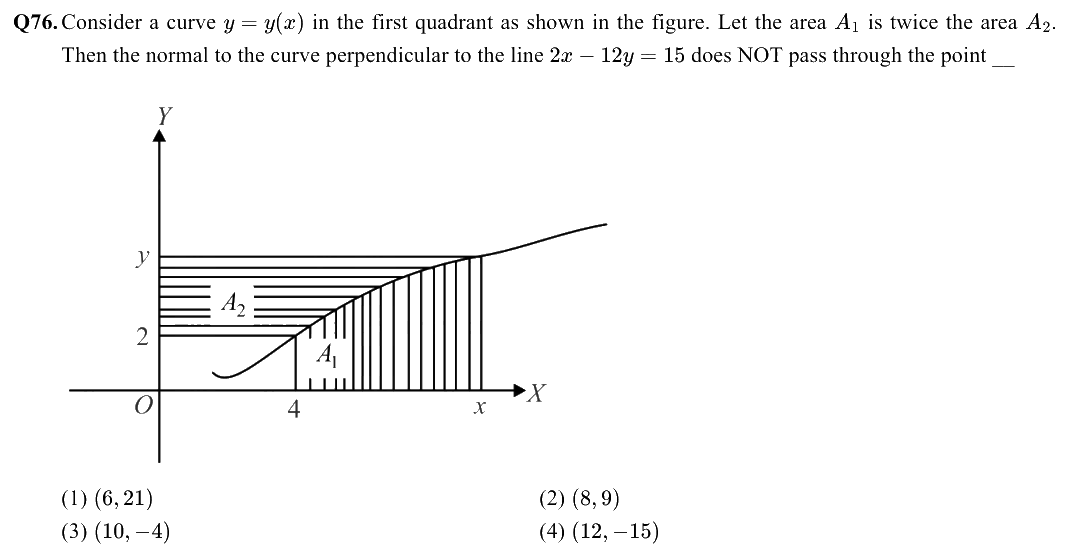
Consider a curve $y = y(x)$ in the first quadrant as shown in the figure. Let the area $A_1$ is twice the area $A_2$. Then the normal to the curve perpendicular to the line $2x - 12y = 15$ does NOT pass through the point ______ (see the figure above)
Let the solution curve $y = fx$ of the differential equation $\frac{dy}{dx} + \frac{xy}{x^2 - 1} = \frac{x^4 + 2x}{\sqrt{1 - x^2}}$, $x \in -1, 1$ pass through the origin. Then $\int_{-\frac{\sqrt{3}}{2}}^{\frac{\sqrt{3}}{2}} fx\,dx$ is equal to
The slope of the tangent to a curve $C$: $y = yx$ at any point $[x, y)$ on it is $\frac{2e^{2x} - 6e^{-x} + 9}{2 + 9e^{-2x}}$. If $C$ passes through the points $0, \frac{1}{2} + \frac{\pi}{2\sqrt{2}}$ and $\alpha, \frac{1}{2}e^{2\alpha}$ then $e^\alpha$ is equal to
Let a smooth curve $y = f(x)$ be such that the slope of the tangent at any point $(x, y)$ on it is directly proportional to $\left(\frac{-y}{x}\right)$. If the curve passes through the points $(1, 2)$ and $(8, 1)$, then $\left|y\left(\frac{1}{8}\right)\right|$ is equal to
If $y = y(x)$ is the solution of the differential equation $\left(1 + e^{2x}\right)\dfrac{dy}{dx} + 2\left(1 + y^2\right)e^x = 0$ and $y(0) = 0$, then $6\left(y'(0) + \left(y\left(\log_e\sqrt{3}\right)\right)^2\right)$ is equal to:
Let the solution curve $y = y(x)$ of the differential equation, $\left[\dfrac{x}{\sqrt{x^2 - y^2}} + e^{\frac{y}{x}}\right] x \dfrac{dy}{dx} = x + \left[\dfrac{x}{\sqrt{x^2 - y^2}} + e^{\frac{y}{x}}\right] y$ pass through the points $(1, 0)$ and $(2\alpha, \alpha)$, $\alpha > 0$. Then $\alpha$ is equal to
Let $y = y(x)$ be the solution of the differential equation $x(1 - x^2)\dfrac{dy}{dx} + \left(3x^2 y - y - 4x^3\right) = 0$, $x > 1$ with $y(2) = -2$. Then $y(3)$ is equal to
Let $x = x(y)$ be the solution of the differential equation $2ye^{\frac{x}{y^{2}}}dx + \left(y^{2} - 4xe^{\frac{x}{y^{2}}}\right)dy = 0$ such that $x(1) = 0$. Then, $x(e)$ is equal to
Let the slope of the tangent to a curve $y = f(x)$ at $(x, y)$ be given by $2\tan x(\cos x - y)$. if the curve passes through the point $\left(\frac{\pi}{4}, 0\right)$, then the value of $\int_0^{\frac{\pi}{2}} y\,dx$ is equal to
Let $\frac{dy}{dx} = \frac{ax - by + a}{bx + cy + a}$, where $a, b, c$ are constants. represent a circle passing through the point $(2, 5)$. Then the shortest distance of the point $(11, 6)$ from this circle is
If the solution curve of the differential equation $\left(\left(\tan^{-1} y\right) - x\right)dy = \left(1 + y^{2}\right)dx$ passes through the point $(1, 0)$ then the abscissa of the point on the curve whose ordinate is $\tan(1)$ is
If $y = y(x)$ is the solution of the differential equation $x\frac{dy}{dx} + 2y = xe^x, y(1) = 0$ then the local maximum value of the function $z(x) = x^2 y(x) - e^x, x \in R$ is
Let $y = y x$ be the solution of the differential equation $x + 1 y' - y = e^{3x} x + 1^2$, with $y 0 = \frac{1}{3}$. Then, the point $x = -\frac{4}{3}$ for the curve $y = y x$ is
If the solution curve $y = y x$ of the differential equation $y^2 dx + x^2 - xy + y^2 dy = 0$, which passes through the point $1, 1$ and intersects the line $y = \sqrt{3}x$ at the point $\alpha, \sqrt{3}\alpha$, then value of $\log_e \sqrt{3}\alpha$ is equal to
A particle is moving in the $xy$-plane along a curve $C$ passing through the point $(3, 3)$. The tangent to the curve $C$ at the point $P$ meets the $x$-axis at $Q$. If the $y$-axis bisects the segment $PQ$, then $C$ is a parabola with
The slope of normal at any point $(x, y)$, $x > 0, y > 0$ on the curve $y = y(x)$ is given by $\frac{x^2}{xy - x^2y^2 - 1}$. If the curve passes through the point $(1, 1)$, then $e \cdot y(e)$ is equal to
If $y = y\left(x\right)$ is the solution curve of the differential equation $x^2\ dy + y - \frac{1}{x}dx = 0$; $x > 0$ and $y\left(1\right) = 1$, then $y\frac{1}{2}$ is equal to :
If $y\frac{dy}{dx} = x\left[\frac{y^2}{x^2} + \frac{\phi\left(\frac{y^2}{x^2}\right)}{\phi'\left(\frac{y^2}{x^2}\right)}\right]$, $x > 0$, $\phi > 0$, and $y\left(1\right) = -1$, then $\phi\left(\frac{y^2}{4}\right)$ is equal to:
Let us consider a curve, $y = f(x)$ passing through the point $(-2, 2)$ and the slope of the tangent to the curve at any point $(x, f(x))$ is given by $f(x) + xf'(x) = x^2$. Then
Let $y = y(x)$ be the solution of the differential equation $\frac{dy}{dx} = 2(y + 2\sin x - 5)x - 2\cos x$ such that $y(0) = 7$. Then $y(\pi)$ is equal to
If the solution curve of the differential equation $\left(2x-10y^{3}\right)dy+ydx=0$, passes through the points $(0,1)$ and $(2,\beta)$, then $\beta$ is a root of the equation?
A differential equation representing the family of parabolas with axis parallel to $y-$axis and whose length of latus rectum is the distance of the point $(2,-3)$ from the line $3x+4y=5$, is given by:
Let $y=y(x)$ be a solution curve of the differential equation $(y+1)\tan^{2}x\,dx+\tan x\,dy+y\,dx=0$, $x\in\left(0,\frac{\pi}{2}\right)$. If $\lim_{x\to0^+}xy(x)=1$, then the value of $y\left(\frac{\pi}{4}\right)$ is:
Let $y(x)$ be the solution of the differential equation $2x^{2}\,\mathrm{d}y+\left(\mathrm{e}^{y}-2x\right)\mathrm{d}x=0$, $x>0$. If $y(\mathrm{e})=1$, then $y(1)$ is equal to:
Let $y = y(x)$ be solution of the differential equation $\log_e\left(\frac{dy}{dx}\right) = 3x + 4y$, with $y(0) = 0$. If $y\left(-\frac{2}{3}\log_e 2\right) = \alpha\log_e 2$, then the value of $\alpha$ is equal to:
Let $y = y(x)$ be the solution of the differential equation $\frac{dy}{dx} = 1 + xe^{y - x}$, $-\sqrt{2} < x < \sqrt{2}$, $y0 = 0$ , then the minimum value of $yx$, $x \in -\sqrt{2}, \sqrt{2}$ is equal to :
Let $y = y(x)$ be the solution of the differential equation $x\,dy = \left(y + x^3\cos x\right)dx$ with $y(\pi) = 0$, then $y\left(\frac{\pi}{2}\right)$ is equal to:
Let $y = y(x)$ be the solution of the differential equation $\mathrm{cosec}^2 x\,dy + 2dx = (1 + y\cos 2x)\,\mathrm{cosec}^2 x\,dx$, with $y\left(\frac{\pi}{4}\right) = 0$. Then, the value of $(y(0) + 1)^2$ is equal to:
Let $y = y(x)$ be the solution of the differential equation $x\tan\left(\frac{y}{x}\right)dy = \left(y\tan\left(\frac{y}{x}\right) - x\right)dx$, $-1 \le x \le 1$, $y\left(\frac{1}{2}\right) = \frac{\pi}{6}$. Then the area of the region bounded by the curves $x = 0$, $x = \frac{1}{\sqrt{2}}$ and $y = y(x)$ in the upper half plane is:
Let $y = y(x)$ be the solution of the differential equation $e^x\sqrt{1 - y^2}\,dx + \left(\frac{y}{x}\right)dy = 0$, $y(1) = -1$. Then the value of $\left(y(3)\right)^2$ is equal to:
Let $y = y(x)$ satisfies the equation $\frac{dy}{dx} - |A| = 0$, for all $x > 0$, where $A = \begin{bmatrix} y & \sin x & 1 \\ 0 & -1 & 1 \\ 2 & 0 & \frac{1}{x} \end{bmatrix}$. If $y(\pi) = \pi + 2$, then the value of $y\left(\frac{\pi}{2}\right)$ is:
Let $y = y(x)$ be the solution of the differential equation $\frac{dy}{dx} = (y + 1)\left((y + 1)e^{x^2/2} - x\right), 0 < x < 2.1$, with $y(2) = 0$. Then the value of $\frac{dy}{dx}$ at $x = 1$ is equal to
Let $y=y(x)$ be the solution of the differential equation $\cos x\left(3 \sin x+\cos x+3\right) d y=(1+y \sin x(3 \sin x+\cos x+3)) d x, 0 \leq x \leq \frac{\pi}{2}, y(0)=0$. Then, $y\left(\frac{\pi}{3}\right)$ is equal to:
If the curve $y=y(x)$ is the solution of the differential equation $2\left(x^2+x^{5 / 4}\right) d y-y\left(x+x^{1 / 4}\right) d x=2 x^{9 / 4} d x, x>0$ which passes through the point $\left(1,1-\frac{4}{3} \log _e 2\right)$, then the value of $y(16)$ is equal to
If $y=y(x)$ is the solution of the differential equation, $\frac{d y}{d x}+2 y \tan x=\sin x, y\left(\frac{\pi}{3}\right)=0$, then the maximum value of the function $y(x)$ over $R$ is equal to :
If $y = y(x)$ is the solution of the differential equation $\frac{dy}{dx} + (\tan x)y = \sin x$, $0 \leq x \leq \frac{\pi}{3}$, with $y(0) = 0$, then $y\left(\frac{\pi}{4}\right)$ is equal to
Let $C_1$ be the curve obtained by the solution of differential equation $2xy\frac{dy}{dx} = y^2 - x^2$, $x > 0$. Let the curve $C_2$ be the solution of $\frac{2xy}{x^2 - y^2} = \frac{dy}{dx}$. If both the curves pass through $(1, 1)$, then the area (in sq. units) enclosed by the curves $C_1$ and $C_2$ is equal to :
The rate of growth of bacteria in a culture is proportional to the number of bacteria present and the bacteria count is 1000 at initial time $t = 0$. The number of bacteria is increased by $20\%$ in 2 hours. If the population of bacteria is 2000 after $\frac{k}{\log_e\left(\frac{6}{5}\right)}$ hours, then $\left(\frac{k}{\log_e 2}\right)^2$ is equal to:
Let slope of the tangent line to a curve at any point $P(x, y)$ be given by $\frac{xy^2 + y}{x}$. If the curve intersects the line $x + 2y = 4$ at $x = -2$, then the value of $y$, for which the point $(3, y)$ lies on the curve, is :
If a curve passes through the origin and the slope of the tangent to it at any point $(x, y)$ is $\frac{x^2 - 4x + y + 8}{x - 2}$, then this curve also passes through the point:
The population $P = Pt$ at time $t$ of a certain species follows the differential equation $\frac{dP}{dt} = 0.5P - 450$. If $P0 = 850$, then the time at which population becomes zero is:
If a curve $y = f(x)$ passes through the point $(1,\ 2)$ and satisfies $x\frac{dy}{dx} + y = bx^4$, then for what value of $b$, $\int_1^2 f(x)dx = \frac{62}{5}$?
If $y = \left(\frac{2}{\pi}x - 1\right)\ \mathrm{cosec}\ x$ is the solution of the differential equation, $\frac{dy}{dx} + p(x)y = \frac{2}{\pi}\mathrm{cosec}\ x$, $0 < x < \frac{\pi}{2}$, then the function $p(x)$ is equal to :
If $y = y(x)$ is the solution of the differential equation $\frac{5 + e^x}{2 + y} \cdot \frac{dy}{dx} + e^x = 0$ satisfying $y(0) = 1$ then value of $y(\log_e 13)$ is
Let $y = y(x)$ be the solution of the differential equation $\cos x \frac{dy}{dx} + 2y\sin x = \sin 2x,\ x \in \left(0, \frac{\pi}{2}\right)$ If $y(\pi/3) = 0$, then $y(\pi/4)$ is equal to :
Let $y = y(x)$ be the solution of the differential equation, $xy' - y = x^{2}\left(x\cos x + \sin x\right)$,$x > 0$. If $y(\pi) = \pi$, then $y''\left(\frac{\pi}{2}\right) + y\left(\frac{\pi}{2}\right)$ is equal to :
Let $y = y(x)$ be the solution of the differential equation, $\frac{2 + \sin x}{y + 1} \cdot \frac{dy}{dx} = -\cos x$, $y > 0$, $y(0) = 1$. If $y(\pi) = a$ and $\frac{dy}{dx}$ at $x = \pi$ is $b$, then the ordered pair $(a, b)$ is equal to
If a curve $y = f(x)$, passing through the point $(1, 2)$, is the solution of the differential equation $2x^{2}dy = (2xy + y^{2})dx$, then $f\left(\frac{1}{2}\right)$ is equal to
Let $y = y(x)$ be a solution of the differential equation, $\sqrt{1 - x^2}\frac{dy}{dx} + \sqrt{1 - y^2} = 0$, $|x| < 1$. If $y\left(\frac{1}{2}\right) = \frac{\sqrt{3}}{2}$, then $y\left(\frac{-1}{\sqrt{2}}\right)$ is equal to
Let $y = y(x)$ be the solution curve of the differential equation, $(y^2 - x)\frac{dy}{dx} = 1$ , satisfying $y(0) = 1$ . This curve intersects the $X-$axis at a point whose abscissa is
If $y = y(x)$ is the solution of the differential equation $\frac{dy}{dx} = \left(\tan x - y\right)\sec^{2}x,\ x \in \left(-\frac{\pi}{2},\ \frac{\pi}{2}\right)$ , such that $y(0) = 0$, then $y\left(-\frac{\pi}{4}\right)$ is equal to:
Let $y = yx$ be the solution of the differential equation, $\frac{dy}{dx} + y\tan x = 2x + x^{2}\tan x,\ \ x \in \left(-\frac{\pi}{2},\ \frac{\pi}{2}\right)$, such that $y0 = 1$. Then
If $\cos x\dfrac{dy}{dx} - y\sin x = 6x$, $\left(0 < x < \dfrac{\pi}{2}\right)$ and $y\left(\dfrac{\pi}{3}\right) = 0$, then $y\left(\dfrac{\pi}{6}\right)$ is equal to
Let $y = y(x)$ be the solution of the differential equation, $x^2 + 1^2 \dfrac{dy}{dx} + 2x\left(x^2 + 1\right)y = 1$ such that $y0 = 0$. If $\sqrt{a}\ y1 = \dfrac{\pi}{32}$, then the value of $a$ is
Given that the slope of the tangent to a curve $y = y(x)$ at any point $x, y$ is $\frac{2y}{x^2}$. If the curve passes through the centre of the circle $x^2 + y^2 - 2x - 2y = 0$, then its equation is
Let $y = y(x)$ be the solution of the differential equation, $x\frac{dy}{dx} + y = x\log_e x$, $(x > 1)$. If $2y(2) = \log_e 4 - 1$, then $y(e)$ is equal to :
If a curve passes through the point $(1,\ -2)$ and has slope of the tangent at any point $(x,\ y)$ on it as $\frac{x^2 - 2y}{x}$, then the curve also passes through the point
If $y(x)$ is the solution of the differential equation $\frac{dy}{dx} + \left(\frac{2x+1}{x}\right)y = e^{-2x}$, $x > 0$, where $y(1) = \frac{1}{2}e^{-2}$, then:
A
$y\left(\log_e 2\right) = \log_e 4$
B
$y\left(\log_e 2\right) = \frac{\log_e 2}{4}$
C
$y(x)$ is decreasing in $\left(\frac{1}{2}, 1\right)$
Let $f(x)$ be a differentiable function such that $f'(x) = 7 - \dfrac{3}{4}\dfrac{f(x)}{x}$, $(x > 0)$ and $f(1) \neq 4$. Then $\lim\limits_{x \to 0^+} x\ f\left(\dfrac{1}{x}\right)$
If $y = y\left(x\right)$ is the solution of the differential equation, $x\dfrac{dy}{dx} + 2y = x^2$ satisfying $y1 = 1$, then $y\dfrac{1}{2}$ is equal to
The differential equation representing the family of ellipses having foci either on the $x$-axis or on the $y$-axis, center at the origin and passing through the point $(0, 3)$ is
Let $y = y(x)$ be the solution of the differential equation $\frac{dy}{dx} + 2y = f(x)$, where $f(x) = \begin{cases} 1, & x \in [0, 1] \\ 0, & \text{otherwise} \end{cases}$ If $y(0) = 0$, then $y\left(\frac{3}{2}\right)$ is
Let $y = y(x)$ be the solution of the differential equation $\sin x\,\dfrac{dy}{dx} + y\cos x = 4x,\ x \in (0,\ \pi)$. If $y\left(\dfrac{\pi}{2}\right) = 0$, then $y\left(\dfrac{\pi}{6}\right)$ is equal to
A tangent to the curve, $y = f(x)$ at $P(x,\ y)$ meets $x$-axis at $A$ and $y$-axis at $B$. If $AP : BP = 1 : 3$ and $f(1) = 1$, then the curve also passes through the point
The solution of the differential equation $\frac{dy}{dx} + \frac{y}{2}\sec x = \frac{\tan x}{2y}$, where $0 \le x < \frac{\pi}{2}$ and $y(0) = 1$, is given by
If $f(x)$ is a differentiable function in the interval $(0,\ \infty)$ such that $f(1) = 1$ and $\lim_{t \to x}\frac{t^2 f(x) - x^2 f(t)}{t - x} = 1$,for each $x > 0$, then $f\left(\frac{3}{2}\right)$ is equal to
If a curve $y = f(x)$ passes through the point $(1, -1)$ and satisfies the differential equation, $y\,(1 + xy)dx = x\,dy$, then $f\left(-\frac{1}{2}\right)$ is equal to
If the general solution of the differential equation $y' = \frac{y}{x} + \Phi\left(\frac{x}{y}\right)$, for some function $\Phi$, is given by $y\ln|cx| = x$, where c is an arbitrary constant, then $\Phi(2)$ is equal to:
If the differential equation representing the family of all circles touching $x$-axis at the origin is $(x^2 - y^2)\frac{dy}{dx} = g(x)y$, then $g(x)$ equals
Let the population of rabbits surviving at a time $t$ be governed by the differential equation $\frac{dp(t)}{dt} = \frac{1}{2}\{p(t) - 400\}$. If $p(0) = 100$, then $p(t)$ equals
If a curve passes through the point $\left(2, \frac{7}{2}\right)$ and has slope $\left(1 - \frac{1}{x^2}\right)$ at any point $(x, y)$ on it, then the ordinate of the point on the curve whose abscissa is $-2$ is :
Consider the differential equation : $\frac{dy}{dx} = \frac{y^3}{2\left(xy^2 - x^2\right)}$ Statement-1: The substitution $z = y^2$ transforms the above equation into a first order homogenous differential equation. Statement-2: The solution of this differential equation is $y^2e^{-y^2/x} = C$.
Statement 1: The degrees of the differential equations $\dfrac{dy}{dx} + y^2 = x$ and $\dfrac{d^2y}{dx^2} + y = \sin x$ are equal. Statement 2: The degree of a differential equation, when it is a polynomial equation in derivatives, is the highest positive integral power of the highest order derivative involved in the differential equation, otherwise degree is not defined.
A
Statement 1 is true, Statement 2 is true, Statement 2 is not a correct explanation of Statement 1.
B
Statement 1 is false, Statement 2 is true.
C
Statement 1 is true, Statement 2 is false.
D
Statement 1 is true, Statement 2 is true; Statement 2 is a correct explanation of Statement 1.
The population $\mathrm{p}(t)$ at time $t$ of a certain mouse species satisfies the differential equation $\frac{\mathrm{dp}(t)}{\mathrm{dt}} = 0.5\ \mathrm{p}(t) - 450$. If $p(0) = 850$, then the time at which the population becomes zero is
Let I be the purchase value of an equipment and V(t) be the value after it has been used for t years. The value V(t) depreciates at a rate given by differential equation $\frac{dV(t)}{dt} = -k(T - t)$, where k > 0 is a constant and T is the total life in years of the equipment. Then the scrap value V(T) of the equipment is
Let $y = y(x)$ be the solution of the differential equation
$x\sin\left(\dfrac{y}{x}\right)dy = \left(y\sin\left(\dfrac{y}{x}\right) - x\right)dx$, $y(1) = \dfrac{\pi}{2}$ and let $\alpha = \cos\left(\dfrac{y(e^{12})}{e^{12}}\right)$. Then the number of integral value of $p$, for which the equation $x^2 + y^2 - 2px + 2py + \alpha + 2 = 0$ represents a circle of radius $r \leq 6$, is ________.
Numerical answer type: type your answer in EdLoop to check it
If the solution curve $y = f(x)$ of the differential equation $(x^2 - 4)y' - 2xy + 2x(4 - x^2)^2 = 0$, $x > 2$, passes through the point $(3, 15)$, then the local maximum value of $f$ is ________.
Numerical answer type: type your answer in EdLoop to check it
Let $y = y(x)$ be the solution of the differential equation $\frac{dy}{dx} + 2y\sec^2 x = 2\sec^2 x + 3\tan x \cdot \sec^2 x$ such that $y(0) = \frac{5}{4}$. Then $12\left(y\left(\frac{\pi}{4}\right) - e^{-2}\right)$ is equal to ______.
Numerical answer type: type your answer in EdLoop to check it
If $y = y(x)$ is the solution of the differential equation, $\sqrt{4 - x^2}\frac{dy}{dx} = \left(\left(\sin^{-1}\left(\frac{x}{2}\right)\right)^2 - y\right)\sin^{-1}\left(\frac{x}{2}\right)$, $-2 \leq x \leq 2$, $y(2) = \frac{\pi^2 - 8}{4}$, then $y^2(0)$ is equal to ______ .
Numerical answer type: type your answer in EdLoop to check it
Let $y = y(x)$ be the solution of the differential equation $2\cos x\,\frac{dy}{dx} = \sin 2x - 4y\sin x$, $x \in \left(0, \frac{\pi}{2}\right)$. If $y\left(\frac{\pi}{3}\right) = 0$, then $y'\left(\frac{\pi}{4}\right) + y\left(\frac{\pi}{4}\right)$ is equal to ______ .
Numerical answer type: type your answer in EdLoop to check it
Let $y = f(x)$ be the solution of the differential equation $\frac{dy}{dx} + \frac{xy}{x^2 - 1} = \frac{x^6 + 4x}{\sqrt{1 - x^2}}$, $-1 < x < 1$ such that $f(0) = 0$. If $6\int_{-1/2}^{1/2} f(x)\mathrm{d}x = 2\pi - \alpha$ then $\alpha^2$ is equal to ______ .
Numerical answer type: type your answer in EdLoop to check it
For a differentiable function $f : \mathbb{R} \to \mathbb{R}$, suppose $f'(x) = 3f(x) + \alpha$, where $\alpha \in \mathbb{R}$, $f(0) = 1$ and $\lim_{x \to -\infty} f(x) = 7$. Then $9f(-\log_e 3)$ is equal to ______
Numerical answer type: type your answer in EdLoop to check it
Let $\alpha|x| = |y|e^{xy - \beta}$, $\alpha, \beta \in \mathbf{N}$ be the solution of the differential equation $x\,dy - y\,dx + xy(x\,dy + y\,dx) = 0$, $y(1) = 2$. Then $\alpha + \beta$ is equal to ______
Numerical answer type: type your answer in EdLoop to check it
Let a conic $C$ pass through the point $(4, -2)$ and $P(x, y)$, $x \ge 3$, be any point on $C$. Let the slope of the line touching the conic $C$ only at a single point $P$ be half the slope of the line joining the points $P$ and $(3, -5)$. If the focal distance of the point $(7, 1)$ on $C$ is $d$, then $12d$ equals ______
Numerical answer type: type your answer in EdLoop to check it
If the solution $y(x)$ of the given differential equation $(e^y + 1)\cos x\,dx + e^y \sin x\,dy = 0$ passes through the point $(\frac{\pi}{2}, 0)$, then the value of $e^{y(\frac{\pi}{6})}$ is equal to ______
Numerical answer type: type your answer in EdLoop to check it
Let $f$ be a differentiable function in the interval $(0, \infty)$ such that $f(1) = 1$ and $\lim_{t \to x} \frac{t^2 f(x) - x^2 f(t)}{t - x} = 1$ for each $x > 0$. Then $2f(2) + 3f(3)$ is equal to ______
Numerical answer type: type your answer in EdLoop to check it
Let $y = y(x)$ be the solution of the differential equation $\frac{dy}{dx} + \frac{2x}{(1+x^2)^2}y = xe^{\frac{1}{(1+x^2)}}$ ; $y(0) = 0$. Then the area enclosed by the curve $f(x) = y(x)e^{-\frac{1}{(1+x^2)}}$ and the line $y - x = 4$ is ______
Numerical answer type: type your answer in EdLoop to check it
Let the solution $y = y(x)$ of the differential equation $\frac{dy}{dx} - y = 1 + 4\sin x$ satisfy $y(\pi) = 1$. Then $y\left(\frac{\pi}{2}\right) + 10$ is equal to ______
Numerical answer type: type your answer in EdLoop to check it
Let $y = y(x)$ be the solution of the differential equation $(x + y + 2)^2 dx = dy$, $y(0) = -2$. Let the maximum and minimum values of the function $y = y(x)$ in $\left[0, \frac{\pi}{3}\right]$ be $\alpha$ and $\beta$, respectively. If $(3\alpha + \pi)^2 + \beta^2 = \gamma + \delta\sqrt{3}, \gamma, \delta \in \mathbb{Z}$, then $\gamma + \delta$ equals ______
Numerical answer type: type your answer in EdLoop to check it
Let $y = y(x)$ be the solution of the differential equation $\sec^2 x\,dx + (e^{2y}\tan^2 x + \tan x)\,dy = 0$, $0 < x < \frac{\pi}{2}$, $y\left(\frac{\pi}{4}\right) = 0$. If $y\left(\frac{\pi}{6}\right) = \alpha$, then $e^{8\alpha}$ is equal to ______.
Numerical answer type: type your answer in EdLoop to check it
Let $y = y(x)$ be the solution of the differential equation $(1 - x^2)dy = \left[xy + (x^3 + 2)\sqrt{3(1 - x^2)}\right]dx$, $-1 < x < 1$, $y(0) = 0$. If $y\left(\frac{1}{2}\right) = \frac{\mathrm{m}}{\mathrm{n}}$, m and n are coprime numbers, then m + n is equal to ______.
Numerical answer type: type your answer in EdLoop to check it
Let $Y = Y(X)$ be a curve lying in the first quadrant such that the area enclosed by the line $Y - y = Y'(x)(X - x)$ and the co-ordinate axes, where $(x, y)$ is any point on the curve, is always $\frac{-y^2}{2Y'(x)} + 1,\ Y'x \neq 0$. If $Y(1) = 1$, then $12\,Y(2)$ equals ______.
Numerical answer type: type your answer in EdLoop to check it
If the solution curve $y = y(x)$ of the differential equation $\left(1 + y^2\right)\left(1 + \log_e x\right)dx + x\,dy = 0$, $x > 0$ passes through the point $(1, 1)$ and $y(e) = \frac{\alpha - \tan\left(\frac{3}{2}\right)}{\beta + \tan\left(\frac{3}{2}\right)}$, then $\alpha + 2\beta$ is
Numerical answer type: type your answer in EdLoop to check it
Let $f(x) = \sqrt{\lim_{r \to x}\left\{\frac{2r^2\left[(f(r))^2 - f(x)f(r)\right]}{r^2 - x^2} - r^3 e^{\frac{f(r)}{r}}\right\}}$ be differentiable in $(-\infty, 0) \cup (0, \infty)$ and $f(1) = 1$. Then the value of $ae$, such that $f(a) = 0$, is equal to ______.
Numerical answer type: type your answer in EdLoop to check it
If the solution of the differential equation $(2x + 3y - 2)dx + (4x + 6y - 7)dy = 0$, $y(0) = 3$, is $\alpha x + \beta y + 3\log_e|2x + 3y - \gamma| = 6$, then $\alpha + 2\beta + 3\gamma$ is equal to ______.
Numerical answer type: type your answer in EdLoop to check it
If the solution curve, of the differential equation $\frac{dy}{dx} = \frac{x + y - 2}{x - y}$ passing through the point $(2, 1)$ is $\tan^{-1}\frac{y - 1}{x - 1} - \frac{1}{\beta}\log_e \alpha + \frac{y - 1}{x - 1}^{2} = \log_e x - 1$, then $5\beta + \alpha$ is equal to
Numerical answer type: type your answer in EdLoop to check it
If $y = y(x)$ is the solution of the differential equation $\frac{dy}{dx} + \frac{4x}{x^{2}-1}y = \frac{x+2}{\left(x^{2}-1\right)^{\frac{5}{2}}}$, $x > 1$ such that $y(2) = \frac{2}{9}\log_e 2 + \sqrt{3}$ and $y\sqrt{2} = \alpha\log_e\sqrt{\alpha} + \beta + \beta - \sqrt{\gamma}$, $\alpha, \beta, \gamma \in \mathbb{N}$, then $\alpha\beta\gamma$ is equal to
Numerical answer type: type your answer in EdLoop to check it
Let the tangent at any point P on a curve passing through the points $1, 1$ and $\frac{1}{10}, 100$, intersect positive x-axis and y-axis at the points A and B respectively. If $PA : PB = 1 : k$ and $y = yx$ is the solution of the differential equation $e^{\frac{dy}{dx}} = kx + \frac{k}{2}$, $y0 = k$, then $4y1 - 5\log_e 3$ is equal to ______
Numerical answer type: type your answer in EdLoop to check it
If the solution curve of the differential equation $(y - 2\log_e x)dx + (x\log_e x^2)dy = 0$, $x > 1$ passes through the points $\left(e, \frac{4}{3}\right)$ and $(e^4, \alpha)$, then $\alpha$ is equal to ______
Numerical answer type: type your answer in EdLoop to check it
Let the solution curve $x = x(y)$, $0 < y < \frac{\pi}{2}$, of the differential equation $(\log_e(\cos y))^2 \cos y\, dx - (1 + 3x\log_e(\cos y))\sin y\, dy = 0$ satisfy $x\left(\frac{\pi}{3}\right) = \frac{1}{2\log_e 2}$. If $x\left(\frac{\pi}{6}\right) = \frac{1}{\log_e m - \log_e n}$, where $m$ and $n$ are coprime, then $mn$ is equal to
Numerical answer type: type your answer in EdLoop to check it
Let $y = y(x)$ be a solution of the differential equation $(x\cos x)\,dy + (xy\sin x + y\cos x - 1)\,dx = 0$, $0 < x < \frac{\pi}{2}$. If $\frac{\pi}{3}\,y\left(\frac{\pi}{3}\right) = \sqrt{3}$, then $\frac{\pi}{6}\,y''\left(\frac{\pi}{6}\right) + 2y'\left(\frac{\pi}{6}\right)$ is equal to ______ .
Numerical answer type: type your answer in EdLoop to check it
Let a curve $y = f(x)$, $x \in (0, \infty)$ pass through the points $P\left(1, \frac{3}{2}\right)$ and $Q\left(a, \frac{1}{2}\right)$. If the tangent at any point $R(b, f(b))$ to the given curve cuts the $y$-axis at the point $S(0, c)$ such that $bc = 3$, then $(PQ)^2$ is equal to ______ .
Numerical answer type: type your answer in EdLoop to check it
Let $y = y(x)$ be the solution curve of the differential equation $\sin(2x^2)\log_e(\tan x^2)dy + \left(4xy - 4\sqrt{2}x\sin\left(x^2 - \frac{\pi}{4}\right)\right)dx = 0$, $0 < x < \sqrt{\frac{\pi}{2}}$, which passes through the point $\left(\sqrt{\frac{\pi}{6}}, 1\right)$. Then $\left|y\left(\sqrt{\frac{\pi}{3}}\right)\right|$ is equal to ______ .
Numerical answer type: type your answer in EdLoop to check it
Let a curve $y = y(x)$ pass through the point $(3, 3)$ and the area of the region under this curve, above the $x$-axis and between the abscissae 3 and $x(> 3)$ be $\left(\frac{y}{x}\right)^3$. If this curve also passes through the point $\left(\alpha, 6\sqrt{10}\right)$ in the first quadrant, then $\alpha$ is equal to ______ .
Numerical answer type: type your answer in EdLoop to check it
Suppose $y = yx$ be the solution curve to the differential equation $\frac{dy}{dx} - y = 2 - e^{-x}$ such that $\lim_{x \to \infty} yx$ is finite. If $a$ and $b$ are respectively the $x$ - and $y$ - intercept of the tangent to the curve at $x = 0$, then the value of $a - 4b$ is equal to ______ .
Numerical answer type: type your answer in EdLoop to check it
Let $y = y(x)$ be the solution of the differential equation $\frac{dy}{dx} = \frac{4y^3 + 2yx^2}{3xy^2 + x^3}$, $y(1) = 1$. If for some $n \in N$, $y(2) \in [n - 1, n)$, then $n$ is equal to ______.
Numerical answer type: type your answer in EdLoop to check it
Let $y = y(x)$ be the solution of the differential equation $\dfrac{dy}{dx} + \dfrac{\sqrt{2}y}{2\cos^4 x - \cos 2x} = xe^{\tan^{-1}\left(\sqrt{2}\cot 2x\right)}$, $0 < x < \dfrac{\pi}{2}$ with $y\left(\dfrac{\pi}{4}\right) = \dfrac{\pi^2}{32}$. If $y\left(\dfrac{\pi}{3}\right) = \dfrac{\pi^2}{18}e^{-\tan^{-1}(\alpha)}$, then the value of $3\alpha^2$ is equal to ______.
Numerical answer type: type your answer in EdLoop to check it
Let $y = y(x),\ x > 1$, be the solution of the differential equation $(x - 1)\dfrac{dy}{dx} + 2xy = \dfrac{1}{x - 1}$, with $y(2) = \dfrac{1 + e^4}{2e^4}$. If $y(3) = \dfrac{e^\alpha + 1}{\beta e^\alpha}$. then the value of $\alpha + \beta$ is equal to ______.
Numerical answer type: type your answer in EdLoop to check it
Let $y = y(x)$ be the solution of the differential equation $(1 - x^{2})dy = \left(xy + (x^{3}+2)\sqrt{1-x^{2}}\right)dx,\ -1 < x < 1$ and $y(0) = 0$. If $\int_{-\frac{1}{2}}^{\frac{1}{2}} \sqrt{1-x^{2}}\,y(x)dx = k$ then $k^{-1}$ is equal to
Numerical answer type: type your answer in EdLoop to check it
Let the solution curve $y = y(x)$ of the differential equation $(4 + x^2)dy - 2x(x^2 + 3y + 4)dx = 0$ pass through the origin. Then $y(2)$ is equal to ______ .
Numerical answer type: type your answer in EdLoop to check it
Let $S = (0, 2\pi) - \left\{\frac{\pi}{2}, \frac{3\pi}{4}, \frac{3\pi}{2}, \frac{7\pi}{4}\right\}$. Let $y = y(x)$, $x \in S$, be the solution curve of the differential equation $\frac{dy}{dx} = \frac{1}{1 + \sin 2x}$, $y\left(\frac{\pi}{4}\right) = \frac{1}{2}$. If the sum of abscissas of all the points of intersection of the curve $y = y(x)$ with the curve $y = \sqrt{2}\sin x$ is $\frac{k\pi}{12}$, then $k$ is equal to ______ .
Numerical answer type: type your answer in EdLoop to check it
If $y = y(x)$, $y \in \left[0, \frac{\pi}{2}\right)$ is the solution of the differential equation $\sec y\frac{dy}{dx} - \sin(x + y) - \sin(x - y) = 0$, with $y(0) = 0$, then $5y'\left(\frac{\pi}{2}\right)$ is equal to ______.
Numerical answer type: type your answer in EdLoop to check it
Let $y = y(x)$ be the solution of the differential equation $dy = e^{\alpha x + y}dx$; $\alpha \in N$. If $y(\log_e 2) = \log_e 2$ and $y(0) = \log_e\left(\frac{1}{2}\right)$, then the value of $\alpha$ is equal to ______.
Numerical answer type: type your answer in EdLoop to check it
Let $y = y(x)$ be solution of the following differential equation $e^y\frac{dy}{dx} - 2e^y\sin x + \sin x\cos^2 x = 0$, $y\frac{\pi}{2} = 0$. If $y0 = \log_e\alpha + \beta e^{-2}$, then $4(\alpha + \beta)$ is equal to ______.
Numerical answer type: type your answer in EdLoop to check it
Let a curve $y = f(x)$ pass through the point $\left(2, (\log_e 2)^2\right)$ and have slope $\frac{2y}{x\log_e x}$ for all positive real values of $x$. Then the value of $f(e)$ is equal to ______.
Numerical answer type: type your answer in EdLoop to check it
Let a curve $y = y(x)$ be given by the solution of the differential equation $\cos\left(\frac{1}{2}\cos^{-1}\left(e^{-x}\right)\right)dx = \left(\sqrt{e^{2x} - 1}\right)dy$. If it intersects $y$-axis at $y = -1$, and the intersection point of the curve with $x$-axis is $(\alpha, 0)$, then $e^{\alpha}$ is equal to ______ .
Numerical answer type: type your answer in EdLoop to check it
Let $y = y(x)$ be the solution of the differential equation $xdy - ydx = \sqrt{(x^2 - y^2)}dx$, $x \ge 1$, with $y(1) = 0$. If the area bounded by the line $x = 1$, $x = e^{\pi}$, $y = 0$ and $y = y(x)$ is $\alpha e^{2\pi} + \beta$, then the value of $10(\alpha + \beta)$ is equal to ______ .
Numerical answer type: type your answer in EdLoop to check it
The difference between degree and order of a differential equation that represents the family of curves given by $y^2 = a\left(x + \frac{\sqrt{a}}{2}\right), a > 0$ is ______.
Numerical answer type: type your answer in EdLoop to check it
If $y = y(x)$ is the solution of the equation $e^{\sin y}\cos y\,\frac{dy}{dx} + e^{\sin y}\cos x = \cos x,\ y(0) = 0$; then $1 + y\left(\frac{\pi}{6}\right) + \frac{\sqrt{3}}{2}y\left(\frac{\pi}{3}\right) + \frac{1}{\sqrt{2}}y\left(\frac{\pi}{4}\right)$ is equal to ______.
Numerical answer type: type your answer in EdLoop to check it
If the curve, $y = y(x)$ represented by the solution of the differential equation $(2xy^2 - y)dx + x\,dy = 0$, passes through the intersection of the lines, $2x - 3y = 1$ and $3x + 2y = 8$, then $|y(1)|$ is equal to ______.
Numerical answer type: type your answer in EdLoop to check it
If for $x \ge 0, y = y(x)$ is the solution of the differential equation, $(x + 1)dy = \left((x+1)^2 + y - 3\right)dx, y(2) = 0$ then $y(3)$ is equal to ______.
Numerical answer type: type your answer in EdLoop to check it
How to prepare Differential Equations for JEE Main
How often it comes up
Differential equations is a prominent calculus chapter under Unit 9: Differential Equations in the Class 12 curriculum, securing rank 8 among the 29 chapters in the subject. Between 2019 and 2026, the examination presented 212 questions from this chapter across 162 papers, representing 4.6 percent of all mathematics questions. It appeared in 155 of those 162 papers and has been tested every single year since 2019. Over the recent 2024 to 2026 test cycles, it accounted for 75 questions across 58 papers, averaging 1.3 questions per paper with a 4.8 percent subject share. Comparing its earlier 2002 to 2018 share of 3.3 percent against 2024 to 2026 reveals that its long-term share is up, while comparing 2019 to 2026 with 2024 to 2026 shows it is about the same. Across the complete archive from 2002 to 2026 spanning 200 papers, 255 questions were asked in 191 papers, including 50 numerical answer questions between 2019 and 2026.
In the 2024, 2025, and 2026 testing periods, the counts stood at 39, 18, and 18 questions respectively, highlighting its sustained prominence.
The overwhelming majority of problems require solving a first-order differential equation subject to an initial value condition, followed by evaluating the resulting particular solution at a specified coordinate. Because these questions end in a concrete numerical value, they frequently appear in the numerical response section.
Most-asked topics
Questions in this chapter are concentrated heavily within a single primary subtopic:
1. First Order Equations (197 questions, 2019-2026; 226 total, last asked 2026) The vast majority of questions fall here. The dominant mathematical forms are linear differential equations solved via integrating factors, homogeneous equations resolved by substituting y equals vx, separable equations, and exact differential forms where groups of terms collapse into total differentials.
2. Applications (8 questions, 2019-2026; 11 total, last asked 2024) Focuses on geometric curves whose tangents or normals possess specified coordinate intercept properties, or physical rates of growth, decay, and cooling. Formation of differential equations from geometric descriptions was recently curtailed.
3. Basics & Formation (7 questions, 2019-2026; 18 total, last asked 2024) Deals with finding the order and degree of given equations, eliminating arbitrary constants to formulate family equations, and verifying given solutions. Note that the formation of differential equations was explicitly excised in recent syllabus updates.
What the questions look like
Examiners repeatedly use well-defined structures when composing problems:
First-Order Linear Form in y or x: An equation presented in standard or disguised linear format where finding the integrating factor e to the power of the integral of P resolves the general solution. In several problems, swapping the roles of dependent and independent variables to form dx over dy linear in x provides the only viable path.
Total Differential Recognition: Expressions containing combinations like x dy plus y dx, or x dy minus y dx divided by x squared or x squared plus y squared, which can be integrated immediately by inspection as exact differentials.
Homogeneous Substitution: Differential equations where terms share uniform polynomial degree, solvable by setting y equal to vx and separating variables in v and x.
Initial Value Followed by Functional Evaluation: Given dy over dx with an initial condition like y of one equals zero, solve for the particular solution and evaluate the functional value or local extrema of the resulting curve.
Questions to try first
Build your command of first-order differential equations with these recent questions:
Solving differential equations efficiently requires swift identification of the underlying type:
Check for linear form first: Look for single occurrences of y and dy over dx. If both appear linearly, divide by the coefficient of the derivative to put the equation in standard form and compute the integrating factor. If y appears in higher powers while x appears linearly, test whether dx over dy is linear in x.
Spot exact differentials: Train your eye to recognize groupings such as d of xy, d of y over x, or d of the square root of x squared plus y squared. Grouping these terms on one side allows immediate integration without formal substitution.
Substitute boundary conditions immediately: Determine the constant of integration as soon as the general solution is obtained, prior to attempting any algebraic rearrangement of the curve equation.
Watch out for integrating factor traps: When computing the integrating factor, ensure that minus signs or numerical constants multiplying the integral are brought into the exponent as logarithms before cancelling the exponential base.
Frequently asked questions
Is the formation of differential equations still in the JEE Main syllabus?
The formation of differential equations by eliminating arbitrary constants was removed from the updated NTA syllabus starting in 2024. Consequently, recent exam papers focus almost exclusively on finding solutions to provided first-order differential equations.
What should I do if a differential equation is not linear in y?
If y appears in non-linear forms (such as in an exponent or under a trigonometric function) while x appears linearly, rewrite the equation by inverting the derivative to dx over dy. Many problems that look non-linear when solved for y turn out to be standard linear equations when treated with x as the dependent variable.
How are Bernoulli's equations handled?
A Bernoulli equation contains y to an arbitrary power multiplied onto the right-hand side of a linear form. Dividing the entire equation by that power of y and substituting a new variable z equal to y to the power of one minus n transforms the expression into a standard first-order linear differential equation in z. Step-by-step solutions for each one are in the EdLoop app.