Three Dimensional Geometry: JEE Main PYQs 2002–2026
Every Three Dimensional Geometry question from past JEE Main and AIEEE papers, with options and answers. Newest first.
416questions
200papers covered
7.2%of Mathematics questions, 2019–2026
2002–2026years
Guide at a glance
Three dimensional geometry is the single highest-weight chapter in JEE Main mathematics under Unit 11: Three Dimensional Geometry in the Class 12 curriculum, claiming rank 1 among the 29 chapters in the subject.
Let the foot of perpendicular from the point $(\lambda, 2, 3)$ on the line $\dfrac{x-4}{1} = \dfrac{y-9}{2} = \dfrac{z-5}{1}$ be the point $(1, \mu, 2)$. Then the distance between the lines $\dfrac{x-1}{2} = \dfrac{y-2}{3} = \dfrac{z+4}{6}$ and $\dfrac{x-\lambda}{2} = \dfrac{y-\mu}{3} = \dfrac{z+5}{6}$ is equal to :
Let the image of the point $\mathrm{P}(1, 6, a)$ in the line $\mathrm{L}: \dfrac{x}{1} = \dfrac{y-1}{2} = \dfrac{z-a+1}{b}$, $b > 0$, be $\left(\dfrac{a}{3}, 0, a + c\right)$. If $\mathrm{S}(\alpha, \beta, \gamma)$, $\alpha > 0$, is the point on L such that the distance of S from the foot of perpendicular from the point P on L is $2\sqrt{14}$, then $\alpha + \beta + \gamma$ is equal to:
Let a line L be perpendicular to both the lines $\mathrm{L_1}: \dfrac{x+1}{3} = \dfrac{y+3}{5} = \dfrac{z+5}{7}$ and $\mathrm{L_2}: \dfrac{x-2}{1} = \dfrac{y-4}{4} = \dfrac{z-6}{7}$.
If $\theta$ is the acute angle between the lines L and $\mathrm{L_3}: \dfrac{x - \frac{8}{7}}{2} = \dfrac{y - \frac{4}{7}}{1} = \dfrac{z}{2}$, then $\tan\theta$ is equal to:
The shortest distance between the lines $\dfrac{x-4}{1} = \dfrac{y-3}{2} = \dfrac{z-2}{-3}$ and $\dfrac{x+2}{2} = \dfrac{y-6}{4} = \dfrac{z-5}{-5}$ is :
The square of the distance of the point of intersection of the lines $\vec{r} = (\hat{i} + \hat{j} - \hat{k}) + \lambda(a\hat{i} - \hat{j})$, $a \neq 0$ and $\vec{r} = (4\hat{i} - \hat{k}) + \mu(2\hat{i} + a\hat{k})$ from the origin is:
Let a triangle PQR be such that P and Q lie on the line $\frac{x+3}{8} = \frac{y-4}{2} = \frac{z+1}{2}$ and are at a distance of 6 units from R $(1, 2, 3)$. If $(\alpha, \beta, \gamma)$ is the centroid of $\Delta$PQR, then $\alpha + \beta + \gamma$ is equal to :
If the distance of the point $(a, 2, 5)$ from the image of the point $(1, 2, 7)$ in the line $\frac{x}{1} = \frac{y-1}{1} = \frac{z-2}{2}$ is 4, then the sum of all possible values of a is equal to :
A line with direction ratios $1, -1, 2$ intersects the lines $\frac{x}{2} = \frac{y}{3} = \frac{z+1}{3}$ and $\frac{x+1}{-1} = \frac{y-2}{1} = \frac{z}{4}$ at the points P and Q, respectively. If the length of the line segment PQ is $\alpha$, then $225\alpha^2$ is equal to:
The square of the distance of the point $(-2, -8, 6)$ from the line $\frac{x-1}{1} = \frac{y-1}{2} = \frac{z}{-1}$ along the line $\frac{x+5}{1} = \frac{y+5}{-1} = \frac{z}{2}$ is equal to:
If $\left(2\alpha + 1,\ \alpha^2 - 3\alpha,\ \frac{\alpha - 1}{2}\right)$ is the image of $(\alpha, 2\alpha, 1)$ in the line $\frac{x-2}{3} = \frac{y-1}{2} = \frac{z}{1}$, then the possible value(s) of $\alpha$ is (are)
If the point of intersection of the lines $\frac{x+1}{3} = \frac{y+\mathrm{a}}{5} = \frac{z+\mathrm{b}+1}{7}$ and $\frac{x-2}{1} = \frac{y-\mathrm{b}}{4} = \frac{z-2\mathrm{a}}{7}$ lies on xy-plane, then the value of $\mathrm{a}+\mathrm{b}$ is :
Let a line L passing through the point (1, 1, 1) be perpendicular to both the vectors $2\hat{i} + 2\hat{j} + \hat{k}$ and $\hat{i} + 2\hat{j} + 2\hat{k}$. If P(a, b, c) is the foot of perpendicular from the origin on the line L, then the value of $34(\mathrm{a}+\mathrm{b}+\mathrm{c})$ is :
Let the point A be the foot of perpendicular drawn from the point $\mathrm{P(a, b, 0)}$ on the line $\frac{x-1}{2} = \frac{y-2}{1} = \frac{z-\alpha}{3}$. If the midpoint of the line segment PA is $\left(0, \frac{3}{4}, \frac{-1}{4}\right)$, then the value of $\mathrm{a^2 + b^2 + \alpha^2}$ is equal to :
If the distances of the point $(1, 2, a)$ from the line $\dfrac{x-1}{1} = \dfrac{y}{2} = \dfrac{z-1}{1}$ along the lines $\mathrm{L_1}: \dfrac{x-1}{3} = \dfrac{y-2}{4} = \dfrac{z-a}{b}$ and $\mathrm{L_2}: \dfrac{x-1}{1} = \dfrac{y-2}{4} = \dfrac{z-a}{c}$ are equal, then $a + b + c$ is equal to
Let Q(a, b, c) be the image of the point P(3, 2, 1) in the line $\dfrac{x-1}{1} = \dfrac{y}{2} = \dfrac{z-1}{1}$. Then the distance of Q from the line $\dfrac{x-9}{3} = \dfrac{y-9}{2} = \dfrac{z-5}{-2}$ is :
Let the lines $\mathrm{L_1}: \vec{r} = \hat{i} + 2\hat{j} + 3\hat{k} + \lambda\left(2\hat{i} + 3\hat{j} + 4\hat{k}\right)$, $\lambda \in \mathbb{R}$ and
$\mathrm{L_2}: \vec{r} = \left(4\hat{i} + \hat{j}\right) + \mu\left(5\hat{i} + 2\hat{j} + \hat{k}\right)$, $\mu \in \mathbb{R}$, intersect at the point R. Let P and Q be the points lying on lines $\mathrm{L_1}$ and $\mathrm{L_2}$, respectively, such that $\left|\overrightarrow{\mathrm{PR}}\right| = \sqrt{29}$ and $\left|\overrightarrow{\mathrm{PQ}}\right| = \sqrt{\dfrac{47}{3}}$. If the point P lies in the first octant, then $27(\mathrm{QR})^2$ is equal to
The sum of all values of $\alpha$, for which the shortest distance between the lines $\dfrac{x+1}{\alpha} = \dfrac{y-2}{-1} = \dfrac{z-4}{-\alpha}$ and $\dfrac{x}{\alpha} = \dfrac{y-1}{2} = \dfrac{z-1}{2\alpha}$ is $\sqrt{2}$, is
Let the direction cosines of two lines satisfy the equations : $4l + m - n = 0$ and $2mn + 10nl + 3lm = 0$. Then the cosine of the acute angle between these lines is :
The vertices B and C of a triangle ABC lie on the line $\dfrac{x}{1} = \dfrac{1 - y}{-2} = \dfrac{z - 2}{3}$. The coordinates of A and B are $(1, 6, 3)$ and $(4, 9, \alpha)$ respectively and C is at a distance of 10 from B. The area (in sq. units) of $\Delta$ABC is :
If the image of the point P$(1, 2, a)$ in the line $\dfrac{x - 6}{3} = \dfrac{y - 7}{2} = \dfrac{7 - z}{2}$ is Q$(5, b, c)$, then $a^2 + b^2 + c^2$ is equal to
Let P$(\alpha, \beta, \gamma)$ be the point on the line $\dfrac{x - 1}{2} = \dfrac{y + 1}{-3} = z$ at a distance $4\sqrt{14}$ from the point $(1, -1, 0)$ and nearer to the origin. Then the shortest distance, between the lines $\dfrac{x - \alpha}{1} = \dfrac{y - \beta}{2} = \dfrac{z - \gamma}{3}$ and $\dfrac{x + 5}{2} = \dfrac{y - 10}{1} = \dfrac{z - 3}{1}$, is equal to
Let L be the line $\dfrac{x+1}{2} = \dfrac{y+1}{3} = \dfrac{z+3}{6}$ and let S be the set of all points $(a, b, c)$ on L, whose distance from the line $\dfrac{x+1}{2} = \dfrac{y+1}{3} = \dfrac{z-9}{0}$ along the line L is 7. Then $\displaystyle\sum_{(a,b,c) \in S}(a + b + c)$ is equal to :
Let $(\alpha, \beta, \gamma)$ be the co-ordinates of the foot of the perpendicular drawn from the point $(5, 4, 2)$ on the line $\vec{r} = (-\hat{i} + 3\hat{j} + \hat{k}) + \lambda(2\hat{i} + 3\hat{j} - \hat{k})$. Then the length of the projection of the vector $\alpha\hat{i} + \beta\hat{j} + \gamma\hat{k}$ on the vector $6\hat{i} + 2\hat{j} + 3\hat{k}$ is :
Let the line $\mathrm{L_1}$ be parallel to the vector $-3\hat{i} + 2\hat{j} + 4\hat{k}$ and pass through the point $(2, 6, 7)$, and the line $\mathrm{L_2}$ be parallel to the vector $2\hat{i} + \hat{j} + 3\hat{k}$ and pass through the point $(4, 3, 5)$. If the line $\mathrm{L_3}$ is parallel to the vector $-3\hat{i} + 5\hat{j} + 16\hat{k}$ and intersects the lines $\mathrm{L_1}$ and $\mathrm{L_2}$ at the points C and D, respectively, then $|\overrightarrow{CD}|^2$ is equal to :
Let the line L pass through the point $(-3, 5, 2)$ and make equal angles with the positive coordinate axes. If the distance of L from the point $(-2, r, 1)$ is $\sqrt{\dfrac{14}{3}}$, then the sum of all possible values of r is :
Let the values of $\lambda$ for which the shortest distance between the lines $\frac{x-1}{2} = \frac{y-2}{3} = \frac{z-3}{4}$ and $\frac{x-\lambda}{3} = \frac{y-4}{4} = \frac{z-5}{5}$ is $\frac{1}{\sqrt{6}}$ be $\lambda_1$ and $\lambda_2$. Then the radius of the circle passing through the points $(0,0), (\lambda_1, \lambda_2)$ and $(\lambda_2, \lambda_1)$ is
Let the line L pass through (1,1,1) and intersect the lines $\frac{x - 1}{2} = \frac{y + 1}{3} = \frac{z - 1}{4}$ and $\frac{x - 3}{1} = \frac{y - 4}{2} = \frac{z}{1}$. Then, which of the following points lies on the line L ?
If the shortest distance between the lines $\frac{x - 1}{2} = \frac{y - 2}{3} = \frac{z - 3}{4}$ and $\frac{x}{1} = \frac{y}{\alpha} = \frac{z - 5}{1}$ is $\frac{5}{\sqrt{6}}$, then the sum of all possible values of $\alpha$ is
Consider the lines $L_1 : x - 1 = y - 2 = z$ and $L_2 : x - 2 = y = z - 1$. Let the feet of the perpendiculars from the point $P(5, 1, -3)$ on the lines $L_1$ and $L_2$ be $Q$ and $R$ respectively. If the area of the triangle PQR is A , then $4A^2$ is equal to:
If the equation of the line passing through the point $\left(0, -\frac{1}{2}, 0\right)$ and perpendicular to the lines $\vec{r} = \lambda\left(\hat{i} + a\hat{j} + b\hat{k}\right)$ and $\vec{r} = \left(\hat{i} - \hat{j} - 6\hat{k}\right) + \mu\left(-b\hat{i} + a\hat{j} + 5\hat{k}\right)$ is $\frac{x - 1}{-2} = \frac{y + 4}{d} = \frac{z - c}{-4}$, then $a + b + c + d$ is equal to :
Let A and B be two distinct points on the line $L : \frac{x - 6}{3} = \frac{y - 7}{2} = \frac{z - 7}{-2}$. Both A and B are at a distance $2\sqrt{17}$ from the foot of perpendicular drawn from the point $(1, 2, 3)$ on the line $L$. If $O$ is the origin, then $\overrightarrow{OA} \cdot \overrightarrow{OB}$ is equal to
Let the shortest distance between the lines $\frac{x - 3}{3} = \frac{y - \alpha}{-1} = \frac{z - 3}{1}$ and $\frac{x + 3}{-3} = \frac{y + 7}{2} = \frac{z - \beta}{4}$ be $3\sqrt{30}$. Then the positive value of $5\alpha + \beta$ is
Let the values of p, for which the shortest distance between the lines $\frac{x + 1}{3} = \frac{y}{4} = \frac{z}{5}$ and $\vec{r} = \left(p\hat{i} + 2\hat{j} + \hat{k}\right) + \lambda\left(2\hat{i} + 3\hat{j} + 4\hat{k}\right)$ is $\frac{1}{\sqrt{6}}$, be $a, b, (a < b)$. Then the length of the latus rectum of the ellipse $\frac{x^2}{a^2} + \frac{y^2}{b^2} = 1$ is :
Let A be the point of intersection of the lines $L_1 : \frac{x - 7}{1} = \frac{y - 5}{0} = \frac{z - 3}{-1}$ and $L_2 : \frac{x - 1}{3} = \frac{y + 3}{4} = \frac{z + 7}{5}$. Let B and C be the points on the lines $L_1$ and $L_2$ respectively such that $AB = AC = \sqrt{15}$. Then the square of the area of the triangle ABC is :
Let a line passing through the point $(4, 1, 0)$ intersect the line $L_1 : \frac{x - 1}{2} = \frac{y - 2}{3} = \frac{z - 3}{4}$ at the point $A(\alpha, \beta, \gamma)$ and the line $L_2 : x - 6 = y = -z + 4$ at the point $B(a, b, c)$. Then $\begin{vmatrix} 1 & 0 & 1 \\ \alpha & \beta & \gamma \\ a & b & c \end{vmatrix}$ is equal to
Line $L_1$ passes through the point $(1, 2, 3)$ and is parallel to $z$ -axis. Line $L_2$ passes through the point $(\lambda, 5, 6)$ and is parallel to $y$ -axis. Let for $\lambda = \lambda_1, \lambda_2, \lambda_2 < \lambda_1$, the shortest distance between the two lines be 3 . Then the square of the distance of the point $(\lambda_1, \lambda_2, 7)$ from the line $L_1$ is
The distance of the point $(7, 10, 11)$ from the line $\frac{x - 4}{1} = \frac{y - 4}{0} = \frac{z - 2}{3}$ along the line $\frac{x - 9}{2} = \frac{y - 13}{3} = \frac{z - 17}{6}$ is
Each of the angles $\beta$ and $\gamma$ that a given line makes with the positive $y$ - and $z$ -axes, respectively, is half of the angle that this line makes with the positive $x$ -axes. Then the sum of all possible values of the angle $\beta$ is
Let the vertices Q and R of the triangle PQR lie on the line $\frac{x + 3}{5} = \frac{y - 1}{2} = \frac{z + 4}{3}$, $QR = 5$ and the coordinates of the point $P$ be $(0, 2, 3)$. If the area of the triangle PQR is $\frac{m}{n}$ then:
If the image of the point P(1,0,3) in the line joining the points A(4,7,1) and B(3,5,3) is $Q(\alpha, \beta, \gamma)$, then $\alpha + \beta + \gamma$ is equal to :
The line $L_1$ is parallel to vector $\vec{a} = -3\hat{i} + 2\hat{j} + 4\hat{k}$ and passes through the point $(7, 6, 2)$ and the line $L_2$ is parallel to vector $\vec{b} = 2\hat{i} + \hat{j} + 3\hat{k}$ and passes through the point $(5, 3, 4)$. The shortest distance between the lines $L_1$ and $L_2$ is :
Let $\vec{\mathrm{a}} = \hat{i} + 2\hat{j} + \hat{k}$ and $\vec{\mathrm{b}} = 2\hat{i} + 7\hat{j} + 3\hat{k}$. Let $\mathrm{L_1} : \vec{\mathrm{r}} = (-\hat{i} + 2\hat{j} + \hat{k}) + \lambda\vec{\mathrm{a}}, \lambda \in \mathbf{R}$ and $\mathrm{L_2} : \vec{\mathrm{r}} = (\hat{j} + \hat{k}) + \mu\vec{\mathrm{b}}, \mu \in \mathbf{R}$ be two lines. If the line $\mathrm{L_3}$ passes through the point of intersection of $\mathrm{L_1}$ and $\mathrm{L_2}$, and is parallel to $\vec{a} + \vec{b}$, then $L_3$ passes through the point :
Let $\mathrm{L_1} : \frac{x-1}{1} = \frac{y-2}{-1} = \frac{z-1}{2}$ and $\mathrm{L_2} : \frac{x+1}{-1} = \frac{y-2}{2} = \frac{z}{1}$ be two lines. Let $\mathrm{L_3}$ be a line passing through the point $(\alpha, \beta, \gamma)$ and be perpendicular to both $L_1$ and $L_2$. If $\mathrm{L_3}$ intersects $\mathrm{L_1}$, then $|5\alpha - 11\beta - 8\gamma|$ equals :
Let P be the foot of the perpendicular from the point $(1, 2, 2)$ on the line L : $\frac{x-1}{1} = \frac{y+1}{-1} = \frac{z-2}{2}$. Let the line $\vec{r} = (-\hat{i} + \hat{j} - 2\hat{k}) + \lambda(\hat{i} - \hat{j} + \hat{k}), \lambda \in \mathbf{R}$, intersect the line L at Q . Then $2(\mathrm{PQ})^2$ is equal to :
Let a straight line $L$ pass through the point $P(2, -1, 3)$ and be perpendicular to the lines $\frac{x-1}{2} = \frac{y+1}{1} = \frac{z-3}{-2}$ and $\frac{x-3}{1} = \frac{y-2}{3} = \frac{z+2}{4}$. If the line $L$ intersects the $yz$-plane at the point $Q$, then the distance between the points $P$ and $Q$ is :
If the image of the point $(4, 4, 3)$ in the line $\frac{x-1}{2} = \frac{y-2}{1} = \frac{z-1}{3}$ is $(\alpha, \beta, \gamma)$, then $\alpha + \beta + \gamma$ is equal to
Let $\mathrm{A}(x, y, z)$ be a point in $xy$-plane, which is equidistant from three points $(0, 3, 2), (2, 0, 3)$ and $( 0, 0, 1 )$. Let $\mathrm{B} = (1, 4, -1)$ and $\mathrm{C} = (2, 0, -2)$. Then among the statements (S1) : $\triangle$ABC is an isosceles right angled triangle, and (S2) : the area of $\triangle$ABC is $\frac{9\sqrt{2}}{2}$,
The square of the distance of the point $\left(\frac{15}{7}, \frac{32}{7}, 7\right)$ from the line $\frac{x+1}{3} = \frac{y+3}{5} = \frac{z+5}{7}$ in the direction of the vector $\hat{i} + 4\hat{j} + 7\hat{k}$ is :
Let in a $\triangle ABC$, the length of the side $AC$ be 6 , the vertex $B$ be $(1, 2, 3)$ and the vertices $A, C$ lie on the line $\frac{x-6}{3} = \frac{y-7}{2} = \frac{z-7}{-2}$. Then the area (in sq. units) of $\triangle$ABC is:
Let the line passing through the points $(-1, 2, 1)$ and parallel to the line $\frac{x-1}{2} = \frac{y+1}{3} = \frac{z}{4}$ intersect the line $\frac{x+2}{3} = \frac{y-3}{2} = \frac{z-4}{1}$ at the point $P$. Then the distance of $P$ from the point $Q(4, -5, 1)$ is
Let $P$ be the foot of the perpendicular from the point $Q(10, -3, -1)$ on the line $\frac{x-3}{7} = \frac{y-2}{-1} = \frac{z+1}{-2}$. Then the area of the right angled triangle $PQR$, where $R$ is the point $(3, -2, 1)$, is
The distance of the line $\frac{x-2}{2} = \frac{y-6}{3} = \frac{z-3}{4}$ from the point $(1, 4, 0)$ along the line $\frac{x}{1} = \frac{y-2}{2} = \frac{z+3}{3}$ is :
If the square of the shortest distance between the lines $\frac{x-2}{1} = \frac{y-1}{2} = \frac{z+3}{-3}$ and $\frac{x+1}{2} = \frac{y+3}{4} = \frac{z+5}{-5}$ is $\frac{m}{n}$, where m, n are coprime numbers, then $\mathrm{m} + \mathrm{n}$ is equal to :
Let $\mathrm{L}_1 : \frac{x-1}{2} = \frac{y-2}{3} = \frac{z-3}{4}$ and $\mathrm{L}_2 : \frac{x-2}{3} = \frac{y-4}{4} = \frac{z-5}{5}$ be two lines. Then which of the following points lies on the line of the shortest distance between $L_1$ and $L_2$ ?
Let a line pass through two distinct points $P(-2, -1, 3)$ and $Q$, and be parallel to the vector $3\hat{i} + 2\hat{j} + 2\hat{k}$. If the distance of the point Q from the point $R(1, 3, 3)$ is 5 , then the square of the area of $\triangle PQR$ is equal to :
Let the line L intersect the lines $x - 2 = -y = z - 1,\ 2(x+1) = 2(y-1) = z + 1$ and be parallel to the line $\frac{x-2}{3} = \frac{y-1}{1} = \frac{z-2}{2}$. Then which of the following points lies on L?
Consider the line $L$ passing through the points $(1, 2, 3)$ and $(2, 3, 5)$. The distance of the point $\left(\frac{11}{3}, \frac{11}{3}, \frac{19}{3}\right)$ from the line L along the line $\frac{3x-11}{2} = \frac{3y-11}{1} = \frac{3z-19}{2}$ is equal to
Let $P(x, y, z)$ be a point in the first octant, whose projection in the $xy$-plane is the point $Q$. Let $OP = \gamma$; the angle between $OQ$ and the positive $x$-axis be $\theta$; and the angle between $OP$ and the positive $z$-axis be $\phi$, where $O$ is the origin. Then the distance of $P$ from the $x$-axis is
If the shortest distance between the lines $\frac{x - \lambda}{2} = \frac{y - 4}{3} = \frac{z - 3}{4}$ and $\frac{x - 2}{4} = \frac{y - 4}{6} = \frac{z - 7}{8}$ is $\frac{13}{\sqrt{29}}$, then a value of $\lambda$ is :
Let P($\alpha, \beta, \gamma$) be the image of the point Q(3, $-3$, 1) in the line $\frac{x-0}{1} = \frac{y-3}{1} = \frac{z-1}{-1}$ and R be the point (2, 5, $-1$). If the area of the triangle $PQR$ is $\lambda$ and $\lambda^2 = 14K$, then $K$ is equal to :
If the line $\frac{2-x}{3} = \frac{3y-2}{4\lambda+1} = 4 - z$ makes a right angle with the line $\frac{x+3}{3\mu} = \frac{1-2y}{6} = \frac{5-z}{7}$, then $4\lambda + 9\mu$ is equal to :
Let d be the distance of the point of intersection of the lines $\frac{x+6}{3} = \frac{y}{2} = \frac{z+1}{1}$ and $\frac{x-7}{4} = \frac{y-9}{3} = \frac{z-4}{2}$ from the point $(7, 8, 9)$. Then $\mathrm{d}^2 + 6$ is equal to :
Let $(\alpha, \beta, \gamma)$ be the image of the point $(8, 5, 7)$ in the line $\frac{x-1}{2} = \frac{y+1}{3} = \frac{z-2}{5}$. Then $\alpha + \beta + \gamma$ is equal to :
Let the point, on the line passing through the points $P(1, -2, 3)$ and $Q(5, -4, 7)$, farther from the origin and at distance of 9 units from the point P, be $(\alpha, \beta, \gamma)$. Then $\alpha^2 + \beta^2 + \gamma^2$ is equal to :
Let P be the point of intersection of the lines $\frac{x-2}{1} = \frac{y-4}{5} = \frac{z-2}{1}$ and $\frac{x-3}{2} = \frac{y-2}{3} = \frac{z-3}{2}$. Then, the shortest distance of P from the line $4x = 2y = z$ is
If the shortest distance between the lines $\frac{x - \lambda}{-2} = \frac{y - 2}{1} = \frac{z - 1}{1}$ and $\frac{x - \sqrt{3}}{1} = \frac{y - 1}{-2} = \frac{z - 2}{1}$ is 1, then the sum of all possible values of $\lambda$ is
If the mirror image of the point $P\,(3, 4, 9)$ in the line $\frac{x - 1}{3} = \frac{y + 1}{2} = \frac{z - 2}{1}$ is $\alpha, \beta, \gamma$, then $14\alpha + \beta + \gamma$ is:
Let $P$ and $Q$ be the points on the line $\frac{x + 3}{8} = \frac{y - 4}{2} = \frac{z + 1}{2}$ which are at a distance of 6 units from the point $R\,(1, 2, 3)$. If the centroid of the triangle $PQR$ is $\alpha, \beta, \gamma$, then $\alpha^2 + \beta^2 + \gamma^2$ is:
The distance of the point $Q(0,\ 2,\ -2)$ form the line passing through the point $P(5,\ -4,\ 3)$ and perpendicular to the lines $\vec{r} = -3\hat{i} + 2\hat{k} + \lambda 2\hat{i} + 3\hat{j} + 5\hat{k}$, $\lambda \in \mathbb{R}$ and $\vec{r} = \hat{i} - 2\hat{j} + \hat{k} + \mu -\hat{i} + 3\hat{j} + 2\hat{k}$, $\mu \in \mathbb{R}$ is
Let $\alpha, \beta, \gamma$ be mirror image of the point $(2, 3, 5)$ in the line $\frac{x-1}{2} = \frac{y-2}{3} = \frac{z-3}{4}$. Then $2\alpha + 3\beta + 4\gamma$ is equal to
The shortest distance between lines $L_1$ and $L_2$, where $L_1$: $\frac{x-1}{2} = \frac{y+1}{-3} = \frac{z+4}{2}$ and $L_2$ is the line passing through the points $A(-4, 4, 3)$, $B(-1, 6, 3)$ and perpendicular to the line $\frac{x-3}{-2} = \frac{y}{3} = \frac{z-1}{1}$, is
Let $(\alpha, \beta, \gamma)$ be the foot of perpendicular from the point $(1, 2, 3)$ on the line $\frac{x+3}{5} = \frac{y-1}{2} = \frac{z+4}{3}$. then $19(\alpha + \beta + \gamma)$ is equal to :
Let $L_1: \vec{r} = \hat{i} - \hat{j} + 2\hat{k} + \lambda\hat{i} - \hat{j} + 2\hat{k},\ \lambda \in R,\ L_2: \vec{r} = \hat{j} - \hat{k} + \mu 3\hat{i} + \hat{j} + p\hat{k},\ \mu \in R$ and $L_3: \vec{r} = \delta\left(l\hat{i} + m\hat{j} + n\hat{k}\right),\ \delta \in R$ be three lines such that $L_1$ is perpendicular to $L_2$ and $L_3$ is perpendicular to both $L_1$ and $L_2$. Then the point which lies on $L_3$ is
Let $PQR$ be a triangle with $R(-1, 4, 2)$. Suppose $M(2, 1, 2)$ is the mid point of $PQ$. The distance of the centroid of $\Delta PQR$ from the point of intersection of the line $\frac{x - 2}{0} = \frac{y}{2} = \frac{z + 3}{-1}$ and $\frac{x - 1}{1} = \frac{y + 3}{-3} = \frac{z + 1}{1}$ is
The distance, of the point $(7, -2, 11)$ from the line $\frac{x - 6}{1} = \frac{y - 4}{0} = \frac{z - 8}{3}$ along the line $\frac{x - 5}{2} = \frac{y - 1}{-3} = \frac{z - 5}{6}$, is :
If the shortest distance between the lines $\frac{x - 4}{1} = \frac{y + 1}{2} = \frac{z}{-3}$ and $\frac{x - \lambda}{2} = \frac{y + 1}{4} = \frac{z - 2}{-5}$ is $\frac{6}{\sqrt{5}}$, then the sum of all possible values of $\lambda$ is :
Let the image of the point $(1, 0, 7)$ in the line $\frac{x}{1} = \frac{y - 1}{2} = \frac{z - 2}{3}$ be the point $(\alpha, \beta, \gamma)$. Then which one of the following points lies on the line passing through $(\alpha, \beta, \gamma)$ and making angles $\frac{2\pi}{3}$ and $\frac{3\pi}{4}$ with y - axis and z - axis respectively and an acute angle with x - axis?
Let the foot of perpendicular of the point $P(3, -2, -9)$ on the plane passing through the points $(-1, -2, -3)$, $(9, 3, 4)$, $(9, -2, 1)$ be $Q(\alpha, \beta, \gamma)$. Then the distance $Q$ from the origin is
Let $S$ be the set of all values of $\lambda$, for which the shortest distance between the lines $\frac{x - \lambda}{0} = \frac{y - 3}{4} = \frac{z + 6}{1}$ and $\frac{x + \lambda}{3} = \frac{y}{-4} = \frac{z - 6}{0}$ is 13. Then $8\left|\sum_{\lambda \in S}\lambda\right|$ is equal to
Let the equation of plane passing through the line of intersection of the planes $x + 2y + az = 2$ and $x - y + z = 3$ be $5x - 11y + bz = 6a - 1$. For $c \in \mathbb{Z}$, if the distance of this plane from the point $(a, -c, c)$ is $\frac{2}{\sqrt{a}}$, then $\frac{a+b}{c}$ is equal to
The distance of the point $(-1, 2, 3)$ from the plane $\vec{r} \cdot \left(\hat{i} - 2\hat{j} + 3\hat{k}\right) = 10$ parallel to the line of the shortest distance between the lines $\vec{r} = \left(\hat{i} - \hat{j}\right) + \lambda\left(2\hat{i} + \hat{k}\right)$ and $\vec{r} = \left(2\hat{i} - \hat{j}\right) + \mu\left(\hat{i} - \hat{j} + \hat{k}\right)$ is
The plane, passing through the points $(0, -1, 2)$ and $(-1, 2, 1)$ and parallel to the line passing through $(5, 1, -7)$ and $(1, -1, -1)$, also passes through the point
Let $N$ be the foot of perpendicular from the point $P(1, -2, 3)$ on the line passing through the points $(4, 5, 8)$ and $(1, -7, 5)$. Then the distance of $N$ from the plane $2x - 2y + z + 5 = 0$ is
Let the lines $L_1 : \frac{x + 5}{3} = \frac{y + 4}{1} = \frac{z - \alpha}{-2}$ and $L_2 : 3x + 2y + z - 2 = 0 = x - 3y + 2z - 13$ be coplanar. If the point $P(a,\ b,\ c)$ on $L_1$ is nearest to the point $Q(-4,\ -3,\ 2)$, then $|a| + |b| + |c|$ is equal to
Let the plane $P$ : $4x - y + z = 10$ be rotated by an angle $\frac{\pi}{2}$ about its line of intersection with the plane $x + y - z = 4$. If $\alpha$ is the distance of the point $(2,\ 3,\ -4)$ from the new position of the plane $P$, then $35\alpha$ is equal to
If the equation of the plane that contains the point $(-2, 3, 5)$ and is perpendicular to each of the planes $2x + 4y + 5z = 8$ and $3x - 2y + 3z = 5$ is $\alpha x + \beta y + \gamma z + 97 = 0$ then $\alpha + \beta + \gamma =$
Let $P$ be the plane passing through the points $(5, 3, 0)$, $(13, 3, -2)$ and $(1, 6, 2)$. For $\alpha \in \mathbb{N}$, if the distance of the points $A(3, 4, \alpha)$ and $B(2, \alpha, a)$ from the plane $P$ are 2 and 3 respectively, then the positive value of $a$ is
Let the line passing through the points $P(2, -1, 2)$ and $Q(5, 3, 4)$ meet the plane $x - y + z = 4$ at the point $R$. Then the distance of the point $R$ from the plane $x + 2y + 3z + 2 = 0$ measured parallel to the line $\frac{x - 7}{2} = \frac{y + 3}{2} = \frac{z - 2}{1}$ is
Let two vertices of a triangle $ABC$ be $2, 4, 6$ and $0, -2, -5$, and its centroid be $2, 1, -1$. If the image of the third vertex in the plane $x + 2y + 4z = 11$ is $\alpha, \beta, \gamma$, then $\alpha\beta + \beta\gamma + \gamma\alpha$ is equal to
Let $P$ be the point of intersection of the line $\frac{x + 3}{3} = \frac{y + 2}{1} = \frac{1 - z}{2}$ and the plane $x + y + z = 2$. If the distance of the point $P$ from the plane $3x - 4y + 12z = 32$ is $q$, then $q$ and $2q$ are the roots of the equation
Let the image of the point P(1, 2, 6) in the plane passing through the points A(1, 2, 0) and B(1, 4, 1) C(0, 5, 1) be $Q(\alpha, \beta, \gamma)$. Then $\alpha^2 + \beta^2 + \gamma^2$ equal to
Let the line $\frac{x}{1} = \frac{6 - y}{2} = \frac{z + 8}{5}$ intersect the lines $\frac{x - 5}{4} = \frac{y - 7}{3} = \frac{z + 2}{1}$ and $\frac{x + 3}{6} = \frac{3 - y}{3} = \frac{z - 6}{1}$ at the points A and B respectively. Then the distance of the mid-point of the line segment $AB$ from the plane $2x - 2y + z = 14$ is
If the equation of the plane containing the line $x + 2y + 3z - 4 = 0 = 2x + y - z + 5$ and perpendicular to the plane $\vec{r} = (\hat{i} - \hat{j}) + \lambda(\hat{i} + \hat{j} + \hat{k}) + \mu(\hat{i} - 2\hat{j} + 3\hat{k})$ is $ax + by + cz = 4$ then $(a - b + c)$ is equal to
For $a, b \in Z$ and $|a - b| \le 10$, let the angle between the plane $P : ax + y - z = b$ and the line $L : x - 1 = a - y = z + 1$ be $\cos^{-1}\left(\frac{1}{3}\right)$. If the distance of the point $(6, -6, 4)$ from the plane $P$ is $3\sqrt{6}$, then $a^4 + b^2$ is equal to
Let $P$ be the plane passing through the line $\frac{x-1}{1} = \frac{y-2}{-3} = \frac{z+5}{7}$ and the point $(2, 4, -3)$. If the image of the point $(-1, 3, 4)$ in the plane $P$ is $(\alpha, \beta, \gamma)$, then $\alpha + \beta + \gamma$ is equal to
One vertex of a rectangular parallelopiped is at the origin $O$ and the lengths of its edges along $x$, $y$ and $z$ axes are 3, 4 and 5 units respectively. Let $P$ be the vertex $(3, 4, 5)$. Then the shortest distance between the diagonal $OP$ and an edge parallel to $z$ axis, not passing through $O$ or $P$ is
If the equation of the plane passing through the line of intersection of the planes $2x - y + z = 3$, $4x - 3y + 5z + 9 = 0$ and parallel to the line $\frac{x+1}{-2} = \frac{y+3}{4} = \frac{z-2}{5}$ is $ax + by + cz + 6 = 0$, then $a + b + c$ is equal to
Let the line $L$ pass through the point $(0, 1, 2)$, intersect the line $\frac{x-1}{2} = \frac{y-2}{3} = \frac{z-3}{4}$ and be parallel to the plane $2x + y - 3z = 4$. Then the distance of the point $P(1, -9, 2)$ from the line $L$ is
A plane $P$ contains the line of intersection of the plane $\vec{r} \cdot (\hat{i} + \hat{j} + \hat{k}) = 6$ and $\vec{r} \cdot (2\hat{i} + 3\hat{j} + 4\hat{k}) = -5$. If $P$ passes through the point $(0, 2, -2)$, then the square of distance of the point $(12, 12, 18)$ from the plane $P$ is
Let the image of the point $P2, -1, 3$ in the plane $x + 2y - z = 0$ be $Q$. Then the distance of the plane $3x + 2y + z + 29 = 0$ from the point $Q$ is
Let the plane $P$ pass through the intersection of the planes $2x + 3y - z = 2$ and $x + 2y + 3z = 6$, and be perpendicular to the plane $2x + y - z + 1 = 0$. If $d$ is the distance of $P$ from the point $(-7, 1, 1)$, then $d^2$ is equal to :
Let the shortest distance between the lines L: $\dfrac{x - 5}{-2} = \dfrac{y - \lambda}{0} = \dfrac{z + \lambda}{1}$, $\lambda \geq 0$ and $L_1$: $x + 1 = y - 1 = 4 - z$ be $2\sqrt{6}$. If $(\alpha, \beta, \gamma)$ lies on L, then which of the following is NOT possible?
Let the plane $P$ : $8x + \alpha_1 y + \alpha_2 z + 12 = 0$ be parallel to the line $L$ : $\frac{x + 2}{2} = \frac{y - 3}{3} = \frac{z + 4}{5}$. If the intercept of $P$ on the $y$-axis is 1 , then the distance between $P$ and $L$ is
Let $P$ be the plane, passing through the point $(1, -1, -5)$ and perpendicular to the line joining the points $(4, 1, -3)$ and $(2, 4, 3)$. Then the distance of $P$ from the point $(3, -2, 2)$ is
The foot of perpendicular from the origin $O$ to a plane $P$ which meets the co-ordinate axes at the point $A, B, C$ is $(2, a, 4)$, $a \in N$. If the volume of the tetrahedron $OABC$ is 144 unit$^3$, then which of the following points is NOT on $P$?
The line $l_1$ passes through the point 2, 6, 2 and is perpendicular to the plane $2x + y - 2z = 10$. Then the shortest distance between the line $l_1$ and the line $\frac{x + 1}{2} = \frac{y + 4}{-3} = \frac{z}{2}$ is:
Let a unit vector $\overrightarrow{OP}$ make angle $\alpha, \beta, \gamma$ with the positive directions of the co-ordinate axes OX, OY, OZ respectively, where $\beta \in 0, \frac{\pi}{2}$. $\overrightarrow{OP}$ is perpendicular to the plane through points 1, 2, 3, 2, 3, 4 and 1, 5, 7, then which one of the following is true ?
A
$\alpha \in \frac{\pi}{2}, \pi$ and $\gamma \in \frac{\pi}{2}, \pi$
B
$\alpha \in 0, \frac{\pi}{2}$ and $\gamma \in 0, \frac{\pi}{2}$
C
$\alpha \in \frac{\pi}{2}, \pi$ and $\gamma \in 0, \frac{\pi}{2}$
D
$\alpha \in 0, \frac{\pi}{2}$ and $\gamma \in \frac{\pi}{2}, \pi$
A vector $\vec{v}$ in the first octant is inclined to the $x$ axis at 60$^\circ$, to the $y$-axis at 45$^\circ$ and to the $z$-axis at an acute angle. If a plane passing through the points $\left(\sqrt{2}, -1, 1\right)$ and $(a, b, c)$, is normal to $\vec{v}$, then
If a plane passes through the points $(-1, k, 0)$, $(2, k, -1)$, $(1, 1, 2)$ and is parallel to the line $\frac{x - 1}{1} = \frac{2y + 1}{2} = \frac{z + 1}{-1}$, then the value of $\frac{k^2 + 1}{(k - 1)(k - 2)}$ is
The plane $2x - y + z = 4$ intersects the line segment joining the points A$(a, -2, 4)$ and B$(2, b, -3)$ at the point C in the ratio $2 : 1$ and the distance of the point C from the origin is $\sqrt{5}$. If $ab < 0$ and P is the point $(a - b, b, 2b - a)$ then $\mathrm{CP}^2$ is equal to:
If the lines $\frac{x-1}{1} = \frac{y-2}{2} = \frac{z+3}{1}$ and $\frac{x-a}{2} = \frac{y+2}{3} = \frac{z-3}{1}$ intersects at the point $P$, then the distance of the point $P$ from the plane $z = a$ is :
The distance of the point $P(4, 6, -2)$ from the line passing through the point $(-3, 2, 3)$ and parallel to a line with direction ratios $3, 3, -1$ is equal to:
Consider the lines $L_1$ and $L_2$ given by $L_1 : \frac{x-1}{2} = \frac{y-3}{1} = \frac{z-2}{2}$ $L_2 : \frac{x-2}{1} = \frac{y-2}{2} = \frac{z-3}{3}$ A line $L_3$ having direction ratios $1, -1, -2$, intersects $L_1$ and $L_2$ at the points $P$ and $Q$ respectively. Then the length of line segment $PQ$ is
The foot of perpendicular of the point $(2,0,5)$ on the line $\frac{x+1}{2}=\frac{y-1}{5}=\frac{z+1}{-1}$ is $(\alpha,\beta,\gamma)$. Then. Which of the following is NOT correct?
Let the plane containing the line of intersection of the planes $P_1:\ x+(\lambda+4)y+z=1$ and $P_2:\ 2x+y+z=2$ pass through the points $(0,1,0)$ and $(1,0,1)$. Then the distance of the point $(2\lambda,\lambda,-\lambda)$ from the plane $P_2$ is
If the foot of the perpendicular drawn from $(1,9,7)$ to the line passing through the point $(3,2,1)$ and parallel to the planes $x+2y+z=0$ and $3y-z=3$ is $(\alpha,\beta,\gamma)$, then $\alpha+\beta+\gamma$ is equal to
If the foot of the perpendicular from the point $A(-1, 4, 3)$ on the plane $P : 2x + my + nz = 4$, is $\left(-2, \frac{7}{2}, \frac{3}{2}\right)$, then the distance of the point $A$ from the plane $P$, measured parallel to a line with direction ratios $3, -1, -4$, is equal to
Let $Q$ be the foot of perpendicular drawn from the point $P1, 2, 3$ to the plane $x + 2y + z = 14$. If $R$ is a point on the plane such that $\angle PRQ = 60^\circ$, then the area of $\Delta PQR$ is equal to
Let the lines $\frac{x-1}{\lambda}=\frac{y-2}{1}=\frac{z-3}{2}$ and $\frac{x+26}{-2}=\frac{y+18}{3}=\frac{z+28}{\lambda}$ be coplanar and $P$ be the plane containing these two lines. Then which of the following points does NOT lies on $P$ ?
A plane $P$ is parallel to two lines whose direction ratios are $-2,1,-3$, and $-1,2,-2$ and it contains the point $(2,2,-2)$. Let $P$ intersect the co-ordinate axes at the points $A,B,C$ making the intercepts $\alpha,\beta,\gamma$. If $V$ is the volume of the tetrahedron $OABC$, where $O$ is the origin and $\mathrm{p}=\alpha+\beta+\gamma$, then the ordered pair $(V,p)$ is equal to
If the plane $P$ passes through the intersection of two mutually perpendicular planes $2x + ky - 5z = 1$ and $3kx - ky + z = 5$, $k < 3$ and intercepts a unit length on positive $x$-axis, then the intercept made by the plane $P$ on the $y$-axis is
If the length of the perpendicular drawn from the point $P(a, 4, 2)$, $a > 0$ on the line $\frac{x + 1}{2} = \frac{y - 3}{3} = \frac{z - 1}{-1}$ is $2\sqrt{6}$ units and $Q(\alpha_1, \alpha_2, \alpha_3)$ is the image of the point $P$ in this line, then $a + \sum_{i=1}^{3}\alpha_i$ is equal to
If the line of intersection of the planes $ax + by = 3$ and $ax + by + cz = 0$, $a > 0$ makes an angle $30^\circ$ with the plane $y - z + 2 = 0$, then the direction cosines of the line are
The length of the perpendicular from the point $(1, -2, 5)$ on the line passing through $(1, 2, 4)$ and parallel to the line $x + y - z = 0 = x - 2y + 3z - 5$ is:
Let $P$ be the plane containing the straight line $\frac{x - 3}{9} = \frac{y + 4}{-1} = \frac{z - 7}{-5}$ and perpendicular to the plane containing the straight lines $\frac{x}{2} = \frac{y}{3} = \frac{z}{5}$ and $\frac{x}{3} = \frac{y}{7} = \frac{z}{8}$. If $d$ is the distance of $P$ from the point $2, -5, 11$, then $d^2$ is equal to
A plane $E$ is perpendicular to the two planes $2x - 2y + z = 0$ and $x - y + 2z = 4$, and passes through the point $P(1, -1, 1)$. If the distance of the plane $E$ from the point $Q(a, a, 2)$ is $3\sqrt{2}$, then $(PQ)^2$ is equal to
Let $\dfrac{x - 2}{3} = \dfrac{y + 1}{-2} = \dfrac{z + 3}{-1}$ lie on the plane $px - qy + z = 5$, for some $p,\ q \in R$. The shortest distance of the plane from the origin is:
Let $Q$ be the mirror image of the point $P(1,\ 2,\ 1)$ with respect to the plane $x + 2y + 2z = 16$. Let $T$ be a plane passing through the point $Q$ and contains the line $\vec{r} = -\hat{k} + \lambda\left(\hat{i} + \hat{j} + 2\hat{k}\right)$, $\lambda \in R$. Then, which of the following points lies on $T$?
If two distinct point $Q$, $R$ lie on the line of intersection of the planes $-x + 2y - z = 0$ and $3x - 5y + 2z = 0$ and $PQ = PR = \sqrt{18}$ where the point $P$ is $(1, -2, 3)$, then the area of the triangle $PQR$ is equal to
The acute angle between the planes $P_1$ and $P_2$, when $P_1$ and $P_2$ are the planes passing through the intersection of the planes $5x + 8y + 13z - 29 = 0$ and $8x - 7y + z - 20 = 0$ and the points $(2, 1, 3)$ and $(0, 1, 2)$, respectively, is
Let the plane $P : \vec{r} \cdot \vec{a} = d$ contain the line of intersection of two planes $\vec{r} \cdot \left(\hat{i} + 3\hat{j} - \hat{k}\right) = 6$ and $\vec{r} \cdot \left(-6\hat{i} + 5\hat{j} - \hat{k}\right) = 7$. If the plane $P$ passes through the point $\left(2, 3, \dfrac{1}{2}\right)$, then the value of $\dfrac{\left|13\vec{a}\right|^2}{d^2}$ is equal to
Let the plane $ax + by + cz = d$ pass through $(2, 3, -5)$ and is perpendicular to the planes $2x + y - 5z = 10$ and $3x + 5y - 7z = 12$. If $a, b, c, d$ are integers $d > 0$ and $gcd(|a|, |b|, |c|, d) = 1$ then the value of $a + 7b + c + 20d$ is equal to
If two straight lines whose direction cosines are given by the relations $l + m - n = 0,\ 3l^{2} + m^{2} + cnl = 0$ are parallel, then the positive value of $c$ is
Let the foot of the perpendicular from the point $(1, 2, 4)$ on the line $\frac{x+2}{4} = \frac{y-1}{2} = \frac{z+1}{3}$ be $P$. Then the distance of $P$ from the plane $3x + 4y + 12z + 23 = 0$ is
If the two lines $l_1 : \frac{x-2}{3} = \frac{y+1}{-2}, z = 2$ and $l_2 : \frac{x-1}{1} = \frac{2y+3}{\alpha} = \frac{z+5}{2}$ are perpendicular, then an angle between the lines $l_2$ and $l_3 : \frac{1-x}{3} = \frac{2y-1}{-4} = \frac{z}{4}$ is
Let the plane $2x + 3y + z + 20 = 0$ be rotated through a right angle about its line of intersection with the plane $x - 3y + 5z = 8$. If the mirror image of the point $(2, -\frac{1}{2}, 2)$ in the rotated plane is $B(a, b, c)$, then
If the plane $2x + y - 5z = 0$ is rotated about its line of intersection with the plane $3x - y + 4z - 7 = 0$ by an angle of $\frac{\pi}{2}$, then the plane after the rotation passes through the point
If the lines $\vec{r} = (\hat{i} - \hat{j} + \hat{k}) + \lambda(3\hat{j} - \hat{k})$ and $\vec{r} = (\alpha\hat{i} - \hat{j}) + \mu(2\hat{i} - 3\hat{k})$ are co-planar, the the distance of the plane containing these two lines from the point $(\alpha, 0, 0)$ is
Let $Q$ be the mirror image of the point $P 1, 0, 1$ with respect to the plane $S: x + y + z = 5$. If a line $L$ passing through $1, -1, -1$, parallel to the line $PQ$ meets the plane $S$ at $R$, then $QR^2$ is equal to
Let $P$ be the plane passing through the intersection of the planes $\vec{r} \cdot \hat{i} + 3\hat{j} - \hat{k} = 5$ and $\vec{r} \cdot 2\hat{i} - \hat{j} + \hat{k} = 3$, and the point $2, 1, -2$. Let the position vectors of the points $X$ and $Y$ be $\hat{i} - 2\hat{j} + 4\hat{k}$ and $5\hat{i} - \hat{j} + 2\hat{k}$ respectively. Then the points
If the shortest distance between the lines $\frac{x-1}{2} = \frac{y-2}{3} = \frac{z-3}{\lambda}$ and $\frac{x-2}{1} = \frac{y-4}{4} = \frac{z-5}{5}$ is $\frac{1}{\sqrt{3}}$, then the sum of all possible values of $\lambda$ is:
Let the points on the plane $P$ be equidistant from the points $(-4, 2, 1)$ and $(2, -2, 3)$. Then the acute angle between the plane $P$ and the plane $2x + y + 3z = 1$ is
Let the acute angle bisector of the two planes $x - 2y - 2z + 1 = 0$ and $2x - 3y - 6z + 1 = 0$ be the plane $P$. Then which of the following points lies on $P$ ?
Let the equation of the plane, that passes through the point $(1, 4, -3)$ and contains the line of intersection of the planes $3x - 2y + 4z - 7 = 0$ and $x + 5y - 2z + 9 = 0$, be $\alpha x + \beta y + \gamma z + 3 = 0$, then $\alpha + \beta + \gamma$ is equal to :
Equation of a plane at a distance $\sqrt{\frac{2}{21}}$ units from the origin, which contains the line of intersection of the planes $x - y - z - 1 = 0$ and $2x + y - 3z + 4 = 0$, is
The equation of the plane passing through the line of intersection of the planes $\vec{r}\cdot\left(\hat{i}+\hat{j}+\hat{k}\right)=1$ and $\vec{r}\cdot\left(2\hat{i}+3\hat{j}-\hat{k}\right)+4=0$ and parallel to the $x$-axis, is
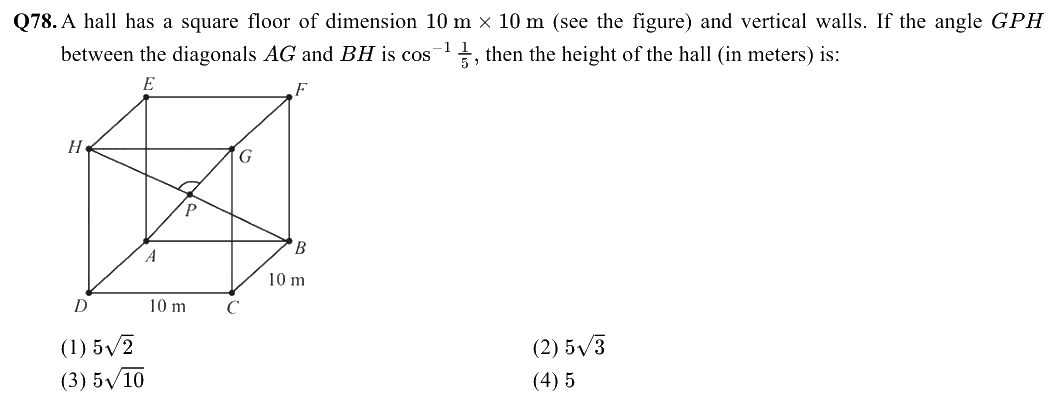
A hall has a square floor of dimension $10\ \mathrm{m}\times10\ \mathrm{m}$ (see the figure) and vertical walls. If the angle $GPH$ between the diagonals $AG$ and $BH$ is $\cos^{-1}\frac{1}{5}$, then the height of the hall (in meters) is: (see the figure above)
Let $P$ be the plane passing through the point $(1,2,3)$ and the line of intersection of the planes $\vec{r}\cdot\left(\hat{i}+\hat{j}+4\hat{k}\right)=16$ & $\vec{r}\cdot\left(-\hat{i}+\hat{j}+\hat{k}\right)=6$. Then which of the following points does NOT lie on $P$?
Let the plane passing through the point $(-1, 0, -2)$ and perpendicular to each of the planes $2x + y - z = 2$ and $x - y - z = 3$ be $ax + by + cz + 8 = 0$. Then the value of $a + b + c$ is equal to:
For real numbers $\alpha$ and $\beta \neq 0$, if the point of intersection of the straight lines $\frac{x - \alpha}{1} = \frac{y - 1}{2} = \frac{z - 1}{3}$ and $\frac{x - 4}{\beta} = \frac{y - 6}{3} = \frac{z - 7}{3}$ lies on the plane $x + 2y - z = 8$, then $\alpha - \beta$ is equal to :
Let the foot of perpendicular from a point $P(1, 2, -1)$ to the straight line $L: \frac{x}{1} = \frac{y}{0} = \frac{z}{-1}$ be $N$. Let a line be drawn from $P$ parallel to the plane $x + y + 2z = 0$ which meets $L$ at point $Q$. If $\alpha$ is the acute angle between the lines $PN$ and $PQ$, then $\cos\alpha$ is equal to ______.
Let $L$ be the line of intersection of planes $\vec{r} \cdot \left(\hat{i} - \hat{j} + 2\hat{k}\right) = 2$ and $\vec{r} \cdot \left(2\hat{i} + \hat{j} - \hat{k}\right) = 2$. If $P(\alpha, \beta, \gamma)$ is the foot of perpendicular on $L$ from the point $(1, 2, 0)$, then the value of $35(\alpha + \beta + \gamma)$ is equal to:
If the shortest distance between the straight lines $3(x - 1) = 6(y - 2) = 2(z - 1)$ and $4(x - 2) = 2(y - \lambda) = (z - 3)$, $\lambda \in R$ is $\frac{1}{\sqrt{38}}$, then the integral value of $\lambda$ is equal to:
Consider the line $L$ given by the equation $\frac{x-3}{2} = \frac{y-1}{1} = \frac{z-2}{1}$. Let $Q$ be the mirror image of the point $(2, 3, -1)$ with respect to $L$. Let a plane $P$ be such that it passes through $Q$, and the line $L$ is perpendicular to $P$. Then which of the following points is on the plane $P$?
If $(a, b, c)$, $a \in \mathbf{Z}$, is the point on $\mathrm{L_3}$ at a distance of $\sqrt{17}$ from the point of intersection of $\mathrm{L_1}$ and $\mathrm{L_2}$, then $(a + b + c)^2$ is equal to ________.
Numerical answer type: type your answer in EdLoop to check it
Let the image of the point $\mathrm{P}(0, -5, 0)$ in the line $\dfrac{x-1}{2} = \dfrac{y}{1} = \dfrac{z+1}{-2}$ be the point R and the image of the point $\mathrm{Q}\left(0, \dfrac{-1}{2}, 0\right)$ in the line $\dfrac{x-1}{-1} = \dfrac{y+9}{4} = \dfrac{z+1}{1}$ be the point S. Then the square of the area of the parallelogram PQRS is ________.
Numerical answer type: type your answer in EdLoop to check it
If the distance of the point P(43, $\alpha$, $\beta$), $\beta < 0$, from the line $\vec{r} = 4\hat{i} - \hat{k} + \mu(2\hat{i} + 3\hat{k})$, $\mu \in \mathbf{R}$ along a line with direction ratios 3, $-1$, 0 is $13\sqrt{10}$, then $\alpha^2 + \beta^2$ is equal to ________.
Numerical answer type: type your answer in EdLoop to check it
Let a line L passing through the point P(1,1,1) be perpendicular to the lines $\dfrac{x-4}{4} = \dfrac{y-1}{1} = \dfrac{z-1}{1}$ and $\dfrac{x-17}{1} = \dfrac{y-71}{1} = \dfrac{z}{0}$. Let the line L intersect the yz-plane at the point Q. Another line parallel to L and passing through the point S(1, 0, $-1$) intersects the yz-plane at the point R. Then the square of the area of the parallelogram PQRS is equal to ________.
Numerical answer type: type your answer in EdLoop to check it
If the image of the point P$(a, 2, a)$ in the line $\dfrac{x}{2} = \dfrac{y + a}{1} = \dfrac{z}{1}$ is Q and the image of Q in the line $\dfrac{x - 2b}{2} = \dfrac{y - a}{1} = \dfrac{z + 2b}{-5}$ is P, then $a + b$ is equal to ________.
Numerical answer type: type your answer in EdLoop to check it
Let the area of the triangle formed by the lines $x + 2 = y - 1 = z$, $\frac{x-3}{5} = \frac{y}{-1} = \frac{z-1}{1}$ and $\frac{x}{-3} = \frac{y-3}{3} = \frac{z-2}{1}$ be $A$. Then $A^2$ is equal to ______.
Numerical answer type: type your answer in EdLoop to check it
Let P be the image of the point $\mathrm{Q}(7, -2, 5)$ in the line $\mathrm{L} : \frac{x-1}{2} = \frac{y+1}{3} = \frac{z}{4}$ and $\mathrm{R}(5, \mathrm{p}, \mathrm{q})$ be a point on $L$. Then the square of the area of $\triangle PQR$ is ______ .
Numerical answer type: type your answer in EdLoop to check it
Let $\mathrm{L}_1 : \frac{x-1}{3} = \frac{y-1}{-1} = \frac{z+1}{0}$ and $\mathrm{L}_2 : \frac{x-2}{2} = \frac{y}{0} = \frac{z+4}{\alpha}$, $\alpha \in \mathbf{R}$, be two lines, which intersect at the point $B$. If $P$ is the foot of perpendicular from the point $A(1, 1, -1)$ on $L_2$, then the value of $26\alpha(\mathrm{PB})^2$ is ______
Numerical answer type: type your answer in EdLoop to check it
Let $\mathrm{P}(\alpha, \beta, \gamma)$ be the image of the point $\mathrm{Q}(1, 6, 4)$ in the line $\frac{x}{1} = \frac{y - 1}{2} = \frac{z - 2}{3}$. Then $2\alpha + \beta + \gamma$ is equal to ______
Numerical answer type: type your answer in EdLoop to check it
Let $P$ be the point $(10, -2, -1)$ and $Q$ be the foot of the perpendicular drawn from the point $R(1, 7, 6)$ on the line passing through the points $(2, -5, 11)$ and $(-6, 7, -5)$. Then the length of the line segment $PQ$ is equal to ______
Numerical answer type: type your answer in EdLoop to check it
If the shortest distance between the lines $\frac{x-\lambda}{3} = \frac{y-2}{-1} = \frac{z-1}{1}$ and $\frac{x+2}{-3} = \frac{y+5}{2} = \frac{z-4}{4}$ is $\frac{44}{\sqrt{30}}$, then the largest possible value of $|\lambda|$ is equal to ______
Numerical answer type: type your answer in EdLoop to check it
Let the point $(-1, \alpha, \beta)$ lie on the line of the shortest distance between the lines $\frac{x+2}{-3} = \frac{y-2}{4} = \frac{z-5}{2}$ and $\frac{x+2}{-1} = \frac{y+6}{2} = \frac{z-1}{0}$. Then $(\alpha - \beta)^2$ is equal to ______
Numerical answer type: type your answer in EdLoop to check it
If the shortest distance between the lines $\frac{x+2}{2} = \frac{y+3}{3} = \frac{z-5}{4}$ and $\frac{x-3}{1} = \frac{y-2}{-3} = \frac{z+4}{2}$ is $\frac{38}{3\sqrt{5}}\mathrm{k}$, and $\int_0^{\mathrm{k}} [x^2]\,dx = \alpha - \sqrt{\alpha}$, where $[x]$ denotes the greatest integer function, then $6\alpha^3$ is equal to ______
Numerical answer type: type your answer in EdLoop to check it
Consider a line L passing through the points $\mathrm{P}(1, 2, 1)$ and $\mathrm{Q}(2, 1, -1)$. If the mirror image of the point $\mathrm{A}(2, 2, 2)$ in the line L is $(\alpha, \beta, \gamma)$, then $\alpha + \beta + 6\gamma$ is equal to ______
Numerical answer type: type your answer in EdLoop to check it
Let the line of the shortest distance between the lines $L_1: \vec{r} = (\hat{i} + 2\hat{j} + 3\hat{k}) + \lambda(\hat{i} - \hat{j} + \hat{k})$ and $L_2: \vec{r} = (4\hat{i} + 5\hat{j} + 6\hat{k}) + \mu(\hat{i} + \hat{j} - \hat{k})$ intersect $L_1$ and $L_2$ at $P$ and $Q$ respectively. If $(\alpha, \beta, \gamma)$ is the midpoint of the line segment $PQ$, then $2(\alpha + \beta + \gamma)$ is equal to ______
Numerical answer type: type your answer in EdLoop to check it
Let $Q$ and $R$ be the feet of perpendiculars from the point $P(a,\ a,\ a)$ on the lines $x = y,\ z = 1$ and $x = -y,\ z = -1$ respectively. If $\angle QPR$ is a right angle, then $12a^2$ is equal to ______.
Numerical answer type: type your answer in EdLoop to check it
A line passes through $A(4, -6, -2)$ and $B(16, -2, 4)$. The point $P(a, b, c)$ where $a, b, c$ are non-negative integers, on the line $AB$ lies at a distance of 21 units, from the point $A$. The distance between the points $P(a, b, c)$ and $Q(4, -12, 3)$ is equal to ______.
Numerical answer type: type your answer in EdLoop to check it
If $d_1$ is the shortest distance between the lines $x + 1 = 2y = -12z$, $x = y + 2 = 6z - 6$ and $d_2$ is the shortest distance between the lines $\frac{x-1}{2} = \frac{y+8}{-7} = \frac{z-4}{5}$, $\frac{x-1}{2} = \frac{y-2}{1} = \frac{z-6}{-3}$, then the value of $\frac{32\sqrt{3}\,d_1}{d_2}$ is :
Numerical answer type: type your answer in EdLoop to check it
Let a line passing through the point $(-1, 2, 3)$ intersect the lines $L_1: \frac{x-1}{3} = \frac{y-2}{2} = \frac{z+1}{-2}$ at $M(\alpha, \beta, \gamma)$ and $L_2: \frac{x+2}{-3} = \frac{y-2}{-2} = \frac{z-1}{4}$ at $N(a, b, c)$. Then the value of $\frac{(\alpha + \beta + \gamma)^2}{(a + b + c)^2}$ equals ______.
Numerical answer type: type your answer in EdLoop to check it
A line with direction ratio 2, 1, 2 meets the lines x = y + 2 = z and x + 2 = 2y = 2z respectively at the point P and Q. if the length of the perpendicular from the point $(1, 2, 12)$ to the line PQ is $l$, then $l^2$ is
Numerical answer type: type your answer in EdLoop to check it
Let $O$ be the origin, and $M$ and $N$ be the points on the lines $\frac{x - 5}{4} = \frac{y - 4}{1} = \frac{z - 5}{3}$ and $\frac{x + 8}{12} = \frac{y + 2}{5} = \frac{z + 11}{9}$ respectively such that $MN$ is the shortest distance between the given lines. Then $\overrightarrow{OM} \cdot \overrightarrow{ON}$ is equal to ______.
Numerical answer type: type your answer in EdLoop to check it
The lines $\frac{x - 2}{2} = \frac{y}{-2} = \frac{z - 7}{16}$ and $\frac{x + 3}{4} = \frac{y + 2}{3} = \frac{z + 2}{1}$ intersect at the point P. If the distance of P from the line $\frac{x + 1}{2} = \frac{y - 1}{3} = \frac{z - 1}{1}$ is $l$, then $14l^2$ is equal to ______.
Numerical answer type: type your answer in EdLoop to check it
Let the plane $P$ contain the line $2x + y - z - 3 = 0 = 5x - 3y + 4z + 9$ and be parallel to the line $\frac{x+2}{2} = \frac{3-y}{-4} = \frac{z-7}{5}$. Then the distance of the point $A(8, -1, -19)$ from the plane $P$ measured parallel to the line $\frac{x}{-3} = \frac{y-5}{4} = \frac{2-z}{-12}$ is equal to ______.
Numerical answer type: type your answer in EdLoop to check it
Let the image of the point $\left(\frac{5}{3}, \frac{5}{3}, \frac{8}{3}\right)$ in the plane $x - 2y + z - 2 = 0$ be $P$. If the distance of the point $Q(6, -2, \alpha)$, $\alpha > 0$, from $P$ is 13, then $\alpha$ is equal to ______.
Numerical answer type: type your answer in EdLoop to check it
Let the plane $x + 3y - 2z + 6 = 0$ meet the co-ordinate axes at the points $A$, $B$, $C$. If the orthocenter of the triangle $ABC$ is $\left(\alpha,\ \beta,\ \frac{6}{7}\right)$, then $98(\alpha + \beta)^2$ is equal to ______.
Numerical answer type: type your answer in EdLoop to check it
Let a line $L$ pass through the origin and be perpendicular to the lines $L_1: \vec{r} = \hat{i} - 11\hat{j} - 7\hat{k} + \lambda\hat{i} + 2\hat{j} + 3\hat{k}$, $\lambda \in \mathbb{R}$ and $L_2: \vec{r} = -\hat{i} + \hat{k} + \mu 2\hat{i} + 2\hat{j} + \hat{k}$, $\mu \in \mathbb{R}$. If $P$ is the point of intersection of $L$ and $L_1$, and $Q\alpha, \beta, \gamma$ is the foot of perpendicular from $P$ on $L_2$, then $9\alpha + \beta + \gamma$ is equal to ______.
Numerical answer type: type your answer in EdLoop to check it
Let the line $L : x = \frac{1 - y}{-2} = \frac{z - 3}{\lambda}$, $\lambda \in \mathbb{R}$ meet the plane $P : x + 2y + 3z = 4$ at the point $(\alpha, \beta, \gamma)$. If the angle between the line $L$ and the plane $P$ is $\cos^{-1}\left(\sqrt{\frac{5}{14}}\right)$, then $\alpha + 2\beta + 6\gamma$ is equal to
Numerical answer type: type your answer in EdLoop to check it
Let the foot of perpendicular from the point $A4, 3, 1$ on the plane $P$: $x - y + 2z + 3 = 0$ be $N$. If $B(5, \alpha, \beta)$, $\alpha, \beta \in \mathbb{Z}$ is a point on plane $P$ such that the area of the triangle $ABN$ is $3\sqrt{2}$, then $\alpha^2 + \beta^2 + \alpha\beta$ is equal to ______
Numerical answer type: type your answer in EdLoop to check it
Let $\lambda_1$, $\lambda_2$ be the values of $\lambda$ for which the points $\left(\frac{5}{2}, 1, \lambda\right)$ and $(-2, 0, 1)$ are at equal distance from the plane $2x + 3y - 6z + 7$ If $\lambda_1 > \lambda_2$ then the distance of the point $(\lambda_1 - \lambda_2, \lambda_2, \lambda_1)$ from the line $\frac{x - 5}{1} = \frac{y - 1}{2} = \frac{z + 7}{2}$ is ______
Numerical answer type: type your answer in EdLoop to check it
Let $P_1$ be the plane $3x - y - 7z = 11$ and $P_2$ be the plane passing through the points $(2, -1, 0)$, $(2, 0, -1)$, and $(5, 1, 1)$. If the foot of the perpendicular drawn from the point $(7, 4, -1)$ on the line of intersection of the planes $P_1$ and $P_2$ is $(\alpha, \beta, \gamma)$, then $\alpha + \beta + \gamma$ is equal to
Numerical answer type: type your answer in EdLoop to check it
Let the image of the point $P(1, 2, 3)$ in the plane $2x - y + z = 9$ be $Q$. If the coordinates of the point $R$ are $(6, 10, 7)$, then the square of the area of the triangle $PQR$ is ______ .
Numerical answer type: type your answer in EdLoop to check it
If the lines $\frac{x-1}{2} = \frac{2-y}{-3} = \frac{z-3}{\alpha}$ and $\frac{x-4}{5} = \frac{y-1}{2} = \frac{z}{\beta}$ intersect, then the magnitude of the minimum value of $8\alpha\beta$ is ______ .
Numerical answer type: type your answer in EdLoop to check it
Let $\alpha x + \beta y + \gamma z = 1$ be the equation of a plane passing through the point $(3, -2, 5)$ and perpendicular to the line joining the points $(1, 2, 3)$ and $(-2, 3, 5)$. Then the value of $\alpha\ \beta\ \gamma$ is equal to ______.
Numerical answer type: type your answer in EdLoop to check it
The point of intersection $C$ of the plane $8x + y + 2z = 0$ and the line joining the points $A(-3, -6, 1)$ and $B(2, 4, -3)$ divides the line segment $AB$ internally in the ratio $k : 1$. If $a, b, c$ ($|a|, |b|, |c|$ are coprime) are the direction ratios of the perpendicular from the point $C$ on the line $\dfrac{1-x}{1} = \dfrac{y+4}{2} = \dfrac{z+2}{3}$, then $|a + b + c|$ is equal to ______.
Numerical answer type: type your answer in EdLoop to check it
Let the line L: $\dfrac{x - 1}{2} = \dfrac{y + 1}{-1} = \dfrac{z - 3}{1}$ intersect the plane $2x + y + 3z = 16$ at the point $P$. Let the point $Q$ be the foot of perpendicular from the point $R1, -1, -3$ on the line $L$. If $\alpha$ is the area of triangle $PQR$. then $\alpha^2$ is equal to ______.
Numerical answer type: type your answer in EdLoop to check it
Let $\theta$ be the angle between the planes $P_1 = \vec{r} \cdot \hat{i} + \hat{j} + 2\hat{k} = 9$ and $P_2 = \vec{r} \cdot 2\hat{i} - \hat{j} + \hat{k} = 15$. Let L be the line that meets $P_2$ at the point 4, - 2, 5 and makes an angle $\theta$ with the normal of $P_2$. If $\alpha$ is the angle between $L$ and $P_2$ then $\tan^2\theta\cot^2\alpha$ is equal to ______.
Numerical answer type: type your answer in EdLoop to check it
If the equation of the plane passing through the point $(1, 1, 2)$ and perpendicular to the line $x - 3y + 2z - 1 = 0 = 4x - y + z$ is $Ax + By + Cz = 1$, then $140(C - B + A)$ is equal to
Numerical answer type: type your answer in EdLoop to check it
If $\lambda_1 < \lambda_2$ are two values of $\lambda$ such that the angle between the planes $P_1: \vec{r}\left(3\hat{i} - 5\hat{j} + \hat{k}\right) = 7$ and $P_2: \vec{r} \cdot \left(\lambda\hat{i} + \hat{j} - 3\hat{k}\right) = 9$ is $\sin^{-1}\frac{2\sqrt{6}}{5}$, then the square of the length of perpendicular from the point $38\lambda_1, 10\lambda_2, 2$ to the plane $P_1$ is
Numerical answer type: type your answer in EdLoop to check it
Let a line $L$ pass through the point $P(2, 3, 1)$ and be parallel to the line $x + 3y - 2z - 2 = 0 = x - y + 2z$. If the distance of $L$ from the point $(5, 3, 8)$ is $\alpha$, then $3\alpha^2$ is equal to ______ .
Numerical answer type: type your answer in EdLoop to check it
Let the equation of the plane P containing the line $x + 10 = \frac{8 - y}{2} = z$ be $ax + by + 3z = 2(a + b)$ and the distance of the plane P from the point $(1, 27, 7)$ be $c$. Then $\mathrm{a}^2 + \mathrm{b}^2 + \mathrm{c}^2$ is equal to
Numerical answer type: type your answer in EdLoop to check it
Let the co-ordinates of one vertex of $\triangle ABC$ be $A(0, 2, \alpha)$ and the other two vertices lie on the line $\frac{x + \alpha}{5} = \frac{y - 1}{2} = \frac{z + 4}{3}$. For $\alpha \in \mathbb{Z}$, if the area of $\triangle ABC$ is 21 sq. units and the line segment $BC$ has length $2\sqrt{21}$ units, then $\alpha^2$ is equal to ______ .
Numerical answer type: type your answer in EdLoop to check it
Let the equation of the plane passing through the line $x - 2y - z - 5 = 0 = x + y + 3z - 5$ and parallel to the line $x + y + 2z - 7 = 0 = 2x + 3y + z - 2$ be $ax + by + cz = 65$. Then the distance of the point $(a, b, c)$ from the plane $2x + 2y - z + 16 = 0$ is ______ .
Numerical answer type: type your answer in EdLoop to check it
If the shortest distance between the line joining the points $(1,2,3)$ and $(2,3,4)$, and the line $\frac{x-1}{2}=\frac{y+1}{-1}=\frac{z-2}{0}$ is $\alpha$, then $28\alpha^{2}$ is equal to ______ .
Numerical answer type: type your answer in EdLoop to check it
If the shortest distance between the lines $\frac{x+\sqrt{6}}{2}=\frac{y-\sqrt{6}}{3}=\frac{z-\sqrt{6}}{4}$ and $\frac{x-\lambda}{3}=\frac{y-2\sqrt{6}}{4}=\frac{z+2\sqrt{6}}{5}$ is 6, then sum of squares of all possible values(s) of $\lambda$ is
Numerical answer type: type your answer in EdLoop to check it
Let a line with direction ratios $a, -4a, -7$ be perpendicular to the lines with direction ratios $3, -1, 2b$ and $b, a, -2$. If the point of intersection of the line $\frac{x + 1}{a^2 + b^2} = \frac{y - 2}{a^2 - b^2} = \frac{z}{1}$ and the plane $x - y + z = 0$ is $(\alpha, \beta, \gamma)$, then $\alpha + \beta + \gamma$ is equal to ______.
Numerical answer type: type your answer in EdLoop to check it
Let $P(-2,-1,1)$ and $Q\left(\frac{56}{17},\frac{43}{17},\frac{111}{17}\right)$ be the vertices of the rhombus $PRQS$. If the direction ratios of the diagonal $RS$ are $\alpha,-1,\beta$, where both $\alpha$ and $\beta$ are integers of minimum absolute values, then $\alpha^{2}+\beta^{2}$ is equal to
Numerical answer type: type your answer in EdLoop to check it
Let the line $\frac{x - 3}{7} = \frac{y - 2}{-1} = \frac{z - 3}{-4}$ intersect the plane containing the lines $\frac{x - 4}{1} = \frac{y + 1}{-2} = \frac{z}{1}$ and $4ax - y + 5z - 7a = 0 = 2x - 5y - z - 3$, $a \in \mathbb{R}$ at the point $P(\alpha, \beta, \gamma)$. Then the value of $\alpha + \beta + \gamma$ equals ______ .
Numerical answer type: type your answer in EdLoop to check it
Let $Q$ and $R$ be two points on the line $\frac{x+1}{2} = \frac{y+2}{3} = \frac{z-1}{2}$ at a distance $\sqrt{26}$ from the point $P(4, 2, 7)$. Then the square of the area of the triangle $PQR$ is ________ .
Numerical answer type: type your answer in EdLoop to check it
The largest value of $a$, for which the perpendicular distance of the plane containing the lines $\vec{r} = \hat{i} + \hat{j} + \lambda\hat{i} + a\hat{j} - \hat{k}$ and $\vec{r} = \hat{i} + \hat{j} + \mu\text{-}\hat{i} + \hat{j} - a\hat{k}$ from the point $2, 1, 4$ is $\sqrt{3}$, is ______ .
Numerical answer type: type your answer in EdLoop to check it
The plane passing through the line $L: l\ x - y + 31 - l\ z = 1, x + 2y - z = 2$ and perpendicular to the plane $3x + 2y + z = 6$ is $3x - 8y + 7z = 4$. If $\theta$ is the acute angle between the line $L$ and the $y$-axis, then $415\ \cos^2\theta$ is equal to ______ .
Numerical answer type: type your answer in EdLoop to check it
The line of shortest distance between the lines $\frac{x - 2}{0} = \frac{y - 1}{1} = \frac{z}{1}$ and $\frac{x - 3}{2} = \frac{y - 5}{2} = \frac{z - 1}{1}$ makes an angle of $\sin^{-1}\sqrt{\frac{2}{27}}$ with the plane $P: ax - y - z = 0$, $a > 0$. If the image of the point $1, 1, -5$ in the plane $P$ is $\alpha, \beta, \gamma$, then $\alpha + \beta - \gamma$ is equal to ______.
Numerical answer type: type your answer in EdLoop to check it
Let $d$ be the distance between the foot of perpendiculars of the points $P(1, 2, -1)$ and $Q(2, -1, 3)$ on the plane $-x + y + z = 1$. Then $d^2$ is equal to ______.
Numerical answer type: type your answer in EdLoop to check it
Let $P_1 : \vec{r} \cdot \left(2\hat{i} + \hat{j} - 3\hat{k}\right) = 4$ be a plane. Let $P_2$ be another plane which passes through the points $(2, -3, 2)(2, -2, -3)$ and $(1, -4, 2)$. If the direction ratios of the line of intersection of $P_1$ and $P_2$ be $16, \alpha, \beta$, then the value of $\alpha + \beta$ is equal to ______.
Numerical answer type: type your answer in EdLoop to check it
Let the image of the point $P(1, 2, 3)$ in the line $L : \frac{x-6}{3} = \frac{y-1}{2} = \frac{z-2}{3}$ be $Q$. let $R(\alpha, \beta, \gamma)$ be a point that divides internally the line segment $PQ$ in the ratio $1 : 3$. Then the value of $22(\alpha + \beta + \gamma)$ is equal to
Numerical answer type: type your answer in EdLoop to check it
Let the mirror image of the point $(a, b, c)$ with respect to the plane $3x - 4y + 12z + 19 = 0$ be $(a - 6, \beta, \gamma)$. If $a + b + c = 5$, then $7\beta - 9\gamma$ is equal to ______ .
Numerical answer type: type your answer in EdLoop to check it
Let the lines $L_1: \vec{r} = \lambda\left(\hat{i} + 2\hat{j} + 3\hat{k}\right)$, $\lambda \in R$ and $L_2: \vec{r} = \hat{i} + 3\hat{j} + \hat{k} + \mu \left( \hat{i} + \hat{j} + 5\hat{k} \right)$; $\mu \in R$, intersect at the point $S$. If a plane $ax + by - z + d = 0$ passes through $S$ and is parallel to the lines $L_1$ and $L_2$, then the value of $a + b + d$ is equal to ______ .
Numerical answer type: type your answer in EdLoop to check it
Let $l_1$ be the line in $xy$-plane with $x$ and $y$ intercepts $\frac{1}{8}$ and $\frac{1}{4\sqrt{2}}$ respectively, and $l_2$ be the line in $zx$-plane with $x$ and $z$ intercepts $-\frac{1}{8}$ and $-\frac{1}{6\sqrt{3}}$ respectively. If $d$ is the shortest distance between the line $l_1$ and $l_2$, then $d^{-2}$ is equal to ______ .
Numerical answer type: type your answer in EdLoop to check it
Let a line having direction ratios $1, -4, 2$ intersect the lines $\frac{x-7}{3} = \frac{y-1}{-1} = \frac{z+2}{1}$ and $\frac{x}{2} = \frac{y-7}{3} = \frac{z}{1}$ at the points $A$ and $B$. Then $(AB)^2$ is equal to
Numerical answer type: type your answer in EdLoop to check it
If the shortest distance between the lines $\vec{r} = \left(-\hat{i} + 3\hat{k}\right) + \lambda\left(\hat{i} - a\hat{j}\right)$ and $\vec{r}' = \left(-\hat{j} + 2\hat{k}\right) + \mu\left(\hat{i} - \hat{j} + \hat{k}\right)$ is $\sqrt{\frac{2}{3}}$, then the integral value of $a$ is equal to ______
Numerical answer type: type your answer in EdLoop to check it
The square of the distance of the point of intersection of the line $\frac{x-1}{2} = \frac{y-2}{3} = \frac{z+1}{6}$ and the plane $2x - y + z = 6$ from the point $(-1, -1, 2)$ is ______
Numerical answer type: type your answer in EdLoop to check it
Suppose the line $\frac{x - 2}{\alpha} = \frac{y - 2}{-5} = \frac{z + 2}{2}$ lies on the plane $x + 3y - 2z + \beta = 0$. Then $(\alpha + \beta)$ is equal to ______
Numerical answer type: type your answer in EdLoop to check it
Let $S$ be the mirror image of the point $Q(1,3,4)$ with respect to the plane $2x-y+z+3=0$ and let $R(3,5,\gamma)$ be a point of this plane. Then the square of the length of the line segment $SR$ is
Numerical answer type: type your answer in EdLoop to check it
Let the line $L$ be the projection of the line $\frac{x-1}{2}=\frac{y-3}{1}=\frac{z-4}{2}$ in the plane $x-2y-z=3$. If $d$ is the distance of the point $(0,0,6)$ from $L$, then $d^{2}$ is equal to
Numerical answer type: type your answer in EdLoop to check it
Let $Q$ be the foot of the perpendicular from the point $P(7,-2,13)$ on the plane containing the lines $\frac{x+1}{6}=\frac{y-1}{7}=\frac{z-3}{8}$ and $\frac{x-1}{3}=\frac{y-2}{5}=\frac{z-3}{7}$. Then $(PQ)^{2}$ is equal to ______.
Numerical answer type: type your answer in EdLoop to check it
Let a plane $P$ pass through the point $(3, 7, -7)$ and contain the line, $\frac{x - 2}{-3} = \frac{y - 3}{2} = \frac{z + 2}{1}$. If distance of the plane $P$ from the origin is $d$, then $d^2$ is equal to
Numerical answer type: type your answer in EdLoop to check it
The distance of the point $P(3, 4, 4)$ from the point of intersection of the line joining the points $Q(3, -4, -5)$ and $R(2, -3, 1)$ and the plane $2x + y + z = 7$, is equal to ______.
Numerical answer type: type your answer in EdLoop to check it
If the lines $\frac{x - k}{1} = \frac{y - 2}{2} = \frac{z - 3}{3}$ and $\frac{x + 1}{3} = \frac{y + 2}{2} = \frac{z + 3}{1}$ are co-planar, then the value of $k$ is ______.
Numerical answer type: type your answer in EdLoop to check it
Let $P$ be a plane passing through the points $(1, 0, 1)$, $(1, -2, 1)$ and $(0, 1, -2)$. Let a vector $\vec{a} = \alpha\hat{i} + \beta\hat{j} + \gamma\hat{k}$ be such that $\vec{a}$ is parallel to the plane $P$, perpendicular to $\left(\hat{i} + 2\hat{j} + 3\hat{k}\right)$ and $\vec{a} \cdot \left(\hat{i} + \hat{j} + 2\hat{k}\right) = 2$, then $\left(\alpha - \beta + \gamma\right)^2$ equals ______.
Numerical answer type: type your answer in EdLoop to check it
How to prepare Three Dimensional Geometry for JEE Main
How often it comes up
Three dimensional geometry is the single highest-weight chapter in JEE Main mathematics under Unit 11: Three Dimensional Geometry in the Class 12 curriculum, claiming rank 1 among the 29 chapters in the subject. Between 2019 and 2026, 330 questions were asked from this chapter across 162 papers, representing 7.2 percent of all mathematics questions. It appeared in all 162 papers, meaning every paper in that period contained questions from this chapter, and it has surfaced every year since 2019. Over the recent 2024 to 2026 testing sessions, it contributed 107 questions across 58 papers, averaging 1.8 questions per paper and holding a 6.9 percent subject share. Comparing the earlier 2002 to 2018 share of 6.6 percent with 2024 to 2026 shows that its long-term share is about the same, while comparing 2019 to 2026 against 2024 to 2026 also shows it is about the same. Across the complete historical record from 2002 to 2026 covering 200 papers, 416 questions were asked across all 200 papers, with 86 numerical answer questions appearing between 2019 and 2026.
Students will find questions from this chapter in every examination shift without exception, with the majority featuring two or three distinct problems. The annual totals during 2024, 2025, and 2026 were 41, 34, and 32 questions respectively.
Even with the formal removal of plane equations from the syllabus starting in 2024, the chapter has maintained its top-tier prominence. Modern examination shifts focus intensively on skew lines, shortest distance calculations, parametric coordinates of line points, foot of perpendiculars, and reflections in spatial lines.
Most-asked topics
Questions in this chapter organize across four distinct topics:
1. Lines (176 questions, 2019-2026; 198 total, last asked 2026) The predominant topic in recent papers. Focuses on symmetric equations of lines, finding points of intersection between intersecting lines, shortest distance between skew lines, conditions for coplanarity, foot of the perpendicular from a point to a line, and image reflections across lines.
2. Planes (140 questions, 2019-2026; 186 total, last asked 2023) Historically the largest component, covering equations of planes passing through three points, distance of a point from a plane, angle between intersecting planes, line of intersection of two planes, and family of planes. This topic was officially removed from the syllabus in 2024, which is why it was last asked in 2023.
3. Points & Direction Cosines (14 questions, 2019-2026; 27 total, last asked 2026) Deals with direction cosines and direction ratios of lines, simultaneous linear and quadratic equations satisfied by direction components, angles between vectors, projection of spatial segments, and section formulas.
4. Sphere (legacy) (0 questions, 2019-2026; 5 total, last asked 2007) Covered basic equations of spheres, diametric forms, and plane intersections in old AIEEE papers before being retired long ago.
What the questions look like
Examiners test three-dimensional lines through several reliable problem patterns:
Shortest Distance Between Skew Lines: Given two skew lines in symmetric form, compute the shortest distance connecting them using the scalar triple product formula or finding endpoints of the common perpendicular.
Foot of Perpendicular and Spatial Image: Dropping a perpendicular from a point onto a line, finding the coordinates of the foot by enforcing orthogonality with direction ratios, and determining the reflected point.
Direction Cosines from Simultaneous Relations: Solving a linear and a quadratic relation in direction ratios l, m, and n to deduce the angle between two lines.
Line Intersecting Two Given Lines: Constructing a third line intersecting two given skew lines at points C and D, followed by evaluating the distance squared between C and D.
Questions to try first
Begin your practice with these representative problems from the question archives:
Express points on a line parametrically: Set the symmetric line ratio equal to lambda. A general point on the line then has coordinates linearly dependent on lambda, converting geometric intersections and perpendicularity checks into simple linear equations.
Master the shortest distance formula: For lines r equals a1 plus lambda b1 and r equals a2 plus mu b2, the shortest distance is the magnitude of the dot product of a2 minus a1 with the cross product of b1 and b2, divided by the magnitude of that cross product.
Enforce orthogonality via dot products: To locate the foot of the perpendicular from an external point to a line, represent the foot as a general parametric point F(lambda). The vector connecting the external point to F must have a zero dot product with the direction vector of the line.
Recognise coplanar lines: Two lines are coplanar if they either intersect or are parallel. Setting the determinant formed by the difference vector a2 minus a1 and both direction vectors equal to zero directly provides the condition for coplanarity.
Frequently asked questions
Are plane equations completely excluded from JEE Main now?
Yes, plane equations were explicitly removed from the official NTA syllabus starting with the 2024 examination. Recent papers contain zero questions on planes, focusing entirely on spatial lines, direction cosines, and vector projections.
How do I check if two lines in space intersect?
Compute the shortest distance between them. If the scalar triple product of the vector joining a point on each line with the two direction vectors equals zero, the lines lie in a common plane. If their direction vectors are not parallel, they intersect at a single unique point.
Why does this chapter hold rank 1 in subject share?
Three-dimensional geometry has consistently provided two or more questions in every examination sitting, accounting for 330 questions and a 7.2 percent share of all mathematics questions between 2019 and 2026. Its procedural nature makes it one of the most reliable testing opportunities in the exam. Step-by-step solutions for each one are in the EdLoop app.