Every Atomic Structure question from past AP EAPCET and TS EAPCET papers, with options and answers. Newest first.
325questions
148papers covered
5.2%of Chemistry questions, 2022–2026
2010–2026years
Guide at a glance
Atomic Structure is one of the heaviest chapters in Class 11 physical chemistry for both Telugu states. Within the papers we hold for AP and TS EAPCET between 2022 and 2026, this unit brought 161 questions across 77 papers.
Threshold frequencies of the metals $A$, $B$ respectively are $4 \times 10^{14}$ $Hz$ and $6 \times 10^{14}$ $Hz$. If both are irradiated with light of frequency $10^{15}$ $Hz$, what is the ratio of the kinetic energy of electrons emitted from $A$ and $B$?
Wavelength of a particular line in Balmer series of atomic spectrum of hydrogen is 656.4 $nm$. What is the wavelength (in $nm$) of corresponding line in the spectrum of $He^+$?
In an atom, electron is moving with a speed of $x\ ms^{-1}$. If its speed is measured within an accuracy of 0.001%, what is its uncertainty in position (in $m$)?
The threshold frequency of a metal is $1.15 \times 10^{15}$ Hz. If electrons with kinetic energy of 0.20 eV are ejected when this metal surface is irradiated with photons of frequency '$\nu$', the value of $\nu$ is ($h = 6.60 \times 10^{-34}$ Js, 1 eV $= 1.6 \times 10^{-19}$ J)
If the energy required to remove an electron from the ground state of $\mathrm{He^+}$ is $x$ J, the energy (in J) required to remove an electron from the ground state of $\mathrm{Li^{2+}}$ is
The wavelength of spectral line ($X$) of hydrogen spectrum is same as that of spectral line of $He^+$ spectrum corresponding to $n = 4 \rightarrow n = 2$ electron transition. The correct electron transition corresponding to $X$ is
The radius of first Bohr orbit of hydrogen is $a_0$ $nm$. What is the de Broglie wavelength (in $nm$) associated with electron present in fourth orbit of hydrogen?
A ball has a mass of 50g and a speed of 50 m/s. If the speed is measured within an accuracy of 2%, the uncertainty in its position (in m) is ($\mathrm{h} = 6.626 \times 10^{-34}$ J s, $\pi$=3.14)
The work function of Mg, Cu, Ag, Li are 3.7, 4.8, 4.3, 2.5 eV respectively. A wavelength of 300 nm light is shined on them. The metals which undergo photoelectric effect are
In a photoelectric effect, the kinetic energy of electrons is $1.3 \times 10^{-19}$ J. If work function of the metal is 2.27 eV, then the frequency (in Hz) of the incident radiation is ($h = 6.6 \times 10^{-34}$ Js, $1\,\mathrm{eV} = 1.6 \times 10^{-19}$ J)
The energy of spectral line of lowest frequency in Lyman series of $\mathrm{Li^{2+}}$ spectrum is $x$ J. The energy of second spectral line in Balmer series of $\mathrm{He^+}$ spectrum is $y$ J. The ratio of $x$ and $y$ is
If the radius of the first Bohr orbit of $He^{+}$ is $26.45\ pm$, then the de Broglie wavelength (in $m$) associated with the electron present in its fourth orbit is ($\pi = 3.14$)
Consider the elements with atomic number ($Z$) from 11 to 18. The ratio of number of $s$-electrons to $p$-electrons in element $X$ is $2:3$ and in element $Y$ is $3:5$. What are $X$ and $Y$?
In an atomic spectrum of hydrogen, a series of lines with wavelengths at 656.46, 486.27, $x$ and 410.29 nm was obtained. What is the value of $x$ (in nm)?
Wavelength of a photon emitted during electron transition from $n = 4$ state to $n = 2$ state in the hydrogen atom is $x$ nm. Wavelength of a photon emitted during electron transition from $n = 4$ state to $n = 1$ state in the same atom is $y$ nm. $\frac{y}{x}$ is equal to
The de Broglie wavelength associated with a pebble of mass $6.63\ g$ travelling with velocity $\underline{x}\ ms^{-1}$ is $10^{-24}$ nm. What is the value of $x$?
If $\nu_0$ and $\nu$ represent the threshold frequency and frequency of incident light respectively, then the correct equation for the velocity of photoelectrons emitted from the metal surface will be
The work function of three metals A, B and C is respectively 2.25, 2.42 and 3.6 eV. All the three metals were irradiated with light of wavelength 330 nm. The kinetic energy of photoelectrons emitted from A, B and C is respectively $\mathrm{E_A, E_B}$ and $\mathrm{E_C}$. The correct relationship of $\mathrm{E_A, E_B}$ and $\mathrm{E_C}$ is
The kinetic energy of photo electron emitted from the surface of a metal is $7.2\times10^{-20}$ J , when the metal is made to strike with light having wavelength $x$ nm. What is the value of $x$?
(Work function of metal = 4.5 eV; h = $6.6\times10^{-34}$ Js; c = $3\times10^{8}$ ms$^{-1}$; 1 eV = $1.6\times10^{-19}$ J )
The velocity of the photoelectron (in $\mathrm{ms^{-1}}$) emitted when a smooth surface of a metal is made to strike with a photon of wavelength $4\times10^{-7}\,\mathrm{m}$ is (W$_0$ of metal = 2.13 eV ; 1 eV = $1.6\times10^{-19}$ J ; h = $6.6\times10^{-34}$ Js ; $\mathrm{m_e}$ = $9.1\times10^{-31}$ kg)
In hydrogen atom, electron is present in $\mathrm{n_x}$ state. The energy of Lyman spectral line of hydrogen spectrum originated from $\mathrm{n_x}$ state is $1.635\times10^{-18}$ J. What is the approximate energy (in J) required to excite this electron from $\mathrm{n_x}$ state to $(\mathrm{n_x}+1)$ state?
In H atom, electron is present in $\mathrm{n_x}$ state. The angular momentum of this electron is $1.051\times10^{-34}$ Js. What is the energy (in J) required to excite this electron from $\mathrm{n_x}$ state to $(\mathrm{n_x}+1)$ state? ($h=6.6\times10^{-34}$ Js; $\pi=3.14$)
The work function of Cu is $7.68\times10^{-19}$ J. If photons of wavelength 221 nm are made to strike the surface of the metal, the kinetic energy (in J) of the ejected electrons will be (h = $6.63 \times 10^{-34}$ Js)
In an element with atomic number (Z) 25, the number of electrons with $(n + l)$ value equal to 3 and 4 are $x$ and $y$ respectively. The value of $(x + y)$ is
a, b, c, d are electromagnetic radiations. Frequencies of a, b are $3\times10^{15}$ Hz, $2\times10^{14}$ Hz, respectively, whereas wavelength of c, d are 400 nm, 750 nm, respectively. The increasing order of their energies is
The work functions (in eV) of Mg, Cu, Ag, Na respectively are 3.7, 4.8, 4.3, 2.3. From how many metals, the electrons will be ejected if their surfaces are irradiated with an electromagnetic radiation of wavelength 300 nm ?
The radius of fourth orbit in $\mathrm{He^+}$ ion is '$\mathrm{R_1}$' pm and radius of third orbit in $\mathrm{Li^{2+}}$ ion is '$\mathrm{R_2}$' pm. The value of $(\mathrm{R_1 - R_2})$ in pm is
The deBroglie wavelengths of two fast moving particles X, Y are 1 nm, 3 nm respectively. Mass of X is nine times the mass of Y. The ratio of kinetic energies of X, Y is
The uncertainty in the velocities of two particles A and B are 0.03 and 0.01 $\mathrm{m\,s^{-1}}$ respectively. The mass of B is four times to the mass of A. The ratio of uncertainties in their positions is
The wavenumber of the first line ($\mathrm{n_2} = 3$) in the Balmer series of hydrogen is $\overline{\mathrm{v}}_1\ \mathrm{cm^{-1}}$. What is the wavenumber (in $\mathrm{cm^{-1}}$) of the second line ($\mathrm{n_2} = 4$) in the Balmer series of $\mathrm{He^+}$ ?
The difference between the radii of $3^{\mathrm{rd}}$ and $2^{\mathrm{nd}}$ orbit of H-atom is $x$ pm. The difference between the radii of $4^{\mathrm{th}}$ and $3^{\mathrm{rd}}$ orbit of $\mathrm{Li^{2+}}$ ion is $y$ pm. $y : x$ is equal to
When a metal surface is irradiated with light of frequency $x$ Hz, the kinetic energy of emitted photoelectrons is $z$ J. When the same metal is irradiated with light of frequency $y$ Hz, the kinetic energy of emitted electrons is $\frac{z}{3}$ J. What is the threshold frequency (in Hz) of metal ?
Identify the correct statements from the following
I) Isotopes of an element show different chemical behaviour
II) Lyman series of lines of hydrogen spectrum appear in UV region
III) The oscillating electric and magnetic field components of electromagnetic radiation are perpendicular to each other and both are perpendicular to the direction of propagation of radiation
The uncertainty in the position of electron ($\Delta x$) is approximately 100 pm. The uncertainty in momentum (in $\mathrm{kg\ m\ s^{-1}}$) of an electron is [h = $6.626\times10^{-34}$ Js]
Which of the following statements are correct ? (only)
I) The energy of hydrogen atom in its ground state is $-13.6$ eV
II) On the basis of Bohr's model, the radius of the $3^{\mathrm{rd}}$ orbit of hydrogen atom is 158.7 pm
III) The order of radius of the first orbit of H, $\mathrm{He^+}$, $\mathrm{Li^{2+}}$ and $\mathrm{Be^{3+}}$ is $\mathrm{H} > \mathrm{He^+} > \mathrm{Li^{2+}} > \mathrm{Be^{3+}}$
An electromagnetic radiation of wavelength 331.5 nm is made to strike the surface of a metal. Electrons are emitted with a kinetic energy of $1.2\times10^{5}\,\mathrm{J\,mol^{-1}}$. The work function (in eV) of the metal is $(\mathrm{h}=6.63\times10^{-34}\,\mathrm{Js},\ \mathrm{N_A}=6\times10^{23}\,\mathrm{mol^{-1}})$
In hydrogen atom, an electron is transferred from an orbit of radius 1.3225 nm to another orbit of radius 0.2116 nm. What is the energy (in J) of emitted radiation?
The energy associated with electron in first orbit of hydrogen atom is $-2.18\times10^{-18}\,\mathrm{J}$. The frequency of the light required (in Hz) to excite the electron to fifth orbit is
In the atomic spectrum of hydrogen, the wavelengths of the spectral lines corresponding to electronic transitions (i) n = 4 to n = 2 and (ii) n = 3 to n = 1 are $\lambda_1$ and $\lambda_2$ Å respectively. The value of $(\lambda_1 - \lambda_2)$ (in cm) is
Work functions of four metals $\mathrm{M_1}$, $\mathrm{M_2}$, $\mathrm{M_3}$ and $\mathrm{M_4}$ are 4.8, 4.3, 4.75 and 3.75 eV respectively. The metals which do not show photoelectric effect when light of wavelength 310 nm falls on the metals are
A
$\mathrm{M_1}$, $\mathrm{M_2}$ only
B
$\mathrm{M_1}$, $\mathrm{M_3}$ only
C
$\mathrm{M_1}$, $\mathrm{M_2}$, $\mathrm{M_3}$ only
D
$\mathrm{M_1}$, $\mathrm{M_2}$, $\mathrm{M_4}$ only
When electromagnetic radiation of wavelength 310 nm falls on the surface of a metal having work function 3.55 eV, the velocity of photoelectrons emitted is $x \times 10^5\,\mathrm{ms^{-1}}$. The value of $x$ is (Nearest integer)
The electron in hydrogen atom undergoes transition from higher orbits to an orbit of radius 476.1 pm. This transition corresponds to which of the following series?
If the position of the electron was measured with an accuracy of $\pm 0.002$ nm, the uncertainty in the momentum of it would be (in $\mathrm{kg\,ms^{-1}}$) ($h = 6.626 \times 10^{-34}$ J s)
If the longest wavelength of spectral line of Paschen series of $\mathrm{Li^{2+}}$ ion spectrum is $x$ Å, then the longest wavelength (in Å) of Lyman series of hydrogen spectrum is
If $v_0$ is the threshold frequency of a metal X, the correct relation between de Broglie wavelength ($\lambda$) associated with photoelectron and frequency ($v$) of the incident radiation is
If $\lambda_0$ and $\lambda$ are respectively the threshold wavelength and wavelength of incident light, the velocity of photo electrons ejected from the metal surface is
The angular momentum of an electron in a stationary state of $\mathrm{Li^{2+}}$ ($Z = 3$) is $3h/\pi$. The radius and energy of that stationary state are respectively
In the ground state of hydrogen atom, electron absorbs 1.5 times energy than the minimum energy $(2.18 \times 10^{-18}\ \mathrm{J})$ to escape from the atom. The wavelength of the emitted electron (in m) is $(m_e = 9 \times 10^{-31}\ \mathrm{kg})$
If $n, l$ represent the principal and azimuthal quantum numbers respectively, the formula used to know the number of radial nodes possible for a given orbital is
The wavenumber of first spectral line of Lyman series of $\mathrm{He^+}$ ion is $x\ \mathrm{m^{-1}}$. What is the wavenumber (in $\mathrm{m^{-1}}$) of second spectral line of Balmer series of $\mathrm{Li^{2+}}$ ion?
The uncertainty in determination of position of a small ball of mass 10 g is $10^{-33}$ m. With what % of accuracy its speed can be measured, if it has a speed of 52.5 $\mathrm{ms^{-1}}$?
Identify the pair of species having same energy from the following (The number given in the bracket corresponds to principal quantum number (n) in which the electron is present)
The kinetic energy of electrons emitted, when radiation of frequency $1.0 \times 10^{15}$ Hz hits a metal, is $2 \times 10^{-19}$ J. What is the threshold frequency of the metal (in Hz)?
Identify the region of spectral lines of electromagnetic spectrum, when electron transition takes place from higher energy levels to $n = 3, 4, 5$ in atomic spectrum of hydrogen is
The angular momentum of electron in H atom in a particular n state is $\frac{h}{\pi}$. What is the energy in J required to excite the electron from this particular n state to (n+1) state?
A photon of wavelength $3000\ \mathring{\mathrm{A}}$ strikes a metal surface. The work function of the metal is 2.13 eV. What is the kinetic energy of the emitted photoelectron?
A 100 watt bulb emits light of wavelength 'x'Å. What is the value of $x$, if the number of photons emitted is $2.0\times10^{20}\,\mathrm{s^{-1}}$? (h$=6.63\times10^{-34}$ Js, 1 watt $=1\ \mathrm{Js^{-1}}$)
The threshold frequency of a metal is $10^{15}\,s^{-1}$. The ratio of maximum kinetic energies of the photoelectrons, when the metal is made to strike with radiations of frequencies $1.5\times10^{15}\,s^{-1}$ and $2.0\times10^{15}\,s^{-1}$ respectively is
The wavelength of second line of Balmer series of hydrogen atom is $\lambda$ nm. What is the wavelength of first line of Lyman series of $\mathrm{He^+}$ ion (in nm)?
The maximum number of orbitals present in n = 4 energy level of an atom and the maximum number of electrons with spin value $+\dfrac{1}{2}$ in the same orbitals are ______, respectively.
Choose the correct statements in reference to the photoelectric effect. a) There is no time lag between the striking of light and ejection of electrons from the metal surface. b) The number of electrons ejected is independent of the intensity of light. c) The elements K, Rb and Cs can show photoelectric effect when exposed to the beam of light.
Assertion (A) : Mo has the ground state electronic configuration $4d^5\ 5s^1$. Reason (R) : Mo has the highest exchange energy among the second row transition elements. The correct option among the following is
A
(A) is true, (R) is true and (R) is the correct explanation for (A)
B
(A) is true, (R) is true but (R) is not the correct explanation for (A)
If the radius and energy of the second Bohr orbit of hydrogen atom is $r_{2}$ and $E_{2}$, respectively. The radius and energy of the third Bohr orbit will be ______, ______ respectively.
The velocity of the electron in Bohr's first orbit is $x \times 10^6\ \mathrm{m\,s^{-1}}$. The deBroglie wave length associated with it (in nm) is ($m_e = 9 \times 10^{-31}$ kg, $h = 6.6 \times 10^{-34}$ J s)
Work function ($W_o$) values of six metals (in eV) are given below: Li 2.42, Mg 3.7, Cu 4.8, Ag 4.3, K 2.25, Na 2.3 How many of the above metals do not eject the electrons when they are made to strike with radiation of wavelength 400 nm? ($h = 6.62\times10^{-34}$ Js)
The wavelength of the electron in the ground state of hydrogen atom is y $\mathrm{\mathring{A}}$. What is the wavelength of the electron in the fourth orbit of $\mathrm{He^{+}}$ ion (in $\mathrm{\mathring{A}}$ ) is
The wavelength associated with the electron moving in the first orbit of hydrogen atom with velocity $2.2\times10^6\ \mathrm{m\,s^{-1}}$ (in nm) is ($m_e = 9.0\times10^{-31}$ kg, $h = 6.6\times10^{-34}$ Js)
If $\Delta x$ is the uncertainty in position and $\Delta\vartheta$ is the uncertainty in velocity of a particle are equal, the correct expression for uncertainty in momentum for the same particle is
The ratio of de-Broglie wavelength of two particles $A$ and $B$ is $2:1$. If the velocities of $A$ and $B$ are $0.05\ \mathrm{m.s^{-1}}$ and $0.02\ \mathrm{m.s^{-1}}$, respectively, then the ratio of their masses $m_A : m_B$ must be ______
If the maximum kinetic energy of photoelectrons ejected from a metal surface when it is irradiated with a radiation of frequency $4 \times 10^{14}\ \mathrm{s^{-1}}$ is $6.63 \times 10^{-20}\ \mathrm{J}$, then the threshold frequency of the metal is ______
Calculate the de Broglie's wavelength of an electron residing in the 2$^{\mathrm{nd}}$ Bohr's orbit of a Hydrogen atom. (Bohr's radius, $a_o = 0.529\ \mathrm{\AA}$)
If the wavelength of the first line in Balmer series is $656\ \mathrm{nm}$, then the wavelengths of its second line and limiting line respectively are ______
If a proton is accelerated to a velocity of $3 \times 10^7\ \mathrm{m.s^{-1}}$ which is accurate up to $\pm 0.5\ \%$, then the uncertainty in its position will be ______ [mass of proton $= 1.66 \times 10^{-27}\ \mathrm{kg}$, $h = 6.6 \times 10^{-34}\ \mathrm{J.s}$]
Find the uncertainty in the position of an electron which is moving with a velocity of $2.99 \times 10^4\ \mathrm{cm.s^{-1}}$, accurate up to $0.0016\ \%$. (Given, $m_e = 9.1 \times 10^{-28}\ \mathrm{g}$, $h = 6.626 \times 10^{-27}\ \mathrm{erg.s}$)
Calculate the mass of an elementary particle, which is accelerated to twice the velocity of light with the precision $\pm$ 1% and has $1.05 \times 10^{-13}$ $m$ uncertainty in position. ($h = 6.6 \times 10^{-34}\ kg\ m^2\ s^{-1}$)
Among the following, which transition in the Hydrogen spectrum would have the same wavelength as Balmer transition, $n = 4$ to $n = 2$ in $He^+$ spectrum?
Match the following species with the correct number of electrons present in them: Species: (i) $\mathrm{Be^{2+}}$ (ii) $\mathrm{H^{+}}$ (iii) $\mathrm{Na^{+}}$ (iv) $\mathrm{Mg^{+}}$ Number of Electrons: (a) 0 (b) 10 (c) 2 (d) 11 (e) 4
If the work function for the photoelectron emission of a metal is $3.75\ eV$, then the threshold wave length of the radiation needed for the ejection of the electron is approximately ______
If two particles $A$ and $B$ are moving with the same velocity, but wavelength of $A$ is found to be double than that of $B$. Which of the following statements are correct?
Assuming that the incident radiation is capable of ejecting photo electrons from all the given metals, the lowest kinetic energy of the ejected photoelectron is observed with which of the given metals?
If the energies of two light radiations $E_1$ and $E_2$ are $25\ \mathrm{eV}$ and $100\ \mathrm{eV}$ respectively, then their respective wavelengths $\lambda_1$ and $\lambda_2$ would be in the ratio $\lambda_1 : \lambda_2 =$ ______
Match the following List I A) Chadwick B) Rutherford C) Mosley D) J. J. Thomson List II I) Cathode rays II) X-rays spectra III) Discovery of neutrons IV) Nuclear atom model The correct match is
Based on the Bohr's theory of hydrogen atom, the speed of the electron, energy of the electron, and the radius of its orbit varies with the principal quantum number, respectively as
A microscope using appropriate photons is engaged to track an electron in an atom within distance of 0.001 nm. What will be the uncertainty involved in measuring its velocity?
Which of the following relations is correct, if the wavelength ($\lambda$) is equal to the distance travelled by the electron in one second? h is the planck's constant and m is the mass of electron
Which among the following is a correct statement based on Heisenberg's uncertainty principle? 1) It is impossible to determine exact position and exact momentum of an electron simultaneously 2) It is applicable to even macroscopic objects 3) It is possible to determine the exact position and momentum of an electron simultaneously 4) It is impossible to determine the exact position and momentum of macroscopic object simultaneously
If the binding energy of electrons in a metal is 250 $\mathrm{kJ/mol}$, what should be the threshold frequency of the striking photons in order to free an electron from the metal surface?
Which of the following statements is correct about the cathode rays? 1) These rays start from anode and move towards cathode 2) They are visible with human eye 3) In presence of electric and magnetic fields, they behave like positively charged particles 4) Their characteristic does not depend on the nature of material at electrode
Choose the correct option regarding: Assertion: Energy of the orbital decreases with increase of 'n' Reason: Energy is required in shifting away the negatively charged electron from positively charged nucleus
A
Assertion and reasoning are correct statements and reason is the correct explanation for assertion
B
Assertion and reasoning are correct statements and reason is not the explanation for assertion
Which of the following statements is correct about photoelectric effect? A) The number of electrons ejected from metal surface is inversely proportional to intensity of light B) Below threshold frequency, photoelectric effect can be observed C) At higher frequency than threshold frequency, the ejected electrons have certain kinetic energy D) At higher frequency than threshold frequency, the electron is still on the metal surface
The uncertainty in the position of an electron moving with velocity of $3 \times 10^4$ cm/s is (given mass of electron $= 9.1 \times 10^{-28}$, uncertainty in velocity $= 0.2\%$ )
How many unpaired electrons will be present in the ground state of an atom which has valence electronic configuration $3d^6$ in its +3 oxidation state?
The de Broglie wavelength of a tennis ball of mass 60 g moving with a velocity of 10 $m.s^{-1}$ is approximately ______ (Planck's constant $h=6.63\times10^{-34}$ J.s)
The number of protons, electrons and neutrons in a species are equal to 17, 18 and 18 respectively. Which of the following will be the proper symbol of this species?
In the two elements ${}_{Z_1}A^{M_1}$ and ${}_{Z_2}B^{M_2}$, the following relations are true. $M_1 \neq M_2$ and $Z_1 \neq Z_2$ but $M_1 - Z_1 = M_2 - Z_2$. These elements are (M is atomic weight, Z is atomic number)
The correct order of decreasing energy for the electrons whose quantum numbers, n and $\ell$ are given below, is A) $n = 5$ and $\ell = 2$ B) $n = 5$ and $\ell = 0$ C) $n = 4$ and $\ell = 3$ D) $n = 4$ and $\ell = 1$
The uncertainty in position and velocity of a particle in motion are $1 \times 10^{-8}$ m and $6.627 \times 10^{-20}$ m/s, respectively. The mass of the particle is ($h = 6.627 \times 10^{-34}$ Js)
Atomic Structure is one of the heaviest chapters in Class 11 physical chemistry for both Telugu states. Within the papers we hold for AP and TS EAPCET between 2022 and 2026, this unit brought 161 questions across 77 papers. That yields an average rate of 2.1 questions per paper, claiming 5.2% of all chemistry questions in that recent window. Taking into account the complete historical archive from 2010 to 2026, Atomic Structure generated 325 questions across 149 papers, maintaining an average of 2.2 questions per paper and a 5.5% subject share. For early years between 2010 and 2021, our records capture 164 questions across 72 papers (5.7% share). Across the recent three-year window from 2024 to 2026, it brought 95 questions across 46 sittings, representing a 5.2% share. Comparing the last three years to early papers, the chapter's share of the subject is down, while compared to the recent five-year window it is about the same.
State-level distributions indicate identical frequency across regional examinations. AP EAPCET papers between 2022 and 2026 contributed 101 questions across 48 papers in our set (2.1 per paper, 5.3% share). Over the same window, TS EAPCET provided 60 questions across 29 papers in our set (2.1 per paper, 5.2% share). With 77 out of 77 recent papers containing questions, this topic appeared without omission in every sitting since 2022 across both states. The chapter ranks 5th of 31 chemistry chapters by question share between 2022 and 2026. Sittings in 2021 were the busiest in our archive, delivering 49 questions across 17 papers.
Most-asked topics
Questions distribute across five syllabus areas:
Bohr Model & Hydrogen Spectrum: This primary topic brought 54 questions between 2022 and 2026, contributing to 94 questions across all years in our archive. It tests the Rydberg formula, line series limits, orbital radii, ionization potentials, and orbital velocity ratios.
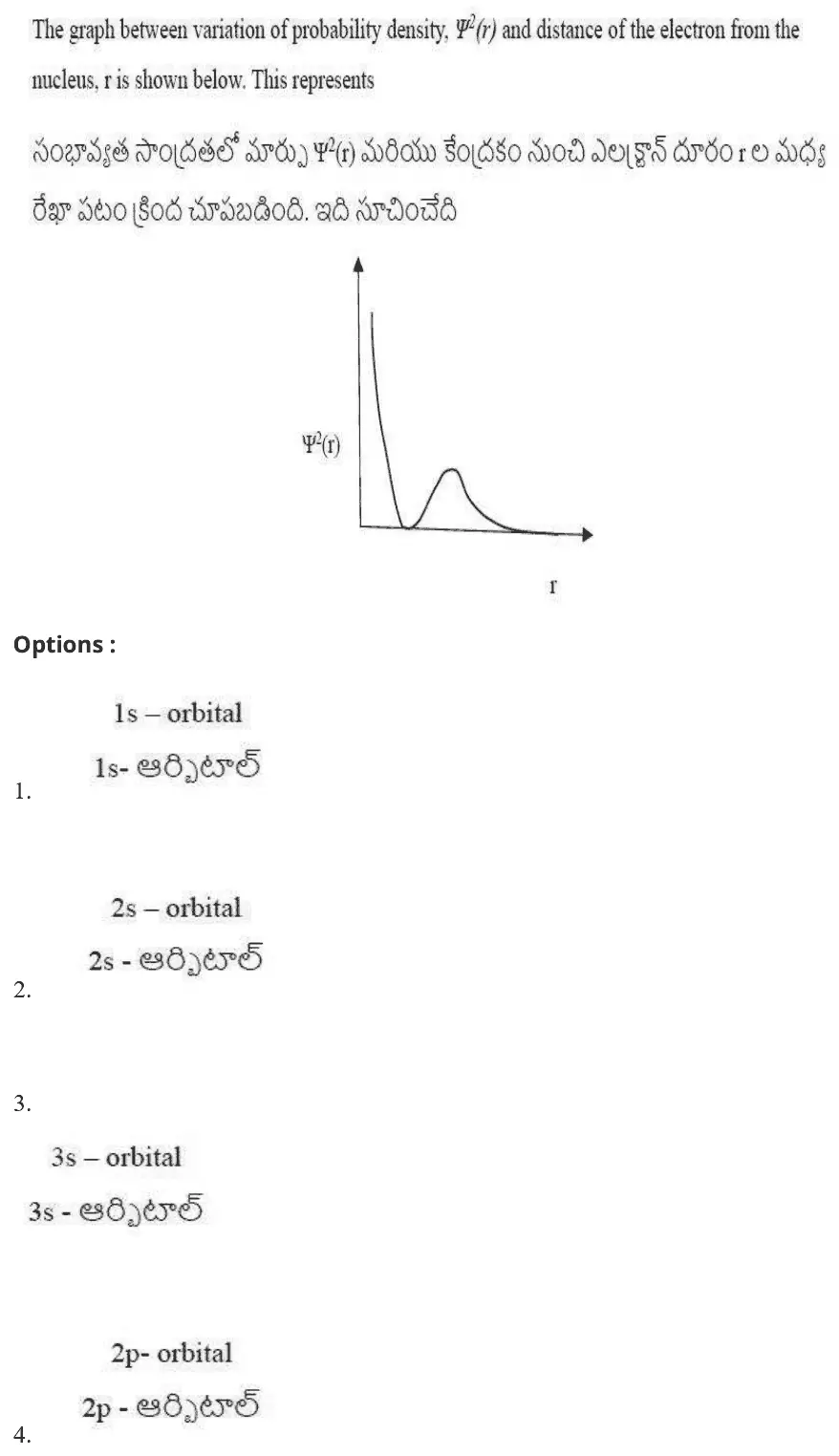
Quantum Mechanical Model: Close behind, this section produced 52 questions in the recent five-year span and 113 questions overall. Key concepts cover quantum numbers (n, l, m, s), orbital shapes, radial and angular nodes, de Broglie's hypothesis, and Heisenberg's uncertainty principle.
Electromagnetic Radiation & Quantum Theory: This section contributed 29 questions over the recent five years, out of 52 questions across our entire archive. Topics evaluate Planck's quantum theory E = h ν, the photoelectric equation, and wave-particle duality.
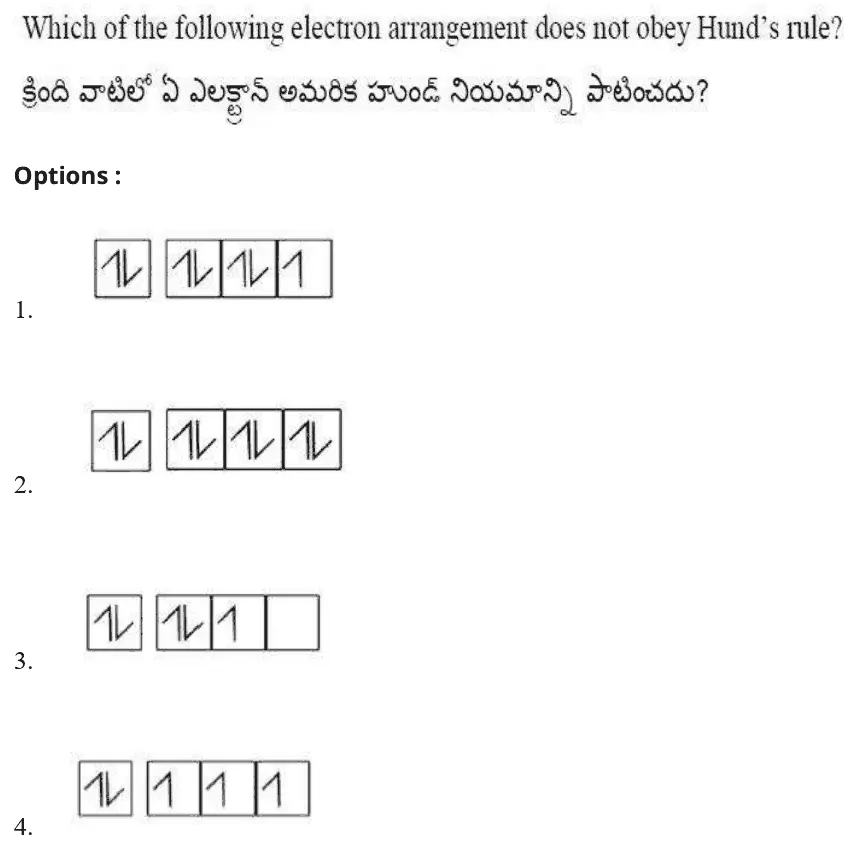
Electronic Configuration: A block of 21 questions appeared in the recent five-year window, out of 41 questions across the entire archive. Questions examine Aufbau principle, Pauli exclusion principle, Hund's rule of maximum multiplicity, and anomalous configurations of chromium and copper.
Early Models & Subatomic Particles: A smaller pool of 5 questions appeared recently, out of 25 questions in the complete record. It covers cathode rays, discovery of fundamental subatomic particles, and Rutherford's nuclear model.
What the questions look like
Rydberg equation calculations and hydrogen emission line ratios are constantly asked. A standard problem compares the wavelength of a transition from the fourth energy level down to the ground state with a transition from the fourth level to the second level, requiring students to compute ratios of inverse square differences. Other questions ask for the maximum number of spectral lines emitted when an excited hydrogen sample cascades from principal quantum number n down to the ground state.
Quantum numbers and nodal geometry form the other major question block. Examiners ask students to calculate the number of radial nodes (n - l - 1) and angular nodes (l) for specific subshells, or to identify valid sets of the four quantum numbers for a specific valence electron. Electronic configuration questions frequently ask for the ratio of s-electrons to p-electrons in elements from sodium to argon, or the number of unpaired electrons in divalent and trivalent transition metal cations.
Start by mastering Bohr's model of one-electron species: radius is r_n = zero point five two nine n² / Z angstroms, velocity is v_n = two point one eight × ten to the sixth power Z / n metres per second, and energy is E_n = - thirteen point six Z² / n² eV. Wave number of emitted radiation during transition from initial orbit n_two to final orbit n_one is 1/λ = R_H Z² [1/n_one² - 1/n_two²], where Rydberg constant R_H is approximately one point zero nine seven × ten to the seventh power per metre.
Next, study quantum mechanics and nodal formulas. Total number of nodes in any atomic orbital is n - 1. This splits into radial nodes = n - l - 1 and planar or angular nodes = l. Orbital angular momentum of an electron depends solely on azimuthal quantum number l: L = √[l (l + 1)] h / (two π). Magnetic spin angular momentum is S = √[s (s + 1)] h / (two π), and spin-only magnetic moment for n unpaired electrons is μ = √[n (n + two)] Bohr magnetons.
Finally, review Heisenberg's uncertainty principle Δx × Δp ≥ h / (four π) and de Broglie's equation λ = h / (m v). Remember that macroscopic bodies exhibit negligibly small de Broglie wavelengths due to their large masses, while subatomic particles like electrons exhibit pronounced wave characteristics.
Frequently asked questions
Does Atomic Structure appear in every shift?
Yes. In the papers we hold from 2022 to 2026, Atomic Structure was asked in every single paper across both AP and TS EAPCET, averaging more than two questions per shift.
How do you find the total number of nodes in an orbital?
The total number of nodes in any orbital equals the principal quantum number minus one, n - 1, which equals the sum of radial nodes (n - l - 1) and angular nodes (l).
What is the electronic configuration of chromium?
Chromium with atomic number twenty-four has the anomalous ground-state configuration with a half-filled d-subshell of five electrons and one valence s-electron, which provides extra exchange energy and symmetric charge distribution.
Where can I find worked solutions for EAPCET Atomic Structure questions?
Step-by-step solutions for each one are in the EdLoop EAPCET app.