Which of the following has maximum number of electrons in $t_{2g}$ orbitals?
- A
$[\mathrm{Fe(CN)_6}]^{3-}$
- B
$[\mathrm{FeCl_6}]^{3-}$
- C
$[\mathrm{CoCl_6}]^{3-}$
- D
$[\mathrm{Co(NH_3)_6}]^{3+}$
Every Coordination Compounds question from past AP EAPCET and TS EAPCET papers, with options and answers. Newest first.
Coordination Compounds sits at rank 18 among the 31 chemistry chapters in the modern 2022 to 2026 period.
Attempt every Coordination Compounds question timed, see the step-by-step solution and track what you get wrong. Free.
Which of the following has maximum number of electrons in $t_{2g}$ orbitals?
$[\mathrm{Fe(CN)_6}]^{3-}$
$[\mathrm{FeCl_6}]^{3-}$
$[\mathrm{CoCl_6}]^{3-}$
$[\mathrm{Co(NH_3)_6}]^{3+}$
In which of the following given sets, complexes are correctly arranged in the increasing order of their spin only magnetic moment values?
I. $[Fe(CN)_6]^{4-} < [Fe(CN)_6]^{3-} < [Fe(H_2O)_6]^{3+}$
II. $[Co(NH_3)_6]^{3+} < [Ni(H_2O)_6]^{2+} < [Cr(H_2O)_6]^{3+}$
III. $[V(H_2O)_6]^{3+} < [Cr(CN)_6]^{3-} < [Fe(H_2O)_6]^{2+}$
The correct answer is
I, II only
I, II, III
II, III only
I, III only
Which of the following exhibit only geometrical isomerism?
Diaquadioxalatochromate (III) ion
Dichloridobis(ethane – 1, 2 – diamine)platinum (IV) ion
Triamminetrinitrito – N cobalt (III)
Tris(ethane – 1, 2 – diamine)cobalt (III) ion
How many of the following complex ions contain 4 unpaired electrons?
$[\mathrm{Cr(H_2O)_6}]^{2+}$, $[\mathrm{Mn(H_2O)_6}]^{2+}$, $[\mathrm{Fe(H_2O)_6}]^{2+}$,
$[\mathrm{Co(H_2O)_6}]^{3+}$, $[\mathrm{Cu(H_2O)_6}]^{2+}$, $[\mathrm{CoF_6}]^{3-}$,
$[\mathrm{Cr(CN)_6}]^{4-}$, $[\mathrm{MnCl_4}]^{2-}$
The correct answer is
3
4
2
5
Identify the correct set containing only ambidentate ligands
$\mathrm{NO_2^-}, \mathrm{CN^-}, \mathrm{SCN^-}$
$\mathrm{NH_3}, \mathrm{CN^-}, \mathrm{C_2O_4^{2-}}$
$\mathrm{SO_4^{2-}}, \mathrm{SCN^-}, \mathrm{CO}$
$\mathrm{C_2O_4^{2-}}, \mathrm{(CH_3)_3P}, \mathrm{CO}$
Which of the following complexes do not exhibit geometrical isomerism?
I. $K[Cr(H_2O)_2(C_2O_4)_2]$
II. $[Co(en)_3]Cl_3$
III. $[Co(NH_3)_5(NO_2)](NO_3)_2$
The correct answer is
I , III only
II , III only
I , II only
I , II , III
The metal ion, ligands present in Wilkinson catalyst are respectively
$\mathrm{Rh^{3+}}$, $\mathrm{Cl^-}$, $\mathrm{PPh_3}$
$\mathrm{Rh^{+}}$, $\mathrm{Cl^-}$, $\mathrm{PPh_3}$
$\mathrm{Rh^{2+}}$, $\mathrm{Br^-}$, $\mathrm{PH_3}$
$\mathrm{Re^{+}}$, $\mathrm{I^-}$, $\mathrm{P(CH_3)_3}$
Choose the correct formula for tris (ethane-1, 2-diamine) cobalt (III) hexacyanido ferrate (II)
$\mathrm{[Co(en)_3] [Fe(CN)_6]}$
$\mathrm{[Co(en)_3]_2 [Fe(CN)_6]_3}$
$\mathrm{[Co(en)_3]_3 [Fe(CN)_6]_2}$
$\mathrm{[Co(en)_3]_4 [Fe(CN)_6]_3}$
In which of the following, ratio of $t_{2g}$ and $e_g$ electrons is 3 : 2 ?
$[\mathrm{FeF_6}]^{3-}$
$[\mathrm{CoF_6}]^{3-}$
$[\mathrm{Fe(CN)_6}]^{3-}$
$[\mathrm{Co(NH_3)_6}]^{3+}$
Aqueous solutions of which of the following compounds do not form AgCl precipitate with excess $\mathrm{AgNO_3}$ solution?
I. $\mathrm{PtCl_4.2HCl}$
II. $\mathrm{PtCl_2.2NH_3}$
III. $\mathrm{CoCl_3.4NH_3}$
IV. $\mathrm{PdCl_2.4NH_3}$
The correct answer is
I , II only
III , IV only
I , II , III only
I , II , IV only
Which one of the following is an outer orbital complex and exhibits paramagnetic behaviour?
$\mathrm{[Co(C_2O_4)_3]^{3-}}$
$\mathrm{[MnCl_6]^{3-}}$
$\mathrm{[Mn(CN)_6]^{3-}}$
$\mathrm{[Fe(CN)_6]^{3-}}$
The primary and secondary valencies of chromium in the complex ion, $[\mathrm{CrCl_2(C_2O_4)_2}]^{3-}$ are respectively $x$ and $y$. The sum of $x$ and $y$ is
7
8
9
6
Which of the following exhibit both geometrical and optical isomerism?
I. $[\mathrm{Pt(en)_2Cl_2}]^{2+}$
II. $[\mathrm{Co(NH_3)_3(NO_2)_3}]$
III. $[\mathrm{Cr(H_2O)_2(C_2O_4)_2}]^{+}$
IV. $[\mathrm{Co(en)_3}]\mathrm{Cl_3}$
The correct answer is
I, III, IV only
I, II, III only
II, III, IV only
I, III only
Which one of the following complexes has least number of stereoisomers?
$[\mathrm{Co(NH_3)_5Cl}]\mathrm{Cl_2}$
$[\mathrm{Co(en)(NH_3)_2Cl_2}]\mathrm{Cl}$
$[\mathrm{Co(en)_2Cl_2}]\mathrm{Cl}$
$[\mathrm{Co(en)_3}]\mathrm{Cl_3}$
Among the four complex ions given, identify the pair of ions with same spin only magnetic moment value
| $[\mathrm{Ni(NH_3)_6}]^{2+}$ | $[\mathrm{MnCl_6}]^{3-}$ | $[\mathrm{FeF_6}]^{3-}$ | $[\mathrm{CoF_6}]^{3-}$ |
|---|---|---|---|
| I | II | III | IV |
II, III only
II, IV only
I, IV only
I, III only
Which of the following will give maximum number of isomers?
$[\mathrm{Co(NH_3)_4Cl_2}]^{+}$
$[\mathrm{Ni(en)(NH_3)_4}]^{2+}$
$[\mathrm{Ni(C_2O_4)(en)_2}]$
$[\mathrm{Cr(SCN)_2(NH_3)_4}]^{+}$
Which of the following exhibit optical isomerism?
I. $[\mathrm{Fe(C_2O_4)_3}]^{3-}$
II. $[\mathrm{Cr(H_2O)_4Cl_2}]^{+}$
III. $[\mathrm{Co(NH_3)_2(en)_2}]^{3+}$
The correct answer is (only)
I, II only
I, III only
II, III only
I, II, III
Identify the set which does not have ambidentate ligand (s)
$\mathrm{NO_2^-, CN^-, C_2O_4^{2-}}$
$\mathrm{C_2O_4^{2-}, H_2O, SO_4^{2-}}$
$\mathrm{SCN^-, NH_3, CH_3COO^-}$
$\mathrm{CN^-, SCN^-, CH_3NH_2}$
Which of the following exhibit ionization isomerism ?
I) $\mathrm{[Cr(NH_3)_4Cl_2]Cl}$
II) $\mathrm{[Ti(H_2O)_5Cl](NO_3)_2}$
III) $\mathrm{[Pt(en)(NH_3)Cl]NO_3}$
IV) $\mathrm{[Co(NH_3)_4(NO_3)_2]NO_3}$
II & III only
I & II only
II & IV only
III & IV only
The IUPAC name of the complex shown below is
$\mathrm{K_3[Co(ox)_3]}$
Tripotassium trioxalatocobaltate (III)
Potassium trioxalatecobaltate (III)
Potassium trioxalatecobalt (III)
Potassium trioxalatocobaltate (III)
Identify the ion (hydrated in solution) which is not correctly matched with its spin only magnetic moment (in BM) given in brackets
$\mathrm{Cr^{3+}}$ (4.90)
$\mathrm{Cu^{2+}}$ (1.73)
$\mathrm{Co^{3+}}$ (4.90)
$\mathrm{Fe^{2+}}$ (4.90)
The co-ordination number of chromium in $\mathrm{K[Cr(H_2O)_2(C_2O_4)_2]}$ is
5
4
6
3
In which one of the following complexes the metal ion has $\mathrm{t_{2g}^{3}e_{g}^{2}}$ configuration?
$\mathrm{[Mn(H_2O)_6]^{2+}}$
$\mathrm{[Fe(H_2O)_6]^{2+}}$
$\mathrm{[Co(NH_3)_6]^{3+}}$
$\mathrm{[Ni(H_2O)_6]^{2+}}$
Identify the complex ion with spin only magnetic moment of 4.90 BM.
$\mathrm{[Co(NH_3)_6]^{3+}}$
$\mathrm{[Cr(NH_3)_6]^{3+}}$
$\mathrm{[Mn(CN)_6]^{3-}}$
$\mathrm{[MnC\ell_6]^{3-}}$
In which of the following, complex ions are not in correct order with respect to their magnitude of crystal field splitting ?
$[\mathrm{Fe(H_2O)_6}]^{3+} > [\mathrm{FeF_6}]^{3-}$
$[\mathrm{Fe(en)_3}]^{3+} > [\mathrm{Fe(NCS)_6}]^{3-}$
$[\mathrm{Fe(CN)_6}]^{4-} > [\mathrm{Fe(H_2O)_6}]^{2+}$
$[\mathrm{Fe(H_2O)_6}]^{2+} > [\mathrm{Fe(NH_3)_6}]^{2+}$
In $\mathrm{Fe_x[Fe_y(CN)_6]_3}$, x, y respectively, are
3, 2
4, 1
2, 3
1, 4
Which of the following complexes exhibit geometrical isomerism ?
I) $\mathrm{[Co(en)(NH_3)_2Cl_2]Cl}$
II) $\mathrm{[Co(NH_3)_4Cl_2]Cl}$
III) $\mathrm{[Co(en)_3]Cl_3}$
IV) $\mathrm{[Co(en)_2Cl_2]Br}$
I, II & III only
II, III & IV only
I, II & IV only
II & III only
Which one of the following complex ions is diamagnetic in nature?
$[\mathrm{CoF_6}]^{3-}$
$[\mathrm{Co(ox)_3}]^{3-}$
$[\mathrm{Mn(CN)_6}]^{3-}$
$[\mathrm{Fe(CN)_6}]^{3-}$
Observe the following complex ions
| $\mathrm{[Mn(CN)_6]^{3-}}$ | $\mathrm{[Fe(CN)_6]^{3-}}$ | $\mathrm{[CoF_6]^{3-}}$ | $\mathrm{[Co(C_2O_4)_3]^{3-}}$ |
|---|---|---|---|
| A | B | C | D |
Identify the option in which the unpaired electrons in the complex ions are in correct increasing order
C, A, B, D
B, A, C, D
D, A, B, C
D, B, A, C
Arrange the following complexes in the increasing order of their spin only magnetic moment (in B.M)
I. $[\mathrm{Fe(CN)_6}]^{4-}$
II. $[\mathrm{MnCl_4}]^{2-}$
III. $[\mathrm{Mn(CN)_6}]^{4-}$
IV. $[\mathrm{Cr(NH_3)_6}]^{3+}$
II < IV < I < III
III < II < I < IV
I < IV < II < III
I < III < IV < II
Total number of geometrical isomers possible for the complexes $\left[\mathrm{NiCl_4}\right]^{2-}$, $\left[\mathrm{CoCl_2(NH_3)_4}\right]^{+}$, $\left[\mathrm{Co(NH_3)_3(NO_2)_3}\right]$ and $\left[\mathrm{Co(NH_3)_5Cl}\right]^{2+}$ is
2
3
4
5
Which one of the following is not an ambidentate ligand?
$\mathrm{CN}$
$\mathrm{SCN^-}$
$\mathrm{SO_4^{2-}}$
$\mathrm{NO_2^-}$
When 100 mL of 0.2 M solution of $\mathrm{CoCl_3.xNH_3}$ is treated with excess of $\mathrm{AgNO_3}$ solution, $3.6\times10^{22}$ ions are precipitated. The value of $x$ is
($\mathrm{N = 6\times10^{23}\ mol^{-1}}$)
5
6
4
3
Arrange the following in the increasing order of their magnetic moments
I. $\mathrm{[Mn(CN)_6]^{3-}}$
II. $\mathrm{[MnCl_6]^{3-}}$
III. $\mathrm{[Fe(CN)_6]^{3-}}$
IV. $\mathrm{[FeF_6]^{3-}}$
III < I < IV < II
III < IV < II < I
IV < II < I < III
III < I < II < IV
Match the complexes in list-I with their hybridization in list-II
| List-I Complex | List-II Hybridization | ||
|---|---|---|---|
| I | $\mathrm{Ni(CO)_4}$ | A | $sp^3d^2$ |
| II | $\mathrm{[Ni(CN)_4]^{2-}}$ | B | $d^2sp^3$ |
| III | $\mathrm{[Co(NH_3)_6]^{3+}}$ | C | $dsp^2$ |
| IV | $\mathrm{[CoF_6]^{3-}}$ | D | $sp^3$ |
I-C, II-D, III-A, IV-B
I-D, II-C, III-A, IV-B
I-D, II-C, III-B, IV-A
I-C, II-D, III-B, IV-A
Which complex among the following is most paramagnetic?
$\mathrm{[Co(NH_3)_6]^{2+}}$
$\mathrm{[Co(NH_3)_6]^{3+}}$
$\mathrm{[Co(H_2O)_6]^{2+}}$
$\mathrm{[Co(H_2O)_6]^{3+}}$
Impure silver ore + $\mathrm{CN^-}$ + $\mathrm{H_2O}$ $\xrightarrow{\mathrm{O_2}}$ $[\mathrm{X}]^-$ + $\mathrm{OH^-}$
$[\mathrm{X}]^-$ + Zn $\longrightarrow$ $[\mathrm{Y}]^{2-}$ + Ag (pure)
The co-ordination numbers of the metals in [X], [Y] are respectively
3, 4
1, 4
4, 2
2, 4
How many of the following ligands are stronger than $\mathrm{H_2O}$?
$\mathrm{S^{2-}, Br^{-}, C_2O_4^{2-}, CN^{-}, en, NH_3, CO, OH^{-}}$
5
3
4
6
Cobalt (III) chloride forms a green coloured complex 'X' with $\mathrm{NH_3}$. Number of moles of AgCl formed when excess of $\mathrm{AgNO_3}$ solution is added to 100 mL of 1M solution of 'X' is
0.3
0.2
0.1
1
The paramagnetic complex ion which has no unpaired electrons in $t_{2g}$ orbitals is
$[\mathrm{Fe(CN)_6}]^{4-}$
$[\mathrm{Fe(CN)_6}]^{3-}$
$[\mathrm{Zn(NH_3)_6}]^{2+}$
$[\mathrm{Ni(NH_3)_6}]^{2+}$
Arrange the following in the increasing order of number of unpaired electrons present in the central metal ion
I. $\mathrm{[MnCl_6]^{3-}}$
II. $\mathrm{[FeF_6]^{3-}}$
III. $\mathrm{[Mn(CN)_6]^{3-}}$
IV. $\mathrm{[Fe(CN)_6]^{3-}}$
$\mathrm{IV} < \mathrm{I} < \mathrm{III} < \mathrm{II}$
$\mathrm{I} < \mathrm{III} < \mathrm{II} < \mathrm{IV}$
$\mathrm{IV} < \mathrm{III} < \mathrm{I} < \mathrm{II}$
$\mathrm{I} < \mathrm{II} < \mathrm{III} < \mathrm{IV}$
The spin only magnetic moments of the complexes $\mathrm{[Mn(CN)_6]^{3-}}$ and $\mathrm{[Co(C_2O_4)_3]^{3-}}$ are respectively
2.84 BM, 0 BM
0 BM, 2.84 BM
0 BM, 3.87 BM
5.92 BM, 2.84 BM
Which of the following does not show optical isomerism?
$Cis - [\mathrm{Cr\,Cl_2(C_2O_4)_2}]^{3-}$
$[\mathrm{Pt\,Cl_2(en)_2}]^{2+}$
$[\mathrm{Co\,(NH_3)_3(NO_2)_3}]$
$[\mathrm{Co(en)_3}]^{3+}$
Which one of the following complex ions has geometrical isomers?
$[\mathrm{Co(Cl)_2(en)_2}]^{+}$
$[\mathrm{Cr(NH_3)_4(en)}]^{3+}$
$[\mathrm{Co(en)_3}]^{3+}$
$[\mathrm{Ni(NH_3)_5Br}]^{+}$
Identify the complex ion with electronic configuration $\mathrm{t_{2g}^{3}e_{g}^{2}}$
$\mathrm{[Fe(H_2O)_6]^{3+}}$
$\mathrm{[Cr(H_2O)_6]^{3+}}$
$\mathrm{[Ni(H_2O)_6]^{2+}}$
$\mathrm{[Ti(H_2O)_6]^{3+}}$
Arrange the following in increasing order of their crystal field splitting energy
I $[\mathrm{Co(H_2O)_6}]^{3+}$
II $[\mathrm{Co(NH_3)_6}]^{3+}$
III $[\mathrm{Co(CN)_6}]^{3-}$
IV $[\mathrm{CoF_6}]^{3-}$
I $<$ II $<$ III $<$ IV
IV $<$ I $<$ II $<$ III
I $<$ III $<$ II $<$ IV
IV $<$ II $<$ I $<$ III
The molecular formula of a coordinate complex is $\mathrm{CoH_{12}O_6Cl_3}$. When one mole of this aqueous solution of complex is reacted with excess of aqueous $\mathrm{AgNO_3}$ solution, three moles of AgCl was formed. What is the correct formula of the complex?
$\mathrm{[Co(H_2O)_6]Cl_3}$
$\mathrm{[Co(H_2O)_5Cl]Cl_2.H_2O}$
$\mathrm{[Co(H_2O)_4Cl_2]Cl(H_2O)_2}$
$\mathrm{[Co(H_2O)_3Cl_3](H_2O)_3}$
$\mathrm{Pt}$ + 3:1 mixture of (conc. $\mathrm{HCl}$ + conc. $\mathrm{HNO_3}$) $\rightarrow [\mathrm{X}]^{2-}$
What is the oxidation state of Pt in $[\mathrm{X}]^{2-}$ complex ion?
+2
+3
+4
+6
Which of the following will have a spin only magnetic moment of 2.86 BM?
$[\mathrm{CoF_6}]^{3-}$
$[\mathrm{Co(NH_3)_6}]^{3+}$
$[\mathrm{NiCl_4}]^{2-}$
$[\mathrm{Ni(CN)_4}]^{2-}$
Match the following.
| List I (Complex) | List II (Color) |
|---|---|
| A. $[\mathrm{Ni(en)_3}]^{2+}$ | I. Green |
| B. $[\mathrm{Ni(H_2O)_4(en)}]^{2+}$ | II. Blue |
| C. $[\mathrm{Ni(H_2O)_6}]^{2+}$ | III. Pale blue |
| D. $[\mathrm{Ni(H_2O)_2(en)_2}]^{2+}$ | IV. Violet |
A-IV, B-I, C-III, D-II
A-I, B-II, C-III, D-IV
A-IV, B-III, C-I, D-II
A-I, B-III, C-II, D-IV
The spin only magnetic moment of $[\mathrm{MnBr_4}]^{x-}$ is 5.9 BM. The geometry of the complex and x respectively are
tetrahedral, 1
square planar, 1
square planar, 2
tetrahedral, 2
The compounds having coordinated water are
$\mathrm{CrCl_3.6H_2O}$ (I) $\mathrm{BaCl_2.2H_2O}$ (II) $\mathrm{CuSO_4.5H_2O}$ (III)
II, III only
I, III only
I, II only
I, II, III
The configurations of the complexes of manganese A, B respectively are $t_{2g}^3 e_g^1$, $t_{2g}^4 e_g^0$. Then A, B are
$[\mathrm{Mn(H_2O)_6}]^{2+}$, $[\mathrm{Mn(CN)_6}]^{3-}$
$[\mathrm{Mn(H_2O)_6}]^{2+}$, $[\mathrm{Mn(CN)_6}]^{4-}$
$[\mathrm{Mn(H_2O)_6}]^{3+}$, $[\mathrm{Mn(CN)_6}]^{4-}$
$[\mathrm{Mn(H_2O)_6}]^{3+}$, $[\mathrm{Mn(CN)_6}]^{3-}$
Which of the following types of isomerism is exhibited by $\mathrm{[Co(NH_3)_5(NO_2)](NO_3)_2}$
i. Optical ii. Linkage iii. Ionization iv. Coordination
ii, iii only
i, ii, iii only
i, iii only
ii, iv only
IUPAC name of $\left[\mathrm{Pt(NH_3)_2Cl(NH_2CH_3)}\right]\mathrm{Cl}$ is
(Amino methane) chloro (diammine) platinum (II) chlolide
Chlorodiammine (methanamine) platinum (II) chloride
Diamminechloro (methanamine) platinum(II) chloride
Diamminechloro (methylamine) platinum (IV) chloride
Which one of the following has the highest molar conductivity?
Diammine dichloroplatinum (II)
Tetraamminedichlorocobalt (III) chloride
Potassium hexacyano ferrate (II)
Hexa aquo chromium (III) chloride
The formula of tris (ethane -1,2- diamine) cobalt (III) sulphate is:
$\mathrm{[Co(H_2NCH_2CH_2NH_2)_3]SO_4}$
$\mathrm{[Co(H_2NCH_2CH_2NH_2)_3]_3(SO_3)_2}$
$\mathrm{[Co(CH_3CH_2NHNH_2)_3]_2(SO_4)_3}$
$\mathrm{[Co(H_2NCH_2CH_2NH_2)_3]_2(SO_4)_3}$
Observe the following complexes
$[\mathrm{Mn(CN)_6}]^{3-}$, $[\mathrm{Fe(CN)_6}]^{3-}$, $[\mathrm{Co(C_2O_4)_3}]^{3-}$, $[\mathrm{MnCl_6}]^{3-}$, $[\mathrm{Fe(CN)_6}]^{4-}$, $[\mathrm{CoF_6}]^{3-}$
From the above, the number of inner orbital complexes with paramagnetic nature is
2
1
3
4
Which of the following statements are correct?
i. $\left[\mathrm{Mn(CN)_6}\right]^{3-}$, $\left[\mathrm{MnCl_6}\right]^{3-}$ both are paramagnetic
ii. Both $\left[\mathrm{NiCl_4}\right]^{2-}$, $\left[\mathrm{Ni(CO)_4}\right]$ are tetrahedral and diamagnetic
iii. $\left[\mathrm{Co(NH_3)_6}\right]^{3+}$ is inner orbital complex, but $\left[\mathrm{Ni(NH_3)_6}\right]^{2+}$ is outer orbital complex.
i, ii only
i, iii only
ii, iii only
i, ii, iii
Arrange the following in order of increasing number of unpaired electrons in them
i. $[\mathrm{Fe(CN)_6}]^{3-}$ ii. $[\mathrm{MnCl_6}]^{3-}$ iii. $[\mathrm{FeF_6}]^{3-}$ iv. $[\mathrm{Co(NH_3)_6}]^{3+}$
i, iv, ii, iii
iv, i, iii, ii
iv, i, ii, iii
i, iv, iii, ii
Match the following
| List – I (Complex) | List – II (Spin only Magnetic moment) |
|---|---|
| A) $\mathrm{[CoF_6]^{3-}}$ | I) $0$ |
| B) $\mathrm{[Co(C_2O_4)_3]^{3-}}$ | II) $\sqrt{24}$ |
| C) $\mathrm{[FeF_6]^{3-}}$ | III) $\sqrt{8}$ |
| D) $\mathrm{[Mn\ (CN)_6]^{3-}}$ | IV) $\sqrt{35}$ |
| V) $\sqrt{15}$ |
The correct answer is
A – V, B – II, C – IV, D – I
A – II, B – I, C – IV, D – III
A – II, B – I, C – V, D – III
A – III, B – II, C – I, D – V
The sum of oxidation state and co-ordination number of central metal atom is maximum with respect to which of the following complex?
$\mathrm{K_3[Cr(C_2O_4)_3]}$
$\mathrm{[Cr(CO)_6]}$
$\mathrm{K_2[PtCl_6]}$
$\mathrm{K_4[Fe(CN)_6]}$
According to Werner’s theory, the number of groups bonded to the central metal atom / ion in a coordination complex represent
Oxidation state
Primary valency
Secondary Valency
Polyhedron
Identify the correct set for $[\mathrm{Co(NH_3)_6}]^{3+}$ ion. (hybridisation of $\mathrm{Co^{3+}}$, type of complex, number of unpaired electrons in the complex ion respectively)
$\mathrm{d^2sp^3}$, inner orbital complex, zero
$\mathrm{sp^3d^2}$, outer orbital complex, three
$\mathrm{d^2sp^3}$, inner orbital complex, two
$\mathrm{sp^3d^2}$, outer orbital complex, zero
Match the following
| List-I (complex) | List-II (electronic configuration of metal/ion) | ||
|---|---|---|---|
| A. | $[\mathrm{Co(NH_3)_6}]^{3+}$ | I. | $\mathrm{t_{2g}^{5}\,e_g^{0}}$ |
| B. | $[\mathrm{CoF_6}]^{3-}$ | II. | $\mathrm{t_{2g}^{6}\,e_g^{0}}$ |
| C. | $[\mathrm{Ni(CO)_4}]$ | III. | $\mathrm{t_{2g}^{4}\,e_g^{2}}$ |
| D. | $[\mathrm{Fe(CN)_6}]^{3-}$ | IV. | $\mathrm{t_2^{4}\,e^{6}}$ |
The correct answer is
A – II, B – III, C – IV, D – I
A – III, B – IV, C – II, D – I
A – IV, B – III, C – I, D – II
A – II, B – I, C – IV, D – III
Identify the incorrect match from the following
$\mathrm{[Cr(H_2O)_6]Br_2}$ - Paramagnetic
$\mathrm{Na_4[Fe(CN)_6]}$ - Diamagnetic
$\mathrm{[Ni(CO)_4]}$ - Paramagnetic
$\mathrm{Na_2[NiCl_4]}$ - Paramagnetic
The pair in which both the species have same magnetic moment (spin only) is
$\mathrm{[CoCl_4]^{2-}}$, $\mathrm{[Fe(H_2O)_6]^{2-}}$
$\mathrm{[Mn(H_2O)_6]^{2+}}$, $\mathrm{[Cr(H_2O)_6]^{2+}}$
$\mathrm{[Cr(H_2O)_6]^{2+}}$, $\mathrm{[Fe(H_2O)_6]^{2+}}$
$\mathrm{[Cr(H_2O)_6]^{2+}}$, $\mathrm{[CoCl_4]^{2-}}$
Secondary valences of the following complexes based on their reactions with excess $\mathrm{AgNO_3}$ are
| Formula of the complexes | Moles of AgCl precipitated per mole of complex |
|---|---|
| I) $\mathrm{CoCl_3.6H_2O}$ | 3 |
| II) $\mathrm{NiCl_3.6H_2O}$ | 2 |
| III) $\mathrm{Co(SO_4)Br.5NH_3}$ | 1 |
I: 4, II: 6, III: 6
I: 6, II: 4, III: 4
I: 6, II: 4, III: 6
I: 6, II: 6, III: 6
A metal complex absorbed orange light. The colour in which it appears is
yellow
yellow – green
red
green – blue
The correct order of decreasing field strength of the below given ligands is
I: $\mathrm{NCS^{-}}$ II: $\mathrm{S^{2-}}$ III: en IV: $\mathrm{SCN^{-}}$
I > II > IV > III
III > II > IV > I
III > I > IV > II
III > IV > I > II
Among the given complexes that possess “CO” ligand bridges are
$\mathrm{[Co_{2}(CO)_{8}]}$ (I), $\mathrm{[Fe_{3}(CO)_{12}]}$ (II), $\mathrm{[Mn_{2}(CO)_{10}]}$ (III), $\mathrm{[Fe_{2}(CO)_{9}]}$ (IV)
I, II and III
II, III and IV
I, II and IV
I, III and IV
According to valence bond theory the metal atom or ion can make use of which of the following orbitals to yield hybrid orbitals, that can form bonds with ligands.
$(n-1)d,\ (n-1)s,\ np$
$(n-1)d,\ ns,\ np$
$(n-1)d,\ ns,\ (n-1)p$
$nd,\ (n-1)s,\ (n-1)p$
The IUPAC name of the following complex is
$[Cr(NH_3)_3(H_2O)_2Cl]Cl_2$
Triamminediaqua chlorido chromium (III) chloride
Diaquatriammine chlorido chromium (III) chloride
Chlorido diaquatriammine chromium (III) chloride
Triammine diaqua trichlorido chromium (III)
The IUPAC name of the following complex is $[Co(NH_2CH_2CH_2NH_2)_2Br_2]Br$
Bis (ethane-1, 2- diamine) dibromido cobalt (III) bromide
Di (ethane-1, 2- diamine) dibromido cobalt (III) bromide
Tribromido bis (ethane-1, 2- diamine) cobalt (III)
Dibromido bis (ethylene diamine) cobalt (III) bromide
The hybridization of metals involved in the following complexes, respectively are
$[\mathrm{Mn(CN)_6}]^{3-}$, $[\mathrm{CoF_6}]^{3-}$
$\mathrm{sp^3d^2}$, $\mathrm{sp^3d^2}$
$\mathrm{sp^3d^2}$, $\mathrm{d^2sp^3}$
$\mathrm{d^2sp^3}$, $\mathrm{d^2sp^3}$
$\mathrm{d^2sp^3}$, $\mathrm{sp^3d^2}$
The set with only ambidentate ligands in the following is
$NO_3^{\ominus},\ Br^{\ominus},\ C_2O_4^{2\ominus}$
$NO_2^{\ominus},\ CN^{\ominus},\ SCN^{\ominus}$
$NO_2^{\ominus},\ C_2O_4^{2\ominus},\ NH_3$
$SCN^{\ominus},\ CO,\ NH_3$
The correct order about the number of unpaired electrons present in the following complexes is
$[\mathrm{Fe(CN)_6}]^{4-}$ (I) $[\mathrm{Fe(H_2O)_6}]^{2+}$ (II) $[\mathrm{Co(H_2O)_6}]^{2+}$ (III)
II > III > I
II > I > III
I > II > III
III > II > I
An element 'X' with atomic number 13 forms a complex of the type $[\mathrm{XCl(H_2O)_5}]^{2+}$. The covalency and oxidation state of X in it are respectively
5, +2
6, +2
5, +3
6, +3
The homoleptic complex in the following is
$[Co(NH_3)_4Br_2]^{\oplus}$
$[Co(C_2O_4)\ (NH_3)_4]^{\oplus}$
$[Co(NH_3)_6]^{3\oplus}$
$[Co(CN)_4Cl_2]^{\ominus}$
The crystal filed theory is successful in explaining which of the following?
I. Ligands as point charges; II. Formation and structures of complexes.
III. colour; IV. Magnetic properties; V. covalent character of metal-ligand bonding.
I, II, III only
II, III, IV only
III, IV, V only
II, IV, V only
The different types of bonds present in $\mathrm{CuSO_4 \cdot 5\,H_2O}$ are ______
Only Ionic and Covalent
Only Ionic, Covalent and Coordinate covalent
Only Covalent, Coordinate covalent and Hydrogen bonding
Ionic, Covalent, Coordinate covalent, Hydrogen bonding only
Which of the following gives the maximum number of ions in aqueous solution?
$\mathrm{Ni(CO)_4}$
$\mathrm{CoCl_3 \cdot 5\,H_2O}$
$\mathrm{PtCl_4 \cdot 6\,NH_3}$
$\mathrm{[Cr(NH_3)_3(NO_2)_3]}$
Match the following based on valence bond theory?
Hybridization | Geometry | Complex structure
(a) $sp^3$ | (i) Square planar | (p) $[\mathrm{Fe(CN)_6}]^{3-}$
(b) $d^2sp^3$ | (ii) Tetrahedral | (q) $[\mathrm{ZnCl_4}]^{2-}$
(c) $dsp^2$ | (iii) Octahedral | (r) $[\mathrm{Ni(NH_3)_4}]^{2+}$
| (s) $[\mathrm{Ag(CN)_2}]^-$ |
(a-ii-q), (b-iii-p), (c-i-r)
(a-ii-q), (b-iii-r), (c-i-s)
(a-i-q), (b-iii-p), (c-ii-r)
(a-ii-r), (b-iii-s), (c-i-q)
Which among the following doesn't form a white precipitate with $\mathrm{AgNO_3}$ solution?
$[\mathrm{Co(NH_3)_6}]\mathrm{Cl_3}$
$[\mathrm{Co(NH_3)_5Cl}]\mathrm{Cl_2}$
$[\mathrm{Co(NH_3)_4Cl_2}]\mathrm{Cl_2}$ (sic)
$[\mathrm{Co(NH_3)_3Cl_3}]$
Which among the following is most paramagnetic?
$[\mathrm{Cr(H_2O)_6}]^{3+}$
$[\mathrm{Fe(H_2O)_6}]^{2+}$
$[\mathrm{Cu(H_2O)_6}]^{2+}$
$[\mathrm{Zn(H_2O)_2}]^{2+}$ (sic)
The geometries of $[Ni(CO)_4]$, $[PtCl_4]^{2-}$ and $[Co(NH_3)_6]^{3+}$ respectively are:
Tetrahedral, Tetrahedral and Octahedral
Tetrahedral, Square planar and Square pyramidal
Square planar, Square planar and Octahedral
Tetrahedral, Square planar and Octahedral
Atomic number of $Cr$, $Fe$ and $Co$ are 24, 26 and 27 respectively. Which of the following inner orbital octahedral complexes are paramagnetic?
$[\mathrm{Co(NH_3)_6}]^{3+}$
$[\mathrm{Co(CN)_3}]^{3+}$ (sic)
$[\mathrm{Fe(CN)_6}]^{4-}$
$[\mathrm{Cr(CN)_6}]^{3-}$
Which of the following complexes formed by Nickel is tetrahedral and paramagnetic?
$[Ni(CN)_4]^{2-}$
$[Ni(CO)_4]$
$[Ni(Cl)_4]^{2-}$
$[Ni(NH_3)_6]^{2+}$
What is coordination of the metal in $[\mathrm{Co(en)_2Cl_2}]$ ?
3
4
5
6
The correct order of field strength of the following ligands is
$\mathrm{N^{3-}>C_2O_4^{2-}>NH_3>CO}$
$\mathrm{N^{3-}>NH_3>C_2O_4^{2-}>CO}$
$\mathrm{CO>NH_3>C_2O_4^{2-}>N^{3-}}$
$\mathrm{CO>N^{3-}>NH_3>C_2O_4^{2-}}$
The Wilkinson catalyst is
$\left[(\mathrm{PPh_3})_2\,\mathrm{RhCl_2}\right]$
$\left[(\mathrm{PPh_3})_3\,\mathrm{RhCl}\right]$
$\left[(\mathrm{PPh_3})\,\mathrm{RhCl_3}\right]$
$\left[(\mathrm{PPh_3})_4\,\mathrm{RhCl}\right]$
The number of $\mathrm{H_2O}$ molecules participating in hydrogen bonding in $\mathrm{CuSO_4\cdot5H_2O}$ is/are
4
2
1
0
The magnetic moment of the high spin complex is 5.92 BM. What is the electronic configuration?
$t_2g^{3}\,eg^{1}$
$t_2g^{4}\,eg^{2}$
$t_2g^{3}\,eg^{2}$
$t_2g^{5}\,eg^{0}$
According to Valence Bond Theory, the number of unpaired electrons present in $[\mathrm{MnCl_6}]^{3-}$, $[\mathrm{Fe(CN)_6}]^{3-}$ and $[\mathrm{Co(C_2O_4)_3}]^{3-}$, respectively, are
0 ; 5 ; 0
4 ; 3 ; 2
4 ; 1 ; 0
5 ; 4 ; 3
The reaction of aqueous $[\mathrm{Ni(H_2O)_6}]^{2+}$ is performed by the addition of a bidentate ligand ethane-1, 2, diamine (en)
Match the following
$[\mathrm{Ni(H_2O)_6}]^{2+}$ : en molar ratio Colour of the product
A) 1 : 1 I) Pale blue
B) 1 : 2 II) Blue / Purple
C) 1 : 3 III) Violet
IV) Green
The correct match is
A-I, B-II, C-III
A-II, B-III, C-IV
A-III, B-I, C-II
A-IV, B-I, C-III
The number of bridged CO ligands present in $\mathrm{Fe_2(CO)_9}$ and $\mathrm{CO_2(CO)_8}$, respectively, are
2, 1
2, 2
2, 3
3, 2
The oxidation number of central metal in $[\mathrm{Pt(NH_3)_2Cl(NO_2)}]$ and $[\mathrm{CoCl_2(en)_2}]^{\oplus}$, respectively, are
+2 ; +1
+2 ; +2
+2 ; +3
+3 ; +2
Match the following
Column-I (Complex):
A) $\mathrm{[Ni(CN)_4]^{2-}}$
B) $\mathrm{[Ni(CO)_4]}$
C) $\mathrm{[NiCl_4]^{2-}}$
Column-II (Structure / Geometry / Property):
I) Tetrahedral / Paramagnetic
II) Tetrahedral / Diamagnetic
III) Square planar / Diamagnetic
The correct match is
A-II, B-I, C-III
A-I, B-II, C-III
A-III, B-II, C-I
A-III, B-I, C-II
The oxidation state and covalency of $Al$ in $[\mathrm{AlCl(H_2O)_5}]^{2+}$ are______ and ______ respectively
$-3$ & 3
$+3$ & 3
$-3$ & 6
$+3$ & 6
The oxidation state of $Co$ in $K[Co(CO)_4]$ is
$+3$
$-3$
$+1$
$-1$
$\mathrm{Cr(CO)}_x$ find the value of $x$?
4
6
2
1
The oxidation state and covalency of $Al$ in $[AlCl(H_2O)_5]^{2+}$ respectively are
$+3$ & $6$
$+6$ & $3$
$+1$ & $2$
$-2$ & $1$
Which complex among the following has the highest value of spin only magnetic moment
$[\mathrm{Fe}\,(\mathrm{CN})_6]^{3-}$, $[\mathrm{Fe}\,(\mathrm{CN})_6]^{4-}$, $[\mathrm{Ni}\,(\mathrm{CN})_4]^{2-}$, $[\mathrm{Ni}\,\mathrm{Cl}_4]^{2-}$
$[\mathrm{Fe}\,(\mathrm{CN})_6]^{3-}$
$[\mathrm{Fe}\,(\mathrm{CN})_6]^{4-}$
$[\mathrm{Ni}\,(\mathrm{CN})_4]^{2-}$
$[\mathrm{Ni}\,\mathrm{Cl}_4]^{2-}$
Which of the following complex ion shows geometrical isomerism?
$[Cr(H_2O)_4Cl_2]^{+}$
$[Pt(NH_3)_3Cl]^{+}$
$[Co(NH_3)_6]^{+3}$
$[Co(CN)_5(NC)]^{3-}$
Oxidation number of Cr in $[Cr(CO)_6]$ is
$+6$
$-6$
$+3$
0
The correct order for wavelengths of absorption in the visible region for the following complexes will be
$\mathrm{[Ni(NH_3)_6]^{2+} < [Ni(H_2O)_6]^{2+} < [Ni(NO_2)_6]^{4-}}$
$\mathrm{[Ni(NO_2)_6]^{4-} < [Ni(NH_3)_6]^{2+} < [Ni(H_2O)_6]^{2+}}$
$\mathrm{[Ni(NH_3)_6]^{2+} < [Ni(NO_2)_6]^{4-} < [Ni(H_2O)_6]^{2+}}$
$\mathrm{[Ni(NO_2)_6]^{4-} < [Ni(H_2O)_6]^{2+} < [Ni(NH_3)_6]^{2+}}$
Which among the following complexes can named "Dichlorido -bis- (ethane- 1, 2 -diamine) - platinum (IV) nitrate"
$[\mathrm{Pt\,Cl_2\,(en)_2}]\,(\mathrm{NO_3})_2$
$[\mathrm{Pt\,Cl_2\,(en)_2}]\,(\mathrm{NO_3})_4$
$[\mathrm{Pt\,Cl_2\,(en)_2(NO_3)}]$
$[\mathrm{Pt\,Cl_2\,(en)_2(NO_2)}]$
Which of the following outer octahedral complexes have same number of unpaired electrons?
1) $[\mathrm{MnCl_6}]^{3-}$
2) $[\mathrm{FeF_6}]^{3-}$
3) $[\mathrm{CoF_6}]^{3-}$
4) $[\mathrm{Ni(NH_3)_6}]^{2+}$
1 & 3
1 & 2
3 & 4
2 & 3
Among the following Cr(III) complexes, which one will have the highest octahedral crystal field splitting?
$[\mathrm{CrF_6}]^{3-}$
$[\mathrm{Cr(H_2O)_6}]^{3+}$
$[\mathrm{Cr(NH_3)_6}]^{3+}$
$[\mathrm{Cr(CN)_6}]^{3-}$
Which compound is zero valent metal complex?
$[\mathrm{Cu(NH_3)_4}]\mathrm{SO_4}$
$[\mathrm{Pt(NH_3)_2Cl_2}]$
$[\mathrm{Ni(CO)_4}]$
$\mathrm{K_3[Fe(CN)_6]}$
Coordination number of Fe in the complexes $[\mathrm{Fe(CN)_6}]^{4-}$, $[\mathrm{Fe(CN)_6}]^{3-}$ and $[\mathrm{FeCl_4}]^{-}$ would be respectively
2, 3, 3
6, 6, 4
6, 3, 3
6, 4, 6
Which of the following correctly represents the order of ligands in spectrochemical series?
$\mathrm{Br^-} < \mathrm{Cl^-} < \mathrm{NH_3} < \mathrm{H_2O}$
$\mathrm{I^-} < \mathrm{Br^-} < \mathrm{H_2O} < [\mathrm{OH}]^-$
$\mathrm{F^-} < \mathrm{Cl^-} < \mathrm{H_2O} < \mathrm{NH_3}$
$\mathrm{I^-} < \mathrm{Cl^-} < \mathrm{H_2O} < \mathrm{en}$
The correct match for complex with its magnetic behaviour in the following is
$[\mathrm{Zn(OH_2)_6}]^{2+}$ ; paramagnetic
$[\mathrm{Co(NH_3)_6}]^{3+}$ ; diamagnetic
$[\mathrm{CoF_6}]^{3-}$ ; diamagnetic
$[\mathrm{V(OH_2)_6}]^{2+}$ ; diamagnetic
The coordination complex $\mathrm{[Co(OH_2)_6]^{2+}}$ has one unpaired electron, which of the following statements are true?
(i) The complex is octahedral.
(ii) The complex is an outer orbital complex.
(iii) The complex is diamagnetic.
(i) and (iii) only
(i), (ii) and (iii)
(i) and (ii) only
(ii) and (iii) only
Which sets of the d- orbitals are directly oriented towards the ligands in octahedral coordination compounds?
$d_{x^2-y^2}$ and $d_{xy}$
$d_{z^2}$ and $d_{yz}$
$d_{xz}$ and $d_{xy}$
$d_{x^2-y^2}$ and $d_{z^2}$
Which one of the following has the highest molar conductivity?
Penta carbonyl iron(0)
Hexaaqua-chromium (III) bromide
Tetraamine-dichloro-cobalt (III) chloride
potassium hexacyanoferrate (II)
In the octahedral crystal field, the correct order of splitting in $\mathrm{Cr^{3+}}$ complexes for $\mathrm{I^-}$, $\mathrm{H_2O}$, $\mathrm{NH_3}$ and $\mathrm{CN^-}$ is
$\mathrm{CN^- < NH_3 < H_2O < I^-}$
$\mathrm{NH_3 < H_2O < I^- < CN^-}$
$\mathrm{CN^- < I^- < H_2O < NH_3}$
$\mathrm{I^- < H_2O < NH_3 < CN^-}$
The coordination number and oxidation state of Cr in $\mathrm{K_3[Cr(C_2O_4)_3]}$ are respectively
3 and 3
3 and 0
6 and 3
4 and 2
How many water molecules present in $\mathrm{CuSO_4\cdot5H_2O}$ are hydrogen bonded?
5
1
4
2
Which one of the following is tris (ethane-1, 2-diammine) cobalt (III) sulphate?
$\mathrm{[Co(en)_2]_2(SO_4)_3}$
$\mathrm{[Co(en)_2\,SO_4]}$
$\mathrm{[Co(en)_3]SO_4}$
$\mathrm{[Co(en)_3]_2(SO_4)_3}$
The name of the compound ($\mathrm{[Ag(NH_3)_2][Ag(CN)_2]}$) is
dicyanoargentate (I) diammino (I) silver.
diamino silver dicyanate
diammine silver (I) dicyanoargentate (I)
silver diamminedicyano Argentate
The correct order of the increasing magnetic moments for the following ions is
$\mathrm{NiCl_4^{2-}}$; $\mathrm{Fe(H_2O)_6^{2+}}$; $\mathrm{Ni(CN)_4^{2-}}$; $\mathrm{Cu(H_2O)_6^{2+}}$
$\mathrm{Ni(CN)_4^{2-}} < \mathrm{Cu(H_2O)_6^{2+}} < \mathrm{NiCl_4^{2-}} < \mathrm{Fe(H_2O)_6^{2+}}$
$\mathrm{NiCl_4^{2-}} < \mathrm{Ni(CN)_4^{2-}} < \mathrm{Fe(H_2O)_6^{2+}} < \mathrm{Cu(H_2O)_6^{2+}}$
$\mathrm{Ni(CN)_4^{2-}} < \mathrm{NiCl_4^{2-}} < \mathrm{Cu(H_2O)_6^{2+}} < \mathrm{Fe(H_2O)_6^{2+}}$
$\mathrm{Ni(CN)_4^{2-}} < \mathrm{Cu(H_2O)_6^{2+}} < \mathrm{Fe(H_2O)_6^{2+}} < \mathrm{NiCl_4^{2-}}$
Which one of the following complex has the highest magnitude of Crystal Field Splitting Energy ($\Delta_0$) ?
$[\mathrm{Co(H_2O)_6}]^{3+}$
$[\mathrm{Co(NH_3)_6}]^{3+}$
$[\mathrm{Co(C_2O_4)_3}]^{3-}$
$[\mathrm{CoF_6}]^{3-}$
The IUPAC name of the compound $\mathrm{(NH_4)_2\,[Ni\,(C_2O_4)_2\,(H_2O)_2]}$ is
Nickel (II) diammino dioxalato diaquate
Dioxalato diammino diaquo nickelate (III)
Ammonium diaquabis (oxalato) nickelate (II)
Ni dioxalato diaqua (II) amminate
The stepwise stability constants of a complex are given below. What is its overall reaction stability constant ($\beta_4$)?
$\mathrm{M + L \rightleftarrows ML};\ K_1 = 1.0 \times 10^{4}$
$\mathrm{ML + L \rightleftarrows ML_2};\ K_2 = 1.0 \times 10^{3}$
$\mathrm{ML_2 + L \rightleftarrows ML_3};\ K_3 = 1.0 \times 10^{3}$
$\mathrm{ML_3 + L \rightleftarrows ML_4};\ K_4 = 1.0 \times 10^{2}$
(Overall reaction : $\mathrm{M + 4L \rightleftarrows ML_4}$)
$1.0 \times 10^{12}$
$12.1 \times 10^{3}$
$1.0 \times 10^{6}$
$1.0 \times 10^{8}$
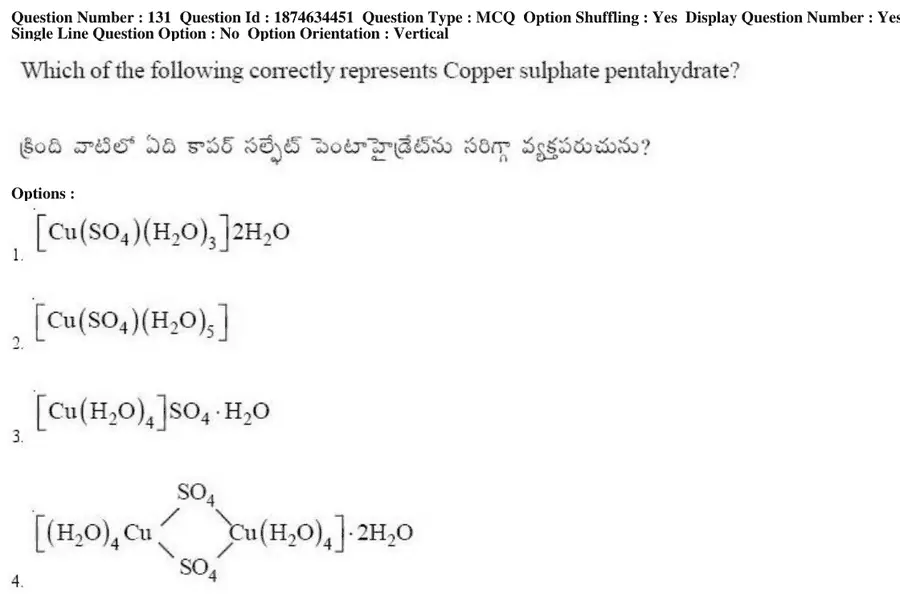
Which of the following correctly represents Copper sulphate pentahydrate?
![The question and its figure as printed in AP EAPCET 2019 22nd April 2019 Shift1. Option 4: [(H2O)4Cu(SO4)2Cu(H2O)4] · 2H2O drawn with two SO4 groups (one above, one below) bridging the two Cu atoms](/eapcet/q/img/q-apeapcet-2019-04-22-m-c11.webp)
$\mathrm{[Cu(SO_4)(H_2O)_3]2H_2O}$
$\mathrm{[Cu(SO_4)(H_2O)_5]}$
$\mathrm{[Cu(H_2O)_4]SO_4 \cdot H_2O}$
see figure $\mathrm{[(H_2O)_4Cu(SO_4)_2Cu(H_2O)_4] \cdot 2H_2O}$ drawn with two $\mathrm{SO_4}$ groups (one above, one below) bridging the two Cu atoms
If the crystal field splitting energy of a tetrahedral complex ($\Delta_t$) of the type $\mathrm{[ML_4]^{n+}}$ is $x\ \mathrm{eV}$, what is the crystal field splitting energy with respect to an octahedral complex, $\mathrm{[ML_6]^{n+}}$?
$\dfrac{9x}{4}\ \mathrm{eV}$
$\dfrac{9x}{8}\ \mathrm{eV}$
$\dfrac{4x}{9}\ \mathrm{eV}$
$\dfrac{4x}{5}\ \mathrm{eV}$
The magnetic moment of which of the following complexes is maximum?
$[\mathrm{Co(NH_3)_6}]^{3+}$
$[\mathrm{Ni(CN)_4}]^{2-}$
$[\mathrm{CoF_6}]^{3-}$
$[\mathrm{NiCl_4}]^{2-}$
A metal ion ($\mathrm{M^{n+}}$) forms octahedral $[\mathrm{ML_6}]^{n+}$ and tetrahedral $[\mathrm{ML_4}]^{n+}$ complexes with same ligand at different experimental conditions. The $\Delta_o$ of $[\mathrm{ML_6}]^{n+}$ is 3 eV. What is the energy in eV of $e_g$ orbital of $[\mathrm{ML_4}]^{n+}$ complex?
$\frac{4}{5}$
$-\frac{4}{5}$
$\frac{8}{15}$
$-\frac{8}{15}$
The $\Delta_0$ of a coordination complex of a metal ion ($\mathrm{3d^1}$) is 1000 $\mathrm{kJ\,mol^{-1}}$. If the energy of $\mathrm{t_{2g}}$ orbitals is $-400\ \mathrm{kJ\,mol^{-1}}$, the energy (in $\mathrm{kJ\,mol^{-1}}$) of $e_g$ orbitals is
$-600$
600
1000
400
Which of the following complex ions is most stable?
$\mathrm{[Co(H_2O)_6]^{3+}}$
$\mathrm{[Co(CN)_6]^{3-}}$
$\mathrm{[Co(C_2O_4)_3]^{3-}}$
$\mathrm{[CoF_6]^{3-}}$
The wavelengths of light absorbed by the complexes $\mathrm{[Ni(H_2O)_6]^{2+}, [Ni(\mathit{en})_3]^{2+}, [Ni(H_2O)_4\mathit{en}]^{2+}}$ are $\lambda_1, \lambda_2, \lambda_3$ respectively. The correct order of wavelengths is
$\lambda_1 > \lambda_2 > \lambda_3$
$\lambda_3 > \lambda_2 > \lambda_1$
$\lambda_1 > \lambda_3 > \lambda_2$
$\lambda_2 > \lambda_3 > \lambda_1$
Which one of the following coordination complexes exhibits the lowest value of magnetic moment (in B.M.)?
$\mathrm{[Cr(CN)_6]^{-3}}$
$\mathrm{[Mn(CN)_6]^{-3}}$
$\mathrm{[Fe(CN)_6]^{-3}}$
$\mathrm{[Co(CN)_6]^{-3}}$
Ethylenediamine (en)
Monodendate ligand and can occupy one position in coordination polyhedron
Bidendate ligand and can occupy two positions in coordination polyhedron
Polydendate ligand
Tridendate ligand and occupy three positions in coordination polyhedron
Which one of the following is square planar in structure and has diamagnetic property?
$\mathrm{[Ni(H_2O)_6]^{2+}}$
$\mathrm{[Ni(CO)_4]}$
$\mathrm{[Ni(CN)_4]^{2-}}$
$\mathrm{[NiCl_4]^{2-}}$
The electronic configuration of Cr in $\mathrm{Cr(CO)_6}$ as calculated using Crystal Field Theory is
$t_{2g}^{4}e_g^{0}$
$t_{2g}^{3}e_g^{1}$
$t_{2g}^{6}e_g^{0}$
$t_{2g}^{4}e_g^{2}$
Identify the number of complexes that are optically active
$[\mathrm{Co(en)_3}]^{3+}$ ; $[\mathrm{Co(NH_3)_4Cl_2}]^{+}$ ; $[\mathrm{CoCl_2(en)_2}]$ ; $[\mathrm{Co(NH_3)_3(NO_2)_3}]$
$0$
$1$
$2$
$3$
The covalency of Al in $[\mathrm{AlCl(H_2O)_5}]^{2+}$ is
3
5
1
6
Which of the following molecules / ions can exhibit isomerism?
A) Tetrahedral $\mathrm{NiCl_2Br_2^{2-}}$
B) Square planar $\mathrm{Pt(NH_3)_2Cl_2}$
C) Octahedral $\mathrm{Co(NH_3)_3Cl_3}$
D) Square planar $\mathrm{Pd(NH_3)_3Br^{+}}$
E) Octahedral $\mathrm{Co(en)_3^{3+}}$
where, en = 1, 2 - di amino ethane
A, B, C, D
B, C, E
B, C, D
A, B, C, E
Aqueous ammonia readily dissolves AgCl because
$\mathrm{NH_3}$ molecules readily solvate $\mathrm{Ag^+}$ and $\mathrm{Cl^-}$ ions
$\mathrm{NH_3}$ molecules abstract chloride from AgCl to form $\mathrm{NH_4Cl}$
A soluble complex $\mathrm{Ag(NH_3)_6^+}$ is formed
A soluble complex $\mathrm{Ag(NH_3)_2^+}$ is formed
Consider the complexes
a) $[\mathrm{Pd(NH_3)_2ClBr}]$
b) $[\mathrm{Pd(NH_3)_2Cl_2}]$
c) $[\mathrm{Pd(en)Cl_2}]$
d) $[\mathrm{Pd(en)ClBr}]$
e) $[\mathrm{Pd(en)_2}]\mathrm{Cl_2}$
(en = ethylenediamine)
The total number of geometrical isomers of (a) is same as the total number of geometrical isomers of
b
c
d
e
The green coloured complex ion of nickel in its aqueous solution is
$[\mathrm{Ni(en)_3}]^{2+}$
$[\mathrm{Ni(H_2O)_2(en)_2}]^{2+}$
$[\mathrm{Ni(H_2O)_4(en)}]^{2+}$
$[\mathrm{Ni(H_2O)_6}]^{2+}$
Identify the complex which exhibits optical isomerism.
$\mathrm{Co(NH_3)_5(SO_4)Br}$
$\mathrm{Co(NH_3)_5Cl_3}$
$\mathrm{Co(en)_3Cl_3}$
$\mathrm{Co(NH_3)_4(NO_2)Cl}$
Arrange the following ligands in the order of increasing field strength
I) $\mathrm{H_2O}$
II) CO
III) $\mathrm{NH_3}$
IV) $\mathrm{I^-}$
V) $\mathrm{F^-}$
IV < V < I < III < II
IV < V < III < II < I
V < IV < III < I < II
IV < I < V < II < III
A coordination compound is made of $\mathrm{Co^{3+}}$, $\mathrm{NH_3}$ and $\mathrm{Cl^-}$. 0.1 M solution of this complex when treated with excess silver nitrate gave no precipitate. The formula of the complex and secondary valency of metal are respectively.
$\mathrm{[Co(NH_3)_3Cl_3]}$, 6
$\mathrm{[Co(NH_3)_5Cl]Cl_2}$, 6
$\mathrm{[Co(NH_3)_3Cl_3]}$, 3
$\mathrm{[Co(NH_3)_4Cl_2]Cl}$, 6
Crystal field splitting energies for octahedral ($\Delta_o$) and tetrahedral ($\Delta_t$) geometries caused by the same ligands are related through the expression
$\Delta_o = \Delta_t$
$4\Delta_o = 9\Delta_t$
$9\Delta_o = 4\Delta_t$
$\Delta_o = 2\Delta_t$
The hybridisation of atom 'X' with atomic number 27 in $[\mathrm{XF_6}]^{3-}$ is
$dsp^{2}$
$d^{2}sp^{3}$
$sp^{3}d^{2}$
$sp^{3}$
Which one of the following statement is correct for $\mathrm{d^4}$ ions [P = pairing energy]
When $\Delta_0 > P$, low-spin complex form
When $\Delta_0 < P$, low-spin complex form
When $\Delta_0 > P$, high-spin complex form
When $\Delta_0 < P$, both high-spin and low-spin complexes form
Identify, from the following, the diamagnetic, tetrahedral complex
$[\mathrm{Ni(CN)_4}]^{2-}$
$[\mathrm{Ni(Cl)_4}]^{2-}$
$[\mathrm{Ni(CO)_4}]$
$[\mathrm{Co(C_2O_4)_3}]^{3-}$
The magnetic moment of $[\mathrm{CoF_6}]^{3-}$ as per spin only formula (in BM) is
3.87
5.92
2.84
4.90
The electronic configuration of a metal ion in its complex is $[\mathrm{Ar}]3d^4$. For this metal complex, $\Delta_0 < P$ (P = energy required for electron pairing in a single orbital). The distribution of electrons in the complex.
$(t_{2g})^3\,(e_g)^1$
$(t_{2g})^2\,(e_g)^2$
$(t_{2g})^4\,(e_g)^0$
$(t_{2g})^1\,(e_g)^3$
Identify the correctly matched set from the following:
$[\mathrm{NiCl_4}]^{2-}$ - Tetrahedral - Paramagnetic
$[\mathrm{Ni(CO)_4}]$ - Tetrahedral - Paramagnetic
$[\mathrm{Ni(CN)_4}]^{2-}$ - Square planar - Paramagnetic
$[\mathrm{NiCl_4}]^{2-}$ - Tetrahedral - Diamagnetic
The complex which does not exhibit geometrical isomerism is
$\mathrm{[Co(NH_3)_5Cl]Cl_2}$
$\mathrm{[Co(NH_3)_4Cl_2]}$
$\mathrm{[Co(NH_3)_3(NO_2)_3]}$
$\mathrm{[Co(en)_2Cl_2]Cl}$
The hybridisation of Ni, shape and number of unpaired electrons present in $[\mathrm{NiCl_4}]^{2-}$ are respectively
$sp^3$, tetrahedral, 2
$dsp^2$, tetrahedral, 2
$sp^3$, tetrahedral, 1
$sp^3$, square planar, 2
Which one of the following does not exhibit geometrical isomerism ?
Octahedral complex with formula $\mathrm{[MX_2L_4]}$
Square planar complex with formula $\mathrm{[MX_2L_2]}$
Tetrahedral complex with formula $\mathrm{[MABXL]}$
Octahedral complex with formula $\mathrm{[MX_2(L-L)_2]}$
Select the <u>correct</u> IUPAC name of $\mathrm{[Co(NH_3)_5(CO_3)]Cl}$
Penta ammonia carbonate cobalt (III) chloride
Pentammine carbonate cobalt chloride
Pentammine carbonato cobalt (III) chloride
Cobalt (III) pentammine carbonate chloride
Match the following :
List-I: A) $sp^3$ B) $dsp^2$ C) $sp^3d^2$ D) $d^2sp^3$
List-II: I) $[\mathrm{Co(NH_3)_6}]^{3+}$ II) $[\mathrm{Ni(CO)_4}]$ III) $[\mathrm{Pt(NH_3)_2Cl_2}]$ IV) $[\mathrm{CoF_6}]^{3-}$ V) $[\mathrm{Fe(CO)_5}]$
The correct answer is :
A-III, B-II, C-IV, D-I
A-V, B-II, C-IV, D-III
A-II, B-III, C-IV, D-I
A-II, B-III, C-I, D-V
The oxidation state and covalency of Al in $[\mathrm{AlCl(H_2O)_5}]^{2+}$ are respectively
+6, 6
+3, 6
+2, 6
+3, 3
A compound absorbs light in the wavelength region 490-500 nm. Its complementary colour is :
Red
Blue
Orange
Blue-green
A coordinate complex contains $\mathrm{Co^{3+}}$, $\mathrm{Cl^-}$ and $\mathrm{NH_3}$. When dissolved in water, one mole of this complex gave a total of 3 moles of ions. The complex is
$\mathrm{[Co(NH_3)_6]Cl_3}$
$\mathrm{[Co(NH_3)_5Cl]Cl_2}$
$\mathrm{[Co(NH_3)_4Cl_2]Cl}$
$\mathrm{[Co(NH_3)_3Cl_3]}$
Coordination Compounds sits at rank 18 among the 31 chemistry chapters in the modern 2022 to 2026 period. Across our complete repository of entrance papers spanning 2010 through 2026, the chapter contributed 160 questions across 149 papers, appearing in 131 of those tests to account for 2.7 percent of the subject with an average of 1.1 questions per paper. In the recent five-year timeframe from 2022 to 2026, it gathered 80 questions across 77 sittings, being present in 71 papers to maintain 1.0 question per paper and a 2.6 percent subject share.
The chapter has appeared in every exam year since 2022, though it was absent from six papers across that five-year window. Looking at state-specific distributions between 2022 and 2026, AP tests accounted for 50 questions across 48 papers (appearing in 43 papers, 1.0 question per paper, 2.6 percent share), while TS tests generated 30 questions across 29 papers (appearing in 28 papers, 1.0 question per paper, 2.6 percent share).
During earlier testing between 2010 and 2021, papers included 80 questions across 72 sittings (appearing in 60 tests), representing 1.1 questions per paper and a 2.8 percent subject share. Across the most recent three exam cycles from 2024 to 2026, question writers set 49 questions across 46 sittings (with 45 papers containing questions), yielding 1.1 questions per test and 2.7 percent share. Looking across the longitudinal split, the proportion early versus the last three years remains about the same, while the balance recent versus the last three years is likewise about the same.
Questions in Coordination Compounds group into four foundational structural categories:
Examiners place heavy emphasis on crystal field electron occupancy and ligand displacement rules. A standard problem supplies octahedral complexes of iron, cobalt, or manganese with strong-field cyanide or weak-field fluoride ligands, asking you to calculate crystal field stabilization energy or determine the ratio of electrons residing in the lower triplet subshell versus the upper doublet subshell.
Another frequent format asks which coordination compound produces zero precipitate when treated with excess silver nitrate solution, requiring candidates to recognize Verners formulation where all chloride ions reside inside the primary coordination sphere as non-ionisable ligands. Isomerism questions often ask you to count total stereoisomers for an octahedral cobalt complex containing symmetrical bidentate ethylenediamine ligands.
Solve these representative state entrance questions to test your grasp on coordination nomenclature, splitting, and isomerism:
Memorise the spectrochemical series for ligands in increasing order of crystal field splitting strength: iodide, bromide, thiocyanate, chloride, sulphide, fluoride, hydroxide, oxalate, water, isothiocyanate, edta, ammonia, ethylenediamine, nitrite, cyanide, and carbon monoxide. Strong-field ligands cause electron pairing when crystal field splitting exceeds pairing energy, producing low-spin inner-orbital complexes.
For isomerism, remember the symmetry rules. Trans isomers of octahedral bis-chelated complexes like trans-dichlorobis(ethylenediamine)cobalt possess an inversion center and are optically inactive, whereas the corresponding cis isomer lacks improper rotation axes and resolves into non-superimposable d and l optical enantiomers. Be fluent in Verners precipitation counts: one mole of hexamminecobalt trichloride yields three moles of silver chloride precipitate, while pentamminecobalt dichloride yields two, and tetramminecobalt monochloride yields one.
Ambidentate ligands possess two different donor atoms through which they can coordinate to a central metal ion, such as the nitro group coordinating through nitrogen or oxygen, and thiocyanate coordinating through sulphur or nitrogen. Linkage isomerism arises when a complex contains an ambidentate ligand coordinating through different atoms.
In a tetrahedral crystal field, only four ligands approach the central metal ion instead of six, and none of the metal d orbitals point directly along the ligand approach vectors. As a consequence, tetrahedral splitting energy equals four-ninths of the octahedral splitting energy for identical metal ions and ligands, making tetrahedral complexes almost universally high-spin.
In metal carbonyls, carbon monoxide donates its lone pair from a carbon sigma orbital into an empty metal d orbital. Simultaneously, filled metal d orbitals donate electron density back into the empty antibonding pi orbitals of carbon monoxide. This synergistic feedback loop strengthens the metal-carbon bond while weakening the carbon-oxygen bond. Step-by-step solutions for each one are in the EdLoop EAPCET app.