The reaction between X and Y produces a solid substance and a mixture of two gases, one of which is a colorless toxic gas. X and Y respectively are
A $\mathrm{LiAlH_4, BF_3}$
B $\mathrm{NaBH_4, I_2}$
C $\mathrm{NaH, BF_3}$
D $\mathrm{LiBH_4, BCl_3}$
Answer: (B) $\mathrm{NaBH_4, I_2}$ · The council's preliminary key
X, Y and Z are three allotropes of carbon. They are used in black ink, in water filters and as reducing agent in metallurgy respectively. The correct statement about their production is
A X is produced by heating wood at high temperatures in absence of air
B Y is produced by burning hydrocarbons in limited air
C Z is produced by heating coal at high temperatures in absence of air
D All three are produced by same chemical process
Answer: (C) Z is produced by heating coal at high temperatures in absence of air · The council's preliminary key
Consider the following statements about sulphur allotropes and identify the incorrect statement
A In both rhombic and monoclinic sulphur, the $\mathrm{S_8}$ ring has crown shape
B In cyclo $\mathrm{S_6}$, the ring adopts the chair form
C The bond angle in $\mathrm{S_8}$ ring is more than that of cyclo $\mathrm{S_6}$ ring
D Monoclinic sulphur is stable below 369 K
Answer: (D) Monoclinic sulphur is stable below 369 K · The council's preliminary key
Consider the following statements regarding the hydrolysis of $\mathrm{XeF_4}$
I. It is a disproportionation reaction
II. Xe and $\mathrm{XeO_3}$ are formed in 2:1 molar ratio
III. $\mathrm{O_2}$ gas is evolved in this reaction
The correct statements are
A I, II only
B II, III only
C I, III only
D I, II, III
Answer: (D) I, II, III · The council's preliminary key
What is the conjugate acid of $\mathrm{H_3P_2O_6^-}$ ?
A Orthophosphorus acid
B Hypophosphorus acid
C Pyrophosphoric acid
D Hypophosphoric acid
Answer: (D) Hypophosphoric acid · The council's preliminary key
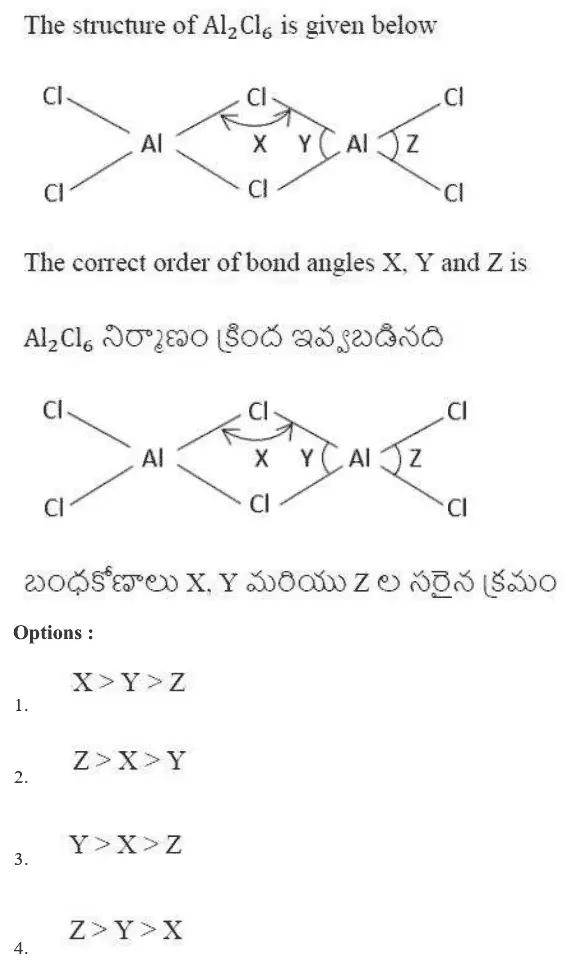
The structure of $\mathrm{Al_2Cl_6}$ is given below
(see the figure above)
The correct order of bond angles X, Y and Z is
The question as printed in the paper. A $\mathrm{X>Y>Z}$
B $\mathrm{Z>X>Y}$
C $\mathrm{Y>X>Z}$
D $\mathrm{Z>Y>X}$
Answer: (B) $\mathrm{Z>X>Y}$ · The council's preliminary key
Which of the following reaction is not correct?
A $\mathrm{SiF_4 + 2F^- \rightarrow [SiF_6]^{2-}}$
B $\mathrm{GeCl_4 + 2Cl^- \rightarrow [GeCl_6]^{2-}}$
C $\mathrm{Sn(OH)_4 + 2OH^- \rightarrow [Sn(OH)_6]^{2-}}$
D $\mathrm{SiCl_4 + 2Cl^- \rightarrow [SiCl_6]^{2-}}$
Answer: (D) $\mathrm{SiCl_4 + 2Cl^- \rightarrow [SiCl_6]^{2-}}$ · The council's preliminary key
The method by which very pure nitrogen can be obtained is
A Thermal decomposition of ammonium dichromate
B Thermal decomposition of barium azide
C Reaction of aqueous solution of ammonium chloride with sodium nitrite
D Thermal decomposition of ammonium nitrate
Answer: (B) Thermal decomposition of barium azide · The council's preliminary key
Observe the following reaction
$$\mathrm{Na_2B_4O_7} \xrightarrow{\mathrm{H_2O}} \text{Acid} + \text{alkali}$$
The hybridisation of central atom of acid is
A $sp^3$
B $sp^2$
C $dsp^2$
D $sp^3d^2$
Answer: (B) $sp^2$ · The council's preliminary key
In group 13 elements, element $Y$ has the lowest boiling point and element $Z$ has lowest melting point. The nature of oxides of $Y$ and $Z$ is respectively
A Acidic, amphoteric
B Amphoteric, Basic
C Basic, amphoteric
D Amphoteric, amphoteric
Answer: (C) Basic, amphoteric · The council's preliminary key
Consider the following statements
Statement –I: In three dimensional network of $\mathrm{SiO_2}$, if few $\mathrm{Si}$ atoms are replaced by $\mathrm{Al}$ atoms, the resulting structure acquires a positive charge
Statement – II: Silicones are organo – silicon polymers which have $-(\mathrm{R_2SiO})-$ as a repeating unit
The correct answer is
A Both statements – I and II are correct
B Statement – I is correct but Statement – II is not correct
C Statement – I is not correct but Statement – II is correct
D Both statements – I and II are not correct
Answer: (C) Statement – I is not correct but Statement – II is correct · The council's preliminary key
Which of the following compounds is not correctly matched with the property given?
A Silica – Has high melting point
B Silicones – water-repellent and heat-resistant
C Zeolites – ion-exchangers
D Stannous chloride – good oxidizing agent
Answer: (D) Stannous chloride – good oxidizing agent · The council's preliminary key
The halogen oxide which is used in the estimation of carbon monoxide
A $\mathrm{Cl_2O_7}$
B $\mathrm{BrO_3}$
C $\mathrm{I_2O_7}$
D $\mathrm{I_2O_5}$
Answer: (D) $\mathrm{I_2O_5}$ · The council's preliminary key
Given below are two statements
Statement I: The formation of $O_2^+[PtF_6]^-$ is the basis for the formation of Xenon flourides
Statement II: $O_2$ and $Xe$ have almost same first ionisation enthalpy
The correct answer is
A Both statements I and II are correct
B Statement I is correct, but statement II is not correct
C Statement I is not correct, but statement II is correct
D Both statements I and II are not correct
Answer: (A) Both statements I and II are correct · The council's preliminary key
In which of the following boron and boron related substances are not correctly matched with the application shown against it?
A Boron fibres – manufacture of glass wool
B Metal borides – protective shields in nuclear industry
C Borax – flux for soldering metals
D Boric acid – mild antiseptic
Answer: (A) Boron fibres – manufacture of glass wool · The council's preliminary key
Which of the following oxoacids is formed when phosphonic acid is made to react with $\mathrm{PCl_3}$?
A $\mathrm{H_4P_2O_6}$
B $\mathrm{H_4P_2O_7}$
C $\mathrm{H_4P_2O_5}$
D $\mathrm{H_3P_3O_9}$
Answer: (C) $\mathrm{H_4P_2O_5}$ · The council's preliminary key
Which of the following statement is not correct about the structures of ozone and sulphur dioxide?
A Both have angular shape
B Both have resonance structures
C Both have same hybridization
D Both have same bond angles
Answer: (D) Both have same bond angles · The council's preliminary key
Which of the following statements regarding the similarities between boron and silicon is not correct?
A Both form halides that undergo hydrolysis
B Both form electron precise hydrides
C Both form acidic oxides
D Density of both is almost same
Answer: (B) Both form electron precise hydrides · The council's preliminary key
Which of the following carbon allotropes is not correctly matched with its use?
A Graphite – as electrode in batteries
B Diamond – as abrasive for cutting hard tools
C Coke – as reducing agent in extraction of metals
D Carbon black – in adsorbing poisonous gases
Answer: (D) Carbon black – in adsorbing poisonous gases · The council's preliminary key
Observe the following reaction
$$\mathrm{PH_3(aq)} \xrightarrow{\text{Light}} \mathrm{X + H_2}$$
Which of the following is NOT correct regarding X?
A It is non-poisonous, odourless solid
B It is insoluble in water and carbon disulphide
C It has polymeric structure
D It exhibits chemiluminescence in dark
Answer: (D) It exhibits chemiluminescence in dark · The council's preliminary key
Total number of electrons involved in the formation of bridge bonds in the structure of diborane is
Answer: (C) 4 · The council's preliminary key
Consider the following statements
Statement – I: Silica in its normal form is almost non-reactive because of very high Si-O bond enthalpy
Statement – II: Silica has no reaction with HF
The correct answer is
A Both the statements I & II are correct.
B Statement I is correct but statement – II is NOT correct
C Statement I is NOT correct but statement – II is correct
D Both the statements I & II are NOT correct
Answer: (B) Statement I is correct but statement – II is NOT correct · The council's preliminary key
The reduction products formed when copper and zinc metals are separately oxidised with dilute $\mathrm{HNO_3}$ respectively are
A $\mathrm{NO}$ , $\mathrm{NO_2}$
B $\mathrm{N_2O}$ , $\mathrm{NO}$
C $\mathrm{NO}$ , $\mathrm{N_2O}$
D $\mathrm{NO_2}$ , $\mathrm{NO}$
Answer: (C) $\mathrm{NO}$ , $\mathrm{N_2O}$ · The council's preliminary key
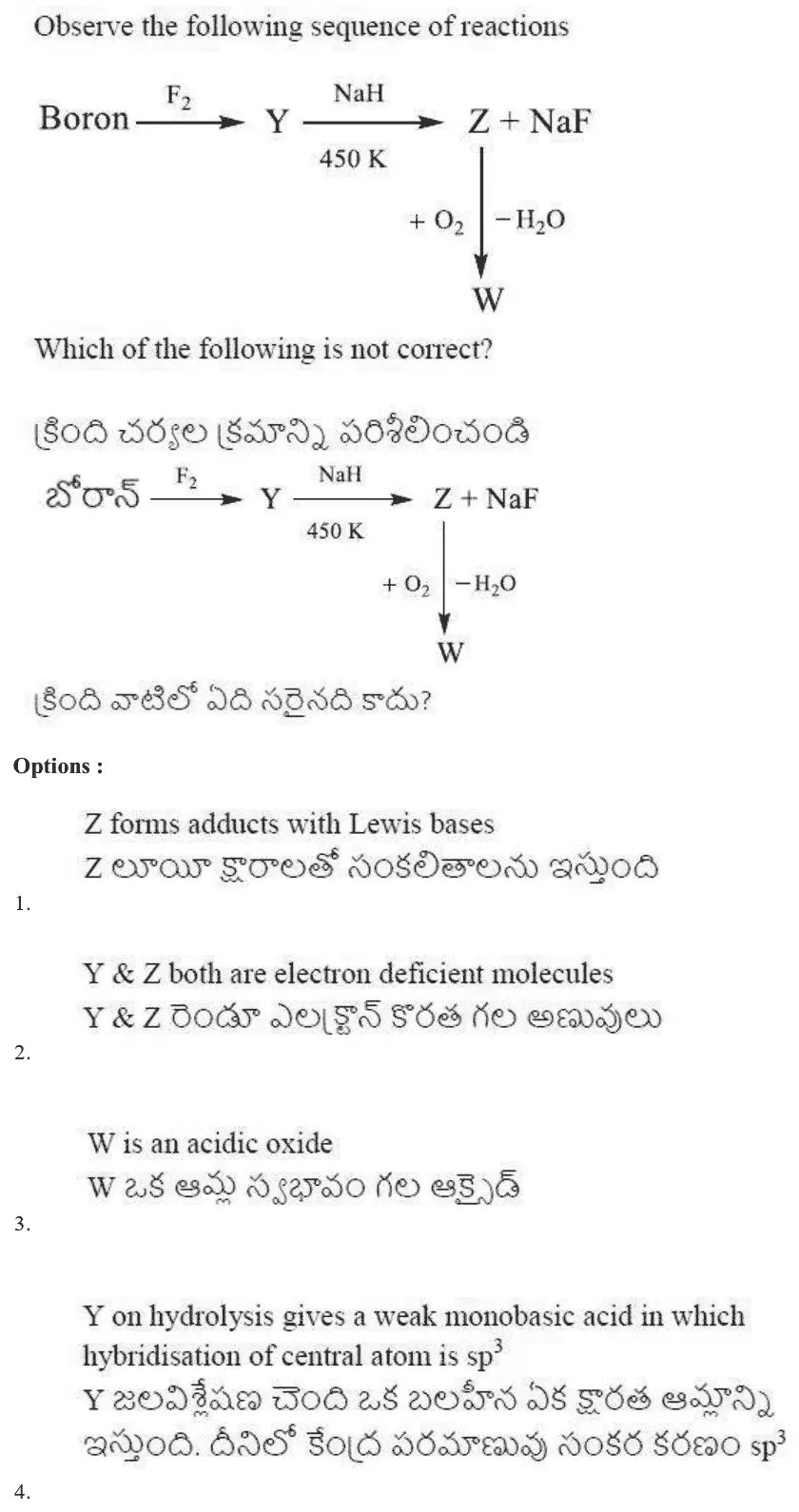
Observe the following sequence of reactions
(see the figure above)
Which of the following is not correct?
The question as printed in the paper. A Z forms adducts with Lewis bases
B Y & Z both are electron deficient molecules
C W is an acidic oxide
D Y on hydrolysis gives a weak monobasic acid in which hybridisation of central atom is $\mathrm{sp^3}$
Answer: (D) Y on hydrolysis gives a weak monobasic acid in which hybridisation of central atom is $\mathrm{sp^3}$ · The council's preliminary key
How many of the following molecules will give oxygen on thermal decomposition?
$\mathrm{(NH_4)_2Cr_2O_7}$, $\mathrm{KClO_3}$, $\mathrm{HgO}$, $\mathrm{NH_4NO_3}$, $\mathrm{KMnO_4}$, $\mathrm{CaCO_3}$, $\mathrm{Pb_3O_4}$
Answer: (A) 4 · The council's preliminary key
Chlorine reacts with sodium thiosulphate in the presence of water and forms sodium sulphate, hydrochloric acid and X. Which of the following also produces X when reacted with chlorine?
A $\mathrm{H_2S}$
B $\mathrm{H_2SO_4}$
C $\mathrm{SO_2}$
D $\mathrm{FeSO_4}$
Answer: (A) $\mathrm{H_2S}$ · The council's preliminary key
The increasing order of N – N bond length of $\mathrm{N_2O}$(A), $\mathrm{N_2O_3}$(B), $\mathrm{N_2O_4}$(C) is
A A, C, B
B A, B, C
C B, C, A
D C, B, A
Answer: (A) A, C, B · The council's preliminary key
$\mathrm{BCl_3}$ on hydrolysis gives a complex ion $\underline{X}$. $\mathrm{AlCl_3}$ in acidified aqueous solution forms a complex ion $\underline{Y}$. The hybridization of central atoms in $X$ and $Y$ are respectively
A $sp^3$, $sp^3$
B $sp^3$, $sp^3d$
C $sp^2$, $sp^3d^2$
D $sp^3$, $sp^3d^2$
Answer: (D) $sp^3$, $sp^3d^2$ · The council's preliminary key
An oxoacid, $X$ is formed by the reaction of $P_4O_6$ with water. When this acid is heated, it undergoes disproportionation to give a different oxoacid $Y$ and a poisonous gas $Z$. Identify the correct statement regarding $X, Y, Z$
A $X$ is a tribasic acid
B $Y$ has two $P$-$H$ bonds
C $X$ forms another tribasic oxoacid on reacting with $PCl_3$
D $Z$ acts as Lewis base
Answer: (D) $Z$ acts as Lewis base · The council's preliminary key
Consider the following reactions which are not balanced
$$\mathrm{XeF_6 + H_2O \rightarrow X + HF}$$
The correct statement regarding X/Y/Z is
A $X$ has square planar geometry
B $Y$ has one $\mathrm{Xe{=}O}$ bond
C $Z$ has no lone pairs of electrons on its central atom
D The oxidation state of Xenon in $X, Y$ and $Z$ is same
Answer: (D) The oxidation state of Xenon in $X, Y$ and $Z$ is same · The council's preliminary key
A boron compound $\underline{X}$ is obtained when aqueous solution of borax is treated with $\mathrm{HCl}$. The incorrect statement about $\underline{X}$ is
A It has layer structure
B Its basicity is 3
C On heating it gives an acidic oxide
D It is highly soluble in hot water
Answer: (B) Its basicity is 3 · The council's preliminary key
Observe the following statements about the oxides of group 14 elements
I. $\mathrm{CO_2}$ is an acidic oxide but $\mathrm{CO}$ is a neutral oxide
II. Cristobalite is the crystalline form of silica
III. Liquid $\mathrm{CO}$ is called dry ice
IV. Both $\mathrm{CO}$ and $\mathrm{CO_2}$ act as Lewis acids
The correct statements are
A I & II only
B I & III only
C I & IV only
D III & IV only
Answer: (A) I & II only · The council's preliminary key
Hydrolysis of chlorine nitrate gives oxoacid of chlorine $\underline{X}$ and oxoacid of nitrogen $\underline{Y}$.
A $+1,\quad +3$
B $-1,\quad +3$
C $+1,\quad +5$
D $+3,\quad +5$
Answer: (C) $+1,\quad +5$ · The council's preliminary key
Compound X is formed when dry chlorine is passed over heated white phosphorous. X on hydrolysis gives an acid Y. What are the disproportionation products of Y?
A $\mathrm{H_3PO_4, H_3PO_2}$
B $\mathrm{PH_3, H_3PO_4}$
C $\mathrm{H_3PO_3, PH_3}$
D $\mathrm{H_3PO_2, PH_3}$
Answer: (B) $\mathrm{PH_3, H_3PO_4}$ · The council's preliminary key
The composition of Borax is $\mathrm{Na_2B_4O_7 \cdot xH_2O}$ and that of Kernite is $\mathrm{Na_2B_4O_7 \cdot yH_2O}$. (x-y) is equal to
Answer: (D) 6 · The council's preliminary key
Four sets of reactants required for the preparation of four different oxoacids of phosphorous are given below
I. $\mathrm{PCl_3, H_3PO_3}$
II. $\mathrm{P_2O_3, H_2O}$
III. Red $\mathrm{P_4}$, alkali
IV. $\mathrm{P_4O_{10}, H_2O}$
The oxoacids formed from which sets of reactants have phosphorus in +3 oxidation state?
A I, II only
B III, IV only
C II, III only
D I, IV only
Answer: (A) I, II only · The council's preliminary key
Ethyl alcohol on reaction with $\mathrm{PCl_3}$ gives ethyl chloride and an oxoacid X. This on reaction with $\mathrm{PCl_3}$ again forms another oxoacid Y. The number of $-\mathrm{OH}$ groups in X and Y are respectively
Answer: (B) 2, 2 · The council's preliminary key
In which of the following the order is not correctly matched with the property mentioned ?
A $\mathrm{HF < HCl < HBr < HI}$ - Acidic strength
B $\mathrm{NH_3 > PH_3 > AsH_3 > SbH_3}$ - Basic strength
C $\mathrm{H_2O < H_2S < H_2Se < H_2Te}$ - Acidic strength
D $\mathrm{H_2O < H_2S < H_2Se < H_2Te}$ - Bond angle
Answer: (D) $\mathrm{H_2O < H_2S < H_2Se < H_2Te}$ - Bond angle · The council's preliminary key
Empirical formula weight of borazine is
Answer: (C) 26.8 · The council's preliminary key
$\mathrm{XeF_4}$ on reaction with $\mathrm{O_2F_2}$ at 143 K gives a Xenon compound A. This on complete hydrolysis gives HF and B. The hybridisation of central atom in B is
A $\mathrm{sp^3}$
B $\mathrm{sp^2}$
C $\mathrm{sp^3d}$
D $\mathrm{sp^3d^2}$
Answer: (A) $\mathrm{sp^3}$ · The council's preliminary key
Which of the following statements are correct?
I. Reaction of bromine with excess fluorine gives a T-shaped compound
II. Iodine oxides decompose on heating
III. Roasting of sulphide ores gives $\mathrm{SO_2}$ as a byproduct
The correct answer is
A I, II only
B II, III only
C I, III only
D I, II, III
Answer: (B) II, III only · The council's preliminary key
Which of the following reactions are correct with respect to the formation of products?
I. $\mathrm{XeF_6 + NaF \rightarrow Na[XeF_7]}$
II. $\mathrm{XeF_2 + PF_5 \rightarrow [XeF]^+[PF_6]^-}$
III. $\mathrm{XeF_4 + SbF_5 \rightarrow [XeF_3]^+[SbF_6]^-}$
The correct answer is
A II, III only
B I, III only
C I, II only
D I, II, III
Answer: (D) I, II, III · The council's preliminary key
Consider the following reactions
$$\text{Borax} \xrightarrow{\mathrm{H_2O}} \mathrm{A + B}$$
$$\text{Borax} \xrightarrow[\mathrm{HCl}]{\mathrm{H_2O}} \mathrm{B + C}$$
Which of the following are the properties of A, B, C?
I. Both A, B are strong bases
II. B is a white crystalline solid with soapy touch
III. C is water soluble
The correct answer is
A I, II, III
B II, III only
C I, III only
D I, II only
Answer: (B) II, III only · The council's preliminary key
Identify the complex ion which does not exist
A $[\mathrm{SiF_6}]^{2-}$
B $[\mathrm{GeCl_6}]^{2-}$
C $[\mathrm{Sn(OH)_6}]^{2-}$
D $[\mathrm{SiCl_6}]^{2-}$
Answer: (D) $[\mathrm{SiCl_6}]^{2-}$ · The council's preliminary key
Match the following
List-1 (Process) List-2 (Catalyst) A Ostwald's process I $\mathrm{CuCl_2}$ B Haber's process II $\mathrm{V_2O_5}$ C Deacon's process III Iron oxide, $\mathrm{K_2O}$, $\mathrm{Al_2O_3}$ D Contact process IV Rh gauge
The correct answer is
A A – II, B – III, C – IV, D – I
B A – IV, B – I, C – II, D – III
C A – IV, B – III, C – I, D – II
D A – II, B – IV, C – I, D – III
Answer: (C) A – IV, B – III, C – I, D – II · The council's preliminary key
Which one of the following oxides of nitrogen has linear structure?
A $\mathrm{N_2O_5}$
B $\mathrm{N_2O_4}$
C $\mathrm{N_2O}$
D $\mathrm{N_2O_3}$
Answer: (C) $\mathrm{N_2O}$ · The council's preliminary key
$\mathrm{SO_2}$ reacts with chlorine in the presence of charcoal and gives a compound X. X on reaction with phosphorus gives $\mathrm{SO_2}$ and Y. The shape of Y is
A Pyramidal
B Tetrahedral
C Trigonal bipyramidal
D Angular
Answer: (C) Trigonal bipyramidal · The council's preliminary key
In graphite the C – C bond length with in the layer is X pm and the distance between two adjacent layers is Y pm. X and Y respectively are
A 340, 141.5
B 141.5, 340
C 141.5, 154
D 143.5, 340
Answer: (B) 141.5, 340 · The council's preliminary key
Which of the following orders are correct for the stated property?
I. $\mathrm{HF > HCl > HBr > HI}$ - Thermal stability
II. $\mathrm{H_2O > H_2S > H_2Se > H_2Te}$ - Bond dissociation enthalpy
III. $\mathrm{HClO_4 > HClO_3 > HClO_2 > HOCl}$ - Acidic character
The correct answer is
A I, II only
B II, III only
C I, III only
D I, II, III
Answer: (D) I, II, III · The council's preliminary key
The transition temperature of sulphur is
A 369 ºC
B 369 K
C 133 K
D 133 ºC
Answer: (B) 369 K · The council's preliminary key
Identify the reactions which give orthoboric acid from the following
I. Acidification of an aqueous solution of borax
II. Hydrolysis of diborane
III. Hydrolysis of boron trichloride
The correct answer is
A I, II only
B II, III only
C I, III only
D I, II, III
Answer: (D) I, II, III · The council's preliminary key
The allotrope of carbon with aromatic character is
A Diamond
B Graphite
C Coke
D Fullerence
Answer: (D) Fullerence · The council's preliminary key
The bond angle in the most stable form of sulphur at room temperature is
A $102.2^\circ$
B $201.2^\circ$
C $107^\circ$
D $117^\circ$
Answer: (C) $107^\circ$ · The council's preliminary key
Iodine on reaction with concentrated nitric acid gives three products X, Y and Z. The sum of oxidation numbers of the central atoms in X, Y and Z is
Answer: (C) 7 · The council's preliminary key
The reaction of chlorine with hot and conc. $\mathrm{NaOH}$ solution gave two chlorine containing products X, Y and $\mathrm{H_2O}$. Oxidation number of chlorine in X and Y is
A $+1, +5$
B $-1, +1$
C $-1, +5$
D $+1, +3$
Answer: (C) $-1, +5$ · The council's preliminary key
The correct order of metallic radius of Al, Ga, In, Tl is
A Tl $>$ In $>$ Al $>$ Ga
B Tl $>$ In $>$ Ga $>$ Al
C In $>$ Ga $>$ Al $>$ Tl
D Ga $>$ In $>$ Tl $>$ Al
Answer: (A) Tl $>$ In $>$ Al $>$ Ga · The council's preliminary key
Given below are two statements
Statement-I: Silicones have high thermal stability and high dielectric strength
Statement-II: In silica Si−O bond enthalpy is very high
The correct answer is
A Both statements I and II are correct
B Both statements I and II are not correct
C Statement I is correct, but statement II is not correct
D Statement I is not correct, but statement II is correct
Answer: (A) Both statements I and II are correct · The council's preliminary key
Observe the following
$\mathrm{P_2O_3 \xrightarrow{H_2O} X \xrightarrow{PCl_3} Y}$
$\mathrm{P_4O_{10} \xrightarrow{H_2O} Z \xrightarrow{\Delta} W}$
Which of the following are common for both Y and W?
I. Four P−OH bonds
II. Two P−H bonds
III. Two P=O bonds
IV. One P−O−P bond
The correct answer is (only)
A I, III, IV only
B I, II, III only
C II, III, IV only
D III, IV only
Answer: (D) III, IV only · The council's preliminary key
What are X, Y in the following reactions?
$$2\mathrm{X_2}(g)+2\mathrm{H_2O}(l)\rightarrow 4\mathrm{H^+}(aq)+4\mathrm{X^-}(aq)+\mathrm{O_2}(g)$$
$$\mathrm{Y_2}(g)+\mathrm{H_2O}(l)\rightarrow \mathrm{HY}(aq)+\mathrm{HOY}(aq)$$
A $\mathrm{X=F, Y=I}$
B $\mathrm{X=I, Y=Cl}$
C $\mathrm{X=F, Y=Cl}$
D $\mathrm{X=Cl, Y=I}$
Answer: (C) $\mathrm{X=F, Y=Cl}$ · The council's preliminary key
Select the correct statements from the following.
A) Aluminium liberates $\mathrm{H_2}$ gas with dil.$\mathrm{HCl}$ but not with aqueous $\mathrm{NaOH}$.
B) Formula of sodium metaborate is $\mathrm{Na_3BO_3}$
C) Boric acid is a weak monobasic acid
D) For thallium, +1 state is more stable than +3 state.
Answer: (C) C & D · The council's preliminary key
Complete hydrolysis of Xenon hexafluoride gives HF along with compound X. The hybridisation in X is
A $\mathrm{sp^3}$
B $\mathrm{sp}$
C $\mathrm{sp^2}$
D $\mathrm{sp^3d}$
Answer: (A) $\mathrm{sp^3}$ · The council's preliminary key
Which of the following reactions give $\mathrm{H_2}$ as one of the products ? (Reactions are not balanced) (only)
I) $\mathrm{NaBH_4 + I_2} \longrightarrow$
II) $\mathrm{B_2H_6 + N(CH_3)_3} \longrightarrow$
III) $\mathrm{Al + NaOH + H_2O} \longrightarrow$
IV) $\mathrm{BF_3 + NaH} \longrightarrow$
A I, II & III only
B II & IV only
C I & III only
D II, III & IV only
Answer: (C) I & III only · The council's preliminary key
Consider the following.
Statement-I : $\mathrm{CCl_4}$ does not undergo hydrolysis. But $\mathrm{SiCl_4}$ undergoes hydrolysis.
Statement-II : Thermal and chemical stability of $\mathrm{GeX_4}$ is more than $\mathrm{GeX_2}$
The correct answer is
A Both statement-I and statement-II are correct
B Both statement-I and statement-II are not correct
C Statement-I is correct, but statement-II is not correct
D Statement-I is not correct, but statement-II is correct
Answer: (A) Both statement-I and statement-II are correct · The council's preliminary key
Orthophosphorus acid on disproportionation gives $\mathrm{PH_3}$ and another oxoacid of phosphorus 'X'. The basicity of X is
Answer: (C) 3 · The council's preliminary key
Identify the correct statements
I) CO reduces the oxygen carrying ability of blood
II) Producer gas contains CO & $\mathrm{N_2}$
III) C-O bond length in $\mathrm{CO_2}$ is 115 pm
A I & III only
B I, II & III
C I & II only
D II & III only
Answer: (B) I, II & III · The council's preliminary key
Identify the incorrect statement about silica.
A It is acidic in nature
B It has no reaction with most of acids except $\mathrm{HF}$
C With $\mathrm{NaOH}$ it forms sodium silicate
D Like graphite, it has two dimensional structure
Answer: (D) Like graphite, it has two dimensional structure · The council's preliminary key
The number of $\mathrm{P=O}$, $\mathrm{P-P}$ bonds present in oxoacid of phosphorus, prepared by treating red $\mathrm{P_4}$ with alkali are respectively
Answer: (A) 2, 1 · The council's preliminary key
Which one of the following reactions is not feasible ?
A $\mathrm{Cl_2(g) + 2KBr(aq) \longrightarrow 2KCl(g) + Br_2(l)}$
B $\mathrm{Cl_2(g) + 2KI(aq) \longrightarrow 2KCl(aq) + I_2(s)}$
C $\mathrm{Br_2(l) + 2KI(aq) \longrightarrow 2KBr(aq) + I_2(s)}$
D $\mathrm{I_2(s) + 2KBr(aq) \longrightarrow 2KI(aq) + Br_2(l)}$
Answer: (D) $\mathrm{I_2(s) + 2KBr(aq) \longrightarrow 2KI(aq) + Br_2(l)}$ · The council's preliminary key
Identify the reaction in which diborane is produced on industrial scale ?
A Reaction of $\mathrm{BF_3}$ with $\mathrm{LiA/H_4}$ in diethyl ether
B Oxidation of $\mathrm{NaBH_4}$ with $\mathrm{I_2}$
C Reaction of $\mathrm{BF_3}$ with $\mathrm{NaH}$ at 450 K
D By heating $\mathrm{H_3BO_3}$ to above 370 K temperature
Answer: (C) Reaction of $\mathrm{BF_3}$ with $\mathrm{NaH}$ at 450 K · The council's preliminary key
Which of the following properties is not correct for silicones ?
A bio compatible
B high thermal stability
C low dielectric strength
D water repelling in nature
Answer: (C) low dielectric strength · The council's preliminary key
Which of the following is not correct ?
A Thermal stability : $\mathrm{H_2O > H_2S > H_2Se > H_2Te > H_2Po}$
B Reducing property : $\mathrm{H_2S > H_2Se > H_2Te > H_2Po}$
C Boiling point : $\mathrm{H_2S < H_2Se < H_2Te < H_2O}$
D Melting point : $\mathrm{H_2S < H_2Se < H_2Te < H_2O}$
Answer: (B) Reducing property : $\mathrm{H_2S > H_2Se > H_2Te > H_2Po}$ · The council's preliminary key
Identify the incorrect statement about the group 13 elements
A Nature of aqueous solution of borax is alkaline
B Orthoboric acid is a weak tribasic acid
C Metaboric acid on heating gives an acidic oxide
D $\mathrm{LiBH_4}$ acts as a reducing agent
Answer: (B) Orthoboric acid is a weak tribasic acid · The council's preliminary key
Which of the following statements are correct ?
I) $\mathrm{SnF_4}$ is ionic in nature
II) Stability of dihalides of group 14 elements increases down the group
III) $\mathrm{GeCl_2}$ is more stable than $\mathrm{GeCl_4}$
A I, II & III
B I & III only
C II & III only
D I & II only
Answer: (D) I & II only · The council's preliminary key
Nature of two oxides of nitrogen X and Y formed in the reaction of sodium nitrite with hydrochloric acid is
A Both X and Y are acidic in nature
B X is acidic and Y is neutral in nature
C Both X and Y are neutral in nature
D X is amphoteric and Y is neutral in nature
Answer: (B) X is acidic and Y is neutral in nature · The council's preliminary key
The incorrect statement from the following is
A Aluminium dissolves in conc.$\mathrm{HNO_3}$ and liberates $\mathrm{H_2}$ gas
B Borazole contains $12\sigma$ and $3\pi$ bonds
C Gallium oxide is amphoteric in nature
D $\mathrm{BF_3}$ is a Lewis acid
Answer: (A) Aluminium dissolves in conc.$\mathrm{HNO_3}$ and liberates $\mathrm{H_2}$ gas · The council's preliminary key
In Buckminster fullerene, the number of six membered carbon rings is '$x$' and five membered carbon rings is '$y$', $(x + y)$ value is
Answer: (C) 32 · The council's preliminary key
Consider the following
Statement-I : $\mathrm{Al_2O_3}$ is amphoteric in nature.
Statement-II : $\mathrm{Tl_2O_3}$ is more basic than $\mathrm{Ga_2O_3}$
The correct answer is
A Both statement-I and statement-II are correct
B Both statement-I and statement-II are not correct
C Statement-I is correct, but statement-II is not correct
D Statement-I is not correct, but statement-II is correct
Answer: (A) Both statement-I and statement-II are correct · The council's preliminary key
Identify the incorrect order against the stated property.
A $\mathrm{Ge} > \mathrm{Sn} > \mathrm{Pb}$ - Ionization enthalpy
B $\mathrm{Ge} > \mathrm{Pb} > \mathrm{Sn}$ - Melting point
C $\mathrm{Pb} > \mathrm{Sn} > \mathrm{Ge}$ - Density
D $\mathrm{Ge} > \mathrm{Pb} > \mathrm{Sn}$ - Electrical resistivity
Answer: (A) $\mathrm{Ge} > \mathrm{Sn} > \mathrm{Pb}$ - Ionization enthalpy · The council's preliminary key
White phosphorus on heating with concentrated $\mathrm{NaOH}$ solution in an inert atmosphere of $\mathrm{CO_2}$ gives a salt 'X' and gas 'Y'. The oxidation state of central atom in X and Y is respectively
A $-3, +1$
B $+1, -3$
C $0, -3$
D $+1, +2$
Answer: (B) $+1, -3$ · The council's preliminary key
Consider the following.
Statement-I : The order of electronegativity of $\mathrm{B, Al, In, Tl}$ is $\mathrm{B > Tl > Al > In}$
Statement-II : Boric acid is a weak protonic acid
The correct answer is
A Both statement-I and statement-II are correct
B Both statement-I and statement-II are not correct
C Statement-I is correct, but statement-II is not correct
D Statement-I is not correct, but statement-II is correct
Answer: (B) Both statement-I and statement-II are not correct · The council's preliminary key
Which of the following does not exist ?
A $[\mathrm{SiCl_6}]^{2-}$
B $[\mathrm{GeCl_6}]^{2-}$
C $[\mathrm{SiF_6}]^{2-}$
D $[\mathrm{Sn(OH)_6}]^{2-}$
Answer: (A) $[\mathrm{SiCl_6}]^{2-}$ · The council's preliminary key
Consider the following.
Assertion (A) : CO is poisonous to living beings
Reason (R) : CO binds to haemoglobin forming carboxyhaemoglobin, which is less stable than oxygen-haemoglobin complex.
Correct answer is
A (A) and (R) both are correct and (R) is the correct explanation for (A)
B (A) and (R) both are correct and (R) is not the correct explanation for (A)
C (A) is correct, but (R) is not correct
D (A) is not correct, but (R) is correct
Answer: (C) (A) is correct, but (R) is not correct · The council's preliminary key
Gas X is obtained in Deacon's process. X on reacting with iodine and water gives
A $\mathrm{HIO_4}$
B $\mathrm{HIO_2}$
C $\mathrm{HIO}$
D $\mathrm{HIO_3}$
Answer: (D) $\mathrm{HIO_3}$ · The council's preliminary key
In the structure of diborane, the number of 2-centre-2-electron bonds is X and 3-centre-2-electron bonds is Y. The value of $(\mathrm{X}+\mathrm{Y})$ is
Answer: (B) 6 · The council's preliminary key
Match the following
List-I (Compound) List-II (Use) A) Kieselghur I) Chromotographic material B) Silica gel II) Softening of hard Water C) ZSM-5 III) Filtration plants D) Hydrated zeolites IV) To convert alcohol directly into gasoline
The correct answer is
A A-IV, B-III, C-II, D-I
B A-IV, B-I, C-II, D-III
C A-III B-IV, C-I, D-II
D A-III, B-I, C-IV, D-II
Answer: (D) A-III, B-I, C-IV, D-II · The council's preliminary key
The oxides of nitrogen obtained by the reaction of nitric acid with (i) $\mathrm{P_4O_{10}}$, (ii) $\mathrm{P_4}$ respectively are
A $\mathrm{NO, N_2O}$
B $\mathrm{N_2O_3, NO}$
C $\mathrm{N_2O_5, NO_2}$
D $\mathrm{NO_2, N_2O}$
Answer: (C) $\mathrm{N_2O_5, NO_2}$ · The council's preliminary key
Boron trifluoride on reaction with lithium aluminium hydride in ether gives $\mathrm{LiF}$, $\mathrm{AlF_3}$ and X. X on reaction with $\mathrm{NH_3}$ gives Y. Y on further heating gives a compound Z. The number of $\sigma$-bonds and $\pi$-bonds in Z are $x$ and $y$ respectively. $(x+y)$ is equal to
Answer: (A) 15 · The council's preliminary key
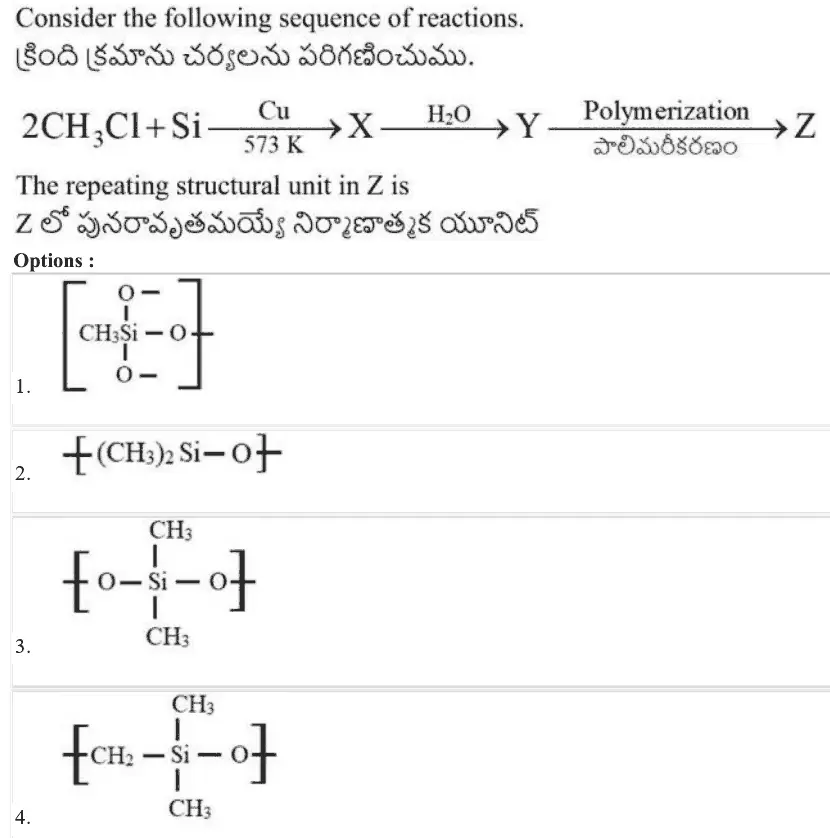
Consider the following sequence of reactions.
$$2\mathrm{CH_3Cl} + \mathrm{Si} \xrightarrow[573\ \mathrm{K}]{\mathrm{Cu}} \mathrm{X} \xrightarrow{\mathrm{H_2O}} \mathrm{Y} \xrightarrow{\text{Polymerization}} \mathrm{Z}$$
The repeating structural unit in Z is
The question as printed in the paper. A see figure Bracketed repeating unit: a Si atom bearing CH3 on the left, with O– above and O– below (each O with a dash extending to the right), and –O– to the right, outside the bracket
B $\left[(\mathrm{CH_3})_2\mathrm{Si}-\mathrm{O}\right]$ (written as a repeating unit in brackets with open bond lines at both ends)
C see figure Repeating unit in brackets: O–Si–O chain with Si bearing CH3 above and CH3 below
D see figure Repeating unit in brackets: CH2–Si–O chain with Si bearing CH3 above and CH3 below
Answer: (B) $\left[(\mathrm{CH_3})_2\mathrm{Si}-\mathrm{O}\right]$ (written as a repeating unit in brackets with open bond lines at both ends) · The council's preliminary key
What are the products formed when ammonium dichromate is thermally decomposed?
A $\mathrm{NO_2, Cr_2O_3, H_2}$
B $\mathrm{N_2O, Cr_2O_3, H_2O}$
C $\mathrm{N_2, CrO_3, H_2O}$
D $\mathrm{N_2, Cr_2O_3, H_2O}$
Answer: (D) $\mathrm{N_2, Cr_2O_3, H_2O}$ · The council's preliminary key
Sulphur dioxide on reaction with chlorine in the presence of charcoal gives compound (A). This on reaction with white phosphorus gives $\mathrm{SO_2}$ and compound (B). The correct statement about ‘B’ is
A The shape of ‘B’ is pyramidal
B ‘B’ on hydrolysis gives phosphorus acid
C ‘B’ in solid state exists as an ionic solid
D In ‘B’ all bonds are equivalent
Answer: (C) ‘B’ in solid state exists as an ionic solid · The council's preliminary key
In which of the following reactions, hydrogen is evolved?
I. Reaction of sodium borohydride with iodine
II. Oxidation of diborane
III. Reaction of boron trifluoride with sodium hydride
IV. Hydrolysis of diborane
A I, IV only
B I, II only
C III, IV only
D I, II, IV only
Answer: (A) I, IV only · The council's preliminary key
Which of the following statements is not correct regarding the gas evolved by the reaction of dilute HCl on $\mathrm{CaCO_3}$?
A It is colourless, odourless gas
B It has least solubility in water
C It is acidic in nature
D It is poisonous gas
Answer: (D) It is poisonous gas · The council's preliminary key
Which of the following gives more number of oxides on reacting with HCl?
A $\mathrm{Na_2CO_3}$
B $\mathrm{NaNO_2}$
C $\mathrm{Na_2SO_3}$
D $\mathrm{NaHCO_3}$
Answer: (B) $\mathrm{NaNO_2}$ · The council's preliminary key
Which of the following statements is not correct?
A $\mathrm{TeO_2}$ is an oxidizing agent
B $\mathrm{SeO_3}$ is acidic in nature
C $\mathrm{SeO_2}$ is a gas
D $\mathrm{SO_2}$ is reducing agent
Answer: (C) $\mathrm{SeO_2}$ is a gas · The council's preliminary key
Which of the following is an incorrect statement about the compounds of group 13 elements?
A All the trihalides exist except $TlI_3$
B Trihalides on hydrolysis form tetrahedral species
C Diborane is an example of electron precise hydride
D Hydrolysis of diborane gives boric acid
Answer: (C) Diborane is an example of electron precise hydride · The council's preliminary key
The incorrect statement about the oxidation states of group 14 elements is
A In addition to $+4$, $+2$, carbon also shows negative oxidation states
B Tin in $+2$ state acts as a reducing agent
C Lead in $+2$ state acts as good reducing agent
D Lead in $+4$ state acts as a good oxidising agent
Answer: (C) Lead in $+2$ state acts as good reducing agent · The council's preliminary key
Thionyl chloride on reaction with white phosphorus gives a compound of phosphorus ‘C’ which on hydrolysis gives an oxo acid ‘O’. The correct statements about C and O are
I. Shape of ‘C’ is pyramidal
II. ‘O’ is a dibasic acid
III. ‘O’ is a monobasic acid
IV. ‘C’ on reaction with acetic acid gives ‘O’
A I & II only
B II & IV only
C I, III & IV only
D I, II & IV only
Answer: (D) I, II & IV only · The council's preliminary key
Which one of the following statements is not correct?
A Chlorine oxidises ferrous salts to ferric salts in acidic medium
B Chlorine oxidises iodine to periodic acid in water
C Chlorine acts as a bleaching agent due to oxidation
D Chlorine is manufactured by Deacon’s process
Answer: (B) Chlorine oxidises iodine to periodic acid in water · The council's preliminary key
Consider the following
Assertion (A): phosphorus can form both phosphorus (III) and phosphorus (V) chlorides but nitrogen cannot form nitrogen(V) chloride.
Reason (R): The electronegativity of nitrogen is more than that of phosphorus
The correct answer is
A Both (A) and (R) are correct, (R) is the correct explanation of (A)
B (A) is correct, but (R) is not correct
C Both (A) and (R) are correct, (R) is not the correct explanation of (A)
D (A) is not correct, but (R) is correct
Answer: (C) Both (A) and (R) are correct, (R) is not the correct explanation of (A) · The council's preliminary key
Diborane on hydrolysis gives a compound X. The correct statements about X are
I. It is a tribasic acid
II. It is a weak monobasic acid
III. It has a layer structure
IV. It is highly soluble in water
A I & III
B II & III
C II & IV
D I & IV
Answer: (B) II & III · The council's preliminary key
Choose the correct statements about allotropes of carbon
I. Graphite has layered structure
II. Buckminster fullerene is not aromatic in nature
III. The distance between two adjacent layers in graphite is 141.5 pm
IV. The hybridization of carbons in graphite and Buckminster fullerene is same
A I & IV
B I & II
C II & III
D III & IV
Answer: (A) I & IV · The council's preliminary key
Which one of the orders is correctly matched with the property mentioned against it?
A $\mathrm{H_2S < H_2O < H_2Se < H_2Te}$ (Boiling point)
B $\mathrm{N_2O < NO < N_2O_3 < N_2O_4 < N_2O_5}$ (Acidic nature)
C $\mathrm{HI < HCl < HBr < HF}$ (Acidic nature)
D $\mathrm{H_2O < H_2S < H_2Se < H_2Te}$ (Bond angle)
Answer: (B) $\mathrm{N_2O < NO < N_2O_3 < N_2O_4 < N_2O_5}$ (Acidic nature) · The council's preliminary key
Noble gas ‘X’ is used as a diluent for oxygen in modern diving apparatus and noble gas ‘Y’ is used mainly to provide an inert atmosphere in high temperature metallurgical processes. ‘Y’ and ‘X’ are respectively?
A He, Ar
B Ar, He
C He, Kr
D Ar, Kr
Answer: (B) Ar, He · The council's preliminary key
The dibasic oxoacid of phosphorus on disproportionation gives two products A and B. A and B are respectively
A $\mathrm{HPO_3, PH_3}$
B $\mathrm{H_3PO_2, H_2O}$
C $\mathrm{H_3PO_4, PH_3}$
D $\mathrm{H_4P_2O_6, H_3PO_2}$
Answer: (C) $\mathrm{H_3PO_4, PH_3}$ · The council's preliminary key
Phosphorus on reaction with sulphuryl chloride gives a compound X, which on complete hydrolysis gives Y. X and Y are respectively
A $\mathrm{PCl_3, H_3PO_3}$
B $\mathrm{PCl_5, POCl_3}$
C $\mathrm{PCl_5, H_3PO_4}$
D $\mathrm{PCl_3, H_3PO_2}$
Answer: (C) $\mathrm{PCl_5, H_3PO_4}$ · The council's preliminary key
Xenon hexafluoride on partial hydrolysis gives ‘X’ and HF. The shape of ‘X’ is
A Pyramidal
B Tetrahedral
C Square pyramidal
D Linear
Answer: (C) Square pyramidal · The council's preliminary key
Which of the following pairs of oxoacids have basicity as 2?
A $\mathrm{H_3PO_3}$, $\mathrm{H_2SO_4}$
B $\mathrm{H_3PO_2}$, $\mathrm{H_2SO_3}$
C $\mathrm{H_3PO_4}$, $\mathrm{H_3PO_2}$
D $\mathrm{H_2S_2O_8}$, $\mathrm{H_3PO_2}$
Answer: (A) $\mathrm{H_3PO_3}$, $\mathrm{H_2SO_4}$ · The council's preliminary key
The correct statements about the compounds of boron are
I. In borax bead test, the colour of cobalt metaborate is blue
II. Diborane is prepared by the oxidation of sodium borohydride with iodine
III. In diborane oxidation state of hydrogen is + 1
IV. Boric acid is a tribasic acid
A I & II
B III & IV
C I & III
D II & IV
Answer: (A) I & II · The council's preliminary key
Dehydration of an organic acid X with concentrated $\mathrm{H_2SO_4}$ at 373K gives $\mathrm{H_2O}$ and gas Y. The hybridisation of the carbon in Y and nature of Y are respectively
A $\mathrm{sp^2}$, Neutral
B $\mathrm{sp}$, Neutral
C $\mathrm{sp^2}$, acidic
D $\mathrm{sp}$, acidic
Answer: (B) $\mathrm{sp}$, Neutral · The council's preliminary key
An oxoacid of phosphorus ‘X’ reduces silver nitrate solution to metallic silver and gets oxidised to another compound Y. X and Y respectively are.
A $\mathrm{HPO_3, H_3PO_4}$
B $\mathrm{H_3PO_2, H_3PO_4}$
C $\mathrm{H_3PO_3, H_3PO_2}$
D $\mathrm{H_3PO_2, HNO_3}$
Answer: (B) $\mathrm{H_3PO_2, H_3PO_4}$ · The council's preliminary key
Zinc on reaction with concentrated nitric acid gives an oxide of nitrogen (A). Zinc with dilute nitric acid gives another oxide of nitrogen (B). Oxidation numbers of nitrogen in (A) & (B) are respectively
A $+4, +1$
B $+4, +2$
C $+2, +4$
D $+1, +4$
Answer: (A) $+4, +1$ · The council's preliminary key
Identify the reaction related to Deacon's process
A $2\mathrm{H_2O} + 2\mathrm{Cl_2} \xrightarrow{\text{sunlight}} 4\mathrm{HCl} + \mathrm{O_2}$
B $4\mathrm{HCl} + \mathrm{O_2} \xrightarrow[723\,\mathrm{K}]{\mathrm{CuCl_2}} 2\mathrm{Cl_2} + 2\mathrm{H_2O}$
C $2\mathrm{NaCl} + \mathrm{H_2SO_4} \xrightarrow{823\,\mathrm{K}} \mathrm{Na_2SO_4} + 2\mathrm{HCl}$
D $\mathrm{Na_2S_2O_3} + \mathrm{Cl_2} + \mathrm{H_2O} \longrightarrow \mathrm{Na_2SO_4} + 2\mathrm{HCl} + \mathrm{S}$
Answer: (B) $4\mathrm{HCl} + \mathrm{O_2} \xrightarrow[723\,\mathrm{K}]{\mathrm{CuCl_2}} 2\mathrm{Cl_2} + 2\mathrm{H_2O}$ · The council's preliminary key
Identify the correct sets
i. Boron fibres – bullet proof vest
ii. Metal borides – protective shields
iii. Borax – glass wool
Correct option is
A i, ii only
B i, ii, iii
C i, iii only
D ii, iii only
Answer: (B) i, ii, iii · The council's preliminary key
Which of the following is / are ionic in nature?
(i) $\mathrm{GeF_4}$ (ii) $\mathrm{SnF_4}$ (iii) $\mathrm{PbF_4}$
The correct option is
A iii only
B ii, iii only
C i only
D i, ii only
Answer: (B) ii, iii only · The council's preliminary key
Hydrolysis of $\mathrm{XeF_4}$ gives HF, $\mathrm{O_2}$, Xe and ‘X’. The structure of ‘X’ is
A pyramidal
B Square pyramidal
C octahedral
D Square planar
Answer: (A) pyramidal · The council's preliminary key
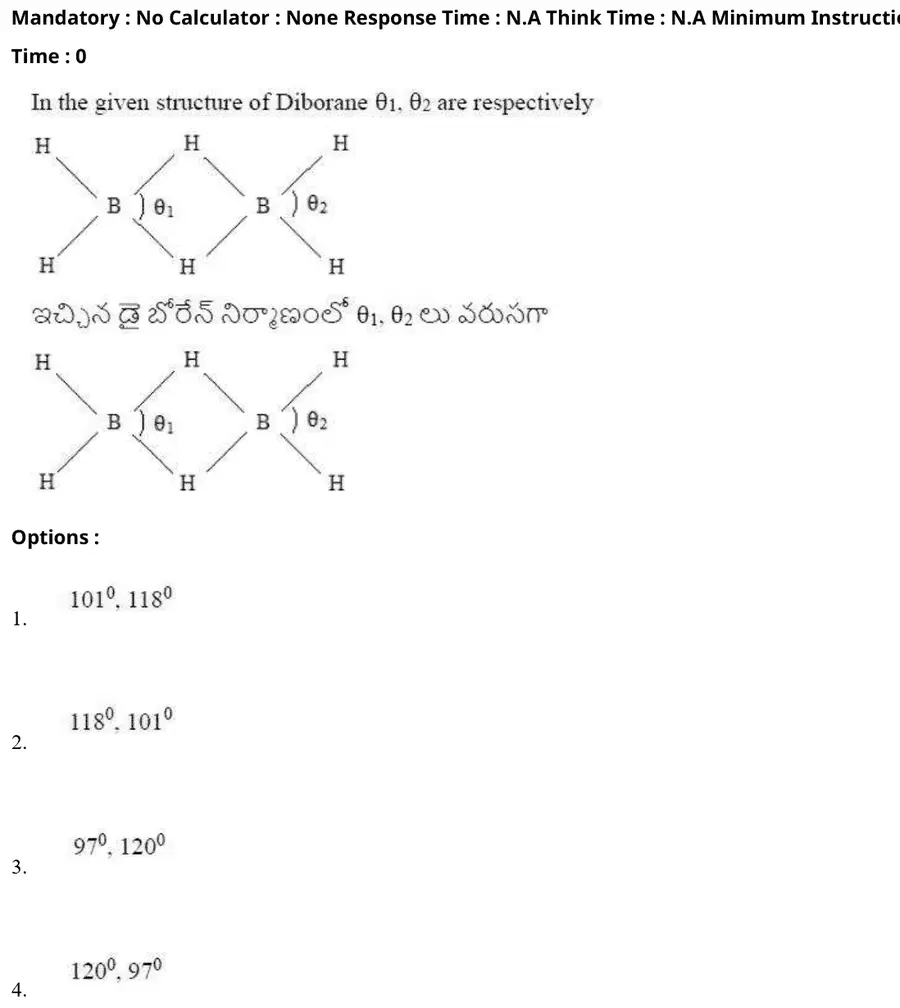
In the given structure of Diborane $\theta_1, \theta_2$ are respectively
(see the figure above)
The question as printed in the paper. A $101^0, 118^0$
B $118^0, 101^0$
C $97^0, 120^0$
D $120^0, 97^0$
Answer: (C) $97^0, 120^0$ · The council's preliminary key
In which of the following sets allotropes of carbon are correctly matched with their uses?
i. graphite – crucibles
ii. activated charcoal – water filters
iii. carbon black – fuel
The correct answer is
A i, iii only
B ii, iii only
C i, ii, iii
D i, ii only
Answer: (D) i, ii only · The council's preliminary key
Two of the products formed by the reaction of 'X' with $\mathrm{HCl}$ are gases. What is 'X'?
A $\mathrm{NaNO_2}$
B $\mathrm{Na_2S}$
C $\mathrm{Ca_3P_2}$
D $\mathrm{Na_2SO_3}$
Answer: (A) $\mathrm{NaNO_2}$ · The council's preliminary key
The shape of colourless neutral gas formed on thermal decomposition of ammonium nitrate is
A Angular
B Linear
C Trigonal planar
D Trigonal pyramidal
Answer: (B) Linear · The council's preliminary key
In which of the following reactions, hydrogen is one of the products?
i. $\mathrm{NaBH_4 + I_2} \longrightarrow$
ii. $\mathrm{BF_3 + NaH} \xrightarrow{450\ K}$
iii. $\mathrm{BF_3 + LiAlH_4} \longrightarrow$
iv. $\mathrm{B_2H_6 + NH_3} \xrightarrow{heat}$
A ii, iii
B i, ii
C i, iv
D iii, iv
Answer: (C) i, iv · The council's preliminary key
Two statements are given below
Statement I : $\mathrm{SnF_4}$, $\mathrm{PbF_4}$ are ionic in nature
Statement II : $\mathrm{GeCl_2}$ is more stable than $\mathrm{GeCl_4}$
The correct answer is
A Both statements I & II are correct
B Both statements I & II are not correct
C Statement I is correct, but statement II is not correct
D Statement I is not correct, but statement II is correct
Answer: (C) Statement I is correct, but statement II is not correct · The council's preliminary key
The basicity of $\mathrm{H_3PO_2}$, $\mathrm{H_3PO_3}$, $\mathrm{H_3PO_4}$ respectively is
A 2, 2, 3
B 2, 3, 3
C 1, 3, 3
D 1, 2, 3
Answer: (D) 1, 2, 3 · The council's preliminary key
A Lewis acid 'X' reacts with $\mathrm{LiAlH_4}$ in ether medium to give a highly toxic gas, 'Y'. 'Y' when heated with $\mathrm{NH_3}$ gives a compound known as inorganic benzene. 'Y' burns in oxygen and gives $\mathrm{H_2O}$ and 'Z'. 'Z' is
A Basic oxide
B Acidic oxide
C Amphoteric acid
D Neutral oxide
Answer: (B) Acidic oxide · The council's preliminary key
In the reaction of sulphur with concentrated sulphuric acid, the oxidised product is X and reduced product is Y. X and Y are respectively
A $\mathrm{SO_3, SO_2}$
B $\mathrm{SO_2, SO_2}$
C $\mathrm{SO_2, H_2S}$
D $\mathrm{SO_2, H_2O}$
Answer: (B) $\mathrm{SO_2, SO_2}$ · The council's preliminary key
Hydrated sodium aluminium silicate is called
A Calgon
B Zeolite
C Dead burnt plaster
D Kaolinite
Answer: (B) Zeolite · The council's preliminary key
Consider the following standard electrode potentials ($\mathrm{E^\circ}$ in volts) in aqueous solution
Element $\mathrm{M^{3+}/M}$ $\mathrm{M^{+}/M}$ Al $-1.66$ $+0.55$ Tl $+1.26$ $-0.34$
Based on this data, which of the following statements is correct?
A $\mathrm{Tl^{3+}}$ is more stable than $\mathrm{Al^{3+}}$
B $\mathrm{Tl^{+}}$ is more stable than $\mathrm{Al^{3+}}$
C $\mathrm{Al^{+}}$ is more stable than $\mathrm{Al^{3+}}$
D $\mathrm{Tl^{+}}$ is more stable than $\mathrm{Al^{+}}$
Answer: (D) $\mathrm{Tl^{+}}$ is more stable than $\mathrm{Al^{+}}$ · The council's preliminary key
Which of the allotropic forms of carbon is aromatic in nature?
A Diamond
B Graphite
C Buckminster fullerene
D coke
Answer: (C) Buckminster fullerene · The council's preliminary key
$\mathrm{P_2O_3 + H_2O \rightarrow X}$
Red $\mathrm{P_4}$ + alkali $\rightarrow$ Y
X, Y are oxoacids of phosphorous. The number of P $-$ OH bonds in X, Y respectively is
Answer: (C) 2, 4 · The council's preliminary key
‘X’ on hydrolysis gives two products. One of them is solid. What is ‘X’?
A $\mathrm{P_4O_{10}}$
B $\mathrm{F_2}$
C $\mathrm{SiCl_4}$
D $\mathrm{N^{3-}}$
Answer: (C) $\mathrm{SiCl_4}$ · The council's preliminary key
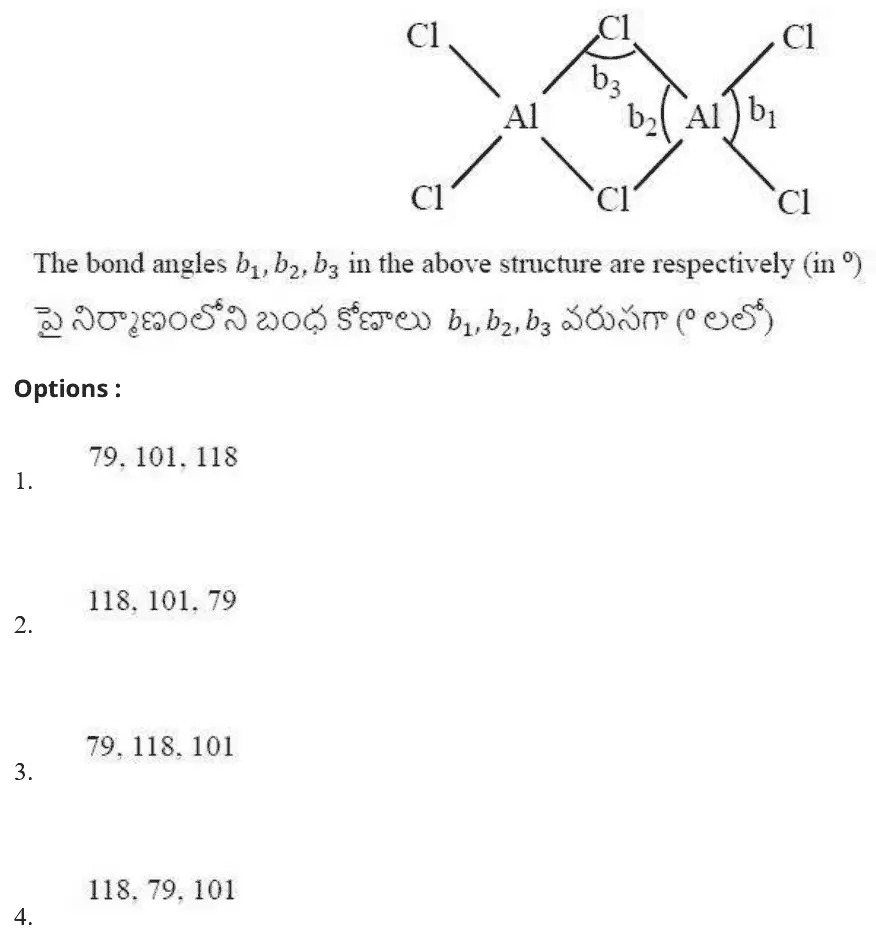
see figure The bond angles $b_1, b_2, b_3$ in the above structure are respectively (in °)
The question as printed in the paper. A 79, 101, 118
B 118, 101, 79
C 79, 118, 101
D 118, 79, 101
Answer: (D) 118, 79, 101 · The council's preliminary key
Which of the following reactions give phosphine?
i. Reaction of calcium phosphide with water
ii. Heating white phosphorous with concentrated $\mathrm{NaOH}$ solution in inert atmosphere
iii. Heating red phosphorous with alkali
A i, ii only
B i, ii, iii
C ii, iii only
D i, iii only
Answer: (A) i, ii only · The council's preliminary key
Which of the following orders is not correct against the given property?
A $\mathrm{Ga < In < Tl < Al < B}$ – melting point
B $\mathrm{Al < Ga < In < Tl < B}$ – Electronegativity
C $\mathrm{B < Al < Ga < In < Tl}$ – density
D $\mathrm{B < Al < Ga < In < Tl}$ – atomic radius
Answer: (D) $\mathrm{B < Al < Ga < In < Tl}$ – atomic radius · The council's preliminary key
Which of the following are correct?
i. Basic structural unit of silicates is $-\mathrm{R_2SiO}-$
ii. Silicones are biocompatible
iii. Producer gas contains $\mathrm{CO}$ and $\mathrm{N_2}$
The correct option is
A i, ii, iii
B ii, iii only
C i, iii only
D i, ii only
Answer: (B) ii, iii only · The council's preliminary key
$$\mathrm{Xe(g)} + 2\,\mathrm{F_2(g)} \xrightarrow[7\ \text{bar}]{873\ \mathrm{K}} \mathrm{XeF_4(s)}$$
The ratio of Xe: $\mathrm{F_2}$ required in the above reaction is
A $1:2$
B $1:5$
C $1:20$
D $1:12$
Answer: (B) $1:5$ · The council's preliminary key
Identify the correct statements
i. Oxidation of $\mathrm{NaBH_4}$ with $\mathrm{I_2}$ gives $\mathrm{B_2H_6}$
ii. $\mathrm{B_2H_6}$ burns in oxygen and releases an enormous amount of energy
iii. $\mathrm{B_2H_6}$ on hydrolysis gives a tribasic acid
A i, ii, iii
B i, iii only
C i, ii only
D ii, iii only
Answer: (C) i, ii only · The council's preliminary key
Which one of the following is used as piezoelectric material?
A tridymite
B quartz
C zelolite
D mica
Answer: (B) quartz · The council's preliminary key
The disproportionation products of ortho phosphorous acid are
A $\mathrm{H_3PO_4}$, $\mathrm{PH_3}$
B $\mathrm{H_3PO_2}$, $\mathrm{H_3PO_3}$
C $\mathrm{H_3PO_4}$, $\mathrm{HPO_3}$
D $\mathrm{H_3PO_2}$, $\mathrm{P_2H_4}$
Answer: (A) $\mathrm{H_3PO_4}$, $\mathrm{PH_3}$ · The council's preliminary key
In which of the following reaction, dihydrogen is not evolved?
A Oxidation of sodium borohydride with iodine
B Hydrolysis of boranes
C Heating the adduct formed by reaction of ammonia with diborane
D Burning of diborane in oxygen
Answer: (D) Burning of diborane in oxygen · The council's preliminary key
Match the following
List-I Bond List-II Bond enthalpy (in kJ mol$^{-1}$) A Si – Si I 240 B C – C II 297 C Sn – Sn III 348 D Ge - Ge IV 260
The correct answer is
A A-II, B-III, C-I, D-IV
B A-II, B-IV, C-III, D-I
C A-III, B-II, C-I, D-IV
D A-III, B-I, C-IV, D-II
Answer: (A) A-II, B-III, C-I, D-IV · The council's preliminary key
When chlorine reacts with hot and conc. $\mathrm{NaOH}$, the products formed are
A $\mathrm{NaCl, NaClO_3, H_2O}$
B $\mathrm{NaCl, NaOCl, H_2O}$
C $\mathrm{NaCl, H_2O}$ only
D $\mathrm{NaOCl, H_2O}$
Answer: (A) $\mathrm{NaCl, NaClO_3, H_2O}$ · The council's preliminary key
The correct formula of borax is $\mathrm{Na_2[B_4O_5(OH)_x]}\cdot y\mathrm{H_2O}$. The sum of $x$ and $y$ is
Answer: (C) 12 · The council's preliminary key
Match the following
List – I<br>Industrial process List – II<br>Catalyst used A Ostwald's process I $\mathrm{CuCl_2}$ B Haber's process II Zeolites C Deacon's process III Pt gauge D Cracking of hydrocarbons IV Fe
The correct answer is
A A – II, B – I, C – IV, D – III
B A – IV, B – I, C – II, D – III
C A – III, B – IV, C – II, D – I
D A – III, B – IV, C – I, D – II
Answer: (D) A – III, B – IV, C – I, D – II · The council's preliminary key
$$\mathrm{C + Conc.\ H_2SO_4 \xrightarrow{\Delta} X + Y + H_2O}$$
X and Y in the above reaction are
A $\mathrm{CO, SO_3}$
B $\mathrm{CO_2, SO_2}$
C $\mathrm{CO, SO_2}$
D $\mathrm{C_3O_2, SO_2}$
Answer: (B) $\mathrm{CO_2, SO_2}$ · The council's preliminary key
Which among the following oxoacids of phosphorous will have $\mathrm{P-O-P}$ bonds?
I. $\mathrm{H_4P_2O_5}$
II. $\mathrm{H_4P_2O_6}$
III. $\mathrm{H_4P_2O_7}$
IV. $\mathrm{(HPO_3)_3}$
A III & IV
B I & II
C I & III
D II & IV
Answer: (A) III & IV · The council's preliminary key
The bond angles $\widehat{\mathrm{H-O-N}}$ and $\widehat{\mathrm{O-N-O}}$ in the planar structure of nitric acid molecule are respectively
A $130^\circ, 102^\circ$
B $102^\circ, 130^\circ$
C $134^\circ, 100^\circ$
D $100^\circ, 134^\circ$
Answer: (B) $102^\circ, 130^\circ$ · The council's preliminary key
Observe the following reactions (not balanced)
$\mathrm{BF_3 + LiAlH_4 \xrightarrow{(C_2H_5)_2O} X + LiF + AlF_3}$
$\mathrm{X + NaH \longrightarrow Y}$
The incorrect statement about Y is
A It is a good oxidizing agent
B It is a good reducing agent
C Oxidation state of hydrogen in it is $-1$
D Oxidation of it with iodine gives diborane
Answer: (A) It is a good oxidizing agent · The council's preliminary key
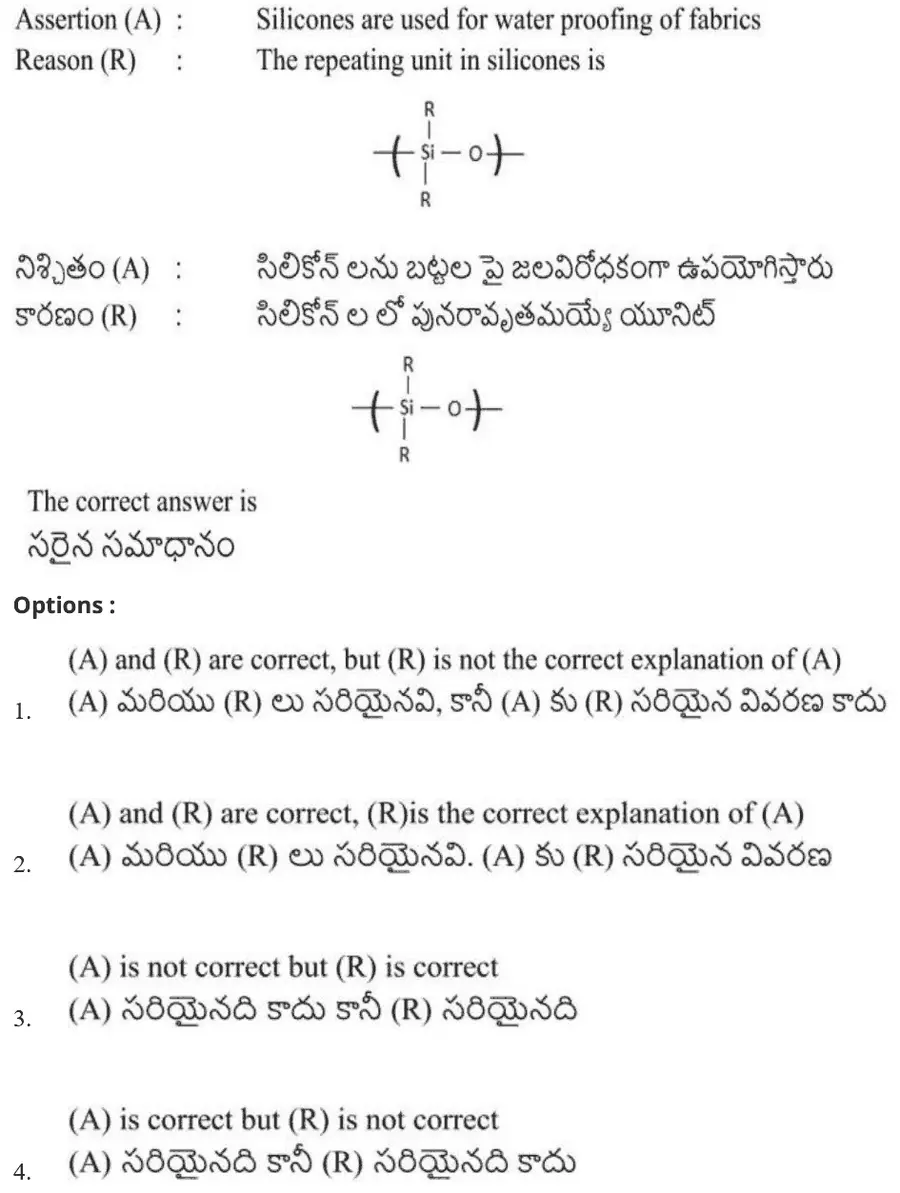
Assertion (A) : Silicones are used for water proofing of fabrics
Reason (R) : The repeating unit in silicones is
(see the figure above)
The correct answer is
The question as printed in the paper. A (A) and (R) are correct, but (R) is not the correct explanation of (A)
B (A) and (R) are correct, (R)is the correct explanation of (A)
C (A) is not correct but (R) is correct
D (A) is correct but (R) is not correct
Answer: (A) (A) and (R) are correct, but (R) is not the correct explanation of (A) · The council's preliminary key
Among the hydrides $\mathrm{NH_3}$, $\mathrm{PH_3}$ and $\mathrm{BiH_3}$, the hydride with highest boiling point is X and the hydride with lowest boiling point is Y. What are X and Y respectively?
A $\mathrm{PH_3, NH_3}$
B $\mathrm{NH_3, PH_3}$
C $\mathrm{BiH_3, PH_3}$
D $\mathrm{NH_3, BiH_3}$
Answer: (C) $\mathrm{BiH_3, PH_3}$ · The council's preliminary key
Xenon (VI) fluoride on complete hydrolysis gives an oxide of xenon ‘O’. The total number of $\sigma$ and $\pi$ bonds in ‘O’ is
Answer: (C) 6 · The council's preliminary key
What are X and Y respectively in the following reactions?
$$\mathrm{X} \xleftarrow{\mathrm{CO}} \mathrm{B_2H_6} \xrightarrow[\mathrm{(C_2H_5)_2O}]{\mathrm{NaH}} \mathrm{Y}$$
A $\mathrm{BH_3 \cdot 2CO}$; $\mathrm{NaBO_2}$
B $\mathrm{BH_3 \cdot CO}$; $\mathrm{NaBH_4}$
C $\mathrm{BH_3 \cdot CO}$; $\mathrm{NaBO_2}$
D $\mathrm{BH_3 \cdot CO}$; $\mathrm{Na_2B_4O_7}$
Answer: (B) $\mathrm{BH_3 \cdot CO}$; $\mathrm{NaBH_4}$ · The council's preliminary key
Which of the following statements are correct?
(i) $\mathrm{CCl_4}$ undergoes hydrolysis easily
(ii) Diamond has directional covalent bonds
(iii) Fullerene is thermodynamically most stable allotrope of carbon
(iv) Glass is a man-made silicate
The correct answer is
A i, iii only
B ii, iv only
C ii, iii, iv only
D i, ii only
Answer: (B) ii, iv only · The council's preliminary key
The correct order of boiling points of hydrogen halides is
A $\mathrm{HF} < \mathrm{HCl} < \mathrm{HBr} < \mathrm{HI}$
B $\mathrm{HI} < \mathrm{HBr} < \mathrm{HCl} < \mathrm{HF}$
C $\mathrm{HCl} < \mathrm{HBr} < \mathrm{HI} < \mathrm{HF}$
D $\mathrm{HBr} < \mathrm{HCl} < \mathrm{HI} < \mathrm{HF}$
Answer: (C) $\mathrm{HCl} < \mathrm{HBr} < \mathrm{HI} < \mathrm{HF}$ · The council's preliminary key
Observe the following reactions (unbalanced)
$\mathrm{P_2O_3 + H_2O \rightarrow X}$
$\mathrm{P_4O_{10} + H_2O \rightarrow Y}$
The number of $\mathrm{P=O}$ bonds present in X, Y are respectively
Answer: (D) 1, 1 · The council's preliminary key
Identify the element for which +1 oxidation state is more stable than +3 oxidation state
Answer: (C) Tl · The council's preliminary key
Which of the following when subjected to thermal decomposition will liberate dinitrogen?
(i) sodium nitrate
(ii) ammonium dichromate
(iii) barium azide
A i, ii only
B ii, iii only
C i, iii only
D i, ii, iii
Answer: (B) ii, iii only · The council's preliminary key
Observe the following reaction. This reaction represents
$$4\mathrm{HCl} + \mathrm{O_2} \xrightarrow[723\,\mathrm{K}]{\mathrm{CuCl_2}} 2\mathrm{Cl_2} + 2\mathrm{H_2O}$$
A van Arkel process
B Hall – Heroult process
C Serpeck's process
D Deacon's process
Answer: (D) Deacon's process · The council's preliminary key
Identify the set which is not correctly matched in the following
A $\mathrm{PH_3}$, colourless gas, rotten fish smell
B $\mathrm{Cl_2}$, greenish yellow gas, pungent smell
C $\mathrm{Ne}$, fluorescent green gas, rotten egg smell
D $\mathrm{SO_2}$, colourless gas, pungent smell
Answer: (C) $\mathrm{Ne}$, fluorescent green gas, rotten egg smell · The council's preliminary key
Consider the following reactions (not balanced)
$$\mathrm{BF_3 + NaH \xrightarrow{450K} X + NaF}$$
$$\mathrm{X + H_2O \rightarrow Y + H_2 \uparrow}$$
The correct statements about X and Y are
I) X is an electron deficient molecule
II) In X, B$-$B bond is present
III) Y is a weak tribasic acid
IV) Y acts as a Lewis acid
A I & IV
B II & III
C II & IV
D I & III
Answer: (A) I & IV · The council's preliminary key
Which of the following does not exist?
A $[\mathrm{GeCl_6}]^{2-}$
B $[\mathrm{SiF_6}]^{2-}$
C $[\mathrm{SiCl_6}]^{2-}$
D $[\mathrm{Sn(OH)_6}]^{2-}$
Answer: (C) $[\mathrm{SiCl_6}]^{2-}$ · The council's preliminary key
Y in the given sequence of reactions is
$$\mathrm{P_4 + xNaOH + yH_2O \xrightarrow{CO_2} X + zNaH_2PO_2}$$
$$\mathrm{X + CuSO_4 \rightarrow Y + H_2SO_4}$$
A $\mathrm{Cu_3(PO_4)_2}$
B $\mathrm{Cu_3P_2}$
C $\mathrm{Cu(OH)_2}$
D $\mathrm{CuCO_3}$
Answer: (B) $\mathrm{Cu_3P_2}$ · The council's preliminary key
In contact process of manufacture of $\mathrm{H_2SO_4}$, the arsenic purifier used in the industrial plant contains
A $\mathrm{Al_2O_3 \cdot xH_2O}$
B $\mathrm{FeO \cdot xH_2O}$
C $\mathrm{Cr_2O_3 \cdot xH_2O}$
D $\mathrm{Fe_2O_3 \cdot xH_2O}$
Answer: (D) $\mathrm{Fe_2O_3 \cdot xH_2O}$ · The council's preliminary key
An oxide of chlorine with water gives the strongest acid. The ratio of chlorine and oxygen in its formula is
Answer: (C) $2:7$ · The council's preliminary key
Relative stability orders of +1, +3 oxidation states of Ga, In, Tl are respectively
A $\mathrm{Tl^+ > In^+ > Ga^+}$, $\quad \mathrm{Ga^{3+} > In^{3+} > Tl^{3+}}$
B $\mathrm{Ga^+ > In^+ > Tl^+}$, $\quad \mathrm{Tl^{3+} > In^{3+} > Ga^{3+}}$
C $\mathrm{Ga^+ > In^+ > Tl^+}$, $\quad \mathrm{Ga^{3+} > In^{3+} > Tl^{3+}}$
D $\mathrm{Tl^+ > In^+ > Ga^+}$, $\quad \mathrm{Tl^{3+} > In^{3+} > Ga^{3+}}$
Answer: (A) $\mathrm{Tl^+ > In^+ > Ga^+}$, $\quad \mathrm{Ga^{3+} > In^{3+} > Tl^{3+}}$ · The council's preliminary key
Which element of group 14 decomposes steam to form dioxide and dihydrogen gas?
A $\mathrm{C}$
B $\mathrm{Pb}$
C $\mathrm{Ge}$
D $\mathrm{Sn}$
Answer: (D) $\mathrm{Sn}$ · The council's preliminary key
The sum of oxygen atoms in the formulae of peroxysulphuric acid and pyrosulphuric acid is
Answer: (C) 15 · The council's preliminary key
Which one of the following is correct?
A Thallium is more electropositive than aluminium
B Boron has high electrical conductivity
C An aqueous solution of ortho boric acid is generally used as a mild antiseptic
D Boron– 11 ($^{11}\mathrm{B}$) isotope has high ability to absorb neutrons
Answer: (C) An aqueous solution of ortho boric acid is generally used as a mild antiseptic · The council's preliminary key
Thermodynamically most stable allotrope of carbon is
A Graphite
B Diamond
C Fullerene
D Coke
Answer: (A) Graphite · The council's preliminary key
Manganese dioxide on heating with concentrated hydrochloric acid gives a greenish yellow gas, X. With excess of ammonia X gives Y and Z. Y and Z respectively are
A $\mathrm{NH_4F}$, $\mathrm{N_2}$
B $\mathrm{NH_4I}$, $\mathrm{NOCl}$
C $\mathrm{NCl_3}$, $\mathrm{HOCl}$
D $\mathrm{NH_4Cl}$, $\mathrm{N_2}$
Answer: (D) $\mathrm{NH_4Cl}$, $\mathrm{N_2}$ · The council's preliminary key
Match the following
List I List II A. Carbon black I. Electrodes in batteries B. Graphite II. Extraction of metals C. Diamond III. Abrasive D. Activated charcoal IV. Filler in automobile tyres V. Air conditioning system
A A - IV B- III C- II D- V
B A - III B- I C- II D- IV
C A - V B - I C- III D- II
D A – IV B - I C - III D - V
Answer: (D) A – IV B - I C - III D - V · The council's preliminary key
Statement I: Boron does not exhibit allotropy
Statement II: Boron is extremely hard and black coloured solid
A Both I & II are correct
B Both I & II are not correct
C I is correct but II is not correct
D I is not correct but II is correct
Answer: (D) I is not correct but II is correct · The council's preliminary key
Which of the following is not correct?
A Lead does not show catenation
B Buckminster fullerene contains 20 six-membered rings and 12 five-membered rings
C Stability order of $\mathrm{GeX_2}$, $\mathrm{SnX_2}$ and $\mathrm{PbX_2}$ is $\mathrm{GeX_2} < \mathrm{SnX_2} < \mathrm{PbX_2}$
D The number of metalloids in group 14 elements is 2
Answer: (D) The number of metalloids in group 14 elements is 2 · The council's preliminary key
The elements with metallic nature in the following are
C, Si, Ge, Sn, Pb
A Ge, Pb
B Ge, Sn
C C, Ge
D Sn, Pb
Answer: (D) Sn, Pb · The council's preliminary key
In the below reaction, geometry of $\mathrm{BCl_3}$, X respectively are
$$\mathrm{BCl_3 + NH_3 \longrightarrow X}$$
A Pyramidal, tetrahedral
B Pyramidal, octahedral
C Trigonal planar, tetrahedral
D Trigonal planar, octahedral
Answer: (C) Trigonal planar, tetrahedral · The council's preliminary key
Which of the following fluorides of Xenon does not exist?
A $\mathrm{XeF_3}$
B $\mathrm{XeF_2}$
C $\mathrm{XeF_6}$
D $\mathrm{XeF_4}$
Answer: (A) $\mathrm{XeF_3}$ · The council's preliminary key
Which of the following statements are not correct?
i. Atomic radius of Ga is less than that of Al
ii. The order of ionization enthalpy of group 13 elements is $\mathrm{B > Al > Ga > In > Tl}$
iii. Boron trioxide is amphoteric in nature
A ii, iii only
B i, iii only
C i, ii only
D i, ii, iii
Answer: (A) ii, iii only · The council's preliminary key
Identify the correct statements from the following.
i. Melting points and boiling points of group 13 elements are much higher than those of corresponding group 14 elements
ii. $\mathrm{SiO}$ only exists at high temperatures
iii. $\mathrm{PbI_4}$ does not exist
iv. Buckminster fullerene contain twelve 6-membered carbon rings and twenty 5 - membered carbon rings.
A i, iii only
B ii, iii, iv only
C ii, iii only
D i, iv only
Answer: (C) ii, iii only · The council's preliminary key
$\mathrm{X + Y \rightarrow oleum}$
The sum of oxidation states of central atom in X and Y is
Answer: (A) 12 · The council's preliminary key
The number of water molecules present in borax, kernite and bauxite respectively are
A 10, 4, 2
B 5, 1, 2
C 4, 2, 3
D 10, 4, 10
Answer: (A) 10, 4, 2 · The council's preliminary key
Which of the following are not in accordance with the property mentioned against them?
I. $\mathrm{F_2 > Cl_2 > Br_2 > I_2}$ : Oxidising power
II. $\mathrm{MI > MBr > MCl > MF}$ : Ionic character of metal halide
III. $\mathrm{F_2 > Cl_2 > Br_2 > I_2}$ : Bond dissociation enthalpy
IV. $\mathrm{HI < HBr < HCl < HF}$ : Hydrogen-halogen bond strength
A I & III only
B II & III only
C I & IV only
D II & IV only
Answer: (B) II & III only · The council's preliminary key
Match the following
List I (Group 13 element) List II (metallic radius, pm) A. Al I. 135 B. Ga II. 143 C. In III. 170 D. Tl IV. 167
The correct answer is
A A-I, B-II, C-IV, D-III
B A-II, B-I, C-IV, D-III
C A-III, B-IV, C-II, D-I
D A-II, B-I, C-III, D-IV
Answer: (B) A-II, B-I, C-IV, D-III · The council's preliminary key
For ozone molecule consider the following
(A) It is a linear molecule with bond angle $180^\circ$
The correct options are
A (B), (C) only
B (A), (B) only
C (B), (D) only
D (A), (D) only
Answer: (A) (B), (C) only · The council's preliminary key
The correct order of melting points of Al, Ga, In is
A $\mathrm{Ga} < \mathrm{In} < \mathrm{Al}$
B $\mathrm{In} < \mathrm{Ga} < \mathrm{Al}$
C $\mathrm{Al} < \mathrm{Ga} < \mathrm{In}$
D $\mathrm{Ga} < \mathrm{Al} < \mathrm{In}$
Answer: (A) $\mathrm{Ga} < \mathrm{In} < \mathrm{Al}$ · The council's preliminary key
Among the following the correct statements are
I. Germanium exists only in traces
II. $\mathrm{PbF_4}$ molecule is tetrahedral in shape
III. $\mathrm{GeX_2}$ is more stable than $\mathrm{GeX_4}$
The correct answer is
A II, III only
B I, II only
C I, II, III
D I, III only
Answer: (B) I, II only · The council's preliminary key
Identify the reaction in which oxygen is not one of the products
A $\mathrm{XeF_2 + H_2O \rightarrow}$
B $\mathrm{XeF_4 + H_2O \rightarrow}$
C $\mathrm{XeF_4 + O_2F_2 \rightarrow}$
D $\mathrm{XeF_6 + H_2O \rightarrow}$
Answer: (D) $\mathrm{XeF_6 + H_2O \rightarrow}$ · The council's preliminary key
Identify the incorrect statement about the oxidation states of group 14 elements
A Carbon and Silicon mostly exhibit +4 oxidation state
B Tin in +2 oxidation state is a reducing agent
C Lead in +2 oxidation state is a reducing agent
D The order of stability of +2 oxidation state follow the sequence Ge<Sn<Pb
Answer: (C) Lead in +2 oxidation state is a reducing agent · The council's preliminary key
$\mathrm{P_4 + 3NaOH + 3H_2O \xrightarrow{CO_2} 3X + PH_3 \uparrow}$
$\mathrm{X \xrightarrow[HCl(aq)]{HCl(aq)} Y + NaCl}$
The incorrect statement about Y is
A It is also called phosphonic acid
B It is a monobasic acid
C It is a reducing agent
D Oxidation state of the central atom in it is $+1$
Answer: (A) It is also called phosphonic acid · The council's preliminary key
Consider the following statements about the oxides of halogens
A. At room temperature, $\mathrm{OF_2}$ is thermally stable
B. Order of stability of oxides of halogens is I > Br > Cl
C. $\mathrm{I_2O_5}$ is used in the estimation of CO
D. $\mathrm{ClO_2}$ is used as a bleaching agent
The correct statements are
A A & B only
B A, B & C only
C B & C only
D A, C & D only
Answer: (D) A, C & D only · The council's preliminary key
$\mathrm{XeF_4 + O_2F_2 \rightarrow X + O_2}$
$\mathrm{X + \underset{(1\,mole)}{H_2O} \rightarrow Y + 2HF}$
The shapes of molecules of X and Y respectively are
A Square planar, square pyramidal
B Distorted octahedral, square pyramidal
C Distorted tetrahedral, Distorted octahedral
D Square pyramidal, Tetrahedral
Answer: (B) Distorted octahedral, square pyramidal · The council's preliminary key
Zeolite is a silicate of two metal ions X and Y. X and Y are respectively
A $\mathrm{Ca^{2+}, Na^{+}}$
B $\mathrm{Mg^{2+}, Na^{+}}$
C $\mathrm{Na^{+}, Al^{3+}}$
D $\mathrm{Ca^{2+}, Mg^{2+}}$
Answer: (C) $\mathrm{Na^{+}, Al^{3+}}$ · The council's preliminary key
The atomic radius of gallium is less than that of aluminium. This is due to
A Greater shielding power of s-electrons of gallium atom
B poor shielding power of s-electrons of gallium
C Poor shielding power of d-electrons of gallium
D Greater shielding power of d-electrons of gallium
Answer: (C) Poor shielding power of d-electrons of gallium · The council's preliminary key
Which of the following has lowest melting point?
A $\mathrm{Si}$
B $\mathrm{Ge}$
C $\mathrm{Sn}$
D $\mathrm{Pb}$
Answer: (C) $\mathrm{Sn}$ · The council's preliminary key
Among the hydrides of group 16 elements, the hydride X has lowest boiling point and the hydride Y has highest boiling point. X and Y respectively are
A $\mathrm{H_2Te, H_2Se}$
B $\mathrm{H_2O, H_2Te}$
C $\mathrm{H_2S, H_2Te}$
D $\mathrm{H_2S, H_2O}$
Answer: (D) $\mathrm{H_2S, H_2O}$ · The council's preliminary key
Sodium nitrite with hydrochloric acid gives water along with two nitrogen oxides. They are
A $\mathrm{NO, NO_2}$
B $\mathrm{NO_2, N_2O_3}$
C $\mathrm{NO_2, N_2O}$
D $\mathrm{NO, N_2O_5}$
Answer: (A) $\mathrm{NO, NO_2}$ · The council's preliminary key
Identify the incorrect statement about the interhalogen compounds
A $\mathrm{ICl}$ is more reactive than $\mathrm{I_2}$
B They are diamagnetic in nature
C The products of $\mathrm{ICl}$ and water are $\mathrm{HI + HOCl}$
D They act as fluorinating agents
Answer: (C) The products of $\mathrm{ICl}$ and water are $\mathrm{HI + HOCl}$ · The council's preliminary key
Kernite and cryolite are the minerals of two elements X and Z. Respectively X and Z are
A B, Ga
B B, Al
C Al, In
D B, Tl
Answer: (B) B, Al · The council's preliminary key
Choose the correct statement from the following with reference to inert pair effect
A $\mathrm{Sn^{+4}}$ is reducing agent but $\mathrm{Pb^{+4}}$ is an oxidizing agent
B $\mathrm{Sn^{+4}}$ is an oxidizing agent but $\mathrm{Pb^{+2}}$ is a reducing agent
C $\mathrm{Sn^{+2}}$ is reducing agent but $\mathrm{Pb^{+4}}$ is an oxidizing agent
D $\mathrm{Sn^{+2}}$ is an oxidizing agent but $\mathrm{Pb^{+4}}$ is a reducing agent
Answer: (C) $\mathrm{Sn^{+2}}$ is reducing agent but $\mathrm{Pb^{+4}}$ is an oxidizing agent · The council's preliminary key
Identify the correct orders from the following with respect to the property associated with
A. $\mathrm{NH_3 > PH_3 > AsH_3 > SbH_3}$ - Bond Angle
B. $\mathrm{NH_3 > PH_3 > AsH_3 > SbH_3}$ - Basic Character
C. $\mathrm{PH_3 > AsH_3 > SbH_3 > NH_3}$ - Thermal stability
D. $\mathrm{SbH_3 > NH_3 > AsH_3 > PH_3}$ - Boiling point
A A, B & C only
B A, C & D only
C B, C & D only
D A, B & D only
Answer: (D) A, B & D only · The council's preliminary key
Which of the following is the strongest reducing agent?
A $\mathrm{TeO_3}$
B $\mathrm{SO_3}$
C $\mathrm{TeO_2}$
D $\mathrm{SO_2}$
Answer: (D) $\mathrm{SO_2}$ · The council's preliminary key
Match the following
List – I (Molecule) List – II (Shape) A. $\mathrm{XeF_4}$ I. Square pyramid B. $\mathrm{ClF_3}$ II. Pentagonal bipyramidal C. $\mathrm{BrF_5}$ III. square planar D. $\mathrm{IF_7}$ IV. Bent T-Shape
The correct answer is
A A - III ; B - II ; C- I ; D- IV
B A - III ; B - II ; C- IV ; D- I
C A - III ; B - IV ; C- I ; D- II
D A - IV ; B - II ; C- I ; D- III
Answer: (C) A - III ; B - IV ; C- I ; D- II · The council's preliminary key
Consider the following statements about group 13 elements
A. $\mathrm{AlCl_3}$ gets stability by forming a dimer
B. $\mathrm{BCl_3}$ is an electron deficient molecule
C. $E^0_{M^{3+}|M}$ (V) is +1.26 for aluminium
D. In +1 oxidation state thallium is unstable
The incorrect statements are
A C & D only
B A & B only
C A & D only
D B & C only
Answer: (A) C & D only · The council's preliminary key
What is the correct order of melting temperature of C, Si, Ge?
A $\mathrm{C > Ge > Si}$
B $\mathrm{Si > C > Ge}$
C $\mathrm{C > Si > Ge}$
D $\mathrm{Si > Ge > C}$
Answer: (C) $\mathrm{C > Si > Ge}$ · The council's preliminary key
Which one of the following statements is correct?
A $\mathrm{N_2}$ is a brown coloured gas
B $\mathrm{O_3}$ is thermodynamically stable compared to oxygen
C Rhombic sulphur is stable at room temperature
D $\mathrm{Cl_2}$ is a colourless gas
Answer: (C) Rhombic sulphur is stable at room temperature · The council's preliminary key
Which oxo acid of sulphur contains S-O-S bond?
A $\mathrm{H_2S_2O_5}$
B $\mathrm{H_2S_2O_4}$
C $\mathrm{H_2S_2O_7}$
D $\mathrm{H_2S_2O_8}$
Answer: (C) $\mathrm{H_2S_2O_7}$ · The council's preliminary key
Which of the following reaction gives nitrogen (II) oxide as one of the products?
A $\mathrm{Cu} + \textit{dil}\ \mathrm{HNO_3} \rightarrow$
B $\mathrm{Cu} + \textit{conc.}\ \mathrm{HNO_3} \rightarrow$
C $\mathrm{Zn} + \textit{dil.}\ \mathrm{HNO_3} \rightarrow$
D $\mathrm{Zn} + \textit{conc.}\ \mathrm{HNO_3} \rightarrow$
Answer: (A) $\mathrm{Cu} + \textit{dil}\ \mathrm{HNO_3} \rightarrow$ · The council's preliminary key
Identify the correct pairs in which the chemical substance given is correctly matched with its use
Chemical substance use A) $\mathrm{Cl_2}$ Preparation of phosgene B) $\mathrm{I_2O_5}$ estimation of CO C) $\mathrm{O_3}$ disinfectant
A A, B, C
B A, B only
C B, C only
D A, C only
Answer: (A) A, B, C · The council's preliminary key
What are the correct statements about the elements of group 13 given below?
I) The stability of $+1$ oxidation state follows the order $\mathrm{Tl} > \mathrm{In} > \mathrm{Ga}$
II) Boron has the lowest melting point and boiling point as it is a non-metal
III) Boron shows a maximum covalency of 4 in its compounds
IV) The order of atomic radius is $\mathrm{Ga} > \mathrm{Al} > \mathrm{In}$
V) Aluminium is passive to concentrated nitric acid
A I, III & V only
B II, IV, & V only
C I, II, & IV only
D III, IV, V only
Answer: (A) I, III & V only · The council's preliminary key
Assertion (A): Graphite is used as a dry lubricant in machines which run at high temperatures
Reason (R): The layers of graphite slip one over the other when pressure is applied
The correct option among the following is
A (A) is true but (R) is false
B (A) is false but (R) is true
C (A) and (R) are true. (R) is the correct explanation of (A)
D (A) and (R) are true, but (R) is not correct explanation of (A)
Answer: (C) (A) and (R) are true. (R) is the correct explanation of (A) · The council's preliminary key
Consider the reaction $\mathrm{P_4 + 3NaOH + 3H_2O \rightarrow Q + 3NaH_2PO_2}$
Identify the reaction in which Q is not the product. (Equations are not balanced)
A $\mathrm{Ca_3P_2 + H_2O \rightarrow}$
B $\mathrm{H_3PO_3 \xrightarrow{\Delta}}$
C $\mathrm{PH_4I + KOH \rightarrow}$
D $\mathrm{PCl_3 + H_2O \rightarrow}$
Answer: (D) $\mathrm{PCl_3 + H_2O \rightarrow}$ · The council's preliminary key
The oxidation states of sulphur atoms and number of S – OH bonds in Peroxydisulphric acid are respectively
A $(+6, +5), 2$
B $(+6, +6), 4$
C $(+6, +6), 2$
D $(+5, +5), 4$
Answer: (C) $(+6, +6), 2$ · The council's preliminary key
Identify the correct statements from the following
I) Au is soluble in aqua regia but not Pt
II) Among the oxoacids of chlorine highest oxidation state possible for chlorine is +7
III) Among the hydrogen halides lowest boiling point is for HCl
IV) The order of stability of oxides of halogens is $\mathrm{Cl} > \mathrm{Br} > \mathrm{I}$
A I & II only
B II & III only
C I & IV only
D II & IV only
Answer: (B) II & III only · The council's preliminary key
$\mathrm{Xe(g) + F_2(g)} \xrightarrow[\text{60-70 bar}]{573\ \mathrm{K}} \mathrm{X(s)}$
(1 : 20)
$\mathrm{X + H_2O \rightarrow Y + HF}$
$\mathrm{X + 3H_2O \rightarrow Z + HF}$
The correct statements regarding Y and Z are
I) Y has square pyramidal geometry
II) Y has linear geometry
III) Z has $3\sigma, 3\pi$ bonds and 1 lone pair of electrons on the central atom
IV) Z has tetrahedral geometry
A I & III only
B II & III only
C III & IV only
D I & IV only
Answer: (A) I & III only · The council's preliminary key
In group 13 of the long form of periodic table an element X has a boiling point of $\mathrm{T_2}$(K) and melting point of $\mathrm{T_1}$(K). Identify the element X for which $\mathrm{T_2 - T_1}$(K) is maximum
Answer: (B) Ga · The council's preliminary key
The dioxides and monoxides of elements X and Y are amphoteric in nature. X and Y are respectively
A C, Si
B Si, Ge
C Sn, Pb
D Ge, Pb
Answer: (C) Sn, Pb · The council's preliminary key
Assertion (A): In group 15 elements nitrogen does not form pentahalides
Reason (R): Nitrogen can exhibit +5 oxidation state
The correct option among the following is
A (A) and (R) are true. (R) is the correct explanation of (A)
B (A) and (R) are true, but (R) is not correct explanation of (A)
C (A) is true but (R) is false
D (A) is false but (R) is true
Answer: (B) (A) and (R) are true, but (R) is not correct explanation of (A) · The council's preliminary key
Which of the following reaction represents Deacon's method?
A $2\mathrm{H_2O} + 2\mathrm{Cl_2} \xrightarrow{\text{Sunlight}} 4\mathrm{HCl} + \mathrm{O_2}$
B $4\mathrm{HCl} + \mathrm{O_2} \xrightarrow[723\,\mathrm{K}]{\mathrm{CuCl_2}} 2\mathrm{H_2O} + \mathrm{Cl_2}$
C $2\mathrm{NaCl} + 2\mathrm{H_2O} \xrightarrow{\text{Electrolysis}} 2\mathrm{NaOH} + \mathrm{H_2} + \mathrm{Cl_2}$
D $\mathrm{Ca(OH)_2} + \mathrm{Cl_2} \rightarrow \mathrm{CaOCl_2.H_2O}$
Answer: (B) $4\mathrm{HCl} + \mathrm{O_2} \xrightarrow[723\,\mathrm{K}]{\mathrm{CuCl_2}} 2\mathrm{H_2O} + \mathrm{Cl_2}$ · The council's preliminary key
The number of lone pair of electrons present in the valence shell of Xenon (z = 54) in $\mathrm{XeOF_4}$, $\mathrm{XeF_4}$, $\mathrm{XeF_2}$ and $\mathrm{XeF_6}$ are respectively
A 1, 2, 3, 1
B 2, 1, 2, 2
C 3, 1, 2, 1
D 1, 3, 2, 0
Answer: (A) 1, 2, 3, 1 · The council's preliminary key
Assertion (A) : $\mathrm{[B(OH_2)_6]^{3+}}$ and $\mathrm{[B(OH)_4]^{-}}$ form octahedral and tetrahedral structures.
A (A) is true, (R) is true and (R) is the correct explanation for (A)
B (A) is true, (R) is true but (R) is not the correct explanation for (A)
C (A) is true but (R) is false
D (A) is false but (R) is true
Answer: (D) (A) is false but (R) is true · The council's preliminary key
The minimum temperature required for a non catalytic reaction between $\mathrm{N_2}$ and $\mathrm{O_2}$ is
A 3000 K
B 2000 K
C 1000 K
D 500 K
Answer: (B) 2000 K · The council's preliminary key
Assertion (A) : Both rhombic and monoclinic Sulphur have $\mathrm{S_8}$ molecules.
A (A) is true, (R) is true and (R) is the correct explanation for (A)
B (A) is true, (R) is true but (R) is not the correct explanation for (A)
C (A) is true but (R) is false
D (A) is false but (R) is true
Answer: (C) (A) is true but (R) is false · The council's preliminary key
The chemical structures of $\mathrm{XeO_3}$ and $\mathrm{XeOF_4}$, respectively, are
A Planar; Trigonal bipyramidal
B Pyramidal; Square pyramidal
C Planar; Square pyramidal
D Pyramidal; Square planar
Answer: (B) Pyramidal; Square pyramidal · The council's preliminary key
A black coloured element with $ns^2np^1$ outer electronic configuration cannot react with air in its crystalline form. However, in amorphous form, it gives an oxide in air which is acidic in nature. Identify the element.
A Boron
B Aluminium
C Gallium
D Indium
Answer: (A) Boron · The council's preliminary key
The element that does not show catenation is
Answer: (D) Pb · The council's preliminary key
In the following, the oxoacid with a peroxy bond is
A $\mathrm{H_2S_2O_5}$
B $\mathrm{H_2S_2O_6}$
C $\mathrm{H_2S_2O_7}$
D $\mathrm{H_2S_2O_8}$
Answer: (D) $\mathrm{H_2S_2O_8}$ · The council's preliminary key
Chlorine is allowed to react with excess of ammonia. In this, 1 mole of chlorine can oxidise 'Z' moles of $\mathrm{NH_3}$. 'Z' is
A $\dfrac{3}{8}$
B $\dfrac{8}{3}$
C $\dfrac{2}{3}$
D $\dfrac{3}{2}$
Answer: (C) $\dfrac{2}{3}$ · Checked by our team
The correct order of enthalpy of vaporisation of noble gases is
A Xe > Kr > Ar > Ne > He
B He > Ne > Kr > Ar > Xe
C Xe > Ar > He > Ne > Kr
D Ne > Xe > Kr > He > Ar
Answer: (A) Xe > Kr > Ar > Ne > He · The council's preliminary key
Phosphorous and phosphoric acids are, respectively, ________ acids.
A dibasic, tribasic
B tribasic, tribasic
C tribasic, dibasic
D tetrabasic, tribasic
Answer: (A) dibasic, tribasic · The council's preliminary key
The correct order of Lewis acidic character of boron trihaldes (sic) is
A $\mathrm{BF_3>BCl_3>BI_3>BBr_3}$
B $\mathrm{BI_3>BBr_3>BF_3>BCl_3}$
C $\mathrm{BI_3>BBr_3>BCl_3>BF_3}$
D $\mathrm{BF_3>BCl_3>BBr_3>BI_3}$
Answer: (C) $\mathrm{BI_3>BBr_3>BCl_3>BF_3}$ · The council's preliminary key
The acidic oxide from the following is
A $\mathrm{SnO_2}$
B $\mathrm{SiO_2}$
C $\mathrm{PbO_2}$
D $\mathrm{SnO}$
Answer: (B) $\mathrm{SiO_2}$ · The council's preliminary key
Match the following.
Column-I (Molecule): A) $\mathrm{F_2}$ B) $\mathrm{Cl_2}$ C) $\mathrm{Br_2}$ D) $\mathrm{I_2}$
The correct match is
A A-IV, B-III, C-I, D-II
B A-III, B-IV, C-I, D-II
C A-III, B-I, C-IV, D-II
D A-IV, B-III, C-II, D-I
Answer: (B) A-III, B-IV, C-I, D-II · The council's preliminary key
The correct decreasing order of the following 'Xe' compounds to act as both fluorinating and oxidizing agent is
A $\mathrm{XeF_2>XeF_4>XeF_6}$
B $\mathrm{XeF_6>XeF_4>XeF_2}$
C $\mathrm{XeF_4>XeF_6>XeF_2}$
D $\mathrm{XeF_6=XeF_4>XeF_2}$
Answer: (B) $\mathrm{XeF_6>XeF_4>XeF_2}$ · The council's preliminary key
Among the following elements, X exhibits maximum catenation and Y is the least abundant on earth. X and Y elements are
A C, Ge
B Si, Ge
C C, Pb
D Ge, C
Answer: (A) C, Ge · The council's preliminary key
The oxoacid of phosphorous which contains 4 P–O–H, 2P=O and one P–O–P bond is
A Orthophosphoric acid
B Metaphosphoric acid
C Pyrophosphoric acid
D Hypophosphoric acid
Answer: (C) Pyrophosphoric acid · The council's preliminary key
Group 16 elements are also called
A Pnicogens
B Picogens
C Halogens
D Chalocogens
Answer: (D) Chalocogens · The council's preliminary key
For the reaction $\mathrm{Br_{2}+F_{2}}$ (excess) $\to$ P, the molecular formula and structure of P, respectively, are
A $\mathrm{BrF_{5}}$, Square pyramidal
B $\mathrm{BrF_{4}}$, Square planar
C $\mathrm{BrF_{3}}$, Bent T-shaped
D $\mathrm{BrF_{3}}$, Linear
Answer: (A) $\mathrm{BrF_{5}}$, Square pyramidal · The council's preliminary key
In the following reaction, a, b, p, q, r and s are
A a=6, b=10, p=4, q=2, r=20, s=3
B a=8, b=14, p=5, q=2, r=26, s=4
C a=6, b=12, p=4, q=2, r=24, s=3
D a=5, b=10, p=3, q=2, r=20, s=3
Answer: (C) a=6, b=12, p=4, q=2, r=24, s=3 · The council's preliminary key
The relative order of electronegativity of C, Ge, and Pb is
A $\mathrm{C}>\mathrm{Ge}>\mathrm{Pb}$
B $\mathrm{Ge}>\mathrm{C}>\mathrm{Pb}$
C $\mathrm{Pb}>\mathrm{C}>\mathrm{Ge}$
D $\mathrm{C}>\mathrm{Pb}>\mathrm{Ge}$
Answer: (D) $\mathrm{C}>\mathrm{Pb}>\mathrm{Ge}$ · The council's preliminary key
In which of the following reactions there is no liberation of nitrogen gas
A $\mathrm{NO_{2}^{-}(aq)+NH_{4}^{+}(s)}\xrightarrow{\Delta}$
B $\mathrm{CO(NH_{2})_{2}(s)+HNO_{2}(\mathit{l})}\longrightarrow$
C $\mathrm{NH_{3}(g)+NaOCl(aq)}\xrightarrow{\text{gelatine}}$
D $\mathrm{(NH_{4})_{2}Cr_{2}O_{7}(s)}\xrightarrow{\Delta}$
Answer: (C) $\mathrm{NH_{3}(g)+NaOCl(aq)}\xrightarrow{\text{gelatine}}$ · The council's preliminary key
The correct order of boiling points of $\mathrm{H_{2}O,H_{2}S,H_{2}Se}$ and $\mathrm{H_{2}Te}$ respectively is
A $\mathrm{H_{2}O>H_{2}S=H_{2}Se=H_{2}Te}$
B $\mathrm{H_{2}O<H_{2}S<H_{2}Se<H_{2}Te}$
C $\mathrm{H_{2}O>H_{2}S>H_{2}Se>H_{2}Te}$
D $\mathrm{H_{2}O>H_{2}Te>H_{2}Se>H_{2}S}$
Answer: (D) $\mathrm{H_{2}O>H_{2}Te>H_{2}Se>H_{2}S}$ · The council's preliminary key
Which of the following is not a mineral of fluorine?
A Fluorspar
B Cryolite
C Fluoroapatite
D Carnallite
Answer: (D) Carnallite · The council's preliminary key
The element that even can diffuse through silica glass is
Answer: (A) He · The council's preliminary key
When aluminium chloride is dissolved in water, it gives
A $\mathrm{[Al(OH)_{6}]^{3-}+3\ HCl}$
B $\mathrm{Al_{2}O_{3}+6\ HCl}$
C $\mathrm{[Al(H_{2}O)_{6}]^{3+}+3\ Cl^{-}}$
D $\mathrm{Al^{3+}+3\ Cl^{-}}$
Answer: (C) $\mathrm{[Al(H_{2}O)_{6}]^{3+}+3\ Cl^{-}}$ · The council's preliminary key
The total number of paramagnetic gaseous products formed in all the following reactions [A + B + C]
Answer: (D) 3 · The council's preliminary key
The main products P and Q of the following unbalanced disproportionation reaction are
A P: $\mathrm{SeCl_{2}}$, Q: $\mathrm{SeCl_{3}}$
B P: $\mathrm{SeCl_{4}}$, Q: $\mathrm{SeCl_{2}}$
C P: $\mathrm{SeCl_{4}}$, Q: Se
D P: $\mathrm{SeCl_{4}}$, Q: $\mathrm{Se_{2}}$
Answer: (C) P: $\mathrm{SeCl_{4}}$, Q: Se · The council's preliminary key
The correct order of acidity of HClO, HBrO and HIO is
A HIO > HBrO > HClO
B HBrO > HIO > HClO
C HClO > HBrO > HIO
D HIO > HClO > HBrO
Answer: (C) HClO > HBrO > HIO · The council's preliminary key
The structures of $\mathrm{BCl_3}$ and $\mathrm{BCl_3.NH_3}$ respectively are
A Planar trigonal and Tetrahedral
B Planar trigonal and Pyramidal
C Pyramidal and Tetrahedral
D Pyramidal and Pyramidal
Answer: (A) Planar trigonal and Tetrahedral · The council's preliminary key
Among the given group 14 elements, the one with highest density is
Answer: (D) Lead · The council's preliminary key
Small quantities of NO and $\mathrm{HNO_3}$ are formed as impurities, when $\mathrm{N_2}$ is prepared from $\mathrm{NH_4Cl}$ (aq) and $\mathrm{NaNO_2}$ (aq), these impurities can be removed by passing the $\mathrm{N_2}$ gas through which of the following?
A $\mathrm{H_2SO_4}$ (aq) containing $\mathrm{SO_3}$
B $\mathrm{H_2SO_4}$ (aq) containing $\mathrm{K_2Cr_2O_7}$
C $\mathrm{H_2SO_4}$ (aq) containing $\mathrm{KMnO_4}$
D $\mathrm{HCl}$ (aq) containing $\mathrm{KMnO_4}$
Answer: (B) $\mathrm{H_2SO_4}$ (aq) containing $\mathrm{K_2Cr_2O_7}$ · The council's preliminary key
When KI is reacted with $\mathrm{O_3}$ under aqueous condition the product formed is
A $\mathrm{I_2O_4}$
B $\mathrm{I_2O_5}$
C $\mathrm{I_4O_9}$
D $\mathrm{I_2}$
Answer: (D) $\mathrm{I_2}$ · The council's preliminary key
The element that can form multiple bonds with itself from the following is
A Antimony
B Arsenic
C Phosphorus
D Nitrogen
Answer: (D) Nitrogen · The council's preliminary key
Which one among the following has the "S-O-S" bonding?
A $\mathrm{H_2S_2O_5}$
B $\mathrm{H_2S_2O_8}$
C $\mathrm{H_2S_2O_7}$
D $\mathrm{H_2S_2O_4}$
Answer: (C) $\mathrm{H_2S_2O_7}$ · The council's preliminary key