What mass (in g) of glycerol is required to produce the same anti-freezing effect in 1.0 L of water as that of 20 g of NaCl in 1.0 L of water? (molar mass of glycerol = $92\ \mathrm{g\ mol^{-1}}$ , assume $\mathrm{NaCl}$ is 97% dissociated)
At $27^\circ\mathrm{C}$, $x$ g of $\mathrm{C_6H_{12}O_6}$ (molar mass = 180 g mol$^{-1}$) and $y$ g of a non-volatile, non-electrolyte (molar mass = 92 g mol$^{-1}$) were present separately in 1.0 L solutions. The osmotic pressure of two solutions is equal. What is $x/y$?
The boiling point of 1M aqueous solution of $KCl$ (85% dissociation) having density 1.04 g mL$^{-1}$ is (Given: $\mathrm{K_b}$ ($\mathrm{H_2O}$) = 0.52 K kg mol$^{-1}$, molar mass of $KCl$ = 74.5 g mol$^{-1}$)
1.0 g of a non-electrolytic and non-volatile solute (X) was dissolved in 20.4 g of water. At 760 mm Hg the freezing point of solution was found to be $-1.05^\circ\mathrm{C}$. The molar mass (in $\mathrm{g\ mol^{-1}}$) of the solute is
($\mathrm{K_f}$ ($\mathrm{H_2O}$) = 1.86 K kg $\mathrm{mol^{-1}}$)
At 300 K, a decimolar solution of potassium ferrocyanide is 50% dissociated. The osmotic pressure (in $atm$) of the solution is $(R = 0.082\ L\ atm\ K^{-1}mol^{-1})$
An aqueous solution of a non-volatile and non-electrolytic solute boils at $100.5^\circ\mathrm{C}$. What will be the freezing point of the same solution? (Given $K_b = 0.512\ K\ kg\ mol^{-1}$ and $K_f = 1.86\ K\ kg\ mol^{-1}$)
The value of $K_f$ (in $K\ kg\ mol^{-1}$) of a solvent (X) is four times the value of its $K_b$. $2g$ of a non-volatile, non-electrolytic solute $A$ is dissolved in 200 g of solvent X. The $\Delta T_b$ of resultant solution in $YK$. $4g$ of $A$ is dissolved in 200 g of X and the $\Delta T_f$ of solution is Z K. What is the ratio of Y and Z? (Molar mass of A=100 $g\ mol^{-1}$)
Henry's law constant for argon at 298 K is 40 k bar. The mass of argon (in g) dissolved in 2.0 L water, when the pressure applied is 3.0 bar at the same temperature is
(Molar mass of argon = $40\,\mathrm{g\,mol^{-1}}$)
If two liquids A and B have $\mathrm{P_A^\circ : P_B^\circ} = 1:2$ and have mole fraction in solution as $1:2$, then mole fraction of B in vapour phase is
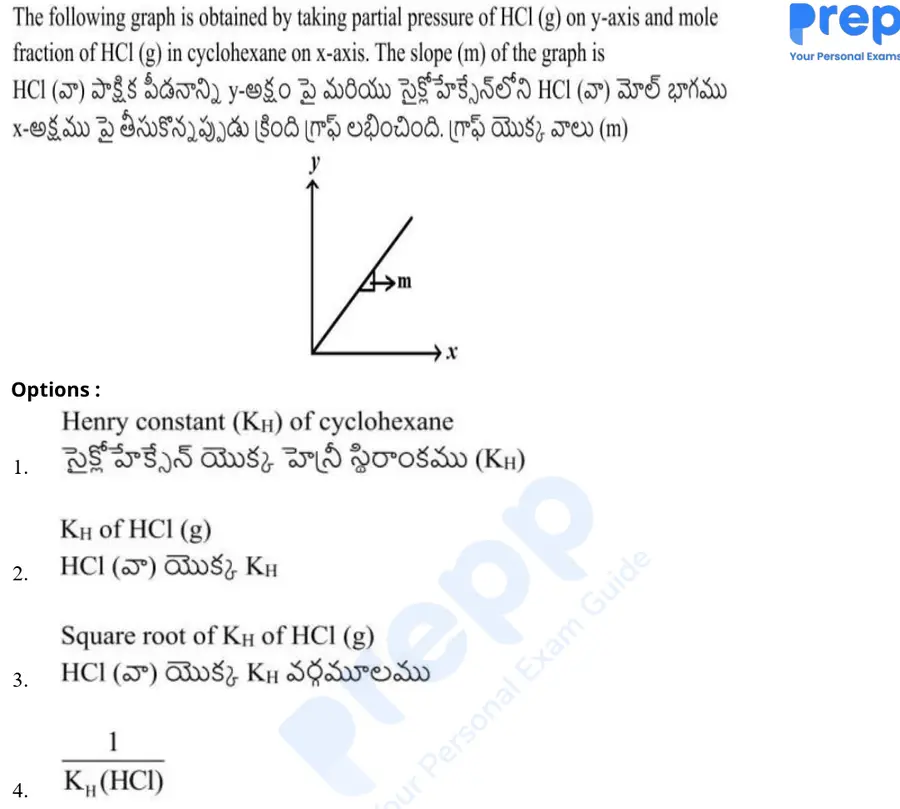
The following graph is obtained by taking partial pressure of $\mathrm{HCl}$ (g) on y-axis and mole fraction of $\mathrm{HCl}$ (g) in cyclohexane on x-axis. The slope (m) of the graph is
(see the figure above)
The question as printed in the paper.
A
Henry constant ($\mathrm{K_H}$) of cyclohexane
B
$\mathrm{K_H}$ of $\mathrm{HCl}$ (g)
C
Square root of $\mathrm{K_H}$ of $\mathrm{HCl}$ (g)
Elements X and Y form two non-volatile compounds ($\mathrm{XY}$ and $\mathrm{XY_3}$). When 10 g of $\mathrm{XY}$ is dissolved in 50 g of ethanol, the depression in freezing point ($\Delta \mathrm{T_f}$) was 5.333 K. When 10 g of $\mathrm{XY_3}$ is dissolved in 50 g of ethanol, the was ($\Delta \mathrm{T_f}$) 2.2857 K. What are the atomic weights of X and Y respectively ? ($\mathrm{K_f}$ = 2 K kg $\mathrm{mol^{-1}}$)
The van't Hoff factor for 0.5 m aqueous $\mathrm{CH_2FCOOH}$ solution is 1.075. What is the experimentally observed $\Delta T_f$ (in K) for this solution ?
An aqueous solution containing 0.2 g of a non volatile solute 'A' in 21.5 g of water freezes at 272.814 K. If the freezing point of water is 273.16 K, the molar mass (in $\mathrm{g\ mol^{-1}}$) of solute A is $[\mathrm{K_f(H_2O)} = 1.86\ \mathrm{K\ kg\ mol^{-1}}]$
At T(K), the vapour pressure of $x$ molal aqueous solution containing a non-volatile solute is 12.078 kPa. The vapour pressure of pure water at T(K) is 12.3 kPa. What is the value of $x$ ?
A solution of urea in water has a boiling point of $100.18^\circ\mathrm{C}$. What is the freezing point of the same solution, if $\mathrm{K_f}$ and $\mathrm{K_b}$ of water are 1.86 and 0.52 $\mathrm{K\ kg\ mol^{-1}}$, respectively ? (Boiling point of water = 100 °C)
At T(K), the vapour pressure of pure benzene and toluene are 75 and 22 mm Hg respectively. 23.4 g of benzene and 64.4 g of toluene are mixed to form an ideal solution. If the vapours are in equilibrium with the liquid mixture, the mole fraction of toluene in vapour phase is (At.wt of C = 12; H = 1)
Benzoic acid molecules undergo dimerisation in benzene. 2.44 g of benzoic acid when dissolved in 30 g of benzene caused depression in freezing point of 2 K. What is the percentage of association of it ?
(Given $\mathrm{K_f(C_6H_6)} = 5\ \mathrm{K\ kg\ mol^{-1}}$; molar mass of benzoic acid = $122\ \mathrm{g\ mol^{-1}}$)
At T(K), the vapour pressure of an aqueous solution of a non-volatile solute, whose mole fraction is 0.02 is found to be 34.65 mm Hg. What is the vapour pressure (in mm Hg) of pure water at the same temperature ?
1.95 g of non-volatile and non-electrolyte solute dissolved in 100 g of benzene lowered the freezing point of it by 0.64 K. The molar mass of the solute (in g $\mathrm{mol^{-1}}$) ($\mathrm{K_f(C_6H_6)}$ = 5.12 K kg $\mathrm{mol^{-1}}$)
At 298 K, 0.714 moles of liquid A is dissolved in 5.555 moles of liquid B. The vapour pressure of the resultant solution is 475 torr. The vapour pressure of pure liquid A at the same temperature is 280.7 torr. What is the vapour pressure of pure liquid B in torr ?
A solution containing 7.5 g of urea (molar mass = 60 g mol$^{-1}$) in 1 kg of water freezes at the same temperature as another solution containing 15 g of solute X, in the same amount of water. The molar mass of X (g mol$^{-1}$) is
A centi molar solution of acetic acid is 50% dissociated at $27\ ^\circ\mathrm{C}$. The osmotic pressure of the solution (in atm) is ($\mathrm{R} = 0.083\ \mathrm{L\ atm\ K^{-1}\ mol^{-1}}$)
At 300 K vapour pressure of a pure liquid, 'A' is 70 mm Hg. It forms an ideal solution with another liquid 'B'. The mole fraction of B in the solution is 0.2 and total vapour pressure of solution is 84 mm Hg at same temperature. What is the vapour pressure (in mm) of pure liquid B at 300 K ?
In a mixture of liquids A and B, if the mole fractions of component A in vapour phase and liquid mixture are $x_1$ and $x_2$ respectively, then the total vapour pressure of liquid mixture is (where $\mathrm{P_A^\circ}$ and $\mathrm{P_B^\circ}$ are the vapour pressures of pure A and B)
Two liquids ‘A’ and ‘B’ form an ideal solution. At 300 K, the vapour pressure of a solution containing 1 mole of ‘A’ and 3 moles of ‘B’ is 550 mm Hg. At the same temperature, if one more mole of ‘B’ is added to the solution, the vapour pressure of solution increases to 560 mm Hg. Then the ratio of vapour pressures of A and B in their pure state is
The osmotic pressure (in atm) of an aqueous solution containing 0.01 mol of $\mathrm{NaCl}$ (degree of dissociation 0.94) and 0.03 mol of glucose in 500 mL at $27\,^\circ\mathrm{C}$ is ($R = 0.082\,\mathrm{L\ atm\ K^{-1}mol^{-1}}$)
At 300 K, the vapour pressures of A and B liquids are 500 and 400 mm Hg respectively. Equal moles of A and B are mixed to form an ideal solution. The mole fraction of A and B in vapor state is respectively
Statement – I: Liquids A and B form a non-ideal solution with positive deviation. The interactions between A and B are weaker than A-A and B-B interactions
Statement – II: For an ideal solution, $\Delta_{mix}H = 0$; $\Delta_{mix}V = 0$
The correct answer is
A
Both Statements -I and Statement -II are correct
B
Both Statements -I and Statement -II are not correct
C
Statement-I is correct but Statement-II is not correct
D
Statement-I is not correct but Statement-II is correct
Benzoic acid undergoes dimerization in benzene. $x$ g of benzoic acid (molar mass $122\ \mathrm{g\ mol^{-1}}$) is dissolved in 49 g of benzene. The depression in freezing point is 1.12 K. If degree of association of acid is 88 %, what is the value of $x$? ($\mathrm{K_f}$ for benzene = $4.9\ \mathrm{K\ kg\ mol^{-1}}$)
At T(K) two liquids A and B form an ideal solution. The vapour pressures of pure liquids A and B at that temperature are 400 and 600 mm Hg respectively. If the mole fraction of liquid B is 0.3 in the mixture, the mole fractions of A and B in vapour phase respectively are
At 290 K, a vessel (I) contains equal moles of three liquids (A, B, C). The boiling points of A, B and C are 350, 373 and 308 K respectively. Vessel (I) is heated to 300 K and vapours were collected into vessel (II). Identify the correct statements. (Assume vessel (I) contains liquids and vapours and vessel (II) contains only vapours)
I. Vessel – I is rich in liquid B
II. Vessel – II is rich in vapour of C
III. The vapour pressures of A, B, C in Vessel (I) at 290 K follows the order C > A > B
At 300 K, 6 g of urea was dissolved in 500 mL of water. What is the osmotic pressure (in atm) of resultant solution? ($\mathrm{R = 0.082\ L\ atm\ K^{-1}\ mol^{-1}}$)
A solution was prepared by dissolving 0.1 mole of a non-volatile solute in 0.9 moles of water. What is the relative lowering of vapour pressure of solution?
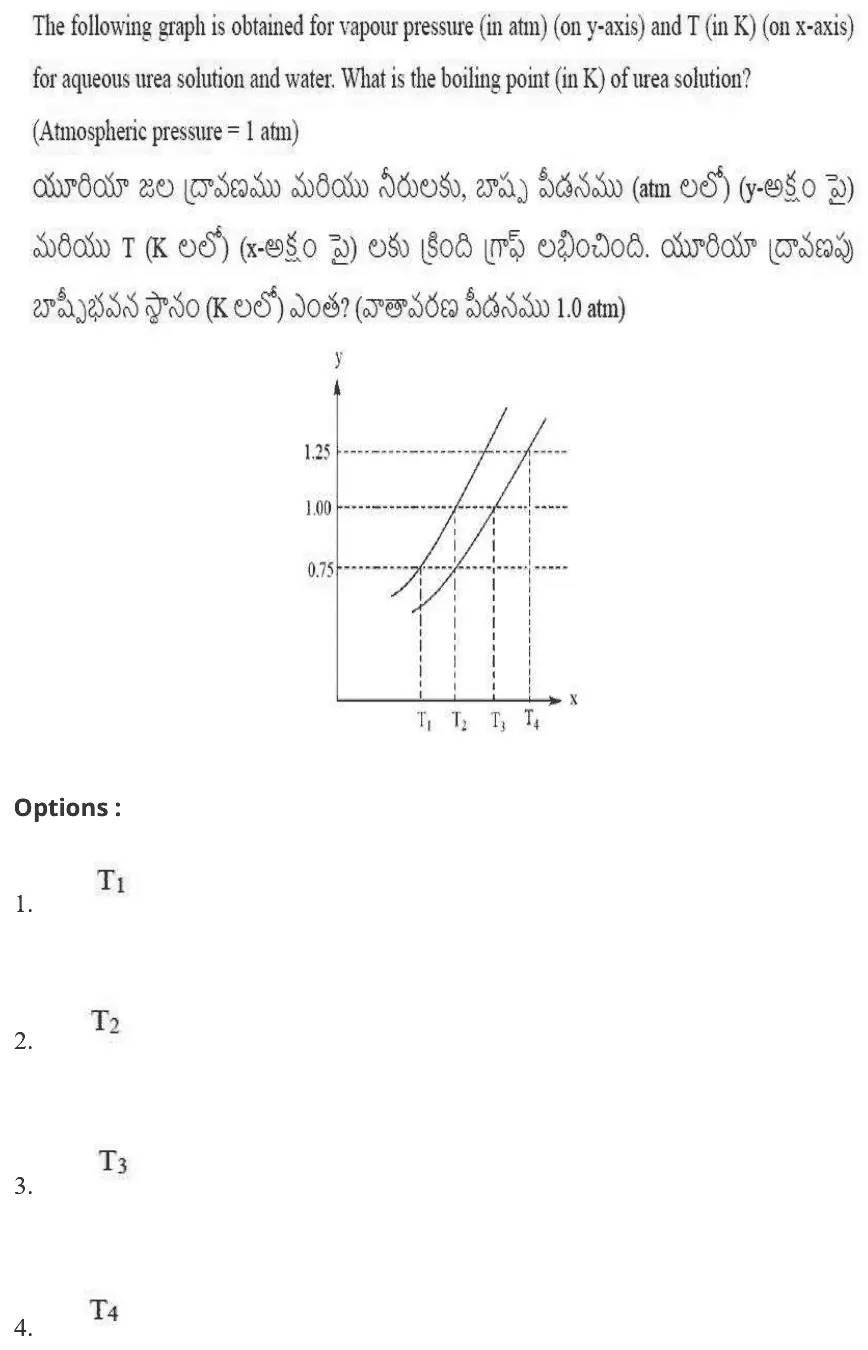
The following graph is obtained for vapour pressure (in atm) (on y-axis) and T (in K) (on x-axis) for aqueous urea solution and water. What is the boiling point (in K) of urea solution?
At 300 K, the vapour pressure of toluene and benzene are 3.63 kPa and 9.7 kPa respectively. What is the composition of vapour in equilibrium with the solution containing 0.4 mole fraction of toluene? (Assume the solution is ideal)
At 300 K, 0.06 kg of an organic solute is dissolved in 1 kg water. The vapour pressure of solution at 300 K is 3.768 kPa. If vapour pressure of water at that temperature is 3.78 kPa, what is the molar mass of the organic solute (in $\mathrm{g\ mol^{-1}}$)?
At T(K), 0.1 moles of a non –volatile solute was dissolved in 0.9 moles of a volatile solvent. The vapour pressure of pure solvent is 0.9 bar. What is the vapour pressure (in bar) of solution?
Distilled water boils at 373.15 K and freezes at 273.15 K. A solution of glucose in distilled water boils at 373.202 K. What is the freezing point (in K) of the same solution? (For water, $\mathrm{K_b} = 0.52\,\mathrm{K\,kg\,mol^{-1}}$, $\mathrm{K_f} = 1.86\,\mathrm{K\,kg\,mol^{-1}}$)
Dry air contains 79% $\mathrm{N_2}$ and 21% $\mathrm{O_2}$. At T(K), if Henry's law constants for $\mathrm{N_2}$ and $\mathrm{O_2}$ in water are $8.57\times10^4$ atm and $4.56\times10^4$ atm, the ratio of mole fractions of $\mathrm{N_2}$ and $\mathrm{O_2}$ dissolved in water at 1 atm is
What is the depression of freezing point, when mole fraction of non-electrolyte solute in aqueous solution is $0.01$ ? ($\mathrm{K_f}$ of $\mathrm{H_2O}$ = $1.86\ \mathrm{K\,kg\,mol^{-1}}$)
At 293 K, the Henry law constant in water for $\mathrm{N_2}$ and $\mathrm{O_2}$ are 76.48 k bar and 34.86 k bar respectively. What is the ratio of mole fractions of $\mathrm{N_2}$ and $\mathrm{O_2}$ in water? (Assume partial pressures of $\mathrm{N_2}$ and $\mathrm{O_2}$ same at 293 K)
At 298 K, if the vapour pressure of pure liquids toluene, benzene, chloroform and dichloromethane are 60, 160, 200 and 415 torr respectively. Then which liquid is having high boiling point?
6 g of a non-volatile solute (x) is dissolved in 100 g of water. The relative lowering of vapour pressure of resultant solution is 0.006. What is the molar mass (in $\mathrm{g\ mol^{-1}}$) of x?
If the osmotic pressure of cane sugar solution is 2.46 atm at $27\ ^\circ\mathrm{C}$, then what is the concentration (in $\mathrm{mol\ L^{-1}}$) of the solution ($R = 0.0821\ \mathrm{L\ atm\ mol^{-1}\ K^{-1}}$)
A solution is formed by the combination of two liquids such as dichloromethane and chloroform. The partial pressures of dichloromethane and chloroform in solution are 285.5 and 62.4 mm Hg respectively. What is the total pressure of the solution?
The elevation in the boiling point of aqueous urea solution is 0.104 K. What is its $\Delta T_f$ (in K) value? (for Water $K_b = 0.52\ \mathrm{K\ kg\ mol^{-1}}$, $K_f = 1.86\ \mathrm{K\ kg\ mol^{-1}}$)
At 50 °C, the vapour pressure of pure benzene is 268 torr. The number of moles of non-volatile solute per mole of benzene required to prepare a solution having a vapour pressure of 167 torr at the same temperature is (molar mass of benzene=78 g mol$^{-1}$)
An aqueous solution of a non-volatile solute boils at $100.17\ ^\circ\mathrm{C}$. The temperature at which this solution will freeze (in $^\circ\mathrm{C}$) is
'$x$' g of urea (molar mass $60\ \mathrm{g\,mol^{-1}}$) is completely dissolved in 'y' g of pure water and the solution boiled at 373.202 K. If the boiling point of pure water at 1.013 bar is 373.15 K, then $x:y$ is $(\mathrm{K_b(H_2O)} = 0.52\ \mathrm{K\,kg\,mol^{-1}})$
Liquids A and B form an ideal solution. The vapour pressures of A and B are 50 and 32mm Hg respectively at 300K. One mole of liquid A is mixed with 1 mole of liquid B. What is the approximate mole fraction of A in vapour phase?
The vapour pressure of a pure liquid A is 70 torr at 300 K. It forms an ideal solution with another liquid B. The mole fraction of B is 0.2 and total vapour pressure of the solution is 84 torr at the same temperature. The vapour pressure of pure liquid B (in torr) is
At 300 K, the osmotic pressure of a decinormal solution of sodium chloride is 4.82 atm. The degree of dissociation of sodium chloride is $x \times 10^{-2}$. The value of $x$ is
A liquid mixture is an ideal solution, if a) It obeys ideal gas equation b) It obeys Raoult's law at all concentrations c) Solute $-$ solute, solute $-$ solvent and solvent $-$ solvent interactions are similar
A solvent freezes at $17\ ^\circ$C and it has latent heat of fusion $180\ \mathrm{J\,g^{-1}}$. The molal depression constant of the solvent is [units of $K_f=\mathrm{K\,kg\,mol^{-1}}$]
The Henry's law constant for the solubility of $\mathrm{N_2}$ gas in water at 298 K is $1\times10^{+5}$ atm. The mole fraction of air is 0.8. The number of moles of $\mathrm{N_2}$ from air dissolved in 10 moles of water at 298 K and 5 atm pressure is
Calculate the quantity of $\mathrm{CO_{2}}$ required to prepare 1 L of soda water when the soda water was packed under 2 atm of $\mathrm{CO_{2}}$. [Henry's law constant for $\mathrm{CO_{2}}$ is $1.67\times10^{8}$ Pa]
Which of the following are correct for an ideal solution? a) $\Delta\mathrm{V_{mix}}=0$ b) $\mathrm{V_{solvent}}+\mathrm{V_{solute}}=\mathrm{V_{solution}}$ c) $\Delta\mathrm{H_{mix}}=0$ d) $\mathrm{H_{2}O+CO_{2}\to H_{2}CO_{3}}$ is an example of ideal solution.
At $0\ ^{\circ}\mathrm{C}$, urea solution has an osmotic pressure of 400 mm. On dilution by $x$ times, its osmotic pressure decreased to 100 mm at $20\ ^{\circ}\mathrm{C}$. The dilution factor $x$ is approximately
Which of the following is/are “not correct” for $\mathrm{CH_{3}OH+CH_{3}COOH}$ mixture solution? a) $\Delta H_{mix}<0$ b) Does not obey Raoult’s law c) $\Delta H_{mix}>0$ d) An example of ideal solution
Henry’s law is valid for A) Ammonia gas dissolution in water B) $\mathrm{O_{2}}$ gas dissolution in unsaturated blood C) $\mathrm{O_{2}}$ dissolution in water D) $\mathrm{CO_{2}}$ dissolution in water
At T (K), the partial pressure of dissolved oxygen in 1 L water is 1 bar. The concentration of oxygen is ppm is ($K_H$ of $\mathrm{O_2}$ at T(K) is 50 kbar)
At T(K) the molarity of $\mathrm{CO_2}$(in $\mathrm{mol\ L^{-1}}$) in 200 mL of soda water packed under a pressure of 3.4 bar is ($\mathrm{K_H}$ of $\mathrm{CO_2}$ in water is $1.7\mathrm{X}10^{3}$ bar at T(K))
The depression in freezing point of solution of molality $0.01\ \mathrm{mol\ kg^{-1}}$ is highest with respect to which of the solvent? (Whose $\mathrm{K_f}$ is given is brackets)
1.8 g of glucose (molar mass $180\ \mathrm{g\,mol^{-1}}$) is dissolved in 0.1 kg of water. The freezing point of the solution (in $^\circ$C) is (K$_f$ for water = $1.86\ \mathrm{K\,kg\,mol^{-1}}$)
At 298K, the vapour pressure of pure water is 25 torr. The vapour pressure of water, when 12 g of urea (molar mass, $60\ \mathrm{g\,mol^{-1}}$) and 36 g of glucose (molar mass, $180\ \mathrm{g\,mol^{-1}}$) is dissolved in 100g of water at the same temperature (in torr) is
At 298 K, vapour pressures of two pure liquids A and B are 200 and 400 mm Hg respectively. If mole fractions of A and B in solution are 0.7 and 0.3 respectively. What is the mole fraction of B in vapour phase?
The freezing point depression of a solution containing 0.6 g of urea (molar mass=60 g $\mathrm{mol^{-1}}$) in 100g of benzene (in K) is ($\mathrm{K_f}$ of $\mathrm{CH_3COOH}$ = 4.0 K Kg $\mathrm{mol^{-1}}$)
0.05 mole of a non-volatile solute is dissolved in 500 g of water. What is the depression in freezing point of resultant solution? ($K_f(\mathrm{H_2O})$ = 1.86 K kg $\mathrm{mol^{-1}}$)
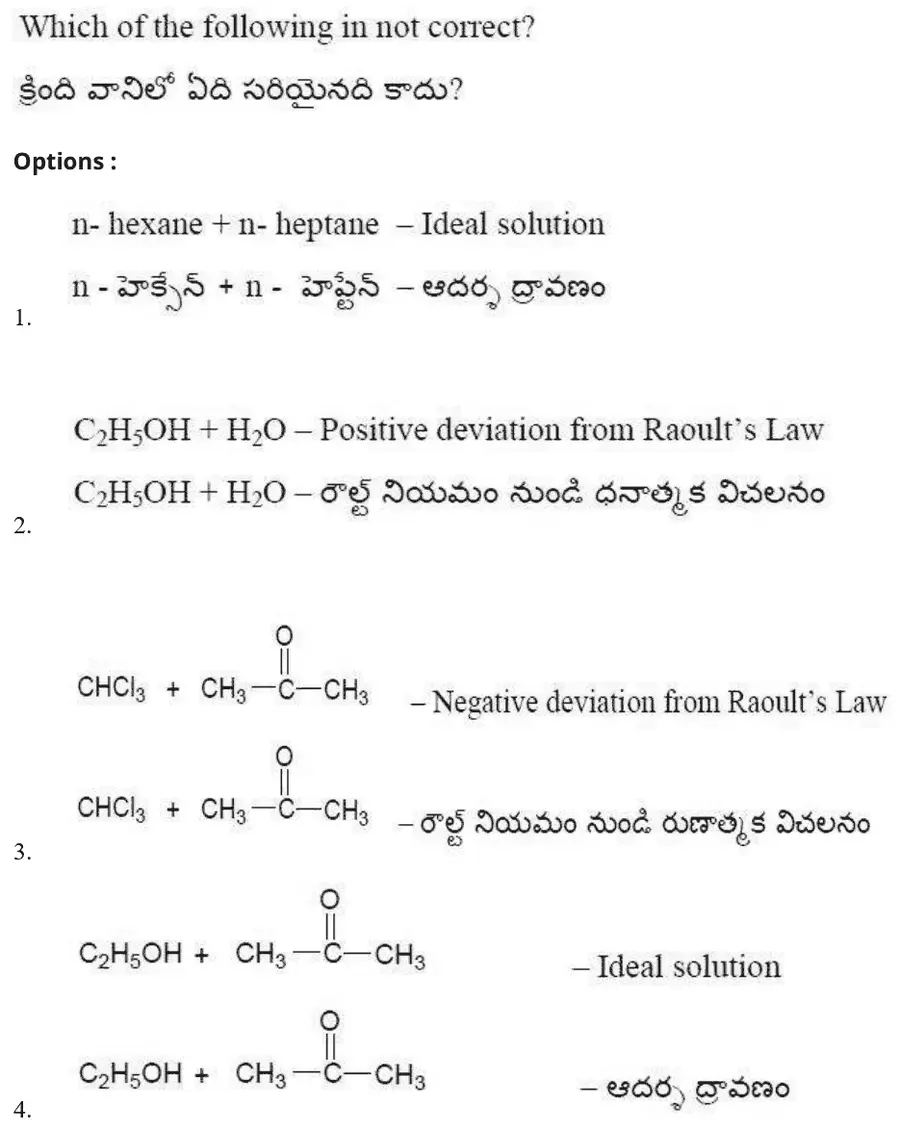
Which of the following form an ideal solution? (I) Chloroethane and bromoethane (II) Benzene and toluene (III) n - Hexane and n - heptane (IV) Phenol and aniline
At T (K) x g of a non-volatile solid (molar mass 78 $\mathrm{g\,mol^{-1}}$) when added to 0.5 kg water, lowered its freezing point by 1.0°C. What is x (in g)? ($K_f$ of water at T(K)= 1.86 $\mathrm{K\,Kg\,mol^{-1}}$)
A solution containing 6.0 g of urea is isotonic with a solution containing 10g of a non-electrolytic solute X. The molar mass of X (in $\mathrm{g\,mol^{-1}}$) is
A 25% solution of cane-sugar (mol mass= $342\ \mathrm{g\ mol^{-1}}$) is isotonic with 5% solution of a substance A. Then find the molecular weight of A?
Henrys law constant for $\mathrm{CO_2}$ in water is $1.67 \times 10^8\ \mathrm{Pa}$. Calculate the approximate quantity of $\mathrm{CO_2}$ in $500\ \mathrm{ml}$ of soda water when packed under $5\ \mathrm{atm}\ \mathrm{CO_2}$ at $298\ \mathrm{K}$.
The elevation in boiling point of a solution of $10\ \mathrm{g}$ of a binary electrolyte (of molecular mass 100) in $100\ \mathrm{g}$ of water is $\Delta T_b$. Then the value of $K_b$ for water is ______
A gas $X$ is dissolved in water at 2 bar pressure. Its mole fraction in the solution is 0.02. Find the mole fraction of water in the solution when the pressure of the gas is doubled at the same temperature.
$2\ g$ of a non-electrolyte solute (molar mass is $500\ g\ mol^{-1}$) was dissolved in $57.3\ g$ of xylene. If the freezing point depression constant $K_f$ of Xylene is $4.3\ K\ kg\ mol^{-1}$. Then the depression in freezing point of Xylene is ______
If the $K_H$ values for $Ar_{(g)}$, $CO_{2(g)}$, $HCHO_{(g)}$ and $CH_{4(g)}$ respectively are 40.39, 1.67, $1.83 \times 10^{-5}$ and 0.413, then identify the correct increasing order of their solubilities.
The vapour pressure of a solvent decreased by 20 $mm$ of $Hg$ when a non-volatile solute was added to the solvent. The mole-fraction of the solute in the solution is 0.5. What should be the mole-fraction of the solvent for the decrease in the vapour pressure needs to be 10 $mm$ of $Hg$?
A solution of urea (molar mass $60\ \mathrm{g\ mol^{-1}}$) boils at $100.20^\circ\mathrm{C}$ at the atmospheric pressure. if $K_f$ and $K_b$ for water are $1.86$ and $0.512\ \mathrm{K\ Kg\ mol^{-1}}$ respectively. The freezing point of the solution will be ______
pH of a $0.1\mathrm{M}$ monobasic acid is 2. Its osmotic pressure at a given temperature T (K) is (Given that the effective concentration for osmotic pressure is $(1+\alpha)\times$ concentration of acid; $\alpha$ is the dissociation factor)
Match the following. A) Ebullioscopic constant I) Depression of freezing point B) Cryoscopic constant II) Total pressure is the sum of partial pressures of the components C) Henry's law III) Elevation of boiling point D) Dalton's law IV) Solubility of a gas in liquid The correct match is
On mixing urea, the boiling point of $\mathrm{H_2O}$ changed to $100.5\ ^\circ\mathrm{C}$. Calculate the freezing point of the solution, if $K_f$ of water is $1.87\ \mathrm{K.kg.mol^{-1}}$ and $K_b$ of water is $0.52\ \mathrm{K.kg.mol^{-1}}$
A 3 ml of solution was made by dissolving 20 mg of protein at 0 °C. The osmotic pressure of the resulting solution is 3.8 torr. The molecular weight of the protein is approximately (in g / mol)
$K_H$ values for $\mathrm{H_2}$, $\mathrm{CO_2}$, $\mathrm{CH_4}$ and $\mathrm{O_2}$ at $298\ K$ are 71.18, 1.67, 41.85 and 34.86 $Kbar$. respectively. Arrange these gases in the increasing order of their solubility.
In comparison to a 0.01 M solution of glucose, the depression in freezing point of a 0.01 M $\mathrm{MgCl_2}$ solution is ______ (M.W. of $\mathrm{MgCl_2}$ = 95, M.W. of glucose= 180)
Match the item given in Column-I (method used for determining colligative property) and Column-II (for the corresponding colligative property) and find the correct order. Column-I: a. Beckmann method; b. Ostwald-Walker method; c. Berkeley-Hartley method; d. Landsberger method Column-II: i. Osmotic pressure; ii. Elevation in B.P.; iii. Depression in F.P.; iv. Relative lowering of Vapour pressure
160 g of non-volatile solute 'A' is dissolved in 54 $ml$ of water at 373 $K$. What is the vapor pressure of aqueous solution of A. (given molecular weight of A= 160 g.$mol^{-1}$)
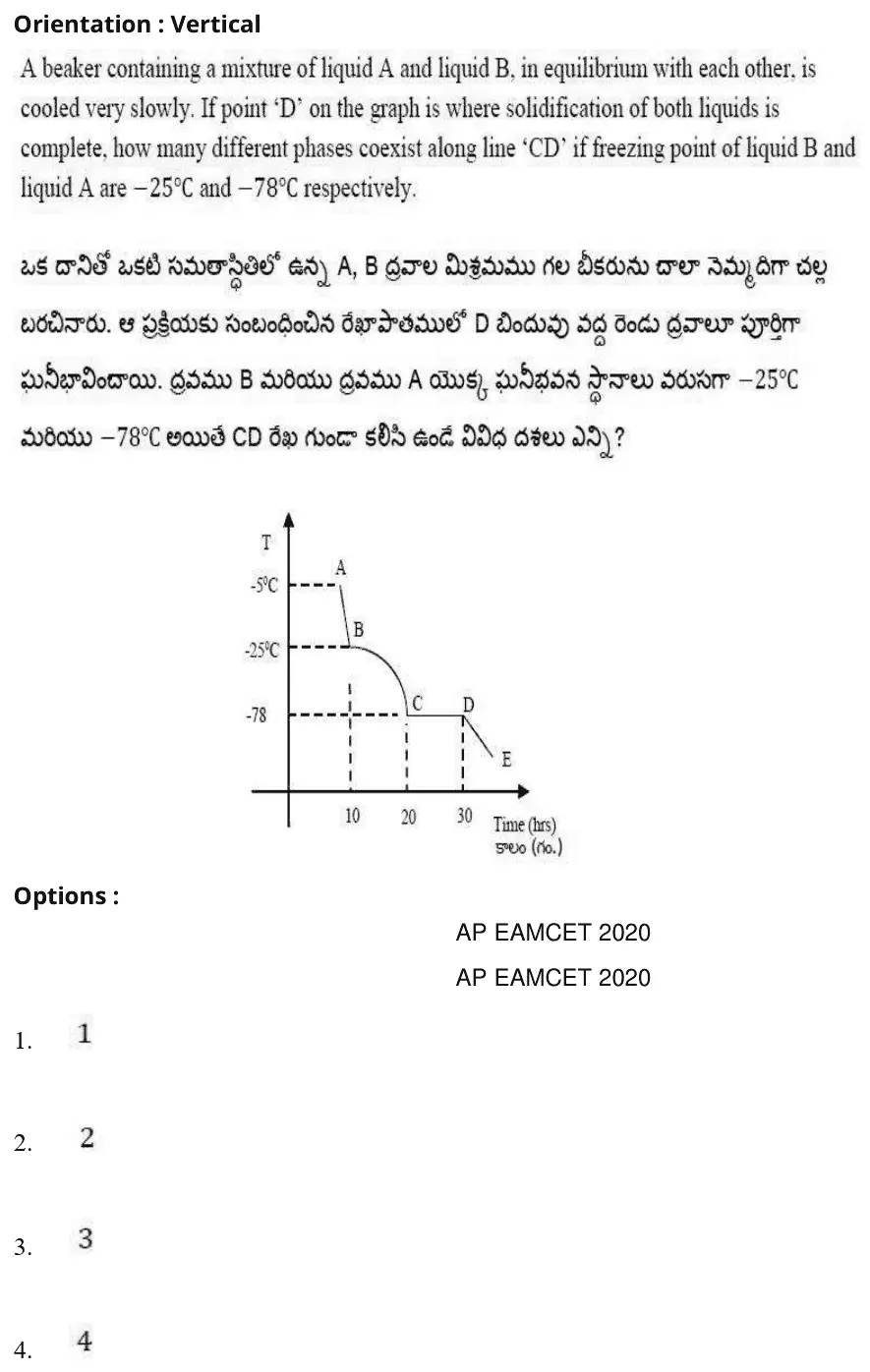
A beaker containing a mixture of liquid A and liquid B, in equilibrium with each other, is cooled very slowly. If point 'D' on the graph is where solidification of both liquids is complete, how many different phases coexist along line 'CD' if freezing point of liquid B and liquid A are $-25^\circ$C and $-78^\circ$C respectively. (see the figure above)
The observed molar mass determined for $\mathrm{Na_2SO_4}$ by freezing point depression method is 50.0 g/mol. The molecular weight of $\mathrm{Na_2SO_4}$ is 142. What will be the degree of dissociation $\alpha$ for $\mathrm{Na_2SO_4}$ in water?
The solubility product of a sparingly soluble $\mathrm{AB_2}$ salt is $2.56\times10^{-4}\ \mathrm{M^3}$ at $25^\circ\mathrm{C}$. The $\mathrm{K_f}$ of water is $1.8\ \mathrm{K\,kg\,mol^{-1}}$. The depression in freezing point of a standard solution of $\mathrm{AB_2}$ is
15% aqueous solution of glucose (molecular weight = 180 g/mol) is isotonic with 8% aqueous solution containing an unknown non-dissociable solute. What is the molecular weight of the unknown solute?
The vapour pressure of pure water is 23 mmHg. The vapour pressure of an aqueous solution which contains 10 mass percent of solute 'A' having molecular weight 50 is
A 1.17% solution of solute A is isotonic with 7.2% solution of glucose. If the molecular weight of solute A is 58.5, the value of van't Hoff factor, 'i' is
A mixture of 3.0 mol of $\mathrm{Na_2O}$ and 1.5 mol of $\mathrm{KO_2}$ is dissolved in 1000 mL of water. The vapour pressure of the solution in Torr, at 100 °C is
$\mathrm{A^{2+}}$, $\mathrm{B^{2+}}$ and $\mathrm{C^{-}}$ form an ionic complex like $\mathrm{A_{x-2}[B(C)_x]_2}$. If the complex is 75% dissociated in a solvent with i = 4, the coordination number of B is
The freezing point depression of 0.001 M of $\mathrm{A_xB_y[Fe(CN)_6]}$ is $5.58 \times 10^{-3}$ K. If the oxidation state of Fe is +2 and $K_f = 1.86\ \mathrm{K\,kg\,mol^{-1}}$, then the total number of possibilities for different types of A and B cations are
When 2.44 grams of benzoic acid ($\mathrm{C_6H_5COOH}$) dissolved in 25 grams of benzene, it shows depression of freezing point equal to 2.2 K. Molal depression constant of benzene is $5.0\ \mathrm{K\,kg\,mol^{-1}}$. What is the percentage association of acid, if it forms dimer in solution?
Correct order of osmotic pressure of the following solutions is (i) 30 gm $\mathrm{L^{-1}}$ of glucose (ii) 60 gm $\mathrm{L^{-1}}$ of $\mathrm{NH_2CONH_2}$ (iii) 80 gm $\mathrm{L^{-1}}$ of glucose (iv) 58.5 gm $\mathrm{L^{-1}}$ of NaCl
The vapour pressure of pure $\mathrm{CCl_4}$ (Molar mass = 154 g mol$^{-1}$) and $\mathrm{SnCl_4}$ (Molar mass = 170 g mol$^{-1}$) at 25 °C are 115.0 and 238.0 Torr respectively. Assuming ideal behavior, calculate the total approximate vapour pressure in Torr of a solution containing 10 g of $\mathrm{CCl_4}$ and 15 g of $\mathrm{SnCl_4}$.
A camphor sample melts at 176 °C. $K_f$ for camphor is 40 K kg mol$^{-1}$. A solution of 0.02 g of a hydrocarbon in 0.8 g of camphor melts at 156.77 °C. The hydrocarbon is made up of 92.3% of carbon. What is the molecular formula of the hydrocarbon?
Calculate the depression in the freezing point of a solution containing 0.1 g of $\mathrm{K_3[Fe(CN)_6]}$ in 100 g of $\mathrm{H_2O}$? (molecular weight of $\mathrm{K_3[Fe(CN)_6]}$ = 329, $K_f = 1.86\ \mathrm{K\ kg\ mol^{-1}}$)
A solution of 17.1 w% of sucrose (molar mass = 342 $\mathrm{g\ mol^{-1}}$) is isotonic with a $x$ w% solution of oxalic acid (molar mass = 90 $\mathrm{g\ mol^{-1}}$). Assume the degree of dissociation of oxalic acid as 0.01. What is $x$?
The freezing point of solution containing 10 mL of non-volatile and non-electrolyte liquid "A" in 500 g of water is $-0.413\ ^\circ$C. If $K_f$ of water is 1.86 K kg mol$^{-1}$ and the molecular weight of A = 60 g mol$^{-1}$, what is the density of the solution in g mL$^{-1}$? (Assume $\Delta_{\mathrm{mix}}V = 0$)
How many grams of glucose are required to prepare an aqueous solution of glucose having a vapor pressure of 23.324 mm Hg at 25°C in 100 g of water? The vapor pressure of pure water at 25°C is 23.8 mm Hg. (Molar mass of glucose = 180 g $\mathrm{mol^{-1}}$)
If 0.1 M solution of NaCl is isotonic with 1.1 w% urea solution, the degree of ionisation of NaCl is (Molar masses of urea and NaCl are 60 and 58.5 g $\mathrm{mol^{-1}}$ respectively)
At 298 K, the vapour pressure of a solution of 7.5 g of non-volatile solute in 90 g of water is 2.8 kPa. If 18 g of water is added to this solution the vapour pressure becomes 2.81 kPa at same temperature, the molar mass of solute in $\mathrm{g\,mol^{-1}}$ is
At T(K), the vapour pressures of pure liquids A and B are 100 mm and 160 mm respectively. An ideal solution is formed by mixing 2 moles of A and 3 moles of B at the same temperature. The mole fraction of A and B in the vapour state respectively are
At $300\ \mathrm{K}$ an ideal solution is formed by mixing $460\ \mathrm{g}$ of toluene with $390\ \mathrm{g}$ benzene. If the vapour pressure of pure toluene and benzene at $300\ \mathrm{K}$ are $32$ and $40\ \mathrm{mm}$ respectively, the mole fraction of toluene in vapour phase is
If aqueous solution contains 9% and 1% (W/W) of two non-volatile, non-electrolytes X(molecular weight 180) and Y(molecular weight 50) respectively, the boiling point of solution in $^\circ\mathrm{C}$ approximately is ($\mathrm{K_b} = 0.52\ \mathrm{K\,kg\,mol^{-1}}$)
An ideal solution of hexane and heptane at 30 $^\circ$C has a vapour pressure of 95 bar with hexane mole fraction 0.305. In vapour phase hexane mole fraction is 0.555. The vapour pressures of pure hexane and heptane at 30 $^\circ$C respectively in bar are
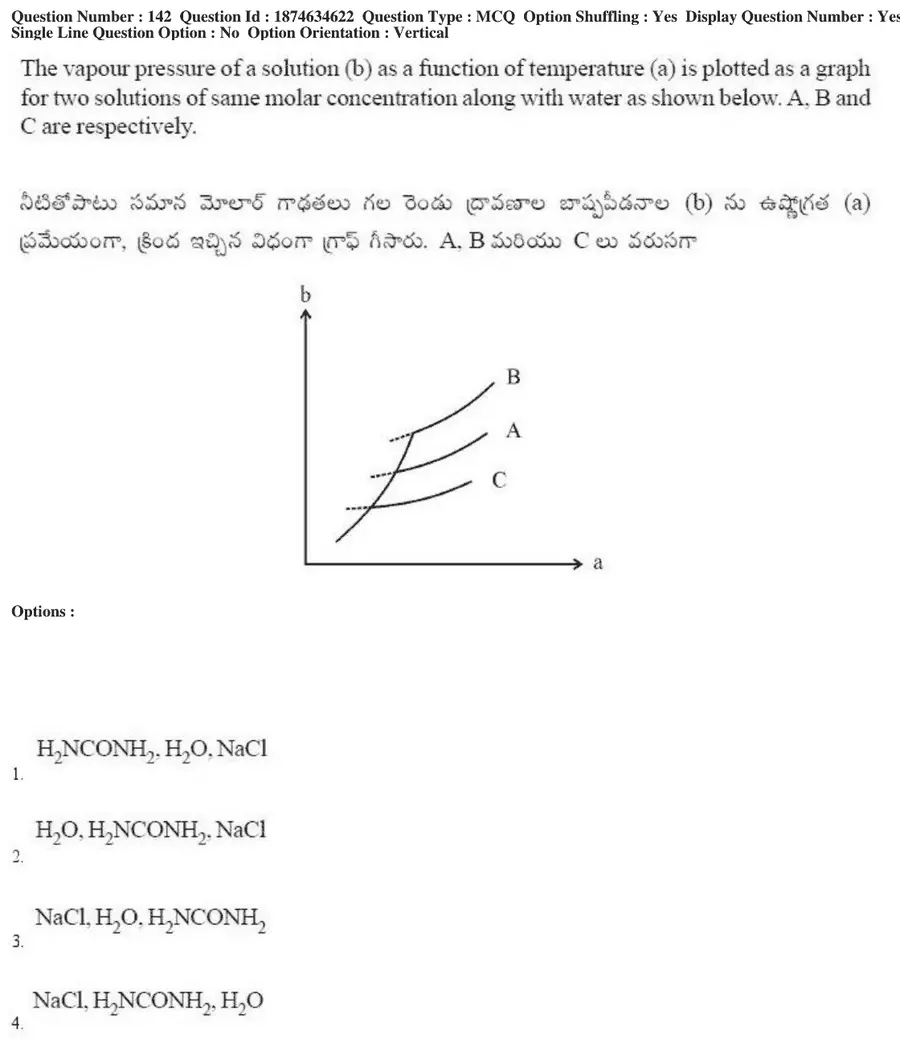
The vapour pressure of a solution (b) as a function of temperature (a) is plotted as a graph for two solutions of same molar concentration along with water as shown below. A, B and C are respectively. (see the figure above)
A solution is prepared by dissolving 10 g of a non-volatile solute (molar mass, 'M' $\mathrm{g\,mol^{-1}}$) in 360 g of water. What is the molar mass in $\mathrm{g\,mol^{-1}}$ of solute if the relative lowering of vapour pressure of solution is $5\times10^{-3}$?
$x$ g of $\mathrm{MgSO_4}$ ($i=1.8$) is in 2.5 L of solution has an osmotic pressure of 2.463 atm. at $27\,^\circ\mathrm{C}$. What is the value of $x$ in g?
The vapour pressures of chloroform ($\mathrm{CHCl_3}$), dichloromethane ($\mathrm{CH_2Cl_2}$) at 298 K are 200 mm Hg and 415 mm Hg respectively. An ideal solution is prepared by mixing 59.75 g of $\mathrm{CHCl_3}$ and 21.25 g of $\mathrm{CH_2Cl_2}$, the mole fractions of chloroform and dichloromethane in vapour phase respectively are
The elevation in boiling point of an aqueous solution of NaCl is $0.01\ ^\circ\mathrm{C}$. If its van't Hoff factor is 1.92, the molality of NaCl solution is ($\mathrm{K_b}$ for water $= 0.52\ \mathrm{K\ kg\ mol^{-1}}$)
6 g of a mixture of naphthalene ($\mathrm{C_{10}H_8}$) and anthracene ($\mathrm{C_{14}H_{10}}$) is dissolved in 300 g of benzene. If the depression in freezing point is 0.70 K, the composition of naphthalene and anthracene in the mixture respectively in g are (molal depression constant of benzene is 5.1 K kg $\mathrm{mol^{-1}}$)
1.2 mL of acetic acid having density $1.06\ \mathrm{gcm^{-3}}$ is dissolved in 1 litre of water. The depression in freezing point observed for this concentration of acid was $0.041^\circ\mathrm{C}$. The van't Hoff factor of the acid is ($\mathrm{K_f}$ of water = $1.86\ \mathrm{K\,kgmol^{-1}}$)
100 mL of 1.5% (w/v) solution of urea is found to have an osmotic pressure of 6.0 atm and 100 mL of 3.42% (w/v) solution of cane sugar is found to have an osmotic pressure of 2.4 atm. If the two solutions are mixed, the osmotic pressure of the resulting solution in atm is (Assume that there is no reaction between urea and cane sugar)
How many grams of glucose must be added to 0.5 liter of a solution so that its osmotic pressure is same as that of a solution of 9.2 g of glucose dissolved in a liter?
In an experiment to estimate the molecular weight of benzoic acid by elevation in boiling point method, the experimental value of molecular weight was double the actual value. Calculate the degree of association of dimer if the elevation in B.P. is $2\,^\circ\mathrm{C}$.
$2.0\ \mathrm{g}$ of a non-electrolyte dissolved in $100\ \mathrm{g}$ of benzene lowers the freezing point of benzene by $1.2\ \mathrm{K}$. The freezing point depression constant of benzene is $5.12\ \mathrm{K\,kg\,mol^{-1}}$. The molar mass of the solute is
At 300 K, a one litre solution of sucrose (molecular weight : 342) was prepared by dissolving 40 g of sucrose. What is the approximate osmotic pressure (in kPa) of solution at the same temperature? ($R = 8.314\times10^{6}\ \mathrm{cm^{3}\,Pa\,K^{-1}\,mol^{-1}}$)
Henry's law constant for $\mathrm{CO_2}$ in water is 1.67 kbar at 25 °C. The quantity of $\mathrm{CO_2}$ in 1000 mL of soda water when packed under 5 bar $\mathrm{CO_2}$ pressure at 25 °C is
If $\mathrm{CO_2}$ gas having a partial pressure of 1.67 bar is bubbled through 1 L water at 298 K, the amount of $\mathrm{CO_2}$ dissolved in water in $\mathrm{g\,L^{-1}}$ is approximately (Henry's law constant of $\mathrm{CO_2}$ is 1.67 k bar at 298 K).
12.25 g of $\mathrm{CH_3CH_2CHClCOOH}$ is added to 250 g of water to make a solution. If the dissociation constant of above acid is $1.44\times10^{-3}$, the depression in freezing point of water in $^\circ$C is ($\mathrm{K_f}$ for water is 1.86 K kg $\mathrm{mol^{-1}}$)
Match the following. List - I A) Azeotrope B) Henry's law C) Cryoscopic constant D) Van't Hoff factor List - II I) $\Delta T_b = i K_b m$ II) $p = K_H x$ III) $\Delta T_f / m$ IV) Deviation from Raoult's law V) $\pi = CRT$ The correct answer is
The mass of ascorbic acid ($\mathrm{C_6H_8O_6}$) to be dissolved in 100 g of acetic acid to lower its freezing point by $1.5\ ^\circ\mathrm{C}$ in g is : ($K_f$ for acetic acid is $4.0\ \mathrm{K\,kg\,mol^{-1}}$)
When 36 g of a non-volatile, non-electrolytic solute having the empirical formula $\mathrm{CH_2O}$ is dissolved in 1.2 kg of water, the solution freezes at $-0.93\ ^\circ\mathrm{C}$. The molecular formula of the solute is ($\mathrm{K_f}$ of water = 1.86 K kg mol$^{-1}$)
Benzene and toluene form an ideal solution over the entire range of composition. The vapour pressure of pure benzene and toluene at T (K) are 50 mm Hg and 40 mm Hg respectively. What is the mole fraction of toluene in vapour phase when 117 g of benzene is mixed with 46 g of toluene ? (molar mass of benzene and toluene are 78 and 92 g mol$^{-1}$ respectively)
The quantity of $\mathrm{CO_2}$ in 500 mL of soda water when packed under 3.34 bar $\mathrm{CO_2}$ pressure at 298 K in g is (Henry's law constant for $\mathrm{CO_2}$ in water at 298 K is $1.67 \times 10^{8}$ Pa).
300 mL of an aqueous solution of a protein contains 2.52 g of the protein. If osmotic pressure of such a solution at 300 K is $5.04 \times 10^{-3}$ bar, the molar mass of the protein in $\mathrm{g\ mol^{-1}}$ is
The measured osmotic pressure of a solution prepared by dissolving $17.4\ \mathrm{mg}$ of $\mathrm{K_2SO_4}$ in 2L of water at $27\ ^\circ\mathrm{C}$ is $3.735\times10^{-3}$ bar. The Van't Hoff factor is ($R = 0.083\ \mathrm{L\,bar\,K^{-1}\,mol^{-1}}$ ; atomic weights K = 39 ; S = 32 ; O = 16)
At T(K), the vapour pressure of pure benzene is 0.85 bar. A non-volatile, non-electrolyte substance weighing 0.5 g when added to 39 g of benzene, the vapour pressure of the solution is 0.845 bar. The molar mass (in $\mathrm{g\,mol^{-1}}$) of the substance is
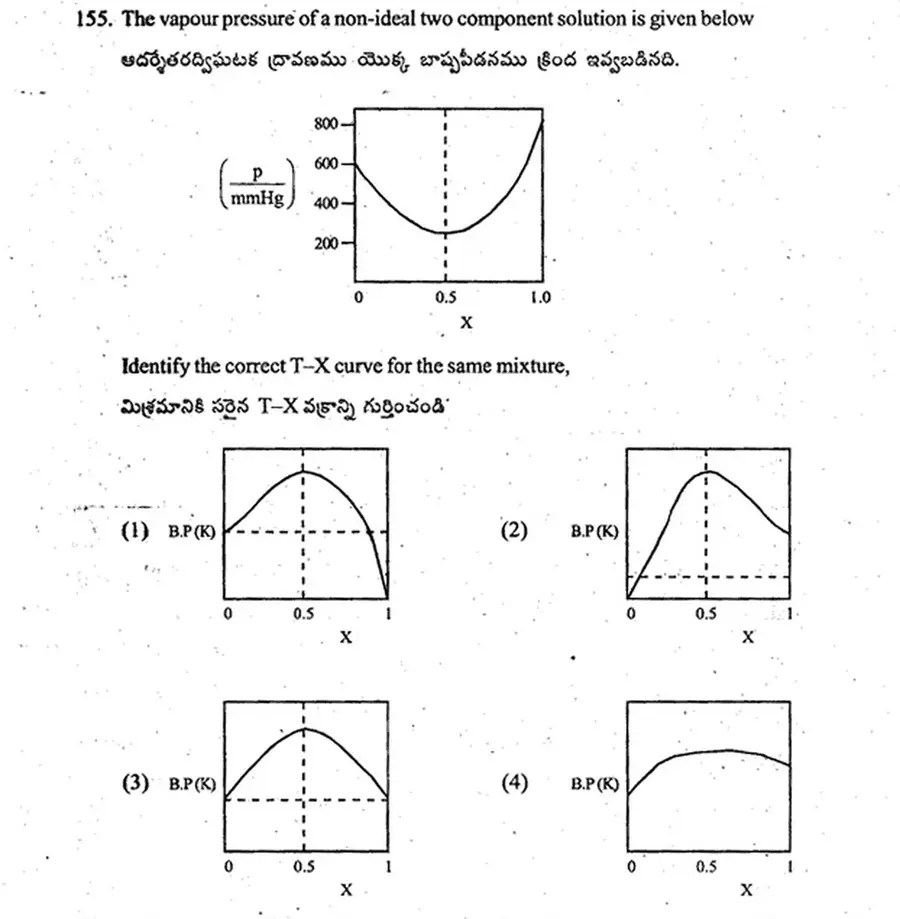
The vapour pressure of a non-ideal two component solution is given below (see the figure above) Identify the correct T-X curve for the same mixture,
The question as printed in the paper.
A
see figure B.P(K) vs X (0 to 1): curve rising to a maximum at X = 0.5 and falling back; horizontal dashed line at the left end value; right end drops steeply to the bottom at X = 1
B
see figure B.P(K) vs X: starts at bottom left at X = 0, rises steeply to a maximum near X = 0.5, then falls gently to the right end; horizontal dashed line near the bottom
C
see figure B.P(K) vs X: symmetric hump, maximum at X = 0.5, both ends at the same level marked by a horizontal dashed line
D
see figure B.P(K) vs X: gentle hump, flat maximum near X = 0.6, no dashed lines, right end slightly lower than left
31 g of ethylene glycol ($\mathrm{C_2H_6O_2}$) is dissolved in 600 g of water. The freezing point depression of the solution is ($K_f$ for water is $1.86\ \mathrm{K\,kg\,mol^{-1}}$)
At T(K), the vapour pressures of two liquids, heptane and octane are 106 kPa and 47 kPa respectively. If 25g of heptane and 57g of octane form an ideal solution, at T(K) the vapour pressure of solution in kPa is :
At 27 °C, the osmotic pressure of a solution containing 4g of a non-electrolyte solute in 1.0 L of solution is 0.4 bar. The molar mass of the solute in $\mathrm{g\,mol^{-1}}$ is : ($R = 0.083\ \mathrm{L\,bar\,K^{-1}mol^{-1}}$)
The ideal solutions formed by mixing two liquids A and B at 300 K in the molar ratio 1 : 1 and 1 : 2 have vapour pressures of 400 mm and 350 mm respectively. At the same temperature, the vapour pressures of pure liquids A and B in mm respectively are:
0.8 mL of acetic acid of density 1.06 g $\mathrm{mL^{-1}}$ when dissolved in 1 kg of water causes depression in freezing point by 0.0325 $^\circ$C. The Van't Hoff factor is: ($K_f$ of $\mathrm{H_2O}$ = 1.86 K kg $\mathrm{mol^{-1}}$)
At T(K), the vapour pressure of pure benzene (molar mass $= 78\ \mathrm{g\ mol^{-1}}$) is 0.85 bar. When 2.0 g of non-volatile, non-electrolyte solute is added to 39 g of benzene, the vapour pressure of solution at T(K) is 0.83 bar. The elevation in boiling point (in K) of the same solution [is] ($\mathrm{K_b}$ of benzene is $2.6\ \mathrm{K\ kg\ mol^{-1}}$)
At 27°C, two liquids A and B form an ideal solution with mole fractions 0.67 and 0.33 respectively. If the vapour pressure of pure A and B at 27°C are 300 mm and 450 mm respectively, the total vapour pressure of the solution in mm is:
What is the molar mass (in $\mathrm{g\,mol^{-1}}$) of a substance, which forms a 7% by mass solution in water, which freezes at $-0.93^\circ\mathrm{C}$? ($K_f$ of $\mathrm{H_2O}=1.86\ \mathrm{K\,kg\,mol^{-1}}$)
Assertion (A): The vapour pressure of 0.1M sugar solution is less than that of 0.1M KCl solution Reason (R): Lowering of vapour pressure is directly proportional to the number of particles of non-volatile solute present in the solution The correct answer is
A
Both (A) and (R) are correct and (R) is the correct explanation of (A)
B
Both (A) and (R) are correct and (R) is not the correct explanation of (A)
At 350 K, the vapour pressure of pure liquids A and B are 450 mm and 700 mm respectively. If the total vapour pressure of liquid mixture is 600 mm of Hg, the mole fractions of A and B in vapour phase respectively are :
At 298 K, Henry's law constant for $\mathrm{CO_2}$ in water is $1.67\times10^{8}$ Pa. At 298 K, the quantity of $\mathrm{CO_2}$ in 1000 mL of soda water when packed at $1.67\times10^{2}$ kPa $\mathrm{CO_2}$ pressure in $\mathrm{mol\ L^{-1}}$ is : (water density = $1.0\ \mathrm{g\ cm^{-3}}$)
The experimental depression in freezing point of a dilute solution is 0.025 K. If the van't Hoff factor (i) is 2.0, the calculated depression in freezing point (in K) is
The molality of an aqueous dilute solution containing non-volatile solute is 0.1 m. What is the boiling temperature (in $^\circ$C) of solution ? (Boiling point elevation constant, $K_b = 0.52\ \mathrm{kg\ mol^{-1}\ K}$; boiling temperature of water = $100^\circ$C).
The vapour pressures of pure benzene and toluene are 160 and 60 mm Hg respectively. The mole fraction of benzene in vapour phase in contact with equimolar solution of benzene and toluene is
6 g of a non volatile, non electrolyte X dissolved in 100 g of water freezes at $-0.93^\circ\mathrm{C}$. The molar mass of X in $\mathrm{g\,mol^{-1}}$ is ($K_f$ of $\mathrm{H_2O}$ = 1.86 $\mathrm{K\,kg\,mol^{-1}}$)
The molar mass of a solute X in g $\mathrm{mol^{-1}}$, if its 1% solution is isotonic with a 5% solution of cane sugar (molar mass = 342 g $\mathrm{mol^{-1}}$), is
The vapour pressure in mm of Hg, of an aqueous solution obtained by adding 18 g of glucose ($\mathrm{C_6H_{12}O_6}$) to 180 g of water at $100^\circ$C is :
The weight in grams of a non-volatile solute (M. wt : 60) to be dissolved in 90 g of water to produce a relative lowering of vapour pressure of 0.02 is
A solution of 10 g of a non-volatile binary electrolyte (mol. wt. = 100) in 500 g of water freezes at $-0.74^\circ$C. What is the degree of ionisation ? ($k_f$ of water = 1.85 K molality$^{-1}$)
Answer: (D) $P_2 < P_1 < P_3$· Official APSCHE final key
How to prepare Solutions for EAPCET
How often it comes up
Solutions holds position 11 among the 31 chemistry chapters in the modern five-year testing period from 2022 to 2026. Looking back across our entire examination archive from 2010 through 2026, the chapter delivered 214 questions across 149 papers, appearing in 139 of those tests and claiming 3.6 percent of all chemistry questions with an average of 1.4 questions per paper. In the recent five-year timeframe from 2022 to 2026, it contributed 100 questions across 77 sittings, being present in 72 papers to maintain 1.3 questions per paper and a 3.2 percent subject share.
The chapter has featured in every exam year since 2022, though it was absent from five sittings during this period. When broken down by state board between 2022 and 2026, AP tests carried 68 questions across 48 papers (appearing in 45 papers, 1.4 questions per paper, 3.5 percent share), while TS papers assembled 32 questions across 29 papers (appearing in 27 papers, 1.1 questions per paper, 2.8 percent share).
During the older testing block between 2010 and 2021, papers featured 114 questions across 72 sittings (appearing in 67 tests), corresponding to 1.6 questions per paper and a 4.0 percent subject share. Across the most recent three exam years from 2024 to 2026, question banks included 52 questions across 46 sittings (with 42 papers containing questions), averaging 1.1 questions per test and 2.8 percent share. Comparing the early era with the last three years indicates a share trend that is down, while comparing the five-year recent window with the last three years shows the share is about the same.
Most-asked topics
Questions in Solutions distribute across three central physical chemistry domains:
Colligative Properties forms the primary testing core with 111 questions overall and 51 during the recent period through 2026. Key problem formats evaluate relative lowering of vapour pressure, elevation in boiling point, depression in freezing point, and osmotic pressure of macromolecular or non-volatile solutes.
Vapour Pressure & Raoult's Law supplied 69 questions across all years, with 37 occurring between 2022 and 2026. Questions explore ideal versus non-ideal liquid mixtures, positive and negative deviations from Raoult law, Henrys law constants for gaseous solubility, and vapour phase mole fraction calculations.
van't Hoff Factor rounds out the syllabus with 34 questions across the archive and 12 in the recent period up to 2026. This area tests the degree of dissociation of strong and weak electrolytes, association of carboxylic acids in non-polar solvents, and anomalous molar masses.
What the questions look like
Examiners love numerical couplings between two distinct colligative phenomena. For example, a question might state the boiling point elevation of an aqueous solution and ask you to find its freezing point depression, requiring you to eliminate molality using the cryoscopic and ebullioscopic constants.
Another popular question type asks candidates to identify which equimolal solution among sodium chloride, calcium chloride, glucose, and aluminium sulphate has the highest freezing point or lowest boiling point. In these questions, calculating the effective particle concentration via the vant Hoff factor provides the swift route to the answer. You will also encounter Henrys law graphs plotting partial pressure against dissolved mole fraction where the slope directly equals the Henry constant.
Questions to try first
Test your command of standard solution calculations with these recent official questions:
Ensure you are comfortable converting between different concentration scales, specifically molality, molarity, and mole fraction. Because colligative properties rely on molality, practice computing solvent mass in kilograms quickly from solution density and solute molarity.
For electrolyte solutions, write down the dissociation equation cleanly. Relate the vant Hoff factor i to the degree of dissociation alpha using the formula i equals one plus open parenthesis n minus one close parenthesis alpha, where n represents the total number of ions produced per formula unit. For association into dimers, replace n with one half. Remember that osmotic pressure is the preferred experimental method for determining the molar masses of polymers and proteins because measurements occur near room temperature with measurable liquid heights.
Frequently asked questions
Why is molality preferred over molarity for boiling and freezing calculations?
Molality expresses the amount of solute per kilogram of pure solvent, which remains strictly independent of temperature. Molarity depends on total solution volume, which expands or contracts as temperature changes during boiling or freezing measurements.
What distinguishes a minimum boiling azeotrope from a maximum boiling azeotrope?
Solutions that exhibit large positive deviations from Raoult law, such as ethanol and water, form minimum boiling azeotropes at a specific intermediate composition. Mixtures showing large negative deviations from Raoult law, such as nitric acid and water, form maximum boiling azeotropes.
How does the vant Hoff factor affect colligative properties?
All four colligative properties are proportional to the total number of dissolved solute particles. Introducing the vant Hoff factor scales each formula directly, multiplying relative vapour pressure lowering, boiling elevation, freezing depression, and osmotic pressure by i. Step-by-step solutions for each one are in the EdLoop EAPCET app.