Which anion of the simple salt can be confirmed by Brown ring test?
- A
$\mathrm{NO_2^-}$
- B
$\mathrm{NO_3^-}$
- C
$\mathrm{Br^-}$
- D
$\mathrm{SO_4^{2-}}$
Answer: (B) $\mathrm{NO_3^-}$ · The council's preliminary key
 PYQs · free, no adsOpen on the web (app.edloop.in)Get EdLoop – free on Google Play
Every Practical Chemistry & Qualitative Analysis question from past AP EAPCET and TS EAPCET papers, with options and answers. Newest first.
Practical Chemistry & Qualitative Analysis holds rank 31 among the 31 chemistry chapters in the modern 2022 to 2026 period.
Attempt every Practical Chemistry & Qualitative Analysis question timed, see the step-by-step solution and track what you get wrong. Free.
Which anion of the simple salt can be confirmed by Brown ring test?
$\mathrm{NO_2^-}$
$\mathrm{NO_3^-}$
$\mathrm{Br^-}$
$\mathrm{SO_4^{2-}}$
Match the following
| List-1 (Name of reagent) | List-2 (Composition) | ||
|---|---|---|---|
| A | Jones reagent | I | $\mathrm{Zn - Hg/HCl}$ |
| B | Clemmensen reagent | II | conc. $\mathrm{HCl}$ + anhy. $\mathrm{ZnCl_2}$ |
| C | Tollens' reagent | III | $\mathrm{CrO_3 - H_2SO_4}$ |
| D | Lucas reagent | IV | $\mathrm{[Ag(NH_3)_2]^+}$ |
| V | $\mathrm{SnCl_2}$ / $\mathrm{HCl}$ |
The correct answer is
A – III, B – IV, C – V, D – II
A – III, B – I, C – IV, D – II
A – II, B – I, C – IV, D – III
A – V, B – III, C – II, D – I
Match the following
| List-1 (Metal) | List-2 (Flame colour) | ||
|---|---|---|---|
| A | Na | I | Apple green |
| B | Ca | II | Yellow |
| C | Ba | III | Brick red |
| D | Li | IV | Colourless |
| V | Crimson red |
The correct answer is
A – IV, B – III, C – II, D – I
A – III, B – I, C – V, D – II
A – II, B – III, C – I, D – V
A – II, B – III, C – IV, D – V
What is the indicator used in Argentometric titrations ?
Starch solution
Eosin dye
$\mathrm{KMnO_4}$ solution
Phenolphthalein
Which one of the following acts as autocatlyst during titration of $\mathrm{KMnO_4}$ and oxalic acid in presence of dilute $\mathrm{H_2SO_4}$ ?
$\mathrm{H_2SO_4}$
$\mathrm{KMnO_4}$
$\mathrm{H_2C_2O_4}$
$\mathrm{MnSO_4}$
Identify the incorrect match with respect to compounds to be distinguished and reagent used
(Solution = ద్రావణం; Anhydrous = అనార్ద్ర; conc = గాఢ)
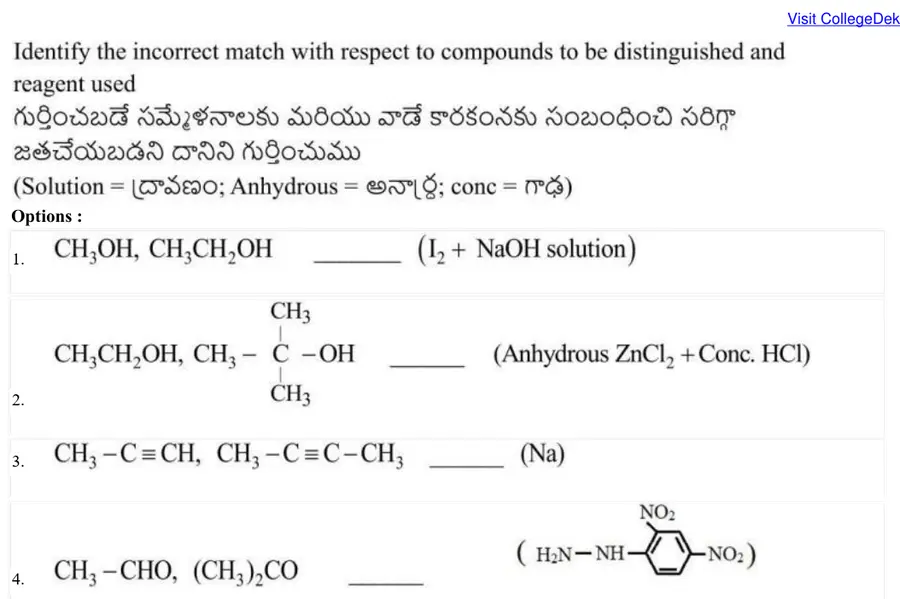
$\mathrm{CH_3OH, CH_3CH_2OH}$ ______ ($\mathrm{I_2}$ + NaOH solution)
$\mathrm{CH_3CH_2OH}$, $\mathrm{CH_3-C(CH_3)(CH_3)-OH}$ (tert-butyl alcohol, drawn with two $\mathrm{CH_3}$ groups above and below the central C) ______ (Anhydrous $\mathrm{ZnCl_2}$ + Conc. HCl)
$\mathrm{CH_3-C\equiv CH}$, $\mathrm{CH_3-C\equiv C-CH_3}$ ______ (Na)
$\mathrm{CH_3-CHO}$, $\mathrm{(CH_3)_2CO}$ ______ ((see the figure above) 2,4-dinitrophenylhydrazine: $\mathrm{H_2N-NH-}$ attached to a benzene ring bearing $\mathrm{NO_2}$ at the ortho and para positions)
Two alkali halide salts, $\mathrm{ACl}$ and $\mathrm{BCl}$ gave crimson red and violet in their flame test respectively. A and B are respectively
$\mathrm{K, Li}$
$\mathrm{Li, K}$
$\mathrm{Li, Na}$
$\mathrm{Na, K}$
Match the following
Column – I (Reaction)
A) $\mathrm{FeCl_3(aq)+NH_3(aq)\longrightarrow}$
B) $\mathrm{AgCl(aq)+NH_3(aq)\longrightarrow}$
C) $\mathrm{Cu^{2+}(aq)+NH_3(aq)\longrightarrow}$
Column – II (colour of the product or nature)
I) Green ppt
II) Deep blue
III) Brown ppt
IV) Colourless
The correct match
A-I, B-II, C-III
A-I, B-III, C-IV
A-III, B-IV, C-II
A-III, B-I, C-IV
A nitrogen oxide that forms "in situ" when dilute $\mathrm{FeSO_4}$ is treated with aqueous solution of nitrate ion and then careful addition of conc. $\mathrm{H_2SO_4}$ along the sides of test tube, is
$\mathrm{NO_2}$
$\mathrm{NO}$
$\mathrm{N_2O}$
$\mathrm{N_2O_3}$
The colour of $\mathrm{Mg(OH)_2}$ precipitate formed when it is precipitated in the presence of magneson reagent is
Green
Yellow
Brown
Blue
Potassium cyanide is made alkaline with $NaOH$ and boiled with thiosulphate ions. The solution is cooled and acidified with $HCl$ and this solution with iron (III) chloride produces ____
Prussian blue colour solution
Blood red colour solution
Dark brown colour solution
Green colour solution
Match the following
Column-1 (Reaction)
A) $4\mathrm{FeCl_3} + 3\mathrm{K_4[Fe(CN)_6]} \rightarrow$
B) $\mathrm{ZnCl_2} + 4\mathrm{NaOH} \rightarrow$
C) $2\mathrm{FeCl_3} + \mathrm{H_2S} \rightarrow$
Column-2 (Main product)
I) $\mathrm{Fe_4[Fe(CN)_6]_3}$
II) $\mathrm{FeCl_2}$
III) $\mathrm{Zn(OH)Cl}$
IV) $\mathrm{Fe_3[Fe(CN)_6]_3}$
V) $\mathrm{Na_2ZnO_2}$
VI) $\mathrm{FeS}$
The correct match is
A-I, B-III, C-VI
A-I, B-V, C-II
A-IV, B-V, C-II
A-IV, B-III, C-VI
Brown ring test is to detect the presence of
$\mathrm{NO_3^-}$
$\mathrm{Cl^-}$
$\mathrm{I^-}$
$\mathrm{Br^-}$
Which is the correct equation for the reaction of AgCl with $\mathrm{NH_4OH}$?
$\mathrm{AgCl + NH_4OH \rightarrow AgOH + NH_4^+ + Cl^-}$
$\mathrm{AgCl + 2NH_4OH \rightarrow [Ag(NH_3)_2]^+ + Cl^- + 2H_2O}$
$\mathrm{AgCl + 4NH_4OH \rightarrow [Ag(NH_3)_4]^+ + Cl^- + 4H_2O}$
$\mathrm{2AgCl + NH_4OH \rightarrow Ag_2O + NH_4^+ + H^+ + 2Cl^-}$
Name the gaseous products from the following A and B reactions respectively.
A. Hydrochloric acid is added to sodium sulphide
B. Conc. sulphuric acid is added to a mixture of sodium chloride and manganese dioxide
The correct answer is
$\mathrm{Cl_2}$ , $\mathrm{Cl_2}$
$\mathrm{H_2}$ , HCl
$\mathrm{H_2S}$ , $\mathrm{O_2}$
$\mathrm{H_2S}$ , $\mathrm{Cl_2}$
Solution "X" contains $\mathrm{Na_2CO_3}$ and $\mathrm{NaHCO_3}$. 20 ml of X when titrated using methyl orange indicator consumed 60 ml of 0.1 M HCl solution. In another experiment, 20 ml of X solution when titrated using phenolphthalein consumed 20 ml of 0.1 M HCl solution. The concentrations (in mol lit$^{-1}$) of $\mathrm{Na_2CO_3}$ and $\mathrm{NaHCO_3}$ in X are respectively
0.01, 0.02
0.1, 0.1
0.01, 0.01
0.1, 0.01
Which one of the following gives Prussion blue colour ?
$\mathrm{Fe_2[Fe(CN)_6]}$
$\mathrm{Na_4[Fe(CN)_6]}$
$\mathrm{Fe_3[Fe(CN)_6]_3}$
$\mathrm{Fe_4[Fe(CN)_6]_3}$
The solution of X having excess of caustic potash is used to detect ammonia. Which of the following is X ?
$\mathrm{K_2[HgI_4]}$
$\mathrm{[Co(NH_3)_6]Cl_3}$
$\mathrm{K_3[Fe(NCS)_6]}$
$\mathrm{[Co(NH_3)_5SO_4]Br}$
Practical Chemistry & Qualitative Analysis holds rank 31 among the 31 chemistry chapters in the modern 2022 to 2026 period. Across our complete repository of entrance papers spanning 2010 through 2026, the chapter contributed 18 questions across 149 papers, appearing in 16 of those tests to record a 0.3 percent subject share and 0.1 questions per paper. In the recent five-year timeframe from 2022 to 2026, it provided 10 questions across 77 sittings, being present in 10 papers to maintain 0.1 questions per paper and a 0.3 percent subject share.
The chapter was completely absent in 2024, but appeared in all other years of this five-year window, being absent from sixty-seven papers overall during this period. Looking at the two regional state boards between 2022 and 2026, AP tests delivered 5 questions across 48 papers (appearing in 5 papers, 0.1 questions per paper, 0.3 percent share), while TS tests generated 5 questions across 29 papers (appearing in 5 papers, 0.2 questions per paper, 0.4 percent share).
During earlier testing between 2010 and 2021, papers included 8 questions across 72 sittings (appearing in 6 tests), representing 0.1 questions per paper and a 0.3 percent subject share. Across the most recent three exam cycles from 2024 to 2026, question writers set 6 questions across 46 sittings (appearing in 6 papers), yielding 0.1 questions per test and 0.3 percent share. Comparing early testing with the last three years indicates the share is about the same, and comparing the recent five-year window with the last three years shows the share is about the same.
Questions in this laboratory-focused chapter distribute across three distinct experimental areas:
Laboratory chemistry problems are concise and strictly factual. A classic question asks candidates to identify which anion is confirmed by the formation of a brown ring at the interface of liquid layers when freshly prepared ferrous sulphate and concentrated sulphuric acid are added, requiring knowledge of the pentaaquanitrosyliron(II) complex cation.
Another prominent style tests reagent compositions. You will match famous laboratory reagents with their active ingredients, such as matching Tollens reagent with ammoniacal silver nitrate, Lucas reagent with anhydrous zinc chloride in concentrated hydrochloric acid, Clemmensen reagent with zinc amalgam in hydrochloric acid, and Jones reagent with chromium trioxide in aqueous sulphuric acid. Questions on flame tests ask you to match alkali and alkaline earth metal salts with characteristic emission colours viewed through cobalt glass.
Solve these representative state entrance questions to test your laboratory recall:
Master the systemic scheme for cation analysis group by group. Group zero contains ammonium, detected by evolving ammonia gas on heating with sodium hydroxide, which turns Nesslers reagent brown. Group one contains lead(II), precipitated as insoluble chloride using dilute hydrochloric acid. Group two contains copper(II) and lead(II), precipitated as sulphides using hydrogen sulphide in acidic medium. Group three contains iron(III) and aluminium, precipitated as hydroxides using ammonium hydroxide in presence of ammonium chloride. Group four contains zinc, nickel, and cobalt, precipitated as sulphides in basic medium.
For anion identification, remember the distinction between dilute acid radicals (carbonate, sulphide, sulphite, and nitrite which effervesce with dilute sulphuric acid) and concentrated acid radicals (chloride, bromide, iodide, and nitrate which react only with concentrated sulphuric acid). Note that sulphate, phosphate, and borate are non-volatile radicals identified through individual wet precipitate tests.
The brown ring is produced by the complex ion pentaaquanitrosyliron(II), having the chemical formula open bracket Fe open parenthesis H2O close parenthesis 5 open parenthesis NO close parenthesis close bracket 2 plus. In this complex, nitric oxide transfers an electron to iron, creating a nitrosyl ligand coordinating to iron in a plus one formal oxidation state.
Nitric acid is itself a strong oxidizing agent. If present in a titration flask, it competes with potassium permanganate by oxidizing the reducing analyte directly, leading to erratic volume measurements. Dilute sulphuric acid is used exclusively because sulphate resists further oxidation.
At room temperature, the initial reaction between permanganate and oxalic acid is sluggish and requires gentle heating. As the reaction proceeds, manganese divalent cations are produced. These manganese(II) ions act as an autocatalyst, dramatically speeding up subsequent decolorization of permanganate so that the reaction proceeds briskly without further heating. Step-by-step solutions for each one are in the EdLoop EAPCET app.