EdLoop PYQs · free, no ads · questions and answers here, step-by-step solutions in the EdLoop app
PYQs · free, no adsOpen on the web (app.edloop.in)Get EdLoop – free on Google Play
ChemistryBiomolecules

Biomolecules: AP & TS EAPCET PYQs 2010–2026

Every Biomolecules question from past AP EAPCET and TS EAPCET papers, with options and answers. Newest first.

198questions
147papers covered
3.9%of Chemistry questions, 2022–2026
2010–2026years

Guide at a glance

Biomolecules is one of the most reliable foundational chapters in the entire EAPCET chemistry curriculum.

Most asked sub-topics

Carbohydrates75
Vitamins, Nucleic Acids & Hormones66
Amino Acids & Proteins57

Practise these in EdLoop

Attempt every Biomolecules question timed, see the step-by-step solution and track what you get wrong. Free.

Start practice

All questions

198 questions
1AP EAPCET 2026 · 18 May · Shift 1MCQOpen question page ↗

In addition to $-NH_2$ and $-COOH$ groups, the functional group present in the amino acid, serine is <u>X</u> and the functional group present in the amino acid cysteine is <u>Y</u>. $X$ and $Y$ are respectively

The question and its figure as printed in AP EAPCET 2026 18th May 2026 Shift 1. Option 1: X: a carboxamide group, a bond line attached to C, which is double bonded to O above and single bonded to NH2 on the right; Y: a bond line attached to SH (–SH) Option 2: X: a bond line attached to OH (–OH); Y: a bond line attached to SH (–SH) Option 3: X: a bond line attached to SH (–SH); Y: a bond line attached to OH (–OH) Option 4: X: a bond line attached to OH (–OH); Y: a bond line attached to C, which is double bonded to O below and single bonded to NH2 on the right (–CONH2)
The question as printed in the paper.
  • A

    see figure X: a carboxamide group, a bond line attached to C, which is double bonded to O above and single bonded to $\mathrm{NH_2}$ on the right; Y: a bond line attached to $\mathrm{SH}$ (–SH)

  • B

    see figure X: a bond line attached to $\mathrm{OH}$ (–OH); Y: a bond line attached to $\mathrm{SH}$ (–SH)

  • C

    see figure X: a bond line attached to $\mathrm{SH}$ (–SH); Y: a bond line attached to $\mathrm{OH}$ (–OH)

  • D

    see figure X: a bond line attached to $\mathrm{OH}$ (–OH); Y: a bond line attached to C, which is double bonded to O below and single bonded to $\mathrm{NH_2}$ on the right (–CONH2)

2AP EAPCET 2026 · 18 May · Shift 2MCQOpen question page ↗

Which of the following are the correct statements about D-glucose?

I. It forms oxime with hydroxyl amine

II. It forms addition product with $\mathrm{NaHSO_3}$

III. It forms cyanohydrin with $\mathrm{HCN}$

IV. It forms saccharic acid with bromine water

The correct answer is

  • A

    II & III only

  • B

    I & III only

  • C

    II & IV only

  • D

    III & IV only

3AP EAPCET 2026 · 15 May · Shift 1MCQOpen question page ↗

Observe the following reactions

I. D-Glucose $\xrightarrow{\mathrm{NH_2OH}}$

II. D-Glucose $\xrightarrow[\mathrm{(ii)\ NH_2OH}]{\mathrm{(i)\ (CH_3CO)_2O}}$

Correct statement regarding the reactions I and II is

  • A

    Oxime is formed in both the reactions I, II

  • B

    Oxime is not formed in both the reactions I, II

  • C

    Oxime is formed in reaction I but oxime is not formed in reaction II

  • D

    Oxime is not formed in reaction I but oxime is formed in reaction II

4AP EAPCET 2026 · 15 May · Shift 2MCQOpen question page ↗

Two statements are given below

Statement I: Cane sugar is disaccharide of $\alpha - \mathrm{D} -$ glucose and $\beta - \mathrm{D} -$ fructose

Statement II: Milk sugar is disaccharide of $\beta - \mathrm{D} -$ galactose and $\beta - \mathrm{D} -$ glucose

Correct answer is

  • A

    Statements I and II both are correct

  • B

    Statements I and II both are not correct

  • C

    Statement I is correct, but statement II is not correct

  • D

    statement I is not correct but statement II is correct

5AP EAPCET 2026 · 14 May · Shift 1MCQOpen question page ↗

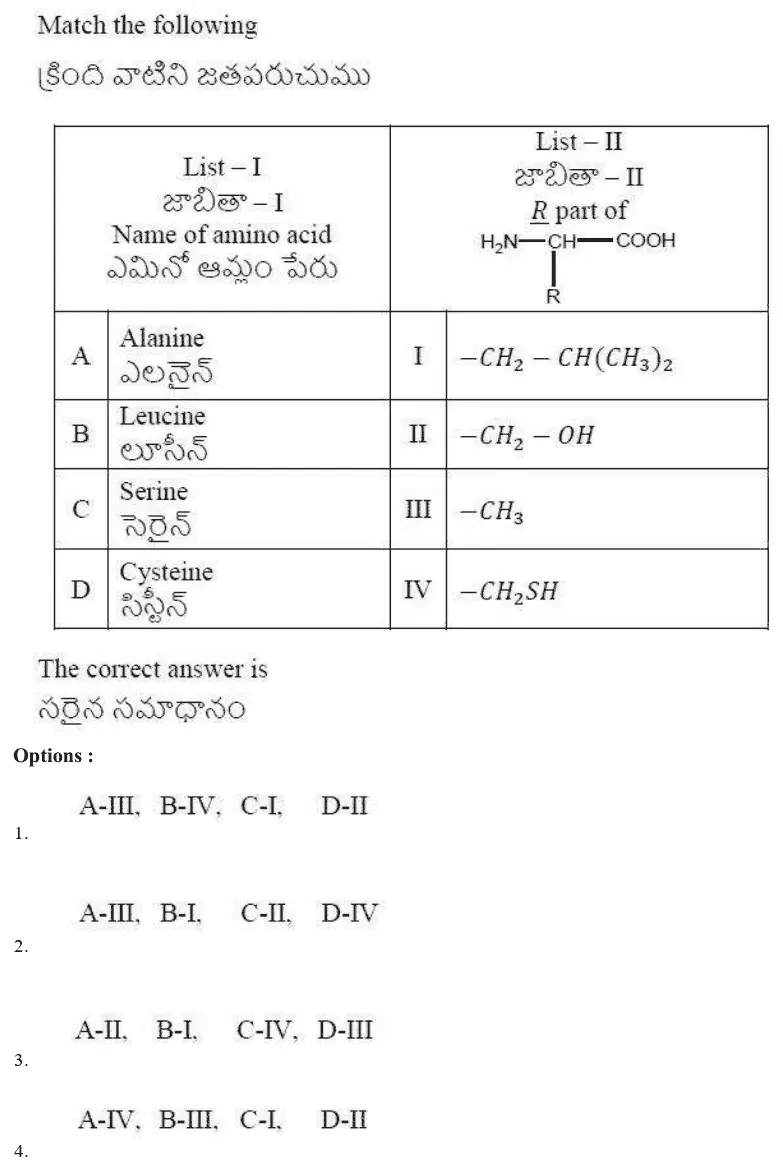
Match the following

List – I<br>Name of amino acidList – II<br>$R$ part of (see the figure above)
AAlanineI$-CH_2-CH(CH_3)_2$
BLeucineII$-CH_2-OH$
CSerineIII$-CH_3$
DCysteineIV$-CH_2SH$

The correct answer is

The question and its figure as printed in AP EAPCET 2026 14th May 2026 Shift 1.
The question as printed in the paper.
  • A

    A-III, B-IV, C-I, D-II

  • B

    A-III, B-I, C-II, D-IV

  • C

    A-II, B-I, C-IV, D-III

  • D

    A-IV, B-III, C-I, D-II

6AP EAPCET 2026 · 14 May · Shift 2MCQOpen question page ↗

The hormone (X) is a derivative of amino acid p $-$ $\mathrm{HO-C_6H_4CH_2CH(NH_2)COOH}$ and is produced by the gland (Y). What are X and Y?

  • A

    Epinephrine, Adrenal

  • B

    Thyroxine, Thyroid

  • C

    Insulin, Pancreas

  • D

    Norepinephrine, Adrenal

7AP EAPCET 2026 · 13 May · Shift 1MCQOpen question page ↗

The incorrect statement in the following is

  • A

    Amylopectin has $C_1 - C_4$ and $C_1 - C_6$ glycosidic linkages

  • B

    Cellulose is a straight chain polysaccharide of $\alpha - D$ -glucose units through $C_1 - C_4$ glycosidic linkage

  • C

    Glycogen is found in Yeast and fungi

  • D

    Glycogen is also known as animal starch

8AP EAPCET 2026 · 13 May · Shift 2MCQOpen question page ↗

The number of secondary alcoholic groups present in the end product ‘Y’ of the given reaction sequence is

$$\mathrm{C_6H_{12}O_6} \xrightarrow{HCN} \mathrm{X} \xrightarrow{H_2O|H^+} \mathrm{Y}$$

  • A

    4

  • B

    3

  • C

    5

  • D

    6

9AP EAPCET 2026 · 12 May · Shift 1MCQOpen question page ↗

Match the following

List -I<br>Name of the amino acidList - II<br>Description
A.TyrosineI.Basic amino acid
B.LysineII.Optically inactive amino acid
C.GlycineIII.Sulphur containing amino acid
D.CysteineIV.Aromatic amino acid

The correct answer is

  • A

    A - II , B - I, C - IV, D - III

  • B

    A - IV , B - III, C - II, D - I

  • C

    A - IV , B - I, C - II, D - III

  • D

    A - III , B - IV, C - I, D - II

10AP EAPCET 2026 · 12 May · Shift 2MCQOpen question page ↗

In which of the following, enzyme and enzyme reaction is not correctly matched?

  • A

    Invertase – sucrose $\rightarrow$ glucose + fructose

  • B

    Diastase – starch $\rightarrow$ maltose

  • C

    Maltase – glucose $\rightarrow$ maltose

  • D

    Pepsin – proteins $\rightarrow$ peptides

11AP EAPCET 2026 · 12 May · Shift 2MCQOpen question page ↗

Amino acids containing hetero aromatic ring are

I. Pro

II. His

III. Tyr

IV. Trp

The correct answer is

  • A

    I, III only

  • B

    II, IV only

  • C

    I, II only

  • D

    III, IV only

13TS EAPCET 2026 · 11 May · Shift 2MCQOpen question page ↗

Match the following

List-1 (Vitamin)List-2 (deficiency disease)
AThiamineICheilosis
BAscorbic acidIIConvulsions
CPyridoxineIIIBeri beri
DRiboflavinIVRickets
VScurvy

The correct answer is

  • A

    A – III, B – IV, C – I, D – II

  • B

    A – III, B – V, C – II, D – I

  • C

    A – II, B – V, C – I, D – III

  • D

    A – III, B – IV, C – II, D – I

14TS EAPCET 2026 · 10 May · Shift 1MCQOpen question page ↗

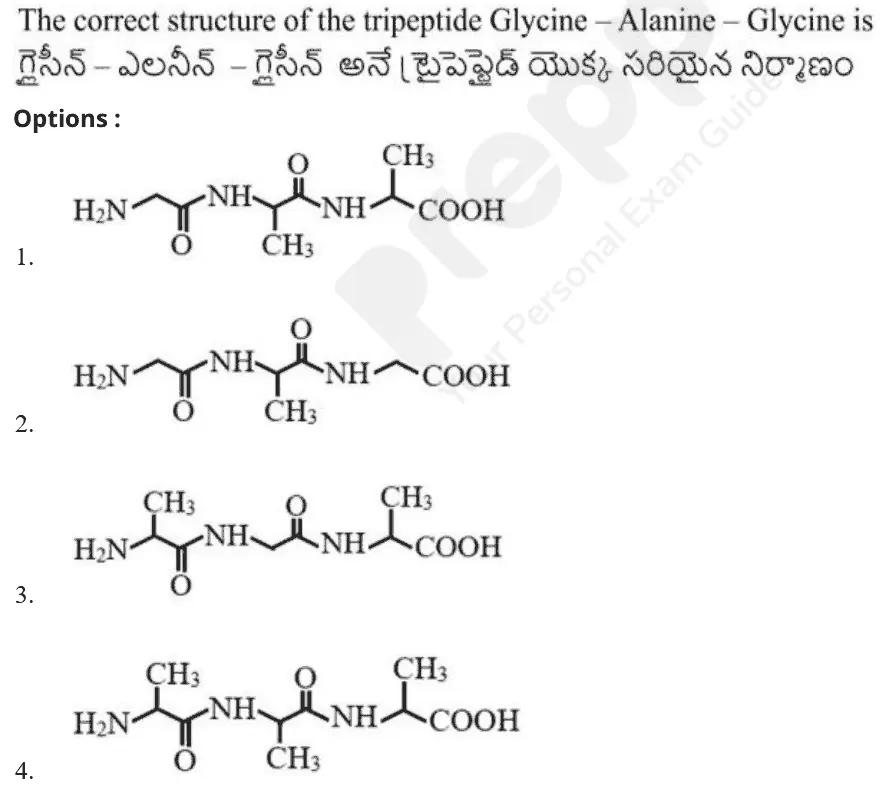
The correct structure of the tripeptide Glycine – Alanine – Glycine is

The question and its figure as printed in TS EAPCET 2026 10th May 2026 Shift 1. Option 1: Skeletal structure: H2N–CH2–C(=O)–NH–CH(CH3)–C(=O)–NH–CH(CH3)–COOH (Gly–Ala–Ala) Option 2: Skeletal structure: H2N–CH2–C(=O)–NH–CH(CH3)–C(=O)–NH–CH2–COOH (Gly–Ala–Gly) Option 3: Skeletal structure: H2N–CH(CH3)–C(=O)–NH–CH2–C(=O)–NH–CH(CH3)–COOH (Ala–Gly–Ala) Option 4: Skeletal structure: H2N–CH(CH3)–C(=O)–NH–CH(CH3)–C(=O)–NH–CH(CH3)–COOH (Ala–Ala–Ala)
The question as printed in the paper.
  • A

    see figure Skeletal structure: H2N–CH2–C(=O)–NH–CH(CH3)–C(=O)–NH–CH(CH3)–COOH (Gly–Ala–Ala)

  • B

    see figure Skeletal structure: H2N–CH2–C(=O)–NH–CH(CH3)–C(=O)–NH–CH2–COOH (Gly–Ala–Gly)

  • C

    see figure Skeletal structure: H2N–CH(CH3)–C(=O)–NH–CH2–C(=O)–NH–CH(CH3)–COOH (Ala–Gly–Ala)

  • D

    see figure Skeletal structure: H2N–CH(CH3)–C(=O)–NH–CH(CH3)–C(=O)–NH–CH(CH3)–COOH (Ala–Ala–Ala)

15TS EAPCET 2026 · 10 May · Shift 2MCQOpen question page ↗

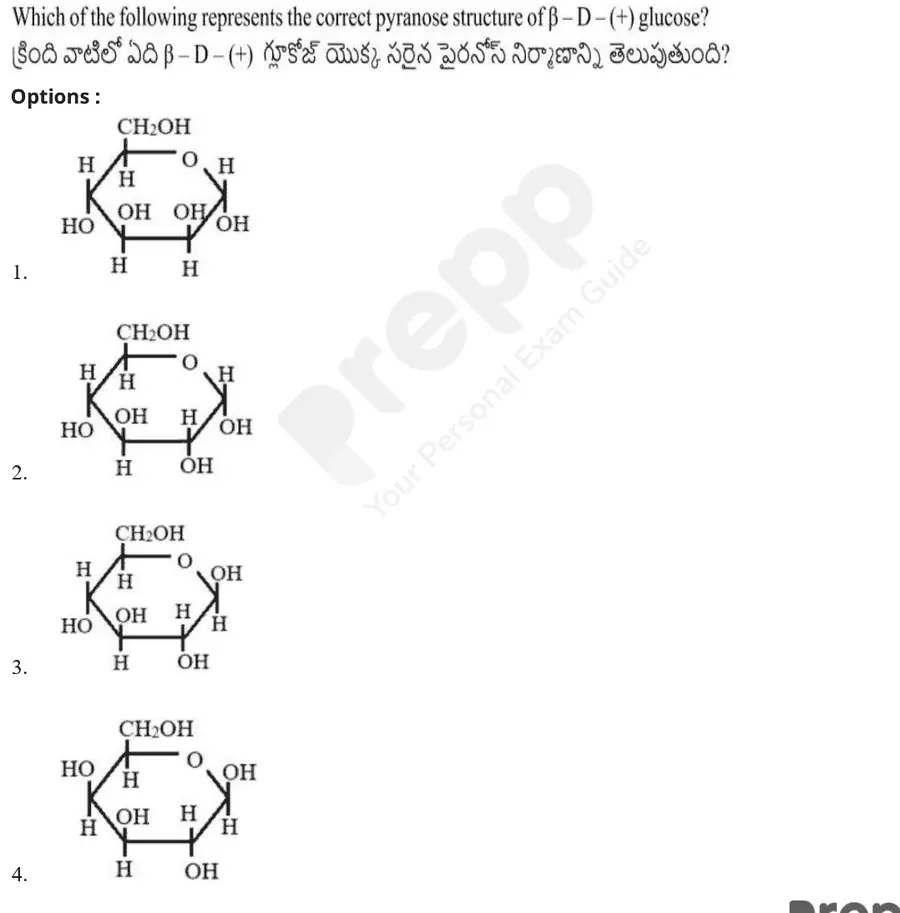
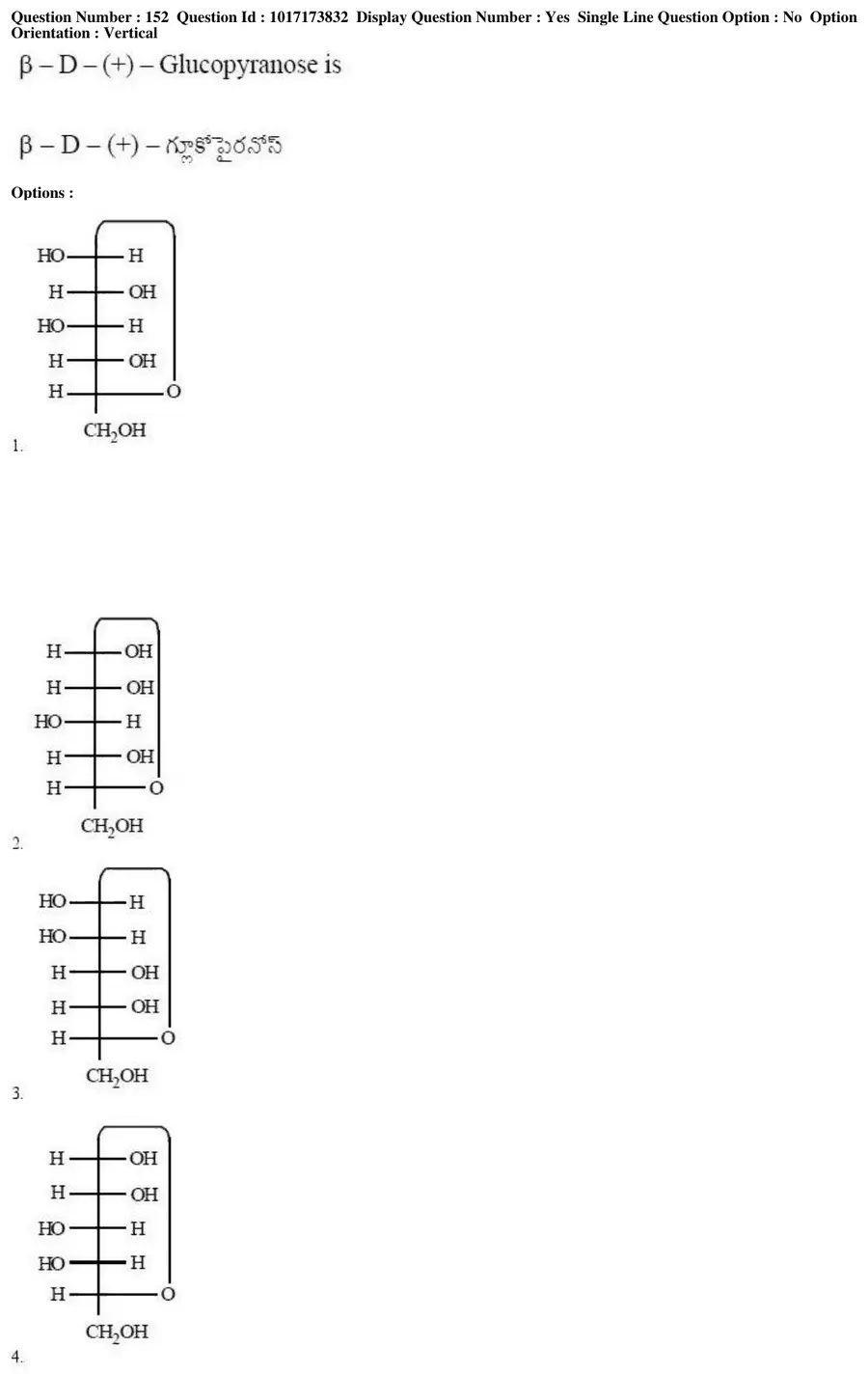
Which of the following represents the correct pyranose structure of $\beta - \mathrm{D} - (+)$ glucose?

The question and its figure as printed in TS EAPCET 2026 10th May 2026 Shift 2. Option 1: Haworth-type pyranose ring drawn as a hexagon with O at top right. CH2OH on top-left carbon with H below it. Left carbon: H (upper left) and HO (lower left). Bottom-left carbon: OH above, H below. Bottom-right carbon: OH above, H below. Right carbon: H (upper right) and OH (lower right). Option 2: Pyranose ring hexagon with O at top right. CH2OH on top-left carbon with H below it. Left carbon: H (upper left) and HO (lower left). Bottom-left carbon: OH above, H below. Bottom-right carbon: H above, OH below. Right carbon: H (upper right) and OH (lower right). Option 3: Pyranose ring hexagon with O at…
The question as printed in the paper.
  • A

    see figure Haworth-type pyranose ring drawn as a hexagon with O at top right. CH2OH on top-left carbon with H below it. Left carbon: H (upper left) and HO (lower left). Bottom-left carbon: OH above, H below. Bottom-right carbon: OH above, H below. Right carbon: H (upper right) and OH (lower right).

  • B

    see figure Pyranose ring hexagon with O at top right. CH2OH on top-left carbon with H below it. Left carbon: H (upper left) and HO (lower left). Bottom-left carbon: OH above, H below. Bottom-right carbon: H above, OH below. Right carbon: H (upper right) and OH (lower right).

  • C

    see figure Pyranose ring hexagon with O at top right. CH2OH on top-left carbon with H below it. Left carbon: H (upper left) and HO (lower left). Bottom-left carbon: OH above, H below. Bottom-right carbon: H above, OH below. Right carbon: OH (upper right) and H (lower right).

  • D

    see figure Pyranose ring hexagon with O at top right. CH2OH on top-left carbon with H below it. Left carbon: HO (upper left) and H (lower left). Bottom-left carbon: OH above, H below. Bottom-right carbon: H above, OH below. Right carbon: OH (upper right) and H (lower right).

16TS EAPCET 2026 · 9 May · Shift 1MCQOpen question page ↗

Which structure of protein represents its constitution?

  • A

    Primary structure

  • B

    Secondary structure

  • C

    Tertiary structure

  • D

    Quaternary structure

17TS EAPCET 2026 · 9 May · Shift 2MCQOpen question page ↗

Glycosidic linkage in maltose is present between

  • A

    C−1 of $\alpha$−D−glucose and C−4 of $\alpha$−D−glucose

  • B

    C−1 of $\alpha$−D−glucose and C−4 of $\beta$−D−galactose

  • C

    C−1 of $\beta$−D−glucose and C−4 of $\alpha$−D−glucose

  • D

    C−1 of $\beta$−D−glucose and C−4 of $\beta$−D−glucose

18AP EAPCET 2025 · 27 May · Shift 1MCQOpen question page ↗

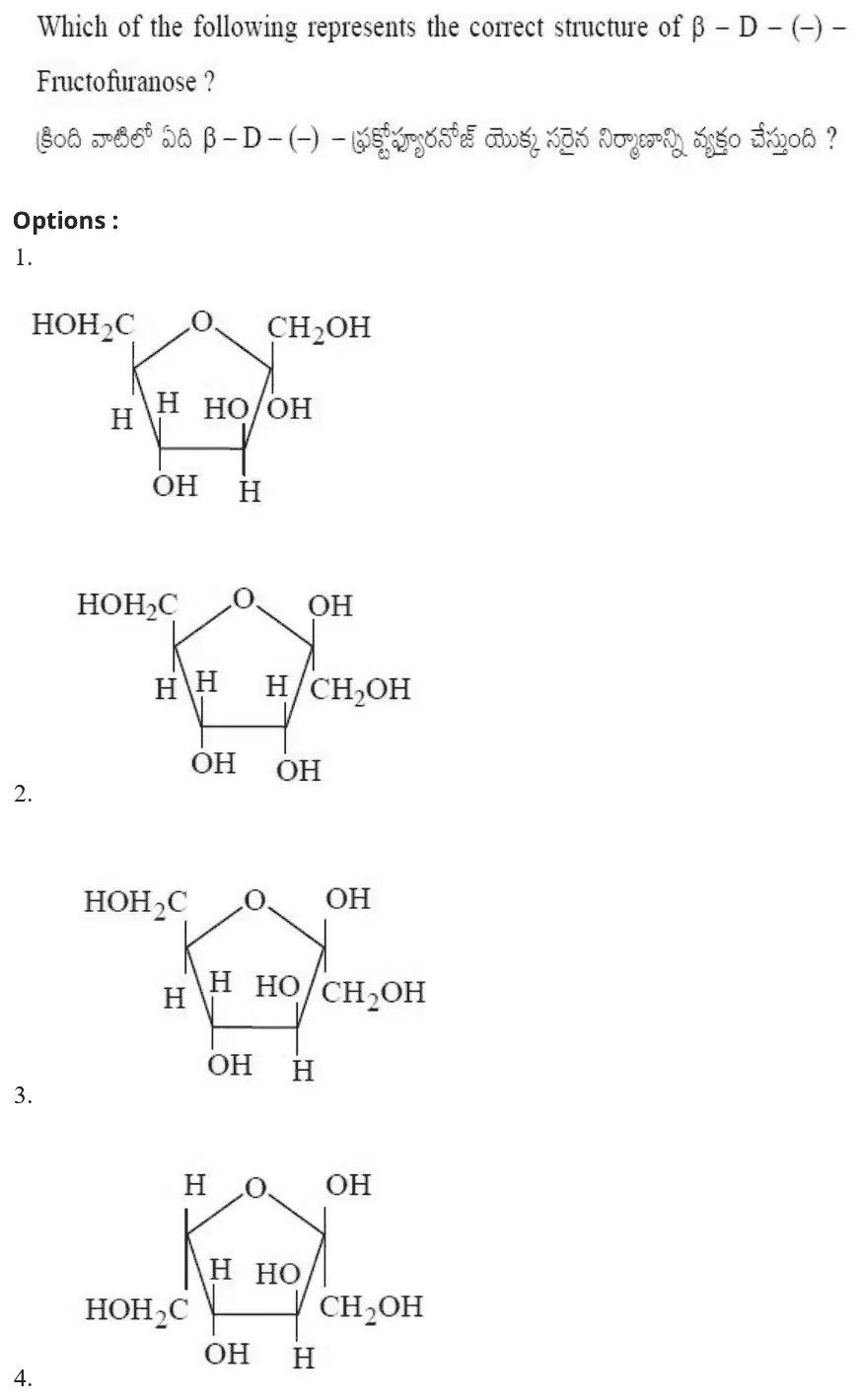
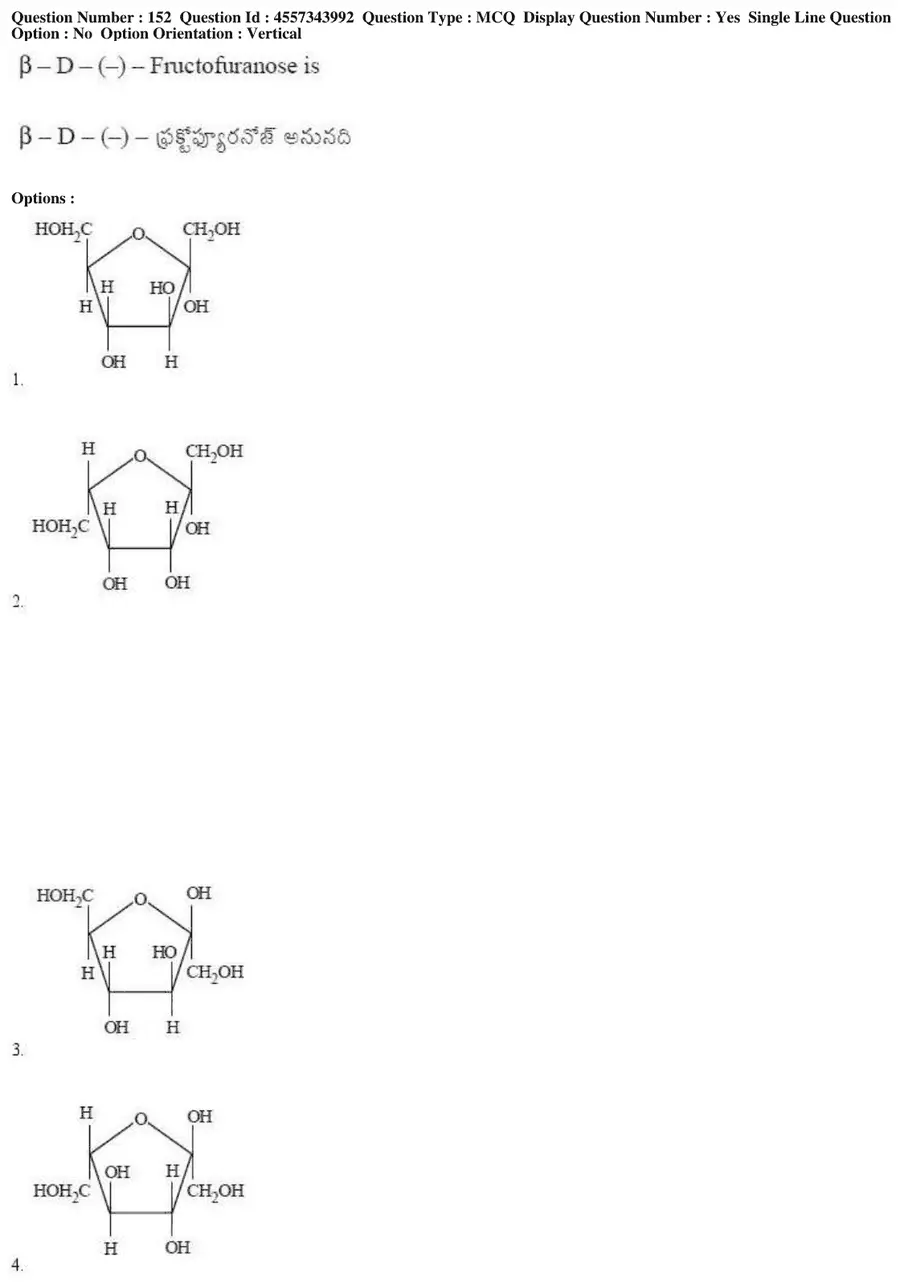
Which of the following represents the correct structure of $\beta - \mathrm{D} - (-) -$ Fructofuranose ?

The question and its figure as printed in AP EAPCET 2025 27th May 2025 Shift 1. Option 1: Furanose ring drawn with O at top. Left ring carbon bears HOH2C (up); right ring carbon bears CH2OH (up) and, on the same carbon, OH is drawn at the right lower position. Lower left carbon: H on left, H on right (upper), OH below. Lower right carbon: HO on left, OH on right, H below. Option 2: Furanose ring drawn with O at top. Left ring carbon bears HOH2C (up); right ring carbon bears OH (up) and CH2OH (down right). Lower left carbon: H on left, H on right, OH below. Lower right carbon: H on left, OH below. Option 3: Furanose ring drawn with O at top. Left ring carbon bears HOH2C (up); right ring…
The question as printed in the paper.
  • A

    see figure Furanose ring drawn with O at top. Left ring carbon bears $\mathrm{HOH_2C}$ (up); right ring carbon bears $\mathrm{CH_2OH}$ (up) and, on the same carbon, $\mathrm{OH}$ is drawn at the right lower position. Lower left carbon: H on left, H on right (upper), $\mathrm{OH}$ below. Lower right carbon: $\mathrm{HO}$ on left, $\mathrm{OH}$ on right, H below.

  • B

    see figure Furanose ring drawn with O at top. Left ring carbon bears $\mathrm{HOH_2C}$ (up); right ring carbon bears $\mathrm{OH}$ (up) and $\mathrm{CH_2OH}$ (down right). Lower left carbon: H on left, H on right, $\mathrm{OH}$ below. Lower right carbon: H on left, $\mathrm{OH}$ below.

  • C

    see figure Furanose ring drawn with O at top. Left ring carbon bears $\mathrm{HOH_2C}$ (up); right ring carbon bears $\mathrm{OH}$ (up) and $\mathrm{CH_2OH}$ (down right). Lower left carbon: H on left, H on right, $\mathrm{OH}$ below. Lower right carbon: $\mathrm{HO}$ on left, H below.

  • D

    see figure Furanose ring drawn with O at top. Left ring carbon bears H (up) and $\mathrm{HOH_2C}$ (down left); right ring carbon bears $\mathrm{OH}$ (up) and $\mathrm{CH_2OH}$ (down right). Lower left carbon: H on right, $\mathrm{OH}$ below. Lower right carbon: $\mathrm{HO}$ on left, H below.

19AP EAPCET 2025 · 27 May · Shift 1MCQOpen question page ↗

Which of the following statement is not correct for glucose ?

  • A

    Glucose does not give Schiffs test.

  • B

    Glucose exists in two crystalline forms $\alpha$- and $\beta$-.

  • C

    The pentaacetate of glucose does not react with $\mathrm{NH_2OH}$.

  • D

    Glucose forms addition product with $\mathrm{NaHSO_3}$.

20AP EAPCET 2025 · 26 May · Shift 1MCQOpen question page ↗

Which of the following do not reduce Tollens' reagent ?

a) Fructose b) Sucrose c) Lactose d) Cellulose

  • A

    a, b

  • B

    b, d

  • C

    a, c

  • D

    c, d

21AP EAPCET 2025 · 26 May · Shift 1MCQOpen question page ↗

Consider the following.

Statement-I : Lysine, arginine are essential and basic amino acids

Statement-II : Leucine, phenyl alanine are non essential and neutral amino acids.

Correct answer is

  • A

    Both statement-I and statement-II are correct

  • B

    Both statement-I and statement-II are not correct

  • C

    Statement-I is correct, but statement-II is not correct

  • D

    Statement-I is not correct, but statement-II is correct

22AP EAPCET 2025 · 26 May · Shift 2MCQOpen question page ↗

Which of the following enzymatic reaction is not correctly matched with enzyme shown against it in brackets ?

  • A

    Proteins $\longrightarrow$ Peptides (Pepsin)

  • B

    Starch $\longrightarrow$ Maltose (Zymase)

  • C

    Sucrose $\longrightarrow$ Glucose and fructose (Invertase)

  • D

    Maltose $\longrightarrow$ Glucose (Maltase)

23AP EAPCET 2025 · 26 May · Shift 2MCQOpen question page ↗

Identify the essential amino acids from the following (only)

A) Leucine B) Tyrosine C) Cysteine D) Histidine

  • A

    A & B only

  • B

    B & C only

  • C

    B & D only

  • D

    A & D only

24AP EAPCET 2025 · 26 May · Shift 2MCQOpen question page ↗

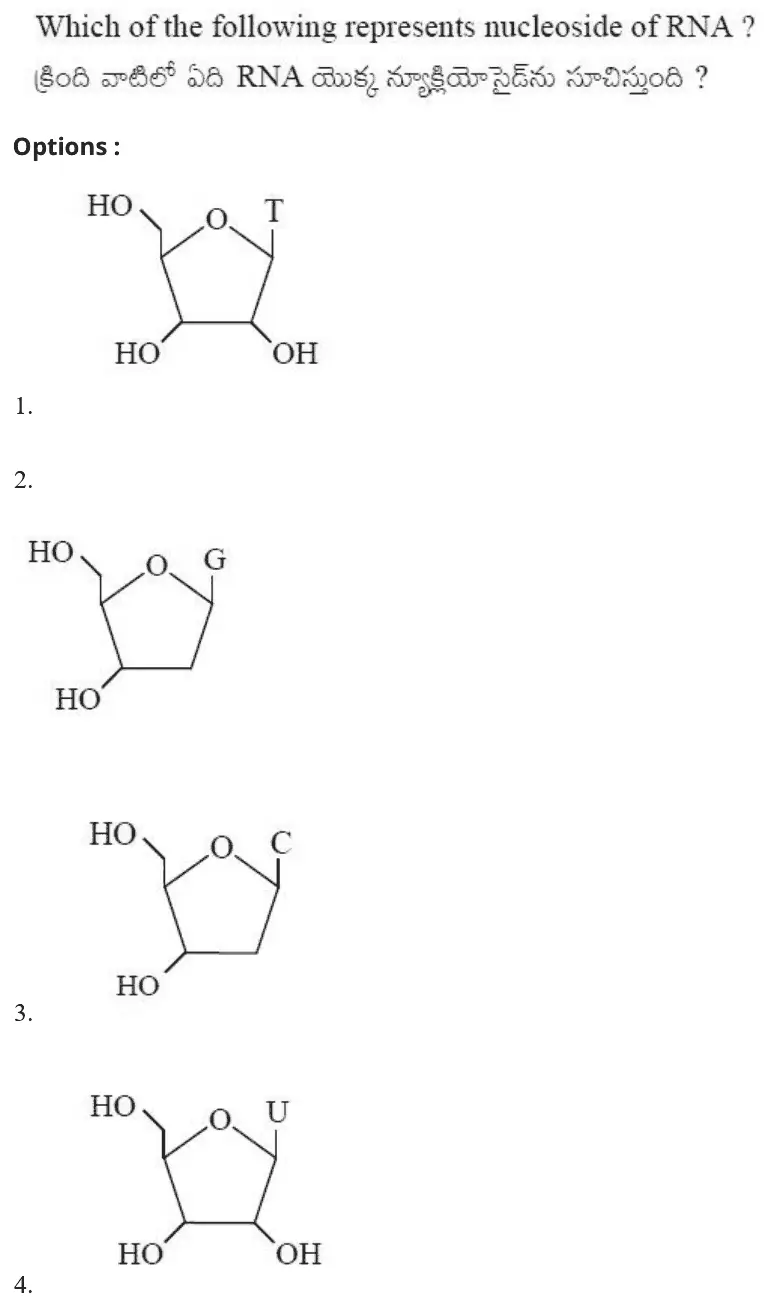
Which of the following represents nucleoside of RNA ?

The question and its figure as printed in AP EAPCET 2025 26thMay 2025 Shift 2. Option 1: Five-membered furanose ring with ring O at top; HO on the CH2 substituent at upper left (HOCH2 side chain); base T (thymine) attached at the upper right carbon; HO at lower left carbon; OH at lower right carbon. Option 2: Five-membered furanose ring with ring O at top; HO on the CH2 substituent at upper left; base G (guanine) attached at the upper right carbon; HO at lower left carbon; no substituent at the lower right carbon (2'-deoxy). Option 3: Five-membered furanose ring with ring O at top; HO on the CH2 substituent at upper left; base C (cytosine) attached at the upper right carbon; HO at lower…
The question as printed in the paper.
  • A

    see figure Five-membered furanose ring with ring O at top; HO on the CH2 substituent at upper left (HOCH2 side chain); base T (thymine) attached at the upper right carbon; HO at lower left carbon; OH at lower right carbon.

  • B

    see figure Five-membered furanose ring with ring O at top; HO on the CH2 substituent at upper left; base G (guanine) attached at the upper right carbon; HO at lower left carbon; no substituent at the lower right carbon (2'-deoxy).

  • C

    see figure Five-membered furanose ring with ring O at top; HO on the CH2 substituent at upper left; base C (cytosine) attached at the upper right carbon; HO at lower left carbon; no substituent at the lower right carbon (2'-deoxy).

  • D

    see figure Five-membered furanose ring with ring O at top; HO on the CH2 substituent at upper left; base U (uracil) attached at the upper right carbon; HO at lower left carbon; OH at lower right carbon.

25AP EAPCET 2025 · 24 May · Shift 1MCQOpen question page ↗

Match the following

List-I (Glycosidic linkage)List-II (Polysaccharide)
A) $\alpha-1,4$I) Amylose
B) $\beta-1,4$II) Amylopectin
C) $\alpha-1,4, \alpha-1,6$III) Cellulose
  • A

    A-II, B-I, C-III

  • B

    A-III, B-I, C-II

  • C

    A-I, B-II, C-III

  • D

    A-I, B-III, C-II

26AP EAPCET 2025 · 24 May · Shift 1MCQOpen question page ↗

The list given below contains essential amino acids that are basic (X) and also non essential amino acids that are neutral (Y). X and Y, respectively are

a) Lysine b) Alanine c) Serine d) Arginine e) Tyrosine

  • A

    X = b, c, e; Y = a, d

  • B

    X = a, d; Y = b, c, e

  • C

    X = a, c; Y = b, d, e

  • D

    X = a, b, c ; Y = d, e

27AP EAPCET 2025 · 23 May · Shift 1MCQOpen question page ↗

Consider the following.

Statement-I : Primary structure of protein represents its constitution

Statement-II : $\alpha$-Helix and $\beta$-pleated sheet structure of protein represent tertiary structure of it

Correct answer is

  • A

    Both statement-I and statement-II are correct

  • B

    Both statement-I and statement-II are not correct

  • C

    Statement-I is correct, but statement-II is not correct

  • D

    Statement-I is not correct, but statement-II is correct

28AP EAPCET 2025 · 23 May · Shift 1MCQOpen question page ↗

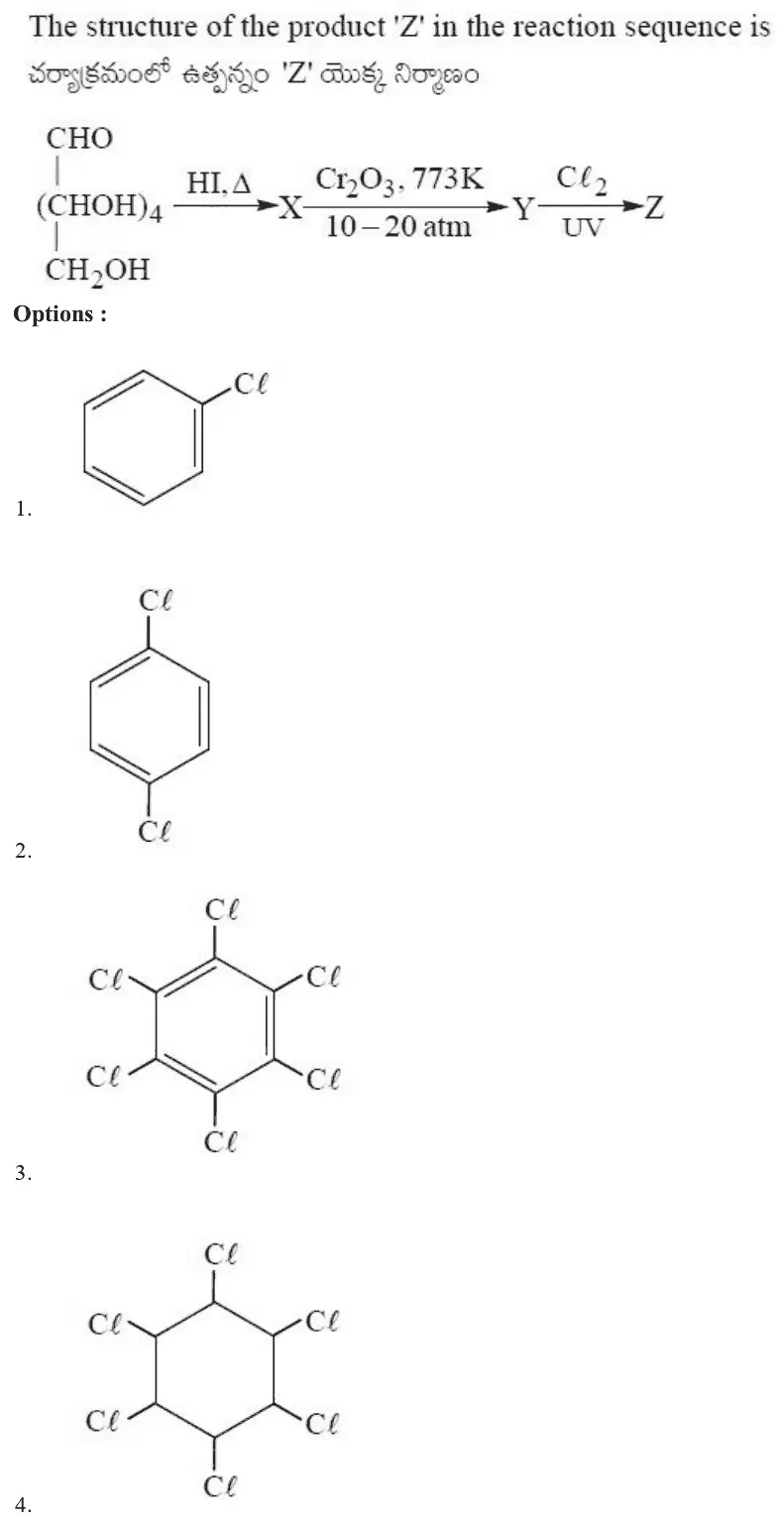
The structure of the product 'Z' in the reaction sequence is

(see the figure above)

The question and its figure as printed in AP EAPCET 2025 23rd May 2025 Shift 1. Option 1: Chlorobenzene: a benzene ring with a single Cl substituent at the upper right. Option 2: p-Dichlorobenzene: a benzene ring with Cl at the top and Cl at the bottom (1,4-positions). Option 3: Hexachlorobenzene: a benzene ring (with alternating double bonds) with a Cl on each of the six carbons. Option 4: Hexachlorocyclohexane: a saturated cyclohexane ring (single bonds only) with a Cl on each of the six carbons.
The question as printed in the paper.
  • A

    see figure Chlorobenzene: a benzene ring with a single Cl substituent at the upper right.

  • B

    see figure p-Dichlorobenzene: a benzene ring with Cl at the top and Cl at the bottom (1,4-positions).

  • C

    see figure Hexachlorobenzene: a benzene ring (with alternating double bonds) with a Cl on each of the six carbons.

  • D

    see figure Hexachlorocyclohexane: a saturated cyclohexane ring (single bonds only) with a Cl on each of the six carbons.

29AP EAPCET 2025 · 23 May · Shift 2MCQOpen question page ↗

Consider the following

Statement-I : Cane sugar is a disaccharide of $\alpha$-D-glucose and $\beta$-D-fructose

Statement-II : Milk sugar is a diasaccharide of $\alpha$-D-glucose and $\beta$-D-galactose

The correct answer is

  • A

    Both statement-I and statement-II are correct

  • B

    Both statement-I and statement-II are not correct

  • C

    Statement-I is correct, but statement-II is not correct

  • D

    Statement-I is not correct, but statement-II is correct

30AP EAPCET 2025 · 23 May · Shift 2MCQOpen question page ↗

The deficiency of vitamin (X) causes convulsions. Source of X is Y. What are X and Y ?

  • A

    Riboflavin, milk

  • B

    Riboflavin, fish

  • C

    Pyridoxine, curd

  • D

    Pyridoxine, cereals

31AP EAPCET 2025 · 22 May · Shift 1MCQOpen question page ↗

Which of the following contain $\alpha$ -D-glucose units ?

a) cane sugar b) milk sugar c) cellulose d) amylose

  • A

    a, d

  • B

    a, b

  • C

    b, c

  • D

    c, d

32AP EAPCET 2025 · 22 May · Shift 1MCQOpen question page ↗

Identify the set containing purine and pyrimidine base of DNA respectively.

  • A

    Adenine, Uracil

  • B

    Cytosine, Guanine

  • C

    Thymine, Uracil

  • D

    Adenine, Cytosine

33AP EAPCET 2025 · 22 May · Shift 2MCQOpen question page ↗

Consider the following

Statement-I : Lactose is composed of $\alpha$-D-glucose and $\beta$-D-glucose.

Statement-II : Lactose is a reducing sugar

The correct answer is

  • A

    Both statement-I and statement-II are not correct

  • B

    Both statement-I and statement-II are correct

  • C

    Statement-I is correct, but statement-II is not correct

  • D

    Statement-I is not correct, but statement-II is correct

34AP EAPCET 2025 · 22 May · Shift 2MCQOpen question page ↗

Match the following

List-I (Hormones)List-II (Functions)
A) GlucocorticoidsI) In the control of menstrual cycle
B) MineralocorticoidsII) Prepares the uterus for implantation of fertilised egg
C) ProgesteroneIII) Control the level of excretion of water and salt by the kidneys
D) EstradiolIV) Control the carbohydrate metabolism
  • A

    A-II, B-III, C-IV, D-I

  • B

    A-IV, B-I, C-II, D-III

  • C

    A-IV, B-III, C-II, D-I

  • D

    A-IV, B-I, C-III, D-II

35AP EAPCET 2025 · 21 May · Shift 1MCQOpen question page ↗

Observe the following reactions

I) Sucrose (aq) + $\mathrm{H_2O}$ $\xrightarrow{x}$ glucose + fructose

II) Glucose (aq) $\xrightarrow{y}$ ethanol + $\mathrm{CO_2}$

What are x and y respectively ?

  • A

    Invertase, Zymase

  • B

    Zymase, Diastase

  • C

    Diastase, Zymase

  • D

    Diastase, Invertase

36AP EAPCET 2025 · 21 May · Shift 1MCQOpen question page ↗

The incorrect statement about amylose is

  • A

    It is water soluble

  • B

    In this $\alpha$-D-(+)-glucose units are held by C-1 to C-4 glycosidic linkages

  • C

    It is a highly branched polymer of $\alpha$-D-(+)-glucose units

  • D

    It is present in starch to an extent of 15-20%

37AP EAPCET 2025 · 21 May · Shift 1MCQOpen question page ↗

The improper functioning of 'X' results in Addison's disease. Hormone 'Y' is responsible for the development of secondary female characterstics. 'X' and 'Y' are respectively

  • A

    Adrenal Cortex, estradiol

  • B

    Adrenal Cortex, progesterone

  • C

    Thyroid, progesterone

  • D

    Thyroid, estradiol

38AP EAPCET 2025 · 21 May · Shift 2MCQOpen question page ↗

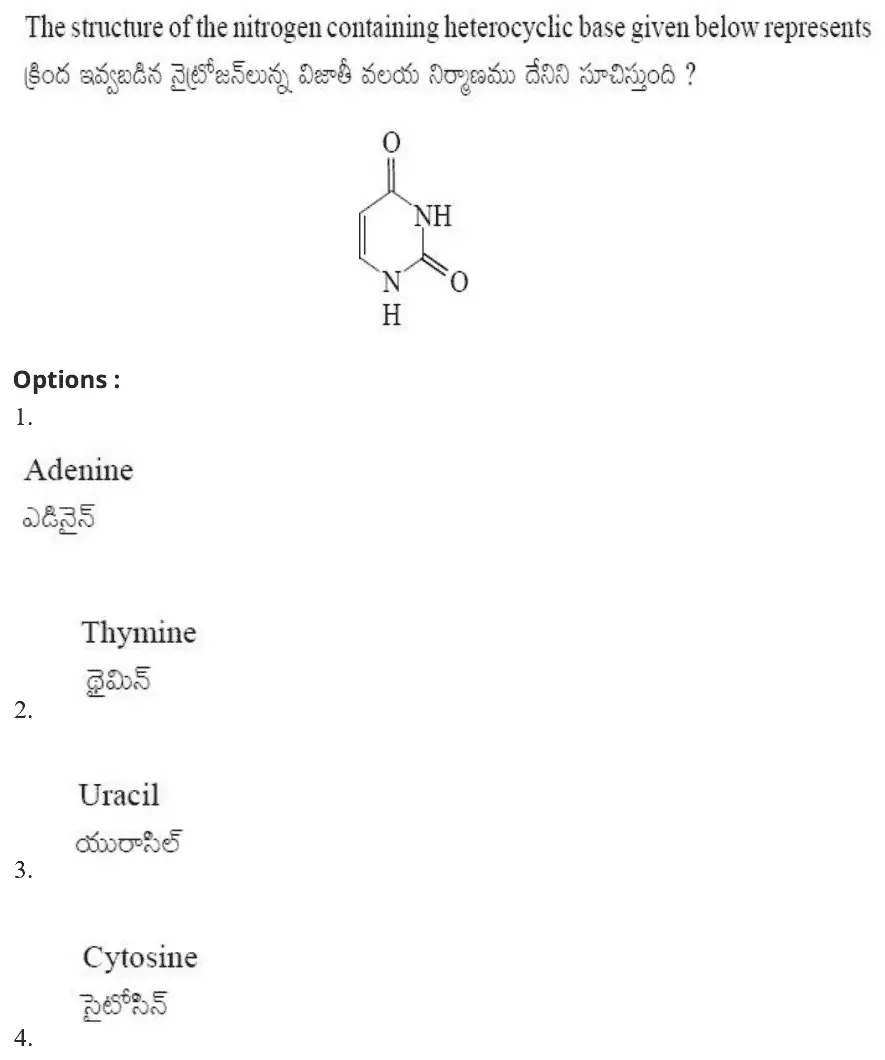
The structure of the nitrogen containing heterocyclic base given below represents

(see the figure above)

The question and its figure as printed in AP EAPCET 2025 21st May 2025 Shift 2.
The question as printed in the paper.
  • A

    Adenine

  • B

    Thymine

  • C

    Uracil

  • D

    Cytosine

39TS EAPCET 2025 · 4 May · Shift 1MCQOpen question page ↗

The general structure of alpha amino acid can be represented as

$$\mathrm{H_2N-CH-CO_2H}$$
$$\quad\ \ |$$
$$\quad\ \ \mathrm{R}$$

Which amino acid is not correctly matched with R-given?

  • A

    $\mathrm{R = -CH_2-C_6H_4-OH(p)}$ - (Tyrosine)

  • B

    $\mathrm{R = -CH_2-SH}$ - (Cysteine)

  • C

    $\mathrm{R = -CH_2-CH_2-S-CH_3}$ - (Serine)

  • D

    $\mathrm{R = -CH_2-C(=O)-NH_2}$ - (Asparagine)

40TS EAPCET 2025 · 4 May · Shift 2MCQOpen question page ↗

Amino acid ‘X’ contains phenolic hydroxy group and amino acid ‘Y’ contains amide group. ‘X’ and ‘Y’ respectively are

  • A

    Ser, Arg

  • B

    Cys, Lys

  • C

    Thr, Asn

  • D

    Tyr, Gln

41TS EAPCET 2025 · 3 May · Shift 1MCQOpen question page ↗

The source of an enzyme is malt and that enzyme converts X into Y. X and Y respectively are

  • A

    Starch, maltose

  • B

    Maltose, glucose

  • C

    Proteins, peptides

  • D

    Glucose, fructose

42TS EAPCET 2025 · 3 May · Shift 2MCQOpen question page ↗

Maltose on hydrolysis gives two monosaccharide units. The incorrect statement about the monosaccharides formed is

  • A

    Both are $\alpha$-D-glucose units only

  • B

    One is $\alpha$-D-glucose and second one is $\beta$-D-fructose

  • C

    Both are reducing sugars

  • D

    In maltose, they are joined through 1,4-glycosidic linkage

44TS EAPCET 2025 · 2 May · Shift 2MCQOpen question page ↗

A carbohydrate (A), when treated with dilute HCl in alcoholic solution gives two isomers (B) and (C). B on reaction with bromine water gives a monocarboxylic acid ‘Z’ and ‘C’ is a ketohexose. What is A?

  • A

    Starch

  • B

    Maltose

  • C

    Sucrose

  • D

    Lactose

46AP EAPCET 2024 · 23 May · Shift 1MCQOpen question page ↗

The deficiency of vitamin (x) causes beri beri and deficiency of vitamin (y) causes convulsions.

What are x and y respectively?

  • A

    $\mathrm{B_2, B_{12}}$

  • B

    $\mathrm{B_1, B_{12}}$

  • C

    $\mathrm{B_2, B_6}$

  • D

    $\mathrm{B_1, B_6}$

47AP EAPCET 2024 · 22 May · Shift 1MCQOpen question page ↗

Match List-I with List-II

List-I (Reaction)List-II (Enzyme)
AHydrolysis of starch to maltoseIDiastase
BConversion of proteins to peptidesIIPepsin
CHydrolysis of sucrose to glucose and fructoseIIIInvertase
DGlucose to ethanolIVZymase

The correct answer is

  • A

    A-III, B-II, C-I, D-IV

  • B

    A-I, B-III, C-II, D-IV

  • C

    A-IV, B-II, C-III, D-I

  • D

    A-I, B-II, C-III, D-IV

50AP EAPCET 2024 · 22 May · Shift 2MCQOpen question page ↗

The number of $-\mathrm{OH}$ groups in open chain and ring structures of D-glucose are respectively

  • A

    4, 5

  • B

    5, 5

  • C

    5, 4

  • D

    6, 5

51AP EAPCET 2024 · 22 May · Shift 2MCQOpen question page ↗

Which of the following is correct statement?

  • A

    Starch is a polymer of $\beta$-D- glucose

  • B

    Amylose is a component of starch

  • C

    Proteins are biopolymers of only one type of amino acids

  • D

    Lactose is a disaccharide of $\alpha$-D-glucose and $\beta$-D-galactose

52AP EAPCET 2024 · 21 May · Shift 1MCQOpen question page ↗

Which of the following structure of proteins represents its constitution?

  • A

    Secondary structure

  • B

    Quaternary structure

  • C

    Primary structure

  • D

    Tertiary structure

53AP EAPCET 2024 · 21 May · Shift 1MCQOpen question page ↗

Carrot and curd are sources for the vitamins respectively

  • A

    A, $\mathrm{B_{12}}$

  • B

    A, $\mathrm{B_1}$

  • C

    E, Pyridoxine

  • D

    E, Riboflavin

54AP EAPCET 2024 · 21 May · Shift 2MCQOpen question page ↗

Identify the correctly matched set from the following

  • A

    Vitamin A – Water soluble – Xerophthalmia

  • B

    Vitamin $\mathrm{B_6}$ – Water soluble – Scurvy

  • C

    Vitamin D – fat soluble - Rickets

  • D

    Vitamin C – fat soluble - convulsions

55AP EAPCET 2024 · 21 May · Shift 2MCQOpen question page ↗

Given below are two statements

I. Cytosine and guanine are formed in equal quantities in DNA hydrolysis

II. Adenine and uracil are formed in equal quantities in RNA hydrolysis

The correct answer is

  • A

    Statements I , II both are correct

  • B

    Statements I , II both are incorrect

  • C

    Statement I is correct but statement II is incorrect

  • D

    Statement I is incorrect but statement II is correct

56AP EAPCET 2024 · 20 May · Shift 1MCQOpen question page ↗

When glucose is oxidized with nitric acid the compound formed is

  • A

    Gluconic acid

  • B

    n-hexanoic acid

  • C

    Sacharic acid

  • D

    Cyanohydrin

57AP EAPCET 2024 · 20 May · Shift 1MCQOpen question page ↗

The number of essential and non-essential amino acids from the following list respectively is

Val, Gly, Leu, Lys, Pro, Ser

  • A

    5, 1

  • B

    4, 2

  • C

    2, 4

  • D

    3, 3

58AP EAPCET 2024 · 20 May · Shift 2MCQOpen question page ↗

Which of the following represents simplified version of nucleoside?

  • A

    Base- sugar- phosphate

  • B

    Sugar- base

  • C

    Sugar- Phosphate

  • D

    Base- Phosphate

60AP EAPCET 2024 · 19 May · Shift 2MCQOpen question page ↗

The carbohydrate which does not react with ammonical $\mathrm{AgNO_3}$ solution is

  • A

    Sucrose

  • B

    Maltose

  • C

    Lactose

  • D

    Fructose

61AP EAPCET 2024 · 19 May · Shift 2MCQOpen question page ↗

Identify the amino acid which has

$\mathrm{-NH_2}$ , $\mathrm{-CO_2H}$ and $\mathrm{-\overset{O}{\overset{\|}{C}}-NH_2}$ groups

  • A

    Alanine

  • B

    Arginine

  • C

    Asparagine

  • D

    Aspartic acid

62AP EAPCET 2024 · 18 May · Shift 1MCQOpen question page ↗

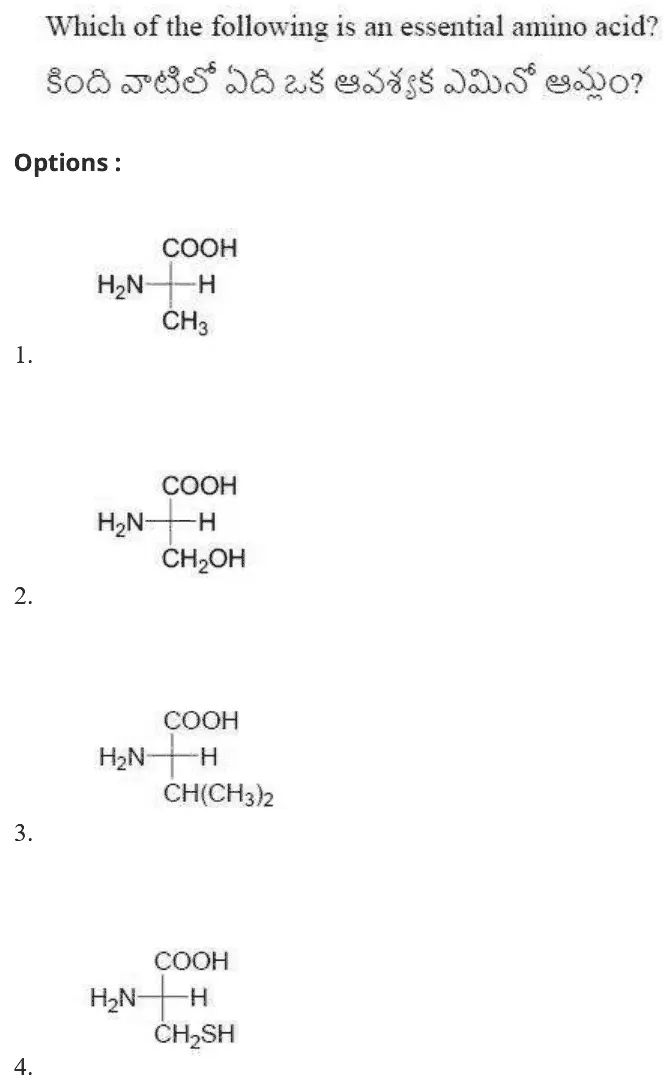
Which of the following is an essential amino acid?

The question and its figure as printed in AP EAPCET 2024 18th May 2024 Shift 1. Option 1: Fischer projection: COOH at top, CH3 at bottom, H2N on the left and H on the right of the central carbon Option 2: Fischer projection: COOH at top, CH2OH at bottom, H2N on the left and H on the right of the central carbon Option 3: Fischer projection: COOH at top, CH(CH3)2 at bottom, H2N on the left and H on the right of the central carbon Option 4: Fischer projection: COOH at top, CH2SH at bottom, H2N on the left and H on the right of the central carbon
The question as printed in the paper.
  • A

    see figure Fischer projection: COOH at top, CH$_3$ at bottom, $\mathrm{H_2N}$ on the left and H on the right of the central carbon

  • B

    see figure Fischer projection: COOH at top, $\mathrm{CH_2OH}$ at bottom, $\mathrm{H_2N}$ on the left and H on the right of the central carbon

  • C

    see figure Fischer projection: COOH at top, $\mathrm{CH(CH_3)_2}$ at bottom, $\mathrm{H_2N}$ on the left and H on the right of the central carbon

  • D

    see figure Fischer projection: COOH at top, $\mathrm{CH_2SH}$ at bottom, $\mathrm{H_2N}$ on the left and H on the right of the central carbon

63AP EAPCET 2024 · 18 May · Shift 1MCQOpen question page ↗

Which of the following hormone is responsible for preparing uterus for implantation of fertilised egg?

  • A

    Estradiol

  • B

    Progesterone

  • C

    Testosterone

  • D

    Thyroxin

64TS EAPCET 2024 · 11 May · Shift 1MCQOpen question page ↗

What is the IUPAC name of the product Y in the given reaction sequence?

$$\begin{array}{c}\mathrm{CHO}\\|\\(\mathrm{CHOH})_4\\|\\\mathrm{CH_2OH}\end{array} \xrightarrow{\mathrm{HCN}} \mathrm{X} \xrightarrow{\mathrm{H^+/H_2O}} \mathrm{Y}$$

  • A

    2,3,4,5,6,7 – hexahydroxyheptanoic acid

  • B

    2,3,4,5,6 – pentahydroxyhexanoic acid

  • C

    3,4,5 – trihydroxyheptanoic acid

  • D

    3,4,5 – trihydroxyhexanoic acid

65TS EAPCET 2024 · 10 May · Shift 1MCQOpen question page ↗

Which of the following vitamin is also called pyridoxine?

  • A

    $\mathrm{B_6}$

  • B

    $\mathrm{B_{12}}$

  • C

    $\mathrm{B_2}$

  • D

    $\mathrm{B_1}$

66TS EAPCET 2024 · 10 May · Shift 2MCQOpen question page ↗

Two statements are given below

I Milk sugar is disaccharide of $\alpha$ -D- galactose and $\beta$ -D-glucose

II Sucrose is disaccharide of $\alpha$ -D- glucose and $\beta$ -D-fructose

Correct answer is

  • A

    Both statements I and II are correct

  • B

    Both statements I and II are incorrect

  • C

    Statement I is correct but statement II is incorrect

  • D

    Statement I is incorrect but statement II is correct

67TS EAPCET 2024 · 9 May · Shift 1MCQOpen question page ↗

The functional groups involved in the conversion of glucose to gluconic acid and gluconic acid to saccharic acid respectively are

  • A

    $\mathrm{-CHO}$, $\mathrm{>CHOH}$

  • B

    $\mathrm{-CHO}$, $\mathrm{-CH_2OH}$

  • C

    $\mathrm{-CH_2OH}$, $\mathrm{-CHO}$

  • D

    $\mathrm{-CH_2OH}$, $\mathrm{>CHOH}$

68TS EAPCET 2024 · 9 May · Shift 2MCQOpen question page ↗

Cellulose is a polysaccharide and is made of

  • A

    $\beta$-D-glucose units joined through 1,4-glycosidic linkages

  • B

    $\alpha$-D-glucose units joined through 1,4-glycosidic linkages

  • C

    $\alpha$-D-glucose units joined through 1,6-glycosidic linkages

  • D

    $\beta$-D-glucose units joined through 1,6-glycosidic linkages

69AP EAPCET 2023 · 19 May · Shift 1MCQOpen question page ↗

Identify the correct statement related to amino acids

  • A

    Nonessential amino acids cannot be synthesized in the body

  • B

    These are soluble in ether

  • C

    These are low melting solid substances

  • D

    In aqueous solution they exist as zwitter ion

70AP EAPCET 2023 · 19 May · Shift 1MCQOpen question page ↗

From the following, number of fat soluble and water soluble vitamins respectively are

A D C $\mathrm{B_1}$ K $\mathrm{B_6}$

  • A

    2, 4

  • B

    4, 2

  • C

    3, 3

  • D

    6, 0

71AP EAPCET 2023 · 18 May · Shift 1MCQOpen question page ↗

Which of the following correctly represents hydrogen bonded pairs in DNA?

  • A

    $\mathrm{G=C\ ;\ T\equiv A}$

  • B

    $\mathrm{G=C\ ;\ T=A}$

  • C

    $\mathrm{G\equiv C\ ;\ T\equiv A}$

  • D

    $\mathrm{G\equiv C\ ;\ T=A}$

72AP EAPCET 2023 · 18 May · Shift 1MCQOpen question page ↗

In D – glucose (X) and D – Fructose (Y), which hydroxyl group participates in hemiacetal formation

  • A

    C – 5 in both X and Y

  • B

    C – 5 in X and C – 6 in Y

  • C

    C – 6 in X and C – 5 in Y

  • D

    C – 4 in both X and Y

73AP EAPCET 2023 · 18 May · Shift 2MCQOpen question page ↗

In which of the following amino acids –OH group is present?

Lysine Serine Tyrosine Valine

A B C D

  • A

    A, B

  • B

    A, C

  • C

    B, C

  • D

    B, D

74AP EAPCET 2023 · 18 May · Shift 2MCQOpen question page ↗

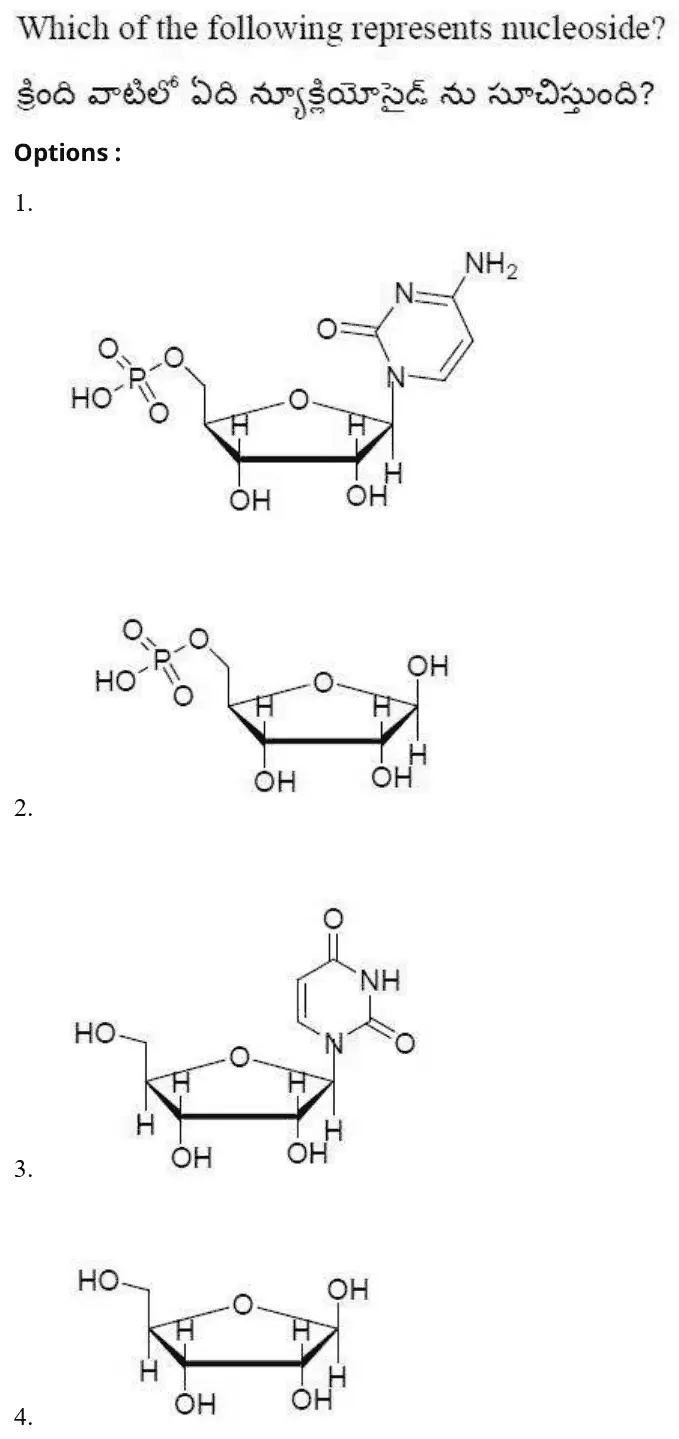
Which of the following represents nucleoside?

The question and its figure as printed in AP EAPCET 2023 18th May 2023 Shift 2. Option 1: Nucleotide: ribofuranose ring (O in ring) with a 5'-CH2-O-P(=O)(OH)-O phosphate group on the left; the base on the right (C1') is cytosine, attached through N (ring: N=C(NH2)-CH=CH-N, with C=O), and the 2' and 3' carbons each bear an OH (OH down at both positions, H's shown). Option 2: Nucleotide: ribofuranose ring with a 5'-CH2-O-P(=O)(OH)-O phosphate group on the left; at C1' on the right there is an OH (no base) with H below; 2' and 3' carbons each bear OH (down) with H's. Option 3: Nucleoside: ribofuranose ring with a 5'-CH2OH (HO-CH2) on the left; the base on the right (C1') is uracil, attached…
The question as printed in the paper.
  • A

    see figure Nucleotide: ribofuranose ring (O in ring) with a 5'-CH2-O-P(=O)(OH)-O phosphate group on the left; the base on the right (C1') is cytosine, attached through N (ring: N=C(NH2)-CH=CH-N, with C=O), and the 2' and 3' carbons each bear an OH (OH down at both positions, H's shown).

  • B

    see figure Nucleotide: ribofuranose ring with a 5'-CH2-O-P(=O)(OH)-O phosphate group on the left; at C1' on the right there is an OH (no base) with H below; 2' and 3' carbons each bear OH (down) with H's.

  • C

    see figure Nucleoside: ribofuranose ring with a 5'-CH2OH (HO-CH2) on the left; the base on the right (C1') is uracil, attached through N (ring: N-C(=O)-NH-C(=O)-CH=CH), and the 2' and 3' carbons each bear an OH (down) with H's.

  • D

    see figure Sugar: ribofuranose ring with a 5'-CH2OH (HO-CH2) on the left; at C1' on the right there is an OH (no base) with H below; 2' and 3' carbons each bear OH (down) with H's.

75AP EAPCET 2023 · 17 May · Shift 1MCQOpen question page ↗

Which of the following is not correctly matched for enzymatic reactions?

  • A

    Proteins $\rightarrow$ Amino acids ; Trypsin

  • B

    Starch $\rightarrow$ Maltose ; Diastase

  • C

    Sucrose $\rightarrow$ glucose and fructose; zymase

  • D

    Maltose $\rightarrow$ glucose ; Maltase

76AP EAPCET 2023 · 17 May · Shift 1MCQOpen question page ↗

Match the following

List – IList – II
A. Beri BeriI. Riboflavin
B. ScurvyII. Thiamine
C. CheilosisIII. Pyridoxine
D. RicketsIV. Ascorbic acid
V. Vitamin D

The correct answer is

  • A

    A – III, B- IV, C – III, D-V

  • B

    A – II, B- IV, C – I, D-V

  • C

    A – III, B- V, C – I, D-II

  • D

    A – III, B- V, C – IV, D-II

79AP EAPCET 2023 · 17 May · Shift 2MCQOpen question page ↗

Which of the following hormones modulate inflammatory reactions?

  • A

    Mineralocorticoids

  • B

    Glucocorticoids

  • C

    Epinephrine

  • D

    Glucagon

80AP EAPCET 2023 · 16 May · Shift 1MCQOpen question page ↗

Sulphur containing amino acids of the following are

Serine Cysteine Lysine methionine

A B C D

  • A

    A, D

  • B

    A, C

  • C

    B, C

  • D

    B, D

81AP EAPCET 2023 · 16 May · Shift 1MCQOpen question page ↗

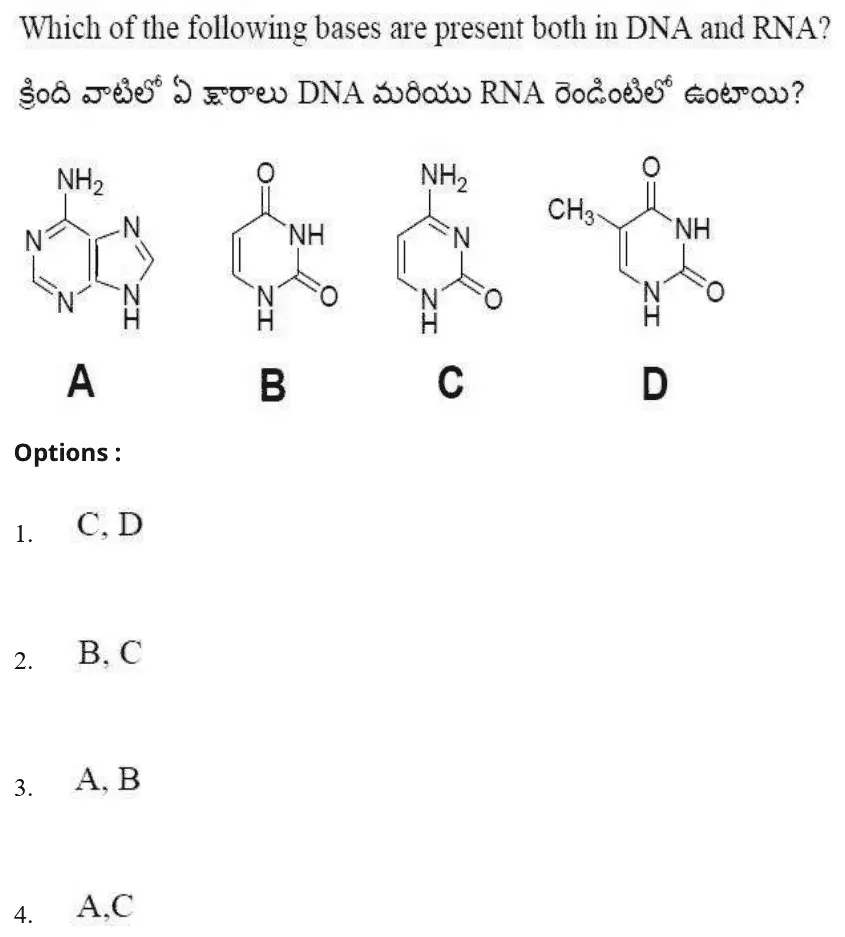
Which of the following bases are present both in DNA and RNA?

(see the figure above)

The question and its figure as printed in AP EAPCET 2023 16th May 2023 Shift 1.
The question as printed in the paper.
  • A

    C, D

  • B

    B, C

  • C

    A, B

  • D

    A,C

83AP EAPCET 2023 · 16 May · Shift 2MCQOpen question page ↗

Addison’s disease is characterized by

A. Hyperglycemia

B. Weakness

C. Increased susceptibility to stress

D. Hypertension

  • A

    A, C

  • B

    A, D

  • C

    B, C

  • D

    B, D

84AP EAPCET 2023 · 15 May · Shift 1MCQOpen question page ↗

Given below are two statements

Assertion (A): Hydrolysis of DNA does not form equal number of A and T: G and C

Reason (R): In DNA adenine forms hydrogen bonds with thymine and cytosine forms hydrogen bonds with guanine

The correct answer is

  • A

    Both A and R are correct and R is the correct explanation of A

  • B

    Both A and R are correct but R is not the correct explanation of A

  • C

    A is correct but R is incorrect

  • D

    A is incorrect but R is correct

85AP EAPCET 2023 · 15 May · Shift 1MCQOpen question page ↗

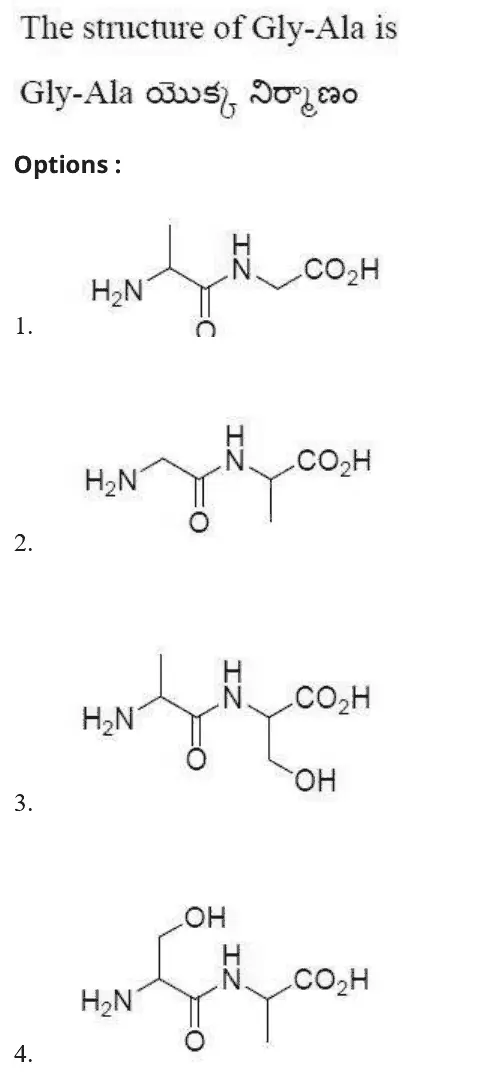
The structure of Gly-Ala is

The question and its figure as printed in AP EAPCET 2023 15th May 2023 Shift 1. Option 1: Skeletal structure: H2N attached to a CH carbon bearing a methyl substituent (a vertical line up), then C(=O) (O drawn below), then NH, then CH2, then CO2H. This is Ala-Gly. Option 2: Skeletal structure: H2N attached to a CH2 carbon, then C(=O) (O drawn below), then NH, then a CH carbon bearing a methyl substituent (a vertical line down), then CO2H. This is Gly-Ala. Option 3: Skeletal structure: H2N attached to a CH carbon bearing a methyl substituent (a vertical line up), then C(=O) (O drawn below), then NH, then a CH carbon bearing CH2OH (OH drawn lower right), then CO2H. This is Ala-Ser. Option 4…
The question as printed in the paper.
  • A

    see figure Skeletal structure: H2N attached to a CH carbon bearing a methyl substituent (a vertical line up), then C(=O) (O drawn below), then NH, then CH2, then CO2H. This is Ala-Gly.

  • B

    see figure Skeletal structure: H2N attached to a CH2 carbon, then C(=O) (O drawn below), then NH, then a CH carbon bearing a methyl substituent (a vertical line down), then CO2H. This is Gly-Ala.

  • C

    see figure Skeletal structure: H2N attached to a CH carbon bearing a methyl substituent (a vertical line up), then C(=O) (O drawn below), then NH, then a CH carbon bearing CH2OH (OH drawn lower right), then CO2H. This is Ala-Ser.

  • D

    see figure Skeletal structure: H2N attached to a CH carbon bearing a CH2OH substituent (OH drawn upper), then C(=O) (O drawn below), then NH, then a CH carbon bearing a methyl substituent (a vertical line down), then CO2H. This is Ser-Ala.

87AP EAPCET 2023 · 15 May · Shift 2MCQOpen question page ↗

Hypothyroidism is due to

A. High level of iodine in the diet

B. Enlargement of thyroid gland

C. Low levels of iodine in the diet

D. Increased levels of thyroxine

  • A

    A, B

  • B

    B, C

  • C

    A, D

  • D

    C, D

88TS EAPCET 2023 · 14 May · Shift 1MCQOpen question page ↗

The deficiency of which vitamin causes pernicious anaemia?

  • A

    Vitamin $\mathrm{B_2}$

  • B

    Vitamin $\mathrm{B_6}$

  • C

    Vitamin E

  • D

    Vitamin $\mathrm{B_{12}}$

89TS EAPCET 2023 · 14 May · Shift 2MCQOpen question page ↗

From the following, the correct statements about polysaccharides are

I) Starch is a polymer of $\alpha$-D(+)-glucose

II) Amylose component of starch is not soluble in water.

III) Amylose is a branched chain polymer of $\alpha$-D(+)- glucose.

IV) Cellulose is a straight chain polymer of $\beta$-D(+)- glucose units

  • A

    I & IV only

  • B

    II & III only

  • C

    II & IV only

  • D

    I & III only

90TS EAPCET 2023 · 13 May · Shift 1MCQOpen question page ↗

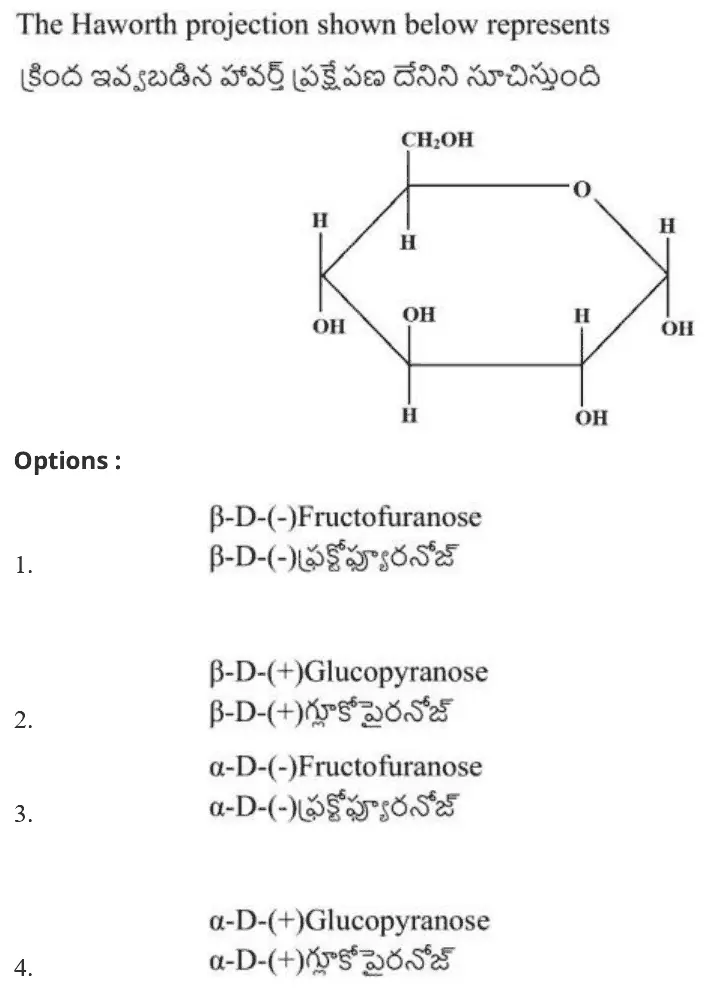
The Haworth projection shown below represents

(see the figure above)

The question and its figure as printed in TS EAPCET 2023 13th May 2023 Shift 1.
The question as printed in the paper.
  • A

    β-D-(-)Fructofuranose

  • B

    β-D-(+)Glucopyranose

  • C

    α-D-(-)Fructofuranose

  • D

    α-D-(+)Glucopyranose

91TS EAPCET 2023 · 13 May · Shift 2MCQOpen question page ↗

A vitamin X is soluble in fat and its source is egg yolk. Deficiency of X causes the disease

  • A

    Scurvy

  • B

    Convulsions

  • C

    Xerophthalmia

  • D

    Rickets

92TS EAPCET 2023 · 12 May · Shift 1MCQOpen question page ↗

Which of the following is the incorrect statement about maltose?

  • A

    It is a reducing sugar

  • B

    It is composed of two $\alpha$-D- glucose units

  • C

    It is composed of one $\beta$-D- glucose and one $\beta$-D- galactose unit

  • D

    It has 1, 4 – glycosidic linkage

93TS EAPCET 2023 · 12 May · Shift 2MCQOpen question page ↗

The functional groups present in Asparagine, a non-essential aminoacid, are

  • A

    $-\mathrm{NH_2}$ , $-\mathrm{COOH}$ , $=\mathrm{NH}$

  • B

    $-\mathrm{NH_2}$ , $-\mathrm{COOH}$ , $-\mathrm{\overset{O}{\overset{\|}{C}}}-\mathrm{NH_2}$

  • C

    $-\mathrm{NH}-\mathrm{\overset{O}{\overset{\|}{C}}}-$ , $-\mathrm{COOH}$ , $-\mathrm{\overset{O}{\overset{\|}{C}}}-\mathrm{Cl}$

  • D

    $-\mathrm{NH_2}$ , $-\mathrm{COOH}$ , $-\mathrm{OH}$

94TS EAPCET 2022 · 20 Jul · Shift 1MCQOpen question page ↗

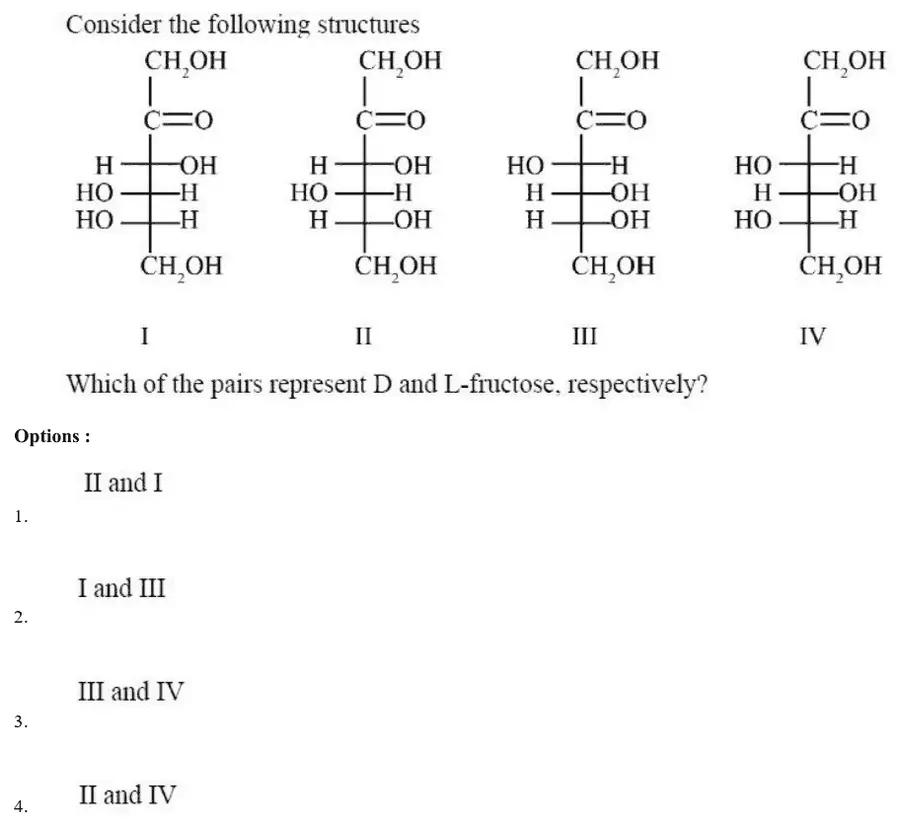
Consider the following structures
(see the figure above)
Which of the pairs represent D and L-fructose, respectively?

The question and its figure as printed in TS EAPCET 2022 20th Jul 2022 Shift 1.
The question as printed in the paper.
  • A

    II and I

  • B

    I and III

  • C

    III and IV

  • D

    II and IV

95TS EAPCET 2022 · 20 Jul · Shift 2MCQOpen question page ↗

Assertion (A) : In aqueous solution, amino acids exist in dipolar ion form.
Reason (R) : Most of the naturally occurring amino acids have L-configuration.
The correct option among the following is

  • A

    (A) is true, (R) is true and (R) is the correct explanation for (A)

  • B

    (A) is true, (R) is true but (R) is not the correct explanation for (A)

  • C

    (A) is true but (R) is false

  • D

    (A) is false but (R) is true

96TS EAPCET 2022 · 19 Jul · Shift 1MCQOpen question page ↗

Assertion (A) : Both Glucose and Fructose have the same D-configuration.

Reason (R) : Both Glucose and Fructose are dextrorotatory.

The correct option among the following is

  • A

    (A) is true, (R) is true and (R) is the correct explanation for (A)

  • B

    (A) is true, (R) is true but (R) is not the correct explanation for (A)

  • C

    (A) is true but (R) is false

  • D

    (A) is false but (R) is true

97TS EAPCET 2022 · 19 Jul · Shift 2MCQOpen question page ↗

The major product of the following reactions is
Glucose $\xrightarrow[\text{ii) }\mathrm{Mo_{2}O_{3}},\ 773\ \mathrm{K},\ 10-20\ \text{atm}]{\text{i) HI, }\Delta}$

  • A

    Cyclohexane

  • B

    Benzene

  • C

    Cyclohexadiene

  • D

    Hexane

98TS EAPCET 2022 · 18 Jul · Shift 1MCQOpen question page ↗

Assertion (A) : The denaturation of proteins can destroy all $1^{\circ}$, $2^{\circ}$ and $3^{\circ}$ protein structures.
Reason (R) : Curdling of milk is due to denaturation of proteins.
The correct option among the following is

  • A

    (A) is true, (R) is true and (R) is the correct explanation for (A)

  • B

    (A) is true, (R) is true but (R) is not the correct explanation for (A)

  • C

    (A) is true but (R) is false

  • D

    (A) is false but (R) is true

100AP EAPCET 2022 · 8 Jul · Shift 1MCQOpen question page ↗

If sucrose is boiled with dilute. HCl in alcoholic solution the ratio in which glucose and fructose are formed is

  • A

    $1:1$

  • B

    $1:2$

  • C

    $2:1$

  • D

    $4:1$

103AP EAPCET 2022 · 8 Jul · Shift 2MCQOpen question page ↗

Hydrolysis of which of the following nucleic acids does not give equal number of A and T or G and C
a) m - RNA b) single strand DNA c) r - RNA d) double helix DNA

  • A

    (a), (b), (c)

  • B

    (b), (c), (d)

  • C

    (b) only

  • D

    (a) only

105AP EAPCET 2022 · 7 Jul · Shift 1MCQOpen question page ↗

Hydrolysis of which disaccharide in presence of enzyme maltase give glucose only?

  • A

    Sucrose

  • B

    Cellulose

  • C

    Lactose

  • D

    Maltose

106AP EAPCET 2022 · 7 Jul · Shift 2MCQOpen question page ↗

Hydrolysis of nucleic acid gives nitrogenous base sugar and ______

  • A

    Sulphuric acid

  • B

    Phosphorous acid

  • C

    Sulphurous acid

  • D

    Phosphoric acid

107AP EAPCET 2022 · 7 Jul · Shift 2MCQOpen question page ↗

Sugar present in DNA is

  • A

    $\beta$-D-2-ribose

  • B

    $\beta$-D-2-deoxyribose

  • C

    $\alpha$-D-2-ribose

  • D

    $\alpha$-D-2-deoxyribose

108AP EAPCET 2022 · 6 Jul · Shift 1MCQOpen question page ↗

In which of the following, Keratin, a fibrous protein is absent?

  • A

    Hair

  • B

    Muscles

  • C

    Silk

  • D

    Wool

110AP EAPCET 2022 · 6 Jul · Shift 2MCQOpen question page ↗

Which of the following is not true about the denaturation of protein?

  • A

    $2^\circ$ structure get destroyed

  • B

    $3^\circ$ structure get destroyed

  • C

    $1^\circ$ structure get destroyed

  • D

    Bioactivity is lost

111AP EAPCET 2022 · 6 Jul · Shift 2MCQOpen question page ↗

Statement-I : Despite having aldehyde group, glucose does not give Schiff test
Statement-II : Glucose exists in $\alpha$ & $\beta$ crystalline forms

  • A

    Both statements I and II are incorrect

  • B

    Both statements I and II are correct

  • C

    Statement I is correct but statement II is incorrect

  • D

    Statement I is incorrect but statement II is correct

112AP EAPCET 2022 · 5 Jul · Shift 1MCQOpen question page ↗

Match the following
List - I (enzyme): A. Invertase; B. Pepsin; C. Diastase
List - II (Reaction): I. Maltose $\rightarrow$ Glucose; II. Sucrose $\rightarrow$ Glucose + Fructose; III. Proteins $\rightarrow$ peptides; IV. Starch $\rightarrow$ Maltose

  • A

    A - IV, B - I, C - III

  • B

    A - I, B - III, C - II

  • C

    A - II, B - III, C - IV

  • D

    A - II, B - IV, C - III

113AP EAPCET 2022 · 5 Jul · Shift 1MCQOpen question page ↗

Carbohydrates are stored in plants and animals in which of the following forms respectively?

  • A

    Glycogen, Starch

  • B

    Glycogen, Glycogen

  • C

    Starch, Starch

  • D

    Starch, Glycogen

114AP EAPCET 2022 · 5 Jul · Shift 1MCQOpen question page ↗

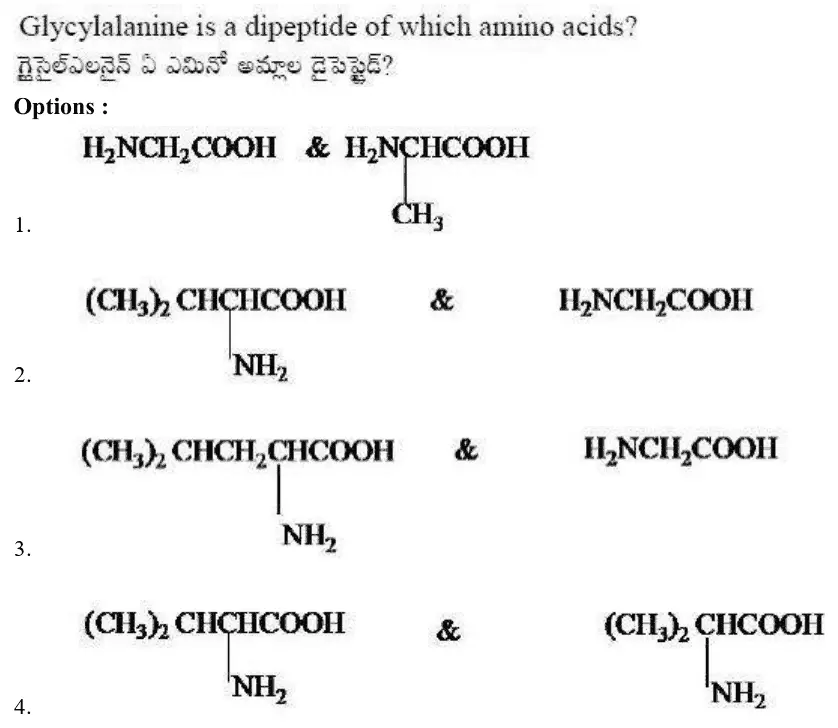
Glycylalanine is a dipeptide of which amino acids?
(see the figure above)

The question and its figure as printed in AP EAPCET 2022 05th July 2022 Shift1. Option 1: H2NCH2COOH & H2NCHCOOH with a CH3 group on the CH Option 2: (CH3)2CHCHCOOH with NH2 on the CH & H2NCH2COOH Option 3: (CH3)2CHCH2CHCOOH with NH2 on the CH & H2NCH2COOH Option 4: (CH3)2CHCHCOOH with NH2 on the CH & (CH3)2CHCOOH with NH2 on the CH
The question as printed in the paper.
  • A

    see figure $\mathrm{H_2NCH_2COOH}$ & $\mathrm{H_2NCHCOOH}$ with a $\mathrm{CH_3}$ group on the CH

  • B

    see figure $\mathrm{(CH_3)_2CHCHCOOH}$ with $\mathrm{NH_2}$ on the CH & $\mathrm{H_2NCH_2COOH}$

  • C

    see figure $\mathrm{(CH_3)_2CHCH_2CHCOOH}$ with $\mathrm{NH_2}$ on the CH & $\mathrm{H_2NCH_2COOH}$

  • D

    see figure $\mathrm{(CH_3)_2CHCHCOOH}$ with $\mathrm{NH_2}$ on the CH & $\mathrm{(CH_3)_2CHCOOH}$ with $\mathrm{NH_2}$ on the CH

115AP EAPCET 2022 · 5 Jul · Shift 2MCQOpen question page ↗

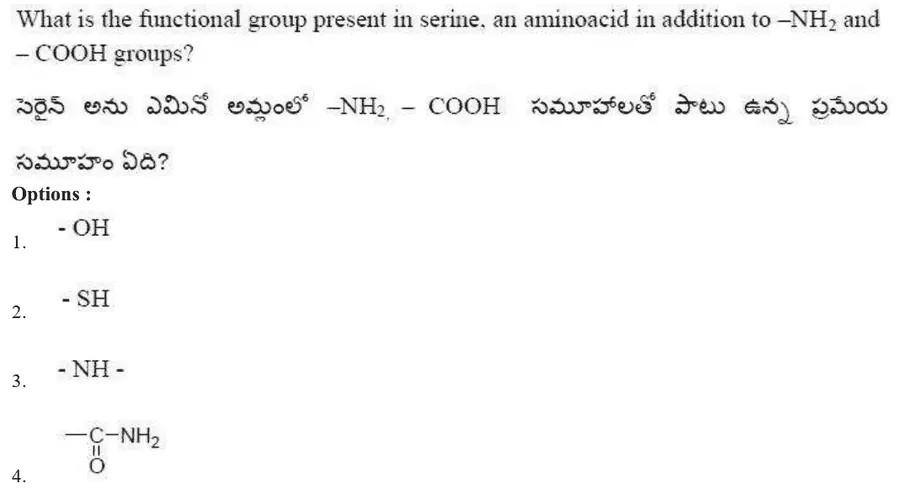
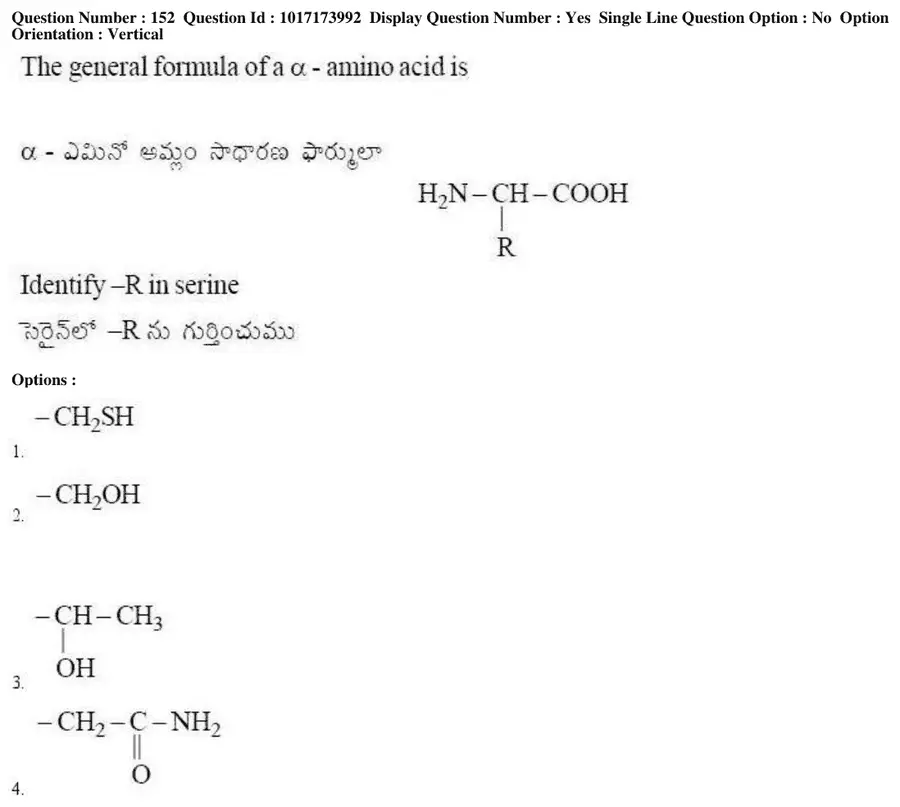
What is the functional group present in serine, an aminoacid in addition to $\mathrm{-NH_2}$ and $\mathrm{-COOH}$ groups?

The question and its figure as printed in AP EAPCET 2022 05th July 2022 Shift2. Option 4: amide group, a carbon bearing a double-bonded O and NH2 (-C(=O)-NH2)
The question as printed in the paper.
  • A

    $\mathrm{-OH}$

  • B

    $\mathrm{-SH}$

  • C

    $\mathrm{-NH-}$

  • D

    see figure amide group, a carbon bearing a double-bonded O and NH2 (-C(=O)-NH2)

116AP EAPCET 2022 · 4 Jul · Shift 1MCQOpen question page ↗

Which hormone tends to increase the blood glucose level in human?

  • A

    Insulin

  • B

    Glucagon

  • C

    Epinephrine

  • D

    Estrogen

117AP EAPCET 2022 · 4 Jul · Shift 1MCQOpen question page ↗

Which of the following molecules is eliminated during peptide bond formation?

  • A

    $\mathrm{H_2O}$

  • B

    $\mathrm{NH_3}$

  • C

    $\mathrm{CH_3OH}$

  • D

    $\mathrm{CO_2}$

120AP EAMCET 2021 · 5 Oct · Shift 1MCQOpen question page ↗

The product of the following reaction is:
$C_{12}H_{22}O_{11} \xrightarrow{H_2SO_4} ?$

  • A

    Hexane

  • B

    Hexanol

  • C

    $CO_2$

  • D

    Carbon

122AP EAMCET 2021 · 25 Aug · Shift 2MCQOpen question page ↗

Match the following vitamins with their sources and the corresponding diseases caused by their deficiency?
Vitamins | Sources | Diseases
(a) Vitamin-$B_1$ | (i) Egg-whites | (p) Convulsions
(b) Vitamin-$B_2$ | (ii) Fish | (q) Pernicious anemia
(c) Vitamin-$B_6$ | (iii) Green vegetables | (r) Cheilosis
(d) Vitamin-$B_{12}$ | (iv) Grams | (s) Beri-Beri

  • A

    (a-ii-r), (b-iv-p), (c-iii-s), (d-i-q)

  • B

    (a-iv-p), (b-ii-q), (c-i-r), (d-iii-s)

  • C

    (a-iii-s), (b-i-r), (c-iv-p), (d-ii-q)

  • D

    (a-i-q), (b-iii-s), (c-ii-r), (d-iv-p)

123AP EAMCET 2021 · 24 Aug · Shift 1MCQOpen question page ↗

In an amino acid, the carboxylic group ionizes at pH = 2.56 ($pKa_1$) and ammonium ion ionizes at pH = 9.38 ($pKa_2$). The isoelectric point of the amino acid is at ______

  • A

    11.94

  • B

    6.82

  • C

    5.97

  • D

    3.41

125AP EAMCET 2021 · 23 Aug · Shift 1MCQOpen question page ↗

Which of the following statements are true about carbohydrates?
(i) Monosaccharides can be hydrolysed.
(ii) The two monosaccharide units obtained on hydrolysis of a disaccharide can either be same or different.
(iii) Polysaccharides are not sweet in taste.
(iv) All monosaccharides are not reducing sugars.

  • A

    (i) & (ii) only

  • B

    (ii) & (iii) only

  • C

    (iii) & (iv) only

  • D

    (i) & (iv) only

126AP EAMCET 2021 · 23 Aug · Shift 2MCQOpen question page ↗

Match the following
Type of Protein: (a) Fibrous, (b) Globular
Their Properties: (i) Hydrogen bonding, (ii) Water soluble, (iii) Spherical shape, (iv) Disulphide linkage

  • A

    (a-i), (a-ii), (b-iii), (b-iv)

  • B

    (a-i), (a-iii), (b-ii), (b-iv)

  • C

    (a-i), (a-iv), (b-ii), (b-iii)

  • D

    (a-ii), (a-iv), (b-i), (b-iii)

129AP EAMCET 2021 · 19 Aug · Shift 1MCQOpen question page ↗

Identify the product of the following reaction.
$(\mathrm{C_6H_{10}O_5})_n + n\,\mathrm{H_2O} \xrightarrow[\text{393 K, 2-3 atm}]{\mathrm{H^+}} ?$ (Starch)

  • A

    Fructose

  • B

    Glucose

  • C

    Lactose

  • D

    Maltose

130AP EAMCET 2021 · 19 Aug · Shift 2MCQOpen question page ↗

Assertion (A): An optically active amino acid can exit in three forms depending on the pH of the solution.
Reason (R): Amino acids contain both acidic and basic groups, they exist as zwetter ion in aq. medium, anionic form in acidic medium and cationic form in basic medium

  • A

    A and R are correct and R is the correct explanation for A

  • B

    A and R are correct but R is not the correct explanation for A

  • C

    A is correct, R is wrong

  • D

    A is wrong, R is correct

131TS EAMCET 2021 · 6 Aug · Shift 1MCQOpen question page ↗

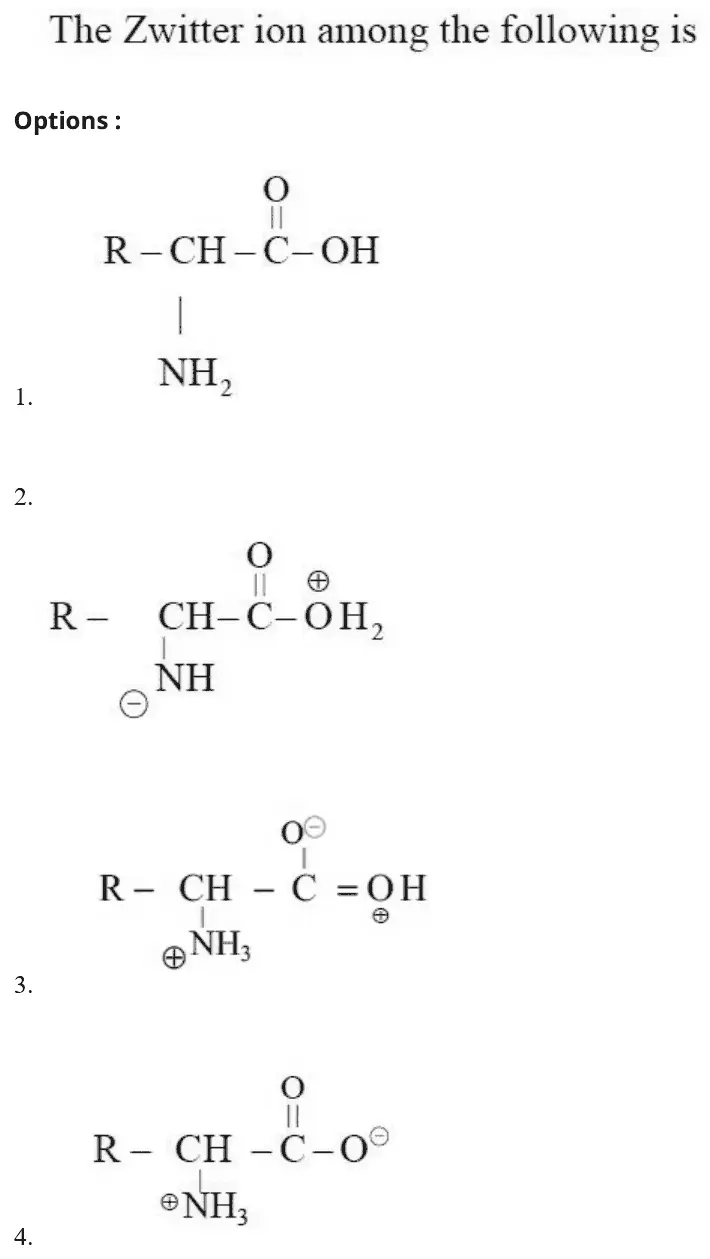
The Zwitter ion among the following is

The question and its figure as printed in TS EAPCET 2021 English 6th Aug 2021 Shift 1. Option 1: R-CH(NH2)-C(=O)-OH (NH2 below the CH) Option 2: R-CH(N^-H)-C(=O)-O^+H2 (NH with a negative charge on N below the CH; the carboxyl OH2 carries a positive charge) Option 3: R-CH(N^+H3)-C(O^-)=O^+H (NH3 with positive charge below the CH; the carboxyl carbon drawn with an O carrying a negative charge on top and =OH carrying a positive charge) Option 4: R-CH(N^+H3)-C(=O)-O^- (NH3 with positive charge below the CH; carboxylate with O negative)
The question as printed in the paper.
  • A

    see figure $\mathrm{R-CH(NH_2)-C(=O)-OH}$ (NH2 below the CH)

  • B

    see figure $\mathrm{R-CH(N^{-}H)-C(=O)-O^{+}H_2}$ (NH with a negative charge on N below the CH; the carboxyl OH2 carries a positive charge)

  • C

    see figure $\mathrm{R-CH(N^{+}H_3)-C(O^{-})=O^{+}H}$ (NH3 with positive charge below the CH; the carboxyl carbon drawn with an O carrying a negative charge on top and =OH carrying a positive charge)

  • D

    see figure $\mathrm{R-CH(N^{+}H_3)-C(=O)-O^{-}}$ (NH3 with positive charge below the CH; carboxylate with O negative)

132TS EAMCET 2021 · 6 Aug · Shift 2MCQOpen question page ↗

Assertion (A): Adenine and guanine are present in RNA as purine bases.
Reason (R): The base uracil is present in RNA.
The correct option among the following is

  • A

    (A) is true, (R) is true and (R) is the correct explanation for (A)

  • B

    (A) is true, (R) is true but (R) is not the correct explanation for (A)

  • C

    (A) is true but (R) is false

  • D

    (A) is false but (R) is true

133TS EAMCET 2021 · 5 Aug · Shift 1MCQOpen question page ↗

During the process of fermentation, the number of moles of $\mathrm{CO_2}$ liberated from one mole to glucose is

  • A

    2

  • B

    3

  • C

    4

  • D

    1

134TS EAMCET 2021 · 5 Aug · Shift 1MCQOpen question page ↗

Assertion (A) : In aqueous solution, $\alpha$-amino acids exists as internal salt called as zwitter ion.
Reason (R) : Proline is a natural amino acid having a secondary amino group.
The correct option among the following is

  • A

    (A) is true, (R) is true and (R) is the correct explanation for (A)

  • B

    (A) is true, (R) is true but (R) is not the correct explanation for (A)

  • C

    (A) is true but (R) is false

  • D

    (A) is false but (R) is true

135TS EAMCET 2021 · 5 Aug · Shift 2MCQOpen question page ↗

Glucose on prolonged heating with HI, gives product P. The product P is

  • A

    $\mathrm{CH_2I{-}(CHOH)_4{-}CH_2OH}$

  • B

    $\mathrm{CHO{-}(CH{-}I)_4{-}CH_2I}$

  • C

    $\mathrm{CH_3{-}(CH_2)_4{-}CH_3}$

  • D

    $\mathrm{CH_2{-}I{-}(CHI)_4{-}CH_2I}$

136TS EAMCET 2021 · 4 Aug · Shift 1MCQOpen question page ↗

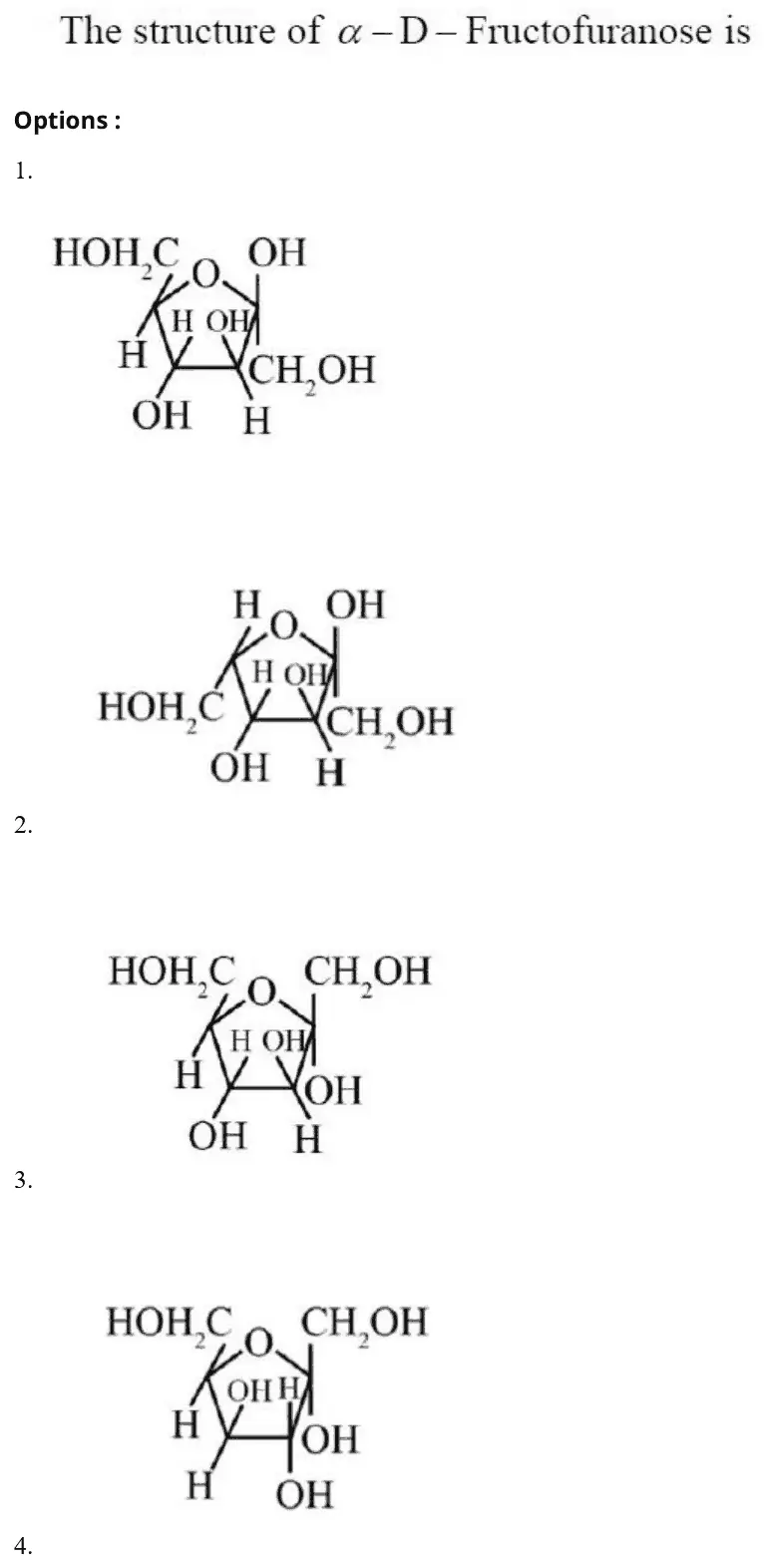
The structure of $\alpha$ – D – Fructofuranose is
(see the figure above)

The question and its figure as printed in TS EAPCET 2021 English 4th Aug 2021 Shift 1. Option 1: furanose structure 1 Option 2: furanose structure 2 Option 3: furanose structure 3 Option 4: furanose structure 4
The question as printed in the paper.
  • A

    see figure furanose structure 1

  • B

    see figure furanose structure 2

  • C

    see figure furanose structure 3

  • D

    see figure furanose structure 4

137TS EAMCET 2021 · 4 Aug · Shift 2MCQOpen question page ↗

A polypeptide can be called as protein when its mass is

  • A

    $> 10{,}000\ \mathrm{u}$

  • B

    $5{,}000$ to $6{,}000\ \mathrm{u}$

  • C

    $7{,}000$ to $8{,}000\ \mathrm{u}$

  • D

    $4{,}000$ to $5{,}000\ \mathrm{u}$

140AP EAMCET 2020 · 22 Sep · Shift 1MCQOpen question page ↗

Glycosidic linkage in carbohydrates is called ______

  • A

    Ester linkage

  • B

    Ether linkage

  • C

    Hydrogen bonding

  • D

    Amide linkage

141AP EAMCET 2020 · 22 Sep · Shift 1MCQOpen question page ↗

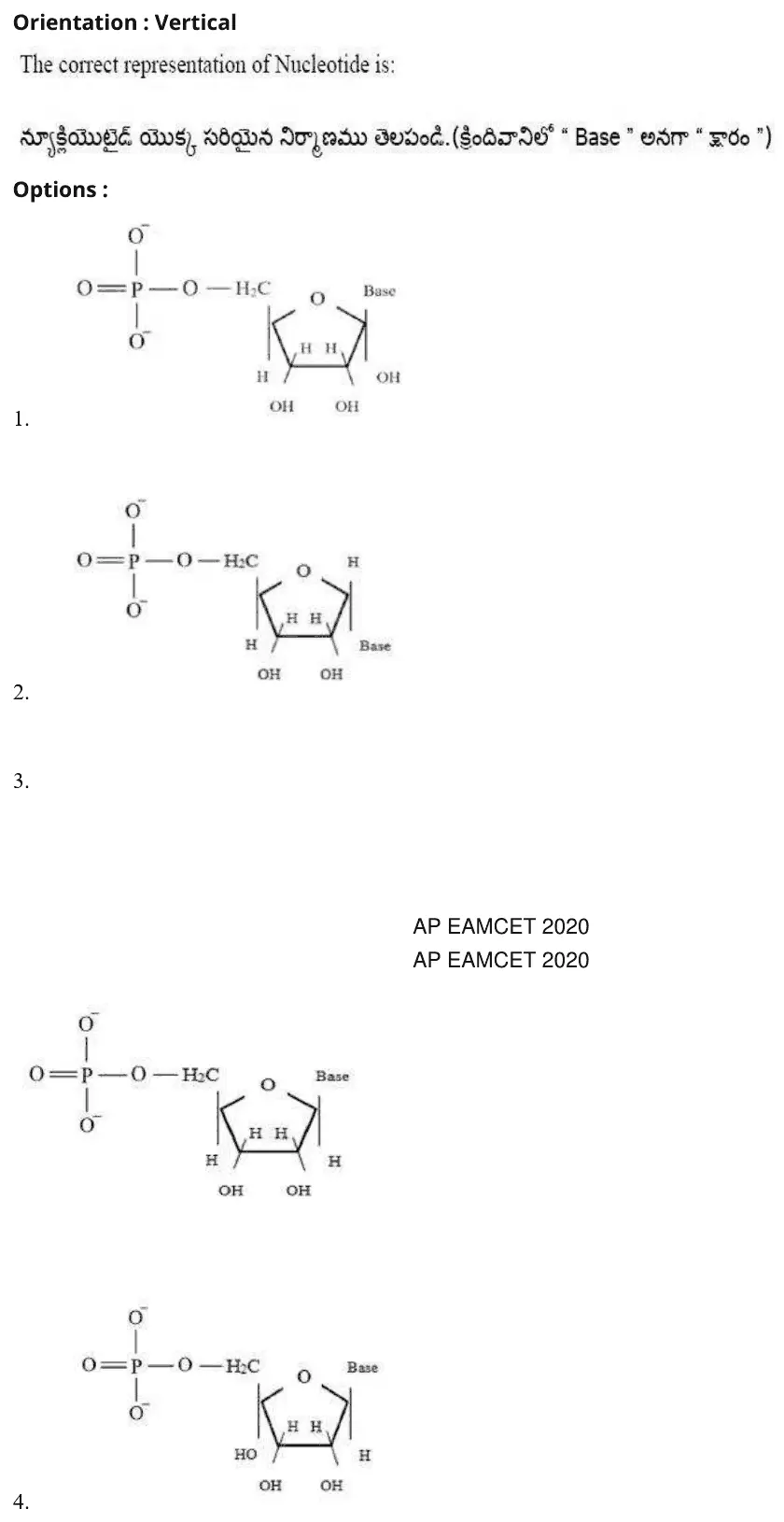
The correct representation of Nucleotide is:

The question and its figure as printed in AP EAPCET 2020 22nd Sep 2020 Shift1. Option 1: phosphate-sugar structure 1 Option 2: phosphate-sugar structure 2 Option 3: phosphate-sugar structure 3 Option 4: phosphate-sugar structure 4
The question as printed in the paper.
  • A

    see figure phosphate-sugar structure 1

  • B

    see figure phosphate-sugar structure 2

  • C

    see figure phosphate-sugar structure 3

  • D

    see figure phosphate-sugar structure 4

143AP EAMCET 2020 · 21 Sep · Shift 1MCQOpen question page ↗

Which among the following acts as a vitamin?

  • A

    Aspartic acid

  • B

    Ascorbic acid

  • C

    Saccharin acid

  • D

    Adipic acid

144AP EAMCET 2020 · 21 Sep · Shift 2MCQOpen question page ↗

DNA consists of two polynucleotide chains. Each chain forms a right-handed spiral with how many bases in one turn of spiral?

  • A

    4

  • B

    6

  • C

    8

  • D

    10

145AP EAMCET 2020 · 21 Sep · Shift 2MCQOpen question page ↗

When glucose reacts with bromine water, the main product is ______

  • A

    Acetic acid

  • B

    Saccharic acid

  • C

    Glyceraldehyde

  • D

    Gluconic acid

147AP EAMCET 2020 · 17 Sep · Shift 1MCQOpen question page ↗

Glucose does not react with which of the following

  • A

    $\mathrm{NH_2OH}$

  • B

    $\mathrm{HCN}$

  • C

    $\mathrm{Br_2}$ Water

  • D

    $\mathrm{NaHSO_3}$

148AP EAMCET 2020 · 17 Sep · Shift 2MCQOpen question page ↗

Hydrolysis of proteins gives:

  • A

    $\beta$– Amino acids

  • B

    $\gamma$ – Amino acids

  • C

    $\delta$– Amino acids

  • D

    $\alpha$ – Amino acids

149AP EAMCET 2020 · 17 Sep · Shift 2MCQOpen question page ↗

Fructose reduces tollens reagent due to ________

  • A

    Primary alcoholic group

  • B

    Secondary alcoholic group

  • C

    Enolization of fructose followed by conversation to aldehyde by base

  • D

    Asymmetric carbon atoms

150TS EAMCET 2020 · 14 Sep · Shift 1MCQOpen question page ↗

Considering the facts that
(i) sucrose forms glycosidic linkage between $C_1$ of glucose and $C_2$ of fructose, while
(ii) lactose forms glycosidic linkage between $C_1$ of galactose and $C_4$ of glucose
Choose the correct statement.

  • A

    Both sucrose and lactose are reducing sugars

  • B

    Both sucrose and lactose are non-reducing sugars

  • C

    Sucrose is reducing sugar and lactose is non-reducing sugar

  • D

    Lactose is reducing sugar and sucrose is non-reducing sugar

151TS EAMCET 2020 · 14 Sep · Shift 2MCQOpen question page ↗

Which of the following statements support the cyclic form for glucose?
(i) It doesn't give Schiff's test
(ii) It is found to exist in two different crystalline forms
(iii) It oxidizes with nitric acid to give saccharic acid
(iv) Pentaacetate of glucose doesn't react with hydroxylamine

  • A

    (i), (ii) and (iv) only

  • B

    (i), (iii) and (iv) only

  • C

    (ii) and (iii) only

  • D

    (i), (ii) and (iii) only

152TS EAMCET 2020 · 11 Sep · Shift 1MCQOpen question page ↗

Which of the following are reducing sugars?
I) Sucrose
II) Ribose
III) Lactose
IV) Fructose

  • A

    I, II only

  • B

    II, III, IV only

  • C

    II, III only

  • D

    I, II, IV only

153TS EAMCET 2020 · 11 Sep · Shift 1MCQOpen question page ↗

The number of six and five membered rings present in norethindrone (a synthetic progesterone) are respectively

  • A

    2 and 2

  • B

    3 and 1

  • C

    3 and 3

  • D

    3 and 2

155TS EAMCET 2020 · 10 Sep · Shift 1MCQOpen question page ↗

Amino acids containing heterocyclic ring are
(i) Histidine (ii) Valine (iii) Arginine (iv) Proline

  • A

    i, iv

  • B

    ii, iii

  • C

    i, iii

  • D

    ii, iv

156TS EAMCET 2020 · 10 Sep · Shift 2MCQOpen question page ↗

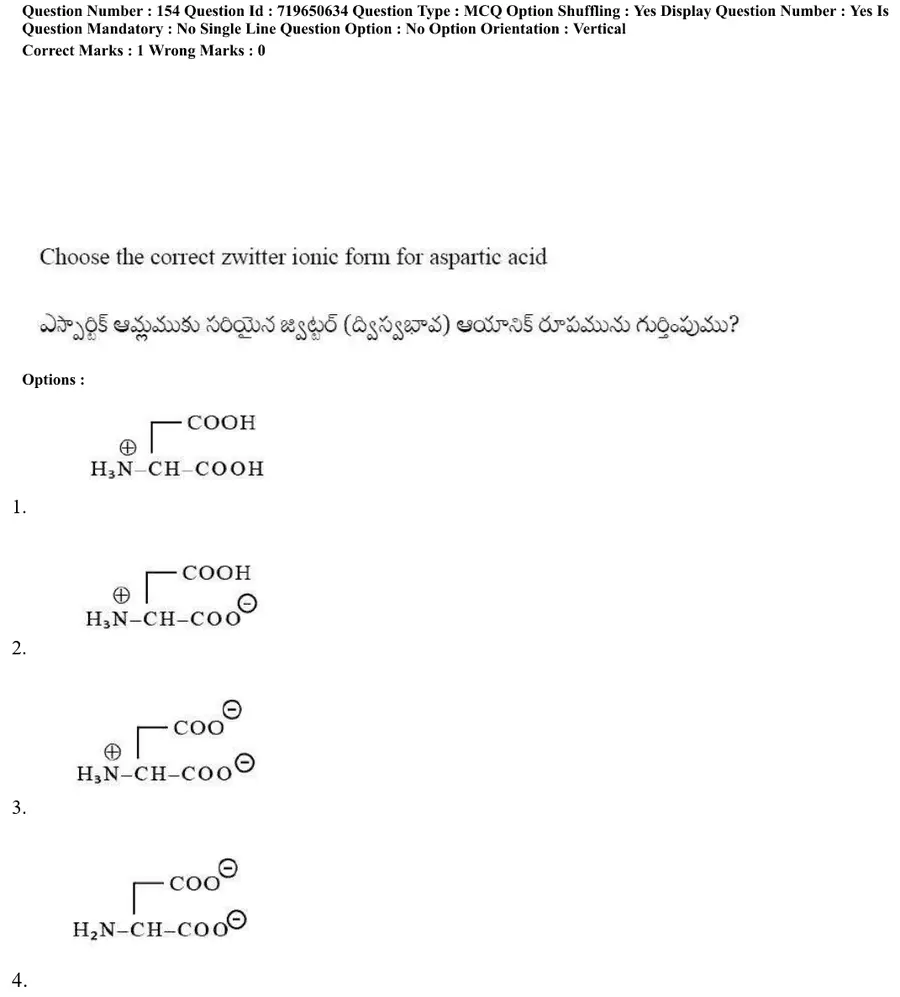
Choose the correct zwitter ionic form for aspartic acid

The question and its figure as printed in TS EAMCET 2020 10 Sep AN. Option 1: H3N^–CH(COOH)–COOH Option 2: H3N^–CH(COOH)–COO^ Option 3: H3N^–CH(COO^)–COO^ Option 4: H2N–CH(COO^)–COO^
The question as printed in the paper.
  • A

    see figure $\mathrm{H_3N^{\oplus}}$–CH(COOH)–COOH

  • B

    see figure $\mathrm{H_3N^{\oplus}}$–CH(COOH)–$\mathrm{COO^{\ominus}}$

  • C

    see figure $\mathrm{H_3N^{\oplus}}$–CH($\mathrm{COO^{\ominus}}$)–$\mathrm{COO^{\ominus}}$

  • D

    see figure $\mathrm{H_2N}$–CH($\mathrm{COO^{\ominus}}$)–$\mathrm{COO^{\ominus}}$

157TS EAMCET 2020 · 9 Sep · Shift 1MCQOpen question page ↗

Insulin and glucogen, which are responsible to maintain the blood glucose level, fall under

  • A

    Antibodies

  • B

    Harmones (sic)

  • C

    Enzymes

  • D

    Transport agents

158TS EAMCET 2020 · 9 Sep · Shift 2MCQOpen question page ↗

Starch, when boiled with dilute sulphuric acid under high pressure, gives compound A. On prolonged heating with hydroiodic acid, A gives compound B. What is the compound B?

  • A

    $\mathrm{CH_3-(CH_2)_4-CH_3}$

  • B

    $\mathrm{HO-CH_2-(CHOH)_4-CHO}$

  • C

    $\mathrm{HOOC-(CHOH)_4-COOH}$

  • D

    $\mathrm{HO-CH_2-(CHOH)_4-COOH}$

159TS EAMCET 2019 · 6 May · Shift 1MCQOpen question page ↗

Find the reagent that oxidises glucose into saccharic acid?

  • A

    $\mathrm{Br_2, H_2O}$

  • B

    $\mathrm{HI, \Delta}$

  • C

    $\mathrm{HNO_3, H_2O}$

  • D

    HCN

160TS EAMCET 2019 · 4 May · Shift 1MCQOpen question page ↗

Among the following B group vitamins, the deficiency of which one results in convulsions

  • A

    $\mathrm{B_6}$

  • B

    $\mathrm{B_{12}}$

  • C

    $\mathrm{B_1}$

  • D

    $\mathrm{B_2}$

161TS EAMCET 2019 · 4 May · Shift 2MCQOpen question page ↗

The product(s) formed when glucose reacts with a strong oxidising agent like $\mathrm{HNO_3}$ is/are

  • A

    $\mathrm{COOH(CHOH)_4COOH}$

  • B

    $\mathrm{CO_2}$, $\mathrm{H_2O}$

  • C

    $\mathrm{COOH(CHOH)_4CHO}$

  • D

    CO, $\mathrm{CO_2}$, $\mathrm{H_2O}$

162TS EAMCET 2019 · 3 May · Shift 1MCQOpen question page ↗

Which of the following are reducing sugars?
(A) Sucrose (B) Maltose (C) Lactose (D) Fructose

  • A

    A, B, C

  • B

    A, B, D

  • C

    A, C, D

  • D

    B, C, D

163TS EAMCET 2019 · 3 May · Shift 2MCQOpen question page ↗

The enzyme responsible for the convension of proteins to $\alpha$-amino acids is

  • A

    Pepsin

  • B

    Trypsin

  • C

    Maltase

  • D

    Amylase

164AP EAMCET 2019 · 23 Apr · Shift 1MCQOpen question page ↗

Which of the following statements are correct?
(A) A tripeptide has two peptide bonds
(B) A pentapeptide contains five amino acids
(C) Nucleotide is a product of base and sugar
(D) In cellulose, $\beta$-glycosidic linkages are present

  • A

    B, C, D

  • B

    C, D only

  • C

    A, B, D

  • D

    A, C only

166AP EAMCET 2019 · 22 Apr · Shift 1MCQOpen question page ↗

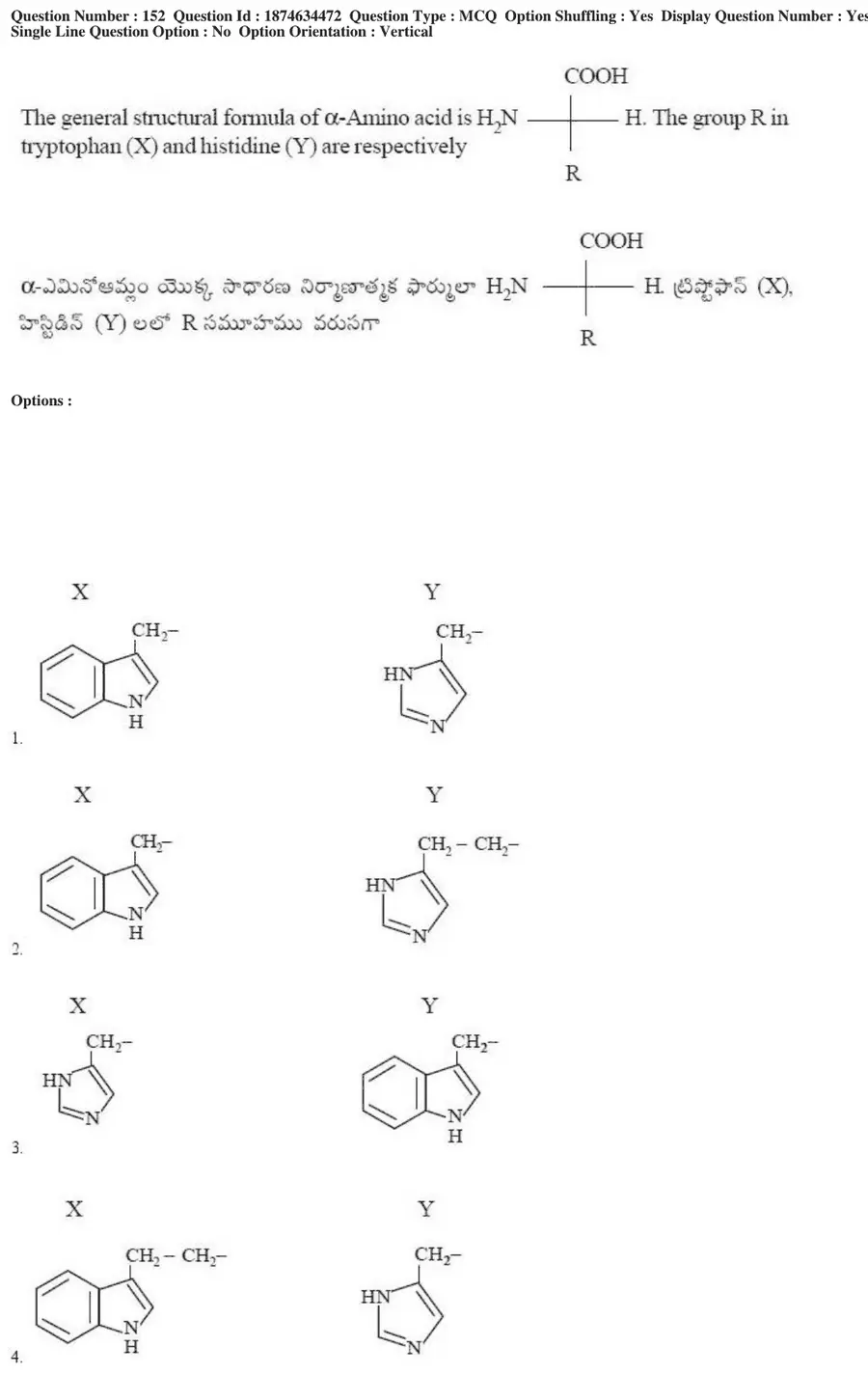
The general structural formula of $\alpha$-Amino acid is (see the figure above). The group R in tryptophan (X) and histidine (Y) are respectively

The question and its figure as printed in AP EAPCET 2019 22nd April 2019 Shift1. Option 1: X: indol-3-yl-CH2- ; Y: imidazol-4-yl-CH2- Option 2: X: indol-3-yl-CH2- ; Y: imidazol-4-yl-CH2-CH2- Option 3: X: imidazol-4-yl-CH2- ; Y: indol-3-yl-CH2- Option 4: X: indol-3-yl-CH2-CH2- ; Y: imidazol-4-yl-CH2-
The question as printed in the paper.
  • A

    see figure X: indol-3-yl-CH2- ; Y: imidazol-4-yl-CH2-

  • B

    see figure X: indol-3-yl-CH2- ; Y: imidazol-4-yl-CH2-CH2-

  • C

    see figure X: imidazol-4-yl-CH2- ; Y: indol-3-yl-CH2-

  • D

    see figure X: indol-3-yl-CH2-CH2- ; Y: imidazol-4-yl-CH2-

167AP EAMCET 2019 · 22 Apr · Shift 2MCQOpen question page ↗

Match the following.
List - I
A) Ascorbic acid
B) Vitamin D
C) Vitamin $\mathrm{B_1}$
D) Vitamin E
List - II
I) Rickets
II) Muscular weakness
III) Convulsions
IV) Amla
V) Beri beri
The correct answer is

  • A

    A-I, B-IV, C-II, D-III

  • B

    A-IV, B-I, C-III, D-II

  • C

    A-I, B-IV, C-III, D-II

  • D

    A-IV, B-I, C-V, D-II

168AP EAMCET 2019 · 21 Apr · Shift 1MCQOpen question page ↗

Identify the correct set from the following.
Each option is a row under the column headings: Vitamin | Source | deficiency disease

  • A

    $\mathrm{B_6}$ | Milk | convulsions

  • B

    K | Leaf vegetables | anaemia

  • C

    C | Fish | scurvy

  • D

    D | Citrus fruits | ricket (sic)

169AP EAMCET 2019 · 21 Apr · Shift 2MCQOpen question page ↗

Identify the correct statements from the following.
I) When DNA is hydrolysed adenine and thymine are obtained in equal quantities.
II) When RNA is hydrolysed adenine and uracil are obtained in equal quantities.
III) Amylose is branched polymer with $\alpha1\rightarrow4$ and $\alpha1\rightarrow6$ glycosidic linkages.
IV) Addison disease is due to the abnormal functioning of adrenal cortex.

  • A

    I, II, III only

  • B

    I, II, III, IV

  • C

    I, II, IV only

  • D

    I, IV only

170AP EAMCET 2019 · 20 Apr · Shift 1MCQOpen question page ↗

Identify the correct set of monosaccharides present in sucrose (X), lactose (Y) and maltose (Z).

  • A

    X: glucose, fructose; Y: galactose, glucose; Z: glucose, fructose

  • B

    X: glucose, fructose; Y: galactose, glucose; Z: glucose, glucose

  • C

    X: glucose, glucose; Y: galactose, glucose; Z: glucose, glucose

  • D

    X: galactose, glucose; Y: glucose, fructose; Z: glucose, glucose

171AP EAMCET 2019 · 20 Apr · Shift 2MCQOpen question page ↗

Which of the following statements about DNA is not correct?

  • A

    It has a double helix structure

  • B

    Adenine forms hydrogen bonds with thymine and cytosine forms hydrogen bonds with guanine

  • C

    The two strands in a DNA molecule are not complementary to each other

  • D

    It contains the pentose sugar, 2-deoxy ribose

172TS EAMCET 2018 · 7 May · Shift 1MCQOpen question page ↗

Which one of the following statements is correct?

  • A

    Starch on complete hydrolysis gives Fructose

  • B

    Lactose on hydrolysis gives Glucose and Fructose

  • C

    Glucose on slow oxidation to $\mathrm{CO_2}$ and $\mathrm{H_2O}$ by enzyme does not liberate energy

  • D

    Cellulose is not digestible in the human body

174TS EAMCET 2018 · 5 May · Shift 2MCQOpen question page ↗

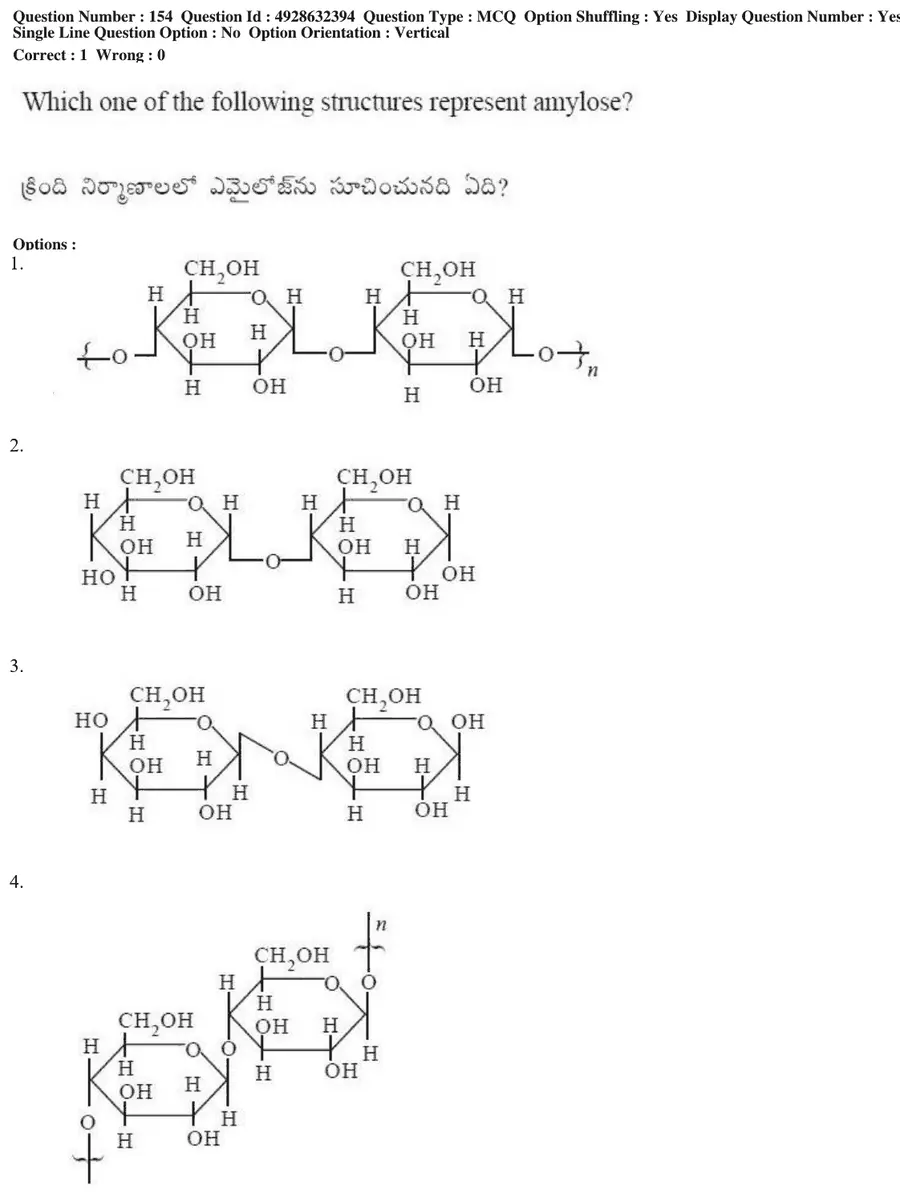
Which one of the following structures represent amylose?
(see the figure above)

The question and its figure as printed in TS EAPCET 2018 5th May Shift 2. Option 1: chain of two glucose rings (pyranose, each with CH2OH on top, ring O at top right) joined by an O bridge between the lower-right of the first ring and the left of the second; open ends "-O" at left and "O-n" at right Option 2: two pyranose rings joined by an O bridge at the lower side (ring 1 right to ring 2 left); no end brackets; HO on left ring's lower-left Option 3: two pyranose rings joined by an O bridge in a slanted manner (ring 1 upper right to ring 2 left); HO at top-left and OH at right of second ring Option 4: two pyranose rings joined through ring-O/side O with polymer end bonds marked "O" at…
The question as printed in the paper.
  • A

    see figure chain of two glucose rings (pyranose, each with CH2OH on top, ring O at top right) joined by an O bridge between the lower-right of the first ring and the left of the second; open ends "{-O" at left and "O-}n" at right

  • B

    see figure two pyranose rings joined by an O bridge at the lower side (ring 1 right to ring 2 left); no end brackets; HO on left ring's lower-left

  • C

    see figure two pyranose rings joined by an O bridge in a slanted manner (ring 1 upper right to ring 2 left); HO at top-left and OH at right of second ring

  • D

    see figure two pyranose rings joined through ring-O/side O with polymer end bonds marked "O" at lower-left and upper-right with subscript n; rings drawn stepwise (lower-left ring, upper-right ring)

175TS EAMCET 2018 · 4 May · Shift 1MCQOpen question page ↗

Which of the following carbohydrates has a glycosidic linkage?

  • A

    Fructofuranose

  • B

    Glucopyranose

  • C

    Maltose

  • D

    $\beta$ - D - Fructose

176TS EAMCET 2018 · 4 May · Shift 2MCQOpen question page ↗

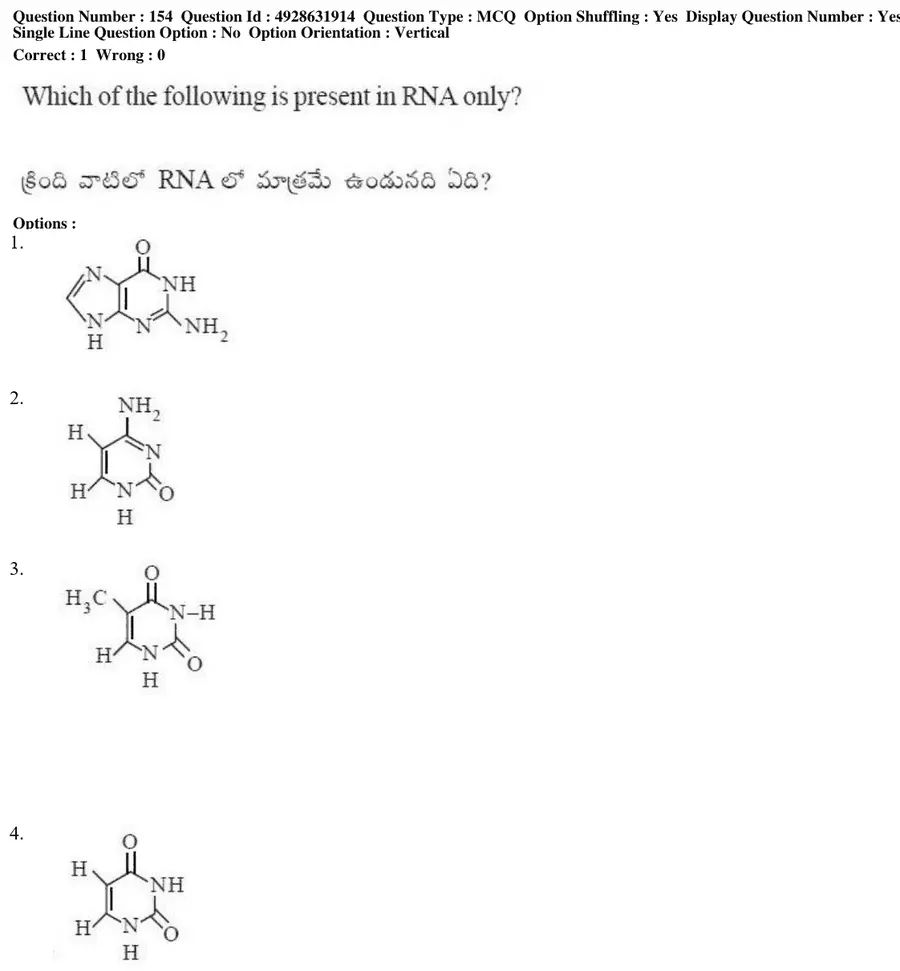
Which of the following is present in RNA only?
(see the figure above)

The question and its figure as printed in TS EAPCET 2018 4th May Shift 2. Option 1: fused imidazole-pyrimidine (purine) ring with C=O, NH, NH2 and ring N-H Option 2: pyrimidine ring with NH2, ring N, C=O, N-H and two H Option 3: pyrimidine ring with H3C, C=O, N-H, C=O, N-H and one H Option 4: pyrimidine ring with C=O, NH, C=O, N-H and two H
The question as printed in the paper.
  • A

    see figure fused imidazole-pyrimidine (purine) ring with C=O, NH, NH2 and ring N-H

  • B

    see figure pyrimidine ring with NH2, ring N, C=O, N-H and two H

  • C

    see figure pyrimidine ring with H3C, C=O, N-H, C=O, N-H and one H

  • D

    see figure pyrimidine ring with C=O, NH, C=O, N-H and two H

177AP EAMCET 2018 · 24 Apr · Shift 1MCQOpen question page ↗

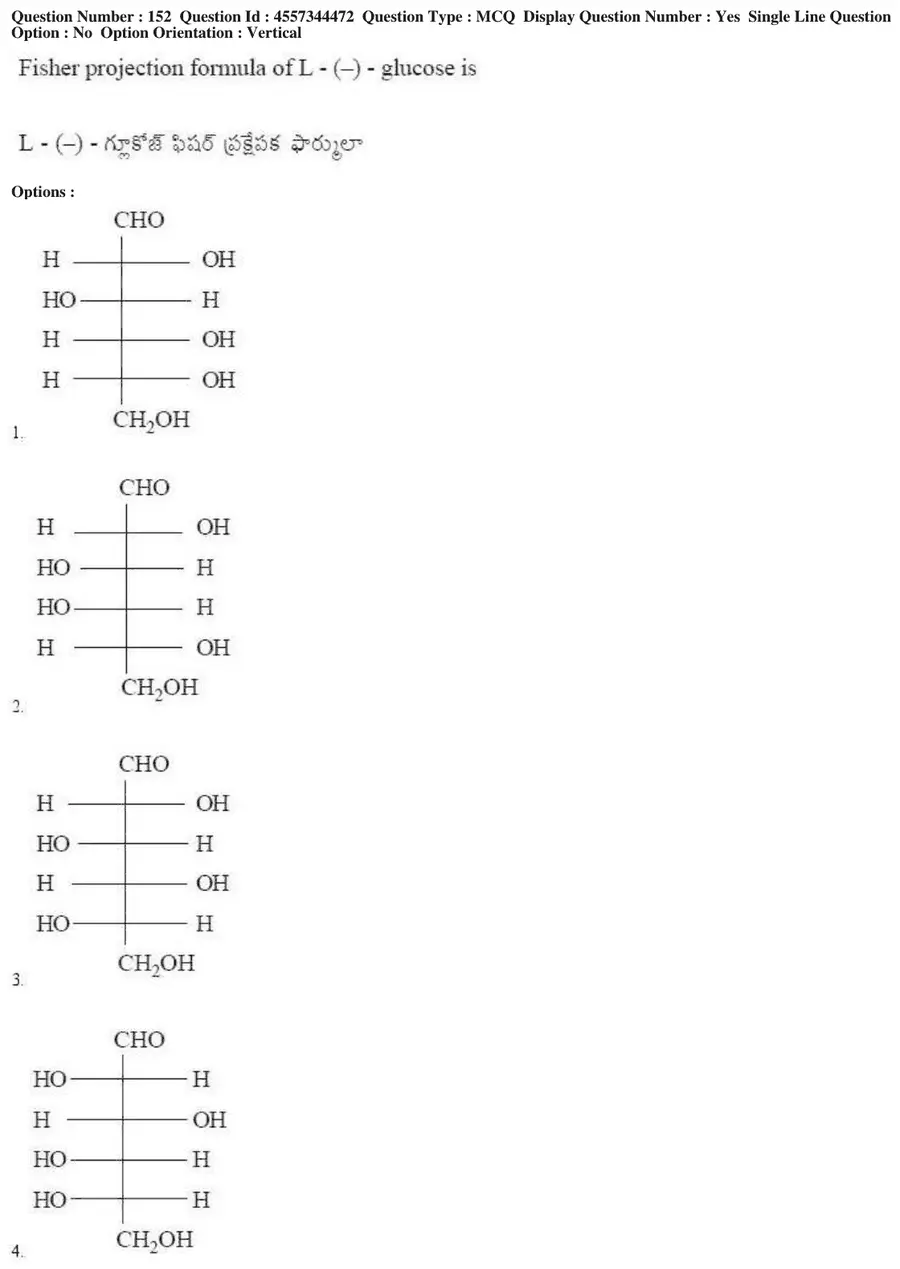
Fisher projection formula of L - (--) - glucose is
(see the figure above)

The question and its figure as printed in AP EAPCET 2018 24th April Shift 1. Option 1: CHO on top, CH2OH at bottom; substituents top to bottom (left | right): H|OH, HO|H, H|OH, H|OH Option 2: CHO on top, CH2OH at bottom; substituents top to bottom (left | right): H|OH, HO|H, HO|H, H|OH Option 3: CHO on top, CH2OH at bottom; substituents top to bottom (left | right): H|OH, HO|H, H|OH, HO|H Option 4: CHO on top, CH2OH at bottom; substituents top to bottom (left | right): HO|H, H|OH, HO|H, HO|H
The question as printed in the paper.
  • A

    see figure CHO on top, CH2OH at bottom; substituents top to bottom (left | right): H|OH, HO|H, H|OH, H|OH

  • B

    see figure CHO on top, CH2OH at bottom; substituents top to bottom (left | right): H|OH, HO|H, HO|H, H|OH

  • C

    see figure CHO on top, CH2OH at bottom; substituents top to bottom (left | right): H|OH, HO|H, H|OH, HO|H

  • D

    see figure CHO on top, CH2OH at bottom; substituents top to bottom (left | right): HO|H, H|OH, HO|H, HO|H

178AP EAMCET 2018 · 24 Apr · Shift 2MCQOpen question page ↗

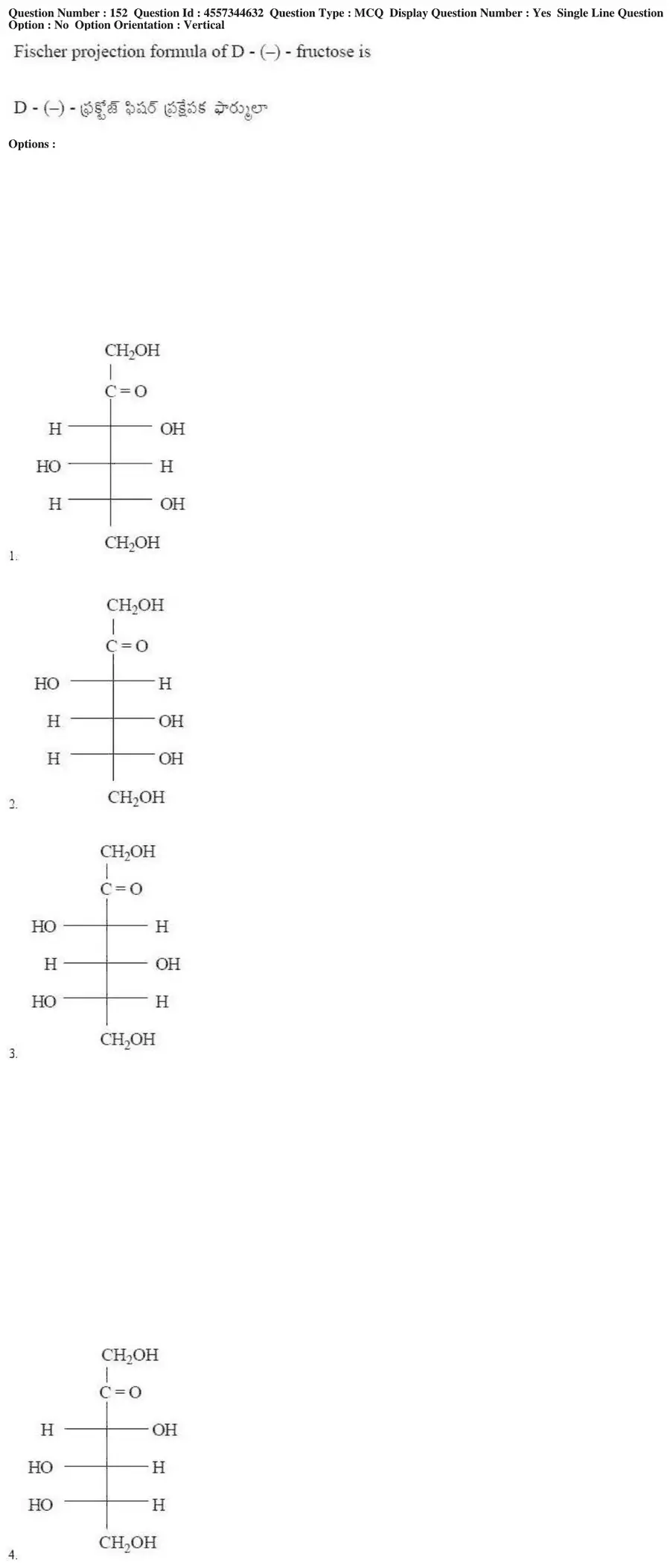
Fischer projection formula of D - (-) - fructose is
(see the figure above)

The question and its figure as printed in AP EAPCET 2018 24th April Shift 2. Option 1: Fischer: CH2OH on top, C=O, then three rows (left | right): H | OH; HO | H; H | OH; CH2OH at bottom Option 2: Fischer: CH2OH on top, C=O, then three rows (left | right): HO | H; H | OH; H | OH; CH2OH at bottom Option 3: Fischer: CH2OH on top, C=O, then three rows (left | right): HO | H; H | OH; HO | H; CH2OH at bottom Option 4: Fischer: CH2OH on top, C=O, then three rows (left | right): H | OH; HO | H; HO | H; CH2OH at bottom
The question as printed in the paper.
  • A

    see figure Fischer: CH2OH on top, C=O, then three rows (left | right): H | OH; HO | H; H | OH; CH2OH at bottom

  • B

    see figure Fischer: CH2OH on top, C=O, then three rows (left | right): HO | H; H | OH; H | OH; CH2OH at bottom

  • C

    see figure Fischer: CH2OH on top, C=O, then three rows (left | right): HO | H; H | OH; HO | H; CH2OH at bottom

  • D

    see figure Fischer: CH2OH on top, C=O, then three rows (left | right): H | OH; HO | H; HO | H; CH2OH at bottom

179AP EAMCET 2018 · 23 Apr · Shift 1MCQOpen question page ↗

The type of bond connecting two nucleotides is

  • A

    Peptide bond

  • B

    Hydrogen bond

  • C

    Phosphodiester bond

  • D

    Glycosidic bond

180AP EAMCET 2018 · 23 Apr · Shift 2MCQOpen question page ↗

Reducing saccharides among the following are
Sucrose (1), Ribose (2), Maltose (3), Lactose (4), Cellulose (5)

  • A

    2, 4, 5

  • B

    1, 3, 4

  • C

    2, 3, 5

  • D

    2, 3, 4

181AP EAMCET 2018 · 22 Apr · Shift 1MCQOpen question page ↗

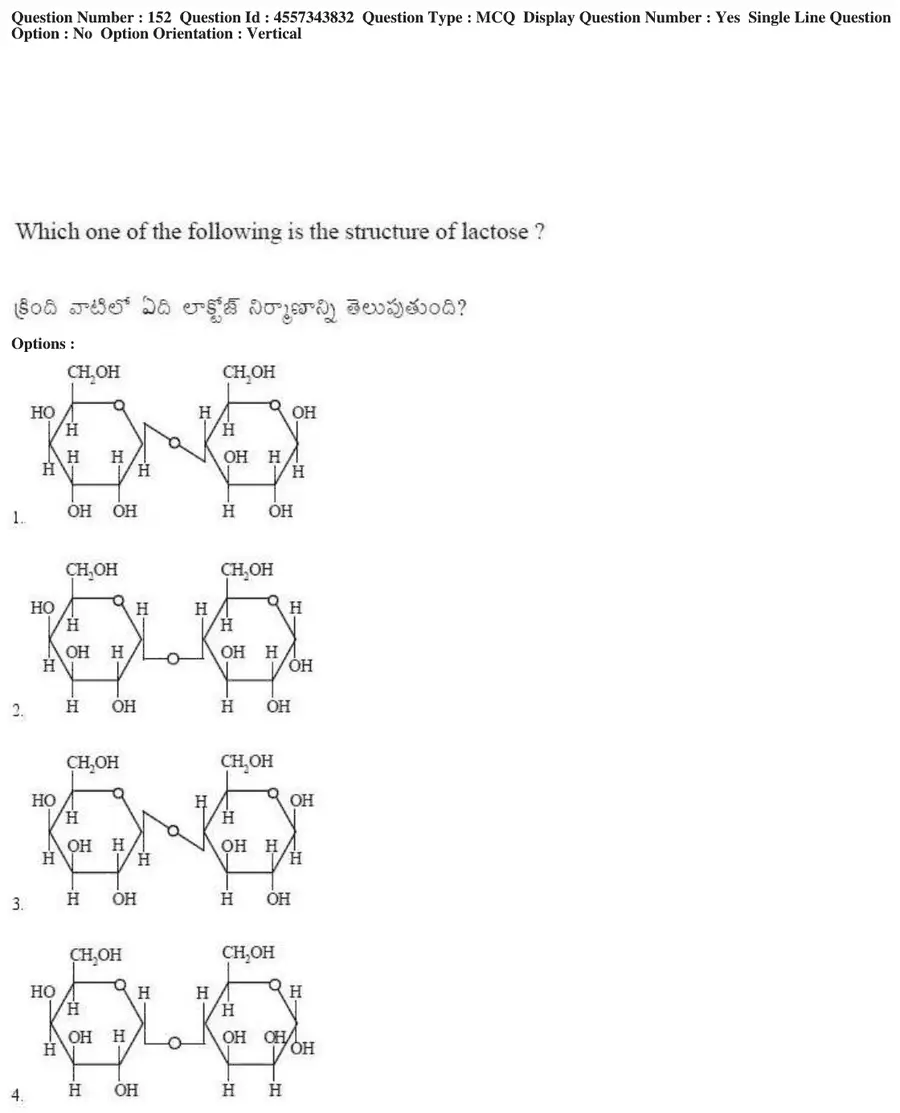
Which one of the following is the structure of lactose ?

The question and its figure as printed in AP EAPCET 2018 22nd April Shift 1. Option 1: Two six-membered pyranose rings joined by an oxygen bridge drawn as a slanted bond. Left ring: CH2OH top, HO left, H and H/H on inner positions, OH and OH at bottom. Right ring: CH2OH top, H, OH H, H OH at bottom, OH at upper right. Option 2: Two pyranose rings joined by an oxygen bridge drawn as a horizontal bond. Left ring: CH2OH top, HO left, H at upper right, OH H inner, H OH at bottom. Right ring: CH2OH top, H upper left, H upper right, OH H inner, OH at right, H OH at bottom. Option 3: Two pyranose rings joined by an oxygen bridge drawn as a slanted bond. Left ring: CH2OH top, HO left, OH H inner…
The question as printed in the paper.
  • A

    see figure Two six-membered pyranose rings joined by an oxygen bridge drawn as a slanted bond. Left ring: CH2OH top, HO left, H and H/H on inner positions, OH and OH at bottom. Right ring: CH2OH top, H, OH H, H OH at bottom, OH at upper right.

  • B

    see figure Two pyranose rings joined by an oxygen bridge drawn as a horizontal bond. Left ring: CH2OH top, HO left, H at upper right, OH H inner, H OH at bottom. Right ring: CH2OH top, H upper left, H upper right, OH H inner, OH at right, H OH at bottom.

  • C

    see figure Two pyranose rings joined by an oxygen bridge drawn as a slanted bond. Left ring: CH2OH top, HO left, OH H inner, H lower right, H OH at bottom. Right ring: CH2OH top, OH at upper right, OH H inner, H lower right, H OH at bottom.

  • D

    see figure Two pyranose rings joined by an oxygen bridge drawn as a horizontal bond. Left ring: as option 2. Right ring: CH2OH top, H upper right, OH OH inner, OH at right, H H at bottom.

182AP EAMCET 2018 · 22 Apr · Shift 2MCQOpen question page ↗

$\beta$-D-(-)-Fructofuranose is
(see the figure above)

The question and its figure as printed in AP EAPCET 2018 22nd April Shift 2. Option 1: furanose ring A (see fig) Option 2: furanose ring B (see fig) Option 3: furanose ring C (see fig) Option 4: furanose ring D (see fig)
The question as printed in the paper.
  • A

    see figure furanose ring A (see fig)

  • B

    see figure furanose ring B (see fig)

  • C

    see figure furanose ring C (see fig)

  • D

    see figure furanose ring D (see fig)

184AP EAMCET 2017 · 26 Apr · Shift 1MCQOpen question page ↗

Identify the statements which are not correct from the following
a) Carbohydrates are stored as glycogen in animals
b) In glycylalanine, $-\overset{\mathrm{O}}{\overset{\|}{\mathrm{C}}}-$ of peptide bond belongs to alanine
c) Base - Sugar - phosphate unit is known as nucleoside
d) Obesity is due to hypothyroidism
The correct answer is

  • A

    a, c, d

  • B

    a, d

  • C

    b, c

  • D

    b, c, d

185AP EAMCET 2017 · 26 Apr · Shift 2MCQOpen question page ↗

Which of the following statements are correct ?
a. Deficiency of vitamin K results in increased blood clotting time.
b. The sources of vitamin $\mathrm{B_2}$ are milk and liver
c. Hexapeptide has six peptide bonds
d. Improper functioning of adrenal cortex results in hypoglycemia.

  • A

    b, c

  • B

    a, c

  • C

    b, d

  • D

    a, b, d

186AP EAMCET 2017 · 25 Apr · Shift 1MCQOpen question page ↗

Which of the following statements are correct?
a) In maltose, C-1 of one $\alpha$-D-glucose is linked to C-4 of second $\alpha$-D-glucose
b) Quaternary structure of protein represents spatial arrangement of two or more polypeptide chains with respect to each other
c) Nucleotide units in a nucleic acid are joined to each other through a phosphodiester linkage
d) Abnormally low level of thyroxine leads to hypothyroidism

  • A

    a, b, c

  • B

    a, b, c, d

  • C

    b, c

  • D

    a, c, d

187AP EAMCET 2017 · 25 Apr · Shift 2MCQOpen question page ↗

Match the following
List - I: a) Vitamin E b) Vitamin K c) Vitamin $\mathrm{B_{12}}$ d) Vitamin $\mathrm{B_2}$
List - II: i) Meat ii) Sunflower oil iii) Egg white iv) Exposure to sunlight v) Green leafy vegetables
The correct answer is

  • A

    a-iii, b-ii, c-iv, d-i

  • B

    a-ii, b-v, c-i, d-iii

  • C

    a-i, b-iii, c-ii, d-v

  • D

    a-iv, b-i, c-v, d-ii

188AP EAMCET 2017 · 24 Apr · Shift 1MCQOpen question page ↗

$\beta$-D-(+)-Glucopyranose is
(see the figure above)

The question and its figure as printed in AP EAPCET 2017 24th April 2017 Shift1. Option 1: Fischer-type ring projection Option 2: Fischer-type ring projection Option 3: Fischer-type ring projection Option 4: Fischer-type ring projection
The question as printed in the paper.
  • A

    see figure Fischer-type ring projection

  • B

    see figure Fischer-type ring projection

  • C

    see figure Fischer-type ring projection

  • D

    see figure Fischer-type ring projection

189AP EAMCET 2017 · 24 Apr · Shift 2MCQOpen question page ↗

The general formula of a $\alpha$ - amino acid is
$\mathrm{H_2N-CH-COOH}$ with R on the CH
(see the figure above)
Identify $-$R in serine

The question and its figure as printed in AP EAPCET 2017 24th April 2017 Shift2.
The question as printed in the paper.
  • A

    $-\mathrm{CH_2SH}$

  • B

    $-\mathrm{CH_2OH}$

  • C

    $-\mathrm{CH(OH)-CH_3}$

  • D

    $-\mathrm{CH_2-C(=O)-NH_2}$

190TS EAMCET 2016 · 15 May · OfflineMCQOpen question page ↗

Hormone that maintains the blood glucose level within the limit is :

  • A

    Thyroxine

  • B

    Insulin

  • C

    Testosterone

  • D

    Epinephrine

191AP EAMCET 2016 · 29 Apr · OfflineMCQOpen question page ↗

Observe the following statements
i) Sucrose has glycosidic linkage
ii) Cellulose is present in both plants and animals
iii) Lactose contains D-galactose and D-glucose units
The correct statements are

  • A

    (i), (ii), (iii)

  • B

    (i), (ii)

  • C

    (ii), (iii)

  • D

    (i), (iii)

192AP EAMCET 2014 · 22 May · OfflineMCQOpen question page ↗

Lactose is a disaccharide of ______.

  • A

    $\alpha$-D-Glucose and $\alpha$-D-Fructose

  • B

    $\beta$-D-Glucose and $\beta$-D-Galactose

  • C

    $\alpha$-D-Glucose and $\beta$-D-Ribose

  • D

    $\alpha$-D-Glucose and $\beta$-D-Galactose

193AP EAMCET 2013 · 10 May · OfflineMCQOpen question page ↗

The number of hydrogen bonds between Guanine & Cytosine; and between Adenine & Thymine in DNA is :

  • A

    1, 2

  • B

    3, 2

  • C

    3, 1

  • D

    2, 1

194AP EAMCET 2012 · 12 May · OfflineMCQOpen question page ↗

Which one of the following is used in the preparation of cellulose nitrate ?

  • A

    $\mathrm{KNO_3}$

  • B

    $\mathrm{HNO_3}$

  • C

    $\mathrm{KNO_2}$

  • D

    $\mathrm{HNO_2}$

How to prepare Biomolecules for EAPCET

How often it comes up

Biomolecules is one of the most reliable foundational chapters in the entire EAPCET chemistry curriculum. Over the full span from 2010 through 2026, the chapter delivered 198 questions across 149 evaluated exam papers, featuring in 147 of those sittings for an average of 1.3 questions per paper and a 3.3 percent subject share. In the modern timeframe from 2022 to 2026, Biomolecules has appeared in every single paper, contributing 119 questions across 77 sittings (an average of 1.5 questions per paper and a 3.9 percent subject share). This places Biomolecules at rank 9 among all 31 chemistry chapters.

Every recent session includes at least one question from this unit. Looking at the three most recent exam years from 2024 to 2026, students encountered 68 questions across 46 papers, appearing in all 46 sittings to average 1.5 questions per test with a 3.7 percent share. In the older testing period from 2010 to 2021, the chapter accounted for 79 questions across 72 sittings (appearing in 70 papers, averaging 1.1 per paper and a 2.7 percent share). Comparing early testing with the last three years shows the share is up, while comparing recent testing with the last three years shows the share is about the same. Across individual state boards from 2022 to 2026, Andhra Pradesh papers featured 90 questions across 48 sessions (present in all 48, averaging 1.9 per test and a 4.7 percent share), whereas Telangana papers included 29 questions across 29 sittings (present in all 29, averaging 1.0 per test and a 2.5 percent share).

Most-asked topics

Questions from Biomolecules fall into three closely balanced biological chemistry divisions:

  • Carbohydrates (75 questions overall, 40 recent, last asked in 2026): Haworth cyclic pyranose and furanose forms of D-glucose and D-fructose, anomeric carbons, mutarotation, glycosidic linkages in maltose, lactose, and sucrose, reducing versus non-reducing sugars, and structural features of starch, glycogen, and cellulose.
  • Amino Acids & Proteins (57 questions overall, 40 recent, last asked in 2026): Classification of amino acids as essential or non-essential, neutral, acidic, or basic, zwitterion structures, isoelectric points, peptide bond formation, levels of protein structure (primary, secondary alpha-helix and beta-pleated sheets, tertiary, and quaternary), and denaturation mechanisms.
  • Vitamins, Nucleic Acids & Hormones (66 questions overall, 39 recent, last asked in 2026): Fat-soluble versus water-soluble vitamins with their corresponding deficiency disorders, purine and pyrimidine nitrogenous bases, nucleoside versus nucleotide architecture, phosphodiester backbones, hydrogen bonding base pairs in DNA double helix, and peptide versus steroid hormones.

What the questions look like

Examiners heavily favor direct recognition questions, structure matching, and linkage identification. A widespread question type asks candidates to pinpoint the exact positions linked by an oxygen bridge in disaccharides, such as distinguishing the alpha-one-four linkage of maltose from the beta-one-four linkage of lactose or the alpha-one-beta-two linkage of sucrose.

Other standard formats present table-matching grids connecting specific vitamins with deficiency syndromes (like scurvy, rickets, or cheilosis), or linking amino acids to their distinctive side-chain characteristics (such as aromatic rings in tyrosine or sulfur atoms in cysteine). Questions on nucleic acids frequently ask students to differentiate between ribose and two-deoxyribose, or to identify which nitrogen base is unique to RNA versus DNA.

Questions to try first

Begin your practice with these authentic recent examination problems:

How to practise it

Start by creating a clean summary chart of all carbohydrates mentioned in the standard textbook. For each sugar, record whether it is a monosaccharide, disaccharide, or polysaccharide; note the constituent monomers; specify the glycosidic linkage carbon numbers; and record whether it reduces Fehling solution and Tollens reagent. Remember that sucrose is a non-reducing sugar because both anomeric carbons participate in the glycosidic bond.

Next, master the twenty standard amino acids by category. Memorize the essential amino acids using standard mnemonics, and note special structural traits such as the only achiral amino acid (glycine), sulfur-containing residues (cysteine and methionine), and aromatic units (phenylalanine, tyrosine, and tryptophan). Finally, tabulate the water-soluble and fat-soluble vitamins along with their biochemical functions and deficiency ailments to secure rapid marks on matching questions.

Frequently asked questions

Why is sucrose classified as an invert sugar?

Sucrose is dextrorotatory, but upon acid or enzymatic hydrolysis, it yields an equimolar mixture of dextrorotatory D-glucose and more strongly levorotatory D-fructose. The resulting mixture has a net negative optical rotation, causing an inversion in the sign of optical activity.

What chemical forces stabilize the secondary structure of proteins?

The secondary structure of proteins, including alpha-helices and beta-pleated sheets, is stabilized primarily by regular hydrogen bonding between the carbonyl oxygen of one peptide bond and the amino hydrogen of another peptide unit along the polypeptide backbone.

Which nitrogenous bases are present in RNA compared to DNA?

Both RNA and DNA share adenine, guanine, and cytosine. However, RNA contains uracil instead of thymine, which pairs with adenine during transcriptional processes. Step-by-step solutions for each one are in the EdLoop EAPCET app.

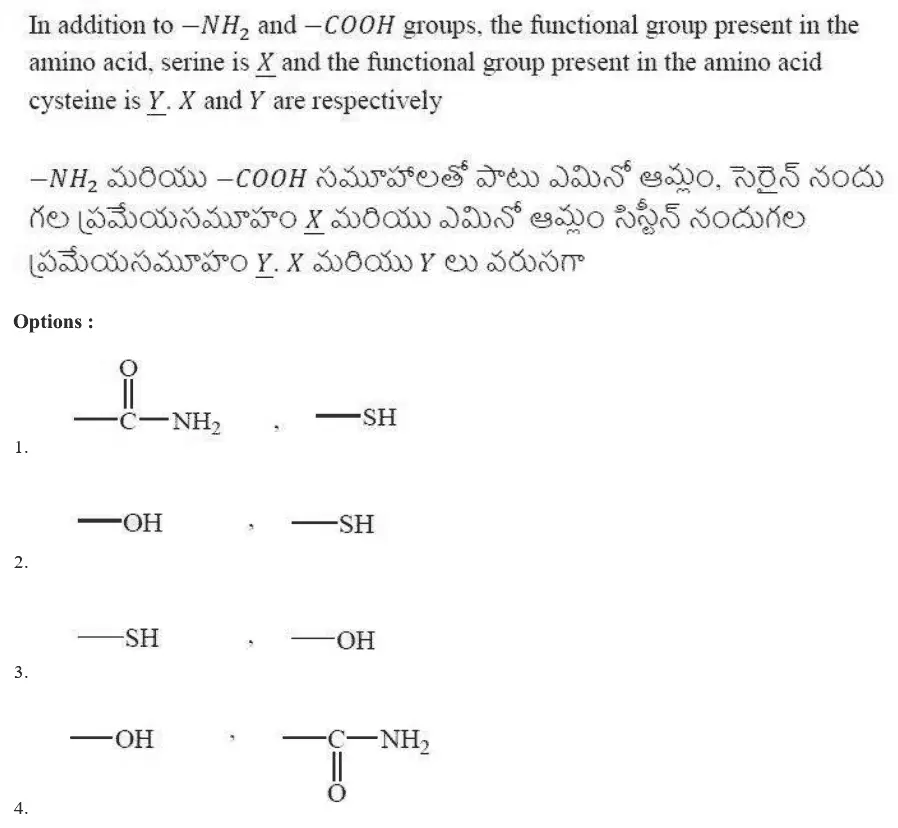
Get EdLoop – freeOpen on the web