EdLoop PYQs · free, no ads · questions and answers here, step-by-step solutions in the EdLoop app
PYQs · free, no adsOpen on the web (app.edloop.in)Get EdLoop – free on Google Play
ChemistryPurification & Characterisation

Purification & Characterisation: AP & TS EAPCET PYQs 2011–2026

Every Purification & Characterisation question from past AP EAPCET and TS EAPCET papers, with options and answers. Newest first.

53questions
45papers covered
0.7%of Chemistry questions, 2022–2026
2011–2026years

Guide at a glance

Purification & Characterisation occupies position 30 among the 31 chemistry chapters in the modern 2022 to 2026 testing cycle.

Most asked sub-topics

Quantitative Analysis23
Purification Methods18
Qualitative Analysis12

Practise these in EdLoop

Attempt every Purification & Characterisation question timed, see the step-by-step solution and track what you get wrong. Free.

Start practice

All questions

53 questions
1AP EAPCET 2026 · 18 May · Shift 2MCQOpen question page ↗

In the estimation of sulphur by Carius method, $x$ g of an organic compound gave 0.233 g of $\mathrm{BaSO_4}$. If the percentage of sulphur in it is 8.89%, the value of $x$ is

($At.wt$; $Ba = 137\ u, S = 32\ u, O = 16\ u$)

  • A

    0.12

  • B

    0.24

  • C

    0.36

  • D

    0.48

2AP EAPCET 2026 · 15 May · Shift 1MCQOpen question page ↗

1.5 g of an organic compound was analysed by Kjeldahl's method for estimation of nitrogen. The ammonia liberated was passed into 30 mL of 1N $\mathrm{HCl}$ solution. The remaining $\mathrm{HCl}$ was further neutralised by 120 mL of N/10 $\mathrm{NaOH}$ solution. The percentage of nitrogen in the compound is

  • A

    18.6

  • B

    16.8

  • C

    36.3

  • D

    28.4

3AP EAPCET 2026 · 14 May · Shift 1MCQOpen question page ↗

A mixture (X) contains two liquids with large difference in their boiling points. Another mixture (Y) contains two liquids with not much difference in their boiling points. Mixtures X and Y can be separated respectively by the methods

  • A

    Simple distillation, Steam distillation

  • B

    Simple distillation, Fractional distillation

  • C

    Fractional distillation, Simple distillation

  • D

    Steam distillation, Fractional distillation

4AP EAPCET 2026 · 13 May · Shift 1MCQOpen question page ↗

An organic compound containing an extra element $E$ on reaction with $\mathrm{Na_2O_2}$ followed by boiling with $\mathrm{HNO_3}$ gives a compound. This on treatment with ammonium molybdate solution gives yellow precipitate. What is $E$?

  • A

    $S$

  • B

    $N$

  • C

    $P$

  • D

    $I$

5AP EAPCET 2026 · 12 May · Shift 1MCQOpen question page ↗

0.248 g of an organic compound was strongly heated in a Carius tube with fuming $\mathrm{HNO_3}$. Phosphoric acid so produced was precipitated as $\mathrm{MgNH_4PO_4}$. This on ignition gave 0.444 g of $\mathrm{Mg_2P_2O_7}$. The percentage of phosphorus in the compound is
(Atomic weight: Mg=24 u, P = 31 u, O = 16 u)

  • A

    25

  • B

    34

  • C

    50

  • D

    68

6AP EAPCET 2026 · 12 May · Shift 2MCQOpen question page ↗

Which of the following will be suitable for estimation of nitrogen by Kjeldahl's method?

  • A

    Benzene diazonium chloride

  • B

    Nitrobenzene

  • C

    Amino benzene

  • D

    Pyridine

7TS EAPCET 2026 · 11 May · Shift 1MCQOpen question page ↗

An organic compound contains 69.4% C, 5.8% H, $x$ % N and $y$ % O. A sample of 0.30 g of this compound was analyzed for nitrogen by Kjeldahl's method. The ammonia evolved was absorbed in 50 mL of 0.05 M $\mathrm{H_2SO_4}$. The excess acid required 25 mL of 0.1 M NaOH for neutralization. The empirical formula of the compound is

  • A

    $\mathrm{C_3H_3NO}$

  • B

    $\mathrm{C_6H_6N_2O}$

  • C

    $\mathrm{C_7H_7NO}$

  • D

    $\mathrm{C_8H_7N_2O}$

8TS EAPCET 2026 · 10 May · Shift 1MCQOpen question page ↗

Match the following

List-1 (Mixture)List-2 (Separation method)
A. $\mathrm{CHCl_3}$ (b.p 334 K) + $\mathrm{C_6H_5NH_2}$ (b.p 457 K)I. Steam distillation
B. Naphthalene + NaClII. Distillation
C. $\mathrm{C_6H_5NH_2 + H_2O}$III. Sublimation
D. Organic compound present in aqueous mediumIV. Distillation under reduced pressure
V. Differential extraction

The correct answer is

  • A

    A – II, B – I, C – III, D – IV

  • B

    A – II, B – III, C – I, D – V

  • C

    A – II, B – V, C – IV, D – III

  • D

    A – IV, B – III, C – II, D – I

9TS EAPCET 2026 · 10 May · Shift 1MCQOpen question page ↗

In the estimation of nitrogen by Kjeldahl’s method, the ammonia produced by 2.0 g of an organic compound was completely neutralized by 20mL of 2M sulphuric acid. The percentage of nitrogen in the compound is

  • A

    56

  • B

    28

  • C

    36

  • D

    46

10TS EAPCET 2026 · 10 May · Shift 2MCQOpen question page ↗

The correct statements about paper chromatography are

I. It is type of adsorption chromatography

II. It is type of partition chromatography

III. Both stationary and mobile phases are liquids

IV. Stationary phase is solid and mobile phase is liquid

The correct answer is

  • A

    II & III

  • B

    III & IV

  • C

    I & IV

  • D

    I & III

11TS EAPCET 2026 · 10 May · Shift 2MCQOpen question page ↗

Consider the following

Benzene diazonium chloride, Nitrobenzene, Pyridine, Aniline, Benzylamine, urea.

How many of the above compounds are not suitable for the estimation of nitrogen by Kjeldahl's method?

  • A

    3

  • B

    2

  • C

    4

  • D

    1

12TS EAPCET 2026 · 9 May · Shift 1MCQOpen question page ↗

The compound X can be separated from spent-lye in soap industry by using distillation under reduced pressure. What is X?

  • A

    $\mathrm{CH_3CH_2OH}$

  • B

    $\mathrm{CH_2(OH)CH_2(OH)}$

  • C

    $\mathrm{HOCH_2CH(OH)CH_2OH}$

  • D

    $\mathrm{HOCH_2(CHOH)_2CH_2OH}$

13TS EAPCET 2026 · 9 May · Shift 2MCQOpen question page ↗

Match the extra element present in the organic compound (List-1) with the reagent used for its detection (List-2)

List-1List-2
ANI$\mathrm{(NH_4)_2MoO_4}$
BSII$\mathrm{AgNO_3}$
CPIII$\mathrm{FeSO_4 \mid H^+}$
DIIV$\mathrm{Na_2[Fe(CN)_5NO]}$

The correct answer is

  • A

    A – IV, B – I, C – II, D – III

  • B

    A – IV, B – III, C – II, D – I

  • C

    A – III, B – I, C – IV, D – II

  • D

    A – III, B – IV, C – I, D – II

14AP EAPCET 2025 · 23 May · Shift 1MCQOpen question page ↗

The element whose percentage composition in an organic compound can be determined by Carius method is

  • A

    Nitrogen

  • B

    Sulphur

  • C

    Carbon

  • D

    Oxygen

15AP EAPCET 2025 · 23 May · Shift 1MCQOpen question page ↗

'x' mg of an organic compound was analysed by Kjeldahl method. The ammonia evolved was absorbed in 50 mL of 0.5 M $\mathrm{H_2SO_4}$. The unused acid required 60 mL of 0.5 M $\mathrm{NaOH}$ solution for complete neutralisation. If the percentage of nitrogen in the compound is 56, the value of $x$ is

  • A

    500

  • B

    250

  • C

    750

  • D

    375

16AP EAPCET 2025 · 22 May · Shift 2MCQOpen question page ↗

Which method is used to purify liquids having very high boiling points and liquids which decompose at or below their boiling point ?

  • A

    Distillation

  • B

    Fractional distillation

  • C

    Distillation under reduced pressure

  • D

    Steam distillation

17TS EAPCET 2025 · 4 May · Shift 1MCQOpen question page ↗

Which purification method is generally used for a high boiling organic liquid compound, which decompose below its boiling point?

  • A

    Distillation

  • B

    Distillation under reduced pressure

  • C

    Steam distillation

  • D

    Fractional distillation

18TS EAPCET 2025 · 3 May · Shift 1MCQOpen question page ↗

Which one of the following mixtures can be separated by steam distillation technique?

  • A

    n-Hexane + n-Heptane

  • B

    $\mathrm{CHCl_3}$ + Aniline

  • C

    Aniline + $\mathrm{H_2O}$

  • D

    Glucose + NaCl

19TS EAPCET 2025 · 3 May · Shift 2MCQOpen question page ↗

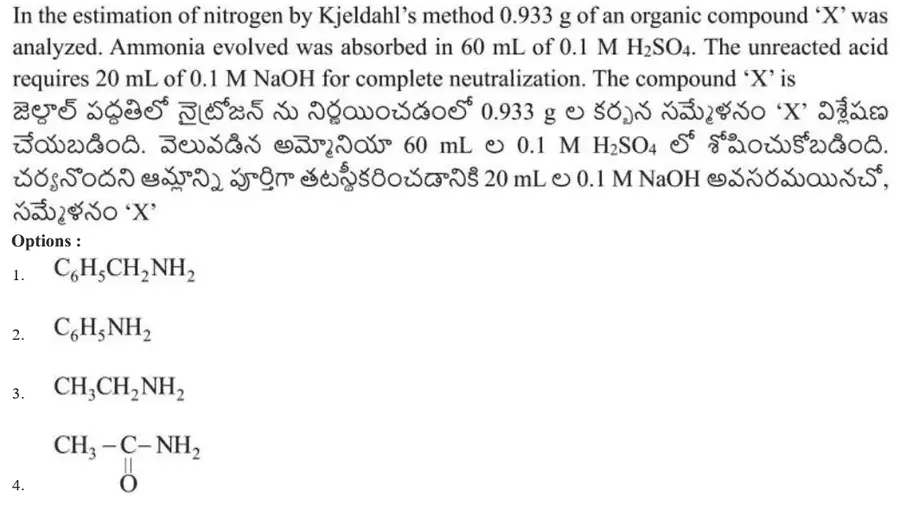
In the estimation of nitrogen by Kjeldahl’s method 0.933 g of an organic compound ‘X’ was analyzed. Ammonia evolved was absorbed in 60 mL of 0.1 M $\mathrm{H_2SO_4}$. The unreacted acid requires 20 mL of 0.1 M NaOH for complete neutralization. The compound ‘X’ is

The question and its figure as printed in TS EAPCET 2025 03rd May 2025 Shift 2.
The question as printed in the paper.
  • A

    $\mathrm{C_6H_5CH_2NH_2}$

  • B

    $\mathrm{C_6H_5NH_2}$

  • C

    $\mathrm{CH_3CH_2NH_2}$

  • D

    $\mathrm{CH_3-C-NH_2}$ with a C=O double bond (O drawn below the C) (see the figure above)

20TS EAPCET 2025 · 2 May · Shift 1MCQOpen question page ↗

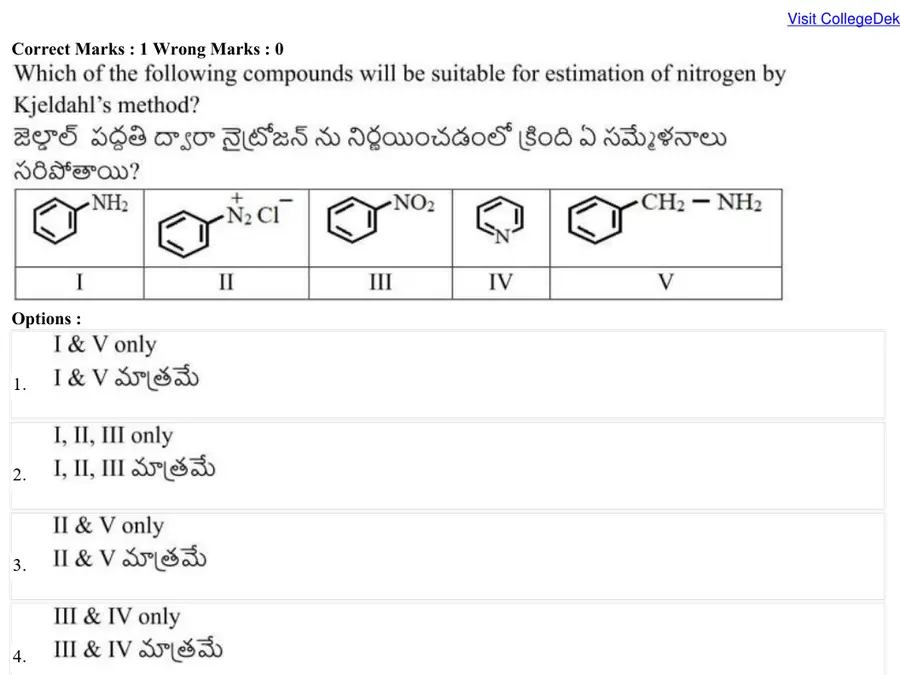
Which of the following compounds will be suitable for estimation of nitrogen by Kjeldahl’s method?

(see the figure above)

The question and its figure as printed in TG EAPCET 2025 02 May FN.
The question as printed in the paper.
  • A

    I & V only

  • B

    I, II, III only

  • C

    II & V only

  • D

    III & IV only

21TS EAPCET 2025 · 2 May · Shift 2MCQOpen question page ↗

When sodium fusion extract of an organic compound is boiled with iron (II) sulphate solution followed by addition of concentrated $\mathrm{H_2SO_4}$, gives Prussian blue colour. This confirms the presence of the element

  • A

    Sulphur

  • B

    Chlorine

  • C

    Phosphorus

  • D

    Nitrogen

22AP EAPCET 2024 · 20 May · Shift 2MCQOpen question page ↗

A mixture of substances A, B, C, D is subjected to column chromatography. The degree of adsorption is in the order of $\mathrm{D > B > C > A}$. The column is eluted with suitable solvent. Identify the correct statement with respect to separation of mixture

  • A

    D comes out first from the column

  • B

    A comes out first from the column

  • C

    C comes out after B from the column

  • D

    B comes out after D from the column

23TS EAPCET 2024 · 10 May · Shift 1MCQOpen question page ↗

An organic compound containing phosphorous on oxidation with $\mathrm{Na_2O_2}$ gives a compound ‘X’. This ‘X’ when boiled with $\mathrm{HNO_3}$ followed by treatment with a reagent gives yellow precipitate Y. X and Y respectively are

  • A

    $\mathrm{Na_3PO_4, (NH_4)_2MoO_3}$

  • B

    $\mathrm{Na_3PO_4, (NH_4)_2MoO_4}$

  • C

    $\mathrm{H_3PO_4, (NH_4)_2MoO_4}$

  • D

    $\mathrm{Na_3PO_4, (NH_4)_3PO_4 \cdot 12MoO_3}$

25AP EAMCET 2021 · 25 Aug · Shift 2MCQOpen question page ↗

$0.765\,g$ of an acid gives $0.535\,g$ of $\mathrm{CO_2}$ and $0.13\,g$ of $\mathrm{H_2O}$ then ratio of percentage of $\mathrm{C}$ and $\mathrm{H}$ is ________

  • A

    $19 : 2$

  • B

    $18 : 11$

  • C

    $20 : 17$

  • D

    $1 : 7$

26AP EAMCET 2021 · 25 Aug · Shift 2MCQOpen question page ↗

Using Duma's method for estimating nitrogen, $0.1\,g$ of an organic compound 'X' gave $82\,\mathrm{ml}$ of nitrogen, collected at $27\,^\circ\mathrm{C}$ and $750\,\mathrm{mm\,Hg}$ pressure. If the aqueous tension at $27\,^\circ\mathrm{C}$ is $30\,\mathrm{mm\,Hg}$ pressure, then the percentage of nitrogen in the given compound X is ______

  • A

    $22.09\,\%$

  • B

    $88.36\,\%$

  • C

    $44.18\,\%$

  • D

    $70.69\,\%$

27AP EAMCET 2021 · 24 Aug · Shift 2MCQOpen question page ↗

In thin layer chromatography, a substance moved by a distance of $4\ \mathrm{cm}$, where as the solvent moved by a distance of $5\ \mathrm{cm}$. Then the value of retardation factor $(R_f)$ is ____

  • A

    0.8

  • B

    1.0

  • C

    9.0

  • D

    1.25

28AP EAMCET 2021 · 23 Aug · Shift 1MCQOpen question page ↗

In Lassaigne sodium fusion test, $N$ and $S$ of an organic compound are converted into ______

  • A

    $\mathrm{NaCN}$

  • B

    $\mathrm{Na_2S}$

  • C

    $\mathrm{NaCNS}$

  • D

    $\mathrm{NaNS}$

29AP EAMCET 2021 · 23 Aug · Shift 2MCQOpen question page ↗

In an organic compound phosphorus is estimated as ______

  • A

    $Mg_3(PO_4)_2$

  • B

    $P_2O_5$

  • C

    $Mg_2P_2O_7$

  • D

    $H_3PO_4$

30AP EAMCET 2021 · 23 Aug · Shift 2MCQOpen question page ↗

A mixture of Dichloromethane and Aniline can be separated by ______

  • A

    Distillation

  • B

    Sublimation

  • C

    Crystallization

  • D

    Fractional distillation

31AP EAMCET 2021 · 20 Aug · Shift 1MCQOpen question page ↗

Using Kjeldahl's method over $1\ g$ of a soil sample, the ammonia evolved could neutralize $25\ ml$ of $1\ M\ H_2SO_4$. Then, the percentage of nitrogen present in the sample is ______

  • A

    $100\ \%$

  • B

    $60\ \%$

  • C

    $70\ \%$

  • D

    $25\ \%$

32AP EAMCET 2021 · 19 Aug · Shift 1MCQOpen question page ↗

When difference in boiling points of two liquids is too small, then the separation is carried out by ___

  • A

    Steam distillation

  • B

    Simple distillation

  • C

    Fractional distillation

  • D

    Vacuum distillation

33AP EAMCET 2021 · 19 Aug · Shift 1MCQOpen question page ↗

In Lassaigne's test for halogens, it is necessary to remove 'X' and 'Y' from the sodium fusion extract, if nitrogen and Sulphur are present. This is done by boiling the extract with 'Z'. Identify $X, Y$ and $Z$.

  • A

    $X = NaNO_3$, $Y = Na_2SO_4$, $Z = $ conc. $HNO_3$

  • B

    $X = NaNH_2$, $Y = NaSH$, $Z = $ conc. $HCl$

  • C

    $X = Na_2NO_2$, $Y = NaSO_3H$, $Z = $ conc. $H_2SO_4$

  • D

    $X = NaCN$, $Y = Na_2S$, $Z = $ conc. $HNO_3$

34AP EAMCET 2021 · 19 Aug · Shift 2MCQOpen question page ↗

Among the following, in which type of chromatography, both stationary and mobile phases are in liquid state?

  • A

    Gas - liquid chromatography

  • B

    Ascending paper chromatography (Partition chromatography)

  • C

    High performance liquid chromatography (HPLC)

  • D

    Thin layer chromatography (TLC)

35AP EAMCET 2020 · 22 Sep · Shift 2MCQOpen question page ↗

A mixture of three compounds A, B, C is passed through a column of $Al_2O_3$ by using alcohol as eluant. The order in which they are eluted out of the column is C, B, A. Which of the following statement is true?

  • A

    'C' is strongly adsorbed on the adsorbent

  • B

    'C' is weakly adsorbed on the adsorbent

  • C

    'A' is weakly adsorbed on the solvent

  • D

    The order of elution does not depend on the extent of adsorption

36AP EAMCET 2020 · 22 Sep · Shift 2MCQOpen question page ↗

Steam distillation process cannot be used for purifying which of the following?

  • A

    Aniline

  • B

    p-nitrophenol

  • C

    Toluene

  • D

    Nitrobenzene

37AP EAMCET 2020 · 18 Sep · Shift 1MCQOpen question page ↗

0.12 g of an organic compound 'X' containing phosphorus on reacting with magnesia mixture gave 0.22 g of magnesium pyro phosphate ($Mg_2P_2O_7$). The percentage of phosphorus in the compound 'X' is ______

  • A

    45.30 %

  • B

    28.70 %

  • C

    64.25 %

  • D

    51.20 %

38AP EAMCET 2020 · 18 Sep · Shift 1MCQOpen question page ↗

Which of the products indicates the presence of Sulphur atom in an organic compound, in qualitative elemental analysis?

  • A

    $Fe_2SO_4$

  • B

    $ZnS$

  • C

    $MgS$

  • D

    $PbS$

39AP EAMCET 2020 · 17 Sep · Shift 2MCQOpen question page ↗

On the basis of which physical property separation of different fractions in fractional distillation technique takes place?

  • A

    Solubility

  • B

    Freezing point

  • C

    Boiling point

  • D

    Melting point

40TS EAMCET 2020 · 14 Sep · Shift 2MCQOpen question page ↗

During the course of estimating nitrogen using Kjeldahl's method, the organic compound is heated with

  • A

    conc. HCl

  • B

    dil. $\mathrm{H_2SO_4}$

  • C

    conc. $\mathrm{H_2SO_4}$

  • D

    conc. HI

41TS EAMCET 2020 · 11 Sep · Shift 2MCQOpen question page ↗

Which one of the following methods is suitable to separate a mixture of n-pentane and toluene?

  • A

    Steam distillation

  • B

    Simple distillation

  • C

    Sublimation

  • D

    Vacuum distillation

42TS EAMCET 2020 · 10 Sep · Shift 1MCQOpen question page ↗

Sodium fusion extract of aniline when heated with ferrous sulphate solution and then acidified with concentrated $\mathrm{H_2SO_4}$ form which of the following complexes?

  • A

    $\mathrm{[Fe(CN)_6]^{4-}}$

  • B

    $\mathrm{Fe_4[Fe(CN)_6]_3\cdot xH_2O}$

  • C

    $\mathrm{[Fe(SCN)]^{2+}}$

  • D

    $\mathrm{[Fe(CN)_5NOS]^{4-}}$

43TS EAMCET 2019 · 6 May · Shift 1MCQOpen question page ↗

Which of the following method is adopted to obtain gasoline from crude oil?

  • A

    Vacuum distillation

  • B

    Steam distillation

  • C

    Adsorption on animal charcoal

  • D

    Fractional distillation

44TS EAMCET 2019 · 3 May · Shift 1MCQOpen question page ↗

Which one of the following methods can be used to find out the percentage composition of halogen present in an organic compound?

  • A

    Kjeldahl method

  • B

    Dumas method

  • C

    Lassaigne's method

  • D

    Carius method

45AP EAMCET 2019 · 22 Apr · Shift 2MCQOpen question page ↗

Nitrogen, sulphur and phosphorus present in organic compounds are detected by the formation of which of the following coloured substances respectively.

  • A

    $\mathrm{Fe_4[Fe(CN)_6]_3}$, Prussian blue; $[\mathrm{Fe(CN)_5NOS}]^{4-}$, Violet; $(\mathrm{NH_4})_3\mathrm{PO_4 \cdot 12MoO_3}$, Yellow

  • B

    $\mathrm{Fe_4[Fe(CN)_6]_3}$, Prussian blue; $[\mathrm{Fe(SCN)}]^{2+}$, Blood red; $(\mathrm{NH_4})_3\mathrm{PO_4 \cdot 12MoO_3}$, Violet

  • C

    $[\mathrm{Fe(CN)_6}]^{4-}$, Blue; $[\mathrm{Fe(SCN)}]^{2+}$, Blood red; $(\mathrm{NH_4})_3\mathrm{PO_4 \cdot 12MoO_3}$, Yellow

  • D

    $[\mathrm{Fe(CN)_6}]^{4-}$, Blue; $[\mathrm{Fe(CN)_5NOS}]^{4-}$, Violet; $(\mathrm{NH_4})_3\mathrm{PO_4 \cdot 12MoO_3}$, Black

46AP EAMCET 2019 · 21 Apr · Shift 1MCQOpen question page ↗

For which of the following, Kjeldahl's method is not used for the estimation of nitrogen?
I) Aniline
II) Azobenzene
III) Nitrobenzene
IV) Pyridine

  • A

    II, III, IV

  • B

    II, III only

  • C

    III, IV only

  • D

    I, III, IV

47AP EAMCET 2019 · 21 Apr · Shift 2MCQOpen question page ↗

In the detection of nitrogen of an organic compound by Lassaigne's test, prussian blue colour is obtained. This is due to the formation of which of the following complexes?

  • A

    $\mathrm{Fe_2[Fe(CN)_6]}$

  • B

    $\mathrm{Fe_4[Fe(CN)_6]_3}$

  • C

    $\mathrm{Fe_3[Fe(CN)_6]_4}$

  • D

    $\mathrm{Na_4[Fe(CN)_6]}$

48AP EAMCET 2019 · 20 Apr · Shift 1MCQOpen question page ↗

In Dumas method one gram of carbon compound gives 50 mL of $\mathrm{N_2}$ at 300 K and 740 mm Hg pressure. If the aqueous tension at 300 K is 15 mm Hg, what is the percentage of nitrogen in it?

  • A

    5.42

  • B

    10.84

  • C

    21.68

  • D

    2.71

49TS EAMCET 2018 · 7 May · Shift 1MCQOpen question page ↗

Which of the following statements about TLC are correct?
a) Glycine is identified on TLC plate due to its colour
b) Amino acids can be detected by spraying the TLC plate with Ninhydrin solution
c) The retardation factor is the ratio of the distance travelled by the solute to that of the solvent from the base line
d) Sodium chloride is commonly used as an adsorbent

  • A

    b, c

  • B

    a, b, c

  • C

    b, c, d

  • D

    a, c

50AP EAMCET 2017 · 25 Apr · Shift 1MCQOpen question page ↗

In phosphorous estimation, 0.31 g of an organic compound gave 0.444 g of magnesium pyrophosphate (molar mass = 222 g $\mathrm{mol^{-1}}$). The percentage of phosphorous in the compound is

  • A

    40

  • B

    30

  • C

    60

  • D

    20

51AP EAMCET 2017 · 24 Apr · Shift 1MCQOpen question page ↗

The formulae of ammonium phosphomolybdate ($X$) and the compound ($Y$) responsible for Prussian blue colour

  • A

    $X$: $(\mathrm{NH_4})_3\mathrm{PO_4}\cdot12\mathrm{MoO_3}$; $Y$: $\mathrm{Fe_4}[\mathrm{Fe(CN)_6}]_3\cdot x\mathrm{H_2O}$

  • B

    $X$: $(\mathrm{NH_4})_3\mathrm{PO_3}\cdot12\mathrm{MoO_3}$; $Y$: $\mathrm{Fe_4}[\mathrm{Fe(CN)_6}]_3\cdot x\mathrm{H_2O}$

  • C

    $X$: $(\mathrm{NH_4})_2\mathrm{PO_3}\cdot12\mathrm{MoO_3}$; $Y$: $\mathrm{Fe_3}[\mathrm{Fe(CN)_6}]_2\cdot x\mathrm{H_2O}$

  • D

    $X$: $(\mathrm{NH_4})_3\mathrm{PO_4}\cdot12\mathrm{MoO_3}$; $Y$: $\mathrm{Fe_3}[\mathrm{Fe(CN)_5}]_2\cdot x\mathrm{H_2O}$

52AP EAMCET 2016 · 29 Apr · OfflineMCQOpen question page ↗

In Dumas method, 0.3 g of an organic compound gave 45 mL of nitrogen at STP. The percentage of nitrogen is

  • A

    16.9

  • B

    18.7

  • C

    23.2

  • D

    29.6

53AP EAMCET 2011 · 8 May · OfflineMCQOpen question page ↗

The reagent used to detect phosphorous in an organic compound is :

  • A

    $\mathrm{FeSO_4}$

  • B

    $\mathrm{AgNO_3}$

  • C

    $\mathrm{(NH_4)_2MoO_4}$

  • D

    $\mathrm{BaCl_2}$

How to prepare Purification & Characterisation for EAPCET

How often it comes up

Purification & Characterisation occupies position 30 among the 31 chemistry chapters in the modern 2022 to 2026 testing cycle. Across our complete repository of entrance examinations spanning 2010 through 2026, the chapter contributed 53 questions across 149 papers, appearing in 45 of those tests to record a 0.9 percent subject share and 0.4 questions per paper. In the modern five-year timeframe from 2022 to 2026, it provided 23 questions across 77 sittings, being present in 20 papers to maintain 0.3 questions per paper and a 0.7 percent subject share.

The chapter did not appear in 2022 and 2023, but returned to the syllabus across 2024, 2025, and 2026, being absent from fifty-seven papers overall across the five-year window. Looking at regional differences between 2022 and 2026, AP examinations yielded 10 questions across 48 papers (appearing in 9 papers, 0.2 questions per paper, 0.5 percent share), while TS examinations generated 13 questions across 29 papers (appearing in 11 papers, 0.4 questions per paper, 1.1 percent share).

During earlier testing between 2010 and 2021, papers included 30 questions across 72 sittings (appearing in 25 tests), delivering 0.4 questions per paper and a 1.0 percent subject share. Across the most recent three exam cycles from 2024 to 2026, question writers set 23 questions across 46 sittings (appearing in 20 papers), yielding 0.5 questions per test and 1.3 percent share. Long-term trend analysis indicates that the share early versus the last three years is about the same, while the share recent versus the last three years is up.

Most-asked topics

Questions in this experimental organic chapter distribute across three analytical areas:

  • Quantitative Analysis leads testing with 23 questions overall and 11 during the recent period through 2026. Frequent problem formats involve mathematical formulas for percentage composition: Dumas and Kjeldahl methods for nitrogen estimation, Carius method for halogens and sulphur, and magnesium pyrophosphate precipitation for phosphorus.
  • Purification Methods accounted for 18 questions across the archive, with 8 appearing between 2022 and 2026. Topics include sublimation, crystallisation, simple versus fractional distillation, vacuum distillation under reduced pressure (such as recovering glycerol from spent lye), steam distillation for water-immiscible volatile liquids like aniline, differential solvent extraction, and chromatography (adsorption, partition, thin-layer, and column).
  • Qualitative Analysis supplied 12 questions in total, with 4 occurring between 2022 and 2026. This area centers on Lassaigne sodium fusion tests for detecting extra elements (nitrogen giving Prussian blue with iron salts, sulphur giving purple with sodium nitroprusside, halogens giving silver halide precipitates, and phosphorus giving yellow ammonium phosphomolybdate).

What the questions look like

Examiners test both numerical percentage formulas and structural suitability rules. A recurring question asks which organic nitrogen compound cannot be estimated by the Kjeldahl method, requiring candidates to recognize that nitro compounds, azo dyes, and nitrogen residing in aromatic rings like pyridine do not convert quantitatively into ammonium sulphate upon digestion with concentrated sulphuric acid.

Numerical problems ask for the percentage of an element based on stoichiometric precipitates: calculating sulphur percentage from the mass of barium sulphate formed in a Carius tube, or finding nitrogen percentage from the volume of standardized acid neutralized by released ammonia in a Kjeldahl distillation. In purification techniques, questions ask you to match mixtures with their separation methods, such as separating ortho- and para-nitrophenol by steam distillation or recovering high-boiling glycerol under vacuum.

Questions to try first

Solve these representative official questions to build confidence with Lassaigne tests and quantitative estimations:

How to practise it

Memorise the standard quantitative estimation formulas. In the Kjeldahl method, percentage of nitrogen equals one point four times molarity of acid times volume of acid consumed divided by mass of organic sample. In the Carius method for sulphur, percentage equals thirty-two divided by two hundred and thirty-three times mass of barium sulphate divided by sample mass times one hundred. For phosphorus, percentage equals sixty-two divided by two hundred and twenty-two times mass of magnesium pyrophosphate divided by sample mass times one hundred.

Review the chemistry of the Lassaigne sodium fusion test: fusing organic compounds with metallic sodium converts covalent elements into water-soluble ionic salts (sodium cyanide from nitrogen, sodium sulphide from sulphur, and sodium halides from halogens). If nitrogen and sulphur are both present, sodium thiocyanate forms, which gives a blood-red coloration with iron(III) ions instead of Prussian blue.

Frequently asked questions

Why does steam distillation work for purifying aniline?

Steam distillation purifies substances that are insoluble in water, volatile in steam, and decompose near their normal boiling points. Aniline and water boil together when the sum of their individual vapour pressures equals atmospheric pressure. Because this total pressure is reached well below one hundred degrees Celsius, aniline distils safely without thermal decomposition.

What is the principle of chromatography?

Chromatography separates mixture components based on differential distribution between a stationary phase and a mobile phase. In adsorption chromatography, different solutes adsorb onto solid adsorbents like alumina or silica gel with differing affinities. In partition chromatography like paper chromatography, separation depends on continuous partitioning between mobile solvent and stationary water bound in paper pores.

Why does nitrobenzene fail in Kjeldahl nitrogen estimation?

The Kjeldahl digestion method utilizes hot concentrated sulphuric acid to convert organic nitrogen into ammonium sulphate. Nitrogen in nitro groups, nitroso groups, azo linkages, and pyridine rings does not reduce to ammonium ions under standard digestion conditions, resulting in severe underestimation unless pre-reduced with zinc and acid. Step-by-step solutions for each one are in the EdLoop EAPCET app.

Get EdLoop – freeOpen on the web