In winter, polar stratospheric clouds formed over Antarctica provide surface on which compound ‘X’ responsible for depletion of ozone is formed. What is X?
In drinking water, if the maximum prescribed concentration of copper is $x\ \mathrm{mg\ dm^{-3}}$, the maximum prescribed concentration of zinc will be
A metal catalyst (X) is used in the catalytic converter of automobiles. This prevents the release of gas Y into the atmosphere. What are X and Y respectively?
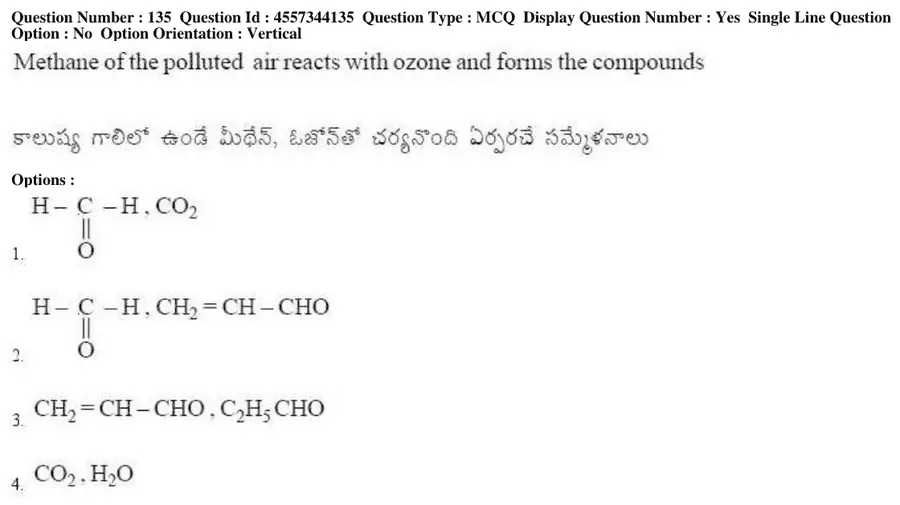
Acrolein (X) is one of the chemicals formed when $\mathrm{O_3}$ and $\mathrm{NO_2}$ react with unburnt hydrocarbons present in the polluted air. The structure of 'X' is
Which of the following practices will not come under green chemistry? (i) Using soaps made of vegetable oils instead synthetic detergents, whenever possible. (ii) Using $\mathrm{H_2O_2}$ for bleaching purposes instead chlorine based bleaching agents. (iii) Using liquefied $\mathrm{CO_2}$ for dry cleaning clothes and laundry. (iv) Using plastic cans for neatly storing substances
Which of the given statements are correct, when carboxyheamoglobin reaches to 3-4% in blood? I) Leads to headache II) Results in cardiovascular problem III) Increases the body temperature IV) Leads to diarrhoea
Which of the following chemicals can be used as dry cleaning agents? a) $\mathrm{Cl_2C{=}CCl_2}$ b) $\mathrm{CO_2}$ (liq) c) $\mathrm{H_2O_2}$ d) $\mathrm{CH_3CHO}$
Acid rain is mainly caused by the emissions of which of the following gases? (i) Sulphur dioxide (ii) Carbon dioxide (iii) Nitrogen dioxide (iv) Methane
Match the following. List - I A) Bleaching of paper B) Eye Irritant C) Freons D) Herbicide List - II I) $\mathrm{CF_2Cl_2}$ II) $\mathrm{H_2O_2}$ III) $\mathrm{Na_3AsO_3}$ IV) PAN V) $\mathrm{CO_2}$ The correct answer is
Consider the following reactions involving some atmospheric pollutants. $\mathrm{NO} + \mathrm{O_3} \longrightarrow \mathrm{NO_2} + \mathrm{O_2} \xrightarrow{h\nu} \mathrm{NO} + \mathrm{O_3}$ $4\mathrm{NO_2} + \mathrm{O_2} + 2\mathrm{H_2O} \longrightarrow 4\mathrm{HNO_3}$ $3\mathrm{CH_4} + 2\mathrm{O_3} \longrightarrow 3\mathrm{H_2C{=}O} + 3\mathrm{H_2O}$ Based on the above, the formation of formaldehyde from methane in the atmosphere will be controlled by
Match the following. List - I List - II A) $\mathrm{SO_2}$ B) PAN C) Smoke D) $\mathrm{CF_2Cl_2}$ I) Photochemical smog II) Acid rain III) Stratospheric pollutant IV) Particulate The correct answer is
Identify the correct statements from the following: i. In the presence of UV light, $\mathrm{CF_2Cl_2(g)}$ gives chlorine free radicals which will react with $\mathrm{O_3(g)}$ to form $\mathrm{O_2(g)}$ ii. Drinking water with 10 ppm fluoride is better than drinking water with 1 ppm fluoride iii. The maximum permissible concentration of lead in drinking water is 50 ppb
The concentration of fluoride ions in drinking water upto 1 ppm make the enamel on teeth much harder by converting $\underline{\mathrm{X}}$ into fluorapatite. What is $\underline{\mathrm{X}}$?
Match the following. List - I A) Insecticide B) $\mathrm{K_2Cr_2O_7}$ / 50% $\mathrm{H_2SO_4}$ C) Bleaching of cloths and paper D) Eye Irritant List - II I) COD II) PAN III) $\mathrm{Na_3AsO_3}$ IV) BOD V) $\mathrm{H_2O_2}$ The correct answer is
Which of the following statements about smog is/are correct? a) Smog formed on sunny days contain oxidizing molecules b) Photochemical smog contains many reactive molecules c) The main polluting components of smog are oxides of carbon d) The presence of carbon monoxide in air leads to the formation of ozone in smog
Match the following. List - I A) Methemaglobinemia B) Kidney damage C) Bones and teeth damage D) Growth of fish is stopped List - II I) 1 ppm of dissolved oxygen in water II) 1000 ppb of lead in drinking water III) BOD of drinking water is 2 ppm IV) 2000 ppm of nitrates in drinking water V) 50 ppm of fluoride in drinking water The correct answer is
From the following, identify the reactions which are responsible for depletion of ozone layer. a) $\mathrm{Cl\dot{O}(g) + NO_2(g) \rightarrow ClONO_2(g)}$ b) $\mathrm{CF_2Cl_2(g) \xrightarrow{uv} \dot{Cl}(g) + \dot{C}F_2Cl(g)}$ c) $\mathrm{\dot{Cl}(g) + CH_4(g) \rightarrow HCl(g) + \dot{C}H_3(g)}$ d) $\mathrm{\dot{Cl}(g) + O_3(g) \rightarrow Cl\dot{O}(g) + O_2(g)}$ e) $\mathrm{Cl\dot{O}(g) + O(g) \rightarrow \dot{Cl}(g) + O_2(g)}$
Identify the correct statements from the following a) BOD value of clean water is less than 5 ppm b) Oxidation of ethene in the presence of $\mathrm{Pd^{2+}}$ catalyst in aqueous medium gives acetic acid c) Photochemical smog causes damage to plant life d) Reducing smog is a mixture of smoke, fog and $\mathrm{SO_2}$
Which of the following statements are correct? a) $\mathrm{F^-}$ ion concentration above 2 ppm causes brown mottling of teeth b) The maximum limit of nitrate in drinking water is 400 ppm c) Depletion of ozone layer leads to cataract and skin cancer d) The irritant red haze in the traffic is due to oxides of sulphur
Environmental Chemistry holds rank 29 among all 31 chemistry chapters in the modern 2022 to 2026 examination span. Across our full compilation of entrance tests from 2010 through 2026, the chapter contributed 104 questions across 149 papers, appearing in 102 of those examinations to capture 1.7 percent of the subject with an average of 0.7 questions per paper. In the modern five-year timeframe from 2022 to 2026, it gathered 43 questions across 77 sittings, appearing in 43 papers to record 0.6 questions per paper and a 1.4 percent subject share.
The chapter was completely absent in 2022 and 2023 before returning strongly from 2024 onward, being absent from thirty-four papers overall across the five-year window. Looking at regional differences between 2022 and 2026, AP tests carried 26 questions across 48 papers (appearing in 26 papers, 0.5 questions per paper, 1.4 percent share), while TS tests generated 17 questions across 29 papers (appearing in 17 papers, 0.6 questions per paper, 1.5 percent share).
During earlier testing between 2010 and 2021, papers featured 61 questions across 72 sittings (appearing in 59 tests), delivering 0.8 questions per paper and a 2.1 percent subject share. Across the latest three exam years from 2024 to 2026, question writers set 43 questions across 46 sittings (appearing in 43 papers), yielding 0.9 questions per test and 2.3 percent share. Looking at trend dynamics, the share early versus the last three years is about the same, while the share recent versus the last three years is up.
Most-asked topics
The environmental chemistry curriculum organizes under one overarching domain:
Pollution accounts for all 104 questions across the full archive, including all 43 questions from the recent period through 2026. Subtopics include tropospheric pollution (gaseous pollutants like sulphur dioxide, nitrogen oxides, carbon monoxide, and hydrocarbons; particulate pollutants like smoke, dust, mists, and fumes), acid rain formation and stone leprosy of marble structures, photochemical smog versus classical reducing smog, stratospheric pollution and chlorofluorocarbon-mediated ozone hole formation, water pollution parameters (biochemical oxygen demand, chemical oxygen demand, and eutrophication), maximum permissible drinking water contamination thresholds (lead, fluoride, sulphate, nitrate), and principles of green chemistry.
What the questions look like
Examiners test exact factual knowledge from NCERT environmental tables. A prominent question type presents a matching list pairing toxic heavy metals with their maximum allowable drinking water concentrations, such as matching fluoride (up to one part per million protects enamel, while above two parts per million causes mottling of teeth), lead (fifty parts per billion), or nitrate (fifty parts per million, above which causes methemoglobinemia or blue baby syndrome).
Another frequent format asks candidates to contrast classical smog (cool, humid climate; smoke and sulphur dioxide; reducing nature) with photochemical smog (warm, dry, sunny climate; unburnt hydrocarbons, nitric oxide, ozone, and peroxyacetyl nitrate; oxidizing nature). Questions on stratospheric chemistry focus on the catalytic cycle where chlorine free radicals continuously destroy ozone molecules.
Questions to try first
Solve these representative state entrance questions to test your recall of pollutant classifications and statutory water standards:
Memorise the statutory concentrations for drinking water: fluoride should be around one part per million; lead must not exceed fifty parts per billion; sulphate should stay below five hundred parts per million (higher amounts cause laxative effects); nitrate must not exceed fifty parts per million. Clean drinking water has a biochemical oxygen demand below five parts per million, whereas highly polluted water records values of seventeen parts per million or higher.
Review the reactions responsible for photochemical smog: vehicle exhaust emits nitric oxide and unburnt hydrocarbons; sunlight dissociates nitrogen dioxide into nitric oxide and reactive oxygen atoms; atomic oxygen combines with molecular oxygen to form ozone, which oxidizes hydrocarbons into formaldehyde, acrolein, and peroxyacetyl nitrate. In green chemistry, remember that replacing tetrachloroethene with liquid carbon dioxide in dry cleaning avoids groundwater poisoning.
Frequently asked questions
What is the mechanism of stratospheric ozone depletion by chlorofluorocarbons?
Ultraviolet radiation in the stratosphere cleaves chlorofluorocarbons, releasing chlorine free radicals. Each chlorine radical reacts with ozone to form chlorine monoxide and dioxygen. Chlorine monoxide subsequently reacts with atomic oxygen to regenerate the chlorine free radical, allowing a single radical to destroy thousands of ozone molecules in a continuous catalytic chain.
What is eutrophication and how does it harm aquatic life?
Eutrophication refers to the nutrient enrichment of water bodies caused by runoff containing agricultural phosphate fertilizers and domestic detergents. This induces rapid proliferation of algae, forming an algal bloom that blankets the surface. When the algae die, bacterial decomposition consumes dissolved oxygen, suffocating fish and degrading the aquatic ecosystem.
What chemical distinguishes classical smog from photochemical smog?
Classical smog contains high concentrations of sulphur dioxide combined with smoke and fog in cool, humid climates, behaving as a chemically reducing mixture. Photochemical smog contains high concentrations of ozone, nitrogen oxides, and peroxyacetyl nitrate formed under intense sunlight, behaving as a powerful oxidizing mixture. Step-by-step solutions for each one are in the EdLoop EAPCET app.