The amount of energy released (in $k\ cal\ mol^{-1}$) when 7.1 $g$ of gaseous chlorine atoms are completely converted to $\mathrm{Cl^-}(g)$ ions is (Given; $\Delta_{eg}H(\mathrm{Cl}) = -3.6\ eV$, $1\ eV = 23\ k\ cal\ mol^{-1}$, $At.Wt;\ \mathrm{Cl} = 35.5u$)
Three separate vessels (A, B and C) each contain 100 mL of distilled water. Some quantity of $\mathrm{P_4O_{10}}$ (s), $\mathrm{SiCl_4}$ ($l$) and $\mathrm{Ca_3N_2}$ (s) are added into A, B and C vessels respectively. The pH range in A, B and C respectively are
Among the ions $\mathrm{Mg^{2+}}$, $\mathrm{O^{2-}}$, $\mathrm{Al^{3+}}$, $\mathrm{F^-}$, $\mathrm{Na^+}$ and $\mathrm{N^{3-}}$, the ion with largest size and ion with smallest size are respectively
In long form of periodic table an element ‘E’ has atomic number 78. The period and group number of the element are $x$ and $y$ respectively. $(x+y)$ is equal to
Observe the following data ($\Delta_i H_1$, $\Delta_i H_2$ and $\Delta_{eg} H$ represent the first, second ionisation enthalpies and electron gain enthalpy respectively).
In second period of the modern periodic table, two elements X and Y have higher first ionization enthalpy values than the preceding and succeeding elements. X and Y are respectively
A, B, C, D and E are elements with atomic numbers 13, 11, 9, 7 and 16 respectively. Among these elements, ion of an element X has largest size and ion of an element Y has smallest size. X and Y are respectively (Assume that all ions have nearest inert gas configuration)
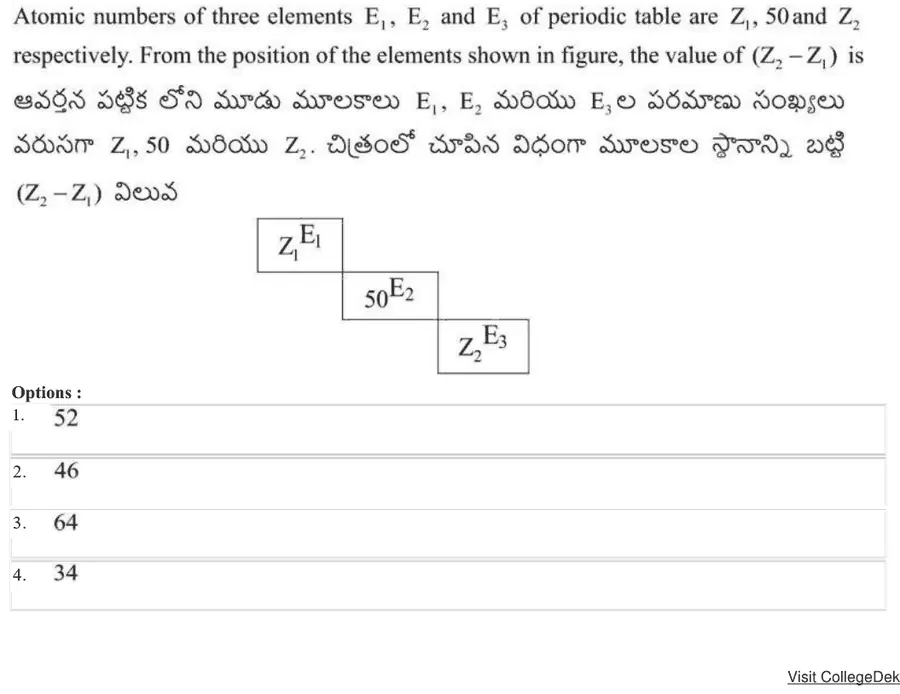
Atomic numbers of three elements $\mathrm{E_1}$, $\mathrm{E_2}$ and $\mathrm{E_3}$ of periodic table are $Z_1$, 50 and $Z_2$ respectively. From the position of the elements shown in figure, the value of $(Z_2 - Z_1)$ is
Electron gain enthalpy values $(\Delta_{eg}H)$ (in $\mathrm{kJ\,mol^{-1}}$) of elements X, Y and Z are $-349, -200$ and $-295$ respectively. X, Y and Z are respectively
If the first ionisation enthalpy of Li, Be and C respectively are 520, 899, 1086 $\mathrm{kJ\ mol^{-1}}$, the first ionisation enthalpy (in $\mathrm{kJ\ mol^{-1}}$) of B will be
If first ionization enthalpy $(\Delta_i H)$ values of Na, Mg and Si are respectively 496, 737 and 786 $\mathrm{kJ\,mol^{-1}}$, the first ionization enthalpy value of Al $\left(\text{in } \mathrm{kJ\,mol^{-1}}\right)$ will be
List-I (Elements) | List-II (Valence shell Configuration) --- | --- A. Alkali metals | I. $\mathrm{ns^2np^6}$ B. Alkaline earth metals | II. $\mathrm{ns^2np^5}$ C. Halogens | III. $\mathrm{ns^2}$ D. Noble gases | IV. $\mathrm{ns^1}$
Consider the elements Ne, Na, Mg. The element with highest first ionization enthalpy and element with lowest second ionization enthalpy respectively are
The first ionization enthalpies of Na, Mg and Si are respectively 496, 737 and 786 $\mathrm{kJ\ mol^{-1}}$. What would be the first ionization enthalpy of Al in $\mathrm{kJ\ mol^{-1}}$?
I) The order of first ionisation enthalpy of first three elements of $3^{\mathrm{rd}}$ period is $\mathrm{Mg} > \mathrm{Al} > \mathrm{Na}$
II) The element with electronegativity of 3.5 is chlorine
III) The order of sizes of ions $\mathrm{Mg^{2+}}$, $\mathrm{Na^+}$, $\mathrm{F^-}$ and $\mathrm{O^{2-}}$ is $\mathrm{Mg^{2+}} < \mathrm{Na^+} < \mathrm{F^-} < \mathrm{O^{2-}}$
IV) The IUPAC name of the element with atomic number 106 is Bohrium
The successive ionisation energies (starting from the $1^{st}$) of an element are 801, 2430, 3660, 25,000 and 32,800 $\mathrm{kJ\,mol^{-1}}$, respectively. The element is
How many of the following statements are correct? a) 'He' is the second most abundant element in the universe. b) the symbol for the element with atomic number 110 is Ds. c) Osmium has the highest density among all elements. d) Francium is the most electropositive element in the periodic table.
Among the ions $\mathrm{O^{2-}}$, $\mathrm{Na^+}$, $\mathrm{F^-}$, $\mathrm{N^{3-}}$, $\mathrm{Mg^{2+}}$ the ions with smallest and largest radii are respectively
Observe the following statements Statement A: - In general, the ionization potential value decreases on moving down in the group. Statement B:- The $1^{st}$ ionization potential of sodium is greater from that of potassium Correct answer is
Arrange the following oxides in correct order of their acidic character. $\mathrm{N_2O_3}$ (I), $\mathrm{P_2O_3}$ (II), $\mathrm{N_2O_5}$ (III), $\mathrm{As_2O_3}$ (IV)
The successive ionization enthalpies of an element X in $(\mathrm{kJ\ mol^{-1}})$ are 1012, 1907, 2955, 4955, 6275 and 21, 260 respectively, the element X is
In which of the following, oxides of three elements X, Y and Z are correctly arranged in the increasing order of acidic nature. The electronic configurations of X, Y and Z are $[\mathrm{Ne}]3s^23p^1$, $[\mathrm{Ne}]3s^23p^5$, $[\mathrm{Ne}]3s^2$ respectively.
Assertion (A): $16^{\mathrm{th}}$ group elements have higher ionization enthalpy values than $15^{\mathrm{th}}$ group elements in the corresponding periods. Reason (R): $15^{\mathrm{th}}$ group elements have half-filled stable electronic configurations.
A
Both (A) and (R) are correct and (R) is the correct explanation of (A).
B
Both (A) and (R) are correct but (R) is not the correct explanation of (A).
Assertion (A): Fluorine has smaller negative electron gain enthalpy than chlorine Reason (R): The electron - electron repulsion is higher in chlorine than in fluorine
A
Both (A) and (R) are correct and (R) is the correct explanation of (A).
B
Both (A) and (R) are correct but (R) is not the correct explanation of (A).
In second period of the long form of the periodic table an element X has second lowest first ionization enthalpy and element Y has second highest first ionization enthalpy values. What are X and Y?
The formation of oxide ion $\mathrm{O^{2-}}$ from oxygen atom requires an exothermic reaction, followed by an endothermic step as shown below. The process of formation of $\mathrm{O^{2-}}$ in gas phase is unfavorable ($\Delta H^{\ominus} = +ve$), even though it has stable configuration of the nearest noble gas, Neon. This is because ______ $\mathrm{O_{(g)} + e^- \rightarrow O^-_{(g)}}$ ; $\Delta H^{\ominus} = -141\ \mathrm{kJ.mol^{-1}}$ $\mathrm{O^-_{(g)} + e^- \rightarrow O^{2-}_{(g)}}$ ; $\Delta H^{\ominus} = +760\ \mathrm{kJ.mol^{-1}}$
A
$\mathrm{O^{2-}}$ has larger size than that of Neon
B
Oxygen is more electronegative than Neon
C
$\mathrm{O^-}$ has larger size than oxygen atom
D
Electron repulsion in oxide ion is more which over comes the stability achieved by noble gas configuration
If the successive ionization energies of an element $A$ are 165, 190, 550 and 595 $\mathrm{kcal}$, respectively, then the ground state electronic configuration of element $A$ is ______
How many oxides among the following are basic in nature? $\mathrm{As_2O_3}$, $\mathrm{Na_2O}$, $\mathrm{MgO}$, $\mathrm{Mn_2O_3}$, $\mathrm{CaO}$, $\mathrm{ZnO}$, $\mathrm{N_2O}$, $\mathrm{N_2O_5}$
Which among the following iso-electronic species has the smallest size? $\mathrm{O^{2-}}, \mathrm{F^-}, \mathrm{Ne}, \mathrm{Na^+}, \mathrm{Mg^{2+}}, \mathrm{Al^{3+}}, \mathrm{Si^{4+}}$
Which element among the following is most probable to have the following values? $\Delta_i H_1 = 419\ kJ\ mol^{-1}$ $\Delta_i H_2 = 3051\ kJ\ mol^{-1}$ $\Delta_{eg}H = -48\ kJ\ mol^{-1}$
How many of the following statements is/are correct? a) Mercury is the only metal that exists as liquid at room temperature. b) Among non-metals, carbon has the highest melting point. c) Hydrogen is the most abundant element in the universe. d) Oxygen is the most abundant element in the earth's crust.
Given that ionization potential and electron gain enthalpy of chlorine are $13\ eV$ and $4\ eV$ respectively. The electronegativity of chlorine on Mulliken scale, approximately equals to
Which of the following represents the correct order of increasing electron gain enthalpy with negative sign for the elements? a. Nitrogen b. Phosphorous c. Chlorine d. Fluorine
Choose the correct option regarding the following statements: Statement-1: Nitrogen has lesser electron gain enthalpy than oxygen. Statement-2: Oxygen has lesser ionization enthalpy than nitrogen.
Which of the following options represents the correct ionic radii in $\mathrm{\AA}$ of $\mathrm{N^{3-}}$, $\mathrm{O^{2-}}$ and $\mathrm{F^-}$, respectively?
The set of amphoteric oxides among the given oxides are $\mathrm{Ga_2O_3}$, $\mathrm{As_4O_{10}}$, $\mathrm{Sb_4O_{10}}$, $\mathrm{B_2O_3}$, $\mathrm{Tl_2O}$
The first ionisation energies (in $\mathrm{kJ\ mol^{-1}}$) of four consecutive elements of the second period are given in the options. The first ionisation energy of nitrogen is
Which among the following is the possible electronic configuration of an element 'X' having first and second ionization enthalpy values as $520\ kJ.mol^{-1}$ and $7300\ kJ.mol^{-1}$ respectively
Match the following elements, given as hints to their first, second ionisation enthalpies and electron gain enthalpies. Elements | $\Delta H_1$ | $\Delta H_2$ | $\Delta_{eg}H$ i. Most reactive non metal ii. Most reactive metal iii. Least reactive element iv. Metal forming binary halide A. 419, 3051, $-48$ B. 1681, 3374, $-328$ C. 738, 1451, $-40$ D. 2372, 5251, $+48$
Calculate the energy required to convert all atoms in 4.8 g of $\mathrm{Mg}$ to $\mathrm{Mg^{2+}}$ in the vapor state. $IE_1$ and $IE_2$ of Mg are 740 kJ/mol and 1450 kJ/mol respectively.
Which of the following statements is correct about "shielding effect"? A) It is effective when the orbitals in the inner shells are completely filled B) Inner shells do not show any effect C) With increase of shielding down the group, ionization energy increases D) With increasing nuclear charge, the shielding effect increases
Assertion (A): Boron has a smaller first ionization enthalpy than beryllium. Reason (R): The penetration of a 2s electron to the nucleus is more than the 2p electron hence 2p electron is more shielded by the inner core of electrons than the 2s electrons.
A
Assertion and reason both are correct statements but reason is not correct explanation for assertion.
B
Assertion is correct statement but reason is wrong statement.
C
Assertion and reason both are correct statements and reason is correct explanation for assertion.
How many compounds given below are amphoteric oxides? $\mathrm{P_2O_5}$, $\mathrm{P_4O_6}$, $\mathrm{As_2O_5}$, $\mathrm{As_4O_6}$, $\mathrm{Sb_2O_5}$, $\mathrm{Sb_4O_6}$, $\mathrm{Bi_2O_3}$
The basic difference in approach between Mendeleev's periodic law and modern periodic law is the change on the basis of classification of elements from ______
Assertion (A) : $\mathrm{Mg^{2+}}$ and $\mathrm{Al^{3+}}$ are isoelectronic but the magnitude of ionic radius of $\mathrm{Al^{3+}}$ is less than that in $\mathrm{Mg^{2+}}$ Reason (R) : The effective nuclear charge on the outermost electrons in $\mathrm{Al^{3+}}$ is greater than that in $\mathrm{Mg^{2+}}$ The correct option among the following is
A
(A) is true, (R) is true and (R) is the correct explanation for (A)
B
(A) is true, (R) is true but (R) is the not the correct explanation for A (sic)
The successive ionisation energy values for an element 'X' are given below i) 1st ionisation energy = 410 $\mathrm{kJ\,mol^{-1}}$ ii) 2nd ionisation energy = 820 $\mathrm{kJ\,mol^{-1}}$ iii) 3rd ionisation energy = 1100 $\mathrm{kJ\,mol^{-1}}$ iv) 4th ionisation energy = 1500 $\mathrm{kJ\,mol^{-1}}$ v) 5th ionisation energy = 3200 $\mathrm{kJ\,mol^{-1}}$ The number of valence electrons in the atom 'X' is
Which one among the following statements is/are not correct? a) Ba compounds, generally are more covalent than Be compounds b) The electron gain enthalpy of He is positive c) The oxidation state of O in $\mathrm{OF_2}$ and $\mathrm{Na_2O}$ are same d) The radius of $\mathrm{Na^+}$ ion is smaller than that of $\mathrm{F^-}$ ion
Arrange the following in the decreasing order of radius: $\mathrm{S^{2-}}, \mathrm{P^{3-}}, \mathrm{Cl^{-}}, \mathrm{Ca^{2+}}, \mathrm{Ar}, \mathrm{K^{+}}$
Among the isoelectronic ions ($\mathrm{O^{2-}}$, $\mathrm{N^{3-}}$, $\mathrm{Mg^{2+}}$, $\mathrm{Na^+}$), the ions with least and highest ionic radius are respectively
X and Y are two elements which form oxides of the type $\mathrm{XO_3}$ and $\mathrm{Y_2O_5}$ with highest oxygen content. Identify the group numbers to which X and Y belongs
The electron gain enthalpy $\Delta_{eg}H$ of $\mathrm{Cl(g)}$ is $-349\ \mathrm{kJ\ mol^{-1}}$. If the ground state energy of $\mathrm{Cl(g)}$ is $x\ \mathrm{kJ\ mol^{-1}}$, the ground state energy (in $\mathrm{kJ\ mol^{-1}}$) of $\mathrm{Cl^-(g)}$ is
Which of the following statements are correct for classification of elements? I) The properties of elements are periodic functions of their atomic numbers II) Non metallic elements are less in number than the metallic elements III) The first ionisation energies of elements along a period do not vary in a regular manner IV) The ground state electronic configuration of Pd (Z = 46) is $[\mathrm{Kr}]4d^8 5s^2$
Which of the following are correct? a) First ionization enthalpy of He < Second ionization enthalpy of Li b) Li has the highest second ionization enthalpy c) All d-block elements are transition elements d) The only alphabet not found in the periodic table is the letter 'J' e) Francium concentration is ~$10^{-18}$ ppm on Earth
Statement (a) : $\mathrm{Na_2O} < \mathrm{MgO} < \mathrm{ZnO} < \mathrm{P_4O_{16}}$ - Acidic property Statement (b) : $\mathrm{F} > \mathrm{Cl} > \mathrm{Br}$ - Electron gain enthalpy Statement (c) : $\mathrm{M^{2-}} > \mathrm{M^{-}} > \mathrm{M^{+}} > \mathrm{M^{2+}}$ - ionic size Statement (d) : The second ionisation enthalpy of Cu is more than second ionisation enthalpy of K. Which of the following is the correct representation of True (T) / False (F) for the given statements
Identify the correct statements from the following. i. In the periodic table, about 78% of elements are metals. ii. In a group, the metallic character decreases from top to bottom and in a period the non-metallic character decreases from left to right. iii. The element Ho belongs to f-block.
Identify the statements which are not correct. i. ZnO, PbO, $\mathrm{Sb_2O_3}$ are neutral oxides. ii. CO and NO are amphoteric oxides. iii. $\mathrm{CrO_3}$, $\mathrm{Mn_2O_7}$, $\mathrm{V_2O_5}$ are basic oxides.
Assertion (A) : $\mathrm{Na^+}$ and $\mathrm{Mg^{2+}}$ ions are isoelectronic but the ionic radius of $\mathrm{Na^+}$ is greater than that of $\mathrm{Mg^{2+}}$ Reason (R) : The effective nuclear charge of $\mathrm{Na^+}$ ion is less than that of $\mathrm{Mg^{2+}}$ ion
A
Both (A) and (R) are correct and (R) is correct explanation of (A)
B
Both (A) and (R) are correct but (R) is not the correct explanation of (A)
Arrange the following oxides in the increasing order of their basic nature (a) $\mathrm{Al_2O_3}$ (b) $\mathrm{K_2O}$ (c) $\mathrm{P_2O_5}$ (d) $\mathrm{MgO}$
The electron affinity values of elements A, B, C and D are respectively $-135, -60, -200$ and $-348\ \mathrm{kJ\ mol^{-1}}$. The outer electronic configuration of element B is :
Answer: (C) $3s^2 3p^3$· Official APSCHE final key
How to prepare Periodic Table & Periodicity for EAPCET
How often it comes up
Periodic Table & Periodicity holds rank 7 among all 31 chemistry chapters during the recent 2022 to 2026 examination period. Across our complete historical compilation spanning 2010 through 2026, the chapter contributed 235 questions across 149 papers, appearing in 140 of those sessions to capture 3.9 percent of the total chemistry questions with 1.6 questions per paper. In the modern five-year window from 2022 to 2026, it expanded its footprint to 130 questions across 77 sittings, delivering 1.7 questions per paper and a 4.2 percent subject share.
The chapter holds an unblemished record across both state engineering entrance streams, appearing in every paper between 2022 and 2026. Across state lines during this period, AP examinations accounted for 77 questions across 48 papers (1.6 questions per paper, 4.0 percent share), while TS examinations generated 53 questions across 29 papers (1.8 questions per paper, 4.6 percent share).
In earlier testing from 2010 through 2021, papers featured 105 questions across 72 sittings (appearing in 63 tests), which worked out to 1.5 questions per paper and a 3.6 percent subject share. Over the latest three exam years from 2024 to 2026, examiners included 70 questions across 46 sittings, maintaining 1.5 questions per test and 3.8 percent share. Tracking trend dynamics reveals that the share early versus the last three years is about the same, and the share recent versus the last three years is about the same. Every shift reliably includes one or two periodicity questions.
Most-asked topics
Questions in this foundational chapter center on two core themes:
Periodic Trends forms the vast majority of the chapter with 198 questions overall and 110 in the recent window through 2026. Subtopics include first and successive ionisation enthalpies, anomalies arising from half-filled and fully filled subshells, electron gain enthalpy trends including halogen and chalcogen reversals, electronegativity scales, covalent and ionic radii across isoelectronic species, and acid-base character of oxides and hydroxides.
Periodic Table accounts for 37 questions across the archive, with 20 occurring between 2022 and 2026. Items focus on electronic configurations of transuranic elements, IUPAC nomenclature for superheavy elements with atomic numbers above one hundred, classification into s, p, d, and f blocks, and representative element groupings.
What the questions look like
Exam questions test precise recognition of periodic irregularities. A prominent format presents four elements and asks candidates to arrange them in order of first or second ionisation enthalpy, emphasizing standard anomalies such as nitrogen exceeding oxygen, beryllium exceeding boron, or noble gas peaks. Another common pattern tests electron gain enthalpy, where chlorine has a more negative value than fluorine, or sulphur has a more negative value than oxygen due to interelectronic repulsions in compact second-period shells.
Examiners also frequently set matching lists where elements are paired with their periodic properties, blocks, or oxide acidity. For superheavy elements, questions test electronic configurations, asking which lighter homologue shares the valence subshell structure of element 114 (flerovium).
Questions to try first
Solve these representative state entrance questions to test your command of periodic anomalies:
Pay careful attention to exceptions in general periodic trends. While ionisation enthalpy generally increases across a period from left to right, beryllium has higher first ionisation enthalpy than boron because removing an electron from a stable s subshell requires extra energy compared to a lone p electron. Similarly, nitrogen has higher first ionisation enthalpy than oxygen because the half-filled p subshell possesses enhanced exchange stability.
For isoelectronic ions, remember that ionic radius decreases steadily with increasing nuclear charge. For example, oxide, fluoride, sodium, magnesium, and aluminium ions all have ten electrons, but aluminium has thirteen protons pulling the electron cloud closest, giving it the smallest ionic radius. Rehearse electronegativity values from the Pauling scale where carbon and sulphur share approximately two point five, and phosphorus and hydrogen share two point two.
Frequently asked questions
Why does chlorine have a higher negative electron gain enthalpy than fluorine?
Fluorine has an extremely small second-period valence subshell where added incoming electrons encounter intense interelectronic repulsions from the existing valence electrons. In chlorine, the incoming electron enters the larger third-period subshell where spatial repulsion is considerably lower, resulting in a more exothermic electron gain.
How do you identify the block and period of an element from its atomic number?
Determine the preceding noble gas to write the condensed electronic configuration. The principal quantum number of the outermost shell indicates the period, while the subshell that receives the last differentiating electron establishes whether the element belongs to the s, p, d, or f block.
How does oxide acidity change across the periodic table?
Oxides of metals located on the far left of the table are strongly basic, such as sodium and calcium oxides. Moving across to the right, oxides transition through amphoteric behaviour, such as aluminium oxide, to increasingly acidic character, culminating in strongly acidic covalent oxides like sulphur trioxide and dichlorine heptoxide. Step-by-step solutions for each one are in the EdLoop EAPCET app.