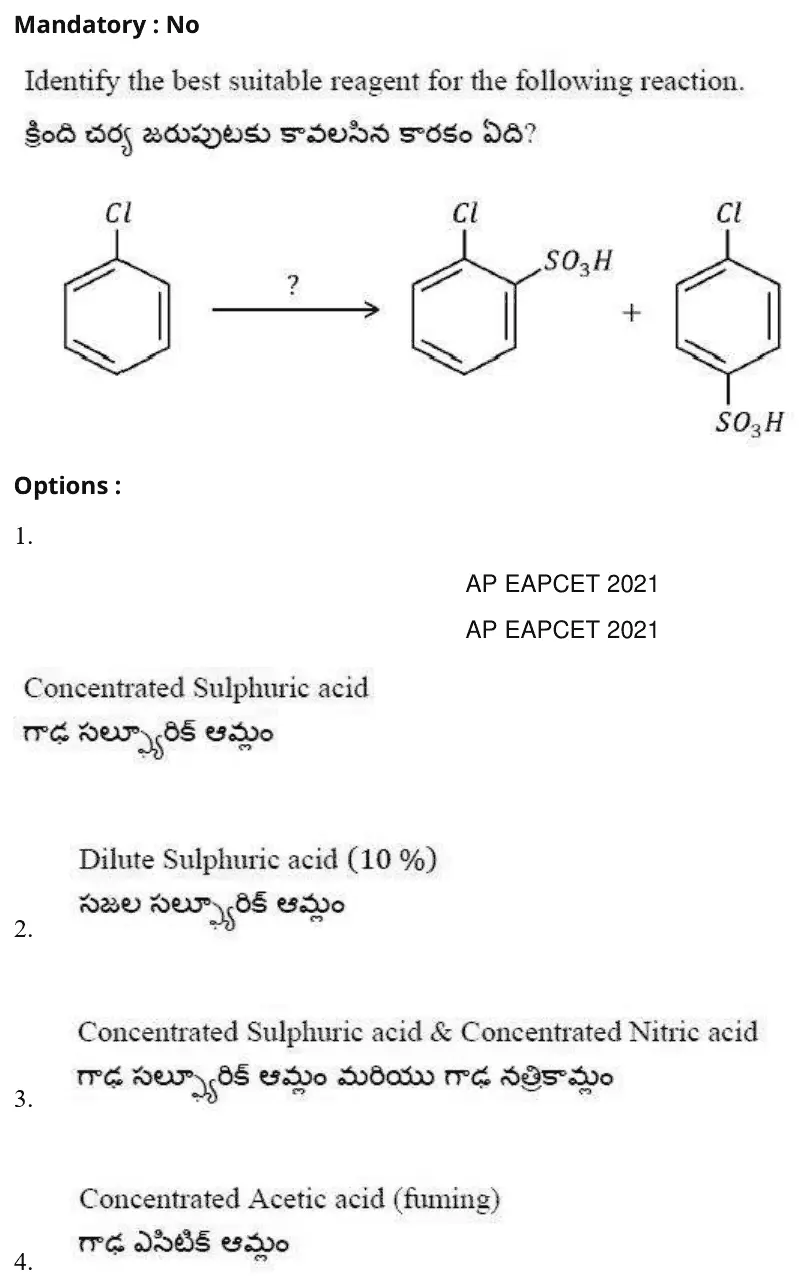
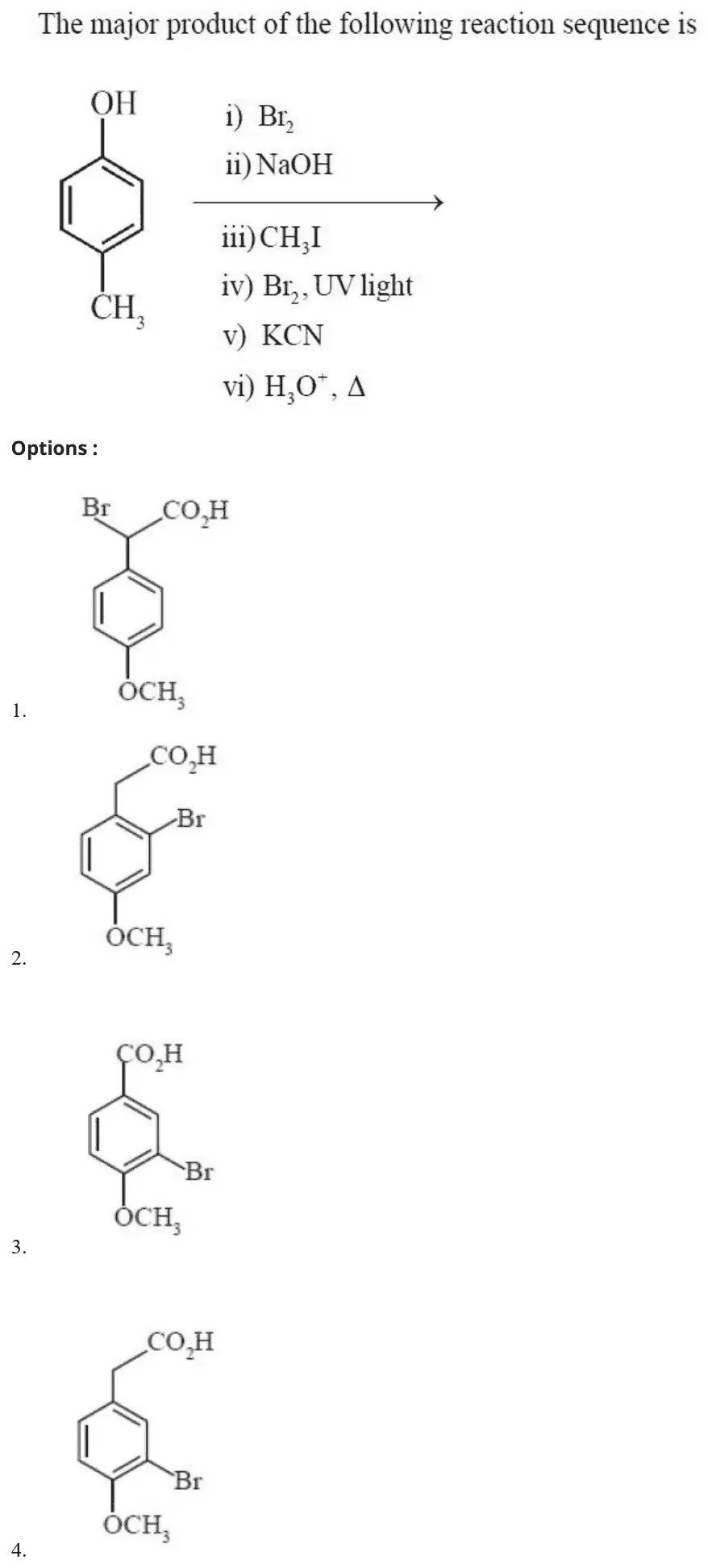
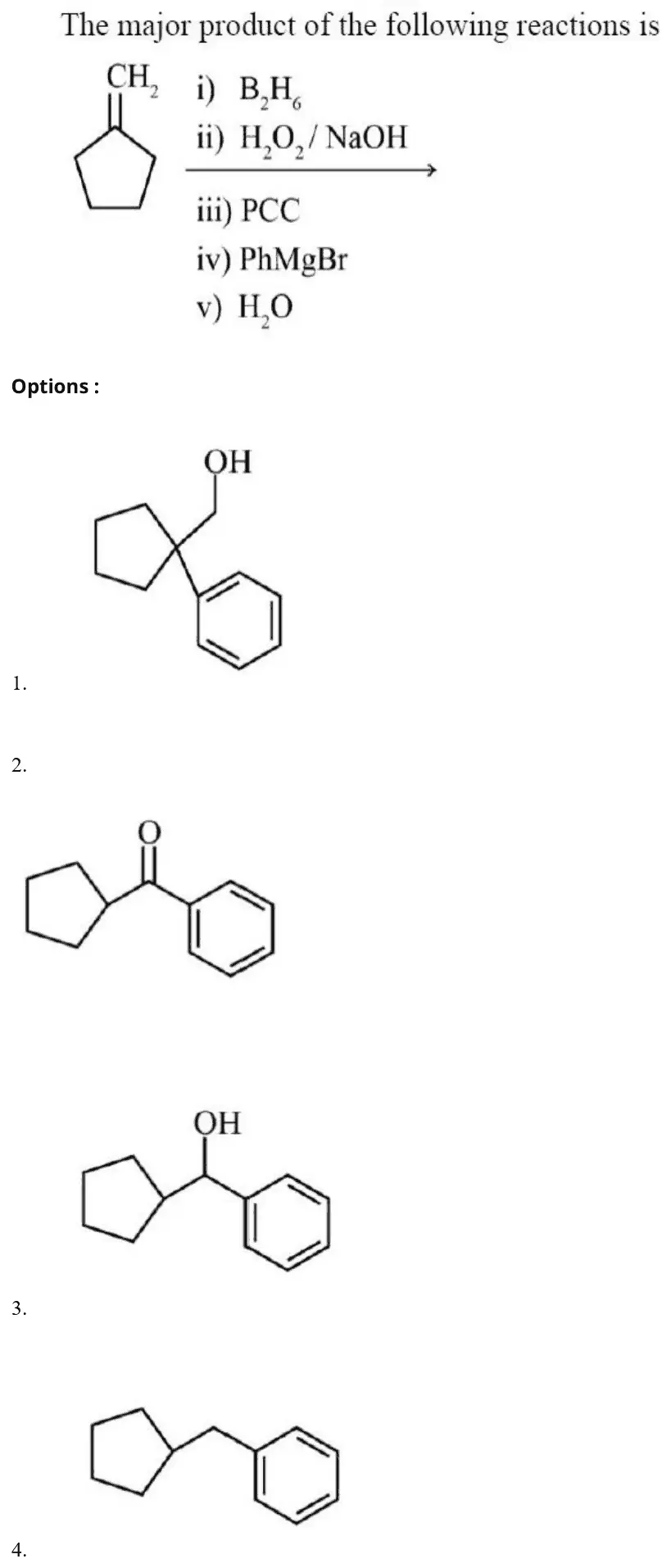
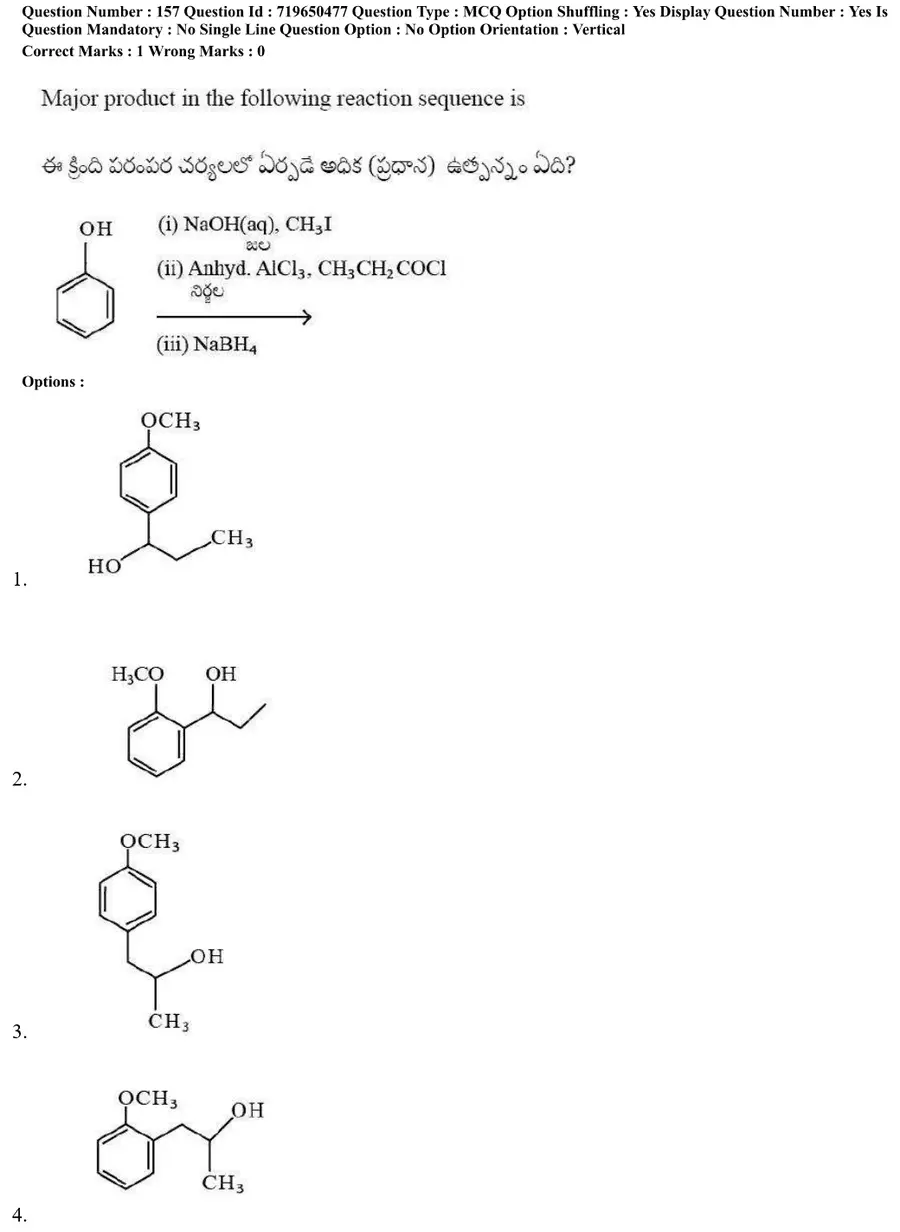
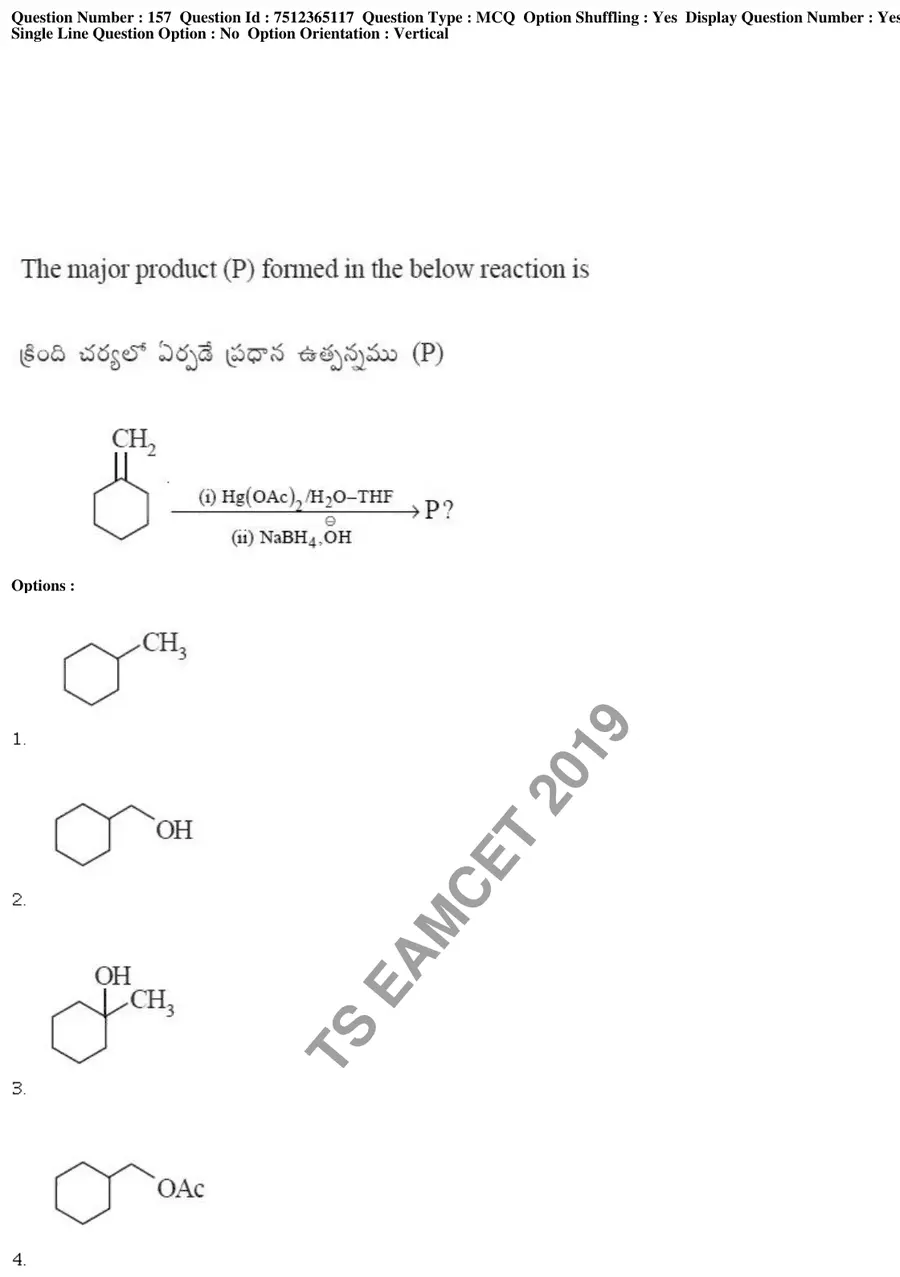
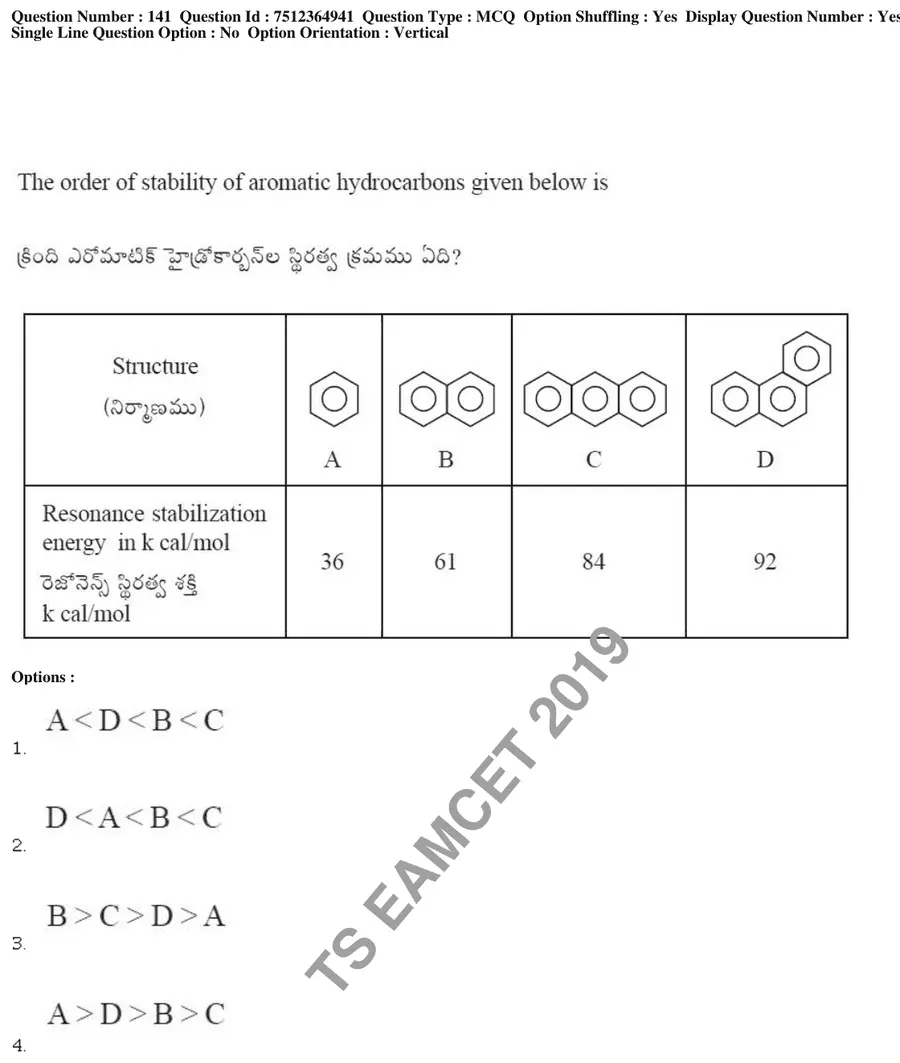
Every Hydrocarbons question from past AP EAPCET and TS EAPCET papers, with options and answers. Newest first.
293questions
142papers covered
5.4%of Chemistry questions, 2022–2026
2010–2026years
Guide at a glance
Hydrocarbons is a major heavyweight in the organic chemistry curriculum, commanding rank 4 among all 31 chemistry chapters during the 2022 to 2026 examination span.
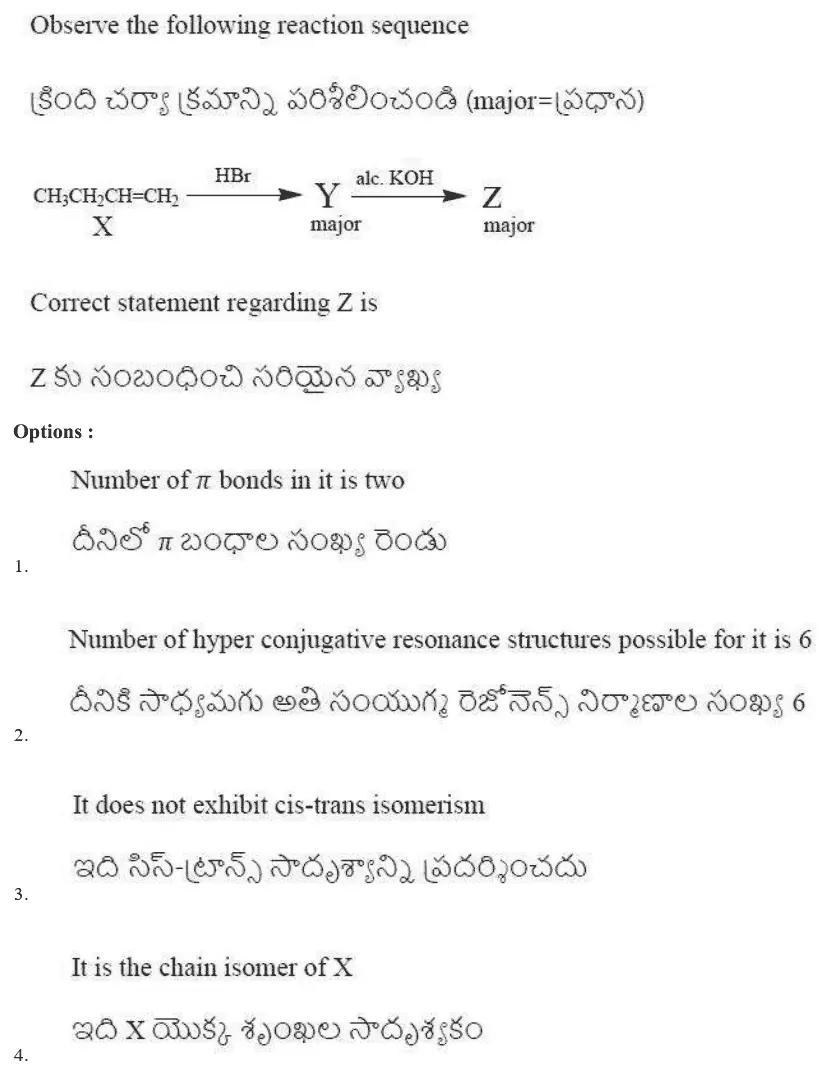
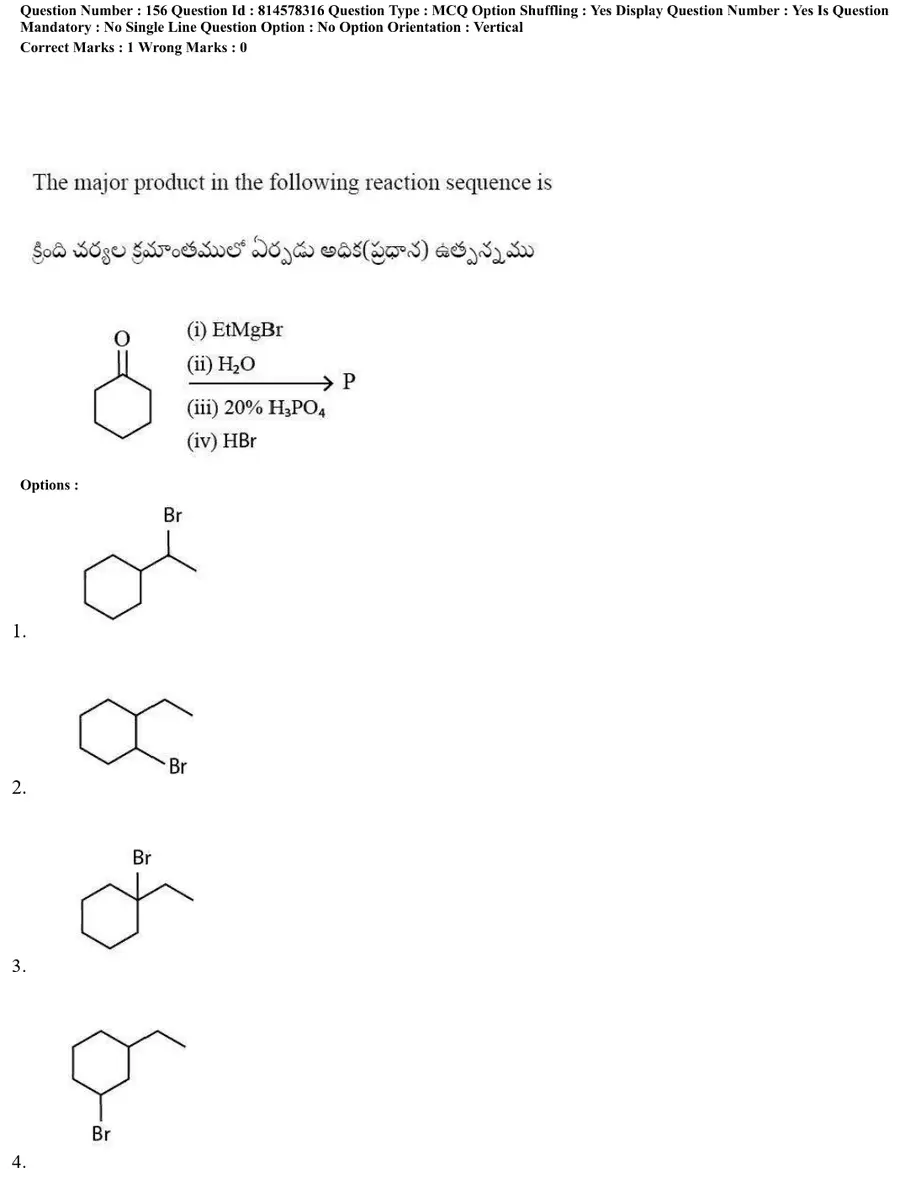
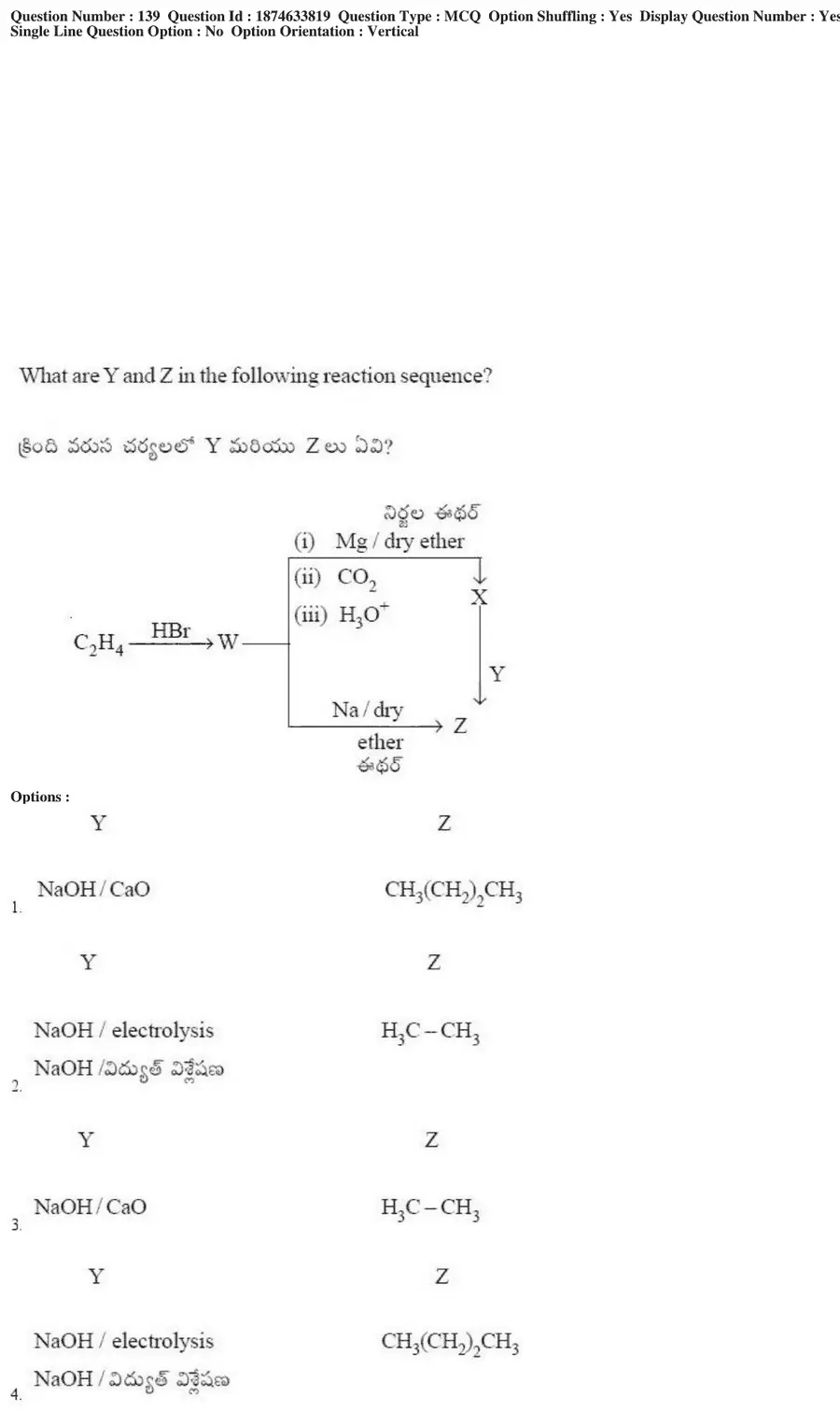
An alkyne $X$ ($\mathrm{C_4H_6}$) does not form sodium alkynide. Reaction of $X$ with $\mathrm{HBr}$ gave $Y$. Another reaction of $X$ with $\mathrm{Na/liq. NH_3}$ gave $Z$. Identify $Y$ and $Z$
An alkene (X) with formula $\mathrm{C_5H_{10}}$ on ozonolysis gives butanone and methanal. X with HBr in the presence of organic peroxide gives Y as major product. When Y is subjected to Wurtz reaction gives Z. The number of $1^\circ$, $2^\circ$ and $3^\circ$ carbons in Z respectively are
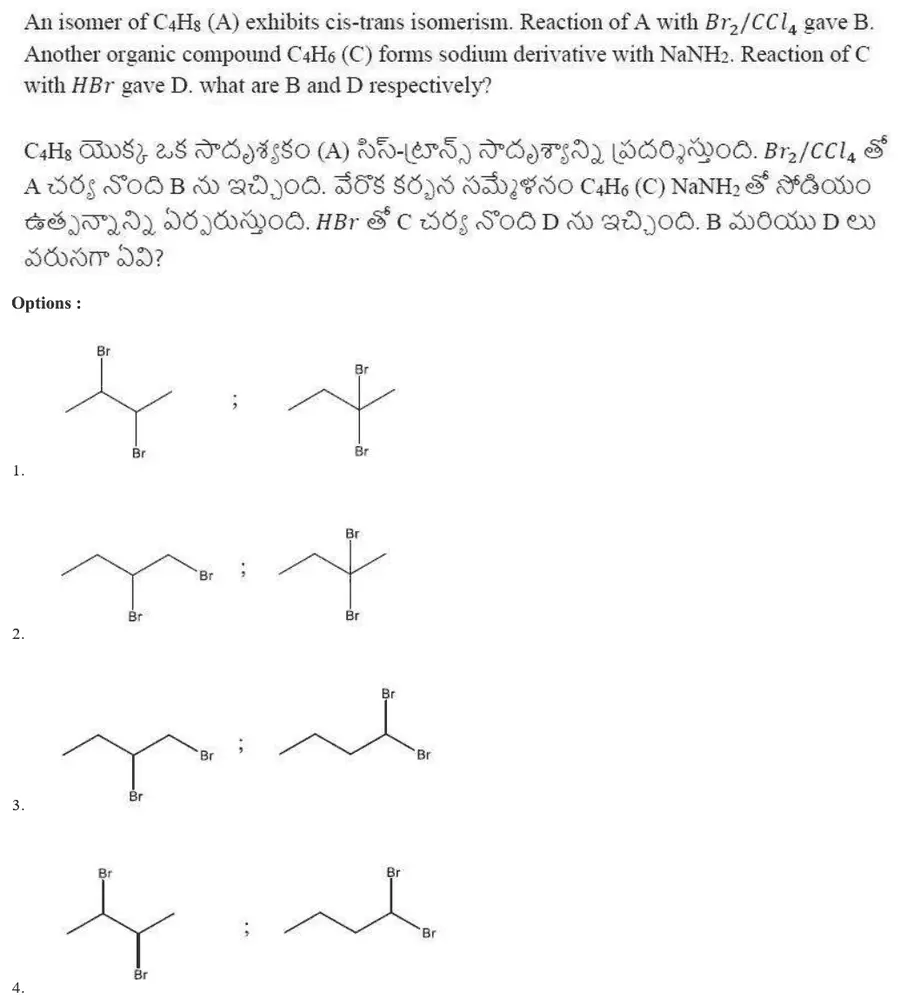
An isomer of $\mathrm{C_4H_8}$ (A) exhibits cis-trans isomerism. Reaction of A with $Br_2/CCl_4$ gave B. Another organic compound $\mathrm{C_4H_6}$ (C) forms sodium derivative with $\mathrm{NaNH_2}$. Reaction of C with $HBr$ gave D. what are B and D respectively?
The question as printed in the paper.
A
see figure B: a skeletal four-carbon chain (zig-zag) with Br on C2 and C3 (2,3-dibromobutane, drawn with Br up on the second carbon and Br down on the third); D: a four-carbon skeletal structure with two Br atoms on the same internal carbon, one up and one down (2,2-dibromobutane)
B
see figure B: a skeletal four-carbon chain with Br on C3 pointing down and a Br on the right side near C3 (1,2-type placement, drawn as a chain with Br down at the middle carbon and Br to the lower right); D: a four-carbon skeletal structure with two Br atoms on the same internal carbon, one up and one down (2,2-dibromobutane)
C
see figure B: a skeletal four-carbon chain with Br on C3 pointing down and a Br at the lower right near C3; D: a four-carbon chain with two Br atoms on the terminal-side carbon (C2 of the right side), one up and one to the lower right (gem-dibromo, 2,2-dibromobutane type)
D
see figure B: a skeletal four-carbon chain (zig-zag) with Br on C2 (up) and Br on C3 (down) (2,3-dibromobutane); D: a four-carbon chain with two Br atoms on the same carbon, one up and one to the lower right (gem-dibromide at C2 from the right end)
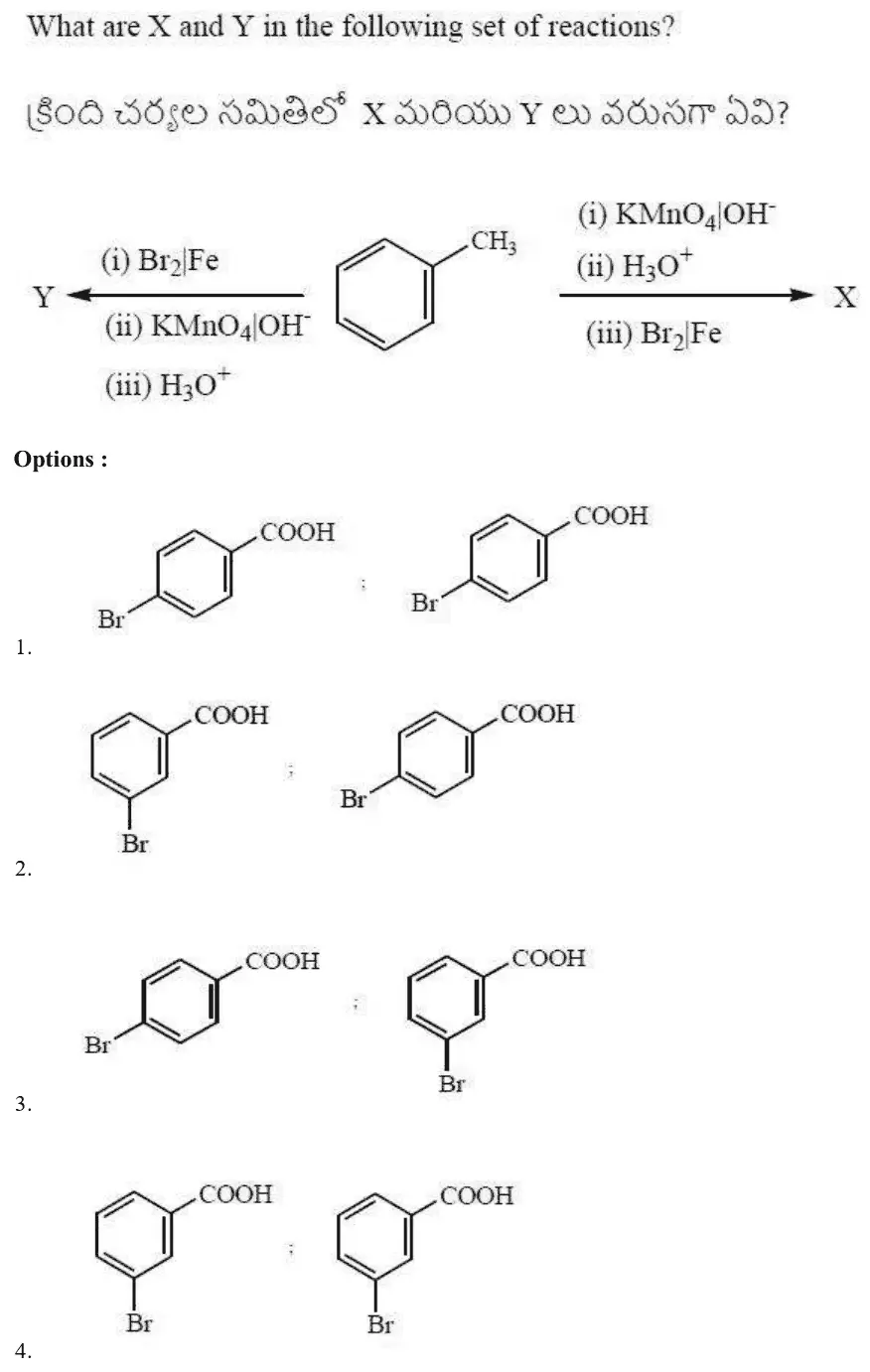
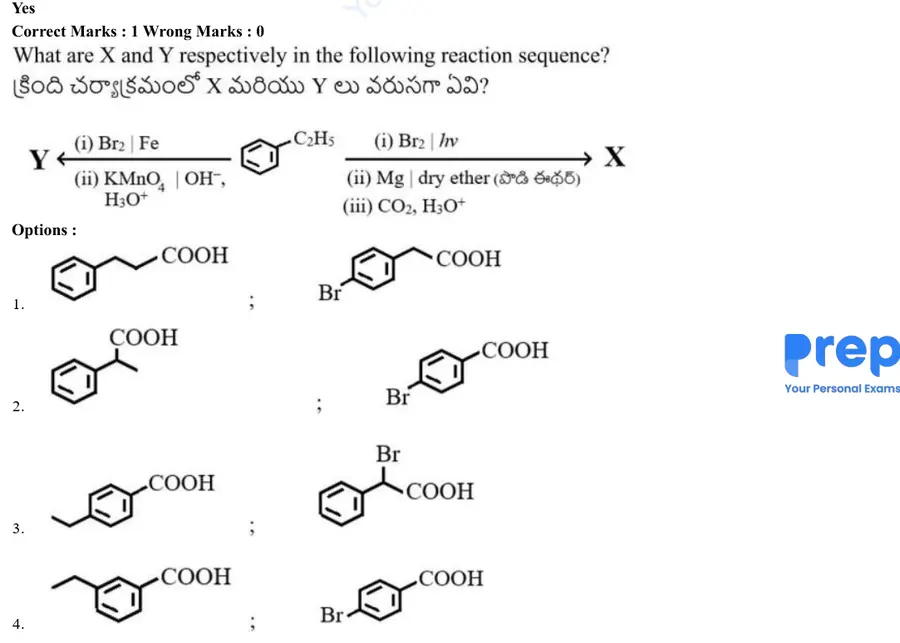
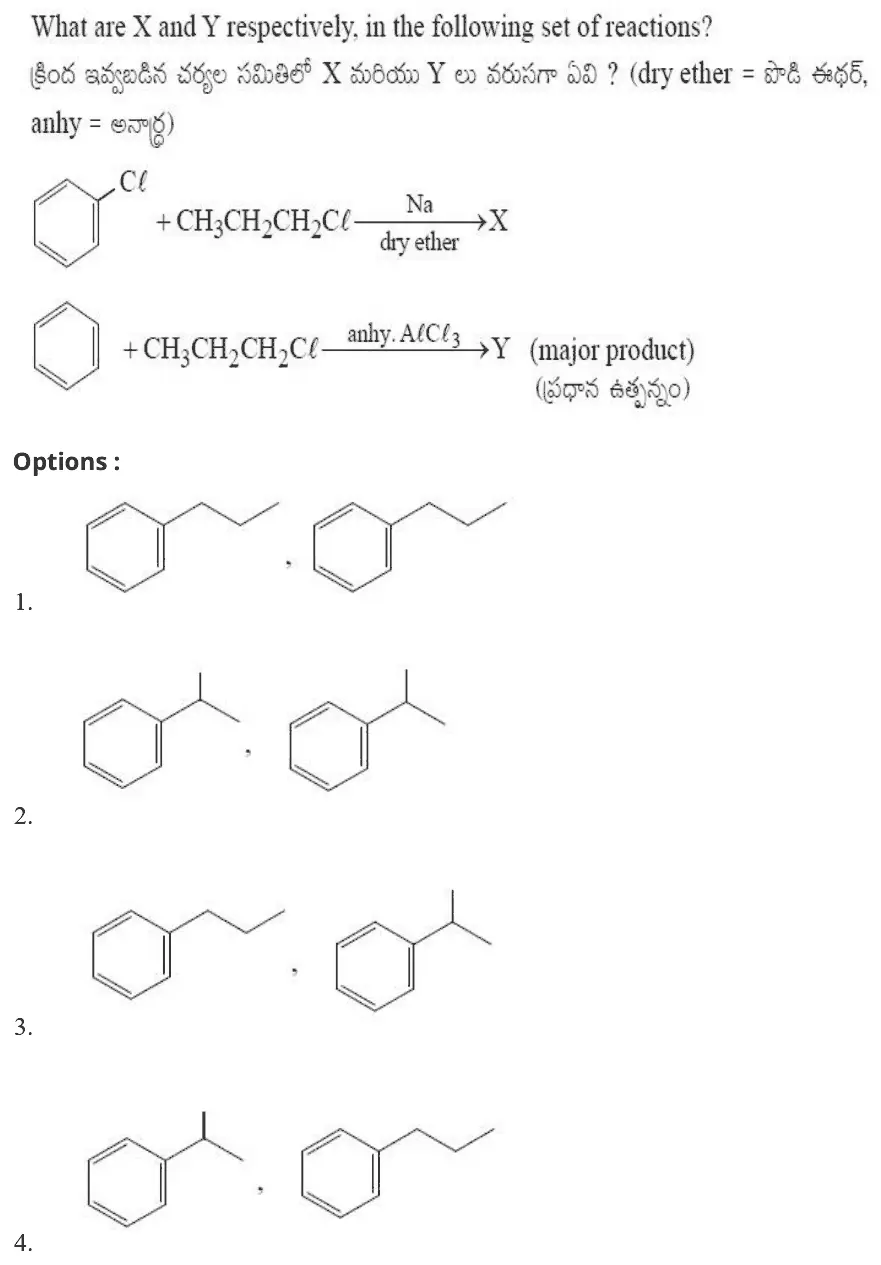
What are X and Y in the following set of reactions?
(see the figure above)
The question as printed in the paper.
A
see figure Para-bromobenzoic acid (benzene ring with COOH at the top right and Br at the bottom left, para); (see the figure above) para-bromobenzoic acid (same structure)
B
see figure Meta-bromobenzoic acid (COOH at the top right, Br at the bottom, meta); (see the figure above) para-bromobenzoic acid (COOH at the top right, Br at the bottom left)
C
see figure Para-bromobenzoic acid (COOH at the top right, Br at the bottom left); (see the figure above) meta-bromobenzoic acid (COOH at the top right, Br at the bottom)
D
see figure Meta-bromobenzoic acid (COOH at the top right, Br at the bottom); (see the figure above) meta-bromobenzoic acid (same structure)
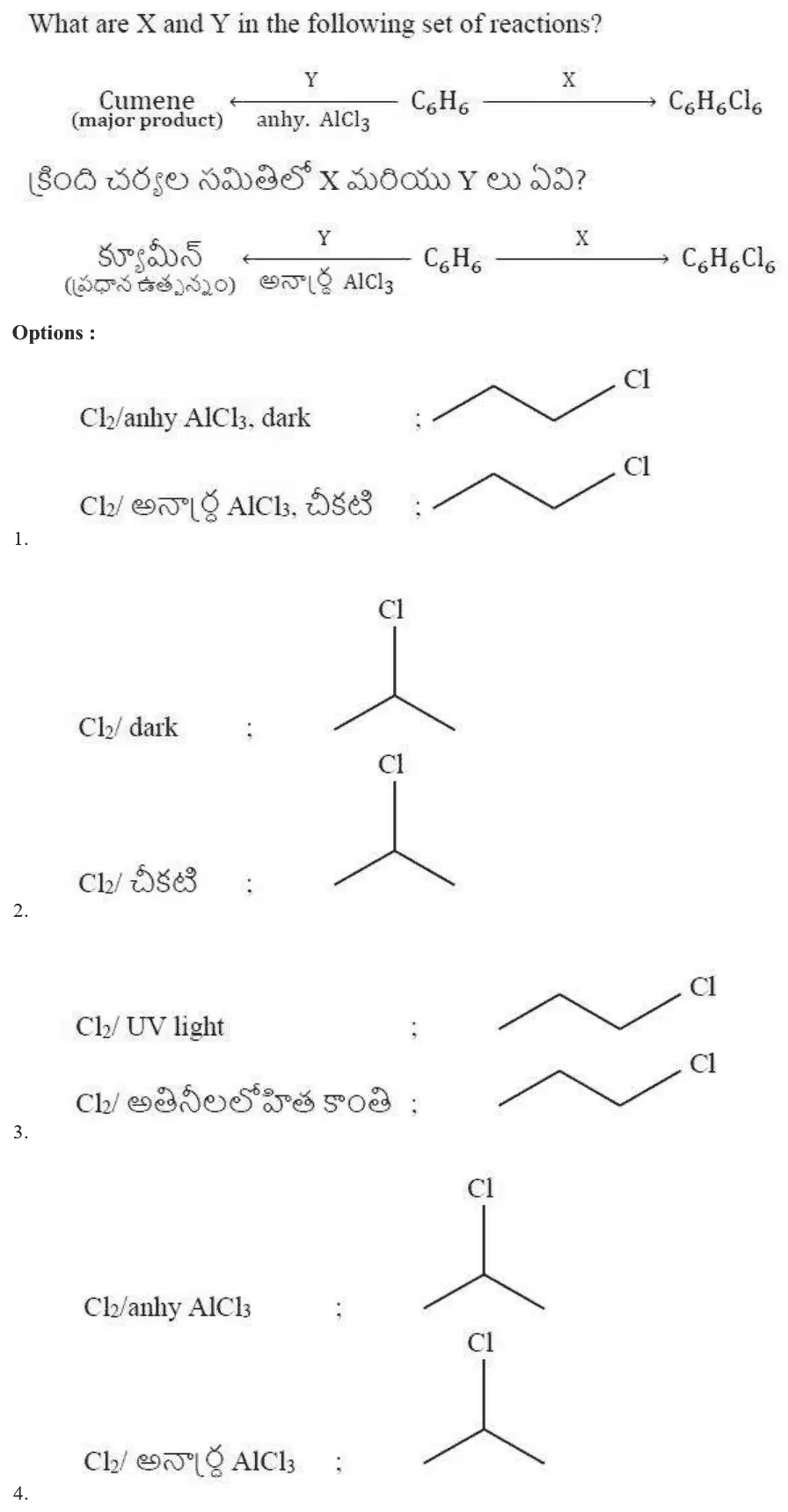
Answer: (C) X: $\mathrm{Cl_2}$/ UV light ; (see the figure above) zig-zag structure of 1-chloropropane (n-propyl chloride) as Y· The council's preliminary key
Reaction of toluene with reagent ‘A’ gave X which reacts with $\mathrm{NaHCO_3}$ and liberates $\mathrm{CO_2}$. In another reaction with reagent ‘B’ toluene gave Y which gives 2,4 – DNP test. What are A and B respectively?
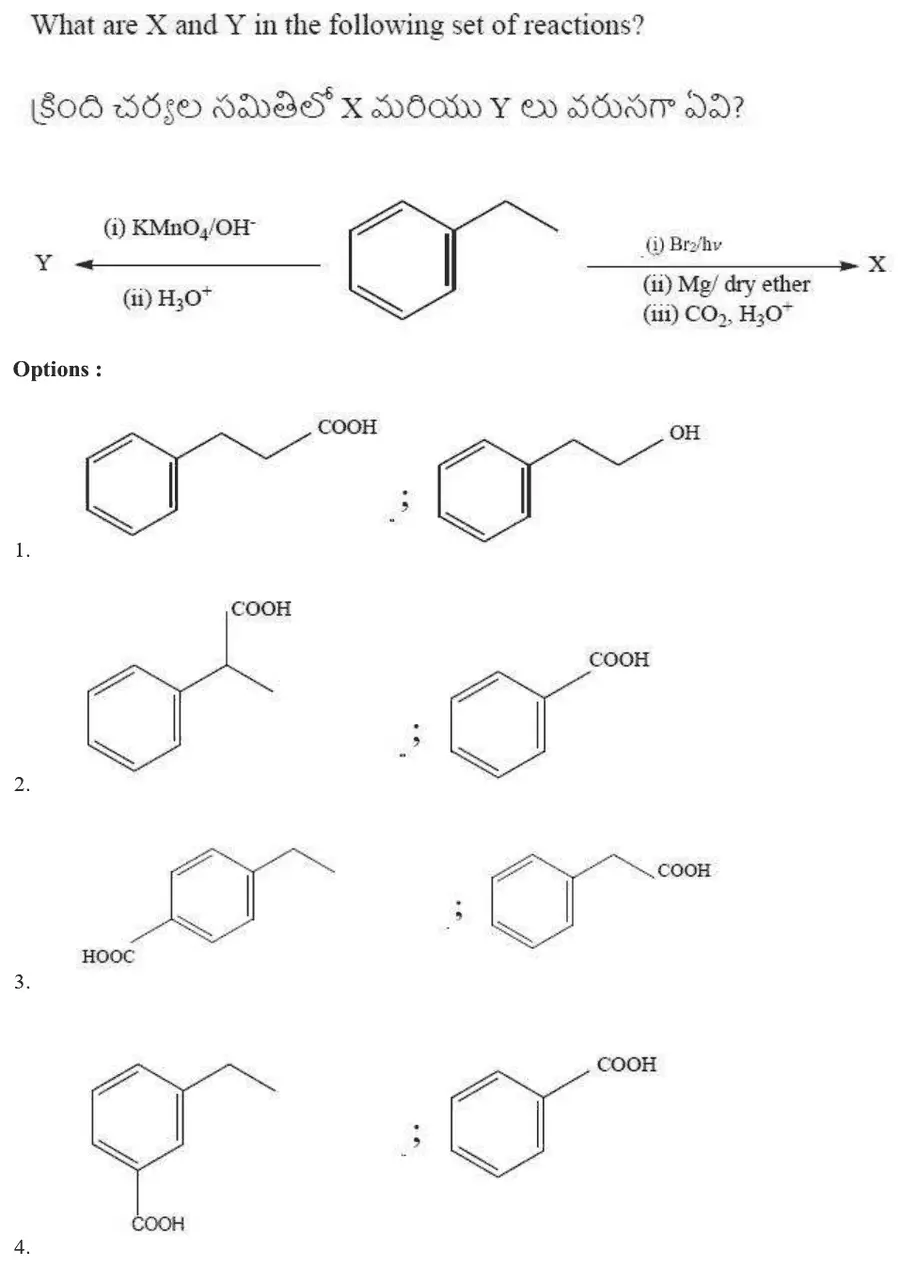
What are X and Y in the following set of reactions?
(see the figure above)
The question as printed in the paper.
A
see figure X: 3-phenylpropanoic acid, i.e. a benzene ring attached to CH2-CH2-COOH; Y: 2-phenylethanol, i.e. a benzene ring attached to CH2-CH2-OH (the pair is printed as X ; Y)
B
see figure X: 2-phenylpropanoic acid, i.e. a benzene ring attached to CH(COOH)-CH3; Y: benzoic acid, i.e. a benzene ring attached to COOH (the pair is printed as X ; Y)
C
see figure X: 4-ethylbenzoic acid, i.e. a benzene ring with an ethyl group and a HOOC group para to each other; Y: phenylacetic acid, i.e. a benzene ring attached to CH2-COOH (the pair is printed as X ; Y)
D
see figure X: 3-ethylbenzoic acid, i.e. a benzene ring with an ethyl group and a COOH group meta to each other; Y: benzoic acid, i.e. a benzene ring attached to COOH (the pair is printed as X ; Y)
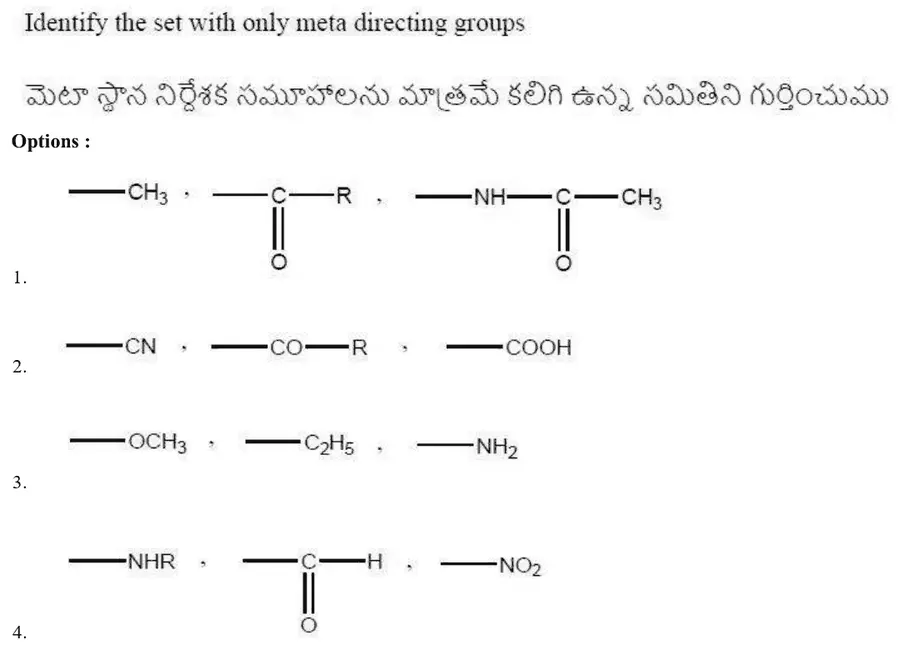
see figure Three substituent groups, each drawn as a bond line: $-\mathrm{CH_3}$ ; $-\mathrm{C(=O)-R}$ (carbonyl carbon with C=O below, R to the right) ; $-\mathrm{NH-C(=O)-CH_3}$ (NH, then carbonyl carbon with C=O below, then CH3)
B
see figure Three substituent groups, each drawn as a bond line: $-\mathrm{CN}$ ; $-\mathrm{CO-R}$ ; $-\mathrm{COOH}$
C
see figure Three substituent groups, each drawn as a bond line: $-\mathrm{OCH_3}$ ; $-\mathrm{C_2H_5}$ ; $-\mathrm{NH_2}$
D
see figure Three substituent groups, each drawn as a bond line: $-\mathrm{NHR}$ ; $-\mathrm{C(=O)-H}$ (carbonyl carbon with C=O below, H to the right) ; $-\mathrm{NO_2}$
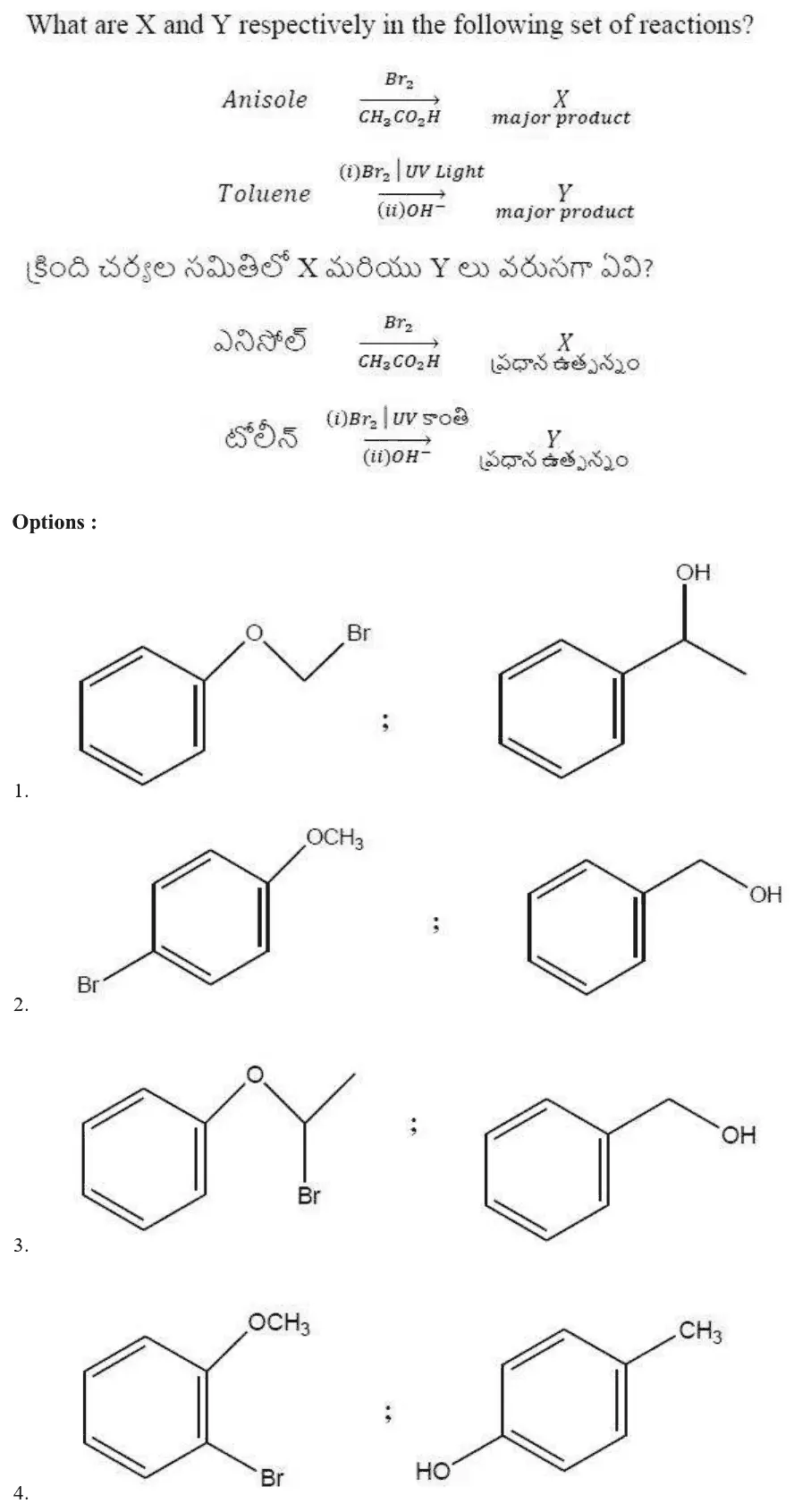
X: (see the figure above) phenyl ether C6H5-O-CH2-Br (bromomethyl phenyl ether); Y: (see the figure above) 1-phenylethanol (benzene ring attached to CH(OH)CH3)
B
X: (see the figure above) 4-bromoanisole (benzene ring with OCH3 and Br para); Y: (see the figure above) benzyl alcohol (benzene ring attached to CH2OH)
C
X: (see the figure above) phenyl ether C6H5-O-CH(Br)CH3 (1-bromoethyl phenyl ether); Y: (see the figure above) benzyl alcohol (benzene ring attached to CH2OH)
D
X: (see the figure above) 2-bromoanisole (benzene ring with OCH3 and Br ortho); Y: (see the figure above) 4-methylphenol (p-cresol; benzene ring with CH3 and HO para)
Answer: (B) X: (see the figure above) 4-bromoanisole (benzene ring with OCH3 and Br para); Y: (see the figure above) benzyl alcohol (benzene ring attached to CH2OH)· The council's preliminary key
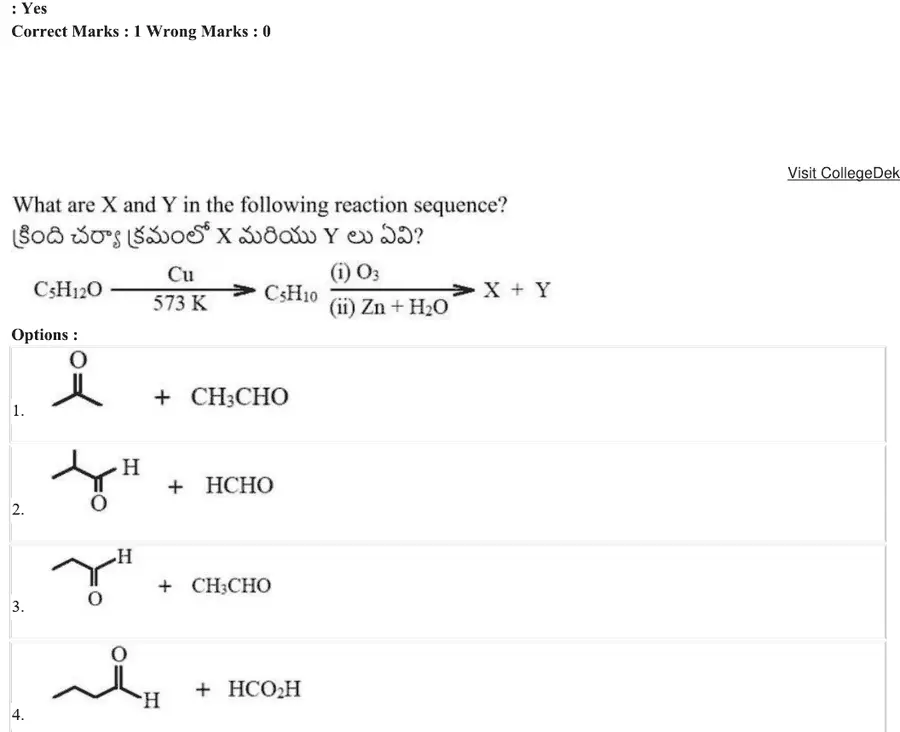
1 mole of a hydrocarbon A($\mathrm{C_5H_{10}}$) on ozonolysis gives two compounds X and Y. Both X and Y respond to iodoform test. X gives test with ammonical $\mathrm{AgNO_3}$ solution but not with Y. What are X and Y respectively?
An alkene, X ($\mathrm{C_5H_{10}}$) exhibits cis/trans isomerism. Bromination of ‘X’ followed by reaction with reagent/s (Y) gave the product ‘Z’. What are ‘Y’ and ‘Z’?
An alkene, $\mathrm{C_4H_8}$ (X) on reaction with HBr gives a compound Y. Hydrolysis of Y follows $\mathrm{S_N1}$ mechanism. The ozonolysis products of X are
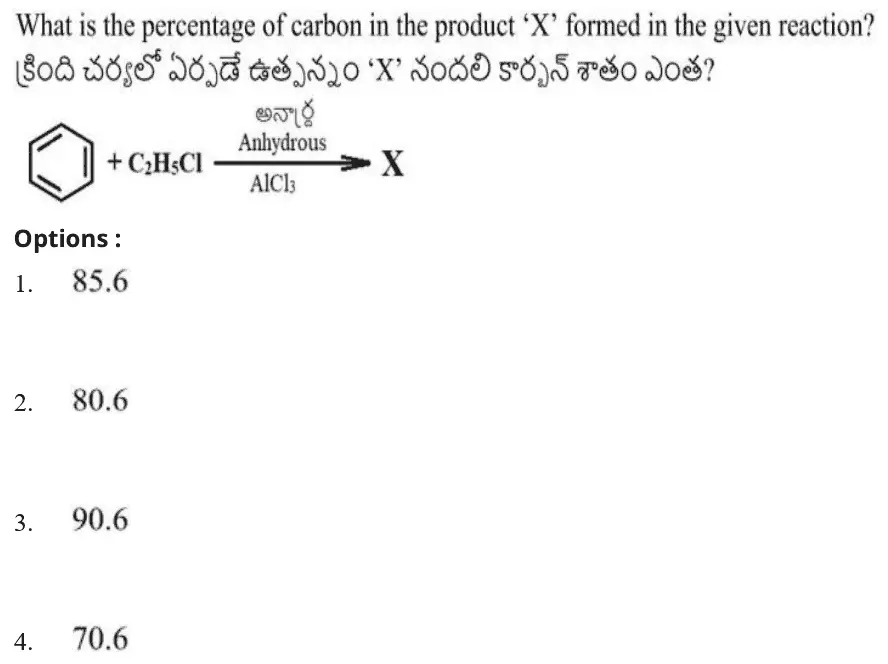
Bromination of toluene in the presence of anhydrous $\mathrm{AlCl_3}$ gave X and bromination of cyclohexene in the presence of light yielded Y. X and Y respectively are
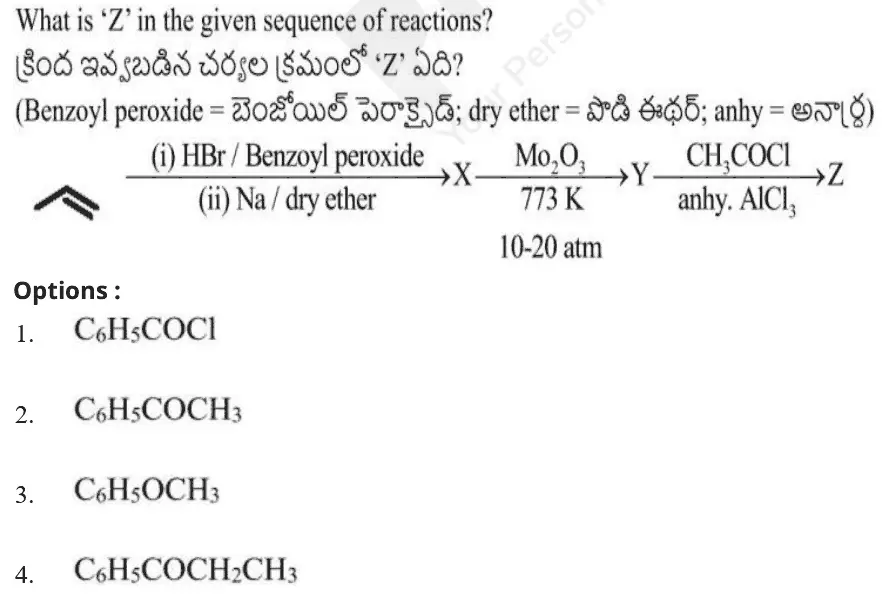
What is Z in the given sequence of reactions? (conc = conc, Quinoline = Quinoline)
$$\text{Propyne} \xrightarrow[\text{Pd-C, Quinoline}]{\mathrm{H_2}/} X \xrightarrow{\mathrm{H_2O|H^+}} Y \xrightarrow[443\ \mathrm{K}]{\text{Conc. }\mathrm{H_2SO_4}} Z$$
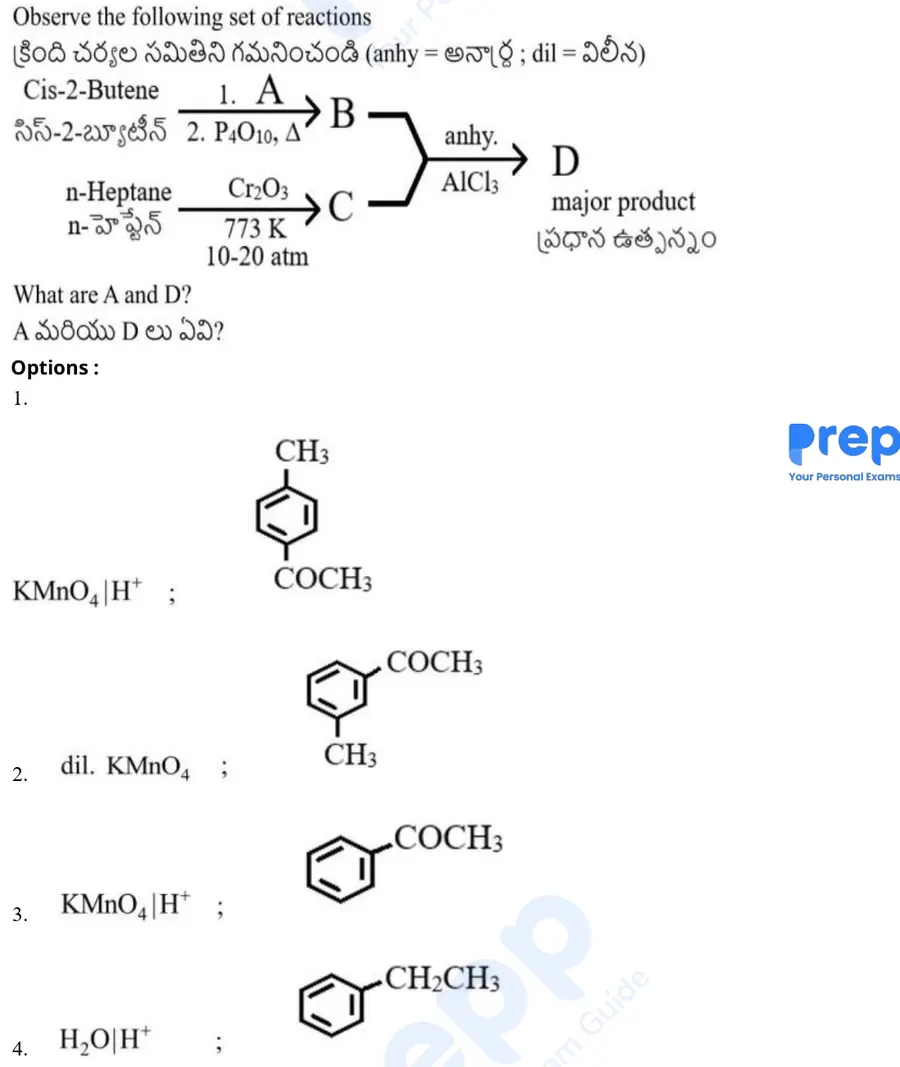
Answer: (A) $\mathrm{KMnO_4|H^+}$ ; (see the figure above) para-substituted benzene ring with $\mathrm{CH_3}$ at the top and $\mathrm{COCH_3}$ at the bottom· The council's preliminary key
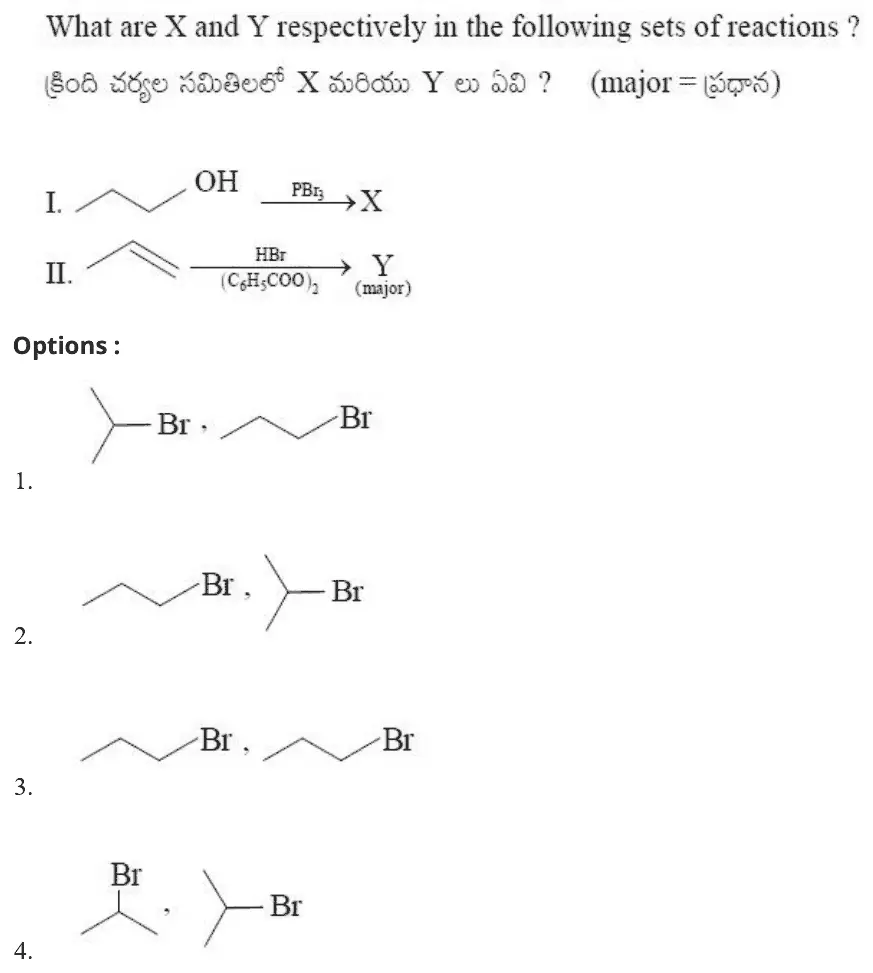
What are X and Y respectively in the following sets of reactions ? (major = major product)
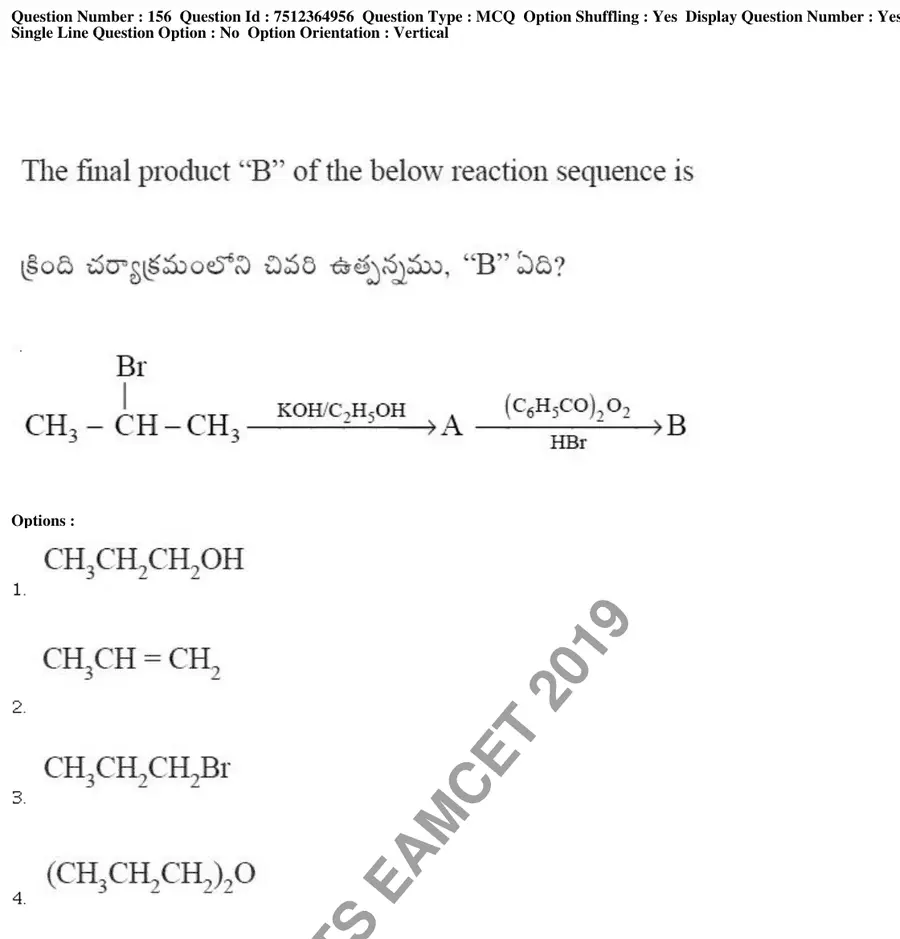
I. (see the figure above) $\xrightarrow{\mathrm{PBr_3}}$ X
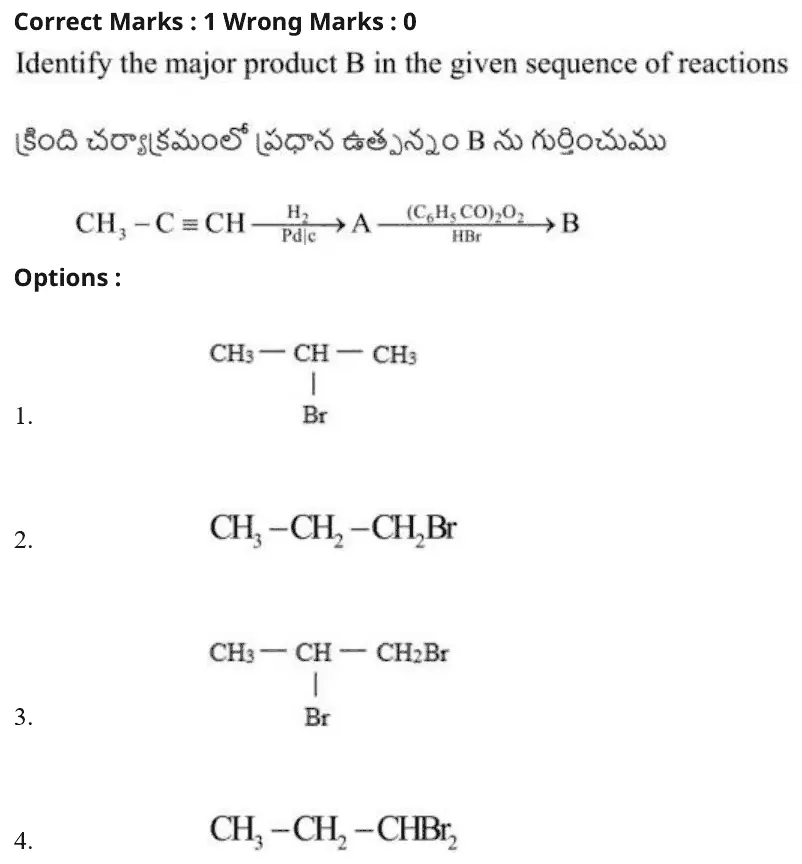
II. (see the figure above) $\xrightarrow[\mathrm{(C_6H_5COO)_2}]{\mathrm{HBr}}$ Y (major)
The question as printed in the paper.
A
see figure Two skeletal structures separated by a comma: isopropyl bromide (2-bromopropane, Br on the middle carbon of a three-carbon chain), and 1-bromopropane (Br on terminal carbon).
B
see figure Two skeletal structures separated by a comma: 1-bromopropane (Br on terminal carbon), and 2-bromopropane (Br on the middle carbon).
C
see figure Two skeletal structures separated by a comma: 1-bromopropane, and 1-bromopropane.
D
see figure Two skeletal structures separated by a comma: 2-bromopropane (Br drawn up on the central carbon), and 2-bromopropane (Br drawn to the right on the central carbon).
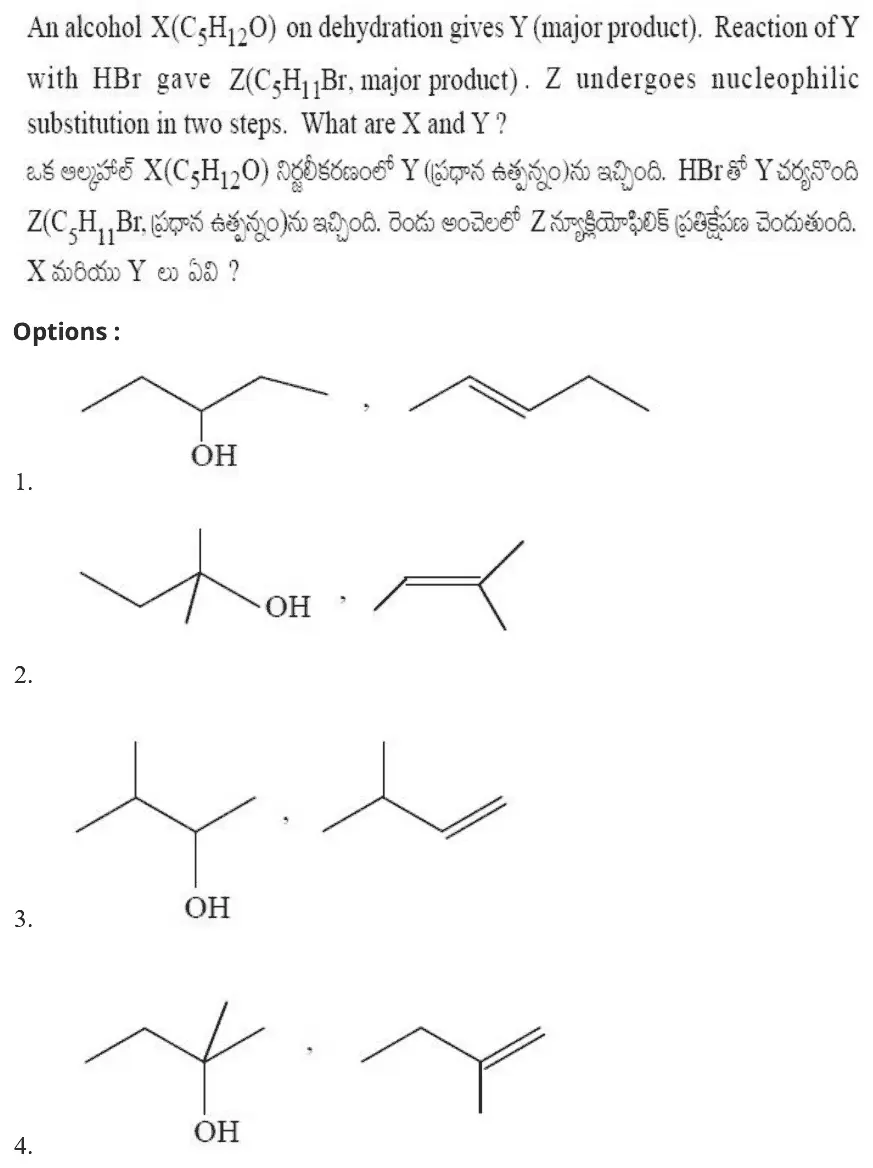
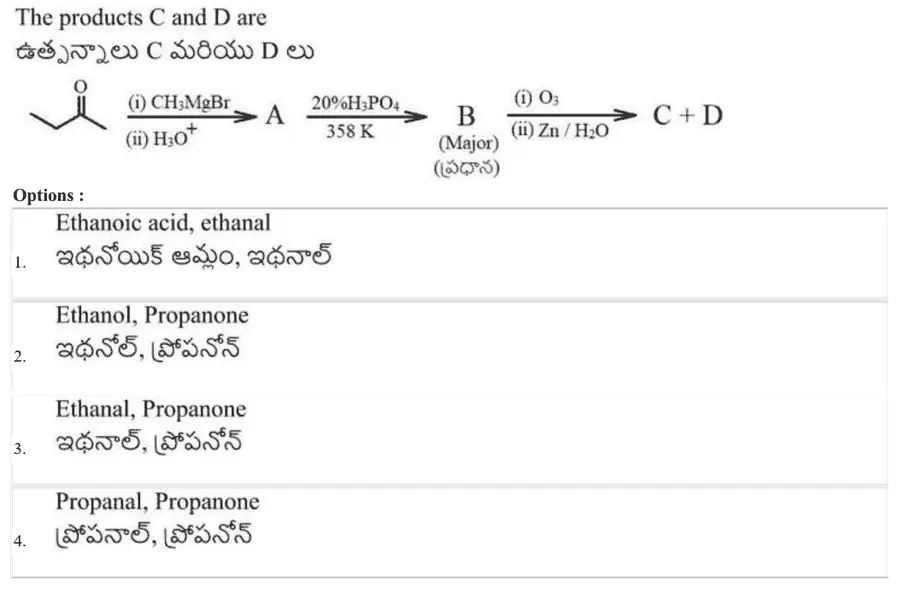
An alcohol $\mathrm{X(C_5H_{12}O)}$ on dehydration gives Y (major product). Reaction of Y with HBr gave $\mathrm{Z(C_5H_{11}Br}$, major product). Z undergoes nucleophilic substitution in two steps. What are X and Y ?
The question as printed in the paper.
A
see figure X: skeletal structure of pentan-3-ol (zigzag chain of five carbons with OH on the middle carbon, pointing down); Y: pent-2-ene (zigzag chain of five carbons with a double bond between C2 and C3, at the left)
B
see figure X: skeletal structure of 3-methylbutan-... tertiary alcohol, 2-methylbutan-2-ol (a quaternary carbon bearing OH with a methyl up, an ethyl on the left and a methyl to the right with OH label); Y: 2-methylbut-2-ene (trisubstituted alkene with double bond and a methyl branch)
C
see figure X: 3-methylbutan-2-ol drawn as skeletal structure (branched chain with a methyl branch up at the left carbon and OH pointing down on the adjacent carbon); Y: 3-methylbut-1-ene (branched chain with a methyl branch up and a terminal double bond to the right)
D
see figure X: 2-methylbutan-2-ol drawn as skeletal structure (ethyl chain at the left, quaternary carbon with OH pointing down and a methyl pointing up); Y: 2-methylbut-1-ene (ethyl chain at the left, carbon with terminal double bond to the upper right and a methyl branch pointing down)
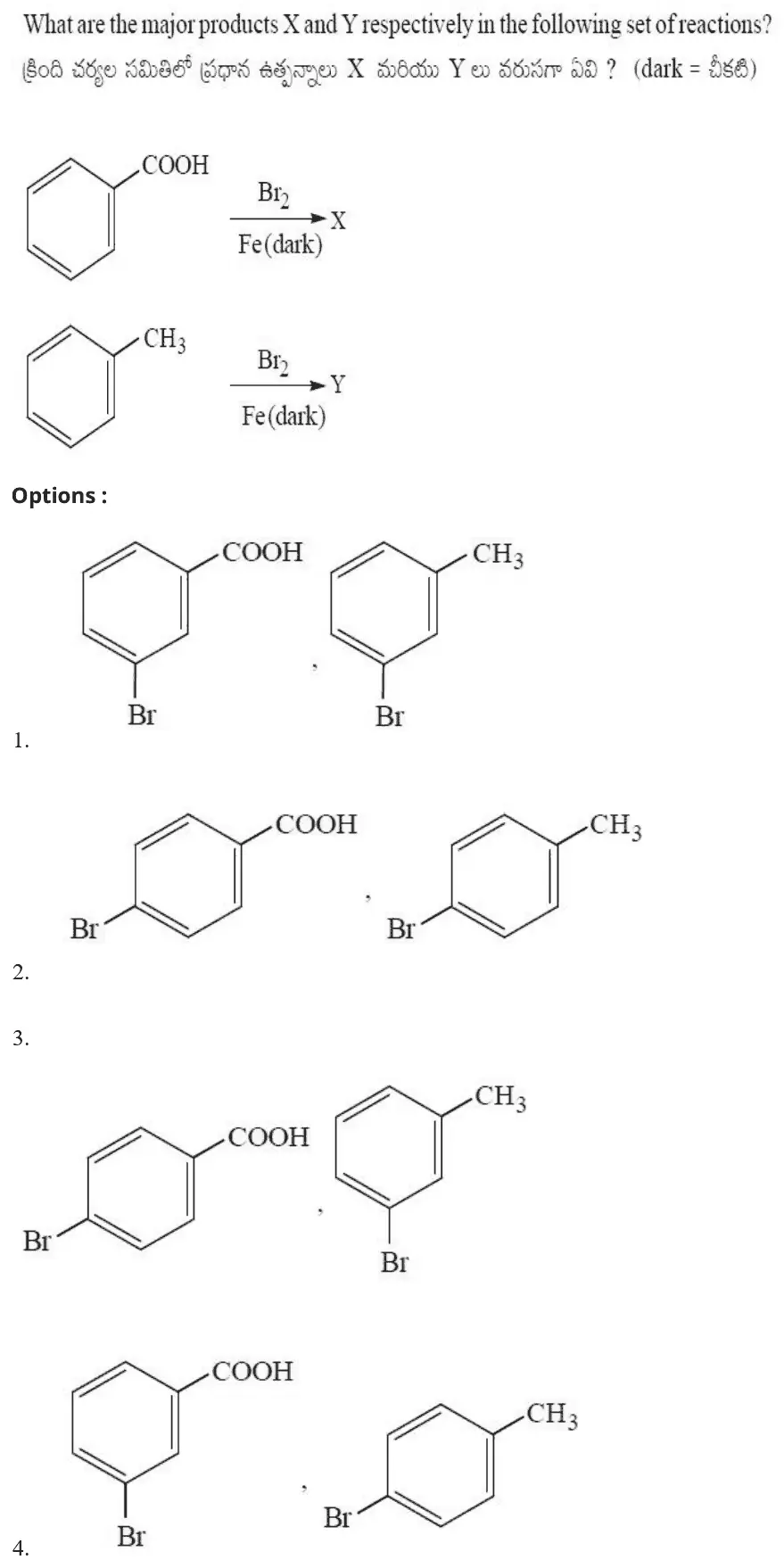
What are the major products X and Y respectively in the following set of reactions?
(see the figure above)
The question as printed in the paper.
A
see figure Pair of structures: meta-bromobenzoic acid (benzene ring with COOH at the top right and Br at the bottom, i.e. meta), and meta-bromotoluene (benzene ring with CH3 at the top right and Br at the bottom, i.e. meta).
B
see figure Pair of structures: para-bromobenzoic acid (COOH at the top right, Br at the lower left, i.e. para), and para-bromotoluene (CH3 at the top right, Br at the lower left, i.e. para).
C
see figure Pair of structures: para-bromobenzoic acid (COOH at the top right, Br at the lower left, i.e. para), and meta-bromotoluene (CH3 at the top right, Br at the bottom, i.e. meta).
D
see figure Pair of structures: meta-bromobenzoic acid (COOH at the top right, Br at the bottom, i.e. meta), and para-bromotoluene (CH3 at the top right, Br at the lower left, i.e. para).
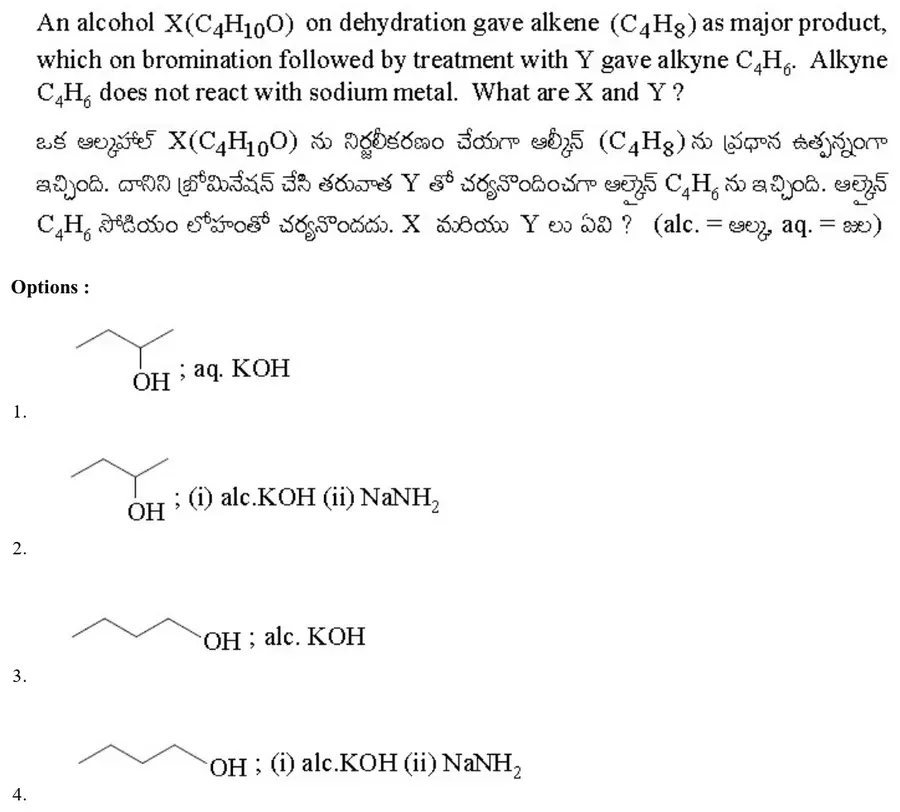
An alcohol $\mathrm{X(C_4H_{10}O)}$ on dehydration gave alkene $\mathrm{(C_4H_8)}$ as major product, which on bromination followed by treatment with Y gave alkyne $\mathrm{C_4H_6}$. Alkyne $\mathrm{C_4H_6}$ does not react with sodium metal. What are X and Y ?
The question as printed in the paper.
A
see figure Skeletal structure of butan-2-ol (OH on the second carbon of a four-carbon chain); aq. KOH
B
see figure Skeletal structure of butan-2-ol (OH on the second carbon of a four-carbon chain); (i) alc.KOH (ii) $\mathrm{NaNH_2}$
C
see figure Skeletal structure of butan-1-ol (OH on the terminal carbon of a four-carbon chain); alc. KOH
D
see figure Skeletal structure of butan-1-ol (OH on the terminal carbon of a four-carbon chain); (i) alc.KOH (ii) $\mathrm{NaNH_2}$
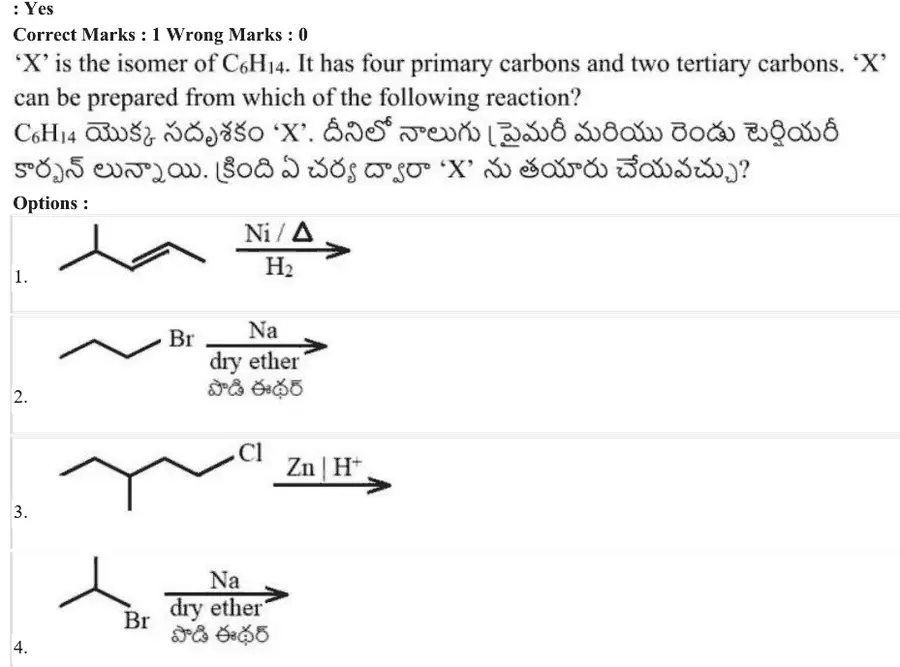
‘X’ is the isomer of $\mathrm{C_6H_{14}}$. It has four primary carbons and two tertiary carbons. ‘X’ can be prepared from which of the following reaction?
The question as printed in the paper.
A
see figure Skeletal structure of an alkene, 4-methylpent-2-ene (isopropyl group attached to a CH=CH–CH3 unit), reacting with $\mathrm{H_2}$ over Ni / Δ
B
see figure Skeletal structure of 1-bromopropane (n-propyl bromide, Br on the terminal carbon), reacting with Na in dry ether
C
see figure Skeletal structure of a chloroalkane, a 6-carbon chain with a methyl branch (3-methylpentane skeleton) bearing Cl at the terminal carbon, reacting with $\mathrm{Zn | H^+}$
D
see figure Skeletal structure of 2-bromopropane (isopropyl bromide, Br on the central carbon), reacting with Na in dry ether
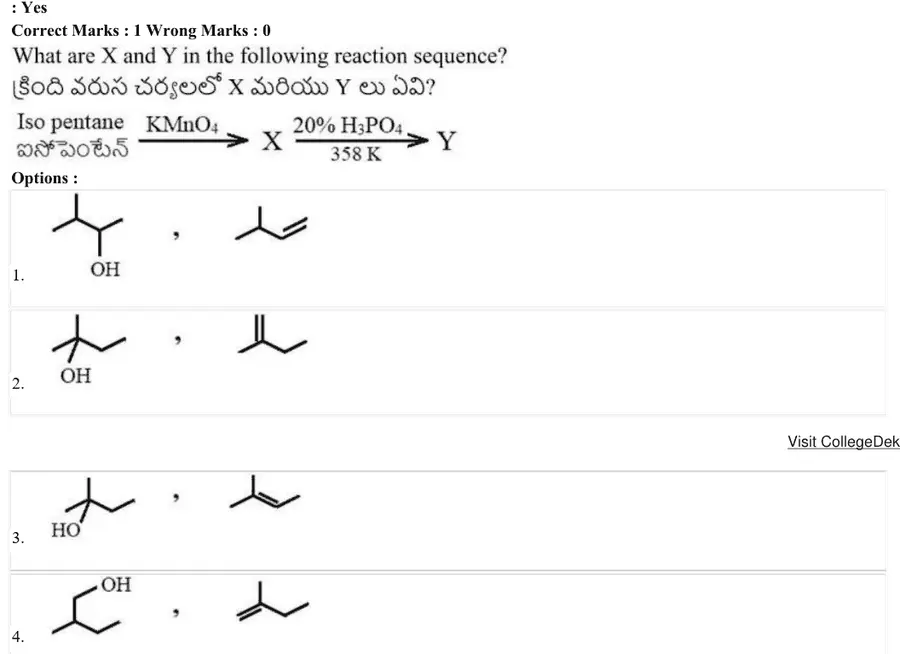
What are X and Y in the following reaction sequence?
Iso pentane $\xrightarrow{\mathrm{KMnO_4}}$ X $\xrightarrow[358\ \mathrm{K}]{20\%\ \mathrm{H_3PO_4}}$ Y
The question as printed in the paper.
A
see figure Skeletal structures separated by a comma: X is a branched alcohol with the OH on the carbon at the junction of an isopropyl-type group (a secondary alcohol, 3-methylbutan-2-ol); Y is 3-methylbut-1-ene (isopropyl group attached to a terminal vinyl group).
B
see figure Skeletal structures separated by a comma: X is a tertiary alcohol with the OH on the quaternary carbon (2-methylbutan-2-ol), drawn with OH at the bottom left; Y is 2-methylbut-1-ene drawn with a terminal double bond on the carbon bearing methyl and ethyl groups.
C
see figure Skeletal structures separated by a comma: X is a tertiary alcohol with HO on the quaternary carbon (2-methylbutan-2-ol), drawn with HO at the lower left; Y is 2-methylbut-2-ene (double bond within the chain, with two methyl groups on one alkene carbon).
D
see figure Skeletal structures separated by a comma: X is a primary alcohol with OH at the top right (2-methylbutan-1-ol, a branched chain with CH2OH); Y is 2-methylbut-1-ene (terminal double bond on the carbon bearing methyl and ethyl groups).
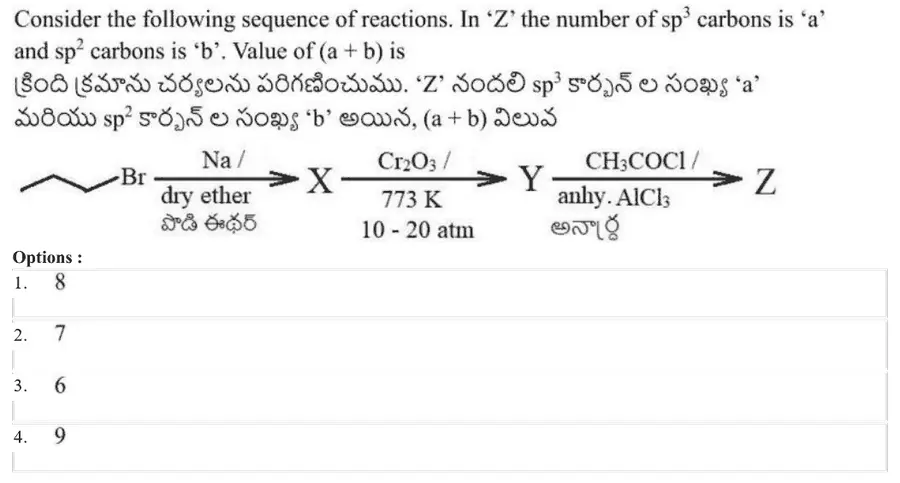
Consider the following sequence of reactions. In ‘Z’ the number of $\mathrm{sp^3}$ carbons is ‘a’ and $\mathrm{sp^2}$ carbons is ‘b’. Value of (a + b) is
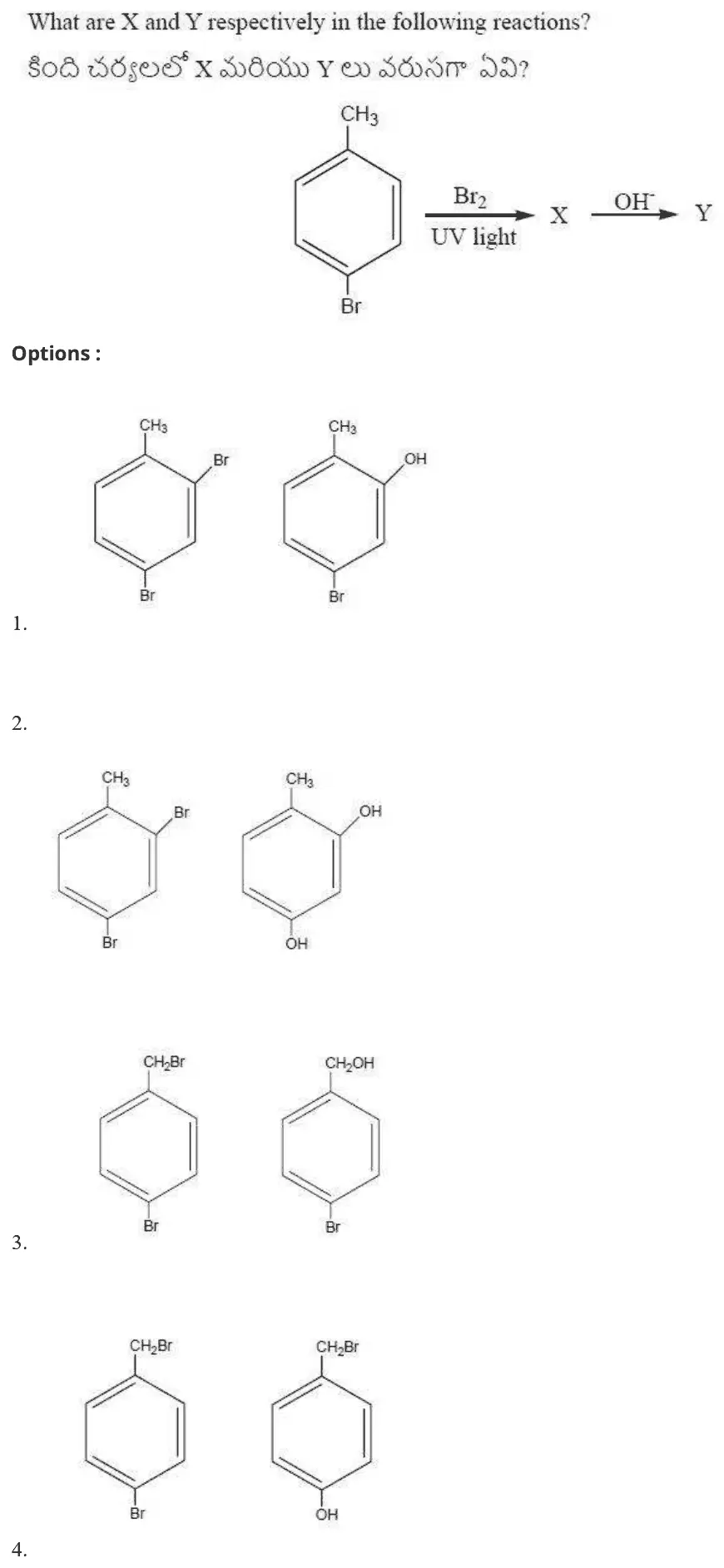
What are X and Y respectively in the following reactions?
(see the figure above)
The question as printed in the paper.
A
see figure X: benzene ring with CH3 at top and Br at bottom (para) and an additional Br on the upper-right ring carbon (ortho to CH3's neighbour, i.e. Br at position 2 relative to CH3... drawn at upper right); Y: benzene ring with CH3 at top, Br at bottom, and OH at the upper-right ring carbon
B
see figure X: benzene ring with CH3 at top, Br at bottom-left position... Br at the lower position and an additional Br at upper-right ring carbon; Y: benzene ring with CH3 at top, OH at bottom and OH at the upper-right ring carbon
C
see figure X: benzene ring with CH2Br at top and Br at bottom (para); Y: benzene ring with CH2OH at top and Br at bottom (para)
D
see figure X: benzene ring with CH2Br at top and Br at bottom (para); Y: benzene ring with CH2Br at top and OH at bottom (para)
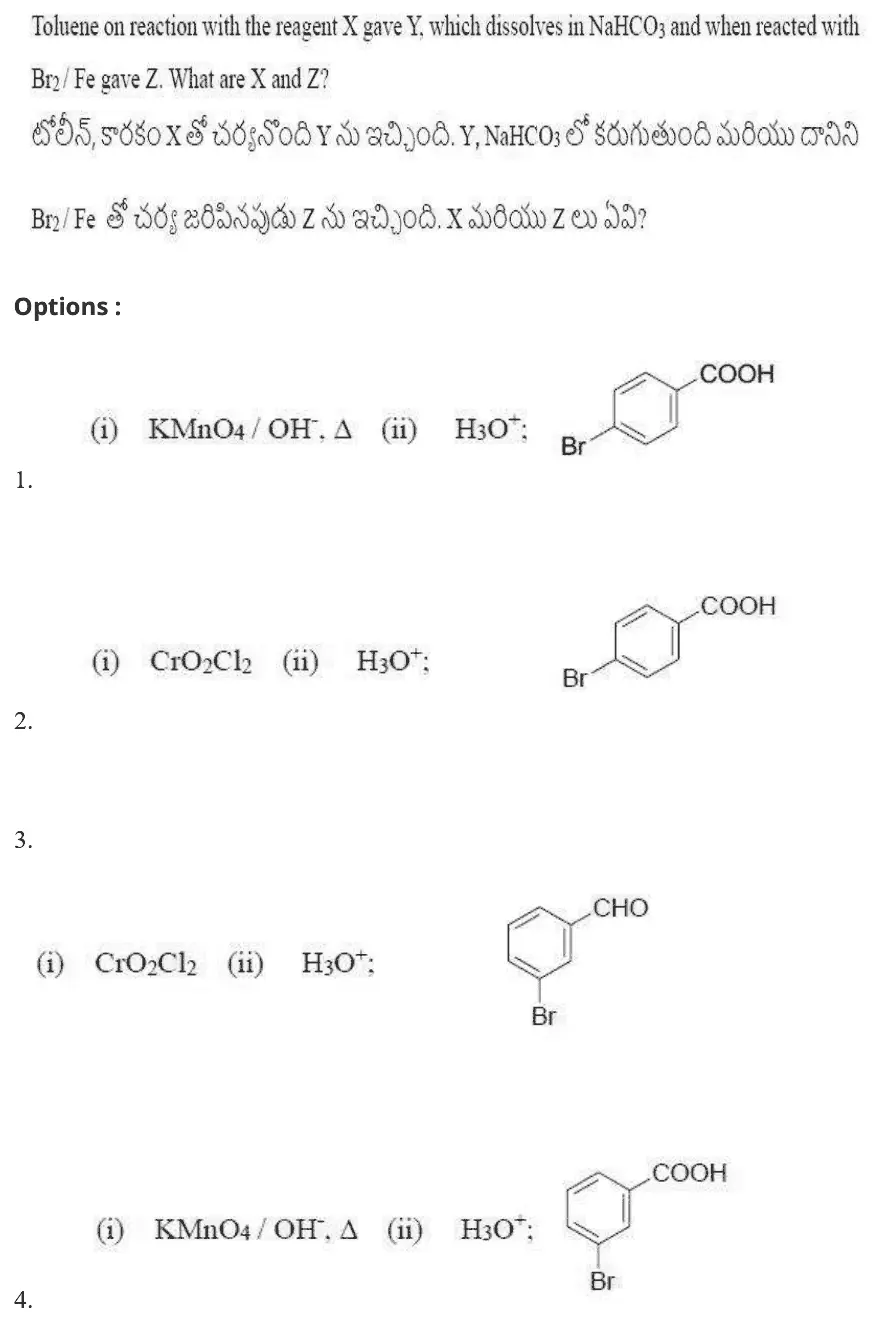
Toluene on reaction with the reagent X gave Y, which dissolves in $\mathrm{NaHCO_3}$ and when reacted with $\mathrm{Br_2}$/Fe gave Z. What are X and Z?
The question as printed in the paper.
A
X: (i) $\mathrm{KMnO_4}$/$\mathrm{OH^-}$, $\Delta$ (ii) $\mathrm{H_3O^+}$; Z: (see the figure above) benzene ring with COOH and Br in para (1,4) positions (p-bromobenzoic acid)
B
X: (i) $\mathrm{CrO_2Cl_2}$ (ii) $\mathrm{H_3O^+}$; Z: (see the figure above) benzene ring with COOH and Br in para (1,4) positions (p-bromobenzoic acid)
C
X: (i) $\mathrm{CrO_2Cl_2}$ (ii) $\mathrm{H_3O^+}$; Z: (see the figure above) benzene ring with CHO and Br in meta (1,3) positions (m-bromobenzaldehyde)
D
X: (i) $\mathrm{KMnO_4}$/$\mathrm{OH^-}$, $\Delta$ (ii) $\mathrm{H_3O^+}$; Z: (see the figure above) benzene ring with COOH and Br in meta (1,3) positions (m-bromobenzoic acid)
Answer: (D) X: (i) $\mathrm{KMnO_4}$/$\mathrm{OH^-}$, $\Delta$ (ii) $\mathrm{H_3O^+}$; Z: (see the figure above) benzene ring with COOH and Br in meta (1,3) positions (m-bromobenzoic acid)· The council's preliminary key
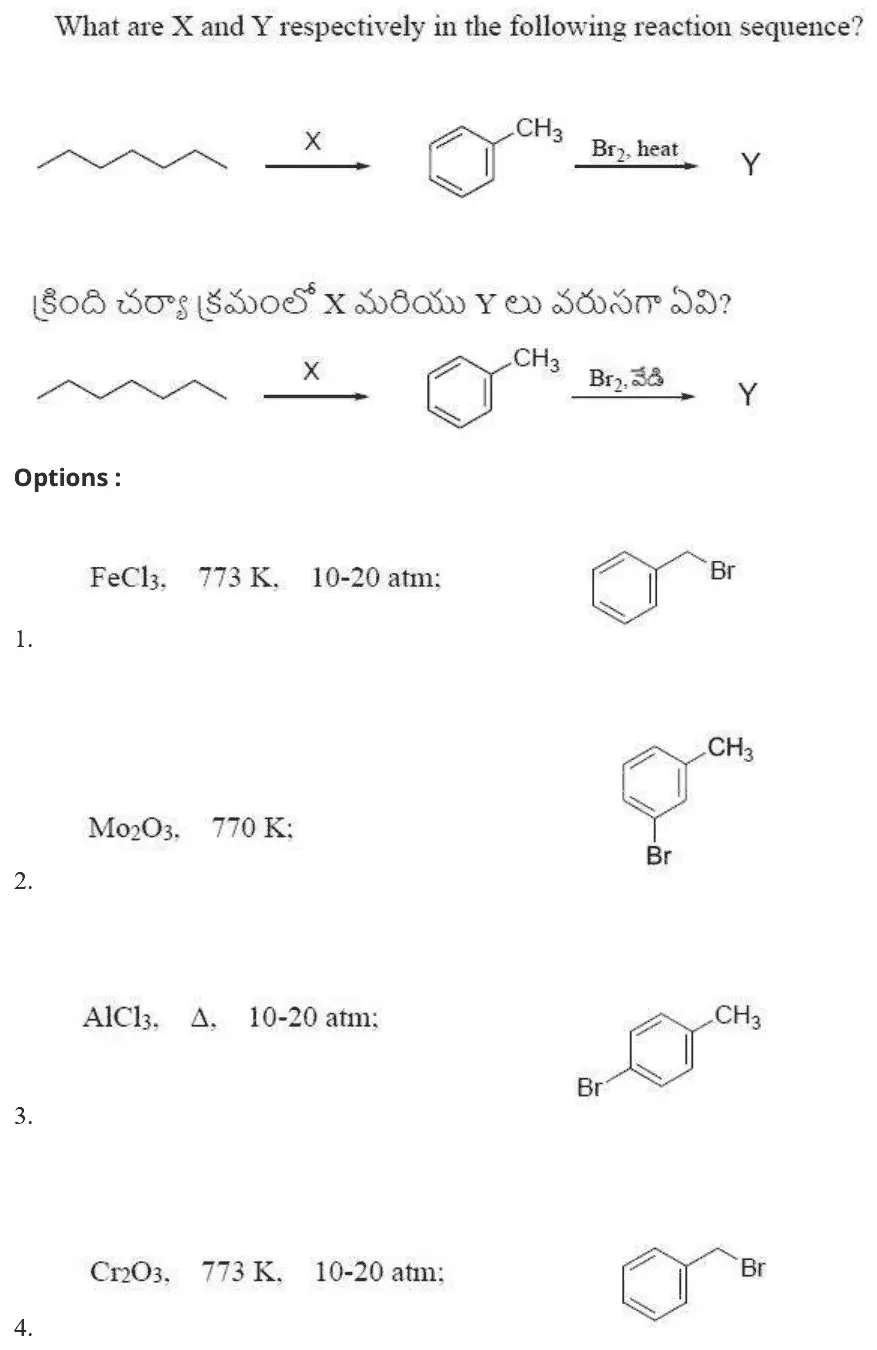
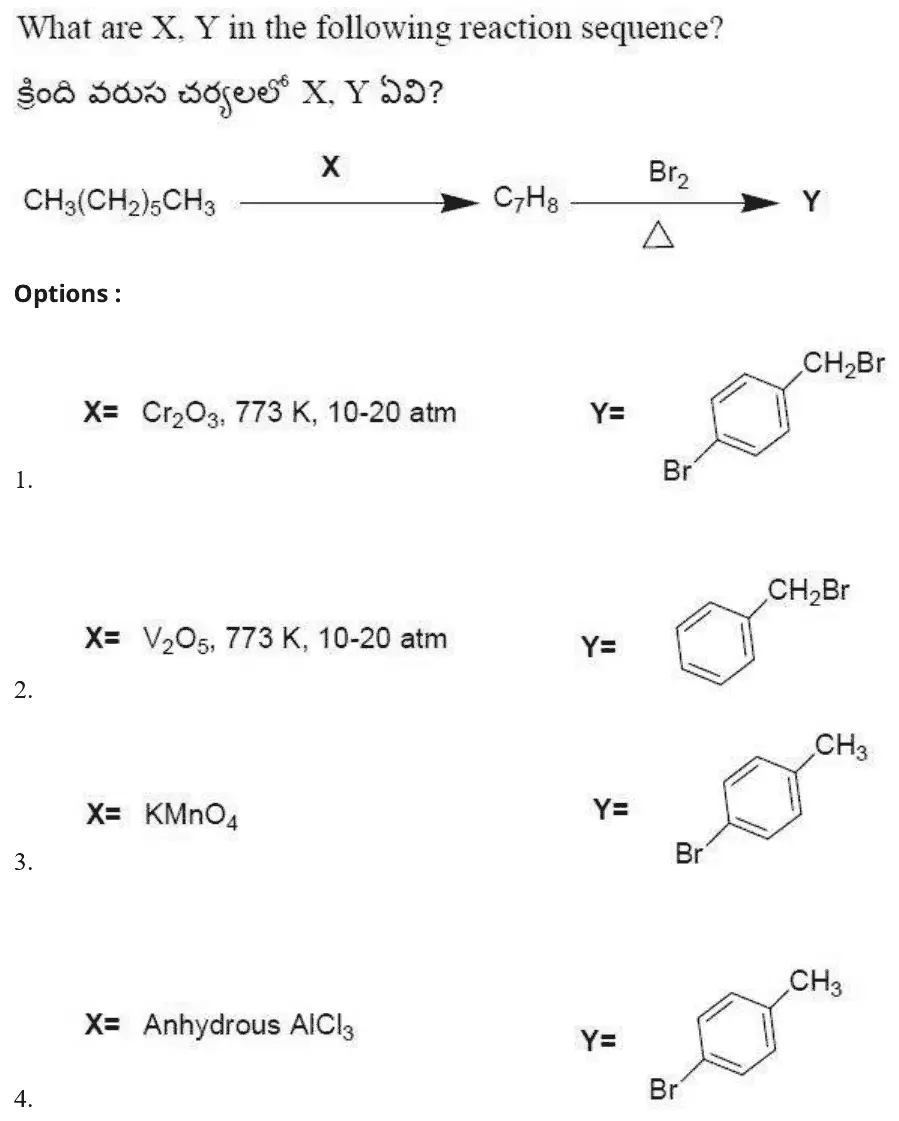
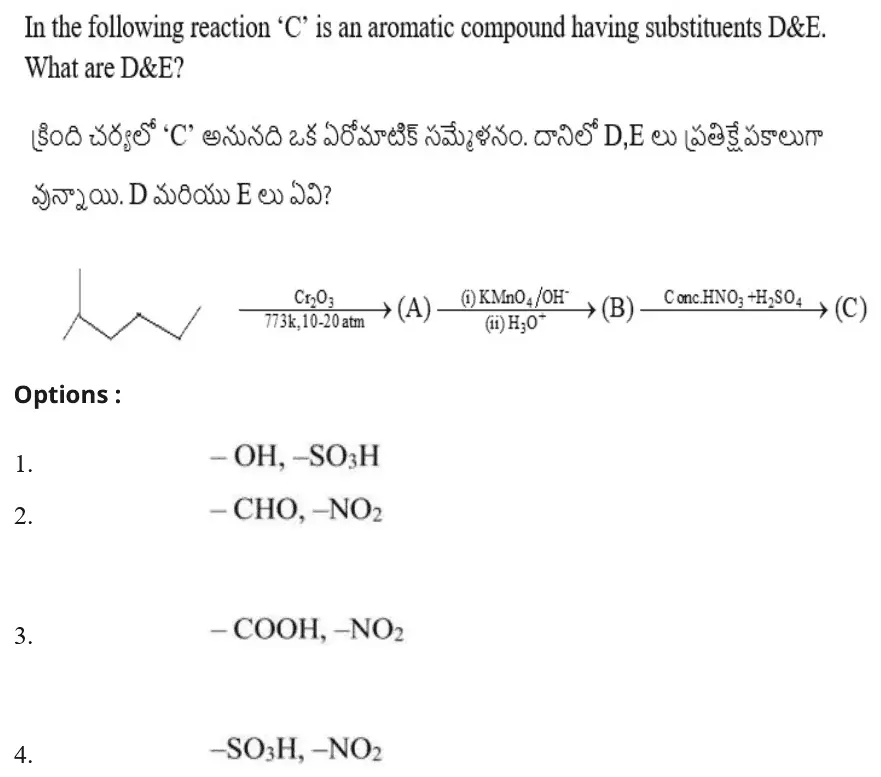
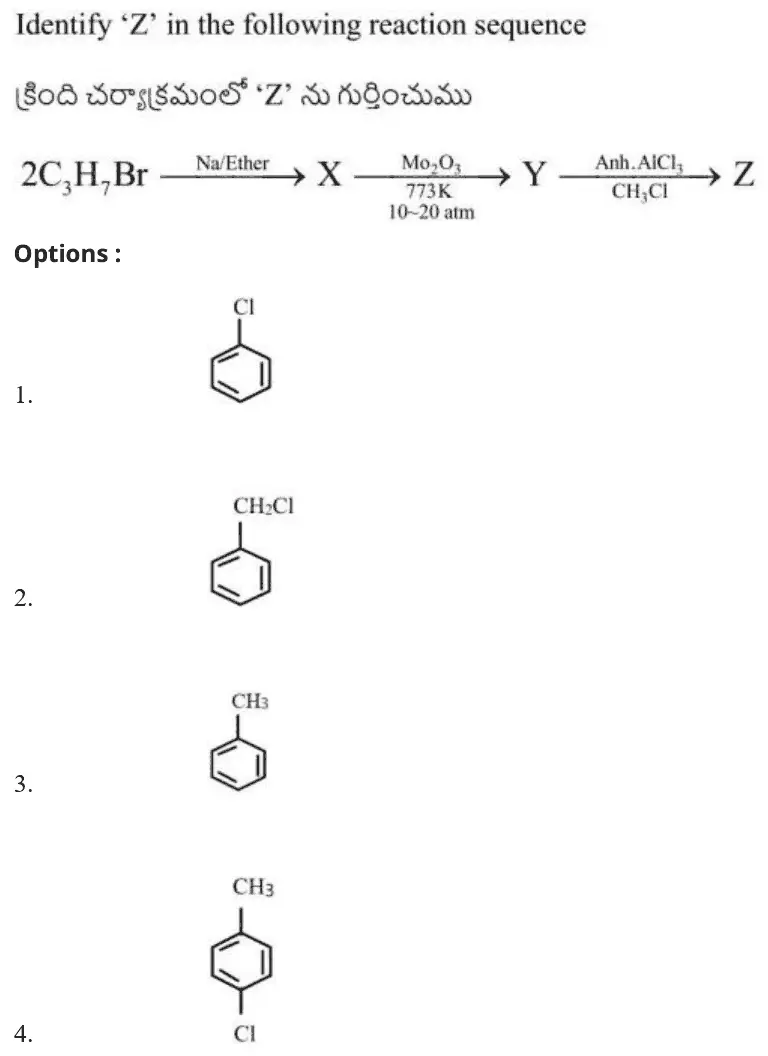
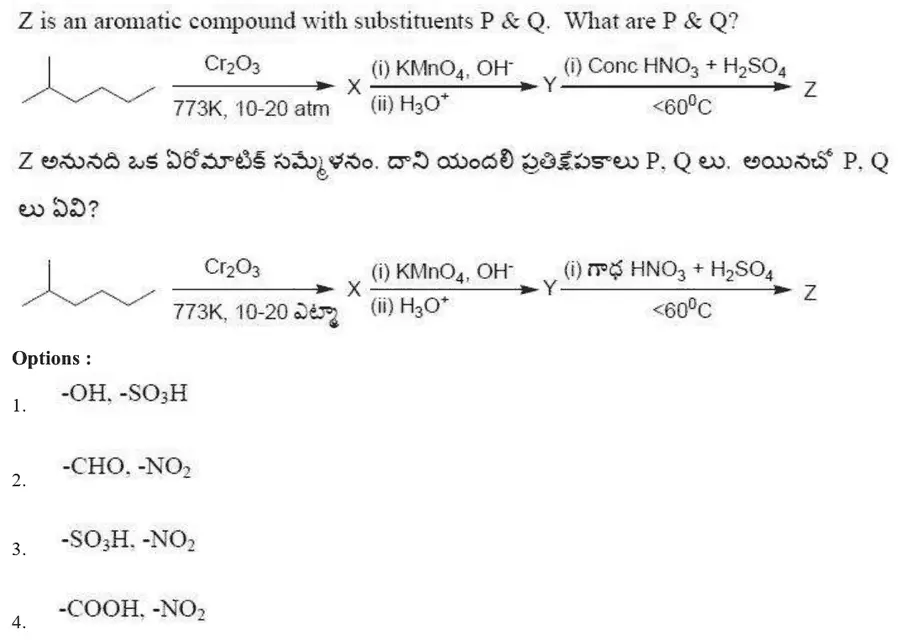
Answer: (D) $\mathrm{Cr_2O_3}$, 773 K, 10-20 atm; (see the figure above) benzyl bromide (benzene ring with a CH2Br group attached)· The council's preliminary key
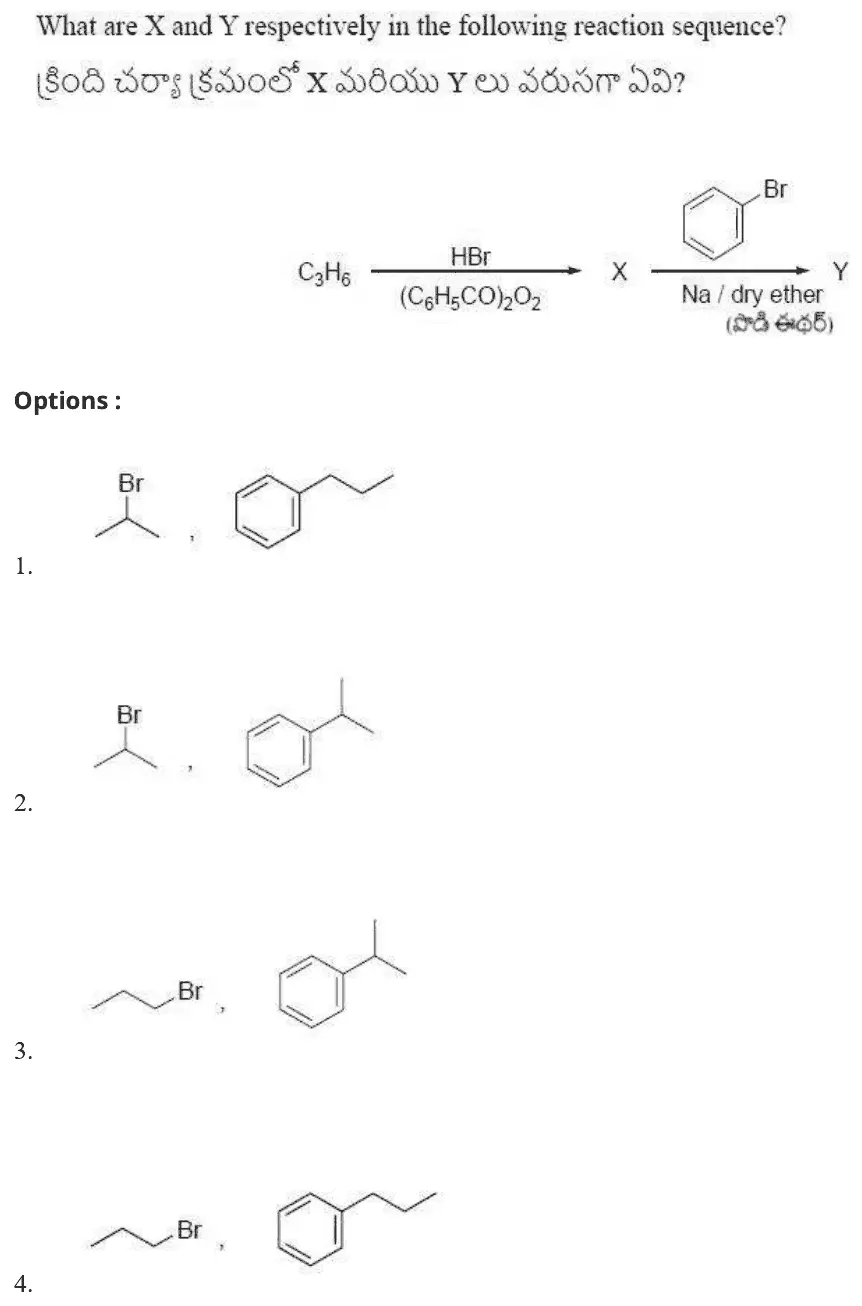
What are X and Y respectively in the following reaction sequence?
(see the figure above)
The question as printed in the paper.
A
see figure X: isopropyl bromide (2-bromopropane, Br on the middle carbon of a three-carbon skeleton); Y: n-propylbenzene (benzene ring attached to a linear three-carbon chain)
B
see figure X: isopropyl bromide (2-bromopropane); Y: isopropylbenzene (cumene, benzene ring attached to the middle carbon of a three-carbon skeleton)
C
see figure X: n-propyl bromide (1-bromopropane, Br on the terminal carbon); Y: isopropylbenzene (cumene)
D
see figure X: n-propyl bromide (1-bromopropane); Y: n-propylbenzene (benzene ring attached to a linear three-carbon chain)
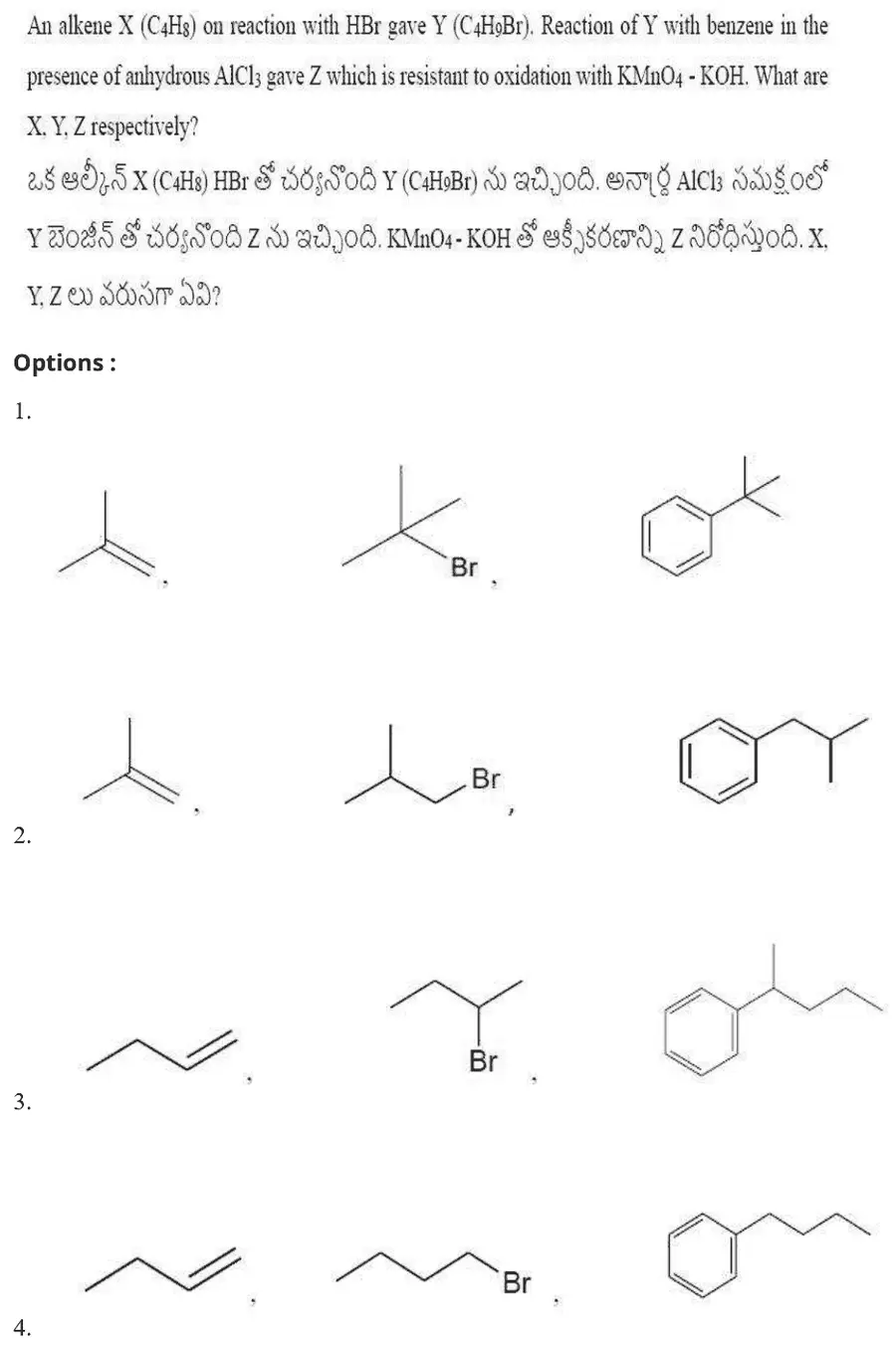
An alkene X ($\mathrm{C_4H_8}$) on reaction with HBr gave Y ($\mathrm{C_4H_9Br}$). Reaction of Y with benzene in the presence of anhydrous $\mathrm{AlCl_3}$ gave Z which is resistant to oxidation with $\mathrm{KMnO_4}$ - KOH. What are X, Y, Z respectively?
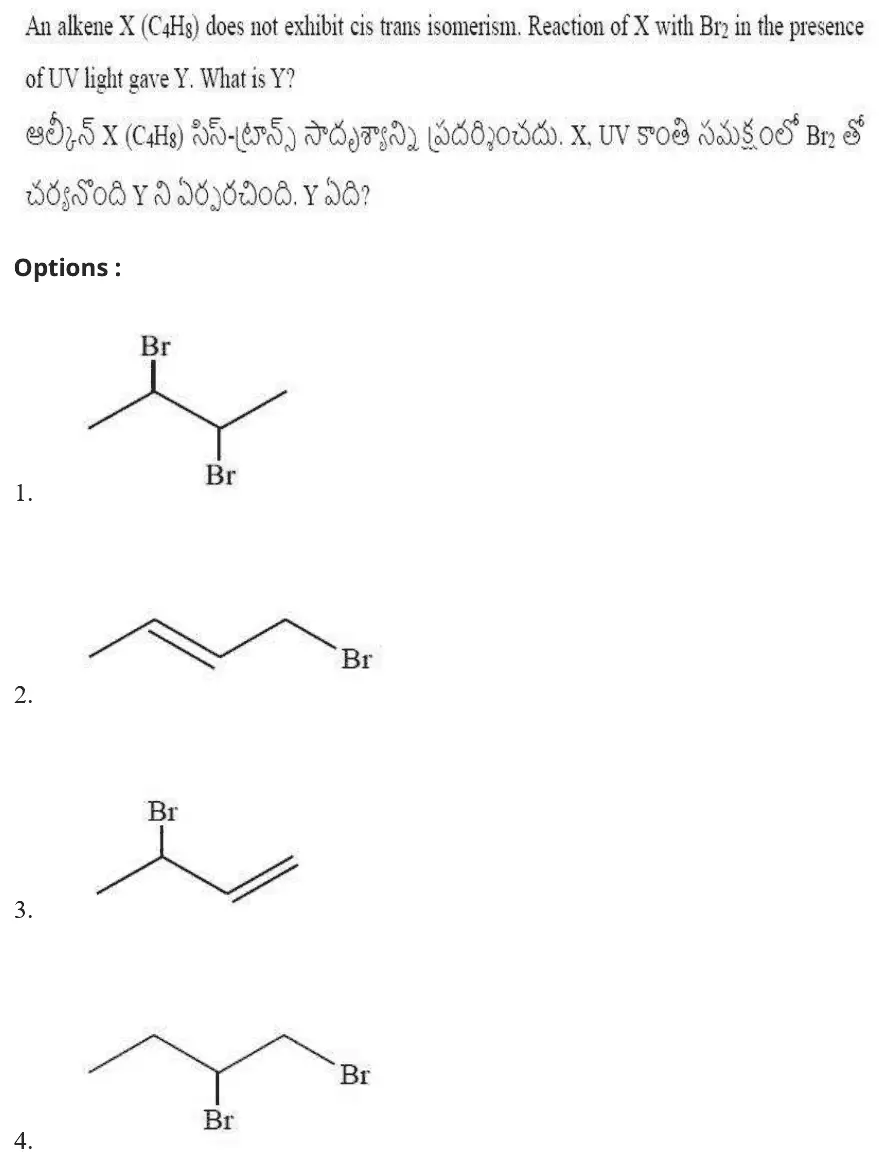
An alkene X ($\mathrm{C_4H_8}$) does not exhibit cis trans isomerism. Reaction of X with $\mathrm{Br_2}$ in the presence of UV light gave Y. What is Y?
The question as printed in the paper.
A
see figure Skeletal structure: a zigzag chain of four carbons (butane skeleton) with Br on C2 and Br on C3, both drawn pointing in the vertical direction (2,3-dibromobutane).
B
see figure Skeletal structure: but-2-ene chain (double bond between C2 and C3 near the left) with Br on the terminal carbon at the right (1-bromobut-2-ene).
C
see figure Skeletal structure: 3-bromobut-1-ene, a chain with terminal double bond at the right, and Br on the carbon at the upper left bend (CH3-CHBr-CH=CH2).
D
see figure Skeletal structure: a zigzag chain of four carbons with Br on C1 (the terminal carbon at the right) and Br on C2 (pointing down): 1,2-dibromobutane (CH3-CH2-CHBr-CH2Br).
Styrene on reaction with reagent X gave Y which on hydrolysis followed by oxidation gave Z. Z gives positive 2,4 – DNP test but does not give iodoform test. What are X and Z respectively?
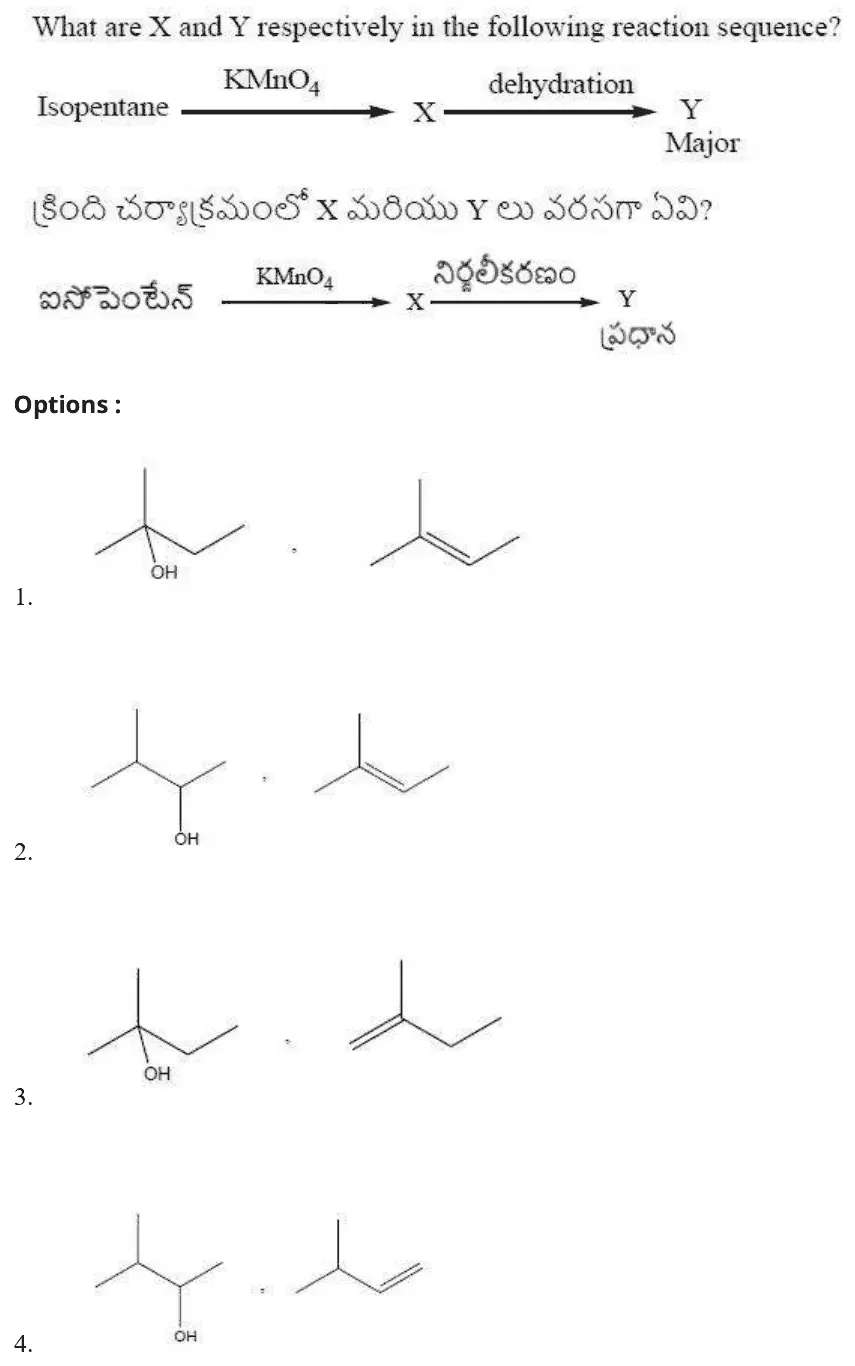
What are X and Y respectively in the following reaction sequence?
Isopentane $\xrightarrow{\mathrm{KMnO_4}}$ X $\xrightarrow{\text{dehydration}}$ Y (Major)
The question as printed in the paper.
A
see figure X: skeletal structure of 2-methylbutan-2-ol (tertiary alcohol, OH on the quaternary carbon bearing two methyl groups and an ethyl group); Y: 2-methylbut-2-ene (trisubstituted alkene)
B
see figure X: skeletal structure of 3-methylbutan-2-ol (secondary alcohol, OH on the carbon adjacent to the isopropyl CH and a methyl group); Y: 2-methylbut-2-ene (trisubstituted alkene)
C
see figure X: skeletal structure of 2-methylbutan-2-ol (tertiary alcohol, OH on the quaternary carbon bearing two methyl groups and an ethyl group); Y: 2-methylbut-1-ene (terminal alkene, C=C at the end with a methyl branch and an ethyl group)
D
see figure X: skeletal structure of 3-methylbutan-2-ol (secondary alcohol); Y: 3-methylbut-1-ene (terminal vinyl alkene with an isopropyl group)
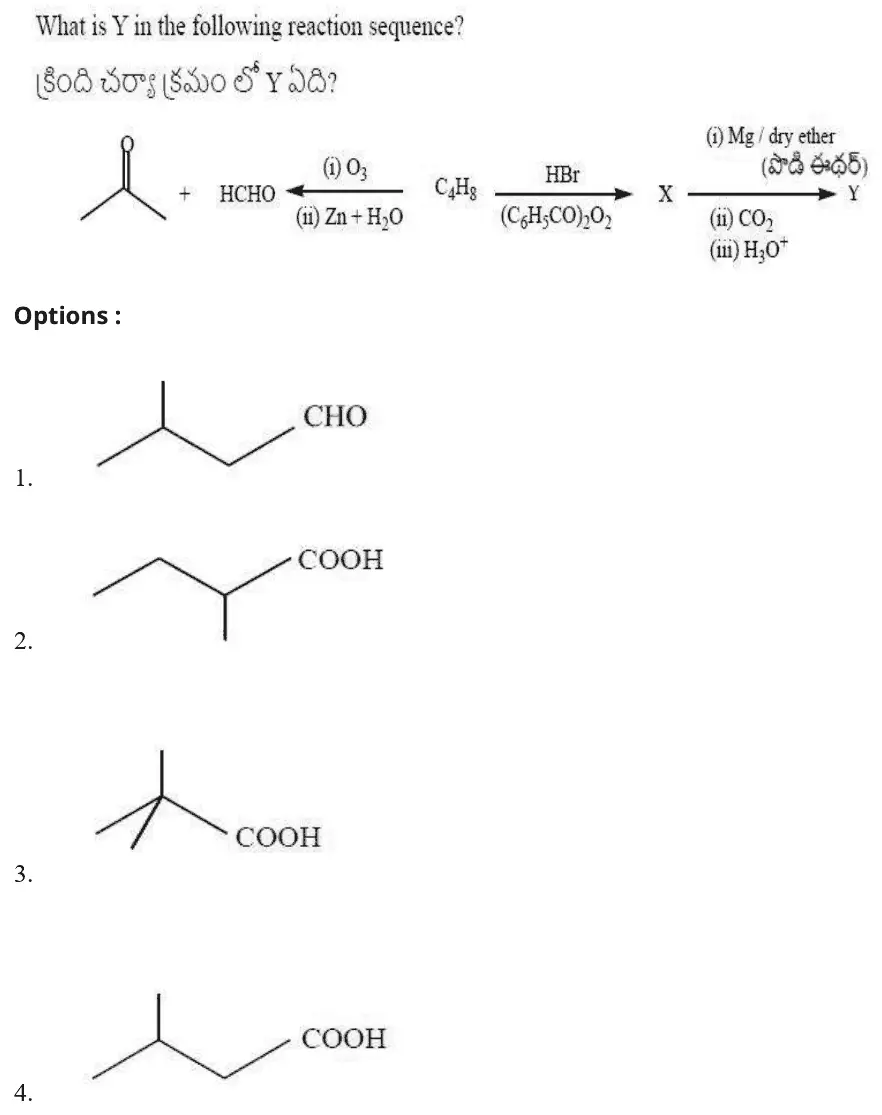
see figure Skeletal structure of 3-methylbutanal: a branched chain with a methyl branch pointing up on the second carbon from the left, and a CHO group at the right end.
B
see figure Skeletal structure with a COOH group at the right end, a chain going up-left to an ethyl-type fragment and a vertical methyl branch pointing down on the carbon bearing COOH-bearing chain (2-methylbutanoic acid type).
C
see figure Skeletal structure of a tert-butyl-type carbon: a quaternary carbon with a vertical methyl up, a methyl down-left, and a chain to the right ending in COOH (3,3-dimethylbutanoic acid type).
D
see figure Skeletal structure of 3-methylbutanoic acid: a branched chain with a methyl branch pointing up on the second carbon from the left, and a COOH group at the right end.
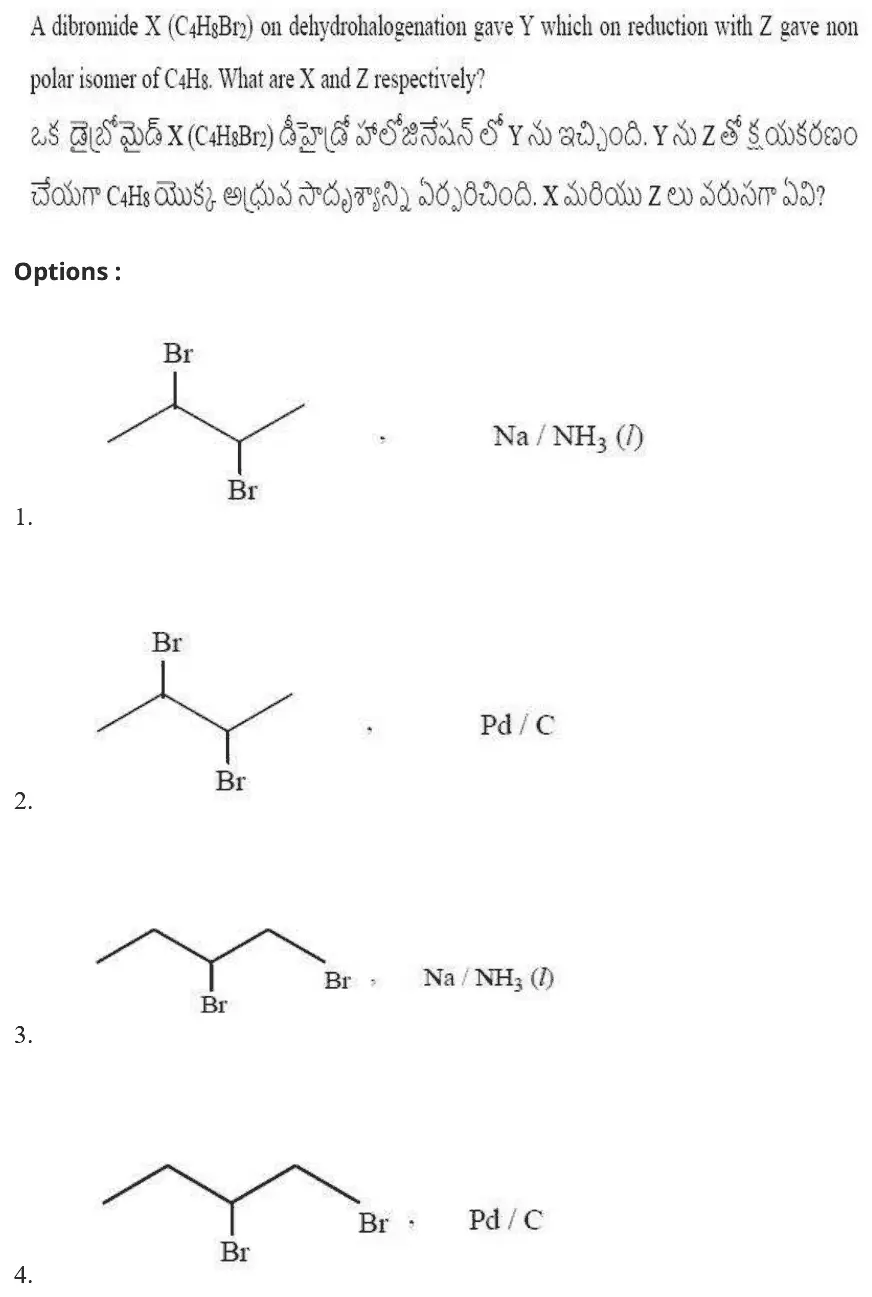
A dibromide X ($\mathrm{C_4H_8Br_2}$) on dehydrohalogenation gave Y which on reduction with Z gave non polar isomer of $\mathrm{C_4H_8}$. What are X and Z respectively?
The question as printed in the paper.
A
see figure Skeletal structure of 2,3-dibromobutane, with Br on C2 and C3, followed by a comma and $\mathrm{Na / NH_3}$ (l)
B
see figure Skeletal structure of 2,3-dibromobutane, with Br on C2 and C3, followed by a comma and $\mathrm{Pd / C}$
C
see figure Skeletal structure of 2,4-dibromopentane-like zigzag chain, with Br on the middle carbon and Br at the right terminal, followed by a comma and $\mathrm{Na / NH_3}$ (l)
D
see figure Skeletal structure of the same zigzag chain, with Br on the middle carbon and Br at the right terminal, followed by a comma and $\mathrm{Pd / C}$
At high pressure and regulated supply of air, methane is heated with catalyst ‘X’ to give methanol and with catalyst ‘Y’ to give methanal. X and Y respectively are
see figure Skeletal structure of an alkene, a zigzag chain with an internal double bond in the middle (pent-2-ene type: 5 carbons)
B
see figure Skeletal structure of a tetra-substituted alkene: a central C=C with two methyl groups on one carbon and two methyl groups on the other (2,3-dimethylbut-2-ene)
C
see figure Skeletal structure of a short chain alkene with a terminal double bond (but-1-ene type)
D
see figure Skeletal structure of a short chain alkene with an internal double bond (but-2-ene type)
An alkene X ($\mathrm{C_4H_8}$) exhibits geometrical isomerism. Oxidation of A with $\mathrm{KMnO_4 | H^+}$ gave Y. On heating sodium salt of Y with a mixture of NaOH and CaO gave Z. What is Z?
Answer: (B) X= $\mathrm{V_2O_5}$, 773 K, 10-20 atm; Y= (see the figure above) benzene ring with $\mathrm{CH_2Br}$ substituent only· The council's preliminary key
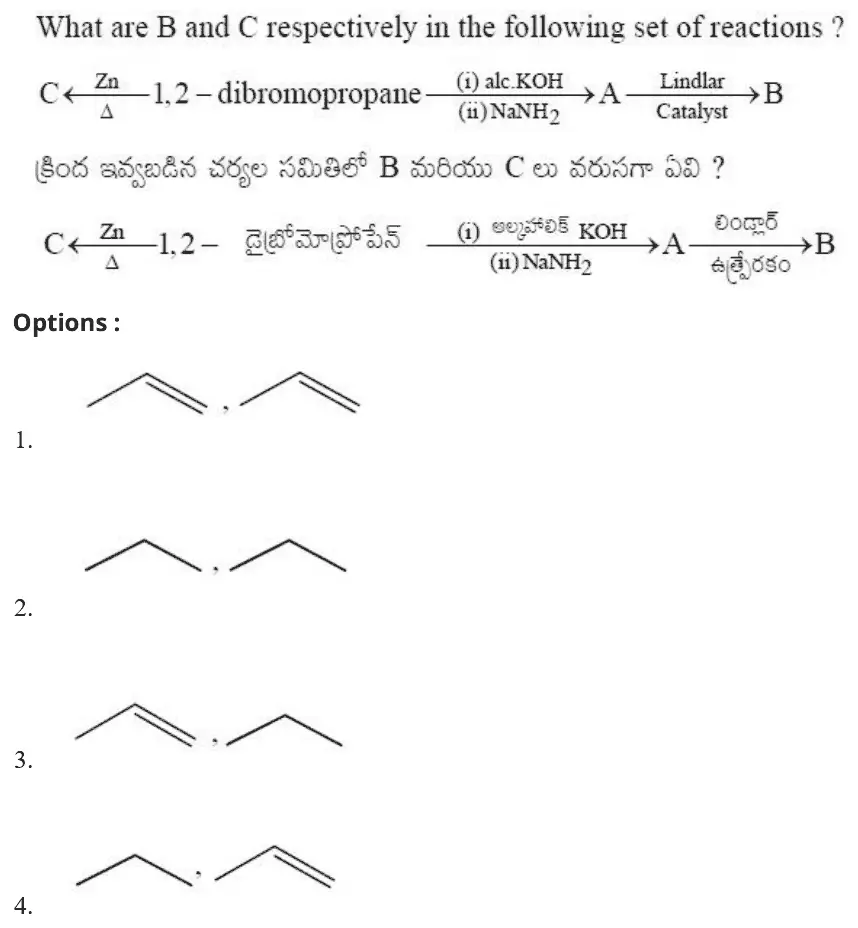
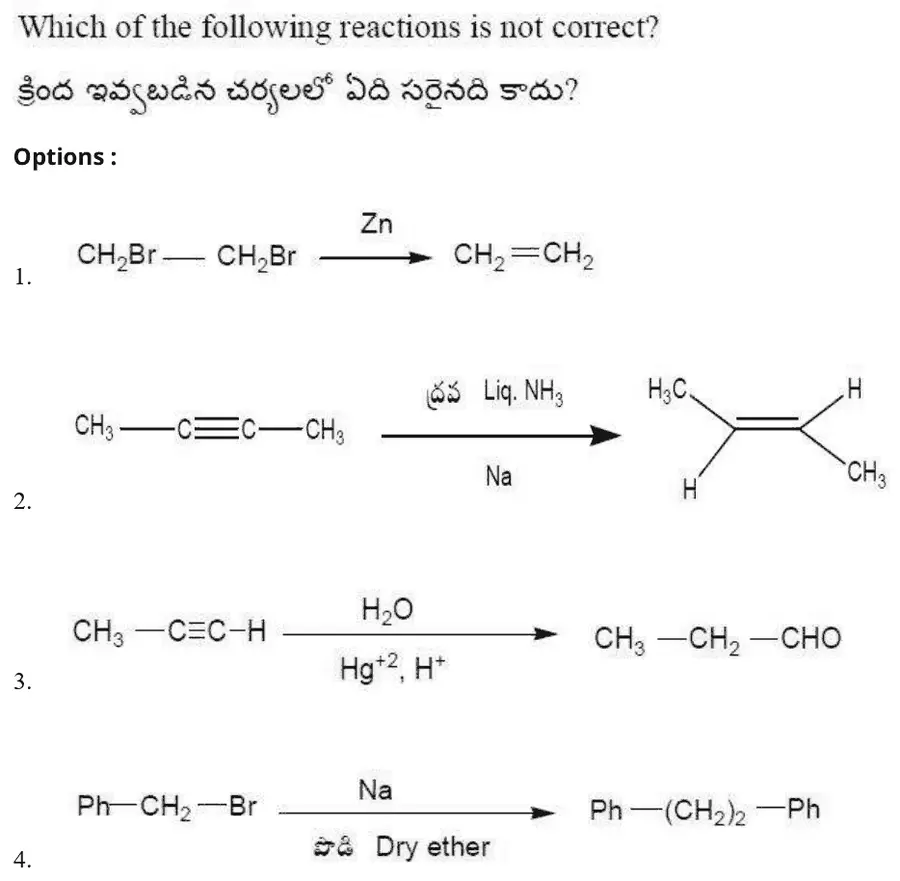
see figure $\mathrm{CH_3-C\equiv C-CH_3}$ with reagents Liq. $\mathrm{NH_3}$ / Na gives the alkene drawn with $\mathrm{H_3C}$ and $\mathrm{H}$ on the left carbon and $\mathrm{H}$ and $\mathrm{CH_3}$ on the right carbon (trans-2-butene)
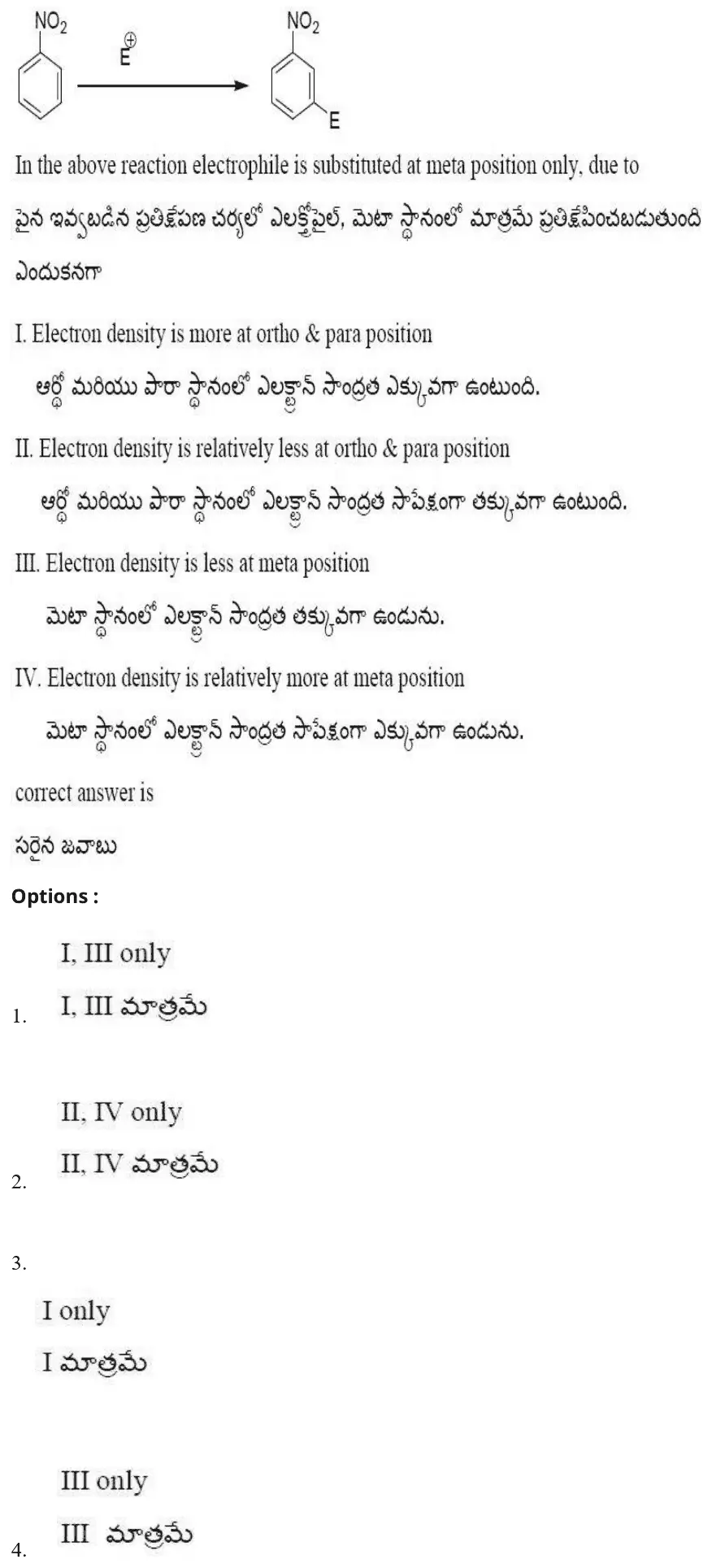
see figure In the above reaction electrophile is substituted at meta position only, due to
I. Electron density is more at ortho & para position
II. Electron density is relatively less at ortho & para position
III. Electron density is less at meta position
IV. Electron density is relatively more at meta position
correct answer is
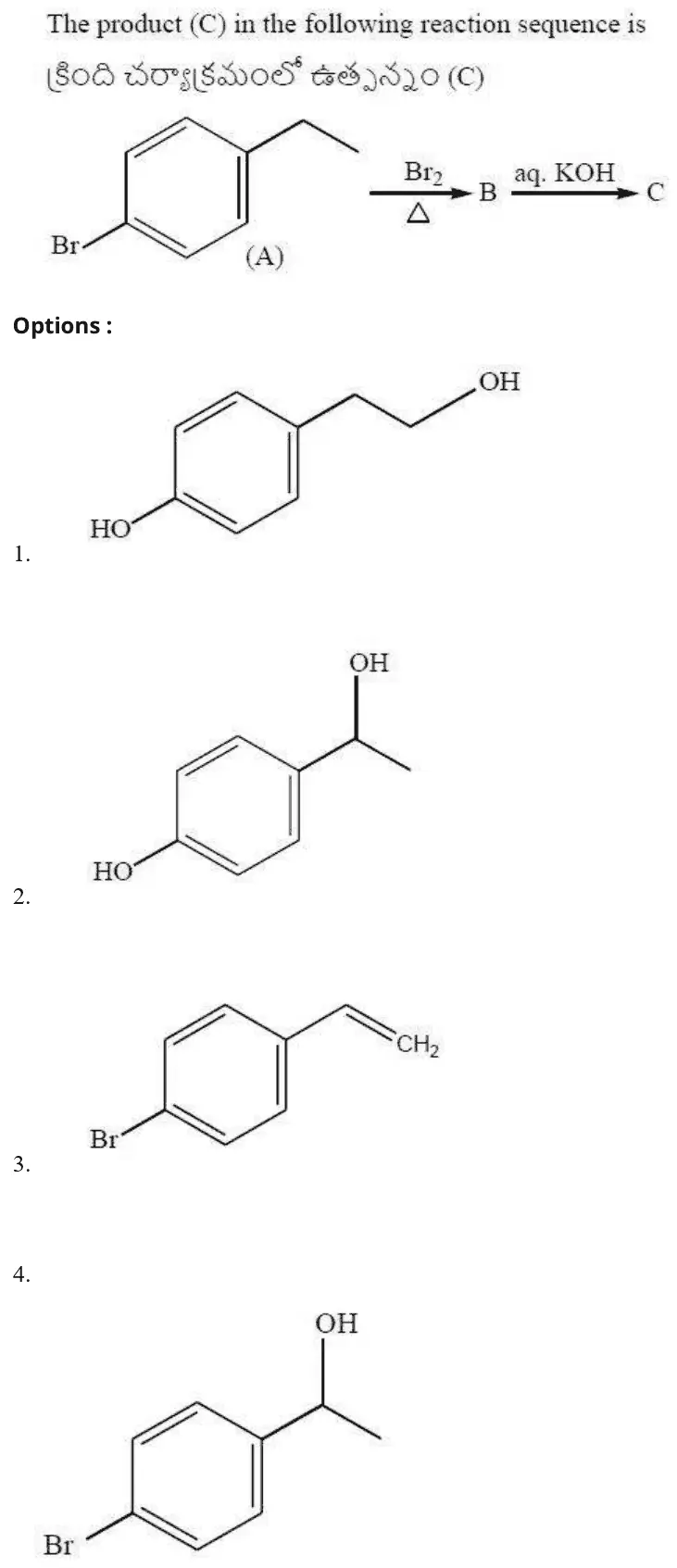
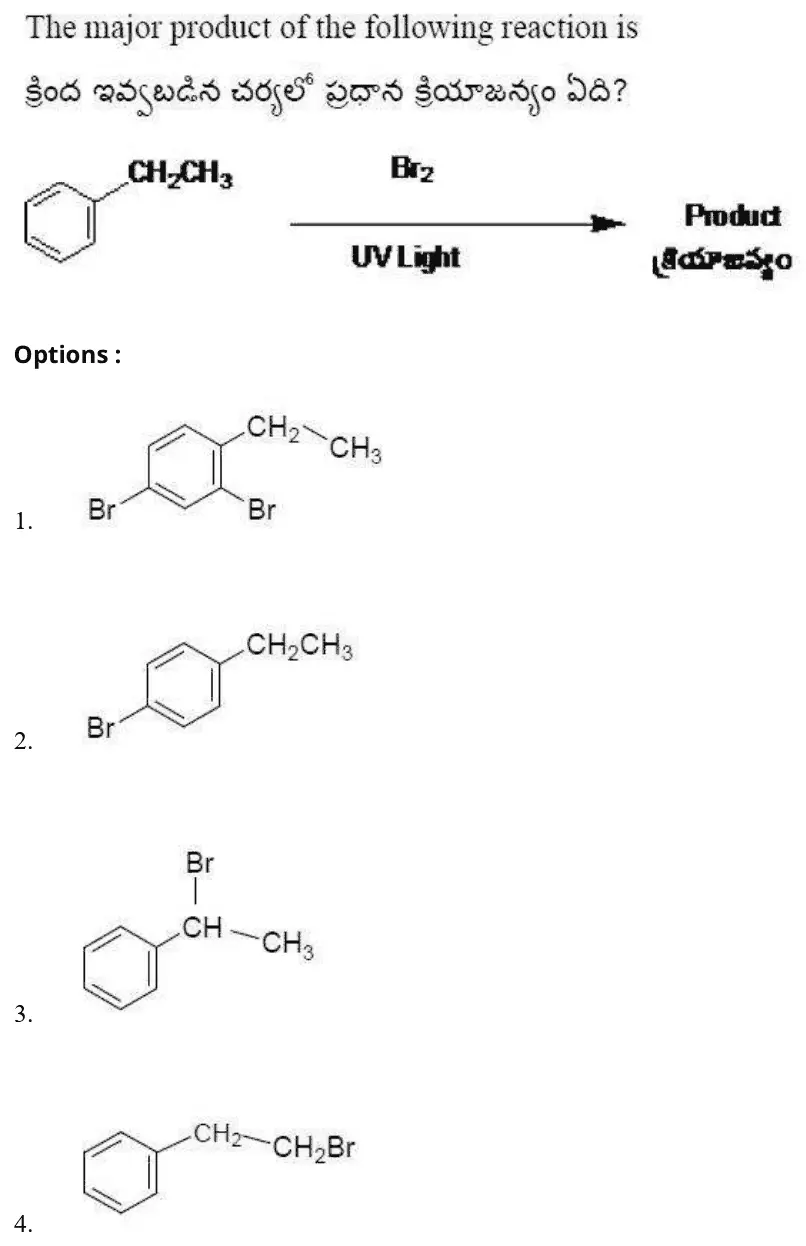
see figure Benzene ring with a CH2CH3 group and Br at the ortho position (adjacent carbon), and another Br at the para position relative to the CH2CH3 group (2,4-dibromo-substituted ethylbenzene as drawn)
B
see figure Benzene ring with a CH2CH3 group and a Br at the para position
C
see figure Benzene ring attached to CH(Br)-CH3 (Br on the carbon attached to the ring)
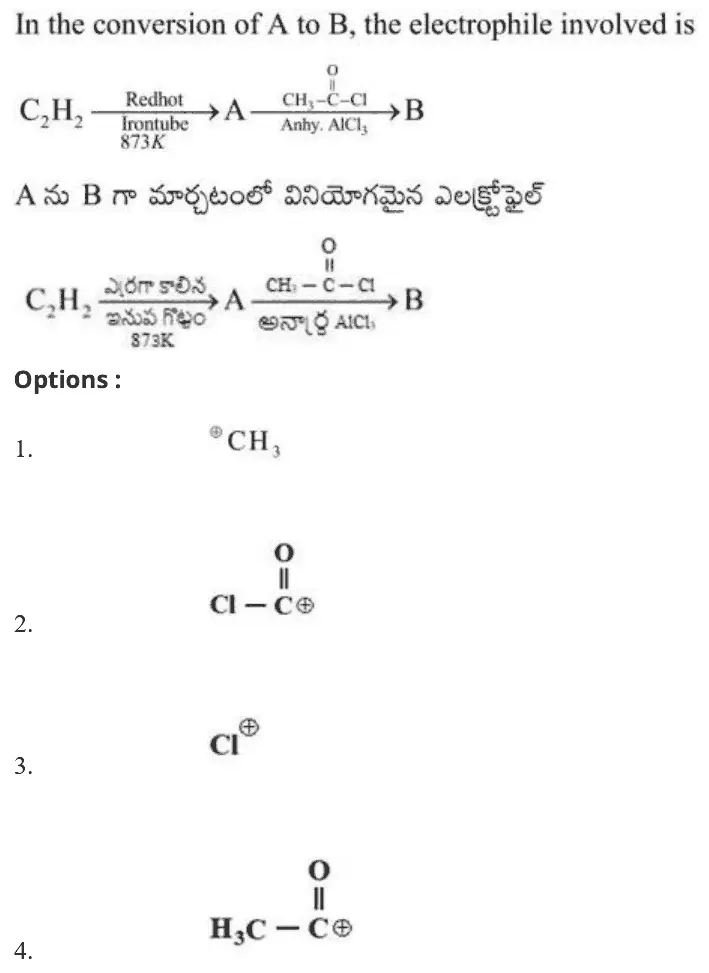
see figure Cl–C(=O)⊕ : acyl cation with Cl attached to carbonyl carbon bearing positive charge, i.e. $\mathrm{Cl-\overset{O}{\overset{\|}{C}}^{\oplus}}$
C
$\mathrm{Cl^{\oplus}}$
D
see figure H$_3$C–C(=O)⊕ : acyl cation, i.e. $\mathrm{H_3C-\overset{O}{\overset{\|}{C}}^{\oplus}}$
Addition of $\mathrm{HBr}$ to propene in presence of a peroxide takes place contrary to Markovnikov rule. This can be explained by the mechanism involving
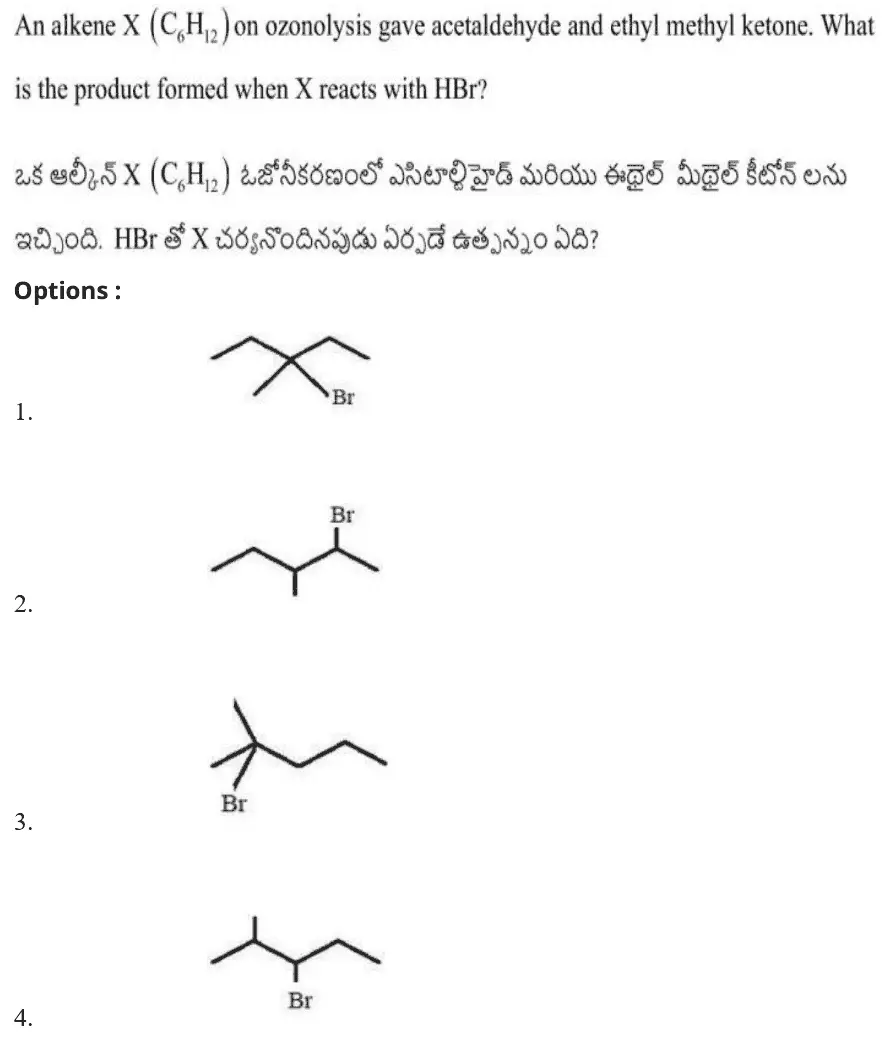
An alkene X $(\mathrm{C_6H_{12}})$ on ozonolysis gave acetaldehyde and ethyl methyl ketone. What is the product formed when X reacts with HBr?
The question as printed in the paper.
A
see figure Skeletal structure: a quaternary carbon bearing Br, with two methyl-type branches going up-left and up-right and a chain going down-left, Br labelled at lower right of the carbon.
B
see figure Skeletal structure: zigzag chain with a carbon bearing Br on top (Br drawn above, at right carbon), and a vertical branch (methyl) pointing down from the middle-left carbon.
C
see figure Skeletal structure: a carbon bearing Br (Br drawn at lower left) and a methyl branch going up, attached to an ethyl-type zigzag chain extending to the right.
D
see figure Skeletal structure: zigzag chain with a branch going up from the left carbon and Br attached downward on the middle carbon (Br drawn below).
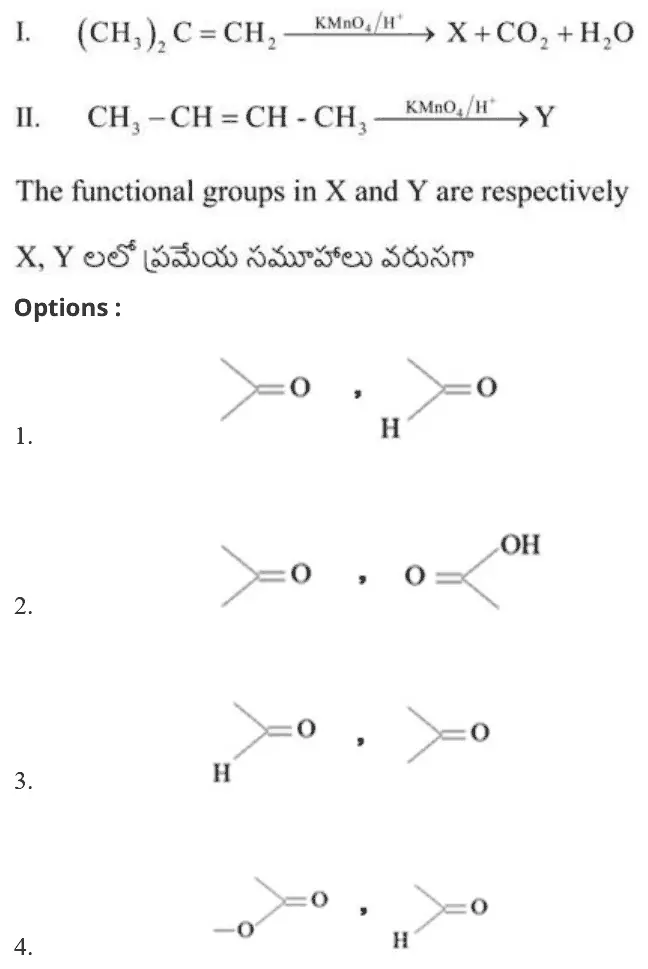
I. $\mathrm{(CH_3)_2C=CH_2}\xrightarrow{\mathrm{KMnO_4/H^+}} \mathrm{X + CO_2 + H_2O}$
II. $\mathrm{CH_3-CH=CH-CH_3}\xrightarrow{\mathrm{KMnO_4/H^+}} \mathrm{Y}$
The functional groups in X and Y are respectively
The question as printed in the paper.
A
see figure Skeletal structure of a ketone (propanone: C=O with two methyl groups), followed by a comma and the skeletal structure of an aldehyde (C=O with an H, ethanal)
B
see figure Skeletal structure of a ketone (propanone), followed by a comma and the skeletal structure of a carboxylic acid (C=O with OH, ethanoic acid)
C
see figure Skeletal structure of an aldehyde (C=O with an H), followed by a comma and the skeletal structure of a ketone (C=O with two methyl groups)
D
see figure Skeletal structure of an ester-like group (C=O with an O- single-bonded substituent, drawn as -O attached to the carbonyl carbon), followed by a comma and the skeletal structure of an aldehyde (C=O with an H)
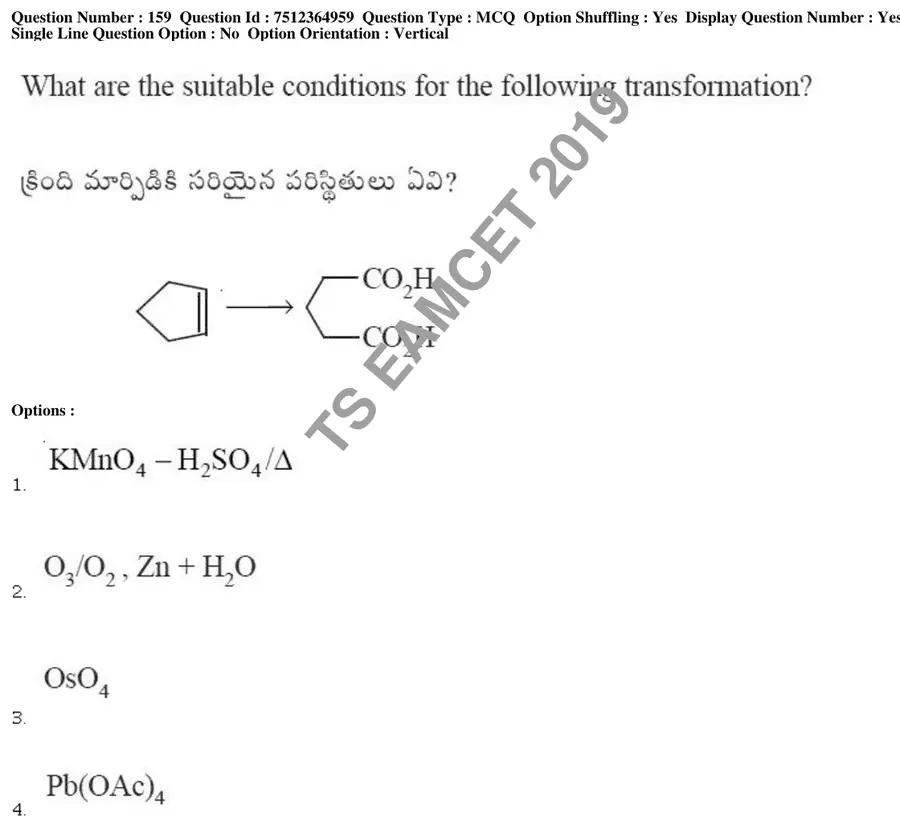
The organic compound 5-allylcyclohex-3-ene-1-ol is reacted with cold, dilute, aqueous solution of $\mathrm{KMnO_4}$. The total number of hydroxyl group(s) (-OH) present in the product is
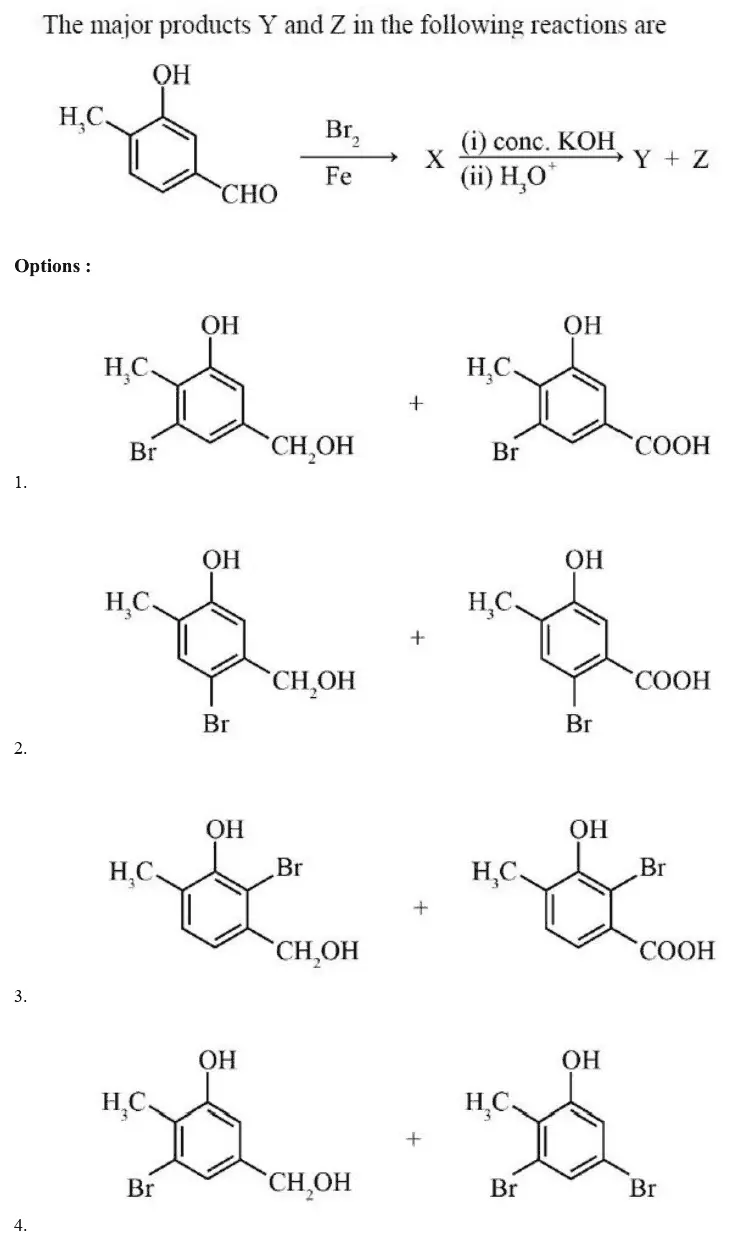
The major products Y and Z in the following reactions are (see the figure above)
The question as printed in the paper.
A
see figure Y: ring with OH (top), $\mathrm{H_3C}$ (upper left), Br (lower left), $\mathrm{CH_2OH}$ (lower right) + Z: same ring with COOH in place of $\mathrm{CH_2OH}$
B
see figure Y: ring with OH (top), $\mathrm{H_3C}$ (upper left), Br (bottom), $\mathrm{CH_2OH}$ (lower right) + Z: same ring with COOH in place of $\mathrm{CH_2OH}$
C
see figure Y: ring with OH (top), $\mathrm{H_3C}$ (upper left), Br (upper right), $\mathrm{CH_2OH}$ (lower right) + Z: same ring with COOH in place of $\mathrm{CH_2OH}$
D
see figure Y: ring with OH (top), $\mathrm{H_3C}$ (upper left), Br (lower left), $\mathrm{CH_2OH}$ (lower right) + Z: ring with OH (top), $\mathrm{H_3C}$ (upper left), Br (lower left), Br (lower right)
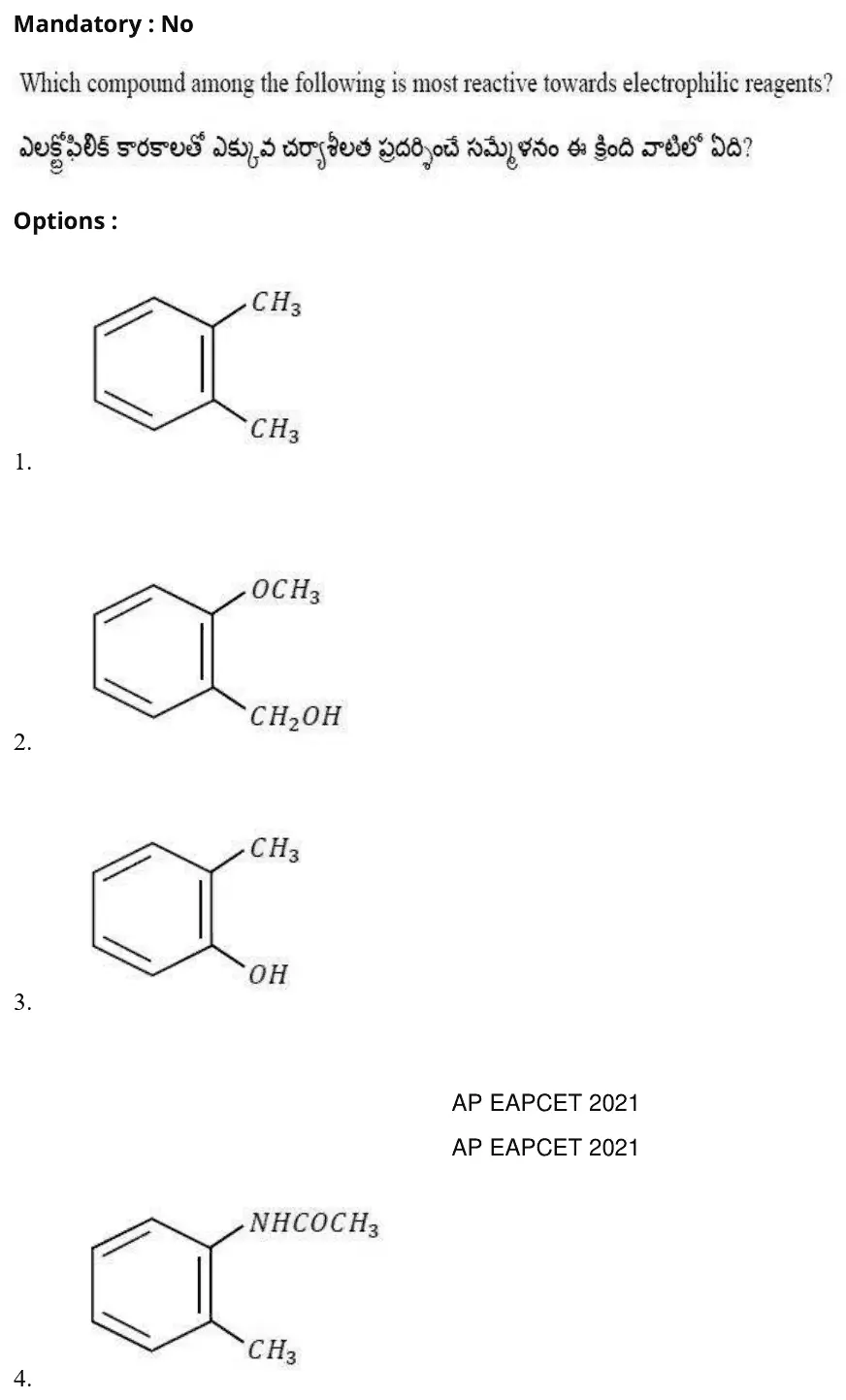
The order of decreasing reactivity towards an electrophilic reagent, for the following compounds, is (i) Benzene (ii) Toluene (iii) Chlorobenzene (iv) Phenol
The correct order of rates of addition of $\mathrm{Br_{2}}$/water to the following alkenes is [A] $\mathrm{CH_{2}=CH_{2}}$ [B] $\mathrm{CH_{2}=CH-NO_{2}}$ [C] $\mathrm{CH_{3}-CH_{2}-CH=CH_{2}}$ [D] $\mathrm{CH_{3}-CH(CH_{3})=CH_{2}}$
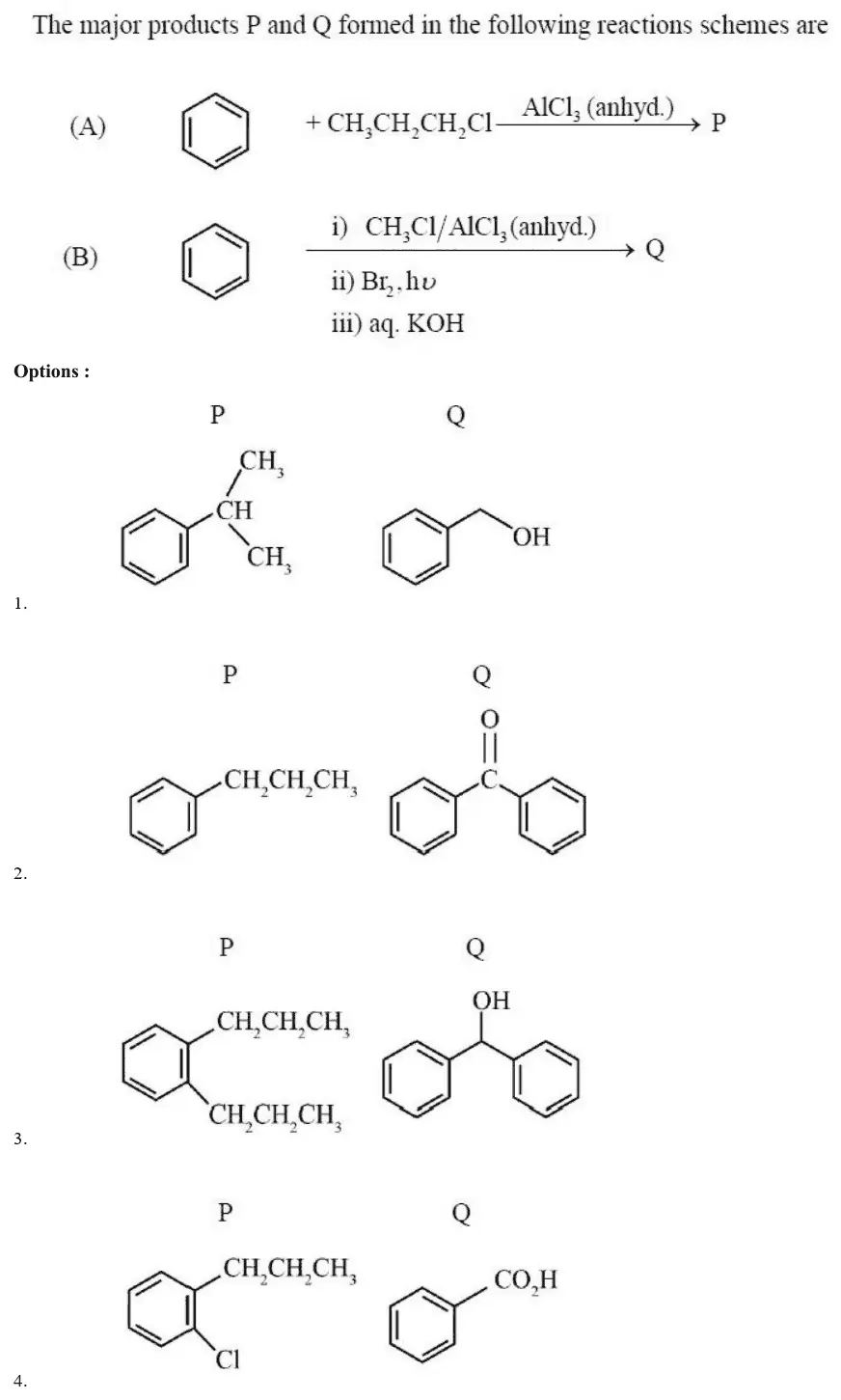
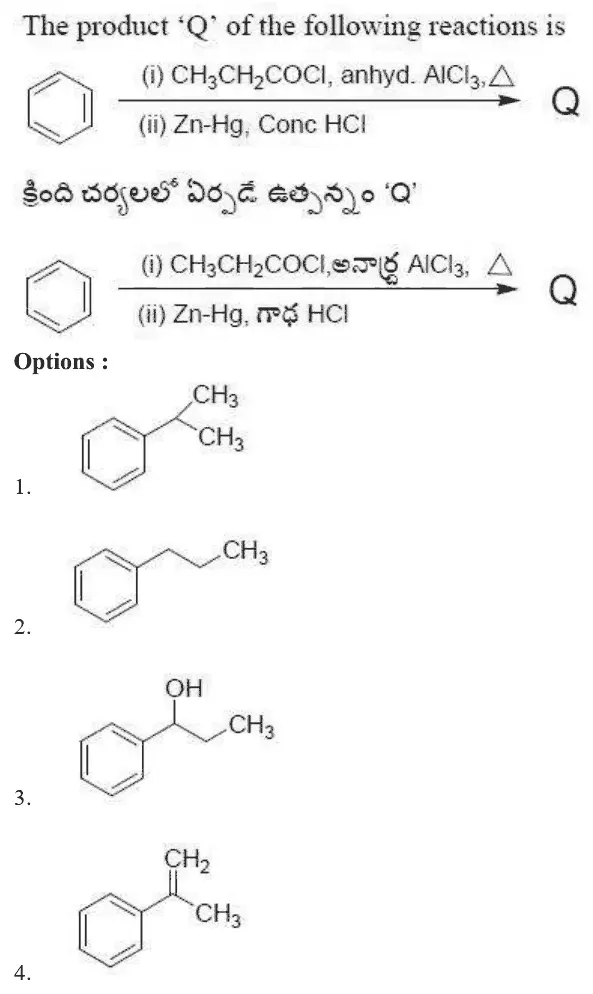
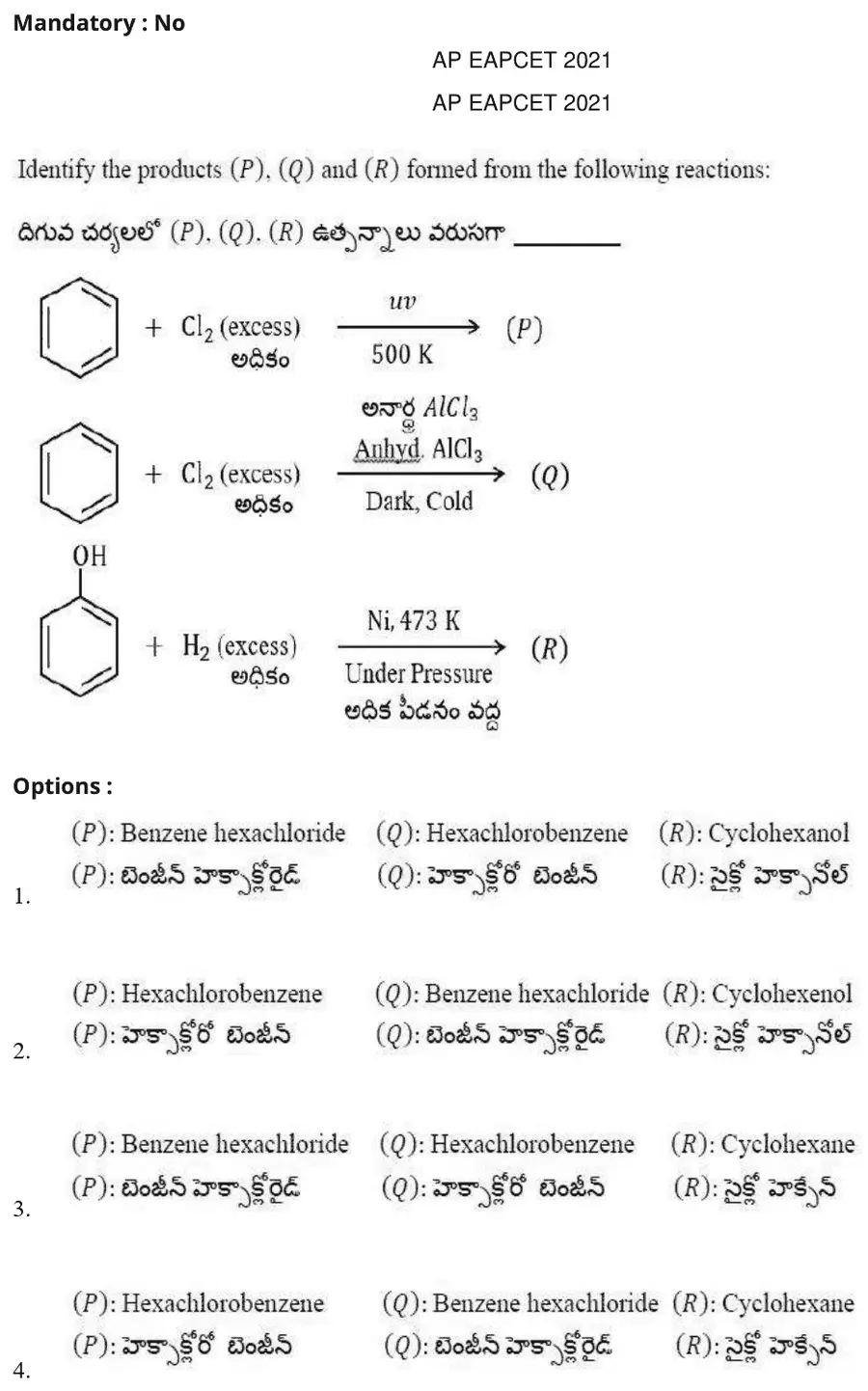
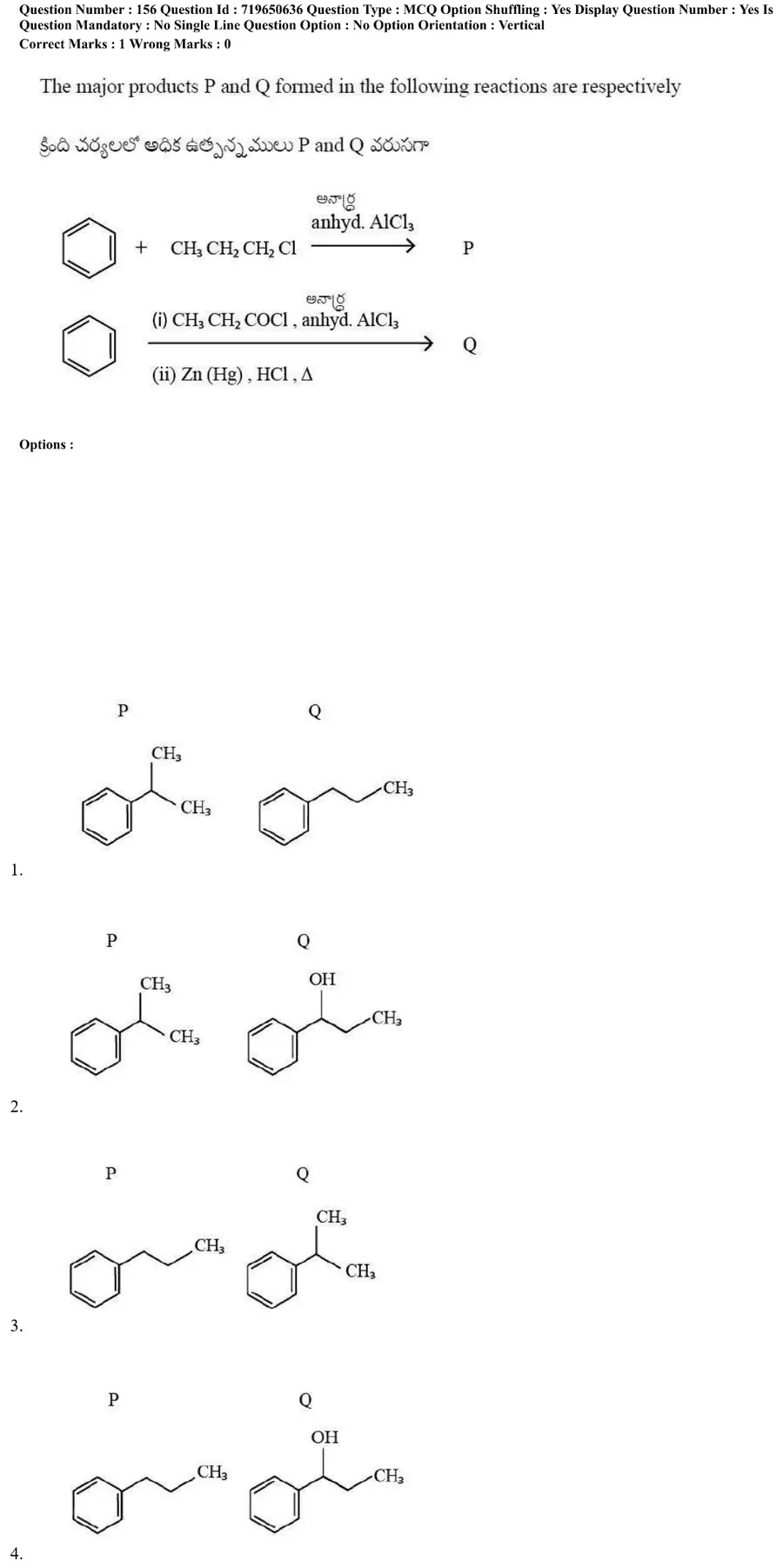
The major products P and Q formed in the following reactions schemes are (A) benzene $+\ \mathrm{CH_{3}CH_{2}CH_{2}Cl}\xrightarrow{\mathrm{AlCl_{3}\ (anhyd.)}}$ P (B) benzene $\xrightarrow[\substack{\text{ii) }\mathrm{Br_{2},\,h\upsilon}\\\text{iii) aq. KOH}}]{\text{i) }\mathrm{CH_{3}Cl/AlCl_{3}\ (anhyd.)}}$ Q (see the figure above)
The question as printed in the paper.
A
P: isopropylbenzene (benzene ring bearing a CH(CH3)2 group); Q: benzyl alcohol (benzene ring bearing CH2-OH)
B
P: n-propylbenzene (benzene ring bearing CH2CH2CH3); Q: benzophenone (two benzene rings joined through C=O)
C
P: 1,2-di-n-propylbenzene (benzene ring bearing two adjacent CH2CH2CH3 groups); Q: diphenylmethanol (two benzene rings on a CH-OH carbon)
D
P: 1-chloro-2-n-propylbenzene (ring bearing CH2CH2CH3 and an adjacent Cl); Q: benzoic acid (benzene ring bearing CO2H)
Propyne was subjected to a reaction with $\mathrm{HgSO_{4}}$ / dil. $\mathrm{H_{2}SO_{4}}$, which resulted in a product P. The product P was heated with $\mathrm{Ba(OH)_{2}}$ to give the product Q. The molecular formula of the product Q is
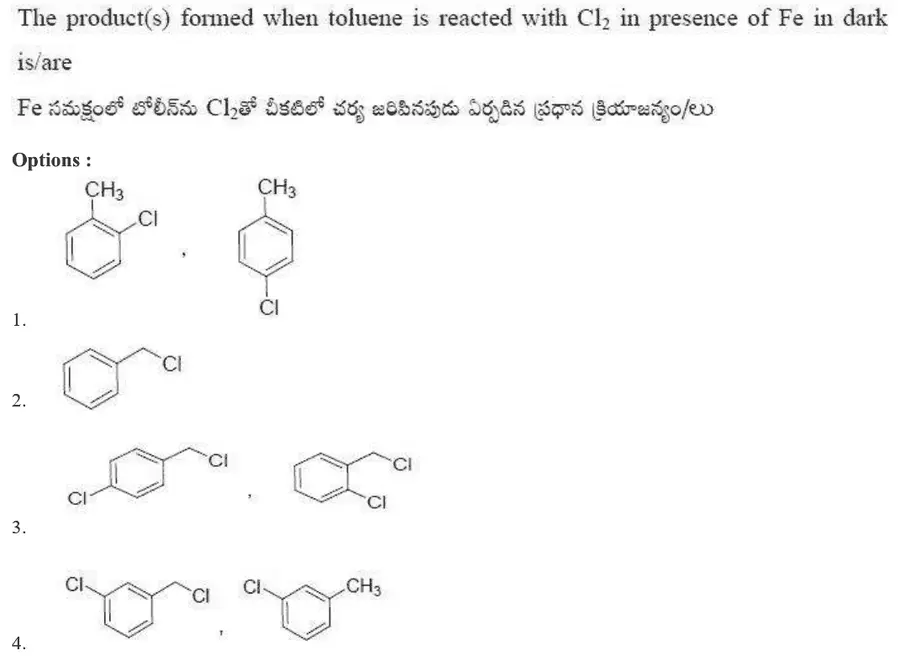
The product(s) formed when toluene is reacted with $\mathrm{Cl_2}$ in presence of Fe in dark is/are
The question as printed in the paper.
A
see figure two benzene-ring structures: o-chlorotoluene (CH3 and Cl on adjacent ring carbons) and p-chlorotoluene (CH3 and Cl on opposite carbons)
B
see figure benzyl chloride (benzene ring with CH2Cl side chain)
C
see figure two structures: p-chloro-(chloromethyl)benzene (Cl on the ring para to a CH2Cl group) and o-chloro-(chloromethyl)benzene (Cl on the ring ortho to a CH2Cl group)
D
see figure two structures: m-chloro-(chloromethyl)benzene (Cl on the ring meta to a CH2Cl group) and m-chlorotoluene (Cl and CH3 meta)
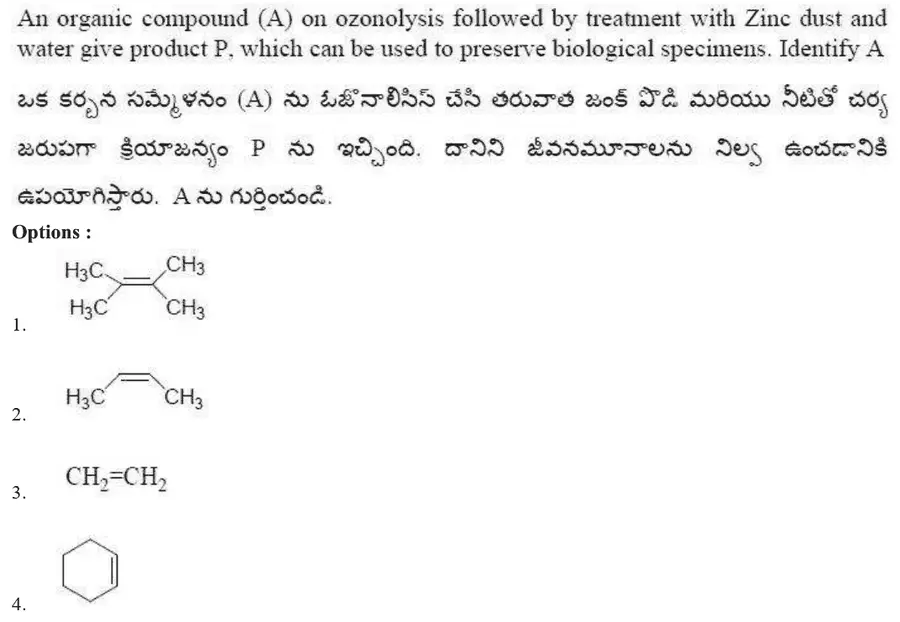
An organic compound (A) on ozonolysis followed by treatment with Zinc dust and water give product P, which can be used to preserve biological specimens. Identify A (see the figure above)
The question as printed in the paper.
A
see figure 2,3-dimethylbut-2-ene: C=C with two CH3 groups on each carbon
B
see figure but-2-ene: C=C with one CH3 on each carbon
C
$\mathrm{CH_2{=}CH_2}$
D
see figure cyclohexene (six-membered ring with one double bond)
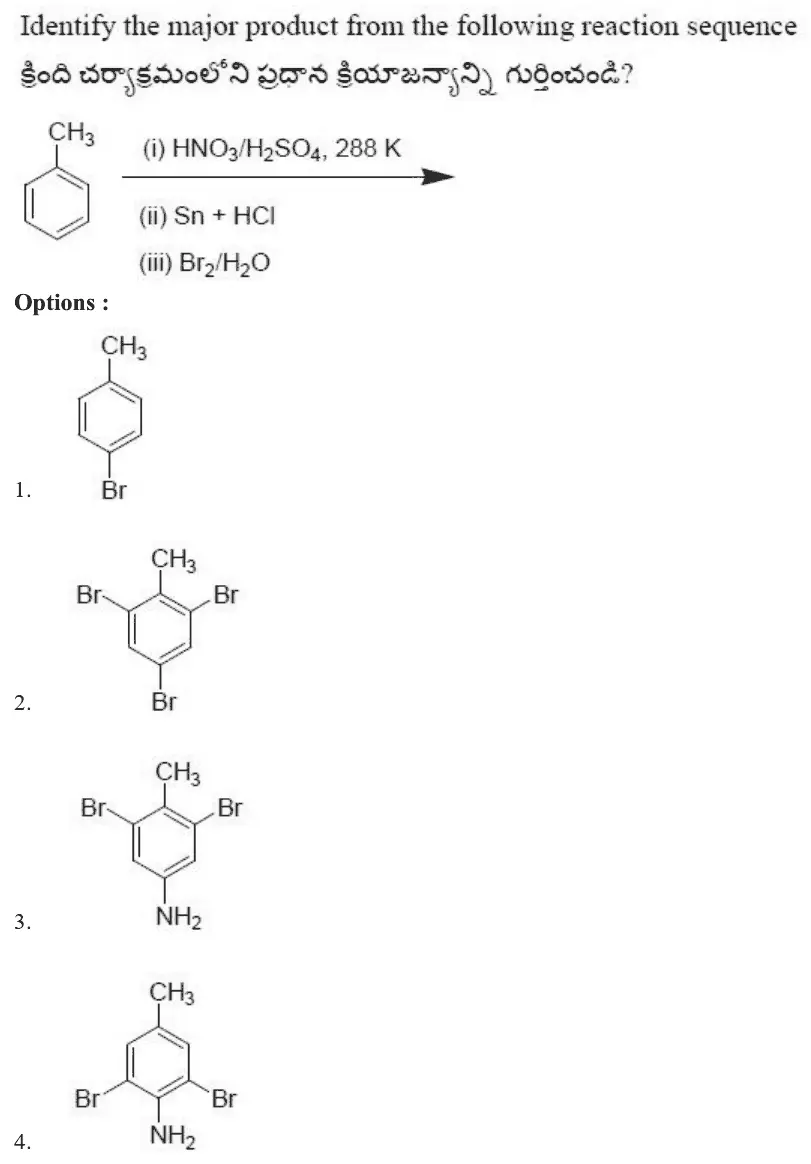
Identify the major product from the following reaction sequence. (see the figure above)
The question as printed in the paper.
A
see figure benzoic acid with Br meta to COOH (COOH at the top carbon, Br at the lower right carbon)
B
see figure benzoic acid with Br on both carbons meta to COOH and on the carbon para to COOH (three Br: 3,5 and 4 positions; COOH at the top carbon, Br at upper left, upper right and bottom)
C
see figure benzoic acid with Br ortho to COOH (right neighbour) and Br para to it at the bottom left carbon as drawn (COOH top left, Br at upper right and at the bottom)
D
see figure benzoic acid with Br para to COOH (COOH at the top carbon, Br at the bottom carbon)
The major products P and Q of the following reactions respectively are I. n $-$ Pentyl bromide $\xrightarrow{\mathrm{Zn/H^+}}$ P II. n $-$ Pentyl bromide $\xrightarrow[\text{Dry Ether}]{\mathrm{Na}}$ Q
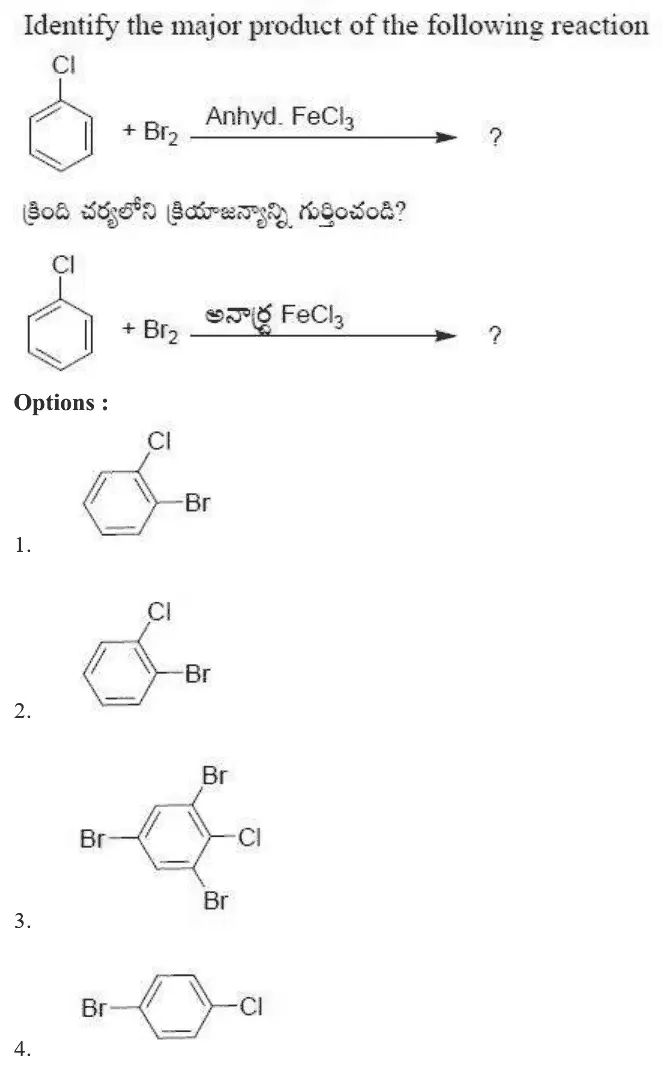
Identify the major product of the following reaction (see the figure above)
The question as printed in the paper.
A
see figure chlorobenzene ring with Br on the carbon next to the Cl-bearing carbon (ortho), drawn on the right
B
see figure chlorobenzene ring with Br on the carbon next to the Cl-bearing carbon (ortho), drawn on the right
C
see figure benzene ring with Cl at the right and three Br: one on each of the two ring carbons next to the Cl carbon (upper right and lower right) and one at the left, para to Cl (2,4,6-tribromochlorobenzene pattern)
D
see figure benzene ring with Br on the left and Cl on the right (para)
What are X and Y respectively in the following reactions $\underline{X}$ + $\mathrm{D_2O}$ $\rightarrow$ $\mathrm{C_2D_2}$ +P $\underline{Y}$ + $\mathrm{D_2O}$ $\rightarrow$ $\mathrm{CD_4}$ + Q
Identify the ortho and para directing groups towards aromatic electrophilic substitution reactions from the following list -OH (I) -CN (II) -CO$_2$H (III) -OCH$_3$ (IV) -NHCOCH$_3$ (V) -CHO (VI)
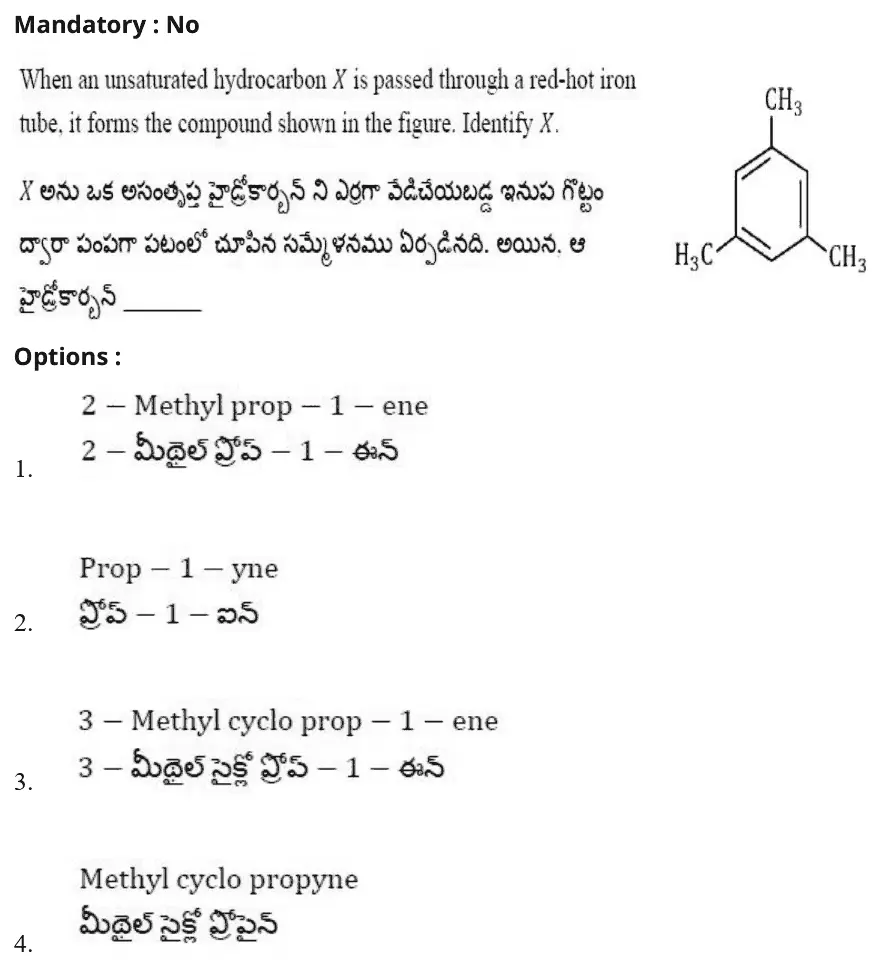
When an unsaturated hydrocarbon $X$ is passed through a red-hot iron tube, it forms the compound shown in the figure. Identify $X$. (see the figure above)
Identify the most suitable reagents $(I)$ and $(II)$ for the following sequence of reactions: $\mathrm{H_3C{-}CH_2{-}CH_2Br} \xrightarrow{(I)} (X)\ \text{Unsaturated} \xrightarrow{(II)} \mathrm{H_3C{-}CH(Br){-}CH_3}$
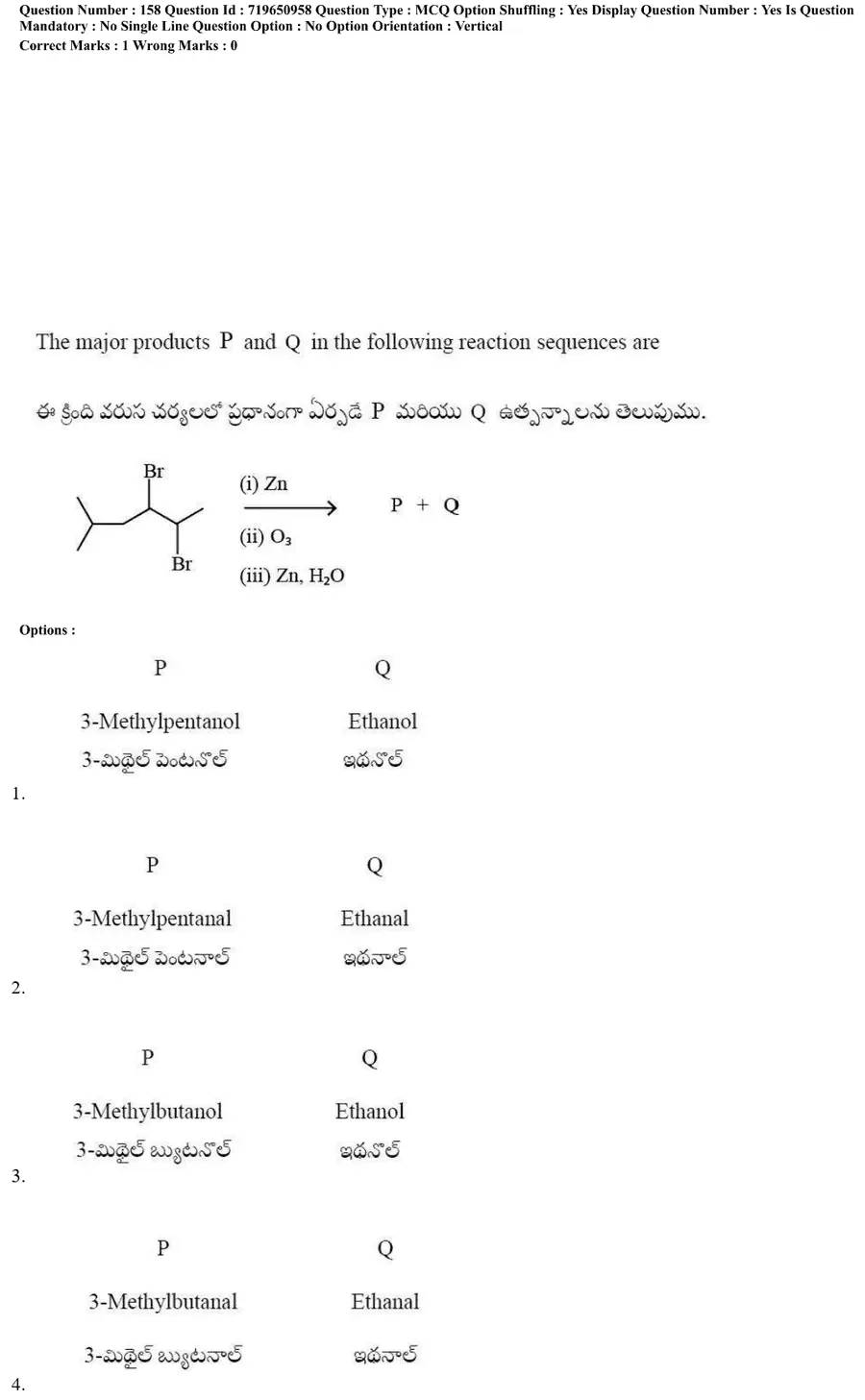
The major product(s) formed in the following reaction sequence is(are): 2,3-Dibromobutane $\xrightarrow[\text{iii) Zn/H}_2\mathrm{O}]{\text{i) Zn/Cu, }\Delta;\ \text{ii) O}_3}$ ?
A compound 'A' contains $C$ and $H$ only, and has molecular mass 72. Its photochlorination gives a mixture containing only one monochloro and two dichloro hydrocarbons. Deduce the structure of 'A'
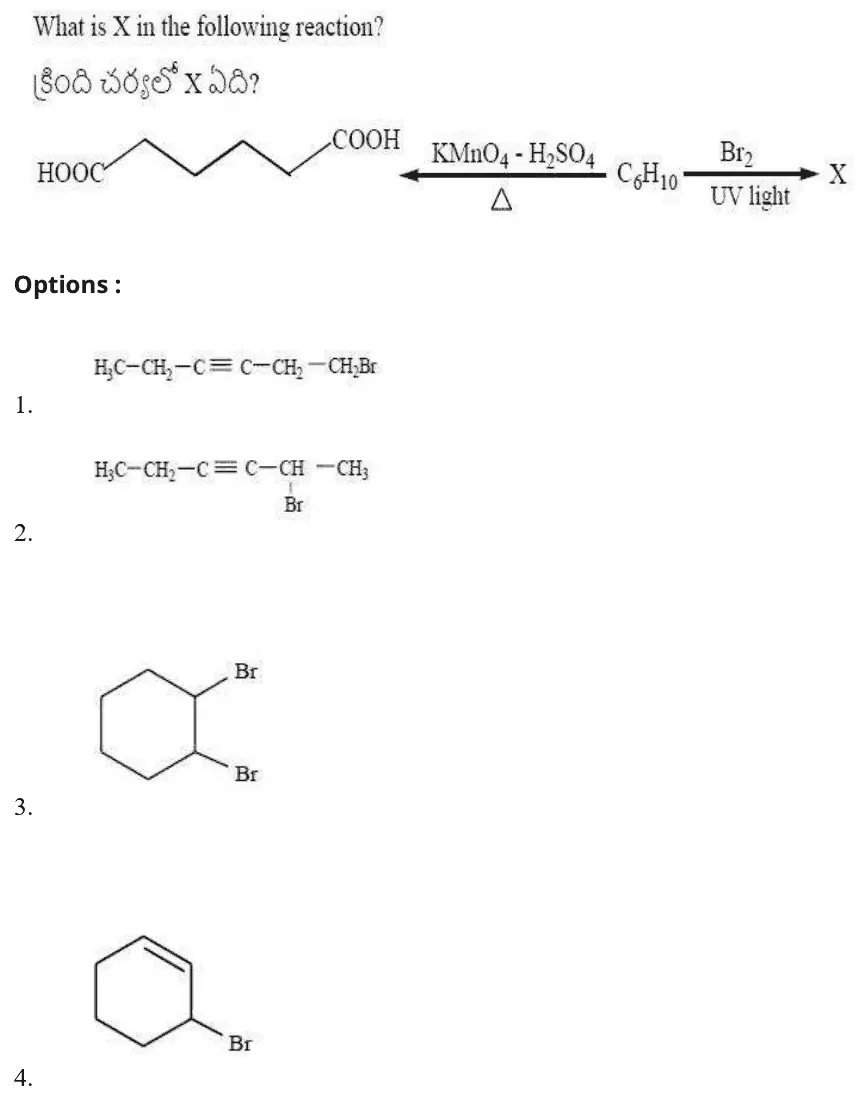
The product formed when a hydrocarbon 'X' of molecular formula $\mathrm{C_6H_{10}}$ is reacted with sodamide is subjected to ozonolysis, followed by hydrolysis with $\mathrm{Zn/H_2O_2}$, and upon further oxidation gave two carboxylic acids, of which one is optically active. The hydrocarbon 'X' is ______
In which of the following reactions, t-butyl benzene is formed (I) Benzene + t- Butyl Chloride $\xrightarrow{\mathrm{AlCl_3}}$ (II) Benzene + $\mathrm{(CH_3)_2\,C{=}CH_2}$ $\xrightarrow{\mathrm{BF_3\cdot HF}}$ (III) Benzene + t- Butyl alcohol $\xrightarrow{\mathrm{H_2SO_4}}$ (IV) Benzene + Butanoyl chloride $\xrightarrow[\mathrm{Zn/HCl}]{\mathrm{AlCl_3}}$
The number of $\pi$-bonds and lone pair(s) present in the major benzenoid product, which formed when benzene is reacted with acetyl chloride in the presence of anhydrous aluminium chloride; respectively are
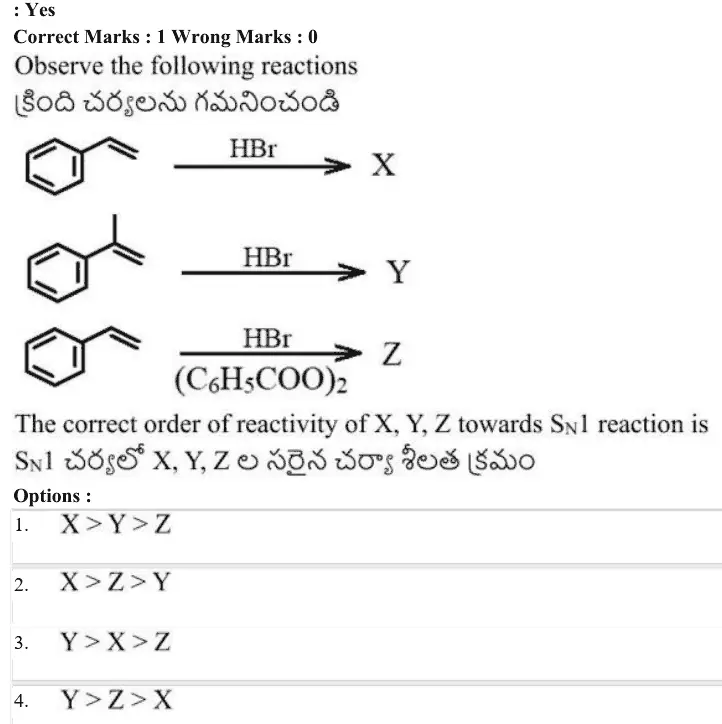
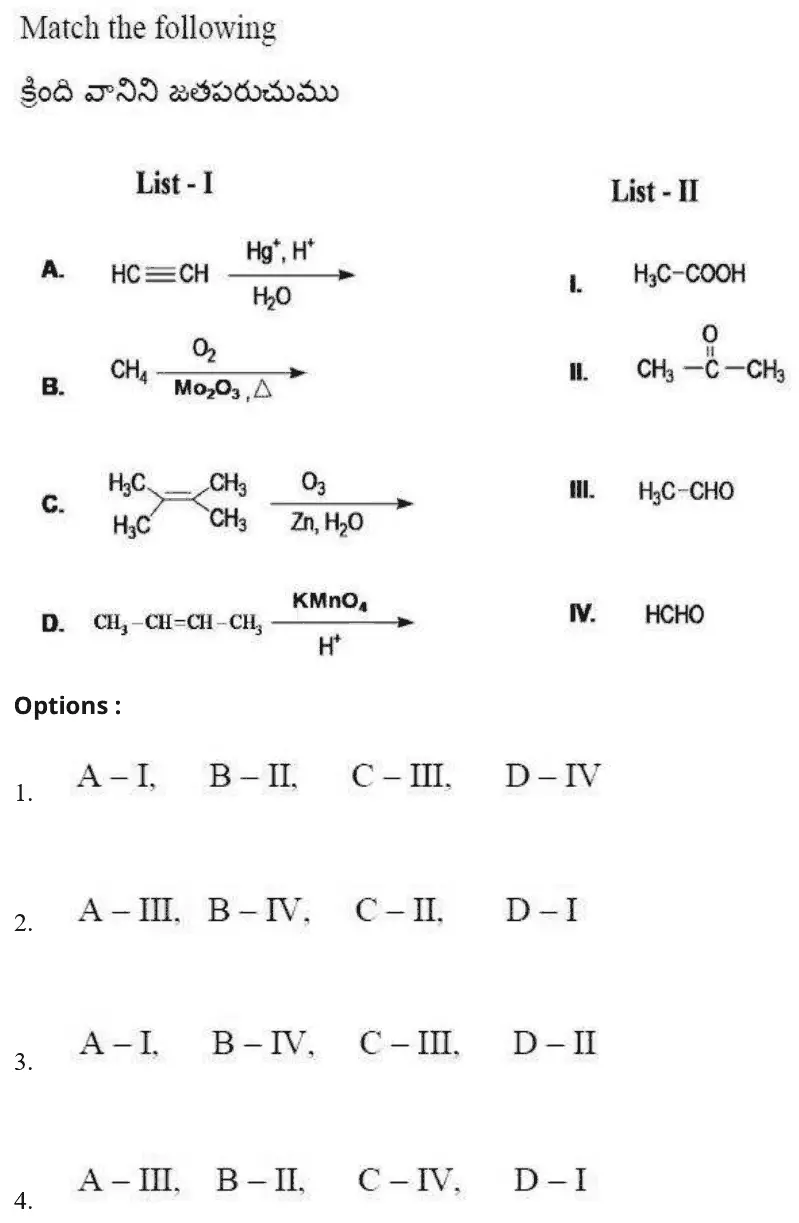
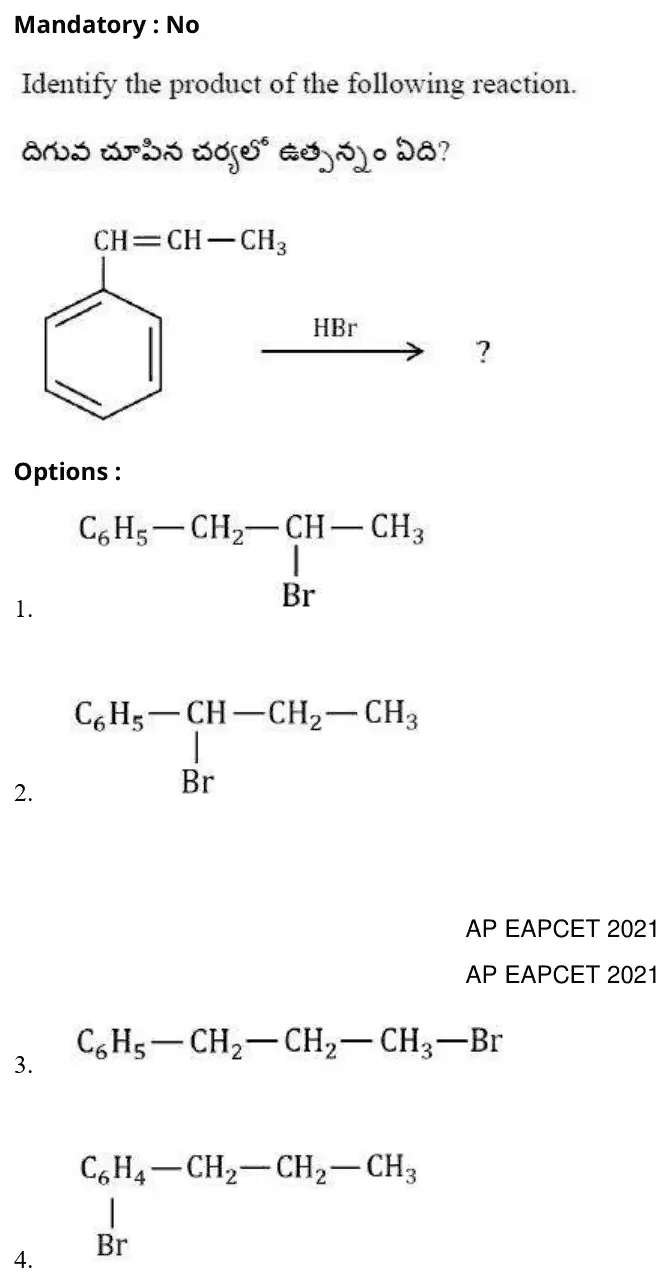
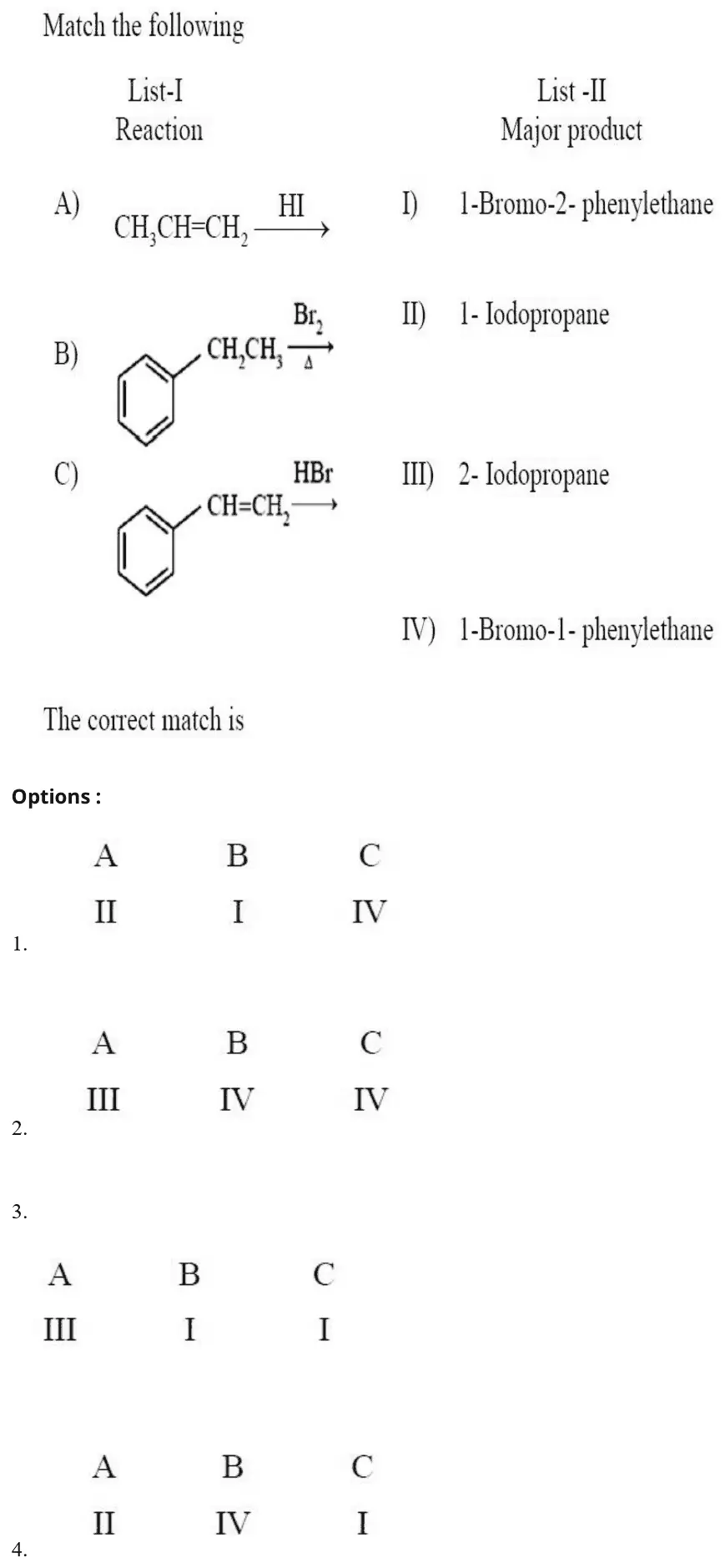
List-I Reaction A) $\mathrm{CH_3CH{=}CH_2}\xrightarrow{\mathrm{HI}}$ B) (see the figure above) $\mathrm{C_6H_5{-}CH_2CH_3}\xrightarrow[\Delta]{\mathrm{Br_2}}$ C) (see the figure above) $\mathrm{C_6H_5{-}CH{=}CH_2}\xrightarrow{\mathrm{HBr}}$
Identity (sic) Z in the following reaction $\mathrm{CH_3CH_2OH} \xrightarrow{\mathrm{PBr_3}} X \xrightarrow{\text{alc. KOH}} Y \xrightarrow[\text{(ii) } \mathrm{H_2O},\ \text{heat}]{\text{(i) } \mathrm{H_2SO_4},\ \mathrm{RT}} Z$
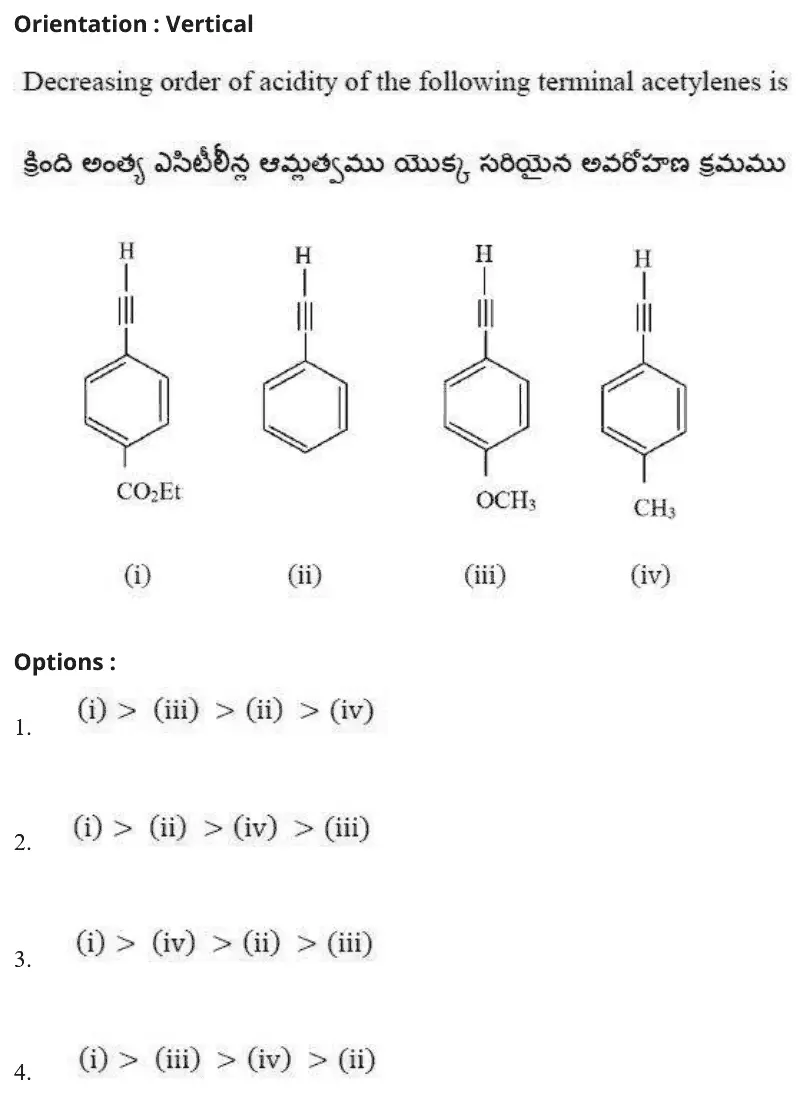
The correct order of acidity of the following compounds is I) $\mathrm{CH_3-C\equiv CH}$ II) $\mathrm{F_3C-C\equiv CH}$ III) $\mathrm{CH_3C\equiv CCH_3}$ IV) $\mathrm{CH_3CH=CHCH_3}$
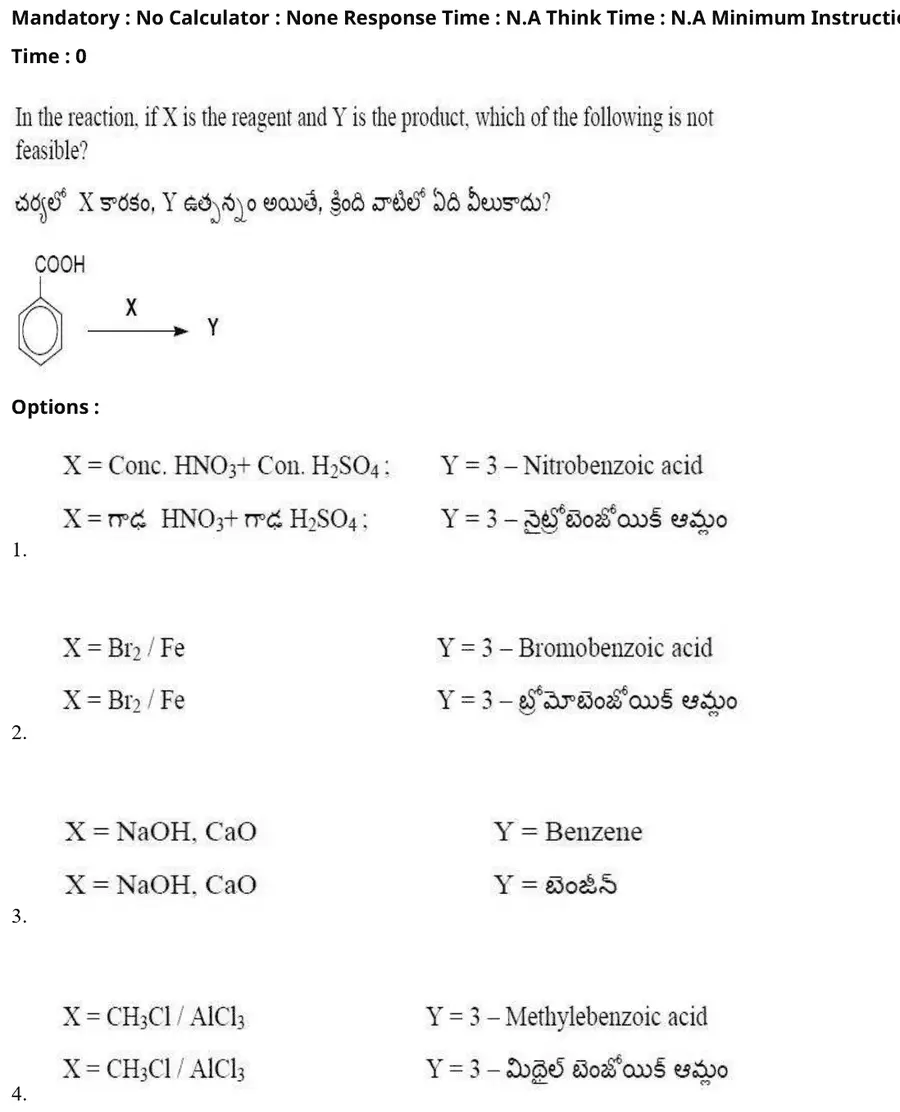
Identify the product Y in the given reaction benzene $\xrightarrow[\text{Conc. } \mathrm{H_2SO_4}]{\text{Conc. } \mathrm{HNO_3}}$ X $\xrightarrow[\mathrm{FeCl_3}]{\mathrm{Cl_2}}$ Y
The product Q and R in the following reactions respectively are $H_2 + CH_3C \equiv CH \xrightarrow{\text{lindlar's catalyst}} P \xrightarrow[Zn + H_2O]{O_3} Q + R$
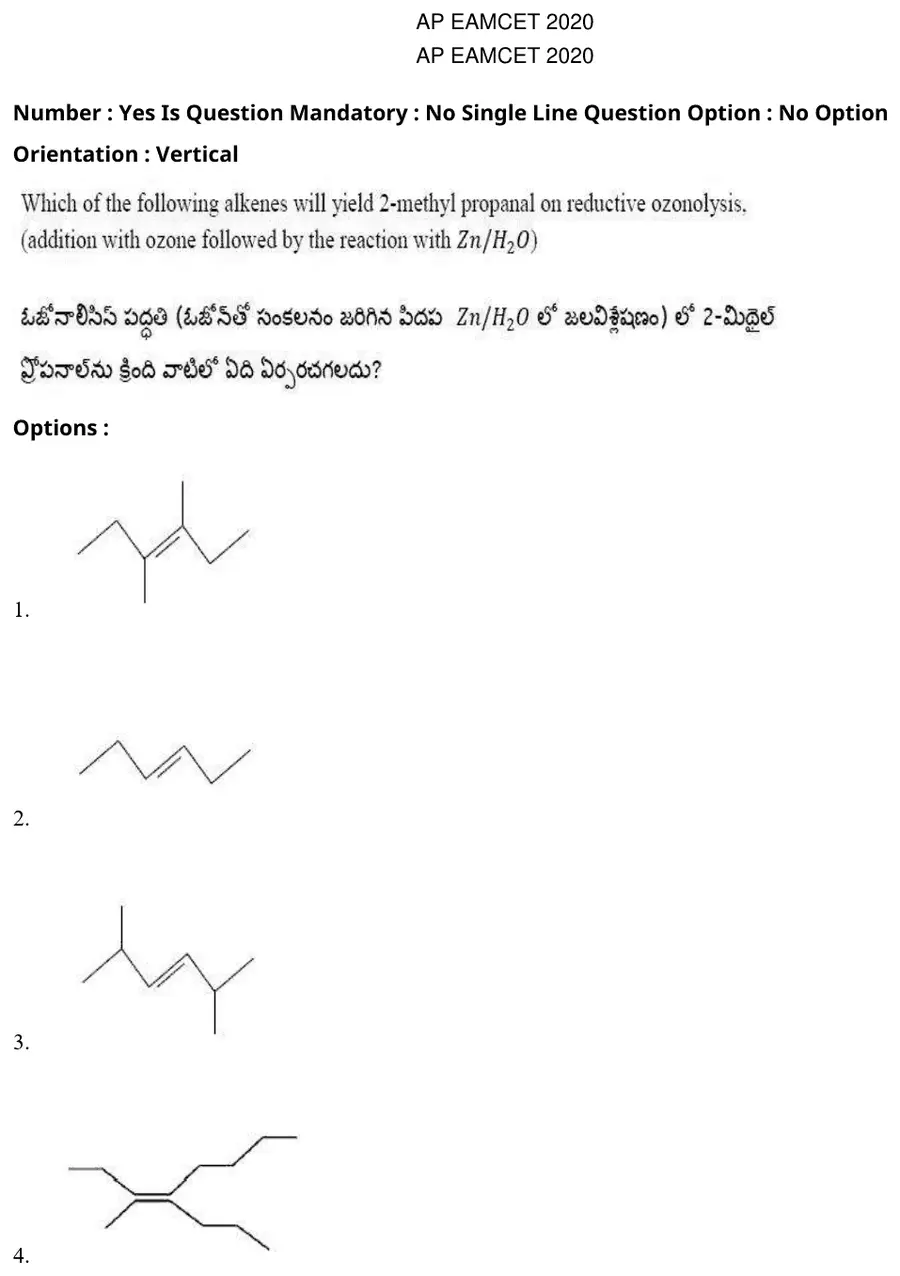
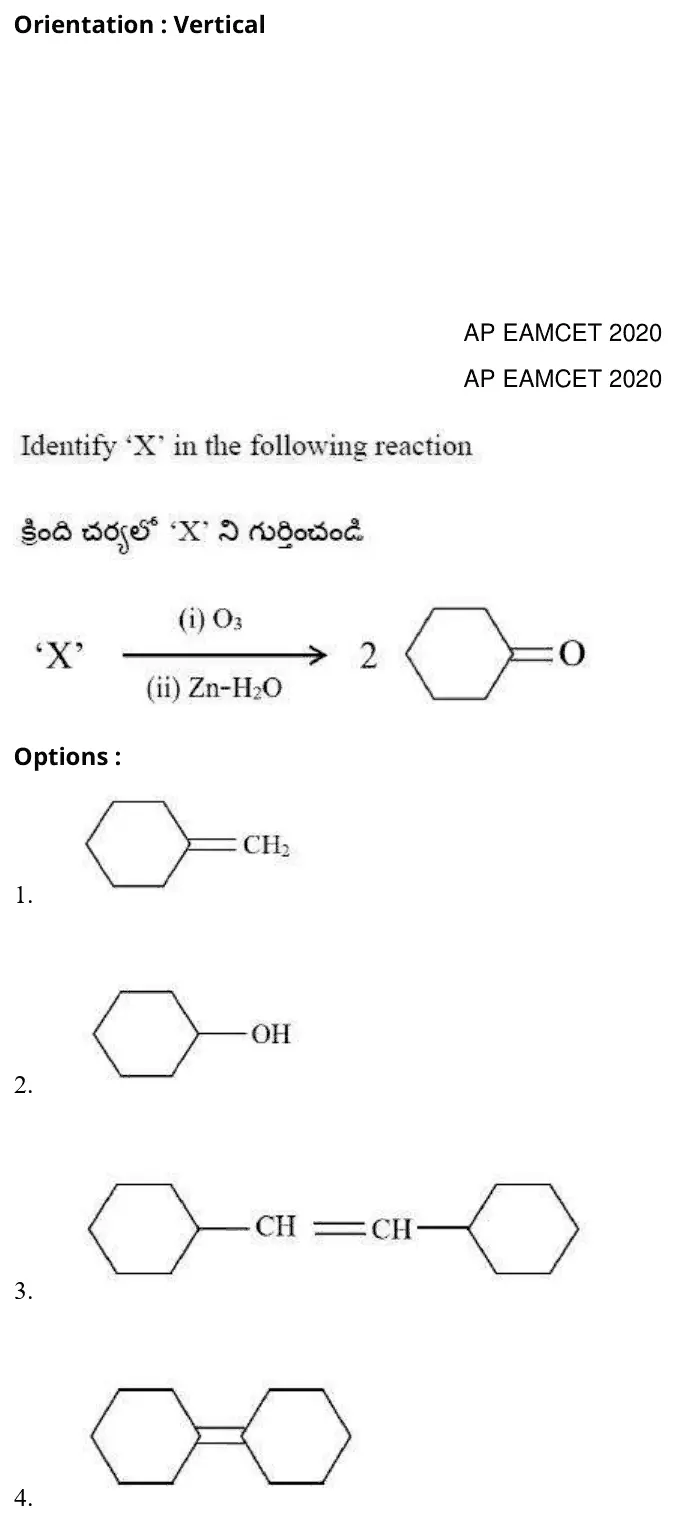
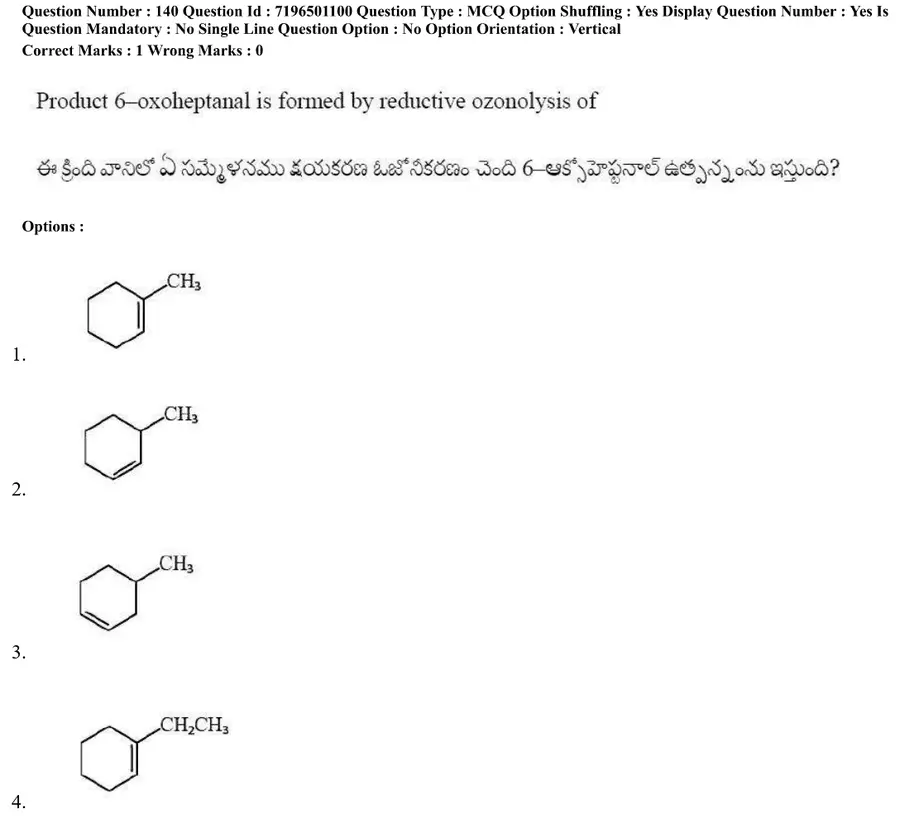
Which of the following alkenes will yield 2-methyl propanal on reductive ozonolysis. (addition with ozone followed by the reaction with $\mathrm{Zn/H_2O}$)
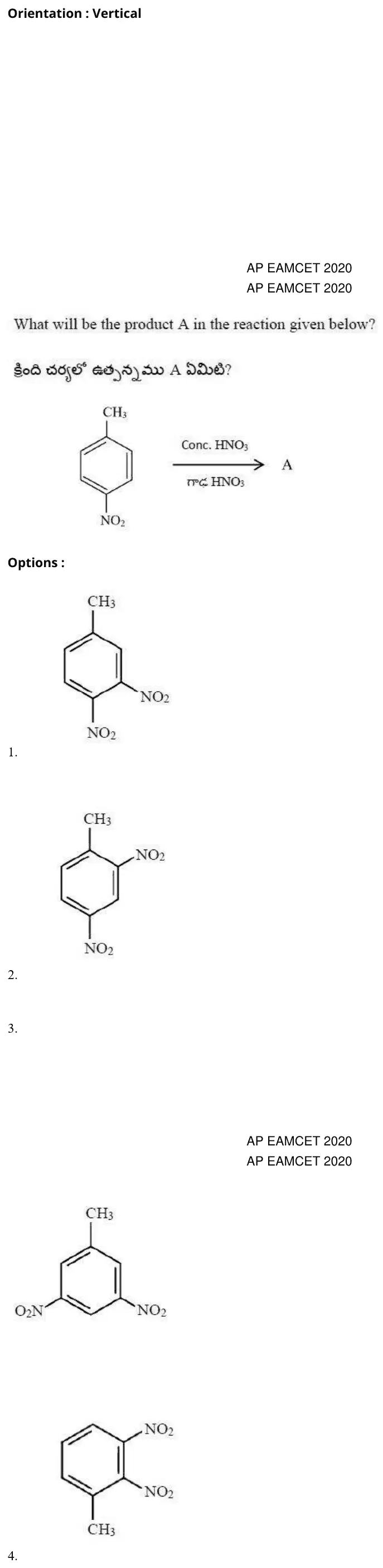
What will be the product A in the reaction given below? (see the figure above)
The question as printed in the paper.
A
see figure benzene ring: $CH_3$ at top, $NO_2$ at lower right vertex, $NO_2$ at bottom vertex
B
see figure benzene ring: $CH_3$ at top, $NO_2$ at upper right vertex, $NO_2$ at bottom vertex
C
see figure benzene ring: $CH_3$ at top, $O_2N$ at lower left vertex, $NO_2$ at lower right vertex
D
see figure benzene ring: $CH_3$ at bottom, one $NO_2$ at upper right vertex and one $NO_2$ at right, adjacent to it (the two nitro groups are next to each other)
When calcium carbide is reacted with heavy water, which of the following product(s) will be formed? (i) $\mathrm{CD_4}$ (ii) $\mathrm{C_2D_2}$ (iii) $\mathrm{Ca(OD)_2}$ (iv) $\mathrm{Ca_2{\cdot}D_2O}$
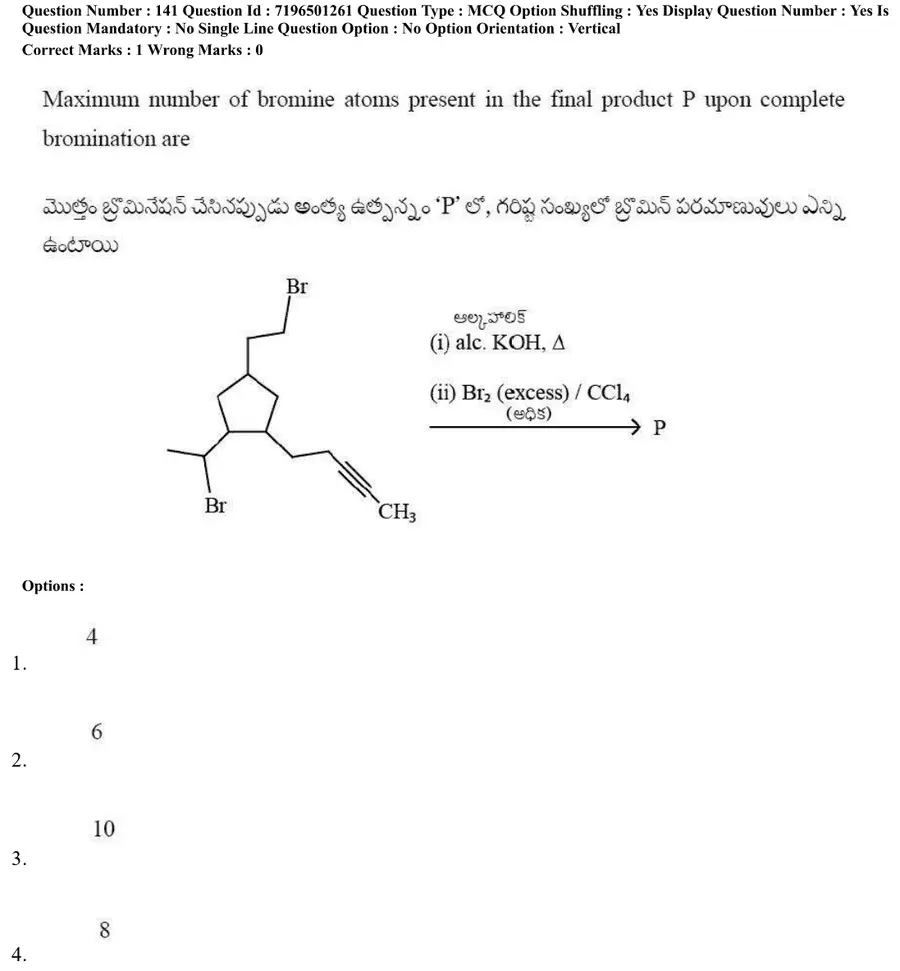
Maximum number of bromine atoms present in the final product P upon complete bromination are (see the figure above) (i) alc. KOH, $\Delta$ (ii) $\mathrm{Br_2}$ (excess) / $\mathrm{CCl_4}$ $\rightarrow$ P
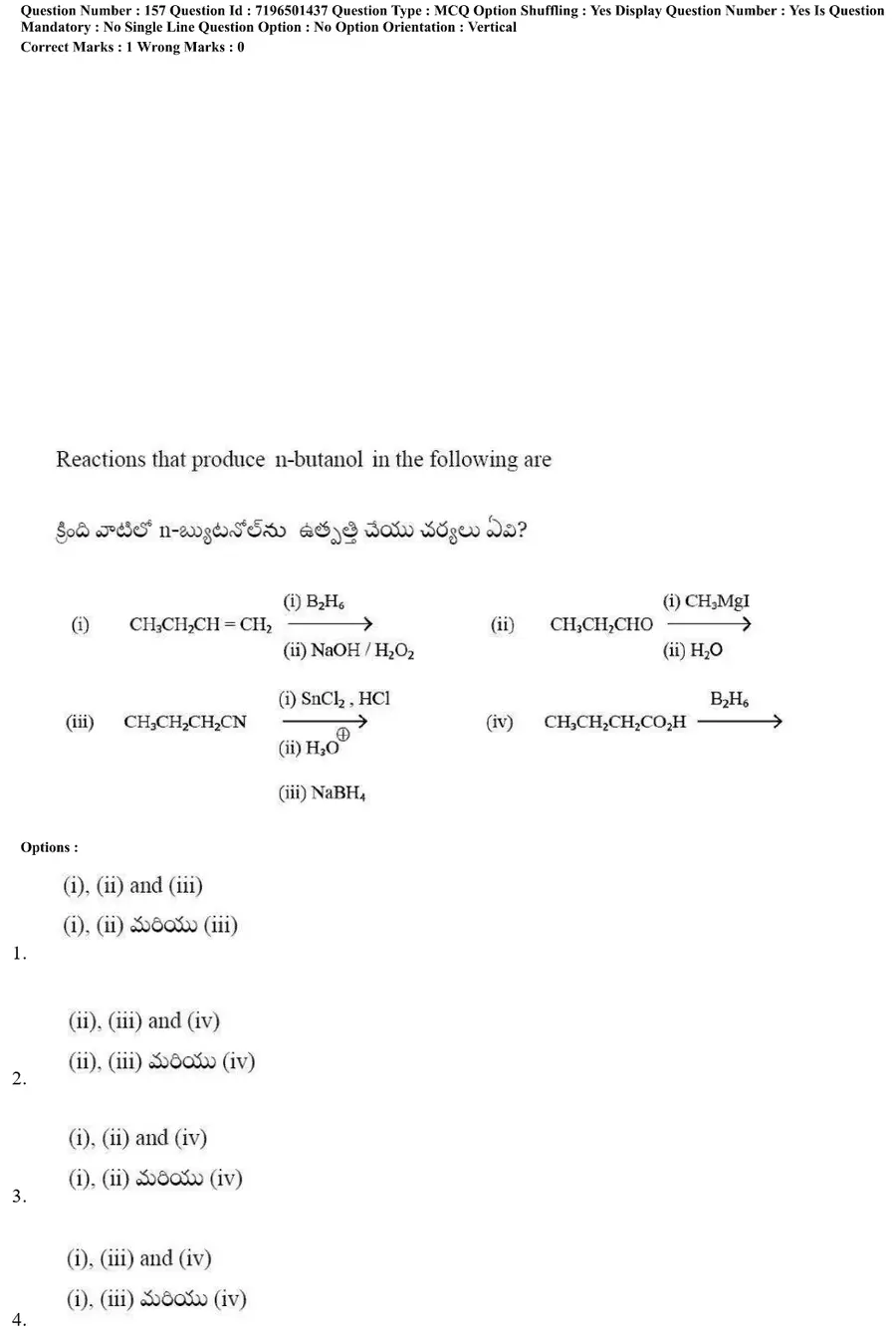
Reactions that produce n-butanol in the following are (see the figure above) (i) $\mathrm{CH_3CH_2CH=CH_2}$ with (i) $\mathrm{B_2H_6}$, (ii) $\mathrm{NaOH/H_2O_2}$ (ii) $\mathrm{CH_3CH_2CHO}$ with (i) $\mathrm{CH_3MgI}$, (ii) $\mathrm{H_2O}$ (iii) $\mathrm{CH_3CH_2CH_2CN}$ with (i) $\mathrm{SnCl_2, HCl}$, (ii) $\mathrm{H_3O^\oplus}$, (iii) $\mathrm{NaBH_4}$ (iv) $\mathrm{CH_3CH_2CH_2CO_2H}$ with $\mathrm{B_2H_6}$
The major products P and Q from the below reactions are $\mathrm{CH_3CH{=}CH_2} \xrightarrow{\mathrm{HBr}} \mathrm{P}$ $\mathrm{CH_3CH{=}CH_2} \xrightarrow[\mathrm{H_2O, H_2O_2/OH^-}]{(\mathrm{BH_3})_2} \mathrm{Q}$
An alkene A ($\mathrm{C_4H_8}$) exhibits cis/trans isomerism. A on ozonolysis gives B, which when reacted with NaOH followed by hydroxylamine gave C. What are B and C?
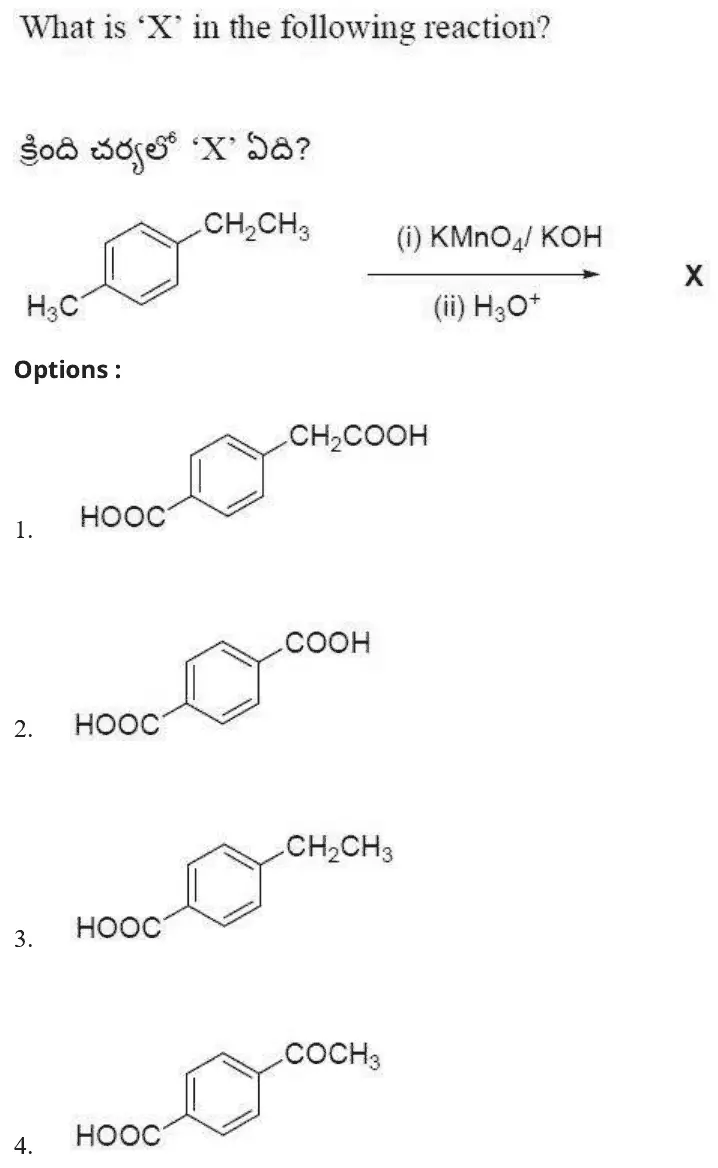
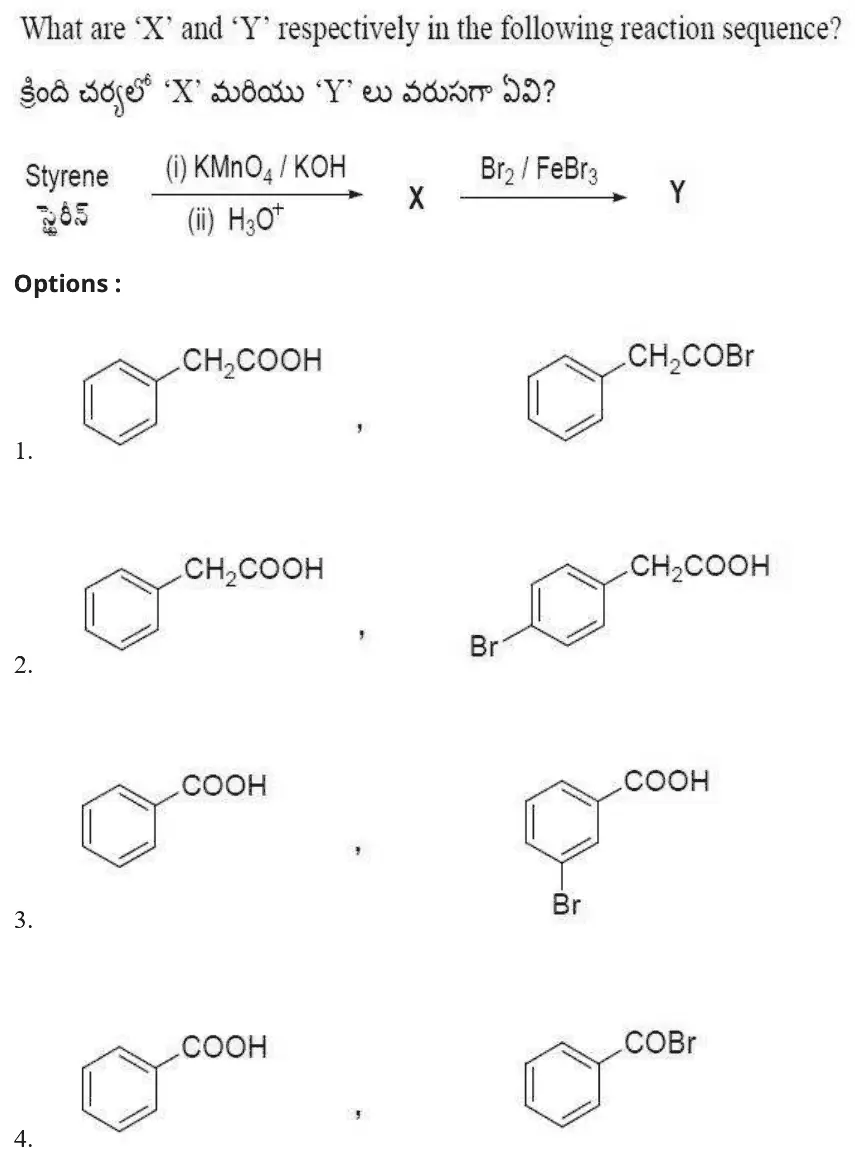
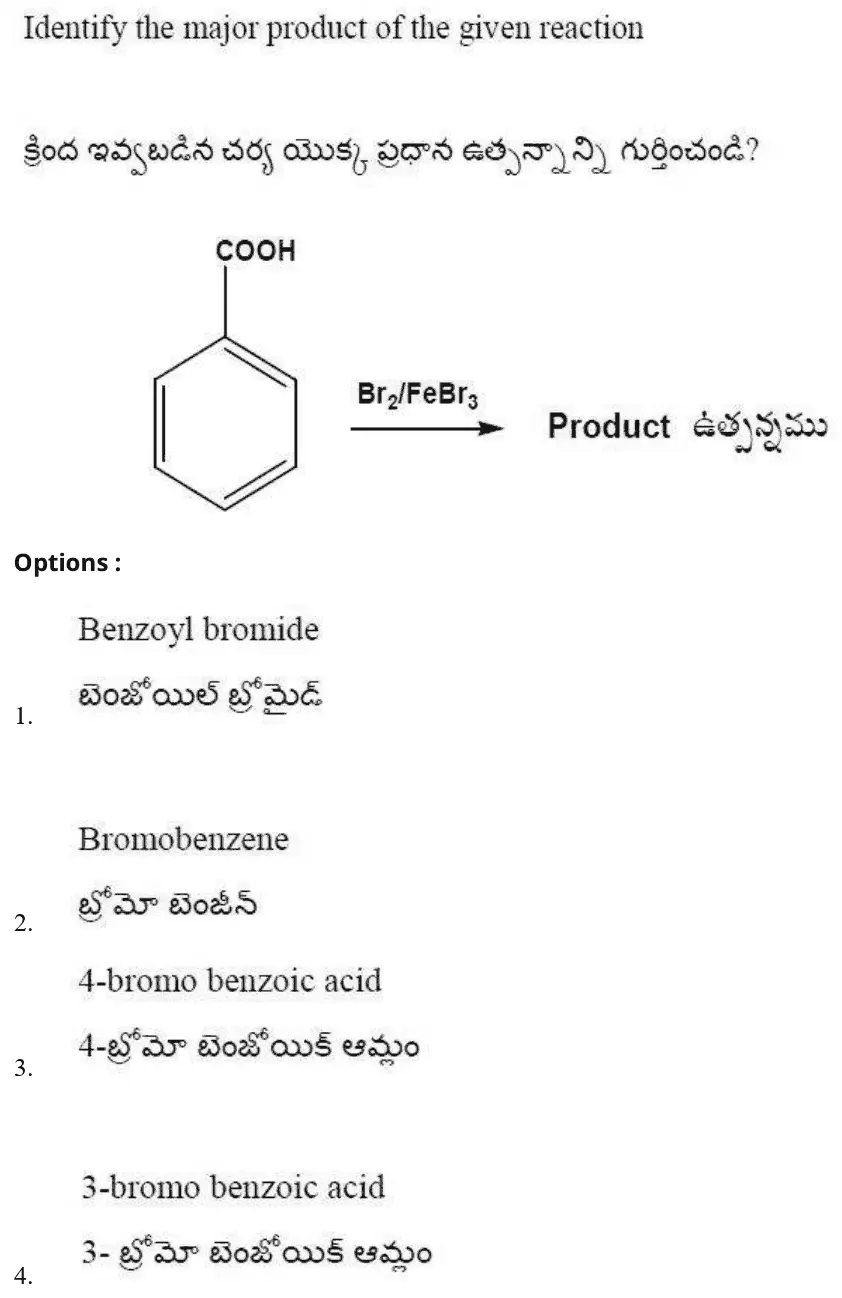
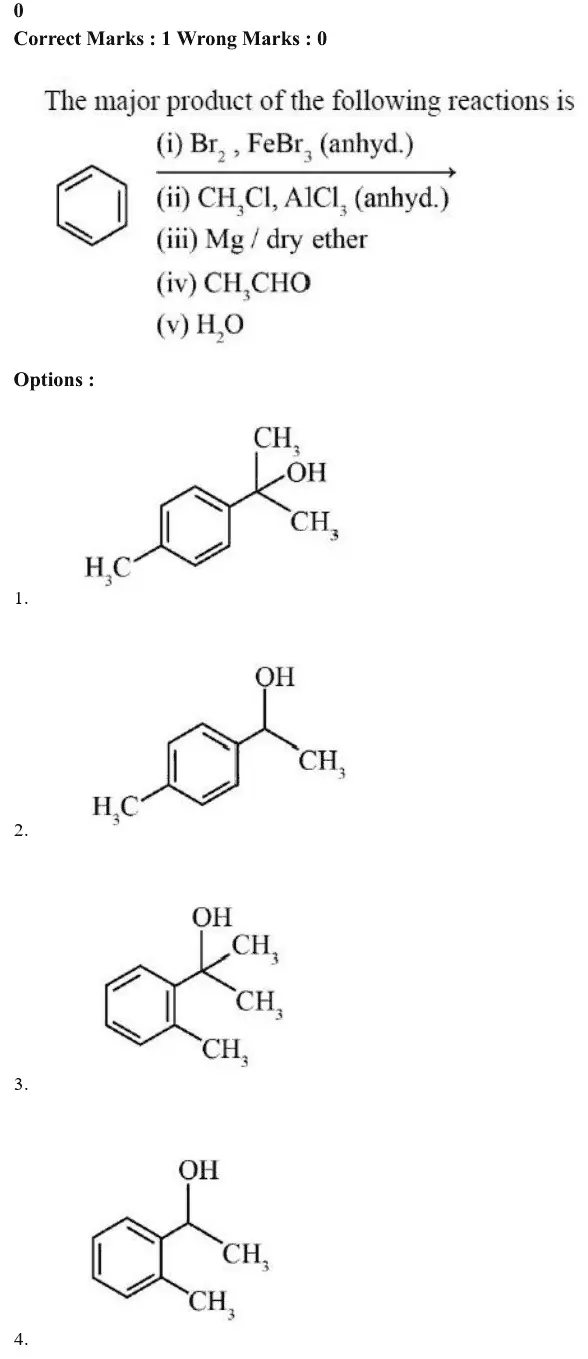
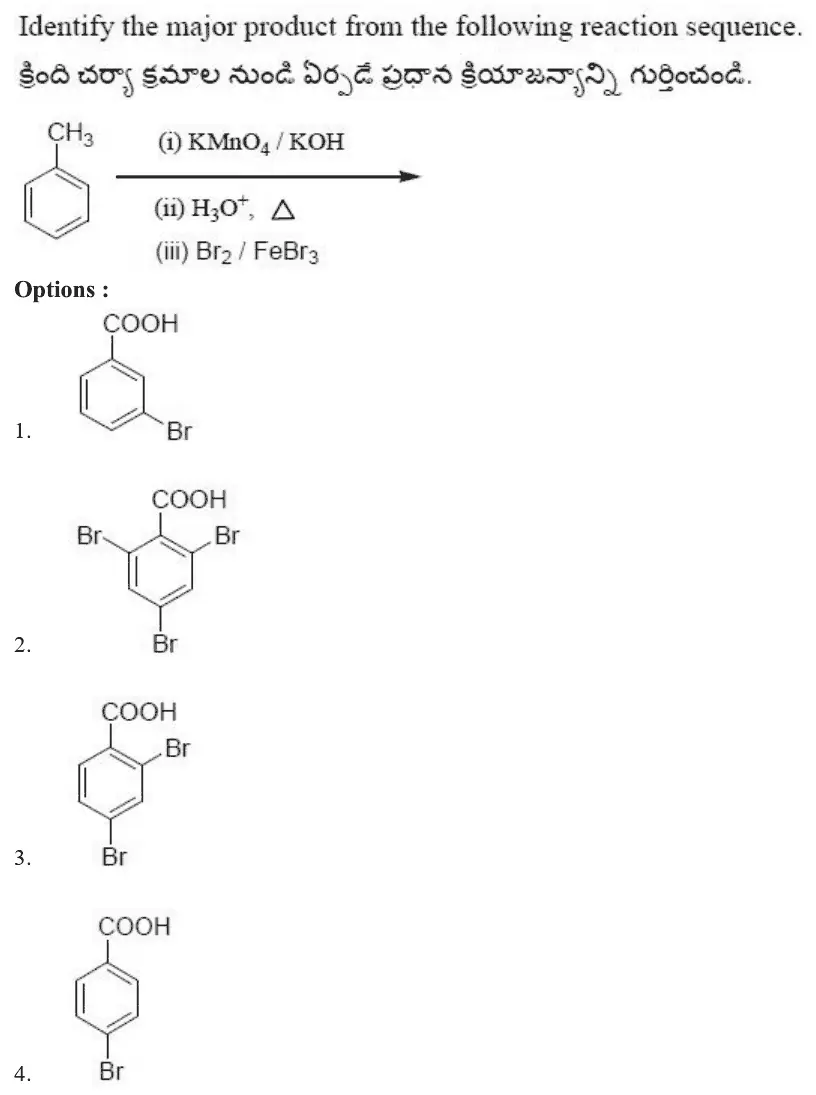
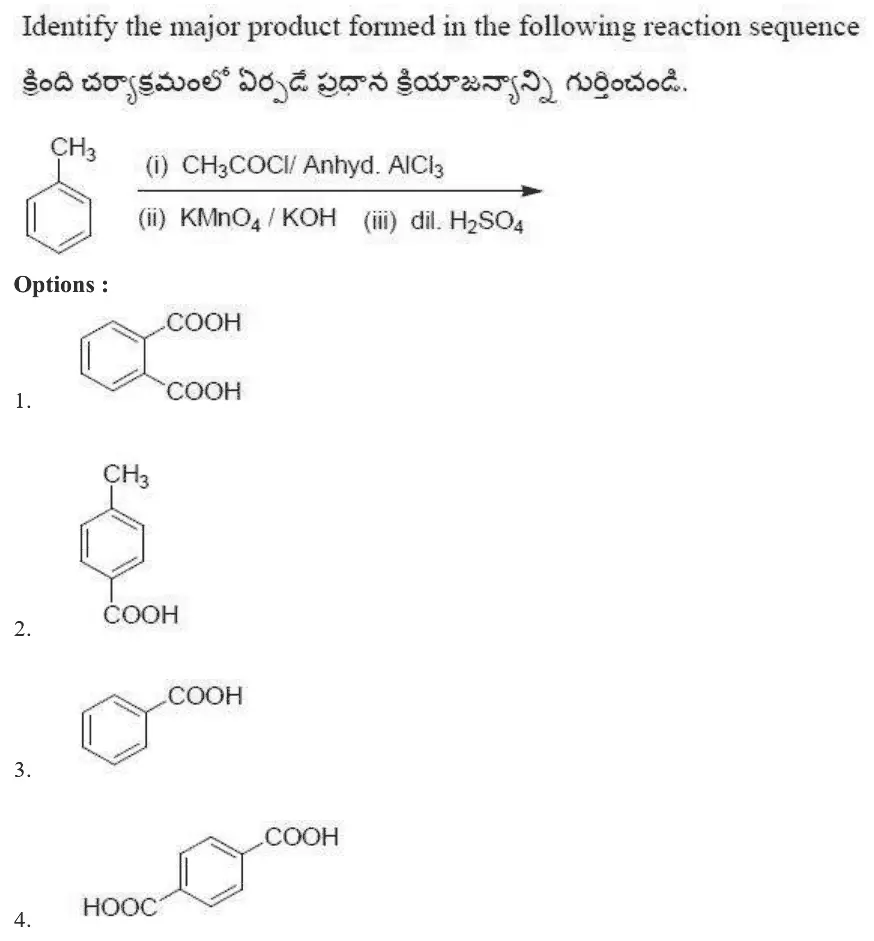
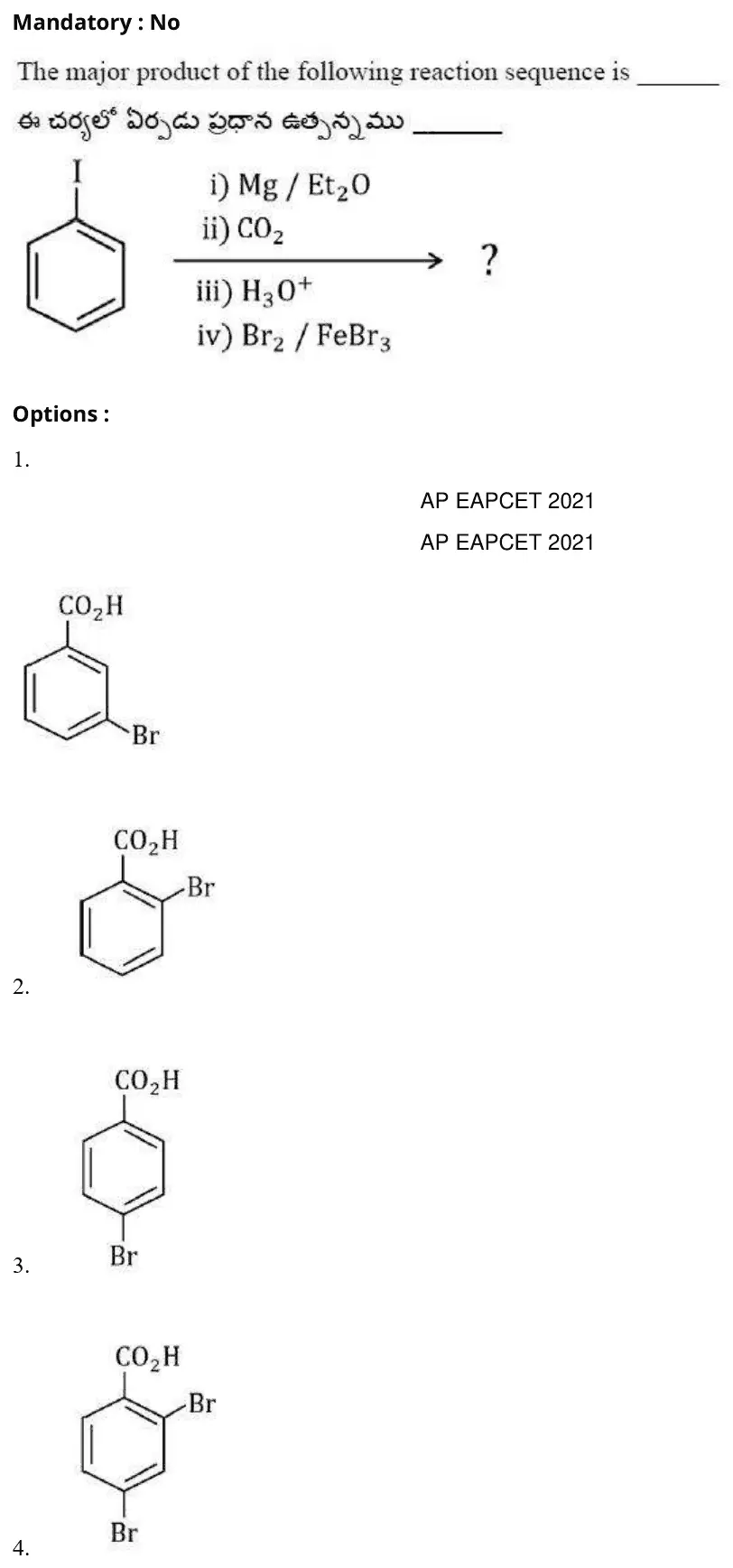
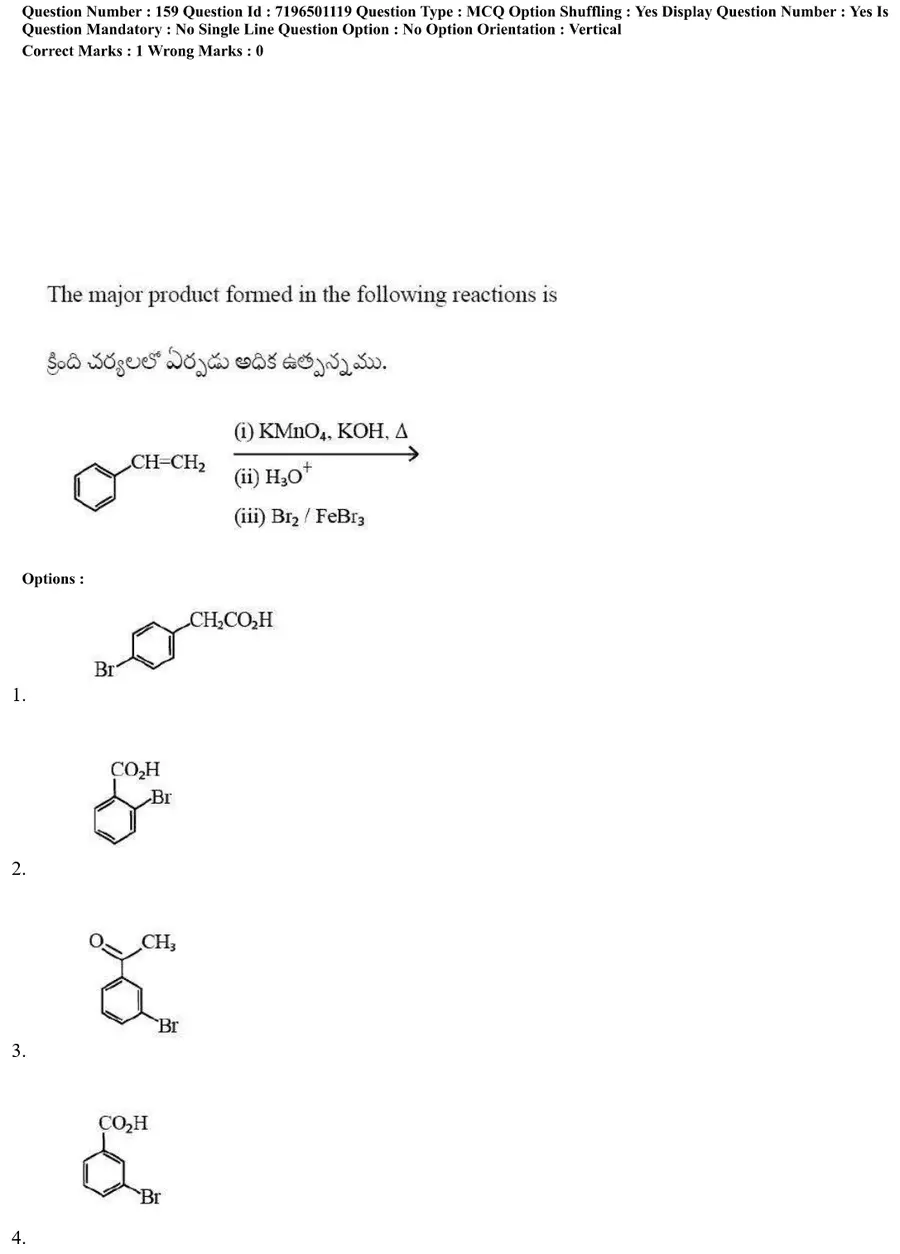
The major product formed in the following reactions is (see the figure above) (i) $\mathrm{KMnO_4}$, KOH, $\Delta$; (ii) $\mathrm{H_3O^+}$; (iii) $\mathrm{Br_2}$ / $\mathrm{FeBr_3}$
The question as printed in the paper.
A
see figure benzene ring with $\mathrm{CH_2CO_2H}$ and Br para to each other
B
see figure benzene ring with $\mathrm{CO_2H}$ and Br ortho
C
see figure benzene ring with $\mathrm{C(=O)CH_3}$ (O= and $\mathrm{CH_3}$ at top) and Br meta
D
see figure benzene ring with $\mathrm{CO_2H}$ and Br meta
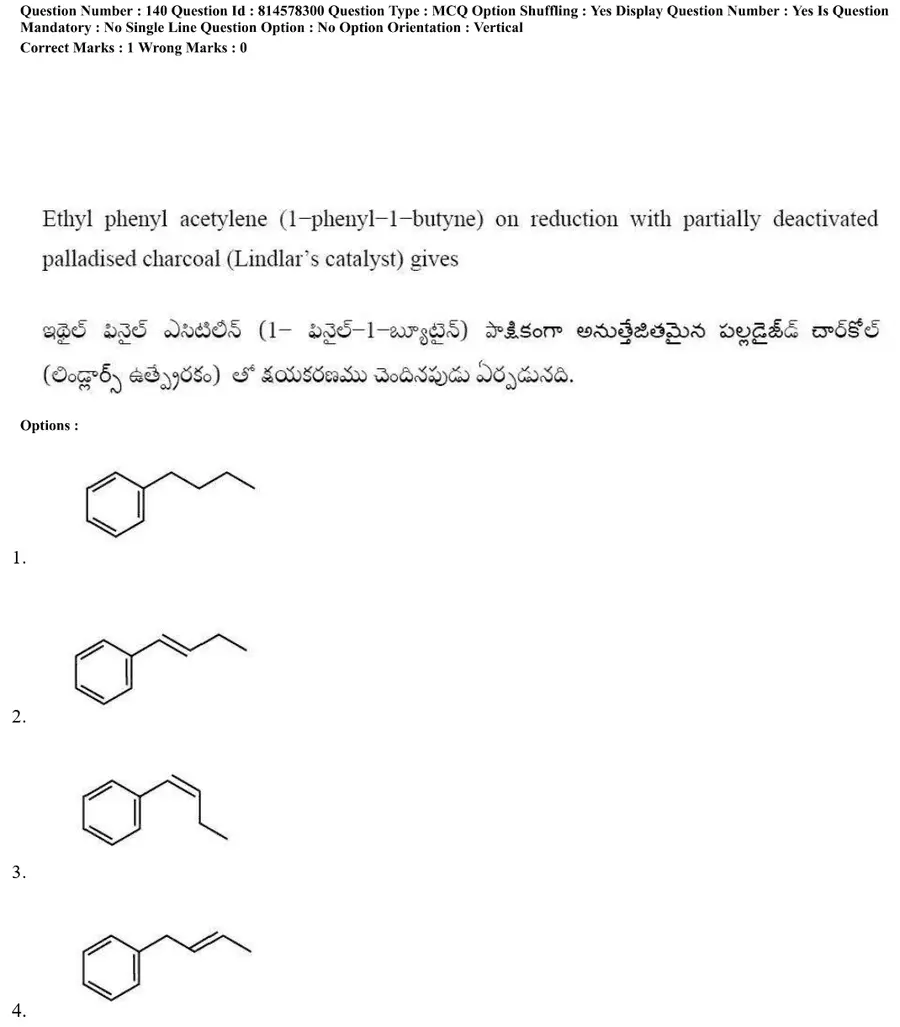
Ethyl phenyl acetylene (1-phenyl-1-butyne) on reduction with partially deactivated palladised charcoal (Lindlar's catalyst) gives (see the figure above)
The question as printed in the paper.
A
see figure benzene ring bonded to a saturated four-carbon zigzag chain (butylbenzene)
B
see figure benzene ring bonded to a C=C at the first carbon, drawn with the chain continuing on opposite sides of the double bond (trans, Ph-CH=CH-CH2CH3)
C
see figure benzene ring bonded to a C=C at the first carbon, drawn with the chain on the same side (cis, Ph-CH=CH-CH2CH3)
D
see figure benzene ring bonded to a CH2 then a C=C at the second carbon (Ph-CH2-CH=CH-CH3)
Which one of the following methods is suitable to generate aromatic compound(s) from linear aliphatic saturated hydrocarbons with at least six carbon atoms?
A benzene derivative did not produce white precipitate with the ammonical silver nitrate solution but decolorized the cold dilute alkaline $\mathrm{KMnO_4}$ solution. The compound is
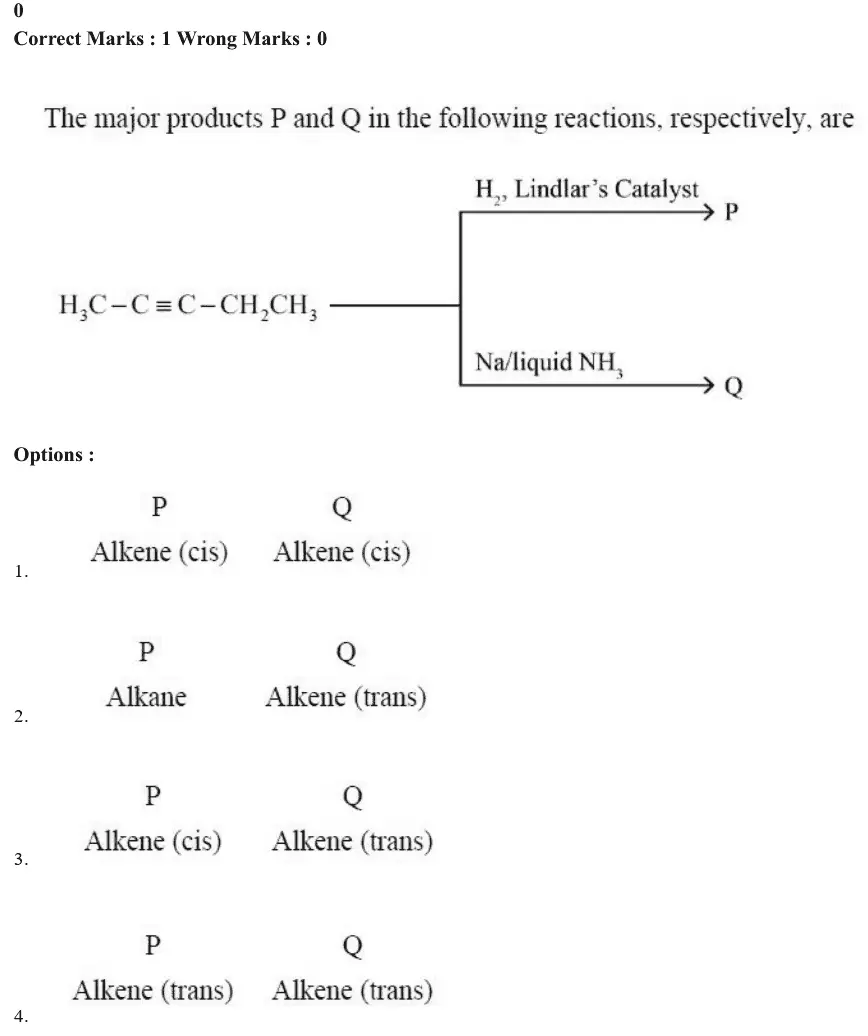
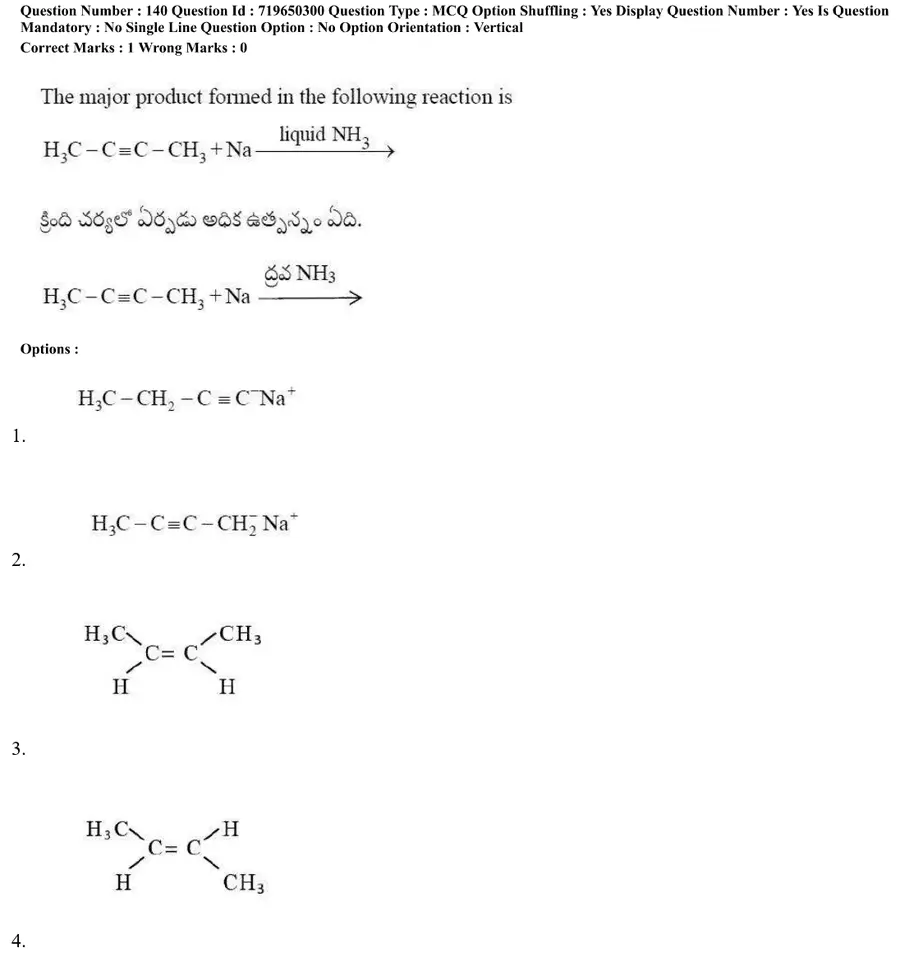
The major product formed in the following reaction is $\mathrm{H_3C-C{\equiv}C-CH_3 + Na \xrightarrow{liquid\ NH_3}}$
The question as printed in the paper.
A
$\mathrm{H_3C-CH_2-C{\equiv}C^-Na^+}$
B
$\mathrm{H_3C-C{\equiv}C-CH_2^-\ Na^+}$ (see the figure above)
C
see figure alkene with $\mathrm{H_3C}$ and H on the left carbon and $\mathrm{CH_3}$ and H on the right carbon, drawn with both $\mathrm{CH_3}$ groups on the upper side (cis)
D
see figure alkene with $\mathrm{H_3C}$ upper left, H lower left on the left carbon; H upper right and $\mathrm{CH_3}$ lower right on the right carbon (trans)
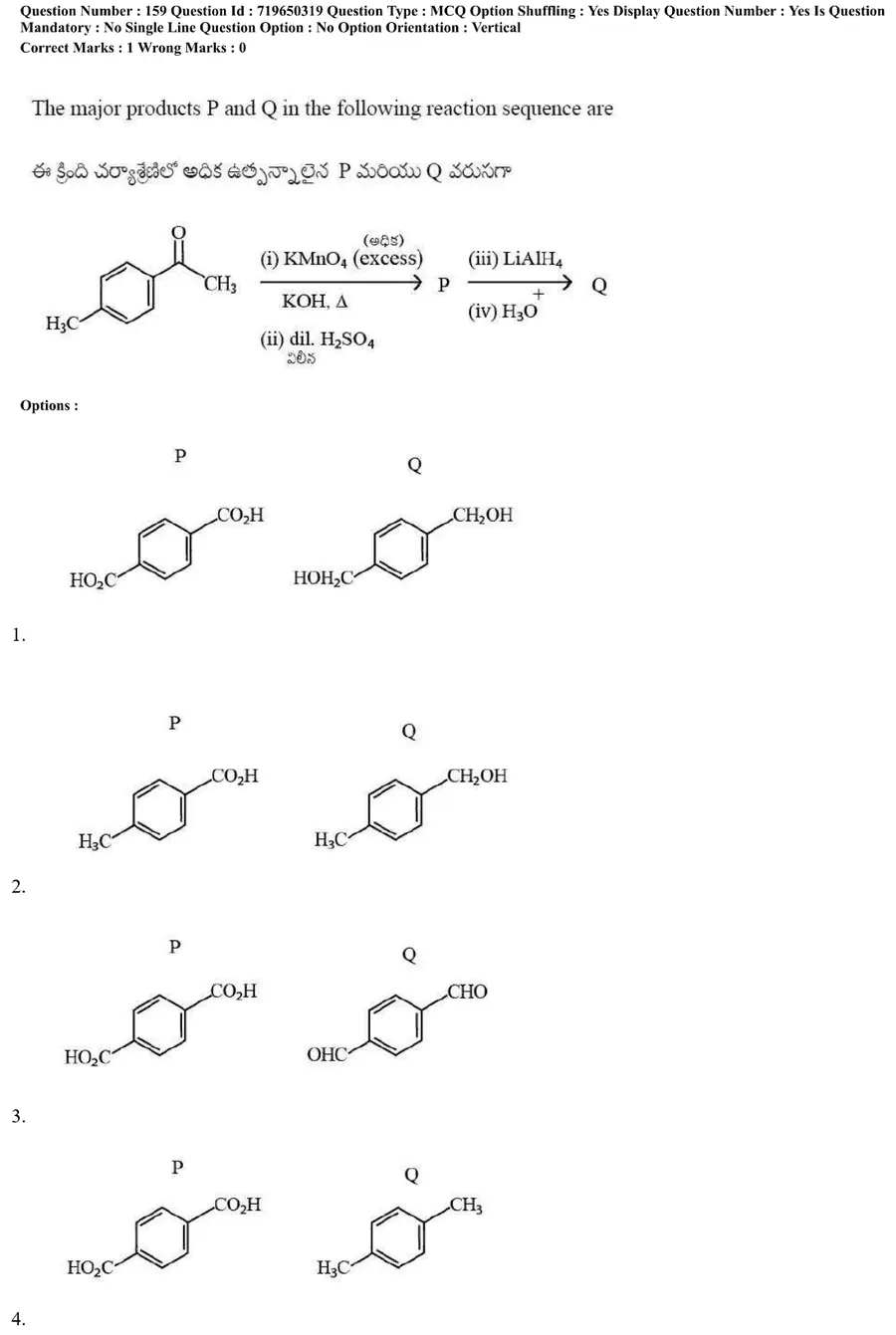
The major products P and Q in the following reaction sequence are (see the figure above)
The question as printed in the paper.
A
see figure P = benzene-1,4-dicarboxylic acid ($\mathrm{HO_2C}$ and $\mathrm{CO_2H}$ para); Q = 1,4-bis(hydroxymethyl)benzene ($\mathrm{HOH_2C}$ and $\mathrm{CH_2OH}$ para)
B
see figure P = 4-methylbenzoic acid ($\mathrm{H_3C}$ and $\mathrm{CO_2H}$ para); Q = 4-methylbenzyl alcohol ($\mathrm{H_3C}$ and $\mathrm{CH_2OH}$ para)
C
see figure P = benzene-1,4-dicarboxylic acid; Q = benzene-1,4-dicarbaldehyde ($\mathrm{OHC}$ and $\mathrm{CHO}$ para)
D
see figure P = benzene-1,4-dicarboxylic acid; Q = p-xylene ($\mathrm{H_3C}$ and $\mathrm{CH_3}$ para)
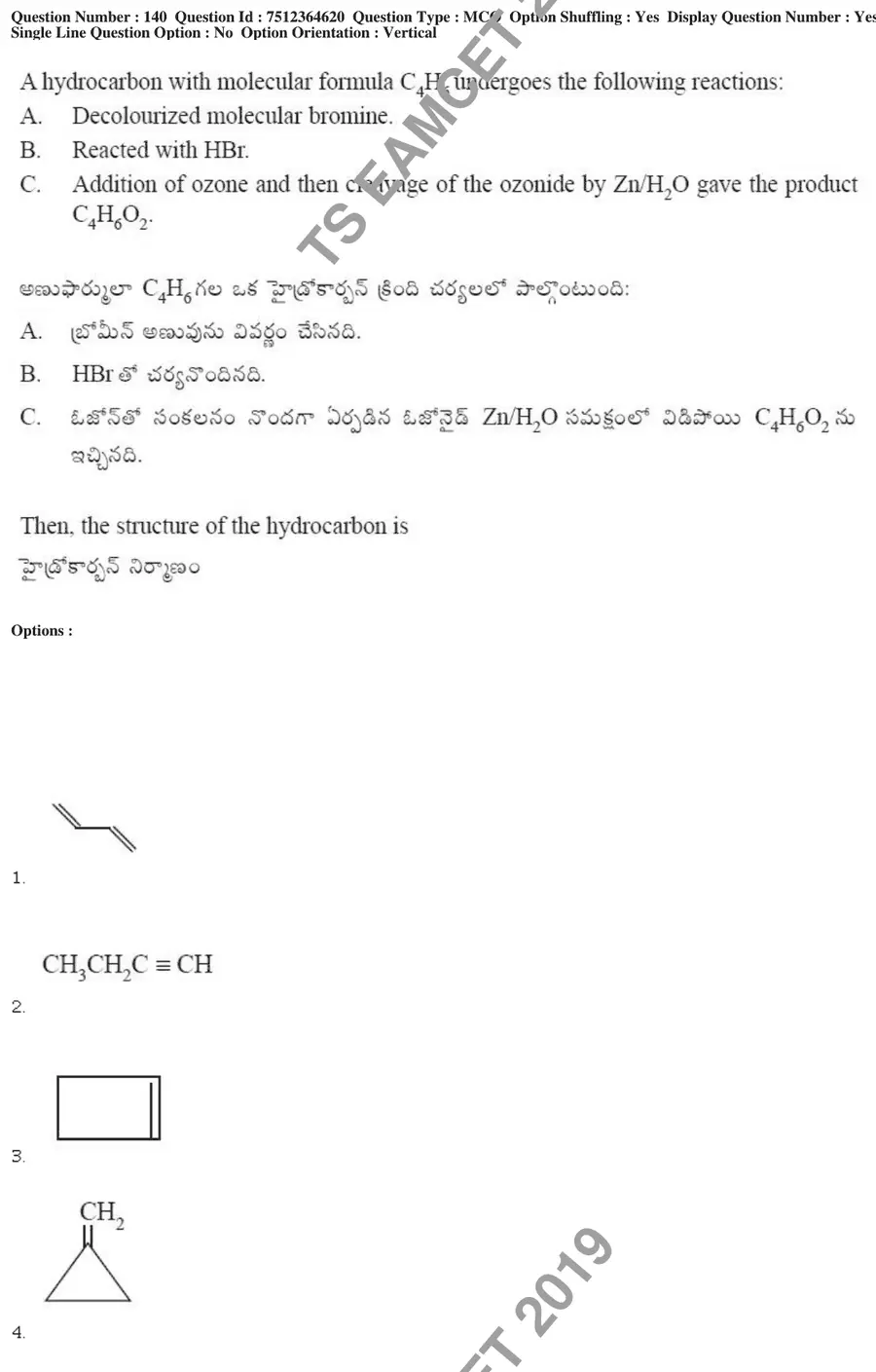
A hydrocarbon with molecular formula $\mathrm{C_4H_6}$ undergoes the following reactions: A. Decolourized molecular bromine. B. Reacted with HBr. C. Addition of ozone and then cleavage of the ozonide by $\mathrm{Zn/H_2O}$ gave the product $\mathrm{C_4H_6O_2}$. Then, the structure of the hydrocarbon is
The question as printed in the paper.
A
see figure skeletal structure of buta-1,3-diene
B
$\mathrm{CH_3CH_2C{\equiv}CH}$
C
see figure cyclobutene (square with one double bond)
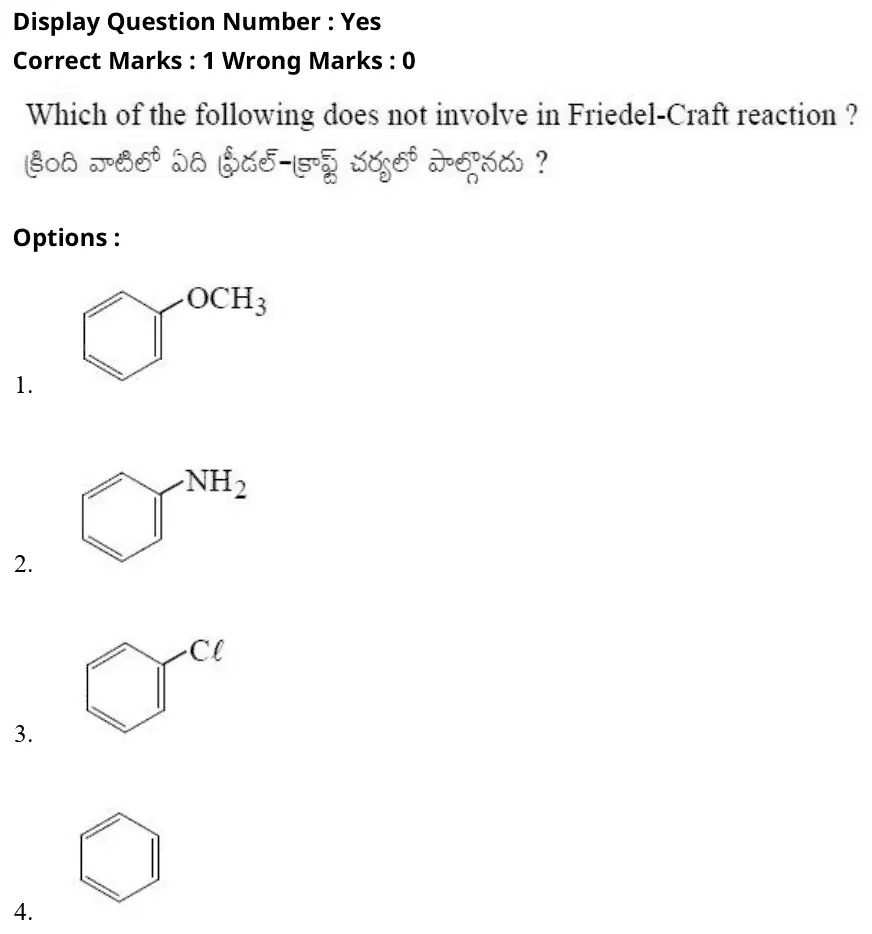
Which of the following statements are correct? I) In nitrating mixture nitric acid participates as an acid II) $\sigma$ complex is the intermediate substance in electrophilic substitution of benzene III) Benzene on Friedel-Crafts alkylation with n-propyl chloride gives isopropyl benzene
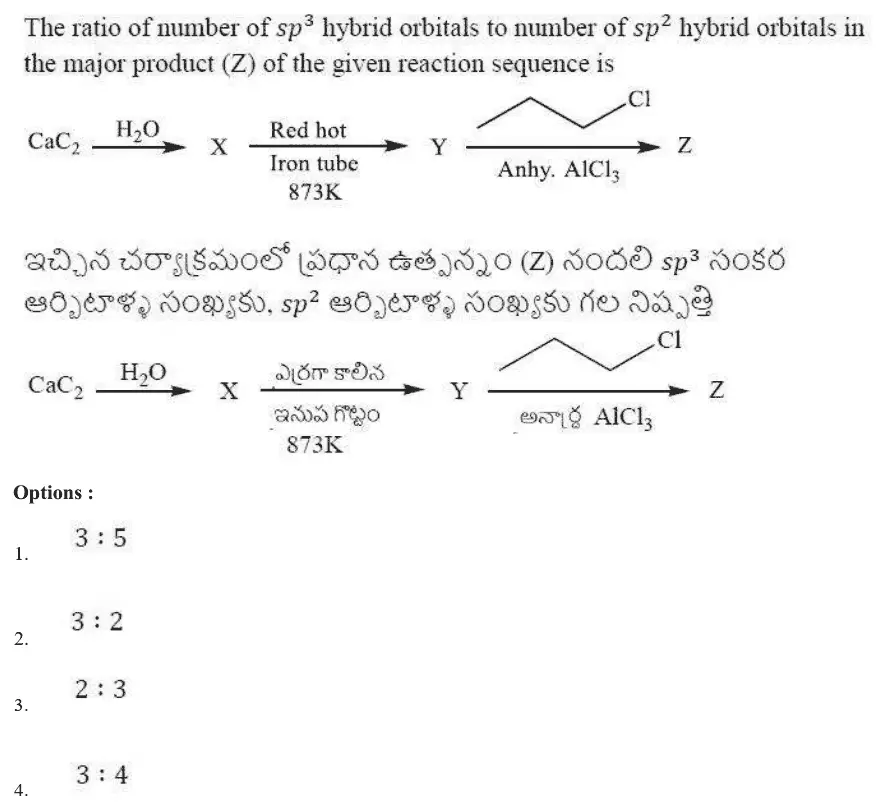
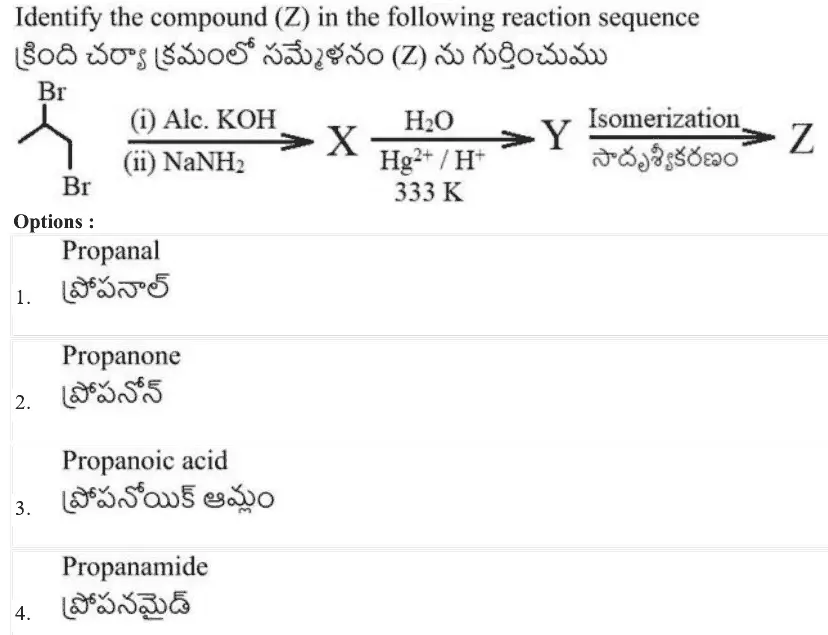
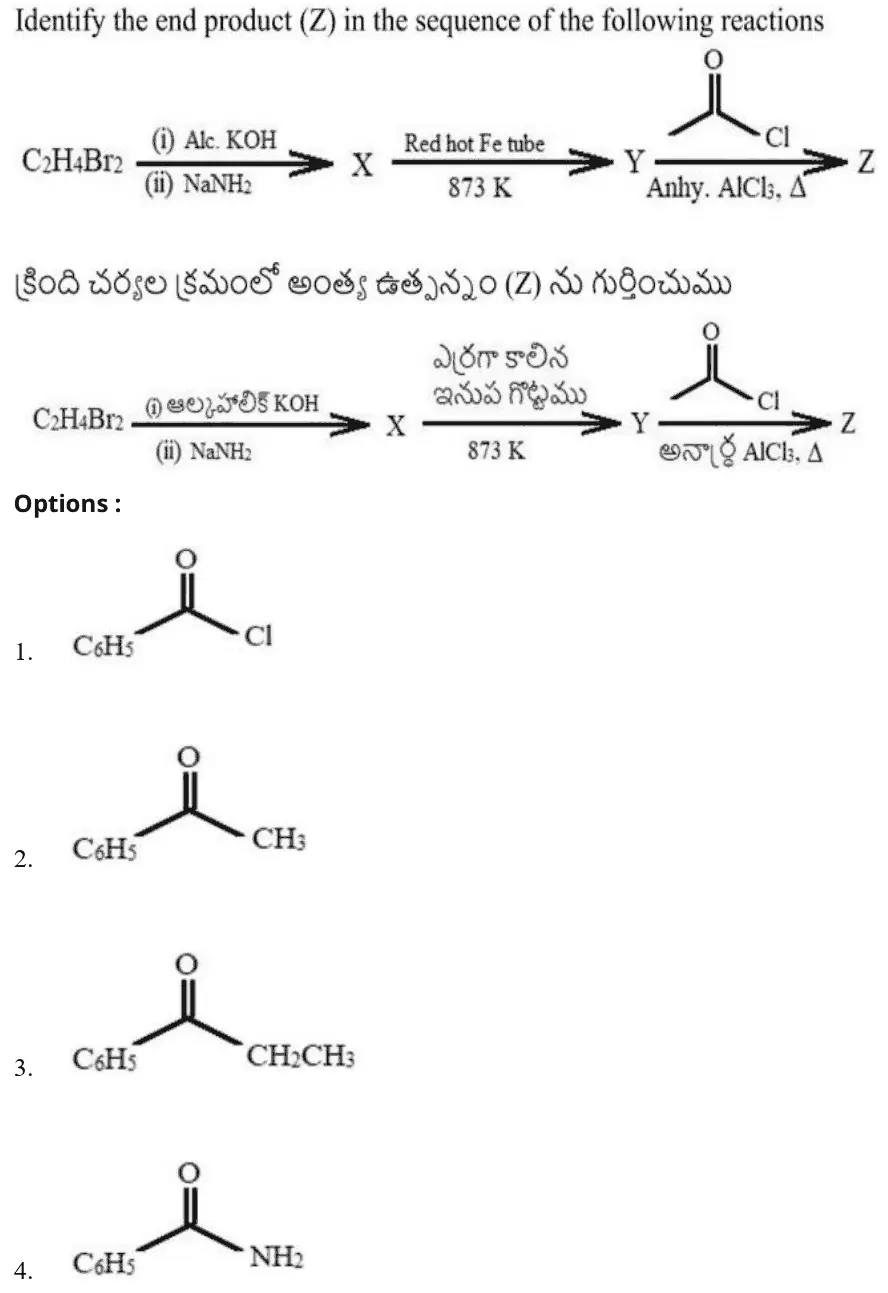
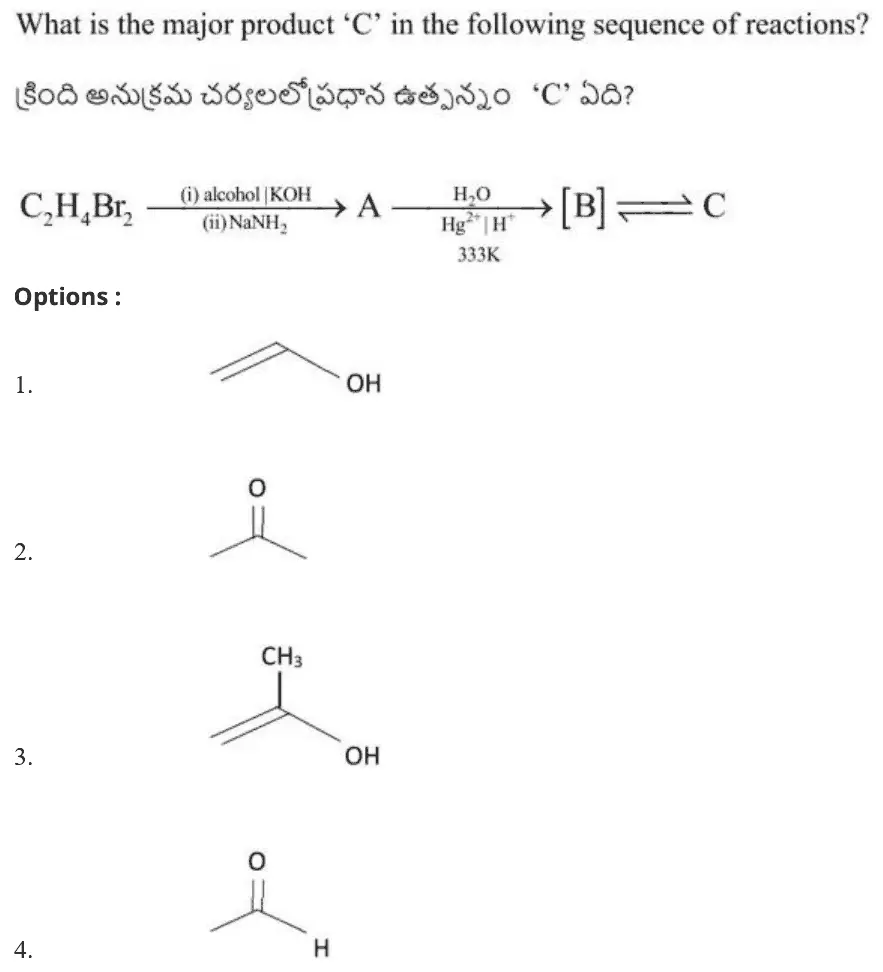
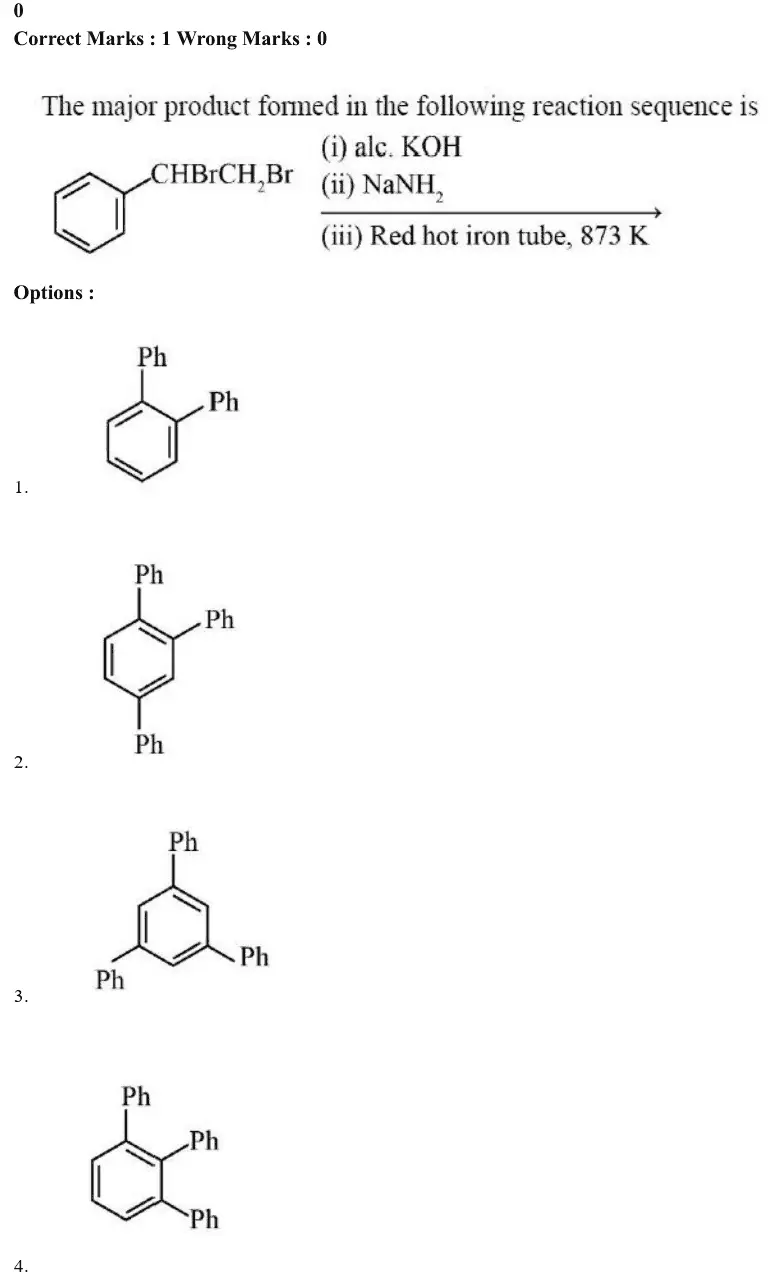
Identify Z in the following sequence of reactions. $\mathrm{C_2H_4Br_2 \xrightarrow[(ii)\ NaNH_2]{(i)\ alc.\ KOH} X \xrightarrow[873K]{Red\ hot\ Fe\ tube} Y \xrightarrow[Anhyd.\ AlCl_3]{(CH_3CO)_2O/\Delta} Z}$
Sodium acetate was electrolysed by Kolbe's method to form two gases A and B at anode. C and D are formed when B is heated with regulated supply of $\mathrm{O_2}$ or air in the presence of $\mathrm{(CH_3COO)_2Mn}$. C reacts with NaOH to form a salt. A and D are respectively.
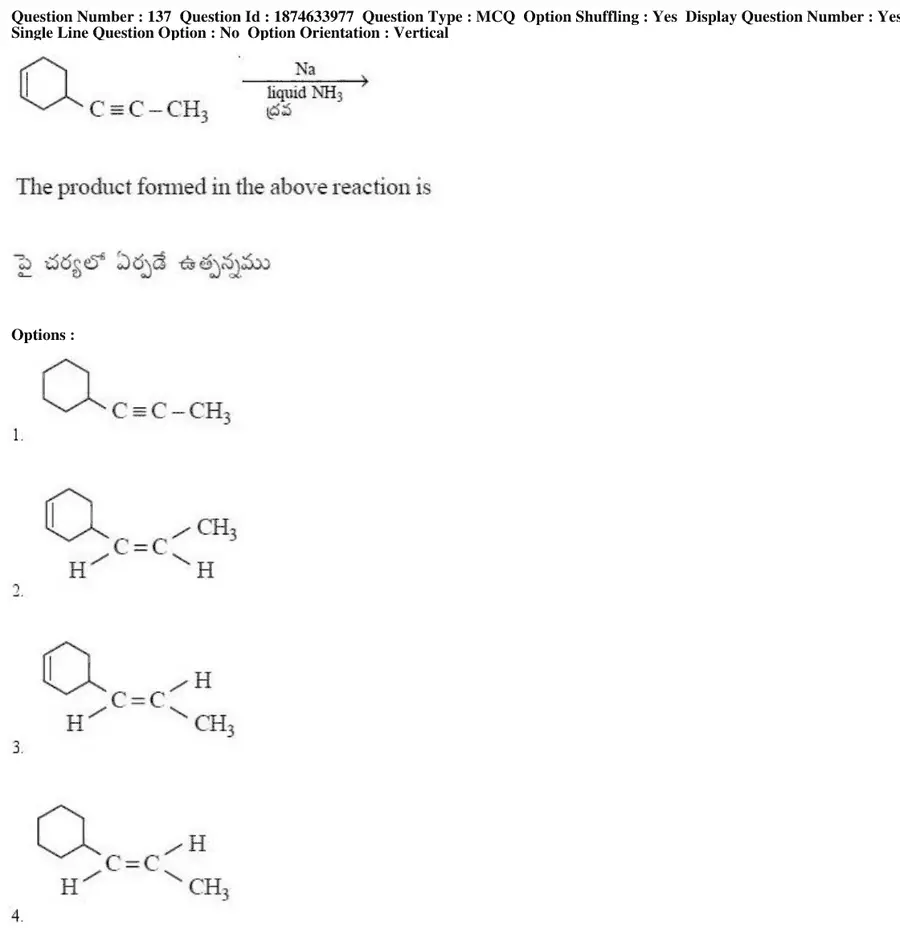
see figure $\xrightarrow[\text{liquid }\mathrm{NH_3}]{\mathrm{Na}}$ The product formed in the above reaction is
The question as printed in the paper.
A
see figure cyclohexane ring bearing $-\mathrm{C{\equiv}C-CH_3}$
B
see figure ring with one C=C bearing $-\mathrm{CH{=}CH-CH_3}$; ring-side alkene carbon has H (lower left), far carbon has CH3 (upper right) and H (lower right)
C
see figure ring with one C=C bearing $-\mathrm{CH{=}CH-CH_3}$; ring-side alkene carbon has H (lower left), far carbon has H (upper right) and CH3 (lower right)
D
see figure ring without a C=C (saturated) bearing $-\mathrm{CH{=}CH-CH_3}$; same arrangement as option 3 (H upper right, CH3 lower right)
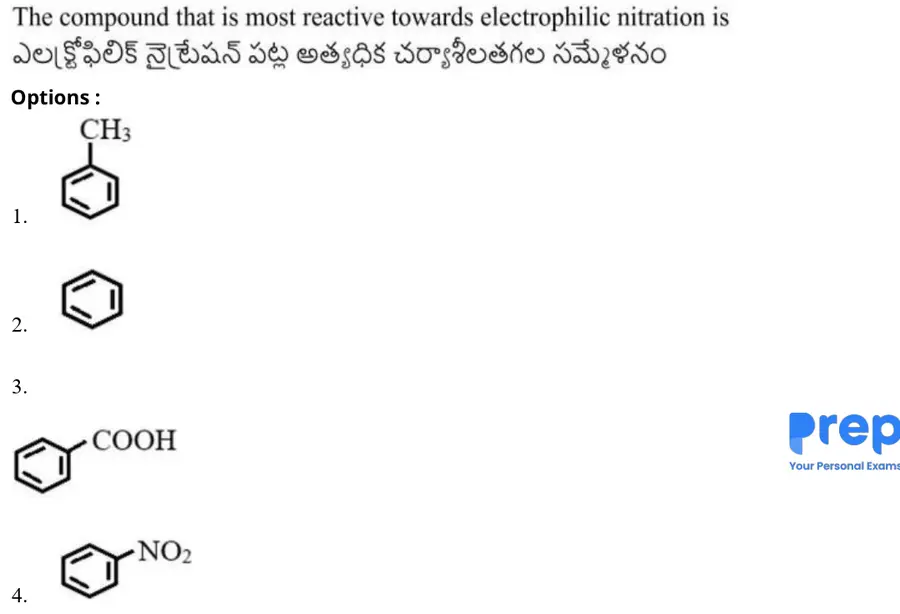
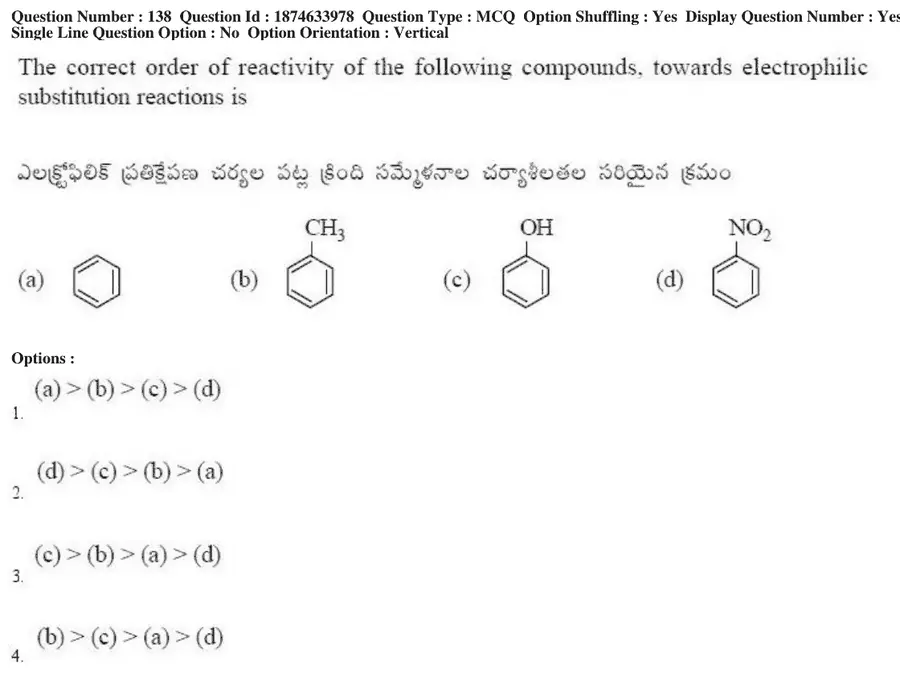
The correct order of reactivity of the following compounds, towards electrophilic substitution reactions is (a) (see the figure above) benzene (b) (see the figure above) toluene ($\mathrm{CH_3}$ on ring) (c) (see the figure above) phenol (OH on ring) (d) (see the figure above) nitrobenzene ($\mathrm{NO_2}$ on ring)
Which of the following statements are correct with respect to benzene? a) It forms triozonide with $\mathrm{O_3}$ b) It is non-planar c) It forms only one monosubstituted product with $\mathrm{CH_3COCl}$ in the presence of anhyd. $\mathrm{AlCl_3}$ d) If forms hexachlorobenzene on heating with $\mathrm{Cl_2}$ under photochemical condition (sic)
Hydrocarbons is a major heavyweight in the organic chemistry curriculum, commanding rank 4 among all 31 chemistry chapters during the 2022 to 2026 examination span. Across our complete repository of entrance papers spanning 2010 through 2026, the chapter contributed 293 questions across 149 papers, appearing in 142 of those tests to capture 4.9 percent of all chemistry questions with an average of 2.0 questions per paper. In the modern five-year timeframe from 2022 to 2026, it provided 165 questions across 77 sittings, featuring in 76 papers to post 2.1 questions per paper and a 5.4 percent subject share.
The chapter has appeared in every exam year since 2022, though it was absent from a single sitting across that five-year period. Across the state breakdown between 2022 and 2026, AP examinations yielded 95 questions across 48 papers (appearing in 47 papers, 2.0 questions per paper, 4.9 percent share), while TS examinations generated 70 questions across 29 papers (appearing in all 29 papers, 2.4 questions per paper, 6.0 percent share).
Earlier testing from 2010 through 2021 featured 128 questions across 72 sittings (appearing in 66 tests), which represented 1.8 questions per paper and a 4.4 percent subject share. Over the last three testing cycles from 2024 to 2026, question writers set 100 questions across 46 sittings (with 45 papers containing questions), yielding 2.2 questions per test and 5.4 percent share. Long-term trend analysis indicates that the share early versus the last three years is up, while the share recent versus the last three years is about the same. Every sitting presents two to three hydrocarbon problems.
Most-asked topics
Questions in this branch distribute across all four fundamental hydrocarbon classes:
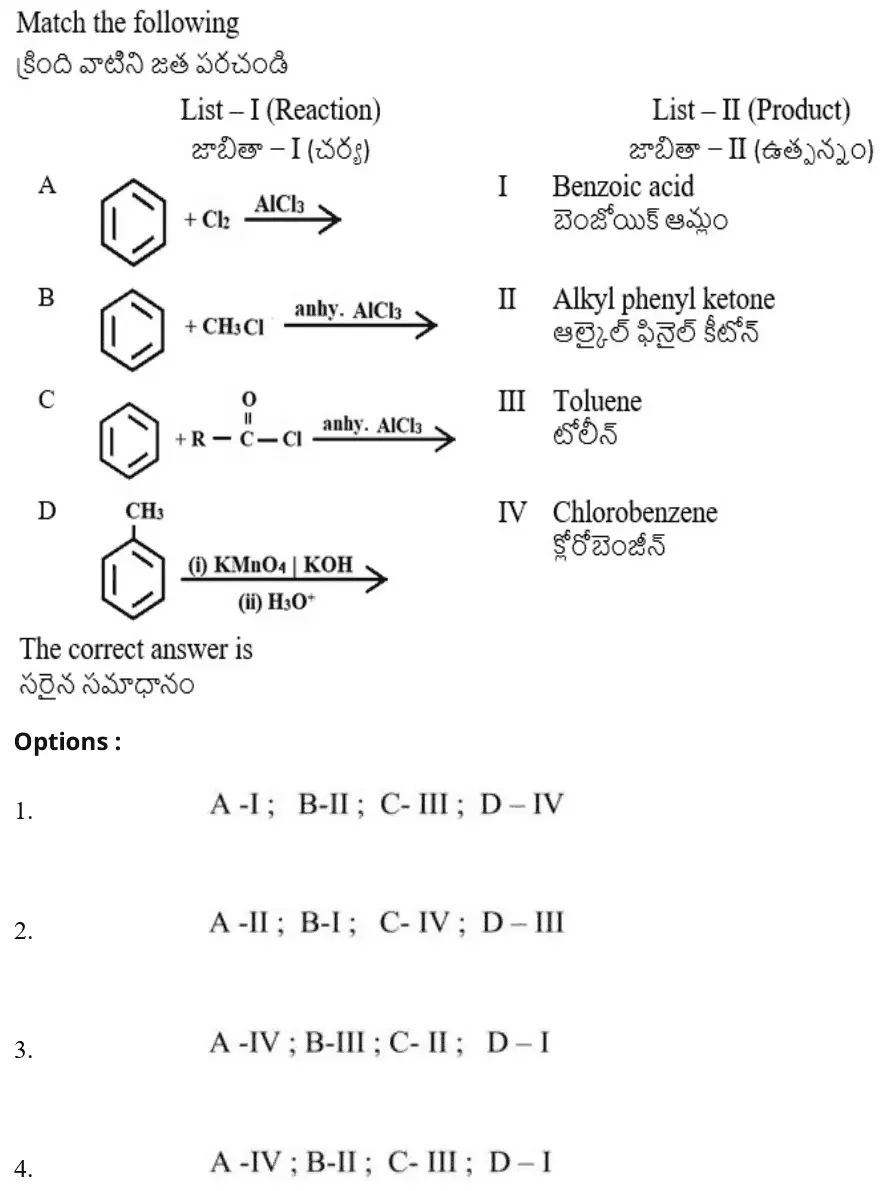
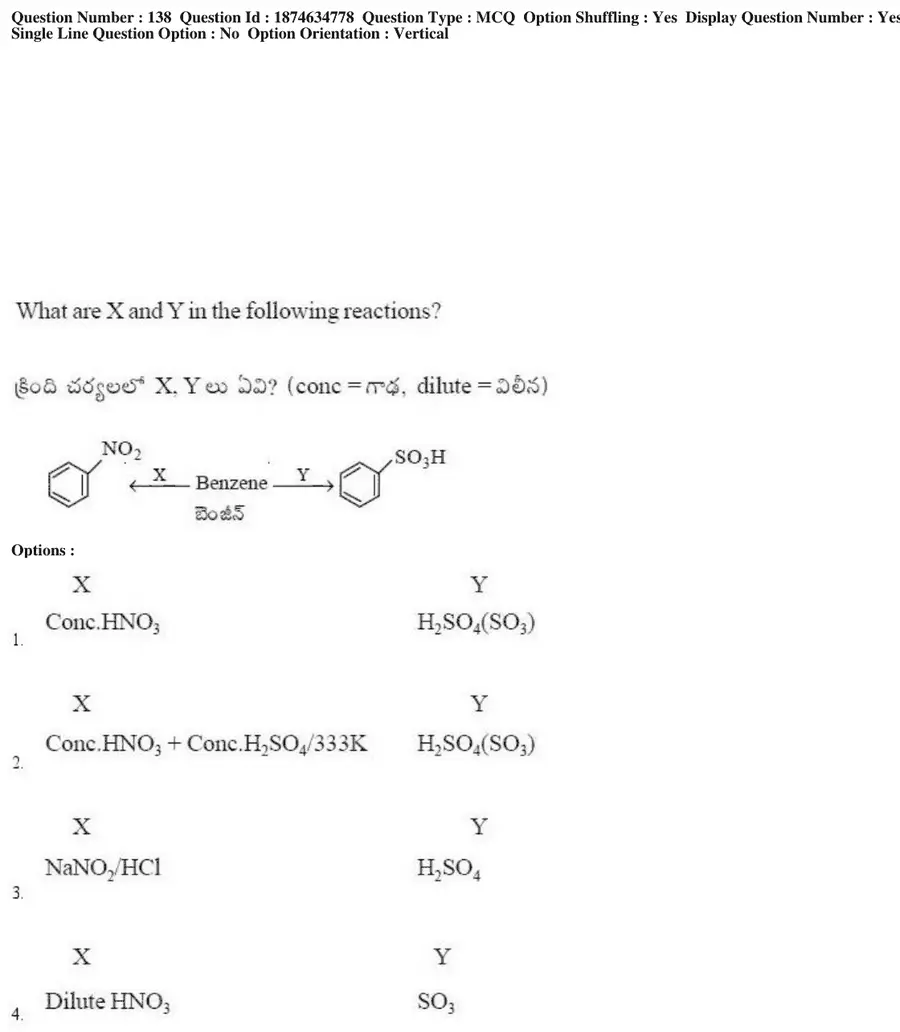
Aromatic Hydrocarbons leads recent testing with 92 questions overall and 54 in the modern window through 2026. Frequent problem formats focus on electrophilic aromatic substitution of benzene and toluene (halogenation, nitration, sulphonation, Friedel-Crafts alkylation and acylation), activating ortho-para directing versus deactivating meta-directing substituent influences, aromatic side-chain oxidation using hot alkaline potassium permanganate, and benzylic halogenation.
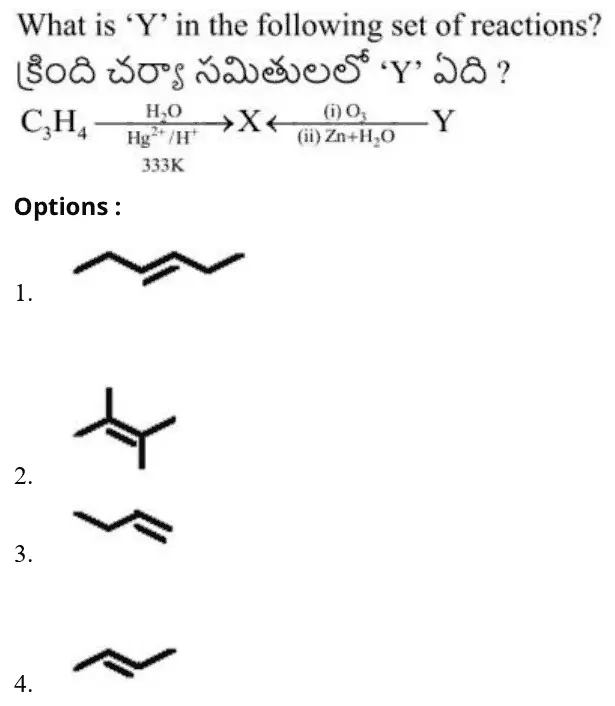
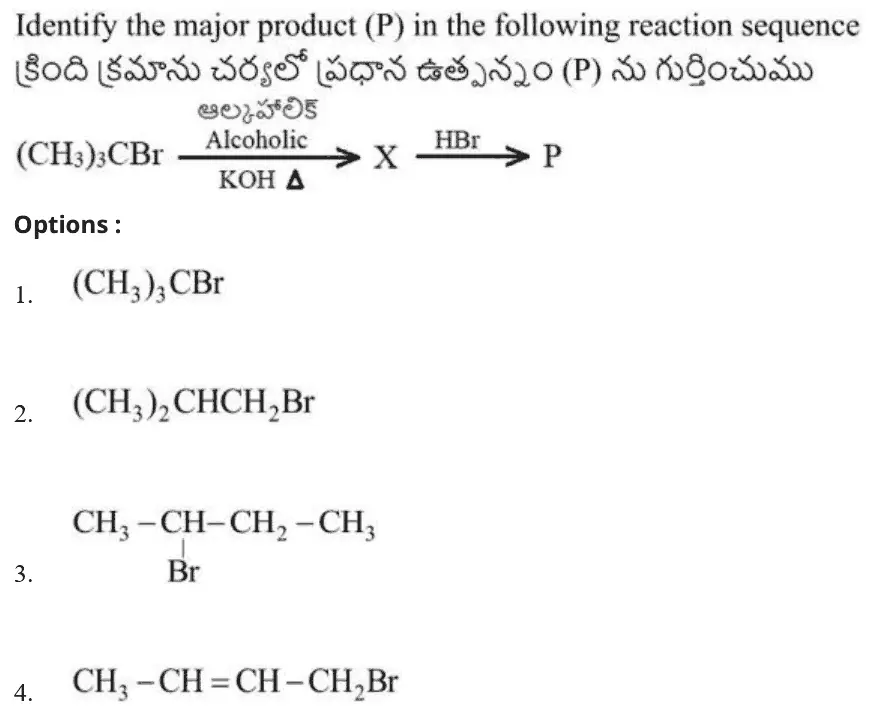
Alkenes is the second major pillar with 98 questions overall and 53 during the recent timeframe through 2026. Core themes explore Markovnikov addition of hydrogen halides, anti-Markovnikov peroxide Kharasch effect with hydrogen bromide, ozonolysis followed by reductive zinc cleavage to deduce precursor structures, catalytic hydrogenation, and Baeyers cold dilute alkaline permanganate test for unsaturation.
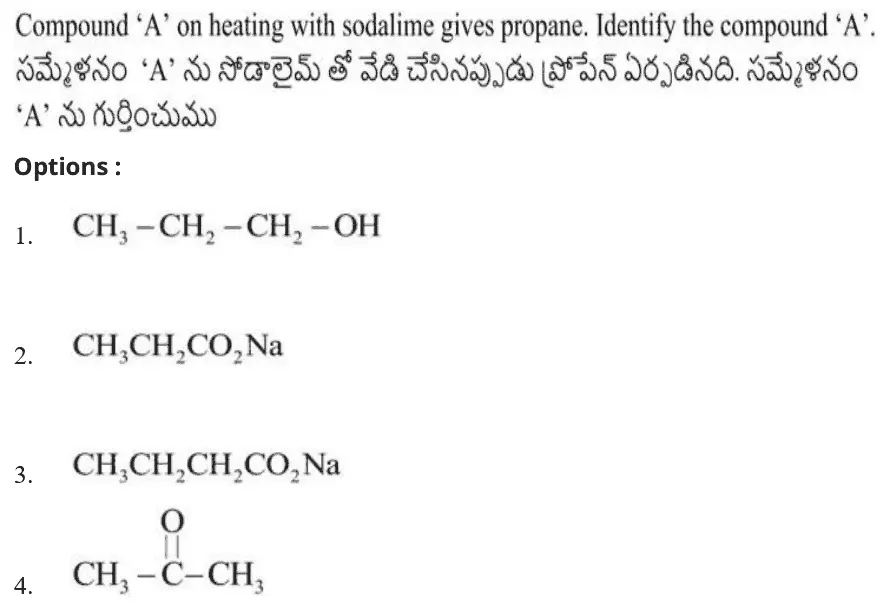
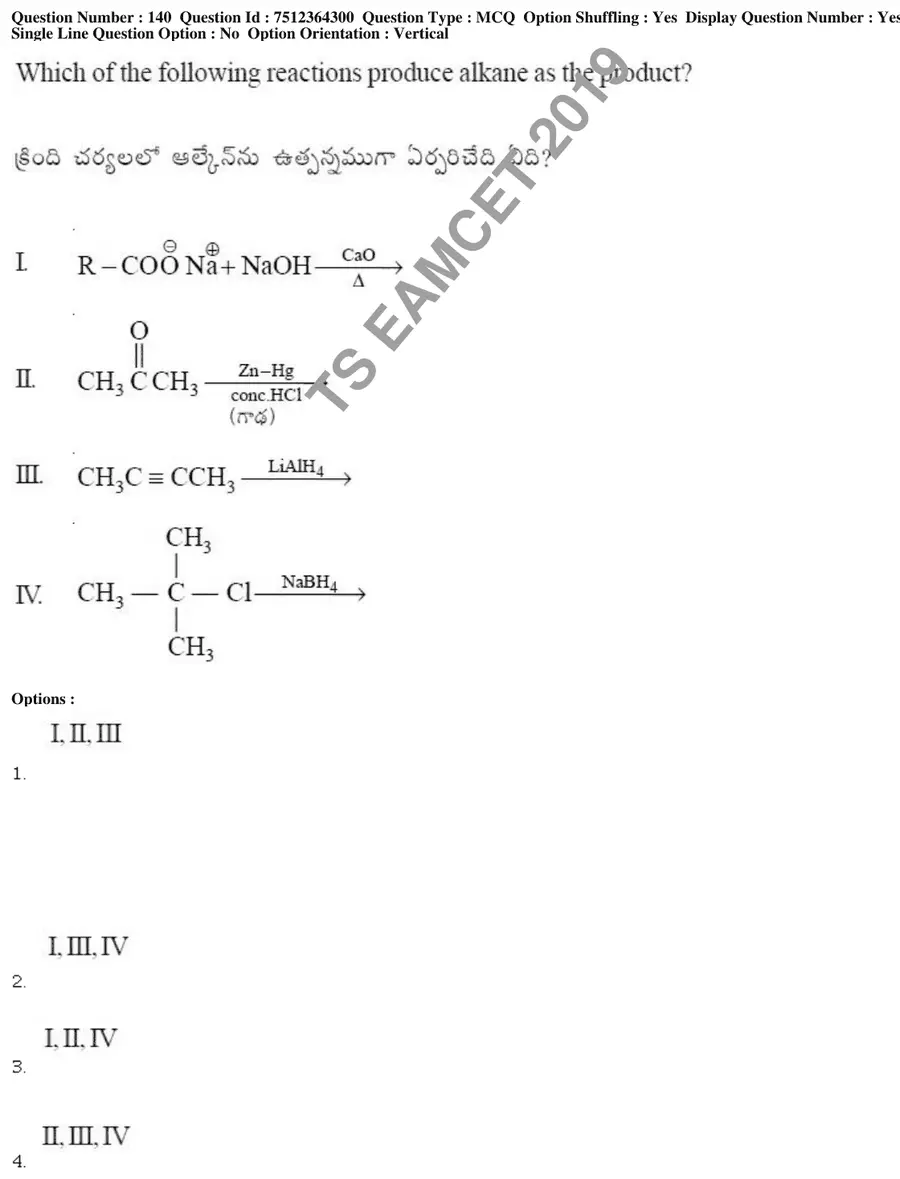
Alkanes contributed 55 questions across the archive, with 29 occurring between 2022 and 2026. Topics include free radical chlorination mechanisms and reactivity-selectivity ratios, Wurtz coupling, Kolbe electrolytic decarboxylation, decarboxylation of carboxylic acid salts with sodalime, and conformations of ethane (staggered versus eclipsed).
Alkynes accounts for 48 questions in total, with 29 appearing from 2022 to 2026. Items center on acidity of terminal acetylenic protons, formation of heavy metal acetylides with ammoniacal cuprous chloride or silver nitrate, mercury-catalysed hydration of alkynes yielding carbonyl compounds, and cyclic polymerization of ethyne to benzene in red-hot iron tubes.
What the questions look like
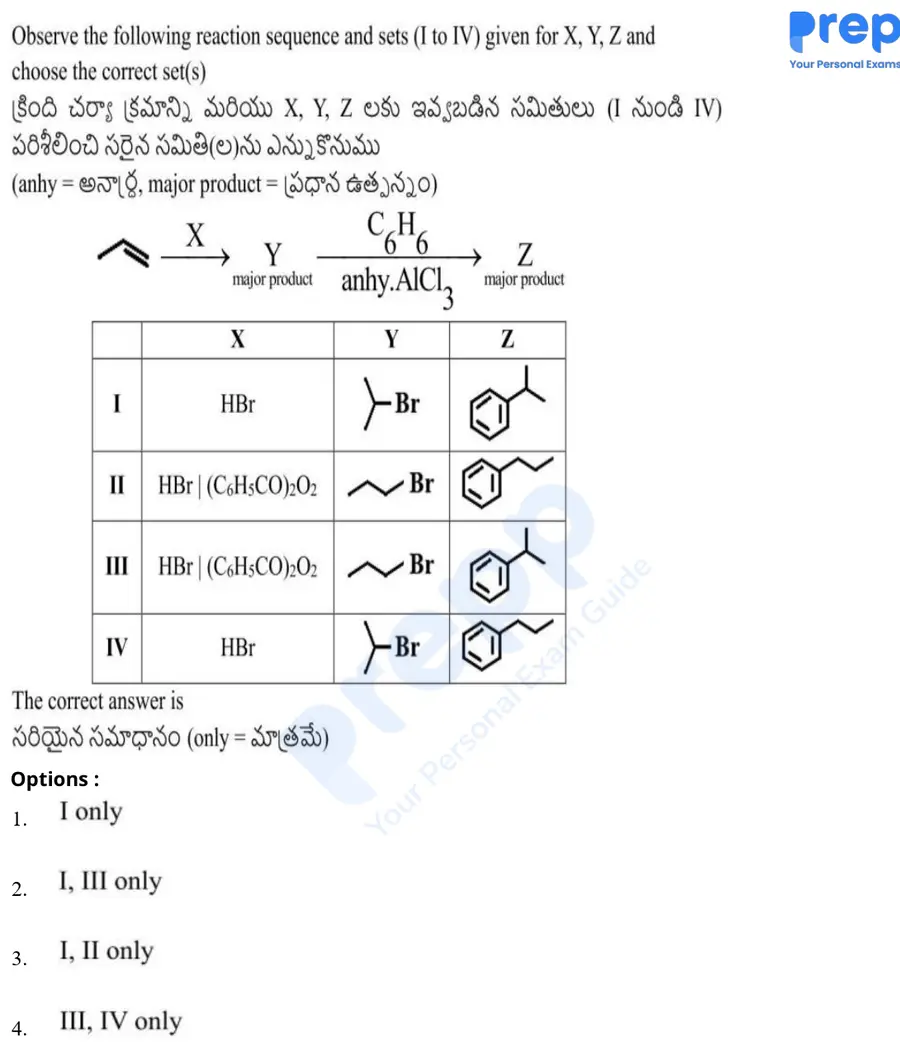
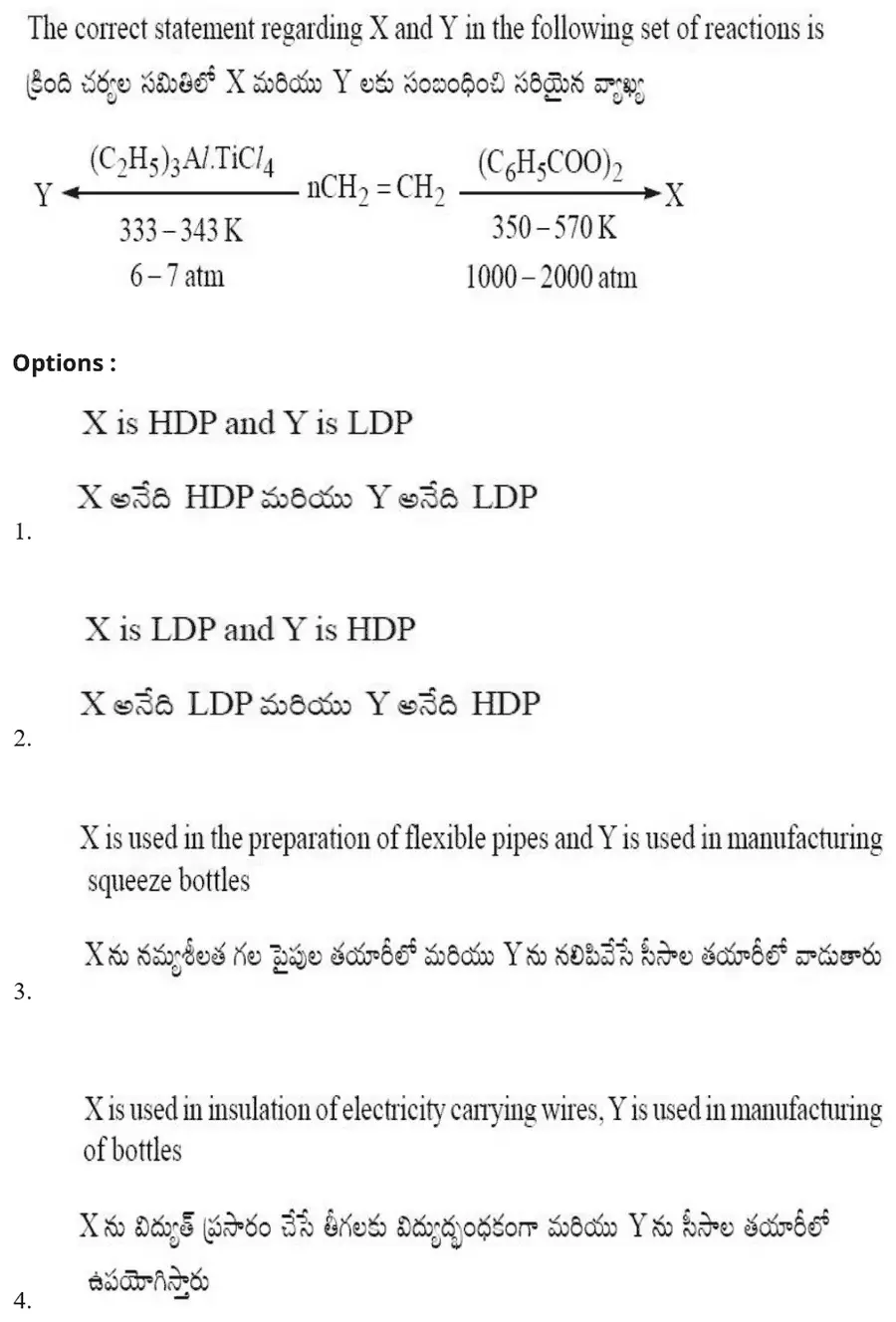
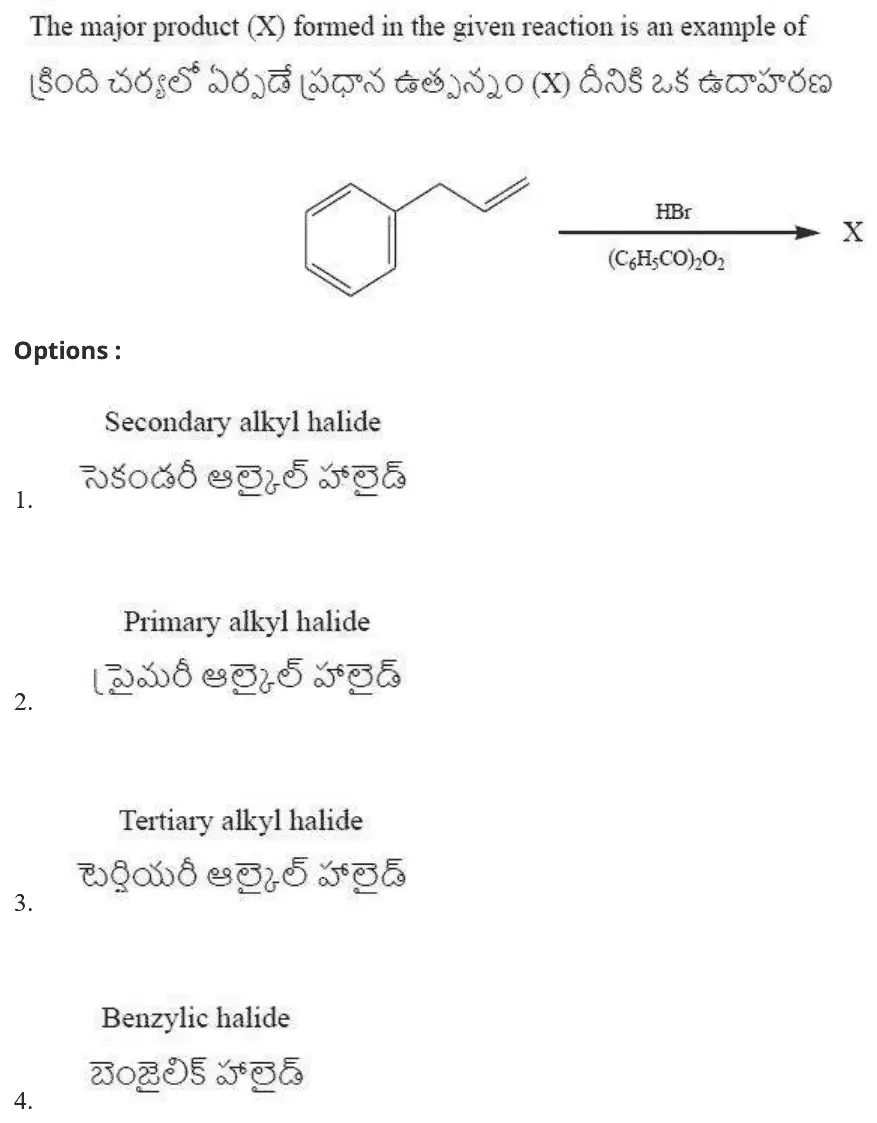
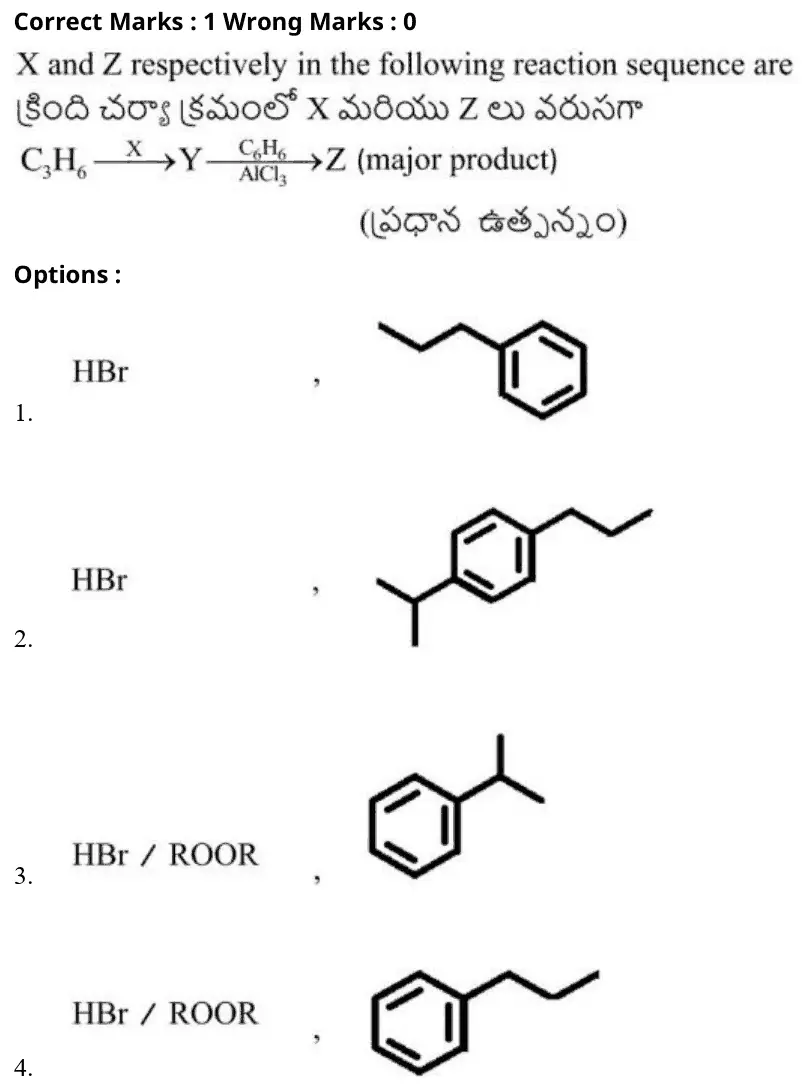
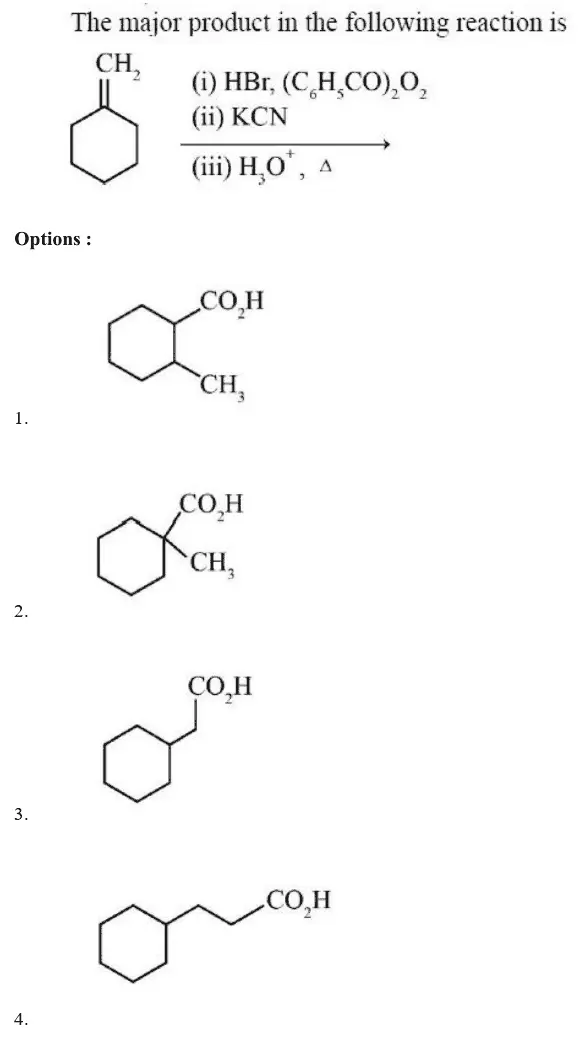
Reaction cascades are the signature pattern in hydrocarbons. A representative question traces propene reacting with hydrogen bromide in the presence of benzoyl peroxide to form 1-bromopropane, which then reacts with benzene in the presence of anhydrous aluminium chloride to yield an alkylbenzene, requiring candidates to recognize that primary propyl carbocations rearrange to isopropyl carbocations.
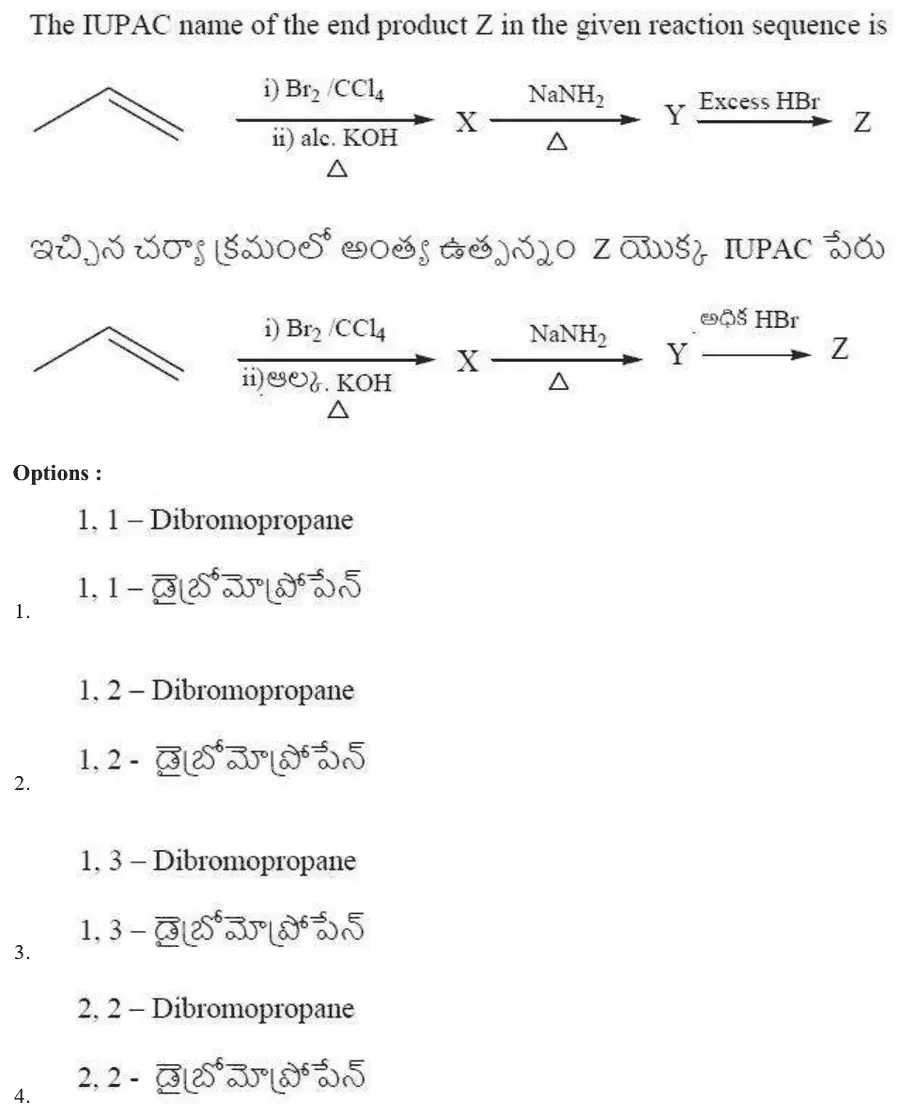
Another frequent question format gives the ozonolysis cleavage products of an unknown alkene and asks you to reconstruct the original alkene structure. For alkynes, questions often test Markovnikov additions where propyne reacts with excess hydrogen bromide to yield 2,2-dibromopropane as the sole geminal dihalide product, or test terminal alkyne salt formation with sodium amide.
Questions to try first
Solve these representative state entrance questions to test your command of organic reaction pathways:
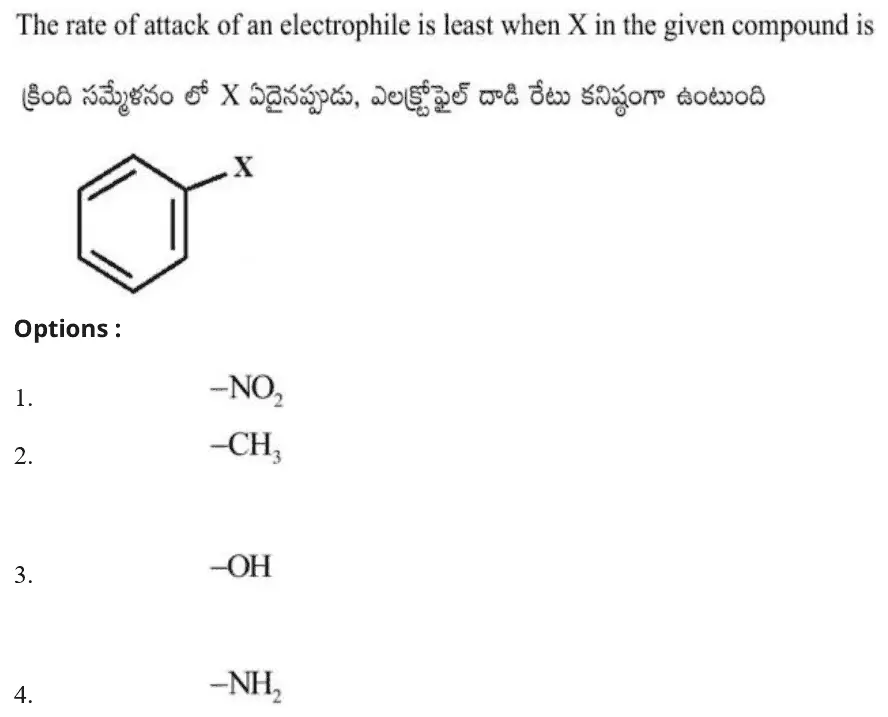
Practice determining electrophilic aromatic substitution products by categorizing substituents into activating ortho-para directors (amino, hydroxy, alkoxy, alkyl) and deactivating meta directors (nitro, cyano, formyl, acyl, carboxyl, sulphonic acid). Remember the halogen anomaly: halogens are deactivating due to strong inductive electron withdrawal, but ortho-para directing due to lone pair resonance donation.
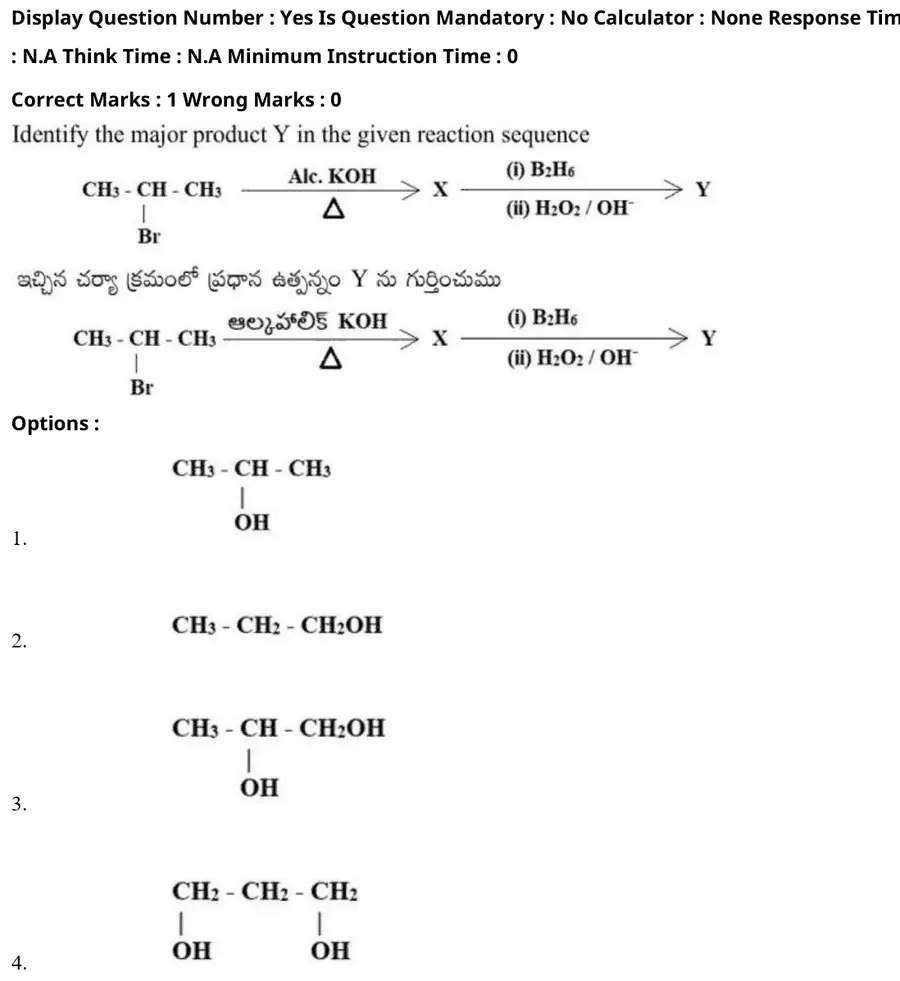
For alkene reactions, distinguish clearly between ionic Markovnikov addition and free radical anti-Markovnikov addition. The peroxide effect applies exclusively to hydrogen bromide: it fails for hydrogen chloride because the chlorine radical propagation step is endothermic, and fails for hydrogen iodide because iodine radicals couple to form molecular iodine rather than adding across double bonds.
Frequently asked questions
Why does the peroxide effect work solely with hydrogen bromide?
In the free radical chain addition mechanism, both propagation steps (addition of bromine radical to the alkene and abstraction of hydrogen from hydrogen bromide by the carbon radical) are exothermic. For hydrogen chloride, the hydrogen-chlorine bond is too strong for homolytic cleavage. For hydrogen iodide, iodine radicals prefer recombining into molecular iodine due to low bond energy, making the overall chain endothermic.
How do you identify terminal alkynes using chemical tests?
Terminal alkynes have an acetylenic hydrogen attached to an sp-hybridized carbon atom, giving them weak acidic character. They react with sodium amide to liberate dihydrogen gas, form a red precipitate of cuprous acetylide with ammoniacal cuprous chloride, and form a white precipitate of silver acetylide with Tollens reagent. Non-terminal internal alkynes give negative results for all these tests.
What is the major product when propene is hydrated in acidic medium?
Acid-catalysed hydration of propene follows Markovnikov rule via the more stable secondary carbocation intermediate. Electrophilic addition of a proton yields the secondary propyl carbocation, which is subsequently trapped by water and deprotonated to yield propan-2-ol as the major product. Step-by-step solutions for each one are in the EdLoop EAPCET app.