Identify the correct statements from the following
I) Conjugate base of nitrous acid is $\mathrm{NO_2^-}$
II) The concentration of $\mathrm{OH^-}$ ions in 0.1 M aqueous pyridine solution is $\sqrt{2} \times 10^{-5}$ M. ($\mathrm{K_b}$ of pyridine = $2 \times 10^{-9}$)
III) The acid strength of aqueous hydrogen halides follow the order
A solution is prepared by adding 0.5 L of 0.5 M $\mathrm{NaOH}$ to 0.5 L of 0.55 M formic acid. What is the pH of resultant solution? ($\mathrm{K_a}$ of formic acid = $1.8 \times 10^{-4}$ ; $\log(1.8) = 0.26$)
The dissociation constants of $\mathrm{H_2A}$ are $\mathrm{K_{a1}} = 6 \times 10^{-2}$ and $\mathrm{K_{a2}} = 6 \times 10^{-5}$ respectively. At equilibrium, $[\mathrm{A^{2-}}] = [\mathrm{H_2A}]$. What is the approximate concentration of $\mathrm{H^+}$ at equilibrium?
Solution of $\mathrm{HCN}$ and $\mathrm{NaCN}$ forms a buffer solution. $x$ moles of $\mathrm{HCN}$ is required to prepare $1.0\ L$ of a buffer solution of $pH$ 9 using 0.01 moles of $\mathrm{NaCN}$. What is the value of $x$ ? (Given $K_a(\mathrm{HCN}) = 10^{-10}$)
The mass of $\mathrm{CaC_2O_4}$ (in $g$) to be dissolved in distilled water to make 1.0 $L$ of saturated solution is ($K_{sp}$ of $\mathrm{CaC_2O_4}$ = $2.5 \times 10^{-9}\ mol^2 L^{-2}$ molar mass of $\mathrm{CaC_2O_4}$ = $128\ g\ mol^{-1}$ )
A certain buffer solution contains $[\mathrm{X^-}]$ and $[\mathrm{HX}]$ in the ratio of 1:10. If $\mathrm{K_b}$ of $\mathrm{X^-}$ is $10^{-10}$, then the pH value of the buffer is
The pH of 0.01 M aqueous aniline solution at 298 K is 8.3. Its degree of dissociation ($\alpha$) is ($\mathrm{K_b}$ of aniline $=4\times10^{-10}$; antilog (0.7) = 5.0; antilog (0.3) = 2.0; antilog (0.4) = 2.5)
The solubility of $\mathrm{BaCO_3}$ (molar mass $197\ \mathrm{g\ mol^{-1}}$) is $1.4\times10^{-3}\ \mathrm{g}/100\mathrm{mL}$. The solubility product constant of $\mathrm{BaCO_3}$ is $x\times10^{-9}\ \mathrm{mol^2\ L^{-2}}$. The value of $x$ is (nearest integer)
At T(K) $\mathrm{K_{sp}}$ of two ionic salts $\mathrm{MX_2}$ and $\mathrm{MX}$ is $5 \times 10^{-13}$ and $1.6 \times 10^{-11}$ respectively. The ratio of molar solubility of $\mathrm{MX_2}$ and $\mathrm{MX}$ is
When 30 mL of 0.2 M $\mathrm{NH_4OH}$ is added to 30 mL of 2 M $\mathrm{NH_4Cl}$ solution. If the pH of the buffer formed is 8.2, what is the $\mathrm{pK_b}$ of $\mathrm{NH_4OH}$ ?
The percentage of ionization of 1 L of $x$ M acetic acid is 4.242 and is called solution "A". The percentage of ionization of 1 L of $y$ M acetic acid is 3 and is called solution "B". Solution "A" is mixed with solution "B". What is the concentration of acetic acid in the resultant solution ?
($\mathrm{K_a}$ of acetic acid $= 1.8 \times 10^{-5}$)
The volume of water required to dissolve 0.1 g $\mathrm{PbCl_2}$ to get a saturated solution (in mL) is (Given $\mathrm{K_{sp}(PbCl_2)} = 3.2\times10^{-8}$; Atomic mass of Pb = 207u)
200 mL of an aqueous solution of $\mathrm{HCl}$ (pH = 2) is mixed with 300 mL of aqueous solution of $\mathrm{NaOH}$ (pH = 12) and is diluted to 1.0 L. The pH of the resulting solution is
At T(K) in a saturated solution of $\mathrm{MgCO_3}$ and $\mathrm{Ag_2CO_3}$, if the concentration of $\mathrm{Mg^{2+}}$ ion is $3.2\times10^{-5}$ M, then the concentration of $\mathrm{Ag^+}$ ion in the solution will be [Given: $\mathrm{K_{sp}(MgCO_3)}=1.6\times10^{-6}$ and $\mathrm{K_{sp}(Ag_2CO_3)}=8.0\times10^{-12}$ at T(K)]
At $27^\circ\mathrm{C}$, the degree of dissociation of HA (weak acid) in $0.5$ M of its solution is $1\%$. The concentrations of $\mathrm{H_3O^+}$, $\mathrm{A^-}$ and HA at equilibrium (in $\mathrm{mol\,L^{-1}}$) are respectively
100 mL of 0.1 M HA (weak acid) and 100 mL of 0.2 M NaA are mixed. What is the pH of resultant solution? ($\mathrm{K_a}$ of HA is $10^{-5}$; $\log 2 = 0.3$)
The solubility of barium phosphate of molar mass ‘M’ $\mathrm{g\ mol^{-1}}$ in water is $x$ g per 100 mL at 298 K. Its solubility product is $1.08 \times \left(\frac{x}{M}\right)^{a} \times (10)^{b}$. The values of a and b respectively are
At $27\ ^0\mathrm{C}$, 100 mL of 0.4 M $\mathrm{HCl}$ is mixed with 100 mL of 0.5 M $\mathrm{NaOH}$ solution. To the resultant solution, 800 mL of distilled water is added. What is the pH of final solution?
At $27^\circ\mathrm{C}$, 100 mL of 0.5 M $\mathrm{HCl}$ is mixed with 100 mL of 0.4 M $\mathrm{NaOH}$ solution. To this resultant solution, 800 mL of distilled water is added. What is the pH of final solution?
A solution is prepared by mixing 10 mL of 1.0 M acetic acid and 20 mL of 0.5M sodium acetate and diluted to 100 mL. If the $\mathrm{pK_a}$ of acetic acid is 4.76, then the pH of the solution is
Match the following Metal Sulfide A) PbS B) HgS C) MnS D) ZnS Solubility product I) $4.0\times10^{-53}$ II) $8.0\times10^{-28}$ III) $1.6\times10^{-24}$ IV) $2.5\times10^{-13}$ The correct match is
Match the following List - I: A) Aq. solution of $\mathrm{AlCl_{3}}$; B) Aq. solution of $\mathrm{CH_{3}COONa}$; C) Aq. solution of KCl; D) $\mathrm{Al_{2}O_{3}}$ List - II: I) Basic; II) Acidic; III) Highly conductive; IV) Strongly basic; V) Amphoteric The correct match is
A 1.0 L of aqueous solution contains $1 \times 10^{-8}$ M NaBr, $1 \times 10^{-8}$ M NaCl and $1 \times 10^{-8}$ M NaI. To this solution, $1 \times 10^{-10}$ M aqueous $\mathrm{AgNO_3}$ solution is added drop wise. The order of precipitation of Ag X ( X = Cl, Br, I) is ($\mathrm{K_{SP}}$ (AgCl) = $1.8 \times 10^{-10}$; $\mathrm{K_{SP}}$ (AgBr) = $5 \times 10^{-13}$; $\mathrm{K_{SP}}$ (AgI) = $8.3 \times 10^{-17}$)
The solubility products of NiS, ZnS, CdS and HgS are $4.7\times10^{-5}$, $1.6\times10^{-24}$, $8\times10^{-27}$ and $4\times10^{-53}$ respectively. An aqueous solution contains $\mathrm{Ni^{2+}}$, $\mathrm{Zn^{2+}}$, $\mathrm{Cd^{2+}}$, and $\mathrm{Hg^{2+}}$ of equal concentration. $\mathrm{H_2S}$ gas was passed into this solution very slowly. The first and the last ions that precipitate as sulphides are respectively
Identify the correct statements from the following a) The ionic product of water at $100^\circ$C is $< 10^{-14}$. b) pH of a solution decreases with increasing temperature. c) $\mathrm{NaH_2PO_4}$ on hydrolysis gives a basic solution. d) $\mathrm{NH_3}$ can act both as Bronsted acid and base.
1 L of 0.02 M aqueous HCl is mixed with 1 L of 0.01 M aqueous $\mathrm{H_2SO_4}$ solution. Assuming complete dissociation and no change in the volume upon mixing, the pH of resultant solution is ($\log_{10} 2 = 0.3$)
The $\mathrm{K_a}$ values of A, B and C are $1.8 \times 10^{-4}$, $5 \times 10^{-10}$ and $3 \times 10^{-8}$ respectively. The correct order of their acidic strength is
If the molar solubility (in $mol.L^{-1}$) of a sparingly soluble salt $\mathrm{AB_4}$ is 'S', and the corresponding solubility product is '$K_{sp}$', then S in terms of $K_{sp}$ is given by the relation ______
If the solubility of $\mathrm{Ag_2CO_3}$ in its saturated solution is $1.20 \times 10^{-4}\ \mathrm{mol.L^{-1}}$, then find the solubility product of $\mathrm{Ag_2CO_3}$.
The successive equilibrium constants for the stepwise dissociation of a tribasic acid are $K_1$, $K_2$ and $K_3$, respectively. The equilibrium constant for the overall dissociation is
Match the following List-1 (Acid) A) $\mathrm{HCN}$ B) $\mathrm{H_2C_2O_4}$ C) $\mathrm{H_2S}$ D) Niacin List-2 (Ka (ionization constant)) I) $6.8\times10^{-4}$ II) $8.9\times10^{-8}$ III) $4.9\times10^{-10}$ IV) $5.6\times10^{-2}$ V) $1.5\times10^{-5}$ The correct match is
$K_{sp}$ for $\mathrm{CaSO_4}$ is $9 \times 10^{-6}$. The minimum volume of water needed to dissolve 1g of $\mathrm{CaSO_4}$ at 298 K temperature is ______
Calculate the molar ratio of a weak acid $\mathrm{HA}$ ($K_a = 10^{-6}$) and its salt with strong base so that the $\mathrm{pH}$ of buffer solution is 6.
The $pK_a$ of a weak acid, benzoic acid and $pK_b$ of a weak base, ammonium hydroxide are 4.25 and 4.75 respectively. Then, the $pH$ of 0.1 $M$ solution of ammonium benzoate will be ______
The solubility product of $\mathrm{Ni(OH)_2}$ at 298 $K$ is $2 \times 10^{-15}\ \mathrm{mol^3.dm^{-9}}$. The pH value if its aqueous and saturated solution is
When equal volumes of $\mathrm{Ca^{+2}}$ and $\mathrm{F^-}$ solutions are mixed, in which of the solutions precipitation will not occur? ($K_{sp}$ of $\mathrm{CaF_2}$ = $1.6 \times 10^{-10}$)
A
$10^{-2}$ M $\mathrm{Ca^{+2}}$ + $10^{-5}$ M $\mathrm{F^-}$
B
$10^{-3}$ M $\mathrm{Ca^{+2}}$ + $10^{-3}$ M $\mathrm{F^-}$
C
$10^{-4}$ M $\mathrm{Ca^{+2}}$ + $10^{-2}$ M $\mathrm{F^-}$
D
$10^{-2}$ M $\mathrm{Ca^{+2}}$ + $10^{-3}$ M $\mathrm{F^-}$
Calculate the molar solubility of calcium hydroxide $\mathrm{Ca(OH)_2}$ in 0.10 M NaOH solution. The ionic product of calcium hydroxide is $5.5 \times 10^{-6}$.
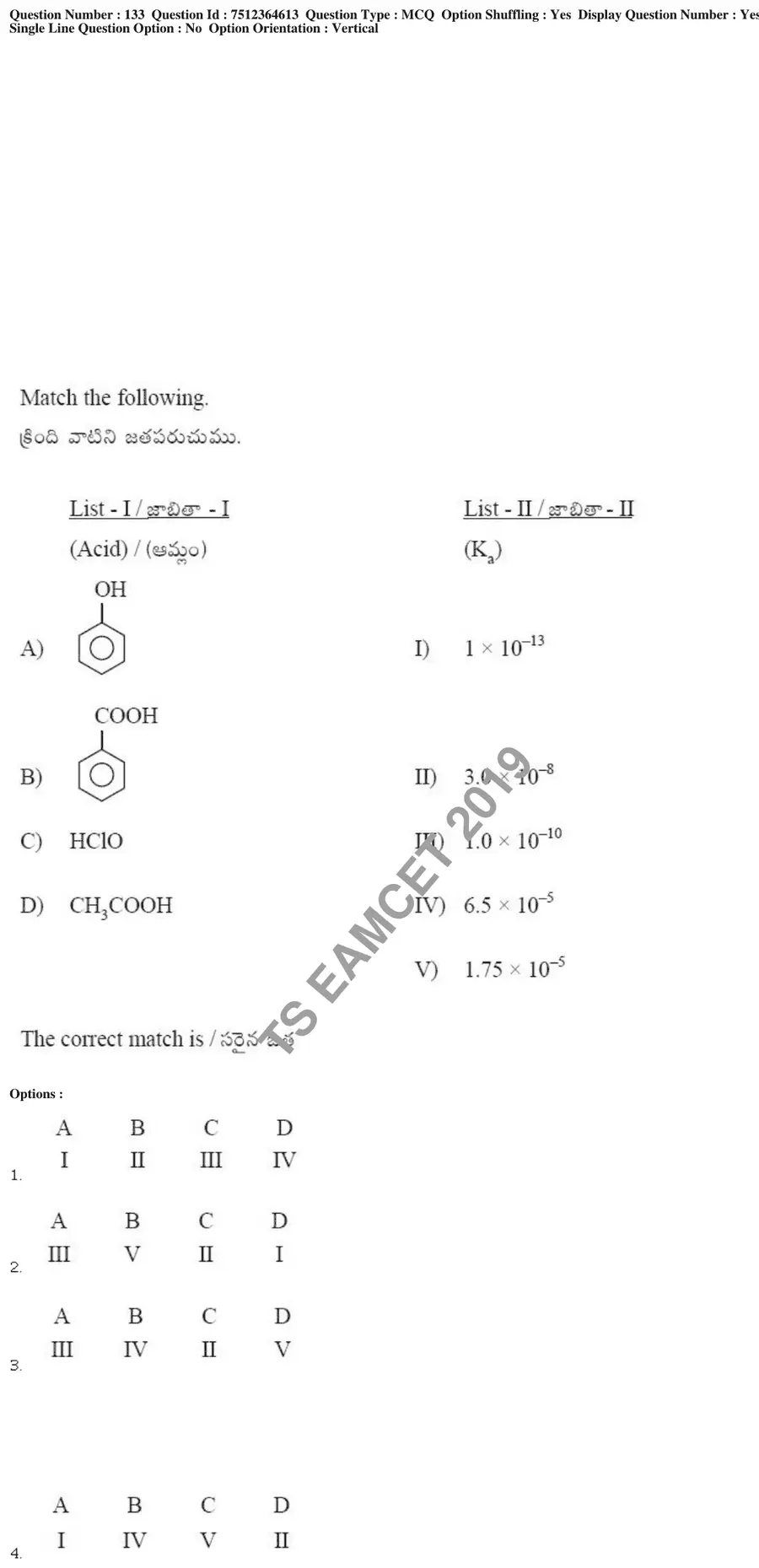
Match the following. List - I (Acid) A) (see the figure above) phenol (benzene ring with OH) B) (see the figure above) benzoic acid (benzene ring with COOH) C) $\mathrm{HClO}$ D) $\mathrm{CH_3COOH}$ List - II ($K_a$) I) $1 \times 10^{-13}$ II) $3.0 \times 10^{-8}$ III) $1.0 \times 10^{-10}$ IV) $6.5 \times 10^{-5}$ V) $1.75 \times 10^{-5}$ The correct match is
A solution of 0.1 mole of $\mathrm{CH_3NH_2}$ ($K_b = 5\times10^{-4}$) and 0.08 mole of $\mathrm{HCl}$ is diluted to one litre, then the pOH of the solution is ($\log 1.25 = 0.1$)
At $\mathrm{T(K)}$, if the ionization constant of ammonia in solution is $2.5 \times 10^{-5}$, the pH of $0.01\ \mathrm{M}$ ammonia solution and the ionization constant of its conjugate acid respectively at that temperature are ($\log 2 = 0.30$)
20 mL of 0.2 M sodium hydroxide solution is added to 40 mL of 0.2 M acetic acid solution. What is the pH of the solution? (pKa of $\mathrm{CH_3COOH}$ = 4.8)
50 mL of 0.02 M NaOH solution is mixed with 50 mL of 0.06 M acetic acid solution, the pH of resulting solution is (pKa of acetic acid is 4.76, log 5 = 0.70)
The number of species of the following that can act both as Bronsted acids and bases is $\mathrm{HCl,\ ClO_4^-,\ ^-OH,\ H^+,\ H_2O,\ HSO_4^-,\ SO_4^{2-},\ H_2SO_4,\ Cl^-}$
A buffer solution is prepared by mixing 10 mL of 1.0 M acetic acid and 20 mL of 0.5 M sodium acetate and then diluted to 100 mL with distilled water. The pH of the buffer solution is ($\mathrm{pK_a}$ of acetic acid is 4.76)
Which of the following compounds give basic solution on hydrolysis? a) $\mathrm{NH_4Cl}$ b) $\mathrm{K_2CO_3}$ c) $\mathrm{Na_2B_4O_7 \cdot 10H_2O}$ d) $\mathrm{NaCl}$
If the $\mathrm{pK_a}$ of acetic acid and $\mathrm{pK_b}$ of dimethylamine are $4.76$ and $3.26$ respectively, the pH of dimethyl ammonium acetate solution is
The pH of a buffer solution formed by mixing 30 mL of 0.1 M $\mathrm{NH_4OH}$ and 30 mL of 1 M $\mathrm{NH_4Cl}$ solutions is 8.6. The $\mathrm{pK_b}$ of $\mathrm{NH_4OH}$ is
The solubility products of three sparingly soluble salts $\mathrm{AB}$, $\mathrm{A_2B}$ and $\mathrm{AB_3}$ are respectively $4.0\times10^{-20}$, $3.2\times10^{-11}$ and $2.7\times10^{-31}$. The increasing order of their solubility is
A solution which is $10^{-3}$ M each in $\mathrm{Mn^{2+}}$, $\mathrm{Fe^{2+}}$, $\mathrm{Zn^{2+}}$ and $\mathrm{Hg^{2+}}$ is treated with $10^{-16}$ M sulphide ion. If the $K_{sp}$ of MnS, FeS, ZnS and HgS are $10^{-15}$, $10^{-23}$, $10^{-20}$ and $10^{-54}$ respectively, which one will precipitate first?
The pH of a buffer solution made by mixing 25 ml of 0.02 M $\mathrm{NH_4OH}$ and 25 ml of 0.2 M $\mathrm{NH_4Cl}$ at $25^\circ$C is : ($\mathrm{pK_b}$ of $\mathrm{NH_4OH}$ = 4.8)
Answer: (A) $1 \times 10^{-5}$ M, $1 \times 10^{-8}$· Official APSCHE final key
How to prepare Ionic Equilibrium for EAPCET
How often it comes up
Ionic Equilibrium sits at rank 22 among the 31 chemistry chapters in the modern 2022 to 2026 period. Across our complete collection of past examination papers from 2010 through 2026, the chapter provided 140 questions across 149 papers, appearing in 120 of those tests to account for 2.3 percent of the chemistry section with 0.9 questions per paper. In the recent five-year timeframe from 2022 to 2026, it maintained an identical frequency of 0.9 questions per paper, supplying 66 questions across 77 sittings and appearing in 60 papers to capture a 2.1 percent subject share.
The chapter has appeared in every exam year since 2022, though it was absent from seventeen papers across that interval. State distributions between 2022 and 2026 indicate that AP papers delivered 49 questions across 48 sittings (featuring in 43 papers, 1.0 questions per paper, 2.6 percent share), whereas TS papers carried 17 questions across 29 sittings (featuring in 17 papers, 0.6 questions per paper, 1.5 percent share).
Looking back at earlier papers from 2010 through 2021, examiners set 74 questions across 72 sittings (appearing in 60 tests), yielding 1.0 questions per paper and a 2.6 percent subject share. During the latest three exam years from 2024 to 2026, question banks included 36 questions across 46 sittings (with 35 papers containing questions), generating 0.8 questions per test and a 2.0 percent share. Comparing the early era with the last three years shows a share trend that is down, while comparing the five-year recent window with the last three years shows the share is about the same.
Most-asked topics
Questions in this chapter group into four distinct aqueous solution categories:
Acids, Bases & pH constitutes the largest topic with 72 questions overall and 38 during the recent period through 2026. Frequent problem formats involve pH and pOH determinations for strong or weak monobasic acids and bases, Ostwald dilution law calculations, polyprotic acid ionization constants, and mixing strong acids with strong bases.
Solubility Equilibria supplied 34 questions across the archive, with 16 appearing between 2022 and 2026. Problems explore solubility product expressions, precipitations governed by ionic product exceedance, common ion suppression of sparingly soluble salts, and selective precipitation.
Buffers & Titrations accounts for 23 questions in total and 10 in the recent window through 2026. Questions test the Henderson-Hasselbalch equation for acidic and basic buffers, buffer capacity principles, and pH changes upon adding strong reagent aliquots.
Salt Hydrolysis rounds out the syllabus with 11 questions overall, including 2 from the recent period (last tested in 2022). Themes include identifying whether salts of weak acids and strong bases, strong acids and weak bases, or weak acids and weak bases yield acidic, neutral, or basic solutions.
What the questions look like
A substantial portion of problems requires fast logarithmic evaluations. For example, a standard problem specifies volumes and molarities of hydrochloric acid and sodium hydroxide, asking for the resultant pH of the mixture after neutralisation and dilution. Other common questions provide the pH of a basic solution and ask you to determine the mass of sodium hydroxide dissolved per litre.
Solubility questions often require calculating the mass of a sparingly soluble salt dissolved in a specified volume of water using its solubility product constant, or calculating how solubility decreases when a common ion electrolyte is added. In buffer chemistry, questions ask candidates to find the ratio of salt to acid required to achieve a designated target pH.
Questions to try first
Practise these official questions to master typical equilibrium and logarithmic formulas:
Memorise the fundamental logarithmic values for small integers: log two is zero point three zero one, log three is zero point four seven seven, and log five is zero point six nine nine. Being able to compute logs quickly in your head without a calculator saves crucial minutes during the test.
When solving solubility product questions, always write the dissolution stoichiometry explicitly. If a salt AB dissociates into one cation and one anion, Ksp equals s squared. If a salt AB2 dissociates into one cation and two anions, Ksp equals four s cubed. When common ions are introduced, insert the common ion concentration directly into the equilibrium expression and neglect the contribution from the sparingly soluble salt whenever the solubility product is minute.
Frequently asked questions
How do you find the pH of extremely dilute strong acid solutions?
When strong acid concentration drops to ten to the power of minus seven molar or below, you cannot ignore autoionisation of water. The total hydronium concentration equals the acid contribution plus the water contribution, ensuring the calculated pH remains slightly below seven rather than above seven.
What is the Henderson-Hasselbalch equation for an acidic buffer?
For a buffer consisting of a weak acid and its conjugate base, pH equals pKa plus log of conjugate base concentration divided by weak acid concentration. Maximum buffer capacity occurs when salt and acid concentrations are equal, making pH equal to pKa.
What determines whether a precipitate will form upon mixing two solutions?
Precipitation occurs if and only if the ionic product of the constituent ions in the mixed solution exceeds the solubility product constant Ksp. If the ionic product is smaller than Ksp, the solution remains unsaturated and no solid forms. Step-by-step solutions for each one are in the EdLoop EAPCET app.