In which of the following, colloidal system is correctly matched with its example?
- A
Sol – Butter
- B
Gel – Smoke
- C
Emulsion – Milk
- D
Foam – Paint
Answer: (C) Emulsion – Milk · The council's preliminary key
 PYQs · free, no adsOpen on the web (app.edloop.in)Get EdLoop – free on Google Play
Every Surface Chemistry question from past AP EAPCET and TS EAPCET papers, with options and answers. Newest first.
Surface Chemistry sits at position 10 among the 31 chemistry chapters in the modern 2022 to 2026 timeframe.
Attempt every Surface Chemistry question timed, see the step-by-step solution and track what you get wrong. Free.
In which of the following, colloidal system is correctly matched with its example?
Sol – Butter
Gel – Smoke
Emulsion – Milk
Foam – Paint
Observe the following statements
I. Micelles have both lyophilic and lyophobic parts
II. Starch in water is an example for multimolecular colloid
III. The CMC of a soap is $10^{-3}$ mol $\mathrm{L^{-1}}$. It can form a micelle when its concentration is less than $10^{-3}$ mol $\mathrm{L^{-1}}$
IV. Gold sol can be prepared by Bredig's Arc method
The correct statements are
I, II, III, IV
I, II, IV only
I, IV only
II, III only
The mass of gas adsorbed ($x$) per gram of adsorbent ($m$) is called extent of adsorption ($^{x}/_{m}$). If a graph is drawn between $\log {}^{x}/_{m}$ (on $y$-axis) and $\log p$ ($x$-axis) we get a straight line with slope equal to 2 and intercept equal to 0.60. The value of $^{x}/_{m}$ at a pressure of 9 $atm$ is ($\log 4 = 0.60$)
243
81
162
324
Which of the following is most effective towards coagulation of $\mathrm{CdS}$ sol?
$\mathrm{K_2SO_4}$
$\mathrm{CaCl_2}$
$\mathrm{Na_3PO_4}$
$\mathrm{AlCl_3}$
In a flask, 2 $g$ of activated charcoal was added to 100 $mL$ of acetic acid solution of 0.06 $N$. After 2 hours, the solution was filtered. The concentration of filtrate was found to be 0.04 $N$. The mass of acetic acid (in $mg$) adsorbed per gram of charcoal is
30
60
90
120
Which of the following colloidal system represents a gel?
Solid in liquid
Solid in gas
Liquid in solid
Liquid in gas
Match List – I with List – II
| List – I (Substance) | List – II (Application) | ||
|---|---|---|---|
| A. | Eosin | I. | Separation of inert gases |
| B. | Alumina gel | II. | Hydrogenation of oils |
| C. | Coconut charcoal | III. | Argentometric titrations |
| D. | Finely divided nickel | IV. | Humidity control |
The correct answer is
A-III; B-I; C-IV; D-II
A-II; B-IV; C-I; D-III
A-III; B-IV; C-II; D-I
A-III; B-IV; C-I; D-II
Given below are two statements
Statement I: Animal skin is positively charged and tannin is negatively charged
Statement II: In leather tanning, chromium salts are used in place of tannin
Correct answer is
Both Statements I and II are correct
Both Statements I and II are not correct
Statement I is correct but statement II is not correct
Statement I is not correct but statement II is correct
Identify the correct pair of ions which are most effective towards the coagulation of sols $\mathrm{Fe_2O_3 \cdot xH_2O}$ and $\mathrm{CdS}$
$\mathrm{PO_4^{3-}, Al^{3+}}$
$\mathrm{Al^{3+}, PO_4^{3-}}$
$\mathrm{[Fe(CN)_6]^{4-}, Al^{3+}}$
$\mathrm{Al^{3+}, [Fe(CN)_6]^{4-}}$
Which of the following statements are correct about chemisorption?
I. It is highly specific in nature
II. It is reversible in nature
III. It depends on nature of gas
IV. It is unilayered adsorption
The correct answer is
I & II only
I & IV only
I, II & IV only
I, III & IV only
When $\mathrm{FeCl_3}$ solution is added to hot water forms a sol “$P$”. However, when $\mathrm{FeCl_3}$ solution is added to $\mathrm{NaOH}$ solution taken in excess, forms a sol ‘$Q$’. What are $P$ and $Q$ respectively?
$\mathrm{Fe_2O_3.xH_2O/Cl^-}$ ; $\mathrm{Fe_2O_3.xH_2O/OH^-}$
$\mathrm{Fe_2O_3.xH_2O/H^+}$ ; $\mathrm{Fe_2O_3.xH_2O/Na^+}$
$\mathrm{Fe_2O_3.xH_2O/Fe^{3+}}$ ; $\mathrm{Fe_2O_3.xH_2O/OH^-}$
$\mathrm{Fe_2O_3.xH_2O/OH^-}$ ; $\mathrm{Fe_2O_3.xH_2O/Fe^{3+}}$
In argentometric titrations, fluorescein is used as an indicator. This is due to
Adsorption of fluorescein on the surface of $\mathrm{AgCl}$
Absorption of fluorescein by $\mathrm{AgCl}$
Complex formation of fluorescein with $\mathrm{Ag^+}$
Oxidation of $\mathrm{AgCl}$ to $\mathrm{AgClO_3}$
At T(K), adsorption of acetic acid on 1g of charcoal gave a Freundlich adsorption isotherm with slope of 0.5 and intercept of 1. What is the value of $x$, when the concentration of acetic acid is $0.1\ mol\ L^{-1}$?
(antilog (0.5) = 3.162; antilog (0.301) = 2.0)
0.3162
3.162
0.5
0.2
Match List – I with List – II
| List – I (colloid) | List – II (use) | ||
|---|---|---|---|
| A | Smoke | I | Eye lotion |
| B | Silver sol | II | Kalaazar |
| C | Antimony colloid | III | Cottrell precipitator |
| D | Gold sol | IV | Intramuscular injection |
The correct answer is
A – III, B – I, C – IV, D – II
A – III, B – I, C – II, D – IV
A – IV, B – II, C – I, D – III
A – II, B – I, C – III, D – IV
The following isotherms were obtained for adsorption of a gas on solid surface at three different temperatures. What is the correct relationship of temperatures?
($x - axis = \log p$; $y - axis = \log\left(\frac{x}{m}\right)$)
(see the figure above)
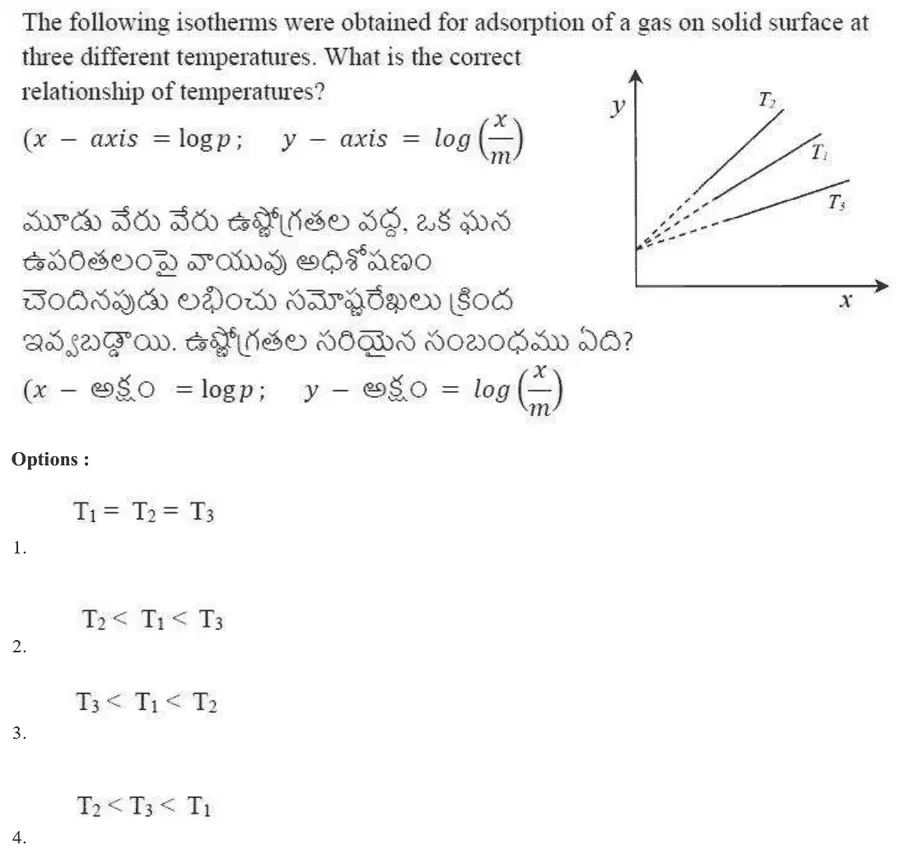
$\mathrm{T_1 = T_2 = T_3}$
$\mathrm{T_2 < T_1 < T_3}$
$\mathrm{T_3 < T_1 < T_2}$
$\mathrm{T_2 < T_3 < T_1}$
Identify the correct statements from the following
I. Lyophilic sols are more stable than Lyophobic sols
II. $\mathrm{As_2S_3}$ sol is a negatively charged sol
III. $\mathrm{TiO_2}$ sol is a negatively charged sol
IV. Milk of magnesia is used to cure kalaazar
Correct answer is
I, II only
III, IV only
I, III, IV only
I, II, III only
Match the following
| List - I (Reaction) | List - II (Catalyst) |
|---|---|
| A. $2\ \mathrm{SO_2} + \mathrm{O_2} \rightarrow 2\ \mathrm{SO_3}$ | I. $\mathrm{MnO_2}$ |
| B. $4\ \mathrm{HCl} + \mathrm{O_2} \rightarrow 2\ \mathrm{Cl_2} + 2\ \mathrm{H_2O}$ | II. $\mathrm{PdCl_2}$ |
| C. $\mathrm{C_2H_4} \rightarrow \mathrm{CH_3CHO}$ | III. $\mathrm{CuCl_2}$ |
| D. $2\ \mathrm{KClO_3} \xrightarrow{\Delta} 2\mathrm{KCl} + 3\mathrm{O_2}$ | IV. $\mathrm{V_2O_5}$ |
The correct answer is
A-IV, B-II, C-III, D-I
A-I, B-III, C-II, D-IV
A-IV, B-III, C-II, D-I
A-II, B-I, C-IV, D-III
Given below are two statements
Statement I: The amount of $\mathrm{CH_4}(g)$ (critical temperature = 190 K) adsorbed on 1g of charcoal is less than that of $\mathrm{SO_2}(g)$ (critical temperature = 630 K)
Statement II: The amount of physical adsorption of a gas increases with increase in temperature
The correct answer is
Both statements I and statement II are correct
Both statements I and statement II are not correct
Statement I is correct but statement II is not correct
Statement I is not correct but statement II is correct
Which of the following is not related to purification of colloidal solutions?
Electrophoresis
Dialysis
Ultrafiltration
Electro dialysis
At $T(K)$, adsorption of $\mathrm{CH_3COOH}(aq)$ on $1g$ of charcoal gave Freundlich adsorption isotherm with slope of 0.5 and intercept of 1.0. The constants $k$ and $n$ are respectively
$10 , 2$
$2 , 10$
$0.5 , 1$
$1 , 0.5$
The graph drawn between $\log\frac{x}{m}$ and $\log P$ for an adsorption process is a straight line at an angle of $45^\circ$, with intercept equal to 0.3010. The extent of adsorption $\left(\frac{x}{m}\right)$ at a pressure of 0.2 atm is
($\log 2 = 0.3010$ ; $\tan 45^\circ = 1$)
0.2
0.3
0.4
0.8
At T(K), adsorption of gas (A) on solid adsorbent (B) follows Freundlich adsorption isotherm. On 10 g of B, adsorption of the gas (A) gave the isotherm shown below. What is $x$ (the quantity of A adsorbed on one gram of B in g) when the pressure of A is 1.259 atm?
(log (1.259) = 0.1 ; Antilog (0.1) = 1.259)
(see the figure above)
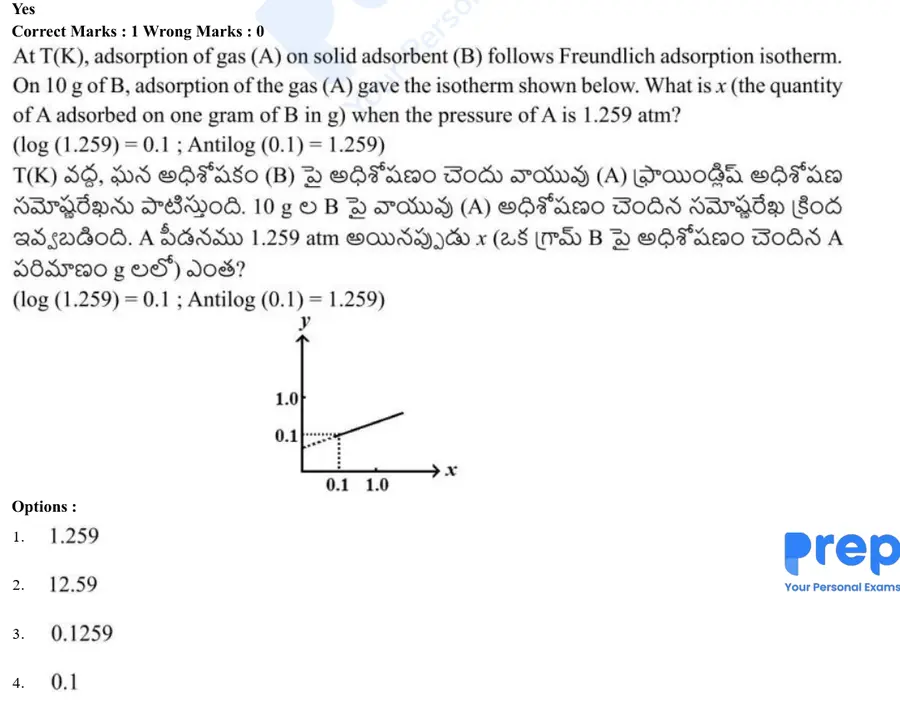
1.259
12.59
0.1259
0.1
Which of the following is not the characteristic of chemisorption?
It is a multilayer adsorption
It is highly specific in nature
It is irreversible
High temperature is favorable for adsorption
Which of the following is not correctly matched with the example mentioned in brackets?
Solid dispersed in gas (Smoke)
Solid dispersed in liquid (Paint)
Liquid dispersed in solid (Butter)
Gas dispersed in liquid (Cloud)
Identify the incorrect statement about colloidal solution
They scatter light
The diameter range of colloidal particles is 1-1000 nm
Elevation in boiling point of a colloidal solution is greater than the true solution of same concentration
$\mathrm{As_2S_3}$ and CdS sols are negatively charged
Gold number of a protective colloid (A) is $x$. A mixture is prepared by adding 50 mL of 10% NaCl solution to 500 mL of gold sol. What is the minimum mass (in mg) of A to be added to the solution to prevent the coagulation of gold sol?
$50x$
$500x$
$5x$
$0.5x$
In which of the following sets, the reaction and catalyst are correctly matched?
(g = gas, $l$ = liquid)
| Reaction | Catalyst | |
|---|---|---|
| I | $\mathrm{SO_2(g) + Cl_2(g) \rightarrow SO_2Cl_2(l)}$ | Charcoal |
| II | $\mathrm{2SO_2(g) + O_2(g) \rightarrow 2SO_3(g)}$ | $\mathrm{V_2O_5}$ |
| III | $\mathrm{4HCl + O_2 \xrightarrow{723\,K} 2Cl_2 + 2H_2O}$ | $\mathrm{CuCl_2}$ |
The correct answer is (only)
I, II, III
I, II only
II, III only
I, III only
Match the following
List-I (Reaction) | List-II (Catalyst)
--- | ---
A) Hydrogenation of vegetable oils | I. Ni
B) Decomposition of potassium chlorate | II. $\mathrm{MnO_2}$
C) Oxidation of $\mathrm{SO_2}$ in lead chamber process | III. Pt
D) Oxidation of ammonia in Ostwald's process | IV. $\mathrm{NO(g)}$
The correct answer is
A-II, B-IV, C-I, D-III
A-I, B-II, C-IV, D-III
A-III, B-IV, C-I, D-II
A-III, B-II, C-IV, D-I
The critical micelle concentration (CMC) of a soap solution is $5 \times 10^{-4}$ mol L$^{-1}$. Identify the correct statements about this solution.
I. The micelle is stable if the soap solution concentration is $10^{-7}$ mol L$^{-1}$
II. The micelle is stable if the soap solution concentration is higher than $5 \times 10^{-4}$ mol L$^{-1}$
III. Micelles are also known as associated colloids.
I, II, III
I, II only
I, III only
II, III only
Choose the incorrect statement from the following
Brownian movement and Tyndall effect are shown by colloidal systems
Hardy-Schulze rule is related with coagulation
Gold number is a measure of the protection power of a lyophilic colloid
Aerosol is a colloidal system in which gas is dispersed in liquid.
Which of the following statements regarding adsorption theory of heterogeneous catalysis is not correct ?
The reactant molecules get adsorbed on the surface of the catalyst
The chemical reaction occurs at the surface of the catalyst
The product molecules remains permanantly bound to the catalyst surface
The catalyst remains unchanged in mass and chemical composition at the end of the reaction
Match the following
| List-I (sol) | List-II (Method of preparation) |
|---|---|
| A) $\mathrm{As_2S_3}$ | I) Bredig's arc method |
| B) $\mathrm{Au}$ | II) Oxidation |
| C) $\mathrm{S}$ | III) Hydrolysis |
| D) $\mathrm{Fe(OH)_3}$ | IV) Double decomposition |
The correct answer is
A-III, B-II, C-IV, D-I
A-I, B-III, C-IV, D-II
A-IV, B-I, C-II, D-III
A-IV, B-III, C-I, D-II
In a Freundlich adsorption isotherm, if the slope is unity and k is 0.1, the extent of adsorption at 2 atm is (log 2 = 0.30)
0.6
0.4
0.2
0.8
The adsorption of a gas on a solid surface follows Freundlich adsorption isotherm. At T(K), the gas pressure is 2 atm. What is the value of $\frac{x}{m}$? (n = 2 and k = constant)
$\frac{x}{m} = 4\mathrm{k}$
$\frac{x}{m} = \frac{1.414}{\mathrm{k}}$
$\frac{x}{m} = \frac{\mathrm{k}}{1.414}$
$\frac{x}{m} = 1.414\,\mathrm{k}$
Match the following
| List-I (colloidal solution) | List-II (use) |
|---|---|
| A) Colloidal antimony | I) Eye lotion |
| B) Argyrol | II) Intramuscular injection |
| C) Colloidal gold | III) Kalaazar |
| D) Milk of magnesia | IV) Stomach disorders |
The correct answer is
A-III, B-I, C-II, D-IV
A-III, B-I, C-IV, D-II
A-IV, B-II, C-I, D-III
A-II, B-I, C-IV, D-III
Adsorption of a gas on solids follows Freundlich adsorption isotherm. The graph drawn between $\log\frac{x}{m}$ (on y-axis) and $\log p$ (on x-axis) is a straight line with slope equal to 3 and intercept equal to 0.30. What is the value of $\frac{x}{m}$ at a pressure of 2 atm ?
(Given; $\log 2 = 0.3$)
48
32
16
8
Which one of the following is not the correct characteristic property of physical adsorption?
It is not specific in nature
Enthalpy of adsorption of this is low
It increases with increase of temperature
It is a multilayer adsorption under high pressure
In each of four separate beakers (I, II, III, IV), X mL of $y$M $\mathrm{Fe_2O_3}.x\mathrm{H_2O}$ colloidal solution is present. Equal volume and equal concentration of of KCl, $\mathrm{K_4[Fe(CN)_6]}$, $\mathrm{K_3PO_4}$ and $\mathrm{K_2SO_4}$ was added into I, II, III and IV respectively. The efficiency of precipitations in these beakers follows the order
II > III > IV > I
II > III > I > IV
I > IV > III > II
III > IV > I > II
In a colloidal solution, both the dispersed phase and dispersion medium are in liquid phase. What is the type of colloid ?
gel
emulsion
foam
aerosol
The equation which represents Freundlich adsorption isotherm is
($x$ = amount of gas, m = mass of solid)
$\log\dfrac{x}{m} = \log p + \dfrac{1}{n}\log k$
$\log\dfrac{x}{m} = \log k + \dfrac{1}{n}\log p$
$\dfrac{x}{m} = k + \dfrac{1}{n}\log p$
$\dfrac{x}{m} = \log p + \dfrac{1}{n}\log k$
Identify the correct statements from the following
I) Sulphur sol is an example for multi molecular colloid.
II) Starch sol is an example for associated colloid.
III) Artificial rubber is an example for macromolecular colloid.
I, II, III
I, II only
II, III only
I, III only
Identify the catalytic reaction in which both reactants are in different phases.
Ammonia synthesis by Haber process.
Synthesis of sulphur trioxide by lead chamber process
Hydrogenation of vegetable oils
Hydrolysis of methyl acetate
Consider the following.
Statement-I : Gold sol is prepared by Bredig's arc method.
Statement-II : Bredig's arc method involves only dispersion but not condensation.
The correct answer is
Both statement-I and statement-II are correct
Both statement-I and statement-II are not correct
Statement-I is correct, but statement-II is not correct
Statement-I is not correct, but statement-II is correct
Activation energy for the hydrolysis of sucrose by acid is X $\mathrm{kJ\ mol^{-1}}$ whereas activation energy for the hydrolysis of sucrose by sucrase is Y $\mathrm{kJ\ mol^{-1}}$. X and Y respectively are
6.22, 2.15
2.15, 6.22
6.22, 6.22
2.15, 2.15
The correct statements about the properties of colloidal solutions are
A. Tyndall effect is used to distinguish between a colloidal solution and a true solution
B. Zeta potential is related to movement of colloidal particles
C. Brownian motion in colloidal solution is faster if the viscosity of the solution is very high.
D. Brownian motion stabilises the sols
A & B
B & C
A & D
B & D
Match the following
| List – 1 (Type of colloid) | List – 2 (Example) | ||
|---|---|---|---|
| A | Sol | I | Cloud |
| B | Foam | II | Whipped cream |
| C | Gel | III | Paint |
| D | Aerosol | IV | Butter |
The correct answer is
A – IV, B – II, C – III, D – I
A – III, B – I, C – IV, D – II
A – III, B – II, C – IV, D – I
A – IV, B – I, C – II, D – III
Which of the following is not correct about Freundlich adsorption isotherm?
$\frac{x}{m} = k\,p^{1/n}$ $(n > 1)$
Extent of adsorption of gas is more at high temperature than at low temperature
$\frac{1}{n}$ represents the slope of the isotherm
$\log \frac{x}{m} = \log k + \frac{1}{n}\log p$ holds good over a limited range of pressures
The most effective coagulating agent for antimony sulphide sol is
$\mathrm{Na_2SO_4}$
$\mathrm{CaCl_2}$
$\mathrm{NH_4Cl}$
$\mathrm{Al_2(SO_4)_3}$
Two statements are given below
Statement I: Adsorption of a gas on the surface of charcoal is primarily an exothermic reaction
Statement II: A closed vessel contains $\mathrm{O_2}$, $\mathrm{H_2}$, $\mathrm{Cl_2}$, $\mathrm{NH_3}$ gases. Its pressure is P (atm). About 1 g of charcoal is added to this vessel and after some time its pressure was found to be less than P (atm)
The correct answer is
Both statement-I and statement-II are correct
Both statement-I and statement-II are not correct
Statement-I is correct but statement-II is not correct
Statement-I is not correct but statement-II is correct
The critical temperature of A, B, C, D gases are 190 K, 630 K, 261 K, 400 K respectively. The quantity of gas adsorbed per gram of charcoal at same pressure is least for the gas
D
C
B
A
The following data is obtained for coagulating a positively charged sol in 2 hours
| Conc. of $\mathrm{Cl^-}$ in mol $\mathrm{L^{-1}}$ | Result |
|---|---|
| $5 \times 10^{-5}$ | Sol not precipitated |
| $6 \times 10^{-5}$ | Sol not precipitated |
| $7 \times 10^{-5}$ | Sol precipitated |
| $8 \times 10^{-5}$ | Sol precipitated |
| $1 \times 10^{-4}$ | Sol precipitated |
What is the coagulating value of electrolyte for this sol?
$7 \times 10^{-5}$
$7 \times 10^{-2}$
$5 \times 10^{-2}$
$9 \times 10^{-2}$
Which of the following solutions is used in the styptic action which prevents bleeding of blood?
$\mathrm{CoCl_2}$ solution
$\mathrm{FeCl_3}$ solution
Gold sol
$\mathrm{AgBr}$ emulsion
‘A’ is a protecting colloid. The following data is obtained for preventing the coagulation of 10 mL of gold sol to which 1 mL of 10% NaCl is added. What is the gold number of ‘A’?
| Expt. No. | Wt (in mg) of A added to gold sol | Coagulation |
|---|---|---|
| 1 | 40 | Prevented |
| 2 | 35 | Prevented |
| 3 | 25 | Not prevented |
| 4 | 32 | Not prevented |
| 5 | 33 | Prevented |
32
33
35
40
The correct statement regarding chemisorption is
It is a multilayered adsorption
The process is reversible in nature
The process is not specific in nature
Enthalpy of adsorption is in the range of 80-240 $\mathrm{kJ\ mol^{-1}}$
Which of the following is incorrectly matched?
Multi molecular colloid – $\mathrm{S_8}$
Macro molecular colloid - enzyme
$\mathrm{As_2S_3}$ sol – positively charged sol
Starch sol – lyophilic sol
Match List - I, with List - II
| List-I | List-II | ||
|---|---|---|---|
| I | Colloidal antimony | A | Kalaazar |
| II | Silver sol | B | Intermuscular injection |
| III | Milk of magnesia | C | Eye lotion |
| IV | Gold sol | D | Stomach disorder |
Correct answer is
I-B, II-A, III-C, IV-D
I-A, II-C, III-D, IV-B
I-A, II-B, III-C, IV-D
I-A, II-D, III-B, IV-C
Identify the method of preparation of a colloidal sol from the following
Ultrafiltration
Peptisation
Dialysis
Electro-dialysis
'X' is a protecting colloid. The following data is obtained for preventing the coagulation of 10 mL of gold sol to which 1 mL of 10% NaCl is added. What is the gold number of 'X'?
| Expt No. | Weight of X (in mg) added to gold sol | Coagulation |
|---|---|---|
| 1 | 24 | Not prevented |
| 2 | 23 | Not prevented |
| 3 | 26 | Prevented |
| 4 | 27 | Prevented |
| 5 | 25 | Prevented |
24
26
27
25
Which sol is used as intramuscular injection?
Antimony Sol
Silver sol
Emulsion of milk of magnesia
Gold sol
Which of the following general reaction is an example for heterogeneous catalysis?
$\mathrm{A_2 (g) + B_2 (g) \xrightarrow{C (g)} 2AB (g)}$
$\mathrm{A (s) + B (s) \xrightarrow{C (s)} D (s)}$
$\mathrm{A (g) + B (g) \xrightarrow{C (s)} D (g)}$
$\mathrm{A_2 (g) + B_2 (g) \xrightarrow{C (g)} D (s)}$
Match List I with List II
| List-I | List-II | ||
|---|---|---|---|
| A | Aerosol | I | Milk |
| B | Foam | II | Soap lather |
| C | Emulsion | III | Cheese |
| D | Gel | IV | Smoke |
The correct answer is
A-II, B-I, C-III, D-IV
A-IV, B-I, C-II, D-III
A-I, B-II, C-IV, D-III
A-IV, B-II, C-I, D-III
Which of the following has maximum coagulating power in the coagulation of positively charged sol?
$\mathrm{Cl^-}$
$\mathrm{SO_4^{2-}}$
$\mathrm{PO_4^{3-}}$
$\mathrm{[Fe(CN)_6]^{4-}}$
Identify the autocatalytic reaction from the following
$\mathrm{N_2(g) + 3H_2(g) \xrightarrow[Mo(s)]{Fe(s)} 2NH_3(g)}$
$\mathrm{2KClO_3(s) \xrightarrow{MnO_2} 2KCl(s) + 3O_2}$
$\mathrm{CH_3COOC_2H_5 + H_2O \longrightarrow CH_3COOH + C_2H_5OH}$
$\mathrm{AgNO_3(aq) + KCl(aq) \longrightarrow AgCl(s) + KNO_3(aq)}$
Given below are two statements
Statement-I: Easily liquefiable gases are readily adsorbed
Statement-II: Adsorption enthalpy for physisorption is less compared to adsorption enthalpy for Chemisorption
The correct answer is
Both Statement-I and statement-II are correct
Both Statement-I and statement-II are not correct
Statement-I is correct but statement-II is not correct
Statement-I is not correct but statement-II is correct
The validity of Freundlich isotherm can be verified by plotting
$\log\frac{x}{m}$ on y-axis and $\log p$ on x-axis
$\frac{x}{m}$ on y-axis and $p$ on x-axis
$\log\frac{x}{m}$ on x-axis and $p$ on y-axis
$\frac{x}{m}$ on x-axis and $\log p$ on y-axis
10 mL of 0.5 M NaCl is required to coagulate 1L of $\mathrm{Sb_2S_3}$ sol in 2 hours time. The flocculating value of NaCl (in milli moles) is
20
10
5
15
In Haber’s process of manufacture of ammonia, the ‘catalyst’ the ‘promoter’ and ‘poison for the catalyst’ are respectively
$\mathrm{Fe, W, CO}$
$\mathrm{Co, Mo, CO}$
$\mathrm{Fe, Mo, CO_2}$
$\mathrm{Fe, Mo, CO}$
Adsorption of a gas (A) on an adsorbent follows Freundlich adsorption isotherm. The slope and intercept (on y-axis) of the isotherm are 0.5 and 1.0 respectively. What is the value of $\frac{x}{m}$, when the pressure of the gas (A) is 100 atm?
10
1
100
1000
Adsorption of a gas on a solid adsorbent follows Freundlich adsorption isotherm. If $x$ is the mass of the gas adsorbed on mass 'm' of the adsorbent at pressure p. From the graph given extent of adsorption is proportional to
(see the figure above)
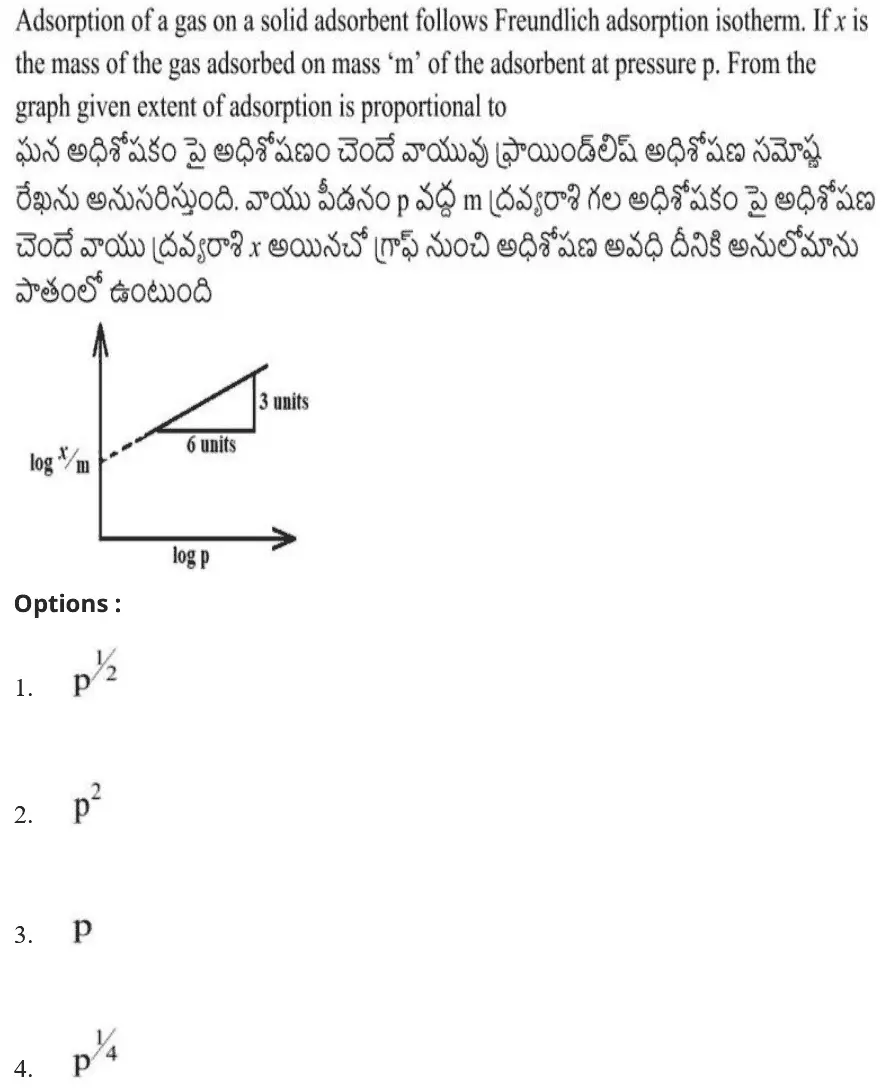
$\mathrm{p^{1/2}}$
$\mathrm{p^{2}}$
$\mathrm{p}$
$\mathrm{p^{1/4}}$
The process of converting a precipitate into colloidal solution is known as
Dialysis
Peptization
Electrophoresis
Flocculation
Match the following
| List – I (Dispersed Phase – Dispersion medium) | List – II (Type of colloid) |
|---|---|
| A) Solid – Liquid | I) Gel |
| B) Liquid – Liquid | II) Aerosol |
| C) Solid – Gas | III) Sol |
| D) Liquid – Solid | IV) Emulsion |
The correct answer is
A-II, B-III, C-I, D-IV
A-III, B-IV, C-II, D-I
A-III, B-IV, C-I, D-II
A-I, B-III, C-IV, D-II
Given below are two statements (S-I and S-II)
S-I: Scattering of light by dispersed particles of colloidal system is known as Tyndall effect.
S-II: The diameter of the dispersed particles should not be much smaller than the wavelength of the light used.
Choose the most appropriate answer from the options given below.
Both S-I and S-II are correct
S-I is correct but S-II is incorrect
Both S-I and S-II are incorrect
S-I is incorrect but S-II is correct
Consider the following statements for a gold sol
I) It is macromolecular colloid
II) It is a lyophobic sol
III) It is a negatively charged sol
IV) It is a multimolecular colloid
V) It is an associated colloid
The correct statements are
I, II, III only
II, III, IV only
III, IV, V only
I, IV V only
Match the following
| List – I (Process) | List - II (Catalyst) |
|---|---|
| A) Ostwald’s process | I) $\mathrm{NO}$ |
| B) Lead Chamber process | II) $\mathrm{Fe}$ |
| C) Deacon’s process | III) $\mathrm{Rh}$ |
| D) Haber’s process | IV) $\mathrm{CuCl_2}$ |
The correct answer is
A-IV, B-I, C-II, D-III
A-II, B-III, C-IV, D-I
A-III, B-I, C-IV, D-II
A-III, B-IV, C-I, D-II
The greater the valence of the flocculating ion added, the greater is its power to cause precipitation of a colloid. This rule is
Hund's rule
Pauling rule
Henry's rule
Hardy – Schulze rule
This equation represents the preparation of gold sol by
$2\,\mathrm{AuCl_3} + 3\,\mathrm{HCHO} + 3\,\mathrm{H_2O} \rightarrow 2\,\mathrm{Au} + 3\,\mathrm{HCOOH} + 6\,\mathrm{HCl}.$
Oxidation
Reduction
Double decomposition
Hydrolysis
2.0 g of activated charcoal is added to 100 mL of 0.5 M acetic acid (molar mass 60 g $\mathrm{mol^{-1}}$), shaken well and filtered. The concentration of solution is reduced to 0.4 M. How many grams of acetic acid is adsorbed on charcoal per gram?
0.1
0.2
0.3
0.15
Which of the following is an example of a multi molecular colloid?
Sulphur sol
Starch sol
Natural rubber sol
Soap sol
Consider the reactions
I. $\mathrm{CO + 3H_2 \xrightarrow{A} CH_4 + H_2O}$
II. $\mathrm{CO + 2H_2 \xrightarrow{B} CH_3OH}$
III. $\mathrm{O_2 + 2H_2 \xrightarrow{C} 2H_2O}$
The catalysts A, B, C are respectively
$\mathrm{Ni,\ ZnO-Cr_2O_3,\ Pt}$
$\mathrm{Pt,\ ZnO-Cr_2O_3,\ Ni}$
$\mathrm{CuCl_2,\ Ni,\ V_2O_5}$
$\mathrm{Pd,\ Pt,\ ZnO-Cr_2O_3}$
In which of the following, the sol is not correctly matched with respect to its charge?
| I. $\mathrm{Al_2O_3.xH_2O}$ sol; +ve sol |
| II. Starch sol ; +ve sol |
| III. $\mathrm{TiO_2}$ sol; −ve sol |
| IV. Methylene blue sol; +ve sol |
The correct answer is
I, IV
I, III
II, III
II, IV
The graph drawn between $\log\left(\frac{x}{m}\right)$ and $\log (p)$ is shown below with intercept OA.
What is the value of $\frac{x}{m}$ at a pressure of 0.3 atm? ($\log 2 = 0.30$, $\log 3 = 0.477$)
(see the figure above)
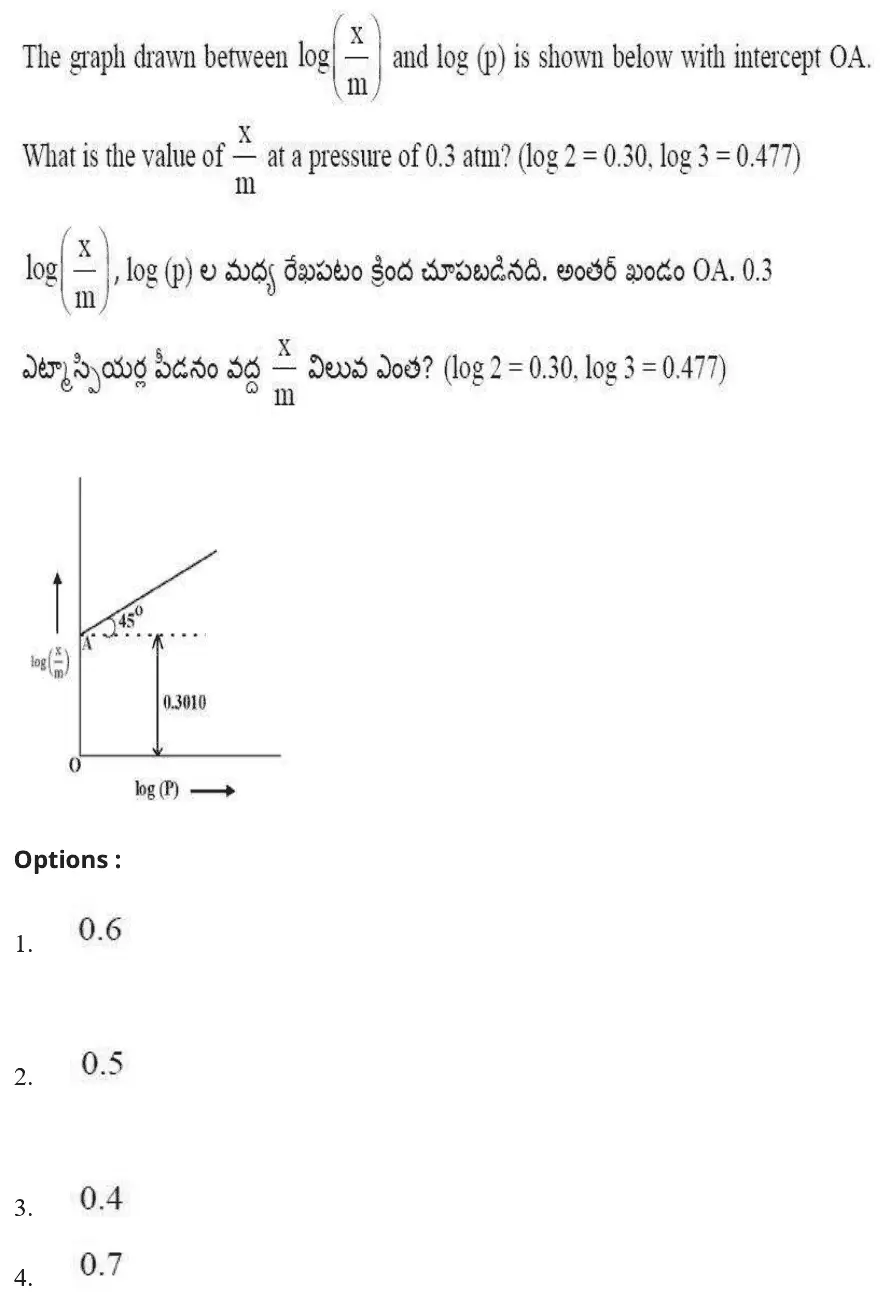
0.6
0.5
0.4
0.7
The correct statements about Zeolites are
I) They are good shape selective catalysts
II) They contain Al-O-Si framework
III) They are not found in nature
IV) They are used as catalysts for cracking hydrocarbons, in petrochemical industry
I & II only
II & III only
III & IV only
I, II & IV only
Which of the following is not the application of adsorption?
Use of $\mathrm{SiO_2}$ gel for removing the moisture
Use of coconut charcoal to separate inert gases
Use of $\mathrm{Al_2O_3}$ to separate the components of organic mixture in chromatography
Use of $\mathrm{CaCl_2}$ for removing the moisture
The most effective coagulating agent for antimony sulphide sol is
$\mathrm{K_2SO_4}$
$\mathrm{NH_4Cl}$
$\mathrm{Al_2(SO_4)_3}$
$\mathrm{K_4(Fe(CN)_6)}$
The plot of $\log\frac{x}{m}$ (y-axis) and $\log p$ (x-axis) is a straight line inclined at an angle of $45^\circ$. When the intercept, K is 10 and pressure is 0.3 atm the amount of solute in grams adsorbed per gram of adsorbent ($\log 3 = 0.4771$)?
30.0
2.0
3.0
20.0
Which of the following can form ionic micelles in water?
Starch molecules
sodium lauryl sulphate
Iodine molecules
$\mathrm{S_8}$ molecules
The sol prepared by Bredig’s Arc method is X and the charge of sol particles of it is q.
X and q are respectively
Metal sol, -ve
Metal sol, +ve
Metal sulphide sol, -ve
$\mathrm{TiO_2}$ sol, +ve
The graph given below is showing the relation between the extent of adsorption (x/m) and Pressure at different temperatures. The correct order of temperatures for curves i, ii and iii is
(see the figure above)
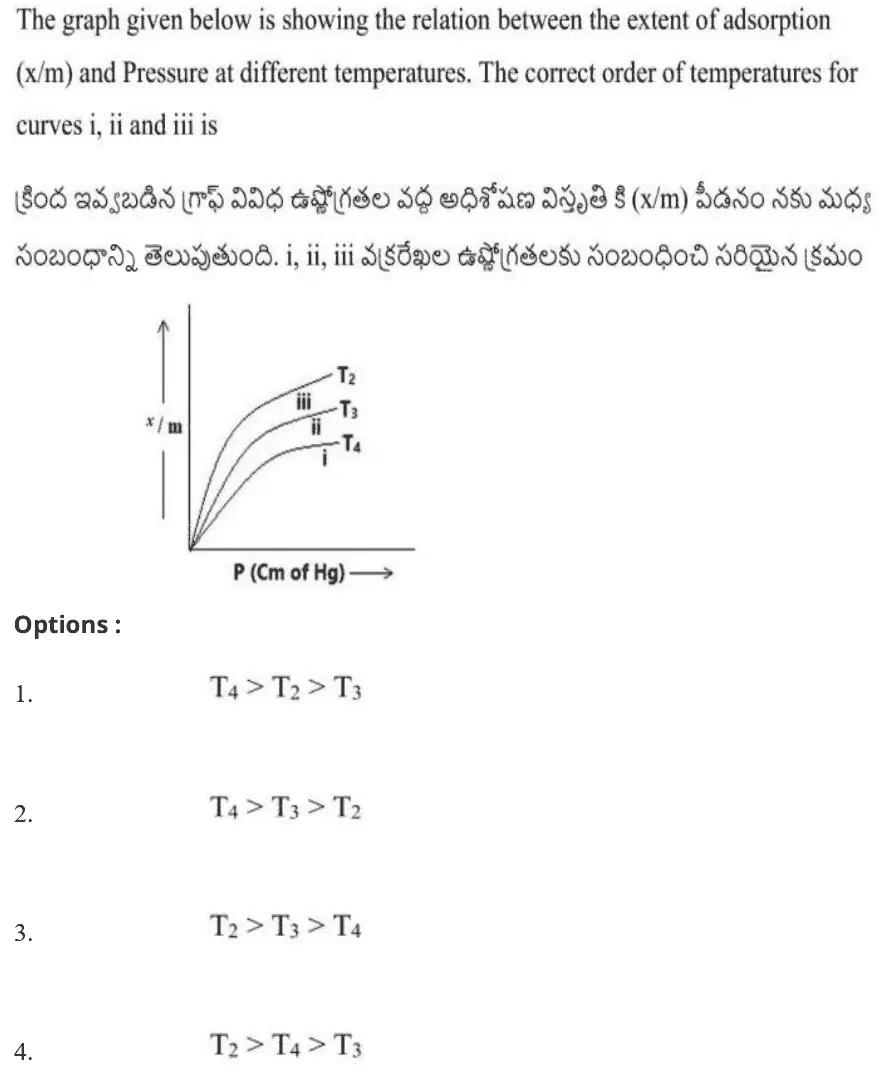
$T_4 > T_2 > T_3$
$T_4 > T_3 > T_2$
$T_2 > T_3 > T_4$
$T_2 > T_4 > T_3$
Match the following
| List I | List-II |
|---|---|
| A. Negatively charged sol | I. Emulsion |
| B. Milk | II. Kalaazar |
| C. Gold number | III. $\mathrm{FeCl_3}$ solution is added to excess $\mathrm{NaOH}$ solution |
| D. Colloidal antimony | IV. Protection of colloids |
The correct answer is
A-III, B-I, C-II, D-IV
A-III, B-I, C-IV, D-II
A-I, B-III, C-IV, D-II
A-II, B-I, C-III, D-IV
Identify the factors which favour the physical adsorption from the following
I) High surface area
II) Low temperatures
III) High temperatures
IV) Low pressures
V) High pressures
I, III & IV only
I, II & V only
III & V only
I, II & IV only
Consider the following about the Tyndall effect
I) It is used to distinguish between a true and colloidal solution
II) It is possible only when the dispersed medium and dispersed phase differ much in their refractive indices
III) It is observed only when the size of colloidal particles is much smaller than the wavelength of the light used
The correct statements are
I & III only
II & III only
I, II & III
I & II only
10 g of a gas is adsorbed on 500 g of solid at 10 bar. If the pressure is increased at 20 bar, 14 g of the gas is adsorbed by the same solid at the same temperature. What is the slope of Freundlich adsorption isotherm?
1.0
$\dfrac{4}{3}$
3
0.5
The process in which colloids, when subjected to DC electric field move towards an electrode is
Brownian movement
Tyndall effect
Peptization
Electrophoresis
Which of the following does not show Tyndall effect?
Clouds
Milk
Sugar solution
Suspension
The coagulation of 200 ml of a positive colloid took place when 0.73 g of HCl was added to it without changing the volume much. The flocculation value of HCl for the colloid is
1000
0.365
200
100
For $\mathrm{As_{2}S_{3}}$ sol, the most effective coagulating agent is
$\mathrm{CaCO_{3}}$
$\mathrm{NaCl}$
$\mathrm{FeCl_{3}}$
Clay
A cube of edge length 1 cm is divided into smaller cubes of uniform size of length 1 nm. Assuming that no voids are present, the ratio of total surface area of all the cubes of 1 nm edge length to the surface area of the initial cube is
$10^{9}$
$10^{7}$
$10^{6}$
$10^{5}$
Catalysts in the following reactions are
I) $\mathrm{CH_{3}COOCH_{3}(l)+H_{2}O(l)\rightarrow CH_{3}COOH(aq)+CH_{3}OH(l)}$
II) $\mathrm{2SO_{2}(g)\rightarrow 2SO_{3}(g)}$
III) $\mathrm{2SO_{2}(g)+O_{2}(g)\rightarrow 2SO_{3}(g)}$
IV) $\mathrm{N_{2}(g)+3H_{2}(g)\rightarrow 2NH_{3}(g)}$
HCl (l), Pt (s), NO (g) and Fe (s)
HCl (l), NO (g), Pt (s) and Fe (s)
HCl (l), Ni (s), NO (g) and Fe (s)
HCl (l), Pt (s), $\mathrm{N_{2}O}$ (g) and Fe (s)
The correct order of adsorption of the following gases on the surface of charcoal is
$\mathrm{H_2}$ (I), $\mathrm{CH_4}$ (II), $\mathrm{SO_2}$ (III)
III > II > I
III > I > II
II > I > III
II > III > I
Relatively which conditions favour the faster Brownian movement of colloidal particles in solution?
Smaller size and higher viscosity
Smaller size and lesser viscosity
Bigger size and higher viscosity
Bigger size and lesser viscosity
Assertion (A) :- Adsorption is an exothermic process
Reason (R) : - Physisorption of a gas on a solid surface is normally reversible
Both (A) and (R) are correct and (R) is the correct explanation of (A)
Both (A) and (R) are correct but (R) is not the correct explanation of (A)
(A) is correct but (R) is incorrect
(A) is incorrect but (R) is correct
When a dilute $\mathrm{AgNO_3}$ solution is mixed with excess of dilute KI, the colloidal solution formed is
$\mathrm{Ag\,NO_3/I^{-}}$
$\mathrm{AgI}$
$\mathrm{Ag\,I/Ag^{+}}$
$\mathrm{AgI/I^{-}}$
Assertion (A) :- Finely divided charcoal can act as an adsorbent
Reason (R): - Finely divided material has small surface area
Both (A) and (R) are correct and (R) is the correct explanation of (A).
Both (A) and (R) are correct and (R) in not the correct explanation of (A).
(A) is correct but (R) is incorrect
(A) is incorrect but (R) is correct
The correct statements with respect to dialysis of colloidal solution are
I. Colloidal particles can pass through the membrane
II. Animal bladder can be used as membrane
III. Cellophane is not used as membrane
IV. Ions or small molecules can diffuse through membrane into water
I, II only
II, III only
III, IV only
II, IV only
Freundlich adsorption isotherm fails at which of the following condition?
High temperature
Low temperature
High Pressure
Low pressure
The no. of positively and negatively charged sols respectively in the following are
$\mathrm{TiO_2}$, blood, CdS, Cu, Ag, Clay, $\mathrm{SiO_2}$, $\mathrm{Fe_2O_3}$.
5, 3
3, 5
6, 2
4, 4
Milk $-$ water mixture when viewed by the reflected light appears in which colour?
Yellow
Green
Blue
Red
Assertion (A):- The aggregate of carboxylate ions of fatty acids form a spherical shape
Reason (R) : - Soap helps in emulsification and washing away of oils
Both (A) and (R) are correct and (R) is the correct explanation of (A).
Both (A) and (R) are correct but (R) is not the correct explanation of (A).
(A) is correct but (R) is incorrect
(A) is incorrect but (R) is correct
In the following reaction for the preparation of gold sol, a, b, c, x, y, and z are
a $\mathrm{AuCl_3}$ + b HCHO + c $\mathrm{H_2O}$ $\rightarrow$ x Au(sol) + y $\mathrm{HCO_2H}$ + z HCl
a=2 b=3 c=3 x=2 y=3 z=6
a=2 b=3 c=2 x=2 y=3 z=4
a=2 b=2 c=2 x=2 y=2 z=4
a=3 b=2 c=2 x=3 y=2 z=6
The correct order of coagulating power of the following ions to coagulate the positive sol is
$[Fe(CN)_6]^{4-}$ (I), $Cl^{(-)}$ (II), $SO_4^{2-}$ (III)
I > II > III
III > II > I
I > II > III
I > III > II
The sol formed in the following unbalanced equation is
$\mathrm{As_2O_3 + H_2S \to}$
$\mathrm{As_2S_2}$
$\mathrm{As_2S_3}$
$\mathrm{As}$
$\mathrm{S}$
The diameters range of colloidal particles is approximately.
1 to 1000 nm
1000 to 2000 nm
2000 to 3000 nm
3000 to 4000 nm
The macromolecular colloids of the following are
I. Starch solution II. Sulphur sol
III. Synthetic detergent IV. Synthetic rubber
I, II
II, III
III, IV
I, IV
Assertion (A) :- Animal skins are colloidal in nature
Reason (R) :- Animal skin has positively charged particles.
Both (A) and (R) are correct and (R) is the correct explanation of (A)
Both (A) and (R) are correct and (R) is not the correct explanation of (A)
(A) is correct but (R) is incorrect
(A) is incorrect but (R) is correct
Freundlich adsorption isotherm is ____________
$\frac{x}{m} = k(p)^{1/n}$
$\frac{x}{m} = (p)^{1/n}$
$\frac{x}{m} \propto (p)^{2}$
$\frac{x}{m} = k(p)^{n}$
In general, for soaps, the concentration of surfactant at $\mathrm{CMC}$ is around ______ $\mathrm{mol.L^{-1}}$
$10^{-4}$ to $10^{-3}$
$10^{-4}$ to $10^{-1}$
$10^{-7}$ to $10^{-4}$
$10^{-4}$ to $10^{+2}$
Assertion (A): The property of adsorption is shown to a great extent by solids than liquids
Reason (R): Solids like charcoal, silica can act as good adsorbents
A and R are correct and R is the correct explanation for A
A and R are correct but R is not the correct explanation for A
A is correct, R is wrong
A is wrong, R is correct
A catalyst is a substance which ______
Changes the equilibrium concentration of the products
Changes the energy of the reactants
Shortens the time to reach equilibrium
Changes the equilibrium constant
Colloids can be purified by ______
Condensation
Peptization
Coagulation
Dialysis
The adsorption of a gas at the boiling point of the gas follows the isotherm shown in the figure. Identify the correct thermodynamic properties at point $C$.
(see the figure above)
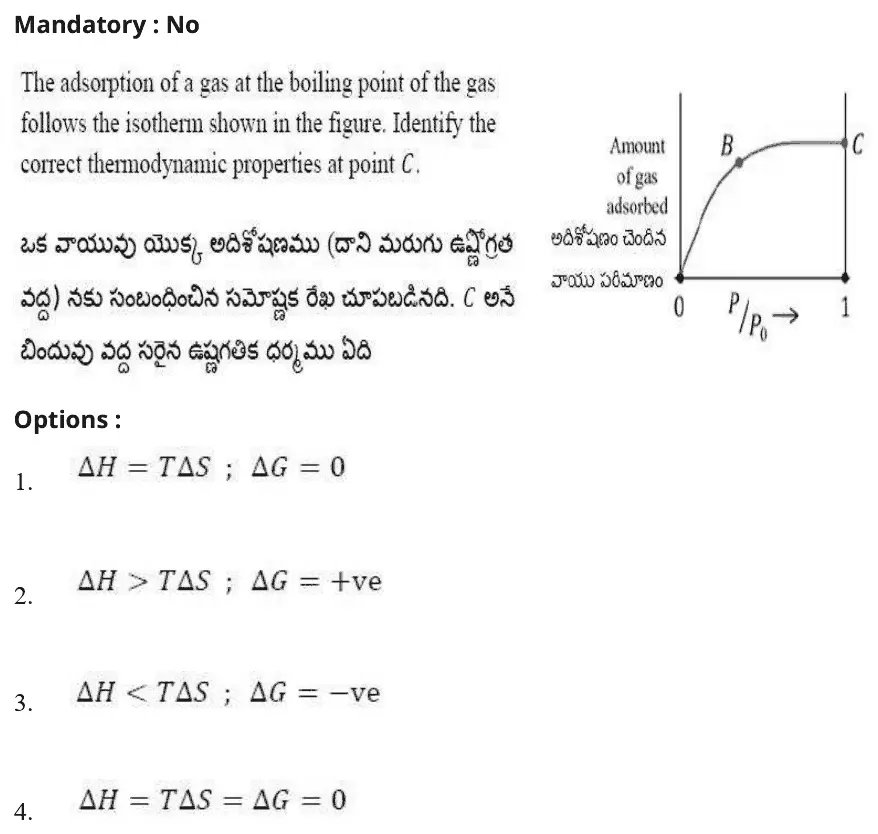
$\Delta H = T\Delta S\ ;\ \Delta G = 0$
$\Delta H > T\Delta S\ ;\ \Delta G = +\mathrm{ve}$
$\Delta H < T\Delta S\ ;\ \Delta G = -\mathrm{ve}$
$\Delta H = T\Delta S = \Delta G = 0$
At high concentration of soap in water soap behaves as a
Multi molecular colloid
Associated colloid
Macromolecular colloid
Lyophilic colloid
In an adsorption experiment, a graph between $\log(x/m)$ versus $\log P$ was found to be linear with a slope of $45^\circ$. The intercept on $\log(x/m)$ axis was found to be 0.3010. The amount of gas adsorbed per gram of charcoal under a pressure of $0.5\ atm$ is
$0.5\ g$
$1.0\ g$
$1.5\ g$
$0.75\ g$
Which statements among the following are correct?
(i) Freundlich isotherm fails at high pressure of the gas.
(ii) $\Delta H < 0$ for both physical and chemical adsorption.
(iii) Physical adsorption is non-selective.
(iv) Chemical adsorption is reversible, where as physical adsorption is irreversible.
(i), (ii), (iii) & (iv)
(i), (ii) & (iii) only
(i), (iii) & (iv) only
(ii) & (iv) only
A plot of $\log(x/m)$ verses $\log(P)$ for adsorption of a gas on a solid gives a straight line with a slope of _____
$-\log k$
$\log(1/n)$
$\dfrac{1}{n}$
$\text{antilog}(1/n)$
During the action of enzyme "Zymase", glucose is converted into ___ with the liberation of carbon dioxide gas.
Phenol
Ethanol
Methanol
Isopropyl alcohol
The protective power of a lyophilic colloidal sol is expressed in terms of ______
Critical micelle concentration
Standard reduction potential
Gold number
Oxidation number
For precipitating $\mathrm{Fe(OH)_3}$ sol, the best precipitating agent is
$\mathrm{Na_2SO_4}$
$\mathrm{Cr(OH)_3}$
$\mathrm{Al(OH)_3}$
$\mathrm{Na_3[Fe(CN)_6]}$
The shape of isobar for physical adsorption and adsorption isobar for chemisorption, respectively, are
(see the figure above)
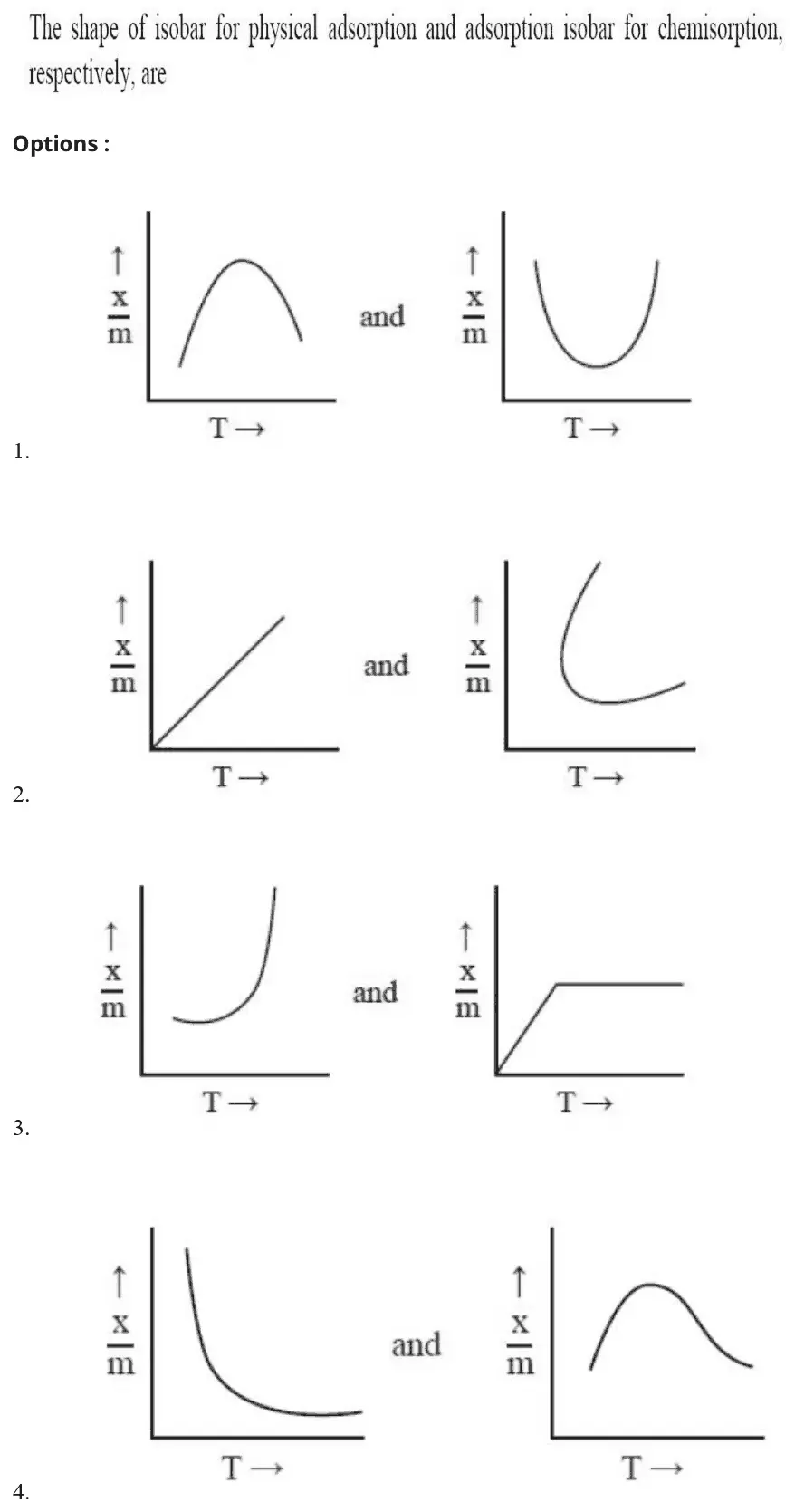
see figure physical: x/m vs T inverted-U (rises then falls) and chemisorption: U-shaped (falls then rises)
see figure physical: straight line rising from the origin and chemisorption: curve starting high, falling steeply then flattening and rising slightly (C-shaped, opening right)
see figure physical: curve with a shallow minimum then rising steeply upward and chemisorption: straight rise from the origin then flat plateau
see figure physical: steeply falling curve flattening out and chemisorption: rises to a maximum then falls (inverted-U)
The most effective coagulating agent among the options for $\mathrm{Sb_2S_3}$ sol is
$\mathrm{Na_2SO_4}$
$\mathrm{Al_2(SO_4)_3}$
$\mathrm{CaCl_2}$
$\mathrm{NH_4Cl}$
Which of the following statements is false during adsorption of gas molecule on a metal surface?
Enthalpy change is positive
Entropy change is negative
Both enthalpy and entropy simultaneously decreases
Free energy change is negative
Which of the following options are correct?
(see the figure above)
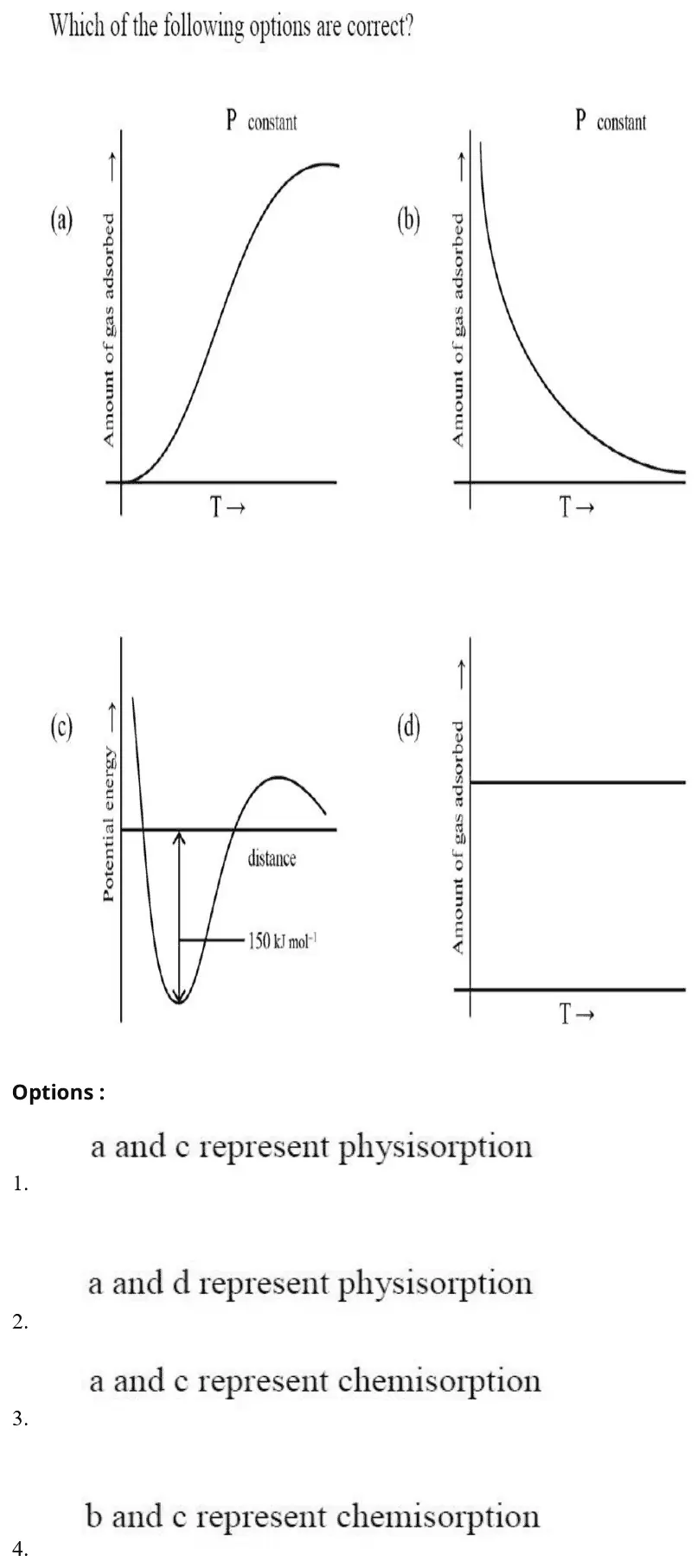
a and c represent physisorption
a and d represent physisorption
a and c represent chemisorption
b and c represent chemisorption
Which plot is the adsorption isobar for chemisorption?
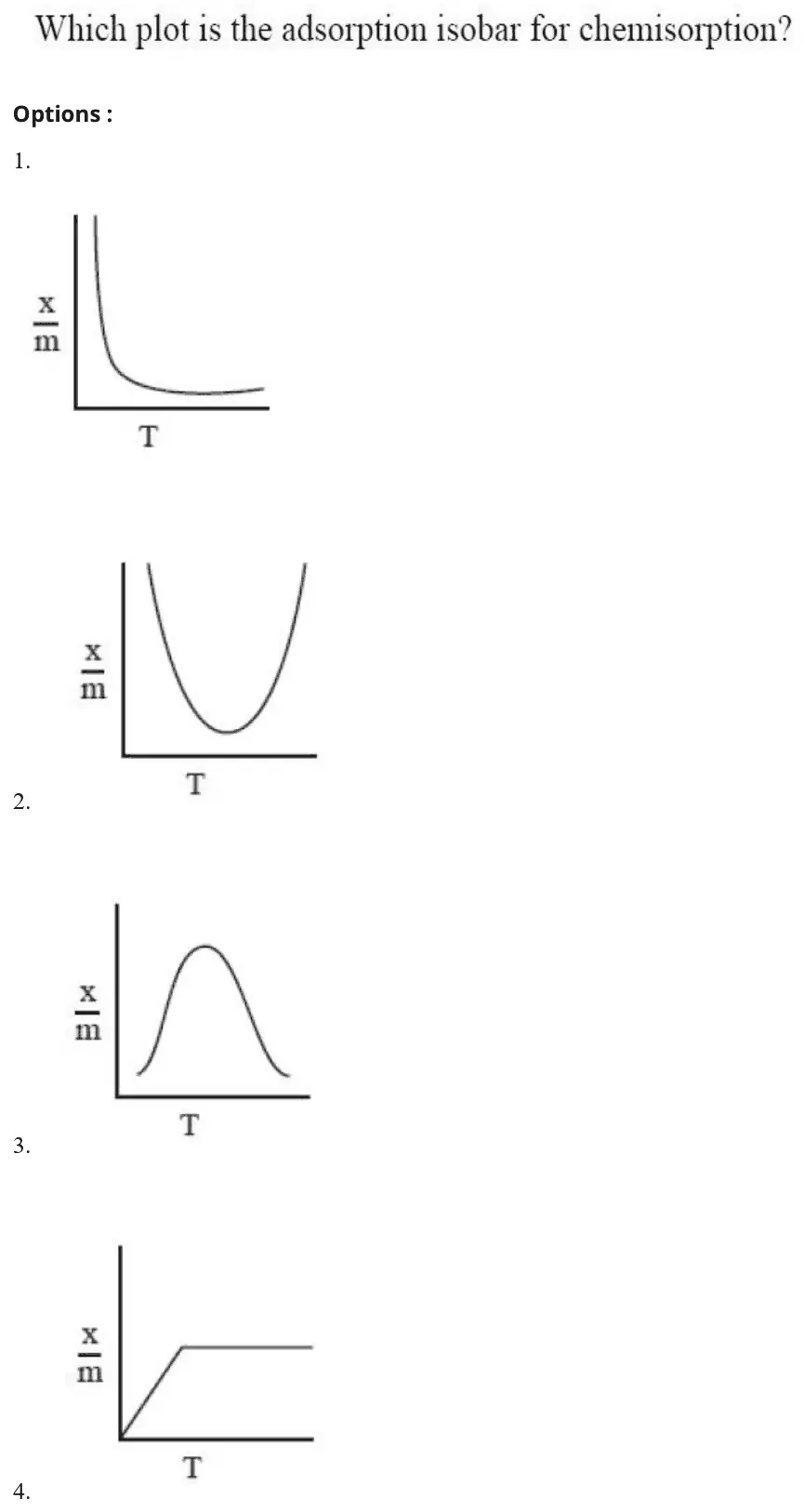
see figure graph of x/m vs T
see figure graph of x/m vs T
see figure graph of x/m vs T
see figure graph of x/m vs T
Which among the following can be explained by adsorption theory?
Homogeneous catalysis
Heterogeneous catalysis
Enzyme catalysis
Acid base Catalysis
In an electrophoresis set up, colloidal solution of glycine having pH of 5.97 is kept at constant T and P. What will happen if few drops of base are added to it.
Cataphoresis
Anaphoresis
Precipitation
Decomposition
When an iron rod is subjected towards an atmosphere having very high content of moisture, which of the process is predominant?
Chemisorption
Physisorption
Sorption
Luminescence
Which of the following metal is used as a catalyst in Haber's process of ammonia synthesis?
Cobalt
Copper
Zinc
Iron
During electro-osmosis of $Fe(OH)_3$ sol, which of the following occurs?
Sol particle move towards anode
Sol particles move towards cathode
The dispersion medium moves towards anode
The dispersion medium moves towards cathode
The Freundlich adsorption isotherm varies with temperature according to the figure given below. Choose the correct option accordingly
(see the figure above)
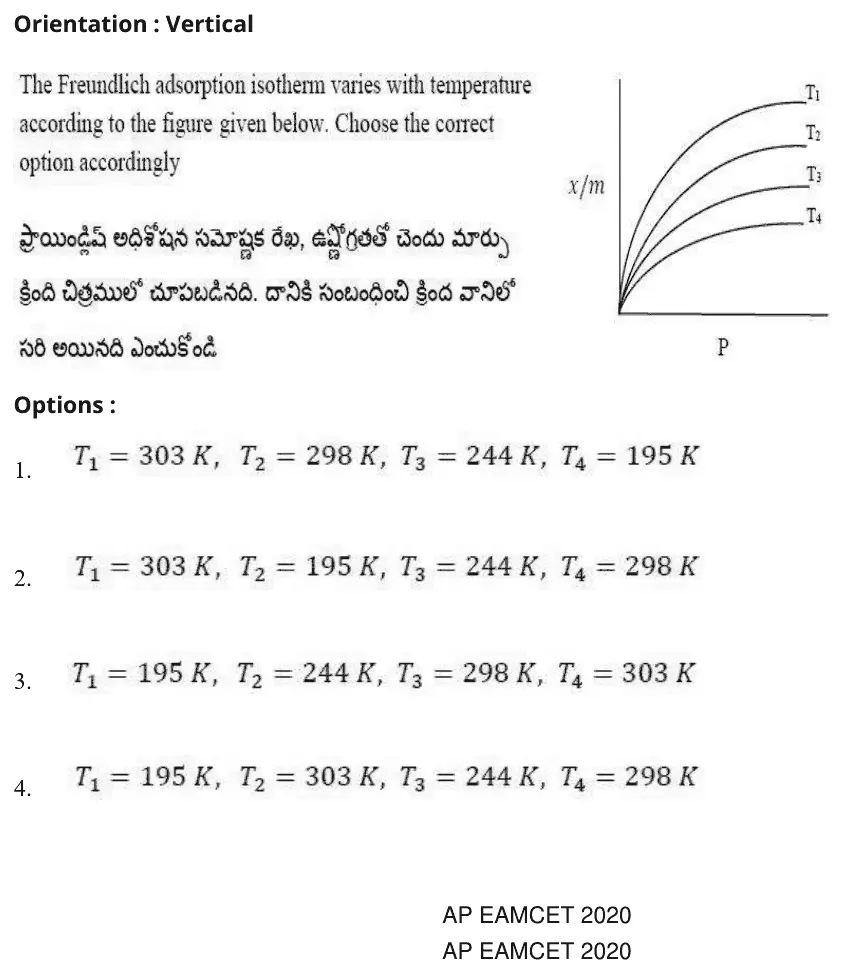
$T_1 = 303\ K,\ T_2 = 298\ K,\ T_3 = 244\ K,\ T_4 = 195\ K$
$T_1 = 303\ K,\ T_2 = 195\ K,\ T_3 = 244\ K,\ T_4 = 298\ K$
$T_1 = 195\ K,\ T_2 = 244\ K,\ T_3 = 298\ K,\ T_4 = 303\ K$
$T_1 = 195\ K,\ T_2 = 303\ K,\ T_3 = 244\ K,\ T_4 = 298\ K$
The charge on colloidal particles is due to ______
Presence of electrolyte
Very small size of particles
Adsorption of ions from the solution
Can't be determined
A charcoal cube having side length 10 cm is chopped lengthwise into 5 equal pieces. Then, the effective adsorption power ______
Increases by 2.33 times
decreases by 2.33 times
Increases by 2.14 times
decreases by 2.14 times
Which of the following is not a characteristic of chemisorption?
Adsorption is highly specific
Heat of adsorption is around 400 $kJ.mol^{-1}$
The process is irreversible
It forms multimolecular layer
An example for hydrophobic sol among the following is ___________
Gum solution
Arsenic sulphide solution
Starch solution
Protein solution
In a plot of $\log\left(\frac{x}{m}\right)$ vs $\log p$ , for the adsorption of a gas on solid, a straight line is obtained. The slope of that straight line is ______
$\frac{1}{n}$
$K$
$n$
$\log K$
The charge of "$\mathrm{SnO_2}$-sol" in alkaline and acidic medium are respectively
(Hint: $\mathrm{SnO_2}$ is amphoteric oxide)
Positive and Positive
Negative and Negative
Positive and Negative
Negative and Positive
Which of the followings is true for spontaneous adsorption?
$\Delta G > 0,\ \Delta S > 0,\ \Delta H < 0$
$\Delta G > 0,\ \Delta S > 0,\ \Delta H > 0$
$\Delta G < 0,\ \Delta S < 0,\ \Delta H < 0$
$\Delta G < 0,\ \Delta S > 0,\ \Delta H < 0$
To resist the coagulation of 100 cc gold-sol; 1 cc of 10 % NaCl is added to it in the presence of $10^{-4}$ g gelatin. The gold number of gelatin is
0.00001
0.0001
0.001
0.01
The gold numbers of gelatin, haemoglobin and sodium acetate are $5\times10^{-3}$, $5\times10^{-2}$ and $7\times10^{-1}$, respectively. The protective actions will be in the order
Gelatin < haemoglobin < sodium acetate
Gelatin > haemoglobin > sodium acetate
Haemoglobin > gelatin > sodium acetate
Sodium acetate > gelatin > haemoglobin
Which of the following statements is correct for chemisorption?
Chemisorption is reversible
Multilayer adsorption takes place
Adsorption increases with temperature
The heat of adsorption is generally less than 40 kJ $\mathrm{mol^{-1}}$
In an adsorption experiment, a graph between $\log(x/m)$ vs $\log P$ was found to be linear with a slope of $45^\circ$. The intercept on the $\log(x/m)$ axis was found to be 0.3. The amount of the gas adsorbed per gram of charcoal under a pressure of 1 atm is
1
2
3
4
Which of the following reaction is auto catalytic?
$\mathrm{C_6H_5COCl + C_6H_6 \xrightarrow{AlCl_3} C_6H_5COC_6H_5 + HCl + AlCl_3}$
$\mathrm{4NH_3 + 5O_2 \xrightarrow{pt} 4NO + 6H_2O}$
$\mathrm{CH_2{=}CH_2 + H_2 \xrightarrow{[RhCl(PPh_3)_3]} CH_3-CH_3}$
$\mathrm{5C_2O_4^{2-} + 2MnO_4^{-} + 16H^+ \rightarrow 10CO_2 + 2Mn^{2+} + 8H_2O}$
Which of the following statements is/are not correct?
A) Adsorption is accompanied by decrease in enthalpy as well as decrease in entropy of the system.
B) Gases which can react strongly with adsorbent show chemisorption.
C) When the value of the slope of the Freundlich isotherm is non-zero, adsorption is independent of pressure.
D) Gold number of potato starch is 0.15.
A, D
B, C
A, C
C, D
Identify the correct statements from the following.
a. A closed vessel containing 90% $\mathrm{CO_2}$ and 10% $\mathrm{O_2}$ is an aerosol.
b. Milk is an emulsion.
c. Smoke is an aerosol.
d. Peptisation is a method of purification of colloidal solution.
e. Ultrafilteration is a method of purification of colloidal solution.
a, b, c
a, c, d
b, c, e
a, b, e
The most effective coagulating agent among the following for $\mathrm{Sb_2S_3}$ sol is
$\mathrm{Na_2SO_4}$
$\mathrm{Al_2(SO_4)_3}$
$\mathrm{NH_4Cl}$
NaCl
Which one of the following is used as an eye lotion?
milk of magnesia
silver sol
colloidal antimony
chromium salt sol
The mass of Haemoglobin in mg required to protect from coagulation of 50 mL of a gold sol on adding 5 mL of 10% NaCl solution is: (gold number of Haemoglobin = 0.03)
0.03
0.75
0.30
0.15
Which one of the following statements is not correct?
The process of settling down of colloidal particles is coagulation
The mass in milligrams of lyophilic sol which protects the coagulation of 10 mL of a gold sol on adding 1mL of 10 % NaCl solution is its gold number
The layer of positive or negative charge acquired by selective adsorption of ion on the surface of a colloidal particle is electrokinetic potential
The potential difference between the fixed layer on the colloidal particles and the diffused layer of opposite charge is zeta potential
What is X in the following reaction?
$\mathrm{CO + 2H_2 \xrightarrow{X} CH_3OH}$
$623\mathrm{K}/300\mathrm{atm}$
$\mathrm{KMnO_4/H^{\oplus}}$
$\mathrm{Zn/\Delta}$
$\mathrm{ZnO{-}Cr_2O_3}$, $200\text{-}300\ \mathrm{atm}$, $573\text{-}673\ \mathrm{K}$
300 mL of gold sol is mixed with 30 mL of 10% NaCl solution. The mass of Haemoglobin in mg required to protect the gold sol from coagulation is (gold number of Haemoglobin is 0.03)
0.3
0.09
0.03
0.9
Which one of the following statements is correct for adsorption of solutes on solids in solutions?
The extent of adsorption increases with an increase in temperature.
The extent of adsorption decreases with an increase of surface area of the adsorbate.
The extent of adsorption decreases with an increase in temperature.
The extent of adsorption does not depend on the amount of the solute in solution.
$\mathrm{H_2C=CH_2 + O_2 \xrightarrow{aqueous\ medium} CH_3CHO}$
What is the catalyst used in the above green reaction?
Pd (II)
Pt
ZnO
Rh
Match the following.
List - I (Reaction)
A) $\mathrm{N_2(g)+3H_2(g)\longrightarrow 2NH_3(g)}$
B) $\mathrm{2H_2(g)+O_2(g)\longrightarrow 2H_2O(l)}$
C) $\mathrm{CO(g)+3H_2(g)\longrightarrow CH_4(g)+H_2O(g)}$
D) $\mathrm{CO(g)+2H_2(g)\longrightarrow CH_3OH(g)}$
List - II (Catalyst)
I) Ni
II) Pt
III) $\mathrm{ZnO-Cr_2O_3}$
IV) Fe
The correct answer is
A-III, B-II, C-I, D-IV
A-IV, B-III, C-II, D-I
A-IV, B-II, C-I, D-III
A-IV, B-I, C-III, D-II
Identify the correct statements from the following.
I) Sulphur sol is an example of a multimolecular colloid.
II) Tyndall effect is observed when the diameter of the dispersed particles is not much smaller than the wavelength of the light used.
III) The process of removing a dissolved substance from a colloidal solution by means of diffusion through a suitable membrane is called peptization.
IV) Eosin, gelatin are examples of negatively charged sols.
I, II, III
I, II, IV
I, III, IV
II, III, IV
Which of the following statements is not correct?
Both physical and chemical adsorptions are exothermic
Physical adsorption takes place with decrease of free energy whereas chemical adsorption occurs with increase of free energy
Physical adsorption requires low activation energy but chemical adsorption requires high activation energy
The magnitude of chemical adsorption increases and that of physical adsorption decreases with rise in temperature
In the Freundlich isotherm ($\frac{x}{m} = k\,\mathrm{P}^{1/n}$) plot of $\log\frac{x}{m}$ vs $\log p$, the intercept is (where $x$, $m$, $p$ and $k$ are mass of the gas, mass of adsorbent, pressure and constant which depend on the nature of the adsorbent, respectively)
k
log k
$\mathrm{e^k}$
$\ln\frac{1}{k}$
If the value of $\dfrac{1}{n}$ is equal to 1 in Freundlich adsorption isotherm, then $\dfrac{x}{m} =$
($x$ = mass of adsorbate, $m$ = mass of the absorbent, P = pressure of the gas)
$\dfrac{k}{P}$
$kP$
$k$
0
Fog is a dispersion of
liquid in liquid
solid in gas
gas in solid
liquid in gas
The following graph is obtained for physisorption of a gas as a function of pressure at different temperatures.
(see the figure above)
The correct order of temperatures is
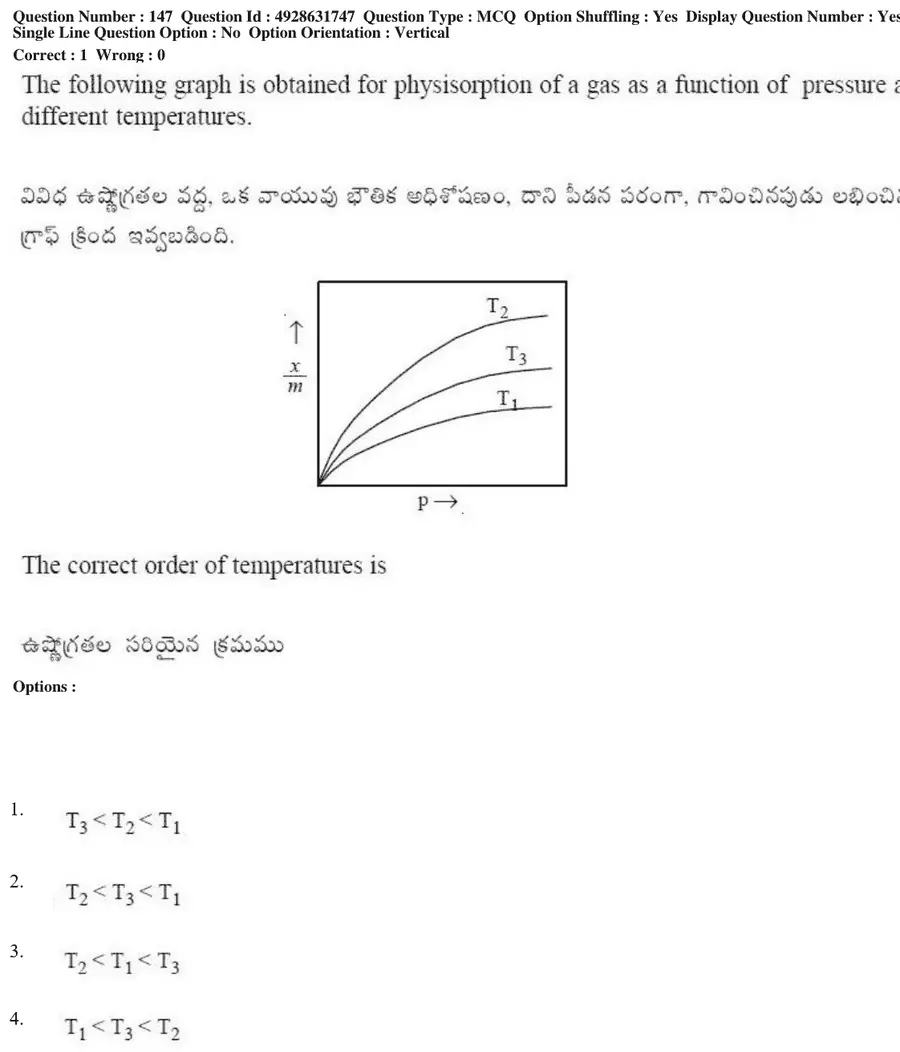
$\mathrm{T_3 < T_2 < T_1}$
$\mathrm{T_2 < T_3 < T_1}$
$\mathrm{T_2 < T_1 < T_3}$
$\mathrm{T_1 < T_3 < T_2}$
Identify the correct statements from the following
a) In the oxidation of oxalic acid with $\mathrm{KMnO_4}$ in acid medium, $\mathrm{Mn^{2+}}$ acts as auto catalyst
b) CdS colloidal solution can be precipitated by the addition of $\mathrm{Cl^-}$ ions
c) The gold numbers of three protective colloids (A, B, C) is 0.03, 25 and 0.25 respectively. Their protective power follows the order A > C > B
d) Physisorption is an irreversible process
a, d
b, c
a, c
a, b, c
Which one of the following is present in gas mask?
Silica gel
$\mathrm{V_2O_5}$
Activated charcoal
Fluorescein
Which one of the following statements is correct ?
The difference in the initial and final concentrations of the adsorbate gives the value of '$x$' in Freundlich equation ($x$ = mass of adsorbate)
The mass of adsorbent gives the value of '$n$' in Freundlich equation
Chemisorption decreases with increase of surface area of the adsorbent
Enthalpy of adsorption is $20\ \mathrm{kJ\,mol^{-1}}$ in chemisorption
Freundlich adsorption isotherms for the physical adsorption of a gas at temperature $\mathrm{T_1}$, $\mathrm{T_2}$ and $\mathrm{T_3}$ are shown in the graph given below. The correct relationship between $\mathrm{T_1}$, $\mathrm{T_2}$ and $\mathrm{T_3}$ is
(see the figure above)
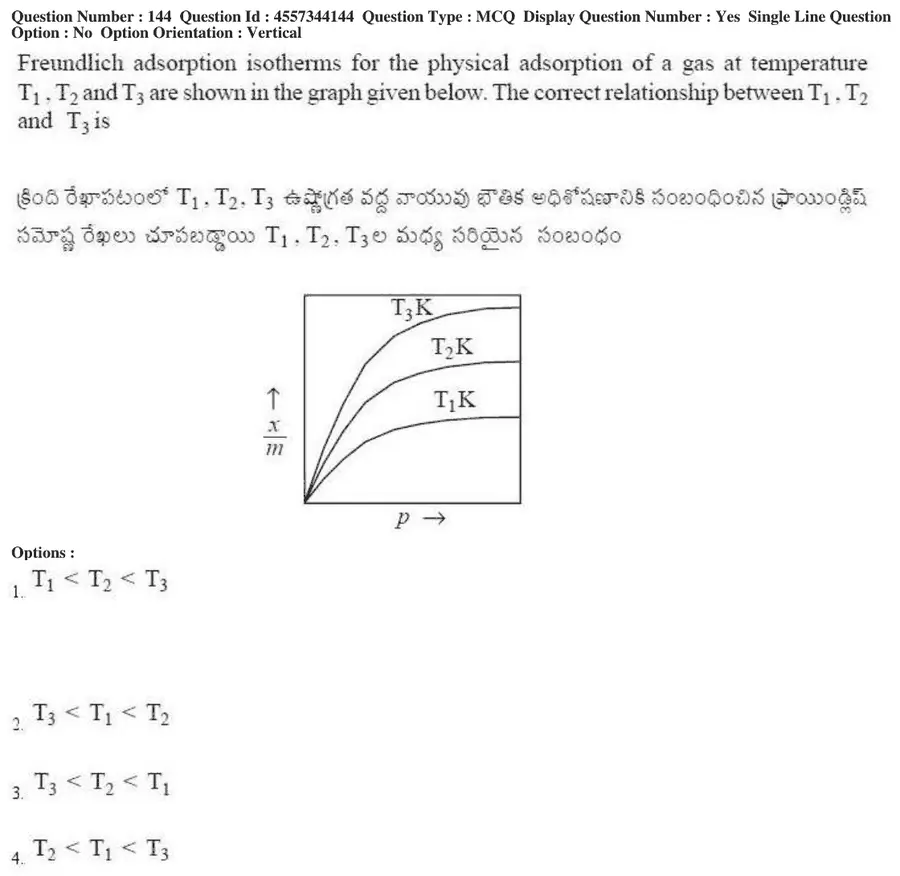
$\mathrm{T_1} < \mathrm{T_2} < \mathrm{T_3}$
$\mathrm{T_3} < \mathrm{T_1} < \mathrm{T_2}$
$\mathrm{T_3} < \mathrm{T_2} < \mathrm{T_1}$
$\mathrm{T_2} < \mathrm{T_1} < \mathrm{T_3}$
In which one of the following processes the reactants and catalyst exist in three different states?
Haber's process
Ostwald's process
Hydrogenation of Vegetable oil
Contact process
Which one of the following statements is not correct?
A mixture of dinitrogen and dioxygen at room temperature is an example for aerosol
Lyophilic sols are more stable compared to lyophobic sols
Formation of micelles is possible only above Kraft temperature
An example for a soap is sodium stearate and an example for detergent is sodium lauryl sulphate
The temperature above which, formation of micelles takes place is called
Boyle's temperature
Kraft temperature
Critical temperature
Inversion temperature
Which of the following is true for spontaneous adsorption of $\mathrm{H_2}$ gas without dissociation on solid surface
Process is exothermic and $\Delta S < 0$
Process is endothermic and $\Delta S > 0$
Process is exothermic and $\Delta S > 0$
Process is endothermic and $\Delta S < 0$
Colloidal solution of gold is in different colours like red, purple, blue and golden because of
Size difference in the particles of gold
Variable oxidation states of gold
Presence of impurities
Difference in the concentration of gold particles
Which one of the following is correct?
$\mathrm{As_2S_3}$ is a positively charged sol.
The refractive indices of the dispersed phase and the dispersion medium differ greatly in magnitude to observe Tyndall effect.
Ultra microscope provides information about the size and shape of colloidal particles
Finest gold sol is green in colour.
Potassium permanganate on heating gives potassium manganate, oxygen and X. For which of the following reactions, X is used as a catalyst.
$2\mathrm{KClO_3} \xrightarrow{\Delta} 2\mathrm{KCl} + 3\mathrm{O_2}$
$2\mathrm{SO_2} + \mathrm{O_2} \longrightarrow 2\mathrm{SO_3}$
$4\mathrm{HCl} + \mathrm{O_2} \longrightarrow 2\mathrm{Cl_2} + 2\mathrm{H_2O}$
$4\mathrm{NH_3} + 5\mathrm{O_2} \longrightarrow 4\mathrm{NO} + 6\mathrm{H_2O}$
Match the following:
List - I
a) Starch
b) Cane sugar
c) Zeolite
d) Maltose to glucose
List - II
i) Shape selective catalyst
ii) Maltase
iii) Diastase
iv) Invertase
v) Zymase
The correct answer is:
a-iii, b-iv, c-i, d-ii
a-iii, b-i, c-iv, d-v
a-iv, b-v, c-i, d-ii
a-ii, b-iv, c-iii, d-i
Which one of the following statements is not correct?
A mixture of noble gases can be separated by adsorption on coconut charcoal at different temperatures
Animal charcoal removes colours of impure coloured solutions by adsorption process
Adsorption of reactants on the solid surface of the catalysts increases the rate of reaction
Silica gel and alumina gel are used as adsorbents to increase moisture in air in the rooms
Identify the correct statement (s) from the following
a) Protective power of a lyophilic sol is more if its gold number is more
b) In the coagulation of negative sols, the coagulating power of cations follow the order $\mathrm{Na^{+}}>\mathrm{Ba^{2+}}>\mathrm{Al^{3+}}$
c) Cloud is a solid in gas type of colloid
d) Physical adsorption is non-specific and multilayered at high pressure.
a, c, d
a, d
d
b
The catalysts commonly used in contact process and Deacon's process are respectively
$\mathrm{V_2O_5}$, $\mathrm{Fe_2O_3}$
$\mathrm{V_2O_5}$, $\mathrm{CuCl_2}$
$\mathrm{CuCl_2}$, $\mathrm{MnO_2}$
$\mathrm{MnO_2}$, $\mathrm{Fe_2O_3}$
Which one of the following statements is not correct ?
The adsorption is independent of pressure when $\dfrac{1}{n} = 0$ in Freundlich adsorption isotherm equation.
The adsorption varies directly with pressure when $\dfrac{1}{n} = 1$ in Freundlich adsorption isotherm equation.
The extent of adsorption increases with increase in temperature.
The extent of adsorption depends on the nature of adsorbent and adsorbate.
Which one of the following is an emulsion ?
Milk
Soap lather
Butter
Vanishing Cream
Which is <u>not</u> the correct statement in respect of chemisorption?
Highly specific adsorption
Irreversible adsorption
Multilayered adsorption
High enthalpy of adsorption
Assertion (A) : van der Waals' forces are responsible for chemisorption.
Reason (R) : High temperature is favourable for chemisorption.
The correct answer is
(A) is not correct but (R) is correct
(A) and (R) are correct and (R) is the correct explanation of (A)
(A) and (R) are correct but (R) is not the correct explanation of (A)
(A) is correct but (R) is not correct
Match the following :
List-I
A) Solid dispersed in liquid
B) Liquid dispersed in liquid
C) Gas dispersed in liquid
D) Liquid dispersed in solid
List-II
I) Emulsion
II) Foam
III) Gel
IV) Sol
V) Aerosol
The correct match is :
A-IV, B-I, C-II, D-III
A-III, B-I, C-V, D-II
A-III, B-I, C-II, D-IV
A-IV, B-I, C-V, D-III
The catalyst and promoter respectively used in the Haber's process of industrial synthesis of ammonia are
Mo, $\mathrm{V_2O_5}$
$\mathrm{V_2O_5}$, Fe
Fe, Mo
Mo, Fe
Gelly is a colloidal solution of
Solid in liquid
Liquid in solid
Liquid in liquid
Solid in solid
According to Langmuir adsorption isotherm, the amount of gas adsorbed by unit surface area is :
($a$, $b$, $k$ and $n$ are constants; P = pressure of gas)
$k.\mathrm{P}^n$
$\frac{1 + b\mathrm{P}}{a\mathrm{P}}$
$k\mathrm{P}^{1/n}$
$\frac{a\mathrm{P}}{1 + b\mathrm{P}}$
A micelle formed during the cleansing action by soap is :
A discrete particle of soap
Aggregated particles of soap and dirt
A discrete particle of dust
An aggregated particle of dust and water
Surface Chemistry sits at position 10 among the 31 chemistry chapters in the modern 2022 to 2026 timeframe. Across our complete repository of entrance papers from 2010 through 2026, the chapter delivered 191 questions across 149 papers, appearing in 141 of those tests to record a 3.2 percent subject share with an overall rate of 1.3 questions per paper. In the recent five-year period from 2022 to 2026, it gathered 114 questions across 77 sittings, being present in 74 papers to maintain 1.5 questions per paper and a 3.7 percent share.
The chapter has appeared in every exam year since 2022, though it was absent from three papers across that five-year window. Looking at state-specific trends from 2022 to 2026, AP tests carried 86 questions across 48 papers (appearing in all 48 papers, 1.8 questions per paper, 4.5 percent share), while TS papers contributed 28 questions across 29 papers (appearing in 26 papers, 1.0 question per paper, 2.4 percent share).
During the earlier historical interval from 2010 through 2021, papers featured 77 questions across 72 sittings (appearing in 67 tests), corresponding to 1.1 questions per paper and a 2.7 percent subject share. Across the most recent three exam cycles from 2024 to 2026, question setters included 69 questions across 46 sittings (with 43 papers containing questions), generating 1.5 questions per test and 3.8 percent share. In terms of long-term trajectory, comparing early testing with the last three years shows the share is up, while comparing the recent five-year window with the last three years shows the share is about the same.
Questions in this branch focus on interfacial phenomena and dispersion systems:
Examiners place heavy emphasis on matching lists, graphical interpretations, and classification rules. A typical adsorption question presents a linear plot of log x by m against log P from the Freundlich isotherm and asks you to extract constants k and one over n from the intercept and slope, or to rank operating temperatures based on isotherm heights.
Colloid questions frequently test the Hardy-Schulze rule by asking which electrolyte exhibits the lowest flocculation value (highest coagulating power) for a negatively charged arsenious sulphide sol or a positively charged ferric hydroxide sol. Other standard formats involve calculating the gold number of a protective lyophilic colloid or selecting the odd compound out from a list of aerosols, gels, foams, and emulsions.
Work through these recent official questions to test your grasp on interfacial rules:
Thoroughly review NCERT tables covering types of colloidal systems by physical states of dispersed phase and dispersion medium. Be prepared to identify examples of sols, gels, solid sols, emulsions, and foams without hesitation.
Master the differences between physisorption and chemisorption: physisorption involves weak van der Waals forces, low enthalpy of adsorption, lacks specificity, forms multimolecular layers, and decreases continuously with temperature. Chemisorption involves chemical bond formation, high enthalpy, is highly specific, forms a unimolecular layer, and first increases with temperature before decreasing due to an activation energy requirement. Learn the Hardy-Schulze rule stating that coagulating power increases sharply with the valency of the active oppositely charged ion.
The gold number is defined as the minimum mass in milligrams of a protective lyophilic colloid needed to prevent the coagulation of ten millilitres of a standard gold sol upon adding one millilitre of ten percent sodium chloride solution. A smaller gold number indicates higher protective effectiveness.
Gases with higher critical temperatures, such as sulphur dioxide, ammonia, and carbon dioxide, possess stronger intermolecular attractive forces and liquefy more easily. Because physical adsorption is closely related to liquefaction, easily liquefiable gases adsorb in greater volumes on solid surfaces like activated charcoal.
The Freundlich equation states that x divided by m equals k times P to the power of one over n. At low pressures, one over n approaches one, making adsorption directly proportional to pressure. At intermediate pressures, one over n lies between zero and one. At high pressures, the adsorbent surface approaches saturation, causing one over n to become zero and adsorption to become independent of pressure. Step-by-step solutions for each one are in the EdLoop EAPCET app.