EdLoop PYQs · free, no ads · questions and answers here, step-by-step solutions in the EdLoop app
PYQs · free, no adsOpen on the web (app.edloop.in)Get EdLoop – free on Google Play
ChemistryChemical Thermodynamics

Chemical Thermodynamics: AP & TS EAPCET PYQs 2010–2026

Every Chemical Thermodynamics question from past AP EAPCET and TS EAPCET papers, with options and answers. Newest first.

220questions
145papers covered
4.1%of Chemistry questions, 2022–2026
2010–2026years

Guide at a glance

Chemical Thermodynamics ranks at position 8 among all 31 chemistry chapters in the 2022 to 2026 examination span.

Most asked sub-topics

First Law & Enthalpy89
Entropy & Gibbs Energy72
Thermochemistry59

Practise these in EdLoop

Attempt every Chemical Thermodynamics question timed, see the step-by-step solution and track what you get wrong. Free.

Start practice

All questions

220 questions
1AP EAPCET 2026 · 18 May · Shift 1MCQOpen question page ↗

At 298 $K$, the value of $(\Delta H - \Delta U)$ for the combustion of 1 mole $\mathrm{C_4H_{10}}$ $(g)$ is $x$ $kJ$ and for the combustion of 1 mole glucose, the value of $(\Delta H - \Delta U)$ is $y$ $kJ$. The value of $(x - y)$ (in kJ) is

($R = 8.3\ J\ K^{-1}\ mol^{-1}$)

  • A

    $+8.657$

  • B

    $-8.657$

  • C

    $-9.659$

  • D

    $+4.329$

2AP EAPCET 2026 · 18 May · Shift 1MCQOpen question page ↗

At $298\ K$ for the reaction $N_2(g) + 3H_2(g) \rightleftharpoons 2NH_3(g)$, $\Delta H = -92.4\ kJ$, $\log K_C$ value is $5.75$. What is the entropy change (in $J\ K^{-1}$) for this reaction at the same temperature?

($R = 8.3\ J\ K^{-1}\ mol^{-1}$)

  • A

    $-300$

  • B

    $-400$

  • C

    $-200$

  • D

    $-100$

3AP EAPCET 2026 · 18 May · Shift 2MCQOpen question page ↗

At constant temperature, one mole of an ideal gas of volume 2L was expanded to 100 L against an external pressure of 1 atm under reversible conditions. What is the change in internal energy?
(1 L atm = 101.3 J; log 5 = 0.7)

  • A

    Zero

  • B

    793.2 J

  • C

    3266 J

  • D

    326.6 J

4AP EAPCET 2026 · 18 May · Shift 2MCQOpen question page ↗

What is the enthalpy change (in $J\ mol^{-1}$) for the conversion of 1 mole of $\mathrm{H_2O}$ $(l)$ at 10 °C to 1 mole of $\mathrm{H_2O}$ $(s)$ at $-10$ °C?

(At 0 °C, $\mathrm{H_2O}$ $(s) + x\ kJ\ mol^{-1} \rightarrow \mathrm{H_2O}$ $(l)$ ;

$C_p(\mathrm{H_2O}\ (l)) = y\ J\ mol^{-1}K^{-1}$

$C_p(\mathrm{H_2O}\ (s)) = z\ J\ mol^{-1}K^{-1}$)

  • A

    $-(1000x + 10y + 10z)$

  • B

    $-(x + y + z)$

  • C

    $-(1000x + y - z)$

  • D

    $-(1000x - y + z)$

5AP EAPCET 2026 · 15 May · Shift 1MCQOpen question page ↗

At constant temperature, one mole of an ideal gas of volume 2L expanded to 100 L against an external pressure of 1 atm under reversible conditions. What is the work done (in J)?
(1 L atm = 101.3 J; log 5 = 0.7)

  • A

    $-163.3$

  • B

    $-793.2$

  • C

    $+793.2$

  • D

    $+326.6$

6AP EAPCET 2026 · 15 May · Shift 1MCQOpen question page ↗

At T(K), in a reaction $\mathrm{A(g) \rightarrow B(g) + C(g)}$ , $x$ J of heat was absorbed and $y$ J of work is done by the system. What is $\Delta_r H$ (in J) for the reaction?
(R = gas constant)

  • A

    $(x + y + RT)$

  • B

    $(x - y + RT)$

  • C

    $(x + y + 2RT)$

  • D

    $(x - y + 2RT)$

7AP EAPCET 2026 · 15 May · Shift 2MCQOpen question page ↗

At 27°C, 1.6 $g$ of $O_2$ exerting a pressure of 5 $atm$ is allowed to expand isothermally against a constant pressure of 1 $atm$. What is the work done (in J)?
$(1\ L - atm = 100J, R = 0.082\ L\ atm\ K^{-1}mol^{-1})$

  • A

    $-49.2$

  • B

    $-98.4$

  • C

    $+98.4$

  • D

    $+49.2$

8AP EAPCET 2026 · 15 May · Shift 2MCQOpen question page ↗

For the reaction, $2\mathrm{Al_2O_3}(s) \rightarrow 4\mathrm{Al}(s) + 3\mathrm{O_2}(g), \Delta H = 3340$ kJ.
What is the enthalpy of formation of $\mathrm{Al_2O_3}(s)$ (in kJ)?

  • A

    $+1670$

  • B

    $-3340$

  • C

    $+3340$

  • D

    $-1670$

9AP EAPCET 2026 · 14 May · Shift 1MCQOpen question page ↗

Combustion of methane gives $\mathrm{CO_2}(g)$ and $\mathrm{H_2O}(l)$. What is enthalpy of combustion ($\Delta_c H^\ominus$ in $kJ\ mol^{-1}$) of $\mathrm{CH_4}(g)$ at 298 K?

($\Delta_f H^\ominus(\mathrm{CH_4}(g)) = -x\ kJ\ mol^{-1}$; $\Delta_f H^\ominus(\mathrm{CO_2}(g)) = -y\ kJ\ mol^{-1}$; $\Delta_f H^\ominus(\mathrm{H_2O}(l)) = -z\ kJ\ mol^{-1}$)

  • A

    $-(y + 2z - x)$

  • B

    $(2z - y + x)$

  • C

    $(2z + x - y)$

  • D

    $-(2y + z + x)$

10AP EAPCET 2026 · 14 May · Shift 1MCQOpen question page ↗

Identify the correct statements from the following

I. Bomb calorimeter is used to determine the heat absorbed by water in a chemical reaction at constant volume

II. Heat capacity is an extensive property

III. The units of entropy are J K

The correct answer is

  • A

    I, II, III

  • B

    I, II only

  • C

    I, III only

  • D

    II, III only

11AP EAPCET 2026 · 14 May · Shift 2MCQOpen question page ↗

Identify the set with only extensive properties

  • A

    Temperature, Pressure, Number of moles

  • B

    Heat capacity, Enthalpy, Entropy

  • C

    Pressure, Specific heat, Molar heat capacity

  • D

    Density, Mole fraction, viscosity

12AP EAPCET 2026 · 14 May · Shift 2MCQOpen question page ↗

Match the following

List – IList - II
$\Delta_r H^\circ$$\Delta_r S^\circ$$\Delta_r G^\circ$Description about the reaction
A.+−+I. Non spontaneous at low temperature
B.−−−II. Spontaneous at high temperature
C.+++III. Non spontaneous at all temperatures
D.++−IV. Spontaneous at low temperature
  • A

    A-III, B-IV, C-II, D-I

  • B

    A-III, B-IV, C-I, D-II

  • C

    A-IV, B-III, C-II, D-I

  • D

    A-II, B-IV, C-I, D-III

13AP EAPCET 2026 · 13 May · Shift 1MCQOpen question page ↗

At T(K), enthalpy of combustion of $\mathrm{C(s)}$, $\mathrm{H_2(g)}$ and $\mathrm{CH_4(g)}$ are -393.5, -286, -890 $\mathrm{kJ\ mol^{-1}}$ respectively. What is the enthalpy of formation of methane (in $\mathrm{kJ\ mol^{-1}}$)?

  • A

    54.6

  • B

    -75.5

  • C

    99.7

  • D

    89.6

14AP EAPCET 2026 · 13 May · Shift 1MCQOpen question page ↗

At 300 K, 1 mole of an ideal gas is allowed to expand isothermally and reversibly from a pressure of 20 atm to 2 atm. The work done (in $\mathrm{kJ\ mol^{-1}}$) in the process is
($\mathrm{R = 8.3\ J\ K^{-1}\ mol^{-1}}$)

  • A

    -57.34

  • B

    +5.734

  • C

    -5.734

  • D

    +57.34

15AP EAPCET 2026 · 13 May · Shift 2MCQOpen question page ↗

At $27^\circ\mathrm{C}$, 10 g of argon (at. wt = 40 u) is compressed isothermally and reversibly from 50 L to 5 L. What is $q$ for this process?
(Assume Ar as an ideal gas) (R = 8.3 $JK^{-1}mol^{-1}$)

  • A

    $+1.433$ $kJ$

  • B

    $-1.433$ $kJ$

  • C

    $-2.866$ $kJ$

  • D

    $+2.866$ $kJ$

16AP EAPCET 2026 · 13 May · Shift 2MCQOpen question page ↗

At 298 K for the reaction,
$N_2(g) + 3H_2(g) \rightleftharpoons 2NH_3(g)$, enthalpy and entropy changes are $-92.4\ kJ$ and $-200\ J\ K^{-1}$ respectively. The value of $\log K_c$ for the reaction is
(R = 8.3 $J\ K^{-1}\ mol^{-1}$)

  • A

    5.75

  • B

    6.75

  • C

    7.65

  • D

    5.67

17AP EAPCET 2026 · 12 May · Shift 1MCQOpen question page ↗

The $\Delta_f H^{\ominus}$ of $\mathrm{AO(g)}$, $\mathrm{AO_2(g)}$, $\mathrm{B_2O(g)}$ and $\mathrm{B_2O_4(g)}$ is respectively $-110, -393, +81$ and $+9.7$ kJ mol$^{-1}$. What is $\Delta_r H^{\ominus}$ (in kJ mol$^{-1}$) of the following reaction at 298 K?

$$\mathrm{B_2O_4(g) + 3\ AO(g) \rightarrow B_2O(g) + 3\ AO_2(g)}$$

  • A

    $-777.7$

  • B

    $-1179$

  • C

    $+777.7$

  • D

    $+1179$

18AP EAPCET 2026 · 12 May · Shift 1MCQOpen question page ↗

What is $\Delta_r G^{\ominus}$ for the following reaction at 298 K?

$2\,\mathrm{X(g)} + \mathrm{Y(g)} \rightarrow 2\,\mathrm{Z(g)}$

($\Delta U^{\ominus} = -10.5$ kJ; $\Delta S^{\ominus} = -44\ \mathrm{JK^{-1}}$; $R = 8.3\ \mathrm{J\,K^{-1}mol^{-1}}$)

  • A

    12973 J

  • B

    13112 J

  • C

    139.0 J

  • D

    0.1390 J

19AP EAPCET 2026 · 12 May · Shift 2MCQOpen question page ↗

Consider the following reaction

$\mathrm{A_2B_4(g) \longrightarrow 2AB_2(g)}$

At 300 K, $\Delta_r H$ for this reaction is $-x$ kJ mol$^{-1}$. What is its $\Delta_r U$ (in kJ mol$^{-1}$) at the same temperature? (R = 8.3 J mol$^{-1}$ K$^{-1}$)

  • A

    $-(x + 2490)$

  • B

    $(x + 2490)$

  • C

    $-(x + 2.49)$

  • D

    $(x + 2.49)$

20AP EAPCET 2026 · 12 May · Shift 2MCQOpen question page ↗

At 17°C, the enthalpy change and entropy change of the reaction given below are respectively $-12.55\ kJ\ mol^{-1}$ and $5.0\ JK^{-1}$

$$Zn(s) + 2HCl(aq) \rightarrow ZnCl_2(aq) + H_2(g)$$

What is $\Delta G$ (in $kJ\ mol^{-1}$) for this reaction?

  • A

    $-14$

  • B

    $+14$

  • C

    $-28$

  • D

    $+56$

21TS EAPCET 2026 · 11 May · Shift 1MCQOpen question page ↗

Identify the sets which contain either only extensive properties or only intensive properties

I. Density, specific heat, surface tension

II. Mole fraction, Internal energy, viscosity

III. Molality, pressure, Entropy

IV. Number of moles, Enthalpy, Heat capacity

  • A

    I, IV only

  • B

    I, II only

  • C

    II, III only

  • D

    II, IV only

22TS EAPCET 2026 · 11 May · Shift 2MCQOpen question page ↗

What is the enthalpy change (in $\mathrm{kJ\,mol^{-1}}$) for the following reaction?

$\mathrm{CH_4(g) \rightarrow C(g) + 4H(g)}$

Given: $(\Delta_f H^{\ominus}(\mathrm{CH_4}) = -74.8\ \mathrm{kJ\,mol^{-1}}$ ; $\mathrm{H_2(g) \rightarrow 2H(g)}$ ; $\Delta_a H^{\ominus} = 435\ \mathrm{kJ\,mol^{-1}}$ ; $\mathrm{C(s) \rightarrow C(g)}$ ; $\Delta_a H^{\ominus} = 716.7\ \mathrm{kJ\,mol^{-1}}$)

  • A

    396.67

  • B

    1586.7

  • C

    1661.5

  • D

    415.37

23TS EAPCET 2026 · 10 May · Shift 1MCQOpen question page ↗

At 300K, enthalpies of formation of $\mathrm{C_6H_5COOH}$ (s), $\mathrm{CO_2}$ (g) and $\mathrm{H_2O}$ ($l$) are $-409$, $-393$ and $-286$ $\mathrm{kJ\,mol^{-1}}$ respectively. Enthalpy of combustion of benzoic acid (in $\mathrm{kJ\,mol^{-1}}$) is

  • A

    $-1600$

  • B

    $+1600$

  • C

    $-3200$

  • D

    $+4800$

24TS EAPCET 2026 · 10 May · Shift 2MCQOpen question page ↗

$\Delta \mathrm{H}$ and $\Delta \mathrm{S}$ for the reaction, $\mathrm{2A+B \rightarrow C}$ at 298 K are 400 kJ mol$^{-1}$ and 2 kJ K$^{-1}$mol$^{-1}$ respectively. At or above T(K), the reaction becomes spontaneous. What is T(K) ?
(Assume $\Delta \mathrm{H}$ and $\Delta \mathrm{S}$ are constant over the temperature range)

  • A

    100

  • B

    200

  • C

    150

  • D

    125

25TS EAPCET 2026 · 9 May · Shift 1MCQOpen question page ↗

In which of the following reactions $\Delta S$ (entropy change) is positive?

(s = solid, $l$ = liquid, g = gas)

  • A

    $\mathrm{H_2O}(l) \rightarrow \mathrm{H_2O(s)}$

  • B

    $\mathrm{3O_2(g) \rightarrow 2O_3(g)}$

  • C

    $\mathrm{H_2O}\,(l) \rightarrow \mathrm{H_2O\,(g)}$

  • D

    $\mathrm{N_2(g) + 3H_2(g) \rightarrow 2NH_3(g)}$

26TS EAPCET 2026 · 9 May · Shift 2MCQOpen question page ↗

The $\Delta_f H^{\ominus}$ of $\mathrm{BaCO_3}$ (s), $\mathrm{BaO}$ (s) and $\mathrm{CO_2}$ (g) is respectively $-1216.3$, $-553.5$ and $-393.5$ kJ mol$^{-1}$. What is the value of $x$ (in kJ mol$^{-1}$) in the following reaction?

$$\mathrm{BaCO_3(s)} \xrightarrow{\Delta} \mathrm{BaO(s)} + \mathrm{CO_2(g)} - x$$

  • A

    $-269.3$

  • B

    $269.3$

  • C

    $2163$

  • D

    $-2163$

27AP EAPCET 2025 · 27 May · Shift 1MCQOpen question page ↗

5 moles of a gas is allowed to pass through a series of changes as shown in the graph, in a cyclic process. The processes $C \to A, B \to C$ and $A \to B$ respectively are

(Volume = ఘనపరిమాణం; Temperature = ఉష్ణోగ్రత)

(see the figure above)

The question and its figure as printed in AP EAPCET 2025 27th May 2025 Shift 1.
The question as printed in the paper.
  • A

    Isothermal, Isochoric, Isobaric

  • B

    Isochoric, Isobaric, Isothermal

  • C

    Isobaric, Isochoric, Isothermal

  • D

    Isothermal, Isobaric, Isochoric

28AP EAPCET 2025 · 27 May · Shift 1MCQOpen question page ↗

1 mole of an ideal gas is allowed to expand isothermally and reversibly from 1L to 5L at 300 K. The change in enthalpy (in kJ) is ($\mathrm{R = 8.3\ J\ K^{-1}\ mol^{-1}}$)

  • A

    1.74

  • B

    2.48

  • C

    0.0

  • D

    4.22

29AP EAPCET 2025 · 26 May · Shift 1MCQOpen question page ↗

Consider the following.

Statement-I : Both internal energy (U) and work (w) are state functions.

Statement-II : During the free expansion of an ideal gas into vacuum, the work done is zero.

The correct answer is

  • A

    Both statement-I and statement-II are correct

  • B

    Both statement-I and statement-II are not correct

  • C

    Statement-I is correct, but statement-II is not correct

  • D

    Statement-I is not correct, but statement-II is correct

30AP EAPCET 2025 · 26 May · Shift 1MCQOpen question page ↗

The signs of $\Delta_r H^\circ$ and $\Delta_r S^\circ$ for a reaction to be spontaneous at all temperatures respectively are

  • A

    positive, positive

  • B

    positive, negative

  • C

    negative, negative

  • D

    negative, positive

31AP EAPCET 2025 · 26 May · Shift 2MCQOpen question page ↗

The number of extensive and intensive properties in the list given below is respectively

density, enthalpy, mass, temperature, volume, pressure

  • A

    4, 2

  • B

    1, 5

  • C

    2, 4

  • D

    3, 3

32AP EAPCET 2025 · 26 May · Shift 2MCQOpen question page ↗

One mole of ethanol $(l)$ was completely burnt in oxygen to form $\mathrm{CO_2(g)}$ and $\mathrm{H_2O}(l)$. What is the $\Delta_r\mathrm{H}^{\ominus}$ (in $\mathrm{kJ\ mol^{-1}}$) for this reaction ?
(The standard enthalpy of formation ( $\Delta_f\mathrm{H}^{\ominus}$ ) of $\mathrm{C_2H_5OH}(l)$, $\mathrm{CO_2(g)}$ and $\mathrm{H_2O}(l)$ is respectively $-277$, $-393$ and $-286\ \mathrm{kJ\ mol^{-1}}$.)

  • A

    $+1921$

  • B

    $-1921$

  • C

    $+1367$

  • D

    $-1367$

33AP EAPCET 2025 · 24 May · Shift 1MCQOpen question page ↗

If $\Delta_r H^{\ominus}$ and $\Delta_r S^{\ominus}$ are standard enthalpy change and standard entropy change respectively for a reaction, the incorrect option is

  • A

    $\Delta_r H^{\ominus}$ = negative; $\Delta_r S^{\ominus}$ = positive; spontaneous at all temperatures

  • B

    $\Delta_r H^{\ominus}$ = negative; $\Delta_r S^{\ominus}$ = negative; non-spontaneous at low temperatures

  • C

    $\Delta_r H^{\ominus}$ = positive; $\Delta_r S^{\ominus}$ = positive; non-spontaneous at low temperatures

  • D

    $\Delta_r H^{\ominus}$ = negative; $\Delta_r S^{\ominus}$ = negative; spontaneous at low temperatures

34AP EAPCET 2025 · 24 May · Shift 1MCQOpen question page ↗

The $\mathrm{C_p}$ of $\mathrm{H_2O}(l)$ is $75.3\ \mathrm{J\ mol^{-1}\ K^{-1}}$. What is the energy (in J) required to raise 180 g of liquid water from $10^\circ\mathrm{C}$ to $15^\circ\mathrm{C}$ ? ($\mathrm{H_2O}$ = 18 u)

  • A

    3.765

  • B

    3765

  • C

    753

  • D

    376.5

35AP EAPCET 2025 · 23 May · Shift 1MCQOpen question page ↗

For which reaction $\Delta \mathrm{H} \neq \Delta \mathrm{U}$ ?

  • A

    $\mathrm{H_2(g) + I_2(g) \longrightarrow 2HI(g)}$

  • B

    $\mathrm{2NO(g) \longrightarrow N_2(g) + O_2(g)}$

  • C

    $\mathrm{N_2(g) + 3H_2(g) \longrightarrow 2NH_3(g)}$

  • D

    $\mathrm{C(s) + O_2(g) \longrightarrow CO_2(g)}$

36AP EAPCET 2025 · 23 May · Shift 1MCQOpen question page ↗

At 298 K, $\Delta_r U^{\ominus}$ and $\Delta_r S^{\ominus}$ for the following reaction are $-10.5$ kJ and $+44.1\ \mathrm{JK^{-1}}$; $\mathrm{2X(g) + Y(g) \longrightarrow 2Z(g)}$

What is $\Delta_r G^{\ominus}$ (in kJ) for this reaction ? ($\mathrm{R = 8.314\ J\ K^{-1}\ mol^{-1}}$)

  • A

    $+0.164$

  • B

    $-26.119$

  • C

    $-2.6119$

  • D

    $-0.082$

37AP EAPCET 2025 · 23 May · Shift 2MCQOpen question page ↗

Identify the incorrect statements from the following.

I. For adiabatic process, $\Delta U = w_{ad}$

II) Enthalpy is an intensive property

III) For the process, $\mathrm{H_2O}$ ($l$) $\rightarrow$ $\mathrm{H_2O}$ (s), the entropy increases

The correct answer is (only)

  • A

    I, II only

  • B

    I, II, III

  • C

    I, III only

  • D

    II, III only

38AP EAPCET 2025 · 23 May · Shift 2MCQOpen question page ↗

Enthalpy of formation of $\mathrm{CO_2(g)}$, $\mathrm{H_2O(\mathit{l})}$ and $\mathrm{C_6H_{12}O_6(s)}$ are $-393$, $-286$ and $-1170\ \mathrm{kJ\ mol^{-1}}$ respectively. The quantity of heat liberated when 18g of $\mathrm{C_6H_{12}O_6(s)}$ is burnt completely in oxygen is

  • A

    520 kJ

  • B

    145 kJ

  • C

    290 kJ

  • D

    420 kJ

39AP EAPCET 2025 · 22 May · Shift 1MCQOpen question page ↗

Identify the correct statements from the following

I) Work is a path function.

II) Enthalpy is an extensive property

III) Lattice enthalpy of ionic compounds can be obtained from Born-Haber cycle.

  • A

    I, II only

  • B

    I, III only

  • C

    II, III only

  • D

    I, II, III

40AP EAPCET 2025 · 22 May · Shift 1MCQOpen question page ↗

For which of the following processes entropy change ($\Delta S$) is negative ?

I) Sublimation of dry ice

II) Freezing of water

III) Crystallisation of the dissolved substance

IV) Burning of rocket fuel

  • A

    I & II only

  • B

    II & III only

  • C

    III & IV only

  • D

    I & IV only

41AP EAPCET 2025 · 22 May · Shift 2MCQOpen question page ↗

Consider the following reaction

$$\mathrm{A(g) + 3B(g) \longrightarrow 2C(g);\ \Delta H^{\ominus} = -24\ kJ.}$$

At $25\ ^\circ\mathrm{C}$ if $\Delta G^{\ominus}$ of the reaction is $-9$ kJ, the standard entropy change (in $\mathrm{JK^{-1}}$) of the same reaction at same temperature is

  • A

    $-5.33$

  • B

    $-50.33$

  • C

    $-500.33$

  • D

    $-0.533$

42AP EAPCET 2025 · 22 May · Shift 2MCQOpen question page ↗

One mole of $\mathrm{C_2H_5OH}(l)$ was completely burnt in oxygen to form $\mathrm{CO_2}(g)$ and $\mathrm{H_2O}(l)$. The standard enthalpy of formation ( $\Delta_f \mathrm{H}^{\ominus}$ ) of $\mathrm{C_2H_5OH}(l)$, $\mathrm{CO_2}(g)$ and $\mathrm{H_2O}(l)$ is $x$, $y$, $z$ kJ mol$^{-1}$ respectively. What is $\Delta_r \mathrm{H}^{\ominus}$ (in kJ mol$^{-1}$) for this reaction ?

  • A

    $(2y + 3z + x)$

  • B

    $(2y - 3z + x)$

  • C

    $(x - 2y - 3z)$

  • D

    $(2y + 3z - x)$

43AP EAPCET 2025 · 21 May · Shift 1MCQOpen question page ↗

At 273 K the maximum work done when pressure on 10 g of hydrogen is reduced from 10 atm to 1 atm under isothermal, reversible conditions is (Assume the gas behaves ideally) ($\mathrm{R = 8.3\ JK^{-1}\ mol^{-1}}$)

  • A

    $-52.18$ kJ

  • B

    $+26.09$ kJ

  • C

    $-26.09$ kJ

  • D

    $+52.18$ kJ

44AP EAPCET 2025 · 21 May · Shift 1MCQOpen question page ↗

At 298 K, $\Delta_r G^{\ominus}$ for the following reaction is 165.469 kJ mol$^{-1}$.

What is the equilibrium constant for this reaction ? ($\mathrm{R} = 8.3\ \mathrm{J\ mol^{-1}\ K^{-1}}$)

$$\frac{3}{2}\mathrm{O_2(g)} \longrightarrow \mathrm{O_3(g)}$$

  • A

    $10^{29}$

  • B

    $10^{-29}$

  • C

    $5\times10^{-27}$

  • D

    $5\times10^{+27}$

45AP EAPCET 2025 · 21 May · Shift 2MCQOpen question page ↗

Consider the following

Statement-I : During isothermal expansion of an ideal gas its enthalpy decreases.

Statement-II : When 2.0 L of an ideal gas expands isothermally into vaccum, $\Delta U = 0$.

The correct answer is

  • A

    Both statement-I and statement-II are correct

  • B

    Both statement-I and statement-II are not correct

  • C

    Statement-I is correct, but statement-II is not correct

  • D

    Statement-I is not correct, but statement-II is correct

46AP EAPCET 2025 · 21 May · Shift 2MCQOpen question page ↗

The energy required to increase the temperature of 180 g of liquid water from $10\ ^\circ\mathrm{C}$ to $15\ ^\circ\mathrm{C}$ is 3765 J. What is $C_\mathrm{p}$ of water in $\mathrm{J\ mol^{-1}\ K^{-1}}$ ? ($\mathrm{H_2O}$ = 18u)

  • A

    75.3

  • B

    376.5

  • C

    753

  • D

    37.65

47TS EAPCET 2025 · 4 May · Shift 1MCQOpen question page ↗

The entropy and enthalpy changes for the reaction $\mathrm{CO(g) + H_2O(g) \rightleftharpoons CO_2(g) + H_2(g)}$ at 300 K and 1 atm are respectively $-42.4\,\mathrm{J\,K^{-1}}$ and $-41.2$ kJ. The temperature at which the reaction will go in the reverse direction is

  • A

    761.8 K

  • B

    671.8 K

  • C

    961.8 K

  • D

    971.8 K

48TS EAPCET 2025 · 4 May · Shift 2MCQOpen question page ↗

The $\mathrm{C_p}$ of an ideal gas is $10.314\,\mathrm{J\,mol^{-1}\,K^{-1}}$. One mole of this gas is expanded against a constant pressure of p atm. The change in temperature during expansion is 1.0 K. The values of q (in J) and $\Delta\mathrm{H}$ (in $\mathrm{J\,mol^{-1}}$) are respectively

  • A

    10.314, 10.314

  • B

    2.000, 10.314

  • C

    10.314, 2.000

  • D

    2.000, 2.000

49TS EAPCET 2025 · 3 May · Shift 1MCQOpen question page ↗

At 298K, if the standard Gibbs energy change $\Delta_r G^{\ominus}$ of a reaction is $-$ 115 kJ, the value of $\log_{10}K_p$ will be

($R = 8.314\ \mathrm{J\ K^{-1}mol^{-1}}$)

  • A

    +20.15

  • B

    $-$20.15

  • C

    $-$10.30

  • D

    +10.30

50TS EAPCET 2025 · 3 May · Shift 2MCQOpen question page ↗

Which of the following processes are reversible?

I. Vaporization of a liquid at its boiling point.

II. Expansion of gas into vacuum.

III. Transformation of a solid substance into liquid at its melting point.

IV. Neutralization of an acid by a base.

  • A

    I & III

  • B

    II & III

  • C

    II & IV

  • D

    I & IV

51TS EAPCET 2025 · 2 May · Shift 1MCQOpen question page ↗

At 298 K, the enthalpy change (in kJ) for the reaction given below is

$$\mathrm{CH_4}(g)+\mathrm{O_2}(g)\rightarrow \mathrm{C}(s)+2\mathrm{H_2O}(l)$$

(Given): $\mathrm{H_2}(g)+\frac{1}{2}\mathrm{O_2}(g)\rightarrow \mathrm{H_2O}(l)$; $\Delta H^{\ominus}=-286$ kJ

$\mathrm{C}(s)+\mathrm{O_2}(g)\rightarrow \mathrm{CO_2}(g)$; $\Delta H^{\ominus}=-394$ kJ

$\mathrm{CH_4}(g)+2\mathrm{O_2}(g)\rightarrow \mathrm{CO_2}(g)+2\mathrm{H_2O}(l)$; $\Delta H^{\ominus}=-890$ kJ

  • A

    +496

  • B

    $-496$

  • C

    $-1284$

  • D

    +680

52TS EAPCET 2025 · 2 May · Shift 2MCQOpen question page ↗

One mole of an ideal gas at 300 K and 20 atm expands to 2 atm under isothermal and reversible conditions. The work done by the gas is $-x$ $\mathrm{kJ\,mol^{-1}}$. The value of $x$ is

(R=8.3 $\mathrm{J\,K^{-1}\,mol^{-1}}$)

  • A

    5.73

  • B

    7.37

  • C

    3.75

  • D

    4.57

53AP EAPCET 2024 · 23 May · Shift 1MCQOpen question page ↗

Observe the following reactions

I. $\mathrm{CaCO_3(s) \rightarrow CaO(s) + CO_2(g)}$

II. $\mathrm{Cl_2(g) \rightarrow 2Cl(g)}$

III. $\mathrm{H_2O(l) \rightarrow H_2O(s)}$

Identify the reactions in which entropy increases

  • A

    I, II, III

  • B

    I, II Only

  • C

    I, III Only

  • D

    II, III Only

54AP EAPCET 2024 · 22 May · Shift 1MCQOpen question page ↗

What is the enthalpy change (in J) for converting 9 g of $\mathrm{H_2O}$ (l) at $+10^\circ\mathrm{C}$ to $\mathrm{H_2O}$ (l) at $+20^\circ\mathrm{C}$ ?

($\mathrm{C_P}$ ($\mathrm{H_2O}$ (l)) $= 75\ \mathrm{J\ mol^{-1}\ K^{-1}}$) (density of $\mathrm{H_2O}$ (l) $= 1\ \mathrm{g\ mL^{-1}}$)

  • A

    750

  • B

    75

  • C

    37.5

  • D

    375

55AP EAPCET 2024 · 22 May · Shift 1MCQOpen question page ↗

A, B, C and D are some compounds. The enthalpy of formation of $\mathrm{A(g)}$, $\mathrm{B(g)}$, $\mathrm{C(g)}$ and $\mathrm{D(g)}$ is 9.7, $-110$, 81 and $-393$ kJ mol$^{-1}$ respectively. What is $\Delta_r H$ (in kJ mol$^{-1}$) for the given reaction?

$\mathrm{A(g) + 3B(g) \rightarrow C(g) + 3D(g)}$

  • A

    $-777.7$

  • B

    $+777.7$

  • C

    $-1418.3$

  • D

    $+1418.3$

56AP EAPCET 2024 · 22 May · Shift 2MCQOpen question page ↗

Observe the following reaction

$$\mathrm{ABO_3\ (s)} \xrightarrow{1000\ K} \mathrm{AO\ (s) + BO_2\ (g)}$$

$\Delta_r H$ for this reaction is $x$ kJ mol$^{-1}$. What is its $\Delta_r U$ (in kJ mol$^{-1}$) at the same temperature? ($R = 8.3$ J mol$^{-1}$ K$^{-1}$)

  • A

    $x - 8300$

  • B

    $x + 8.3$

  • C

    $x + 8300$

  • D

    $x - 8.3$

57AP EAPCET 2024 · 22 May · Shift 2MCQOpen question page ↗

At 300 K, $\Delta_r G^{\ominus}$ for the reaction $\mathrm{A_2(g) \rightleftharpoons B_2(g)}$ is $-11.5$ kJ mol$^{-1}$. The equilibrium constant at 300 K is approximately

(R = 8.314 J mol$^{-1}$ K$^{-1}$)

  • A

    10

  • B

    100

  • C

    1000

  • D

    25

58AP EAPCET 2024 · 21 May · Shift 1MCQOpen question page ↗

Identify the correct statements from the following

I. $\Delta_r G$ is zero for $\mathrm{A} \rightleftharpoons \mathrm{B}$ reaction

II. The entropy of pure crystalline solids approaches zero as the temperature approaches absolute zero

III. $\Delta U$ of a reaction can be determined using bomb calorimeter

  • A

    I, II only

  • B

    I, III only

  • C

    II, III only

  • D

    I, II, III

59AP EAPCET 2024 · 21 May · Shift 1MCQOpen question page ↗

Observe the following reactions

$AB(g) + 25\ H_2O(l) \rightarrow AB_{(25H_2O)};\ \Delta H = x\ kJ\ mol^{-1}$

$AB(g) + 50\ H_2O(l) \rightarrow AB_{(50H_2O)};\ \Delta H = y\ kJ\ mol^{-1}$

The enthalpy of dilution $(\Delta H_{dil})$in $kJ\ mol^{-1}$ is

  • A

    $(y - x)$

  • B

    $(y + x)$

  • C

    $\frac{y}{x}$

  • D

    $\frac{x}{y}$

60AP EAPCET 2024 · 21 May · Shift 2MCQOpen question page ↗

Identify the correct equation relating $\Delta H$, $\Delta U$ and $\Delta T$ for 1 mole of an ideal gas from the following

(R = gas constant)

  • A

    $(\Delta H)^2 = \Delta U + R\Delta T$

  • B

    $\Delta H = (\Delta U)^2 + R\Delta T$

  • C

    $\Delta U = \Delta H - R\Delta T$

  • D

    $\Delta U = \Delta H + R\Delta T$

61AP EAPCET 2024 · 21 May · Shift 2MCQOpen question page ↗

The number of extensive properties in the following list is

enthalpy, density, volume, internal energy, temperature.

  • A

    4

  • B

    2

  • C

    3

  • D

    5

62AP EAPCET 2024 · 20 May · Shift 1MCQOpen question page ↗

Observe the following reaction

$$2\mathrm{A_2(g)} + \mathrm{B_2(g)} \xrightarrow{T(K)} 2\mathrm{A_2B(g)} + 600\ \mathrm{kJ}$$

The standard enthalpy of formation $(\Delta_f H^{\ominus})$ of $\mathrm{A_2B}$ (g) is

  • A

    $600\ \mathrm{kJ\ mol^{-1}}$

  • B

    $300\ \mathrm{kJ\ mol^{-1}}$

  • C

    $-300\ \mathrm{kJ\ mol^{-1}}$

  • D

    $-600\ \mathrm{kJ\ mol^{-1}}$

63AP EAPCET 2024 · 20 May · Shift 1MCQOpen question page ↗

Identify the molecule for which the enthalpy of atomization ($\Delta_a H^{\ominus}$) and bond dissociation enthalpy ($\Delta_{bond} H^{\ominus}$) are not equal

  • A

    $\mathrm{H_2}$

  • B

    $\mathrm{Cl_2}$

  • C

    $\mathrm{F_2}$

  • D

    $\mathrm{CH_4}$

64AP EAPCET 2024 · 20 May · Shift 2MCQOpen question page ↗

The volume of an ideal gas contracts from 10.0 L to 2.0 L under an applied pressure of 2.0 atm. During contraction the system also evolved 900 J of heat. The change in internal energy (in J) involved in the system is (1 L atm = 101.3 J)

  • A

    720.8

  • B

    360.4

  • C

    1620.8

  • D

    810.4

65AP EAPCET 2024 · 20 May · Shift 2MCQOpen question page ↗

The molar heats of fusion and vapourisation of benzene are 10.9 and 31.0 kJ $\mathrm{mol^{-1}}$ respectively. The changes in entropy for the solid $\rightarrow$ liquid and liquid $\rightarrow$ vapour transitions for benzene are x and y, $\mathrm{J\,K^{-1}\,mol^{-1}}$, respectively. The value of (y-x) (in $\mathrm{J\,K^{-1}\,mol^{-1}}$) is

(At 1 atm, benzene melts at 5.5 °C and boils at 80 °C)

  • A

    87.8

  • B

    48.7

  • C

    39.1

  • D

    28.7

66AP EAPCET 2024 · 19 May · Shift 2MCQOpen question page ↗

Given below are two statements

Statement - I: For isothermal irreversible change of an ideal gas, $q = -w = P_{ext}(V_{final} - V_{initial})$

Statement - II: For adiabatic change, $\Delta U = w_{adiabatic}$

The correct answer is

  • A

    Both Statement-I and statement-II are correct

  • B

    Both Statement-I and statement-II are not correct

  • C

    Statement-I is correct but statement-II is not correct

  • D

    Statement-I is not correct but statement-II is correct

67AP EAPCET 2024 · 19 May · Shift 2MCQOpen question page ↗

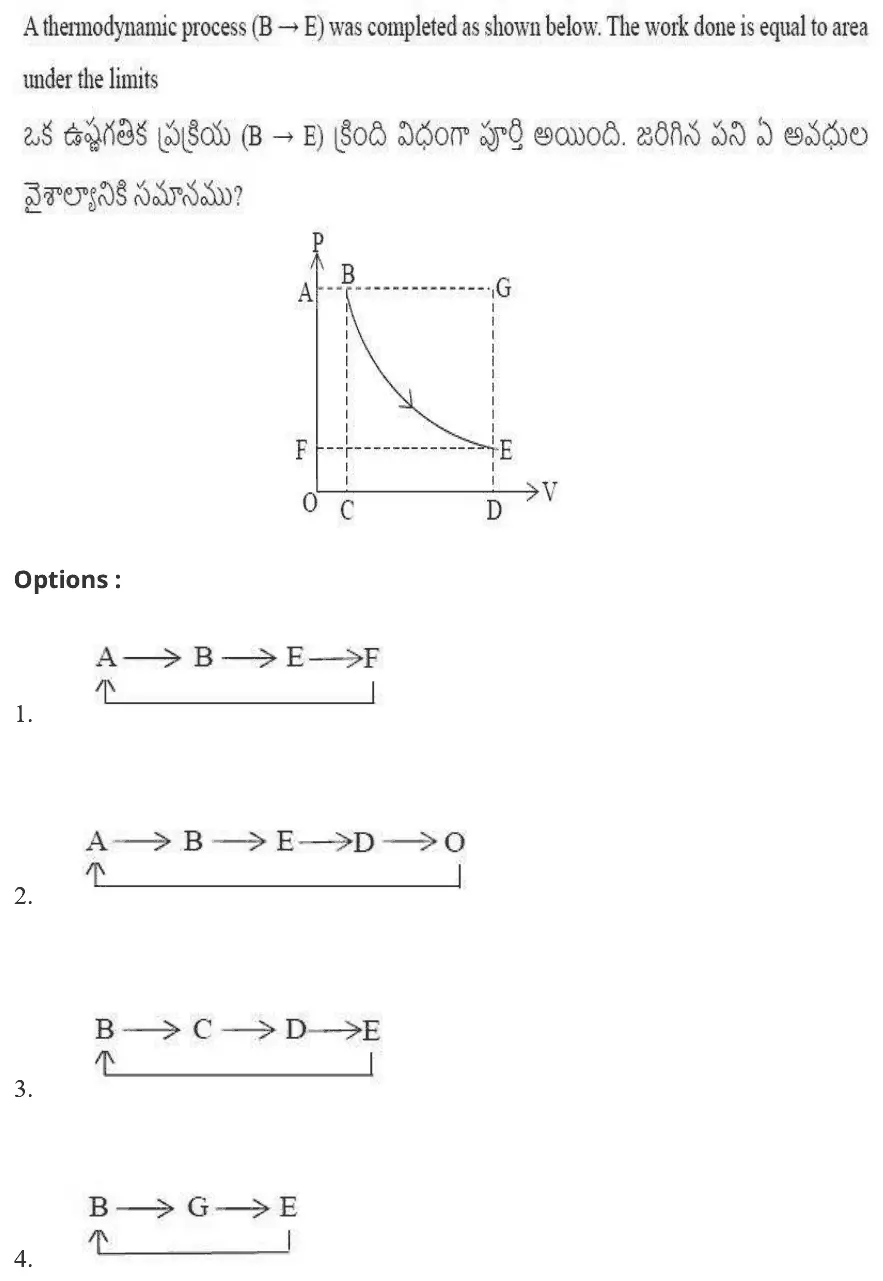
A thermodynamic process ($\mathrm{B \to E}$) was completed as shown below. The work done is equal to area under the limits

(see the figure above)

The question and its figure as printed in AP EAPCET 2024 19th May 2024 Shift 2. Option 1: A → B → E → F, with a line below from F back up to A with an arrow pointing up at A (a closed loop path A→B→E→F→A) Option 2: A → B → E → D → O, with a line below from O back up to A with an arrow pointing up at A (a closed loop path A→B→E→D→O→A) Option 3: B → C → D → E, with a line below from E back up to B with an arrow pointing up at B (a closed loop path B→C→D→E→B) Option 4: B → G → E, with a line below from E back up to B with an arrow pointing up at B (a closed loop path B→G→E→B)
The question as printed in the paper.
  • A

    see figure A → B → E → F, with a line below from F back up to A with an arrow pointing up at A (a closed loop path A→B→E→F→A)

  • B

    see figure A → B → E → D → O, with a line below from O back up to A with an arrow pointing up at A (a closed loop path A→B→E→D→O→A)

  • C

    see figure B → C → D → E, with a line below from E back up to B with an arrow pointing up at B (a closed loop path B→C→D→E→B)

  • D

    see figure B → G → E, with a line below from E back up to B with an arrow pointing up at B (a closed loop path B→G→E→B)

68AP EAPCET 2024 · 18 May · Shift 1MCQOpen question page ↗

At 300 K, for the reaction $\mathrm{A \rightarrow P}$, the $\Delta S_{sys}$ is 5 $\mathrm{JK^{-1}\,mol^{-1}}$. What is the heat absorbed (in $\mathrm{kJ\,mol^{-1}}$) by the system?

  • A

    1.5

  • B

    15

  • C

    1500

  • D

    0.6

69AP EAPCET 2024 · 18 May · Shift 1MCQOpen question page ↗

Identify the incorrect statements from the following

I. $\Delta S_{\mathrm{system}} = (\Delta S_{\mathrm{total}} + \Delta S_{\mathrm{surr}})$

II. $\mathrm{A}(l) \rightarrow \mathrm{A}(s)$; for this process entropy change decreases

III. Entropy units are $\mathrm{J\ K\ mol^{-1}}$

  • A

    I, III only

  • B

    I, II only

  • C

    I, II, III

  • D

    II, III only

70TS EAPCET 2024 · 11 May · Shift 1MCQOpen question page ↗

At 300 K, 3.0 moles of an ideal gas at 3.0 atm pressure is compressed isothermally to one half of its volume by an external pressure of 6.0 atm. The work done (in kJ) is (Given, R=0.082 L atm $\mathrm{K^{-1}mol^{-1}}$) (1 L atm = 101.3 J)

  • A

    7.476

  • B

    11.214

  • C

    3.738

  • D

    14.952

71TS EAPCET 2024 · 10 May · Shift 1MCQOpen question page ↗

The standard enthalpy of combustion of C (graphite), $\mathrm{H_2}$ (g) and $\mathrm{CH_3OH}(l)$ respectively are $-393$, $-286$ and $-726\ \mathrm{kJ\ mol^{-1}}$. What is the standard enthalpy of formation of methanol?

  • A

    $-726\ \mathrm{kJ\ mol^{-1}}$

  • B

    $-239\ \mathrm{kJ\ mol^{-1}}$

  • C

    $-96\ \mathrm{kJ\ mol^{-1}}$

  • D

    $+96\ \mathrm{kJ\ mol^{-1}}$

72TS EAPCET 2024 · 10 May · Shift 2MCQOpen question page ↗

The $\Delta_f H^{\ominus}$ of $\mathrm{AO(s)}$, $\mathrm{BO_2(g)}$ and $\mathrm{ABO_3(s)}$ is $-635$, $x$ and $-1210$ kJ mol$^{-1}$ respectively. $\mathrm{ABO_3(s)} \rightarrow \mathrm{AO(s)} + \mathrm{BO_2(g)}$; $\Delta_r H^{\ominus} = 175$ $kJ$ $mol^{-1}$. What is the value of $x$ (in kJ mol$^{-1}$)?

  • A

    -750

  • B

    +400

  • C

    -400

  • D

    +750

73TS EAPCET 2024 · 9 May · Shift 1MCQOpen question page ↗

The standard enthalpy of formation ($\Delta_f H^\ominus$) of ammonia is $-46.2\,\mathrm{kJ\,mol^{-1}}$. What is the $\Delta_r H^\ominus$ of the following reaction?

$\mathrm{N_2(g) + 3H_2(g) \rightarrow 2NH_3(g)}$

  • A

    $-46.2\,\mathrm{kJ}$

  • B

    $+46.2\,\mathrm{kJ}$

  • C

    $-92.4\,\mathrm{kJ}$

  • D

    $-184.8\,\mathrm{kJ}$

74TS EAPCET 2024 · 9 May · Shift 2MCQOpen question page ↗

At 61 K, one mole of an ideal gas of 1.0 L volume expands isothermally and reversibly to a final volume of 10.0 L. What is the work done in the expansion?

  • A

    $-11.52$ L atm

  • B

    $-23.04$ L atm

  • C

    $-46.08$ L atm

  • D

    $-5.76$ L atm

75AP EAPCET 2023 · 19 May · Shift 1MCQOpen question page ↗

The standard enthalpy of atomization of ethane according to the equation $\mathrm{C_2H_6(g) \rightarrow 2C(g) + 6H(g)}$ is 622 kJ $\mathrm{mol^{-1}}$. If standard mean C-H bond dissociation enthalpy is 90 kJ $\mathrm{mol^{-1}}$, the standard mean dissociation enthalpy of C-C bond (in kJ $\mathrm{mol^{-1}}$) is

  • A

    540

  • B

    90

  • C

    85

  • D

    82

76AP EAPCET 2023 · 19 May · Shift 1MCQOpen question page ↗

If standard molar enthalpy change and standard molar internal energy change measured in bomb calorimeter are equal, which one of the following statements is correct?

  • A

    $\Delta n > 0$, with increase in pressure

  • B

    $\Delta n > 0$, with decrease in pressure

  • C

    $\Delta n < 0$, with increase in pressure

  • D

    $\Delta n = 0$, at constant pressure

77AP EAPCET 2023 · 18 May · Shift 1MCQOpen question page ↗

Identify the pair in which both are not extensive properties

  • A

    Internal energy, enthalpy

  • B

    Mass, volume

  • C

    Density, pressure

  • D

    Heat capacity, Gibbs energy

78AP EAPCET 2023 · 18 May · Shift 1MCQOpen question page ↗

The standard enthalpy of formation of $\mathrm{CO_2(g)}$, $\mathrm{CaO(s)}$ and $\mathrm{CaCO_3(s)}$ are -393, -634, -1210 $\mathrm{kJ\ mol^{-1}}$ respectively. If all the substances are in standard state, the standard enthalpy of decomposition of calcium carbonate to $\mathrm{CaO(s)}$ and $\mathrm{CO_2(g)}$ (in $\mathrm{kJ\ mol^{-1}}$) is

  • A

    969

  • B

    183

  • C

    -969

  • D

    -183

79AP EAPCET 2023 · 18 May · Shift 2MCQOpen question page ↗

The number of extensive and intensive properties in the following list is respectively

Mass, temperature, pressure, enthalpy, heat capacity, internal energy, density

  • A

    2, 5

  • B

    3, 4

  • C

    4, 3

  • D

    5, 2

80AP EAPCET 2023 · 18 May · Shift 2MCQOpen question page ↗

If one litre of an ideal gas at a pressure of 20 atm expands isothermally and reversibly to a final volume of 'X' L by absorbing 92.12 L.atm heat, 'X' (in L) is

  • A

    200

  • B

    20

  • C

    10

  • D

    100

81AP EAPCET 2023 · 17 May · Shift 1MCQOpen question page ↗

If the enthalpy and entropy change for a reaction at 298 K are -145 kJ $\mathrm{mol^{-1}}$ and -650 J $\mathrm{K^{-1}}$ $\mathrm{mol^{-1}}$ respectively, which one of the following statements is correct?

  • A

    $\Delta G = -50\ \mathrm{kJ\ mol^{-1}}$, the reaction is spontaneous

  • B

    $\Delta G = -48.7\ \mathrm{kJ\ mol^{-1}}$, the reaction is non-spontaneous

  • C

    $\Delta G = +50\ \mathrm{kJ\ mol^{-1}}$, the reaction is spontaneous

  • D

    $\Delta G = 48.7\ \mathrm{kJ\ mol^{-1}}$, the reaction is non-spontaneous

82AP EAPCET 2023 · 17 May · Shift 1MCQOpen question page ↗

11.0 L of an ideal gas at constant external pressure of 5 atm is compressed isothermally to a final volume of one liter. The heat absorbed and work done respectively, during this compression (in L atm) are

  • A

    -50, -50

  • B

    50, -50

  • C

    -50, 50

  • D

    50, 50

83AP EAPCET 2023 · 17 May · Shift 2MCQOpen question page ↗

If for the reaction $\mathrm{CCl_4(g) \rightarrow C(g) + 4Cl(g)}$ the following data is given

$\Delta_{vap}H^{\theta}\ \mathrm{CCl_4(l)} = 30\ \mathrm{kJ\ mol^{-1}}$, vap = vaporization

$\Delta_f H^{\theta}_{\mathrm{CCl_4}} = -136.0\ \mathrm{kJ\ mol^{-1}}$, f = formation

$\Delta_a H^{\theta}_{\mathrm{C}} = 714.0\ \mathrm{kJ\ mol^{-1}}$, a = atomization

$\Delta_a H^{\theta}_{\mathrm{Cl_2}} = 242.0\ \mathrm{kJ\ mol^{-1}}$, a = atomization

the bond mean enthalpy of C-Cl in $\mathrm{CCl_4}$ (l) is

  • A

    -319

  • B

    326

  • C

    -326

  • D

    292

84AP EAPCET 2023 · 17 May · Shift 2MCQOpen question page ↗

If 5 L of an ideal gas at a constant external pressure of 2 atm expands isothermally to a final volume of ‘X’ L, the system does a work of -2,026.4 J. ‘X’ (in L) is

(1 L. atm = 101.32 J)

  • A

    25

  • B

    20

  • C

    15

  • D

    10

85AP EAPCET 2023 · 16 May · Shift 1MCQOpen question page ↗

If the standard enthalpy of sublimation ($\Delta_{sub}\mathrm{H^\circ}$) of solid $\mathrm{CO_2}$, naphthalene, Li and Na are 25.2, 73.0, 162, 108 kJ mol respectively, the order of sublimation of these substances with temperature is

  • A

    Na > Li > Napthalane > Solid $\mathrm{CO_2}$

  • B

    Solid $\mathrm{CO_2}$ > Na > Napthalane > Li

  • C

    Solid $\mathrm{CO_2}$ > Napthalane > Na > Li

  • D

    Li > Na > Napthalane > Solid $\mathrm{CO_2}$

86AP EAPCET 2023 · 16 May · Shift 1MCQOpen question page ↗

When ‘X’ g of graphite is completely burnt in a bomb calorimeter in excess of $\mathrm{O_2}$ at 298 K and 1 atm pressure as given in the equation

$\mathrm{C(graphite) + O_2(g) \rightarrow CO_2(g)}$.

The temperature of calorimeter raised from 298 K to 302 K. If the heat capacity of the calorimeter and molar enthalpy change for the reaction at 1 atm and 298 K are 20.7 kJ $\mathrm{K^{-1}}$ and -248.4 kJ $\mathrm{mol^{-1}}$, ‘X’ in g is

  • A

    8

  • B

    2

  • C

    3

  • D

    4

87AP EAPCET 2023 · 16 May · Shift 2MCQOpen question page ↗

If $\Delta G$ and $\Delta S$ for the reaction $\mathrm{A(g)} \rightarrow \mathrm{B(g)} + 2\mathrm{C(g)}$ at 2000 K are -40 kJ mol$^{-1}$ and 0.22 kJ K$^{-1}$ mol$^{-1}$ respectively, the change in internal energy for the same reaction approximately (in kJ mol$^{-1}$) is

  • A

    366.7

  • B

    -366.7

  • C

    433.3

  • D

    -433.3

88AP EAPCET 2023 · 16 May · Shift 2MCQOpen question page ↗

If 100 L of an ideal gas at a pressure of 2 atm compressed isothermally and reversibly to a final volume of 'X' L releases -460.6 L atm heat, the final volume 'X' (in L) is

  • A

    1

  • B

    20

  • C

    10

  • D

    2

89AP EAPCET 2023 · 16 May · Shift 2MCQOpen question page ↗

Given below are two statements

Assertion (A): The enthalpy of formation of graphite is taken as zero.

Reason (R): Graphite is thermodynamically most stable allotrope of carbon

The correct answer is

  • A

    Both (A) and (R) are correct and (R) is the correct explanation of (A)

  • B

    Both (A) and (R) are correct but (R) is not the correct explanation of (A)

  • C

    (A) is correct but (R) is incorrect

  • D

    (A) Is incorrect but (R) is correct

90AP EAPCET 2023 · 15 May · Shift 1MCQOpen question page ↗

If the standard enthalpy change $(\Delta_r H^\theta)$ for a certain reaction at 298 K and constant pressure is $-1860\,\mathrm{kJ\,mol^{-1}}$, the standard entropy change $(\Delta_{sys} S^\theta)$ of the same reaction is $-550\,\mathrm{J\,K^{-1}\,mol^{-1}}$, which one of the following statements is correct?

  • A

    $(\Delta_{sys} S^\theta) + \Delta_{surr} S^\theta = -7692\ \mathrm{J\,mol^{-1}\,K^{-1}}$, the reaction is spontaneous

  • B

    $(\Delta_{sys} S^\theta) + \Delta_{surr} S^\theta = -5692\ \mathrm{J\,mol^{-1}\,K^{-1}}$, the reaction is non- spontaneous

  • C

    $(\Delta_{sys} S^\theta) + \Delta_{surr} S^\theta = +5692\ \mathrm{J\,mol^{-1}\,K^{-1}}$, the reaction is spontaneous

  • D

    $(\Delta_{sys} S^\theta) + \Delta_{surr} S^\theta = +7692\ \mathrm{J\,mol^{-1}\,K^{-1}}$, the reaction is non- spontaneous

91AP EAPCET 2023 · 15 May · Shift 1MCQOpen question page ↗

If the standard enthalpy change ($\Delta_r\mathrm{H}^\theta$) for reaction $\mathrm{H_2(g) + Br_2(l) \rightarrow 2HBr(g)}$ is $-72.8$ kJ, the standard enthalpy of formation ($\Delta_f\mathrm{H}^\theta$) of HBr (g) (in kJ mol$^{-1}$) is

  • A

    -36.4

  • B

    +36.4

  • C

    -18.2

  • D

    +18.2

92AP EAPCET 2023 · 15 May · Shift 2MCQOpen question page ↗

If the work done by 2 mol of an ideal gas during isothermal reversible expansion from 5L to 50L is -189.1 L atm. at constant pressure, the temperature of the gas (in °C) is

  • A

    500

  • B

    227

  • C

    327

  • D

    127

93AP EAPCET 2023 · 15 May · Shift 2MCQOpen question page ↗

At 300 K the enthalpy change for the following reaction is -2800 kJ mol$^{-1}$

$\mathrm{C_6H_{12}O_6(s) + 6O_2(g) \rightarrow 6CO_2(g) + 6H_2O(l)}$

What is the $\Delta U$ for the same reaction at 300 K (kJ mol$^{-1}$)?

  • A

    -2802.49

  • B

    -2800.00

  • C

    -2814.94

  • D

    +2802.49

94TS EAPCET 2023 · 14 May · Shift 1MCQOpen question page ↗

For the reaction at $25\ ^\circ\mathrm{C}$, $\mathrm{X_2O_4}(l) \longrightarrow 2\mathrm{XO_2}(g)$, $\Delta U$ and $\Delta S$ are 2.1 K.Cal and 20 Cal/K respectively. What is $\Delta G$ for the reaction at the same temperature?
(R= 2 Cal $\mathrm{K^{-1}mol^{-1}}$)

  • A

    -2.67 k.Cal

  • B

    +2.67 k.Cal

  • C

    -1.67 k.Cal

  • D

    +3.67 k.Cal

95TS EAPCET 2023 · 14 May · Shift 2MCQOpen question page ↗

At T(K) 2 mole of an ideal gas is allowed to expand reversibly and isothermally from a pressure of 10 atmospheres to 1 atmosphere. The work done (in kJ) is

($\mathrm{R=8.3\ J\ K^{-1}\ mol^{-1}}$)

  • A

    $-3.82\times10^{-1}\times \mathrm{T}$

  • B

    $-4.82\times10^{-1}\times \mathrm{T}$

  • C

    $-2.82\times10^{-2}\times \mathrm{T}$

  • D

    $-3.82\times10^{-2}\times \mathrm{T}$

96TS EAPCET 2023 · 13 May · Shift 1MCQOpen question page ↗

Enthalpy of formation of $\mathrm{CO(g)}$, $\mathrm{CO_2(g)}$ are $-110$, $-393\ \mathrm{kJmol^{-1}}$ respectively. The enthalpy of combustion of $\mathrm{CO}$ (in $\mathrm{kJmol^{-1}}$) is

  • A

    -283.0

  • B

    -110.5

  • C

    504

  • D

    -221.2

97TS EAPCET 2023 · 13 May · Shift 2MCQOpen question page ↗

Observe the following properties

I. Molar volume
II. Mass
III. Internal energy
IV. Volume
V. Enthalpy
VI. Temperature
VII. Density

The intensive properties in the above list are

  • A

    I, VI, VII only

  • B

    I, IV, VI, VII only

  • C

    I, III, IV, V only

  • D

    II, III, V only

98TS EAPCET 2023 · 12 May · Shift 1MCQOpen question page ↗

If 2.5 moles of an ideal gas at a certain temperature are allowed to expand isothermally and reversibly from an initial volume of $2\,\mathrm{dm^3}$ to $20\,\mathrm{dm^3}$, the work done by the gas is $-16.5\,\mathrm{kJ}$. The temperature (in K) of the gas is (Round off to the nearest value)

($R = 8.314\,\mathrm{J\,K^{-1}\,mol^{-1}}$)

  • A

    445

  • B

    245

  • C

    345

  • D

    745

99TS EAPCET 2023 · 12 May · Shift 2MCQOpen question page ↗

The enthalpies of formation of gaseous $\mathrm{N_2O}$ and NO at 298 K are 82.0 and $90.0\,\mathrm{KJ\,mol^{-1}}$ respectively. The enthalpy change of the reaction $\mathrm{N_2O(g)} + \frac{1}{2}\mathrm{O_2(g)} \rightarrow 2\mathrm{NO(g)}$ is

  • A

    $-74$ kJ

  • B

    $+98$ kJ

  • C

    $+89$ kJ

  • D

    $-47$ kJ

100TS EAPCET 2022 · 20 Jul · Shift 1MCQOpen question page ↗

In the reaction $\mathrm{H_2O(l) \rightarrow H_2O(s)}$ at 0 $^\circ$C and 1 atm, the internal energy change is $-$41 kJ/mol. What will be the value of molar enthalpy change?

  • A

    $-$41 kJ/ mol

  • B

    41 kJ/ mol

  • C

    30 kJ/ mol

  • D

    $-$30 kJ/ mol

101TS EAPCET 2022 · 20 Jul · Shift 1MCQOpen question page ↗

The correct order of "$\Delta_f H^{\circ}$" values of Diamond (I), Graphite (II) and Fullerene (III) is

  • A

    I > II > III

  • B

    II > I > III

  • C

    III > I > II

  • D

    III > II > I

102TS EAPCET 2022 · 20 Jul · Shift 2MCQOpen question page ↗

The bond enthalpies of heavy hydrogen, O–O and D–O are +400, +498 and +490 $\mathrm{kJ\,mol^{-1}}$, respectively. The $\Delta_r\mathrm{H^\circ}$ of the reaction to produce $\mathrm{D_2O}$ is

  • A

    $-300\ \mathrm{kJ\,mol^{-1}}$

  • B

    $-331\ \mathrm{kJ\,mol^{-1}}$

  • C

    $29.1\ \mathrm{kJ\,mol^{-1}}$

  • D

    $2.91\ \mathrm{kJ\,mol^{-1}}$

103TS EAPCET 2022 · 19 Jul · Shift 1MCQOpen question page ↗

Given $\mathrm{H_2(g)+\dfrac{1}{2}O_2(g)\to H_2O(\mathit{l})}$; $\Delta\mathrm{H}=-285$ kJ
$\mathrm{N_2O_5(g)+H_2O(\mathit{l})\to 2HNO_3(\mathit{l})}$; $\Delta\mathrm{H}=-76.6$ kJ
$\mathrm{N_2(g)+3O_2(g)+H_2(g)\to 2HNO_3(\mathit{l})}$; $\Delta\mathrm{H}=-348.2$ kJ
Calculate the $\Delta\mathrm{H}$ of $\mathrm{2N_2(g)+5O_2(g)\to 2N_2O_5(g)}$.

  • A

    $572$ kJ

  • B

    $419$ kJ

  • C

    $14.5$ kJ

  • D

    $26.8$ kJ

104TS EAPCET 2022 · 19 Jul · Shift 2MCQOpen question page ↗

An air bag on adiabatic expansion undergoes 5% increase in its volume. The percentage change in pressure is $[\gamma_{air}=1.4]$

  • A

    5

  • B

    6

  • C

    7

  • D

    9

105TS EAPCET 2022 · 18 Jul · Shift 1MCQOpen question page ↗

If 92 g Na reacts with water in open vessel at 300 K. What is the value of work done?
[Assume ideal nature of the gaseous product]

  • A

    $0.0$

  • B

    $-4988.4\ \mathrm{J}$

  • C

    $-2494.2\ \mathrm{J}$

  • D

    $-9976.8\ \mathrm{J}$

106TS EAPCET 2022 · 18 Jul · Shift 2MCQOpen question page ↗

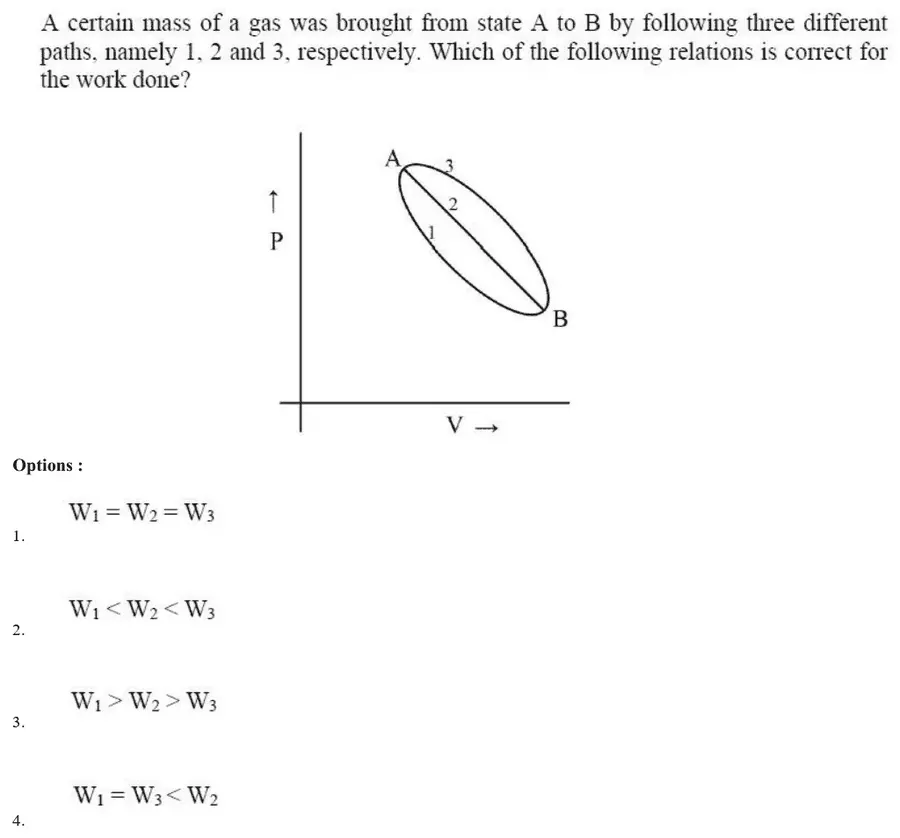
A certain mass of a gas was brought from state A to B by following three different paths, namely 1, 2 and 3, respectively. Which of the following relations is correct for the work done?
(see the figure above)

The question and its figure as printed in TS EAPCET 2022 18th Jul 2022 Shift 2.
The question as printed in the paper.
  • A

    $W_{1}=W_{2}=W_{3}$

  • B

    $W_{1}<W_{2}<W_{3}$

  • C

    $W_{1}>W_{2}>W_{3}$

  • D

    $W_{1}=W_{3}<W_{2}$

107TS EAPCET 2022 · 18 Jul · Shift 2MCQOpen question page ↗

Among the following given substances, the one with zero $\Delta_{f}H^{\circ}$ is

  • A

    Diamond

  • B

    Graphite

  • C

    Fullerene

  • D

    Bituminous coal

109AP EAPCET 2022 · 8 Jul · Shift 1MCQOpen question page ↗

Calculate $\Delta_r H$ (kJ mol$^{-1}$) of the following reaction
$\mathrm{C_2H_5OH(l) + 7/2\ O_2(g) \to 2\ CO_2(g) + 3\ H_2O(l)}$
Molecule | $\Delta_f H^0$ (kJ mol$^{-1}$)
$\mathrm{C_2H_5OH(l)}$ | $-280$
$\mathrm{CO_2(g)}$ | $-400$
$\mathrm{H_2O(l)}$ | $-290$

  • A

    $-1950$

  • B

    $-1100$

  • C

    $-1390$

  • D

    $-700$

110AP EAPCET 2022 · 8 Jul · Shift 2MCQOpen question page ↗

The atomization enthalpy of $\mathrm{CH_4}$ is $1660\ \mathrm{kJmol^{-1}}$. The C-H bond enthalpy of each successive step in $\mathrm{CH_4 \to CH_3 \to CH_2 \to CH}$ are +15, +30 and +45 $\mathrm{kJ\ mol^{-1}}$ higher than the mean bond enthalpy of CH bonds, respectively. The bond enthalpy of the last C-H unit is

  • A

    $400\ \mathrm{kJmol^{-1}}$

  • B

    $325\ \mathrm{kJmol^{-1}}$

  • C

    $475\ \mathrm{kJmol^{-1}}$

  • D

    $385\ \mathrm{kJmol^{-1}}$

111AP EAPCET 2022 · 7 Jul · Shift 1MCQOpen question page ↗

Which of the following conditions are not suitable for a spontaneous reaction?

  • A

    $\Delta H < 0$ and $\Delta S > 0$ at low temperature

  • B

    $\Delta H < 0$ and $\Delta S < 0$ at high temperature

  • C

    $\Delta H < 0$ and $\Delta S < 0$ at low temperature

  • D

    $\Delta H > 0$ and $\Delta S > 0$ at high temperature

112AP EAPCET 2022 · 7 Jul · Shift 1MCQOpen question page ↗

Which of the following are extensive properties? (A) Heat capacity (B) Entropy (C) Gibbs Energy (D) Concentration (E) Vapour pressure.

  • A

    A, B, C and E

  • B

    A, B, and D

  • C

    A, B, C only

  • D

    D and E only

113AP EAPCET 2022 · 7 Jul · Shift 2MCQOpen question page ↗

Identify the correct statements from the following.
(i). For adiabatic process, $\Delta U = W_{adiabatic}$
(ii). Work is a path function.
(iii). Volume is an extensive property.

  • A

    i, ii, iii

  • B

    i, iii only

  • C

    ii, iii only

  • D

    i, ii only

114AP EAPCET 2022 · 7 Jul · Shift 2MCQOpen question page ↗

The standard Gibbs energy ($\Delta G^0$) for the following reaction is
$\mathrm{A(s) + B^{2+}(aq) \rightleftharpoons A^{2+}(aq) + B(s)}$, $K_c = 10^{12}$ at $25^\circ\mathrm{C}$ ($K_c$ = equilibrium constant)

  • A

    -150 kJ

  • B

    -96.80 kJ

  • C
    • 68.47 kJ
  • D

    -100 kJ

115AP EAPCET 2022 · 6 Jul · Shift 1MCQOpen question page ↗

Identify the reaction/process in which the entropy decreases

  • A

    $\mathrm{H_2O}\ (l) \longrightarrow \mathrm{H_2O}\ (s)$

  • B

    $\mathrm{H_2O}\ (l) \longrightarrow \mathrm{H_2O}\ (g)$

  • C

    $\mathrm{H_2O}\ (g) \longrightarrow 2\mathrm{H}\ (g)$

  • D

    Crystal (100 K) $\longrightarrow$ Crystal (200 K)

116AP EAPCET 2022 · 6 Jul · Shift 1MCQOpen question page ↗

From the following data at $25^\circ$C, calculate the $\Delta_rH^0$ for $\mathrm{H_2O(g)} \to \mathrm{2H(g)+O(g)}$.
reaction: $\Delta_rH^0\ (\mathrm{kJ\,mol^{-1}})$
$\frac{1}{2}H_2(g) + \frac{1}{2}O_2(g) \to OH(g)$ : 42.09
$\mathrm{H_2(g)} + \frac{1}{2}O_2(g) \to \mathrm{H_2O(g)}$ : $-242$
$\mathrm{H_2(g)} \to \mathrm{2H(g)}$ : 436
$\mathrm{O_2(g)} \to \mathrm{2O\ (g)}$ : 496

  • A

    $1174\ \mathrm{kJ\,mol^{-1}}$

  • B

    $742\ \mathrm{kJ\,mol^{-1}}$

  • C

    $926\ \mathrm{kJ\,mol^{-1}}$

  • D

    $690\ \mathrm{kJ\,mol^{-1}}$

117AP EAPCET 2022 · 6 Jul · Shift 2MCQOpen question page ↗

Enthalpy of formation of CO (g), $\mathrm{CO_2}$ (g), $\mathrm{N_2O}$ (g) and $\mathrm{N_2O_4}$ (g) are -110, -393, 81, 9.7 $\mathrm{kJ\ mol^{-1}}$ respectively. Calculate $\Delta_r H$ for the following reaction.
$\mathrm{N_2O_4}$ (g) + 3CO (g) $\rightarrow$ $\mathrm{N_2O}$ (g) + 3$\mathrm{CO_2}$(g)

  • A

    $-569\ \mathrm{kJ\ mol^{-1}}$

  • B

    $+569\ \mathrm{kJ\ mol^{-1}}$

  • C

    $+778\ \mathrm{kJ\ mol^{-1}}$

  • D

    $-778\ \mathrm{kJ\ mol^{-1}}$

118AP EAPCET 2022 · 6 Jul · Shift 2MCQOpen question page ↗

For a reaction to be spontaneous, the required conditions are

  • A

    $\Delta_r H^\circ$ = - ve, $\Delta_r S^\circ$ = - ve, at High T

  • B

    $\Delta_r H^\circ$ = + ve, $\Delta_r S^\circ$ = + ve, at High T

  • C

    $\Delta_r H^\circ$ = + ve, $\Delta_r S^\circ$ = + ve, at Low T

  • D

    $\Delta_r H^\circ$ = + ve, $\Delta_r S^\circ$ = - ve, at all T

119AP EAPCET 2022 · 5 Jul · Shift 1MCQOpen question page ↗

Identify the correct statements from the following
I. At 0 K, the entropy of pure crystalline materials approach zero.
II. Entropy for the process, $\mathrm{H_2O(l)} \longrightarrow \mathrm{H_2O\ (g)}$ decreases.
III. Gibbs energy is a state function.

  • A

    i, ii, iii

  • B

    i, iii Only

  • C

    ii, iii Only

  • D

    i, ii Only

120AP EAPCET 2022 · 5 Jul · Shift 1MCQOpen question page ↗

Use the data from table to estimate the enthalpy of formation of $\mathrm{CH_3CHO}$.
Bond Enthalpy | Bond | Enthalpy of formation
400 kJ $\mathrm{mol^{-1}}$ | C - H | C(g): 700 kJ $\mathrm{mol^{-1}}$
350 kJ $\mathrm{mol^{-1}}$ | C - C | H (g): 200 kJ $\mathrm{mol^{-1}}$
700 kJ $\mathrm{mol^{-1}}$ | C = O | O (g): 250 kJ $\mathrm{mol^{-1}}$

  • A

    -200 kJ $\mathrm{mol^{-1}}$

  • B

    -400 kJ $\mathrm{mol^{-1}}$

  • C

    -350 kJ $\mathrm{mol^{-1}}$

  • D

    -150 kJ $\mathrm{mol^{-1}}$

121AP EAPCET 2022 · 5 Jul · Shift 2MCQOpen question page ↗

For a reaction $\mathrm{2CO\,(g) + O_2\,(g)} \rightleftharpoons \mathrm{2CO_2\,(g)}$, $\Delta_rG^0 = -128$ kJ at 300 K. If $\Delta_rS^\circ$ of the reaction is $-40\ \mathrm{J\,K^{-1}}$, calculate $\Delta_rU$ of the reaction.

  • A

    $-137.5\ \mathrm{kJ}$

  • B

    $-128\ \mathrm{kJ}$

  • C

    $-140\ \mathrm{kJ}$

  • D

    $126.2\ \mathrm{kJ}$

122AP EAPCET 2022 · 5 Jul · Shift 2MCQOpen question page ↗

Which of the following equations are correct?

(A) $\mathrm{U = H - PV}$

(B) $\mathrm{G = H - TS}$

(C) $\mathrm{U = q + W}$

  • A

    A,B and C

  • B

    A and B only

  • C

    A and C only

  • D

    B and C only

123AP EAPCET 2022 · 4 Jul · Shift 1MCQOpen question page ↗

Identify the reaction/process in which the entropy increases.

  • A

    H (g) + H (g) $\rightarrow$ $\mathrm{H_2}$ (g)

  • B

    $\mathrm{H_2O}$ (g) $\rightarrow$ $\mathrm{H_2O}$ (s)

  • C

    $\mathrm{H_2O}$ (l) $\rightarrow$ $\mathrm{H_2O}$ (g)

  • D

    A (g) + B (g) + C(s) $\rightarrow$ 2D(s)

124AP EAPCET 2022 · 4 Jul · Shift 1MCQOpen question page ↗

State 1 $\rightleftharpoons$ State 2 $\rightleftharpoons$ State 3
State 1: T = 300 K, P = 15 bar, 1 mole; State 2: T = 300 K, P = 10 bar, 1 mole; State 3: T = 300 K, P = 5 bar, 1 mole.
Above shows a cyclic process. Calculate the total work done during one complete cycle.
(Assume a single step to reach the next state).

  • A

    25/3 L bar

  • B

    -25/3 L bar

  • C

    50/3 L bar

  • D

    -50/3 L bar

125AP EAPCET 2022 · 4 Jul · Shift 2MCQOpen question page ↗

Observe the following properties:
Volume, enthalpy, density, temperature, heat capacity, pressure, internal energy.
The number of extensive properties in the above list is

  • A

    $4$

  • B

    $5$

  • C

    $6$

  • D

    $3$

126AP EAPCET 2022 · 4 Jul · Shift 2MCQOpen question page ↗

Match the following
A. Isothermal process i q= $\Delta$U
B. Adiabatic process ii W= - P × $\Delta$V
C. Isobaric process iii W= $\Delta$U
D. Isochoric process iv W= - nRTln $\left(\frac{V_f}{V_i}\right)$

  • A

    A – (iv), B – (iii), C – (ii), D – (i)

  • B

    A – (iii), B – (iv), C – (i), D – (ii)

  • C

    A – (i), B – (ii), C – (iii), D – (iv)

  • D

    A – (ii), B – (i), C – (iv), D – (iii)

127AP EAPCET 2022 · 4 Jul · Shift 2MCQOpen question page ↗

Which of the following expression is correct

  • A

    $\Delta G=-RT\ln K$

  • B

    $\Delta G=\frac{1}{RT^2\ln K}$

  • C

    $\Delta G^0=-RT\ln K$

  • D

    $\Delta G^0=-\frac{1}{RT^2\ln K}$

128AP EAMCET 2021 · 5 Oct · Shift 1MCQOpen question page ↗

The bond dissociation energies of $H_2$, $Cl_2$ and $HCl$ are given as 104, 58 and 103 $\mathrm{kcal.mol^{-1}}$ respectively. Find the enthalpy of formation of $HCl$.

  • A

    $-44\ \mathrm{kcal.mol^{-1}}$

  • B

    $-22\ \mathrm{kcal.mol^{-1}}$

  • C

    $+44\ \mathrm{kcal.mol^{-1}}$

  • D

    $+11\ \mathrm{kcal.mol^{-1}}$

129AP EAMCET 2021 · 5 Oct · Shift 1MCQOpen question page ↗

For the reaction at 298K, $A_2B_4 \rightarrow 2AB_2$, $\Delta H = 2\ kJ$ and $\Delta S = 20\ J/K$ at constant P & $T$, the reaction will be ______

  • A

    spontaneous & entropy driven

  • B

    spontaneous & enthalpy driven

  • C

    non-spontaneous

  • D

    at equilibrium

130AP EAMCET 2021 · 5 Oct · Shift 1MCQOpen question page ↗

Find the value of $\Delta H^{\circ}$ (in $\mathrm{kJ.mol^{-1}}$) in the following reaction:
$N_{2(g)} + 3\,H_{2(g)} \xrightarrow{Fe,\ \Delta} 2\,NH_{3(g)} + \Delta H^{\circ}$

  • A

    $92.6$

  • B

    $-92.6$

  • C

    $285$

  • D

    $-285$

131AP EAMCET 2021 · 25 Aug · Shift 1MCQOpen question page ↗

The boiling point of water at $1\ \mathrm{atm}$ is $100\,^\circ\mathrm{C}$. Which among the following is true for vaporization of water at $75\,^\circ\mathrm{C}$ ?

  • A

    $\Delta G^0_{vap} > 0$

  • B

    $\Delta H^0_{vap} < 0$

  • C

    $K_{vap} = 1$

  • D

    $\Delta S^0_{vap} < 0$

132AP EAMCET 2021 · 25 Aug · Shift 1MCQOpen question page ↗

An ideal gas expanded irreversibly against $10\ \mathrm{bar}$ pressure from $20\ \mathrm{L}$ to $30\ \mathrm{L}$. Calculate $Q$ if the process is Isoenthalpic. $1\ \mathrm{L.bar} = 100\ \mathrm{J}$

  • A

    0

  • B

    $100\ \mathrm{J}$

  • C

    $-100\ \mathrm{J}$

  • D

    $10\ \mathrm{kJ}$

133AP EAMCET 2021 · 25 Aug · Shift 1MCQOpen question page ↗

Which condition among the following holds true at the stage of half-completion for the reaction $A \rightleftharpoons B$?

  • A

    $\Delta G^\ominus = 0$

  • B

    $\Delta G^\ominus > 0$

  • C

    $\Delta G^\ominus < 0$

  • D

    $\Delta G^\ominus = -RT\ln 2$

134AP EAMCET 2021 · 25 Aug · Shift 2MCQOpen question page ↗

The change in internal energy equals ______

  • A

    Isothermal work

  • B

    Isochoric work

  • C

    Isobaric work

  • D

    Adiabatic work

135AP EAMCET 2021 · 24 Aug · Shift 1MCQOpen question page ↗

When equal volumes of Helium and Neon at same temperature and pressure are mixed, the ratio $C_p : C_v$ of the mixture equals ______

  • A

    3 : 5

  • B

    1 : 2

  • C

    5 : 3

  • D

    2 : 1

136AP EAMCET 2021 · 24 Aug · Shift 1MCQOpen question page ↗

Which among the following are true for an irreversible isothermal expansion of an ideal gas?
(i) $W = -Q$
(ii) $\Delta U = 0$
(iii) $\Delta H \neq 0$
(iv) $\Delta T = 0$

  • A

    Only (i), (ii) & (iii)

  • B

    Only (i), (ii) & (iv)

  • C

    Only (ii), (iii) & (iv)

  • D

    (i), (ii), (iii) & (iv)

137AP EAMCET 2021 · 24 Aug · Shift 2MCQOpen question page ↗

The heat liberated when $1.89\ g$ of benzoic acid is burnt in a bomb calorimeter at $25\ ^\circ C$ increases the temperature of $18.94\ kg$ of water by $0.632\ ^\circ C$. If the specific heat of water at $25\ ^\circ C$ is $0.998\ cal\ /\ (g - ^\circ C)$, then find the heat of combustion of benzoic acid.

  • A

    $2540\ kJ\ mol^{-1}$

  • B

    $1975\ kJ\ mol^{-1}$

  • C

    $3240\ kJ\ mol^{-1}$

  • D

    $2825\ kJ\ mol^{-1}$

138AP EAMCET 2021 · 24 Aug · Shift 2MCQOpen question page ↗

For strong acid and strong base neutralization net chemical change is $\mathrm{H^+ + OH^- \rightarrow H_2O\,(l)}$ $\Delta H_r^0 = -55.84\ \mathrm{kJ\,mol^{-1}}$. If enthalpy of neutralization of $\mathrm{CH_3COOH}$ by $\mathrm{NaOH}$ is $49.86\ \mathrm{kJ\,mol^{-1}}$ then enthalpy of ionization of $\mathrm{CH_3COOH}$ is ______

  • A

    $5.98\ \mathrm{kJ\,mol^{-1}}$

  • B

    $-5.98\ \mathrm{kJ\,mol^{-1}}$

  • C

    $105.7\ \mathrm{kJ\,mol^{-1}}$

  • D

    $-59.8\ \mathrm{kJ\,mol^{-1}}$

139AP EAMCET 2021 · 23 Aug · Shift 1MCQOpen question page ↗

Out of molar entropy (I), specific volume (II), heat capacity (III), volume (IV), extensive properties are

  • A

    I, II

  • B

    I, II, IV

  • C

    II, III

  • D

    III, IV

140AP EAMCET 2021 · 23 Aug · Shift 1MCQOpen question page ↗

When reaction is carried out at standard states then at the equilibrium ______

  • A

    $\Delta H^0 = 0$

  • B

    $\Delta S^0 = 0$

  • C

    equilibrium Const $K = 0$

  • D

    equilibrium Const $K = 1$

141AP EAMCET 2021 · 20 Aug · Shift 1MCQOpen question page ↗

For the reaction $H_2O_{(l)} \longrightarrow H_2O_{(g)}$ at $T = 100\ ^\circ C$ and $P = 1\ atm$, choose the correct option:

  • A

    $\Delta S_{system} > 0$ & $\Delta S_{surroundings} > 0$

  • B

    $\Delta S_{system} > 0$ & $\Delta S_{surroundings} < 0$

  • C

    $\Delta S_{system} < 0$ & $\Delta S_{surroundings} > 0$

  • D

    $\Delta S_{system} < 0$ & $\Delta S_{surroundings} < 0$

142AP EAMCET 2021 · 20 Aug · Shift 1MCQOpen question page ↗

At $60\ ^\circ C$, dinitrogen tetroxide is fifty percent dissociated. Find its standard free energy change at this temperature and one atmosphere. [ Given: $\log 1.33 = 0.1239$ ]

  • A

    $-650\ \mathrm{J.mol^{-1}}$

  • B

    $-830\ \mathrm{J.mol^{-1}}$

  • C

    $-790\ \mathrm{J.mol^{-1}}$

  • D

    $-875\ \mathrm{J.mol^{-1}}$

143AP EAMCET 2021 · 20 Aug · Shift 2MCQOpen question page ↗

When an ideal gas expands isothermally from 5 $m^3$ to 10 $m^3$ at 25 °C against a constant pressure of $10^7\ N.m^{-2}$, then the work done on the gas is ______

  • A

    $-100\ MJ$

  • B

    $-50\ MJ$

  • C

    $-0.5\ MJ$

  • D

    $-10^5\ MJ$

144AP EAMCET 2021 · 20 Aug · Shift 2MCQOpen question page ↗

Find the approximate value of $(\Delta H - \Delta U)$ in $J.mol^{-1}$, for the formation of $CO$ from its elements at 298 $K$. ($R = 8.314\ J.K^{-1}.mol^{-1}$)

  • A

    $-1238$

  • B

    $1238$

  • C

    $2477$

  • D

    $-2477$

145AP EAMCET 2021 · 19 Aug · Shift 1MCQOpen question page ↗

If a chemical reaction is known to be non-spontaneous at $298\ K$ but spontaneous at $350\ K$, then which among the following conditions is true for the reaction?

  • A

    $\Delta G = -ve,\ \Delta H = -ve,\ \Delta S = +ve$

  • B

    $\Delta G = +ve,\ \Delta H = +ve,\ \Delta S = +ve$

  • C

    $\Delta G = -ve,\ \Delta H = +ve,\ \Delta S = +ve$

  • D

    $\Delta G = +ve,\ \Delta H = +ve,\ \Delta S = -ve$

146AP EAMCET 2021 · 19 Aug · Shift 1MCQOpen question page ↗

Standard entropies of $X_2, Y_2$ and $XY_3$ are $60, 40$ and $50\ \mathrm{J/K/mol}$ respectively. At what temperature the following reaction will be at equilibrium
$\frac{1}{2}X_2 + \frac{3}{2}Y_2 \rightleftharpoons XY_3,\ \Delta H = -30\ kJ$

  • A

    $500\ K$

  • B

    $750\ K$

  • C

    $1000\ K$

  • D

    $1250\ K$

147AP EAMCET 2021 · 19 Aug · Shift 2MCQOpen question page ↗

When the temperature of $2$ moles of an ideal gas is increased by $20\ ^\circ\mathrm{C}$ at constant pressure, find the work involved in the process.

  • A

    $5R$

  • B

    $40R$

  • C

    $15R$

  • D

    $20R$

148AP EAMCET 2021 · 19 Aug · Shift 2MCQOpen question page ↗

Using the data provided, find the value of equilibrium constant for the following reaction at $298\ \mathrm{K}$ and $1\ \mathrm{atm}$ pressure. $\mathrm{NO_{(g)}} + \dfrac{1}{2}\mathrm{O_{2\,(g)}} \rightleftharpoons \mathrm{NO_{2\,(g)}}$
$\Delta_f H^\circ(\mathrm{NO_{(g)}}) = 90.4\ \mathrm{kJ.mol^{-1}}$
$\Delta_f H^\circ(\mathrm{NO_{2(g)}}) = 32.48\ \mathrm{kJ.mol^{-1}}$
$\Delta S^\circ\ @\ 298\ \mathrm{K} = -70.8\ \mathrm{J.K^{-1}.mol^{-1}}$
$\mathrm{antilog}(0.50) = 3162$

  • A

    $3.162 \times 10^{4}$

  • B

    $3.162 \times 10^{-4}$

  • C

    $3.162 \times 10^{6}$

  • D

    $3.162 \times 10^{7}$

149TS EAMCET 2021 · 6 Aug · Shift 1MCQOpen question page ↗

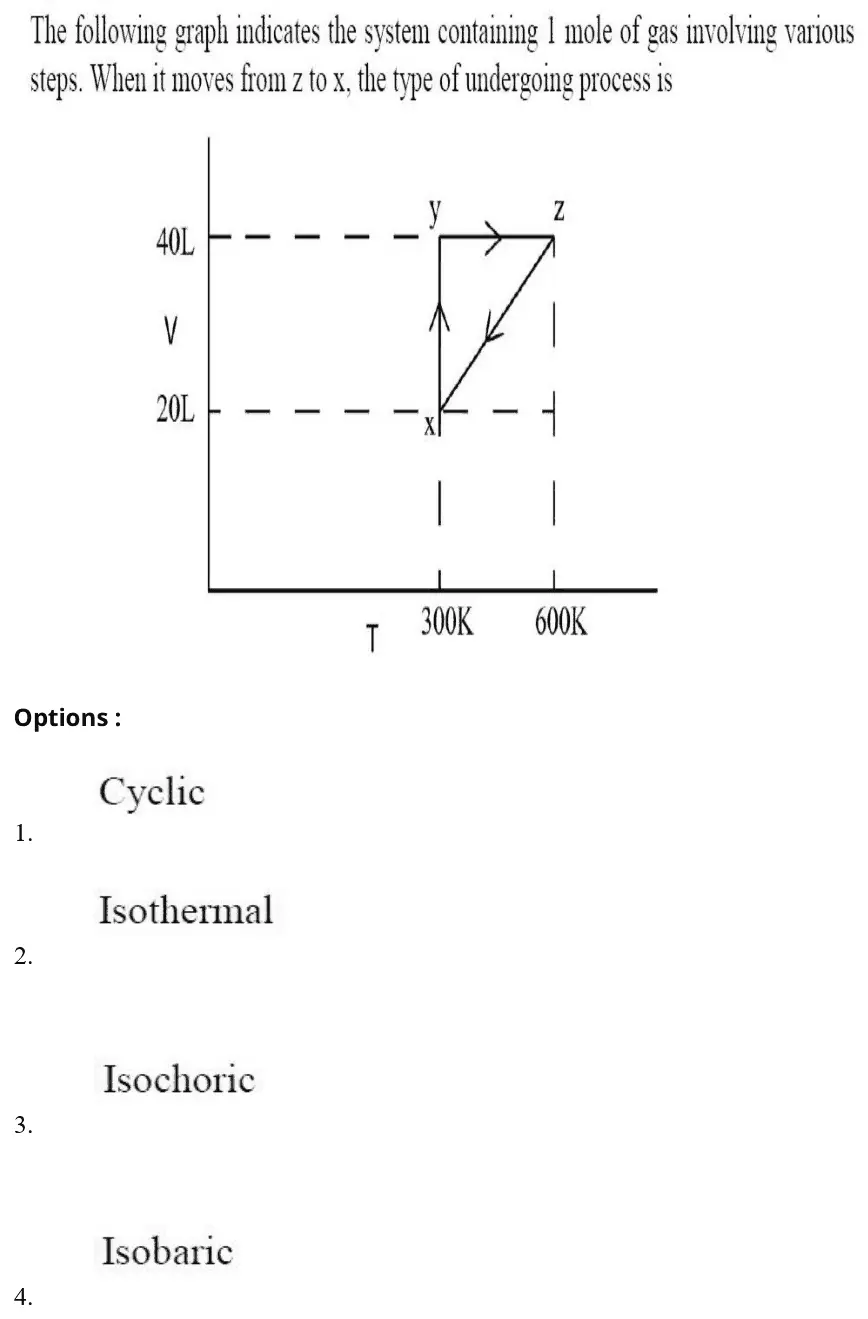
The following graph indicates the system containing 1 mole of gas involving various steps. When it moves from z to x, the type of undergoing process is
(see the figure above)

The question and its figure as printed in TS EAPCET 2021 English 6th Aug 2021 Shift 1.
The question as printed in the paper.
  • A

    Cyclic

  • B

    Isothermal

  • C

    Isochoric

  • D

    Isobaric

150TS EAMCET 2021 · 6 Aug · Shift 1MCQOpen question page ↗

Which of the following relation is correct?

  • A

    $dG = VdP + SdT$

  • B

    $dG = VdP - SdT$

  • C

    $\Delta G = -RT\ ln(K)$

  • D

    $dU = PdV + T\,dS$

151TS EAMCET 2021 · 6 Aug · Shift 2MCQOpen question page ↗

Which of the following options are correct?
Options | $\Delta_rH^\circ$ | $\Delta_rS^\circ$ | $\Delta_rG^\circ$ | Spontaneity of the reaction
A) + | + | + | Spontaneous at low T
B) + | + | - | Spontaneous at high T
C) - | - | - | Spontaneous at low T
D) + | - | + | Spontaneous at high T

  • A

    A, B, C only

  • B

    B only

  • C

    B, C only

  • D

    C, D only

152TS EAMCET 2021 · 5 Aug · Shift 1MCQOpen question page ↗

Which of the following is not an intensive property?

  • A

    Entropy

  • B

    Melting point

  • C

    Specific gravity

  • D

    Refractive index

153TS EAMCET 2021 · 4 Aug · Shift 1MCQOpen question page ↗

Enthalpy of hydrogenation of one mole of benzene to cyclohexane is
[Resonance energy of benzene = – 150.4 kJ/mole.
Enthalpy of hydrogenation of cyclohexene = –119.5 kJ/mole]

  • A

    – 208.1 kJ/mole

  • B

    – 358.1 kJ/mole

  • C

    +150.4 kJ/mole

  • D

    – 269.9 kJ/mole

154TS EAMCET 2021 · 4 Aug · Shift 2MCQOpen question page ↗

Which of the following compounds has the highest standard molar entropy?

  • A

    $\mathrm{SO_2(g)}$

  • B

    $\mathrm{SO_3(g)}$

  • C

    $\mathrm{CO_2(g)}$

  • D

    $\mathrm{CO(g)}$

155TS EAMCET 2021 · 4 Aug · Shift 2MCQOpen question page ↗

A and B on mixing form an ideal solution at room temperature. Which of the following options is correct for this process?

  • A

    $\Delta G$: $-$; $\Delta S$ System: $+$; $\Delta S$ Surroundings: $+$; $\Delta H$: $+$

  • B

    $\Delta G$: $+$; $\Delta S$ System: $+$; $\Delta S$ Surroundings: $0$; $\Delta H$: $+$

  • C

    $\Delta G$: $-$; $\Delta S$ System: $+$; $\Delta S$ Surroundings: $0$; $\Delta H$: $0$

  • D

    $\Delta G$: $-$; $\Delta S$ System: $-$; $\Delta S$ Surroundings: $+$; $\Delta H$: $+$

156AP EAMCET 2020 · 7 Oct · Shift 1MCQOpen question page ↗

At $300\ K$, $\mathrm{PCl_{5(g)}} \rightleftharpoons \mathrm{PCl_{3(g)}} + \mathrm{Cl_{2(g)}}$ and $K_p = 1.8 \times 10^{-7}$. Then calculate its $\Delta G^0$.

  • A

    $38.72\ kJ.mol^{-1}$

  • B

    $44.80\ kJ.mol^{-1}$

  • C

    $80.80\ kJ.mol^{-1}$

  • D

    $45.80\ kJ.mol^{-1}$

157AP EAMCET 2020 · 7 Oct · Shift 1MCQOpen question page ↗

When is a reaction is spontaneous?

  • A

    $\Delta G = 0$

  • B

    $\Delta G < 0$

  • C

    $\Delta G > 0$

  • D

    Can't be determined based on $\Delta G$

158AP EAMCET 2020 · 7 Oct · Shift 1MCQOpen question page ↗

For the reaction, $3\mathrm{C_2H_{2(g)}} \longrightarrow \mathrm{C_6H_{6(g)}}$, calculate the standard enthalpy change. The values of $\Delta H_f$ for $\mathrm{C_2H_2}$ and $\mathrm{C_6H_6}$ respectively are $250\ kJ.mol^{-1}$ and $90\ kJ.mol^{-1}$.

  • A

    $+660\ kJ.mol^{-1}$

  • B

    $-260\ kJ.mol^{-1}$

  • C

    $+260\ kJ.mol^{-1}$

  • D

    $-660\ kJ.mol^{-1}$

159AP EAMCET 2020 · 23 Sep · Shift 1MCQOpen question page ↗

For the reaction, $2H_{2(g)} + O_{2(g)} \longrightarrow 2H_2O_{(g)}$. At 300 K, $\Delta G$ and $\Delta H$ of water are $-228.4$ $kJ.mol^{-1}$ and $-241.60$ $kJ.mol^{-1}$ respectively. The, calculate the value of change in entropy for the given reaction.

  • A

    $+88$ J

  • B

    $+4.4$ kJ

  • C

    $-88$ J

  • D

    $-44$ J

160AP EAMCET 2020 · 22 Sep · Shift 2MCQOpen question page ↗

For the reaction $N_2O_{4(g)} \rightleftharpoons 2NO_{2(g)}$ if dinitrogen tetroxide is 50% dissociated at 60 °C, the standard free energy change at this temperature and 1 atm pressure is

  • A

    $-367.8\ \mathrm{kJ.mol^{-1}}$

  • B

    $-763.8\ \mathrm{kJ.mol^{-1}}$

  • C

    $-867\ \mathrm{kJ.mol^{-1}}$

  • D

    $-249\ \mathrm{kJ.mol^{-1}}$

161AP EAMCET 2020 · 21 Sep · Shift 1MCQOpen question page ↗

If $\Delta H > 0$ and $\Delta S > 0$, the reaction can proceed spontaneously at ______

  • A

    Low temperature

  • B

    High temperature

  • C

    All temperatures

  • D

    Will never be spontaneous

162AP EAMCET 2020 · 21 Sep · Shift 1MCQOpen question page ↗

Work done by an ideal gas at a constant volume is ______

  • A

    $-\dfrac{\Delta P}{P}$

  • B

    $-V\,\Delta P$

  • C

    0

  • D

    $\dfrac{nR}{P}$

163AP EAMCET 2020 · 21 Sep · Shift 2MCQOpen question page ↗

For the reaction $2\mathrm{NH_{3(s)}} + \mathrm{CO_{2(g)}} \rightleftharpoons \mathrm{NH_2CONH_{2(aq)}} + \mathrm{H_2O_{(l)}}$, find the value of equilibrium constant at 295 K. Given, standard Gibbs energy change at the given temperature is $-13.9\ \mathrm{kJ.mol^{-1}}$

  • A

    $2.88\times10^{2}$

  • B

    $2.58\times10^{2}$

  • C

    $2.40\times10^{2}$

  • D

    $2.65\times10^{2}$

164AP EAMCET 2020 · 21 Sep · Shift 2MCQOpen question page ↗

Among the following processes, for which process, the change in entropy ($\Delta S$) is negative?

  • A

    Sublimation of Iodine

  • B

    Freezing of water

  • C

    Burning of rocket fuel

  • D

    Dissolution of Sugar

165AP EAMCET 2020 · 18 Sep · Shift 2MCQOpen question page ↗

For an isothermal and free expansion of an ideal gas, which of the following is true?
1) For an adiabatic change, heat ($q$) is non zero
2) For an adiabatic change, heat ($q$) is zero
3) For an isothermal reversible change, heat ($q$) is zero
4) For an isothermal process, the temperature changes

  • A

    1

  • B

    2

  • C

    3

  • D

    4

167AP EAMCET 2020 · 17 Sep · Shift 2MCQOpen question page ↗

For a thermodynamic system, which among the following is not a state function?

  • A

    Enthalpy

  • B

    Internal energy

  • C

    Free energy

  • D

    Work

168TS EAMCET 2020 · 14 Sep · Shift 1MCQOpen question page ↗

In which of the processes, the entropy will decrease

  • A

    $\mathrm{H_2\,(g) \rightarrow 2H(g)}$

  • B

    Liquid water crystallizes to ice

  • C

    Temperature of ice is raised from 10 K to 115 K

  • D

    $\mathrm{2NaHCO_3\,(s) \rightarrow Na_2CO_3\,(s) + CO_2\,(g) + H_2O\,(s)}$

169TS EAMCET 2020 · 14 Sep · Shift 2MCQOpen question page ↗

For the reactions,
$\mathrm{2Cl\,(g) \rightarrow Cl_2\,(g)}$
$\mathrm{CO_2\,(g) \rightarrow CO\,(g) + \tfrac{1}{2}O_2\,(g)}$
what are the signs of $\Delta S$, respectively?

  • A

    Positive and positive

  • B

    Positive and negative

  • C

    Negative and positive

  • D

    Negative and negative

170TS EAMCET 2020 · 14 Sep · Shift 2MCQOpen question page ↗

Which of the following statement is correct?

  • A

    $\Delta G$ is equal to $\Delta G^\circ$ when the system is at the standard state

  • B

    $\Delta G^\circ$ is zero when the system is at equilibrium

  • C

    $\Delta G$ measures activation energy of a reaction

  • D

    When $\Delta G$ is positive, the reaction should proceed forward to form more product

171TS EAMCET 2020 · 11 Sep · Shift 1MCQOpen question page ↗

Find the value of the equilibrium constant (K) of a reaction at 300 K when standard Gibbs free energy change is $-25\ \mathrm{kJ\,mol^{-1}}$?
(Consider R = 8.33 $\mathrm{J\,mol^{-1}K^{-1}}$)

  • A

    $e^{8}$

  • B

    $e^{9}$

  • C

    $e^{10}$

  • D

    $e^{11}$

172TS EAMCET 2020 · 11 Sep · Shift 2MCQOpen question page ↗

Which of the following statements regarding the first law of thermodynamics is correct?

  • A

    The energy of the isolated system plus the energy of the surrounding is constant

  • B

    The energy of the isolated system minus the energy of the surrounding is constant

  • C

    The energy of an isolated system is constant

  • D

    The energy of an isolated system varies

173TS EAMCET 2020 · 10 Sep · Shift 1MCQOpen question page ↗

$\Delta H$ & $\Delta S$ for a reaction are +30.0 $\mathrm{kJ\,mol^{-1}}$ and 0.06 $\mathrm{kJ\,K^{-1}\,mol^{-1}}$ at 1 atm pressure. The temperature at which free energy change is equal to zero and nature of the reaction below this temperature are

  • A

    500 °C and non-spontaneous

  • B

    227 °C and non-spontaneous

  • C

    400 °C and spontaneous

  • D

    127 °C and spontaneous

174TS EAMCET 2020 · 10 Sep · Shift 2MCQOpen question page ↗

What will be the $\Delta U$ value, when one mole of oxygen ($\mathrm{O_2}$) is going from −20 °C to 40 °C at constant volume?
(Molar heat capacity for oxygen ≃ 20.8 J $\mathrm{mol^{-1}K^{-1}}$)

  • A

    2496 J

  • B

    20.8 J

  • C

    416 J

  • D

    1248 J

175TS EAMCET 2020 · 9 Sep · Shift 1MCQOpen question page ↗

For which of the following systems, the difference between $\Delta H$ and $\Delta U$ is not significant?
(i) Solids
(ii) Gases
(iii) Mixture of gases and liquids
(iv) Liquids

  • A

    (i) and (iv)

  • B

    (i), (iii) and (iv)

  • C

    (ii) and (iv)

  • D

    (ii) and (iii)

176TS EAMCET 2020 · 9 Sep · Shift 2MCQOpen question page ↗

Which of the following is not an extensive property?

  • A

    Volume

  • B

    Entropy

  • C

    Heat capacity at constant volume

  • D

    Molar heat capacity at constant pressure

177TS EAMCET 2019 · 6 May · Shift 1MCQOpen question page ↗

What is the standard enthalpy of reaction (in kJ) when two moles of $\mathrm{Fe_2O_3(s)}$ reacts with $\mathrm{H_2}$ gas to give Fe metal?
($\Delta_f H^\circ$ of $\mathrm{Fe_2O_3(s)}$ and $\mathrm{H_2O}(l)$ are $-824.2$ and $-285.83$ kJ mol$^{-1}$ respectively)

  • A

    $-66.58$

  • B

    $-33.3$

  • C

    $-538.37$

  • D

    $-1110.03$

178TS EAMCET 2019 · 4 May · Shift 1MCQOpen question page ↗

Enthalpy change for freezing of 1 g of water at 1 bar and $0\ ^\circ\mathrm{C}$ is 334 J. Calculate the internal energy change in J when 1 g of water is converted into ice?

  • A

    205

  • B

    334

  • C

    0

  • D

    668

179TS EAMCET 2019 · 4 May · Shift 1MCQOpen question page ↗

For a chemical reaction, the standard Gibbs energy change, $\Delta G^{\ominus}$ is $-7.64 \times 10^{4}\ \mathrm{J\ mol^{-1}}$. What is the value of equilibrium constant (K)?

  • A

    $K = 1$

  • B

    $K > 1$

  • C

    $K < 1$

  • D

    $K = 0$

180TS EAMCET 2019 · 4 May · Shift 1MCQOpen question page ↗

The heat of combustion ($\mathrm{kJ\ mol^{-1}}$) is highest for

  • A

    $\mathrm{H_2(g)}$

  • B

    $\mathrm{H_2(l)}$

  • C

    LPG

  • D

    $\mathrm{CH_4(g)}$

181TS EAMCET 2019 · 4 May · Shift 2MCQOpen question page ↗

The increase in entropy in J K$^{-1}$ of a substance when it absorbs 1 kJ of heat energy at 3 K is

  • A

    3.33

  • B

    333.3

  • C

    0.333

  • D

    0.0333

182TS EAMCET 2019 · 4 May · Shift 2MCQOpen question page ↗

Two compounds form an ideal solution at room temperature. Which of the following are correct for this ideal solution?
a) $\Delta G = +\mathrm{ve}$
b) $\Delta S = +\mathrm{ve}$ surrounding
c) $\Delta S = +\mathrm{ve}$ system
d) $\Delta_{mix}H = 0$

  • A

    c, d

  • B

    b, c, d

  • C

    b, c

  • D

    a, d

183TS EAMCET 2019 · 3 May · Shift 1MCQOpen question page ↗

Find the heat required to make water at 30 $^\circ$C from 10 g of ice at 0.0 $^\circ$C. (enthalpy of fusion of ice = 333.55 J g$^{-1}$, Cp of water = 4.18 J g$^{-1}$ K$^{-1}$)

  • A

    4.0 kJ

  • B

    5.0 kJ

  • C

    3.59 kJ

  • D

    4.59 kJ

184TS EAMCET 2019 · 3 May · Shift 1MCQOpen question page ↗

$\Delta H_f^\circ$ values (in kJ mol$^{-1}$) for graphite, diamond and $\mathrm{C_{60}}$ are respectively

  • A

    0; 1.9; 38.1

  • B

    1.8; 1.9; 38.1

  • C

    0; 0; 21.4

  • D

    1.8; 1.9; 2.0

185TS EAMCET 2019 · 3 May · Shift 2MCQOpen question page ↗

Which of the following does not follow first law of thermodynamics? (w = work; q = heat; $\Delta U$ = change in internal energy)

  • A

    $w>0$; $q>0$; $\Delta U<0$

  • B

    $w=0$; $q=0$; $\Delta U=0$

  • C

    $w>0$; $q=0$; $\Delta U>0$

  • D

    $w<0$; $q<0$; $\Delta U<0$

186AP EAMCET 2019 · 23 Apr · Shift 1MCQOpen question page ↗

Match the following.
List - I
A) $\Delta U = W_{ad}$
B) $\Delta U = q - W$
C) $\Delta U = -q$
D) $\Delta U = 0$
List - II
I) Isothermal reversible expansion
II) Wall is adiabatic
III) Thermally conducting walls
IV) Isolated system
V) Closed system
The correct answer is

  • A

    A-V, B-I, C-II, D-III

  • B

    A-I, B-III, C-II, D-IV

  • C

    A-II, B-V, C-III, D-I

  • D

    A-II, B-V, C-I, D-III

187AP EAMCET 2019 · 22 Apr · Shift 1MCQOpen question page ↗

If $\mathrm{K_p}$ for the conversion of oxygen to ozone at $400\ \mathrm{K}$ is $1.0 \times 10^{-30}$, its standard Gibbs energy change in $\mathrm{kJ\,mol^{-1}}$ is approximately

  • A

    229.8

  • B

    114.9

  • C

    $-229.8$

  • D

    $-114.9$

188AP EAMCET 2019 · 22 Apr · Shift 2MCQOpen question page ↗

The standard molar enthalpy of vaporisation of benzene $\Delta_{\mathrm{vap}}H^\circ$ at 353 K is 30.8 $\mathrm{kJ\ mol^{-1}}$. If the benzene vapours behave as an ideal gas, the change in internal energy of vaporisation of 78 g of benzene at 353 K in $\mathrm{kJ\ mol^{-1}}$ is (1 L-atm = 101.32 J)

  • A

    37.87

  • B

    27.87

  • C

    33.74

  • D

    17.87

189AP EAMCET 2019 · 21 Apr · Shift 1MCQOpen question page ↗

The heat required to rise the temperature of 54 g of aluminium from $40\,^\circ\mathrm{C}$ to $60\,^\circ\mathrm{C}$ in J is (molar heat capacity of aluminium in this temperature range is $24\ \mathrm{J\,mol^{-1}\,K^{-1}}$; atomic weight of Al is 27)

  • A

    480

  • B

    800

  • C

    960

  • D

    1280

190AP EAMCET 2019 · 21 Apr · Shift 2MCQOpen question page ↗

What is the nature of reaction at 298 K, if the entropy change and enthalpy change for a chemical reaction are $7.4\ \mathrm{cal\ K^{-1}}$ and $-2.5\times10^{3}\ \mathrm{cal}$ respectively.

  • A

    Reversible

  • B

    Spontaneous

  • C

    Non-Spontaneous

  • D

    Irreversible

191AP EAMCET 2019 · 20 Apr · Shift 1MCQOpen question page ↗

6 g of graphite is burnt in a bomb calorimeter at $25\ ^\circ\mathrm{C}$ and 1 atm pressure. The temperature of water increased from $25\ ^\circ\mathrm{C}$ to $31\ ^\circ\mathrm{C}$. If $\Delta H$ of this reaction is $-248\ \mathrm{kJ\ mol^{-1}}$, find out $C_v$ (in $\mathrm{kJ\ K^{-1}}$) of bomb calorimeter.

  • A

    20.667

  • B

    41.33

  • C

    1488

  • D

    0.145

192AP EAMCET 2019 · 20 Apr · Shift 2MCQOpen question page ↗

At 300K, the equilibrium constant for a reaction is 10. The standard free energy change (in $\mathrm{kJ\ mol^{-1}}$) for the reaction is

  • A

    $-57.4$

  • B

    $-115.2$

  • C

    $+57.4$

  • D

    $-5.74$

193TS EAMCET 2018 · 7 May · Shift 1MCQOpen question page ↗

For the following process $\mathrm{H_2O_{(l)}}$ (1 bar, 373.15K) $\rightleftharpoons$ $\mathrm{H_2O_{(g)}}$ (1 bar, 373.15K) identify the correct set of thermodynamic parameters

  • A

    $\Delta G = 0$, $\Delta S = +$ve

  • B

    $\Delta G = 0$, $\Delta S = -$ve

  • C

    $\Delta G = +$ve, $\Delta S = 0$

  • D

    $\Delta G = -$ve, $\Delta S = +$ve

194TS EAMCET 2018 · 5 May · Shift 1MCQOpen question page ↗

The standard enthalpy of formation of $\mathrm{CO_{(g)}}$, $\mathrm{CO_{2(g)}}$, $\mathrm{N_2O_{(g)}}$, and $\mathrm{N_2O_{4(g)}}$ are respectively $-10$, $-393$, $81$, and $-10\ \mathrm{kJ\ mol^{-1}}$. Enthalpy change (in kJ) of the following reaction is
$\mathrm{N_2O_{4(g)} + 3CO_{(g)} \longrightarrow N_2O_{(g)} + 3CO_{2(g)}}$

  • A

    $-1058$

  • B

    $+1058$

  • C

    $-957$

  • D

    $+957$

195TS EAMCET 2018 · 5 May · Shift 2MCQOpen question page ↗

A sample of argon of $1\ \mathrm{atm}$ pressure and $300\ \mathrm{K}$ expands reversibly and adiabatically from $1.25\ \mathrm{dm^3}$ to $2.5\ \mathrm{dm^3}$. Calculate the approximate enthalpy (in J) change
[i) $C_v$ for argon is $12.48\ \mathrm{JK^{-1}}$, ii) Assume argon to be an ideal gas, iii) $\Delta T = 111.5\ \mathrm{K}$]

  • A

    $20.9$

  • B

    $117$

  • C

    $234$

  • D

    $58.5$

196TS EAMCET 2018 · 5 May · Shift 2MCQOpen question page ↗

If equilibrium constant of a process is $3.8 \times 10^{-3}$ at $25\,^\circ\mathrm{C}$, standard free energy change of the process is
($R = 8.314\ \mathrm{J\,mol^{-1}\,K^{-1}}$, $\log 0.0038 = -2.42$)

  • A

    $5.7\ \mathrm{kJ\,mol^{-1}}$

  • B

    $9.9\ \mathrm{kJ\,mol^{-1}}$

  • C

    $13.8\ \mathrm{kJ\,mol^{-1}}$

  • D

    $15.6\ \mathrm{kJ\,mol^{-1}}$

197TS EAMCET 2018 · 4 May · Shift 1MCQOpen question page ↗

At 298 K, the equilibrium constant of the process $1.5\,\mathrm{O_{2(g)}} \rightleftharpoons \mathrm{O_{3(g)}}$ is $3\times10^{-29}$. Standard free energy change (in $\mathrm{kJ\,mol^{-1}}$) of the process is approximately
($R = 8.314\ \mathrm{J\,mol^{-1}K^{-1}}$; $\log 3 = 0.47$)

  • A

    724

  • B

    612

  • C

    247

  • D

    163

198TS EAMCET 2018 · 4 May · Shift 2MCQOpen question page ↗

Amongst the chemical reactions given below, the reactions with increasing entropy a
a) $\mathrm{H_2O_{(l)} \rightarrow H_2O_{(g)}}$
b) $\mathrm{C_{(s)} + CO_{2(g)} \rightarrow 2CO_{(g)}}$
c) $\mathrm{2H_{2(g)} + O_{2(g)} \rightarrow 2H_2O_{(l)}}$
d) $\mathrm{N_{2(g)} + O_{2(g)}}$ $\rightarrow$ Mixture of $\mathrm{N_2}$ and $\mathrm{O_2}$

  • A

    a, b, c, d

  • B

    a, b, c

  • C

    a, b, d

  • D

    b, c, d

199AP EAMCET 2018 · 24 Apr · Shift 1MCQOpen question page ↗

If 1.5 L of an ideal gas at a pressure of 20 atm expands isothermally and reversibly to a final volume of 15 L, the work done by the gas in L atm is

  • A

    69.09

  • B

    34.55

  • C

    $-34.55$

  • D

    $-69.09$

200AP EAMCET 2018 · 24 Apr · Shift 2MCQOpen question page ↗

If the work done during the isothermal reversible expansion of an ideal gas at a pressure of 10 atm from 4L to a final volume is $-184.24$ L atm, the final volume of the gas in L is

  • A

    40

  • B

    400

  • C

    8

  • D

    80

201AP EAMCET 2018 · 23 Apr · Shift 1MCQOpen question page ↗

At the temperature T(K) for the reaction $\mathrm{X_2O_{4(l)}} \rightarrow 2\mathrm{XO_{2(g)}}$ $\Delta U = x\ \mathrm{kJ\,mol^{-1}}$, $\Delta S = y\ \mathrm{JK^{-1}mol^{-1}}$. Gibbs energy change for the reaction is
(Assume $\mathrm{X_2O_4}$, $\mathrm{XO_2}$ are ideal gases)

  • A

    $1000x + 2R(T - y)\ \mathrm{J\,mol^{-1}}$

  • B

    $1000x + T(2R - y)\ \mathrm{J\,mol^{-1}}$

  • C

    $x + T(2R - y)\ \mathrm{J\,mol^{-1}}$

  • D

    $x + 2R(T - y)\ \mathrm{J\,mol^{-1}}$

202AP EAMCET 2018 · 23 Apr · Shift 2MCQOpen question page ↗

If enthalpy of combustion of carbon to $\mathrm{CO_{2(g)}}$ is $-394.0\ \mathrm{kJ\ mol^{-1}}$, the enthalpy change for the formation of 17.6 g of $\mathrm{CO_2}$ from carbon and dioxygen at the same temperature in kJ is

  • A

    -157.6

  • B

    315.2

  • C

    157.6

  • D

    -315.2

203AP EAMCET 2018 · 22 Apr · Shift 1MCQOpen question page ↗

From the following data
$\mathrm{CH_3OH_{(l)}} + \frac{3}{2}\mathrm{O_{2(g)}} \rightarrow \mathrm{CO_{2(g)}} + 2\mathrm{H_2O_{(l)}}$ ; $\Delta_r H^\circ = -726\ \mathrm{kJ\,mol^{-1}}$
$\mathrm{H_{2(g)}} + \frac{1}{2}\mathrm{O_{2(g)}} \rightarrow \mathrm{H_2O_{(l)}}$ ; $\Delta_r H^\circ = -286\ \mathrm{kJ\,mol^{-1}}$
$\mathrm{C_{(graphite)}} + \mathrm{O_{2(g)}} \rightarrow \mathrm{CO_{2(g)}}$ ; $\Delta_r H^\circ = -393\ \mathrm{kJ\,mol^{-1}}$
The standard enthalpy of formation of $\mathrm{CH_3OH_{(l)}}$ in $\mathrm{kJ\,mol^{-1}}$ is

  • A

    $-239$

  • B

    $239$

  • C

    $547$

  • D

    $-905$

204AP EAMCET 2018 · 22 Apr · Shift 2MCQOpen question page ↗

Match the following
List I
A) At constant volume the change in internal energy of a system
B) Isothermal irreversible change
C) Isothermal reversible change
D) Adiabatic change
List II
I) $W=-2.303\,nRT\log\frac{V_f}{V_i}$
II) $W_{adia}=\Delta U$
III) $q_v=\Delta U$
IV) $W=-P_{ex}(V_f-V_i)$
V) $\Delta U=\Delta H-\Delta nRT$
The correct answer is

  • A

    A-V, B-III, C-IV, D-I

  • B

    A-IV, B-I, C-III, D-V

  • C

    A-III, B-IV, C-I, D-II

  • D

    A-III, B-V, C-I, D-II

205TS EAMCET 2017 · 12 May · OfflineMCQOpen question page ↗

Given $\Delta \mathrm{H_f^\circ}$ for $\mathrm{CO_{2(g)}}$, $\mathrm{CO_{(g)}}$ and $\mathrm{H_2O(g)}$ are $-393.5$, $-110.5$ and $-241.8\ \mathrm{kJ\ mol^{-1}}$, respectively. The $\Delta \mathrm{H_f^\circ}$ [in $\mathrm{kJ\ mol^{-1}}$] for the reaction
$\mathrm{CO_2(g) + H_{2(g)} \rightarrow CO_{(g)} + H_2O(g)}$ is

  • A

    $524.1$

  • B

    $-262.5$

  • C

    $-41.7$

  • D

    $41.2$

206TS EAMCET 2017 · 12 May · OfflineMCQOpen question page ↗

Standard Enthalpy (Heat) of formation of liquid water at $25\,^\circ$C is around
$\mathrm{H_{2(g)}} + \frac{1}{2}\mathrm{O_{2(g)}} \to \mathrm{H_2O_{(l)}}$

  • A

    $-237$ kJ/mol

  • B

    237 kJ/mol

  • C

    $-286$ kJ/mol

  • D

    286 kJ/mol

207AP EAMCET 2017 · 26 Apr · Shift 1MCQOpen question page ↗

The enthalpy of formation ($\Delta_f\mathrm{H}$) of methanol, formaldehyde and water are $-239$, $-116$ and $-286\ \mathrm{kJ\,mol^{-1}}$ respectively. The enthalpy change for the oxidation of methanol to formaldehyde and water in kJ is

  • A

    $-136$

  • B

    $-173$

  • C

    $-163$

  • D

    $163$

208AP EAMCET 2017 · 26 Apr · Shift 2MCQOpen question page ↗

Which one of the following involves decrease in entropy ?

  • A

    $\mathrm{2NaHCO_{3(s)} \longrightarrow Na_2CO_{3(s)} + CO_{2(g)} + H_2O_{(g)}}$

  • B

    $\mathrm{CCl_{4(s)} \longrightarrow CCl_{4(l)}}$

  • C

    $\mathrm{Zn_{(s)} + 2HCl_{(aq)} \longrightarrow ZnCl_{2(aq)} + H_{2(g)}}$

  • D

    $\mathrm{CaO_{(s)} + CO_{2(g)} \longrightarrow CaCO_{3(s)}}$

209AP EAMCET 2017 · 26 Apr · Shift 2MCQOpen question page ↗

Assertion (A) : For every chemical reaction at equilibrium, standard Gibbs energy change of the reaction is zero
Reason (R) : At constant temperature and pressure chemical reactions are spontaneous in the direction of decreasing Gibbs energy.

  • A

    Both (A) and (R) are correct and (R) is the correct explanation of (A)

  • B

    Both (A) and (R) are correct but (R) is not the correct explanation of (A)

  • C

    (A) is correct and (R) is not correct

  • D

    (A) is not correct but (R) is correct

210AP EAMCET 2017 · 25 Apr · Shift 1MCQOpen question page ↗

If standard enthalpy of formation ($\Delta_f H^\circ$) of $\mathrm{CO_2}$, $\mathrm{H_2O}$ and $\mathrm{CH_4}$ are $-393$, $-286$ and $-74.0$ $\mathrm{kJ\ mol^{-1}}$ respectively, the standard enthalpy of combustion of methane in $\mathrm{kJ\ mol^{-1}}$ is

  • A

    $-753$

  • B

    $-105$

  • C

    $-605$

  • D

    $-891$

211AP EAMCET 2017 · 25 Apr · Shift 2MCQOpen question page ↗

Molar enthalpy change for vapourisation of 1.0 mol of water at 1.0 bar and 100°C is 41.0 kJ $\mathrm{mol^{-1}}$. If water vapour is assumed to be an ideal gas, the internal energy change for 1.0 g of water in kJ is

  • A

    1.053

  • B

    4.212

  • C

    3.159

  • D

    2.106

212AP EAMCET 2017 · 24 Apr · Shift 1MCQOpen question page ↗

A gas absorbs 100 J of heat and is simultaneously compressed by a constant external pressure of 1.5 atm from a volume of 8.0L to 2.0L. The change in internal energy for the gas in Joules is (1L - atm = 101.32 J)

  • A

    $-1011.9$

  • B

    $-909.9$

  • C

    $+909.9$

  • D

    $1011.9$

213AP EAMCET 2017 · 24 Apr · Shift 2MCQOpen question page ↗

Assertion (A) : If heat of combustion of $\mathrm{C_2H_6}$ is 'X' $\mathrm{kJ\ mol^{-1}}$, heat liberated on combustion of 150 g $\mathrm{C_2H_6}$ is $\frac{X}{5}$ kJ.
Reason (R) : Enthalpy is an extensive property

  • A

    Both (A) and (R) are correct, and (R) is the correct explanation of (A)

  • B

    Both (A) and (R) are correct, but (R) is not the correct explanation of (A)

  • C

    (A) is correct, (R) is not correct

  • D

    (A) is not correct but (R) is correct

214TS EAMCET 2016 · 15 May · OfflineMCQOpen question page ↗

Given that $\mathrm{N_2(g) + 3H_2(g) \rightarrow 2NH_3(g)}$; $\Delta_r H^{\ominus} = -92$ kJ, the standard molar enthalpy of formation in kJ $\mathrm{mol^{-1}}$ of $\mathrm{NH_3(g)}$ is

  • A

    $-92$

  • B

    $+46$

  • C

    $+92$

  • D

    $-46$

215AP EAMCET 2016 · 29 Apr · OfflineMCQOpen question page ↗

Given that
$\mathrm{C_{(s)} + O_{2(g)} \rightarrow CO_{2(g)}}$ ; $\Delta H^\circ = -x$ kJ
$\mathrm{2CO_{(g)} + O_{2(g)} \rightarrow 2CO_{2(g)}}$ ; $\Delta H^\circ = -y$ kJ
The enthalpy of formation of CO will be

  • A

    $\dfrac{y - 2x}{3}$

  • B

    $\dfrac{y - 2x}{2}$

  • C

    $\dfrac{2x - y}{2}$

  • D

    $\dfrac{x - y}{2}$

216AP EAMCET 2014 · 22 May · OfflineMCQOpen question page ↗

The temperature in K at which $\Delta G = 0$, for a given reaction with $\Delta H = -20.5\ \mathrm{kJ\ mol^{-1}}$ and $\Delta S = -50.0\ \mathrm{JK^{-1}\ mol^{-1}}$ is

  • A

    $-410$

  • B

    410

  • C

    2.44

  • D

    $-2.44$

217AP EAMCET 2013 · 10 May · OfflineMCQOpen question page ↗

For which one of the following reactions, the entropy change is positive ?

  • A

    $\underset{(g)}{\mathrm{H_2}} + \dfrac{1}{2}\underset{(g)}{\mathrm{O_2}} \rightarrow \underset{(\ell)}{\mathrm{H_2O}}$

  • B

    $\underset{(g)}{\mathrm{Na^+}} + \underset{(g)}{\mathrm{Cl^-}} \rightarrow \underset{(s)}{\mathrm{NaCl}}$

  • C

    $\underset{(\ell)}{\mathrm{NaCl}} \rightarrow \underset{(s)}{\mathrm{NaCl}}$

  • D

    $\underset{(\ell)}{\mathrm{H_2O}} \rightarrow \underset{(g)}{\mathrm{H_2O}}$

218AP EAMCET 2012 · 12 May · OfflineMCQOpen question page ↗

The molar heat capacity ($C_p$) of water at constant pressure is 75 $\mathrm{J.K^{-1}.mol^{-1}}$. The increase in temperature (in K) of 100 g of water when 1 k.J. of heat is supplied to it is

  • A

    2.4

  • B

    0.24

  • C

    1.3

  • D

    0.13

219AP EAMCET 2011 · 8 May · OfflineMCQOpen question page ↗

Which one of the following pairs represents the intensive properties ?

  • A

    Specific heat and temperature

  • B

    Entropy and density

  • C

    Enthalpy and mole fraction

  • D

    Heat and temperature

220AP EAMCET 2010 · 30 May · OfflineMCQOpen question page ↗

A system is provided with 50 Joules of heat and the work done on the system is 10 Joules. What is the change in internal energy of the system in Joules ?

  • A

    60

  • B

    40

  • C

    50

  • D

    10

How to prepare Chemical Thermodynamics for EAPCET

How often it comes up

Chemical Thermodynamics ranks at position 8 among all 31 chemistry chapters in the 2022 to 2026 examination span. Across our complete archive from 2010 through 2026, the chapter registered 220 questions across 149 papers, appearing in 145 of those sessions and commanding 3.7 percent of the total chemistry questions with 1.5 questions per paper. In the modern window from 2022 to 2026, it provided 127 questions across 77 sittings, generating 1.6 questions per paper and a 4.1 percent subject share.

The chapter has cemented its standing in recent sessions, appearing in every paper between 2022 and 2026. Across jurisdictions during these five years, AP candidates tackled 96 questions across 48 papers (2.0 questions per paper, 5.0 percent share), whereas TS papers included 31 questions over 29 sittings (1.1 questions per paper, 2.7 percent share).

Looking at the earlier historical block from 2010 through 2021, the chapter contributed 93 questions across 72 sittings (appearing in 68 papers), delivering 1.3 questions per paper and a 3.2 percent subject share. Over the last three testing seasons from 2024 to 2026, papers accumulated 74 questions across 46 sittings, maintaining 1.6 questions per paper and 4.0 percent share. In terms of long-term movement, comparing early testing with the last three years shows the share is up, while comparing the recent five-year window with the last three years shows the share is about the same. Every sitting presents at least one reliable thermodynamics problem.

Most-asked topics

Questions in this branch focus on three interrelated conceptual clusters:

  • First Law & Enthalpy forms the foundation with 89 questions overall and 56 across the recent window through 2026. Frequent problem types assess state versus path functions, intensive versus extensive parameters, isothermal and adiabatic work, and the conversion between internal energy change and enthalpy change using gaseous stoichiometric differences.
  • Thermochemistry supplied 59 questions across the archive, with 39 appearing between 2022 and 2026. This area tests Hesss law cycles, standard enthalpies of formation, enthalpies of combustion, bond dissociation energies, and resonance stabilization calculations.
  • Entropy & Gibbs Energy accounts for 72 questions in total and 32 in the recent period through 2026. Core topics include qualitative sign evaluations for system entropy, calculations of standard Gibbs free energy, criteria for spontaneity, and equilibrium temperature thresholds.

What the questions look like

Calculations in chemical thermodynamics tend to be direct, testing whether you can set up energy conservation equations cleanly. One recurring problem supplies standard formation enthalpies for reactants and products and asks for the reaction enthalpy, or asks you to deduce standard formation enthalpy from combustion data. Another common variant tests the relation connecting enthalpy change to internal energy change, requiring you to calculate the net change in moles of gas produced by a chemical reaction.

In the second law area, problems often present numerical values for enthalpy change and entropy change and ask for the threshold temperature at which the reaction transitions from non-spontaneous to spontaneous. Other questions present four physical or chemical changes and ask you to select the transformation where entropy increases.

Questions to try first

Solve these representative official questions to build familiarity with typical numerical setups:

How to practise it

Pay rigorous attention to units and sign conventions. Enthalpy changes are conventionally stated in kilojoules per mole, whereas entropy changes are almost always provided in joules per mole Kelvin. Forgetting to divide entropy by one thousand before plugging values into the Gibbs Helmholtz equation is the single most common source of wrong answers.

Practise Hesss law problems by writing balanced thermochemical equations step by step. When using bond enthalpies, remember the rule: sum of bond enthalpies of reactants minus sum of bond enthalpies of products. Conversely, when using standard enthalpies of formation, the calculation is products minus reactants. Rehearse gaseous stoichiometric mole counting carefully so you never miscount liquid or solid phases in net gas mole differences.

Frequently asked questions

When does reaction spontaneity depend entirely on temperature?

When enthalpy change and entropy change share the same sign, temperature dictates whether Gibbs free energy is negative. When both values are positive, the reaction becomes spontaneous only at temperatures above enthalpy divided by entropy. When both are negative, the reaction is spontaneous only below that temperature.

How are extensive and intensive variables distinguished in questions?

Extensive properties depend on the quantity of matter present, such as mass, internal energy, volume, and heat capacity. Intensive properties remain independent of sample size, including molar heat capacity, density, temperature, and pressure.

Does work done depend on whether a gas expands reversibly or irreversibly?

Yes, isothermal reversible expansion yields maximum work given by negative two point three zero three n R T log of final volume over initial volume. In irreversible expansion against constant external pressure, work equals negative external pressure multiplied by change in volume. Step-by-step solutions for each one are in the EdLoop EAPCET app.

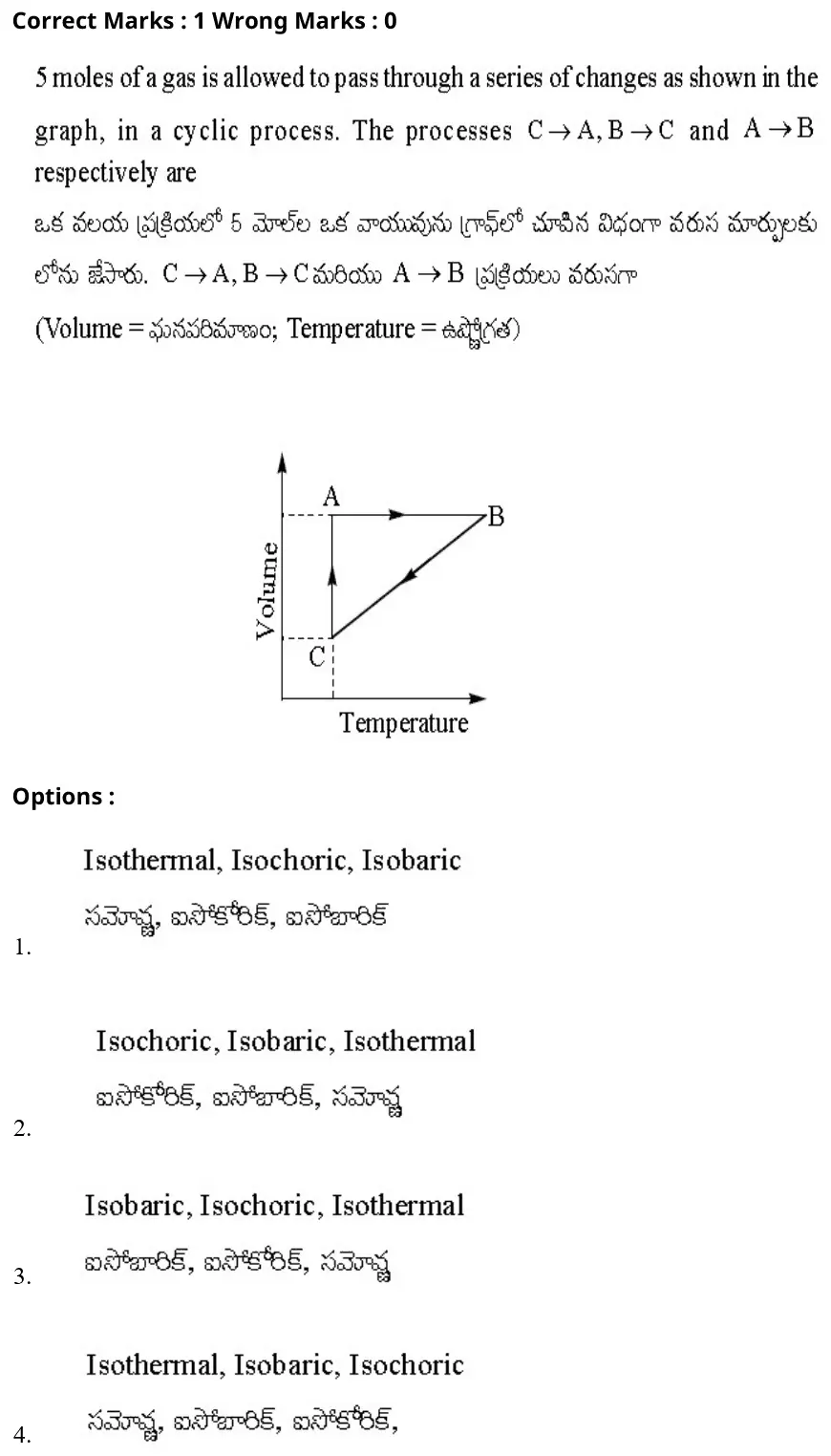
Get EdLoop – freeOpen on the web