At 450 K, for the reaction $2\mathrm{SO_2}(g) + \mathrm{O_2}(g) \rightleftharpoons 2\mathrm{SO_3}(g)$, the value of $K_p$ is $2.0 \times 10^{10}$. What is the value of $K_c$ for the decomposition of sulphur trioxide at the same temperature? [R=0.083 L bar mol$^{-1}$ K$^{-1}$]
The value of $\mathrm{K_c}$ for this reaction is 100. At equilibrium, the number of moles of $\mathrm{SO_3(g)}$ is equal to twice the number of moles of $\mathrm{SO_2(g)}$. What is the number of moles of $\mathrm{O_2(g)}$ at equilibrium?
In a 1L closed flask, 2 moles of $\mathrm{A(g)}$ and 1 mole of $\mathrm{B(g)}$ were taken and heated to $\mathrm{T(K)}$. At equilibrium, the concentration of $\mathrm{B(g)}$ is equal to twice the equilibrium concentration of $\mathrm{C(g)}$. What is the value of $\mathrm{K_c}$?
At $T(K)$ in a $10.0\ L$ flask, 2 moles of $N_2O_4(g)$ was heated. At equilibrium $20\%$ of $N_2O_4(g)$ was dissociated into $NO_2(g)$. What is the $K_c$ for this reaction?
In a 1L closed flask, 2 moles of A(g) and 1 mole of B(g) were taken and heated to T(K). At equilibrium, the concentration of C(g) is thrice the concentration of B(g). what is the value of $\mathrm{K_c}$?
At T(K), 15 moles of $\mathrm{H_2}$ reacts with 5.2 moles of $\mathrm{I_2}$ and forms 10 moles of $\mathrm{HI}$. The equilibrium constant for the reaction $2\mathrm{HI}(g) \rightleftharpoons \mathrm{H_2}(g) + \mathrm{I_2}(g)$ is
For the reaction $2\mathrm{HI}(g) \rightleftharpoons \mathrm{H_2}(g) + \mathrm{I_2}(g)$, the correct expression relating the degree of dissociation ($\alpha$) of $\mathrm{HI}$ and equilibrium constant $K_p$ is
At $T$ $(K)$ in a closed $2.0$ $L$ vessel, 1 mole of $\mathrm{H_2}$ and 2 moles of $\mathrm{I_2}$ are taken initially and allowed to react till equilibrium is established. At equilibrium, the number of moles of $\mathrm{H_2}$ is found to be 0.2. The equilibrium constant for the dissociation of $HI$ is
The equilibrium constants $K_{P_1}$ and $K_{P_2}$ for the gaseous reactions, $X \rightleftharpoons 2Y$ and $Z \rightleftharpoons P + Q$ respectively are in the ratio of $1 : 9$. If the degree of dissociation of $X$ and $Z$ are equal, then the ratio of their total pressures at these equilibria is
At $540\ K$, $0.1\ mol$ of $PCl_5$ is heated in a $8.0\ L$ flask. The total pressure of the equilibrium mixture is $1\ atm$. The $K_p$ (in $atm$ ) for the reaction is $(R = 0.082\ L\ atm\ K^{-1}mol^{-1})$
The pressure of equilibrium mixture is 1 atm. Among the gaseous compounds, CO has 84% by mass. $\mathrm{K_c}$ of this reaction is (approximately) ($\mathrm{R = 0.082\ L\ atm\ mol^{-1}K^{-1}}$)
(Assume that $\mathrm{CO}$ and $\mathrm{CO_2}$ are ideal gases)
Consider the following equilibrium reaction in gaseous state at T(K).
$$\mathrm{A + 2B \rightleftharpoons 2C + D}$$
The initial concentration of B is 1.5 times that of A. At equilibrium, the concentrations of A and B are equal. The equilibrium constant for the reaction is
At T(K), $\mathrm{K_c}$ value of $\mathrm{AO_2(g) + BO_2(g) \rightleftharpoons AO_3(g) + BO(g)}$ is 16. In a closed 1 L flask, one mole each of $\mathrm{AO_2}$, $\mathrm{BO_2}$, $\mathrm{AO_3}$ and BO are taken and heated to T(K). Identify the correct statements about this equilibrium.
I) Total number of moles at equilibrium is 4
II) At equilibrium, the ratio of moles of $\mathrm{AO_2}$ and $\mathrm{AO_3}$ is 1 : 4
III) Total number of moles of $\mathrm{AO_2}$ and $\mathrm{BO_2}$ at equilibrium is 0.8
For the following given equilibrium reaction $\frac{K_c}{K_p}$ is equal to 1076 at T(K). What is the value of T (in K) ? (R = 0.082 L-atm $\mathrm{K^{-1}}$ $\mathrm{mol^{-1}}$)
What is the fraction of $\mathrm{N_2O_5}$ decomposed at constant volume and temperature, if the initial pressure is 300 mm Hg and pressure at equilibrium is 480 mm Hg? (Assume all gases as ideal)
Consider the following gaseous equilibrium reactions (I), (II) and (III) with equilibrium constants $\mathrm{K_1}$, $\mathrm{K_2}$ and $\mathrm{K_3}$ respectively
The correct expression for the equilibrium constant for the gaseous equilibrium reaction $2\mathrm{NH_3} + \frac{5}{2}\mathrm{O_2} \rightleftharpoons 2\mathrm{NO} + 3\mathrm{H_2O}$ is
At 298 K, the value of $\mathrm{K_p}$ for $\mathrm{N_2O_4(g)} \rightleftharpoons 2\mathrm{NO_2(g)}$ is 0.113 atm. The partial pressure of $\mathrm{N_2O_4}$ at equilibrium is 0.2 atm. What is the partial pressure (in atm) of $\mathrm{NO_2}$ at equilibrium ?
At T(K), $\mathrm{K_c}$ value for $\mathrm{AO_2(g) + BO_2(g) \rightleftharpoons AO_3(g) + BO(g)}$ is 16. In a closed 1 L flask, one mole each of $\mathrm{AO_2, BO_2, AO_3}$ and $\mathrm{BO}$ are taken and heated to T(K). What is the concentration (in $\mathrm{mol\ L^{-1}}$) of $\mathrm{AO_3}$ at equilibrium?
At T(K), the following gaseous equilibrium is established.
$$\mathrm{W + X \rightleftharpoons Y + Z}$$
The initial concentration of W is two times to the initial concentration of X. The system is heated to T(K) to establish the equilibrium. At equilibrium the concentration of Y is four times to the concentration of X. What is the value of $\mathrm{K_c}$ ?
At 298 K, the value of $\mathrm{K_c}$ for the following reaction is $x$ mol $\mathrm{L^{-1}}$. What is the approximate $\mathrm{K_p}$ value for this reaction ?
For the reaction $\mathrm{N_2O_4}(g) \rightleftharpoons 2\mathrm{NO_2}(g)$, the correct relation between degree of dissociation ($\alpha$) of $\mathrm{N_2O_4}(g)$ and equilibrium constant, $\mathrm{K_p}$ is (P = total pressure of mixture)
At 1000 K, the equilibrium constant for the reaction
$\mathrm{CO_2(g) + H_2(g) \rightleftharpoons CO(g) + H_2O(g)}$ is 0.53. In a one litre vessel, at equilibrium the mixture contains 0.25 mole of CO, 0.5 mole of $\mathrm{CO_2}$, 0.6 mole of $\mathrm{H_2}$ and $x$ moles of $\mathrm{H_2O}$. The value of $x$ is
the concentrations of $\mathrm{A_2}$, $\mathrm{B_2}$ and AB respectively are $1.5 \times 10^{-3}\,\mathrm{M}$, $2.1 \times 10^{-3}\,\mathrm{M}$ and $1.4 \times 10^{-3}\,\mathrm{M}$ in a sealed vessel at 800 K. What will be $\mathrm{K_p}$ for the decomposition of AB at same temperature?
is 39.0. In a closed one litre flask, one mole of $\mathrm{A_2(g)}$ was heated to T(K). What are the concentrations of $\mathrm{A_2(g)}$ and $\mathrm{B_2(g)}$ (in $\mathrm{mol\ L^{-1}}$) respectively at equilibrium?
15 moles of $\mathrm{H_2}$ and 5.2 moles of $\mathrm{I_2}$ are mixed and allowed to attain equilibrium at 773 K. At equilibrium, the number of moles of HI is found to be 10. The equilibrium constant for the dissociation of HI is
$K_c$ for the reaction, $\mathrm{A_2(g)} \overset{T(K)}{\rightleftharpoons} \mathrm{B_2(g)}$ is 99.0. In a 1 L closed flask two moles of $\mathrm{B_2(g)}$ is heated to T (K). What is the concentration of $\mathrm{B_2(g)}$ (in $\mathrm{mol\ L^{-1}}$) at equilibrium?
In a one litre flask, 2 moles of $\mathrm{A_2}$ was heated to T(K) and the above equilibrium is reached. The concentrations at equilibrium of $\mathrm{A_2}$ and $\mathrm{B_2}$ are $C_1(\mathrm{A_2})$ and $C_2(\mathrm{B_2})$ respectively. Now, one mole of $\mathrm{A_2}$ was added to flask and heated to T(K) to establish the equilibrium again. The concentrations of $\mathrm{A_2}$ and $\mathrm{B_2}$ are $C_3(\mathrm{A_2})$ and $C_4(\mathrm{B_2})$ respectively. What is the value of $C_3(\mathrm{A_2})$ in $\mathrm{mol\ L^{-1}}$?
At T (K), $\mathrm{K_c}$ for the reaction, $\mathrm{A_2}$ (g) $\rightleftharpoons$ $\mathrm{B_2}$ (g) is 99.0. Two moles of $\mathrm{A_2}$ (g) was heated to T (K) in a 1L closed flask to reach the above equilibrium. What are the concentrations (in mol $\mathrm{L^{-1}}$) of $\mathrm{A_2}$ (g) and $\mathrm{B_2}$ (g) respectively at equilibrium?
At T(K), $\mathrm{K_c}$ for the reaction $\mathrm{AO_2(g) + BO_2(g) \rightleftharpoons AO_3(g) + BO(g)}$ is 16. One mole each of reactants and products are taken in a 1L flask and heated to T(K), and equilibrium is established. What is the equilibrium concentration of BO (in mol $\mathrm{L^{-1}}$)?
At T(K), $\mathrm{K_c}$ for the dissociation of $\mathrm{PCl_5}$ is $2\times10^{-2}\ \mathrm{mol\ L^{-1}}$. The number of moles of $\mathrm{PCl_5}$ that must be taken in 1.0 L flask at the same temperature to get $0.2\ \mathrm{mol}$ of chlorine at equilibrium is
At T(K), the $\mathrm{K_p}$ for the reaction $\mathrm{A_2B_6(g) \rightleftharpoons A_2B_4(g) + B_2(g)}$ is 0.04 atm. The equilibrium pressure (in atm) of $\mathrm{A_2B_6(g)}$ when it is placed in a flask at 4 atm pressure and allowed to come to above equilibrium is
One mole $\mathrm{H_2O(g)}$ and one mole $\mathrm{CO(g)}$ are taken in 1L flask and heated to 725K. At equilibrium, 40% (by mass) of water reacted with $\mathrm{CO(g)}$ as follows.
The equilibrium constant of this reaction is $10^{-1}$. After reaching the equilibrium, 0.5 moles of $\mathrm{A\,(g)}$ is added and heated. The equilibrium is again established. The value of $\frac{[\mathrm{A}]}{[\mathrm{B}]}$ is
One mole of $\mathrm{PCl_5(g)}$ was heated in a 1L closed flask at 500 K. At equilibrium, 0.1 mole of $\mathrm{Cl_2(g)}$ was formed. What is its $\mathrm{K_p}$ (in atm)?
At T(K), the equilibrium constant for $\mathrm{A(g)} \rightleftharpoons \mathrm{B(g)}$ is $10^{-2}$. If rate of forward reaction is $0.025\ \mathrm{mol\ L^{-1}\ s^{-1}}$. The rate of backward reaction (in $\mathrm{mol\ L^{-1}\ s^{-1}}$) is
One mole $\mathrm{H_2O(g)}$ and one mole $\mathrm{CO(g)}$ are taken in 1L flask and heated to 725K. At equilibrium, 40% (by mass) of water reacted with $\mathrm{CO(g)}$ as follows
At T(K), the equilibrium constant for the reaction $\mathrm{a\,A(g) \rightleftharpoons b\,B(g)}$ is $\mathrm{K_c}$. If the reaction takes place in the following form $\mathrm{2a\,A(g) \rightleftharpoons 2b\,B(g)}$ its equilibrium constant is $\mathrm{K_c'}$. The correct relationship between $\mathrm{K_c}$ and $\mathrm{K_c'}$ is
At T(K) when one mol of X and one mol of Y are heated in a 1 L flask, 0.5 moles of Z is formed at the equilibrium. The $\mathrm{K_c}$ value for the reaction is
At T (K), $\mathrm{K_C}$ value for the reaction $\frac{1}{3}\mathrm{N_2(g)} + \mathrm{H_2(g)} \rightleftharpoons \frac{2}{3}\mathrm{NH_3(g)}$ is 50. The $\mathrm{K_C}$ value for the reaction $2\mathrm{NH_3(g)} \rightleftharpoons \mathrm{N_2(g)} + 3\mathrm{H_2(g)}$ at the same temperature is
At 780 K and 10 atmosphere pressure the equilibrium constant for the reaction $\mathrm{2A(g) \rightleftharpoons B(g) + C(g)}$ is 3.52. At the same temperature and 7.04 atmosphere pressure, the equilibrium constant for the same reaction is
For the formation of ammonia from its constituent elements (1 mole of $\mathrm{N_2}$ and 3 moles of $\mathrm{H_2}$) in a closed vessel of volume V(L), the value of $K_c$ is [units of $K_c$ = $\mathrm{mol^{-2}L^{2}}$]
Calculate the value of the equilibrium constant ($K_P$) for the reaction of oxygen gas oxidising ammonia gas to nitric oxide and water vapour. The pressure of each gas at equilibrium is 0.5 atm.
The $\mathrm{K_{p}}$ value at equilibrium of $\mathrm{SO_{3}}$ formation reaction from $\mathrm{SO_{2}(g)}$ and $\mathrm{O_{2}(g)}$ is 5 $\mathrm{atm^{-1}}$. What is the equilibrium partial pressure of $\mathrm{O_{2}}$ if the equilibrium pressure of $\mathrm{SO_{2}}$ and $\mathrm{SO_{3}}$ are equal?
For a reaction $\mathrm{A(s)\rightleftharpoons B(s)+C(g)}$ the set of all correct statements are a) K is independent of [A]. b) K is dependent on partial pressure of C at a given temperature. c) $\Delta$H will be independent of temperature. d) $\Delta$H is independent of the catalyst addition.
Assertion (A): For an endothermic dissolution process, increase in temperature increases the solubility in a nearly saturated solution. Reason (R): In saturated solution dynamic equilibrium exists between dissolved solute and undissolved solute.
A
Both (A) and (R) are correct and R is the correct explanation of A
B
Both (A) and (R) are correct, but R is not the correct explanation of A
For the formation of $\mathrm{NH_3(g)}$ from its constituent elements, which of the relation between the reaction quotient (Q) and equilibrium constant ($K_C$) is correct for the backward reaction
At 500 K, for the reaction, $N_2(g) + 3H_2(g) \rightleftharpoons 2NH_3(g)$, the $K_p$ is 0.036 $\mathrm{atm^{-2}}$. What is its $K_c$ in $\mathrm{L^2\,mol^{-2}}$? (R = 0.082 L atm $\mathrm{mol^{-1}\,K^{-1}}$).
Using the data given below, find the expression for equilibrium constant 'K' for the reaction $2\,NH_3 + \frac{5}{2}O_2 \rightleftharpoons 2\,NO + 3\,H_2O$ Equilibrium constant for the reaction $2\,NH_3 \rightleftharpoons N_2 + 3H_2$ is $K_1$ Equilibrium constant for the reaction $2\,NO \rightleftharpoons N_2 + O_2$ is $K_2$ Equilibrium constant for the reaction $\frac{1}{2}O_2 + H_2 \rightleftharpoons H_2O$ is $K_3$
Given $K_p$ for the reaction $\frac{1}{2}\mathrm{C_{(g)}} \rightleftharpoons \frac{1}{2}\mathrm{A_{(g)}} + \frac{1}{2}\mathrm{B_{(g)}}$ at a fixed temperature is $0.25\ atm^{-2}$. Then find the $K_p$ for the reaction $\mathrm{A_{(g)} + B_{(g)} \rightleftharpoons C_{(g)}}$ at the same temperature.
The reaction $\mathrm{N_{2(g)} + 3\,H_{2(g)} \rightleftharpoons 2\,NH_{3(g)}}$ is exothermic and reversible. A mixture of $\mathrm{N_{2(g)}, H_{2(g)}}$ and $\mathrm{NH_{3(g)}}$ is at equilibrium in a closed container. When a certain quantity of extra $\mathrm{H_{2(g)}}$ is introduced into the container, while keeping the volume constant, then which statement among the following is true?
When the reaction $A + 2B \rightleftharpoons 2C + D$ was studied, it was observed that the initial concentration of $B$ was 1.5 times that of $A$, and the equilibrium concentrations of $A$ and $C$ were equal. Then $K_c$ for the given equilibrium equals ______
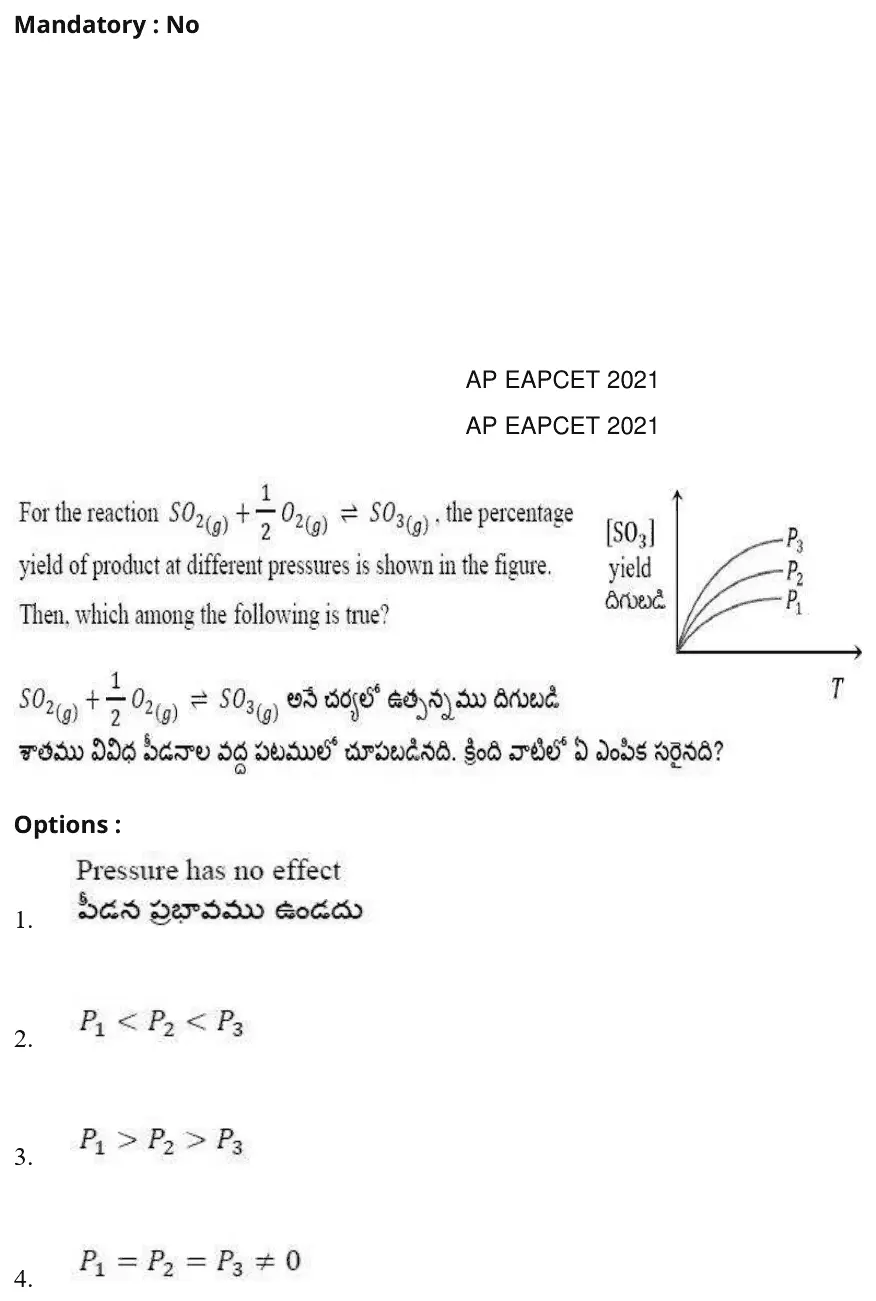
For the reaction $\mathrm{SO_{2(g)}} + \frac{1}{2}\mathrm{O_{2(g)}} \rightleftharpoons \mathrm{SO_{3(g)}}$, the percentage yield of product at different pressures is shown in the figure. Then, which among the following is true? (see the figure above)
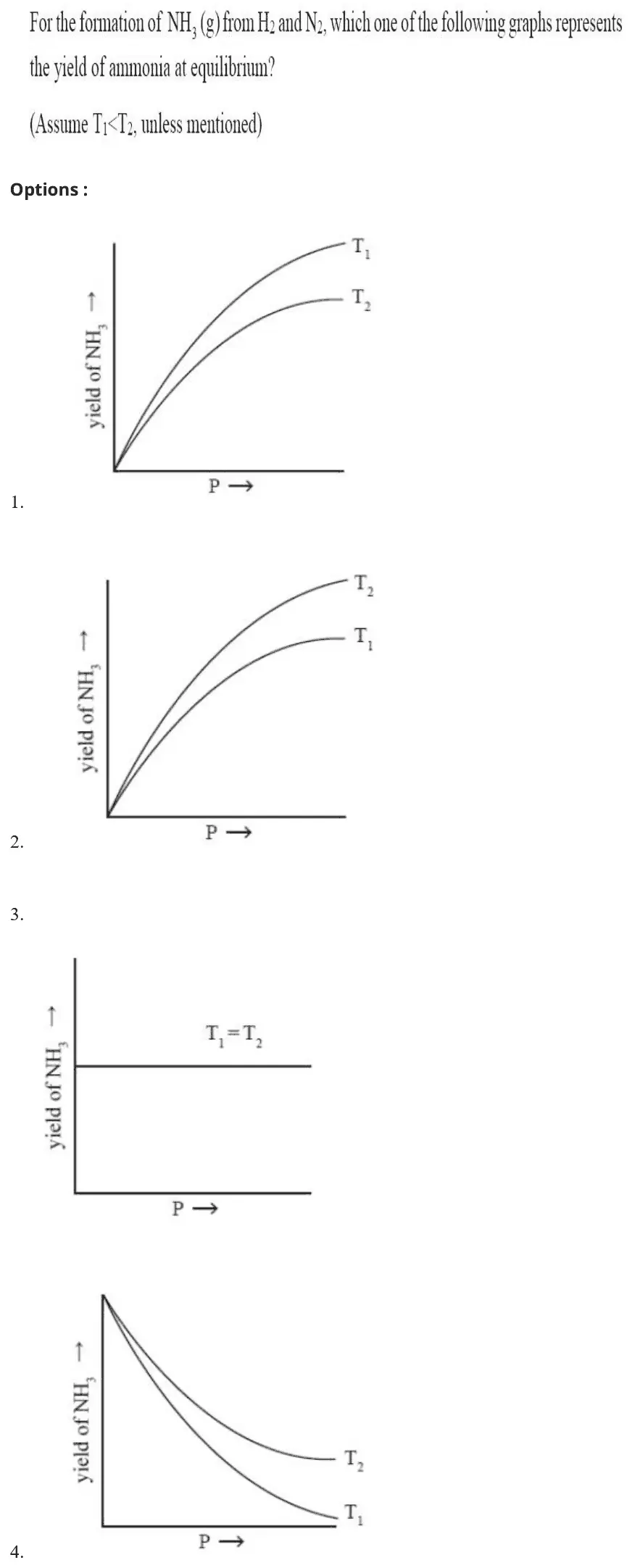
For the formation of $\mathrm{NH_3}$ (g) from $\mathrm{H_2}$ and $\mathrm{N_2}$, which one of the following graphs represents the yield of ammonia at equilibrium? (Assume $T_1<T_2$, unless mentioned) (see the figure above)
The question as printed in the paper.
A
see figure yield of $\mathrm{NH_3}$ vs P: two rising curves from the origin, $T_1$ above $T_2$
B
see figure yield of $\mathrm{NH_3}$ vs P: two rising curves from the origin, $T_2$ above $T_1$
C
see figure yield of $\mathrm{NH_3}$ vs P: horizontal line labelled $T_1=T_2$
D
see figure yield of $\mathrm{NH_3}$ vs P: two falling curves from a common high point at P=0, $T_2$ above $T_1$
The equilibrium constant ($K_p$) for the formation of ammonia from its constituent elements at $27\ ^\circ\mathrm{C}$ is $1.2\times10^{-4}$ and at $127\ ^\circ\mathrm{C}$ is $0.60\times10^{-4}$. Calculate the mean heat of formation of ammonia per mole in this temperature range.
For a reaction $\mathrm{2A \rightleftharpoons B+C}$, $K_c$ is $2\times10^{-3}$. At a given time, the reaction mixture has $[\mathrm{A}]=[\mathrm{B}]=[\mathrm{C}]=3\times10^{-4}$ M. Which of the following options is correct?
For the reaction $\mathrm{A_{(g)} \rightleftharpoons B_{(g)} + C_{(g)}}$, A is 33 % dissociated at a total pressure P. The correct relation between P and $K_p$ is
For the reaction $NO_2+CO\rightleftharpoons NO+CO_2$ one mole of $NO_2$ and 2 moles of $CO$ were kept in a vessel. Calculate the equilibrium constant $K_p$ if at equilibrium 25% of initial amount $CO$ is consumed.
For a given equilibrium reaction, addition of inert argon gas at constant volume can shift the equilibrium in $\mathrm{N_2\,(g) + 3H_2\,(g) \rightleftharpoons 2NH_3\,(g)}$
For a given reaction, $\mathrm{2A \rightleftharpoons B + C}$, the equilibrium constant is $2\times10^{-3}$. If at any given time the composition of the reaction mixture is $[\mathrm{A}] = [\mathrm{B}] = [\mathrm{C}] = 6\times10^{-5}\,\mathrm{M}$; predict in which direction the reaction will proceed and the correct value for reaction quotient.
Aqueous solution of ferric nitrate when mixed with aqueous solution of potassium thiocyanate gives red color solution. The intensity of red color becomes constant on attaining equilibrium. Choose the correct statement when the following chemical is added to the above solution at equilibrium (i) Oxalic acid (ii) Mercuric chloride
A
Both (i) and (ii) will decrease the intensity of red color
B
Both (i) and (ii) will increase the intensity of red color
C
(i) will increase but (ii) will decrease the intensity of red color
D
(i) will decrease but (ii) will increase the intensity of red color
What is the equilibrium constant ($K_c$) for the given reaction? $\mathrm{N_2 + O_2 \rightleftharpoons 2NO}$ Where the equilibrium concentration of $\mathrm{N_2}$, $\mathrm{O_2}$ and NO are found to be $4\times10^{-3}$, $3\times10^{-3}$ and $3\times10^{-3}$ M respectively.
For the given equilibrium reaction, $\mathrm{2A(g) \rightleftharpoons 2B(g) + C(g)}$ the equilibrium constant ($K_c$) at 1000 K is $4 \times 10^{-4}$. Calculate $K_p$ for the reaction at 800 K temperature
If the equilibrium constant for the reaction $\mathrm{2SO_2 + O_2 \rightleftharpoons 2SO_3}$ is 64 at 500 K, then the equilibrium constant for the reaction $\mathrm{SO_3 \rightleftharpoons SO_2 + \tfrac{1}{2}O_2}$ at the same temperature is
Consider the equilibrium $\mathrm{H_2} + \mathrm{I_2} \rightleftharpoons 2\mathrm{HI}$. Calculate the equilibrium constant of the reverse reaction when the equilibrium concentration of $\mathrm{H_2}$, $\mathrm{I_2}$ and HI are $1.14 \times 10^{-2}$, $0.12 \times 10^{-2}$ and $2.52 \times 10^{-2}$ mol L$^{-1}$, respectively
For the reaction $0.5\,\mathrm{C(s)} + 0.5\,\mathrm{CO_2(g)} \rightleftharpoons \mathrm{CO(g)}$ the equilibrium pressure is 12 atm. If $\mathrm{CO_2}$ conversion is 50%, the value of $\mathrm{K_p}$, in atm is
Match the following: List - I (Reaction) List - II ($K_p$) A) $2\mathrm{SO_2(g)} + \mathrm{O_2(g)} \rightleftharpoons 2\mathrm{SO_3(g)}$ at 298 K B) $2\mathrm{SO_2(g)} + \mathrm{O_2(g)} \rightleftharpoons 2\mathrm{SO_3(g)}$ at 700 K C) $\mathrm{N_2O_4(g)} \rightleftharpoons 2\mathrm{NO_2(g)}$ at 298 K D) $\mathrm{N_2O_4(g)} \rightleftharpoons 2\mathrm{NO_2(g)}$ at 500 K I) 0.98 II) $3.0\times10^{4}$ III) 1700 IV) $4.0\times10^{24}$ V) $6.8\times10^{-5}$ The correct answer is
18.4 g $\mathrm{N_2O_4}$ was placed in 1L vessel at 400 K and allowed to attain the following equilibrium $\mathrm{N_2O_{4(g)} \rightleftharpoons 2NO_{2(g)}}$. If the total pressure at equilibrium was 10.64 bar, approximate $K_p$ is ($R = 0.083\ \mathrm{L\ bar\ K^{-1}mol^{-1}}$) (Assume $\mathrm{N_2O_4}$, $\mathrm{NO_2}$ as ideal gases)
At $1000\ \mathrm{K}$, the partial pressures of $\mathrm{CO_{2(g)}}$ and $\mathrm{CO_{(g)}}$ for the reaction $\mathrm{CO_{2(g)} + C_{(s)} \rightleftharpoons 2CO_{(g)}}$ in a closed vessel at equilibrium are $0.15$ and $0.60$ bar respectively. The $\mathrm{K_c}$ for this reaction at the same temperature is approximately
The equilibrium partial pressures of $\mathrm{CO_{(g)}}$, $\mathrm{CO_{2(g)}}$ in the equilibrium reaction $\mathrm{CO_{2(g)} + C_{(s)} \rightleftharpoons 2CO_{(g)}}$ at 1000 K are 0.66 and 0.15 bar respectively. The equilibrium constant $K_c$ approximately is
The equilibrium constant at 850 K for the reaction $\mathrm{N_{2(g)}+O_{2(g)}\rightleftharpoons 2NO_{(g)}}$ is 0.5625. The equilibrium concentration of $\mathrm{NO_{(g)}}$ is $3.0\times10^{-3}$ M. If the equilibrium concentrations of $\mathrm{N_{2(g)}}$ and $\mathrm{O_{2(g)}}$ are equal, the concentration of $\mathrm{N_{2(g)}}$ in M
The value of $\mathrm{K_C}$ for the equilibrium reaction $\mathrm{CO_{2(g)} + C_{(s)} \rightleftharpoons 2CO_{(g)}}$ at T (K) is 0.036. If the equilibrium concentration of $\mathrm{CO_{2(g)}}$ is 0.004 M, the concentration of $\mathrm{CO_{(g)}}$ in $\mathrm{mol\ L^{-1}}$ is
Observe the following equations $\mathrm{NH_3 + Ag^+ \rightleftharpoons [Ag(NH_3)]^+}$, $K_1 = 1.6\times10^3$ $\mathrm{[Ag(NH_3)]^+ + NH_3 \rightleftharpoons [Ag(NH_3)_2]^+}$, $K_2 = 6.8\times10^3$ The equilibrium constant for the following reaction, $\mathrm{Ag^+ + 2NH_3 \rightleftharpoons [Ag(NH_3)_2]^+}$ is
$\mathrm{PCl_5 \rightleftharpoons PCl_3 + Cl_2}$ If the equilibrium constant ($\mathrm{K_c}$) for the above reaction at 500 K is 1.79 and the equilibrium concentration of $\mathrm{PCl_5}$ and $\mathrm{PCl_3}$ are 1.41 M and 1.59 M, respectively, then the concentration of $\mathrm{Cl_2}$ is approximately
Consider the following reaction in a 1 L closed vessel. $\mathrm{N_2 + 3H_2 \rightleftharpoons 2NH_3}$ If all the species; $\mathrm{N_2}$, $\mathrm{H_2}$ and $\mathrm{NH_3}$ are in 1 mole in the beginning of the reaction and equilibrium is attained after unreacted $\mathrm{N_2}$ is 0.7 moles. What is the value of equilibrium constant.
For a reaction $2\mathrm{A_{(g)}} \rightleftharpoons 2\mathrm{B_{(g)}} + \mathrm{C_{(g)}}$, $\mathrm{K_c} = 3.75\times10^{-6}$ at 1069 K. The approximate value of $\mathrm{K_p}$ for this reaction at the same temperature is ($R = 0.082\ \mathrm{L\,bar\,mol^{-1}K^{-1}}$)
For the formation of $\mathrm{NH_3}$ from $\mathrm{N_2}$ and $\mathrm{H_2}$ at 500 K, the concentration of $\mathrm{N_2}$, $\mathrm{H_2}$ and $\mathrm{NH_3}$ at equilibrium are $1.5\times10^{-2}$ M, $3.0\times10^{-2}$ M, and $1.2\times10^{-2}$ M, respectively. The equilibrium constant for the reverse reaction is
At T(K), the equilibrium constant of $\mathrm{H_{2(g)} + I_{2(g)} \rightleftharpoons 2HI_{(g)}}$ is 49. If $[\mathrm{H_2}]$, $[\mathrm{I_2}]$ at equilibrium at the same temperature are $2.0\times10^{-2}$ M and $8.0\times10^{-2}$ M respectively, the [HI] at equilibrium in $\mathrm{mol\,L^{-1}}$ is
The equilibrium concentrations of $\mathrm{N_2}$, $\mathrm{H_2}$ and $\mathrm{NH_3}$ in the formation of $\mathrm{NH_3}$ at 500 K are $1.25\times10^{-2}\ \mathrm{M}$, $4.0\times10^{-2}\ \mathrm{M}$ and $1.6\times10^{-2}\ \mathrm{M}$ respectively. The equilibrium constant $K_p$ at the same temperature is
For the gaseous reactions (I) and (II), the equilibrium constants are X and Y respectively. I. $\frac{1}{2}\mathrm{N_{2(g)}} + \mathrm{O_{2(g)}} \rightleftharpoons \mathrm{NO_{2(g)}}$ II. $2\mathrm{NO_{2(g)}} \rightleftharpoons \mathrm{N_2O_{4(g)}}$ Using the above reactions the equilibrium constant Z for the reaction (III) given below is III. $\mathrm{N_2O_{4(g)}} \rightleftharpoons \mathrm{N_{2(g)}} + 2\mathrm{O_{2(g)}}$
At 1000 K, if the equilibrium constant $K_p$ for the reaction $2\mathrm{NOCl_{(g)}} \rightleftharpoons 2\mathrm{NO_{(g)}} + \mathrm{Cl_{2(g)}}$ is $4.157 \times 10^{-4}$ bar, the $K_c$ (in $\mathrm{mol\ L^{-1}}$) is ($R = 0.083\ \mathrm{L\ bar\ K^{-1}\ mol^{-1}}$)
At 1000 K, the equilibrium constant, $K_c$ for the reaction $2\mathrm{NOCl_{(g)}} \rightleftharpoons 2\mathrm{NO_{(g)}} + \mathrm{Cl_{2(g)}}$ is $4.0\times10^{-6}\ \mathrm{mol\,L^{-1}}$. The $K_p$ (in bar) at the same temperature is ($R = 0.083\ \mathrm{L\,bar\,K^{-1}\,mol^{-1}}$)
i) $\mathrm{H_3PO_4(aq)\rightleftharpoons H^+_{(aq)}+H_2PO^-_{4(aq)}}$ ii) $\mathrm{H_2PO^-_{4(aq)}\rightleftharpoons H^+_{(aq)}+HPO^{2-}_{4\,(aq)}}$ iii) $\mathrm{HPO^{2-}_{4\,(aq)}\rightleftharpoons H^+_{(aq)}+PO^{3-}_{4\,(aq)}}$ The equilibrium constants for the above reactions at a certain temperature are $K_1$, $K_2$ and $K_3$ respectively. The equilibrium constant for the reaction $\mathrm{H_3PO_{4(aq)}\rightleftharpoons 3H^+_{(aq)}+PO^{3-}_{4\,(aq)}}$ in terms of $K_1$, $K_2$ and $K_3$ is
The equilibrium constant ($K_c$) for the following equilibrium $\mathrm{2SO_{2(g)}+O_{2(g)}\rightleftharpoons 2SO_{3(g)}}$ at 563 K is 100. At equilibrium, the number of moles of $\mathrm{SO_3}$ in the 10 litre flask is twice the number of moles of $\mathrm{SO_2}$, then the number of moles of oxygen is
In a 100 L vessel, 3 moles of nitrogen and 3 moles of $\mathrm{PCl_5}$ are taken and heated to 500 K. The equilibrium pressure is 3.28 atm. The percentage degree of dissociation of $\mathrm{PCl_5}$ is (Assume ideal behaviour for all gases).
At T(K), $\mathrm{K_c}$ for the reaction $\mathrm{SO_{2(g)} + NO_{2(g)} \rightleftharpoons SO_{3(g)} + NO_{(g)}}$ is 16. If initially one mole each of all the four gases are taken in one litre vessel, the equilibrium concentrations of $\mathrm{SO_{3(g)}}$ and $\mathrm{SO_{2(g)}}$ in $\mathrm{mol\ L^{-1}}$ respectively are:
At 800 K in a closed vessel, the molar concentrations of $\mathrm{N_2}$, $\mathrm{O_2}$ and NO at equilibrium are $3.2\times10^{-3}$ M, $4.2\times10^{-3}$ M and $2.8\times10^{-3}$ M respectively. The approximate values of $K_c$ and $\frac{1}{K_c}$ for the following reaction are respectively $\mathrm{N_{2(g)}+O_{2(g)}\rightleftharpoons 2NO_{(g)}}$
The equilibrium constant ($K_c$) is independent of temperature.
B
The value of $K_c$ is independent of initial concentrations of reactants and products.
C
At equilibrium, the rate of the forward reaction is twice the rate of the backward reaction.
D
The equilibrium constant ($K_c$) for the reaction $\mathrm{Ni(s) + 4CO(g) \rightleftharpoons Ni(CO)_4(g)}$ is, $\frac{[\mathrm{Ni(CO)_4}]}{[\mathrm{CO}]}$
At 400 K, in a 1.0L vessel $\mathrm{N_2O_4}$ is allowed to attain equilibrium $\mathrm{N_2O_{4(g)} \rightleftharpoons 2NO_{2(g)}}$ At equilibrium the total pressure is 600 mm Hg, when 20% of $\mathrm{N_2O_4}$ is dissociated. The $K_p$ value for the reaction is
In a reaction $\mathrm{A + B \rightleftharpoons C + D}$, 40% of B has reacted at equilibrium, when 1 mol of A was heated with 1 mol of B in a 10 litre closed vessel. The value of $K_c$ is
At T(K), the partial pressures of $\mathrm{SO_2}$, $\mathrm{O_2}$ and $\mathrm{SO_3}$ are 0.662, 0.100 and 0.331 atm. respectively for the reaction $2\,\mathrm{SO_2(g)} + \mathrm{O_2(g)} \rightleftharpoons 2\,\mathrm{SO_3(g)}$ at equilibrium. What is the partial pressure in atm. of $\mathrm{O_2}$ when the equilibrium partial pressures of $\mathrm{SO_2}$ and $\mathrm{SO_3}$ are equal at the same temperature ?
If the equilibrium constant for the reaction $\mathrm{H_{2(g)} + I_{2(g)} \rightleftharpoons 2HI_{(g)}}$ is K what is the equilibrium constant of $\mathrm{HI_{(g)} \rightleftharpoons \frac{1}{2}H_{2(g)} + \frac{1}{2}I_{2(g)}}$ ?
Answer: (D) $\frac{1}{\sqrt{K}}$· Official APSCHE final key
How to prepare Chemical Equilibrium for EAPCET
How often it comes up
Chemical Equilibrium holds rank 24 among all 31 chemistry chapters in the recent 2022 to 2026 examination span. Across the full historical archive spanning 2010 through 2026, the chapter contributed 120 questions across 149 papers, appearing in 110 of those tests to record a 2.0 percent subject share and 0.8 questions per paper. In the modern timeframe from 2022 to 2026, it maintained this consistent rhythm with 62 questions across 77 sittings, featuring in 60 papers to post 0.8 questions per paper and a 2.0 percent share.
The chapter has appeared in every exam year since 2022, although it was absent from seventeen papers across that five-year period. State distributions between 2022 and 2026 show that AP papers gathered 45 questions across 48 sittings (appearing in 43 papers, 0.9 questions per paper, 2.3 percent share), while TS papers recorded 17 questions across 29 sittings (appearing in 17 papers, 0.6 questions per paper, 1.5 percent share).
In earlier testing from 2010 through 2021, papers included 58 questions across 72 sittings (appearing in 50 papers), which also yielded 0.8 questions per paper and a 2.0 percent subject share. Across the most recent three exam years from 2024 to 2026, question writers set 36 questions across 46 sittings (appearing in 36 papers), delivering 0.8 questions per paper and a 2.0 percent share. Evaluating trend patterns shows that the share early versus the last three years is about the same, and the share recent versus the last three years is also about the same.
Most-asked topics
Questions in this chapter focus on quantitative equilibrium relationships and qualitative system responses:
Equilibrium Calculations leads modern testing with 45 questions overall and 33 across the recent window through 2026. Questions require you to set up algebraic tables relating initial quantities, extent of reaction, and equilibrium partial pressures or molar concentrations.
Equilibrium Constant provided 59 questions across the archive, with 23 appearing from 2022 to 2026. Core topics include manipulating equilibrium constants when reversing reactions or multiplying coefficients, connecting Kp and Kc via the ideal gas relation, and relating reaction quotients to equilibrium constants.
Le Chatelier's Principle accounts for 16 questions overall, with 6 occurring between 2022 and 2026 (last tested in 2023). Problems examine shifts caused by altering pressure, temperature, component concentrations, or adding inert gases at constant volume versus constant pressure.
What the questions look like
Most questions demand setting up algebraic expressions for homogeneous gaseous reactions. A classic format asks for the relationship between the degree of dissociation and Kp for the decomposition of phosphorus pentachloride or dinitrogen tetroxide, often asking for Kp in terms of total equilibrium pressure. Another frequent variant presents heterogeneous equilibria, such as the decomposition of solid mercury oxide or calcium carbonate, where pure solids do not appear in the equilibrium expression.
You will also encounter comparative problems where two different reactions share an identical degree of dissociation, and you must calculate the ratio of their total pressures from their equilibrium constants. Mathematical manipulations of K are equally prominent, asking how the numerical value changes when an equation is multiplied by a fractional factor or inverted.
Questions to try first
Work through these official state exam questions to master standard algebraic manipulations:
Master the connection between Kp and Kc given by Kp equals Kc open parenthesis R T close parenthesis to the power of delta n. Always check the sign and magnitude of delta n by counting only gaseous moles. If delta n is zero, Kp equals Kc and equilibrium compositions remain unchanged by pressure fluctuations or volume expansions.
Build speed in writing standard dissociation grids. For a reaction starting with one mole of reactant that dissociates to degree alpha, express the equilibrium moles of each species, sum them to obtain total moles, and express partial pressure as mole fraction times total pressure. Practise simplifying expressions when alpha is negligible compared to one, but always verify whether the numerical values warrant that approximation.
Frequently asked questions
Does the addition of an inert gas always alter chemical equilibrium?
No, introducing an inert gas at constant volume leaves the partial pressures and concentrations of reacting gases unchanged, so the equilibrium position does not shift. However, adding an inert gas at constant pressure increases total volume, shifting the equilibrium toward the side with more moles of gas.
How does changing temperature affect the equilibrium constant?
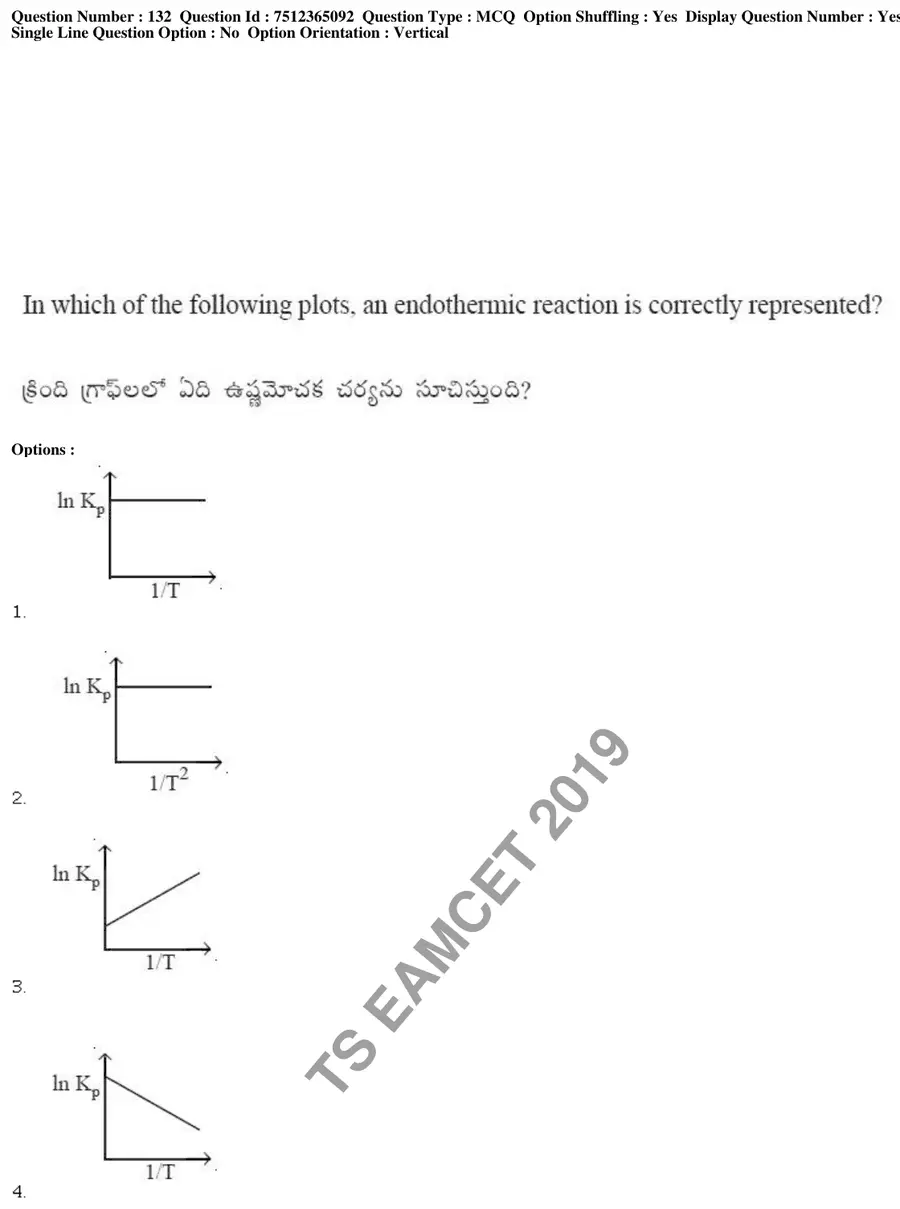
Temperature is the sole variable that alters the numerical value of the equilibrium constant. For an endothermic process, increasing temperature increases K, shifting equilibrium forward. For an exothermic process, increasing temperature decreases K, favoring reactants.
Are pure solids and pure liquids included in equilibrium constant formulas?
Pure solids and liquids have constant thermodynamic activity equal to one because their molar concentrations remain invariant regardless of quantity. Consequently, they are omitted from Kp and Kc expressions, simplifying heterogeneous calculations. Step-by-step solutions for each one are in the EdLoop EAPCET app.