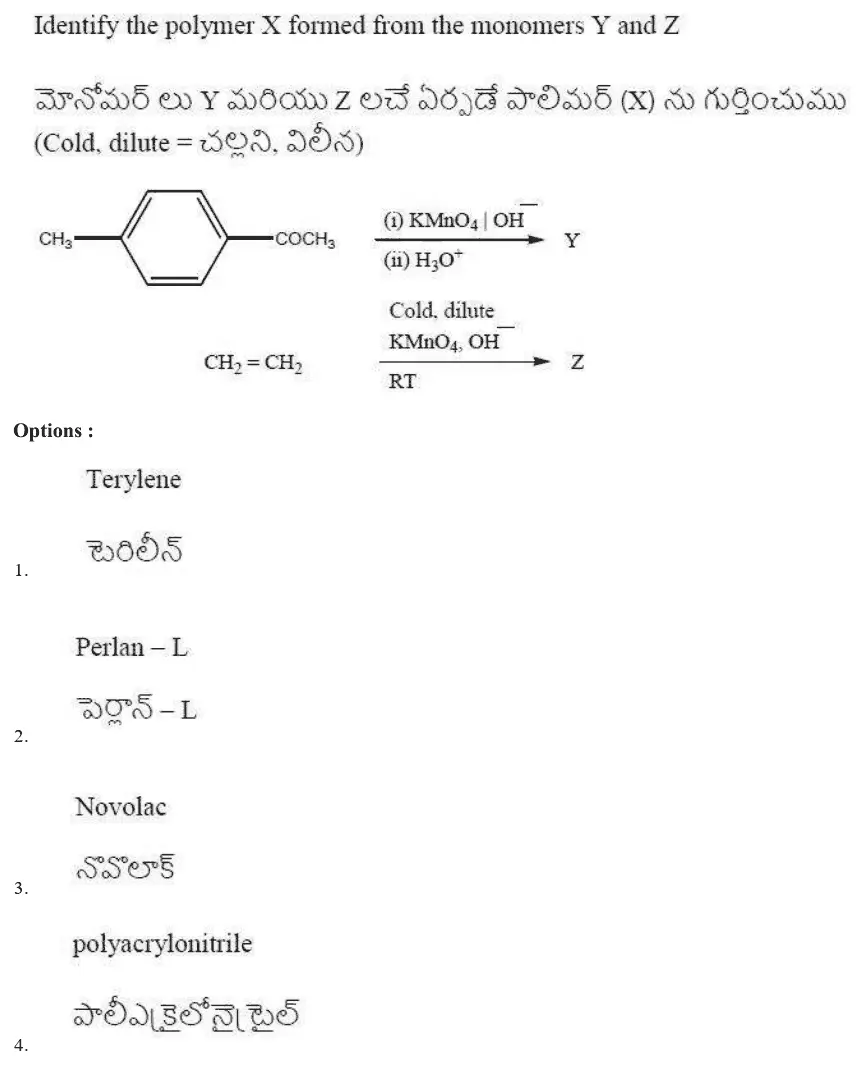
Identify the polymer X formed from the monomers Y and Z
(Cold, dilute)
(see the figure above)
- A
Terylene
- B
Perlan – L
- C
Novolac
- D
polyacrylonitrile
Answer: (A) Terylene · The council's preliminary key
 PYQs · free, no adsOpen on the web (app.edloop.in)Get EdLoop – free on Google Play
Every Polymers question from past AP EAPCET and TS EAPCET papers, with options and answers. Newest first.
Polymers represents a compact and straightforward component of the senior secondary organic syllabus.
Attempt every Polymers question timed, see the step-by-step solution and track what you get wrong. Free.
Identify the polymer X formed from the monomers Y and Z
(Cold, dilute)
(see the figure above)
Terylene
Perlan – L
Novolac
polyacrylonitrile
Which of the following is not an example of copolymer?
Bakelite
Dacron
Buna-N
Perlan-L
Polymer (X) is used in the preparation of non-stick utensils and polymer (Y) is used in manufacture of unbreakable crockery. What are X and Y respectively?
Addition copolymer ; condensation copolymer
Addition homopolymer ; condensation copolymer
Condensation homopolymer ; addition homopolymer
Condensation copolymer ; addition copolymer
Which one of the polymers does not contain $-COO-$ linkage in its structure?
Bakelite
Glyptal
PHBV
Dacron
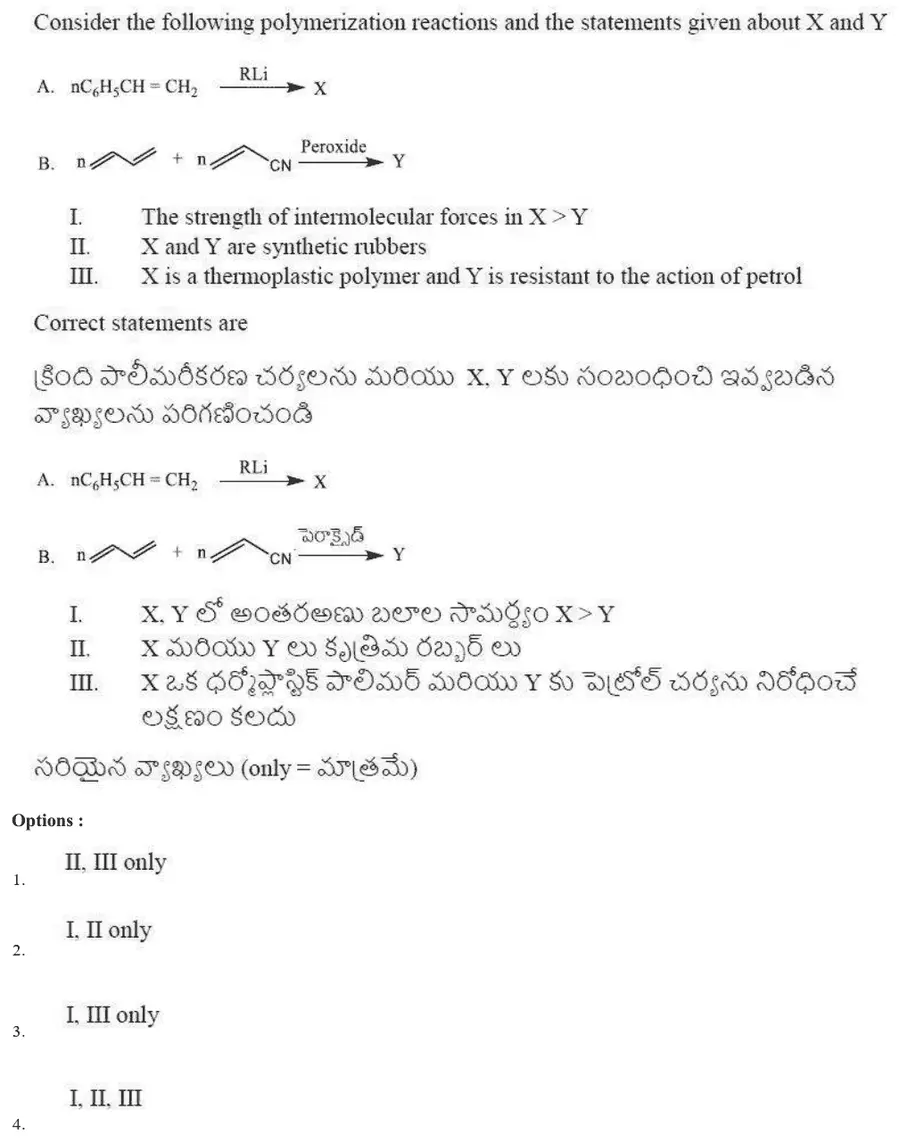
Consider the following polymerization reactions and the statements given about X and Y
A. $n\mathrm{C_6H_5CH=CH_2}$ $\xrightarrow{\mathrm{RLi}}$ X
B. n (see the figure above) + n (see the figure above) $\xrightarrow{\text{Peroxide}}$ Y
I. The strength of intermolecular forces in X > Y
II. X and Y are synthetic rubbers
III. X is a thermoplastic polymer and Y is resistant to the action of petrol
Correct statements are
II, III only
I, II only
I, III only
I, II, III
Consider the following statements
Statement-I: Polystyrene is a thermosetting polymer
Statement-II: Bakelite is a thermoplastic polymer
The correct answer is
Both Statement-I and statement-II are correct
Statement-I is correct but statement-II is not correct
Statement-I is not correct but statement-II is correct
Both Statement-I and statement-II are not correct
The total number of carbon – carbon $\pi$ – bonds present in the monomers of Buna – S rubber is
4
5
6
7
Which of the following represents the structure of the polymer PHBV?
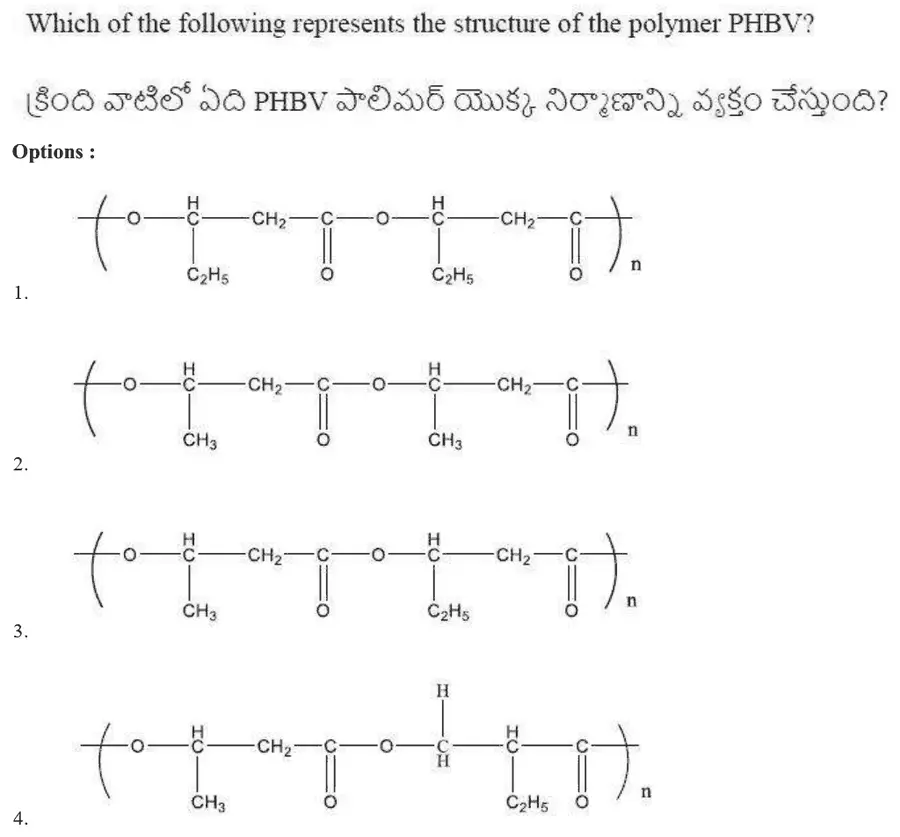
see figure Polymer repeat unit in brackets, subscript n: –O–CH(C2H5)–CH2–C(=O)–O–CH(C2H5)–CH2–C(=O)– ; both CH carbons bear a C2H5 substituent.
see figure Polymer repeat unit in brackets, subscript n: –O–CH(CH3)–CH2–C(=O)–O–CH(CH3)–CH2–C(=O)– ; both CH carbons bear a CH3 substituent.
see figure Polymer repeat unit in brackets, subscript n: –O–CH(CH3)–CH2–C(=O)–O–CH(C2H5)–CH2–C(=O)– ; the first CH carbon bears CH3, the second bears C2H5.
see figure Polymer repeat unit in brackets, subscript n: –O–CH(CH3)–CH2–C(=O)–O–CH2–CH(C2H5)–C(=O)– ; the first CH carbon bears CH3; after the ester O there is a CH2 carbon (H above, H below) and then a CH carbon bearing C2H5, then the C=O.
Monomers of Buna-N are X and Y. The monomers of Buna-S are Y and Z. What are X, Y, Z respectively?
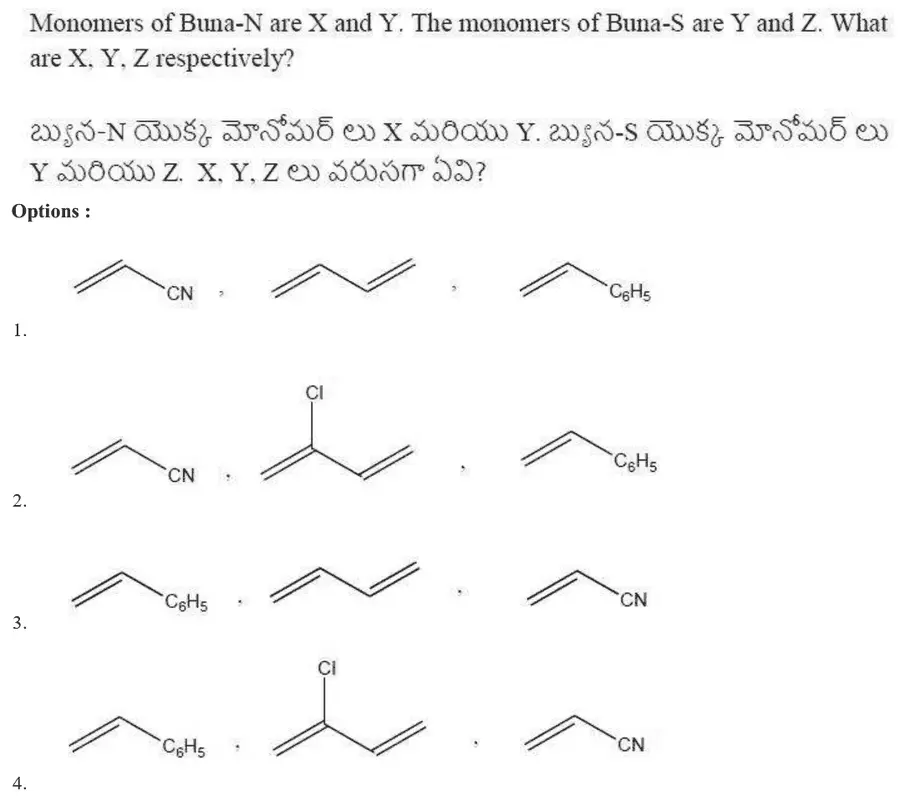
see figure X = acrylonitrile (vinyl cyanide, CH2=CH-CN), Y = 1,3-butadiene, Z = styrene (vinyl benzene, CH2=CH-C6H5)
see figure X = acrylonitrile (CH2=CH-CN), Y = 2-chloro-1,3-butadiene (chloroprene), Z = styrene (CH2=CH-C6H5)
see figure X = styrene (CH2=CH-C6H5), Y = 1,3-butadiene, Z = acrylonitrile (CH2=CH-CN)
see figure X = styrene (CH2=CH-C6H5), Y = 2-chloro-1,3-butadiene (chloroprene), Z = acrylonitrile (CH2=CH-CN)
Observe the following polymerization reactions and statements given about them
(see the figure above)
I. Chain termination step is present in both reactions
II. X is an elastomer and Y is a thermoplastic polymer
III. X is used in preparation of conveyer belts and Y is used in preparation of television cabinets
Correct statements are
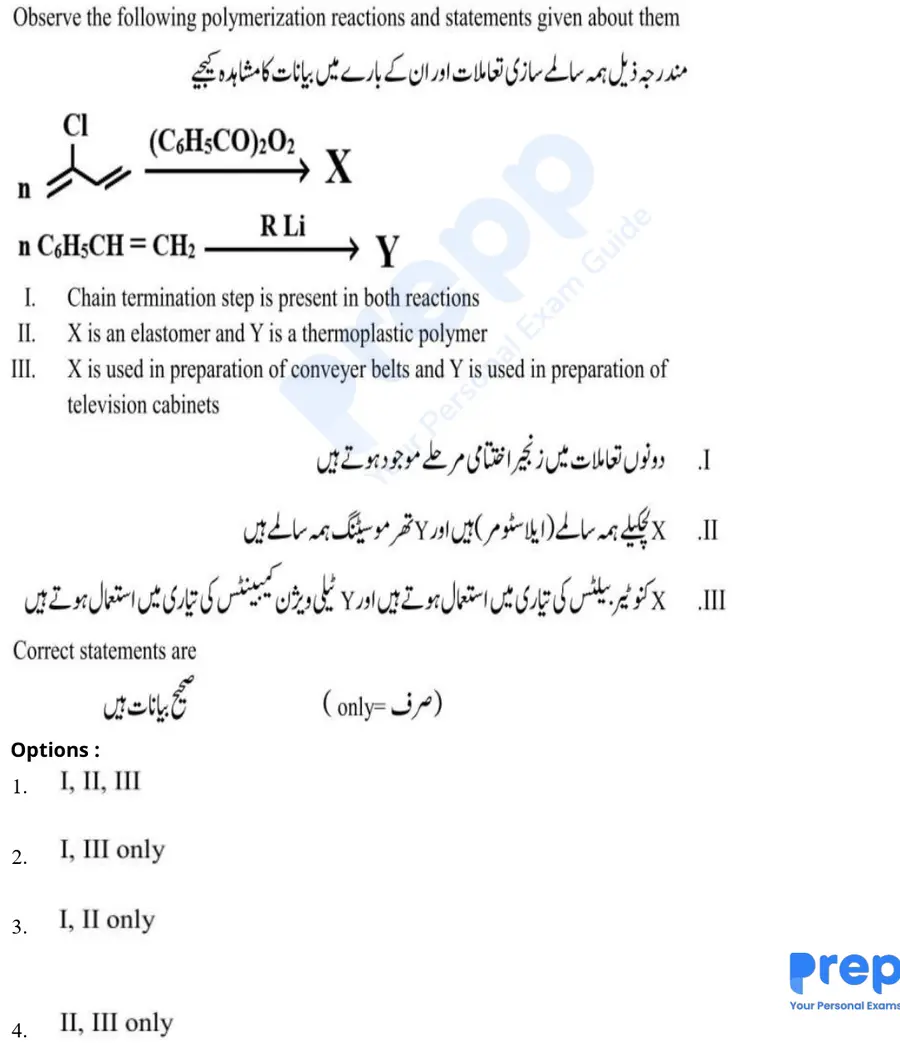
I, II, III
I, III only
I, II only
II, III only
The polymer formed by X and Y is
I. $\mathrm{CH_4 + O_2} \xrightarrow[\Delta]{\mathrm{Mo_2O_3}} \mathrm{X}$
II. (see the figure above) $\xrightarrow[\text{623 K, 300 atm}]{\text{(i) NaOH}}$ Y, followed by (ii) $\mathrm{H^+}$
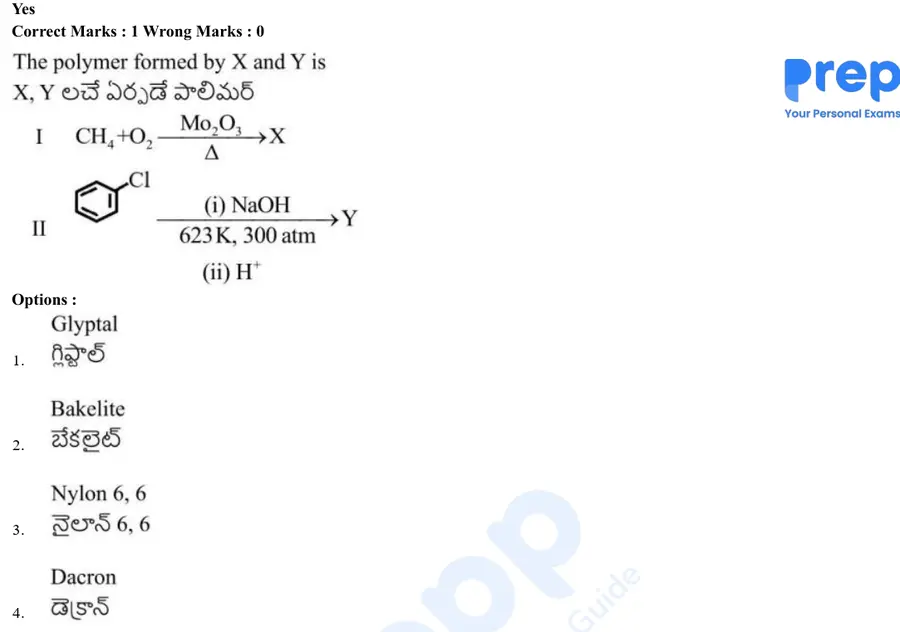
Glyptal
Bakelite
Nylon 6, 6
Dacron
The common monomer for Terylene and Glyptal is
Ethylidene chloride
Ethylene glycol
Ethylene chloride
Formaldehyde
Identify the correctly matched pairs from the following sets
I. Addition copolymer ------------------- $\left[\mathrm{NHCONHCH_2}\right]_n$
II. Condensation homopolymer --------- $\left[\mathrm{CO-(CH_2)_5-NH}\right]_n$
III. Condensation copolymer ------------- (see the figure above)
The correct answer is (only =)
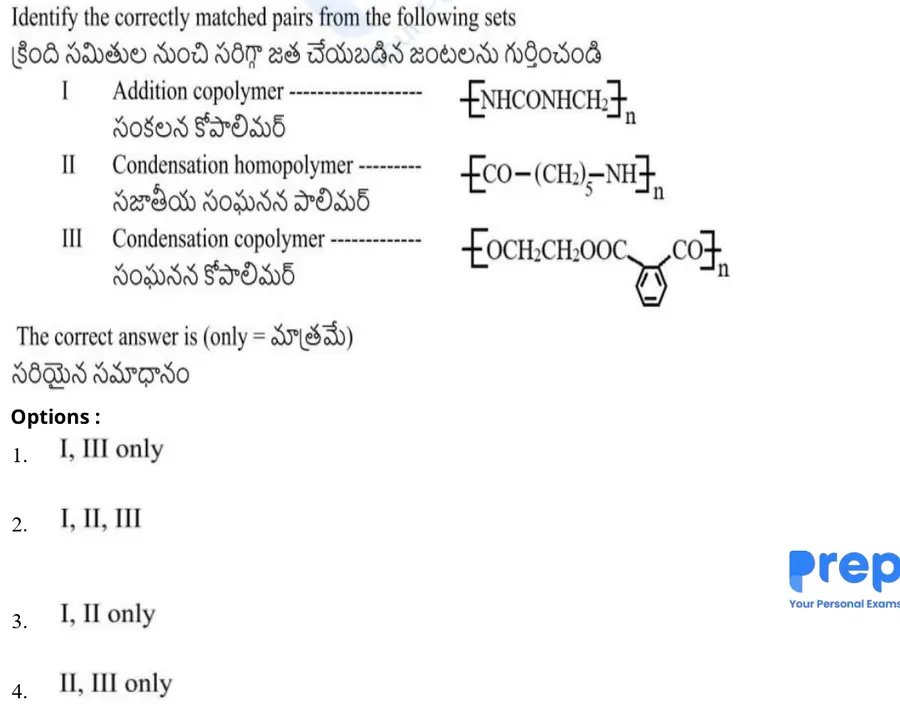
I, III only
I, II, III
I, II only
II, III only
Which of the following is not a condensation polymer?
Teflon
Bakelite
Glyptal
Dacron
Natural Rubber is the addition polymer of monomer X and neoprene is the addition polymer of monomer Y. What are X and Y respectively?
$\mathrm{CH_2=C(Cl)-CH=CH_2}$ ; $\mathrm{CH_2=C(CN)-CH=CH_2}$ [FIGURE: Cl substituent on C2 of the first diene; CN substituent on C2 of the second diene]
$\mathrm{CH_2=C(CN)-CH=CH_2}$ ; $\mathrm{CH_2=C(Cl)-CH=CH_2}$ [FIGURE: CN substituent on C2 of the first diene; Cl substituent on C2 of the second diene]
$\mathrm{CH_2=C(CH_3)-CH=CH_2}$ ; $\mathrm{CH_2=C(Cl)-CH=CH_2}$ [FIGURE: CH3 substituent on C2 of the first diene; Cl substituent on C2 of the second diene]
$\mathrm{CH_2=C(C_2H_5)-CH=CH_2}$ ; $\mathrm{CH_2=C(C_6H_5)-CH=CH_2}$ [FIGURE: C2H5 substituent on C2 of the first diene; C6H5 substituent on C2 of the second diene]
The number of linear and crosslinked polymers in the following respectively are
Novolac, Nylon 6,6, Bakelite, PVC, melamine
1, 4
4, 1
2, 3
3, 2
A polymer sample contains 10 molecules each with molecular mass 5,000 and 5 molecules each with molecular mass 50,000. The number average molecular mass of the polymer sample is
$2 \times 10^{4}$
$3 \times 10^{4}$
$2 \times 10^{5}$
$3 \times 10^{5}$
Which one of the statements, regarding X is not correct ?
3-Hydroxybutanoic acid + 3-Hydroxypentanoic acid $\longrightarrow$ X
It is a condensation polymer
It is non biodegradable
It is used in orthopaedic devices
It is known as PHBV
Consider the following
Statement-I : Nylon 6 is a condensation copolymer.
Statement-II : Nylon 6, 6 is a condensation polymer of adipic acid and tetra methylene diamine.
The correct answer is
Both statement-I and statement-II are correct
Statement-I is correct, but statement-II is not correct
Statement-I is not correct, but statement-II is correct
Both statement-I and statement-II are not correct
Match the following.
| List-I (Polymer) | List-II (Used in making) |
|---|---|
| A) $\mathrm{[-CF_2-CF_2-]_n}$ | I) Safety Helmets |
| B) $\mathrm{[-CH_2-CH(CN)-]_n}$ | II) Gaskets |
| C) (see the figure above) | III) Laminated sheets |
| D) $\mathrm{[-NHCONHCH_2-]_n}$ | IV) Commercial fibres |
| V) Paints |
Correct answer is
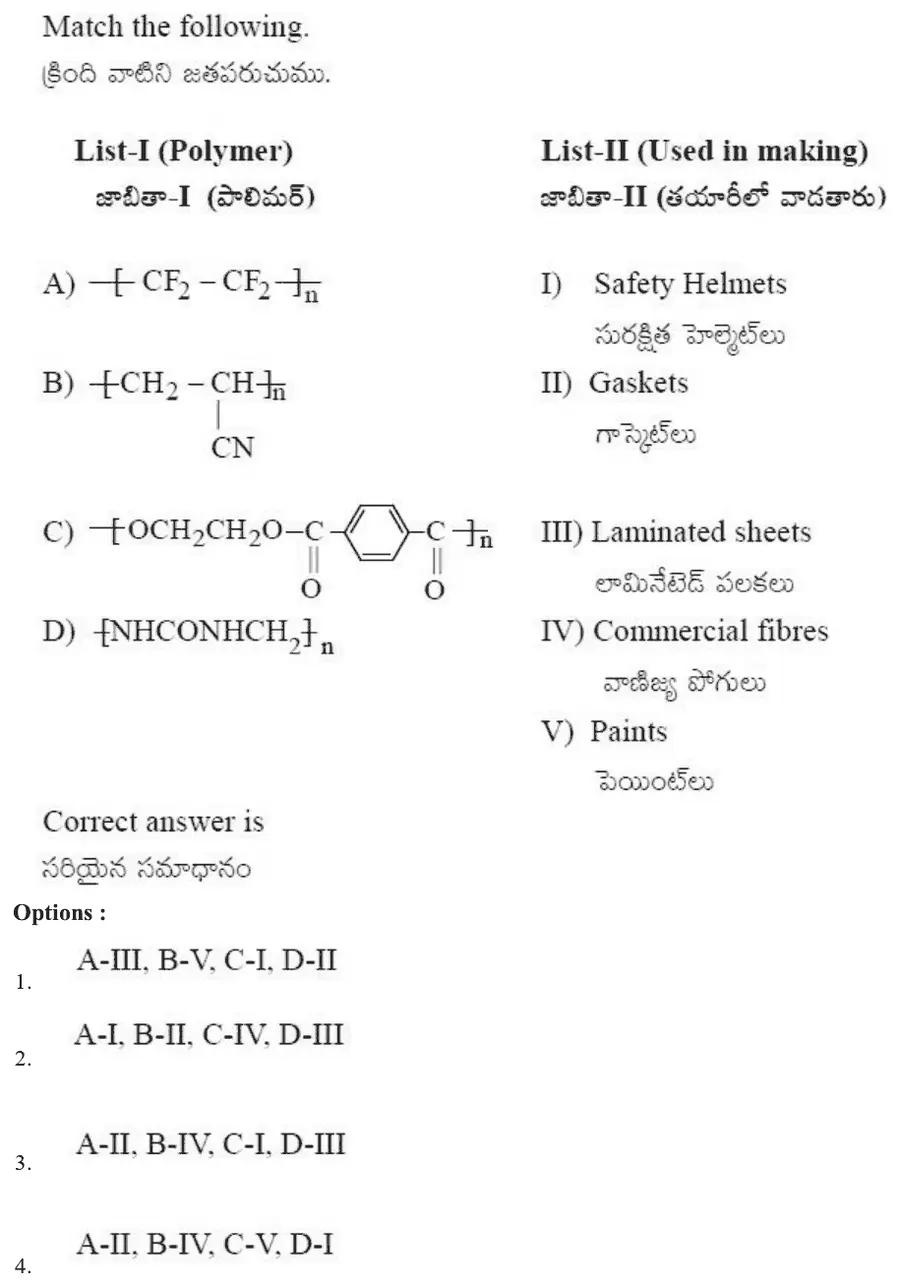
A-III, B-V, C-I, D-II
A-I, B-II, C-IV, D-III
A-II, B-IV, C-I, D-III
A-II, B-IV, C-V, D-I
What are X and Y in the following reaction ? ($l$ = liquid)
$$n\mathrm{Cl}\mathrm{CH}=\mathrm{CH_2} \xrightarrow{X} Y$$
$\mathrm{Na / NH_3}(l)$ - thermosetting polymer
$\mathrm{(C_6H_5COO)_2}$ - thermoplastic polymer
$\mathrm{Na / NH_3}(l)$ - condensation polymer
$\mathrm{(C_6H_5COO)_2}$ - Network polymer
Novolac is formed by the polymerisation of monomer 'x' in the presence of $\mathrm{OH^-}$ ions. What is 'x' ?
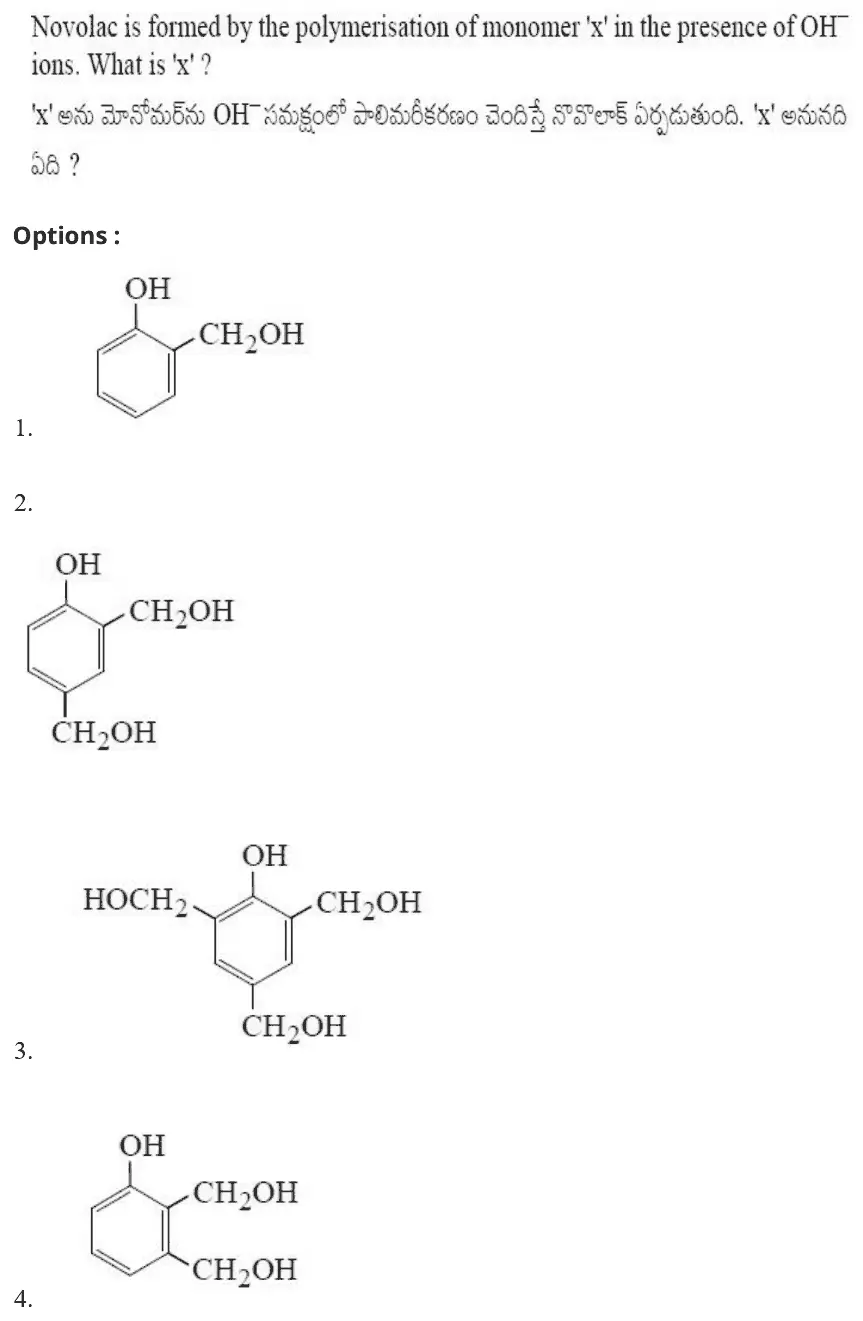
see figure Benzene ring with an OH group and, on the adjacent (ortho) carbon, a CH2OH group (2-hydroxymethylphenol).
see figure Benzene ring with an OH group, a CH2OH group on one ortho carbon, and a CH2OH group on the para carbon (2,4-bis(hydroxymethyl)phenol).
see figure Benzene ring with an OH group, with CH2OH groups on both ortho carbons and on the para carbon (2,4,6-tris(hydroxymethyl)phenol).
see figure Benzene ring with an OH group, with CH2OH groups on two adjacent carbons: one ortho to OH and the next (meta) carbon.
In which polymer preparation, Ziegler - Natta catalyst is used ?
Low density polythene
Teflon
Polyacrylonitrile
High density polythene
Which of the following is the common monomer for the polymers Bakelite and Melamine ?
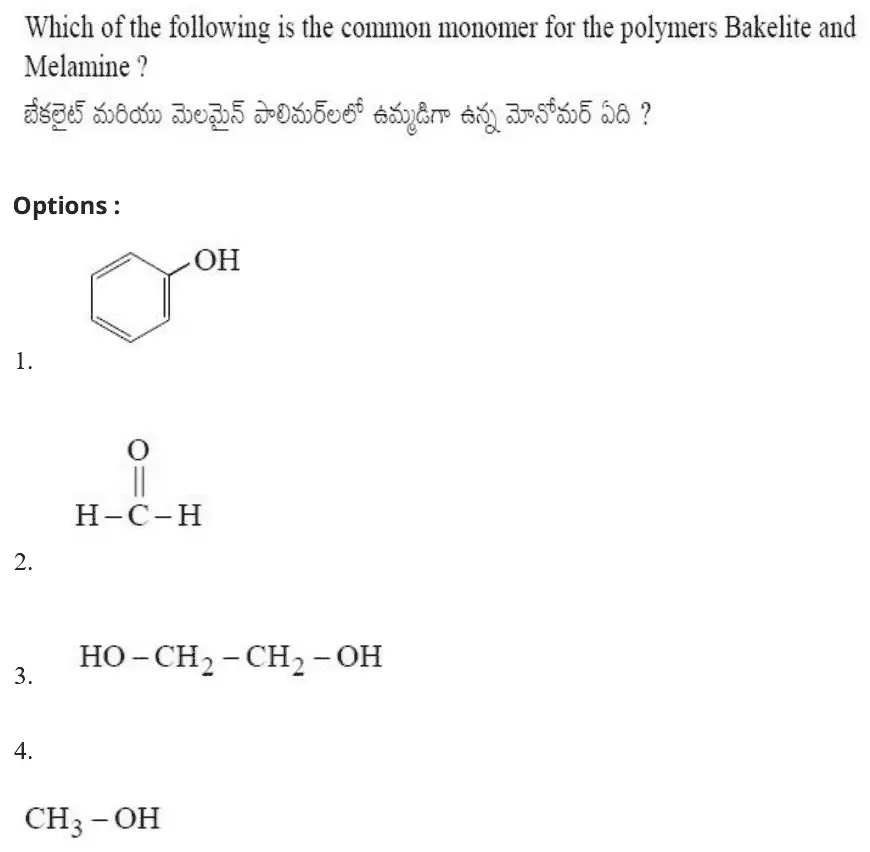
see figure Phenol: benzene ring with an OH group attached
$\mathrm{H-C-H}$ with a double-bonded O above the C (formaldehyde, HCHO)
$\mathrm{HO-CH_2-CH_2-OH}$
$\mathrm{CH_3-OH}$
Polymer X is an example of polyester and Y is an example of polyamide. X and Y are respectively
Novolac, Terylene
Dacron, Nylon 6,6
Nylon 6, Terylene
Teflon, Terylene
The polymer chains are held together by hydrogen bonding in a polymer X. Polymer X is formed from monomers Y and Z. What are Y and Z?
(see the figure above)
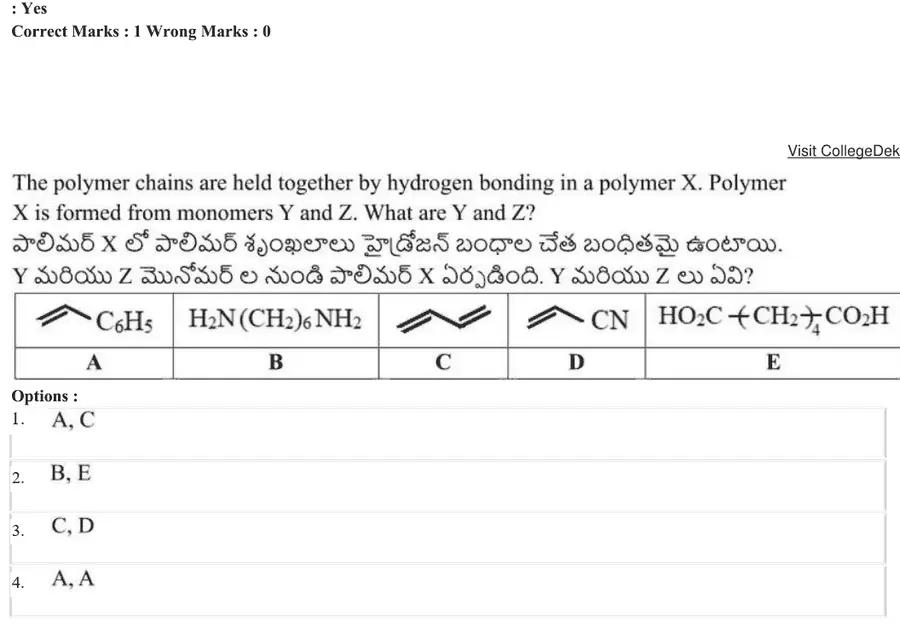
A, C
B, E
C, D
A, A
Neoprene is the polymer of a monomer X. IUPAC name of X is
1,3 -Butadiene
2-Methyl-1,3-butadiene
2-Iodo-1,3-butadiene
2-Chloro-1,3-butadiene
Match the following
| List – 1 (Type of polymer) | List – 2 (Structure of the example) | ||
|---|---|---|---|
| A | Fibre | I | (see the figure above) |
| B | Elastomer | II | (see the figure above) |
| C | Thermosetting polymer | III | (see the figure above) |
| D | Thermoplastic polymer | IV | (see the figure above) |
The correct answer is
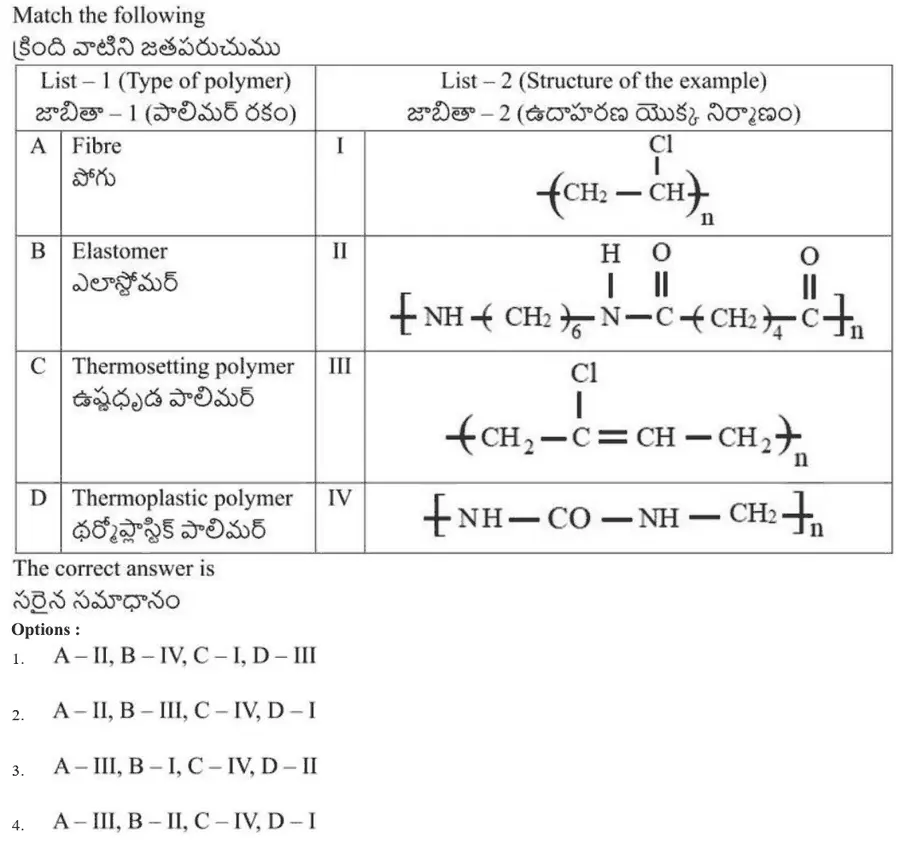
A – II, B – IV, C – I, D – III
A – II, B – III, C – IV, D – I
A – III, B – I, C – IV, D – II
A – III, B – II, C – IV, D – I
‘X’ is a polymer, which is mainly used for making unbreakable cups and laminated sheets. The monomers of ‘X’ are
Urea and formaldehyde
Ethylene glycol and phthalic acid
Phenol and formaldehyde
1,3-Butadiene and styrene
Ethylene on reaction with cold, dilute alkaline $\mathrm{KMnO_4}$ at 273 K gives a compound ‘P’. This on polymerisation with which of the following gives dacron?
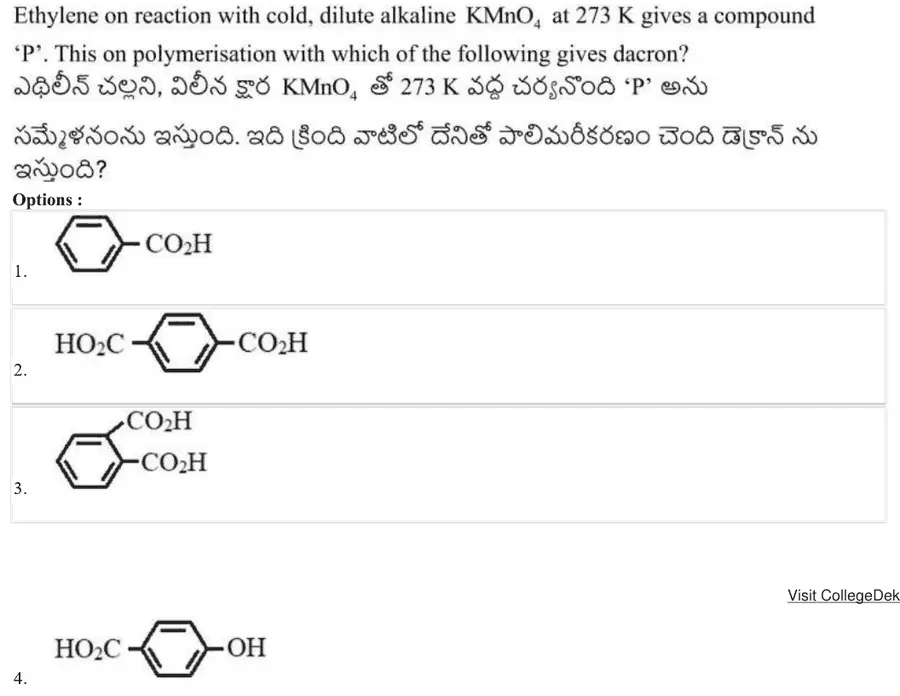
see figure Benzene ring with one $\mathrm{CO_2H}$ substituent (benzoic acid)
see figure Benzene ring with $\mathrm{HO_2C}$ and $\mathrm{CO_2H}$ at para (1,4) positions (terephthalic acid)
see figure Benzene ring with two $\mathrm{CO_2H}$ groups at adjacent (ortho, 1,2) positions (phthalic acid)
see figure Benzene ring with $\mathrm{HO_2C}$ and $\mathrm{OH}$ at para (1,4) positions (4-hydroxybenzoic acid)
The X formed in the following reaction sequence and its structural type are respectively
(see the figure above)
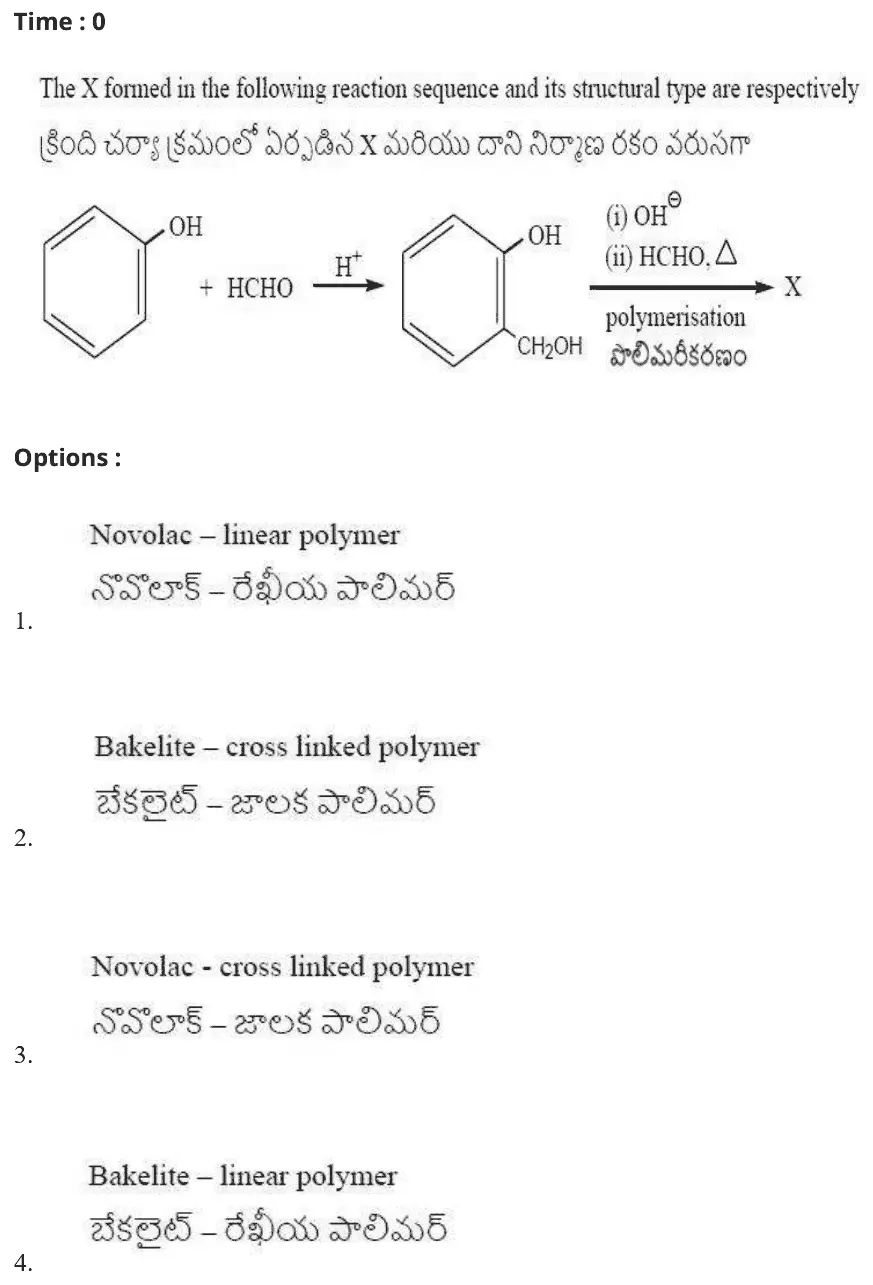
Novolac – linear polymer
Bakelite – cross linked polymer
Novolac - cross linked polymer
Bakelite – linear polymer
Match the following
| List-I (Polymers) | List-II (Type) | ||
|---|---|---|---|
| A | Buna-N-Rubber | I | Fibre |
| B | Terylene | II | Thermosetting polymer |
| C | Polystyrene | III | Elastomer |
| D | Urea-Formaldehyde resin | IV | Thermoplastic polymer |
A - III, B - I, C - IV, D - II
A - III, B - IV, C - I, D - II
A - I, B - II, C - III, D - IV
A - IV, B - III, C - II, D - I
Polymers that can be softened on heating and hardened on cooling are called
Thermosetting polymers
Bakelite
Fibres
Thermoplastic polymers
The common monomer for both Terylene and glyptal is
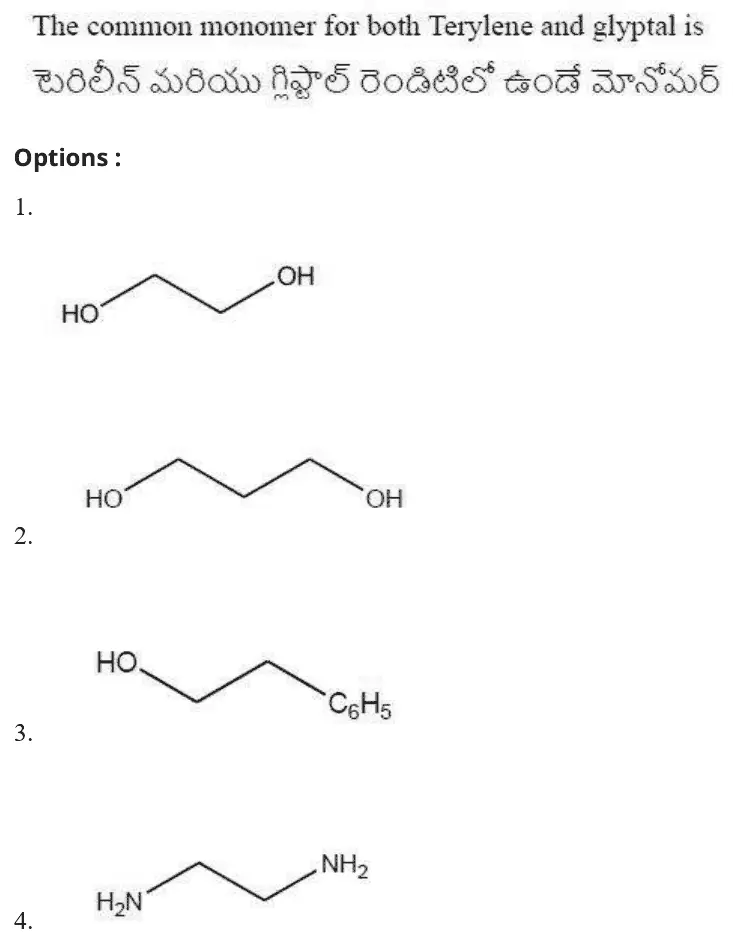
see figure Skeletal structure of ethylene glycol: HO–CH2–CH2–OH (zigzag chain of two carbons with HO at the left end and OH at the right end)
see figure Skeletal structure of a three-carbon diol: HO–CH2–CH2–CH2–OH (zigzag chain with HO at the left end and OH at the right end)
see figure Skeletal structure of HO–CH2–CH2–CH2–C6H5 (zigzag chain with HO at the left end and C6H5 at the right end)
see figure Skeletal structure of ethylenediamine: H2N–CH2–CH2–NH2 (zigzag chain of two carbons with H2N at the left end and NH2 at the right end)
The correctly matched set of the following is
Polystyrene – copolymer - thermoplastic
Bakelite – addition polymer - thermosetting
Nylon 6 – Homopolymer - fibre
Buna-N – Homopolymer - elastomer
Which of the following is an example for fibre?
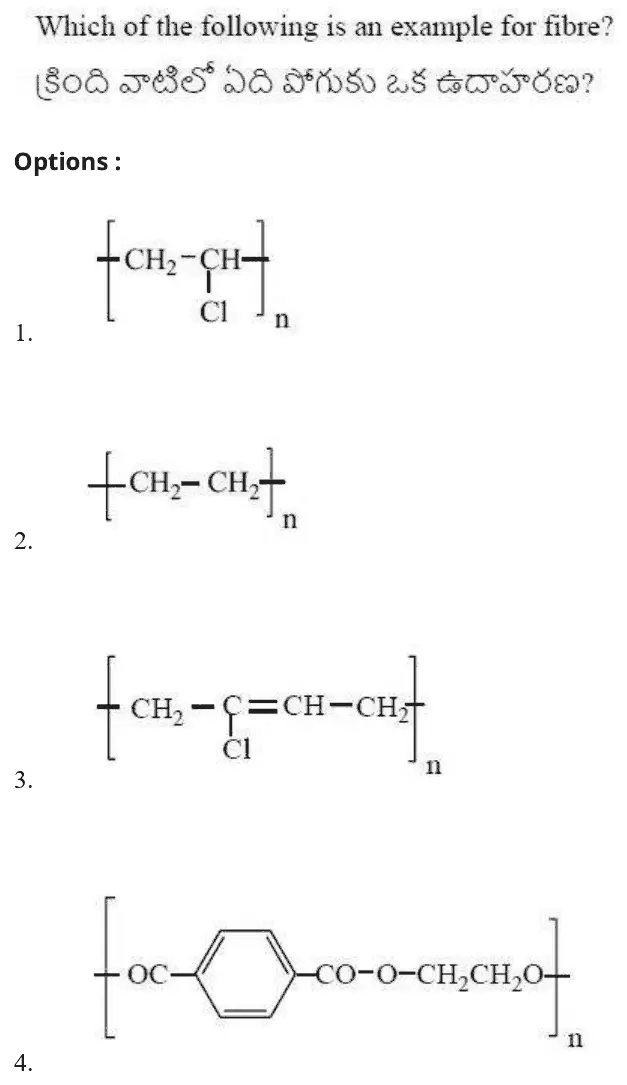
see figure Polymer repeat unit in square brackets, n times: $\mathrm{-CH_2-CH(Cl)-}$ (Cl on the CH carbon, below)
see figure Polymer repeat unit in square brackets, n times: $\mathrm{-CH_2-CH_2-}$
see figure Polymer repeat unit in square brackets, n times: $\mathrm{-CH_2-C(Cl)=CH-CH_2-}$ (Cl on the C carbon, below)
see figure Polymer repeat unit in square brackets, n times: $\mathrm{-OC-}$(para-substituted benzene ring)$\mathrm{-CO-O-CH_2CH_2O-}$
Which of the following polymerisation leads to the formation of neoprene?
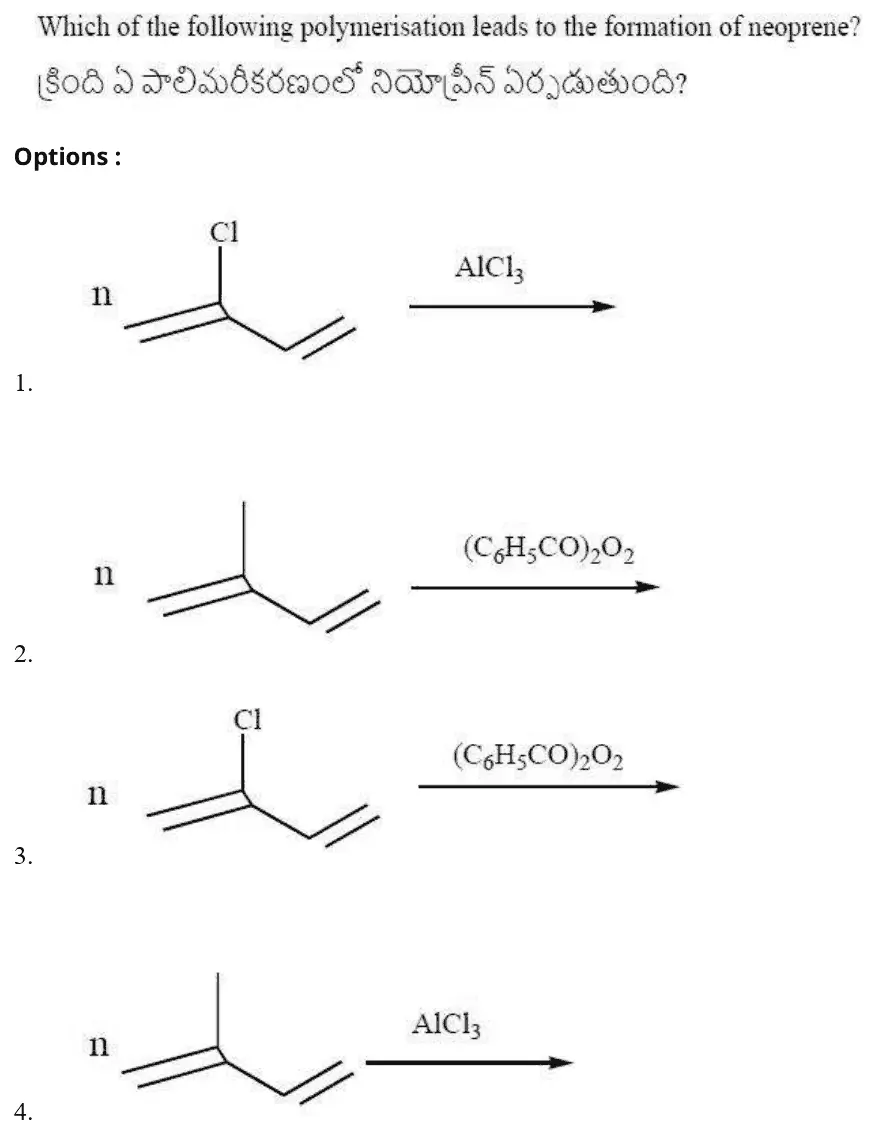
see figure n times 2-chlorobuta-1,3-diene (CH2=C(Cl)-CH=CH2, drawn as skeletal structure with Cl on the second carbon) with reagent AlCl$_3$ over the arrow
see figure n times 2-methylbuta-1,3-diene (isoprene, skeletal structure with a methyl group on the second carbon) with reagent $\mathrm{(C_6H_5CO)_2O_2}$ over the arrow
see figure n times 2-chlorobuta-1,3-diene (CH2=C(Cl)-CH=CH2, skeletal structure with Cl on the second carbon) with reagent $\mathrm{(C_6H_5CO)_2O_2}$ over the arrow
see figure n times 2-methylbuta-1,3-diene (isoprene, skeletal structure with a methyl group on the second carbon) with reagent AlCl$_3$ over the arrow
PHBV is a biodegradable polymer of two monomers X and Y. X and Y respectively are
$X = \mathrm{C_2H_5-CH(OH)-CH_2CO_2H}$; $Y = \mathrm{C_2H_5-CH(OH)-CO_2H}$
$X = \mathrm{CH_3-CH(OH)-CH_2CO_2H}$; $Y = \mathrm{C_2H_5-CH(OH)-CH_2CO_2H}$
$X = \mathrm{CH_3-CH(OH)-CH_2OH}$; $Y = \mathrm{C_2H_5-CH(OH)-CH_2CO_2H}$
$X = \mathrm{H_2N-(CH_2)_5-CO_2H}$; $Y = \mathrm{CH_3-CH(OH)-CH_2CO_2H}$
A polymer X is biodegradable and is obtained from the monomers Y, Z. What are Y and Z?
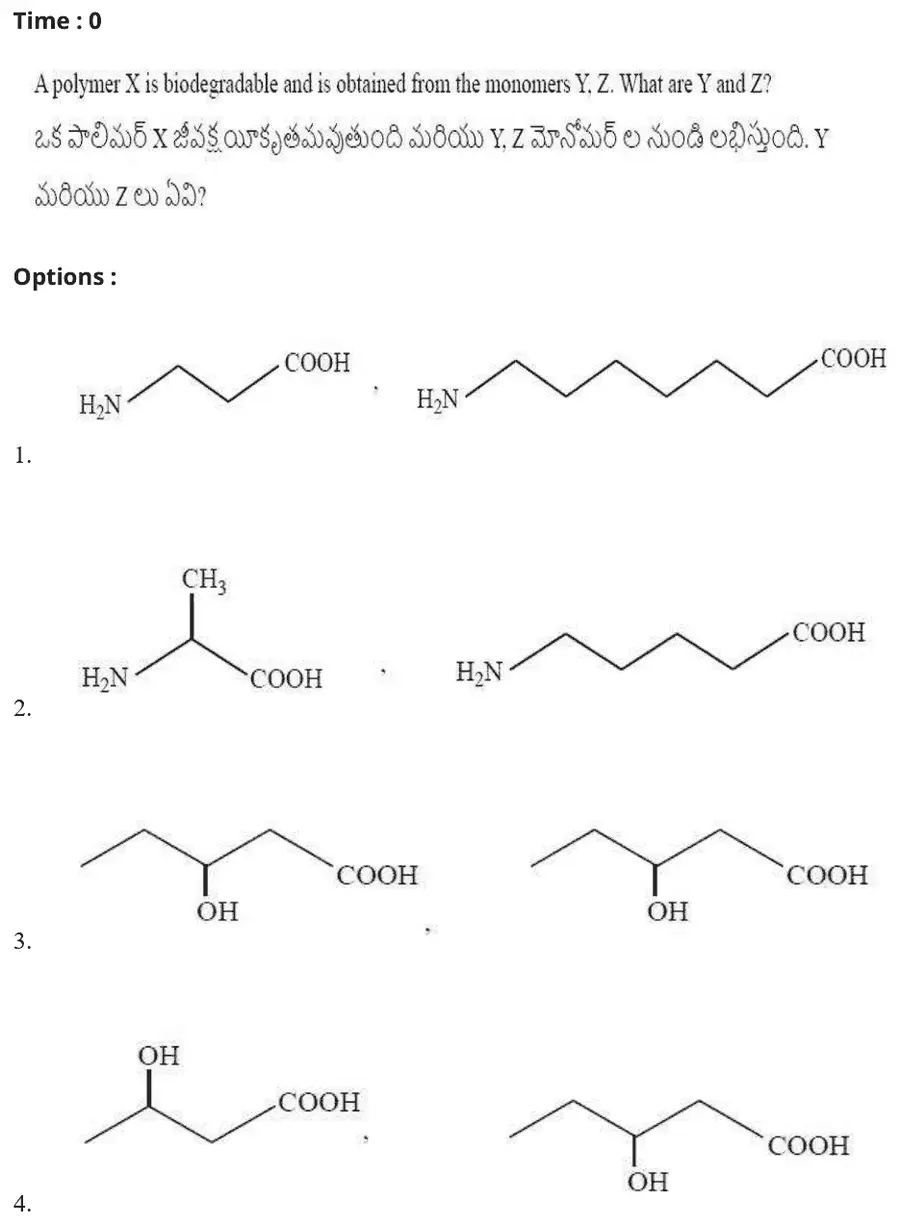
see figure Two skeletal structures separated by a comma. First: H$_2$N at the left end of a zigzag chain of 3 carbons ending in COOH (4-aminobutanoic acid). Second: H$_2$N at the left end of a longer zigzag chain ending in COOH (about 7 carbons, 7-aminoheptanoic acid).
see figure Two skeletal structures separated by a comma. First: alanine-type structure, H$_2$N attached to a carbon bearing CH$_3$ (vertical) and COOH. Second: H$_2$N at the left end of a zigzag chain ending in COOH (about 5 carbons, 6-aminohexanoic acid type).
see figure Two identical skeletal structures separated by a comma: each is a zigzag chain with an OH on the middle carbon (drawn downward, bold bond) and COOH at the right end (3-hydroxypentanoic acid).
see figure Two skeletal structures separated by a comma. First: short zigzag chain with OH on the second carbon (drawn upward, bold bond) ending in COOH (3-hydroxybutanoic acid). Second: zigzag chain with OH on the middle carbon (drawn downward, bold bond) and COOH at the right end (3-hydroxypentanoic acid).
Which one of the following is not an example of condensation polymer?
Terylene
Nylon 6,6
Bakelite
Polystyrene
Identify the structure of the polymer ‘P’ formed in the given reaction
$\mathrm{Caprolactam} \xrightarrow[\mathrm{H_2O}]{533\text{-}543\,K} P$
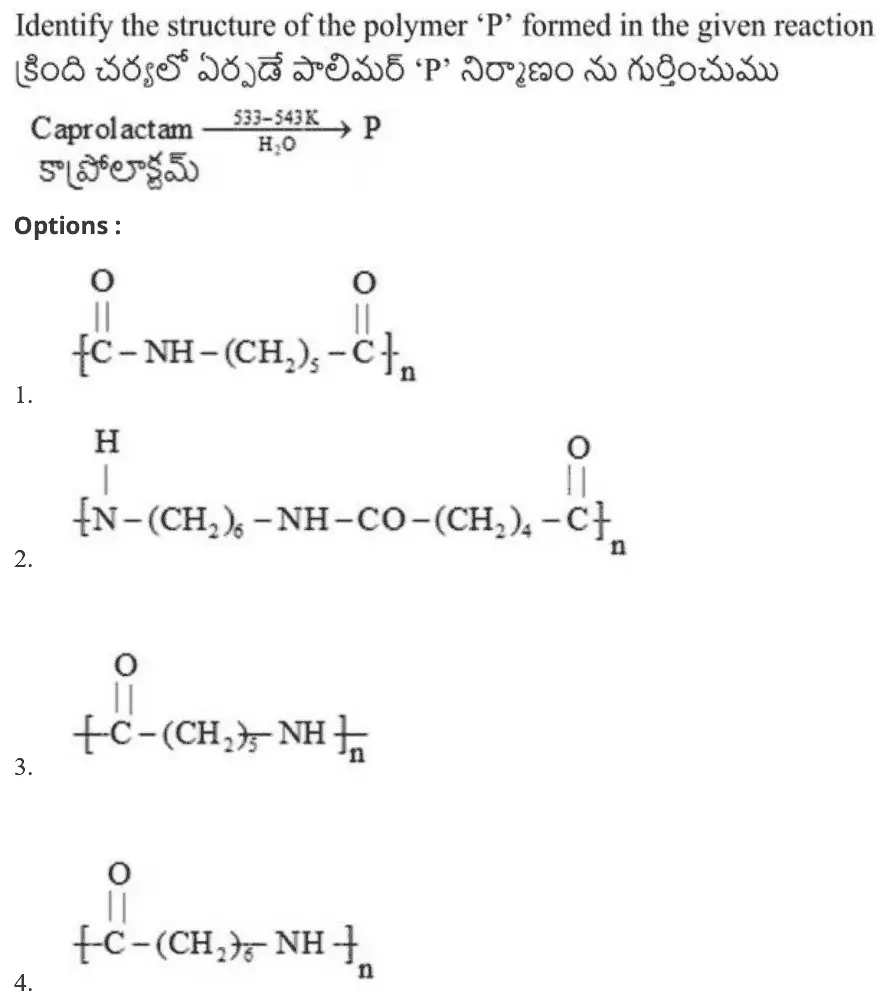
see figure Polymer repeat unit in brackets with subscript n: C(=O)–NH–(CH2)5–C(=O), i.e. $\mathrm{[C(=O)-NH-(CH_2)_5-C(=O)]_n}$
see figure Polymer repeat unit in brackets with subscript n: N(H)–(CH2)6–NH–CO–(CH2)4–C(=O), i.e. $\mathrm{[N(H)-(CH_2)_6-NH-CO-(CH_2)_4-C(=O)]_n}$
see figure Polymer repeat unit in brackets with subscript n: C(=O)–(CH2)5–NH, i.e. $\mathrm{[C(=O)-(CH_2)_5-NH]_n}$
see figure Polymer repeat unit in brackets with subscript n: C(=O)–(CH2)6–NH, i.e. $\mathrm{[C(=O)-(CH_2)_6-NH]_n}$
What are ‘X’ and ‘Y’ respectively in the following reactions?
(see the figure above)
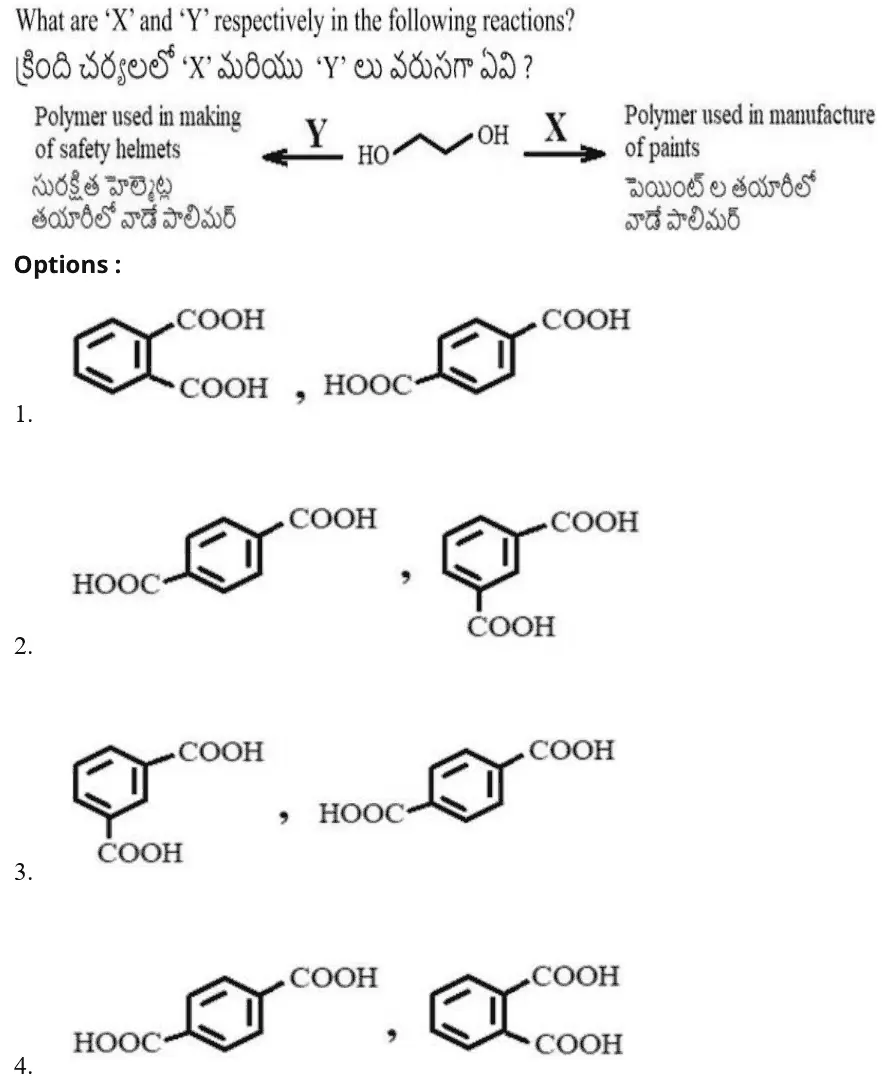
see figure Two structures: ortho-phthalic acid (benzene with two adjacent COOH groups), and para-terephthalic acid (benzene with COOH groups at 1,4 positions, HOOC on left and COOH on upper right)
see figure Two structures: terephthalic acid (benzene with HOOC and COOH at para positions), and isophthalic acid (benzene with COOH groups at meta positions: upper right and bottom)
see figure Two structures: isophthalic acid (benzene with COOH groups at meta positions: upper right and bottom), and terephthalic acid (benzene with HOOC on left and COOH at upper right, para)
see figure Two structures: terephthalic acid (benzene with HOOC on left and COOH on upper right, para), and ortho-phthalic acid (benzene with two adjacent COOH groups)
Match the following
| List – I (Monomer/s) | List – II (Name of the polymer) | ||
|---|---|---|---|
| A | $\mathrm{CF_2 = CF_2}$ | I | Neoprene |
| B | $\mathrm{NH_2(CH_2)_6NH_2,\ HO_2C(CH_2)_4CO_2H}$ | II | Bakelite |
| C | $\mathrm{C_6H_5OH,\ HCHO}$ | III | Teflon |
| D | $\mathrm{CH_2=CH(Cl)-CH=CH_2}$ | IV | Nylon 6,6 |
The correct answer is
A – II ; B – III ; C – I ; D – IV
A – III ; B – IV ; C – II ; D – I
A – III ; B – IV ; C – I ; D – II
A – III ; B – I ; C – IV ; D – II
The monomer which is present in both Bakelite and Melamine polymers is
Methanal
Methanol
Phenol
Ethane-1, 2-diol
Identify the correct statement from the following with respect to high density polythene
$\mathrm{TiCl_4}$ and $\mathrm{Et_3Al}$ used as catalyst for preparation
Obtained by the polymerization of ethene at 350-570K
Has highly branched structure
Chemically active
Zinc acetate – antimony trioxide catalyst used in the preparation of which polymer?
High density polythene
Teflon
Terylene
PVC
Which of the following polymer is used in the preparation of gaskets?
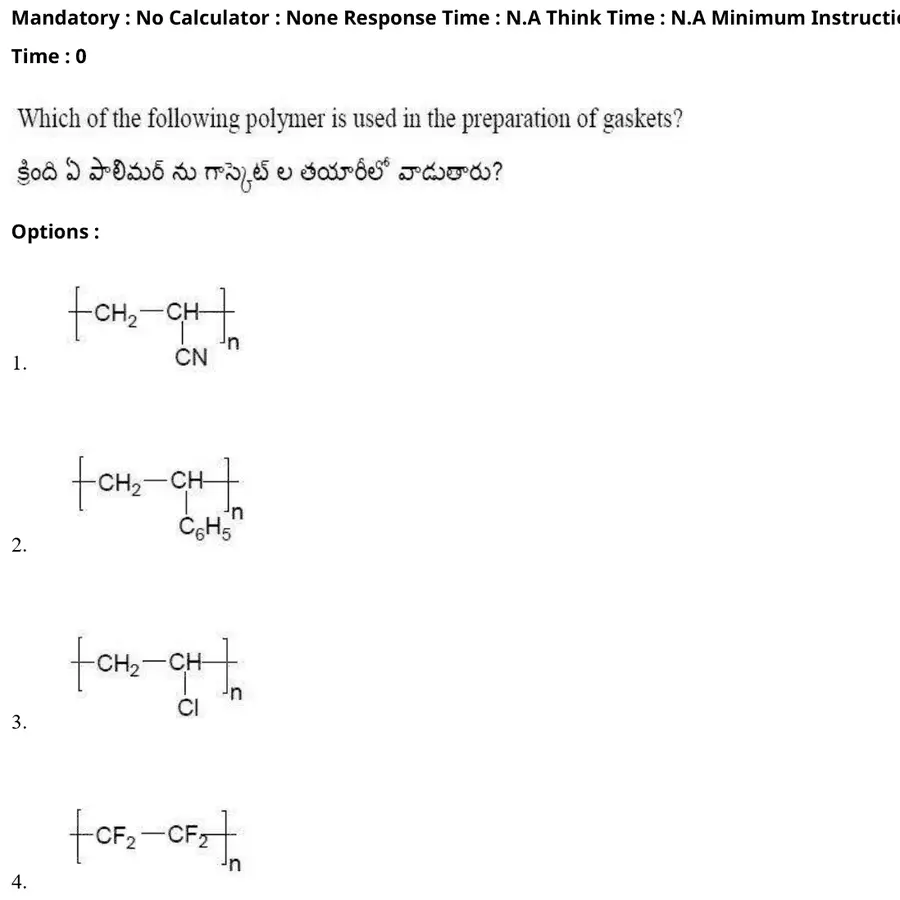
see figure Polymer repeat unit in square brackets with subscript n: $\mathrm{-CH_2-CH(CN)-}$, with CN attached below the CH
see figure Polymer repeat unit in square brackets with subscript n: $\mathrm{-CH_2-CH(C_6H_5)-}$, with $\mathrm{C_6H_5}$ attached below the CH
see figure Polymer repeat unit in square brackets with subscript n: $\mathrm{-CH_2-CH(Cl)-}$, with Cl attached below the CH
see figure Polymer repeat unit in square brackets with subscript n: $\mathrm{-CF_2-CF_2-}$
Which of the polymer is used in the controlled release of drug?
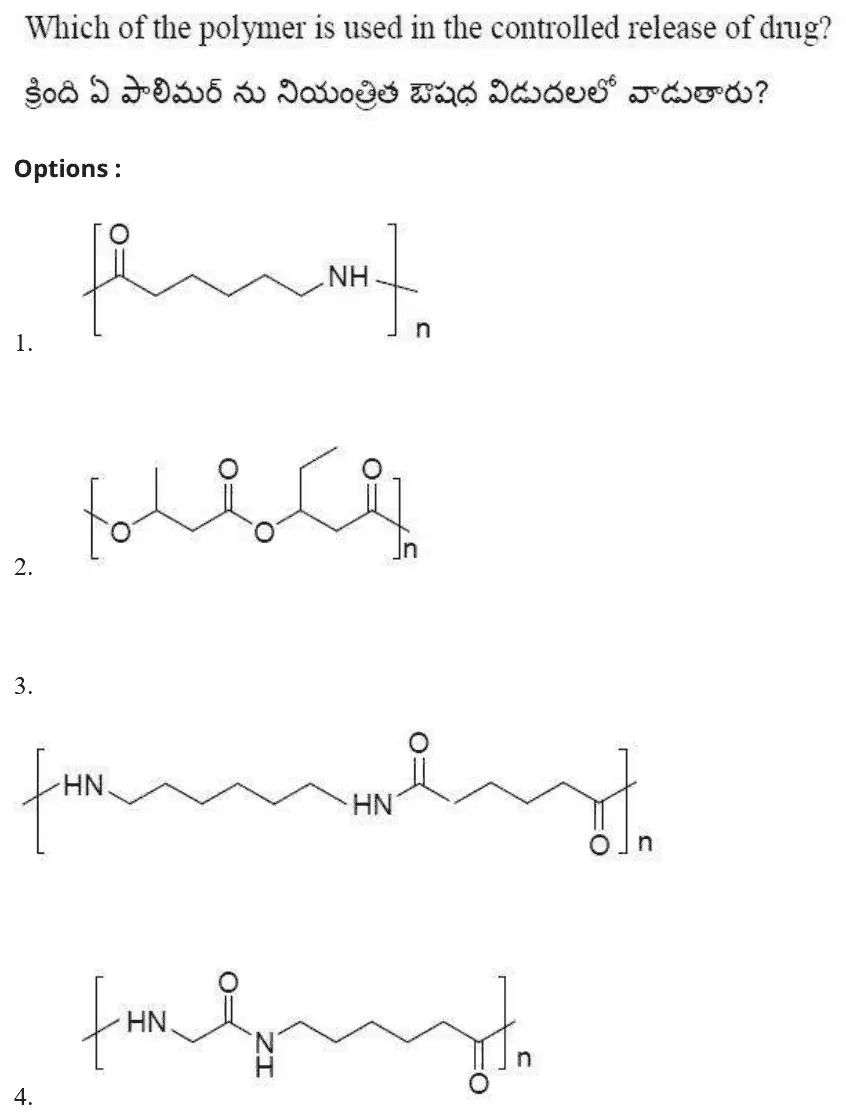
see figure Polymer repeat unit in brackets with subscript n: a C=O (carbonyl, O at top) at the left end of a zigzag chain of carbons, ending on the right in an NH group bonded to the bracket (polycaprolactam, Nylon-6 type).
see figure Polyester repeat unit in brackets with subscript n: bracket bond at left to O, then a branched carbon (methyl) chain, then a C=O (carbonyl O at top), then O, then a CH-CH2 chain with an ethyl branch and a terminal C=O (carbonyl O at top) at the right bracket (a copolyester of 3-hydroxybutanoic acid and 3-hydroxypentanoic acid, PHBV type).
see figure Polyamide repeat unit in brackets with subscript n: HN at left, a long zigzag carbon chain, HN, then a C=O (carbonyl O at top), a zigzag carbon chain, then a terminal C=O (carbonyl O at bottom) at the right bracket (Nylon-6,6 type).
see figure Polyamide repeat unit in brackets with subscript n: HN at left, then C=O (carbonyl O at top), then N-H (drawn with N and H stacked vertically), a zigzag carbon chain, then a terminal C=O (carbonyl O at bottom) at the right bracket.
Identify the condensation polymers from the following
PHBV, Buna – N, Neoprene, Nylon-6, Glyptal
A, B, C, D, E (labels printed beneath the polymers in that order)
A, B, D
B, C, D
B, C, E
A, D, E
Poly dispersity index of a polymer is 1.25. If $\overline{\mathrm{M}}_\mathrm{n}$ is 800, what is its $\overline{\mathrm{M}}_\mathrm{w}$ ?
850
900
950
1000
Monomers of nylon 2-nylon 6 are
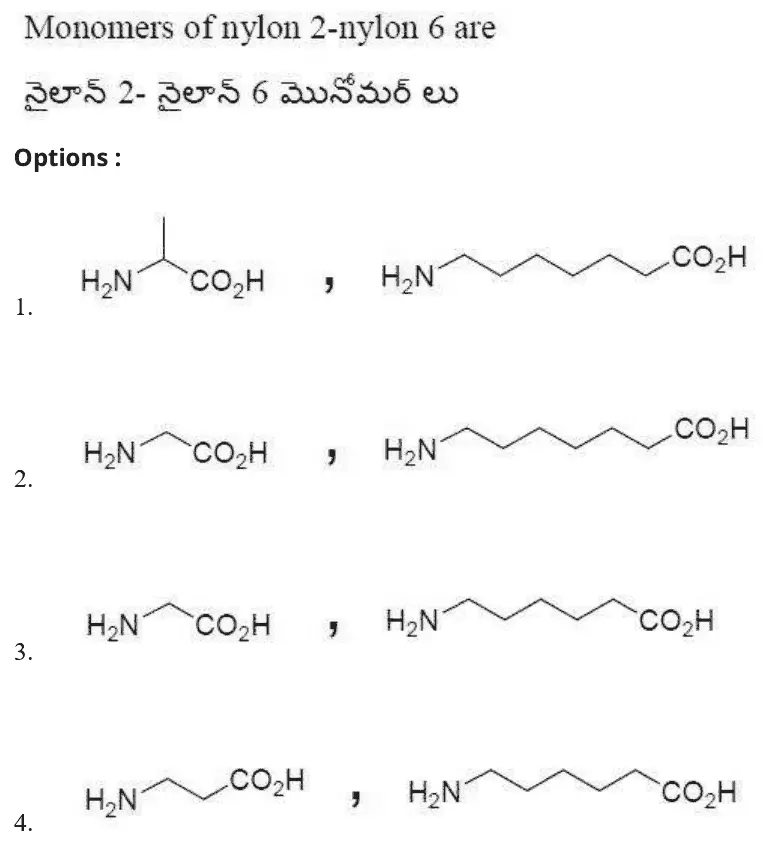
see figure Two skeletal structures separated by a comma: (i) H2N–CH(CH3)–CO2H (alanine-type, with a methyl branch drawn upward on the carbon between H2N and CO2H); (ii) H2N attached to a zigzag chain ending in CO2H, drawn with 6 bonds between H2N and the carbon bearing CO2H (7-carbon amino acid, as drawn).
see figure Two skeletal structures separated by a comma: (i) H2N–CH2–CO2H (glycine); (ii) H2N attached to a zigzag chain ending in CO2H, drawn with 6 bonds between H2N and the carbon bearing CO2H (as drawn).
see figure Two skeletal structures separated by a comma: (i) H2N–CH2–CO2H (glycine); (ii) H2N attached to a shorter zigzag chain ending in CO2H (6-aminohexanoic acid type, as drawn).
see figure Two skeletal structures separated by a comma: (i) H2N–CH2–CH2–CO2H (3-aminopropanoic acid type, zigzag of 3 bonds with CO2H up); (ii) H2N attached to a zigzag chain ending in CO2H (6-aminohexanoic acid type, as drawn).
In which of the following pairs the polymer is correctly matched with the forces possessed by them.
A. Neoprene ---- Weak intermolecular forces
B. Terylene ---- Hydrogen bonding
C. Polystyrene ---- Very weak intermolecular forces
D. Polythene ---- Hydrogen bonding
B,C
C, D
A, B
A,D
Ziegler-Natta Catalyst is used in the manufacture of
Polyacrylonitrile
Terylene
High density polythene
Low density polythene
Match the following
| List – I (Polymer Type) | List – II (Example) |
|---|---|
| A) Fibre | I) Bakelite |
| B) Elastomer | II) Polystyrene |
| C) Thermosetting polymer | III) Neoprene |
| D) Thermoplastic polymer | IV) Dacron |
The correct answer is
A – III, B – IV, C – I, D – II
A – IV, B – III, C – I, D – II
A – II, B – I, C – IV, D – III
A – IV, B – I, C – II, D – III
A polymer sample contains 3 molecules of molar mass $10^3$, 3 molecules of molar mass 500 and 4 molecules of molar mass 200. What is its weight average molecular mass?
530
737.7
834.4
821.6
Identify the correct statement from the following
(A) Glyptal is made from the monomers ethylene glycol and phthalic acid
(B) Bakelite is used in making electrical switches
(C) Nylon2-nylon6 is a biodegradable polymer
A, B, C
A &C only
A & B only
B & C only
Amongst the following, how many of them come under the category of elastomers?
Natural rubber, polyethene, vulcanized rubber, bakelite, polyvinylchloride, Buna-N, Nylon 6, Neoprene
4
5
3
6
Match the following
| List-I (polymer) | List-II (Monomer/s) |
|---|---|
| A) Bakelite | I) 2-Methyl-1,3-butadiene |
| B) Natural rubber | II) Glycine + Aminocaproic acid |
| C) Glyptal | III) Phenol+formaldehyde |
| D) Nylon 2-Nylon 6 | IV) Phthalic acid+ethylene glycol |
The correct answer is
A - IV, B - I, C - II, D – III
A - III B - I, C - IV, D – II
A - III, B - II, C - IV, D – I
A – II, B - III, C - I, D – IV
Which of the following can be used as a chain transfer agent during vinyl polymerization?
$\mathrm{CCl_4}$
$\mathrm{C_6H_5OH}$
t- butylperoxide
Diphenylamine
Teflon is an example of ______
Formaldehyde resin
Polyamide
Polyester
Addition polymer
Which of the following polymer is bio-degradable?
Nylon-6,6
Nylon-2-nylon-6
Melamine polymer
Nylon-6
Which of among the following is an example for fibre?
Polyester
Urea-formaldehyde resin
Polyvinyl chloride
Neoprene
Find the product in the reaction given below
(see the figure above)
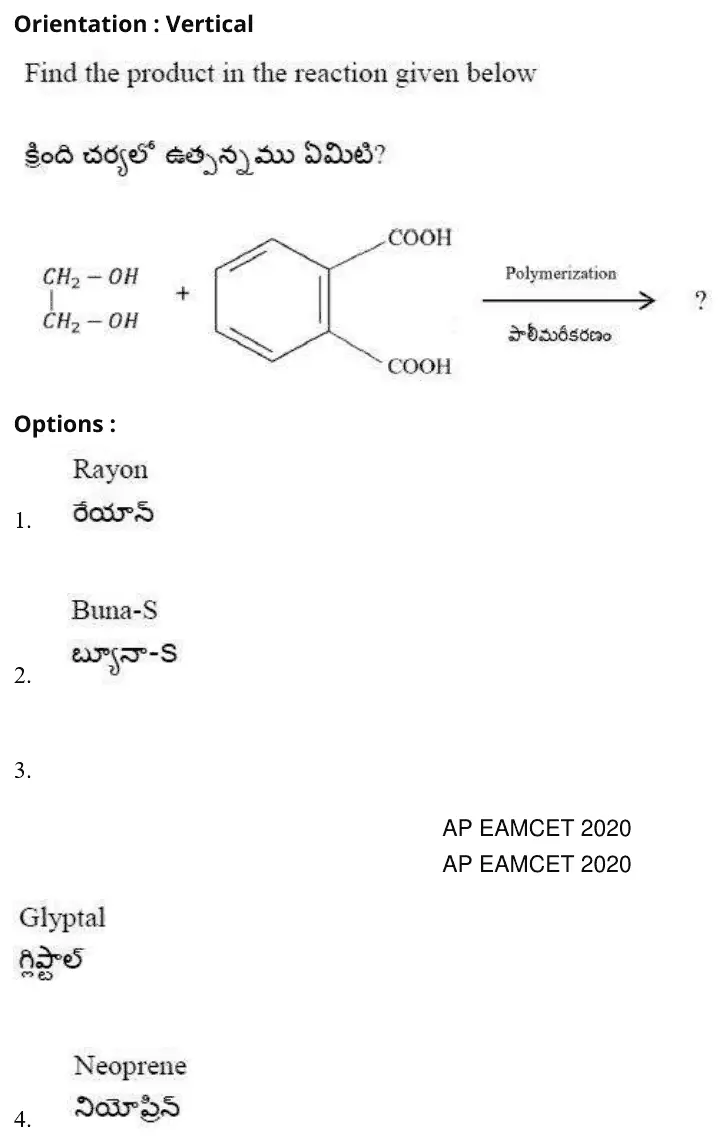
Rayon
Buna-S
Glyptal
Neoprene
Which of the following is an example for Chain-Growth polymer?
Bakelite
Teflon
Nylon
Terylene
Which among the following polymers can be formed by using caprolactam monomer unit?
Nylon-6,6
Nylon-2-nylon-6
Melamine polymer
Nylon-6
Intermolecular forces in nylon-6,6 are
Dipole - dipole interactions
Hydrogen Bonding
Vander Waal's forces
Ionic bonds
Which of the following is not a semisynthetic polymer?
cis-poly isoprene
Cellulose nitrate
Cellulose acetate
Vulcanized rubber.
Which of the following is a biodegradable polymer of polyamide class?
Dextron
Nylon-2-nylon-6
Nylon-6, 6
PHBV
Which among the following polymers exhibit hydrogen bonding?
Polyvinyl chloride
Nylon-6, 6
Neoprene
Teflon
Which one among the following is a semi-synthetic polymer?
Cellulose acetate
Starch
Rubber
Nylon 6, 6
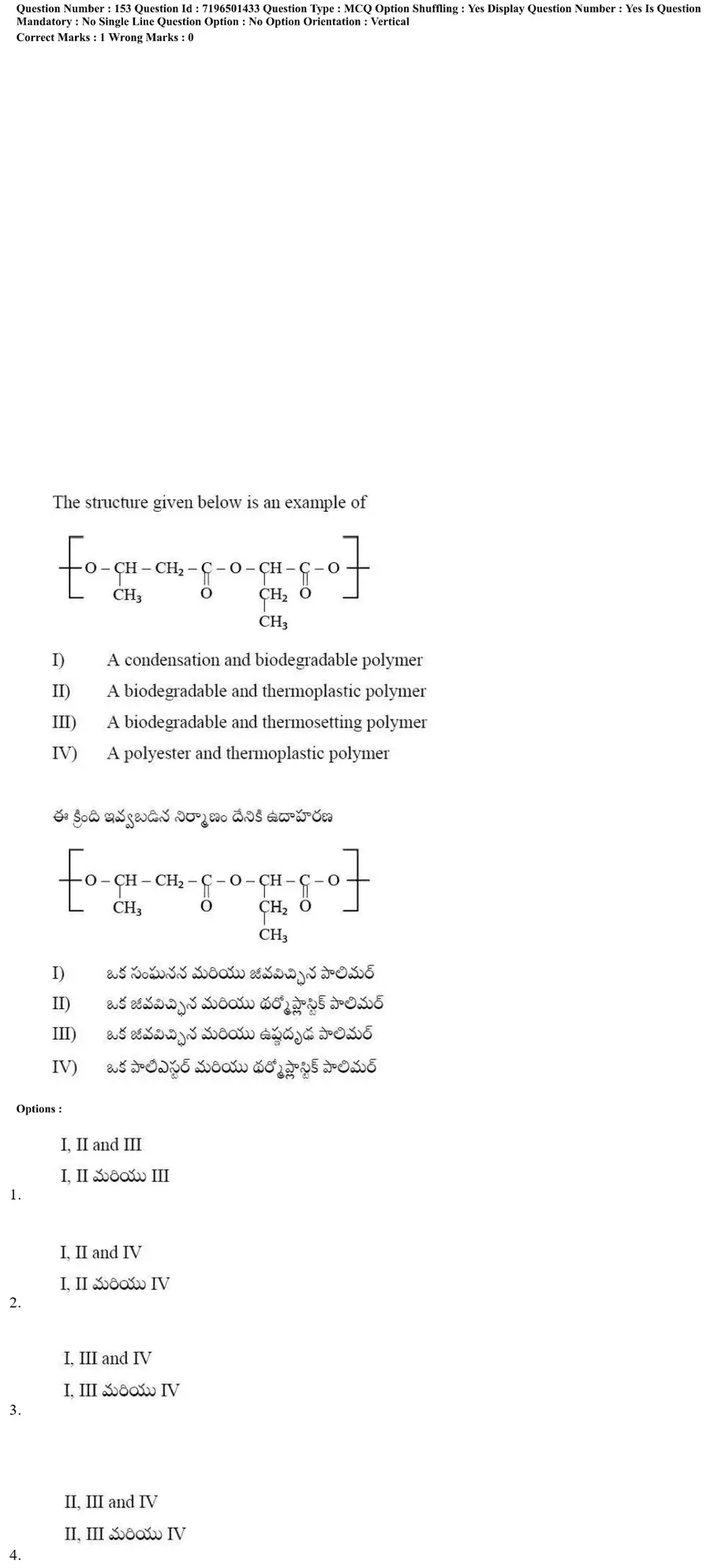
The structure given below is an example of
(see the figure above)
I) A condensation and biodegradable polymer
II) A biodegradable and thermoplastic polymer
III) A biodegradable and thermosetting polymer
IV) A polyester and thermoplastic polymer
I, II and III
I, II and IV
I, III and IV
II, III and IV
Type of reaction involved in the initial step in the formation of Bakelite
Electrophilic substitution
Electrophilic addition
Nucleophilic substitution
Nucleophilic addition
Monomeric units of melamine polymer are:
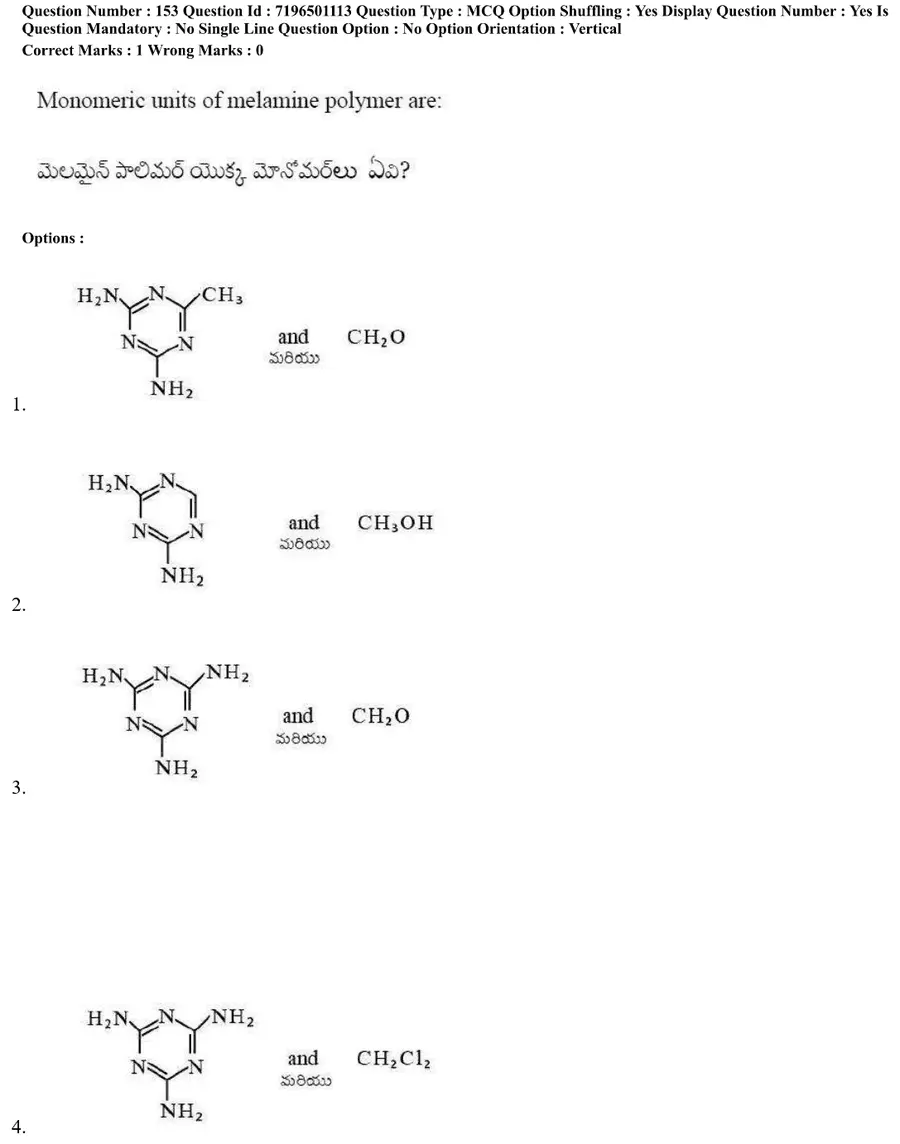
see figure and $\mathrm{CH_2O}$
see figure and $\mathrm{CH_3OH}$
see figure and $\mathrm{CH_2O}$
see figure and $\mathrm{CH_2Cl_2}$
Which of the following vinyl derivatives is the most reactive towards anionic polymerisation?
$\mathrm{CH_2{=}CH{-}CH_2{-}CH_3}$
$\mathrm{CH_2{=}CH{-}CH_2{-}OE}$ (sic)
$\mathrm{CH_2{=}CH{-}Cl}$
$\mathrm{CH_2{=}CH{-}C{\equiv}N}$
Which of the following are synthetic rubbers?
(i) Terylene
(ii) Buna–S
(iii) Buna–N
(iv) Neoprene
(v) Polyacrylonitrile
(i), (ii) and (iii)
(ii), (iv) and (v)
(ii), (iii) and (iv)
(i), (ii) and (iv)
Which one of the following is made by using step growth polymerization?
Nylon 6, 6
Teflon
Rubber
Neoprene
Match the following
A) Natural rubber
B) PVC
C) Terylene
D) Syndiotactic polymer
I) Free radical polymerization
II) Side chain alternative arrangement
III) cis-Polyisoprene
IV) Condensation polymerization
The correct match is
A-I, B-II, C-III, D-IV
A-III, B-II, C-IV, D-I
A-III, B-I, C-IV, D-II
A-IV, B-II, C-I, D-III
Which of the following polymer is formed due to the copolymerisation of 1, 3-butadiene and phenylethene?
Buna-N
Neoprene
Novolac
Buna-S
Match the following.
List - I
A) $\mathrm{[-CH_2-C(Cl)=CH-CH_2-]_n}$
B) Nylon 6, 6
C) HDP
D) Melamine-formaldehyde
List - II
I) Cross-linked network
II) Elastomer
III) Fibre
IV) Ziegler-Natta Catalyst
The correct answer is
A-IV, B-III, C-II, D-I
A-II, B-III, C-IV, D-I
A-III, B-II, C-I, D-IV
A-I, B-IV, C-III, D-II
The monomer units of Nylon 6,6, Nylon 2-Nylon 6 are respectively,
$\mathrm{H_2NCH_2CO_2H}$, $\mathrm{H_2N(CH_2)_6NH_2}$; $\mathrm{HO_2C(CH_2)_4CO_2H}$, $\mathrm{H_2NCH_2CO_2H}$
$\mathrm{H_2NCH_2CO_2H}$, $\mathrm{HO_2C(CH_2)_4CO_2H}$; $\mathrm{H_2N(CH_2)_6NH_2}$, $\mathrm{H_2N(CH_2)_5CO_2H}$
$\mathrm{H_2N(CH_2)_6NH_2}$, $\mathrm{HO_2C(CH_2)_4CO_2H}$; $\mathrm{H_2NCH_2CO_2H}$, $\mathrm{H_2N(CH_2)_5CO_2H}$
$\mathrm{H_2NCH_2CO_2H}$, $\mathrm{H_2N(CH_2)_5CO_2H}$; $\mathrm{H_2N(CH_2)_6NH_2}$, $\mathrm{HO_2C(CH_2)_4CO_2H}$
A polymer contains 50 molecules with molecular mass 5000, 100 molecules with molecular mass 10,000 and 50 molecules with molecular mass 15,000. Calculate number average molecular mass?
5,000
75,000
10,000
20,000
Which one of the following is a biodegradable polymer?
(see the figure above)
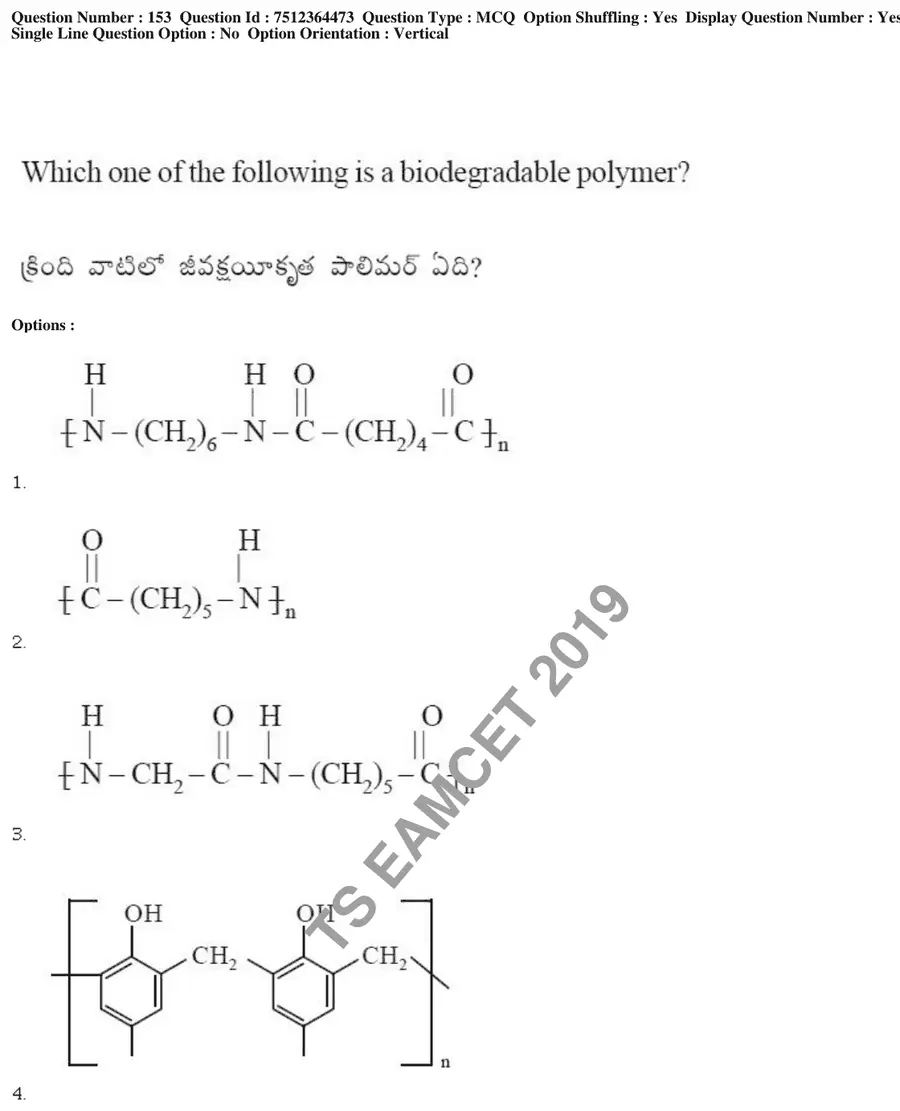
see figure $\left[\mathrm{NH-(CH_2)_6-NH-CO-(CH_2)_4-CO}\right]_n$
see figure $\left[\mathrm{CO-(CH_2)_5-NH}\right]_n$
see figure $\left[\mathrm{NH-CH_2-CO-NH-(CH_2)_5-CO}\right]_n$
see figure phenol-formaldehyde type network polymer: repeating unit of two phenol rings (OH on each) joined by CH2 bridges, with open bonds at both ends and cross-link bonds, bracketed with subscript n
Number average molecular mass of a polymer that contains 15 molecules with each of mass 8,000 and 15 molecules with each of mass 80,000 is
22,000
33,000
11,000
44,000
The monomers of nylon 6, 6 (X) and terylene (Y) are
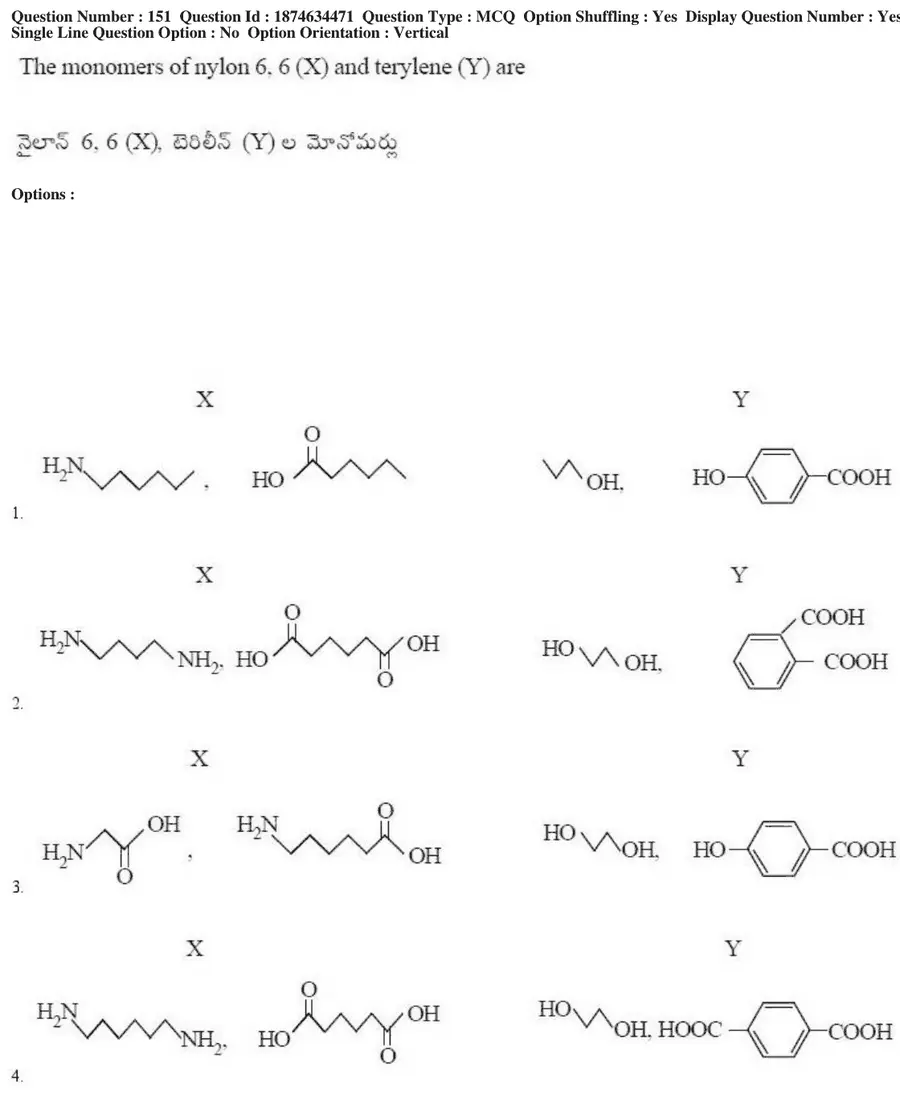
see figure X: H2N-zigzag chain, and HO-C(=O)-zigzag chain (a monoacid, no second functional group); Y: short zigzag chain ending in OH, and p-HO-C6H4-COOH
see figure X: H2N-zigzag chain-NH2, and HO-C(=O)-zigzag chain-C(=O)-OH (a diacid); Y: HO-CH2CH2-OH, and o-phthalic acid (1,2-benzenedicarboxylic acid)
see figure X: glycine-like H2N-CH2-C(=O)OH, and H2N-zigzag chain-C(=O)OH (an amino acid); Y: HO-CH2CH2-OH, and p-HO-C6H4-COOH
see figure X: H2N-zigzag chain-NH2, and HO-C(=O)-zigzag chain-C(=O)-OH (a diacid); Y: HO-CH2CH2-OH, and p-HOOC-C6H4-COOH (terephthalic acid)
The catalyst triethyl aluminium and titanium tetrachloride finds use in the formation of the polymer
Teflon
Low density polythene
Polyacrylonitrile
High density polythene
How many of the following polymers given, come under the category of condensation polymers
Bakelite, Teflon, Nylon 6, Dacron, Polyisoprene, Melamine, Neoprene
4
3
5
6
Match the following.
List - I
A) Addition polymer
B) Condensation polymer
C) Acrilan
D) Rubber
List - II
I) Bakelite
II) 2-methyl-1, 3-butadiene
III) 2, 3-dimethyl-1, 3-butadiene
IV) Vinyl cyanide
V) Polythene
The correct answer is
A-V, B-I, C-IV, D-II
A-V, B-I, C-II, D-III
A-I, B-V, C-IV, D-II
A-I, B-V, C-II, D-III
Match the following.
List - I
A) Teflon
B) Anionic polymerisation
C) Cationic polymerisation
D) Thermosetting polymer
List - II
I) $\mathrm{SnCl_2}$
II) $\mathrm{C_2F_4}$
III) Bakelite
IV) Polystyrene
V) RLi
The correct answer is
A-II, B-I, C-V, D-III
A-II, B-V, C-I, D-IV
A-II, B-V, C-I, D-III
A-V, B-II, C-I, D-IV
Match the following
List - I
A) $\mathrm{[-NH-(CH_2)_6-NH-CO-(CH_2)_4-CO-]_n}$
B) $\mathrm{[-CO-(CH_2)_5-NH-]_n}$
C) $\mathrm{[-CF_2-CF_2-]_n}$
D) $\mathrm{[-O-CH_2-CH_2-OOC-C_6H_4-CO-]_n}$ (para-phenylene ring drawn)
List - II
I) Ethylene glycol and Terephthalic acid
II) Phenol and formaldehyde
III) Caprolactam
IV) Hexamethylene diamine and adipic acid
V) Tetrafluoroethene
A-IV, B-III, C-V, D-I
A-III, B-II, C-IV, D-I
A-IV, B-III, C-II, D-I
A-II, B-IV, C-III, D-V
Examples for natural polymers are
Cotton, Silk, Bakelite and Wool
Cellulose, Polystyrene and Neoprene
Nylon, Terylene and PVC
Silk, Cotton and Proteins
Match the following
List - I
a) Natural rubber
b) Cellulose
c) Nylon-6
d) Teflon
List - II
i) $\beta$-Glucose
ii) Isoprene
iii) Tetrafluoroethylene
iv) Caprolactam
v) Hexamethylenediamine, adipic acid
The correct answer is
(a)-(ii), (b)-(i), (c)-(iv), (d)-(iii)
(a)-(ii), (b)-(iv), (c)-(i), (d)-(iii)
(a)-(iv), (b)-(i), (c)-(ii), (d)-(iii)
(a)-(ii), (b)-(iii), (c)-(iv), (d)-(v)
The schematic illustrations of macromolecules given below represent
(see the figure above)
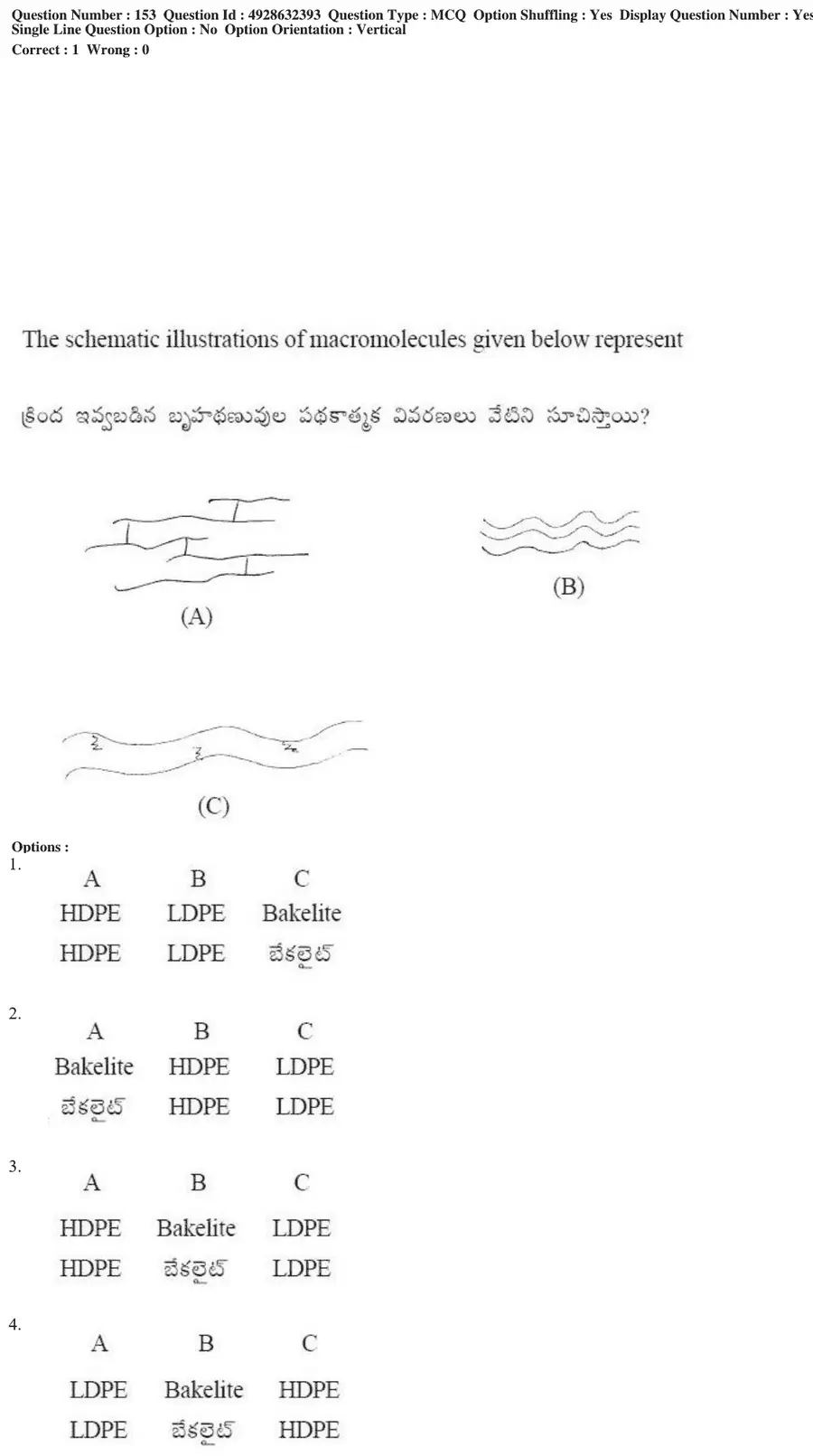
A: HDPE, B: LDPE, C: Bakelite
A: Bakelite, B: HDPE, C: LDPE
A: HDPE, B: Bakelite, C: LDPE
A: LDPE, B: Bakelite, C: HDPE
The formation of terylene (or decron) from ethylene glycol and terephthalic acid is
a condensation polymerization reaction
an anionic polymerization reaction
an addition polymerization reaction
a cationic polymerization reaction
Identify the monomers used in the manufacture of glyptal (X), dacron (Y) and nylon 2-nylon 6 (Z).
(see the figure above)
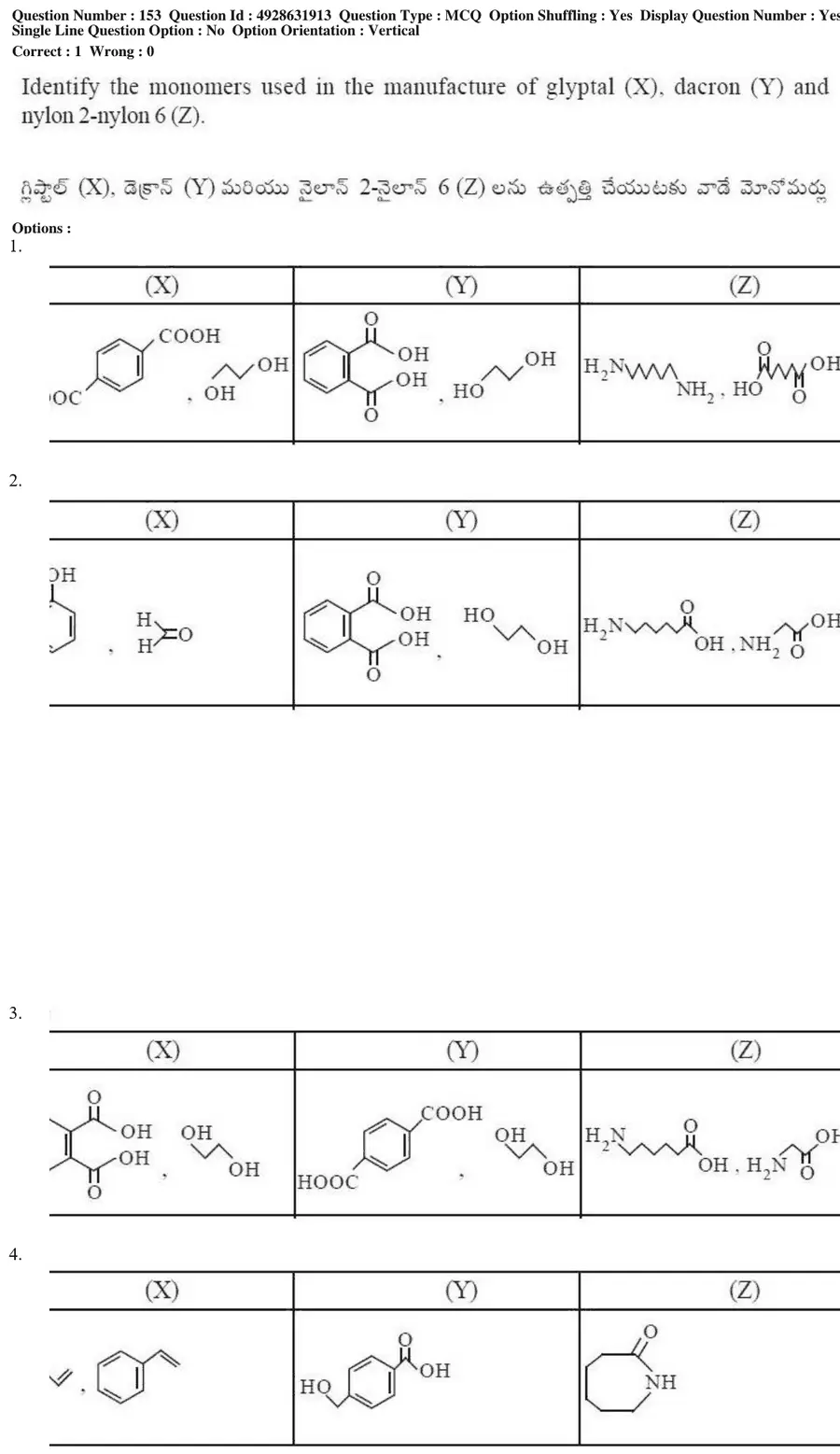
see figure (X) p-dicarboxylic benzene (benzene ring with COOH at two para positions; left COOH clipped) , HO-CH2CH2-OH; (Y) phthalic acid (ortho COOH, COOH) , HO-CH2CH2-OH; (Z) H2N-(zig-zag chain)-NH2 , HO-C(=O)-(zig-zag chain)-C(=O)-OH
see figure (X) phenol-type ring with OH (left part clipped) , H2C=O; (Y) phthalic acid (ortho COOH, COOH) , HO-CH2CH2-OH; (Z) H2N-(long chain)-C(=O)OH , H2N-CH2-C(=O)OH
see figure (X) ring-type diacid, C(=O)OH and C(=O)OH on adjacent carbons of a C=C (left part clipped) , HO-CH2CH2-OH; (Y) terephthalic acid (HOOC and COOH para on benzene) , HO-CH2CH2-OH; (Z) H2N-(long chain)-C(=O)OH , H2N-CH2-C(=O)OH
see figure (X) a vinyl compound (left part clipped) , styrene; (Y) HO-CH2-C6H4-COOH (para); (Z) eight-membered lactam ring (NH and C=O)
Examples of synthetic polymer (X) and semi-synthetic polymer (Y) are
X = polythene, Y = rayon
X = rayon, Y = nylon 6, 6
X = rubber, Y = polythene
X = cellulose nitrate, Y = PVC
Examples of thermoplastic polymer (X) and thermosetting polymer (Y) are
X: teflon; Y: neoprene
X: neoprene; Y: glyptal
X: polystyrene; Y: bakelite
X: bakelite; Y: polythene
Which one of the following structures represents the neoprene rubber?
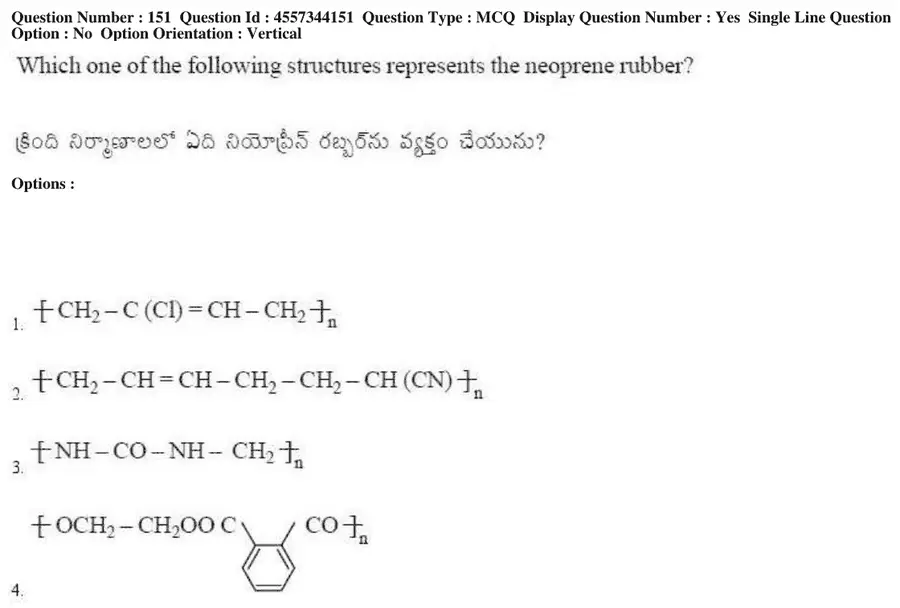
$-[\mathrm{CH_2-C(Cl)=CH-CH_2}]_n-$
$-[\mathrm{CH_2-CH=CH-CH_2-CH_2-CH(CN)}]_n-$
$-[\mathrm{NH-CO-NH-CH_2}]_n-$
see figure $-[\mathrm{OCH_2-CH_2OOC-}$ benzene ring (1,2-disubstituted as drawn) $\mathrm{-CO}]_n-$
Nylon 6, 6 is a condensation polymer of two monomers X and Y. The number of $-\mathrm{CH_2}-$ groups in X and Y are respectively
6, 4
6, 6
5, 6
6, 2
In anionic polymerisation, the compound which acts as effective chain initiator is
$\mathrm{BF_3}$
$(\mathrm{CH_3CO})_2\mathrm{O_2}$
$\mathrm{SnCl_2}$
R-Li
Catalyst used in the manufacture of high density polythene is
$\mathrm{MnO_2}$
$\mathrm{V_2O_5}$
$\mathrm{TiCl_4}$ & $\mathrm{(C_2H_5)_3Al}$
$\mathrm{PdCl_2}$
The polydispersity index of a polymer containing 10 molecules with molecular mass $1.0\times10^{4}$ and 10 molecules with molecular mass $1.0\times10^{5}$ is approximately
$1.67$
$0.59$
$1.55$
$0.83$
The monomers of Buna-S rubber are
Isoprene and butadiene
Butadiene and phenol
Styrene and butadiene
Vinyl chloride and sulphur
Which one of the following is not used as an initiator in ionic polymerisation?
$\mathrm{AlCl_3}$
$\mathrm{SnCl_2}$
$\mathrm{NaNH_2}$
$(\mathrm{C_6H_5CO})_2\mathrm{O_2}$
Which of the following statements are correct ?
a. Natural rubber becomes hard at high temperature
b. Neoprene is a polymer of 2-chloro -1, 3-butadiene
c. Nylon 6, 6 is a polyamide fibre
d. Buna-S is an example of a homopolymer
b, c
a, c, d
b, d
a, c
Identify the set with only addition homopolymers.
Polythene, Natural rubber, Cellulose
Starch, Nylon, Terylene
Teflon, Bakelite, Orlon
Neoprene, PVC, Polythene
Identify the monomer that can undergo polymerisation by free radical, cationic and anionic mechanisms.
Vinyl chloride
Acrylonitrile
Styrene
Isobutylene
Ethylene on reaction with Baeyer's reagent gives the compound A. In the preparation of co-polymer X, compound A is used as monomer. What is X?
Nylon 6, 6
Bakelite
Glyptal
Nylon 2 - Nylon 6
Buna - N is a co-polymer of 1, 3-Butadiene and X. What is X?
$\mathrm{CH_2{=}CH{-}CN}$
$\mathrm{CH_2{=}CH{-}Cl}$
$\mathrm{CH_2{=}CH{-}C_6H_5}$
$\mathrm{CH_2{=}CH{-}CH_3}$
Identify the fibre (X) and elastomer (Y) from the following
X: Dacron, Y: Neoprene
X: Novolac, Y: Polystyrene
X: Teflon, Y: Buna - S
X: Glyptal, Y: Polypropene
The P Dispersity Index (PDI) of a polymer is ($\overline{M}_w$ = weight average molecular mass and $\overline{M}_n$ = number average molecular mass)
The product of $\overline{M}_n$ and $\overline{M}_w$
The sum of $\overline{M}_n$ and $\overline{M}_w$
The difference between $\overline{M}_w$ and $\overline{M}_n$
The ratio between $\overline{M}_w$ and $\overline{M}_n$
Observe the following polymers
A) PHBV
B) Nylon 2-nylon 6
C) Glyptal
D) Bakelite
Biodegradable polymer(s) from the above is/are
(C)
(A), (B)
(D)
(C), (D)
Identify the copolymer from the following :
(see the figure above)
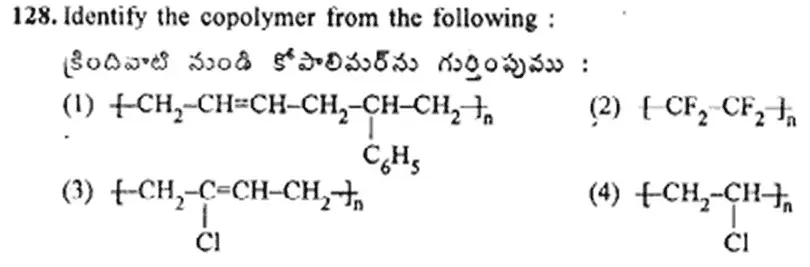
see figure $\left[\mathrm{CH_2{-}CH{=}CH{-}CH_2{-}CH(C_6H_5){-}CH_2}\right]_n$
see figure $\left[\mathrm{CF_2{-}CF_2}\right]_n$
see figure $\left[\mathrm{CH_2{-}C(Cl){=}CH{-}CH_2}\right]_n$
see figure $\left[\mathrm{CH_2{-}CH(Cl)}\right]_n$
Example of a biodegradable polymer pair is :
Nylon-6,6 and Terylene
PHBV and Dextron
Bakelite and PVC
PET and Polyethylene
The monomer of neoprene is
1, 3-Butadiene
2-Chloro-1, 3-butadiene
2-Methyl-1, 3-butadiene
Vinyl chloride
If the number average molecular weight and weight average molecular weight of a polymer are 40,000 and 60,000 respectively, the polydispersity index of the polymer will be :
$>1$
$<1$
$1$
Zero
Polymers represents a compact and straightforward component of the senior secondary organic syllabus. Over the historical period from 2010 to 2026, Polymers generated 115 questions across 149 evaluated test sittings, appearing in 109 papers to average 0.8 questions per paper and a 1.9 percent subject share. Modern test cycles from 2022 to 2026 reflect an identical general frequency: examiners set 58 questions across 77 sittings, appearing in 58 papers to record 0.8 questions per test and a 1.9 percent share. This volume places Polymers at rank 27 of 31 chemistry chapters.
The chapter does not appear in every sitting, and it was entirely absent from the 2022 exam cycle before returning consistently. Across the most recent three calendar sessions from 2024 to 2026, the topic supplied 44 questions across 46 papers, featuring in 44 sittings for an average of 1.0 question per test and a 2.4 percent share. In the earlier testing era from 2010 to 2021, examiners set 57 questions across 72 sittings (present in 51 papers, averaging 0.8 per test and a 2.0 percent share). Evaluating the trajectory, comparing early testing with the last three years shows the share is about the same, while comparing recent testing with the last three years shows the share is up. Across regional boards between 2022 and 2026, Andhra Pradesh administered 35 questions across 48 papers (appearing in 35 papers, 0.7 per test, 1.8 percent share), while Telangana administered 23 questions across 29 papers (appearing in 23 papers, 0.8 per test, 2.0 percent share).
Because the official curriculum groups this subject into a single unified heading, questions focus on fundamental classification, monomer pairing, and industrial polymer structures:
EAPCET polymer problems are straightforward memory and identification items that test monomer formulas, linkage classes, and physical property categorizations.
A very common question asks students to name the exact monomer precursors for synthetic elastomers like Buna-S (one-three-butadiene and styrene) or Buna-N (one-three-butadiene and acrylonitrile). Another recurring template presents four commercial polymers and requires candidates to classify them into elastomers, fibers, thermoplastics, or thermosetting plastics based on intermolecular forces. Questions also frequently ask candidates to determine which condensation polymer contains ester linkages (polyesters like Terylene and Glyptal) or amide linkages (polyamides like nylon six-six), or to identify the monomers of biodegradable copolymer PHBV (three-hydroxybutanoic acid and three-hydroxypentanoic acid).
Test your command of polymer classes and monomer structures with these recent official questions:
Prepare a concise two-column reference table. On the left side, list every polymer named in the standard textbook; on the right side, write its exact IUPAC and common monomer names, whether it forms via addition or step-growth condensation, and the small elimination product (water, alcohol, or hydrogen chloride) if applicable.
Ensure that you can clearly differentiate between natural rubber (cis-one-four-polyisoprene) and gutta-percha (trans-one-four-polyisoprene). Pay special attention to vulcanization of rubber using elemental sulfur, which introduces cross-links across reactive double bonds. Finally, review the structures and applications of newer biodegradable materials like PHBV and nylon two-nylon six, which appear regularly in recent paper cycles.
Novolac is a linear polymer produced by the acid-catalyzed reaction of phenol with excess formaldehyde, commonly utilized in paints and varnishes. When Novolac is heated further with formaldehyde, extensive cross-linking occurs to yield Bakelite, an infusible, hard thermosetting plastic.
Addition polymerization involves the repeated addition of unsaturated monomer molecules containing double or triple bonds without the loss of any secondary small molecules. In contrast, condensation polymerization proceeds through repetitive bifunctional or polyfunctional condensation reactions accompanied by the elimination of small molecules like water or alcohol.
Nylon six-six is synthesized by the condensation polymerization of hexamethylenediamine and adipic acid under high pressure and temperature, eliminating water molecules to create repeating amide linkages along the polymer chain. Step-by-step solutions for each one are in the EdLoop EAPCET app.