At 1130 K, the decomposition of ammonia on Pt catalyst follows zero order kinetics. The rate of this reaction at t = 10 min is $x$ mol $\mathrm{L^{-1}}$ $\mathrm{min^{-1}}$. What will be its rate (in mol $\mathrm{L^{-1}}$ $\mathrm{min^{-1}}$) at t = 20 min, at the same temperature?
When $50\ mL$ of $2M$ solution of $\mathrm{N_2O_5}$ was heated, $0.28\ L$ of $\mathrm{O_2}$ was formed at $STP$ after 30 minutes. The concentration of unreacted $\mathrm{N_2O_5}$ is $X\ M$ and average rate of reaction (in $mol\ L^{-1}min^{-1}$) is $Y$. What are $X$ and $Y$ respectively?
(molar volume = $22.4\ L$, molar mass of $\mathrm{N_2O_5}$ = $108\ g\ mol^{-1}$)
Hydrolysis of benzene diazonium chloride follows first order kinetics. The time taken for its decomposition to $^1/_8$ and $^1/_{10}$ of its original concentration are $\left[t_{1/8}\right]$ and $\left[t_{1/10}\right]$ respectively. What is the ratio of $\left[t_{1/8}\right]$ to $\left[t_{1/10}\right]$ ?
The k value of the reaction $\mathrm{A}$ $\rightarrow$ products is $5 \times 10^{3}\ \mathrm{s^{-1}}$ at 300 K. Its activation energy is 50 kJ $\mathrm{mol^{-1}}$. At T(K), its value becomes $1.0 \times 10^{4}\ \mathrm{s^{-1}}$. What is the value of T (in K)? (R = 8.3 J $\mathrm{mol^{-1}\,K^{-1}}$), (log 2 = 0.3)
At 300°C, decomposition of azomethane follows first order kinetics. Rate constant of this reaction at this temperature is $2.5 \times 10^{-4} s^{-1}$. If the activation energy of the reaction is 42 $kcal\ mol^{-1}$, what is the temperature (in $K$) at which the half-life of the reaction is 138.6 seconds? ($R = 2\ cal\ K^{-1} mol^{-1}$, $\log 20 = 1.30$)
Half-life of a first order reaction is 10 minutes. What is the rate of reaction after 20 minutes, if the initial concentration of the reactant is 10 M?
The rate constant of a first order reaction at 600 K is $1.6 \times 10^{-5}\mathrm{s^{-1}}$. If its activation energy is $198.87\ \mathrm{kJ\ mol^{-1}}$, what is the rate constant (in $\mathrm{s^{-1}}$) at 700 K ? $(\mathrm{R} = 8.3\ \mathrm{J\ mol^{-1}K^{-1}})$ (antilog(0.4771) = 3.0)
$A(g) \rightarrow$ products, follows first order kinetics. Initial concentration of $A$ is $8 \times 10^{-3}\ mol\ L^{-1}$. For 80% decomposition of $A$, the time taken was 80 minutes. What is the rate constant for that reaction?
At T(K), the rate constant of a reaction (A$\rightarrow$products) is 0.02 $mol\ L^{-1}\ min^{-1}$. The initial concentration of A is 1.0 $mol\ L^{-1}$. What will be the concentration of A (in $mol\ L^{-1}$) after 20 min? (antilog (0.8264) = 6.705)
At T(K), the following first order reaction takes place
$$\mathrm{A(g)\rightarrow B(g) + C(g)}$$
Initial pressure ($t = 0$ min) of $\mathrm{A(g)}$ is $p_A^0$. After 10 min of the reaction, the pressure is $p_t$. The correct equation for the rate constant of this reaction is
For a first order reaction, rate constants at $50\ ^\circ\mathrm{C}$ and $100\ ^\circ\mathrm{C}$ are $1.5\times10^{7}\ \mathrm{s^{-1}}$ and $4.5\times10^{7}\ \mathrm{s^{-1}}$ respectively. What is the approximate activation energy of the reaction (in $\mathrm{kJ\,mol^{-1}}$)?
For a reaction, the graph of $/n\ k$ (on y-axis) and $1/T$ (on x-axis) is a straight line with a slope $-2 \times 10^4$ K. The activation energy of the reaction (in kJ $\mathrm{mol^{-1}}$) is ($R = 8.3\ \mathrm{J\,K^{-1}\,mol^{-1}}$)
$\mathrm{R \longrightarrow P}$ is a first order reaction. The concentration of $\mathrm{R}$ changed from 0.04 to 0.03 $\mathrm{mol\ L^{-1}}$ in 40 min. What is the average velocity of the reaction in $\mathrm{mol\ L^{-1}\ s^{-1}}$ ?
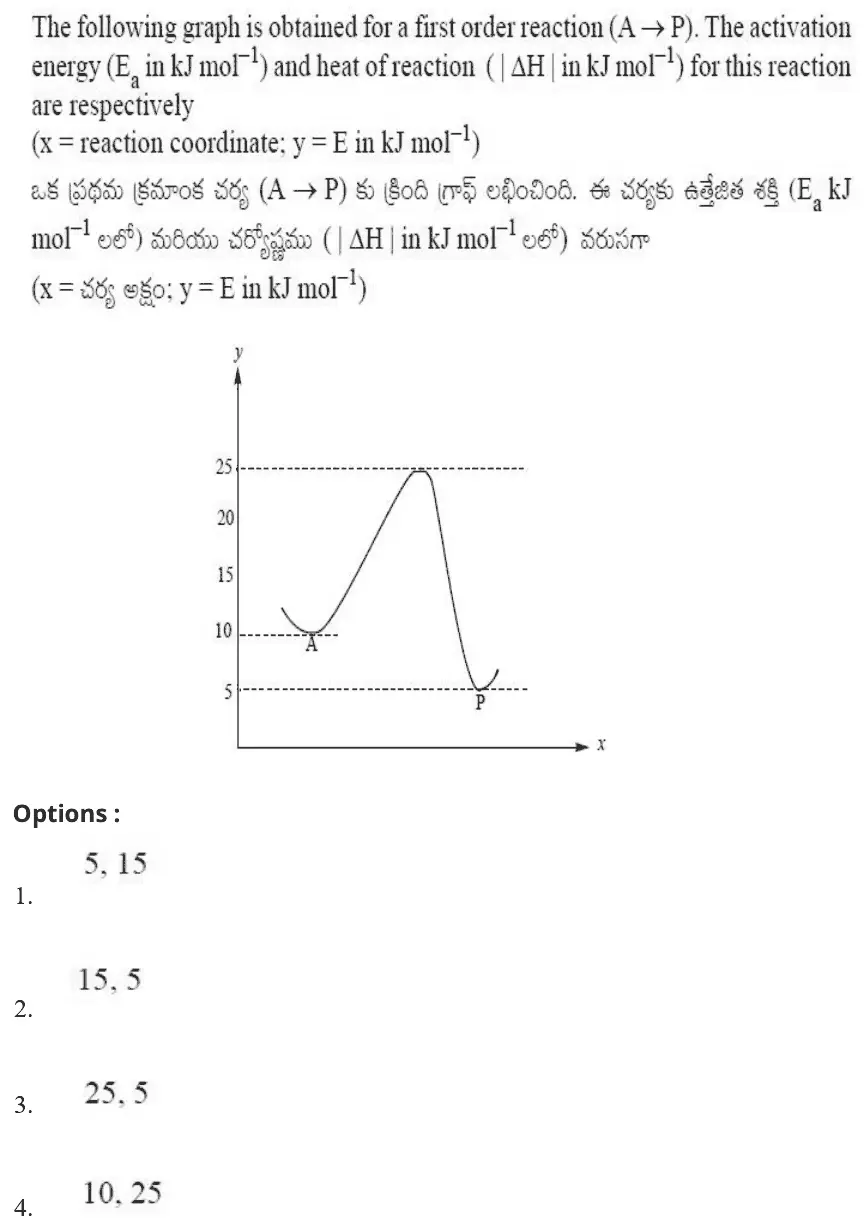
The following graph is obtained for a first order reaction ($\mathrm{A \rightarrow P}$). The activation energy ($\mathrm{E_a}$ in $\mathrm{kJ\ mol^{-1}}$) and heat of reaction ($|\Delta \mathrm{H}|$ in $\mathrm{kJ\ mol^{-1}}$) for this reaction are respectively ($\mathrm{x}$ = reaction coordinate; $\mathrm{y = E}$ in $\mathrm{kJ\ mol^{-1}}$)
For a first order reaction, the ratio between the time taken to complete $\frac{3}{4}$th of the reaction and time taken to complete half of the reaction is
$\mathrm{A} \rightarrow \mathrm{B}$ is a first order reaction. The concentration of A is decreased from $x$ mol $\mathrm{L^{-1}}$ to $y$ mol $\mathrm{L^{-1}}$ in 100 min. What is the average velocity of the reaction in mol $\mathrm{L^{-1}}$ $\mathrm{min^{-1}}$ ?
In a first order reaction, the concentration of the reactant is reduced to 1/8 of the initial concentration in 75 minutes. The $t_{1/2}$ of the reaction (in minutes) is (log 2 = 0.30, log 3 = 0.47, log 4 = 0.60)
$\mathrm{R \to P}$ is a first order reaction. For this reaction a graph of $\ln[\mathrm{R}]$ (on y-axis) and time (on x-axis) gave a straight line with negative slope. The intercept on y-axis is equal to ($\mathrm{k}$ = rate constant)
$\mathrm{A \rightarrow P}$ is a first order reaction. At 300 K this reaction was started with $[\mathrm{A}]=0.5\,\mathrm{mol\,L^{-1}}$. The rate constant of reaction was $0.125\,\mathrm{min^{-1}}$. The same reaction was started separately with $[\mathrm{A}]=1\,\mathrm{mol\,L^{-1}}$ at 300 K. The rate constant (in $\mathrm{min^{-1}}$) now is
For a first order decomposition of a certain reaction, rate constant is given by the equation $\log k(\mathrm{s^{-1}}) = 7.14 - \dfrac{1\times 10^{4}\,\mathrm{K}}{\mathrm{T}}$. The activation energy of the reaction (in $\mathrm{kJ\ mol^{-1}}$) is $(\mathrm{R} = 8.3\ \mathrm{J\,K^{-1}\,mol^{-1}})$
The half-life of a zero order reaction $\mathrm{A} \rightarrow$ products, is 0.5 hour. The initial concentration of A is 4 mol $\mathrm{L^{-1}}$. How much time (in hr) does it take for its concentration to come from 2.0 mol $\mathrm{L^{-1}}$ to 1.0 mol $\mathrm{L^{-1}}$?
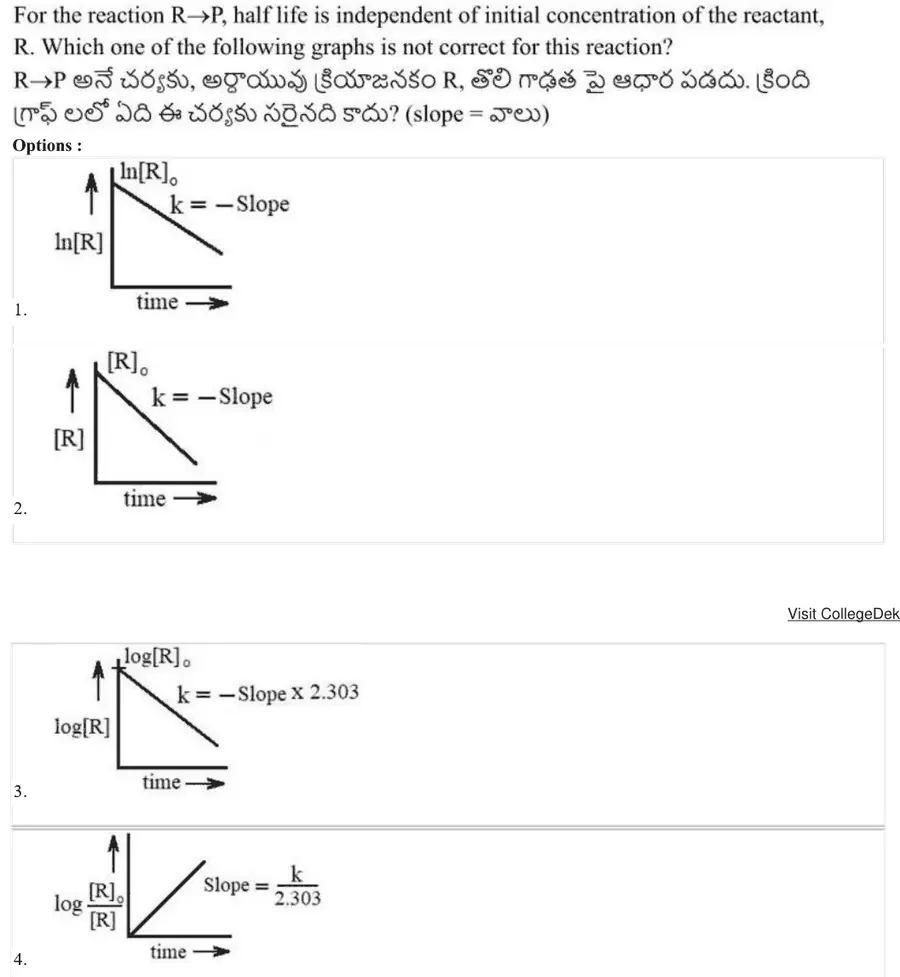
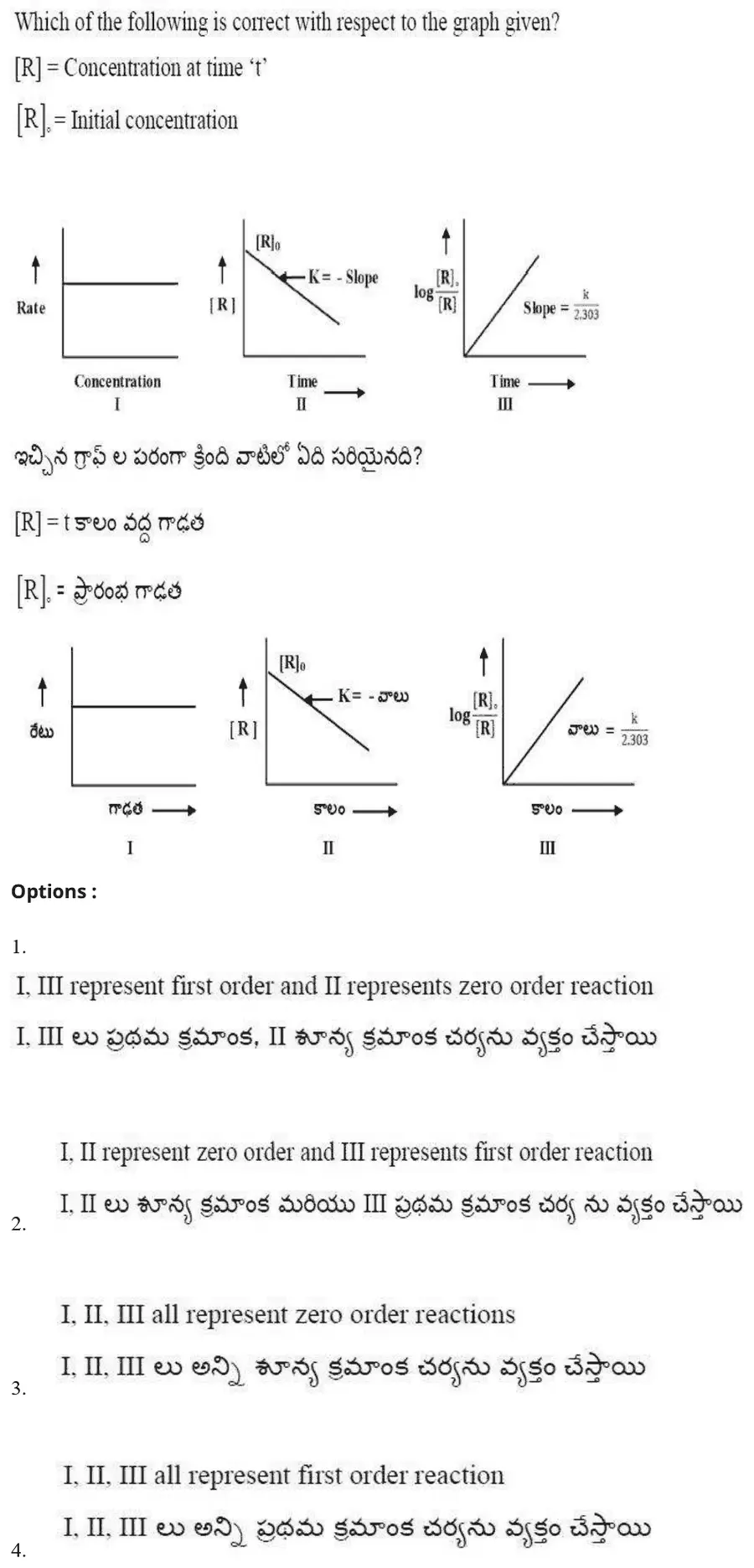
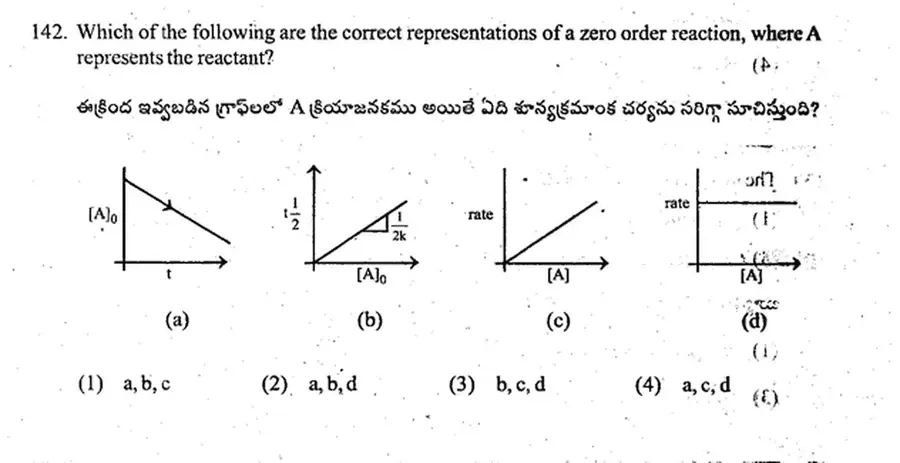
For the reaction $\mathrm{R \to P}$, half life is independent of initial concentration of the reactant, R. Which one of the following graphs is not correct for this reaction? (slope = slope)
The question as printed in the paper.
A
see figure Graph of ln[R] (y-axis) versus time (x-axis): straight line decreasing from ln[R]$_0$ on the y-axis; labelled $k = -\text{Slope}$.
B
see figure Graph of [R] (y-axis) versus time (x-axis): straight line decreasing from [R]$_0$ on the y-axis; labelled $k = -\text{Slope}$.
C
see figure Graph of log[R] (y-axis) versus time (x-axis): straight line decreasing from log[R]$_0$ on the y-axis; labelled $k = -\text{Slope} \times 2.303$.
D
see figure Graph of $\log \frac{[R]_0}{[R]}$ (y-axis) versus time (x-axis): straight line increasing from the origin; labelled $\text{Slope} = \frac{k}{2.303}$.
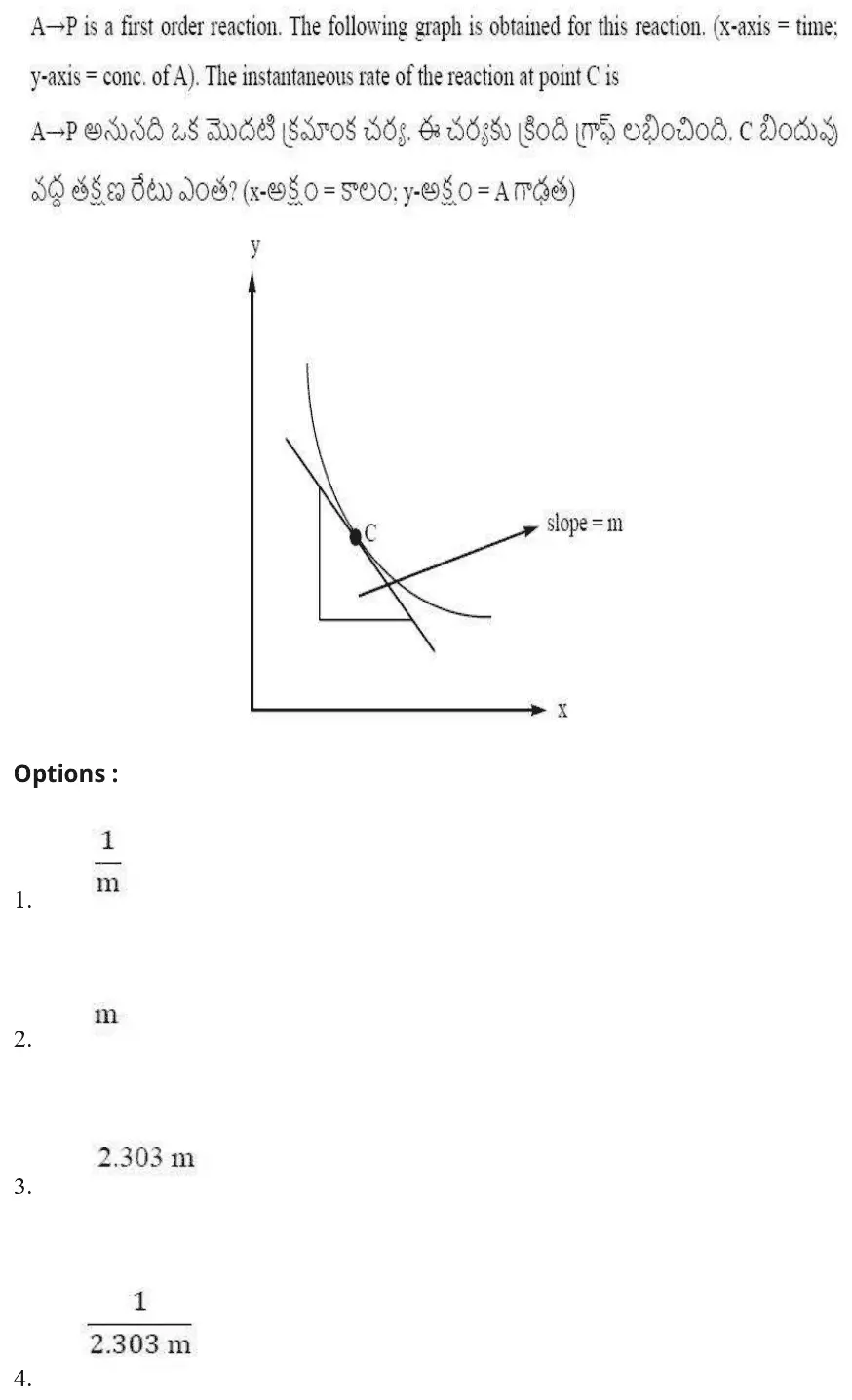
$\mathrm{A \rightarrow P}$ is a first order reaction. The following graph is obtained for this reaction. (x-axis = time; y-axis = conc. of A). The instantaneous rate of the reaction at point C is
Isomerisation of gaseous cyclobutene to butadiene is a first order reaction. At T(K), the rate constant of the reaction is $3.3 \times 10^{-4}\,s^{-1}$. What is the time required (in min) to complete 90 % of this reaction at the same temperature? (log 2 = 0.3)
The rate constant of a first order reaction was doubled when the temperature was increased from 300 to 310 K. What is its approximate activation energy (in $\mathrm{kJ\ mol^{-1}}$)?
The rate constant of a first order reaction is $3.46\times10^{-2}\ \mathrm{s^{-1}}$ at 298K. What is the rate constant of the reaction at 350 K if its activation energy is $50.1\ \mathrm{kJ\ mol^{-1}}$? ($\mathrm{R=8.314\ J\ K^{-1}mol^{-1}}$)
$\mathrm{A \rightarrow P}$ is a zero order reaction. At 298 K the rate constant of the reaction is $1 \times 10^{-3}\ \mathrm{mol\ L^{-1}\ s^{-1}}$. Initial concentration of 'A' is $0.1\ \mathrm{mol\ L^{-1}}$. What is the concentration of 'A' after 10 sec?
For a first order reaction, the concentration of reactant was reduced from $0.03\ \mathrm{mol\ L^{-1}}$ to $0.02\ \mathrm{mol\ L^{-1}}$ in 25 min. What is its rate (in $\mathrm{mol\ L^{-1}s^{-1}}$)?
At 298 K the value of $-\frac{\Delta[\mathrm{Br^-}]}{\Delta t}$ for the reaction
$5\mathrm{Br^-(aq)} + \mathrm{BrO_3^-(aq)} + 6\mathrm{H^+(aq)} \rightarrow 3\mathrm{Br_2(aq)} + 3\mathrm{H_2O(l)}$ is $x$ mol $\mathrm{L^{-1}}$ $\mathrm{min^{-1}}$. What is the rate (in mol $\mathrm{L^{-1}}$ $\mathrm{min^{-1}}$) of this reaction?
The first order reaction $\mathrm{A_{(g)} \rightarrow B_{(g)} + 2C_{(g)}}$ occurs at $25\ ^\circ\mathrm{C}$. After 24 minutes the ratio of the concentration of products to the concentration of the reactant is 1:3. What is the half life of the reaction (in min)? (log 1.11 = 0.046)
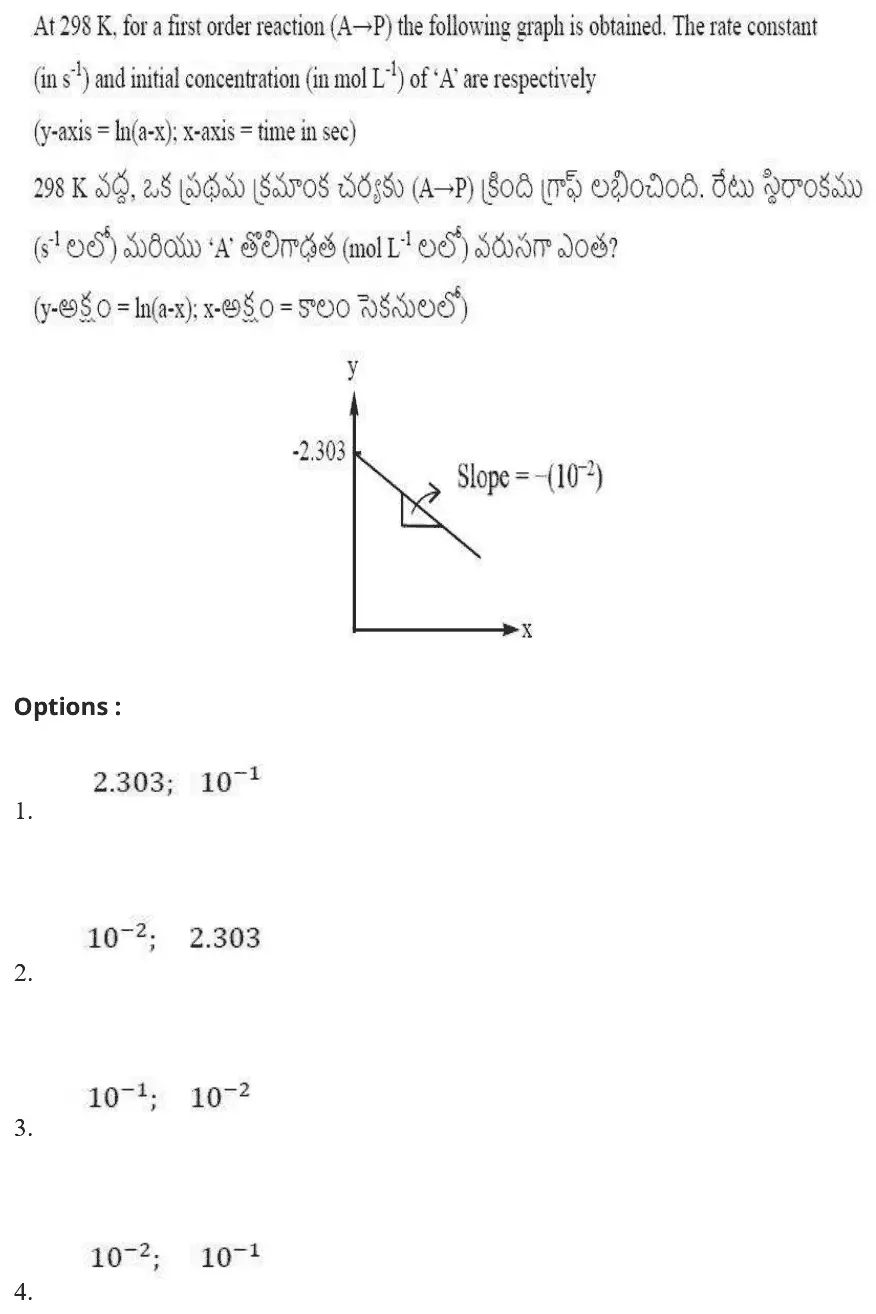
At 298 K, for a first order reaction (A→P) the following graph is obtained. The rate constant (in $\mathrm{s^{-1}}$) and initial concentration (in $\mathrm{mol\ L^{-1}}$) of 'A' are respectively
The decomposition of benzene diazonium chloride is a first order reaction. The time taken for its decomposition to $\frac{1}{4}$ and $\frac{1}{10}$ of its initial concentration are $t_{1/4}$ and $t_{1/10}$ respectively. The value of $\frac{t_{1/4}}{t_{1/10}} \times 100$ is
For a first order reaction, the graph between $\log\frac{a}{(a-x)}$ (on y-axis) and time (in min, on x-axis) gave a straight line passing through origin. The slope is $2\times10^{-3}\ \mathrm{min^{-1}}$. What is the rate constant (in $\mathrm{min^{-1}}$)?
For a first order reaction, a plot of $\ln k$ (y-axis) and $\frac{1}{\mathrm{T}}$ (x-axis) gave the straight line with slope equal to $-10^3 k$ and intercept equal to 2.303 (on y-axis). What is the activation energy ($\mathrm{E_a}$ in $\mathrm{kJ\,mol^{-1}}$) of the reaction?
A reaction, $3\mathrm{X(g)} \rightarrow 2\mathrm{Y(g)} + \mathrm{Z(g)}$ takes place in a closed vessel. What is the rate of formation of $\mathrm{Y}$ (in $\mathrm{mol\,L^{-1}s^{-1}}$) if the rate of disappearance of $\mathrm{X}$ is $7.2\times10^{-3}\ \mathrm{mol\,L^{-1}s^{-1}}$?
The rate law for this reaction is $r = k[\mathrm{A}]^1[\mathrm{B}]^2$. The concentration of A in experiment 2 and rate in experiment 3 shown as x and z in the table. x and z are respectively
A first order reaction has the rate constant of $1.15\times10^{-3}\ \mathrm{s^{-1}}$. The time required to reduce 10 g of reactant to 6 g is $\mathrm{x}\times10^{2}$ sec. What is the approximate value of x?
The rate constant, k of a zero order reaction $2\mathrm{NH_3}(g) \xrightarrow[1130\,K]{Pt} \mathrm{N_2}(g)+3\mathrm{H_2}(g)$ is $y\times10^{-4}\ \mathrm{mol\,L^{-1}\,s^{-1}}$. The rate of formation of hydrogen (in $\mathrm{mol\,L^{-1}\,s^{-1}}$) is
The rate of a first order reaction doubles when the temperature changes from 300 K to 310 K. The activation energy of the reaction (in $\mathrm{kJ\,mol^{-1}}$) is
For a zero order reaction $\mathrm{A} \rightarrow$ product, a plot of $[\mathrm{A}]$ (on y-axis) and time (on x-axis) gave a straight line with slope equal to $-3\times10^{-3}\ \mathrm{M\ min^{-1}}$ and intercept equal to $2\times10^{-2}\ \mathrm{M}$ (on y-axis). What is the rate constant (in $\mathrm{M\ min^{-1}}$) of this reaction?
If benzene diazonium chloride undergoes first order decomposition at T(K) with a rate constant of $6.93\times10^{-2}\ \mathrm{min^{-1}}$, the time for completion of 90% of the reaction (in min) is (nearest integer) (log 2=0.30, log 3 =0.477)
The graph obtained between $\ln k$ ($k$ = Rate constant) on y-axis and $1/T$ on x-axis is a straight line. The slope of it is $-4 \times 10^4 k$. The activation energy of the reaction (in $\mathrm{kJ\ mol^{-1}}$) is ($\mathrm{R = 8.3\ J\ K^{-1}mol^{-1}}$)
Rate constants in the following reaction are Reaction 1: A $\xrightarrow{\text{catalyst 1}}$ P$_1$, k$_1$ = 1 s$^{-1}$ Reaction 2: A $\xrightarrow{\text{catalyst 2}}$ P$_2$, k$_2$ = 0.1 L mol$^{-1}$s$^{-1}$ Reaction 3: A $\xrightarrow{\text{catalyst 3}}$ P$_3$, k$_3$ = 0.01 L$^2$ mol$^{-2}$s$^{-1}$ The correct relations between the rate of the reactions at 1 M of A are
If the definition of the temperature coefficient of the reaction holds good for a reaction between $27\ ^{\circ}\mathrm{C}$ and $37\ ^{\circ}\mathrm{C}$, the activation energy for the reaction in $\mathrm{kJ.mol^{-1}}$ is
The rate constant of a reaction is increased 4 times after addition of catalyst to the reaction mixture at the same temperature of 27 °C. The change in the activation energy of this reaction is (Take $\ln\left(\frac{1}{4}\right)=-1.386$, R = 8.314)
In the reaction, A$\rightarrow$ products, If the concentration of the reactant is doubled, rate of the reaction remains unchanged. The order of the reaction with respect to A is
$\mathrm{P \to Q}$ is a zero order reaction. If the concentration of P decreases from 0.1 M to 0.05 M in 10 seconds, the concentration of P after 15 seconds time is
If the rate of disappearance of $\mathrm{N_2O_5}$ in the following reaction is $1.2 \times 10^{-5}\ \mathrm{mol\,L^{-1}s^{-1}}$, the rate of production of $\mathrm{NO_2}$ (in $\mathrm{mol\,L^{-1}s^{-1}}$) is $\mathrm{2N_2O_5\,(g) \to 4NO_2\,(g) + O_2\,(g)}$
What is the concentration (in $\mathrm{mol\,L^{-1}}$) of the product after 20 s in the following reaction. Given that $\mathrm{A \rightarrow 3B}$, rate = $k[\mathrm{A}]^0$ Time(s) Concentration of the reactant ($\mathrm{mol\,L^{-1}}$) 0 0.1 15 0.05 20 0.1-x
A$\to$ products, is a first order reaction. The time required to decompose A to half its initial amount is 60 minutes. The rate constant of the reaction (in $\mathrm{s^{-1}}$) is
In a first order reaction, the concentration of the reactant is reduced from 0.6 $\mathrm{mol\,L^{-1}}$ to 0.2 $\mathrm{mol\,L^{-1}}$ in 5 min. What is the rate constant of the reaction? (log 3= 0.4771)
The rate constant of a reaction at 500K and 700K are $0.02\ \mathrm{s^{-1}}$ and $0.2\ \mathrm{s^{-1}}$ respectively. The activation energy of the reaction (in $\mathrm{kJ\,mol^{-1}}$) is (R=8.3 $\mathrm{JK^{-1}\,mol^{-1}}$)
The initial concentrations of ethyl acetate and water are 0.001M and 2M respectively. The value of rate constant, k of the reaction, if 99% of ethyl acetate is hydrolyzed in 10 seconds is
The rate constant for a zero order reaction A$\rightarrow$ products is 0.0030 $\mathrm{mol\,L^{-1}\,s^{-1}}$. How long it will take for the initial concentration of A to fall from 0.10 M to 0.075M?
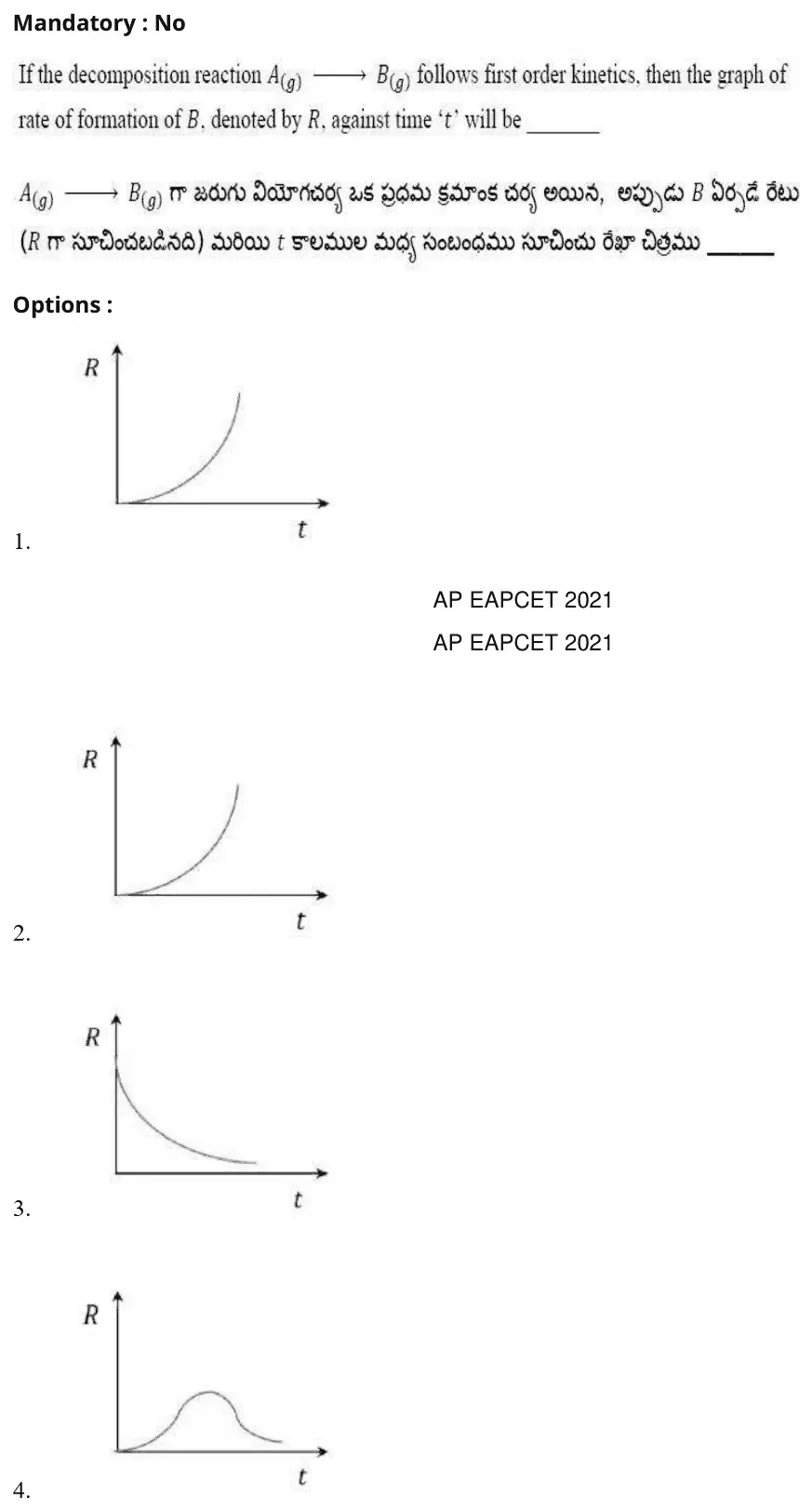
If the decomposition reaction $\mathrm{A_{(g)} \longrightarrow B_{(g)}}$ follows first order kinetics, then the graph of rate of formation of $B$, denoted by $R$, against time '$t$' will be ______
If the rate constant of a first order reaction is $4.606 \times 10^{-3}\,\mathrm{s^{-1}}$, then find the time required for $400\,g$ of the reactant to reduce to $50\,g$.
Compounds $A$ and $B$ react according to the equation $2A_{(g)} + B_{(g)} \rightarrow 2C_{(g)} + D_{(g)}$. The initial rate of formation was determined at different initial concentrations of $A$ and $B$. The following results were obtained. The rate law for this reaction may be ______ [All concentrations are in $mol/lit$] Exp No | Initial [A] | Initial [B] | Initial rate of formation of C 1 | 0.1 | 0.1 | $6 \times 10^{-3}$ 2 | 0.3 | 0.2 | $7.2 \times 10^{-2}$ 3 | 0.3 | 0.4 | $2.88 \times 10^{-1}$ 4 | 0.4 | 0.1 | $2.4 \times 10^{-2}$
For a reaction $NO_2 + CO \rightarrow CO_2 + NO$ the possible elementary steps (below 500K) are Step 1: $NO_2 + NO_2 \xrightarrow{slow} NO + NO_3$ Step 2: $NO_3 + CO \xrightarrow{Fast} CO_2 + NO_2$ its rate expression will be
For an elementary reaction, $X_{(g)} \longrightarrow Y_{(g)} + Z_{(g)}$, the $t_{1/2}$ is 10 minutes. In what period of time would the concentration of $X$ be reduced to 10 % of its original concentration?
If the rate constant for a first order reaction is $2.303 \times 10^{-3}\ s^{-1}$, find the time required to reduce $4\ g$ of the reactant to $0.2\ g$.
For a reaction A+B $\rightarrow$ P, the following data are provided Entry | [A] in M | [B] in M | Initial rate (M/s) 1 | 0.02 | 0.02 | $2\times10^{-2}$ 2 | 0.02 | 0.04 | $4\times10^{-2}$ 3 | 0.04 | 0.04 | $8\times10^{-2}$ The rate constant for this reaction in standard unit is
For a hypothetical reaction $\mathrm{A\to C}$ $\mathrm{A}\underset{k_2}{\overset{k_1}{\rightleftharpoons}}\mathrm{B}$ [Fast] $\mathrm{A+B}\xrightarrow{k_3}\mathrm{C}$ (Slow) Rate law for this reaction is
In the sequence of reaction $\mathrm{A \xrightarrow{k_1} X \xrightarrow{k_2} Y \xrightarrow{k_3} Z}$ $k_3 > k_2 > k_1$, then the rate determining step is
The rate constant is same for 3 reactions of order I, II and III respectively, the unit of concentration being in $moles/litre$. If the concentration of reactant is unity, rates of reaction $R_1, R_2, R_3$ will be ______
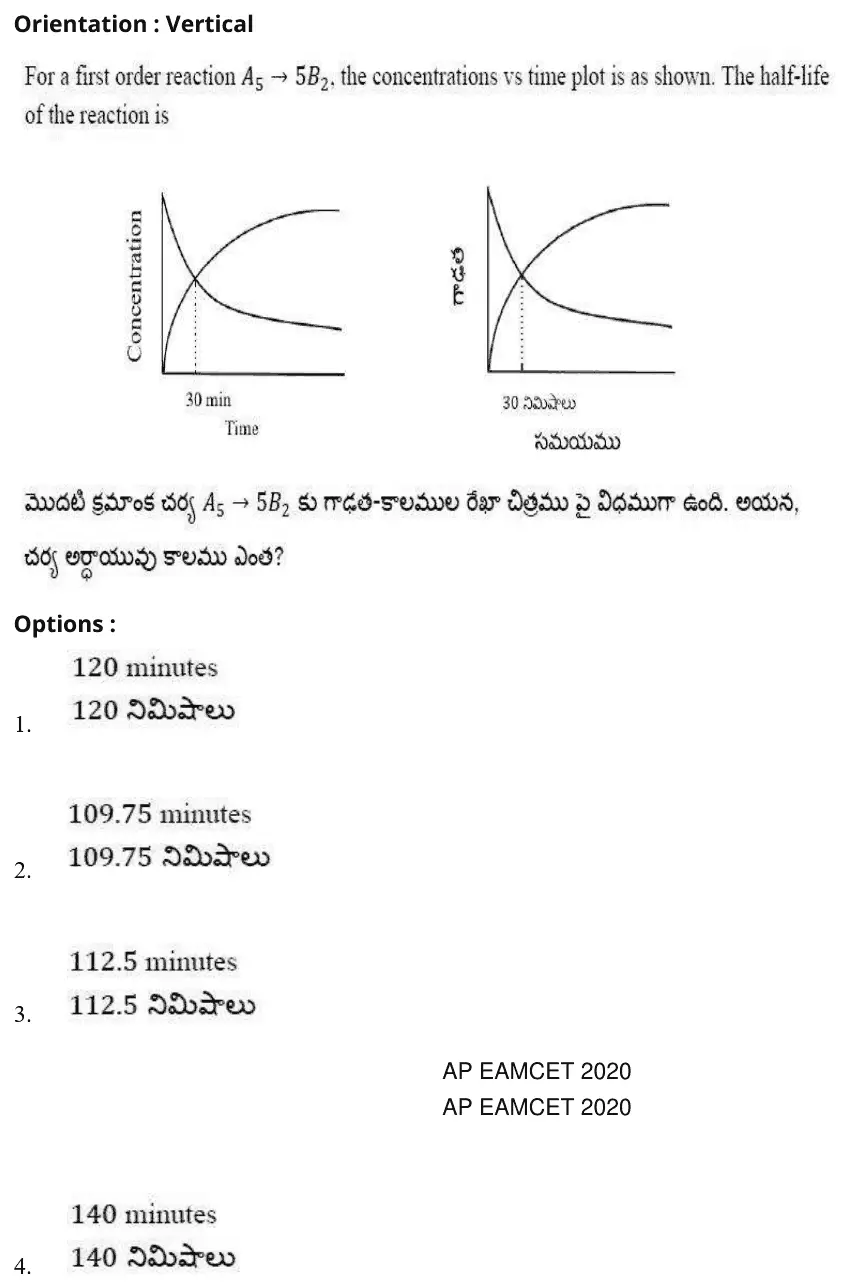
For a first order reaction $A_5 \rightarrow 5B_2$, the concentrations vs time plot is as shown. The half-life of the reaction is (see the figure above)
Decomposition of ethane $\dfrac{d[\mathrm{C_2H_6}]}{dt} = k[\mathrm{C_2H_6}]$ proceeds through a complex mechanism, which includes 5 steps. The overall rate constant($k$) can be expressed as $k = \dfrac{k_1k_2k_3}{k_2k_5}$ where $k_1, k_2, k_3, k_4, k_5$ are the rate constants of the 5 steps. If the activation energies of each of the steps respectively are $E_1 = 1E,\ E_2 = 2E,\ E_3 = 3E,\ E_4 = 4E,\ E_5 = 5E$, where $E = 20\ \mathrm{kJ/mol}$. Then find the overall activation energy of the decomposition.
In the chemical reaction $A \rightarrow B$, what is the order of the reaction? Given that the rate of reaction doubles if the concentration of A is increased four times.
The rate of a reaction doubles when the temperature is changed from 300 K to 310 K. Activation energy of the change is ______ ($R = 8.314\ J.K^{-1}.mol^{-1}$), $\log 2 = 0.301$]
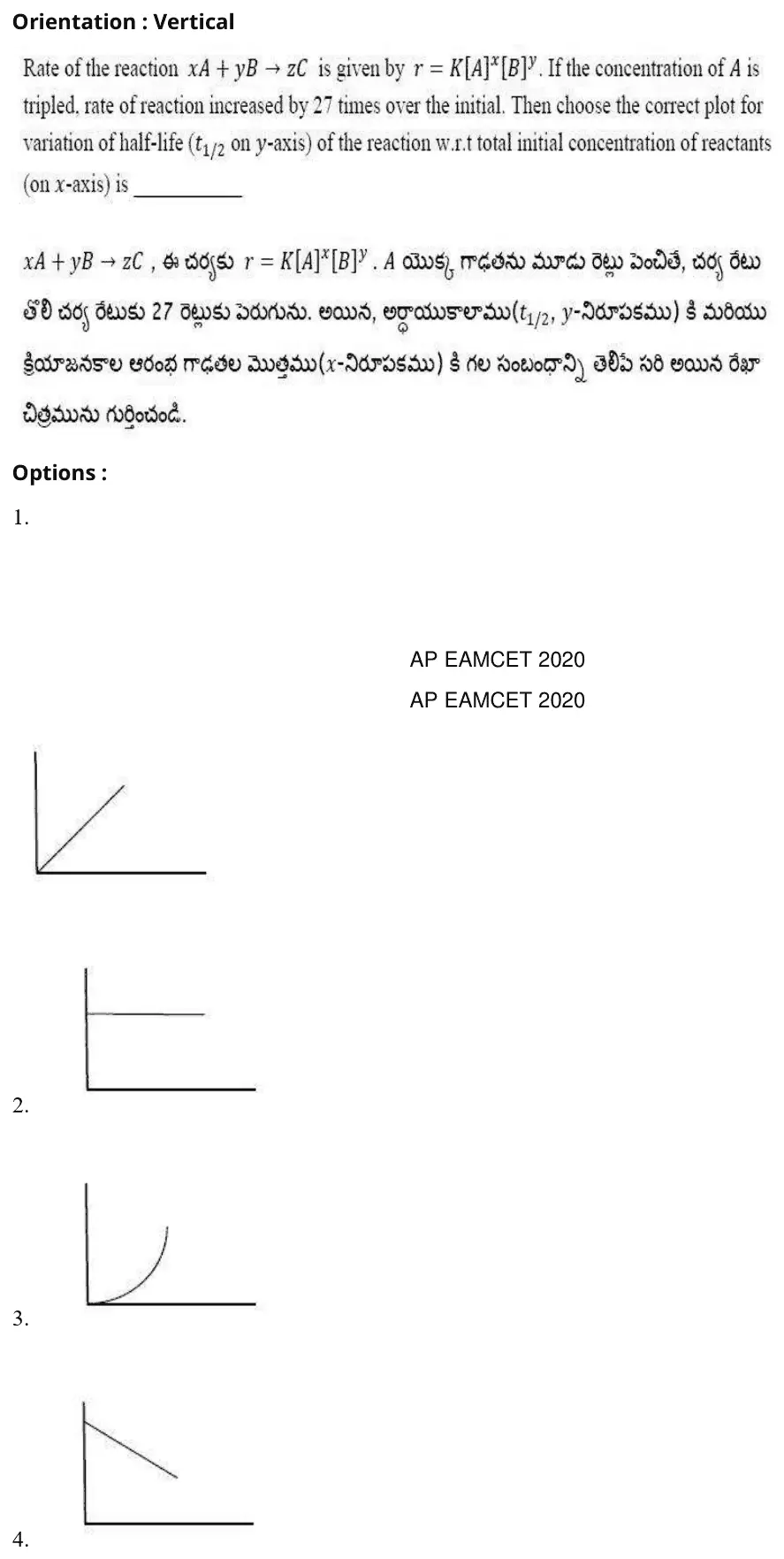
Rate of the reaction $xA+yB\rightarrow zC$ is given by $r=K[A]^x[B]^y$. If the concentration of $A$ is tripled, rate of reaction increased by 27 times over the initial. Then choose the correct plot for variation of half-life ($t_{1/2}$ on $y$-axis) of the reaction w.r.t total initial concentration of reactants (on $x$-axis) is ______
The question as printed in the paper.
A
see figure straight line rising from the origin
B
see figure horizontal line parallel to x-axis
C
see figure curve starting near x-axis and rising upward, concave up
D
see figure straight line falling from the y-axis downward to the right
For a reversible reaction $\mathrm{A} \rightleftharpoons \mathrm{B}$, pre-exponential factor is same for both the forward and backward reactions and has value of $20\ \mathrm{S^{-1}}$. If the enthalpy change along the forward reaction is $-41.5\ \mathrm{kJ/mol}$, the value of equilibrium constant at $500\ \mathrm{K}$ is
For a first order reaction (A $\rightarrow$ B), the temperature (T) dependent rate constant (k) in $\mathrm{sec^{-1}}$ was found to follow the equation: $\log k = \left(-\dfrac{20}{T}\right) + 4$. The activation energy ($\mathrm{E_a}$) and pre-exponential factor (A) respectively, are
A
46.06 $\mathrm{cal\,mol^{-1}}$ and $10^{-4}\ \mathrm{s^{-1}}$
B
92.12 $\mathrm{cal\,mol^{-1}}$ and $10^{4}\ \mathrm{s^{-1}}$
C
46.06 $\mathrm{cal\,mol^{-1}}$ and $10^{4}\ \mathrm{s^{-1}}$
D
9.212 $\mathrm{cal\,mol^{-1}}$ and $10^{-4}\ \mathrm{s^{-1}}$
The specific rate constant of decomposition of a compound is given by $\ln k = 5.0 - \frac{12000}{T}$. The activation energy of decomposition for this compound at 300 K is
The rate of chemical reaction doubles with every 10 °C rise in temperature. If the reaction is carried out in the vicinity of 22 °C, the activation energy of the reaction is (Given $R = 8.3\ \mathrm{J\,K^{-1}\,mol^{-1}}$, $\ln 2 = 0.69$ and $\ln 3 = 1.1$)
For a reaction A $\rightarrow$ B, the average energies of A and B are 30 and 60 kcal/mol respectively. Energy of the activation for the backward reaction is 93 kcal/mol. The energy of activation for the forward reaction is
The first order decomposition of $\mathrm{H_2O_2}$ in an appropriate medium is characterized by a rate constant of 0.2303 min$^{-1}$. What is the time (in min) required to complete 9/10 fraction of the reaction?
The decomposition of $\mathrm{O_3}$ (g) follows first order kinetics and is given by: $\mathrm{O_3\,(g) \to O_2\,(g) + O\,(g)}$ The rate constant for this reaction is $1.0\times10^{-3}\ \mathrm{s^{-1}}$. The initial pressure of $\mathrm{O_3}$ (g) is 100 atm. What will be the partial pressure (in atm) of $\mathrm{O_3, O_2, O}$ respectively after 38.38 minutes?
The following results have been obtained during the kinetic studies of reaction: $\mathrm{2NO + 2H_2 \longrightarrow N_2 + 2H_2O}$ Table (Expt; $-\dfrac{d[\mathrm{NO}]}{dt}$ in $\mathrm{mol\,L^{-1}s^{-1}}$; [NO] in $\mathrm{mol\,L^{-1}}$; $[\mathrm{H_2}]$ in $\mathrm{mol\,L^{-1}}$):
The rate equation for the reaction $2\mathrm{A} + \mathrm{B} \rightarrow$ products is rate $= k[\mathrm{A}][\mathrm{B}]^2$. If $k$ at T(K) is $5.0 \times 10^{-6}\ \mathrm{mol^{-2}L^{2}s^{-1}}$, the initial rate of the reaction, when $[\mathrm{A}] = 0.05\ \mathrm{mol\,L^{-1}}$ and $[\mathrm{B}] = 0.1\ \mathrm{mol\,L^{-1}}$ is
Answer: (A) In collision theory $\mathrm{e^{-E_a/RT}}$ corresponds to the fraction of molecules that have energy equal or greater than $\mathrm{E_a}$· Official APSCHE final key
The half life periods of a first order reaction at 300 K and 400 K are 50 s and 10 s respectively. The activation energy of the reaction in $\mathrm{kJ\,mol^{-1}}$ is ($\log 5=0.70$)
The rate constants for a reaction at 400 K and 500 K are $2.60\times10^{-5}\ \mathrm{s^{-1}}$ and $2.60\times10^{-3}\ \mathrm{s^{-1}}$ respectively. The activation energy of the reaction in $\mathrm{kJ\ mol^{-1}}$ is
In the first order thermal decomposition of $\mathrm{C_2H_5I_{(g)} \longrightarrow C_2H_{4(g)} + HI_{(g)}}$ the reactant in the beginning exerts a pressure of 2 bar in a closed vessel at 600 K. If the partial pressure of the reactant is 0.1 bar after 1000 minutes at the same temperature the rate constant in $\mathrm{min^{-1}}$ is (log 2 = 0.30)
The reaction $\mathrm{X \to}$ products is a first order reaction. In 40 minutes, the concentration of X changes from 1.0M to 0.25M. What is the initial rate of reaction when [X] = 0.1M? ($\log 4 = 0.60$)
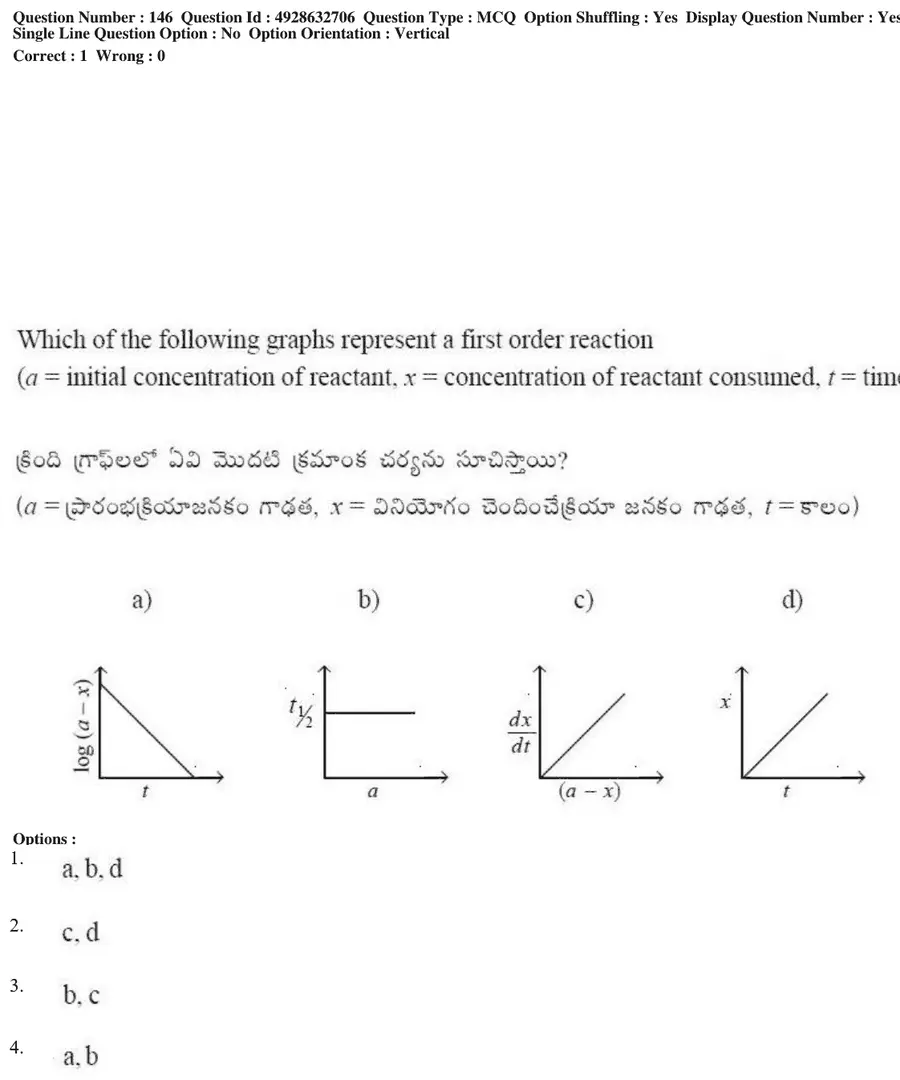
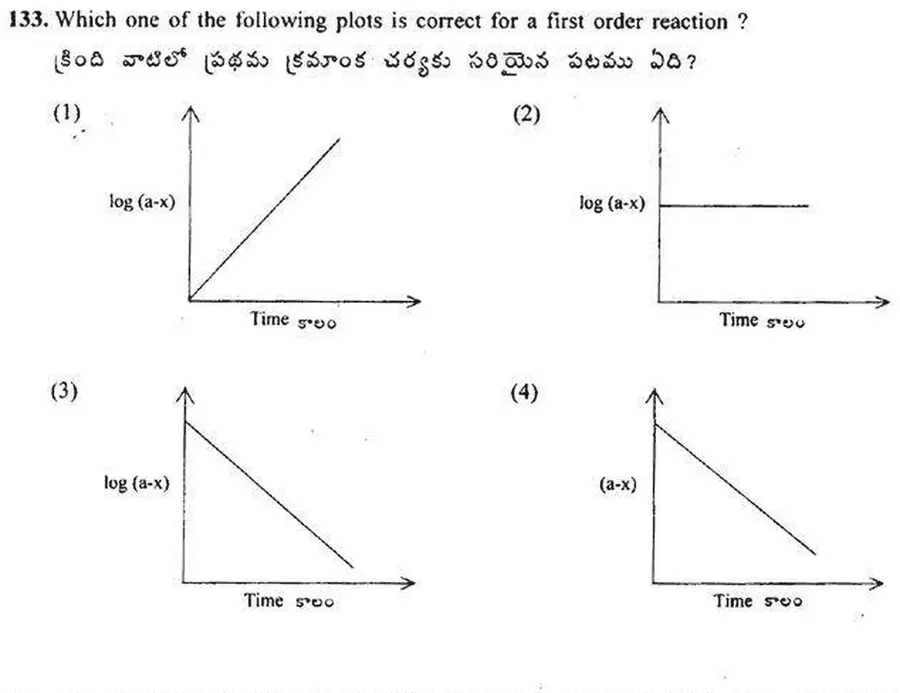
Which of the following graphs represent a first order reaction ($a$ = initial concentration of reactant, $x$ = concentration of reactant consumed, $t$ = time) (see the figure above)
A particular reaction has a rate constant $1.15\times10^{-3}\ \mathrm{s^{-1}}$. How long does it take for 6 g of the reactant to reduce to 3 g? ($\log 2 = 0.301$)
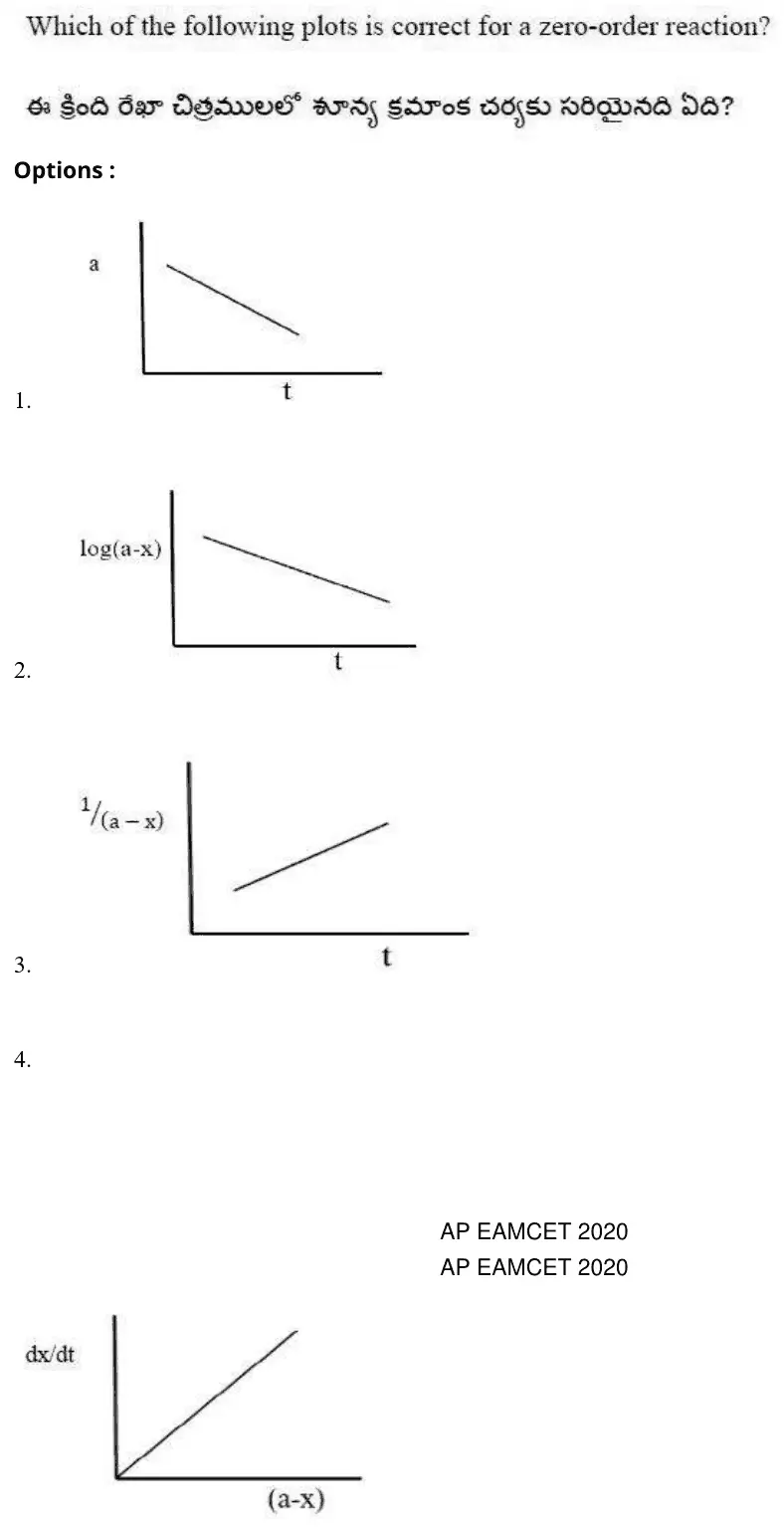
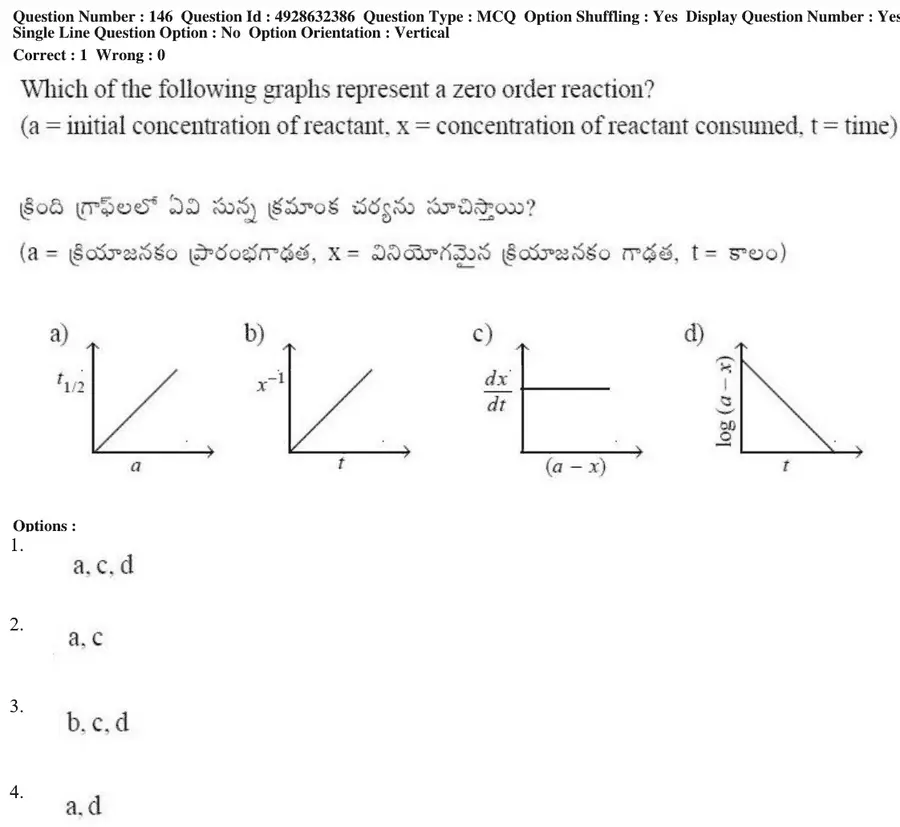
Which of the following graphs represent a zero order reaction? (a = initial concentration of reactant, x = concentration of reactant consumed, t = time) (see the figure above)
If the rate constants of a reaction at 500 K and 700 K are $0.002\ \mathrm{s^{-1}}$ and $0.06\ \mathrm{s^{-1}}$ respectively, the value of $\mathrm{K^{-1}}$ (sic) activation energy is ($R = 8.314\ \mathrm{J\,mol^{-1}K^{-1}}$, $\log 3 = 0.477$)
For a particular reaction, the rate constant becomes double on increasing temperature from 27 °C to 37 °C. Calculate the approximate activation energy (in kcal mol$^{-1}$) (R = 2 cal mol$^{-1}$ K$^{-1}$)
If the half lives of the first order reaction at 350 K and 300 K are 2 and 20 seconds respectively, the activation energy of the reaction in $\mathrm{kJmol^{-1}}$ is
At T(K), if the rate constant of a first order reaction is $4.606\times10^{-3}\ \mathrm{s^{-1}}$, the time to reduce the initial concentration of the reactant to 1/10 in seconds is :
The rate equation for a first order reaction is given by $[\mathrm{R}] = [\mathrm{R}]_0\, e^{-kt}$. A straight line with positive slope is obtained by plotting ($[\mathrm{R}]_0$ = Initial concentration of reactant, $[\mathrm{R}]$ = concentration of reactant at time, t)
At T(K), the following data were obtained for a general reaction $\mathrm{A + B + C \longrightarrow products}$ Expt. | Initial [A] | Initial [B] | Initial [C] | Initial rate 1 | 0.02 M | 0.1 M | 0.03 M | $2.4 \times 10^{-6}\ \mathrm{Ms^{-1}}$ 2 | 0.02 M | 0.2 M | 0.03 M | $4.8 \times 10^{-6}\ \mathrm{Ms^{-1}}$ 3 | 0.02 M | 0.2 M | 0.06 M | $9.6 \times 10^{-6}\ \mathrm{Ms^{-1}}$ 4 | 0.04 M | 0.2 M | 0.06 M | $9.6 \times 10^{-6}\ \mathrm{Ms^{-1}}$ The rate constant for the above reaction is
Thermal decomposition of HCOOH is a first order reaction and the rate constant at T(K) is $4.606\times10^{-3}\ \mathrm{s^{-1}}$. The time required to decompose 90% of initial quantity of HCOOH at T(K) in seconds is
At T(K) if the rate constant for a zero order reaction is $2.5\times10^{-3}\ \mathrm{Ms^{-1}}$, the time required for the initial concentration of reactant, R to fall from 0.10 M to 0.075 M at the same temperature in seconds is
20% of a first order reaction was found to be completed at 10 A.M. At 11.30 A.M. on the same day, 20% of the reaction was found to be remaining. The half life period in minutes of the reaction is
The rate equation for the decomposition of a compound 'A' in terms of partial pressure is given as, rate $= k(P_A)^{3/2}$. If the pressure is measured in bar and time in minutes, then the units of rate constant is :
The time taken for 10% completion of a first order reaction is 20 minutes. The time required for the completion of 19% of the same reaction in minutes is
The time taken for half of the initial amount of $\mathrm{N_2O_5}$ to decompose is 12 min at 310 K and 2 hrs at 300 K. The activation energy of reaction in kJ is ($R = 8.3\ \mathrm{J\ K^{-1}\ mol^{-1}}$)
The rate constant of a first order reaction is $6.909\ \mathrm{min^{-1}}$. So the time required for the completion of 75% of the same reaction in minutes is
In a first order reaction the concentration of the reactant decreases from 0.6 M to 0.3 M in 15 minutes. The time taken for the concentration to change from 0.1 M to 0.025 M in minutes is
Match the following : List I A) Arrhenius equation B) Slowest step in a reaction mechanism C) Rate constant of a II order reaction D) The possibility of a reaction depends on List II i) Free energy change ii) $\mathrm{conc^{-1}.time^{-1}}$ iii) $\mathrm{conc^{1-n}.time^{-1}}$ iv) Rate determining step v) $k = \mathrm{A}\,.\,e^{-E_a/RT}$ The correct answer is :
What is the slope of the straight line for the graph drawn between $\ln k$ and $\frac{1}{\mathrm{T}}$, where $k$ is the rate constant of a reaction at temperature T ?
Answer: (B) $\frac{-\mathrm{E}_a}{\mathrm{R}}$· Official APSCHE final key
How to prepare Chemical Kinetics for EAPCET
How often it comes up
Chemical Kinetics occupies position 20 among all 31 chemistry chapters across the modern 2022 to 2026 testing period. Over our complete examination history from 2010 through 2026, the chapter contributed 152 questions across 149 papers, appearing in 142 of those tests to account for 2.6 percent of the subject with an average of 1.0 question per paper. In the five-year recent window from 2022 to 2026, it provided 78 questions across 77 sittings, appearing in 76 papers to maintain 1.0 question per paper and a 2.5 percent subject share.
The chapter has featured in every exam year since 2022, though it was absent from a single sitting during this five-year period. Looking at the two regional boards between 2022 and 2026, AP tests delivered 48 questions across 48 papers (appearing in 47 papers, 1.0 question per paper, 2.5 percent share), while TS papers recorded 30 questions across 29 papers (appearing in all 29 papers, 1.0 question per paper, 2.6 percent share).
During earlier testing between 2010 and 2021, papers contained 74 questions across 72 sittings (appearing in 66 tests), delivering 1.0 question per paper and a 2.6 percent subject share. Across the latest three exam years from 2024 to 2026, question banks carried 47 questions across 46 sittings (with all 46 papers containing questions), yielding 1.0 question per test and 2.6 percent share. Comparing early testing with the last three years indicates the share is about the same, and comparing the recent five-year window with the last three years shows the share is about the same. Almost every session carries exactly one kinetics problem.
Most-asked topics
Questions in this branch distribute across three main reaction dynamics areas:
Integrated Rate Laws forms the principal pillar with 67 questions overall and 35 during the recent timeframe through 2026. Frequent problem formats involve first-order half-life relationships, time required for fractional decomposition, zero-order linear concentration plots, and gaseous decomposition tracked via total pressure.
Temperature Dependence & Mechanism supplied 48 questions across the archive, with 23 appearing from 2022 to 2026. This area centers on the Arrhenius activation energy equation, rate constant ratios at two different temperatures, catalyst impact on activation barriers, and identifying rate-determining elementary steps.
Rate of Reaction accounts for 37 questions in total and 20 in the recent window through 2026. Core topics include expressing reaction rates in terms of stoichiometric disappearance and appearance of components, deducing overall reaction orders from dimensional units of rate constants, and initial rate method tables.
What the questions look like
Most kinetics problems test algebraic substitutions into first-order and Arrhenius equations. A classic first-order problem asks for the time required to complete eighty percent of a reaction given its rate constant, or asks for the remaining concentration after twenty minutes. Another prominent format tracks gaseous decomposition of a molecule A turning into B plus C, asking you to express the rate constant in terms of initial pressure and total pressure at time t.
Temperature questions frequently provide rate constants at two temperatures and ask for the activation energy, or ask for the ratio of rate constant to pre-exponential factor when activation energy equals two point three zero three R T. In foundational rate problems, you will deduce reaction order by inspecting the dimensional units of the rate constant or finding the rate of appearance of a product from the disappearance rate of a reactant.
Questions to try first
Solve these representative state exam questions to build confidence with integrated rate laws and activation energy:
Make first-order decay relationships second nature. Remember that the half-life of a first-order process is strictly independent of initial reactant concentration, given by zero point six nine three divided by k. Connect key percentages to half-life multiples: seventy-five percent completion requires exactly two half-lives, eighty-seven point five percent requires three half-lives, and ninety-nine point nine percent requires approximately ten half-lives.
For Arrhenius calculations, write the logarithmic formula as log open parenthesis k two over k one close parenthesis equals activation energy divided by two point three zero three R times open parenthesis T two minus T one close parenthesis divided by open parenthesis T one times T two close parenthesis. Use eight point three one four joules per mole Kelvin for R when activation energy is in joules, or divide by one thousand if activation energy is in kilojoules.
Frequently asked questions
How can reaction order be identified directly from rate constant units?
The general physical units for a rate constant are concentration to the power of one minus n multiplied by time to the power of minus one. For a zero-order reaction, units are moles per litre per second. For a first-order reaction, units are reciprocal seconds. For a second-order reaction, units are litres per mole per second.
What is the distinction between molecularity and order of a reaction?
Molecularity is a theoretical quantity denoting the number of reacting particles colliding simultaneously in an elementary step; it is always an integer from one to three. Reaction order is an experimentally determined exponent in the rate law that can be zero, fractional, or an integer.
How does a positive catalyst increase the rate of a chemical reaction?
A positive catalyst provides an alternative reaction pathway with a lower activation energy barrier. By lowering activation energy, a larger fraction of colliding molecules possesses sufficient energy to cross the barrier, accelerating both forward and backward rates equally without altering the equilibrium constant. Step-by-step solutions for each one are in the EdLoop EAPCET app.