Every Capacitors question from past JEE Main and AIEEE papers, with options and answers. Newest first.
182questions
148papers covered
3.1%of Physics questions, 2019–2026
2002–2026years
Guide at a glance
Capacitors connect electrostatic theory with electric circuits in the Class 12 syllabus under NTA Unit 11 (Electrostatics). It holds rank 17 among the 29 physics chapters.
A sphere of capacitance 100 pF is charged to a potential of 100 V. Another identical uncharged metal sphere is brought in contact with the charged sphere, then the change in the total energy stored on these spheres, when they touch is $\alpha\times10^{-7}$ J. The value of $\alpha$ is ________. (combined capacitance of spheres is 200 pF)
A parallel plate air capacitor is connected to a battery. The plates are pulled apart at uniform speed $v$. If $x$ is the separation between the plates at any instant, then the time rate of change of electrostatic energy of the capacitor is proportional to $x^\alpha$, where $\alpha$ is ________.
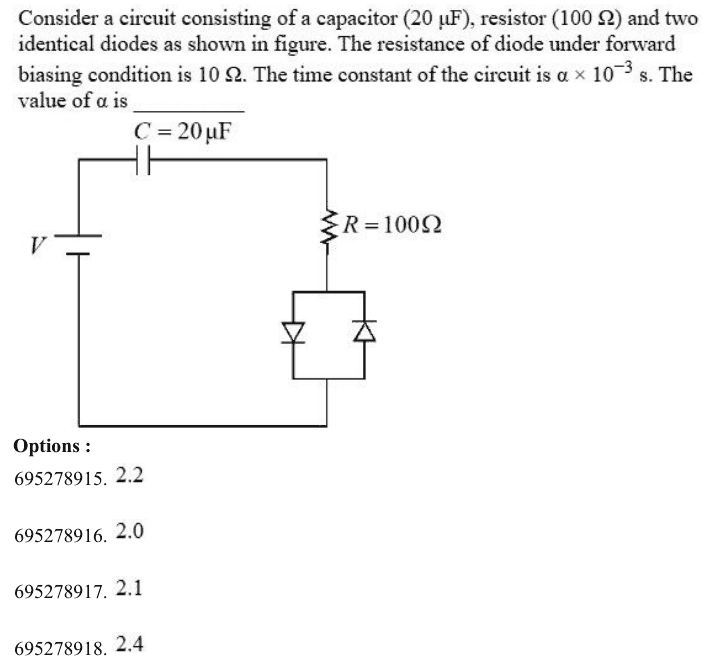
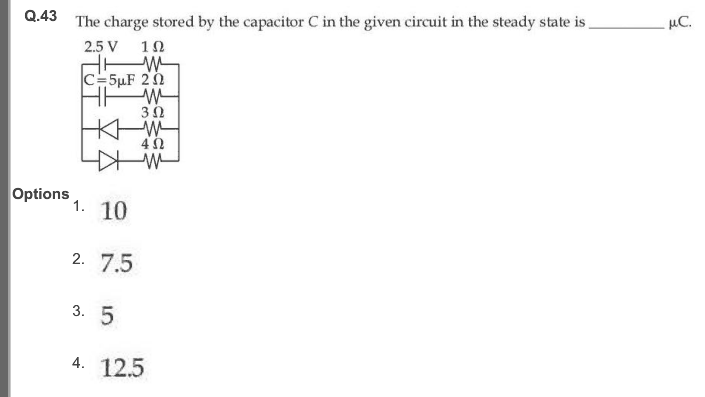
Consider a circuit consisting of a capacitor (20 $\mu$F), resistor (100 $\Omega$) and two identical diodes as shown in figure. The resistance of diode under forward biasing condition is 10 $\Omega$. The time constant of the circuit is $\alpha\times10^{-3}$ s. The value of $\alpha$ is ________.
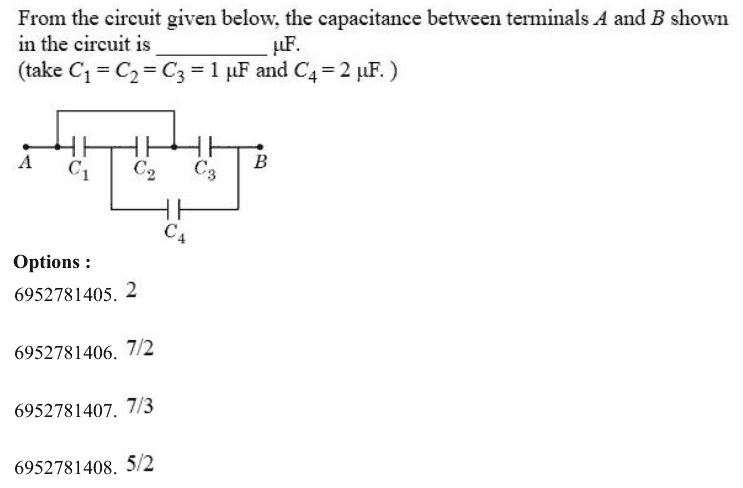
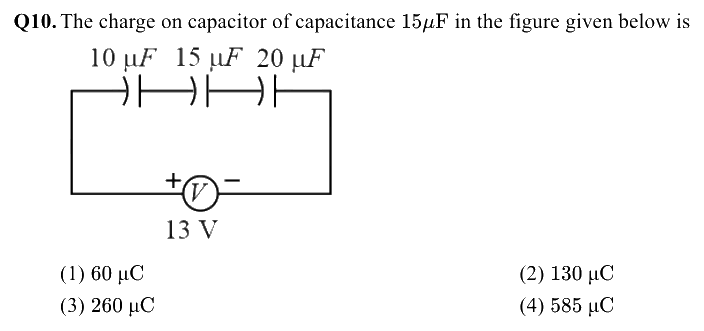
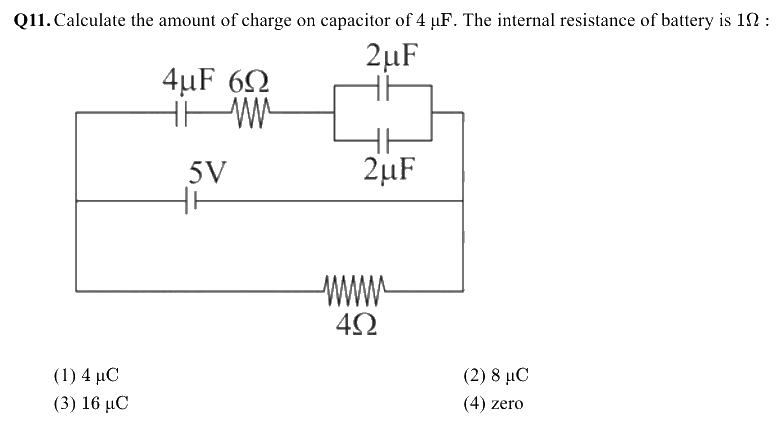
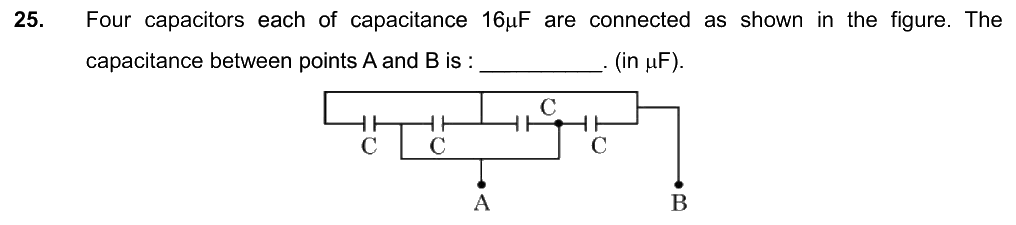
From the circuit given below, the capacitance between terminals $A$ and $B$ shown in the circuit is ________ $\mu$F. (take $C_1 = C_2 = C_3 = 1\ \mu$F and $C_4 = 2\ \mu$F.)
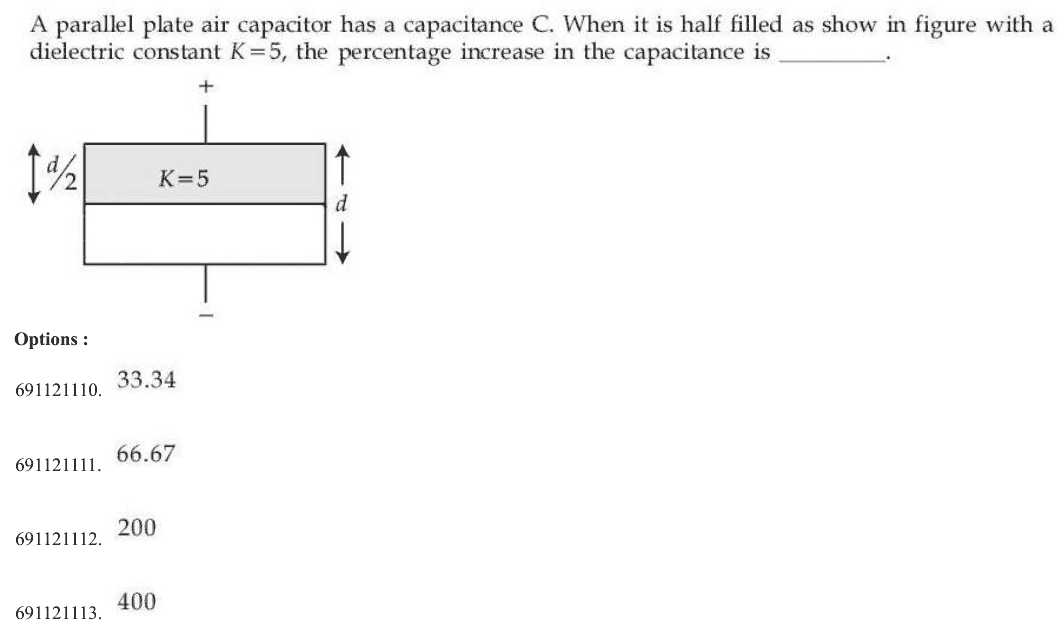
A parallel plate air capacitor has a capacitance C. When it is half filled as show in figure with a dielectric constant $K = 5$, the percentage increase in the capacitance is ________.
A. Effective capacitance of a series combination of capacitors is always smaller than the smallest capacitance of the capacitor in the combination.
B. When a dielectric medium is placed between the charged plates of a capacitor, displacement of charges cannot occur due to insulation property of dielectric.
C. Increasing of area of capacitor plate or decreasing of thickness of dielectric is an alternate method to increase the capacitance.
D. For a point charge, concentric spherical shells centered at the location of the charge are equipotential surfaces.
Choose the correct answer from the options given below :
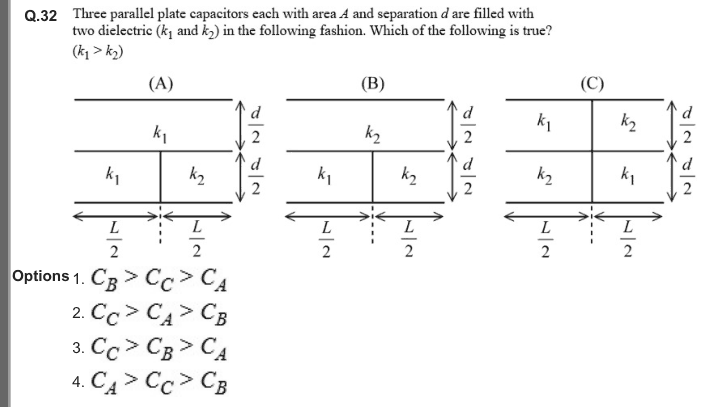
Three parallel plate capacitors each with area $A$ and separation $d$ are filled with two dielectric ($k_1$ and $k_2$) in the following fashion. Which of the following is true? ($k_1 > k_2$)
A parallel plate capacitor with plate separation 5 mm is charged by a battery. On introducing a mica sheet of 2 mm and maintaining the connections of the plates with the terminals of the battery, it is found that it draws 25% more charge from the battery. The dielectric constant of mica is ________.
A parallel plate capacitor has capacitance $C$, when there is vacuum within the parallel plates.
A sheet having thickness $\left(\frac{1}{3}\right)^{rd}$ of the separation between the plates and relative permittivity $K$ is introduced between the plates. The new capacitance of the system is :
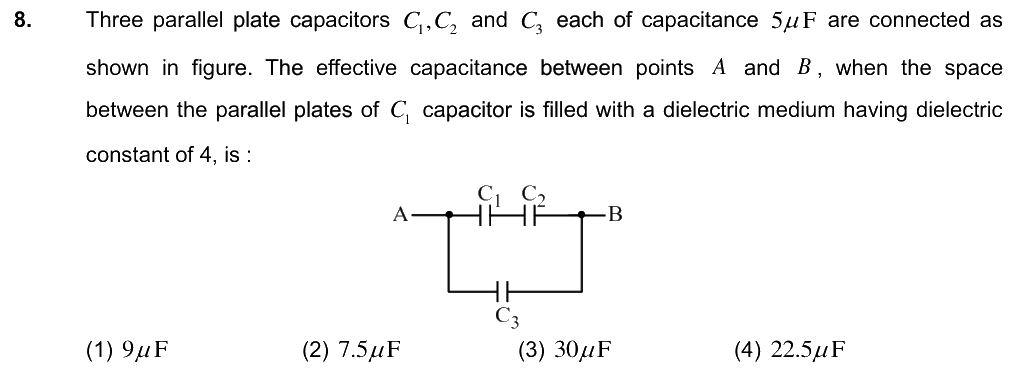
Three parallel plate capacitors $C_1, C_2$ and $C_3$ each of capacitance $5\mu F$ are connected as shown in figure. The effective capacitance between points $A$ and $B$, when the space between the parallel plates of $C_1$ capacitor is filled with a dielectric medium having dielectric constant of 4, is :
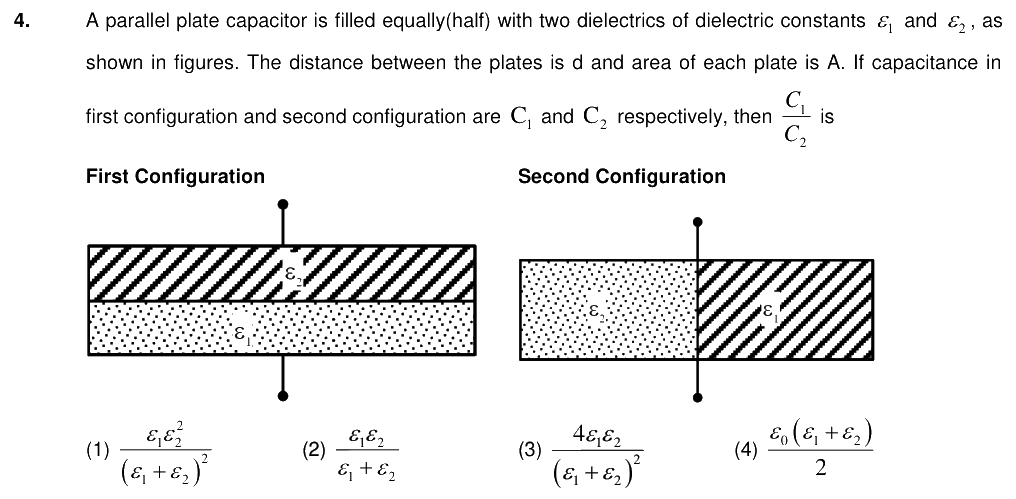
A parallel plate capacitor is filled equally(half) with two dielectrics of dielectric constants $\epsilon_1$ and $\epsilon_2$, as shown in figures. The distance between the plates is d and area of each plate is A. If capacitance in first configuration and second configuration are $C_1$ and $C_2$ respectively, then $\frac{C_1}{C_2}$ is
Using a battery, a 100 pF capacitor is charged to 60 V and then the battery is removed. After that, a second uncharged capacitor is connected to the first capacitor in parallel. If the final voltage across the second capacitor is 20 V , its capacitance is: (in pF )
Given below are two statements : one is labelled as Assertion (A) and the other is labelled as Reason (R). Assertion (A) : Net dipole moment of a polar linear isotropic dielectric substance is not zero even in the absence of an external electric field. Reason (R): In absence of an external electric field, the different permanent dipoles of a polar dielectric substance are oriented in random directions. In the light of the above statements, choose the most appropriate answer from the options given below :
A
(A) is correct but (R) is not correct
B
Both (A) and (R) are correct and (R) is the correct explanation of (A)
C
Both (A) and (R) are correct but (R) is not the correct explanation of (A)
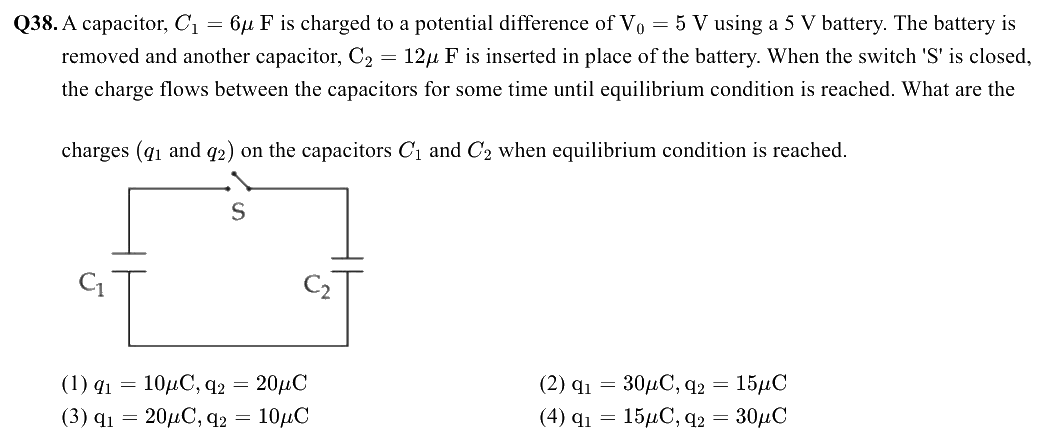
A capacitor, $C_1 = 6\mu$ F is charged to a potential difference of $\mathrm{V_0}$ = 5 V using a 5 V battery. The battery is removed and another capacitor, $\mathrm{C_2}$ = $12\mu$ F is inserted in place of the battery. When the switch 'S' is closed, the charge flows between the capacitors for some time until equilibrium condition is reached. What are the charges ($q_1$ and $q_2$) on the capacitors $C_1$ and $C_2$ when equilibrium condition is reached.
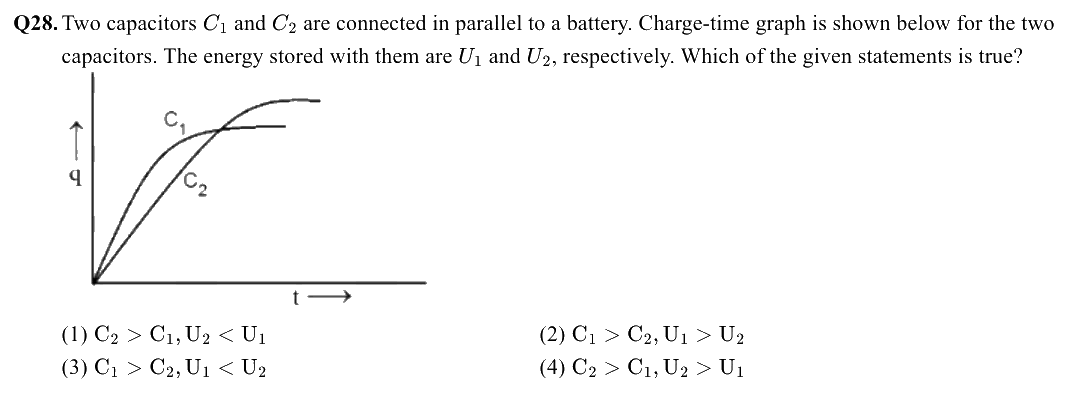
Two capacitors $C_1$ and $C_2$ are connected in parallel to a battery. Charge-time graph is shown below for the two capacitors. The energy stored with them are $U_1$ and $U_2$, respectively. Which of the given statements is true?
A parallel plate capacitor of capacitance $1\mu$ F is charged to a potential difference of 20 V . The distance between plates is $1\mu$ m. The energy density between plates of capacitor is.
A parallel plate capacitor was made with two rectangular plates, each with a length of $l = 3$ cm and breath of b = 1 cm. The distance between the plates is $3\mu$ m. Out of the following, which are the ways to increase the capacitance by a factor of 10 ? A. $l = 30$ cm, b = 1 cm, d = $1\mu$ m B. $l = 3$ cm, b = 1 cm, d = $30\mu$ m C. $l = 6$ cm, b = 5 cm, d = $3\mu$ m D. $l = 1$ cm, b = 1 cm, d = $10\mu$ m E. $l = 5$ cm, b = 2 cm, d = $1\mu$ m Choose the correct answer from the options given below:
Consider a parallel plate capacitor of area A (of each plate) and separation 'd' between the plates. If $E$ is the electric field and $\varepsilon_0$ is the permittivity of free space between the plates, then potential energy stored in the capacitor is
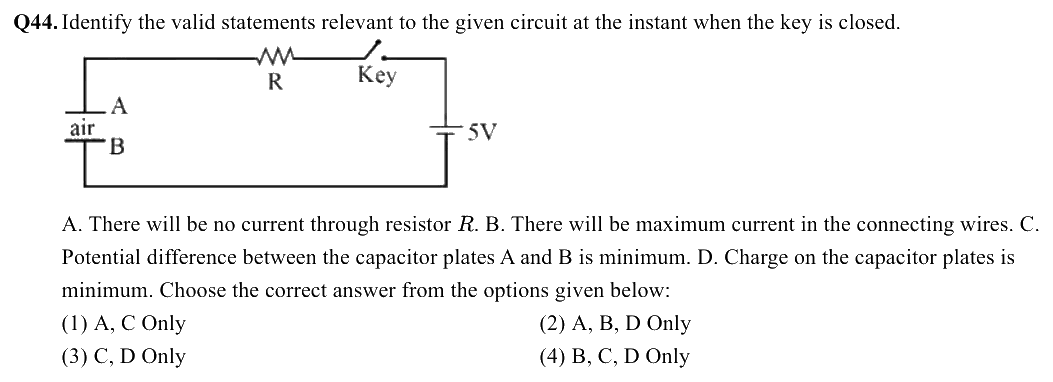
Identify the valid statements relevant to the given circuit at the instant when the key is closed.
(see the figure above)
A. There will be no current through resistor $R$. B. There will be maximum current in the connecting wires. C. Potential difference between the capacitor plates A and B is minimum. D. Charge on the capacitor plates is minimum. Choose the correct answer from the options below:
A parallel-plate capacitor of capacitance $40\mu$ F is connected to a 100 V power supply. Now the intermediate space between the plates is filled with a dielectric material of dielectric constant K = 2. Due to the introduction of dielectric material, the extra charge and the change in the electrostatic energy in the capacitor, respectively, are
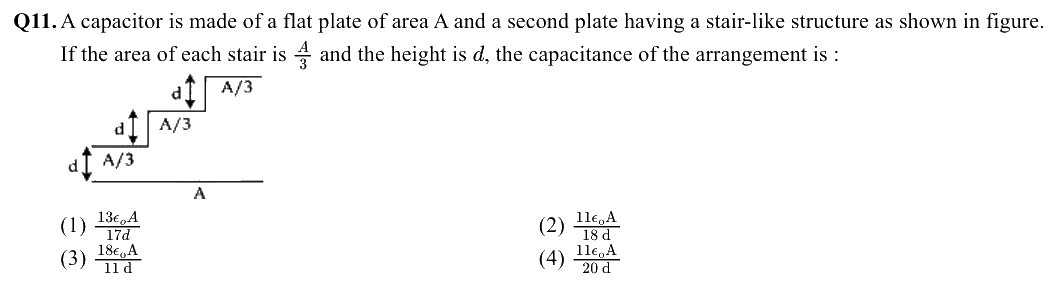
A capacitor is made of a flat plate of area A and a second plate having a stair-like structure as shown in figure. If the area of each stair is $\frac{A}{3}$ and the height is $d$, the capacitance of the arrangement is :
A capacitor has air as dielectric medium and two conducting plates of area $12\ \mathrm{cm}^2$ and they are 0.6 cm apart. When a slab of dielectric having area $12\ \mathrm{cm}^2$ and 0.6 cm thickness is inserted between the plates, one of the conducting plates has to be moved by 0.2 cm to keep the capacitance same as in previous case. The dielectric constant of the slab is : (Given $\epsilon_0 = 8.834 \times 10^{-12}$ F/m )
Two identical capacitors have same capacitance $C$. One of them is charged to the potential $V$ and other to the potential $2V$. The negative ends of both are connected together. When the positive ends are also joined together, the decrease in energy of the combined system is :
A parallel plate capacitor of capacitance 2 F is charged to a potential $V$. The energy stored in the capacitor is $E_1$. The capacitor is now connected to another uncharged identical capacitor in parallel combination. The energy stored in the combination is $E_2$. The ratio $\frac{E_2}{E_1}$ is
The distance between two plates of a capacitor is $d$ and its capacitance is $C_1$, when air is the medium between the plates. If a metal sheet of thickness $\frac{2d}{3}$ and of the same area as plate is introduced between the plates, the capacitance of the capacitor becomes $C_2$. The ratio $\frac{C_2}{C_1}$ is
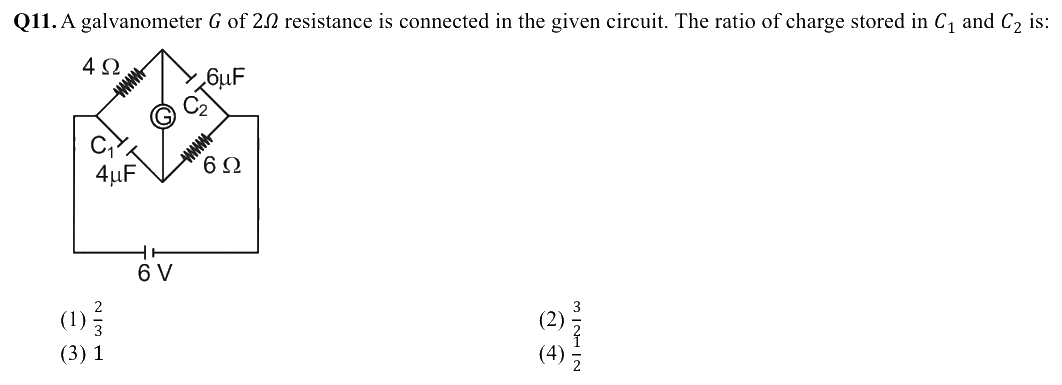
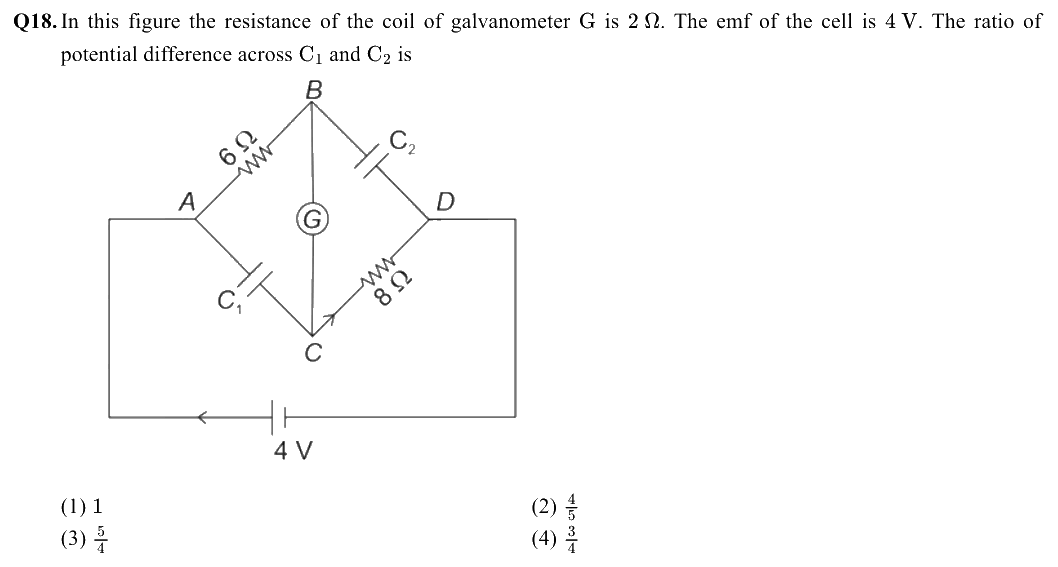
In this figure the resistance of the coil of galvanometer G is $2\ \Omega$. The emf of the cell is 4 V. The ratio of potential difference across $\mathrm{C_1}$ and $\mathrm{C_2}$ is (see the figure above)
Given below are two statements : One is labelled as Assertion A and the other is labelled as Reason R. Assertion A : Two metallic spheres are charged to the same potential. One of them is hollow and another is solid, and both have the same radii. Solid sphere will have lower charge than the hollow one. Reason R : Capacitance of metallic spheres depend on the radii of spheres. In the light of the above statements, choose the correct answer from the options given below.
A
A is false but R is true
B
Both A and R are true and R is the correct explanation of A
C
A is true but R is false
D
Both A and R are true but R is not the correct explanation of A
A parallel plate capacitor has plate area $40\ \mathrm{cm^2}$ and plates separation $2\ \mathrm{mm}$. The space between the plates is filled with a dielectric medium of a thickness $1\ \mathrm{mm}$ and dielectric constant 5. The capacitance of the system is:
Two identical thin metal plates has charge $q_1$ and $q_2$ respectively such that $q_1 > q_2$. The plates were brought close to each other to form a parallel plate capacitor of capacitance $C$. The potential difference between them is :
Two capacitors, each having capacitance $40\mu\mathrm{F}$ are connected in series. The space between one of the capacitors is filled with dielectric material of dielectric constant $K$ such that the equivalence capacitance of the system became $24\mu\mathrm{F}$. The value of $K$ will be :
A slab of dielectric constant $K$ has the same crosssectional area as the plates of a parallel plate capacitor and thickness $\frac{3}{4}d$, where $d$ is the separation of the plates. The capacitance of the capacitor when the slab is inserted between the plates will be : (Given $C_0=$ capacitance of capacitor with air as medium between plates.)
The total charge on the system of capacitance $C_1 = 1\mu\mathrm{F}$, $C_2 = 2\mu\mathrm{F}$, $C_3 = 4\mu\mathrm{F}$ and $C_4 = 3\mu\mathrm{F}$ connected in parallel is (Assume a battery of 20 V is connected to the combination)
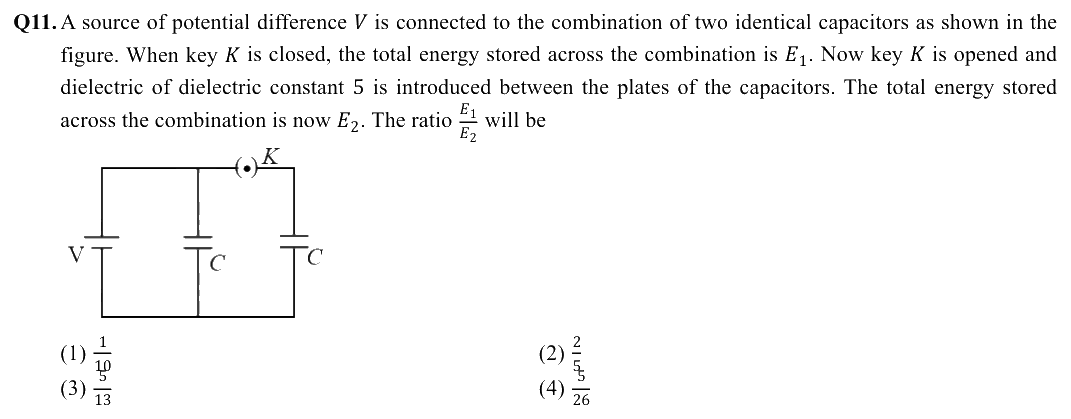
A source of potential difference $V$ is connected to the combination of two identical capacitors as shown in the figure. When key $K$ is closed, the total energy stored across the combination is $E_1$. Now key $K$ is opened and dielectric of dielectric constant 5 is introduced between the plates of the capacitors. The total energy stored across the combination is now $E_2$. The ratio $\frac{E_1}{E_2}$ will be
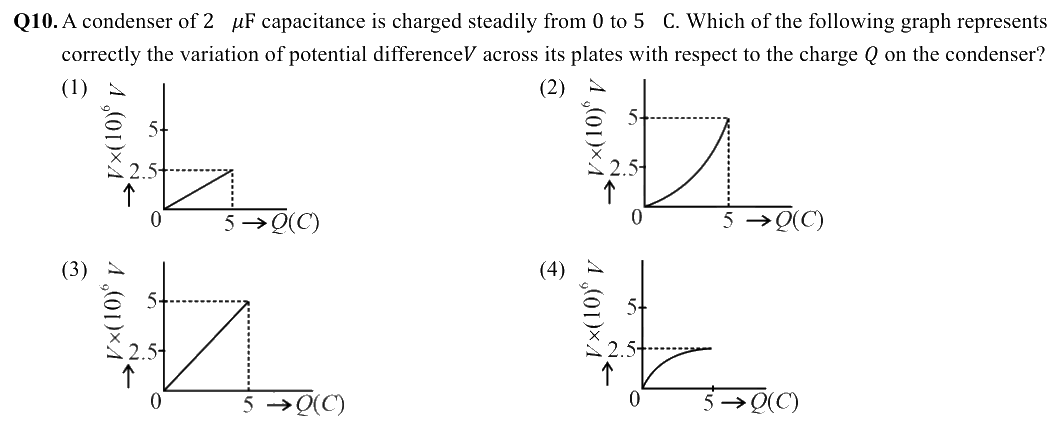
A condenser of $2\ \mu$F capacitance is charged steadily from 0 to 5 C. Which of the following graph represents correctly the variation of potential difference $V$ across its plates with respect to the charge $Q$ on the condenser?
(see the figure above)
The question as printed in the paper.
A
see figure Straight line from the origin to the point (Q = 5, V = 2.5) with dashed guide lines to the axes at 2.5 and 5; the line ends at the 2.5 level.
B
see figure Curve from the origin rising with increasing steepness (concave up) to the point (Q = 5, V = 5), with dashed guide lines at 5 on the V axis and at Q = 5; the 2.5 level is marked on the axis.
C
see figure Straight line from the origin to the point (Q = 5, V = 5) with dashed guide lines at 5 on the V axis and at Q = 5; the 2.5 level is marked on the axis.
D
see figure Curve from the origin rising steeply and then flattening (concave down) to the level V = 2.5 at Q = 5, with a dashed guide line at 2.5 and at Q = 5; the 5 level is marked on the axis.
Capacitance of an isolated conducting sphere of radius $R_1$ becomes $n$ times when it is enclosed by a concentric conducting sphere of radius $R_2$ connected to earth. The ratio of their radii $\left(\frac{R_2}{R_1}\right)$ is:
A parallel plate capacitor filled with a medium of dielectric constant 10, is connected across a battery and is charged. The dielectric slab is replaced by another slab of dielectric constant 15. Then the energy of capacitor will
A capacitor is discharging through a resistor $R$. Consider in time $t_1$, the energy stored in the capacitor reduces to half of its initial value and in time $t_2$, the charge stored reduces to one eighth of its initial value. The ratio $\dfrac{t_1}{t_2}$ will be
A force of $10\ \mathrm{N}$ acts on a charged particle placed between two plates of a charged capacitor. If one plate of capacitor is removed, then the force acting on that particle will be.
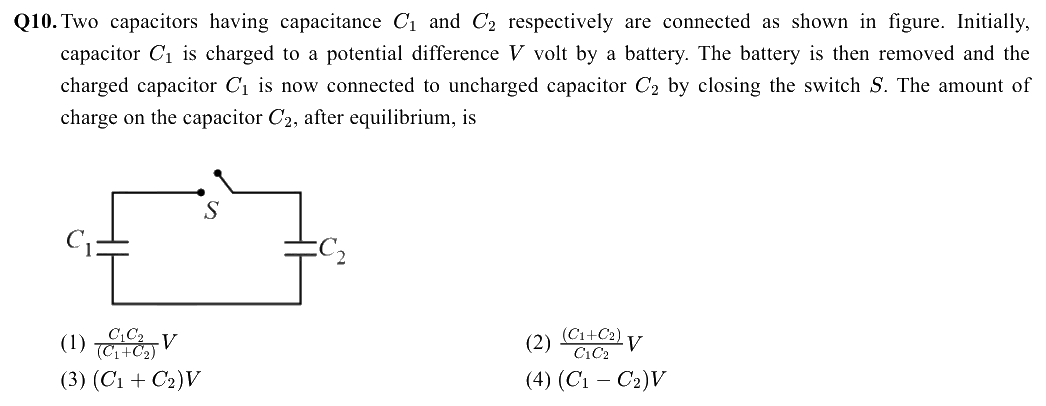
Two capacitors having capacitance $C_1$ and $C_2$ respectively are connected as shown in figure. Initially, capacitor $C_1$ is charged to a potential difference $V$ volt by a battery. The battery is then removed and the charged capacitor $C_1$ is now connected to uncharged capacitor $C_2$ by closing the switch $S$. The amount of charge on the capacitor $C_2$, after equilibrium, is (see the figure above)
Given below two statements : One is labelled as Assertion (A) and other is labelled as Reason (R). Assertion (A): Non-polar materials do not have any permanent dipole moment. Reason (R): When a non-polar material is placed in an electric field, the centre of the positive charge distribution of it's individual atom or molecule coincides with the centre of the negative charge distribution. In the light of above statements, choose the most appropriate answer from the options given below.
A
Both (A) and (R) are correct and (R) is the correct explanation of (A).
B
Both (A) and (R) are correct and (R) is not the correct explanation of (A).
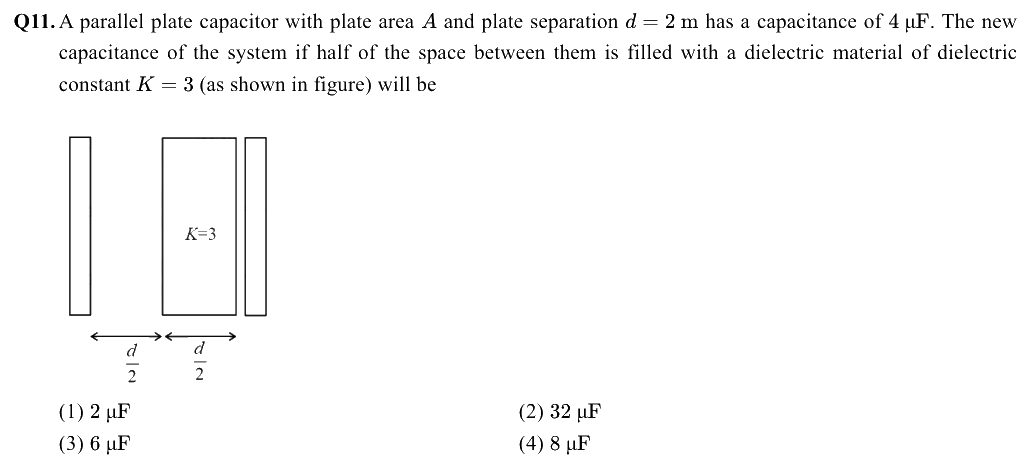
A parallel plate capacitor with plate area $A$ and plate separation $d = 2 \mathrm{~m}$ has a capacitance of $4 \mu\mathrm{F}$. The new capacitance of the system if half of the space between them is filled with a dielectric material of dielectric constant $K = 3$ (as shown in figure) will be (see the figure above)
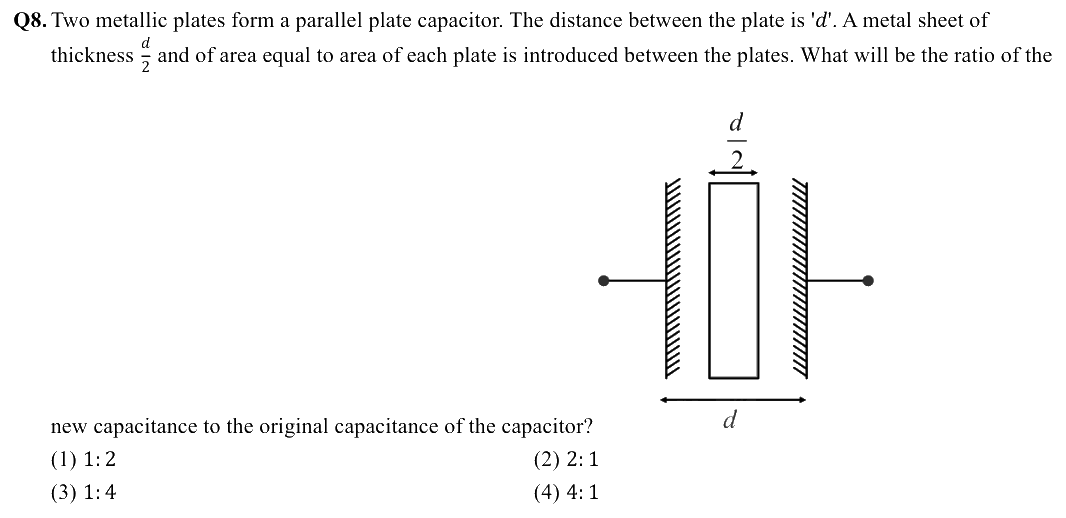
Two metallic plates form a parallel plate capacitor. The distance between the plate is 'd'. A metal sheet of thickness $\frac{d}{2}$ and of area equal to area of each plate is introduced between the plates. What will be the ratio of the new capacitance to the original capacitance of the capacitor? (see the figure above)
A parallel plate capacitor is formed by two plates each of area $30\pi \mathrm{~cm^2}$ separated by $1 \mathrm{~mm}$. A material of dielectric strength $3.6 \times 10^{7} \mathrm{~V~m^{-1}}$ is filled between the plates. If the maximum charge that can be stored on the capacitor without causing any dielectric breakdown is $7 \times 10^{-6} \mathrm{~C}$, the value of dielectric constant of the material is : [Use $\frac{1}{4\pi\varepsilon_o} = 9 \times 10^{9} \mathrm{~N~m^2~C^{-2}}$]
A capacitor is connected to a $20$ V battery through a resistance of $10\Omega$. It is found that the potential difference across the capacitor rises to $2$ V in $1$ $\mu$s. The capacitance of the capacitor is ______ $\mu$F. Given $\ln\frac{10}{9} = 0.105$
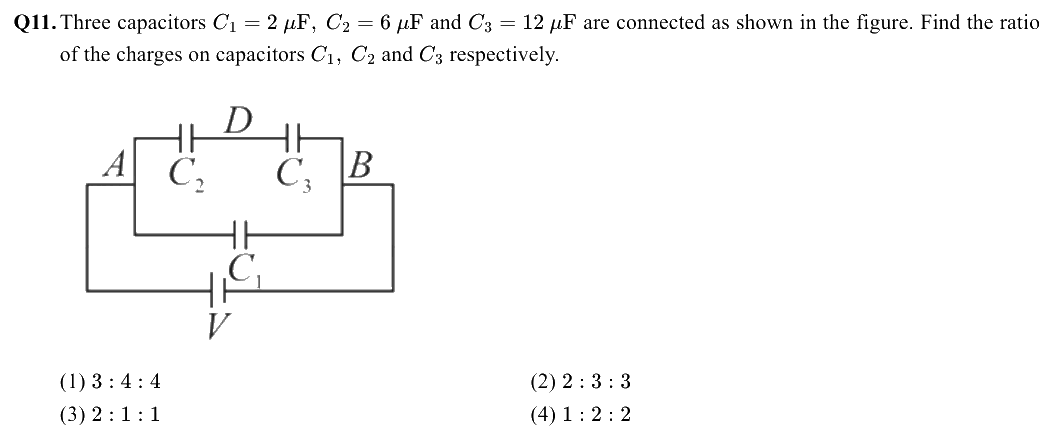
Three capacitors $C_1=2\ \mu\mathrm{F}$, $C_2=6\ \mu\mathrm{F}$ and $C_3=12\ \mu\mathrm{F}$ are connected as shown in the figure. Find the ratio of the charges on capacitors $C_1$, $C_2$ and $C_3$ respectively. (see the figure above)
The material filled between the plates of a parallel plate capacitor has resistivity $200\ \Omega\,\mathrm{m}$. The value of capacitance of the capacitor is $2\ \mathrm{pF}$. If a potential difference of $40\ \mathrm{V}$ is applied across the plates of the capacitor, then the value of leakage current flowing out of the capacitor is: (given the value of relative permittivity of material is $50$)
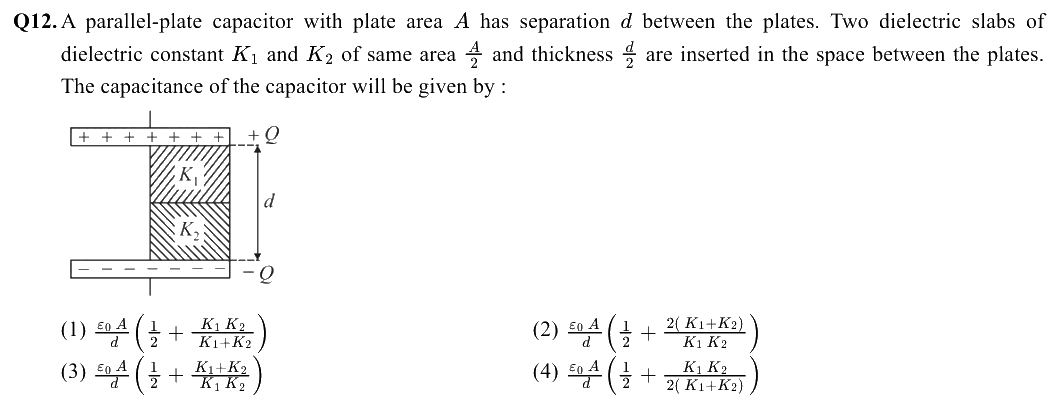
A parallel-plate capacitor with plate area $A$ has separation $d$ between the plates. Two dielectric slabs of dielectric constant $K_1$ and $K_2$ of same area $\frac{A}{2}$ and thickness $\frac{d}{2}$ are inserted in the space between the plates. The capacitance of the capacitor will be given by : (see the figure above)
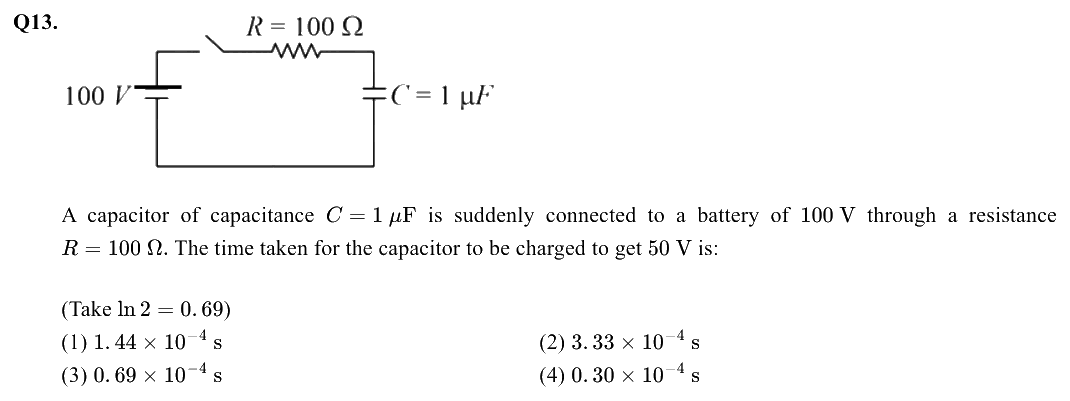
see figure A capacitor of capacitance $C = 1\ \mu\mathrm{F}$ is suddenly connected to a battery of $100\ \mathrm{V}$ through a resistance $R = 100\ \Omega$. The time taken for the capacitor to be charged to get $50\ \mathrm{V}$ is: (Take $\ln 2 = 0.69$)
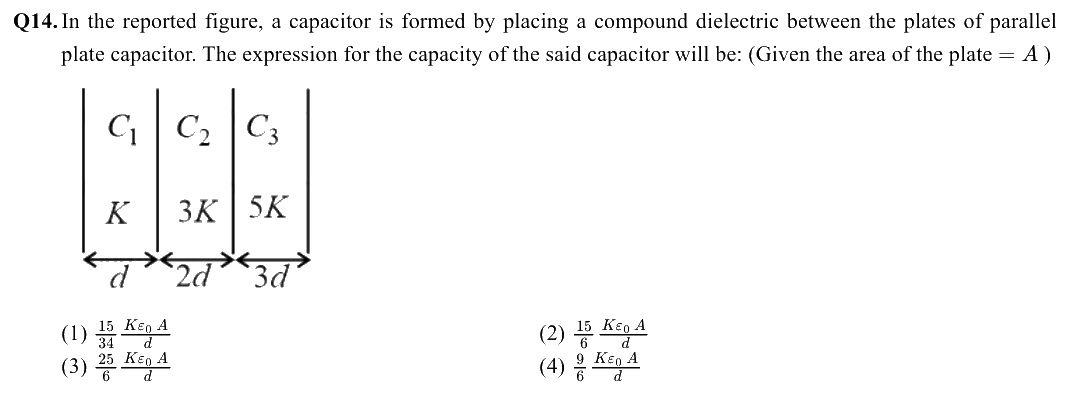
In the reported figure, a capacitor is formed by placing a compound dielectric between the plates of parallel plate capacitor. The expression for the capacity of the said capacitor will be: (Given the area of the plate $= A$ ) (see the figure above)
Two capacitors of capacities $2C$ and $C$ are joined in parallel and charged up to potential $V$. The battery is removed and the capacitor of capacity $C$ is filled completely with a medium of dielectric constant $K$. The potential difference across the capacitors will now be:
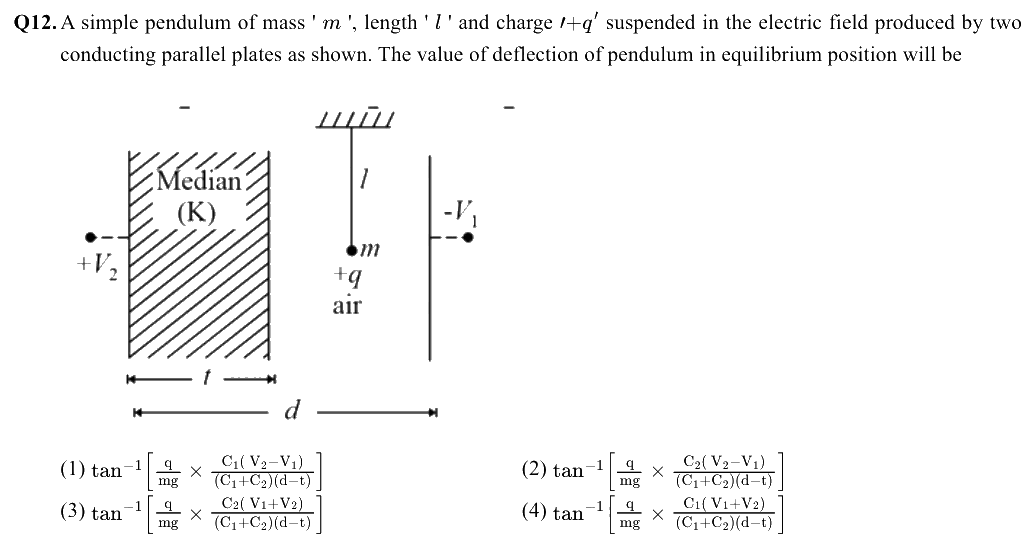
A simple pendulum of mass ' $m$ ', length ' $l$ ' and charge '$+q$' suspended in the electric field produced by two conducting parallel plates as shown. The value of deflection of pendulum in equilibrium position will be (see the figure above)
A parallel plate capacitor with plate area 'A' and distance of separation 'd' is filled with a dielectric. What is the capacity of the capacitor when permittivity of the dielectric varies as: $\varepsilon x = \varepsilon_0 + kx$, for $0 < x \leq \frac{d}{2}$ $\varepsilon x = \varepsilon_0 + kd - x$, for $\frac{d}{2} \leq x \leq d$
If $\mathrm{q_f}$ is the free charge on the capacitor plates and $\mathrm{q_b}$ is the bound charge on the dielectric slab of dielectric constant k placed between the capacitor plates, then bound charge $\mathrm{q_b}$ can be expressed as :
For changing the capacitance of a given paralle plate capacitor, a dielectric material of dielectric constant $K$ is used, which has the same area as the plates of the capacitor. The thickness of the dielectric slab is $\frac{3}{4} d$, where $d$ is the separation between the plates of parallel plate capacitor. The new capacitance $C^{\prime}$ in terms of original capacitance $C_0$ is given by the following relation :
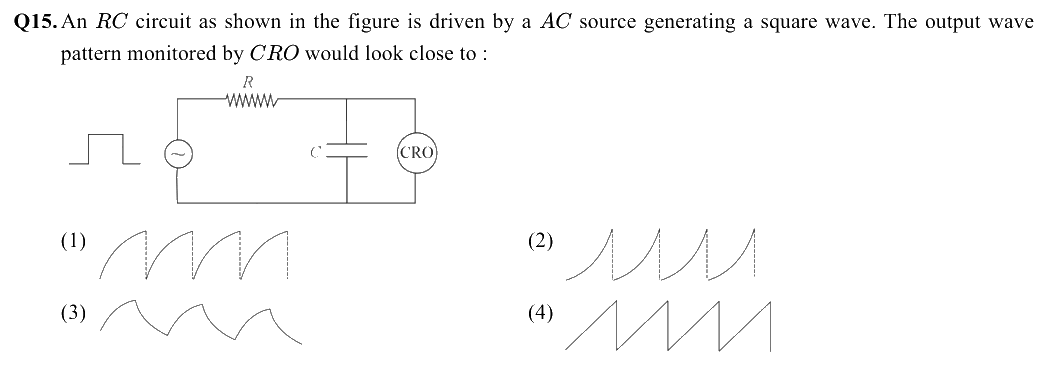
An $R C$ circuit as shown in the figure is driven by a $A C$ source generating a square wave. The output wave pattern monitored by $C R O$ would look close to : (see the figure above)
The question as printed in the paper.
A
see figure Repeated sawtooth of curved rises (concave down, flattening towards the top), each ending with a vertical dashed drop back to the start level
B
see figure Repeated sawtooth of curved rises (concave up, steeper towards the top), each ending with a vertical dashed drop back to the start level
C
see figure Repeated waveform with no vertical drops: a curved rise (concave down) to a pointed peak, then a curved fall (concave up) to a pointed trough, repeated three times with the pattern drifting slightly downward
D
see figure Sawtooth of straight-line rises, each followed by a vertical drop (solid line) back to the start level
Consider the combination of two capacitors $C_1$ and $C_2$, with $C_2 > C_1$, when connected in parallel, the equivalent capacitance is 10 times the equivalent capacitance of the same connected in series. Calculate the ratio of capacitors, $\frac{C_2}{C_1}$.
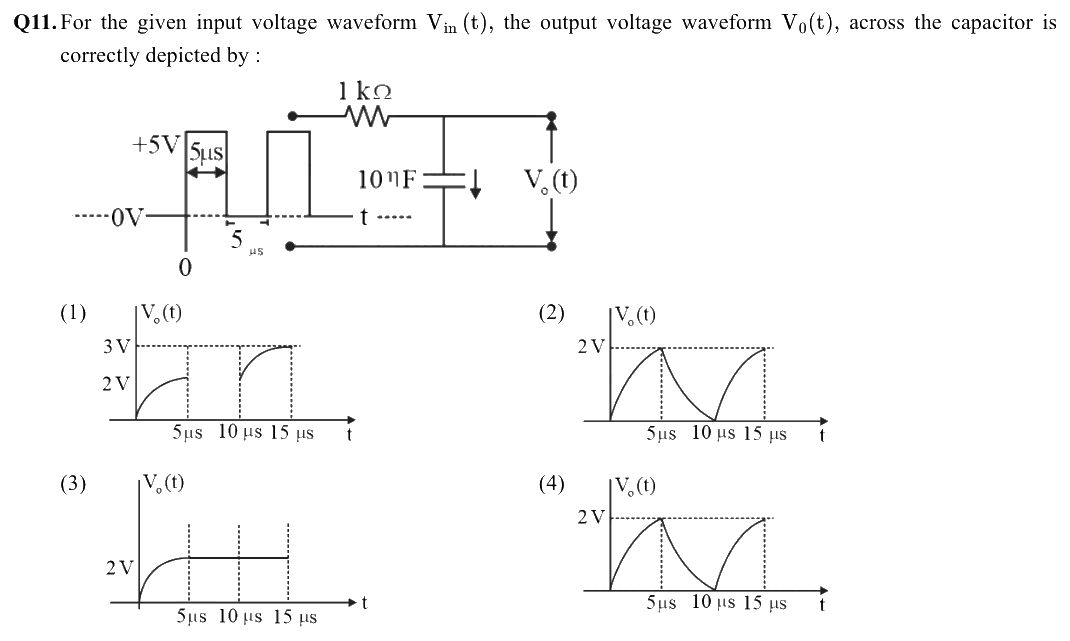
For the given input voltage waveform $\mathrm{V_{in}\,(t)}$, the output voltage waveform $\mathrm{V_0(t)}$, across the capacitor is correctly depicted by : (see the figure above)
The question as printed in the paper.
A
see figure V_o(t) graph with marks 2 V and 3 V on the vertical axis: a charging arc rising towards 2 V up to 5 microseconds, then a second charging arc between 10 and 15 microseconds rising to 3 V, with dotted lines at 5, 10 and 15 microseconds.
B
see figure V_o(t) graph with 2 V mark: a rising arc to 2 V at 5 microseconds, a falling arc to 0 at 10 microseconds, a rising arc to 2 V at 15 microseconds.
C
see figure V_o(t) graph with 2 V mark: a charging arc rising to 2 V by about 5 microseconds and then constant at 2 V until 15 microseconds.
D
see figure V_o(t) graph with 2 V mark: a rising arc to 2 V at 5 microseconds, a falling arc to 0 at 10 microseconds, a rising arc to 2 V at 15 microseconds (drawn very like option 2; the two differ only slightly in the curvature of the arcs).
Two capacitors of capacitances $C$ and $2C$ are charged to potential differences $V$ and $2V$, respectively. These are then connected in parallel in such a manner that the positive terminal of one is connected to the negative terminal of the other. The final energy of this configuration is :
A parallel plate capacitor has plate of length $l$, width $w$ and separation of plates is $d$. It is connected to a battery of emf $V$. A dielectric slab of the same thickness $d$ and dielectric constant $K = 4$ is being inserted between the plates of the capacitor. At what length of the slab inside plates, will the energy stored in the capacitor be two times the initial energy stored?
A capacitor $C$ is fully charged with voltage $V_{0}$. After disconnecting the voltage source, it is connected in parallel with another uncharged capacitor of capacitance $\frac{C}{2}$. The energy loss in the process after the charge is distributed between the two capacitors is :
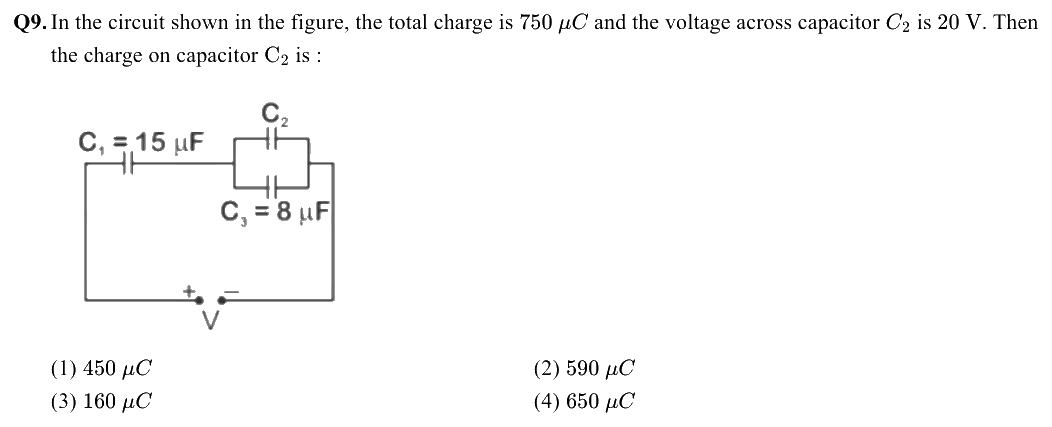
In the circuit shown in the figure, the total charge is $750\ \mu C$ and the voltage across capacitor $C_2$ is $20\ \mathrm{V}$. Then the charge on capacitor $C_2$ is : (see the figure above)
A $10\ \mu\mathrm{F}$ capacitor is fully charged to a potential difference of $50\ \mathrm{V}$ After removing the source voltage it is connected to an uncharged capacitor in parallel. Now the potential difference across them becomes $20\ \mathrm{V}$. The capacitance of the second capacitor is :
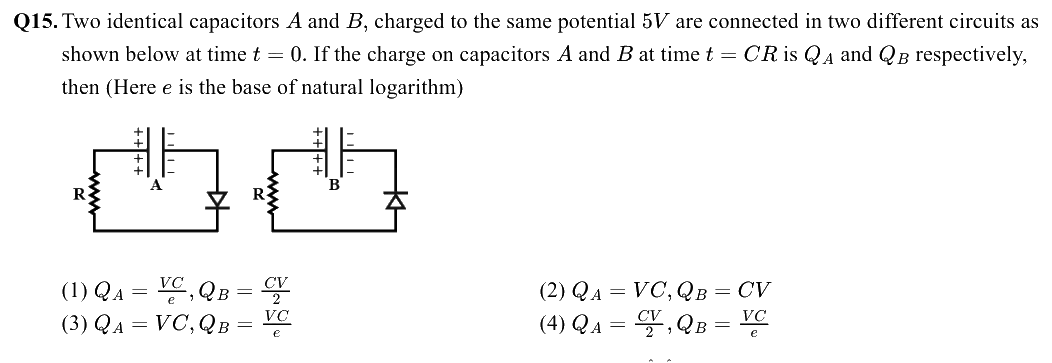
Two identical capacitors $A$ and $B$, charged to the same potential $5V$ are connected in two different circuits as shown below at time $t = 0$. If the charge on capacitors $A$ and $B$ at time $t = CR$ is $Q_A$ and $Q_B$ respectively, then (Here $e$ is the base of natural logarithm) (see the figure above)
Effective capacitance of parallel combination of two capacitors $C_1$ and $C_2$ is $10\mu\mathrm{F}$. When these capacitors are individually connected to a voltage source of $1\mathrm{V}$, the energy stored in the capacitor $C_2$ is 4 times that of $C_1$. If these capacitors are connected in series, their effective capacitance will be:
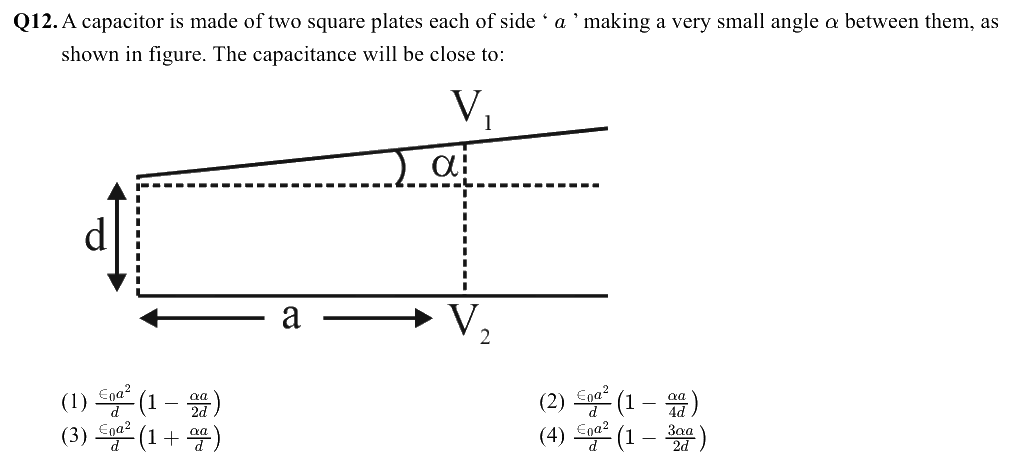
A capacitor is made of two square plates each of side ' $a$ ' making a very small angle $\alpha$ between them, as shown in figure. The capacitance will be close to: (see the figure above)
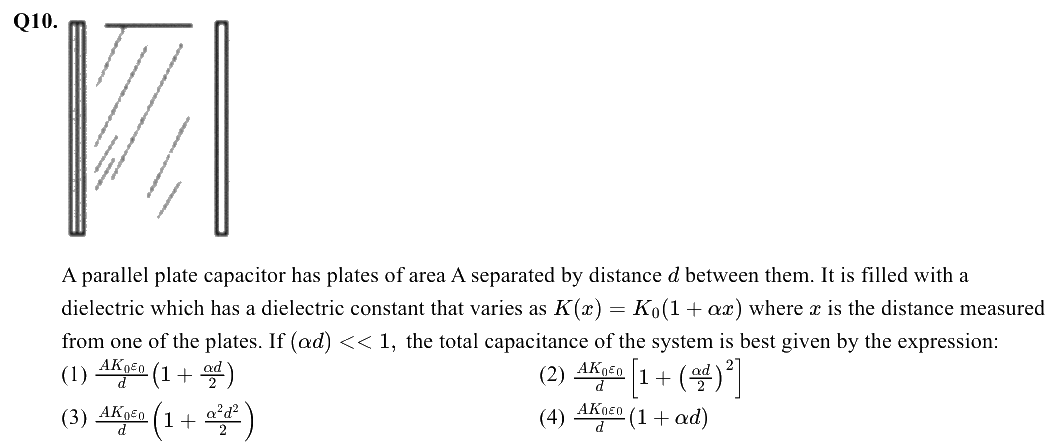
see figure A parallel plate capacitor has plates of area A separated by distance $d$ between them. It is filled with a dielectric which has a dielectric constant that varies as $K(x) = K_0(1 + \alpha x)$ where $x$ is the distance measured from one of the plates. If $(\alpha d) << 1$, the total capacitance of the system is best given by the expression:
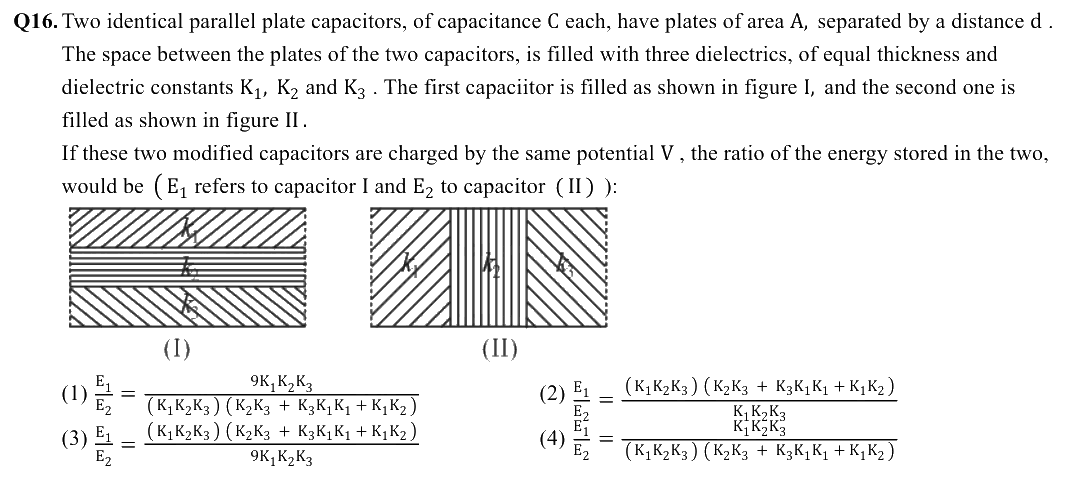
Two identical parallel plate capacitors, of capacitance C each, have plates of area A, separated by a distance d . The space between the plates of the two capacitors, is filled with three dielectrics, of equal thickness and dielectric constants $\mathrm{K_1,\ K_2}$ and $\mathrm{K_3}$ . The first capaciitor is filled as shown in figure I, and the second one is filled as shown in figure II . If these two modified capacitors are charged by the same potential V , the ratio of the energy stored in the two, would be ( $\mathrm{E_1}$ refers to capacitor I and $\mathrm{E_2}$ to capacitor ( II ) ): (see the figure above)
A capacitor with capacitance 5 $\mu$F is charged to 5 $\mu$C . If the plates are pulled apart to reduce the capacitance to 2 $\mu$F, how much work is done?
The parallel combination of two air filled parallel plate capacitors of capacitance $C$ and $nC$ is connected to a battery of voltage, $V$. When the capacitors are fully charged, the battery is removed and after that a dielectric material of dielectric constant $K$ is placed the two plates of the first capacitor. The new potential difference of the combined system is:
Voltage rating of a parallel plate capacitor is 500 V. Its dielectric can withstand a maximum electric field of $10^6\,\mathrm{V/m}$. The plate area is $10^{-4}\ \mathrm{m^2}$. What is the dielectric constant if the capacitance is 15 pF ? given $\epsilon_0 = 8.86 \times 10^{-12}\,\mathrm{C^2/Nm^2}$
A parallel plate capacitor has 1$\mu$F capacitance. One of its two plates is given +2$\mu$C charge and the other plate, +4 $\mu$C charge. The potential difference developed across the capacitor is:
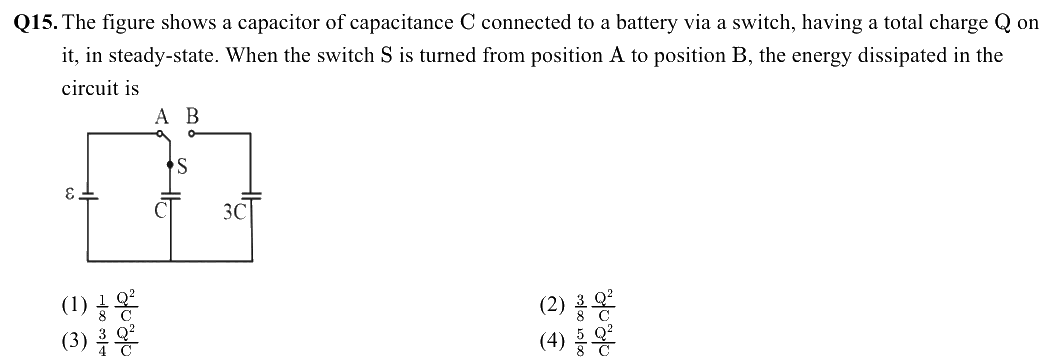
The figure shows a capacitor of capacitance C connected to a battery via a switch, having a total charge Q on it, in steady-state. When the switch S is turned from position A to position B, the energy dissipated in the circuit is
A parallel plate capacitor with plates of area 1 $m^2$ each, are at a separation of 0.1 $m$. If the electric field between the plates is 100 $N/C$, the magnitude of charge on each plate is: (Take $\epsilon_0 = 8.85 \times 10^{-12}\ \frac{C^2}{N\text{-}m^2}$)
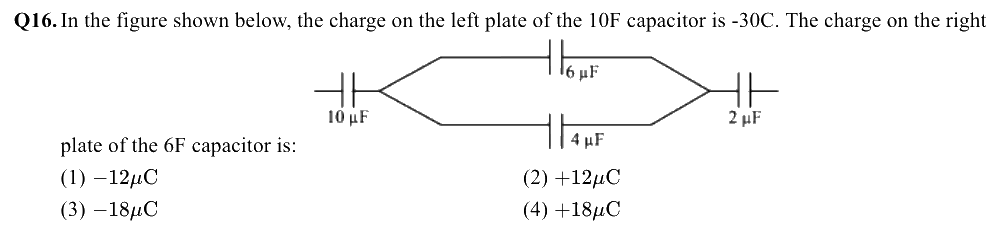
In the figure shown below, the charge on the left plate of the 10F capacitor is -30C. The charge on the right plate of the 6F capacitor is: (see the figure above)
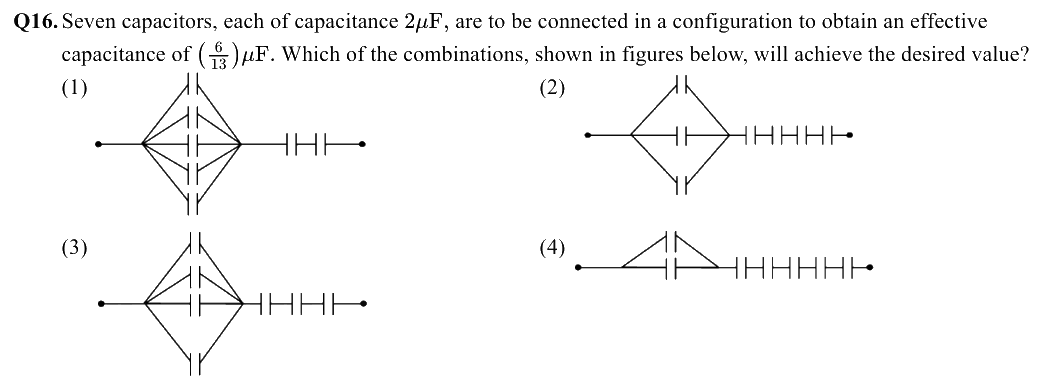
Seven capacitors, each of capacitance $2\mu$F, are to be connected in a configuration to obtain an effective capacitance of $\left(\frac{6}{13}\right)\mu$F. Which of the combinations, shown in figures below, will achieve the desired value? (see the figure above)
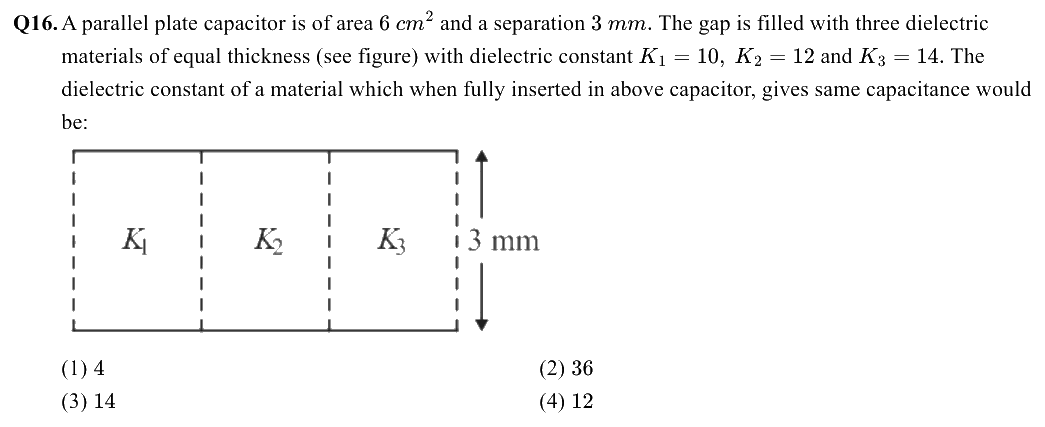
A parallel plate capacitor is of area $6\ cm^2$ and a separation $3\ mm$. The gap is filled with three dielectric materials of equal thickness (see figure) with dielectric constant $K_1 = 10$, $K_2 = 12$ and $K_3 = 14$. The dielectric constant of a material which when fully inserted in above capacitor, gives same capacitance would be: (see the figure above)
A parallel plate capacitor having capacitance $12\ \mathrm{pF}$ is charged by a battery to a potential difference of $10\ \mathrm{V}$ between its plates. The charging battery is now disconnected and a porcelain slab of dielectric constant $6.5$ is slipped between the plates. The work done by the capacitor on the slab is
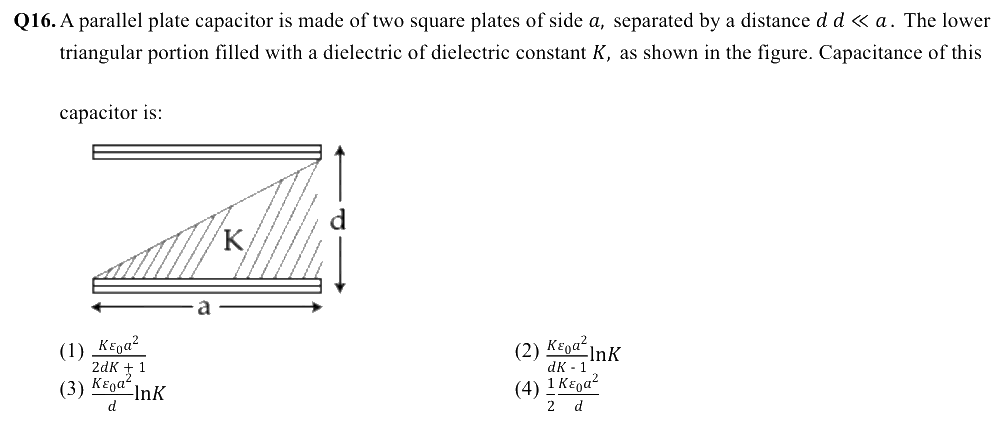
A parallel plate capacitor is made of two square plates of side $a$, separated by a distance $d$ $d \ll a$. The lower triangular portion filled with a dielectric of dielectric constant $K$, as shown in the figure. Capacitance of this capacitor is: (see the figure above)
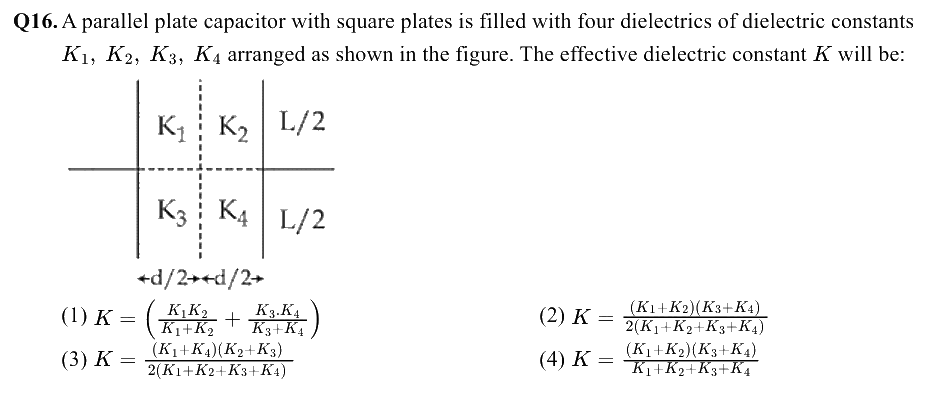
A parallel plate capacitor with square plates is filled with four dielectrics of dielectric constants $K_1$, $K_2$, $K_3$, $K_4$ arranged as shown in the figure. The effective dielectric constant $K$ will be: (see the figure above)
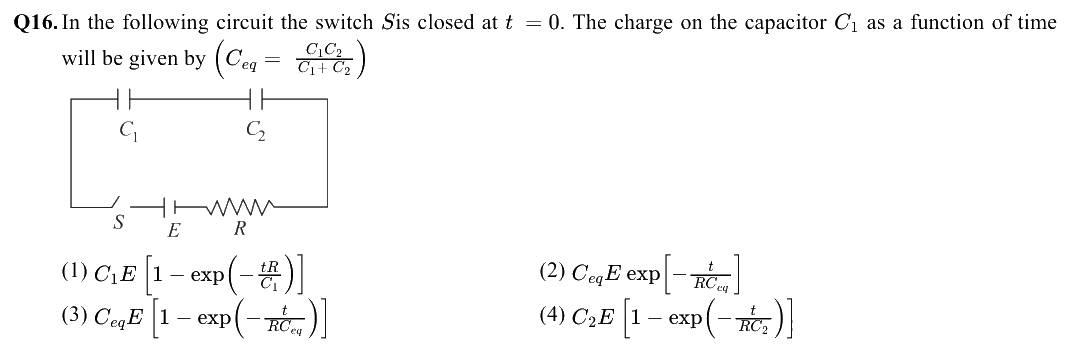
In the following circuit the switch $S$ is closed at $t = 0$. The charge on the capacitor $C_1$ as a function of time will be given by $\left(C_{eq} = \frac{C_1C_2}{C_1 + C_2}\right)$ (see the figure above)
A parallel plate capacitor with area $200\ \mathrm{cm^2}$ and separation between the plates $1.5\ \mathrm{cm}$, is connected across a battery of emf $V$. If the force of attraction between the plates is $25\times10^{-6}\ \mathrm{N}$, the value of $V$ is approximately: $\left(\varepsilon_0 = 8.85\times10^{-12}\dfrac{\mathrm{C^2}}{\mathrm{N.m}}\right)^2$
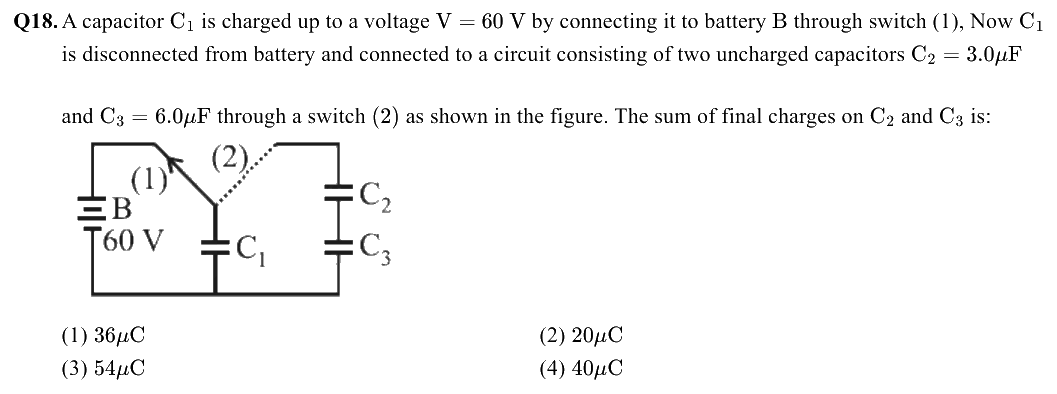
A capacitor $\mathrm{C_1} = 1.0\mu\mathrm{F}$ is charged up to a voltage $\mathrm{V} = 60\ \mathrm{V}$ by connecting it to battery B through switch (1), Now $\mathrm{C_1}$ is disconnected from battery and connected to a circuit consisting of two uncharged capacitors $\mathrm{C_2} = 3.0\mu\mathrm{F}$ and $\mathrm{C_3} = 6.0\mu\mathrm{F}$ through a switch (2) as shown in the figure. The sum of final charges on $\mathrm{C_2}$ and $\mathrm{C_3}$ is: (see the figure above)
A parallel plate capacitor of capacitance $90\ \mathrm{pF}$ is connected to a battery of EMF $20\ \mathrm{V}$. If a dielectric material of dielectric constant $K = \dfrac{5}{3}$ is inserted between the plates, the magnitude of the induced charge will be:
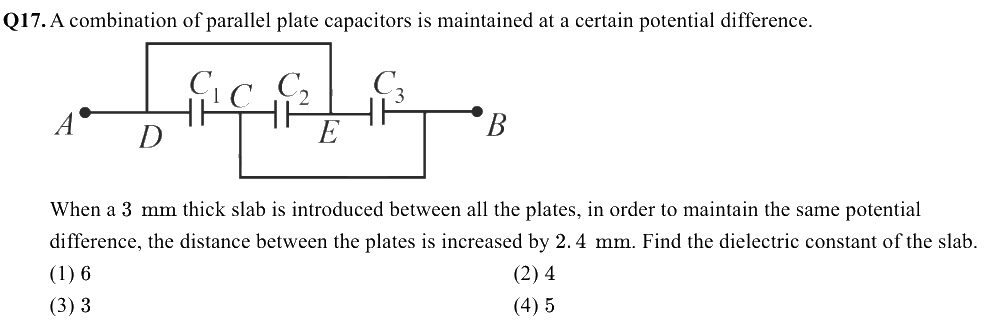
A combination of parallel plate capacitors is maintained at a certain potential difference. (see the figure above) When a 3 mm thick slab is introduced between all the plates, in order to maintain the same potential difference, the distance between the plates is increased by 2.4 mm. Find the dielectric constant of the slab.
A capacitance of $2\ \mu\mathrm{F}$ is required in an electrical circuit across a potential difference of $1.0\ \mathrm{kV}$. A large number of $1\ \mu\mathrm{F}$ capacitors are available which can withstand a potential difference of not more than $300\ \mathrm{V}$. The minimum number of capacitors required to achieve this is:
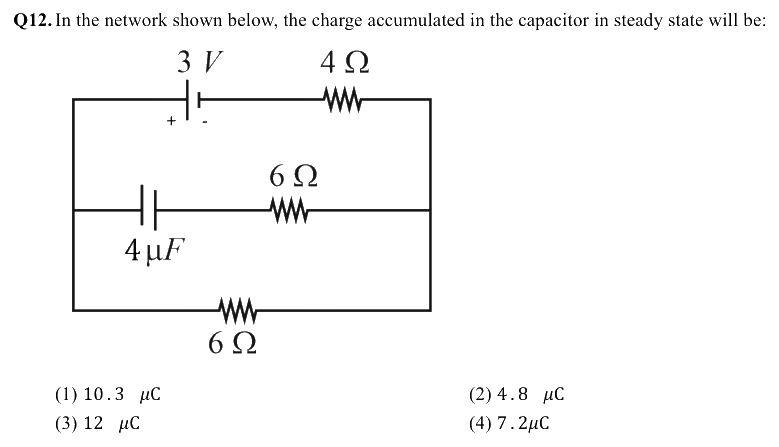
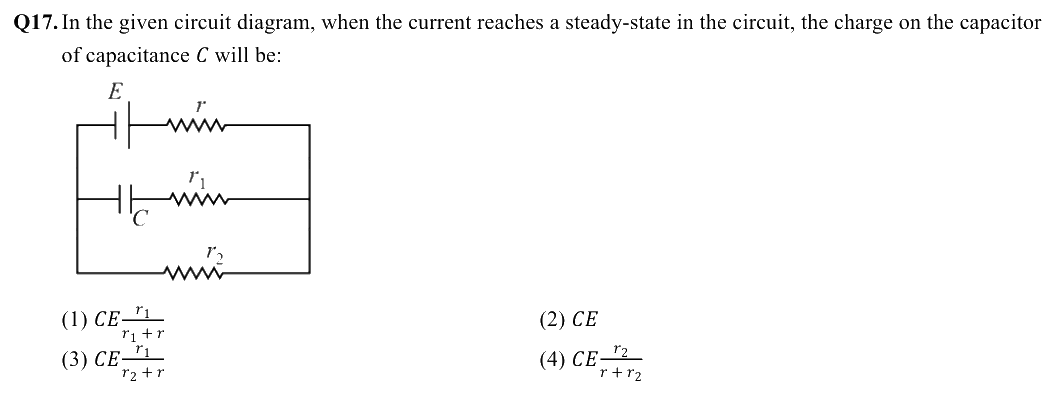
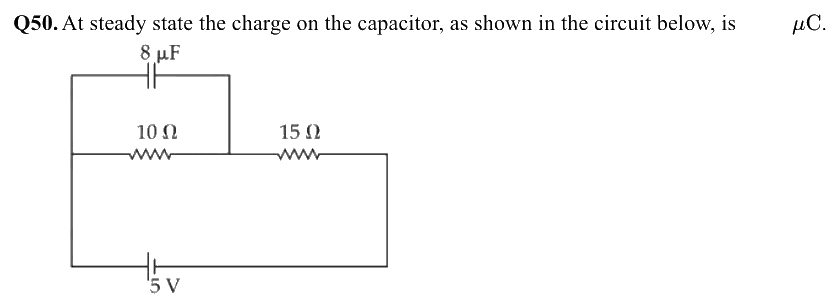
In the given circuit diagram, when the current reaches a steady-state in the circuit, the charge on the capacitor of capacitance $C$ will be: (see the figure above)
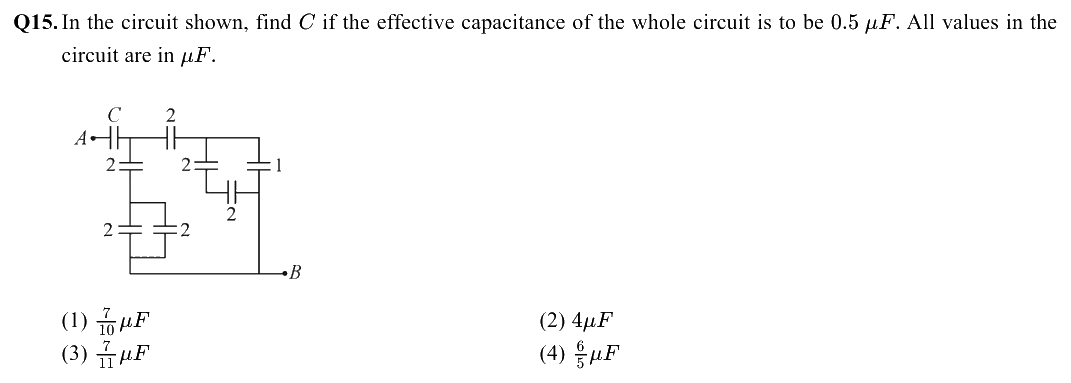
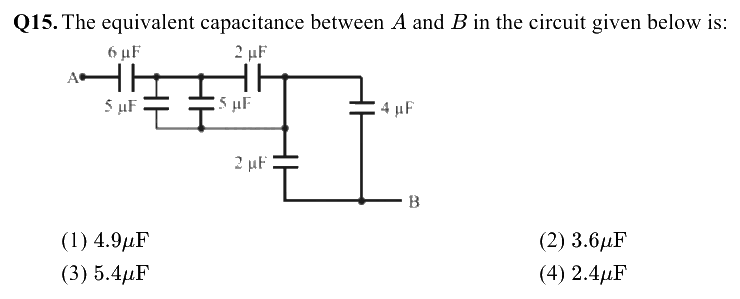
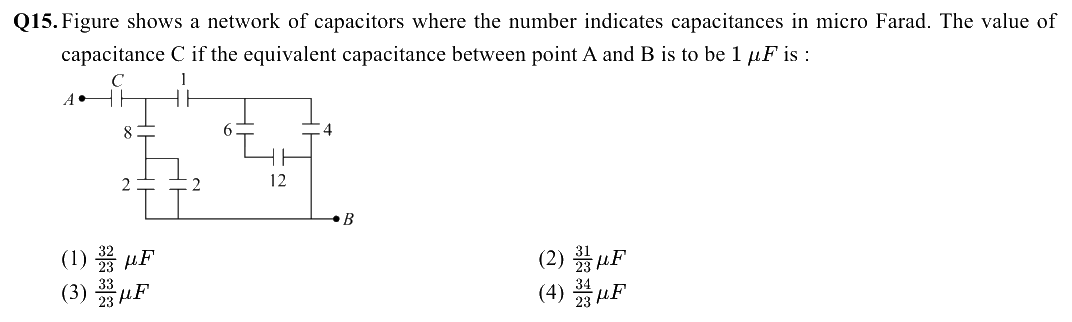
Figure shows a network of capacitors where the number indicates capacitances in micro Farad. The value of capacitance C if the equivalent capacitance between point A and B is to be $1\ \mu F$ is : (see the figure above)
Three capacitors each of $4\ \mu\mathrm{F}$ are to be connected in such a way that the effective capacitance is $6\ \mu\mathrm{F}$. This can be done by connecting them
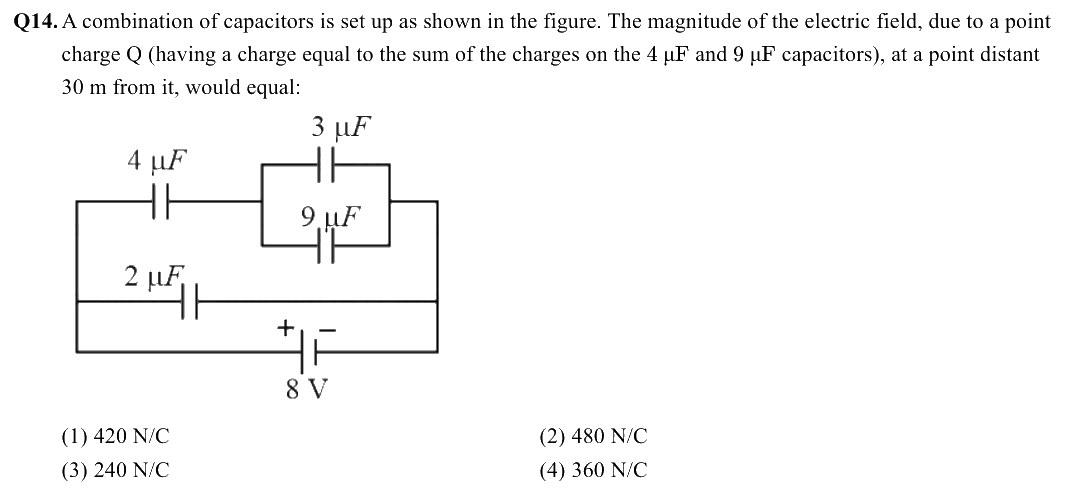
A combination of capacitors is set up as shown in the figure. The magnitude of the electric field, due to a point charge Q (having a charge equal to the sum of the charges on the $4\ \mu$F and $9\ \mu$F capacitors), at a point distant 30 m from it, would equal: (see the figure above)
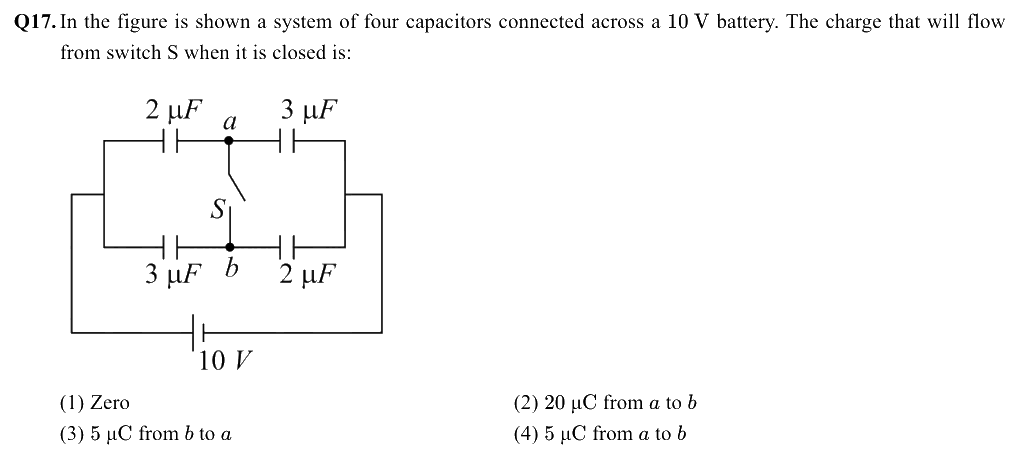
In the figure is shown a system of four capacitors connected across a 10 V battery. The charge that will flow from switch S when it is closed is: (see the figure above)
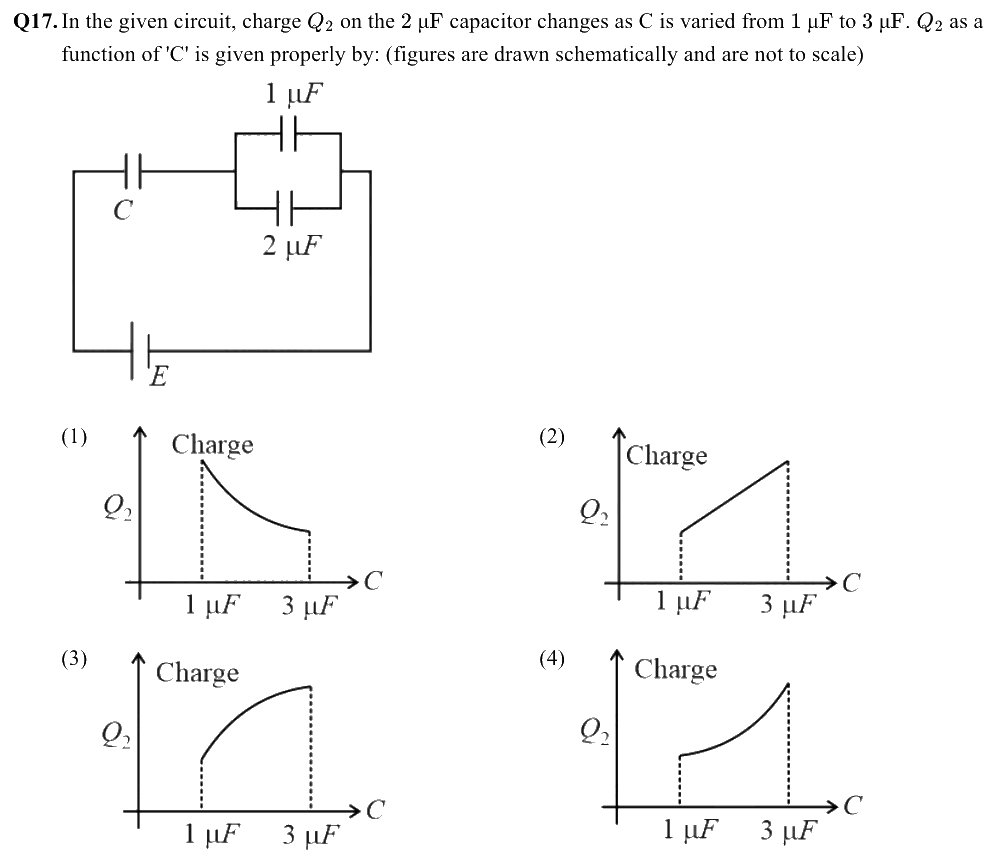
In the given circuit, charge $Q_2$ on the $2\ \mu\mathrm{F}$ capacitor changes as C is varied from $1\ \mu\mathrm{F}$ to $3\ \mu\mathrm{F}$. $Q_2$ as a function of 'C' is given properly by: (figures are drawn schematically and are not to scale) (see the figure above)
The gap between the plates of a parallel plate capacitor of area $A$ and distance between plates $d$, is filled with a dielectric whose relative permittivity varies linearly from $\epsilon_1$ at one plate to $\epsilon_2$ at the other. The capacitance of the capacitor is
The space between the plates of a parallel plate capacitor is filled with a 'dielectric' whose 'dielectric constant' varies with distance as per the relation: $K(x) = K_o + \lambda x(\lambda = \text{ a constant })$ The capacitance C, of the capacitor, would be related to its vacuum capacitance $C_o$ for the relation :
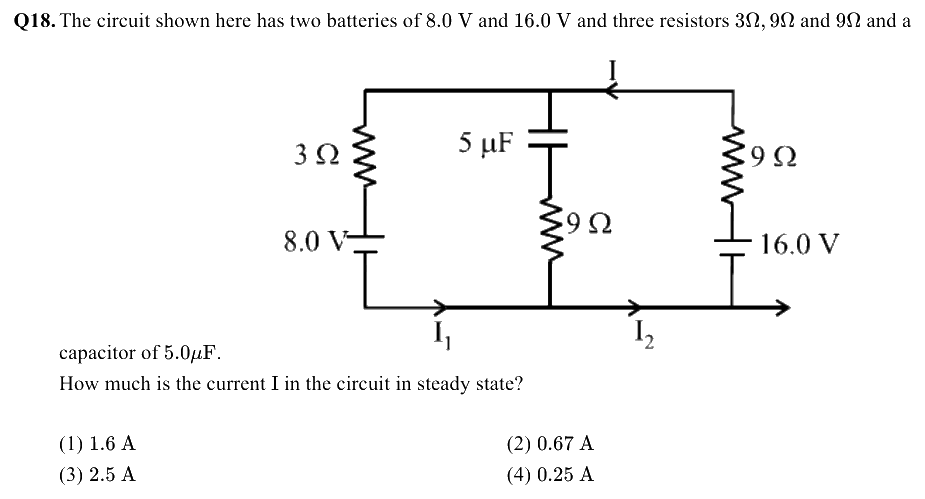
The circuit shown here has two batteries of $8.0\ \mathrm{V}$ and $16.0\ \mathrm{V}$ and three resistors $3\Omega$, $9\Omega$ and $9\Omega$ and a (see the figure above) capacitor of $5.0\mu\mathrm{F}$. How much is the current I in the circuit in steady state?
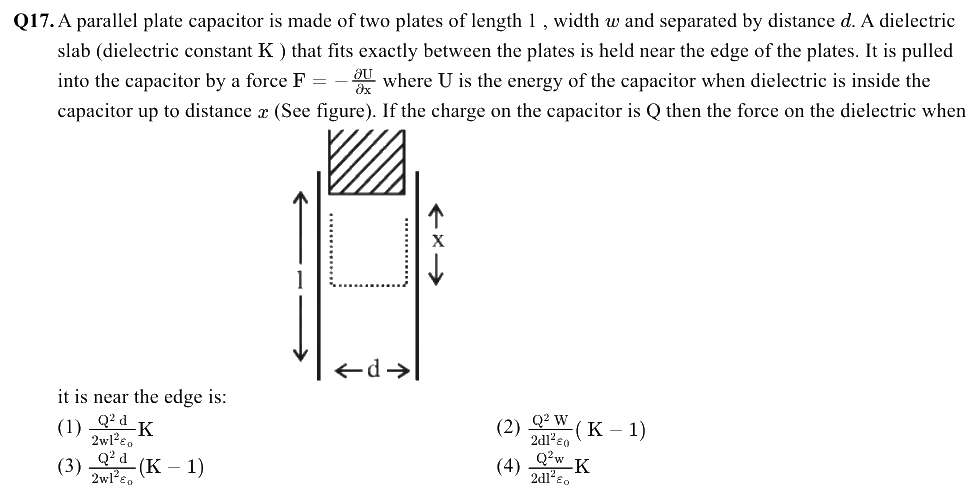
A parallel plate capacitor is made of two plates of length $l$, width $w$ and separated by distance $d$. A dielectric slab (dielectric constant K ) that fits exactly between the plates is held near the edge of the plates. It is pulled into the capacitor by a force $\mathrm{F} = -\frac{\partial \mathrm{U}}{\partial \mathrm{x}}$ where U is the energy of the capacitor when dielectric is inside the capacitor up to distance $x$ (See figure). If the charge on the capacitor is Q then the force on the dielectric when it is near the edge is: (see the figure above)
A parallel plate capacitor is made of two circular plates separated by a distance of 5 mm and with a dielectric of dielectric constant 2.2 between them. When the electric field in the dielectric is $3 \times 10^4$ V/m, the charge density of the positive plate will be close to :
A parallel plate capacitor having a separation between the plates d, plate area A and material with dielectric constant K has capacitance $C_0$. Now one-third of the material is replaced by another material with dielectric constant 2 K, so that effectively there are two capacitors one with area $\frac{1}{3}$ A, dielectric constant 2 K and another with area $\frac{2}{3}$ A and dielectric constant K. If the capacitance of this new capacitor is C then $\frac{C}{C_0}$ is
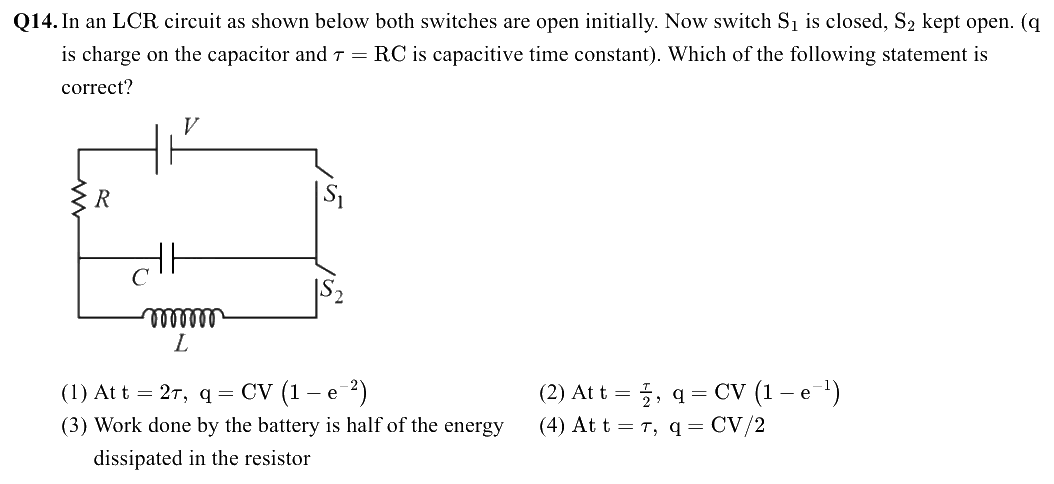
In an LCR circuit as shown below both switches are open initially. Now switch $S_1$ is closed, $S_2$ kept open. (q is charge on the capacitor and $\tau = RC$ is capacitive time constant). Which of the following statement is correct? (see the figure above)
The question as printed in the paper.
A
At t = $2\tau$, $q = CV\ (1 - e^{-2})$
B
At t = $\frac{\tau}{2}$, $q = CV\ (1 - e^{-1})$
C
Work done by the battery is half of the energy dissipated in the resistor
Two capacitors $C_1$ and $C_2$ are charged to 120 V and 200 V respectively. It is found that by connecting them together the potential on each one can be made zero. Then:
This question has Statement 1 and Statement 2 . Of the four choices given after the Statements, choose the one that best describes the two Statements. Statement 1: It is not possible to make a sphere of capacity 1 farad using a conducting material. Statement 2: It is possible for earth as its radius is $6.4 \times 10^{6}$ m.
A
Statement 1 is true, Statement 2 is true, Statement 2 is the correct explanation of Statement 1.
B
Statement 1 is false, Statement 2 is true.
C
Statement 1 is true, Statement 2 is true, Statement 2 is not the correct explanation of Statement 1.
The capacitor of an oscillatory circuit is enclosed in a container. When the container is evacuated, the resonance frequency of the circuit is 10kHz. When the container is filled with a gas, the resonance frequency changes by 50 Hz. The dielectric constant of the gas is
A series combination of $n_1$ capacitors, each of capacity $C_1$ is charged by source of potential difference $4$ V. When another parallel combination of $n_2$ capacitors each of capacity $C_2$ is charged by a source of potential difference $V$, it has the same total energy stored in it as the first combination has. The value of $C_2$ in terms of $C_1$ is then
A resistance $R$ and a capacitance $C$ are connected in series to a battery of negligible internal resistance through a key. The key is closed at $t = 0$ . If after $t$ sec the voltage across the capacitor was seven times the voltage across R, the value of t is
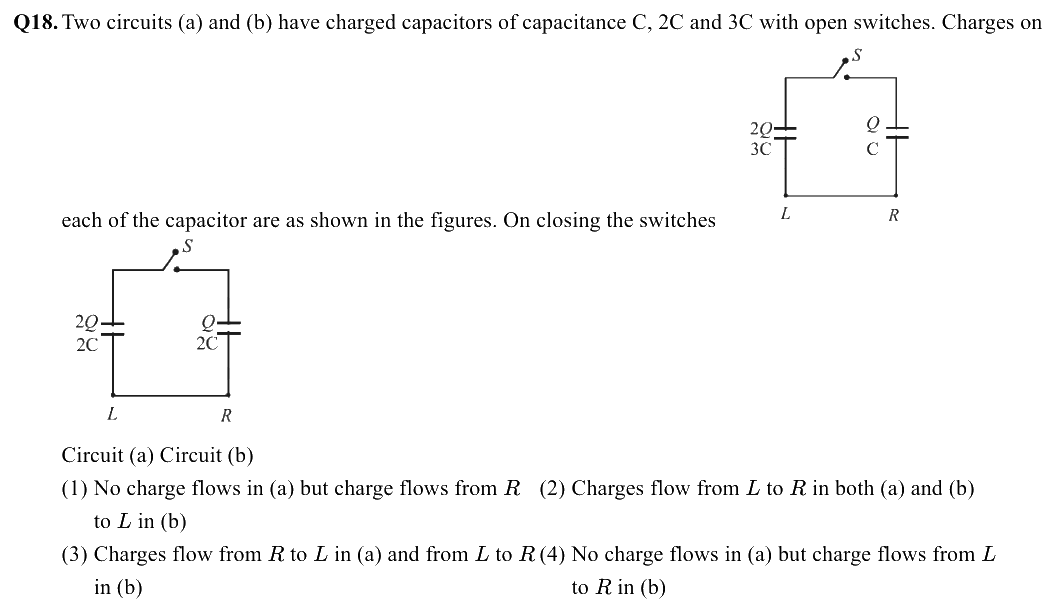
Two circuits (a) and (b) have charged capacitors of capacitance C, 2C and 3C with open switches. Charges on each of the capacitor are as shown in the figures. On closing the switches (see the figure above) Circuit (a) Circuit (b)
The question as printed in the paper.
A
No charge flows in (a) but charge flows from $R$ to $L$ in (b)
B
Charges flow from $L$ to $R$ in both (a) and (b)
C
Charges flow from $R$ to $L$ in (a) and from $L$ to $R$ in (b)
D
No charge flows in (a) but charge flows from $L$ to $R$ in (b)
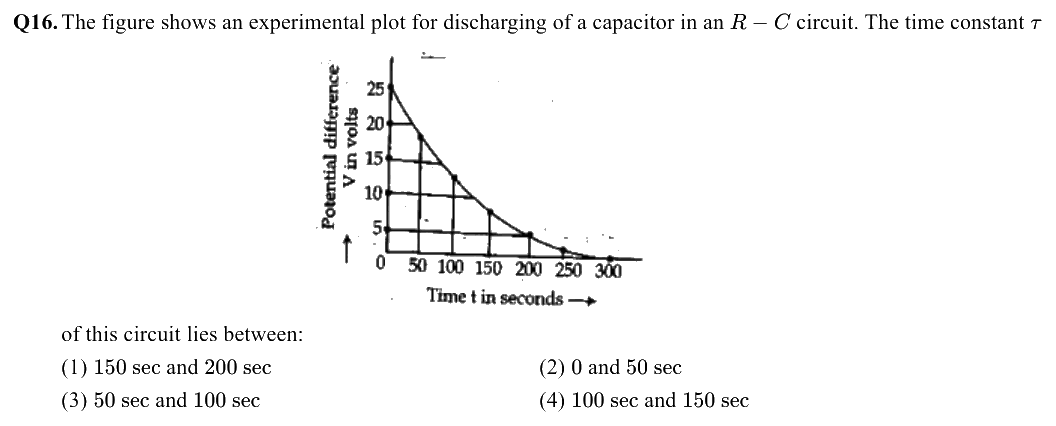
The figure shows an experimental plot for discharging of a capacitor in an $R - C$ circuit. The time constant $\tau$ (see the figure above) of this circuit lies between:
A resistor 'R' and $2\mu\mathrm{F}$ capacitor in series is connected through a switch to $200\ \mathrm{V}$ direct supply. Across the capacitor is a neon bulb that lights up at $120\ \mathrm{V}$. Calculate the value of $R$ to make the bulb light up $5\ \mathrm{s}$ after the switch has been closed. ($\log_{10} 2.5 = 0.4$)
Let $C$ be the capacitance of a capacitor discharging through a resistor R. Suppose $t_1$ is the time taken for the energy stored in the capacitor to reduce to half its initial value and $t_2$ is the time taken for the charge to reduce to one-fourth its initial value. Then the ratio $t_1/t_2$ will be
A parallel plate capacitor with air between the plates has a capacitance of $9\,\mathrm{pF}$. The separation between its plates is ' $d$ '. The space between the plates is now filled with two dielectrics. One of the dielectrics has dielectric constant $k_1 = 3$ and thickness $\frac{d}{3}$ while the other one has dielectric constant $\mathrm{k_2} = 6$ and thickness $\frac{2\mathrm{d}}{3}$ . Capacitance of the capacitor is now
A battery is used to charge a parallel plate capacitor till the potential difference between the plates becomes equal to the electromotive force of the battery. The ratio of the energy stored in the capacitor and the work done by the battery will be
A parallel plate condenser with a dielectric of dielectric constant K between the plates has a capacity C and is charged to a potential V volts. The dielectric slab is slowly removed from between the plates and then reinserted. The net work done by the system in this process is
A fully charged capacitor has a capacitance ' $C$ ' it is discharged through a small coil of resistance wire embedded in a thermally insulated block of specific heat capacity ' $s$ ' and mass ' $\mathrm{m}$ '. If the temperature of the block is raised by ' $\Delta\mathrm{T}$ '. The potential difference $V$ across the capacitor is
A parallel plate capacitor is made by stacking n equally spaced plates connected alternatively. If the capacitance between any two adjacent plates is C then the resultant capacitance is
A parallel plate capacitor is having separation between plates 0.885 mm. It has a capacitance of 1 $\mu$F when the space between the plates is filled with an insulating material of resistivity $1\times10^{13}$ $\Omega$m and resistance $17.7\times10^{14}$ $\Omega$. Relative permittivity of the insulating material is $\alpha\times10^7$. The value of $\alpha$ is ________. (Take permittivity of free space $= 8.85\times10^{-12}$ F/m)
Numerical answer type: type your answer in EdLoop to check it
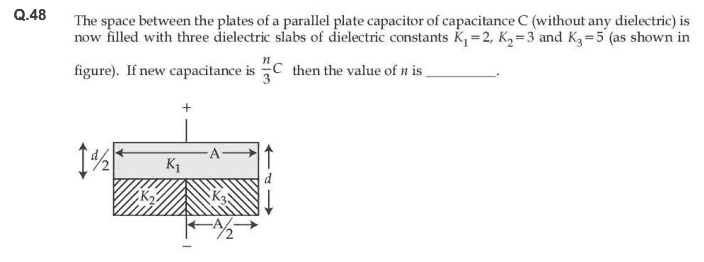
The space between the plates of a parallel plate capacitor of capacitance C (without any dielectric) is now filled with three dielectric slabs of dielectric constants $K_1 = 2$, $K_2 = 3$ and $K_3 = 5$ (as shown in figure). If new capacitance is $\dfrac{n}{3}C$ then the value of $n$ is ________.
(see the figure above)
The question as printed in the paper.
Numerical answer type: type your answer in EdLoop to check it
A capacitor $P$ with capacitance $10 \times 10^{-6}$ F is fully charged with a potential difference of 6.0 V and disconnected from the battery. The charged capacitor $P$ is connected across another capacitor $Q$ with capacitance $20 \times 10^{-6}$ F. The charge on capacitor $Q$ when equilibrium is established will be $\alpha \times 10^{-5}$ C (assume capacitor $Q$ does not have any charge initially), the value of $\alpha$ is ________.
Numerical answer type: type your answer in EdLoop to check it
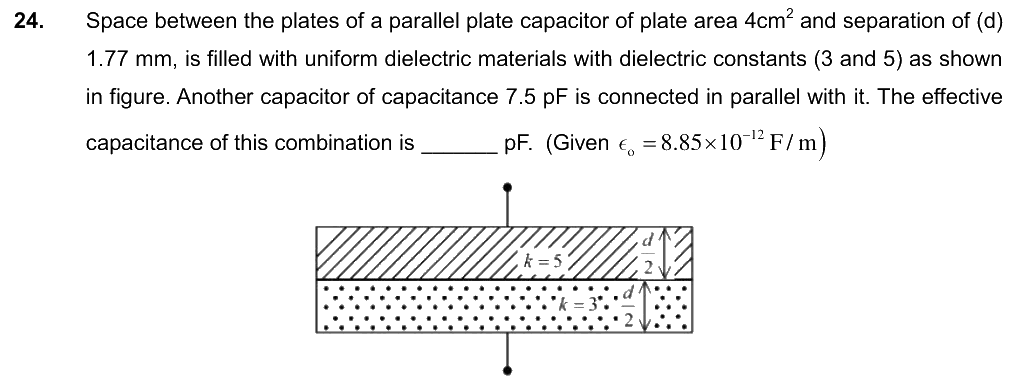
Space between the plates of a parallel plate capacitor of plate area 4cm$^2$ and separation of (d) 1.77 mm, is filled with uniform dielectric materials with dielectric constants (3 and 5) as shown in figure. Another capacitor of capacitance 7.5 pF is connected in parallel with it. The effective capacitance of this combination is ______ pF. (Given $\epsilon_0 = 8.85 \times 10^{-12}$ F/m)
(see the figure above)
The question as printed in the paper.
Numerical answer type: type your answer in EdLoop to check it
A parallel plate capacitor has charge $5 \times 10^{-6}C$. A dielectric slab is inserted between the plates and almost fills the space between the plates. If the induced charge on one face of the slab is $4 \times 10^{-6}C$ then the dielectric constant of the slab is ______ .
Numerical answer type: type your answer in EdLoop to check it
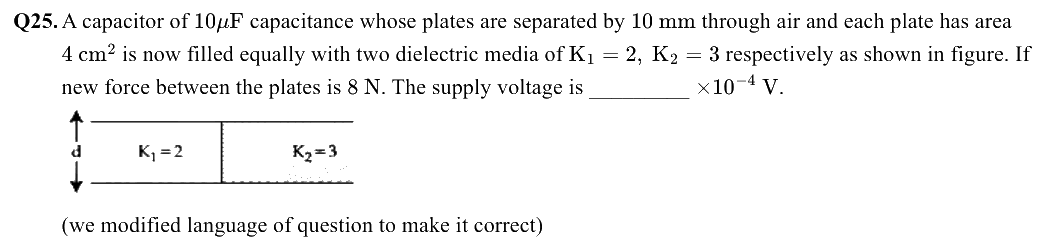
A capacitor of 10$\mu$F capacitance whose plates are separated by 10 mm through air and each plate has area 4 cm$^2$ is now filled equally with two dielectric media of $K_1 = 2$, $K_2 = 3$ respectively as shown in figure. If new force between the plates is 8 N. The supply voltage is ______ $\times 10^{-4}$ V.
(see the figure above)
(we modified language of question to make it correct)
The question as printed in the paper.
Numerical answer type: type your answer in EdLoop to check it
Three capacitors of capacitances $25\mu$F, $30\mu$F and $45\mu$F are connected in parallel to a supply of 100 V. Energy stored in the above combination is E. When these capacitors are connected in series to the same supply, the stored energy is $\frac{9}{x}$E. The value of $x$ is ______ .
Numerical answer type: type your answer in EdLoop to check it
The electric field between the two parallel plates of a capacitor of $1.5\mu$F capacitance drops to one third of its initial value in 6.6$\mu$s when the plates are connected by a thin wire. The resistance of this wire is ______ $\Omega$. (Given, log 3 = 1.1 )
Numerical answer type: type your answer in EdLoop to check it
A parallel plate capacitor of capacitance 12.5pF is charged by a battery connected between its plates to potential difference of 12.0 V. The battery is now disconnected and a dielectric slab ($\epsilon_r = 6$) is inserted between the plates. The change in its potential energy after inserting the dielectric slab is ______ $10^{-12}$ J.
Numerical answer type: type your answer in EdLoop to check it
A parallel plate capacitor with plate separation 5 mm is charged up by a battery. It is found that on introducing a dielectric sheet of thickness 2 mm, while keeping the battery connections intact, the capacitor draws 25% more charge from the battery than before. The dielectric constant of the sheet is ______.
Numerical answer type: type your answer in EdLoop to check it
A capacitor of capacitance $C$ and potential $V$ has energy $E$. It is connected to another capacitor of capacitance $2C$ and potential $2V$. Then the loss of energy is $\frac{x}{3}E$, where x is ______.
Numerical answer type: type your answer in EdLoop to check it
A 16 $\Omega$ wire is bend to form a square loop. A 9 V battery with internal resistance 1 $\Omega$ is connected across one of its sides. If a 4 $\mu$F capacitor is connected across one of its diagonals, the energy stored by the capacitor will be $\frac{x}{2}$ $\mu$J, where $x =$ ______.
Numerical answer type: type your answer in EdLoop to check it
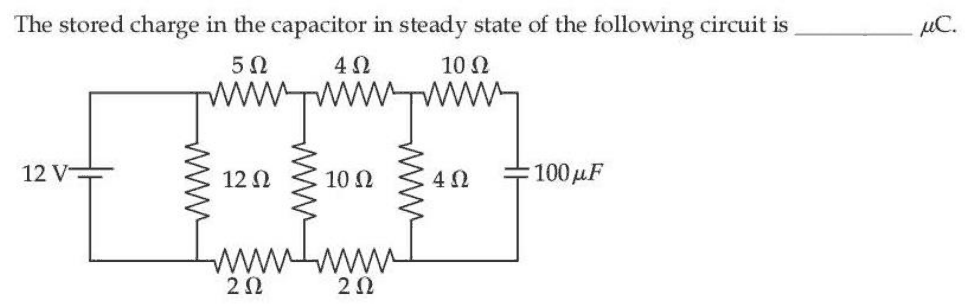
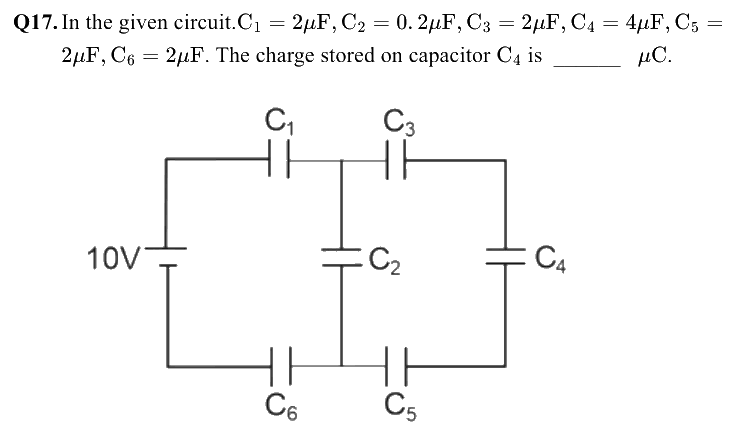
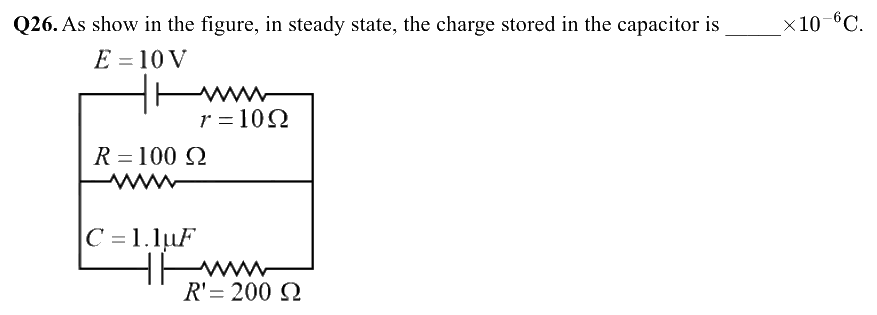
In the given circuit. $\mathrm{C_1} = 2\mu\mathrm{F}$, $\mathrm{C_2} = 0.2\mu\mathrm{F}$, $\mathrm{C_3} = 2\mu\mathrm{F}$, $\mathrm{C_4} = 4\mu\mathrm{F}$, $\mathrm{C_5} = 2\mu\mathrm{F}$, $\mathrm{C_6} = 2\mu\mathrm{F}$. The charge stored on capacitor $\mathrm{C_4}$ is ______ $\mu$C. (see the figure above)
The question as printed in the paper.
Numerical answer type: type your answer in EdLoop to check it
A $600\ \mathrm{pF}$ capacitor is charged by $200\ \mathrm{V}$ supply. It is then disconnected from the supply and is connected to another uncharged $600\ \mathrm{pF}$ capacitor. Electrostatic energy lost in the process is ______ $\mu\mathrm{J}$.
Numerical answer type: type your answer in EdLoop to check it
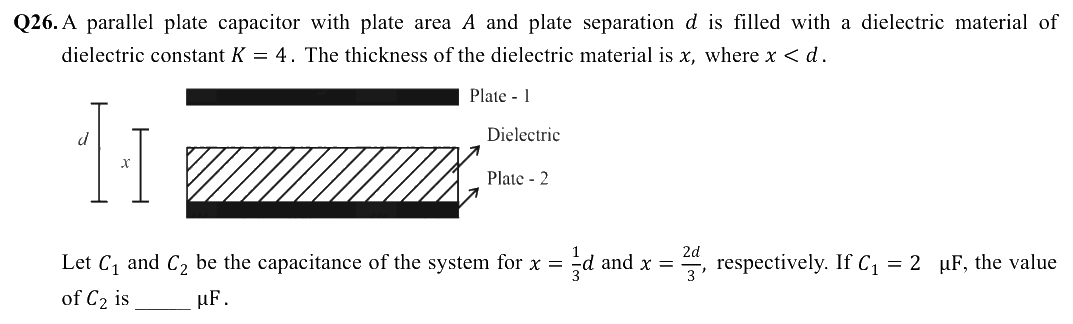
A parallel plate capacitor with plate area $A$ and plate separation $d$ is filled with a dielectric material of dielectric constant $K = 4$. The thickness of the dielectric material is $x$, where $x < d$.
(see the figure above)
Let $C_1$ and $C_2$ be the capacitance for the system for $x = \frac{1}{3}d$ and $x = \frac{2d}{3}$, respectively. If $C_1 = 2\ \mu\mathrm{F}$, the value of $C_2$ is ______ $\mu\mathrm{F}$.
The question as printed in the paper.
Numerical answer type: type your answer in EdLoop to check it
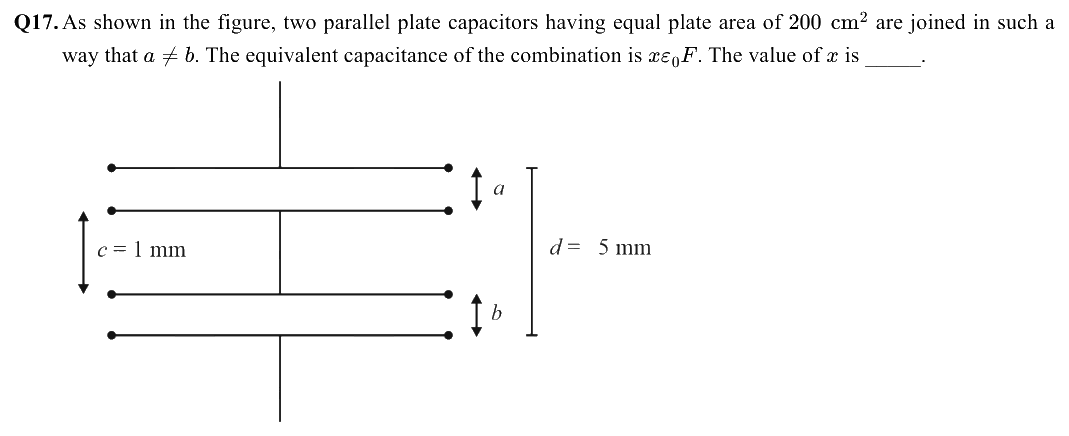
As shown in the figure, two parallel plate capacitors having equal plate area of $200\ \mathrm{cm^2}$ are joined in such a way that $a \neq b$. The equivalent capacitance of the combination is $x\varepsilon_0 F$. The value of $x$ is ______ .
(see the figure above)
The question as printed in the paper.
Numerical answer type: type your answer in EdLoop to check it
Two parallel plate capacitors $C_1$ and $C_2$ each having capacitance of 10 $\mu$F are individually charged by a 100 V D.C. source. Capacitor $C_1$ is kept connected to the source and a dielectric slab is inserted between its plates. Capacitor $C_2$ is disconnected from the source and then a dielectric slab is inserted in it. Afterwards the capacitor $C_1$ is also disconnected from the source and the two capacitors are finally connected in parallel combination. The common potential of the combination will be ______ V. (Assuming Dielectric constant = 10)
Numerical answer type: type your answer in EdLoop to check it
A capacitor of capacitance 900 $\mu$F is charged by a 100 V battery. The capacitor is disconnected from the battery and connected to another uncharged identical capacitor such that one plate of uncharged capacitor connected to positive plate and another plate of uncharged capacitor connected to negative plate of the charged capacitor. The loss of energy in this process is measured as $x \times 10^{-2}$ J. The value of $x$ is ______.
Numerical answer type: type your answer in EdLoop to check it
A capacitor has capacitance 5 $\mu$F when its parallel plates are separated by air medium of thickness $d$. A slab of material of dielectric constant 1.5 having area equal to that of plates but thickness $\frac{d}{2}$ is inserted between the plates. Capacitance of the capacitor in the presence of slab will be ______ $\mu$F.
Numerical answer type: type your answer in EdLoop to check it
A parallel plate capacitor with air between the plate has a capacitance of 15 pF. The separation between the plate becomes twice and the space between them is filled with a medium of dielectric constant 3.5. Then the capacitance becomes $\frac{x}{4}$ pF. The value of $x$ is ______.
Numerical answer type: type your answer in EdLoop to check it
A parallel plate capacitor with width 4 cm, length 8 cm and separation between the plates of 4 mm is connected to a battery of 20 V. A dielectric slab of dielectric constant 5 having length 1 cm, width 4 cm and thickness 4 mm is inserted between the plates of parallel plate capacitor. The electrostatic energy of this system will be ______ $\epsilon_0$ J. (Where $\epsilon_0$ is the permittivity of free space)
Numerical answer type: type your answer in EdLoop to check it
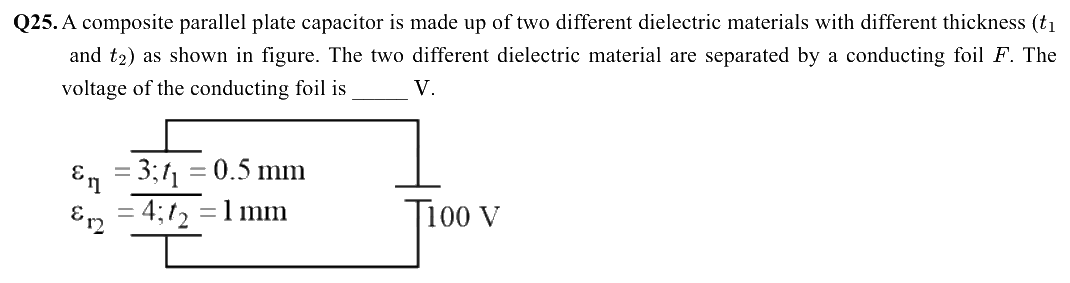
A composite parallel plate capacitor is made up of two different dielectric materials with different thickness ($t_1$ and $t_2$) as shown in figure. The two different dielectric material are separated by a conducting foil $F$. The voltage of the conducting foil is ______ V. (see the figure above)
The question as printed in the paper.
Numerical answer type: type your answer in EdLoop to check it
Two parallel plate capacitors of capacity $C$ and $3C$ are connected in parallel combination and charged to a potential difference 18 V. The battery is then disconnected and the space between the plates of the capacitor of capacity $C$ is completely filled with a material of dielectric constant 9. The final potential difference across the combination of capacitors will be ______ V.
Numerical answer type: type your answer in EdLoop to check it
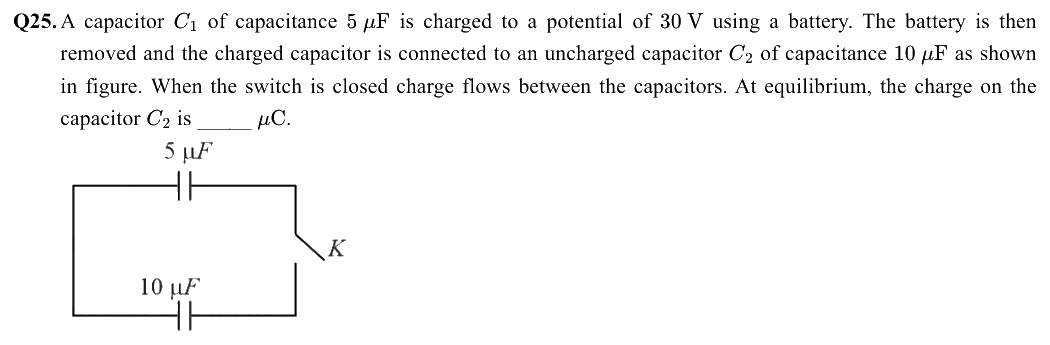
A capacitor $C_1$ of capacitance $5\ \mu\mathrm{F}$ is charged to a potential of $30\ \mathrm{V}$ using a battery. The battery is then removed and the charged capacitor is connected to an uncharged capacitor $C_2$ of capacitance $10\ \mu\mathrm{F}$ as shown in figure. When the switch is closed charge flows between the capacitors. At equilibrium, the charge on the capacitor $C_2$ is ______ $\mu\mathrm{C}$. (see the figure above)
The question as printed in the paper.
Numerical answer type: type your answer in EdLoop to check it
A capacitor of capacitance $50\ \mathrm{pF}$ is charged by $100\ \mathrm{V}$ source. It is then connected to another uncharged identical capacitor. Electrostatic energy loss in the process is ______ nJ.
Numerical answer type: type your answer in EdLoop to check it
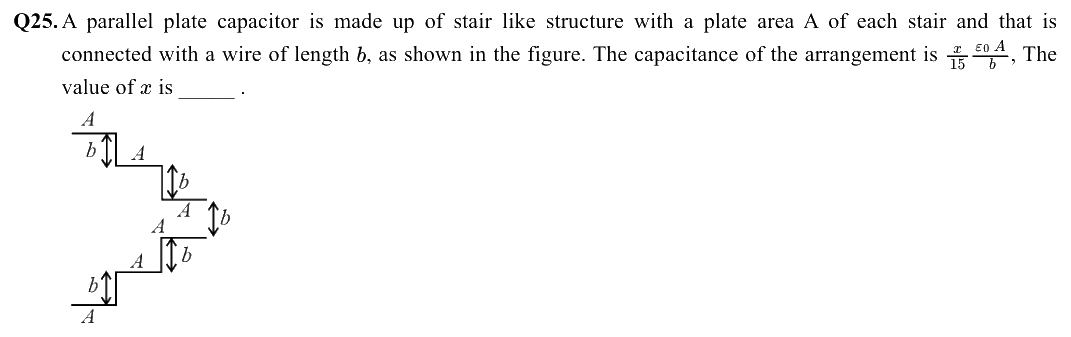
A parallel plate capacitor is made up of stair like structure with a plate area A of each stair and that is connected with a wire of length $b$, as shown in the figure. The capacitance of the arrangement is $\frac{x}{15}\frac{\varepsilon_0 A}{b}$. The value of $x$ is ______ . (see the figure above)
The question as printed in the paper.
Numerical answer type: type your answer in EdLoop to check it
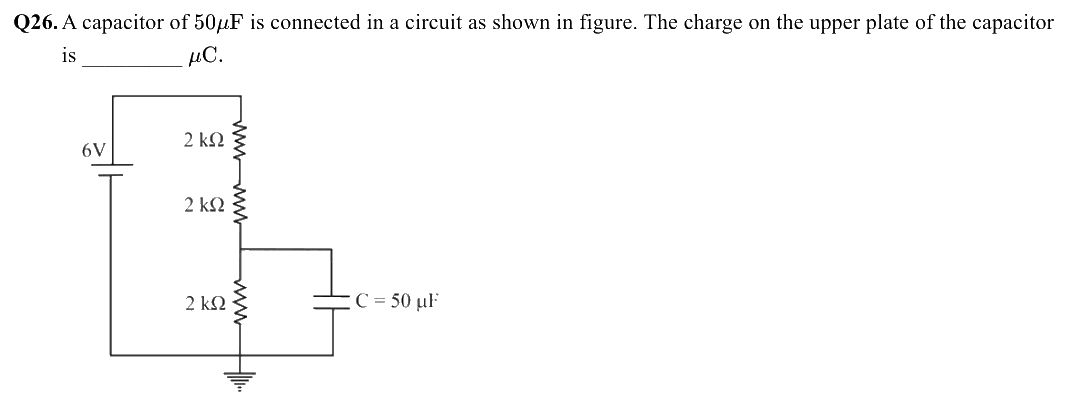
A capacitor of $50\mu$F is connected in a circuit as shown in figure. The charge on the upper plate of the capacitor is ______ $\mu$C. (see the figure above)
The question as printed in the paper.
Numerical answer type: type your answer in EdLoop to check it
A parallel plate capacitor of capacitance $200\mu$F is connected to a battery of $200$ V. A dielectric slab of dielectric constant $2$ is now inserted into the space between plates of capacitor while the battery remain connected. The change in the electrostatic energy in the capacitor will be ______ J.
Numerical answer type: type your answer in EdLoop to check it
A radioactive sample has an average life of $30\ \mathrm{ms}$ and is decaying. A capacitor of capacitance $200\ \mu\mathrm{F}$ is first charged and later connected with resistor $R$. If the ratio of the charge on the capacitor to the activity of the radioactive sample is fixed with respect to time then the value of $R$ should be ______ $\Omega$.
Numerical answer type: type your answer in EdLoop to check it
A parallel plate capacitor has plate area $100~\mathrm{m^2}$ and plate separation of $10~\mathrm{m}$. The space between the plates is filled up to a thickness $5~\mathrm{m}$ with a material of dielectric constant of $10$ . The resultant capacitance of the system is $x$ pF. The value of $\varepsilon_0 = 8.85 \times 10^{-12}~\mathrm{F~m^{-1}}$. The value of $x$ to the nearest integer is ______ .
Numerical answer type: type your answer in EdLoop to check it
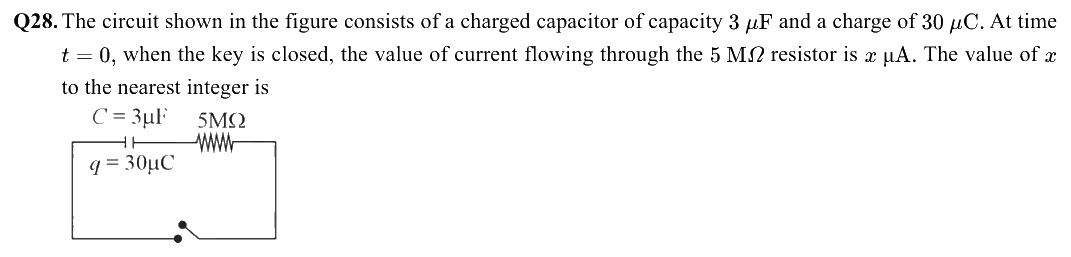
The circuit shown in the figure consists of a charged capacitor of capacity $3~\mu\mathrm{F}$ and a charge of $30~\mu\mathrm{C}$. At time $t = 0$, when the key is closed, the value of current flowing through the $5~\mathrm{M}\Omega$ resistor is $x~\mu\mathrm{A}$. The value of $x$ to the nearest integer is (see the figure above)
The question as printed in the paper.
Numerical answer type: type your answer in EdLoop to check it
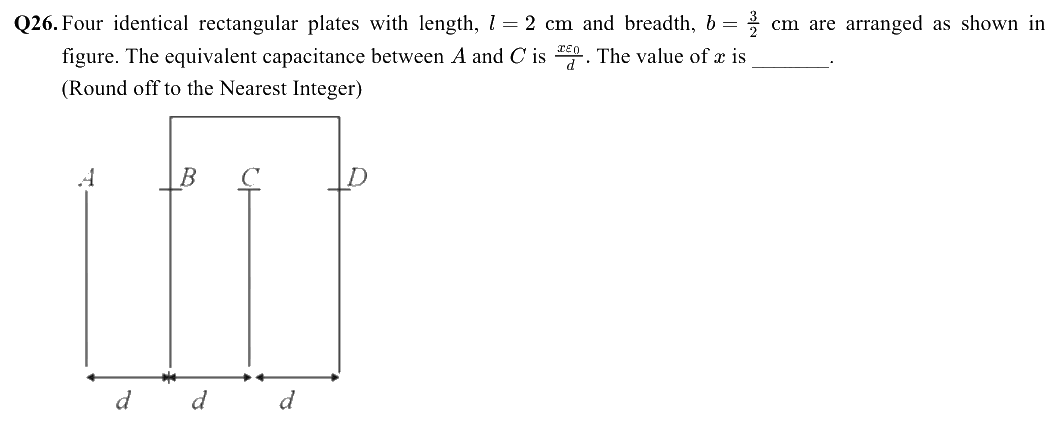
Four identical rectangular plates with length, $l=2 \mathrm{~cm}$ and breadth, $b=\frac{3}{2} \mathrm{~cm}$ are arranged as shown in figure. The equivalent capacitance between $A$ and $C$ is $\frac{x \varepsilon_0}{d}$. The value of $x$ is ______. (Round off to the Nearest Integer) (see the figure above)
The question as printed in the paper.
Numerical answer type: type your answer in EdLoop to check it
A parallel plate capacitor whose capacitance $C$ is $14 \mathrm{pF}$ is charged by a battery to a potential difference $V=12 \mathrm{~V}$ between its plates. The charging battery is now disconnected and a porcelain plate with $k=7$ is inserted between the plates, then the plate would oscillate back and forth between the plates with a constant mechanical energy of ______ pJ. (Assume no friction)
Numerical answer type: type your answer in EdLoop to check it
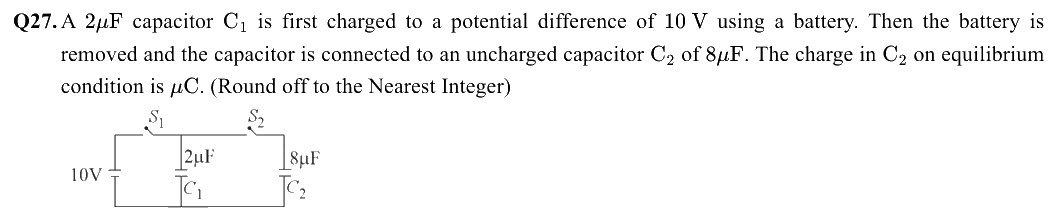
A $2 \mu \mathrm{F}$ capacitor $\mathrm{C}_1$ is first charged to a potential difference of $10 \mathrm{~V}$ using a battery. Then the battery is removed and the capacitor is connected to an uncharged capacitor $\mathrm{C}_2$ of $8 \mu \mathrm{F}$. The charge in $\mathrm{C}_2$ on equilibrium condition is $\mu \mathrm{C}$. (Round off to the Nearest Integer) (see the figure above)
The question as printed in the paper.
Numerical answer type: type your answer in EdLoop to check it
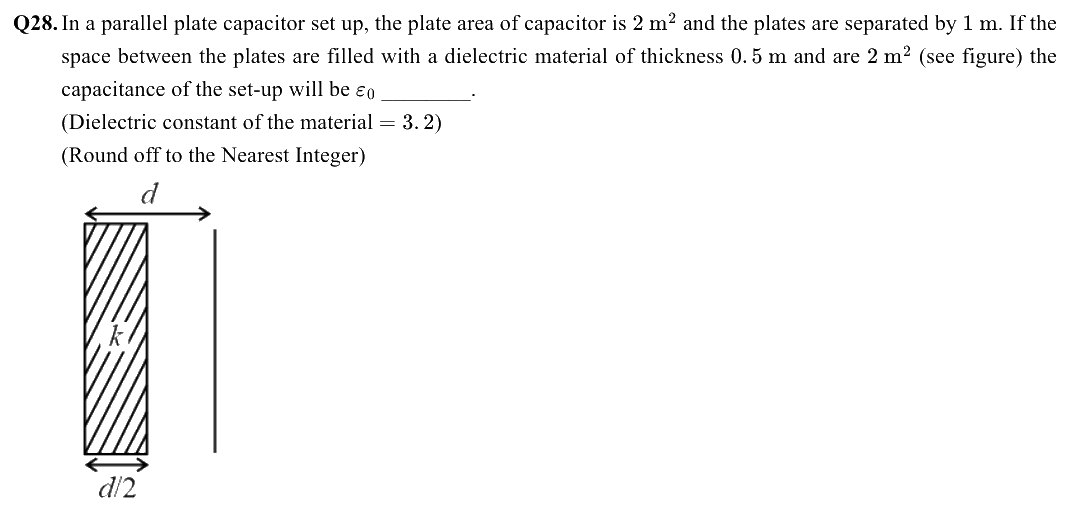
In a parallel plate capacitor set up, the plate area of capacitor is $2\ \mathrm{m^2}$ and the plates are separated by $1\ \mathrm{m}$. If the space between the plates are filled with a dielectric material of thickness $0.5\ \mathrm{m}$ and are $2\ \mathrm{m^2}$ (see figure) the capacitance of the set-up will be $\varepsilon_0$ ______. (Dielectric constant of the material $= 3.2$) (Round off to the Nearest Integer) (see the figure above)
The question as printed in the paper.
Numerical answer type: type your answer in EdLoop to check it
A $5\ \mu\mathrm{F}$ capacitor is charged fully by a $220\ \mathrm{V}$ supply. It is then disconnected from the supply and is connected in series to another uncharged $2.5\ \mu\mathrm{F}$ capacitor. If the energy change during the charge redistribution is $\frac{\mathrm{X}}{100}\ \mathrm{J}$ then value of X to the nearest integer is :
Numerical answer type: type your answer in EdLoop to check it
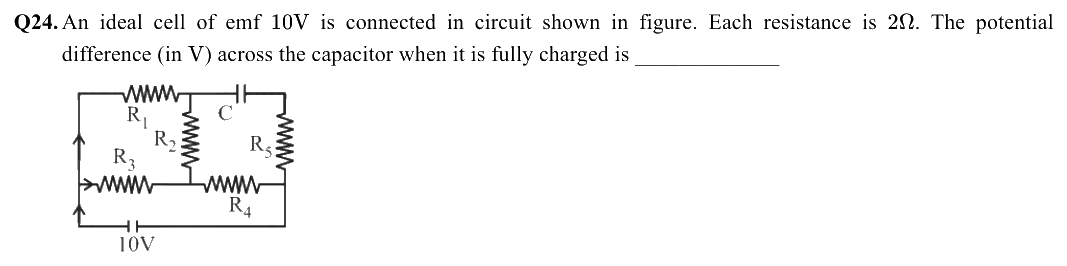
An ideal cell of emf $10\mathrm{V}$ is connected in circuit shown in figure. Each resistance is $2\Omega$. The potential difference (in V) across the capacitor when it is fully charged is ______ (see the figure above)
The question as printed in the paper.
Numerical answer type: type your answer in EdLoop to check it
A $60\mathrm{pF}$ capacitor is fully charged by a $20\mathrm{V}$ supply. It is then disconnected from the supply and is connected to another uncharged $60\mathrm{pF}$ capacitor in parallel. The electrostatic energy that is lost in this process by the time the charge is redistributed between them is (in $\mathrm{nJ}$ ) ______
Numerical answer type: type your answer in EdLoop to check it
Capacitors connect electrostatic theory with electric circuits in the Class 12 syllabus under NTA Unit 11 (Electrostatics). It holds rank 17 among the 29 physics chapters. During the computer-based era from 2019 to 2026, candidates faced 143 capacitor problems in 162 testing sessions, representing roughly 0.9 questions per paper. The chapter was present in 119 of those 162 papers, showing up consistently across testing seasons with questions asked every year. In the three years spanning 2024 to 2026, 45 questions appeared across 58 test papers, yielding an average of 0.8 questions per shift and a 2.9 percent share. The chapter's share has stayed about the same when compared to the 2002 to 2018 window, which also logged a 2.9 percent share with 39 questions in 38 tests. In 2026 alone, examiners included 16 capacitor problems across 19 papers, featured in 13 separate sessions. Notably, 49 questions from 2019 to 2026 required numerical answers, meaning about a third of all capacitor problems demand final numerical computation rather than option elimination.
Most-asked topics
The question pool divides across four core areas:
Dielectrics: 63 questions historically, including 52 from 2019 to 2026, continuing through 2026. Frequent problems evaluate partial slab insertion, composite dielectric arrangements with multiple slabs in series or parallel, and energy changes when slabs enter with or without a connected battery.
Combinations: 61 problems overall, with 47 between 2019 and 2026, tested up to 2026. This topic covers equivalent capacitance in bridge networks, symmetric ladder circuits, charge redistribution between disconnected or reconnected capacitors, and common potential calculations.
RC Circuits: 37 questions since 2002, with 29 appearing from 2019 to 2026, asked in 2026. Questions explore DC transient charging and discharging, exponential time constants, and steady-state currents where fully charged capacitors act as open circuits.
Capacitance: 21 lifetime problems, with 15 between 2019 and 2026, tested in 2026. Focus areas involve parallel plate geometry, pulling plates apart at constant charge or voltage, spherical and cylindrical capacitors, and mechanical electrostatic pressure.
What the questions look like
Capacitor questions in JEE Main generally feature clear circuit diagrams and structured algebraic relations:
Composite dielectric slabs: Slabs of varying thickness and dielectric constant fill specific fractions of the gap between parallel plates. Students must model the system as combinations of sub-capacitors connected in series or parallel.
Charge sharing between capacitors: A capacitor charged to an initial voltage connects across another capacitor that is uncharged or charged with opposite polarity. Calculations determine final common voltages, individual charges, or heat dissipated during redistribution.
Steady-state DC circuit analysis: Circuits containing combinations of resistors and capacitors powered by a DC source. Candidates replace capacitors with open branches to determine branch currents and potential drops across specific elements.
Dynamic plate movement: Evaluating the work done by external forces or the rate of energy exchange as capacitor plates separate at constant velocity while connected to a supply.
Questions to try first
Start your revision with these selected recent problems:
Master the distinction between isolated and battery-connected capacitors. When disconnected from a source, the stored charge Q stays constant while potential difference V and stored energy adjust with capacitance changes. When connected to a battery, voltage V remains fixed while charge Q and energy scale directly with capacitance.
Pay special attention to equivalent capacitance when dielectric slabs fill portions of the gap. If slabs divide the gap perpendicular to the plates, treat them as series capacitances. If they divide the plate area parallel to the plates, treat them as parallel capacitances. Practice drawing equivalent circuits with labeled node voltages to break down complex networks.
For transient circuits, be confident with the exponential charging and discharging equations. Know that at time zero an uncharged capacitor acts as a short circuit with zero voltage drop, while in the infinite time limit it acts as an open circuit blocking DC current.
Frequently asked questions
How often do capacitor questions involve dielectrics?
Dielectrics account for the single largest share of capacitor questions, appearing in 52 problems between 2019 and 2026. Questions frequently test how capacitance, electric field, and stored electrostatic energy change when dielectric slabs fill portions of the plate gap.
What is the most common mistake students make in capacitor combination problems?
Students frequently confuse the series and parallel formulas for capacitors with those for resistors. In capacitors, parallel components add directly while series components add reciprocally. Another frequent pitfall is ignoring initial polarity when two charged capacitors connect in parallel.
Are RC circuit differential equations required for JEE Main?
Standard JEE Main questions test either the steady-state DC limits or basic exponential growth and decay using the time constant RC. Complex transient differential equations are rarely tested in the Main exam. Step-by-step solutions for each one are in the EdLoop app.