Every Nuclei question from past JEE Main and AIEEE papers, with options and answers. Newest first.
164questions
131papers covered
2.6%of Physics questions, 2019–2026
2002–2026years
Guide at a glance
Nuclei deals with nuclear binding energy and reactions under Unit 18: Atoms and Nuclei in the Class 12 curriculum, holding rank 23 among the 29 physics chapters with a 2.6 percent share of total physics questions.
Two radioactive substances A and B of mass numbers 200 and 212 respectively, shows spontaneous $\alpha$-decay with same $Q$ value of 1 MeV. The ratio of energies of $\alpha$-rays produced by A and B is ________.
Two nuclei of mass number 3 combine with another nucleus of mass number 4 to yield a nucleus of mass number 10. If the binding energy per nucleon for the mass numbers 3, 4 and 10 are 5.6 MeV, 7.4 MeV and 6.1 MeV, respectively, then in the process, $\Delta\mathrm{Mc}^2 =$ ________ MeV.
An atom ${}^{8}_{3}X$ is bombarded by shower of fundamental particles and in 10 s this atom absorbed 10 electrons, 10 protons and 9 neutrons. The percentage growth in the surface area of the nucleons is recorded by:
A nucleus has mass number $\alpha$ and radius $R_\alpha$. Another nucleus has mass number $\beta$ and radius $R_\beta$. If $\beta = 8\alpha$ then $R_\alpha / R_\beta$ is :
If $\mathrm{X_3}$, $\mathrm{X_4}$, $\mathrm{X_5}$ denote the stability of ${}_2\mathrm{He}^3$, ${}_2\mathrm{He}^4$ and ${}_2\mathrm{He}^5$, respectively, then the correct order is :
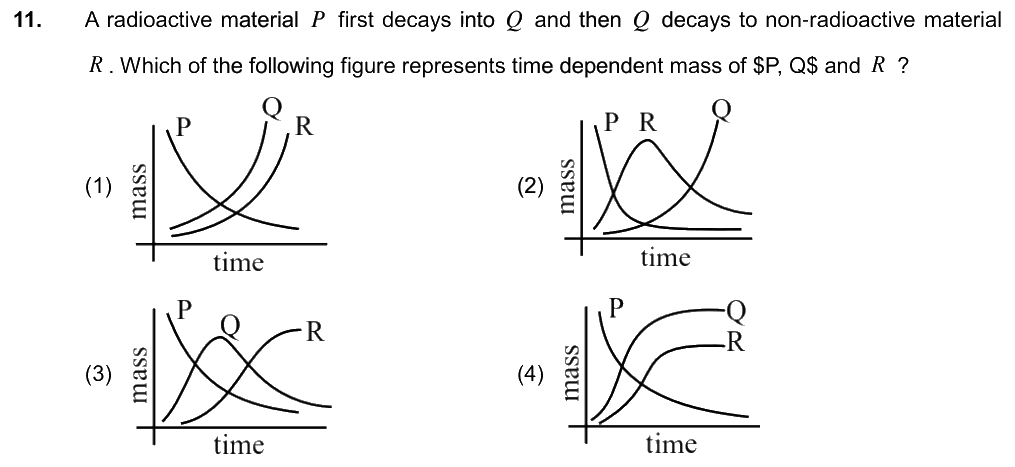
A radioactive material $P$ first decays into $Q$ and then $Q$ decays to non-radioactive material $R$. Which of the following figure represents time dependent mass of $P, Q$ and $R$ ?
The question as printed in the paper.
A
see figure axes 'mass' (vertical) and 'time' (horizontal); 'P' falls from high on the left to near the horizontal axis; 'Q' and 'R' both start low at the left and rise ever more steeply to the upper right, with Q lying above R (no maximum, no levelling off).
B
see figure same axes; 'P' falls steeply from the upper left to near zero and runs along the axis; 'R' starts low, rises to a rounded maximum a little right of the vertical axis and then falls, levelling off at a low value; 'Q' starts low and rises ever more steeply to the upper right, crossing R's curve on its way down.
C
see figure same axes; 'P' falls from high on the left, gradually, to near the horizontal axis; 'Q' starts low, rises to a rounded maximum in the left-middle and then falls, levelling off at a low value on the right; 'R' starts low, rises later and levels off at a high plateau on the right (above where Q ends).
D
see figure same axes; 'P' falls from high on the left, gradually, to near the horizontal axis; 'Q' rises quickly and levels off at the highest plateau; 'R' rises more slowly and levels off at a lower plateau, below Q's.
Choose the correct nuclear process from the below options [p: proton, n : neutron, $\mathrm{e^-}$: electron, $\mathrm{e^+}$: positron, $v$ : neutrino, $\bar{v}$ : antineutrino]
A radioactive nucleus $n_2$ has 3 times the decay constant as compared to the decay constant of another radioactive nucleus $n_1$. If initial number of both nuclei are the same, what is the ratio of number of nuclei of $n_2$ to the number of nuclei of $n_1$, after one half-life of $n_1$ ?
Given below are two statements. One is labelled as Assertion (A) and the other is labelled as Reason (R). Assertion (A) : The binding energy per nucleon is found to be practically independent of the atomic number A, for nuclei with mass numbers between 30 and 170. Reason (R): Nuclear force is long range. In the light of the above statements, choose the correct answer from the options given below :
A
(A) is true but (R) is false
B
(A) is false but (R) is true
C
Both (A) and (R) are true and (R) is the correct explanation of (A)
D
Both (A) and (R) are true but (R) is NOT the correct explanation of (A)
The energy released in the fusion of 2 kg of hydrogen deep in the sun is $E_H$ and the energy released in the fission of 2 kg of $^{235}\mathrm{U}$ is $E_U$. The ratio $\frac{E_H}{E_U}$ is approximately: (Consider the fusion reaction as $4 \mid H + 2e^- \rightarrow {}^4_2\mathrm{He} + 2v + 6\gamma + 26.7\,\mathrm{MeV}$, energy released in the fission reaction of $^{235}\mathrm{U}$ is 200MeV per fission nucleus and $\mathrm{N_A} = 6.023 \times 10^{23}$)
Binding energy of a certain nucleus is $18 \times 10^8$ J. How much is the difference between total mass of all the nucleons and nuclear mass of the given nucleus:
Which of the following nuclear fragments corresponding to nuclear fission between neutron ($^1_0\mathrm{n}$) and uranium isotope ($^{235}_{92}\mathrm{U}$) is correct :
In a nuclear fission reaction of an isotope of mass $M$, three similar daughter nuclei of same mass are formed. The speed of a daughter nuclei in terms of mass defect $\Delta M$ will be :
The explosive in a Hydrogen bomb is a mixture of ${}_1\mathrm{H}^2$, ${}_1\mathrm{H}^3$ and ${}_3\mathrm{Li}^6$ in some condensed form. The chain reaction is given by ${}_3\mathrm{Li}^6 + {}_0\mathrm{n}^1 \rightarrow {}_2\mathrm{He}^4 + {}_1\mathrm{H}^3$; ${}_1\mathrm{H}^2 + {}_1\mathrm{H}^3 \rightarrow {}_2\mathrm{He}^4 + {}_0\mathrm{n}^1$
During the explosion the energy released is approximately [Given : $M(\mathrm{Li}) = 6.01690$ amu, $M({}_1\mathrm{H}^2) = 2.01471$ amu, $M({}_2\mathrm{He}^4) = 4.00388$ amu and 1 amu = 931.5 MeV]
The atomic mass of ${}_{6}\mathrm{C}^{12}$ is 12.000000 u and that of ${}_{6}\mathrm{C}^{13}$ is 13.003354 u. The required energy to remove a neutron from ${}_{6}\mathrm{C}^{13}$, if mass of neutron is 1.008665 u, will be:
${}^{238}_{92}\mathrm{A} \rightarrow {}^{234}_{90}\mathrm{B} + {}^{4}_{2}\mathrm{D} + Q$ In the given nuclear reaction, the approximate amount of energy released will be: [Given, mass of ${}^{238}_{92}\mathrm{A}$ = 238.05079 $\times$ 931.5 MeV c$^{-2}$, mass of ${}^{234}_{90}\mathrm{B}$ = 234.04363 $\times$ 931.5 MeV c$^{-2}$, mass of ${}^{4}_{2}\mathrm{D}$ = 4.00260 $\times$ 931.5 MeV c$^{-2}$]
Given below are two statements: one is labelled as Assertion A and the other is labelled as Reason R Assertion A : The binding energy per nucleon is practically independent of the atomic number for nuclei of mass number in the range 30 to 170. Reason R : Nuclear force is short ranged. In the light of the above statements, choose the correct answer from the options given below
A
A is false but R is true
B
Both A and R are true and R is the correct explanation of A
C
Both A and R are true but R is NOT the correct explanation of A
Two radioactive elements $A$ and $B$ initially have same number of atoms. The half life of $A$ is same as the average life of $B$. If $\lambda_A$ and $\lambda_B$ are decay constants of $A$ and $B$ respectively, then choose the correct relation from the given options.
For a nucleus ${}^{A}_{Z}X$ having mass number A and atomic number Z A. The surface energy per nucleon $(b_s) = -a_1 A^{\frac{2}{3}}$. B. The Coulomb contribution to the binding energy $\mathrm{b_c} = -\mathrm{a}_2 \frac{Z(Z-1)}{A^{\frac{4}{3}}}$. C. The volume energy $b_v = a_3 A$ D. Decrease in the binding energy is proportional to surface area. E. While estimating the surface energy, it is assumed that each nucleon interacts with 12 nucleons. ($a_1$, $a_2$ and $a_3$ are constants) Choose the most appropriate answer from the options given below:
A radio active material is reduced to $\frac{1}{8}$ of its original amount in 3 days. If $8 \times 10^{-3}\ \mathrm{kg}$ of the material is left after 5 days the initial amount of the material is
Given below are two statements : one is labelled as Assertion A and the other is labelled as Reason R
Assertion A : The nuclear density of nuclides ${}^{10}_{5}B$, ${}^{6}_{3}Li$, ${}^{56}_{26}Fe$, ${}^{20}_{10}Ne$ and ${}^{209}_{83}Bi$ can be arranged as $\rho^N_{Bi} > \rho^N_{Fe} > \rho^N_{Ne} > \rho^N_B > \rho^N_{Li}$.
Reason R : The radius $R$ of nucleus is related to its mass number $A$ as $R = R_0 A^{\frac{1}{3}}$, where $R_0$ is a constant.
In the light of the above statement, choose the correct answer from the options given below :
A
Both A and R are true and R is the correct explanation of A
B
A is false but R is true
C
A is true but R is false
D
Both A and R are true but R is NOT the correct explanation of A
If a radioactive element having half-life of $30\ \mathrm{min}$ is undergoing beta decay, the fraction of radioactive element remains undecayed after $90\ \mathrm{min}$ will be :
Substance $A$ has atomic mass number 16 and half life of 1 day. Another substance $B$ has atomic mass number 32 and half life of $\frac{1}{2}$ day. If both $A$ and $B$ simultaneously start undergo radio activity at the same time with initial mass 320 g each, how many total atoms of $A$ and $B$ combined would be left after 2 days
Read the following statements: (A) Volume of the nucleus is directly proportional to the mass number. (B) Volume of the nucleus is independent of mass number. (C) Density of the nucleus is directly proportional to the mass number. (D) Density of the nucleus is directly proportional to the cube root of the mass number. (E) Density of the nucleus is independent of the mass number. Choose the correct option from the following options.
The disintegration rate of a certain radioactive sample at any instant is 4250 disintegrations per minute. 10 minutes later, the rate becomes 2250 disintegrations per minute. The approximate decay constant is (Take $\log_e 1.88 = 0.63$)
The activity of a radioactive material is $2.56 \times 10^{-3}\ \mathrm{Ci}$. If the half life of the material is 5 days, after how many days the activity will become $2 \times 10^{-5}\ \mathrm{Ci}$?
In the following nuclear reaction, $D \xrightarrow{\alpha} D_1 \xrightarrow{\beta^-} D_2 \xrightarrow{\alpha} D_3 \xrightarrow{\gamma} D_4$ Mass number of $D$ is 182 and atomic number is 74 . Mass number and atomic number of $D_4$ respectively will be
Following statements related to radioactivity are given below : (A) Radioactivity is a random and spontaneous process and is dependent on physical and chemical conditions. (B) The number of undecayed nuclei in the radioactive sample decays exponentially with time. (C) Slope of the graph of $\log_e$ (no. of undecayed nuclei) vs. time represents the reciprocal of mean life time ($\tau$) (D) Product of decay constant ($\lambda$) and half-life time $\left(T_{\frac{1}{2}}\right)$ is not constant. Choose the most appropriate answer from the options given below:
A radioactive nucleus can decay by two different processes. Half-life for the first process is $3.0$ hours while it is $4.5$ hours for the second process. The effective halflife of the nucleus will be
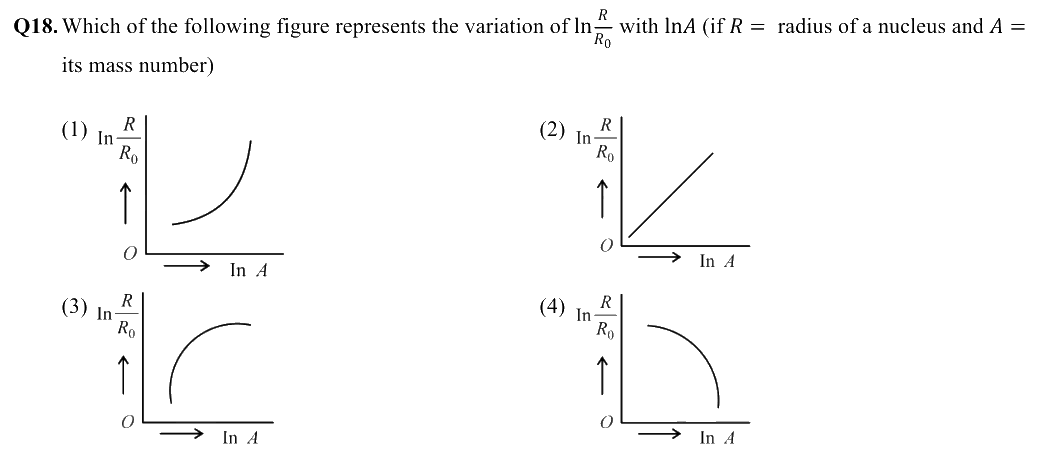
Which of the following figure represents the variation of $\ln\frac{R}{R_0}$ with $\ln A$ (if $R =$ radius of a nucleus and $A =$ its mass number)
The question as printed in the paper.
A
see figure graph: $\ln\frac{R}{R_0}$ versus $\ln A$; a curve that starts above the horizontal axis at the left and rises, curving upward ever more steeply (convex, like an exponential).
B
see figure graph: $\ln\frac{R}{R_0}$ versus $\ln A$; a straight line rising from the origin.
C
see figure graph: $\ln\frac{R}{R_0}$ versus $\ln A$; a curve that starts at the horizontal axis a little to the right of the vertical axis, rises steeply and then flattens (concave).
D
see figure graph: $\ln\frac{R}{R_0}$ versus $\ln A$; a curve that starts high on the vertical axis and falls, becoming steeper, down to the horizontal axis (like a quarter circle).
Nucleus $A$ is having mass number $220$ and its binding energy per nucleon is $5.6 \mathrm{~MeV}$. It splits in two fragments $B$ and $C$ of mass numbers $105$ and $115$. The binding energy of nucleons in $B$ and $C$ is $6.4 \mathrm{~MeV}$ per nucleon. The energy $Q$ released per fission will be:
The half life period of a radioactive element $x$ is same as the mean life time of another radioactive element $y$. Initially they have the same number of atoms. Then:
A
$x$ and $y$ decay at the same rate always.
B
$x$-will decay faster than $y$.
C
$y$-will decay faster than $x$.
D
$x$ and $y$ have same decay rate initially and later on different decay rate.
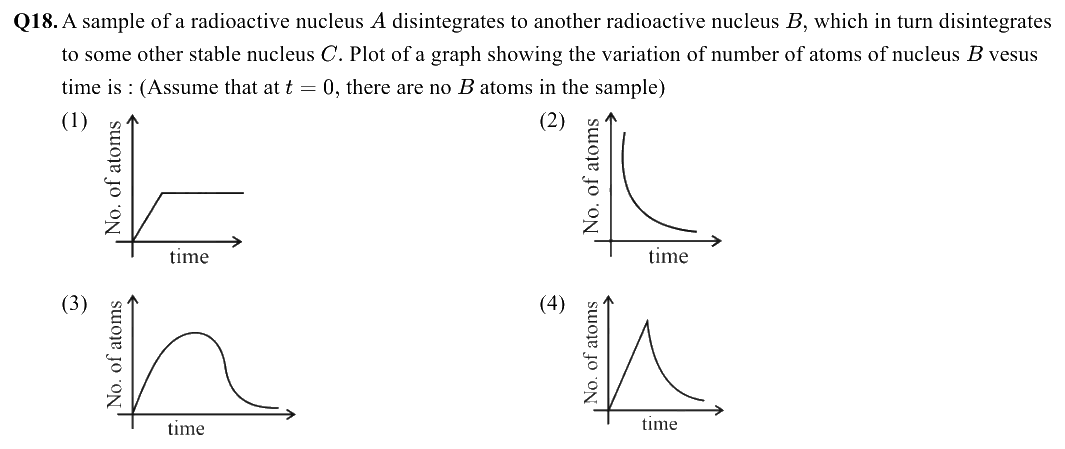
A sample of a radioactive nucleus $A$ disintegrates to another radioactive nucleus $B$, which in turn disintegrates to some other stable nucleus $C$. Plot of a graph showing the variation of number of atoms of nucleus $B$ vesus time is : (Assume that at $t = 0$, there are no $B$ atoms in the sample)
The question as printed in the paper.
A
see figure No. of atoms against time; a straight line rising from the origin, then a horizontal flat line.
B
see figure No. of atoms against time; a curve starting high on the vertical axis and falling steeply, then more slowly towards the time axis (decay curve).
C
see figure No. of atoms against time; a curve rising from the origin to a rounded maximum, then falling with a long tail towards the time axis.
D
see figure No. of atoms against time; a straight line rising from the origin to a sharp peak, then a curve falling towards the time axis.
There are $10^{10}$ radioactive nuclei in a given radioactive element. Its half-life time is $1$ min. How many nuclei will remain after $30$ s? ($\sqrt{2} = 1.414$)
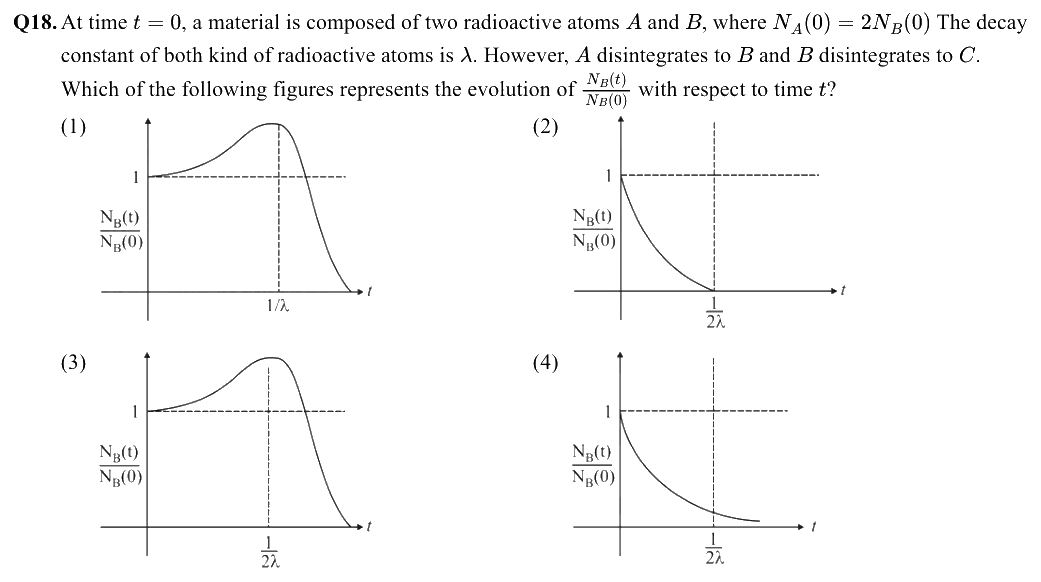
At time $t=0$, a material is composed of two radioactive atoms $A$ and $B$, where $N_A(0)=2N_B(0)$ The decay constant of both kind of radioactive atoms is $\lambda$. However, $A$ disintegrates to $B$ and $B$ disintegrates to $C$. Which of the following figures represents the evolution of $\frac{N_B(t)}{N_B(0)}$ with respect to time $t$? (see the figure above)
The question as printed in the paper.
A
see figure Graph of N_B(t)/N_B(0) against t: the curve starts at 1 on the vertical axis (dashed horizontal line at 1), rises to a single maximum above 1 at t = 1/lambda (dashed vertical line there), then falls steeply towards zero.
B
see figure Graph of N_B(t)/N_B(0) against t: the curve starts at 1 and decreases monotonically (convex), reaching about zero at t = 1/(2 lambda) (dashed vertical line there, marked 1/2lambda).
C
see figure Graph of N_B(t)/N_B(0) against t: the curve starts at 1 (dashed horizontal line at 1), rises to a single maximum above 1 at t = 1/(2 lambda) (dashed vertical line there, marked 1/2lambda), then falls steeply towards zero.
D
see figure Graph of N_B(t)/N_B(0) against t: the curve starts at 1 (dashed horizontal line at 1) and decreases monotonically (convex) without reaching zero, flattening out at a small positive level at t = 1/(2 lambda) (dashed vertical line there, marked 1/2lambda).
If $f$ denotes the ratio of the number of nuclei decayed ($N_d$) to the number of nuclei at $t = 0$, ($N_0$) then for a collection of radioactive nuclei, the rate of change of $f$ with respect to time is given as: [$\lambda$ is the radioactive decay constant]
Consider the following statements: A. Atoms of each element emit characteristics spectrum. B. According to Bohr's Postulate, an electron in a hydrogen atom revolves in a certain stationary orbit. C. The density of nuclear matter depends on the size of the nucleus. D. A free neutron is stable but a free proton decay is possible. E. Radioactivity is an indication of the instability of nuclei. Choose the correct answer from the options given below.
Some nuclei of a radioactive material are undergoing radioactive decay. The time gap between the instances when a quarter of the nuclei have decayed and when half of the nuclei have decayed is given as: (where $\lambda$ is the decay constant)
The half-life of $^{198}\mathrm{Au}$ is 3 days. If atomic weight of $^{198}\mathrm{Au}$ is $198\ \mathrm{g\ mol^{-1}}$, then the activity of $2\ \mathrm{mg}$ of $^{198}\mathrm{Au}$ is [in disintegration $\mathrm{second^{-1}}$]:
A nucleus with mass number 184 initially at rest emits an $\alpha$-particle. If the $Q$ value of the reaction is $5.5\ \mathrm{MeV}$, calculate the kinetic energy of the $\alpha-$ particle.
A radioactive material decays by simultaneous emissions of two particles with half lives of $1400$ years and $700$ years, respectively. What will be the time after the which one third of the material remains ? (Take $\ln 3 = 1.1$)
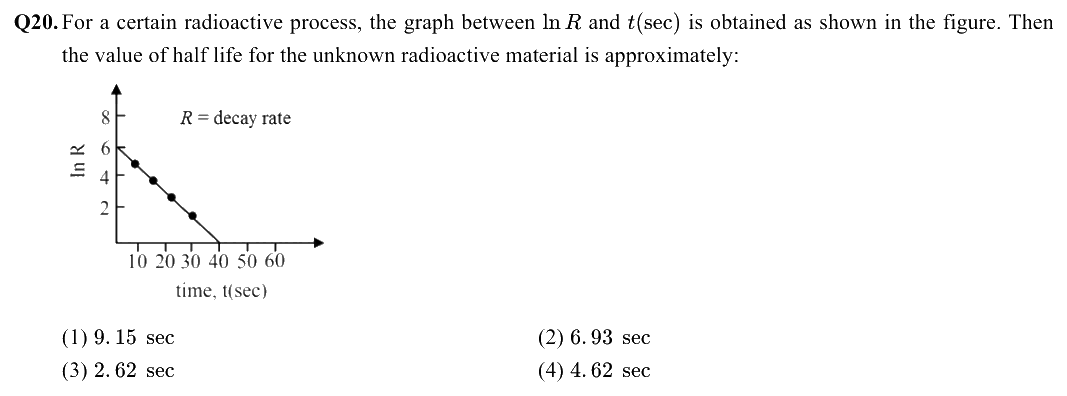
For a certain radioactive process, the graph between $\ln R$ and $t$(sec) is obtained as shown in the figure. Then the value of half life for the unknown radioactive material is approximately: (see the figure above)
A radioactive sample disintegrates via two independent decay processes having half lives $T_{1/2}^{(1)}$ and $T_{1/2}^{(2)}$ respectively. The effective half- life $T_{1/2}$ of the nuclei is :-
The half-life of $\mathrm{Au^{198}}$ is $2.7$ days. The activity of $1.50\ \mathrm{mg}$ of $\mathrm{Au^{198}}$, if its atomic weight is $198\ \mathrm{g\ mol^{-1}}$ is, $(N_A = 6 \times 10^{23}\ \mathrm{mol^{-1}})$
A radioactive sample is undergoing $\alpha$ decay, At any time $t_1$, its activity is $A$ and another time $t_2$, the activity is $\frac{A}{5}$. What is the average life time for the sample ?
Two radioactive substances $X$ and $Y$ originally have $N_1$ and $N_2$ nuclei respectively. Half life of $X$ is half of the half life of $Y$. After three half lives of $Y$, number of nuclei of both are equal. The ratio $\frac{N_1}{N_2}$ will be equal to :
You are given that $^7_3\mathrm{Li} = 7.0160\mathrm{u}$,Mass of Mass of $^4_2\mathrm{He} = 4.0026\mathrm{u}$ and Mass of $^1_1\mathrm{He} = 1.0079\mathrm{H}$ When 20g of $^7_3\mathrm{Li}$ is converted into $^4_2$ He by proton capture, the energy liberated, (in kWh ), is : [Mass of nucleon $= 1\ \mathrm{GeV}/c^2$]
Given the masses of various atomic particles $m_P = 1,0072$ u, $m_n = 1,0087$ u, $m_e = 0.000548$ u, $m_{\overline{\nu}} = 0$, $m_d = 2.0141$ u, where p =proton, n $\equiv$neutron, e $\equiv$electron, $\overline{\nu}$ $\equiv$antineutrino and $\overline{d}$ $\equiv$deuteron. Which of the following process is allowed by momentum and energy conservation :
A
$n + n \rightarrow$ deuterium atom (electron bound to the nucleus)
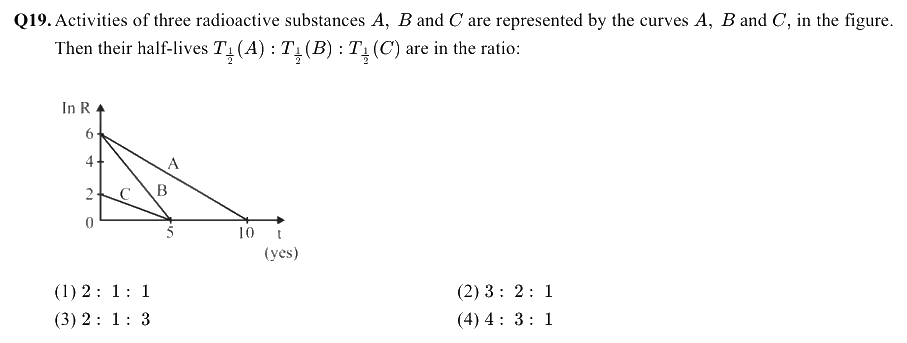
Activities of three radioactive substances $A$, $B$ and $C$ are represented by the curves $A$, $B$ and $C$, in the figure. Then their half-lives $T_{\frac{1}{2}}(A) : T_{\frac{1}{2}}(B) : T_{\frac{1}{2}}(C)$ are in the ratio: (see the figure above)
A radioactive nucleus decays by two different processes. The half-life for the first process is 10 s and that for the second is 100 s. The effective half-life of the nucleus is close to:
Find the Binding energy per nucleon for $^{120}_{50}\mathrm{Sn}$. Mass of proton $m_{p} = 1.00783\ U$, mass of neutron $m_{n} = 1.00867\ U$ and mass of tin nucleus $m_{\mathrm{sn}} = 119.902199\ U$. (take $1U\ =\ 931\ MeV$)
In a radioactive material, a fraction of active material remaining after the time $t$ is $\frac{9}{16}$ . The fraction that was remaining after the time $\frac{t}{2}$ is :
The radius R of a nucleus of mass number A can be estimated by the formula $R = (1.3\times 10^{-15})A^{1/3}\mathrm{m}$. It follows that the mass density of n nucleus is of the order of: $(M_{prot}\cong M_{neut}\simeq 1.67\times 10^{-27}\ \mathrm{kg})$
In a reactor, $2\ \mathrm{kg}$ of $_{92}\mathrm{U}^{235}$ fuel is fully used up in 30 days. The energy released fission is $200\ \mathrm{MeV}$. Given that the Avogadro number, $\mathrm{N} = 6.023 \times 10^{26}$ per kilo mole and $1\ \mathrm{eV} = 1.6 \times 10^{-19}\ \mathrm{J}$. The power output of the reactor is close to:
Half lives of two radioactive nuclei A and B are 10 minutes and 20 minutes, respectively. If, initially a sample has equal number of nuclei, then after 60 minutes, the ratio of decayed numbers of nuclei A and B will be:
Two radioactive materials A and B have decay constants $10\lambda$ and $\lambda$ , respectively. If initially they have the same number of nuclei, then the ratio of the number of nuclei of A to that of B will be 1/e after a time:
Two radioactive substances A and B have decay constants $5\lambda$ and $\lambda$ respectively. At $t = 0$, a sample has the same number of the two nuclei. The time taken for the ratio of the number of nuclei to become $\frac{1}{e}^{2}$ will be
In a radioactive decay chain, the initial nucleus is $^{232}_{90}\mathrm{Th}$. At the end, there are 6 $\alpha$-particles and $4\beta$-particles which are emitted. If the end nucleus is $^{A}_{Z}\mathrm{X}$, $A$ and $Z$ are given by:
Using a nuclear counter the count rate of emitted particles from a radioactive source is measured. At $t = 0$ it was 1600 counts per second and $t = 8$ seconds it was 100 counts per second. The count rate observed, as counts per second, at $t = 6$ seconds is close to:
A Sample of radioactive material $A$, that has an activity of $10\ m\ \ Ci\ 1\ Ci = 3.7\times10^{10}\ \ \mathrm{decays\ s^{-1}}$, has twice the number of nuclei as another sample of a different radioactive material $B$ which has an activity of $20\ m\ \ Ci$. The correct choices for half-lives of $A$ and $B$ would then be, respectively:
At a given instant, say $t = 0$, two radioactive substance $A$ and $B$ have equal activities. The ratio $\dfrac{R_B}{R_A}$ of their activities after time $t$ itself decays with time $t$ as $e^{-3t}$. If the half-life of $A$ is $ln2$, the half-life of $B$ is:
Both the nucleus and the atom of some element are in their respective first excited states. They get de-excited by emitting photons of wavelengths $\lambda_N$, $\lambda_A$ respectively. The ratio $\frac{\lambda_N}{\lambda_A}$ is closest to:
At some instant, a radioactive sample $S_1$ having an activity $5\mu\mathrm{Ci}$ has twice the number of nuclei as another sample $S_2$ which has an activity of $10\mu\mathrm{Ci}$. The half lives of $S_1$ and $S_2$ are :
A solution containing active cobalt ${}^{60}_{27}\mathrm{Co}$ having activity of $0.8\mu\mathrm{Ci}$ and decay constant $\lambda$ is injected in an animal's body. If $1\ \mathrm{cm}^3$ of blood is drawn from the animal's body after 10hrs of injection, the activity found was 300 decays per minute. What is the volume of blood that is flowing in the body? ($1\mathrm{Ci} = 3.7 \times 10^{10}$ decay per second and at $t = 10\mathrm{hrs}$ $e^{-\lambda t} = 0.84$)
An unstable heavy nucleus at rest breaks into two nuclei which move away with velocities in the ratio of $8:27$ . The ratio of the radii of the nuclei (assumed to be spherical ) is:
Imagine that a reactor converts all the given mass into energy and that it operates at a power level of $10^9$ Watt. The mass of the fuel consumed per hour, in the reactor, will be: (velocity of light, $c$ is $3 \times 10^8\ \mathrm{m\,s^{-1}}$)
Two deuterons undergo nuclear fusion to form a Helium nucleus. The energy released in this process is (given binding energy per nucleon for deuteron= 1.1 MeV and for helium= 7.0 MeV)
A radioactive nucleus $A$ with a half-life $T$, decays into a nucleus $B$. At $t = 0$, there is no nucleus $B$. At some time $t$, the ratio of the number of $B$ to that of $A$ is $0.3$. Then, $t$ is given by: Consider $\log_e x = \log x$
Half-lives of two radioactive elements A and B are 20 minutes and 40 minutes, respectively. Initially, the samples have an equal number of nuclei. After 80 minutes, the ratio of decayed numbers of A and B nuclei will be:
Let $N_\beta$ be the number of $\beta$ particle emitted by 1 gram of $\mathrm{Na}^{24}$ radioactive nuclei having a half life of 15 h. In 7.5 h, the number $N_\beta$ is close to $\left[N_\mathrm{A} = 6.023 \times 10^{23}\ \mathrm{mole}^{-1}\right]$
A piece of wood from a recently cut tree shows 20 decays per minute. A wooden piece of the same size placed in a museum (obtained from a tree cut many years back) shows 2 decays per minute. If the half-life of $\mathrm{C^{14}}$ is $5730$ years, then the age of the wooden piece placed in the museum is approximately
A piece of bone of an animal from a ruin is found to have $^{14}\mathrm{C}$ activity of 12 disintegrations per minute per gm of its carbon content. The $^{14}\mathrm{C}$ activity of a living animal is 16 disintegrations per minute per gm. How long ago nearly did the animal die? (Given half life of $^{14}\mathrm{C}$ is $\mathrm{t_{1/2}} = 5760$ years)
A radioactive nuclei with decay constant $0.5/\mathrm{s}$ is being produced at a constant rate of 100 nuclei/s. If at $t = 0$ there were no nuclei, the time when there are 50 nuclei is:
The half-life of a radioactive element A is the same as the mean-life of another radioactive element B. Initially both substances have the same number of atoms, then :
When Uranium is bombarded with neutrons, it undergoes fission. The fission reaction can be written as : $_{92}\mathrm{U}^{235} + {}_0n^1 \rightarrow {}_{56}\mathrm{Ba}^{141} + {}_{36}\mathrm{Kr}^{92} + 3x + Q$( energy) where three particles named $x$ are produced and energy Q is released. What is the name of the particle $x$ ?
The counting rate observed from a radioactive source at $t = 0$ was 1600 counts s$^{-1}$, and $t = 8$ s, it was 100 counts s$^{-1}$. The counting rate observed as counts s$^{-1}$ at $t = 6$ s will be
The decay constants of a radioactive substance for $\alpha$ and $\beta$ emission are $\lambda_\alpha$ and $\lambda_\beta$ respectively. If the substance emits $\alpha$ and $\beta$ simultaneously, then the average half life of the material will be
A sample originally contained $10^{20}$ radioactive atoms, which emit $\alpha$-particles. The ratio of $\alpha$ particles emitted in the third year to that emitted during the second year is 0.3. How many $\alpha$ particles were emitted in the first year?
The half life of a radioactive substance is $20$ minutes. The approximate time interval $(t_2 - t_1)$ between the time $t_2$ when $\frac{2}{3}$ of it has decayed and time $t_1$ and $\frac{1}{3}$ of it had decayed is :
A nucleus of mass $M + \Delta m$ is at rest and decays into two daughter nuclei of equal mass $\frac{M}{2}$ each. Speed of light is c. 40. The binding energy per nucleon for the parent nucleus is $E_1$ and that for the daughter nuclei is $E_2$. Then
A nucleus of mass $M + \Delta m$ is at rest and decays into two daughter nuclei of equal mass $\frac{M}{2}$ each. Speed of light is C. The speed of daughter nuclei is
A radioactive nucleus (initial mass number $A$ and atomic number Z) emits $3\alpha$-particles and 2 positrons. The ratio of number of neutrons to that of protons in the final nucleus will be
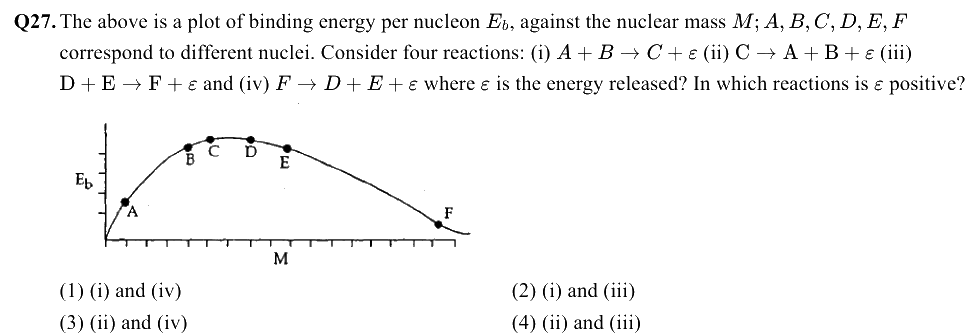
The above is a plot of binding energy per nucleon $E_b$, against the nuclear mass $M$; $A, B, C, D, E, F$ correspond to different nuclei. Consider four reactions: (i) $A + B \to C + \varepsilon$ (ii) C $\to$ A $+$ B $+ \varepsilon$ (iii) D $+$ E $\to$ F $+ \varepsilon$ and (iv) $F \to D + E + \varepsilon$ where $\varepsilon$ is the energy released? In which reactions is $\varepsilon$ positive? (see the figure above)
This question contains Statement $-1$ and Statement-2. Of the four choices given after the statements, choose the one that best describes the two statements. Statement - I: Energy is released when heavy nuclei undergo fission or light nuclei undergo fusion. and Statement - II For heavy nuclei, binding energy per nucleon increases with increasing $Z$ while for light nuclei it decrease with increasing $Z$.
A
Statement $-1$ is false, Statement $-2$ is true.
B
Statement - 1is true, Statement $-2$ is true; Statement $-2$ is correct explanation for Statement-1.
C
Statement $-1$ is true, Statement $-2$ is true; Statement $-2$ is not a correct explanation for Statement-1.
If $\mathrm{M_o}$ is the mass of an oxygen isotope ${}_8\mathrm{O}^{17}$, $\mathrm{M_P}$ and $\mathrm{M_N}$ are the masses of a proton and a neutron respectively, the nuclear binding energy of the isotope is
The half-life period of a radio-active element X is same as the mean life time of another radioactive element Y . Initially they have the same number of atoms. Then
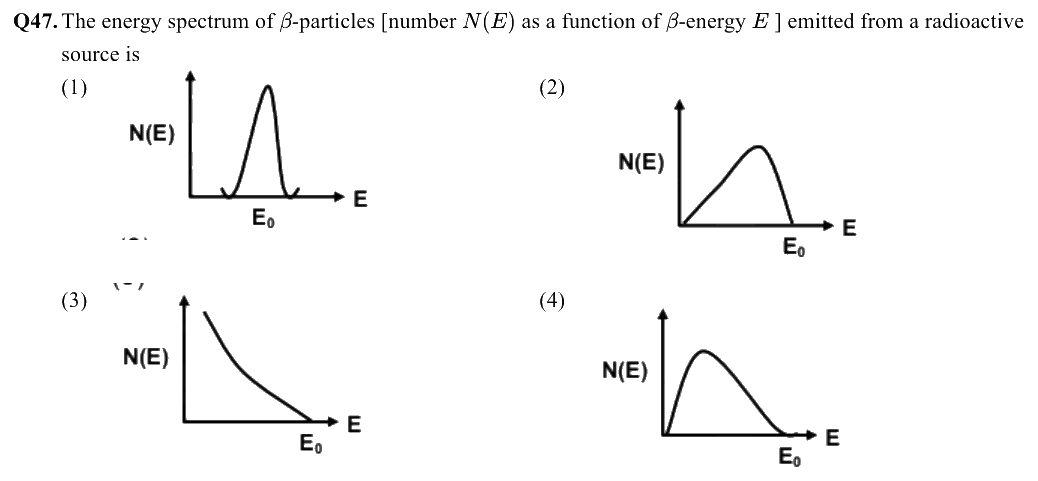
The energy spectrum of $\beta$-particles [number $N(E)$ as a function of $\beta$-energy $E$ ] emitted from a radioactive source is
(see the figure above)
The question as printed in the paper.
A
see figure N(E) against E graph: a narrow, symmetric bell-shaped peak that starts from the axis, rises to a sharp maximum and falls back to the axis; the label $E_0$ is on the E axis just below the peak.
B
see figure N(E) against E graph: a curve that rises roughly linearly from the origin to a rounded maximum (at about two-thirds of the way to $E_0$) and then falls steeply to the E axis at $E_0$, which is marked on the axis at the right end of the curve.
C
see figure N(E) against E graph: a curve that starts high on the N(E) axis side (at a small non-zero E) and falls monotonically, convex, to meet the E axis at $E_0$.
D
see figure N(E) against E graph: a curve that rises steeply from the origin to a maximum at low E (about a quarter of the way to $E_0$) and then falls gradually, with a long tail, to the E axis at $E_0$.
If the binding energy per nucleon in $^7_3\mathrm{Li}$ and $^4_2\mathrm{He}$ nuclei are 5.60MeV and 7.06MeV respectively, then in the reaction $\mathrm{p} + {}^7_3\mathrm{Li} \rightarrow 2\,{}^4_2\mathrm{He}$ energy of proton must be
The intensity of gamma radiation from a given source is I. On passing through 36 mm of lead, it is reduced to $\frac{I}{8}$. The thickness of lead which will reduce the intensity to $\frac{I}{2}$ will be
The binding energy per nucleon of deuteron ($^2_1$H) and helium nucleus ($^4_2$He) is 1.1MeV and 7MeV respectively. If two deuteron nuclei react to form a single helium nucleus, then the energy released is
A radioactive sample at any instant has its disintegration rate 5000 disintegrations per minute. After 5 minutes, the rate is 1250 disintegrations per minute. Then, the decay constant (per minute) is
A nucleus with Z = 92 emits the following in a sequence: $\alpha, \beta^-, \beta^- \alpha, \alpha, \alpha, \alpha, \alpha, \beta^-, \beta^-, \alpha, \beta^+, \beta^+, \alpha$. Then Z of the resulting nucleus is
At a specific instant emission of radioactive compound is deflected in a magnetic field. The compound can emit (i) electrons (ii) protons (iii) $\mathrm{He^{2+}}$ (iv) neutrons The emission at instant can be
If $\mathrm{N_0}$ is the original mass of the substance of half- life period $\mathrm{t_{1/2}}$ = 5 years, then the amount of substance left after 15 years is
The energy released when $\dfrac{7}{17.13}$ kg of $^7_3\mathrm{Li}$ is converted into $^4_2\mathrm{He}$ by proton bombardment is $\alpha\times10^{32}$ eV. The value of $\alpha$ is ________. (Nearest integer) (Mass of $^7_3\mathrm{Li} = 7.0183$ u, mass of $^4_2\mathrm{He} = 4.004$ u, mass of proton = 1.008 u and 1 u = 931 MeV/c$^2$ and Avogadro number = $6.0\times10^{23}$)
Numerical answer type: type your answer in EdLoop to check it
The average energy released per fission for the nucleus of ${}^{235}_{92}\mathrm{U}$ is 190 MeV. When all the atoms of 47 g pure ${}^{235}_{92}\mathrm{U}$ undergo fission process, the energy released is $\alpha \times 10^{23}$ MeV. The value of $\alpha$ is ________.
(Avogadro Number $= 6 \times 10^{23}$ per mole)
Numerical answer type: type your answer in EdLoop to check it
A star has 100% helium composition. It starts to convert three $^{4}$He into one $^{12}$C via triple alpha process as $^{4}\mathrm{He} + {}^{4}\mathrm{He} + {}^{4}\mathrm{He} \rightarrow {}^{12}\mathrm{C} + \mathrm{Q}$. The mass of the star is $2.0 \times 10^{32}$ kg and it generates energy at the rate of $5.808 \times 10^{30}$ W. The rate of converting these $^{4}$He to $^{12}$C is n $\times\ 10^{42}\ \mathrm{s^{-1}}$, where n is ______ [ Take, mass of $^{4}$He = 4.0026u, mass of $^{12}$C = 12u ]
Numerical answer type: type your answer in EdLoop to check it
If three helium nuclei combine to form a carbon nucleus then the energy released in this reaction is ______ $\times 10^{-2}$MeV. (Given 1u = 931MeV/$c^2$, atomic mass of helium = 4.002603u )
Numerical answer type: type your answer in EdLoop to check it
The disintegration energy $Q$ for the nuclear fission of $^{235}\mathrm{U} \rightarrow {}^{140}\mathrm{Ce} + {}^{94}\mathrm{Zr} + n$ is ______ MeV. Given atomic masses of $^{235}\mathrm{U}$ : 235.0439$u$; $^{140}\mathrm{Ce}$ : 139.9054$u$, $^{94}\mathrm{Zr}$ : 93.9063$u$; $n$ : 1.0086$u$, Value of $c^2$ = 931MeV/u
Numerical answer type: type your answer in EdLoop to check it
The radius of a nucleus of mass number 64 is 4.8 fermi. Then the mass number of another nucleus having radius of 4 fermi is $\frac{1000}{x}$, where $x$ is ______.
Numerical answer type: type your answer in EdLoop to check it
The mass defect in a particular reaction is 0.4 g. The amount of energy liberated is $n \times 10^7$ kW h, where $n =$ ______. (speed of light = $3 \times 10^8$ m s$^{-1}$)
Numerical answer type: type your answer in EdLoop to check it
A nucleus has mass number $A_1$ and volume $V_1$. Another nucleus has mass number $A_2$ and volume $V_2$. If relation between mass number is $A_2 = 4A_1$, then $\frac{V_2}{V_1} =$ ______.
Numerical answer type: type your answer in EdLoop to check it
In a nuclear fission process, a high mass nuclide ($A \approx 236$) with binding energy 7.6 MeV /Nucleon dissociated into two middle mass nuclides ($A \approx 118$), having binding energy of 8.6 MeV /Nucleon. The energy released in the process would be ______ MeV.
Numerical answer type: type your answer in EdLoop to check it
A common example of alpha decay is $^{238}_{92}\mathrm{U} \rightarrow\, ^{234}_{90}\mathrm{Th} +\, _{2}\mathrm{He}^{4} + Q$ Given: $^{238}_{92}\mathrm{U} = 238.05060$ u $^{234}_{90}\mathrm{Th} = 234.04360$ u $^{4}_{2}\mathrm{He} = 4.00260$ u and $1\mathrm{u} = 931.5\ \frac{\mathrm{MeV}}{c^2}$ The energy released $(Q)$ during the alpha decay of $^{238}_{92}\mathrm{U}$ is ______ MeV.
Numerical answer type: type your answer in EdLoop to check it
A nucleus disintegrates into two nuclear parts, in such a way that ratio of their nuclear sizes is $1 : 2^{1/3}$. Their respective speed have a ratio of $n : 1$. The value of $n$ is ______
Numerical answer type: type your answer in EdLoop to check it
The decay constant for a radioactive nuclide is $1.5 \times 10^{-5}\ \mathrm{s^{-1}}$. Atomic weight of the substance is $60\ \mathrm{g\,mole^{-1}}$, $N_A = 6 \times 10^{23}$. The activity of $1.0\ \mu\mathrm{g}$ of the substance is ______ $\times 10^{10}$ Bq.
Numerical answer type: type your answer in EdLoop to check it
A nucleus with mass number 242 and binding energy per nucleon as $7.6\ \mathrm{MeV}$ breaks into two fragment each with mass number 121. If each fragment nucleus has binding energy per nucleon as $8.1\ \mathrm{MeV}$, the total gain in binding energy is ______ MeV.
Numerical answer type: type your answer in EdLoop to check it
Nucleus $A$ having $Z$ = 17 and equal number of protons and neutrons has 1.2 MeV binding energy per nucleon. Another nucleus $B$ of $Z$ = 12 has total 26 nucleons and 1.8 MeV binding energy per nucleons. The difference of binding energy of $B$ and $A$ will be ______ MeV.
Numerical answer type: type your answer in EdLoop to check it
A radioactive nucleus decays by two different process. The half life of the first process is 5 minutes and that of the second process is 30 s. The effective half-life of the nucleus is calculated to be $\frac{\alpha}{11}$ s. The value of $\alpha$ is ______.
Numerical answer type: type your answer in EdLoop to check it
A radioactive element ${}^{242}_{92}\mathrm{X}$ emits two $\alpha$-particles, one electron and two positrons. The product nucleus is represented by ${}^{234}_{\mathrm{P}}\mathrm{Y}$. The value of $P$ is ______.
Numerical answer type: type your answer in EdLoop to check it
A nucleus disintegrates into two smaller parts, which have their velocities in the ratio 3 : 2. The ratio of their nuclear sizes will be $\left(\frac{x}{3}\right)^{\frac{1}{3}}$. The value of 'x' is:
Numerical answer type: type your answer in EdLoop to check it
Assume that protons and neutrons have equal masses. Mass of a nucleon is $1.6\times10^{-27}$ kg and radius of nucleus is $1.5\times10^{-15}A^{\frac{1}{3}}$ m. The approximate ratio of the nuclear density and water density is $n\times10^{13}$. The value of n is ______.
Numerical answer type: type your answer in EdLoop to check it
The energy released per fission of nucleus of $^{240}\mathrm{X}$ is 200 MeV. The energy released if all the atoms in 120 g of pure $^{240}\mathrm{X}$ undergo fission is ______$\times10^{25}$ MeV.
(Given $N_A=6\times10^{23}$)
Numerical answer type: type your answer in EdLoop to check it
Two radioactive materials $A$ and $B$ have decay constants $25\lambda$ and $16\lambda$ respectively. If initially they have the same number of nuclei, then the ratio of the number of nuclei of $B$ to that of $A$ will be "$e$" after a time $\frac{1}{a\lambda}$. The value of $a$ is ______.
Numerical answer type: type your answer in EdLoop to check it
A freshly prepared radioactive source of half life 2 hours 30 minutes emits radiation which is 64 times the permissible safe level. The minimum time, after which it would be possible to work safely with source, will be ______ hours.
Numerical answer type: type your answer in EdLoop to check it
Two lighter nuclei combine to form a comparatively heavier nucleus by the relation given below: $^{2}_{1}X + ^{2}_{1}X = ^{4}_{2}Y$ The binding energies per nucleon of $^{2}_{1}X$ and $^{4}_{2}Y$ are $1.1$MeV and $7.6$MeV respectively. The energy released in this process is ______ MeV.
Numerical answer type: type your answer in EdLoop to check it
The half life of a radioactive substance is 5 years. After $x$ years a given sample of the radioactive substance gets reduced to $6.25\%$ of its initial value. The value of $x$ is ______
Numerical answer type: type your answer in EdLoop to check it
A sample contains $10^{-2} \mathrm{~kg}$ each of two substances $A$ and $B$ with half lives $4 \mathrm{~s}$ and $8 \mathrm{~s}$ respectively. The ratio of their atomic weights is $1 : 2$. The ratio of the amounts of $A$ and $B$ after $16 \mathrm{~s}$ is $\frac{x}{100}$. The value of $x$ is ______ .
Numerical answer type: type your answer in EdLoop to check it
From the given data, the amount of energy required to break the nucleus of aluminium ${}^{27}_{13}\mathrm{Al}$ is ______ $x \times 10^{-3}\ \mathrm{J}$ Mass of neutron $= 1.00866\ \mathrm{u}$ Mass of proton $= 1.00726\ \mathrm{u}$ Mass of Aluminium nucleus $= 27.18846\ \mathrm{u}$ (Assume $1\ \mathrm{u}$ corresponds to $x\ J$ of energy) (Round off to the nearest integer)
Numerical answer type: type your answer in EdLoop to check it
The nuclear activity of a radioactive element becomes $\left(\frac{1}{8}\right)^{\mathrm{th}}$ of its initial value in $30$ years. The half-life of radioactive element is ______ years.
Numerical answer type: type your answer in EdLoop to check it
A radioactive substance decays to $\left(\frac{1}{16}\right)^{\mathrm{th}}$ of its initial activity in 80 days. The half life of the radioactive substance expressed in days is ______ .
Numerical answer type: type your answer in EdLoop to check it
Nuclei deals with nuclear binding energy and reactions under Unit 18: Atoms and Nuclei in the Class 12 curriculum, holding rank 23 among the 29 physics chapters with a 2.6 percent share of total physics questions. In the computerized exam period from 2019 to 2026, candidates solved 120 questions from nuclei across 162 papers, representing an average frequency of 0.7 questions per session. The chapter appeared in 104 of those 162 papers, and questions were featured every single year. Examining the three years from 2024 to 2026 reveals 39 questions in 58 papers, maintaining 0.7 questions per test and a 2.5 percent subject share. The chapter's share is down compared to the 2002 to 2018 window, which logged 44 questions across 38 papers for a 3.3 percent share. Measured against the full 2019 to 2026 baseline, its recent share has stayed about the same. In 2026 alone, examiners presented 13 questions across 19 papers, featured in 12 separate shifts. Exactly 27 questions from 2019 to 2026 required numerical answers, with students calculating fission yields, mass defects, and nuclear radius ratios.
Most-asked topics
The chapter distributes questions across three core subtopics:
Radioactivity: 85 questions historically, with 57 asked between 2019 and 2026, tested up to 2026. This area examines exponential radioactive decay laws, half-life and mean life relations, alpha and beta decay energy splits, Q-value apportionment, and decay chain branching.
Nuclear Structure: 50 total questions, including 38 from 2019 to 2026, continuing into 2026. Themes assess the nuclear radius scaling law R proportional to mass number A to the one-third power, constant nuclear density, mass defect calculations, binding energy per nucleon curves, and isobar identification.
Nuclear Reactions: 29 lifetime problems, with 25 concentrated between 2019 and 2026, tested through 2026. Problems evaluate energy released in binary fusion, uranium-235 fission energy calculations, Q-value evaluations from atomic masses, and threshold reaction energies.
What the questions look like
Questions in nuclei balance conceptual binding energy evaluations with quantitative mass energy conversions:
Nuclear radius and area scaling: Comparing the radii or surface areas of two nuclei whose mass numbers differ by a known factor, applying the cube root relation of atomic mass numbers.
Total energy released in nuclear fission: Calculating the cumulative thermal energy liberated when a specified mass of uranium-235 undergoes complete fission, given the average energy yielded per individual event.
Alpha decay kinetic energy partitioning: Two parent nuclei of differing mass numbers undergo alpha decay with identical reaction Q-values. Students use momentum conservation to compare the kinetic energies carried away by the resulting alpha particles.
Binding energy per nucleon curve interpretation: Analyzing the stability of light nuclei fusing into heavier isotopes or heavy nuclei undergoing fission based on position along the binding energy curve.
Master the cube root scaling law for nuclear dimensions. Nuclear radius R equals R zero multiplied by mass number A to the power one-third. Because nuclear volume is directly proportional to mass number A, nuclear mass density remains approximately constant across all stable nuclei.
Be fluent with mass defect and binding energy calculations. Sum the masses of individual constituent protons and neutrons, subtract the measured nuclear mass, and convert the resulting mass defect in unified atomic mass units into mega-electronvolts.
For radioactive decay, express remaining nuclei as N zero multiplied by one-half raised to the power of the number of elapsed half-lives. In alpha decays, remember that the alpha particle receives a fraction equal to A minus four divided by A of the total reaction Q-value.
Frequently asked questions
Has radioactivity been removed from the recent JEE Main syllabus?
While certain syllabus revisions have compressed modern physics descriptions, radioactivity decay kinetics and alpha decay Q-value problems continue to appear in 2026 papers.
How do I remember the kinetic energy split in alpha decay?
By conservation of linear momentum, the daughter nucleus and alpha particle carry equal and opposite momenta. Since kinetic energy equals momentum squared divided by two times mass, the lighter alpha particle takes the majority of the energy, specifically A minus four over A times Q.
What is the most critical curve to memorize in nuclei?
The binding energy per nucleon versus mass number curve is essential. It peaks near mass number fifty-six for iron and declines toward both lighter elements and heavy actinide nuclei, explaining why fusion occurs for light nuclei and fission for heavy nuclei. Step-by-step solutions for each one are in the EdLoop app.