A new unit ($\alpha$) of length is chosen such that it is equal to the speed of light in vacuum. What is the distance between Venus and Earth in terms of $\alpha$ units if light takes 6 min. 40 s to cover this distance ?
The density $\rho$ of a uniform cylinder is determined by measuring its mass $m$, length $l$ and diameter $d$. The measured values of $m$, $l$ and $d$ are $97.42 \pm 0.02$ g, $8.35 \pm 0.05$ mm and $20.20 \pm 0.02$ mm, respectively. Calculated percentage fractional error in $\rho$ is ________.
The potential energy of a particle changes with distance $x$ from a fixed origin as $V = \dfrac{A\sqrt{x}}{x + B}$, where $A$ and $B$ are constant with appropriate dimensions. The dimensions of $AB$ are ________.
In a Vernier calipers, when both jaws touch each other, zero of the Vernier scale is shifted to the right of zero of the main scale and 7$^{\text{th}}$ Vernier division coincides with a main scale reading. If the value of 1 main scale division is 1 mm and there are 10 Vernier scale divisions, then the Vernier caliper has
$L$, $C$ and $R$ represents physical quantities inductance, capacitance and resistance respectively. The dimensional formula $\mathrm{M\,L^2\,T^{-4}\,A^{-2}}$ corresponds to ________.
In an experiment to determine the resistance of a given wire using Ohm's law, the voltmeter and ammeter readings are noted as 10 V and 5 A, respectively. The least counts of voltmeter and ammeter are 500 mV and 200 mA, respectively. The estimated error in the resistance measurement is ________ $\Omega$.
In a screw gauge when the circular scale is given five complete rotations it moves linearly by 2.5 mm. If the circular scale has 100 divisions, the least count of screw gauge is ________ mm.
The dimensional formula of $\frac{1}{2}\epsilon_o E^2$ ($\epsilon_o$ = permittivity of vacuum and E = electric field) is $\mathrm{M^aL^bT^c}$. The value of $2a - b + c =$ ________.
The diameter of a wire measured by a screw gauge of least count 0.001 cm is 0.08 cm. The length measured by a scale of least count 0.1 cm is 150 cm. When a weight of 100 N is applied to the wire, the extension in length is 0.5 cm, measured by a micrometer of least count 0.001 cm. The error in the measured Young's modulus is $\alpha \times 10^9$ N/m$^2$. The value of $\alpha$ is ________. (Ignore the contribution of the load to Young's modulus error calculation)
In a screw gauge the zero of main scale reference line coincides with the fifth division of the circular scale when two studs are in contact. There are 100 divisions in circular scale and pitch of screw gauge is 0.1 mm. When diameter of a sphere is measured, the reading of main scale is 5 mm and 50$^{\text{th}}$ division of circular scale coincides with the reference line of main scale. The diameter of sphere is ________ mm.
When both jaws of vernier callipers touch each other, zero mark of the vernier scale is right to zero mark of main scale, 4$^{th}$ mark on vernier scale coincides with certain mark on the main scale. While measuring the length of a cylinder, observer observes 15 divisions on main scale and 5$^{th}$ division of vernier scale coincides with a main scale division. Measured length of cylinder is ________ mm. (Least count of Vernier calliper = 0.1 mm)
The time period of a simple harmonic oscillator is $T = 2\pi\sqrt{\dfrac{k}{m}}$. Measured value of mass ($m$) of the object is 10 g with an accuracy of 10 mg and time for 50 oscillations of the spring is found to be 60 s using a watch of 2 s resolution. Percentage error in determination of spring constant ($k$) is ________ %.
In an experiment, a set of reading are obtained as follows - 1.24 mm, 1.25 mm, 1.23 mm, 1.21 mm. The expected least count of the instrument used in recording these readings is ________ mm.
In a vernier callipers, 50 vernier scale divisions are equal to 48 main scale divisions. If one main scale division $= 0.05$ mm, then the least count of the vernier callipers is ________ mm.
Four persons measure the length of a rod as 20.00 cm, 19.75 cm, 17.01 cm and 18.25 cm. The relative error in the measurement of average length of the rod is :
In a screw gauge, the zero of the circular scale lies 3 divisions above the horizontal pitch line when their metallic studs are brought in contact. Using this instrument thickness of a sheet is measured. If pitch scale reading is 1 mm and the circular scale reading is 51 then the correct thickness of the sheet is ________ mm.
If $\epsilon$, $E$ and $t$ represent the free space permittivity, electric field and time respectively, then the unit of $\dfrac{\epsilon E}{t}$ will be :
In an experiment the values of two spring constants were measured as $k_1 = (10 \pm 0.2)$ N/m and $k_2 = (20 \pm 0.3)$ N/m. If these springs are connected in parallel, then the percentage error in equivalent spring constant is :
A spherical body of radius $r$ and density $\sigma$ falls freely through a viscous liquid having density $\rho$ and viscosity $\eta$ and attains a terminal velocity $v_o$. Estimated maximum error in the quantity $\eta$ is : (Ignore errors associated with $\sigma$, $\rho$ and $g$, gravitational acceleration)
A quantity Q is formulated as $X^{-2}Y^{+\frac{3}{2}}Z^{-\frac{2}{5}}$. X, Y and Z are independent parameters which have fractional errors of 0.1, 0.2 and 0.5, respectively in measurement. The maximum fractional error of Q is
In an electromagnetic system, the quantity representing the ratio of electric flux and magnetic flux has dimension of $M^PL^QT^RA^S$, where value of ' Q ' and ' R ' are
For the determination of refractive index of glass slab, a travelling microscope is used whose main scale contains 300 equal divisions equals to 15 cm. The vernier scale attached to the microscope has 25 divisions equals to 24 divisions of main scale. The least count (LC) of the travelling microscope is (in cm) :
In an electromagnetic system, a quantity defined as the ratio of electric dipole moment and magnetic dipole moment has dimension of $\left[M^PL^QT^RA^S\right]$. The value of P and Q are :
A person measures mass of 3 different particles as 435.42g, 226.3 g and 0.125 g. According to the rules for arithmetic operations with significant figures, the addition of the masses of 3 particles will be.
The equation for real gas is given by $\left(P + \frac{a}{V^2}\right)(V - b) = RT$, where P, V, T and $R$ are the pressure, volume, temperature and gas constant, respectively. The dimension of $ab^{-2}$ is equivalent to that of :
If $\mu_0$ and $\epsilon_0$ are the permeability and permittivity of free space, respectively, then the dimension of $\left(\frac{1}{\mu_0\epsilon_0}\right)$ is:
The expression given below shows the variation of velocity ($v$) with time (t), $v = \mathrm{At^2} + \frac{\mathrm{Bt}}{\mathrm{C} + \mathrm{t}}$. The dimension of ABC is :
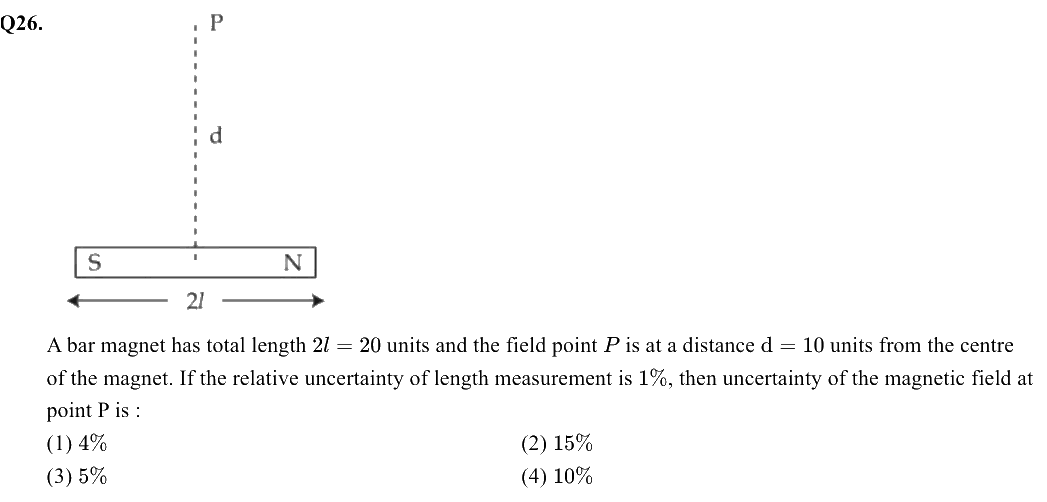
see figure A bar magnet has total length $2l = 20$ units and the field point $P$ is at a distance d = 10 units from the centre of the magnet. If the relative uncertainty of length measurement is 1%, then uncertainty of the magnetic field at point P is :
For an experimental expression $y = \frac{32.3 \times 1125}{27.4}$, where all the digits are significant. Then to report the value of $y$ we should write
The position of a particle moving on $x$-axis is given by $x(t) = A\sin t + B\cos^2 t + Ct^2 + D$, where $t$ is time. The dimension of $\frac{ABC}{D}$ is
The electric flux is $\phi = \alpha\sigma + \beta\lambda$ where $\lambda$ and $\sigma$ are linear and surface charge density, respectively. $\left(\frac{\alpha}{\beta}\right)$ represents
The energy of a system is given as $\mathrm{E(t)} = \alpha^3\mathrm{e}^{-\beta t}$, where t is the time and $\beta = 0.3\ \mathrm{s}^{-1}$. The errors in the measurement of $\alpha$ and $t$ are 1.2% and 1.6%, respectively. At $t = 5$ s, maximum percentage error in the energy is :
Given below are two statements : Statement I : In a vernier callipers, one vernier scale division is always smaller than one main scale division. Statement II : The vernier constant is given by one main scale division multiplied by the number of vernier scale divisions. In the light of the above statements, choose the correct answer from the options given below.
Which one of the following is the correct dimensional formula for the capacitance in F ? M, L, T and C stand for unit of mass, length, time and charge,
The maximum percentage error in the measurment of density of a wire is [Given, mass of wire $= (0.60 \pm 0.003)$g radius of wire $= (0.50 \pm 0.01)$cm length of wire $= (10.00 \pm 0.05)$cm]
One main scale division of a vernier caliper is equal to $m$ units. If n$^{\text{th}}$ division of main scale coincides with $(n+1)^{\text{th}}$ division of vernier scale, the least count of the vernier caliper is :
Young's modulus is determined by the equation given by $Y = 49000\,\frac{\mathrm{m}}{\mathrm{l}}\,\frac{\mathrm{dyn}}{\mathrm{cm}^2}$ where $M$ is the mass and $l$ is the extension of wire used in the experiment. Now error in Young modules $(Y)$ is estimated by taking data from $M - l$ plot in graph paper. The smallest scale divisions are 5 g and 0.02 cm along load axis and extension axis respectively. If the value of $M$ and $l$ are 500 g and 2 cm respectively then percentage error of $Y$ is :
The diameter of a sphere is measured using a vernier caliper whose 9 divisions of main scale are equal to 10 divisions of vernier scale. The shortest division on the main scale is equal to 1 mm. The main scale reading is 2 cm and second division of vernier scale coincides with a division on main scale. If mass of the sphere is 8.635 g, the density of the sphere is:
Least count of a vernier caliper is $\frac{1}{20\,N}$ cm. The value of one division on the main scale is 1 mm. Then the number of divisions of main scale that coincide with N divisions of vernier scale is :
There are 100 divisions on the circular scale of a screw gauge of pitch 1 mm. With no measuring quantity in between the jaws, the zero of the circular scale lies 5 divisions below the reference line. The diameter of a wire is then measured using this screw gauge. It is found that 4 linear scale divisions are clearly visible while 60 divisions on circular scale coincide with the reference line. The diameter of the wire is :
To find the spring constant ($k$) of a spring experimentally, a student commits 2% positive error in the measurement of time and 1% negative error in measurement of mass. The percentage error in determining value of $k$ is :
While measuring diameter of wire using screw gauge the following readings were noted. Main scale reading is 1 mm and circular scale reading is equal to 42 divisions. Pitch of screw gauge is 1 mm and it has 100 divisions on circular scale. The diameter of the wire is $\frac{x}{50}$ mm. The value of $x$ is :
Given below are two statements : Statement (I) : Dimensions of specific heat is $[L^2 T^{-2} K^{-1}]$. Statement (II) : Dimensions of gas constant is $[ML^2 T^{-1} K^{-1}]$. In the light of the above statements, choose the most appropriate answer from the options given below.
A
Both statement (I) and statement (II) are correct
B
Statement (I) is correct but statement (II) is incorrect
C
Both statement (I) and statement (II) are incorrect
D
Statement (I) is incorrect but statement (II) is correct
In a vernier calliper, when both jaws touch each other, zero of the vernier scale shifts towards left and its 4$^{th}$ division coincides exactly with a certain division on main scale. If 50 vernier scale divisions equal to 49 main scale divisions and zero error in the instrument is 0.04 mm then how many main scale divisions are there in 1 cm ?
Time periods of oscillation of the same simple pendulum measured using four different measuring clocks were recorded as 4.62 s, 4.632 s, 4.6 s and 4.64 s. The arithmetic mean of these readings in correct significant figure is :
A vernier callipers has 20 divisions on the vernier scale, which coincides with 19$^{th}$ division on the main scale. The least count of the instrument is 0.1 mm. One main scale division is equal to ______ mm.
In an experiment to measure focal length ($f$) of convex lens, the least counts of the measuring scales for the position of object ($u$) and for the position of image ($v$) are $\Delta u$ and $\Delta v$, respectively. The error in the measurement of the focal length of the convex lens will be:
The equation of stationary wave is : $y = 2a\sin\left(\frac{2\pi nt}{\lambda}\right)\cos\left(\frac{2\pi x}{\lambda}\right)$. Which of the following is NOT correct :
Applying the principle of homogeneity of dimensions, determine which one is correct, where $T$ is time period, $G$ is gravitational constant, $M$ is mass, $r$ is radius of orbit.
10 divisions on the main scale of a Vernier calliper coincide with 11 divisions on the Vernier scale. If each division on the main scale is of 5 units, the least count of the instrument is :
Consider two physical quantities $A$ and $B$ related to each other as $E = \frac{B - x^2}{At}$ where $E$, $x$ and $t$ have dimensions of energy, length and time respectively. The dimension of $AB$ is
The measured value of the length of a simple pendulum is 20 cm with 2 mm accuracy. The time for 50 oscillations was measured to be 40 seconds with 1 second resolution. From these measurements, the accuracy in the measurement of acceleration due to gravity is $N\%$. The value of $N$ is:
If mass is written as $m = kc^{P}G^{-1/2}\,h^{1/2}$, then the value of $P$ will be : (Constants have their usual meaning with $k$ a dimensionless constant)
If 50 Vernier divisions are equal to 49 main scale divisions of a travelling microscope and one smallest reading of main scale is 0.5 mm the Vernier constant of travelling microscope is:
A physical quantity $Q$ is found to depend on quantities $a$, $b$, $c$ by the relation $Q = \frac{a^4 b^3}{c^2}$. The percentage error in $a$, $b$ and c are 3%, 4% and 5% respectively. Then, the percentage error in $Q$ is:
The equation of state of a real gas is given by $P + \frac{a}{V^2}\left(V - b\right) = RT$, where $P$, $V$ and $T$ are pressure, volume and temperature respectively and $R$ is the universal gas constant. The dimensions of $\frac{a}{b^2}$ is similar to that of :
Given below are two statements: one is labelled as Assertion(A) and the other is labelled as Reason (R).
Assertion (A) : In Vernier calliper if positive zero error exists, then while taking measurements, the reading taken will be more than the actual reading.
Reason (R) : The zero error in Vernier Calliper might have happened due to manufacturing defect or due to rough handling.
In the light of the above statements, choose the correct answer from the options given below :
A
Both (A) and (R) are correct and (R) is the correct explanation of (A)
B
Both (A) and (R) are correct but (R) is not the correct explanation of (A)
The speed of a wave produced in water is given by $v = \lambda^{a}g^{b}\rho^{c}$. Where $\lambda$, $g$ and $\rho$ are wavelength of wave, acceleration due to gravity and density of water respectively. The values of $a$, $b$ and $c$ respectively, are
In the equation $X + \frac{a}{Y^{2}}\left[Y - b\right] = RT$, $X$ is pressure, $Y$ is volume, $R$ is universal gas constant and $T$ is temperature. The physical quantity equivalent to the ratio $\frac{a}{b}$ is:
Match List I with List II List-I A. Spring constant B. Angular speed C. Angular momentum D. Moment of Inertia List-II I. $[T^{-1}]$ II. $[MT^{-2}]$ III. $[ML^2]$ IV. $[ML^2T^{-1}]$ Choose the correct answer from the options given below:
Given below are two statements : Statement I : Astronomical unit (Au), Parsec (Pc) and Light year (ly) are units for measuring astronomical distances. Statement II : Au < Parsec (Pc) < ly In the light of the above statements, choose the most appropriate answer from the options given below:
A
Both Statements I and Statements II are incorrect
B
Statements I is correct but Statements II is incorrect
C
Both Statements I and Statements II are correct
D
Statements I is incorrect but Statements II is correct
A physical quantity $P$ is given as $P = \frac{a^2 b^3}{c\sqrt{d}}$. The percentage error in the measurement of $a$, $b$, $c$ and $d$ are $1\%$, $2\%$, $3\%$ and $4\%$ respectively. The percentage error in the measurement of quantity $P$ will be
In an experiment with vernier callipers of least count $0.1$ mm, when two jaws are joined together the zero of vernier scale lies right to the zero of the main scale and $6^{\mathrm{th}}$ division of vernier scale coincides with the main scale division. While measuring the diameter of a spherical bob, the zero of vernier scale lies in between $3.2$ cm and $3.3$ cm marks and $4^{\mathrm{th}}$ division of vernier scale coincides with the main scale division. The diameter of bob is measured as
Two resistance are given as $R_1 = (10 \pm 0.5)\ \Omega$ and $R_2 = (15 \pm 0.5)\ \Omega$. The percentage error in the measurement of equivalent resistance when they are connected in parallel is
$P + \dfrac{a}{V^2}V - b = RT$ represents the equation of state of some gases. Where $P$ is the pressure, $V$ is the volume, $T$ is the temperature and $a$, $b$, $R$ are the constants. The physical quantity, which has dimensional formula as that of $\dfrac{b^2}{a}$, will be :
If the velocity of light $c$, universal gravitational constant $G$ and planck's constant $h$ are chosen as fundamental quantities. The dimensions of mass in the new system is:
A Pressure gradient | I $[\mathrm{M^0L^2T^{-2}}]$ B Energy density | II $[\mathrm{M^1L^{-1}T^{-2}}]$ C Electric Field | III $[\mathrm{M^1L^{-2}T^{-2}}]$ D Latent heat | IV $[\mathrm{M^1L^1T^{-3}A^{-1}}]$
Choose the correct answer from the options given below :
The equation of a circle is given by $x^2 + y^2 = a^2$, where $a$ is the radius. If the equation is modified to change the origin other than $(0, 0)$, then find out the correct dimensions of $A$ and $B$ in a new equation : $(x - At)^2 + \left(y - \frac{t}{B}\right)^2 = a^2$ The dimensions of $t$ is given as $[\mathrm{T}^{-1}]$
The frequency ($\nu$) of an oscillating liquid drop may depend upon radius ($r$) of the drop, density ($\rho$) of liquid and the surface tension ($s$) of the liquid as: $\nu=r^{a}\rho^{b}s^{c}$. The values of $a$, $b$ and $c$ respectively are
Given below are two statements: One is labelled as Assertion (A) and other is labelled as Reason (R) Assertion (A) : Time period of oscillation of a liquid drop depends on surface tension ($S$), if density of the liquid is $\rho$ and radius of the drop is $r$, then $T = K\sqrt{\frac{\rho r^3}{S^{\frac{3}{2}}}}$ is dimensionally correct, where $K$ is dimensionless. Reason (R) : Using dimensional analysis we get R.H.S. having different dimension than that of time period. In the light of above statements, choose the correct answer from the options given below.
A
Both (A) and (R) are true and (R) is the correct explanation of (A)
B
Both (A) and (R) are true but (R) is not the correct explanation of (A)
A travelling microscope has 20 divisions per cm on the main scale while its Vernier scale has total 50 divisions and 25 Vernier scale divisions are equal to 24 main scale divisions, what is the least count of the travelling microscope ?
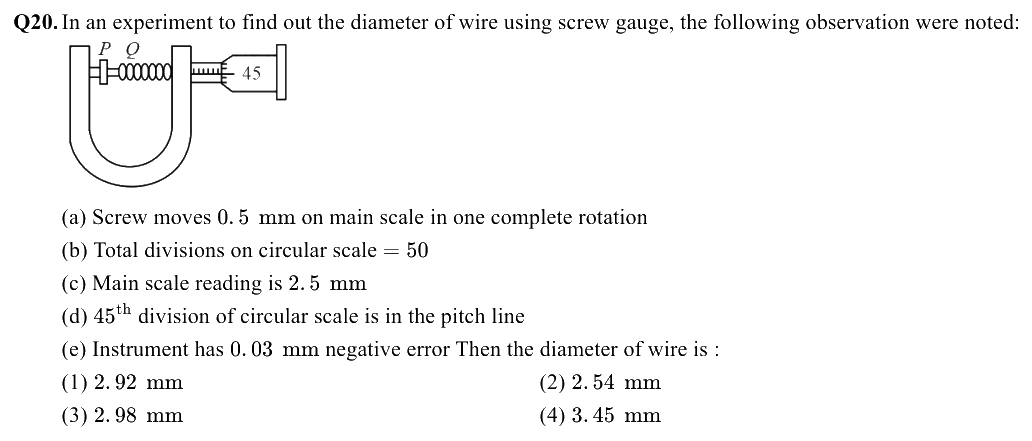
In an experiment to find out the diameter of wire using screw gauge, the following observation were noted: (see the figure above) (a) Screw moves 0.5 mm on main scale in one complete rotation (b) Total divisions on circular scale = 50 (c) Main scale reading is 2.5 mm (d) 45$^{\mathrm{th}}$ division of circular scale is in the pitch line (e) Instrument has 0.03 mm negative error Then the diameter of wire is :
Match List I with List II. List I: (A) Torque, (B) Stress, (C) Latent Heat, (D) Power List II: (I) $\mathrm{Nms^{-1}}$, (II) $\mathrm{Jkg^{-1}}$, (III) $\mathrm{Nm}$, (IV) $\mathrm{Nm^{-2}}$ Choose the correct answer from the options given below:
Consider the efficiency of Carnot's engine is given by $\eta=\frac{\alpha\beta}{\sin\theta}\log_{e}\frac{\beta x}{kT}$, where $\alpha$ and $\beta$ are constants. If $T$ is temperature, $k$ is Boltzman constant, $\theta$ is angular displacement and $x$ has the dimensions of length. Then, choose the incorrect option.
A
Dimensions of $\beta$ is same as that of force.
B
Dimensions of $\alpha^{-1}x$ is same as that of energy.
C
Dimensions of $\eta^{-1}\sin\theta$ is same as that of $\alpha\beta$
A torque meter is calibrated to reference standards of mass, length and time each with 5% accuracy. After calibration, the measured torque with this torque meter will have net accuracy of
An expression of energy density is given by $u = \frac{\alpha}{\beta}\sin\left(\frac{\alpha x}{kt}\right)$, where $\alpha$, $\beta$ are constants, $x$ is displacement, $k$ is Boltzmann constant and $t$ is the temperature. The dimensions of $\beta$ will be
A screw gauge of pitch 0.5 mm is used to measure the diameter of uniform wire of length 6.8 cm, the main scale reading is 1.5 mm and circular scale reading is 7. The calculated curved surface area of wire to appropriate significant figures is [Screw gauge has 50 divisions on the circular scale]
In a Vernier Caliper 10 divisions of Vernier scale is equal to the 9 divisions of main scale. When both jaws of Vernier calipers touch each other, the zero of the Vernier scale is shifted to the left of zero of the main scale and $4^{\mathrm{th}}$ Vernier scale division exactly coincides with the main scale reading. One main scale division is equal to 1 mm. While measuring diameter of a spherical body, the body is held between two jaws. It is now observed that zero of the Vernier scale lies between 30 and 31 divisions of main scale reading and $6^{\mathrm{th}}$ Vernier scale division exactly. coincides with the main scale reading. The diameter of the spherical body will be:
The maximum error in the measurement of resistance, current and time for which current flows in an electrical circuit are $1\%$, $2\%$ and $3\%$ respectively. The maximum percentage error in the detection of the dissipated heat will be:
In van dar Wall equation $\left[P + \dfrac{a}{V^2}\right][V - b] = RT$; $P$ is pressure, $V$ is volume, $R$ is universal gas constant and $T$ is temperature. The ratio of constants $\dfrac{a}{b}$ is dimensionally equal to :
Assertion A: Product of Pressure ($P$) and time ($t$) has the same dimension as that of coefficient of viscosity. Reason: Coefficient of viscosity $= \dfrac{\text{Force}}{\text{Velocity gradient}}$
A
Both A and R true, and R is correct explanation of A.
B
Both A and R are true but R is NOT the correct explanation of A.
Velocity ($v$) and acceleration ($a$) in two systems of units 1 and 2 are related as $v_2 = \frac{n}{m^{2}}v_1$ and $a_2 = \frac{a_1}{mn}$ respectively. Here $m$ and $n$ are constants. The relations for distance and time in two systems respectively are
A
$\frac{n^{3}}{m^{3}}L_1 = L_2$ and $\frac{n^{2}}{m}T_1 = T_2$
B
$L_1 = \frac{n^{4}}{m^{2}}L_2$ and $T_1 = \frac{n^{2}}{m}T_2$
C
$L_1 = \frac{n^{2}}{m}L_2$ and $T_1 = \frac{n^{4}}{m^{2}}T_2$
D
$\frac{n^{2}}{m}L_1 = L_2$ and $\frac{n^{4}}{m^{2}}T_1 = T_2$
A silver wire has a mass $(0.6 \pm 0.006)\mathrm{g}$, radius $(0.5 \pm 0.005)\ \mathrm{mm}$ and length $(4 \pm 0.04)\ \mathrm{cm}$. The maximum percentage error in the measurement of its density will be
The distance of the Sun from earth is $1.5 \times 10^{11}\ \mathrm{m}$ and its angular diameter is $2000''$ when observed from the earth. The diameter of the Sun will be
An expression for a dimensionless quantity $P$ is given by $P = \frac{\alpha}{\beta}\log_e\left(\frac{kT}{\beta x}\right)$; where $\alpha$ and $\beta$ are constants, $x$ is distance; $k$ is Boltzmann constant and $T$ is the temperature. Then the dimensions of $\alpha$ will be
A student determined Young's Modulus of elasticity using the formula $Y = \frac{MgL^3}{4\mathrm{bd}^3\delta}$. The value of $g$ is taken to be $9.8$ m s$^{-2}$ without any significant error, his observations are as following. Physical Quantity | Least count of the Equipment used for measurement | Observed Value Mass ( M ) | $1$ g | $2$ kg Length of bar ( L ) | $1$ mm | $1$ m Breadth of bar ( b ) | $0.1$ mm | $4$ cm Thickness of bar ( d ) | $0.01$ mm | $0.4$ cm Depression ( $\delta$ ) | $0.01$ mm | $5$ mm Then the fractional error in the measurement of $Y$ is :
Two resistors $R_1 = (4 \pm 0.8)$ $\Omega$ and $R_2 = (4 \pm 0.4)$ $\Omega$ are connected in parallel. The equivalent resistance of their parallel combination will be :
Match List - I with List - II. List - I a Torque b Impulse c Tension d Surface Tension List - II i $\mathrm{MLT^{-1}}$ ii $\mathrm{MT^{-2}}$ iii $\mathrm{ML^2\ T^{-2}}$ iv $\mathrm{MLT^{-2}}$ Choose the most appropriate answer from the option given below :
A huge circular arc of length $4.4$ ly subtends an angle $4$s at the centre of the circle. How long it would take for a body to complete $4$ revolution if its speed is $8$ AU per second? Given : $1$ ly $= 9.46 \times 10^{15}$ m $1$ AU $= 1.5 \times 10^{11}$ m
Match List-(I) with List-(II). List-(I) a $\mathrm{R_H}$ (Rydberg constant) b $h$ (Planck's constant) c $\mu_{\mathrm{B}}$ (Magnetic field energy density) d $\eta$ (coefficient of viscosity) List-(II) i $\mathrm{kg\ m^{-1}\ s^{-1}}$ ii $\mathrm{kg\ m^{2}\ s^{-1}}$ iii $\mathrm{m^{-1}}$ iv $\mathrm{kg\ m^{-1}\ s^{-2}}$ Choose the most appropriate answer from the options given below:
If $E$, $L$, $M$ and $G$ denote the quantities as energy, angular momentum, mass and constant of gravitation respectively, then the dimensions of $P$ in the formula $P=EL^{2}M^{-5}G^{-2}$ are:
In a Screw Gauge, fifth division of the circular scale coincides with the reference line when the ratchet is closed. There are 50 divisions on the circular scale, and the main scale moves by $0.5\ \mathrm{mm}$ on a complete rotation. For a particular observation the reading on the main scale is $5\ \mathrm{mm}$ and the $20^{\mathrm{th}}$ division of the circular scale coincides with reference line. Calculate the true reading.
Match List - I with List - II : List - I a Magnetic induction b Magnetic flux c Magnetic permeability d Magnetization List - II i $\mathrm{ML^{2}\,T^{-2}\,A^{-1}}$ ii $\mathrm{M^{0}\,L^{-1}\,A}$ iii $\mathrm{MT^{-2}\,A^{-1}}$ iv $\mathrm{MLT^{-2}\,A^{-2}}$ Choose the most appropriate answer from the options given below :
Assertion $A$ : If in five complete rotations of the circular scale, the distance travelled on the main scale of the screw gauge is $5\ \mathrm{mm}$ and there are 50 total divisions on a circular scale, then the least count is $0.001\ \mathrm{cm}$. Reason $R$ : $\mathrm{Least\ Count} = \frac{\mathrm{Pitch}}{\mathrm{Total\ divisions\ on\ circular\ scale}}$ In the light of the above statements, choose the most appropriate answer from the options given below.
A
$A$ is not correct but $R$ is correct.
B
Both $A$ and $R$ are correct and $R$ is the correct explanation of $A$.
C
$A$ is correct but $R$ is not correct.
D
Both $A$ and $R$ are correct and $R$ is NOT the correct explanation of $A$.
A physical quantity $y$ is represented by the formula $y = m^2r^{-4}g^xl^{-\frac{3}{2}}$ If the percentage errors found in $y$, $m$, $r$, $l$ and $g$ are 18, 1, 0.5, 4 and $p$ respectively, then find the value of $x$ and $p$.
Match List I with List II. List-I: a Capacitance, C; b Permittivity of free space, $\varepsilon_0$; c Permeability of free space, $\mu_0$; d Electric field, E List-II: i $\mathrm{M^1L^1T^{-3}A^{-1}}$; ii $\mathrm{M^{-1}L^{-3}T^4A^2}$; iii $\mathrm{M^{-1}L^{-2}T^4A^2}$; iv $\mathrm{M^1L^1T^{-2}A^{-2}}$ Choose the correct answer from the options given below
The entropy of any system is given by, $S = \alpha^2 \beta \ln\left[\frac{\mu k R}{J \beta^2} + 3\right]$ where $\alpha$ and $\beta$ are the constants. $\mu, J, k$ and $R$ are number of moles, mechanical equivalent of heat, Boltzmann's constant and gas constant, respectively. $\left[\text{Take } S = \frac{dQ}{T}\right]$ Choose the incorrect option from the following:
A
$\alpha$ and $J$ have the same dimensions.
B
$S, \beta, k$ and $\mu R$ have the same dimensions.
If time $(t)$, velocity $(v)$, and angular momentum $(l)$ are taken as the fundamental units. Then the dimension of mass $(m)$ in terms of $t$, $v$ and $l$ is:
The time period of a simple pendulum is given by $T = 2\pi\sqrt{\frac{l}{g}}$. The measured value of the length of the pendulum is $10~\mathrm{cm}$ known to a $1~\mathrm{mm}$ accuracy. The time for 200 oscillations of the pendulum is found to be 100 second using a clock of 1s resolution. The percentage accuracy in the determination of $g$ using this pendulum is $x$. The value of $x$ to the nearest integer is:-
In the experiment of Ohm's law, a potential difference of $5.0~\mathrm{V}$ is applied across the end of a conductor of length $10.0~\mathrm{cm}$ and diameter of $5.00~\mathrm{mm}$. The measured current in the conductor is $2.00~\mathrm{A}$. The maximum permissible percentage error in the resistivity of the conductor is :-
The vernier scale used for measurement has a positive zero error of $0.2 \mathrm{~mm}$. If while taking a measurement it was noted that 0 on the vernier scale lies between $8.5 \mathrm{~cm}$ and $8.6 \mathrm{~cm}$. Vernier coincidence is 6, then the correct value of measurement is cm. (least count$=0.01 \mathrm{~cm}$)
One main scale division of a vernier callipers is $a \mathrm{~cm}$ and $n^{\text {th }}$ division of the vernier scale coincide with $(n-1)^{\text {th }}$ division of the main scale. The least count of the callipers in mm is :
In order to determine the Young's Modulus of a wire of radius $0.2\ \mathrm{cm}$ (measured using a scale of least count $= 0.001\ \mathrm{cm}$) and length $1\ \mathrm{m}$ (measured using a scale of least count $= 1\ \mathrm{mm}$), a weight of mass $1\ \mathrm{kg}$ (measured using a scale of least count $= 1\ \mathrm{g}$) was hanged to get the elongation of $0.5\ \mathrm{cm}$ (measured using a scale of least count $0.001\ \mathrm{cm}$). What will be the fractional error in the value of Young's Modulus determined by this experiment?
In a typical combustion engine the workdone by a gas molecule is given by $W = \alpha^2 \beta e^{\frac{-\beta x^2}{kT}}$, where $x$ is the displacement, $k$ is the Boltzmann constant and $T$ is the temperature. If $\alpha$ and $\beta$ are constants, dimensions of $\alpha$ will be:
Match List - I with List - II : List - I (a) $h$ (Planck's constant) (b) $E$ (kinetic energy) (c) $V$ (electric potential) (d) $P$ (linear momentum) List - II (i) $[\mathrm{MLT^{-1}}]$ (ii) $[\mathrm{ML^2\ T^{-1}}]$ (iii) $[\mathrm{ML^2\ T^{-2}}]$ (iv) $[\mathrm{ML^2\,I^{-1}\ T^{-3}}]$ Choose the correct answer from the options given below:
The pitch of the screw gauge is $1\ \mathrm{mm}$ and there are $100$ divisions on the circular scale. When nothing is put in between the jaws, the zero of the circular scale lies $8$ divisions below the reference line. When a wire is placed between the jaws, the first linear scale division is clearly visible while $72^{\mathrm{nd}}$ division on circular scale coincides with the reference line. The radius of the wire is
If $e$ is the electronic charge, $c$ is the speed of light in free space and $h$ is Planck's constant, the quantity $\frac{1}{4\pi\varepsilon_0}\frac{|e|^2}{hc}$ has dimensions of :
The work done by a gas molecule in an isolated system is given by, $W = \alpha\beta^2 e^{-\frac{x^2}{\alpha k T}}$, where $x$ is the displacement, $k$ is the Boltzmann constant and $T$ is the temperature. $\alpha$ and $\beta$ are constants. Then the dimensions of $\beta$ will be:
The period of oscillation of a simple pendulum is $T = 2\pi\sqrt{\frac{L}{g}}$. Measured value of $L$ is $1.0\ \mathrm{m}$ from meter scale having a minimum division of $1\ \mathrm{mm}$ and time of one complete oscillation is $1.95\ \mathrm{s}$ measured from stopwatch of $0.01\ \mathrm{s}$ resolution. The percentage error in the determination of $g$ will be:
A screw gauge has 50 divisions on its circular scale. The circular scale is 4 units ahead of the pitch scale marking, prior to use. Upon one complete rotation of the circular scale, a displacement of $0.5\ \mathrm{mm}$ is noticed on the pitch scale. The nature of zero error involved and the lest count of the screw gauge, are respectively:
A student measuring the diameter of a pencil of circular cross-section with the help of a vernier scale records the following four readings 5.50 mm, 5.55 mm, 5.34 mm, 5.65 mm. The average of these four reading is 5.5375 mm and the standard deviation of the data is 0.07395 mm. The average diameter of the pencil should therefore be recorded as :
A physical quantity $z$ depends on four observables $a$, $b$, $c$ and $d$, as $z = \frac{a^2 b^{2/3}}{\sqrt{c}d^3}$. The percentage of error in the measurement of $a$, $b$, $c$ and $d$ are 2%, 1. 5%, 4% and 2. 5% respectively. The percentage of error in $z$ is :
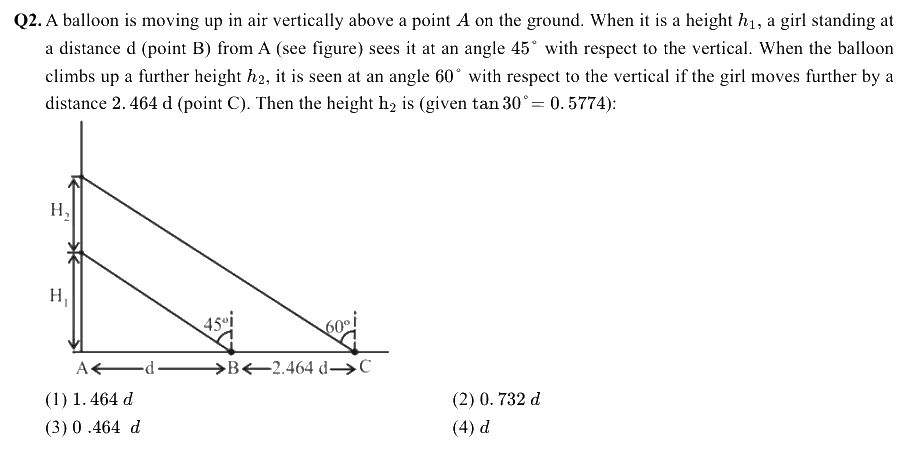
A balloon is moving up in air vertically above a point $A$ on the ground. When it is a height $h_1$, a girl standing at a distance d (point B) from A (see figure) sees it at an angle 45$^{\circ}$ with respect to the vertical. When the balloon climbs up a further height $h_2$, it is seen at an angle 60$^{\circ}$ with respect to the vertical if the girl moves further by a distance 2. 464 d (point C). Then the height h$_2$ is (given tan 30$^{\circ}$= 0. 5774): (see the figure above)
Assume that the displacement (s) of air is proportional to the pressure difference ($\Delta p$) created by a sound wave. Displacement (s) further depends on the speed of sound (v), density of air($\rho$) and the frequency (f). If $\Delta p \sim 10\ Pa, v \sim 300\ m/s, \rho \sim 1\ kg/m^3$ $f \sim 1000 Hz$, then s will be of the order of (take the multiplicative constant to be 1 )
The quantities $x = \frac{1}{\sqrt{\mu_0 \epsilon_0}}, y = \frac{E}{B}$ and $z = \frac{l}{CR}$ are defined where C-capacitance, R-Resistance, $\ell$-length, E-Electric field, B-magnetic field and $\in 0$, $\mu 0$, -free space permittivity and permeability respectively. Then:
A quantity $x$ is given by $\left(IFv^{2}/WL^{4}\right)$ in terms of moment of inertia $I$, force $F$, velocity $v$, work $W$ and length $L$. The dimensional formula for $x$ is same as that of :
Using screw gauge of pitch $0.1\ \mathrm{cm}$ and 50 divisions on its circular scale, the thickness of an object is measured. It should correctly be recorded as,
The least count of the main scale of a vernier calipers is $1\ \mathrm{mm}$. Its vernier scale is divided into 10 divisions and coincide with 9 divisions of the main scale. When jaws are touching each other, the $7^{\mathrm{th}}$ division of the vernier scale coincides with a division of the main scale and the zero of vernier scale is lying right side of the zero of the main scale. When this vernier is used to measure the length of the cylinder the zero of the vernier scale between $3.1\ \mathrm{cm}$ and $3.2\ \mathrm{cm}$ and $4^{\mathrm{th}}$ VSD coincides with the main scale division. The length of the cylinder is (VSD is vernier scale division)
A quantity $f$ is given by $f = \sqrt{\frac{hc^5}{G}}$ where $c$ is speed of light, $G$ univasal (sic) gravitational constant and $h$ is the Planck's constant. Dimension of $f$ is that of:
If the screw on a screw-gauge is given six rotations, it moves by $3mm$ on the main scale. If there are 50 divisions on the circular scale the least count of the screw gauge is:
For the four sets of three measured physical quantities as given below. Which of the following options is correct? (i) $A_1 = 24.36, B_1 = 0.0724, C_1 = 256.2$ (ii) $A_2 = 24.44, B_2 = 16.082, C_2 = 240.2$ (iii) $A_3 = 25.2, B_3 = 19.2812, C_3 = 236.183$ (iv) $A_4 = 25, B_4 = 236.191, C_4 = 19.5$
The dimension of stopping potential $V_0$ in photoelectric effect in units of Planck's constant ' $h$ ', speed of light ' $c$ ' and Gravitational constant ' $G$ ' and ampere $A$ is:
A simple pendulum is being used to determine the value of gravitational acceleration $g$ at a certain place. The length of the pendulum is $25.0\ \mathrm{cm}$ and a stopwatch with $1\ \mathrm{s}$ resolution measures the time taken for 40 oscillations to be $50\ \mathrm{s}$. The accuracy in g is:
Which of the following combinations has the dimension of electrical resistance ( $\epsilon_0$ is the permittivity of vacuum and $\mu_0$ is the permeability of vacuum)?
The number density of molecules of a gas depends on their distance r from the origin as, $n(r) = n_0 e^{-\alpha r^4}$. Then the numer of molecules is proportional to:
In the density measurement of a cube, the mass and edge length are measured as $(10.00 \pm 0.10)$ kg and $(0.10 \pm 0.01)$ m, respectively. The error in the measurement of density is:
In a simple pendulum experiment for determination of acceleration due to gravity ($\mathrm{g}$), time taken for 20 oscillations is measures by using a watch of 1 second least count. The mean value of time taken comes out to be 30 s. The length of the pendulum is measured by using a meter scale of least count 1 mm and the value obtained is 55.0 cm. The percentage error in the determination of g is close to
If Surface tension ($\mathrm{S}$), Moment of Inertia ($\mathrm{I}$) and Planck's constant ($\mathrm{h}$), were to be taken as the fundamental units, the dimensional formula for linear momentum would be:
The least count of the main scale of a screw gauge is 1 mm. The minimum number of divisions on its circular scale required to measure 5 $\mu$m diameter of a wire is:
Let $L$, $R$, $C$ and $V$ represent inductance, resistance, capacitance and voltage, respectively. The dimension of $\frac{L}{RCV}$ in $SI$ units will be:
The force of interaction between two atoms is given by $F = \alpha\beta\exp\left(-\frac{x^2}{\alpha kT}\right)$; where $x$ is the distance, k is the Boltzmann constant and T is temperature and $\alpha$ and $\beta$ are two constants. The dimensions of $\beta$ is:
The density of a material in $SI$ units is $128\ kg\ m^{-3}$. In certain units in which the unit of length is $25\ cm$ and the unit of mass is $50g$, the numerical value of density of the material is:
The diameter and height of a cylinder are measured by a meter scale to be $12.6 \pm 0.1\ cm$ and $34.2 \pm 0.1\ cm$ , respectively. What will be the value of its volume in appropriate significant figures?
The pitch and the number of divisions, on the circular scale, for a given screw gauge are $0.5\ \mathrm{mm}$ and $100$ respectively. When the screw gauge is fully tightened without any object, the zero of its circular scale lies $3$ divisions below the mean line. The readings of the main scale and the circular scale, for a thin sheet, are $5.5\ \mathrm{mm}$ and $48$ respectively, the thickness of this sheet is:
The percentage errors in quantities $P$, $Q$, $R$ and $S$ are $0.5\%$, $1\%$, $3\%$ and $1.5\%$ respectively in the measurement of a physical quantity $A = \frac{P^3 Q^2}{\sqrt{R}\,S}$. The maximum percentage error in the value of $A$ will be:
In a screw gauge, 5 complete rotations of the screw cause it to move a linear distance of $0.25\ \mathrm{cm}$. There are 100 circular scale divisions. The thickness of a wire measured by this screw gauge gives a reading of 4 main scale divisions and 30 circular scale divisions. Assuming negligible zero error, the thickness of the wire is:
The characteristic distance at which quantum gravitational effects are significant, the Planck length, can be determined from a suitable combination of the fundamental physical constants $\mathrm{G}$, $\mathrm{h}$ and $\mathrm{c}$. Which of the following correctly gives the Planck length?
The density of a material, in the shape of a cube, is determined by measuring three sides of the cube and its mass. If the relative errors in measuring the mass and length are $1.5\%$ and $1\%$, respectively, the maximum error in determining the density is:
A physical quantity $P$ is described by the relation $P = a^{\frac{1}{2}} b^{2} c^{3} d^{-4}$. If the relative errors in the measurement of $a$, $b$, $c$ and $d$ respectively, are 2%, 1%, 3% and 5%. Then the relative error in $P$ will be:
Time ($T$), velocity ($C$) and angular momentum ($h$) are chosen as fundamental quantities instead of mass, length and time. In terms of these, the dimensions of mass would be:
The following observations were taken for determining surface tension $T$ of water by capillary method: diameter of capillary, $D = 1.25 \times 10^{-2}\ \mathrm{m}$ rise of water, $h = 1.45 \times 10^{-2}\ \mathrm{m}$ Using $g = 9.80\ \mathrm{m\ s^{-2}}$ and the simplified relation $T = \frac{rhg}{2} \times 10^{3}\ \mathrm{N\ m^{-1}}$ the possible error in surface tension is closest to:
A thin $1\ \mathrm{m}$ long rod has a radius of $5\ \mathrm{mm}$. A force of $50\pi\times10^{3}\ \mathrm{N}$ is applied at one end to determine its Young's modulus. Assume that the force is exactly known. If the least count in the measurement of all lengths is $0.01\ \mathrm{mm}$, which of the following statements is false?
A
The maximum value of $Y$ that can be determined is $2\times10^{14}\ \mathrm{N\,m^{-2}}$.
B
$\frac{\Delta Y}{Y}$ gets minimum contribution from the uncertainty in the length.
C
$\frac{\Delta Y}{Y}$ gets its maximum contribution from the uncertainty in strain.
D
The figure of merit is the largest for the length of the rod.
$A$, $B$, $C$, and $D$ are four different physical quantities having different dimensions. None of them is dimensionless. But we know that the equation $AD = C\ln(BD)$ holds true. Then which of the combination is not a meaningful quantity?
In the following $I$ refers to current and other symbols have their usual meaning. Choose the option that corresponds to the dimensions of electrical conductivity:
A student measures the time period of 100 oscillations of a simple pendulum four times. The data set is 90 s, 91 s, 95 s and 92 s. If the minimum division in the measuring clock is 1 s, then the reported mean time should be:
A screw gauge with a pitch of 0.5 mm and a circular scale with 50 divisions is used to measure the thickness of a thin sheet of aluminium. Before starting the measurement, it is found that when the two jaws of the screw gauge are brought in contact, the $45^{\text{th}}$ division coincides with the main scale line and that the zero of the main scale is barely visible. What is the thickness of the sheet if the main scale reading is 0.5 mm and the $25^{\text{th}}$ division coincides with the main scale line?
A beaker contains a fluid of density $\rho\,\frac{\mathrm{kg}}{\mathrm{m}^3}$, specific heat $S\,\frac{\mathrm{J}}{\mathrm{kg}^\circ\mathrm{C}}$ and viscosity $\eta$. The beaker is filled up to height h. To estimate the rate of heat transfer per unit area $\left(\frac{\dot{Q}}{A}\right)$ by convection when beaker is put on a hot plate, a student proposes that it should depend on $\eta$, $\left(\frac{S\Delta\theta}{h}\right)$ and $\left(\frac{1}{\rho g}\right)$ when $\Delta\theta$ ( in$^\circ$C ) is the difference in the temperature between the bottom and top of the fluid. In that situation the correct option for $\left(\frac{\dot{Q}}{A}\right)$ is:
If electronic charge $e$, electron mass $m$, speed of light in vacuum $c$ and Planck's constant $h$ are taken as fundamental quantities, the permeability of vacuum $\mu_0$ can be expressed in units of:
A ball of radius $r$ and density $\rho$ dropped through a viscous liquid of density $\sigma$ and viscosity $\eta$ attains its terminal velocity at time $t$, given by $t = A\,\rho^a r^b \eta^c \sigma^d$, where $A$ is a constant and $a$, $b$, $c$ and $d$ are integers. The value of $\dfrac{b + c}{a + d}$ is ________.
Numerical answer type: type your answer in EdLoop to check it
A physical quantity C is related to four other quantities $p, q, r$ and s as follows
$C = \frac{pq^2}{r^3\sqrt{s}}$
The percentage errors in the measurement of $p, q, r$ and s are $1\%, 2\%, 3\%$ and $2\%$, respectively. The percentage error in the measurement of $C$ will be ______ $\%$ .
Numerical answer type: type your answer in EdLoop to check it
A physical quantity $Q$ is related to four observables $a, b, c, d$ as follows : $\mathrm{Q} = \frac{ab^4}{cd}$ where, $a = (60 \pm 3)$Pa; $b = (20 \pm 0.1)$m; $c = (40 \pm 0.2)\mathrm{Nsm^{-2}}$ and $d = (50 \pm 0.1)$m, then the percentage error in $Q$ is $\frac{x}{1000}$, where $x = $ ______ .
Numerical answer type: type your answer in EdLoop to check it
In a measurement, it is asked to find modulus of elasticity per unit torque applied on the system. The measured quantity has dimension of $\left[M^aL^bT^c\right]$. If $b = -3$, the value of $c$ is ______
Numerical answer type: type your answer in EdLoop to check it
A tiny metallic rectangular sheet has length and breadth of 5 mm and 2.5 mm , respectively. Using a specially designed screw gauge which has pitch of 0.75 mm and 15 divisions in the circular scale, you are asked to find the area of the sheet. In this measurement, the maximum fractional error will be $\frac{x}{100}$ where $x$ is ______ .
Numerical answer type: type your answer in EdLoop to check it
The least count of a screw guage is 0.01 mm . If the pitch is increased by 75% and number of divisions on the circular scale is reduced by 50%, the new least count will be ______ $\times 10^{-3}$ mm
Numerical answer type: type your answer in EdLoop to check it
In an experiment for estimating the value of focal length of converging mirror, image of an object placed at 40 cm from the pole of the mirror is formed at distance 120 cm from the pole of the mirror. These distances are measured with a modified scale in which there are 20 small divisions in 1 cm. The value of error in measurement of focal length of the mirror is $\frac{1}{K}$ cm. The value of $K$ is ______.
Numerical answer type: type your answer in EdLoop to check it
In a screw gauge, there are 100 divisions on the circular scale and the main scale moves by 0.5 mm on a complete rotation of the circular scale. The zero of circular scale lies 6 divisions below the line of graduation when two studs are brought in contact with each other. When a wire is placed between the studs, 4 linear scale divisions are clearly visible while 46$^{th}$ division the circular scale coincide with the reference line. The diameter of the wire is ______ $\times$ $10^{-2}$ mm.
Numerical answer type: type your answer in EdLoop to check it
In an experiment of measuring the refractive index of a glass slab using travelling microscope in physics lab, a student measures real thickness of the glass slab as $5.25\ \mathrm{mm}$ and apparent thickness of the glass slab at $5.00\ \mathrm{mm}$. Travelling microscope has 20 divisions in one cm on main scale and 50 divisions on Vernier scale is equal to 49 divisions on main scale. The estimated uncertainty in the measurement of refractive index of the slab is $\frac{x}{10} \times 10^{-3}$, where $x$ is ______.
Numerical answer type: type your answer in EdLoop to check it
In an experiment to find acceleration due to gravity ($g$) using simple pendulum, time period of $0.5\ \mathrm{s}$ is measured from time of 100 oscillation with a watch of $1\ \mathrm{s}$ resolution. If measured value of length is $10\ \mathrm{cm}$ known to $1\ \mathrm{mm}$ accuracy. The accuracy in the determination of $g$ is found to be $x\%$. The value of $x$ is
Numerical answer type: type your answer in EdLoop to check it
The one division of main scale of vernier callipers reads 1 mm and 10 divisions of Vernier scale is equal to 9 divisions on main scale. When the two jaws of the instrument touch each other the zero of the Vernier lies to the right of zero of the main scale and its fourth division coincides with a main scale division. When a spherical bob is tightly placed between the two jaws, the zero of the Vernier scale lies in between 4.1 cm and 4.2 cm and 6$^{\mathrm{th}}$ Vernier division coincides with a main scale division. The diameter of the bob will be ______ $10^{-2}$ cm.
Numerical answer type: type your answer in EdLoop to check it
In an experiment of determine the Young's modulus of wire of a length exactly 1 m, the extension in the length of the wire is measured as 0.4 mm with an uncertainty of $\pm 0.02$ mm when a load of 1 kg is applied. The diameter of the wire is measured as 0.4 mm with an uncertainty of $\pm 0.01$ mm. The error in the measurement of Young's modulus ($\Delta Y$) is found to be $x \times 10^{10} \mathrm{~N~m^{-2}}$. The value of $x$ is ______ .
Numerical answer type: type your answer in EdLoop to check it
The Vernier constant of Vernier callipers is $0.1\ \mathrm{mm}$ and it has zero error of $(-0.05\ \mathrm{cm})$. While measuring diameter of a sphere, the main scale reading is $1.7\ \mathrm{cm}$ and coinciding vernier division is 5 . The corrected diameter will be ______ $\times 10^{-2}\ \mathrm{cm}$.
Numerical answer type: type your answer in EdLoop to check it
A student in the laboratory measures thickness of a wire using screw gauge. The readings are $1.22\ \mathrm{mm}, 1.23\ \mathrm{mm}, 1.19\ \mathrm{mm}$ and $1.20\ \mathrm{mm}$. The percentage error is $\frac{x}{121}\%$. The value of $x$ is ______ .
Numerical answer type: type your answer in EdLoop to check it
In a vernier callipers, each cm on the main scale is divided into 20 equal parts. If tenth vernier scale division coincides with nineth main scale division. Then the value of vernier constant will be ______ $\times 10^{-2}$ mm
Numerical answer type: type your answer in EdLoop to check it
A travelling microscope is used to determine the refractive index of a glass slab. If 40 divisions are there in $1 \mathrm{~cm}$ on main scale and 50 Vernier scale divisions are equal to 49 main scale divisions, then least count of the travelling microscope is ______ $\times 10^{-6} \mathrm{~m}$.
Numerical answer type: type your answer in EdLoop to check it
For $z = a^2 x^3 y^{\frac{1}{2}}$, where 'a' is a constant. If percentage error in measurement of 'x' and 'y' are $4\%$and $12\%$, respectively, then the percentage error for 'z' will be ______ $\%$.
Numerical answer type: type your answer in EdLoop to check it
The diameter of a spherical bob is measured using a vernier callipers. $9$ divisions of the main scale, in the vernier callipers, are equal to $10$ divisions of vernier scale. One main scale division is $1$ mm. The main scale reading is $10$ mm and $8^{th}$ division of vernier scale was found to coincide exactly with one of the main scale division. If the given vernier callipers has positive zero error of $0.04$ cm, then the radius of the bob is ______ $\times 10^{-2}$ cm.
Numerical answer type: type your answer in EdLoop to check it
The acceleration due to gravity is found up to an accuracy of $4\%$ on a planet. The energy supplied to a simple pendulum of known mass $m$ to undertake oscillations of time period $T$ is being estimated. If time period is measured to an accuracy of $3\%$, the accuracy to which $E$ is known as ______$\%$
Numerical answer type: type your answer in EdLoop to check it
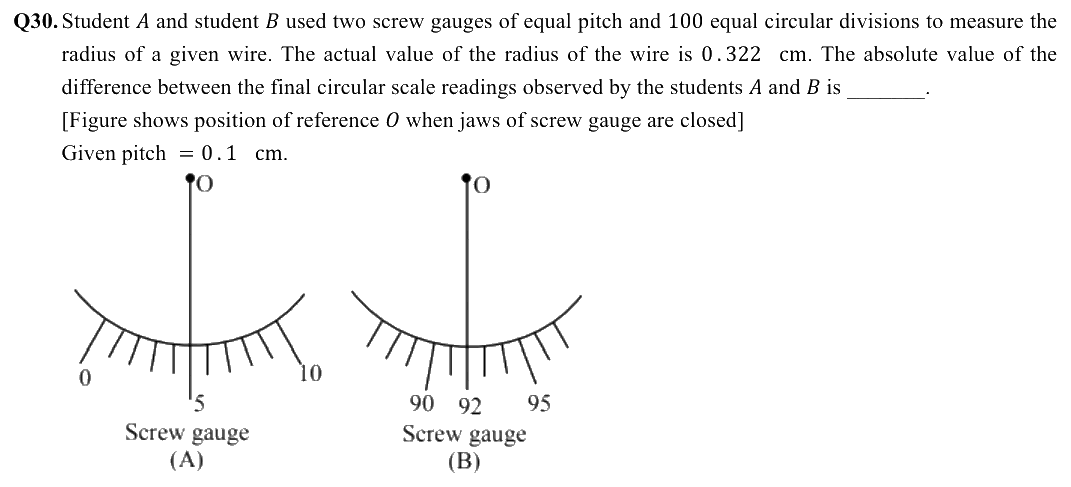
Student $A$ and student $B$ used two screw gauges of equal pitch and 100 equal circular divisions to measure the radius of a given wire. The actual value of the radius of the wire is $0.322\ \mathrm{cm}$. The absolute value of the difference between the final circular scale readings observed by the students $A$ and $B$ is ______. [Figure shows position of reference $O$ when jaws of screw gauge are closed] Given pitch $= 0.1\ \mathrm{cm}$. (see the figure above)
The question as printed in the paper.
Numerical answer type: type your answer in EdLoop to check it
Three students $S_1$, $S_2$ and $S_3$ perform an experiment for determining the acceleration due to gravity ($g$) using a simple pendulum. They use different lengths of pendulum and record time for different number of oscillations. The observations are as shown in the table. Student No. | Length of pendulum (cm) | Number of oscillations ($n$) | Total time for $n$ oscillations (s) | Time period (s)
| 64.0 | 8 | 128.0 | 16.0
| 64.0 | 4 | 64.0 | 16.0
| 20.0 | 4 | 36.0 | 9.0
(Least count of length $= 0.1\ \mathrm{m}$, least count for time $= 0.1\ \mathrm{s}$) If $E_1$, $E_2$ and $E_3$ are the percentage errors in $g$ for students 1, 2 and 3, respectively, then the minimum percentage error is obtained by student no ______ .
Numerical answer type: type your answer in EdLoop to check it
The radius of a sphere is measured to be $(7.50 \pm 0.85)$ cm. Suppose the percentage error in its volume is $x$. The value of $x$, to the nearest $x$, is ______ .
Numerical answer type: type your answer in EdLoop to check it
Suppose you have taken a dilute solution of oleic acid in such a way that its concentration becomes $0.01 \mathrm{~cm}^3$ of oleic acid per $\mathrm{cm}^3$ of the solution. Then you make a thin film of this solution (monomolecular thickness) of area $4 \mathrm{~cm}^2$ by considering 100 spherical drops of radius $\left(\frac{3}{40 \pi}\right)^{\frac{1}{3}} \times 10^{-3} \mathrm{~cm}$. Then the thickness of oleic acid layer will be $x \times 10^{-14} \mathrm{~m}$. Where $x$ is ______.
Numerical answer type: type your answer in EdLoop to check it
The resistance $R=\frac{V}{I}$, where $V=(50 \pm 2) \mathrm{V}$ and $I=(20 \pm 0.2) \mathrm{A}$. The percentage error in $R$ is $x \%$. The value of $x$ to the nearest integer is ______.
Numerical answer type: type your answer in EdLoop to check it
The density of a solid metal sphere is diameter. The maximum error in the density of the sphere is $\left(\frac{x}{100}\right)\%$. If the relative errors in measuring the mass and the diameter are $6.0\%$ and $1.5\%$ respectively, the value of $x$ is $-$
Numerical answer type: type your answer in EdLoop to check it
How to prepare Units, Dimensions & Errors for JEE Main
How often it comes up
Units,Dimensions & Errors serves as the starting gate of the Class 11 Physics syllabus and has become a major testing area in JEE Main. Across the papers we hold from 2019 to 2026, the chapter delivered 235 questions in 162 papers, working out to 1.5 questions per paper, and appeared in 156 of those 162 papers. That makes it the 4th largest of 29 Physics chapters over that span, accounting for 5.1% of all Physics questions.
The chapter has grown significantly compared to earlier decades. In the AIEEE and early JEE Main years (2002 to 2018), it represented 3.5% of the Physics section; in the last three exam years (2024 to 2026), its share rose to 6.5%, producing 101 questions in 58 papers. The peak years in our collection were 2021 (38 questions in 26 papers) and 2024 (38 questions in 20 papers). Since 2019 there has been no year without it, featuring in 156 of the 162 papers we hold.
As Unit 1: Units and Measurements in NTA's Class 11 syllabus, it gives students an early boost because its tools apply across electrodynamics, modern physics, and mechanics.
Most-asked topics
Between 2019 and 2026, the questions distributed across four distinct topics:
Dimensional Analysis: 118 questions. Over half the chapter, emphasizing dimensional formulas of derived quantities and consistency of algebraic equations.
Errors & Significant Figures: 65 questions. Error propagation through fractional powers, absolute error bounds, and rounding rules.
Measuring Instruments: 43 questions. Mechanical tools including vernier callipers and micrometer screw gauges with positive or negative zero errors.
Units & SI System: 9 questions. Conversion factors, fundamental base units, and derived unit definitions.
Every one of these four areas appeared in 2026 papers, meaning a well-rounded review is essential.
What the questions look like
Dimensional analysis questions generally follow two main formats. In the first format, you are given an unfamiliar physical relationship, such as an altered fluid flow formula or an electromagnetic expression, and asked to find the dimensions of unknown coefficients using dimensional homogeneity. In the second format, questions ask you to match physical quantities, often combining thermal constants, magnetic permeability, and electrical permittivity, against their dimensional expressions in terms of mass, length, time, and electric current.
Error questions usually center on laboratory formulas. A typical problem presents a cylinder, pendulum, or electrical resistor where each measurement carries a stated percentage uncertainty. You take logarithmic differentials to relate fractional errors, taking care to multiply exponents and add absolute fractional uncertainties. Significant figure problems ask for the correct decimal representation after adding lengths or calculating density from mass and volume.
Measuring instruments problems evaluate practical laboratory skills. You will determine the least count of a vernier scale where n vernier divisions coincide with n - 1 main scale divisions, or calculate the true thickness of a wire using a screw gauge whose circular scale has an initial zero offset.
The chapter also contains a steady proportion of numerical-response problems: 25 of the 235 questions since 2019 had no options, requiring clean arithmetic without relying on option choices.
Questions to try first
Here are five representative questions from NTA's 2026 papers:
Begin by compiling a reference table of dimensional formulas for quantities outside basic mechanics. Focus on quantities that frequently recur in exam questions: Stefan's constant, universal gas constant, magnetic flux, self-inductance, and coefficient of viscosity. Derive each from a fundamental equation rather than memorizing bare powers.
Next, practise error propagation with powers and quotients. Train yourself to write the fractional error expression directly from the formula without intermediate steps, remembering that uncertainties always add in worst-case analysis. For significant figures, review the distinction between decimal places (used in addition and subtraction) and significant digits (used in multiplication and division).
For measuring instruments, draw the barrel and thimble scales of a screw gauge and the main and vernier jaws of calipers. Work through problems with negative zero error, ensuring you subtract the negative reading rather than adding it. Finish by timing yourself on mixed sets of recent questions.
Frequently asked questions
Is Units, Dimensions & Errors heavily tested in JEE Main 2027?
Yes. It provided 235 questions across the 162 papers we hold from 2019 to 2026, averaging 1.5 questions per paper. It ranks 4th among 29 Physics chapters and appeared in 156 of the 162 papers in our collection.
Which topic appears most often in this chapter?
Dimensional analysis is the dominant topic, accounting for 118 questions from 2019 to 2026, followed by errors and significant figures with 65 questions and measuring instruments with 43.
Do screw gauge and vernier calliper questions come every year?
Yes. Measuring instruments generated 43 questions between 2019 and 2026 in our set, featuring regularly in both morning and evening shifts.
Where can I see the solutions?
Every question on this page opens with its options and answer. Step-by-step solutions for each one are in the EdLoop app.