Dual Nature of Matter & Radiation: JEE Main PYQs 2002–2026
Every Dual Nature of Matter & Radiation question from past JEE Main and AIEEE papers, with options and answers. Newest first.
208questions
181papers covered
3.6%of Physics questions, 2019–2026
2002–2026years
Guide at a glance
Dual nature of matter and radiation analyzes quantum energy packets and particle waves under Unit 17: Dual Nature of Matter and Radiation in the Class 12 syllabus, holding rank 11 among the 29 physics chapters.
A monochromatic source of light operating at 15 kW emits $2.5\times10^{22}$ photons/s. The region of an electromagnetic spectrum to which the emitted electromagnetic radiation belongs to ________. (Take $h = 6.6\times10^{-34}$ J.s and $c = 3\times10^8$ m/s).
$K_1$ and $K_2$ be the maximum kinetic energies of photoelectrons emitted from a surface of a given material for the light of wavelength $\lambda_1$ and $\lambda_2$, respectively. If $\lambda_1 = 2\lambda_2$ then the work function of material is given by :
An electron of mass $m$ is moving in an electric field $\vec{E} = -2E_o\hat{i}$ ($E_o$ = constant > 0), with an initial velocity $\vec{V} = v_o\hat{i}$ ($v_o$ = constant > 0). If $\lambda_o = \dfrac{h}{4mv_o}$, its de Broglie wavelength at time $t$ is ________.
Light source having wavelength 331 nm is used to generate photo-electrons whose stopping potential is 0.2 V. The work function of the used metal in the experiment is $\alpha\times10^{-19}$ J. The value of $\alpha$ is ________. ($h = 6.62\times10^{-34}$ J s, $e = 1.6\times10^{-19}$ C and $c = 3\times10^8$ m/s)
An electron is travelling with a velocity $v$ in free space and when it enters a medium, its velocity is reduced by 20%. The de Broglie wavelength of electron in the medium is $\alpha\lambda_0$, where $\lambda_0$ is its de Broglie wavelength in free space. The value of $\alpha$ is ________.
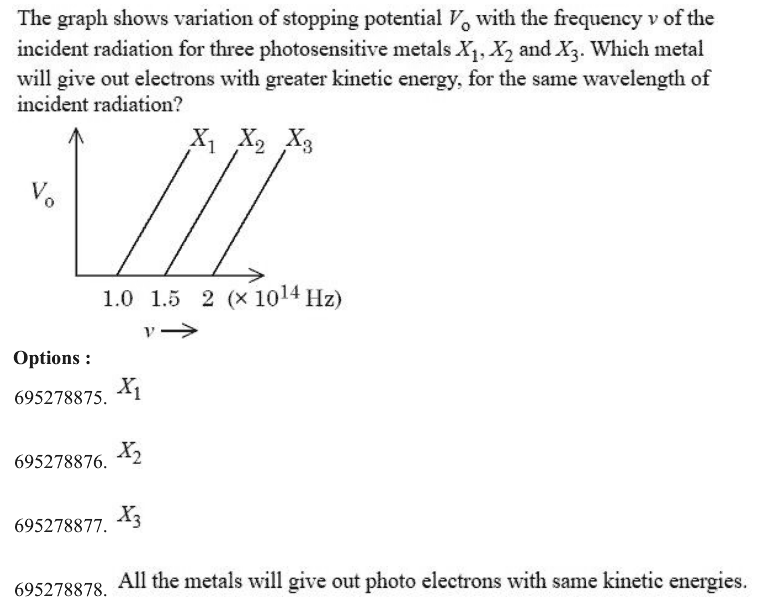
The graph shows variation of stopping potential $V_o$ with the frequency $\nu$ of the incident radiation for three photosensitive metals $X_1$, $X_2$ and $X_3$. Which metal will give out electrons with greater kinetic energy, for the same wavelength of incident radiation?
(see the figure above)
The question as printed in the paper.
A
$X_1$
B
$X_2$
C
$X_3$
D
All the metals will give out photo electrons with same kinetic energies.
The de Broglie wavelength associated with an electron accelerated through a potential difference V is $\lambda_e$ and the de Broglie wavelength associated with a proton accelerated through the same potential difference is $\lambda_p$. If their corresponding masses are $m_e$ and $m_p$, respectively, then the ratio of their de Broglie wavelengths $\left(\frac{\lambda_e}{\lambda_p}\right)$ is ________.
For a certain metal, when monochromatic light of wavelength $\lambda$ is incident, the stopping potential for photoelectrons is $3V_o$. When the same metal is illuminated by light of wavelength $2\lambda$, then the stopping potential becomes $\mathrm{V_o}$. The threshold wavelength for photoelectric emission for the given metal is $\alpha\lambda$. The value of $\alpha$ is ________.
Number of photons of equal energy emitted per second by a 6 mW laser source operating at 663 nm is ________. (Given : h$=6.63 \times 10^{-34}$ J.s and c$=3 \times 10^8$ m/s)
When a light of a given wavelength falls on a metallic surface the stopping potential for photoelectrons is 3.2 V. If a second light having wavelength twice of first light is used, the stopping potential drops to 0.7 V. The wavelength of first light is ________ m.
(h $= 6.63 \times 10^{-34}$ J.s, e $= 1.6 \times 10^{-19}$ C, c $= 3 \times 10^8$ m/s)
Light is incident on a metallic plate having work function $110 \times 10^{-20}$ J. If the produced photoelectrons have zero kinetic energy then the angular frequency of the incident light is ________ rad/s. (h $= 6.63 \times 10^{-34}$ J.s).
A light wave described by $E = 60[\sin(3\times10^{15})t + \sin(12\times10^{15})t]$ (in SI units) falls on a metal surface of work function 2.8 eV. The maximum kinetic energy of ejected photoelectron is (approximately) ________ eV. ($h = 6.6\times10^{-34}$ J.s. and $e = 1.6\times10^{-19}$ C)
A photo-emissive substance is illuminated with a radiation of wavelength $\lambda_i$ so that it releases electrons with de-Broglie wavelength $\lambda_e$. The longest wavelength of radiation that can emit photoelectron is $\lambda_o$. Expression for de-Broglie wavelength is given by : (m : mass of the electron, h : Planck's constant and c : speed of light)
Given below are two statements: one is labelled as Assertion A and the other is labelled as Reason R
Assertion A: In photoelectric effect, on increasing the intensity of incident light the stopping potential increases.
Reason R: Increase in intensity of light increases the rate of photoelectrons emitted, provided the frequency of incident light is greater than threshold frequency.
In the light of the above statements, choose the correct answer from the options given below
A
Both A and R are true and R is the correct explanation of A
B
Both A and R are true but R is NOT the correct explanation of A
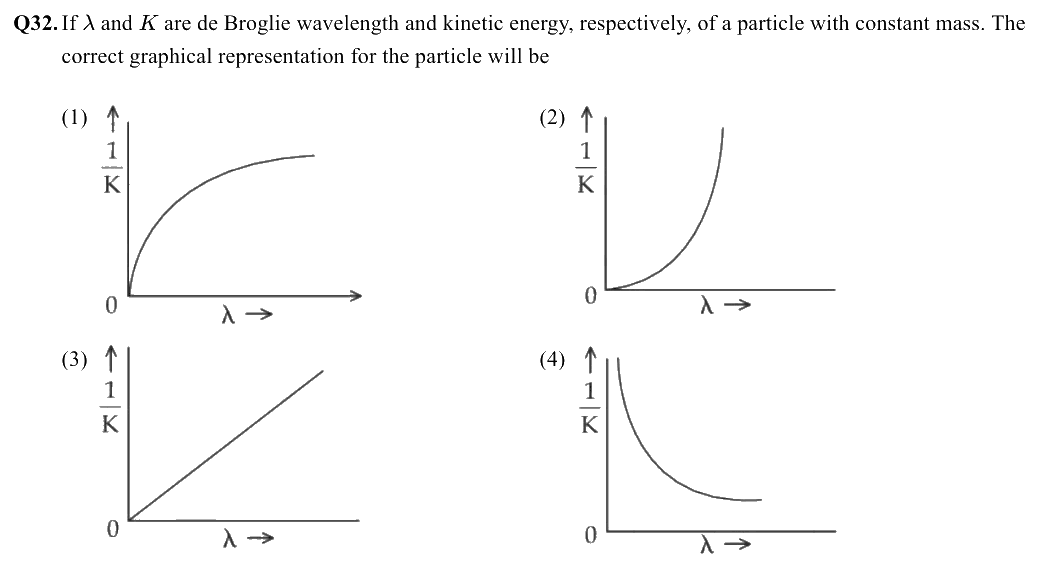
If $\lambda$ and $K$ are de Broglie wavelength and kinetic energy, respectively, of a particle with constant mass. The correct graphical representation for the particle will be
The question as printed in the paper.
A
see figure axes '1/K' (vertical, arrow up) and 'λ →' (horizontal) with '0' at the origin; a curve rising steeply from the origin and then flattening to the right (concave down, levelling off).
B
see figure same axes; a curve starting at the origin, nearly flat at first and then rising ever more steeply toward the top (concave up, almost vertical at the right).
C
see figure same axes; a straight line from the origin rising to the upper right.
D
see figure same axes; a curve starting high on the vertical axis, falling steeply and then levelling off close to the horizontal axis (a falling curve flattening to the right, not touching the horizontal axis).
Given below are two statements : one is labelled as Assertion (A) and the other is labelled as Reason (R). Assertion (A) : Emission of electrons in photoelectric effect can be suppressed by applying a sufficiently negative electron potential to the photoemissive substance. Reason (R) : A negative electric potential, which stops the emission of electrons from the surface of a photoemissive substance, varies linearly with frequency of incident radiation. In the light of the above statements, choose the most appropriate answer from the options given below :
A
(A) is false but (R) is true
B
(A) is true but (R) is false
C
Both (A) and (R) are true and (R) is the correct explanation of (A)
D
Both (A) and (R) are true but (R) is not the correct explanation of (A)
A proton of mass ' $m_p$ ' has same energy as that of a photon of wavelength ' $\lambda$ '. If the proton is moving at non-relativistic speed, then ratio of its de Broglie wavelength to the wavelength of photon is.
An electron of mass ' m ' with an initial velocity $\vec{\mathrm{v}} = \mathrm{v_0}\hat{i}$ ($\mathrm{v_0} > 0$) enters an electric field $\vec{\mathrm{E}} = -\mathrm{E_o}\hat{\mathrm{k}}$. If the initial de Broglie wavelength is $\lambda_0$, the value after time t would be
In photoelectric effect, the stopping potential $(\mathrm{V_0})$v/s frequency $(\nu)$ curve is plotted. ( h is the Planck's constant and $\phi_0$ is work function of metal ) (A) $\mathrm{V_0}$v/s$\nu$ is linear. (B) The slope of $\mathrm{V_0}$v/s$\nu$ curve $= \frac{\phi_0}{\mathrm{h}}$ (C) h constant is related to the slope of $\mathrm{V_0}$v/s$\nu$ line. (D) The value of electric charge of electron is not required to determine $h$ using the $\mathrm{V_0}$v/s$\nu$ curve. (E) The work function can be estimated without knowing the value of $h$. Choose the correct answer from the options given below :
The energy $E$ and momentum $p$ of a moving body of mass $m$ are related by some equation. Given that c represents the speed of light, identify the correct equation
A sub-atomic particle of mass $10^{-30}$ kg is moving with a velocity $2.21 \times 10^6$ m/s. Under the matter wave consideration, the particle will behave closely like $\left(\mathrm{h} = 6.63 \times 10^{-34}\ \mathrm{J.s}\right)$
In photoelectric effect an em-wave is incident on a metal surface and electrons are ejected from the surface. If the work function of the metal is 2.14 eV and stopping potential is 2 V , what is the wavelength of the em-wave ? (Given hc = 1242eVnm where h is the Planck's constant and c is the speed of light in vaccum.)
An electron in the ground state of the hydrogen atom has the orbital radius of $5.3 \times 10^{-11}$ m while that for the electron in third excited state is $8.48 \times 10^{-10}$ m. The ratio of the de Broglie wavelengths of electron in the excited state to that in the ground state is
The work functions of cesium (Cs) and lithium (Li) metals are 1.9 eV and 2.5 eV , respectively. If we incident a light of wavelength 550 nm on these two metal surfaces, then photo-electric effect is possible for the case of
A light source of wavelength $\lambda$ illuminates a metal surface and electrons are ejected with maximum kinetic energy of 2 eV . If the same surface is illuminated by a light source of wavelength $\frac{\lambda}{2}$, then the maximum kinetic energy of ejected electrons will be (The work function of metal is 1 eV )
UV light of 4.13eV is incident on a photosensitive metal surface having work function 3.13eV. The maximum kinetic energy of ejected photoelectrons will be:
A proton and an electron are associated with same de-Broglie wavelength. The ratio of their kinetic energies is: (Assume h=6.63 $\times 10^{-34}$ J s, $\mathrm{m_e}$ = 9.0 $\times 10^{-31}$ kg and $\mathrm{m_p}$ = 1836 times $\mathrm{m_e}$ )
A proton and an electron have the same de Broglie wavelength. If $K_p$ and $K_e$ be the kinetic energies of proton and electron respectively, then choose the correct relation :
In photoelectric experiment energy of 2.48eV irradiates a photo sensitive material. The stopping potential was measured to be 0.5 V. Work function of the photo sensitive material is :
Which of the following phenomena does not explain by wave nature of light. A. reflection B. diffraction C. photoelectric effect D. interference E. polarization Choose the most appropriate answer from the options given below:
When UV light of wavelength 300 nm is incident on the metal surface having work function 2.13eV, electron emission takes place. The stopping potential is: (Given hc = 1240eVnm )
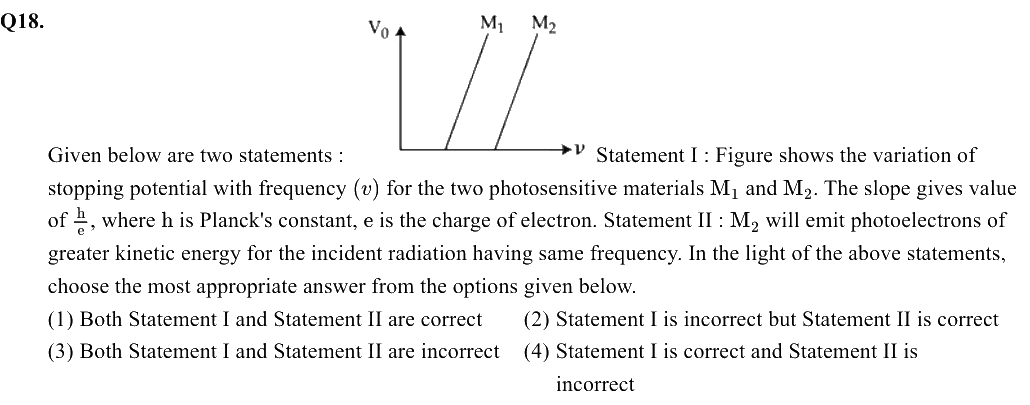
see figure Given below are two statements : Statement I : Figure shows the variation of stopping potential with frequency ($v$) for the two photosensitive materials $\mathrm{M_1}$ and $\mathrm{M_2}$. The slope gives value of $\frac{h}{e}$, where h is Planck's constant, e is the charge of electron. Statement II : $\mathrm{M_2}$ will emit photoelectrons of greater kinetic energy for the incident radiation having same frequency. In the light of the above statements, choose the most appropriate answer from the options given below.
The question as printed in the paper.
A
Both Statement I and Statement II are correct
B
Statement I is incorrect but Statement II is correct
C
Both Statement I and Statement II are incorrect
D
Statement I is correct and Statement II is incorrect
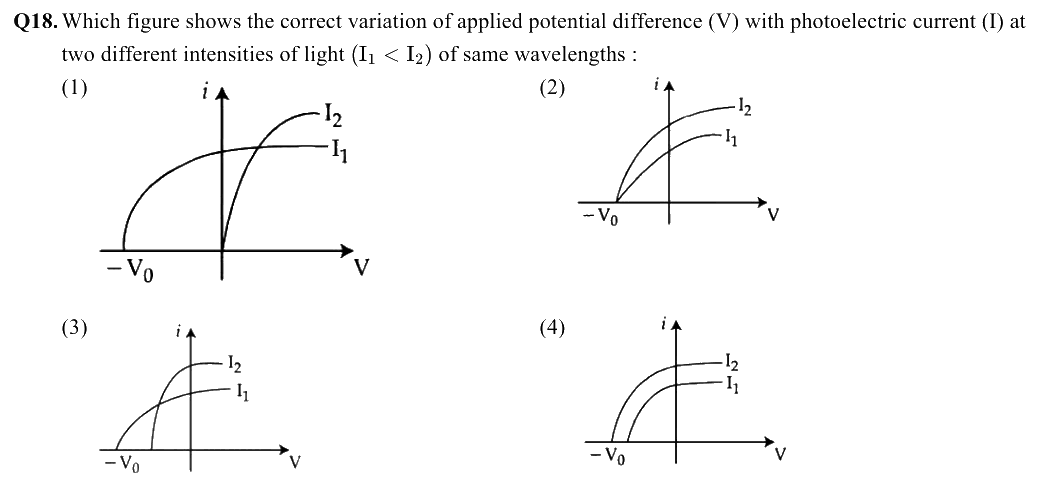
Which figure shows the correct variation of applied potential difference (V) with photoelectric current (I) at two different intensities of light ($\mathrm{I_1} < \mathrm{I_2}$) of same wavelengths :
The question as printed in the paper.
A
see figure Graph of i against V with the point -V0 marked on the V axis. Curve I1 starts at -V0, rises concavely and levels off to a plateau at the right. Curve I2 starts at the origin (V = 0), rises steeply, crosses I1 to the right of the i-axis and levels off higher than I1.
B
see figure Graph of i against V. Both curves I1 and I2 start from the same point -V0 on the V axis and rise to the right, I2 above I1, I1 flatter; neither shows a clear plateau.
C
see figure Graph of i against V with -V0 marked. I1 starts at -V0 and rises gradually to a plateau. I2 starts at a point on the V axis to the right of -V0 (but left of the i-axis), rises steeply, crosses I1 to the left of the i-axis and levels off higher than I1.
D
see figure Graph of i against V with -V0 marked. I2 starts at -V0 and I1 starts at a point slightly to the right of -V0; both rise and level off, I2 above I1 throughout.
Given below are two statements: one is labelled as Assertion A and the other is labelled as Reason R. Assertion A: Number of photons increases with increase in frequency of light. Reason R: Maximum kinetic energy of emitted electrons increases with the frequency of incident radiation. In the light of the above statements, choose the most appropriate answer from the options given below:
A
Both A and R are correct and R is the correct explanation of A.
B
Both A and R are correct and R is NOT the correct explanation of A.
The de Broglie wavelengths of a proton and an $\alpha$ particle are $\lambda$ and $2\lambda$ respectively. The ratio of the velocities of proton and $\alpha$ particle will be :
Monochromatic light of frequency $6 \times 10^{14}$ Hz is produced by a laser. The power emitted is $2 \times 10^{-3}$ W. How many photons per second on an average, are emitted by the source?
When a metal surface is illuminated by light of wavelength $\lambda$, the stopping potential is 8 V. When the same surface is illuminated by light of wavelength $3\lambda$, stopping potential is 2 V. The threshold wavelength for this surface is :
In a photoelectric effect experiment a light of frequency $1.5$ times the threshold frequency is made to fall on the surface of photosensitive material. Now if the frequency is halved and intensity is doubled, the number of photo electrons emitted will be:
The work function of a substance is 3. 0 eV. The longest wavelength of light that can cause the emission of photoelectrons from this substance is approximately:
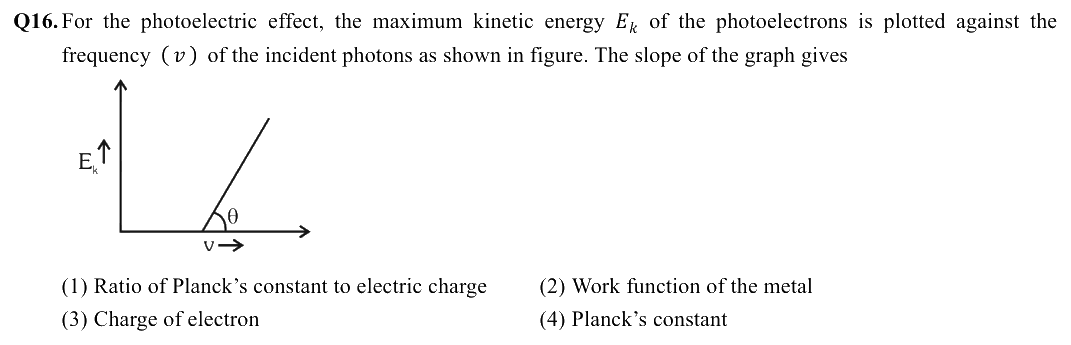
For the photoelectric effect, the maximum kinetic energy $E_k$ of the photoelectrons is plotted against the frequency ($\nu$) of the incident photons as shown in figure. The slope of the graph gives
The de-Broglie wavelength of an electron is the same as that of a photon. If velocity of electron is 25% of the velocity of light, then the ratio of K.E. of electron and K.E. of photon will be:
Two sources of light emit with a power of 200 W. The ratio of number of photons of visible light emitted by each source having wavelengths 300 nm and 500 nm respectively, will be :
A convex lens of focal length 40 cm forms an image of an extended source of light on a photoelectric cell. A current $I$ is produced. The lens is replaced by another convex lens having the same diameter but focal length 20 cm. The photoelectric current now is
The de Broglie wavelength of an electron having kinetic energy $E$ is $\lambda$. If the kinetic energy of electron becomes $\frac{E}{4}$, then its de-Broglie wavelength will be:
The difference between threshold wavelengths for two metal surfaces $A$ and $B$ having work function $\phi_A = 9$ eV and $\phi_B = 4.5$ eV in nm is: {Given, $hc$ = 1242 eV nm}
Given below are two statements: Statement I : Out of microwaves, infrared rays and ultraviolet rays, ultraviolet rays are the most effective for the emission of electrons from a metallic surface Statement II : Above the threshold frequency, the maximum kinetic energy of photoelectrons is inversely proportional to the frequency of the incident light In the light of above statements, choose the correct answer from the options given below
A metallic surface is illuminated with radiation of wavelength $\lambda$, the stopping potential is $V_0$. If the same surface is illuminated with radiation of wavelength $2\lambda$, the stopping potential becomes $\frac{V_0}{4}$. The threshold wavelength for this metallic surface will be
The de Broglie wavelength of a molecule in a gas at room temperature 300 K is $\lambda_1$. If the temperature of the gas is increased to 600 K, then the de Broglie wavelength of the same gas molecule becomes
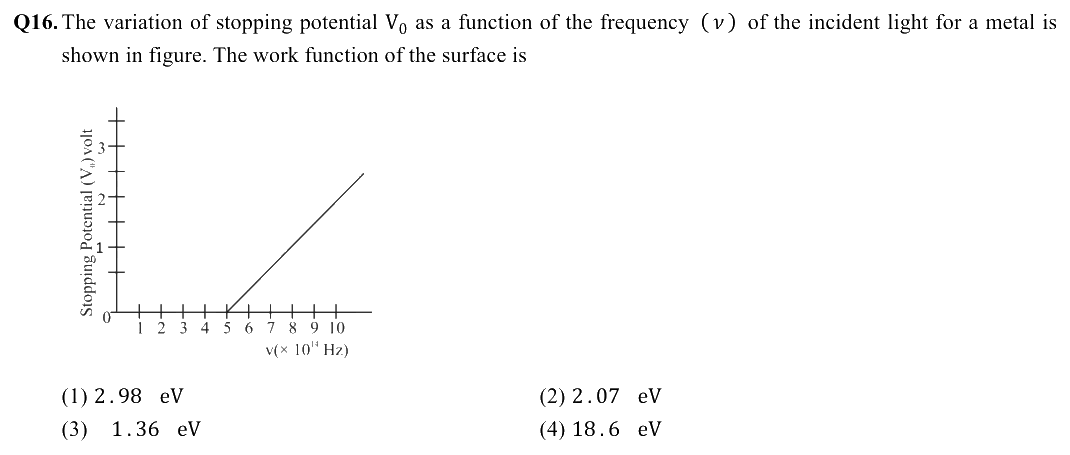
The variation of stopping potential $\mathrm{V_0}$ as a function of the frequency $(\nu)$ of the incident light for a metal is shown in figure. The work function of the surface is (see the figure above)
The kinetic energy of an electron, $\alpha$ - particle and a proton are given as $4K$, $2K$ and $K$ respectively. The de-Broglie wavelength associated with electron $(\lambda_e)$, $\alpha$ - particle $(\lambda_\alpha)$ and the proton $(\lambda_p)$ are as follows:
The work functions of Aluminium and Gold are $4.1\ \mathrm{eV}$ and $5.1\ \mathrm{eV}$ respectively. The ratio of the slope of the stopping potential versus frequency plot for Gold to that of Aluminium is
A proton moving with one tenth of velocity of light has a certain de Broglie wavelength of $\lambda$. An alpha particle having certain kinetic energy has the same de-Brogle wavelength $\lambda$. The ratio of kinetic energy of proton and that of alpha particle is :
The threshold frequency of metal is $f_0$. When the light of frequency $2f_0$ is incident on the metal plate, the maximum velocity of photoelectron is $v_1$. When the frequency of incident radiation is increased to $5f_0$, the maximum velocity of photoelectrons emitted is $v_2$. The ratio of $v_1$ to $v_2$ is:
Given below are two statements: One is labelled as Assertion A and the other is labelled as Reason R Assertion A : The beam of electrons shows wave nature and exhibit interference and diffraction. Reason R : Davisson Germer Experimentally verified the wave nature of electrons. In the light of the above statements. Choose the most appropriate answer from the options given below :
A
A is correct but R is not correct
B
A is not correct but R is correct
C
Both A and R are correct but R is Not the correct explanation of A
D
Both A and R are correct and R is the correct explanation of A
If a source of electromagnetic radiation having power 15 $\mathrm{kW}$ produces $10^{16}$ photons per second, the radiation belongs to a part of spectrum is : (Take Planck constant $h$ = $6 \times 10^{-34}$ $\mathrm{J\ s}$)
If the two metals $A$ and $B$ are exposed to radiation of wavelength 350 nm. The work functions of metals $A$ and $B$ are 4.8 eV and 2.2 eV. Then choose the correct option
A
Metal $B$ will not emit photo-electrons
B
Both metals $A$ and $B$ will emit photo-electrons
C
Both metals $A$ and $B$ will not emit photoelectrons
An electron accelerated through a potential difference $V_1$ has a de-Broglie wavelength of $\lambda$. When the potential is changed to $V_2$, its de-Broglie wavelength increases by 50%. The value of $\left(\frac{V_1}{V_2}\right)$ is equal to :
The threshold wavelength for photoelectric emission from a material is $5500\ \mathrm{\AA}$. Photoelectrons will be emitted, when this material is illuminated with monochromatic radiation from a
A. $75\ \mathrm{W}$ infra-red lamp B. $10\ \mathrm{W}$ infra-red lamp C. $75\ \mathrm{W}$ ultra-violet lamp D. $10\ \mathrm{W}$ ultra-violet lamp
Choose the correct answer from the options given below :
The ratio of de-Broglie wavelength of an $\alpha$-particle and a proton accelerated from rest by the same potential is $\frac{1}{\sqrt{m}}$ , the value of $m$ is:
Electron beam used in an electron microscope, when accelerated by a voltage of $20\ \mathrm{kV}$ has a de-Broglie wavelength of $\lambda_0$. If the voltage is increased to $40\ \mathrm{kV}$ then the de-Broglie wavelength associated with the electron beam would be:
An $\alpha$ particle, a proton and an electron have the same kinetic energy. Which one of the following is correct in case of their de-Broglie wavelength:
The kinetic energy of emitted electron is $E$ when the light incident on the metal has wavelength $\lambda$. To double the kinetic energy, the incident light must have wavelength:
An $\alpha$ particle and a proton are accelerated from rest through the same potential difference. The ratio of linear momenta acquired by above two particals will be :
The equation $\lambda=\frac{1.227}{x}$ nm can be used to find the de-Broglie wavelength of an electron. In this equation $x$ stands for : Where, $m=$ mass of electron $P=$ momentum of electron $K=$ Kinetic energy of electron $V=$ Accelerating potential in volts for electron
Two streams of photons, possessing energies to five and ten times the work function of metal are incident on the metal surface successively. The ratio of the maximum velocities of the photoelectron emitted, in the two cases respectively, will be
An electron (mass $m$) with an initial velocity $\overrightarrow{v} = v_0\hat{i}(v_0 > 0)$ is moving in an electric field $\overrightarrow{E} = -E_0\hat{i}(E_0 > 0)$ where $E_0$ is constant. If at $t = 0$, de-Broglie wavelength is $\lambda_0 = \frac{h}{mv_0}$, then its de-Broglie wavelength after time $t$ is given by
With reference to the observations in photo-electric effect, identify the correct statements from below: A. The square of maximum velocity of photoelectrons varies linearly with frequency of incident light. B. The value of saturation current increases on moving the source of light away from the metal surface. C. The maximum kinetic energy of photo-electrons decreases on decreasing the power of LED (light emitting diode) source of light. D. The immediate emission of photo-electrons out of metal surface can not be explained by particle nature of light/electromagnetic waves. E. Existence of threshold wavelength can not be explained by wave nature of light/electromagnetic waves. Choose the correct answer from the options given below:
A parallel beam of light of wavelength 900 nm and intensity $100 \mathrm{~Wm^{-2}}$ is incident on a surface perpendicular to the beam. The number of photons crossing 1 $\mathrm{cm^2}$ area perpendicular to the beam in one second is
A nucleus of mass $M$ at rest splits into two parts having masses $\frac{M}{3}$ and $\frac{2M}{3}M' < M$. The ratio of de Broglie wavelength of two parts will be
A metal exposed to light of wavelength 800 nm and emits photoelectrons with a certain kinetic energy. The maximum kinetic energy of photo-electron doubles when light of wavelength 500 nm is used. The work function of the metal is (Take $hc = 1230$ eV - nm).
Given below are two statements: one is labelled as Assertion A and the other is labelled as Reason R. Assertion A : The photoelectric effect does not take place, if the energy of the incident radiation is less than the work function of a metal. Reason R : Kinetic energy of the photoelectrons is zero, if the energy of the incident radiation is equal to the work function of a metal.
A
Both A and R are correct and R is the correct explanation of A
B
Both A and R are correct but R is not the correct explanation of A
The electric field at a point associated with a light wave is given by $E = 200\left[\sin\left(6 \times 10^{15}\right)t + \sin\left(9 \times 10^{15}\right)t\right]\ \mathrm{Vm^{-1}}$ Given: $h = 4.14 \times 10^{-15}\ \mathrm{eVs}$ If this light falls on a metal surface having a work function of $2.50\ \mathrm{eV}$, the maximum kinetic energy of the photoelectrons will be
The de Broglie wavelengths for an electron and a photon are $\lambda_e$ and $\lambda_p$ respectively. For the same kinetic energy of electron and photon, which of the following presents the correct relation between the de Broglie wavelengths of two?
Let $K_1$ and $K_2$ be the maximum kinetic energies of photo-electrons emitted when two monochromatic beams of wavelength $\lambda_1$ and $\lambda_2$, respectively are incident on a metallic surface. If $\lambda_1 = 3\lambda_2$ then :
An electron with speed $v$ and a photon with speed $c$ have the same de-Broglie wavelength. If the kinetic energy and momentum of electron are $E_e$ and $P_e$ and that of photon are $E_{ph}$ and $P_{ph}$ respectively. Which of the following is correct?
A metal surface is illuminated by a radiation of wavelength $4500 \mathrm{~\AA}$. The ejected photo-electron enters a constant magnetic field of $2 \mathrm{~mT}$ making an angle of $90^\circ$ with the magnetic field. If it starts revolving in a circular path of radius $2 \mathrm{~mm}$, the work function of the metal is approximately
Given below are two statements : Statement I : Davisson-Germer experiment establishes the wave nature of electrons. Statement II : If electrons have wave nature, they can interfere and show diffraction. In the light of the above statements choose the correct answer from the option given below :
A proton, a neutron, an electron and an $\alpha$-particle have same energy. If $\lambda_p, \lambda_n, \lambda_e$ and $\lambda_\alpha$ are the de Broglie's wavelengths of proton, neutron, electron and $\alpha$ particle respectively, then choose the correct relation from the following
The light of two different frequencies whose photons have energies $3.8 \mathrm{~eV}$ and $1.4 \mathrm{~eV}$ respectively, illuminate a metallic surface whose work function is $0.6 \mathrm{~eV}$ successively. The ratio of maximum speeds of emitted electrons for the two frequencies respectively will be :
The temperature of an ideal gas in three dimensions is $300$ K. The corresponding de-Broglie wavelength of the electron approximately at $300$ K is: $m_e$ = mass of electron $= 9 \times 10^{-31}$ kg, $h$ = Planck constant $= 6.6 \times 10^{-34}$ J s, $k_B$ = Boltzmann constant $= 1.38 \times 10^{-23}$ J K$^{-1}$
A moving proton and electron have the same de-Broglie wavelength. If $K$ and $P$ denote the $K.E.$ and momentum respectively. Then choose the correct option :
Consider two separate ideal gases of electrons and protons having same number of particles. The temperature of both the gases are same. The ratio of the uncertainty in determining the position of an electron to that of a proton is proportional to:
A monochromatic neon lamp with wavelength of $670.5\ \mathrm{nm}$ illuminates a photo-sensitive material which has a stopping voltage of $0.48\ \mathrm{V}$. What will be the stopping voltage if the source light is changed with another source of wavelength of $474.6\ \mathrm{nm}$ ?
In a photoelectric experiment, ultraviolet light of wavelength $280\ \mathrm{nm}$ is used with lithium cathode having work function $\phi=2.5\ \mathrm{eV}$. If the wavelength of incident light is switched to $400\ \mathrm{nm}$, find out the change in the stopping potential. ($\mathrm{h}=6.63\times10^{-34}\ \mathrm{J\ s}$, $\mathrm{c}=3\times10^{8}\ \mathrm{m\ s^{-1}}$)
The de-Broglie wavelength of a particle having kinetic energy $E$ is $\lambda$. How much extra energy must be given to this particle so that the de-Broglie wavelength reduces to $75\%$ of the initial value?
What should be the order of arrangement of de-Broglie wavelength of electron $\lambda_e$, an $\alpha$-particle $\lambda_\alpha$ and proton $\lambda_p$ given that all have the same kinetic energy ?
A particle of mass $4M$ at rest disintegrates into two particles of mass $M$ and $3M$, respectively, having non zero velocities. The ratio of de-Broglie wavelength of particle of mass $M$ to that of mass $3M$ will be:
An electron moving with speed $v$ and a photon moving with speed $c$, have the same D-Broglie wavelength. The ratio of the kinetic energy of the electron to that of a photon is:
When radiation of wavelength $\lambda$ is incident on a metallic surface, the stopping potential of ejected photoelectrons is $4.8\ \mathrm{V}$. If the same surface is illuminated by radiation of double the previous wavelength, then the stopping potential becomes $1.6\ \mathrm{V}$. The threshold wavelength of the metal is:
An electron of mass $m_e$ and a proton of mass $m_p$ are accelerated through the same potential difference. The ratio of the de-Broglie wavelength associated with the electron to that with the proton is
The radiation corresponding to $3 \to 2$ transition of a hydrogen atom falls on a gold surface to generate photoelectrons. These electrons are passed through a magnetic field of $5 \times 10^{-4}\ \mathrm{T}$. Assume that the radius of the largest circular path followed by these electrons is $7\ \mathrm{mm}$, the work function of the metal is: (Mass of electron $= 9.1 \times 10^{-31}\ \mathrm{kg}$)
A particle is travelling 4 times as fast as an electron. Assuming the ratio of de-Broglie wavelength of a particle to that of electron is $2:1$, the mass of the particle is :-
The speed of electrons in a scanning electron microscope is $1 \times 10^7~\mathrm{ms^{-1}}$. If the protons having the same speed are used instead of electrons, then the resolving power of scanning proton microscope will be changed by a factor of:
An electron of mass $m$ and a photon have same energy $E$. The ratio of wavelength of electron to that of photon is : ($c$ being the velocity of light)
Two identical photocathodes receive the light of frequencies $f_1$ and $f_2$ respectively. If the velocities of the photo-electrons coming out are $v_1$ and $v_2$ respectively, then
The de-Broglie wavelength associated with an electron and a proton were calculated by accelerating them through same potential of $100\ \mathrm{V}$. What should nearly be the ratio of their wavelengths ? $(m_p = 1.00727\ \mathrm{u}, m_e = 0.00055\ \mathrm{u})$
Given below are two statements : one is labelled as Assertion A and the other is labelled as Reason R. Assertion A : An electron microscope can achieve better resolving power than an optical microscope. Reason R : The de Broglie's wavelength of the electrons emitted from an electron gun is much less than wavelength of visible light. In the light of the above statements, choose the correct answer from the options given below:
A
A is false but R is true.
B
Both A and R are true and R is the correct explanation of A
C
Both A and R are true but R is NOT the correct explanation of A
An $\alpha$ particle and a proton are accelerated from rest by a potential difference of $200\ \mathrm{V}$. After this, their de Broglie wavelengths are $\lambda_\alpha$ and $\lambda_p$ respectively. The ratio $\frac{\lambda_p}{\lambda_\alpha}$ is :
An electron of mass $m_e$ and a proton of mass $m_p = 1836\ m_e$ are moving with the same speed. The ratio of their de Broglie wavelength $\frac{\lambda_{electron}}{\lambda_{proton}}$ will be :
The stopping potential for electrons emitted from a photosensitive surface illuminated by light of wavelength $491\ \mathrm{nm}$ is $0.710\ \mathrm{V}$. When the incident wavelength is changed to a new value, the stopping potential is $1.43\ \mathrm{V}$. The new wavelength is :
Given below are two statements: Statement I: Two photons having equal linear momenta have equal wavelengths. Statement II: If the wavelength of the photon is decreased, then the momentum and energy of a photon will also decrease. In the light of the above statements, choose the correct answer from the options given below.
An electron, a doubly ionized helium ion ($He^{++}$) and proton are having the same kinetic energy. The relation between their respective de-Broglie wavelength $\lambda_{e}, \lambda_{\mathrm{He}^{++}}$ and $\lambda_\mathrm{p}$ is :
Assuming the nitrogen molecule is moving with r. m. s. velocity at 400 K, the de-Broglie wave length of nitrogen molecule is close to : (Given : nitrogen molecule weight : $4.64 \times 10^{-26}$ kg, Boltzman constant : $1.38 \times 10^{-23}\ \mathrm{J\,K^{-1}}$, Planck constant : $6.63 \times 10^{-34}\ \mathrm{J\,s}$)
Particle A of mass $\mathrm{m_{A}} = \frac{\mathrm{m}}{2}$ moving along the x -axis with velocity $\mathrm{v_{0}}$ collides elastically with another particle B at rest having mass $\mathrm{m_{B}} = \frac{\mathrm{m}}{3}$. If both the particles move along the x -axis after the collision, the change $\Delta\lambda$ in the wavelength of the particle A, in terms of its de-Broglie wavelength $(\lambda_{0})$ before the collision is:
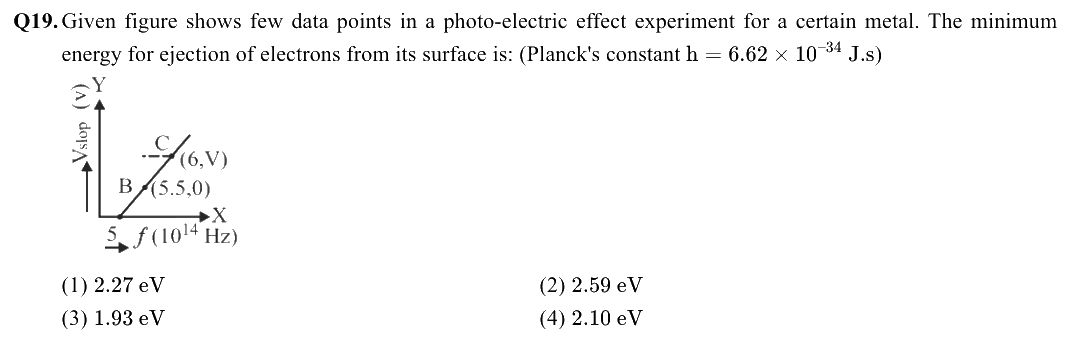
Given figure shows few data points in a photo-electric effect experiment for a certain metal. The minimum energy for ejection of electrons from its surface is: (Planck's constant h = $6.62 \times 10^{-34}$ J.s) (see the figure above)
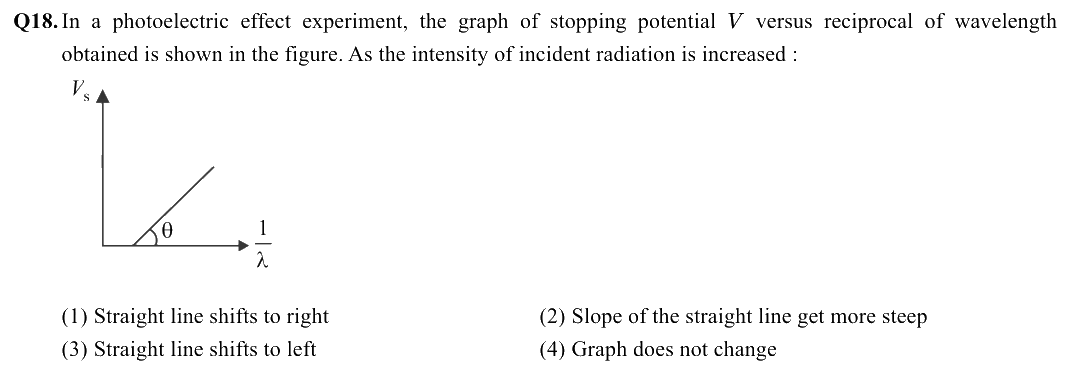
In a photoelectric effect experiment, the graph of stopping potential $V$ versus reciprocal of wavelength obtained is shown in the figure. As the intensity of incident radiation is increased : (see the figure above)
When the wavelength of radiation falling on a metal is changed from $500\ \mathrm{nm}$ to $200\ \mathrm{nm}$, the maximum kinetic energy of the photoelectrons becomes three times larger. The work function of the metal is close to:
Two sources of light emit X-rays of wavelength $1\ \mathrm{nm}$ and visible light of wavelength $500\ \mathrm{nm}$, respectively. Both the sources emit light of the same power $200\ \mathrm{W}$. The ratio of the number density of photons of X-rays to the number density of photons of the visible light of the given wavelengths is:
A particle is moving 5 times as fast as an electron. The ratio of the de-Broglie wavelength of the particle to that of the electron is $1.878 \times 10^{-4}$. The mass of the particle is close to :
Radiation, with wavelength $6561\ \mathrm{\AA}$ falls on a metal surface to produce photoelectrons. The electrons are made to enter a uniform magnetic field of $3 \times 10^{-4}\ \mathrm{T}$ . If the radius of the largest circular path followed by the electrons is $10\ \mathrm{mm}$ , the work function of the metal is close to:
A particle moving with kinetic energy $E$ has de Broglie wavelength $\lambda$ . If energy $\Delta E$ is added to its energy, the wavelength become $\frac{\lambda}{2}$ . Value of $\Delta E$, is:
An electron of mass $m$ and magnitude of charge $e$ at rest, gets accelerated by a constant electric field $E$. The rate of change of de-Broglie wavelength of this electron at a time $t$ is (ignore relativistic effects)
When photon of energy $4.0\mathrm{eV}$ strikes the surface of a metal $A$, the ejected photoelectrons have maximum kinetic energy $T_A\mathrm{eV}$ and de-Broglie wavelength $\lambda_A$. The maximum kinetic energy of photoelectrons liberated from another metal $B$ by photon of energy $4.50\mathrm{eV}$ is $T_B = (T_A - 1.5)\mathrm{eV}$. If the de-Broglie wavelength of these photoelectrons $\lambda_B = 2\lambda_A$, then the work function of metal $B$ is:
An electron (mass $\mathrm{m}$ ) with initial velocity $\vec{v} = v_0\hat{i} + v_0\hat{j}$ is in an electric filed $\vec{E} = -E_0\hat{k}$. If $\lambda_0$ is initial de-Broglie wavelength of electron, its de-Broglie wave length at time $t$ is given by:
An electron (of mass $m$ ) and a photon have the same energy $E$ in the range of a few eV. The ratio of the de-Broglie wavelength associated with the electron and the wavelength of the photon is ( $\mathrm{c} =$ speed of light in vacuum)
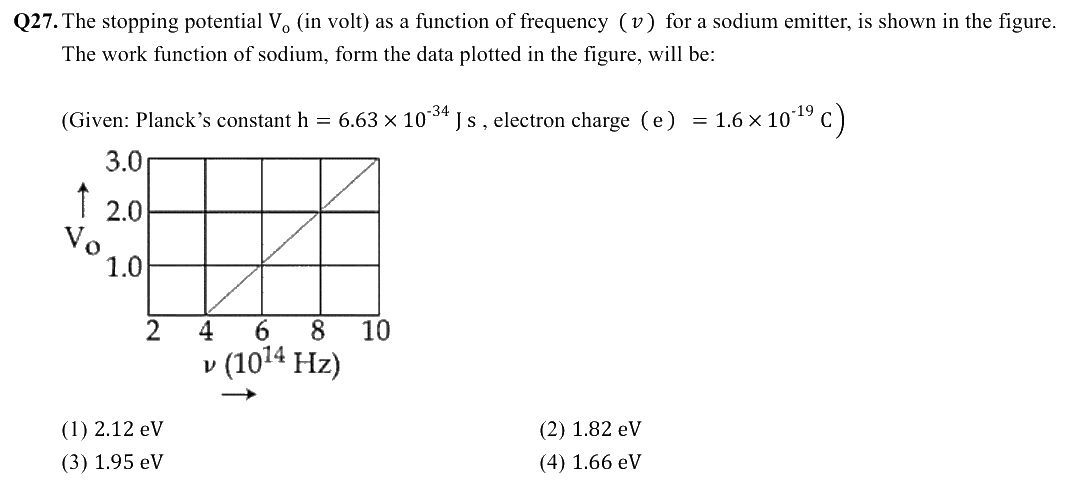
The stopping potential $\mathrm{V_o}$ (in volt) as a function of frequency $(\nu)$ for a sodium emitter, is shown in the figure. The work function of sodium, form the data plotted in the figure, will be: (Given: Planck's constant $\mathrm{h = 6.63 \times 10^{-34}\ J\ s}$ , electron charge $(\mathrm{e})\ = 1.6 \times 10^{-19}\ \mathrm{C}$) (see the figure above)
In a photoelectric effect experiment, the threshold wavelength of light is $380\ \mathrm{nm}$ . If the wavelength of incident light is $260\ \mathrm{nm}$ , the maximum kinetic energy of emitted electrons will be Given E (in eV) $= \frac{1237}{\lambda(\text{in nm})}$
A 2 mW laser operates at a wavelength of $500\ \mathrm{nm}$. The number of photons that will be emitted per second is: [Given Planck's constant $h = 6.6\times10^{-34}\ \mathrm{J\,s}$, speed of light $c = 3.0\times10^{8}\ \mathrm{m\,/\,s}$ ]
The electric field of light wave is given as $\vec{E} = 10^{-3}\cos\left(\dfrac{2\pi x}{5 \times 10^{-7}} - 2\pi \times 6 \times 10^{14}t\right)\hat{x}\,\dfrac{\mathrm{N}}{\mathrm{C}}$. This light falls on a metal plate of work function 2 eV . The stopping potential of the photo-electrons is: Given, E (in eV ) = $\dfrac{12375}{\lambda(\text{in Å})}$
A particle 'P' is formed due to a completely inelastic collision of particles 'x' and 'y' having de-Broglie wavelengths '$\lambda_x$' and '$\lambda_y$' respectively. If x and y were moving in opposite directions, then the de-Broglie wavelength of 'P' is:
Two particles move at right angle to each other. Their de Broglie wavelengths are $\lambda_1$ and $\lambda_2$ respectively. The particles suffer perfectly inelastic collision. The de Broglie wavelength $\lambda$ of the final particle, is given by:
A nucleus A, with a finite de-broglie wavelength $\lambda_{\mathrm{A}}$, undergoes spontaneous fission into two nuclei B and C of equal mass. B flies in the same direction as that of A, while C flies in the opposite direction with a velocity equal to half of that of B . The de-Broglie wavelengths $\lambda_{\mathrm{B}}$ and $\lambda_{\mathrm{C}}$ of B and C are respectively:
A particle A of mass $m$ and charge $q$ is accelerated by a potential difference of 50 V. Another particle B of mass $4m$ and charge $q$ is accelerated by a potential difference of 2500 V. The ratio of de-Broglie wavelengths $\frac{\lambda_A}{\lambda_B}$ is close to:
When a certain photosensitive surface is illuminated with a monochromatic light of frequency $\nu$, the stopping potential of the photo current is $-\frac{V_0}{2}$. When the surface is illuminated by monochromatic light of frequency $\frac{\nu}{2}$, the stopping potential is $-V_0$. The threshold frequency for photoelectric emission is
If the deBroglie wavelength of an electron is equal to $10^{-3}$ times the wavelength of a photon of frequency $6 \times 10^{14}$ Hz, then the speed of electron is equal to : (Speed of light = $3 \times 10^8$ m/s) Planck's constant = $6.63 \times 10^{-34}$ J. s Mass of electron = $9.1 \times 10^{-31}$ kg)
In a photoelectric experiment, the wavelength of the light incident on a metal is changed from 300nm to 400nm. The decrease in the stopping potential is close to : $\left(\frac{hc}{e} = 1240\text{nm} - \text{V}\right)$
In an electron microscope, the resolution that can be achieved is of the order of the wavelength of electrons used. To resolve a width of $7.5 \times 10^{-12}\ m$, the minimum electron energy required is close to:
A metal plate of area $1\times10^{-4}\ m^2$ is illuminated by a radiation of intensity $16\ \dfrac{milli\ W}{m^2}$. The work function of the metal is $5\ eV$. The energy of the incident photons is $10\ eV$ and only $10\%$ of it produces photo electrons. The number of emitted photo electron per second and their maximum energy, respectively, will be: $\left[1eV = 1.6\times10^{-19}J\right]$
The surface of certain metal is first illuminated with light of wavelength $\lambda_1 = 350\ \mathrm{nm}$ and then, by a light of wavelength $\lambda_2 = 540\ \mathrm{nm}$. It is found that the maximum speed of the photoelectrons in the two cases differ by a factor of $2$. The work function of the metal (in eV) is close to (Energy of photon $= \dfrac{1240}{\lambda\ \mathrm{in\ nm}}\ \mathrm{eV}$ )
The magnetic field associated with a light wave is given, at the origin, by $B = B_0\left[\sin\left(3.14\times10^7\right)ct + \sin\left(6.28\times10^7\right)ct\right]$. If this light falls on a silver plate having a work function of $4.7\ \mathrm{eV}$, what will be the maximum kinetic energy of the photoelectrons? $\left(c = 3\times10^8\ \mathrm{m\,s^{-1}}, h = 6.6\times10^{-34}\ \mathrm{J\,s}\right)$
Two electrons are moving with non-relativistic speeds perpendicular to each other. If corresponding de Broglie wavelengths are $\lambda_1$ and $\lambda_2$, their de Broglie wavelength in the frame of reference attached to their centre of mass is:
If the de Broglie wavelengths associated with a proton and an $\alpha$-particle are equal, then the ratio of velocities of the proton and the $\alpha$-particle will be:
A laser light of wavelength 660 nm is used to weld Retina detachment. If a laser pulse of width 60 ms and power 0.5 kW is used, the approximate number of photons in the pulse are (Take Planck's Constant, $h = 6.62 \times 10^{-34}$ J s)
The maximum velocity of the photoelectrons emitted from the surface is $v$ when light of frequency $n$ falls on a metal surface. If the incident frequency is increased to $3n$, the maximum velocity of the ejected photoelectrons will be:
A particle $A$ of mass $m$ and initial velocity $v$ collides with a particle $B$ of mass $\frac{m}{2}$ which is at rest. The collision is head on, and elastic. The ratio of the de-Broglie wavelengths $\lambda_A$ to $\lambda_B$ after the collision is:
A photoelectric surface is illuminated successively by monochromatic light of wavelengths $\lambda$ and $\frac{\lambda}{2}$. If the maximum kinetic energy of the emitted photoelectrons in the second case is 3 times that in the first case, the work function of the surface is :
When photons of wavelength $\lambda_1$ are incident on an isolated sphere, the corresponding stopping potential is found to be $V$. When photons of wavelength $\lambda_2$ are used, the corresponding stopping potential was thrice that of the above value. If light of wavelength $\lambda_3$ is used then find the stopping potential for this case:
Radiation of wavelength $\lambda$ is incident on a photocell. The fastest emitted photoelectron has a speed v. If the wavelength is changed to $\frac{3\lambda}{4}$, the speed of the fastest emitted photoelectron will be
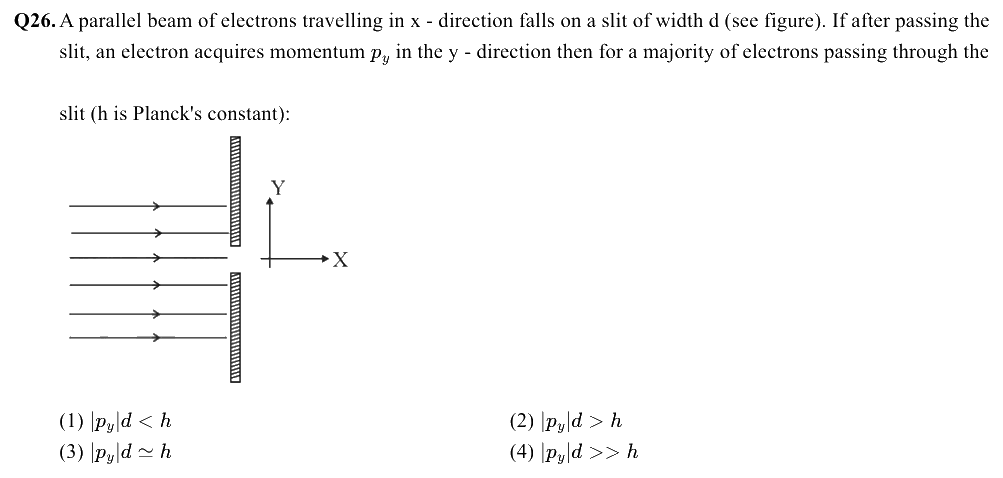
A parallel beam of electrons travelling in x - direction falls on a slit of width d (see figure). If after passing the slit, an electron acquires momentum $p_y$ in the y - direction then for a majority of electrons passing through the slit (h is Planck's constant): (see the figure above)
De-Broglie wavelength of an electron accelerated by a voltage of 50 V is close to ($|e| = 1.6 \times 10^{-19}$ C, $m_e = 9.1 \times 10^{-31}$ kg, $h = 6.6 \times 10^{-34}$ J s)
Match list-I (Fundamental Experiment) with List-II (its conclusion) and select the correct option from the choices given below the list: List-I A Franck-Hertz Experiment B Photo-electric experiment C Davison-Germer Experiment List-II (i) Particle nature of light (ii) Discrete energy levels of the atom (iii) Wave nature of electron (iv) Structure of atom
Match List-I (Experiment performed) with List-II (Phenomena discovered/associated)and select the correct option from the options given below the lists List-I (a) Davisson and Germer experiment (b) Millikan's oil drop experiment (c) Rutherford experiment (d) Franck-Hertz experiment List-II (i) Wave nature of electrons (ii) Charge of an electron (iii) Quantisation of energy levels (iv) Existence of the nucleus
A beam of light has two wavelengths of $4972\mathring{A}$ and $6216\mathring{A}$ with a total intensity of $3.6\times 10^{-3}\ \mathrm{Wm^{-2}}$ equally distributed among the two wavelengths. The beam falls normally on an area of $1\ \mathrm{cm^2}$ of a clean metallic surface of work function $2.3\mathrm{eV}$. Assume that there is no loss of light by reflection and that each capable photon ejects one electron. The number of photoelectrons liberated in $2\ \mathrm{s}$ is approximately:
A photon of wavelength $\lambda$ is scattered from an electron, which was at rest. The wavelength shift $\Delta\lambda$ is three times of $\lambda$ and the angle of scattering $\theta$ is $60^{\circ}$. The angle at which the electron recoiled is $\phi$. The value of $\tan\phi$ is : (electron speed is much smaller than the speed of light)
The radiation corresponding to $3 \to 2$ transition of hydrogen atom falls on a metal surface to produce photoelectrons. These electrons are made to enter a magnetic field of $3 \times 10^{-4}$ T. If the radius of the largest circular path followed by these electrons is 10.0 mm, the work function of the metal is close to :
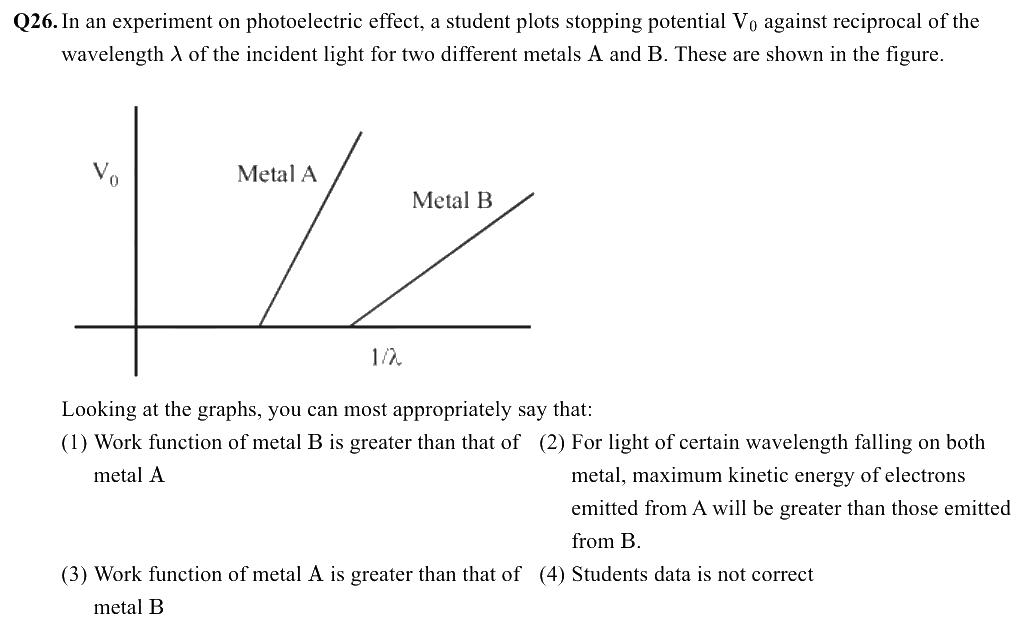
In an experiment on photoelectric effect, a student plots stopping potential $\mathrm{V_0}$ against reciprocal of the wavelength $\lambda$ of the incident light for two different metals A and B. These are shown in the figure. (see the figure above) Looking at the graphs, you can most appropriately say that:
The question as printed in the paper.
A
Work function of metal B is greater than that of metal A
B
For light of certain wavelength falling on both metal, maximum kinetic energy of electrons emitted from A will be greater than those emitted from B.
C
Work function of metal A is greater than that of metal B
A copper ball of radius 1 cm and work function 4.47 eV is irradiated with ultraviolet radiation of wavelength 2500 $\mathrm{\AA}$. The effect of irradiation results in the emission of electrons from the ball. Further the ball will acquire charge and due to this there will be a finite value of the potential on the ball. The charge acquired by the ball is :
Electrons are accelerated through a potential difference V and protons are accelerated through a potential difference 4 V. The de-Broglie wavelengths are $\lambda_e$ and $\lambda_p$ for electrons and protons respectively. The ratio of $\frac{\lambda_e}{\lambda_p}$ is given by: (given $m_e$ is mass of electron and $m_p$ is mass of proton).
Orbits of a particle moving in a circle are such that the perimeter of the orbit equals an integer number of de-Broglie wavelengths of the particle. For a charged particle moving in a plane perpendicular to a magnetic field, the radius of the $n^{\mathrm{th}}$ orbital will therefore be proportional to :
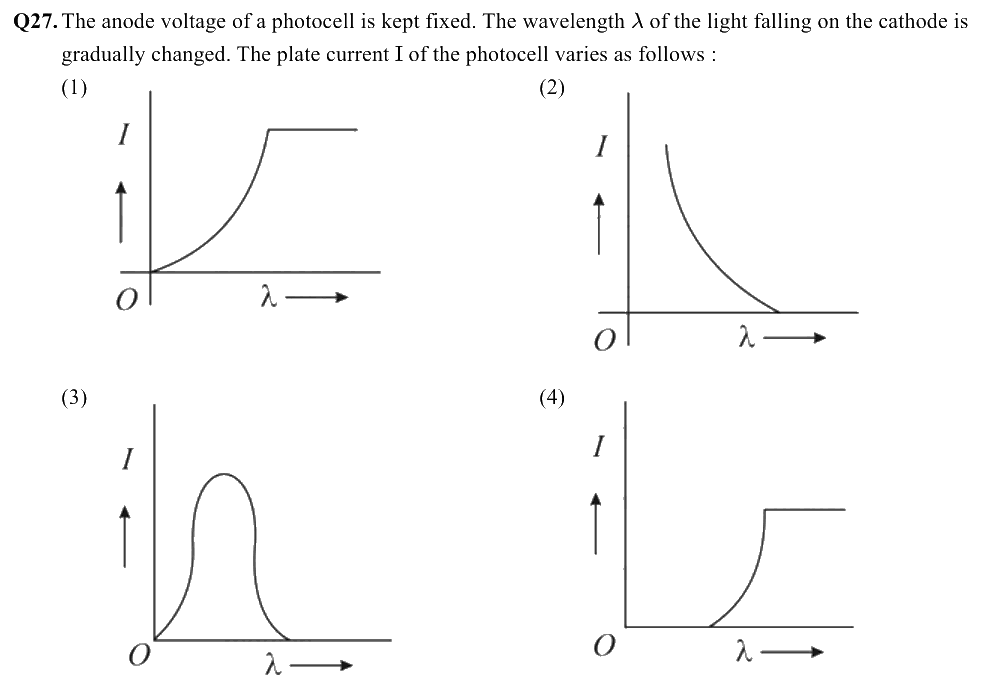
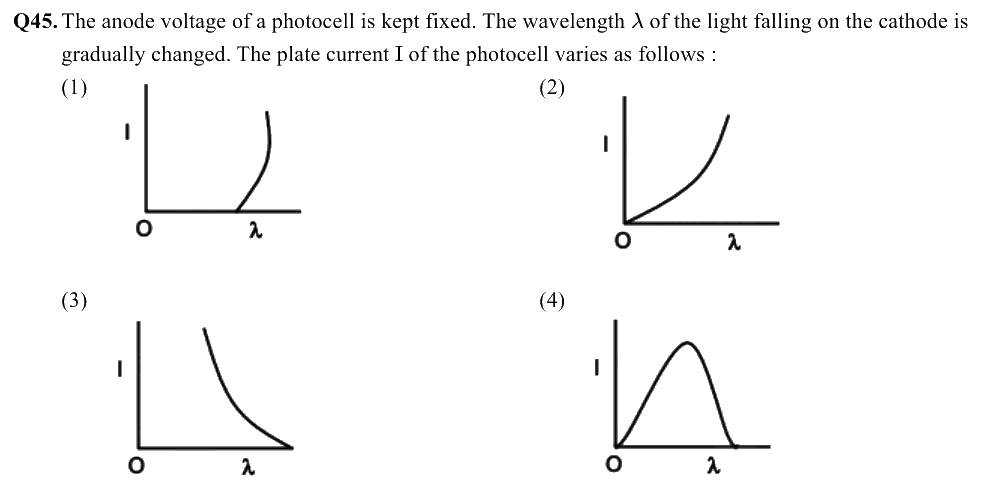
The anode voltage of a photocell is kept fixed. The wavelength $\lambda$ of the light falling on the cathode is gradually changed. The plate current I of the photocell varies as follows :
This question has Statement 1 and Statement 2. Of the four choices given after the Statements, choose the one that best describes the two Statements. Statement 1: A metallic surface is irradiated by a monochromatic light of frequency $v > v_0$ (the threshold frequency). If the incident frequency is now doubled, the photocurrent and the maximum kinetic energy are also doubled. Statement 2: The maximum kinetic energy of photoelectrons emitted from a surface is linearly dependent on the frequency of the incident light. The photocurrent depends only on the intensity of the incident light.
A
Statement 1 is true, Statement 2 is true, Statement 2 is the correct explanation of Statement 1.
B
Statement 1 is false, Statement 2 is true.
C
Statement 1 is true, Statement 2 is false.
D
Statement 1 is true, Statement 2 is true, Statement 2 is not the correct explanation of Statement 1.
This question has statement 1 and statement 2. Of the four choices given after the statements, choose the one that best describes the two statements Statement 1 : Davisson - germer experiment established the wave nature of electrons. Statement 2 : If electrons have wave nature, they can interfere and show diffraction.
A
Statement 1 is false, Statement 2 is true
B
Statement 1 is true, Statement 2 is false
C
Statement 1 is true, Statement 2 is the correct explanation for statement 1
D
Statement 1 is true, Statement 2 is true, Statement 2 is not the correct explanation for statement 1.
This question has Statement -1 and Statement -2. Of the four choices given after the statements, choose the one that best describes the two statements. Statement-1 : A metallic surface is irradiated by a monochromatic light of frequency $v > v_0$ (the threshold frequency). The maximum kinetic energy and the stopping potential are $K_{\max}$ and $V_0$ respectively. If the frequency incident on the surface doubled, both the $K_{\max}$ and $V_0$ are also doubled. Statement-2 : The maximum kinetic energy and the stopping potential of photoelectrons emitted from a surface are linearly dependent on the frequency of incident light.
A
Statement-1 is true, Statement-2 is true; Statement-2 is the correct explanation of Statement-1.
B
Statement-1 is true, Statement-2 is true; Statement-2 is not the correct explanation of Statement-1.
Statement-1 : When ultraviolet light is incident on a photocell, its stopping potential is $V_0$ and the maximum kinetic energy of the photoelectrons is $K_{\max}$. When the ultraviolet light is replaced by X$-$ rays, both $V_0$ and $K_{\max}$ increase. Statement-2 : Photoelectrons are emitted with speeds ranging from zero to a maximum value because of the range of frequencies present in the incident light. Of the four choices given after the statements, choose the one that best describes the two statements.
A
Statement-1 is true, Statement-2 is true; Statement-2 is the correct explanation of Statement-1.
B
Statement-1 is true, Statement-2 is true; Statement-2 is not the correct explanation of Statement- 1.
The surface of a metal is illuminated with the light of 400 nm. The kinetic energy of the ejected photoelectrons was found to be 1.68eV. The work function of the metal is (hc = 1240eVnm)
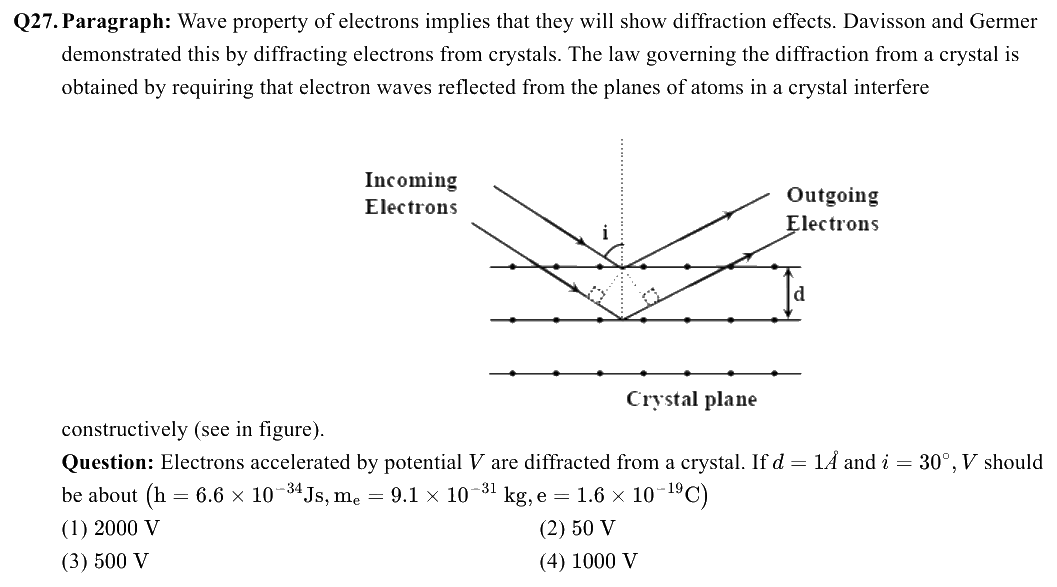
Paragraph: Wave property of electrons implies that they will show diffraction effects. Davisson and Germer demonstrated this by diffracting electrons from crystals. The law governing the diffraction from a crystal is obtained by requiring that electron waves reflected from the planes of atoms in a crystal interfere constructively (see in figure). (see the figure above) Question: Electrons accelerated by potential $V$ are diffracted from a crystal. If $d = 1\AA$ and $i = 30^{\circ}$, $V$ should be about ($\mathrm{h} = 6.6 \times 10^{-34}\,\mathrm{Js}$, $\mathrm{m_e} = 9.1 \times 10^{-31}$ kg, $\mathrm{e} = 1.6 \times 10^{-19}\mathrm{C}$)
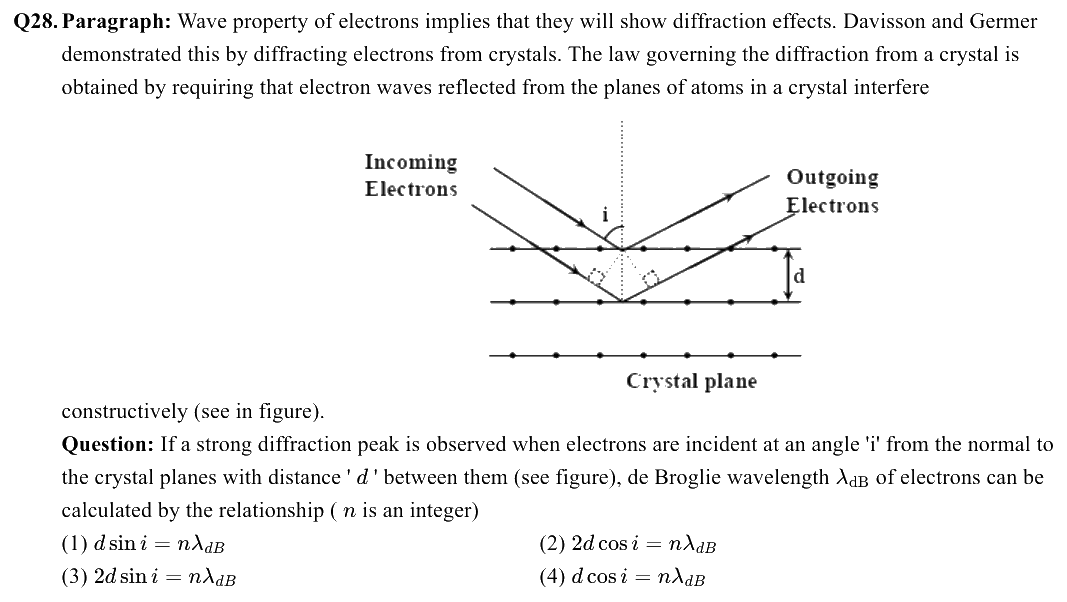
Paragraph: Wave property of electrons implies that they will show diffraction effects. Davisson and Germer demonstrated this by diffracting electrons from crystals. The law governing the diffraction from a crystal is obtained by requiring that electron waves reflected from the planes of atoms in a crystal interfere constructively (see in figure). (see the figure above) Question: If a strong diffraction peak is observed when electrons are incident at an angle 'i' from the normal to the crystal planes with distance ' $d$ ' between them (see figure), de Broglie wavelength $\lambda_{\mathrm{dB}}$ of electrons can be calculated by the relationship ( $n$ is an integer)
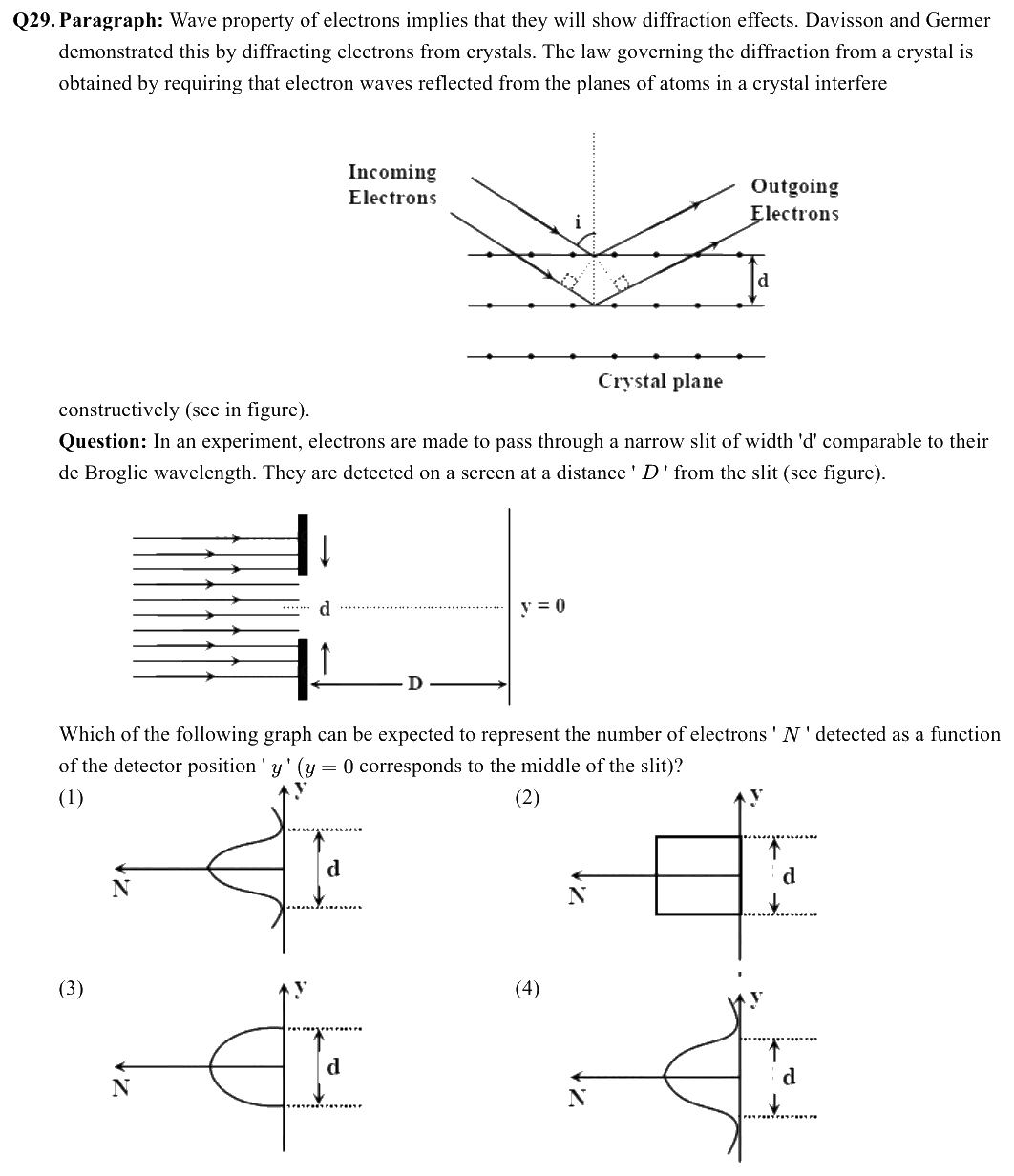
Paragraph: Wave property of electrons implies that they will show diffraction effects. Davisson and Germer demonstrated this by diffracting electrons from crystals. The law governing the diffraction from a crystal is obtained by requiring that electron waves reflected from the planes of atoms in a crystal interfere constructively (see in figure). (see the figure above) Question: In an experiment, electrons are made to pass through a narrow slit of width 'd' comparable to their de Broglie wavelength. They are detected on a screen at a distance ' $D$ ' from the slit (see figure). (see the figure above) Which of the following graph can be expected to represent the number of electrons ' $N$ ' detected as a function of the detector position ' $y$ ' ($y = 0$ corresponds to the middle of the slit)?
The threshold frequency for a metallic surface corresponds to an energy of 6.2eV, and the stopping potential for a radiation incident on this surface 5 V. The incident radiation lies in
The anode voltage of a photocell is kept fixed. The wavelength $\lambda$ of the light falling on the cathode is gradually changed. The plate current I of the photocell varies as follows :
(see the figure above)
The question as printed in the paper.
A
see figure I against $\lambda$ graph: current is zero (along the axis) from O up to a certain wavelength, then rises from the axis there, climbing upward and curving back slightly to the left near the top.
B
see figure I against $\lambda$ graph: curve rising from the origin O, convex upward (getting steeper with increasing $\lambda$).
C
see figure I against $\lambda$ graph: decreasing curve that starts high at a small non-zero $\lambda$ (not at the I axis) and falls, convex, to meet the $\lambda$ axis at the far right.
D
see figure I against $\lambda$ graph: curve rising from the origin O to a rounded maximum and then falling back to the $\lambda$ axis at a finite wavelength.
A photocell is illuminated by a small bright source placed 1 m away. When the same source of light is placed $\frac{1}{2}$ m away, the number of electrons emitted by photo cathode would
According to EInstein's photoelectric equation, the plot of the kinetic energy of the emitted photo electrons from a metal $\mathrm{V_s}$ the frequency, of the incident radiation gives straight line whose slope
A
depends on the nature of the metal used
B
depends on the intensity of the radiation
C
depends both on the intensity of the radiation and the metal used
D
is the same for all metals and independent of the intensity of the radiation.
Two identical photocathodes receive light of frequencies $\mathrm{f_1}$ and $\mathrm{f_2}$. If the velocities of the photo electrons (of mass m ) coming out are respectively $\mathrm{v_1}$ and $\mathrm{v_2}$, then
The de Broglie wavelength for an electron accelerated through the potential difference of $V_1$ volt is $\lambda_1$. When the potential difference is changed to $V_2$ volt, the associated de Broglie wavelength is increased by 50%. If $(V_1/V_2) = (9/\alpha)$, then the value of $\alpha$ is ________.
Numerical answer type: type your answer in EdLoop to check it
The ratio of de Broglie wavelength of a deutron with kinetic energy $E$ to that of an alpha particle with kinetic energy $2E$, is $n : 1$. The value of $n$ is ________.
(Assume mass of proton = mass of neutron) :
Numerical answer type: type your answer in EdLoop to check it
A particle having electric charge $3\times10^{-19}$ C and mass $6\times10^{-27}$ kg is accelerated by applying an electric potential of 1.21 V. Wavelength of the matter wave associated with the particle is $\alpha\times10^{-12}$ m. The value of $\alpha$ is ________. (Take Planck's constant = $6.6\times10^{-34}$ J.s)
Numerical answer type: type your answer in EdLoop to check it
An electron is released from rest near an infinite non-conducting sheet of uniform charge density '$-\sigma$'. The rate of change of de-Broglie wave length associated with the electron varies inversely as $n^{th}$ power of time. The numerical value of n is ______.
Numerical answer type: type your answer in EdLoop to check it
The ratio of the power of a light source $S_1$ to that the light source $S_2$ is 2. $S_1$ is emitting $2 \times 10^{15}$ photons per second at 600 nm . If the wavelength of the source $S_2$ is 300 nm , then the number of photons per second emitted by $S_2$ is ______ $\times 10^{14}$.
Numerical answer type: type your answer in EdLoop to check it
An atom absorbs a photon of wavelength 500 nm and emits another photon of wavelength 600 nm. The net energy absorbed by the atom in this process is $n \times 10^{-4}$ eV. The value of $n$ is [Assume the atom to be stationary during the absorption and emission process] (Take $h = 6.6 \times 10^{-34}$ J s and $c = 3 \times 10^{8}$ m s$^{-1}$).
Numerical answer type: type your answer in EdLoop to check it
The stopping potential for photoelectrons emitted from a surface illuminated by light of wavelength $6630 \mathrm{~\AA}$ is $0.42 \mathrm{~V}$. If the threshold frequency is $x \times 10^{13} \mathrm{~s}$, where $x$ is (nearest integer): (Given: speed light $= 3 \times 10^8 \mathrm{~m} \mathrm{~s}^{-1}$. Planck's constant $= 6.63 \times 10^{-34} \mathrm{~J} \mathrm{~s}$)
Numerical answer type: type your answer in EdLoop to check it
When light of frequency twice the threshold frequency is incident on the metal plate, the maximum velocity of emitted electron is $v_1$. When the frequency of incident radiation is increased to five times the threshold value, the maximum velocity of emitted electron becomes $v_2$. If $v_2 = xv_1$, the value of $x$ will be ______ .
Numerical answer type: type your answer in EdLoop to check it
A particle of mass $9.1 \times 10^{-31}\ \mathrm{kg}$ travels in a medium with a speed of $10^6\ \mathrm{m\ s^{-1}}$ and a photon of radiation of linear momentum $10^{-27}\ \mathrm{kg\ m\ s^{-1}}$ travels in a vacuum. The wavelength of the photon is ______ times the wavelength of the particle.
Numerical answer type: type your answer in EdLoop to check it
A light beam of wavelength $500\ \mathrm{nm}$ is incident on a metal having work function of $1.25\ \mathrm{eV}$, placed in a magnetic field of intensity $B$. The electrons emitted perpendicular to the magnetic field $B$, with maximum kinetic energy are bent into a circular arc of radius $30\ \mathrm{cm}$. The value of $B$ is ______ $\times 10^{-7}\ \mathrm{T}$. Given $hc = 20 \times 10^{-26}\ \mathrm{J\ m}$, the mass of the electron$= 9 \times 10^{-31}\ \mathrm{kg}$.
Numerical answer type: type your answer in EdLoop to check it
A certain metallic surface is illuminated by monochromatic radiation of wavelength $\lambda$. The stopping potential for photoelectric current for this radiation is $3~V_0$. If the same surface is illuminated with a radiation of wavelength $2\lambda$, the stopping potential is $V_0$. The threshold wavelength of this surface for photoelectric effect is ______ $\lambda$.
Numerical answer type: type your answer in EdLoop to check it
Two stream of photons, possessing energies equal to twice and ten times the work function of metal are incident on the metal surface successively. The value of ratio of maximum velocities of the photoelectrons emitted in the two respective cases is $x : 3$ The value of $x$ is
Numerical answer type: type your answer in EdLoop to check it
The wavelength of an X-ray beam is $10\ \mathrm{\AA}$. The mass of a fictitious particle having the same energy as that of the X-ray photons is $\frac{x}{3}h\ \mathrm{kg}$. The value of $x$ is ______. ($h$ =Planck's constant)
Numerical answer type: type your answer in EdLoop to check it
A beam of electrons of energy E scatters from a target having atomic spacing of 1 Å. The first maximum intensity occurs at $\theta = 60^{\circ}$. Then E(in eV) is........ (Planck's constant $h = 6.64 \times 10^{-34}$ Js, 1 eV = 1.6 $\times 10^{-19}$J, electron mass m = 9.1 $\times 10^{-31}$ kg)
Numerical answer type: type your answer in EdLoop to check it
The surface of a metal is illuminated alternately with photons of energies $E_1 = 4$ eV and $E_2 = 2.5$ eV respectively. The ratio of maximum speeds of the photoelectrons emitted in the two cases is 2. The work function of the metal (in eV) is ______
Numerical answer type: type your answer in EdLoop to check it
When radiation of wavelength $\lambda$ is used to illuminate a metallic surface, the stopping potential is V. When the same surface is illuminated with radiation of wavelength $3\lambda$, the stopping potential is $\frac{\mathrm{V}}{4}$. If the threshold wavelength for the metallic surface is n$\lambda$ then value of n will be :
Numerical answer type: type your answer in EdLoop to check it
A beam of electromagnetic radiation of intensity $6.4 \times 10^{-5}\mathrm{W/cm^2}$ is comprised of wavelength, $\lambda = 310\mathrm{nm}$ . It falls normally on a metal (work function $\varphi = 2\mathrm{eV}$ ) of surface area of $1\mathrm{cm}^2$ . If one in $10^3$ photons ejects an election, total number of electrons ejected in 1s is $10^x$ . ($hc = 1240\mathrm{eVnm}$, $1\mathrm{eV} = 1.6 \times 10^{-19}J$), then $x$ is ______
Numerical answer type: type your answer in EdLoop to check it
How to prepare Dual Nature of Matter & Radiation for JEE Main
How often it comes up
Dual nature of matter and radiation analyzes quantum energy packets and particle waves under Unit 17: Dual Nature of Matter and Radiation in the Class 12 syllabus, holding rank 11 among the 29 physics chapters. In the computer-based testing era from 2019 to 2026, candidates faced 165 questions across 162 papers, representing an average rate of 1.0 question per shift. The chapter featured in 148 of those 162 papers, and questions have been set every single year throughout the cycle. During the recent 2024 to 2026 examination seasons, testing recorded 55 questions across 58 papers, maintaining an average of 0.9 questions per sitting and a 3.6 percent subject share. The chapter's share has stayed about the same when compared to the 2002 to 2018 testing interval, which recorded 43 questions across 38 papers for a 3.2 percent share. In 2026 specifically, 16 questions appeared across 19 papers, showing up in 14 individual shifts. Across 2019 to 2026, 17 questions appeared as numerical answer questions, while the vast majority were multiple choice questions testing graphical interpretations and straightforward wavelength ratios.
Most-asked topics
The chapter divides into two tightly focused conceptual areas:
Photoelectric Effect: 119 questions historically, with 92 asked between 2019 and 2026, tested up to 2026. This dominant area tests Einstein's photoelectric equation, work function, threshold frequency, threshold wavelength, stopping potential variations with frequency and intensity, photon emission rates from continuous lasers, and saturation currents.
Matter Waves: 89 total questions, including 73 from 2019 to 2026, continuing in 2026. Concepts explore the de Broglie wavelength formula lambda equals h over p, wavelengths of charged particles accelerated through electric potentials, thermal neutrons and gas molecules at absolute temperature, and de Broglie wavelength comparisons between electrons, protons, deuterons, and alpha particles.
What the questions look like
Exam questions in this chapter rely on concise algebraic equations and ratio comparisons:
Stopping potential ratios across varying wavelengths: Illuminating a metallic emitter with light of wavelength lambda produces a stopping potential of several volts, which drops to a lower specified value when the wavelength doubles. Students formulate dual equations to find the threshold wavelength or work function.
Matter wave ratios for accelerated particles: Comparing the de Broglie wavelengths of different particles like deuterons and alpha particles possessing identical kinetic energy or accelerated across identical potential differences.
Photon flux from optical sources: Calculating the number of photons emitted per second by a laser given its operating power and emission wavelength.
Thermal de Broglie wavelength: Evaluating the matter wavelength of an oxygen molecule or neutron in thermal equilibrium at a specified temperature in degrees Celsius.
Master Einstein's photoelectric equation in both electron-volt and joule units. Remember that stopping potential multiplied by elementary charge e directly equals maximum kinetic energy in electron-volts. Be comfortable converting between photon energy in electron-volts and wavelength using standard physical constants.
Practice setting up simultaneous equations when stopping potentials are given at two different illumination frequencies or wavelengths. Subtracting the two equations eliminates the work function, giving a direct calculation of Planck's constant or the threshold wavelength.
For matter waves, express momentum in terms of kinetic energy, accelerating potential V, and thermal energy three-halves k T. Memorize the numerical shortcuts for electrons, protons, and alpha particles accelerated through potential V to solve ratio questions rapidly.
Frequently asked questions
Which formula in dual nature appears most often?
Einstein's photoelectric equation connecting photon energy, work function, and maximum kinetic energy is the most frequently tested formula. Equally common is the de Broglie wavelength formula relating wavelength to accelerating potential.
How does light intensity affect stopping potential?
Light intensity influences the number of incident photons and hence the saturation photocurrent, but has no effect on the stopping potential or maximum kinetic energy, which depend solely on photon frequency and the metal's work function.
What is the most common student error in this chapter?
Forgetting to convert temperatures to Kelvin when calculating thermal de Broglie wavelengths of gas molecules, or misidentifying mass and charge values when comparing deuterons and alpha particles. Step-by-step solutions for each one are in the EdLoop app.