Every Work, Energy & Power question from past JEE Main and AIEEE papers, with options and answers. Newest first.
201questions
151papers covered
3.3%of Physics questions, 2019–2026
2002–2026years
Guide at a glance
Work, Energy & Power provides the primary scalar framework for solving mechanics problems in JEE Main Physics. Across the papers we hold from 2019 to 2026, the chapter delivered 151 questions in 162 papers, which equates to 0.9 questions per paper, and appeared in 122 of those 162 papers.
The rain drop of mass 1 g, starts with zero velocity from a height of 1 km. It hits the ground with a speed of 5 m/s. The work done by the unknown resistive force is ________ J. (take g = 10 m/s$^2$)
A body of mass 1 kg moves along a straight line with a velocity $v = 2x^2$. The work done by the body during displacement from $x = 0$ to 5 m is ________ J.
A mass of 1 kg is kept on a inclined plane with 30° inclination with respect to horizontal plane and it is at rest initially. Then the whole assembly is moved up with constant velocity of 4 m/s. The work done by the frictional force in time 2 s is ________ J. (Take g = 10 m/s$^2$)
A spherical ball of mass 2 kg falls from a height of 10 m and is brought to rest after penetrating 10 cm into sand. The average force exerted by sand on the ball is ________ N. (Take $g = 10$ m/s$^2$)
In a perfectly inelastic collision, two spheres made of the same material with masses 15 kg and 25 kg, moving in opposite directions with speeds of 10 m/s and 30 m/s, respectively, strike each other and stick together. The rise in temperature (in °C), if all the heat produced during the collision is retained by these spheres, is :
(specific heat of sphere material 31 cal/kg.°C and 1 cal = 4.2 J)
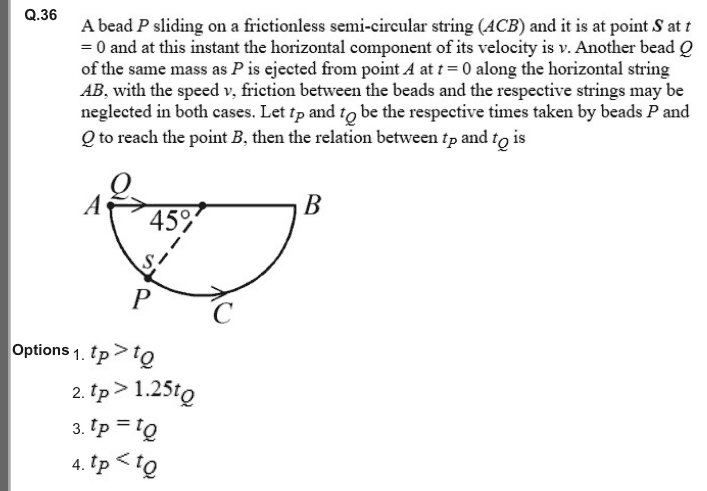
A bead $P$ sliding on a frictionless semi-circular string ($ACB$) and it is at point $S$ at $t = 0$ and at this instant the horizontal component of its velocity is $v$. Another bead $Q$ of the same mass as $P$ is ejected from point $A$ at $t = 0$ along the horizontal string $AB$, with the speed $v$, friction between the beads and the respective strings may be neglected in both cases. Let $t_P$ and $t_Q$ be the respective times taken by beads $P$ and $Q$ to reach the point $B$, then the relation between $t_P$ and $t_Q$ is
Statement I : An object moves from position $r_1$ to position $r_2$ under a conservative force field $\vec{F}$. The work done by the force is $W = -\int_{r_1}^{r_2} \vec{F} \cdot d\vec{r}$.
Statement II : Any object moving from one location to another location can follow infinite number of paths. Therefore, the amount of work done by the object changes with the path it follows for a conservative force.
In the light of the above statements, choose the correct answer from the options given below :
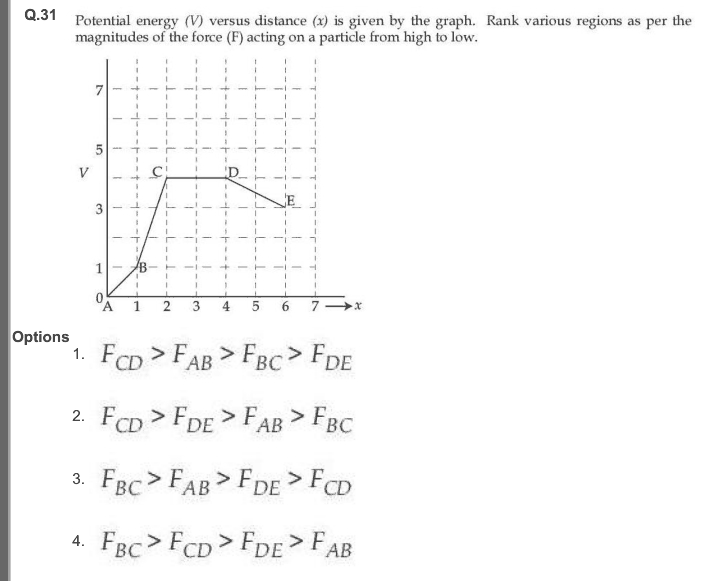
Potential energy ($V$) versus distance ($x$) is given by the graph. Rank various regions as per the magnitudes of the force ($F$) acting on a particle from high to low.
A body of mass 2 kg is moving along $x$-direction such that its displacement as function of time is given by $x(t) = \alpha t^2 + \beta t + \gamma$ m, where $\alpha = 1$ m/s$^2$, $\beta = 1$ m/s and $\gamma = 1$ m. The work done on the body during the time interval $t = 2$ s to $t = 3$ s, is ________ J.
An object of mass 1000 g experiences a time dependent force $\vec{F} = \left(2t\hat{i} + 3t^2\hat{j}\right)N$. The power generated by the force at time t is:
A particle is released from height S above the surface of the earth. At certain height its kinetic energy is three times its potential energy. The height from the surface of the earth and the speed of the particle at that instant are respectively.
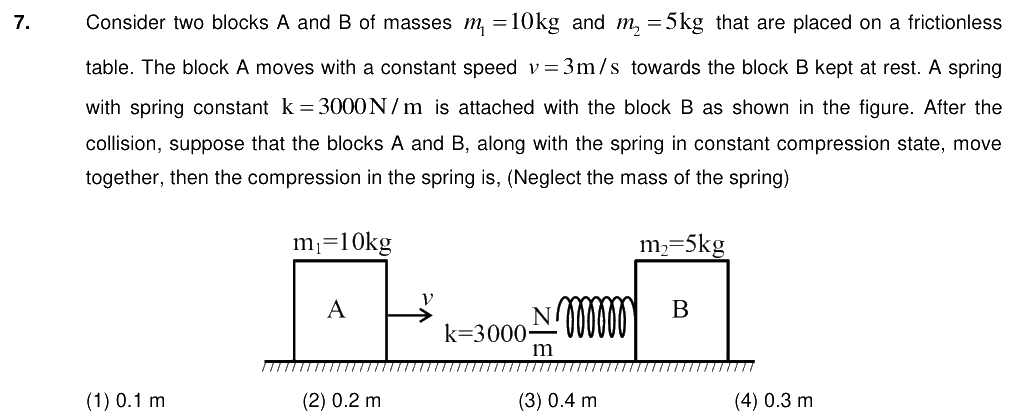
Consider two blocks A and B of masses $m_1 = 10kg$ and $m_2 = 5kg$ that are placed on a frictionless table. The block A moves with a constant speed $v = 3m/s$ towards the block B kept at rest. A spring with spring constant $k = 3000N / m$ is attached with the block B as shown in the figure. After the collision, suppose that the blocks A and B, along with the spring in constant compression state, move together, then the compression in the spring is, (Neglect the mass of the spring)
A block of mass 1 kg, moving along $x$ with speed $v_i = 10m/s$ enters a rough region ranging from $x = 0.1m$ to $x = 1.9m$. The retarding force acting on the block in this range is $F_r = -kxN$, with k $= 10N / m$. Then the final speed of the block as it crosses rough region is.
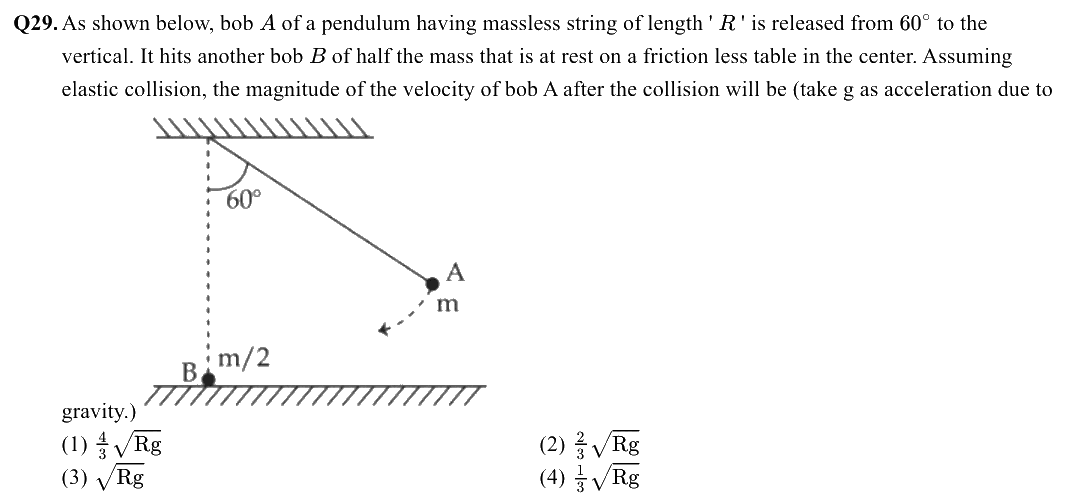
As shown below, bob $A$ of a pendulum having massless string of length ' $R$ ' is released from $60^\circ$ to the vertical. It hits another bob $B$ of half the mass that is at rest on a friction less table in the center. Assuming elastic collision, the magnitude of the velocity of bob A after the collision will be (take g as acceleration due to gravity.)
A body of mass ' $m$ ' connected to a massless and unstretchable string goes in verticle circle of radius ' $R$ ' under gravity $g$. The other end of the string is fixed at the center of circle. If velocity at top of circular path is $n\sqrt{gR}$, where, $n \geqslant 1$, then ratio of kinetic energy of the body at bottom to that at top of the circle is
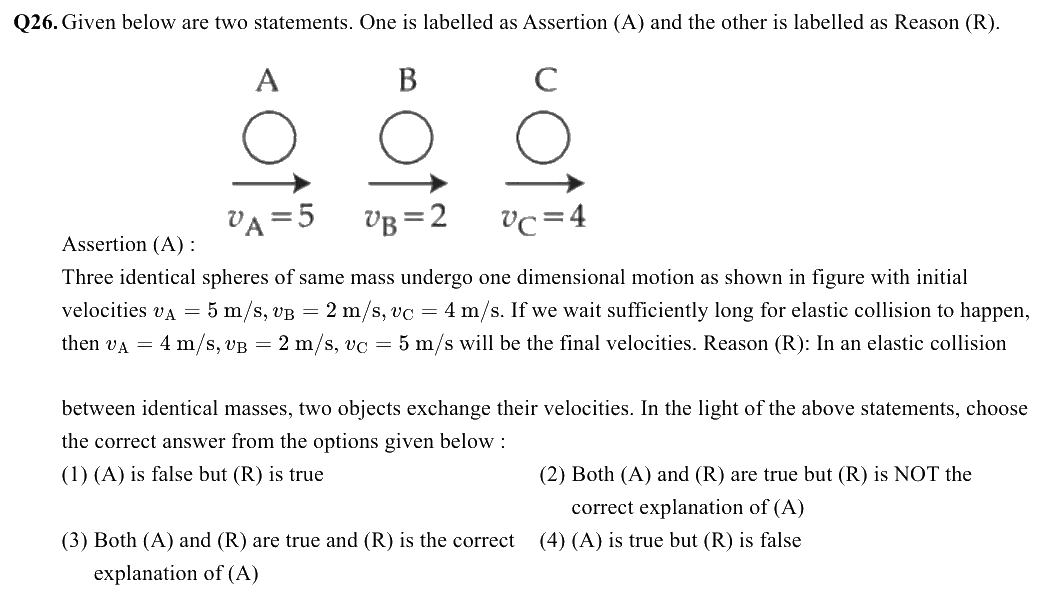
Given below are two statements. One is labelled as Assertion (A) and the other is labelled as Reason (R).
(see the figure above)
Assertion (A) : Three identical spheres of same mass undergo one dimensional motion as shown in figure with initial velocities $v_A = 5$ m/s, $v_B = 2$ m/s, $v_C = 4$ m/s. If we wait sufficiently long for elastic collision to happen, then $v_A = 4$ m/s, $v_B = 2$ m/s, $v_C = 5$ m/s will be the final velocities. Reason (R): In an elastic collision between identical masses, two objects exchange their velocities. In the light of the above statements, choose the correct answer from the options given below :
The question as printed in the paper.
A
(A) is false but (R) is true
B
Both (A) and (R) are true but (R) is NOT the correct explanation of (A)
C
Both (A) and (R) are true and (R) is the correct explanation of (A)
Given below are two statements: one is labelled as Assertion A and the other is labelled as Reason R Assertion A: In a central force field, the work done is independent of the path chosen. Reason R: Every force encountered in mechanics does not have an associated potential energy. In the light of the above statements, choose the most appropriate answer from the options given below
A
A is false but R is true
B
Both A and R are true but R is NOT the correct explanation of A
C
A is true but R is false
D
Both A and R are true and R is the correct explanation of A
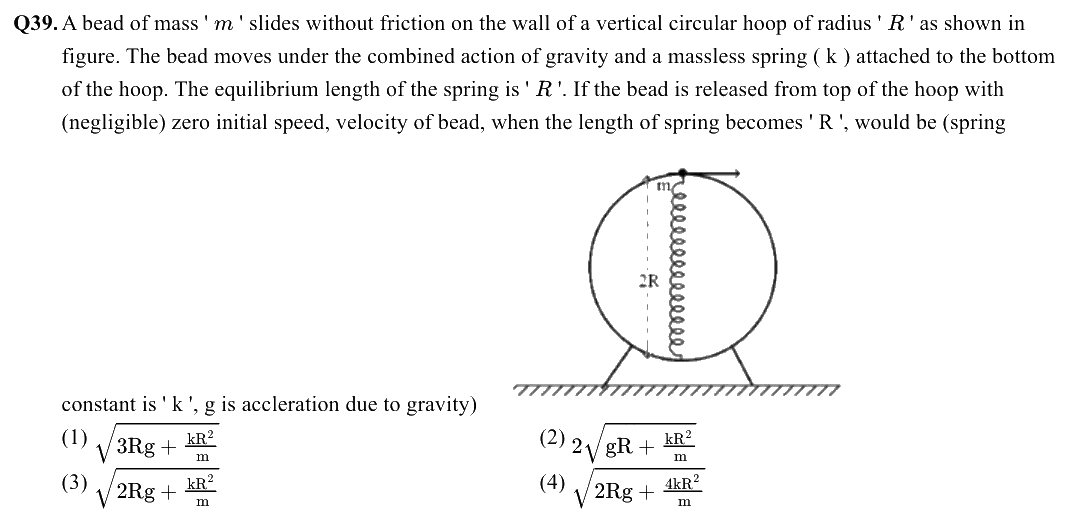
A bead of mass ' $m$ ' slides without friction on the wall of a vertical circular hoop of radius ' $R$ ' as shown in figure. The bead moves under the combined action of gravity and a massless spring ( k ) attached to the bottom of the hoop. The equilibrium length of the spring is ' R '. If the bead is released from top of the hoop with (negligible) zero initial speed, velocity of bead, when the length of spring becomes ' R ', would be (spring constant is ' k ', g is accleration due to gravity)
A body of mass 4 kg is placed on a plane at a point P having coordinate $(3, 4)$m. Under the action of force $\vec{\mathrm{F}} = (2\hat{i} + 3\hat{j})$N, it moves to a new point Q having coordinates $(6, 10)$m in 4 sec . The average power and instantaneous power at the end of 4 sec are in the ratio of :
A force $\mathrm{F} = \alpha + \beta x^2$ acts on an object in the x -direction. The work done by the force is 5 J when the object is displaced by 1 m . If the constant $\alpha = 1$ N then $\beta$ will be
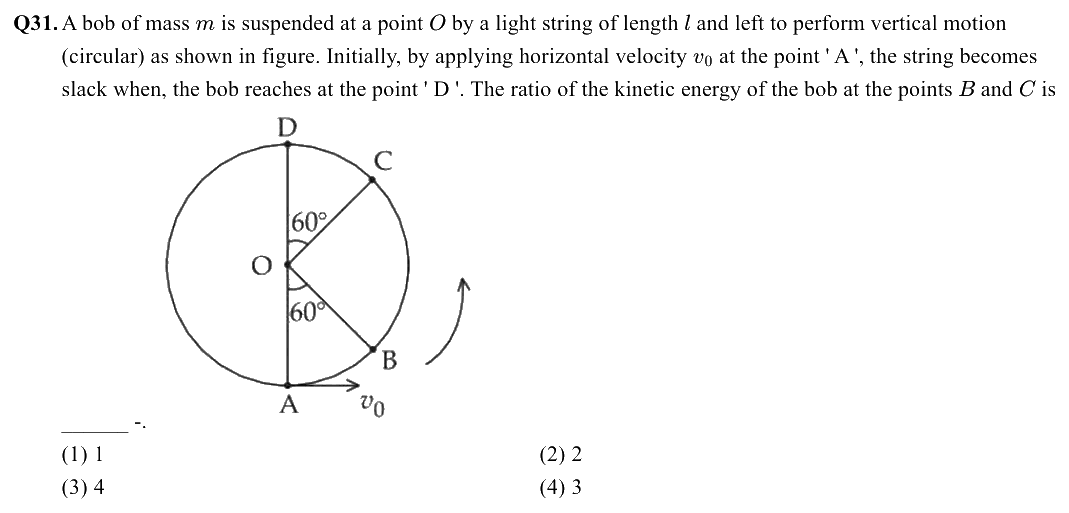
A bob of mass $m$ is suspended at a point $O$ by a light string of length $l$ and left to perform vertical motion (circular) as shown in figure. Initially, by applying horizontal velocity $v_0$ at the point ' A ', the string becomes slack when, the bob reaches at the point ' D '. The ratio of the kinetic energy of the bob at the points $B$ and $C$ is ______ -.
A force $\overrightarrow{\mathrm{F}} = 2\hat{i} + \mathrm{b}\hat{j} + \hat{k}$ is applied on a particle and it undergoes a displacement $\hat{i} - 2\hat{j} - \hat{k}$. What will be the value of $b$, if work done on the particle is zero.
A particle of mass $m$ moves on a straight line with its velocity increasing with distance according to the equation $v = \alpha\sqrt{x}$, where $\alpha$ is a constant. The total work done by all the forces applied on the particle during its displacement from $x = 0$ to $x = \mathrm{d}$, will be :
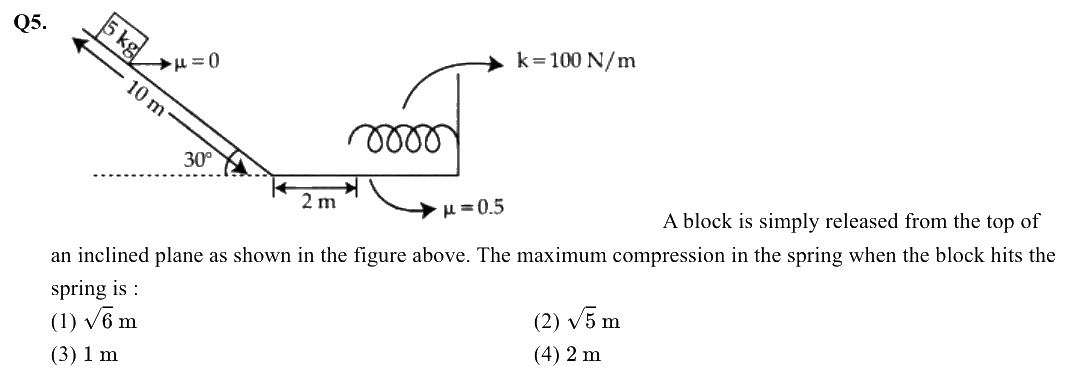
see figure A block is simply released from the top of an inclined plane as shown in the figure above. The maximum compression in the spring when the block hits the spring is :
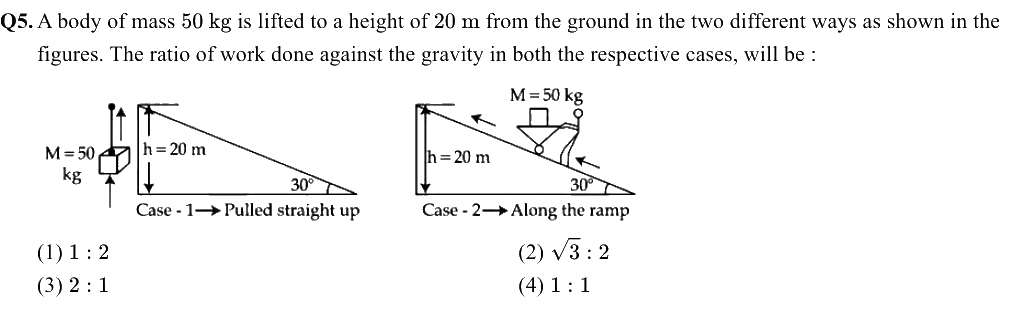
A body of mass 50 kg is lifted to a height of 20 m from the ground in the two different ways as shown in the figures. The ratio of work done against the gravity in both the respective cases, will be :
If a rubber ball falls from a height $h$ and rebounds upto the height of $h/2$. The percentage loss of total energy of the initial system as well as velocity ball before it strikes the ground, respectively, are :
A simple pendulum of length 1 m has a wooden bob of mass 1 kg. It is struck by a bullet of mass $10^{-2}$ kg moving with a speed of $2 \times 10^2\ \text{m s}^{-1}$. The bullet gets embedded into the bob. The height to which the bob rises before swinging back is. (use $g = 10\ \text{m s}^{-2}$)
A body of mass 2 kg begins to move under the action of a time dependent force given by $\vec{F} = 6t\,\hat{i} + 6t^2\,\hat{j}$ N. The power developed by the force at the time $t$ is given by:
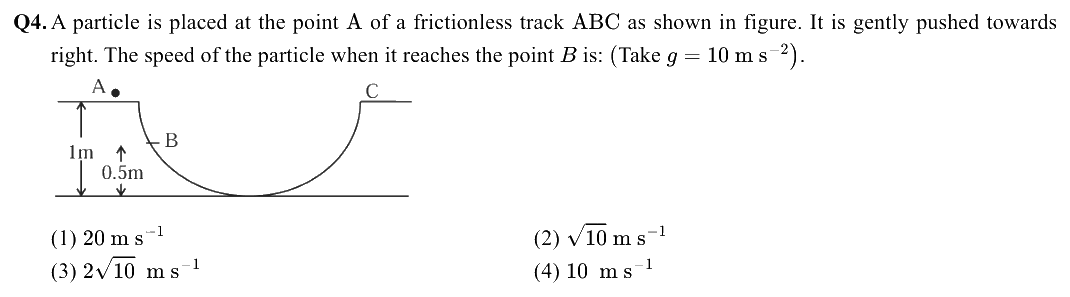
A particle is placed at the point A of a frictionless track ABC as shown in figure. It is gently pushed towards right. The speed of the particle when it reaches the point $B$ is: (Take $g = 10\ \mathrm{m\,s^{-2}}$).
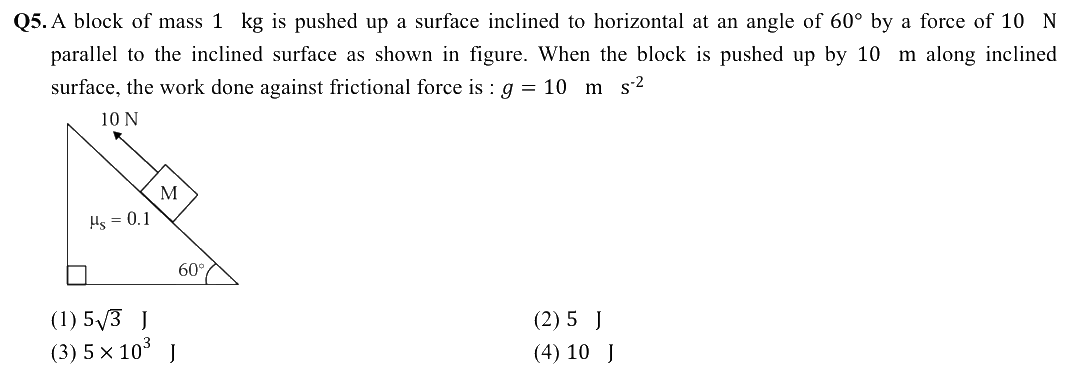
A block of mass 1 kg is pushed up a surface inclined to horizontal at an angle of $60^\circ$ by a force of 10 N parallel to the inclined surface as shown in figure. When the block is pushed up by 10 m along inclined surface, the work done against frictional force is : $g = 10\ \mathrm{m\,s^{-2}}$
A block of mass 100 kg slides over a distance of 10 m on a horizontal surface. If the co-efficient of friction between the surfaces is 0.4, then the work done against friction (in J) is:
The potential energy function (in J) of a particle in a region of space is given as $U = \left(2x^2 + 3y^3 + 2z\right)$. Here $x$, $y$ and $z$ are in meter. The magnitude of $x$ - component of force (in N) acting on the particle at point $P(1, 2, 3)$ m is:
The bob of a pendulum was released from a horizontal position. The length of the pendulum is 10 m. If it dissipates 10% of its initial energy against air resistance, the speed with which the bob arrives at the lowest point is: [Use, $g = 10$ m s$^{-2}$ ]
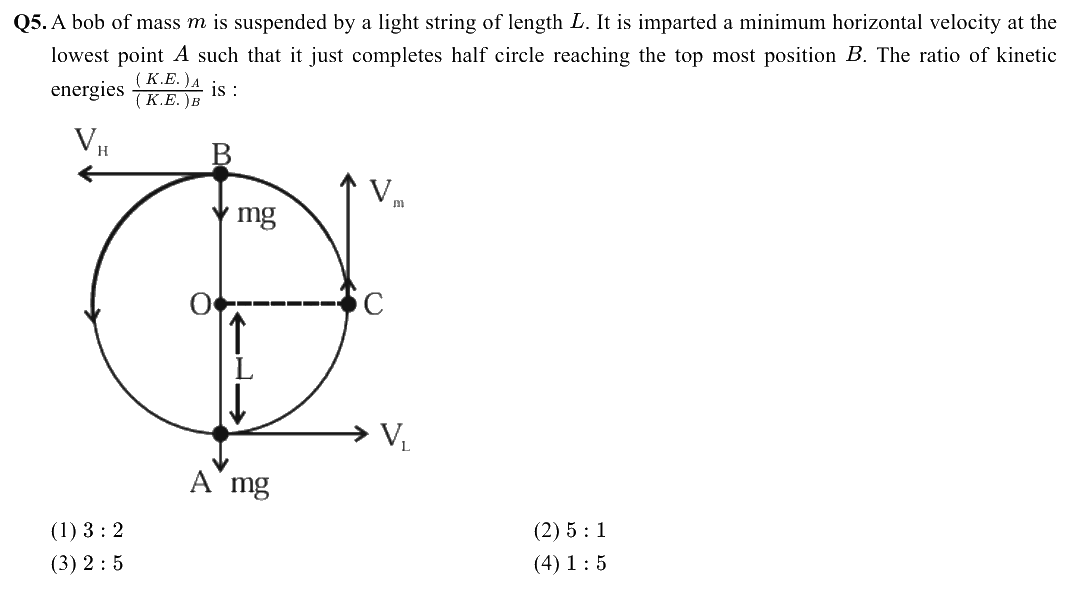
A bob of mass $m$ is suspended by a light string of length $L$. It is imparted a minimum horizontal velocity at the lowest point $A$ such that it just completes half circle reaching the top most position $B$. The ratio of kinetic energies $\frac{(K.E.)_A}{(K.E.)_B}$ is :
The ratio of powers of two motors is $\frac{3\sqrt{x}}{\sqrt{x}+1}$, that are capable of raising 300 kg water in 5 minutes and 50 kg water in 2 minutes respectively from a well of 100 m deep. The value of $x$ will be
Given below are two statements: Statement I : A truck and a car moving with same kinetic energy are brought to rest by applying breaks which provide equal retarding forces. Both come to rest in equal distance. Statement II : A car moving towards east takes a turn and moves towards north, the speed remains unchanged. The acceleration of the car is zero. In the light of given statements, choose the most appropriate answer from the options given below
A
Statement I is correct but statement II is incorrect
B
Statement I is incorrect but statement II is correct
A particle of mass $m$ moving with velocity $v$ collides with a stationary particle of mass $2m$. After collision, they stick together and continue to move together with velocity
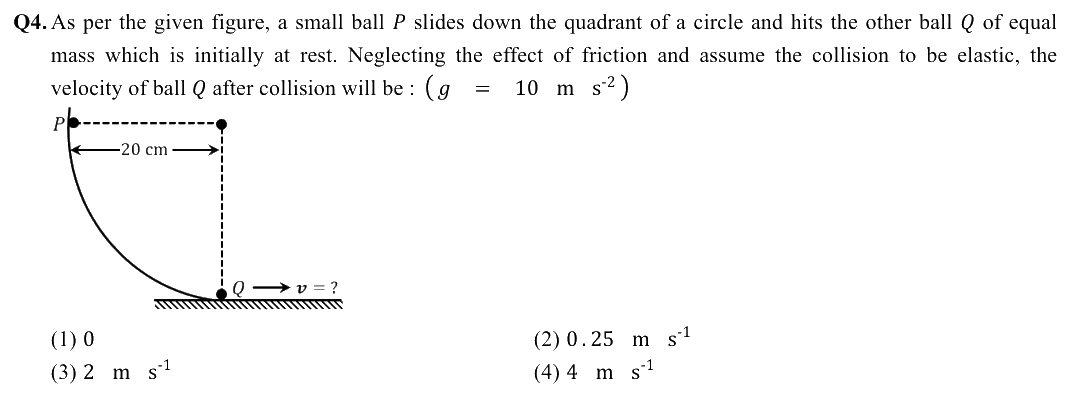
As per the given figure, a small ball $P$ slides down the quadrant of a circle and hits the other ball $Q$ of equal mass which is initially at rest. Neglecting the effect of friction and assume the collision to be elastic, the velocity of ball $Q$ after collision will be : ($g$ = 10 m s$^{-2}$)
Identify the correct statements from the following: (A) Work done by a man in lifting a bucket out of a well by means of a rope tied to the bucket is negative (B) Work done by gravitational force in lifting a bucket out of a well by a rope tied to the bucket is negative (C) Work done by friction on a body sliding down an inclined plane is positive (D) Work done by an applied force on a body moving on a rough horizontal plane with uniform velocity is zero (E) Work done by the air resistance on an oscillating pendulum is negative Choose the correct answer from the options given below:
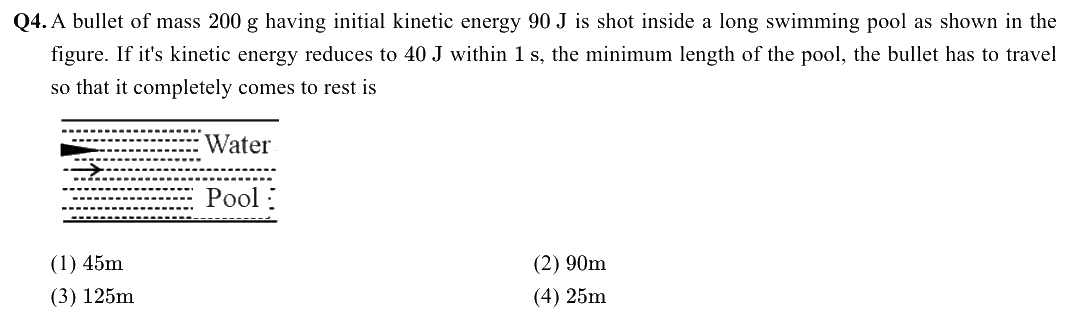
A bullet of mass $200\ \mathrm{g}$ having initial kinetic energy $90\ \mathrm{J}$ is shot inside a long swimming pool as shown in the figure. If it's kinetic energy reduces to $40\ \mathrm{J}$ within $1\ \mathrm{s}$, the minimum length of the pool, the bullet has to travel so that it completely comes to rest is
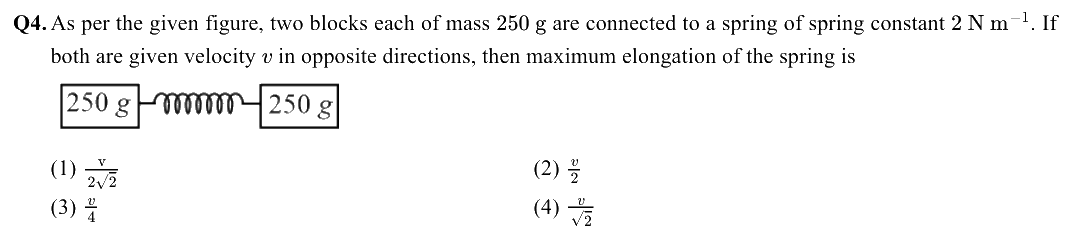
As per the given figure, two blocks each of mass 250 g are connected to a spring of spring constant $2 \mathrm{~N~m^{-1}}$. If both are given velocity $v$ in opposite directions, then maximum elongation of the spring is (see the figure above)
A body of mass $8\ \mathrm{kg}$ and another of mass $2\ \mathrm{kg}$ are moving with equal kinetic energy. The ratio of their respective momenta will be
A body of mass $0.5$ kg travels on straight line path with velocity $v = 3x^2 + 4\ \mathrm{m\ s^{-1}}$. The net work done by the force during its displacement from $x = 0$ to $x = 2$ m is
A bag of sand of mass $9.8\ \mathrm{kg}$ is suspended by a rope. $A$ bullet of $200\ \mathrm{g}$ travelling with speed $10\ \mathrm{ms^{-1}}$ gets embedded in it, then loss of kinetic energy will be
A particle of mass $500\ \mathrm{g}$ is moving in a straight line with velocity $v = bx^{\frac{5}{2}}$. The work done by the net force during its displacement from $x = 0$ to $x = 4\ \mathrm{m}$ is (Take $\mathrm{b} = 0.25\ \mathrm{m^{\frac{-3}{2}}s^{-1}}$).
A block of mass $2\ \mathrm{kg}$ moving on a horizontal surface with speed of $4\ \mathrm{m\ s^{-1}}$ enters a rough surface ranging from $x = 0.5\ \mathrm{m}$ to $x = 1.5\ \mathrm{m}$. The retarding force in this range of rough surface is related to distance by $F = -kx$ where $k = 12\ \mathrm{N\ m^{-1}}$. The speed of the block as it just crosses the rough surface will be
Water falls from a $40\ \mathrm{m}$ high dam at the rate of $9 \times 10^{4}\ \mathrm{kg}$ per hour. Fifty percentage of gravitational potential energy can be converted into electrical energy. Using this hydro electric energy number of $100\ \mathrm{W}$ lamps, that can be lit, is (Take $g = 10\ \mathrm{ms^{-2}}$)
What percentage of kinetic energy of a moving particle is transferred to a stationary particle when it strikes the stationary particle of 5 times its mass? (Assume the collision to be head-on elastic collision)
A stone tide to a string of length $L$ is whirled in a vertical circle with the other end of the string at the centre. At a certain instant of time, the stone is at its lowest position and has a speed $u$. The magnitude of change in its velocity, as it reaches a position where the string is horizontal, is $\sqrt{x(u^{2}-gL)}$. The value of $x$ is
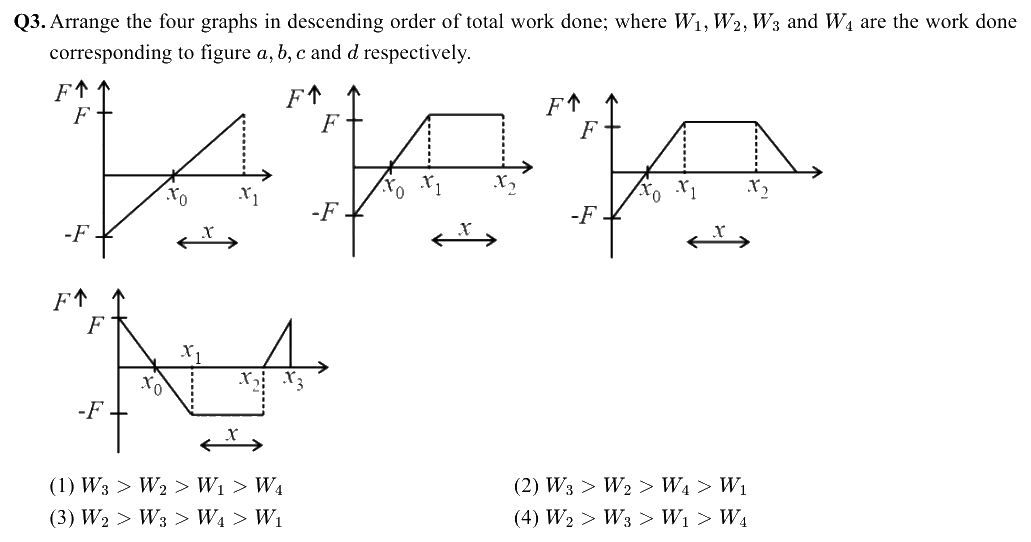
Arrange the four graphs in descending order of total work done; where $W_1, W_2, W_3$ and $W_4$ are the work done corresponding to figure $a, b, c$ and $d$ respectively. (see the figure above)
A particle experiences a variable force $\overrightarrow{\mathrm{F}} = \left(4x\hat{i} + 3y^2\hat{j}\right)$ in a horizontal $x - y$ plane. Assume distance in meters and force is newton. If the particle moves from point $(1, 2)$ to point $(2, 3)$ in the $x - y$ plane, then Kinetic Energy changes by :
Potential energy as a function of $r$ is given by $U = \frac{A}{r^{10}} - \frac{B}{r^{5}}$, where $r$ is the interatomic distance, $A$ and $B$ are positive constants. The equilibrium distance between the two atoms will be :
A body of mass $M$ moving at speed $V_0$ collides elastically with a mass $m$ at rest. After the collision, the two masses move at angles $\theta_1$ and $\theta_2$ with respect to the initial direction of motion of the body of mass $M$.. The largest possible value of the ratio $\frac{M}{m}$, for which the angles $\theta_1$ and $\theta_2$ will be equal, is :
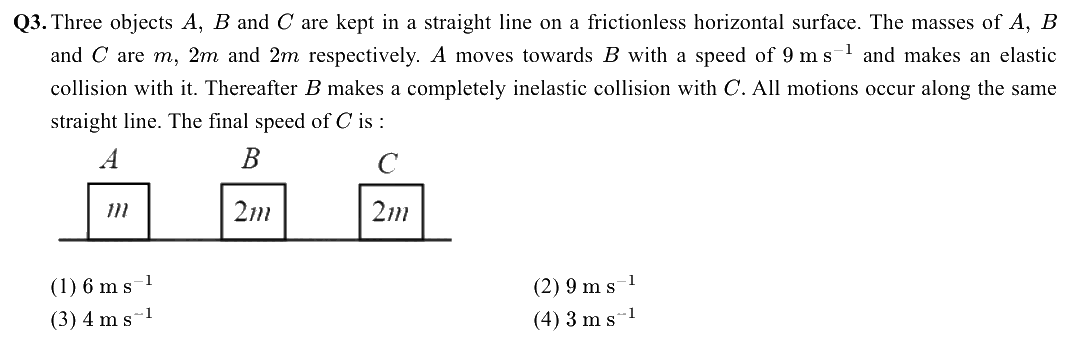
Three objects $A$, $B$ and $C$ are kept in a straight line on a frictionless horizontal surface. The masses of $A$, $B$ and $C$ are $m$, $2m$ and $2m$ respectively. $A$ moves towards $B$ with a speed of $9\ \mathrm{m\ s^{-1}}$ and makes an elastic collision with it. Thereafter $B$ makes a completely inelastic collision with $C$. All motions occur along the same straight line. The final speed of $C$ is : (see the figure above)
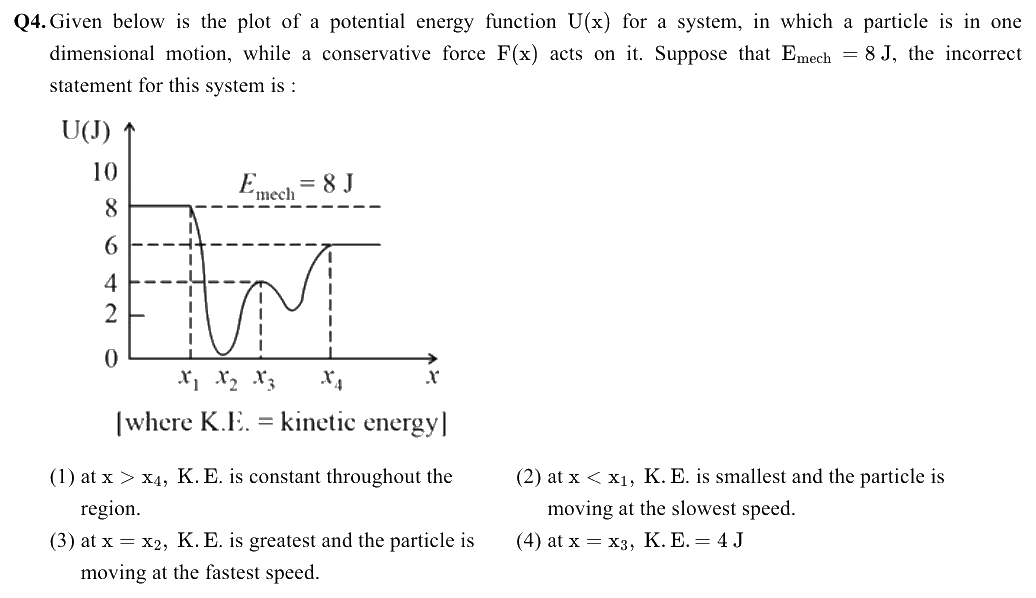
Given below is the plot of a potential energy function U(x) for a system, in which a particle is in one dimensional motion, while a conservative force F(x) acts on it. Suppose that $\mathrm{E_{mech}} = 8\ \mathrm{J}$, the incorrect statement for this system is : (see the figure above) [where K.E. = kinetic energy]
The question as printed in the paper.
A
at $\mathrm{x > x_4}$, K.E. is constant throughout the region.
B
at $\mathrm{x < x_1}$, K.E. is smallest and the particle is moving at the slowest speed.
C
at $\mathrm{x = x_2}$, K.E. is greatest and the particle is moving at the fastest speed.
An automobile of mass $m$ accelerates starting from the origin and initially at rest, while the engine supplies constant power $P$. The position is given as a function of time by:
A porter lifts a heavy suitcase of mass $80\ \mathrm{kg}$ and at the destination lowers it down by a distance of $80\ \mathrm{cm}$ with a constant velocity. Calculate the work done by the porter in lowering the suitcase. (take $g = 9.8\ \mathrm{m\ s^{-2}}$ )
A body at rest is moved along a horizontal straight line by a machine delivering a constant power. The distance moved by the body in time $t$ is proportional to:
A constant power delivering machine has towed a box, which was initially at rest, along a horizontal straight line. The distance moved by the box in time $t$ is proportional to :-
An object of mass $\mathrm{m_1}$ collides with another object of mass $\mathrm{m_2}$, which is at rest. After the collision the objects move with equal speeds in opposite direction. The ratio of the masses $\mathrm{m_2 : m_1}$ is :
A boy is rolling a $0.5 \mathrm{~kg}$ ball on the frictionless floor with the speed of $20 \mathrm{~m} \mathrm{~s}^{-1}$. The ball gets deflected by an obstacle on the way. After deflection it moves with $5 \%$ of its initial kinetic energy. What is the speed of the ball now?
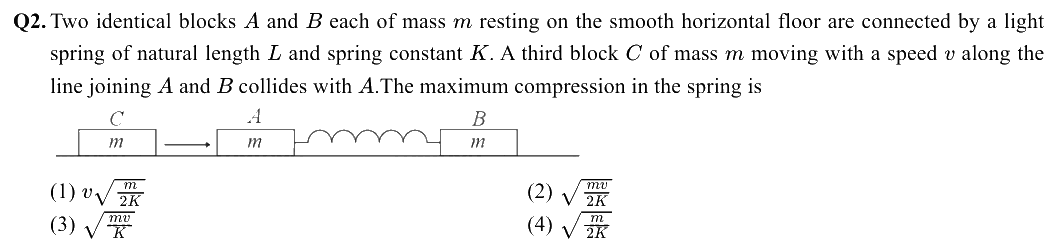
Two identical blocks $A$ and $B$ each of mass $m$ resting on the smooth horizontal floor are connected by a light spring of natural length $L$ and spring constant $K$. A third block $C$ of mass $m$ moving with a speed $v$ along the line joining $A$ and $B$ collides with $A$.The maximum compression in the spring is (see the figure above)
A rubber ball is released from a height of 5 m above the floor. It bounces back repeatedly, always rising to $\frac{81}{100}$ of the height through which it falls. Find the average speed of the ball. (Take $g=10 \mathrm{~m} \mathrm{~s}^{-2}$ )
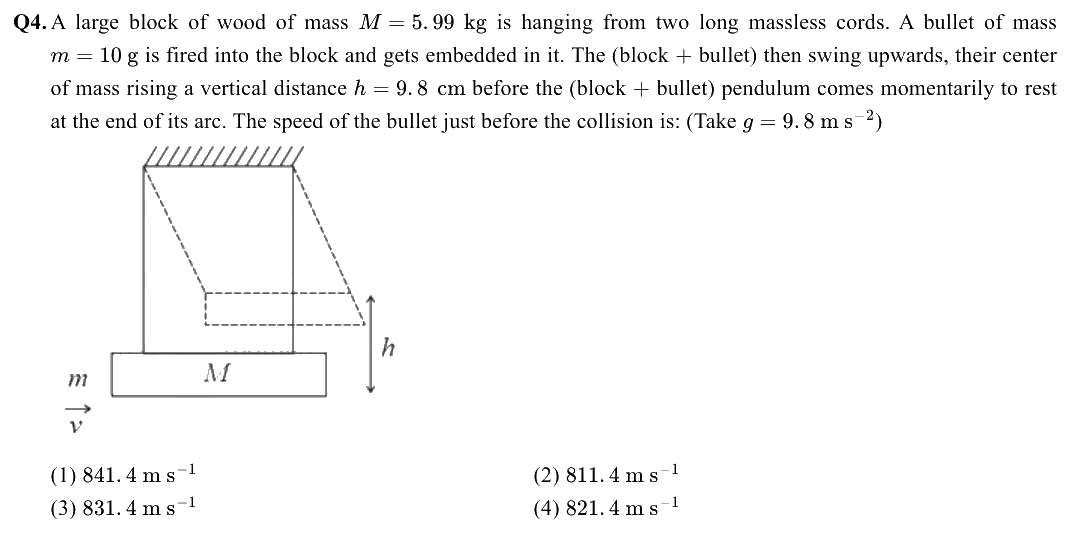
A large block of wood of mass $M = 5.99\ \mathrm{kg}$ is hanging from two long massless cords. A bullet of mass $m = 10\ \mathrm{g}$ is fired into the block and gets embedded in it. The (block + bullet) then swing upwards, their center of mass rising a vertical distance $h = 9.8\ \mathrm{cm}$ before the (block + bullet) pendulum comes momentarily to rest at the end of its arc. The speed of the bullet just before the collision is: (Take $g = 9.8\ \mathrm{m\,s^{-2}}$) (see the figure above)
Given below are two statements: one is labelled as Assertion A and the other is labelled as Reason R. Assertion A : Body $P$ having mass $M$ moving with speed $u$ has head-on collision elastically with another body $Q$ having mass $m$ initially at rest. If $m \ll M$, body $Q$ will have a maximum speed equal to $2u$ after collision. Reason R : During elastic collision, the momentum and kinetic energy are both conserved. In the light of the above statements, choose the most appropriate answer from the options given below:
A
A is correct but R is not correct.
B
A is not correct but R is correct.
C
Both A and R are correct and R is the correct explanation of A
D
Both A and R are correct but R is NOT the correct explanation of A
If the potential energy between two molecules is given by $U = \frac{A}{r^6} + \frac{B}{r^{12}}$, then at equilibrium, separation between molecules, and the potential energy are:
Particle A of mass $m_1$ moving with velocity $\left(\sqrt{3}\hat{i} + \hat{j}\right)\ \mathrm{ms^{-1}}$ collides with another particle B of mass $m_2$ which is at rest initially. Let $\vec{v_1}$ and $\vec{v_2}$ be the velocities of particles A and B after collision respectively. If $m_1 = 2m_2$ and after collision $\vec{v_1} = \left(\hat{i} + \sqrt{3}\hat{j}\right)\ \mathrm{ms^{-1}}$, the angle between $\vec{v_1}$ and $\vec{v_2}$ is :
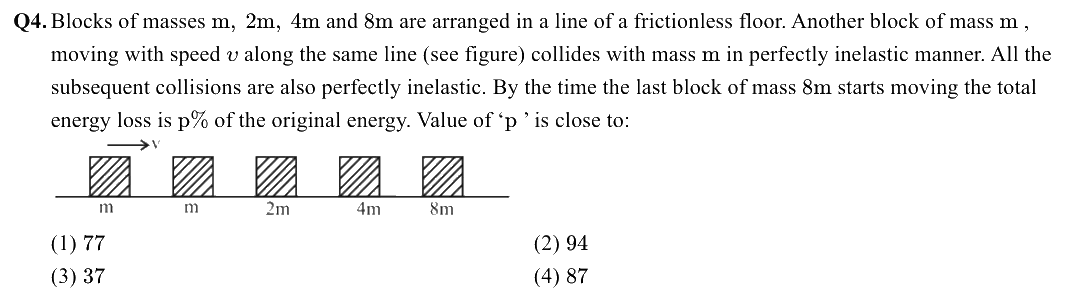
Blocks of masses m, 2m, 4m and 8m are arranged in a line of a frictionless floor. Another block of mass m , moving with speed $v$ along the same line (see figure) collides with mass m in perfectly inelastic manner. All subsequent collisions are also perfectly inelastic. By the time the last block of mass 8m starts moving the total energy loss is p% of the original energy. Value of 'p ' is close to: (see the figure above)
A person pushes a box on a rough horizontal plateform surface. He applies a force of $200\ N$ over a distance of $15\ m$. Thereafter, he gets progressively tired and his applied force reduces linearly with distance to $100\ N$. The total distance through which the box has been moved is $30\ m$. What is the work done by the person during the total movement of the box?
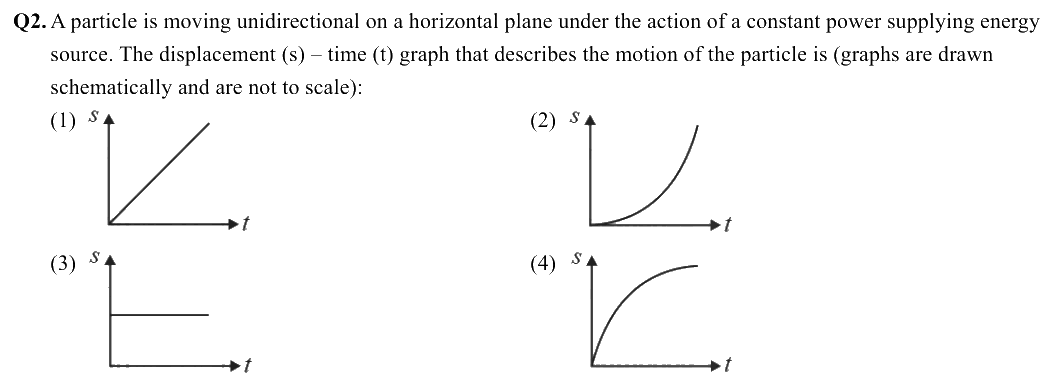
A particle is moving unidirectional on a horizontal plane under the action of a constant power supplying energy source. The displacement $(s)$ – time $(t)$ graph that describes the motion of the particle is (graphs are drawn schematically and are not to scale):
A block of mass $1.9\ \mathrm{kg}$ is at rest at the edge of a table, of height $1\ \mathrm{m}$. A bullet of mass $0.1\ \mathrm{kg}$ collides with the block and sticks to it. If the velocity of the bullet is $20\ \mathrm{m\,s^{-1}}$ in the horizontal direction just before the collision then the kinetic energy just before the combined system strikes the floor, is [Take $g = 10\ \mathrm{m\,s^{-2}}$. Assume there is no rotational motion and loss of energy after the collision is negligible.]
A particle of mass m with an initial velocity $u\hat{i}$ collides perfectly elastically with a mass $3\mathrm{m}$ at rest. It moves with a velocity $v\hat{j}$ after collision, then, v is given by
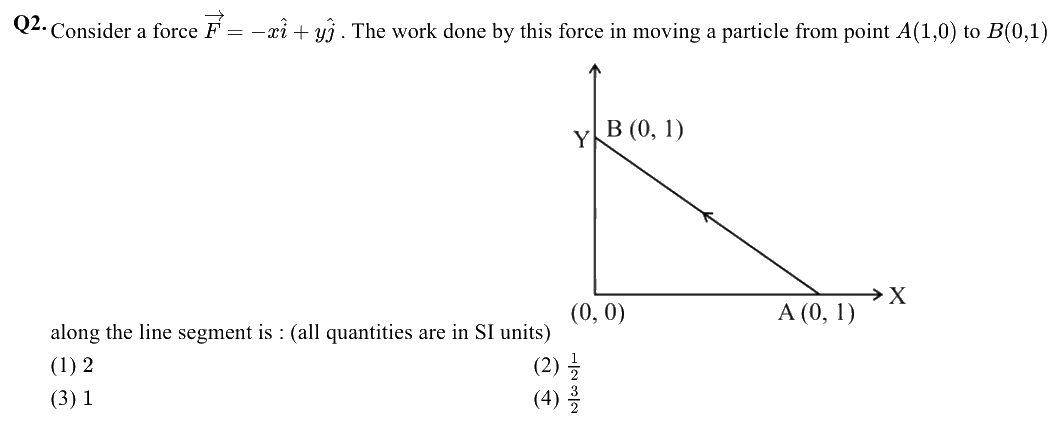
Consider a force $\overrightarrow{F} = -x\hat{i} + y\hat{j}$ . The work done by this force in moving a particle from point $A(1,0)$ to $B(0,1)$ along the line segment is : (all quantities are in SI units) (see the figure above)
Two particles of equal mass $m$ have respective initial velocities $u\hat{i}$ and $u\left(\frac{\hat{i}+\hat{j}}{2}\right)$ . They collide completely inelastically. The energy lost in the process is:
A $60\mathrm{HP}$ electric motor lifts an elevator having a maximum total load capacity of $2000\ \mathrm{kg}$. If the frictional force on the elevator is $4000\ \mathrm{N}$, the speed of the elevator at full load is close to : $(1\ \mathrm{HP} = 746\ \mathrm{W},\ g = 10\ \mathrm{m\,s^{-2}})$
An elevator in a building can carry a maximum of 10 persons, with the average mass of each person being $68\ \mathrm{kg}$. The mass of the elevator itself is $920\ \mathrm{kg}$ and it moves with a constant speed of $3\ \mathrm{m/s}$. The frictional force opposing the motion is $6000\ \mathrm{N}$. If the elevator is moving up with its full capacity, the power delivered by the motor to the elevator $(\mathrm{g} = 10\ \mathrm{m/s^2})$ must be at least:
A bullet of mass $20\ \mathrm{g}$ has an initial speed of $1\ \mathrm{m\,s^{-1}}$, just before it starts penetrating a mud wall of thickness $20\ \mathrm{cm}$. If the wall offers a mean resistance of $2.5\times10^{-2}\ \mathrm{N}$, the speed of the bullet after emerging from the other side of the wall is close to:
A uniform cable of mass $M$ and length $L$ is placed on a horizontal surface such that its $\left(\dfrac{1}{n}\right)^{\mathrm{th}}$ part is hanging below the edge of the surface. To lift the hanging part of the cable upto the surface, the work done should be:
A body of mass 2 kg makes an elastic collision with a second body at rest and continues to move in the original direction but with one fourth of its original speed. What is the mass of the second body?
A wedge of mass $M = 4m$ lies on a frictionless plane. A particle of mass $m$ approaches the wedge with speed $v$. There is no friction between the particle and the plane or between the particle and the wedge. The maximum height climbed by the particle on the wedge is given by:
A particle of mass $m$ is moving with speed 2v and collides with a mass $2m$ moving with speed v in the same direction. After the collision, the first mass is stopped completely while the second one splits into two particles each of mass $m$, which move at an angle $45^\circ$ with respect to the original direction. The speed of each of the moving particle will be
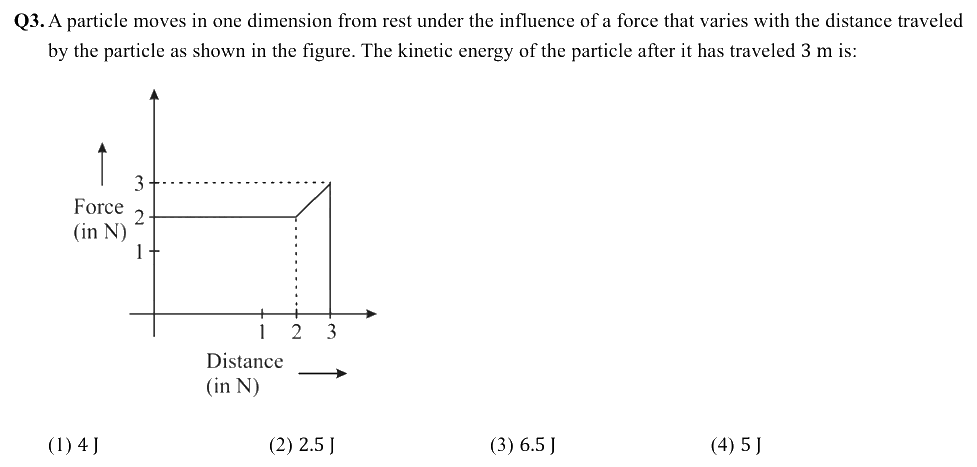
A particle moves in one dimension from rest under the influence of a force that varies with the distance traveled by the particle as shown in the figure. The kinetic energy of the particle after it has traveled 3 m is: (see the figure above)
A simple pendulum, made of a string of length $l$ and a bob of mass $m$, is released from a small angle $\theta_0$. It strikes a block of mass $M$, kept on horizontal surface at its lowest point of oscillations, elastically. It bounces back and goes up to an angle $\theta_1$. Then $M$ is given by:
An alpha- particle of mass $m$ suffers 1- dimensional elastic collision with a nucleus at rest of unknown mass. It is scattered directly backwards losing $64\%$ of its initial kinetic energy. The mass of the nucleus is
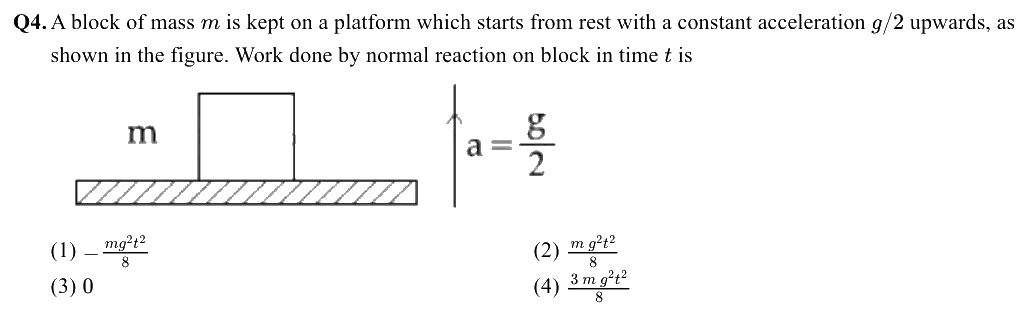
A block of mass $m$ is kept on a platform which starts from rest with a constant acceleration $g/2$ upwards, as shown in the figure. Work done by normal reaction on block in time $t$ is (see the figure above)
A piece of wood of mass $0.03\ kg$ is dropped from the top of a $100\ m$ height building. At the same time, a bullet of mass $0.02\ kg$ is fired vertically upward, with a velocity $100\ ms^{-1}$, from the ground. The bullet gets embedded in the wood. Then the maximum height to which the combined system reaches above the top of the building before falling below is: $(g = 10\ ms^{-2})$
A particle which is experiencing a force, given by $\overrightarrow{F} = 3\hat{i} - 12\hat{j}$, undergoes a displacement of $\overrightarrow{d} = 4\hat{i}$. If the particle had a kinetic energy of $3\ \mathrm{J}$ at the beginning of the displacement, what is its kinetic energy at the end of the displacement?
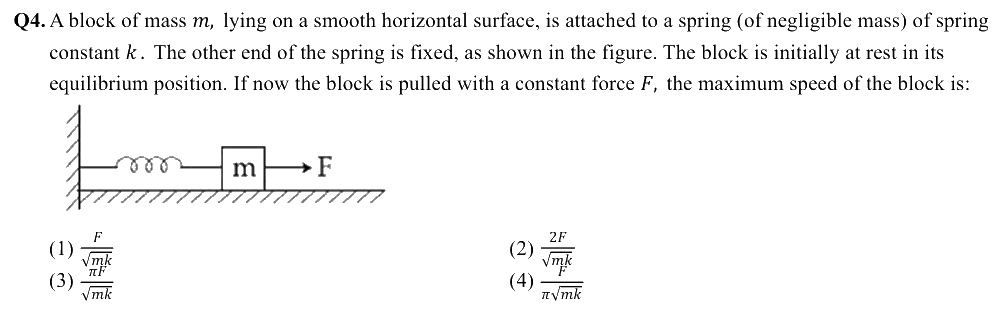
A block of mass $m$, lying on a smooth horizontal surface, is attached to a spring (of negligible mass) of spring constant $k$. The other end of the spring is fixed, as shown in the figure. The block is initially at rest in its equilibrium position. If now the block is pulled with a constant force $F$, the maximum speed of the block is: (see the figure above)
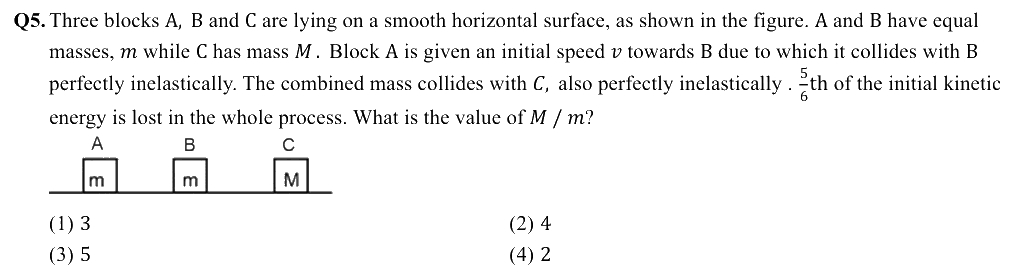
Three blocks A, B and C are lying on a smooth horizontal surface, as shown in the figure. A and B have equal masses, $m$ while C has mass $M$. Block A is given an initial speed $v$ towards B due to which it collides with B perfectly inelastically. The combined mass collides with C, also perfectly inelastically. $\dfrac{5}{6}$th of the initial kinetic energy is lost in the whole process. What is the value of $M\ /\ m$? (see the figure above)
A force acts on a $2\ \mathrm{kg}$ object so that its position is given as a function of time as $x = 3t^2 + 5$. What is the work done by this force in first 5 seconds?
A proton of mass m collides elastically with a particle of unknown mass at rest. After the collision, the proton and the unknown particle are seen moving at an angle of $90^\circ$ with respect to each other. The mass of unknown particle is:
In a collinear collision, a particle with an initial speed $v_0$ strikes a stationary particle of the same mass. If the final total kinetic energy is $50\%$ greater than the original kinetic energy, the magnitude of the relative velocity between the two particles, after the collision, is
It is found that if a neutron suffers an elastic collinear collision with a deuterium at rest, the fractional loss of its energy is $P_\mathrm{d}$, while for its similar collision with a carbon nucleus at rest, the fractional loss of energy is $P_\mathrm{c}$. The values of $P_\mathrm{d}$ and $P_\mathrm{c}$ are respectively
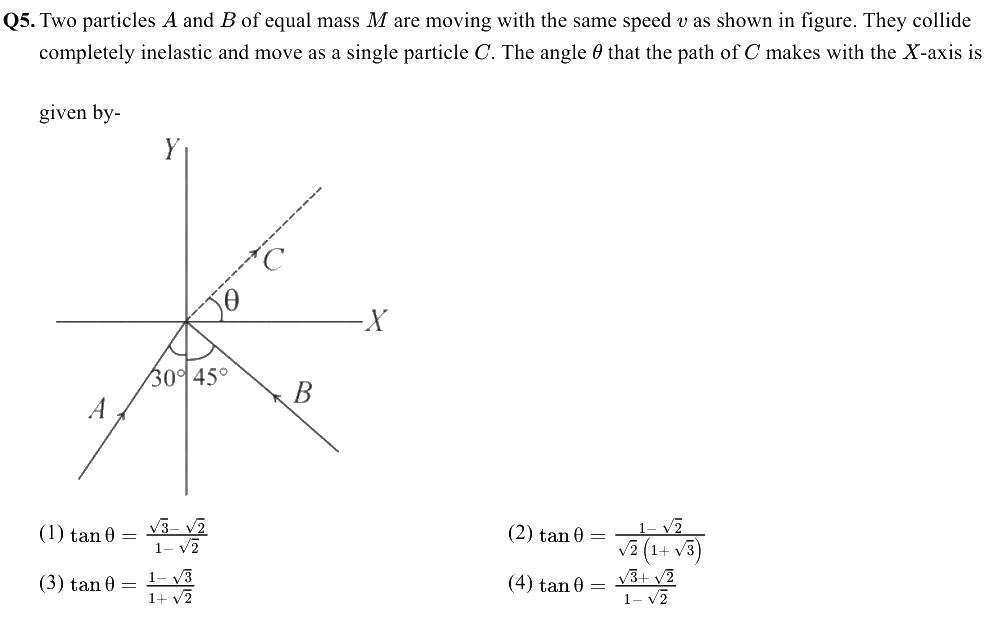
Two particles $A$ and $B$ of equal mass $M$ are moving with the same speed $v$ as shown in figure. They collide completely inelastic and move as a single particle $C$. The angle $\theta$ that the path of $C$ makes with the $X$-axis is given by- (see the figure above)
An object is dropped from a height $h$ from the ground. Every time it hits the ground it loses 50% of its kinetic energy. The total distance covered as $t \to \infty$ is:
A time dependent force $F = 6t$ acts on a particle of mass $1\ \mathrm{kg}$. If the particle starts from the rest, the work done by the force during the first $1\ \mathrm{sec}$ will be:
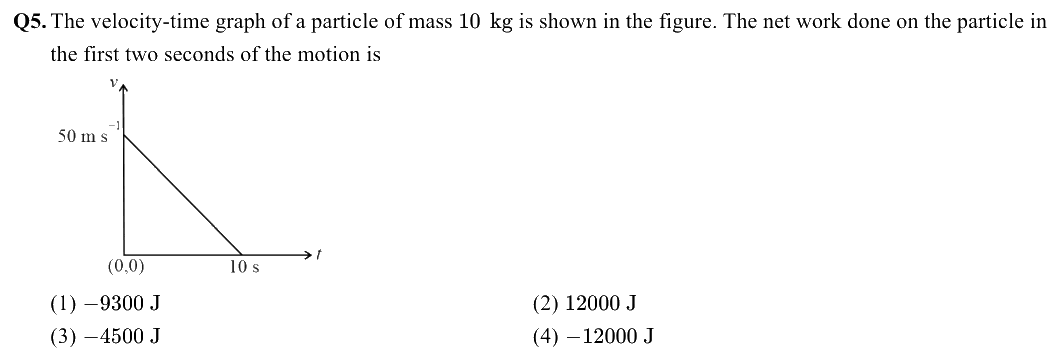
The velocity-time graph of a particle of mass $10\ \mathrm{kg}$ is shown in the figure. The net work done on the particle in the first two seconds of the motion is (see the figure above)
A car of weight W is on an inclined road that rises by 100 m over a distance of 1km and applies a constant frictional force $\frac{W}{20}$ on the car. While moving uphill on the road at a speed of $10\ \mathrm{ms^{-1}}$ , the car needs power P. If it needs power $\frac{P}{2}$ while moving downhill at speed $v$ then value of $v$ is :
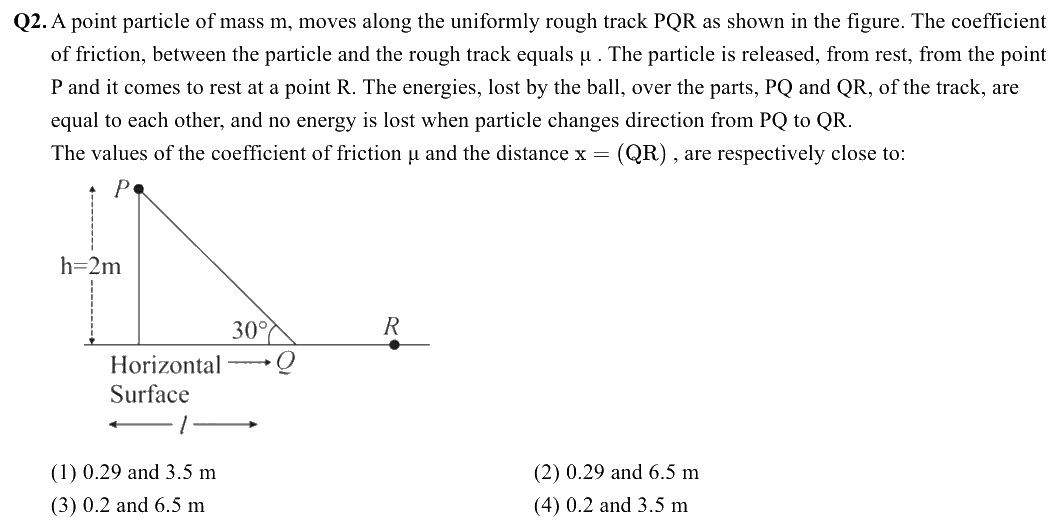
A point particle of mass m, moves along the uniformly rough track PQR as shown in the figure. The coefficient of friction, between the particle and the rough track equals $\mu$ . The particle is released, from rest, from the point P and it comes to rest at a point R. The energies, lost by the ball, over the parts, PQ and QR, of the track, are equal to each other, and no energy is lost when particle changes direction from PQ to QR. The values of the coefficient of friction $\mu$ and the distance $x = (QR)$ , are respectively close to: (see the figure above)
A person trying to lose weight by burning fat lifts a mass of 10 kg upto a height of 1m 1000 times. Assume that the potential energy lost each time he lowers the mass is dissipated. How much fat will he use up considering the work done only when the weight is lifted up? Fat supplies $3.8 \times 10^{7}$ J of energy per kg which is converted to mechanical energy with a 20% efficiency rate. Take $g = 9.8\ \mathrm{ms^{-2}}$ :
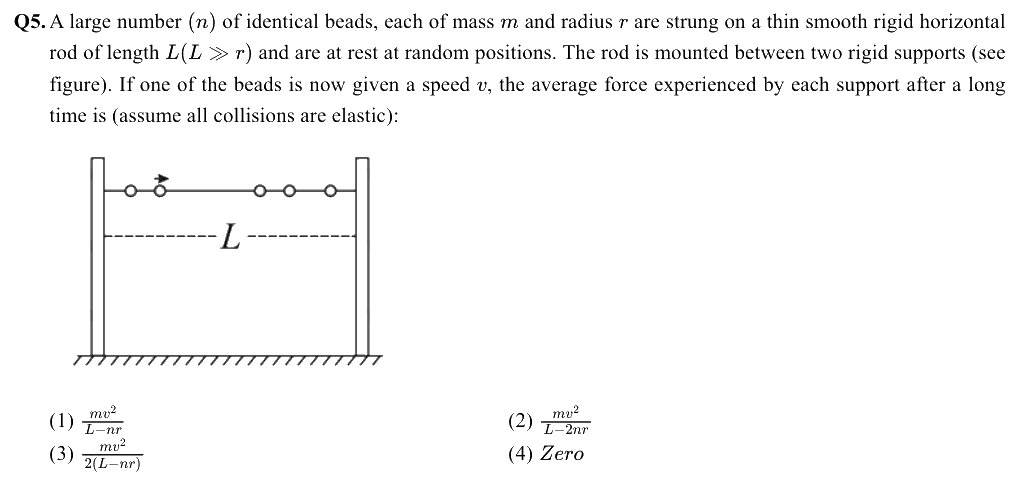
A large number ($n$) of identical beads, each of mass $m$ and radius $r$ are strung on a thin smooth rigid horizontal rod of length $L(L \gg r)$ and are at rest at random positions. The rod is mounted between two rigid supports (see figure). If one of the beads is now given a speed $v$, the average force experienced by each support after a long time is (assume all collisions are elastic): (see the figure above)
A particle is moving in a circle of radius $r$ under the action of a force $F = \alpha r^2$ which is directed towards centre of the circle. Total mechanical energy (kinetic energy + potential energy) of the particle is (take potential energy $= 0$ for $r = 0$):
A block of mass $m = 10$ kg rests on a horizontal table. The coefficient of friction between the block and the table is 0.05. When hit by a bullet of mass 50 g moving with speed $v$, that gets embedded in it, the block moves and comes to stop after moving a distance of 2 m on the table. If a freely falling object were to acquire speed $\frac{v}{10}$ after being dropped from height $H$, then neglecting energy losses and taking $g = 10\ \mathrm{m\,s^{-2}}$, the value of $H$ is close to
A block of mass $m = 0.1$ kg is connected to a spring of unknown spring constant k. It is compressed to a distance $x$ from its equilibrium position and released from rest. After approaching half the distance $\left(\frac{x}{2}\right)$ from the equilibrium position, it hits another block and comes to rest momentarily, while the other block moves with velocity $3\ \mathrm{m\,s^{-1}}$. The total initial energy of the spring is:
A particle of mass $m$ moving in the $x$ direction with speed $2v$ is hit by another particle of mass $2m$ moving in the $y$ direction with speed $v$. If the collision is perfectly inelastic, the percentage loss in the energy during the collision is close to:
A bullet of mass $4\ \mathrm{g}$ is fired horizontally with a speed of $300\ \mathrm{m/s}$ into $0.8\ \mathrm{kg}$ block of wood at rest on a table. If the coefficient of friction between the block and the table is $0.3$, how far will the block slide approximately?
A spring of unstretched length $l$ has a mass $m$ with one end fixed to a rigid support. Assuming spring to be made of a uniform wire, the kinetic energy possessed by it if its free end is pulled with uniform velocity $v$ is:
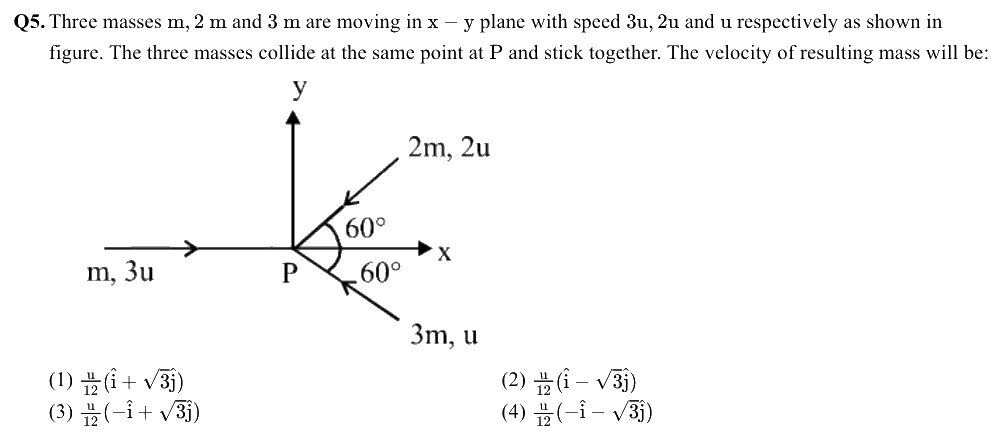
Three masses $\mathrm{m}$, $2\ \mathrm{m}$ and $3\ \mathrm{m}$ are moving in $x - y$ plane with speed $3u$, $2u$ and $u$ respectively as shown in figure. The three masses collide at the same point at P and stick together. The velocity of resulting mass will be: (see the figure above)
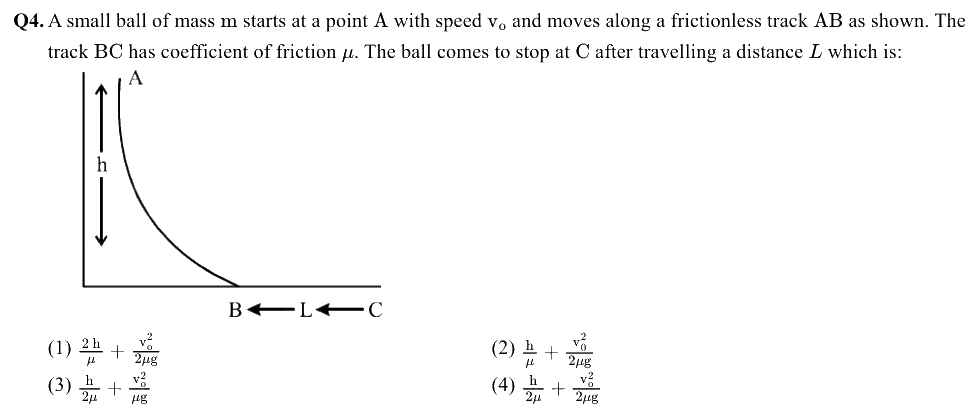
A small ball of mass $\mathrm{m}$ starts at a point A with speed $\mathrm{v_o}$ and moves along a frictionless track AB as shown. The track BC has coefficient of friction $\mu$. The ball comes to stop at C after travelling a distance $L$ which is: (see the figure above)
The average mass of rain drops is $3.0 \times 10^{-5}\ \mathrm{kg}$ and their avarage terminal velocity is $9\ \mathrm{m/s}$. Calculate the energy transferred by rain to each square metre of the surface at a place which receives $100\ \mathrm{cm}$ of rain in a year.
When a rubber-band is stretched by a distance x, it exerts a restoring force of magnitude $F = ax + bx^2$ where a and b are constants. The work done in stretching the unstretched rubber-band by L is :
A wind-powered generator converts wind energy into electrical energy. Assume that the generator converts a fixed fraction of the wind energy intercepted by its blades into electrical energy. For wind speed $v$, the electrical power output will be most likely proportional to
This question has Statement - I and Statement - II of the four choices given after the Statements, choose the one that best describes the two Statements. Statement - I: A point particle of mass $m$ moving with speed $v$ collides with stationary point particle of mass $M$. If the maximum energy loss possible is given as $f\left(\frac{1}{2}mv^{2}\right)$ then $f = \left(\frac{m}{M+m}\right)$. Statement - II: Maximum energy loss occurs when the particles get stuck together as a result of the collision.
A
Statement-I is true, Statement-II is false.
B
Statement-I is false, Statement-II is true.
C
Statement-I is true, Statement-II is true, Statement-II is a correct explanation of Statement-I.
D
Statement-I is true, Statement-II is true, Statement-II is not a correct explanation of Statement-I.
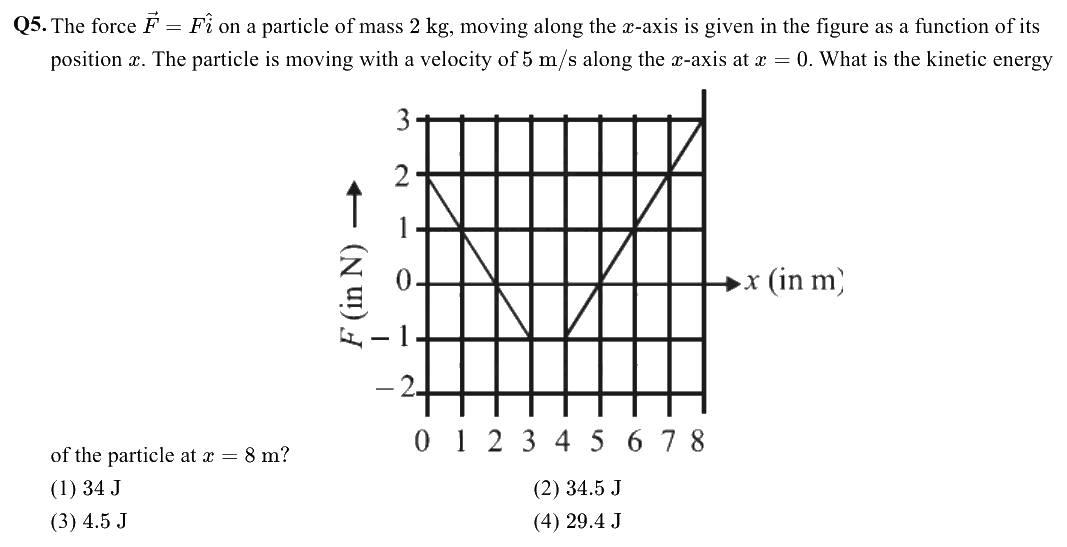
The force $\vec{F} = F\hat{i}$ on a particle of mass 2 kg, moving along the $x$-axis is given in the figure as a function of its position $x$. The particle is moving with a velocity of 5 m/s along the $x$-axis at $x = 0$. What is the kinetic energy (see the figure above) of the particle at $x = 8$ m?
A moving particle of mass $m$, makes a head on elastic collision with another particle of mass $2m$, which is initially at rest. The percentage loss in energy of the colliding particle on collision, is close to
Two bodies $A$ and $B$ of mass $m$ and $2m$ respectively are placed on a smooth floor. They are connected by a spring of negligible mass. A third body $C$ of mass $m$ is placed on the floor. The body $C$ moves with a velocity $v_0$ along the line joining $A$ and $B$ and collides elastically with $A$. At a certain time after the collision it is found that the instantaneous velocities of $A$ and $B$ are same and the compression of the spring is $x_0$. The spring constant $k$ will be
A particle gets displaced by $\Delta\vec{r} = (2\hat{i} + 3\hat{j} + 4\hat{k})\mathrm{m}$ under the action of a force $\vec{F} = (7\hat{i} + 4\hat{j} + 3\hat{k})$. The change in its kinetic energy is
This question has statement 1 and statement 2. Of the four choices given after the statements, choose the one that best describes the two statements. If two springs $\mathrm{S}_1$ and $\mathrm{S}_2$ of force constants $k_1$ and $k_2$, respectively, are stretched by the same force, it is found that more work is done on spring $\mathrm{S}_1$ than on spring $\mathrm{S}_2$. Statement 1 : If stretched by the same amount, work done on $\mathrm{S}_1$, will be more than that on $\mathrm{S}_2$ Statement 2 : $k_1 < k_2$
A
Statement 1 is false, Statement 2 is true
B
Statement 1 is true, Statement 2 is false
C
Statement 1 is true, Statement 2 is the correct explanation for statement 1
D
Statement 1 is true, Statement 2 is true, Statement 2 is not the correct explanation for statement 1.
The potential energy function for the force between two atoms in a diatomic molecule is approximately given by $U(x) = \frac{a}{x^{12}} - \frac{b}{x^{6}}$, where a and b are constants and x is the distance between the atoms. If the dissociation energy of the molecule is $D = [U(x = \infty) - U_{\text{at equilibrium}}]$, D is
Statement-1 : Two particles moving in the same direction do not lose all their energy in a completely inelastic collision. Statement-2 : Principle of conservation of momentum holds true for all kinds of collisions. Of the four choices given after the statements, choose the one that best describes the two statements. Of the four choices given after the statements, choose the one that best describes the two statements.
A
Statement-1 is true, Statement-2 is true; Statement-2 is the correct explanation of Statement-1.
B
Statement-1 is true, Statement-2 is true; Statement-2 is not the correct explanation of Statement1
A block of mass $0.50\ \mathrm{kg}$ is moving with a speed of $2.00\ \mathrm{m/s}$ on a smooth surface. It strikes another mass of $1.00\ \mathrm{kg}$ and then they move together as a single body. The energy loss during the collision is
A 2 kg block slides on a horizontal floor with a speed of 4 m/s. It strikes a uncompressed spring, and compresses it till the block is motionless. The kinetic friction force is 15 N and spring constant is 10, 000. N/m. The spring compresses by
A mass of $M$kg is suspended by a weightless string. The horizontal force that is required to displace it until the string makes an angle of $45^\circ$ with the initial vertical direction is
A particle of mass 100 g is thrown vertically upwards with a speed of 5 m/s. the work done by the force of gravity during the time the particle goes up is
A ball of mass 0.2 kg is thrown vertically upwards by applying a force by hand. If the hand moves 0.2 m which applying the force and the ball goes upto 2 m height further, find the magnitude of the force. Consider $g = 10\ \mathrm{m/s^2}$
A spherical ball of mass 20 kg is stationary at the top of a hill of height 100 m. It rolls down a smooth surface to the ground, then climbs up another hill of height 30 m and finally rolls down to a horizontal base at a height of 20 m above the ground. The velocity attained by the ball is
A body of mass $m$ is accelerated uniformly from rest to a speed $v$ in a time $T$. The instantaneous power delivered to the body as a function time is given by
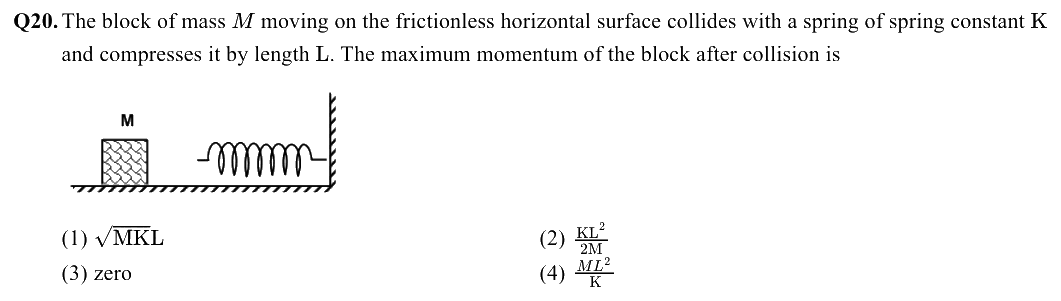
The block of mass $M$ moving on the frictionless horizontal surface collides with a spring of spring constant K and compresses it by length L. The maximum momentum of the block after collision is (see the figure above)
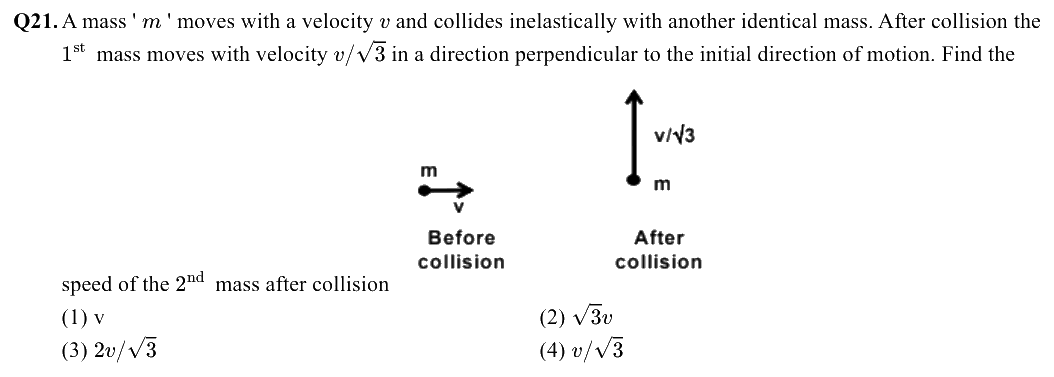
A mass ' $m$ ' moves with a velocity $v$ and collides inelastically with another identical mass. After collision the $1^{\mathrm{st}}$ mass moves with velocity $v/\sqrt{3}$ in a direction perpendicular to the initial direction of motion. Find the speed of the $2^{\mathrm{nd}}$ mass after collision (see the figure above)
A particle moves in a straight line with retardation proportional to its displacement. Its loss of kinetic energy for any displacement x is proportional to
A uniform chain of length 2 m is kept on a table such that a length of 60 cm hangs freely from the edge of the table. The total mass of the chain is 4 kg. What is the work done in pulling the entire chain on the table?
A force $\vec{F} = (5\hat{i} + 3\hat{j} + 2\hat{k})N$ is applied over a particle which displaces it from its origin to the point $\vec{r} = (2\hat{i} - \hat{j})m$. The work done on the particle in joules is
A particle is acted upon by a force of constant magnitude which is always perpendicular to the velocity of the particle, the motion of the particle takes place in a plane. It follows that
A spring of spring constant $5 \times 10^3$ N/m is stretched initially by 5 cm from the unstretched position. Then the work required to stretch it further by another 5 cm is
A 1 kg block subjected to two simultaneous forces $\left(2\hat{i} + 3\hat{j} + 4\hat{k}\right)$ N and $\left(3\hat{i} - \hat{j} - 2\hat{k}\right)$ N is moved a distance of 25 m along $\left(3\hat{i} - 4\hat{j}\right)$ direction. The work done in this process is ________ J.
Numerical answer type: type your answer in EdLoop to check it
A body of mass 2 kg begins to move under the influence of time dependent force $\vec{F} = \left(2t\hat{i} + 6t^2\hat{j}\right)$ N, where $\hat{i}$ and $\hat{j}$ are unit vectors along $x$ and $y$-axis respectively. The power produced by the force at $t = 2$ s is ________ W.
Numerical answer type: type your answer in EdLoop to check it
A block of mass 10 kg is moving along $x$-axis under the action of force $F = 5x$ N. The work done by the force in moving the block from $x$ = 2 m to 4 m will be ______ J.
Numerical answer type: type your answer in EdLoop to check it
A car accelerates from rest of $u$ m s$^{-1}$. The energy spent in this process is $E$ J. The energy required to accelerate the car from $u$ m s$^{-1}$ to $2u$ m s$^{-1}$ is $nE$ J. The value of $n$ is ______.
Numerical answer type: type your answer in EdLoop to check it
To maintain a speed of $80\ \mathrm{km\ h^{-1}}$ by a bus of mass 500 kg on a plane rough road for 4 km distance, the work done by the engine of the bus will be ______ kJ. [The coefficient of friction between tyre of bus and road is $0.04$ ]
Numerical answer type: type your answer in EdLoop to check it
A force $\vec{F} = 2 + 3x\hat{i}$ acts on a particle in the $x$ direction where $F$ is in Newton and $x$ is in meter. The work done by this force during a displacement from $x = 0$ to $x = 4$ m is ______ J.
Numerical answer type: type your answer in EdLoop to check it
A block of mass 5 kg starting from rest pulled up on a smooth incline plane making an angle of $30^\circ$ with horizontal with an effective acceleration of $1\ \mathrm{m\ s^{-2}}$. The power delivered by the puling force at $t = 10$ s from the start is ______ W. [Use $g = 10\ \mathrm{m\ s^{-2}}$] (Calculate the nearest integer value)
Numerical answer type: type your answer in EdLoop to check it
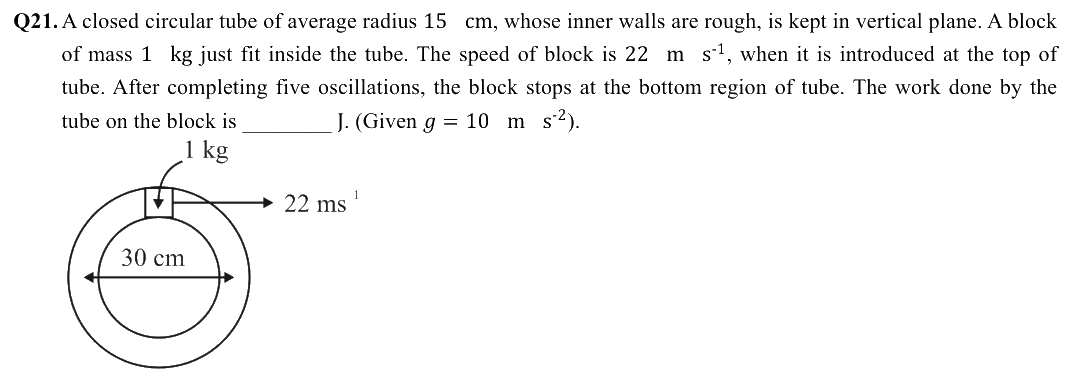
A closed circular tube of average radius 15 cm, whose inner walls are rough, is kept in vertical plane. A block of mass 1 kg just fit inside the tube. The speed of block is $22\ \mathrm{m\,s^{-1}}$, when it is introduced at the top of tube. After completing five oscillations, the block stops at the bottom region of tube. The work done by the tube on the block is ______ J. (Given $g = 10\ \mathrm{m\,s^{-2}}$). (see the figure above)
The question as printed in the paper.
Numerical answer type: type your answer in EdLoop to check it
If the maximum load carried by an elevator is 1400 kg (600 kg-Passengers + 800 kg-elevator), which is moving up with a uniform speed of $3\ \mathrm{m\,s^{-1}}$ and the frictional force acting on it is 2000 N, then the maximum power used by the motor is ______ kW. $g = 10\ \mathrm{m\,s^{-2}}$
Numerical answer type: type your answer in EdLoop to check it
A particle of mass $10\ \mathrm{g}$ moves in a straight line with retardation $2x$, where $x$ is the displacement in SI units. Its loss of kinetic energy for above displacement is $\frac{10^{-n}}{x}\ \mathrm{J}$. The value of $n$ will be ______ .
Numerical answer type: type your answer in EdLoop to check it
A body is dropped on ground from a height $h_1$ and after hitting the ground, it rebounds to a height $h_2$. If the ratio of velocities of the body just before and after hitting ground is 4, then percentage loss in kinetic energy of the body is $\frac{x}{4}$. The value of $x$ is ______ .
Numerical answer type: type your answer in EdLoop to check it
A small particle moves to position $5\hat{i} - 2\hat{j} + \hat{k}$ from its initial position $2\hat{i} + 3\hat{j} - 4\hat{k}$ under the action of force $5\hat{i} + 2\hat{j} + 7\hat{k}$ N. The value of work done will be ______ J.
Numerical answer type: type your answer in EdLoop to check it
A block is fastened to a horizontal spring. The block is pulled to a distance $x$ = 10 $\mathrm{cm}$ from its equilibrium position (at $x$ = 0) on a frictionless surface from rest. The energy of the block at $x$ = 5 $\mathrm{cm}$ is 0.25 J. The spring constant of the spring is ______ $\mathrm{N\ m^{-1}}$.
Numerical answer type: type your answer in EdLoop to check it
A force $F$ = $(5 + 3y^2)$ acts on a particle in the $y$-direction, where $F$ is newton and $y$ is in meter. The work done by the force during a displacement from $y$ = 2 m to $y$ = 5 m is ______ J.
Numerical answer type: type your answer in EdLoop to check it
A lift of mass $M$ = 500 $\mathrm{kg}$ is descending with speed of 2 $\mathrm{m\ s^{-1}}$. Its supporting cable begins to slip thus allowing it to fall with a constant acceleration of 2 $\mathrm{m\ s^{-2}}$. The kinetic energy of the lift at the end of fall through to a distance of 6 $\mathrm{m}$ will be ______ $\mathrm{kJ}$.
Numerical answer type: type your answer in EdLoop to check it
A ball is dropped from a height of 20 m. If the coefficient of restitution for the collision between ball and floor is 0.5, after hitting the floor, the ball rebounds to a height of ______ m.
Numerical answer type: type your answer in EdLoop to check it
A body of mass 2 kg is initially at rest. It starts moving unidirectionally under the influence of a source of constant power $P$. Its displacement in 4 s is $\frac{1}{3}\alpha^2\sqrt{P}$ m. The value of $\alpha$ will be ______.
Numerical answer type: type your answer in EdLoop to check it
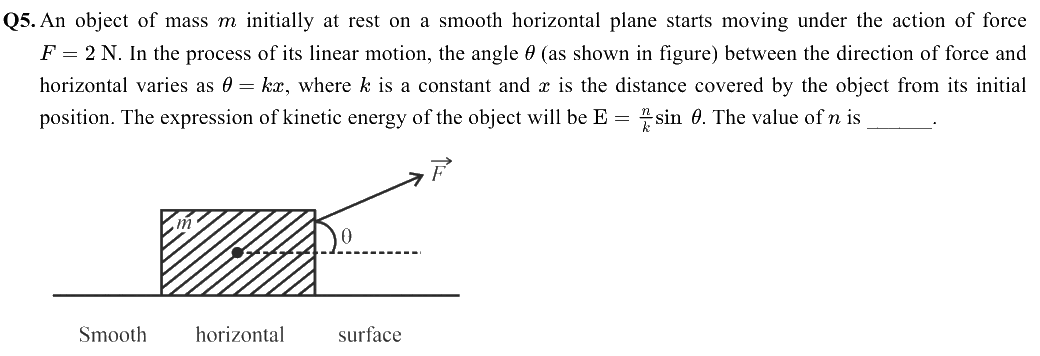
An object of mass $m$ initially at rest on a smooth horizontal plane starts moving under the action of force $F = 2\ \mathrm{N}$. In the process of its linear motion, the angle $\theta$ (as shown in figure) between the direction of force and horizontal varies as $\theta = kx$, where $k$ is a constant and $x$ is the distance covered by the object from its initial position. The expression of kinetic energy of the object will be $E = \frac{n}{k}\sin\theta$. The value of $n$ is ______. (see the figure above)
The question as printed in the paper.
Numerical answer type: type your answer in EdLoop to check it
A body of mass 1 kg collides head on elastically with a stationary body of mass 3 kg. After collision, the smaller body reverses its direction of motion and moves with a speed of $2\ \mathrm{m\,s^{-1}}$. The initial speed of the smaller body before collision is ______ $\mathrm{m\,s^{-1}}$.
Numerical answer type: type your answer in EdLoop to check it
A spherical body of mass 2 kg starting from rest acquires a kinetic energy of 10000 J at the end of $5^{\text{th}}$ second. The force acted on the body is ______ N.
Numerical answer type: type your answer in EdLoop to check it
A body of mass 1 kg begins to move under the action of a time dependent force $\vec{F}=\left(t\hat{i}+3t^{2}\hat{j}\right)$ N, where $\hat{i}$ and $\hat{j}$ are the unit vectors along $x$ and $y$ axis. The power developed by above force, at the time $t=2$ s, will be ______ W.
Numerical answer type: type your answer in EdLoop to check it
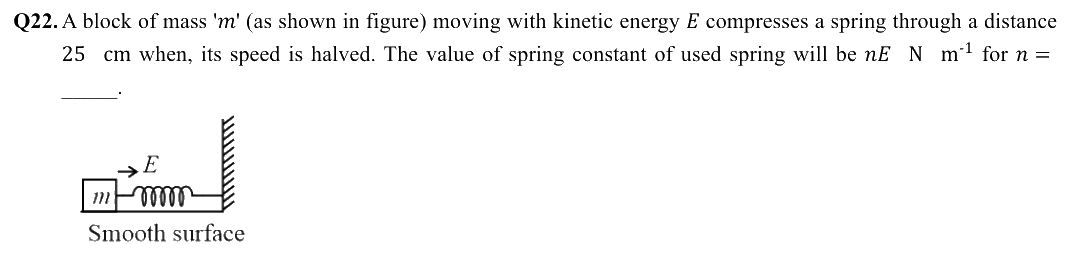
A block of mass '$m$' (as shown in figure) moving with kinetic energy $E$ compresses a spring through a distance $25\ \mathrm{cm}$ when, its speed is halved. The value of spring constant of used spring will be $nE\ \mathrm{N\ m^{-1}}$ for $n=$ ______.
(see the figure above)
The question as printed in the paper.
Numerical answer type: type your answer in EdLoop to check it
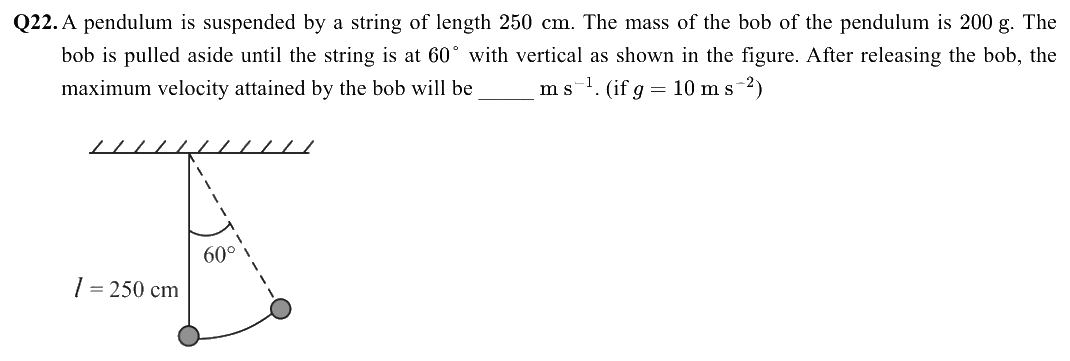
A pendulum is suspended by a string of length $250\ \mathrm{cm}$. The mass of the bob of the pendulum is $200\ \mathrm{g}$. The bob is pulled aside until the string is at $60^\circ$ with vertical as shown in the figure. After releasing the bob, the maximum velocity attained by the bob will be ______ $\mathrm{m\,s^{-1}}$. (if $g = 10\ \mathrm{m\,s^{-2}}$)
(see the figure above)
The question as printed in the paper.
Numerical answer type: type your answer in EdLoop to check it
A $0.5 \mathrm{~kg}$ block moving at a speed of $12 \mathrm{~ms}^{-1}$ compresses a spring through a distance $30 \mathrm{~cm}$ when its speed is halved. The spring constant of the spring will be ______ $\mathrm{Nm}^{-1}$
Numerical answer type: type your answer in EdLoop to check it
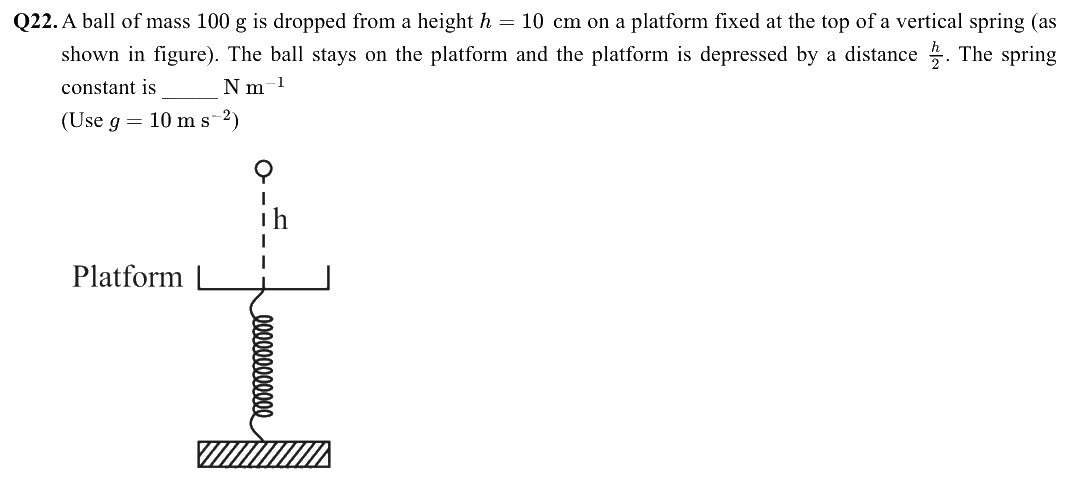
A ball of mass $100 \mathrm{~g}$ is dropped from a height $h = 10 \mathrm{~cm}$ on a platform fixed at the top of a vertical spring (as shown in figure). The ball stays on the platform and the platform is depressed by a distance $\frac{h}{2}$. The spring constant is ______ $\mathrm{N~m^{-1}}$ (Use $g = 10 \mathrm{~m~s^{-2}}$) (see the figure above)
The question as printed in the paper.
Numerical answer type: type your answer in EdLoop to check it
An engine is attached to a wagon through a shock absorber of length $1.5$ m. The system with a total mass of $40,000$ kg is moving with a speed of $72$ km h$^{-1}$ when the brakes are applied to bring it to rest. In the process of the system being brought to rest, the spring of the shock absorber gets compressed by $1.0$ m. If $90\%$ of energy of the wagon is lost due to friction, the spring constant is ______ $\times 10^5$ N m$^{-1}$.
Numerical answer type: type your answer in EdLoop to check it
Two persons $A$ and $B$ perform same amount of work in moving a body through a certain distance $d$ with application of forces acting at angles $45^\circ$ and $60^\circ$ with the direction of displacement respectively. The ratio of force applied by person $A$ to the force applied by person $B$ is $\frac{1}{\sqrt{x}}$. The value of $x$ is ______.
Numerical answer type: type your answer in EdLoop to check it
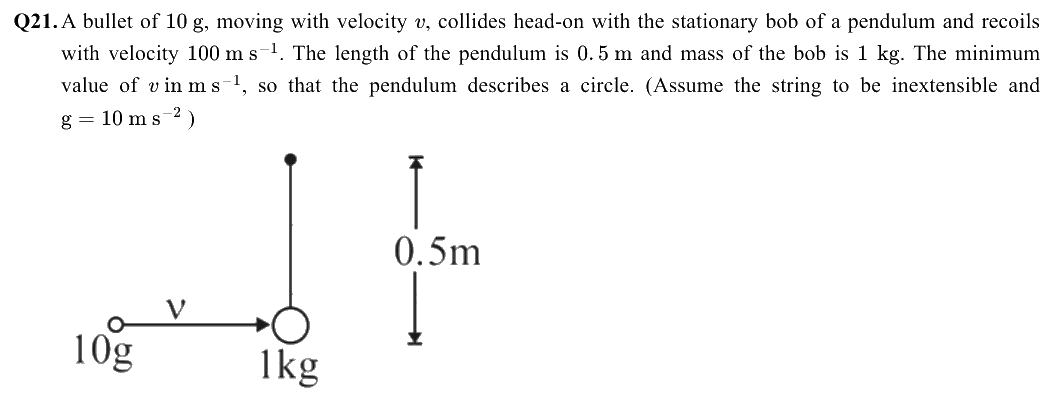
A bullet of $10\ \mathrm{g}$, moving with velocity $v$, collides head-on with the stationary bob of a pendulum and recoils with velocity $100\ \mathrm{m\ s^{-1}}$. The length of the pendulum is $0.5\ \mathrm{m}$ and mass of the bob is $1\ \mathrm{kg}$. The minimum value of $v$ in $\mathrm{m\ s^{-1}}$, so that the pendulum describes a circle. (Assume the string to be inextensible and $\mathrm{g}=10\ \mathrm{m\ s^{-2}}$ ) (see the figure above)
The question as printed in the paper.
Numerical answer type: type your answer in EdLoop to check it
A uniform chain of length $3\ \mathrm{m}$ and mass $3\ \mathrm{kg}$ overhangs a smooth table with $2\ \mathrm{m}$ laying on the table. If $K$ is the kinetic energy of the chain in J as it completely slips off the table, then the value of $K$ is (Take $\mathrm{g}=10\ \mathrm{m\ s^{-2}}$)
Numerical answer type: type your answer in EdLoop to check it
A body of mass $2\ \mathrm{kg}$ moving with a speed of $4\ \mathrm{m\ s^{-1}}$ makes an elastic collision with another body at rest and continues to move in the original direction but with one fourth of its initial speed. The speed of the two body centre of mass is $x/10$. Find the value of x.
Numerical answer type: type your answer in EdLoop to check it
A pendulum bob has a speed of $3\ \mathrm{m\ s^{-1}}$ at its lowest position. The pendulum is $50\ \mathrm{cm}$ long. The speed of bob, when the length makes an angle of $60^\circ$ to the vertical will be $g = 10\ \mathrm{m\ s^{-2}}$ ______ $\mathrm{m\ s^{-1}}$.
Numerical answer type: type your answer in EdLoop to check it
A force of $F = \left(5y + 20\right)\hat{j}\ \mathrm{N}$ acts on a particle. The work done by this force when the particle is moved from $y = 0\ \mathrm{m}$ to $y = 10\ \mathrm{m}$ is ______ J.
Numerical answer type: type your answer in EdLoop to check it
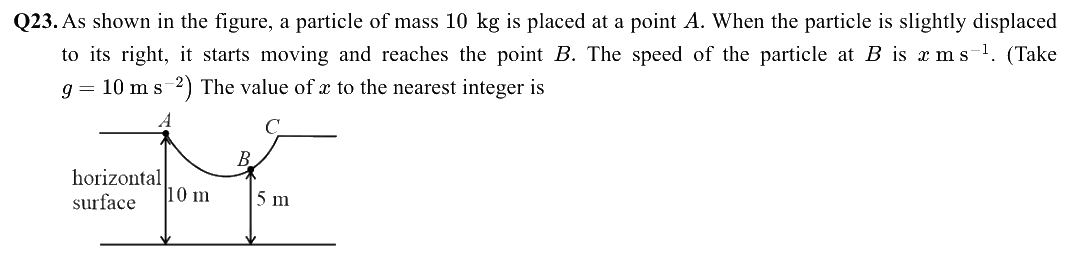
As shown in the figure, a particle of mass $10~\mathrm{kg}$ is placed at a point $A$. When the particle is slightly displaced to its right, it starts moving and reaches the point $B$. The speed of the particle at $B$ is $x~\mathrm{m~s^{-1}}$. (Take $g = 10~\mathrm{m~s^{-2}}$) The value of $x$ to the nearest integer is (see the figure above)
The question as printed in the paper.
Numerical answer type: type your answer in EdLoop to check it
A ball of mass $4~\mathrm{kg}$, moving with a velocity of $10~\mathrm{m~s^{-1}}$, collides with a spring of length $8~\mathrm{m}$ and force constant $100~\mathrm{N~m^{-1}}$. The length of the compressed spring is $x$ m. The value of $x$, to the nearest integer, is ______
Numerical answer type: type your answer in EdLoop to check it
The potential energy $(U)$ of a diatomic molecule is a function dependent on $r$ (interatomic distance) as $U = \frac{\alpha}{r^{10}} - \frac{\beta}{r^5} - 3$ where, $\alpha$ and $\beta$ are positive constants. The equilibrium distance between two atoms will be $\left(\frac{2\alpha}{\beta}\right)^{\frac{a}{b}}$, where $a =$ ______.
Numerical answer type: type your answer in EdLoop to check it
Two particles having masses $4\ \mathrm{g}$ and $16\ \mathrm{g}$ respectively are moving with equal kinetic energies. The ratio of the magnitudes of their linear momentum is $n : 2$. The value of $n$ will be ______.
Numerical answer type: type your answer in EdLoop to check it
A ball with a speed of $9\ \mathrm{m\ s^{-1}}$ collides with another identical ball at rest. After the collision, the direction of each ball makes an angle of $30^\circ$ with the original direction. If the ratio of velocities of the balls after the collision is $x : y$, then what is the value of $x$?
Numerical answer type: type your answer in EdLoop to check it
Two solids $A$ and $B$ of mass $1\ \mathrm{kg}$ and $2\ \mathrm{kg}$ respectively are moving with equal linear momentum. The ratio of their kinetic energies $(K.E.)_A : (K.E.)_B$ will be $\frac{A}{1}$, so the value of $A$ will be ______.
Numerical answer type: type your answer in EdLoop to check it
Two bodies of the same mass are moving with the same speed, but in different directions in a plane. They have a completely inelastic collision and move together thereafter with a final speed which is half of their initial velocities of the two bodies (in degree) is -
Numerical answer type: type your answer in EdLoop to check it
A particle of mass 200 MeV c$^{-2}$ collides with a hydrogen atom at rest. Soon after the collision, the particle comes to rest, and the atom recoils and goes to its first excited state. The initial kinetic energy of the particle (in eV) is $\frac{N}{4}$. The value of $N$ is: (Given the mass of the hydrogen atom to be 1 GeV c$^{-2}$).........
Numerical answer type: type your answer in EdLoop to check it
A body of mass 2 kg is driven by an engine delivering a constant power of 1 J s$^{-1}$. the body starts from rest and moves in a straight line. After 9 s, the body has moved a distance (in m)______
Numerical answer type: type your answer in EdLoop to check it
A cricket ball of mass $0.15\ \mathrm{kg}$ is thrown vertically up by a bowling machine so that it rises to a maximum height of $20\ \mathrm{m}$ after leaving the machine. If the part pushing the ball applies a constant force F on the ball applies a constant force $F$ on the ball and moves horizontally a distance of $0.2\ \mathrm{m}$ while launching the ball, the value of $F(\text{in N})$ is $(g = 10\ \mathrm{m\,s^{-2}})$
Numerical answer type: type your answer in EdLoop to check it
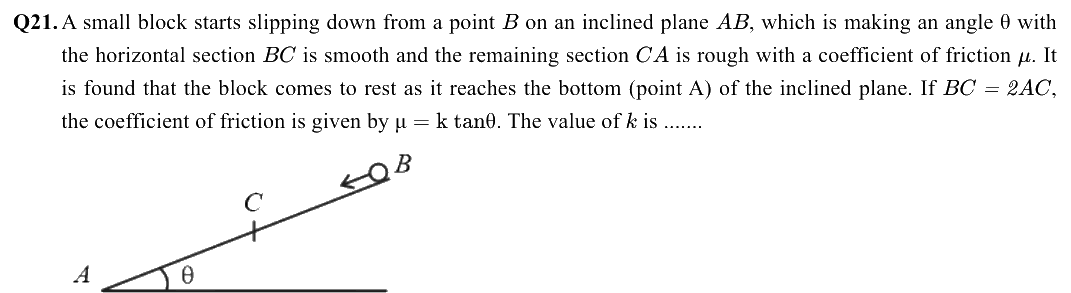
A small block starts slipping down from a point $B$ on an inclined plane $AB$, which is making an angle $\theta$ with the horizontal section $BC$ is smooth and the remaining section $CA$ is rough with a coefficient of friction $\mu$. It is found that the block comes to rest as it reaches the bottom (point A) of the inclined plane. If $BC = 2AC$, the coefficient of friction is given by $\mu = k\ \tan\theta$. The value of $k$ is ....... (see the figure above)
The question as printed in the paper.
Numerical answer type: type your answer in EdLoop to check it
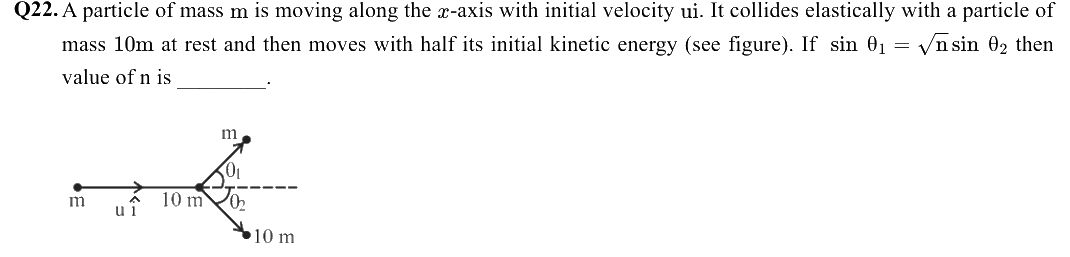
A particle of mass m is moving along the $x$-axis with initial velocity $u\hat{i}$. It collides elastically with a particle of mass $10m$ at rest and then moves with half its initial kinetic energy (see figure). If $\sin\theta_{1} = \sqrt{n}\sin\theta_{2}$ then value of n is ______. (see the figure above)
The question as printed in the paper.
Numerical answer type: type your answer in EdLoop to check it
A body A of mass $m = 0.1\ \mathrm{kg}$ has an initial velocity of $3\hat{i}\ \mathrm{m\ s^{-1}}$. It collides elastically with another body B of the same mass which has an initial velocity of $5\hat{j}\ \mathrm{m\ s^{-1}}$. After the collision, A moves with a velocity $\vec{v} = 4(\hat{i} + \hat{j})\ \mathrm{m\ s^{-1}}$. The energy of B after the collision is written as $\frac{x}{10}\ \mathrm{J}$. The value of $x$ is
Numerical answer type: type your answer in EdLoop to check it
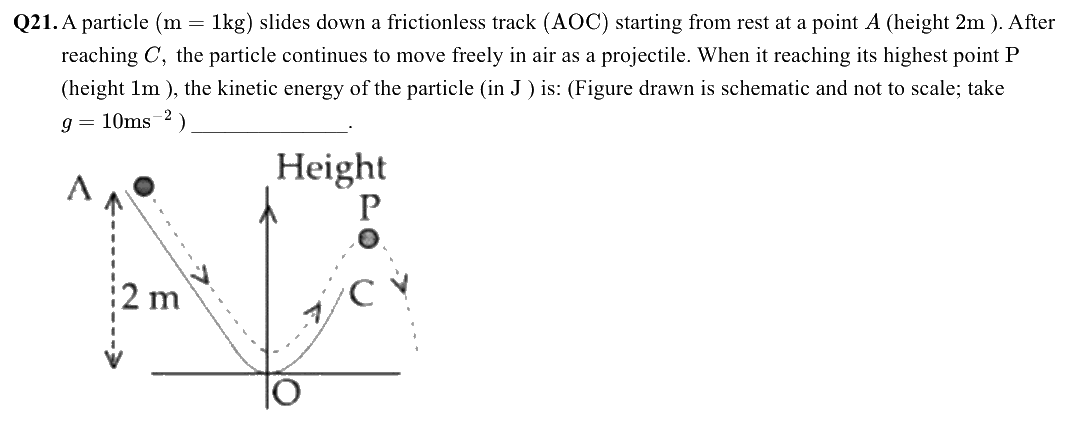
A particle $(\mathrm{m} = 1\mathrm{kg})$ slides down a frictionless track $(\mathrm{AOC})$ starting from rest at a point $A$ (height $2\mathrm{m}$ ). After reaching $C$, the particle continues to move freely in air as a projectile. When it reaching its highest point P (height $1\mathrm{m}$ ), the kinetic energy of the particle (in $\mathrm{J}$ ) is: (Figure drawn is schematic and not to scale; take $g = 10\mathrm{ms}^{-2}$ ) ______ . (see the figure above)
The question as printed in the paper.
Numerical answer type: type your answer in EdLoop to check it
Work, Energy & Power provides the primary scalar framework for solving mechanics problems in JEE Main Physics. Across the papers we hold from 2019 to 2026, the chapter delivered 151 questions in 162 papers, which equates to 0.9 questions per paper, and appeared in 122 of those 162 papers. That ranks it 14th of 29 Physics chapters by question count in that period, making up 3.3% of the Physics section.
The chapter's share has fallen since the AIEEE years. From 2002 to 2018, it represented 3.7% of Physics; across the last three exam years (2024 to 2026), it declined to 2.9%, with 45 questions across 58 papers. The most active years in our collection were 2021 (28 questions across 26 papers) and 2022 (28 questions across 22 papers). Since 2019 there has been no year without it, featuring in 122 of the 162 papers we hold.
The topics form Unit 4: Work, Energy and Power in NTA's Class 11 Physics syllabus. The work-energy theorem and potential energy curves developed here recur constantly in rotational motion, electrostatics, and modern physics.
Most-asked topics
Between 2019 and 2026, the chapter's questions fell under four topics:
Energy & Conservation: 69 questions. Mechanical energy conservation, conservative force fields, potential energy functions, and stable or unstable equilibrium points.
Collisions: 37 questions. One-dimensional and two-dimensional collisions, coefficient of restitution, and kinetic energy loss converted into heat.
Work: 27 questions. Scalar dot products, variable force integration along paths, and area under force-displacement plots.
Power: 18 questions. Instantaneous power as the dot product of force and velocity, average power output, and pump or engine delivery rates.
All four topic areas appeared in the 2026 papers, making a balanced revision necessary.
What the questions look like
Energy conservation problems frequently challenge students to read potential energy graphs. You will find plots of potential energy U(x) against position x where you must determine force directions from negative derivatives, or identify points of stable, unstable, and neutral equilibrium where slope vanishes. Other common questions evaluate work done using the work-energy theorem: given a polynomial expression for position with time, you compute velocities at the boundary times to find kinetic energy change directly rather than integrating forces over distance.
Collision questions split between perfectly elastic and partially or completely inelastic impacts. A classic problem sets up two spherical masses colliding along a line and sticking together, asking for the loss of mechanical energy or the consequent temperature increase of the combined mass. Oblique collision setups require separate restitution equations along the common normal and momentum conservation along the tangent.
Work and power problems test vector algebra and calculus. You will encounter questions calculating work done by multiple constant forces moving a mass along a specified displacement vector, or finding instantaneous power at a given timestamp for an accelerating mass driven by a time-varying vector force.
A major portion of this chapter is tested via direct calculation: 48 of the 151 questions between 2019 and 2026 were numerical answer items without multiple-choice options.
Questions to try first
Here are five questions from NTA's 2026 papers that demonstrate key exam styles:
Begin by drilling the work-energy theorem until it becomes your default problem-solving tool. Whenever a question asks for speed, height, or spring compression without mentioning time, try work-energy balance before writing down equations of motion. Remember that work done by all forces, including friction and applied external forces, equals the change in kinetic energy.
For potential energy functions, practice relating force to the spatial gradient: force in one dimension equals negative dU/dx. Check your signs carefully; a positive slope implies a force directed along the negative coordinate direction. For equilibrium points, evaluate second derivatives: positive curvature signifies stable equilibrium, while negative curvature indicates instability.
In collision problems, always establish coordinate axes along the line of impact and the transverse plane. Write momentum conservation along the line of impact, and write the coefficient of restitution formula as the ratio of separation speed to approach speed along that line alone. Verify your energy bookkeeping to ensure kinetic energy never increases in passive collisions.
Frequently asked questions
Is Work, Energy & Power important for JEE Main 2027?
Yes. It provided 151 questions across 162 papers in our set from 2019 to 2026, averaging 0.9 questions per paper. It ranks 14th among 29 Physics chapters and appeared in 122 of the 162 papers we hold.
Which topic in this chapter appears most frequently?
Energy and conservation leads the chapter with 69 questions between 2019 and 2026, followed by collisions with 37 questions and work with 27 questions.
How do I tell whether to use momentum conservation or energy conservation?
Momentum is conserved whenever the net external force on the system along an axis is zero, regardless of whether mechanical energy is lost. Energy conservation applies only when non-conservative forces like friction or inelastic deformation do no net work.
Where can I see the solutions?
Every question on this page opens with its options and answer. Step-by-step solutions for each one are in the EdLoop app.