Electromagnetic Induction: JEE Main PYQs 2002–2026
Every Electromagnetic Induction question from past JEE Main and AIEEE papers, with options and answers. Newest first.
177questions
132papers covered
3%of Physics questions, 2019–2026
2002–2026years
Guide at a glance
Electromagnetic induction links mechanics with electromagnetism under Unit 14: Electromagnetic Induction and Alternating Currents in the Class 12 NTA physics syllabus, holding rank 20 among the 29 physics chapters.
A 30 cm long solenoid has 10 turns per cm and area of 5 cm$^2$. The current through the solenoid coil varies from 2 A to 4 A in 3.14 s. The e.m.f. induced in the coil is $\alpha\times10^{-5}$ V. The value $\alpha$ is ________.
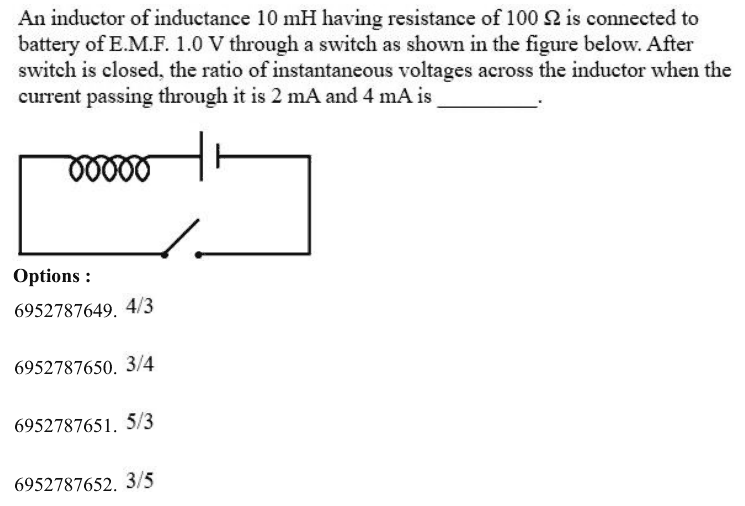
An inductor of inductance 10 mH having resistance of 100 $\Omega$ is connected to battery of E.M.F. 1.0 V through a switch as shown in the figure below. After switch is closed, the ratio of instantaneous voltages across the inductor when the current passing through it is 2 mA and 4 mA is ________.
A square loop of side 2 cm is placed in a time varying magnetic field with magnitude as $B = 0.4\sin(300t)$ Tesla. The normal to the plane of loop makes an angle of 60° with the field. The maximum induced emf produced in the loop is ________ mV.
A metal rod of length $L$ rotates about one end at origin with a uniform angular velocity $\omega$. The magnetic field radially falls off as $B(\mathrm{r}) = B_o\,e^{-\lambda r}$; $\lambda$ being a positive constant. The emf induced (neglecting the centripetal force on electrons in the rod) is :
When a coil is placed in a time dependent magnetic field the power dissipated in it is $P$. The number of turns, area of the coil and radius of the coil wire are $N$, $A$ and $r$ respectively. For a second coils number of turns, area of the coil and radius of the coil wire are $2N$, $2A$ and $3r$ respectively. When the first coil is replaced with second coil the power dissipated in it is $\sqrt{2}\,\alpha P$. The value of $\alpha$ is ________.
A circular current loop of radius $R$ is placed inside square loop of side length $L$ ($L \gg R$) such that they are co-planar and their centers coincide. The permeability of free space is $\mu_0$. The mutual inductance between circular loop and square loop is ________.
A 20 m long uniform copper wire held horizontally is allowed to fall under the gravity ($g = 10$ m/s$^2$) through a uniform horizontal magnetic field of 0.5 Gauss perpendicular to the length of the wire. The induced EMF across the wire when it travells a vertical distance of 200 m is ________ mV.
A circular loop of radius 7 cm is placed in uniform magnetic field of 0.2 T directed perpendicular to plane of loop. The loop is converted into a square loop in 0.5 s. The EMF induced in the loop is ________ mV.
Suppose a long solenoid of 100 cm length, radius 2 cm having 500 turns per unit length, carries a current $I = 10\sin(\omega t)$ A, where $\omega = 1000$ rad./s. A circular conducting loop ($B$) of radius 1 cm coaxially slided through the solenoid at a speed $v = 1$ cm/s. The r.m.s. current through the loop when the coil $B$ is inserted 10 cm inside the solenoid is $\alpha/\sqrt{2}\ \mu$A. The value of $\alpha$ is ________.
Three identical coils $C_1$, $C_2$ and $C_3$ are closely placed such that they share a common axis. $C_2$ is exactly midway. $C_1$ carries current $I$ in anti-clockwise direction while $C_3$ carries current $I$ in clockwise direction. An induced current flows through $C_2$ will be in clockwise direction when
A
$C_1$ and $C_3$ move with equal speeds away from $C_2$
B
$C_1$ moves away from $C_2$ and $C_3$ moves towards $C_2$
C
$C_1$ moves towards $C_2$ and $C_3$ moves away from $C_2$
D
$C_1$ and $C_3$ move with equal speeds towards $C_2$
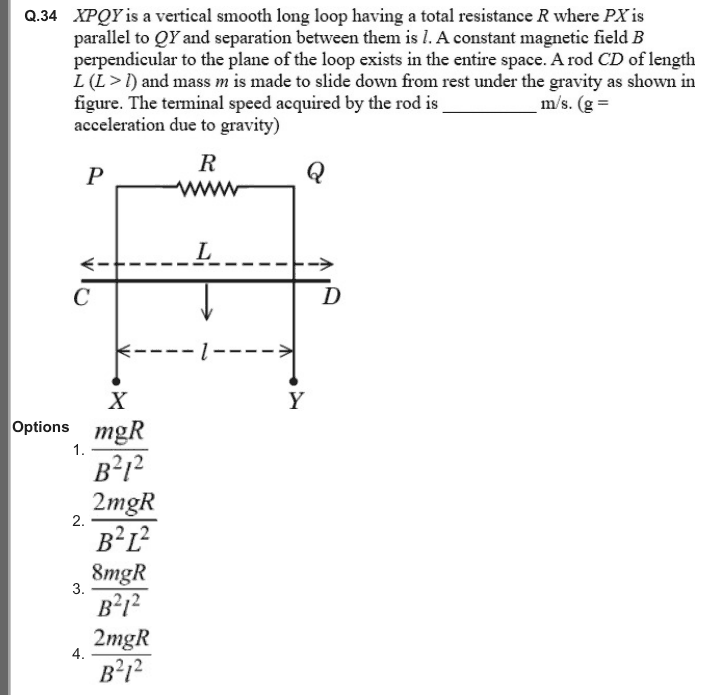
$XPQY$ is a vertical smooth long loop having a total resistance $R$ where $PX$ is parallel to $QY$ and separation between them is $l$. A constant magnetic field $B$ perpendicular to the plane of the loop exists in the entire space. A rod $CD$ of length $L$ ($L > l$) and mass $m$ is made to slide down from rest under the gravity as shown in figure. The terminal speed acquired by the rod is ________ m/s. ($g$ = acceleration due to gravity)
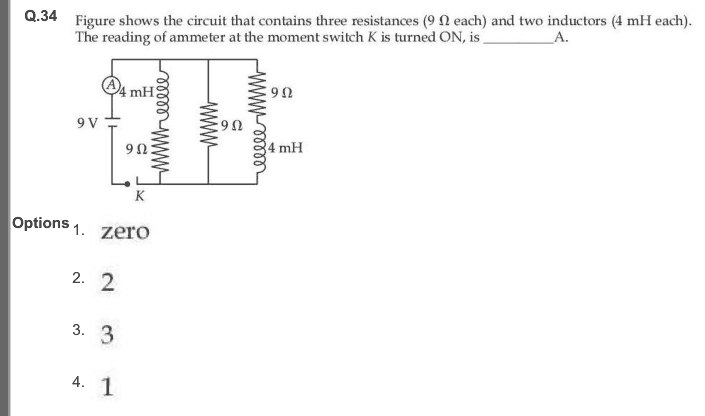
Figure shows the circuit that contains three resistances ($9\,\Omega$ each) and two inductors (4 mH each). The reading of ammeter at the moment switch $K$ is turned ON, is ________ A.
A conducting circular loop of area 1.0 m$^2$ is placed perpendicular to a magnetic field which varies as $B = \sin(100\,t)$ Tesla. If the resistance of the loop is 100 $\Omega$, then the average thermal energy dissipated in the loop in one period is ________ J.
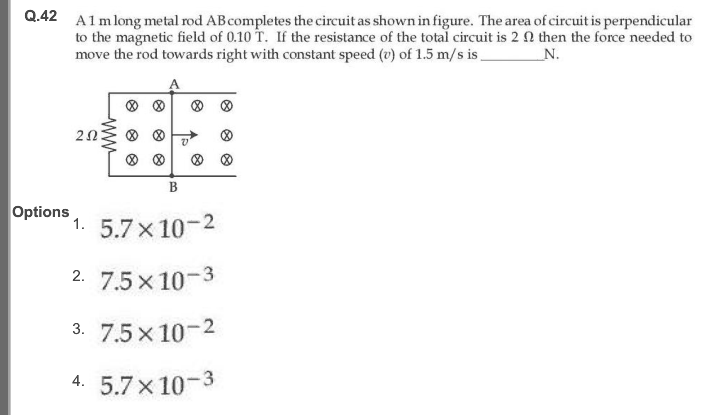
A 1 m long metal rod $AB$ completes the circuit as shown in figure. The area of circuit is perpendicular to the magnetic field of 0.10 T. If the resistance of the total circuit is 2 $\Omega$ then the force needed to move the rod towards right with constant speed ($v$) of 1.5 m/s is ________ N.
A capacitor $C$ is first charged fully with potential difference of $V_0$ and disconnected from the battery. The charged capacitor is connected across an inductor having inductance $L$. In $t$ s 25% of the initial energy in the capacitor is transferred to the inductor. The value of $t$ is ________ s.
Consider $\mathrm{I_1}$ and $\mathrm{I_2}$ are the currents flowing simultaneously in two nearby coils 1 & 2, respectively. If $\mathrm{L_1}$ = self inductance of coil 1, $\mathrm{M_{12}}$ = mutual inductance of coil 1 with respect to coil 2, then the value of induced emf in coil 1 will be Options
A uniform magnetic field of 0.4 T acts perpendicular to a circular copper disc 20 cm in radius. The disc is having a uniform angular velocity of $10\pi\mathrm{rads^{-1}}$ about an axis through its centre and perpendicular to the disc. What is the potential difference developed between the axis of the disc and the rim ? ($\pi = 3.14$)
Regarding self-inductance: A. The self-inductance of the coil depends on its geometry. B. Self-inductance does not depend on the permeability of the medium. C. Self-induced e.m.f. opposes any change in the current in a circuit. D. Self-inductance is electromagnetic analogue of mass in mechanics. E. Work needs to be done against self-induced e.m.f. in establishing the current. Choose the correct answer from the options given below:
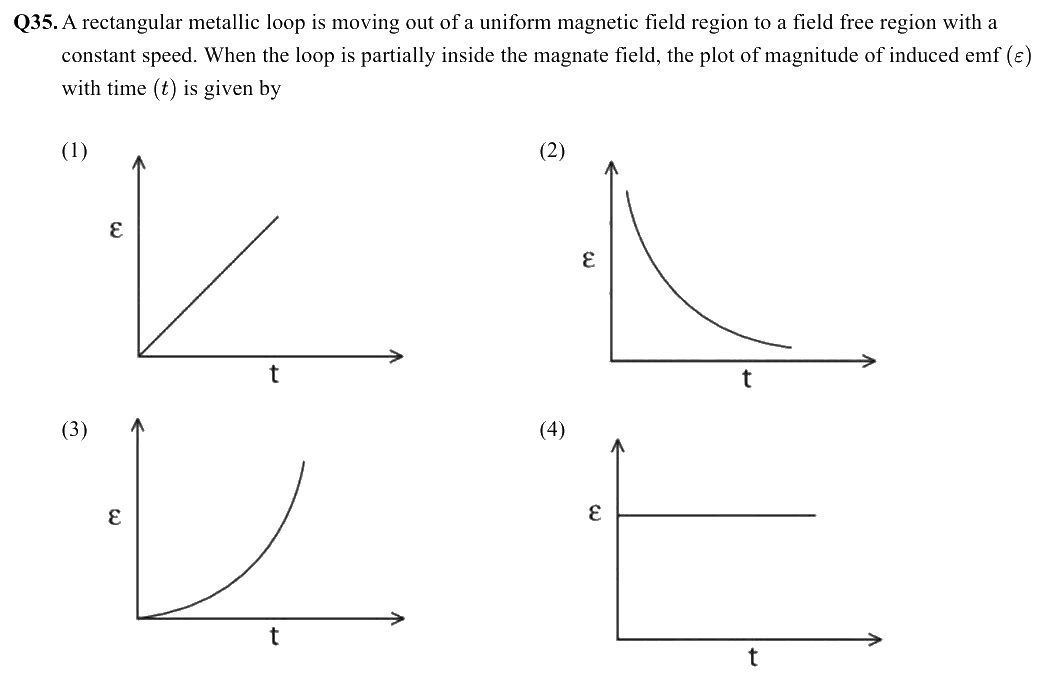
A rectangular metallic loop is moving out of a uniform magnetic field region to a field free region with a constant speed. When the loop is partially inside the magnate field, the plot of magnitude of induced emf ($\varepsilon$) with time ($t$) is given by
The question as printed in the paper.
A
see figure vertical axis labelled 'ε', horizontal axis labelled 't'; a straight line starting at the origin and rising to the upper right.
B
see figure same axes; a curve starting high on the vertical axis, falling steeply and then flattening, ending above the t axis (decreasing, bending toward the t axis).
C
see figure same axes; a curve starting at the origin, rising slowly at first and then more and more steeply to the upper right.
D
see figure same axes; a horizontal straight line at constant height above the t axis, starting at the ε axis.
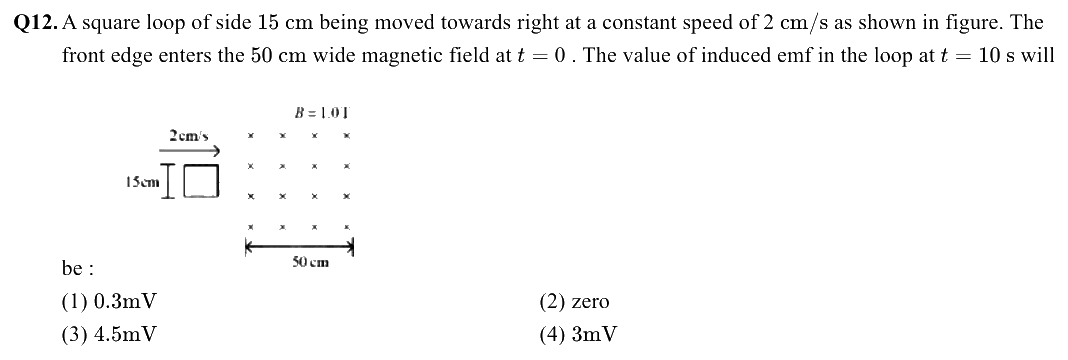
A square loop of side 15 cm being moved towards right at a constant speed of 2 cm/s as shown in figure. The front edge enters the 50 cm wide magnetic field at $t = 0$ . The value of induced emf in the loop at $t = 10$ s will be :
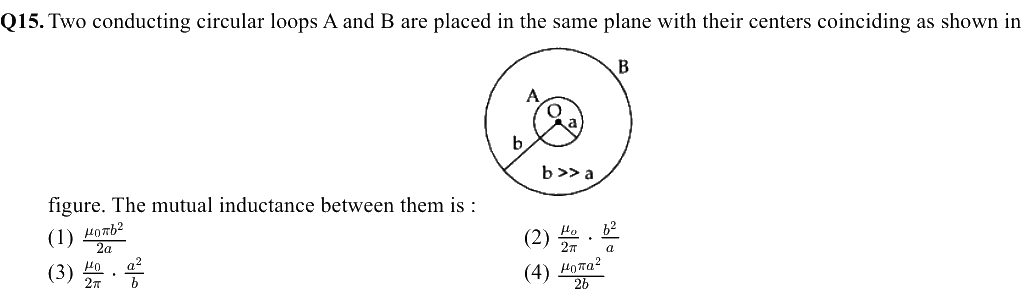
Two conducting circular loops A and B are placed in the same plane with their centers coinciding as shown in figure. The mutual inductance between them is :
A coil is placed perpendicular to a magnetic field of 5000 T. When the field is changed to 3000 T in 2 s, an induced emf of 22 V is produced in the coil. If the diameter of the coil is 0.02 m, then the number of turns in the coil is:
A capacitor of capacitance 100 $\mu$F is charged to a potential of 12 V and connected to a 6.4 mH inductor to produce oscillations. The maximum current in the circuit would be :
A rectangular loop of length 2.5 m and width 2 m is placed at $60^\circ$ to a magnetic field of 4 T. The loop is removed from the field in 10 sec. The average emf induced in the loop during this time is
A 12 V battery connected to a coil of resistance 6 $\Omega$ through a switch, drives a constant current in the circuit. The switch is opened in 1 ms. The emf induced across the coil is 20 V. The inductance of the coil is :
Given below are two statements: one is labelled as Assertion A and the other is labelled as Reason R Assertion A: A bar magnet dropped through a metallic cylindrical pipe takes more time to come down compared to a non-magnetic bar with same geometry and mass. Reason R: For the magnetic bar, Eddy currents are produced in the metallic pipe which oppose the motion of the magnetic bar. In the light of the above statements, choose the correct answer from the options given below
A
A is false but R is true
B
Both A and R are true and R is the correct explanation of A
C
A is true but R is false
D
Both A and R are true and R is NOT the correct explanation of A
An emf of $0.08\ \mathrm{V}$ is induced in a metal rod of length $10\ \mathrm{cm}$ held normal to a uniform magnetic field of $0.4\ \mathrm{T}$, when move with a velocity of:
A coil is placed in magnetic field such that plane of coil is perpendicular to the direction of magnetic field. The magnetic flux through a coil can be changed: A. By changing the magnitude of the magnetic field within the coil. B. By changing the area of coil within the magnetic field. C. By changing the angle between the direction of magnetic field and the plane of the coil. D. By reversing the magnetic field direction abruptly without changing its magnitude. Choose the most appropriate answer from the options given below:
Spherical insulating ball and a spherical metallic ball of same size and mass are dropped from the same height. Choose the correct statement out of the following {Assume negligible air friction}
A
Time taken by them to reach the earth's surface will be independent of the properties of their materials
B
Insulating ball will reach the earth's surface earlier than the metal ball
C
Both will reach the earth's surface simultaneously
D
Metal ball will reach the earth's surface earlier than the insulating ball
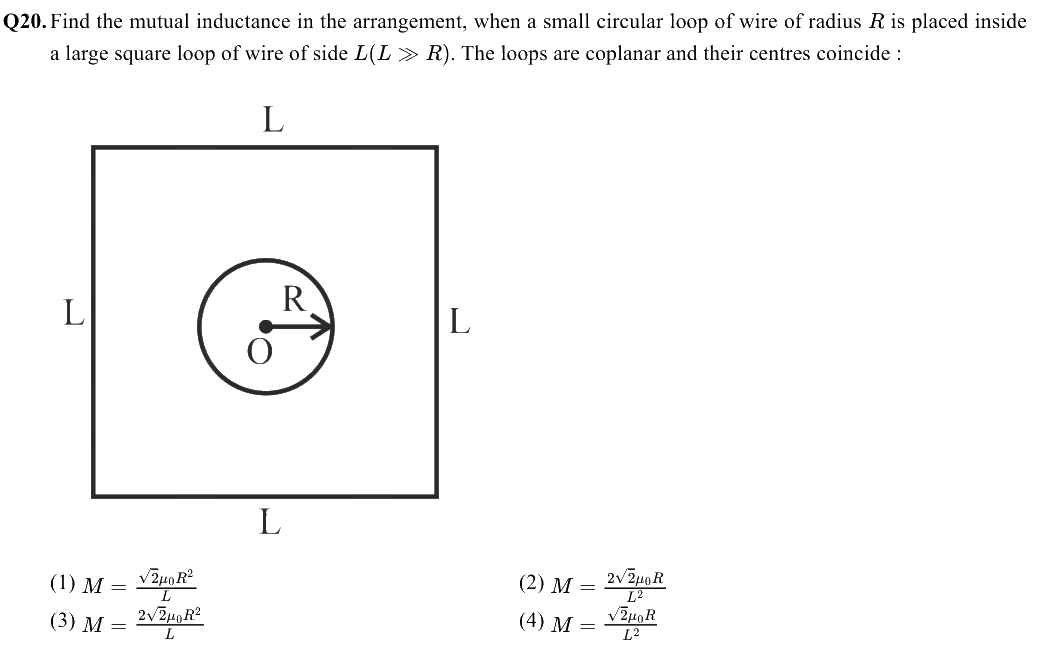
Find the mutual inductance in the arrangement, when a small circular loop of wire of radius $R$ is placed inside a large square loop of wire of side $L(L \gg R)$. The loops are coplanar and their centres coincide :
A square loop of area $25\ \mathrm{cm^2}$ has a resistance of $10\ \Omega$. The loop is placed in uniform magnetic field of magnitude $40.0$ T. The plane of loop is perpendicular to the magnetic field. The work done in pulling the loop out of the magnetic field slowly and uniformly in $1.0$ sec, will be
In an LC oscillator, if values of inductance and capacitance become twice and eight times, respectively, then the resonant frequency of oscillator becomes $x$ times its initial resonant frequency $\omega_0$. The value of $x$ is:
A wire of length 1 m moving with velocity $8\ \mathrm{m\,s^{-1}}$ at right angles to a magnetic field of 2 T. The magnitude of induced emf, between the ends of wire will be ______.
A conducting loop of radius $\frac{10}{\sqrt{\pi}}$ cm is placed perpendicular to a uniform magnetic field of 0.5 T. The magnetic field is decreased to zero in 0.5 s at a steady rate. The induced emf in the circular loop at 0.25 s is:
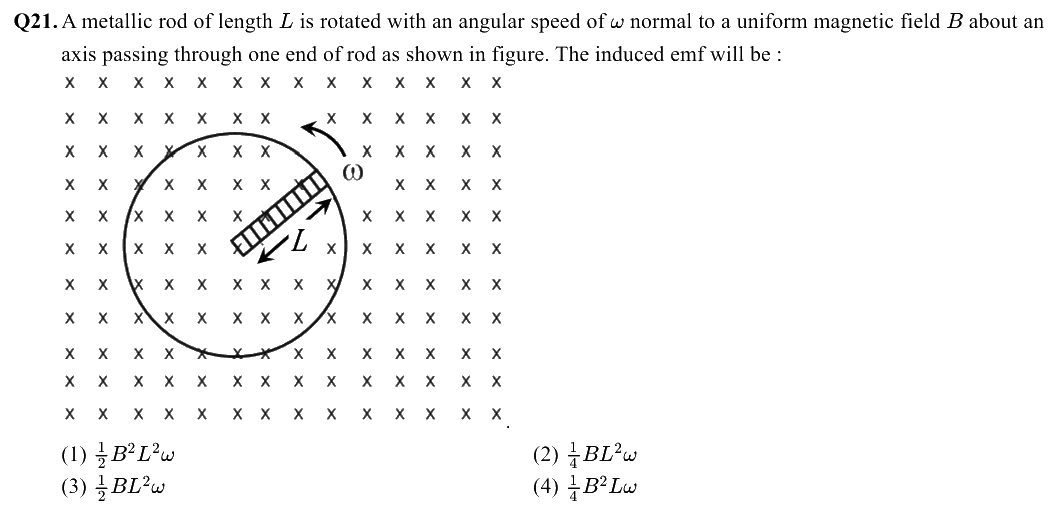
A metallic rod of length $L$ is rotated with an angular speed of $\omega$ normal to a uniform magnetic field $B$ about an axis passing through one end of rod as shown in figure. The induced emf will be :
A coil of inductance 1 H and resistance 100 $\Omega$ is connected to a battery of 6 V. Determine approximately : (a) The time elapsed before the current acquires half of its steady-state value (b) The energy stored in the magnetic field associated with the coil at an instant 15 ms after the circuit is switched on. (Given $\ln 2 = 0.693$, $e^{\frac{-3}{2}} = 0.25$)
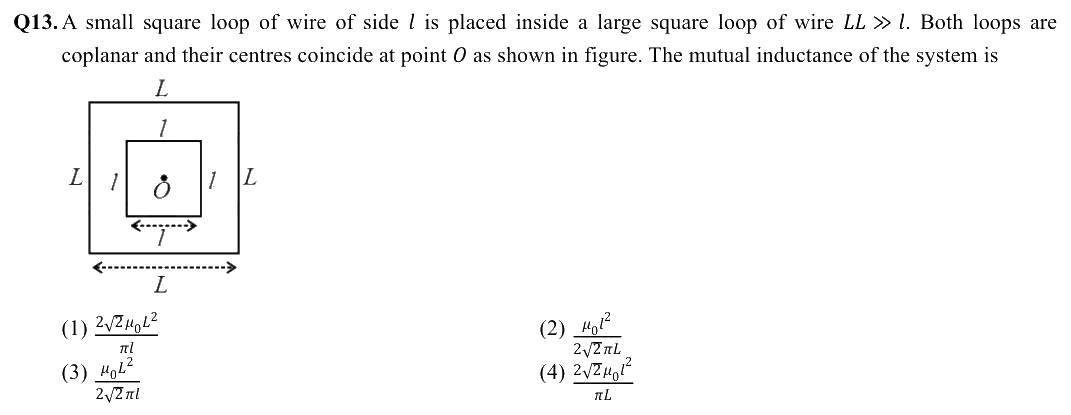
A small square loop of wire of side $l$ is placed inside a large square loop of wire $L$ ($L \gg l$). Both loops are coplanar and their centres coincide at point $O$ as shown in figure. The mutual inductance of the system is
A coil is placed in a time varying magnetic field. If the number of turns in the coil were to be halved and the radius of wire doubled, the electrical power dissipated due to the current induced in the coil would be (Assume the coil to be short circuited.)
The magnetic flux through a coil perpendicular to its plane is varying according to the relation $\phi = (5t^3 + 4t^2 + 2t - 5)$ Weber. If the resistance of the coil is $5$ ohm, then the induced current through the coil at $\mathrm{t} = 2$ s will be,
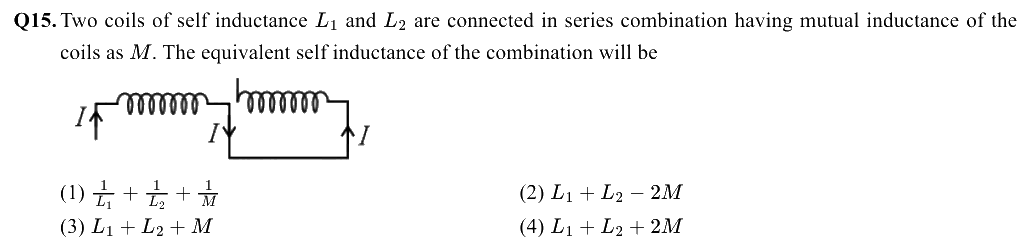
Two coils of self inductance $L_1$ and $L_2$ are connected in series combination having mutual inductance of the coils as $M$. The equivalent self inductance of the combination will be (see the figure above)
A metallic conductor of length $1 \mathrm{~m}$ rotates in a vertical plane parallel to east-west direction about one of its end with angular velocity $5 \mathrm{~rad} \mathrm{~s}^{-1}$. If the horizontal component of earth's magnetic field is $0.2 \times 10^{-4} \mathrm{~T}$, then emf induced between the two ends of the conductor is
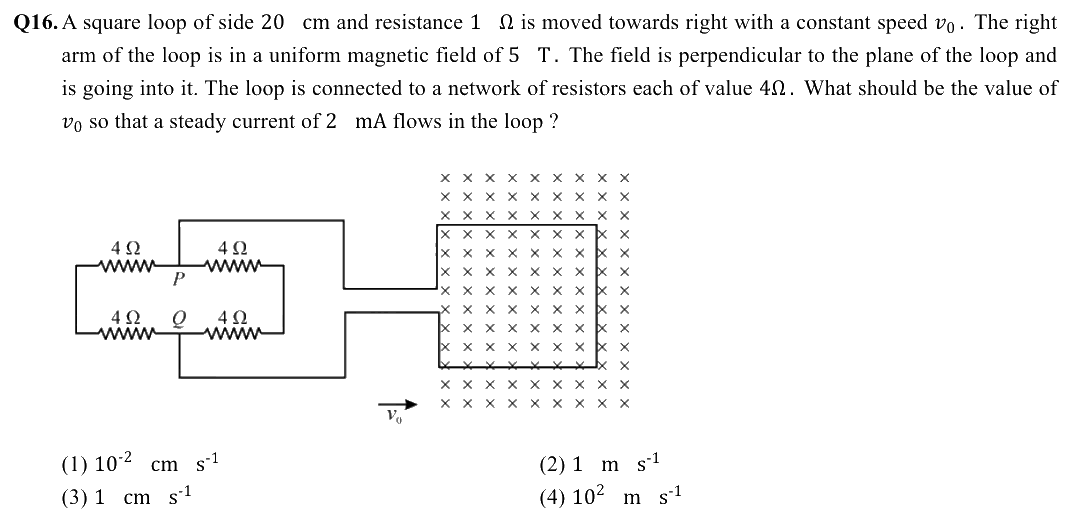
A square loop of side $20$ cm and resistance $1$ $\Omega$ is moved towards right with a constant speed $v_0$. The right arm of the loop is in a uniform magnetic field of $5$ T. The field is perpendicular to the plane of the loop and is going into it. The loop is connected to a network of resistors each of value $4\Omega$. What should be the value of $v_0$ so that a steady current of $2$ mA flows in the loop ? (see the figure above)
A small square loop of side $a$ and one turn is placed inside a larger square loop of side $b$ and one turn ($b \gg a$). The two loops are coplanar with their centres coinciding. If a current $I$ is passed in the square loop of side $b$, then the coefficient of mutual inductance between the two loops is :
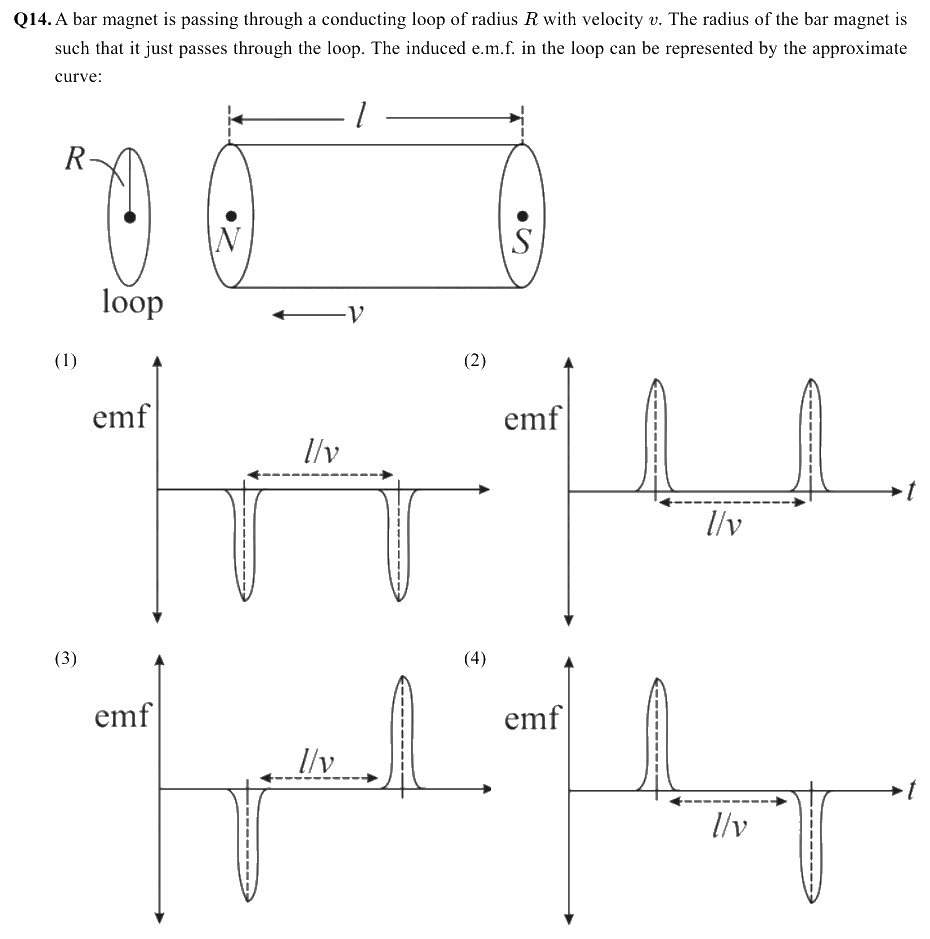
A bar magnet is passing through a conducting loop of radius $R$ with velocity $v$. The radius of the bar magnet is such that it just passes through the loop. The induced e.m.f. in the loop can be represented by the approximate curve: (see the figure above)
The question as printed in the paper.
A
see figure emf against time; two narrow downward (negative) pulses, the distance between them marked $l/v$.
B
see figure emf against $t$; two narrow upward (positive) pulses, the distance between them marked $l/v$.
C
see figure emf against time; first a narrow downward (negative) pulse, then after $l/v$ a narrow upward (positive) pulse.
D
see figure emf against $t$; first a narrow upward (positive) pulse, then after $l/v$ a narrow downward (negative) pulse.
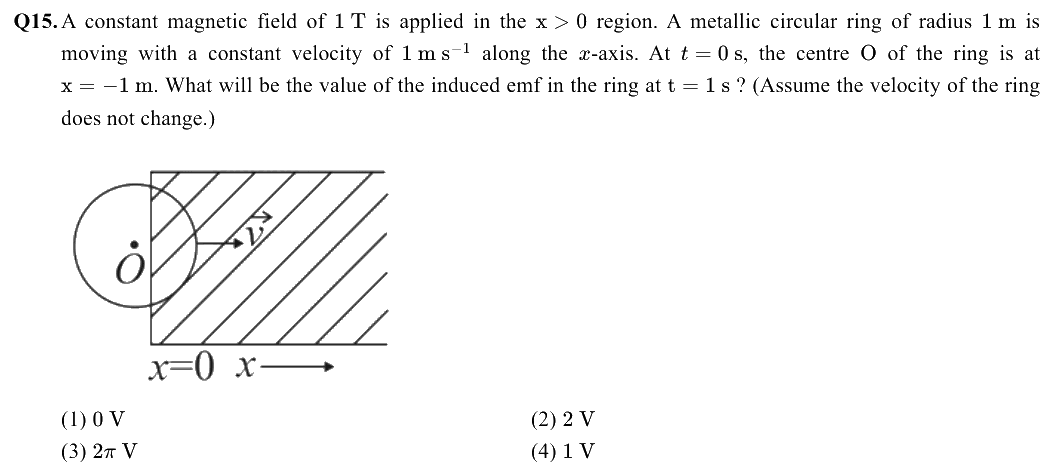
A constant magnetic field of $1\ \mathrm{T}$ is applied in the $\mathrm{x}>0$ region. A metallic circular ring of radius $1\ \mathrm{m}$ is moving with a constant velocity of $1\ \mathrm{m\ s^{-1}}$ along the $x$-axis. At $t=0\ \mathrm{s}$, the centre O of the ring is at $\mathrm{x}=-1\ \mathrm{m}$. What will be the value of the induced emf in the ring at $\mathrm{t}=1\ \mathrm{s}$ ? (Assume the velocity of the ring does not change.) (see the figure above)
An inductor coil stores $64\ \mathrm{J}$ of magnetic field energy and dissipates energy at the rate of $640\ \mathrm{W}$ when a current of $8\ \mathrm{A}$ is passed through it. If this coil is joined across an ideal battery, find the time constant of the circuit (in s).
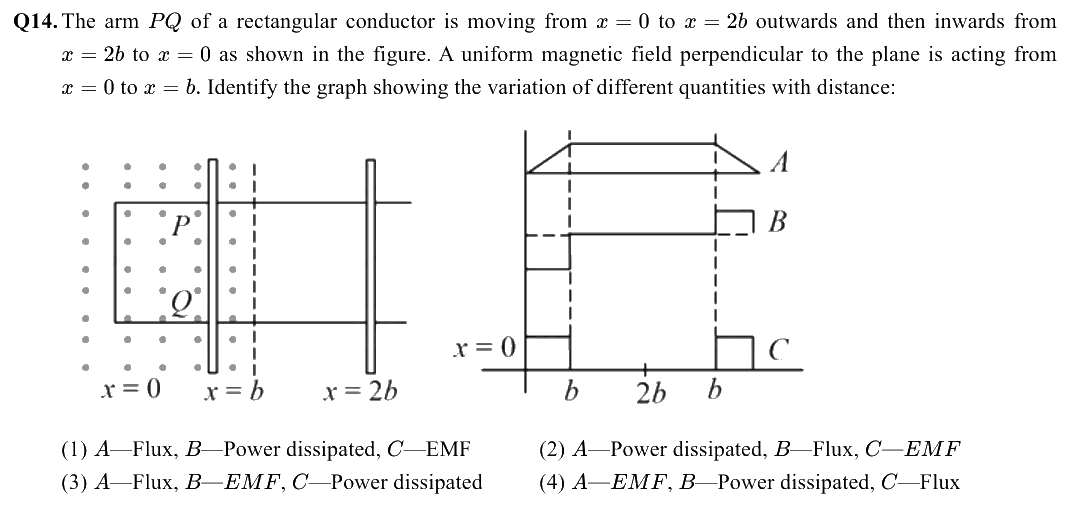
The arm $PQ$ of a rectangular conductor is moving from $x = 0$ to $x = 2b$ outwards and then inwards from $x = 2b$ to $x = 0$ as shown in the figure. A uniform magnetic field perpendicular to the plane is acting from $x = 0$ to $x = b$. Identify the graph showing the variation of different quantities with distance: (see the figure above)
The time taken for the magnetic energy to reach $25\%$ of its maximum value, when a solenoid of resistance $R$, inductance $L$ is connected to a battery, is :
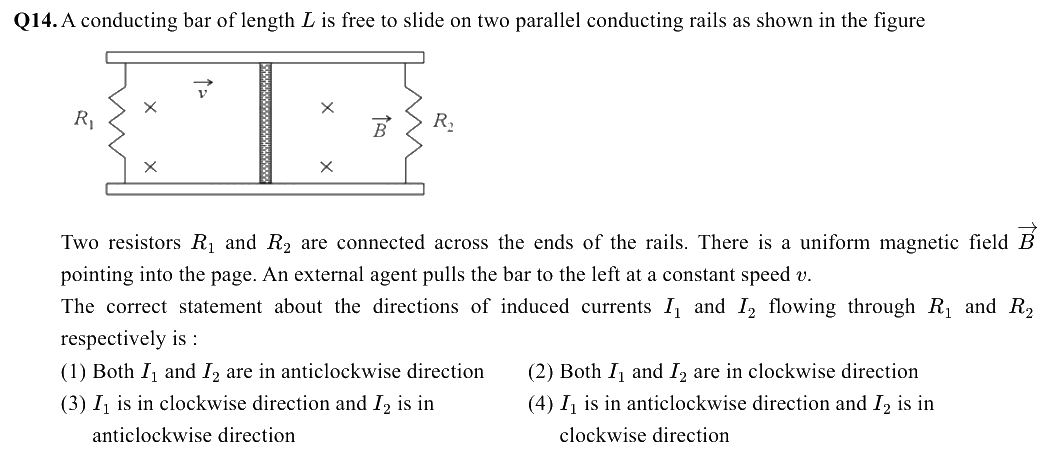
A conducting bar of length $L$ is free to slide on two parallel conducting rails as shown in the figure (see the figure above) Two resistors $R_1$ and $R_2$ are connected across the ends of the rails. There is a uniform magnetic field $\vec{B}$ pointing into the page. An external agent pulls the bar to the left at a constant speed $v$. The correct statement about the directions of induced currents $I_1$ and $I_2$ flowing through $R_1$ and $R_2$ respectively is :
The question as printed in the paper.
A
Both $I_1$ and $I_2$ are in anticlockwise direction
B
Both $I_1$ and $I_2$ are in clockwise direction
C
$I_1$ is in clockwise direction and $I_2$ is in anticlockwise direction
D
$I_1$ is in anticlockwise direction and $I_2$ is in clockwise direction
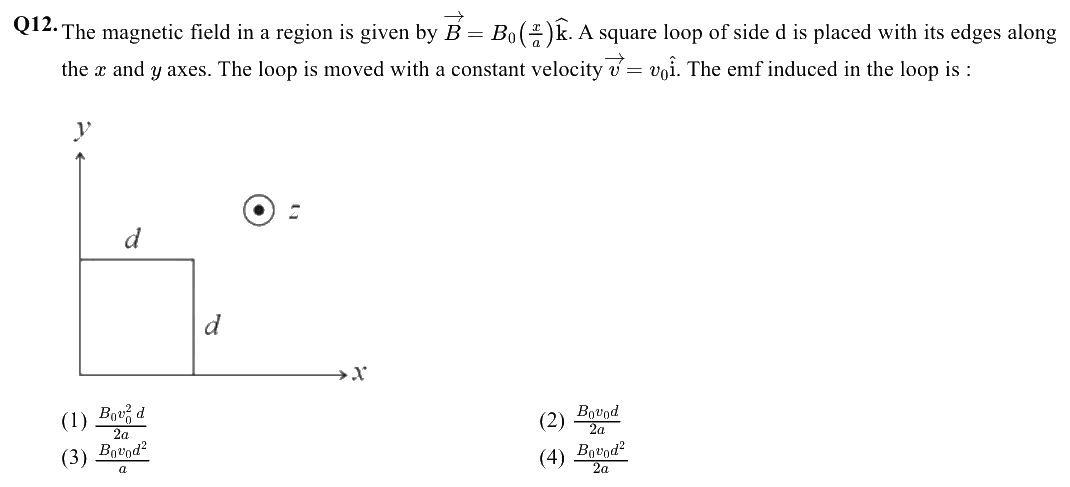
The magnetic field in a region is given by $\vec{B} = B_0\left(\frac{x}{a}\right)\hat{k}$. A square loop of side d is placed with its edges along the $x$ and $y$ axes. The loop is moved with a constant velocity $\vec{v} = v_0\hat{i}$. The emf induced in the loop is : (see the figure above)
An aeroplane, with its wings spread $10\ \mathrm{m}$, is flying at a speed of $180\ \mathrm{km\,h^{-1}}$ in a horizontal direction. The total intensity of earth's field at that part is $2.5 \times 10^{-4}\ \mathrm{Wb\,m^{-2}}$ and the angle of dip is $60^\circ$. The emf induced between the tips of the plane wings will be
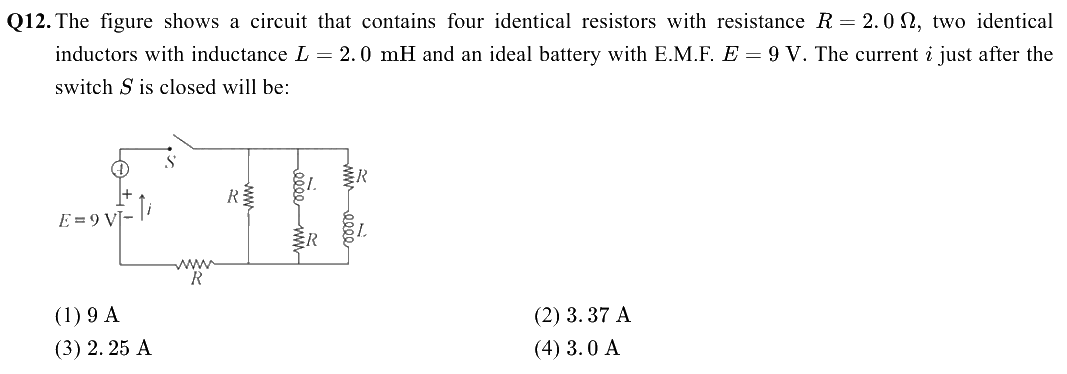
The figure shows a circuit that contains four identical resistors with resistance $R = 2.0\ \Omega$, two identical inductors with inductance $L = 2.0\ \mathrm{mH}$ and an ideal battery with E.M.F. $E = 9\ \mathrm{V}$. The current $i$ just after the switch $S$ is closed will be: (see the figure above)
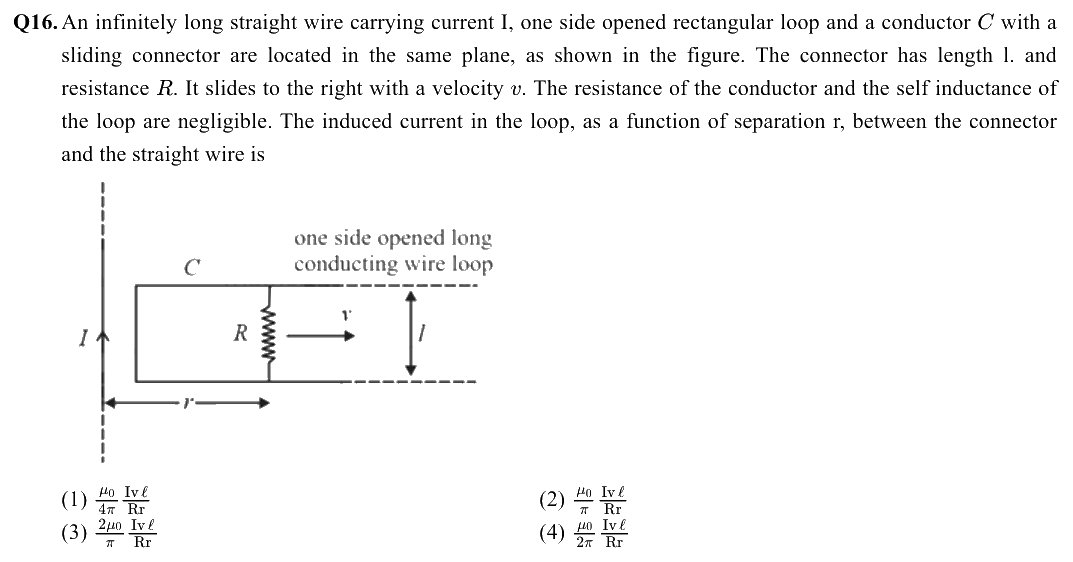
An infinitely long straight wire carrying current I, one side opened rectangular loop and a conductor $C$ with a sliding connector are located in the same plane, as shown in the figure. The connector has length 1. and resistance $R$. It slides to the right with a velocity $v$. The resistance of the conductor and the self inductance of the loop are negligible. The induced current in the loop, as a function of separation r, between the connector and the straight wire is (see the figure above)
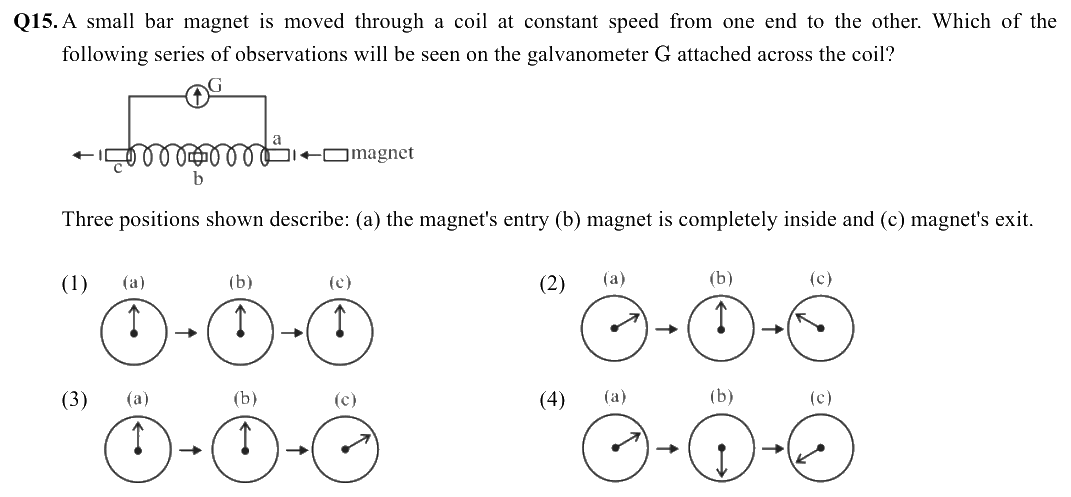
A small bar magnet is moved through a coil at constant speed from one end to the other. Which of the following series of observations will be seen on the galvanometer G attached across the coil? (see the figure above) Three positions shown describe: (a) the magnet's entry (b) magnet is completely inside and (c) magnet's exit.
The question as printed in the paper.
A
see figure dials (a), (b), (c): needle straight up in all three
B
see figure dials (a), (b), (c): needle toward upper right, straight up, toward upper left
C
see figure dials (a), (b), (c): needle straight up, straight up, toward upper right
D
see figure dials (a), (b), (c): needle toward upper right, straight down, toward lower left
A series $L - R$ circuit is connected to a battery of emf $V$. If the circuit is switched on at $t = 0$, then the time at which the energy stored in the inductor reaches $\left(\frac{1}{n}\right)$ times of its maximum value, is :
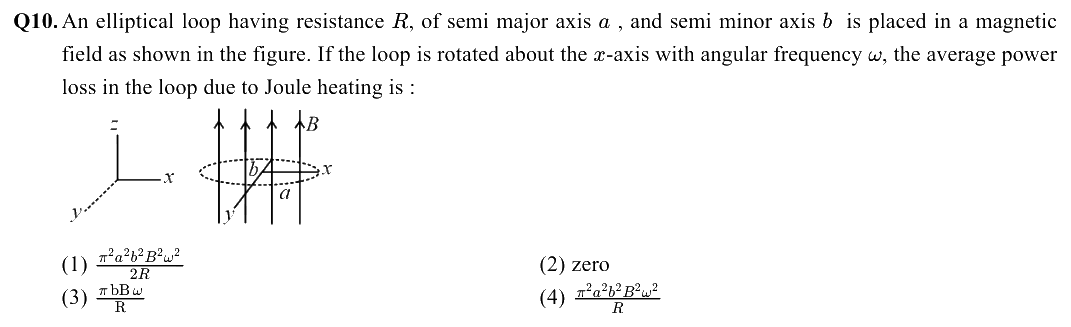
An elliptical loop having resistance $R$, of semi major axis $a$ , and semi minor axis $b$ is placed in a magnetic field as shown in the figure. If the loop is rotated about the $x$-axis with angular frequency $\omega$, the average power loss in the loop due to Joule heating is : (see the figure above)
A uniform magnetic field B exists in a direction perpendicular to the plane of a square loop made of a metal wire. The wire has a diameter of $4\ \mathrm{mm}$ and a total length of $30\ \mathrm{cm}$. The magnetic field changes with time at a steady rate $dB/dt = 0.032\ \mathrm{Ts^{-1}}$. The induced current in the loopis close to (Resistivity of the metal wire is $1.23\times 10^{-8}\ \Omega\mathrm{m}$ )
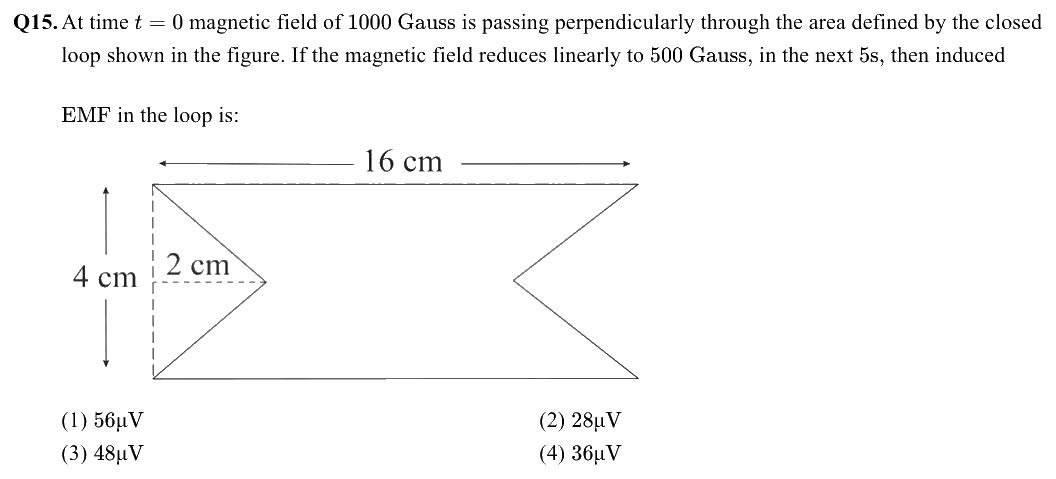
At time $t = 0$ magnetic field of 1000 Gauss is passing perpendicularly through the area defined by the closed loop shown in the figure. If the magnetic field reduces linearly to 500 Gauss, in the next 5s, then induced EMF in the loop is: (see the figure above)
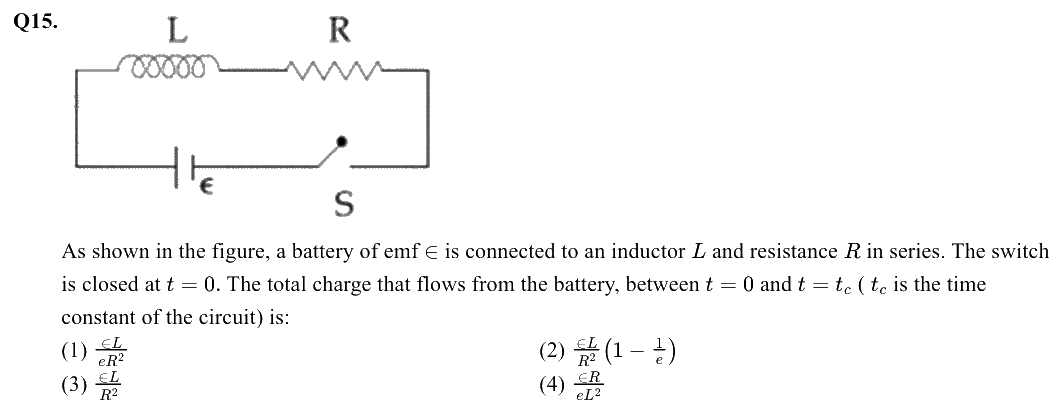
see figure As shown in the figure, a battery of emf $\varepsilon$ is connected to an inductor $L$ and resistance $R$ in series. The switch is closed at $t = 0$. The total charge that flows from the battery, between $t = 0$ and $t = t_c$ ( $t_c$ is the time constant of the circuit) is:
A long solenoid of radius $R$ carries a time $(t)$ dependent current $I(t) = I_0 t(1 - t)$. A ring of radius $2R$ is placed coaxially near its middle. During the time interval $0 \leq t \leq 1$, the induced current $(I_R)$ and the induced $EMF(V_R)$ in the ring change as:
A
Direction of $I_R$ remains unchanged and $V_R$ is maximum at $t = 0.5$
B
At $t = 0.25$ direction of $I_R$ reverses and $V_R$ is maximum
C
Direction of $I_R$ remains unchanged and $V_R$ is zero at $t = 0.25$
D
At $t = 0.5$ direction of $I_R$ reverses and $V_R$ is zero
Consider a circular coil of wire carrying constant current I, forming a magnetic dipole. The magnetic flux through an infinite plane that contains the circular coil and excluding the circular coil area is given by $\phi_i$ The magnetic flux through the area of the circular coil area is given by $\phi_0$ . Which of the following option is correct?
A LCR circuit behaves like a clamped harmonic oscillator. Comparing it with a physical spring-mass damped oscillator having damping constant 'b', the correct equivalence would be:
A
$L \leftrightarrow m, C \leftrightarrow k, R \leftrightarrow b$
B
$L \leftrightarrow \frac{1}{b}, C \leftrightarrow \frac{1}{m}, R \leftrightarrow \frac{1}{k}$
C
$L \leftrightarrow k, C \leftrightarrow b, R \leftrightarrow m$
D
$L \leftrightarrow m, C \leftrightarrow \frac{1}{k}, R \leftrightarrow b$
A planar loop of wire rotates in a uniform magnetic field. Initially, at $t = 0$, the plane of the loop is perpendicular to the magnetic field. If it rotates with a period of $10\mathrm{s}$ about an axis in its plane then the magnitude of induced emf will be maximum and minimum, respectively at:
An emf of $20\ \mathrm{V}$ is applied at time $t = 0$ to a circuit containing in series $10\ \mathrm{mH}$ inductor and $5\ \Omega$ resistor. The ratio of the currents at time $t = \infty$ and at $t = 40\ \mathrm{s}$ is close to: (Take $e^2 = 7.389$ )
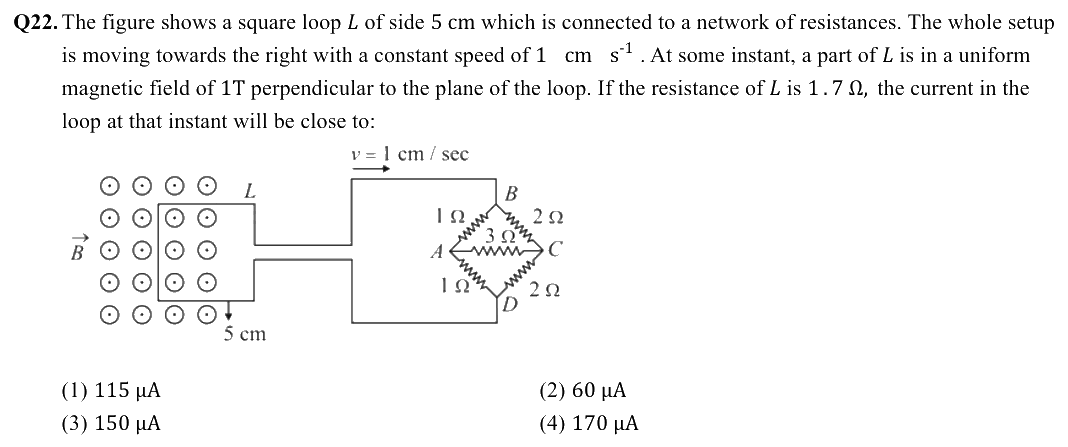
The figure shows a square loop $L$ of side 5 cm which is connected to a network of resistances. The whole setup is moving towards the right with a constant speed of $1\ \ \mathrm{cm\ \ s^{-1}}$ . At some instant, a part of $L$ is in a uniform magnetic field of 1T perpendicular to the plane of the loop. If the resistance of $L$ is $1.7\ \Omega$, the current in the loop at that instant will be close to: (see the figure above)
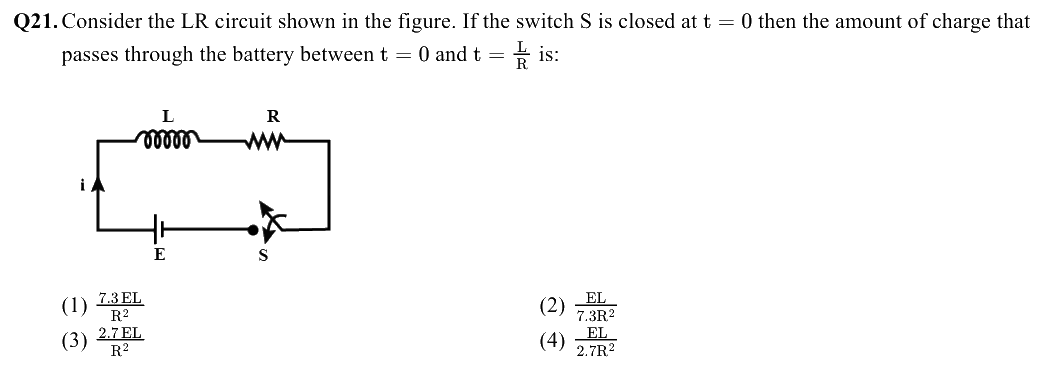
Consider the LR circuit shown in the figure. If the switch S is closed at $\mathrm{t} = 0$ then the amount of charge that passes through the battery between $\mathrm{t} = 0$ and $\mathrm{t} = \frac{\mathrm{L}}{\mathrm{R}}$ is: (see the figure above)
A coil of self inductance $10\ \mathrm{mH}$ and resistance of $0.1\ \Omega$ is connected through a switch to a battery of internal resistance $0.9\ \Omega$. After the switch is closed, the time taken for the current to attain 80% of the saturation value is: [$\ln 5 = 1.6$]
The total number of turns and cross-section area in a solenoid is fixed. However, its length L is varied by adjusting the separation between windings. The inductance of solenoid will be proportional to:
Two coils 'P' and 'Q' are separated by some distance. When a current of 3 A flows through coil 'P', a magnetic flux of $10^{-3}$ Wb passes through 'Q'. No current is passed through 'Q'. When no current passes through 'P' and a current of 2 A passes through 'Q', the flux through 'P' is:
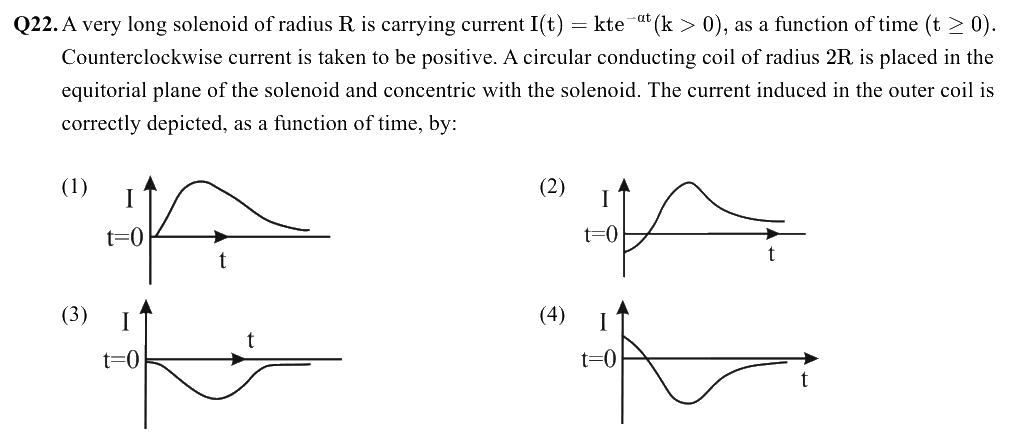
A very long solenoid of radius R is carrying current $I(t) = kte^{-\alpha t}$ $(k > 0)$, as a function of time ($t \geq 0$). Counterclockwise current is taken to be positive. A circular conducting coil of radius 2R is placed in the equitorial plane of the solenoid and concentric with the solenoid. The current induced in the outer coil is correctly depicted, as a function of time, by:
The question as printed in the paper.
A
see figure I against t (t = 0 at the origin): a curve that rises from zero to a positive maximum and then decays back towards the t axis.
B
see figure I against t (t = 0 at the origin): a curve that starts at a negative value at t = 0, rises through zero to a positive maximum and then decays towards the t axis from above.
C
see figure I against t (t = 0 at the origin): a curve that dips from zero to a negative minimum and then returns towards the t axis.
D
see figure I against t: a curve that starts at a positive value at t = 0, falls through zero to a negative minimum and then returns towards the t axis.
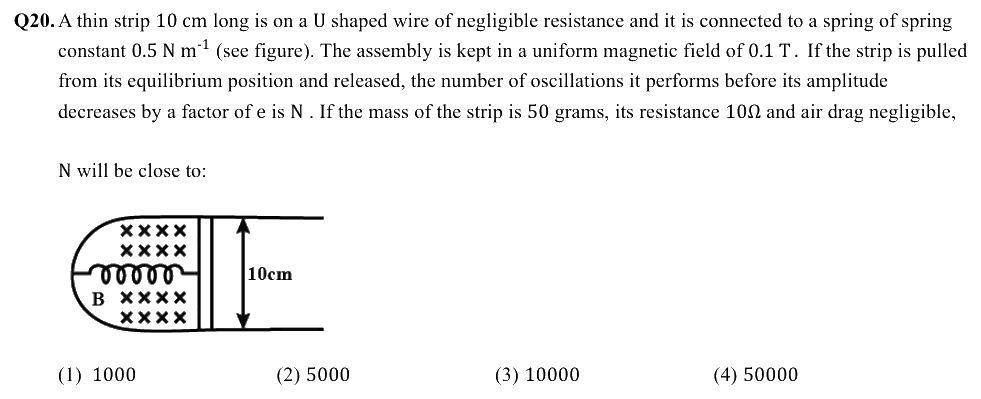
A thin strip 10 cm long is on a U shaped wire of negligible resistance and it is connected to a spring of spring constant 0.5 $\mathrm{N\,m^{-1}}$ (see figure). The assembly is kept in a uniform magnetic field of 0.1 T. If the strip is pulled from its equilibrium position and released, the number of oscillations it performs before its amplitude decreases by a factor of e is N . If the mass of the strip is 50 grams, its resistance 10$\Omega$ and air drag negligible, N will be close to: (see the figure above)
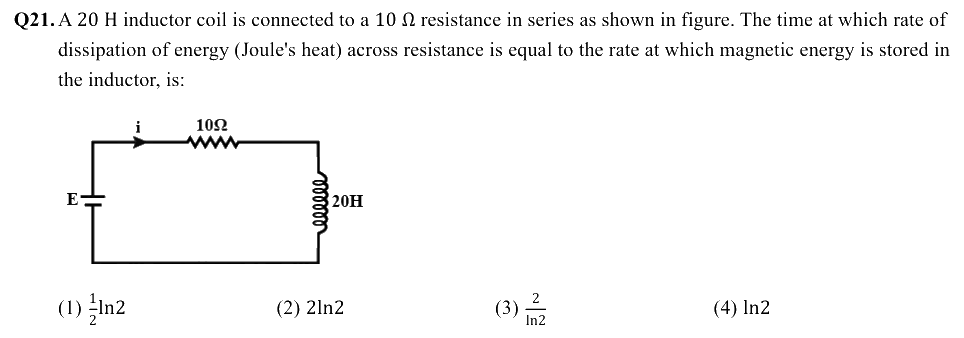
A 20 H inductor coil is connected to a 10 $\Omega$ resistance in series as shown in figure. The time at which rate of dissipation of energy (Joule's heat) across resistance is equal to the rate at which magnetic energy is stored in the inductor, is: (see the figure above)
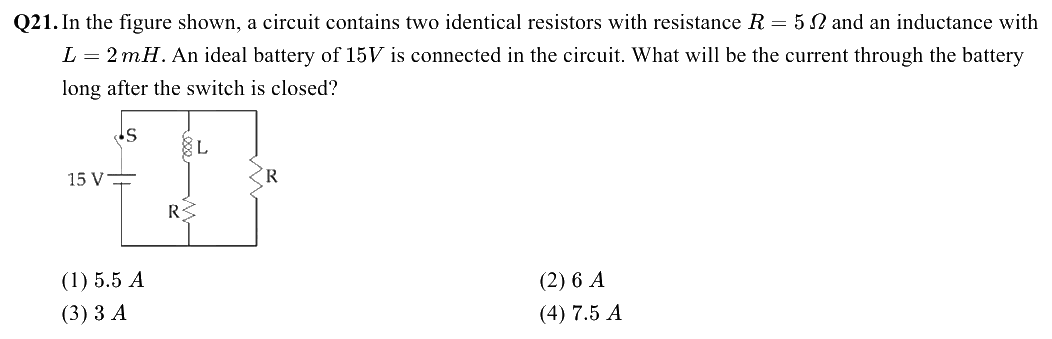
In the figure shown, a circuit contains two identical resistors with resistance $R = 5\ \Omega$ and an inductance with $L = 2\ mH$. An ideal battery of $15V$ is connected in the circuit. What will be the current through the battery long after the switch is closed?
A 10 m long horizontal wire extends from North East to South West. It is falling with a speed of 5.0 m s$^{-1}$, at right angles to the horizontal component of the earth's magnetic field of $0.3 \times 10^{-4}$ Wb m$^{-2}$. The value of the induced emf in the wire is:
There are two long co-axial solenoids of same length $l$. The inner and outer coils have radii $r_1$ and $r_2$ and number of turns per unit length n$_1$ and n$_2$, respectively. The ratio of mutual inductance to the self-inductance of the inner-coil is :
A copper wire is wound on a wooden frame, whose shape is that of an equilateral triangle. If the linear dimension of each side of the frame is increased by a factor of 3, keeping the number of turns of the coil per unit length of the frame the same, then the self inductance of the coil:
A solid metal cube of edge length 2 cm is moving in the positive y-direction, at a constant speed of 6 m s$^{-1}$. There is a uniform magnetic field of 0.1 T in the positive z-direction. The potential difference between the two faces of the cube, perpendicular to the x-axis, is
The self induced emf of a coil is $25$ volts. When the current in it is changed at uniform rate from $10\mathrm{A}$ to $25\mathrm{A}$ in $1\mathrm{s}$ , the change in the energy of the inductance is:
A conducting circular loop made of a thin wire has area $3.5\times10^{-2}\ \mathrm{m^2}$ and resistance $10\ \Omega$ It is placed perpendicular to a time-dependent magnetic field $Bt = 0.4\ \ T\sin50\pi t$ The field is uniform in space. Then the net charge flowing through the loop during $t = 0$ s and $t = 10$ ms is close to
An ideal capacitor of capacitance $0.2\mu\mathrm{F}$ is charged to a potential difference of $10\ \mathrm{V}$. The charging battery is then disconnected. The capacitor is then connected to an ideal inductor of self inductance $0.5\mathrm{mH}$. The current at a time when the potential difference across the capacitor is $5\ \mathrm{V}$, is:
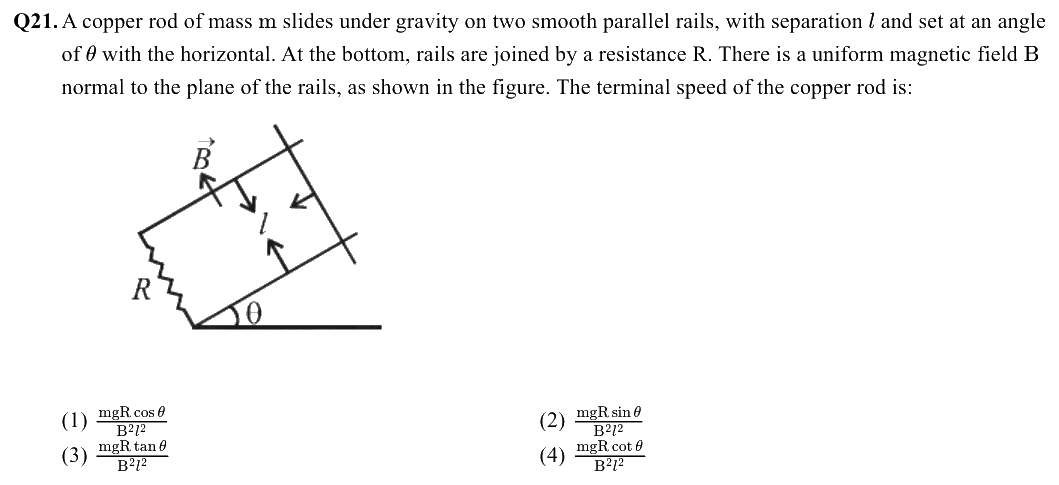
A copper rod of mass m slides under gravity on two smooth parallel rails, with separation $l$ and set at an angle of $\theta$ with the horizontal. At the bottom, rails are joined by a resistance R. There is a uniform magnetic field B normal to the plane of the rails, as shown in the figure. The terminal speed of the copper rod is: (see the figure above)
At the centre of a fixed large circular coil of radius R, a much smaller circular coil of radius $r$ is placed. The two coils are concentric and are in the same plane. The larger coil carries a current I. The smaller coil is set to rotate with a constant angular velocity $\omega$ about an axis along their common diameter. Calculate the emf induced in the smaller coil after a time $t$ of its start of rotation.
A small circular loop of wire of radius $a$ is located at the centre of a much larger circular wire loop of radius $b$. The two loops are in the same plane. The outer loop of radius $b$ carries an alternating current $I = I_0\cos(\omega t)$. The emf induced in the smaller inner loop is nearly:
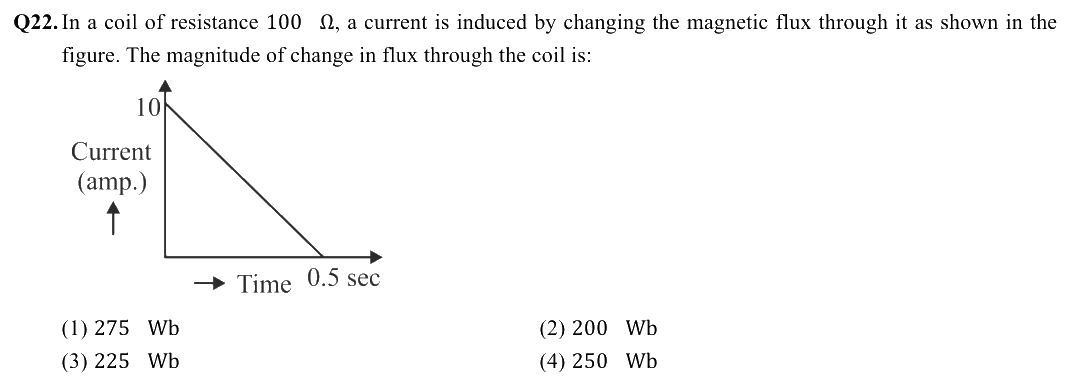
In a coil of resistance $100\ \Omega$, a current is induced by changing the magnetic flux through it as shown in the figure. The magnitude of change in flux through the coil is: (see the figure above)
A fighter plane of length $20\ \mathrm{m}$, wing span (distance from tip of one wing to the tip of the other wing) of $15\ \mathrm{m}$ and height $5\ \mathrm{m}$ is flying towards east over Delhi. Its speed is $240\ ms^{-1}$. The earth's magnetic field over Delhi is $5\times10^{-5}T$ with the declination angle $\sim 0^{o}$ and dip of $\theta$ such that $\sin\theta = \frac{2}{3}$. If the voltage developed is $V_B$ between the lower and upper side of the plane and $V_W$ between the tips of the wings then $V_B$ and $V_W$ are close to :
A
$V_B = 40\ mV;\ V_W = 135\ mV$ with left side of pilot at higher voltage
B
$V_B = 45\ mV;\ V_W = 120\ mV$ with right side of pilot at higher voltage
C
$V_B = 40\ mV;\ V_W = 135\ mV$ with right side of pilot at high voltage
D
$V_B = 45\ mV;\ V_W = 120\ mV$ with left side of pilot at higher voltage
A conducting metal circular-wire-loop of radius $r$ is placed perpendicular to a magnetic field which varies with time as $B = B_0 e^{-\frac{t}{\tau}}$, where $B_0$ and $\tau$ are constants at time $t = 0$. If the resistance of the loop is $R$, then the heat generated in the loop after a long time $(t \to \infty)$ is
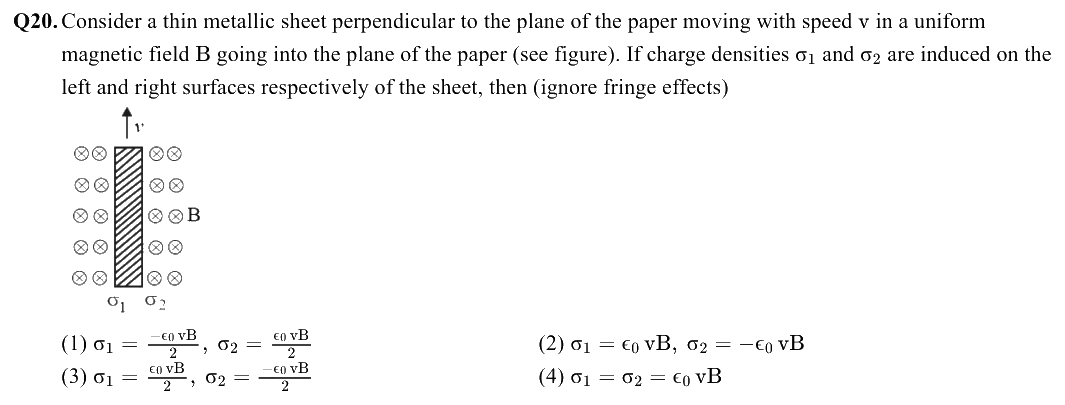
Consider a thin metallic sheet perpendicular to the plane of the paper moving with speed v in a uniform magnetic field B going into the plane of the paper (see figure). If charge densities $\sigma_1$ and $\sigma_2$ are induced on the left and right surfaces respectively of the sheet, then (ignore fringe effects) (see the figure above)
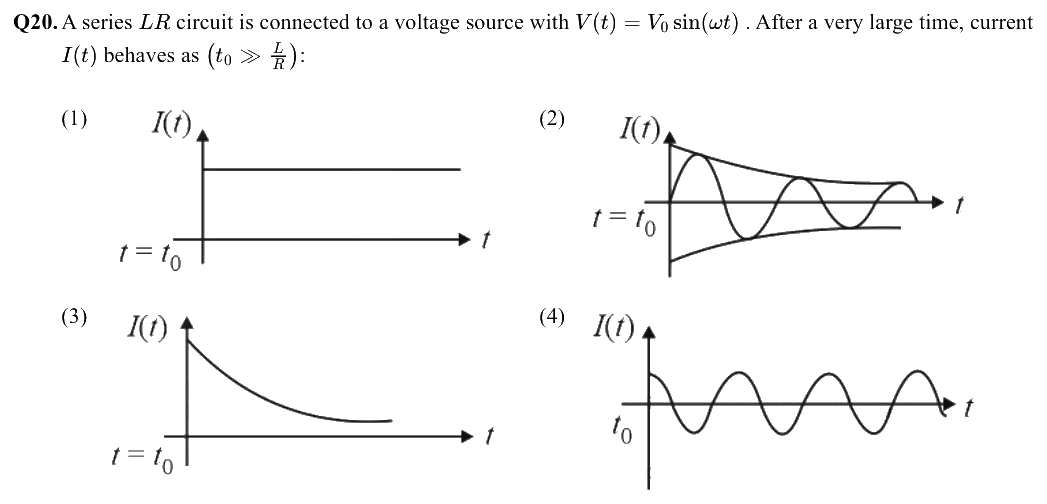
A series $LR$ circuit is connected to a voltage source with $V(t) = V_0\sin(\omega t)$ . After a very large time, current $I(t)$ behaves as $\left(t_0 \gg \frac{L}{R}\right)$:
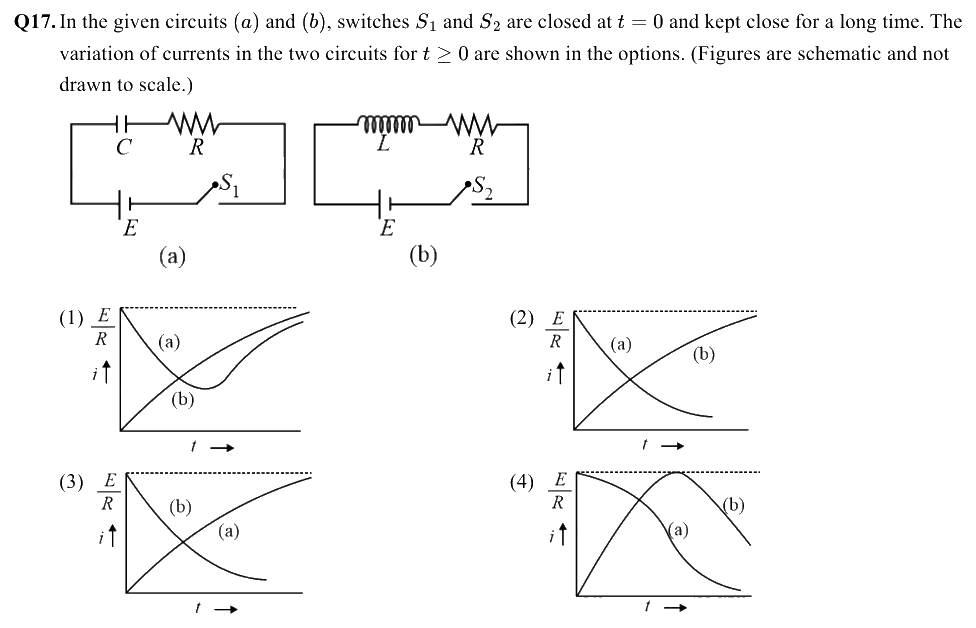
In the given circuits ($a$) and ($b$), switches $S_1$ and $S_2$ are closed at $t = 0$ and kept close for a long time. The variation of currents in the two circuits for $t \geq 0$ are shown in the options. (Figures are schematic and not drawn to scale.) (see the figure above)
The question as printed in the paper.
A
see figure graph of current $i$ against $t$ with a dotted horizontal line at $\frac{E}{R}$: one curve starts at $\frac{E}{R}$, falls to a minimum and then rises towards $\frac{E}{R}$; the other rises from the origin towards $\frac{E}{R}$; they cross; labels (a) near the falling part and (b) below the minimum
B
see figure graph of current $i$ against $t$ with a dotted horizontal line at $\frac{E}{R}$: curve (a) starts at $\frac{E}{R}$ and decays towards zero; curve (b) rises from the origin towards $\frac{E}{R}$; they cross
C
see figure graph of current $i$ against $t$ with a dotted horizontal line at $\frac{E}{R}$: a curve starting at $\frac{E}{R}$ and decaying towards zero, labelled (b); a curve rising from the origin towards $\frac{E}{R}$, labelled (a); they cross
D
see figure graph of current $i$ against $t$ with a dotted horizontal line at $\frac{E}{R}$: one curve rises from the origin to a peak touching $\frac{E}{R}$ and then falls, labelled (b) on its falling side; another curve starts at about $\frac{E}{R}$, flat at first, and falls to zero, labelled (a)
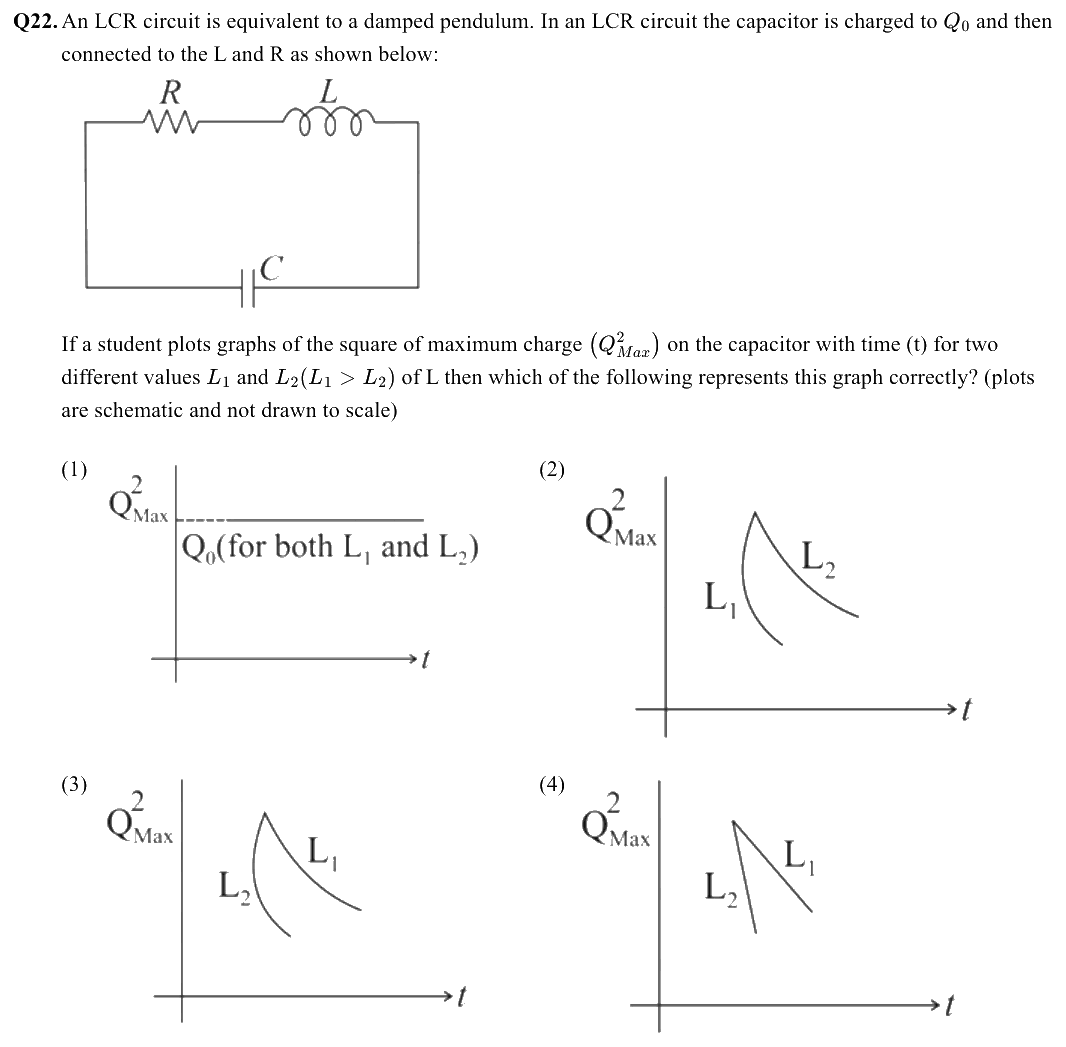
An LCR circuit is equivalent to a damped pendulum. In an LCR circuit the capacitor is charged to $Q_0$ and then connected to the L and R as shown below: (see the figure above) If a student plots graphs of the square of maximum charge $\left(Q_{\mathrm{Max}}^2\right)$ on the capacitor with time (t) for two different values $L_1$ and $L_2$ ($L_1 > L_2$) of L then which of the following represents this graph correctly? (plots are schematic and not drawn to scale)
The question as printed in the paper.
A
see figure graph of $Q_{\mathrm{Max}}^2$ against $t$
B
see figure graph of $Q_{\mathrm{Max}}^2$ against $t$
C
see figure graph of $Q_{\mathrm{Max}}^2$ against $t$
D
see figure graph of $Q_{\mathrm{Max}}^2$ against $t$
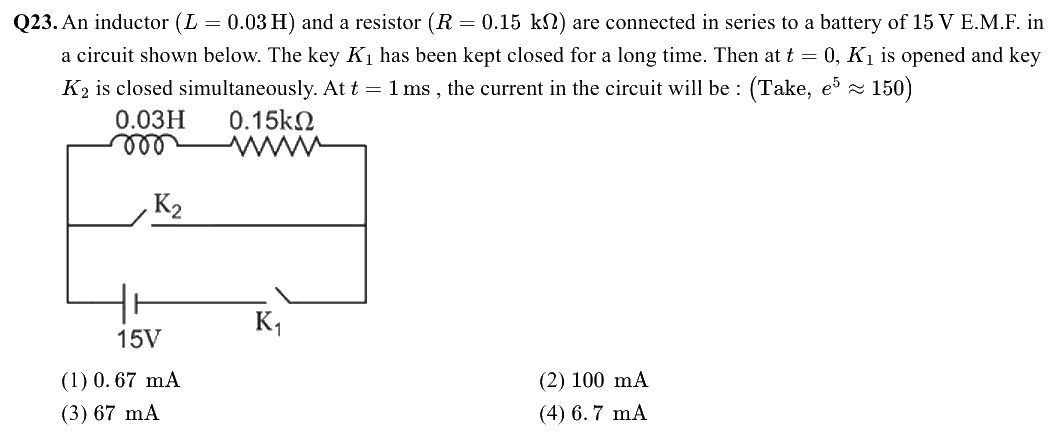
An inductor ($L = 0.03\ \mathrm{H}$) and a resistor ($R = 0.15\ \mathrm{k}\Omega$) are connected in series to a battery of $15\ \mathrm{V}$ E.M.F. in a circuit shown below. The key $K_1$ has been kept closed for a long time. Then at $t = 0$, $K_1$ is opened and key $K_2$ is closed simultaneously. At $t = 1\ \mathrm{ms}$, the current in the circuit will be : (Take, $e^5 \approx 150$) (see the figure above)
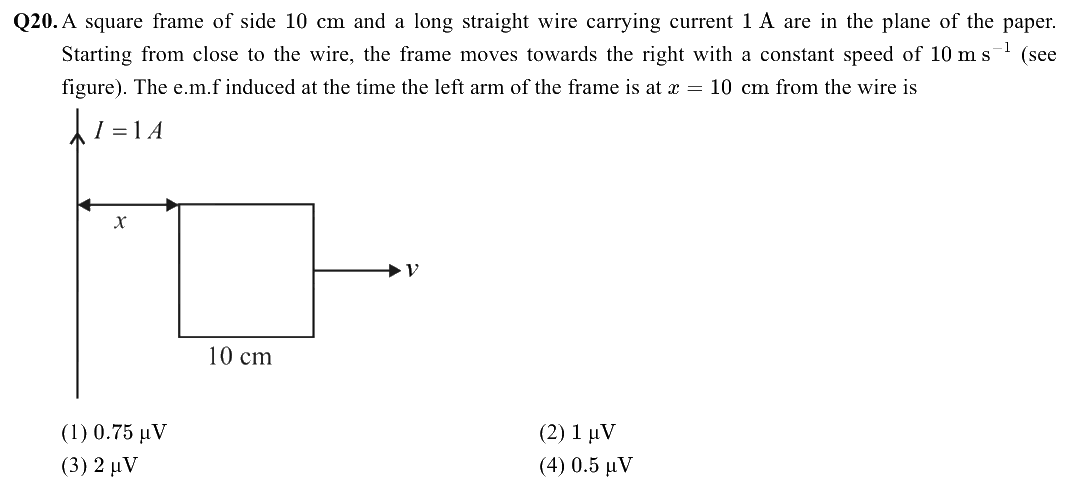
see figure A square frame of side $10\ \mathrm{cm}$ and a long straight wire carrying current $1\ \mathrm{A}$ are in the plane of the paper. Starting from close to the wire, the frame moves towards the right with a constant speed of $10\ \mathrm{m\,s^{-1}}$ (see figure). The e.m.f induced at the time the left arm of the frame is at $x = 10\ \mathrm{cm}$ from the wire is
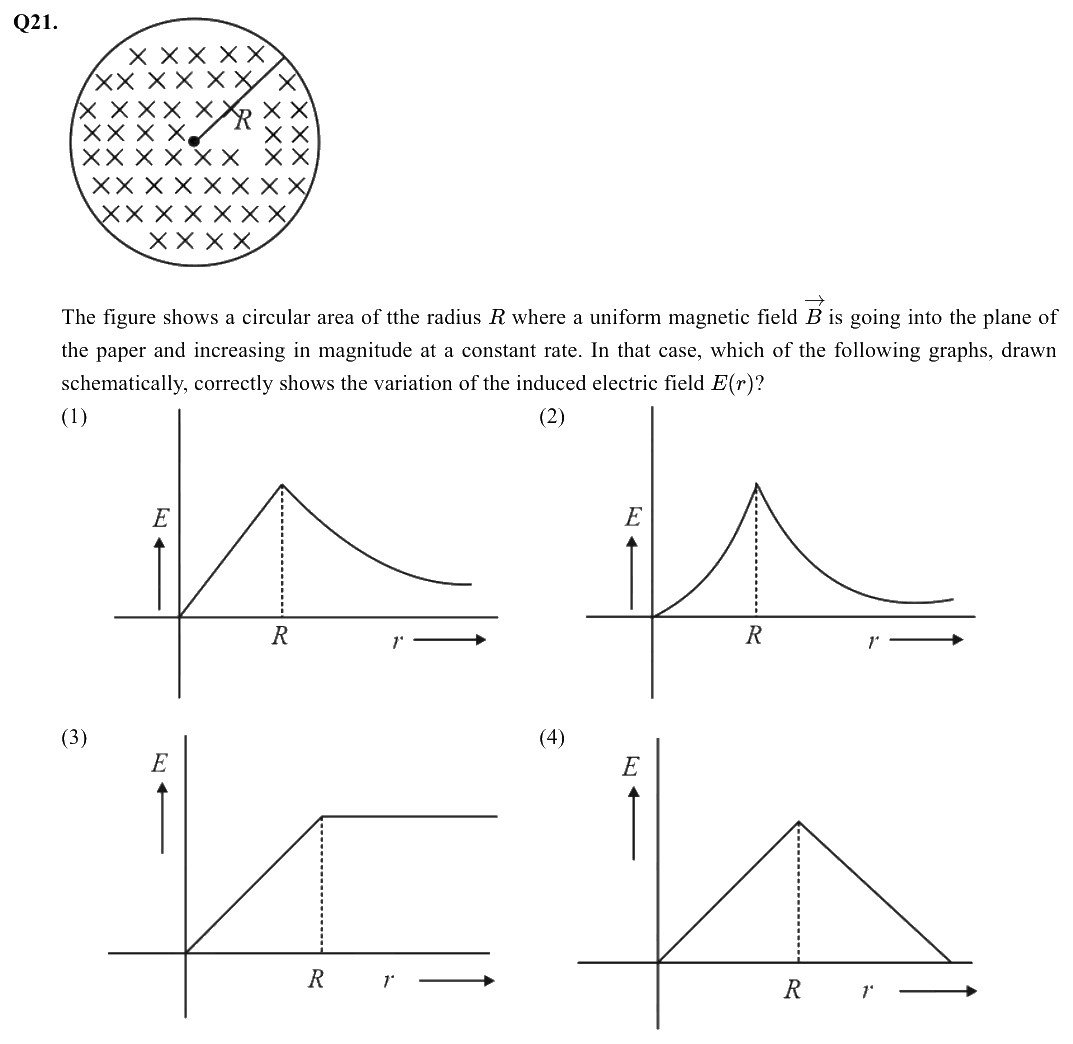
see figure The figure shows a circular area of tthe (sic) radius $R$ where a uniform magnetic field $\overrightarrow{B}$ is going into the plane of the paper and increasing in magnitude at a constant rate. In that case, which of the following graphs, drawn schematically, correctly shows the variation of the induced electric field $E(r)$?
The question as printed in the paper.
A
see figure Graph of E against r: straight line from the origin rising to a peak at r = R (dotted vertical line down to R), then falling as a smooth curve of decreasing slope (like 1/r) that levels off at a small positive value above the r axis.
B
see figure Graph of E against r: a curve from the origin that is concave upward (steepening, parabola-like) rising to a sharp peak at r = R (dotted vertical line down to R), then falling as a smooth 1/r-like curve that flattens out near the r axis (it dips very slightly and rises a little at the far right).
C
see figure Graph of E against r: straight line from the origin rising to r = R (dotted vertical line down to R), then a horizontal line at that constant maximum value for r greater than R.
D
see figure Graph of E against r: straight line from the origin rising to a peak at r = R (dotted vertical line down to R), then a straight line falling back down to zero at about r = 2R (a symmetric triangle).
A coil of circular cross-section having $1000$ turns and $4\ \mathrm{cm}^2$ face area is placed with its axis parallel to a magnetic field which decreases by $10^{-2}\ \mathrm{Wb\ m}^{-2}$ in $0.01\ \mathrm{s}$. The e.m.f. induced in the coil is:
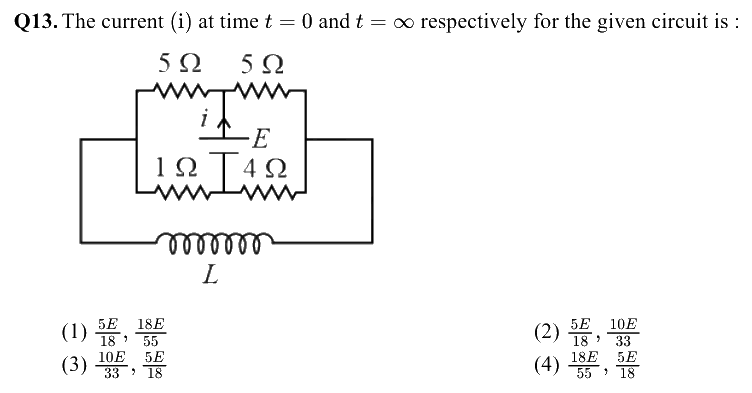
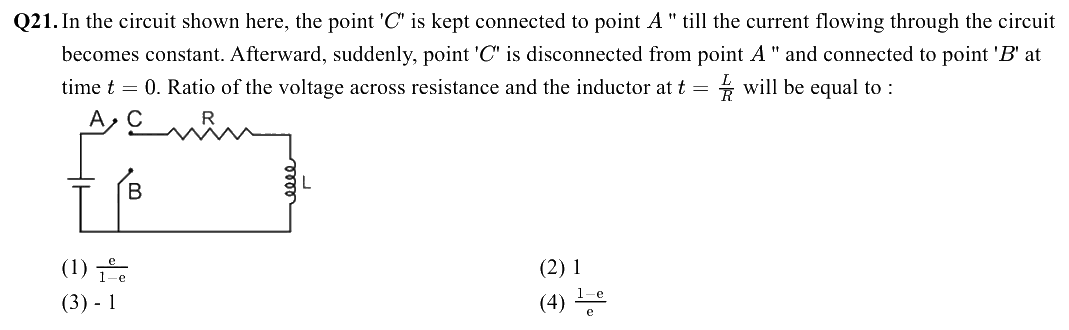
In the circuit shown here, the point 'C" is kept connected to point A " till the current flowing through the circuit becomes constant. Afterward, suddenly, point 'C" is disconnected from point A " and connected to point 'B' at time $t = 0$. Ratio of the voltage across resistance and the inductor at $t = \frac{L}{R}$ will be equal to :
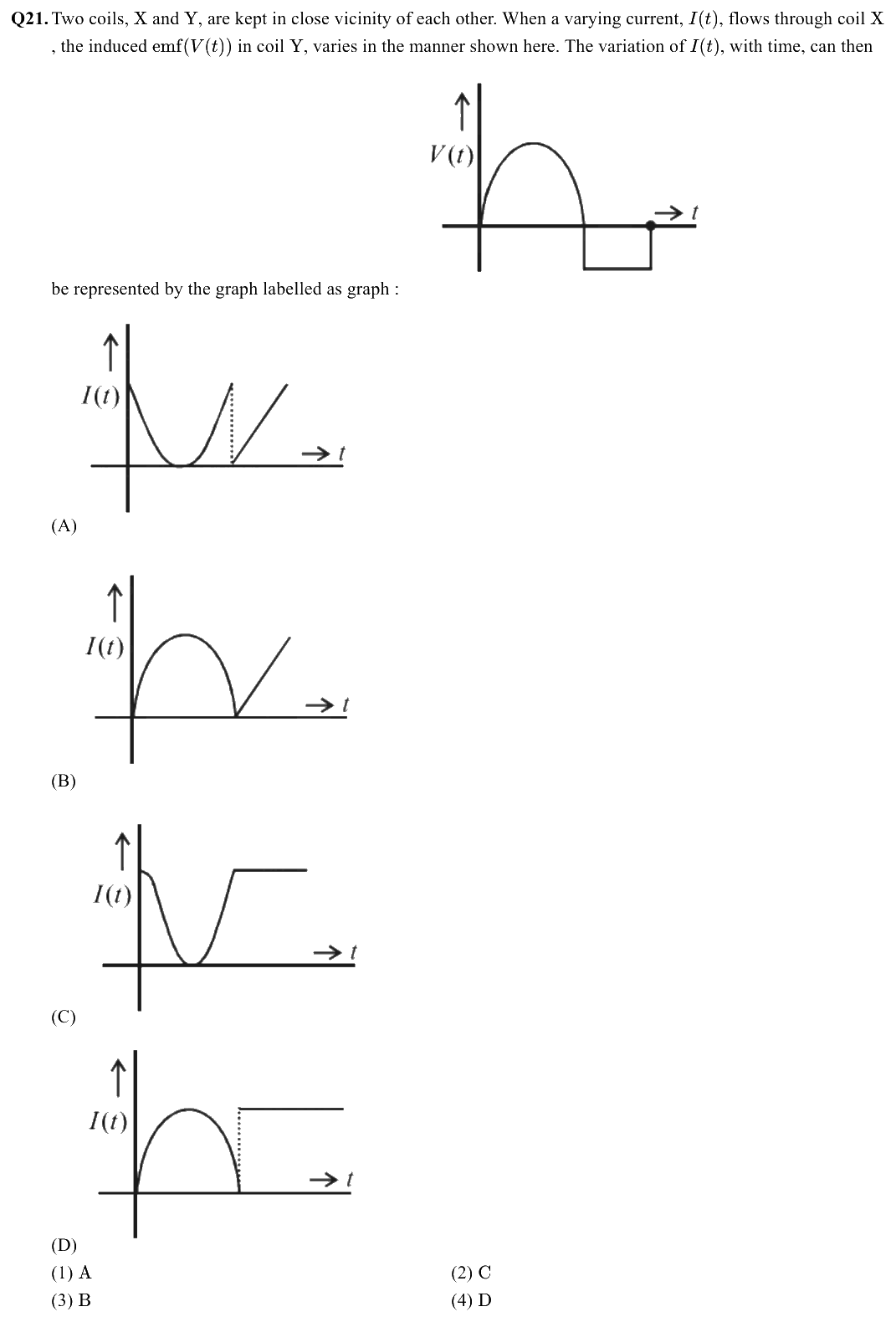
Two coils, X and Y, are kept in close vicinity of each other. When a varying current, $I(t)$, flows through coil X , the induced $\mathrm{emf}(V(t))$ in coil Y, varies in the manner shown here. The variation of $I(t)$, with time, can then be represented by the graph labelled as graph : (see the figure above)
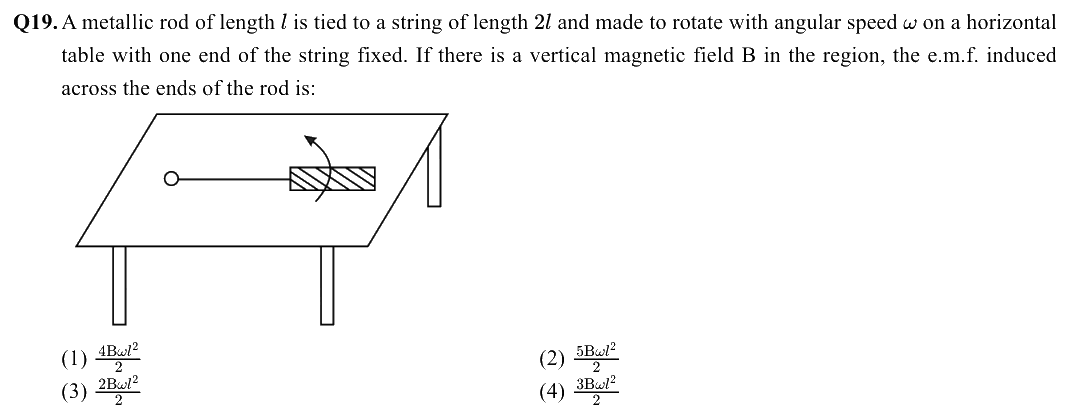
A metallic rod of length $l$ is tied to a string of length $2l$ and made to rotate with angular speed $\omega$ on a horizontal table with one end of the string fixed. If there is a vertical magnetic field B in the region, the e.m.f. induced across the ends of the rod is: (see the figure above)
A circular loop of radius 0.3 cm lies parallel to a much bigger circular loop of radius 20 cm. The centre of the small loop is on the axis of the bigger loop. The distance between their centres is 15 cm. If a current of 2.0 A flows through the smaller loop, then the flux linked with a bigger loop is:
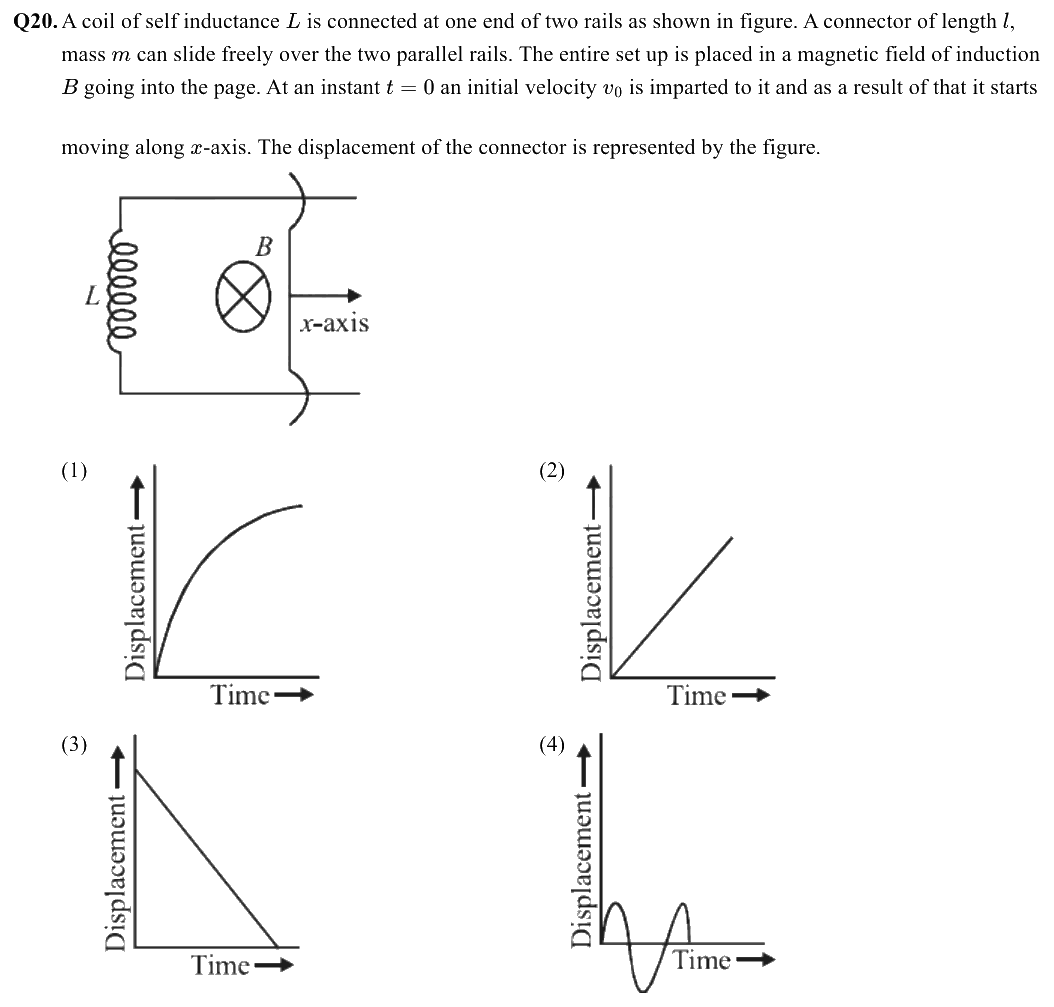
A coil of self inductance $L$ is connected at one end of two rails as shown in figure. A connector of length $l$, mass $m$ can slide freely over the two parallel rails. The entire set up is placed in a magnetic field of induction $B$ going into the page. At an instant $t = 0$ an initial velocity $v_0$ is imparted to it and as a result that it starts moving along $x$-axis. The displacement of the connector is represented by the figure. (see the figure above)
The question as printed in the paper.
A
see figure Displacement against Time: a curve starting at the origin, rising steeply and flattening out (concave down, approaching a constant value).
B
see figure Displacement against Time: a straight line from the origin rising at a constant slope.
C
see figure Displacement against Time: a straight line starting at a positive value on the displacement axis and falling steadily towards the time axis.
D
see figure Displacement against Time: an oscillating curve starting at the origin, rising to a peak, falling below the time axis to a deeper trough, rising to a second peak and then dropping vertically to the time axis where it ends.
This question has Statement 1 and Statement 2. Of the four choices given after the Statements, choose the one that best describes the two Statements. Statement 1: Self inductance of a long solenoid of length $L$, total number of turns N and radius r is less than $\frac{\pi\mu_0 N^2 r^2}{L}$. Statement 2: The magnetic induction in the solenoid in Statement 1 carrying current $I$ is $\frac{\mu_0 NI}{L}$ in the middle of the solenoid but becomes less as we move towards its ends.
A
Statement 1 is true, Statement 2 is false.
B
Statement 1 is true, Statement 2 is true, Statement 2 is the correct explanation of Statement 1.
C
Statement 1 is false, Statement 2 is true.
D
Statement 1 is true, Statement 2 is true, Statement 2 is not the correct explanation of Statement 1.
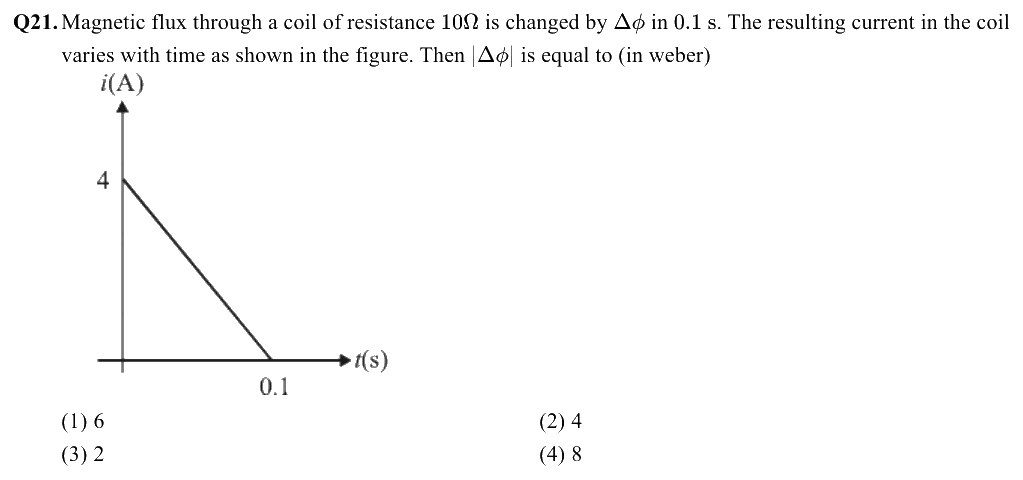
Magnetic flux through a coil of resistance $10\,\Omega$ is changed by $\Delta\phi$ in $0.1$ s. The resulting current in the coil varies with time as shown in the figure. Then $|\Delta\phi|$ is equal to (in weber) (see the figure above)
A coil is suspended in a uniform magnetic field, with the plane of the coil parallel to the magnetic lines of force. When a current is passed through the coil it starts oscillating; it is very difficult to stop. But if an aluminium plate is placed near to the coil, it stops. This is due to :
A
development of air current when the plate is placed.
B
induction of electrical charge on the plate
C
shielding of magnetic lines of force as aluminium is a paramagnetic material.
D
electromagnetic induction in the aluminium plate giving rise to electromagnetic damping.
A boat is moving due east in a region where the earth's magnetic field is $5.0 \times 10^{-5}\ \mathrm{NA^{-1}\,m^{-1}}$ due north and horizontal. The boat carries a vertical aerial $2\ \mathrm{m}$ long. If the speed of the boat is $1.50\ \mathrm{ms^{-1}}$, the magnitude of the induced emf in the wire of aerial is :
A fully charged capacitor $C$ with initial charge $q_0$ is connected to a coil of self inductance $L$ at $t = 0$. The time at which the energy is stored equally between the electric and the magnetic field is :
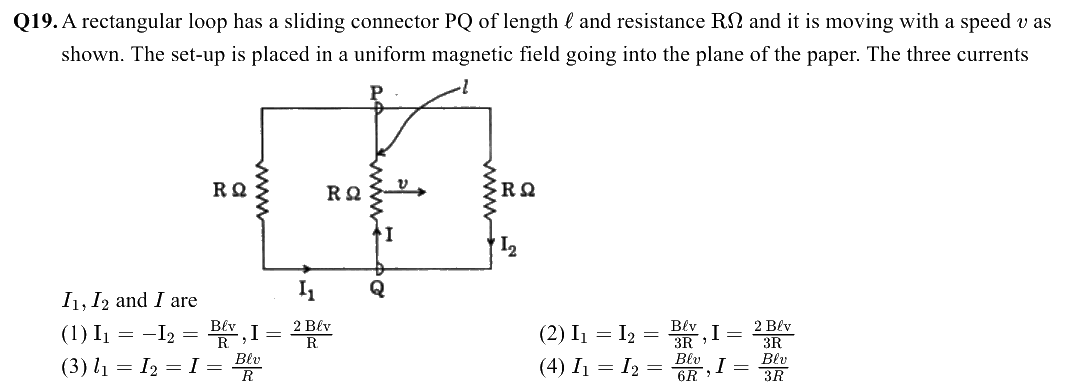
A rectangular loop has a sliding connector PQ of length $\ell$ and resistance $\mathrm{R}\Omega$ and it is moving with a speed $v$ as shown. The set-up is placed in a uniform magnetic field going into the plane of the paper. The three currents $I_1$, $I_2$ and $I$ are (see the figure above)
The question as printed in the paper.
A
$I_1 = -I_2 = \frac{B\ell v}{R}, I = \frac{2\,B\ell v}{R}$
B
$I_1 = I_2 = \frac{B\ell v}{3R}, I = \frac{2\,B\ell v}{3R}$
C
$I_1 = I_2 = I = \frac{B\ell v}{R}$
D
$I_1 = I_2 = \frac{B\ell v}{6R}, I = \frac{B\ell v}{3R}$
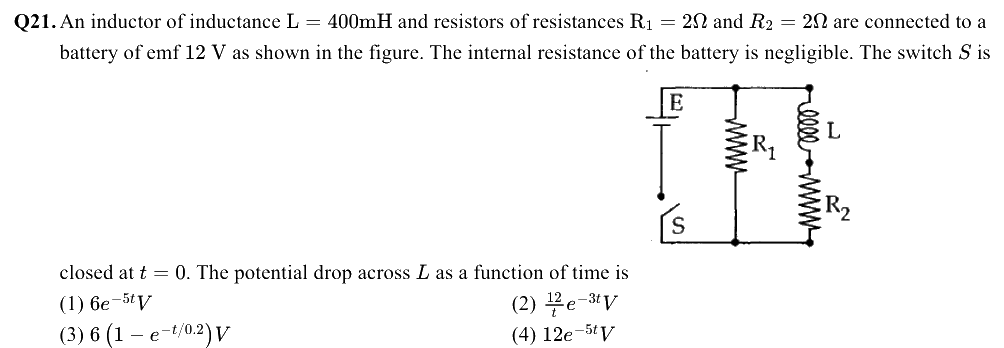
An inductor of inductance L = 400mH and resistors of resistances $\mathrm{R_1} = 2\Omega$ and $\mathrm{R_2} = 2\Omega$ are connected to a battery of emf 12 V as shown in the figure. The internal resistance of the battery is negligible. The switch $S$ is (see the figure above) closed at $t = 0$. The potential drop across $L$ as a function of time is
Two coaxial solenoids are made by winding thin insulated wire over a pipe of cross sectional area $A = 10\ \mathrm{cm^2}$ and length = 20 cm. If one of the solenoids has 300 turns and the other 400 turns, their mutual inductance is ($\mu_0 = 4\pi \times 10^{-7}\,\mathrm{TmA^{-1}}$)
An ideal coil of 10H is connected in series with a resistance of $5\Omega$ and a battery of 5 V. 2 second after the connection is made the current flowing in amperes in the circuit is
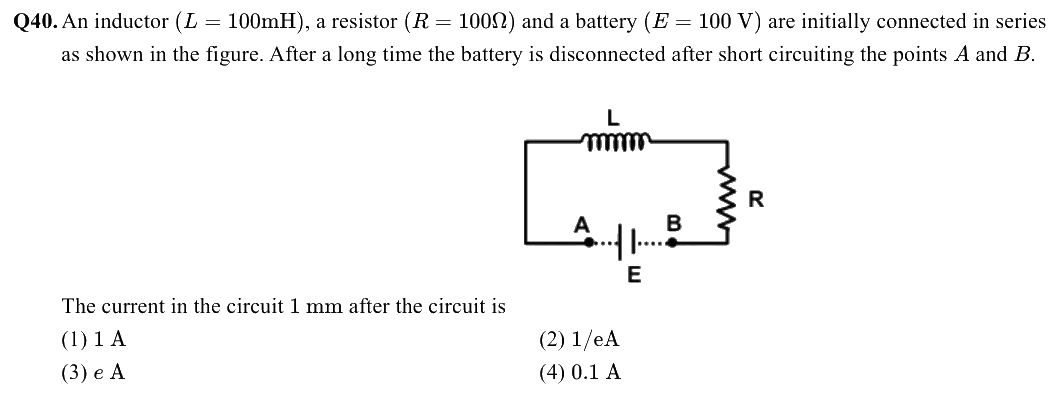
An inductor $(L = 100\mathrm{mH})$, a resistor $(R = 100\Omega)$ and a battery $(E = 100\ \mathrm{V})$ are initially connected in series as shown in the figure. After a long time the battery is disconnected after short circuiting the points $A$ and $B$.
(see the figure above) The current in the circuit 1 mm (sic) after the circuit is
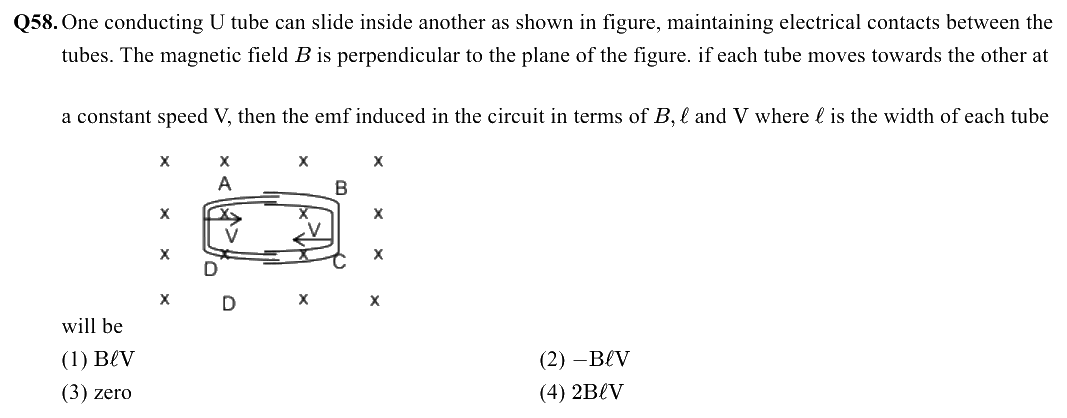
One conducting U tube can slide inside another as shown in figure, maintaining electrical contacts between the tubes. The magnetic field $B$ is perpendicular to the plane of the figure. if each tube moves towards the other at a constant speed V, then the emf induced in the circuit in terms of $B$, $\ell$ and V where $\ell$ is the width of each tube will be (see the figure above)
A coil of inductance $300\mathrm{mH}$ and resistance $2\Omega$ is connected to a source of voltage 2V. The current reaches half of its steady state value in
A coil having $n$ turns and resistance $\mathrm{R}\,\Omega$ is connected with a galvanometer of resistance $4\mathrm{R}\,\Omega$. This combination is moved in time $t$ seconds from a magnetic field $W_1$ weber to $W_2$ weber. The induced current in the circuit is
A metal conductor of length 1 m rotates vertically about one of its ends at angular velocity 5 radians per second. If the horizontal component of earth's magnetic field is $0.2 \times 10^{-4}$ T, then the e.m.f. developed between the two ends of the conductor is
In an oscillating LC circuit the maximum charge on the capacitor is Q. The charge on the capacitor when the energy is stored equally between the electric and magnetic field is
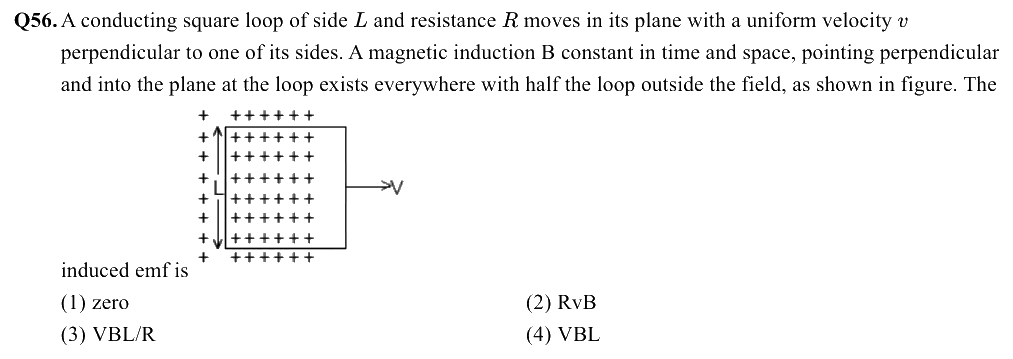
A conducting square loop of side $L$ and resistance $R$ moves in its plane with a uniform velocity $v$ perpendicular to one of its sides. A magnetic induction B constant in time and space, pointing perpendicular and into the plane at the loop exists everywhere with half the loop outside the field, as shown in figure. The induced emf is (see the figure above)
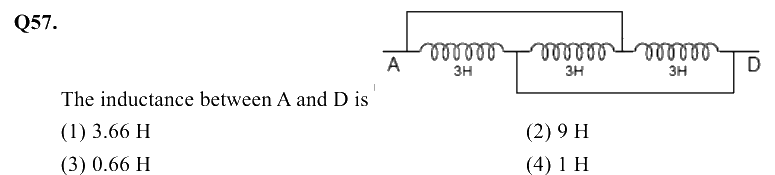
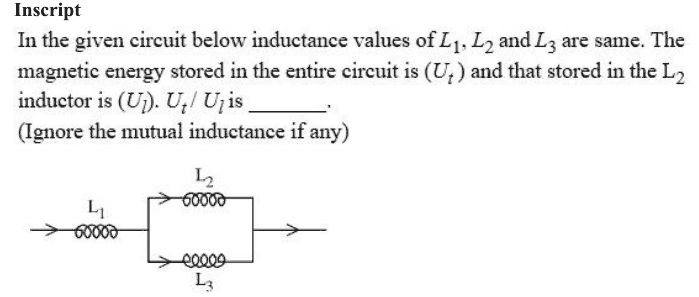
In the given circuit below inductance values of $L_1$, $L_2$ and $L_3$ are same. The magnetic energy stored in the entire circuit is ($U_t$) and that stored in the $\mathrm{L_2}$ inductor is ($U_j$). $U_t / U_j$ is ________. (Ignore the mutual inductance if any)
(see the figure above)
The question as printed in the paper.
Numerical answer type: type your answer in EdLoop to check it
A circular loop of radius 20 cm and resistance 2 $\Omega$ is placed in a time varying magnetic field $\vec{B} = (2t^2 + 2t + 3)$ T. At t = 0, for the plane of the loop being perpendicular to the magnetic field and, the induced current in the loop at $t = 3$ s is $\frac{\alpha}{50}$ A. The value of $\alpha$ is ________. (Take $\pi = 22/7$)
Numerical answer type: type your answer in EdLoop to check it
A simple pendulum made of mass 10 g and a metallic wire of length 10 cm is suspended vertically in a uniform magnetic field of 2 T. The magnetic field direction is perpendicular to the plane of oscillations of the pendulum. If the pendulum is released from an angle of $60°$ with vertical, then maximum induced EMF between the point of suspension and point of oscillation is ________ mV. (Take $g = 10$ m/s$^2$)
Numerical answer type: type your answer in EdLoop to check it
Inductance of a coil with $10^4$ turns is 10 mH and it is connected to a dc source of 10 V with internal resistance of $10\,\Omega$. The energy density in the inductor when the current reaches $\left(\dfrac{1}{e}\right)$ of its maximum value is $\alpha\pi \times \dfrac{1}{e^2}$ J/m$^3$. The value of $\alpha$ is ________.
($\mu_0 = 4\pi \times 10^{-7}$ Tm/A).
Numerical answer type: type your answer in EdLoop to check it
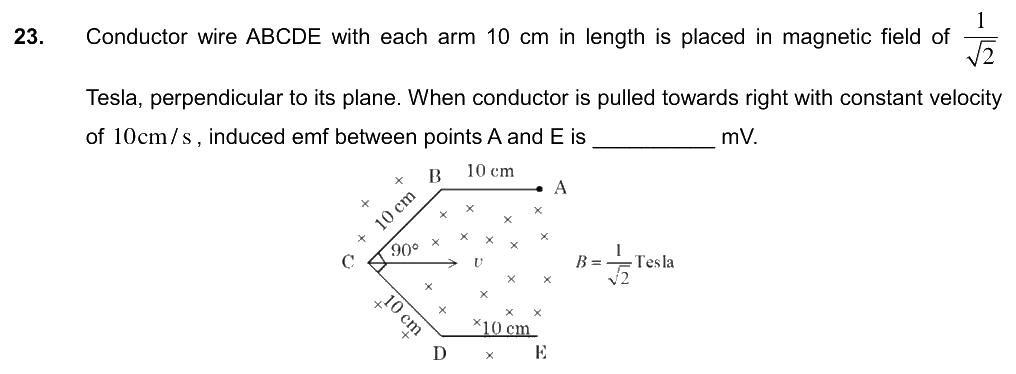
Conductor wire ABCDE with each arm 10 cm in length is placed in magnetic field of $\frac{1}{\sqrt{2}}$ Tesla, perpendicular to its plane. When conductor is pulled towards right with constant velocity of $10cm/s$, induced emf between points A and E is ______ mV.
(see the figure above)
The question as printed in the paper.
Numerical answer type: type your answer in EdLoop to check it
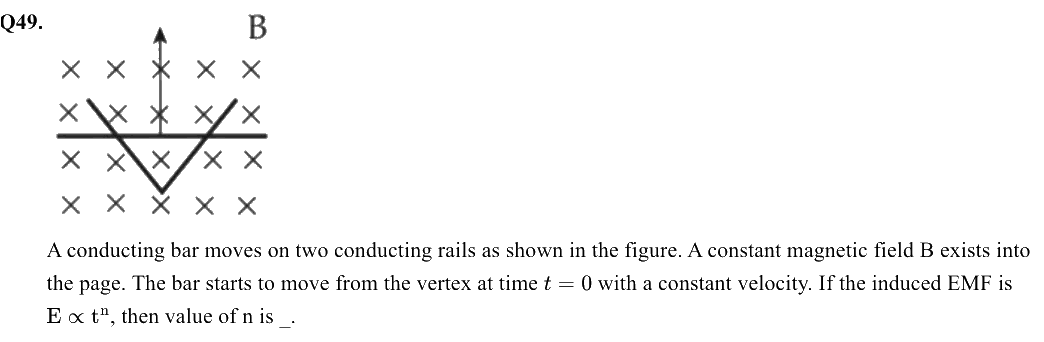
see figure A conducting bar moves on two conducting rails as shown in the figure. A constant magnetic field B exists into the page. The bar starts to move from the vertex at time $t = 0$ with a constant velocity. If the induced EMF is $\mathrm{E \propto t^n}$, then value of n is ______ .
The question as printed in the paper.
Numerical answer type: type your answer in EdLoop to check it
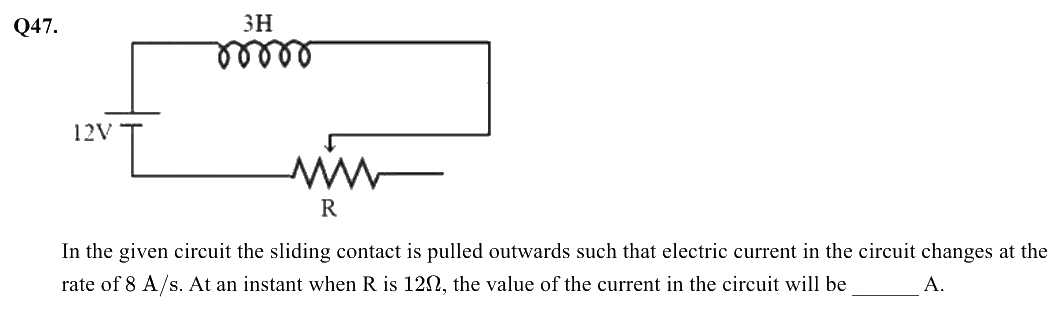
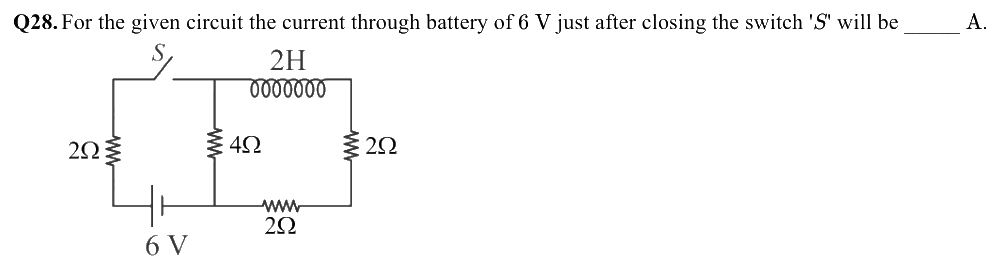
In the given circuit the sliding contact is pulled outwards such that electric current in the circuit changes at the rate of 8 A/s. At an instant when R is $12\Omega$, the value of the current in the circuit will be ______ A.
(see the figure above)
The question as printed in the paper.
Numerical answer type: type your answer in EdLoop to check it
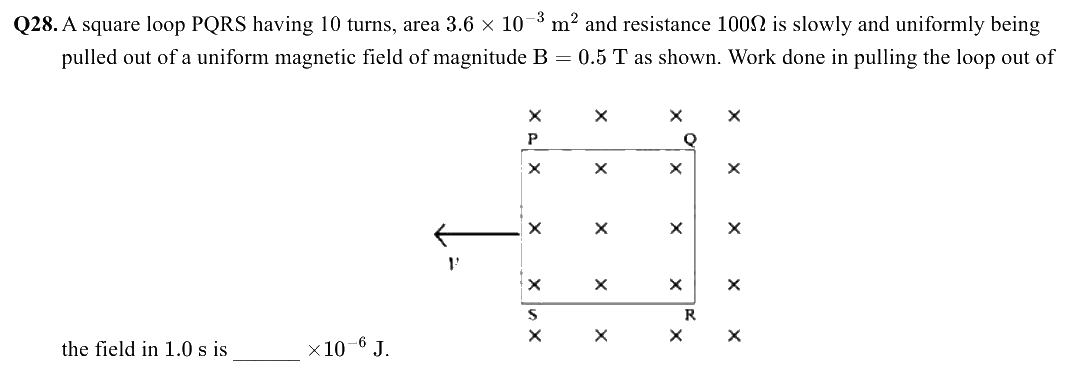
A square loop PQRS having 10 turns, area $3.6 \times 10^{-3}\ \mathrm{m}^2$ and resistance $100\Omega$ is slowly and uniformly being pulled out of a uniform magnetic field of magnitude B = 0.5 T as shown. Work done in pulling the loop out of the field in 1.0 s is ______ $\times 10^{-6}$ J.
(see the figure above)
The question as printed in the paper.
Numerical answer type: type your answer in EdLoop to check it
The current in an inductor is given by I = (3t + 8) where t is in second. The magnitude of induced emf produced in the inductor is 12mV. The self-inductance of the inductor ______ mH.
Numerical answer type: type your answer in EdLoop to check it
A rod of length 60 cm rotates with a uniform angular velocity 20rads$^{-1}$ about its perpendicular bisector, in a uniform magnetic filed 0.5$T$. The direction of magnetic field is parallel to the axis of rotation. The potential difference between the two ends of the rod is ______ V.
Numerical answer type: type your answer in EdLoop to check it
A rectangular loop of sides 12 cm and 5 cm, with its sides parallel to the $x$-axis and $y$-axis respectively moves with a velocity of 5 $\text{cm s}^{-1}$ in the positive $x$ axis direction, in a space containing a variable magnetic field in the positive $z$ direction. The field has a gradient of $10^{-3}\ \text{T cm}^{-1}$ along the negative $x$ direction and it is decreasing with time at the rate of $10^{-3}\ \text{T s}^{-1}$. If the resistance of the loop is 6 m$\Omega$, the power dissipated by the loop as heat is ______ $\times 10^{-9}$ W.
Numerical answer type: type your answer in EdLoop to check it
A small square loop of wire of side $l$ is placed inside a large square loop of wire of side $LL = l^2$. The loops are coplanar and their centers coincide. The value of the mutual inductance of the system is $\sqrt{x} \times 10^{-7}$ H, where $x =$ ______.
Numerical answer type: type your answer in EdLoop to check it
The magnetic flux $\phi$ (in weber) linked with a closed circuit of resistance 8 $\Omega$ varies with time (in seconds) as $\phi = 5t^2 - 36t + 1$. The induced current in the circuit at $t = 2$ s is ______ A.
Numerical answer type: type your answer in EdLoop to check it
A ceiling fan having 3 blades of length 80 cm each is rotating with an angular velocity of 1200 rpm. The magnetic field of earth in that region is 0. 5 G and angle of dip is $30^\circ$. The emf induced across the blades is $N\pi \times 10^{-5}$ V. The value of N is ______.
Numerical answer type: type your answer in EdLoop to check it
A square loop of side 10 cm and resistance 0.7 $\Omega$ is placed vertically in the east-west plane. A uniform magnetic field of 0.20 T is set up across the plane in the north-east direction. The magnetic field is decreased to zero in 1 s at a steady rate. Then, the magnitude of induced emf is $\sqrt{x} \times 10^{-3}$ V. The value of $x$ is ______.
Numerical answer type: type your answer in EdLoop to check it
A horizontal straight wire 5 m long extending from east to west falling freely at right angle to horizontal component of earth's magnetic field $0.60 \times 10^{-4}$ Wb m$^{-2}$. The instantaneous value of emf induced in the wire when its velocity is 10 m s$^{-1}$ is ______ $\times 10^{-3}$ V.
Numerical answer type: type your answer in EdLoop to check it
Two coils have mutual inductance 0.002 H. The current changes in the first coil according to the relation $i = i_0\sin\omega t$, where $i_0$ = 5 A and $\omega$ = $50\pi$ rad s$^{-1}$. The maximum value of emf in the second coil is $\frac{\pi}{\alpha}$ V. The value of $\alpha$ is
Numerical answer type: type your answer in EdLoop to check it
A 20 cm long metallic rod is rotated with 210 rpm about an axis normal to the rod passing through its one end. The other end of the rod is in contact with a circular metallic ring. A constant and uniform magnetic field 0.2 T parallel to the axis exists everywhere. The emf developed between the centre and the ring is ______ mV. (Take $\pi = \frac{22}{7}$)
Numerical answer type: type your answer in EdLoop to check it
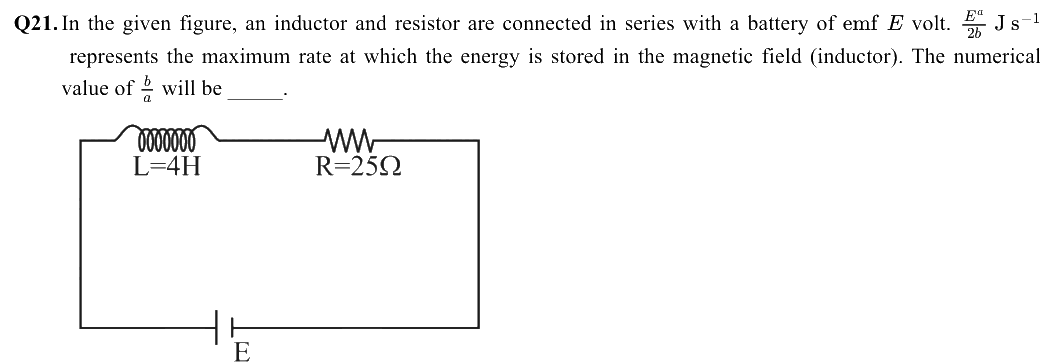
In the given figure, an inductor and resistor are connected in series with a battery of emf $E$ volt. $\frac{E^{a}}{2b}$ J s$^{-1}$ represents the maximum rate at which the energy is stored in the magnetic field (inductor). The numerical value of $\frac{b}{a}$ will be ______.
(see the figure above)
The question as printed in the paper.
Numerical answer type: type your answer in EdLoop to check it
An insulated copper wire of 100 turns is wrapped around a wooden cylindrical core of the cross-sectional area 24 cm$^{2}$. The two ends of the wire are connected to a resistor. The total resistance in the circuit is 12 $\Omega$. If externally applied uniform magnetic field in the core along its axis changes from 1.5 T in one direction to 1.5 T in the opposite direction, the charge flowing through a point in the circuit during the change of magnetic field will be ______ mC.
Numerical answer type: type your answer in EdLoop to check it
A conducting circular loop is placed in a uniform magnetic field of $0.4$ T with its plane perpendicular to the field. Somehow, the radius of the loop starts expanding at a constant rate of $1\ \mathrm{mm\ s^{-1}}$. The magnitude of induced emf in the loop at an instant when the radius of the loop is 2 cm will be ______ $\mu$V.
Numerical answer type: type your answer in EdLoop to check it
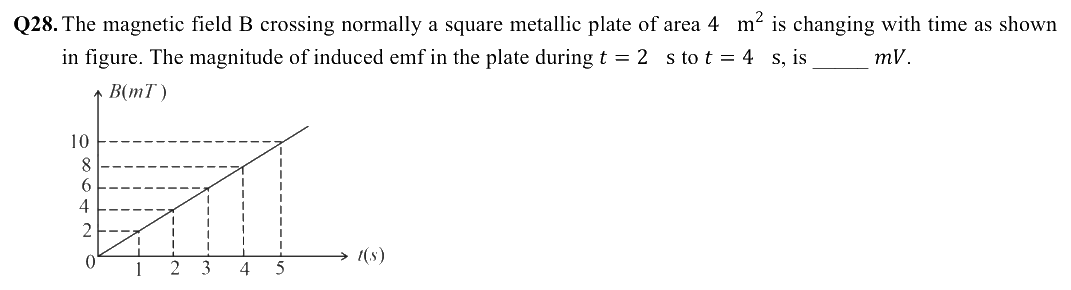
The magnetic field B crossing normally a square metallic plate of area 4 $\mathrm{m^2}$ is changing with time as shown in figure. The magnitude of induced emf in the plate during $t = 2$ s to $t = 4$ s, is ______ $mV$. (see the figure above)
The question as printed in the paper.
Numerical answer type: type your answer in EdLoop to check it
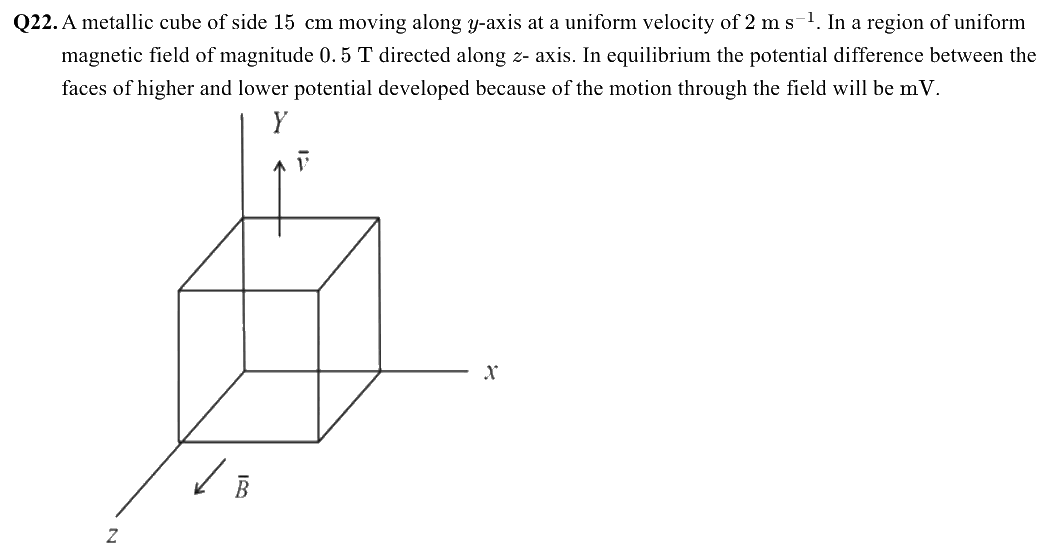
A metallic cube of side 15 cm moving along $y$-axis at a uniform velocity of $2\ \mathrm{m\ s^{-1}}$. In a region of uniform magnetic field of magnitude $0.5$ T directed along $z$- axis. In equilibrium the potential difference between the faces of higher and lower potential developed because of the motion through the field will be mV. (see the figure above)
The question as printed in the paper.
Numerical answer type: type your answer in EdLoop to check it
A coil has an inductance of 2 H and resistance of 4 $\Omega$. A 10 V is applied across the coil. The energy stored in the magnetic field after the current has built up to its equilibrium value will be ______ $\times 10^{-2}$ J
Numerical answer type: type your answer in EdLoop to check it
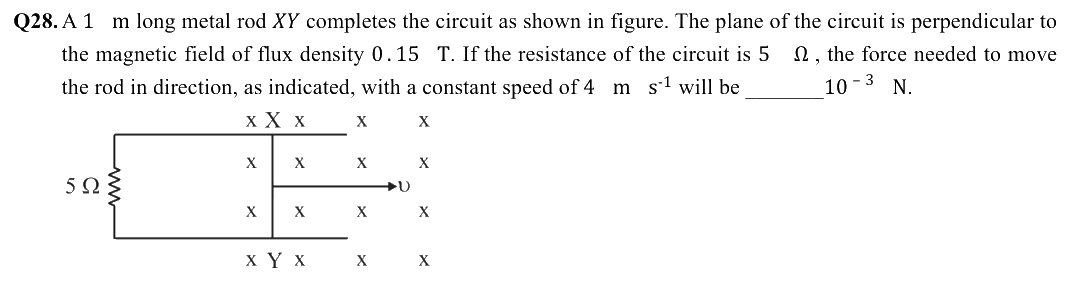
A 1 m long metal rod $XY$ completes the circuit as shown in figure. The plane of the circuit is perpendicular to the magnetic field of flux density 0.15 T. If the resistance of the circuit is $5\ \Omega$, the force needed to move the rod in direction, as indicated, with a constant speed of $4\ \mathrm{m\,s^{-1}}$ will be ______ $10^{-3}$ N. (see the figure above)
The question as printed in the paper.
Numerical answer type: type your answer in EdLoop to check it
A square loop of side $2.0$ cm is placed inside a long solenoid that has 50 turns per centimetre and carries a sinusoidally varying current of amplitude $2.5$ A and angular frequency $700\ \mathrm{rad\,s^{-1}}$. The central axes of the loop and solenoid coincide. The amplitude of the emf induced in the loop is $x \times 10^{-4}$ V. The value of $x$ is ______ ( Take, $\pi = \frac{22}{7}$ )
Numerical answer type: type your answer in EdLoop to check it
An oscillating LC circuit consists of a 75 mH inductor and a $1.2\ \mu\mathrm{F}$ capacitor. If the maximum charge to the capacitor is $2.7\ \mu\mathrm{C}$. The maximum current in the circuit will be ______ mA.
Numerical answer type: type your answer in EdLoop to check it
Two concentric circular coils with radii $1\ \mathrm{cm}$ and $1000\ \mathrm{cm}$ and number of turns 10 and 200 respectively are placed coaxially with centers coinciding. The mutual inductance of this arrangement will be ______ $\times 10^{-8}\ \mathrm{H}$. (Take, $\pi^2 = 10$)
Numerical answer type: type your answer in EdLoop to check it
A certain elastic conducting material is stretched into a circular loop. It is placed with its plane perpendicular to a uniform magnetic field $B = 0.8\ \mathrm{T}$. When released the radius of the loop starts shrinking at a constant rate of $2\ \mathrm{cm\,s^{-1}}$. The induced emf in the loop at an instant when the radius of the loop is $10\ \mathrm{cm}$ will be ______ mV.
Numerical answer type: type your answer in EdLoop to check it
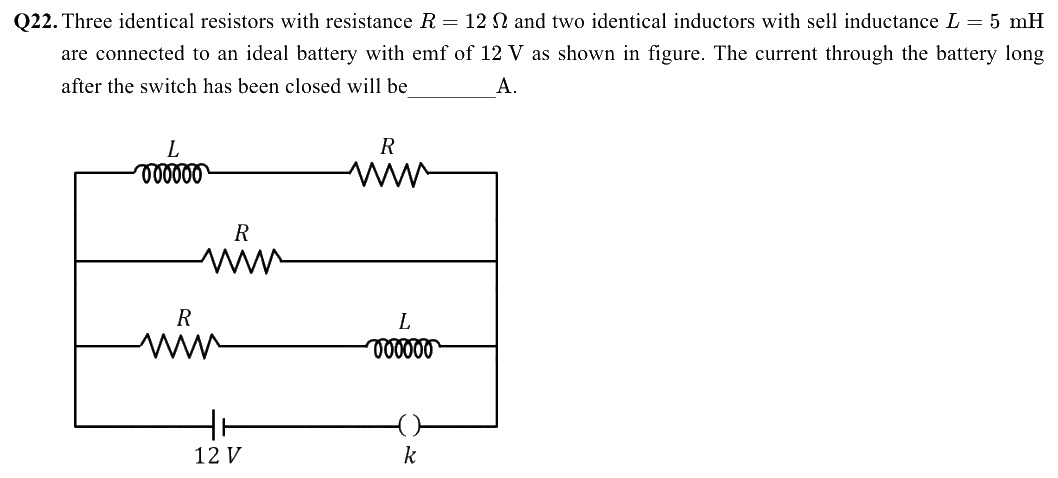
Three identical resistors with resistance $R=12\ \Omega$ and two identical inductors with sell inductance $L=5$ mH are connected to an ideal battery with emf of 12 V as shown in figure. The current through the battery long after the switch has been closed will be ______ A.
(see the figure above)
The question as printed in the paper.
Numerical answer type: type your answer in EdLoop to check it
A capacitor of capacitance 500 $\mu$F is charged completely using a dc supply of 100 V. It is now connected to an inductor of inductance 50 mH to form an LC circuit. The maximum current in LC circuit will be ______ A.
Numerical answer type: type your answer in EdLoop to check it
A conducting circular loop is placed in $X - Y$ plane in presence of magnetic field $\overrightarrow{B} = \left(3t^3\hat{j} + 3t^2\widehat{k}\right)$ in SI unit. If the radius of the loop is 1 m, the induced emf in the loop, at time, $t$ = 2 s is $n\pi$ V. The value of $n$ is ______ .
Numerical answer type: type your answer in EdLoop to check it
In a coil of resistance $8\ \Omega$, the magnetic flux due to an external magnetic field varies with time as $\phi = \frac{2}{3}9 - t^2$ . The value of total heat produced in the coil, till the flux becomes zero, will be ______ J.
Numerical answer type: type your answer in EdLoop to check it
Magnetic flux (in weber) in a closed circuit of resistance $20\ \Omega$ varies with time $t$(s) as $\phi = 8t^{2} - 9t + 5$. The magnitude of the induced current at $t = 0.25$ s will be ______ mA.
Numerical answer type: type your answer in EdLoop to check it
A metallic rod of length $20\ \mathrm{cm}$ is placed in North-South direction and is moved at a constant speed of $20\ \mathrm{m\ s^{-1}}$ towards East. The horizontal component of the Earth's magnetic field at that place is $4 \times 10^{-3}\ \mathrm{T}$ and the angle of dip is $45^{\circ}$. The emf induced in the rod is ______ mV.
Numerical answer type: type your answer in EdLoop to check it
A $10 \Omega$, $20 \mathrm{~mH}$ coil carrying constant current is connected to a battery of $20 \mathrm{~V}$ through a switch. Now after switch is opened current becomes zero in $100 \mu\mathrm{s}$. The average e.m.f. induced in the coil is ______ V.
Numerical answer type: type your answer in EdLoop to check it
The current in a coil of self inductance $L = 2.0 \mathrm{~H}$ is increasing according to the law $i = 2\sin t^2$. Find the amount of energy spent (in J) during the period when the current changes from 0 to $2 \mathrm{~A}$.
Numerical answer type: type your answer in EdLoop to check it
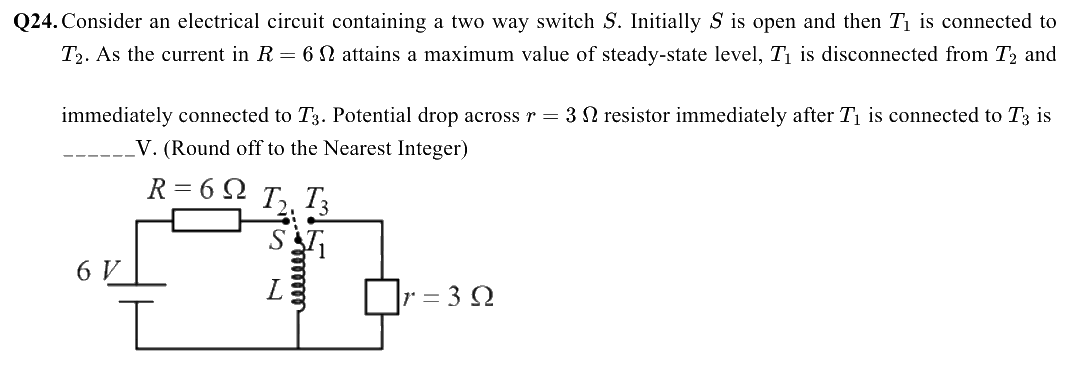
Consider an electrical circuit containing a two way switch $S$. Initially $S$ is open and then $T_1$ is connected to $T_2$. As the current in $R = 6\ \Omega$ attains a maximum value of steady-state level, $T_1$ is disconnected from $T_2$ and immediately connected to $T_3$. Potential drop across $r = 3\ \Omega$ resistor immediately after $T_1$ is connected to $T_3$ is ______ V. (Round off to the Nearest Integer) (see the figure above)
The question as printed in the paper.
Numerical answer type: type your answer in EdLoop to check it
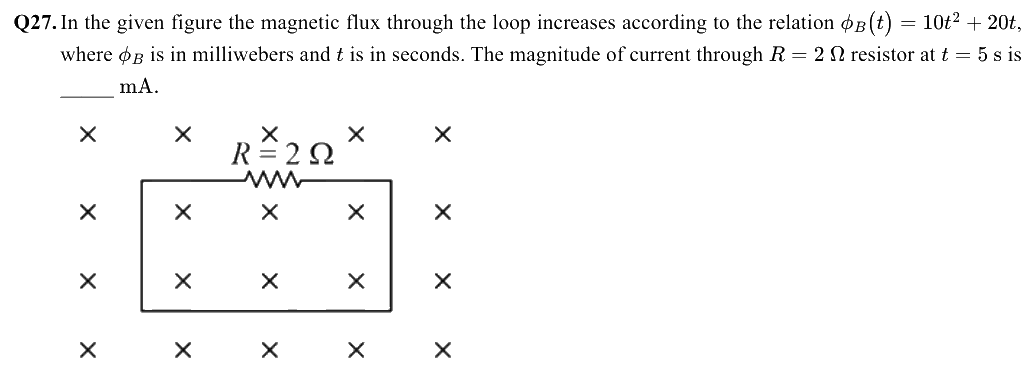
In the given figure the magnetic flux through the loop increases according to the relation $\phi_B(t) = 10t^2 + 20t$, where $\phi_B$ is in milliwebers and t is in seconds. The magnitude of current through $R = 2\ \Omega$ resistor at $t = 5\ \mathrm{s}$ is ______ mA. (see the figure above)
The question as printed in the paper.
Numerical answer type: type your answer in EdLoop to check it
A circular conducting coil of radius $1\ \mathrm{m}$ is being heated by the change of magnetic field $\vec{B}$ passing perpendicular to the plane in which the coil is laid. The resistance of the coil is $2\ \mu\Omega$. The magnetic field is slowly switched off such that its magnitude changes in time as $B = \frac{4}{\pi} \times 10^{-3}\ \mathrm{T}\ 1 - \frac{t}{100}$ The energy dissipated by the coil before the magnetic field is switched off completely is $E =$ ______ $\mathrm{mJ}$.
Numerical answer type: type your answer in EdLoop to check it
An inductor of $10\ \mathrm{mH}$ is connected to a $20\ \mathrm{V}$ battery through a resistor of $10\ \mathrm{k\Omega}$ and a switch. After a long time, when maximum current is set up in the circuit, the current is switched off. The current in the circuit after $1\ \mu\mathrm{s}$ is $\frac{x}{100}\ \mathrm{mA}$. Then $x$ is equal to ______. (Take $e^{-1} = 0.37$)
Numerical answer type: type your answer in EdLoop to check it
A coil of inductance $2\ \mathrm{H}$ having negligible resistance is connected to a source of supply whose voltage is given by $V = 3t$ volt. (where $t$ is in second). If the voltage is applied when $t = 0$, then the energy stored in the coil after $4\ \mathrm{s}$ in J,
Numerical answer type: type your answer in EdLoop to check it
A transmitting station releases waves of wavelength $960\ \mathrm{m}$. A capacitor of $2.56\ \mu\mathrm{F}$ is used in the resonant circuit. The self-inductance of coil necessary for resonance is $x \times 10^{-8}\ \mathrm{H}$. find $x$
Numerical answer type: type your answer in EdLoop to check it
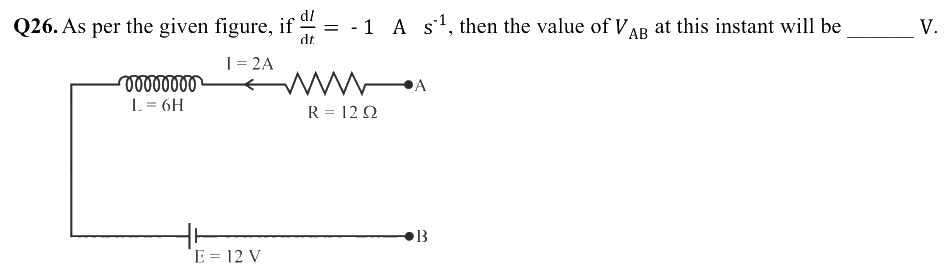
A part of a complete circuit is shown in the figure. At some instant, the value of current I is 1A and it is decreasing at a rate of $10^2\ \mathrm{As^{-1}}$. The value of the potential difference $\mathrm{V_p}$ $-$ $\mathrm{V_Q}$, (in volts) at that instant is- (see the figure above)
The question as printed in the paper.
Numerical answer type: type your answer in EdLoop to check it
Two concentric circular coils, $C_1$ and $C_2$, are placed in the $XY$ plane. $C_1$ has 500turns, and a radius of 1 cm. $C_2$ has 200 turns and radius of 20 cm . $C_2$ carries a time dependent current $I(t) = \left(5t^2 - 2t + 3\right)$A where $t$ is in s. The emf induced in $C_1$(in mV) at the instant $t$ = 1s is $\frac{4}{x}$. The value of $x$ is ..........
Numerical answer type: type your answer in EdLoop to check it
In a fluorescent lamp choke (a small transformer) $100V$ of reverse voltage is produced when the choke current changes uniformly from $0.25A$ to 0 in a duration of $0.025ms$ . The self-inductance of the choke (in $mH$ ) is estimated to be ______.
Numerical answer type: type your answer in EdLoop to check it
A loop ABCDEFA of straight edges has six corner points $A(0,0,0), B(5,0,0), C(5,5,0), D(0,5,0), E(0,5,5)$ and $F(0,0,5)$ . The magnetic field in this region is $\vec{B} = \left(3\hat{i} + 4\hat{k}\right)T$ . The quantity of flux through the loop ABCDEFA (in Wb ) is ______
Numerical answer type: type your answer in EdLoop to check it
How to prepare Electromagnetic Induction for JEE Main
How often it comes up
Electromagnetic induction links mechanics with electromagnetism under Unit 14: Electromagnetic Induction and Alternating Currents in the Class 12 NTA physics syllabus, holding rank 20 among the 29 physics chapters. Across 162 papers administered between 2019 and 2026, electromagnetic induction produced 135 questions, translating to 0.8 questions per sitting. Candidates encountered this topic in 106 of those 162 papers, and questions were included every single year throughout the cycle. In the three testing years from 2024 to 2026, 43 questions appeared across 58 papers, representing 0.7 questions per paper and a 2.8 percent subject share. The chapter's share has stayed about the same when compared to the 2002 to 2018 testing interval, which recorded 42 questions across 38 papers for a 3.1 percent share. During the 2026 testing sessions, 19 questions were featured across 19 papers, showing up in 13 separate shifts. Over the 2019 to 2026 testing window, 49 questions required numerical answers, reflecting a steady emphasis on exact calculations of induced electromotive forces, magnetic flux, and circuit time constants.
Most-asked topics
The chapter distributes its questions across four evenly balanced core topics:
Faraday's & Lenz's Laws: 48 questions historically, including 39 from 2019 to 2026, tested through 2026. This topic tests flux changes through expanding or rotating loops, rate of change of time-varying magnetic fields, direction of induced currents using Lenz's rule, and thermal dissipation in closed resistive loops.
Motional EMF: 45 questions overall, with 34 between 2019 and 2026, continuing in 2026. Problems evaluate conducting rods sliding along parallel rails in magnetic fields, rotating conducting spokes, falling conducting rods reaching terminal velocity, and external forces required for uniform rod translation.
Inductance: 42 lifetime questions, with 33 asked from 2019 to 2026, tested up to 2026. Themes cover self-inductance of solenoids and coils, mutual inductance between coaxial loops, magnetic energy density, and energy stored in magnetic fields.
LR & LC Circuits: 42 total problems, including 29 from 2019 to 2026, tested in 2026. Core concepts evaluate growth and decay of currents in inductive DC circuits, inductive time constants, switch-on branch behavior where inductors act as open circuits, and energy oscillations in LC circuits.
What the questions look like
Exam questions in this chapter present dynamic physical setups and electrical transient networks:
Sliding conducting bars on rails: A conducting crossbar slides along smooth horizontal or vertical rails within a uniform magnetic field. Questions ask for the induced electromotive force, the braking magnetic force, or the terminal steady speed attained under gravity.
Time-dependent magnetic fields: Loops of defined geometric shape subjected to time-varying magnetic fields like linear or sinusoidal ramps. Students calculate instantaneous induced potential differences and total heat produced over a specified time duration.
Inductor transient branch currents: DC circuits with resistors and inductors connected across a battery. Problems test branch currents immediately after closing a switch or long after steady state is established.
LC circuit energy exchange: Evaluating the time elapsed for stored electric energy in a capacitor to transfer partially or wholly into magnetic energy in an inductor.
Master Lenz's law thoroughly by always asking what change the induced current opposes. If external flux through a loop increases, the induced magnetic field opposes the external field. If flux decreases, the induced field reinforces it.
Learn the limiting behaviors of inductors in DC circuits. At the initial instant a switch closes, an unenergized inductor behaves as an open circuit with zero current flow. In the long-time steady state, an ideal inductor behaves as a simple zero-resistance connecting wire.
For motional electromotive force, use the cross product relation of velocity and magnetic field integrated along the conductor path. For rotating rods, integrate the tangential velocity along the radius to obtain the standard half B omega L squared result.
Frequently asked questions
What is the most frequently tested calculation in electromagnetic induction?
Motional electromotive force from sliding rods and Faraday flux derivative calculations appear most frequently. Together with inductor transient circuit analysis, they represent the majority of points.
How do I handle terminal speed problems for falling rods on vertical rails?
Equate the downward gravitational force with the upward magnetic Lorentz force caused by the induced current. Express the induced current in terms of instantaneous speed, rail resistance, and motional electromotive force to solve for terminal speed.
Do LC oscillations require differential calculus in JEE Main?
No, questions typically rely on simple harmonic analogies, equating maximum electrostatic energy in the capacitor to maximum magnetic energy in the inductor, or evaluating angular frequency using one over the square root of LC. Step-by-step solutions for each one are in the EdLoop app.