EdLoop PYQs · free, no ads · questions and answers here, step-by-step solutions in the EdLoop app
PYQs · free, no adsOpen on the web (app.edloop.in)Get EdLoop – free on Google Play
PhysicsElasticity

Elasticity: JEE Main PYQs 2003–2026

Every Elasticity question from past JEE Main and AIEEE papers, with options and answers. Newest first.

120questions
104papers covered
2.2%of Physics questions, 2019–2026
2003–2026years

Guide at a glance

Elasticity is a concise and highly practical chapter that offers consistent returns in JEE Main Physics. Across the papers we hold from 2019 to 2026, it supplied 99 questions in 162 papers, which corresponds to 0.6 questions per paper, and was present in 84 of those 162 papers.

Most asked sub-topics

Stress, Strain & Moduli92
Elastic Energy & Applications28

Practise these in EdLoop

Attempt every Elasticity question timed, see the step-by-step solution and track what you get wrong. Free.

Start practice

MCQ, single correct

78 questions
1JEE Main 2026 · 6 Apr · Shift 1MCQOpen question page ↗

A lift of mass 1600 kg is supported by thick iron wire. If the maximum stress which the wire can withstand is $4\times10^8$ N/m$^2$ and its radius is 4 mm, then maximum acceleration the lift can take is ________ m/s$^2$.
(take g = 10 m/s$^2$ and $\pi = 3.14$)

  • A

    2.56

  • B

    3.89

  • C

    4.32

  • D

    5.16

2JEE Main 2026 · 6 Apr · Shift 1MCQOpen question page ↗

The two wires $A$ and $B$ of equal cross-section but of different materials are joined together. The ratio of Young's modulus of wire $A$ and wire $B$ is 20/11. When the joined wire is kept under certain tension the elongations in the wires $A$ and $B$ are equal. If the length of wire $A$ is 2.2 m, then the length of wire $B$ is ________ m.

  • A

    1.1

  • B

    2.22

  • C

    1.21

  • D

    4.44

3JEE Main 2026 · 6 Apr · Shift 2MCQOpen question page ↗

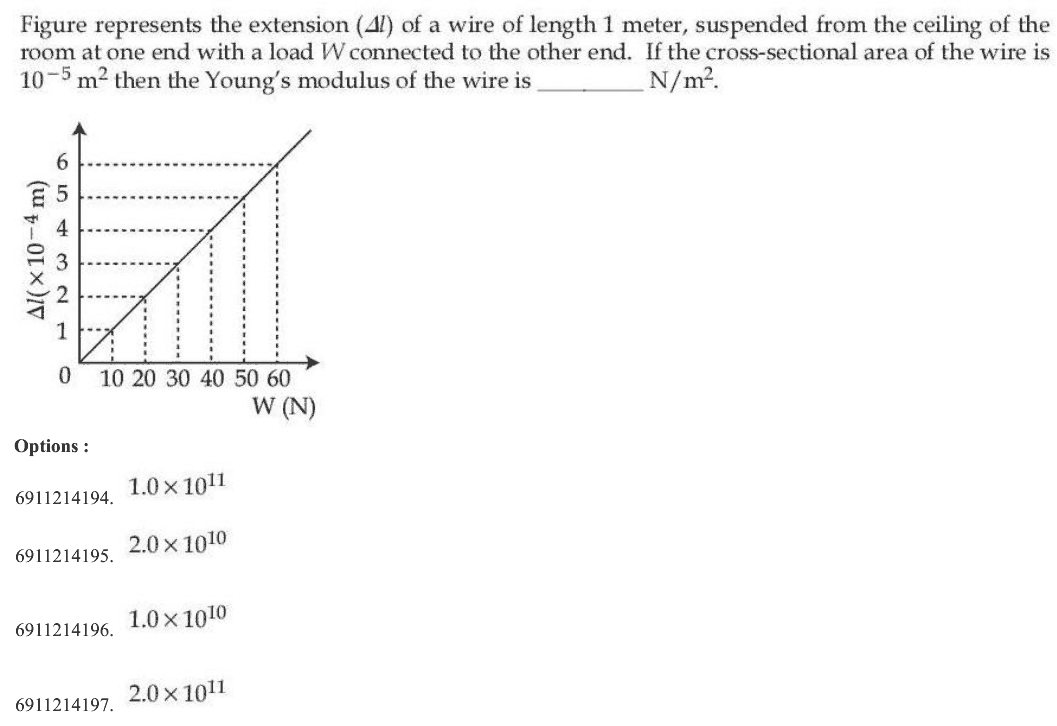
Figure represents the extension ($\Delta l$) of a wire of length 1 meter, suspended from the ceiling of the room at one end with a load $W$ connected to the other end. If the cross-sectional area of the wire is $10^{-5}$ m$^2$ then the Young's modulus of the wire is ________ N/m$^2$.

(see the figure above)

The question and its figure as printed in B Tech 6th Apr 2026 Shift 2.
The question as printed in the paper.
  • A

    $1.0\times10^{11}$

  • B

    $2.0\times10^{10}$

  • C

    $1.0\times10^{10}$

  • D

    $2.0\times10^{11}$

4JEE Main 2026 · 5 Apr · Shift 1MCQOpen question page ↗

The Young's modulus of steel wire of radius $r$ and length $L$ is $Y$.

If the radius $r$ and length $L$ of the wire are doubled then the value of $Y$

  • A

    increases by two times

  • B

    reduces by half

  • C

    remains unchanged

  • D

    becomes one fourth

5JEE Main 2026 · 5 Apr · Shift 1MCQOpen question page ↗

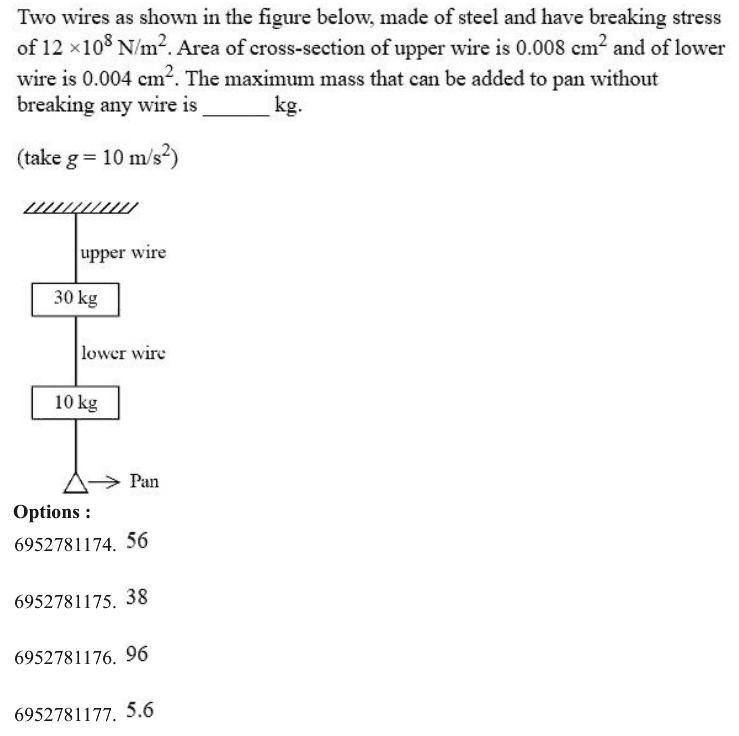
Two wires as shown in the figure below, made of steel and have breaking stress of $12\times10^8$ N/m$^2$. Area of cross-section of upper wire is 0.008 cm$^2$ and of lower wire is 0.004 cm$^2$. The maximum mass that can be added to pan without breaking any wire is ________ kg.

(take $g = 10$ m/s$^2$)

(see the figure above)

The question and its figure as printed in B Tech 5th Apr 2026 Shift 1.
The question as printed in the paper.
  • A

    56

  • B

    38

  • C

    96

  • D

    5.6

6JEE Main 2026 · 4 Apr · Shift 1MCQOpen question page ↗

The increase in the pressure required to decrease the volume ($\Delta V$) of water is $6.3\times10^7$ N/m$^2$. The percentage decrease in the volume is ________.
(Bulk modulus of water $= 2.1\times10^9$ N/m$^2$.)

  • A

    2 %

  • B

    3 %

  • C

    6 %

  • D

    4 %

7JEE Main 2026 · 4 Apr · Shift 1MCQOpen question page ↗

A string $A$ of length 0.314 m and Young's modulus $2\times10^{10}$ N/m$^2$ is connected to another string $B$ of length and Young's modulus both twice of those of $A$. This series combination of strings is then suspended from a rigid support and its free end is fixed to a load of mass 0.8 kg. The net change in length of the combination is ________ mm.
(radius of both the strings is 0.2 mm and acceleration due to gravity $= 10$ m/s$^2$)
(Mass of both strings is to be neglected as compared to the mass of load)

  • A

    3

  • B

    2

  • C

    1.9

  • D

    1

8JEE Main 2026 · 4 Apr · Shift 2MCQOpen question page ↗

A metal string $A$ is suspended from a rigid support and its free end is attached to a block of mass $M$. Second block having mass $2M$ is suspended at the bottom of the first block using a string $B$. The area of cross sections of strings $A$ and $B$ are same. The ratio of lengths of strings of $A$ to $B$ is 2 and the ratio of their Young's moduli ($Y_A / Y_B$) is 0.5. The ratio of elongations in $A$ to $B$ is ________.

  • A

    1

  • B

    4

  • C

    8

  • D

    6

9JEE Main 2026 · 28 Jan · Shift 1MCQOpen question page ↗

Two wires $A$ and $B$ made of different materials of lengths 6.0 cm and 5.4 cm, respectively and area of cross sections $3.0 \times 10^{-5}$ m$^2$ and $4.5 \times 10^{-5}$ m$^2$, respectively are stretched by the same magnitude under a given load. The ratio of the Young's modulus of $A$ to that of $B$ is $x : 3$. The value of $x$ is ________.

  • A

    5

  • B

    4

  • C

    2

  • D

    1

10JEE Main 2026 · 24 Jan · Shift 1MCQOpen question page ↗

A brass wire of length 2 m and radius 1 mm at 27 °C is held taut between two rigid supports. Initially it was cooled to a temperature of $-43$ °C creating a tension $T$ in the wire. The temperature to which the wire has to be cooled in order to increase the tension in it to $1.4T$, is ________ °C.

  • A

    $-71$

  • B

    $-65$

  • C

    $-80$

  • D

    $-86$

11JEE Main 2026 · 23 Jan · Shift 1MCQOpen question page ↗

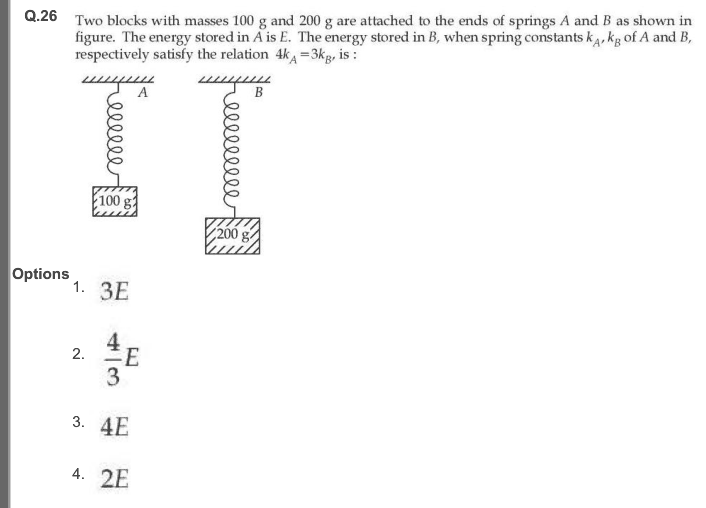
Two blocks with masses 100 g and 200 g are attached to the ends of springs $A$ and $B$ as shown in figure. The energy stored in $A$ is $E$. The energy stored in $B$, when spring constants $k_A$, $k_B$ of $A$ and $B$, respectively satisfy the relation $4k_A = 3k_B$, is :

(see the figure above)

The question and its figure as printed in JEE Main 2026 23 Jan Shift 1.
The question as printed in the paper.
  • A

    $3E$

  • B

    $\frac{4}{3}E$

  • C

    $4E$

  • D

    $2E$

12JEE Main 2026 · 23 Jan · Shift 1MCQOpen question page ↗

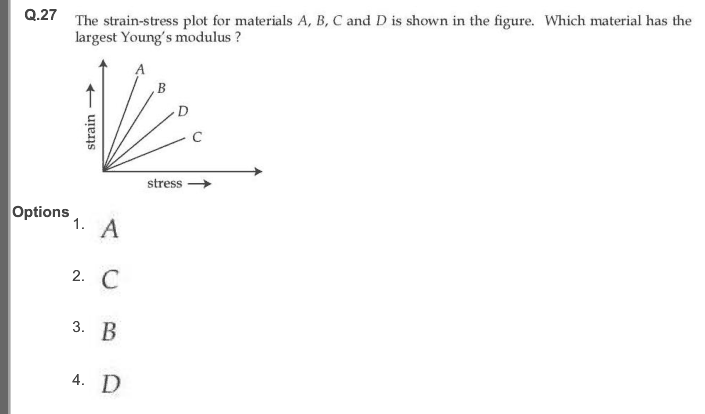
The strain-stress plot for materials $A$, $B$, $C$ and $D$ is shown in the figure. Which material has the largest Young's modulus ?

(see the figure above)

The question and its figure as printed in JEE Main 2026 23 Jan Shift 1.
The question as printed in the paper.
  • A

    $A$

  • B

    $C$

  • C

    $B$

  • D

    $D$

13JEE Main 2025 · 8 Apr · Shift 2MCQOpen question page ↗

A 3 m long wire of radius 3 mm shows an extension of 0.1 mm when loaded vertically by a mass of 50 kg in an experiment to determine Young's modulus. The value of Young's modulus of the wire as per this experiment is $P \times 10^{11}\,Nm^{-2}$, where the value of P is:(Take $g = 3\pi\,m/s^2$)

  • A

    10

  • B

    25

  • C

    2.5

  • D

    5

14JEE Main 2025 · 7 Apr · Shift 1MCQOpen question page ↗

Two wires A and B are made of same material having ratio of lengths $\frac{L_A}{L_B} = \frac{1}{3}$ and their diameters ratio $\frac{d_A}{d_B} = 2$. If both the wires are stretched using same force, what would be the ratio of their respective elongations ?

  • A

    1 : 12

  • B

    3 : 4

  • C

    1 : 3

  • D

    1 : 6

15JEE Main 2025 · 4 Apr · Shift 2MCQOpen question page ↗

A cylindrical rod of length 1 m and radius 4 cm is mounted vertically. It is subjected to a shear force of $10^5$ N at the top. Considering infinitesimally small displacement in the upper edge, the angular displacement $\theta$ of the rod axis from its original position would be: (shear moduli, $G = 10^{10}N/m^2$ )

  • A

    $1/4\pi$

  • B

    $1/40\pi$

  • C

    $1/2\pi$

  • D

    $1/160\pi$

16JEE Main 2025 · 29 Jan · Shift 1MCQOpen question page ↗

The fractional compression $\left(\frac{\Delta\mathrm{V}}{\mathrm{V}}\right)$ of water at the depth of 2.5 km below the sea level is ______ %. Given, the Bulk modulus of water = $2 \times 10^9\ \mathrm{N\,m^{-2}}$, density of water = $10^3\ \mathrm{kgm^{-3}}$, acceleration due to gravity = g = 10 $\mathrm{m\,s^{-2}}$.

  • A

    1.25

  • B

    1.0

  • C

    1.75

  • D

    1.5

17JEE Main 2025 · 23 Jan · Shift 2MCQOpen question page ↗

A massless spring gets elongated by amount $x_1$ under a tension of 5 N . Its elongation is $x_2$ under the tension of 7 N . For the elongation of $(5x_1 - 2x_2)$, the tension in the spring will be,

  • A

    39 N

  • B

    15 N

  • C

    11 N

  • D

    20 N

18JEE Main 2024 · 5 Apr · Shift 2MCQOpen question page ↗

Match List-I with List-II :

List-IList-II
(A)A force that restores an elastic body of unit area to its original state(I)Bulk modulus
(B)Two equal and opposite forces parallel to opposite faces(II)Young's modulus
(C)Forces perpendicular everywhere to the surface per unit area same everywhere(III)Stress
(D)Two equal and opposite forces perpendicular to opposite faces(IV)Shear modulus

Choose the correct answer from the options given below :

  • A

    (A)-(IV), (B)-(II), (C)-(III), (D)-(I)

  • B

    (A)-(III), (B)-(IV), (C)-(I), (D)-(II)

  • C

    (A)-(II), (B)-(IV), (C)-(I), (D)-(III)

  • D

    (A)-(III), (B)-(I), (C)-(II), (D)-(IV)

19JEE Main 2024 · 1 Feb · Shift 1MCQOpen question page ↗

With rise in temperature, the Young's modulus of elasticity

  • A

    changes erratically

  • B

    decreases

  • C

    increases

  • D

    remains unchanged

20JEE Main 2024 · 30 Jan · Shift 1MCQOpen question page ↗

Young's modules of material of a wire of length $L$ and cross-sectional area $A$ is $Y$. If the length of the wire is doubled and cross-sectional area is halved then Young's modules will be:

  • A

    $\frac{Y}{4}$

  • B

    $4Y$

  • C

    $Y$

  • D

    $2Y$

21JEE Main 2024 · 29 Jan · Shift 2MCQOpen question page ↗

A wire of length $L$ and radius $r$ is clamped at one end. If its other end is pulled by a force $F$, its length increases by $l$. If the radius of the wire and the applied force both are reduced to half of their original values keeping original length constant, the increase in length will become:

  • A

    3 times

  • B

    $\frac{3}{2}$ times

  • C

    4 times

  • D

    2 times

22JEE Main 2024 · 27 Jan · Shift 2MCQOpen question page ↗

Given below are two statements : one is labelled as Assertion (A) and the other is labelled as Reason (R)

Assertion (A) : The property of body, by virtue of which it tends to regain its original shape when the external force is removed, is Elasticity.

Reason (R) : The restoring force depends upon the bonded inter atomic and inter molecular force of solid.

In the light of the above statements, choose the correct answer from the options given below :

  • A

    (A) is false but (R) is true

  • B

    (A) is true but (R) is false

  • C

    Both (A) and (R) are true and (R) is the correct explanation (A)

  • D

    Both (A) and (R) are true but (R) is not the correct explanation of (A)

23JEE Main 2023 · 15 Apr · Shift 1MCQOpen question page ↗

A wire of length $L$ and radius $r$ is clamped rigidly at one end. When the other end of the wire is pulled by a force $f$, its length increases by $l$. Another wire of same material of length $2L$ and radius $2r$ is pulled by a force $2f$. Then the increase in its length will be:

  • A

    $4l$

  • B

    $\frac{l}{2}$

  • C

    $2l$

  • D

    $l$

24JEE Main 2023 · 13 Apr · Shift 1MCQOpen question page ↗

Under isothermal condition, the pressure of a gas is given by $P = aV^{-3}$, where $a$ is a constant and $V$ is the volume of the gas. The bulk modulus at constant temperature is equal to

  • A

    $3P$

  • B

    $P$

  • C

    $2P$

  • D

    $\frac{P}{2}$

25JEE Main 2023 · 10 Apr · Shift 2MCQOpen question page ↗

Young's moduli of the material of wires $A$ and $B$ are in the ratio of $1 : 4$, while its area of cross sections are in the ratio of $1 : 3$. If the same amount of load is applied to both the wires, the amount of elongation produced in the wires A and B will be in the ratio of [Assume length of wires $A$ and $B$ are same]

  • A

    $12 : 1$

  • B

    $1 : 36$

  • C

    $36 : 1$

  • D

    $1 : 12$

26JEE Main 2023 · 8 Apr · Shift 1MCQOpen question page ↗

An aluminium rod with Young's modulus $\mathrm{Y} = 7.0 \times 10^{10}\ \mathrm{N\,m^{-2}}$ undergoes elastic strain of $0.04\%$. The energy per unit volume stored in the rod in SI unit

  • A

    2800

  • B

    11200

  • C

    5600

  • D

    8400

27JEE Main 2023 · 1 Feb · Shift 2MCQOpen question page ↗

The Young's modulus of a steel wire of length 6 m and cross-sectional area 3 $\mathrm{mm^2}$, is 2 $\times$ $11^{11}$ $\mathrm{N/m^2}$ (sic). The wire is suspended from its support on a given planet. A block of mass 4 $\mathrm{kg}$ is attached to the free end of the wire. The acceleration due to gravity on the planet is $\dfrac{1}{4}$ of its value on the earth. The elongation of wire is (Take $g$ on the earth = 10 $\mathrm{m/s^2}$ ):

  • A

    1 $cm$

  • B

    1 $mm$

  • C

    0.1 $mm$

  • D

    0.1 $cm$

28JEE Main 2023 · 31 Jan · Shift 2MCQOpen question page ↗

Under the same load, wire A having length 5.0 m and cross section $2.5 \times 10^{-5}$ m$^2$ stretches uniformly by the same amount as another wire $B$ of length 6.0 m and a cross section of $3.0 \times 10^{-5}$ m$^2$ stretches. The ratio of the Young's modulus of wire $A$ to that of wire $B$ will be:

  • A

    1 : 4

  • B

    1 : 1

  • C

    1 : 10

  • D

    1 : 2

29JEE Main 2023 · 30 Jan · Shift 1MCQOpen question page ↗

Choose the correct relationship between Poisson ratio $\sigma$, bulk modulus $(K)$ and modulus of rigidity $\eta$ of a given solid object:

  • A

    $\sigma = \frac{3K - 2\eta}{6K + 2\eta}$

  • B

    $\sigma = \frac{6K + 2\eta}{3K - 2\eta}$

  • C

    $\sigma = \frac{3K + 2\eta}{6K + 2\eta}$

  • D

    $\sigma = \frac{6K - 2\eta}{3K - 2\eta}$

30JEE Main 2023 · 30 Jan · Shift 2MCQOpen question page ↗

A force is applied to a steel wire $A$, rigidly clamped at one end. As a result elongation in the wire is 0.2 mm. If same force is applied to another steel wire $B$ of double the length and a diameter 2.4 times that of the wire $A$, the elongation in the wire $B$ will be (wires having uniform circular cross sections)

  • A

    $6.06 \times 10^{-2}$ mm

  • B

    $2.77 \times 10^{-2}$ mm

  • C

    $3.0 \times 10^{-2}$ mm

  • D

    $6.9 \times 10^{-2}$ mm

31JEE Main 2023 · 24 Jan · Shift 1MCQOpen question page ↗

A 100 m long wire having cross-sectional area $6.25\times10^{-4}\ \mathrm{m^{2}}$ and Young's modulus is $10^{10}\ \mathrm{N\,m^{-2}}$ is subjected to a load of 250 N, then the elongation in the wire will be :

  • A

    $6.25\times10^{-3}$ m

  • B

    $4\times10^{-4}$ m

  • C

    $6.25\times10^{-6}$ m

  • D

    $4\times10^{-3}$ m

32JEE Main 2023 · 24 Jan · Shift 2MCQOpen question page ↗

Given below are two statements: one is labelled as Assertion A and the other is labelled as Reason R

Assertion (A) : Steel is used in the construction of buildings and bridges.

Reason (R) : Steel is more elastic and its elastic limit is high.

In the light of above statements, choose the most appropriate answer from the options given below

  • A

    Both $A$ and $R$ are correct and $R$ is the correct explanation of $A$

  • B

    Both $A$ and $R$ are correct but $R$ is NOT the correct explanation of $A$

  • C

    $A$ is correct but $R$ is not correct

  • D

    $A$ is not correct but $R$ is correct

33JEE Main 2022 · 29 Jul · Shift 1MCQOpen question page ↗

If the length of a wire is made double and radius is halved of its respective values. Then, the Young's modulus of the material of the wire will :

  • A

    Remain same

  • B

    Become 8 times its initial value

  • C

    Become $\frac{1^{th}}{4}$ of its initial value

  • D

    Become 4 times its initial value

34JEE Main 2022 · 28 Jul · Shift 1MCQOpen question page ↗

The force required to stretch a wire of cross-section $1\ \mathrm{cm^{2}}$ to double its length will be :
(Given Yong's modulus of the wire $=2\times10^{11}\ \mathrm{N\ m^{-2}}$)

  • A

    $1\times10^{7}\ \mathrm{N}$

  • B

    $1.5\times10^{7}\ \mathrm{N}$

  • C

    $2\times10^{7}\ \mathrm{N}$

  • D

    $2.5\times10^{7}\ \mathrm{N}$

35JEE Main 2022 · 27 Jul · Shift 2MCQOpen question page ↗

A steel wire of length 3.2 m ($Y_S = 2.0 \times 10^{11} \mathrm{~N~m^{-2}}$) and a copper wire of length 4.4 m ($Y_C = 1.1 \times 10^{11} \mathrm{~N~m^{-2}}$), both of radius 1.4 mm are connected end to end. When stretched by a load, the net elongation is found to be 1.4 mm. The load applied, in Newton, will be: (Given $\pi = \frac{22}{7}$)

  • A

    360

  • B

    180

  • C

    1080

  • D

    154

36JEE Main 2022 · 26 Jul · Shift 2MCQOpen question page ↗

The area of cross section of the rope used to lift a load by a crane is $2.5\times10^{-4}\ \mathrm{m^2}$. The maximum lifting capacity of the crane is 10 metric tons. To increase the lifting capacity of the crane to 25 metric tons, the required area of cross section of the rope should be
(take g = $10\ \mathrm{ms^{-2}}$)

  • A

    $6.25\times10^{-4}\ \mathrm{m^2}$

  • B

    $10\times10^{-4}\ \mathrm{m^2}$

  • C

    $1\times10^{-4}\ \mathrm{m^2}$

  • D

    $1.67\times10^{-4}\ \mathrm{m^2}$

37JEE Main 2022 · 29 Jun · Shift 1MCQOpen question page ↗

A wire of length $L$ is hanging from a fixed support. The length changes to $L_1$ and $L_2$ when masses $1\ \mathrm{kg}$ and $2\ \mathrm{kg}$ are suspended respectively from its free end. Then the value of $L$ is equal to

  • A

    $\sqrt{L_1 L_2}$

  • B

    $\dfrac{L_1 + L_2}{2}$

  • C

    $2L_1 - L_2$

  • D

    $3L_1 - L_2$

38JEE Main 2022 · 24 Jun · Shift 1MCQOpen question page ↗

The bulk modulus of a liquid is $3 \times 10^{10} \mathrm{~Nm^{-2}}$. The pressure required to reduce the volume of liquid by $2\%$ is :

  • A

    $3 \times 10^{8} \mathrm{~N~m^{-2}}$

  • B

    $6 \times 10^{8} \mathrm{~N~m^{-2}}$

  • C

    $9 \times 10^{8} \mathrm{~N~m^{-2}}$

  • D

    $12 \times 10^{8} \mathrm{~N~m^{-2}}$

39JEE Main 2021 · 31 Aug · Shift 1MCQOpen question page ↗

A uniform heavy rod of weight $10$ kg m s$^{-2}$, cross-sectional area $100$ cm$^2$ and length $20$ cm is hanging from a fixed support. Young modulus of the material of the rod is $2 \times 10^{11}$ N m$^{-2}$. Neglecting the lateral contraction, find the elongation of rod due to its own weight:

  • A

    $5 \times 10^{-10}$ m

  • B

    $4 \times 10^{-8}$ m

  • C

    $5 \times 10^{-8}$ m

  • D

    $2 \times 10^{-9}$ m

40JEE Main 2021 · 31 Aug · Shift 2MCQOpen question page ↗

Four identical hollow cylindrical columns of mild steel support a big structure of mass $50 \times 10^3$ kg. The inner and outer radii of each column are $50$ cm and $100$ cm respectively. Assuming uniform local distribution, calculate the compression strain of each column. [use $Y = 2.0 \times 10^{11}$ Pa, $g = 9.8$ m s$^{-2}$]

  • A

    $1.87 \times 10^{-3}$

  • B

    $2.60 \times 10^{-7}$

  • C

    $3.60 \times 10^{-8}$

  • D

    $7.07 \times 10^{-4}$

41JEE Main 2021 · 26 Aug · Shift 2MCQOpen question page ↗

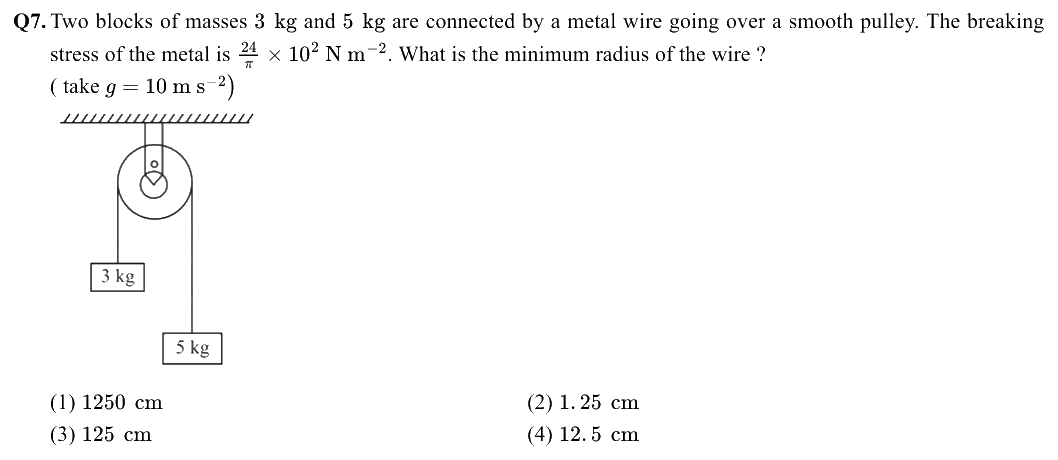
Two blocks of masses $3\ \mathrm{kg}$ and $5\ \mathrm{kg}$ are connected by a metal wire going over a smooth pulley. The breaking stress of the metal is $\frac{24}{\pi}\times10^{2}\ \mathrm{N\ m^{-2}}$. What is the minimum radius of the wire ?
( take $g=10\ \mathrm{m\ s^{-2}}$)
(see the figure above)

The question and its figure as printed in JEE Main 2021 26 Aug Shift 2.
The question as printed in the paper.
  • A

    $1250\ \mathrm{cm}$

  • B

    $1.25\ \mathrm{cm}$

  • C

    $125\ \mathrm{cm}$

  • D

    $12.5\ \mathrm{cm}$

42JEE Main 2021 · 25 Jul · Shift 1MCQOpen question page ↗

Two wires of same length and radius are joined end to end and loaded. The Young's moduli of the materials of the two wires are $Y_1$ and $Y_2$. The combination behaves as a single wire then its Young's modulus is:

  • A

    $Y = \frac{2Y_1Y_2}{3Y_1 + Y_2}$

  • B

    $Y = \frac{2Y_1Y_2}{Y_1 + Y_2}$

  • C

    $Y = \frac{Y_1Y_2}{2Y_1 + Y_2}$

  • D

    $Y = \frac{Y_1Y_2}{Y_1 + Y_2}$

43JEE Main 2021 · 20 Jul · Shift 1MCQOpen question page ↗

The value of tension in a long thin metal wire has been changed from $T_1$ to $T_2$. The lengths of the metal wire at two different values of tension $T_1$ and $T_2$ are $\ell_1$ and $\ell_2$, respectively. The actual length of the metal wire is:

  • A

    $\frac{T_1 \ell_2 - T_2 \ell_1}{T_1 - T_2}$

  • B

    $\frac{T_1 \ell_1 - T_2 \ell_2}{T_1 - T_2}$

  • C

    $\frac{\ell_1 + \ell_2}{2}$

  • D

    $\sqrt{T_1 T_2 \ell_1 \ell_2}$

44JEE Main 2021 · 20 Jul · Shift 2MCQOpen question page ↗

The length of a metal wire is $\ell_1$, when the tension in it is $T_1$ and is $\ell_2$ when the tension is $T_2$. The natural length of the wire is:

  • A

    $\sqrt{\ell_1\ell_2}$

  • B

    $\frac{\ell_1\ T_2 - \ell_2\ T_1}{T_2 - T_1}$

  • C

    $\frac{\ell_1\ T_2 + \ell_2\ T_1}{T_2 + T_1}$

  • D

    $\frac{\ell_1 + \ell_2}{2}$

45JEE Main 2021 · 17 Mar · Shift 2MCQOpen question page ↗

An object is located at $2 \mathrm{~km}$ beneath the surface of the water. If the fractional compression $\frac{\Delta V}{V}$ is $1.36 \%$, the ratio of hydraulic stress to the corresponding hydraulic strain will be ______ [Given: density of water is $1000 \mathrm{~kg} \mathrm{~m}^{-3}$ and $g=9.8 \mathrm{~m} \mathrm{~s}^{-2}$).

  • A

    $1.96 \times 10^7 \mathrm{~N} \mathrm{~m}^{-2}$

  • B

    $1.44 \times 10^7 \mathrm{~N} \mathrm{~m}^{-2}$

  • C

    $2.26 \times 10^9 \mathrm{~N} \mathrm{~m}^{-2}$

  • D

    $1.44 \times 10^9 \mathrm{~N} \mathrm{~m}^{-2}$

46JEE Main 2021 · 26 Feb · Shift 1MCQOpen question page ↗

The normal density of a material is $\rho$ and its bulk modulus of elasticity is $K$. The magnitude of increase in density of material, when a pressure $P$ is applied uniformly on all sides, will be :

  • A

    $\frac{PK}{\rho}$

  • B

    $\frac{\rho P}{K}$

  • C

    $\frac{\rho K}{P}$

  • D

    $\frac{K}{\rho P}$

47JEE Main 2021 · 26 Feb · Shift 2MCQOpen question page ↗

The length of metallic wire is $l_1$ when tension in it is $T_1$. It is $l_2$ when the tension is $T_2$. The original length of the wire will be :

  • A

    $\frac{T_2 l_1 + T_1 l_2}{T_1 + T_2}$

  • B

    $\frac{l_1 + l_2}{2}$

  • C

    $\frac{T_2 l_1 - T_1 l_2}{T_2 - T_1}$

  • D

    $\frac{T_1 l_1 - T_2 l_2}{T_2 - T_1}$

48JEE Main 2021 · 24 Feb · Shift 1MCQOpen question page ↗

If $Y$, $K$ and $\eta$ are the values of Young's modulus, bulk modulus and modulus of rigidity of any material respectively. Choose the correct relation for these parameters.

  • A

    $Y = \frac{9K\eta}{3K - \eta}\ \mathrm{N\ m^{-2}}$

  • B

    $\eta = \frac{3YK}{9K + Y}\ \mathrm{N\ m^{-2}}$

  • C

    $K = \frac{Y\eta}{9\eta - 3Y}\ \mathrm{N\ m^{-2}}$

  • D

    $Y = \frac{9K\eta}{2\eta + 3K}\ \mathrm{N\ m^{-2}}$

49JEE Main 2020 · 4 Sep · Shift 2MCQOpen question page ↗

A cube of metal is subjected to a hydrostatic pressure $4\ GPa$. The percentage change in the length of the side of the cube is close to : (Given bulk modulus of metal, $B = 8 \times 10^{10}\ Pa$)

  • A

    5

  • B

    0.6

  • C

    20

  • D

    1.67

50JEE Main 2020 · 9 Jan · Shift 2MCQOpen question page ↗

Two steel wires having same length are suspended from a ceiling under the same load. If the ratio of their energy stored per unit volume is $1 : 4$, the ratio of their diameters is:

  • A

    $\sqrt{2} : 1$

  • B

    $1 : 2$

  • C

    $2 : 1$

  • D

    $1 : \sqrt{2}$

51JEE Main 2019 · 12 Apr · Shift 1MCQOpen question page ↗

At $40^\circ\mathrm{C}$, a brass wire of 1 mm radius is hung from the ceiling. A small mass, M is hung from the free end of the wire. When the wire is cooled down from $40^\circ\mathrm{C}$ to $20^\circ\mathrm{C}$ it regains its original length of $0.2\ \mathrm{m}$ . The value of M is close to:
(Coefficient of linear expansion and Young's modulus of brass are $10^{-5}\ /^\circ\mathrm{C}$ and $10^{11}\ \mathrm{N\ /\ m^2}$, respectively; $\mathrm{g = 10\ m\ s^{-2}}$ )

  • A

    0.9 kg

  • B

    0.5 kg

  • C

    1.5 kg

  • D

    9 kg

52JEE Main 2019 · 10 Apr · Shift 2MCQOpen question page ↗

The elastic limit of brass is $379\ \mathrm{MPa}$. The minimum diameter of a brass rod if it is to support a $400\ \mathrm{N}$ load without exceeding its elastic limit will be

  • A

    $1.00\ \mathrm{mm}$

  • B

    $1.36\ \mathrm{mm}$

  • C

    $1.16\ \mathrm{mm}$

  • D

    $0.90\ \mathrm{mm}$

53JEE Main 2019 · 10 Apr · Shift 2MCQOpen question page ↗

In an experiment, brass and steel wires of length $1\ \mathrm{m}$ each with areas of cross section $1\ \mathrm{mm^{2}}$ are used. The wires are connected in series and one end of the combined wire is connected to a rigid support and other end is subjected to elongation. The stress required to produce a net elongation of $0.2\ \mathrm{mm}$ is,
[Given, the Young's Modulus for steel and brass are, respectively, $120\times10^{9}\ \mathrm{N\,/\,m^{2}}$ and $60\times10^{9}\ \mathrm{N\,/\,m^{2}}$ ]

  • A

    $8.0\times10^{6}\ \mathrm{N\,/\,m^{2}}$

  • B

    $1.2\times10^{6}\ \mathrm{N\,/\,m^{2}}$

  • C

    $0.2\times10^{6}\ \mathrm{N\,/\,m^{2}}$

  • D

    $1.8\times10^{6}\ \mathrm{N\,/\,m^{2}}$

54JEE Main 2019 · 8 Apr · Shift 1MCQOpen question page ↗

A boy's catapult is made of rubber cord which is 42 cm long, with 6 mm diameter of cross-section and of negligible mass. The boy keeps a stone weighing 0.02 kg on it and stretches the cord by 20 cm by applying a constant force. When released, the stone flies off with a velocity of 20 $\mathrm{ms^{-1}}$. Neglect the change in the area of cross-section of the cord while stretched. The Young's modulus of rubber is closest to:

  • A

    $10^6\,\mathrm{N\,m^{-2}}$

  • B

    $10^4\,\mathrm{N\,m^{-2}}$

  • C

    $10^8\,\mathrm{N\,m^{-2}}$

  • D

    $10^3\,\mathrm{N\,m^{-2}}$

55JEE Main 2019 · 8 Apr · Shift 1MCQOpen question page ↗

A steel wire having a radius of 2.0 mm, carrying a load of 4 kg, is hanging from a ceiling. Given that $g = 3.1\pi\ \mathrm{m\,s^{-2}}$, what will be the tensile stress that would be developed in the wire?

  • A

    $5.2 \times 10^6\ \mathrm{N\,m^{-2}}$

  • B

    $6.2 \times 10^6\ \mathrm{N\,m^{-2}}$

  • C

    $4.8 \times 10^6\ \mathrm{N\,m^{-2}}$

  • D

    $3.1 \times 10^6\ \mathrm{N\,m^{-2}}$

56JEE Main 2019 · 8 Apr · Shift 2MCQOpen question page ↗

Young's moduli of two wires A and B are in the ratio 7 : 4 . Wire A is 2 m long and has radius R. Wire B is 1.5 m long and has radius 2 mm . If the two wires stretch by the same length for a given load, the value of R is close to:

  • A

    1.3 mm

  • B

    1.9 mm

  • C

    1.5 mm

  • D

    1.7 mm

57JEE Main 2019 · 12 Jan · Shift 2MCQOpen question page ↗

A load of mass $M$ $kg$ is suspended from a steel wire of length $2m$ and radius 1.0 $mm$ in Searle's apparatus experiment. The increase in length produced in the wire is 4.0 $mm$. Now the load is fully immersed in a liquid of relative density 2. The relative density of the material of load is 8. The new value of increase in length of the steel wire is:

  • A

    $4.0\ mm$

  • B

    Zero

  • C

    $5.0mm$

  • D

    $3.0mm$

58JEE Main 2018 · 15 Apr · Shift 2MCQOpen question page ↗

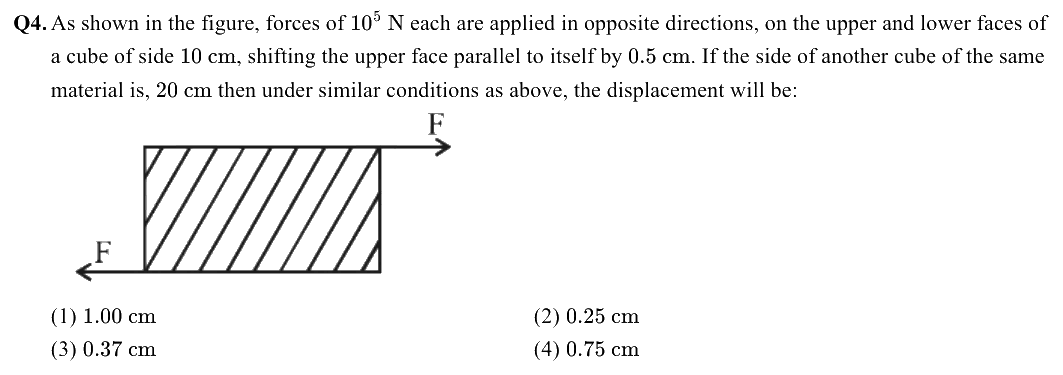
As shown in the figure, forces of $10^5\ \mathrm{N}$ each are applied in opposite directions, on the upper and lower faces of a cube of side $10\ \mathrm{cm}$, shifting the upper face parallel to itself by $0.5\ \mathrm{cm}$. If the side of another cube of the same material is, $20\ \mathrm{cm}$ then under similar conditions as above, the displacement will be:
(see the figure above)

The question and its figure as printed in JEE Main 2018 15 Apr Shift 2 Online.
The question as printed in the paper.
  • A

    $1.00\ \mathrm{cm}$

  • B

    $0.25\ \mathrm{cm}$

  • C

    $0.37\ \mathrm{cm}$

  • D

    $0.75\ \mathrm{cm}$

59JEE Main 2018 · 8 Apr · OfflineMCQOpen question page ↗

A solid sphere of radius r made of a soft material of bulk modulus K is surrounded by a liquid in a cylindrical container. A massless piston of area $a$ floats on the surface of the liquid, covering entire cross-section of cylindrical container. When a mass m is placed on the surface of the piston to compress the liquid, the fractional decrement in the radius of the sphere $\left(\dfrac{dr}{r}\right)$, is:

  • A

    $\dfrac{mg}{Ka}$

  • B

    $\dfrac{Ka}{mg}$

  • C

    $\dfrac{Ka}{3mg}$

  • D

    $\dfrac{mg}{3Ka}$

60JEE Main 2017 · 2 Apr · OfflineMCQOpen question page ↗

A man grows into a giant such that his linear dimensions increase by a factor of $9$. Assuming that his density remains same, the stress in the leg will change by a factor of:

  • A

    $\frac{1}{81}$

  • B

    $9$

  • C

    $\frac{1}{9}$

  • D

    $81$

61JEE Main 2016 · 10 Apr · OnlineMCQOpen question page ↗

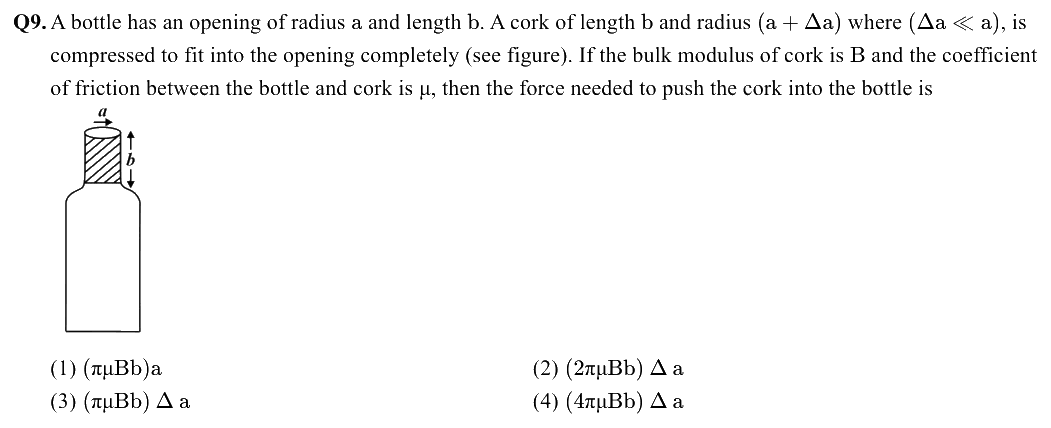
A bottle has an opening of radius a and length b. A cork of length b and radius $(a + \Delta a)$ where $(\Delta a \ll a)$, is compressed to fit into the opening completely (see figure). If the bulk modulus of cork is B and the coefficient of friction between the bottle and cork is $\mu$, then the force needed to push the cork into the bottle is
(see the figure above)

The question and its figure as printed in JEE Main 2016 10 Apr Online.
The question as printed in the paper.
  • A

    $(\pi\mu Bb)a$

  • B

    $(2\pi\mu Bb)\,\Delta a$

  • C

    $(\pi\mu Bb)\,\Delta a$

  • D

    $(4\pi\mu Bb)\,\Delta a$

62JEE Main 2016 · 9 Apr · OnlineMCQOpen question page ↗

A uniformly tapering conical wire is made from a material of Young's modulus $Y$ and has a normal, unextended length $L$. The radii, at the upper and lower ends of this conical wire, have values $R$ and $3R$, respectively. The upper end of the wire is fixed to a rigid support and a mass $M$ is suspended from its lower end. The equilibrium extended length, of this wire, would equal:

  • A

    $\mathrm{L}\left(1+\frac{2}{9}\frac{\mathrm{Mg}}{\pi \mathrm{YR}^{2}}\right)$

  • B

    $\mathrm{L}\left(1+\frac{1}{9}\frac{\mathrm{Mg}}{\pi \mathrm{YR}^{2}}\right)$

  • C

    $\mathrm{L}\left(1+\frac{1}{3}\frac{\mathrm{Mg}}{\pi \mathrm{YR}^{2}}\right)$

  • D

    $\mathrm{L}\left(1+\frac{2}{3}\frac{\mathrm{Mg}}{\pi \mathrm{YR}^{2}}\right)$

63JEE Main 2015 · 4 Apr · OfflineMCQOpen question page ↗

A pendulum made of a uniform wire of cross sectional area A has time period T. When an additional mass M is added to its bob, the time period changes to $T_M$. If the Young's modulus of the material of the wire is $Y$, then $\dfrac{1}{Y}$ is equal to:
($g$ =gravitational acceleration)

  • A

    $\left[1 - \left(\dfrac{T}{T_M}\right)^2\right]\dfrac{A}{Mg}$

  • B

    $\left[\left(\dfrac{T_M}{T}\right)^2 - 1\right]\dfrac{A}{Mg}$

  • C

    $\left[\left(\dfrac{T_M}{T}\right)^2 - 1\right]\dfrac{Mg}{A}$

  • D

    $\left[1 - \left(\dfrac{T_M}{T}\right)^2\right]\dfrac{A}{Mg}$

64JEE Main 2014 · 12 Apr · OnlineMCQOpen question page ↗

Steel ruptures when a shear of $3.5\times 10^{8}\ \mathrm{N\,m^{-2}}$ is applied. The force needed to punch a $1\ \mathrm{cm}$ diameter hole in a steel sheet $0.3\ \mathrm{cm}$ thick is nearly:

  • A

    $1.4\times 10^{4}\ \mathrm{N}$

  • B

    $2.7\times 10^{4}\ \mathrm{N}$

  • C

    $3.3\times 10^{4}\ \mathrm{N}$

  • D

    $1.1\times 10^{4}\ \mathrm{N}$

65JEE Main 2014 · 11 Apr · OnlineMCQOpen question page ↗

The bulk moduli of ethanol, mercury and water are given as $0.9, 25$ and $2.2$ respectively in units of $10^9 \mathrm{Nm}^{-2}$. For a given value of pressure, the fractional compression in volume is $\frac{\Delta V}{V}$. Which of the following statements about $\frac{\Delta V}{V}$ for these three liquids is correct ?

  • A

    Ethanol > Water > Mercury

  • B

    Water > Ethanol > Mercury

  • C

    Mercury > Ethanol > Water

  • D

    Ethanol > Mercury > Water

66JEE Main 2014 · 9 Apr · OnlineMCQOpen question page ↗

In materials like aluminium and copper, the correct order of magnitude of various elastic modulii is :

  • A

    Young's modulii < shear modulii < bulk modulii

  • B

    Bulk modulii < shear modulii < Young's modulii

  • C

    Shear modulii < Young's modulii < bulk modulii

  • D

    Bulk modulii < Young's modulii < shear modulii

67JEE Main 2013 · 23 Apr · OnlineMCQOpen question page ↗

A copper wire of length 1.0 m and a steel wire of length 0.5 m having equal cross-sectional areas are joined end to end. The composite wire is stretched by a certain load which stretches the copper wire by 1 mm. If the Young's modulii of copper and steel are respectively $1.0 \times 10^{11}\ \mathrm{Nm^{-2}}$ and $2.0 \times 10^{11}\mathrm{Nm^{-2}}$, the total extension of the composite wire is :

  • A

    1.75 mm

  • B

    2.0 mm

  • C

    1.50 mm

  • D

    1.25 mm

68JEE Main 2013 · 22 Apr · OnlineMCQOpen question page ↗

A uniform wire (Young's modulus $2 \times 10^{11}\ \mathrm{Nm^{-2}}$ ) is subjected to longitudinal tensile stress of $5 \times 10^{7}\ \mathrm{Nm^{-2}}$. If the overall volume of the wire is 0.02%, the fractional decrease in the radius of the wire is close to:

  • A

    $1.0 \times 10^{-4}$

  • B

    $1.5 \times 10^{-4}$

  • C

    $0.25 \times 10^{-4}$

  • D

    $5 \times 10^{-4}$

69JEE Main 2013 · 9 Apr · OnlineMCQOpen question page ↗

If the ratio of lengths, radii and Young's moduli of steel and brass wires in the figure are $a$, $b$ and $c$ respectively, then the corresponding ratio of increase in their lengths is :

  • A

    $\dfrac{3c}{2ab^2}$

  • B

    $\dfrac{2a^2c}{b}$

  • C

    $\dfrac{3a}{2b^2c}$

  • D

    $\dfrac{2ac}{b^2}$

70AIEEE 2012 · 19 May · OnlineMCQOpen question page ↗

A steel wire can sustain $100\ \mathrm{kg}$ weight without breaking. If the wire is cut into two equal parts, each part can sustain a weight of

  • A

    $50\ \mathrm{kg}$

  • B

    $400\ \mathrm{kg}$

  • C

    $100\ \mathrm{kg}$

  • D

    $200\ \mathrm{kg}$

71AIEEE 2012 · 7 May · OnlineMCQOpen question page ↗

A structural steel rod has a radius of 10 mm and length of 1.0 m. A 100kN force stretches it along its length. Young's modulus of structural steel is $2 \times 10^{11}\mathrm{Nm}^{-2}$. The percentage strain is about

  • A

    0.16%

  • B

    0.32%

  • C

    0.08%

  • D

    0.24%

72AIEEE 2012 · 7 May · OnlineMCQOpen question page ↗

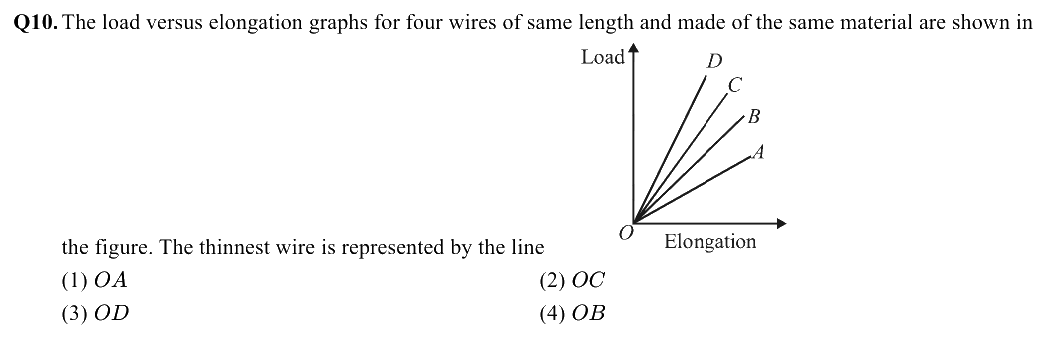
The load versus elongation graphs for four wires of same length and made of the same material are shown in the figure. The thinnest wire is represented by the line
(see the figure above)

The question and its figure as printed in AIEEE 2012 07 May Online.
The question as printed in the paper.
  • A

    $OA$

  • B

    $OC$

  • C

    $OD$

  • D

    $OB$

73AIEEE 2012 · OfflineMCQOpen question page ↗

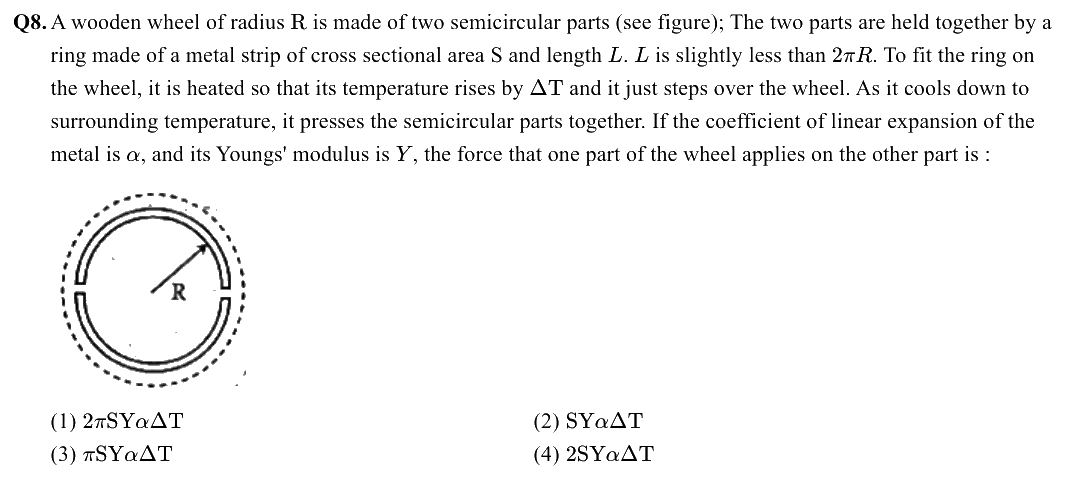
A wooden wheel of radius $\mathrm{R}$ is made of two semicircular parts (see figure); The two parts are held together by a ring made of a metal strip of cross sectional area $\mathrm{S}$ and length $L$. $L$ is slightly less than $2\pi \mathrm{R}$. To fit the ring on the wheel, it is heated so that its temperature rises by $\Delta \mathrm{T}$ and it just steps over the wheel. As it cools down to surrounding temperature, it presses the semicircular parts together. If the coefficient of linear expansion of the metal is $\alpha$, and its Youngs' modulus is $Y$, the force that one part of the wheel applies on the other part is :
(see the figure above)

The question and its figure as printed in AIEEE 2012 Offline.
The question as printed in the paper.
  • A

    $2\pi \mathrm{SY}\alpha\Delta\mathrm{T}$

  • B

    $\mathrm{SY}\alpha\Delta\mathrm{T}$

  • C

    $\pi \mathrm{SY}\alpha\Delta\mathrm{T}$

  • D

    $2\mathrm{SY}\alpha\Delta\mathrm{T}$

74AIEEE 2009MCQOpen question page ↗

Two wires are made of the same material and have the same volume. However wire 1 has crosssectional area $A$ and wire-2 has cross-sectional area $3A$. If the length of wire 1 increases by $\Delta x$ on applying force $F$, how much force is needed to stretch wire 2 by the same amount?

  • A

    F

  • B

    4 F

  • C

    6 F

  • D

    9 F

75AIEEE 2006MCQOpen question page ↗

A wire elongates by $\ell$mm when a load W is hanged from it. If the wire goes over a pulley and two weights W each are hung at the two ends, the elongation of the wire will be (in mm )

  • A

    $\ell/2$

  • B

    $\ell$

  • C

    $2\ell$

  • D

    zero

76AIEEE 2005MCQOpen question page ↗

If $S$ is stress and $Y$ is Young's modulus of material of a wire, the energy stored in the wire per unit volume is

  • A

    $2S^2Y$

  • B

    $S^2/2Y$

  • C

    $2Y/S^2$

  • D

    $S/2Y$

77AIEEE 2004MCQOpen question page ↗

A wire fixed at the upper end stretches by length by applying a force F. The work done in stretching is

  • A

    F/2

  • B

    $\mathrm{F}\ell$

  • C

    2 $\mathrm{F}\ell$

  • D

    $\mathrm{F}\ell/2$

78AIEEE 2003MCQOpen question page ↗

A wire suspended vertically from one of its ends is stretched by attaching a weight of 200 N to the lower end. The weight stretches the wire by 1 mm. Then the elastic energy stored in the wire is

  • A

    0.2 J

  • B

    10 J

  • C

    20 J

  • D

    0.1 J

Numerical value

42 questions
79JEE Main 2026 · 5 Apr · Shift 1NumericalOpen question page ↗

A cube has side length 5 cm and modulus of rigidity $10^5$ N/m$^2$. The displacement produced by a force of 10 N in the upper face of cube is ________ mm.

Numerical answer type: type your answer in EdLoop to check it
80JEE Main 2026 · 5 Apr · Shift 2NumericalOpen question page ↗

A copper wire of length 3 m is stretched by 3 mm by applying an external force. The volume of the wire is $600\times10^{-6}$ m$^3$. The elastic potential energy stored in the wire in stretched condition would be ________ J.
(Given Young modulus of copper = $1.1\times10^{11}$ N/m$^2$)

Numerical answer type: type your answer in EdLoop to check it
81JEE Main 2026 · 2 Apr · Shift 1NumericalOpen question page ↗

A uniform wire of length $l$ of weight w is suspended from the roof with a weight of W at the other end. The stress in the wire at $\frac{l}{3}$ distance from the top is $\left(\frac{W}{A} + \frac{2}{\gamma}\frac{w}{A}\right)$, where, A is the cross sectional area of the wire. The value of $\gamma$ is ________.

Numerical answer type: type your answer in EdLoop to check it
82JEE Main 2025 · 8 Apr · Shift 2NumericalOpen question page ↗

A sample of a liquid is kept at 1 atm. It is compressed to 5 atm which leads to change of volume of 0.8 cm$^3$. If the bulk modulus of the liquid is 2 GPa, the initial volume of the liquid was ______ litre. (Take 1atm = $10^5$ Pa)

Numerical answer type: type your answer in EdLoop to check it
83JEE Main 2025 · 4 Apr · Shift 1NumericalOpen question page ↗

Two slabs with square cross section of different materials $(1, 2)$ with equal sides $(l)$ and thickness $d_1$ and $d_2$ such that $d_2 = 2d_1$ and $l > d_2$. Considering lower edges of these slabs are fixed to the floor, we apply equal shearing force on the narrow faces. The angle of deformation is $\theta_2 = 2\theta_1$. If the shear moduli of material 1 is $4 \times 10^9N/m^2$, then shear moduli of material 2 is $x \times 10^9N/m^2$, where value of $x$ is ______ .

Numerical answer type: type your answer in EdLoop to check it
84JEE Main 2025 · 2 Apr · Shift 1NumericalOpen question page ↗

A steel wire of length 2 m and Young's modulus $2.0 \times 10^{11}Nm^{-2}$ is stretched by a force. If Poisson ratio and transverse strain for the wire are 0.2 and $10^{-3}$ respectively, then the elastic potential energy density of the wire is ______ $\times 10^5$ (in SI units).

Numerical answer type: type your answer in EdLoop to check it
85JEE Main 2025 · 2 Apr · Shift 2NumericalOpen question page ↗

The length of a light string is 1.4 m when the tension on it is 5 N. If the tension increases to 7 N, the length of the string is 1.56 m. The original length of the string is ______ m.

Numerical answer type: type your answer in EdLoop to check it
86JEE Main 2025 · 28 Jan · Shift 2NumericalOpen question page ↗

The volume contraction of a solid copper cube of edge length 10 cm , when subjected to a hydraulic pressure of $7 \times 10^6$ Pa, would be ______ $\mathrm{mm^3}$. (Given bulk modulus of copper = $1.4 \times 10^{11}\ \mathrm{N\,m^{-2}}$ )

Numerical answer type: type your answer in EdLoop to check it
87JEE Main 2025 · 24 Jan · Shift 2NumericalOpen question page ↗

The increase in pressure required to decrease the volume of a water sample by $0.2\%$ is $\mathrm{P \times 10^5 Nm^{-2}}$. Bulk modulus of water is $2.15 \times 10^9 \mathrm{Nm^{-2}}$. The value of P is ______

Numerical answer type: type your answer in EdLoop to check it
88JEE Main 2024 · 9 Apr · Shift 1NumericalOpen question page ↗

Two persons pull a wire towards themselves. Each person exerts a force of 200 N on the wire. Young's modulus of the material of wire is $1 \times 10^{11}$ N m$^{-2}$. Original length of the wire is 2 m and the area of cross section is 2 cm$^2$. The wire will extend in length by ______ $\mu$m.

Numerical answer type: type your answer in EdLoop to check it
89JEE Main 2024 · 6 Apr · Shift 2NumericalOpen question page ↗

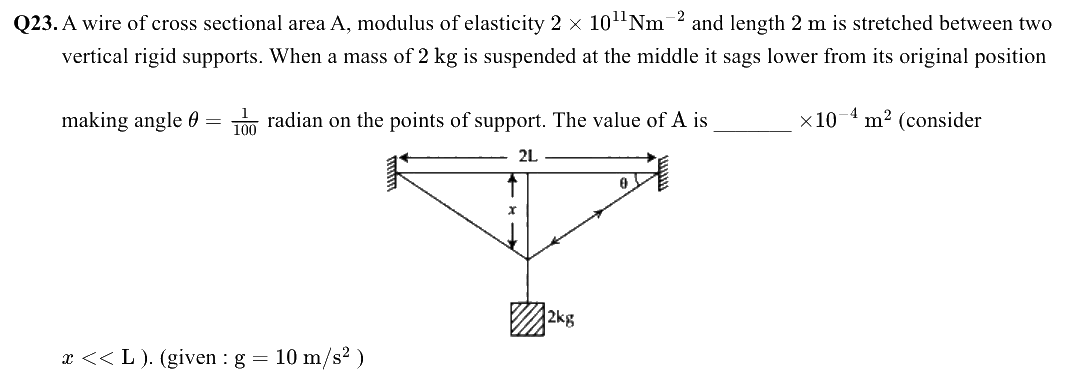
A wire of cross sectional area A, modulus of elasticity $2 \times 10^{11}$Nm$^{-2}$ and length 2 m is stretched between two vertical rigid supports. When a mass of 2 kg is suspended at the middle it sags lower from its original position making angle $\theta = \frac{1}{100}$ radian on the points of support. The value of A is ______ $\times 10^{-4}$ m$^2$ (consider $x \ll L$ ). (given : g = 10 m/s$^2$ )

(see the figure above)

The question and its figure as printed in JEE Main 2024 06 Apr Shift 2.
The question as printed in the paper.
Numerical answer type: type your answer in EdLoop to check it
90JEE Main 2024 · 5 Apr · Shift 1NumericalOpen question page ↗

The density and breaking stress of a wire are $6 \times 10^4$ kg/m$^3$ and $1.2 \times 10^8$ N/m$^2$ respectively. The wire is suspended from a rigid support on a planet where acceleration due to gravity is $\frac{1}{3}^{rd}$ of the value on the surface of earth. The maximum length of the wire with breaking is ______ m (take, g = 10 m/s$^2$ ).

Numerical answer type: type your answer in EdLoop to check it
91JEE Main 2024 · 4 Apr · Shift 1NumericalOpen question page ↗

An elastic spring under tension of 3 N has a length $a$. Its length is $b$ under tension 2 N. For its length $(3a - 2b)$, the value of tension will be ______ N.

Numerical answer type: type your answer in EdLoop to check it
92JEE Main 2024 · 1 Feb · Shift 2NumericalOpen question page ↗

One end of a metal wire is fixed to a ceiling and a load of 2 kg hangs from the other end. A similar wire is attached to the bottom of the load and another load of 1 kg hangs from this lower wire. Then the ratio of longitudinal strain of upper wire to that of the lower wire will be

[Area of cross section of wire = 0.005 $\text{cm}^2$, $Y = 2 \times 10^{11}\ \text{N m}^{-2}$ and $g = 10\ \text{m s}^{-2}$]

Numerical answer type: type your answer in EdLoop to check it
93JEE Main 2024 · 31 Jan · Shift 1NumericalOpen question page ↗

The depth below the surface of sea to which a rubber ball be taken so as to decrease its volume by 0.02% is ______ m.
(Take density of sea water = $10^3$ kg m$^{-3}$, Bulk modulus of rubber = $9 \times 10^8$ N m$^{-2}$, and $g = 10$ m s$^{-2}$)

Numerical answer type: type your answer in EdLoop to check it
94JEE Main 2024 · 31 Jan · Shift 2NumericalOpen question page ↗

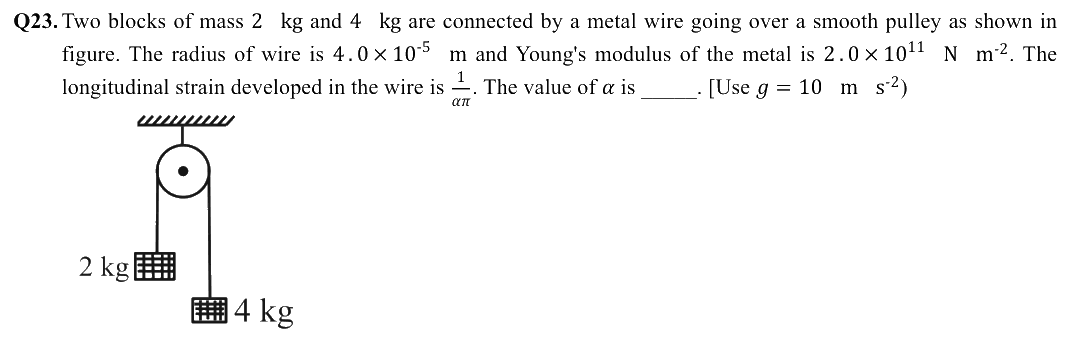
Two blocks of mass 2 kg and 4 kg are connected by a metal wire going over a smooth pulley as shown in figure. The radius of wire is $4.0 \times 10^{-5}$ m and Young's modulus of the metal is $2.0 \times 10^{11}$ N m$^{-2}$. The longitudinal strain developed in the wire is $\frac{1}{\alpha\pi}$. The value of $\alpha$ is ______. [Use $g = 10$ m s$^{-2}$]

(see the figure above)

The question and its figure as printed in JEE Main 2024 31 Jan Shift 2.
The question as printed in the paper.
Numerical answer type: type your answer in EdLoop to check it
95JEE Main 2024 · 30 Jan · Shift 1NumericalOpen question page ↗

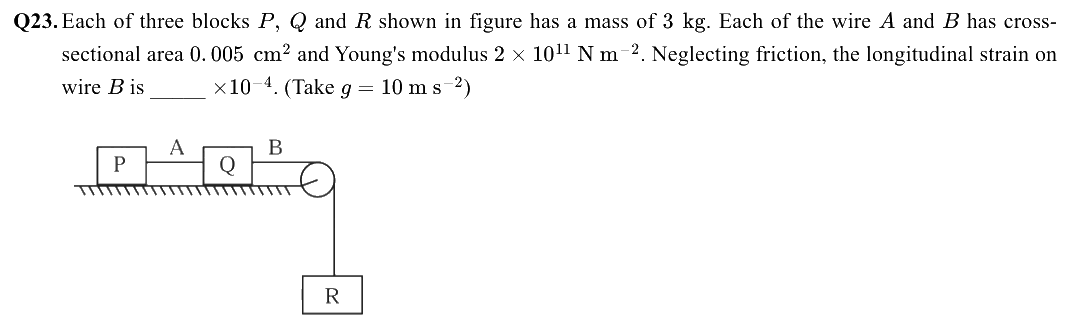
Each of three blocks $P$, $Q$ and $R$ shown in figure has a mass of 3 kg. Each of the wire $A$ and $B$ has cross-sectional area 0. 005 cm$^2$ and Young's modulus $2 \times 10^{11}\ \mathrm{N\,m^{-2}}$. Neglecting friction, the longitudinal strain on wire $B$ is ______ $\times 10^{-4}$. (Take $g = 10\ \mathrm{m\,s^{-2}}$).

(see the figure above)

The question and its figure as printed in JEE Main 2024 30 Jan Shift 1.
The question as printed in the paper.
Numerical answer type: type your answer in EdLoop to check it
96JEE Main 2024 · 29 Jan · Shift 2NumericalOpen question page ↗

Two metallic wires $P$ and $Q$ have same volume and are made up of same material. If their area of cross sections are in the ratio 4 : 1 and force $F_1$ is applied to $P$, an extension of $\Delta l$ is produced. The force which is required to produce same extension in Q is $F_2$. The value of $\frac{F_1}{F_2}$ is ______.

Numerical answer type: type your answer in EdLoop to check it
97JEE Main 2024 · 27 Jan · Shift 1NumericalOpen question page ↗

If average depth of an ocean is 4000 m and the bulk modulus of water is $2 \times 10^9$ N m$^{-2}$, then fractional compression $\frac{\Delta V}{V}$ of water at the bottom of ocean is $\alpha \times 10^{-2}$. The value of $\alpha$ is ______. (Given, g = 10 m s$^{-2}$, $\rho$ = 1000 kg m$^{-3}$)

Numerical answer type: type your answer in EdLoop to check it
98JEE Main 2023 · 13 Apr · Shift 1NumericalOpen question page ↗

The elastic potential energy stored in a steel wire of length 20 m stretched through 2 cm is 80 J. The cross sectional area of the wire is ______ mm$^{2}$. (Given, $Y = 2.0 \times 10^{11}$ N m$^{-2}$)

Numerical answer type: type your answer in EdLoop to check it
99JEE Main 2023 · 11 Apr · Shift 1NumericalOpen question page ↗

The length of a wire becomes $l_1$ and $l_2$ when 100 N and 120 N tension are applied respectively. If $10 l_2 = 11 l_1$, then the natural length of wire will be $\frac{1}{x}l_1$. Here the value of $x$ is

Numerical answer type: type your answer in EdLoop to check it
100JEE Main 2023 · 10 Apr · Shift 1NumericalOpen question page ↗

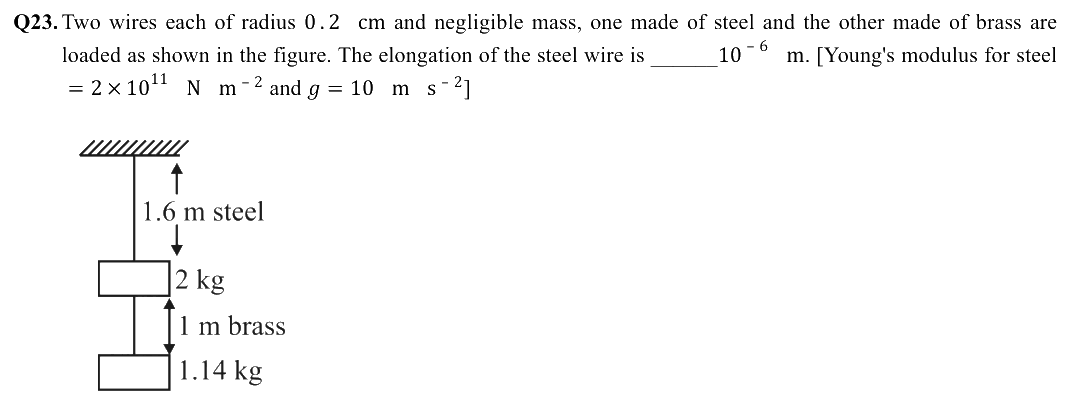
Two wires each of radius 0.2 cm and negligible mass, one made of steel and the other made of brass are loaded as shown in the figure. The elongation of the steel wire is ______ $10^{-6}$ m. [Young's modulus for steel $= 2 \times 10^{11}\ \mathrm{N\,m^{-2}}$ and $g = 10\ \mathrm{m\,s^{-2}}$]
(see the figure above)

The question and its figure as printed in JEE Main 2023 10 Apr Shift 1.
The question as printed in the paper.
Numerical answer type: type your answer in EdLoop to check it
101JEE Main 2023 · 6 Apr · Shift 1NumericalOpen question page ↗

A steel rod has a radius of $20\ \mathrm{mm}$ and a length of $2.0\ \mathrm{m}$. A force of $62.8\ \mathrm{kN}$ stretches it along its length. Young's modulus of steel is $2.0 \times 10^{11}\ \mathrm{N\ m^{-2}}$. The longitudinal strain produced in the wire is ______ $\times 10^{-5}$.

Numerical answer type: type your answer in EdLoop to check it
102JEE Main 2023 · 6 Apr · Shift 2NumericalOpen question page ↗

A metal block of mass $m$ is suspended from a rigid support through a metal wire of diameter $14\ \mathrm{mm}$. The tensile stress developed in the wire under equilibrium state is $7 \times 10^5\ \mathrm{N\,m^{-2}}$. The value of mass $m$ is ______ kg.
(Take $g = 9.8\ \mathrm{m\,s^{-2}}$ and $\pi = \frac{22}{7}$)

Numerical answer type: type your answer in EdLoop to check it
103JEE Main 2023 · 1 Feb · Shift 1NumericalOpen question page ↗

A certain pressure '$P$' is applied to 1 litre of water and 2 litre of a liquid separately. Water gets compressed to 0.01% whereas the liquid gets compressed to 0.03%. The ratio of Bulk modulus of water to that of the liquid is $\dfrac{3}{x}$. The value of $x$ is ______.

Numerical answer type: type your answer in EdLoop to check it
104JEE Main 2023 · 31 Jan · Shift 1NumericalOpen question page ↗

A thin rod having a length of 1 $\mathrm{m}$ and area of cross-section $3 \times 10^{-6}$ $\mathrm{m^2}$ is suspended vertically from one end. The rod is cooled from $210^\circ\mathrm{C}$ to $160^\circ\mathrm{C}$. After cooling, a mass $M$ is attached at the lower end of the rod such that the length of rod again becomes 1 $\mathrm{m}$. Young's modulus and coefficient of linear expansion of rod are $2 \times 10^{11}$ $\mathrm{N\ m^{-2}}$ and $2 \times 10^{-5}$ $\mathrm{K^{-1}}$, respectively. The value of $M$ is ______ $\mathrm{kg}$. (Take $g$ = 10 $\mathrm{m\ s^{-2}}$)

Numerical answer type: type your answer in EdLoop to check it
105JEE Main 2023 · 25 Jan · Shift 1NumericalOpen question page ↗

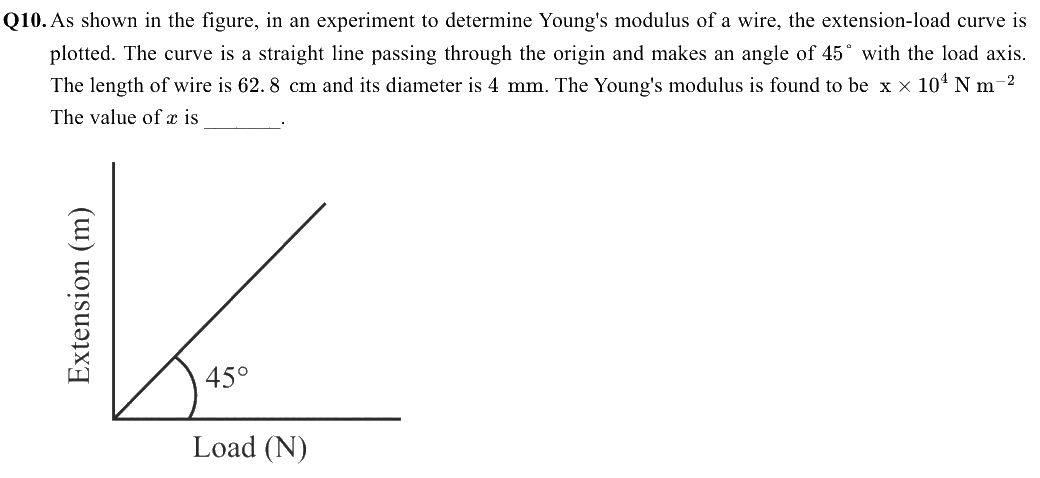
As shown in the figure, in an experiment to determine Young's modulus of a wire, the extension-load curve is plotted. The curve is a straight line passing through the origin and makes an angle of $45^\circ$ with the load axis. The length of wire is $62.8\ \mathrm{cm}$ and its diameter is $4\ \mathrm{mm}$. The Young's modulus is found to be $\mathrm{x \times 10^4\ N\,m^{-2}}$. The value of $x$ is ______.
(see the figure above)

The question and its figure as printed in JEE Main 2023 25 Jan Shift 1.
The question as printed in the paper.
Numerical answer type: type your answer in EdLoop to check it
106JEE Main 2022 · 29 Jul · Shift 2NumericalOpen question page ↗

A metal wire of length 0.5 m and cross-sectional area $10^{-4}\ \mathrm{m^2}$ has breaking stress $5 \times 10^8\ \mathrm{N\ m^{-2}}$. A block of 10 kg is attached at one end of the string and is rotating in a horizontal circle. The maximum linear velocity of block will be ______ $\mathrm{m\ s^{-1}}$.

Numerical answer type: type your answer in EdLoop to check it
107JEE Main 2022 · 28 Jul · Shift 2NumericalOpen question page ↗

A string of area of cross-section $4\ \mathrm{mm^{2}}$ and length $0.5$ is connected with a rigid body of mass $2\ \mathrm{kg}$. The body is rotated in a vertical circular path of radius $0.5\ \mathrm{m}$. The body acquires a speed of $5\ \mathrm{m\,s^{-1}}$ at the bottom of the circular path. Strain produced in the string when the body is at the bottom of the circle is ______ $\times10^{-5}$. (Use Young's modulus $10^{11}\ \mathrm{N\,m^{-2}}$ and $g=10\ \mathrm{m\,s^{-2}}$)

Numerical answer type: type your answer in EdLoop to check it
108JEE Main 2022 · 27 Jul · Shift 1NumericalOpen question page ↗

A square aluminium (shear modulus is $25 \times 10^9$ $\mathrm{Nm^{-2}}$) slab of side 60 cm and thickness 15 cm is subjected to a shearing force (on its narrow face) of $18.0 \times 10^4$ N. The lower edge is riveted to the floor. The displacement of the upper edge is ______ $\mu$m.

Numerical answer type: type your answer in EdLoop to check it
109JEE Main 2022 · 27 Jul · Shift 2NumericalOpen question page ↗

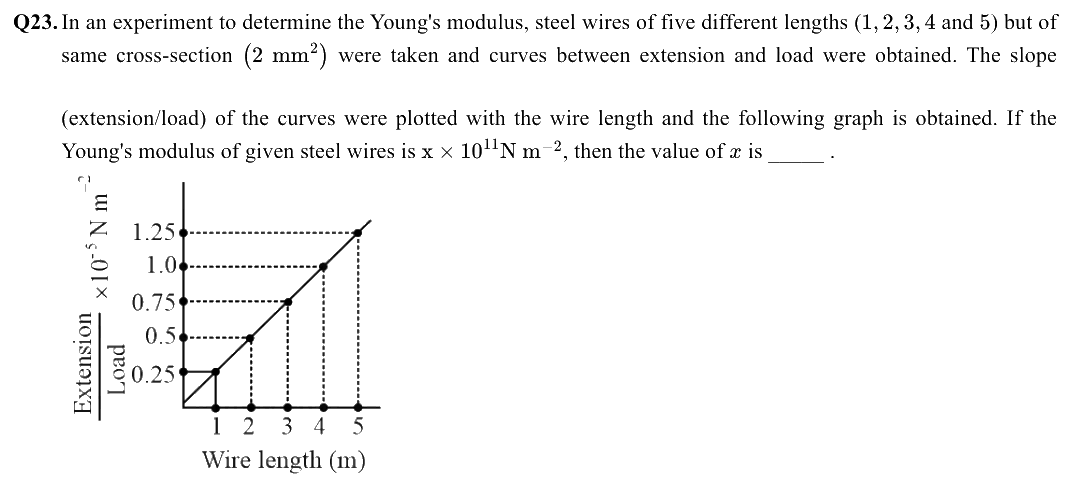
In an experiment to determine the Young's modulus, steel wires of five different lengths (1, 2, 3, 4 and 5) but of same cross-section ($2 \mathrm{~mm^2}$) were taken and curves between extension and load were obtained. The slope (extension/load) of the curves were plotted with the wire length and the following graph is obtained. If the Young's modulus of given steel wires is x $\times$ $10^{11}\mathrm{N~m^{-2}}$, then the value of $x$ is ______ .
(see the figure above)

The question and its figure as printed in JEE Main 2022 27 Jul Shift 2.
The question as printed in the paper.
Numerical answer type: type your answer in EdLoop to check it
110JEE Main 2022 · 26 Jul · Shift 2NumericalOpen question page ↗

A uniform heavy rod of mass $20\ \mathrm{kg}$. Cross sectional area $0.4\ \mathrm{m^2}$ and length $20\ \mathrm{m}$ is hanging from a fixed support. Neglecting the lateral contraction, the elongation in the rod due to its own weight is $x\times10^{-9}$ m. The value of $x$ is ______ .
(Given. Young's modulus $Y = 2\times10^{11}\ \mathrm{Nm^{-2}}$ and $g = 10\ \mathrm{m\ s^{-2}}$ )

Numerical answer type: type your answer in EdLoop to check it
111JEE Main 2022 · 25 Jul · Shift 1NumericalOpen question page ↗

A wire of length $L$ and radius $r$ is clamped rigidly at one end. When the other end of the wire is pulled by a force $F$, its length increases by 5 cm. Another wire of the same material of length $4\ L$ and radius $4r$ is pulled by a force $4\ F$ under same conditions. The increase in length of this wire is ______ cm.

Numerical answer type: type your answer in EdLoop to check it
112JEE Main 2022 · 26 Jun · Shift 1NumericalOpen question page ↗

The elongation of a wire on the surface of the earth is $10^{-4} \mathrm{~m}$. The same wire of same dimensions is elongated by $6 \times 10^{-5} \mathrm{~m}$ on another planet. The acceleration due to gravity on the planet will be ______ $\mathrm{m} \mathrm{~s}^{-2}$. (Take acceleration due to gravity on the surface of earth $= 10 \mathrm{~m} \mathrm{~s}^{-2}$)

Numerical answer type: type your answer in EdLoop to check it
113JEE Main 2022 · 26 Jun · Shift 1NumericalOpen question page ↗

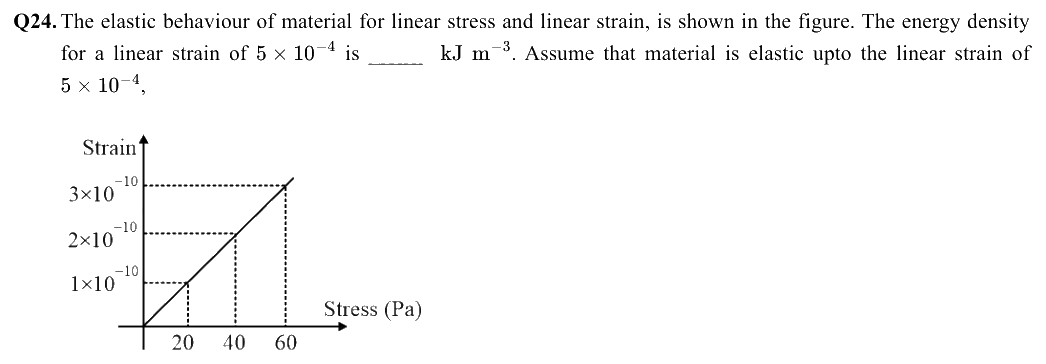
The elastic behaviour of material for linear stress and linear strain, is shown in the figure. The energy density for a linear strain of $5 \times 10^{-4}$ is ______ $\mathrm{kJ} \mathrm{~m}^{-3}$. Assume that material is elastic upto the linear strain of $5 \times 10^{-4}$,
(see the figure above)

The question and its figure as printed in JEE Main 2022 26 Jun Shift 1.
The question as printed in the paper.
Numerical answer type: type your answer in EdLoop to check it
114JEE Main 2021 · 31 Aug · Shift 1NumericalOpen question page ↗

When a rubber ball is taken to a depth of ______ m in deep sea, its volume decreases by $0.5\%$
(The bulk modulus of rubber $= 9.8 \times 10^8$ N m$^{-2}$ Density of sea water $= 10^3$ kg m$^{-3}$,g $= 9.8$ m s$^{-2}$)

Numerical answer type: type your answer in EdLoop to check it
115JEE Main 2021 · 27 Aug · Shift 2NumericalOpen question page ↗

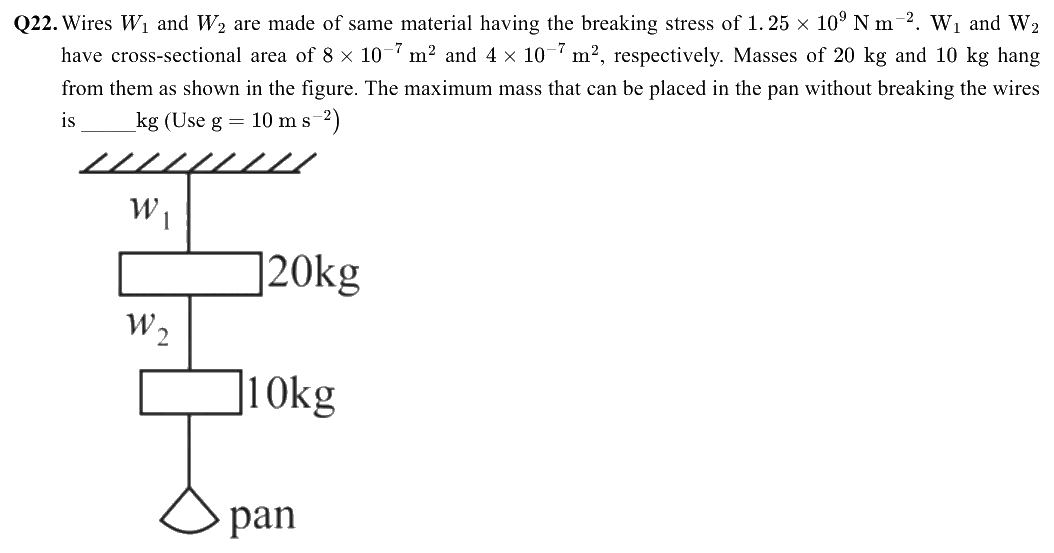
Wires $W_1$ and $W_2$ are made of same material having the breaking stress of $1.25\times10^{9}\ \mathrm{N\ m^{-2}}$. $\mathrm{W_1}$ and $\mathrm{W_2}$ have cross-sectional area of $8\times10^{-7}\ \mathrm{m^{2}}$ and $4\times10^{-7}\ \mathrm{m^{2}}$, respectively. Masses of $20\ \mathrm{kg}$ and $10\ \mathrm{kg}$ hang from them as shown in the figure. The maximum mass that can be placed in the pan without breaking the wires is _____$\mathrm{kg}$ (Use $\mathrm{g}=10\ \mathrm{m\ s^{-2}}$)
(see the figure above)

The question and its figure as printed in JEE Main 2021 27 Aug Shift 2.
The question as printed in the paper.
Numerical answer type: type your answer in EdLoop to check it
116JEE Main 2021 · 27 Jul · Shift 1NumericalOpen question page ↗

A stone of mass $20\ \mathrm{g}$ is projected from a rubber catapult of length $0.1\ \mathrm{m}$ and area of cross section $10^{-6}\ \mathrm{m^2}$ stretched by an amount $0.04\ \mathrm{m}$. The velocity of the projected stone is $\mathrm{m\ s^{-1}}$. (Young's modulus of rubber $= 0.5 \times 10^9\ \mathrm{N\ m^{-2}}$)

Numerical answer type: type your answer in EdLoop to check it
117JEE Main 2021 · 22 Jul · Shift 1NumericalOpen question page ↗

The area of cross-section of a railway track is $0.01\ \mathrm{m}^2$. The temperature variation is $10\ ^\circ\mathrm{C}$. Coefficient of linear expansion of material of track is $10^{-5}\ ^\circ\mathrm{C}^{-1}$. The energy stored per meter in the track is $\mathrm{J\ m^{-1}}$. (Young's modulus of material of track is $10^{11}\ \mathrm{N\ m^{-2}}$)

Numerical answer type: type your answer in EdLoop to check it
118JEE Main 2021 · 18 Mar · Shift 1NumericalOpen question page ↗

Two separate wires $A$ and $B$ are stretched by $2~\mathrm{mm}$ and $4~\mathrm{mm}$ respectively, when they are subjected to a force of $2~\mathrm{N}$. Assume that both the wires are made up of same material and the radius of wire $B$ is 4 times that of the radius of wire $A$. The length of the wires $A$ and $B$ are in the ratio of $a:\ b$. Then $\frac{a}{b}$ can be expressed as $\frac{1}{x}$, where $x$ is ______ .

Numerical answer type: type your answer in EdLoop to check it
119JEE Main 2021 · 24 Feb · Shift 2NumericalOpen question page ↗

A uniform metallic wire is elongated by $0.04\ \mathrm{m}$ when subjected to a linear force $F$. The elongation, if its length and diameter is doubled and subjected to the same force will be ______ cm.

Numerical answer type: type your answer in EdLoop to check it
120JEE Main 2020 · 9 Jan · Shift 1NumericalOpen question page ↗

A body of mass m $= 10$ kg is attached to one end of a wire of length 0.3 m. What is the maximum angular speed (in rad $\mathrm{s^{-1}}$) with which it can be rotated about its other end in a space station without breaking the wire? [Breaking stress of wire $(\sigma)= 4.8 \times 10^7\ \mathrm{N\ m^{-2}}$ and area of cross-section of the wire= $10^{-2}\ \mathrm{cm^2}$]

Numerical answer type: type your answer in EdLoop to check it

How to prepare Elasticity for JEE Main

How often it comes up

Elasticity is a concise and highly practical chapter that offers consistent returns in JEE Main Physics. Across the papers we hold from 2019 to 2026, it supplied 99 questions in 162 papers, which corresponds to 0.6 questions per paper, and was present in 84 of those 162 papers. Over that period, it ranks 25th of 29 Physics chapters, representing 2.2% of all Physics questions.

The chapter has grown in recent exam cycles compared to historical levels. In the AIEEE and early JEE Main years (2002 to 2018), it accounted for 1.6% of Physics; over the recent 2024 to 2026 testing window, it rose to 2.6%, contributing 41 questions across 58 papers. The highest question counts in our set occurred in 2021 (20 questions in 26 papers), followed by 2024 (15 questions in 20 papers) and 2026 (15 questions in 19 papers). Since 2019 there has been no year without it, appearing in 84 of the 162 papers we hold.

Classified under Unit 7: Properties of Solids and Liquids in NTA's Class 11 syllabus, the chapter focuses on material deformation under mechanical and thermal stresses.

Most-asked topics

Between 2019 and 2026, the questions divided into two clear topics:

  • Stress, Strain & Moduli: 77 questions. Tensile stress, longitudinal strain, Young's modulus, shear modulus, bulk modulus, and stress-strain curve interpretation.
  • Elastic Energy & Applications: 22 questions. Strain energy density in stretched wires, spring systems, thermal stress in clamped rods, and stress distribution along heavy suspended ropes.

Both areas appeared in 2026 question sets, and their concise scope makes thorough coverage manageable within a short revision window.

What the questions look like

Modulus questions primarily focus on wire stretching and comparative ratios. A common problem compares two metal wires made of different materials, with given ratios of original length and cross-sectional area, subjected to identical stretching forces or experiencing identical elongations. Students equate tensile stress to Young's modulus multiplied by longitudinal strain to solve for unknown dimensional or material ratios. Other questions evaluate volumetric compression in liquids, where you calculate percentage volume decrease using bulk modulus and applied pressure.

Stress-strain curve problems test qualitative and quantitative understanding of material behavior. Given graphs of strain plotted against stress for multiple substances, you must identify the material possessing the highest Young's modulus by examining reciprocal slopes, or distinguish brittle materials from ductile metals based on their plastic deformation ranges.

Elastic energy problems calculate the work stored inside deformed materials. Standard setups evaluate elastic potential energy stored in a wire under load, or compute the temperature drop required to induce a specified thermal tension in a clamped rod whose thermal contraction is restrained. Another regular problem type evaluates tensile stress at intermediate cross-sections along a heavy suspended rope bearing its own self-weight plus an external load.

Numerical-response problems form an unusually heavy slice of this chapter: 42 of the 99 questions from 2019 to 2026 had no answer choices, making meticulous unit tracking essential.

Questions to try first

These selections from NTA's 2026 papers illustrate the dominant question formats:

How to practise it

Start by mastering the three primary elastic moduli: Young's modulus for longitudinal stretch, shear modulus for shape distortion at constant volume, and bulk modulus for volumetric compression. Write out each definition clearly, ensuring you recognize that strain is a dimensionless ratio while stress and moduli carry units of pressure (N/m² or Pa).

Pay special attention to axes when reading graphical data. Standard physics textbooks place stress on the vertical axis and strain on the horizontal axis, where slope directly yields Young's modulus. However, JEE Main frequently inverts the axes by plotting strain on the vertical axis and stress on the horizontal axis; in such cases, the steepest curve corresponds to the smallest Young's modulus rather than the largest.

For elastic potential energy, practice deriving both total stored energy (half of force times elongation) and energy density (half of stress times strain). When solving thermal stress questions, recognize that prevented thermal contraction equals mechanical elongation, so thermal stress simply equals Young's modulus times the linear expansion coefficient times temperature change.

Frequently asked questions

Is Elasticity regularly tested in JEE Main 2027?

Yes. Elasticity delivered 99 questions across 162 papers in our collection from 2019 to 2026, appearing in 84 of those 162 papers. Because the question patterns are narrow and repetitive, it offers reliable marks for modest preparation time.

Why do so many Elasticity questions appear in numerical format?

Of the 99 questions asked since 2019, 42 were numerical-response questions. The simple formulas make it easy for examiners to test direct multi-digit calculations involving powers of ten and material constants.

How does thermal stress arise in a clamped metal rod?

When a metal rod is clamped rigidly at both ends and cooled, thermal contraction is prevented. The clamps must exert outward tensile forces to hold the length fixed, setting up an internal tensile stress equal to the product of Young's modulus, the linear expansion coefficient, and the temperature drop.

Where can I see the solutions?

Every question on this page opens with its options and answer. Step-by-step solutions for each one are in the EdLoop app.

Get EdLoop – freeOpen on the web