Every Ray Optics question from past JEE Main and AIEEE papers, with options and answers. Newest first.
278questions
184papers covered
5%of Physics questions, 2019–2026
2002–2026years
Guide at a glance
Ray optics investigates geometric image formation under Unit 16: Optics in the Class 12 physics syllabus, holding rank 6 among all 29 physics chapters with a 5.0 percent share of the subject.
A thin biconvex lens is prepared from the glass ($\mu = 1.5$) both curved surfaces of which have equal radii of 20 cm each. Left side surface of the lens is silvered from outside to make it reflecting. To have the position of image and object at the same place, the object should be placed, from the lens at a distance of ________ cm.
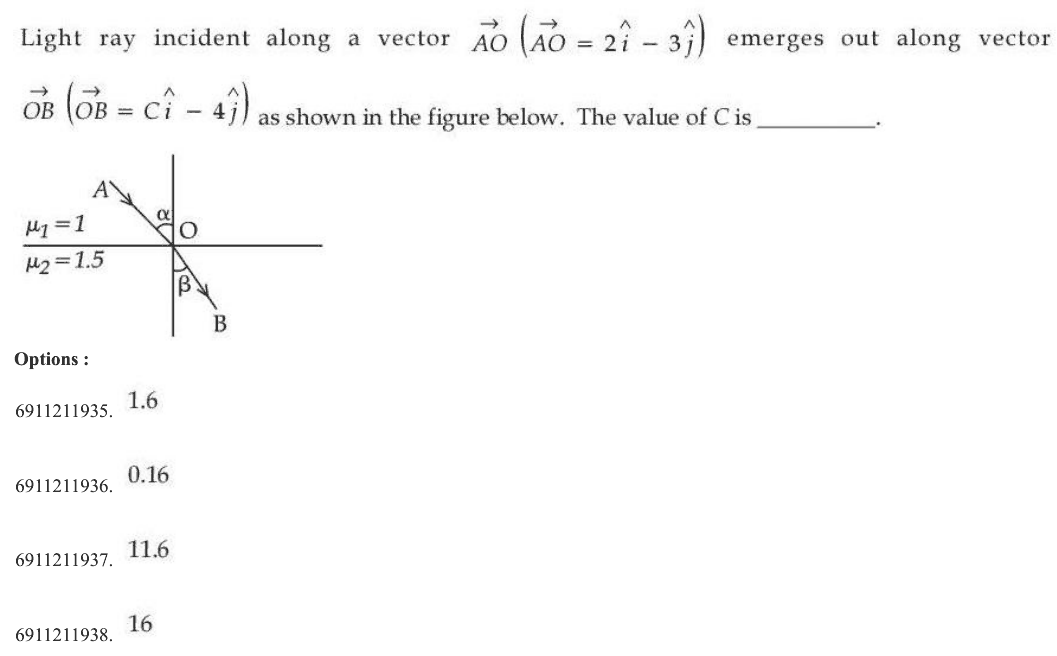
Light ray incident along a vector $\overrightarrow{AO}\left(\overrightarrow{AO} = 2\hat{i} - 3\hat{j}\right)$ emerges out along vector $\overrightarrow{OB}\left(\overrightarrow{OB} = C\hat{i} - 4\hat{j}\right)$ as shown in the figure below. The value of $C$ is ________.
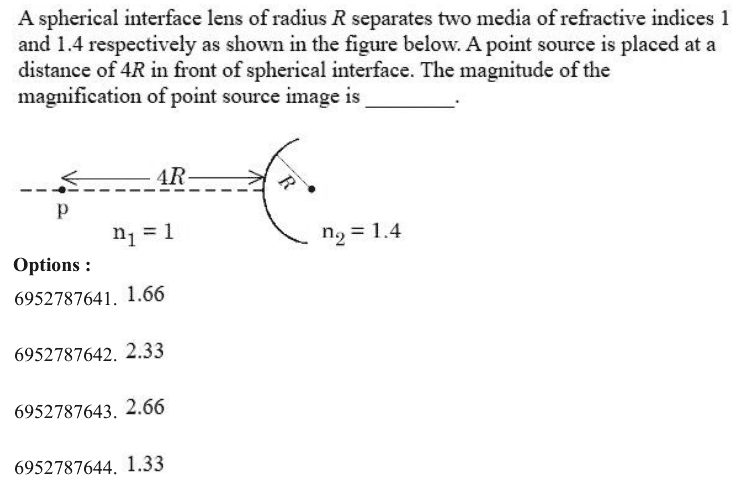
A spherical interface lens of radius $R$ separates two media of refractive indices 1 and 1.4 respectively as shown in the figure below. A point source is placed at a distance of $4R$ in front of spherical interface. The magnitude of the magnification of point source image is ________.
A ray of light passing through an equilateral prism is having velocity $2.12\times10^8$ m/s in the prism material, then the minimum angle of deviation is ________ degrees.
A compound microscope is designed with two symmetric biconvex lenses. The objective lens is cut vertically, creating two identical plano-convex lenses. One of them is used in place of original objective lens. To retain same magnification keeping the object distance unchanged, the tube length has to be
A thin convex lens and a thin concave lens are kept in contact and are co-axial. Which of the following statements is correct for this combination of two lenses ?
A
behaves as concave lens if $|f_{\text{convex}}| > |f_{\text{concave}}|$
B
behaves as concave lens if $|f_{\text{convex}}| < |f_{\text{concave}}|$
C
behaves as convex lens if $|f_{\text{convex}}| > |f_{\text{concave}}|$
D
Focal length of the lens system will change if the positions of two lenses are interchanged
An object $AB$ is placed 15 cm on the left of a convex lens $P$ of focal length 10 cm. Another convex lens $Q$ is now placed 15 cm right of lens $P$. If the focal length of lens $Q$ is 15 cm, the final image is ________.
A
virtual, formed at 7.5 cm right of lens $Q$, with a size bigger than that of $AB$
B
real, formed at 7.5 cm right of lens $Q$, with a size same as that of $AB$
C
formed at infinity.
D
real, formed at 7 cm right of lens $Q$, with a size smaller than that of $AB$
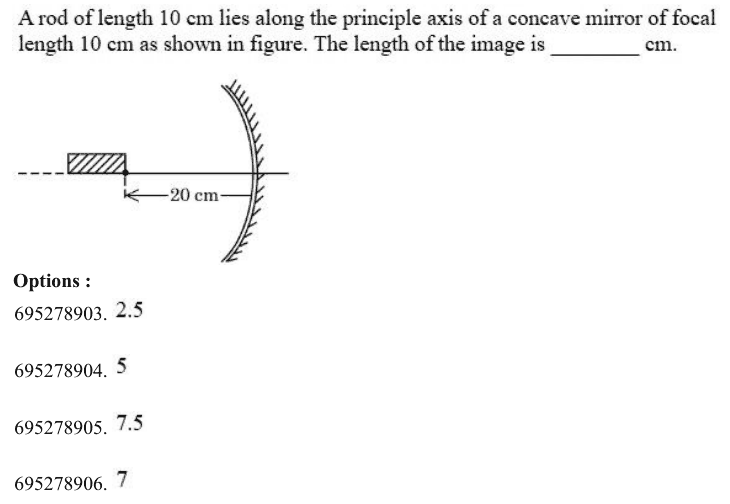
A rod of length 10 cm lies along the principle axis of a concave mirror of focal length 10 cm as shown in figure. The length of the image is ________ cm.
A convex lens is made from glass material having refractive index of 1.4 with same radius of curvature on both sides. The ratio of its focal length and radius of curvature is ________.
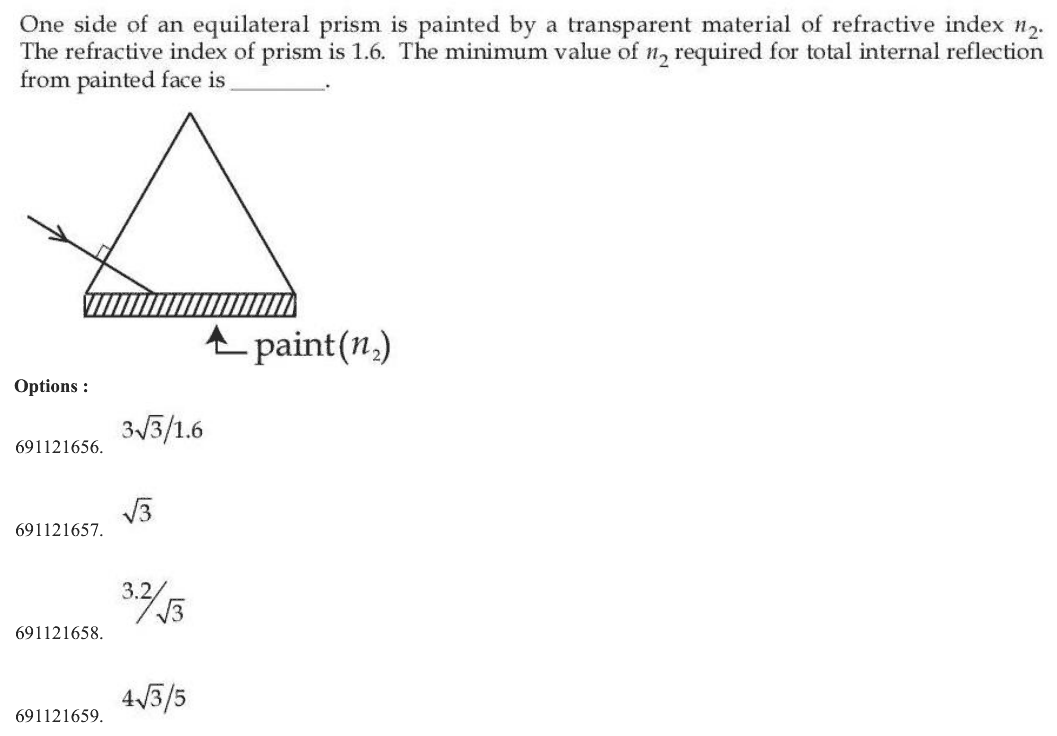
One side of an equilateral prism is painted by a transparent material of refractive index $n_2$. The refractive index of prism is 1.6. The minimum value of $n_2$ required for total internal reflection from painted face is ________.
The magnitudes of power of a biconvex lens (refractive index 1.5) and that of a plano-concave lens (refractive index = 1.7) are same. If the curvature of plano-concave lens exactly matches with the curvature of back surface of the biconvex lens, then ratio of radius of curvature of front and back surface of the biconvex lens is ________.
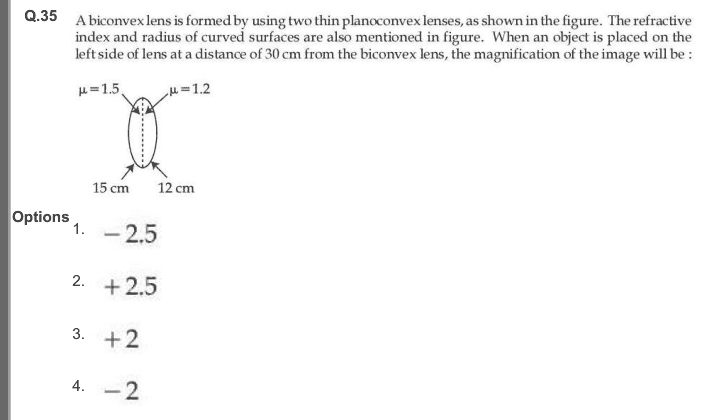
A biconvex lens is formed by using two thin planoconvex lenses, as shown in the figure. The refractive index and radius of curved surfaces are also mentioned in figure. When an object is placed on the left side of lens at a distance of 30 cm from the biconvex lens, the magnification of the image will be :
The exit surface of a prism with refractive index $n$ is coated with a material having refractive index $\dfrac{n}{2}$. When this prism is set for minimum angle of deviation, it exactly meets the condition of critical angle. The prism angle is ________.
In a microscope of tube length 10 cm two convex lenses are arranged with focal length of 2 cm and 5 cm. Total magnification obtained with this system for normal adjustment is $(5)^k$. The value of $k$ is ________.
Five persons $\mathrm{P_1}$, $\mathrm{P_2}$, $\mathrm{P_3}$, $\mathrm{P_4}$ and $\mathrm{P_5}$ recorded object distance (u) and image distance (v) using same convex lens having power $+5$D as (25,96), (30,62), (35,37), (45,35) and (50,32) respectively. Identify correct statement
A
Readings recorded by $\mathrm{P_4}$ and $\mathrm{P_5}$ persons are incorrect
B
Readings recorded by $\mathrm{P_3}$ and $\mathrm{P_2}$ persons are incorrect
C
Readings recorded by all persons are correct
D
Readings recorded by $\mathrm{P_3}$ person are incorrect
A thin prism with angle $5°$ of refractive index 1.72 is combined with another prism of refractive index 1.9 to produce dispersion without deviation. The angle of second prism is ________.
Consider light travelling from a medium $A$ to medium $B$ separated by a plane interface. If the light undergoes total internal reflection during its travel from medium $A$ to $B$ and the speed of light in media $A$ and $B$ are $2.4 \times 10^8$ m/s and $2.7 \times 10^8$ m/s, respectively, then the value of critical angle is :
A prism of angle $75°$ and refractive index $\sqrt{3}$ is coated with thin film of refractive index 1.5 only at the back exit surface. To have total internal reflection at the back exit surface the incident angle must be ________.
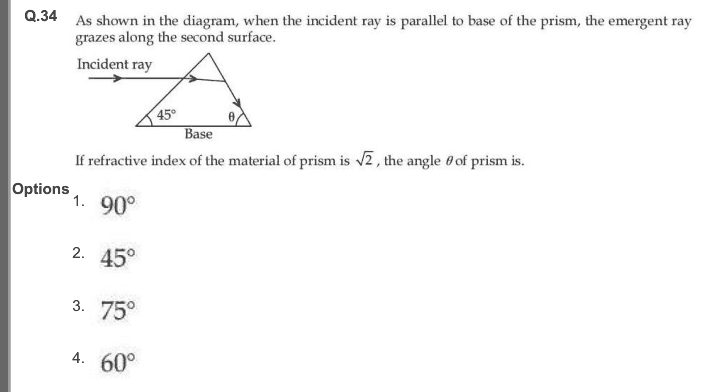
Consider an equilateral prism (refractive index $\sqrt{2}$). A ray of light is incident on its one surface at a certain angle $i$. If the emergent ray is found to graze along the other surface then the angle of refraction at the incident surface is close to ________.
A thin convex lens of focal length 5 cm and a thin concave lens of focal length 4 cm are combined together (without any gap) and this combination has magnification $m_1$ when an object is placed 10 cm before the convex lens. Keeping the positions of convex lens and object undisturbed a gap of 1 cm is introduced between the lenses by moving the concave lens away, which lead to a change in magnification of total lens system to $m_2$. The value of $\left|\dfrac{m_1}{m_2}\right|$ is ________.
The wavelength of light, while it is passing through water is 540 nm. The refractive index of water is $\frac{4}{3}$. The wavelength of the same light when it is passing through a transparent medium having refractive index of $\frac{3}{2}$ is ________ nm.
A convex lens of focal length 30 cm is placed in contact with a concave lens of focal length 20 cm. An object is placed at 20 cm to the left of this lens system. The distance of the image from the lens in cm is ______.
A concave-convex lens of refractive index 1.5 and the radii of curvature of its surfaces are 30 cm and 20 cm, respectively. The concave surface is upwards and is filled with a liquid of refractive index 1.3. The focal length of the liquid-glass combination will be
A lens having refractive index 1.6 has focal length of 12 cm, when it is in air. Find the focal length of the lens when it is placed in water. (Take refractive index of water as 1.28)
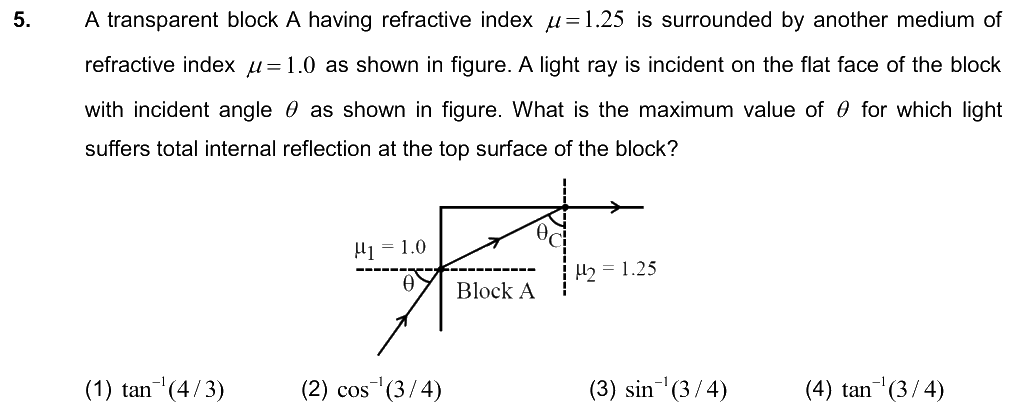
A transparent block A having refractive index $\mu = 1.25$ is surrounded by another medium of refractive index $\mu = 1.0$ as shown in figure. A light ray is incident on the flat face of the block with incident angle $\theta$ as shown in figure. What is the maximum value of $\theta$ for which light suffers total internal reflection at the top surface of the block?
A mirror is used to produce an image with magnification of $\frac{1}{4}$. If the distance between object and its image is 40 cm, then the focal length of the mirror is
When an object is placed 40 cm away from a spherical mirror an image of magnification $\frac{1}{2}$ is produced. To obtain an image with magnification of $\frac{1}{3}$, the object is to be moved :
A finite size object is placed normal to the principal axis at a distance of 30 cm from a convex mirror of focal length 30 cm. A plane mirror is now placed in such a way that the image produced by both the mirrors coincide with each other. The distance between the two mirrors is :
The radii of curvature for a thin convex lens are 10 cm and 15 cm respectively. The focal length of the lens is 12 cm. The refractive index of the lens material is
A monochromatic light of frequency $5 \times 10^{14}Hz$ travelling through air, is incident on a medium of refractive index ' 2 '. Wavelength of the refracted light will be:
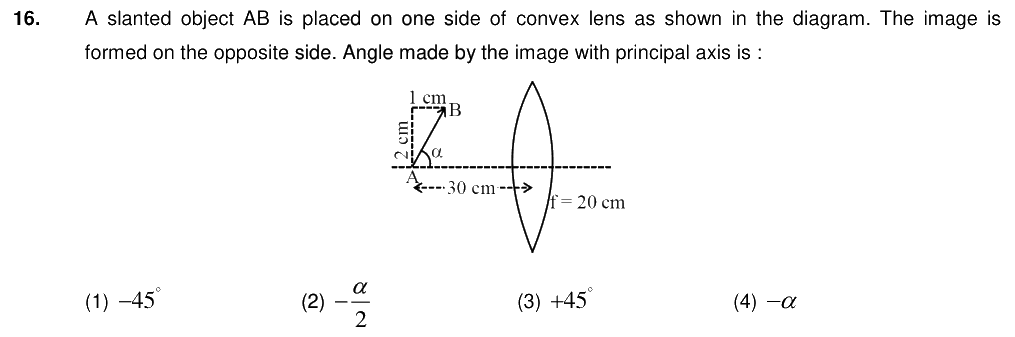
A slanted object AB is placed on one side of convex lens as shown in the diagram. The image is formed on the opposite side. Angle made by the image with principal axis is :
Two identical objects are placed in front of convex mirror and concave mirror having same radii of curvature of 12 cm, at same distance of 18 cm from the respective mirrors. The ratio of sizes of the images formed by convex mirror and by concave mirror is :
A bi-convex lens has radius of curvature of both the surfaces same as $1/6cm$. If this lens is required to be replaced by another convex lens having different radii of curvatures on both sides $(R_1 \neq R_2)$, without any change in lens power then possible combination of $R_1$ and $R_2$ is :
At the interface between two materials having refractive indices $n_1$ and $n_2$, the critical angle for reflection of an em wave is $\theta_{1C}$. The $n_2$ material is replaced by another material having refractive index $n_3$ such that the critical angle at the interface between $n_1$ and $n_3$ materials is $\theta_{2C}$. If $n_3 > n_2 > n_1$; $\frac{n_2}{n_3} = \frac{2}{5}$ and $\sin\theta_{2C} - \sin\theta_{1C} = \frac{1}{2}$, then $\theta_{1C}$ is
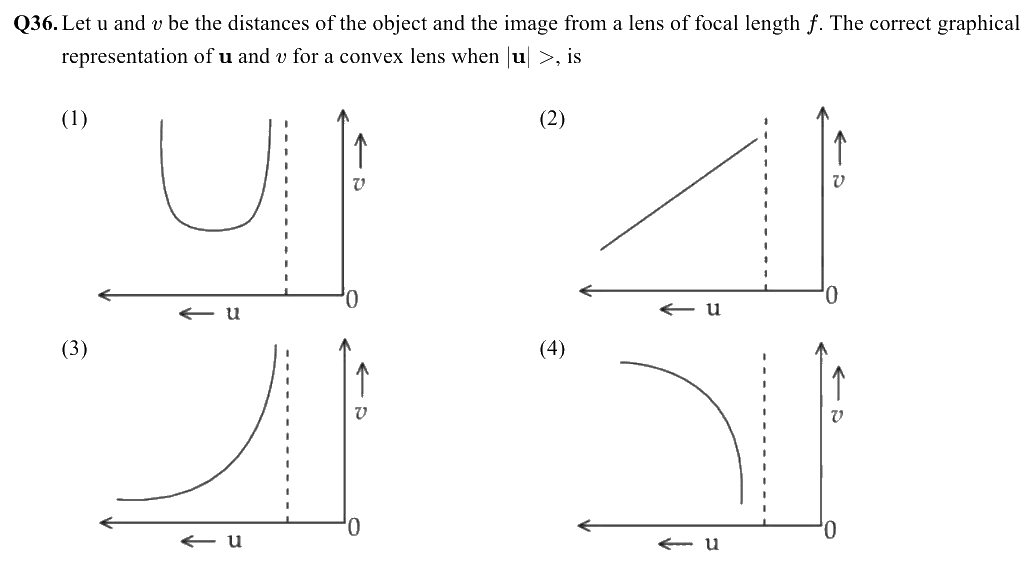
Let u and $v$ be the distances of the object and the image from a lens of focal length $f$. The correct graphical representation of u and $v$ for a convex lens when |u| >, is
The question as printed in the paper.
A
see figure axes 'v' (vertical, arrow up, on the right) and 'u' (horizontal, arrow pointing left, with '0' at the right end where the axes cross); a dashed vertical line to the left of the v axis; a U-shaped curve to the left of the dashed line, standing on the left, with its two arms both rising steeply (the right arm rises close to the dashed line, the left arm rises at the left).
B
see figure same axes and dashed line; a straight line from the lower left rising to the upper right, ending near the dashed line.
C
see figure same axes and dashed line; a curve rising from the lower left, gently at first and then steeply, bending up along the dashed line (concave up, approaching the dashed line from the left).
D
see figure same axes and dashed line; a curve starting at the upper left, bending over and falling steeply toward the horizontal axis at the right, ending near the dashed line (concave down).
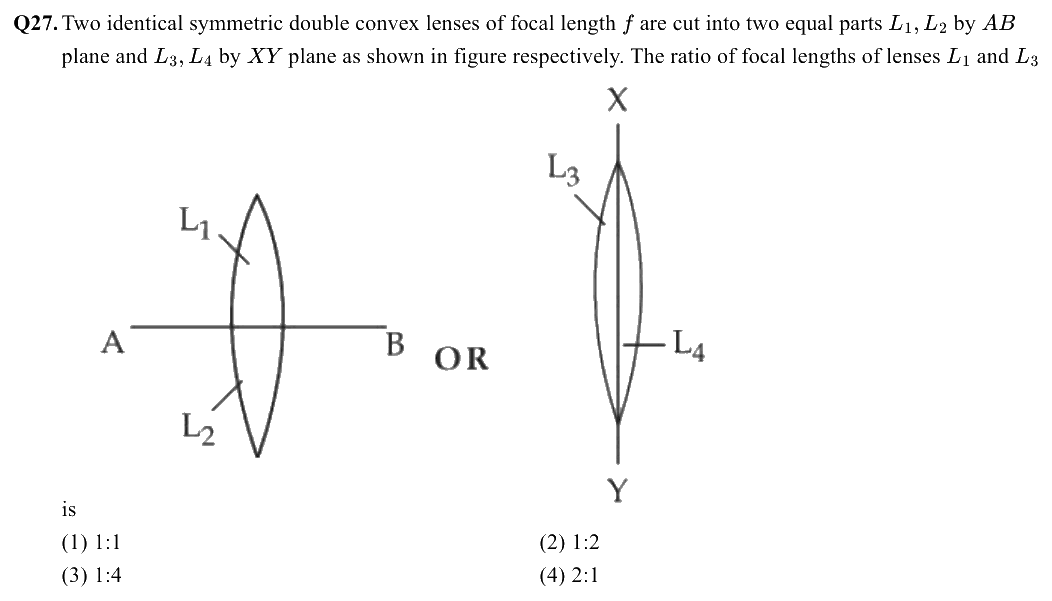
Two identical symmetric double convex lenses of focal length $f$ are cut into two equal parts $L_1, L_2$ by $AB$ plane and $L_3, L_4$ by $XY$ plane as shown in figure respectively. The ratio of focal lengths of lenses $L_1$ and $L_3$ is
A convex lens made of glass (refractive index = 1.5 ) has focal length 24 cm in air. When it is totally immersed in water (refractive index = 1.33 ), its focal length changes to
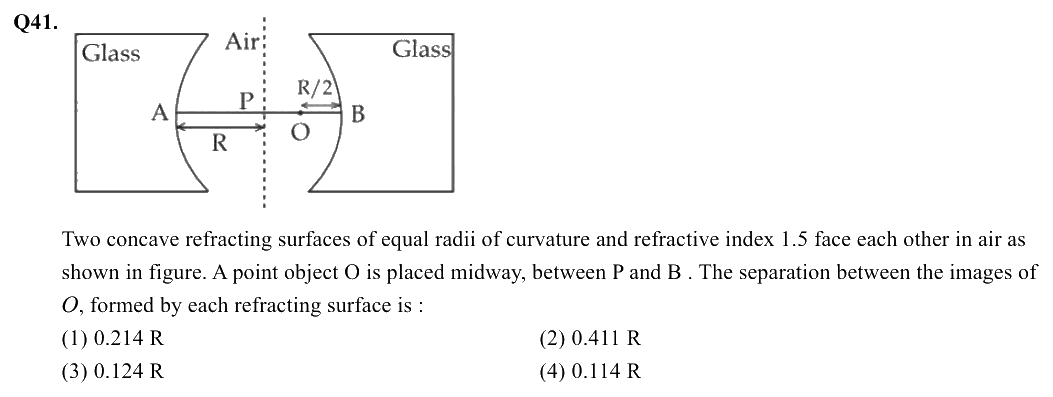
see figure Two concave refracting surfaces of equal radii of curvature and refractive index 1.5 face each other in air as shown in figure. A point object O is placed midway, between P and B . The separation between the images of $O$, formed by each refracting surface is :
A thin prism $\mathrm{P_1}$ with angle $4^\circ$ made of glass having refractive index 1.54 , is combined with another thin prism $\mathrm{P_2}$ made of glass having refractive index 1.72 to get dispersion without deviation. The angle of the prism $\mathrm{P_2}$ in degrees is
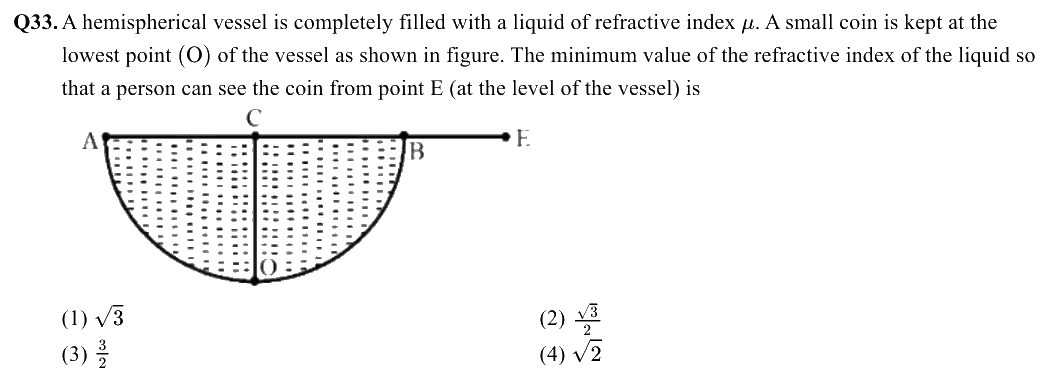
A hemispherical vessel is completely filled with a liquid of refractive index $\mu$. A small coin is kept at the lowest point (O) of the vessel as shown in figure. The minimum value of the refractive index of the liquid so that a person can see the coin from point E (at the level of the vessel) is
A concave mirror produces an image of an object such that the distance between the object and image is 20 cm . If the magnification of the image is ' -3 ', then the magnitude of the radius of curvature of the mirror is :
In a long glass tube, mixture of two liquids A and B with refractive indices 1.3 and 1.4 respectively, forms a convex refractive meniscus towards $A$. If an object placed at 13 cm from the vertex of the meniscus in A forms an image with a magnification of ' $-2'$ then the radius of curvature of meniscus is :
A thin plano convex lens made of glass of refractive index 1.5 is immersed in a liquid of refractive index 1.2. When the plane side of the lens is silver coated for complete reflection, the lens immersed in the liquid behaves like a concave mirror of focal length 0.2 m . The radius of curvature of the curved surface of the lens is
A plano-convex lens having radius of curvature of first surface 2 cm exhibits focal length of $\mathrm{f_1}$ in air. Another plano-convex lens with first surface radius of curvature 3 cm has focal length of $\mathrm{f_2}$ when it is immersed in a liquid of refractive index 1.2 . If both the lenses are made of same glass of refractive index 1.5 , the ratio of $\mathrm{f_1}$ and $\mathrm{f_2}$ will be
A photograph of a landscape is captured by a drone camera at a height of 18 km . The size of the camera film is 2 cm $\times$ 2 cm and the area of the landscape photographed is 400 $\mathrm{km}^2$. The focal length of the lens in the drone camera is :
A spherical surface of radius of curvature $R$, separates air from glass (refractive index = 1.5 ). The centre of curvature is in the glass medium. A point object ' $O$ ' placed in air on the optic axis of the surface, so that its real image is formed at ' $I$ ' inside glass. The line OI intersects the spherical surface at P and PO = PI. The distance PO equals to
Given a thin convex lens (refractive index $\mu_2$ ), kept in a liquid (refractive index $\mu_1, \mu_1 < \mu_2$ ) having radii of curvatures $|R_1|$ and $|R_2|$. Its second surface is silver polished. Where should an object be placed on the optic axis so that a real and inverted image is formed at the same place?
What is the lateral shift of a ray refracted through a parallel-sided glass slab of thickness ' $h$ ' in terms of the angle of incidence ' $i$ ' and angle of refraction ' $r$ ', if the glass slab is placed in air medium?
The refractive index of the material of a glass prism is $\sqrt{3}$. The angle of minimum deviation is equal to the angle of the prism. What is the angle of the prism?
Given is a thin convex lens of glass (refractive index $\mu$ ) and each side having radius of curvature $R$. One side is polished for complete reflection. At what distance from the lens, an object be placed on the optic axis so that the image gets formed on the object itself ?
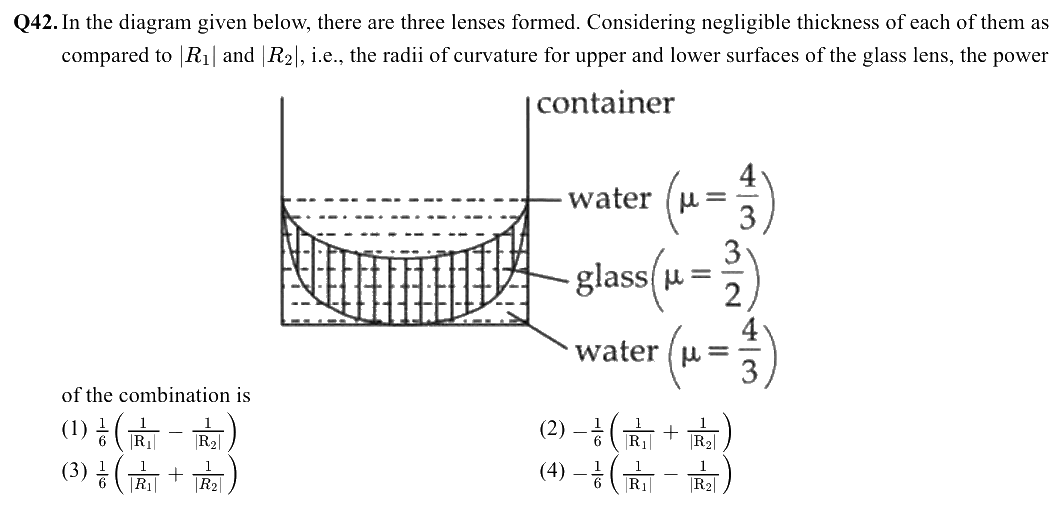
In the diagram given below, there are three lenses formed. Considering negligible thickness of each of them as compared to $|R_1|$ and $|R_2|$, i.e., the radii of curvature for upper and lower surfaces of the glass lens, the power of the combination is
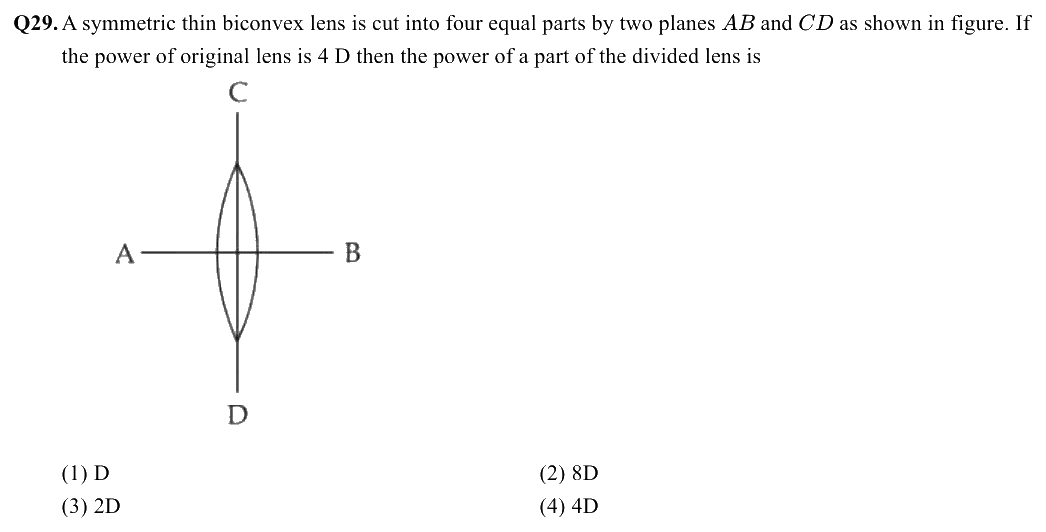
A symmetric thin biconvex lens is cut into four equal parts by two planes $AB$ and $CD$ as shown in figure. If the power of original lens is 4 D then the power of a part of the divided lens is
Given below are two statements : Statement (I) : When an object is placed at the centre of curvature of a concave lens, image is formed at the centre of curvature of the lens on the other side. Statement (II) : Concave lens always forms a virtual and erect image. In the light of the above statements, choose the correct answer from the options given below :
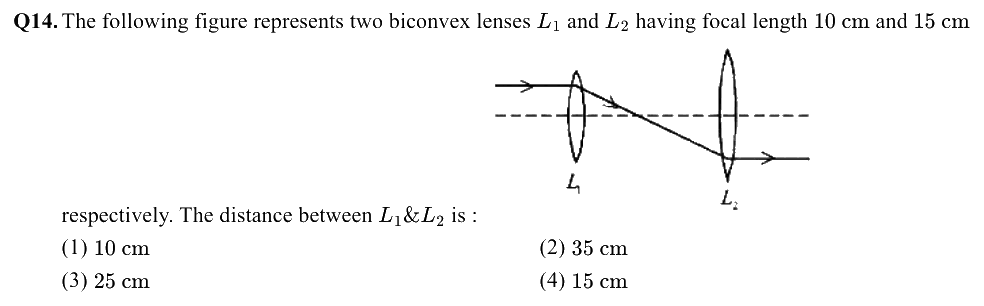
The following figure represents two biconvex lenses $L_1$ and $L_2$ having focal length 10 cm and 15 cm respectively. The distance between $L_1$ & $L_2$ is :
For the thin convex lens, the radii of curvature are at 15 cm and 30 cm respectively. The focal length the lens is 20 cm. The refractive index of the material is :
Given below are two statements : Statement I : When the white light passed through a prism, the red light bends lesser than yellow and violet. Statement II : The refractive indices are different for different wavelengths in dispersive medium. In the light of the above statements, chose the correct answer from the options given below:
An effective power of a combination of 5 identical convex lenses which are kept in contact along the principal axis is 25D. Focal length of each of the convex lens is :
A biconvex lens of refractive index 1.5 has a focal length of 20 cm in air. Its focal length when immersed in a liquid of refractive index 1.6 will be:
If the distance between object and its two times magnified virtual image produced by a curved mirror is 15 cm, the focal length of the mirror must be :
If the refractive index of the material of a prism is $\cot\left(\frac{A}{2}\right)$, where $A$ is the angle of prism then the angle of minimum deviation will be
A vessel of depth $d$ is half filled with oil of refractive index $n_1$ and the other half is filled with water of refractive index $n_2$. The apparent depth of this vessel when viewed from above will be-
An ice cube has a bubble inside. When viewed from one side the apparent distance of the bubble is 12 cm. When viewed from the opposite side, the apparent distance of the bubble is observed as 4 cm. If the side of the ice cube is 24 cm, the refractive index of the ice cube is
The critical angle of the denser-rarer interface is $45^\circ$. The speed of light in rarer medium is $3 \times 10^{8}\ \mathrm{m\ s^{-1}}$. The speed of light in the denser medium is:
An object is placed at a distance of 12 cm in front of a plane mirror. The virtual and erect image is formed by the mirror. Now the mirror is moved by 4 cm towards the stationary object. The distance by which the position of image would be shifted, will be
A monochromatic light wave with wavelength $\lambda_1$ and frequency $\nu_1$ in air enters another medium. If the angle of incidence and angle of refraction at the interface are $45^\circ$ and $30^\circ$ respectively, then the wavelength $\lambda_2$ and frequency $\nu_2$ of the refracted wave are:
Two objects $A$ and $B$ are placed at 15 $\mathrm{cm}$ and 25 $\mathrm{cm}$ from the pole in front of a concave mirror having radius of curvature 40 $\mathrm{cm}$. The distance between images formed by the mirror is:
A microscope is focused on an object at the bottom of a bucket. If liquid with refractive index $\frac{5}{3}$ is poured inside the bucket, then microscope have to be raised by 30 cm to focus the object again. The height of the liquid in the bucket is :
A person has been using spectacles of power $-1.0$ diopter for distant vision and a separate reading glass of power 2.0 diopters. What is the least distance of distinct vision for this person:
A thin prism $P_1$ with an angle 6$^\circ$ and made of glass of refractive index 1.54 is combined with another prism $P_2$ made from glass of refractive index 1.72 to produce dispersion without average deviation. The angle of prism $P_2$ is :
A scientist is observing a bacteria through a compound microscope. For better analysis and to improve its resolving power he should. (Select the best option)
A
Increase the wave length of the light
B
Increase the refractive index of the medium between the object and objective lens
When a beam of white light is allowed to pass through convex lens parallel to principal axis, the different colours of light converge at different point on the principle axis after refraction. This is called :
Light enters from air into a given medium at an angle of $45^\circ$ with interface of the air-medium surface. After refraction, the light ray is deviated through an angle of $15^\circ$ from its original direction. The refractive index of the medium is :
In normal adjustment, for a refracting telescope, the distance between objective and eye piece is $30\ \mathrm{cm}$. The focal length of the objective, when the angular magnification of the telescope is 2, will be:
The power of a lens (biconvex) is $1.25\ \mathrm{m^{-1}}$ in particular medium. Refractive index of the lens is $1.5$ and radii of curvature are $20\ \mathrm{cm}$ and $40\ \mathrm{cm}$ respectively. The refractive index of surrounding medium:
A microscope was initially placed in air (refractive index 1). It is then immersed in oil (refractive index 2). For a light whose wavelength in air is $\lambda$, calculate the change of microscope's resolving power due to oil and choose the correct option
A
Resolving power will be $\frac{1}{4}$ in the oil than it was in the air
B
Resolving power will be twice in the oil than it was in the air.
C
Resolving power will be four times in the oil than it was in the air.
D
Resolving power will be $\frac{1}{2}$ in the oil than it was in the air.
Light travels in two media $M_1$ and $M_2$ with speeds $1.5\times10^{8}\ \mathrm{m\ s^{-1}}$ and $2.0\times10^{8}\ \mathrm{m\ s^{-1}}$ respectively. The critical angle between them is
Time taken by light to travel in two different materials $A$ and $B$ of refractive indices $\mu_A$ and $\mu_B$ of same thickness is $t_1$ and $t_2$ respectively. If $t_2$ - $t_1 = 5\times10^{-10}$s and the ratio of $\mu_A$ to $\mu_B$ is 1: 2. Then the thickness of material, in meter is: (Given $v_A$ and $v_B$ are velocities of light in $A$ and $B$ materials respectively.)
For an object placed at a distance $2.4\ \mathrm{m}$ from a lens, a sharp focused image is observed on a screen placed at a distance $12\ \mathrm{cm}$ from the lens. A glass plate of refractive index $1.5$ and thickness $1\ \mathrm{cm}$ is introduced between lens and screen such that the glass plate plane faces parallel to the screen. By what distance should the object be shifted so that a sharp focused image is observed again on the screen?
The speed of light in media 'A' and 'B' are $2.0 \times 10^{10}\ \mathrm{cm\,s^{-1}}$ and $1.5 \times 10^{10}\ \mathrm{cm\,s^{-1}}$ respectively. A ray of light enters from the medium $B$ to $A$ at an incident angle '$\theta$'. If the ray suffers total internal reflection, then
The refracting angle of a prism is $A$ and refractive index of the material of the prism is $\cot\left(\dfrac{A}{2}\right)$. Then the angle of minimum deviation will be
The aperture of the objective is $24.4\ \mathrm{cm}$. The resolving power of this telescope, if a light of wavelength $2440\ \mathrm{\AA}$ is used to see the object will be
Consider a light ray travelling in air is incident into a medium of refractive index $\sqrt{2n}$. The incident angle is twice that of refracting angle. Then, the angle of incidence will be
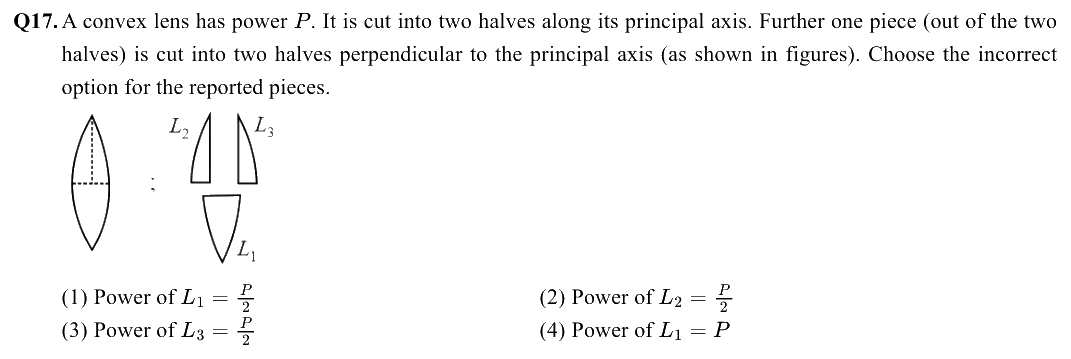
A convex lens has power $P$. It is cut into two halves along its principal axis. Further one piece (out of the two halves) is cut into two halves perpendicular to its principal axis (as shown in figures). Choose the incorrect option for the reported pieces. (see the figure above)
A light wave travelling linearly in a medium of dielectric constant 4, incidents on the horizontal interface separating medium with air. The angle of incidence for which the total intensity of incident wave will be reflected back into the same medium will be : (Given : relative permeability of medium $\mu_r = 1$)
The difference of speed of light in the two media $A$ and $B$ $v_A - v_B$ is $2.6 \times 10^7 \mathrm{~m} \mathrm{~s}^{-1}$. If the refractive index of medium $B$ is $1.47$, then the ratio of refractive index of medium $B$ to medium $A$ is: (Given : speed of light in vacuum $c = 3 \times 10^8 \mathrm{~m} \mathrm{~s}^{-1}$)
A glass tumbler having inner depth of $17.5$ cm is kept on a table. A student starts pouring water $\mu = \frac{4}{3}$ into it while looking at the surface of water from the above. When he feels that the tumbler is half filled, he stops pouring water. Up to what height, the tumbler is actually filled ?
An object is placed at the focus of concave lens having focal length $f$. What is the magnification and distance of the image from the optical centre of the lens?
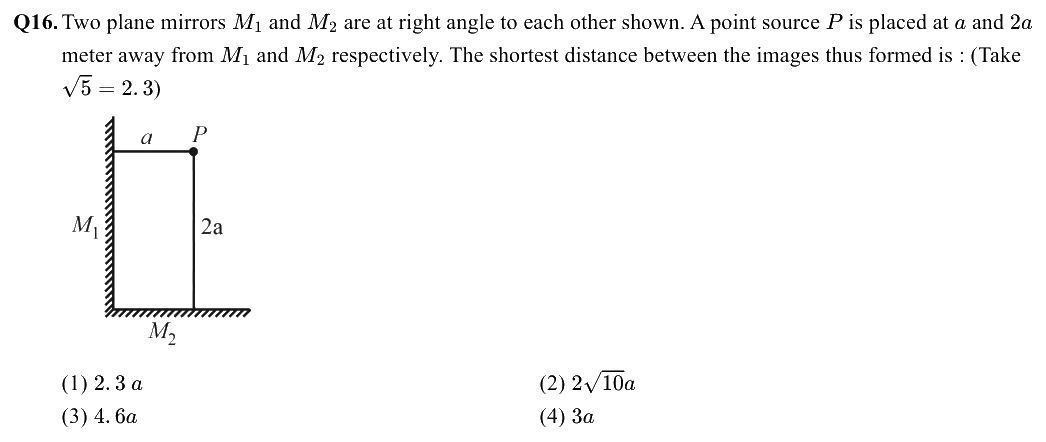
Two plane mirrors $M_1$ and $M_2$ are at right angle to each other shown. A point source $P$ is placed at $a$ and $2a$ meter away from $M_1$ and $M_2$ respectively. The shortest distance between the images thus formed is : (Take $\sqrt{5} = 2.3$) (see the figure above)
An object is placed beyond the centre of curvature $C$ of the given concave mirror. If the distance of the object is $d_1$ from $C$ and the distance of the image formed is $d_2$ from $C$, the radius of curvature of this mirror is:
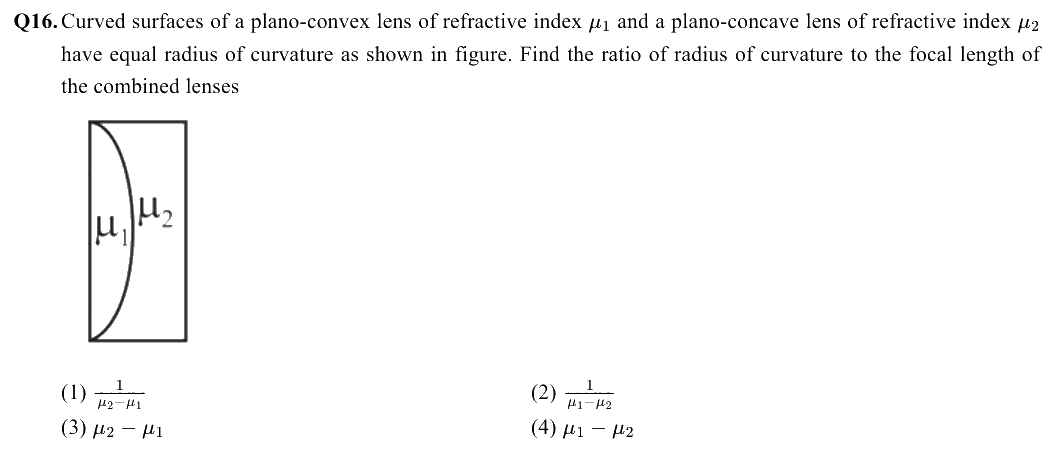
Curved surfaces of a plano-convex lens of refractive index $\mu_1$ and a plano-concave lens of refractive index $\mu_2$ have equal radius of curvature as shown in figure. Find the ratio of radius of curvature to the focal length of the combined lenses (see the figure above)
Car $B$ overtakes another car $A$ at a relative speed of $40\ \mathrm{m\ s^{-1}}$. How fast will the image of car $B$ appear to move in the mirror of focal length $10\ \mathrm{cm}$ fitted in car $A$, when the car $B$ is $1.9\ \mathrm{m}$ away from the car $A$?
A ray of laser of a wavelength $630\ \mathrm{nm}$ is incident at an angle of $30^\circ$ at the diamond-air interface. It is going from diamond to air. The refractive index of diamond is $2.42$ and that of air is 1. Choose the correct option.
A prism of refractive index $\mu$ and angle of prism $A$ is placed in the position of minimum angle of deviation. If minimum angle of deviation is also $A$, then in terms of refractive index, the angle of prism $A$ is
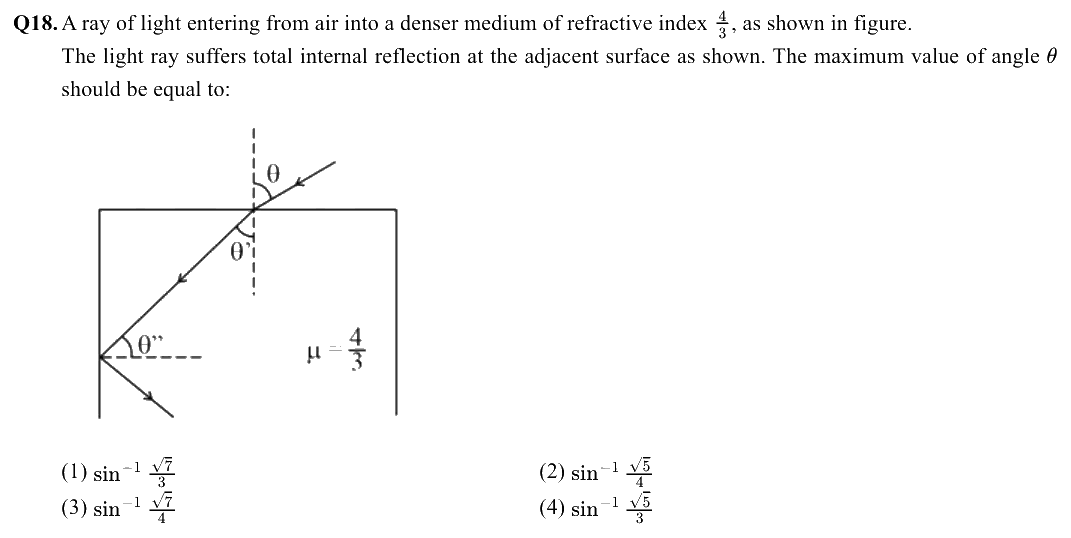
A ray of light entering from air into a denser medium of refractive index $\frac{4}{3}$, as shown in figure. The light ray suffers total internal reflection at the adjacent surface as shown. The maximum value of angle $\theta$ should be equal to: (see the figure above)
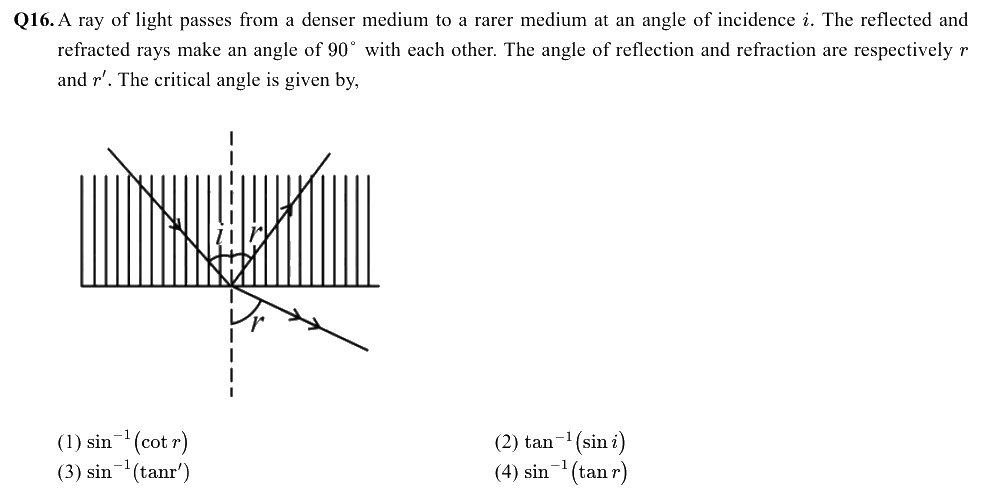
A ray of light passes from a denser medium to a rarer medium at an angle of incidence $i$. The reflected and refracted rays make an angle of $90^\circ$ with each other. The angle of reflection and refraction are respectively $r$ and $r'$. The critical angle is given by, (see the figure above)
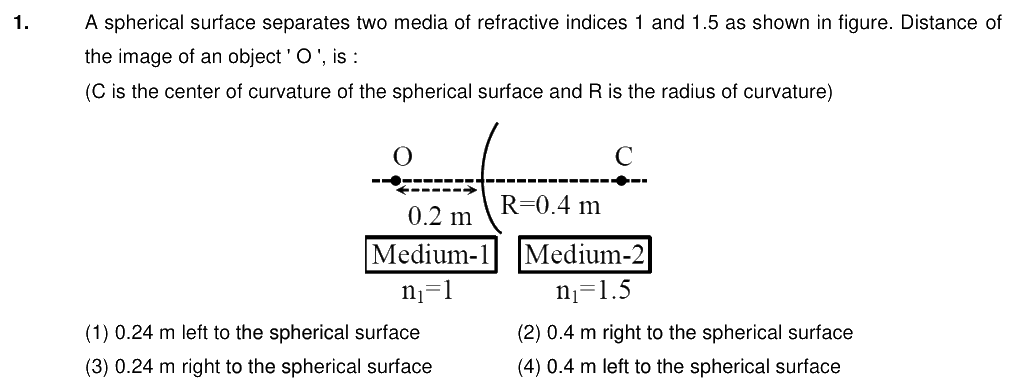
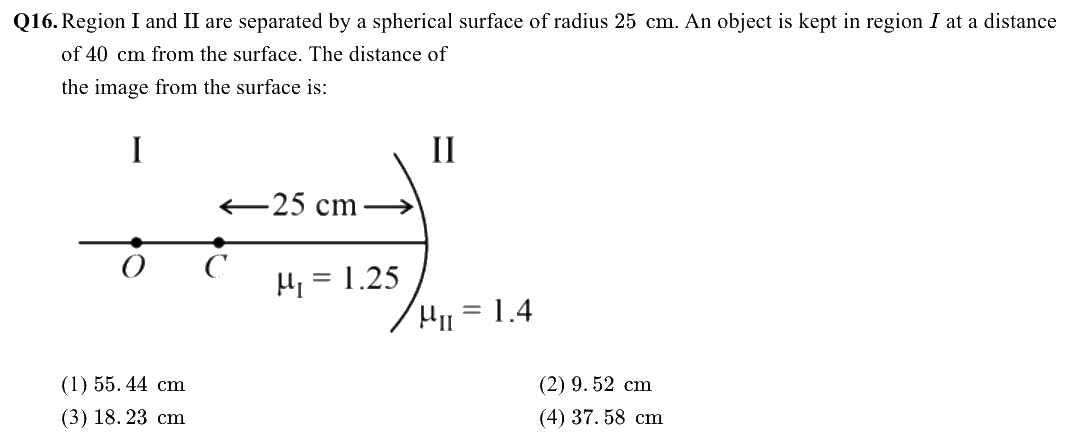
Region I and II are separated by a spherical surface of radius $25\ \mathrm{cm}$. An object is kept in region $I$ at a distance of $40\ \mathrm{cm}$ from the surface. The distance of the image from the surface is: (see the figure above)
Your friend is having eye sight problem. She is not able to see clearly a distant uniform window mesh and it appears to her as nonuniform and distorted. The doctor diagnosed the problem as :
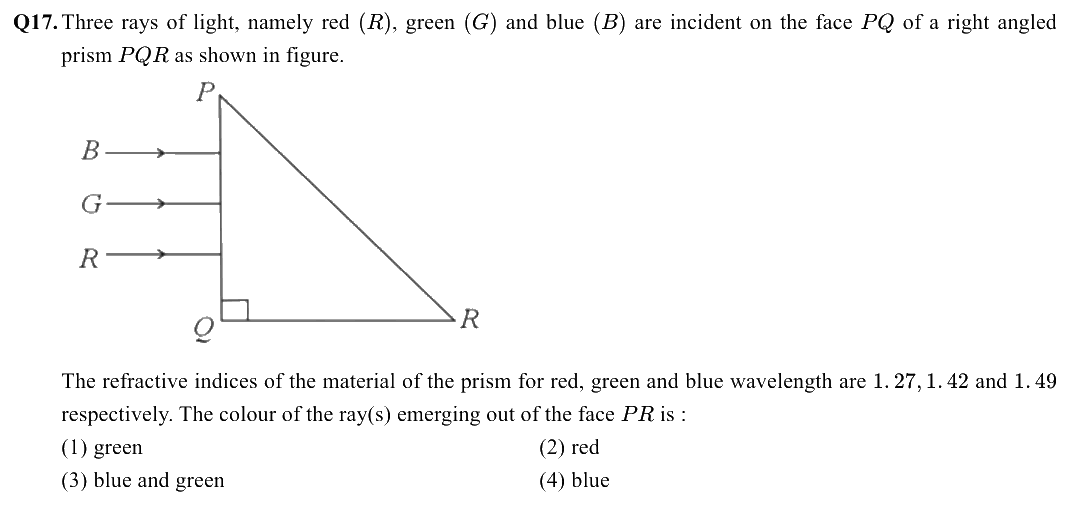
Three rays of light, namely red $(R)$, green $(G)$ and blue $(B)$ are incident on the face $PQ$ of a right angled prism $PQR$ as shown in figure. (see the figure above) The refractive indices of the material of the prism for red, green and blue wavelength are $1.27, 1.42$ and $1.49$ respectively. The colour of the ray(s) emerging out of the face $PR$ is :
The thickness at the centre of a plano convex lens is $3 \mathrm{~mm}$ and the diameter is $6 \mathrm{~cm}$. If the speed of light in the material of the lens is $2 \times 10^8 \mathrm{~m} \mathrm{~s}^{-1}$. The focal length of the lens is ______.
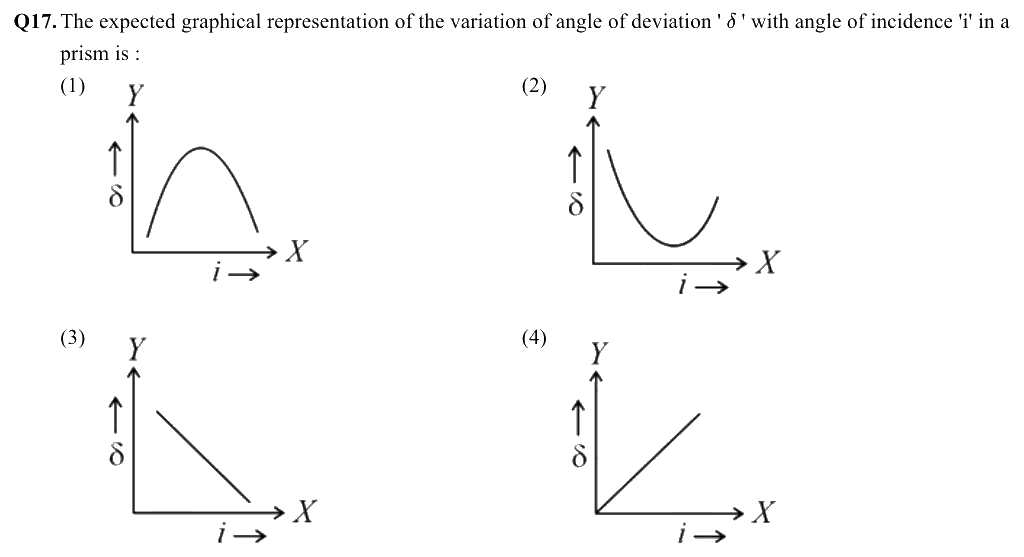
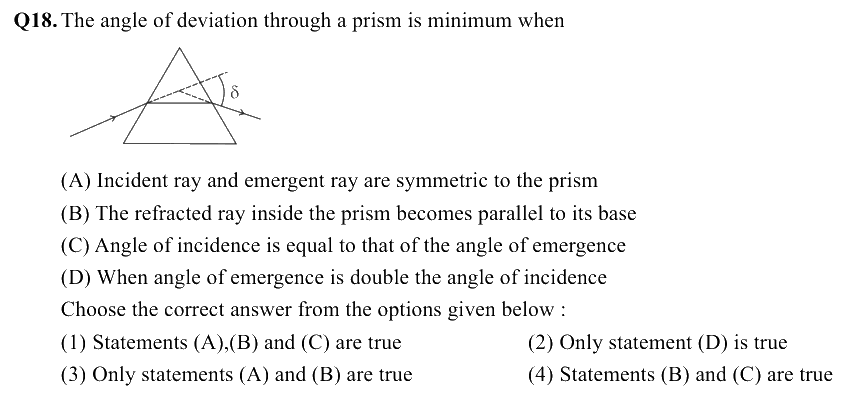
The angle of deviation through a prism is minimum when (see the figure above) (A) Incident ray and emergent ray are symmetric to the prism (B) The refracted ray inside the prism becomes parallel to its base (C) Angle of incidence is equal to that of the angle of emergence (D) When angle of emergence is double the angle of incidence Choose the correct answer from the options given below :
The refractive index of a converging lens is $1.4$. What will be the focal length of this lens if it is placed in a medium of same refractive index ? (Assume the radii of curvature of the faces of lens are $R_1$ and $R_2$ respectively)
A short straight object of height $100\ \mathrm{cm}$ lies before the central axis of a spherical mirror whose focal length has absolute value $|f| = 40\ \mathrm{cm}$. The image of object produced by the mirror is of height $25\ \mathrm{cm}$ and has the same orientation of the object. One may conclude from the information:
A
Image is real, same side of convex mirror.
B
Image is virtual, opposite side of concave mirror.
Given below are two statements : one is labeled as Assertion $A$ and the other is labeled as Reason $R$. Assertion $A$: For a simple microscope, the angular size of the object equals the angular size of the image. Reason $R$: Magnification is achieved as the small object can be kept much closer to the eye than $25\ \mathrm{cm}$ and hence it subtends a large angle. In the light of the above statements, choose the most appropriate answer from the options given below:
A
$A$ is false but $R$ is true
B
Both $A$ and $R$ are true but $R$ is NOT the correct explanation of $A$
C
$A$ is true but $R$ is false
D
Both $A$ and $R$ are true and $R$ is the correct explanation of $A$
The incident ray, reflected ray and the outward drawn normal are denoted by the unitvectors $\vec{a}$, $\vec{b}$and $\vec{c}$ respectively. Then choose the correct relation for these vectors.
A point like object is placed at distance of $1\mathrm{m}$ in front of a convex lens of focal length $0.5\mathrm{m}$. A plane mirror is placed at a distance of $2\mathrm{m}$ behind the lens. The position and nature of the image formed by the system is
A double convex lens has power P and same radii of curvature r of both the surfaces. The radius of curvature of a surface of a plano-convex lens made of the same material with power $1.5\ \mathrm{P}$ is :
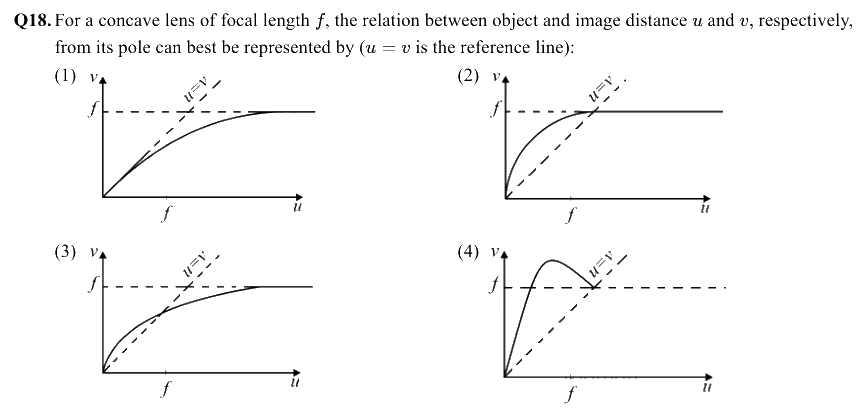
For a concave lens of focal length $f$, the relation between object and image distance $u$ and $v$, respectively, from its pole can best be represented by ($u = v$ is the reference line): (see the figure above)
The question as printed in the paper.
A
see figure v versus u graph: a curve starting at the origin tangent to the dashed u = v line, staying below it throughout, and flattening to the horizontal dashed line v = f.
B
see figure v versus u graph: a curve rising steeply from the origin above the u = v line, crossing the dashed u = v line near v = f and then flat at v = f.
C
see figure v versus u graph: a curve rising steeply from the origin above the dashed u = v line, crossing it below v = f, then flattening to the horizontal dashed line v = f.
D
see figure v versus u graph: a curve rising steeply from the origin to a peak above f, then falling to meet the u = v line at v = f and continuing along it.
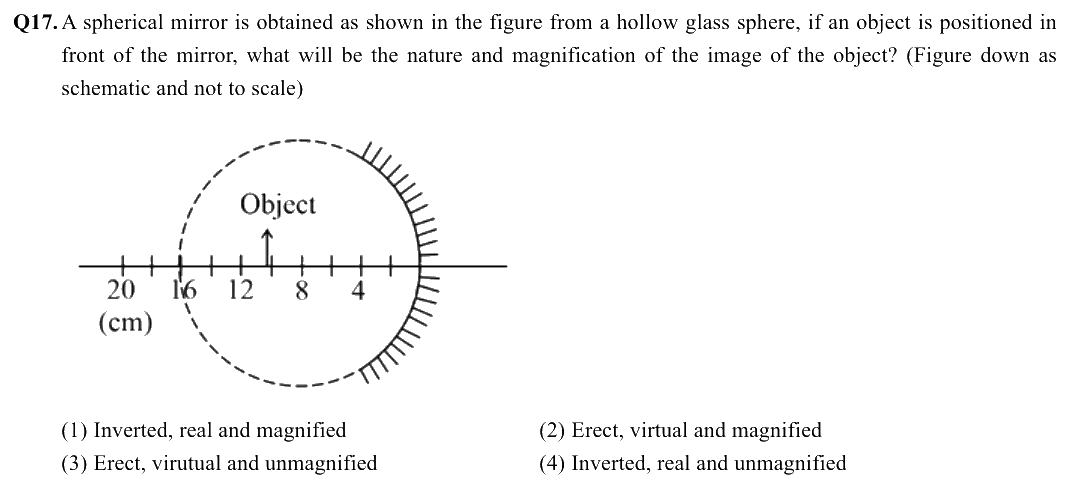
A spherical mirror is obtained as shown in the figure from a hollow glass sphere, if an object is positioned in front of the mirror, what will be the nature and magnification of the image of the object? (Figure down as schematic and not to scale) (see the figure above)
A vessel of depth $2h$ is half filled with a liquid of refractive index $2\sqrt{2}$ and the upper half with another liquid of refractive index $\sqrt{2}$ . The liquids are immiscible. The apparent depth of the inner surface of the bottom of the vessel will be
There is a small source of light at some depth below the surface of water (refractive index $= \frac{4}{3}$ ) in a tank of large cross sectional surface area. Neglecting any reflection from the bottom and absorption by water, percentage of light that emerges out of surface is (nearly): [Use the fact that surface area of a spherical cap of height $h$ and radius of curvature $r$ is $2\pi rh$ ]
The critical angle of a medium for a specific wavelength, if the medium has relative permittivity 3 and relative permeability $\frac{4}{3}$ for this wavelength, will be:
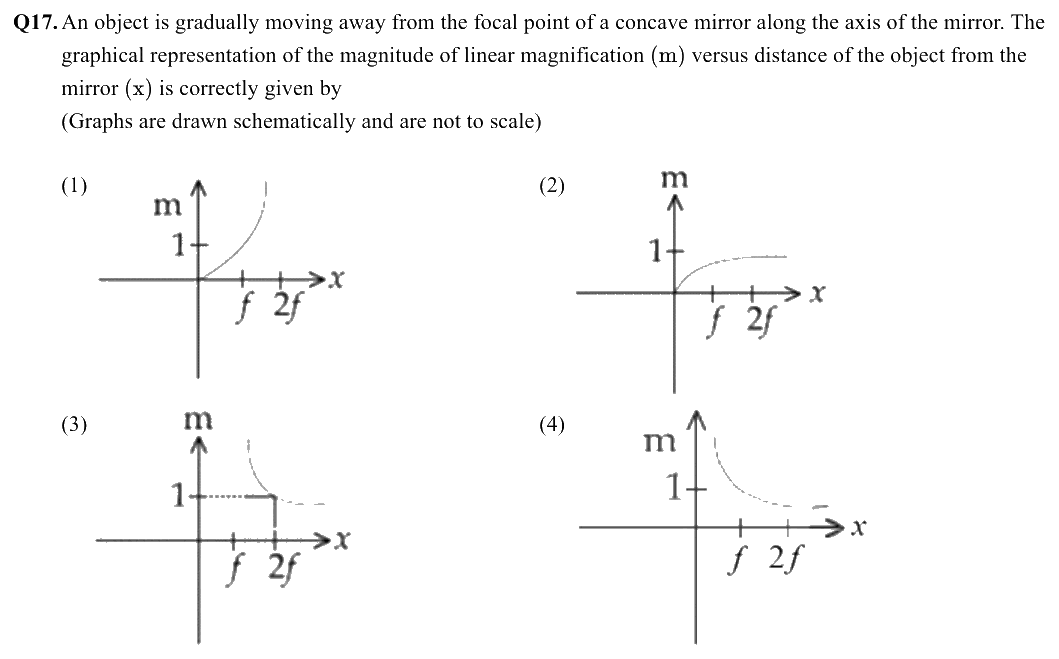
An object is gradually moving away from the focal point of a concave mirror along the axis of the mirror. The graphical representation of the magnitude of linear magnification ($\mathrm{m}$) versus distance of the object from the mirror ($\mathrm{x}$) is correctly given by (Graphs are drawn schematically and are not to scale)
If we need a magnification of 375 from a compound microscope of tube length $150\mathrm{mm}$ and an objective of focal length $5\mathrm{mm}$, the focal length of the eye-piece, should be close to:
A thin lens made of glass (refractive index $= 1.5$ ) of focal length $f = 16\mathrm{cm}$ is immersed in a liquid of refractive index $1.42$. If its focal length in liquid is $f_l$, then the ratio $f_l/f$ is closest to the integer:
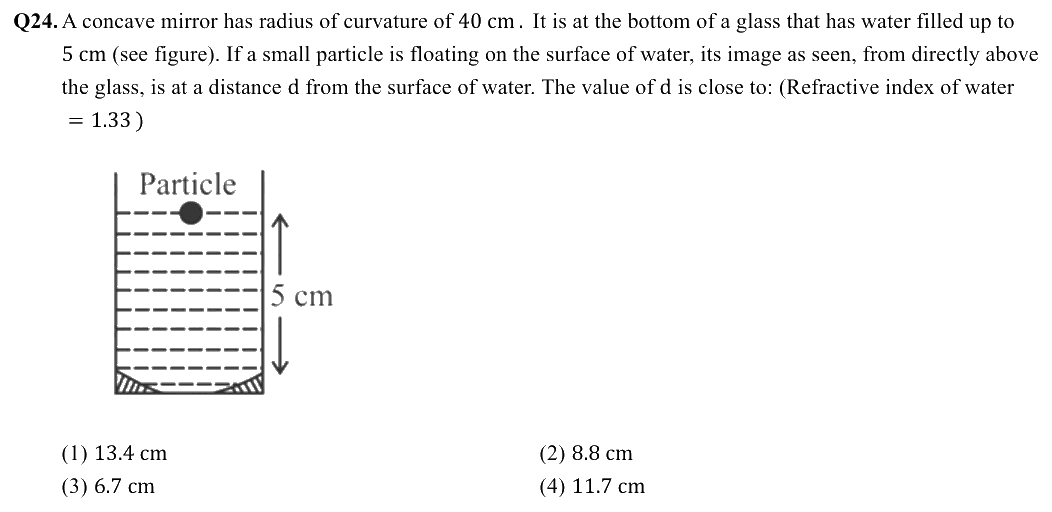
A concave mirror has radius of curvature of 40 cm . It is at the bottom of a glass that has water filled up to 5 cm (see figure). If a small particle is floating on the surface of water, its image as seen, from directly above the glass, is at a distance d from the surface of water. The value of d is close to: (Refractive index of water $= 1.33$ ) (see the figure above)
The value of numerical aperture of the objective lens of a microscope is 1.25 . If light of wavelength 5000 Å is used, the minimum separation between two points, to be seen as distinct, will be:
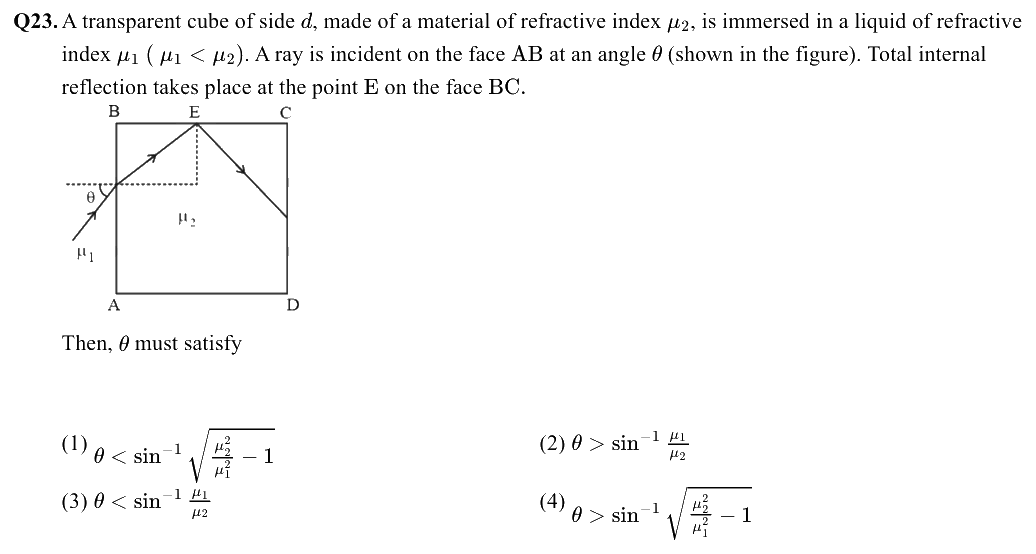
A transparent cube of side $d$, made of a material of refractive index $\mu_2$, is immersed in a liquid of refractive index $\mu_1$ ( $\mu_1 < \mu_2$). A ray is incident on the face AB at an angle $\theta$ (shown in the figure). Total internal reflection takes place at the point E on the face BC. (see the figure above) Then, $\theta$ must satisfy
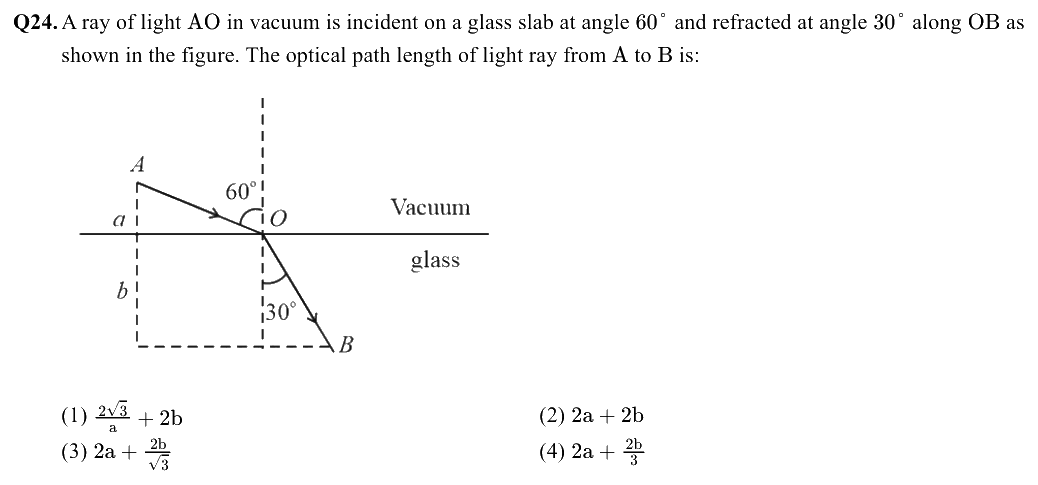
A ray of light AO in vacuum is incident on a glass slab at angle $60^\circ$ and refracted at angle $30^\circ$ along OB as shown in the figure. The optical path length of light ray from A to B is:
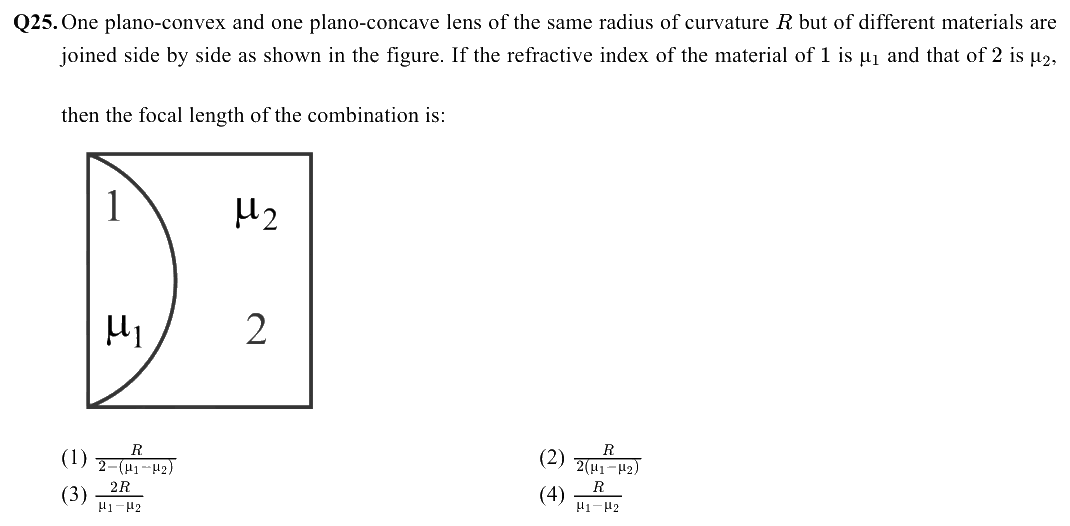
One plano-convex and one plano-concave lens of the same radius of curvature $R$ but of different materials are joined side by side as shown in the figure. If the refractive index of the material of 1 is $\mu_1$ and that of 2 is $\mu_2$, then the focal length of the combination is:
A concave mirror for face viewing has a focal length of 0.4 m. The distance at which you hold the mirror from your face in order to see your image upright with a magnification of 5 is
A convex lens of focal length 20 cm produces images of the same magnification 2 when an object is kept at two distances $x_1$ and $x_2$($x_1 > x_2$) from the lens. The ratio of $x_1$ and $x_2$ is:
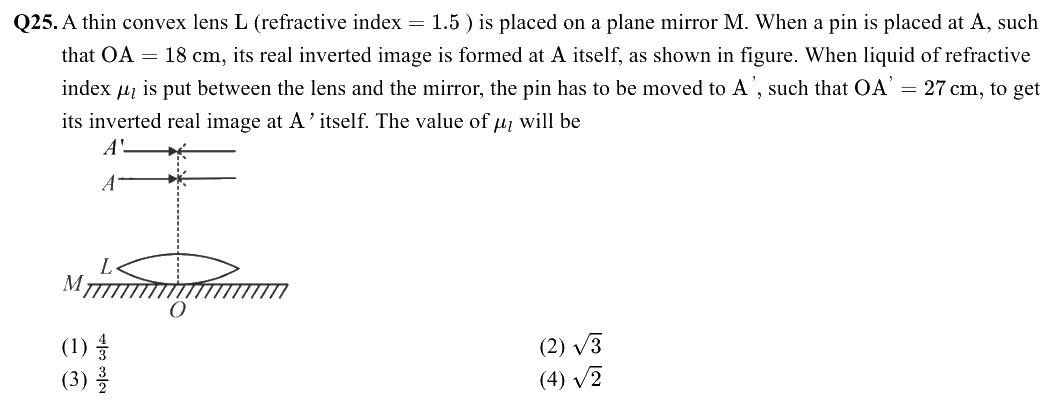
A thin convex lens L (refractive index = 1.5 ) is placed on a plane mirror M. When a pin is placed at A, such that OA = 18 cm, its real inverted image is formed at A itself, as shown in figure. When liquid of refractive index $\mu_l$ is put between the lens and the mirror, the pin has to be moved to A', such that OA' = 27 cm, to get its inverted real image at A' itself. The value of $\mu_l$ will be (see the figure above)
Diameter of the objective lens of a telescope is 250 cm. For light of wavelength 600 nm coming from a distant object, the limit of resolution of the telescope is close to:
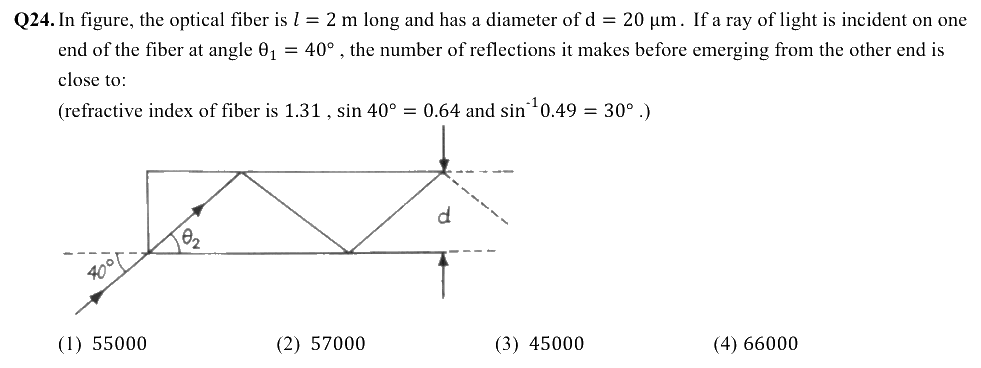
In figure, the optical fiber is $l = 2$ m long and has a diameter of d = 20 $\mu$m. If a ray of light is incident on one end of the fiber at angle $\theta_1 = 40^\circ$, the number of reflections it makes before emerging from the other end is close to: (refractive index of fiber is 1.31 , $\sin 40^\circ = 0.64$ and $\sin^{-1}0.49 = 30^\circ$ .) (see the figure above)
An upright object is placed at a distance of 40 cm in front of a convergent lens of focal length 20 cm. A convergent mirror of focal length 10 cm is placed at a distance of 60 cm on the other side of the lens. The position and size of the final image will be:
A
40 cm from the convergent lens, twice the size of the object
B
20 cm from the convergent mirror, twice the size of the object
C
40 cm from the convergent lens, same size of the object
D
20 cm from the convergent mirror, same size of the object
A convex lens (of focal length 20 cm ) and a concave mirror, having their principal axes along the same lines, are kept 80 cm apart from each other. The concave mirror is to the right of the convex lens. When an object is kept at a distance of 30 cm to the left of the convex lens, its image remains at the same position even if the concave mirror is removed. The maximum distance of the object for which this concave mirror, by itself would produce a virtual image would be:
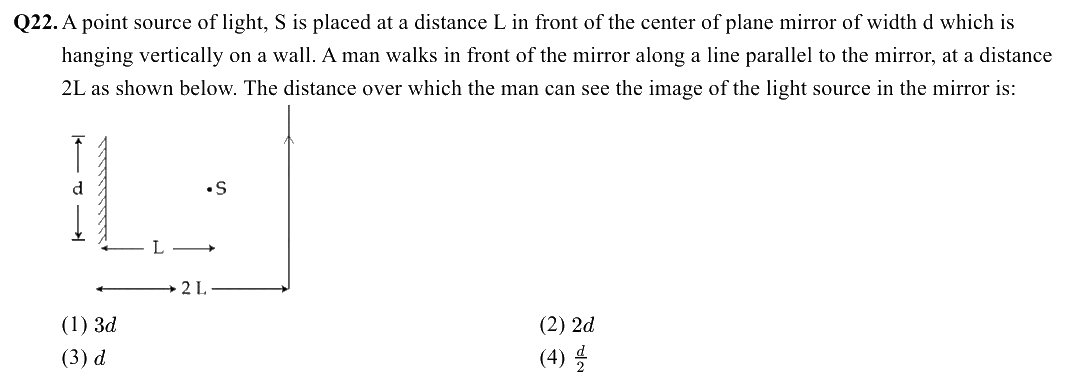
A point source of light, S is placed at a distance L in front of the center of plane mirror of width d which is hanging vertically on a wall. A man walks in front of the mirror along a line parallel to the mirror, at a distance 2L as shown below. The distance over which the man can see the image of the light source in the mirror is:
A plano - convex lens (focal length $f_2$ , refractive index $\mu_2$, radius of curvature R) fits exactly into a plano - concave lens (focal length $f_1$, refractive index $\mu_1$, radius of curvature R). Their plane surfaces are parallel to each other. Then, the focal length of the combination will be:
An object is at a distance of 20 m from a convex lens of focal length 0.3 m. The lens forms an image of the object. If the object moves away from the lens at a speed of 5 m/s the speed and direction of the image will be
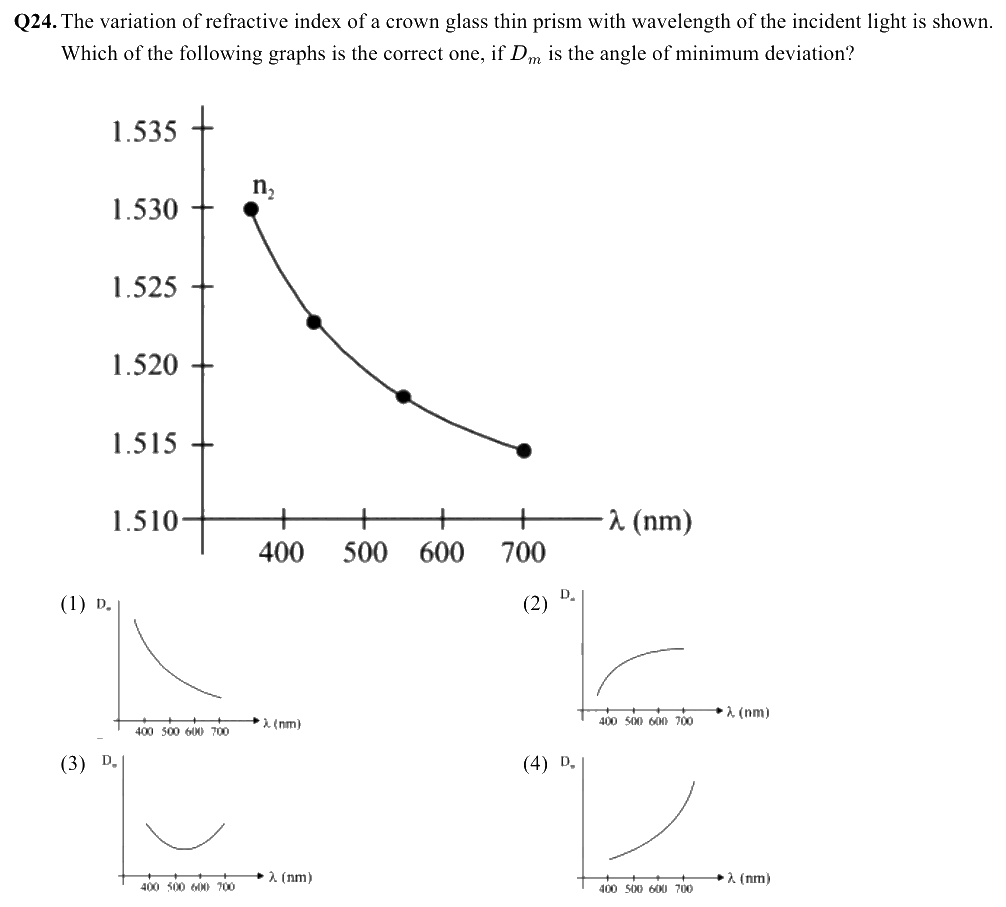
The variation of refractive index of a crown glass thin prism with wavelength of the incident light is shown. Which of the following graphs is the correct one, if $D_m$ is the angle of minimum deviation? (see the figure above)
The question as printed in the paper.
A
see figure D_m versus lambda (nm): a decreasing convex curve
B
see figure D_m versus lambda (nm): an increasing concave curve that flattens
C
see figure D_m versus lambda (nm): a U-shaped curve (falls then rises)
D
see figure D_m versus lambda (nm): an increasing convex curve (rising steeply at the right)
A monochromatic light is incident at a certain angle on an equilateral triangular prism and suffers minimum deviation. If the refractive index of the material of the prism is $\sqrt{3}$, then the angle of incidence is :
A plano-convex lens of refractive index $\mu_1$ and focal length $f_1$ is kept in contact with another plano-concave lens of refractive index $\mu_2$ and focal length $f_2$. If the radius of curvature of their spherical faces is $R$ each and $f_1 = 2f_2$, the $\mu_1$ and $\mu_2$ are related as:
The eye can be regarded as a single refracting surface. The radius of curvature of this surface is equal to that of the cornea $(7.8\ \mathrm{mm})$. This surface separates two media of refractive indices $1$ and $1.34$. Calculate the distance from the refracting surface at which a parallel beam of light will come to focus.
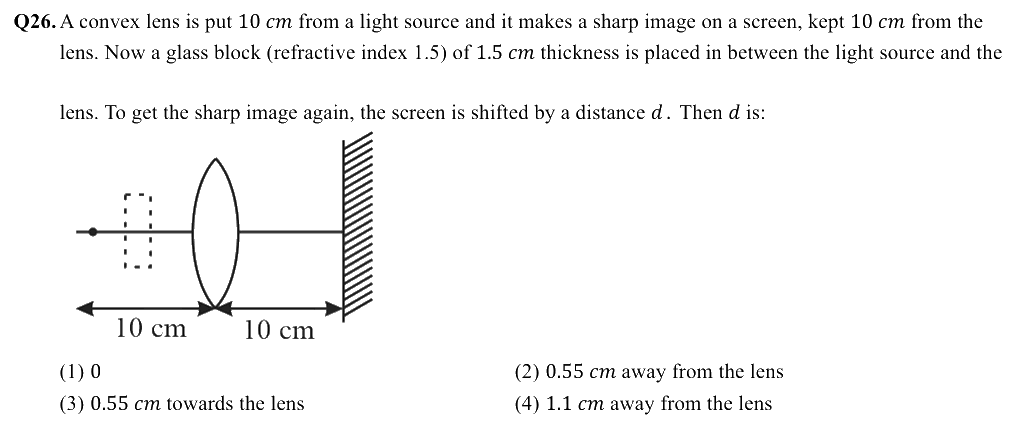
A convex lens is put $10\ cm$ from a light source and it makes a sharp image on a screen, kept $10\ cm$ from the lens. Now a glass block (refractive index $1.5$) of $1.5\ cm$ thickness is placed in between the light source and the lens. To get the sharp image again, the screen is shifted by a distance $d$ . Then $d$ is: (see the figure above)
Two plane mirrors are inclined to each other such that a ray of light incident on the first mirror $(M_1)$ and parallel to the second mirror $(M_2)$ is finally reflected from the second mirror $(M_2)$ and parallel to the first mirror $(M_1)$. The angle between the two mirrors will be:
A ray of light is incident at an angle of $60^\circ$ on one face of a prism of angle $30^\circ$. The emergent ray of light makes an angle of $30^\circ$ with incident ray. The angle made by the emergent ray with second face of prism will be:
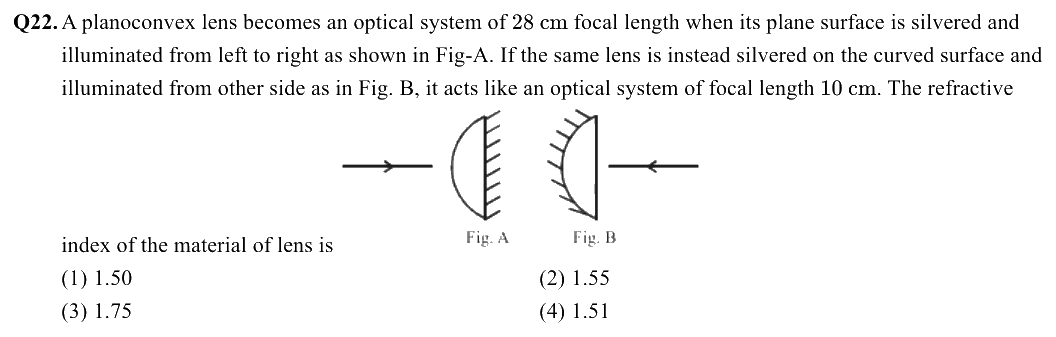
A planoconvex lens becomes an optical system of $28\ \mathrm{cm}$ focal length when its plane surface is silvered and illuminated from left to right as shown in Fig-A. If the same lens is instead silvered on the curved surface and illuminated from other side as in Fig. B, it acts like an optical system of focal length $10\ \mathrm{cm}$. The refractive index of the material of lens is (see the figure above)
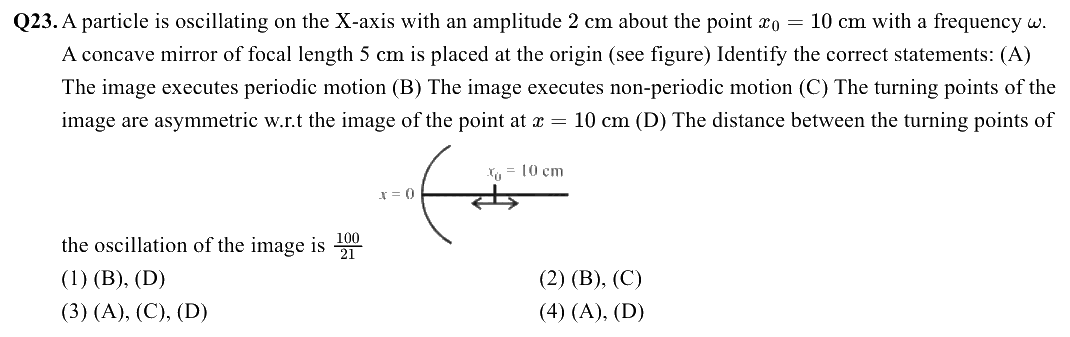
A particle is oscillating on the X-axis with an amplitude $2\ \mathrm{cm}$ about the point $x_0 = 10\ \mathrm{cm}$ with a frequency $\omega$. A concave mirror of focal length $5\ \mathrm{cm}$ is placed at the origin (see figure) Identify the correct statements: (A) The image executes periodic motion (B) The image executes non-periodic motion (C) The turning points of the image are asymmetric w.r.t the image of the point at $x = 10\ \mathrm{cm}$ (D) The distance between turning points of the oscillation of the image is $\frac{100}{21}$ (see the figure above)
A convergent doublet of separated lenses, corrected for spherical aberration, has resultant focal length of $10\ \mathrm{cm}$. The separation between the two lenses is $2\ \mathrm{cm}$. The focal lengths of the component lenses
In an experiment a convex lens of focal length 15 cm is placed coaxially on an optical bench in front of a convex mirror at a distance of 5 cm from it. It is found that an object and its image coincide, if the object is placed at a distance of 20 cm from the lens. The focal length of the convex mirror is-
Let the refractive index of a denser medium with respect to rarer medium be $n_{12}$ and its critical angle be $\theta_C$. At an angle of incidence $A$ when light is travelling from denser medium to rarer medium, a part of the light is reflected and the rest is refracted and the angle between reflected and refracted rays is $90^\circ$. Angle $A$ is given by
A diverging lens with magnitude of focal length $25\ \mathrm{cm}$ is placed at a distance of $15\ \mathrm{cm}$ from a converging lens of magnitude of focal length $20\ \mathrm{cm}$. A beam of parallel light falls on the diverging lens. The final image formed is:
A
Real and at a distance of $6\ \mathrm{cm}$ from the convergent lens
B
Real and at a distance of $40\ \mathrm{cm}$ from convergent lens
C
Virtual and at a distance of $40\ \mathrm{cm}$ from convergent lens
D
Real and at a distance of $40\ \mathrm{cm}$ from the divergent lens
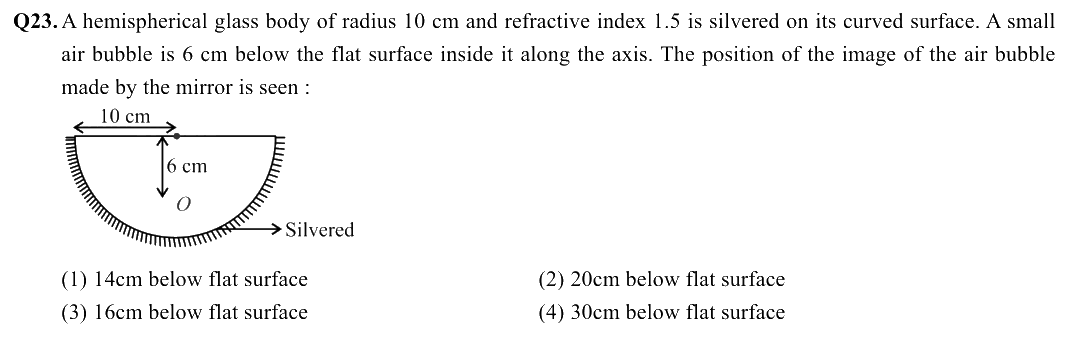
A hemispherical glass body of radius $10\ \mathrm{cm}$ and refractive index $1.5$ is silvered on its curved surface. A small air bubble is $6\ \mathrm{cm}$ below the flat surface inside it along the axis. The position of the image of the air bubble made by the mirror is seen : (see the figure above)
In an experiment for determination of refractive index of glass of a prism by i v/s $\delta$ plot, it was found that a ray incident at angle $35^{\circ}$ , suffers a deviation of $40^{\circ}$ and that it emerges at angle $79^{\circ}$ . In that case which of the following is closest to the maximum possible value of the refractive index?
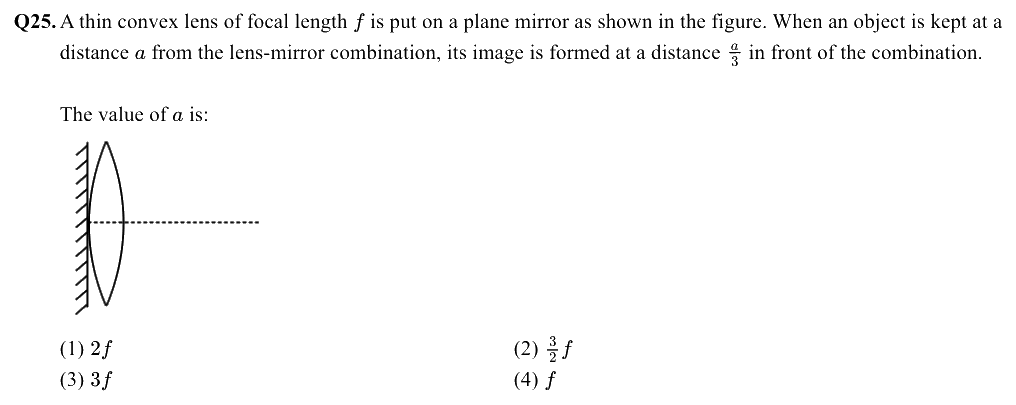
A thin convex lens of focal length $f$ is put on a plane mirror as shown in the figure. When an object is kept at a distance $a$ from the lens-mirror combination, its image is formed at a distance $\frac{a}{3}$ in front of the combination. The value of $a$ is: (see the figure above)
A telescope has an objective lens of focal length 150 cm and an eyepiece of focal length 5 cm. If a 50 m tall tower at a distance of 1 km is observed through this telescope in a normal setting, the angle formed by the image of the tower is $\theta$, then $\theta$ is close to
You are asked to design a shaving mirror assuming that a person keeps it at 10 cm from his face and views the magnified image of the face at the closest comfortable distance of 25 cm. The radius of curvature of the mirror would then be:
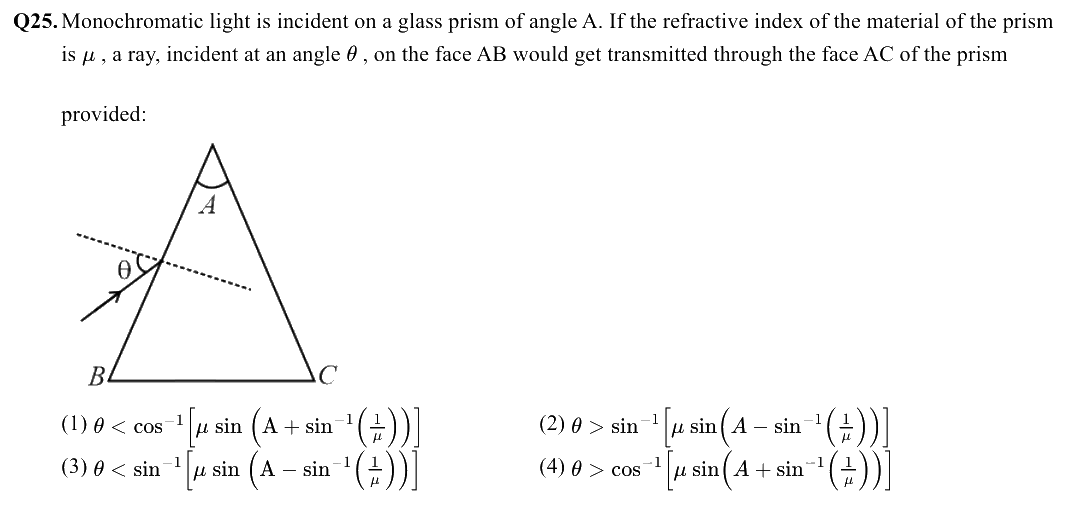
Monochromatic light is incident on a glass prism of angle A. If the refractive index of the material of the prism is $\mu$, a ray, incident at an angle $\theta$, on the face AB would get transmitted through the face AC of the prism provided: (see the figure above)
The diameter of the objective lens of the microscope makes an angle $\beta$ at the focus of the microscope. Further, the medium between the object and the lens is the oil of the refractive index $n$. Then the resolving power of the microscope.
A
Increases with decreasing value of $\beta$
B
Increases with increasing value of $n \sin 2\beta$
C
Increases with increasing value of $\frac{1}{n \sin 2\beta}$
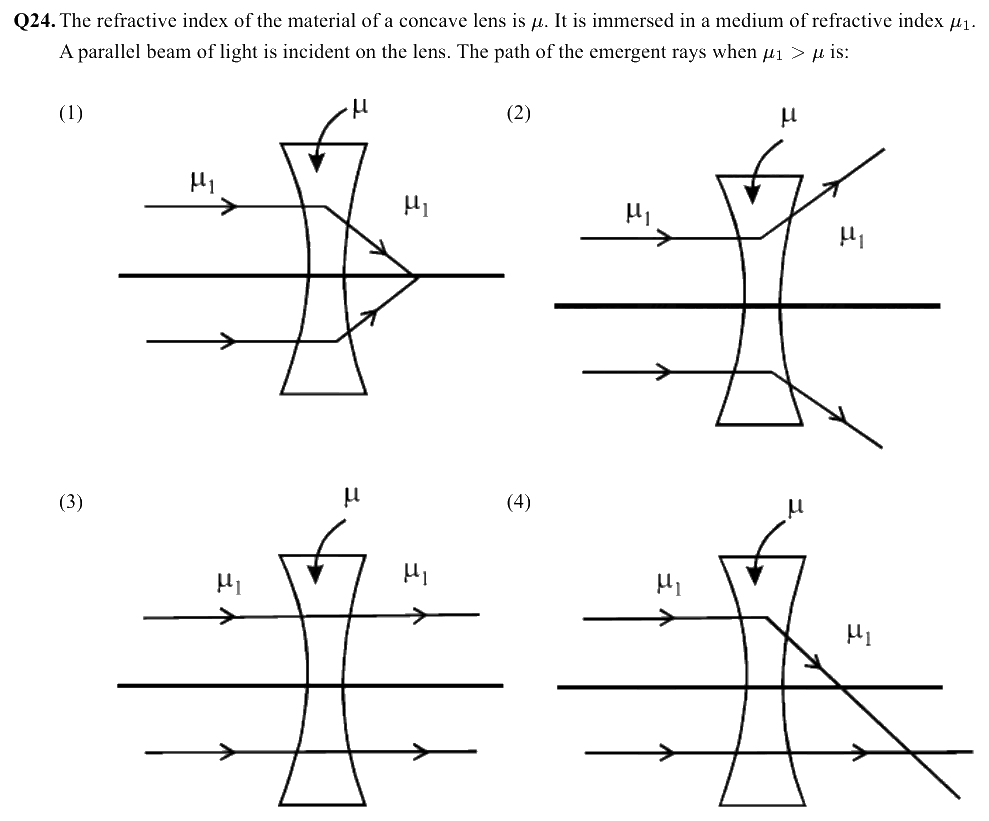
The refractive index of the material of a concave lens is $\mu$. It is immersed in a medium of refractive index $\mu_1$. A parallel beam of light is incident on the lens. The path of the emergent rays when $\mu_1 > \mu$ is:
The question as printed in the paper.
A
see figure Concave (biconcave) lens labelled mu (curved arrow pointing at the lens), surrounding medium labelled mu1 on both sides. Two parallel rays come from the left (arrows pointing right), one above and one below the principal axis. After the lens both rays bend towards the axis (converge) and meet at a single point on the axis to the right of the lens.
B
see figure Same lens and labels. The two parallel rays from the left bend away from the axis after the lens: the upper ray goes up and to the right, the lower ray goes down and to the right (diverging).
C
see figure Same lens and labels. Both parallel rays pass through the lens undeviated and continue parallel to the axis to the right.
D
see figure Same lens and labels. The upper ray bends downwards after the lens, crosses the principal axis and continues down to the right, crossing the lower ray; the lower ray passes through undeviated and continues parallel to the axis.
An object is located in a fixed position in front of a screen. Sharp image is obtained on the screen for two positions of a thin lens separated by $10\ \mathrm{cm}$. The size of the images in two situations are in the ratio $3 : 2$. What is the distance between the screen and the object?
In a compound microscope the focal length of objective lens is $1.2\ \mathrm{cm}$ and focal length of eye piece is $3.0\ \mathrm{cm}$. When object is kept at $1.25\ \mathrm{cm}$ in front of objective, final image is formed at infinity. Magnifying power of the compound microscope should be:
A diver looking up through the water sees the outside world contained in a circular horizon. The refractive index of water is $\frac{4}{3}$, and the diver's eyes are 15 cm below the surface of the water. Then the radius of the circle is :
The focal lengths of objective lens and eye lens of a Galilean Telescope are respectively 30 cm and 3.0 cm. Telescope produces virtual, erect image of an object situated far away from it at least distance of distinct vision from the eye lens. In this condition the Magnifying Power of the Galilean Telescope should be :
A thin convex lens made from crown glass $\left(\mu = \frac{3}{2}\right)$ has focal length $f$. When it is measured in two different liquids having refractive indices $\frac{4}{3}$ and $\frac{5}{3}$, it has the focal lengths $f_1$ and $f_2$ respectively. The correct relation between the focal lengths is :
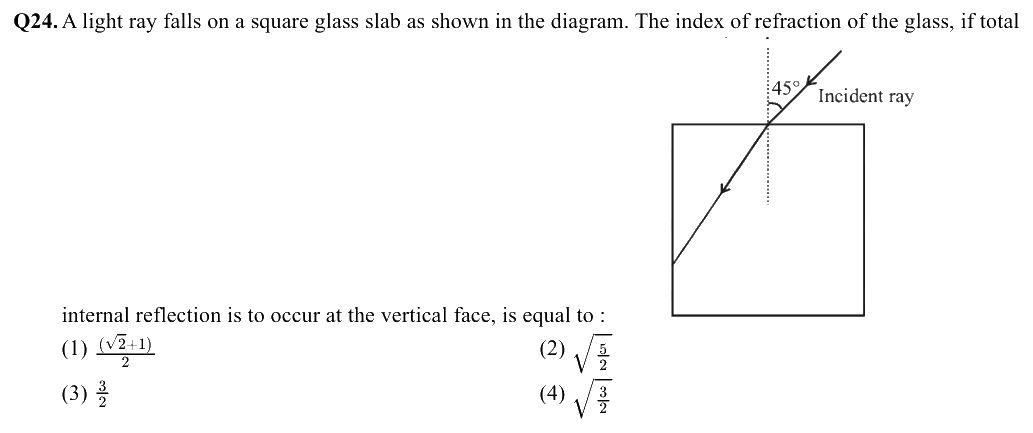
A light ray falls on a square glass slab as shown in the diagram. The index of refraction of the glass, if total internal reflection is to occur at the vertical face, is equal to : (see the figure above)
Some distant star is to be observed by some telescope of diameter of objective lens $a$, at an angular resolution of $3.0\times10^{-7}$ radian. If the wavelength of light from the star reaching the telescope is 500 nm, the minimum diameter of the objective lens of the telescope is ________ cm. (nearest interger)
Numerical answer type: type your answer in EdLoop to check it
A concave mirror of focal length 10 cm forms an image which is double the size of object when the object is placed at two different positions. The distance between the two positions of the object is ________ cm.
Numerical answer type: type your answer in EdLoop to check it
If sunlight is focused on a paper using convex lens, it starts burning the paper in shortest time when the lens is kept at 30 cm above the paper. If the radius of curvature of the lens is 60 cm then the refractive index of the lens material is $\frac{\alpha}{10}$. The value of $\alpha$ is ________.
Numerical answer type: type your answer in EdLoop to check it
A convex lens of refractive index 1.5 and focal length $f = 18$ cm is immersed in water. The difference in focal lengths of the given lens when it is in water and in air is $\alpha \times f$. The value of $\alpha$ is ________.
(refractive index of water = 4/3)
Numerical answer type: type your answer in EdLoop to check it
The size of the images of an object, formed by a thin lens are equal when the object is placed at two different positions 8 cm and 24 cm from the lens. The focal length of the lens is ________ cm.
Numerical answer type: type your answer in EdLoop to check it
A parallel beam of light travelling in air (refractive index 1.0) is incident on a convex spherical glass surface of radius of curvature 50 cm. Refractive index of glass is 1.5. The rays converge to a point at a distance $x$ cm from the centre of the curvature of the spherical surface. The value of $x$ is ________ cm.
Numerical answer type: type your answer in EdLoop to check it
In a microscope the objective is having focal length $f_o = 2$ cm and eye-piece is having focal length $f_e = 4$ cm. The tube length is 32 cm. The magnification produced by this microscope for normal adjustment is ________.
Numerical answer type: type your answer in EdLoop to check it
A collimated beam of light of diameter 2 mm is propagating along $x$-axis. The beam is required to be expanded into a collimated beam of diameter 14 mm using a system of two convex lenses. If first lens has focal length 40 mm, then the focal length of second lens is ________ mm.
Numerical answer type: type your answer in EdLoop to check it
A container contains a liquid with refractive index of 1.2 up to a height of 60 cm and another liquid having refractive index 1.6 is added to height H above first liquid. If viewed from above, the apparent shift in the position of bottom of container is 40 cm. The value of H is ______ cm . (Consider liquids are immiscible)
Numerical answer type: type your answer in EdLoop to check it
Distance between object and its image (magnified by $-\frac{1}{3}$ ) is 30 cm . The focal length of the mirror 74 used is $\left|\left(\frac{x}{4}\right)\right|$cm , where magnitude of value of x is ______
Numerical answer type: type your answer in EdLoop to check it
Light from a point source in air falls on a spherical glass surface (refractive index, $\mu = 1.5$ and radius of curvature $= 50cm$ ). The image is formed at a distance of 200 cm from the glass surface inside the glass. The magnitude of distance of the light source from the glass surface is ______ m.
Numerical answer type: type your answer in EdLoop to check it
A ray of light suffers minimum deviation when incident on a prism having angle of the prism equal to $60^\circ$. The refractive index of the prism material is $\sqrt{2}$. The angle of incidence (in degrees) is ______
Numerical answer type: type your answer in EdLoop to check it
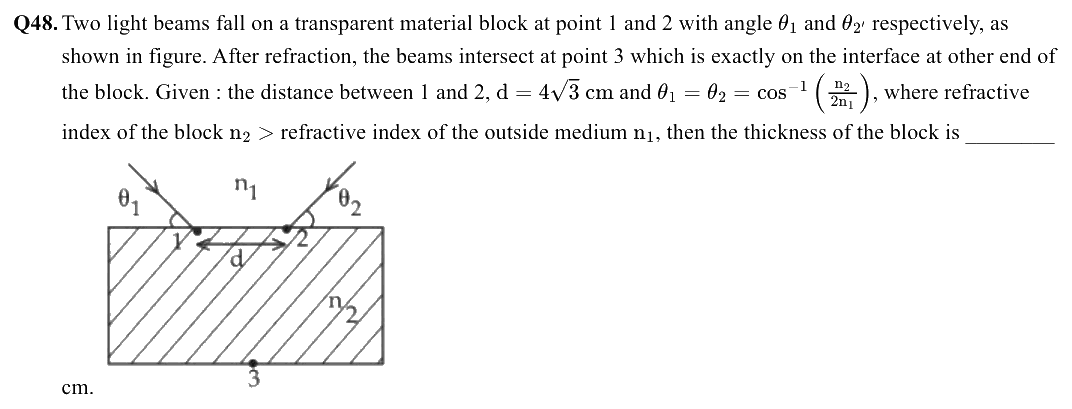
Two light beams fall on a transparent material block at point 1 and 2 with angle $\theta_1$ and $\theta_2$, respectively, as shown in figure. After refraction, the beams intersect at point 3 which is exactly on the interface at other end of the block. Given : the distance between 1 and 2, d = $4\sqrt{3}$ cm and $\theta_1 = \theta_2 = \cos^{-1}\left(\frac{\mathrm{n_2}}{2\mathrm{n_1}}\right)$, where refractive index of the block $\mathrm{n_2} > $ refractive index of the outside medium $\mathrm{n_1}$, then the thickness of the block is ______ cm.
(see the figure above)
The question as printed in the paper.
Numerical answer type: type your answer in EdLoop to check it
The driver sitting inside a parked car is watching vehicles approaching from behind with the help of his side view mirror, which is a convex mirror with radius of curvature R = 2 m. Another car approaches him from behind with a uniform speed of 90 km/hr. When the car is at a distance of 24 m from him, the magnitude of the acceleration of the image of the car in the side view mirror is ' a '. The value of 100 a is ______ m/s$^2$.
Numerical answer type: type your answer in EdLoop to check it
The refractive index of prism is $\mu = \sqrt{3}$ and the ratio of the angle of minimum deviation to the angle of prism is one. The value of angle of prism is ______.
Numerical answer type: type your answer in EdLoop to check it
A light ray is incident on a glass slab of thickness $4\sqrt{3}$ cm and refractive index $\sqrt{2}$. The angle of incidence is equal to the critical angle for the glass slab with air. The lateral displacement of ray after passing through glass slab is ______ cm. ( Given $\sin 15^\circ = 0.25$)
Numerical answer type: type your answer in EdLoop to check it
The distance between object and its 3 times magnified virtual image as produced by a convex lens is 20 cm. The focal length of the lens used is ______ cm.
Numerical answer type: type your answer in EdLoop to check it
Light from a point source in air falls on a convex curved surface of radius 20 cm and refractive index $1.5$. If the source is located at 100 cm from the convex surface, the image will be formed at ______ cm from the object.
Numerical answer type: type your answer in EdLoop to check it
The distance between object and its two times magnified real image as produced by a convex lens is 45 cm. The focal length of the lens used is ______ cm.
Numerical answer type: type your answer in EdLoop to check it
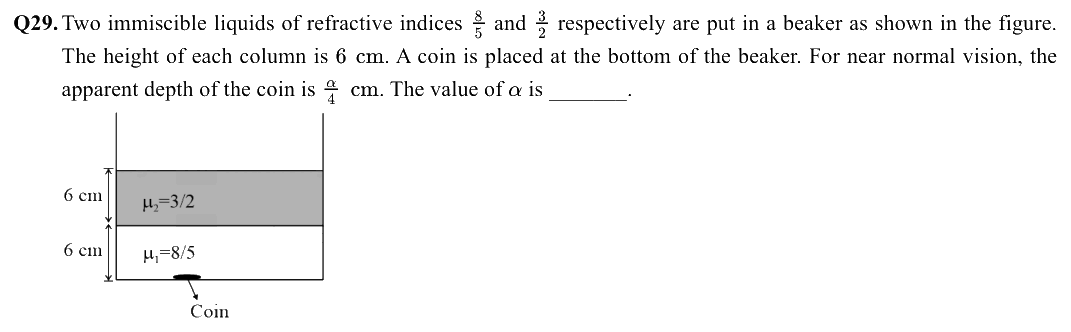
Two immiscible liquids of refractive indices $\frac{8}{5}$ and $\frac{3}{2}$ respectively are put in a beaker as shown in the figure. The height of each column is 6 cm. A coin is placed at the bottom of the beaker. For near normal vision, the apparent depth of the coin is $\frac{\alpha}{4}$ cm. The value of $\alpha$ is ______.
(see the figure above)
The question as printed in the paper.
Numerical answer type: type your answer in EdLoop to check it
The refractive index of a transparent liquid filled in an equilateral hollow prism is $\sqrt{2}$. The angle of minimum deviation for the liquid will be ______ °.
Numerical answer type: type your answer in EdLoop to check it
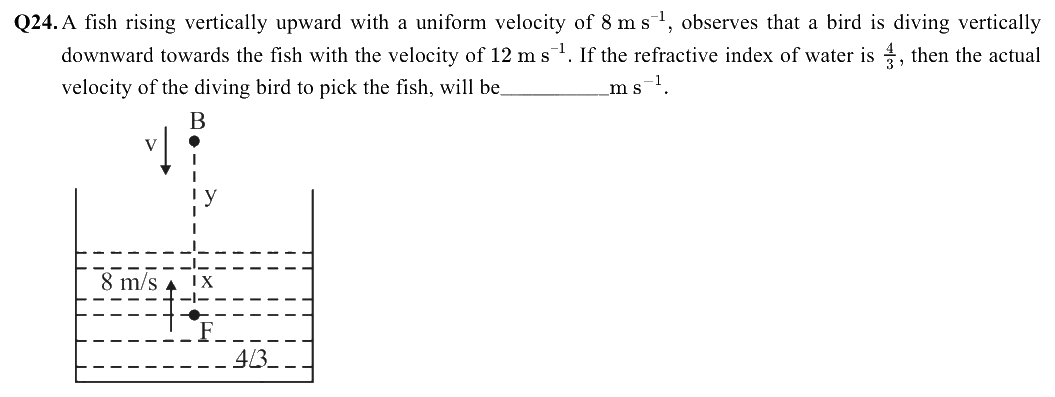
A fish rising vertically upward with a uniform velocity of 8 m s$^{-1}$, observes that a bird is diving vertically downward towards the fish with the velocity of 12 m s$^{-1}$. If the refractive index of water is $\frac{4}{3}$, then the actual velocity of the diving bird to pick the fish, will be ______ m s$^{-1}$.
(see the figure above)
The question as printed in the paper.
Numerical answer type: type your answer in EdLoop to check it
A bi convex lens of focal length 10 cm is cut in two identical parts along a plane perpendicular to the principal axis. The power of each lens after cut is ______ D.
Numerical answer type: type your answer in EdLoop to check it
Two convex lenses of focal length 20 cm each are placed coaxially with a separation of 60 cm between them. The image of the distant object formed by the combination is at ______ cm from the first lens.
Numerical answer type: type your answer in EdLoop to check it
The radius of curvature of each surface of a convex lens having refractive index 1.8 is 20 cm. The lens is now immersed in a liquid of refractive index 1.5. The ratio of power of lens in air to its power in the liquid will be $x : 1$. The value of $x$ is
Numerical answer type: type your answer in EdLoop to check it
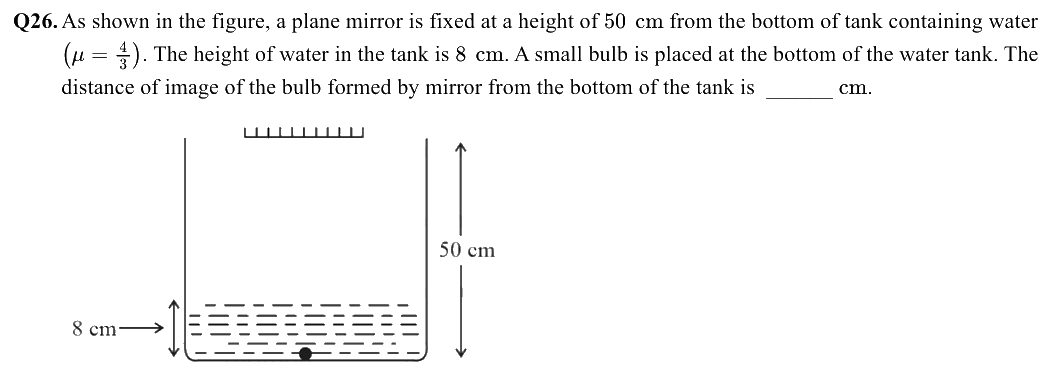
As shown in the figure, a plane mirror is fixed at a height of 50 cm from the bottom of tank containing water $\left(\mu = \frac{4}{3}\right)$. The height of water in the tank is 8 cm. A small bulb is placed at the bottom of the water tank. The distance of image of the bulb formed by mirror from the bottom of the tank is ______ cm. (see the figure above)
The question as printed in the paper.
Numerical answer type: type your answer in EdLoop to check it
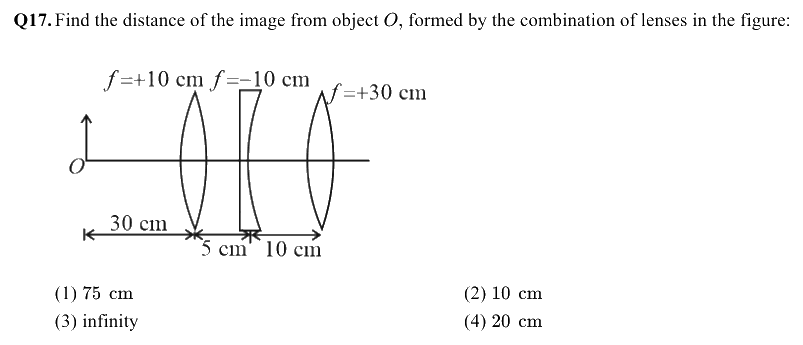
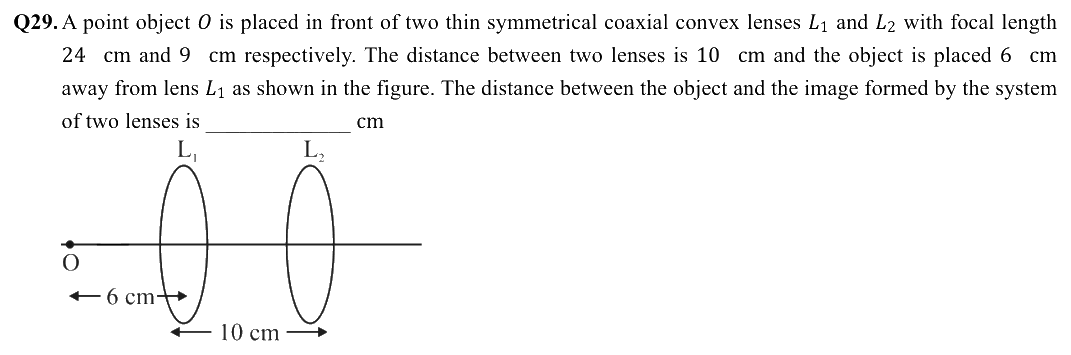
A point object $O$ is placed in front of two thin symmetrical coaxial convex lenses $L_1$ and $L_2$ with focal length 24 cm and 9 cm respectively. The distance between two lenses is 10 cm and the object is placed 6 cm away from lens $L_1$ as shown in the figure. The distance between the object and the image formed by the system of two lenses is ______ cm (see the figure above)
The question as printed in the paper.
Numerical answer type: type your answer in EdLoop to check it
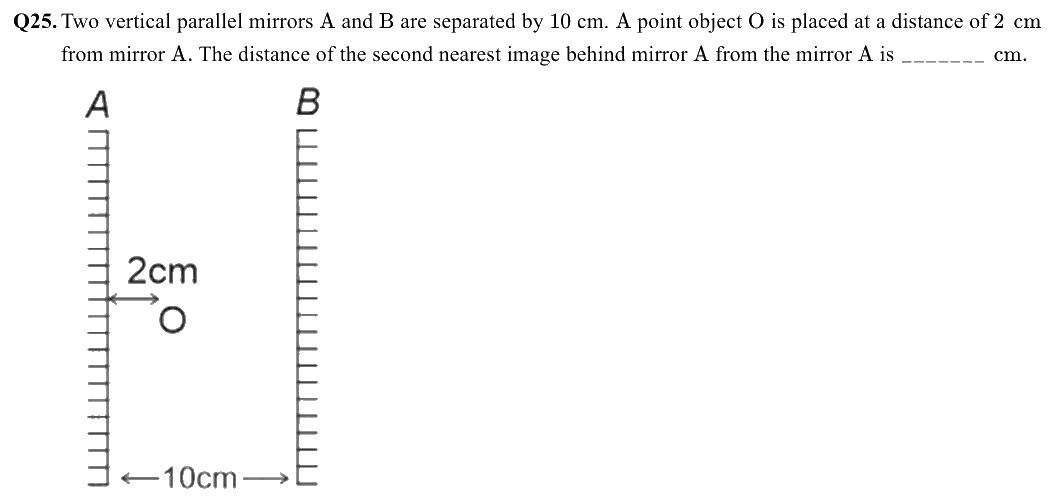
Two vertical parallel mirrors A and B are separated by 10 cm. A point object O is placed at a distance of 2 cm from mirror A. The distance of the second nearest image behind mirror A from the mirror A is ______ cm. (see the figure above)
The question as printed in the paper.
Numerical answer type: type your answer in EdLoop to check it
Two transparent media having refractive indices $1.0$ and $1.5$ are separated by a spherical refracting surface of radius of curvature $30\ \mathrm{cm}$. The centre of curvature of surface is towards denser medium and a point object is placed on the principal axis in rarer medium at a distance of $15\ \mathrm{cm}$ from the pole of the surface. The distance of image from the pole of the surface is cm.
Numerical answer type: type your answer in EdLoop to check it
A pole is vertically submerged in swimming pool, such that it gives a length of shadow $2.15\ \mathrm{m}$ within water when sunlight is incident at an angle of $30^\circ$ with the surface of water. If swimming pool is filled to a height of $1.5\ \mathrm{m}$, then the height of the pole above the water surface in centimeters is $\left(n_w = \frac{4}{3}\right)$ ______ .
Numerical answer type: type your answer in EdLoop to check it
A thin cylindrical rod of length 10 cm is placed horizontally on the principle axis of a concave mirror of focal length 20 cm. The rod is placed in a such a way that mid point of the rod is at 40 cm from the pole of mirror. The length of the image formed by the mirror will be $\dfrac{x}{3}$ cm. The value of $x$ is ______.
Numerical answer type: type your answer in EdLoop to check it
A ray of light is incident from air on a glass plate having thickness $\sqrt{3}$ cm and refractive index $\sqrt{2}$. The angle of incidence of a ray is equal to the critical angle for glass-air interface. The lateral displacement of the ray when it passes through the plate is ______ $\times 10^{-2}$ cm. (given $\sin 15^\circ = 0.26$)
Numerical answer type: type your answer in EdLoop to check it
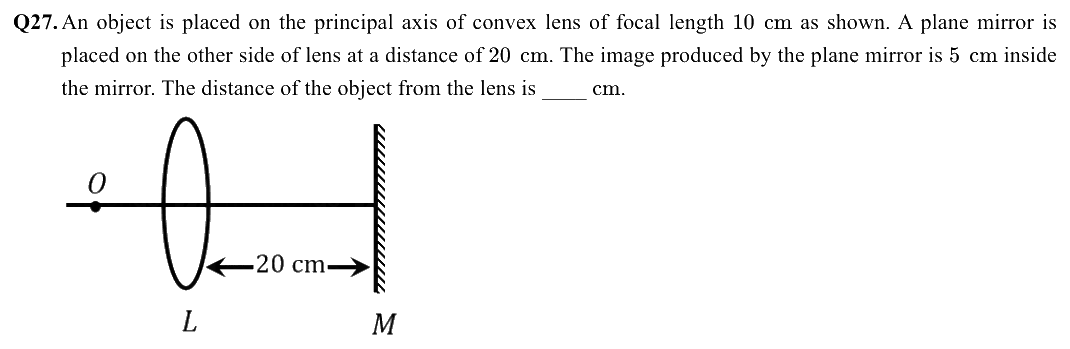
An object is placed on the principal axis of convex lens of focal length 10 cm as shown. A plane mirror is placed on the other side of lens at a distance of 20 cm. The image produced by the plane mirror is 5 cm inside the mirror. The distance of the object from the lens is ______ cm.
(see the figure above)
The question as printed in the paper.
Numerical answer type: type your answer in EdLoop to check it
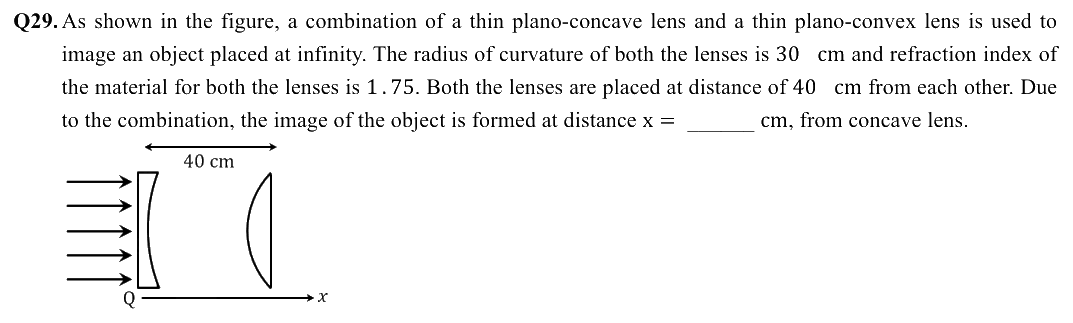
As shown in the figure, a combination of a thin plano-concave lens and a thin plano-convex lens is used to image an object placed at infinity. The radius of curvature of both the lenses is 30 cm and refraction index of the material for both the lenses is 1.75. Both the lenses are placed at distance of 40 cm from each other. Due to the combination, the image of the object is formed at distance x = ______ cm, from concave lens.
(see the figure above)
The question as printed in the paper.
Numerical answer type: type your answer in EdLoop to check it
The $X - Y$ plane be taken as the boundary between two transparent media $M_1$ and $M_2$. $M_1$ in $Z \geq 0$ has a refractive index of $\sqrt{2}$ and $M_2$ with $Z < 0$ has a refractive index of $\sqrt{3}$. A ray of light travelling in $M_1$ along the direction given by the vector $\vec{A} = 4\sqrt{3}\hat{i} - 3\sqrt{3}\hat{j} - 5\hat{k}$, is incident on the plane of separation. The value of difference between the angle of incident in $M_1$ and the angle of refraction in $M_2$ will be ______ degree.
Numerical answer type: type your answer in EdLoop to check it
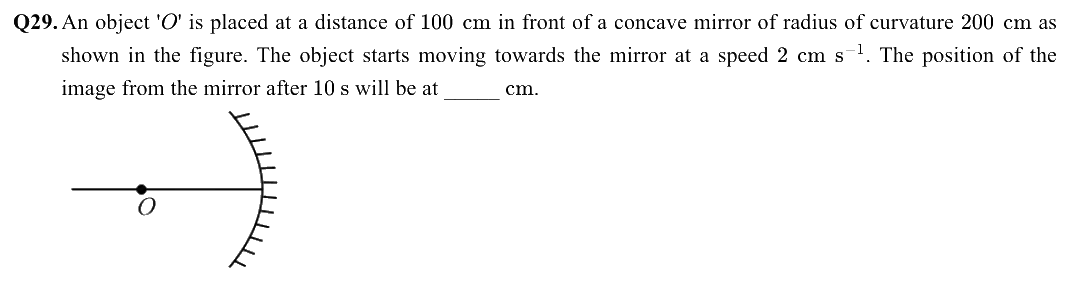
An object '$O$' is placed at a distance of $100\ \mathrm{cm}$ in front of a concave mirror of radius of curvature $200\ \mathrm{cm}$ as shown in the figure. The object starts moving towards the mirror at a speed $2\ \mathrm{cm\,s^{-1}}$. The position of the image from the mirror after $10\ \mathrm{s}$ will be at ______ cm.
(see the figure above)
The question as printed in the paper.
Numerical answer type: type your answer in EdLoop to check it
In an experiment with a convex lens. The plot of the image distance ($v'$) against the object distance ($\mu'$) measured from the focus gives a curve $v'\mu'=225$. If all the distances are measured in cm. The magnitude of the focal length of the lens is ______ cm.
Numerical answer type: type your answer in EdLoop to check it
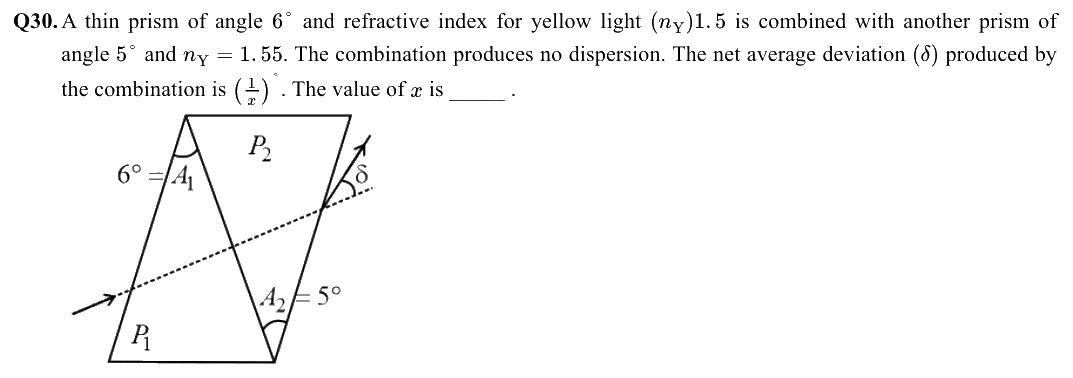
A thin prism of angle $6^\circ$ and refractive index for yellow light ($n_\mathrm{Y}$)1.5 is combined with another prism of angle $5^\circ$ and $n_\mathrm{Y}$ = 1.55. The combination produces no dispersion. The net average deviation ($\delta$) produced by the combination is $\left(\frac{1}{x}\right)^\circ$. The value of $x$ is ______ . (see the figure above)
The question as printed in the paper.
Numerical answer type: type your answer in EdLoop to check it
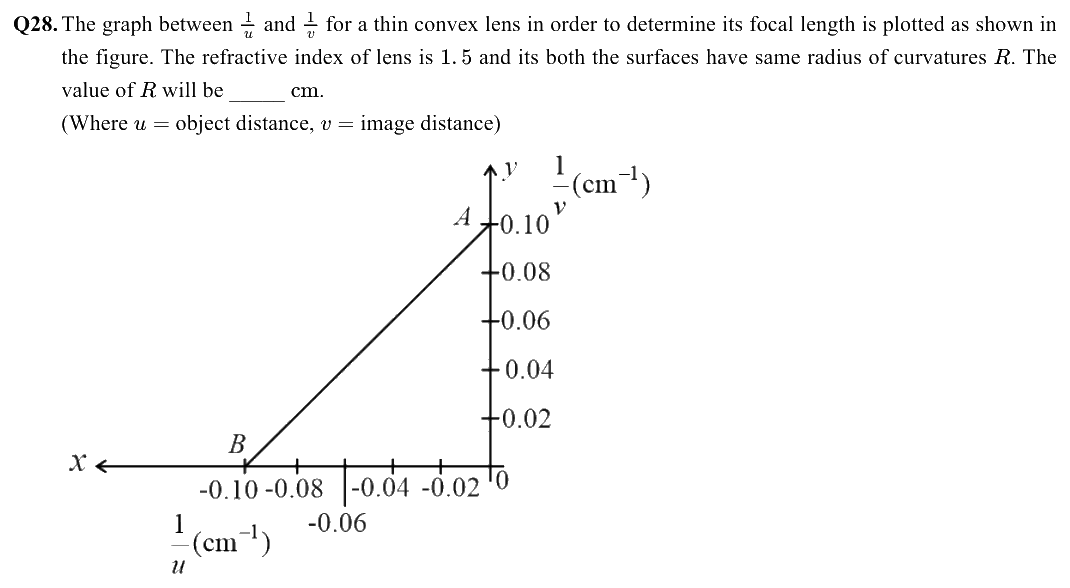
The graph between $\frac{1}{u}$ and $\frac{1}{v}$ for a thin convex lens in order to determine its focal length is plotted as shown in the figure. The refractive index of lens is 1.5 and its both the surfaces have same radius of curvatures $R$. The value of $R$ will be ______ cm. (Where $u$ = object distance, $v$ = image distance) (see the figure above)
The question as printed in the paper.
Numerical answer type: type your answer in EdLoop to check it
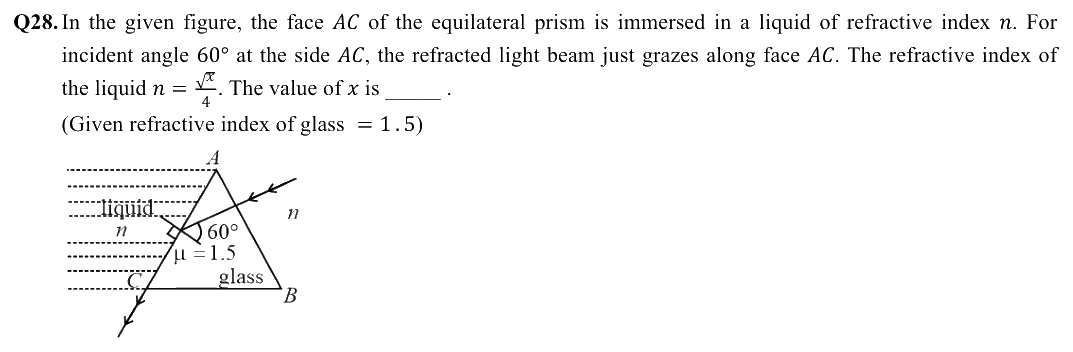
In the given figure, the face $AC$ of the equilateral prism is immersed in a liquid of refractive index $n$. For incident angle $60^\circ$ at the side $AC$, the refracted light beam just grazes along face $AC$. The refractive index of the liquid $n = \frac{\sqrt{x}}{4}$. The value of $x$ is ______ . (Given refractive index of glass $= 1.5$)
(see the figure above)
The question as printed in the paper.
Numerical answer type: type your answer in EdLoop to check it
A convex lens of focal length $20\ \mathrm{cm}$ is placed in front of convex mirror with principal axis coinciding each other. The distance between the lens and mirror is $10\ \mathrm{cm}$. A point object is placed on principal axis at a distance of $60\ \mathrm{cm}$ from the convex lens. The image formed by combination coincides the object itself. The focal length of the convex mirror is ______ cm.
Numerical answer type: type your answer in EdLoop to check it
A parallel beam of light is allowed to fall on a transparent spherical globe of diameter $30\ \mathrm{cm}$ and refractive index $1.5$. The distance from the centre of the globe at which beam of light can converge is ______ mm.
Numerical answer type: type your answer in EdLoop to check it
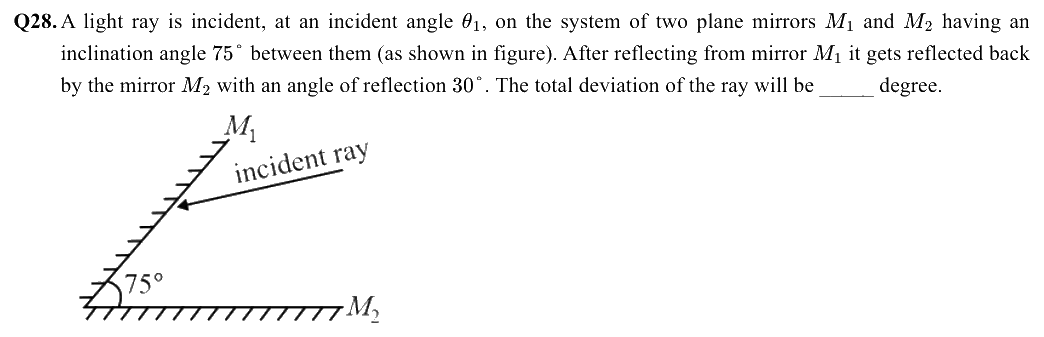
A light ray is incident, at an incident angle $\theta_1$, on the system of two plane mirrors $M_1$ and $M_2$ having an inclination angle $75^\circ$ between them (as shown in figure). After reflecting from mirror $M_1$ it gets reflected back by the mirror $M_2$ with an angle of reflection $30^\circ$. The total deviation of the ray will be ______ degree. (see the figure above)
The question as printed in the paper.
Numerical answer type: type your answer in EdLoop to check it
A small bulb is placed at the bottom of a tank containing water to a depth of $\sqrt{7} \mathrm{~m}$. The refractive index of water is $\frac{4}{3}$. The area of the surface of water through which light from the bulb can emerge out is $x\pi \mathrm{~m}^2$. The value of $x$ is ______ .
Numerical answer type: type your answer in EdLoop to check it
Two identical thin biconvex lenses of focal length $15 \mathrm{~cm}$ and refractive index $1.5$ are in contact with each other. The space between the lenses is filled with a liquid of refractive index $1.25$. The focal length of the combination is ______ cm.
Numerical answer type: type your answer in EdLoop to check it
A ray of light is incident at an angle of incidence $60^\circ$ on the glass slab of refractive index $\sqrt{3}$. After refraction, the light ray emerges out from other parallel faces and lateral shift between incident ray and emergent ray is $4\sqrt{3} \mathrm{~cm}$. The thickness of the glass slab is ______ cm.
Numerical answer type: type your answer in EdLoop to check it
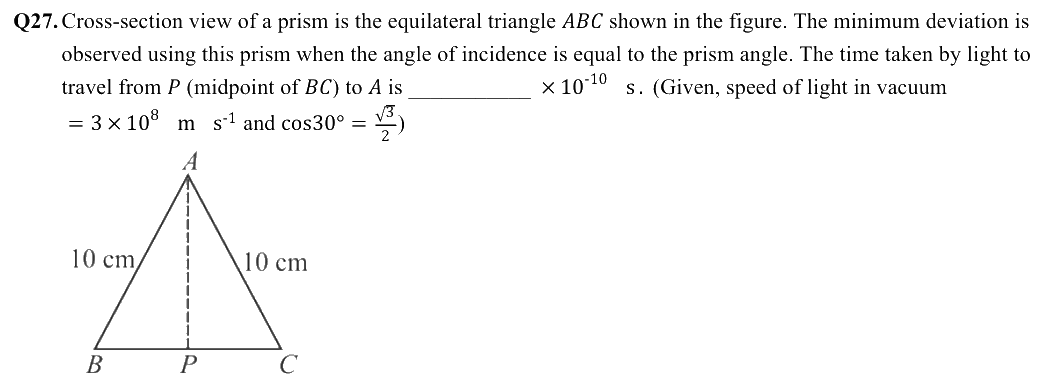
Cross-section view of a prism is the equilateral triangle $ABC$ shown in the figure. The minimum deviation is observed using this prism when the angle of incidence is equal to the prism angle. The time taken by light to travel from $P$ (midpoint of $BC$) to $A$ is ______ $\times 10^{-10}$ s. (Given, speed of light in vacuum $= 3 \times 10^8$ m s$^{-1}$ and $\cos 30^\circ = \frac{\sqrt{3}}{2}$) (see the figure above)
The question as printed in the paper.
Numerical answer type: type your answer in EdLoop to check it
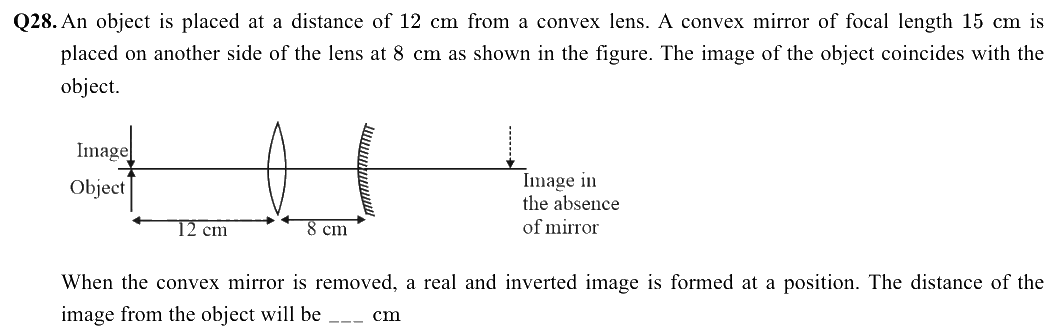
An object is placed at a distance of $12\ \mathrm{cm}$ from a convex lens. A convex mirror of focal length $15\ \mathrm{cm}$ is placed on another side of the lens at $8\ \mathrm{cm}$ as shown in the figure. The image of the object coincides with the object. (see the figure above) When the convex mirror is removed, a real and inverted image is formed at a position. The distance of the image from the object will be ___ cm
The question as printed in the paper.
Numerical answer type: type your answer in EdLoop to check it
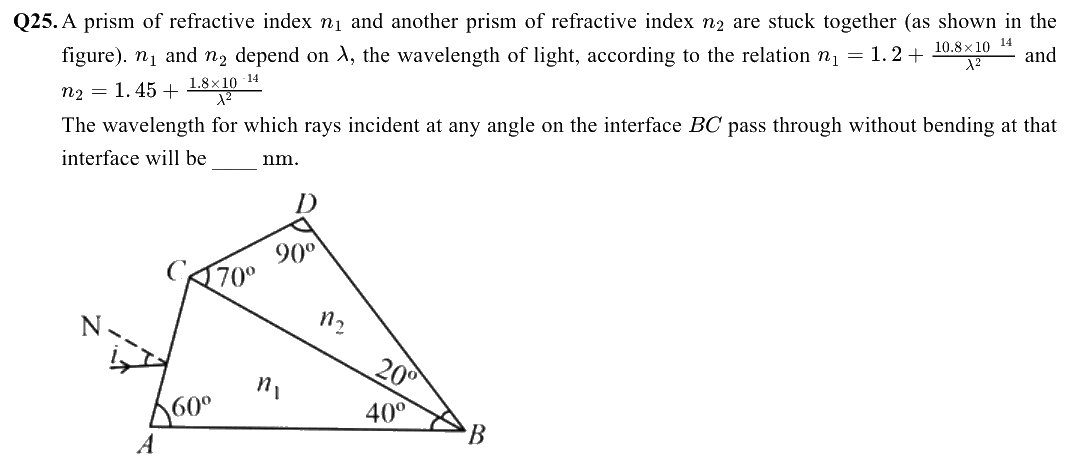
A prism of refractive index $n_1$ and another prism of refractive index $n_2$ are stuck together (as shown in the figure). $n_1$ and $n_2$ depend on $\lambda$, the wavelength of light, according to the relation $n_1 = 1.2 + \frac{10.8 \times 10^{-14}}{\lambda^2}$ and $n_2 = 1.45 + \frac{1.8 \times 10^{-14}}{\lambda^2}$. The wavelength for which rays incident at any angle on the interface $BC$ pass through without bending at that interface will be ______ nm. (see the figure above)
The question as printed in the paper.
Numerical answer type: type your answer in EdLoop to check it
A ray of light passing through a prism $\left(\mu = \sqrt{3}\right)$ suffers minimum deviation. It is found that the angle of incidence is double the angle of refraction within the prism. Then, the angle of prism is ______ (in degrees).
Numerical answer type: type your answer in EdLoop to check it
An object viewed from a near point distance of $25\ \mathrm{cm}$, using a microscopic lens with magnification $6$, gives an unresolved image. A resolved image is observed at infinite distance with a total magnification double the earlier using an eyepiece along with the given lens and a tube of length $0.6\ \mathrm{m}$, if the focal length of the eyepiece is equal to ____ cm.
Numerical answer type: type your answer in EdLoop to check it
The image of an object placed in air formed by a convex refracting surface is at a distance of $10 \mathrm{~m}$ behind the surface. The image is real and is at $\frac{2^{r d}}{3}$ of the distance of the object from the surface. The wavelength of light inside the surface is $\frac{2}{3}$ times the wavelength in air. The radius of the curved surface is $\frac{x}{13} \mathrm{~m}$, the value of $x$ is ______.
Numerical answer type: type your answer in EdLoop to check it
A deviation of $2^\circ$ is produced in the yellow ray when prism of crown and flint glass are achromatically combined. Taking dispersive powers of crown and flint glass are $0.02$ and $0.03$ respectively and refractive index for yellow light for these glasses are $1.5$ and $1.6$ respectively. The refracting angles for crown glass prism will be ______$^\circ$ (in degree) (Round off to the Nearest Integer)
Numerical answer type: type your answer in EdLoop to check it
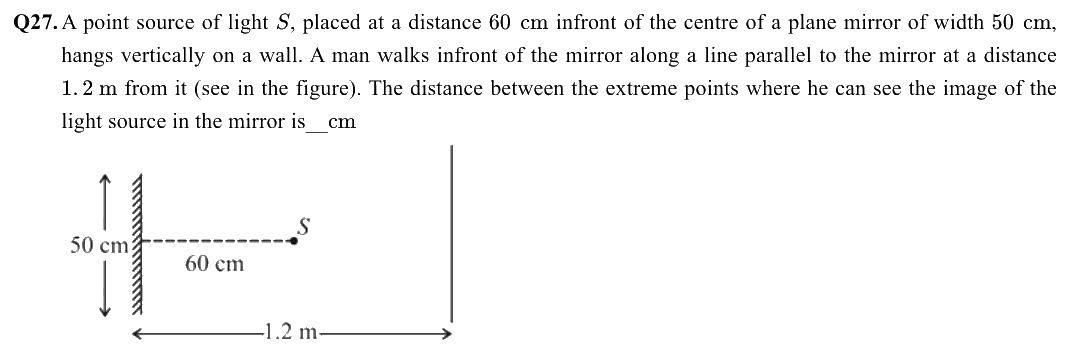
A point source of light $S$, placed at a distance $60\ \mathrm{cm}$ infront of the centre of a plane mirror of width $50\ \mathrm{cm}$, hangs vertically on a wall. A man walks infront of the mirror along a line parallel to the mirror at a distance $1.2\ \mathrm{m}$ from it (see in the figure). The distance between the extreme points where he can see the image of the light source in the mirror is ______ cm (see the figure above)
The question as printed in the paper.
Numerical answer type: type your answer in EdLoop to check it
The same size images are formed by a convex lens when the object is placed at $20\ \mathrm{cm}$ or at $10\ \mathrm{cm}$ from the lens. The focal length of convex lens is
Numerical answer type: type your answer in EdLoop to check it
A compound microscope consists of an objective lens of focal length 1 cm and an eye piece of focal length 5 cm with a separation of 10 cm. The distance between an object and the objective lens, at which the strain on the eye is minimum is $\frac{n}{40}$cm. The value of n is.......
Numerical answer type: type your answer in EdLoop to check it
A prism of angle $A = 1^{\circ}$ $\mu = 1.5$. A good estimate for the minimum angle of deviation (in degrees) is close to $\frac{N}{10}$. Value of N is ______
Numerical answer type: type your answer in EdLoop to check it
In a compound microscope, the magnified virtual image is formed at a distance of 25 cm from the eye-piece. The focal length of its objective lens is 1 cm. If the magnification is 100 and the tube length of the microscope is 20 cm, then the focal length of the eye-piece lens (in cm) is ______
Numerical answer type: type your answer in EdLoop to check it
The distance between an object and a screen is $100\ \mathrm{cm}$. A lens can produce real image of the object on the screen for two different positions between the screen and the object. The distance between these two positions is $40\ \mathrm{cm}$. If the power of the lens is close to $\left(\frac{N}{100}\right)\mathrm{D}$ where N is an integer, the value of N is ______
Numerical answer type: type your answer in EdLoop to check it
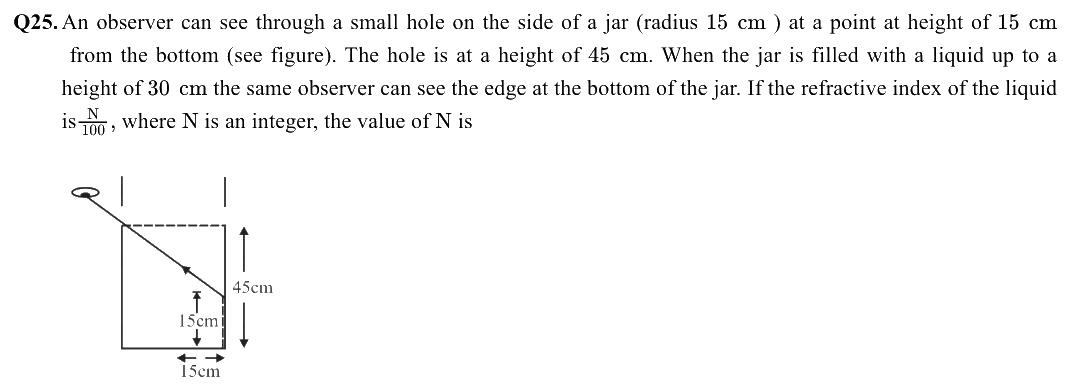
An observer can see through a small hole on the side of a jar (radius $15\ \mathrm{cm}$ ) at a point at height of $15\ \mathrm{cm}$ from the bottom (see figure). The hole is at a height of $45\ \mathrm{cm}$. When the jar is filled with a liquid up to a height of $30\ \mathrm{cm}$ the same observer can see the edge at the bottom of the jar. If the refractive index of the liquid is $\frac{N}{100}$, where N is an integer, the value of N is (see the figure above)
The question as printed in the paper.
Numerical answer type: type your answer in EdLoop to check it
When an object is kept at a distance of $30\ \mathrm{cm}$ from a concave mirror, the image is formed at a distance of $10\ \mathrm{cm}$ from the mirror. If the object is moved with a speed of $9\ \mathrm{cm\,s^{-1}}$ , the speed (in $\mathrm{cm\,s^{-1}}$) with which image moves at that instant is
Numerical answer type: type your answer in EdLoop to check it
A light ray enters a solid glass sphere of refractive index $\mu = \sqrt{3}$ at an angle of incidence $60^{\circ}$. The ray is both reflected and refracted at the farther surface of the sphere. The angle (in degrees) between the reflected and refracted rays at this surface is ______.
Numerical answer type: type your answer in EdLoop to check it
A point object in air is in front of the curved surface of a plano-convex lens. The radius of curvature of the curved surface is $30\ \mathrm{cm}$ and the refractive index of the lens material is 1.5, then the focal length of the lens (in cm) is ____________.
Numerical answer type: type your answer in EdLoop to check it
Ray optics investigates geometric image formation under Unit 16: Optics in the Class 12 physics syllabus, holding rank 6 among all 29 physics chapters with a 5.0 percent share of the subject. During the modern computer-based testing era from 2019 to 2026, ray optics supplied 227 questions in 162 test papers, delivering an average of 1.4 problems per sitting. The chapter appeared in 150 of those 162 test papers, with questions featured in every single exam year. Over the recent 2024 to 2026 cycle, its testing frequency has risen significantly: candidates encountered 96 questions across 58 papers, achieving a rate of 1.7 questions per paper and a 6.2 percent share. This demonstrates a trend that is up compared to the 3.8 percent share recorded from 51 questions in the 2002 to 2018 testing window. In the 2026 exam season alone, examiners set 35 questions across 19 papers, with problems appearing in 19 separate sessions. Across the 2019 to 2026 timeframe, 64 questions were structured as numerical answer questions, meaning students regularly calculate focal lengths, image positions, and magnifications without multiple choices.
Most-asked topics
The question pool spans five distinct geometric optics themes:
Lenses: 88 questions historically, with 75 appearing between 2019 and 2026, tested up to 2026. This topic emphasizes thin lens formula applications, lens maker's equation, combinations of lenses in contact or separated by finite distances, silvered lenses, and beam expanders.
Refraction: 77 problems overall, including 63 from 2019 to 2026, continuing into 2026. Focus areas involve Snell's law at planar and spherical interfaces, apparent depth, critical angle, total internal reflection, and optical fiber transmission.
Reflection & Mirrors: 43 lifetime problems, with 36 asked between 2019 and 2026, tested in 2026. Concepts examine concave and convex spherical mirror formulas, magnification ratios, and real or virtual image placement.
Prism & Dispersion: 40 questions since 2002, with 34 from 2019 to 2026, tested through 2026. Problems evaluate angle of minimum deviation, grazing incidence and emergence, thin prism combinations for dispersion without deviation, and prism refractive indices.
Optical Instruments: 30 questions overall, including 19 between 2019 and 2026, tested in 2026. Questions explore magnifying power and tube length for compound microscopes and astronomical telescopes under normal adjustment and least distance of distinct vision.
What the questions look like
JEE Main problems in ray optics present geometric ray paths requiring Cartesian coordinate conventions and algebraic substitutions:
Prisms with grazing emergence: A light ray passes through a triangular prism and emerges along the boundary face at ninety degrees to the normal. Students apply Snell's law across both faces to find the refracting angle or refractive index.
Optical microscope magnification: Given the focal lengths of objective and eyepiece lenses alongside the overall tube length, candidates calculate magnifying power under specified viewing conditions.
Beam expansion through two convex lenses: A narrow parallel laser beam widens after passing coaxially through two positive lenses separated by the sum of their focal lengths.
Wavelength and speed shifts across media: Calculating the altered wavelength or critical angle as monochromatic light travels between water and higher index glass media.
Questions to try first
Solve these illustrative recent problems to build problem-solving speed:
Enforce strict Cartesian sign conventions from the start. Taking the direction of incident light as the positive coordinate axis prevents sign errors in mirror and lens equations. Remember that focal lengths of concave mirrors and concave lenses are negative, while those of convex mirrors and convex lenses are positive.
Master the single spherical surface refraction formula. The lens maker formula derives directly from two successive refractions at spherical boundaries, so understanding surface curvature signs helps solve composite lenses and liquid container problems.
For optical instruments, focus on normal adjustment where the final image forms at infinity, and the case where the image forms at twenty-five centimeters. Learn the magnifying power formulas for both telescopes and microscopes, noting whether the tube length equals the sum of focal lengths or includes image distance.
Frequently asked questions
Which concepts in ray optics appear most frequently?
Lenses and refraction together comprise over sixty percent of all ray optics questions. Mastery of the lens maker equation, lens combinations, and refraction at spherical surfaces yields the highest returns in practice.
What is the most common reason for mistakes in ray optics?
Sign convention errors account for most lost marks. Students often forget to apply signs to focal lengths and object distances, or accidentally invert the signs of radii of curvature when substituting into the lens maker formula.
Are silvered lens problems still relevant in JEE Main?
Yes, questions where one face of a thin lens is silvered to act as an equivalent curved mirror appear regularly in both multiple choice and numerical answer sections. Step-by-step solutions for each one are in the EdLoop app.