The temperature of a metal strip having coefficient of linear expansion $\alpha$ is increased from $T_1$ to $T_2$ resulting in increase of its length by $\Delta L_1$. The temperature is further increased from $T_2$ to $T_3$ such that the increase in its length is $\Delta L_2$.
Given $T_3 + T_1 = 2T_2$ and $T_2 - T_1 = \Delta T$, the value of $\Delta L_2$ is ________.
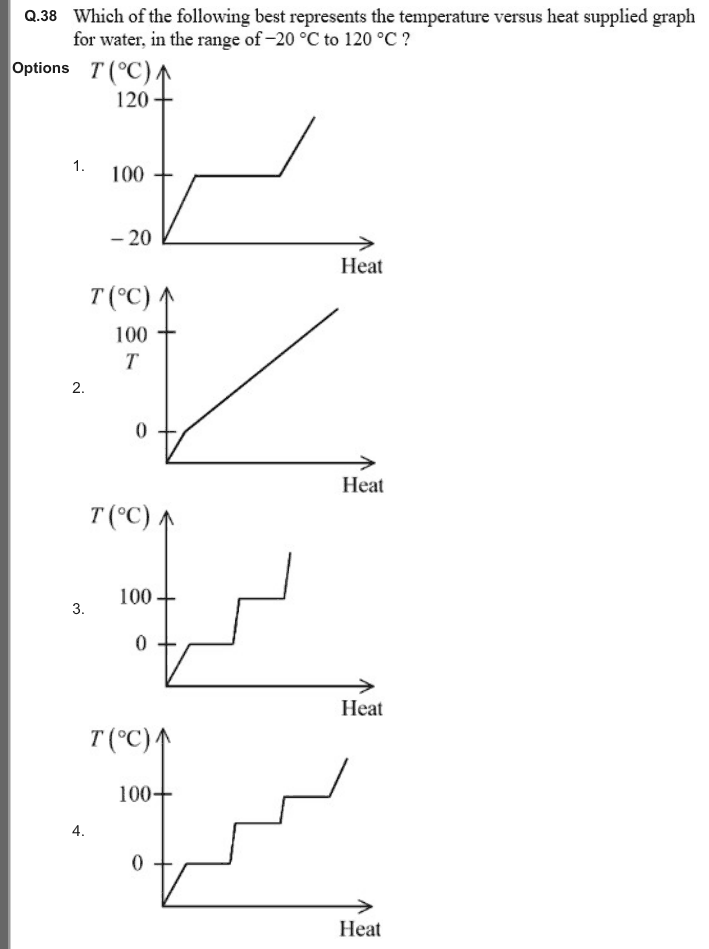
Which of the following best represents the temperature versus heat supplied graph for water, in the range of $-20$ °C to 120 °C ?
The question as printed in the paper.
A
see figure axes 'T (°C)' (vertical, marked 120, 100 and -20 with -20 at the horizontal axis) and 'Heat' (horizontal); a steep straight segment rising from -20 to the 100 level, a single flat segment at 100, then a rising segment going above 100 up toward the 120 level. One flat segment only.
B
see figure axes 'T (°C)' (vertical, marked 100, 'T' and 0) and 'Heat'; a short steep segment from the origin up to just above the 0 mark, then a gentler straight line rising continuously to above the 100 mark; no flat segments.
C
see figure axes 'T (°C)' (vertical, marked 100 and 0) and 'Heat'; a rising segment from the origin (below the 0 mark) to the 0 level, a flat segment at 0, a steep rise to the 100 level, a flat segment at 100, then a near-vertical rise above 100 at the right. Two flat segments (at 0 and at 100).
D
see figure axes 'T (°C)' (vertical, marked 100 and 0) and 'Heat'; a rising segment from the origin (below the 0 mark) to the 0 level, a flat segment at 0, a steep rise to a level between 0 and 100, a second flat segment at that intermediate level, a steep rise to the 100 level, a flat segment at 100, then a rising segment above 100 at the right. Three flat segments (at 0, at a level between 0 and 100, and at 100).
10 kg of ice at $-10$ °C is added to 100 kg of water to lower its temperature from 25 °C. Consider no heat exchange to surroundings. The decrement to the temperature of water is ________ °C.
(specific heat of ice = 2100 J/Kg.°C, specific heat of water = 4200 J/Kg.°C, latent heat of fusion of ice = $3.36 \times 10^5$ J/Kg)
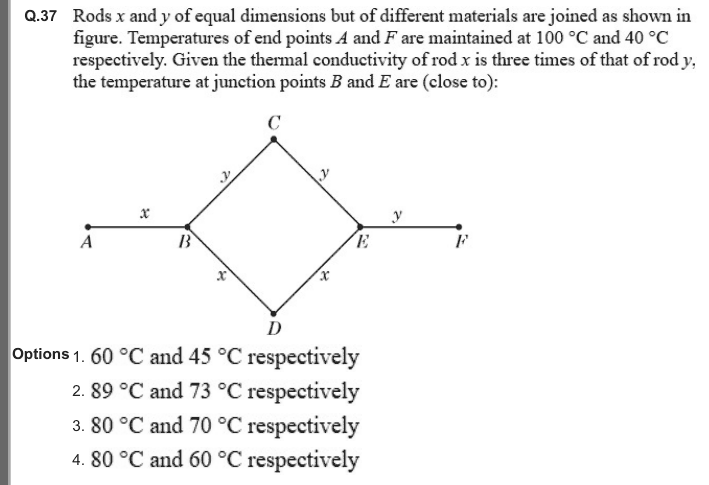
Rods $x$ and $y$ of equal dimensions but of different materials are joined as shown in figure. Temperatures of end points $A$ and $F$ are maintained at 100 °C and 40 °C respectively. Given the thermal conductivity of rod $x$ is three times of that of rod $y$, the temperature at junction points $B$ and $E$ are (close to):
An aluminium and steel rods having same lengths and cross-sections are joined to make total length of 120 cm at 30 °C. The coefficient of linear expansion of aluminium and steel are $24\times10^{-6}$/°C and $1.2\times10^{-5}$/°C, respectively. The length of this composite rod when its temperature is raised to 100 °C, is ________ cm.
A gas based geyser heats water flowing at the rate of 5.0 litres per minute from 27 °C to 87 °C. The rate of consumption of the gas is ________ g/s. (Take heat of combustion of gas = $5.0\times10^4$ J/g) specific heat capacity of water = 4200 J/kg.°C
Water falls from a height of 200 m into a pool. Calculate the rise in temperature of the water assuming no heat dissipation from the water in the pool.
(Take $g = 10\,m/s^2$, specific heat of water $= 4200\,J/(kg\,K)$ )
Consider a rectangular sheet of solid material of length $l = 9cm$ and width $d = 4cm$. The coefficient of linear expansion is $\alpha = 3.1 \times 10^{-5}K^{-1}$ at room temperature and one atmospheric pressure. The mass of sheet $m = 0.1kg$ and the specific heat capacity $C_V = 900Jkg^{-1}K^{-1}$. If the amount of heat supplied to the material is $8.1 \times 10^2J$ then change in area of the rectangular sheet is :
A cup of coffee cools from $90^\circ$C to $80^\circ$C in t minutes when the room temperature is $20^\circ$C. The time taken by the similar cup of coffee to cool from $80^\circ$C to $60^\circ$C at the same room temperature is :
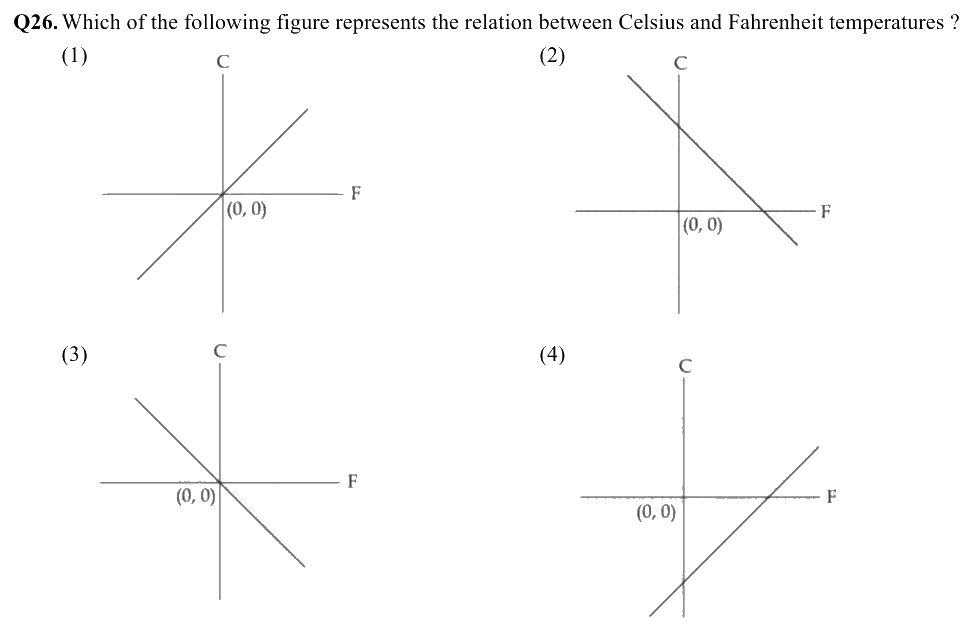
Which of the following figure represents the relation between Celsius and Fahrenheit temperatures ?
The question as printed in the paper.
A
see figure axes 'C' (vertical) and 'F' (horizontal) crossing at '(0, 0)' in the middle of the drawing; a straight line passing through the origin and rising to the upper right.
B
see figure axes 'C' and 'F' with '(0, 0)' labelled below-left of the crossing, the horizontal axis lying in the lower part of the drawing; a straight line falling from the upper left to the lower right, crossing the vertical axis above the horizontal axis and crossing the horizontal axis to the right of the vertical axis.
C
see figure axes 'C' and 'F' with '(0, 0)' labelled below-left of the crossing; a straight line passing through the origin and falling from the upper left to the lower right.
D
see figure axes 'C' and 'F' with '(0, 0)' labelled below-left of the crossing, the horizontal axis lying in the upper part of the drawing; a straight line rising from the lower left to the upper right, crossing the vertical axis below the horizontal axis and crossing the horizontal axis to the right of the vertical axis.
The temperature of a body in air falls from $40^\circ$C to $24^\circ$C in 4 minutes. The temperature of the air is $16^\circ$C. The temperature of the body in the next 4 minutes will be:
A gun fires a lead bullet of temperature 300 K into a wooden block. The bullet having melting temperature of 600 K penetrates into the block and melts down. If the total heat required for the process is 625 J , then the mass of the bullet is ______ grams. (Latent heat of fusion of lead $= 2.5 \times 10^4\ \mathrm{JKg^{-1}}$ and specific heat capacity of lead $= 125\ \mathrm{JKg^{-1}\ K^{-1}}$)
An amount of ice of mass $10^{-3}$ kg and temperature $-10^\circ$C is transformed to vapour of temperature $110^\circ$C by applying heat. The total amount of work required for this conversion is, (Take, specific heat of ice $= 2100\mathrm{Jg}^{-1}\,\mathrm{K}^{-1}$, specific heat of water $= 4180\mathrm{Jg}^{-1}\,\mathrm{K}^{-1}$, specific heat of steam $= 1920\mathrm{Jg}^{-1}\,\mathrm{K}^{-1}$, Latent heat of ice $= 3.35 \times 10^5\,\mathrm{Jg}^{-1}$ and Latent heat of steam $= 2.25 \times 10^6\ \mathrm{Jg}^{-1}$ )
Two spherical bodies of same materials having radii 0.2 m and 0.8 m are placed in same atmosphere. The temperature of the smaller body is 800 K and temperature of the bigger body is 400 K . If the energy radiated from the smaller body is E, the energy radiated from the bigger body is (assume, effect of the surrounding temperature to be negligible),
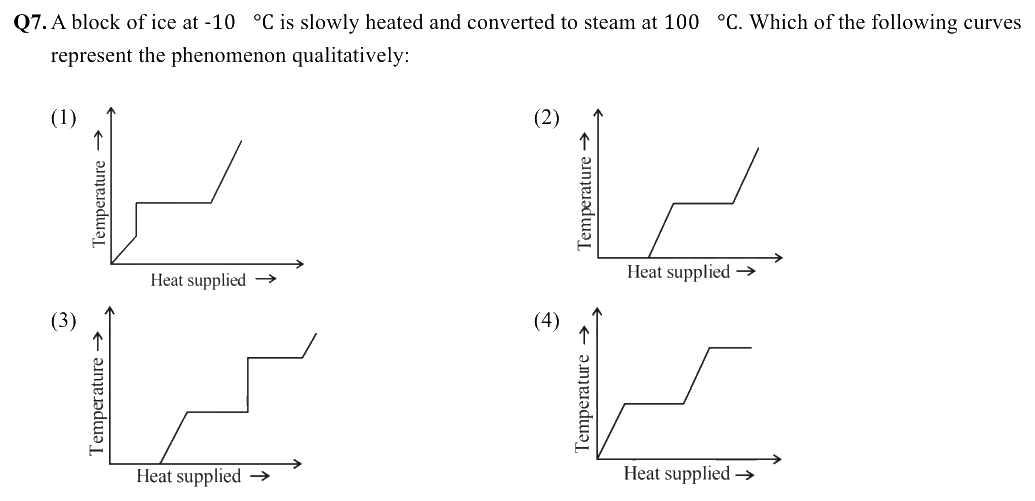
A block of ice at $-10^\circ$C is slowly heated and converted to steam at $100^\circ$C. Which of the following curves represent the phenomenon qualitatively:
(see the figure above)
The question as printed in the paper.
A
see figure Temperature vs heat supplied: starts at the origin, rises with a gentle slope to a small height, then a vertical jump to a plateau height, flat plateau, then a steeper rise to the end.
B
see figure Temperature vs heat supplied: starts on the heat axis at a point to the right of the origin, rises, flat plateau, then rises again to the end.
C
see figure Temperature vs heat supplied: starts on the heat axis at a point to the right of the origin, rises, first flat plateau, rises, vertical jump to a higher second plateau, flat, then rises again at the end.
D
see figure Temperature vs heat supplied: starts at the origin, rises, flat plateau, rises, then ends flat at a higher level.
A body cools from $80^\circ$C to $60^\circ$ in 5 minutes. The temperature for the surrounding is $20^\circ$C. The time it takes to cool from $60^\circ$C to $40^\circ$C is
On a temperature scale '$X$', the boiling point of water is $65^\circ$X and the freezing point is $-15^\circ$X. Assuming that the $X$ scale is linear. The equivalent temperature corresponding to $-95^\circ$X on the Fahrenheit scale would be
A body cools in 7 minutes from $60^\circ\mathrm{C}$ to $40^\circ\mathrm{C}$. The temperature of the surrounding is $10^\circ\mathrm{C}$. The temperature of the body after the next 7 minutes will be
Heat energy of 184 kJ is given to ice of mass 600 g at $-12\ ^\circ\mathrm{C}$, Specific heat of ice is $2222.3\ \mathrm{J\,kg^{-1}\,^\circ C^{-1}}$ and latent heat of ice is $336\ \mathrm{kJ\ kg^{-1}}$. (A) Final temperature of system will be $0\ ^\circ\mathrm{C}$ (B) Final temperature of the system will be greater than $0\ ^\circ\mathrm{C}$ (C) The final system will have a mixture of ice and water in the ratio of $5 : 1$ (D) The final system will have a mixture of ice and water in the ratio of $1 : 5$ (E) The final system will have water only Choose the correct answer from the options given below :
A bowl filled with very hot soup cools from $98^\circ\mathrm{C}$ to $86^\circ\mathrm{C}$ in 2 minutes when the room temperature is $22^\circ\mathrm{C}$. How long it will take to cool from $75^\circ\mathrm{C}$ to $69^\circ\mathrm{C}$ ?
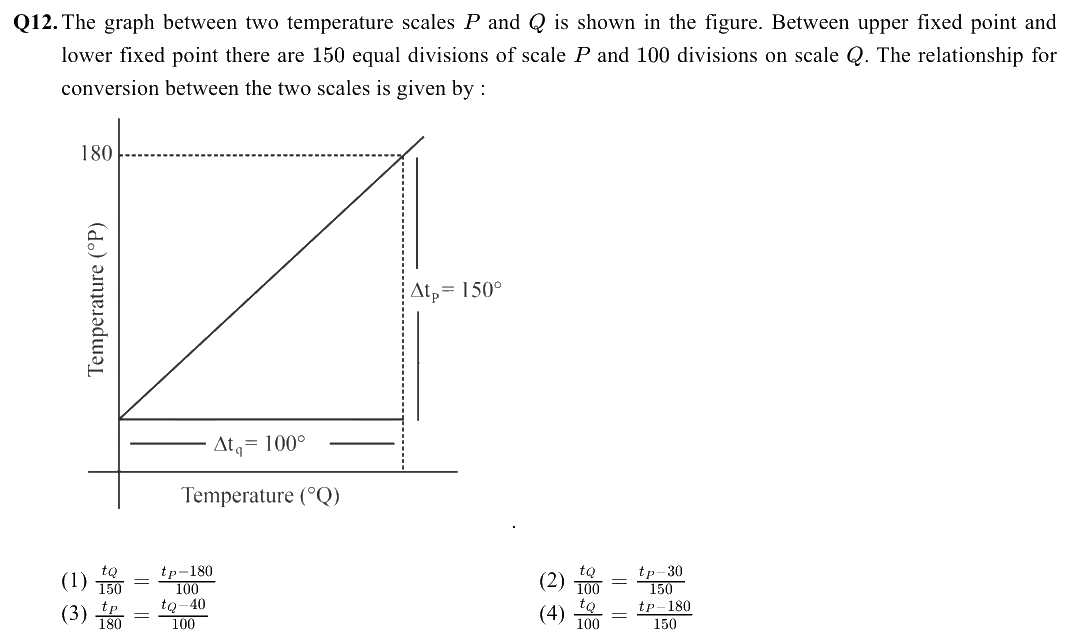
The graph between two temperature scales $P$ and $Q$ is shown in the figure. Between upper fixed point and lower fixed point there are 150 equal divisions of scale $P$ and 100 divisions on scale $Q$. The relationship for conversion between the two scales is given by :
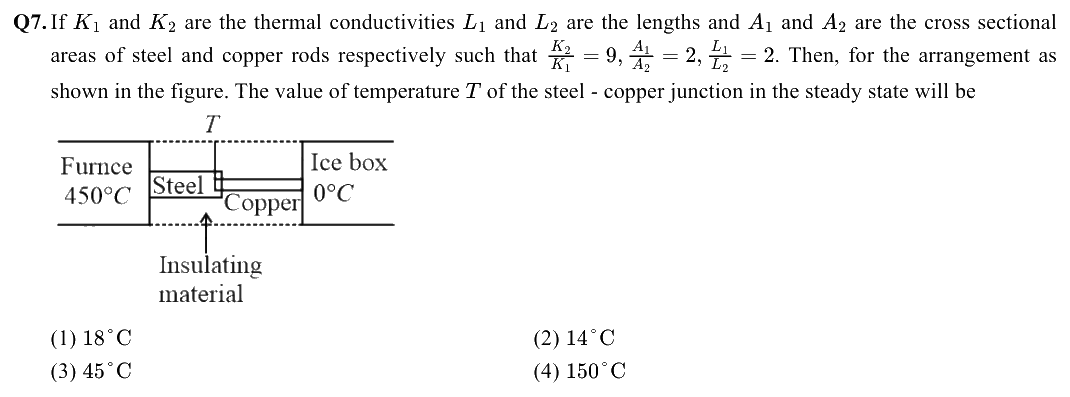
If $K_1$ and $K_2$ are the thermal conductivities $L_1$ and $L_2$ are the lengths and $A_1$ and $A_2$ are the cross sectional areas of steel and copper rods respectively such that $\frac{K_2}{K_1}$ = 9, $\frac{A_1}{A_2}$ = 2, $\frac{L_1}{L_2}$ = 2. Then, for the arrangement as shown in the figure. The value of temperature $T$ of the steel - copper junction in the steady state will be (see the figure above)
Read the following statements : A. When small temperature difference between a liquid and its surrounding is doubled the rate of loss of heat of the liquid becomes twice. B. Two bodies $P$ and $Q$ having equal surface areas are maintained at temperature $10^\circ$C and $20^\circ$C. The thermal radiation emitted in a given time by $P$ and $Q$ are in the ratio 1 : 1.15 C. A carnot Engine working between 100 K and 400 K has an efficiency of 75% D. When small temperature difference between a liquid and its surrounding is quadrupled, the rate of loss of heat of the liquid becomes twice. Choose the correct answer from the options given below :
An ice cube of dimensions $60\ \mathrm{cm}\times50\ \mathrm{cm}\times20\ \mathrm{cm}$ is placed in an insulation box of wall thickness $1\ \mathrm{cm}$. The box keeping the ice cube at $0^\circ$C of temperature is brought to a room of temperature $40^\circ$C. The rate of melting of ice is approximately: (Latent heat of fusion of ice is $3.4\times10^{5}\ \mathrm{J\ kg^{-1}}$ and thermal conducting of insulation wall is $0.05\ \mathrm{W\ m^{-1}\ ^\circ C^{-1}}$)
At what temperature a gold ring of diameter $6.230\ \mathrm{cm}$ be heated so that it can be fitted on a wooden bangle of diameter $6.241\ \mathrm{cm}$? Both the diameters have been measured at room temperature ($27^\circ\mathrm{C}$). (Given: coefficient of linear thermal expansion of gold $\alpha_L = 1.4 \times 10^{-5}\ \mathrm{K^{-1}}$)
A lead bullet penetrates into a solid object and melts. Assuming that $40\%$ of its kinetic energy is used to heat it, the initial speed of bullet is (Given, initial temperature of the bullet $= 127^{\circ}\mathrm{C}$, Melting point of the bullet $= 327^{\circ}\mathrm{C}$, Latent heat of fusion of lead $= 2.5 \times 10^{4}\ \mathrm{J\ kg^{-1}}$, Specific heat capacity of lead $= 125\ \mathrm{J\ kg\ K^{-1}}$)
A solid metallic cube having total surface area $24 \mathrm{~m^2}$ is uniformly heated. If its temperature is increased by $10^\circ\mathrm{C}$, calculate the increase in volume of the cube. (Given $\alpha = 5.0 \times 10^{-4}\,^\circ\mathrm{C^{-1}}$).
A copper block of mass $5.0 \mathrm{~kg}$ is heated to a temperature of $500^\circ\mathrm{C}$ and is placed on a large ice block. What is the maximum amount of ice that can melt? [Specific heat of copper : $0.39 \mathrm{~Jg^{-1}\,^\circ C^{-1}}$ and latent heat of fusion of water : $335 \mathrm{~Jg^{-1}}$]
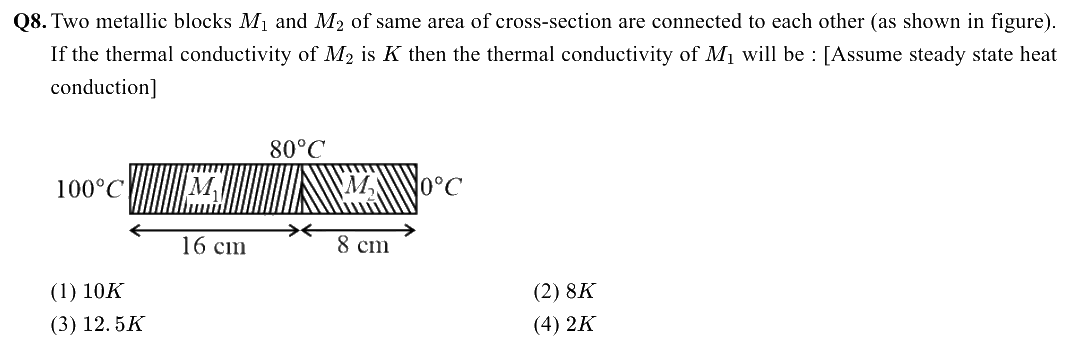
Two metallic blocks $M_1$ and $M_2$ of same area of cross-section are connected to each other (as shown in figure). If the thermal conductivity of $M_2$ is $K$ then the thermal conductivity of $M_1$ will be : [Assume steady state heat conduction] (see the figure above)
A $100 \mathrm{~g}$ of iron nail is hit by a $1.5 \mathrm{~kg}$ hammer striking at a velocity of $60 \mathrm{~ms^{-1}}$. What will be the rise in the temperature of the nail if one fourth of energy of the hammer goes into heating the nail ? [Specific heat capacity of iron $= 0.42 \mathrm{~J g^{-1}\,{}^\circ C^{-1}}$]
Due to cold weather, a $1$ m water pipe of cross-sectional area $1$ cm$^2$ is filled with ice at $-10$ $^\circ$C. Resistive heating is used to melt the ice. Current of $0.5$ A is passed through $4$ k$\Omega$ resistance. Assuming that all the heat produced is used for melting, what is the minimum time required? (Given latent heat of fusion for water/ice $= 3.33 \times 10^5$ J kg$^{-1}$, specific heat of ice $= 2 \times 10^3$ J kg$^{-1}$ $^\circ$C$^{-1}$ and density of ice $= 10^3$ kg m$^{-3}$ )
Two thin metallic spherical shells of radii $r_1$ and $r_2$ $r_1 < r_2$ are placed with their centres coinciding. A material of thermal conductivity $K$ is filled in the space between the shells. The inner shell is maintained at temperature $\theta_1$ and the outer shell at temperature $\theta_2$ $\theta_1 < \theta_2$. The rate at which heat flows radially through the material is :
The height of victoria's falls is $63\ \mathrm{m}$. What is the difference in the temperature of water at the top and at the bottom of the fall? [Given $1\ \mathrm{cal}=4.2\ \mathrm{J}$ and specific heat of water $=1\ \mathrm{cal\ g^{-1}\,{}^\circ C^{-1}}$]
The temperature of equal masses of three different liquids $x$, $y$ and $z$ are $10^\circ\mathrm{C}$, $20^\circ\mathrm{C}$ and $30^\circ\mathrm{C}$ respectively. The temperature of mixture when $x$ is mixed with $y$ is $16^\circ\mathrm{C}$ and that when $y$ is mixed with $z$ is $26^\circ\mathrm{C}$. The temperature of mixture when $x$ and $z$ are mixed will be :
A body takes $4\ \mathrm{min}$ to cool from $61^\circ\mathrm{C}$ to $59^\circ\mathrm{C}$. If the temperature of the surroundings is $30^\circ\mathrm{C}$, the time taken by the body to cool from $51^\circ\mathrm{C}$ to $49^\circ\mathrm{C}$ is:
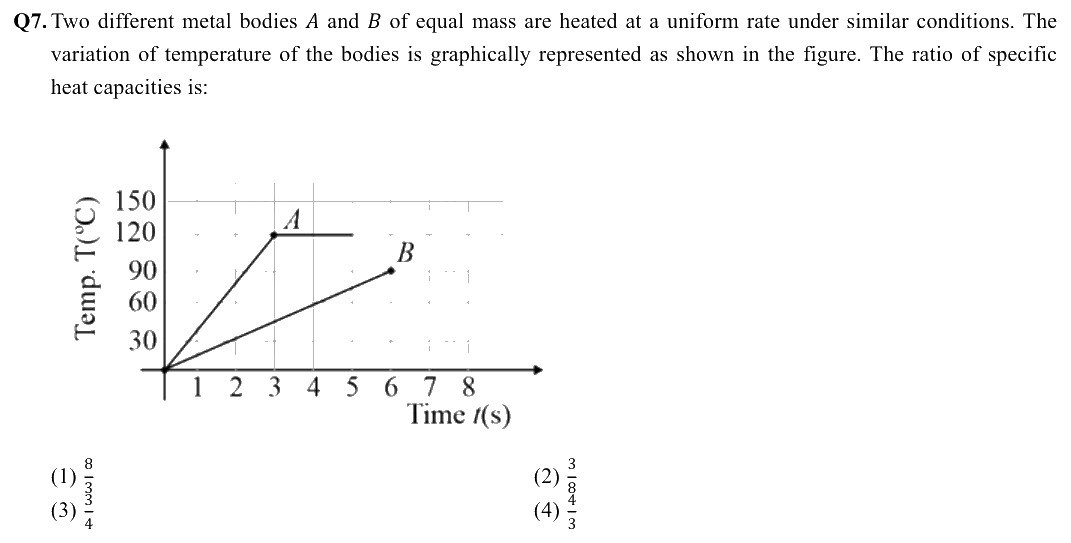
Two different metal bodies $A$ and $B$ of equal mass are heated at a uniform rate under similar conditions. The variation of temperature of the bodies is graphically represented as shown in the figure. The ratio of specific heat capacities is: (see the figure above)
Two identical metal wires of thermal conductivities $K_1$ and $K_2$ respectively are connected in series. The effective thermal conductivity of the combination is:
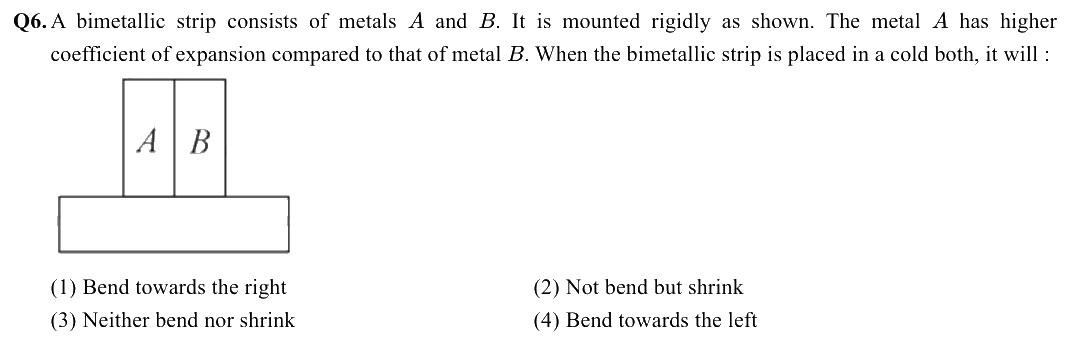
A bimetallic strip consists of metals $A$ and $B$. It is mounted rigidly as shown. The metal $A$ has higher coefficient of expansion compared to that of metal $B$. When the bimetallic strip is placed in a cold both, it will : (see the figure above)
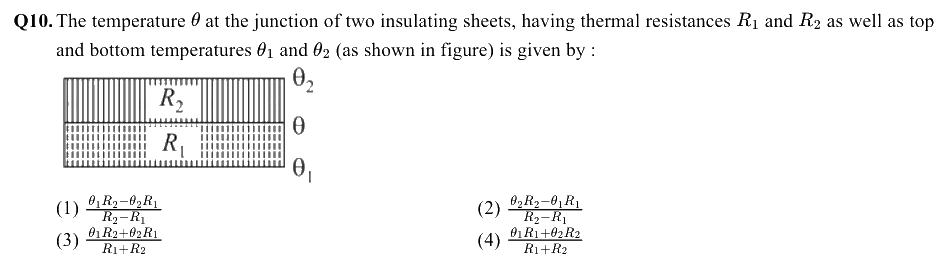
The temperature $\theta$ at the junction of two insulating sheets, having thermal resistances $R_1$ and $R_2$ as well as top and bottom temperatures $\theta_1$ and $\theta_2$ (as shown in figure) is given by : (see the figure above)
Given below are two statements: one is labelled as Assertion $A$ and the other is labelled as Reason $R$. Assertion $A$ : When a rod lying freely is heated, no thermal stress is developed in it. Reason $R$ : On heating, the length of the rod increases. In the light of the above statements, choose the correct answer from the options given below:
A
Both $A$ and $R$ are true and $R$ is the correct explanation of $A$
B
$A$ is false but $R$ is true
C
Both $A$ and $R$ are true but $R$ is NOT the correct explanation of $A$
Each side of a box made of metal sheet in cubic shape is $a$ at room temperature $T$, the coefficient of linear expansion of the metal sheet is $\alpha$. The metal sheet is heated uniformly, by a small temperature $\Delta T$, so that its new temperature is $T + \Delta T$. Calculate the increase in the volume of the metal box.
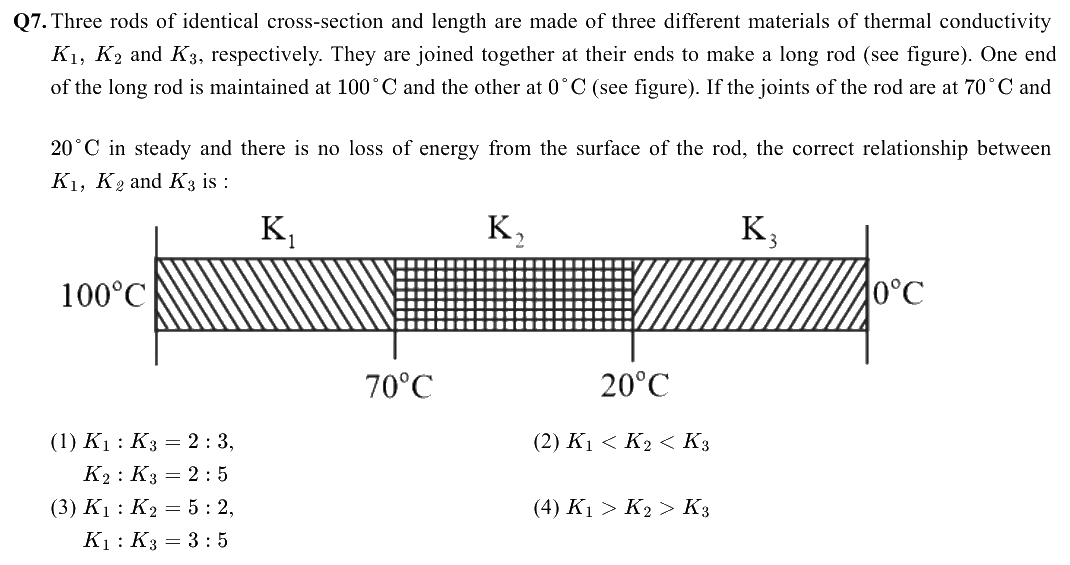
Three rods of identical cross-section and length are made of three different materials of thermal conductivity $K_1$, $K_2$ and $K_3$, respectively. They are joined together at their ends to make a long rod (see figure). One end of the long rod is maintained at $100^\circ\mathrm{C}$ and the other at $0^\circ\mathrm{C}$ (see figure). If the joints of the rod are at $70^\circ\mathrm{C}$ and $20^\circ\mathrm{C}$ in steady and there is no loss of energy from the surface of the rod, the correct relationship between $K_1$, $K_2$ and $K_3$ is : (see the figure above)
A bullet of mass 5 gram, travelling with a speed of 210 m s$^{-1}$ strikes a fixed wooden target. One half of its kinetic energy is converted into heat in the wood. The rise of temperature of the bullet if the specific heat of its material is 0. 030 (gram $^{\circ}$C)$^{-1}$ (1 calorie = 4 .2 $\times 10^7$ ergs) close to :
Two different wires having lengths $L_1$ and $L_2$ and respective temperature coefficient of linear expansion $\alpha_1$ and $\alpha_2$, are joined end-to-end. Then the effective temperature coefficient of linear expansion is :
The specific heat of water = $4200\ \mathrm{J\ kg^{-1}\ K^{-1}}$ and the latent heat of ice = $3.4 \times 10^{5}\ \mathrm{J\ kg^{-1}}$. 100 grams of ice at $0\ ^{\circ}\mathrm{C}$ is placed in 200 g of water at $25\ ^{\circ}\mathrm{C}$. The amount of ice that will melt as the temperature of water reaches $0\ ^{\circ}\mathrm{C}$ is close to (in grams)
A metallic sphere cools from $50\ ^\circ\mathrm{C}$ to $40\ ^\circ\mathrm{C}$ in $300\ \mathrm{s}$. If atmospheric temperature around is $20\ ^\circ\mathrm{C}$, then the sphere's temperature after the nest 5 minutes will be close to:
A calorimeter of water equivalent $20\ \mathrm{g}$ contains $180\ \mathrm{g}$ of water at $25\ ^\circ\mathrm{C}$. $'m''$ grams of steam at $100\ ^\circ\mathrm{C}$ is mixed in it till the temperature of the mixture is $31\ ^\circ\mathrm{C}$. The value of $'m'$ is close to (Latent heat of water $= 540\ \mathrm{cal\,g^{-1}}$, specific heat of water$= 1\ \mathrm{cal\,g^{-1}\,^\circ C^{-1}}$)
When the temperature of a metal wire is increased from $0^{\circ}\mathrm{C}$ to $10^{\circ}\mathrm{C}$, its length increases by $0.02\%$.The percentage change in its mass density will be closed to:
When $M_1$ gram of ice at $-10^o\mathrm{C}$ (specific heat $= 0.5\ \mathrm{cal\ g^{-1}\ ^oC^{-1}}$ ) is added to $M_2$ gram of water at $50\ ^o\mathrm{C}$, finally no ice is left and the water is at $0\ ^o\mathrm{C}$ . The value of latent heat of ice, in $\mathrm{cal\ g^{-1}}$ is:
A uniform cylindrical rod of length $L$ and radius r, is made from a material whose Young's modulus of Elasticity equals $Y$. When this rod is heated by temperature T and simultaneously subjected to a net longutudinal compressive force F, its length remains unchanged. The coefficient of volume expansion, of the material of the rod, is (nearly) equal to:
1 kg of water, at $20\ ^\circ\mathrm{C}$ is heated in an electric kettle whose heating element has a mean (temperature averaged) resistance of $20\ \Omega$. The rms voltage in the mains is 200 V. Ignoring heat loss from the kettle, time taken for water to evaporate fully is close to [ Specific heat of water = $4200\ \mathrm{J\ kg^{-1}\ ^\circ C^{-1}}$ Latent heat of water = $2260\ \mathrm{kJ\ kg^{-1}}$ ]
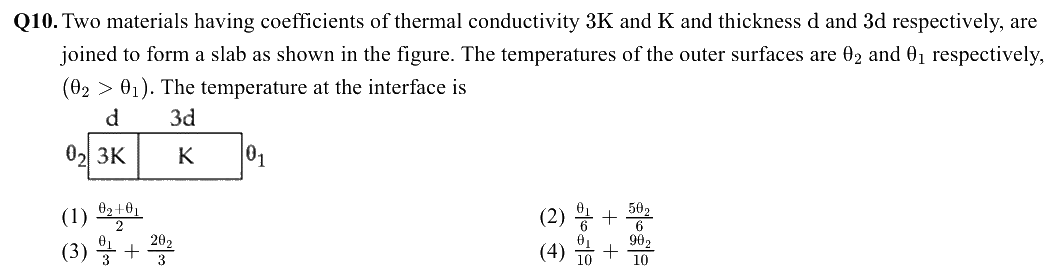
Two materials having coefficients of thermal conductivity 3K and K and thickness d and 3d respectively, are joined to form a slab as shown in the figure. The temperatures of the outer surfaces are $\theta_2$ and $\theta_1$ respectively, ($\theta_2 > \theta_1$). The temperature at the interface is (see the figure above)
A massless spring ($k$ = 800 N/m), attached with a mass (500 g) is completely immersed in 1 kg of water. The spring is stretched by 2 cm and released so that it starts vibrating. What would be the order of magnitude of the change in the temperature of water when the vibrations stop completely? (Assume that the water container and spring receive negligible heat and specific heat of mass = 400 J/kg K, specific heat of water = 4184 J/kg K )
A thermally insulated vessel contains 150 g of water at $0^\circ$C. Then the air from the vessel is pumped out adiabatically. A fraction of water turns into ice and the rest evaporates at $0^\circ$C itself. The mass of evaporated water will be closest to: (Latent heat of vaporization of water $= 2.10 \times 10^6\ \mathrm{J\,kg^{-1}}$ and Latent heat of Fusion of water $= 3.36 \times 10^5\ \mathrm{J\,kg^{-1}}$)
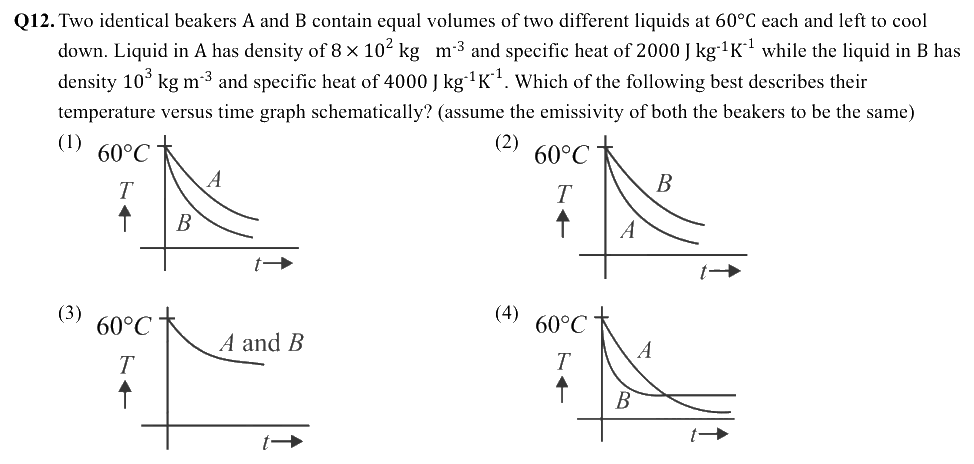
Two identical beakers A and B contain equal volumes of two different liquids at $60^\circ$C each and left to cool down. Liquid in A has density of $8 \times 10^2\ \mathrm{kg\ m^{-3}}$ and specific heat of 2000 $\mathrm{J\,kg^{-1}K^{-1}}$ while the liquid in B has density $10^3\ \mathrm{kg\ m^{-3}}$ and specific heat of 4000 $\mathrm{J\,kg^{-1}K^{-1}}$. Which of the following best describes their temperature versus time graph schematically? (assume the emissivity of both the beakers to be the same)
The question as printed in the paper.
A
see figure T (vertical, starting at 60°C) against t: two decaying curves from 60°C, A above B throughout.
B
see figure T against t: two decaying curves from 60°C, B above A throughout.
C
see figure T against t: a single decaying curve labelled "A and B" (the two coincide).
D
see figure T against t: A falls steeply from 60°C and levels off; B starts at 60°C, crosses A near the start and runs to a horizontal line (reading of the final levels is uncertain).
A cylinder of radius $R$ is surrounded by a cylindrical shell of inner radius $R$ and outer radius $2R$. The thermal conductivity of the material of the inner cylinder is $K_1$ and that of the outer cylinder is $K_2$. Assuming no loss of heat, the effective thermal conductivity of the system for heat flowing along the length of the cylinder is:
Ice at $-20^{\circ}$C is added to 50 g of water at 40$^{\circ}$C, When the temperature of the mixture reaches 0$^{\circ}$C, it is found that 20 g of ice is still unmelted. The amount of ice added to the water was close to (Specific heat of water = 4.2 J/g/$^{\circ}$C Specific heat of Ice = 2.1 J/g/$^{\circ}$C Heat of fusion of water at 0$^{\circ}$C = 334 J/g)
Two rods $A$ and $B$ of identical dimensions are at temperature 30$^{\circ}$C. If A is heated upto 180$^{\circ}$C and B upto T$^{\circ}$C, then the new lengths are the same. If the ratio of the coefficients of linear expansion of A and B is 4 : 3, then the value of $T$ is
A thermometer graduated according to a linear scale reads a value $x_0$ when in contact with boiling water, and $x_0/3$ when in contact with ice. What is the temperature of an object in $^{\circ}$C, if this thermometer in the contact with the object reads $x_0/2$?
When 100 g of a liquid A at 100$^{\circ}$C is added to 50 g of a liquid $B$ at temperature 75$^{\circ}$C, the temperature of the mixture becomes 90$^{\circ}$C. The temperature of the mixture, if 100 g of liquid $A$ at 100$^{\circ}$C is added to 50 g of liquid B at 50$^{\circ}$C, will be:
A metal ball of mass 0.1 kg is heated upto 500$^{\circ}$C and dropped into a vessel of heat capacity 800JK$^{-1}$ and containing 0.5 kg water. The initial temperature of water and vessel is 30$^{\circ}$C. What is the approximate percentage increment in the temperature of the water? [Specific Heat Capacities of water and metal are, respectively, 4200Jkg$^{-1}$K$^{-1}$ and 400Jkg$^{-1}$K$^{-1}$ ]
A heat source at $T = 10^3$ K is connected to another heat reservoir at $T = 10^2$ K by a copper slab which is 1 m thick. Given that the thermal conductivity of copper is 0.1 W K$^{-1}$ m$^{-1}$, the energy flux through it in the steady-state is:
An unknown metal of mass $192\ g$ heated to a temperature of $100^\circ C$ was immersed into a brass calorimeter of mass $128\ g$ containing $240\ g$ of water at a temperature of $8.4^oC$. Calculate the specific heat of the unknown metal if water temperature stabilizes at $21.5^oC$. ( Specific heat of brass is $394J\ kg^{-1}K^{-1}$)
A rod, of length $L$ at room temperature and uniform area of cross section $A$, is made of a metal having coefficient of linear expansion $\alpha$ $/^\circ C$ It is observed that an external compressive force $F$ is applied on each of its ends, prevents any change in the length of the rod, when its temperature rises by $\Delta T$ K Young's modulus, $Y$ for this metal is:
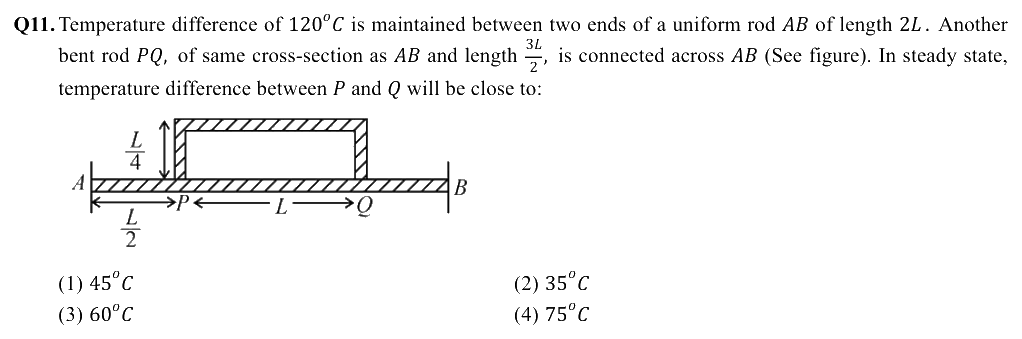
Temperature difference of $120^\circ C$ is maintained between two ends of a uniform rod $AB$ of length $2L$. Another bent rod $PQ$, of same cross-section as $AB$ and length $\dfrac{3L}{2}$, is connected across $AB$ (See figure). In steady state, temperature difference between $P$ and $Q$ will be close to: (see the figure above)
A body takes $10$ minutes to cool from $60^\circ\mathrm{C}$ to $50^\circ\mathrm{C}$. The temperature of surroundings is constant at $25^\circ\mathrm{C}$. Then, the temperature of the body after next $10$ minutes will be approximately
A steel rail of length 5 m and area of cross section $40\ \mathrm{cm^2}$ is prevented from expanding along its length while the temperature rises by $10^\circ\mathrm{C}$. If coefficient of linear expansion and Young's modulus of steel are $1.2 \times 10^{-5}\ \mathrm{K^{-1}}$ and $2 \times 10^{11}\ \mathrm{N\,m^{-2}}$ respectively, the force developed in the rail is approximately:
A compressive force, $F$ is applied at the two ends of a long thin steel rod. It is heated, simultaneously, such that its temperature increases by $\Delta T$. The net change in its length is zero. Let $l$ be the length of the rod, $A$ its area of cross-section, $Y$ its Young's modulus, and $\alpha$ its coefficient of linear expansion. Then, $F$ is equal to:
In an experiment, a sphere of aluminium of mass 0.20 kg is heated up to $150^\circ\mathrm{C}$. Immediately, it is put into water of volume 150 cc at $27^\circ\mathrm{C}$ kept in a calorimeter of water equivalent to 0.025 kg. The final temperature of the system is $40^\circ\mathrm{C}$. The specific heat of the aluminium is (take 4.2 Joule = 1 calorie)
A copper ball of mass $100\ \mathrm{g}$ is at a temperature $T$. It is dropped in a copper calorimeter of mass $100\ \mathrm{g}$, filled with $170\ \mathrm{g}$ of water at room temperature. Subsequently, the temperature of the system is found to be $75^\circ\mathrm{C}$. $T$ is given by: (Given: room temperature $= 30^\circ\mathrm{C}$, specific heat of copper $= 0.1\ \mathrm{cal\ g^{-1}\ ^\circ C^{-1}}$)
An external pressure $P$ is applied on a cube at $0^\circ\mathrm{C}$ so that it is equally compressed from all sides. $K$ is the bulk modulus of the material of the cube and $\alpha$ is its coefficient of linear expansion. Suppose we want to bring the cube to its original size by heating. The temperature should be raised by:
A simple pendulum made of a bob of mass m and a metallic wire of a negligible mass has a time period of 2 s at $T = 0^{\circ}$C. If the temperature of the wire is increased, and the corresponding change in its time period is plotted against its temperature, the resulting graph is a line of slope $S$. If the coefficient of linear expansion of metal is $\alpha$, then the value of $S$ is
A pendulum clock loses 12 s a day if the temperature is $40^{\circ}$ C and gains 4s a day if the temperature is $20^{\circ}$ C. The temperature at which the clock will show correct time, and the co-efficient of linear expansion ($\alpha$) of the metal of the pendulum shaft are respectively:
An experiment takes 10 min to raise the temperature of water in a container from $0^\circ$C to $100^\circ$C and another 55 min to convert it totally into steam by a heater supplying heat at a uniform rate. Neglecting the specific heat of the container and taking specific heat of the water to be 1 cal $(\mathrm{g}^\circ\mathrm{C})^{-1}$, the heat of vaporization according to this experiment will come out to be:
A black coloured solid sphere of radius $R$ and mass $M$ is inside a cavity with a vacuum inside. The walls of the cavity are maintained at temperature $T_0$. The initial temperature of the sphere is $3T_0$. If the specific heat of the material of the sphere varies as $\alpha T^3$ per unit mass with the temperature $T$ of the sphere, where $\alpha$ is a constant, then the time taken for the sphere to cool down to temperature $2T_0$ will be $(\sigma$ is Stefan Boltzman constant)
Hot water cools from $60^\circ\mathrm{C}$ to $50^\circ\mathrm{C}$ in the first 10 minutes and to $42^\circ\mathrm{C}$ in the next 10 minutes. The temperature of the surroundings is:
A hot body, obeying Newton's law of cooling is cooling down from its peak value $80^{\circ}\mathrm{C}$ to an ambient temperature of $30^{\circ}\mathrm{C}$. It takes 5 minutes in cooling down from $80^{\circ}\mathrm{C}$ to $40^{\circ}\mathrm{C}$. How much time will it take to cool down from $62^{\circ}\mathrm{C}$ to $32^{\circ}\mathrm{C}$ ? (Given $\ln 2 = 0.693$, $\ln 5 = 1.609$ )
Water of volume 2 L in a closed container is heated with a coil of 1 kW. While water is heated, the container loses energy at a rate of 160 J/s. In how much time will the temperature of water rise from $27^\circ\mathrm{C}$ to $77^\circ\mathrm{C}$ ? (Specific heat of water is 4.2 kJ/kg and that of the container is negligible).
The pressure that has to be applied to the ends of a steel wire of length 10 cm to keep its length constant when its temperature is raised by $100\,^\circ$C is : (For steel, Young's modulus is $2 \times 10^{11}$ N m$^{-2}$ and coefficient of thermal expansion is $1.1 \times 10^{-5}$ K$^{-1}$)
Three rods of Copper, Brass and Steel are welded together to form a Y-shaped structure. Area of cross-section of each rod is 4 cm$^2$. End of copper rod is maintained at $100^\circ$C. Where as ends of brass and steel are kept at $0^\circ$C. Lengths of the copper, brass and steel rods are 46, 13 and 12 cms respectively. The rods are thermally insulated from surroundings except at ends. Thermal conductivities of copper, brass and steel are 0.92, 0.26 and 0.12 CGS units respectively. Rate of heat flow through copper rod is :
A mass of 50 g of water in a closed vessel, with surroundings at a constant temperature takes 2 minutes to cool from $30^\circ$C to $25^\circ$C. A mass of 100 g of another liquid in an identical vessel with identical surroundings takes the same time to cool from $30^\circ$C to $25^\circ$C. The specific heat of the liquid is : (The water equivalent of the vessel is 30 g.)
The ratio of the coefficient of volume expansion of a glass container to that of a viscous liquid kept inside the container is $1 : 4$. What fraction of the inner volume of the container should the liquid occupy so that the volume of the remaining vacant space will be same at all temperatures ?
500 g of water and 100 g of ice at $0^\circ\mathrm{C}$ are in a calorimeter whose water equivalent is 40 g.10 g of steam at $100^\circ\mathrm{C}$ is added to it. Then water in the calorimeter is : (Latent heat of ice = 80cal/g, Latent heat of steam = 540cal/g )
On a linear temperature scale Y, water freezes at $-160^\circ\mathrm{Y}$ and boils at $-50^\circ\mathrm{Y}$. On this Y scale, a temperature of 340 K would be read as : (water freezes at 273 K and boils at 373 K )
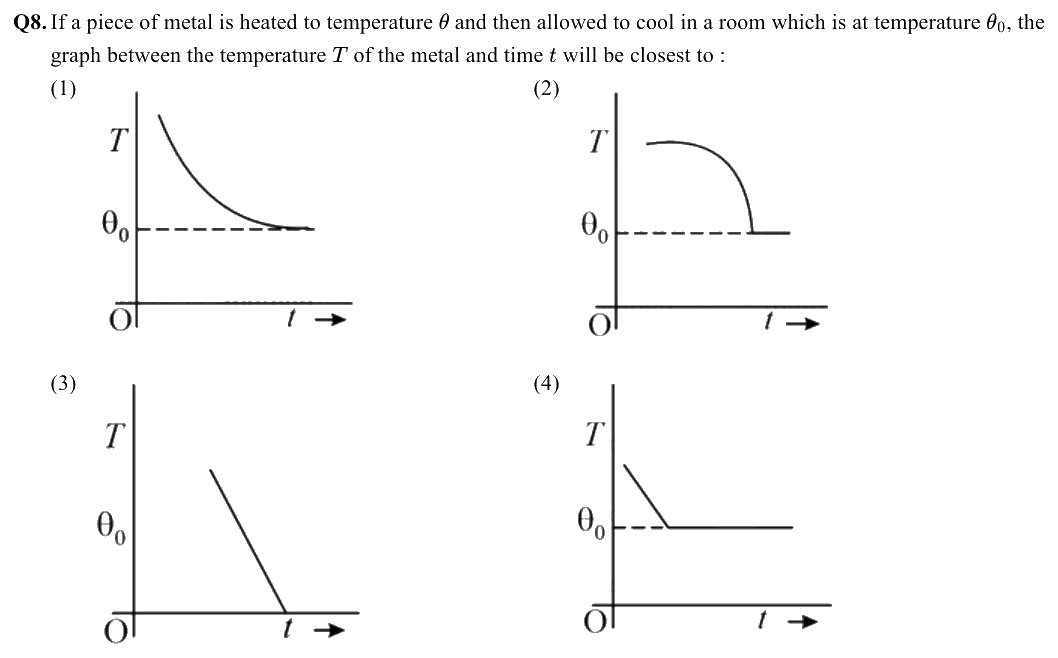
If a piece of metal is heated to temperature $\theta$ and then allowed to cool in a room which is at temperature $\theta_0$, the graph between the temperature $T$ of the metal and time $t$ will be closest to :
A large cylindrical rod of length $L$ is made by joining two identical rods of copper and steel of length $\left(\frac{L}{2}\right)$ each. The rods are completely insulated from the surroundings. If the free end of copper rod is maintained at $100^\circ\mathrm{C}$ and that of steel at $0^\circ\mathrm{C}$ then the temperature of junction is (Thermal conductivity of copper is 9 times that of steel)
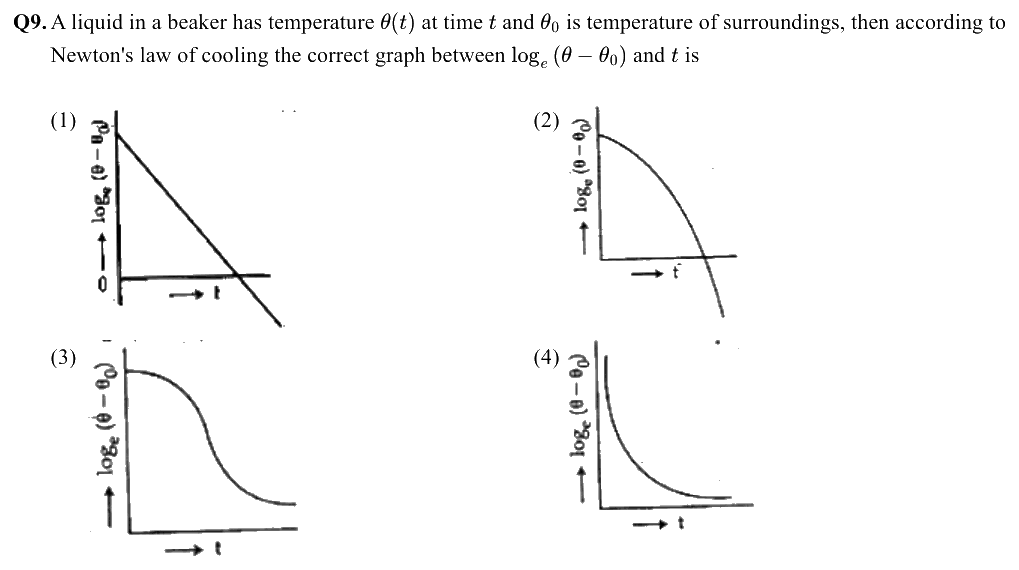
A liquid in a beaker has temperature $\theta(t)$ at time $t$ and $\theta_0$ is temperature of surroundings, then according to Newton's law of cooling the correct graph between $\log_e (\theta - \theta_0)$ and $t$ is
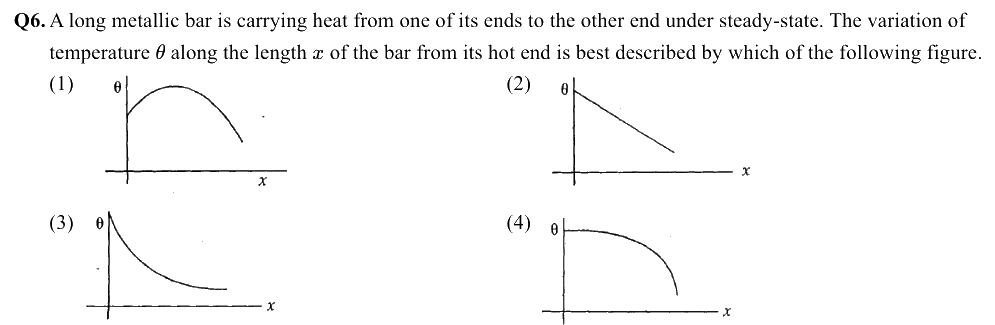
A long metallic bar is carrying heat from one of its ends to the other end under steady-state. The variation of temperature $\theta$ along the length $x$ of the bar from its hot end is best described by which of the following figure.
The question as printed in the paper.
A
see figure Graph of $\theta$ against $x$: curve rises from the $\theta$-axis to a rounded maximum and then falls, ending above the x-axis.
B
see figure Graph of $\theta$ against $x$: a straight line falling from the $\theta$-axis (top left) down to the right, ending above the x-axis.
C
see figure Graph of $\theta$ against $x$: a convex decaying curve falling steeply at first and then flattening towards the x-axis (exponential-decay shape).
D
see figure Graph of $\theta$ against $x$: curve starts flat at the top on the $\theta$-axis and bends downward more and more steeply to the right (concave-down, ending steeply near the x-axis).
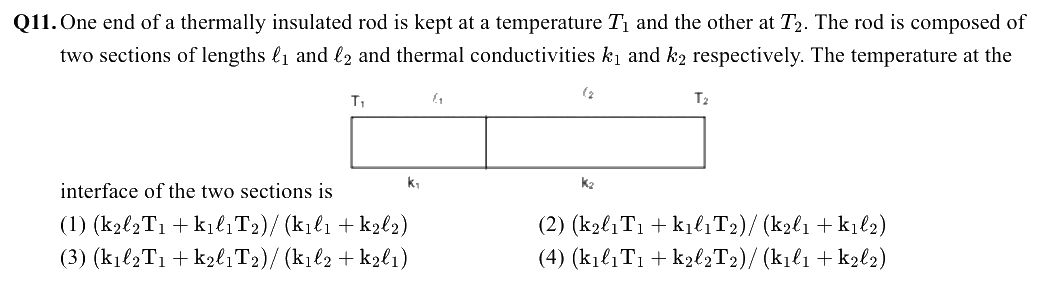
see figure One end of a thermally insulated rod is kept at a temperature $T_1$ and the other at $T_2$. The rod is composed of two sections of lengths $\ell_1$ and $\ell_2$ and thermal conductivities $k_1$ and $k_2$ respectively. The temperature at the interface of the two sections is
Assuming the sun to be a spherical body of radius R at a temperature of TK, evaluate the total radiant power, incident on Earth, at a distance $r$ from the Sun.
A thermocouple is made from two metals, Antimony and Bismuth. If one junction of the couple is kept hot and the other is kept cold then, an electric current will
A
flow from Antimony to Bismuth at the cold junction
B
flow from Antimony to Bismuth at the hot junction
C
flow from Bismuth to Antimony at the cold junction
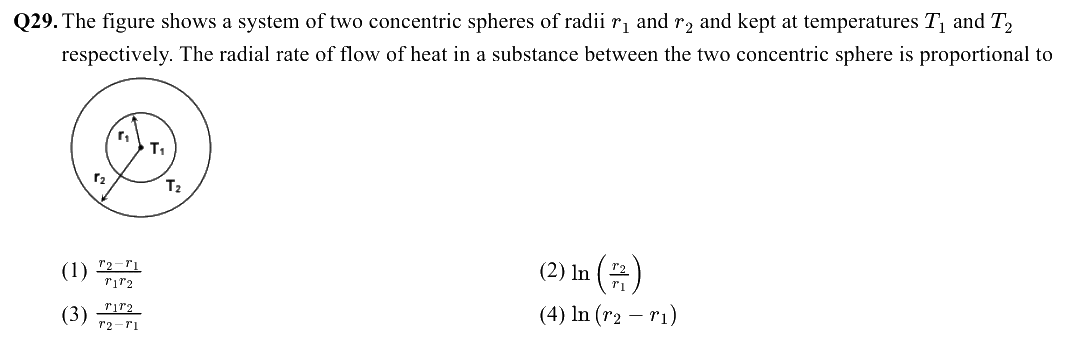
The figure shows a system of two concentric spheres of radii $r_1$ and $r_2$ and kept at temperatures $T_1$ and $T_2$ respectively. The radial rate of flow of heat in a substance between the two concentric sphere is proportional to (see the figure above)
If the temperature of the sun were to increase from $T$ to $2T$ and its radius from $R$ to $2R$, then the ratio of the radiant energy received on earth to what it was previously will be
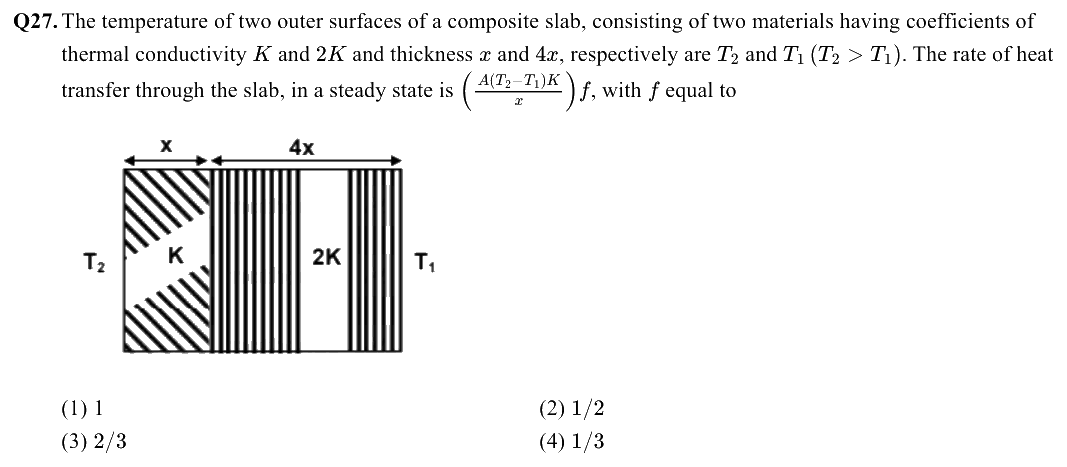
The temperature of two outer surfaces of a composite slab, consisting of two materials having coefficients of thermal conductivity $K$ and $2K$ and thickness $x$ and $4x$, respectively are $T_2$ and $T_1$ ($T_2 > T_1$). The rate of heat transfer through the slab, in a steady state is $\left(\frac{A(T_2 - T_1)K}{x}\right)f$, with $f$ equal to (see the figure above)
The thermo emf of a thermocouple varies with the temperature $\theta$ of the hot junction as E = a$\theta$ + b$\theta^2$ in volts where the ratio a/b is $700^\circ$C. If the cold junction is kept at $0^\circ$C, then the neutral temperature is
A
$700^\circ$C
B
$350^\circ$C
C
$1400^\circ$C
D
no neutral temperature is possible for this thermocouple.
According to Newton's law of cooling, the rate of cooling of a body is proportional to $(\Delta\theta)^{\mathrm{n}}$, where $\Delta\theta$ is the difference of the temperature of the body and the surroundings, and $n$ is equal to
The thermo e.m.f. of a thermo-couple is $25\,\mu\mathrm{V}/^\circ\mathrm{C}$ at room temperature. A galvanometer of 40 ohm resistance, capable of detecting current as low as $10^{-5}$ A, is connected with the thermo couple. The smallest temperature difference that can be detected by this sytem is
Two spheres of the same material have radii 1 m and 4 m and temperatures 4000 K and 2000 K respectively. The ratio of the energy radiated per second by the first sphere to that by the second is
The heat extracted out of $x$ gram of water initially at 50 °C to cool it down to 0 °C is sufficient to evaporate $(1000 - x)$ gram of water also initially at 50 °C. The value of $x$ (closest integer) is ________. (Take latent heat of water 2256 kJ/kg. K, specific heat capacity of water 4200 J/kg. K)
Numerical answer type: type your answer in EdLoop to check it
A wire of length 10 cm and diameter 0.5 mm is used in a bulb. The temperature of the wire is $1727^\circ C$ and power radiated by the wire is 94.2 W. Its emissivity is $\frac{x}{8}$ where x = ______
(Given $\sigma = 6.0 \times 10^{-8}Wm^{-2}K^{-4}, \pi = 3.14$ and assume that the emissivity of wire material is same at all wavelength.)
Numerical answer type: type your answer in EdLoop to check it
Two cylindrical rods A and B made of different materials, are joined in a straight line. The ratios of lengths, radii and thermal conductivities of these rods are: $\frac{L_A}{L_B} = \frac{1}{2}, \frac{r_A}{r_B} = 2$ and $\frac{K_A}{K_B} = \frac{1}{2}$. The free ends of rods A and B are maintained at 400 K, 200 K, respectively. The temperature of rods interface is ______ K, when equilibrium is established.
Numerical answer type: type your answer in EdLoop to check it
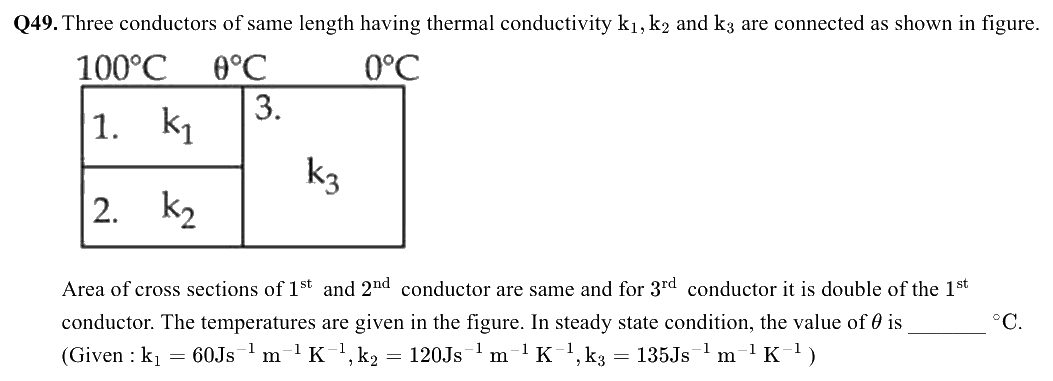
Three conductors of same length having thermal conductivity $\mathrm{k_1}$, $\mathrm{k_2}$ and $\mathrm{k_3}$ are connected as shown in figure. Area of cross sections of $1^{\mathrm{st}}$ and $2^{\mathrm{nd}}$ conductor are same and for $3^{\mathrm{rd}}$ conductor it is double of the $1^{\mathrm{st}}$ conductor. The temperatures are given in the figure. In steady state condition, the value of $\theta$ is ______ $^\circ$C. (Given : $\mathrm{k_1} = 60\mathrm{Js^{-1}\,m^{-1}\,K^{-1}}$, $\mathrm{k_2} = 120\mathrm{Js^{-1}\,m^{-1}\,K^{-1}}$, $\mathrm{k_3} = 135\mathrm{Js^{-1}\,m^{-1}\,K^{-1}}$ )
(see the figure above)
The question as printed in the paper.
Numerical answer type: type your answer in EdLoop to check it
Two plates A and B have thermal conductivities 84 W m$^{-1}$ K$^{-1}$ and 126 W m$^{-1}$ K$^{-1}$ respectively. They have same surface area and same thickness. They are placed in contact along their surfaces. If the temperatures of the outer surfaces of A and B are kept at 100°C and 0°C respectively, then the temperature of the surface of contact in steady state is ______ °C.
Numerical answer type: type your answer in EdLoop to check it
A steel rod of length $1\ \mathrm{m}$ and cross-sectional area $10^{-4}\ \mathrm{m^2}$ is heated from $0^\circ\mathrm{C}$ to $200^\circ\mathrm{C}$ without being allowed to extend or bend. The compressive tension produced in the rod is ______ $\times 10^4\ \mathrm{N}$. (Given Young's modulus of steel $= 2 \times 10^{11}\ \mathrm{N\,m^{-2}}$, coefficient of linear expansion $= 10^{-5}\ \mathrm{K^{-1}}$ )
Numerical answer type: type your answer in EdLoop to check it
A water heater of power 2000 W is used to heat water. The specific heat capacity of water is 4200 J kg$^{-1}$ K$^{-1}$. The efficiency of heater is 70%. Time required to heat 2 kg of water from 10$^\circ$C to 60$^\circ$C is ______ s. (Assume that the specific heat capacity of water remains constant over the temperature range of the water).
Numerical answer type: type your answer in EdLoop to check it
A faulty thermometer reads 5$^\circ$C in melting ice and 95$^\circ$C in steam. The correct temperature on absolute scale will be ______ K when the faulty thermometer reads 41$^\circ$C.
Numerical answer type: type your answer in EdLoop to check it
A body cools from $60^\circ\mathrm{C}$ to $40^\circ\mathrm{C}$ in $6$ minutes. If, temperature of surroundings is $10^\circ\mathrm{C}$. Then, after the next $6$ minutes, its temperature will be ______ $^\circ\mathrm{C}$.
Numerical answer type: type your answer in EdLoop to check it
A hole is drilled in a metal sheet. At $27\ ^\circ$C, the diameter of hole is 5 cm. When the sheet is heated to $177\ ^\circ$C, the change in the diameter of hole is $d\times10^{-3}$ cm. The value of $d$ will be ______, if coefficient of linear expansion of the metal is $1.6\times10^{-5}\ /^\circ$C
Numerical answer type: type your answer in EdLoop to check it
A unit scale is to be prepared whose length does not change with temperature and remains 20 cm, using a bimetallic strip made of brass and iron each of different length. The length of both components would change in such a way that difference between their lengths remains constant. If length of brass is 40 cm and length of iron will be ______ cm. $\alpha_{\mathrm{iron}}$ = $1.2\times10^{-5}\ \mathrm{K^{-1}}$ and $\alpha_{\mathrm{brass}}$ = $1.8\times10^{-5}\ \mathrm{K^{-1}}$.
Numerical answer type: type your answer in EdLoop to check it
A block of ice of mass 120 g at temperature $0^\circ$C is put in 300 g of water at $25^\circ$C. The $x$ g of ice melts as the temperature of the water reaches $0^\circ$C. The value of $x$ is [Use: Specific heat capacity of water $= 4200\ \mathrm{J\,kg^{-1}\,K^{-1}}$, Latent heat of ice $= 3.5\times10^{5}\ \mathrm{J\,kg^{-1}}$]
Numerical answer type: type your answer in EdLoop to check it
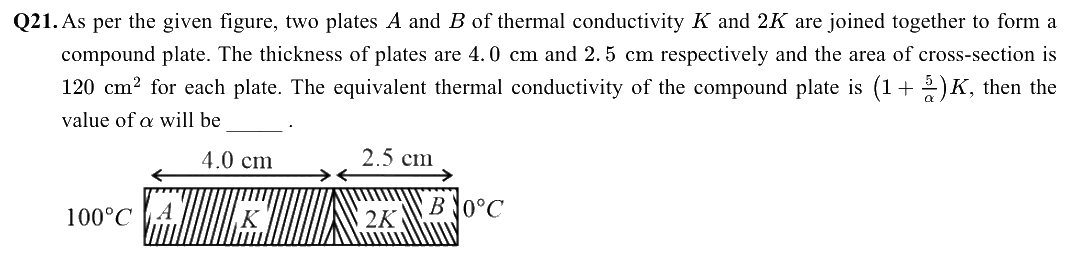
As per the given figure, two plates $A$ and $B$ of thermal conductivity $K$ and $2K$ are joined together to form a compound plate. The thickness of plates are $4.0\ \mathrm{cm}$ and $2.5\ \mathrm{cm}$ respectively and the area of cross-section is $120\ \mathrm{cm^2}$ for each plate. The equivalent thermal conductivity of the compound plate is $\left(1 + \dfrac{5}{\alpha}\right)K$, then the value of $\alpha$ will be ______.
(see the figure above)
The question as printed in the paper.
Numerical answer type: type your answer in EdLoop to check it
A geyser heats water flowing at a rate of $2.0 \mathrm{~kg}$ per minute from $30^\circ\mathrm{C}$ to $70^\circ\mathrm{C}$. If geyser operates on a gas burner, the rate of combustion of fuel will be ______ $\mathrm{g} \mathrm{~min}^{-1}$. [Heat of combustion $= 8 \times 10^3 \mathrm{~J} \mathrm{~g}^{-1}$, Specific heat of water $= 4.2 \mathrm{~J} \mathrm{~g}^{-1} {}^\circ\mathrm{C}^{-1}$]
Numerical answer type: type your answer in EdLoop to check it
A steam engine intakes $50 \mathrm{~g}$ of steam at $100^\circ\mathrm{C}$ per minute and cools it down to $20^\circ\mathrm{C}$. If latent heat of vaporization of steam is $540 \mathrm{~cal} \mathrm{~g}^{-1}$, then the heat rejected by the steam engine per minute is ______ $\times 10^3 \mathrm{~cal}$ (Given : specific heat capacity of water : $1 \mathrm{~cal} \mathrm{~g}^{-1} {}^\circ\mathrm{C}^{-1}$)
Numerical answer type: type your answer in EdLoop to check it
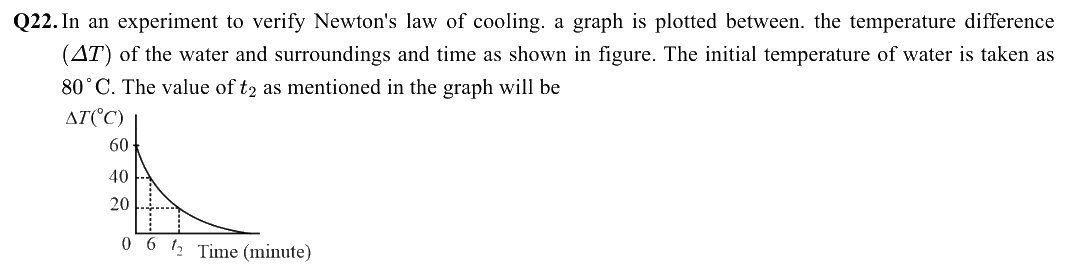
In an experiment to verify Newton's law of cooling. a graph is plotted between. the temperature difference $(\Delta T)$ of the water and surroundings and time as shown in figure. The initial temperature of water is taken as $80^\circ \mathrm{C}$. The value of $t_2$ as mentioned in the graph will be (see the figure above)
The question as printed in the paper.
Numerical answer type: type your answer in EdLoop to check it
A steel rod with $y = 2.0 \times 10^{11}$ N m$^{-2}$ and $\alpha = 10^{-5}$ $^\circ$C$^{-1}$ of length $4$ m and area of cross-section $10$ cm$^2$ is heated from $0^\circ$C to $400^\circ$C without being allowed to extend. The tension produced in the rod is $x \times 10^5$ N where the value of $x$ is ______.
Numerical answer type: type your answer in EdLoop to check it
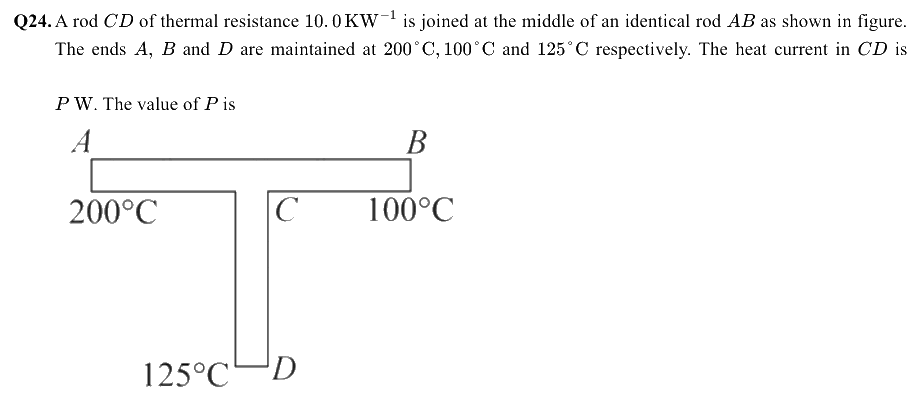
A rod $CD$ of thermal resistance $10.0$ KW$^{-1}$ is joined at the middle of an identical rod $AB$ as shown in figure. The ends $A$, $B$ and $D$ are maintained at $200^\circ$C, $100^\circ$C and $125^\circ$C respectively. The heat current in $CD$ is $P$ W. The value of $P$ is (see the figure above)
The question as printed in the paper.
Numerical answer type: type your answer in EdLoop to check it
In 5 minutes, a body cools from $75\ ^\circ\mathrm{C}$ to $65\ ^\circ\mathrm{C}$ at room temperature of $25\ ^\circ\mathrm{C}$. The temperature of body at the end of next 5 minutes is ______ $^\circ\mathrm{C}$.
Numerical answer type: type your answer in EdLoop to check it
A bakelite beaker has volume capacity of $500\ \mathrm{cc}$ at $30^\circ\mathrm{C}$. When it is partially filled with $\mathrm{V_m}$ volume (at $30^\circ\mathrm{C}$ ) of mercury, it is found that the unfilled volume of the beaker remains constant as temperature is varied. If $\gamma_{\text{(beaker)}} = 6\times 10^{-6}\ {}^\circ\mathrm{C}^{-1}$ and $\gamma_{\text{(mercury)}} = 1.5\times 10^{-4}\ {}^\circ\mathrm{C}^{-1}$, where $\gamma$ is the coefficient of volume expansion, then $\mathrm{V_m}$ (in cc ) is close to ______
Numerical answer type: type your answer in EdLoop to check it
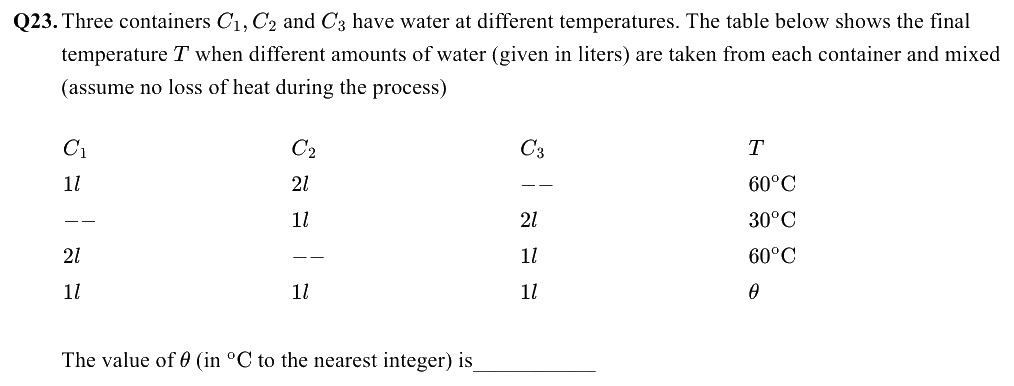
Three containers $C_1, C_2$ and $C_3$ have water at different temperatures. The table below shows the final temperature $T$ when different amounts of water (given in liters) are taken from each container and mixed (assume no loss of heat during the process) (see the figure above) The value of $\theta$ (in $^\circ\mathrm{C}$ to the nearest integer) is______
The question as printed in the paper.
Numerical answer type: type your answer in EdLoop to check it
A non-isotropic solid metal cube has coefficients of linear expansion as: $5 \times 10^{-5}/^\circ\mathrm{C}$ along the x-axis and $5 \times 10^{-6}/^\circ\mathrm{C}$ along the y and the z-axis. If the coefficient of volume expansion of the solid is $\mathrm{C} \times 10^{-6}/^\circ\mathrm{C}$ then the value of C is ______
Numerical answer type: type your answer in EdLoop to check it
$\mathrm{M}$ grams of steam at $100^\circ\mathrm{C}$ is mixed with $200\mathrm{g}$ of ice at its melting point in a thermally insulated container. If it produces liquid water at $40^\circ\mathrm{C}$ [heat of vaporization of water is $540\mathrm{cal/g}$ and heat of fusion of ice is $80\mathrm{cal/g}$ ], the value of $\mathrm{M}$ is ______
Numerical answer type: type your answer in EdLoop to check it
How to prepare Thermal Properties of Matter for JEE Main
How often it comes up
Thermal Properties of Matter covers the foundational thermometric, calorimetric, and heat transfer principles in the JEE Main syllabus. Across the papers we hold from 2019 to 2026, it contributed 91 questions in 162 papers, which corresponds to 0.6 questions per paper, and was present in 73 of those 162 papers. That places it 26th of 29 Physics chapters by volume over that eight-year period, representing 2.0% of all Physics questions asked.
The chapter's share has fallen since the AIEEE years. Between 2002 and 2018, it commanded 2.8% of the Physics section; across the last three exam years (2024 to 2026), it declined to 1.4%, giving 22 questions in 58 papers. The most question-heavy year in our archive was 2019, which registered 17 questions across 16 papers. Every exam cycle from 2019 onward has featured questions from this chapter, with appearances in 73 of the 162 papers in our set.
It is placed under Unit 7: Properties of Solids and Liquids in NTA's Class 11 framework, setting up the thermodynamic cycles and kinetic theories that follow later in the syllabus.
Most-asked topics
Between 2019 and 2026, question counts broke down across four topics:
Calorimetry: 40 questions. Phase changes between ice, liquid water, and steam, latent heat balances, water equivalent of containers, and steady flow geysers.
Thermal Expansion: 19 questions. Linear, superficial, and volumetric expansion of solids, bimetallic strips, and apparent liquid expansion in glass vessels.
Conduction: 18 questions. Thermal resistance analogy with electrical circuits, junction temperatures in composite rods, and cylindrical insulation shells.
Radiation: 14 questions. Stefan-Boltzmann law, Wien's displacement law, and Newton's law of cooling in convective environments.
The top three topics were tested in the 2026 exam season, while radiation questions appeared in 2025.
What the questions look like
Calorimetry problems revolve around thermal equilibrium equations. A typical setup adds sub-zero ice to warm water inside a calorimeter of known heat capacity, asking for the final mixture temperature or the residual ice mass. Students must perform an energy check first: calculate the heat needed to warm the ice to 0 °C and melt it, compare this against the heat released when water cools to 0 °C, and determine whether all ice melts. Continuous flow problems ask for the fuel consumption rate of a domestic gas geyser warming a known volumetric flow of cold inlet water.
Conduction problems apply Ohm's law to heat currents. When several metal rods of different lengths, cross-sections, and thermal conductivities are joined in series or parallel between fixed thermal reservoirs, students write heat current conservation at internal junctions to deduce intermediate temperatures.
Thermal expansion problems evaluate differential elongation. When two bars of different metals are joined end-to-end and heated through a temperature rise, you sum their individual length increases. In radiation, problems compare emissive powers of spherical bodies using Stefan's law, where radiated energy scales with the surface area and the fourth power of absolute temperature.
A notable portion of problems requires exact values: 23 of the 91 questions between 2019 and 2026 were numerical answer items with no choices provided.
Questions to try first
These five past questions demonstrate the standard testing styles:
Approach calorimetry by setting up an explicit energy balance ledger. Never write an equilibrium equation with an unknown final temperature until you have verified whether a phase transition completes. Calculate the energy required to reach the phase boundary first; if the available energy is insufficient to complete the latent heat exchange, the final temperature is locked at the transition point (such as 0 °C for an ice-water mixture).
In thermal conduction, convert each rod into an equivalent thermal resistance equal to length divided by the product of thermal conductivity and cross-sectional area. Treat temperature differences exactly like potential differences and heat flow rates like electric currents. Applying Kirchhoff's junction law at rod intersections makes finding interface temperatures painless.
For thermal radiation, remember that temperatures in the Stefan-Boltzmann law and Wien's displacement law must always be expressed in Kelvin. Convert degrees Celsius to absolute temperatures before raising them to the fourth power. For Newton's law of cooling, remember that it holds only for small temperature differences above ambient surroundings.
Frequently asked questions
Is Thermal Properties of Matter a concise chapter for JEE Main 2027?
Yes. It provided 91 questions across 162 papers in our set from 2019 to 2026, appearing in 73 of those 162 papers. Because the formulas are direct and the topic count is small, students can master it in a couple of study sessions.
Which topic in this chapter carries the highest weight?
Calorimetry is by far the largest topic, accounting for 40 of the 91 questions asked between 2019 and 2026, followed by thermal expansion with 19 questions and conduction with 18.
How does thermal resistance simplify composite slab problems?
By treating a thermal slab as a resistor with resistance L / (k A), series slabs simply add their resistances, while parallel slabs combine reciprocally, allowing you to bypass multi-variable differential equations.
Where can I see the solutions?
Every question on this page opens with its options and answer. Step-by-step solutions for each one are in the EdLoop app.