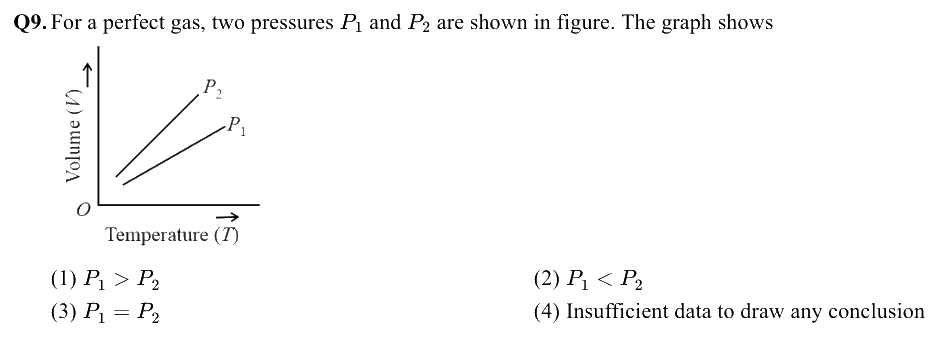
Two closed vessels of same volume are joined through a narrow tube and both vessels are filled with air of pressure 90 kPa and temperature 400 K. Keeping the temperature of one vessel constant at 400 K the second vessel temperature is raised to 500 K. The final pressure in the vessels is ________ kPa.
If 2 mole of an ideal monoatomic gas at temperature $T$, is mixed with 6 mole of another ideal monoatomic gas at temperature $2T$ then the temperature of mixture is :
Given below are two statements: one is labelled as Assertion A and the other is labelled as Reason R
Statement I: Change in internal energy of a system containing $n$ mole of ideal gas can be written as $\Delta U = n\,C_v\left(T_f - T_i\right) = \dfrac{nR}{\gamma - 1}\left(T_f - T_i\right)$, where $\gamma = \dfrac{C_p}{C_v}$, $T_i$ = initial temperature, $T_f$ = final temperature.
Statement II: Relation between degree of freedom $f$ and $\gamma$ ($= C_p/C_v$) is $\left(\gamma = 1 + \dfrac{2}{f}\right)$
Choose the *correct* answer from the options given below
A
Both A and R are true and R is the correct explanation of A
B
Both A and R are true but R is NOT the correct explanation of A
One gas of $n_1$ mole of molecules at temperature $T_1$, volume $V_1$, and pressure $P_1$, and another gas of $n_2$ mole of molecules at temperature $T_2$, volume $V_2$, and pressure $P_2$, are mixed resulting in pressure $P$ and volume $V$ of the mixture. The temperature of the mixture is ________.
An ideal gas undergoes a process maintaining relation between pressure ($P$) and volume($V$) as $P = P_o\left(1 + \left(\frac{V_o}{V}\right)^2\right)^{-1}$, where $P_o$ and $V_o$ are constants. If two samples $A$ and $B$ (two moles each) with initial volumes $V_o$ and $3V_o$ respectively undergo above mentioned process and attain same pressure, then the difference at the temperatures of these samples, $T_B - T_A$ is ________. ($R$ = gas constant)
Given below are two statements: one is labelled as Assertion A and the other is labelled as Reason R
Assertion A: If the average kinetic energy of $\mathrm{H_2}$ and $\mathrm{O_2}$ molecules, kept in two different sized containers are same, then their temperatures will be same.
Reason R: The r.m.s. speed of $\mathrm{H_2}$ and $\mathrm{O_2}$ molecules are same at same temperature.
Choose the *correct* answer from the options given below
A
Both A and R are true and R is the correct explanation of A
B
Both A and R are true but R is NOT the correct explanation of A
A mixture of carbon dioxide and oxygen has volume 8310 cm$^3$, temperature 300 K, pressure 100 kPa and mass 13.2 g. The number of moles of carbon dioxide and oxygen gases in the mixture respectively are ________. (Assume both carbon dioxide and oxygen gases behave like ideal gases) [R = 8.31 J/mol.K]
The mean free path of a molecule of diameter $5 \times 10^{-10}$ m at the temperature 41 °C and pressure $1.38 \times 10^5$ Pa, is given as ________ m. (Given $k_B = 1.38 \times 10^{-23}$ J/K).
An air bubble of volume 2.9 cm$^3$ rises from the bottom of a swimming pool of 5 m deep. At the bottom of the pool water temperature is 17 °C. The volume of the bubble when it reaches the surface, where the water temperature is 27 °C, is ________ cm$^3$.
($g = 10$ m/s$^2$, density of water $= 10^3$ kg/m$^3$, and 1 atm pressure is $10^5$ Pa)
Consider two boxes containing ideal gases $A$ and $B$ such that their temperatures, pressures and number densities are same. The molecular size of $A$ is half of that of $B$ and mass of molecule $A$ is four times that of $B$. If the collision frequency in gas $B$ is $32 \times 10^{18}$/s then collision frequency in gas $A$ is ________ /s.
The r.m.s. speed of oxygen molecules at 47 °C is equal to that of the hydrogen molecules kept at ________ °C. (Mass of oxygen molecule/mass of hydrogen molecule = 32/2)
The helium and argon are put in the flask at the same room temperature (300K). The ratio of average kinetic energies (per molecule) of helium and argon is:
(Give : Molar mass of helium = 4g/mol, Molar mass of argon = 40g/mol )
The mean free path and the average speed of oxygen molecules at 300 K and 1 atm are $3 \times 10^{-7}m$ and $600m/s$, respectively. Find the frequency of its collisions.
There are two vessels filled with an ideal gas where volume of one is double the volume of other. The large vessel contains the gas at 8 kPa at 1000 K while the smaller vessel contains the gas at 7 kPa at 500 K. If the vessels are connected to each other by a thin tube allowing the gas to flow and the temperature of both the vessels is maintained at 600 K, at steady state the pressure in the vessels will be (in kPa).
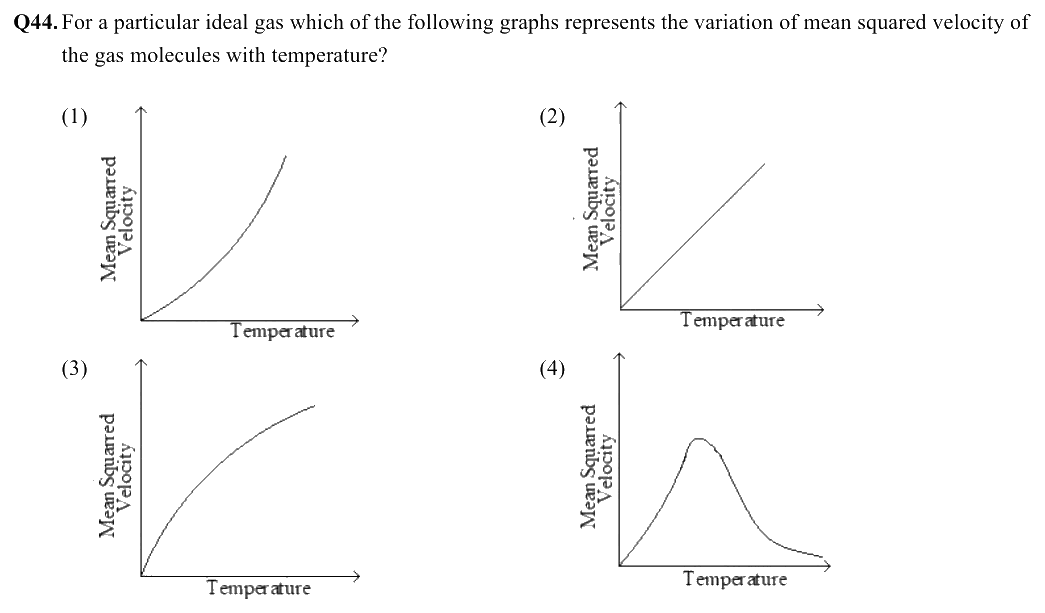
For a particular ideal gas which of the following graphs represents the variation of mean squared velocity of the gas molecules with temperature?
The question as printed in the paper.
A
see figure axes 'Mean Squared Velocity' (vertical) and 'Temperature' (horizontal); a curve starting at the origin and bending upward, rising faster and faster (concave up).
B
see figure same axes; a straight line from the origin rising to the upper right.
C
see figure same axes; a curve from the origin rising steeply at first and then flattening (concave down).
D
see figure same axes; a curve from the origin rising to a peak and then falling back towards the horizontal axis (a hump-shaped curve).
For a diatomic gas, if $\gamma_1 = \left(\frac{C_p}{C_v}\right)$ for rigid molecules and $\gamma_2 = \left(\frac{C_p}{C_v}\right)$ for another diatomic molecules, but also having vibrational modes. Then, which one of the following options is correct ? (Cp and Cv are specific heats of the gas at constant pressure and volume)
The temperature of a gas is $-78^\circ$C and the average translational kinetic energy of its molecules is K. The temperature at which the average translational kinetic energy of the molecules of the same gas becomes 2 K is :
A mixture of one mole of monoatomic gas and one mole of a diatomic gas (rigid) are kept at room temperature $(27^{\circ}\mathrm{C})$. The ratio of specific heat of gases at constant volume respectively is:
Given below are two statements : Statement (I) : The mean free path of gas molecules is inversely proportional to square of molecular diameter. Statement (II) : Average kinetic energy of gas molecules is directly proportional to absolute temperature of gas. In the light of the above statements, choose the correct answer from the options given below :
If the collision frequency of hydrogen molecules in a closed chamber at $27^\circ$C is Z, then the collision frequency of the same system at $127^\circ$C is :
If n is the number density and d is the diameter of the molecule, then the average distance covered by a molecule between two successive collisions (i.e. mean free path) is represented by :
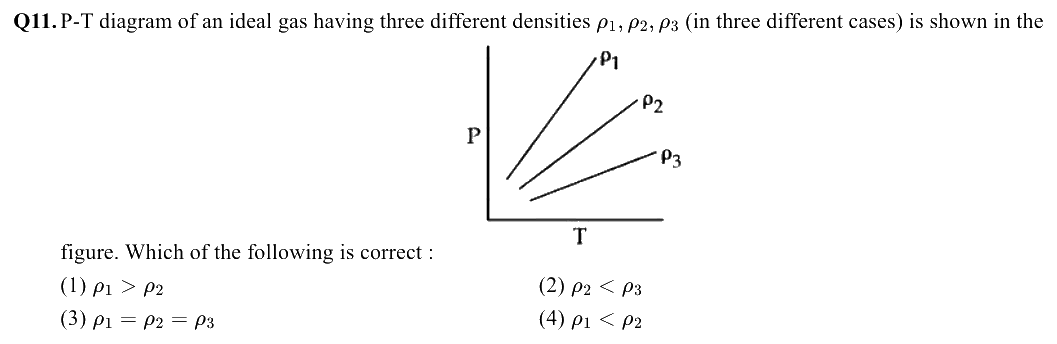
P-T diagram of an ideal gas having three different densities $\rho_1, \rho_2, \rho_3$ (in three different cases) is shown in the figure. Which of the following is correct :
If the root mean square velocity of hydrogen molecule at a given temperature and pressure is 2 $\text{km s}^{-1}$, the root mean square velocity of oxygen at the same condition in $\text{km s}^{-1}$ is:
A gas mixture consists of 8 moles of argon and 6 moles of oxygen at temperature $T$. Neglecting all vibrational modes, the total internal energy of the system is
If three moles of monoatomic gas $\gamma = \frac{5}{3}$ is mixed with two moles of a diatomic gas $\gamma = \frac{7}{5}$, the value of adiabatic exponent $\gamma$ for the mixture is:
Two vessels $A$ and $B$ are of the same size and are at same temperature. $A$ contains 1 g of hydrogen and $B$ contains 1 g of oxygen. $P_A$ and $P_B$ are the pressures of the gases in $A$ and $B$ respectively, then $\frac{P_A}{P_B}$ is :
$N$ moles of a polyatomic gas ($f = 6$) must be mixed with two moles of a monoatomic gas so that the mixture behaves as a diatomic gas. The value of $N$ is:
A flask contains Hydrogen and Argon in the ratio 2 : 1 by mass. The temperature of the mixture is 30°C. The ratio of average kinetic energy per molecule of the two gases $\left(\frac{K_{argon}}{K_{hydrogen}}\right)$ is: (Given : Atomic Weight of Ar = 39.9)
The rms speed of oxygen molecule in a vessel at particular temperature is $\left(1 + \frac{5}{x}\right)^{\frac{1}{2}} v$, when $v$ is the average speed of the molecule. The value of $x$ will be: (take $\pi = \frac{22}{7}$)
The mean free path of molecules of a certain gas at STP is $1500d$, where $d$ is the diameter of the gas molecules. While maintaining the standard pressure, the mean free path of the molecules at 373 $K$ is approximately:
If the r.m.s speed of chlorine molecule is $490\ \mathrm{m\ s^{-1}}$ at $27^\circ$C, the r.m.s speed of argon molecules at the same temperature will be (Atomic mass of argon $= 39.9$ u, molecular mass of chlorine $= 70.9$ u)
Three vessels of equal volume contain gases at the same temperature and pressure. The first vessel contains neon (monoatomic), the second contains chlorine (diatomic) and third contains uranium hexafluoride (polyatomic). Arrange these on the basis of their root mean square speed $v_{rms}$ and choose the correct answer from the options given below:
The root mean square speed of molecules of nitrogen gas at $27^\circ$C is approximately: (Given mass of a nitrogen molecule $= 4.6 \times 10^{-26}$ kg and take Boltzmann constant $k_B = 1.4 \times 10^{-23}\ \mathrm{J\ K^{-1}}$ )
Match List I with List II: List I List II (A) 3 Translational degrees of freedom (I) Monoatomic gases (B) 3 Translational, 2 rotational degrees of freedoms (II) Polyatomic gases (C) 3 Translational, 2 rotational and 1 vibrational degrees of freedom (III) Rigid diatomic gases (D) 3 Translational, 3 rotational and more than one vibrational degrees of freedom (IV) Nonrigid diatomic gases Choose the correct answer from the options given below:
A gas mixture consists of 2 moles of oxygen and 4 moles of neon at temperature $T$. Neglecting all vibrational modes, the total internal energy of the system will be:
An air bubble of volume $1\ \mathrm{cm^{3}}$ rises from the bottom of a lake 40 m deep to the surface at a temperature of $12^\circ\mathrm{C}$. The atmospheric pressure is $1 \times 10^{5}$ Pa, the density of water is $1000\ \mathrm{kg\,m^{-3}}$ and $\mathrm{g} = 10\ \mathrm{m\,s^{-2}}$. There is no difference of the temperature of water at the depth of 40 m and on the surface. The volume of air bubble when it reaches the surface will be
The number of air molecules per $\mathrm{cm^3}$ is increased from $3 \times 10^{19}$ to $12 \times 10^{19}$. The ratio of collision frequency of air molecules before and after the increase in number respectively is :
The temperature of an ideal gas is increased from $200\ \mathrm{K}$ to $800\ \mathrm{K}$. If r.m.s. speed of gas at $200\ \mathrm{K}$ is $v_0$. Then, r.m.s. speed of the gas at $800\ \mathrm{K}$ will be:
The pressure $(P)$ and temperature $(T)$ relationship of an ideal gas obeys the equation $PT^2$ = constant. The volume expansion coefficient of the gas will be :
A flask contains hydrogen and oxygen in the ratio of 2 : 1 by mass at temperature 27 $^\circ$C. The ratio of average kinetic energy per molecule of hydrogen and oxygen respectively is :
A bicycle tyre is filled with air having pressure of $270\ \mathrm{kPa}$ at $27^\circ\mathrm{C}$. The approximate pressure of the air in the tyre when the temperature increases to $36^\circ\mathrm{C}$ is
At 300 $K$, the rms speed of oxygen molecules is $\sqrt{\frac{\alpha + 5}{\alpha}}$ times to that of its average speed in the gas. Then, the value of $\alpha$ will be (use $\pi = \frac{22}{7}$)
According to law of equipartition of energy the molar specific heat of a diatomic gas at constant volume where the molecule has one additional vibrational mode is :-
Statement I: The temperature of a gas is $-73\ ^\circ$C. When the gas is heated to $527\ ^\circ$C, the root mean square speed of the molecules is doubled.
Statement II : The product of pressure and volume of an ideal gas will be equal to translational kinetic energy of the molecules.
In the light of the above statements, choose the correct answer from the options given below:
Let $\gamma_1$ be the ratio of molar specific heat at constant pressure and molar specific heat at constant volume of a monoatomic gas and $\gamma_2$ be the similar ratio of diatomic gas. Considering the diatomic gas molecule as a rigid rotator, the ratio $\frac{\gamma_1}{\gamma_2}$ is:
The root mean square speed of smoke particles of mass $5 \times 10^{-17}$ kg in their Brownian motion in air at NTP is approximately. [Given $k = 1.38 \times 10^{-23}\ \mathrm{J\ K^{-1}}$]
Given below are two statements: Statement I :The average momentum of a molecule in a sample of an ideal gas depends on temperature. Statement II : The rms speed of oxygen molecules in a gas is $v$. If the temperature is doubled and the oxygen molecules dissociate into oxygen atoms, the rms speed will become $2v$. In the light of the above statements, choose the correct answer from the options given below :
Same gas is filled in two vessels of the same volume at the same temperature. If the ratio of the number of molecules is 1 : 4, then A. The r.m.s. velocity of gas molecules in two vessels will be the same. B. The ratio of pressure in these vessels will be 1 : 4. C. The ratio of pressure will be 1 : 1. D. The r.m.s. velocity of gas molecules in two vessels will be in the ratio of 1 : 4.
Which statements are correct about degrees of freedom? A. A molecule with $n$ degrees of freedom has $n^2$ different ways of storing energy. B. Each degree of freedom is associated with $\frac{1}{2}RT$ average energy per mole. C. A monoatomic gas molecule has 1 rotational degree of freedom where as diatomic molecule has 2 rotational degrees of freedom D. $\mathrm{CH_4}$ has a total to 6 degrees of freedom. Choose the correct answer from the option given below:
Following statements are given (1) The average kinetic energy of a gas molecule decreases when the temperature is reduced. (2) The average kinetic energy of a gas molecule increases with increase in pressure at constant temperature. (3) The average kinetic energy of a gas molecule decreases with increases in volume. (4) Pressure of a gas increases with increase in temperature at constant volume. (5) The volume of gas decreases with increase in temperature. Choose the correct answer from the options given below :
Sound travels in a mixture of two moles of helium and $n$ moles of hydrogen. If rms speed of gas molecules in the mixture is $\sqrt{2}$ times the speed of sound, then the value of $n$ will be
A vessel contains $16\ \mathrm{g}$ of hydrogen and $128\ \mathrm{g}$ of oxygen at standard temperature and pressure. The volume of the vessel in $\mathrm{cm^3}$ is :
What will be the effect on the root mean square velocity of oxygen molecules if the temperature is doubled and oxygen molecule dissociates into atomic oxygen?
A mixture of hydrogen and oxygen has volume $2000\ \mathrm{cm^3}$, temperature $300\ \mathrm{K}$, pressure $100\ \mathrm{kPa}$ and mass $0.76\ \mathrm{g}$. The ratio of number of moles of hydrogen to number of moles of oxygen in the mixture will be [Take gas constant $R = 8.3\ \mathrm{J\ K^{-1}\ mol^{-1}}$]
According to kinetic theory of gases, A. The motion of gas molecules freezes at $0^{\circ}\mathrm{C}$. B. The mean free path of gas molecules decreases if the density of molecules is increased. C. The mean free path of gas molecules increases if temperature is increased keeping pressure constant. D. Average kinetic energy per molecule per degree of freedom is $\frac{3}{2}k_B T$ (for monoatomic gases). Choose the most appropriate answer from the options given below
A thermally insulated vessel contains an ideal gas of molecular mass $M$ and ratio of specific heats $1.4$. Vessel is moving with speed $v$ and is suddenly brought to rest. Assuming no heat is lost to the surrounding and vessel temperature of the gas increases by : ($R$ = universal gas constant)
A flask contains argon and oxygen in the ratio of $3 : 2$ in mass and the mixture is kept at $27^\circ\mathrm{C}$. The ratio of their average kinetic energy per molecule respectively
The relation between root mean square speed $v_{\mathrm{rms}}$ and most probable speed $v_{\mathrm{p}}$ for the molar mass $M$ of oxygen gas molecule at the temperature of $300 \mathrm{~K}$ will be
For an ideal gas the instantaneous change in pressure $P$ with volume $V$ is given by the equation $\frac{dP}{dV} = -aP$. If $P = P_0$ at $V = 0$ is the given boundary condition, then the maximum temperature one mole of gas can attain is: (Here $R$ is the gas constant)
A mixture of hydrogen and oxygen has volume $500$ cm$^3$, temperature $300$ K, pressure $400$ kPa and mass $0.76$ g. The ratio of masses of oxygen to hydrogen will be:
A balloon carries a total load of $185$ kg at normal pressure and temperature of $27^\circ$C. What load will the balloon carry on rising to a height at which the barometric pressure is $45$ cm of Hg and the temperature is $-7^\circ$C. Assuming the volume constant?
If the R.M.S. speed of oxygen molecules at $0^\circ\mathrm{C}$ is $160\ \mathrm{m\ s^{-1}}$. Find the R.M.S. speed of hydrogen molecules at $0^\circ\mathrm{C}$.
The R.M.S. speeds of the molecules of Hydrogen, Oxygen, and Carbon dioxide at the same temperature are $v_{\mathrm{H}}$, $v_{\mathrm{O}}$ and $v_{\mathrm{C}}$ respectively, then:
A cylindrical container of volume $4.0\times10^{-3}\ \mathrm{m^{3}}$ contains one mole of hydrogen and two moles of carbon dioxide. Assume the temperature of the mixture is $400\ \mathrm{K}$. The pressure of the mixture of gases is : [Take gas constant as $8.3\ \mathrm{J\ mol^{-1}\ K^{-1}}$]
The number of molecules in one litre of an ideal gas at 300 K and 2 atmospheric pressure with mean kinetic energy $2 \times 10^{-9}\ \mathrm{J}$ per molecule is:
Consider a mixture of gas molecule of types $A$, $B$ and $C$ having masses $m_A < m_B < m_C$. The ratio of their root mean square speeds at normal temperature and pressure is:
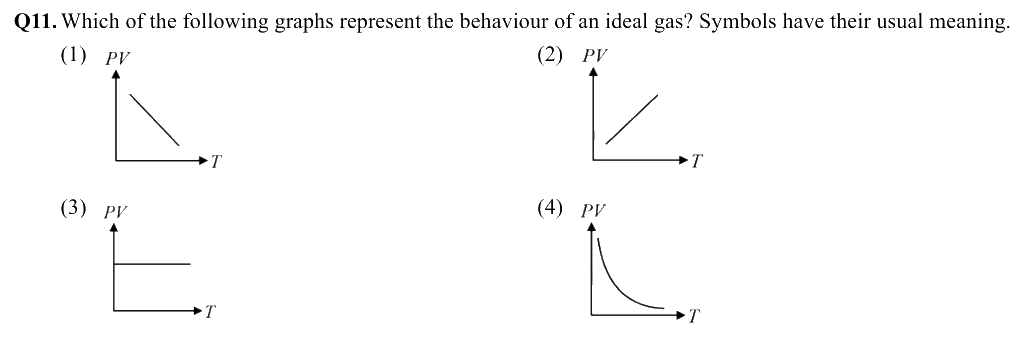
Which of the following graphs represent the behaviour of an ideal gas? Symbols have their usual meaning.
The question as printed in the paper.
A
see figure PV (vertical) against T (horizontal): a straight line falling from the upper left near the PV axis to the lower right.
B
see figure PV (vertical) against T (horizontal): a straight line rising from the lower left to the upper right.
C
see figure PV (vertical) against T (horizontal): a horizontal straight line (PV constant).
D
see figure PV (vertical) against T (horizontal): a curve falling steeply from high PV near the PV axis and flattening towards the T axis (hyperbola-like).
What will be the average value of energy along one degree of freedom for an ideal gas in thermal equilibrium at a temperature $T$ ? ($k_B$ is Boltzmann constant)
Consider a sample of oxygen behaving like an ideal gas. At $300~\mathrm{K}$, the ratio of root-mean-square (RMS) velocity to the average velocity of the gas molecule would be : (Molecular weight of oxygen is $32~\mathrm{g~mol^{-1}}$; $R = 8.3~\mathrm{J~K^{-1}~mol^{-1}}$)
Two ideal polyatomic gases at temperatures $T_1$ and $T_2$ are mixed so that there is no loss of energy. If $F_1$ and $F_2, m_1$ and $m_2$, $n_1$ and $n_2$ be the degrees of freedom, masses, number of molecules of the first and second gas respectively, the temperature of mixture of these two gases is:
If one mole of the polyatomic gas is having two vibrational modes and $\beta$ is the ratio of molar specific heats for polyatomic gas $\left(\beta=\frac{C_P}{C_v}\right)$ then the value of $\beta$ is :
The volume $V$ of an enclosure contains a mixture of three gases, 16 g of oxygen, 28 g of nitrogen and 44 g of carbon dioxide at absolute temperature $T$. Consider $R$ as universal gas constant. The pressure of the mixture of gases is :
Calculate the value of the mean free path ($\lambda$) for oxygen molecules at temperature $27^\circ\mathrm{C}$ and pressure $1.01 \times 10^5\ \mathrm{Pa}$. Assume the molecular diameter $0.3\ \mathrm{nm}$ and the gas is ideal. $(k = 1.38 \times 10^{-23}\ \mathrm{J\,K^{-1}})$
Given below are two statements: Statement I: In a diatomic molecule, the rotational energy at a given temperature obeys Maxwell's distribution. Statement II : In a diatomic molecule, the rotational energy at a given temperature equals the translational kinetic energy for each molecule. In the light of the above statements, choose the correct answer from the options given below:
Molecules of an ideal gas are known to have three translational degrees of freedom. The gas is maintained at a temperature of T. The total internal energy, U of a mole of this gas, and the value of $\gamma = \left(\frac{\mathrm{C_p}}{\mathrm{C_v}}\right)$ are given, respectively, by
A
$\mathrm{U} = \frac{5}{2}\mathrm{RT}$ and $\gamma = \frac{6}{5}$
B
$U = 5\ R\,T$ and $\gamma = \frac{7}{5}$
C
$\mathrm{U} = \frac{5}{2}\mathrm{RT}$ and $\gamma = \frac{7}{5}$
Number of molecules in a volume of 4 cm$^3$ of a perfect monoatomic gas at some temperature T and at a pressure of 2 cm of mercury is close to? (Given, mean kinetic energy of a molecule (at T) is $4 \times 10^{-14}$ erg, g = 980 cm s$^{-2}$ density of mercury = 13. 6 g cm$^{-3}$)
Match the $\frac{\mathrm{C_{p}}}{\mathrm{C_{v}}}$ ratio for ideal gases with different type of molecules: Molecule Type $\mathrm{C_{p}/C_{v}}$ (A) Monoatomic (I) 7/5 (B) Diatomic rigid molecules (II) 9/7 (C) Diatomic non-rigid molecules (III) 4/3 (D) Triatomic rigid molecules (IV) 5/3
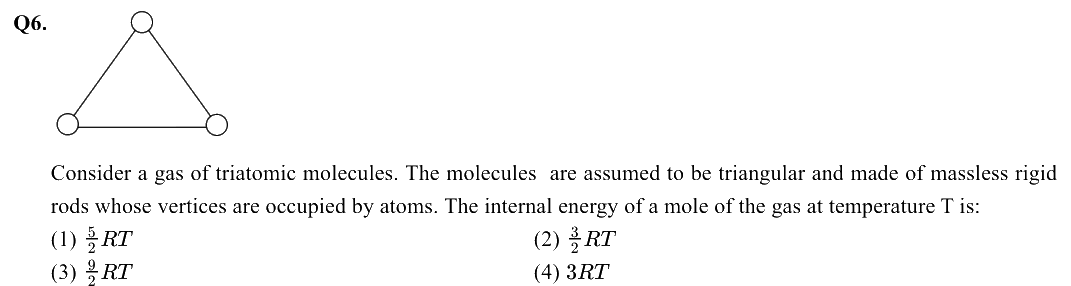
see figure Consider a gas of triatomic molecules. The molecules are assumed to be triangular and made of massless rigid rods whose vertices are occupied by atoms. The internal energy of a mole of the gas at temperature T is:
To raise the temperature of a certain mass of gas by $50\ ^\circ\mathrm{C}$ at a constant pressure,160 calories of heat is required. When the same mass of gas is cooled by $100\ ^\circ\mathrm{C}$ at constant volume,240 calories of heat is released. How many degrees of freedom does each molecule of this gas have (assume gas to be ideal)?
A gas mixture consists of 3 moles of oxygen and 5 moles of argon at temperature $T$. Assuming the gases to be ideal and the oxygen bond to be rigid, the total internal energy (in units of $RT$) of the mixutre is :
An ideal gas in a closed container is slowly heated. As its temperature increases, which of the following statements are true ? (A) the mean free path of the molecules decreases (B) the mean collision time between the molecules decreases. (C) the mean free path remains unchanged. (D) the mean collision time relations unchanged.
Consider two ideal diatomic gases $A$ and $B$ at some temperature $T$ . Molecules of the gas $A$ are rigid, and have a mass $m$ . Molecules of the gas $B$ have an additional vibrational mode and have a mass $\frac{m}{4}$ . The ratio of the specific heats $(C_V)_A$ and $(C_V)_B$ of gas $A$ and $B$, respectively, is:
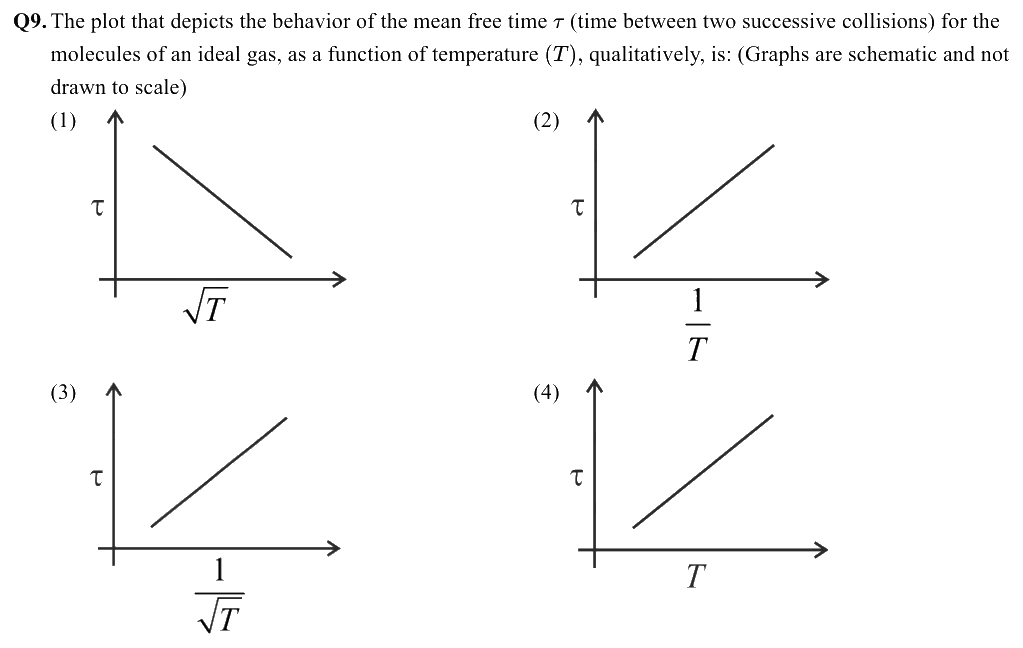
The plot that depicts the behavior of the mean free time $\tau$ (time between two successive collisions) for the molecules of an ideal gas, as a function of temperature ($T$), qualitatively, is: (Graphs are schematic and not drawn to scale)
The question as printed in the paper.
A
see figure graph of $\tau$ versus $\sqrt{T}$
B
see figure graph of $\tau$ versus $\frac{1}{T}$
C
see figure graph of $\tau$ versus $\frac{1}{\sqrt{T}}$
Consider a mixture of $n$ moles of helium gas and $2n$ moles of oxygen gas (molecules taken to be rigid) as an ideal gas. Its $\frac{C_P}{C_V}$ value will be:
Two moles of an ideal gas, with $\frac{C_P}{C_V} = \frac{5}{3}$, are mixed with three moles of another ideal gas $\frac{C_P}{C_V} = \frac{4}{3}$. The value of $\frac{C_P}{C_V}$ for the mixture is
Two moles of helium gas is mixed with three moles of hydrogen molecules (taken to be rigid). What is the molar specific heat of mixture at constant volume? $\mathrm{R = 8.3\ J\ /\ mol\ K}$
A $25\times10^{-3}\ \mathrm{m^{3}}$ volume cylinder is filled with 1 mol of $\mathrm{O_2}$ gas at room temperature (300 K) . The molecular diameter of $\mathrm{O_2}$ , and its root mean square speed, are found to be 0.3 nm and 200 m/s , respectively. What is the average collision rate (per second) for an $\mathrm{O_2}$ molecule?
One mole of an ideal gas passes through a process where pressure and volume obey the relation $P = P_o\,1 - \frac{1}{2}\left(\frac{V_o}{V}\right)^{2}$. Here $P_o$ and $V_o$ are constants. Calculate the change in the temperature of the gas if its volume changes from $V_o$ to $2V_o$.
For given gas at 1 atm pressure, rms speed of the molecules is 200 m/s at $127^\circ$ C. At 2 atm pressure and at $227^\circ$ C, the rms speed of the molecules will be:
An HCl molecule has rotational, translational and vibrational motions. If the rms velocity of HCl molecules in its gaseous phase is $\bar{v}$, m is its mass and $k_B$ is Boltzmann's constant, then its temperature will be:
The specific heats, $C_p$ and $C_v$ of a gas of diatomic molecules, A, are given (in units of $\mathrm{J\ mol^{-1}\ K^{-1}}$ ) by 29 and 22, respectively. Another gas of diatomic molecules, B, has the corresponding values 30 and 21. If they are treated as ideal gases, then:
If $10^{22}$ gas molecules each of mass $10^{-26}$ kg collides with a surface (perpendicular to it) elastically per second over an area 1 $\mathrm{m^2}$ with a speed $10^4\,\mathrm{m/s}$, the pressure exerted by the gas molecules will be of the order of:
The temperature, at which the root mean square velocity of hydrogen molecules equals their escape velocity from the earth, is closest to: [ Boltzmann Constant $\mathrm{k_B}$ = $1.38 \times 10^{-23}$ J / K Avogadro number $\mathrm{N_A}$ = $6.02 \times 10^{26}$ / kg Radius of Earth: $6.4 \times 10^6$ m Gravitational acceleration on Earth = 10 $\mathrm{ms^{-2}}$]
A vertical closed cylinder is separated into two parts by a frictionless piston of mass $m$ and of negligible thickness. The piston is free to move along the length of the cylinder. The length of the cylinder above piston is $l_1$, and that below the piston is $l_2$, such that $l_1 > l_2$. Each part of the cylinder contains $n$ moles of an ideal gas at equal temperature $T$. If the piston is stationary, its mass $m$ will be given by: ($R$ is universal gas constant and $g$ is the acceleration due to gravity)
An ideal gas is enclosed in a cylinder at pressure of 2 atm and temperature, 300 $K$. The mean time between two successive collisions is $6 \times 10^{-8}s$. If the pressure is doubled and temperature is increased to 500 $K$, the mean time between two successive collisions will be close to:
A gas mixture consists of 3 moles of oxygen and 5 moles of argon at temperature T. Considering only translational and rotational modes, the total internal energy of the system is
$2\ \mathrm{kg}$ of a monoatomic gas is at a pressure of $4\times10^4\ \mathrm{N\,m^{-2}}$. The density of the gas is $8\ \mathrm{kg\ m^{-3}}$. What is the order of energy of the gas due to its thermal motion?
A mixture of $2$ moles of helium gas (atomic mass $= 4u$) , and $1$ mole of argon gas (atomic mass $= 40\ u$) is kept at $300\ K$ in a container. The ratio of their rms speeds $\dfrac{V_{rms}\,helium}{V_{rms}\,(argon)}$, is close to:
The value closest to the thermal velocity of a Helium atom at room temperature ($300\ \mathrm{K}$) in $\mathrm{ms^{-1}}$ is: $\left[\mathrm{k_B} = 1.4\times10^{-23}\ \mathrm{J/K};\ \mathrm{m_{He}} = 7\times10^{-27}\ \mathrm{kg}\right]$
The mass of a hydrogen molecule is $3.32 \times 10^{-27}\ \mathrm{kg}$. If $10^{23}$ hydrogen molecules strike, per second, a fixed wall of the area $2\ \mathrm{cm}^2$ at an angle of $45^\circ$ to the normal, and rebound elastically with a speed of $10^3\ \mathrm{m\,s^{-1}}$, then the pressure on the wall is nearly:
$N$ moles of diatomic gas in a cylinder is at a temperature $T$. Heat is supplied to the cylinder such that the temperature remains constant but $n$ moles of the diatomic gas get converted into monoatomic gas. The change in the total kinetic energy of the gas is
An ideal gas has molecules with 5 degrees of freedom. The ratio of specific heats at constant pressure ($C_\mathrm{p}$) and at constant volume ($C_\mathrm{V}$) is:
The temperature of an open room of volume $30\ \mathrm{m^3}$ increases from $17^\circ\mathrm{C}$ to $27^\circ\mathrm{C}$ due to the sunshine. The atmospheric pressure in the room remains $1 \times 10^{5}\ \mathrm{Pa}$. If $n_i$ and $n_f$ are the number of molecules in the room before and after heating, then $n_f - n_i$ will be:
Using equipartition of energy, the specific heat (in J kg$^{-1}$ K$^{-1}$ ) of Aluminium at high temperature can be estimated to be (atomic weight of Aluminium $= 27$)
In an ideal gas at temperature T, the average force that a molecule applies on the walls of a closed container depends on $T$ as $T^q$ . A good estimate for q is:
Consider an ideal gas confined in an isolated closed chamber. As the gas undergoes an adiabatic expansion, the average time of collision between molecules increases as $V^q$, where $V$ is the volume of the gas. The value of $q$ is: $\left(\gamma = \dfrac{C_P}{C_v}\right)$
A gas molecule of mass $M$ at the surface of the earth has kinetic energy equivalent to $0\ ^\circ\mathrm{C}$. If it were to go up straight without colliding with any other molecules, how high it would rise? Assume that the height attained is much less than the radius of the earth. ($k_{\mathrm{B}}$ is Boltzmann constant)
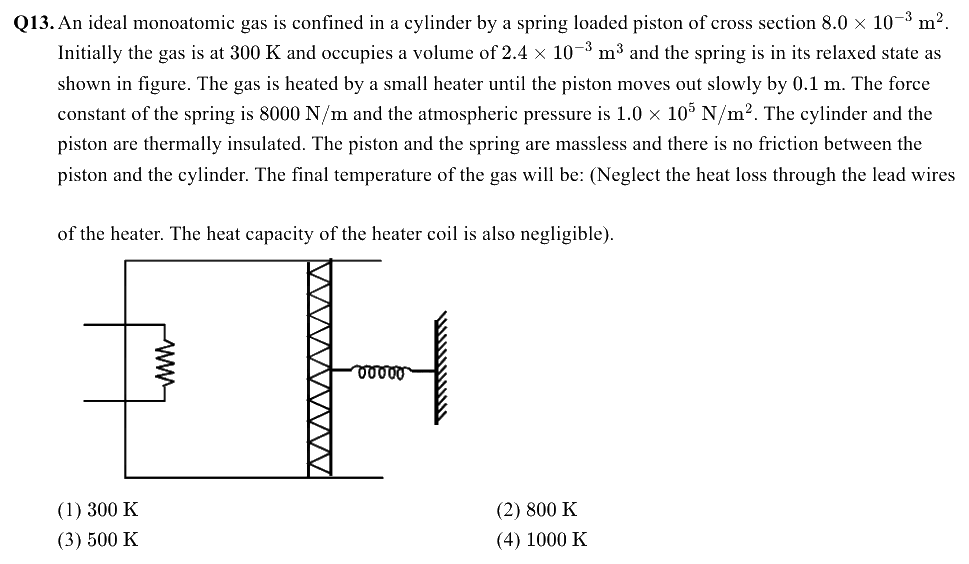
An ideal monoatomic gas is confined in a cylinder by a spring loaded piston of cross section $8.0 \times 10^{-3}\ \mathrm{m}^2$. Initially the gas is at $300\ \mathrm{K}$ and occupies a volume of $2.4 \times 10^{-3}\ \mathrm{m}^3$ and the spring is in its relaxed state as shown in figure. The gas is heated by a small heater until the piston moves out slowly by $0.1\ \mathrm{m}$. The force constant of the spring is $8000\ \mathrm{N/m}$ and the atmospheric pressure is $1.0 \times 10^5\ \mathrm{N/m}^2$. The cylinder and the piston are thermally insulated. The piston and the spring are massless and there is no friction between the piston and the cylinder. The final temperature of the gas will be: (Neglect the heat loss through the lead wires of the heater. The heat capacity of the heater coil is also negligible). (see the figure above)
Modern vacuum pumps can evacuate a vessel down to a pressure of $4.0\times10^{-15}$ atm. at room temperature (300 K). Taking R = 8.3 $\mathrm{JK^{-1}}$ $\mathrm{mole^{-1}}$, 1 atm = $10^5$ Pa and $\mathrm{N_{Avogadro}} = 6\times10^{23}\ \mathrm{mole^{-1}}$, the mean distance between molecules of gas in an evacuated vessel will be of the order of :
An open glass tube is immersed in mercury in such a way that a length of 8 cm extends above the mercury level. The open end of the tube is then closed and sealed and the tube is raised vertically up by additional 46 cm. What will be length of the air column above mercury in the tube now ? (Atmospheric pressure = 76 cm of Hg)
In the isothermal expansion of 10 g of gas from volume V to 2 V the work done by the gas is 575 J. What is the root mean square speed of the molecules of the gas at that temperature?
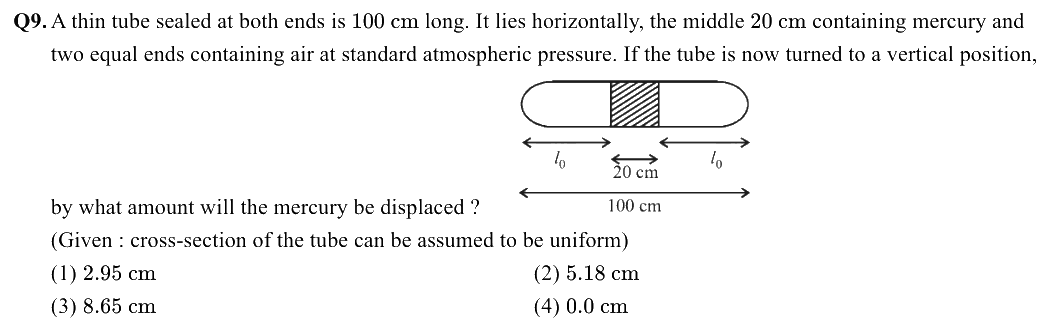
A thin tube sealed at both ends is 100 cm long. It lies horizontally, the middle 20 cm containing mercury and two equal ends containing air at standard atmospheric pressure. If the tube is now turned to a vertical position, by what amount will the mercury be displaced ? (see the figure above) (Given : cross-section of the tube can be assumed to be uniform)
A thermally insulated vessel contains an ideal gas of molecular mass $M$ and ratio of specific heats $\gamma$. It is moving with speed $v$ and is suddenly brought to rest. Assuming no heat is lost to the surroundings, its temperature increases by :
Three perfect gases at absolute temperatures $T_1, T_2$ and $T_3$ are mixed. The masses of molecules are $m_1$, $m_2$ and $m_3$ and the number of molecules are $n_1$, $n_2$ and $n_3$ respectively. Assuming no loss of energy, the final temperature of the mixture is :
One kg of a diatomic gas is at a pressure of $8 \times 10^4\ \mathrm{N/m^2}$. The density of the gas is $4\ \mathrm{kg/m^{-3}}$. What is the energy of the gas due to its thermal motion?
Two rigid boxes containing different ideal gases are placed on a table. Box A contains one mole of nitrogen at temperature $T_0$, while Box $B$ contains one mole of helium at temperature $(7/3)T_0$. The boxes are then put into thermal contact with each other and heat flows between them until the gases reach a common final temperature. (Ignore the heat capacity of boxes). Then, the final temperature of the gases, $T_f$, in terms of $T_0$ is
One mole of ideal monoatomic gas ($\gamma$ = 5/3) is mixed with one mole of diatomic gas ($\gamma$ = 7/5). What is $\gamma$ for the mixture? $\gamma$ denotes the ratio of specific heat at constant pressure, to that at constant volume.
Two thermally insulated vessels 1 and 2 are filled with air at temperatures ($T_1, T_2$), volume ($V_1, V_2$) and pressure ($P_1, P_2$) respectively. If the valve joining two vessels is opened, the temperature inside the vessel at equilibrium will be
In the nuclear fusion reaction ${}^{2}_{1}\mathrm{H} + {}^{3}_{1}\mathrm{H} \rightarrow {}^{4}_{2}\mathrm{He} + \mathrm{n}$ given that the repulsive potential energy between the two nuclei is $\sim 7.7 \times 10^{-14}$ J, the temperature at which the gases must be heated to initiate the reaction is nearly
A gas of certain mass filled in a closed cylinder at a pressure of 3.23 kPa has temperature 50 °C. The gas is now heated to double its temperature. The modified pressure is ________ Pa.
Numerical answer type: type your answer in EdLoop to check it
An insulated cylinder of volume 60 cm$^3$ is filled with a gas at 27 °C and 2 atmospheric pressure. Then the gas is compressed making the final volume as 20 cm$^3$ while allowing the temperature to rise to 77 °C. The final pressure is ________ atmospheric pressure.
Numerical answer type: type your answer in EdLoop to check it
$\gamma_A$ is the specific heat ratio of monoatomic gas A having 3 translational degrees of freedom. $\gamma_B$ is the specific heat ratio of polyatomic gas B having 3 translational, 3 rotational degrees of freedom and 1 vibrational mode. If $\frac{\gamma_A}{\gamma_B} = \left(1 + \frac{1}{n}\right)$, then the value of $n$ is ______
Numerical answer type: type your answer in EdLoop to check it
The internal energy of air in $4m \times 4m \times 3m$ sized room at 1 atmospheric pressure will be ______ $\times 10^6 J$. (Consider air as diatomic molecule)
Numerical answer type: type your answer in EdLoop to check it
A container of fixed volume contains a gas at $27^\circ$C. To double the pressure of the gas, the temperature of gas should be raised to ______ $^\circ$C.
Numerical answer type: type your answer in EdLoop to check it
One mole of a monoatomic gas is mixed with three moles of a diatomic gas. The molecular specific heat of mixture at constant volume is $\frac{\alpha^2}{4} R\ \mathrm{J\ mol\ K^{-1}}$; then the value of $\alpha$ will be ______. (Assume that the given diatomic gas has no vibrational mode.)
Numerical answer type: type your answer in EdLoop to check it
The total internal energy of two mole monoatomic ideal gas at temperature $T = 300\ \mathrm{K}$ will be ______ J. (Given $R = 8.31\ \mathrm{J\,mol^{-1}\,K^{-1}}$)
Numerical answer type: type your answer in EdLoop to check it
When a gas filled in a closed vessel is heated by raising the temperature by $1^\circ\mathrm{C}$, its pressure increases by $0.4\%$ The initial temperature of the gas is ______ $K$.
Numerical answer type: type your answer in EdLoop to check it
$0.056 \mathrm{~kg}$ of Nitrogen is enclosed in a vessel at a temperature of $127^\circ \mathrm{C}$. The amount of heat required to double the speed of its molecules is ______ kcal. (Take $R = 2 \mathrm{~cal~mole^{-1}~K^{-1}}$ )
Numerical answer type: type your answer in EdLoop to check it
The average translational kinetic energy of $\mathrm{N_2}$ gas molecules at ______ $^\circ$C becomes equal to the $K.E.$ of an electron accelerated from rest through a potential difference of $0.1$ volt. (Given $k_B = 1.38 \times 10^{-23}$ J K$^{-1}$ (Fill the nearest integer).
Numerical answer type: type your answer in EdLoop to check it
A system consists of two types of gas molecules $A$ and $B$ having the same number density $2 \times 10^{25}\ \mathrm{m^{-3}}$. The diameter of $A$ and $B$ are $10A$ and $5A$ respectively. They suffer collisions at room temperature. The ratio of average distance covered by the molecule $A$ to that of $B$ between two successive collisions is ______ $\times 10^{-2}$
Numerical answer type: type your answer in EdLoop to check it
A container is divided into two chambers by a partition. The volume of first chamber is $4.5$ litre and second chamber is $5.5$ litre. The first chamber contain $3.0$ moles of gas at pressure $2.0$ atm and second chamber contain $4.0$ moles of gas at pressure $3.0$ atm. After the partition is removed and the mixture attains equilibrium, then, the common equilibrium pressure existing in the mixture is $x \times 10^{-1}$ atm. Value of $x$ (nearest integer) is ______
Numerical answer type: type your answer in EdLoop to check it
The root-mean-square speed of molecules of a given mass of a gas at $27\ ^\circ\mathrm{C}$ and $1$ atmosphere pressure is $200\ \mathrm{m\ s^{-1}}$. The root-mean-square speed of molecules of the gas at $127\ ^\circ\mathrm{C}$ and $2$ atmosphere pressure is $\frac{x}{\sqrt{3}}\ \mathrm{m\ s^{-1}}$. The value of $x$ will be ______.
Numerical answer type: type your answer in EdLoop to check it
Initially a gas of diatomic molecules is contained in a cylinder of volume $V_1$ at a pressure $P_1$ and temperature 250 K. Assuming that 25% of the molecules get dissociated causing a change in number of moles. The pressure of the resulting gas at temperature 2000 K, when contained in a volume $2V_1$ is given by $\mathrm{P_2}$. The ratio $\mathrm{P_2/P_1}$ is -
Numerical answer type: type your answer in EdLoop to check it
Nitrogen gas is at 300 $^\circ$C temperature. The temperature (in K ) at which the rms speed of a H$_2$ molecule would be equal to the rms speed of a nitrogen molecule, is ______ (Molar mass of N$_2$ gas 28 g ).
Numerical answer type: type your answer in EdLoop to check it
A closed vessel contains 0.1 mole of a monoatomic ideal gas at 200 K. If 0.05 mole of the same gas at 400 K is added to it, the final equilibrium temperature (in K) of the gas in the vessel will be close to ______
Numerical answer type: type your answer in EdLoop to check it
The change in the magnitude of the volume of an ideal gas when a small additional pressure $\Delta P$ is applied at a constant temperature, is the same as the change when the temperature is reduced by a small quantity $\Delta T$ at constant pressure. The initial temperature and pressure of the gas were 300 K and 2 atm respectively. If $|\Delta T| = \mathrm{C}|\Delta P|$ then value of C in (K/ atm) is ______
Numerical answer type: type your answer in EdLoop to check it
How to prepare Kinetic Theory of Gases for JEE Main
How often it comes up
Kinetic Theory of Gases provides the statistical microscopic bridge between classical Newtonian mechanics and macroscopic thermal physics. In the papers we hold from 2019 to 2026, the chapter generated 146 questions in 162 papers, which corresponds to 0.9 questions per paper, and appeared in 131 of those 162 papers. Over that span, it holds the 16th rank among 29 Physics chapters by question count, making up 3.2% of the Physics section.
The chapter has grown in weighting compared to the older AIEEE era. From 2002 to 2018, it represented 2.2% of Physics; across the last three exam years (2024 to 2026), its share rose to 3.0%, producing 47 questions in 58 papers. The busiest year in our collection was 2021, when our records show 26 questions across 26 papers, followed by 2024 with 21 questions across 20 papers. Across every year from 2019 to 2026, questions on kinetic theory appeared consistently, featuring in 131 of the 162 papers in our set.
The topics form Unit 9: Kinetic Theory of Gases in NTA's Class 11 curriculum, concluding the mechanics and properties of matter sequence before the study of oscillations and waves.
Most-asked topics
Between 2019 and 2026, the chapter's questions divided into three closely matched topics:
Gas Laws & Kinetic Model: 52 questions. Ideal gas state equation (PV = nRT), Dalton's law of partial pressures, pressure exerted by gas collisions against container walls, and bubbles expanding with depth.
Degrees of Freedom & Specific Heats: 49 questions. Equipartition of energy, vibrational contributions, molar heat capacities (Cv and Cp), and mixtures of non-reacting gases.
Molecular Speeds: 45 questions. Root mean square speed, average speed, most probable speed, Maxwellian distributions, mean free path, and collision frequency.
All three topic areas appeared in 2026 shifts, demonstrating that examiners treat the entire chapter as active testing territory.
What the questions look like
Molecular speed problems frequently test functional dependencies on temperature and molar mass. A standard problem asks for the temperature at which hydrogen molecules possess the same root mean square speed as oxygen molecules at a given temperature like 47 °C. Because root mean square speed is proportional to the square root of absolute temperature divided by molar mass, students set up a simple ratio equating T / M for both gases, taking care to convert temperatures from Celsius to Kelvin.
Degrees of freedom questions evaluate energy equipartition. Each translational and rotational degree of freedom contributes (1/2)kT of thermal energy per molecule, or (1/2)RT per mole. Questions frequently present mixtures of non-reacting gases, such as two moles of helium combined with three moles of oxygen, asking for the equivalent molar specific heat or the adiabatic exponent of the mixture.
Gas law problems test simultaneous shifts in pressure, volume, and temperature. For example, a sample of gas at 2 atm and 27 °C inside 60 cm³ is compressed to 20 cm³ while heated to 77 °C, and students calculate the final pressure using combined gas laws. Other problems compute the mean free path of gas molecules from given values of molecular diameter, pressure, and ambient temperature.
Direct calculation without options is required on occasion: 17 of the 146 questions between 2019 and 2026 were numerical answer questions.
Questions to try first
The following questions from NTA's 2026 papers illustrate the dominant question styles:
Master the three characteristic molecular speeds: root mean square speed, average speed, and most probable speed. Notice that all three scale identically with the square root of temperature over molar mass. Remember that kinetic energy per mole depends strictly on temperature, completely independent of molecular mass or gas density.
For gas mixtures, learn the weighted average rules for molar heat capacity rather than memorizing complicated formulas. The effective Cv of a mixture is the total internal energy derivative, which equals (n1 Cv1 + n2 Cv2) / (n1 + n2). Once you have Cv for the mixture, simply add R to get Cp, and take their ratio to find γ.
For mean free path problems, write the formula 1 / (√2 n π d²), where n is number density (N/V = P / (kT)) and d is molecular diameter. Keep track of SI prefixes, converting angstroms to meters and pressure from atmospheres or kilopascals into pascals.
Frequently asked questions
Is Kinetic Theory of Gases regularly tested in JEE Main 2027?
Yes. Kinetic Theory of Gases generated 146 questions across 162 papers in our collection from 2019 to 2026, averaging 0.9 questions per paper. It ranks 16th among 29 Physics chapters and appeared in 131 of those 162 papers.
Which speed among rms, average, and most probable is the highest?
Root mean square speed is the highest of the three, followed by average speed, with most probable speed being the lowest for any ideal gas distribution.
How do degrees of freedom change with temperature?
At room temperatures, monatomic gases have 3 translational degrees of freedom, while rigid diatomic gases have 5 (3 translational plus 2 rotational). At very high temperatures, vibrational modes become active, adding 2 additional degrees of freedom (one kinetic, one potential) per vibrational mode.
Where can I see the solutions?
Every question on this page opens with its options and answer. Step-by-step solutions for each one are in the EdLoop app.