Every Magnetism & Matter question from past JEE Main and AIEEE papers, with options and answers. Newest first.
80questions
68papers covered
1.2%of Physics questions, 2019–2026
2003–2026years
Guide at a glance
Magnetism and matter covers magnetic materials and bar magnets under Unit 13: Magnetic Effects of Current and Magnetism in the Class 12 physics curriculum, placing the chapter at rank 28 among the 29 physics chapters.
A solenoid has a core made of material with relative permeability 400. The magnetic field produced in the interior of solenoid is 1.0 T. The magnetic intensity in SI units is $\alpha\times10^5$. The value of $\alpha$ is ________.
(Free space permeability $\mu_0 = 4\pi\times10^{-7}$ SI units.)
Given below are two statements : one is labelled as Assertion (A) and the other is labelled as Reason (R).
Consider a ferromagnetic material :
Assertion (A) : The individual atoms in a ferromagnetic material possess a magnetic dipole moment and interact with one another in such a way that they spontaneously align themselves forming domains.
Reason (R) : At high enough temperature, the domain structure of ferromagnetic material disintegrates. Thus, magnetization will disappear at high enough temperature known as Curie temperature.
In the light of the above statements, choose the correct answer from the options given below :
A
(A) is false but (R) is true
B
Both (A) and (R) are true but (R) is not the correct explanation of (A)
C
Both (A) and (R) are true and (R) is the correct explanation of (A)
The percentage increase in magnetic field (B) when space within a current carrying solenoid is filled with magnesium (magnetic susceptibility $\chi_{Mg} = 1.2 \times 10^{-5}$ ) is :
The relationship between the magnetic susceptibility $(\chi)$ and the magnetic permeability $(\mu)$ is given by : ( $\mu_0$ is the permeability of free space and $\mu_r$ is relative permeability)
Paramagnetic substances: A. align themselves along the directions of external magnetic field. B. attract strongly towards external magnetic field. C. has susceptibility little more than zero. D. move from a region of strong magnetic field to weak magnetic field. Choose the most appropriate answer from the options given below:
The magnetic moment of a bar magnet is $0.5\,\mathrm{Am}^2$. It is suspended in a uniform magnetic field of $8 \times 10^{-2}$ T. The work done in rotating it from its most stable to most unstable position is:
Given below are two statements: Statement I : The diamagnetic property depends on temperature. Statement II : The induced magnetic dipole moment in a diamagnetic sample is always opposite to the magnetising field. In the light of given statements, choose the correct answer from the options given below
The free space inside a current carrying toroid is filled with a material of susceptibility $2 \times 10^{-2}$. The percentage increase in the value of magnetic field inside the toroid will be
Given below are two statements: Statement I: For diamagnetic substance $-1 \le x < 0$, where $x$ is the magnetic susceptibility. Statement II: Diamagnetic substance when placed in an external magnetic field, tend to move from stronger to weaker part of the field. In the light of the above statements, choose the correct answer from the options give below.
A bar magnet with a magnetic moment 5.0 $\mathrm{A\ m^2}$ is placed in parallel position relative to a magnetic field of 0.4 $\mathrm{T}$. The amount of required work done in turning the magnet form parallel to antiparallel position relative to the field direction is ______.
A rod with circular cross-section area 2 $\mathrm{cm^2}$ and length 40 $\mathrm{cm}$ is wound uniformly with 400 turns of an insulated wire. If a current of 0.4 $\mathrm{A}$ flows in the wire windings, the total magnetic flux produced inside windings is $4\pi \times 10^{-6}$ $\mathrm{Wb}$. The relative permeability of the rod is (Given : Permeability of vacuum $\mu_0 = 4\pi \times 10^{-7}$ $\mathrm{N\ A^{-2}}$)
The vertical component of the earth's magnetic field is $6 \times 10^{-5}$ T at any place where the angle of dip is $37^\circ$. The earth's resultant magnetic field at that place will be (Given $\tan 37^\circ = \frac{3}{4}$)
Two bar magnets oscillate in a horizontal plane in earth's magnetic field with time periods of 3 s and 4 s respectively. If their moments of inertia are in the ratio of 3 : 2 then the ratio of their magnetic moments will be
A compass needle of oscillation magnetometer oscillates 20 times per minute at a place $P$ of dip $30^\circ$. The number of oscillations per minute become 10 at another place $Q$ of $60^\circ$ dip. The ratio of the total magnetic field at the two places ($B_Q : B_P$) is:
At a certain place the angle of dip is $30^\circ$ and the horizontal component of earth's magnetic field is $0.5\ \mathrm{G}$. The earth's total magnetic field (in G), at that certain place, is
The space inside a straight current carrying solenoid is filled with a magnetic material having magnetic susceptibility equal to $1.2 \times 10^{-5}$. What is fractional increase in the magnetic field inside solenoid with respect to air as medium inside the solenoid?
The susceptibility of a paramagnetic material is 99. The permeability of the material in $\mathrm{Wb\,/A - m}$, is [Permeability of free space $\mu_0 = 4\pi \times 10^{-7}\ \mathrm{Wb\,/A - m}$]
A bar magnet having a magnetic moment of $2.0 \times 10^5 \mathrm{~J} \mathrm{~T}^{-1}$, is placed along the direction of uniform magnetic field of magnitude $B = 14 \times 10^{-5} \mathrm{~T}$. The work done in rotating the magnet slowly through $60^\circ$ from the direction of field is
Given below are two statements : Statement - I : Susceptibilities of paramagnetic and ferromagnetic substances increase with decrease in temperature. Statement - II : Diamagnetism is a result of orbital motions of electrons developing magnetic moments opposite to the applied magnetic field. Choose the correct answer from the options given below
A
Both Statement - I and Statement - II are true.
B
Both Statement - I and Statement - II are false.
C
Statement - I is true but Statement - II is false.
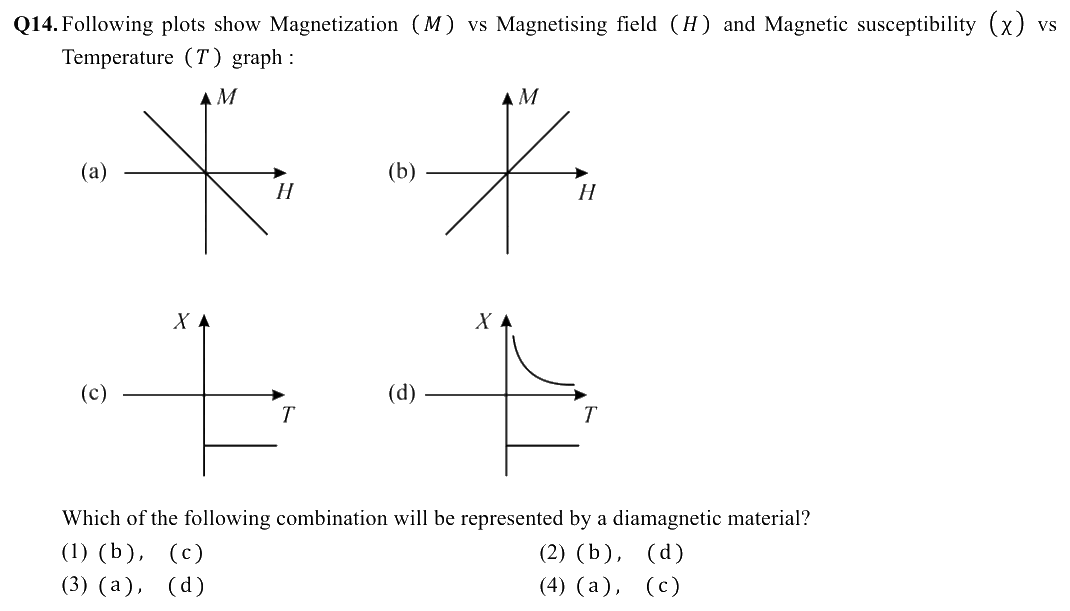
Following plots show Magnetization $(M)$ vs Magnetising field $(H)$ and Magnetic susceptibility $(\chi)$ vs Temperature $(T)$ graph : (see the figure above) Which of the following combination will be represented by a diamagnetic material?
Statement I : The ferromagnetic property depends on temperature. At high temperature, ferromagnet becomes paramagnet. Statement II : At high temperature, the domain wall area of a ferromagnetic substance increases. In the light of the above statements, choose the most appropriate answer from the options given below:
The magnetic susceptibility of a material of a rod is 499. Permeability in vacuum is $4\pi \times 10^{-7}~\mathrm{Hm^{-1}}$. Absolute permeability of the material of the rod is
Which of the following statements are correct? (A) Electric monopoles do not exist whereas magnetic monopoles exist. (B) Magnetic field lines due to a solenoid at its ends and outside cannot be completely straight and confined. (C) Magnetic field lines are completely confined within a toroid. (D) Magnetic field lines inside a bar magnet are not parallel. (E) $\chi = -1$ is the condition for a perfect diamagnetic material, where $\chi$ is its magnetic susceptibility. Choose the correct answer from the options given below :
A bar magnet of length $14 \mathrm{~cm}$ is placed in the magnetic meridian with its north pole pointing towards the geographic north pole. A neutral point is obtained at a distance of $18 \mathrm{~cm}$ from the center of the magnet. If $B_H=0.4 \mathrm{~G}$, the magnetic moment is $\left(1 \mathrm{G}=10^{-4} \mathrm{~T}\right)$
An iron rod of volume $10^{-3}$ m$^3$ and relative permeability 1000 is placed as core in a solenoid with 10 turns cm$^{-1}$. If a current of 0. 5 A is passed through the solenoid, then the magnetic moment of the rod will be :
A small bar magnet is placed with its axis at $30^{\circ}$ with an external magnetic field of $0.06\ \mathrm{T}$ experiences a torque of $0.018\ \mathrm{Nm}$. The minimum work required to rotate it from its stable to unstable equilibrium position is:
A paramagnetic sample shows a net magnetisation of $6\ A/m$ when it is placed in an external magnetic field of $0.4\ T$ at a temperature of $4\ K$. When the sample is placed in an external magnetic field of $0.3\ T$ at a temperature of $24\ K$, then the magnetisation will be :
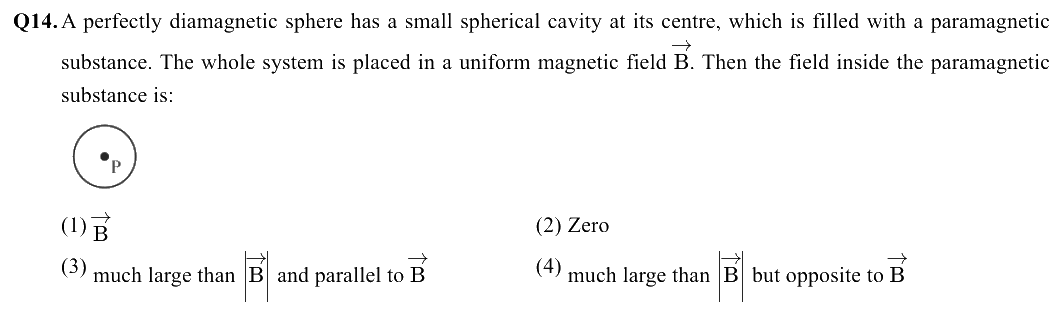
A perfectly diamagnetic sphere has a small spherical cavity at its centre, which is filled with a paramagnetic substance. The whole system is placed in a uniform magnetic field $\vec{B}$. Then the field inside the paramagnetic substance is: (see the figure above)
The question as printed in the paper.
A
$\vec{B}$
B
Zero
C
much large than $|\vec{B}|$ and parallel to $\vec{B}$
D
much large than $|\vec{B}|$ but opposite to $\vec{B}$
Magnetic materials used for making permanent magnets (P) and magnets in a transformer (T) have different properties of the following, which property best matches for the type of magnet required?
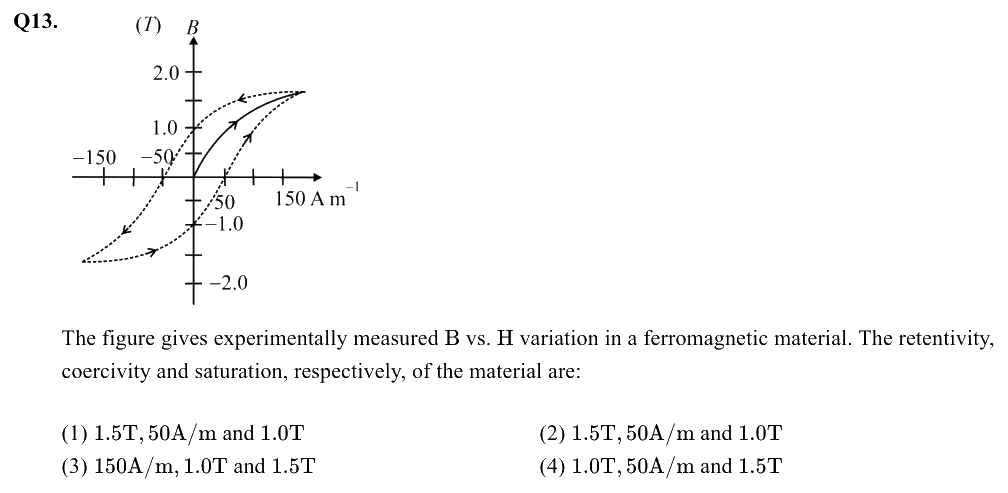
see figure The figure gives experimentally measured $\mathrm{B}$ vs. $\mathrm{H}$ variation in a ferromagnetic material. The retentivity, coercivity and saturation, respectively, of the material are:
The question as printed in the paper.
A
$1.5\mathrm{T}, 50\mathrm{A/m}$ and $1.0\mathrm{T}$
B
$1.5\mathrm{T}, 50\mathrm{A/m}$ and $1.0\mathrm{T}$
C
$150\mathrm{A/m}, 1.0\mathrm{T}$ and $1.5\mathrm{T}$
D
$1.0\mathrm{T}, 50\mathrm{A/m}$ and $1.5\mathrm{T}$
A magnetic compass needle oscillates 30 times per minute at a place where the dip is $45^\circ$ and 40 times per minute where the dip is $30^\circ$. If $B_1$ and $B_2$ are the net magnetic fields due to the earth at the two places respectively, then the ratio $B_1\ /\ B_2$ is approximately equal to
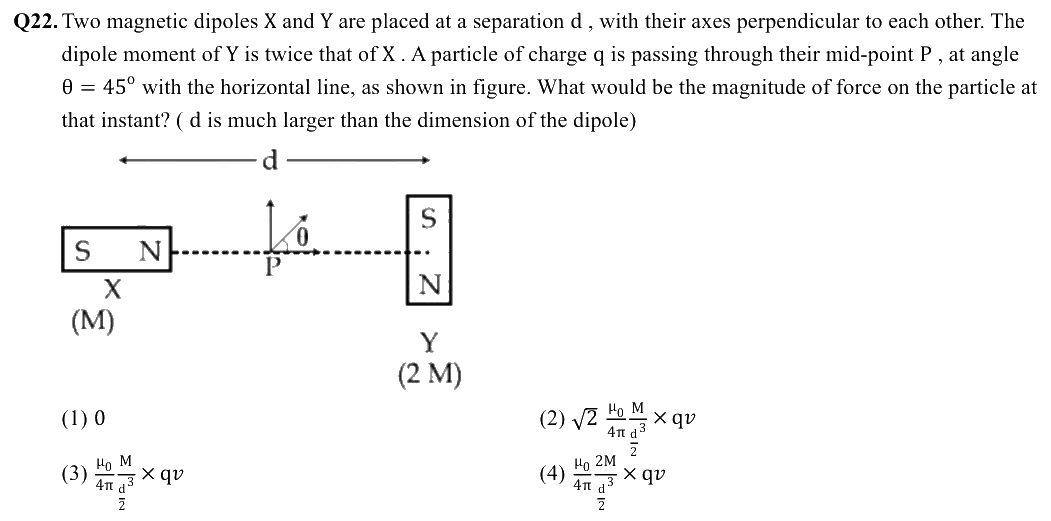
Two magnetic dipoles X and Y are placed at a separation d , with their axes perpendicular to each other. The dipole moment of Y is twice that of X . A particle of charge q is passing through their mid-point P , at angle $\theta$ = $45^o$ with the horizontal line, as shown in figure. What would be the magnitude of force on the particle at that instant? ( d is much larger than the dimension of the dipole)
A paramagnetic material has $10^{28}$ atoms m$^{-3}$. Its magnetic susceptibility at temperature 350 K is $2.8 \times 10^{-4}$. Its susceptibility at 300 K is
A paramagnetic substance in the form of a cube with sides 1 cm has a magnetic dipole moment of $20 \times 10^{-6}$ J/T when a magnetic intensity of $60 \times 10^3$ A/m is applied. Its magnetic susceptibility is:
A magnet of total magnetic moment $10^{-2}\ \hat{i}$ A m$^2$ is placed in a time varying magnetic field, $B\hat{i}(\cos \omega t)$ where $B = 1$ Tesla and $\omega = 0.125$ rad s$^{-1}$. The work done for reversing the direction of the magnetic moment at $t = 1$ second, is:
A hoop and a solid cylinder of same mass and radius are made of a permanent magnetic material with their respective axes. But the magnetic moment of hoop is twice of solid cylinder. They are placed in a uniform magnetic field in such a manner that their magnetic moments make a small angle with the field. If the oscillation periods of hoop and cylinder are $T_h$ and $T_c$ respectively, then:
At some location the horizontal component of earth's magnetic field is $18\times10^{-6}\ \mathrm{T}$. At this location, magnetic needle of length $0.12\ \mathrm{m}$ and pole strength $1.8\ \mathrm{Am}$ is suspended from its mid-point using a thread, it makes $45^\circ$ angles with horizontal in equilibrium. To keep this needle horizontal, the vertical force that should be applied at one of its ends is:
A bar magnet is demagnetized by inserting it inside a solenoid of length $0.2\ m$, $100$ turns, and carrying a current of $5.2\ A$ . The coercivity of the bar magnet is:
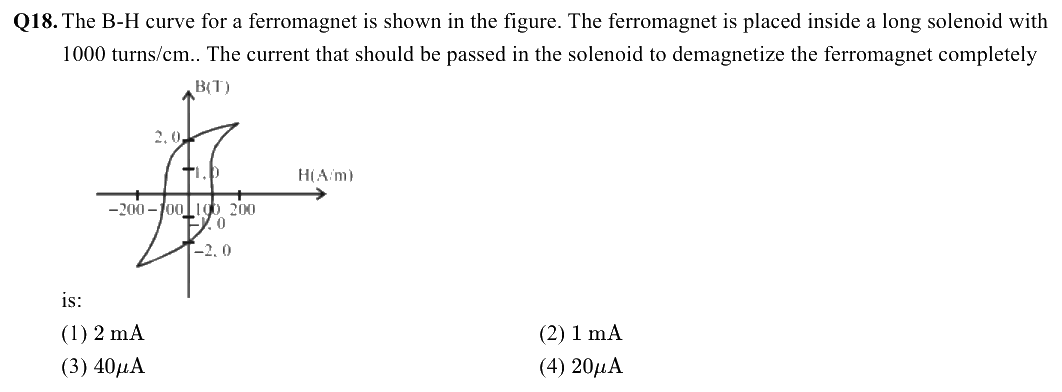
The B-H curve for a ferromagnet is shown in the figure. The ferromagnet is placed inside a long solenoid with $1000$ turns/cm.. The current that should be passed in the solenoid to demagnetize the ferromagnet completely is: (see the figure above)
A magnetic needle of magnetic moment $6.7 \times 10^{-2}\ \mathrm{A\ m^2}$ and moment of inertia $7.5 \times 10^{-6}\ \mathrm{kg\ m^2}$ is performing simple harmonic oscillations in a magnetic field of $0.01\ \mathrm{T}$. Time taken for 10 complete oscillations is:
A magnetic dipole is acted upon by two magnetic fields which are inclined to each other at an angle of $75^{\circ}$. One of the fields has a magnitude of $15\ \mathrm{mT}$. The dipole attains stable equilibrium at an angle of $30^{\circ}$ with this field. The magnitude of the other field (in mT) is close to
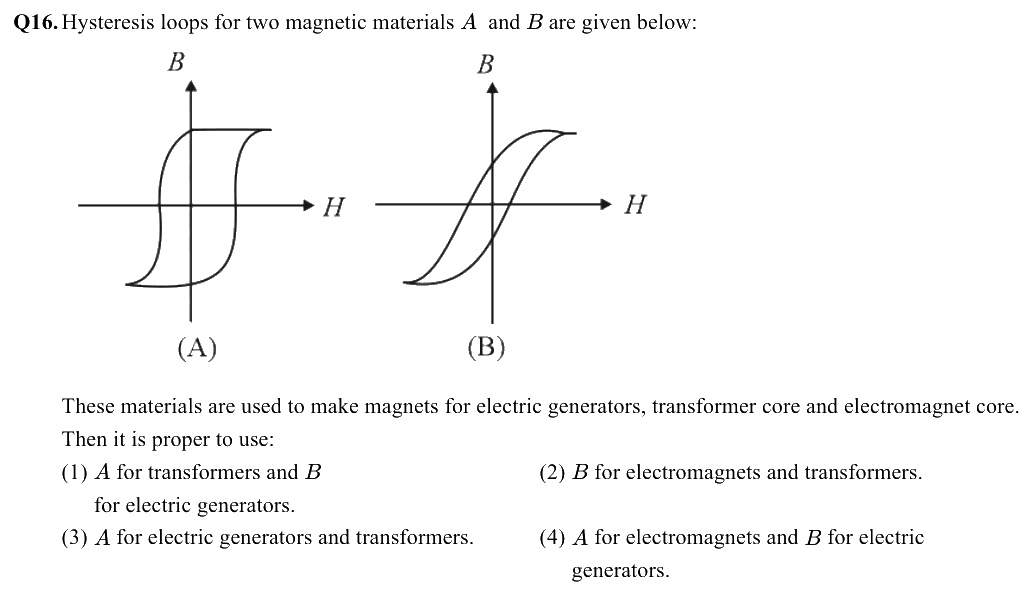
Hysteresis loops for two magnetic materials $A$ and $B$ are given below: (see the figure above) These materials are used to make magnets for electric generators, transformer core and electromagnet core. Then it is proper to use:
The question as printed in the paper.
A
$A$ for transformers and $B$ for electric generators.
B
$B$ for electromagnets and transformers.
C
$A$ for electric generators and transformers.
D
$A$ for electromagnets and $B$ for electric generators.
A short bar magnet is placed in the magnetic meridian of the earth with North Pole pointing north. Neutral points are found at a distance of 30 cm from the magnet on the East-West line, drawn through the middle point of the magnet. The magnetic moment of the magnet in Am$^2$ is close to: (Given $\frac{\mu_0}{4\pi} = 10^{-7}$ in SI units and $B_H$ = Horizontal component of earth's magnetic field = $3.6 \times 10^{-5}$ Tesla.)
An example of a perfect diamagnet is a superconductor. This implies that when a superconductor is put in a magnetic field of intensity $B$, the magnetic field $B_s$ inside the superconductor will be such that
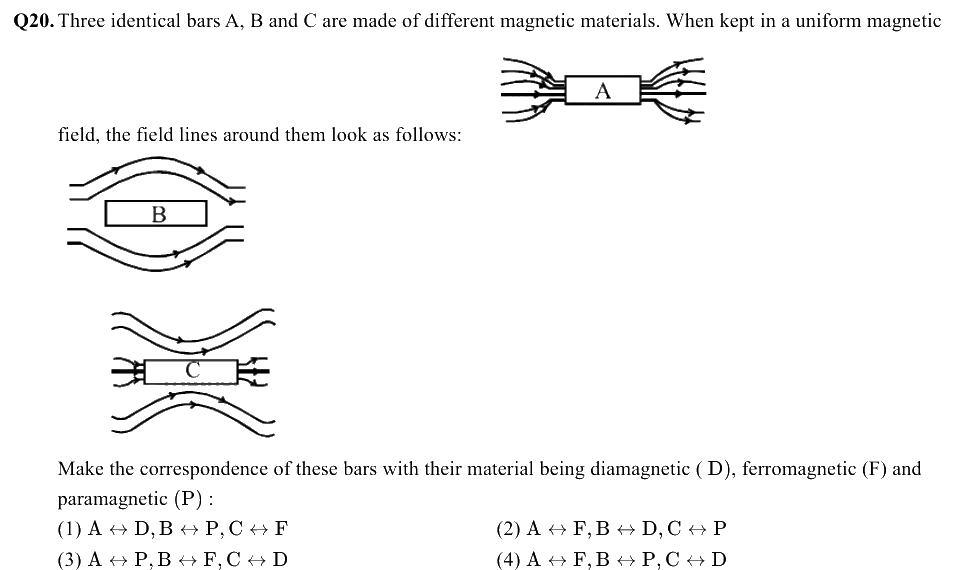
Three identical bars A, B and C are made of different magnetic materials. When kept in a uniform magnetic field, the field lines around them look as follows: (see the figure above) Make the correspondence of these bars with their material being diamagnetic ( D), ferromagnetic (F) and paramagnetic (P) :
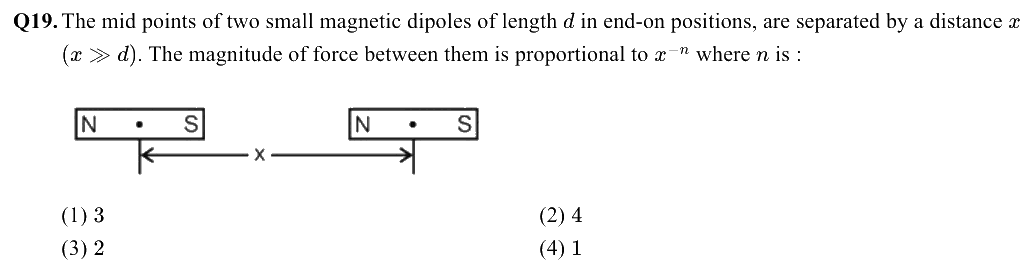
The mid points of two small magnetic dipoles of length $d$ in end-on positions, are separated by a distance $x$ ($x \gg d$). The magnitude of force between them is proportional to $x^{-n}$ where $n$ is : (see the figure above)
The magnetic field of earth at the equator is approximately $4\times10^{-5}\mathrm{T}$. The radius of earth is $6.4\times10^{6}\mathrm{m}$. Then the dipole moment of the earth will be nearly of the order of :
The coercivity of a small magnet, where the ferromagnet gets demagnetised is $3 \times 10^3$ A/m. The current required to be passed in a solenoid of length 10 cm and number of turns 100, so that the magnet gets demagnetised when inside the solenoid is
The earth's magnetic field lines resemble that of a dipole at the centre of the earth. If the magnetic moment of this dipole is close to $8 \times 10^{22}\,\mathrm{Am^2}$, the value of earth's magnetic field near the equator is close to (radius of the earth $= 6.4 \times 10^6$ m)
Two short bar magnets of length 1 cm each have magnetic moments 1.20 $\mathrm{A\ m^{2}}$ and 1.00 $\mathrm{A\ m^{2}}$ respectively. They are placed on a horizontal table parallel to each other with their N poles pointing towards the south. They have a common magnetic equator and are separated by a distance of 20.0 cm. The value of the resultant horizontal magnetic induction at the mid-point O of the line joining their centres is close to ( Horizontal component of earth's magnetic induction is $3.6 \times 10^{-5}\ \mathrm{Wb\ m^{-2}}$ )
A bar magnet of length 6 cm has a magnetic moment of 4 $\mathrm{J\,T}^{-1}$. Find the strength of magnetic field at a distance of 200 cm from the centre of the magnet along its equatorial line.
Relative permittivity and permeability of a material are $\varepsilon_r$ and $\mu_r$, respectively. Which of the following values of these quantities are allowed for a diamagnetic material?
Needles $\mathrm{N_1}$, $\mathrm{N_2}$ and $\mathrm{N_3}$ are made of a ferromagnetic, a paramagnetic and a diamagnetic substance respectively. A magnet when brought close to them will
A
attract all three of them
B
attract $\mathrm{N_1}$ and $\mathrm{N_2}$ strongly but repel $\mathrm{N_3}$
C
attract $\mathrm{N_1}$ strongly, $\mathrm{N_2}$ weakly and repel $\mathrm{N_3}$ weakly
D
attract $\mathrm{N_1}$ strongly, but repel $\mathrm{N_2}$ and $\mathrm{N_3}$ weakly
The length of a magnet is large compared to its width and breadth. The time period of its width and breadth. The time period of its oscillation in a vibration magnetometer is 2 s. The magnet is cut along its length into three equal parts and three parts are then placed on each other with their like poles together. The time period of this combination will be
A thin rectangular magnet suspended freely has a period of oscillation equal to $T$. Now it is broken into two equal halves (each having half of the original length) and one piece is made to oscillate freely in the same field. If its period of oscillation is $T'$, the ratio $\frac{T'}{T}$ is
A magnetic needle lying parallel to a magnetic field requires W units of work to turn it through $60^\circ$. The torque needed to maintain the needle in this position will be
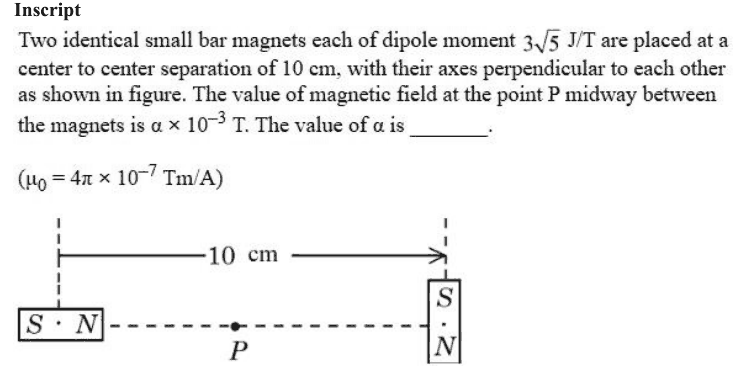
Two identical small bar magnets each of dipole moment $3\sqrt{5}$ J/T are placed at a center to center separation of 10 cm, with their axes perpendicular to each other as shown in figure. The value of magnetic field at the point P midway between the magnets is $\alpha\times10^{-3}$ T. The value of $\alpha$ is ________.
($\mu_0 = 4\pi\times10^{-7}$ Tm/A)
(see the figure above)
The question as printed in the paper.
Numerical answer type: type your answer in EdLoop to check it
A short bar magnet placed with its axis at $30°$ with an external field of 800 Gauss, experiences a torque of 0.016 N.m. The work done in moving it from most stable to most unstable position is $\alpha \times 10^{-3}$ J. The value of $\alpha$ is ________.
Numerical answer type: type your answer in EdLoop to check it
A straight magnetic strip has a magnetic moment of 44Am$^2$. If the strip is bent in a semicircular shape, its magnetic moment will be ______ Am$^2$. (given $\pi = \frac{22}{7}$ )
Numerical answer type: type your answer in EdLoop to check it
The coercivity of a magnet is $5 \times 10^3$ A/m. The amount of current required to be passed in a solenoid of length 30 cm and the number of turns 150 , so that the magnet gets demagnetised when inside the solenoid is ______ A.
Numerical answer type: type your answer in EdLoop to check it
The magnetic potential due to a magnetic dipole at a point on its axis situated at a distance of 20 cm from its center is $1.5 \times 10^{-5}$ T m. The magnetic moment of the dipole is ______ A m$^2$. (Given : $\frac{\mu_0}{4\pi} = 10^{-7}$ T m A$^{-1}$)
Numerical answer type: type your answer in EdLoop to check it
A compass needle oscillates 20 times per minute at a place where the dip is $30^\circ$ and 30 times per minute where the dip is $60^\circ$. The ratio of total magnetic field due to the earth at two places respectively is $\frac{4}{\sqrt{x}}$. The value of $x$ is
Numerical answer type: type your answer in EdLoop to check it
A long solenoid with $1000$ turns m$^{-1}$ has a core material with relative permeability $500$ and volume $10^3$ cm$^3$. If the core material is replaced by another material having relative permeability of $750$ with same volume maintaining same current of $0.75$ A in the solenoid, the fractional change in the magnetic moment of the core would be approximately $\frac{x}{499}$. Find the value of $x$.
Numerical answer type: type your answer in EdLoop to check it
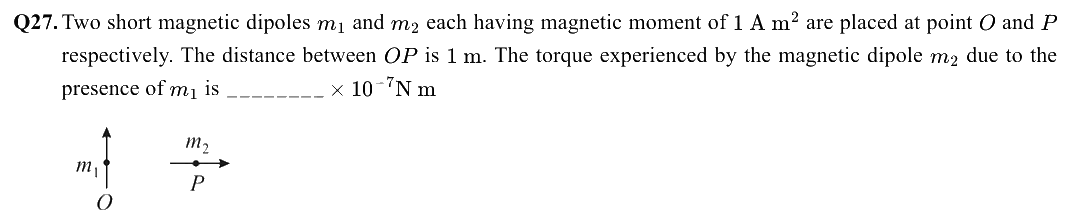
Two short magnetic dipoles $m_1$ and $m_2$ each having magnetic moment of $1\ \mathrm{A\ m^{2}}$ are placed at point $O$ and $P$ respectively. The distance between $OP$ is $1\ \mathrm{m}$. The torque experienced by the magnetic dipole $m_2$ due to the presence of $m_1$ is ________$\times10^{-7}\ \mathrm{N\ m}$ (see the figure above)
The question as printed in the paper.
Numerical answer type: type your answer in EdLoop to check it
In a uniform magnetic field, the magnetic needle has a magnetic moment $9.85 \times 10^{-2}\ \mathrm{A\ m^{-2}}$ and moment of inertia $5 \times 10^{-6}\ \mathrm{kg\ m^2}$. If it performs 10 complete oscillations in 5 seconds then the magnitude of the magnetic field is ______ mT [Take $\pi^2$ as 9.85]
Numerical answer type: type your answer in EdLoop to check it
The value of aluminium susceptibility is $2.2 \times 10^{-5}$. The percentage increase in the magnetic field in space within a current carrying toroid is filled with aluminium is $\frac{x}{10^4}$. Then the value of $x$ is
Numerical answer type: type your answer in EdLoop to check it
Magnetism and matter covers magnetic materials and bar magnets under Unit 13: Magnetic Effects of Current and Magnetism in the Class 12 physics curriculum, placing the chapter at rank 28 among the 29 physics chapters. In the computerized testing interval from 2019 to 2026, 57 questions appeared across 162 papers, representing an average of 0.4 questions per shift. The chapter featured in 50 of those 162 papers, and questions have been asked every year across that span. Examining the recent 2024 to 2026 cycle shows 13 questions across 58 papers, an average of 0.2 questions per test and a 0.8 percent share. The chapter's share is down when compared against the 2002 to 2018 period, which recorded 23 questions across 38 papers for a 1.7 percent share. Relative to the broader 2019 to 2026 baseline, the recent share has stayed about the same. In 2026 specifically, 4 questions were distributed across 19 papers, appearing in 3 testing sessions. Between 2019 and 2026, exactly 10 problems were presented in numerical answer format, with the majority of questions remaining conceptual multiple choice items.
Most-asked topics
Questions from this chapter center on three distinct subject divisions:
Magnetic Materials: 41 total questions since 2003, with 32 between 2019 and 2026, tested up to 2026. This topic explores the properties of diamagnetic, paramagnetic, and ferromagnetic materials, domain theory, Curie temperature, magnetic susceptibility, and the relation between permeability and susceptibility.
Bar Magnet: 28 questions overall, including 16 from 2019 to 2026, continuing in 2026. Problems evaluate magnetic dipole moments, axial and equatorial fields of short bar magnets, torque in external fields, potential energy of orientation, and work done rotating a dipole from stable to unstable alignment.
Earth's Magnetism: 11 lifetime questions, with 9 appearing between 2019 and 2026, last tested in 2023. Core themes analyze magnetic elements of the Earth, including angle of dip, declination, and horizontal and vertical field components.
What the questions look like
Exam questions in this chapter are largely conceptual, with occasional compact numerical evaluations:
Classification of magnetic media: Identifying differences in magnetic susceptibility across diamagnetic, paramagnetic, and ferromagnetic substances, or determining behavior in non-uniform magnetic fields.
Rotating a bar magnet: Calculating the mechanical work necessary to flip a permanent magnet from its equilibrium position aligned with an external field to the anti-parallel configuration.
Relations between field vectors: Connecting magnetic induction B, magnetic intensity H, and magnetization M within a solenoid core of known relative permeability.
Dip needle and compass oscillations: Evaluating how the time period of an oscillating magnetic needle varies with the horizontal component of the terrestrial field across differing dip angles.
Questions to try first
Review these representative questions from recent examination papers:
Begin by thoroughly learning the definitions and relationships connecting magnetic induction, magnetic field intensity, magnetization, and susceptibility. Ensure you know the exact algebraic connections and SI units for each quantity, as unit matching questions appear regularly.
Memorize the distinctive characteristics of diamagnetic, paramagnetic, and ferromagnetic materials. Pay attention to how susceptibility depends on temperature for each class, particularly Curie's law for paramagnets and the Curie-Weiss law near the transition temperature.
For bar magnet problems, draw analogies to electric dipoles. The formulas for magnetic field along the axis and the broadside-on position correspond directly to electric dipole equations when replacing permittivity with magnetic permeability.
Frequently asked questions
Has Earth's magnetism been removed from the syllabus?
While Earth's magnetic elements were last asked in 2023 and have seen reduced emphasis in recent syllabus revisions, bar magnets and magnetic material classifications continue to be tested regularly in 2026.
How much preparation time should be devoted to this chapter?
Because it ranks 28 in overall question share and features predominantly qualitative questions, studying NCERT text and reviewing recent past questions for a few hours is usually sufficient for full coverage.
What is the most critical formula to remember for magnetic materials?
The relationship connecting relative permeability with magnetic susceptibility, alongside the equation relating total magnetic induction to magnetic intensity and magnetization, forms the core of most calculation problems. Step-by-step solutions for each one are in the EdLoop app.