Every Rotational Motion question from past JEE Main and AIEEE papers, with options and answers. Newest first.
315questions
194papers covered
5.3%of Physics questions, 2019–2026
2002–2026years
Guide at a glance
Rotational Motion is one of the steadiest chapters in JEE Main Physics. Across the papers we hold from 2019 to 2026, it gave 241 questions in 162 papers, about 1.5 questions per paper, and it appeared in 158 of those 162 papers.
A solid cylinder having radius $R$ and length $L$ is slipping on a rough horizontal plane. At time $t = 0$ the cylinder has a translational velocity $v_o = 49$ m/s, perpendicular to its axis and a rotational velocity $v_o/4R$ about the centre. The time taken by the cylinder to start rolling is ________ seconds. (coefficient of kinetic friction $\mu_K = 0.25$ and $g = 9.8$ m/s$^2$)
A solid sphere of radius 4 cm and mass 5 kg is rotating (rotation axis is passing through the centre of the sphere) with an angular velocity of 1200 rpm. It is brought to rest in 10 s by applying a constant torque. The torque applied and the number of rotations it made before it comes to rest are ________ and ________ respectively.
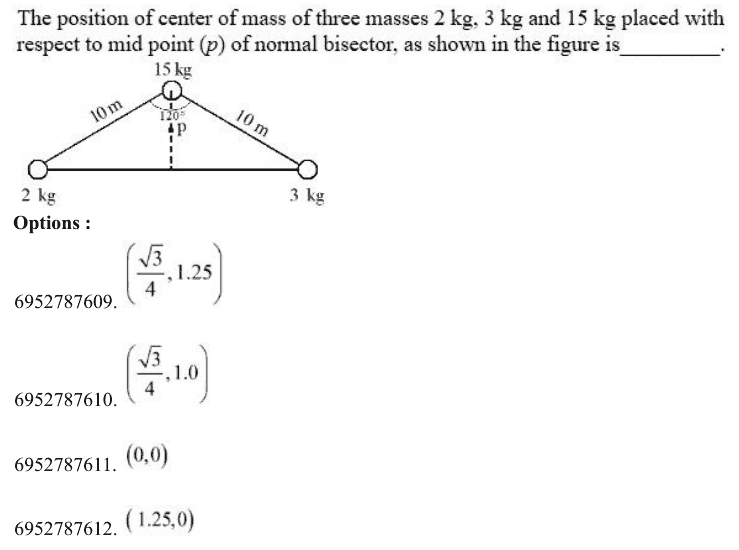
The position of center of mass of three masses 2 kg, 3 kg and 15 kg placed with respect to mid point ($p$) of normal bisector, as shown in the figure is ________.
A solid sphere ($A$) of mass $5m$ and a spherical shell ($B$) of mass $m$, both having same radius, are placed on a rough surface. When a force of same magnitude is applied tangentially at the highest points of $A$ and $B$, they start rolling without slipping with an acceleration of $a_A$ and $a_B$, respectively. The ratio of $a_A$ and $a_B$ is ________.
Two identical bodies A and B of equal masses have initial velocities $\vec{v}_1 = 4\hat{i}$ m/s and $\vec{v}_2 = 4\hat{j}$ m/s respectively. The body A has acceleration $\vec{a}_1 = 6\hat{i} + 6\hat{j}$ m/s$^2$ while the acceleration of the other body B is zero. The centre of mass of the two bodies moves in ________ path.
A wheel initially at rest is subjected to a uniform angular acceleration about its axis. In the first 2 s it rotates through an angle $\theta_1$ and in the next 2 s it rotates through an angle $\theta_2$. The ratio $\frac{\theta_2}{\theta_1}$ is ________.
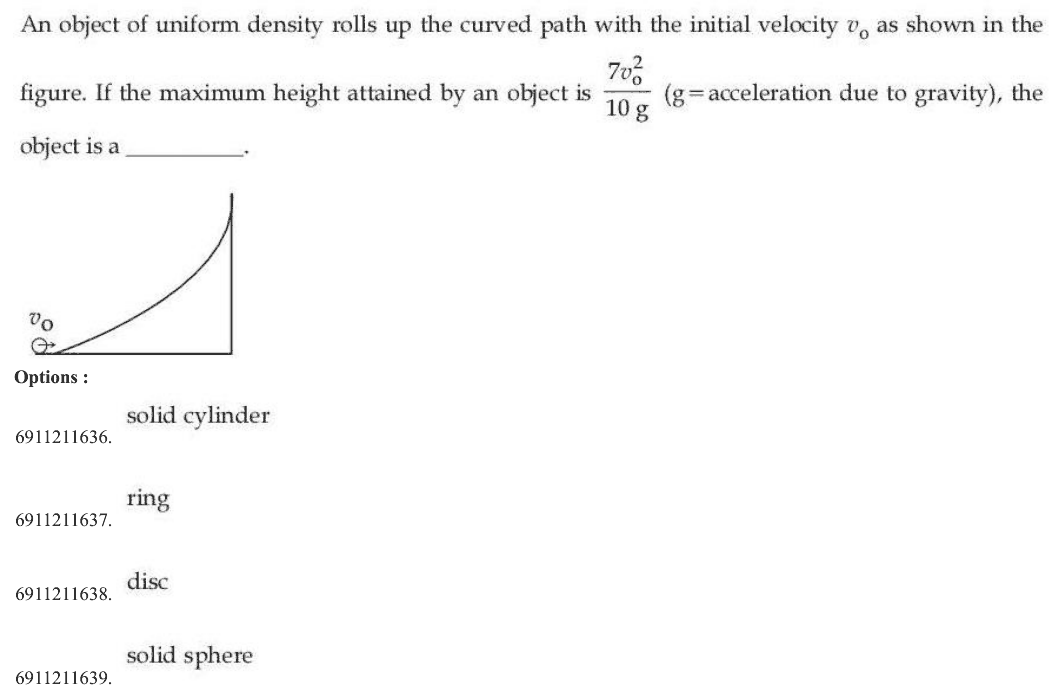
An object of uniform density rolls up the curved path with the initial velocity $v_o$ as shown in the figure. If the maximum height attained by an object is $\frac{7v_o^2}{10\,g}$ (g = acceleration due to gravity), the object is a ________.
A solid sphere of mass $M$ and radius $R$ is divided into two unequal parts. The smaller part having mass $M/8$ is converted into a sphere of radius $r$ and the larger part is converted into a circular disc of thickness $t$ and radius $2R$. If $I_1$ is moment of inertia of a sphere having radius $r$ about an axis through its centre and $I_2$ is the moment of inertia of a disc about its diameter, the ratio of their moment of inertia $I_2/I_1 =$ ________.
The position of an object having mass 0.1 kg as a function of time $t$ is given as $\vec{r} = \left(10t^2\hat{i} + 5t^3\hat{j}\right)$ m. At $t = 1$ s, which of the following statements are correct ?
A. The linear momentum $\vec{p} = \left(2\hat{i} + 1.5\hat{j}\right)$ kg·m/s.
B. The force acting on the object $\vec{F} = \left(2\hat{i} + 3\hat{j}\right)$ N.
C. The angular momentum of the object about its origin $\vec{L} = 15\,\hat{k}$ J s.
D. The torque acting on the object about its origin $\vec{\tau} = 20\,\hat{k}$ N m.
Choose the correct answer from the options given below :
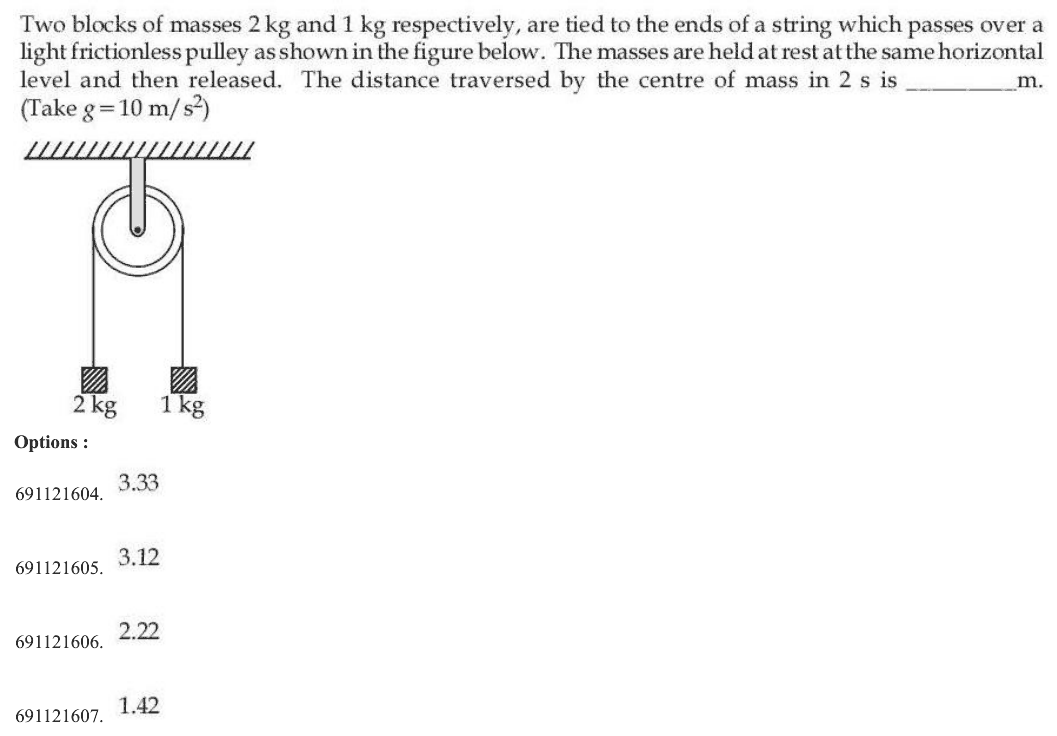
Two blocks of masses 2 kg and 1 kg respectively, are tied to the ends of a string which passes over a light frictionless pulley as shown in the figure below. The masses are held at rest at the same horizontal level and then released. The distance traversed by the centre of mass in 2 s is ________ m. (Take $g$ = 10 m/s$^2$)
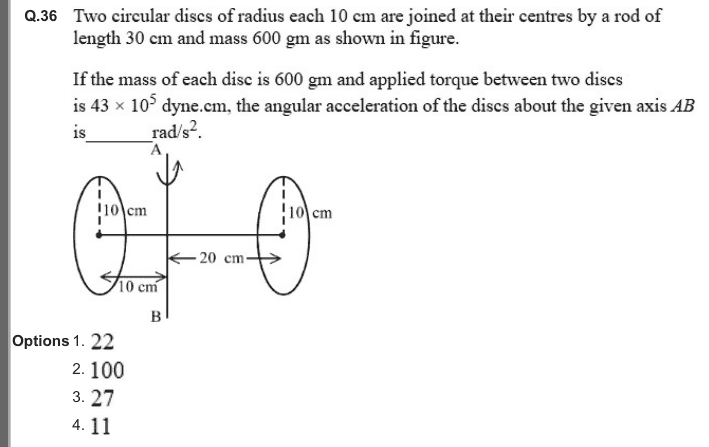
Two circular discs of radius each 10 cm are joined at their centres by a rod of length 30 cm and mass 600 gm as shown in figure.
If the mass of each disc is 600 gm and applied torque between two discs is $43 \times 10^5$ dyne.cm, the angular acceleration of the discs about the given axis $AB$ is ________ rad/s$^2$.
Two masses 400 g and 350 g are suspended from the ends of a light string passing over a heavy pulley of radius 2 cm. When released from rest the heavier mass is observed to fall 81 cm in 9 s. The rotational inertia of the pulley is ________ kg.m$^2$.
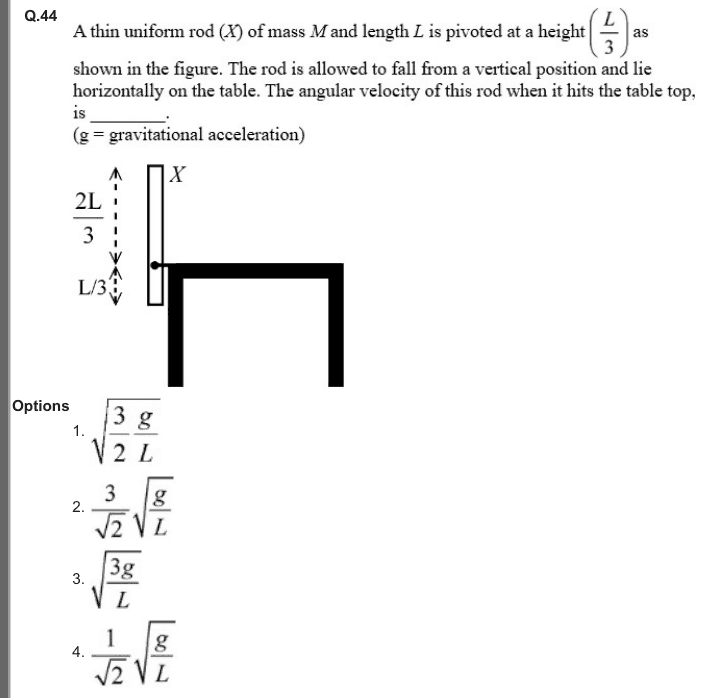
A thin uniform rod ($X$) of mass $M$ and length $L$ is pivoted at a height $\left(\dfrac{L}{3}\right)$ as shown in the figure. The rod is allowed to fall from a vertical position and lie horizontally on the table. The angular velocity of this rod when it hits the table top, is ________.
The moment of inertia of a square loop made of four uniform solid cylinders, each having radius $R$ and length $L$ ($R<L$) about an axis passing through the mid points of opposite sides, is (Take the mass of the entire loop as $M$) :
Two small balls with masses $m$ and $2m$ are attached to both ends of a rigid rod of length $d$ and negligible mass. If angular momentum of this system is $L$ about an axis ($A$) passing through its centre of mass and perpendicular to the rod then angular velocity of the system about $A$ is :
A solid sphere of mass 5 kg and radius 10 cm is kept in contact with another solid sphere of mass 10 kg and radius 20 cm. The moment of inertia of this pair of spheres about the tangent passing through the point of contact is ________ kg.m$^2$.
Statement I : For a mechanical system of many particles total kinetic energy is the sum of kinetic energies of all the particles.
Statement II : The total kinetic energy can be the sum of kinetic energy of the center of mass w.r.t to the origin and the kinetic energy of all the particles w.r.t. the center of mass as the reference.
In the light of the above statements, choose the correct answer from the options given below :
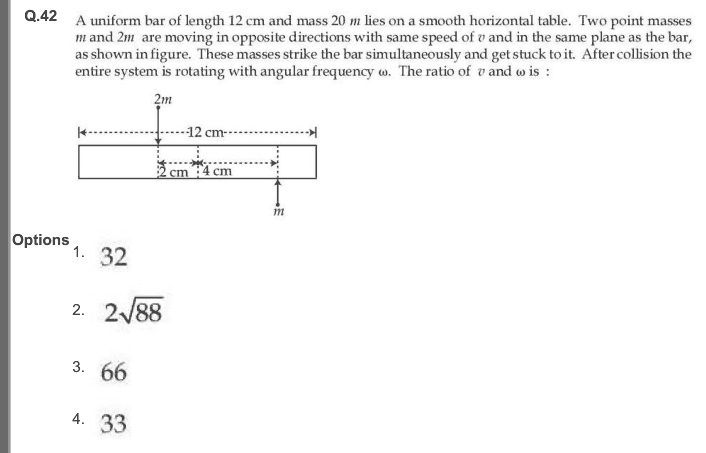
A uniform bar of length 12 cm and mass 20 $m$ lies on a smooth horizontal table. Two point masses $m$ and $2m$ are moving in opposite directions with same speed of $v$ and in the same plane as the bar, as shown in figure. These masses strike the bar simultaneously and get stuck to it. After collision the entire system is rotating with angular frequency $\omega$. The ratio of $v$ and $\omega$ is :
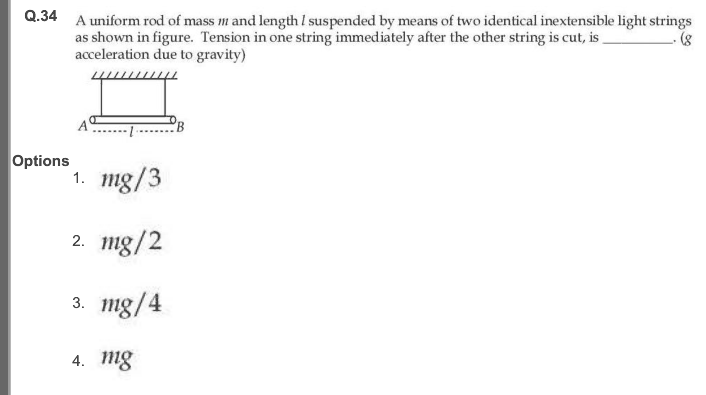
A uniform rod of mass $m$ and length $l$ suspended by means of two identical inextensible light strings as shown in figure. Tension in one string immediately after the other string is cut, is ________. (g acceleration due to gravity)
Two cars $A$ and $B$ each of mass $10^3$ kg are moving on parallel tracks separated by a distance of 10 m, in same direction with speeds 72 km/h and 36 km/h. The magnitude of angular momentum of car $A$ with respect to car $B$ is ________ J.s.
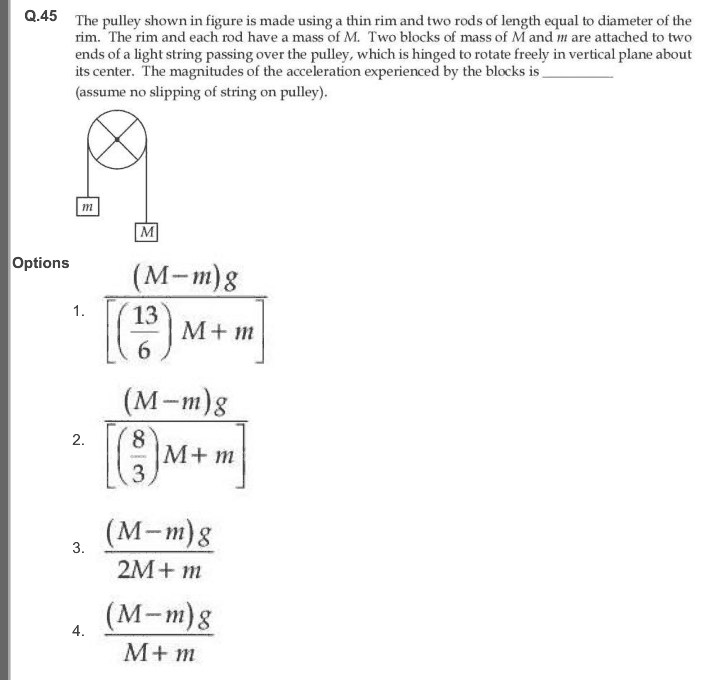
The pulley shown in figure is made using a thin rim and two rods of length equal to diameter of the rim. The rim and each rod have a mass of $M$. Two blocks of mass of $M$ and $m$ are attached to two ends of a light string passing over the pulley, which is hinged to rotate freely in vertical plane about its center. The magnitudes of the acceleration experienced by the blocks is ________ (assume no slipping of string on pulley).
A wheel is rolling on a plane surface. The speed of a particle on the highest point of the rim is $8m / s$. The speed of the particle on the rim of the wheel at the same level as the centre of wheel, will be :
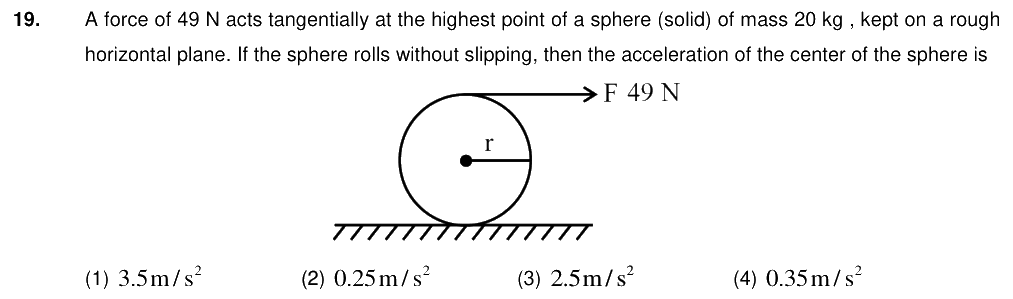
A force of 49 N acts tangentially at the highest point of a sphere (solid) of mass 20 kg , kept on a rough horizontal plane. If the sphere rolls without slipping, then the acceleration of the center of the sphere is
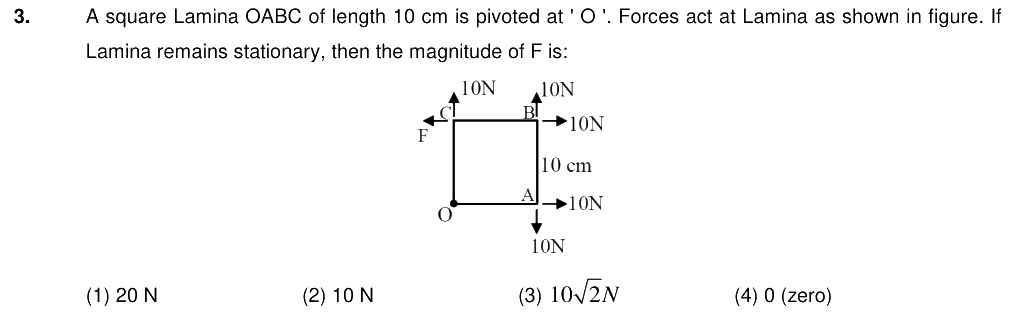
A square Lamina OABC of length 10 cm is pivoted at ' O '. Forces act at Lamina as shown in figure. If Lamina remains stationary, then the magnitude of F is:
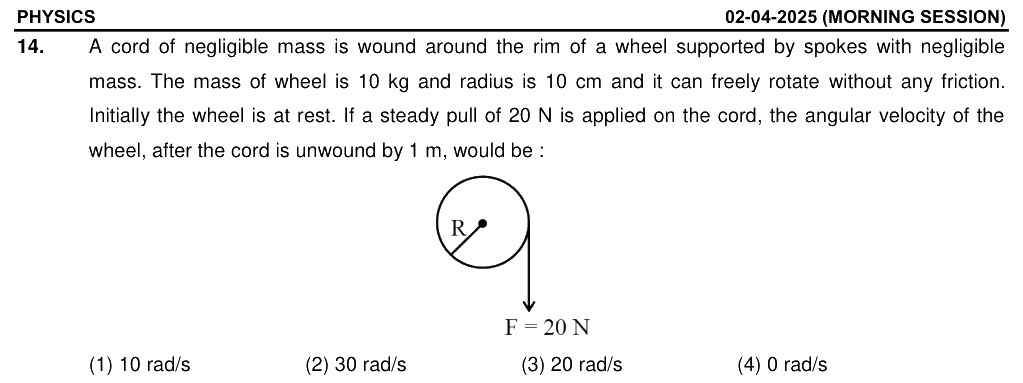
A cord of negligible mass is wound around the rim of a wheel supported by spokes with negligible mass. The mass of wheel is 10 kg and radius is 10 cm and it can freely rotate without any friction. Initially the wheel is at rest. If a steady pull of 20 N is applied on the cord, the angular velocity of the wheel, after the cord is unwound by 1 m, would be :
Moment of inertia of a rod of mass 'M' and length 'L' about an axis passing through its center and normal to its length is ' $\alpha$'. Now the rod is cut into two equal parts and these parts are joined symmetrically to form a cross shape. Moment of inertia of cross about an axis passing through its center and normal to plane containing cross is :
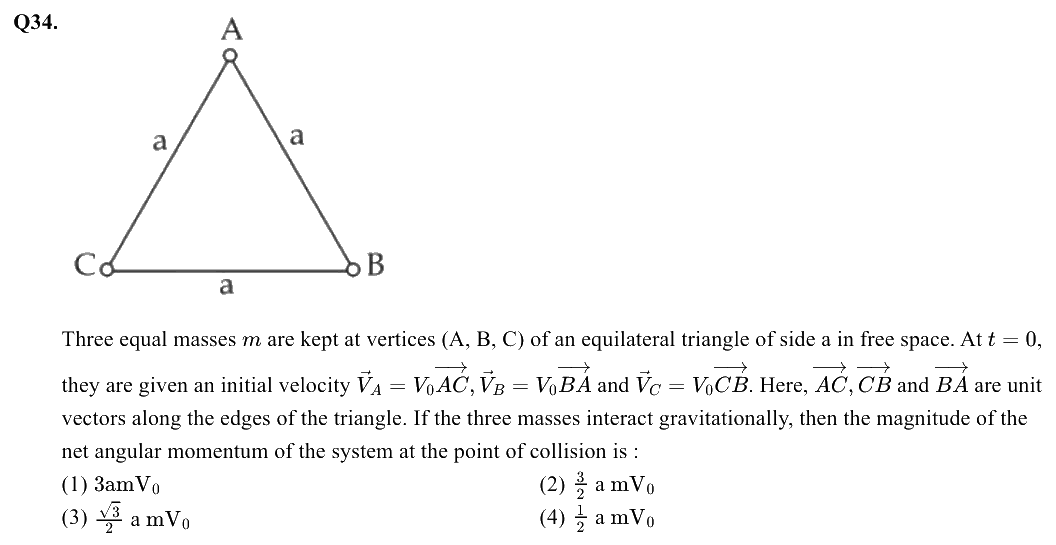
see figure Three equal masses $m$ are kept at vertices (A, B, C) of an equilateral triangle of side a in free space. At $t = 0$, they are given an initial velocity $\vec{V}_A = V_0\overrightarrow{AC}$, $\vec{V}_B = V_0\overrightarrow{BA}$ and $\vec{V}_C = V_0\overrightarrow{CB}$. Here, $\overrightarrow{AC}$, $\overrightarrow{CB}$ and $\overrightarrow{BA}$ are unit vectors along the edges of the triangle. If the three masses interact gravitationally, then the magnitude of the net angular momentum of the system at the point of collision is :
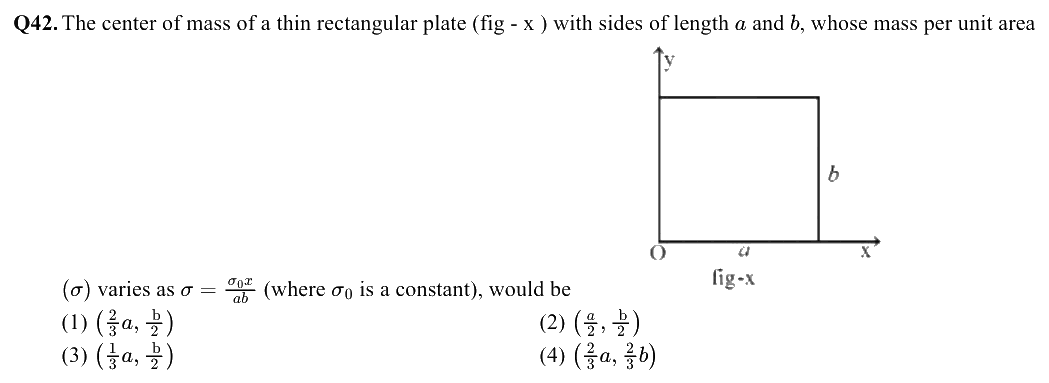
The center of mass of a thin rectangular plate (fig - x ) with sides of length $a$ and $b$, whose mass per unit area ($\sigma$) varies as $\sigma = \frac{\sigma_0 x}{ab}$ (where $\sigma_0$ is a constant), would be
A uniform rod of mass 250 g having length 100 cm is balanced on a sharp edge at 40 cm mark. A mass of 400 g is suspended at 10 cm mark. To maintain the balance of the rod, the mass to be suspended at 90 cm mark, is
A uniform solid cylinder of mass ' $m$ ' and radius ' $r$ ' rolls along an inclined rough plane of inclination $45^\circ$. If it starts to roll from rest from the top of the plane then the linear acceleration of the cylinder's axis will be
An object of mass ' m ' is projected from origin in a vertical $xy$ plane at an angle $45^\circ$ with the x axis with an initial velocity $\mathrm{v_0}$. The magnitude and direction of the angular momentum of the object with respect to origin, when it reaches at the maximum height, will be [ g is acceleration due to gravity]
A
$\frac{\mathrm{mv_o^3}}{2\sqrt{2}g}$ along negative $z$-axis
B
$\frac{\mathrm{mv_o^3}}{4\sqrt{2}g}$ along positive $z$-axis
C
$\frac{\mathrm{mv_o^3}}{4\sqrt{2}g}$ along negative $z$-axis
D
$\frac{\mathrm{mv_o^3}}{2\sqrt{2}g}$ along positive $z$-axis
A solid sphere and a hollow sphere of the same mass and of same radius are rolled on an inclined plane. Let the time taken to reach the bottom by the solid sphere and the hollow sphere be $t_1$ and $t_2$, respectively, then
A solid sphere is rolling without slipping on a horizontal plane. The ratio of the linear kinetic energy of the centre of mass of the sphere and rotational kinetic energy is :
Consider a circular disc of radius 20 cm with centre located at the origin. A circular hole of radius 5 cm is cut from this disc in such a way that the edge of the hole touches the edge of the disc. The distance of centre of mass of residual or remaining disc from the origin will be
A solid sphere of mass ' $m$ ' and radius ' $r$ ' is allowed to roll without slipping from the highest point of an inclined plane of length ' $L$ ' and makes an angle $30^\circ$ with the horizontal. The speed of the particle at the bottom of the plane is $v_1$. If the angle of inclination is increased to $45^\circ$ while keeping $L$ constant. Then the new speed of the sphere at the bottom of the plane is $v_2$. The ratio $v_1^2 : v_2^2$ is
A circular disk of radius R meter and mass M kg is rotating around the axis perpendicular to the disk. An external torque is applied to the disk such that $\theta(t) = 5t^2 - 8t$, where $\theta(t)$ is the angular position of the rotating disc as a function of time $t$. How much power is delivered by the applied torque, when $t = 2$ s ?
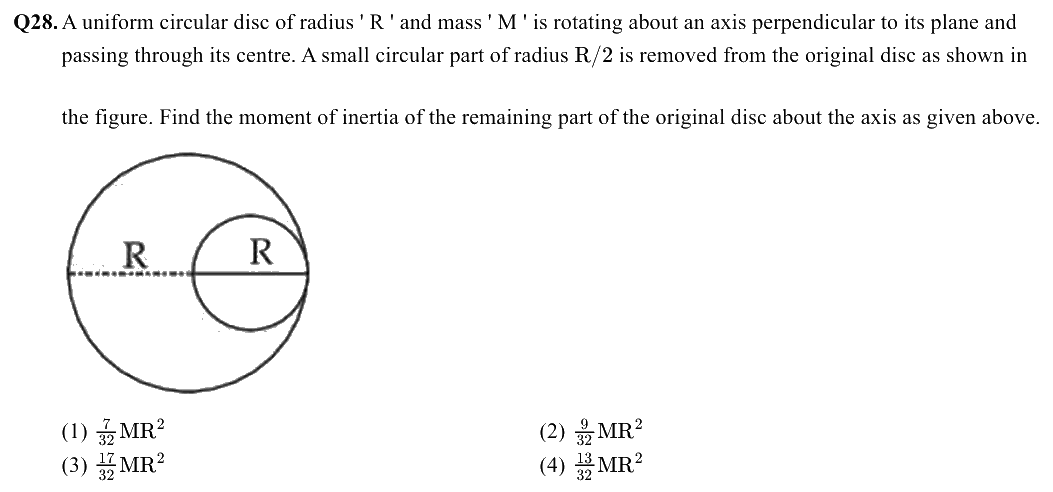
A uniform circular disc of radius ' R ' and mass ' M ' is rotating about an axis perpendicular to its plane and passing through its centre. A small circular part of radius R/2 is removed from the original disc as shown in the figure. Find the moment of inertia of the remaining part of the original disc about the axis as given above.
The torque due to the force $(2\hat{i} + \hat{j} + 2\hat{k})$ about the origin, acting on a particle whose position vector is $(\hat{i} + \hat{j} + \hat{k})$, would be
A heavy iron bar, of weight $W$ is having its one end on the ground and the other on the shoulder of a person. The bar makes an angle $\theta$ with the horizontal. The weight experienced by the person is :
A thin circular disc of mass $M$ and radius $R$ is rotating in a horizontal plane about an axis passing through its centre and perpendicular to its plane with angular velocity $\omega$. If another disc of same dimensions but of mass M/2 is placed gently on the first disc co-axially, then the new angular velocity of the system is :
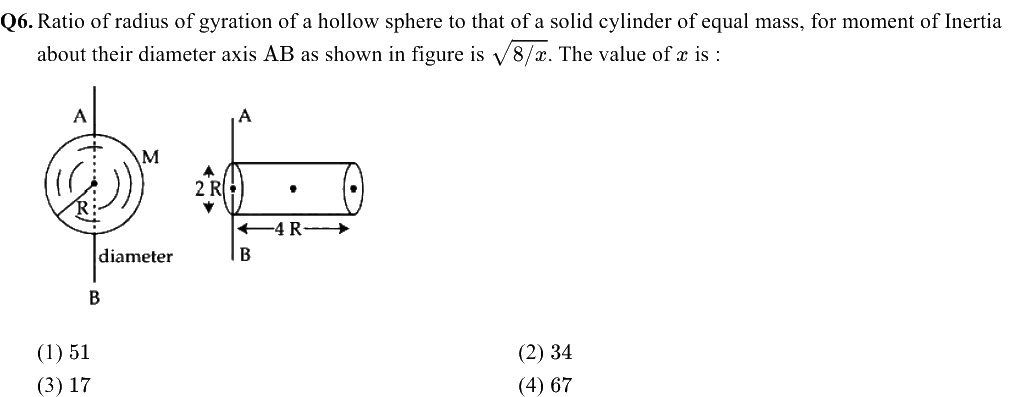
Ratio of radius of gyration of a hollow sphere to that of a solid cylinder of equal mass, for moment of Inertia about their diameter axis AB as shown in figure is $\sqrt{8/x}$. The value of $x$ is :
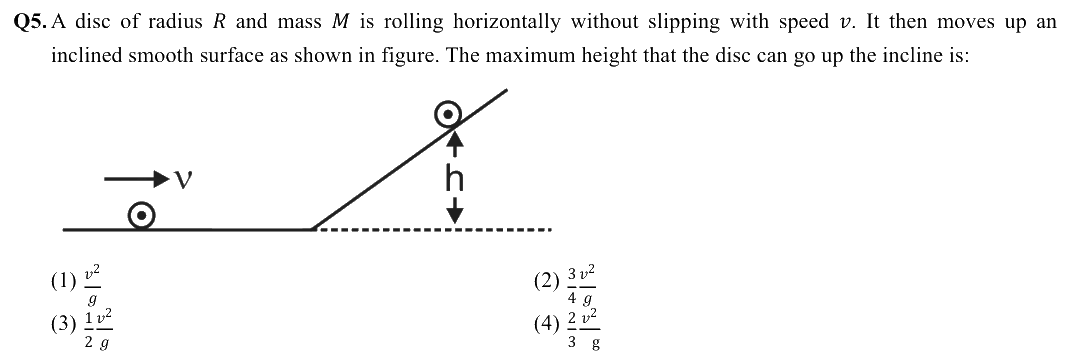
A disc of radius $R$ and mass $M$ is rolling horizontally without slipping with speed $v$. It then moves up an inclined smooth surface as shown in figure. The maximum height that the disc can go up the incline is:
A particle of mass $m$ projected with a velocity $u$ making an angle of $30^\circ$ with the horizontal. The magnitude of angular momentum of the projectile about the point of projection when the particle is at its maximum height $h$ is :
A heavy iron bar of weight 12 kg is having its one end on the ground and the other on the shoulder of a man. The rod makes an angle $60°$ with the horizontal, the normal force applied by the man on bar is:
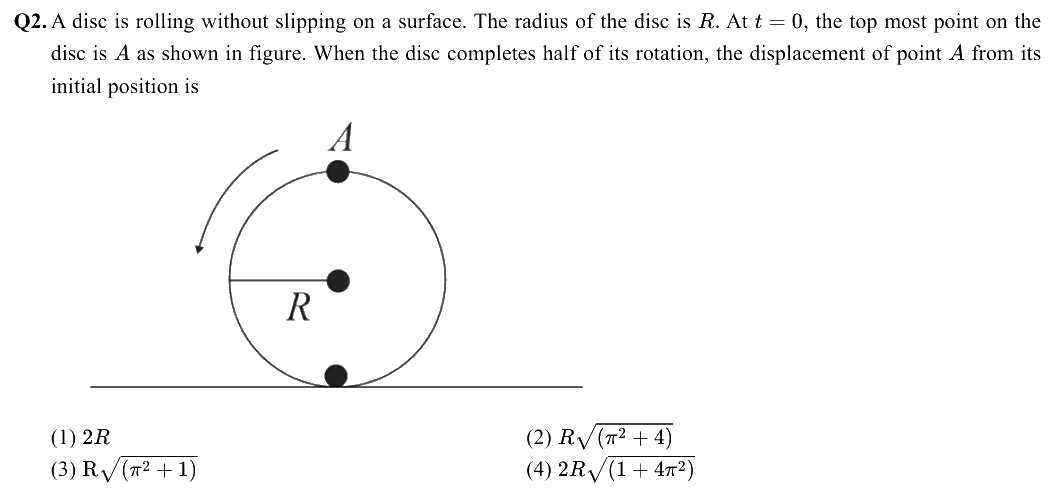
A disc is rolling without slipping on a surface. The radius of the disc is $R$. At $t = 0$, the top most point on the disc is $A$ as shown in figure. When the disc completes half of its rotation, the displacement of point $A$ from its initial position is
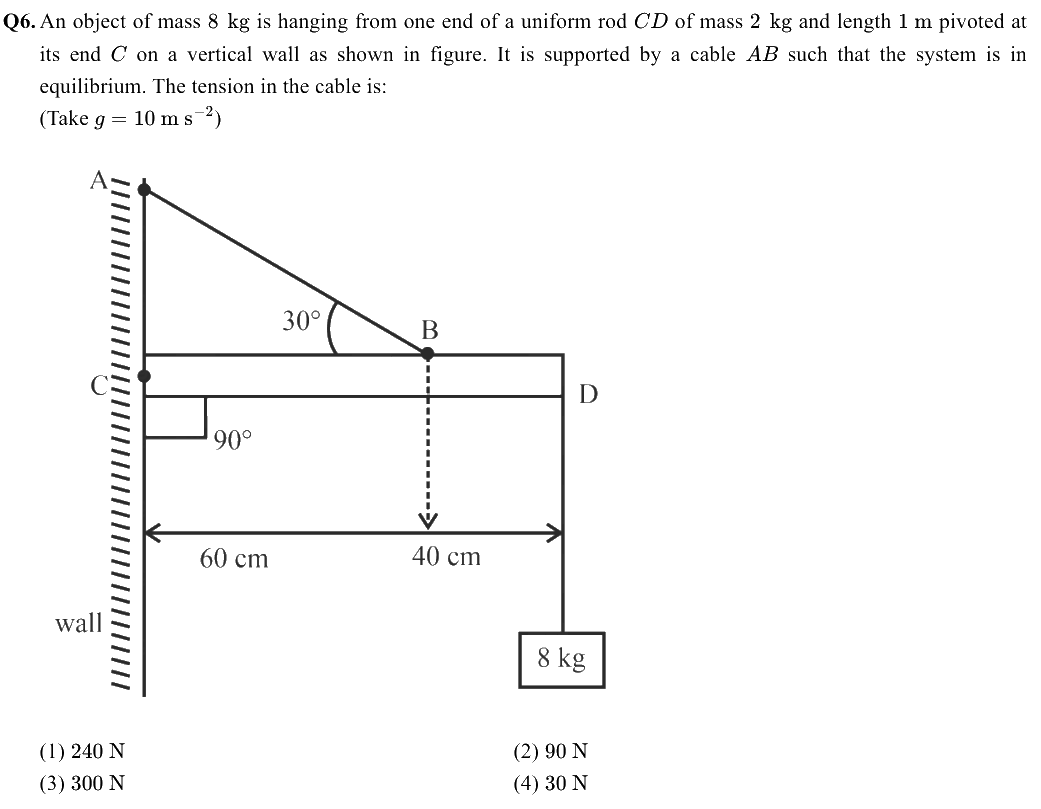
An object of mass $8\ \mathrm{kg}$ is hanging from one end of a uniform rod $CD$ of mass $2\ \mathrm{kg}$ and length $1\ \mathrm{m}$ pivoted at its end $C$ on a vertical wall as shown in figure. It is supported by a cable $AB$ such that the system is in equilibrium. The tension in the cable is: (Take $g = 10\ \mathrm{m\,s^{-2}}$) (see the figure above)
Two bodies of mass 1 kg and 3 kg have position vectors $\hat{i} + 2\hat{j} + \hat{k}$ and $-3\hat{i} - 2\hat{j} + \hat{k}$ respectively. The magnitude of position vector of centre of mass of this system will be similar to the magnitude of vector :
The torque of a force $5\hat{i} + 3\hat{j} - 7\hat{k}$ about the origin is $\tau$. If the force acts on a particle whose position vector is $2\hat{i} + 2\hat{j} + \hat{k}$, then the value of $\tau$ will be
A solid cylinder and a solid sphere, having same mass $M$ and radius $R$, roll down the same inclined plane from top without slipping. They start from rest. The ratio of velocity of the solid cylinder to that of the solid sphere, with which they reach the ground, will be
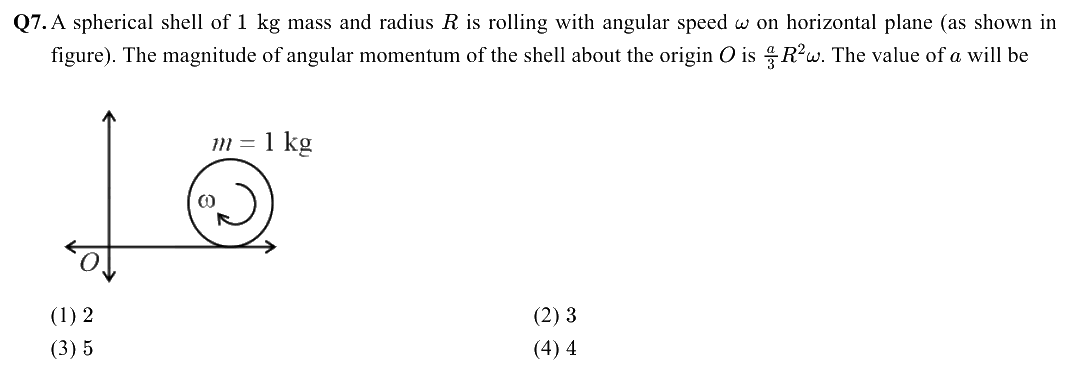
A spherical shell of $1\ \mathrm{kg}$ mass and radius $R$ is rolling with angular speed $\omega$ on horizontal plane (as shown in figure). The magnitude of angular momentum of the shell about the origin $O$ is $\dfrac{a}{3}R^2\omega$. The value of $a$ will be
List-I (A) Moment of inertia of solid sphere of radius $R$ about any tangent. (B) Moment of inertia of hollow sphere of radius $(R)$ about any tangent. (C) Moment of inertia of circular ring of radius $(R)$ about its diameter. (D) Moment of inertia of circular disc of radius $(R)$ about any diameter.
List-II (I) $\dfrac{5}{3}MR^2$ (II) $\dfrac{7}{5}MR^2$ (III) $\dfrac{1}{4}MR^2$ (IV) $\dfrac{1}{2}MR^2$
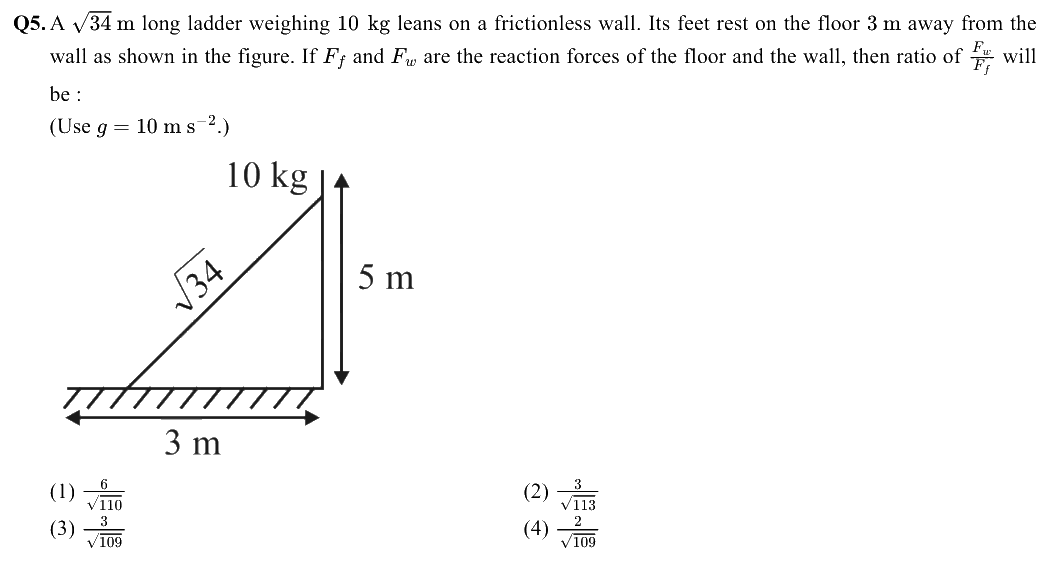
A $\sqrt{34}\ \mathrm{m}$ long ladder weighing $10\ \mathrm{kg}$ leans on a frictionless wall. Its feet rest on the floor $3\ \mathrm{m}$ away from the wall as shown in the figure. If $F_f$ and $F_w$ are the reaction forces of the floor and the wall, then ratio of $\frac{F_w}{F_f}$ will be : (Use $g = 10\ \mathrm{m\ s^{-2}}$.) (see the figure above)
Two blocks of masses $10\ \mathrm{kg}$ and $30\ \mathrm{kg}$ are placed on the same straight line with coordinates $(0, 0)$ cm and $(x, 0)$ cm respectively. The block of $10\ \mathrm{kg}$ is moved on the same line through a distance of $6\ \mathrm{cm}$ towards the other block. The distance through which the block of $30\ \mathrm{kg}$ must be moved to keep the position of centre of mass of the system unchanged is
A
$4\ \mathrm{cm}$ towards the $10\ \mathrm{kg}$ block
B
$2\ \mathrm{cm}$ away from the $10\ \mathrm{kg}$ block
C
$2\ \mathrm{cm}$ towards the $10\ \mathrm{kg}$ block
D
$4\ \mathrm{cm}$ away from the $10\ \mathrm{kg}$ block
A thin circular ring of mass $M$ and radius $R$ is rotating with a constant angular velocity $2 \mathrm{~rad} \mathrm{~s}^{-1}$ in a horizontal plane about an axis vertical to its plane and passing through the center of the ring. If two objects each of mass $m$ be attached gently to the opposite ends of a diameter of ring, the ring will then rotate with an angular velocity (in $\mathrm{rad} \mathrm{~s}^{-1}$).
A solid spherical ball is rolling on a frictionless horizontal plane surface about its axis of symmetry. The ratio of rotational kinetic energy of the ball to its total kinetic energy is
If force $\vec{F} = 3\hat{i} + 4\hat{j} - 2\hat{k}$ acts on a particle having position vector $2\hat{i} + \hat{j} + 2\hat{k}$ then, the torque about the origin will be:
A fly wheel is accelerated uniformly from rest and rotates through $5 \mathrm{~rad}$ in the first second. The angle rotated by the fly wheel in the next second, will be :
A system consists of two identical spheres each of mass $1.5$ kg and radius $50$ cm at the ends of a light rod. The distance between the centres of the two spheres is $5$ m. What will be the moment of inertia of the system about an axis perpendicular to the rod passing through its midpoint?
Moment of inertia of a square plate of side $l$ about the axis passing through one of the corner and perpendicular to the plane of square plate is given by:
Two discs have moments of intertia $I_1$ and $I_2$ about their respective axes perpendicular to the plane and passing through the centre. They are rotating with angular speeds, $\omega_1$ and $\omega_2$ respectively and are brought into contact face to face with their axes of rotation coaxial. The loss in kinetic energy of the system in the process is given by:
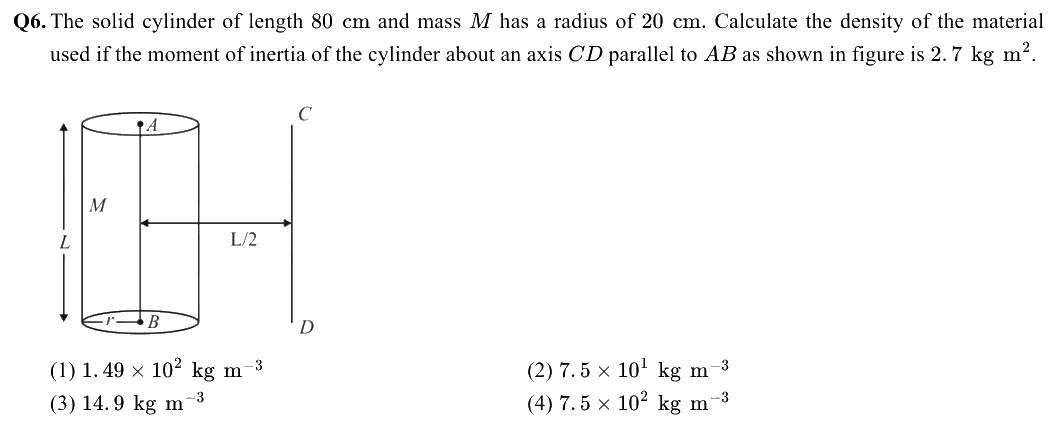
The solid cylinder of length $80\ \mathrm{cm}$ and mass $M$ has a radius of $20\ \mathrm{cm}$. Calculate the density of the material used if the moment of inertia of the cylinder about an axis $CD$ parallel to $AB$ as shown in figure is $2.7\ \mathrm{kg\ m^{2}}$. (see the figure above)
List-I: (a) $MI$ of the rod (length $L$, Mass $M$, about an axis $\perp$ to the rod passing through the midpoint) (b) $MI$ of the rod (length $L$, Mass $2M$, about an axis $\perp$ to the rod passing through one of its end) (c) $MI$ of the rod (length $2L$, Mass $M$, about an axis $\perp$ to the rod passing through its midpoint) (d) $MI$ of the rod (Length $2L$, Mass $2M$, about an axis $\perp$ to the rod passing through one of its end) List-II: (i) $\frac{8ML^2}{3}$ (ii) $\frac{ML^2}{3}$ (iii) $\frac{ML^2}{12}$ (iv) $\frac{2ML^2}{3}$ Choose the correct answer from the options given below:
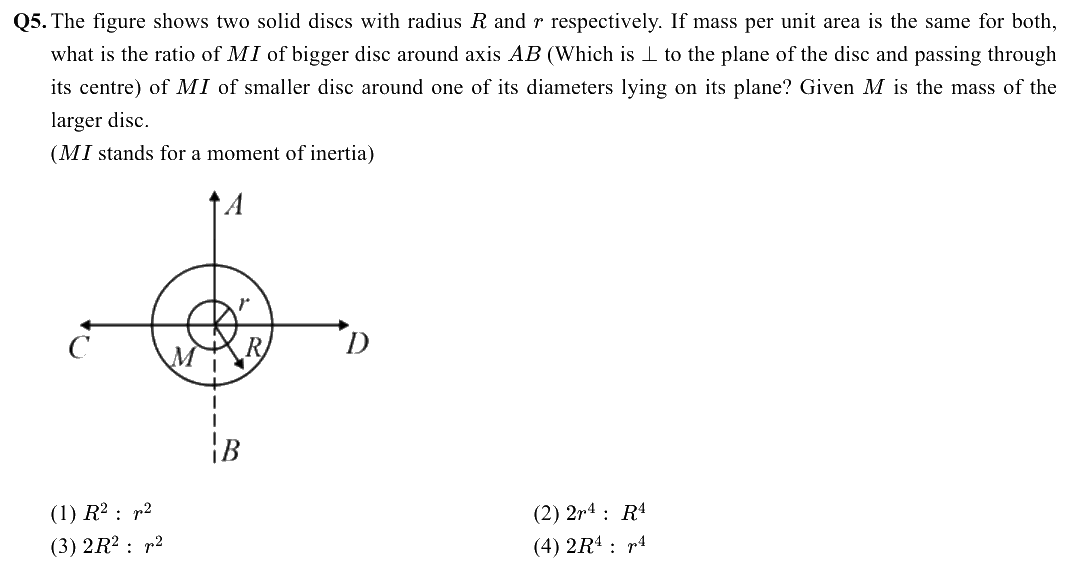
The figure shows two solid discs with radius $R$ and $r$ respectively. If mass per unit area is the same for both, what is the ratio of $MI$ of bigger disc around axis $AB$ (Which is $\perp$ to the plane of the disc and passing through its centre) of $MI$ of smaller disc around one of its diameters lying on its plane? Given $M$ is the mass of the larger disc. ($MI$ stands for a moment of inertia) (see the figure above)
Given below are two statements: one is labelled as Assertion A and the other is labelled as Reason R. Assertion A: Moment of inertia of a circular disc of mass $M$ and radius $R$ about $X, Y$ axes (passing through its plane) and Z-axis which were perpendicular to its plane were found to be $I_{\mathrm{x}}, I_{\mathrm{y}}$ and $I_{\mathrm{z}}$, respectively. The respective radii of gyration about all the three axes will be the same. Reason R: A rigid body making rotational motion has fixed mass and shape. In the light of the above statements, choose the most appropriate answer from the options given below:
A
Both A and R are correct but R is not the correct explanation of A.
B
A is not correct but R is correct.
C
A is correct but R is not correct.
D
Both A and R are correct and R is the correct explanation of A.
Consider a situation in which a ring, a solid cylinder and a solid sphere roll down on the same inclined plane without slipping. Assume that they start rolling from rest and having identical diameter. The correct statement for this situation is
A
The sphere has the greatest and the ring has the least velocity of the centre of mass at the bottom of the inclined plane.
B
The ring has the greatest and the cylinder has the least velocity of the centre of mass at the bottom of the inclined plane.
C
All of them will have same velocity.
D
The cylinder has the greatest and the sphere has the least velocity of the centre of mass at the bottom of the inclined plane.
Answer: (A) The sphere has the greatest and the ring has the least velocity of the centre of mass at the bottom of the inclined plane.· Key from source paper
A thin circular ring of mass $M$ and radius $r$ is rotating about its axis with an angular speed $\omega$. Two particles having mass $m$ each are now attached at diametrically opposite points. The angular speed of the ring will become:
Consider a uniform wire of mass $M$ and length $L$. It is bent into a semicircle. Its moment of inertia about a line perpendicular to the plane of the wire passing through the centre is :
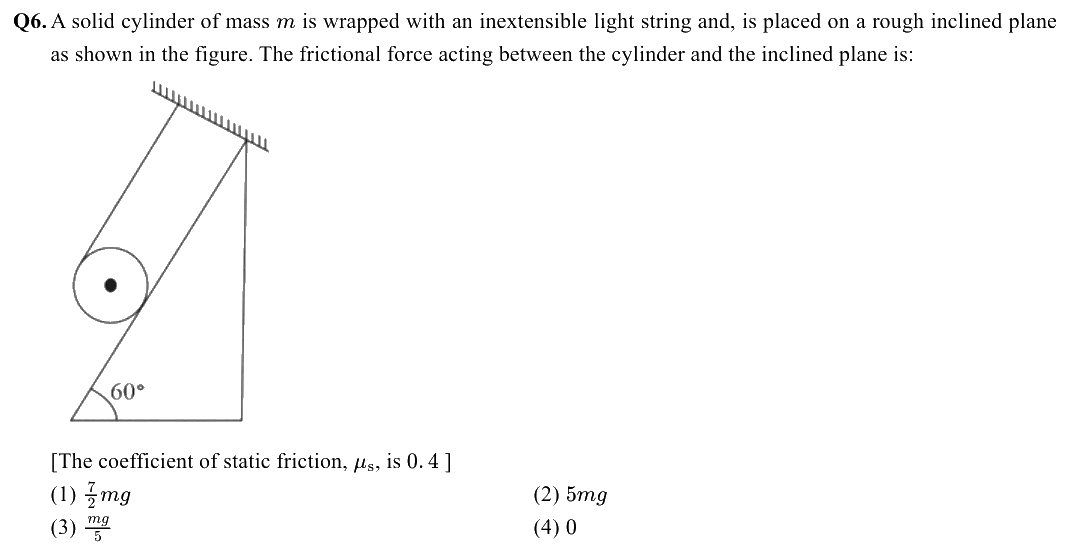
A solid cylinder of mass $m$ is wrapped with an inextensible light string and, is placed on a rough inclined plane as shown in the figure. The frictional force acting between the cylinder and the inclined plane is: (see the figure above) [The coefficient of static friction, $\mu_s$, is $0.4$ ]
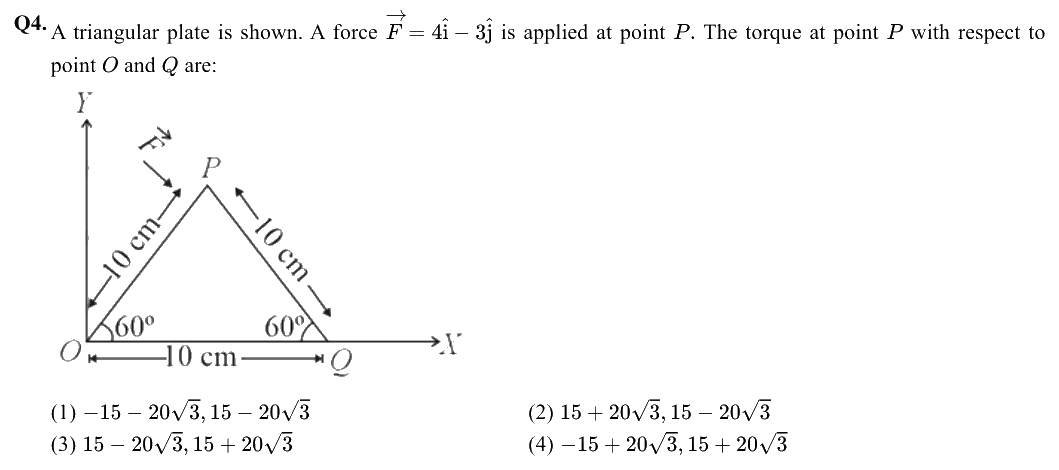
A triangular plate is shown. A force $\vec{F}=4 \hat{i}-3 \hat{j}$ is applied at point $P$. The torque at point $P$ with respect to point $O$ and $Q$ are: (see the figure above)
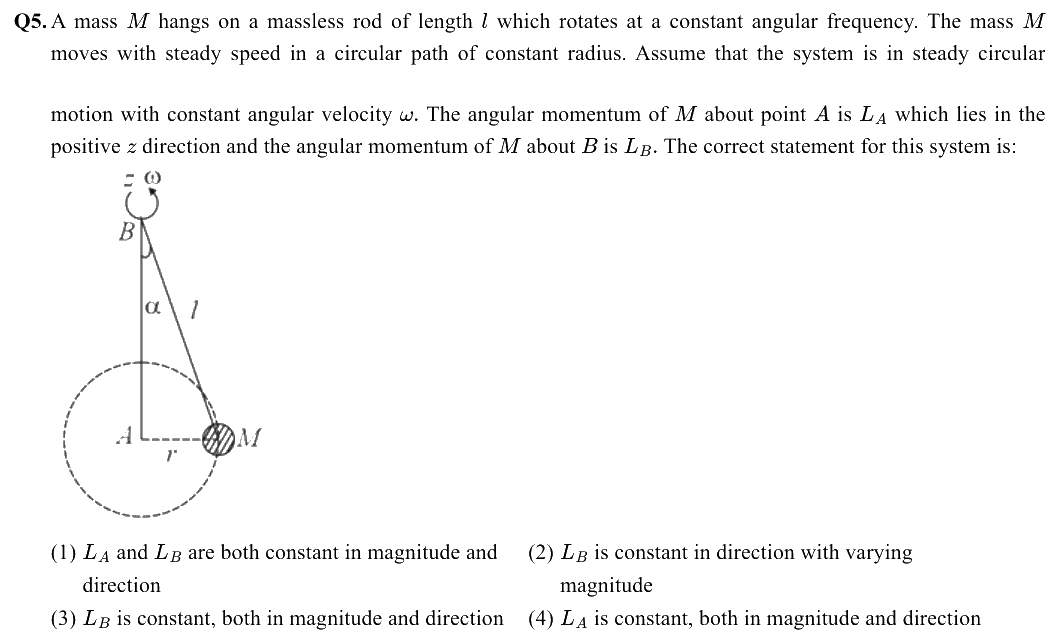
A mass $M$ hangs on a massless rod of length $l$ which rotates at a constant angular frequency. The mass $M$ moves with steady speed in a circular path of constant radius. Assume that the system is in steady circular motion with constant angular velocity $\omega$. The angular momentum of $M$ about point $A$ is $L_A$ which lies in the positive $z$ direction and the angular momentum of $M$ about $B$ is $L_B$. The correct statement for this system is: (see the figure above)
The question as printed in the paper.
A
$L_A$ and $L_B$ are both constant in magnitude and direction
B
$L_B$ is constant in direction with varying magnitude
C
$L_B$ is constant, both in magnitude and direction
D
$L_A$ is constant, both in magnitude and direction
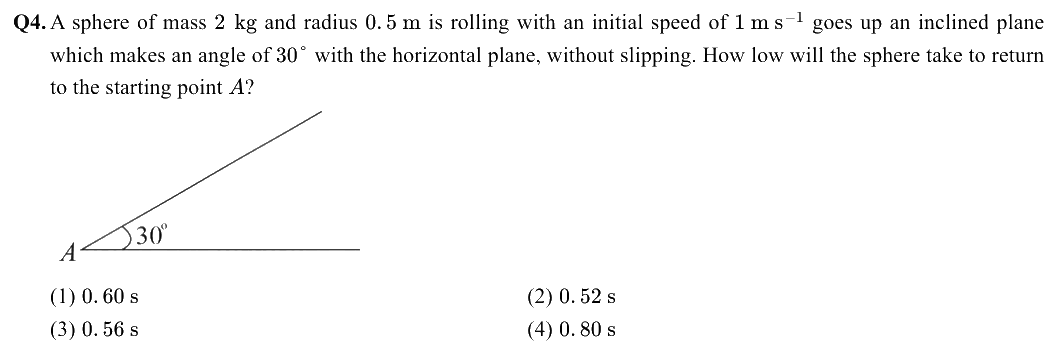
A sphere of mass $2 \mathrm{~kg}$ and radius $0.5 \mathrm{~m}$ is rolling with an initial speed of $1 \mathrm{~m} \mathrm{~s}^{-1}$ goes up an inclined plane which makes an angle of $30^{\circ}$ with the horizontal plane, without slipping. How low will the sphere take to return to the starting point $A$ ? (see the figure above)
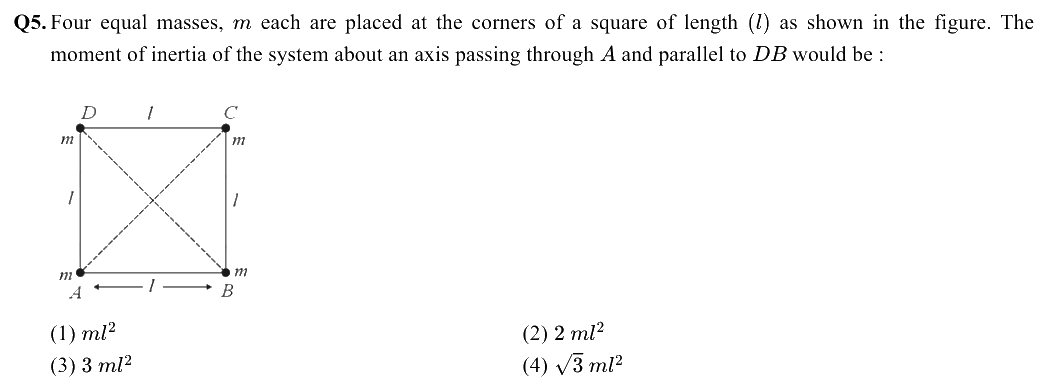
Four equal masses, $m$ each are placed at the corners of a square of length $(l)$ as shown in the figure. The moment of inertia of the system about an axis passing through $A$ and parallel to $D B$ would be : (see the figure above)
Four identical solid spheres each of mass $m$ and radius $a$ are placed with their centres on the four corners of a square of side $b$. The moment of inertia of the system about one side of square where the axis of rotation is parallel to the plane of the square is :
A cord is wound round the circumference of wheel of radius $r$, The axis of the wheel is horizontal and the moment of inertia about it is $I$. A weight $mg$ is attached to the cord at the end. The weight falls from rest. After falling through a distance h, the square of angular velocity of wheel will be
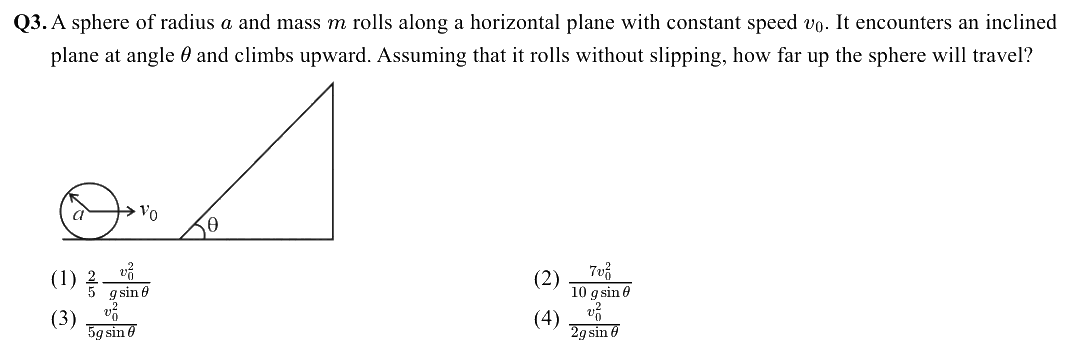
A sphere of radius $a$ and mass $m$ rolls along a horizontal plane with constant speed $v_0$. It encounters an inclined plane at angle $\theta$ and climbs upward. Assuming that it rolls without slipping, how far up the sphere will travel? (see the figure above)
Moment of inertia M.I. of four bodies, having same mass and radius, are reported as; $I_1$ = M.I. of thin circular ring about its diameter, $I_2$ = M.I. of circular disc about an axis perpendicular to disc and going through the centre, $I_3$ = M.I. of solid cylinder about its axis and $I_4$ = M.I. of solid sphere about its diameter. Then:
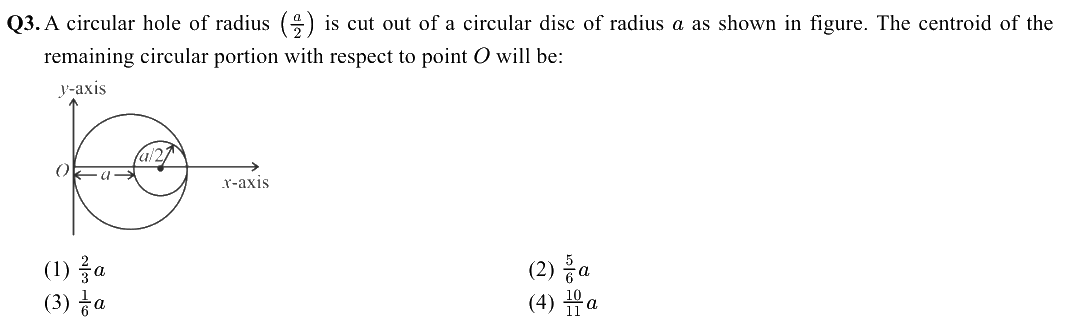
A circular hole of radius $\left(\frac{a}{2}\right)$ is cut out of a circular disc of radius $a$ as shown in figure. The centroid of the remaining circular portion with respect to point $O$ will be: (see the figure above)
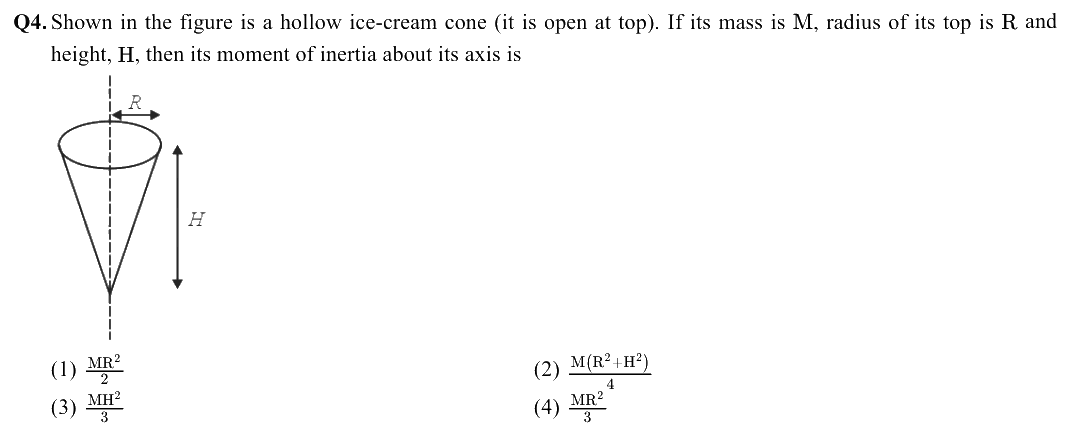
Shown in the figure is a hollow ice-cream cone (it is open at top). If its mass is M, radius of its top is R and height, H, then its moment of inertia about its axis is (see the figure above)
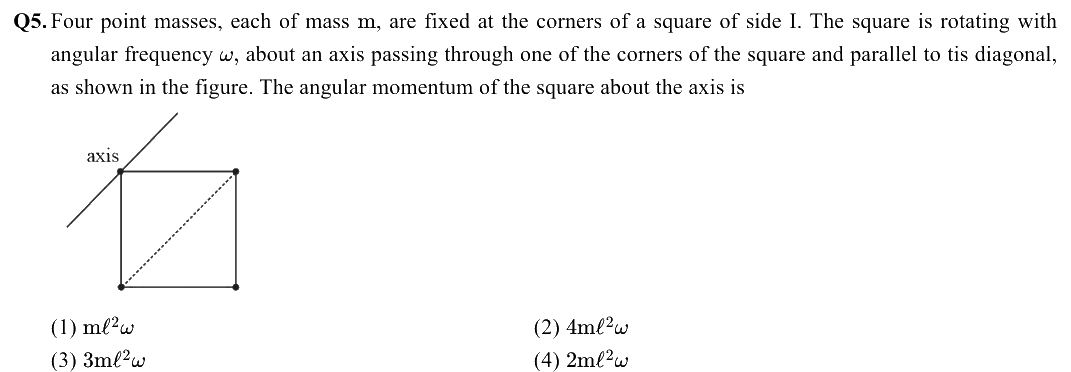
Four point masses, each of mass m, are fixed at the corners of a square of side I. The square is rotating with angular frequency $\omega$, about an axis passing through one of the corners of the square and parallel to tis diagonal, as shown in the figure. The angular momentum of the square about the axis is (see the figure above)
The linear mass density of a thin rod AB of length L varies from A to B as $\lambda(x) = \lambda_0\left(1 + \frac{x}{L}\right)$, where x is the distance from A. If M is the mass of the rod then its moment of inertia about an axis passing through A and perpendicular to the rod :
A wheel is rotating freely with an angular speed $\omega$ on a shaft. The moment of inertia of the wheel is $I$ and the moment of inertia of the shaft is negligible. Another wheel of moment of inertia $3I$ initially at rest is suddenly coupled to the same shaft. The resultant fractional loss in the kinetic energy of the system is:
Consider two uniform discs of the same thickness and different radii $R_{1} = R$ and $R_{2} = \alpha R$ made of the same material. If the ratio of their moments of inertia $I_{1}$ and $I_{2}$, respectively, about their axes is $I_{1} : I_{2} = 1 : 16$ then the value of $\alpha$ is :
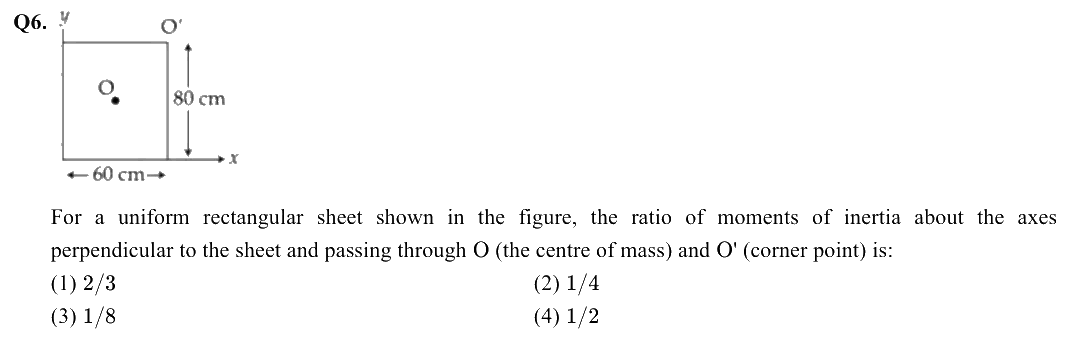
see figure For a uniform rectangular sheet shown in the figure, the ratio of moments of inertia about the axes perpendicular to the sheet and passing through O (the centre of mass) and O' (corner point) is:
Moment of inertia of a cylinder of mass m, length L and radius R about an axis passing through its centre and perpendicular to the axis of the cylinder is $I = M\left(\frac{R^{2}}{4} + \frac{L^{2}}{12}\right)$. If such a cylinder is to be made for a given mass of a material, the ratio $\frac{L}{R}$ for it to have minimum possible $I$ is:
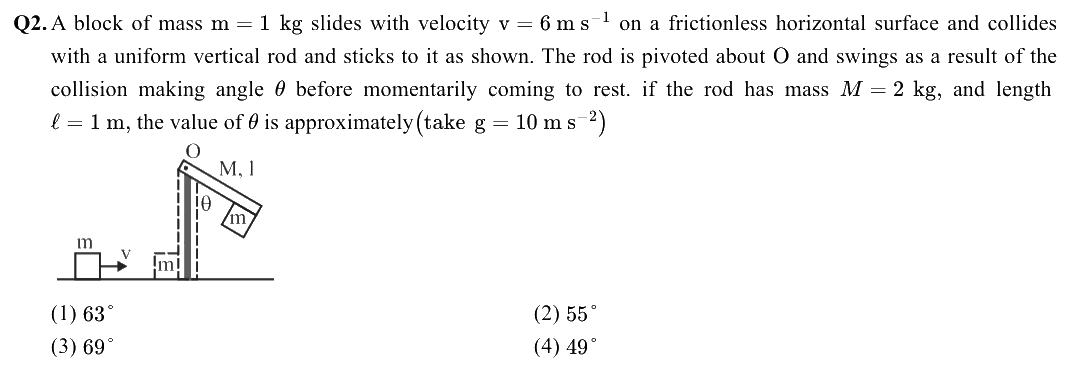
A block of mass $m = 1\ \mathrm{kg}$ slides with velocity $v = 6\ \mathrm{m\,s^{-1}}$ on a frictionless horizontal surface and collides with a uniform vertical rod and sticks to it as shown. The rod is pivoted about O and swings as a result of the collision making angle $\theta$ before momentarily coming to rest. if the rod has mass $M = 2\ \mathrm{kg}$, and length $\ell = 1\ \mathrm{m}$, the value of $\theta$ is approximately $(\text{take } g = 10\ \mathrm{m\,s^{-2}})$ (see the figure above)
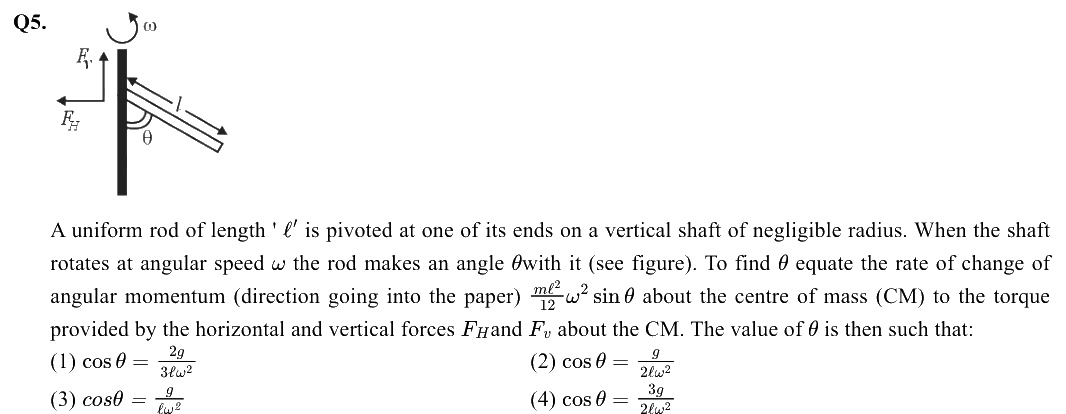
see figure A uniform rod of length $'\ell'$ is pivoted at one of its ends on a vertical shaft of negligible radius. When the shaft rotates at angular speed $\omega$ the rod makes an angle $\theta$ with it (see figure). To find $\theta$ equate the rate of change of angular momentum (direction going into the paper) $\frac{m\ell^{2}}{12}\omega^{2}\sin\theta$ about the centre of mass (CM) to the torque provided by the horizontal and vertical forces $F_H$ and $F_v$ about the CM. The value of $\theta$ is then such that:
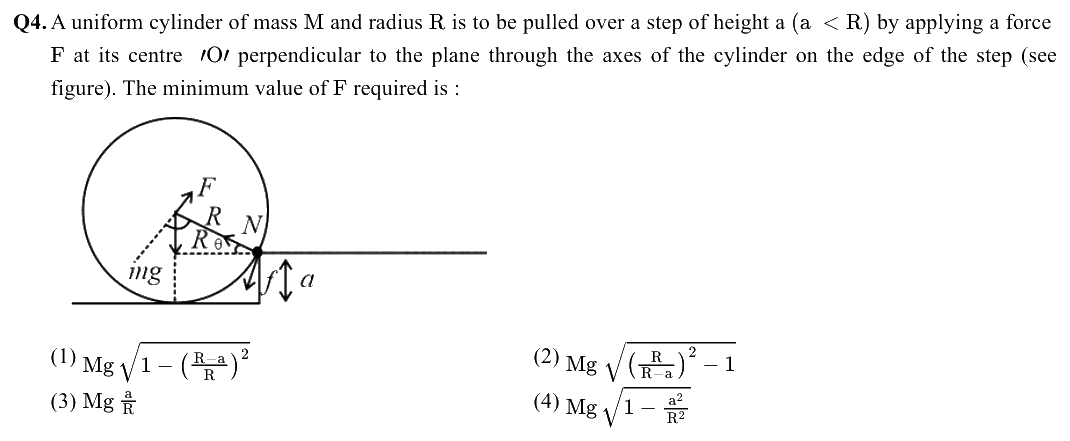
A uniform cylinder of mass M and radius R is to be pulled over a step of height a ($a < R$) by applying a force F at its centre 'O' perpendicular to the plane through the axes of the cylinder on the edge of the step (see figure). The minimum value of F required is : (see the figure above)
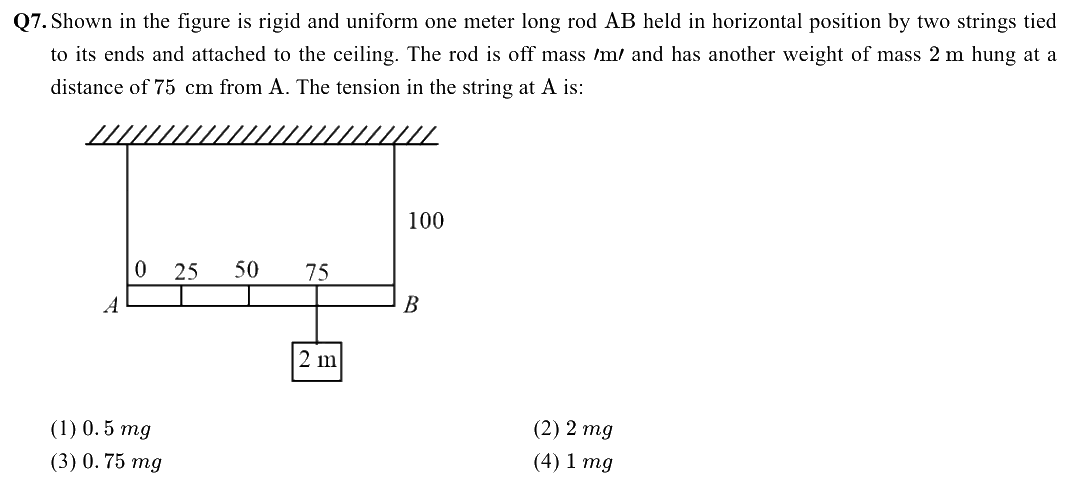
Shown in the figure is rigid and uniform one meter long rod AB held in horizontal position by two strings tied to its ends and attached to the ceiling. The rod is off mass 'm' and has another weight of mass $2\ \mathrm{m}$ hung at a distance of $75\ \mathrm{cm}$ from A. The tension in the string at A is: (see the figure above)
Two uniform circular discs are rotating independently in the same direction around their common axis passing through their centres. The moment of inertia and angular velocity of the first disc are $0.1\ \mathrm{kg} - \mathrm{m}^{2}$ and $10\ \mathrm{rad\ s}^{-1}$ respectively while those for the second one are $0.2\ \mathrm{kg} - \mathrm{m}^{2}$ and $5\ \mathrm{rad\ s}^{-1}$ respectively. At some instant they get stuck together and start rotating as a single system about their common axis with some angular speed. The kinetic energy of the combined system is :
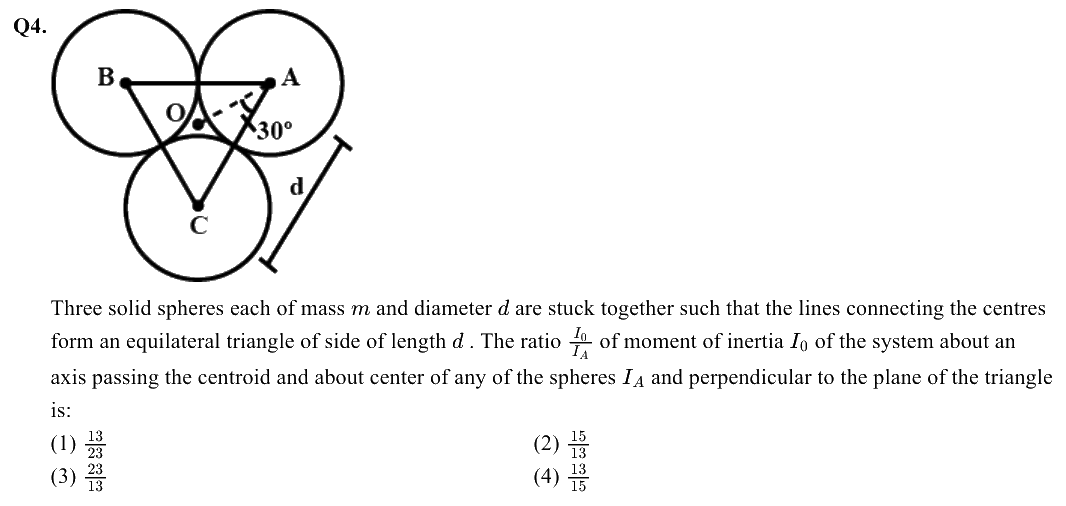
see figure Three solid spheres each of mass $m$ and diameter $d$ are stuck together such that the lines connecting the centres form an equilateral triangle of side of length $d$ . The ratio $\frac{I_0}{I_A}$ of moment of inertia $I_0$ of the system about an axis passing the centroid and about center of any of the spheres $I_A$ and perpendicular to the plane of the triangle is:
A rod of length $l$ has non-uniform linear mass density given by $\rho(x) = a + b\left(\frac{x}{l}\right)^2$, where $a$ and $b$ are constants and $0 \le x \le l$ The value of $x$ for the centre of mass of the rod is at:
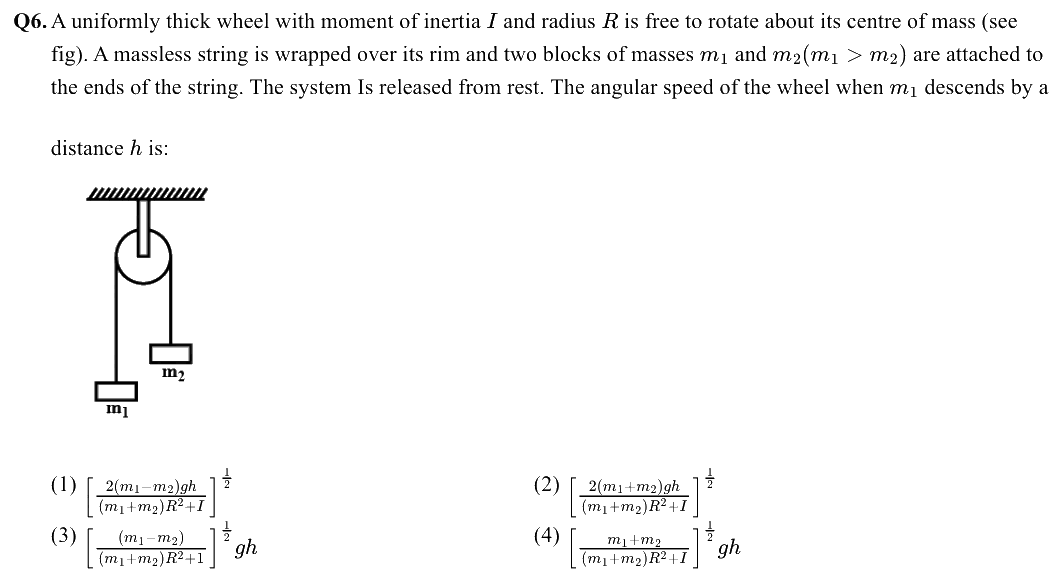
A uniformly thick wheel with moment of inertia $I$ and radius $R$ is free to rotate about its centre of mass (see fig). A massless string is wrapped over its rim and two blocks of masses $m_1$ and $m_2(m_1 > m_2)$ are attached to the ends of the string. The system Is released from rest. The angular speed of the wheel when $m_1$ descends by a distance $h$ is: (see the figure above)
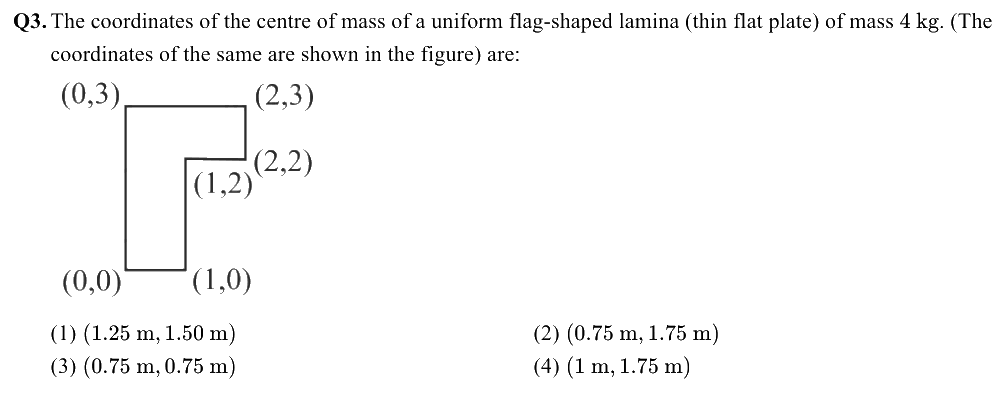
The coordinates of the centre of mass of a uniform flag-shaped lamina (thin flat plate) of mass 4 kg. (The coordinates of the same are shown in the figure) are: (see the figure above)
Consider a uniform rod of mass $M = 4m$ and length $l$ pivoted about its centre. A mass $m$ moving with velocity $v$ making angle $\theta = \frac{\pi}{4}$ to the rod's long axis collides with one end of the rod and sticks to it. The angular speed of the rod-mass system just after the collision is:
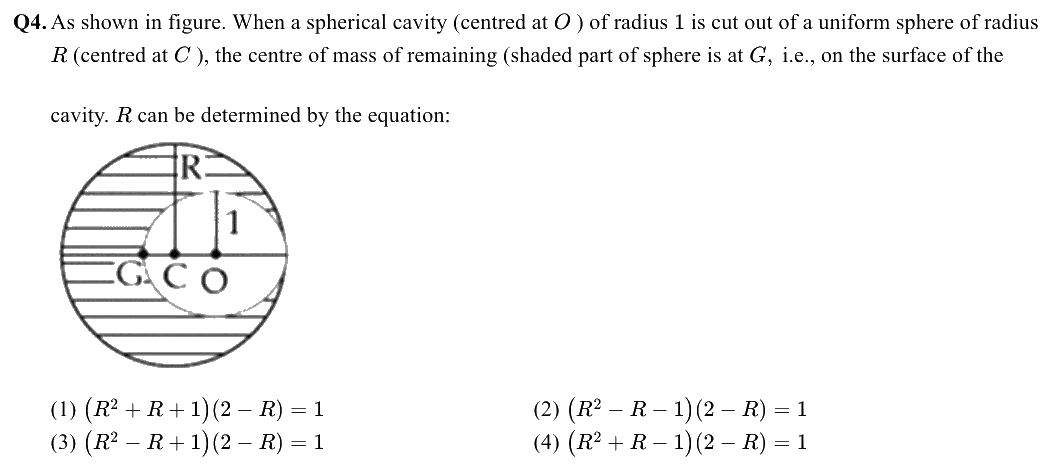
As shown in figure. When a spherical cavity (centred at $O$) of radius 1 is cut out of a uniform sphere of radius $R$ (centred at $C$), the centre of mass of remaining (shaded part of sphere is at $G$, i.e., on the surface of the cavity. $R$ can be determined by the equation: (see the figure above)
A uniform sphere of mass $500\ \mathrm{g}$ rolls without slipping on a plane horizontal surface with its centre moving at a speed of $5.00\ \mathrm{cm\ s^{-1}}$. Its kinetic energy is:
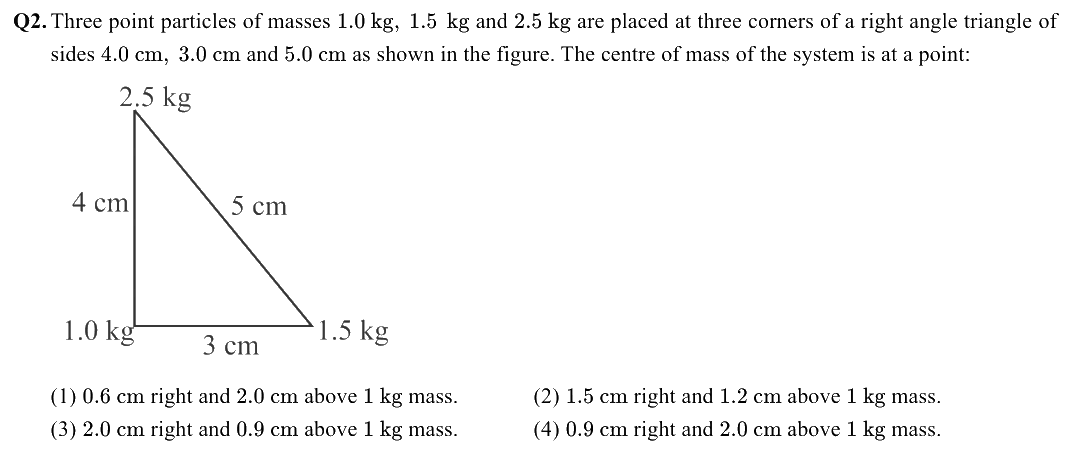
Three point particles of masses $1.0\ \mathrm{kg}$, $1.5\ \mathrm{kg}$ and $2.5\ \mathrm{kg}$ are placed at three corners of a right angle triangle of sides $4.0\ \mathrm{cm}$, $3.0\ \mathrm{cm}$ and $5.0\ \mathrm{cm}$ as shown in the figure. The centre of mass of the system is at a point: (see the figure above)
The question as printed in the paper.
A
$0.6\ \mathrm{cm}$ right and $2.0\ \mathrm{cm}$ above $1\ \mathrm{kg}$ mass.
B
$1.5\ \mathrm{cm}$ right and $1.2\ \mathrm{cm}$ above $1\ \mathrm{kg}$ mass.
C
$2.0\ \mathrm{cm}$ right and $0.9\ \mathrm{cm}$ above $1\ \mathrm{kg}$ mass.
D
$0.9\ \mathrm{cm}$ right and $2.0\ \mathrm{cm}$ above $1\ \mathrm{kg}$ mass.
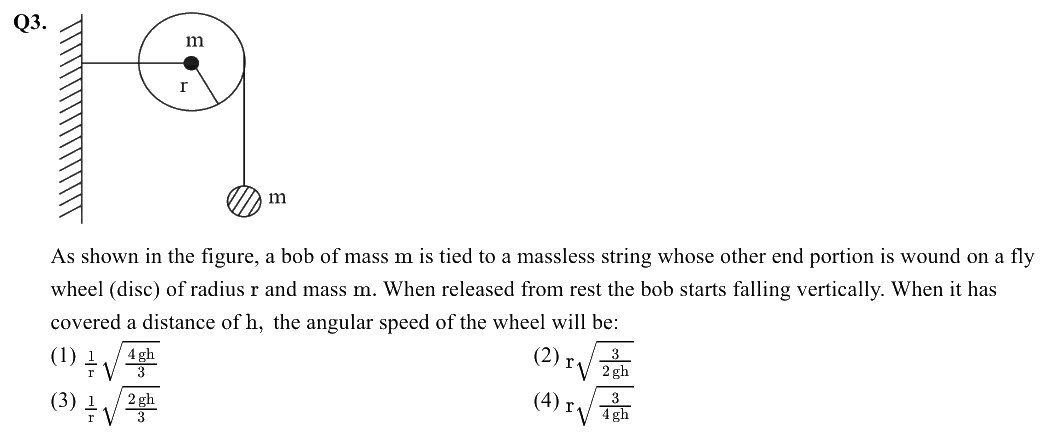
see figure As shown in the figure, a bob of mass $\mathrm{m}$ is tied to a massless string whose other end portion is wound on a fly wheel (disc) of radius $\mathrm{r}$ and mass $\mathrm{m}$. When released from rest the bob starts falling vertically. When it has covered a distance of $\mathrm{h}$, the angular speed of the wheel will be:
The radius of gyration of a uniform rod of length $l$, about an axis passing through a point $\frac{l}{4}$ away from the centre of the rod, and perpendicular to it, is:
Mass per unit area of a circular disc of radius $a$ depends on the distance $r$ from its centre as $\sigma(r) = A + Br$. The moment of inertia of the disc about the axis, perpendicular to the plane and passing through its centre is:
A person of mass $M$ is sitting on a swing of length $L$ and swinging with and an angular amplitude $\theta_0$ . If the person stands up when the swing passes through its lowest point, the work done by him, assuming that his centre of mass moves by a distance $l\ l < < L$, is close to:
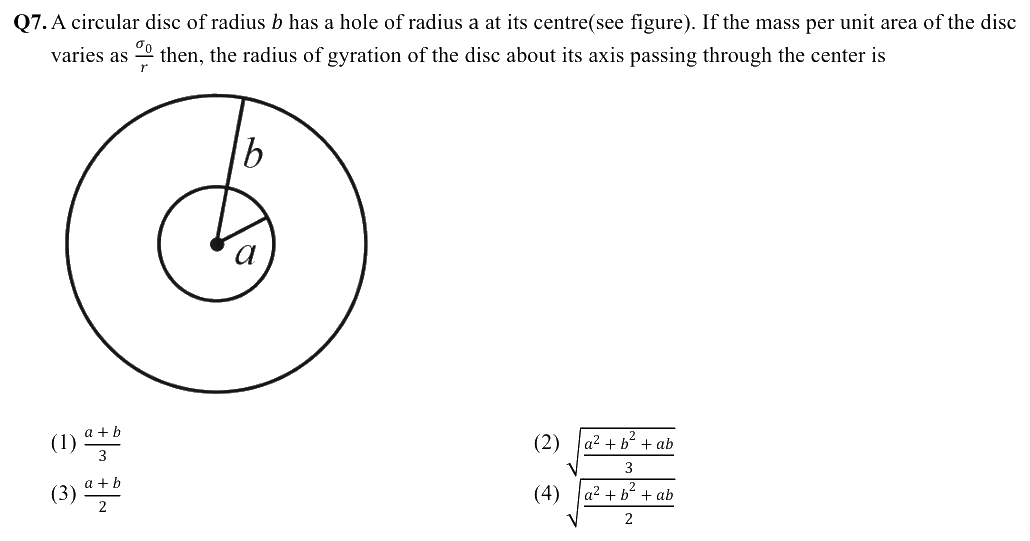
A circular disc of radius $b$ has a hole of radius a at its centre(see figure). If the mass per unit area of the disc varies as $\frac{\sigma_0}{r}$ then, the radius of gyration of the disc about its axis passing through the center is (see the figure above)
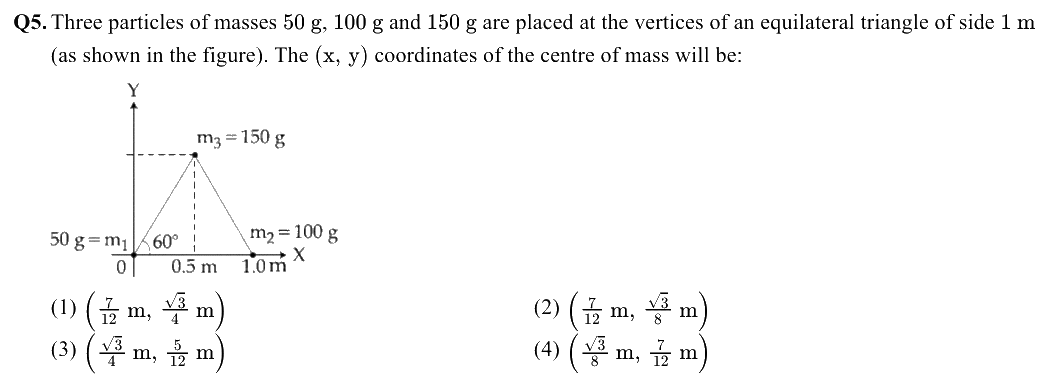
Three particles of masses 50 g, 100 g and 150 g are placed at the vertices of an equilateral triangle of side 1 m (as shown in the figure). The $(\mathrm{x, y})$ coordinates of the centre of mass will be: (see the figure above)
A particle of mass m is moving along a trajectory given by $x = x_0 + a\ \cos\omega_1 t$ $y = y_0 + b\ \sin\omega_2 t$ The torque, acting on the particle about the origin, at t = 0 is:
A thin disc of mass M and radius R has mass per unit area $\sigma(r) = kr^{2}$ where r is the distance from its centre. Its moment inertia about an axis going through its centre of mass and perpendicular to its plane is:
Two coaxial discs, having moments of inertia $I_1$ and $\frac{I_1}{2}$ , are rotating with respective angular velocities $\omega_1$ and $\frac{\omega_1}{2}$ , about their common axis. They are brought in contact with each other and thereafter they rotate with a common angular velocity. If $E_f$ and $E_i$ are the final and initial total energies, then $\left(E_f - E_i\right)$ is:
A solid sphere of mass M and radius R is divided into two unequal parts. The first part has a mass of $\frac{7M}{8}$ and is converted into uniform disc of radius $2R$. The second part is converted into a uniform solid sphere. Let $I_1$ be the moment of inertia of the disc about its axis and $I_2$ be the moment of inertia of the new sphere about its axis. The ratio $I_1 / I_2$ is given by:
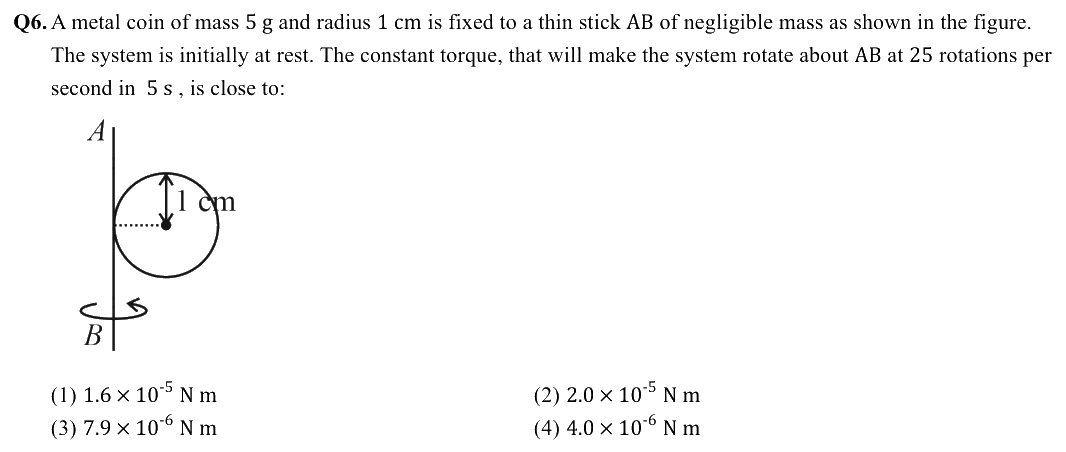
A metal coin of mass $5\ \mathrm{g}$ and radius $1\ \mathrm{cm}$ is fixed to a thin stick AB of negligible mass as shown in the figure. The system is initially at rest. The constant torque, that will make the system rotate about AB at 25 rotations per second in $5\ \mathrm{s}$, is close to:
The time dependence of the position of a particle of mass $m = 2$ is given by $\vec{r}\,t = 2t\,\hat{i} - 3t^{2}\hat{j}$. Its angular momentum, with respect to the origin, at time $t = 2$ is:
A stationary horizontal disc is free to rotate about its axis. When a torque is applied on it, its kinetic energy as a function of $\theta$, where $\theta$ is the angle by which it has rotated, is given as $k\theta^2$. If its moment of inertia is I then the angular acceleration of the disc is:
The following bodies are made to roll up (without slipping) the same inclined plane from a horizontal plane: (i) a ring of radius $R$, (ii) a solid cylinder of radius $\dfrac{R}{2}$ and (iii) a solid sphere of radius $\dfrac{R}{4}$. If, in each case, the speed of the center of mass at the bottom of the incline is same, the ratio of the maximum heights they climb is:
A thin smooth rod of length L and mass M is rotating freely with angular speed $\omega_0$ about an axis perpendicular to the rod and passing through center. Two beads of mass m and negligible size are at the center of the rod initially. The beads of mass m and negligible size are at the center of the rod initially. The beads are free to slide along the rod. The angular speed of the system, when the beads reach the opposite ends of the rod, will be:
Moment of inertia of a body about a given axis is 1.5 $\mathrm{kg\ m^2}$. Initially the body is at rest. In order to produce a rotational kinetic energy of 1200 J, the angular acceleration of 20 $\mathrm{rad/s^2}$ must be applied about the axis for a duration of:
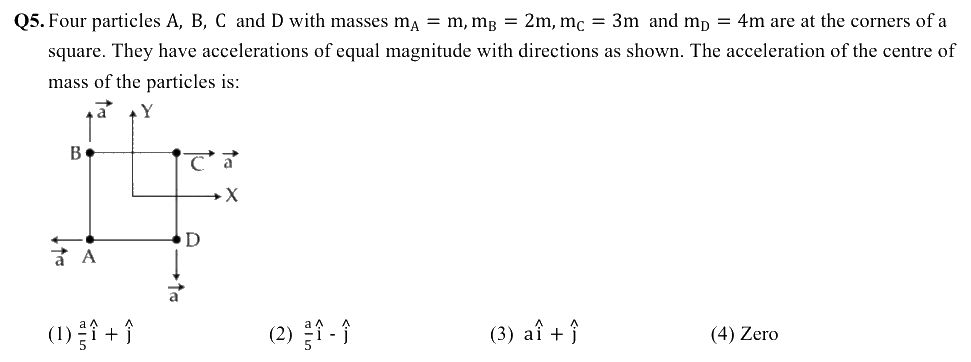
Four particles A, B, C and D with masses $m_A = m$, $m_B = 2m$, $m_C = 3m$ and $m_D = 4m$ are at the corners of a square. They have accelerations of equal magnitude with directions as shown. The acceleration of the centre of mass of the particles is: (see the figure above)
A thin circular plate of mass $M$ and radius $R$ has its density varying as $\rho(r) = \rho_0 r$ with $\rho_0$ as constant and $r$ is the distance from its centre. The moment of Inertia of the circular plate about an axis perpendicular to the plate and passing through its edge is $I = aMR^2$. The value of the coefficient $a$ is:
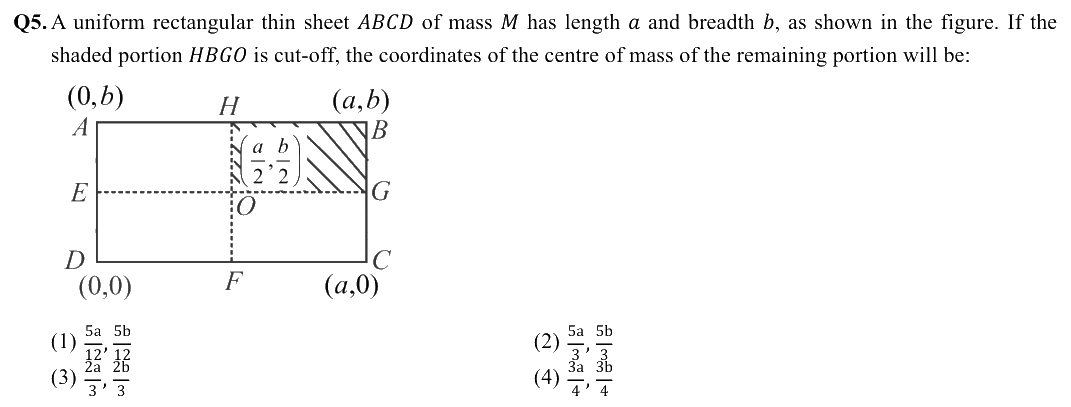
A uniform rectangular thin sheet $ABCD$ of mass $M$ has length $a$ and breadth $b$, as shown in the figure. If the shaded portion $HBGO$ is cut-off, the coordinates of the centre of mass of the remaining portion will be:
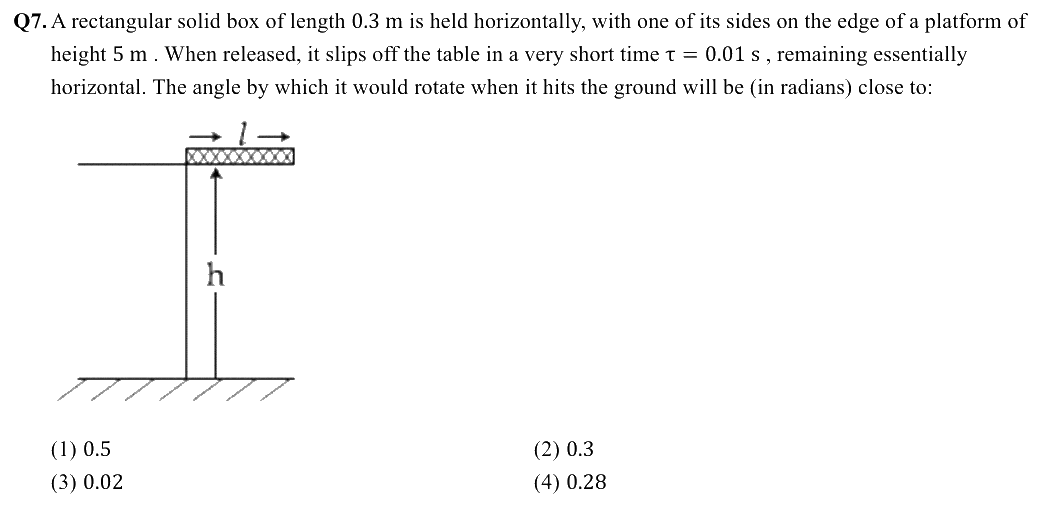
A rectangular solid box of length 0.3 m is held horizontally, with one of its sides on the edge of a platform of height 5 m . When released, it slips off the table in a very short time $\tau$ = 0.01 s , remaining essentially horizontal. The angle by which it would rotate when it hits the ground will be (in radians) close to:
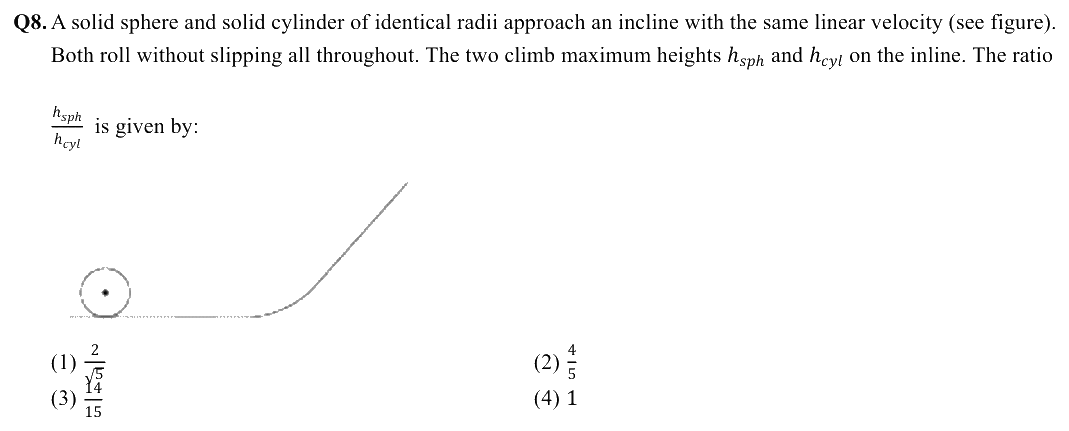
A solid sphere and solid cylinder of identical radii approach an incline with the same linear velocity (see figure). Both roll without slipping all throughout. The two climb maximum heights $h_{sph}$ and $h_{cyl}$ on the inline. The ratio $\frac{h_{sph}}{h_{cyl}}$ is given by:
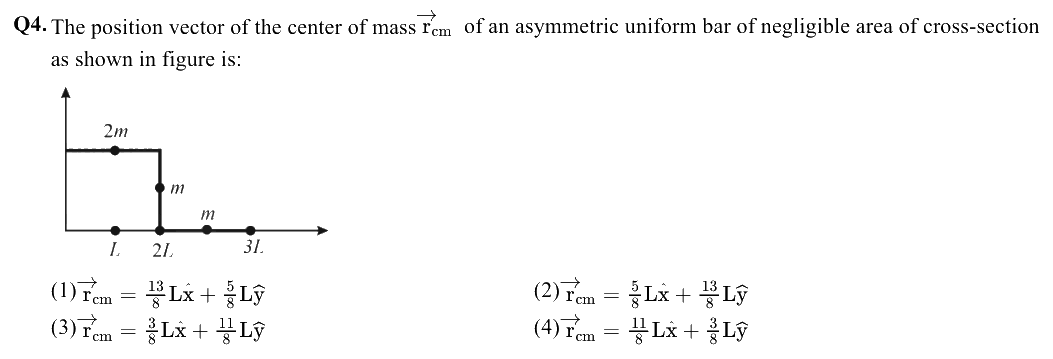
The position vector of the center of mass $\overrightarrow{r}_{cm}$ of an asymmetric uniform bar of negligible area of cross-section as shown in figure is:
Let the moment of inertia of a hollow cylinder of length 30 $cm$ (inner radius 10 $cm$ and outer radius 20 $cm$ ), about its axis be I . The radius of a thin cylinder of the same mass such that its moment of inertia about its axis is also I, is:
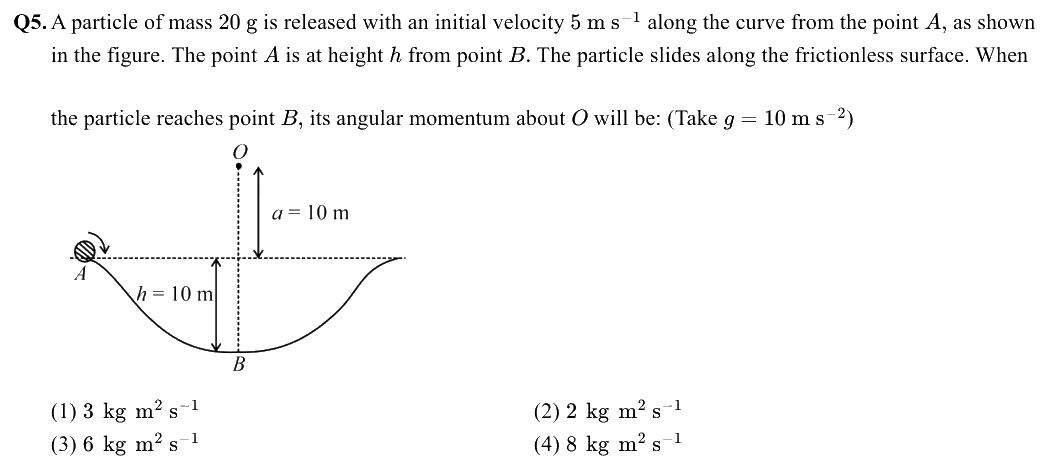
A particle of mass 20 g is released with an initial velocity 5 m s$^{-1}$ along the curve from the point $A$, as shown in the figure. The point $A$ is at height $h$ from point $B$. The particle slides along the frictionless surface. When the particle reaches point $B$, its angular momentum about $O$ will be: (Take $g = 10$ m s$^{-2}$)
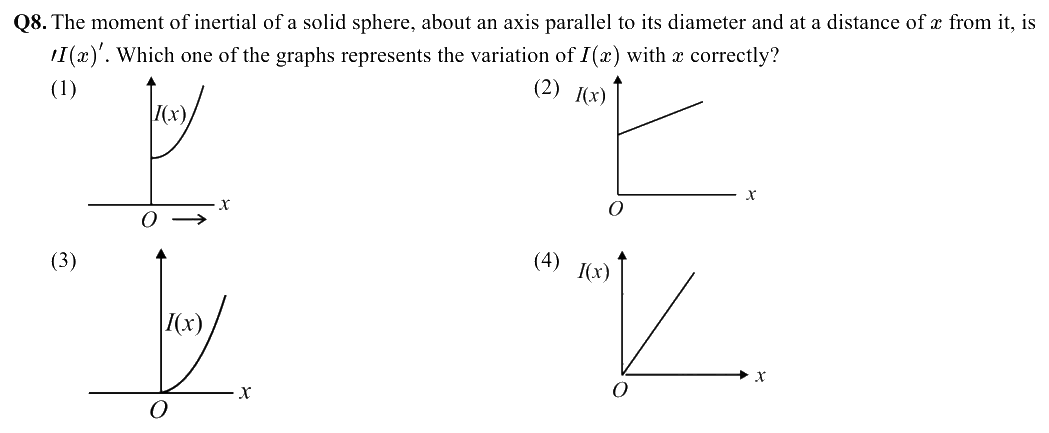
The moment of inertial of a solid sphere, about an axis parallel to its diameter and at a distance of $x$ from it, is '$I(x)$'. Which one of the graphs represents the variation of $I(x)$ with $x$ correctly?
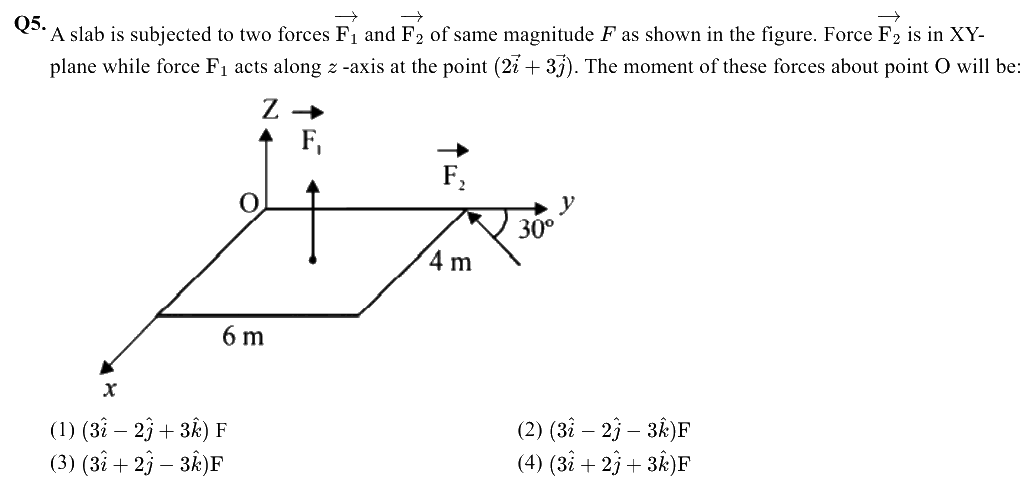
A slab is subjected to two forces $\vec{F_1}$ and $\vec{F_2}$ of same magnitude $F$ as shown in the figure. Force $\vec{F_2}$ is in XY-plane while force F$_1$ acts along $z$ -axis at the point $(2\hat{i} + 3\hat{j})$. The moment of these forces about point O will be: (see the figure above)
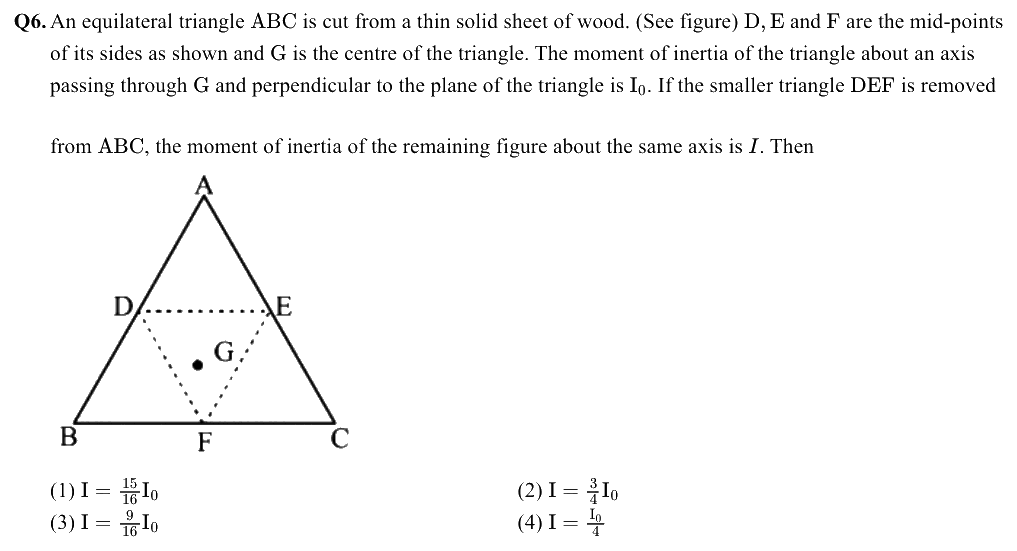
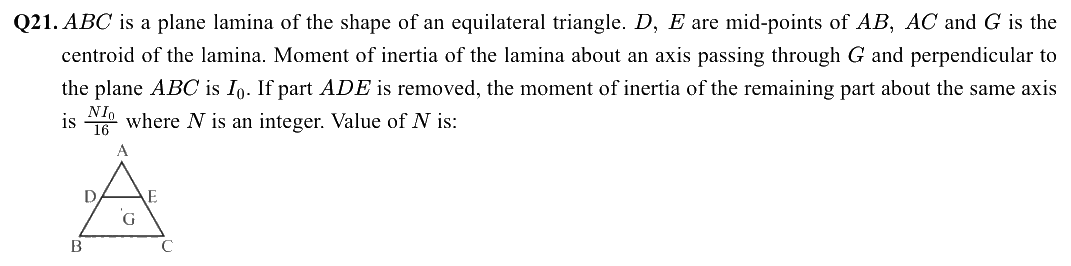
An equilateral triangle ABC is cut from a thin solid sheet of wood. (See figure) D, E and F are the mid-points of its sides as shown and G is the centre of the triangle. The moment of inertia of the triangle about an axis passing through G and perpendicular to the plane of the triangle is I$_0$. If the smaller triangle DEF is removed from ABC, the moment of inertia of the remaining figure about the same axis is $I$. Then (see the figure above)
The magnitude of torque on a particle of mass 1 kg is 2.5 Nm about the origin. If the force acting on it is 1 N, and the distance of the particle from the origin is 5 m, the angle between the force and the position vector is (in radians):
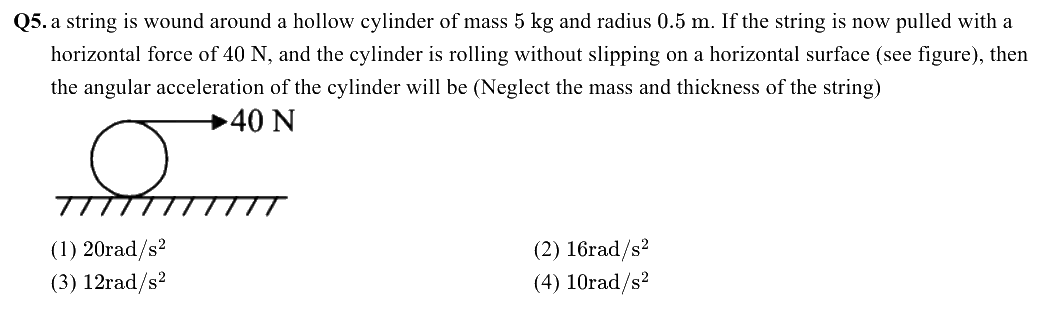
a string is wound around a hollow cylinder of mass 5 kg and radius 0.5 m. If the string is now pulled with a horizontal force of 40 N, and the cylinder is rolling without slipping on a horizontal surface (see figure), then the angular acceleration of the cylinder will be (Neglect the mass and thickness of the string) (see the figure above)
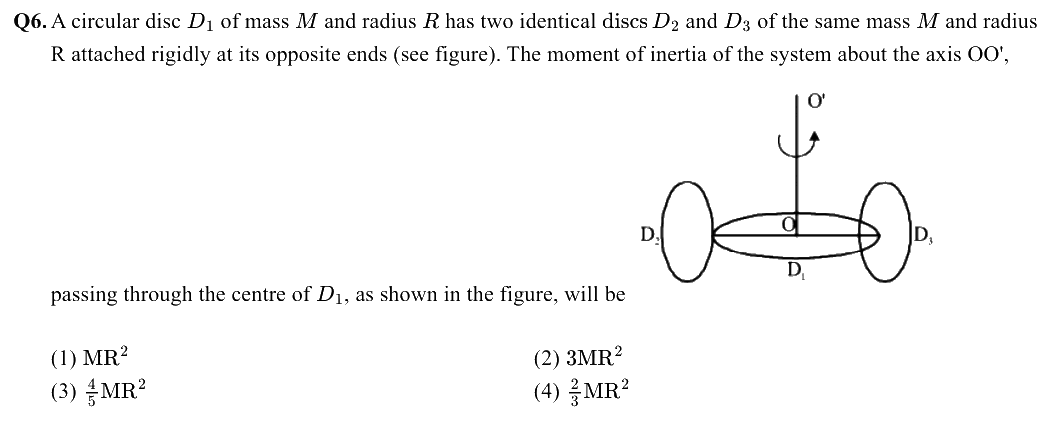
A circular disc $D_1$ of mass $M$ and radius $R$ has two identical discs $D_2$ and $D_3$ of the same mass $M$ and radius $R$ attached rigidly at its opposite ends (see figure). The moment of inertia of the system about the axis OO', passing through the centre of $D_1$, as shown in the figure, will be (see the figure above)
To mop-clean a floor, a cleaning machine presses a circular mop of radius $R$ vertically down with a total force $F$ and rotates it with a constant angular speed about its axis. If the force $F$ is distributed uniformly over the mop and if coefficient of friction between the mop and the floor is $\mu$, the torque, applied by the machine on the mop is:
A homogeneous solid cylindrical roller of radius $R$ and mass $M$ is pulled on a cricket pitch by a horizontal force. Assuming rolling without slipping, angular acceleration of the cylinder is:
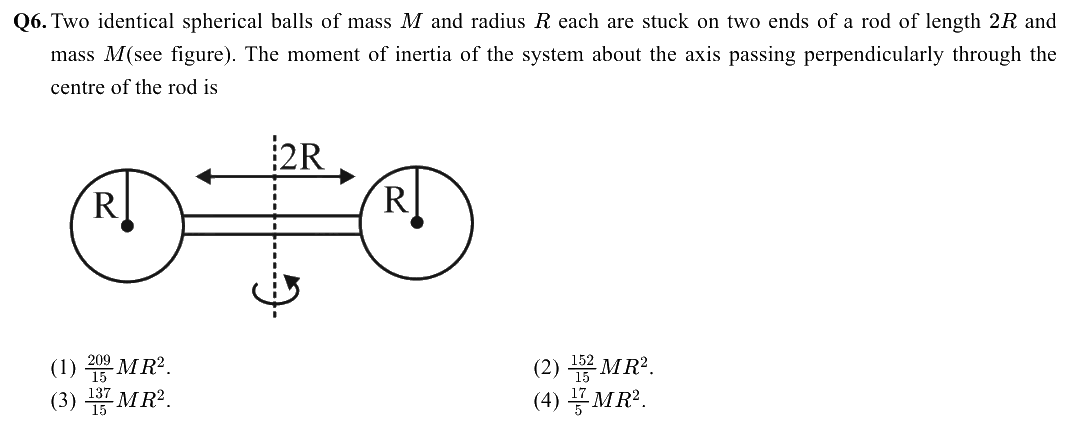
Two identical spherical balls of mass $M$ and radius $R$ each are stuck on two ends of a rod of length $2R$ and mass $M$(see figure). The moment of inertia of the system about the axis passing perpendicularly through the centre of the rod is (see the figure above)
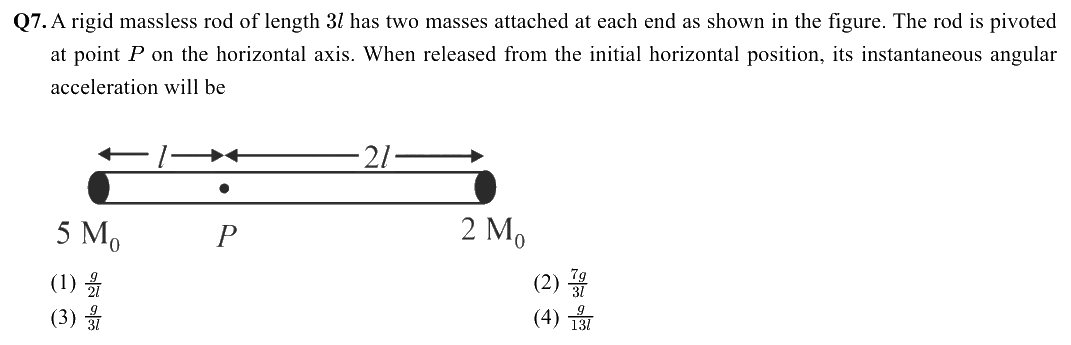
A rigid massless rod of length $3l$ has two masses attached at each end as shown in the figure. The rod is pivoted at point $P$ on the horizontal axis. When released from the initial horizontal position, its instantaneous angular acceleration will be (see the figure above)
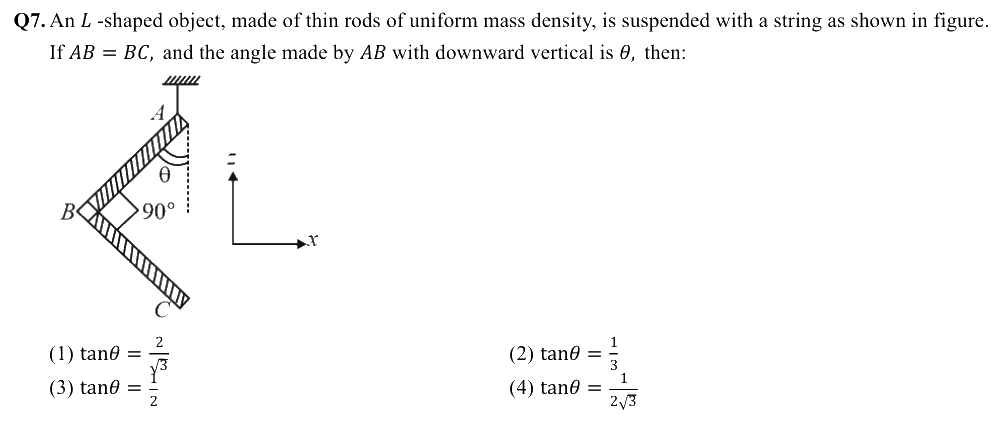
An $L$ -shaped object, made of thin rods of uniform mass density, is suspended with a string as shown in figure. If $AB = BC$, and the angle made by $AB$ with downward vertical is $\theta$, then: (see the figure above)
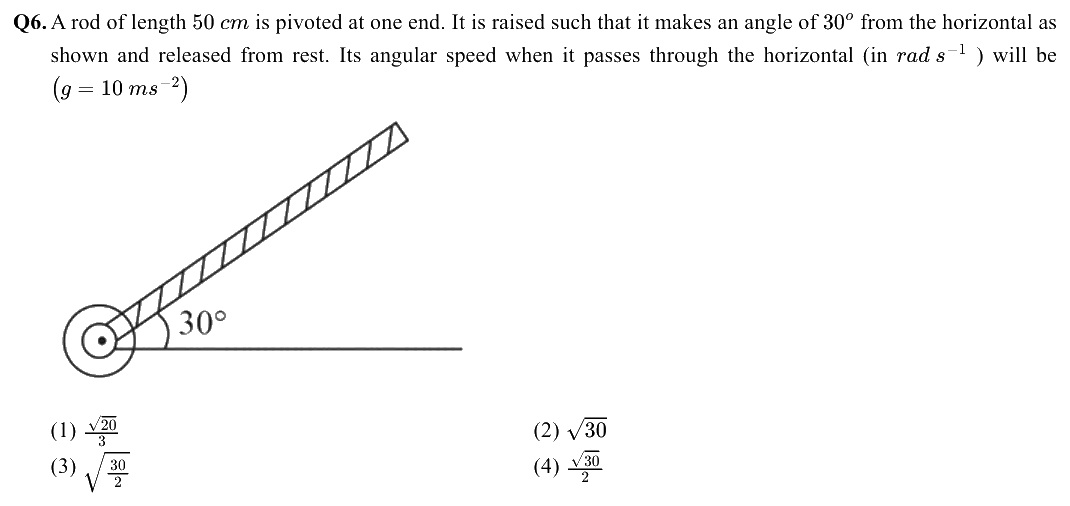
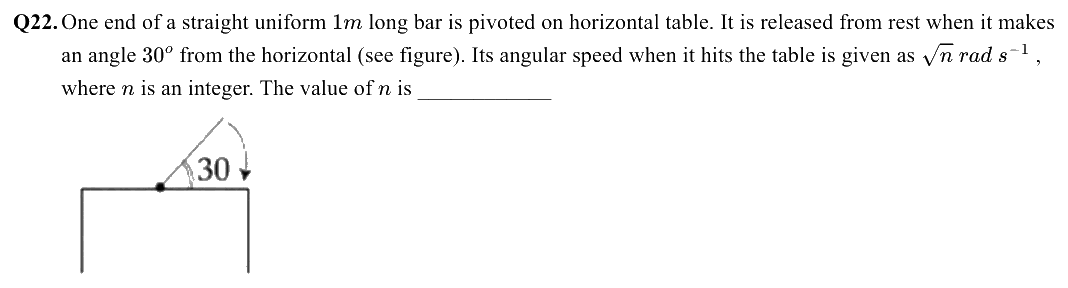
A rod of length $50\ cm$ is pivoted at one end. It is raised such that it makes an angle of $30^o$ from the horizontal as shown and released from rest. Its angular speed when it passes through the horizontal (in $rad\ s^{-1}$ ) will be $(g = 10\ ms^{-2})$ (see the figure above)
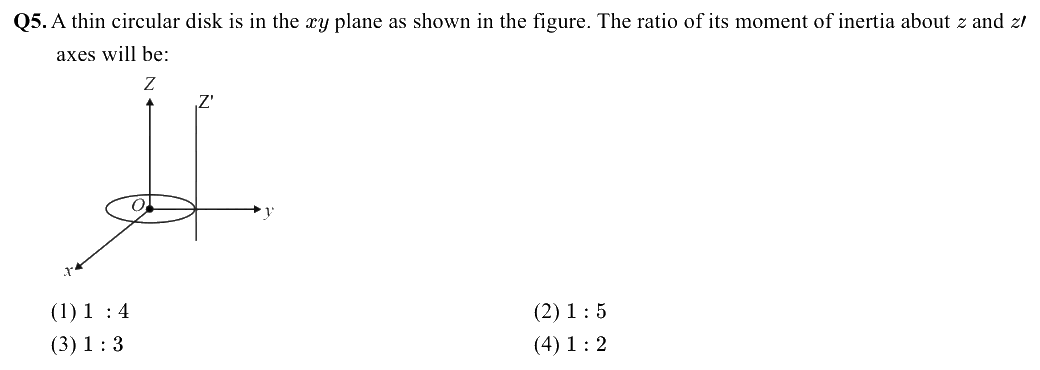
A thin circular disk is in the $xy$ plane as shown in the figure. The ratio of its moment of inertia about $z$ and $z'$ axes will be: (see the figure above)
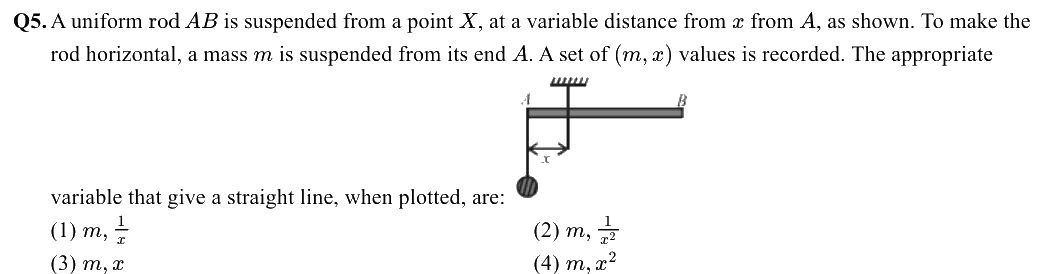
A uniform rod $AB$ is suspended from a point $X$, at a variable distance from $x$ from $A$, as shown. To make the rod horizontal, a mass $m$ is suspended from its end $A$. A set of $(m, x)$ values is recorded. The appropriate (see the figure above) variable that give a straight line, when plotted, are:
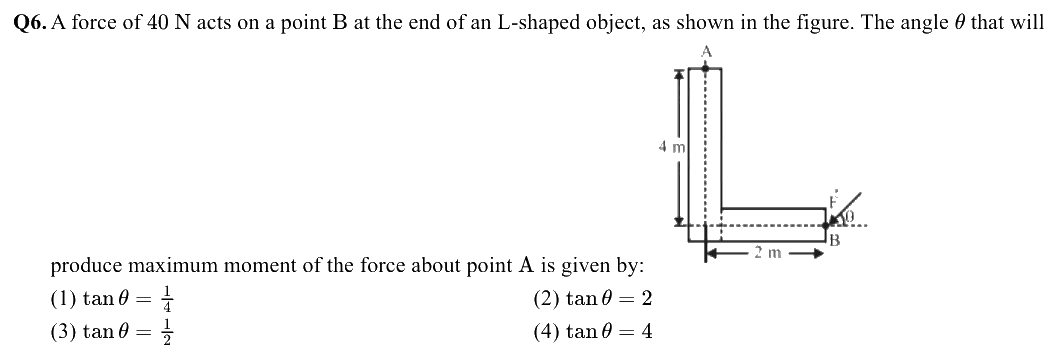
A force of $40\ \mathrm{N}$ acts on a point B at the end of an L-shaped object, as shown in the figure. The angle $\theta$ that will produce maximum moment of the force about point A is given by: (see the figure above)
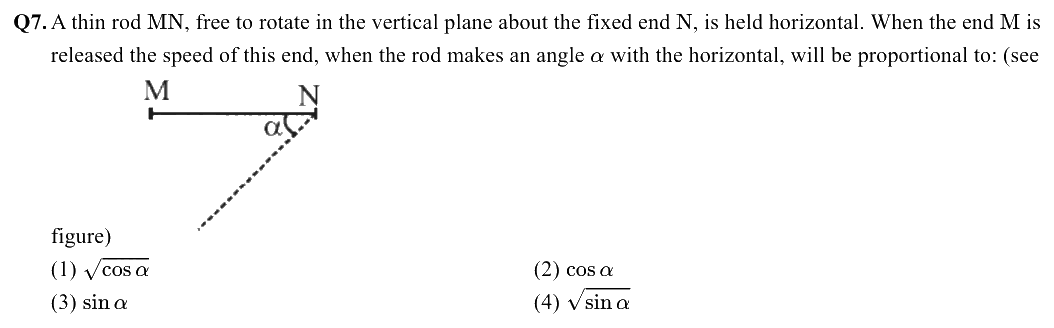
A thin rod MN, free to rotate in the vertical plane about the fixed end N, is held horizontal. When the end M is released the speed of this end, when the rod makes an angle $\alpha$ with the horizontal, will be proportional to: (see figure) (see the figure above)
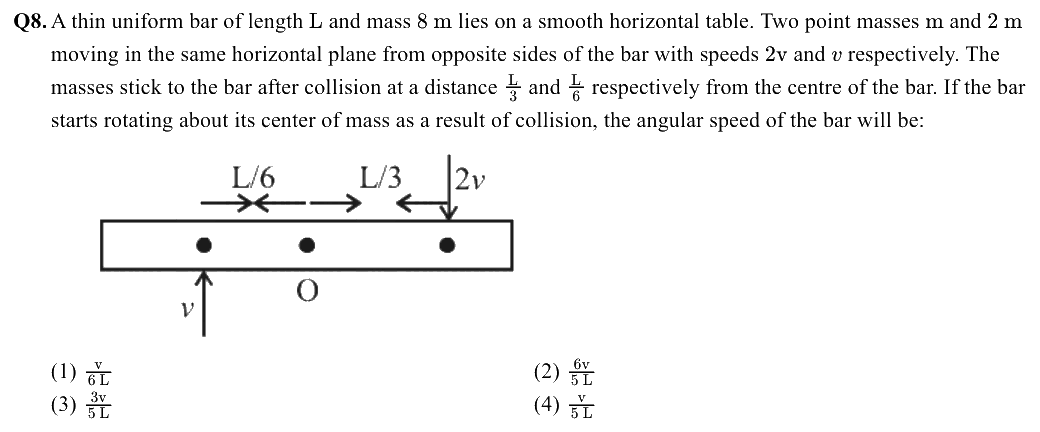
A thin uniform bar of length L and mass $8\ \mathrm{m}$ lies on a smooth horizontal table. Two point masses m and $2\ \mathrm{m}$ moving in the same horizontal plane from opposite sides of the bar with speeds $2v$ and $v$ respectively. The masses stick to the bar after collision at a distance $\frac{L}{3}$ and $\frac{L}{6}$ respectively from the centre of the bar. If the bar starts rotating about its center of mass as a result of collision, the angular speed of the bar will be: (see the figure above)
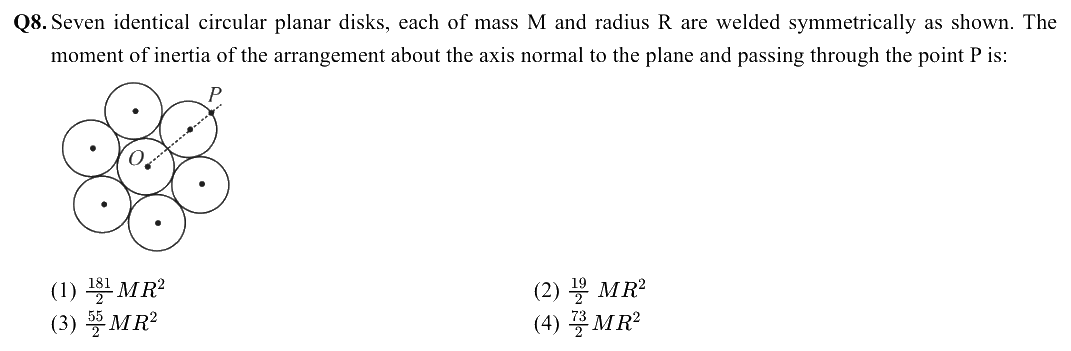
Seven identical circular planar disks, each of mass M and radius R are welded symmetrically as shown. The moment of inertia of the arrangement about the axis normal to the plane and passing through the point P is: (see the figure above)
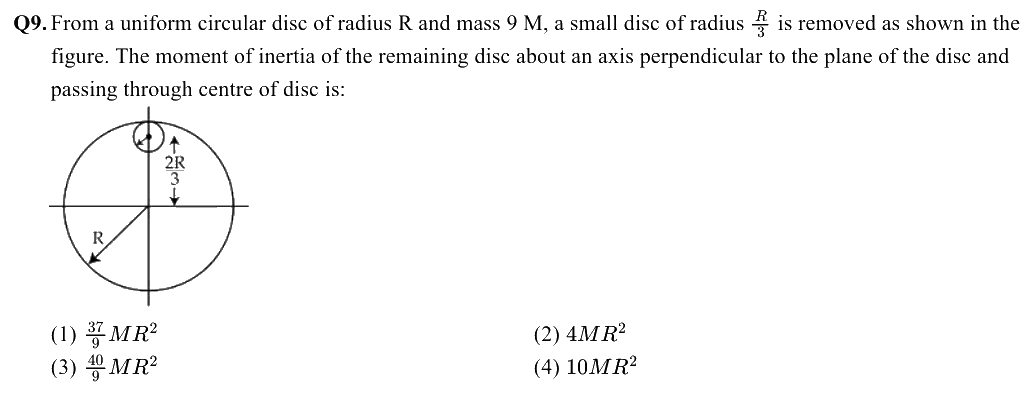
From a uniform circular disc of radius R and mass 9 M, a small disc of radius $\dfrac{R}{3}$ is removed as shown in the figure. The moment of inertia of the remaining disc about an axis perpendicular to the plane of the disc and passing through centre of disc is: (see the figure above)
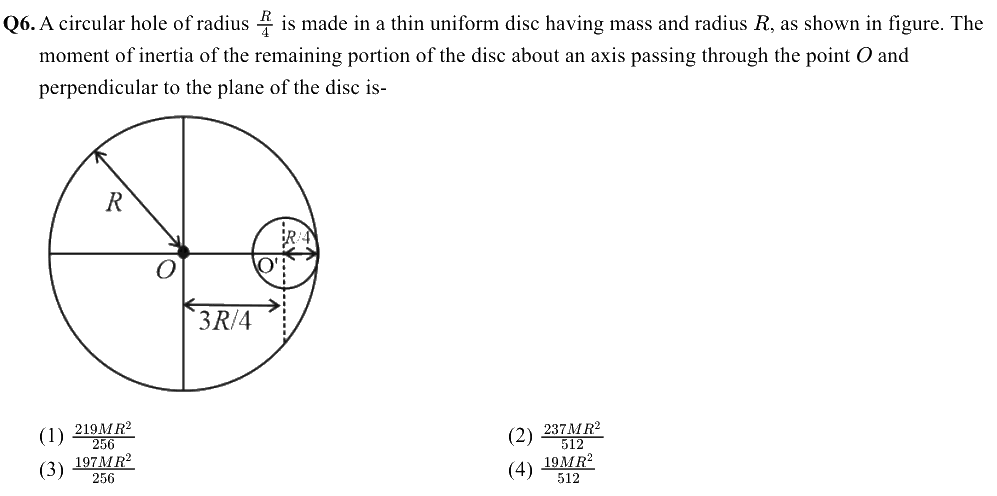
A circular hole of radius $\frac{R}{4}$ is made in a thin uniform disc having mass and radius $R$, as shown in figure. The moment of inertia of the remaining portion of the disc about an axis passing through the point $O$ and perpendicular to the plane of the disc is- (see the figure above)
In a physical balance working on the principle of moments, when 5 mg weight is placed on the left pan, the beam becomes horizontal. Both the empty pans of the balance are of equal mass. Which of the following statements is correct?
A
Every object that is weighed using this balance appears lighter than its actual weight
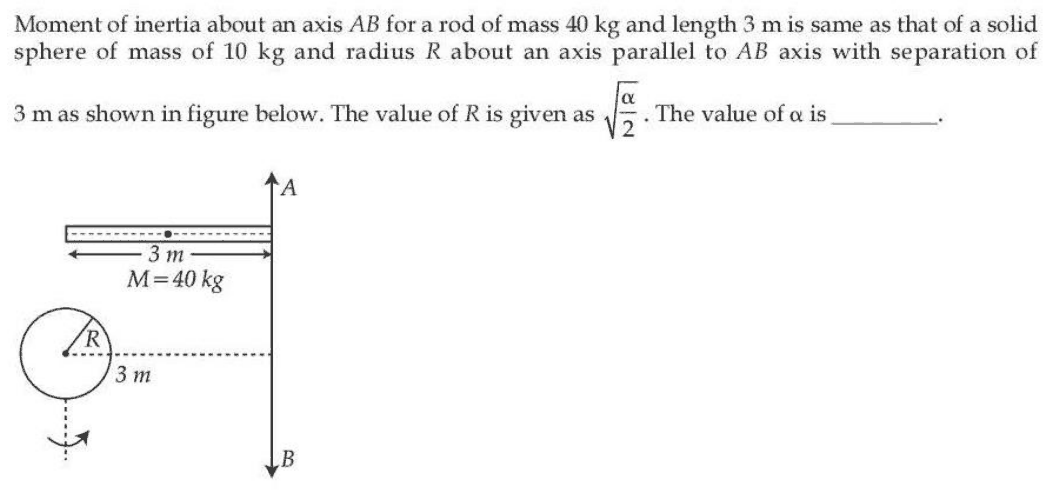
Moment of inertia about an axis $AB$ for a rod of mass 40 kg and length 3 m is same as that of a solid sphere of mass of 10 kg and radius $R$ about an axis parallel to $AB$ axis with separation of 3 m as shown in figure below. The value of $R$ is given as $\sqrt{\frac{\alpha}{2}}$. The value of $\alpha$ is ________.
(see the figure above)
The question as printed in the paper.
Numerical answer type: type your answer in EdLoop to check it
A solid sphere of radius 10 cm is rotating about an axis which is at a distance 15 cm from its centre. The radius of gyration about this axis is $\sqrt{n}$ cm. The value of $n$ is
Numerical answer type: type your answer in EdLoop to check it
A fly wheel having mass 3 kg and radius 5 m is free to rotate about a horizontal axis. A string having negligible mass is wound around the wheel and the loose end of the string is connected to 3 kg mass. The mass is kept at rest initially and released. Kinetic energy of the wheel when the mass descends by 3 m is ________ J. (g=10 m/s$^2$)
Numerical answer type: type your answer in EdLoop to check it
A uniform solid cylinder of length $L$ and radius $R$ has moment of inertia about its axis equal to $I_1$. A small co-centric cylinder of length $L/2$ and radius $R/3$ carved from this cylinder has moment of inertia about its axis equals to $I_2$. The ratio $I_1/I_2$ is ________.
Numerical answer type: type your answer in EdLoop to check it
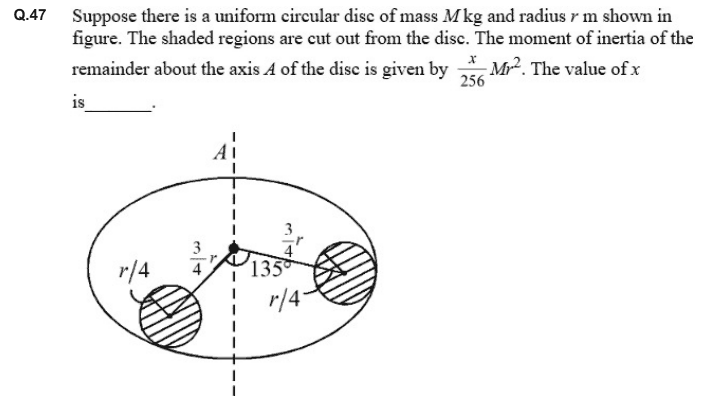
Suppose there is a uniform circular disc of mass $M$ kg and radius $r$ m shown in figure. The shaded regions are cut out from the disc. The moment of inertia of the remainder about the axis $A$ of the disc is given by $\dfrac{x}{256}Mr^2$. The value of $x$ is ________.
(see the figure above)
The question as printed in the paper.
Numerical answer type: type your answer in EdLoop to check it
A circular disc has radius $R_1$ and thickness $T_1$. Another circular disc made of the same material has radius $R_2$ and thickness $T_2$. If the moment of inertia of both discs are same and $\dfrac{R_1}{R_2} = 2$ then $\dfrac{T_1}{T_2} = \dfrac{1}{\alpha}$. The value of $\alpha$ is ________.
Numerical answer type: type your answer in EdLoop to check it
Two masses $m$ and $2m$ are connected by a light string going over a pulley (disc) of mass $30m$ with radius $r = 0.1$ m. The pulley is mounted in a vertical plane and it is free to rotate about its axis. The $2m$ mass is released from rest and its speed when it has descended through a height of 3.6 m is ________ m/s. (Assume string does not slip and g $= 10$ m/s$^2$)
Numerical answer type: type your answer in EdLoop to check it
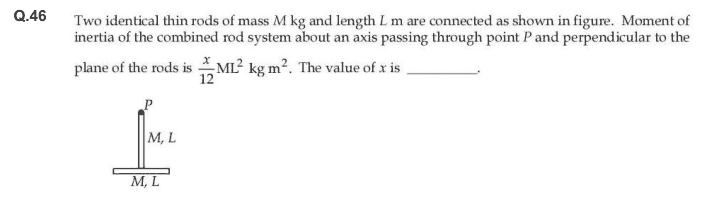
Two identical thin rods of mass $M$ kg and length $L$ m are connected as shown in figure. Moment of inertia of the combined rod system about an axis passing through point $P$ and perpendicular to the plane of the rods is $\frac{x}{12}ML^2$ kg m$^2$. The value of $x$ is ________.
(see the figure above)
The question as printed in the paper.
Numerical answer type: type your answer in EdLoop to check it
A thin solid disk of 1 kg is rotating along its diameter axis at the speed of 1800 rpm. By applying an external torque of $25\pi\,Nm$ for 40s, the speed increases to 2100 rpm. The diameter of the disk is ______ m.
Numerical answer type: type your answer in EdLoop to check it
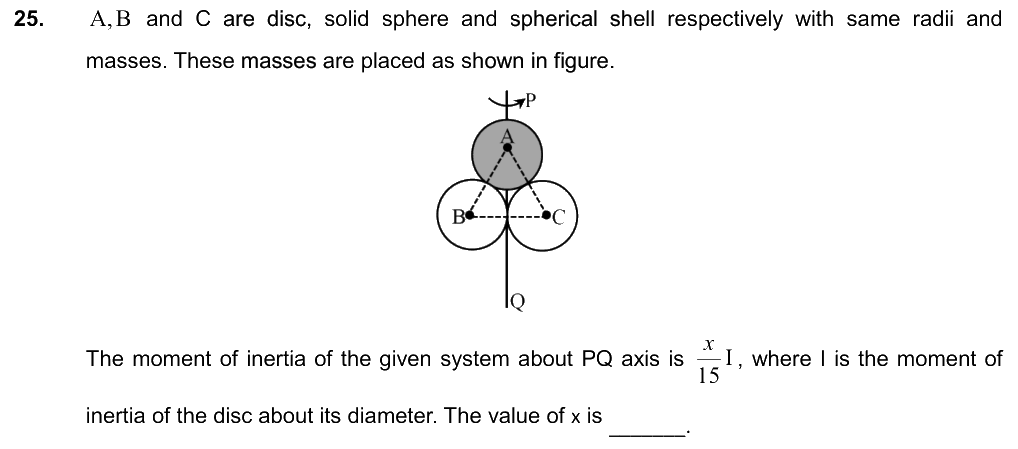
A, B and C are disc, solid sphere and spherical shell respectively with same radii and masses. These masses are placed as shown in figure.
(see the figure above)
The moment of inertia of the given system about PQ axis is $\frac{x}{15}I$, where I is the moment of inertia of the disc about its diameter. The value of x is ______ .
The question as printed in the paper.
Numerical answer type: type your answer in EdLoop to check it
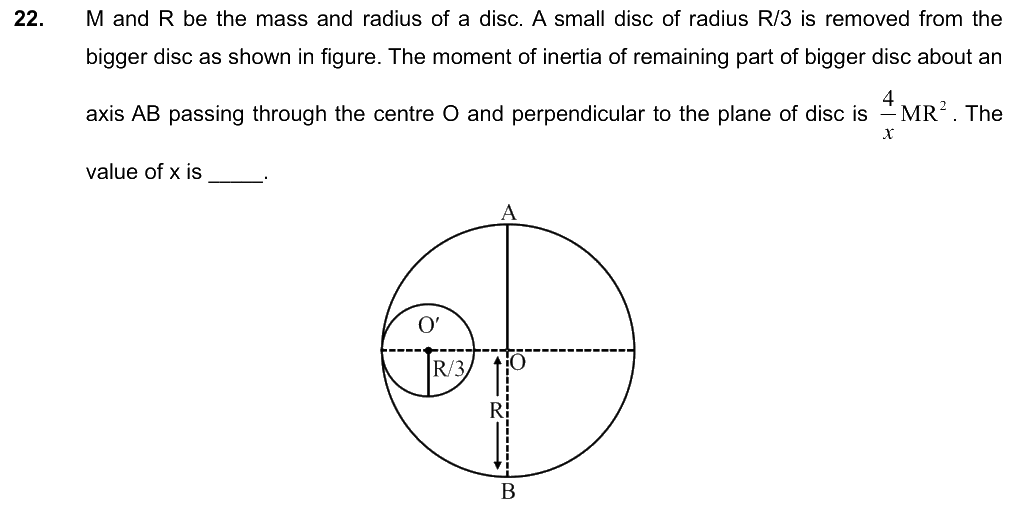
M and R be the mass and radius of a disc. A small disc of radius R/3 is removed from the bigger disc as shown in figure. The moment of inertia of remaining part of bigger disc about an axis AB passing through the centre O and perpendicular to the plane of disc is $\frac{4}{x}MR^2$. The value of x is ______ .
(see the figure above)
The question as printed in the paper.
Numerical answer type: type your answer in EdLoop to check it
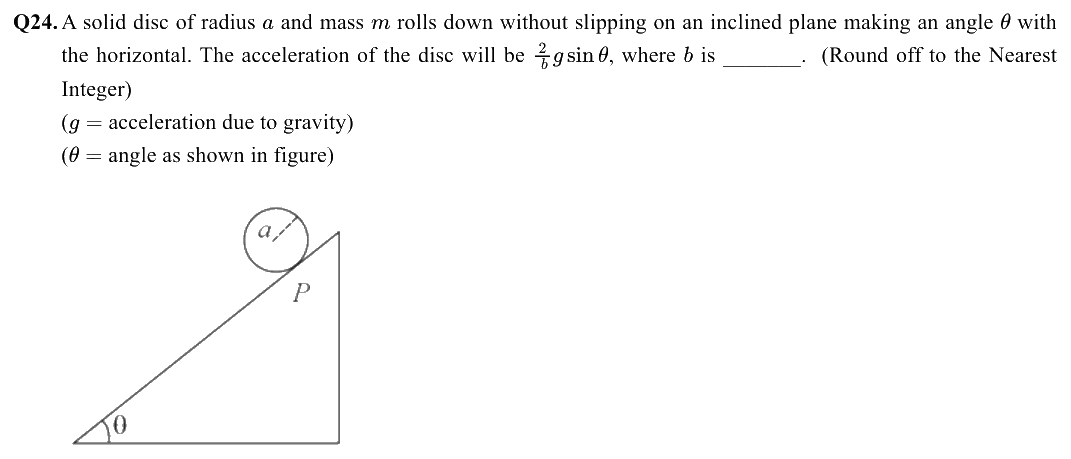
A circular ring and a solid sphere having same radius roll down on an inclined plane from rest without slipping. The ratio of their velocities when reached at the bottom of the plane is $\sqrt{\frac{x}{5}}$ where x = ______
Numerical answer type: type your answer in EdLoop to check it
A solid sphere with uniform density and radius R is rotating initially with constant angular velocity $(\omega_1)$ about its diameter. After some time during the rotation its starts loosing mass at a uniform rate, with no change in its shape. The angular velocity of the sphere when its radius become $R / 2$ is $x\omega_1$. The value of $x$ is ______ .
Numerical answer type: type your answer in EdLoop to check it
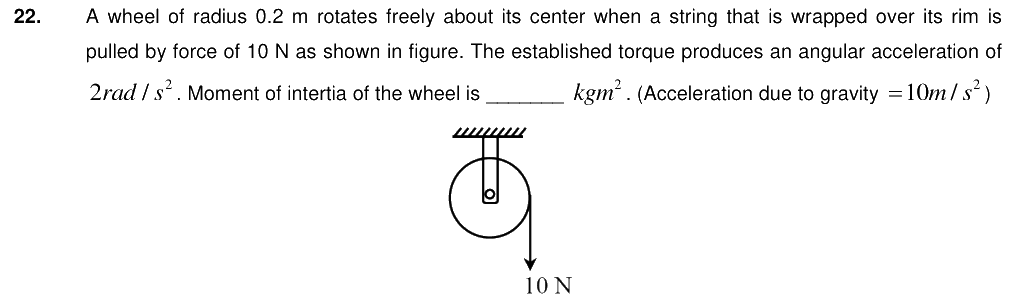
A wheel of radius 0.2 m rotates freely about its center when a string that is wrapped over its rim is pulled by force of 10 N as shown in figure. The established torque produces an angular acceleration of $2rad / s^2$. Moment of intertia of the wheel is ______ $kgm^2$. (Acceleration due to gravity $= 10m / s^2$ )
(see the figure above)
The question as printed in the paper.
Numerical answer type: type your answer in EdLoop to check it
The coordinates of a particle with respect to origin in a given reference frame is $(1, 1, 1)$ meters. If a force of $\vec{\mathrm{F}} = \hat{i} - \hat{j} + \hat{k}$ acts on the particle, then the magnitude of torque (with respect to origin) in z-direction is ______ .
Numerical answer type: type your answer in EdLoop to check it
Two iron solid discs of negligible thickness have radii $R_1$ and $R_2$ and moment of intertia $I_1$ and $I_2$, respectively. For $R_2 = 2R_1$, the ratio of $I_1$ and $I_2$ would be $1/x$, where x = ______ .
Numerical answer type: type your answer in EdLoop to check it
The moment of inertia of a solid disc rotating along its diameter is 2.5 times higher than the moment of inertia of a ring rotating in similar way. The moment of inertia of a solid sphere which has same radius as the disc and rotating in similar way, is $n$ times higher than the moment of inertia of the given ring. Here, n = ______ Consider all the bodies have equal masses.
Numerical answer type: type your answer in EdLoop to check it
The position vectors of two 1 kg particles, (A) and (B), are given by $\overrightarrow{\mathrm{r}_{\mathrm{A}}} = \left(\alpha_1 t^2\hat{i} + \alpha_2 t\hat{j} + \alpha_3 t\hat{k}\right)$m and $\overrightarrow{\mathrm{r}_{\mathrm{B}}} = \left(\beta_1 t\hat{i} + \beta_2 t^2\hat{j} + \beta_3 t\hat{k}\right)$m, respectively; $\left(\alpha_1 = 1\ \mathrm{m/s^2}, \alpha_2 = 3\mathrm{nm/s}, \alpha_3 = 2\ \mathrm{m/s}, \beta_1 = 2\ \mathrm{m/s}, \beta_2 = -1\ \mathrm{m/s^2}, \beta_3 = 4\mathrm{pm/s}\right)$, where t is time, n and p are constants. At $t = 1$ s, $\left|\overrightarrow{V_A}\right| = \left|\overrightarrow{V_B}\right|$ and velocities $\vec{V}_A$ and $\vec{V}_B$ of the particles are orthogonal to each other. At $t = 1$ s, the magnitude of angular momentum of particle (A) with respect to the position of particle (B) is $\sqrt{\mathrm{L}}\,\mathrm{kgm^2\,s^{-1}}$. The value of L is ______ .
Numerical answer type: type your answer in EdLoop to check it
A string is wrapped around the rim of a wheel of moment of inertia 0.40kgm$^2$ and radius 10 cm. The wheel is free to rotate about its axis. Initially the wheel is at rest. The string is now pulled by a force of 40 N. The angular velocity of the wheel after 10 s is $x$rad/s, where $x$ is ______
Numerical answer type: type your answer in EdLoop to check it
A circular disc reaches from top to bottom of an inclined plane of length $l$. When it slips down the plane, if takes $t$ s. When it rolls down the plane then it takes $\left(\frac{\alpha}{2}\right)^{1/2}t$ s, where $\alpha$ is ______.
Numerical answer type: type your answer in EdLoop to check it
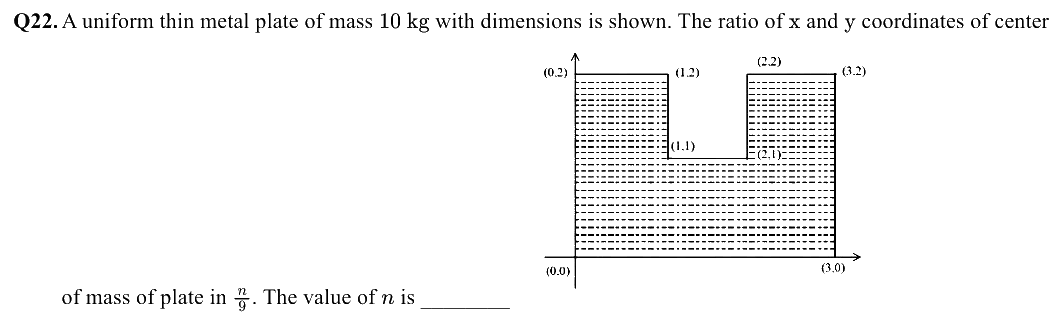
A uniform thin metal plate of mass 10 kg with dimensions is shown. The ratio of x and y coordinates of center of mass of plate in $\frac{n}{9}$. The value of $n$ is ______
(see the figure above)
The question as printed in the paper.
Numerical answer type: type your answer in EdLoop to check it
If the radius of earth is reduced to three-fourth of its present value without change in its mass then value of duration of the day of earth will be ______ hours 30 minutes.
Numerical answer type: type your answer in EdLoop to check it
Three balls of masses 2 kg, 4 kg and 6 kg respectively are arranged at centre of the edges of an equilateral triangle of side 2 m. The moment of intertia of the system about an axis through the centroid and perpendicular to the plane of triangle, will be ______ kgm$^2$.
Numerical answer type: type your answer in EdLoop to check it
A hollow sphere is rolling on a plane surface about its axis of symmetry. The ratio of rotational kinetic energy to its total kinetic energy is $\frac{x}{5}$. The value of $x$ is ______ .
Numerical answer type: type your answer in EdLoop to check it
A solid sphere and a hollow cylinder roll up without slipping on same inclined plane with same initial speed $v$. The sphere and the cylinder reaches upto maximum heights $h_1$ and $h_2$, respectively, above the initial level. The ratio $h_1 : h_2$ is $\frac{n}{10}$. The value of $n$ is ______.
Numerical answer type: type your answer in EdLoop to check it
In a system two particles of masses $m_1 = 3$ kg and $m_2 = 2$ kg are placed at certain distance from each other. The particle of mass $m_1$ is moved towards the center of mass of the system through a distance 2 cm. In order to keep the center of mass of the system at the original position, the particle of mass $m_2$ should move towards the center of mass by the distance ______ cm.
Numerical answer type: type your answer in EdLoop to check it
The identical spheres each of mass $2M$ are placed at the corners of a right angled triangle with mutually perpendicular sides equal to 4 m each. Taking point of intersection of these two sides as origin, the magnitude of position vector of the centre of mass of the system is $\frac{4\sqrt{2}}{x}$, where the value of $x$ is ______.
Numerical answer type: type your answer in EdLoop to check it
A uniform rod $AB$ of mass 2 kg and Length 30 cm at rest on a smooth horizontal surface. An impulse of force 0.2 N s is applied to end B. The time taken by the rod to turn through at right angles will be $\frac{\pi}{x}$ s, where $x$ = ______.
Numerical answer type: type your answer in EdLoop to check it
A solid circular disc of mass 50 kg rolls along a horizontal floor so that its center of mass has a speed of 0.4 m s$^{-1}$. The absolute value of work done on the disc to stop it is ______ J.
Numerical answer type: type your answer in EdLoop to check it
Two identical spheres each of mass 2 kg and radius 50 cm are fixed at the ends of a light rod so that the separation between the centers is 150 cm. Then, moment of inertia of the system about an axis perpendicular to the rod and passing through its middle point is $\frac{x}{20}$ kg m$^2$, where the value of $x$ is
Numerical answer type: type your answer in EdLoop to check it
A body of mass $m$ is projected with a speed $u$ making an angle of $45^\circ$ with the ground. The angular momentum of the body about the point of projection, at the highest point is expressed as $\frac{\sqrt{2}\,mu^3}{Xg}$. The value of $X$ is ______.
Numerical answer type: type your answer in EdLoop to check it
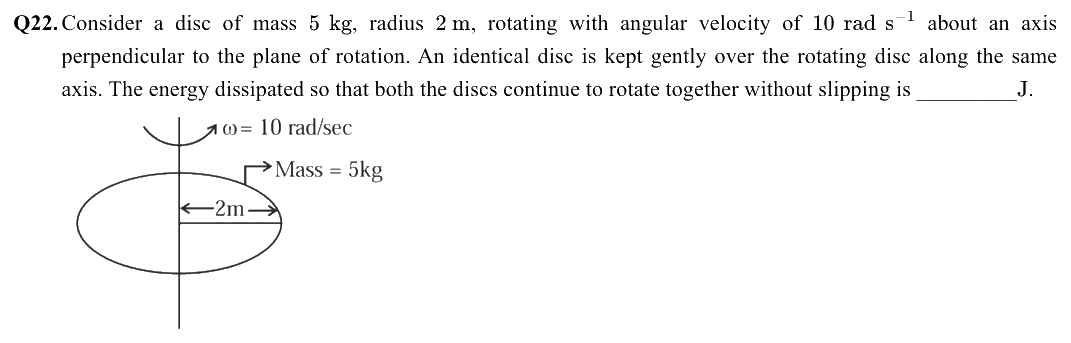
Consider a disc of mass 5 kg, radius 2 m, rotating with angular velocity of 10 rad s$^{-1}$ about an axis perpendicular to the plane of rotation. An identical disc is kept gently over the rotating disc along the same axis. The energy dissipated so that both the discs continue to rotate together without slipping is ______ J.
(see the figure above)
The question as printed in the paper.
Numerical answer type: type your answer in EdLoop to check it
Two discs of moment of inertia $I_1 = 4\ \mathrm{kg\,m^2}$ and $I_2 = 2\ \mathrm{kg\,m^2}$ about their central axes & normal to their planes, rotating with angular speeds 10 $\mathrm{rad\,s^{-1}}$ & 4 $\mathrm{rad\,s^{-1}}$ respectively are brought into contact face to face with their axe of rotation coincident. The loss in kinetic energy of the system in the process is ______ J.
Numerical answer type: type your answer in EdLoop to check it
A cylinder is rolling down on an inclined plane of inclination 60$^\circ$. Its acceleration during rolling down will be $\frac{x}{\sqrt{3}}$ m s$^{-2}$, where x = ______ (use $g = 10$ m s$^{-2}$).
Numerical answer type: type your answer in EdLoop to check it
A body of mass 5 kg moving with a uniform speed $3\sqrt{2}$ m s$^{-1}$ in $X - Y$ plane along the line $y = x + 4$. The angular momentum of the particle about the origin will be ______ kg m$^2$ s$^{-1}$.
Numerical answer type: type your answer in EdLoop to check it
Four particles, each of mass 1 kg are placed at four corners of a square of side 2 m. The moment of inertia of the system about an axis perpendicular to its plane and passing through one of its vertex is ______ kg m$^2$.
Numerical answer type: type your answer in EdLoop to check it
A ring and a solid sphere roll down the same inclined plane without slipping. They start from rest. The radii of both bodies are identical and the ratio of their kinetic energies is $\frac{7}{x}$, where x is ______.
Numerical answer type: type your answer in EdLoop to check it
A solid sphere and a solid cylinder of same mass and radius are rolling on a horizontal surface without slipping. The ratio of their radius of gyrations respectively ($k_{sph} : k_{cyl}$) is 2 : $\sqrt{x}$. The value of $x$ is ______.
Numerical answer type: type your answer in EdLoop to check it
A solid sphere is rolling on a horizontal plane without slipping. If the ratio of angular momentum about axis of rotation of the sphere to the total energy of moving sphere is $\pi : 22$ then, the value of its angular speed will be ______ rad s$^{-1}$.
Numerical answer type: type your answer in EdLoop to check it
A light rope is wound around a hollow cylinder of mass 5 kg and radius 70 cm. The rope is pulled with a force of 52.5 N. The angular acceleration of the cylinder will be ______ rad s$^{-2}$.
Numerical answer type: type your answer in EdLoop to check it
A solid sphere of mass 500 g radius 5 cm is rotated about one of its diameter with angular speed of $10\ \mathrm{rad\ s^{-1}}$. If the moment of inertia of the sphere about its tangent is $x \times 10^{-2}$ times its angular momentum about the diameter. Then the value of $x$ will be
Numerical answer type: type your answer in EdLoop to check it
A circular plate is rotating in horizontal plane, about an axis passing through its centre and perpendicular to the plate, with an angular velocity $\omega$. A person sits at the centre having two dumbbells in his hands. When he stretched out his hands, the moment of inertia of the system becomes triple. If $E$ be the initial Kinetic energy of the system, then final Kinetic energy will be $\frac{E}{x}$. The value of $x$ is
Numerical answer type: type your answer in EdLoop to check it
If the earth suddenly shrinks to $\frac{1}{64}$th of its original volume with its mass remaining the same, the period of rotation of earth becomes $\frac{24}{x}$h. The value of $x$ is ______
Numerical answer type: type your answer in EdLoop to check it
A force of $-P\hat{k}$ acts on the origin of the coordinate system. The torque about the point $(2, -3)$ is $P(a\hat{i} + b\hat{j})$, The ratio of $\frac{a}{b}$ is $\frac{x}{2}$. The value of $x$ is
Numerical answer type: type your answer in EdLoop to check it
The moment of inertia of a semicircular ring about an axis, passing through the center and perpendicular to the plane of ring, is $\frac{1}{x}\mathrm{MR}^{2}$, where R is the radius and M is the mass of the semicircular ring. The value of x will be ______.
Numerical answer type: type your answer in EdLoop to check it
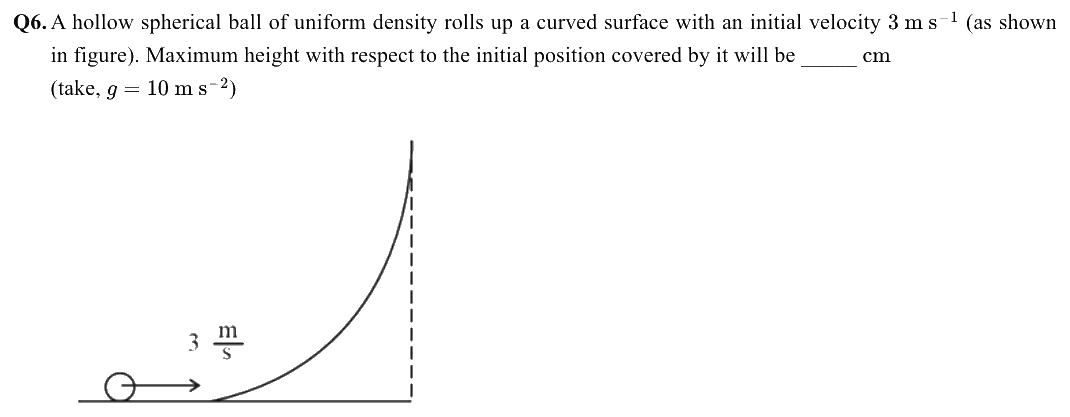
A hollow spherical ball of uniform density rolls up a curved surface with an initial velocity $3\ \mathrm{m\,s^{-1}}$ (as shown in figure). Maximum height with respect to the initial position covered by it will be ______ cm (take, $g = 10\ \mathrm{m\,s^{-2}}$)
(see the figure above)
The question as printed in the paper.
Numerical answer type: type your answer in EdLoop to check it
Two identical solid spheres each of mass $2\ \mathrm{kg}$ and radii $10\ \mathrm{cm}$ are fixed at the ends of a light rod. The separation between the centres of the spheres is $40\ \mathrm{cm}$. The moment of inertia of the system about an axis perpendicular to the rod passing through its middle point is ______ $\times 10^{-3}\ \mathrm{kg\ m^2}$.
Numerical answer type: type your answer in EdLoop to check it
A ring and a solid sphere rotating about an axis passing through their centres have same radii of gyration. The axis of rotation is perpendicular to plane of ring. The ratio of radius of ring to that of sphere is $\sqrt{\frac{2}{x}}$. The value of $x$ is ______ .
Numerical answer type: type your answer in EdLoop to check it
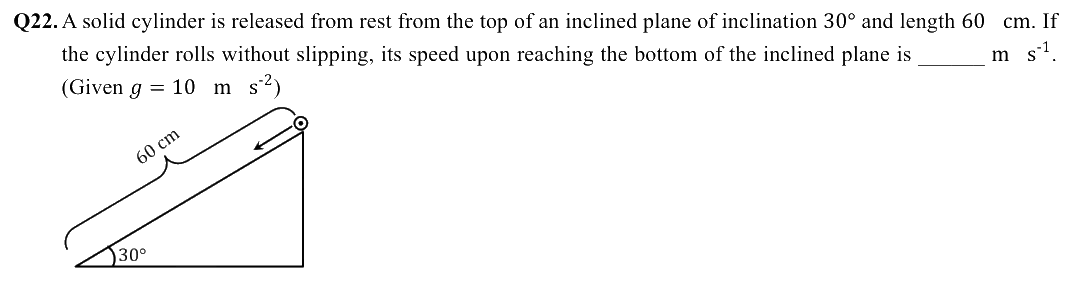
A solid cylinder is released from rest from the top of an inclined plane of inclination $30^\circ$ and length 60 $\mathrm{cm}$. If the cylinder rolls without slipping, its speed upon reaching the bottom of the inclined plane is ______ $\mathrm{m\ s^{-1}}$. (Given $g$ = 10 $\mathrm{m\ s^{-2}}$)
(see the figure above)
The question as printed in the paper.
Numerical answer type: type your answer in EdLoop to check it
Moment of inertia of a disc of mass $M$ and radius '$R$' about any of its diameter is $\dfrac{MR^2}{4}$. The moment of inertia of this disc about an axis normal to the disc and passing through a point on its edge will be, $\dfrac{x}{2}MR^2$. The value of $x$ is ______.
Numerical answer type: type your answer in EdLoop to check it
A solid sphere of mass 1 $\mathrm{kg}$ rolls without slipping on a plane surface. Its kinetic energy is $7 \times 10^{-3}$ $\mathrm{J}$. The speed of the centre of mass of the sphere is ______ $\mathrm{cm\ s^{-1}}$.
Numerical answer type: type your answer in EdLoop to check it
Two discs of same mass and different radii are made of different materials such that their thicknesses are 1 cm and 0.5 cm respectively. The densities of materials are in the ratio 3 : 5. The moment of inertia of these discs respectively about their diameters will be in the ratio of $\frac{x}{6}$. The value of $x$ is ______.
Numerical answer type: type your answer in EdLoop to check it
A thin uniform rod of length 2 m, cross sectional area $A$ and density $d$ is rotated about an axis passing through the centre and perpendicular to its length with angular velocity $\omega$. If value of $\omega$ in terms of its rotational kinetic energy $E$ is $\sqrt{\frac{\alpha E}{Ad}}$, then the value of $\alpha$ is ______.
Numerical answer type: type your answer in EdLoop to check it
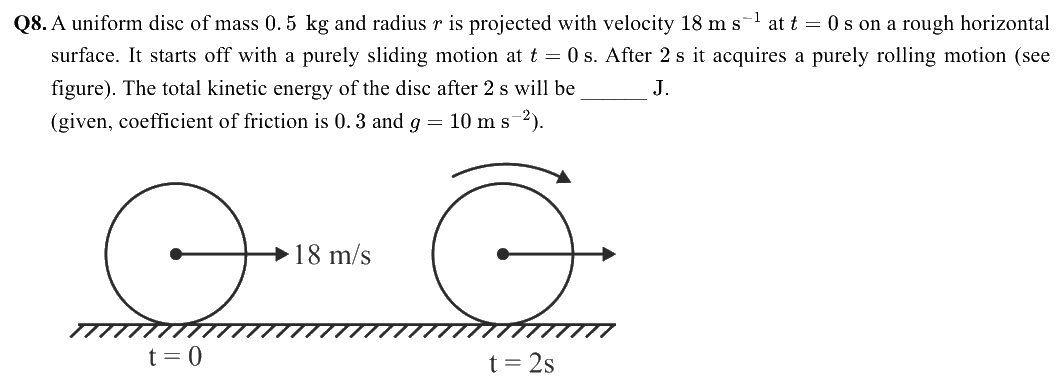
A uniform disc of mass 0.5 kg and radius $r$ is projected with velocity 18 m s$^{-1}$ at $t$ = 0 s on a rough horizontal surface. It starts off with a purely sliding motion at $t$ = 0 s. After 2 s it acquires a purely rolling motion (see figure). The total kinetic energy of the disc after 2 s will be ______ J. (given, coefficient of friction is 0.3 and $g$ = 10 m s$^{-2}$).
(see the figure above)
The question as printed in the paper.
Numerical answer type: type your answer in EdLoop to check it
A solid sphere of mass $2\ \mathrm{kg}$ is making pure rolling on a horizontal surface with kinetic energy $2240\ \mathrm{J}$. The velocity of centre of mass of the sphere will be ______ $\mathrm{m\,s^{-1}}$.
Numerical answer type: type your answer in EdLoop to check it
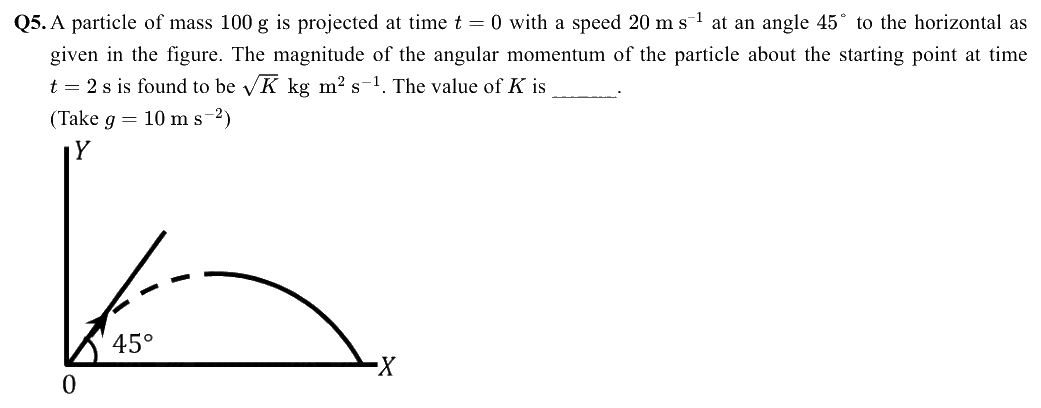
A particle of mass 100 g is projected at time $t = 0$ with a speed $20\ \mathrm{m\,s^{-1}}$ at an angle $45^\circ$ to the horizontal as given in the figure. The magnitude of the angular momentum of the particle about the starting point at time $t = 2$ s is found to be $\sqrt{K}\ \mathrm{kg\,m^2\,s^{-1}}$. The value of $K$ is ______. (Take $g = 10\ \mathrm{m\,s^{-2}}$) (see the figure above)
The question as printed in the paper.
Numerical answer type: type your answer in EdLoop to check it
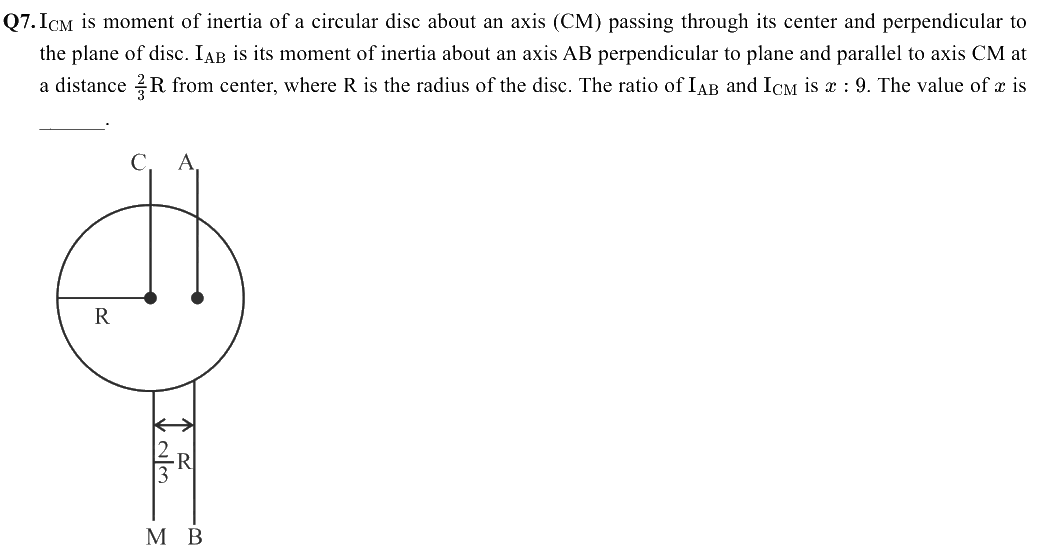
$\mathrm{I_{CM}}$ is moment of inertia of a circular disc about an axis (CM) passing through its center and perpendicular to the plane of disc. $\mathrm{I_{AB}}$ is its moment of inertia about an axis AB perpendicular to plane and parallel to axis CM at a distance $\frac{2}{3}\mathrm{R}$ from center, where R is the radius of the disc. The ratio of $\mathrm{I_{AB}}$ and $\mathrm{I_{CM}}$ is $x : 9$. The value of $x$ is ______. (see the figure above)
The question as printed in the paper.
Numerical answer type: type your answer in EdLoop to check it
If a solid sphere of mass 5 kg and a disc of mass 4 kg have the same radius, then the ratio of moment of inertia of the disc about a tangent in its plane to the moment of inertia of the sphere about its tangent will be $\frac{x}{7}$. The value of $x$ is ______.
Numerical answer type: type your answer in EdLoop to check it
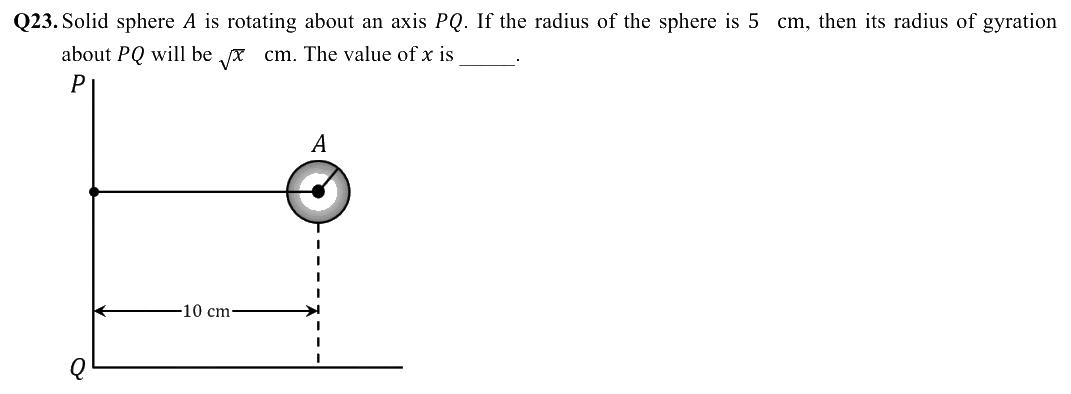
Solid sphere $A$ is rotating about an axis $PQ$. If the radius of the sphere is 5 cm, then its radius of gyration about $PQ$ will be $\sqrt{x}$ cm. The value of $x$ is ______.
(see the figure above)
The question as printed in the paper.
Numerical answer type: type your answer in EdLoop to check it
A uniform solid cylinder with radius $R$ and length $L$ has moment of inertia $I_1$, about the axis of cylinder. A concentric solid cylinder of radius $R'=\frac{R}{2}$ and length $L'=\frac{L}{2}$ is carved out of the original cylinder. If $I_2$ is the moment of inertia of the carved out portion of the cylinder then $\frac{I_1}{I_2}=$ ______. (Both $I_1$ and $I_2$ are about the axis of the cylinder)
Numerical answer type: type your answer in EdLoop to check it
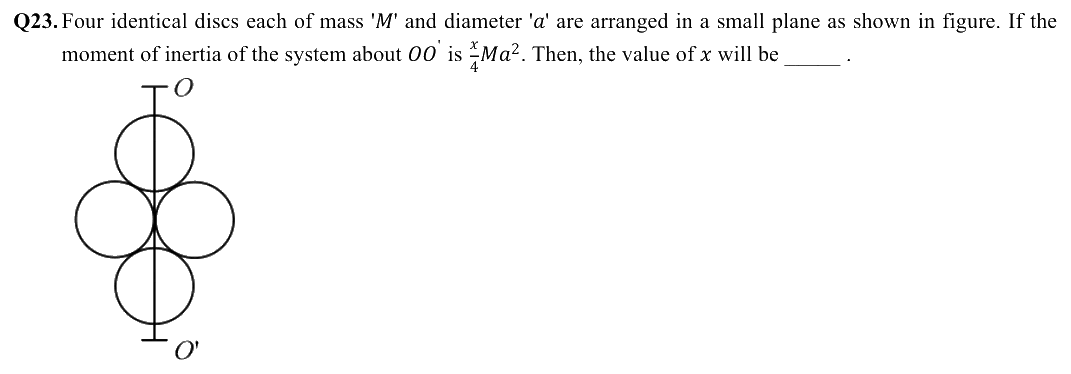
Four identical discs each of mass '$M$' and diameter '$a$' are arranged in a small plane as shown in figure. If the moment of inertia of the system about $OO'$ is $\frac{x}{4}Ma^{2}$. Then, the value of $x$ will be ______.
(see the figure above)
The question as printed in the paper.
Numerical answer type: type your answer in EdLoop to check it
The distance of centre of mass from end $A$ of a one dimensional rod ($AB$) having mass density $\rho=\rho_0\left(1-\frac{x^{2}}{L^{2}}\right)\ \mathrm{kg\,m^{-1}}$ and length $L$ (in meter) is $\frac{3L}{\alpha}$ m. The value of $\alpha$ is ______ (where $x$ is the distance form end $A$)
Numerical answer type: type your answer in EdLoop to check it
A pulley of radius 1.5 m is rotated about its axis by a force $F$ = $(12t - 3t^2)$ N applied tangentially (while $t$ is measured in seconds). If moment of inertia of the pulley about its axis of rotation is 4.5 $\mathrm{kg~m^2}$, the number of rotations made by the pulley before its direction of motion is reversed, will be $\frac{K}{\pi}$. The value of $K$ is ______ .
Numerical answer type: type your answer in EdLoop to check it
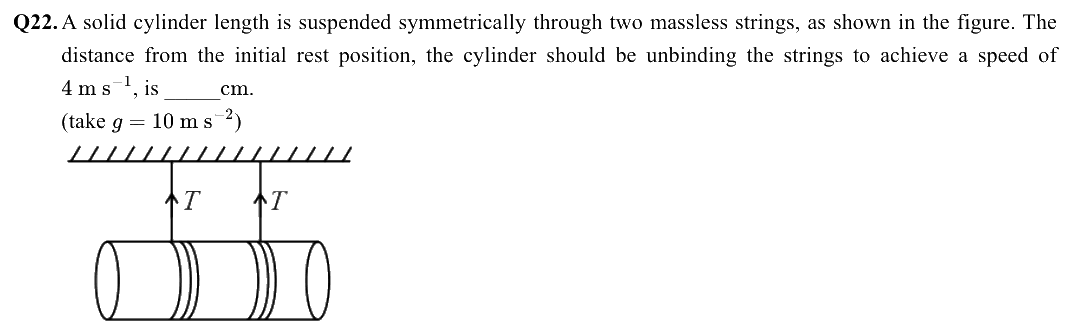
A solid cylinder length is suspended symmetrically through two massless strings, as shown in the figure. The distance from the initial rest position, the cylinder should be unbinding the strings to achieve a speed of $4 \mathrm{~m~s^{-1}}$, is ______ cm. (take $g = 10 \mathrm{~m~s^{-2}}$) (see the figure above)
The question as printed in the paper.
Numerical answer type: type your answer in EdLoop to check it
A disc of mass 1 kg and radius $R$ is free of rotate about a horizontal axis passing through its centre and perpendicular to the plane of disc. A body of same mass as that of disc is fixed at the highest point of the disc. Now the system is released, when the body comes to the lowest position, its angular speed will be $4\sqrt{\frac{x}{3R}}$ $\mathrm{rad~s^{-1}}$ where $x$ = ______ .
Numerical answer type: type your answer in EdLoop to check it
The radius of gyration of a cylindrical rod about an axis of rotation perpendicular to its length and passing through the center will be ______ m. Given, the length of the rod is $10\sqrt{3}$ m.
Numerical answer type: type your answer in EdLoop to check it
Three identical spheres each of mass $M$ are placed at the corners of a right angled triangle with mutually perpendicular sides equal to 3 m each. Taking point of intersection of mutually perpendicular sides as origin, the magnitude of position vector of centre of mass of the system will be $\sqrt{x}$ m. The value of $x$ is
Numerical answer type: type your answer in EdLoop to check it
The moment of inertia of a uniform thin rod about a perpendicular axis passing through one end is $I_1$. The same rod is bent into a ring and its moment of inertia about a diameter is $I_2$. If $\dfrac{I_1}{I_2}$ is $\dfrac{x\pi^2}{3}$, then the value of $x$ will be ______.
Numerical answer type: type your answer in EdLoop to check it
The position vector of $1\ \mathrm{kg}$ object is $\vec{r} = \left(3\hat{i} - \hat{j}\right)\ \mathrm{m}$ and its velocity $\vec{v} = \left(3\hat{j} + \hat{k}\right)\ \mathrm{m\,s^{-1}}$. The magnitude of its angular momentum is $\sqrt{x}\ \mathrm{N\,m\,s}$, where $x$ is
Numerical answer type: type your answer in EdLoop to check it
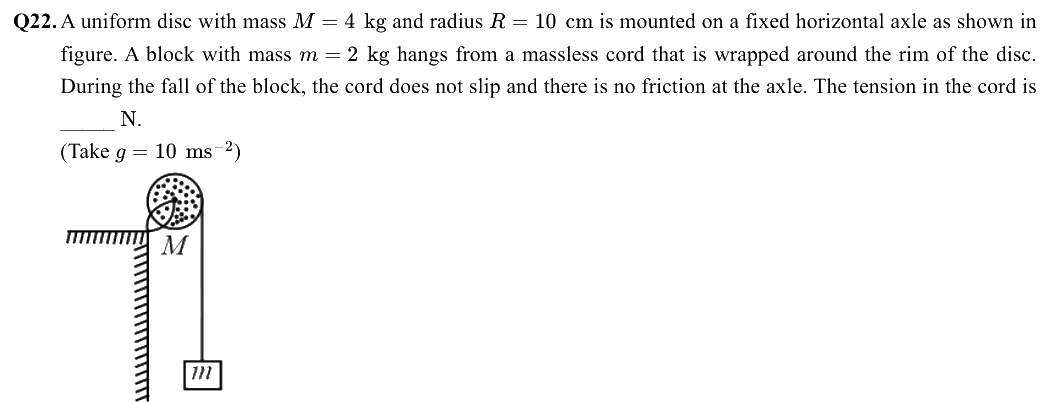
A uniform disc with mass $M = 4\ \mathrm{kg}$ and radius $R = 10\ \mathrm{cm}$ is mounted on a fixed horizontal axle as shown in figure. A block with mass $m = 2\ \mathrm{kg}$ hangs from a massless cord that is wrapped around the rim of the disc. During the fall of the block, the cord does not slip and there is no friction at the axle. The tension in the cord is ______ N. (Take $g = 10\ \mathrm{ms^{-2}}$) (see the figure above)
The question as printed in the paper.
Numerical answer type: type your answer in EdLoop to check it
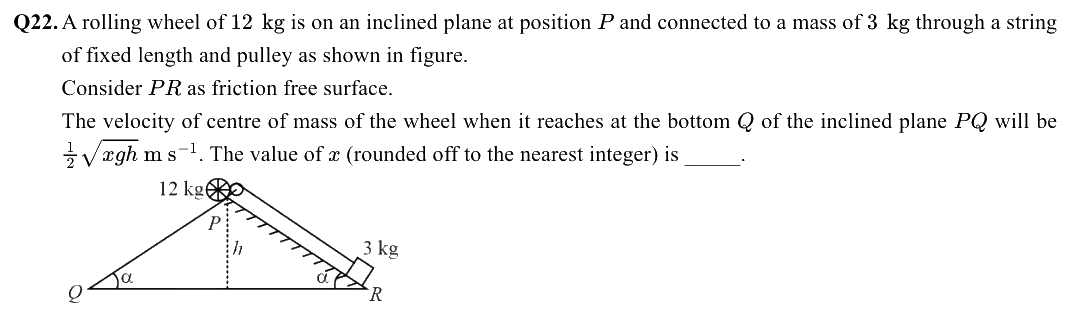
A rolling wheel of $12\ \mathrm{kg}$ is on an inclined plane at position $P$ and connected to a mass of $3\ \mathrm{kg}$ through a string of fixed length and pulley as shown in figure. Consider $PR$ as friction free surface. The velocity of centre of mass of the wheel when it reaches at the bottom $Q$ of the inclined plane $PQ$ will be $\frac{1}{2}\sqrt{xgh}\ \mathrm{m\ s^{-1}}$. The value of $x$ (rounded off to the nearest integer) is ______ . (see the figure above)
The question as printed in the paper.
Numerical answer type: type your answer in EdLoop to check it
Moment of Inertia (M.I.) of four bodies having same mass $M$ and radius $2R$ are as follows $I_1 =$ M.I. of solid sphere about its diameter $I_2 =$ M.I. of solid cylinder about its axis $I_3 =$ M.I. of solid circular disc about its diameter $I_4 =$ M.I. of thin circular ring about its diameter If $2\left(I_2 + I_3\right) + I_4 = xI_1$ then the value of $x$ will be ______ .
Numerical answer type: type your answer in EdLoop to check it
A metre scale is balanced on a knife edge at its centre. When two coins, each of mass $10 \mathrm{~g}$ are put one on the top of the other at the $10.0 \mathrm{~cm}$ mark the scale is found to be balanced at $40.0 \mathrm{~cm}$ mark. The mass of the metre scale is found to be $x \times 10^{-2} \mathrm{~kg}$. The value of $x$ is ______ .
Numerical answer type: type your answer in EdLoop to check it
A $2$ kg steel rod of length $0.6$ m is clamped on a table vertically at its lower end and is free to rotate in the vertical plane. The upper end is pushed so that the rod falls under gravity. Ignoring the friction due to clamping at its lower end, the speed of the free end of the rod when it passes through its lowest position is ______ m s$^{-1}$. (Take $g = 10$ m s$^{-2}$ )
Numerical answer type: type your answer in EdLoop to check it
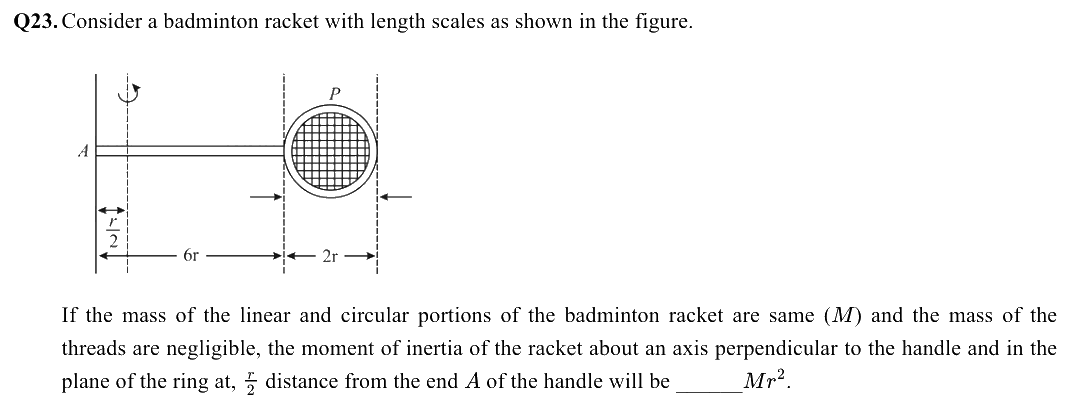
Consider a badminton racket with length scales as shown in the figure. (see the figure above) If the mass of the linear and circular portions of the badminton racket are same ($M$) and the mass of the threads are negligible, the moment of inertia of the racket about an axis perpendicular to the handle and in the plane of the ring at, $\frac{r}{2}$ distance from the end $A$ of the handle will be ______$Mr^{2}$.
The question as printed in the paper.
Numerical answer type: type your answer in EdLoop to check it
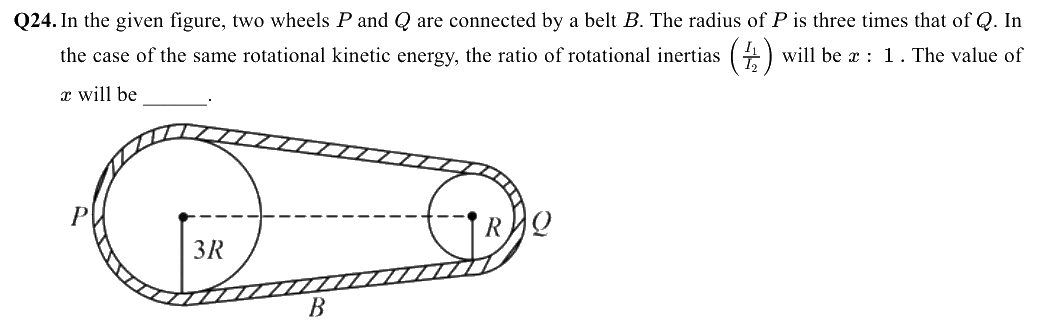
In the given figure, two wheels $P$ and $Q$ are connected by a belt $B$. The radius of $P$ is three times that of $Q$. In the case of the same rotational kinetic energy, the ratio of rotational inertias $\left(\frac{I_1}{I_2}\right)$ will be $x : 1$. The value of $x$ will be ______. (see the figure above)
The question as printed in the paper.
Numerical answer type: type your answer in EdLoop to check it
A particle of mass $m$ is moving in time $t$ on a trajectory given by, $\vec{r} = 10\alpha t^2\hat{i} + 5\beta t - 5\hat{j}$ where $\alpha$ and $\beta$ are dimensional constants. The angular momentum of the particle becomes the same as it was for $t = 0$ at time $t =$ ______ seconds.
Numerical answer type: type your answer in EdLoop to check it
A solid disc of radius $20\ \mathrm{cm}$ and mass $10\ \mathrm{kg}$ is rotating with an angular velocity of $600\ \mathrm{rpm}$, about an axis normal to its circular plane and passing through its centre of mass. The retarding torque required to bring the disc at rest in $10\ \mathrm{s}$ is ______ $\pi \times 10^{-1}\ \mathrm{N\ m}$
Numerical answer type: type your answer in EdLoop to check it
The position of the centre of mass of a uniform semi-circular wire of radius $R$ placed in $x - y$ plane with its centre at the origin and the line joining its ends as $x-$axis is given by, $\left(0, \frac{xR}{\pi}\right)$. Then, the value of $|x|$ is ______.
Numerical answer type: type your answer in EdLoop to check it
The centre of a wheel rolling on a plane surface moves with a speed $v_0$. A particle on the rim of the wheel at the same level as the centre will be moving at a speed $\sqrt{x}v_0$. Then the value of $x$ is ______.
Numerical answer type: type your answer in EdLoop to check it
A rod of mass $M$ and length $L$ is lying on a horizontal frictionless surface. A particle of mass $m$ travelling along the surface hits at one end of the rod with a velocity $u$ in a direction perpendicular to the rod. The collision is completely elastic. After collision, particle comes to rest. The ratio of masses $\left(\frac{m}{M}\right)$ is $\frac{1}{x}$. The value of $x$ will be
Numerical answer type: type your answer in EdLoop to check it
A circular disc reaches from top to bottom of an inclined plane of length $L$. When it slips down the plane, it takes time $t_1$. When it rolls down the plane, it takes time $t_2$. The value of $\frac{t_2}{t_1}$ is $\sqrt{\frac{3}{x}}$. The value of $x$ will be
Numerical answer type: type your answer in EdLoop to check it
Two bodies, a ring and a solid cylinder of same material are rolling down without slipping on an inclined plane. The radii of the bodies are same. The ratio of velocity of the centre of mass at the bottom of the inclined plane of the ring to that of the cylinder is $\frac{\sqrt{x}}{2}$. Then, the value of $x$ is
Numerical answer type: type your answer in EdLoop to check it
A body rotating with an angular speed of $600~\mathrm{rpm}$ is uniformly accelerated to $1800~\mathrm{rpm}$ in $10~\mathrm{sec}$. The number of rotations made in the process is
Numerical answer type: type your answer in EdLoop to check it
The angular speed of truck wheel is increased from $900 \mathrm{rpm}$ to $2460 \mathrm{rpm}$ in 26 seconds. The number of revolutions by the truck engine during this time is ______. (Assuming the acceleration to be uniform).
Numerical answer type: type your answer in EdLoop to check it
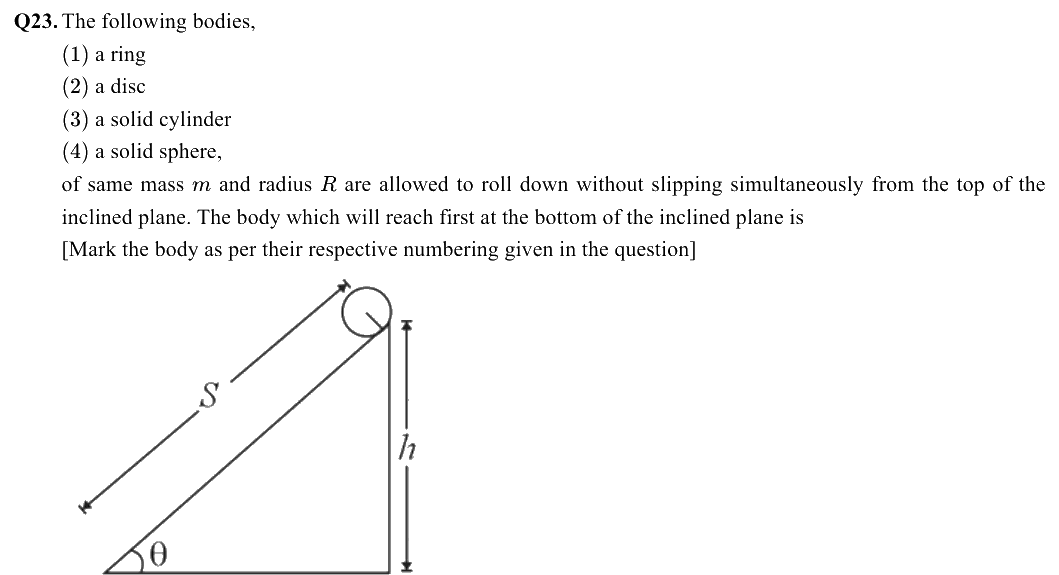
The following bodies, (1) a ring (2) a disc (3) a solid cylinder (4) a solid sphere, of same mass $m$ and radius $R$ are allowed to roll down without slipping simultaneously from the top of the inclined plane. The body which will reach first at the bottom of the inclined plane is [Mark the body as per their respective numbering given in the question] (see the figure above)
The question as printed in the paper.
Numerical answer type: type your answer in EdLoop to check it
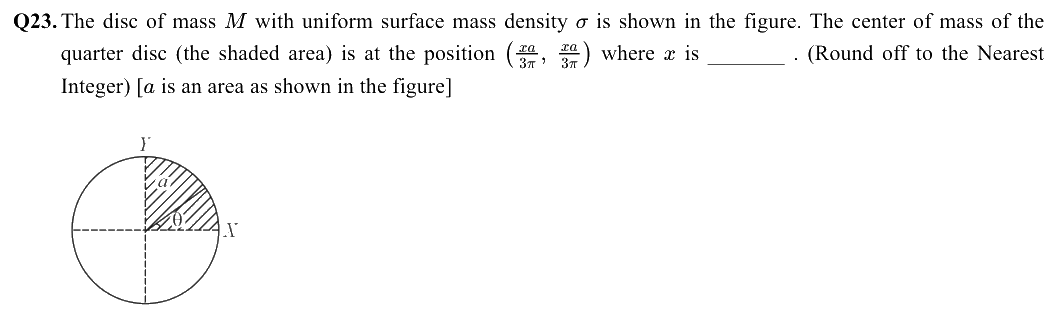
The disc of mass $M$ with uniform surface mass density $\sigma$ is shown in the figure. The center of mass of the quarter disc (the shaded area) is at the position $\left(\frac{x a}{3 \pi}, \frac{x a}{3 \pi}\right)$ where $x$ is ______. (Round off to the Nearest Integer) [$a$ is an area as shown in the figure] (see the figure above)
The question as printed in the paper.
Numerical answer type: type your answer in EdLoop to check it
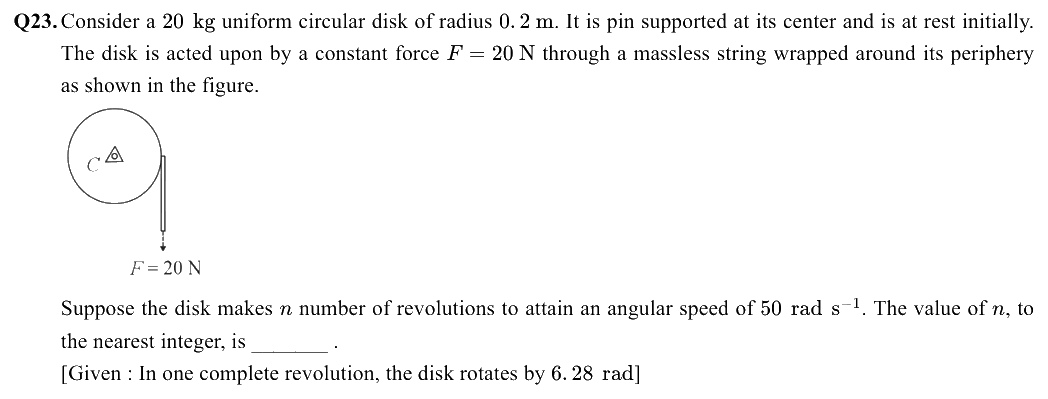
Consider a 20 kg uniform circular disk of radius $0.2 \mathrm{~m}$. It is pin supported at its center and is at rest initially. The disk is acted upon by a constant force $F=20 \mathrm{~N}$ through a massless string wrapped around its periphery as shown in the figure. (see the figure above) Suppose the disk makes $n$ number of revolutions to attain an angular speed of $50 \mathrm{rad} \mathrm{s}^{-1}$. The value of $n$, to the nearest integer, is ______. [Given : In one complete revolution, the disk rotates by $6.28 \mathrm{~rad}$]
The question as printed in the paper.
Numerical answer type: type your answer in EdLoop to check it
A force $\vec{F} = 4\hat{i} + 3\hat{j} + 4\hat{k}$ is applied on an intersection point of $x = 2$ plane and $x$-axis. The magnitude of torque of this force about a point $(2, 3, 4)$ is ______. (Round off to the Nearest Integer)
Numerical answer type: type your answer in EdLoop to check it
A solid disc of radius $a$ and mass $m$ rolls down without slipping on an inclined plane making an angle $\theta$ with the horizontal. The acceleration of the disc will be $\frac{2}{b}g\sin\theta$, where $b$ is ______. (Round off to the Nearest Integer) ($g$ = acceleration due to gravity) ($\theta$ = angle as shown in figure) (see the figure above)
The question as printed in the paper.
Numerical answer type: type your answer in EdLoop to check it
A uniform thin bar of mass $6\ \mathrm{kg}$ and length $2.4$ meter is bent to make an equilateral hexagon. The moment of inertia about an axis passing through the centre of mass and perpendicular to the plane of hexagon is ______ $\times 10^{-1}\ \mathrm{kg\ m^2}$.
Numerical answer type: type your answer in EdLoop to check it
A force $\vec{F} = \left(\hat{i} + 2\hat{j} + 3\hat{k}\right)$ N acts at a point $\left(4\hat{i} + 3\hat{j} - \hat{k}\right)$ m. Then the magnitude of torque about the point $\left(\hat{i} + 2\hat{j} + \hat{k}\right)$ m will be $\sqrt{x}$ N – m.The value of $x$ is..........
Numerical answer type: type your answer in EdLoop to check it
A thin rod of mass 0. 9 kg and length 1 m is suspended, at rest, from one end so that it can freely oscillate in the vertical plane. A particle of move (sic) 0. 1 kg moving in a straight line with velocity 80 m s$^{-1}$ hits the rod at its bottom most point and sticks to it (see figure). The angular speed (in rad s$^{-1}$) of the rod immediately after the collision will be ______ (see the figure above)
The question as printed in the paper.
Numerical answer type: type your answer in EdLoop to check it
$ABC$ is a plane lamina of the shape of an equilateral triangle. $D$, $E$ are mid-points of $AB$, $AC$ and $G$ is the centroid of the lamina. Moment of inertia of the lamina about an axis passing through $G$ and perpendicular to the plane $ABC$ is $I_{0}$. If part $ADE$ is removed, the moment of inertia of the remaining part about the same axis is $\frac{NI_{0}}{16}$ where $N$ is an integer. Value of N is: (see the figure above)
The question as printed in the paper.
Numerical answer type: type your answer in EdLoop to check it
A circular disc of mass M and radius R is rotating about its axis with angular speed $\omega_{1}$. If another stationary disc having radius $\frac{\mathrm{R}}{2}$ and same mass M is dropped co-axially on to the rotating disc. Gradually both discs attain constant angular speed $\omega_{2}$. The energy lost in the process is p% of the initial energy. Value of p is ______
Numerical answer type: type your answer in EdLoop to check it
A person of $80\ \mathrm{kg}$ mass is standing on the rim of a circular platform of mass $200\ \mathrm{kg}$ rotating about its axis at 5 revolutions per minute (rpm). The person now starts moving towards the centre of the platform. What will be the rotational speed (in $\mathrm{rpm}$ ) of the platform when the person reaches its centre....
Numerical answer type: type your answer in EdLoop to check it
An massless equilateral triangle EFG of side 'a' (As shown in figure) has three particles of mass m situated at its vertices. The moment of inertia of the system about the line EX perpendicular to EG in the plane of EFG is $\frac{N}{20}\mathrm{ma}^{2}$ where N is an integer. The value of N is ______ . (see the figure above)
The question as printed in the paper.
Numerical answer type: type your answer in EdLoop to check it
A square shaped hole of side $l = \frac{a}{2}$ is carved out at a distance $d = \frac{a}{2}$ from the centre 'O' of a uniform circular disk of radius a. If the distance of the centre of mass of the remaining portion from O is $-\frac{a}{x}$, value of X (to the nearest integer) is : (see the figure above)
The question as printed in the paper.
Numerical answer type: type your answer in EdLoop to check it
One end of a straight uniform $1m$ long bar is pivoted on horizontal table. It is released from rest when it makes an angle $30^o$ from the horizontal (see figure). Its angular speed when it hits the table is given as $\sqrt{n}\ rad\ s^{-1}$ , where $n$ is an integer. The value of $n$ is ______. (see the figure above)
The question as printed in the paper.
Numerical answer type: type your answer in EdLoop to check it
see figure Consider a uniform cubical box of side $a$ on a rough floor that is to be moved by applying minimum possible force $\mathrm{F}$ at a point $b$ above its centre of mass (see figure). If the coefficient of friction is $\mu = 0.4$, the maximum possible value of $100 \times \frac{b}{a}$ for a box not to topple before moving is ______
The question as printed in the paper.
Numerical answer type: type your answer in EdLoop to check it
Rotational Motion is one of the steadiest chapters in JEE Main Physics. Across the papers we hold from 2019 to 2026, it gave 241 questions in 162 papers, about 1.5 questions per paper, and it appeared in 158 of those 162 papers. That makes it the 3rd largest of 29 Physics chapters in that period, with 5.3% of all Physics questions.
The share has not moved much over two decades. In the AIEEE and early JEE Main years (2002 to 2018) it was 5.5% of Physics, and in the last three exam years (2024 to 2026) it is again 5.5%: 85 questions in 58 papers. Since 2019 there has been no year without it, and it was missing from only a handful of the 162 papers. If you are planning JEE Main 2027, treat it as a chapter you cannot leave out.
It is a Class 11 chapter (NTA's Unit 5: Rotational Motion), but it leans on Laws of Motion and Work, Energy and Power, so it rewards students who are already comfortable with forces and energy.
Most-asked topics
From 2019 to 2026, the questions split across five topics:
Moment of Inertia: 71 questions. The single most-asked topic in the chapter.
Torque & Angular Momentum: 63 questions. Over the whole archive (89 questions) it is just ahead of moment of inertia.
Rolling Motion: 44 questions.
Rotational Dynamics: 35 questions.
Centre of Mass: 28 questions.
All five topics were asked in 2026, so none of them is safe to skip.
What the questions look like
Most moment of inertia questions are built from shapes you already know: rods joined into a T or a square frame, discs and rings, spheres touching each other. The work is in choosing the axis and using the parallel or perpendicular axis theorem cleanly, not in long algebra.
Torque and angular momentum questions often hide the rotation. A classic version asks for the angular momentum of one moving car about another on a parallel track, or of masses stuck to a free bar. If you remember that angular momentum about a point is defined for straight-line motion too, these become short.
Rolling questions usually combine energy and rotation: a body rolls up a curve or down an incline and you must find how far it gets or which body it is. Rotational dynamics questions put a pulley with mass, or a rod that suddenly loses a support, into a Newton's-laws problem.
A large part of this chapter now comes as numerical-answer questions: 102 of the 241 questions since 2019 had no options at all, so you need the exact value, not an elimination trick.
Questions to try first
These are from NTA's own 2026 papers, one from each kind of question above:
Start with moment of inertia, because the other topics reuse it. Learn the standard results for a rod, ring, disc, cylinder and sphere, then practise only the axis theorems until combined shapes feel routine.
Next, do torque and angular momentum together with conservation of angular momentum, since many questions switch between the two. Leave rolling for after you are confident with energy conservation, then mix all topics in timed sets. Because so many questions are numerical, check units and powers of ten before you enter an answer.
Going year by year through the list below is a good way to see how the style has changed from AIEEE to NTA's online papers.
Frequently asked questions
Is Rotational Motion important for JEE Main 2027?
Yes. It gave 241 questions in the 162 papers we hold from 2019 to 2026, about 1.5 per paper, and it ranks 3rd of 29 Physics chapters by share of questions. It appeared in every year in that period.
Which topic of Rotational Motion is asked the most?
Moment of inertia, with 71 questions from 2019 to 2026, followed by torque and angular momentum with 63 and rolling motion with 44.
Are Rotational Motion questions numerical or multiple choice?
Both. Of the 241 questions since 2019, 102 were numerical-answer questions, so practise getting exact values, not only choosing between options.
Where can I see the solutions?
Every question on this page opens with its options and answer. Step-by-step solutions for each one are in the EdLoop app.