
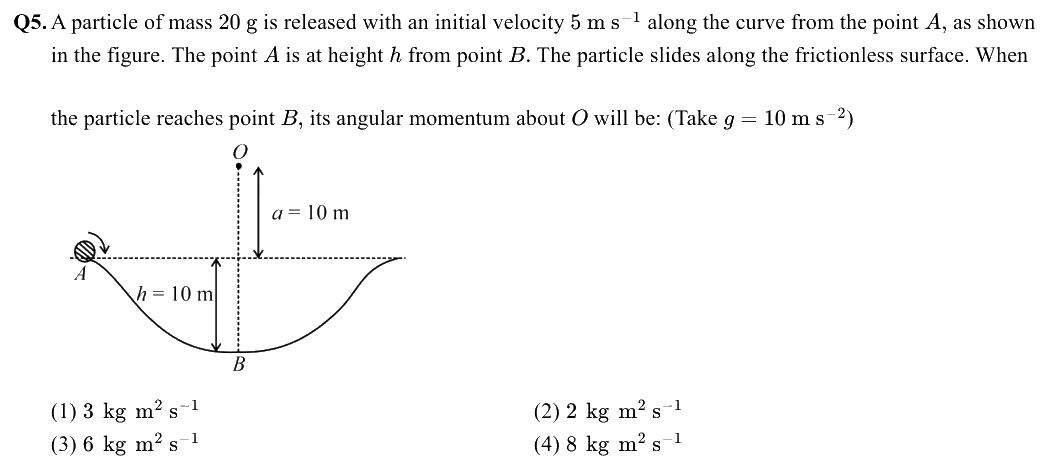
A particle of mass 20 g is released with an initial velocity 5 m s$^{-1}$ along the curve from the point $A$, as shown in the figure. The point $A$ is at height $h$ from point $B$. The particle slides along the frictionless surface. When the particle reaches point $B$, its angular momentum about $O$ will be: (Take $g = 10$ m s$^{-2}$)
(see the figure above)
- (1)
3 kg m$^2$ s$^{-1}$
- (2)
2 kg m$^2$ s$^{-1}$
- (3)
6 kg m$^2$ s$^{-1}$
- (4)
8 kg m$^2$ s$^{-1}$
Show answer
Option (3) is correct.
Key from source paper