Every Kinematics question from past JEE Main and AIEEE papers, with options and answers. Newest first.
339questions
184papers covered
5.9%of Physics questions, 2019–2026
2002–2026years
Guide at a glance
Kinematics forms the mechanical backbone of JEE Main Physics, appearing in the vast majority of test sessions. In the papers we hold from 2019 to 2026, the chapter yielded 268 questions in 162 papers, which corresponds to 1.7 questions per paper, and was present in 150 of those 162 papers.
A gas balloon is going up with a constant velocity of 10 m/s. When this balloon reached a height of 75 m, a stone is dropped from it and balloon keeps moving up with the same velocity. The height of the balloon when the stone hits the ground is ________ m. (Take $g = 10$ m/s$^2$)
Two identical bodies, projected with the same speed at two different angles cover the same horizontal range $R$. If the time of flight of these bodies are 5 s and 10 s, respectively, then the value of $R$ is ________ m. (Take $g = 10$ m/s$^2$)
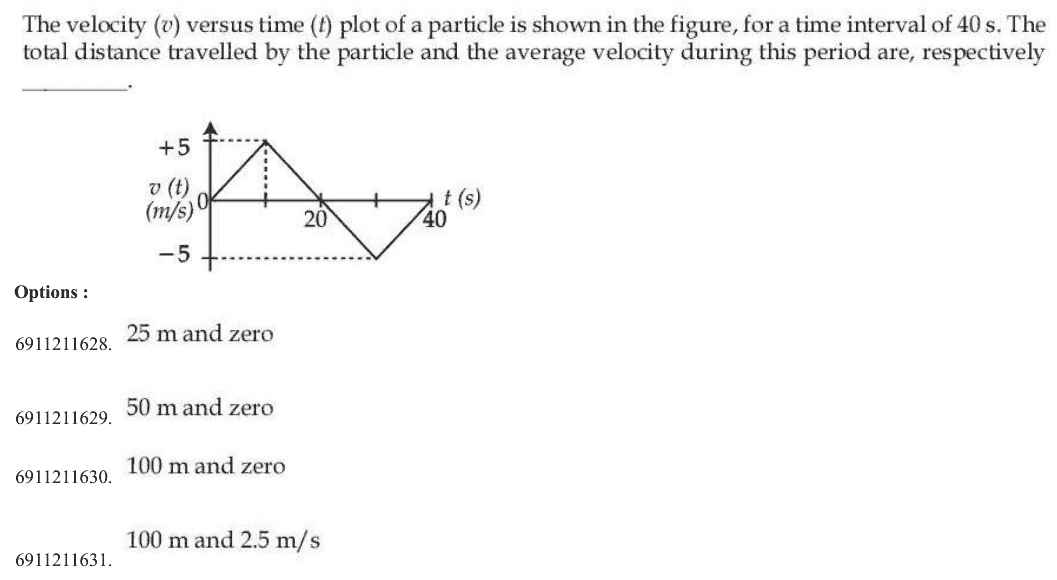
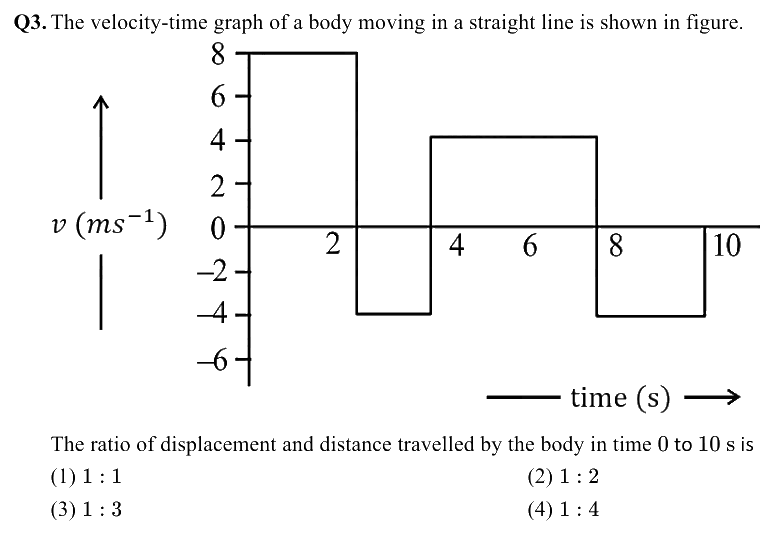
The velocity ($v$) versus time ($t$) plot of a particle is shown in the figure, for a time interval of 40 s. The total distance travelled by the particle and the average velocity during this period are, respectively ________.
The two projectiles are projected with the same initial velocities at the 15° and 30° with respect to the horizontal. The ratio of their ranges is $1{:}x$. The value of $x$ is
Two cars $A$ and $B$ are moving in the same direction along a straight line with speeds 100 km/h and 80 km/h, respectively such that car $A$ is moving ahead of car $B$. A person in car $B$ throws a stone with a speed $v$ so that it hits the car $A$ with a speed of 5 m/s. The value of $v$ is ________ km/h.
If $x$ and $y$ coordinates of a projectile as a function of time ($t$) are given as $24t$ and $43.6t - 4.9t^2$, respectively, then the angle (in degrees) made by the projectile with horizontal when $t = 2$ s is ________.
The velocity of a particle is given as $\vec{v} = -x\hat{i} + 2y\hat{j} - z\hat{k}$ m/s. The magnitude of acceleration at point (1, 2, 4) is ________ m/s$^2$.
A particle is rotating in a circular path and at any instant its motion can be described as $\theta = \frac{5t^4}{40} - \frac{t^3}{3}$. The angular acceleration of the particle after 10 seconds is ________ rad/s$^2$.
Water drops fall from a tap on the floor, 5 m below, at regular intervals of time, the first drop strikes the floor when the sixth drop begins to fall. The height at which the fourth drop will be from ground, at the instant when the first drop strikes the ground is ________ m.
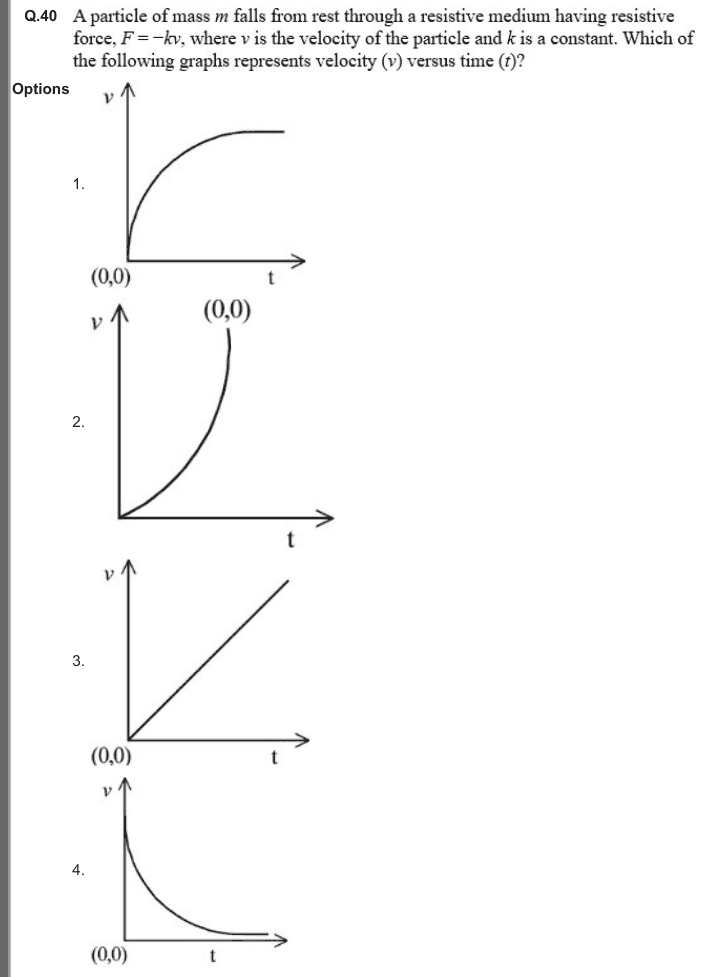
A particle of mass $m$ falls from rest through a resistive medium having resistive force, $F = -kv$, where $v$ is the velocity of the particle and $k$ is a constant. Which of the following graphs represents velocity ($v$) versus time ($t$)?
The question as printed in the paper.
A
see figure axes 'v' (vertical) and 't' (horizontal), '(0,0)' written below the origin; a curve rising steeply from the origin and flattening to a horizontal level at the right (it ends at about two-thirds of the height of the vertical axis).
B
see figure axes 'v' and 't', '(0,0)' written at the top of the figure above the curve; a curve starting at the bottom left at the origin, rising slowly at first and then more and more steeply, ending near the top of the figure; no flattening.
C
see figure axes 'v' and 't', '(0,0)' at the lower left; a straight line rising from the origin to the upper right.
D
see figure axes 'v' and 't', '(0,0)' at the lower left; a curve starting high on the vertical axis, falling steeply and then flattening, ending close to but above the t axis.
When the position vector $\vec{r} = x\hat{i} + y\hat{j} + z\hat{k}$ changes sign as $-\vec{r}$, which one of the following vector will not flip under sign change ?
A boy throws a ball into air at $45°$ from the horizontal to land it on a roof of a building of height $H$. If the ball attains maximum height in 2 s and lands on the building in 3 s after launch, then value of $H$ is ________ m.
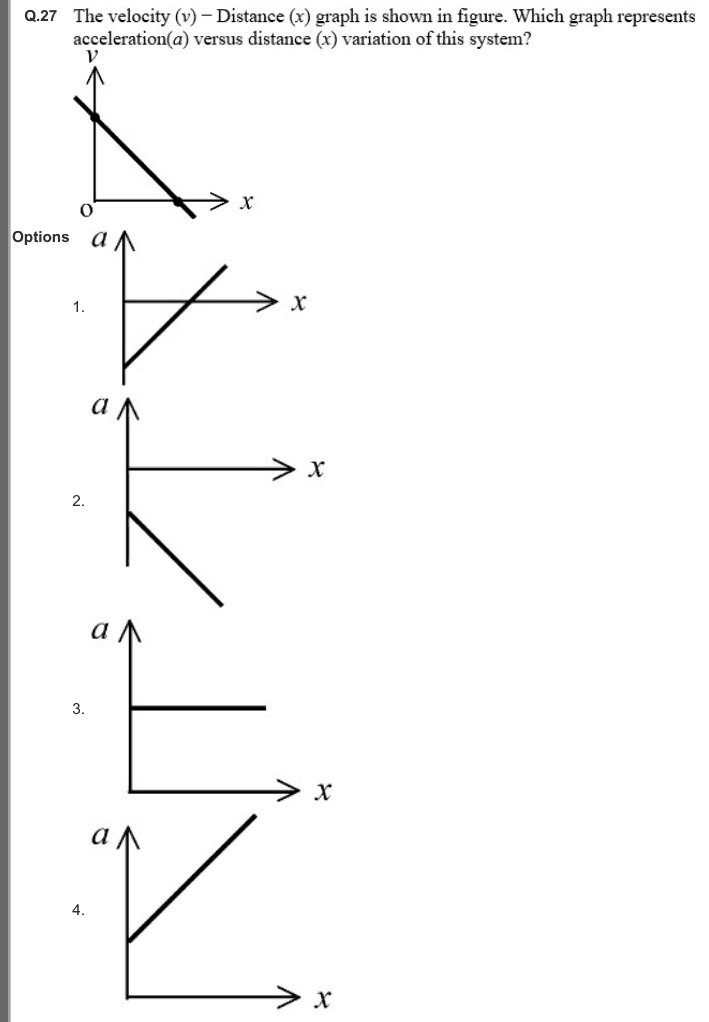
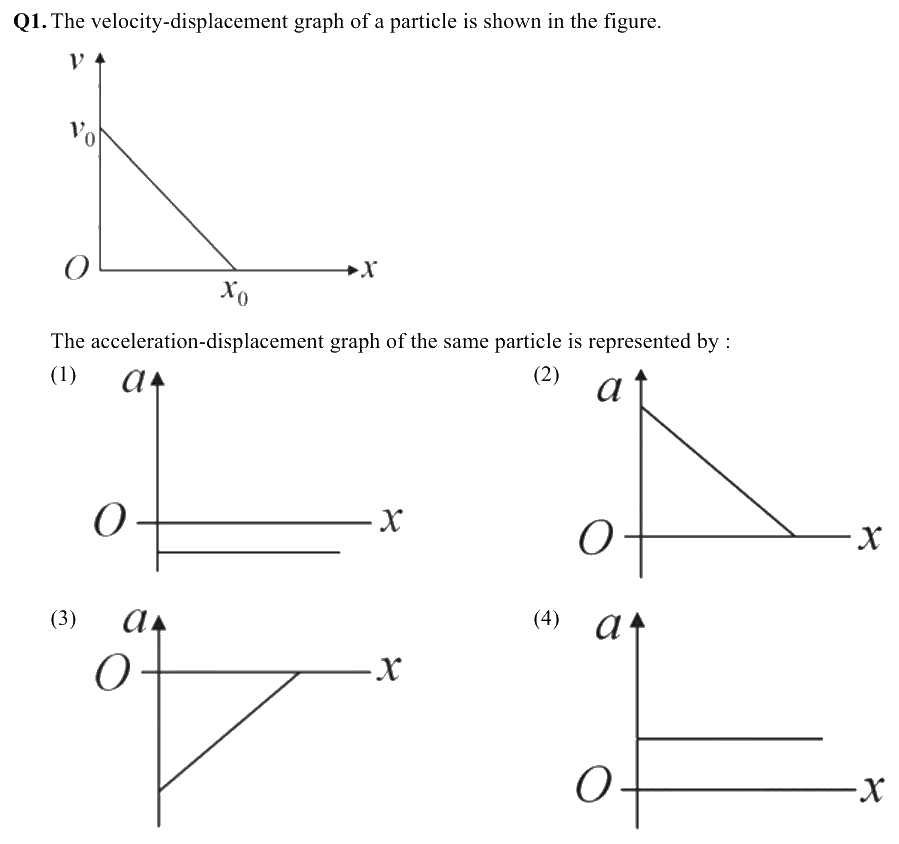
The velocity ($v$) $-$ Distance ($x$) graph is shown in figure. Which graph represents acceleration($a$) versus distance ($x$) variation of this system?
(see the figure above)
The question as printed in the paper.
A
see figure vertical axis 'a' and horizontal axis 'x', the x axis drawn across the upper part of the vertical axis; a straight line starting on the vertical axis well below the x axis and rising to the upper right, crossing the x axis about a third of the way along and ending above it.
B
see figure vertical axis 'a' and horizontal axis 'x', the x axis drawn near the top of the vertical axis; a straight line starting on the vertical axis below the x axis and falling to the lower right, staying below the x axis all the way.
C
see figure vertical axis 'a' and horizontal axis 'x', the x axis at the bottom; a horizontal straight line at constant height, about halfway up, starting at the vertical axis.
D
see figure vertical axis 'a' and horizontal axis 'x', the x axis at the bottom; a straight line starting on the vertical axis about a third of the way up and rising to the upper right, ending near the top.
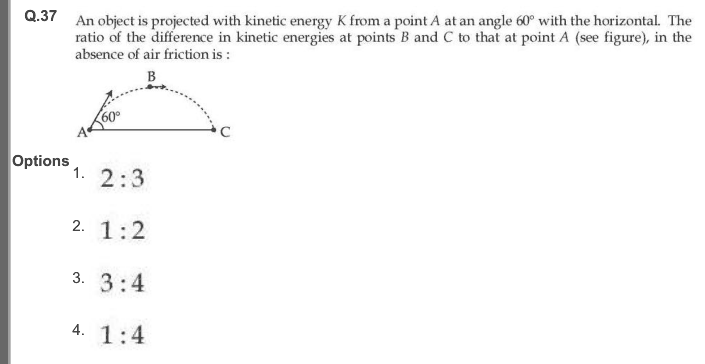
An object is projected with kinetic energy $K$ from a point $A$ at an angle $60°$ with the horizontal. The ratio of the difference in kinetic energies at points $B$ and $C$ to that at point $A$ (see figure), in the absence of air friction is :
A paratrooper jumps from an aeroplane and opens a parachute after 2 s of free fall and starts deaccelerating with 3 m/s$^2$. At 10 m height from ground, while descending with the help of parachute, the speed of paratrooper is 5 m/s. The initial height of the airplane is ________ m.
A projectile is thrown upward at an angle $60°$ with the horizontal. The speed of the projectile is 20 m/s when its direction of motion is $45°$ with the horizontal. The initial speed of the projectile is ________ m/s.
A river of width 200 m is flowing from west to east with a speed of 18 km/h. A boat, moving with speed of 36 km/h in still water, is made to travel one-round trip (bank to bank of the river). Minimum time taken by the boat for this journey and also the displacement along the river bank are ________ and ________ respectively.
Two balls with same mass and initial velocity, are projected at different angles in such a way that maximum height reached by first ball is 8 times higher than that of the second ball. $T_1$ and $T_2$ are the total flying times of first and second ball, respectively, then the ratio of $T_1$ and $T_2$ is
Two projectiles are fired from ground with same initial speeds from same point at angles $(45^\circ + \alpha)$ and $(45^\circ - \alpha)$ with horizontal direction. The ratio of their times of flights is
A helicopter flying horizontally with a speed of 360 km/h at an altitude of 2 km, drops an object at an instant. The object hits the ground at a point O, 20s after it is dropped. Displacement of 'O' from the position of helicopter where the object was released is : (use acceleration due to gravity $g = 10m/s^2$ and neglect air resistance)
If $L$ and $P$ represent the angular momentum and linear momentum respectively of a particle of mass 'm' having position vector as $\vec{r} = a(\hat{i}\cos\omega t + \hat{j}\sin\omega t)$. The direction of force is
A
Opposite to the direction of $\vec{r}$
B
Opposite to the direction of $\vec{P}$
C
Opposite to the direction of $\vec{L} \times \vec{P}$
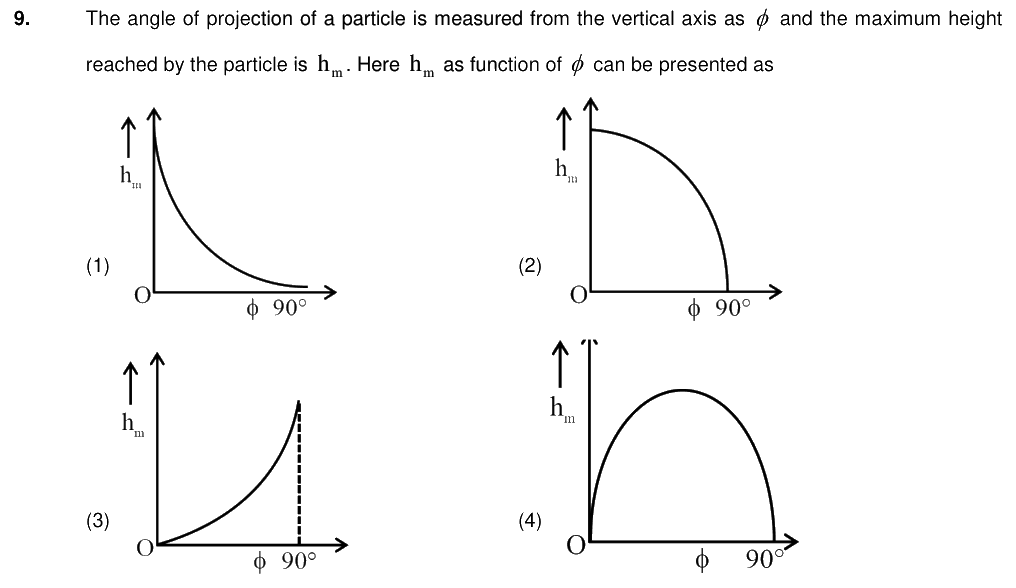
The angle of projection of a particle is measured from the vertical axis as $\phi$ and the maximum height reached by the particle is $h_m$. Here $h_m$ as function of $\phi$ can be presented as
The question as printed in the paper.
A
see figure axes 'hm' (vertical) and 'φ' (horizontal, marked 90°) from the origin O; a curve starting high on the vertical axis and falling steeply at first, then flattening out towards the horizontal axis near 90° (a falling convex curve ending close to the axis).
B
see figure same axes; a curve starting at a point on the vertical axis, nearly flat at first and then bending down to reach the horizontal axis at 90° (a quarter-circle-like arc, concave down, ending on the axis at 90°).
C
see figure same axes; a curve starting at the origin, rising slowly at first and then steeper, ending high at 90° where a dashed vertical line drops from its end to the axis (concave up).
D
see figure same axes; a curve starting at the origin, rising to a rounded maximum between O and 90° and falling back to the horizontal axis at 90° (a hump).
A particle is projected with velocity u so that its horizontal range is three times the maximum height attained by it. The horizontal range of the projectile is given as $\frac{mu^2}{25g}$, where value of n is: (Given, 'g' is the acceleration due to gravity.)
A river is flowing from west to east direction with speed of $9kmh^{-1}$. If a boat capable of moving at a maximum speed of $27kmh^{-1}$ in still water, crosses the river in half a minute, while moving with maximum speed at an angle of $150^\text{o}$ to direction of river flow, then the width of the river is :
Two projectiles are fired with same initial speed from same point on ground at angles of $(45^\circ - \alpha)$ and $(45^\circ + \alpha)$, respectively, with the horizontal direction. The ratio of their maximum heights attained is :
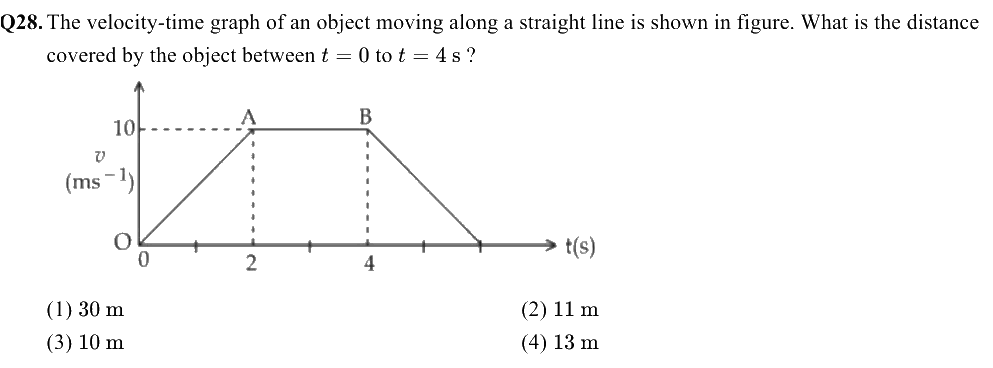
The velocity-time graph of an object moving along a straight line is shown in figure. What is the distance covered by the object between $t = 0$ to $t = 4$ s ?
The position vector of a moving body at any instant of time is given as $\vec{r} = \left(5t^2\hat{i} - 5t\hat{j}\right)$m. The magnitude and direction of velocity at $t = 2$ s is,
A
$5\sqrt{15}$ m/s, making an angle of $\tan^{-1}4$ with - ve Y axis
B
$5\sqrt{15}$ m/s, making an angle of $\tan^{-1}4$ with + ve X axis
C
$5\sqrt{17}$ m/s, making an angle of $\tan^{-1}4$ with + ve X axis
D
$5\sqrt{17}$ m/s, making an angle of $\tan^{-1}4$ with - ve Y axis
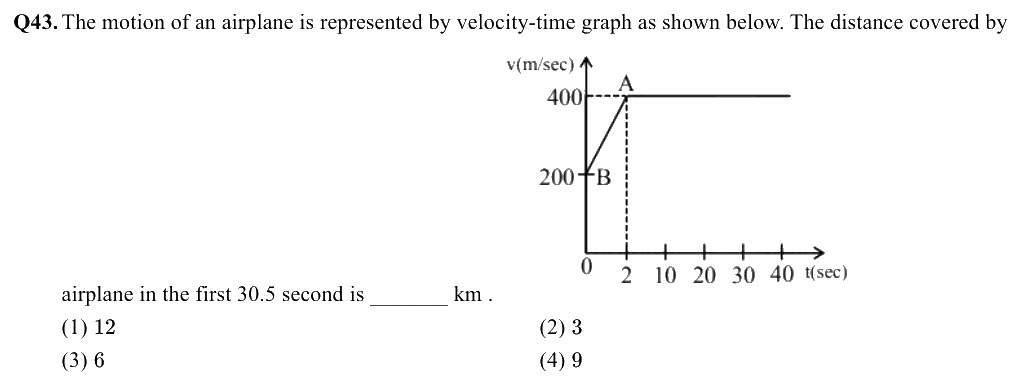
The motion of an airplane is represented by velocity-time graph as shown below. The distance covered by airplane in the first 30.5 second is ______ km .
A ball having kinetic energy KE, is projected at an angle of $60^\circ$ from the horizontal. What will be the kinetic energy of ball at the highest point of its flight ?
A ball of mass 100 g is projected with velocity 20 m/s at $60°$ with horizontal. The decrease in kinetic energy of the ball during the motion from point of projection to highest point is
A particle moving in a straight line covers half the distance with speed 6 m/s. The other half is covered in two equal time intervals with speeds 9 m/s and 15 m/s respectively. The average speed of the particle during the motion is :
Two cars are travelling towards each other at speed of 20 m s$^{-1}$ each. When the cars are 300 m apart, both the drivers apply brakes and the cars retard at the rate of 2 m s$^{-2}$. The distance between them when they come to rest is :
A clock has 75 cm, 60 cm long second hand and minute hand respectively. In 30 minutes duration the tip of second hand will travel $x$ distance more than the tip of minute hand. The value of $x$ in meter is nearly (Take $\pi = 3.14$ ) :
A train starting from rest first accelerates uniformly up to a speed of 80 km/h for time $t$, then it moves with a constant speed for time $3t$. The average speed of the train for this duration of journey will be (in km/h ) :
A body projected vertically upwards with a certain speed from the top of a tower reaches the ground in $t_1$. If it is projected vertically downwards from the same point with the same speed, it reaches the ground in $t_2$. Time required to reach the ground, if it is dropped from the top of the tower, is :
A man carrying a monkey on his shoulder does cycling smoothly on a circular track of radius 9 m and completes 120 resolutions in 3 minutes. The magnitude of centripetal acceleration of monkey is ( in m/s$^2$ ) :
A particle moving in a circle of radius $R$ with uniform speed takes time $T$ to complete one revolution. If this particle is projected with the same speed at an angle $\theta$ to the horizontal, the maximum height attained by it is equal to $4R$. The angle of projection $\theta$ is then given by :
Train A is moving along two parallel rail tracks towards north with 72 $\text{km h}^{-1}$ and train $B$ is moving towards south with speed 108 $\text{km h}^{-1}$. Velocity of train $B$ with respect to $A$ and velocity of ground with respect to $B$ are (in $\text{m s}^{-1}$):
The relation between time 't' and distance 'x' is $t = \alpha x^2 + \beta x$, where $\alpha$ and $\beta$ are constants. The relation between acceleration $a$ and velocity $v$ is:
Projectiles $A$ and $B$ are thrown at angles of $45^\circ$ and $60^\circ$ with vertical respectively from top of a 400 m high tower. If their times of flight are same, the ratio of their speeds of projection $v_A : v_B$ is:
A body starts moving from rest with constant acceleration covers displacement $S_1$ in first $(p - 1)$ seconds and $S_2$ in first $p$ seconds. The displacement $S_1 + S_2$ will be made in time :
A particle is moving in a straight line. The variation of position $x$ as a function of time $t$ is given as $x = (t^3 - 6t^2 + 20t + 15)$ m. The velocity of the body when its acceleration becomes zero is:
Position of an ant ( S in metres) moving in Y $-$ Z plane is given by $S = 2t^2\hat{j} + 5\hat{k}$ (where $t$ is in second). The magnitude and direction of velocity of the ant at t = 1 s will be :
A bullet is fired into a fixed target looses one third of its velocity after travelling 4 cm. It penetrates further $D \times 10^{-3}$ m before coming to rest. The value of $D$ is :
A vector in $x - y$ plane makes an angle of 30° with $y$-axis. The magnitude of $y$-component of vector is $2\sqrt{3}$. The magnitude of $x$-component of the vector will be :
The position of a particle related to time is given by $x = \left(5t^{2} - 4t + 5\right)$ m. The magnitude of velocity of the particle at $t$ = 2 s will be :
The position vector of a particle related to time $t$ is given by $\vec{r} = \left(10t\hat{i} + 15t^{2}\hat{j} + 7\hat{k}\right)$ m. The direction of net force experienced by the particle is :
Two trains $A$ and $B$ of length $l$ and $4l$ are travelling into a tunnel of length $L$ in parallel tracks from opposite directions with velocities 108 km h$^{-1}$ and 72 km h$^{-1}$, respectively. If train $A$ take 35 s less time than train $B$ to cross the tunnel then, length $L$ of tunnel is: (Given $L = 60\,l$)
A passenger sitting in a train A moving at 90 km h$^{-1}$ observes another train B moving in the opposite direction for 8 s. If the velocity of the train B is 54 km h$^{-1}$, then length of train B is:
A ball is thrown vertically upward with an initial velocity of $150\ \mathrm{m\ s^{-1}}$. The ratio of velocity after 3 s and 5 s is $\frac{x + 1}{x}$. The value of $x$ is ______. {take, $g = 10\ \mathrm{m\ s^{-2}}$}
When vector $\vec{A} = 2\hat{i} + 3\hat{j} + 2\hat{k}$ is subtracted from vector $\vec{B}$, it gives a vector equal to $2\hat{j}$. Then the magnitude of vector $\vec{B}$ will be:
A projectile is projected at $30^\circ$ from horizontal with initial velocity $40\ \mathrm{m\ s^{-1}}$. The velocity of the projectile at $t = 2$ s from the start will be:
A body of mass 500 g moves along $x$-axis such that it's velocity varies with displacement $x$ according to the relation $v = 10\sqrt{x}\ \mathrm{m\ s^{-1}}$ the force acting on the body is:
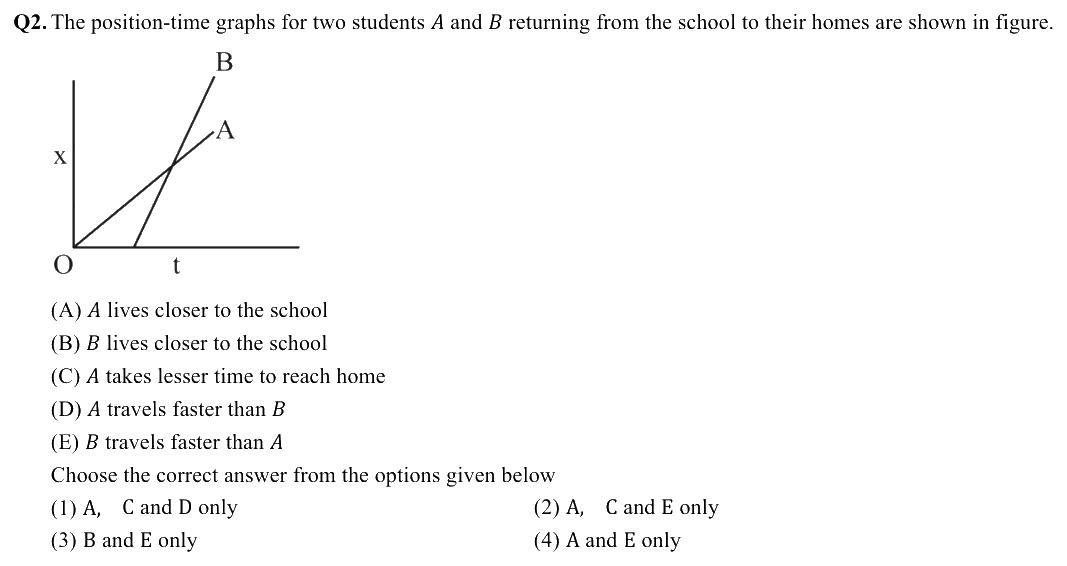
The position-time graphs for two students $A$ and $B$ returning from the school to their homes are shown in figure. (see the figure above) (A) $A$ lives closer to the school (B) $B$ lives closer to the school (C) $A$ takes lesser time to reach home (D) $A$ travels faster than $B$ (E) $B$ travels faster than $A$ Choose the correct answer from the options given below
The range of the projectile projected at an angle of $15^\circ$ with horizontal is 50 m. If the projectile is projected with same velocity at an angle of $45^\circ$ with horizontal, then its range will be
A person travels $x$ distance with velocity $v_1$ and then $x$ distance with velocity $v_2$ in the same direction. The average velocity of the person is $v$, then the relation between $v$, $v_1$ and $v_2$ will be
Two projectiles are projected at $30^\circ$ and $60^\circ$ with the horizontal with the same speed. The ratio of the maximum height attained by the two projectiles respectively is:
Two projectiles $A$ and $B$ are thrown with initial velocities of $40\ \mathrm{m\,s^{-1}}$ and $60\ \mathrm{m\,s^{-1}}$ at angles $30^\circ$ and $60^\circ$ with the horizontal respectively. The ratio of their ranges respectively is ($\mathrm{g} = 10\ \mathrm{m\,s^{-2}}$)
The trajectory of projectile, projected from the ground is given by $y = x - \frac{x^2}{20}$. Where $x$ and $y$ are measured in meter. The maximum height attained by the projectile will be.
A particle is moving with constant speed in a circular path. When the particle turns by an angle $90^\circ$, the ratio of instantaneous velocity to its average velocity is $\pi : x\sqrt{2}$. The value of $x$ will be
A particle starts with an initial velocity of $10.0\ \mathrm{ms^{-1}}$ along $x$-direction and accelerates uniformly at the rate of $2.0\ \mathrm{m\,s^{-2}}$. The time taken by the particle to reach the velocity of $60.0\ \mathrm{m\,s^{-1}}$ is ______ .
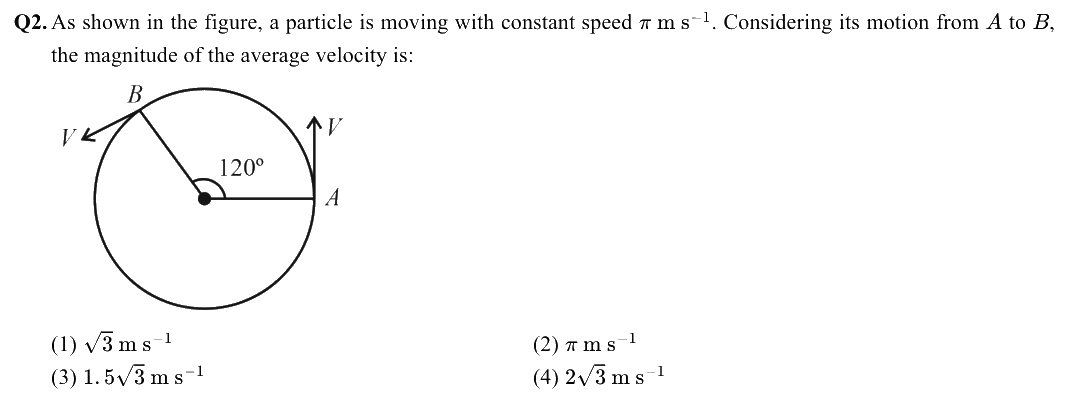
As shown in the figure, a particle is moving with constant speed $\pi\ \mathrm{m\,s^{-1}}$. Considering its motion from $A$ to $B$, the magnitude of the average velocity is:
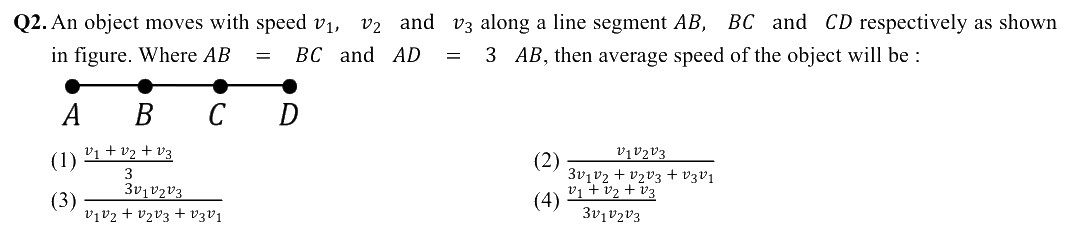
An object moves with speed $v_1$, $v_2$ and $v_3$ along a line segment $AB$, $BC$ and $CD$ respectively as shown in figure. Where $AB$ = $BC$ and $AD$ = 3 $AB$, then average speed of the object will be :
A child stands on the edge of the cliff 10 $\mathrm{m}$ above the ground and throws a stone horizontally with an initial speed of 5 $\mathrm{m\ s^{-1}}$. Neglecting the air resistance, the speed with which the stone hits the ground will be ______ $\mathrm{m\ s^{-1}}$ (given, $g$ = 10 $\mathrm{m\ s^{-2}}$ ).
The initial speed of a projectile fired from ground is $u$. At the highest point during its motion, the speed of projectile is $\dfrac{\sqrt{3}}{2}u$. The time of flight of the projectile is:
A body is moving with constant speed, in a circle of radius 10 m. The body completes one revolution in 4 s. At the end of 3$rd$ second, the displacement of body (in m) from its starting point is:
A stone is projected at angle $30^\circ$ to the horizontal. The ratio of kinetic energy of the stone at point of projection to its kinetic energy at the highest point of flight will be :
An object moves at a constant speed along a circular path in a horizontal plane with centre at the origin. When the object is at $x = +2$ m, its velocity is $-4\hat{\mathrm{j}}\ \mathrm{m\,s^{-1}}$. The object's velocity ($v$) and acceleration ($a$) at $x = -2$ m will be
Two objects are projected with same velocity $u$ however at different angles $\alpha$ and $\beta$ with the horizontal. If $\alpha+\beta=90^\circ$, the ratio of horizontal range of the first object to the $2^{\text{nd}}$ object will be :
If two vectors $\vec{P}=\hat{i}+2m\hat{j}+m\hat{k}$ and $\vec{Q}=4\hat{i}-2\hat{j}+m\hat{k}$ are perpendicular to each other. Then, the value of $m$ will be
A ball is thrown up vertically with a certain velocity so that, it reaches a maximum height $h$. Find the ratio of the times in which it is at height $\frac{h}{3}$ while going up and coming down respectively.
A ball is projected with kinetic energy $E$, at an angle of $60^\circ$ to the horizontal. The kinetic energy of this ball at the highest point of its flight will become :
A juggler throws balls vertically upwards with same initial velocity in air. When the first ball reaches its highest position, he throws the next ball. Assuming the juggler throws $n$ balls per second, the maximum height the balls can reach is
A ball is released from a height $h$. If $t_1$ and $t_2$ be the time required to complete first half and second half of the distance respectively. Then, choose the correct relation between $t_1$ and $t_2$.
A NCC parade is going at a uniform speed of $9\ \mathrm{km\ h^{-1}}$ under a mango tree on which a monkey is sitting at a height of $19.6\ \mathrm{m}$. At any particular instant, the monkey drops a mango. A cadet will receive the mango whose distance from the tree at time of drop is : (Given $g=9.8\ \mathrm{m\ s^{-2}}$)
At time $t=0$ a particle starts travelling from a height $7\hat{z}$ cm in a plane keeping $z$ coordinate constant. At any instant of time, it's position along the $x$ and $y$ directions are defined as $3t$ and $5t^{3}$ respectively. At $t=1\ \mathrm{s}$ acceleration of the particle will be
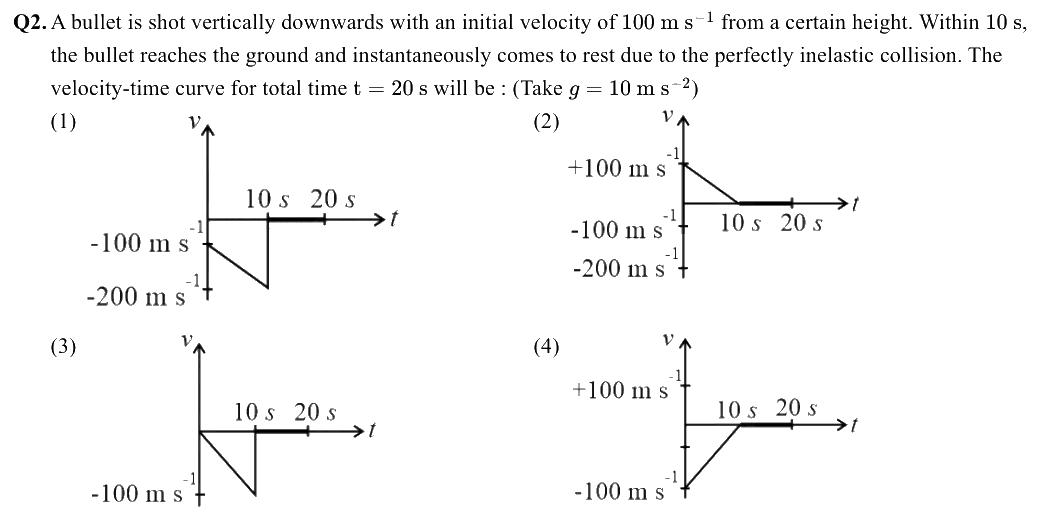
A bullet is shot vertically downwards with an initial velocity of 100 $\mathrm{m~s^{-1}}$ from a certain height. Within 10 s, the bullet reaches the ground and instantaneously comes to rest due to the perfectly inelastic collision. The velocity-time curve for total time t = 20 s will be : (Take $g$ = 10 $\mathrm{m~s^{-2}}$) (see the figure above)
The question as printed in the paper.
A
see figure v-t graph with the vertical axis labelled -100 and -200 m s^-1: a straight line slopes downward from -100 m s^-1 at t = 0 to -200 m s^-1 at t = 10 s, then a vertical jump to 0 at t = 10 s, then zero velocity along the axis to 20 s.
B
see figure v-t graph with the vertical axis labelled +100, -100 and -200 m s^-1: a straight line slopes downward from +100 m s^-1 at t = 0 to 0 at t = 10 s, then zero velocity along the axis to 20 s.
C
see figure v-t graph with the vertical axis labelled -100 m s^-1: a straight line slopes downward from 0 at t = 0 to -100 m s^-1 at t = 10 s, then a vertical jump to 0 at t = 10 s, then zero velocity along the axis to 20 s.
D
see figure v-t graph with the vertical axis labelled +100 and -100 m s^-1: a straight line slopes upward from -100 m s^-1 at t = 0 to 0 at t = 10 s, then zero velocity along the axis to 20 s.
The velocity of the bullet becomes one third after it penetrates 4 cm in a wooden block. Assuming that bullet is facing a constant resistance during its motion in the block. The bullet stops completely after travelling at $(4 + x)$ cm inside the block. The value of $x$ is
A body of mass 10 kg is projected at an angle of $45^\circ$ with the horizontal. The trajectory of the body is observed to pass through a point (20, 10). If $T$ is the time of flight, then its momentum vector, at time $t = \frac{T}{\sqrt{2}}$, is ______ . [Take $g = 10 \mathrm{~m~s^{-2}}$]
A
$100\hat{i} + \left(100\sqrt{2} - 200\right)\hat{j}$ N s
B
$100\sqrt{2}\hat{i} + \left(100 - 200\sqrt{2}\right)\hat{j}$ N s
C
$100\hat{i} + \left(100 - 200\sqrt{2}\right)\hat{j}$ N s
D
$100\sqrt{2}\hat{i} + \left(100\sqrt{2} - 200\right)\hat{j}$ N s
Two projectile thrown at $30^\circ$ and $45^\circ$ with the horizontal respectively, reach the maximum height in same time. The ratio of their initial velocities is
Two projectiles are thrown with same initial velocity making an angle of $45^\circ$ and $30^\circ$ with the horizontal respectively. The ratio of their respective ranges will be
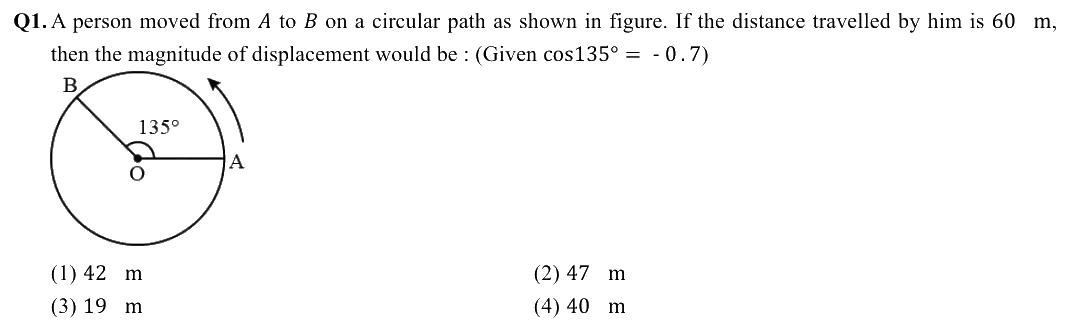
A person moved from $A$ to $B$ on a circular path as shown in figure. If the distance travelled by him is 60 m, then the magnitude of displacement would be : (Given $\cos135^\circ$ = - $0.7$)
A ball is projected from the ground with a speed $15\ \mathrm{m\,s^{-1}}$ at an angle $\theta$ with horizontal so that its range and maximum height are equal, then $\tan\theta$ will be equal to
Two vectors $\vec{A}$ and $\vec{B}$ have equal magnitudes. If magnitude of $\vec{A} + \vec{B}$ is equal to two times the magnitude of $\vec{A} - \vec{B}$, then the angle between $\vec{A}$ and $\vec{B}$ will be
Two balls $A$ and $B$ are placed at the top of $180\ \mathrm{m}$ tall tower. Ball $A$ is released from the top at $t = 0$ s. Ball $B$ is thrown vertically down with an initial velocity $u$ at $t = 2$ s. After a certain time, both balls meet $100\ \mathrm{m}$ above the ground. Find the value of $u$ in $\mathrm{m\,s^{-1}}$. [use $g = 10\ \mathrm{m\,s^{-2}}$]
A small toy starts moving from the position of rest under a constant acceleration. If it travels a distance of $10\ \mathrm{m}$ in $t$ s, the distance travelled by the toy in the next $t$ s will be:
A particle of mass $m$ is moving in a circular path of constant radius $r$ such that its centripetal acceleration $a_c$ is varying with time $t$ as $a_c = k^2 r t^2$ , where $k$ is a constant. The power delivered to the particle by the force acting on it is -
A ball is spun with angular acceleration $\alpha = 6t^{2} - 2t$ where $t$ is in second and $\alpha$ is in $\mathrm{rad\ s^{-2}}$. At $t = 0$, the ball has angular velocity of $10\ \mathrm{rad\ s^{-1}}$ and angular position of $4\ \mathrm{rad}$. The most appropriate expression for the angular position of the ball is
A projectile is launched at an angle $\alpha$ with the horizontal with a velocity $20\ \mathrm{m\ s^{-1}}$. After 10 s, its inclination with horizontal is $\beta$. The value of $\tan\beta$ will be : ($g = 10\ \mathrm{m\ s^{-2}}$).
A girl standing on road holds her umbrella at $45^{\circ}$ with the vertical to keep the rain away. If she starts running without umbrella with a speed of $15\sqrt{2}\ \mathrm{km\ h^{-1}}$, the rain drops hit her head vertically. The speed of rain drops with respect to the moving girl is
When a ball is dropped into a lake from a height $4.9\ \mathrm{m}$ above the water level, it hits the water with a velocity $v$ and then sinks to the bottom with the constant velocity $v$. It reaches the bottom of the lake $4.0\ \mathrm{s}$ after it is dropped. The approximate depth of the lake is
Two buses $P$ and $Q$ start from a point at the same time and move in a straight line and their positions are represented by $x_P t = \alpha t + \beta t^2$ and $x_Q t = ft - t^2$. At what time, both the buses have same velocity ?
Given below are two statements. One is labelled as Assertion A and the other is labelled as Reason R. Assertion A: Two identical balls $A$ and $B$ thrown with same velocity 'u' at two different angles with horizontal attained the same range $R$. If A and B reached the maximum height $h_1$ and $h_2$ respectively, then $R = 4\sqrt{h_1 h_2}$ Reason R: Product of said heights. $h_1 h_2 = \frac{u^2 \sin^2\theta}{2g} \cdot \frac{u^2 \cos^2\theta}{2g}$
A
Both A and R are true and R is the correct explanation of A.
B
Both A and R are true but R is NOT the correct explanation of A.
For a particle in uniform circular motion, the acceleration $\vec{a}$ at any point $PR, \theta$ on the circular path of radius $R$ is (when $\theta$ is measured from the positive $x$-axis and $v$ is uniform speed):
A projectile is projected with velocity of $25 \mathrm{~m~s^{-1}}$ at an angle $\theta$ with the horizontal. After $t$ seconds its inclination with horizontal becomes zero. If $R$ represents horizontal range of the projectile, the value of $\theta$ will be : [use use $\mathrm{g} = 10 \mathrm{~m~s^{-2}}$]
An object of mass $5 \mathrm{~kg}$ is thrown vertically upwards from the ground. The air resistance produces a constant retarding force of $10 \mathrm{~N}$ throughout the motion. The ratio of time of ascent to the time of descent will be equal to : [Use $g = 10 \mathrm{~m~s^{-2}}$].
The ranges and heights for two projectiles projected with the same initial velocity at angles $42^\circ$ and $48^\circ$ with the horizontal are $R_1$, $R_2$ and $H_1$, $H_2$ respectively. Choose the correct option:
A helicopter is flying horizontally with a speed $v$ at an altitude $h$ has to drop a food packet for a man on the ground. What is the distance of helicopter from the man when the food packet is dropped ?
Statement I: If three forces $\vec{F_1}$, $\vec{F_2}$ and $\vec{F_3}$ are represented by three sides of a triangle and $\vec{F_1} + \vec{F_2} = -\vec{F_3}$, then these three forces are concurrent forces and satisfy the condition for equilibrium. Statement II: A triangle made up of three forces $\vec{F_1}$, $\vec{F_2}$ and $\vec{F_3}$ as its sides were taken in the same order, satisfies the condition for translatory equilibrium. In the light of the above statements, choose the most appropriate answer from the options given below:
Statement-I : Two forces $\vec{P} + \vec{Q}$ and $\vec{P} - \vec{Q}$ where $\vec{P} \perp \vec{Q}$, when act at an angle $\theta_1$ to each other, the magnitude of their resultant is $\sqrt{3\left(P^2 + Q^2\right)}$, when they act at an angle $\theta_2$, the magnitude of their resultant becomes $\sqrt{2\left(P^2 + Q^2\right)}$. This is possible only when $\theta_1 < \theta_2$. Statement-II : In the situation given above. $\theta_1 = 60^\circ$ and $\theta_2 = 90^\circ$ In the light of the above statement, choose the most appropriate answer from the options given below :
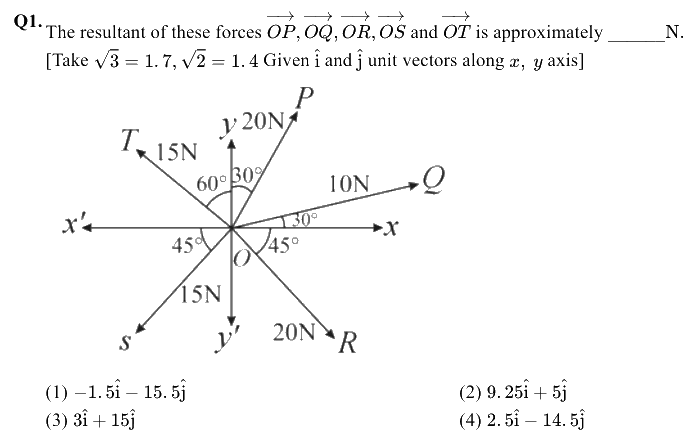
The resultant of these forces $\overrightarrow{OP}, \overrightarrow{OQ}, \overrightarrow{OR}, \overrightarrow{OS}$ and $\overrightarrow{OT}$ is approximately ______N. [Take $\sqrt{3} = 1.7$, $\sqrt{2} = 1.4$ Given $\hat{i}$ and $\hat{j}$ unit vectors along $x$, $y$ axis] (see the figure above)
Water drops are falling from a nozzle of a shower onto the floor from a height of $9.8\ \mathrm{m}$. The drops fall at a regular interval of time. When the first drop strikes the floor, at that instant, the third drop begins to fall. Locate the position of second drop from the floor when the first drop strikes the floor.
A player kicks a football with an initial speed of $25\ \mathrm{m\ s^{-1}}$ at an angle of $45^\circ$ from the ground. What are the maximum height and the time taken by the football to reach at the highest point during motion? (Take $\mathrm{g}=10\ \mathrm{m\ s^{-2}}$)
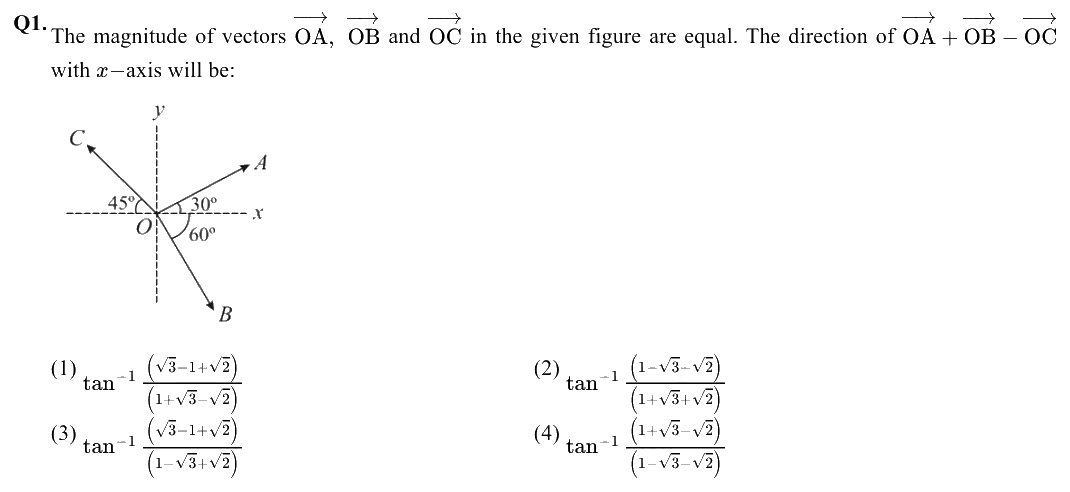
The magnitude of vectors $\overrightarrow{OA}$, $\overrightarrow{OB}$ and $\overrightarrow{OC}$ in the given figure are equal. The direction of $\overrightarrow{OA}+\overrightarrow{OB}-\overrightarrow{OC}$ with $x-$axis will be: (see the figure above)
A ball is thrown up with a certain velocity so that it reaches a height $h$. Find the ratio of the two different times of the ball reaching $\frac{h}{3}$ in both the directions.
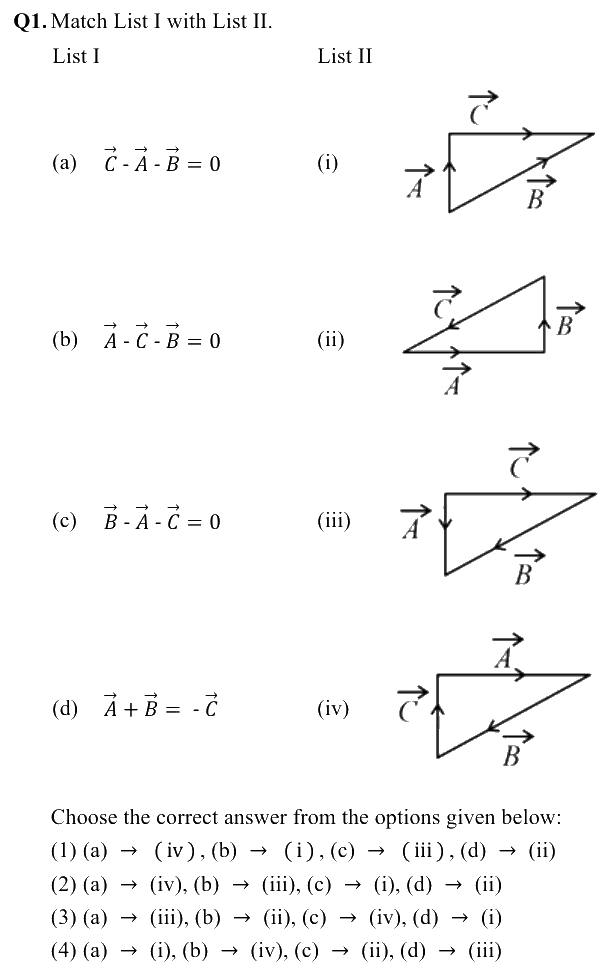
Match List I with List II. List I: (a) $\vec{C} - \vec{A} - \vec{B} = 0$; (b) $\vec{A} - \vec{C} - \vec{B} = 0$; (c) $\vec{B} - \vec{A} - \vec{C} = 0$; (d) $\vec{A} + \vec{B} = -\vec{C}$ List II: (i) (see the figure above); (ii) (see the figure above); (iii) (see the figure above); (iv) (see the figure above) Choose the correct answer from the options given below:
Water droplets are coming from an open tap at a particular rate. The spacing between a droplet observed at $4^{\mathrm{th}}$ second after its fall to the next droplet is $34.3\ \mathrm{m}$. At what rate the droplets are coming from the tap ? (Take $g = 9.8\ \mathrm{m\ s^{-2}}$)
Two vectors $\vec{X}$ and $\vec{Y}$ have equal magnitude. The magnitude of $\left(\vec{X} - \vec{Y}\right)$ is $n$ times the magnitude of $\left(\vec{X} + \vec{Y}\right)$. The angle between $\vec{X}$ and $\vec{Y}$ is :
The relation between time $t$ and distance $x$ for a moving body is given as $t = mx^2 + nx$, where $m$ and $n$ are constants. The retardation of the motion is: (When $v$ stands for velocity)
A balloon was moving upwards with a uniform velocity of $10\ \mathrm{m\ s^{-1}}$. An object of finite mass is dropped from the balloon when it was at a height of $75\ \mathrm{m}$ from the ground level. The height of the balloon from the ground when object strikes the ground was around: (takes the value of g as $10\ \mathrm{m\ s^{-2}}$)
The instantaneous velocity of a particle moving in a straight line is given as $v = \alpha t + \beta t^2$, where $\alpha$ and $\beta$ are constants. The distance travelled by the particle between $1\ \mathrm{s}$ and $2\ \mathrm{s}$ is:
If $\vec{A}$ and $\vec{B}$ are two vectors satisfying the relation $\vec{A} \cdot \vec{B} = \left|\vec{A} \times \vec{B}\right|$. Then the value of $\left|\vec{A} - \vec{B}\right|$ will be:
A butterfly is flying with a velocity $4\sqrt{2}\ \mathrm{m\ s^{-1}}$ in north-east direction. Wind is slowly blowing at $1\ \mathrm{m\ s^{-1}}$ from north to south. The resultant displacement of the butterfly in 3 seconds is:
Two vectors $\overrightarrow{P}$ and $\overrightarrow{Q}$ have equal magnitudes. If the magnitude of $\overrightarrow{P} + \overrightarrow{Q}$ is $n$ times the magnitude of $\overrightarrow{P} - \overrightarrow{Q}$, then angle between $\overrightarrow{P}$ and $\overrightarrow{Q}$ is
A boy reaches the airport and finds that the escalator is not working. He walks up the stationary escalator in time $t_1$. If he remains stationary on a moving escalator then the escalator takes him in time $t_2$. The time taken by him to walk up on the moving escalator will be:
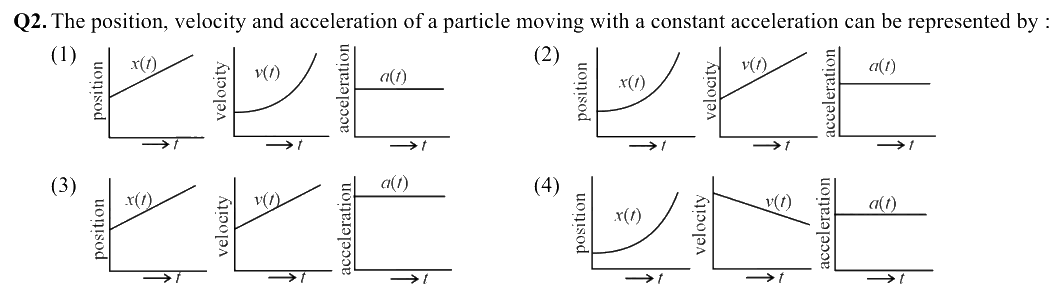
The position, velocity and acceleration of a particle moving with a constant acceleration can be represented by :
The question as printed in the paper.
A
see figure Three small graphs against t: position x(t) a straight rising line with a positive intercept; velocity v(t) a curve rising upward (convex, increasing slope) from a positive intercept; acceleration a(t) a horizontal line above the axis.
B
see figure Three small graphs against t: position x(t) a curve rising upward (convex, increasing slope) from a positive intercept; velocity v(t) a straight rising line from a positive intercept; acceleration a(t) a horizontal line above the axis.
C
see figure Three small graphs against t: position x(t) a straight rising line with a positive intercept; velocity v(t) a straight rising line with a positive intercept; acceleration a(t) a horizontal line above the axis.
D
see figure Three small graphs against t: position x(t) a curve rising upward (convex, increasing slope) starting flat from a positive value; velocity v(t) a straight falling line; acceleration a(t) a horizontal line above the axis.
The velocity-displacement graph of a particle is shown in the figure. (see the figure above) The acceleration-displacement graph of the same particle is represented by :
The question as printed in the paper.
A
see figure a-x axes with origin O; a single horizontal straight line drawn below the x-axis (constant negative a), starting slightly right of the a-axis and running to about the same length as the axis.
B
see figure a-x axes with origin O; a straight line starting at a positive value of a on the a-axis and falling linearly to meet the x-axis at a point on the right.
C
see figure a-x axes with origin O; a straight line starting at a negative value of a on the a-axis (below the x-axis) and rising linearly to meet the x-axis at a point on the right.
D
see figure a-x axes with origin O; a single horizontal straight line drawn above the x-axis (constant positive a), starting slightly right of the a-axis and ending before the right end of the axis.
A car accelerates from rest at a constant rate $\alpha$ for some time after which it decelerates at a constant rate $\beta$ to come to rest. If the total time elapsed is t seconds, the total distance travelled is:
The velocity of a particle is $v=\left(v_0+g t+F t^2\right) \mathrm{m} \mathrm{s}^{-1}$. Its position is $x=0$ at $t=0$ ; then its displacement after time $(t=1 \mathrm{~s})$ is :
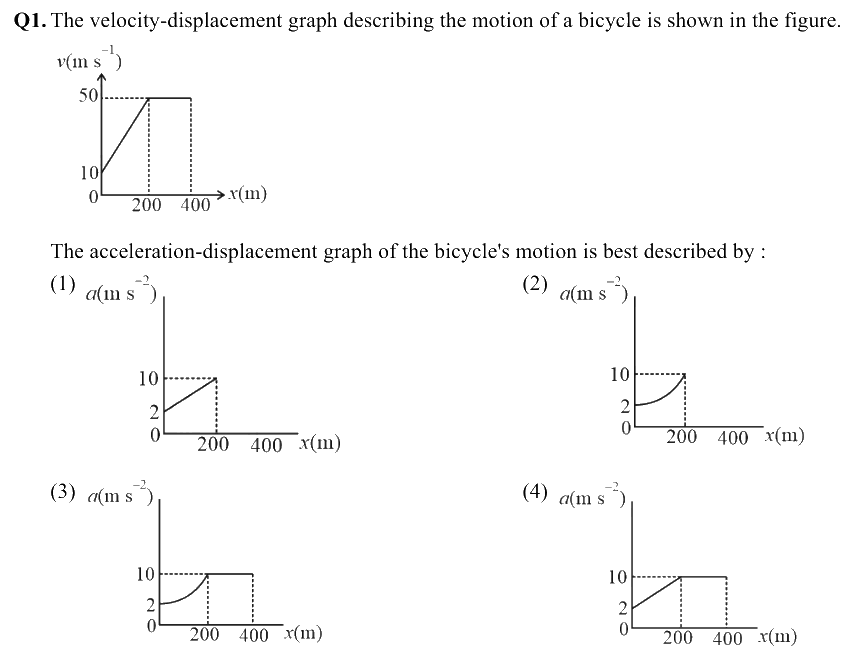
The velocity-displacement graph describing the motion of a bicycle is shown in the figure. (see the figure above) The acceleration-displacement graph of the bicycle's motion is best described by :
The question as printed in the paper.
A
see figure a-x graph: straight line rising from a = 2 at x = 0 to a = 10 at x = 200 (dotted guides to 10 and 200); beyond x = 200 the graph lies on the x-axis (a = 0); x-axis marked 200 and 400
B
see figure a-x graph: curve rising from a = 2 at x = 0 to a = 10 at x = 200, bending upward (concave up, steeper at the end); beyond x = 200 the graph lies on the x-axis (a = 0); x-axis marked 200 and 400
C
see figure a-x graph: curve rising from a = 2 at x = 0 to a = 10 at x = 200, bending upward (concave up), then a horizontal line at a = 10 from x = 200 to x = 400 (dotted guides at 200 and 400)
D
see figure a-x graph: straight line rising from a = 2 at x = 0 to a = 10 at x = 200, then a horizontal line at a = 10 from x = 200 to x = 400 (dotted guides at 200 and 400)
A mosquito is moving with a velocity $\vec{v} = 0.5t^2\hat{i} + 3t\hat{j} + 9\hat{k}\ \mathrm{m\,s^{-1}}$ and accelerating in uniform conditions. What will be the direction of mosquitoes after $2\ \mathrm{s}$ ?
A
$\tan^{-1}\left(\frac{2}{3}\right)$ from $x$-axis
B
$\tan^{-1}\left(\frac{\sqrt{85}}{6}\right)$ from $y$-axis
A scooter accelerates from rest for time $t_1$ at constant rate $a_1$ and then retards at constant rate $a_2$ for time $t_2$ and comes to rest. The correct value of $\frac{t_1}{t_2}$ will be :
The trajectory of a projectile in a vertical plane is $y = \alpha x - \beta x^2$, where $\alpha$ and $\beta$ are constants and $x$ & $y$ are respectively the horizontal and vertical distances of the projectile from the point of projection. The angle of projection $\theta$ and the maximum height attained $H$ are respectively given by
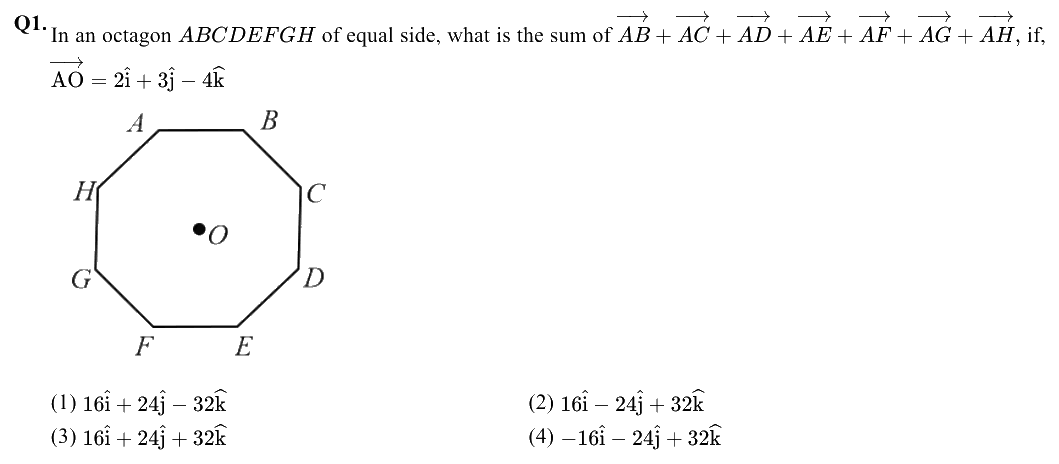
In an octagon $ABCDEFGH$ of equal side, what is the sum of $\overrightarrow{AB} + \overrightarrow{AC} + \overrightarrow{AD} + \overrightarrow{AE} + \overrightarrow{AF} + \overrightarrow{AG} + \overrightarrow{AH}$, if, $\overrightarrow{AO} = 2\hat{i} + 3\hat{j} - 4\hat{k}$ (see the figure above)
An engine of a train, moving with uniform acceleration, passes the signal-post with velocity $u$ and the last compartment with velocity $v$. The velocity with which middle point of the train passes the signal post is :
A stone is dropped from the top of a building. When it crosses a point $5\ \mathrm{m}$ below the top, another stone starts to fall from a point $25\ \mathrm{m}$ below the top. Both stones reach the bottom of building simultaneously. The height of the building is :
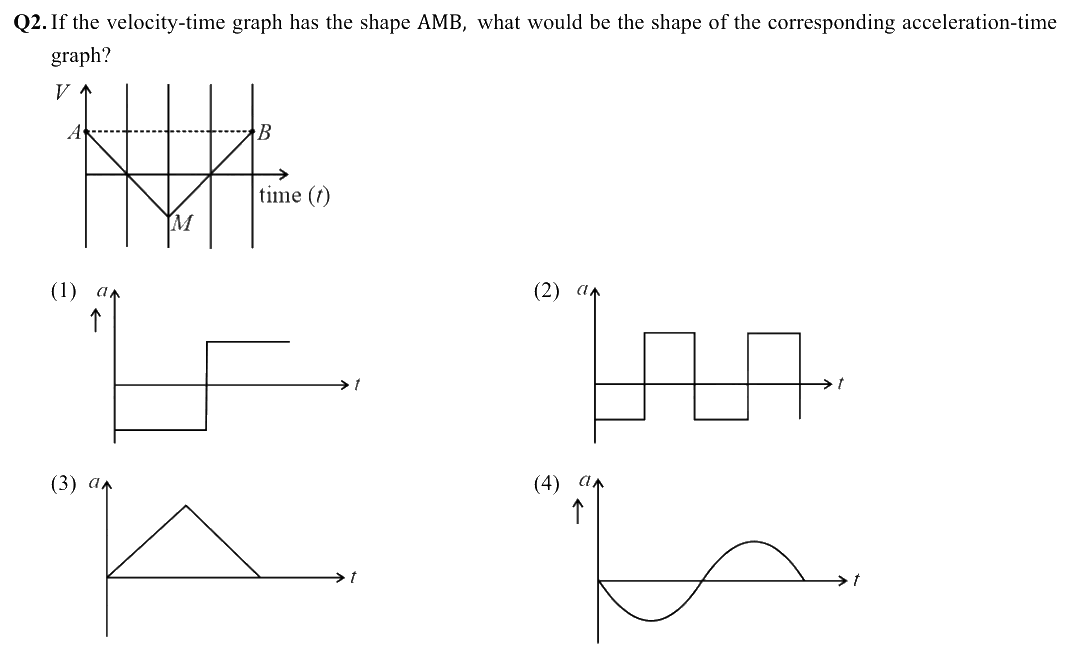
If the velocity-time graph has the shape AMB, what would be the shape of the corresponding acceleration-time graph? (see the figure above)
The question as printed in the paper.
A
see figure a-t graph: a constant negative value for the first part, then a jump to a constant positive value for the rest (a step from below the t-axis to above it)
B
see figure a-t graph: a square wave alternating between a negative level and a positive level, two negative and two positive segments of equal width, starting negative
C
see figure a-t graph: a triangular pulse above the t-axis, rising linearly from the origin to a peak and falling linearly back to the axis
D
see figure a-t graph: a sine-like curve starting at the origin, going below the t-axis first (one trough) and then above it (one crest)
A particle is projected with velocity $v_0$ along $x$-axis. A damping force is acting on the particle which is proportional to the square of the distance from the origin i.e. $ma = -\alpha x^2$. The distance at which the particle stops:
A clock has a continuously moving second's hand of $0.1\mathrm{m}$ length. The average acceleration of the tip of the hand (in units of $\mathrm{ms^{-2}}$ ]) is of the order of :
When a car is at rest, its driver sees rain drops falling on it vertically. When driving the car with speed v, he sees that rain drops coming at an angle $60^\circ$ from the horizontal. On further increasing the speed of the car to $(1 + \beta)v$, this angle changes to $45^\circ$. The value of $\beta$ is close to :
A helicopter rises from rest on the ground vertically upwards with a constant acceleration g. A food packet is dropped from the helicopter when it is at a height h. The time taken by the packet to reach the ground is close to [g is the acceleration due to gravity]:
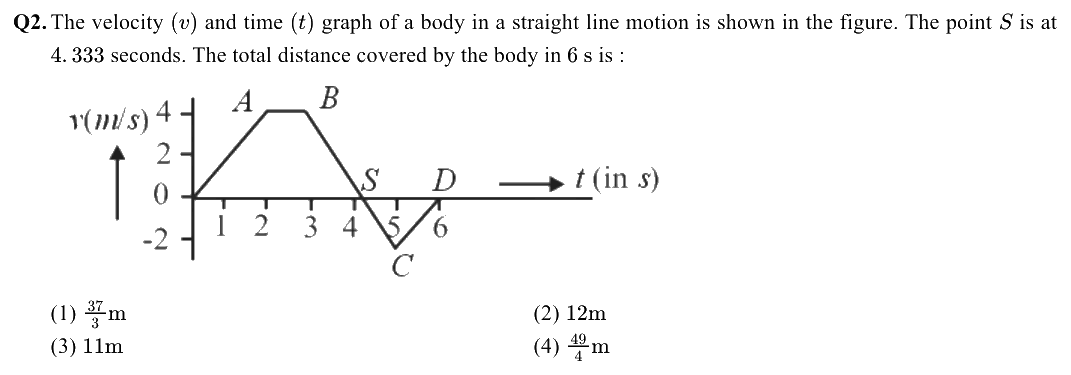
The velocity ($v$) and time ($t$) graph of a body in a straight line motion is shown in the figure. The point $S$ is at 4. 333 seconds. The total distance covered by the body in 6 s is : (see the figure above)
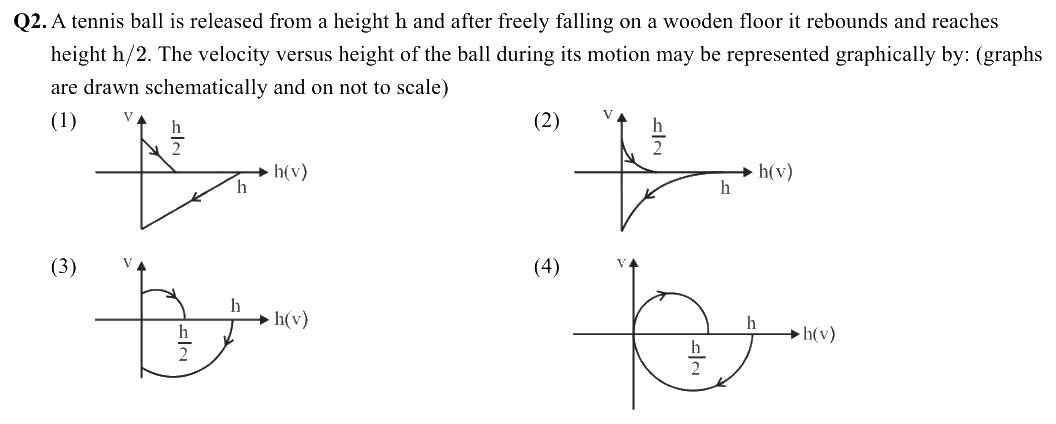
A tennis ball is released from a height h and after freely falling on a wooden floor it rebounds and reaches height h/2. The velocity versus height of the ball during its motion may be represented graphically by: (graphs are drawn schematically and on not to scale)
The question as printed in the paper.
A
see figure v versus h(v) graph, two straight pieces
B
see figure v versus h(v) graph, two curved pieces
C
see figure v versus h(v) graph, two circular arcs
D
see figure v versus h(v) graph, one large looped curve
Starting from the origin at time $\mathrm{t} = 0$, with initial velocity $5\ \hat{j}\ \mathrm{ms^{-1}}$, a particle moves in the $x$ -$y$ plane with a constant acceleration of $\left(10\hat{i} + 4\hat{j}\right)\mathrm{ms^{-2}}$. At time t, its coordinates are $(20\ \mathrm{m}, \mathrm{y_{0}}\ \mathrm{m})$. The values of t and $\mathrm{y_{0}}$ are, respectively:
A small ball of mass $m$ is thrown upward with velocity $u$ from the ground. The ball experiences a resistive force $mkv^{2}$ where $v$ is it speed. The maximum height attained by the ball is :
Train A and train B are running on parallel tracks in the opposite directions with speed of $36\ \mathrm{km\ hour}^{-1}$ and $72\ \mathrm{km\ hour}^{-1}$, respectively. A person is walking in train A in the direction opposite to its motion with a speed of $1.8\ \mathrm{km\ hour}^{-1}$. Speed (in $\mathrm{m\ s}^{-1}$) of this person as observed from train B will be close to: (take the distance between the tracks as negligible)
A particle starts from the origin at $t = 0$ with an initial velocity of $3.0\hat{i}\,\mathrm{m/s}$ and moves in the $x - y$ plane with a constant acceleration $\left(6.0\hat{i} + 4.0\hat{j}\right)\mathrm{m/s^2}$. The $x-$ coordinate of the particle at the instant when its $y-$ coordinate is $32 m$ is $D$ meters. The value of $D$ is:
A particle of mass m is projected with a speed u from the ground at an angle $\theta = \frac{\pi}{3}$ w.r.t. horizontal (x-axis). When it has reached its maximum height, it collides completely inelastically with another particle of the same mass and velocity $u\hat{i}$. The horizontal distance covered by the combined mass before reaching the ground is:
A particle moves such that its position vector $\vec{r}(t) = \cos \omega t\,\hat{i} + \sin \omega t\,\hat{j}$ where $\omega$ is a constant and $t$ is time. Then which of the following statements is true for the velocity $\vec{v}(t)$ and acceleration $\vec{a}(t)$ of the particle:
A
$\vec{v}$ is perpendicular to $\vec{r}$ and $\vec{a}$ is directed away from the origin
B
$\vec{v}$ and $\vec{a}$ both are perpendicular to $\vec{r}$
C
$\vec{v}$ and $\vec{a}$ both are parallel to $\vec{r}$
D
$\vec{v}$ is perpendicular to $\vec{r}$ and $\vec{a}$ is directed towards the origin
A particle of mass $m$ is dropped from a height $h$ above the ground. At the same time another particle of the same mass is thrown vertically upwards from the ground with a speed of $\sqrt{2gh}$. If they collide head-on completely inelastically, the time taken for the combined mass to reach the ground, in units of $\sqrt{\frac{h}{g}}$ is:
The trajectory of a projectile near the surface of the earth is given as $y = 2x - 9x^2$ . If it were launched at an angle $\theta_0$ with speed $v_0$ then $\mathrm{g = 10\ m\ s^{-2}}$:
A
$\theta_0 = \cos^{-1}\frac{1}{\sqrt{5}}$ and $v_0 = \frac{5}{3}\ \mathrm{ms^{-1}}$
B
$\theta_0 = \cos^{-1}\frac{2}{\sqrt{5}}$ and $v_0 = \frac{3}{5}\ \mathrm{ms^{-1}}$
C
$\theta_0 = \sin^{-1}\frac{1}{\sqrt{5}}$ and $v_0 = \frac{5}{3}\ \mathrm{ms^{-1}}$
D
$\theta_0 = \sin^{-1}\frac{2}{\sqrt{5}}$ and $v_0 = \frac{3}{5}\ \mathrm{ms^{-1}}$
A shell is fired from a fixed artillery gun with an initial speed u such that it hits the target on the ground at a distance R from it. If $\mathrm{t_1}$ and $\mathrm{t_2}$ are the values of the time taken by it to hit the target in two possible ways, the product $\mathrm{t_1t_2}$ is:
A particle is moving with speed $v = b\sqrt{x}$ along positive $x-$ axis. Calculate the speed of the particle at time $t = \tau$ (assume that the particle is at origin at $t = 0$ )
Two particles are projected from the same point with the same speed u such that they have the same range R, but different maximum heights, $\mathrm{h_1}$ and $\mathrm{h_2}$. Which of the following is correct?
A ball is thrown upward with an initial velocity $V_0$ from the surface of the earth. The motion of the ball is affected by a drag force equal to $m\gamma v^{2}$ (where m is mass of the ball, $v$ is its instantaneous velocity and $\gamma$ is a constant). Time taken by the ball to rise to its zenith is:
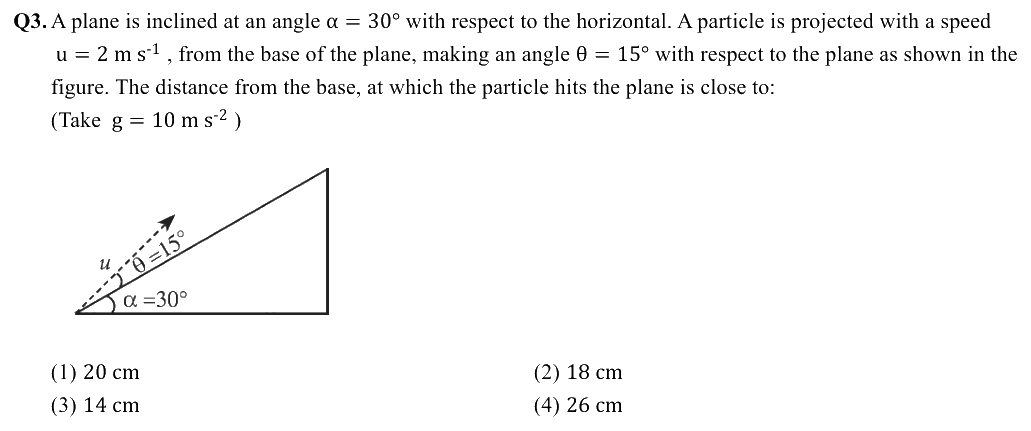
A plane is inclined at an angle $\alpha = 30^\circ$ with respect to the horizontal. A particle is projected with a speed $u = 2\ \mathrm{m\,s^{-1}}$, from the base of the plane, making an angle $\theta = 15^\circ$ with respect to the plane as shown in the figure. The distance from the base, at which the particle hits the plane, is close to: (Take $g = 10\ \mathrm{m\,s^{-2}}$)
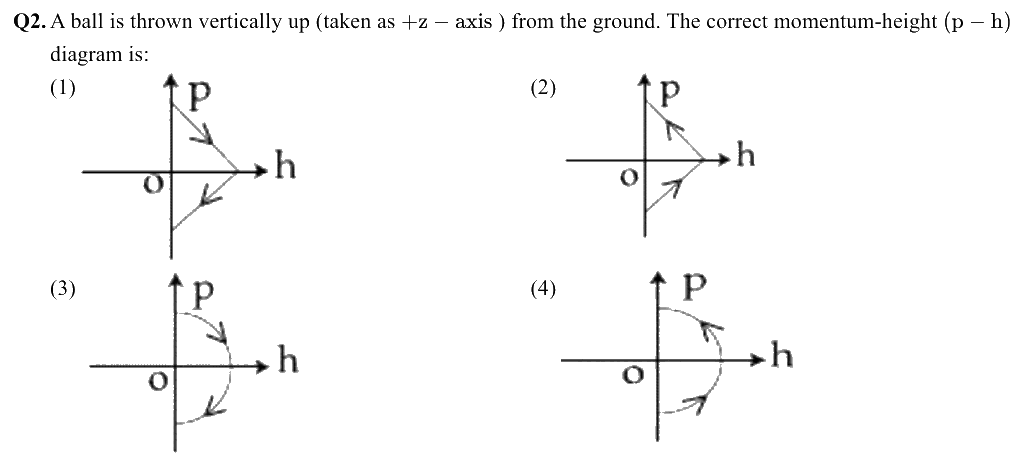
A ball is thrown vertically up (taken as $+z - $axis ) from the ground. The correct momentum-height ($\mathrm{p - h}$) diagram is:
The question as printed in the paper.
A
see figure p (vertical) against h (horizontal), origin O: two straight lines forming a "<"-shaped (V on its side) figure with the vertex on the positive h axis; the upper line runs from the top of the p axis down to the vertex with its arrow pointing down towards the vertex, the lower line runs from the vertex down-left to the negative p axis with its arrow pointing away from the vertex.
B
see figure p against h: the same two-line shape as option 1 but with the arrows reversed (the lower line's arrow points up-right towards the vertex, the upper line's arrow points up-left away from the vertex).
C
see figure p against h: two curved arcs (a "D" shape lying on the right of the p axis) with the vertex on the positive h axis; the upper arc has its arrow pointing down towards the h axis and the lower arc has its arrow pointing down-left away from the h axis.
D
see figure p against h: the same two arcs as option 3 with the arrows reversed (the upper arc's arrow points up-left away from the h axis, the lower arc's arrow points up-right towards it).
The stream of a river is flowing with a speed of 2 $\mathrm{km\ h^{-1}}$. A swimmer can swim at a speed of 4 $\mathrm{km\ h^{-1}}$. The direction of the swimmer with respect to the flow of the river, to cross the river straight, is
The position vector of a particle changes with time according to the relation $\vec{r}(t) = 15t^2\hat{i} + (4 - 20t^2)\hat{j}$. What is the magnitude of the acceleration at $t = 1$?
Two masses of 3.4 kg and 2.5 kg are accelerated from an initial speed of 5 m/s and 12 m/s, respectively. The distances traversed by the masses in the 5$^{\text{th}}$ second are 104 m and 129 m, respectively. The ratio of their momenta after 10 s is $\dfrac{x}{8}$. The value of $x$ is ________.
Numerical answer type: type your answer in EdLoop to check it
From 18 m height above the ground a ball is dropped from rest . The height above the ground at which the magnitude of velocity equal to the magnitude of acceleration (in the same set of units) due to gravity is ________ m. (Take $g = 10$ m/s$^2$ and neglect the air resistance)
Numerical answer type: type your answer in EdLoop to check it
A gun mounted on the ground fires bullets in all directions with same speed. The farthest distance the bullets could reach is 6.4 m. The speed of the bullets from the gun is ________ m/s.
(take g = 10 m/s$^2$)
Numerical answer type: type your answer in EdLoop to check it
A person travelling on a straight line moves with a uniform velocity $v_1$ for a distance x and with a uniform velocity $v_2$ for the next $\frac{3}{2}x$ distance. The average velocity in this motion is $\frac{50}{7}m / s$. If $v_1$ is $5m / s$ then $v_2 =$ ______ $m / s$.
Numerical answer type: type your answer in EdLoop to check it
The maximum speed of a boat in still water is 27 km/h. Now this boat is moving downstream in a river flowing at 9 km/h. A man in the boat throws a ball vertically upwards with speed of 10 m/s. Range of the ball as observed by an observer at rest on the river bank, is ______ cm. (Take g = 10 $\mathrm{m/s^2}$)
Numerical answer type: type your answer in EdLoop to check it
Two cars $P$ and $Q$ are moving on a road in the same direction. Accleration of car $P$ increases linearly with time whereas car $Q$ moves with a constant accleration. Both cars cross each other at time $t = 0$, for the first time. The maximum possible number of crossing(s) (including the crossing at $t = 0$) is ______ .
Numerical answer type: type your answer in EdLoop to check it
Two particles are located at equal distance from origin. The position vectors of those are represented by $\bar{A} = 2\hat{i} + 3n\hat{j} + 2\hat{k}$ and $\bar{B} = 2\hat{i} - 2\hat{j} + 4p\hat{k}$, respectively. If both the vectors are at right angle to each other, the value of $n^{-1}$ is ______ .
Numerical answer type: type your answer in EdLoop to check it
A particle is projected at an angle of $30^\circ$ from horizontal at a speed of 60 m/s. The height traversed by the particle in the first second is $\mathrm{h_0}$ and height traversed in the last second, before it reaches the maximum height, is $h_1$. The ratio $h_0 : h_1$ is ______ [Take, g = 10 m/s$^2$ ]
Numerical answer type: type your answer in EdLoop to check it
If $\vec{a}$ and $\vec{b}$ makes an angle $\cos^{-1}\left(\frac{5}{9}\right)$ with each other, then $|\vec{a} + \vec{b}| = \sqrt{2}|\vec{a} - \vec{b}|$ for $|\vec{a}| = n|\vec{b}|$ The integer value of n is ______
Numerical answer type: type your answer in EdLoop to check it
The resultant of two vectors $\vec{A}$ and $\vec{B}$ is perpendicular to $\vec{A}$ and its magnitude is half that of $\vec{B}$. The angle between vectors $\vec{A}$ and $\vec{B}$ is ______ $^\circ$.
Numerical answer type: type your answer in EdLoop to check it
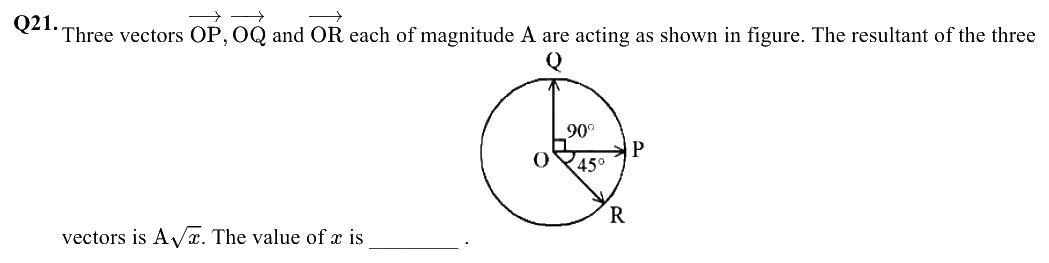
Three vectors $\overrightarrow{OP}, \overrightarrow{OQ}$ and $\overrightarrow{OR}$ each of magnitude A are acting as shown in figure. The resultant of the three vectors is $\mathrm{A}\sqrt{x}$. The value of $x$ is ______ .
(see the figure above)
The question as printed in the paper.
Numerical answer type: type your answer in EdLoop to check it
A body of mass $M$ thrown horizontally with velocity $v$ from the top of the tower of height $H$ touches the ground at a distance of 100 m from the foot of the tower. A body of mass 2M thrown at a velocity $\frac{v}{2}$ from the top of the tower of height 4H will touch the ground at a distance of ______ m.
Numerical answer type: type your answer in EdLoop to check it
For three vectors $\vec{A} = (-x\hat{i} - 6\hat{j} - 2\hat{k})$, $\vec{B} = (-\hat{i} + 4\hat{j} + 3\hat{k})$ and $\vec{C} = (-8\hat{i} - \hat{j} + 3\hat{k})$, if $\vec{A} \cdot (\vec{B} \times \vec{C}) = 0$, then value of $x$ is ______
Numerical answer type: type your answer in EdLoop to check it
A particle moves in a straight line so that its displacement $x$ at any time $t$ is given by $x^2 = 1 + t^2$. Its acceleration at any time t is $x^{-n}$ where n = ______
Numerical answer type: type your answer in EdLoop to check it
A body moves on a frictionless plane starting from rest. If $S_n$ is distance moved between t = n - 1 and t = n and $S_{n-1}$ is distance moved between t = n - 2 and t = n - 1, then the ratio $\frac{S_{n-1}}{S_n}$ is $\left(1 - \frac{2}{x}\right)$ for n = 10. The value of $x$ is ______ .
Numerical answer type: type your answer in EdLoop to check it
Two forces $F_1$ and $F_2$ are acting on a body. One force has magnitude thrice that of the other force and the resultant of the two forces is equal to the force of larger magnitude. The angle between $\vec{F}_1$ and $\vec{F}_2$ is $\cos^{-1}\left(\frac{1}{n}\right)$. The value of $|n|$ is ______.
Numerical answer type: type your answer in EdLoop to check it
A bus moving along a straight highway with speed of 72 km/h is brought to halt within 4s after applying the brakes. The distance travelled by the bus during this time (Assume the retardation is uniform) is ______ m.
Numerical answer type: type your answer in EdLoop to check it
A particle is moving in one dimension (along $x$ axis) under the action of a variable force. It's initial position was 16 m right of origin. The variation of its position $x$ with time $t$ is given as $x = -3t^3 + 18t^2 + 16t$, where $x$ is in m and $t$ is in s. The velocity of the particle when its acceleration becomes zero is ______ $\text{m s}^{-1}$.
Numerical answer type: type your answer in EdLoop to check it
A particle initially at rest starts moving from reference point $x = 0$ along $x$-axis, with velocity $v$ that varies as $v = 4\sqrt{x}\ \text{m s}^{-1}$. The acceleration of the particle is ______ $\text{m s}^{-2}$.
Numerical answer type: type your answer in EdLoop to check it
A body starts falling freely from height $H$ hits an inclined plane in its path at height $h$. As a result of this perfectly elastic impact, the direction of the velocity of the body becomes horizontal. The value of $\frac{H}{h}$ for which the body will take the maximum time to reach the ground is ______.
Numerical answer type: type your answer in EdLoop to check it
The displacement and the increase in the velocity of a moving particle in the time interval of $t$ to $(t+1)$ s are 125 m and 50 m s$^{-1}$, respectively. The distance travelled by the particle in $(t+2)^{\mathrm{th}}$ s is ______ m.
Numerical answer type: type your answer in EdLoop to check it
A vector has magnitude same as that of $\vec{A} = 3\hat{j} + 4\hat{j}$ and is parallel to $\vec{B} = 4\hat{i} + 3\hat{j}$. The $x$ and $y$ components of this vector in first quadrant are $x$ and 3 respectively where x = ______.
Numerical answer type: type your answer in EdLoop to check it
A ball rolls off the top of a stairway with horizontal velocity $u$. The steps are 0.1 m high and 0.1 m wide. The minimum velocity $u$ with which that ball just hits the step 5 of the stairway will be $\sqrt{x}$ m s$^{-1}$, where $x =$ ______ [use $g = 10$ m s$^{-2}$].
Numerical answer type: type your answer in EdLoop to check it
A particle is moving in a circle of radius 50 cm in such a way that at any instant the normal and tangential components of its acceleration are equal. If its speed at t = 0 is 4 m s$^{-1}$, the time taken to complete the first revolution will be $\frac{1}{\alpha}\left[1 - e^{-2\pi}\right]$ s, where $\alpha =$ ______.
Numerical answer type: type your answer in EdLoop to check it
A particle starts from origin at t = 0 with a velocity $5\hat{i}$ m s$^{-1}$ and moves in x $-$ y plane under action of a force which produces a constant acceleration of $\left(3\hat{i} + 2\hat{j}\right)$ m s$^{-2}$. If the $x$-coordinate of the particle at that instant is 84 m, then the speed of the particle at this time is $\sqrt{\alpha}$ m s$^{-1}$. The value of $\alpha$ is ______.
Numerical answer type: type your answer in EdLoop to check it
A body falling under gravity covers two points A and B separated by 80 m in 2 s. The distance of upper point A from the starting point is ______ m. Use g = 10 m s$^{-2}$
Numerical answer type: type your answer in EdLoop to check it
A projectile fired at $30^\circ$ to the ground is observed to be at same height at time 3 s and 5 s after projection, during its flight. The speed of projection of the projectile is $\mathrm{m\ s^{-1}}$. (Given $g = 10\ \mathrm{m\ s^{-2}}$)
Numerical answer type: type your answer in EdLoop to check it
For a train engine moving with speed of 20 $\mathrm{ms^{-1}}$, the driver must apply brakes at a distance of 500 $\mathrm{m}$ before the station for the train to come to rest at the station. If the brakes were applied at half of this distance, the train engine would cross the station with speed $\sqrt{x}$ $\mathrm{ms^{-1}}$. The value of $x$ is ______. (Assuming same retardation is produced by brakes)
Numerical answer type: type your answer in EdLoop to check it
The speed of a swimmer is 4 $\mathrm{km\ h^{-1}}$ in still water. If the swimmer makes his strokes normal to the flow of river of width 1 $\mathrm{km}$, he reaches a point 750 $\mathrm{m}$ down the stream on the opposite bank. The speed of the river water is ______ $\mathrm{km\ h^{-1}}$.
Numerical answer type: type your answer in EdLoop to check it
Two bodies are projected from ground with same speeds 40 m s$^{-1}$ at two different angles with respect to horizontal. The bodies were found to have same range. If one of the body was projected at an angle of 60$^\circ$, with horizontal then sum of the maximum heights, attained by the two projectiles, is ______ m. (Given $g$ = 10 m s$^{-2}$)
Numerical answer type: type your answer in EdLoop to check it
A horse rider covers half the distance with 5 m s$^{-1}$ speed. The remaining part of the distance was travelled with speed 10 m s$^{-1}$ for half the time and with speed 15 m s$^{-1}$ for other half of the time. The mean speed of the rider averaged over the whole time of motion is $\frac{x}{7}$ m s$^{-1}$. The value of $x$ is ______.
Numerical answer type: type your answer in EdLoop to check it
A stone tied to 180 cm long string at its end is making 28 revolutions in horizontal circle in every minute. The magnitude of acceleration of stone is $\frac{1936}{x}$ m s$^{-2}$. The value of $x$ ______. [Take $\pi = \frac{22}{7}$]
Numerical answer type: type your answer in EdLoop to check it
A $0.4\ \mathrm{kg}$ mass takes $8\ \mathrm{s}$ to reach ground when dropped from a certain height $P$ above surface of earth. The loss of potential energy in the last second of fall is ______ J. [Take $g = 10\ \mathrm{m\,s^{-2}}$]
Numerical answer type: type your answer in EdLoop to check it
A car is moving on a circular path of radius 600 m such that the magnitudes of the tangential acceleration and centripetal acceleration are equal. The time taken by the car to complete first quarter of revolution, if it is moving with an initial speed of $54\ \mathrm{km\,h^{-1}}$ is $t\left(1 - e^{-\frac{\pi}{2}}\right)$ s. The value of $t$ is ______.
Numerical answer type: type your answer in EdLoop to check it
If $\vec{P} = 3\hat{i} + \sqrt{3}\hat{j} + 2\hat{k}$ and $\vec{Q} = 4\hat{i} + \sqrt{3}\hat{j} + 2.5\hat{k}$ then, the unit vector in the direction of $\vec{P} \times \vec{Q}$ is $\frac{1}{x}\left(\sqrt{3}\hat{i} + \hat{j} - 2\sqrt{3}\hat{k}\right)$. The value of $x$ is
Numerical answer type: type your answer in EdLoop to check it
Vectors $a\hat{i}+b\hat{j}+\hat{k}$ and $2\hat{i}-3\hat{j}+4\hat{k}$ are perpendicular to each other when $3a+2b=7$, the ratio of $a$ to $b$ is $\frac{x}{2}$. The value of $x$ is ______.
Numerical answer type: type your answer in EdLoop to check it
An object is projected in the air with initial velocity $u$ at an angle $\theta$. The projectile motion is such that the horizontal range $R$, is maximum. Another object is projected in the air with a horizontal range half of the range of first object. The initial velocity remains same in both the case. The value of the angle of projection, at which the second object is projected, will be ______ degree.
Numerical answer type: type your answer in EdLoop to check it
A ball is thrown vertically upwards with a velocity of $19.6\ \mathrm{m\,s^{-1}}$ from the top of a tower. The ball strikes the ground after $6\ \mathrm{s}$. The height from the ground up to which the ball can rise will be $\left(\frac{k}{5}\right)\ \mathrm{m}$. The value of $k$ is ______ (use $\mathrm{g}=9.8\ \mathrm{m\,s^{-2}}$)
Numerical answer type: type your answer in EdLoop to check it
A ball of mass $m$ is thrown vertically upward. Another ball of mass 2 m is thrown an angle $\theta$ with the vertical. Both the balls stay in air for the same period of time. The ratio of the heights attained by the two balls respectively is $\frac{1}{x}$. The value of $x$ is ______ .
Numerical answer type: type your answer in EdLoop to check it
If the initial velocity in horizontal direction of a projectile is unit vector $i$ and the equation of trajectory is $y = 5x(1 - x)$. The $y$ component vector of the initial velocity is ______ $\hat{j}$. (Take $g = 10 \mathrm{~m~s^{-2}}$)
Numerical answer type: type your answer in EdLoop to check it
If $\vec{A} = 2\hat{i} + 3\hat{j} - \hat{k}\ \mathrm{m}$ and $\vec{B} = \hat{i} + 2\hat{j} + 2\hat{k}\ \mathrm{m}$. The magnitude of component of vector $\vec{A}$ along vector $\vec{B}$ will be ______ m.
Numerical answer type: type your answer in EdLoop to check it
A car is moving with speed of 150 $\mathrm{km\ h^{-1}}$ and after applying the brake it will move 27 m before it stops. If the same car is moving with a speed of one third the reported speed then it will stop after travelling ______ m distance.
Numerical answer type: type your answer in EdLoop to check it
A particle is moving in a straight line such that its velocity is increasing at $5\ \mathrm{m\,s^{-1}}$ per meter. The acceleration of the particle is ______ $\mathrm{m\,s^{-2}}$ at a point where its velocity is $20\ \mathrm{m\,s^{-1}}$.
Numerical answer type: type your answer in EdLoop to check it
A car covers $AB$ distance with first one-third at velocity $v_1\ \mathrm{m\ s^{-1}}$, second one-third at $v_2\ \mathrm{m\ s^{-1}}$ and last one-third at $v_3\ \mathrm{m\ s^{-1}}$. If $v_3 = 3v_1,\ v_2 = 2v_1$ and $v_1 = 11\ \mathrm{m\ s^{-1}}$, then the average velocity of the car is ______ $\mathrm{m\ s^{-1}}$. (see the figure above)
The question as printed in the paper.
Numerical answer type: type your answer in EdLoop to check it
A ball of mass $0.5 \mathrm{~kg}$ is dropped from the height of $10 \mathrm{~m}$. The height, at which the magnitude of velocity becomes equal to the magnitude of acceleration due to gravity, is ______ m. [Use $g = 10 \mathrm{~m} \mathrm{~s}^{-2}$ ]
Numerical answer type: type your answer in EdLoop to check it
A fighter jet is flying horizontally at a certain altitude with a speed of $200 \mathrm{~m} \mathrm{~s}^{-1}$. When it passes directly overhead an anti-aircraft gun, a bullet is fired from the gun, at an angle $\theta$ with the horizontal, to hit the jet. If the bullet speed is $400 \mathrm{~m} \mathrm{~s}^{-1}$, the value of $\theta$ will be ______ ${}^\circ$.
Numerical answer type: type your answer in EdLoop to check it
A ball is projected vertically upward with an initial velocity of $50 \mathrm{~m} \mathrm{~s}^{-1}$ at $t = 0 \mathrm{~s}$. At $t = 2 \mathrm{~s}$, another ball is projected vertically upward with same velocity. At $t =$ ______ s, second ball will meet the first ball $(g = 10 \mathrm{~m} \mathrm{~s}^{-2})$.
Numerical answer type: type your answer in EdLoop to check it
From the top of a tower, a ball is thrown vertically upward which reaches the ground in $6 \mathrm{~s}$. A second ball thrown vertically downward from the same position with the same speed reaches the ground in $1.5 \mathrm{~s}$. A third ball released, from the rest from the same location, will reach the ground in ______ s.
Numerical answer type: type your answer in EdLoop to check it
A body is projected from the ground at an angle of $45^\circ$ with the horizontal. Its velocity after $2 \mathrm{~s}$ is $20 \mathrm{~m~s^{-1}}$. The maximum height reached by the body during its motion is ______ $m$. (use $g = 10 \mathrm{~m~s^{-2}}$)
Numerical answer type: type your answer in EdLoop to check it
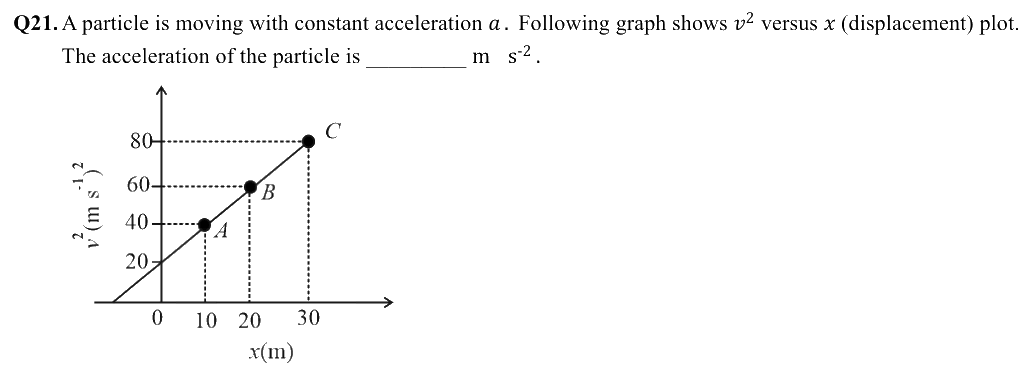
A particle is moving with constant acceleration $a$. Following graph shows $v^2$ versus $x$ (displacement) plot. The acceleration of the particle is ______ m s$^{-2}$. (see the figure above)
The question as printed in the paper.
Numerical answer type: type your answer in EdLoop to check it
If the velocity of a body related to displacement $x$ is given by $v = \sqrt{5000 + 24x}$ m s$^{-1}$, then the acceleration of the body is ______ m s$^{-2}$.
Numerical answer type: type your answer in EdLoop to check it
Two spherical balls having equal masses with radius of $5\ \mathrm{cm}$ each are thrown upwards along the same vertical direction at an interval of $3\ \mathrm{s}$ with the same initial velocity of $35\ \mathrm{m\ s^{-1}}$, then these balls collide at a height of ______$\mathrm{m}$, (take $\mathrm{g}=10\ \mathrm{m\ s^{-2}}$)
Numerical answer type: type your answer in EdLoop to check it
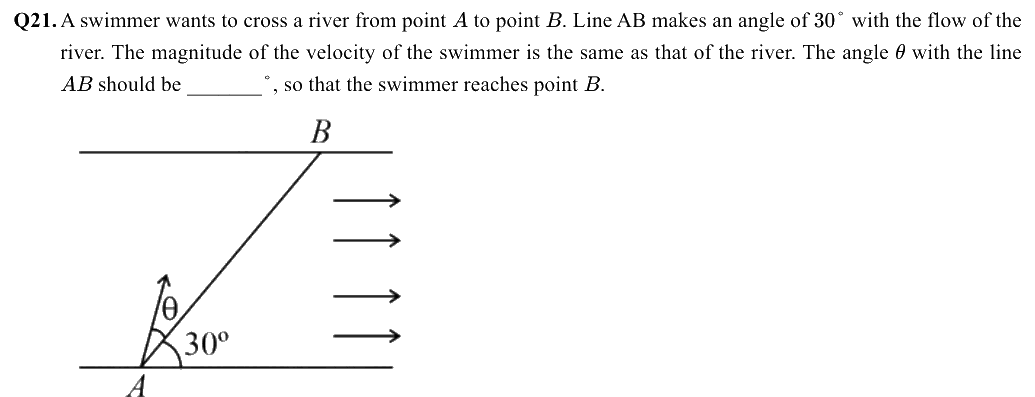
A swimmer wants to cross a river from point $A$ to point $B$. Line AB makes an angle of $30^\circ$ with the flow of the river. The magnitude of the velocity of the swimmer is the same as that of the river. The angle $\theta$ with the line $AB$ should be ______ $^\circ$, so that the swimmer reaches point $B$. (see the figure above)
The question as printed in the paper.
Numerical answer type: type your answer in EdLoop to check it
Three particles $P$, $Q$ and $R$ are moving along the vectors $\vec{A} = \hat{i} + \hat{j}$, $\vec{B} = \hat{j} + \hat{k}$ and $\vec{C} = -\hat{i} + \hat{j}$, respectively. They strike on a point and start to move in different directions. Now particle $P$ is moving normal to the plane which contains vector $\vec{A}$ and $\vec{B}$. Similarly particle $Q$ is moving normal to the plane which contains vector $\vec{A}$ and $\vec{C}$. The angle between the direction of motion of $P$ and $Q$ is $\cos^{-1}\left(\frac{1}{\sqrt{x}}\right)$. Then the value of $x$ is ______.
Numerical answer type: type your answer in EdLoop to check it
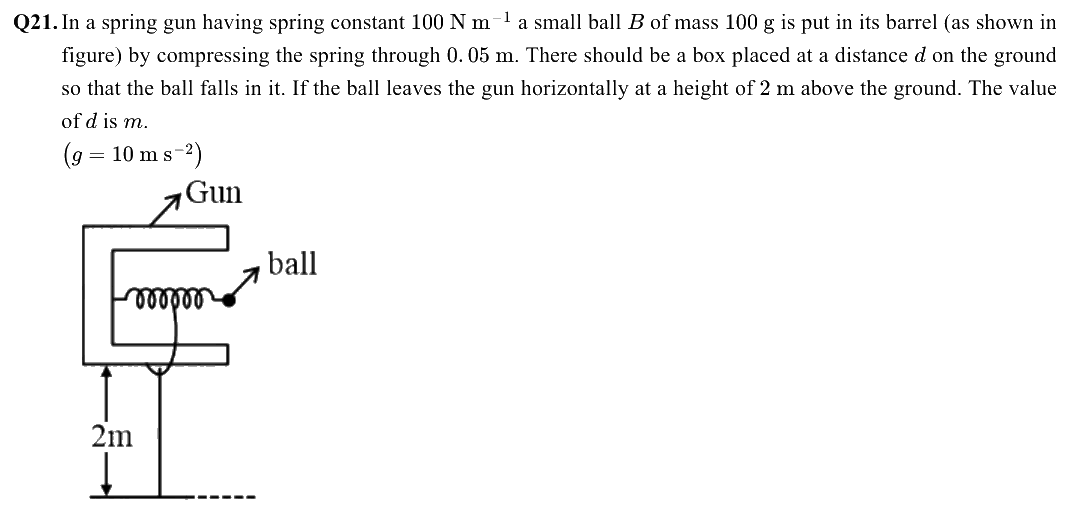
In a spring gun having spring constant $100\ \mathrm{N\ m^{-1}}$ a small ball $B$ of mass $100\ \mathrm{g}$ is put in its barrel (as shown in figure) by compressing the spring through $0.05\ \mathrm{m}$. There should be a box placed at a distance $d$ on the ground so that the ball falls in it. If the ball leaves the gun horizontally at a height of $2\ \mathrm{m}$ above the ground. The value of $d$ is $\mathrm{m}$. ($g = 10\ \mathrm{m\ s^{-2}}$) (see the figure above)
The question as printed in the paper.
Numerical answer type: type your answer in EdLoop to check it
A person is swimming with a speed of $10~\mathrm{m~s^{-1}}$ at an angle of $120^\circ$ with the flow and reaches to a point directly opposite on the other side of the river. The speed of the flow is $x~\mathrm{m~s^{-1}}$. The value of $x$ to the nearest integer is ______ .
Numerical answer type: type your answer in EdLoop to check it
A bullet of mass $0.1~\mathrm{kg}$ is fired on a wooden block to pierce through it, but it stops after moving a distance of $50~\mathrm{cm}$ into it. If the velocity of the bullet before hitting the wood is $10~\mathrm{m~s^{-1}}$ and, it slows down with uniform deceleration, then the magnitude of effective retarding force on the bullet is $x$ N. The value of $x$ to the nearest integer is,
Numerical answer type: type your answer in EdLoop to check it
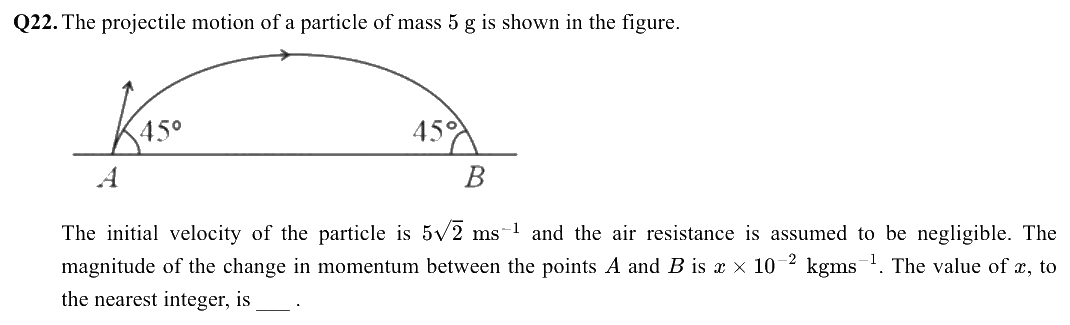
The projectile motion of a particle of mass $5~\mathrm{g}$ is shown in the figure. (see the figure above) The initial velocity of the particle is $5\sqrt{2}~\mathrm{ms^{-1}}$ and the air resistance is assumed to be negligible. The magnitude of the change in momentum between the points $A$ and $B$ is $x \times 10^{-2}~\mathrm{kgms^{-1}}$. The value of $x$, to the nearest integer, is ______ .
The question as printed in the paper.
Numerical answer type: type your answer in EdLoop to check it
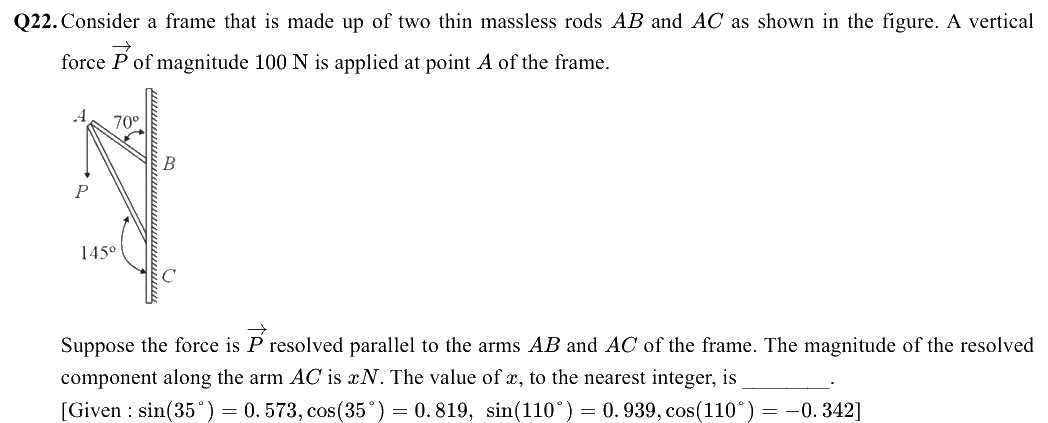
Consider a frame that is made up of two thin massless rods $A B$ and $A C$ as shown in the figure. A vertical force $\vec{P}$ of magnitude 100 N is applied at point $A$ of the frame. (see the figure above) Suppose the force is $\vec{P}$ resolved parallel to the arms $A B$ and $A C$ of the frame. The magnitude of the resolved component along the arm $A C$ is $x \mathrm{~N}$. The value of $x$, to the nearest integer, is ______. [Given : $\sin \left(35^{\circ}\right)=0.573, \cos \left(35^{\circ}\right)=0.819, \sin \left(110^{\circ}\right)=0.939, \cos \left(110^{\circ}\right)=-0.342$]
The question as printed in the paper.
Numerical answer type: type your answer in EdLoop to check it
A swimmer can swim with velocity of $12\ \mathrm{km\,/h}$ in still water. Water flowing in a river has velocity $6\ \mathrm{km\,/h}$. The direction with respect to the direction of flow of river water he should swim in order to reach the point on the other bank just opposite to his starting point is ______$^\circ$. (Round off to the Nearest Integer) (find the angle in degree)
Numerical answer type: type your answer in EdLoop to check it
If $\vec{P} \times \vec{Q} = \vec{Q} \times \vec{P}$, the angle between $\vec{P}$ and $\vec{Q}$ is $\theta(0^\circ < \theta < 360^\circ)$. The value of $\theta$ will be ______$^\circ$.
Numerical answer type: type your answer in EdLoop to check it
The speed verses time graph for a particle is shown in the figure. The distance travelled (in $m$) by the particle during the time interval $\mathrm{t}$ = 0 to $\mathrm{t}$ = 5 $s$ will be ______ (see the figure above)
The question as printed in the paper.
Numerical answer type: type your answer in EdLoop to check it
The distance $x$ covered by a paritcle (sic) in one dimensional motion varies with time $t$ as $x^2 = at^2 + 2bt + c$ . If the acceleration of the particle depends on $x$ as $x^{-n}$ , where $n$ is an integer, the value of $n$ is ______.
Numerical answer type: type your answer in EdLoop to check it
A particle is moving along the $x$ -axis with its coordinate with time $t$ given by $x(t) = 10 + 8t - 3t^2$. Another particle is moving along the $y$ -axis with its coordinate as a function of time given by $y(t) = 5 - 8t^3$. At $t = 1\ \mathrm{s}$, the speed of the second particle as measured in the frame of the first particle is given as $\sqrt{v}$. Then $v(\mathrm{in\ m\ s^{-1}})$ is ____________.
Numerical answer type: type your answer in EdLoop to check it
A ball is dropped from the top of a $100\ \mathrm{m}$ high tower on a planet. In the last $\frac{1}{2}\mathrm{s}$ before hitting the ground, it covers a distance of $19\ \mathrm{m}$. Acceleration due to gravity (in $\mathrm{m\ s^{-2}}$ ) near the surface on that planet is______
Numerical answer type: type your answer in EdLoop to check it
The sum of two forces $\vec{P}$ and $\vec{Q}$ is $\vec{R}$ such that $|\vec{R}| = |\vec{P}|$. Find the angle between resultant of $2\vec{P}$ and $\vec{Q}$ and $\vec{Q}$ ______
Numerical answer type: type your answer in EdLoop to check it
Kinematics forms the mechanical backbone of JEE Main Physics, appearing in the vast majority of test sessions. In the papers we hold from 2019 to 2026, the chapter yielded 268 questions in 162 papers, which corresponds to 1.7 questions per paper, and was present in 150 of those 162 papers. This places it 2nd of 29 Physics chapters by volume over that eight-year period, representing 5.9% of all Physics questions asked.
The chapter's weighting has stayed about the same when compared to the older entrance exam format. From 2002 to 2018, it took a 5.3% share of the Physics section; across the recent 2024 to 2026 cycle, it stood at 5.4%, yielding 84 questions in 58 papers. Its peak activity in our records occurred in 2021, with 48 questions across 26 papers. Since 2019 there has been no year without it, featuring in 150 of the 162 papers we hold.
The material corresponds to Unit 2: Kinematics in NTA's Class 11 curriculum. Because trajectory analysis, coordinate decomposition, and relative velocity appear repeatedly in Newton's laws and electromagnetism, early confidence here pays steady dividends.
Most-asked topics
Across 2019 to 2026, the chapter divided into six distinct topic buckets:
Motion in a Straight Line: 104 questions. The primary area, including variable acceleration calculus, multi-interval braking, and vertical throws under gravity.
Projectile Motion: 63 questions. Trajectories on horizontal ground and inclined surfaces, trajectory equations, and instantaneous velocity directions.
Vectors: 43 questions. Scalar and cross products, orthogonal resolution, directional cosines, and axial versus polar classifications.
Relative Motion: 21 questions. Classic river-boat crossing problems, rain-umbrella angles, and closing velocities between two bodies.
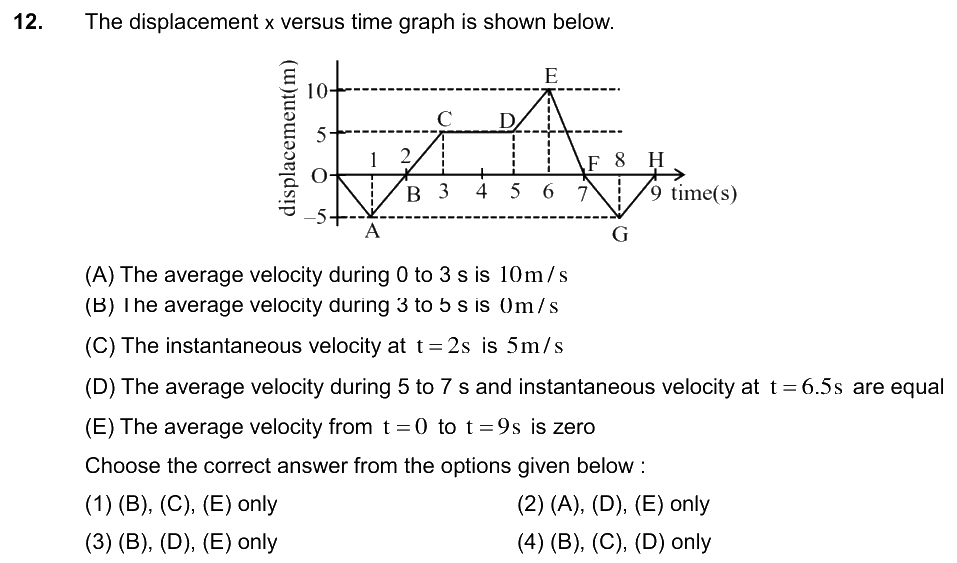
Graphs of Motion: 19 questions. Slope interpretation of displacement curves and area integration under acceleration-time or velocity-time plots.
Circular Motion (Kinematics): 18 questions. Tangential and radial acceleration splits, angular displacement polynomials, and banked turns.
Every single topic among these six appeared in the 2026 exam cycle, so skipping any branch leaves marks on the table.
What the questions look like
Straight-line motion problems regularly feature bodies undergoing two consecutive phases of movement. For example, a falling skydiver drops freely for a measured time interval before opening a parachute that provides uniform upward deceleration, and you must calculate the drop altitude. Another standard format provides position or velocity as a polynomial function of time, requiring differentiation to determine when acceleration vanishes or integration to find net displacement over an interval.
Projectile motion questions often test velocities at intermediate points along the path rather than standard peak height or range formulas. A representative problem specifies the speed when the velocity vector makes a 45° angle with the ground and asks for the launch velocity knowing the initial projection angle was 60°. You solve these efficiently by exploiting the constancy of the horizontal velocity component throughout free flight.
Relative motion questions generally involve two dimensions. A swimmer aims perpendicular to river banks to minimize crossing duration while drifting downstream, or two vehicles approach an intersection along perpendicular roads. Graph-based problems present piecewise linear velocity profiles where students compute total distance traveled from enclosed area while evaluating displacement from algebraic area sums.
A substantial share of kinematics appears in non-multiple-choice format: 68 of the 268 questions from 2019 to 2026 were numerical-response items, meaning students must arrive at exact answers without relying on candidate choices.
Questions to try first
The following questions from NTA's 2026 papers illustrate the range of problem styles:
Begin by establishing clear sign conventions for one-dimensional kinematics. Treat displacement, velocity, and acceleration as algebraic scalars with explicit positive and negative signs rather than juggling separate formulas for upward and downward motion. Always verify whether acceleration is constant before applying standard kinematic equations; if acceleration depends on position or time, switch immediately to calculus.
When practicing projectile motion, decompose all vector quantities along orthogonal axes at the outset. Avoid relying exclusively on memorized formulas for range and time of flight, which fail whenever the landing point sits on an incline or elevation differs from the launch height. Instead, write separate equations for horizontal and vertical coordinates parameterized by time.
For relative velocity, draw vector addition triangles and write down the governing vector subtraction relationship before taking components. Pay close attention to unit conversions between kilometers per hour and meters per second, which frequently trip students up in numerical answer inputs.
Frequently asked questions
Is Kinematics a heavy chapter in JEE Main 2027?
Yes. Kinematics provided 268 questions across 162 papers in our collection from 2019 to 2026, averaging 1.7 questions per paper. It ranks 2nd among 29 Physics chapters by total question count and appeared in 150 of those 162 papers.
Which topic in Kinematics carries the greatest question volume?
Motion in a straight line leads the chapter with 104 questions between 2019 and 2026, followed by projectile motion with 63 questions and vector algebra with 43 questions.
Are calculus methods required for kinematics problems in JEE Main?
Yes. Many questions define velocity or position as non-linear functions of time, requiring direct differentiation for acceleration and definite integration for distance or displacement.
Where can I see the solutions?
Every question on this page opens with its options and answer. Step-by-step solutions for each one are in the EdLoop app.