The equation of a plane progressive wave is given by $y = 5\cos\pi\left(200\,t - \frac{x}{150}\right)$ where $x$ and $y$ are in cm and $t$ is in second. The velocity of the wave is ________ m/s.
The speed of a longitudinal wave in a metallic bar is 400 m/s. If the density and Young's modulus of the bar material are increased by 0.5% and 1%, respectively then the speed of the wave is changed approximately to ________ m/s.
The fifth harmonic of a closed organ pipe is found to be in unison with the first harmonic of an open pipe. The ratio of lengths of closed pipe to that of the open pipe is $5/x$. The value of $x$ is ________.
In an open organ pipe $\nu_3$ and $\nu_6$ are $3^{rd}$ and $6^{th}$ harmonic frequencies, respectively. If $\nu_6 - \nu_3 = 2200$ Hz then length of the pipe is ________ mm.
Two strings ($A, B$) having linear densities $\mu_A = 2\times10^{-4}$ kg/m and, $\mu_B = 4\times10^{-4}$ kg/m and lengths $L_A = 2.5$ m and $L_B = 1.5$ m respectively are joined. Free ends of $A$ and $B$ are tied to two rigid supports $C$ and $D$, respectively creating a tension of 500 N in the wire. Two identical pulses, sent from $C$ and $D$ ends, take time $t_1$ and $t_2$, respectively, to reach the joint. The ratio $t_1/t_2$ is :
The amplitude and phase of a wave that is formed by the superposition of two harmonic travelling waves, $y_1(x,t) = 4\sin(kx - \omega t)$ and $y_2(x,t) = 2\sin\left(kx - \omega t + \frac{2\pi}{3}\right)$, are:
(Take the angular frequency of initial waves same as $\omega$)
Two strings with circular cross section and made of same material, are stretched to have same amount of tension. A transverse wave is then made to pass through both the strings. The velocity of the wave in the first string having the radius of cross section R is $v_1$, and that in the other string having radius of cross section $R/2$ is $v_2$. Then $\frac{v_2}{v_1} =$
Two harmonic waves moving in the same direction superimpose to form a wave $x = a\cos(1.5t)\cos(50.5t)$ where t is in seconds. Find the period with which they beat. (close to nearest integer)
The equation of a wave travelling on a string is $y = \sin[20\pi x + 10\pi t]$, where x and t are distance and time in SI units. The minimum distance between two points having the same oscillating speed is :
Consider the sound wave travelling in ideal gases of $He, CH_4$, and $CO_2$. All the gases have the same ratio $\frac{P}{\rho}$, where P is the pressure and $\rho$ is the density. The ratio of the speed of sound through the gases $V_{He} : V_{CH_4} : V_{CO_2}$ is given by
In an experiment with a closed organ pipe, it is filled with water by $\left(\frac{1}{5}\right)$th of its volume. The frequency of the fundamental note will change by
In the resonance experiment, two air columns (closed at one end) of 100 cm and 120 cm long, give 15 beats per second when each one is sounding in the respective fundamental modes. The velocity of sound in the air column is:
A sinusoidal wave of wavelength 7.5 cm travels a distance of 1.2 cm along the $x$ -direction in 0.3 sec. The crest P is at $x = 0$ at $t = 0sec$ and maximum displacement of the wave is 2 cm. Which equation correctly represents this wave ?
Given below are two statements: one is labelled as Assertion A and the other is labelled as Reason R Assertion A: A sound wave has higher speed in solids than gases. Reason R: Gases have higher value of Bulk modulus than solids. In the light of the above statements, choose the correct answer from the options given below
A
Both A and R are true but R is NOT the correct explanation of A
B
A is true but R is false
C
A is false but R is true
D
Both A and R are true and R is the correct explanation of A
The equation of a transverse wave travelling along a string is $y(x, t) = 4.0\sin\left[20 \times 10^{-3}x + 600t\right]$mm, where $x$ is in mm and $t$ is in second. The velocity of the wave is :
A closed organ and an open organ tube are filled by two different gases having same bulk modulus but different densities $\rho_1$ and $\rho_2$, respectively. The frequency of $9^{\mathrm{th}}$ harmonic of closed tube is identical with $4^{\mathrm{th}}$ harmonic of open tube. If the length of the closed tube is 10 cm and the density ratio of the gases is $\rho_1 : \rho_2 = 1 : 16$, then the length of the open tube is :
The fundamental frequency of a closed organ pipe is equal to the first overtone frequency of an open organ pipe. If length of the open pipe is 60 cm, the length of the closed pipe will be :
A car $P$ travelling at $20\ \mathrm{m\ s^{-1}}$ sounds its horn at a frequency of 400 Hz. Another car $Q$ is travelling behind the first car in the same direction with a velocity $40\ \mathrm{m\ s^{-1}}$. The frequency heard by the passenger of the car $Q$ is approximately [Take, velocity of sound $= 360\ \mathrm{m\ s^{-1}}$]
The engine of a train moving with speed $10\ \mathrm{m\,s^{-1}}$ towards a platform sounds a whistle at frequency 400 Hz. The frequency heard by a passenger inside the train is: (Neglect air speed. Speed of sound in air $= 330\ \mathrm{m\,s^{-1}}$)
A steel wire with mass per unit length 7.0 $\times$ $10^{-3}$ $\mathrm{kg\ m^{-1}}$ is under tension of 70 $\mathrm{N}$. The speed of transverse waves in the wire will be:
For a solid rod, the Young's modulus of elasticity is $3.2 \times 10^{11}$ N m$^{-2}$ and density is $8 \times 10^3$ kg m$^{-3}$. The velocity of longitudinal wave in the rod will be
A person observes two moving trains, $A$ reaching the station and $B$ leaving the station with equal speed of $30\ \mathrm{m\,s^{-1}}$. If both trains emit sounds with frequency $300\ \mathrm{Hz}$, (Speed of sound : $330\ \mathrm{m\,s^{-1}}$) approximate difference of frequencies heard by the person will be :
A transverse wave is represented by $y = 2\sin\omega t - kx$cm. The value of wavelength (in cm) for which the wave velocity becomes equal to the maximum particle velocity, will be
A longitudinal wave is represented by $y = 10\sin 2\pi\left(nt - \dfrac{x}{\lambda}\right)\ \mathrm{cm}$. The maximum particle velocity will be four times the wave velocity if the determined value of wavelength is equal to
An observer moves towards a stationary source of sound with a velocity one-fifth of the velocity of sound. The percentage change in the apparent frequency is
For a specific wavelength $670 \mathrm{~nm}$ of light coming from a galaxy moving with velocity $v$, the observed wavelength is $670.7 \mathrm{~nm}$. The value of $v$ is
The equations of two waves are given by : $y_1 = 5\sin 2\pi(x - vt) \mathrm{~cm}$ $y_2 = 3\sin 2\pi(x - vt + 1.5) \mathrm{~cm}$ These waves are simultaneously passing through a string. The amplitude of the resulting wave is :
With what speed should a galaxy move outward with respect to earth so that the sodium-$D$ line at wavelength $5890~\mathrm{\AA}$ is observed at $5896~\mathrm{\AA}$?
A sound wave of frequency 245 Hz travels with the speed of $300 \mathrm{~m} \mathrm{~s}^{-1}$ along the positive x-axis. Each point of the wave moves to and fro through a total distance of $6 \mathrm{~cm}$. What will be the mathematical expression of this travelling wave?
A tuning fork $A$ of unknown frequency produces $5$ beats $\mathrm{s}^{-1}$ with a fork of known frequency $340\ \mathrm{Hz}$. When fork $A$ is filed, the beat frequency decreases to $2$ beats $\mathrm{s}^{-1}$. What is the frequency of fork $A$ ?
A student is performing the experiment of the resonance column. The diameter of the column tube is $6\ \mathrm{cm}$. The frequency of the tuning fork is $504\ \mathrm{Hz}$. Speed of the sound at the given temperature is $336\ \mathrm{m\ s^{-1}}$. The zero of the meter scale coincides with the top end of the resonance column tube. The reading of the water level in the column when the first resonance occurs is:
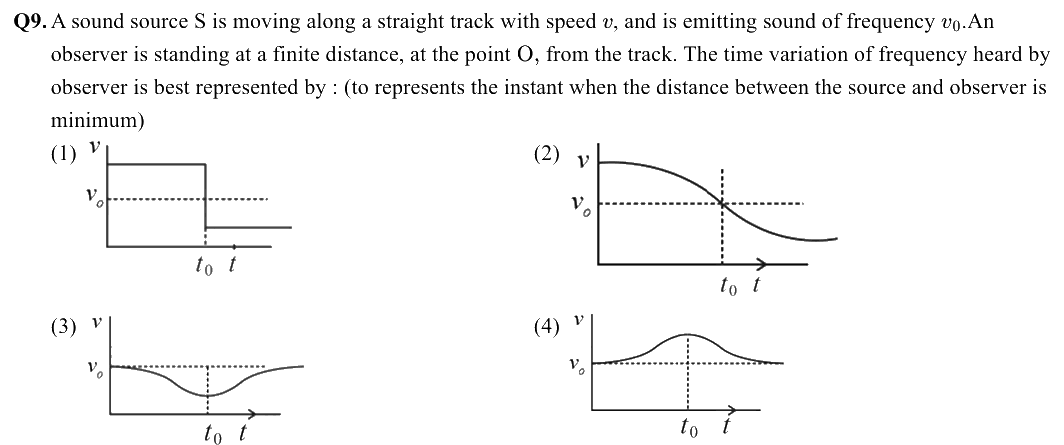
A sound source S is moving along a straight track with speed $v$, and is emitting sound of frequency $v_0$.An observer is standing at a finite distance, at the point O, from the track. The time variation of frequency heard by observer is best represented by : ($t_0$ represents the instant when the distance between the source and observer is minimum)
The question as printed in the paper.
A
see figure Step graph of frequency against time: a horizontal level above $v_0$ up to $t_0$, then a vertical drop to a horizontal level below $v_0$, which continues flat.
B
see figure Smoothly decreasing curve: starts above $v_0$, falls through $v_0$ exactly at $t_0$ and flattens out below $v_0$.
C
see figure Curve starting at $v_0$, dipping below $v_0$ to a minimum at $t_0$ and returning to $v_0$.
D
see figure Curve starting at $v_0$, rising above $v_0$ to a maximum at $t_0$ and returning to $v_0$.
In a resonance tube experiment when the tube is filled with water up to a height of 17. 0 cm , from bottom, it resonates with a given tuning fork. When the water level is raised the next resonance with the same tuning fork occurs at a height of 24. 5 cm . If the velocity of sound in air is 330 m s$^{-1}$, the tuning fork frequency is :
A driver in a car, approaching a vertical wall notices that the frequency of his car horn has changed from 440 Hz to 480 Hz, when it gets reflected from the wall. If the speed of sound in air is 345 m s$^{-1}$, then the speed of the car is:
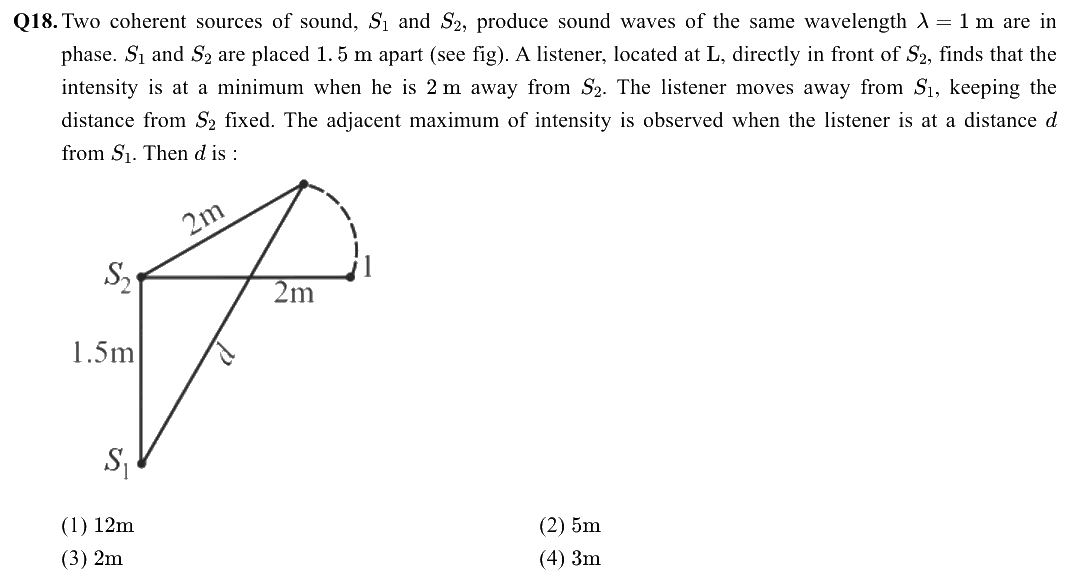
Two coherent sources of sound, $S_1$ and $S_2$, produce sound waves of the same wavelength $\lambda = 1$ m are in phase. $S_1$ and $S_2$ are placed 1. 5 m apart (see fig). A listener, located at L, directly in front of $S_2$, finds that the intensity is at a minimum when he is 2 m away from $S_2$. The listener moves away from $S_1$, keeping the distance from $S_2$ fixed. The adjacent maximum of intensity is observed when the listener is at a distance $d$ from $S_1$. Then $d$ is : (see the figure above)
For a transvers wave travelling, along a straight line, the distance between two peaks (crests) is 5 m, while the distance between one crest and one trough is 1.5 m. The possible wavelengths (in m) of the waves are:
The driver of bus approaching a big wall notices that the frequency of his bus's horn changes from $420\ \mathrm{Hz}$ to $490\ \mathrm{Hz}$ when he hears it after it gets reflected from the wall. Find the speed of the bus if speed of the sound is $330\ \mathrm{ms^{-1}}$:
A uniform thin rope of length $12\ \mathrm{m}$ and mass $6\ \mathrm{kg}$ hangs vertically from a rigid support and a block of mass $2\ \mathrm{kg}$ is attached to its free end. A transverse short wave train of wavelength $6\ \mathrm{cm}$ is produced at the lower end of the rope. What is the wavelength of the wave train (in cm ) when it reaches the top of the rope?
Two identical strings X and Z made of same material have tension $\mathrm{T}_{\mathrm{X}}$ and $\mathrm{T}_{\mathrm{Z}}$ in then if their fundamental frequencies are $450\ \mathrm{Hz}$ and $300\ \mathrm{Hz}$, respectively, then the ratio $\mathrm{T}_{\mathrm{X}}/\mathrm{T}_{\mathrm{Z}}$ is :
Three harmonic waves having equal frequency $v$ and same intensity $I_0$ , have phase angles $0$, $\frac{\pi}{4}$ and $-\frac{\pi}{4}$ respectively. When they are superimposed the intensity of the resultant wave is close to:
A wire of length $L$ and mass per unit length $6.0 \times 10^{-3}\,\mathrm{kg\,m^{-1}}$ is put under tension of $540\,\mathrm{N}$. Two consecutive frequencies that it resonates at are: $420\,\mathrm{Hz}$ and $490\,\mathrm{Hz}$. Then $L$ in meters is :
A transverse wave travels on a taut steel wire with a velocity of $v$ when tension in it is $2.06 \times 10^4\mathrm{N}$. When the tension is changed to T, the velocity changed to $\frac{v}{2}$. The value of T is close to:
Speed of a transverse wave on a straight wire (mass $6.0\ \mathrm{g}$, length $60\ \mathrm{cm}$ and area of cross-section $1.0\ \mathrm{mm}^2$ is $90\ \mathrm{m\,s^{-1}}$. If the Young's modulus of wire is $16 \times 10^{11}\ \mathrm{N\,m^{-2}}$, the extension of wire over its natural length is:
A stationary observer receives sound from two identical tuning forks, one of which approaches and the other one recedes with the same speed (much less than the speed of sound). The observer hears 2 beats/sec. The oscillation frequency of each tuning fork is $v_0 = 1400\ \mathrm{Hz}$ and the velocity of sound in air is $350\ \mathrm{m/s}$. The speed of each tuning fork is close to:
A submarine A travelling at $18\mathrm{km\ \ hr^{-1}}$ is being chased along the line of its velocity by another submarine B travelling at $27\ \mathrm{km\ \ hr^{-1}}$ . B sends a sonar signal of 500 Hz to detect A and receives a reflected sound of frequency v. The value of v is closed to (Speed of sound in water $1500\ \mathrm{m\ s^{-1}}$ )
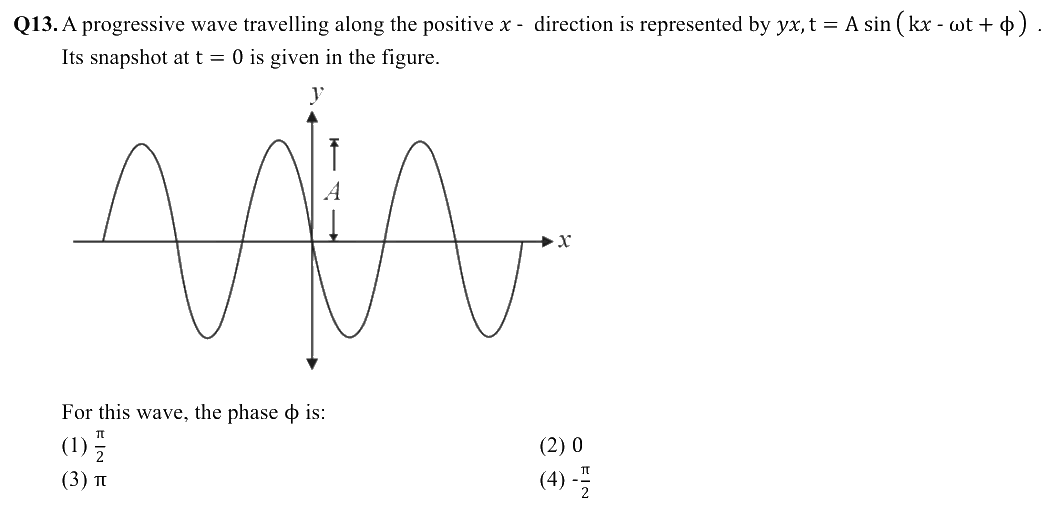
A progressive wave travelling along the positive $x -$ direction is represented by $yx, t = A\ \sin\left(kx - \omega t + \phi\right)$ . Its snapshot at $\mathrm{t = 0}$ is given in the figure. (see the figure above) For this wave, the phase $\phi$ is:
A small speaker delivers 2 W of audio output. At what distance from the speaker will one detect 120 dB intensity sound? [Given reference intensity of sound as $10^{-12}\ \mathrm{W/m^2}$ ]
Two sources of sound $S_1$ and $S_2$ produce sound waves of same frequency 660 Hz. A listener is moving from source $S_1$ towards $S_2$ with a constant speed $\mathrm{u_0\ m/s}$ and he hears 10 beats/s. The velocity of sound is 330 m/s. Then, $\mathrm{u_0}$ equals:
A tunning fork of frequency 480 Hz is used in an experiment for measuring speed of sound ($v$) in air by resonance tube method. Resonance is observed to occur at two successive lengths of the air column, $l_1 = 30\ \mathrm{cm}$ and $l_2 = 70\ \mathrm{cm}$. Then, $v$ is equal to:
A stationary source emits sound waves of frequency $500\ \mathrm{Hz}$ . Two observers moving along a line passing through the source detect sound to be of frequencies $480\ \mathrm{Hz}$ and $530\ \mathrm{Hz}$ . Their respective speeds are, in $\mathrm{m\ s^{-1}}$ , (Given speed of sound $= 300\ \mathrm{m/s}$ )
A source of sound S is moving with a velocity of $50\ \mathrm{m\ s^{-1}}$ towards a stationary observer. The observer measures the frequency of the source as $1000\ \mathrm{Hz}$. What will be the apparent frequency of the source when it is moving away from the observer after crossing him? (Take velocity of sound in air is $350\ \mathrm{m\ s^{-1}}$ )
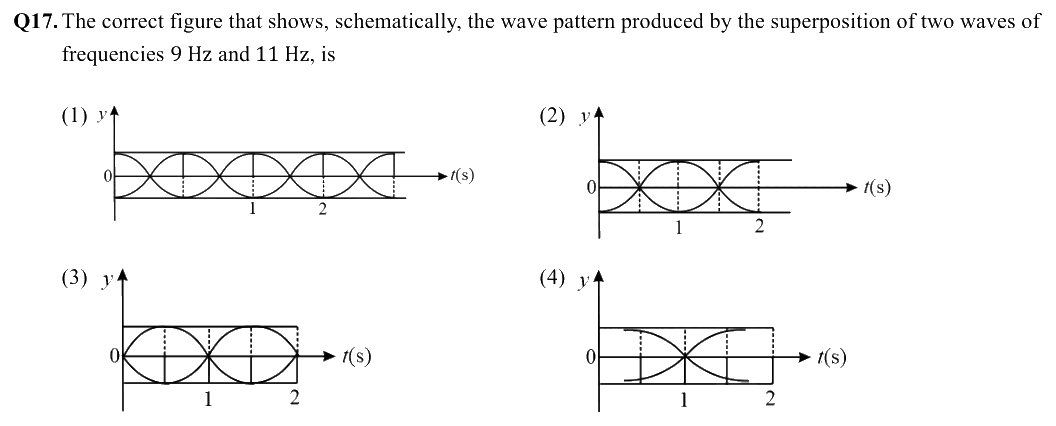
The correct figure that shows, schematically, the wave pattern produced by the superposition of two waves of frequencies 9 Hz and 11 Hz, is
(see the figure above)
The question as printed in the paper.
A
see figure y versus t(s): beat lobes with maxima at the dotted lines and nodes midway between them; the tick labels 1 and 2 sit under the 2nd and 3rd dotted lines
B
see figure y versus t(s): maxima at t = 0, 1 and 2 s, nodes at t = 0.5 and 1.5 s
C
see figure y versus t(s): nodes at t = 0, 1 and 2 s, maxima at t = 0.5 and 1.5 s
D
see figure y versus t(s): a single node at t = 1 s; the curves reach the envelope near t = 0.3 s and t = 1.7 s
A string is clamped at both the ends and it is vibrating in its $4^{\mathrm{th}}$ harmonic. The equation of the stationary wave is $y = 0.3\sin(0.157x)\cos(200\pi t)$. The length of the string is (All quantities are in SI units.)
The pressure wave, $\mathrm{P} = 0.01\sin[1000t - 3x]\mathrm{N\ m^{-2}}$, corresponds to the sound produced by a vibrating blade on a day when atmospheric temperature is $0^\circ$C. On some other day when temperature is T , the speed of sound produced by the same blade and at the same frequency is found to be 336 $\mathrm{m\ s^{-1}}$. Approximate value of T is:
Two cars A and B are moving away from each other in opposite directions. Both the cars are moving with speed of 20 $\mathrm{m\ s^{-1}}$ with respect to the ground. If an observer in car A detects a frequency 2000 Hz of the sound coming from car B, what is the natural frequency of the sound source in car B? (speed of sound in air = 340 $\mathrm{m\ s^{-1}}$ )
A string 2.0 m long and fixed at its ends is driven by a 240 Hz vibrator. The string vibrates in its third harmonic mode. The speed of the wave and its fundamental frequency is
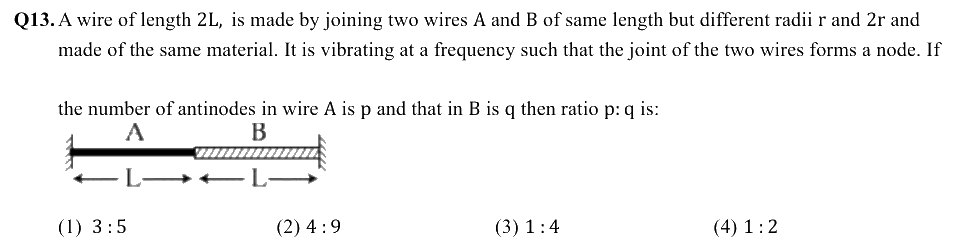
A wire of length 2L, is made by joining two wires A and B of same length but different radii r and 2r and made of the same material. It is vibrating at a frequency such that the joint of the two wires forms a node. If the number of antinodes in wire A is p and that in B is q then ratio p: q is: (see the figure above)
A travelling harmonic wave is represented by the equation $y(x,\ t) = 10^{-3}\ \sin(50t + 2x)$, where $x$ and $y$ are in meter and $t$ is in seconds. Which of the following is a correct statement about the wave?
A
The wave is propagating along the positive $x$ - axis with speed 25 m s$^{-1}$
B
The wave is propagating along the positive $x$ - axis with speed 100 m s$^{-1}$
C
The wave is propagating along the negative $x$ - axis with speed 25 m s$^{-1}$
D
The wave is propagating along the negative $x$ - axis with speed 100 m s$^{-1}$
A resonance tube is old and has a jagged end. It is still used in the laboratory to determine the velocity of sound in air. A tuning fork of frequency 512 $Hz$ produces first resonance when the tube is filled with water to a mark 11 $cm$ below a reference mark, near the open end of the tube. The experiment is repeated with another fork of frequency 256 $Hz$ which produces first resonance when water reaches a mark 27 $cm$ below the reference mark. The velocity of sound in air, obtained in the experiment, is close to
Equation of travelling wave on a stretched string of linear density 5 g/m is y = 0.03 sin(450t $-$ 9x) where distance and time are measured in SI units. The tension in the string is:
A train moves towards a stationary observer with speed $34\ m/s$. The train sounds a whistle and its frequency registered by the observer is $f_1$. If the speed of the train is reduced to $17\ m/s$, the frequency registered is $f_2$. If speed of sound is $340\ m/s$, then the ratio $f_1/f_2$ is:
A string of length 1 m and mass 5 g is fixed at both ends. The tension in the string is 8.0 N. The string is set into vibration using an external vibrator of frequency 100 Hz. The separation between successive nodes on the string is close to
A closed organ pipe has a fundamental frequency of $1.5\ \mathrm{kHz}$. The number of overtones that can be distinctly heard by a person with this organ pipe will be (Assume that the highest frequency a person can hear is $20{,}000\ \mathrm{Hz}$).
A heavy ball of mass $M$ is suspended from the ceiling of a car by a light string of mass $m$ $m \ll M$. When the car is at rest, the speed of transverse waves in the string is $60\ \mathrm{ms^{-1}}$. When the car has acceleration $a$, the wave-speed increases to $60.5\ \mathrm{ms^{-1}}$. The value of $a$, in terms of gravitational acceleration $g$, is closed to
A musician using an open flute of length $50\ \mathrm{cm}$ produces second harmonic sound waves. A person runs towards the musician from another end of a hall at a speed of $10\ \mathrm{km\ h^{-1}}$. If the wave speed is $330\ \mathrm{m\ s^{-1}}$, the frequency heard by the running person shall be close to
The end correction of a resonance column is 1 cm. If the shortest length resonating with the tuning fork is 10 cm, the next resonating length should be
Two sitar strings, $A$ and $B$ playing the note 'Dha' are slightly out of tune and produce beats of frequency 5 Hz. The tension of the string $B$ is slightly increased and the beat frequency is found to decrease by 3 Hz. If the frequency of $A$ is 425 Hz. The original frequency of $B$ is
A tuning fork vibrates with frequency $256\ \mathrm{Hz}$ and gives one best (sic) per second with the third normal mode of vibration of an open pipe. What is the length of the pipe? (Speed of sound in air is $340\ \mathrm{ms}^{-1}$ )
5 beats/ second are heard when a turning fork is sounded with a sonometer wire under tension, when the length of the sonometer wire is either $0.95\ \mathrm{m}$ or $1\ \mathrm{m}$. The frequency of the fork will be:
A granite rod of $60\ \mathrm{cm}$ length is clamped at its middle point and is set into longitudinal vibrations. The density of granite is $2.7 \times 10^{3}\ \mathrm{kg\ m^{-3}}$ and its Young's modulus is $9.27 \times 10^{10}\ \mathrm{Pa}$. What will be the fundamental frequency of the longitudinal vibrations?
A standing wave is formed by the superposition of two waves travelling in opposite directions. The transverse displacement is given by, $y(x,\,t) = 0.5\sin\left(\frac{5\pi}{4}x\right)\cos(200\pi t)$. What is the speed of the travelling wave moving in the positive $x$ direction? ($x$ and $t$ are in meter and second, respectively)
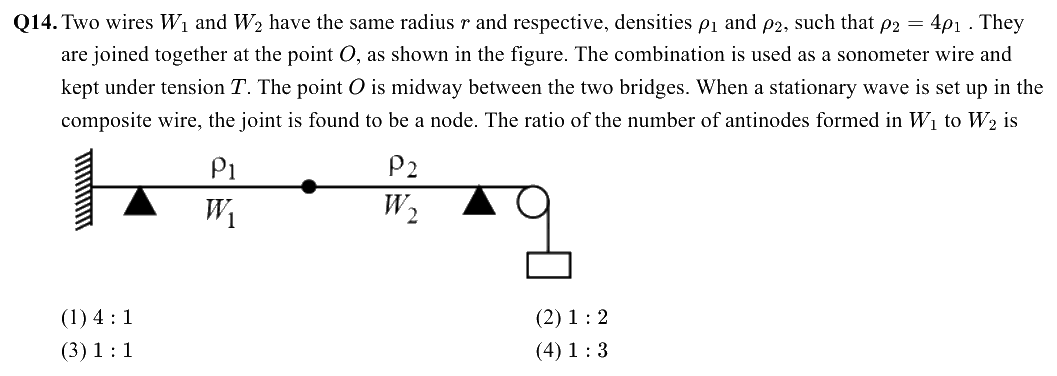
Two wires $W_1$ and $W_2$ have the same radius $r$ and respective, densities $\rho_1$ and $\rho_2$, such that $\rho_2 = 4\rho_1$. They are joined together at the point $O$, as shown in the figure. The combination is used as a sonometer wire and kept under tension $T$. The point $O$ is midway between the two bridges. When a stationary wave is set up in the composite wire, the joint is found to be a node. The ratio of the number of antinodes formed in $W_1$ to $W_2$ is (see the figure above)
An observer is moving with half the speed of light towards a stationary microwave source emitting waves at frequency $10\ \mathrm{GHz}$. What is the frequency of the microwave measured by the observer? (speed of light $= 3 \times 10^{8}\ \mathrm{m\ s^{-1}}$)
A toy-car, blowing its horn, is moving with a steady speed of $5\ \mathrm{m\,s^{-1}}$, away from a wall. An observer, towards whom the toy car is moving, is able to hear 5 beats per second. If the velocity in air is $340\ \mathrm{m\,s^{-1}}$ the frequency of the horn of the toy car is close to
Two engines pass each other moving in opposite directions with uniform speed of 30 m/s. one of them is blowing a whistle of frequency 540 Hz. Calculate the frequency heard by driver of second engine before they pass each other. speed of sound is 330 m/sec:
A pipe open at both ends has a fundamental frequency $f$ in air. The pipe is dipped vertically in water so that half of it is in water. The fundamental frequency of the air column is now:
A uniform string of length 20 m is suspended from a rigid support. A short wave pulse is introduced at its lowest end. It starts moving up the string. The time taken to reach the support is (Take, g = 10 m s$^{-2}$)
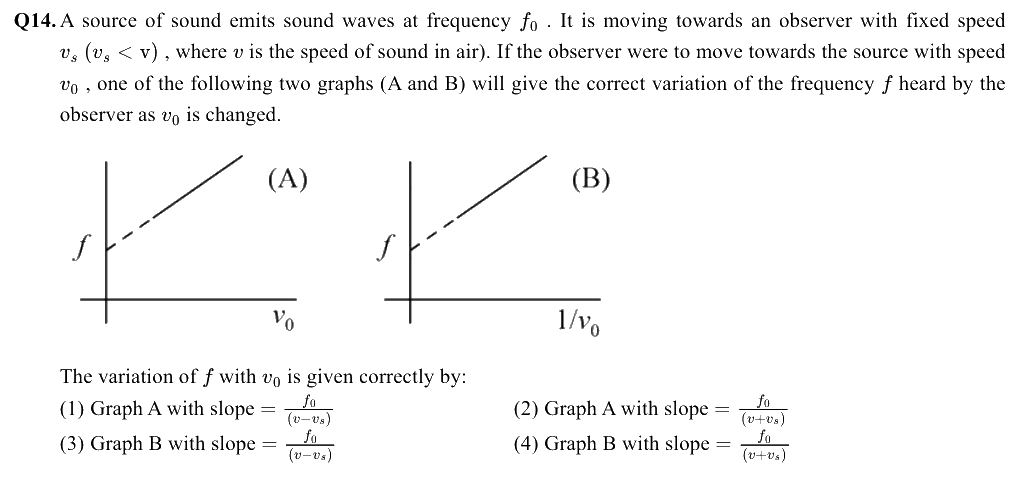
A source of sound emits sound waves at frequency $f_0$. It is moving towards an observer with fixed speed $v_s$ ($v_s < v$, where $v$ is the speed of sound in air). If the observer were to move towards the source with speed $v_0$, one of the following two graphs (A and B) will give the correct variation of the frequency $f$ heard by the observer as $v_0$ is changed. (see the figure above) The variation of $f$ with $v_0$ is given correctly by:
A bat moving at $10\ \mathrm{m\,s^{-1}}$ towards a wall sends a sound signal of 8000 Hz towards it. On reflection, it hears a sound of frequency $f$. The value of $f$ in Hz is close to ($\text{speed of sound} = 320\ \mathrm{m\,s^{-1}}$)
A train is moving on a straight track with speed $20\ \mathrm{m\,s^{-1}}$. It is blowing its whistle at the frequency of $1000\ \mathrm{Hz}$. The percentage change in the frequency heard by a person standing near the track as the train passes him is (speed of sound $= 320\ \mathrm{m\,s^{-1}}$) close to:
The total length of a sonometer wire fixed between two bridges is $110\ \mathrm{cm}$. Now, two more bridges are placed to divide the length of the wire in the ratio $6:3:2$. If the tension in the wire is $400\ \mathrm{N}$ and the mass per unit length of the wire is $0.01\ \mathrm{kg\ m^{-1}}$, then the minimum common frequency with which all the three parts can vibrate, is
A source of sound A emitting waves of frequency $1800\ \mathrm{Hz}$ is falling towards ground with a terminal speed v. The observer B on the ground directly beneath the source receives waves of frequency $2150\ \mathrm{Hz}$. The source A receives waves, reflected from ground of frequency nearly: (Speed of sound $= 343\ \mathrm{m/s}$ )
Two factories are sounding their sirens at $800\ \mathrm{Hz}$. A man goes from one factory to other at a speed of $2\ \mathrm{m/s}$. The velocity of sound is $320\ \mathrm{m/s}$. The number of beats heard by the person in one second will be:
A transverse wave is represented by : $\mathrm{y} = \frac{10}{\pi}\,\sin\left(\frac{2\pi}{T}\mathrm{t} - \frac{2\pi}{\lambda}x\right)$ For what value of the wavelength the wave velocity is twice the maximum particle velocity?
A pipe of length 85 cm is closed from one end. Find the number of possible natural oscillations of air column in the pipe whose frequencies lie below 1250 Hz. The velocity of sound in air is 340 m/s.
In a transverse wave the distance between a crest and neighbouring trough at the same instant is 4.0 cm and the distance between a crest and trough at the same place is 1.0 cm. The next crest appears at the same place after a time interval of 0.4 s. The maximum speed of the vibrating particles in the medium is:
A sonometer wire of length 114 cm is fixed at both the ends. Where should the two bridges be placed so as to divide the wire into three segments whose fundamental frequencies are in the ratio $1 : 3 : 4$ ?
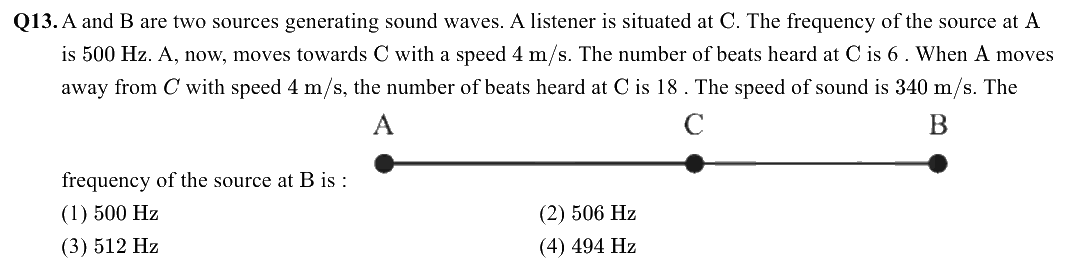
A and B are two sources generating sound waves. A listener is situated at C. The frequency of the source at A is $500\ \mathrm{Hz}$. A, now, moves towards C with a speed $4\ \mathrm{m/s}$. The number of beats heard at C is $6$ . When A moves away from $C$ with speed $4\ \mathrm{m/s}$, the number of beats heard at C is $18$ . The speed of sound is $340\ \mathrm{m/s}$. The frequency of the source at B is : (see the figure above)
When two sound waves travel in the same direction in a medium, the displacements of a particle located at ' $x$ ' at time ' $t$ ' is given by : $y_1 = 0.05\cos(0.50\pi x - 100\pi t)$, $y_2 = 0.05\cos(0.46\pi x - 92\pi t)$ where $y_1$, $y_2$ and $x$ are in meters and $t$ in seconds. The speed of sound in the medium is :
An engine approaches a hill with a constant speed. When it is at a distance of 0.9 km, it blows a whistle whose echo is heard by the driver after 5 seconds. If the speed of sound in air is 330 m/s, then the speed of the engine is :
A sonometer wire of length 1.5 m is made of steel. The tension in it produces an elastic strain of 1%. What is the fundamental frequency of steel if density and elasticity of steel are $7.7 \times 10^{3}\ \mathrm{kg\ m^{-3}}$ and $2.2 \times 10^{11}\ \mathrm{N\ m^{-2}}$ respectively?
An air column in a pipe, which is closed at one end, will be in resonance wtih (sic) a vibrating tuning fork of frequency 264 Hz if the length of the column in cm is (velocity of sound $= 330$ m/s )
The disturbance $y(x, t)$ of a wave propagating in the positive $x$-direction is given by $y = \frac{1}{1+x^{2}}$ at time $t = 0$ and by $y = \frac{1}{[1+(x-1^{2})]}$ at $t = 2$ s, where $x$ and $y$ are in meters. The shape of the wave disturbance does not change during the propagation. The velocity of wave in m/s is
A uniform tube of length $60.5\ \mathrm{cm}$ is held vertically with its lower end dipped in water. A sound source of frequency $500\ \mathrm{Hz}$ sends sound waves into the tube. When the length of tube above water is $16\ \mathrm{cm}$ and again when it is $50\ \mathrm{cm}$, the tube resonates with the source of sound. Two lowest frequencies (in $\mathrm{Hz}$ ), to which tube will resonate when it is taken out of water, are (approximately).
This question has Statement 1 and Statement 2 . Of the four choices given after the Statements, choose the one that best describes the two Statements. Statement 1: Bats emitting ultrasonic waves can detect the location of a prey by hearing the waves reflected from it. Statement 2: When the source and the detector are moving, the frequency of reflected waves is changed.
A
Statement 1 is false, Statement 2 is true.
B
Statement 1 is true, Statement 2 is false.
C
Statement 1 is true, Statement 2 is true, Statement 2 is not the correct explanation of Statement 1.
D
Statement 1 is true, Statement 2 is true, Statement 2 is the correct explanation of Statement 1.
A wave represented by the equation $y_1 = a\cos(kx - \omega t)$ is superimposed with another wave to form a stationary wave such that the point $x = 0$ is node. The equation for the other wave is
A
$a\cos(kx - \omega t + \pi)$
B
$a\cos(kx + \omega t + \pi)$
C
$a\cos\left(kx + \omega t + \dfrac{\pi}{2}\right)$
D
$a\cos\left(kx - \omega t + \dfrac{\pi}{2}\right)$
Following are expressions for four plane simple harmonic waves (i) $y_1 = A\cos 2\pi\left(n_1 t + \frac{x}{\lambda_1}\right)$ (ii) $y_2 = A\cos 2\pi\left(n_1 t + \frac{x}{\lambda_1} + \pi\right)$ (iii) $y_3 = A\cos 2\pi\left(n_2 t + \frac{x}{\lambda_2}\right)$ (iv) $y_4 = A\cos 2\pi\left(n_2 t - \frac{x}{\lambda_2}\right)$ The pairs of waves which will produce destructive interference and stationary waves respectively in a medium, are
This question has Statement 1 and Statement 2. Of the four choices given after the Statements, choose the one that best describes the two Statements. Statement 1: In the resonance tube experiment, if the tuning fork is replaced by another identical turning (sic) fork but with its arm having been filed, the length of the air column should be increased to obtain resonance again. Statement 2: On filing the arms, the frequency of a tuning fork increases.
A
Statement 1 is true, Statement 2 is true, Statement 2 is a correct explanation of Statement 1.
B
Statement 1 is true, Statement 2 is false.
C
Statement 1 is false, Statement 2 is true.
D
Statement 1 is true, Statement 2 is true, Statement 2 is not a correct explanation of Statement 1.
A cylindrical tube, open at both ends, has a fundamental frequency, f, in air. The tube is dipped vertically in water so that half of it is in water. The fundamental frequency of the air-column is now
The equation of a wave on a string of linear mass density 0.04 kg m$^{-1}$ is given by $y = 0.02(\text{ m})\sin\left[2\pi\left(\frac{t}{0.04(\text{ s})} - \frac{x}{0.50(\text{ m})}\right)\right]$. The tension in the string is
A motor cycle starts from rest and accelerates along a straight path at $2\ \mathrm{m/s^2}$. At the starting point of the motor cycle there is a stationary electric sire. How far has the motor cycle gone when the driver hears the frequency of the siren at 94% of its value when the motor cycle was at rest? (speed of sound = $330\ \mathrm{ms^{-1}}$)
Three sound waves of equal amplitudes have frequencies $(v - 1)$, $v$, $(v + 1)$. They superpose to give beats. The number of beats produced per second will be
While measuring the speed of sound by performing a resonance column experiment, a student gets the first resonance condition at a column length of 18 cm during winter. Repeating the same experiment during summer, she measures the column length to be $x$ cm for the second resonance. Then
The speed of sound in oxygen ($\mathrm{O_2}$) at a certain temperature is $460\ \mathrm{ms^{-1}}$. The speed of sound in helium (He) at the same temperature will be (assumed both gases to be ideal)
A wave travelling along the $x$-axis is described by the equation $y(x,t) = 0.005\cos(\alpha x - \beta t)$. If the wavelength and the time period of the wave are 0.08 m and 2.0 s, respectively, then $\alpha$ and $\beta$ in appropriate units are
A whistle producing sound waves of frequencies 9500 Hz and above is approaching a stationary person with speed $v\ \mathrm{ms^{-1}}$. The velocity of sound in air is $300\ \mathrm{ms^{-1}}$. If the person can hear frequencies upto a maximum of 10, 000 Hz, the maximum value of v upto which he can hear the whistle is
A string is stretched between fixed points separated by 75 cm. It is observed to have resonant frequencies of 420 Hz and 315 Hz. There are no other resonant frequencies between these two. Then, the lowest resonant frequency for this string is
When two tuning forks (fork 1 and fork 2) are sounded simultaneously, 4 beats per second are heard. Now, some tape is attached on the prong of the fork 2 . When the tuning forks are sounded again, 6 beats per seconds are heard. If the frequency of fork 1 is 200 Hz, then what was the original frequency of fork 2 ?
An observer moves towards a stationary source of sound, with a velocity one fifth of the velocity of sound. What is the percentage increase in the apparent frequency?
The displacement y of a particle in a medium can be expressed as $y = 10^{-6} \sin(100t + 20x + \pi/4)m$, where t is in seconds and $x$ in meter. The speed of the wave is
The displacement $y$ of a wave travelling in the $x$-direction is given by $y = 10^{-4} \sin\left(600t - 2x + \frac{\pi}{3}\right)$ metres where x is expressed in metres and t in seconds. The speed of the wave-motion, in ms$^{-1}$, is
A tuning fork of known frequency 256 Hz makes 5 beats per second with the vibrating string of a piano. The beat frequency decreases to 2 beats per second when the tension in the piano string is slightly increased. The frequency of the piano string before increasing the tension was
A metal wire of linear mass density of 9.8 g/m is stretched with a tension of 10 kg-wt between two rigid supports 1 metre apart. The wire passes at its middle point between the poles of a permanent magnet, and it vibrates in resonance when carrying an alternating current of frequency $n$. The frequency $n$ of the alternating source is
A tuning fork arrangement (pair) produces 4 beats / sec with one fork of frequency 288cps. A little wax is placed on the unknown fork and it then produces 2 beats /sec. The frequency of the unknown fork is
A transverse wave on a string is described by $y = 3\sin\left(36t + 0.018x + \pi/4\right)$. where $x$, $y$ are in cm and $t$ in seconds. The least distance between the two successive crests in the wave is ________ cm. (Nearest integer)
($\pi = 3.14$)
Numerical answer type: type your answer in EdLoop to check it
Two tuning forks $A$ and $B$ are sounded together giving rise to 8 beats in 2 s. When fork $A$ is loaded with wax, the beat frequency is reduced to 4 beats in 2 s. If the original frequency of tuning fork $B$ is 380 Hz then original frequency of tuning fork $A$ is ________ Hz.
Numerical answer type: type your answer in EdLoop to check it
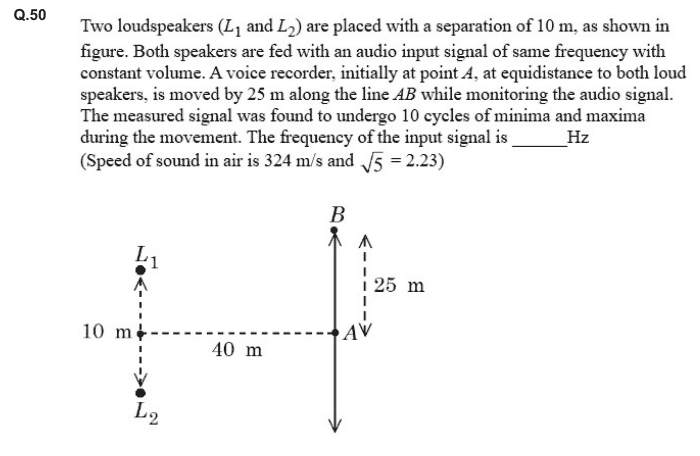
Two loudspeakers ($L_1$ and $L_2$) are placed with a separation of 10 m, as shown in figure. Both speakers are fed with an audio input signal of same frequency with constant volume. A voice recorder, initially at point $A$, at equidistance to both loud speakers, is moved by 25 m along the line $AB$ while monitoring the audio signal. The measured signal was found to undergo 10 cycles of minima and maxima during the movement. The frequency of the input signal is ________ Hz
(Speed of sound in air is 324 m/s and $\sqrt{5} = 2.23$)
(see the figure above)
The question as printed in the paper.
Numerical answer type: type your answer in EdLoop to check it
A closed and an open organ pipe have same lengths. If the ratio of frequencies of their seventh overtones is $\left(\frac{a-1}{a}\right)$ then the value of a is ______
Numerical answer type: type your answer in EdLoop to check it
Two open organ pipes of lengths 60 cm and 90 cm resonate at 6$^{th}$ and 5$^{th}$ harmonics respectively. The difference of frequencies for the given modes is ______ Hz. (Velocity of sound in air = 333 m/s )
Numerical answer type: type your answer in EdLoop to check it
A sonometer wire of resonating length 90 cm has a fundamental frequency of 400 Hz when kept under some tension. The resonating length of the wire with fundamental frequency of 600 Hz under same tension ______ cm .
Numerical answer type: type your answer in EdLoop to check it
A tuning fork resonates with a sonometer wire of length 1 m stretched with a tension of 6 N. When the tension in the wire is changed to 54 N, the same tuning fork produces 12 beats per second with it. The frequency of the tuning fork is ______ Hz.
Numerical answer type: type your answer in EdLoop to check it
In a closed organ pipe, the frequency of fundamental note is 30 Hz. A certain amount of water is now poured in the organ pipe so that the fundamental frequency is increased to 110 Hz. If the organ pipe has a cross-sectional area of 2 cm$^2$, the amount of water poured in the organ tube is ______ g. (Take speed of sound in air is 330 m s$^{-1}$ )
Numerical answer type: type your answer in EdLoop to check it
A point source is emitting sound waves of intensity $16 \times 10^{-8}\ \mathrm{W\,m^{-2}}$ at the origin. The difference in intensity (magnitude only) at two points located at a distances of 2 m and 4 m from the origin respectively will be ______ $\times 10^{-8}\ \mathrm{W\,m^{-2}}$.
Numerical answer type: type your answer in EdLoop to check it
A closed organ pipe 150 cm long gives 7 beats per second with an open organ pipe of length 350 cm, both vibrating in fundamental mode. The velocity of sound is ______ m s$^{-1}$.
Numerical answer type: type your answer in EdLoop to check it
The fundamental frequency of vibration of a string between two rigid support is 50 Hz. The mass of the string is 18 g and its linear mass density is 20 g m$^{-1}$. The speed of the transverse waves so produced in the string is ______ m s$^{-1}$.
Numerical answer type: type your answer in EdLoop to check it
In an experiment with sonometer when a mass of 180 g is attached to the string, it vibrates with fundamental frequency of 30 Hz. When a mass $m$ is attached, the string vibrates with fundamental frequency of 50 Hz. The value of $m$ is ______ g.
Numerical answer type: type your answer in EdLoop to check it
For a certain organ pipe, the first three resonance frequencies are in the ratio of $1 : 3 : 5$ respectively. If the frequency of fifth harmonic is 405 Hz and the speed of sound in air is $324\ \mathrm{m\ s^{-1}}$ the length of the organ pipe is ______ m.
Numerical answer type: type your answer in EdLoop to check it
The equation of wave is given by $Y = 10^{-2}\sin 2\pi 160t - 0.5x + \frac{\pi}{4}$, where $x$ and $Y$ are in $m$ and $t$ in $s$. The speed of the wave is ______ $\mathrm{km\ h^{-1}}$.
Numerical answer type: type your answer in EdLoop to check it
A wire of density $8 \times 10^{3}\ \mathrm{kg\ m^{-3}}$ is stretched between two clamps $0.5$ m apart. The extension developed in the wire is $3.2 \times 10^{-4}$ m. If $Y = 8 \times 10^{10}\ \mathrm{N\ m^{-2}}$, the fundamental frequency of vibration in the wire will be ______ Hz
Numerical answer type: type your answer in EdLoop to check it
A transverse harmonic wave on a string is given by $yx, t = 5\ \sin 6t + 0.003x$ where $x$ and $y$ are in cm and $t$ in sec. The wave velocity is ______ $\mathrm{m\,s^{-1}}$.
Numerical answer type: type your answer in EdLoop to check it
An organ pipe 40 cm long is open at both ends. The speed of sound in air is $360\ \mathrm{m\,s^{-1}}$. The frequency of the second harmonic is ______ Hz.
Numerical answer type: type your answer in EdLoop to check it
A guitar string of length $90\ \mathrm{cm}$ vibrates with a fundamental frequency of $120\ \mathrm{Hz}$. The length of the string producing a fundamental of $180\ \mathrm{Hz}$ will be ______ cm
Numerical answer type: type your answer in EdLoop to check it
A person driving car at a constant speed of $15\ \mathrm{m\ s^{-1}}$ is approaching a vertical wall. The person notices a change of $40\ \mathrm{Hz}$ in the frequency of his car's horn upon reflection from the wall. The frequency of horn is ______ Hz. (Given: Speed of sound: $30\ \mathrm{m\ s^{-1}}$)
Numerical answer type: type your answer in EdLoop to check it
The displacement equations of two interfering waves are given by $y_1 = 10\ \sin\left(\omega t + \frac{\pi}{3}\right)$ cm, $y_2 = 5\left[\sin\ (\omega t) + \sqrt{3}\ \cos\ \omega t\right]$ cm respectively. The amplitude of the resultant wave is ______ cm.
Numerical answer type: type your answer in EdLoop to check it
Two simple harmonic waves having equal amplitudes of $8\ \mathrm{cm}$ and equal frequency of $10\ \mathrm{Hz}$ are moving along the same direction. The resultant amplitude is also $8\ \mathrm{cm}$. The phase difference between the individual waves is ______ degree.
Numerical answer type: type your answer in EdLoop to check it
The distance between two consecutive points with phase difference of $60^\circ$ in a wave of frequency $500\ \mathrm{Hz}$ is $6.0\ \mathrm{m}$. The velocity with which wave is travelling is ______ $\mathrm{km\,s^{-1}}$.
Numerical answer type: type your answer in EdLoop to check it
A train blowing a whistle of frequency 320 Hz approaches an observer standing on the platform at a speed of $66\ \mathrm{m\,s^{-1}}$. The frequency observed by the observer will be (given speed of sound $=330\ \mathrm{m\,s^{-1}}$) ______ Hz.
Numerical answer type: type your answer in EdLoop to check it
The speed of a transverse wave passing through a string of length 50 cm and mass 10 g is 60 $\mathrm{m\ s^{-1}}$. The area of cross-section of the wire is 2.0 $\mathrm{mm^2}$ and its Young's modulus is $1.2 \times 10^{11}\ \mathrm{N\ m^{-2}}$. The extension of the wire over its natural length due to its tension will be $x \times 10^{-5}$ m. The value of $x$ is ______.
Numerical answer type: type your answer in EdLoop to check it
The frequency of echo will be ______ Hz if the train blowing a whistle of frequency $320\ \mathrm{Hz}$ is moving with a velocity of $36\ \mathrm{km\ h^{-1}}$ towards a hill from which an echo is heard by the train driver. Velocity of sound in air is $330\ \mathrm{m\ s^{-1}}$.
Numerical answer type: type your answer in EdLoop to check it
A wire of length 30 cm, stretched between rigid supports, has it's $n^{\mathrm{th}}$ and $(n + 1)^{\mathrm{th}}$ harmonics at 400 Hz and 450 Hz, respectively. If tension in the string is 2700 N, it's linear mass density is ______ $\mathrm{kg~m^{-1}}$.
Numerical answer type: type your answer in EdLoop to check it
When a car is approaching the observer, the frequency of horn is 100 Hz. After passing the observer, it is 50 Hz. If the observer moves with the car, the frequency will be $\frac{x}{3}$ Hz where $x$ = ______ .
Numerical answer type: type your answer in EdLoop to check it
An observer is riding on a bicycle and moving towards a hill at 18 $\mathrm{km\ h^{-1}}$. He hears a sound from a source at some distance behind him directly as well as after its reflection from the hill. If the original frequency of the sound as emitted by source is 640 Hz and velocity of the sound in air is 320 $\mathrm{m\ s^{-1}}$, the beat frequency between the two sounds heard by observer will be ______ Hz.
Numerical answer type: type your answer in EdLoop to check it
Two waves executing simple harmonic motion travelling in the same direction with same amplitude and frequency are superimposed. The resultant amplitude is equal to the $\sqrt{3}$ times of amplitude of individual motions. The phase difference between the two motions is ______ (degree)
Numerical answer type: type your answer in EdLoop to check it
In an experiment to determine the velocity of sound in air at room temperature using a resonance tube, the first resonance is observed when the air column has a length of $20.0\ \mathrm{cm}$ for a tuning fork of frequency $400\ \mathrm{Hz}$ is used. The velocity of the sound at room temperature is $336\ \mathrm{m\,s^{-1}}$. The third resonance is observed when the air column has a length of ______ cm
Numerical answer type: type your answer in EdLoop to check it
A tunning fork of frequency $340\ \mathrm{Hz}$ resonates in the fundamental mode with an air column of length $125\ \mathrm{cm}$ in a cylindrical tube closed at one end. When water is slowly poured in it, the minimum height of water required for observing resonance once again is ______ cm. (Velocity of sound in air is $340\ \mathrm{ms^{-1}}$)
Numerical answer type: type your answer in EdLoop to check it
A set of 20 tuning forks is arranged in a series of increasing frequencies. If each fork gives 4 beats with respect to the preceding fork and the frequency of the last fork is twice the frequency of the first, then the frequency of last fork is ______ Hz.
Numerical answer type: type your answer in EdLoop to check it
The first overtone frequency of an open organ pipe is equal to the fundamental frequency of a closed organ pipe. If the length of the closed organ pipe is $20 \mathrm{~cm}$. The length of the open organ pipe is ______ cm
Numerical answer type: type your answer in EdLoop to check it
Two travelling waves of equal amplitudes and equal frequencies move in opposite directions along a string. They interfere to produce a stationary wave whose equation is given by $y = \left(10 \cos \pi x \sin \frac{2\pi t}{T}\right)$ cm. The amplitude of the particle at $x = \frac{4}{3}$ cm will be ______ cm.
Numerical answer type: type your answer in EdLoop to check it
A wire having a linear mass density $9.0 \times 10^{-4}$ kg m$^{-1}$ is stretched between two rigid supports with a tension of $900$ N. The wire resonates at a frequency of $500$ Hz. The next higher frequency at which the same wire resonates is $550$ Hz. The length of the wire is ______ m.
Numerical answer type: type your answer in EdLoop to check it
Two cars $X$ and $Y$ are approaching each other with velocities $36$ km h$^{-1}$ and $72$ km h$^{-1}$ respectively. The frequency of a whistle sound as emitted by a passenger in car $X$, heard by the passenger in car $Y$ is $1320$ Hz. If the velocity of sound in air is $340$ ms$^{-1}$, the actual frequency of the whistle sound produced is ______ Hz.
Numerical answer type: type your answer in EdLoop to check it
A tuning fork is vibrating at $250\ \mathrm{Hz}$. The length of the shortest closed organ pipe that will resonate with the tuning fork will be ______$\mathrm{cm}$. (Take speed of sound in air as $340\ \mathrm{m\ s^{-1}}$ )
Numerical answer type: type your answer in EdLoop to check it
Two travelling waves produces a standing wave represented by equation. $y=\left(1.0\ \mathrm{mm}\right)\cos\left[\left(1.57\ \mathrm{cm^{-1}}\right)x\right]\sin\left[\left(78.5\ \mathrm{s^{-1}}\right)t\right]$. The node closest to the origin in the region $x>0$ will be at $x=......$ (in cm).
Numerical answer type: type your answer in EdLoop to check it
A source and a detector move away from each other in absence of wind with a speed of $20\ \mathrm{m\ s^{-1}}$, with respect to the ground. If the detector detects a frequency of $1800\ \mathrm{Hz}$ of the sound coming from the source, then the original frequency of source considering the speed of sound in the air $340\ \mathrm{m\ s^{-1}}$ will be ______ $\mathrm{Hz}$.
Numerical answer type: type your answer in EdLoop to check it
Two waves are simultaneously passing through a string and their equations are : $y_1=A_1\sin k(x-vt),\, y_2=A_2\sin k(x-vt+x_0)$. Given amplitudes $A_1=12\ \mathrm{mm}$ and $A_2=5\ \mathrm{mm}$, $x_0=3.5\ \mathrm{cm}$ and wave number $\mathrm{k}=6.28\ \mathrm{cm^{-1}}$. The amplitude of resulting wave will be ______ mm.
Numerical answer type: type your answer in EdLoop to check it
The amplitude of wave disturbance propagating in the positive $x$-direction is given by $y = \frac{1}{(1+x)^2}$ at time $t = 0$ and $y = \frac{1}{1+(x-2)^2}$ at $t = 1\ \mathrm{s}$, where $x$ and $y$ are in metres. The shape of wave does not change during the propagation. The velocity of the wave will be $\mathrm{m\ s^{-1}}$.
Numerical answer type: type your answer in EdLoop to check it
The frequency of a car horn encountered a change from $400\ \mathrm{Hz}$ to $500\ \mathrm{Hz}$. When the car approaches a vertical wall. If the speed of sound is $330\ \mathrm{m\ s^{-1}}$. Then the speed of car is ___ $\mathrm{km\ h^{-1}}$.
Numerical answer type: type your answer in EdLoop to check it
A galaxy is moving away from the earth at a speed of $286~\mathrm{km~s^{-1}}$. The shift in the wavelength of a red line at $630~\mathrm{nm}$ is $x \times 10^{-10}~\mathrm{m}$. The value of $x$, to the nearest integer, is ______ . [Take the value of the speed of the light $c$, as $3 \times 10^8~\mathrm{m~s^{-1}}$]
Numerical answer type: type your answer in EdLoop to check it
A closed organ pipe of length $L$ and an open organ pipe contain gases of densities $\rho_1$ and $\rho_2$ respectively. The compressibility of gases are equal in both the pipes. Both the pipes are vibrating in their first overtone with same frequency. The length of the open pipe is $\frac{x}{3}L\sqrt{\frac{\rho_1}{\rho_2}}$, where $x$ is ______. (Round off to the Nearest Integer)
Numerical answer type: type your answer in EdLoop to check it
The mass per unit length of a uniform wire is $0.135\ \mathrm{g\ cm^{-1}}$. A transverse wave of the form $y = -0.21\sin(x + 30t)$ is produced in it, where $x$ is in meter and $t$ is in second. Then, the expected value of tension in the wire is $x \times 10^{-2}$ N. Value of $x$ is ______ (Round-off to the nearest integer)
Numerical answer type: type your answer in EdLoop to check it
Two cars are approaching each other at an equal speed of $7.2\ \mathrm{km\ hr^{-1}}$. When they see each other, both blow horns having a frequency of $676\ \mathrm{Hz}$. The beat frequency heard by each driver will be ______ Hz. [Velocity of sound in air is $340\ \mathrm{m\ s^{-1}}$.
Numerical answer type: type your answer in EdLoop to check it
A wire of density $9 \times 10^{-3}\ \mathrm{kg\ cm}^{-3}$ is stretched between two clamps $1\ \mathrm{m}$ apart. The resulting strain in the wire is $4.9 \times 10^{-4}$. The lowest frequency of the transverse vibrations in the wire (Young's modulus of wire $Y = 9 \times 10^{10}\ \mathrm{Nm}^{-2}$ ), (to the nearest integer),______
Numerical answer type: type your answer in EdLoop to check it
A one metre long (both ends open) organ pipe is kept in a gas that has double the density of air at STP. Assuming the speed of sound in air at STP is $300\ \mathrm{m/s}$, the frequency difference between the fundamental and second harmonic of this pipe is __________ Hz.
Numerical answer type: type your answer in EdLoop to check it
Waves concludes the Class 11 Physics syllabus by analyzing mechanical energy transport through elastic strings and acoustic air columns. Across the papers we hold from 2019 to 2026, the chapter delivered 125 questions in 162 papers, which translates to 0.8 questions per paper, and was present in 104 of those 162 papers. Over this eight-year period, it holds the 22nd spot among 29 Physics chapters by question count, representing 2.7% of all Physics questions.
Relative to the earlier AIEEE period, questions on waves have become less frequent. From 2002 to 2018, waves accounted for 4.1% of the Physics section; in the recent 2024 to 2026 testing window, it declined to 2.1%, producing 32 questions across 58 papers. Peak activity in our collection occurred in 2021 (22 questions in 26 papers) and 2022 (20 questions in 22 papers). Every year since 2019 has featured questions from this chapter, appearing in 104 of the 162 papers in our set.
It constitutes the second half of Unit 10: Oscillations and Waves in NTA's Class 11 syllabus. Its interference mathematics and boundary reflection principles directly prepare students for Wave Optics in Class 12.
Most-asked topics
Between 2019 and 2026, questions separated into four distinct areas:
Wave Motion: 42 questions. Wave speed along stretched cords, transverse wave kinematics, wave equation relations, and speed of sound temperature dependence.
Sound Waves: 32 questions. Standing waves in organ pipes (open and closed ends), end corrections, acoustic resonance tubes, and harmonics.
Doppler Effect: 26 questions. Frequency shifts for moving acoustic sources, moving observers, and echo reflections from stationary or moving walls.
Superposition & Standing Waves: 25 questions. Nodes and antinodes on clamped strings, beats produced by tuning forks, and coherent spatial interference.
Standing waves in acoustic tubes and transverse string waves were tested actively in 2026, while Doppler questions featured regularly through 2023.
What the questions look like
Organ pipe questions evaluate natural acoustic modes. A classic problem states that the difference between the sixth and third harmonics of an open organ pipe equals 2200 Hz and asks for the physical length of the pipe. Students use the open-pipe harmonic formula f_n = n v / (2L), setting the frequency gap to 3 v / (2L) and solving for length using the speed of sound. Another frequent variant matches the fifth harmonic of a closed pipe with the fundamental frequency of an open pipe, asking for their length ratio.
String wave problems test transverse propagation speed v = √(T/μ). A typical question joins two strings of different linear mass densities end-to-end under a shared 500 N tension, asking for the ratio of transit times for pulses initiated at opposite boundaries. Sound velocity questions test gas temperature dependencies, asking for the absolute temperature where sound speed in air doubles relative to its value at 0 °C.
Superposition questions probe beats and interference. A mobile acoustic receiver moves past two coherent speakers separated by a fixed baseline, recording intensity maxima as path differences shift by integer wavelengths. Beats problems evaluate the frequency change when tuning fork prongs are loaded with wax or filed down.
An exceptionally high fraction comes as numerical entry: 50 of the 125 questions since 2019 had no answer options, demanding rigorous unit conversion and arithmetic.
Questions to try first
The following selections from recent papers illustrate the principal question types:
Master boundary conditions for standing waves. Remember that a displacement node occurs at a rigid string clamp or closed organ pipe end (where longitudinal air motion is prevented), whereas an antinode forms at a free string boundary or open organ pipe end (where acoustic pressure matches atmospheric pressure). Open pipes support all integer harmonics (1, 2, 3, ...), whereas closed pipes support only odd harmonics (1, 3, 5, ...).
In string mechanics, memorize that pulse speed depends on tension T and linear mass density μ (mass per unit length). If a string hangs under its own weight, tension varies along its length, so speed increases from bottom to top and calculating transit time requires direct integration.
For sound velocity in gases, apply the Laplace-corrected formula v = √(γRT / M). Notice that sound speed is proportional to the square root of absolute temperature T in Kelvin, but is completely independent of pressure changes at constant temperature because gas density scales proportionally with pressure.
Frequently asked questions
Is Waves regularly tested in JEE Main 2027?
Yes. Waves produced 125 questions across 162 papers in our collection from 2019 to 2026, averaging 0.8 questions per paper. It ranks 22nd of 29 Physics chapters and appeared in 104 of the 162 papers in our set.
Why do closed organ pipes produce only odd harmonics?
A closed pipe requires a displacement node at the sealed bottom and an antinode at the open top. This boundary constraint demands an odd number of quarter wavelengths inside the tube: L = (2n - 1)λ / 4. Consequently, only odd integer multiples of the fundamental frequency can form resonant standing waves.
How does air temperature affect acoustic resonance frequency?
Because the speed of sound scales with the square root of absolute temperature, warmer air increases sound velocity. Since pipe length remains virtually constant, all resonant harmonic frequencies shift upward proportionally with the square root of absolute temperature.
Where can I see the solutions?
Every question on this page opens with its options and answer. Step-by-step solutions for each one are in the EdLoop app.