Every Communication Systems question from past JEE Main and AIEEE papers, with options and answers. Newest first.
104questions
103papers covered
1.8%of Physics questions, 2019–2026
2011–2023years
Guide at a glance
Communication systems was previously in the Class 12 physics syllabus before being removed in 2024, holding rank 27 among 29 physics chapters with a 1.8 percent share of total physics questions.
The height of transmitting antenna is 180 m and the height of the receiving antenna is 245 m. The maximum distance between them for satisfactory communication in line of sight will be: (given $R$ = 6400 km)
Match List-I with List-II List-I (Layer of atmosphere) | List-II (Approximate height over earth's surface) (A) F$_1$-Layer | (I) 10 km (B) D-Layer | (II) 170 - 190 km (C) Troposphere | (III) 100 km (D) E-Layer | (V) 65 - 75 km Choose the correct answer from the options given below.
The amplitude of $15\sin(1000\,\pi t)$ is modulated by $10\sin(4\,\pi t)$ signal. The amplitude modulated signal contains frequencies of A. 500 Hz B. 2 Hz C. 250 Hz D. 498 Hz E. 502 Hz Choose the correct answer from the options given below
A transmitting antenna is kept on the surface of the earth. The minimum height of receiving antenna required to receive the signal in line of sight at 4 km distance from it is $x \times 10^{-2}$ m. The value of $x$ is ______. (Let, radius of earth $R = 6400$ km)
A carrier wave of amplitude 15 V is modulated by a sinusoidal base band signal of amplitude 3 V. The ratio of maximum amplitude to minimum amplitude in an amplitude modulated wave is
A TV transmitting antenna is 98 m high and the receiving antenna is at the ground level. If the radius of the earth is 6400 km, the surface area covered by the transmitting antenna is approximately:
For an amplitude modulated wave the minimum amplitude is $3\ \mathrm{V}$, while the modulation index is $60\%$. The maximum amplitude of the modulated wave is:
In an amplitude modulation, a modulating signal having amplitude of $X$ V is superimposed with a carrier signal of amplitude $Y$ V in first case. Then, in second case, the same modulating signal is superimposed with different carrier signal of amplitude $2Y$ V. The ratio of modulation index in the two case respectively wil be :
The amplitude of $15\sin(1000\pi t)$ is modulated by $10\sin(4\pi t)$ signal. The amplitude modulated signal contains frequency (ies) of (A) 500 $\mathrm{Hz}$ (B) 2 $\mathrm{Hz}$ (C) 250 $\mathrm{Hz}$ (D) 498 $\mathrm{Hz}$ (E) 502 $\mathrm{Hz}$ Choose the correct answer from the options given below:
Given below are two statements Statement I : For transmitting a signal, size of antenna ($l$) should be comparable to wavelength of signal (at least $l$ = $\frac{\lambda}{4}$ in dimension). Statement II : In amplitude modulation, amplitude of carrier wave remains constant (unchanged). In the light of the above statements, choose the most appropriate answer from the options given below
A
Both Statement I and Statement II are correct
B
Both Statement I and Statement II are incorrect
C
Statement I is incorrect but Statement II is correct
D
Statement I is correct but Statement II is incorrect
A sinusoidal carrier voltage is amplitude modulated. The resultant amplitude modulated wave has maximum and minimum amplitude of 120 V and 80 V respectively. The amplitude of each side band is :
List I A Attenuation B Transducer C Demodulation D Repeater
List II I Combination of a receiver and transmitter II Process of retrieval of information from the carrier wave at receiver III Converts one form of energy into another IV Loss of strength of a signal while propagating through a medium
Choose the correct answer from the options given below :
A message signal of frequency $5\ \mathrm{kHz}$ is used to modulate a carrier signal of frequency $2\ \mathrm{MHz}$. The bandwidth for amplitude modulation is:
A FM Broad cast transmitter, using modulating signal of frequency $20\ \mathrm{kHz}$ has a deviation ratio of $10$. The Bandwidth required for transmission is :
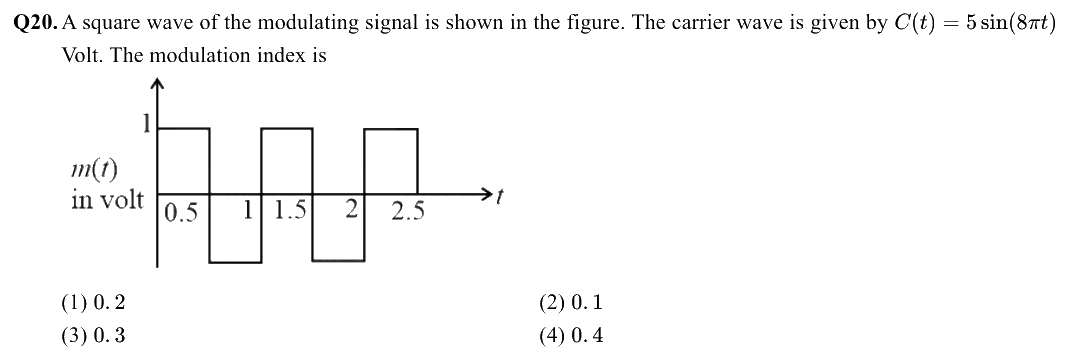
A square wave of the modulating signal is shown in the figure. The carrier wave is given by $C(t) = 5\sin(8\pi t)$ Volt. The modulation index is (see the figure above)
The maximum and minimum voltage of an amplitude modulated signal are $60\ \mathrm{V}$ and $20\ \mathrm{V}$ respectively. The percentage modulation index will be
In AM modulation, a signal is modulated on a carrier wave such that maximum and minimum amplitude are found to be 6 V and 2 V respectively. The modulation index is
Only $2\%$ of the optical source frequency is the available channel bandwidth for an optical communicating system operating at $1000\ \mathrm{nm}$. If an audio signal requires a bandwidth of $8\ \mathrm{kHz}$, how many channels can be accommodated for transmission
The TV transmission tower at a particular station has a height of $125\ \mathrm{m}$. For doubling the coverage of its range, the height of the tower should be increased by
Amplitude modulated wave is represented by $V_{\mathrm{AM}} = 10\left[1 + 0.4\cos\left(2\pi \times 10^{4}t\right)\right]\cos\left(2\pi \times 10^{7}t\right)$. The total bandwidth of the amplitude modulated wave is
We do not transmit low frequency signal to long distances because (a) The size of the antenna should be comparable to signal wavelength which is unreal solution for a signal of longer wavelength. (b) Effective power radiated by a long wavelength baseband signal would be high. (c) We want to avoid mixing up signals transmitted by different transmitter simultaneously. (d) Low frequency signal can be sent to long distances by superimposing with a high frequency wave as well. Therefore, the most suitable option will be :
A sinusoidal wave $y(t) = 40 \sin(10 \times 10^6 \pi t)$ is amplitude modulated by another sinusoidal wave $x(t) = 20 \sin(1000\pi t)$. The amplitude of minimum frequency component of modulated signal is
A baseband signal of $3.5 \mathrm{~MHz}$ frequency is modulated with a carrier signal of $3.5 \mathrm{~GHz}$ frequency using amplitude modulation method. What should be the minimum size of antenna required to transmit the modulated signal ?
A transmitting antenna at top of a tower has a height of $50\ \mathrm{m}$, and the height of receiving antenna is, $80\ \mathrm{m}$. What is the range of communication for the line of sight (LOS) mode? [use radius of the earth$=6400\ \mathrm{km}$]
In amplitude modulation, the message signal $V_{\mathrm{m}}(t) = 10\sin 2\pi \times 10^{5}t$ volts and carrier signal $V_{\mathrm{c}}t = 20\sin 2\pi \times 10^{7}t$ volts. The modulated signal now contains the message signal with lower side band and upper side band frequency, therefore the bandwidth of modulated signal is $\alpha\ \mathrm{kHz}$. The value of $\alpha$ is:
What should be the height of transmitting antenna and the population covered if the television telecast is to cover a radius of $150\ \mathrm{km}$? The average population density around the tower is $2000\ \mathrm{km^{-2}}$ and the value of $R_e = 6.5 \times 10^6\ \mathrm{m}$.
A
Height $= 1731\ \mathrm{m}$ Population Covered $= 1413 \times 10^5$
B
Height $= 1241\ \mathrm{m}$ Population Covered $= 7 \times 10^5$
C
Height $= 1600\ \mathrm{m}$ Population Covered $= 2 \times 10^5$
D
Height $= 1800\ \mathrm{m}$ Population Covered $= 1413 \times 10^8$
A carrier signal $C(t)=25 \sin \left(2.512 \times 10^{10} t\right)$ is amplitude modulated by a message signal $m(t)=5 \sin \left(1.57 \times 10^8 t\right)$ and transmitted through an antenna. What will be the bandwidth of the modulated signal ?
A 25 m long antenna is mounted on an antenna tower. The height of the antenna tower is 75 m. The wavelength (in meter) of the signal transmitted by this antenna would be :
Two identical antennas mounted on identical towers are separated from each other by a distance of $45\ \mathrm{km}$. What should nearly be the minimum height of receiving antenna to receive the signals in line of sight ? (Assume radius of earth is $6400\ \mathrm{km}$)
Given below are two statements: Statement I : A speech signal of $2\ \mathrm{kHz}$ is used to modulate a carrier signal of $1\ \mathrm{MHz}$. The bandwidth requirement for the signal is $4\ \mathrm{kHz}$. Statement II : The side band frequencies are $1002\ \mathrm{kHz}$ and $998\ \mathrm{kHz}$. In the light of the above statements, choose the correct answer from the options given below:
If a message signal of frequency $f_m$ is amplitude modulated with a carrier signal of frequency $f_c$ and radiated through an antenna, the wavelength of the corresponding signal in air is
An amplitude modulated waves is represented by expression $\mathrm{v}_{\mathrm{m}} = 5(1 + 0.6\ \cos\ 6280\mathrm{t})\ \sin(211 \times 10^{4}\mathrm{t})\ \mathrm{V}$. The minimum and maximum amplitudes of the amplitudes modulated wave are, respectively:
Given below in the left column are different modes of communication using the kinds of waves given in the right column. (1) Optical Fibre Communication (P) Ultrasound (2) Radar (Q) Infrared Light (3) Sonar (R) Microwaves (4) Mobile Phones (S) Radio Waves From the options given below, find the most appropriate match between entries in the left and the right column.
A message signal of frequency $100\ \mathrm{MHz}$ and peak voltage $100\ \mathrm{V}$ is used execute amplitude modulation on a carrier wave of frequency $300\ \mathrm{GHz}$ and peak voltage $400\ \mathrm{V}$ . The modulation index and difference between the two side band frequencies are:
In a line of sight radio communication, a distance of about 50 km is kept between the transmitting and receiving antennas. If the height of the receiving antenna is 70 m, then the minimum height of the transmitting antenna should be: (Radius of the Earth = $6.4 \times 10^{6}$ m)
A TV transmission tower has a height of $140\ m$ and the height of the receiving antenna is $40\ m$. What is the maximum distance upto which signals can be broadcasted from this tower in LOS (Line of Sight) mode? (Given: radius of earth $= 6.4 \times 10^6\ m$).
The modulation frequency of an $AM$ radio station is $250kHz$, which is $10\%$ of the carrier wave. If another $AM$ station approaches you for license what broadcast frequency will you allot?
In a communication system operating at wavelength $800\ nm$, only one percent of source frequency is available as signal bandwidth. The number of channels accommodated for transmitting $TV$ signals of band width $6\ MHz$ are (Take velocity of light $c = 3\times10^8\ m/s$, $h = 6.6\times10^{-34}\ J\text{-}s$ )
A carrier wave of peak voltage 14 V is used for transmitting a message signal. The peak voltage of the modulating signal given to achieve a modulation index of $80\%$ will be:
The number of amplitude modulated broadcast stations that can be accommodated in a $300\mathrm{kHz}$ band width for the highest modulating frequency $15\mathrm{kHz}$ will be:
The carrier frequency of a transmitter is provided by a tank circuit of a coil of inductance $49\mu\mathrm{H}$ and a capacitance of $2.5\mathrm{nF}$. It is modulated by an audio signal of $12\mathrm{kHz}$. The frequency range occupied by the side bands is:
A telephonic communication service is working at a carrier frequency of $10\ \mathrm{GHz}$. Only $10\%$ of it is utilized for transmission. How many telephonic channels can be transmitted simultaneously if each channel requires a bandwidth of $5\ \mathrm{kHz}$?
A signal is to be transmitted through a wave of wavelength $\lambda$, using a linear antenna. The length $l$ of the antenna and effective power radiated $P_{\mathrm{eff}}$ will be given, respectively, as- ($K$ is a constant of proportionality)
A signal of frequency 20 kHz and peak voltage of 5 Volt is used to modulate a carrier wave of frequency 1.2 MHz and peak voltage 25 Volts. Choose the correct statement.
A
Modulation index = 5, side frequency bands are at 1400 kHz and 1000 kHz.
B
Modulation index= 5, side frequency bands are at 21.2 kHz and 18.8 kHz.
C
Modulation index = 0.2, side frequency bands are at 1220 kHz and 1180 kHz.
D
Modulation index = 5, side frequency bands are at 24.2 kHz and 18.8 kHz.
In amplitude modulation, the sinusoidal carrier frequency used is denoted by $\omega_c$ and the signal frequency is denoted by $\omega_m$. The bandwidth $\Delta\omega_m$ of the signal is such that $\Delta\omega_m \ll \omega_c$. Which of the following frequencies is not contained in the modulated wave?
A modulated signal $C_m(t)$ has the form $C_m(t) = 30\sin 300\pi t + 10(\cos 200\pi t - \cos 400\pi t)$. The carrier frequency $f'_c$ the modulating frequency(message frequency) $f_\omega$ and the modulation index $\mu$ are respectively given by :
An audio signal consists of two distinct sounds: one a human speech signal in the frequency band of 200 Hz to 2700 Hz, while the other is a high frequency music signal in the frequency band of 10200 Hz to 15200 Hz. The ratio of the AM signal band width required to send both the signals together to the AM signal band width required to send just the human speech is:
Answer: (C) In amplitude modulation the amplitude of the high frequency carrier wave is made to vary in proportion to the amplitude of the audio signal.· Key from source paper
A signal of $5\ \mathrm{kHz}$ frequency is amplitude modulated on a carrier wave of frequency $2\ \mathrm{MHz}$. The frequencies of the resultant signal is/are:
A
$2000\ \mathrm{kHz}$ and $1995\ \mathrm{kHz}$
B
$2\ \mathrm{MHz}$ only
C
$2005\ \mathrm{kHz}$ and $1995\ \mathrm{kHz}$
D
$2005\ \mathrm{kHz}$, $2000\ \mathrm{kHz}$ and $1995\ \mathrm{kHz}$
Long-range radio transmission is possible when the radio waves are reflected from the ionosphere. For this to happen the frequency of the radio waves must be in the range:
A transmitting antenna at the top of a tower has a height 32 m and the height of the receiving antenna is 50 m. What is the maximum distance between them for satisfactory communication in line of sight (LOS) mode?
This question has Statement-1 and Statement-2. Of the four choices given after the Statements, choose the one that best describes the two Statements. Statement-1: Short wave transmission is achieved due to the total internal reflection of the e-m wave from an appropriate height in the ionosphere. Statement-2: Refractive index of a plasma is independent of the frequency of e-m waves.
A
Statement-1 is true, Statement- 2 is false.
B
Statement-1 is false, Statement- 2 is true.
C
Statement-1 is true, Statement- 2 is true but Statement $-2$ is not the correct explanation of statement-1.
D
Statement-1 is true, Statement-2 is true and Statement $-2$ is the correct explanation of Statement-1.
If a carrier wave c(t) $= A\sin\omega_c t$ is amplitude modulated by a modulator signal m(t) $= A\sin\omega_m t$ then the equation of modulated signal $[\mathrm{C_m}(t)]$ and its modulation index are respectively
A
$C_m(t) = A\,(1 + \sin\omega_m t)\sin\omega_c t$ and 2
B
$C_m(t) = A\,(1 + \sin\omega_m t)\sin\omega_m t$ and 1
C
$C_m(t) = A\,(1 + \sin\omega_m t)\sin\omega_c t$ and 1
D
$C_m(t) = A\,(1 + \sin\omega_c t)\sin\omega_m t$ and 2
A diode detector is used to detect an amplitude modulated wave of 60% modulation by using a condenser of capacity 250 pico farad in parallel with a load resistance of 100 kilo ohm. Find the maximum modulated frequency which could be detected by it.
Given the electric field of a complete amplitude modulated wave as $\vec{E} = \hat{i}E_c\left(1 + \frac{E_m}{E_c}\cos\omega_m t\right)\cos\omega_c t$ Where the subscript c stands for the carrier wave and m for the modulating signal. The frequencies present in the modulated wave are
A
$\omega_c$ and $\sqrt{\omega_c^2 + \omega_m^2}$
B
$\omega_c, \omega_c + \omega_m$ and $\omega_c - \omega_m$
A radar has a power of $1\ \mathrm{Kw}$ and is operating at a frequency of $10\ \mathrm{GHz}$. It is located on a mountain top of height $500\ \mathrm{m}$. The maximum distance upto which it can detect object located on the surface of the earth (Radius of earth $= 6.4 \times 10^6\ \mathrm{m}$ ) is
This question has Statement -1 and Statement -2. Of the four choices given after the statements, choose the one that best describes the two statements. Statement-1 : Sky wave signals are used for long distance radio communication. These signals are in general, less stable than ground wave signals. Statement-2 : The state of ionosphere varies from hour to hour, day to day and season to season.
A
Statement-1 is true, Statement-2 is true; Statement-2 is the correct explanation of Statement-1.
B
Statement-1 is true, Statement-2 is true; Statement-2 is not the correct explanation of Statement-1.
A modulating signal $2\sin 6.28 \times 10^6 t$ is added to the carrier signal $4\sin 12.56 \times 10^9 t$ for amplitude modulation. The combined signal is passed through a non-linear square law device. The output is then passed through a band pass filter. The bandwidth of the output signal of band pass filter will be ______ MHz.
Numerical answer type: type your answer in EdLoop to check it
The required height of a TV tower which can cover the population of $6.03$ lakh is $h$. If the average population density is 100 per square km and the radius of earth is 6400 km, then the value of $h$ will be ______ m.
Numerical answer type: type your answer in EdLoop to check it
The height of a transmitting antenna at the top of a tower is $25\ \mathrm{m}$ and that of receiving antenna is, $49\ \mathrm{m}$. The maximum distance between them, for satisfactory communication in LOS (Line-Of-Sight) is $K\sqrt{5} \times 10^{2}\ \mathrm{m}$. The value of $K$ is ______ . (Assume radius of Earth is $64 \times 10^{5}\ \mathrm{m}$) [Calculate upto nearest integer value]
Numerical answer type: type your answer in EdLoop to check it
An antenna is placed in a dielectric medium of dielectric constant $6.25$. If the maximum size of that antenna is $5.0 \mathrm{~mm}$, it can radiate a signal of minimum frequency of ______ GHz. (Given $\mu_r = 1$ for dielectric medium)
Numerical answer type: type your answer in EdLoop to check it
A carrier wave with amplitude of $250$ V is amplitude modulated by a sinusoidal base band signal of amplitude $150$ V. The ratio of minimum amplitude to maximum amplitude for the amplitude modulated wave is $50 : x$, then value of $x$, is ______.
Numerical answer type: type your answer in EdLoop to check it
If the sum of the heights of transmitting and receiving antennas in the line of sight of communication is fixed at $160$ m, then the maximum range of LOS communication is ______ km (Take radius of Earth $= 6400$ km)
Numerical answer type: type your answer in EdLoop to check it
A bandwidth of $6$ MHz is available for $A.M.$ transmission. If the maximum audio signal frequency used for modulating the carrier wave is not to exceed $6$ kHz. The number of stations that can be broadcasted within this band simultaneously without interfering with each other will be ______.
Numerical answer type: type your answer in EdLoop to check it
A transmitting antenna has a height of $320$ m and that of receiving antenna is $2000$ m. The maximum distance between them for satisfactory communication in line of sight mode is $d$. The value of $d$ is ______ km.
Numerical answer type: type your answer in EdLoop to check it
An amplitude-modulated wave is represented by, $C_m(t)=10\left(1+0.2\cos12560t\right)\sin\left(111\times10^{4}t\right)\ \mathrm{V}$. The modulating frequency in kHz will be
Numerical answer type: type your answer in EdLoop to check it
The amplitude of upper and lower side bands of $AM$ wave where a carrier signal with frequency $11.21\ \mathrm{MHz}$, peak voltage $15\ \mathrm{V}$ is amplitude modulated by a $7.7\ \mathrm{kHz}$ sine wave of $5\ \mathrm{V}$ amplitude are $\frac{a}{10}\ \mathrm{V}$ and $\frac{b}{10}\ \mathrm{V}$ respectively. Then the value of $\frac{a}{b}$ is ______.
Numerical answer type: type your answer in EdLoop to check it
The maximum amplitude for an amplitude modulated wave is found to be $12\ \mathrm{V}$ while the minimum amplitude is found to be $3\ \mathrm{V}$. The modulation index is $0.6x$ where $x$ is ______.
Numerical answer type: type your answer in EdLoop to check it
A message signal of frequency $20\ \mathrm{kHz}$ and peak voltage of $20\ \mathrm{V}$ is used to modulate a carrier wave of frequency $1\ \mathrm{MHz}$ and peak voltage of $20\ \mathrm{V}$. The modulation index will be:
Numerical answer type: type your answer in EdLoop to check it
A carrier wave $V_C(t) = 160\sin\left(2\pi \times 10^6 t\right)$ volts is made to vary between $V_{\max} = 200\ \mathrm{V}$ and $V_{\min} = 120\ \mathrm{V}$ by a message signal $V_m(t) = A_m \sin\left(2\pi \times 10^3 t\right)$ volts. The peak voltage $A_m$ of the modulating signal is,
Numerical answer type: type your answer in EdLoop to check it
A TV transmission tower antenna is at a height of $20~\mathrm{m}$. Suppose that the receiving antenna is at. (i) ground level (ii) a height of $5~\mathrm{m}$. The increase in antenna range in case (ii) relative to case (i) is $n\%$. The value of $n$, to the nearest integer, is.
Numerical answer type: type your answer in EdLoop to check it
For VHF signal broadcasting, ______ $\mathrm{km}^2$ of maximum service area will be covered by an antenna tower of height 30 m, if the receiving antenna is placed at ground. Let radius of the earth be $6400 \mathrm{~km}$. (Round off to the Nearest Integer) (Take $\pi$ as 3.14)
Numerical answer type: type your answer in EdLoop to check it
The maximum and minimum amplitude of an amplitude modulated wave is $16\ \mathrm{V}$ and $8\ \mathrm{V}$ respectively. The modulation index for this amplitude modulated wave is $x \times 10^{-2}$. The value of $x$ is ______. (Round off your answer to the nearest integer)
Numerical answer type: type your answer in EdLoop to check it
If the highest frequency modulating a carrier is $5\ \mathrm{kHz}$, then the number of $AM$ broadcast stations accommodated in a $90\ \mathrm{kHz}$ bandwidth are
Numerical answer type: type your answer in EdLoop to check it
A signal of $0.1\ \mathrm{kW}$ is transmitted in a cable. The attenuation of cable is $-5$ dB per km and cable length is $20$ km. The power received at the receiver is $10^{-x}$ W. The value of $x$ is ______. [Gain in dB $= 10\ \log_{10}\left(\frac{P_o}{P_i}\right)$]
Numerical answer type: type your answer in EdLoop to check it
Communication systems was previously in the Class 12 physics syllabus before being removed in 2024, holding rank 27 among 29 physics chapters with a 1.8 percent share of total physics questions. Between 2019 and 2026, the question pool recorded 82 questions across 162 papers, representing an average of 0.5 questions per shift. The topic featured in 81 of those 162 papers. Because it was removed in 2024, zero questions were set in 2024, 2025, or 2026. Over the recent 2024 to 2026 period, its testing count dropped to 0 questions across 58 papers, yielding a 0.0 percent share. This demonstrates a trend that is down compared to both the 1.6 percent share in the 2002 to 2018 era and the 1.8 percent share across 2019 to 2026. Across 2019 to 2026, 19 questions appeared in numerical answer format, with the remainder being multiple choice items on modulation parameters and communication terminology.
Most-asked topics
Historical questions fall into two primary subject divisions:
Modulation: 56 questions since 2011, with 44 asked between 2019 and 2026, last tested in 2023. This area examines amplitude modulation principles, modulation index mu from peak-to-peak signal limits, sideband frequencies, carrier power, total radiated power, and transmission bandwidth.
Communication Basics: 48 total questions, including 38 from 2019 to 2026, last tested in 2023. Core concepts assess line-of-sight radio horizon distances for elevated antennas, space wave propagation, sky wave ionospheric reflection, tropospheric ground waves, terminology matching, and frequency band allocations for television, FM, and satellite services.
What the questions look like
Past questions from this chapter featured straightforward numerical evaluations and conceptual matching:
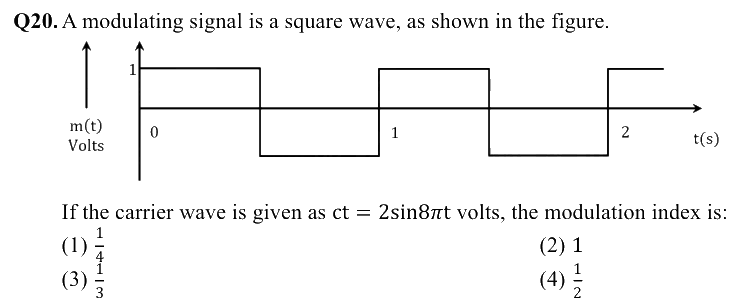
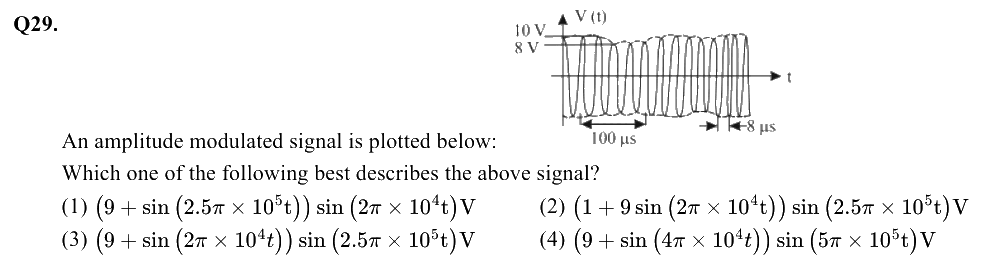
Modulation index from waveform envelopes: Finding the modulation index from maximum and minimum peak-to-peak voltages of an amplitude-modulated carrier wave.
Line-of-sight horizon distance: Calculating the maximum line-of-sight communication range between two elevated antennas of specified heights above the Earth.
Transmission bandwidth: Determining the total bandwidth required for transmitting an audio message on a high-frequency carrier wave.
Matching communication terminology: Matching terms like attenuation, transducer, repeater, and demodulation with their definitions.
Because communication systems is excluded from the current syllabus, students preparing exclusively for JEE Main should not allocate active preparation time to this chapter.
If revising past year papers for general practice or state engineering entrances that retain the topic, focus on the modulation index formula A max minus A min divided by A max plus A min, alongside the line-of-sight distance formula square root of two R h.
Learn basic definitions of attenuation, amplification, modulation, and demodulation. Familiarize yourself with standard broadcast frequency allocations for radio and television.
Frequently asked questions
Is communication systems part of the current JEE Main syllabus?
No, communication systems was removed from the syllabus in 2024 and recorded 0 questions across all 58 papers in 2024, 2025, and 2026.
Why do past year question papers contain so many communication systems questions?
Between 2011 and 2023, the chapter was an active topic that appeared regularly across test sessions, generating 104 questions in our database before its removal.
Should I study this chapter for other engineering entrance examinations?
While omitted from JEE Main, certain state entrance exams or school board tests may still retain portions of communication theory. Step-by-step solutions for each one are in the EdLoop app.