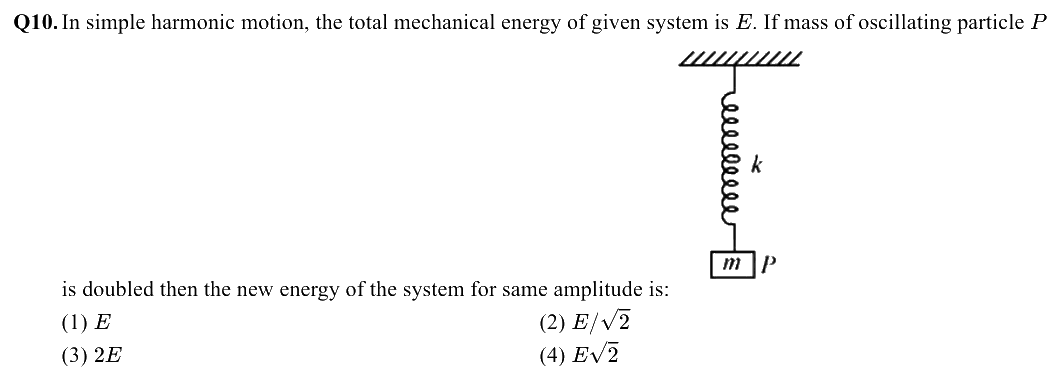
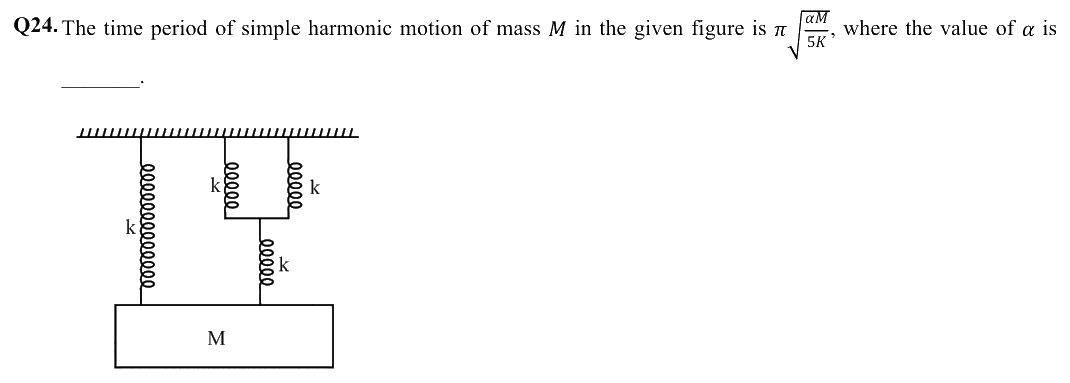
The frequency of oscillation of a mass $m$ suspended by a spring is $v_1$. If the length of the spring is cut to half, the same mass oscillates with frequency $v_2$. The value of $\dfrac{v_2}{v_1}$ is ________.
A particle is executing simple harmonic motion. Its amplitude is $A$ and time period is 5 sec. The time required by it to move from $x = A$ to $x = \dfrac{A}{\sqrt{2}}$ is ________ sec.
A spring stretches by 2 mm when it is loaded with a mass of 200 g. From equilibrium position the mass is further pulled down by 2 mm and released. The frequency associated with the system and maxmimum energy in the spring are ________ Hz and ________ J, respectively. (Take g = 10 m/s$^2$)
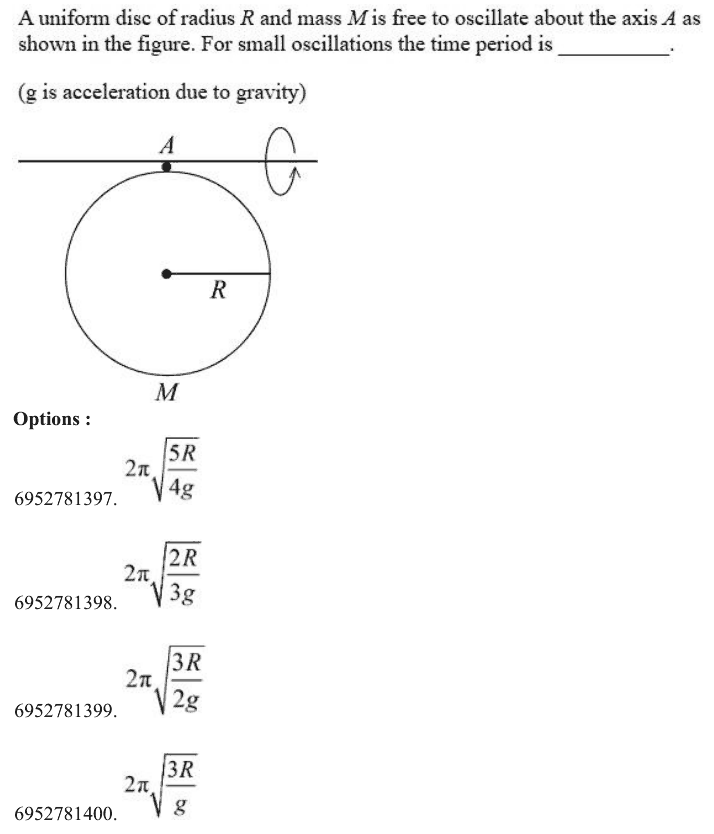
A uniform disc of radius $R$ and mass $M$ is free to oscillate about the axis $A$ as shown in the figure. For small oscillations the time period is ________.
The equation of motion of a particle is given by $x = a\,\sin\left(50t + \frac{\pi}{3}\right)$ cm. The particle will come to rest at time $t_1$ and it will have zero acceleration at time $t_2$. The $t_1$ and $t_2$ respectively are ________.
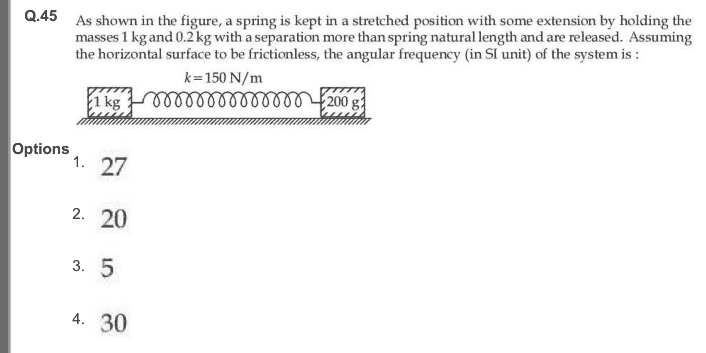
As shown in the figure, a spring is kept in a stretched position with some extension by holding the masses 1 kg and 0.2 kg with a separation more than spring natural length and are released. Assuming the horizontal surface to be frictionless, the angular frequency (in SI unit) of the system is :
A spring of force constant 15 N/m is cut into two pieces. If the ratio of their length is 1:3, then the force constant of smaller piece is ________ N/m.
A cylindrical block of mass $M$ and area of cross section $A$ is floating in a liquid of density $\rho$ and with its axis vertical. When depressed a little and released the block starts oscillating. The period of oscillation is ________.
A simple pendulum of string length 30 cm performs 20 oscillations in 10 s. The length of the string required for the pendulum to perform 40 oscillations in the same time duration is ________ cm. [Assume that the mass of the pendulum remains same.]
The kinetic energy of a simple harmonic oscillator is oscillating with angular frequency of 176 rad/s. The frequency of this simple harmonic oscillator is ________ Hz. [take $\pi = \frac{22}{7}$]
A block of mass 2 kg is attached to one end of a massless spring whose other end is fixed at a wall. The spring-mass system moves on a frictionless horizontal table. The spring's natural length is 2 m and spring constant is 200 N/m. The block is pushed such that the length of the spring becomes 1 m and then released. At distance $x\,m\,(x < 2)$ from the wall, the speed of the block will be
Two simple pendulums having lengths $l_1$ and $l_2$ with negligible string mass undergo angular displacements $\theta_1$ and $\theta_2$, from their mean positions, respectively. If the angular accelerations of both pendulums are same, then which expression is correct?
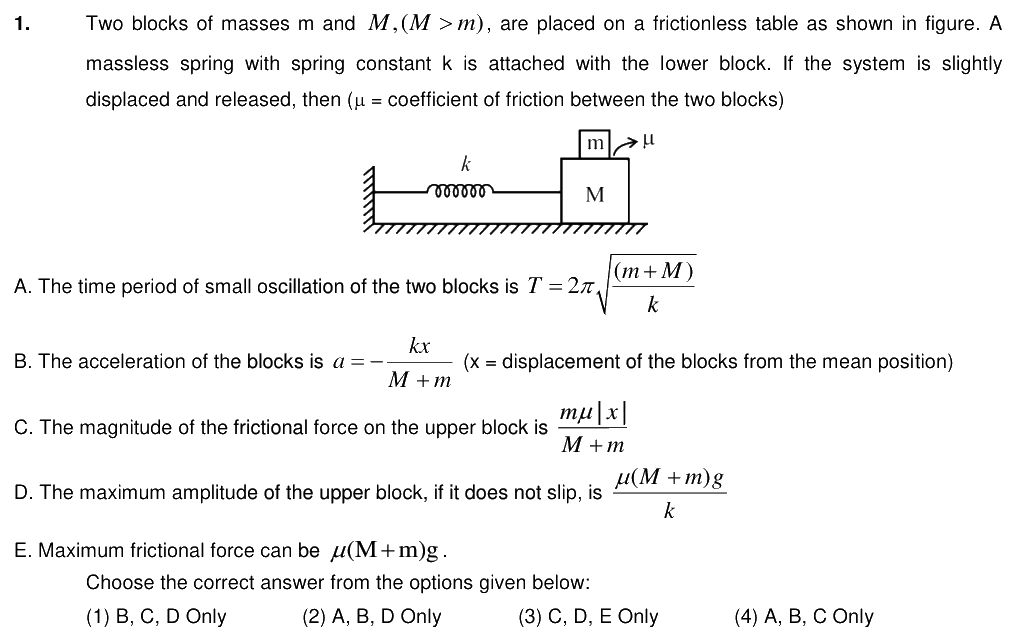
Two blocks of masses m and $M, (M > m)$, are placed on a frictionless table as shown in figure. A massless spring with spring constant k is attached with the lower block. If the system is slightly displaced and released, then ($\mu$ = coefficient of friction between the two blocks)
(see the figure above)
A. The time period of small oscillation of the two blocks is $T = 2\pi\sqrt{\frac{(m + M)}{k}}$
B. The acceleration of the blocks is $a = -\frac{kx}{M + m}$ (x = displacement of the blocks from the mean position)
C. The magnitude of the frictional force on the upper block is $\frac{m\mu|x|}{M + m}$
D. The maximum amplitude of the upper block, if it does not slip, is $\frac{\mu(M + m)g}{k}$
E. Maximum frictional force can be $\mu(M + m)g$.
Choose the correct answer from the options given below:
Given below are two statements : one is labelled as Assertion (A) and the other is labelled as Reason (R). Assertion (A) : Time period of a simple pendulum is longer at the top of a mountain than that at the base of the mountain. Reason (R): Time period of a simple pendulum decreases with increasing value of acceleration due to gravity and vice-versa. In the light of the above statements, choose the most appropriate answer from the options given below :
A
Both (A) and (R) are true and (R) is the correct explanation of (A)
B
(A) is true but (R) is false
C
(A) is false but (R) is true
D
Both (A) and (R) are true but (R) is not the correct explanation of (A)
Two bodies A and B of equal mass are suspended from two massless springs of spring constant $k_1$ and $k_2$, respectively. If the bodies oscillate vertically such that their amplitudes are equal, the ratio of the maximum velocity of $A$ to the maximum velocity of $B$ is
Given below are two statements. One is labelled as Assertion (A) and the other is labelled as Reason (R). Assertion (A) : Knowing initial position $x_0$ and initial momentum $p_0$ is enough to determine the position and momentum at any time $t$ for a simple harmonic motion with a given angular frequency $\omega$. Reason (R): The amplitude and phase can be expressed in terms of $x_0$ and $\mathrm{p_0}$. In the light of the above statements, choose the correct answer from the options given below :
A
(A) is false but (R) is true
B
(A) is true but (R) is false
C
Both (A) and (R) are true but (R) is NOT the correct explanation of (A)
D
Both (A) and (R) are true and (R) is the correct explanation of (A)
A particle is executing simple harmonic motion with time period 2 s and amplitude 1 cm . If D and d are the total distance and displacement covered by the particle in 12.5 s , then $\frac{\mathrm{D}}{\mathrm{d}}$ is
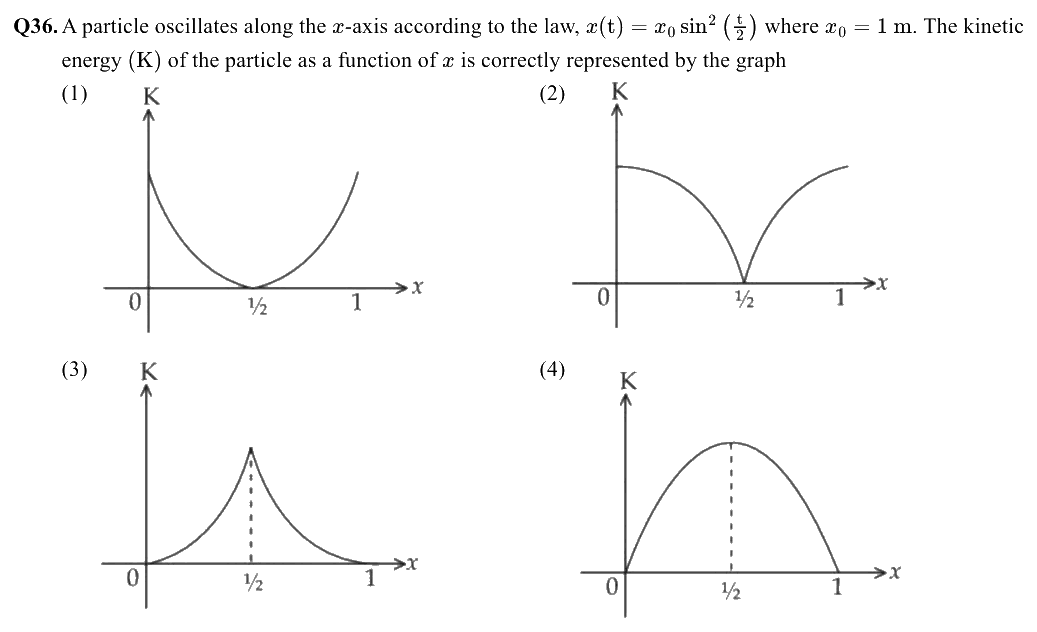
A particle oscillates along the $x$-axis according to the law, $x(t) = x_0\sin^2\left(\frac{t}{2}\right)$ where $x_0 = 1$ m. The kinetic energy (K) of the particle as a function of $x$ is correctly represented by the graph
The question as printed in the paper.
A
see figure axes 'K' (vertical) and 'x' (horizontal) with '1/2' and '1' marked on the x axis; a smooth U-shaped curve that starts high on the K axis (x = 0), falls to touch the x axis at x = 1/2 and rises again to a high point at x = 1.
B
see figure same axes; a curve starting high on the K axis, falling to a sharp cusp touching the x axis at x = 1/2, then rising again towards x = 1 (a V shape with curved sides that is rounded and flattening near its top at both ends).
C
see figure same axes; a curve starting at the origin, rising to a sharp peak at x = 1/2 (dashed vertical line from the peak to the x axis) and falling back to the x axis at x = 1.
D
see figure same axes; a smooth arch starting at the origin, rising to a rounded maximum at x = 1/2 (dashed vertical line from the top to the x axis) and falling back to the x axis at x = 1.
A light hollow cube of side length 10 cm and mass 10 g , is floating in water. It is pushed down and released to execute simple harmonic oscillations. The time period of oscillations is $y\pi \times 10^{-2}$ s, where the value of $y$ is (Acceleration due to gravity, $g = 10$ m/$\mathrm{s}^2$, density of water $= 10^3$ kg/$\mathrm{m}^3$ )
A simple pendulum doing small oscillations at a place R height above earth surface has time period of $T_1$ = 4 s. $T_2$ would be it's time period if it is brought to a point which is at a height 2R from earth surface. Choose the correct relation [$R$ = radius of earth ] :
In a linear Simple Harmonic Motion (SHM) (A) Restoring force is directly proportional to the displacement. (B) The acceleration and displacement are opposite in direction. (C) The velocity is maximum at mean position. (D) The acceleration is minimum at extreme points. Choose the correct answer from the options given below:
A particle is executing simple harmonic motion (SHM). The ratio of potential energy and kinetic energy of the particle when its displacement is half of its amplitude will be
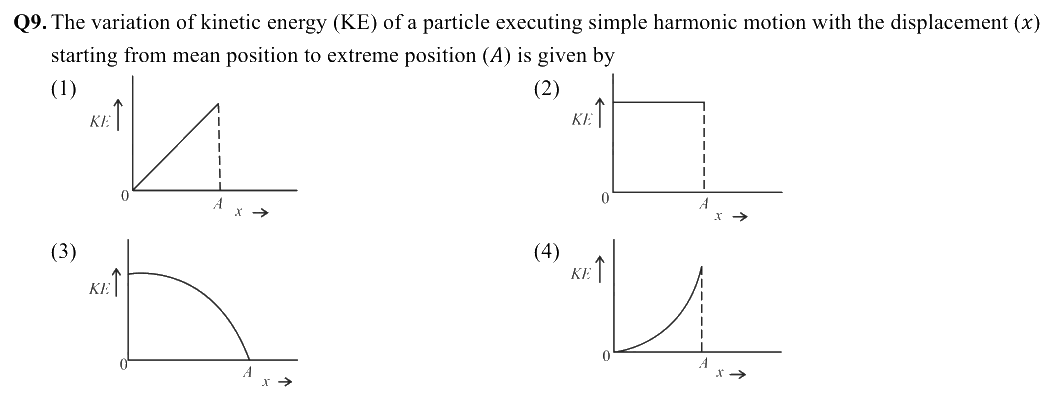
The variation of kinetic energy (KE) of a particle executing simple harmonic motion with the displacement $(x)$ starting from mean position to extreme position $(A)$ is given by
A particle executes S.H.M. of amplitude $A$ along $x$-axis. At $t = 0$, the position of the particle is $x = \frac{A}{2}$ and it moves along positive $x$-axis. The displacement of particle in time $t$ is $x = A\ \sin\omega t + \delta$, then the value $\delta$ will be
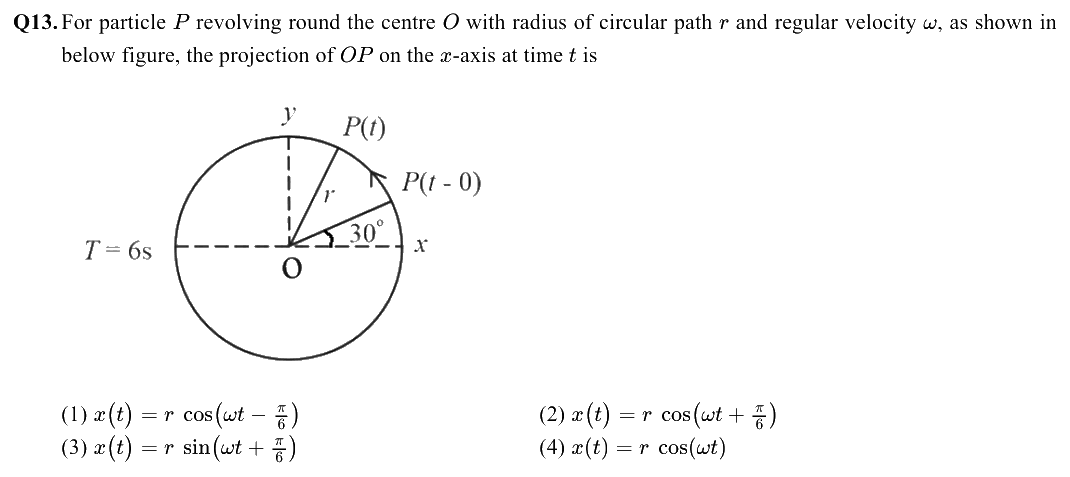
For particle $P$ revolving round the centre $O$ with radius of circular path $r$ and regular velocity $\omega$, as shown in below figure, the projection of $OP$ on the $x$-axis at time $t$ is
(see the figure above)
The question as printed in the paper.
A
$x(t) = r\cos\left(\omega t - \frac{\pi}{6}\right)$
B
$x(t) = r\cos\left(\omega t + \frac{\pi}{6}\right)$
C
$x(t) = r\sin\left(\omega t + \frac{\pi}{6}\right)$
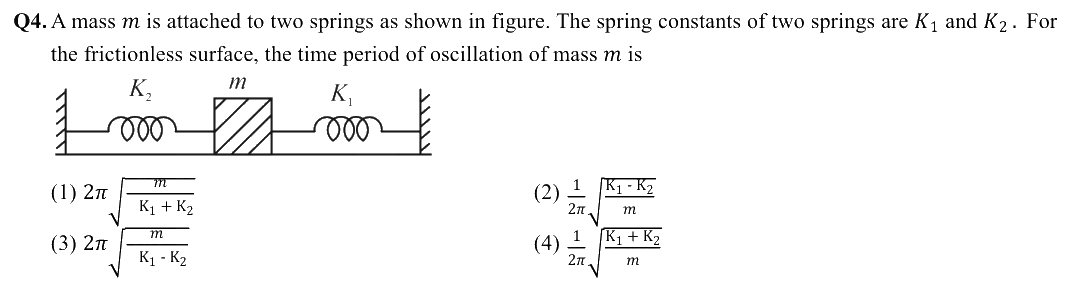
A mass $m$ is attached to two springs as shown in figure. The spring constants of two springs are $K_1$ and $K_2$. For the frictionless surface, the time period of oscillation of mass $m$ is
The maximum potential energy of a block executing simple harmonic motion is 25 $\mathrm{J}$. A is amplitude of oscillation. At $\dfrac{A}{2}$, the kinetic energy of the block is
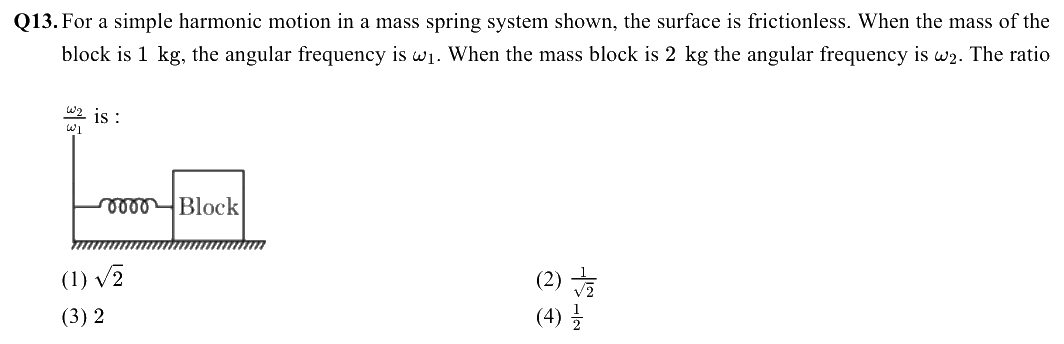
For a simple harmonic motion in a mass spring system shown, the surface is frictionless. When the mass of the block is 1 kg, the angular frequency is $\omega_1$. When the mass block is 2 kg the angular frequency is $\omega_2$. The ratio $\frac{\omega_2}{\omega_1}$ is :
$T$ is the time period of simple pendulum on the earth's surface. Its time period becomes $xT$ when taken to a height $R$ (equal to earth's radius) above the earth's surface. Then, the value of $x$ will be:
A particle executes simple harmonic motion between $x=-A$ and $x=+A$. If time taken by particle to go from $x=0$ to $\frac{A}{2}$ is 2 s; then time taken by particle in going from $x=\frac{A}{2}$ to $A$ is:
The time period of oscillation of a simple pendulum of length $L$ suspended from the roof of a vehicle which moves without friction down an inclined plane of inclination $\alpha$, is given by :
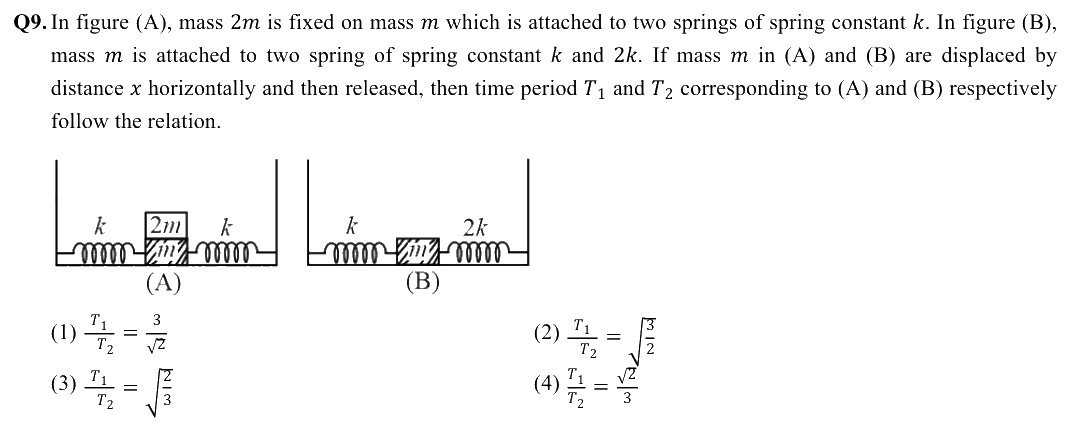
In figure (A), mass $2m$ is fixed on mass $m$ which is attached to two springs of spring constant $k$. In figure (B), mass $m$ is attached to two spring of spring constant $k$ and $2k$. If mass $m$ in (A) and (B) are displaced by distance $x$ horizontally and then released, then time period $T_1$ and $T_2$ corresponding to (A) and (B) respectively follow the relation.
The motion of a simple pendulum executing S.H.M. is represented by the following equation $y = A\sin(\pi t + \phi)$, where time is measured in second. The length of pendulum is
Motion of a particle in $x - y$ plane is described by a set of following equations $x = 4\sin\left(\dfrac{\pi}{2} - \omega t\right)\ \mathrm{m}$ and $y = 4\sin(\omega t)\ \mathrm{m}$. The path of the particle will be
The displacement of simple harmonic oscillator after 3 seconds starting from its mean position is equal to half of its amplitude. The time period of harmonic motion is
The equation of a particle executing simple harmonic motion is given by $x = \sin \pi\left(t + \frac{1}{3}\right)$ m. At $t = 1$ s, the speed of particle will be (Given: $\pi = 3.14$)
Time period of a simple pendulum in a stationary lift is $T$. If the lift accelerates with $\frac{g}{6}$ vertically upwards then the time period will be (Where $g$ = acceleration due to gravity)
Two massless springs with spring constants $2k$ and $9k$, carry $50 \mathrm{~g}$ and $100 \mathrm{~g}$ masses at their free ends. These two masses oscillate vertically such that their maximum velocities are equal. Then, the ratio of their respective amplitudes will be :
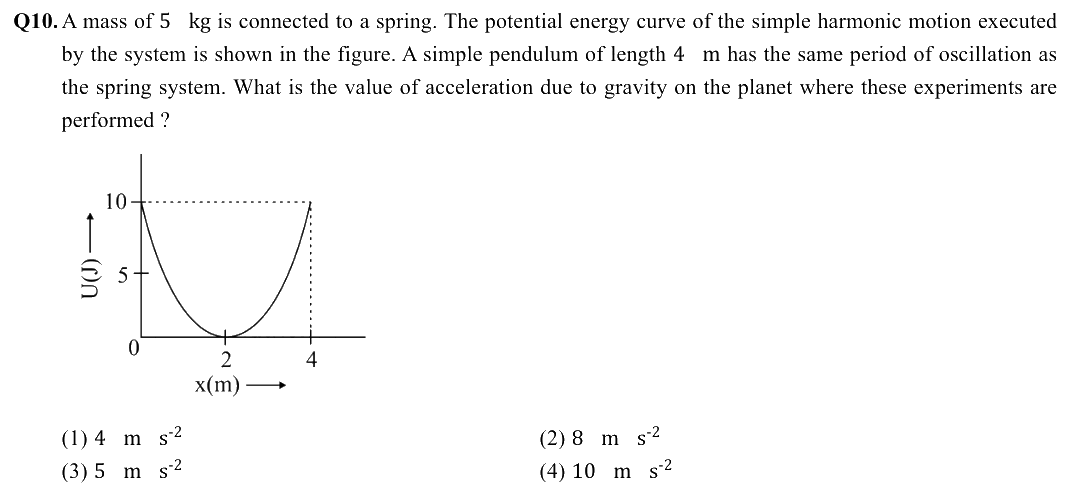
A mass of $5$ kg is connected to a spring. The potential energy curve of the simple harmonic motion executed by the system is shown in the figure. A simple pendulum of length $4$ m has the same period of oscillation as the spring system. What is the value of acceleration due to gravity on the planet where these experiments are performed ? (see the figure above)
A bob of mass $m$ suspended by a thread of length $\ell$ undergoes simple harmonic oscillations with time period $T$. If the bob is immersed in a liquid that has density $\frac{1}{4}$ times that of the bob and the length of the thread is increased by $\frac{1}{3}^{rd}$ of the original length, then the time period of the simple harmonic oscillations will be:
For a body executing S.H.M. : (a) Potential energy is always equal to its $K.E.$ (b) Average potential and kinetic energy over any given time interval are always equal. (c) Sum of the kinetic and potential energy at any point of time is constant. (d) Average $K.E.$ in one time period is equal to average potential energy in one time period. Choose the most appropriate option from the options given below :
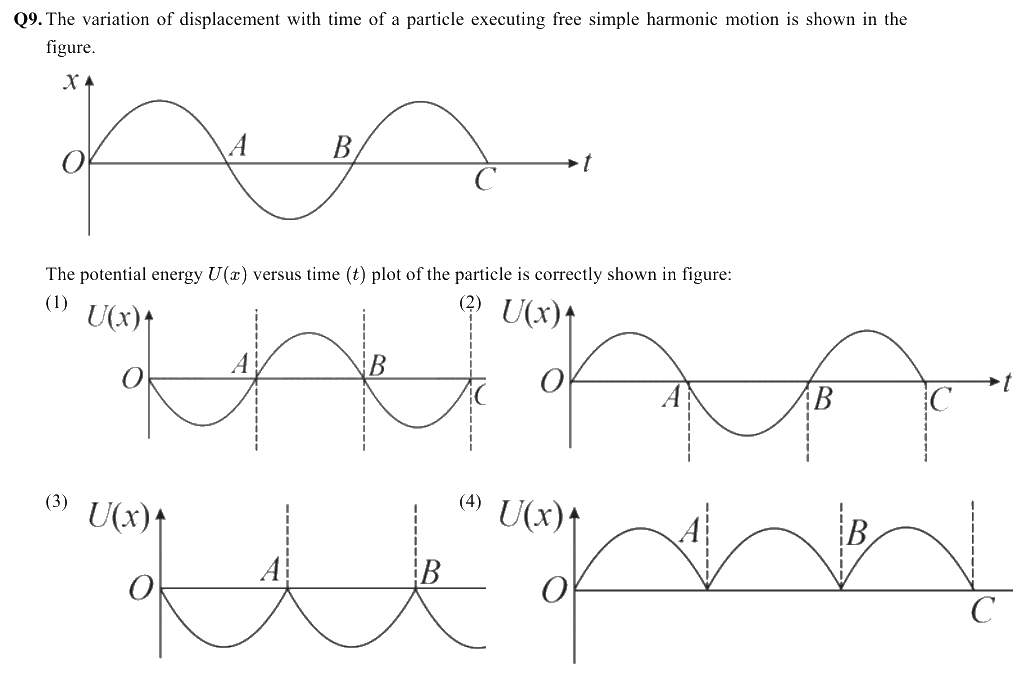
The variation of displacement with time of a particle executing free simple harmonic motion is shown in the figure. (see the figure above) The potential energy $U(x)$ versus time ($t$) plot of the particle is correctly shown in figure:
The question as printed in the paper.
A
see figure $U(x)$ against time, axes starting at O; a sine-shaped curve that goes below the axis first, crosses the axis at A, is above the axis between A and B, crosses at B and goes below again toward C (vertical dashed lines at A, B and C).
B
see figure $U(x)$ against $t$; a sine-shaped curve that is above the axis between O and A, crosses at A, is below the axis between A and B, crosses at B and is above again between B and C (vertical dashed lines at A, B and C).
C
see figure $U(x)$ against time; a curve entirely below the axis, a series of downward arches from O to A and from A to B, meeting the axis at sharp points at A and B (dashed lines at A and B).
D
see figure $U(x)$ against time; a curve entirely above the axis, a series of upward arches O to A, A to B and B to C, meeting the axis at sharp points at A, B and C (dashed lines at A and B).
A particle starts executing simple harmonic motion (SHM) of amplitude $a$ and total energy $E$. At any instant, its kinetic energy is $\frac{3E}{4}$, then its displacement $y$ is given by:
An object of mass $0.5\ \mathrm{kg}$ is executing simple harmonic motion. It amplitude is $5\ \mathrm{cm}$ and time period (T) is $0.2\ \mathrm{s}$. What will be the potential energy of the object at an instant $\mathrm{t} = \frac{T}{4}\ \mathrm{s}$ starting from mean position. Assume that the initial phase of the oscillation is zero.
In a simple harmonic oscillation, what fraction of total mechanical energy is in the form of kinetic energy, when the particle is midway between mean and extreme position.
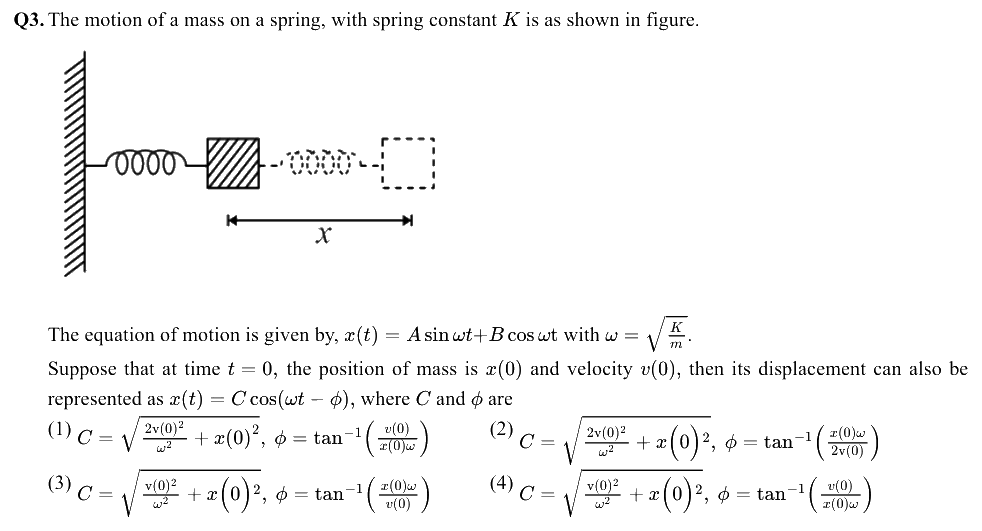
The motion of a mass on a spring, with spring constant $K$ is as shown in figure. (see the figure above) The equation of motion is given by, $x(t) = A\sin\omega t + B\cos\omega t$ with $\omega = \sqrt{\frac{K}{m}}$. Suppose that at time $t = 0$, the position of mass is $x(0)$ and velocity $v(0)$, then its displacement can also be represented as $x(t) = C\cos(\omega t - \phi)$, where $C$ and $\phi$ are
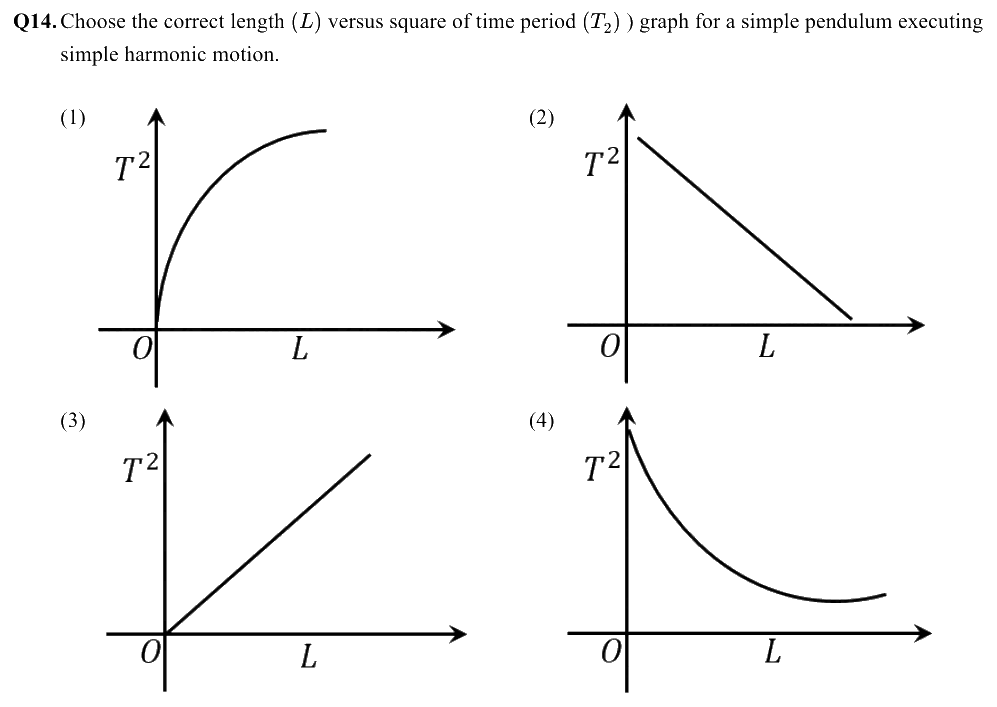
$T_0$ is the time period of a simple pendulum at a place. If the length of the pendulum is reduced to $\frac{1}{16}$ times of its initial value, the modified time period is
A particle is making simple harmonic motion along the $X$-axis. If at a distances $x_1$ and $x_2$ from the mean position the velocities of the particle are $v_1$ and $v_2$, respectively. The time period of its oscillation is given as:
A block of mass $1 \mathrm{~kg}$ attached to a spring is made to oscillate with an initial amplitude of $12 \mathrm{~cm}$. After 2 minutes the amplitude decreases to $6 \mathrm{~cm}$. Determine the value of the damping constant for this motion. (take $\ln 2=0.693$ )
Two particles $A$ and $B$ of equal masses are suspended from two massless springs of spring constants $K_1$ and $K_2$ respectively.If the maximum velocities during oscillations are equal, the ratio of the amplitude of $A$ and $B$ is
Time period of a simple pendulum is $T$ inside a lift when the lift is stationary. If the lift moves upwards with an acceleration $\frac{g}{2}$, the time period of pendulum will be :
The amplitude of a mass-spring system, which is executing simple harmonic motion decreases with time. If mass $= 500\ \mathrm{g}$, Decay constant $= 20\ \mathrm{g\,s^{-1}}$ then how much time is required for the amplitude of the system to drop to half of its initial value? $(\ln 2 = 0.693)$
Given below are two statements: Statement I: A second's pendulum has a time period of 1 second. Statement II: It takes precisely one second to move between the two extreme positions. In the light of the above statements, choose the correct answer from the options given below
If the time period of a two meter long simple pendulum is $2\ \mathrm{s}$, the acceleration due to gravity at the place where pendulum is executing S.H.M. is:
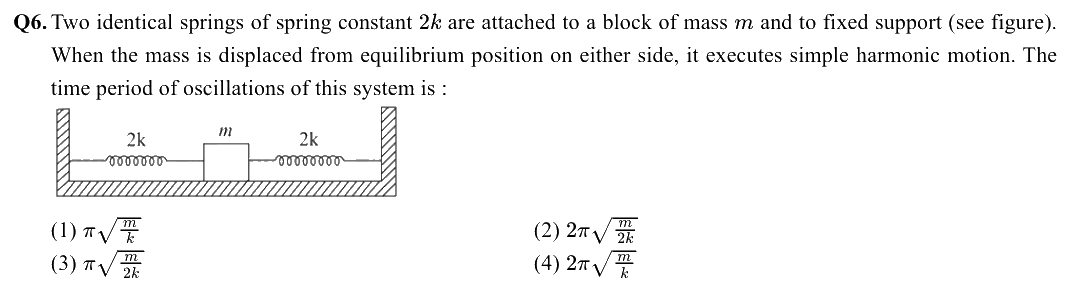
Two identical springs of spring constant $2k$ are attached to a block of mass $m$ and to fixed support (see figure). When the mass is displaced from equilibrium position on either side, it executes simple harmonic motion. The time period of oscillations of this system is : (see the figure above)
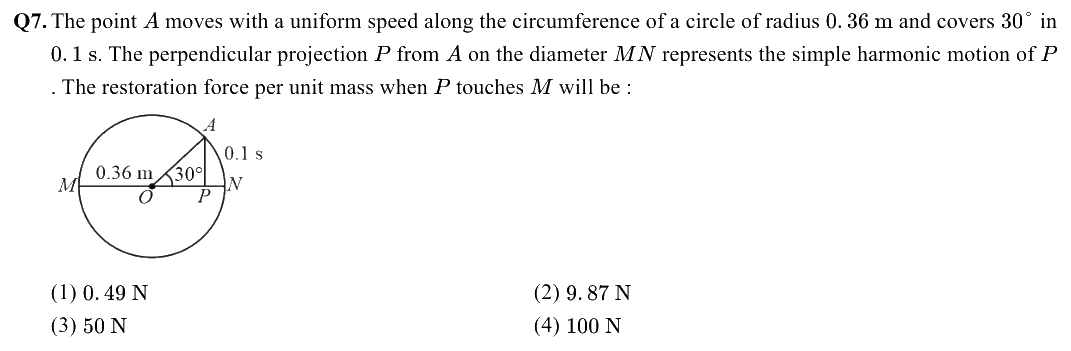
The point $A$ moves with a uniform speed along the circumference of a circle of radius $0.36\ \mathrm{m}$ and covers $30^\circ$ in $0.1\ \mathrm{s}$. The perpendicular projection $P$ from $A$ on the diameter $MN$ represents the simple harmonic motion of $P$. The restoration force per unit mass when $P$ touches $M$ will be : (see the figure above)
$Y = A\sin(\omega t + \phi_0)$ is the time-displacement equation of a $SHM$. At $t = 0$ the displacement of the particle is $Y = \frac{A}{2}$ and it is moving along negative $x$-direction. Then the initial phase angle $\phi_0$ will be:
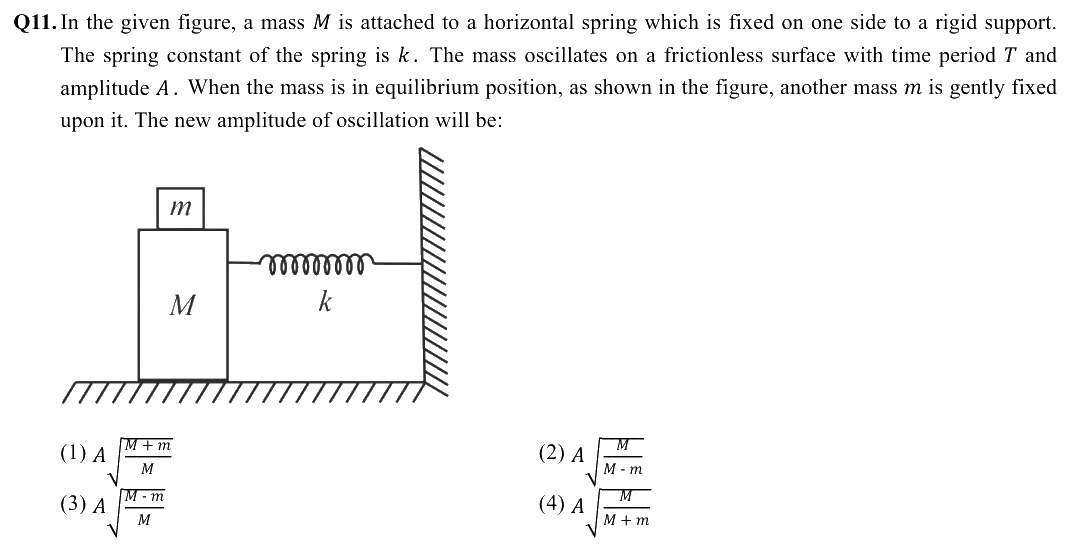
In the given figure, a mass $M$ is attached to a horizontal spring which is fixed on one side to a rigid support. The spring constant of the spring is $k$. The mass oscillates on a frictionless surface with time period $T$ and amplitude $A$. When the mass is in equilibrium position, as shown in the figure, another mass $m$ is gently fixed upon it. The new amplitude of oscillation will be: (see the figure above)
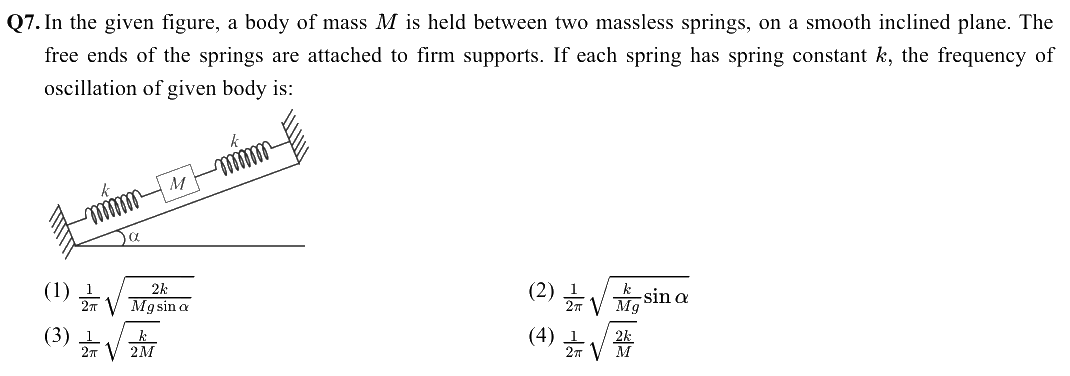
In the given figure, a body of mass $M$ is held between two massless springs, on a smooth inclined plane. The free ends of the springs are attached to firm supports. If each spring has spring constant $k$, the frequency of oscillation of given body is: (see the figure above)
An object of mass m is suspended at the end of a massless wire of length L and area of cross-section, A. Young modulus of the material of the wire is $Y$. If the mass is pulled down slightly its frequency of oscillation along the vertical direction is :
When a particle of mass m is attached to a vertical spring of spring constant k and released, its motion, is described by $y(t) = y_0 \sin^2 \omega t$, where 'y' is measured from the lower end of upstretched spring. Then $\omega$ is :
A ring is hung on a nail. It can oscillate, without slipping or sliding (i) in its plane with a time period $T_1$ and (ii) back and forth in a direction perpendicular to its plane, with a period $T_2$. The ratio $\frac{T_1}{T_2}$ will be :
A block of mass m attached to a massless spring is performing oscillatory motion of amplitude 'A' on a frictionless horizontal plane. If half of the mass of the block breaks off when it is passing through its equilibrium point, the amplitude of oscillation for the remaining system become $fA$. The value of $f$ is:
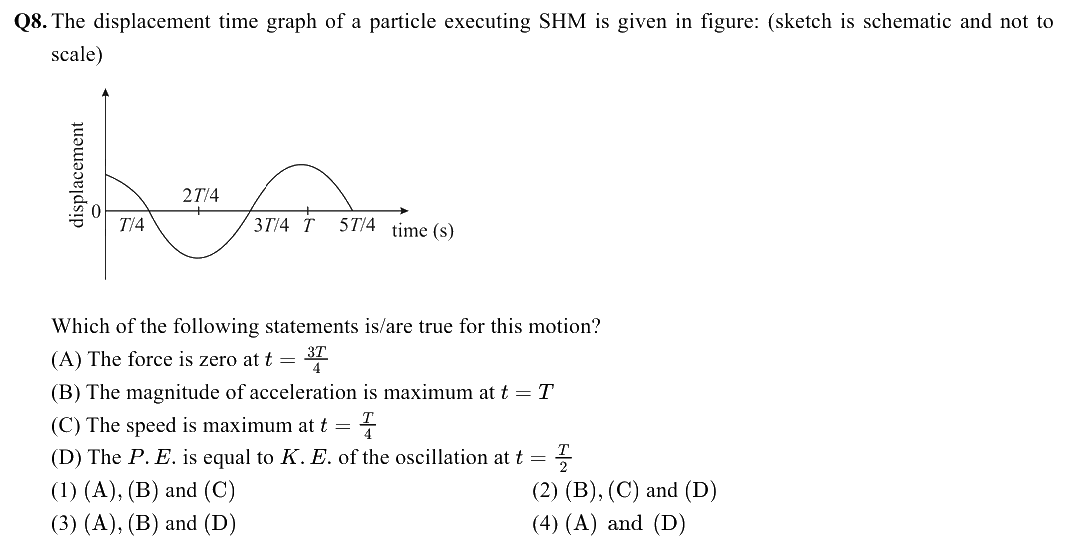
The displacement time graph of a particle executing SHM is given in figure: (sketch is schematic and not to scale) (see the figure above) Which of the following statements is/are true for this motion? (A) The force is zero at $t = \frac{3T}{4}$ (B) The magnitude of acceleration is maximum at $t = T$ (C) The speed is maximum at $t = \frac{T}{4}$ (D) The $P.E.$ is equal to $K.E.$ of the oscillation at $t = \frac{T}{2}$
A spring whose unstrentches length is $l$ has a force constant $k$. The spring is cut into two pieces of unstretches lengths $l_1$ and $l_2$ where, $l_1 = nl_2$ and n is an integer. The ratio $k_1/k_2$ of the corresponding force constants, $k_1$ and $k_2$ will be:
The displacement of a damped harmonic oscillator is given by $x(t) = e^{-0.1t}\ \cos(10\pi t + \varphi)$. Here t is in seconds. The time taken for its amplitude of vibration to drop to half of its initial value is close to:
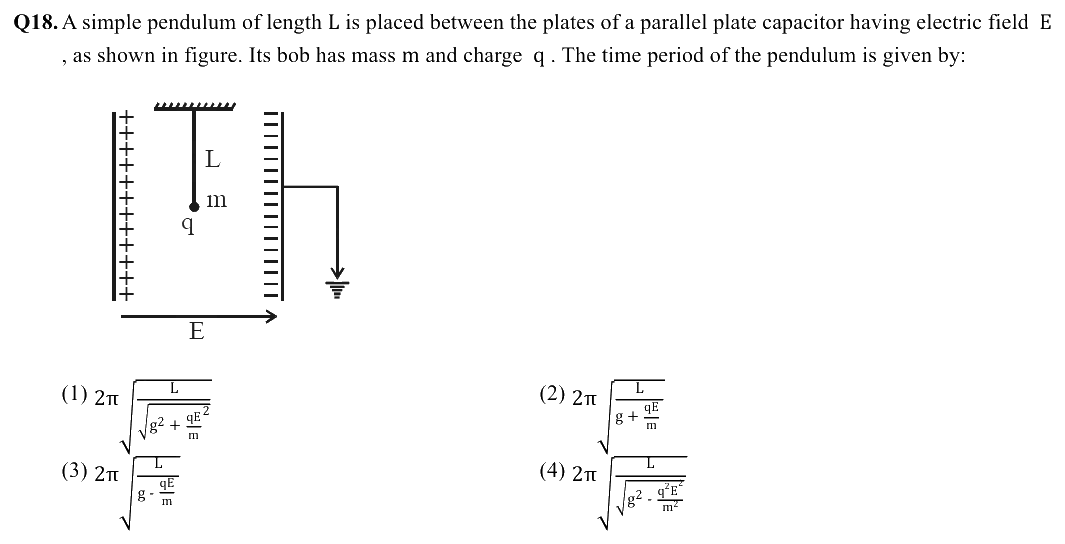
A simple pendulum of length L is placed between the plates of a parallel plate capacitor having electric field E , as shown in figure. Its bob has mass m and charge $q$. The time period of the pendulum is given by:
A simple pendulum oscillating in air has period T . The bob of the pendulum is completely immersed in a non-viscous liquid. The density of the liquid is $\dfrac{1}{16}$th of the material of the bob. If the bob is inside liquid all the time, its period of oscillation in this liquid is:
A damped harmonic oscillator has a frequency of 5 oscillations per second. The amplitude drops to half its value for every 10 oscillations. The time it will take to drop to $\frac{1}{1000}$ of the original amplitude is close to:
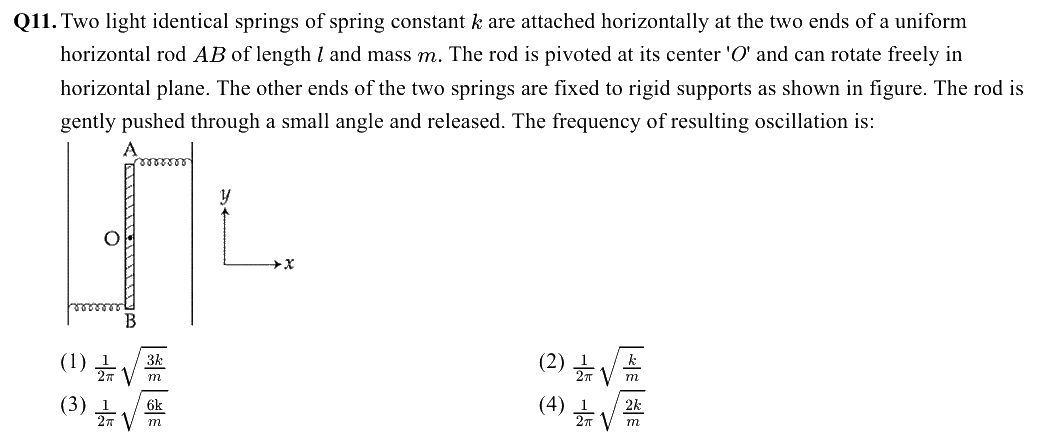
Two light identical springs of spring constant $k$ are attached horizontally at the two ends of a uniform horizontal rod $AB$ of length $l$ and mass $m$. The rod is pivoted at its center '$O$' and can rotate freely in horizontal plane. The other ends of the two springs are fixed to rigid supports as shown in figure. The rod is gently pushed through a small angle and released. The frequency of resulting oscillation is:
A particle undergoing simple harmonic motion has time dependent displacement given by $x(t)$ = A sin $\frac{\pi t}{90}$. The ratio of kinetic to potential energy of this particle at t = 210 s will be
A pendulum is executing simple harmonic motion and its maximum kinetic energy is K$_1$. If the length of the pendulum is doubled and it performs simple harmonic motion with the same amplitude as in the first case, its maximum kinetic energy is K$_2$
A simple pendulum of length 1 m is oscillating with an angular frequency 10rad/s. The support of the pendulum starts oscillating up and down with a small angular frequency of 1rad/s and an amplitude of $10^{-2}$ m . The relative change in the angular frequency of the pendulum is best given by :
A particle executes simple harmonic motion with an amplitude of $5\ cm$ . When the particle is at $4\ cm$ from the mean position, the magnitude of its velocity in $SI$ units is equal to that of its acceleration. Then, its periodic time in seconds is:
A cylindrical plastic bottle of negligible mass is filled with $310\ ml$ of water and left floating in a pond with still water. If pressed downward slightly and released, it starts performing simple harmonic motion at angular frequency $\omega$. If the radius of the bottle is $2.5\ cm$ then $\omega$ is close to: ( density of water $= 10^3kg/m^3$)
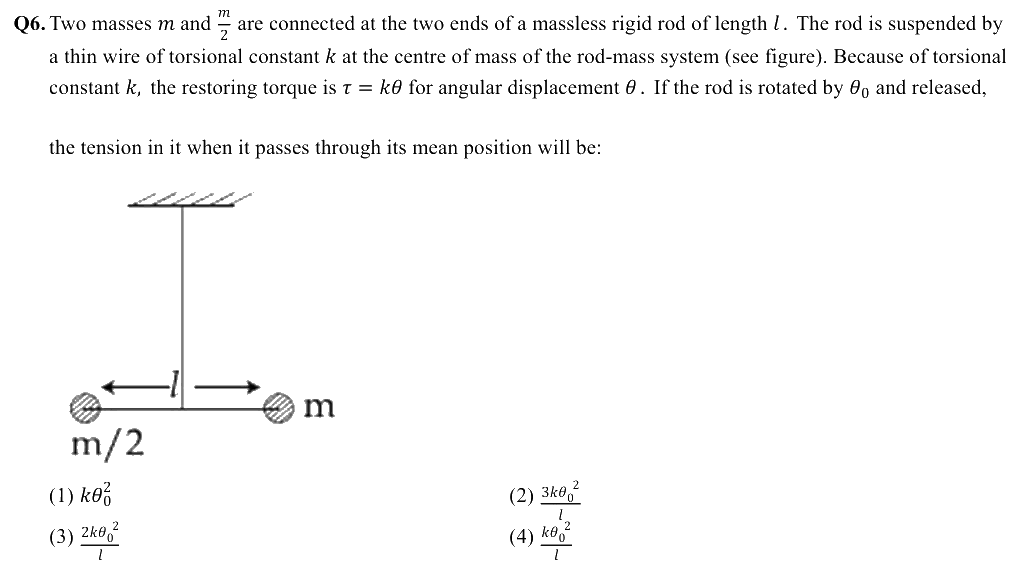
Two masses $m$ and $\dfrac{m}{2}$ are connected at the two ends of a massless rigid rod of length $l$. The rod is suspended by a thin wire of torsional constant $k$ at the centre of mass of the rod-mass system (see figure). Because of torsional constant $k$, the restoring torque is $\tau = k\theta$ for angular displacement $\theta$. If the rod is rotated by $\theta_0$ and released, the tension in it when it passes through its mean position will be: (see the figure above)
A particle is executing simple harmonic motion $(SHM)$ of amplitude $A$, along the $x$ -axis, about $x = 0$. When its potential Energy $(PE)$ equal kinetic energy $(KE)$, the position of the particle will be:
A rod of mass $M$ and length $2L$ is suspended at its middle by a wire. It exhibits torsional oscillations. If two masses, each of mass $m$, are attached at a distance $L/2$ from its centre on both sides, it reduces the oscillation frequency by $20\%$. The value of ratio $m/M$ is close to
An oscillator of mass $M$ is at rest in its equilibrium position in a potential, $V = \frac{1}{2}k(x - X)^2$. A particle of mass $m$ comes from the right with speed $u$ and collides completely inelastic with $M$ and sticks to it. This process repeats every time the oscillator crosses its equilibrium position. The amplitude of oscillations after 13 collisions is: ($M = 10$, $m = 5$, $u = 1$, $k = 1$)
A particle executes simple harmonic motion and it is located at $x = a$, $b$ and $c$ at time $t_0$, $2t_0$ and $3t_0$ respectively. The frequency of the oscillation is:
A body of mass $M$ and charge $q$ is connected to a spring of spring constant $k$. It is oscillating along x-direction about its equilibrium position, taken to be at $x = 0$, with an amplitude $A$. An electric field $E$ is applied along the x-direction. Which of the following statements is correct?
A
The total energy of the system is $\frac{1}{2}m\omega^2A^2 + \frac{1}{2}\frac{q^2E^2}{k}$
B
The new equilibrium position is at a distance: $\frac{2qE}{k}$ from $x = 0$
C
The new equilibrium position is at a distance: $\frac{qE}{2k}$ from $x = 0$
D
The total energy of the system is $\frac{1}{2}m\omega^2A^2 - \frac{1}{2}\frac{q^2E^2}{k}$
Two simple harmonic motions, as shown, are at right angles. They are combined to form Lissajous figures. $x(t) = A\sin(at+\delta)$ $y(t) = B\sin(bt)$ Identify the correct match below
A silver atom in a solid oscillates in simple harmonic motion in some direction with a frequency of $10^{12}\ \mathrm{s^{-1}}$ . What is the force constant of the bonds connecting one atom with the other? (Mole wt. of silver, $= 108\ \mathrm{g\ mol^{-1}}$ and Avogadro number $= 6.02 \times 10^{23}$)
A block of mass 0.1 kg is connected to an elastic spring of spring constant $640\ \mathrm{N\,m^{-1}}$ and oscillates in a damping medium of damping constant $10^{-2}\ \mathrm{kg\,s^{-1}}$. The system dissipates its energy gradually. The time taken for its mechanical energy of vibration to drop to half of its initial value, is closest to-
In an experiment to determine the period of a simple pendulum of length 1 m, it is attached to different spherical bobs of radii $r_1$ and $r_2$. The two spherical bobs have uniform mass distribution. If the relative difference in the periods, is found to be $5 \times 10^{-4}$ s, the difference in radii, $|r_1 - r_2|$ is best-given by
The ratio of maximum acceleration to maximum velocity in a simple harmonic motion is $10\ \mathrm{s^{-1}}$. At, $t = 0$ the displacement is 5 m. What is the maximum acceleration? The initial phase is $\frac{\pi}{4}$.
A 1 kg block attached to a spring vibrates with a frequency of 1 Hz on a frictionless horizontal table. Two springs identical to the original spring are attached in parallel to a 8 kg block placed on the same table. So, the frequency of vibration of the 8 kg block is
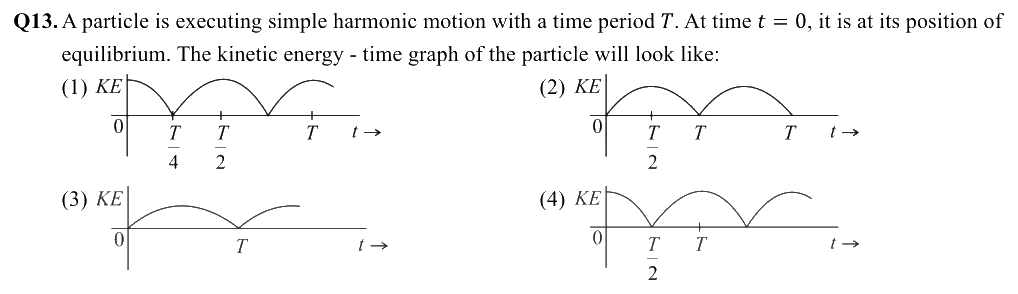
A particle is executing simple harmonic motion with a time period $T$. At time $t = 0$, it is at its position of equilibrium. The kinetic energy - time graph of the particle will look like:
In an engine the piston undergoes vertical simple harmonic motion with amplitude $7\mathrm{cm}$. A washer rests on top of the piston and moves with it. The motor speed is slowly increased. The frequency of the piston at which the washer no longer stays in contact with the piston, is close to :
Two particles are performing simple harmonic motion in a straight line about the same equilibrium point. The amplitude and time period for both particles are same and equal to $A$ and $T$, respectively. At time $\mathrm{t = 0}$ one particle has displacement $A$ while the other one has displacement $-\frac{A}{2}$ and they are moving towards each other. If they cross each other at time $t$, then $t$ is:
A particle performs simple harmonic motion with amplitude A. Its speed is tripled at the instant that it is at a distance $\frac{2A}{3}$ from equilibrium position. The new amplitude of the motion is:
A pendulum with the time period of 1 s is losing energy due to damping. At a certain time, its energy is 45 J. If after completing 15 oscillations its energy has become 15 J, then its damping constant (in s$^{-1}$) will be
A cylindrical block of wood (density $= 650$ kg m$^{-3}$), of base area 30 cm$^2$ and height 54 cm, floats in a liquid of density 900 kg m$^{-3}$. The block is depressed slightly and then released. The time period of the resulting oscillations of the block would be equal to that of a simple pendulum of length (nearly) :
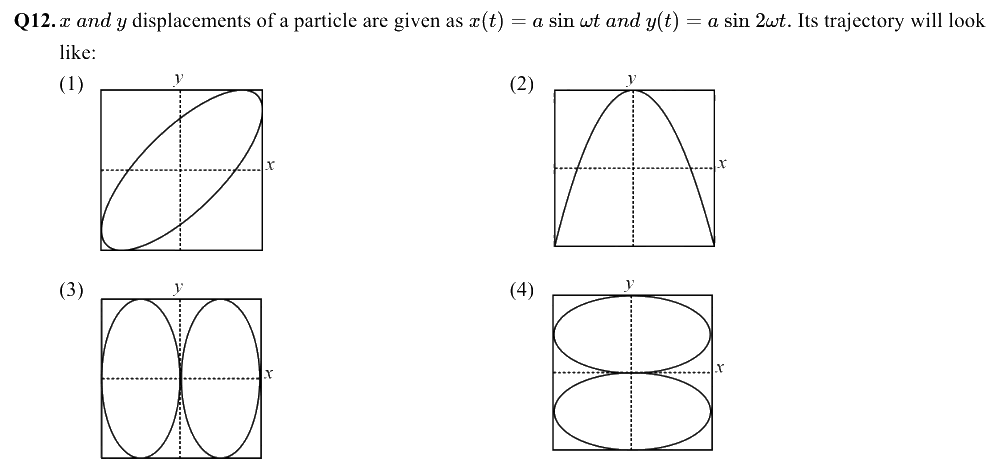
$x$ and $y$ displacements of a particle are given as $x(t) = a \sin \omega t$ and $y(t) = a \sin 2\omega t$. Its trajectory will look like:
The question as printed in the paper.
A
see figure trajectory in an x-y square box with dotted axes: a tilted ellipse rising from lower left to upper right
B
see figure trajectory in an x-y square box with dotted axes: a single arch (parabola-like) opening downwards, from the bottom left corner up to the top middle and down to the bottom right corner
C
see figure trajectory in an x-y square box with dotted axes: a figure of eight made of two tall vertical lobes side by side, meeting at the centre
D
see figure trajectory in an x-y square box with dotted axes: a figure of eight made of two wide horizontal lobes, one above the other, meeting at the centre
A simple harmonic oscillator of angular frequency $2\ \mathrm{rad\,s^{-1}}$ is acted upon by an external force $F = \sin t\ N$. If the oscillator is at rest in its equilibrium position at $t = 0$, its position at later times is proportional to:
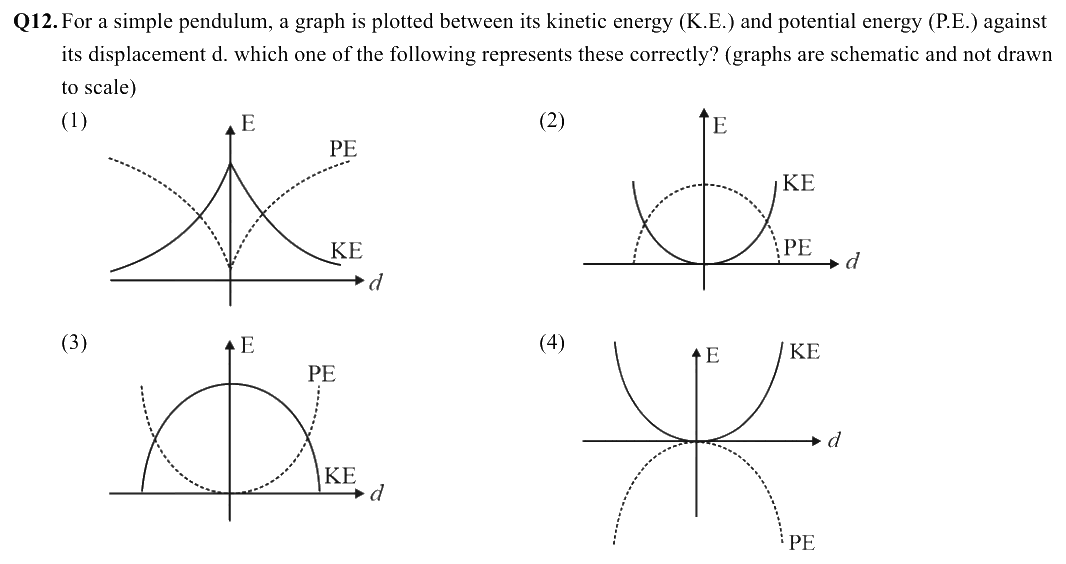
For a simple pendulum, a graph is plotted between its kinetic energy (K.E.) and potential energy (P.E.) against its displacement d. which one of the following represents these correctly? (graphs are schematic and not drawn to scale)
The question as printed in the paper.
A
see figure graph of E against d with KE and PE curves
B
see figure graph of E against d with KE and PE curves
C
see figure graph of E against d with KE and PE curves
D
see figure graph of E against d with KE and PE curves
A body is in simple harmonic motion with time period $T = 0.5\,\mathrm{s}$ and amplitude $A = 1\,\mathrm{cm}$. Find the average velocity in the interval in which it moves from equilibrium position to half of its amplitude.
Which of the following expressions corresponds to simple harmonic motion along a straight line, where x is the displacement and a, b, c are positive constants?
The angular frequency of the damped oscillator is given by, $\omega = \sqrt{\left(\frac{\mathrm{k}}{\mathrm{m}} - \frac{r^2}{4\ \mathrm{m}^2}\right)}$ where k is the spring constant, m is the mass of the oscillator and $r$ is the damping constant. If the ratio $\frac{r^2}{\mathrm{mk}}$ is $8\%$, the change in time period compared to the undamped oscillator is approximately as follows:
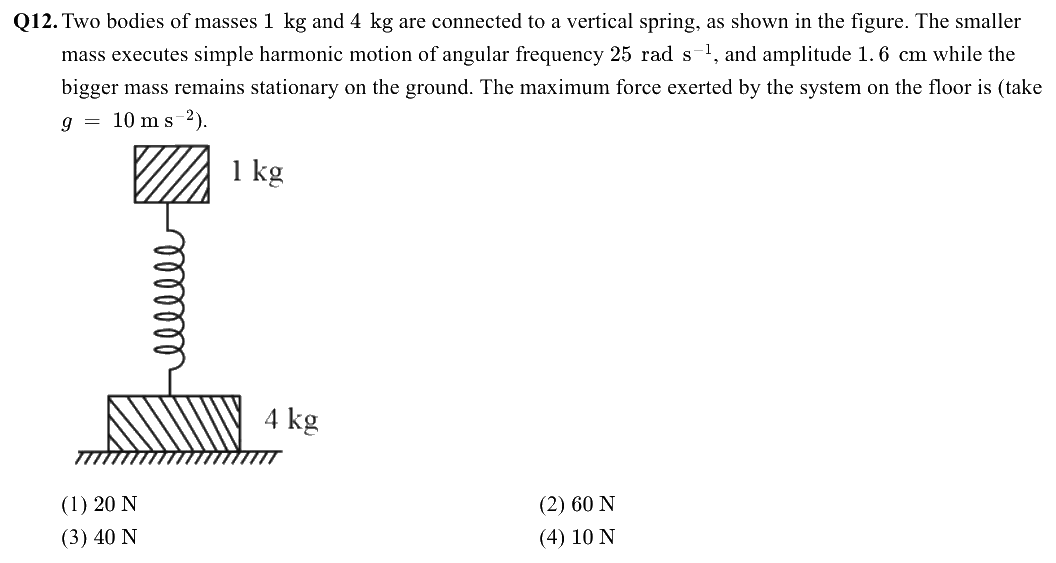
Two bodies of masses 1 kg and 4 kg are connected to a vertical spring, as shown in the figure. The smaller mass executes simple harmonic motion of angular frequency 25 $\mathrm{rad\ s^{-1}}$, and amplitude 1.6 cm while the bigger mass remains stationary on the ground. The maximum force exerted by the system on the floor is (take $g$ = 10 $\mathrm{m\,s^{-2}}$). (see the figure above)
The amplitude of a simple pendulum, oscillating in air with a small spherical bob, decreases from 10 cm to 8 cm in 40 seconds. Assuming that Stokes law is valid, and ratio of the coefficient of viscosity of air to that of carbon dioxide is 1.3, the time in which amplitude of this pendulum will reduce from 10 cm to 5 cm in carbondioxide will be close to (ln 5 = 1.601, ln 2 = 0.693).
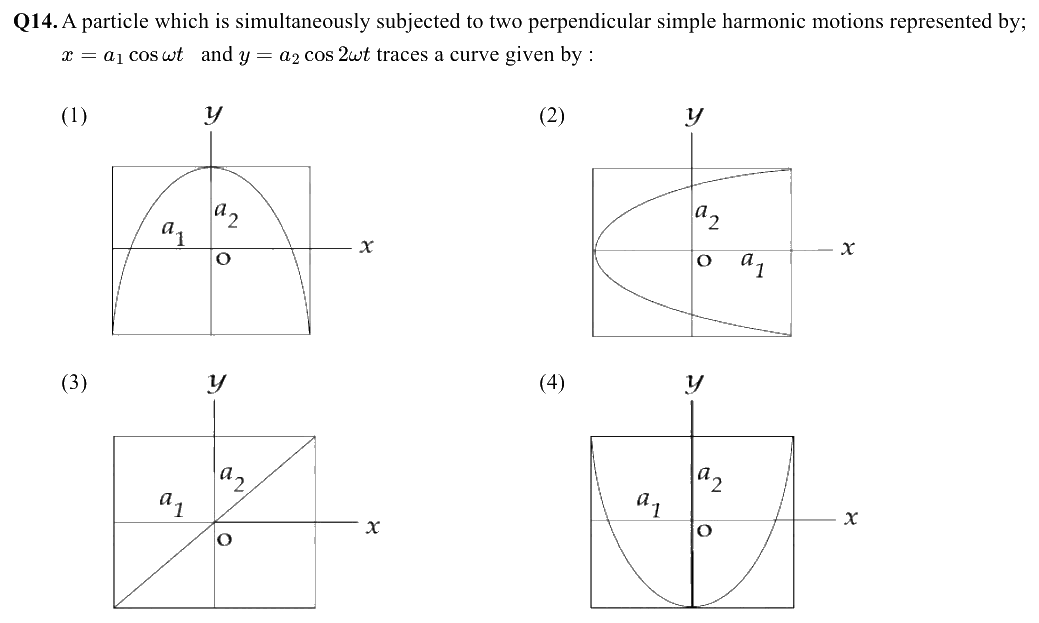
A particle which is simultaneously subjected to two perpendicular simple harmonic motions represented by; $x = a_1\cos\omega t$ and $y = a_2\cos 2\omega t$ traces a curve given by :
The question as printed in the paper.
A
see figure Curve in the x-y plane inside a rectangular box centred on the origin O (box half-width a_1, half-height a_2, labels a_1 on the x side and a_2 on the y side). The curve is a downward parabola: it starts at the bottom-left corner (-a_1, -a_2), rises to a peak on the top edge of the box at x = 0 (on the y-axis, y = a_2) and falls to the bottom-right corner (+a_1, -a_2); it fills the box and is symmetric about the y-axis.
B
see figure Same kind of box with axes, O, a_1 and a_2. The curve is a sideways parabola with its vertex on the x-axis at the left edge (x = -a_1, y = 0), opening to the right and reaching the right edge of the box at the top (y = +a_2) and bottom (y = -a_2); it is symmetric about the x-axis.
C
see figure Same kind of box with axes, O, a_1 and a_2. The curve is a straight diagonal line through O from the bottom-left corner (-a_1, -a_2) to the top-right corner (+a_1, +a_2).
D
see figure Same kind of box with axes, O, a_1 and a_2. The curve is an upright parabola with its vertex at the bottom edge on the y-axis (x = 0, y = -a_2), opening upward and reaching the top-left and top-right corners (-a_1, +a_2) and (+a_1, +a_2); it is symmetric about the y-axis.
A particle moves with simple harmonic motion in a straight line. In first $\tau$ s, after starting from rest it travels a distance a, and in next $\tau$ s it travels 2a, in same direction, then :
A uniform cylinder of length L and mass $M$ having cross-sectional area A is suspended, with its length vertical, from a fixed point by a massless spring, such that it is half submerged in a liquid of density $\sigma$ at equilibrium position. When the cylinder is given a downward push and released, it starts oscillating vertically with a small amplitude. The time period T of the oscillations of the cylinder will be :
A
Smaller than $2\pi\left[\frac{M}{(k+A\sigma g)}\right]^{1/2}$
B
$2\pi\sqrt{\frac{M}{k}}$
C
Larger than $2\pi\left[\frac{M}{(k+A\sigma g)}\right]^{1/2}$
Bob of a simple pendulum of length $l$ is made of iron. The pendulum is oscillating over a horizontal coil carrying direct current. If the time period of the pendulum is T then :
A
$T < 2\pi\sqrt{\frac{l}{g}}$ and damping is smaller than in air alone.
B
$T = 2\pi\sqrt{\frac{l}{g}}$ and damping is larger than in air alone.
C
$T > 2\pi\sqrt{\frac{l}{g}}$ and damping is smaller than in air alone.
D
$T < 2\pi\sqrt{\frac{l}{g}}$ and damping is larger than in air alone.
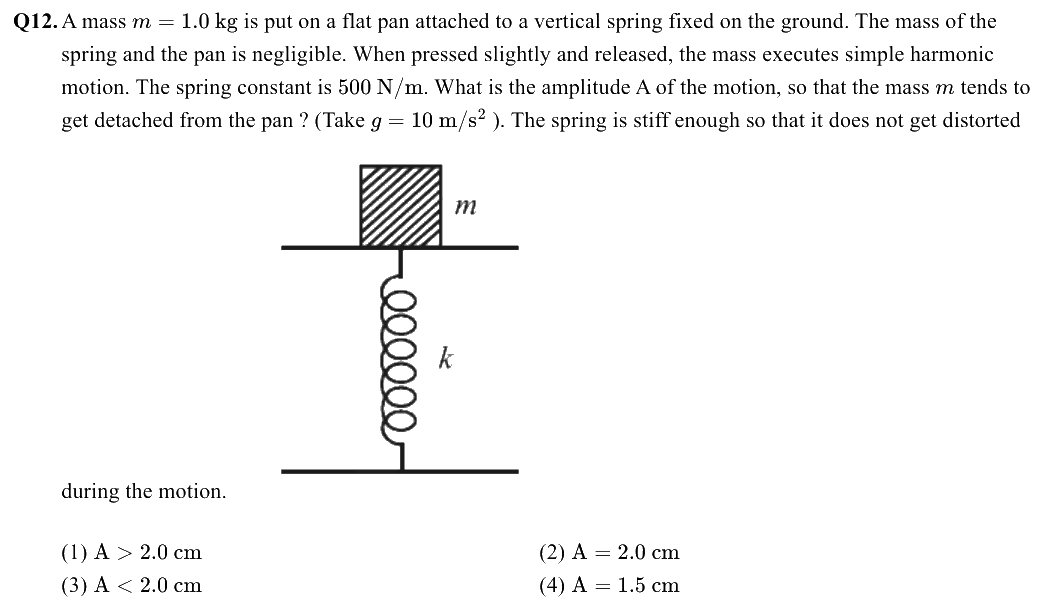
A mass $m = 1.0\ \mathrm{kg}$ is put on a flat pan attached to a vertical spring fixed on the ground. The mass of the spring and the pan is negligible. When pressed slightly and released, the mass executes simple harmonic motion. The spring constant is $500\ \mathrm{N/m}$. What is the amplitude A of the motion, so that the mass $m$ tends to get detached from the pan ? (Take $g = 10\ \mathrm{m/s^2}$ ). The spring is stiff enough so that it does not get distorted during the motion. (see the figure above)
Two springs of force constants 300 N/m (Spring A) and 400 N/m (Spring B) are joined together in series. The combination is compressed by 8.75 cm. The ratio of energy stored in A and B is $\dfrac{E_A}{E_B}$. Then $\dfrac{E_A}{E_B}$ is equal to:
Two simple pendulums of length 1 m and 4 m respectively are both given small displacement in the same direction at the same instant. They will be again in phase after the shorter pendulum has completed number of oscillations equal to:
An ideal gas enclosed in a vertical cylindrical container supports a freely moving piston of mass $M$. The piston and the cylinder have equal cross-sectional area $A$. When the piston is in equilibrium, the volume of the gas is $V_0$ and its pressure is $P_0$. The piston is slightly displaced from the equilibrium position and released. Assuming that the system is completely isolated from its surrounding, the piston executes a simple harmonic motion with frequency
The amplitude of a damped oscillator decreases to 0.9 times its original magnitude in 5s. In another 10s it will decrease to $\alpha$ times its original magnitude, where $\alpha$ equals :
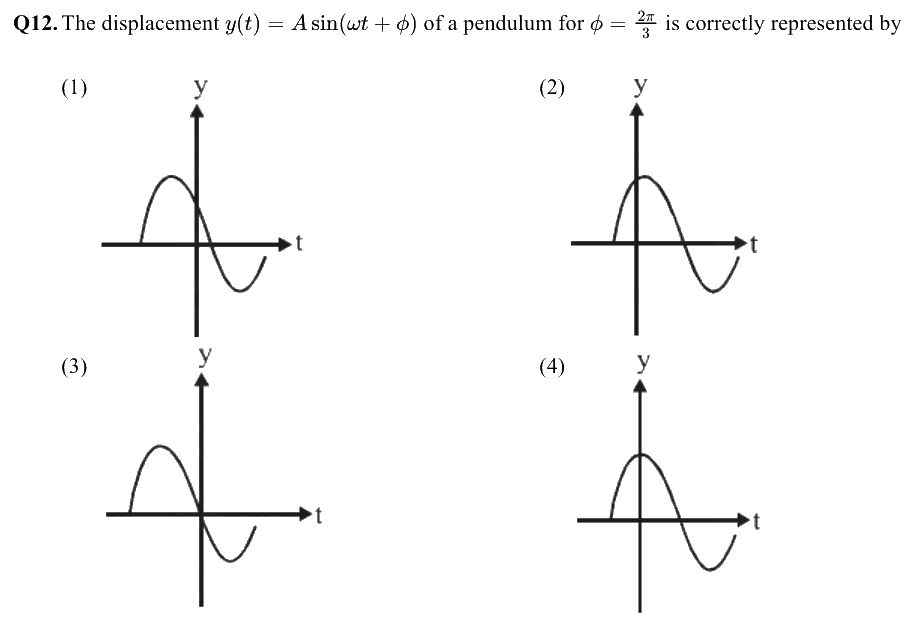
The displacement $y(t) = A\sin(\omega t + \phi)$ of a pendulum for $\phi = \frac{2\pi}{3}$ is correctly represented by
The question as printed in the paper.
A
see figure Graph of y against t: a sine-type curve that starts on the t-axis to the left of the y-axis, rises to its maximum to the left of the y-axis, falls and crosses the y-axis at a positive value (well below the maximum), crosses the t-axis just to the right of the origin and reaches its minimum to the right.
B
see figure Graph of y against t: a sine-type curve that starts on the t-axis to the left of the y-axis, rises to its maximum at (or just right of) the y-axis so that y(0) is at the maximum, then falls, crosses the t-axis well to the right of the origin and reaches its minimum further right.
C
see figure Graph of y against t: a sine-type curve that starts on the t-axis to the left of the y-axis, rises to its maximum to the left of the y-axis, falls and passes through the origin (crosses the t-axis exactly at the y-axis), then reaches its minimum to the right.
D
see figure Graph of y against t: a sine-type curve that starts on the t-axis to the left of the y-axis, rises to its maximum on the y-axis (y(0) at the maximum), then falls, crosses the t-axis to the right of the origin and reaches its minimum further right.
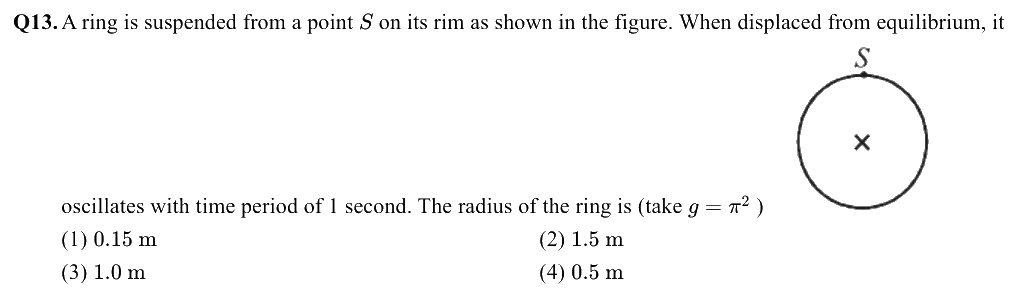
A ring is suspended from a point $S$ on its rim as shown in the figure. When displaced from equilibrium, it (see the figure above) oscillates with time period of 1 second. The radius of the ring is (take $g = \pi^2$ )
If a simple pendulum has significant amplitude (up to a factor of $1/e$ of original) only in the period between $t = 0\mathrm{s}$ to $t = \tau\mathrm{s}$, then $\tau$ may be called the average life of the pendulum. When the spherical bob of the pendulum suffers a retardation (due to viscous drag) proportional to its velocity, with 'b' as the constant of proportionality, the average life time of the pendulum is (assuming damping is small) in seconds:
Two particles are executing simple harmonic motion of the same amplitude A and frequency $\omega$ along the $x$-axis. Their mean position is separated by distance $X_0$ ($X_0 > A$). If the maximum separation between them is $(X_0 + A)$, the phase difference between their motion is :
A mass $M$, attached to a horizontal spring, executes S.H.M. with amplitude $A_1$. When the mass $M$ passes through its mean position then a smaller mass m is placed over it and both of them move together with amplitude $A_2$. The ratio of $\left(\frac{A_1}{A_2}\right)$ is :
The displacement of an object attached to a spring and executing simple harmonic motion is given by $x = 2 \times 10^{-2}\cos\pi t$ metres. The time at which the maximum speed first occurs is
A point mass oscillates along the x-axis according to the law $\mathrm{x = x_0\cos(\omega t - \pi/4)}$. If the acceleration of the particle is written as $\mathrm{a = A\cos(\omega t + \delta)}$
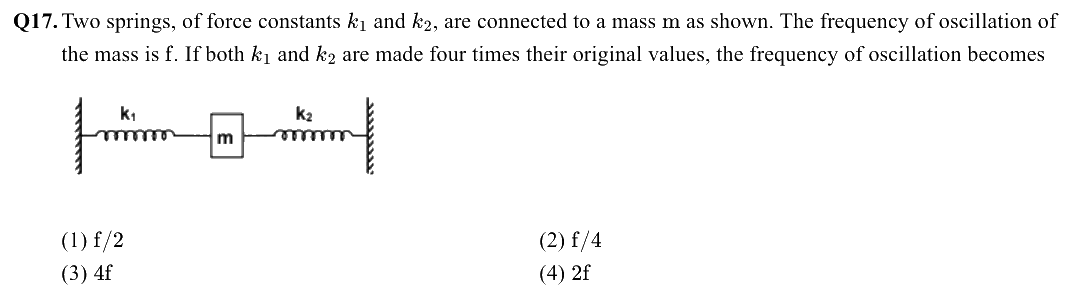
see figure Two springs, of force constants $k_1$ and $k_2$, are connected to a mass m as shown. The frequency of oscillation of the mass is f. If both $k_1$ and $k_2$ are made four times their original values, the frequency of oscillation becomes
A particle of mass $m$ executes simple harmonic motion with amplitude ' $a$ ' and frequency ' $v$ '. The average kinetic energy during its motion from the position of equilibrium to the end is
Starting from the origin, a body oscillates simple harmonically with a period of 2 s. After what time will its kinetic energy be 75% of the total energy?
Two simple harmonic motions are represented by the equation $\mathrm{y_1} = 0.1\sin\left(100\pi t + \frac{\pi}{3}\right)$ and $\mathrm{y_2} = 0.1\cos \pi t$. The phase difference of the velocity of particle 1 w.r.t. the velocity of the particle 2 is
The bob of a simple pendulum is a spherical hollow ball filled with water. A plugged hole near the bottom of the oscillation bob gets suddenly unplugged. During observation, till water is coming out, the time period of oscillation would
A
first increase and then decrease to the original value.
B
first decreased then increase to the original value.
The bob of a simple pendulum executes simple harmonic motion in water with a period $t$, while the period of oscillation of the bob is $t_0$ in air. Neglecting frictional force of water and given that the density of the bob is $\left(\frac{4}{3}\right) \times 1000$ $\mathrm{kg/m^3}$. What relationship between $t$ and $t_0$ is true?
A particle at the end of a spring executes simple harmonic motion with a period $t_1$, while the corresponding period for another spring is $t_2$. If the period of oscillation with the two springs in series is T, then
A particle of mass $m$ is attached to a spring (of spring constant $k$ ) and has a natural angular frequency $\omega_0$. An external force $F(t)$ proportional to $\cos \omega t$ ($\omega \neq \omega_0$) is applied to the oscillator. The time displacement of the oscillator will be proportional to
The length of a simple pendulum executing simple harmonic motion is increased by 21%. The percentage increase in the time period of the pendulum of increased length is
A mass M is suspended from a spring of negligible mass. The spring is pulled a little and then released so that the mass executes SHM of time period T. If the mass is increased by m, the time period becomes $\frac{5T}{3}$. Then the ratio of $\frac{m}{M}$ is
Two particles A and B of equal masses are suspended from two massless springs of spring constant $\mathrm{k_1}$ and $\mathrm{k_2}$, respectively. If the maximum velocities, during oscillation, are equal, the ratio of amplitude of $A$ and $B$ is
A body executes simple harmonic motion. The potential energy (P.E), the kinetic energy (K.E) and total energy (T.E) are measured as a function of displacement $x$. Which of the following statements is true?
The velocity of a particle executing simple harmonic motion along $x$-axis is described as $v^2 = 50 - x^2$, where $x$ represents displacement. If the time period of motion is $\frac{x}{7}$ s, the value of $x$ is ________.
Numerical answer type: type your answer in EdLoop to check it
The displacement of a particle, executing simple harmonic motion with time period $T$, is expressed as $x\,(t) = A\sin\omega t$, where $A$ is the amplitude. The maximum value of potential energy of this oscillator is found at $t = T/2\beta$. The value of $\beta$ is ________.
Numerical answer type: type your answer in EdLoop to check it
The position, velocity and acceleration of a particle executing simple harmonic motion are found to have magnitudes of 4 m, 2 ms$^{-1}$ and 16 ms$^{-2}$ at a certain instant. The amplitude of the motion is $\sqrt{x}$, m where $x$ is ______
Numerical answer type: type your answer in EdLoop to check it
A particle of mass 0.50 kg executes simple harmonic motion under force $F = -50\,(\mathrm{Nm^{-1}})\,x$. The time period of oscillation is $\frac{x}{35}$ s. The value of $x$ is ______ (Given $\pi = \frac{22}{7}$ )
Numerical answer type: type your answer in EdLoop to check it
An object of mass 0.2 kg executes simple harmonic motion along x axis with frequency of $\left(\frac{25}{\pi}\right)$Hz. At the position $x = 0.04$ m the object has kinetic energy 0.5 J and potential energy 0.4 J. The amplitude of oscillation is ______ cm.
Numerical answer type: type your answer in EdLoop to check it
The displacement of a particle executing SHM is given by $x = 10\sin\left(wt + \frac{\pi}{3}\right)m$. The time period of motion is 3.14 s. The velocity of the particle at $t = 0$ is ______ m/s.
Numerical answer type: type your answer in EdLoop to check it
A mass $m$ is suspended from a spring of negligible mass and the system oscillates with a frequency $f_1$. The frequency of oscillations if a mass $9m$ is suspended from the same spring is $f_2$. The value of $\frac{f_1}{f_2}$ is ______.
Numerical answer type: type your answer in EdLoop to check it
A particle performs simple harmonic motion with amplitude $A$. Its speed is increased to three times at an instant when its displacement is $\frac{2A}{3}$. The new amplitude of motion is $\frac{nA}{3}$. The value of $n$ is ______.
Numerical answer type: type your answer in EdLoop to check it
When the displacement of a simple harmonic oscillator is one third of its amplitude, the ratio of total energy to the kinetic energy is $\frac{x}{8}$, where $x =$ ______.
Numerical answer type: type your answer in EdLoop to check it
A simple harmonic oscillator has an amplitude $A$ and time period $6\pi$ second. Assuming the oscillation starts from its mean position, the time required by it to travel from $x = A$ to $x = \frac{\sqrt{3}}{2}A$ will be $\frac{\pi}{x}$ s, where $x =$ ______.
Numerical answer type: type your answer in EdLoop to check it
A particle executes simple harmonic motion with an amplitude of 4 cm. At the mean position, velocity of the particle is 10 cm s$^{-1}$. The distance of the particle from the mean position when its speed becomes 5 cm s$^{-1}$ is $\sqrt{\alpha}$ cm, where $\alpha =$ ______.
Numerical answer type: type your answer in EdLoop to check it
At a given point of time the value of displacement of a simple harmonic oscillator is given as $y = A\cos(30°)$. If amplitude is 40 cm and kinetic energy at that time is 200 J, the value of force constant $1.0 \times 10^{x}$ N m$^{-1}$. The value of $x$ is ______.
Numerical answer type: type your answer in EdLoop to check it
A rectangular block of mass 5 kg attached to a horizontal spiral spring executes simple harmonic motion of amplitude 1 m and time period $3.14$ s. The maximum force exerted by spring on block is ______ N.
Numerical answer type: type your answer in EdLoop to check it
A simple pendulum with length $100\ \mathrm{cm}$ and bob of mass $250\ \mathrm{g}$ is executing S.H.M of amplitude $10\ \mathrm{cm}$. The maximum tension in the string is found to be $\frac{x}{40}$ N. The value of $x$ is ______ .
Numerical answer type: type your answer in EdLoop to check it
The amplitude of a particle executing SHM is 3 cm. The displacement at which its kinetic energy will be 25% more than the potential energy is: ______ cm.
Numerical answer type: type your answer in EdLoop to check it
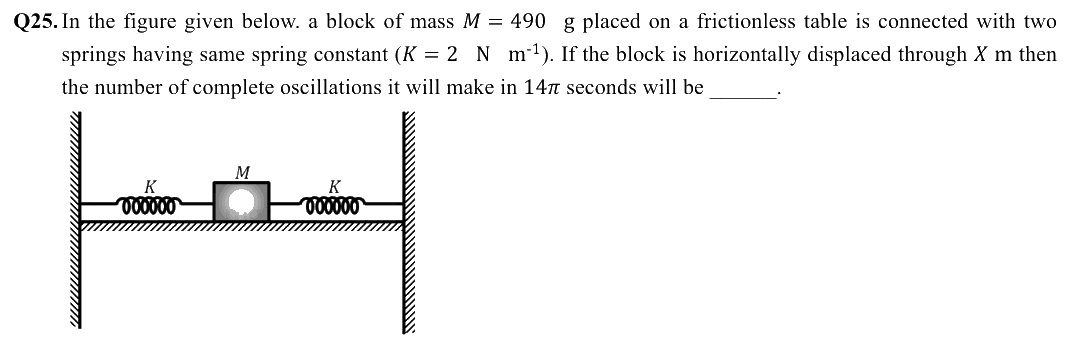
In the figure given below. a block of mass $M$ = 490 $\mathrm{g}$ placed on a frictionless table is connected with two springs having same spring constant ($K$ = 2 $\mathrm{N\ m^{-1}}$). If the block is horizontally displaced through $X$ m then the number of complete oscillations it will make in $14\pi$ seconds will be ______.
(see the figure above)
The question as printed in the paper.
Numerical answer type: type your answer in EdLoop to check it
The general displacement of a simple harmonic oscillator is $x = A\ \sin\ \omega t$. Let $T$ be its time period. The slope of its potential energy $(U)$ $-$ time $(t)$ curve will be maximum when $t = \frac{T}{\beta}$. The value of $\beta$ is ______.
Numerical answer type: type your answer in EdLoop to check it
The velocity of a particle executing SHM varies with displacement ($x$) as $4v^2 = 50 - x^2$. The time period of oscillations is $\frac{\pi}{7}$ s. The value of $x$ is ______. [Take $\pi = \frac{22}{7}$]
Numerical answer type: type your answer in EdLoop to check it
A particle of mass 250 g executes a simple harmonic motion under a periodic force $F = (-25x)$ N. The particle attains a maximum speed of $4\ \mathrm{m\,s^{-1}}$ during its oscillation. The amplitude of the motion is ______ cm.
Numerical answer type: type your answer in EdLoop to check it
A block of mass 2 kg is attached with two identical springs of spring constant $20\ \mathrm{N\,m^{-1}}$ each. The block is placed on a frictionless surface and the ends of the springs are attached to rigid supports (see figure). When the mass is displaced from its equilibrium position, it executes a simple harmonic motion. The time period of oscillation is $\frac{\pi}{\sqrt{X}}$ in SI unit. The value of $X$ is ______.
(see the figure above)
The question as printed in the paper.
Numerical answer type: type your answer in EdLoop to check it
A mass $m$ attached to free end of a spring executes SHM with a period of 1 s. If the mass is increased by 3 kg the period of oscillation increases by one second, the value of mass $m$ is ______ kg.
Numerical answer type: type your answer in EdLoop to check it
The metallic bob of simple pendulum has the relative density 5. The time period of this pendulum is 10 s. If the metallic bob is immersed in water, then the new time period becomes $5\sqrt{x}$ s. The value of $x$ will be ______.
Numerical answer type: type your answer in EdLoop to check it
The potential energy of a particle of mass $4\ \mathrm{kg}$ in motion along the $x$-axis is given by $U=4(1-\cos4x)\ \mathrm{J}$. The time period of the particle for small oscillation ($\sin\theta\simeq\theta$) $\left(\frac{\pi}{K}\right)$ s. The value of $K$ is ______.
Numerical answer type: type your answer in EdLoop to check it
A mass 0.9 kg, attached to a horizontal spring, executes SHM with an amplitude $A_1$. When this mass passes through its mean position, then a smaller mass of 124 g is placed over it and both masses move together with amplitude $A_2$. If the ratio $\frac{A_1}{A_2}$ is $\frac{\alpha}{\alpha - 1}$, then the value of $\alpha$ will be ______ .
Numerical answer type: type your answer in EdLoop to check it
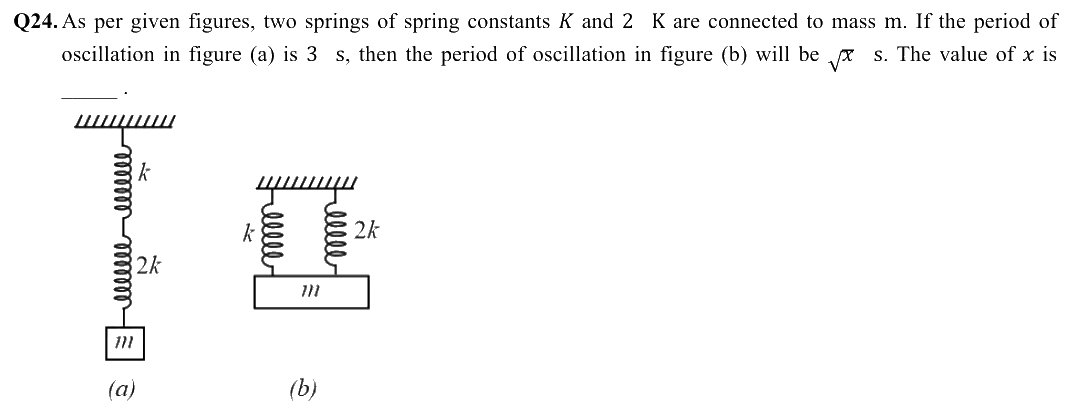
As per given figures, two springs of spring constants $K$ and $2\ \mathrm{K}$ are connected to mass m. If the period of oscillation in figure (a) is 3 s, then the period of oscillation in figure (b) will be $\sqrt{x}$ s. The value of $x$ is ______ .
(see the figure above)
The question as printed in the paper.
Numerical answer type: type your answer in EdLoop to check it
A body is performing simple harmonic with an amplitude of $10\ \mathrm{cm}$. The velocity of the body was tripled by air Jet when it is at $5\ \mathrm{cm}$ from its mean position. The new amplitude of vibration is $\sqrt{x}\ \mathrm{cm}$. The value of $x$ is ______.
Numerical answer type: type your answer in EdLoop to check it
A particle executes simple harmonic motion. Its amplitude is $8\ \mathrm{cm}$ and time period is $6\ \mathrm{s}$. The time it will take to travel from its position of maximum displacement to the point corresponding to half of its amplitude, is ______ s
Numerical answer type: type your answer in EdLoop to check it
A particle of mass $1$ kg is hanging from a spring of force constant $100$ N m$^{-1}$. The mass is pulled slightly downward and released so that it executes free simple harmonic motion with time period $T$. The time when the kinetic energy and potential energy of the system will become equal, is $\frac{T}{n}$. The value of $n$ is ______.
Numerical answer type: type your answer in EdLoop to check it
Two simple harmonic motion, are represented by the equations $y_1=10\sin\left(3\pi t+\frac{\pi}{3}\right)$; $y_2=5\left(\sin3\pi t+\sqrt{3}\cos3\pi t\right)$ Ratio of amplitude of $y_1$ to $y_2=x:1$. The value of $x$ is
Numerical answer type: type your answer in EdLoop to check it
Two simple harmonic motions are represented by the equations $x_1=5\sin\left(2\pi t+\frac{\pi}{4}\right)$ and $x_2=5\sqrt{2}\left(\sin 2\pi t+\cos 2\pi t\right)$. The amplitude of the second motion is ______ times the amplitude in the first motion.
Numerical answer type: type your answer in EdLoop to check it
A particle executes simple harmonic motion represented by displacement function as $x(t) = A\sin(\omega t + \phi)$. If the position and velocity of the particle at $t = 0\ \mathrm{s}$ are $2\ \mathrm{cm}$ and $2\omega\ \mathrm{cm\ s^{-1}}$ respectively, then its amplitude is $x\sqrt{2}\ \mathrm{cm}$ where the value of $x$ is
Numerical answer type: type your answer in EdLoop to check it
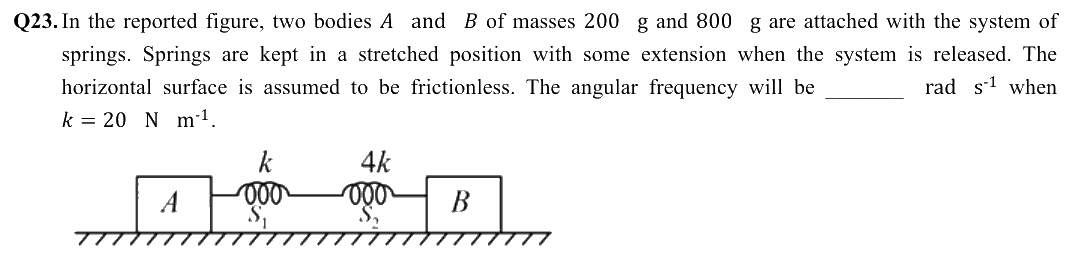
In the reported figure, two bodies $A$ and $B$ of masses $200\ \mathrm{g}$ and $800\ \mathrm{g}$ are attached with the system of springs. Springs are kept in a stretched position with some extension when the system is released. The horizontal surface is assumed to be frictionless. The angular frequency will be ______ $\mathrm{rad\ s^{-1}}$ when $k = 20\ \mathrm{N\ m^{-1}}$. (see the figure above)
The question as printed in the paper.
Numerical answer type: type your answer in EdLoop to check it
A particle performs simple harmonic motion with a period of 2 second. The time taken by the particle to cover a displacement equal to half of its amplitude from the mean position is $\frac{1}{a}$ s. The value of $a$ to the nearest integer is
Numerical answer type: type your answer in EdLoop to check it
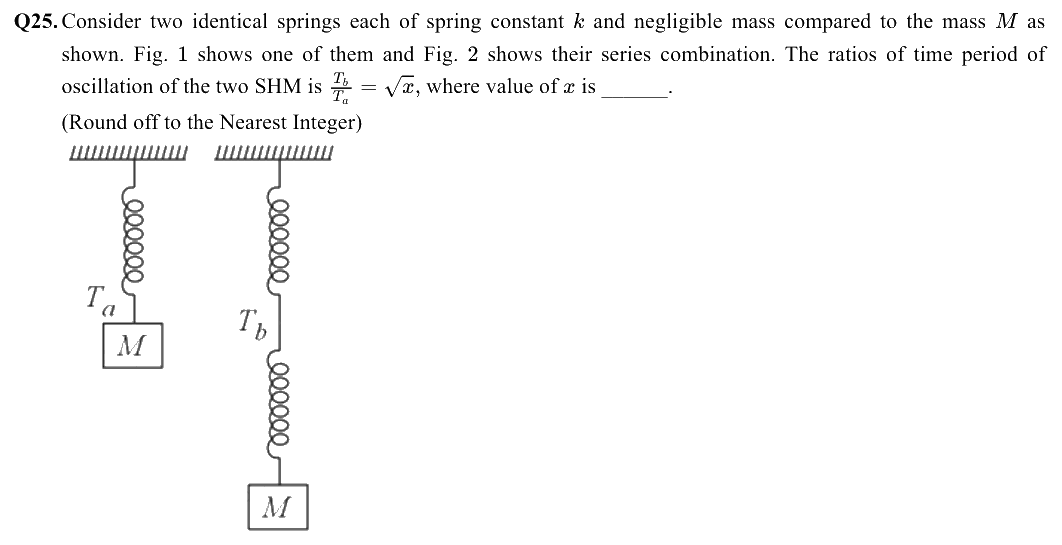
Consider two identical springs each of spring constant $k$ and negligible mass compared to the mass $M$ as shown. Fig. 1 shows one of them and Fig. 2 shows their series combination. The ratios of time period of oscillation of the two SHM is $\frac{T_b}{T_a}=\sqrt{x}$, where value of $x$ is ______. (Round off to the Nearest Integer) (see the figure above)
The question as printed in the paper.
Numerical answer type: type your answer in EdLoop to check it
A particle executes S.H.M. with amplitude $A$ and time period $T$. The displacement of the particle when its speed is half of maximum speed is $\frac{\sqrt{x}A}{2}$. The value of $x$ is
Numerical answer type: type your answer in EdLoop to check it
Time period of a simple pendulum is $T$. The time taken to complete $\frac{5}{8}$ oscillations starting from mean position is $\frac{\alpha}{12}T$. The value of $\alpha$ is ______.
Numerical answer type: type your answer in EdLoop to check it
Oscillations (SHM) explores restorative forces and sinusoidal dynamics in Class 11 Physics, bridging kinematics with wave phenomena. Across the papers we hold from 2019 to 2026, the chapter delivered 132 questions in 162 papers, which corresponds to 0.8 questions per paper, and was present in 109 of those 162 papers. That ranks it 21st of 29 Physics chapters by question count in that period, comprising 2.9% of all Physics questions.
Testing weight for harmonic motion has dropped noticeably when contrasted with earlier testing eras. Between 2002 and 2018, it represented 4.4% of the Physics section; in the recent 2024 to 2026 cycle, it declined to 2.3%, generating 36 questions in 58 papers. The most concentrated years in our archive were 2021 (24 questions across 26 papers) and 2022 (22 questions across 22 papers). The chapter has featured in every annual testing cycle since 2019, turning up in 109 of the 162 papers in our collection.
It forms the first half of Unit 10: Oscillations and Waves in NTA's Class 11 Physics syllabus, introducing differential equations of motion that re-emerge in alternating current circuits.
Most-asked topics
Between 2019 and 2026, questions separated into four distinct topics:
Oscillating Systems: 65 questions. Spring-block combinations in series and parallel, simple pendulums, liquid columns in U-tubes, and floating hydrometers.
SHM Basics: 39 questions. Harmonic displacement equations, phase constants, velocity-displacement ellipses, and linear acceleration relations.
Energy in SHM: 24 questions. Kinetic and potential energy exchanges, time-averaged energies, and energy frequency doubling.
Damped & Forced Oscillations: 4 questions. Exponential amplitude decay, quality factor, and driving frequency resonance peaks.
The first three topics were tested actively in 2026, while damped oscillations appeared occasionally in earlier years like 2021.
What the questions look like
Oscillating system problems typically require deriving the effective restoring force. A classic question cuts a uniform coil spring of stiffness 15 N/m into two pieces in a 1 : 3 length ratio and asks for the spring constant of the shorter segment. Because spring stiffness is inversely proportional to unstretched length, shorter segments become stiffer. Other questions evaluate the oscillation period of a cylinder floating upright in a liquid when gently depressed and released, requiring students to equate net restoring buoyant force to mass times acceleration.
Kinematic questions test the harmonic equations x = A sin(ωt + φ). Students compute the earliest time when velocity reaches zero (at extreme displacement) or when acceleration vanishes (passing through the mean position). Phase difference problems determine whether two oscillators moving along parallel lines pass each other heading in identical or opposite directions.
Energy questions center on the quadratic dependence of energy on position. You will encounter questions noting that kinetic energy oscillates at an angular frequency of 176 rad/s, asking for the natural frequency of the physical oscillator itself. Because kinetic energy completes two full cycles for every single mechanical cycle of the mass, the oscillator frequency is half the kinetic energy frequency.
Numerical entry problems represent a noticeable portion: 38 of the 132 questions between 2019 and 2026 were numerical answer items.
Questions to try first
These five questions from recent NTA papers represent the main problem formats:
Master the defining differential equation of simple harmonic motion: acceleration equals negative ω² times displacement. Whenever you encounter an unfamiliar physical setup, displace the system by a small distance x from its equilibrium position, write the net restoring force, and show that force is proportional to negative x. The ratio of the restoring constant to system inertia immediately gives ω².
Remember the energy frequency relation: while displacement, velocity, and acceleration complete one cycle in time period T, kinetic energy and potential energy complete two full cycles in the same duration. The frequency of energy oscillation is exactly twice the frequency of mechanical motion.
For spring combinations, treat springs like capacitors in electrical circuits: springs in parallel add their stiffnesses directly (k1 + k2), while springs in series combine reciprocally. For simple pendulums, verify that time period scales with the square root of length divided by effective acceleration, remembering to modify effective g inside accelerating elevators or vehicles.
Frequently asked questions
Is Oscillations (SHM) an important chapter for JEE Main 2027?
Yes. It provided 132 questions across 162 papers in our set from 2019 to 2026, averaging 0.8 questions per paper. It ranks 21st among 29 Physics chapters and appeared in 109 of those 162 papers.
Which topic in Oscillations is tested most?
Oscillating systems leads the chapter with 65 questions between 2019 and 2026, followed by fundamental SHM kinematics with 39 questions and energy relationships with 24.
Why does a shorter spring have a higher spring constant?
A spring's stiffness is inversely proportional to its active coil length. When a spring is cut into smaller segments, each unit length must stretch by the same absolute amount to produce a given overall tension, meaning the shorter segment requires much more force to achieve a unit total elongation.
Where can I see the solutions?
Every question on this page opens with its options and answer. Step-by-step solutions for each one are in the EdLoop app.