
EdLoop PYQs · free, no ads · questions and answers here, step-by-step solutions in the EdLoop app
PYQs · free, no adsOpen on the web (app.edloop.in)Get EdLoop – free on Google Play
PhysicsDual Nature of Matter & Radiation

AIEEE 2008 Physics: Dual Nature of Matter & Radiation

Multiple choice, one correct option Memory based Dual Nature of Matter & Radiation

AIEEE 2008PhysicsDual Nature of Matter & RadiationMCQ

Paragraph: Wave property of electrons implies that they will show diffraction effects. Davisson and Germer demonstrated this by diffracting electrons from crystals. The law governing the diffraction from a crystal is obtained by requiring that electron waves reflected from the planes of atoms in a crystal interfere constructively (see in figure).
(see the figure above)
Question: In an experiment, electrons are made to pass through a narrow slit of width 'd' comparable to their de Broglie wavelength. They are detected on a screen at a distance ' $D$ ' from the slit (see figure).
(see the figure above)
Which of the following graph can be expected to represent the number of electrons ' $N$ ' detected as a function of the detector position ' $y$ ' ($y = 0$ corresponds to the middle of the slit)?
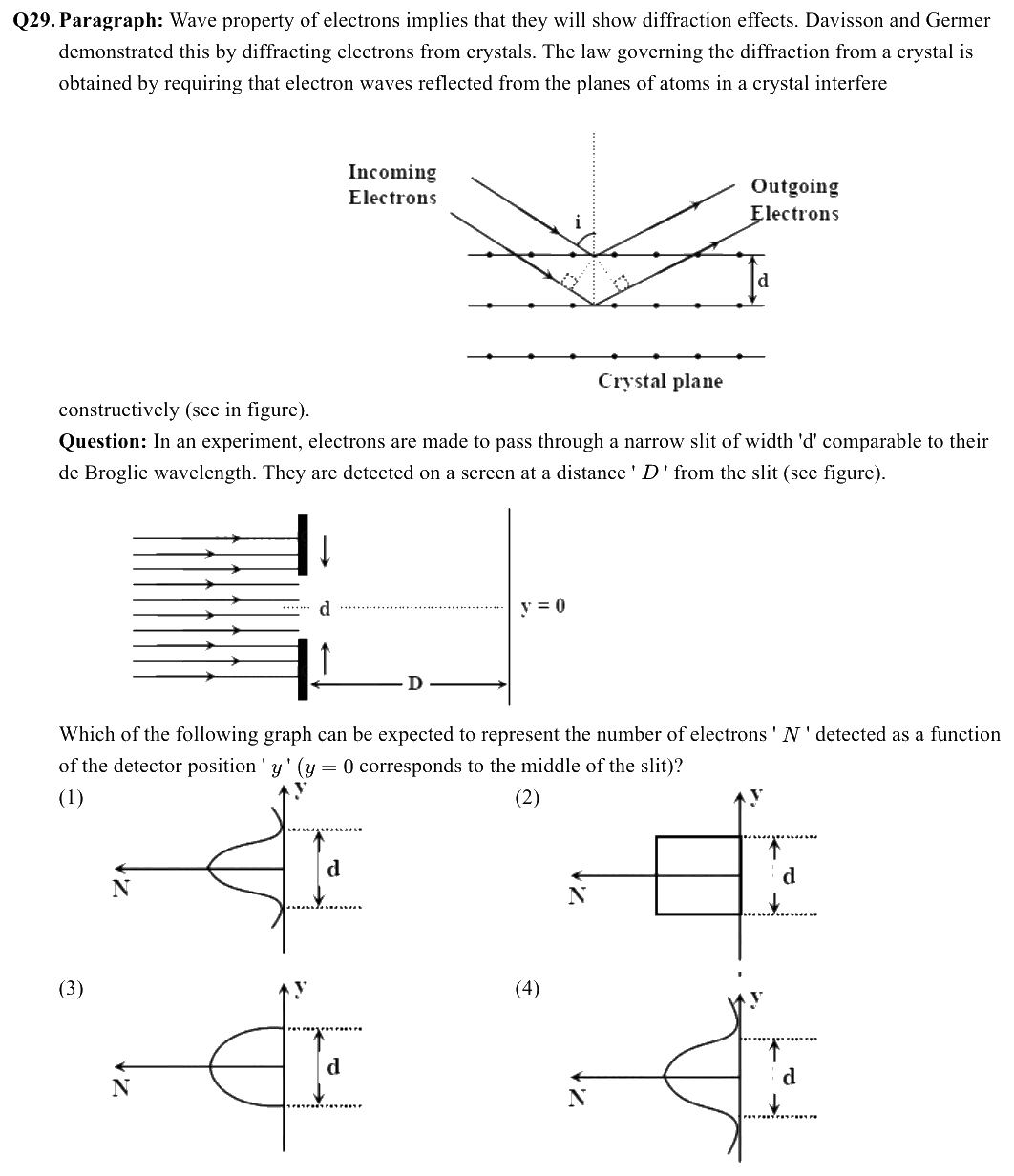
The question and its figure as printed in AIEEE 2008. Option 1: graph of N against y Option 2: graph of N against y Option 3: graph of N against y Option 4: graph of N against y
The question as printed in the paper.
  1. (1)

    see figure graph of $N$ against $y$

  2. (2)

    see figure graph of $N$ against $y$

  3. (3)

    see figure graph of $N$ against $y$

  4. (4)

    see figure graph of $N$ against $y$

Show answer

Option (4) is correct.

Key from source paper

See the step-by-step solution in EdLoop

The worked solution is in the EdLoop app, free on Android, with every other Dual Nature of Matter & Radiation question from 2002 to 2026.

More from this chapter

All 208 questions in Dual Nature of Matter & Radiation ›

Physics Dual Nature of Matter & Radiation question from AIEEE 2008 (AIEEE, now called JEE Main). Memory-based papers are reconstructed from candidates' memory by coaching institutes.

All JEE Main Dual Nature of Matter & Radiation PYQs (208 questions)

Get EdLoop – freeOpen on the web