Every Atoms question from past AP EAPCET and TS EAPCET papers, with options and answers. Newest first.
141questions
131papers covered
2.5%of Physics questions, 2022–2026
2011–2026years
Guide at a glance
Atomic structure and quantum spectral transitions form an essential section of modern physics in Class 12. In the papers we hold for AP and TS EAPCET between 2022 and 2026, Atoms contributed 77 questions across 77 papers.
An electron has an angular momentum of $90\hbar\ J - S$ while orbiting with a linear velocity of $\pi \times 10^{5} ms^{-1}$ then the radius of the orbit is (mass of electron = $9 \times 10^{-3} Kg$ and Planks Constant = $6.6 \times 10^{-34}$ J s)
An electron is moving in an orbit of hydrogen atom in which there can be a maximum of six transitions. Another electron is moving in an another orbit of hydrogen atom in which there can be maximum of three transitions. The ratio of the velocity of electrons in these two orbits is
Suppose an electron is attracted towards the origin by a force $\frac{K}{r}$, where K is a constant and r is the distance of the electron from the origin. By applying Bohr model to this system, the radius of the $n^{th}$ orbit of the electron is found to be $r_n$, and the kinetic energy of the electron to be $T_n$, then which of the following is true?
If the ratio of the time periods of the electrons revolving in the first and $n^{\mathrm{th}}$ orbits of Hydrogen atom is 1 : 64, then the angular momentum of the electron in the $n^{\mathrm{th}}$ excited state of Hydrogen atom is (h – Planck’s constant)
The atomic number (Z) of a hydrogen like atom whose shortest wavelength of Brackett Series is same as the shortest wavelength of Balmer series of hydrogen atom is
Find the impact parameter of a particle of energy 10 MeV while approaching the gold nucleus, if scattered with $60^\circ$? (Charge of electron = $1.6 \times 10^{-19}\,\mathrm{C}$, Atomic Number of gold = 79)
If the time period of an electron in the ground state of hydrogen atom is $1.5\times10^{-16}\,\mathrm{s}$, then the time period of the electron in the third excited state of hydrogen atom is
In terms of Planck's constant (h), permittivity of free space ( $\varepsilon_0$ ), mass of the electron (m) and charge of the electron (e), the de Broglie wavelength associated with the electron in the second orbit of hydrogen atom is
If the 9546 Å wavelength spectral line in hydrogen spectrum is due to the transition of an electron from a higher orbit to n$^{\mathrm{th}}$ lower orbit, then the value of n is
The substance which has an energy band gap equal to the energy of the spectral line corresponding to the shortest wavelength of Paschen series of the hydrogen spectrum is
If the wavelength of a spectral line in the Balmer series of hydrogen spectrum is $\frac{7.2}{R}$, then the ratio of the radii of the higher and lower orbits between which the transition of electron takes place is (R - Rydberg constant)
The ratio of energies of photons produced due to transition of an electron in hydrogen atom from second energy level to first energy level and fifth energy level to second energy level is
If the difference in the frequencies of the first and second lines of Lyman series of hydrogen atom is f, then the difference in frequencies of the first and second lines of Balmer series of hydrogen atom is
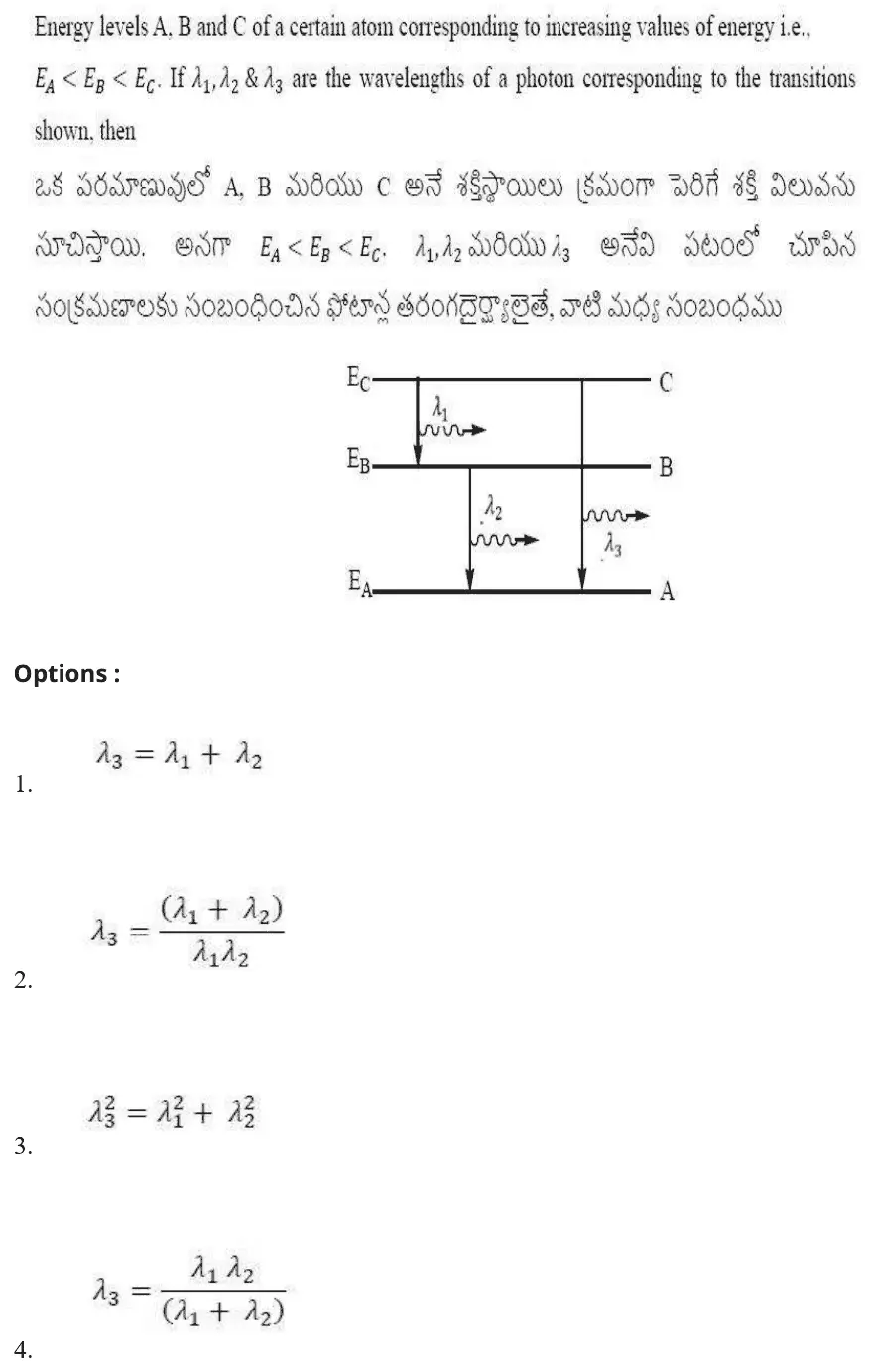
Energy levels A, B and C of a certain atom corresponding to increasing values of energy i.e., $E_A < E_B < E_C$. If $\lambda_1, \lambda_2$ & $\lambda_3$ are the wavelengths of a photon corresponding to the transitions shown, then
The principle quantum number ‘n’ corresponding to the exited state of $\mathrm{He^+}$ ion, if on transition to the ground state two photons in succession with wavelength 1026 A° and 304 A° are emitted
The electrostatic potential energy of the electron in an orbit of hydrogen is $-6.8$ eV. The speed of the electron in this orbit is (C is speed of light in vacuum)
$\mu$ – meson of charge 'e', mass 208 me moves in a circular orbit around a heavy nucleus having charge +3e. The quantum state 'n' for which the radius of the orbit is same as that of the first Bohr orbit for hydrogen atom is [approximately]
In hydrogen atom, the frequency of the photon emitted when an electron jumps from second orbit to first orbit is ‘f’. The frequency of the photon emitted when an electron jumps from third excited state to first excited state is
The ratio of the centripetal accelerations of the electron in two successive orbits of hydrogen is $81:16$. Due to a transition between these two states, the angular momentum of the electron changes by (h – Planck’s constant)
At room temperature, gaseous hydrogen is bombarded with a beam of electrons of 13.6 eV energy. The series to which the emitted spectral line belongs to
The ratio of the wavelengths of radiation emitted when an electron in the hydrogen atom jumps from $4^{\text{th}}$ orbit to $2^{\text{nd}}$ orbit and from $3^{\text{rd}}$ orbit to $2^{\text{nd}}$ orbit is
In hydrogen atom, if an electron in the orbit with principal quantum number 'n' jumps to the first excited state, the wavelength of the emitted photon is '$\lambda$'. Then the value of n is
In hydrogen spectrum, the shortest wavelengths of Lyman and Balmer series are $\lambda_1$ and $\lambda_2$ respectively. The Rydberg constant of hydrogen is
The distance of closest approach of an alpha particle to a nucleus when the alpha particle moves towards the nucleus with linear momentum P is d. The distance of closest approach of alpha particle to nucleus, if the linear momentum of the alpha particle is 1.5 P
An alpha particle of energy K MeV is moving towards a nucleus of atomic number Z. The distance of closest approach of the alpha particle to the nucleus in metres is
In hydrogen spectrum, the shortest and longest wavelengths of Balmer series are $\lambda_1$ and $\lambda_2$ respectively. The Rydberg constant of hydrogen is
Considering the Bohr's model of Hydrogen atom, the ratio of velocities of electrons orbiting in the $4^{\text{th}}$ orbit to that in the $9^{\text{th}}$ orbit is
The light emitted in the transition n = 3 to n = 2 (where n is the principal quantum number of the state) in hydrogen is called $\mathrm{H}_{\alpha}$-light. Find the maximum work function that a metal can have so that $\mathrm{H}_{\alpha}$-light can emit photoelectrons from it.
Statement (A): As one considers orbits with higher values of n in hydrogen atom, the electric potential energy of the atom increases. Statement (B): In Thomson's model, an atom is a spherical cloud of positive charges with electrons embedded in it. Statement (C): The orbital picture in Bohr's model of the hydrogen atom was consistent with the uncertainty principle.
An electron in the hydrogen atom excites from $2^{\mathrm{nd}}$ orbit to $4^{\mathrm{th}}$ orbit then the change in angular momentum of the electron is (Planck's constant $h = 6.64\times10^{-34}$ J-s)
The frequency of the light emitted when an electron comes down from n = 4 to n = 2 level in hydrogen atom is $\frac{3}{7}$ times of the following transition of the $\mathrm{Li^{2+}}$ ion
Energy of a stationary electron in the hydrogen atom is $E = -\dfrac{13.6}{n^2}$ eV then the energies required to excite the electron in hydrogen atom to (a) its second excited state and (b) ionized state respectively
A hydrogen like atom emits radiation of frequency $2.7\times10^{15}\ Hz$ when it undergoes a transition from $n = 2$ to $n = 1$. For the same atom, find the frequency of the radiation emitted when a transition occurs from $n = 3$ to $n = 1$.
Assertion (A): The impact parameter for scattering of $\alpha$- particles by $180^\circ$ is zero. Reason (R): Zero impact parameter means that the $\alpha$-particles tend to hit the center of the nucleus.
A
Both A and R are true and R is a correct explanation for A
B
Both A and R are true but R is not a correct explanation for A
The ratio of speed of electrons in the first excited state of hydrogen atom to the speed of light in vacuum is ______. Given, Planck's constant = $6.625 \times 10^{-34}\,\mathrm{J.s}$ and permittivity of free space is $8.85 \times 10^{-12}\,\mathrm{F.m^{-1}}$
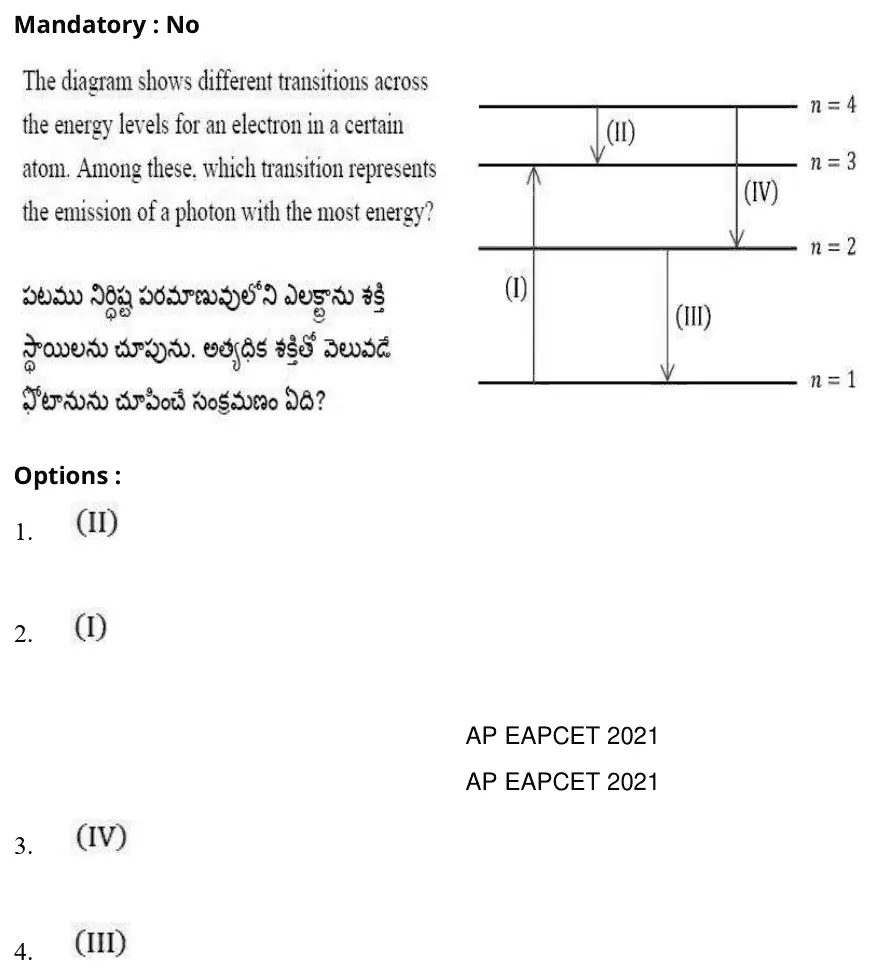
The diagram shows different transitions across the energy levels for an electron in a certain atom. Among these, which transition represents the emission of a photon with the most energy? (see the figure above)
Ionization potential of hydrogen atom is 13.6 $eV$. When hydrogen atoms in ground state are excited by a supply of 12.1 $eV$, the number of spectral lines emitted by hydrogen atoms according to Bohr's theory is ______
The ionization potential of hydrogen atom is $13.6\ \mathrm{V}$. How much energy need to be supplied to ionize the hydrogen atom in the first excited state.
A mono chromatic radiation of wave length $\lambda$ is incident on a hydrogen sample in ground state the sample subsequently emits radiation of six different wave lengths, then the value of $\lambda$ is [Use ch = 1242 ev-m]
In hydrogen atom spectra, if the ratio of wavelengths corresponding to the first line of Balmer series and the first line of Lyman series is $9\alpha$, the value of $\alpha$ is
A hydrogen atom emits a photon corresponding to an electron transition from n = 5 to n = 1. If $R$ is the Rydberg constant, then the wavelength of emitted photon is
Hydrogen atom in the ground state absorbs $\Delta E$ amount of energy. If the orbital angular momentum of the electron is increased by $\frac{h}{2\pi}$ (h = Plank constant), then the magnitude of $\Delta E$ is
The wavelength of the first line of Balmer series of hydrogen atom is $\lambda$, what will be the wavelength of the same line in doubly ionized lithium?
In Bohr's theory the potential of an electron at a position is $\frac{Kr^2}{2}$, where $K$ is a constant. Then the quantized energy of the electron in $n^{th}$ orbit is
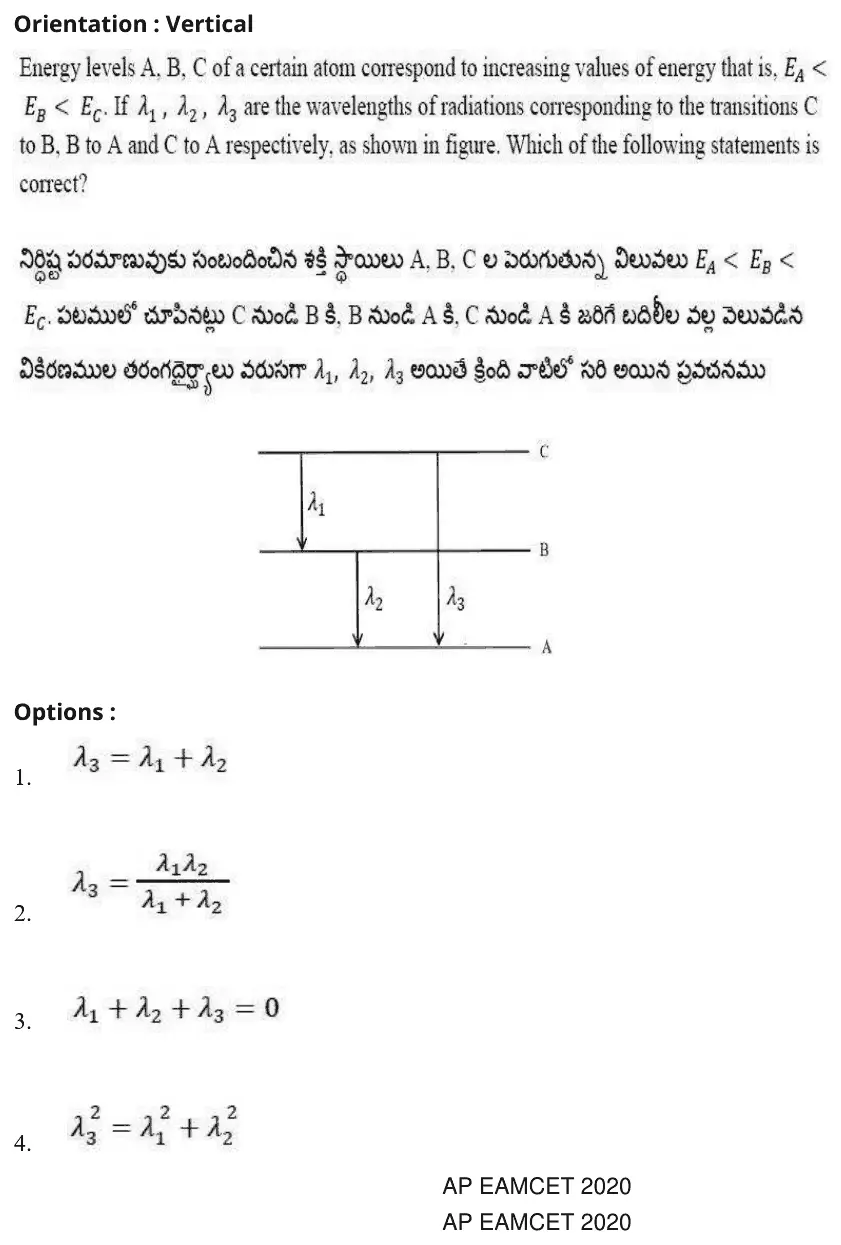
Energy levels A, B, C of a certain atom correspond to increasing values of energy that is, $E_A < E_B < E_C$. If $\lambda_1, \lambda_2, \lambda_3$ are the wavelengths of radiations corresponding to the transitions C to B, B to A and C to A respectively, as shown in figure. Which of the following statements is correct? (see the figure above)
A hydrogen like atom has one electron revolving round a stationary nucleus. If the energy required to excite the electron from the $2^{nd}$ orbit to $3^{rd}$ orbit is $47.2\,\mathrm{eV}$, find the atomic number of the given atom.
A monochromatic light of wavelength $\lambda$ ejects photoelectrons from a metal surface with work function ($\varphi$) 2.4 eV. These photoelectrons are made to collide with hydrogen atoms in ground state. The maximum value of $\lambda$ for which hydrogen atom may be ionized is [Take hc = 1240 eV-nm]
The wavelength of a spectral line emitted by hydrogen atom in the Balmer series is $\frac{16}{3R}$ (R is Rydberg constant). What is the value of the principal quantum number of the state from which the transition takes place?
In the hydrogen atom spectrum, let $E_1$ and $E_2$ are energies for the transition $n=2 \to n=1$ and $n=3 \to n=2$ respectively. The ratio $E_2/E_1$ is
Monochromatic radiation is incident on hydrogen sample which is in ground state. If the hydrogen atoms emit radiation of ten different wavelengths after absorbing incident radiation, then the wavelength of incident radiation is (Let $hc = 1242$ eV-nm)
A hydrogen sample is prepared in a particular excited state A of quantum number $n_A = 3$. The ground state energy of hydrogen atom is $-|E|$. The photons of energy $\frac{|E|}{12}$ are absorbed in the sample which results in excitation of some electrons to excited state B of quantum number $n_B$, whose value is
To excite the spectral line of wavelength $4960\ \mathrm{\AA}$ of an atom, an excitation energy of $7.7\ \mathrm{eV}$ is required. The ground state energy of the atom is $10.5\ \mathrm{eV}$. The energies of two levels involved in the emission of $4960\ \mathrm{\AA}$ line are (Assume $hc = 1240\ \mathrm{eV\text{-}nm}$, where h is Planck constant and c is speed of light)
Speed of electron in its $1^{\mathrm{st}}$ Bohr's orbit is given by $2.18 \times 10^{6}\ \mathrm{ms^{-1}}$. If the time period of electron in $\mathrm{n^{th}}$ orbit is measured as 4.10 femto second, the value of $n$ is
A hydrogen atom emits a photon of wavelength $\frac{36}{35R}$ when it is jumped from its $n^{\mathrm{th}}$ excited state to ground state. Then the quantum number $n$ is (R is Rydberg constant)
In a hydrogen atom, an electron of mass $9.1\times10^{-31}\ \mathrm{kg}$ revolves about a proton in circular orbit of radius 0.53 Å. The radial acceleration and angular velocity of electron are respectively
In a system, a particle A of mass $m$ and charge $-2q$ is moving in the nearest orbit around a very heavy particle B having charge $+q$. Assuming Bohr's model of the atom to be applicable to this system, the orbital angular velocity of the particle A is
Match the following List-I with List-II in connection with Bohr's atomic model List-I A) Speed of revolution of electron B) Kinetic energy C) Total energy D) Frequency List-II I) $\frac{1}{4\pi\epsilon_0}\,\frac{2\pi z e^2}{nh}$ II) $-\left(\frac{1}{4\pi\epsilon_0}\right)^2 \frac{2\pi^2 m e^4 z^2}{n^2 h^2}$ III) $\left(\frac{1}{4\pi\epsilon_0}\right)^2 \frac{2\pi^2 m e^4 z^2}{n^2 h^2}$ IV) $\left(\frac{1}{4\pi\epsilon_0}\right)^2 \frac{4\pi^2 z^2 e^4 m}{n^3 h^3}$ The correct answer is
In a hydrogen sample, if the atoms are excited to states with principal quantum number 20, the number of different wavelengths which may be observed in the spectrum is
The frequency of light emitted when the electron makes transition from the level of principal quantum number $n=2$ to the level with $n=1$ is (Take the ionization energy of hydrogen to be 13.6 eV and $h\simeq4\times10^{-15}$ eV-sec)
A moving Hydrogen atom makes a head on collision with a stationary Hydrogen atom. Before collision both atoms are in ground state and after collision they move together. The minimum kinetic energy of the moving Hydrogen atom, such that one of the atoms reaches the excitation state is ______
The difference between the radii of $n^{\mathrm{th}}$ and $(n+1)^{\mathrm{th}}$ orbits of hydrogen atom is equal to the radius of $(n-1)^{\mathrm{th}}$ orbit of hydrogen. The angular momentum of the electron in the $n^{\mathrm{th}}$ orbit is ______ ($h$ is Plank's constant)
The maximum potential energy due to electrostatic repulsion between two hydrogen nuclei is nearly (radius of the nucleus = 1.1 fermi) $\left[\frac{1}{4\pi\epsilon_0} = 9\times10^{9}\ \mathrm{Nm^2C^{-2}}\right]$
If $\lambda_1$ and $\lambda_2$ are the wavelengths of the photons emitted when electrons in the $n^{th}$ orbit of hydrogen atom fall to first excited state and ground state respectively, then the value of n is
A stationary hydrogen atom undergoes a transition from n = 5 to n = 4. Recoil speed of the atom is (R = Rydberg constant, h = Planck's constant, m = mass of the proton).
An electron collides with a Hydrogen atom in its ground state and excites it to n = 3 state. The energy given to the Hydrogen atom in this inelastic collision (neglecting the recoil of Hydrogen atom) is
The radius of orbit of an electron and the speed of electron in the ground state of hydrogen atom are $5.5\times10^{-11}\ \mathrm{m}$ and $4\times10^{6}\ \mathrm{ms^{-1}}$ respectively. Then the orbital period of this electron in the first excited state will be ______
If $\Delta\lambda_L$ is the difference between shortest and longest wavelengths of Lymann series and $\Delta\lambda_B$ is the difference between shortest and longest wavelengths of Balmer series, then $\dfrac{\Delta\lambda_B}{\Delta\lambda_L} =$
In an atom the difference between two energy levels is 3.31 eV, then the wavelength of the radiation emitted when the transition takes place between these levels is nearly
The radius of the first orbit of hydrogen is $r_H$, and the energy in the ground state is $-13.6$ eV. Considering a $\mu^-$-particle with a mass $207\,m_e$ revolving round a proton as in Hydrogen atom, the energy and radius of proton and $\mu^-$ combination respectively in the first orbit are (assume nucleus to be stationary)
Answer: (A) $1.33\ \mathrm{\AA}$· The council's preliminary key
How to prepare Atoms for EAPCET
How often it comes up
Atomic structure and quantum spectral transitions form an essential section of modern physics in Class 12. In the papers we hold for AP and TS EAPCET between 2022 and 2026, Atoms contributed 77 questions across 77 papers. That yields an average of 1.0 question per paper, making up 2.5% of all physics questions in that recent window. Across all 149 papers in our collection from 2010 to 2026, Atoms brought 141 questions, holding an overall rate of 0.9 questions per paper and a 2.4% subject share. During the early span between 2010 and 2021, our database shows 64 questions across 72 papers (2.2% share). For the three most recent testing years from 2024 to 2026, the topic supplied 48 questions in 46 sittings, taking a 2.6% share. Measured against early papers, the share in the last three years is about the same, and compared with the 2022–2026 window it is likewise about the same.
State-wise tallies show balanced frequency across both regional administrations. AP EAPCET papers between 2022 and 2026 contributed 47 questions across 48 papers in our set, with 44 papers containing questions (1.0 per paper, 2.4% share). TS EAPCET contributed 30 questions across 29 papers in our set, with 28 papers featuring questions (1.0 per paper, 2.6% share). Atoms has appeared every year since 2022, though across all 77 recent papers in our collection, five papers missed it, meaning it did not feature in all 77 sittings. The chapter ranks 23rd of 28 physics chapters by question share between 2022 and 2026. The busiest single sitting in our collection was 2026, which produced 18 questions across 16 papers.
Most-asked topics
Questions concentrate across three syllabus areas:
Bohr Model: This overwhelming majority topic brought 70 questions between 2022 and 2026, contributing to 130 questions across all years in our archive. It tests quantized orbital radii r_n ∝ n² / Z, orbital speeds v_n ∝ Z / n, total energy E_n = - thirteen point six Z² / n² eV, Rydberg formula for spectral series, and de Broglie's standing wave explanation of quantization.
Rutherford Model: Recent examinations contributed 4 questions, out of 6 questions in the complete record. Key concepts cover alpha particle scattering, distance of closest approach, impact parameter b, and nuclear radius estimates.
X-rays: A focused pool of 3 questions appeared in the recent five-year span, out of 5 questions overall. Questions examine continuous X-ray Duane-Hunt minimum cut-off wavelength λ_min = h c / (e V) and Moseley's law for characteristic K-alpha emissions.
What the questions look like
Hydrogen emission spectrum lines represent the single most common numerical question type. Students are given a transition line in the Lyman, Balmer, Paschen, or Brackett series, frequently specified through wave number or wavelength, and asked to deduce the principal quantum number of the initial or final orbit. Another recurring pattern compares the shortest wavelength (series limit where n_initial approaches infinity) with the longest wavelength (first line transition) of a given spectral series.
Bohr orbit kinematics also appears regularly. Questions ask for the ratio of orbital frequencies, magnetic dipole moments, or angular momenta between two specified energy levels. In scattering problems, examiners give the kinetic energy of an approaching alpha particle and ask for its distance of closest approach to a heavy gold nucleus, or test the geometric impact parameter formula where head-on collisions with zero impact parameter produce a rebound scattering angle of one hundred eighty degrees.
Start by mastering Bohr's quantization postulates and hydrogenic formulas. Quantized angular momentum is m v r = n h / (two π). For a single-electron atom of atomic number Z, orbital radius is r_n = r_one n² / Z, where first Bohr radius is approximately zero point five three angstroms. Orbital velocity is v_n = v_one Z / n. Total energy is E_n = - (thirteen point six Z² / n²) eV, where kinetic energy K_n = - E_n and potential energy U_n = two E_n = - two K_n.
Next, study transition spectroscopy via the Rydberg equation: wave number ν_bar = 1 / λ = R_H Z² [1 / n₁² - 1 / n₂²]. Memorize series lower levels: Lyman series terminates at n₁ = 1 (ultraviolet), Balmer series at n₁ = two (visible), Paschen series at n₁ = three (infrared), Brackett series at n₁ = four (infrared), and Pfund series at n₁ = five (infrared). When an electron cascades from level n down to ground state, the maximum number of distinct spectral lines emitted is N_lines = n (n - 1) / two.
Finally, review alpha scattering and X-ray limits. Distance of closest approach for an alpha particle of kinetic energy K fired at a target nucleus of charge Z e is d_zero = two Z e² / (four π ε_zero K). The Duane-Hunt threshold for continuous X-rays generated at accelerating potential V is λ_min = h c / (e V) = twelve thousand four hundred / V angstroms.
Frequently asked questions
How many questions come from Atoms in an exam paper?
In the papers we hold from 2022 to 2026, Atoms averaged 1.0 question per paper, appearing in 72 out of 77 shifts across both states.
What is the ratio of potential energy to total energy in a Bohr orbit?
In any hydrogenic Bohr orbit, electrostatic potential energy is strictly double the total energy, U = two E, while kinetic energy is the absolute negative of total energy, K = - E.
Which spectral series of hydrogen falls in the visible range?
The Balmer series of hydrogen, where electrons transition down to principal quantum number n = two, emits photons in the visible spectrum.
Where can I find worked solutions for EAPCET Atoms questions?
Step-by-step solutions for each one are in the EdLoop EAPCET app.