The kinetic energy of released electron in photo electric effect depends on
- A
Intensity of incidenting photons
- B
Frequency of incidenting photons
- C
Area of photocell
- D
Time
Answer: (B) Frequency of incidenting photons · The council's preliminary key
 PYQs · free, no adsOpen on the web (app.edloop.in)Get EdLoop – free on Google Play
Every Dual Nature of Matter & Radiation question from past AP EAPCET and TS EAPCET papers, with options and answers. Newest first.
Modern physics commences with Dual Nature of Matter & Radiation in Class 12. Across the AP and TS EAPCET papers held in our archive between 2022 and 2026, the chapter contributed 86 questions across 77 papers.
Attempt every Dual Nature of Matter & Radiation question timed, see the step-by-step solution and track what you get wrong. Free.
The kinetic energy of released electron in photo electric effect depends on
Intensity of incidenting photons
Frequency of incidenting photons
Area of photocell
Time
Sodium and Copper have work functions 2.3 eV and 4.5 eV respectively. Then the ratio of their threshold wavelengths is nearly
1:2
4:1
2:1
1:4
Two identical photo cathodes receive light of frequencies $f_1$ and $f_2$. If the velocity of photo electrons (of mass m) coming out are respectively $V_1$ & $V_2$, then
$V_1^2 - V_2^2 = \dfrac{2h}{m}(f_1 - f_2)$
$V_1 + V_2 = \left[\dfrac{2h}{m}(f_1 + f_2)\right]^{\frac{1}{2}}$
$V_1^2 + V_2^2 = \dfrac{2h}{m}(f_1 + f_2)$
$V_1 - V_2 = \left[\dfrac{2h}{m}(f_1 - f_2)\right]^{\frac{1}{2}}$
If the potential difference used to accelerate electrons at rest is increased from 150 V to 600 V, then the percentage decrease in the de-Broglie wavelength associated with the electron is
25
75
50
40
Light of wavelength $1000\,\mathrm{\AA}$ incidents on a metal surface of work function $6$ eV. The maximum kinetic energy of photoelectrons is
12.4 eV
6.4 eV
19.2 eV
0 eV
When photons of energy 4.2 eV incident on a photosensitive material of work function 2.2 eV, photoelectrons are emitted with a maximum linear momentum of P. If photons of energy 6.2 eV incident on the same photosensitive material, the maximum linear momentum of the emitted photoelectrons is
$4\mathrm{P}$
$\mathrm{P}\sqrt{2}$
$2\mathrm{P}$
$\mathrm{P}\sqrt{3}$
Work function of a metallic surface is 5.01 eV. When a light of wavelength 2000Å falls on the metallic surface, it emits photo electrons. The potential difference required to stop the fastest photo electron is? (in Volt)
1.2
1.6
2.4
2.8
When a metal surface is illuminated with lights of wavelengths $\lambda$ and $2\lambda$ separately, the stopping potentials are $V$ and $\frac{V}{3}$ respectively. Then the threshold wavelength of that metal surface is
$\frac{4\lambda}{3}$
$4\lambda$
$6\lambda$
$\frac{8\lambda}{3}$
A proton and an $\alpha$-particle are accelerated through the same potential difference. The ratio of their de Broglie wavelengths will be
$1:1$
$1:2$
$2:1$
$2\sqrt{2}:1$
When two electrons A and B are accelerated through potential difference $V_A$ and $V_B$ respectively, their deBrogli wave lengths are in the ratio of 2:3, then the ratio of potential differences $\frac{V_A}{V_B}$ is
3:2
2:3
4:9
9:4
When monochromatic photons incident on a photosensitive material of work function $1.8$ eV, photoelectrons are emitted with a maximum kinetic energy of $2.2$ eV. If the frequency of the incident photons is doubled, then the maximum kinetic energy of the emitted photoelectrons is
$7.2$ eV
$6.2$ eV
$4.4$ eV
$3.6$ eV
When an electron and a positron at rest annihilate each other, the momentum of each of the photons emitted is
(Rest mass of electron $=9\times10^{-31}$ kg)
$36\times10^{-23}\ \mathrm{kg\,ms^{-1}}$
$9\times10^{-23}\ \mathrm{kg\,ms^{-1}}$
$27\times10^{-23}\ \mathrm{kg\,ms^{-1}}$
$18\times10^{-23}\ \mathrm{kg\,ms^{-1}}$
If an electron initially at rest is subjected to a uniform electric field of $4125\,\mathrm{NC^{-1}}$, then the de Broglie wavelength associated with the electron at time $t=2\times10^{-9}$ s is
(Planck's constant $=6.6\times10^{-34}$ Js)
12 Å
2 Å
10 Å
5 Å
The process of electron emission that takes place in a spark plug is
Field emission
Photoelectric emission
Thermionic emission
Secondary emission
If the wavelength of an electromagnetic radiation is 4288 Å, then the de Broglie wavelength associated with its photon is
4288 Å
1072 Å
2144 Å
8576 Å
When photons of wavelength 4000 Å are incident on a photosensitive material of cut-off wavelength 4800 Å, the stopping potential is V. If the same photons incident on another photosensitive material of cut off wavelength 6000 Å, then the stopping potential is
1.5V
0.5V
4V
2V
The de Broglie wavelength associated with an electron accelerated through a potential difference of $\dfrac{200}{3}$ V is nearly
$25\,\mathrm{\AA}$
$2.5\,\mathrm{\AA}$
$15\,\mathrm{\AA}$
$1.5\,\mathrm{\AA}$
When photons of energy $8\times10^{-19}$ J incident on a photosensitive material, the de Broglie wavelength of the photoelectrons emitted with maximum kinetic energy is 10 Å. The work function of the photosensitive material is nearly
3.5 eV
2.5 eV
2.0 eV
1.5 eV
The ratio of de Broglie wavelengths associated with thermal neutrons at temperatures $127\ ^\circ\mathrm{C}$ and $352\ ^\circ\mathrm{C}$ is
$5 : 3$
$3 : 2$
$3 : 4$
$5 : 4$
A laser produces a beam of light of frequency $5\times10^{14}$ Hz with an output power of 33 mW. The average number of photons emitted by the laser per second is (Planck's constant = $6.6 \times 10^{-34}$ J s)
$40\times10^{16}$
$10\times10^{16}$
$30\times10^{16}$
$20\times10^{16}$
If a proton and an alpha particle are accelerated through the same potential difference, then the ratio of their de Broglie wavelengths is
$1:2$
$1:4$
$2\sqrt{2}:1$
$1:8$
If the de Broglie wavelength of an electron is 2 nm, then its kinetic energy is nearly
(Planck's constant = $6.6 \times 10^{-34}$ J s and mass of electron = $9 \times 10^{-31}$ kg)
0.48 eV
0.68 eV
0.38 eV
0.25 eV
An alpha particle moves along a circular path of radius $0.5$ mm in a magnetic field of $2 \times 10^{-2}$ T. The de Broglie wavelength associated with the alpha particle is nearly
(Planck's constant $= 6.63 \times 10^{-34}$ J s)
$3.1$ Å
$1.1$ Å
$0.1$ Å
$2.1$ Å
If the threshold wavelength of light for photoelectric emission to take place from a metal surface is 6250 Å, then the work function of the metal is
(Planck's constant = $6.6\times10^{-34}$ Js)
3.98 eV
1.98 eV
2.98 eV
4.98 eV
If the linear momentum of a proton is changed by $p_0$, then the de Broglie wavelength associated with the proton changes by 0.25%. Then the initial linear momentum of the proton is
$100p_0$
$\frac{p_0}{400}$
$400p_0$
$\frac{p_0}{100}$
If an electron in the excited state falls to ground state, a photon of energy 5 eV is emitted, then the wavelength of the photon is nearly
748 nm
598 nm
398 nm
248 nm
The work done to accelerate an electron from rest so that it can have a de Broglie wavelength of 6600 Å is nearly
(Planck's constant $= 6.6\times10^{-34}$ Js and mass of electron $= 9\times10^{-31}$ kg)
$5.56\times10^{-25}$ eV
$1.88$ eV
$5.56\times10^{-25}$ J
$1.88$ J
In a photoelectric experiment, the slope of the graph drawn between stopping potential along y-axis and frequency of incident radiation along x-axis is
(Planck's constant $=6.6\times10^{-34}$ Js)
$2.42\times10^{15}\ \mathrm{Js\,C^{-1}}$
$10.56\times10^{-15}\ \mathrm{Js\,C^{-1}}$
$4.125\times10^{-15}\ \mathrm{Js\,C^{-1}}$
$6.25\times10^{-20}\ \mathrm{Js\,C^{-1}}$
When photons incident on a photosensitive material of work function 1.5 eV, the maximum velocity of the emitted photoelectrons is $8\times10^{5}\ \mathrm{ms^{-1}}$. The stopping potential of the photoelectrons is
(Mass of the electron $=9\times10^{-31}$ kg and charge of the electron $=1.6\times10^{-19}$ C)
1.8 V
1.5 V
2.1 V
2.4 V
Photons of energy $4.5\ \mathrm{eV}$ are incident on a photosensitive material of work function $3\ \mathrm{eV}$. The de Broglie wavelength associated with the photoelectrons emitted with maximum kinetic energy is nearly
$10\ \text{Å}$
$5\ \text{Å}$
$20\ \text{Å}$
$15\ \text{Å}$
When a photosensitive material is illuminated by photons of energy 3.1 eV, the stopping potential of the photoelectrons is 1.7 V. When the same photosensitive material is illuminated by photons of energy 2.5 eV, the stopping potential of the photoelectrons is
1.8 V
1.4 V
1.1 V
1.3 V
A photon incident on a metal of work function 2 eV produced photo electron of maximum kinetic energy of 2 eV. The wavelength associated with the photon is
6200 Å
3100 Å
9300 Å
2000 Å
The surface of a metal is first illuminated with a light of wavelength 300 nm and later illuminated by another light of wavelength 500 nm. It is observed that the ratio of maximum velocities of photo electrons in two cases is 3. The work function of metal value is close to
6.48 eV
1.23 eV
4.17 eV
2.28 eV
Light of wavelength $4000\,\mathrm{\AA}$ is incident on a sodium surface for which the threshold wavelength of photo electrons is $5420\,\mathrm{\AA}$. The work function of sodium is
4.58 eV
2.29 eV
1.14 eV
0.57 eV
A blue lamp emits light of mean wavelength $4500\mathrm{\AA}$. The lamp is rated at $150\ W$ and $8\%$ efficiency. Then the number of photons are emitted by the lamp per second
$27.17 \times 10^{18}$
$17.17 \times 10^{18}$
$27.17 \times 10^{15}$
$54 \times 10^{16}$
The maximum wavelength of light which causes photoelectric emission from a photosensitive metal surface is $\lambda_0$. Two light beams of wavelengths $\frac{\lambda_0}{3}$ and $\frac{\lambda_0}{9}$ incident on the metal surface. The ratio of the maximum velocities of the emitted photoelectrons is
$3:4$
$1:3$
$1:2$
$2:3$
A transmitter of power 10 kW emits radio waves of wavelength 500 m. The number of photons emitted per second by the transmitter is of the order of
$10^{37}$
$10^{31}$
$10^{25}$
$10^{43}$
An electron of mass 'm' with initial velocity $\vec{v} = v_0\hat{i}$ ($v_0 > 0$) enters in an electric field $\vec{E} = -E_0\hat{i}$ [$E_0$ is constant $> 0$] at $t = 0$. If $\lambda$ is its de-Broglie wavelength initially, then the de-Broglie wave length after time 't' is
$\dfrac{\lambda}{1+\dfrac{eE_0t}{mv_0}}$
$\dfrac{\lambda}{\left(1-\dfrac{eE_0t}{mv_0}\right)^2}$
$\left(1+\dfrac{eE_0t}{mv_0}\right)\lambda$
$\left(1+\dfrac{eE_0t}{mv_0}\right)^2\lambda$
If the kinetic energy of a particle in motion is decreased by 36%, the increase in de Broglie wavelength of the particle is
18%
25%
20%
32%
The longest wavelength of light that can initiate photo electric effect in the metal of work function 9 eV is
$1.37 \times 10^{-7} m$
$1.5 \times 10^{-7} m$
$3.7 \times 10^{-7} m$
$4 \times 10^{-7} m$
Energy required to remove an electron from aluminium surface is 4.2 eV. If light of wavelength 2000 Å falls on the surface, the velocity of the fastest electron ejected from the surface will be
$8.4 \times 10^{5}\ \mathrm{ms^{-1}}$
$7.4 \times 10^{5}\ \mathrm{ms^{-1}}$
$6.4 \times 10^{5}\ \mathrm{ms^{-1}}$
$8.4 \times 10^{6}\ \mathrm{ms^{-1}}$
The work functions of two photosensitive metal surfaces A and B are in the ratio $2:3$. If x and y are the slopes of the graphs drawn between the stopping potential and frequency of incident light for the surfaces A and B respectively, then $x:y=$
$1:1$
$2:3$
$4:9$
$2:5$
The de Broglie wavelength of a proton is twice the de Broglie wavelength of an alpha particle. The ratio of the kinetic energies of the proton and the alpha particle is
$1:1$
$1:4$
$1:2$
$1:8$
Wave picture of light has failed to explain
photoelectric effect
interference of light
diffraction of light
polarization of light
The work function of a photosensitive metal surface is 1.1 eV. Two light beams of energies 1.5 eV and 2 eV incident on the metal surface. The ratio of the maximum velocities of the emitted photoelectrons is
$3:4$
$1:1$
$2:3$
$4:9$
If Planck’s constant is $6.63\times10^{-34}$ Js, then the slope of a graph drawn between cut off voltage and frequency of incident light in a photoelectric experiment is
$4.14 \times 10^{-15}$ Vs
$19.776 \times 10^{-15}$ Vs
$2.198 \times 10^{-15}$ Vs
$1.337 \times 10^{-15}$ Vs
If the de Broglie wavelength of a neutron at a temperature of $77\ ^\circ\mathrm{C}$ is $\lambda$, then the de Broglie wavelength of the neutron at a temperature of $1127\ ^\circ\mathrm{C}$ is
$\frac{\lambda}{2}$
$\frac{\lambda}{3}$
$\frac{\lambda}{4}$
$\frac{\lambda}{9}$
The de Broglie wavelength of a charged particle accelerated through a potential difference V is $\lambda$. If the potential difference is increased by 21%, the de Broglie wavelength of the charged particle is
$\frac{5\lambda}{9}$
$\frac{7\lambda}{9}$
$\frac{9\lambda}{11}$
$\frac{10\lambda}{11}$
Photoelectrons are emitted with maximum velocity v when light of frequency 3 f incidents on a photosensitive material of work function 2 hf. If the frequency of the incident light is 4.25 f, the maximum velocity of the emitted photoelectrons is (h – Plank's constant)
0.5 v
v
1.5 v
2 v
The threshold wavelength of a photosensitive material is equal to the frequency of $\mathrm{H_\alpha}$ line of hydrogen. If a photon whose frequency equal to the frequency of $\mathrm{H_\beta}$ line of hydrogen is incident on this photosensitive material, the maximum kinetic energy of the emitted photoelectrons is
(R – Rydberg’s constant, h – Planck’s constant and c – speed of light in vacuum)
$Rhc$
$\frac{5Rhc}{144}$
$\frac{7Rhc}{144}$
$\frac{Rhc}{36}$
When light of wavelength $\lambda$ incidents on a photosensitive material, photoelectrons are emitted. If the wavelength of the incident light is reduced by 50%, the maximum kinetic energy of the emitted photoelectrons becomes 3 times the initial maximum kinetic energy. The work function of the material is
(h – Planck’s constant, c – Speed of light in vacuum)
$\frac{hc}{\lambda}$
$\frac{hc}{2\lambda}$
$\frac{2hc}{\lambda}$
$\frac{hc}{3\lambda}$
In a photoelectric experiment, a graph is drawn with stopping potential along Y-axis and the frequency of the incident light along X-axis. If the graph is a straight line which makes an angle $\theta$ with Y-axis, then $\tan\theta=$
(h – planck's constant, e – charge of electron)
$\frac{h}{e}$
$\frac{e}{h}$
$\sqrt{\frac{h}{e}}$
$\sqrt{\frac{e}{h}}$
The particle having zero mass is
proton
neutron
photon
electron
The maximum kinetic energy of the emitted photoelectrons from a photosensitive material of work function $\phi$, when light of frequency 'v' incidents on it is 'E'. If the frequency of the incident light is $3v$, the maximum kinetic energy of the emitted photoelectrons is
$3E + 2\phi$
$3E - 2\phi$
$2E + 3\phi$
$2E - 3\phi$
The threshold frequency of a photosensitive material is $\nu$. When photons of frequency $2\nu$ incident on the material, photoelectrons are emitted with a maximum linear momentum P. To get photoelectrons with maximum linear momentum 2 P, the frequency of the incident photons is
$2\nu$
$3\nu$
$4\nu$
$5\nu$
The velocity of a particle A is 3 times the velocity of proton. If the ratio of the de Broglie wavelengths of the particle A and the proton is 3:2, the mass of the particle A is
($m_p$ – mass of proton)
$\frac{2}{9}m_p$
$\frac{2}{3}m_p$
$\frac{2}{5}m_p$
$\frac{2}{7}m_p$
The de Broglie wavelength of the most energetic photoelectrons emitted from a photosensitive metal of work function $\phi$, when light frequency $\nu$ incidents on it is $\lambda$. Then $\nu =$
(h – Planck’s constant, m – mass of electron)
$\frac{2\phi}{h}-\frac{h}{m\lambda^2}$
$\frac{2\phi}{h}+\frac{h}{m\lambda^2}$
$\frac{\phi}{h}+\frac{h}{2m\lambda^2}$
$\frac{\phi}{h}-\frac{h}{2m\lambda^2}$
Radiations of wavelength 400 nm incidents on a photo sensitive material of work function 2.2 eV. The stopping potential is nearly
0.9 V
0.5 V
0.4 V
0.1 V
The graph given in the figure shows the variation of photo current (I) and the applied voltage (V) for two different materials and for two different intensities of the incident radiations. Then the curves which represent the same material are
(see the figure above)
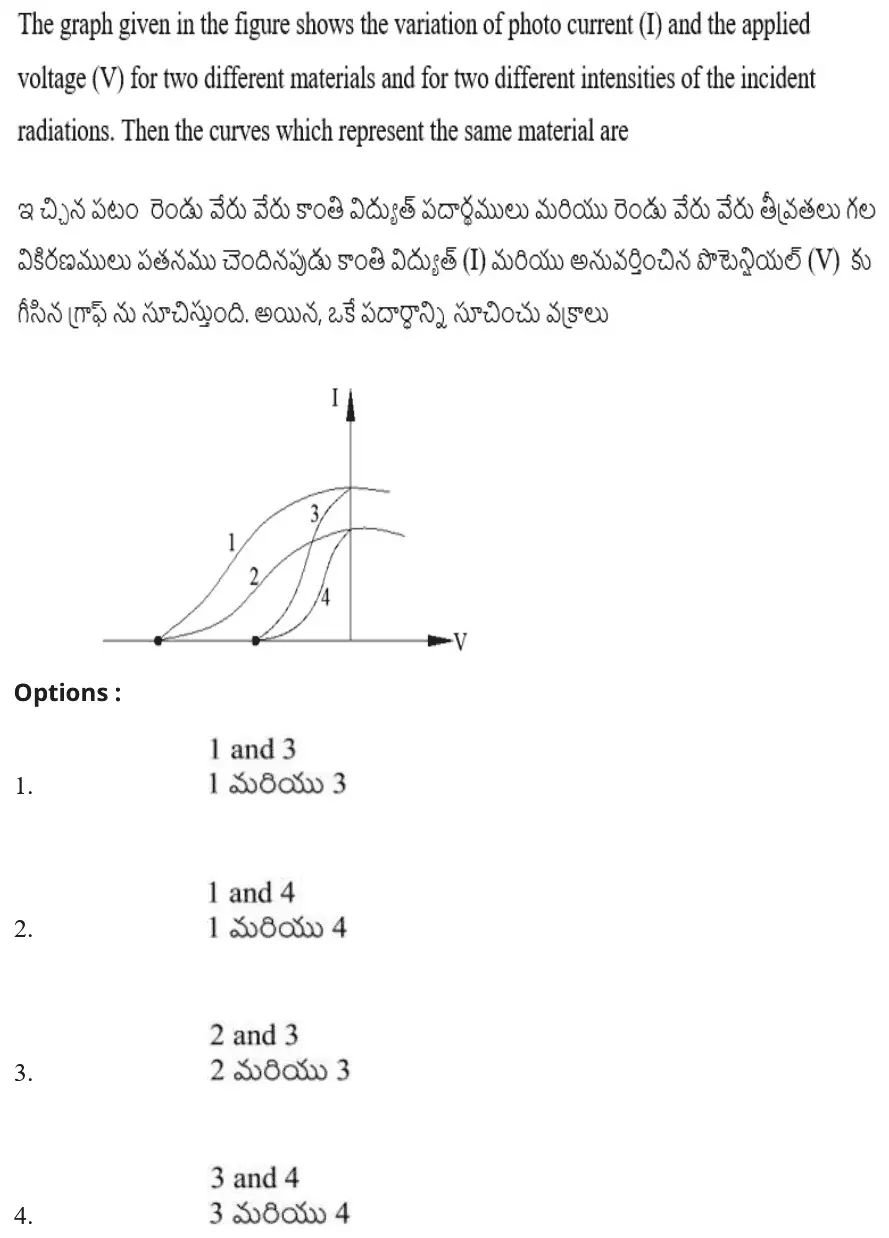
1 and 3
1 and 4
2 and 3
3 and 4
The de Broglie wavelength of a particle moving with a speed of $0.8c$ is equal to the wavelength of a photon. If $c$ is speed of the photon in vacuum, the ratio of the energy of the photon and the kinetic energy of the particle is
$2:3$
$5:2$
$4:5$
$3:5$
Consider two black bodies A and B having equal surface areas. On the surface of A, 'n' photons of frequency 'f' are incident perpendicularly in a time 't'. On the surface of B, '2n' photons of frequency '3f' are incident perpendicularly in a time '4t'. The ratio of average intensity of radiation on surface A to that on surface B is
2:3
3:2
1:12
1:24
A photon released by the transition of an electron from the second excited state to the ground state of Hydrogen atom is incident on the surface of a metal of work function $3.1$ eV. The de Broglie wavelength of the most energetic electron emitted from that metal surface is nearly
$2.6\ \mathrm{\AA}$
$4\ \mathrm{\AA}$
$6\ \mathrm{\AA}$
$7\ \mathrm{\AA}$
The de Broglie wavelength of an electron accelerated between two plates having a potential difference of 900 V is nearly
0.015 nm
0.01 nm
0.02 nm
0.04 nm
The additional energy that should be given to an electron to reduce its de-Broglie wavelength from 1 nm to 0.5 nm is
four times initial energy
thrice the initial energy
equal to the initial energy
twice the initial energy
Statement I : By increasing the potential difference between cathode and anode continuously in a photoelectric experiment, the photo current always increases continuously.
Statement II : If two photons A and B of energies 2.5 eV and 3.5 eV respectively fall on a metal surface of work function 2.0 eV, then the ratio of maximum kinetic energies emitted between A and B is 3.
Statement III : The maximum energy needed by an electron to come out from a metal surface is called the work function of the metal.
Which of the following is correct?
Statements I, II and III are true
Statements I, II true, but statement III is false
Statements II, III are true, but statement I is false
Statements I, II and III are false
Which of the following has the largest de Broglie wavelength?
a bullet of mass 0.02 kg moving with speed 1 km/s
a ball of mass 0.06 kg moving with speed 10 m/s
a particle of mass 0.01 kg moving with speed 100 m/s
a ball of mass 0.03 kg moving with speed 1 m/s
When monochromatic light falls on a photo-sensitive metal, an electron is emitted with maximum velocity $1.6\times10^6$ m/s. Find the stopping potential.
[charge of electron = $1.6\times10^{-19}$ C, mass of electron = $9\times10^{-31}$kg]
7.2 V
14.4 V
21.6 V
28.8 V
A lamp of power 942 W radiates energy uniformly in all direction. The wavelength of radiation is 660 nm. The photon flux on a small screen 5.0 m from the lamp in units of $\dfrac{\mathrm{photon}}{m^2.s}$ is
(Take Planck's constant $h=6.6\times10^{-34}$ SI unit)
$5\times10^{20}$
$2\pi\times10^{19}$
$\dfrac{6}{\pi}\times10^{18}$
$1\times10^{19}$
Light strikes a metal surface causing photoelectric emission. The wavelength of incident light is 248 nm. If the stopping potential for the ejected electrons is 2.8 eV, then the work function of the metal is
(Take hc = 1240 eV.nm)
$5.2$ eV
$4.4$ eV
$3.8$ eV
$2.2$ eV
The de-Broglie wavelength associated with an electron, accelerated through a potential difference of 121 volts is about:
[Take Plank's constant $=h=6.6\times10^{-34}\,J\cdot s$, mass of electron $9\times10^{-31}$ kg ]
$0.123$ nm
$0.112$ nm
$0.221$ nm
$0.098$ nm
In a photo electric experiment, the wavelength of the light incident on the metal is changed from 200 nm to 400 nm. The decrease in the stopping potential is close to
[Use hc = 1240 eV-nm where h = Planck's constant and c is velocity of light]
3.1 V
4.2 V
1.2 V
The de-Broglie wavelength of an electron with kinetic energy of 320 eV is
(Take $h=6.0\times10^{-34}$ SI unit, mass of electron $=m_{e}=9.0\times10^{-31}$ kg, Charge of an electron $=1.6\times10^{-19}$ C.)
85.8 pm
110.5 pm
62.5 pm
50 pm
For photoelectric effect which of the following statements are true.
I) The kinetic energies of the photoelectrons do not depend on the frequency of light
II) Photoelectric effect will always occur for highly intense light
III) The maximum kinetic energy of photoelectron does not depend upon the intensity of the light
IV) The escaping electron's kinetic energy is larger for larger frequency
I and II only
II and III only
III and IV only
IV and I only
Which of the following statements is NOT true?
Electromagnetic radiation is made up of particles called photons
Each photon moves with the speed of light
Photon energy is dependent on the intensity of radiation
Photons are not deflected by electric and magnetic field
The value of Plank’s constant, if the slope of the graph of stopping potential vs frequency of incident light is $4\times10^{-15}$ Vs is
(given charge of an electron = $1.6\times10^{-19}$C)
$6.0\times10^{-34}$ Js
$6.2\times10^{-34}$ Js
$6.4\times10^{-34}$ Js
$6.6\times10^{-34}$ Js
Two light waves of wavelengths 600 nm and 200 nm incident on a metal surface. The maximum velocity of photoelectrons produced due to one wavelength is $\frac{1}{3}$ of the maximum velocity of the photoelectrons produced due to the other wavelength, then the work function of the metal is
$\frac{hc}{8}\times10^{7}\ \mathrm{J}$
$\frac{8}{hc}\times10^{7}\ \mathrm{J}$
$\frac{hc}{4}\times10^{7}\ \mathrm{J}$
$\frac{hc}{9}\times10^{7}\ \mathrm{J}$
A metal has work function 2.5 eV. If a radiation of frequency $3.2 \times 10^{15}$ Hz is incident on this metal surface, then the maximum kinetic energy of ejected photo electrons is
(Plank's constant, $h = 6.6 \times 10^{-34}$ J-s)
$9.5\ \mathrm{eV}$
$2.5\ \mathrm{eV}$
$10.7\ \mathrm{eV}$
$12.6\ \mathrm{eV}$
The average number of photons emitted per second by a laser of power $6.6 \times 10^{-3}$ W producing a light of wavelength 600 nm is (Planck's constant, $h = 6.6 \times 10^{-34}$ J s)
$2 \times 10^{16}$
$3 \times 10^{16}$
$4 \times 10^{16}$
$6 \times 10^{16}$
A light from Paschen series of hydrogen atom is able to eject photoelectrons from a metal. Then the work function of the metal is
$3.4$ eV
$1.54$ eV
$0.85$ eV
$1.1$ eV
A particle of mass $1\times10^{-30}$ kg and electric change (sic) $1.6\times10^{-19}$ C has de-Broglie wavelength 660 nm. Then kinetic energy of this particle is
(Plank's (sic) constant, $h = 6.6\times10^{-34}$ J-s)
$4.2\times10^{-6}$ eV
$2.5\times10^{-6}$ eV
$1.3\times10^{-6}$ eV
$3.1\times10^{-6}$ eV
A radiation of 3.8 eV falls on a metal surface to produce photo electrons. These electrons are made to enter a magnetic field of $2\times10^{-4}$ T. If the radius of the largest circular path followed by these electrons is 30 mm, then the work function of the metal is
(Mass of electron $m_e = 9\times10^{-31}$ kg)
0.9 eV
1.0 eV
0.6 eV
1.2 eV
The electric field associated with a mono chromatic light wave is given by $E = E_o\sin[(1.57\times10^{7}\ \mathrm{m^{-1}})(x - ct)]$, then the stopping potential when this light is used in a photoelectric experiment with the metal having work function 1.9 eV is
[Planck's constant, $h = 6.64\times10^{-34}$ Js]
$0.5\ \mathrm{eV}$
$3.2\ \mathrm{eV}$
$1.1\ \mathrm{eV}$
$0.75\ \mathrm{eV}$
The following statement is correct in the case of photoelectric effect
For a given frequency of incident radiation, the stopping potential varies linearly with its intensity.
For a given frequency of incident radiation, the photocurrent is independent of its intensity.
For a given frequency of a incident radiation, the maximum kinetic energy of the photoelectrons is independent of its intensity.
For a frequency lower than cutoff frequency, photoelectric emissions can occur if intensity of incident light is increased slightly .
A particle of mass $2 \times 10^{-27}\ \mathrm{kg}$ has de-Broglie wavelength of $3.3 \times 10^{-10}\ \mathrm{m}$. The kinetic energy of this particle is
(Plank's Constant $h = 6.6 \times 10^{-34}\ \mathrm{J\text{-}s}$)
$5 \times 10^{-20}\ \mathrm{J}$
$8 \times 10^{-20}\ \mathrm{J}$
$1 \times 10^{-21}\ \mathrm{J}$
$6 \times 10^{-22}\ \mathrm{J}$
The metal which has the highest work function in the following is
Cesium (Cs)
Sodium (Na)
Aluminium (Al)
Platinum (Pt)
In a photoelectric experiment light of wavelength 800 nm produces photoelectrons with the smallest de Broglie wavelength of 1 nm. Light of 400 nm produces photoelectrons with smallest de Broglie wavelength of 0.5 nm. Then the work function of the metal used in the experiment is nearly
$1.03$ eV
$0.53$ eV
$2.03$ eV
$4.02$ eV
The maximum wavelength of light that can cause photo electric effect in a metal of work function 3.5 $eV$ is ________
$354.5\ nm$
$35.45\ nm$
$5.67\times10^{-26}\ m$
$5.67\ \text{Å}$
When a light of wavelength $4900\ \mathrm{\AA}$ falls on a photosensitive metal, a negative $2\ \mathrm{V}$ potential is required to stop the emitted electrons. Then the work function of the material is nearly ______. Given charge on electron $= 1.602 \times 10^{-19}\ \mathrm{C}$ and Planck's constant $= 6.625 \times 10^{-34}\ \mathrm{J.s}$
$1.1\ \mathrm{eV}$
$2.2\ \mathrm{eV}$
$0.53\ \mathrm{eV}$
$1\ \mathrm{eV}$
The study of photoelectric effect is useful in understanding:
Quantization of charge
Quantization of energy
Conservation of energy
Conservation of kinetic energy
Photo cells convert ______
light energy into mechanical energy
heat energy into electrical energy
light energy into electrical energy
electrical energy into light energy
The voltage applied to an electron microscope to produce electrons of wavelength $0.50\ \mathrm{\AA}$ is ______
$602\ V$
$50\ V$
$138\ V$
$812\ V$
The graph between the maximum speed ($v_{max}$) of a photoelectron and frequency ($v$) of the incident radiation, in photoelectric effect is correctly represented by:
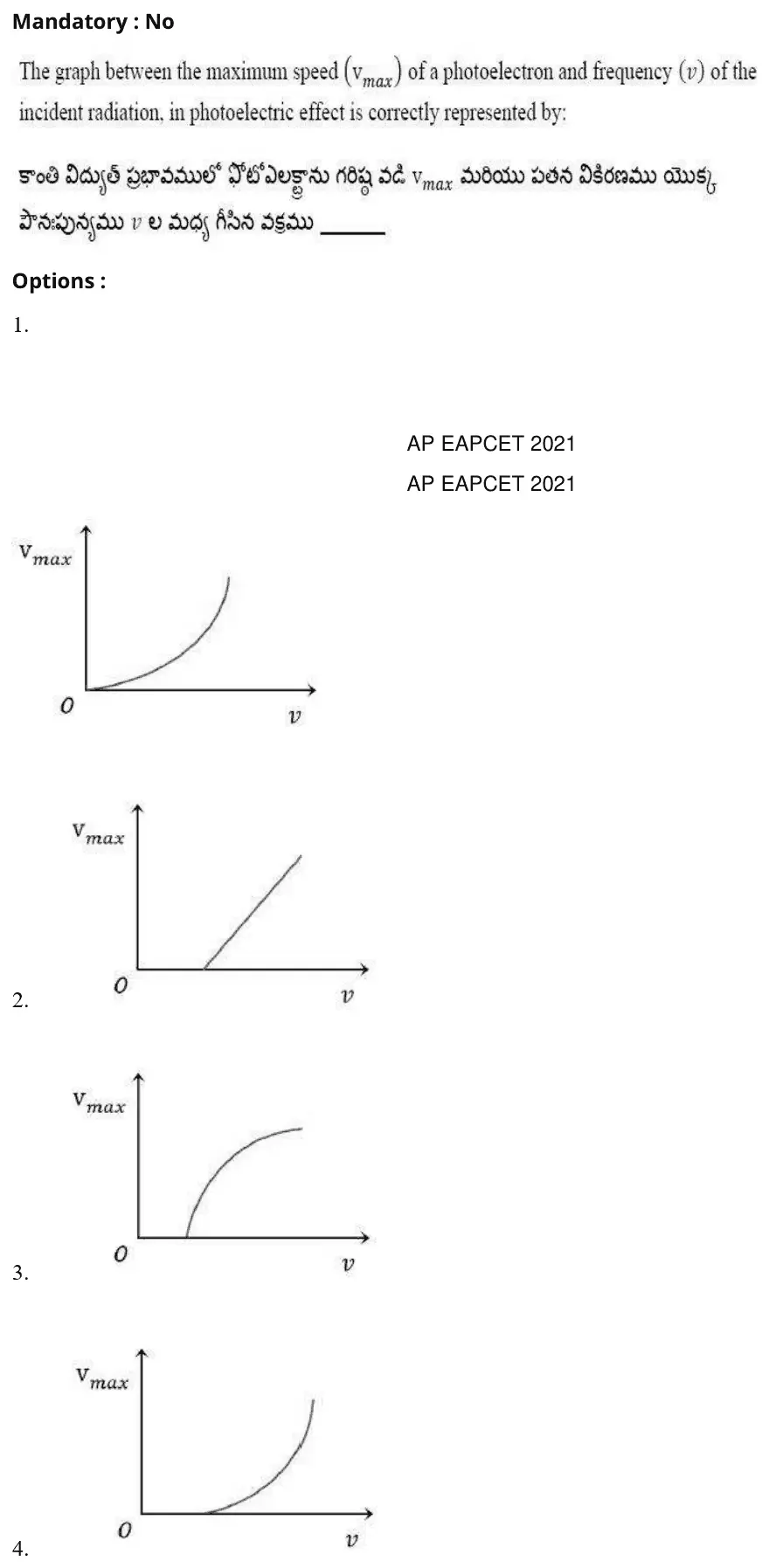
see figure $v_{max}$ vs $v$: curve from the origin O rising with increasing slope (convex, upward-curving)
see figure $v_{max}$ vs $v$: straight line starting on the $v$ axis at a positive value and rising with constant slope
see figure $v_{max}$ vs $v$: curve starting on the $v$ axis at a positive value, rising steeply then flattening (concave, curving over)
see figure $v_{max}$ vs $v$: curve starting on the $v$ axis at a positive value, rising with increasing slope (convex)
If a photocell is illuminated with a radiation of $1240\ \mathrm{\AA}$, the stopping potential is found to be $8\ V$; then the work function of the emitter and the threshold wavelength are:
$2\ eV,\ 2000\ \mathrm{\AA}$
$2\ eV,\ 6200\ \mathrm{\AA}$
$2\ eV,\ 2480\ \mathrm{\AA}$
$3\ eV,\ 6200\ \mathrm{\AA}$
Radiation of wavelength $300\ nm$ and intensity $100\ \mathrm{W.m^{-2}}$ falls on the surface of a photosensitive material. If $2\ \%$ of the incident photons produce photo electron, the number of photoelectrons emitted from an area of $2\ cm^2$ of the surface is nearly ______
$15 \times 10^{11}$
$6.04 \times 10^{14}$
$1.5 \times 10^{12}$
$60.4 \times 10^{15}$
The de Broglie wavelength associated with a proton under the influence of an electric potential of $100$ volts is ______
$1.227\ \mathrm{\AA}$
$2.86\ \mathrm{pm}$
$12.27\ \mathrm{\AA}$
$1.146 \times 10^{-21}\ \mathrm{m}$
In a photoelectric experiment 3 different lights are incident on a metal of work function 1.5 eV. Light A is 200 nm wavelength with intensity 1.8 w/$m^2$, light B is 400 nm with 1 w/$m^2$ and light C is 600 nm with 0.5 w/$m^2$. The current versus voltage is measured. Which graphs correspond to which light?
(see the figure above)
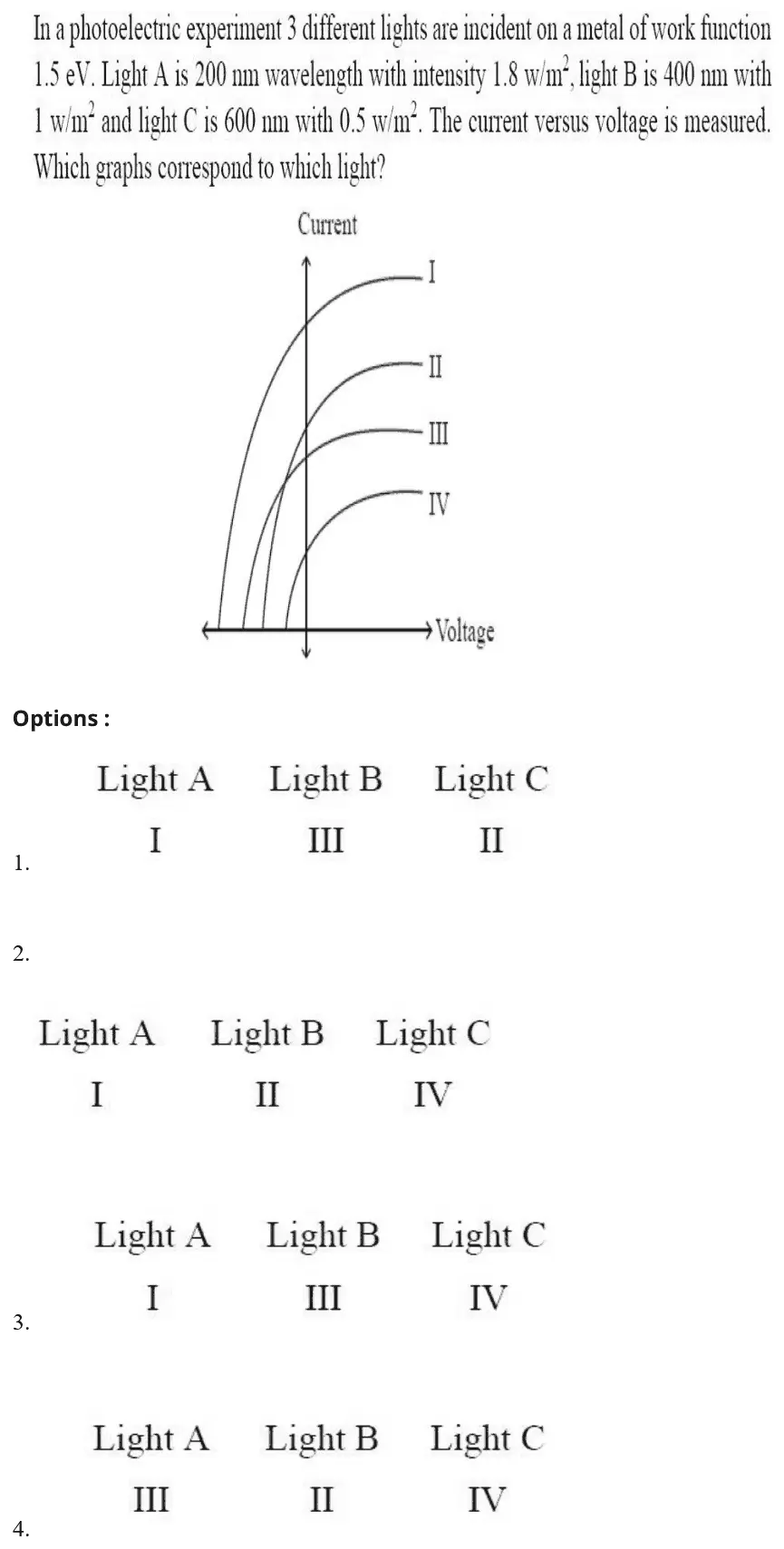
Light A: I, Light B: III, Light C: II
Light A: I, Light B: II, Light C: IV
Light A: I, Light B: III, Light C: IV
Light A: III, Light B: II, Light C: IV
In a photoelectric effect experiment the cathode metal is exposed to light of wavelength $600\ \mathrm{nm}$. The maximum kinetic energy of the ejected electron doubles when light of wavelength $400\ \mathrm{nm}$ is used. The work function of the cathode metal is approximately [Use $h=6.63\times10^{-34}\ \mathrm{J.s}$, $c=3\times10^{8}\ \mathrm{m/s}$]
$1.58\ \mathrm{eV}$
$1.84\ \mathrm{eV}$
$1.02\ \mathrm{eV}$
$2.64\ \mathrm{eV}$
The de-Broglie wavelength of an electron having kinetic energy 100 eV is [Use h = $4.14\times10^{-15}$ eVs, mass of electron = $\frac{0.5\times10^{6}}{c^{2}}$ eV, 1 pm = $10^{-12}$ m]
150.1 pm
124.2 pm
115.5 pm
120.8 pm
If the light from Balmer series of hydrogen is used to eject photoelectrons from a metal, then the maximum work function of the metal can be
1.89 eV
3.4 eV
3.8 eV
5.1 eV
Which of the following particle has the shortest de-Broglie wavelength?
Proton
Electron
$\alpha$ – particle
X – rays
The work function of a metal is $h\nu_0$. Light of frequency $\nu$ falls on this metal. The photoelectric effect will take place only if
$\nu > \nu_0$
$\nu > 2\nu_0$
$\nu < \nu_0$
$\nu < \dfrac{\nu_0}{2}$
Threshold frequency for photoelectric effect on sodium corresponds to a wavelength 5000Å. Its work function is
15 J
$16 \times 10^{-14}$ J
$4 \times 10^{-19}$ J
$4 \times 10^{-18}$ J
The photoelectric threshold for a certain metal surface is $360\ \mathrm{\AA}$. If the metal surface is irradiated by a wavelength of $1100\ \mathrm{\AA}$, the kinetic energy of the emitted photoelectrons is
$1.1\ \mathrm{eV}$
$2\ \mathrm{eV}$
$2.3\ \mathrm{eV}$
$0$
A metal surface is illuminated by a light of given intensity and frequency to cause photoemission. If the intensity of illumination is reduced to one-fourth of its original value, then the maximum kinetic energy of the emitted photoelectrons would become ______
Unchanged
Half of the original value
Twice of the original value
Four times of the original value
If the wavelength of a photon is $4000\ \mathrm{\AA}$, then its energy will be ______
$4.95 \times 10^{-19}\ \mathrm{J}$
$5.95 \times 10^{-19}\ \mathrm{J}$
$3.95 \times 10^{-19}\ \mathrm{J}$
$6.95 \times 10^{-19}\ \mathrm{J}$
The maximum velocity of an electron emitted by light of wavelength $\lambda$ incident on the surface of a metal of work function $\phi$ is ________ [$h$ = Planck's constant, $m$ = mass of electron and $c$ = speed of light].
$\sqrt{\frac{2(hc+\lambda\phi)}{m\lambda}}$
$\frac{2(hc-\lambda\phi)}{m}$
$\sqrt{\frac{2(hc-\lambda\phi)}{m\lambda}}$
$\frac{2(h\lambda-\phi)}{m}$
The retarding potential necessary to stop the emission of photoelectrons, when a target material of work function $1.24\,\mathrm{eV}$ is irradiated with light of wavelength $4.36 \times 10^{-7}\,\mathrm{m}$ is
$4.08\,\mathrm{eV}$
$2.84\,\mathrm{eV}$
$1.60\,\mathrm{eV}$
$0.36\,\mathrm{eV}$
Which of the following statements is correct regarding photoelectric effect?
1
2
3
4
If ultra-violet radiation of $6.2\ eV$ falls of an aluminum surface, then kinetic energy of the fastest emitted electron is (work function $= 4.2\ eV$)
$3.2 \times 10^{-19}$ J
$3.2 \times 10^{-21}$ J
$7 \times 10^{-25}$ J
$9 \times 10^{-31}$ J
According to the photoelectric effect, the plot of kinetic energy of the emitted photo electrons from a metal versus the frequency of the incident radiation gives a straight line whose slope
is the same for all metals and independent of the intensity of radiation
depends only on the intensity of radiation
depends both on the intensity of the radiation and the metal used
depends on the nature of metals used
A light of wavelength 310 nm is used in a photoelectric experiment. The metal electrode of work function of 2.5 eV is used in the experiment. The stopping potential for the photoelectrons will be
(Assume hc = 1240 eV $-$nm)
1.0 V
1.5 V
2.0 V
2.5 V
When the energy of incident radiation is increased by 20 %, the kinetic energy of the photo electrons emitted from a metal surface increased from 0.5 eV to 0.8 eV. The work function of the metal is
0.65 eV
1.0 eV
1.3 eV
1.5 eV
In a photoelectric effect experiment if the frequency of light is doubled, the stopping potential will
be halved
become more than double
become less than double
be doubled
Photons of energy 2.4 eV and wavelength $\lambda$ fall on a metal plate and release photoelectrons with a maximum velocity $\upsilon$. By decreasing $\lambda$ by 50 % the maximum velocity of photoelectrons becomes $3\upsilon$. The work function of the material of the metal plate is
2.1 eV
1.7 eV
2.8 eV
2.0 eV
Let $V_1$ and $V_2$ be the maximum velocities of the emitted electrons when the surface of a metal is illuminated with light waves of energy $E_1$ = 4 eV and $E_2$ = 2.5 eV respectively. If the work function of the metal is 2 eV, then the ratio $\frac{V_1}{V_2}$ is
1.6
4
2
0.5
A beam of photons with an energy of 10.5 eV strike a metal plate. The photoelectrons are emitted with maximum velocity of $1.6 \times 10^6$ m /s. The work function of the metal is (Assume mass of electron = $9 \times 10^{-31}$ kg and Charge of electron = $1.6 \times 10^{-19}$ C)
$3.0\ \mathrm{eV}$
$3.1\ \mathrm{eV}$
$3.3\ \mathrm{eV}$
$3.5\ \mathrm{eV}$
Match the following.
List - I
A) Michelson-Morley experiment
B) Stern-Gerlach experiment
C) Davisson-Germer experiment
D) Anderson discovery of positron
List - II
I) The existence of antimatter
II) The existence of de-Broglie matter waves
III) Electrons have spins
IV) The non-existence of ether
The correct match is
A-IV, B-II, C-I, D-III
A-II, B-III, C-IV, D-I
A-I, B-II, C-IV, D-III
A-IV, B-III, C-II, D-I
A flashlight of intensity 9 W/cm$^2$ illuminates a perfectly reflective surface of area 300 cm$^2$. The average force exerted on the surface due to the incident light photons is
0 N
14 $\mu$N
18 $\mu$N
12 $\mu$N
A parallel beam of monochromatic light of frequency '$\nu$' is incident on a surface. The intensity of the beam is I and area of the surface is A. Find the force exerted by the light beam on the surface if the surface is perfectly reflecting and the light beam is incident at an angle of incidence $\theta$. (The speed of light is denoted as '$c$')
$\frac{2IA\sin^2\theta}{\pi c}$
$\frac{IA\cos^2\theta}{c}$
$\frac{2IA\cos^2\theta}{c}$
$\frac{IA\cos^2\theta}{\sqrt{2}\,c}$
Albert Einstein was conferred with the Nobel Prize in physics for his work on:
Special theory of relativity
Bose-Einstein statistics
Photoelectric effect
General relativity
The wavelength of a charged particle of mass $8 \times 10^{-31}\ \mathrm{kg}$, charge $1.6 \times 10^{-19}\ \mathrm{C}$ and kinetic energy 1 keV will be (Let $h = 6.4 \times 10^{-34}\ \mathrm{J.s.}$)
$0.4\ \mathrm{\AA}$
$2.1\ \mathrm{\AA}$
$1.0\ \mathrm{\AA}$
$0.1\ \mathrm{\AA}$
A cobalt plate is placed at a distance of 1 m from a point source of power 1 W. Assume a circular area of the plate of radius $r = 1$ Å is exposed to the radiation and ejects photoelectrons. The light energy is considered to be spread uniformly and the work function of cobalt is 5 eV. The minimum time the target should be exposed to the light source to eject a photoelectron (assuming no reflection losses) is
320 s
450 s
860 s
100 s
A particle of charge $q$, mass $m$ and energy E has de-Broglie wavelength $\lambda$. For a particle of charge $2q$, mass $2m$ and energy $2E$, the de-Broglie wavelength is
$\frac{\lambda}{4}$
$2\lambda$
$8\lambda$
$\frac{\lambda}{2}$
A photodiode sensor is used to measure the output of a $300\ \mathrm{W}$ lamp kept $10\ \mathrm{m}$ away. The sensor has an opening of $2\ \mathrm{cm}$ in diameter. How many photons enter the sensor if the wavelength of the light is $660\ \mathrm{nm}$ and the exposure time is $100\ \mathrm{m\,s}$. (Assume that all the energy of the lamp is given off as light and $h = 6.6\times10^{-34}\ \mathrm{J\text{-}s}$)
$3.6\times10^{13}$
$2.8\times10^{13}$
$2.5\times10^{13}$
$1.8\times10^{13}$
Light of wavelength $488\ \mathrm{nm}$ produced by an Argon laser is used in the photoelectric effect. When light from this spectral line is incident on the cathode, the stopping potential of photoelectrons is $0.38\ \mathrm{V}$. The work function of the cathode material is
$2.16\ \mathrm{eV}$
$216\ \mathrm{eV}$
$21.6\ \mathrm{eV}$
$0.216\ \mathrm{eV}$
All electrons ejected from a metallic surface by incident light of wavelength 400 nm travelled 1 m in the direction of uniform electric field of $2\ \mathrm{NC^{-1}}$ and came to rest. The work function of the surface is
1.1 eV
2.2 eV
3.1 eV
5.1 eV
All electrons ejected from a metal surface by the incident light of wavelength $200\ \mathrm{nm}$ can be stopped before travelling $1\ \mathrm{m}$ in the direction of uniform electric field of $4\ \mathrm{NC^{-1}}$. The work function of the metal surface is
$2\ \mathrm{eV}$
$2.2\ \mathrm{eV}$
$4\ \mathrm{eV}$
$6.2\ \mathrm{eV}$
The maximum kinetic energy of a photoelectron liberated from the surface of lithium with work function 2.35 eV by electromagnetic radiation whose electric component varies with time as $E = a\left[1 + \cos(2\pi f_1 t)\right]\cos 2\pi f_2 t$ (where 'a' is a constant) is ($f_1 = 3.6 \times 10^{15}$ Hz, $f_2 = 1.2 \times 10^{15}$ Hz and Plank's constant = $6.6 \times 10^{-34}$ J-s)
2.64 eV
7.55 eV
12.52 eV
17.45 eV
An $\alpha$-particle moves in a circular path of radius 1 cm in a uniform magnetic field of 0.125 T. The de Broglie wavelength associated with the $\alpha$-particle is
$1.65\times10^{-12}\ \mathrm{m}$
$3.3\times10^{-12}\ \mathrm{m}$
$4.95\times10^{-12}\ \mathrm{m}$
$6.6\times10^{-12}\ \mathrm{m}$
In a photoelectric experiment, a monochromatic light is incident on the emitter plate E, as shown in the figure. When switch $S_1$ is closed and switch $S_2$ is open, the photoelectrons strike the collector plate C with a maximum kinetic energy of 1 eV. If switch $S_1$ is open and switch $S_2$ is closed and the frequency of the incident light is doubled, the photoelectrons strike the collector plate with a maximum kinetic energy of 20 eV. The threshold wavelength of the emitter plate is
(see the figure above)
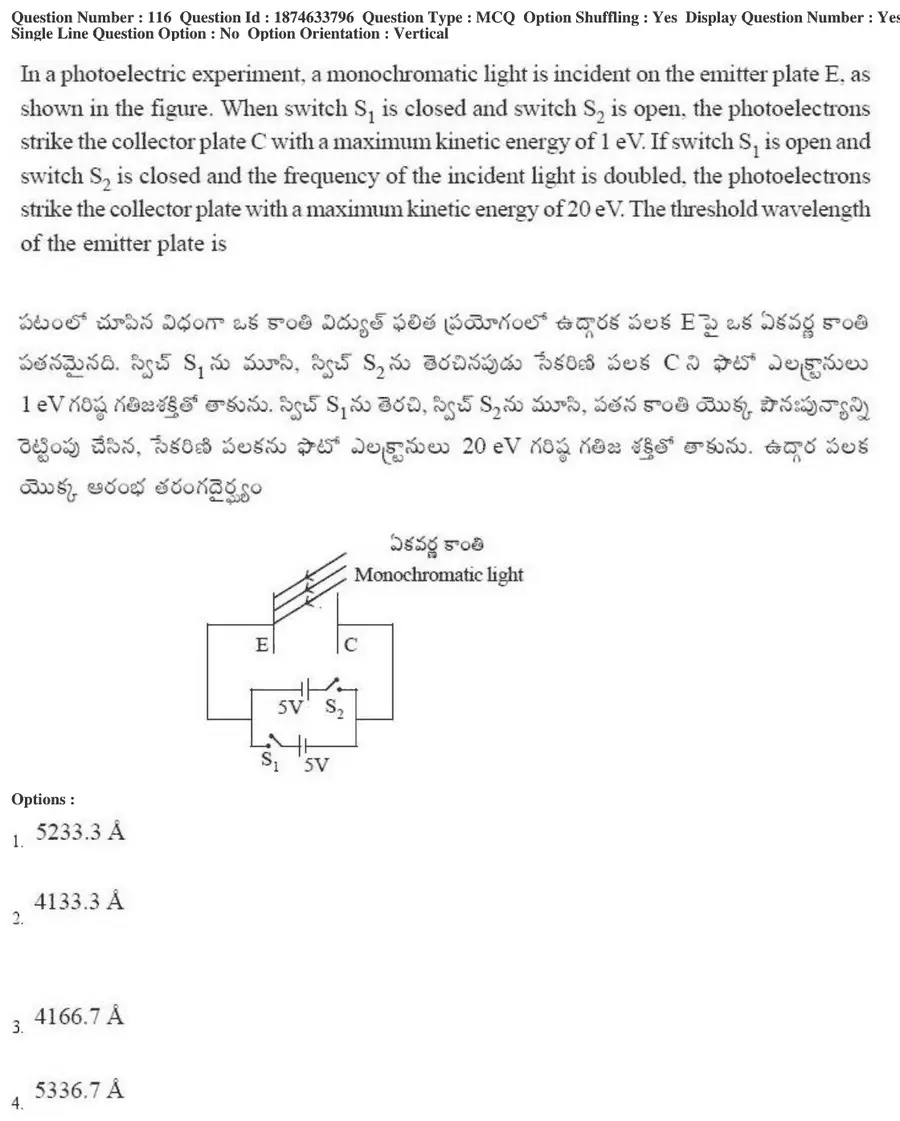
5233.3 Å
4133.3 Å
4166.7 Å
5336.7 Å
An electron of charge 'e' and mass 'm' moving with an initial velocity $\mathrm{v_0}\hat{i}$ is subjected to an electric field $\mathrm{E_0}\hat{j}$. The de-Broglie wavelength of the electron at a time 't' is (Initial de-Broglie wavelength of the electron = $\lambda_0$)
$\lambda_0$
$\lambda_0\sqrt{1+\frac{e^2 E_0^2 t^2}{m^2 v_0^2}}$
$\frac{\lambda_0}{\sqrt{1+\frac{e^2 E_0^2 t^2}{m^2 v_0^2}}}$
$\frac{\lambda_0}{\left(1+\frac{e^2 E_0^2 t^2}{m v_0^2}\right)}$
A photon of energy 4 eV imparts all its energy to an electron that leaves a metal surface with 1.1 eV of kinetic energy. The work function of the metal is
2.9 eV
5.1 eV
3.64 eV
4.4 eV
Light of frequency $4 \times 10^{14}\ \mathrm{Hz}$ is incident on a metal surface of work function $2.14\ \mathrm{eV}$ resulting in photoemission of electrons. The maximum kinetic energy of the emitted electrons is $[h = 6.63 \times 10^{-34}\ \mathrm{Js}]$
$0.35\ \mathrm{eV}$
$0.14\ \mathrm{eV}$
$2.14\ \mathrm{eV}$
$0\ \mathrm{eV}$
If a proton is accelerated through a potential difference of $1000\ \mathrm{V}$, its deBroglie wave length is (Given $m_p = 1.67 \times 10^{-27}\ \mathrm{kg}$, $h = 6.63 \times 10^{-34}\ \mathrm{Js}$)
$9.1 \times 10^{-13}\ \mathrm{m}$
$9.1 \times 10^{+13}\ \mathrm{m}$
$1.09 \times 10^{-15}\ \mathrm{m}$
$1.09 \times 10^{+15}\ \mathrm{m}$
At an incident radiation frequency of $\nu_1$, which is greater than the threshold frequency, the stopping potential for a certain metal is $V_1$. At frequency $2\nu_1$ the stopping potential is $3V_1$. If the stopping potential at frequency $4\nu_1$ is $nV_1$, then $n$ is
2
3
6
7
The de Broglie wavelength of an electron of kinetic energy 9eV is ( take $h = 4\times10^{-15}$ eV.sec, $c = 3\times10^{10}$ cm/sec and the mass $m_e$ of electron as $m_ec^2 = 0.5$ MeV)
$4\times10^{-8}$ cm
$3\times10^{-8}$ cm
$4\times10^{-7}$ cm
$3\times10^{-7}$ cm
An isolated lead ball is charged upon continuous irradiation by EM radiation of wavelength ($\lambda$) = 221 nm. The maximum potential attained by the lead ball, if its work function is 4.14 eV, is
(Take $h=6.63\times10^{-34}$ J.s, $c=3\times10^{8}$ m/s, $e=1.6\times10^{-19}$ C)
1.49 V
2.67 V
3.14 V
0.51 V
When light of frequency '$\nu$' incidents on two metallic plates A and B, photo electrons are emitted. If the work function of A is more than that of B, the correct curve of the following curves drawn between stopping potential 'V' and incident frequency '$\nu$' is
(see the figure above)
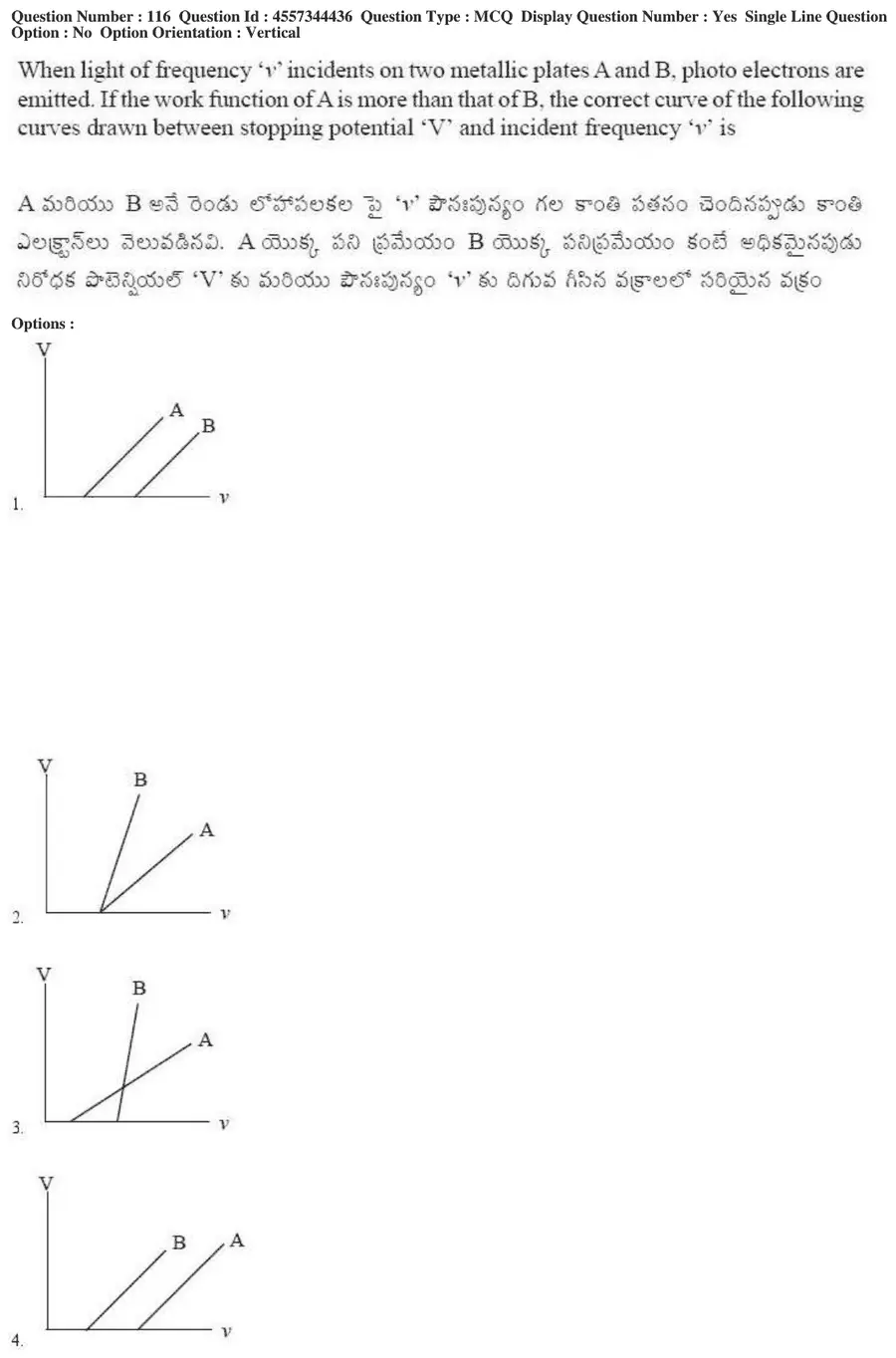
see figure V versus $\nu$: two parallel straight lines; A's line starts on the axis to the left of B's line (A has the smaller threshold), both rising to the right.
see figure V versus $\nu$: two lines from the same intercept on the $\nu$ axis; B is steeper than A.
see figure V versus $\nu$: two lines that cross; A is the gentler line starting further left on the axis, B is steeper and starts further right.
see figure V versus $\nu$: two parallel straight lines; B's line starts on the axis to the left of A's line (A has the larger threshold), both rising to the right.
When photons of energy 5 eV incident on a photo metal of work function 4.36 eV, photo electrons are emitted. The maximum impulse of the metal surface is ____
$2.41\times10^{-25}\ \mathrm{kgms^{-1}}$
$2.31\times10^{-25}\ \mathrm{kgms^{-1}}$
$4.31\times10^{-25}\ \mathrm{kgms^{-1}}$
$1.31\times10^{-24}\ \mathrm{kgms^{-1}}$
An $\alpha$ - particle and a proton are accelerated from rest by the same potential, then the ratio of their de-Broglie wavelengths is ______
$2\sqrt{2} : 1$
$1 : 2\sqrt{2}$
$1 : 2$
$2 : 1$
Photons of wavelength $\lambda$ emitted by a source of power P incident on a photo cell. If the current produced in the cell is I, The percentage of incident photons which produce current in the photo cell is
(h is Planck's constant and c is the speed of light in vacuum)
$\dfrac{100\,ePc}{Ih\lambda}$
$\dfrac{100\,eP\lambda}{Ihc}$
$\dfrac{100\,Ih\lambda}{ePc}$
$\dfrac{100\,Ihc}{eP\lambda}$
Photons of frequencies equal to the frequencies of $\mathrm{H_\beta}$ and $\mathrm{H_\infty}$ lines of hydrogen incident on a photosensitive plate whose threshold frequency is equal to the frequency of $\mathrm{H_\alpha}$ line of hydrogen. The ratio of the maximum kinetic energies of the emitted electrons is
$7:16$
$3:4$
$8:27$
$5:36$
Hydrogen atom is in its $n^{\mathrm{th}}$ energy state. If de-Broglie wavelength of the electron is $\lambda$, then
$\lambda \propto \frac{1}{n^2}$
$\lambda \propto \frac{1}{n}$
$\lambda \propto n^2$
$\lambda \propto n$
The figure shows the variation of photocurrent (i) with anode potential (V) for three different radiations. Let $I_a$, $I_b$ and $I_c$ be the intensities and $f_a$, $f_b$ and $f_c$ be the frequencies for the curves a, b and c respectively. Then
(see the figure above)
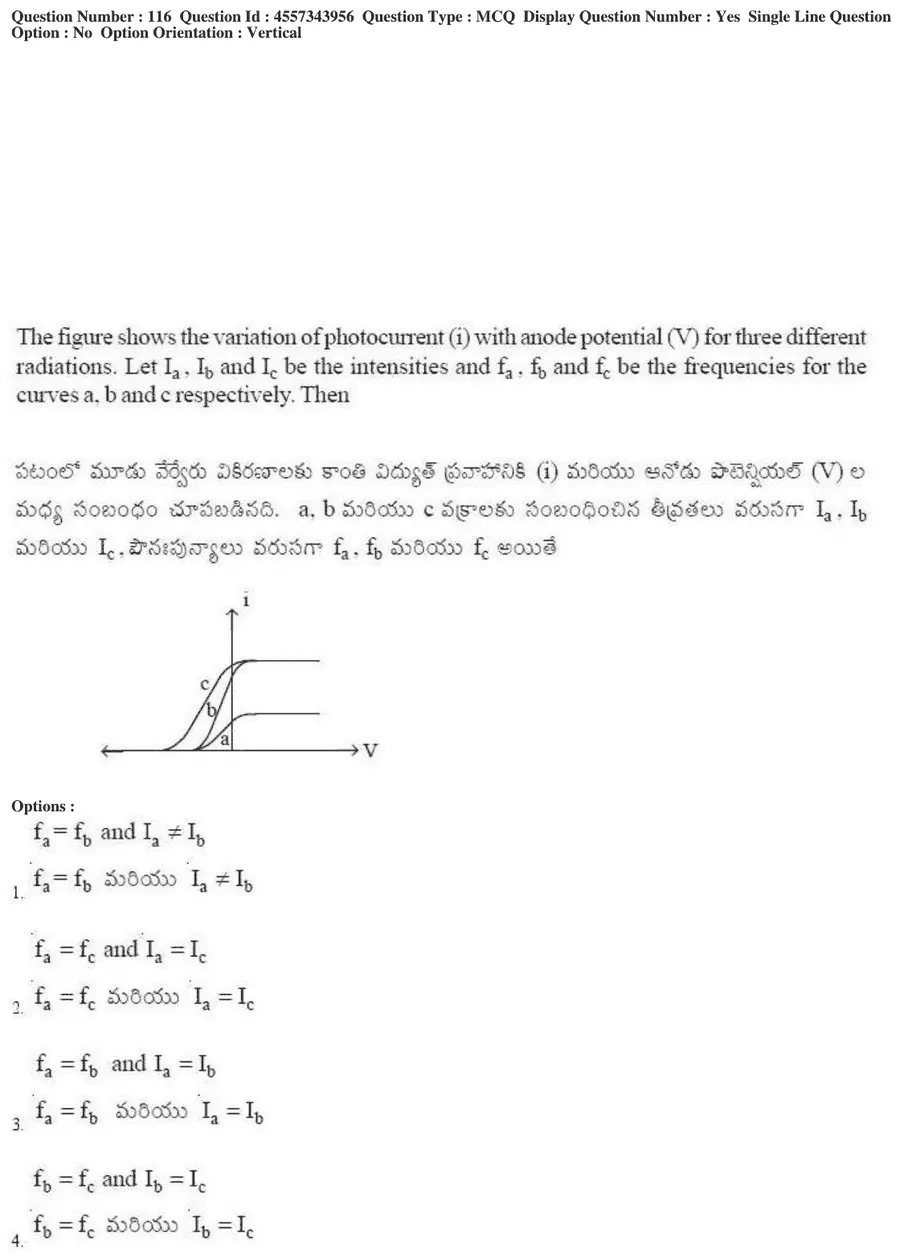
$f_a=f_b$ and $I_a\neq I_b$
$f_a=f_c$ and $I_a=I_c$
$f_a=f_b$ and $I_a=I_b$
$f_b=f_c$ and $I_b=I_c$
The energy that should be added to an electron to reduce its de-Broglie wavelength from 1 nm to 0.5 nm is
four-times the initial energy
equal to the initial energy
two-times the initial energy
three-times the initial energy
Both an electron and a photon have same de-Broglie wavelength of $1.2\ \mathrm{\AA}$. The ratio of their energies is nearly
$1:1$
$1:10$
$1:100$
$1:1000$
The ratio of de-Broglie wavelength of molecules of hydrogen and helium which are at temperatures 27 °C and 127 °C respectively is ______
$2 : 3$
$2\sqrt{2} : \sqrt{3}$
$\sqrt{3} : 2\sqrt{2}$
$\sqrt{2} : \sqrt{3}$
The threshold frequency for a certain metal is ‘$\upsilon_0$’. When a certain radiation of frequency $2\upsilon_0$ is incident on this metal surface, maximum velocity of the photo electrons emitted is $2\times10^{6}\ \mathrm{ms^{-1}}$. If radiation of frequency $3\upsilon_0$ is incident on the same metal surface, the maximum velocity of the photo electrons emitted is ______
$\sqrt{2}\times10^{-6}\ \mathrm{ms^{-1}}$
$2\sqrt{2}\times10^{6}\ \mathrm{ms^{-1}}$
$4\times10^{6}\ \mathrm{ms^{-1}}$
$5\times10^{6}\ \mathrm{ms^{-1}}$
If the momentum of an electron changes by 'P' then the de-Broglie wavelength associated with it changes by 5%. Then the initial momentum of the electron is
$\dfrac{20}{P}$
$20\,P$
$\dfrac{P}{20}$
$30\,P$
de Broglie wavelengths associated with a proton and an electron are in the ratio 2:1. The stopping potentials are approximately in the ratio of
$1:\sqrt{86}$
$\sqrt{86}:1$
$1:(86)^2$
$1:86$
A point source of light emits photons of energy 4.8 eV at the rate $10^5$ photons per second. These photons incident on a photo-sensitive sphere of work function 2.8 eV and radius 9 mm. The sphere is initially neutral and the emitted photo electrons are instantly swept away. The time after which the photo electric emission stops is
250 s
125 s
375 s
175 s
Electron microscope is based on the principle
Photoelectric effect
Wave nature of electron
Superconductivity
Laws of electromagnetic induction
A charged particle is accelerated from rest through a certain potential difference. The de Broglie wavelength is $\lambda_1$ when it is accelerated through $V_1$ and is $\lambda_2$ when accelerated through $V_2$. The ratio $\lambda_1/\lambda_2$ is
$V_1^{3/2} : V_2^{3/2}$
$V_2^{1/2} : V_1^{1/2}$
$V_1^{1/2} : V_2^{1/2}$
$V_1^{2} : V_2^{2}$
A photo sensitive metallic surface emits electrons when X-rays of wavelength '$\lambda$' fall on it. The de Broglie wavelength of the emitted electrons is (Neglect the work function of the surface, m is mass of the electron. h-Planck's constant, c-velocity of light)
$\sqrt{\dfrac{2mc}{h\lambda}}$
$\sqrt{\dfrac{h\lambda}{2mc}}$
$\sqrt{\dfrac{mc}{h\lambda}}$
$\sqrt{\dfrac{h\lambda}{mc}}$
The energy of a photon is equal to the kinetic energy of a proton. If $\lambda_1$ is the de Broglie wavelength of a proton, $\lambda_2$ the wavelength associated with the photon, and if the energy of the photon is E, then ($\lambda_1/\lambda_2$) is proportional to
$E^4$
$E^{1/2}$
$E^2$
$E$
Initially a photon of wavelength $\lambda_1$ falls on photocathode and emits an electron of maximum energy $E_1$. If the wavelength of the incident photon is changed to $\lambda_2$, the maximum energy of the electron emitted becomes $E_2$. Then value of hc (h = Planck's constant, c = Velocity of light) is
$hc = \dfrac{(E_1 + E_2)\lambda_1\lambda_2}{\lambda_2 - \lambda_1}$
$hc = \dfrac{E_1 - E_2}{\lambda_2 - \lambda_1} \cdot (\lambda_1\lambda_2)$
$hc = \dfrac{(E_1 - E_2)(\lambda_2 - \lambda_1)}{\lambda_1\lambda_2}$
$hc = \dfrac{\lambda_2 - \lambda_1}{\lambda_1\lambda_2 E_2} \cdot E_1$
The work function of a metal is 2 eV. If a radiation of wavelength 3000 Å is incident on it, the maximum kinetic energy of the emitted photoelectrons is (Planck's constant $h=6.6\times10^{-34}$ JS; Velocity of light $c=3\times10^8$ m/s; $1\ \mathrm{eV}=1.6\times10^{-19}$ J)
$4.4\times10^{-19}$ J
$5.6\times10^{-19}$ J
$3.4\times10^{-19}$ J
$2.5\times10^{-19}$ J
The de Broglie wavelength of an electron moving with a velocity of $1.5 \times 10^8$ m/s is equal to that of a photon. The ratio of kinetic energy of the electron to that of the photon ($C = 3 \times 10^8$ m/s)
2
4
$\frac{1}{2}$
$\frac{1}{4}$
A proton when accelerated through a potential difference of V, has a de Broglie wavelength $\lambda$ associated with it. If an alpha particle is to have the same de Broglie wavelength $\lambda$, it must be accelerated through a potential difference of
$\frac{V}{8}$
$\frac{V}{4}$
4 V
8 V
Two photons of energy 2.5 eV and 3.5 eV fall on a metal surface of work function 1.5 eV. The ratio of the maximum velocities of the photoelectrons emitted from the metal surface is :
$1:4$
$2:1$
$1:2$
$1:\sqrt{2}$
Photoelectric emission is observed from a metallic surface for frequencies $\nu_1$ and $\nu_2$ of the incident light ($\nu_1 > \nu_2$). If the maximum values of kinetic energy of the photoelectrons emitted in the two cases are in the ratio 1 : $n$, then the threshold frequency of the metallic surface is :
$(\nu_1 - \nu_2)/(n-1)$
$(n\nu_1 - \nu_2)/(n-1)$
$(n\nu_2 - \nu_1)/(n-1)$
$(\nu_1 - \nu_2)/n$
Modern physics commences with Dual Nature of Matter & Radiation in Class 12. Across the AP and TS EAPCET papers held in our archive between 2022 and 2026, the chapter contributed 86 questions across 77 papers. That gives an average frequency of 1.1 questions per paper, making up 2.8% of all physics questions in that recent window. Examining all 149 papers in our collection from 2010 to 2026, Dual Nature of Matter & Radiation contributed 161 questions, sustaining an average of 1.1 questions per paper and a 2.7% subject share. Over the earlier segment from 2010 to 2021, our records capture 75 questions across 72 papers (2.6% share). In the last three exam years from 2024 to 2026, the topic supplied 47 questions across 46 papers, holding a 2.6% share. Viewed against early papers, the subject share in the last three years is about the same, and when measured against the recent five-year window it is also about the same.
State-wise breakdowns show consistent testing across regional exams. AP EAPCET papers between 2022 and 2026 contributed 51 questions across 48 papers in our set, with 47 papers featuring at least one question (1.1 per paper, 2.7% share). TS EAPCET contributed 35 questions across 29 papers in our set, with 27 papers containing questions (1.2 per paper, 3.0% share). Dual Nature of Matter & Radiation has appeared every year since 2022, though across all 77 recent papers in our collection, three papers omitted it, meaning it did not feature in all 77 sittings. By question volume from 2022 to 2026, it stands 19th among the 28 physics chapters. Its most active sitting in our archive occurred in 2022, supplying 22 questions across 16 papers.
Questions concentrate across two syllabus areas:
Einstein's photoelectric equation is the source of many numerical problems. A classic question illuminates a photosensitive metal with radiation of wavelength λ, recording a stopping potential V_one, and then replaces it with wavelength two λ, yielding stopping potential V_two. Students must set up two simultaneous linear equations to extract the threshold wavelength or work function. Other questions test graphical characteristics, such as the linear slope of stopping potential against incident frequency, which always equals Planck's constant divided by elementary charge, h / e.
Matter wave problems heavily test comparative ratios between elementary particles. A common question asks for the ratio of de Broglie wavelengths of a proton and an alpha particle accelerated from rest through identical electric potential differences. Students must evaluate λ = h / √(two m q V), noting that an alpha particle has four times the mass and twice the charge of a proton, giving an eight-fold mass-charge product.
Start by mastering Einstein's photoelectric law. Express energy balance as K_max = e V_zero = h ν - Φ_zero = h c (1/λ - 1/λ_zero). Remember the key physical dependencies: maximum kinetic energy and stopping potential depend strictly on incident radiation frequency, not on light beam intensity. Conversely, photocurrent and saturation current scale linearly with light intensity at constant frequency.
Next, master de Broglie matter wave formulas. For any particle of momentum p and kinetic energy K, wavelength is λ = h / p = h / √(two m K). When accelerated from rest through electric potential difference V, kinetic energy is K = q V, yielding λ = h / √(two m q V). For a gas molecule or thermal neutron at absolute temperature T, average kinetic energy is (three / two) k_B T, so thermal de Broglie wavelength is λ = h / √(three m k_B T).
Finally, memorize the particle ratios for proton, deuteron, and alpha particle. For a proton of mass m and charge e, mass-charge product is m e. For a deuteron of mass two m and charge e, the product is two m e. For an alpha particle of mass four m and charge two e, the product is eight m e. Because λ is inversely proportional to √(m q), accelerating all three through identical voltages produces wavelengths in the ratio √eight : √four : 1.
In the papers we hold from 2022 to 2026, the chapter averaged 1.1 questions per paper, appearing in 74 out of 77 shifts.
No. Stopping potential depends entirely on incident photon frequency and cathode work function; increasing light intensity increases the rate of emitted photoelectrons without altering their maximum kinetic energy.
The graph of stopping potential V_zero against incident frequency ν is a straight line with slope h / e and horizontal intercept at the threshold frequency ν_zero.
Step-by-step solutions for each one are in the EdLoop EAPCET app.