Every Waves question from past AP EAPCET and TS EAPCET papers, with options and answers. Newest first.
206questions
142papers covered
3.3%of Physics questions, 2022–2026
2010–2026years
Guide at a glance
Mechanical waves and acoustics provide a regular stream of questions in Class 11 physics. Our collection of AP and TS EAPCET papers spanning 2022 to 2026 records 103 questions from Waves across 77 papers.
An observer moves towards a stationary source of sound with a velocity one fourth of the velocity of sound. Then the percentage of increase in the apparent frequency observed by the observer
A sound source of $1000\ Hz$ frequency approaches the observer with speed $20\ ms^{-1}$. The observed frequency of sound is nearly (speed of sound in air = $340\ ms^{-1}$)
How fast a person should drive his car so that the red signal of light appears green? (wavelengths of red and green colours are $6200\mathrm{\AA}$ and $5400\mathrm{\AA}$ respectively)
A car is approaching a cliff at a constant speed. It sounds a horn when it is at $0.9\ km$ from the cliff. The reflected sound of the horn is heard by car driver after 5 sec. The speed of the car is [Velocity of sound in air is $330\ ms^{-1}$]
A wire of density $9 \times 10^{3}\ \mathrm{kg\ m^{-3}}$ is stretched between two clamps of 1 m apart and is subjected to an extension of $4.9 \times 10^{-4}$ m. The lowest frequency of transverse vibrations in the wire is (Young’s modulus of the material of the wire $Y = 9 \times 10^{10}\ \mathrm{Nm^{-2}}$)
A person at rest hears an electric siren which is stationary. Now the person accelerates at $2\,ms^{-2}$ along a straight line path. The distance travelled by him when he hears the frequency of the siren as 94% of its initial value is (speed of sound in air = $330\,ms^{-1}$)
Two vibrating tuning forks produce progressive waves given by $y_1 = 2\sin(500\pi t - ax)$ and $y_2 = 2\sin(506\pi t - bx)$. Number of beats produced per minute is
Two identical strings $A$ and $B$ of same material are having tensions $T_A$ and $T_B$ respectively. If their fundamental frequencies are $450\ Hz$ and $300\ Hz$, then $T_A/T_B$ is
Ten tuning forks are arranged in increasing order of frequency. Any two nearest tuning forks produce 4 beats per second. The highest frequency of tuning fork is twice that of the lowest possible, then the highest and lowest frequencies, in Hz, are respectively
Two identical strings each of length $0.750\ m$ are each tuned exactly to $440\ Hz$. The tension in one of the strings is then increased by $1.0\ \%$. If they are now struck, then the beat frequency between the fundamentals of the two strings is nearly
A wire of length 100 cm is clamped between two rigid supports and is made to vibrate in its fundamental mode. If the amplitude at the midpoint of the wire is A, then the distance between two points having amplitude of $\frac{A}{\sqrt{2}}$ is
The lengths of two open pipes are in the ratio 5:6. If 8 beats are heard per second when both the pipes are vibrated in their fundamental modes, then the frequency of third harmonic of the longer pipe is
The speed of a progressive transverse wave on a string is $18\,\mathrm{ms^{-1}}$. If the phase difference between two points on the string separated by a distance of 3 cm is $90^\circ$, then the frequency of the transverse waves on the string is
A source producing sound of frequency 990 Hz and an observer are initially at rest. If both the source and observer start moving simultaneously towards each other with accelerations $2\,\mathrm{ms^{-2}}$ and $4\,\mathrm{ms^{-2}}$ respectively, then the frequency of sound heard by the observer at a time of $\mathrm{t = 5s}$ is
A wire of length $1.2$ m is subjected to a tension of $240$ N. If the frequencies of two successive modes of vibration of the wire are $200$ Hz and $250$ Hz, then the mass of the wire is
Two observers A and B are moving towards a stationary source of sound with speeds $0.8V_0$ and $0.6V_0$ respectively, where $V_0$ is the speed of sound in air. The ratio of the frequencies of the sound heard by the observers A and B is
If a 200 cm long steel rod clamped at its middle is vibrated in its fundamental mode with a frequency of 1.25 kHz, then the speed of longitudinal waves in the rod is
If a source of sound initially at rest is moving away from a stationery observer with an acceleration of $11\ \mathrm{ms^{-2}}$, then the time taken for the frequency of sound heard by the observer to become 10 % less than the frequency of source is (Speed of sound in air $= 330\ \mathrm{ms^{-1}}$)
If sound waves of frequency 169 Hz incident horizontally on a perfectly rigid vertical wall, then the shortest distance from the wall at which the air particle will have maximum amplitude of vibration is
Two stationary sources P and Q produce sounds of equal frequency of 170 Hz. The velocity with which an observer has to move from source P towards source Q such that 8 beats are to be heard per second by the observer is (Speed of sound in air $= 340\ \mathrm{ms^{-1}}$)
The length of an open pipe is half of the length of another closed pipe. When the two pipes are vibrated, four nodes are formed in both the cases. The ratio of the frequencies of the open and the closed pipes is
A source of sound of frequency 660 Hz and an observer are moving towards each other with speeds of 31 kmph and 23 kmph respectively. If the wind blows with a speed of 5 kmph from observer towards the source, then the frequency of the sound heard by the observer is
A sound wave of frequency 500 Hz travels between two points X and Y separated by a distance of 600 m in a time of 2 s. The number of waves between the points X and Y are
When both source of sound and observer approach each other with a speed equal to 10% of the speed of sound, then the percentage change in frequency heard by the observer is nearly
If the magnetic field in a plane progressive wave is represented by the equation $B_y = 2\times10^{-7}\sin(0.5\times10^{3}x+1.5\pi\times10^{11}t)$ T, then the frequency of the wave is (In the equation time t is in second)
The equation of a transverse wave propagating along a stretched string of length 80 cm is $y=1.5\sin\{(5\times10^{-3}x)+20t\}$, here 'x' and 'y' are in cm and the time 't' is in second. If the mass of the string is 3 g, then the tension in the string is
If a travelling wave is given by $y(x, t) = 0.5 \sin (70.1x - 10\pi t)$, where x and y are in metre, the time t is in second, then the frequency of the wave is
If two progressive sound waves represented by $y_1 = 3\sin 250\pi t$ and $y_2 = 2\sin 260\pi t$ (where displacement is in metre and time is in second) superimpose, then the time interval between two successive maximum intensities is
A steel wire of length 81 cm has a mass of $5 \times 10^{-3}$ kg. If the wire is under a tension of 50 N, then the speed of transverse waves on the wire is
When a stretched wire of fundamental frequency $f$ is divided into three segments, the fundamental frequencies of these three segments are $f_1$, $f_2$ and $f_3$ respectively. Then the relation among $f_1$, $f_2$, $f_3$ and $f$ is (Assume tension is constant)
Two sound waves of wavelengths 99 cm and 100 cm produce 10 beats in a time of t seconds. If the speed of sound in air is 330 m s$^{-1}$, then the value of t in seconds is
In a plane electromagnetic wave, the magnetic field is given by $\vec{B} = 3 \times 10^{-7} \sin (100\pi x + 10^{12} t)$ T, then the wavelength of the wave is (In the equation x is in metre and t is in second)
An air column in a tube of length 50 cm, closed at one end is vibrating in its fifth harmonic. The phase difference between a particle at the open end and a particle at 42 cm from the open end is
A metal rod of length 125 cm is clamped at its midpoint. If the speed of the sound in the metal is $5000\,\mathrm{ms^{-1}}$, then the fundamental frequency of the longitudinal vibrations of the rod is
The air columns in two tubes closed at one end vibrating in their fundamental modes produce 2 beats per second. The number of beats produced per second when the same tubes are vibrated in their fundamental mode with their both ends open are
A car moving towards a cliff emits sound of frequency ‘n’. If the difference in frequencies of the horn and its echo heard by the driver of the car is 10 % of ‘n’, then the speed of the car is nearly
(Speed of sound in air is $336\,\mathrm{ms^{-1}}$)
A sound wave of frequency 210 Hz travels with a speed of 330 $\mathrm{ms^{-1}}$ along the positive x-axis. Each particle of the wave moves a distance of 10 cm between the two extreme points. The equation of the displacement function (s) of this wave is (x in metre, t in second)
A string vibrates in its fundamental mode when a tension $T_1$ is applied to it. If the length of the string is decreased by 25% and the tension applied is changed to $T_2$, the fundamental frequency of the string increases by 100%, then $\frac{T_2}{T_1} =$
Two tuning forks of frequencies 320 Hz and 323 Hz are vibrated together. The time interval between a maximum sound and its adjacent minimum sound heard by an observer is
The frequency of sound heard by an observer moving towards a stationary source with certain speed is $n_1$ and if the observer moves away from the same source with same speed, the frequency of sound heard by the observer is $n_2$. If the speed of sound in air is $340\,\mathrm{ms^{-1}}$ and $n_1 : n_2 = 71:65$, then speed of observer is
The fundamental frequency of transverse wave of a stretched string subjected to a tension $\mathrm{T_1}$ is 300 Hz. If the length of the string is doubled and subjected to a tension of $\mathrm{T_2}$, the fundamental frequency of the transverse wave in the string becomes 100 Hz, then $\mathrm{T_2 : T_1}$ =
Two sound waves each of intensity I are superimposed. If the phase difference between the waves is $\frac{\pi}{2}$, then the intensity of the resultant wave is
If the lengths of the open and closed pipes are in the ratio of $2:3$, then the ratio of the frequencies of the third harmonic of the open pipe and the fifth harmonic of the closed pipe is
The equation of a transverse wave propagating on a stretched string is given by $y = 3\sin(4x + 200t)$, where $x$ and $y$ are in metre and the time 't' is in second. If the tension applied to the string is 500 N, the linear density of the string is
The frequency of fifth harmonic of a closed pipe is equal to the frequency of third harmonic of an open pipe. If the length of the open pipe is 72 cm, then the length of the closed pipe is
The fundamental frequency of an open pipe is 100 Hz. If the bottom end of the pipe is closed and $\frac{1}{3}$rd of the pipe is filled with water, then the fundamental frequency of the pipe is
A car sounding a horn of frequency 1000 Hz passes a stationary observer. The ratio of frequencies of the horn noted by the observer before and after passing of the car is $11:9$. The speed of car is (Speed of sound $v = 340\ \mathrm{ms^{-1}}$)
A pipe with 30 cm Length is open at both ends. Which harmonic mode of the pipe resonates a 1.65 kHz source? (Velocity of sound in air = 330 $\mathrm{ms^{-1}}$)
The speed of a wave on a string is $150\ \mathrm{ms^{-1}}$ when the tension is 120 N. The percentage increase in the tension in order to raise the wave speed by 20% is
Two stretched strings A and B when vibrated together produce 4 beats per second. If the tension applied to the string A increased, the number of beats produced per second is increased to 7. If the frequency of string B is 480 Hz initially, the frequency of string A is
The tension applied to a metal wire of one metre length produces an elastic strain of 1%. The density of the metal is $8000\ \mathrm{kgm^{-3}}$ and Young's modulus of the metal is $2 \times 10^{11}\ \mathrm{Nm^{-2}}$. The fundamental frequency of the transverse waves in the metal wire is
Two closed pipes when sounded simultaneously in their fundamental modes produce 6 beats per second. If the length of the shorter pipe is 150 cm, then the length of the longer pipe is
The difference between the fundamental frequencies of an open pipe and a closed pipe of same length is $100\,\mathrm{Hz}$. The difference between the frequencies of the second harmonic of the open pipe and the third harmonic of the closed pipe is
The displacement equations of sound waves produced by two sources are given by $y_1=5\sin 400\pi t$ and $y_2=8\sin 408\pi t$, where 't' is time in seconds. If the waves are produced simultaneously, the number of beats produced per minute is
The path difference between two particles of a sound wave is 50 cm and the phase difference between them is $1.8\pi$. If the speed of sound in air is $340\ \mathrm{ms^{-1}}$, the frequency of the sound wave is
A source at rest emits sound waves of frequency 102 Hz. Two observers are moving away from the source of sound in opposite directions each with a speed of 10 % of the speed of sound. The ratio of the frequencies of sound heard by the observers is
A car travelling at a speed of 54 kmph towards a wall sounds horn of frequency 400 Hz. The difference in the frequencies of two sounds, one received directly from the car and other reflected from the wall noticed by a person standing between the car and the wall is (speed of sound in air is 335 ms$^{-1}$)
The speed of a transverse wave in a stretched string ‘A’ is ‘v’. Another string ‘B’ of same length and same radius is subjected to same tension. If the density of the material of the string ‘B’ is 2% more than that of ‘A’, then the speed of the transverse wave in string ‘B’ is
A boy standing on a platform observes the frequency of a train horn as it passes by. The change in the frequency noticed as the train approaches and recedes him with a velocity of 108 kmph is (speed of sound in air = 330 $\mathrm{ms^{-1}}$)
If three sources of sound of frequencies $(n-1)$, $n$ and $(n+1)$ are vibrated together, the number of beats produced and heard per second respectively are
The equation of a stationary wave is $y=20\sin(\pi x)\cos(\omega t)$, where x, y are in metre and t is in second. The distance between a node and its adjacent antinode is
The ratio of radii of two wires is $1:2$ and the density of their materials are in the ratio $1:4$. If same tension is applied to both the wires then the ratio of the speed of transverse waves produced in them is
A standing wave having 3 nodes and 2 antinodes is formed between two atoms having a distance $1.21\,\mathring{\mathrm{A}}$ between then. The wavelength of the standing wave is
Small amplitude progressive wave in a stretched string has a speed of $100\ \mathrm{cms^{-1}}$, and frequency $100$ Hz. The phase difference between two points $2.75$ cm apart on the string, in radians, is
A string of length ‘L’ is stretched by $\frac{L}{20}$ and the speed of transverse waves along it is ‘v’. The speed of wave when it is stretched by $\frac{L}{10}$ will be
A source and an observer move away from each other with same velocity of $10\ \mathrm{ms^{-1}}$ with respect to ground. If the observer finds the frequency of sound coming from the source as 1980 Hz, then actual frequency of the source is (speed of sound in air = $340\ \mathrm{ms^{-1}}$)
A source emitting sound is tied to one end of a string of length 50 cm and is rotated with an angular speed of 40 rad s$^{-1}$ in the horizontal plane. The ratio of the maximum and minimum frequencies of the sound heard by an observer standing at a distance of 10 m from the fixed end of the string is (speed of sound in air = 340 ms$^{-1}$)
One end of a string is tied to the ceiling of a lift and a load is attached at the bottom end of the string. When the lift is moving upwards with an acceleration of $2.1\,\mathrm{ms^{-2}}$, the speed of the transverse wave at the lower end of the string is $88\,\mathrm{ms^{-1}}$. If the lift moves downwards with an acceleration of $1.9\,\mathrm{ms^{-2}}$, the speed of the transverse wave at the lower end of the string is $(g=10\,\mathrm{ms^{-2}})$
If the seventh harmonic of a closed organ pipe is in unison with fourth harmonic of an open organ pipe, then the ratio of length of closed pipe to that of open pipe is
An observer moves towards a stationary source of sound, with a speed of one-fifth of the speed of sound. The apparent increase in the frequency heard by the observer is
A wave is given by $y = 5\times10^{-3}\sin\left(12.5\pi x - \dfrac{\pi}{2}t\right)$. Then its wavelength and time period are respectively ($y$ and $x$ are in metres and $t$ is in seconds)
A tuning fork ‘A’ of frequency 250 Hz and another tuning fork ‘B’ of frequency ‘x’ produced 5 beats per second when vibrated together. If the fork ‘B’ is waxed and vibrated together with ‘A’, then 3 beats per second are produced. Then x =
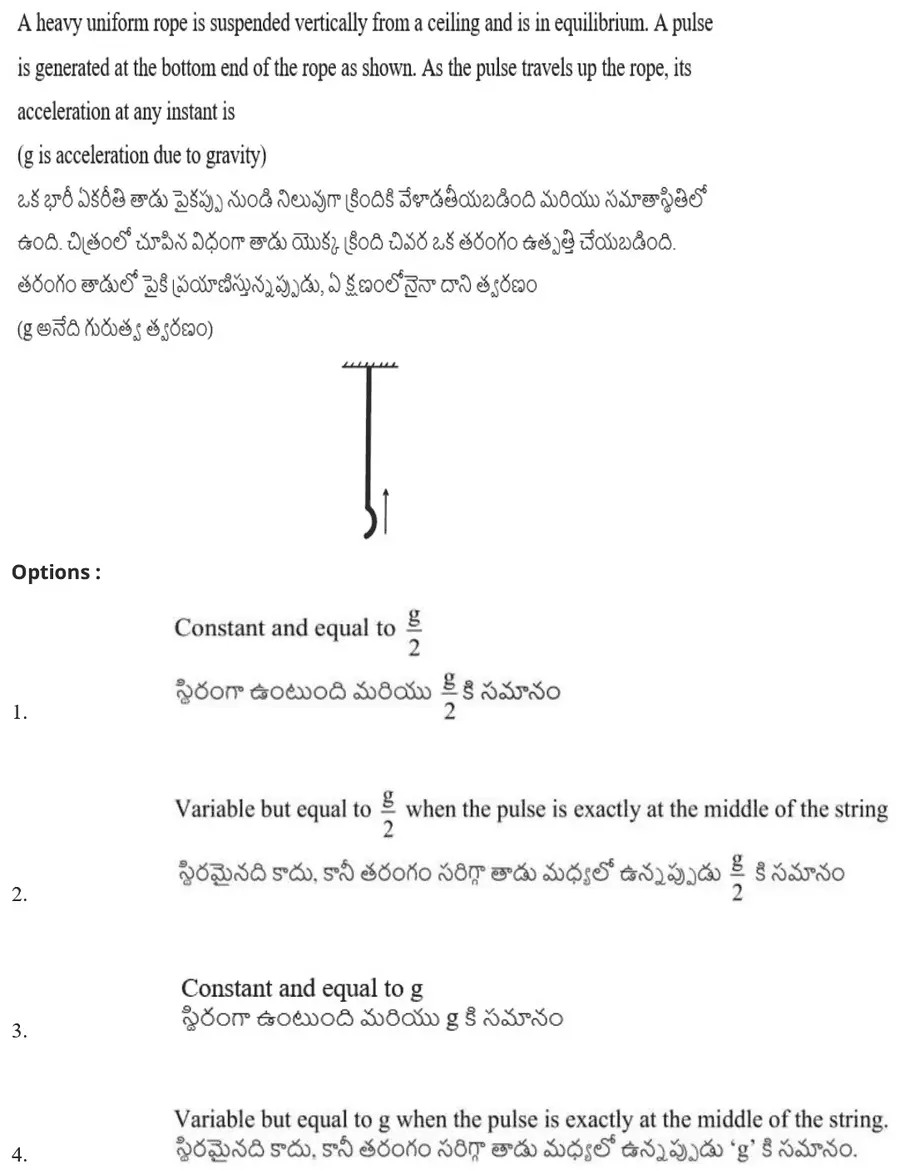
A heavy uniform rope is suspended vertically from a ceiling and is in equilibrium. A pulse is generated at the bottom end of the rope as shown. As the pulse travels up the rope, its acceleration at any instant is (g is acceleration due to gravity)
(see the figure above)
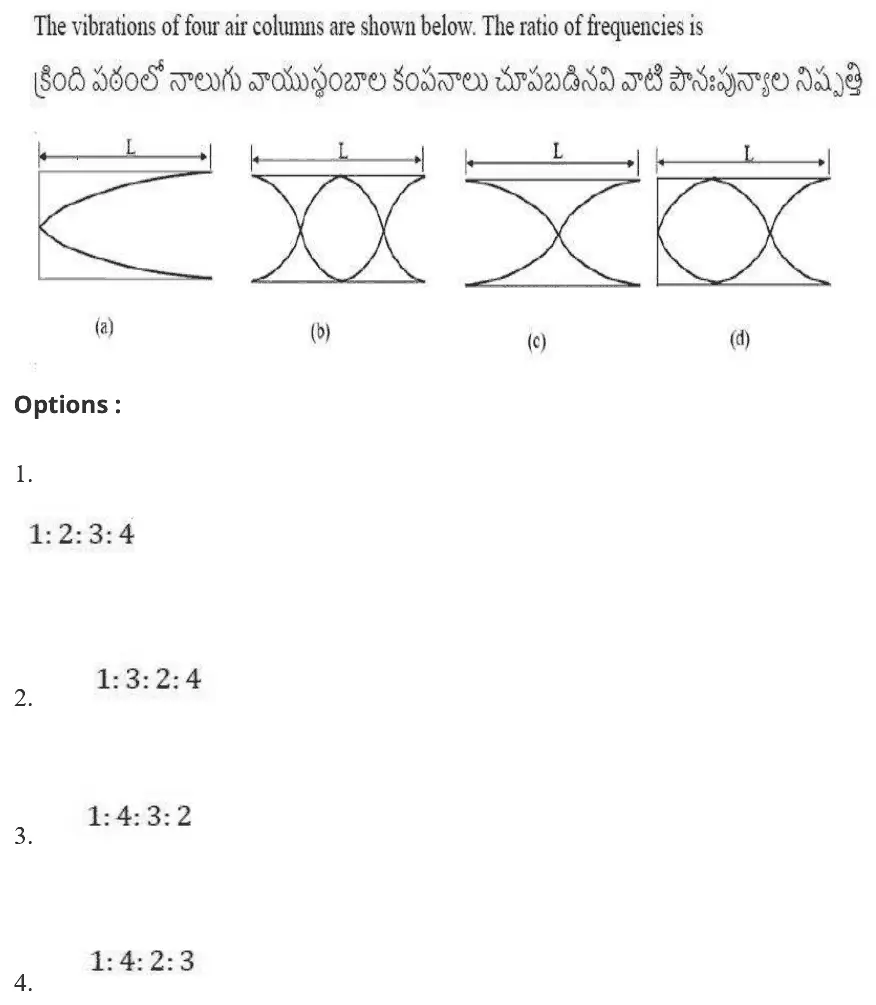
The question as printed in the paper.
A
Constant and equal to $\frac{g}{2}$
B
Variable but equal to $\frac{g}{2}$ when the pulse is exactly at the middle of the string
C
Constant and equal to g
D
Variable but equal to g when the pulse is exactly at the middle of the string.
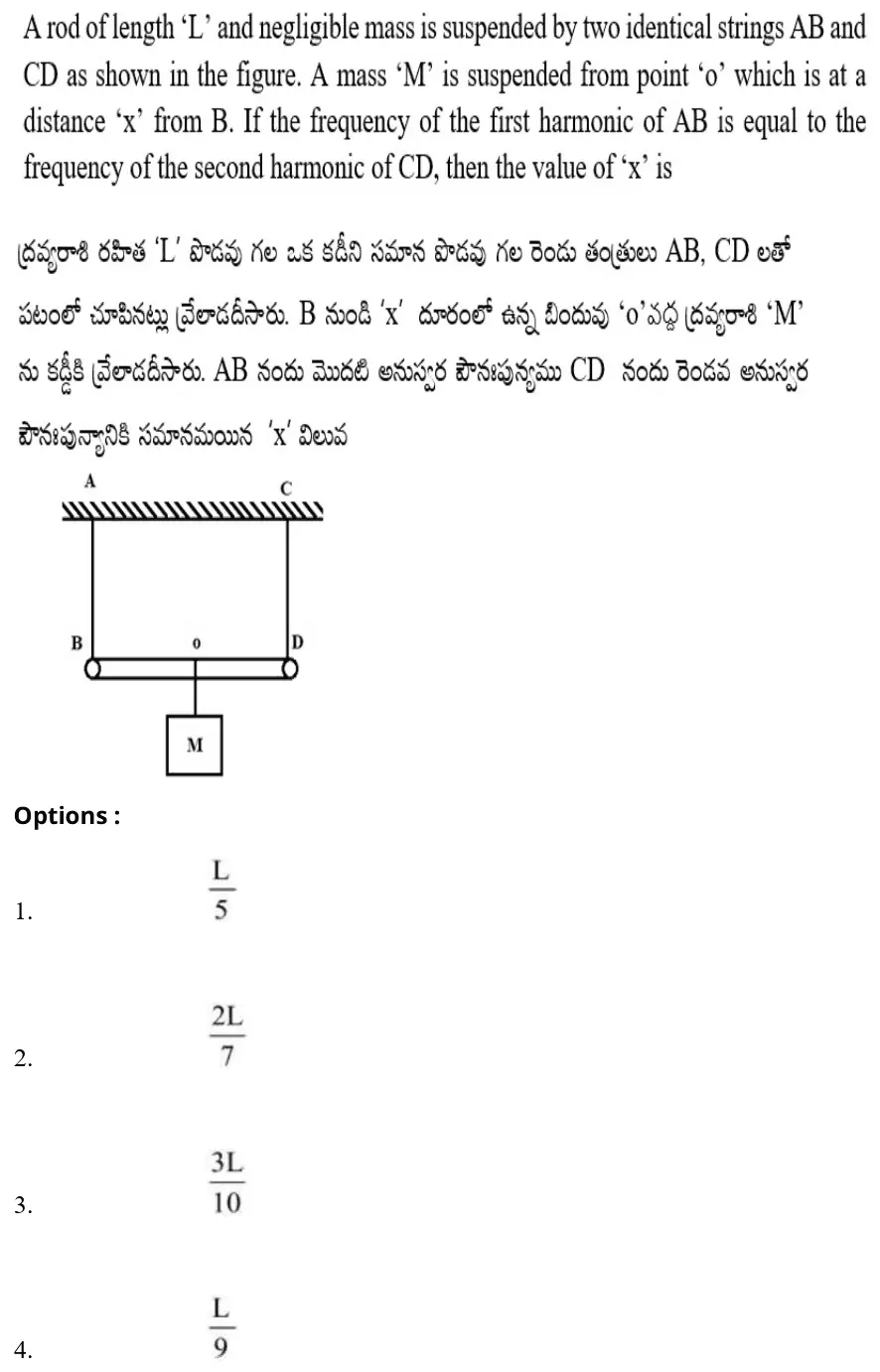
A rod of length ‘L’ and negligible mass is suspended by two identical strings AB and CD as shown in the figure. A mass ‘M’ is suspended from point ‘o’ which is at a distance ‘x’ from B. If the frequency of the first harmonic of AB is equal to the frequency of the second harmonic of CD, then the value of ‘x’ is
An observer moves towards a stationary source of sound with a speed $\frac{1}{5}$th that of sound. The frequency of the sound emitted by the source is $f$. The apparent frequency recorded by the observer is
A cylindrical tube open at both ends has a fundamental frequency 'f' in air. The tube is dipped vertically in water so that half of it is in water. The new fundamental frequency is
Two strings A and B produce beat of frequency $\Delta f_1>0$. The tension in string A is slightly increased and the beat frequency is found to be $\Delta f_2>0$. If the original frequency of A is $f_0$ and $\Delta f_2<\Delta f_1$, then the frequency of B is
A wire of length 0.4 m stretched at both ends vibrates 250 times per second. If the length of the wire is increased by 0.1 m and the stretching force is reduced to $1/4^{\text{th}}$ of its original value then the new frequency is
The distance between two successive minima of a transverse wave is 2.7 m. Five crests of the wave pass a given point along the direction of travel every 15.0 s. The speed of the wave is
An open air pipe of length 80 cm has the second harmonic frequency equal to the fundamental frequency of a closed organ air pipe. The length of the closed pipe is
Two wires A and B of lengths in the ratio 1:2 and masses in the ratio 2:1 are stretched by same tension. The ratio of the fundamental frequencies of wires A and B is
Two trains A and B are moving towards each other with speeds $72\ \mathrm{kmh^{-1}}$ and $36\ \mathrm{kmh^{-1}}$ respectively. The train-A whistles at 640 Hz frequency. Before the trains meet, frequency of sound heard by a passenger in Train-B is (Speed of sound in air = $340\ \mathrm{ms^{-1}}$)
A steel wire of length 1.25 m is stretched between two rigid supports. The tension in the wire produces an elastic strain of 0.14%. The fundamental frequency of the wire is (Density and Young's modules (sic) of steel are $7.7\times10^3\ \mathrm{kgm^{-3}}$ and $2.2\times10^{11}\ \mathrm{Nm^{-2}}$ respectively)
Two open organ pipes of lengths 50 cm and 51 cm are totally immersed in a medium. They are found to give 40 beats in 10 s when each is sounding at its fundamental note. The speed of sound in this medium is
Two cars are moving towards each other at the speed of $50\ \mathrm{m\,s^{-1}}$. If one of the cars blows a horn at a frequency of 250 Hz, the wave length of the sound perceived by the driver of the other car is (Speed of sound in air $= 350\ \mathrm{m\,s^{-1}}$)
A body is suspended from a string of length 1 m and mass 2 g. The mass of the body to produce a fundamental mode of 100 Hz frequency in the string is (Acceleration due to gravity = 10 $\mathrm{ms^{-2}}$)
An elastic string of length 2 $m$ is fixed at one end. The string starts to vibrate in third overtone with a frequency 1200 $Hz$. The ratio of frequency of first overtone and fundamental is
The speed of the sound in Oxygen $O_2$ at a certain temperature is $460\ \mathrm{m.s^{-1}}$. The speed of the sound in Helium $He$ at the same temperature will be ______ (assume both the gasses to be ideal)
Two identical sinusoidal waves each of amplitude $10\ mm$, with a phase difference of $90^\circ$ are travelling with the same direction in a string. The amplitude of the resultant wave is ______
A string is divided into three segments, so that the segment possesses fundamental frequencies in the ratio $1:2:3$. Then, the length of the segments are in the ratio ______
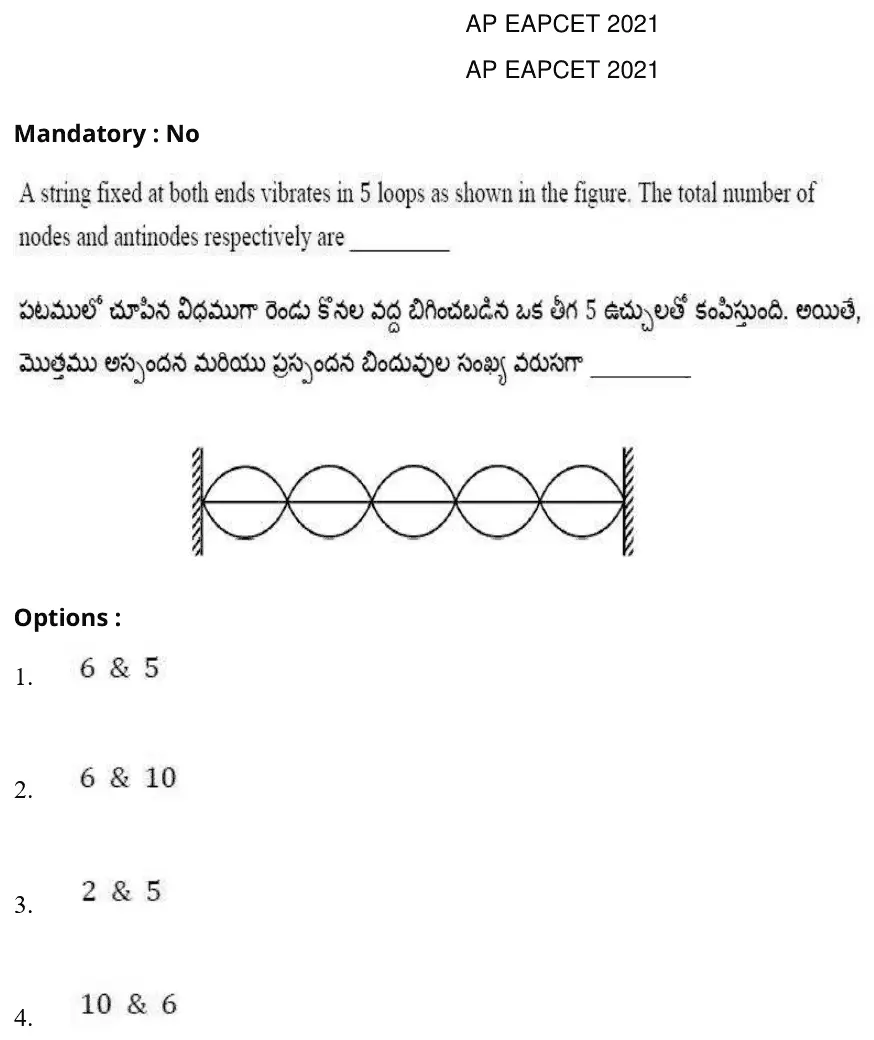
A string fixed at both ends vibrates in 5 loops as shown in the figure. The total number of nodes and antinodes respectively are ______. (see the figure above)
The sources of sound $A$ and $B$ produce a wave of $350\ Hz$ in same phase. A particle $P$ is vibrating under an influence of these two waves. If the amplitudes at $P$ produced by the two waves is $0.3\ mm$ and $0.4\ mm$, the resultant amplitude of the point $P$ will be, when $AP - BP = 25\ cm$ and the velocity of sound is $350\ m.s^{-1}$,
Match the following: A) Transverse wave through a steel rod B) Longitudinal waves in earth's crust C) Longitudinal waves through a steel rod D) Ripples I) $\sqrt{B + \left(\dfrac{4}{3}\right)\dfrac{\eta}{\rho}}$ II) $\sqrt{\dfrac{\eta}{\rho}}$ III) $\sqrt{\dfrac{2\pi T}{g\lambda}}$ IV) $\sqrt{\dfrac{\lambda}{\rho}}$
A wire vibrates at a fundamental frequency of 500 Hz. A second identical wire produces 5 beats per second with it when the tension in the first wire is slightly decreased. The ratio of the tension in the second wire to the tension in the first wire is approximately equal to:
Two identical wires have a fundamental frequency $f_0$ when kept under the same tension T. If the tension of one wire is increased by $\Delta T$, then the N beats/s occur when both wires oscillate simultaneously. The correct statement is
A second wave of frequency 200 Hz is travelling in air. The speed of sound in the air is 340 m/s. What is the phase difference at a given instant between two points separated by a distance of 85 cm along the direction of propagation?
The amplitude of the wave resulting from the superposition of three waves given by $x_1 = A\cos\omega t$, $x_2 = 2A\sin\omega t$ and $x_3 = \sqrt{2}A\cos\left(\omega t+\frac{\pi}{4}\right)$ is
A wave is represented by the equation $y = (0.02\ \mathrm{m})\sin(5\pi x - 20t)$. The minimum distance between the two particles always having the same speed is. (Assume x and t are in SI units)
Consider a gas with molar mass $M$. If the sound at frequency $f$ is introduced to a tube of this gas at temperature $T$ then an internal acoustic standing wave is set up with nodes separated by $L$. The adiabatic constant $(\gamma = C_p/C_v)$ is
Two vibrating strings 'A' and 'B' produce beats of frequency 8 Hz. The beat frequency is found to reduce to 4 Hz if the tension in the string 'A' is slightly reduced. If the original frequency of A is 320 Hz, then the frequency of 'B' is
A closed organ pipe and an open organ pipe of same length produce $2$ beats/sec when they are set into vibrations together in fundamental mode. The length of open pipe is now halved and that of closed pipe is doubled. The number of beats produced will be
A source is stationary and the observer is in motion along a line joining the source and the observer. If the frequency heard by the observer is $1\%$ higher than the true frequency, the ratio of velocity of the observer and that of sound in air is:
The displacement $y$ (in $\mathrm{cm}$) in case of a simple harmonic wave is given by $y = \frac{10}{\pi}\sin\left(2000\pi t - \frac{\pi x}{17}\right)$. The period and maximum velocity of the particles in the medium will respectively be ______
A piano wire with a diameter of 0.90 $\mathrm{mm}$ is replaced by another wire of diameter 0.93 $\mathrm{mm}$ of the same material. If tension of wire is kept the same, then the percentage change in frequency of fundamental tone is ______
When the area of cross section of a stretched wire is halved and tension is doubled, the speed of propagation of transverse waves along it becomes $k$ times the initial speed. Then $k$ =
On getting reflected at a surface, the intensity of sound is found to be decreased by 20%. If 'A' be the amplitude of the incident sound waves, then the amplitude of reflected sound waves is
On producing the waves of frequency $1000\ Hz$ in a Kundt's tube, the total distance between 6 successive nodes is $85\ cm$. Then, the speed of sound in the gas filled in the tube is
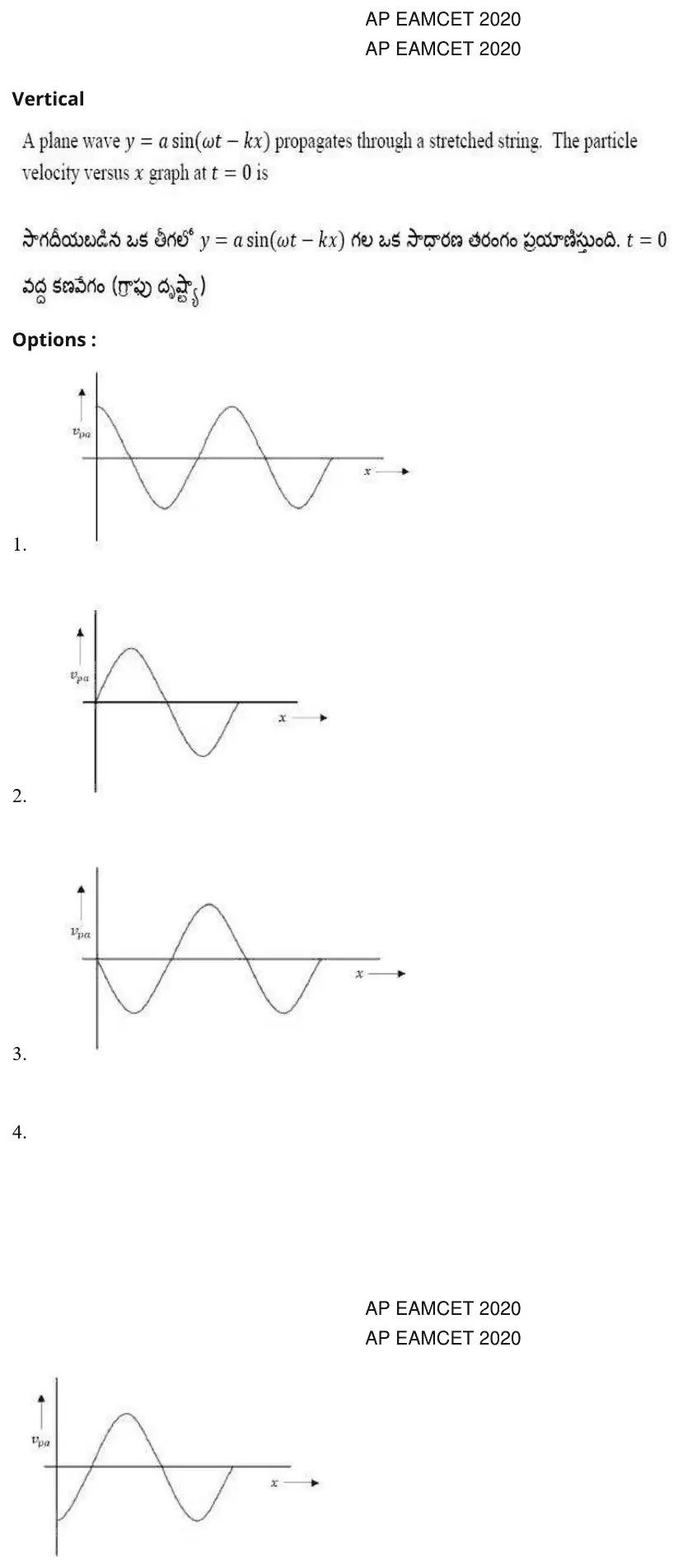
A plane wave $y = a\sin(\omega t - kx)$ propagates through a stretched string. The particle velocity versus $x$ graph at $t = 0$ is
The question as printed in the paper.
A
see figure cosine-shaped curve starting at a positive value (near maximum) at x=0, falling through zero to a minimum, back up to a maximum, down again (about 1.5 cycles)
B
see figure sine-shaped curve starting at zero, rising to a maximum, falling through zero to a minimum, then back up to zero (one cycle)
C
see figure negative-sine-shaped curve starting at zero, dipping to a minimum first, rising to a maximum, then down to a second minimum (about 1.5 cycles)
D
see figure curve starting at a negative value (slightly above its minimum, below the axis) at x=0, rising through zero to a maximum, falling through zero to a minimum and ending near the axis (about 1 cycle)
Two tuning forks X and Y are of frequencies 280 $\mathrm{Hz}$ and 284 $\mathrm{Hz}$. A third tuning fork Z is of unknown frequency, when X and Z are sounded together certain beats are heard per second. When Y and Z are sounded together beat frequency is found to be thrice as great. The frequency of Z is
What is the phase difference between two particles 25 $\mathrm{m}$ apart in a wave represented by equation $y = 0.03\ \sin(\pi\,[2t - 0.01\,x])$ travelling in a medium?
An organ pipe with both ends open has a length L = 25 cm. An extra hole is created at position $\dfrac{L}{2}$. The lowest frequency of sound produced is (Assume speed of sound = 340 m/s)
Two trucks heading in opposite directions each with speed $0.1\,u$, approach each other. The speed of the sound is $u$. The driver of first truck sounds his horn of frequency 495 Hz. Let $\nu_1$ and $\nu_2$ are the frequencies heard by the driver of second truck when the trucks approach each other and when the trucks have passed each other. The magnitude of $\nu_1 - \nu_2$ is
A bus moving with an uniform speed of 72 km/h towards a building blows a horn of frequency 1.7 KHz. If speed of sound in air is 340 m/s, what will be the frequency of echo heard by bus driver?
The phase difference between the following two waves $y_2$ and $y_1$ is: $y_1 = a\sin(\omega t - kx)$ $y_2 = b\cos\left(\omega t - kx + \frac{\pi}{3}\right)$
An engine sounding a whistle of frequency 2000 Hz is receding from the stationary observer at 72 km/h. What is the apparent frequency of the observer? The velocity of sound in air is 340 m/s.
Two identical sinusoidal waves moving in the same direction along a stretched string, interfere with each other. The phase difference between them is $120^\circ$. The amplitudes of both waves are same. If the amplitude of the resultant wave due to interference is 2 mm, the amplitude of each wave is
A whistle of frequency 660 Hz moves in a circle of radius 1 m at an angular speed of 10 rad/s. The highest frequency heard by a listener at a long distance and at rest with respect to the center of the circle is (Let speed of sound = 340 m/s)
Consider two tuning forks with natural frequency 250 Hz. One is moving away and another is moving towards a stationary observer at same speed. If the observer hears beats of frequency 5 Hz, then the speed of the tuning fork is (Given speed of sound wave is 350 m/s)
A drone fitted with siren is flying directly away from the drone operator and towards a distant building at a speed of 15 m/s. The siren produces sound of frequency 780 Hz. What is the frequency that the operator hears in the echo reflected from the building [Speed of sound is 340 m/s]
A string of length 100 cm has three resonant frequencies, 120 Hz, 200 Hz and 280 Hz. If a node is formed at the end of the string, the speed of the transverse wave on this string is
Standing waves are produced in a string 16 m long. If there are 9 nodes between the two fixed ends of the string and the speed of the wave is 32 m/s, what is the frequency of the wave?
A highway truck has two horns A and B. When sounded together, the driver records 50 beats in 10 seconds with horn B blowing and the truck moving towards a wall at a speed of 10 m/s, the driver noticed a beat frequency of 5 Hz with the echo. When frequency of A is decreased the beat frequency with two horns sounded together increases. Calculate the frequency of horn A. (Speed of sound = 330 m/s)
A musician on a moving vehicle plays a tone at 880 Hz note. When the vehicle was approaching a listner, he receives it as 888 Hz tone. The speed of the vehicle is (Assume the velocity of sound is 333 m/s)
Match the following List - I with List - II A) Transverse wave B) Longitudinal wave C) Beats D) Stationary waves I) Vibrations parallel to the direction of propagation II) Vibrations perpendicular to the direction of propagation III) Superposition of waves travelling in opposite directions IV) Superposition of waves travelling in same direction The correct answer is
A police car moving at $22\ \mathrm{ms^{-1}}$ chases a motor cyclist. The police man sounds horn at $176\ \mathrm{Hz}$, while both of them move towards a stationary siren of frequency $165\ \mathrm{Hz}$. If the number of beats heard by the motor cyclist per second is zero, then the speed of motorcycle is (speed of sound in air $= 330\ \mathrm{ms^{-1}}$)
When the air column of a resonance tube is vibrated together with a tuning fork, 3 beats are heard per second, either the temperature of the air column is $51\,^\circ\mathrm{C}$ or $16\,^\circ\mathrm{C}$. The frequency of the tuning fork is
Two sources A and B are producing notes of frequency 680 Hz. A listner moves from A to B with a constant velocity 'v'. If the speed of sound in air is $340\ \mathrm{ms^{-1}}$, the value of 'v' so that he hears 10 beats per second is
A metal wire of length $80\ \mathrm{cm}$, area of cross-section $3\ \mathrm{mm^2}$ and material density $3000\ \mathrm{kg\,m^{-3}}$ is joined to another metal wire of length $60\ \mathrm{cm}$, area of cross-section $1\ \mathrm{mm^2}$ and material density $9000\ \mathrm{kg\,m^{-3}}$. The free ends of the two wires are stretched between two rigid supports and a tension of $40\ \mathrm{N}$ is produced in the wires. The minimum frequency of the tuning fork which can produce stationary waves with the joint of the wires as a node is
A source producing sound of frequency $720\ \mathrm{Hz}$ is falling freely from the top of a tower of height $20\ \mathrm{m}$. The frequency of sound heard by an observer on the top of the tower when the source just reaches the ground is (Acceleration due to gravity $= 10\ \mathrm{ms^{-2}}$ and speed of sound in air $= 340\ \mathrm{ms^{-1}}$)
At a temperature of $27\,^\circ\mathrm{C}$, two identical organ pipes produce notes of frequency 140 Hz. If the temperature of one pipe is raised to $57.75\,^\circ\mathrm{C}$, the number of beats produced per second is
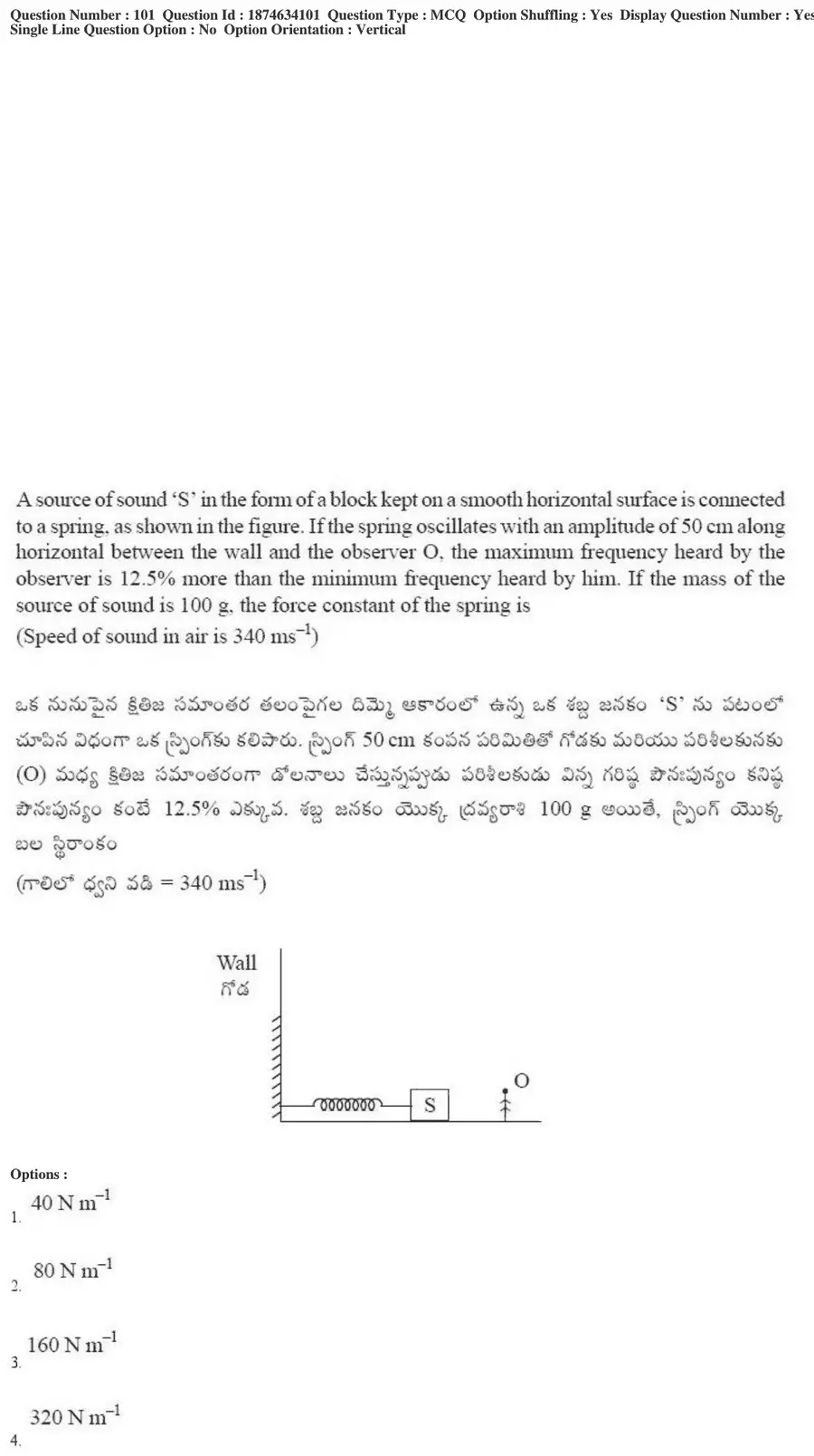
A source of sound 'S' in the form of a block kept on a smooth horizontal surface is connected to a spring, as shown in the figure. If the spring oscillates with an amplitude of 50 cm along horizontal between the wall and the observer O, the maximum frequency heard by the observer is 12.5% more than the minimum frequency heard by him. If the mass of the source of sound is 100 g, the force constant of the spring is (Speed of sound in air is $340\,\mathrm{ms^{-1}}$) (see the figure above)
A cylindrical tube open at both ends has a fundamental frequency $f$ in air. The tube is dipped vertically in water so that 60% of the tube is in water. Then the fundamental frequency of air column is
A train approaching a railway crossing at a speed of 120 kmph sounds a whistle of frequency 576 Hz, when it is 288 m away from the crossing. The frequency heard by the observer standing on the road perpendicular to the track from the crossing at a distance of 384 m is (Speed of sound in air $= 340\ \mathrm{ms^{-1}}$)
An earthquake generates both transverse (S) and longitudinal (P) waves in the earth with speeds $4.5\ \mathrm{km\,s^{-1}}$ and $8.0\ \mathrm{km\,s^{-1}}$ respectively. A seismograph records that the first P-wave arrives 3.5 minutes earlier than the first S-wave. From the seismograph, the epicentre of the earthquake is located at a distance
An observer moves towards a stationary source of sound with a speed $\frac{1}{5}^{\mathrm{th}}$ of the speed of sound. The wavelength and frequency of the waves emitted by the source are '$\lambda$' and '$f$' respectively. The apparent frequency and wavelength heard by the observer are respectively
A siren placed at a railway platform is emitting a sound of frequency 5 kHz. A passenger sitting in a moving train 'A' records the frequency of the siren as 5.5 kHz. During his return journey by train 'B' he records the frequency of the siren as 6 kHz. The ratio of the speed of train B to that of train A is
The speed of a transverse wave travelling in a wire of length 50 cm, cross-sectional area $1\ \mathrm{mm^2}$ and mass 5 g is $80\ \mathrm{ms^{-1}}$. The Young's modulus of the material of the wire is $4\times10^{11}\ \mathrm{Nm^{-2}}$. The extension in the length of the wire is
The speed of sound in air at temperature $T$ and pressure $P$ is v. When the temperature is increased to $2T$ and the pressure is reduced to $P/2$, then the speed is changed to ______
A wire of length 50 cm and weighing 10 gm is attached to a spring at one end and to a fixed wall at the other end. The spring has a spring constant of 50 N/m and is stretched by 1 cm. If a wave pulse is produced on the string near the wall, how much time will it take to reach the spring
The speed of a transverse wave on a string is $160\ \mathrm{m/sec}$. If the three resonant frequencies of this string respectively are $160\ \mathrm{Hz}$, $240\ \mathrm{Hz}$ and $400\ \mathrm{Hz}$, the length of the string is
Two harmonic travelling waves are described by the equations $y_1 = a\sin(kx - \omega t)$ and $y_2 = a\sin(-kx + \omega t + \phi)$. The amplitude of the superposed wave is
A source of sound whose frequency is 1000 Hz is moving with a speed 33 m/s. The waves reflected by a fixed obstacle are registered by a receiver that moves together with the source. (the speed of the sound waves is 330 m/s). The frequency registered by the receiver is
Two uniform stretched steel strings A and B are vibrating under the same tension. The first overtone of A is equal to the second overtone of B. If the radius of A is twice that of B, then the ratio of the lengths of the strings is ________
A open pipe of length 'l' is vibrating in $3^{\mathrm{rd}}$ overtone with maximum amplitude 'A'. The amplitude at a distance of $\dfrac{l}{16}$ from any open end is
A motor cycle starts from rest from a stationary source of sound and moves away from the source with a uniform acceleration $2\ \mathrm{ms^{-2}}$. Distance travelled by the motor cycle when the person on it hears the sound of frequency which is 94% of the true frequency, is nearly (speed of sound in air $= 330\ \mathrm{ms^{-1}}$)
A steel wire of length $1\ \mathrm{m}$, mass $0.1\ \mathrm{kg}$ and uniform area of cross section $10^{-6}\ \mathrm{m^2}$ is rigidly fixed at both the ends without any tension. Its temperature is lowered by $20\ ^\circ\mathrm{C}$ and transverse waves are set up by plucking the wire at the middle. The frequency of the fundamental mode is ($Y = 200\ \mathrm{GPa}$, $\alpha = 1.21\times10^{-5}\ ^\circ\mathrm{C}^{-1}$)
If the length of a stretched string is shortened by $x\,\%$ and the tension is increased by 44%, then the ratio of the final and initial fundamental frequencies is 1:2, the value of '$x$' is
A small source of sound vibrating at a frequency 500 Hz is rotated along a circle of radius $\frac{100}{\pi}$ cm at a constant angular speed of 5 revolutions per second. The minimum and maximum frequency of the sound observed by a listener situated in the plane of the circle is (Speed of sound is $332\ \mathrm{ms^{-1}}$)
A progressive wave of frequency 500 Hz is travelling with a velocity of $360\ \mathrm{ms^{-1}}$. The distance between the two points, having a phase difference of $60^\circ$, is ______
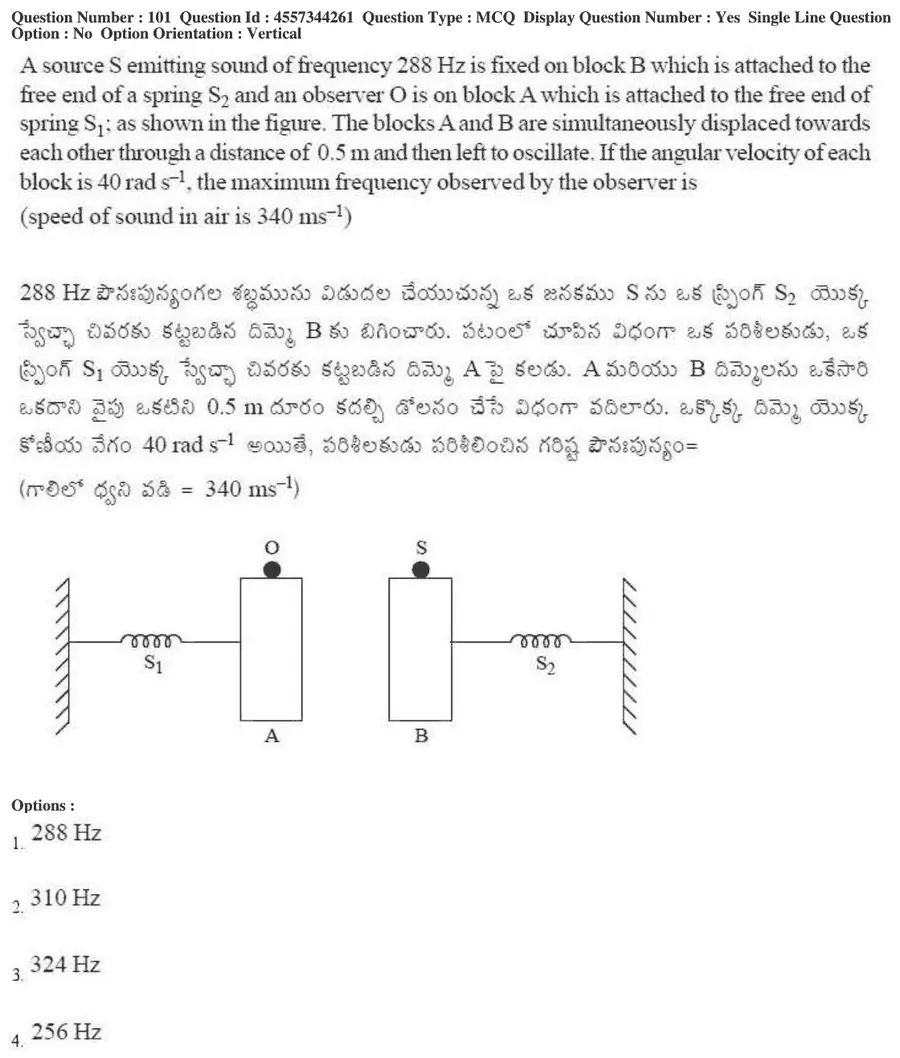
A source S emitting sound of frequency 288 Hz is fixed on block B which is attached to the free end of a spring $S_2$ and an observer O is on block A which is attached to the free end of spring $S_1$; as shown in the figure. The blocks A and B are simultaneously displaced towards each other through a distance of 0.5 m and then left to oscillate. If the angular velocity of each block is $40\ \mathrm{rad\ s^{-1}}$, the maximum frequency observed by the observer is (speed of sound in air is $340\ \mathrm{ms^{-1}}$) (see the figure above)
A solid ball is suspended from the ceiling of a motor car through a light string. A transverse pulse travels at the speed $60\ \mathrm{cms^{-1}}$ on the string when the car is at rest. When the car accelerates on a horizontal road, speed of the pulse is $66\ \mathrm{cms^{-1}}$. The acceleration of the car is nearly ($g = 10\ \mathrm{ms^{-2}}$)
A reflector is moving with $20\ \mathrm{ms^{-1}}$ towards a stationary source of sound. If the source is producing sound waves of $160\ \mathrm{Hz}$ then the wavelength of the reflected wave is (speed of sound in air is $340\ \mathrm{ms^{-1}}$)
An object of density $2000\ \mathrm{kgm^{-3}}$ is hung from a thin light wire. The fundamental frequency of the transverse waves in the wire is 200 Hz. If the object is immersed in water such that half of its volume is submerged, then the fundamental frequency of the transverse waves in the wire is ______
An observer and a source emitting sound of frequency 120 Hz are on the X-axis. The observer is stationary while the source of sound is in motion given by the equation $x=3\sin\omega t$ ($x$ in metres and $t$ in seconds). If the difference between the maximum and minimum frequencies of the sound observed by the observer is 22 Hz, then the value of $\omega$ is (Speed of sound in air $=330\ \mathrm{ms^{-1}}$)
A sound wave of frequency '$\nu$' Hz initially travels a distance of $1\ \mathrm{km}$ in air. Then it gets reflected into a water reservoir of depth $600\ \mathrm{m}$. The frequency of the wave at the bottom of the reservoir is ( $V_{\mathrm{air}} = 340\ \mathrm{m/s}$ ; $V_{\mathrm{water}} = 1484\ \mathrm{m/s}$)
A
$> \nu$ Hz
B
$< \nu$ Hz
C
$\nu$ Hz
D
$0$ (the sound wave gets attenuated by water completely)
The transverse displacement of a string of a linear density $0.01\ \mathrm{kg\,m^{-1}}$, clamped at its ends is given by $Y_{(x,t)} = 0.03\sin\left(\dfrac{2\pi x}{3}\right)\cos(60\pi t)$ where x and y are in metres and time 't' in seconds. Tension in the string is
A closed organ pipe of length 'L' and an open organ pipe contain gases of densities $\rho_1$ and $\rho_2$ respectively. The compressibility of gases are equal in both the pipes. If the frequencies of their first overtones are same, then the length of the open organ pipe is
When a train is approaching the stationary observer, the apparent frequency of the whistle of the train is $n_1$ and when the train is moving away from the observer, the apparent frequency is $n_2$. The frequency of the whistle noticed by the observer when he moves with the train is ______
The depth of the sea measured by means of an echo. If the time between the moment of the sound produced and received is 3.52 s, then the depth of the sea is (The compressibility of sea water is $4.84 \times 10^{-10}\ \mathrm{m^2N^{-1}}$ and its density is $1024\ \mathrm{kg\,m^{-3}}$) is
A transverse wave is described by the equation $y=y_0\sin 2\pi\left(vt-\dfrac{x}{\lambda}\right)$. The maximum particle velocity is equal to four times the wave velocity if $\lambda=$
A bus is moving with a velocity of 5 $\mathrm{ms^{-1}}$ towards a huge wall. The driver sounds horn of frequency 165 Hz. If the speed of sound in air is 335 $\mathrm{ms^{-1}}$, the number of beats heard per second by the passengers in the bus will be
An open pipe and a closed pipe have fundamental frequencies $n_1$ and $n_2$ respectively. They are combined to form a closed pipe. Fundamental frequency of the combined pipe is
A source emitting sound of frequency 288 Hz is tied to a string of 100 cm length and rotated with an angular velocity of $20\ \mathrm{rad\,s^{-1}}$ in the horizontal plane. The range of frequencies heard by an observer standing at a distance of 5 m from the source is (in Hz) (Speed of sound in air $=340\ \mathrm{ms^{-1}}$)
56 tuning forks are arranged such that each fork produces 4 beats per second with its previous one. If the frequency of the last fork is twice that of the first, the frequency of $19^{\mathrm{th}}$ fork is ______
A closed pipe is in resonance with a tuning fork at $27\ ^\circ\mathrm{C}$ when its length is 20 cm. If the pipe is to be in resonance with the same tuning fork at $7\ ^\circ\mathrm{C}$ then the change in the length of the pipe required is nearly
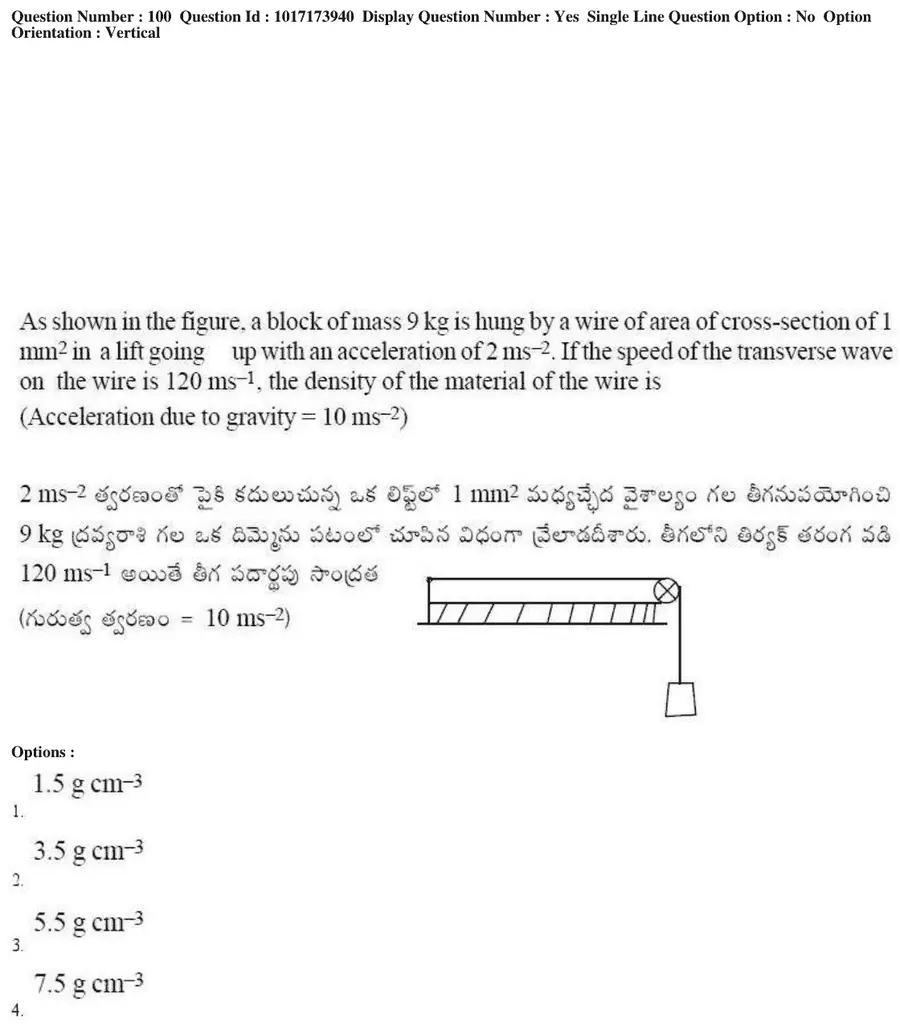
As shown in the figure, a block of mass 9 kg is hung by a wire of area of cross-section of $1\ \mathrm{mm^2}$ in a lift going up with an acceleration of $2\ \mathrm{ms^{-2}}$. If the speed of the transverse wave on the wire is $120\ \mathrm{ms^{-1}}$, the density of the material of the wire is (Acceleration due to gravity $= 10\ \mathrm{ms^{-2}}$) (see the figure above)
A stationary source of sound A is producing sound of frequency 170 Hz. Another source of sound B producing sound of frequency 240 Hz is moving towards the source A on a straight path with a uniform speed of $20\ \mathrm{ms^{-1}}$. An observer between A and B is moving towards the source A along the straight path BA. If the number of beats heard by the observer is zero, the speed of the observer is ______ $\mathrm{ms^{-1}}$. (Speed of sound in air $= 340\ \mathrm{ms^{-1}}$)
A source of frequency 340 Hz is kept above a vertical cylindrical tube closed at lower end. The length of the tube is 120 cm. Water is slowly poured in just enough to produce resonance. Then the minimum height (velocity of sound = 340 m/s) of the water level in the tube for that resonance is,
For a certain organ pipe, three successive resonance frequencies are observed at 425, 595 and 765 Hz, respectively. The length of the pipe is (speed of sound in air = $340\ \mathrm{ms^{-1}}$)
A student holds a tuning fork oscillating at 170 Hz. He walks towards a wall at a constant speed of $2\ \mathrm{ms^{-1}}$. The beat frequency observed by the student between the tuning fork and its echo is (Velocity of sound = $342\ \mathrm{ms^{-1}}$)
A closed pipe is suddenly opened and changed to an open pipe of same length. The fundamental frequency of the resulting open pipe is less than that of $3^{\mathrm{rd}}$ harmonic of the earlier closed pipe by 55 Hz. Then, the value of fundamental frequency of the closed pipe is
An air column in a tube 32 cm long, closed at one end, is in resonance with a tuning fork. The air column in another tube, open at both ends, of length 66 cm is in resonance with another tuning fork. When these two tuning forks are sounded together, they produce 8 beats per second. Then the frequencies of the two tuning forks are, (Consider fundamental frequencies only)
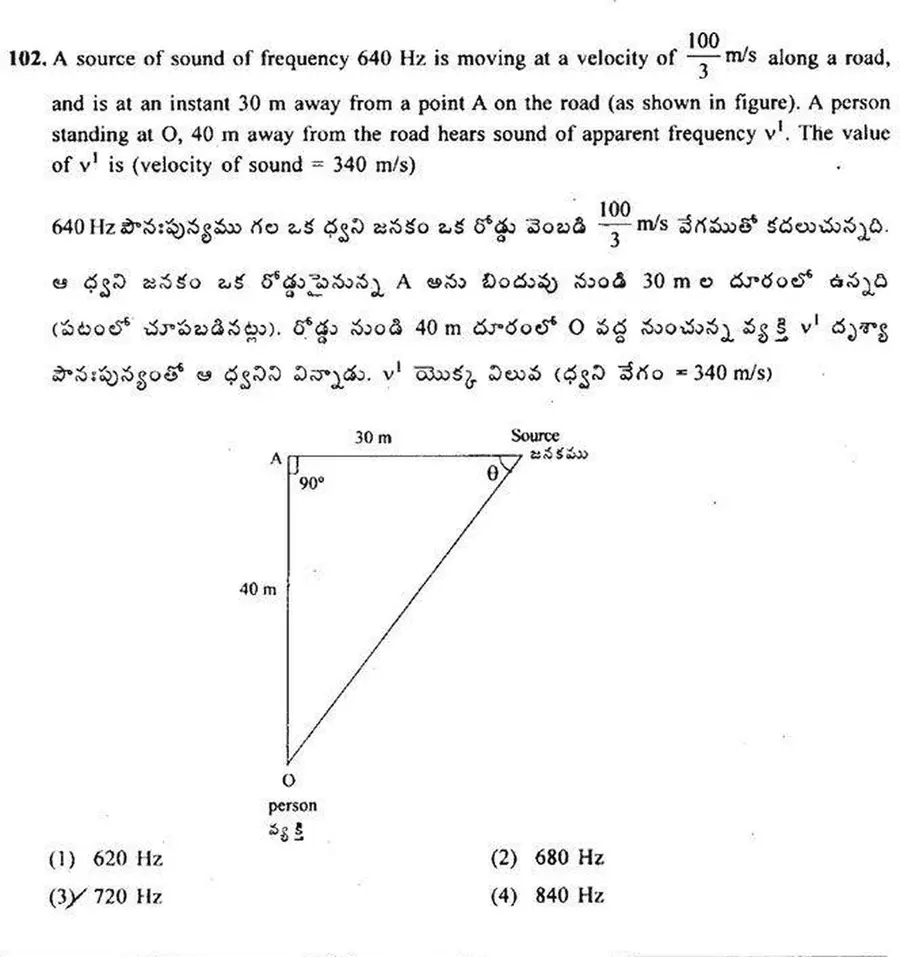
A source of sound of frequency 640 Hz is moving at a velocity of $\frac{100}{3}$ m/s along a road, and is at an instant 30 m away from a point A on the road (as shown in figure). A person standing at O, 40 m away from the road hears sound of apparent frequency $\nu^1$. The value of $\nu^1$ is (velocity of sound = 340 m/s) (see the figure above)
A uniform rope of mass 0.1 kg and length 2.45 m hangs from a rigid support. The time taken by the transverse wave formed in the rope to travel through the full length of the rope is (Assume g = 9.8 $\mathrm{m/s^2}$)
When a vibrating tuning fork is placed on a sound box of a sonometer, 8 beats per second are heard when the length of the sonometer wire is kept at 101 cm or 100 cm. Then the frequency of the tuning fork is (consider that the tension in the wire is kept constant)
The wavelengths of two sound notes in air are $\dfrac{40}{195}$ m and $\dfrac{40}{193}$ m. Each note produces 9 beats per second separately with a third note of fixed frequency. The velocity of sound in air in m/s is :
Two uniform stretched strings A and B, made of steel, are vibrating under the same tension. If the first overtone of A is equal to the second overtone of B and if the radius of A is twice that of B, the ratio of the lengths of the strings is :
An organ pipe $P_1$, closed at one end and containing a gas of density $\rho_1$ is vibrating in its first harmonic. Another organ pipe $P_2$, open at both ends and containing a gas of density $\rho_2$ is vibrating in its third harmonic. Both the pipes are in resonance with a given tuning fork. If the compressibility of gases is equal in both pipes, the ratio of the lengths of $P_1$ and $P_2$ is (assume the given gases to be mono-atomic) :
A sonometer wire has a length of 114 cm, between two fixed ends. Where should two bridges be placed so as to divide the wire into three segments (in cm) whose fundamental frequencies are in the ratio $1 : 3 : 4$ ?
Answer: (D) $l_1, l_2, l_3 = 72, 24, 18$· Official APSCHE final key
How to prepare Waves for EAPCET
How often it comes up
Mechanical waves and acoustics provide a regular stream of questions in Class 11 physics. Our collection of AP and TS EAPCET papers spanning 2022 to 2026 records 103 questions from Waves across 77 papers. That corresponds to an average of 1.3 questions per paper, representing 3.3% of all physics questions in that recent window. Looking at the full historical record from 2010 to 2026, Waves accounted for 206 questions across 149 papers, maintaining an average of 1.4 questions per paper and a 3.5% subject share. Across the earlier testing period from 2010 to 2021, our archive records 103 questions across 72 papers, representing 1.4 questions per paper and a 3.6% share. In the last three exam years from 2024 to 2026, the chapter provided 67 questions across 46 papers, registering a 3.6% share. Historical comparisons indicate that the subject share from 2024 to 2026 is about the same when weighed against the early 2010–2021 papers, and about the same when compared with the recent 2022–2026 period.
State-level distributions indicate stronger emphasis in Telangana. Between 2022 and 2026, AP EAPCET papers in our set contributed 52 questions across 48 papers, with 47 papers featuring at least one question (1.1 per paper, 2.7% share). Over the same window, TS EAPCET contributed 51 questions across 29 papers in our set, with 28 papers carrying questions (1.8 per paper, 4.4% share). Waves has appeared every year since 2022, though two papers in our collection omitted it, so it was not present in all 77 sittings. The chapter ranks 14th of 28 physics chapters by question share between 2022 and 2026. The busiest single sitting in our collection was 2025, which saw 26 questions across 16 papers.
Most-asked topics
Questions distribute across four balanced themes:
Wave Motion: Recent papers included 29 questions, out of 56 questions across the full archive. It tests the wave equation y = A sin(k x - ω t + φ), wave speed on stretched strings, longitudinal versus transverse propagation, and energy transport.
Sound Waves: This area provided 29 questions between 2022 and 2026 and 52 questions overall. Key concepts involve speed of sound via Laplace's correction, organ pipes open at one or both ends, end corrections, and beats.
Doppler Effect: Examiners set 23 questions in the recent five-year span, contributing to 52 questions across all years in our archive. It tests apparent frequency shifts when source, observer, and medium move along the line of sight.
Superposition & Standing Waves: A pool of 22 questions appeared recently, out of 46 questions in the complete record. Topics cover stationary waves on strings, nodes and antinodes, resonance tubes, and harmonic frequencies.
What the questions look like
Organ pipe problems are a fixture of every exam season. Questions regularly compare the fundamental or overtone frequencies of an open organ pipe with a closed pipe of identical or differing length. Another classic problem involves a vibrating sonometer wire tuned to a tuning fork: raising or lowering string tension slightly produces beats, requiring students to determine the original or altered frequency of the wire.
Doppler effect problems remain prominent in both state exams. Standard configurations involve a moving vehicle sounding a horn while approaching a stationary observer or rigid wall, where the observer hears both direct sound and reflected echoes, creating beats. In progressive wave kinematics, examiners supply an analytical wave equation and ask for maximum particle velocity, wave velocity, or the phase difference between two points separated by a given spatial distance.
Start by mastering progressive wave relations: wave velocity v = f λ = ω / k, where angular wave number k = 2 π / λ. Remember that maximum particle velocity is v_max = ω A, while wave propagation speed on a string under tension T and linear mass density μ is v = √(T / μ). For sound in an ideal gas, use Laplace's formula v = √(γ P / ρ) = √(γ R T / M).
Next, memorize standing wave mode frequencies thoroughly. For a string fixed at both ends or an open organ pipe of length L, resonant frequencies form an integer harmonic series f_n = n v / (two L). For a pipe closed at one end, only odd harmonics exist: f_n = (two n - 1) v / (four L). Incorporate acoustic end corrections when specified, where each open end adds an effective length proportional to inner radius r.
Finally, master the Doppler equation for sound. Write the comprehensive formula f_observed = f_source × (v ± v_medium ± v_observer) / (v ± v_medium ± v_source). Set up positive coordinate axes from source toward observer to maintain consistent sign conventions, especially when factoring in wind velocity or wall reflections.
Frequently asked questions
Is the Doppler effect in the EAPCET syllabus?
Yes. Unlike national exams where acoustic Doppler effect was omitted, both AP and TS EAPCET regularly test Doppler shifts for moving sound sources and observers.
How does changing temperature affect the frequency of an organ pipe?
As temperature rises, the speed of sound v increases proportionally to the square root of absolute temperature. Because resonant wavelengths are geometrically fixed by pipe length, resonant frequencies increase with rising temperature.
What is the beat frequency formula?
The beat frequency equals the absolute difference between the frequencies of two superposing sound waves, f_beat = |f₁ - f₂|.
Where can I find worked solutions for EAPCET Waves questions?
Step-by-step solutions for each one are in the EdLoop EAPCET app.