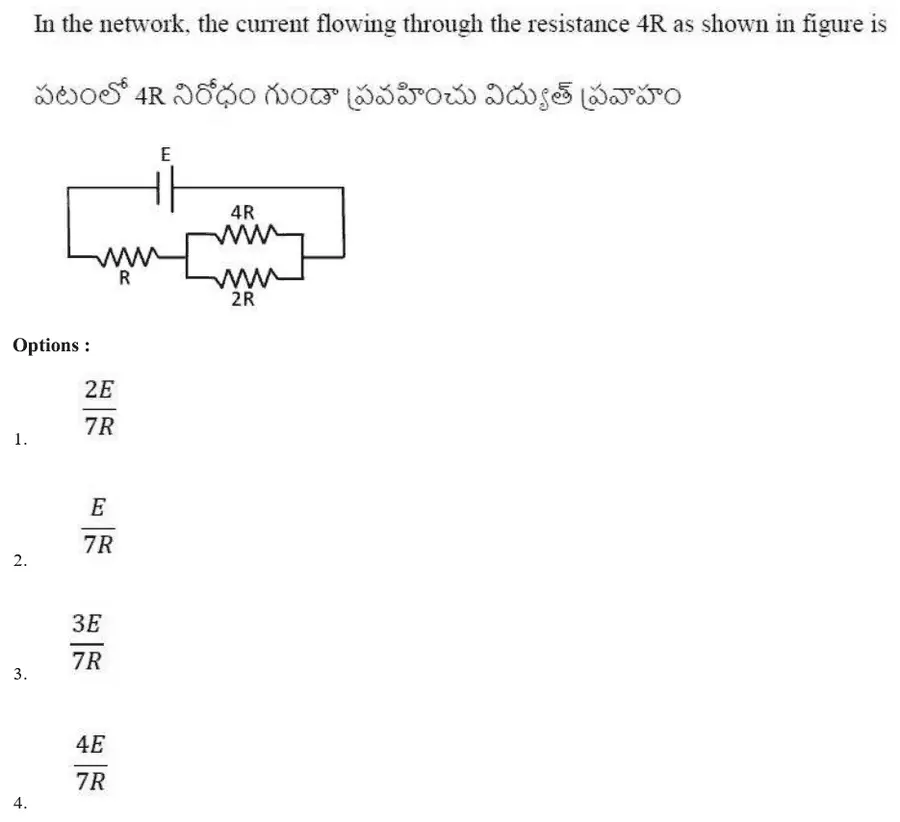
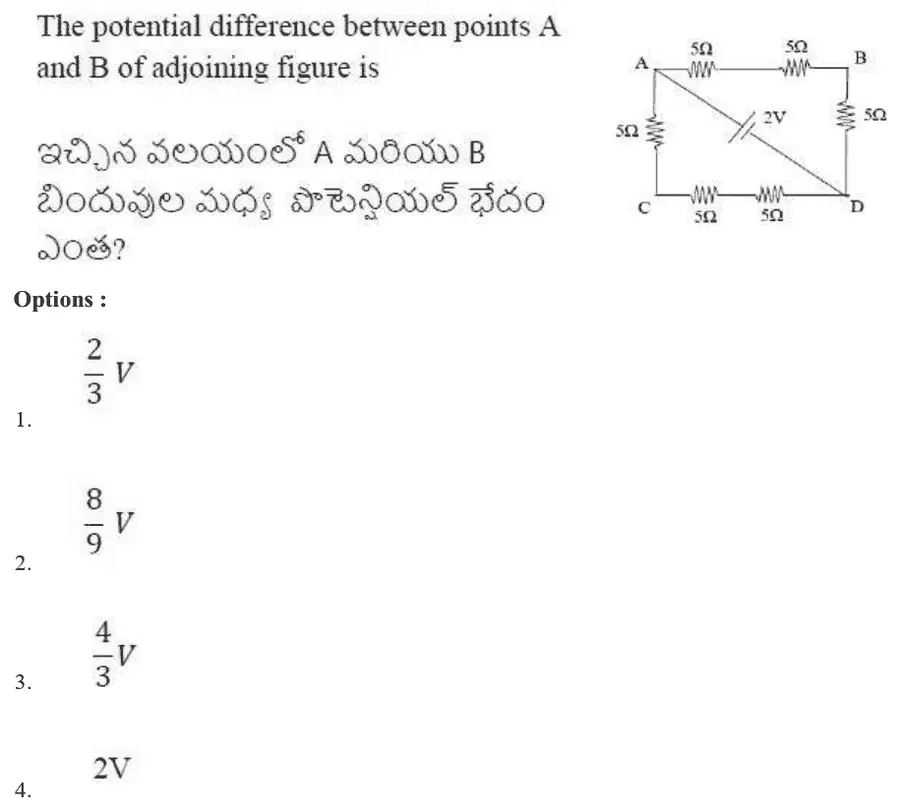
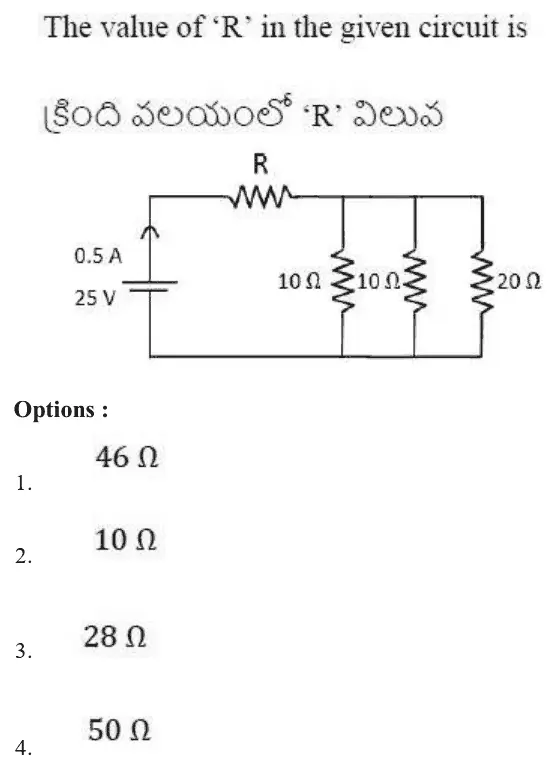
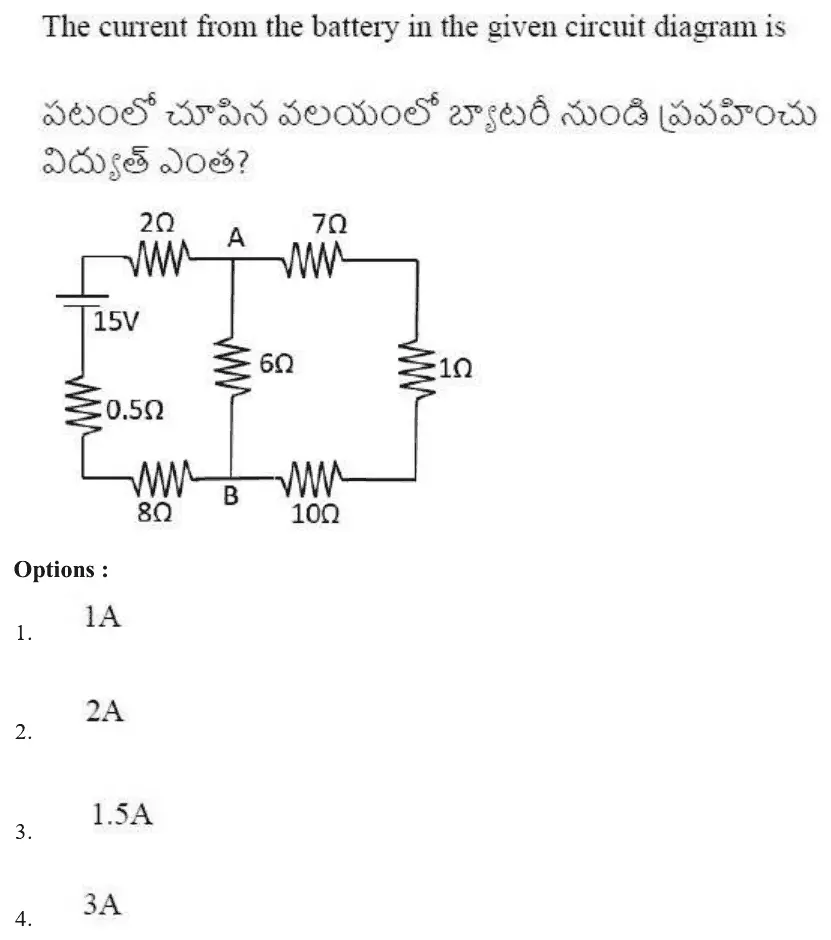
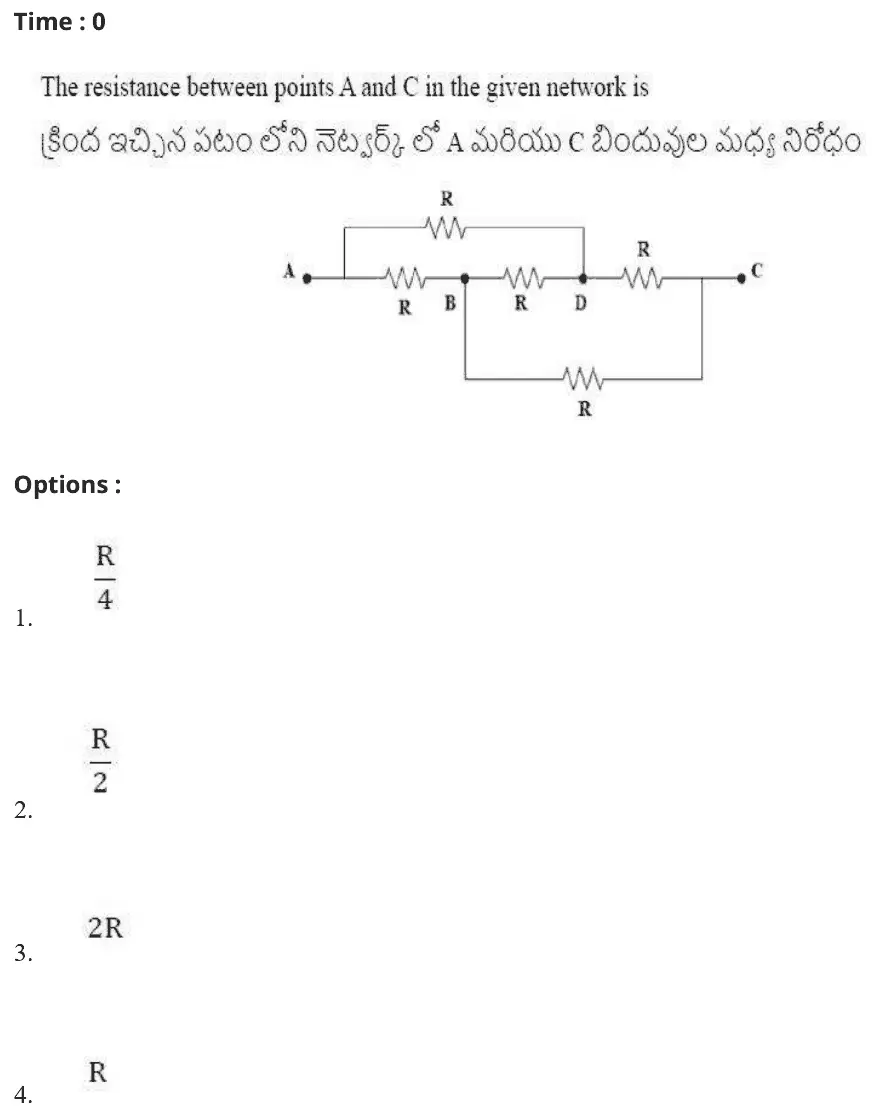
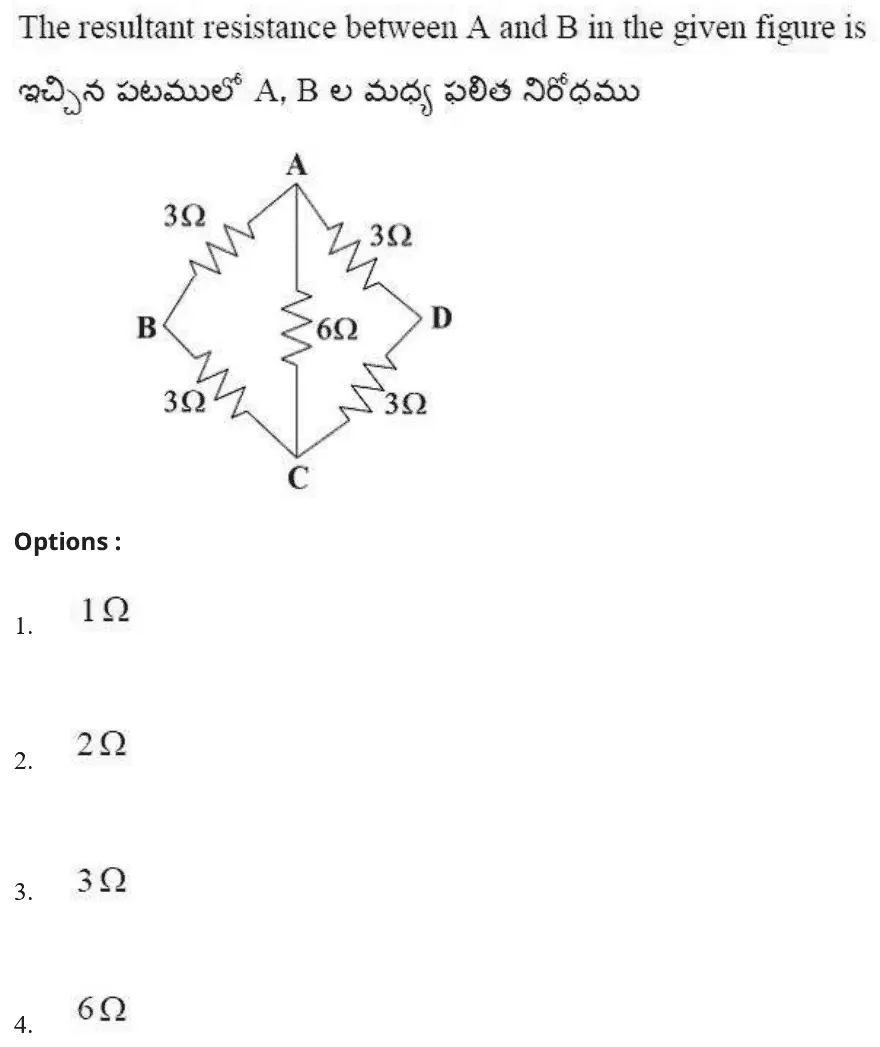
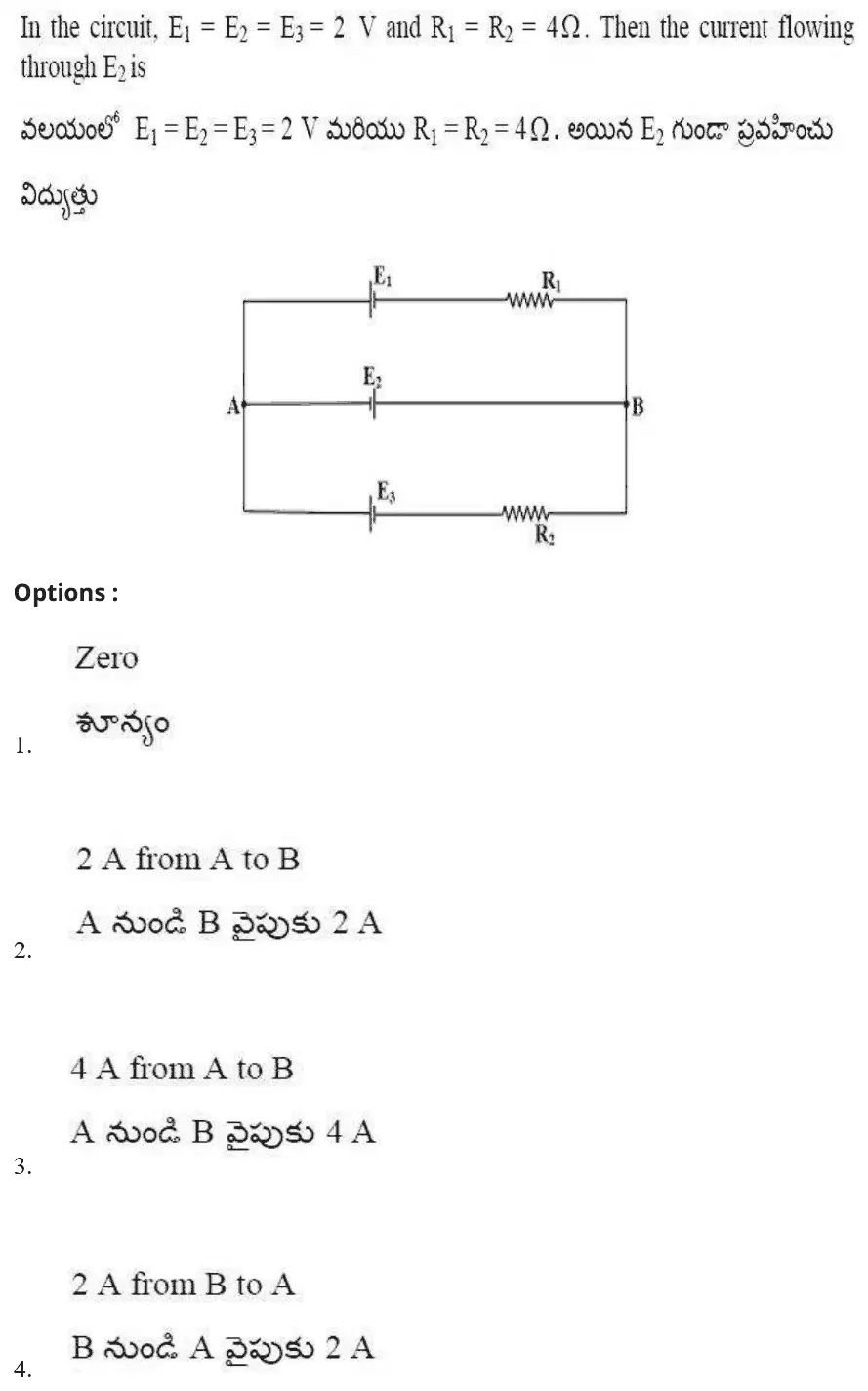
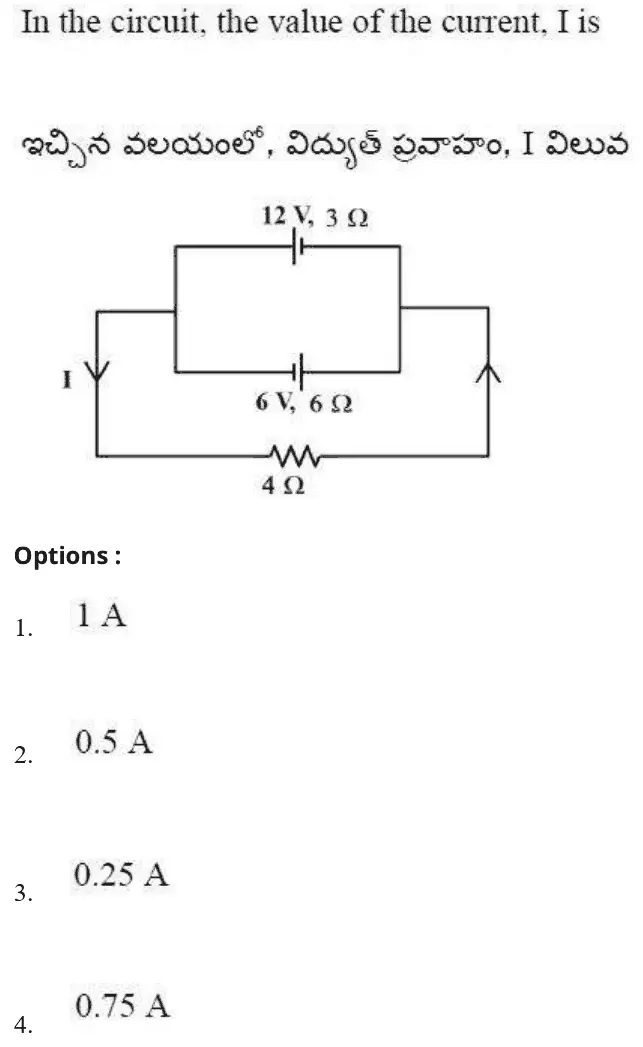
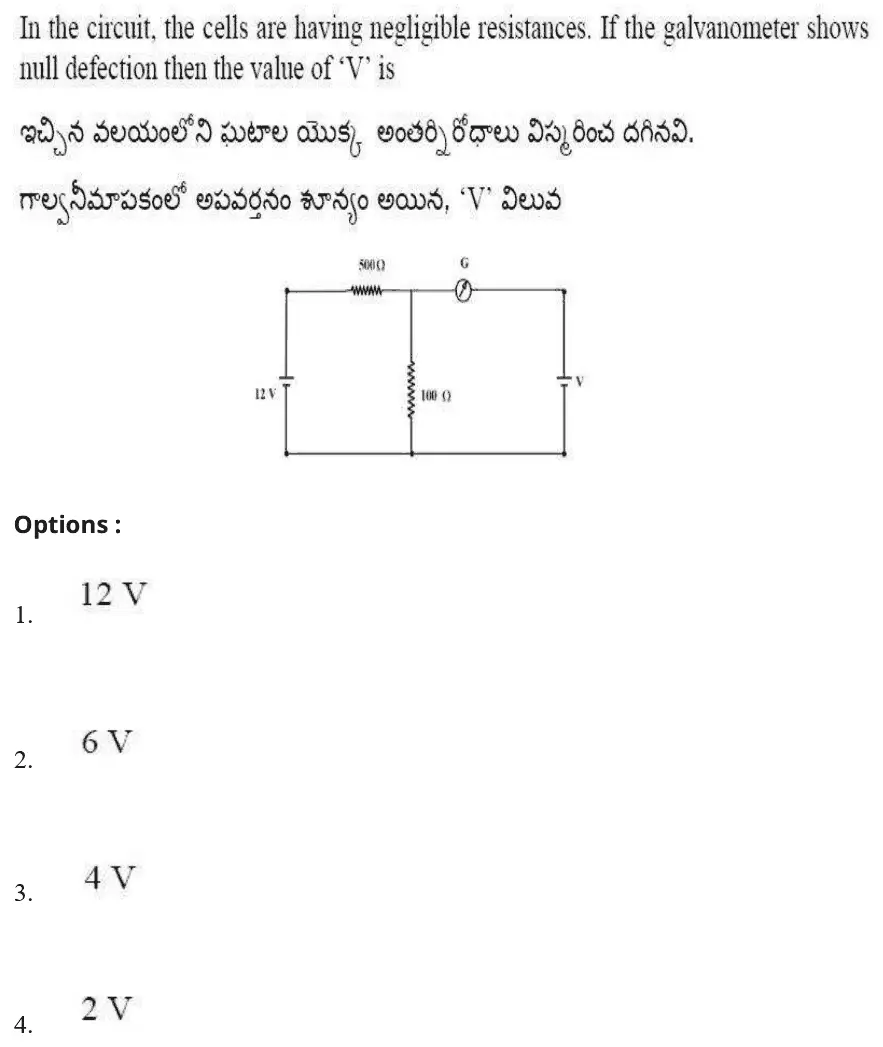
Current Electricity: AP & TS EAPCET PYQs 2010–2026
Every Current Electricity question from past AP EAPCET and TS EAPCET papers, with options and answers. Newest first.
288questions
145papers covered
5.2%of Physics questions, 2022–2026
2010–2026years
Guide at a glance
Current Electricity stands as the second most heavily tested chapter across all of physics in Class 12. In the papers we hold for AP and TS EAPCET between 2022 and 2026, this unit contributed 159 questions across 77 papers.
When two wires are connected in the two gaps of a meter bridge, the balancing point is obtained at a distance of 48.4 cm from the left end of the bridge wire. If the wire in the left gap is stretched so that its resistance increases by 3.2% and the wire in the right gap is stretched so that its length increases by 10%, then the new balancing length from the left end of the bridge wire is nearly
When an external resistor of resistance $18\ \Omega$ is connected to a cell, the current drawn from the cell is I. if another $18\ \Omega$ resistor is connected parallel to the first resistor, the current drawn from the cell increases by 90%, then the internal resistance of the cell is
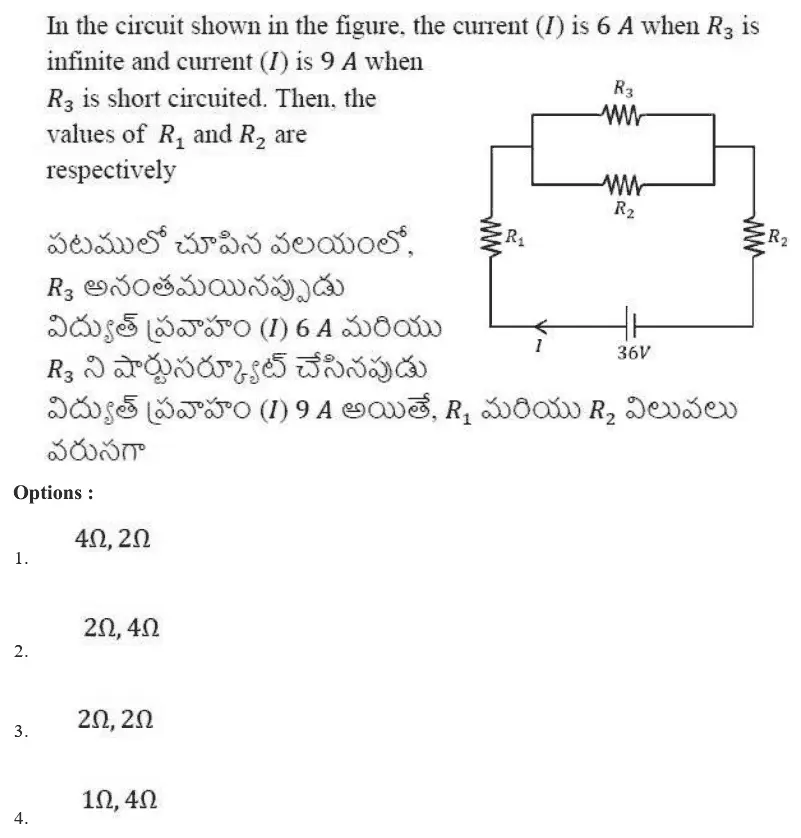
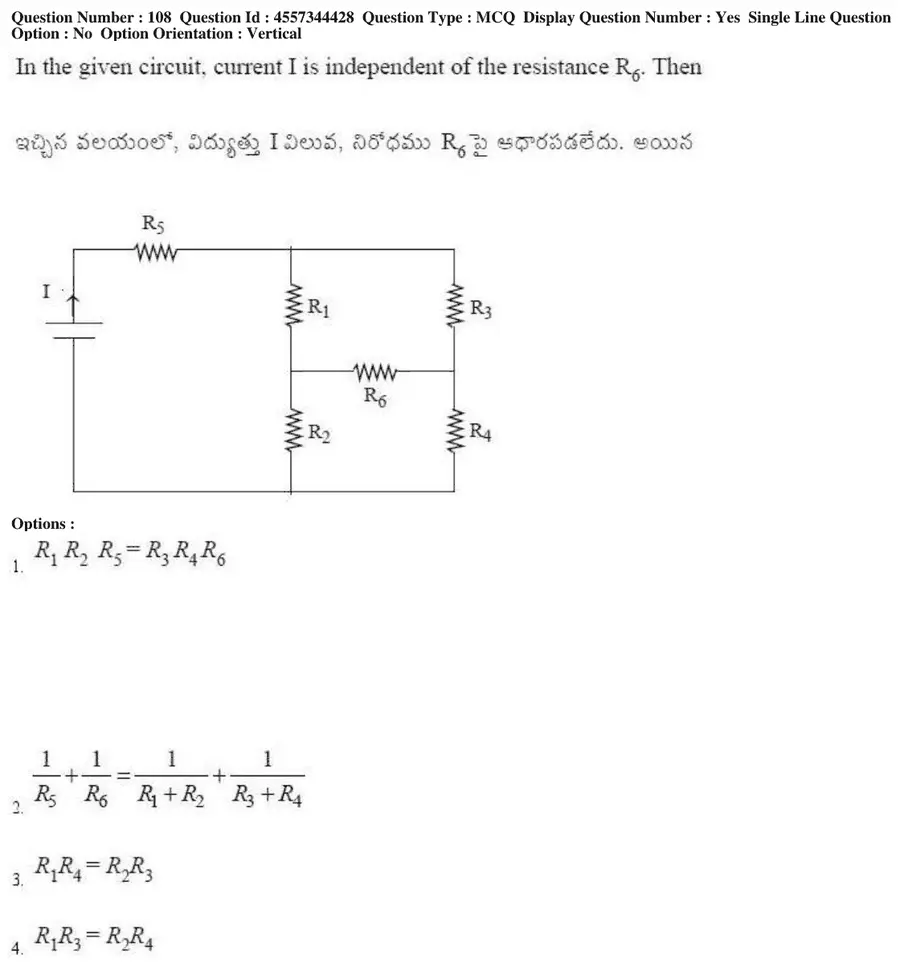
In the circuit shown in the figure, the current ($I$) is 6 $A$ when $R_3$ is infinite and current ($I$) is 9 $A$ when $R_3$ is short circuited. Then, the values of $R_1$ and $R_2$ are respectively
The balancing length of a potentiometer is at $120$ $cm$. On shunting the cell with a resistance of $4$ $ohm$, the balancing point shifts to a length of $60$ $cm$. The internal resistance of the cell is
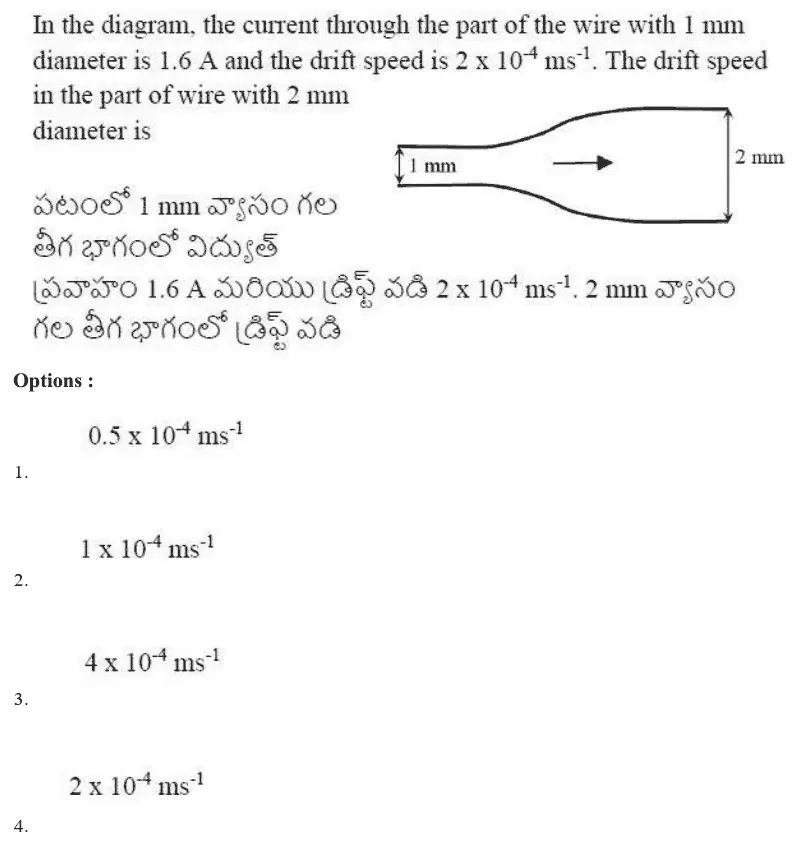
In the diagram, the current through the part of the wire with 1 mm diameter is 1.6 A and the drift speed is $2 \times 10^{-4}\ \mathrm{ms^{-1}}$. The drift speed in the part of wire with 2 mm diameter is
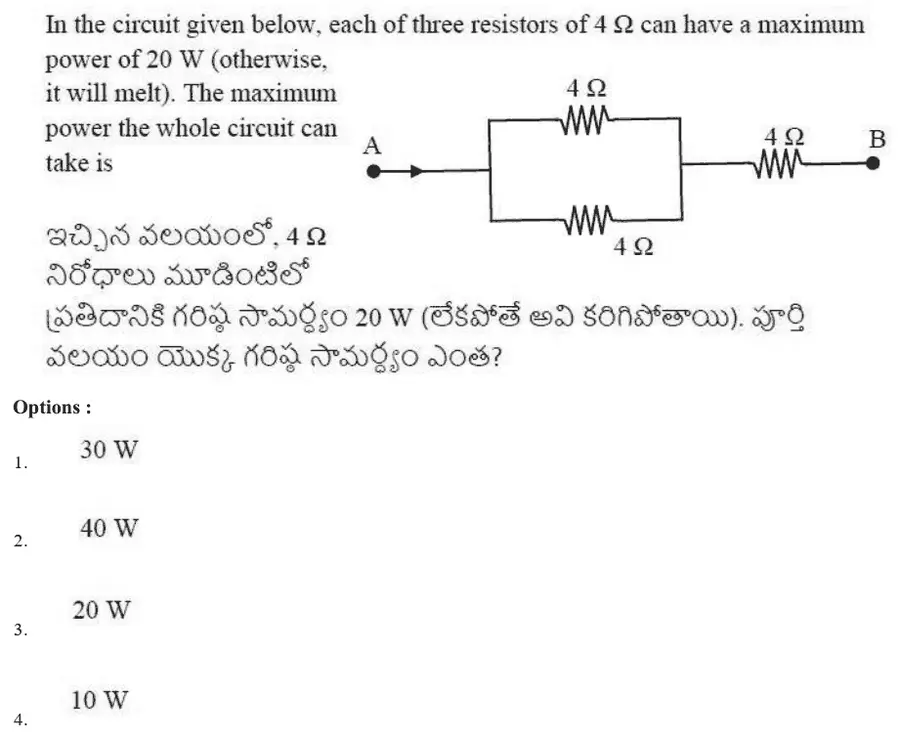
In the circuit given below, each of three resistors of $4\ \Omega$ can have a maximum power of 20 W (otherwise, it will melt). The maximum power the whole circuit can take is
A potentiometer wire is 10m long and has a resistance of 18 $\Omega$. It is connected to a battery of emf 5V and internal resistance 2 $\Omega$. Calculate the potential gradient along the wire.
When the current through a battery is 5A, the potential difference across its terminals is 9V and when the current through that battery is 3A, the potential difference across its terminals is 12V. If the same battery is connected to an external resistor of resistance $4\Omega$, then the current through the $4\Omega$ resistor is,
In a potentiometer experiment, the potentiometer wire of length 4m and resistance $20\ \Omega$ is connected in series with an external resistor of resistance $979\ \Omega$ and a cell of internal resistance $1\ \Omega$. If the emf of the cell is 1.2 V, then the length of the wire between two points where the potential difference is 12 mV is
A copper wire has a resistance of $8\ \Omega$ at $25^\circ\mathrm{C}$, and its temperature coefficient of resistivity is $6\times10^{-3}\ ^\circ\mathrm{C}^{-1}$. At $25^\circ\mathrm{C}$, it carries a current of $36\ \mathrm{mA}$ when a constant voltage is applied across its ends. If the wire is heated to $125^\circ\mathrm{C}$, what is the current flowing through the wire now?
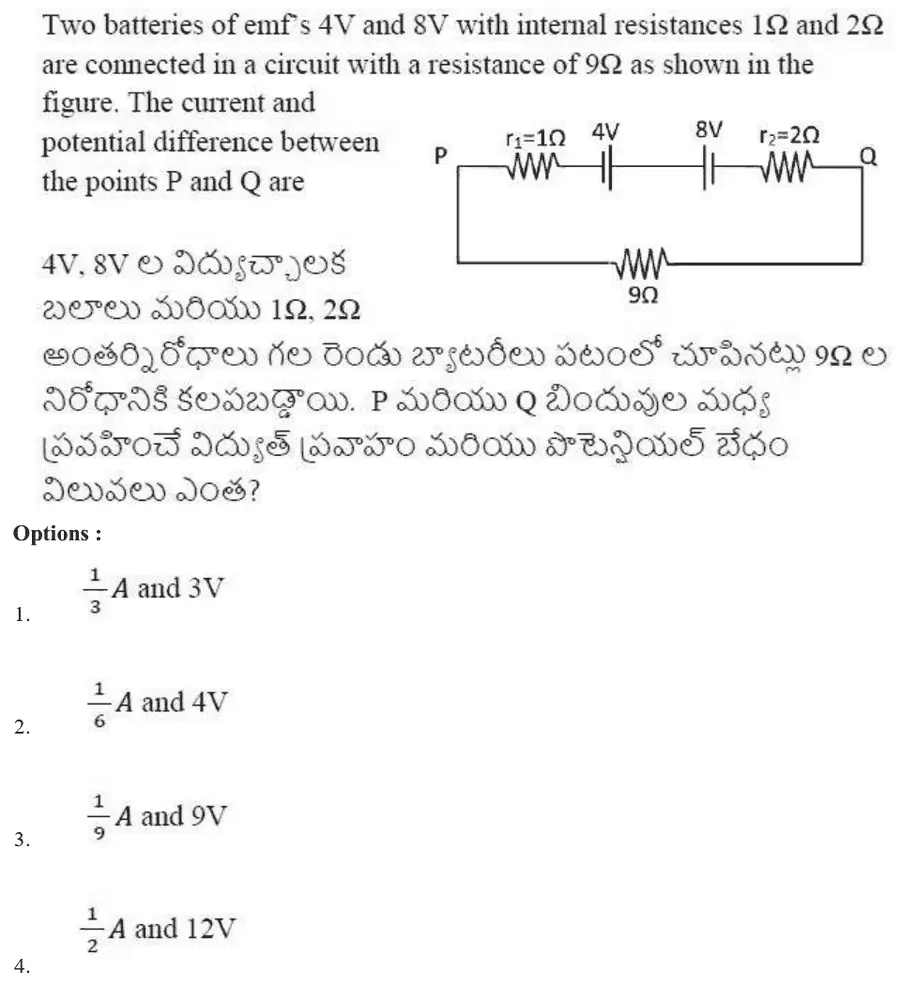
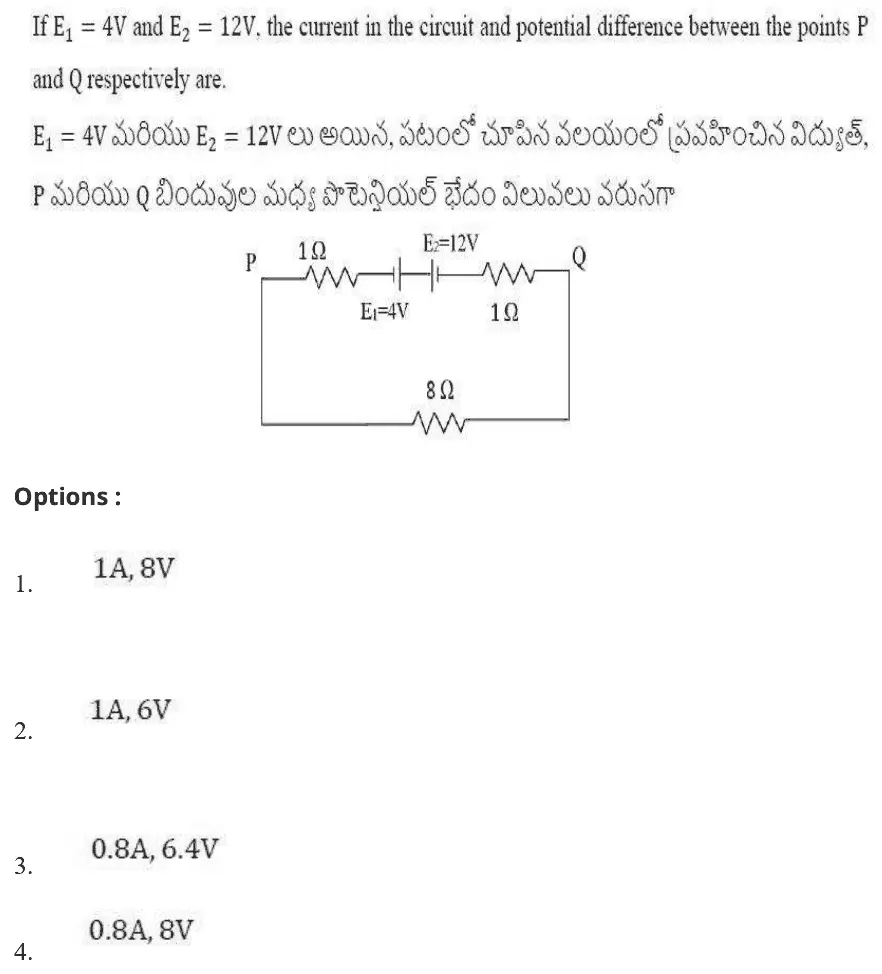
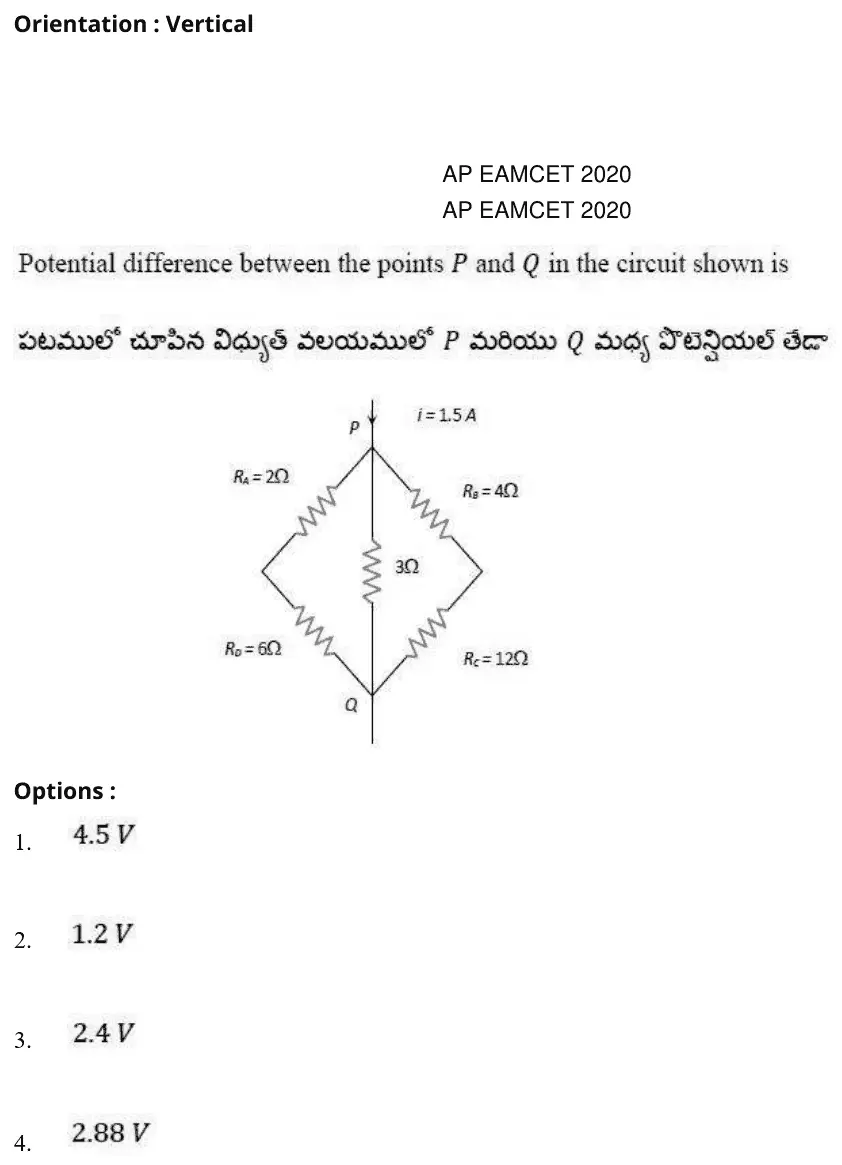
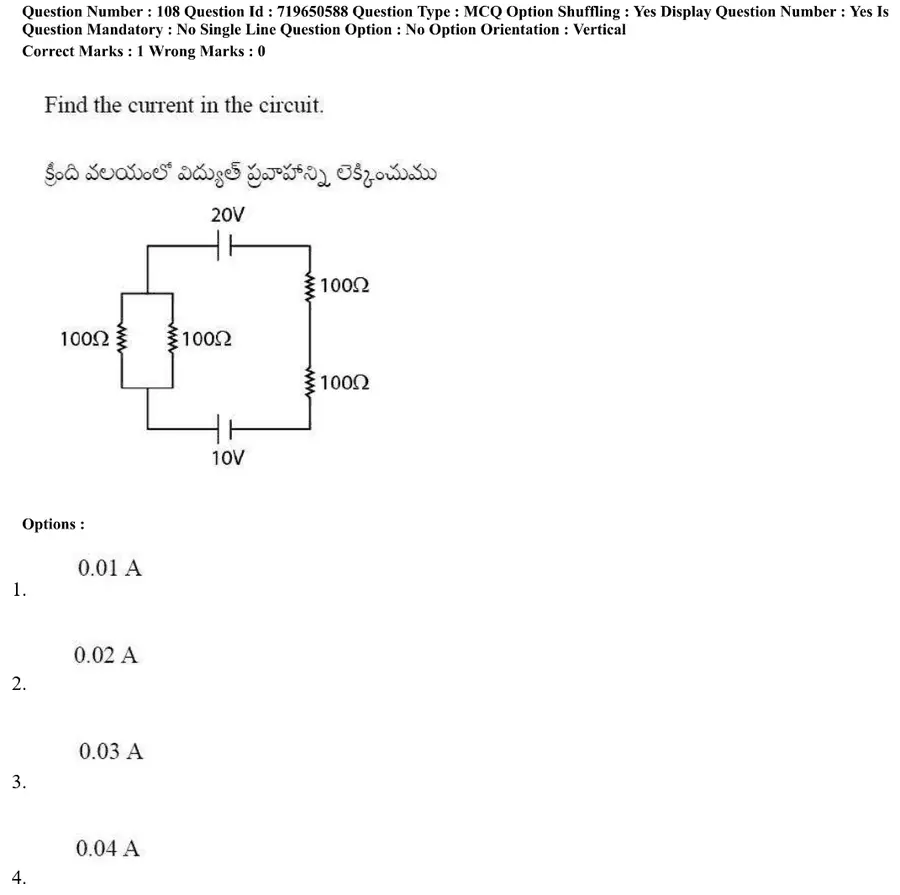
Two batteries of emf's 4V and 8V with internal resistances $1\Omega$ and $2\Omega$ are connected in a circuit with a resistance of $9\Omega$ as shown in the figure. The current and potential difference between the points P and Q are
A galvanometer has 30 divisions on its scale. It requires a potential difference of 30 mV for a current of 1 mA through its coil, which produces a deflection of one division. The shunt required to convert it into an ammeter of range 0 - 3A is
If e, m and $\tau$ are charge, mass and average collision time for an electron respectively, then the magnitude of drift velocity per unit electric field is
In a meter bridge with resistors $R_1$ and $R_2$ in the left and right gaps respectively, the balancing point is obtained at 25 cm from the left end of the bridge wire. If shunt resistances of $2\ \Omega$ each are connected to both $R_1$ and $R_2$, the balancing point shifts by 15 cm. The initial values of $R_1$ and $R_2$ respectively are
If the potential difference across the ends of a copper wire of 100 cm length is 2 V and the conductivity of copper is $5.95\times10^{7}\ \mathrm{S\,m^{-1}}$, then the current per unit area (in $\mathrm{A\,m^{-2}}$) of the conductor is
A potentiometer wire of length 10 m and resistance $9\ \Omega$ is connected to a cell of emf E and internal resistance $1\ \Omega$. If V is the maximum potential difference that can be measured using the potentiometer, then the condition for the potentiometer to work is
The potential difference between the ends of a wire at all temperatures is constant and is 240 V. When the temperature of the wire is increased from $0\ ^\circ\mathrm{C}$ to $1000\ ^\circ\mathrm{C}$, its resistance increases by $25\ \Omega$. If the temperature coefficient of resistance of the material of the wire is $1.25\times10^{-4}\ ^\circ\mathrm{C}^{-1}$, then the current through the wire at $0\ ^\circ\mathrm{C}$ is
When two resistors are connected in the two gaps of a meter bridge, the balancing point is obtained at 25 cm from the left end of the bridge wire. When a $48\ \Omega$ resistor is connected in series to the smaller of the two resistors, the balancing point is obtained at 75 cm from the left end of the bridge wire. Then the initial values of the resistors connected in the left and right gaps of the bridge are respectively
If the number density of free electrons in a copper wire is $8.5\times10^{22}\ \mathrm{cm^{-3}}$ and the relaxation time of free electrons in the wire is $2.25\times10^{-14}\ \mathrm{s}$, then the electrical conductivity of copper is (Mass of the electron $=9\times10^{-31}\ \mathrm{kg}$ and charge of the electron $=1.6\times10^{-19}\ \mathrm{C}$)
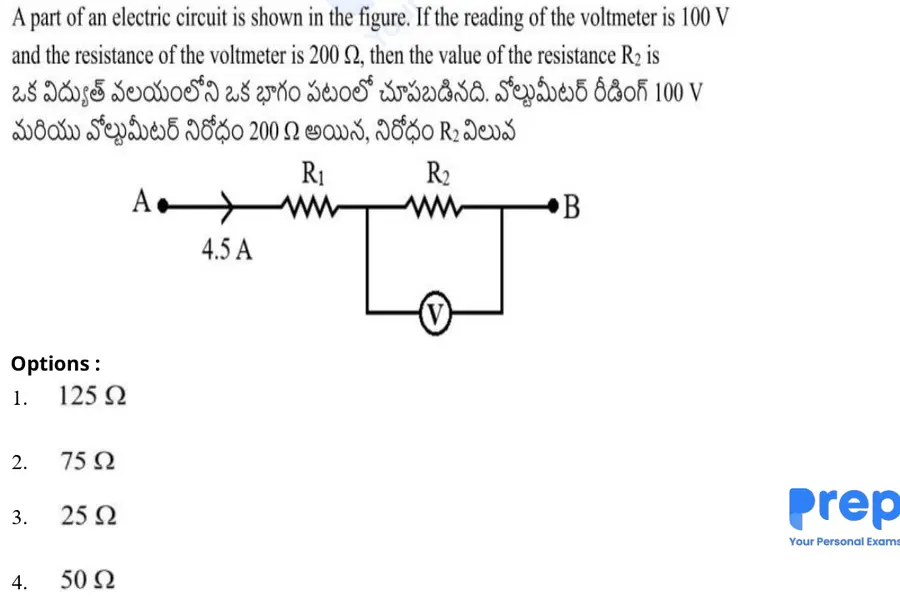
A part of an electric circuit is shown in the figure. If the reading of the voltmeter is 100 V and the resistance of the voltmeter is 200 $\Omega$, then the value of the resistance $R_2$ is
When two resistances P and Q are connected in the left and right gaps of a meter bridge respectively, then the balancing point is obtained at a distance greater than 25 cm. If the resistance P is increased by 5 $\Omega$, the balancing point shifts by 10 cm. After that if the resistance Q is halved, the balancing point further shifts by 15 cm, then the initial value of P is
The lengths of two copper wires A and B are 180 cm and 270 cm respectively. If the mass of wire A is twice the mass of wire B and the electrical resistance of wire A is 200 $\Omega$, then the electrical resistance of wire B is
When a cell is connected to either $2\ \Omega$ or $4.5\ \Omega$ resistors, if the power consumption is same in both the cases, then the internal resistance of the cell is
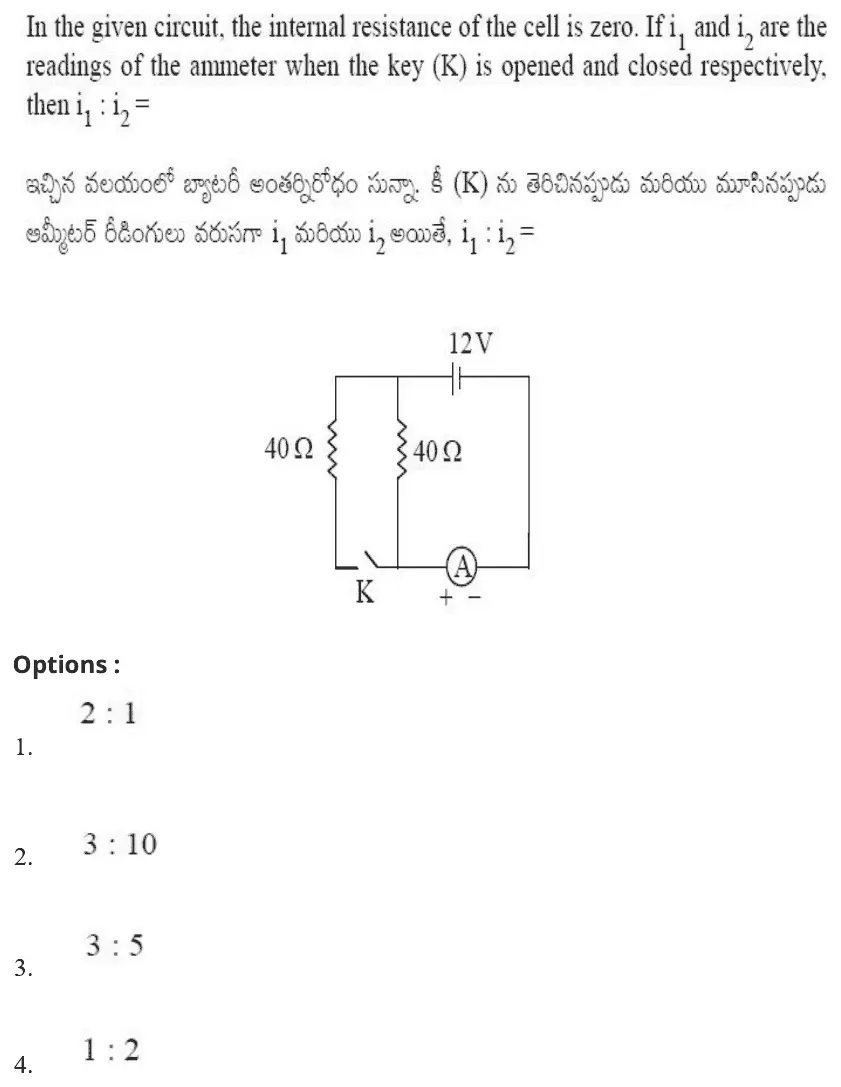
In the given circuit, the internal resistance of the cell is zero. If $i_1$ and $i_2$ are the readings of the ammeter when the key (K) is opened and closed respectively, then $i_1 : i_2 =$
In a meter bridge, the null point is located at 20 cm from left end of the wire when resistances R and S are connected in the left and right gaps respectively. If the resistance S is shunted with $60\ \Omega$ resistance, the null point shifted by 5 cm, then the values of R and S are respectively
A galvanometer having 30 divisions has a current sensitivity of $0.0625\ \frac{\mathrm{div}}{\mu \mathrm{A}}$. If it is converted into a voltmeter to read a maximum of 6 V, then the resistance of that voltmeter is
The area of cross-section of a copper wire is $4 \times 10^{-7}\ \mathrm{m^2}$ and the electrons per cubic metre in copper is $8 \times 10^{28}$. If the wire carries a current of 6.4 A, then the drift velocity of the electrons (in $10^{-3}\ \mathrm{m\ s^{-1}}$) is
When two identical batteries of internal resistance $1\,\Omega$ each are connected in series across a resistor R, the rate of heat produced in R is $\mathrm{P_1}$. When the same batteries are connected in parallel across R, the rate of heat produced is $\mathrm{P_2}$. If $\mathrm{P_1} = 2.25\,\mathrm{P_2}$, then the value of R is
The potential difference across a conducting wire of length 20 cm is 30 V. If the electron mobility is $2\times10^{-6}\ \mathrm{m^2\,V^{-1}\,s^{-1}}$, then the drift velocity of the electrons is
A maximum current of $0.5$ mA can pass through a galvanometer of resistance $15\,\Omega$. The resistance to be connected in series to the galvanometer to convert it into a voltmeter of range $0-10$ V is
A wire of resistance ‘R’ is bent in the form of a circular loop. Two points on the circle seperated by a quarter circumference are connected to a battery of emf ‘E’ and negligible internal resistance. The heat generated in the wire per second is
When a wire is connected in the left gap of a metre bridge, the balancing point is at 40 cm from the left end of the bridge wire. If the wire in the left gap is stretched so that its length is doubled and again connected in the same gap, then the balancing point from the left end of the bridge wire is
A dc supply of 160 V is used to charge a battery of emf 10 V and internal resistance $1\,\Omega$ by connecting a series resistance of $24\,\Omega$. The terminal voltage of the battery during charging is
Charge 'Q' (in coulomb) flowing through a conductor in terms of time 't' (in second) is given by the equation $Q = 3t^2 + t$. The current in the conductor at time $t = 3$ s is
In a metal, the charge carrier density is $9.1 \times 10^{28}\ \mathrm{m^{-3}}$ and its electrical conductivity is $6.4 \times 10^{7}\ \mathrm{S\ m^{-1}}$. When an electric field of $10\ \mathrm{N\ C^{-1}}$ is applied to the metal, then the average time between two successive collisions of electrons in the metal is
(Mass of electron $= 9.1 \times 10^{-31}\ \mathrm{kg}$; charge of electron $= 1.6 \times 10^{-19}\ \mathrm{C}$)
The length and area of cross-section of a copper wire are respectively $30\ \mathrm{m}$ and $6\times10^{-7}\ \mathrm{m}^2$. If the resistivity of copper is $1.7\times10^{-8}\ \Omega\ \mathrm{m}$, then the resistance of the wire is
An electric kettle takes 4 A current at 220 V. If the entire electric energy is converted into heat energy, then the time (in minutes) taken to increase the temperature of 1 kg of water from 34 °C to 100 °C is
A wire of resistance $100\ \Omega$ is stretched so that its length increases by 20%. The stretched wire is then bent in the form of a rectangle whose length and breadth are in the ratio $3:2$. The effective resistance between the ends of any diagonal of the rectangle is
In a potentiometer experiment, when two cells of emfs $E_1$ and $E_2$ ($E_2 > E_1$) are connected in series, the balancing length is 160 cm. If one of the cells is reversed, the balancing length decreases by 75%. If $E_1 = 1.2$ V, then $E_2 =$
A straight wire of resistance $18\ \Omega$ is bent in the form of an equilateral triangular loop. The effective resistance between any two vertices of the traingle is
The lengths of two wires made of the same material are in the ratio $2:3$ and their radii are in the ratio $1:2$. If the two wires are connected in parallel to a battery, then the ratio of the drift velocities of free electrons in the two wires is
In a potentiometer experiment for the determination of the internal resistance of a cell, when an external resistance of R is connected parallel to the cell, the balancing length decreases by 10%. The internal resistance of the cell is
The area of cross-section of a potentiometer wire is $6\times10^{-7}\,\mathrm{m^2}$. The potential difference per unit length of the potentiometer wire when it is connected to a cell of negligible internal resistance and a resistor in series is $0.15\,\mathrm{Vm^{-1}}$. If the current through potentiometer wire is 0.3A, then the resistivity of the material of the potentiometer wire is
The length of a potentiometer wire is 2.5 m and its resistance is 8 $\Omega$. A cell of negligible internal resistance and emf of 2.5 V is connected in series with a resistance of 242 $\Omega$ in the primary circuit. The potential difference between two points separated by a distance of 20 cm on the potentiometer wire is
The potential difference between the terminals of a cell is 20 V when a current of 2 A flows through the circuit. When the direction of current in the circuit is reversed, the potential difference between the terminals of the cell is 30 V. The internal resistance of the cell is
A straight uniform wire of resistance $36\ \Omega$ is bent in the form of a semi-circular loop. The effective resistance between the ends of the diameter of the semi-circular loop is
The drift speed of electrons in a material is found to be $0.3\,\mathrm{ms^{-1}}$ when an electric field of $2\,\mathrm{Vm^{-1}}$ is applied across it. The electron mobility (in $\mathrm{m^2\,V^{-1}\,s^{-1}}$) in the material is
In a potentiometer experiment, a wire of length 10 m and resistance $5\ \Omega$ is connected to a cell of emf 2.2 V. If the potential difference between two points separated by a distance of 660 cm on potentiometer wire is 1.1 V, then the internal resistance of the cell is
When the right gap of a meter bridge consists of two equal resistors in series, the balancing point is at 50 cm. When one of the resistors in the right gap is removed and is connected in parallel to the resistor in the left gap, the balancing point is at
In a meter bridge experiment, a resistance of $9\,\Omega$ is connected in the left gap and an unknown resistance greater than $9\,\Omega$ is connected in the right gap. If the resistance in the gaps are interchanged, the balancing point shifts by 10 cm. The unknown resistance is
Two identical cells gave the same current through an external resistance of $2\,\Omega$ regardless whether the cells are grouped in series or parallel. The internal resistance of the cells is
A battery of $emf$ $8\ \mathrm{V}$ and internal resistance $0.5\ \Omega$ is being charged by a $120\ \mathrm{V}$ dc supply using a series resister of $15.5\ \Omega$. The terminal voltage of $8\ \mathrm{V}$ battery during charging is
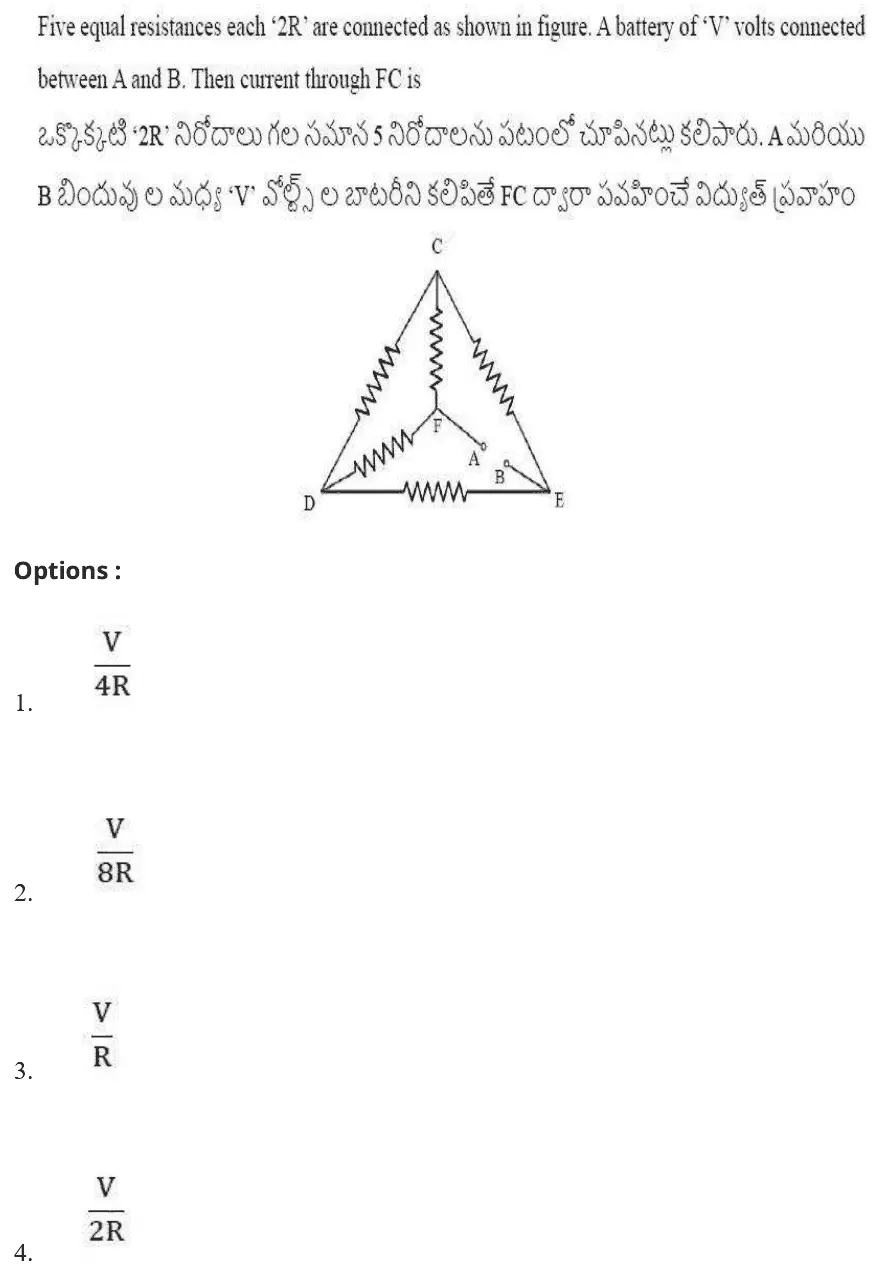
Five equal resistances each \u20182R\u2019 are connected as shown in figure. A battery of \u2018V\u2019 volts connected between A and B. Then current through FC is
A lamp is rated at 240V, 60W. When in use the resistance of the filament of the lamp is 20 times that of cold filament. The resistance of the lamp when not in use is
The charge $q$ (in coulomb) passing through a $10\ \Omega$ resistor as a function of time $t$ (in second) is given by $q = 3t^2 - 2t + 6$. The potential difference across the ends of the resistor at time $t = 5$ s is
A cell of emf $1.2\ \mathrm{V}$ and internal resistance $2\ \Omega$ is connected in parallel to another cell of emf $1.5\ \mathrm{V}$ and internal resistance $1\ \Omega$. If the like poles of the cells are connected together, the emf of the combination of the two cells is
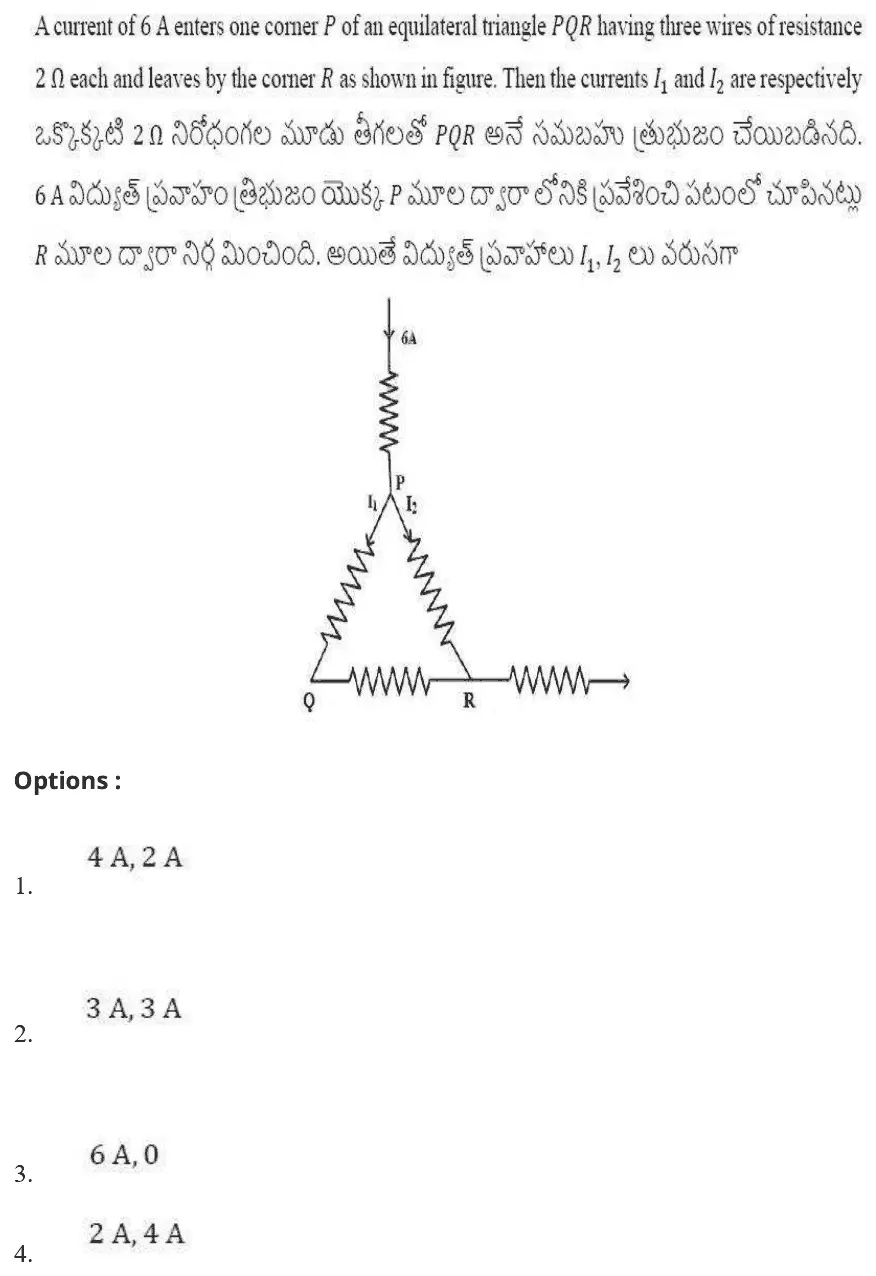
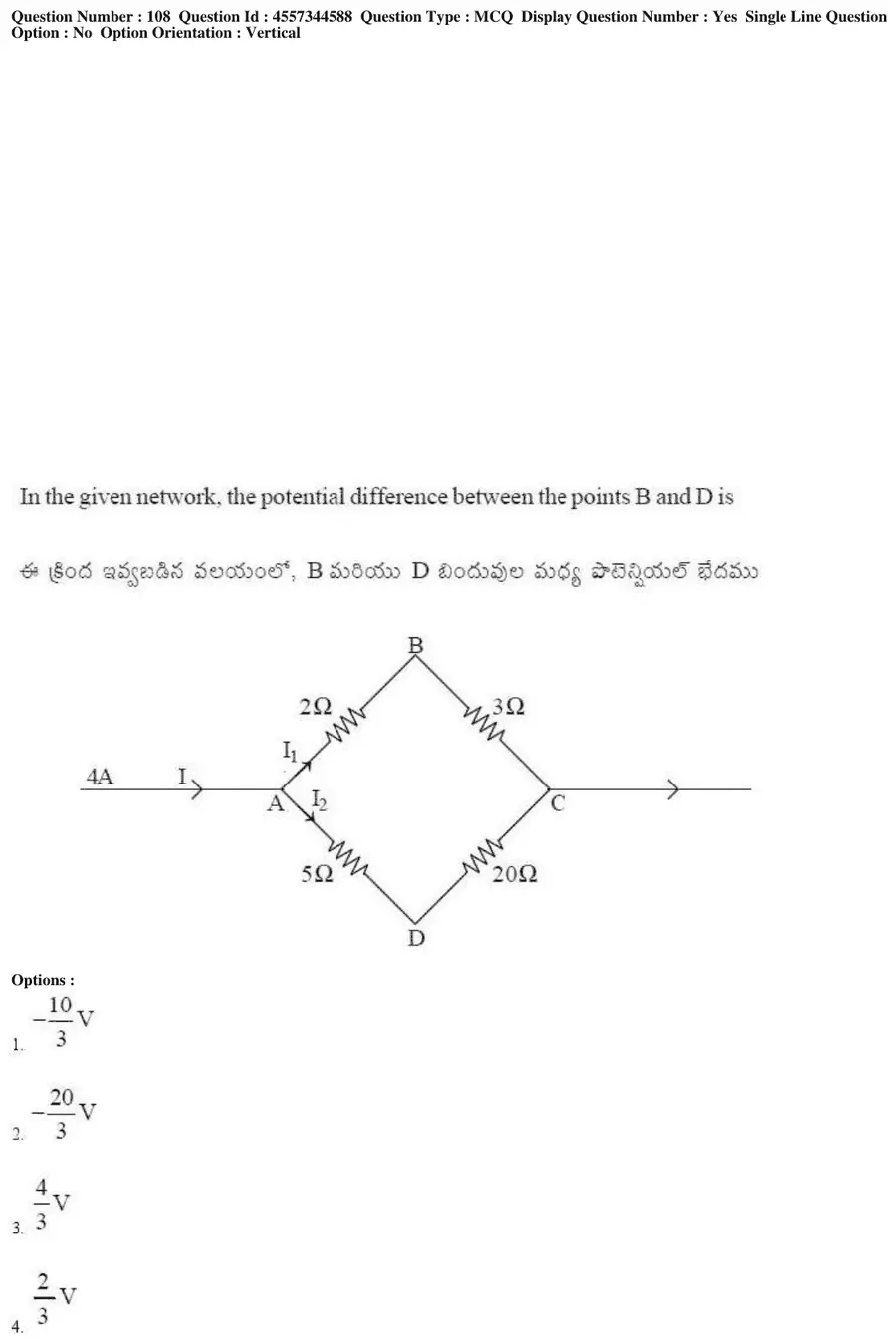
A current of 6 A enters one corner $P$ of an equilateral triangle $PQR$ having three wires of resistance $2\,\Omega$ each and leaves by the corner $R$ as shown in figure. Then the currents $I_1$ and $I_2$ are respectively
A straight wire of resistance R is bent in the shape of a square. A cell of *emf* 12 V is connected between two adjacent corners of the square. The potential difference across any diagonal of the square is
In a potentiometer, the area of cross section of the wire is $4\ \mathrm{cm^2}$, the current flowing in the circuit is $1\ \mathrm{A}$ and the potential gradient is $7.5\ \mathrm{Vm^{-1}}$, then the resistivity of the potentiometer wire is
A voltmeter of resistance $400\,\Omega$ is used to measure the emf of a cell with an internal resistance of $4\,\Omega$. The error in the measurement of emf of the cell is
When two wires are connected in the two gaps of a meter bridge, the balancing length is 50 cm. When the wire in the right gap is stretched to double its length and again connected in the same gap, then the new balancing length from the left end of the bridge wire is
A conductor of length 1.5 m and area of cross-section $3\times10^{-5}\,\mathrm{m^2}$ has electrical resistance of 15 $\Omega$. The current density in the conductor for an electric field of $21\ \mathrm{Vm^{-1}}$ is
The resistance of a wire is $2.5\ \Omega$ at a temperature $373$ K. If the temperature coefficient of resistance of the material of the wire is $3.6\times10^{-3}\ \mathrm{K^{-1}}$, its resistance at a temperature $273$ K is nearly
When two identical resistors are connected in series to an ideal cell, the current through each resistor is 2 A. If the resistors are connected in parallel to the cell, the current through each resistor is
When the temperature of a wire is increased from 303 K to 356 K, the resistance of the wire increases by 10%. The temperature coefficient of resistance of the material of the wire is
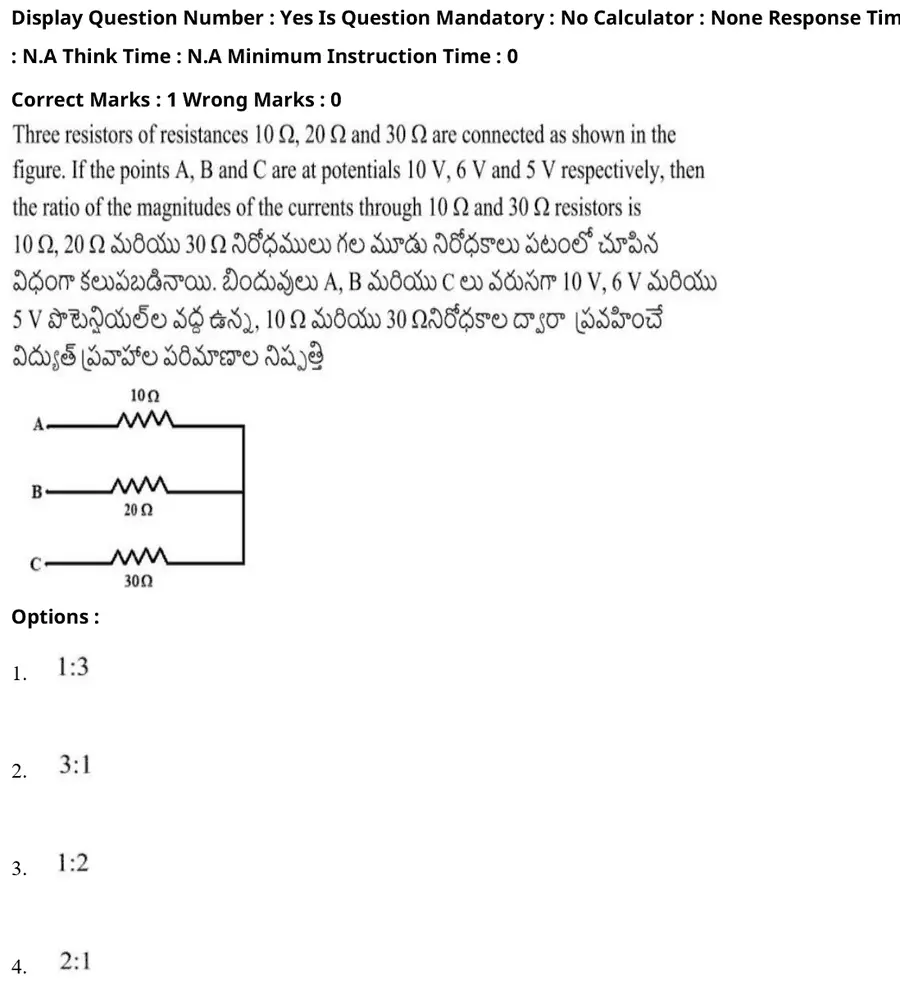
Three resistors of resistances $10\ \Omega$, $20\ \Omega$ and $30\ \Omega$ are connected as shown in the figure. If the points A, B and C are at potentials $10\ \mathrm{V}$, $6\ \mathrm{V}$ and $5\ \mathrm{V}$ respectively, then the ratio of the magnitudes of the currents through $10\ \Omega$ and $30\ \Omega$ resistors is
The potential difference between the ends of a straight conductor of length 20 cm is 16 V. If the drift speed of the electrons is $2.4\times10^{-4}\ \mathrm{ms^{-1}}$, the electron mobility in $\mathrm{m^2\,V^{-1}s^{-1}}$ is
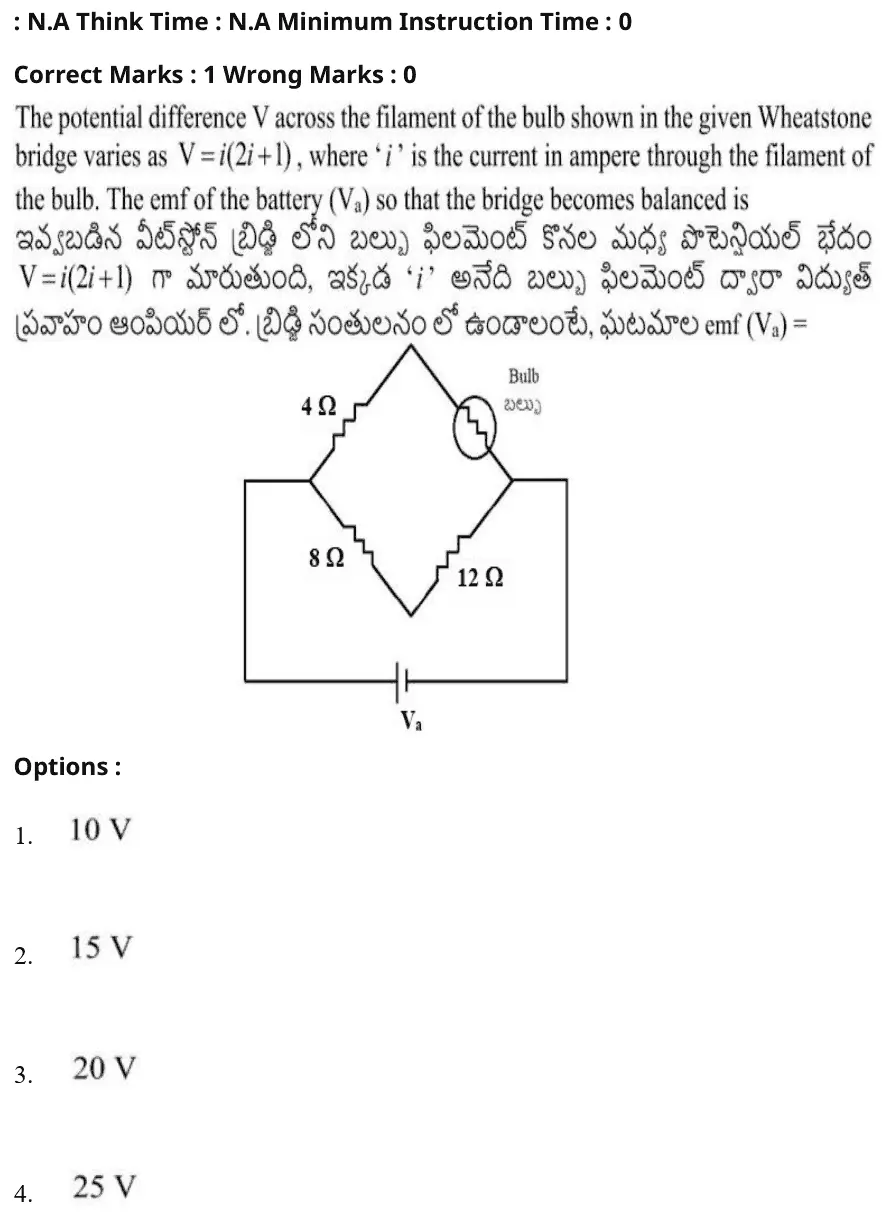
The potential difference V across the filament of the bulb shown in the given Wheatstone bridge varies as $V = i(2i+1)$, where '$i$' is the current in ampere through the filament of the bulb. The emf of the battery ($V_a$) so that the bridge becomes balanced is
In order to quadruple the resistance of a uniform wire, a part of it is uniformly stretched so that the final length of the wire becomes 1.5 times the original length. The fractional length of the stretched part is
Two cells with same emf $E$ but different internal resistances, $r_1$, and $r_2$ are connected in series to an external resistance $R$. If the potential difference across the first cell is zero then the value of $R$ is
Two metal wires of same length, same area of cross-section have conductivities of their material $\sigma_1$ and $\sigma_2$. If they are connected in series, the effective conductivity is
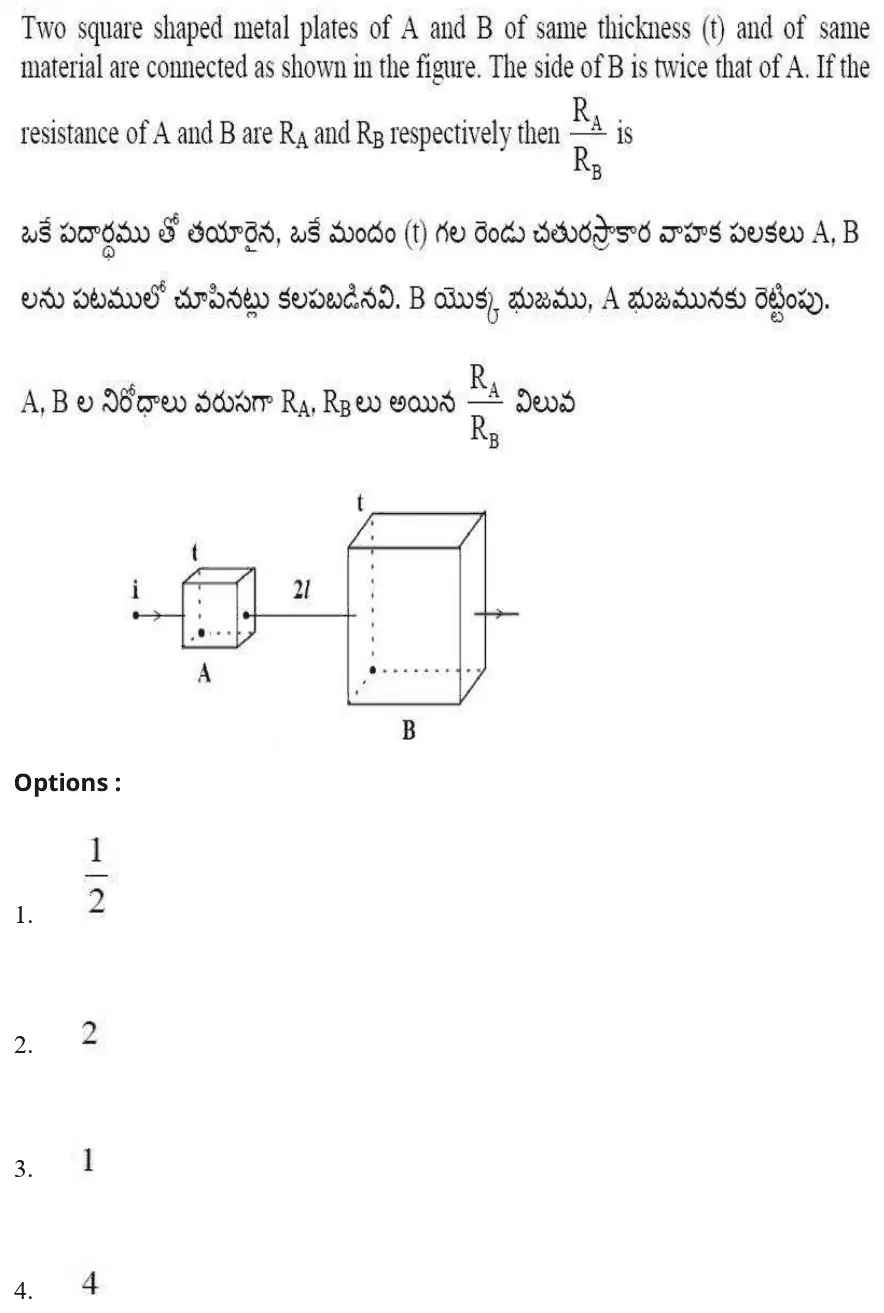
Two square shaped metal plates of A and B of same thickness (t) and of same material are connected as shown in the figure. The side of B is twice that of A. If the resistance of A and B are $R_A$ and $R_B$ respectively then $\frac{R_A}{R_B}$ is
Two resistances are connected in the two gaps of a meter bridge. The balancing point is obtained at 20 cm. When a resistance of $15\,\Omega$ is connected in series with the smaller resistance of the two, the balancing point shifts to 40 cm. The value of smaller resistance is
A uniform metal wire carries a current of 2 A when an ideal cell of 3.4 V is connected across it. The wire has mass $8.92\times10^{-3}$ kg, density $8.92\times10^{3}$ kgm$^{-3}$ and resistivity $1.7\times10^{-8}\,\Omega$m. Then the length of the wire is
When a resistance $R_1$ is connected across a cell, the current is $I_1$ and if the resistance $R_1$ is replaced by $R_2$, the current is $I_2$. Then the internal resistance of the cell is
Charge passing through a conductor of cross-section $0.3\ \mathrm{m^2}$ is given by $q=(3t^2+5t+2)\,\mathrm{C}$ where 't' is in seconds. The drift velocity at $t = 2\ \mathrm{s}$ is (Concentration of electrons in the conductor $= 2\times10^{25}\,\mathrm{m^{-3}}$)
The drift velocity of electrons in a conducting wire connected to a cell is $V_d$. If the length of the wire is doubled and area of cross-section is halved then the drift velocity of electrons becomes
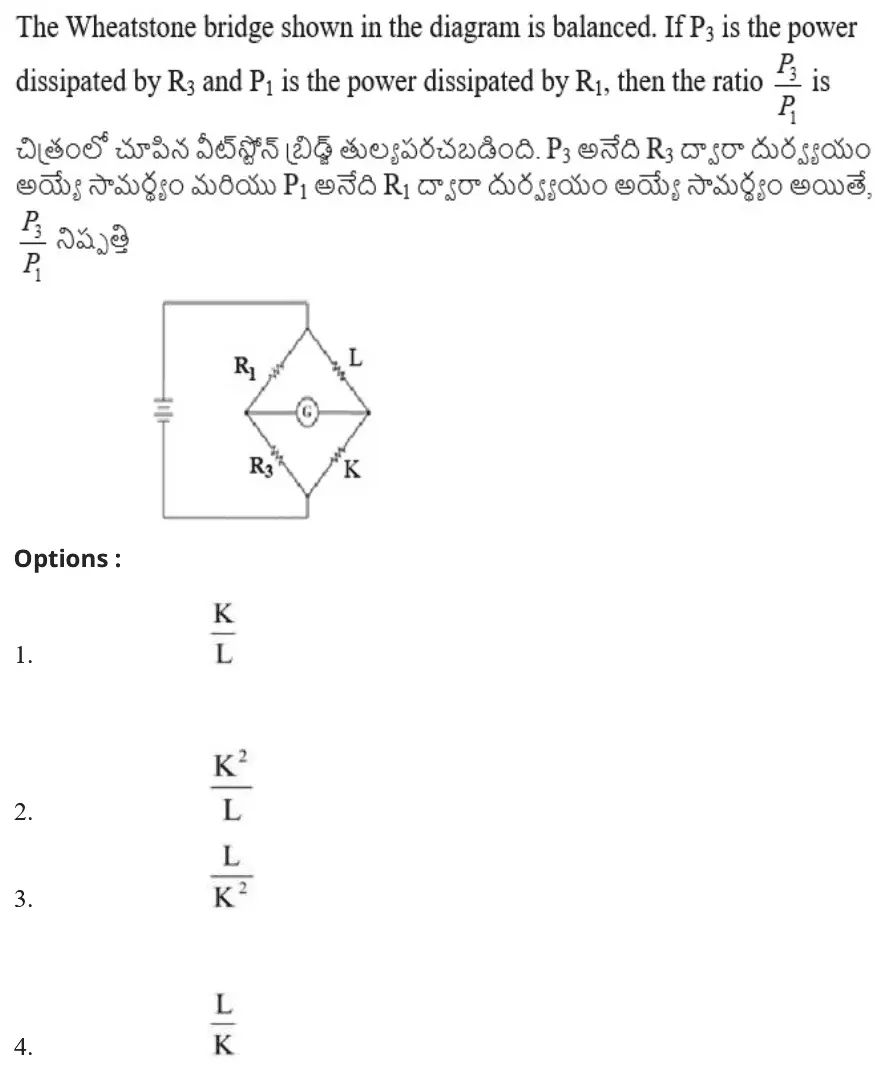
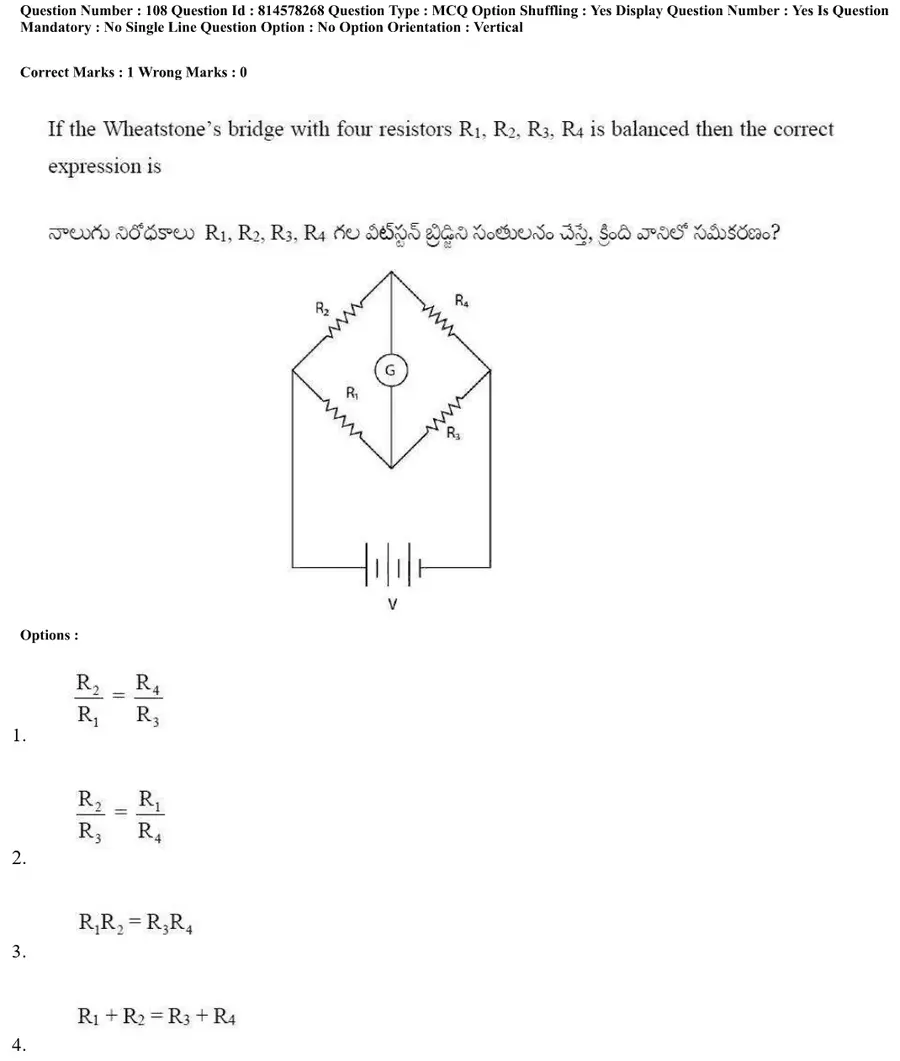
The Wheatstone bridge shown in the diagram is balanced. If $\mathrm{P_3}$ is the power dissipated by $\mathrm{R_3}$ and $\mathrm{P_1}$ is the power dissipated by $\mathrm{R_1}$, then the ratio $\frac{P_3}{P_1}$ is
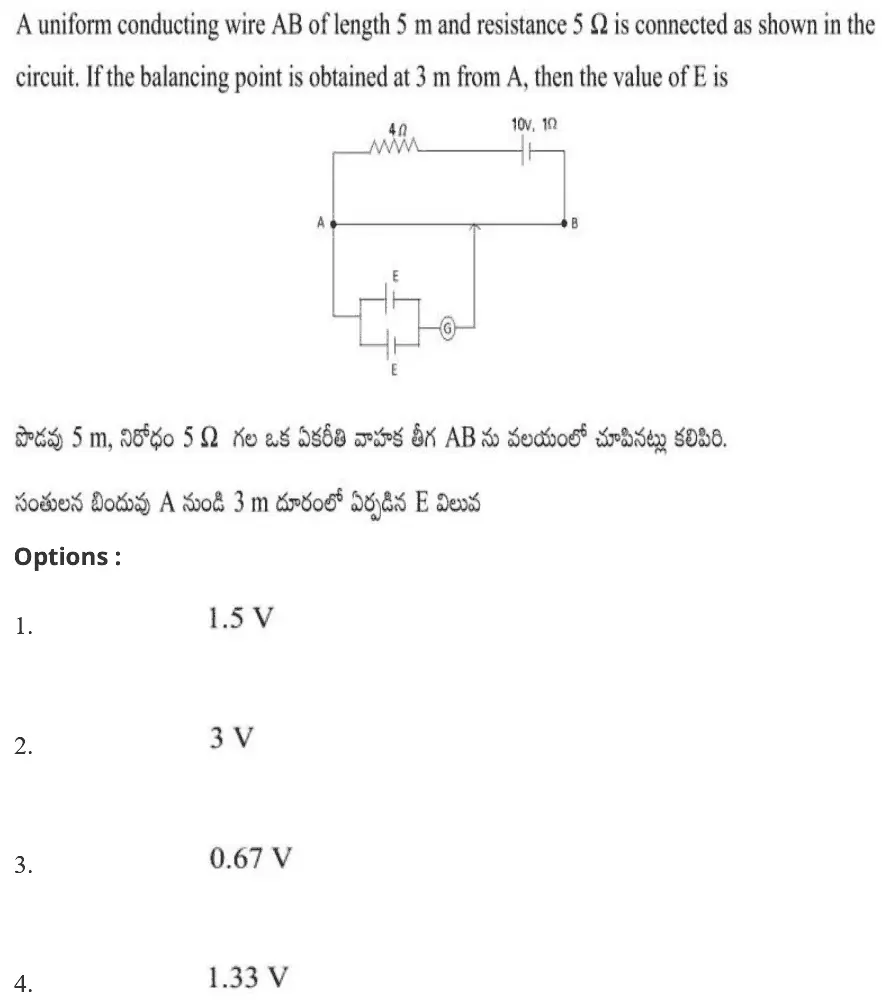
A uniform conducting wire AB of length 5 m and resistance 5 $\Omega$ is connected as shown in the circuit. If the balancing point is obtained at 3 m from A, then the value of E is
In a galvanometer, 5% of the total current in the circuit passes through it. If the resistance of the galvanometer is $G$, the shunt resistance $S$ connected to the galvanometer is
If the masses of three wires of same material are in the ratio of 1:2:3 and their lengths are in the ratio of 3:2:1, then electrical resistances of these wires are in the ratio
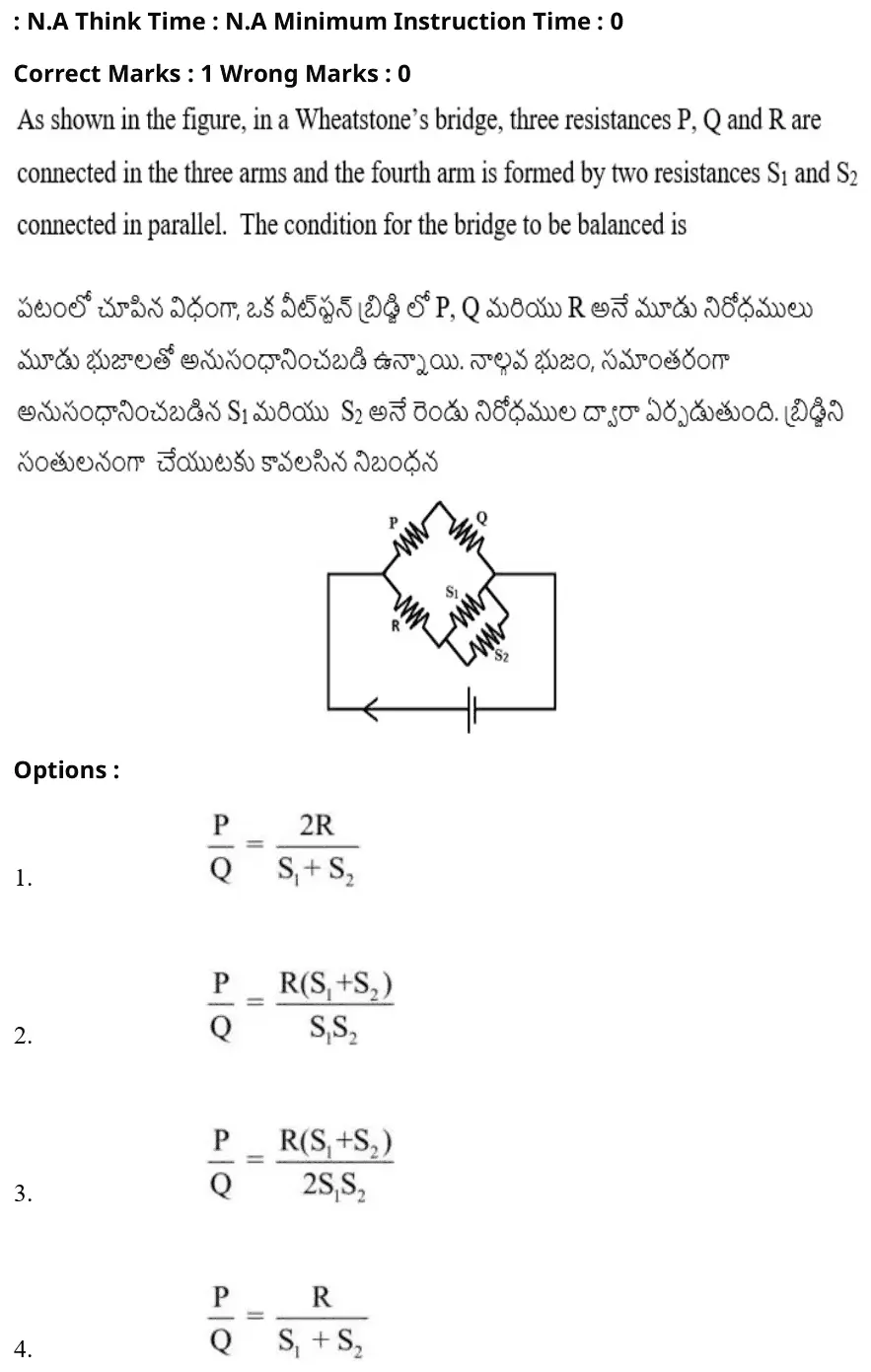
As shown in the figure, in a Wheatstone’s bridge, three resistances P, Q and R are connected in the three arms and the fourth arm is formed by two resistances $S_1$ and $S_2$ connected in parallel. The condition for the bridge to be balanced is
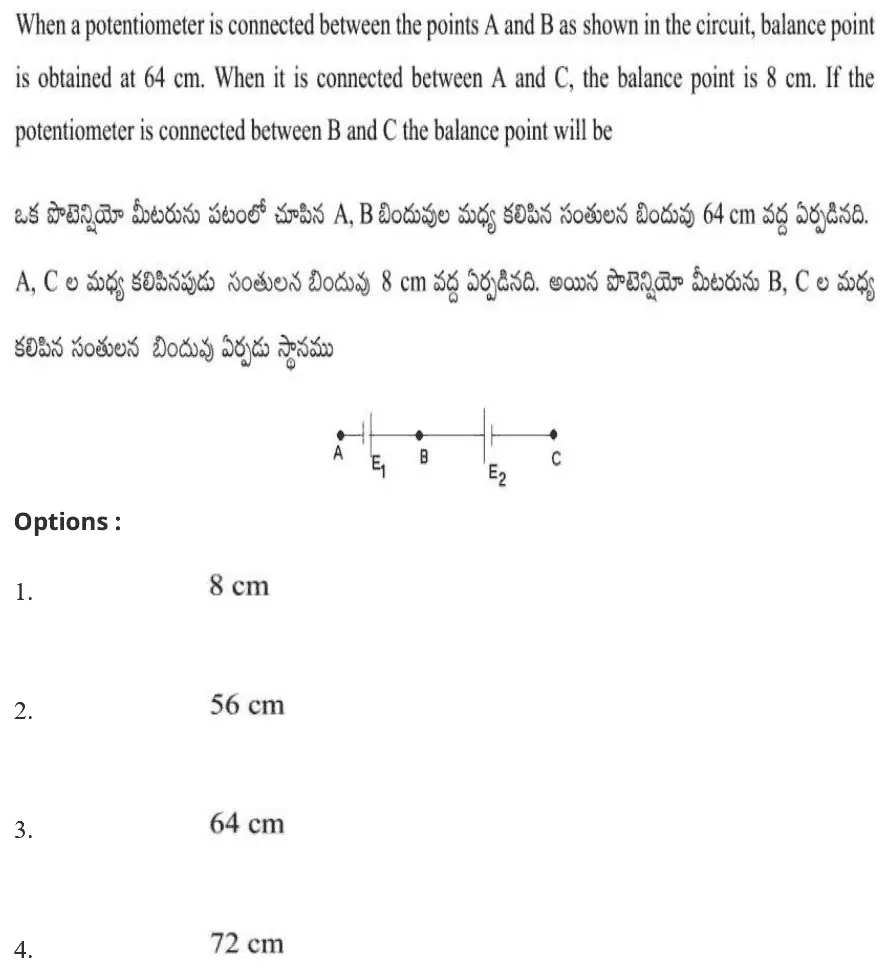
When a potentiometer is connected between the points A and B as shown in the circuit, balance point is obtained at 64 cm. When it is connected between A and C, the balance point is 8 cm. If the potentiometer is connected between B and C the balance point will be
A potentiometer balances at 44 cm when a cell of internal resistance $1\ \Omega$ is in the secondary circuit. To obtain the balancing point at 40 cm, the resistance to be connected parallel to cell is
Two wires made of the same material have lengths in the ratio $2:3$ and radii in the ratio $8:9$. If the same potential difference is applied across the ends of the wires, the ratio of the electric currents flowing through them is
Statement I : Specific resistance depends on nature of material and independent of temperature of the material. Statement II : A wire of resistance 6 $\Omega$ is drawn out so that its new length is four times its original length. The resistance of the new wire is 48 $\Omega$. Statement III : Drift velocity is the average constant velocity acquired by free electrons inside a metal by the application of an electric field which results in current. Which of the following is correct?
A
Statements I, II and III are true
B
Statement I is true, but, Statements II, III is false
C
Statement III is true, but Statements I, II are false
D
Statements II, III are true but Statement I is false
Find the mobility of electron in a wire, if its average collision time is $9.1 \times 10^{-15}$ s. (charge of electron = $1.6 \times 10^{-19}$ C and mass of electron = $9.1 \times 10^{-31}$ kg)
The time required to raise the temperature of 3 litre of water from $0\ ^\circ$C to $80\ ^\circ$C by a heater operated under 200 V having resistance of $50\ \Omega$ is [specific heat capacity of water is $4200\ \mathrm{J\,kg^{-1}K^{-1}}$] [ density of water = $1000\ \mathrm{kg/m^3}$]
The current density in a circular wire is given by $J(r)=(1\times10^5\ A/m^3)r$, where $r$ is the radial distance and the wire's radius is 2 mm. If the potential applied across the wire is 70 V, then the energy consumed by the wire in 1000 seconds is
A metal has $9\times10^{28}$ conduction electrons per m$^3$ and its resistivity is $1\times10^{-8}\ \Omega$.m. If the drift speed of an electron in the metal is $1.6\times10^{6}$ m/s then its mean free path is (mass of electron $=9\times10^{-31}$ kg and charge of electron $=1.6\times10^{-19}$C)
The resistivity of a metal is $1\times10^{-8}\ \Omega$m. If it contains $9\times10^{28}$ electrons per m$^3$ then the relaxation time of electrons inside the metal is nearly (electron mass $=9\times10^{-31}$ kg )
Statement (I) : The temperature coefficient of resistance for most of metals in pure form is positive. Statement (II) : A metal wire 2 mm in diameter carries a charge of $360\,\pi$ C in two hours. If the metal contains $5\times10^{22}$ free electrons / $\mathrm{cm^{3}}$, then drift velocity of the electrons in the wire is $6.25\times10^{-6}$ m/s. Statement (III) : Semiconductors like pure germanium does not obey Ohm's law for all range of electric field values. Which of the following is correct?
A
Statements I, II, III are true
B
Statements I, II are true, but statement III is false
C
Statements II, III are true, but statement I is false
A cylindrical resistor of radius 7.0 mm and length 4.0 cm is made of material that has a resistivity of $10^{-6}\ \Omega$.m. If the energy is dissipated at rate 1.54 W in the resistor, then the current density is
A metal wire of length L and radius r has a resistance R. If a wire of the same metal of length 2L and radius 3r is taken, then what will be its resistance?
Balancing point of a potentiometer shifts from a length of 60 cm to 40 cm by shunting the cell with a 4 ohm resistance. What is the internal resistance of the cell?
A cylindrical metallic wire is stretched to increase its length in such a way that the metallic wire changes its resistance by 6%. The percentage increase in its length is
The power consumed when 10 V voltage is applied to a series combination of 10 resistors of each $1\ \Omega$ is $P_s$ and the power consumed when the same 10 V is applied to the parallel combination of these 10 resistors is $P_p$. The value of $\frac{P_s}{P_p}$ is
A battery of emf 12 V and internal resistance $4\ \Omega$ is connected to a resistor. The resistance of the resistor if the current in the circuit is 0.8 A is
A heating element is designed to dissipate 2400 W when connected to 240 V. The power it dissipates when it is connected to 120 V is (Assume that resistance of the filament is constant)
Two wires A and B of same material having length $L_A$, $L_B$ and radii $R_A$, $R_B$ and drift velocity $V_A$, $V_B$ respectively carries same current. If $L_A = L_B$ and $R_A = 2R_B$ then the value of $\left(\dfrac{V_A}{V_B}\right)$ is
Two cells A and B are connected in the secondary circuit of a potentiometer one at a time and the balancing lengths are respectively 360 cm and 420 cm. If emf of A is 2.4 V, the emf of the second cell B is
A $8\ \Omega$ resistor is connected to a battery that has an internal resistance of $0.2\ \Omega$. If the voltage across the battery (the terminal voltage) is 10 V, then the emf of the battery is
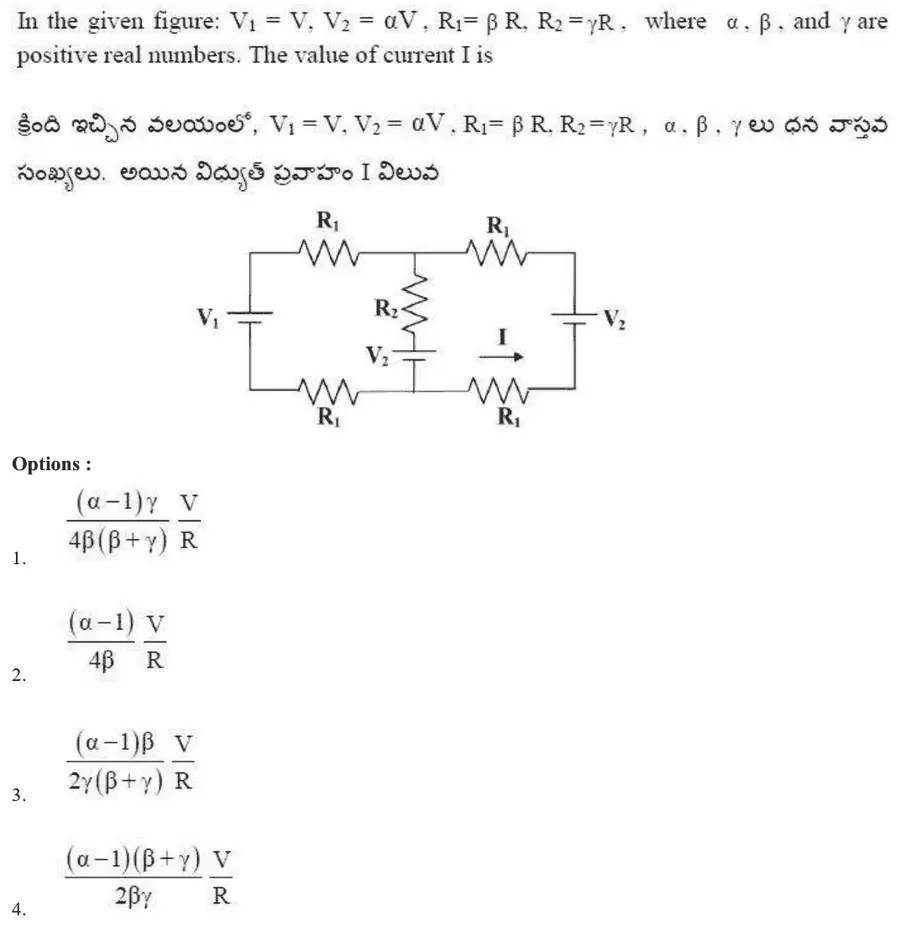
In the given figure: $V_1 = V$, $V_2 = \alpha V$, $R_1 = \beta R$, $R_2 = \gamma R$, where $\alpha$, $\beta$, and $\gamma$ are positive real numbers. The value of current I is (see the figure above)
A metal wire of 1 cm length and 1 mm radius has a resistance of $3\times10^{-3}\ \Omega$. If a wire of the same metal of length 3 cm and radius 0.5 mm is drawn, the resistance of the wire
A galvanometer has a coil of resistance $100\ \Omega$ showing a full scale deflection at $50\ \mu\mathrm{A}$. The resistance that should be added to use it as an ammeter of range 10 mA is
The resistance of a wire at $0\ ^\circ\mathrm{C}$ is $20\ \Omega$. If the temperature coefficient of the resistance is $5\times10^{-3}\ ^\circ\mathrm{C^{-1}}$. The temperature at which the resistance will be double of that at $0\ ^\circ\mathrm{C}$ is
A battery with a 12 V emf has an initial charge of 80 A.h. If the potential across the terminals stays constant until battery is completely discharged, then this battery can deliver energy at the rate of 120 W for a time
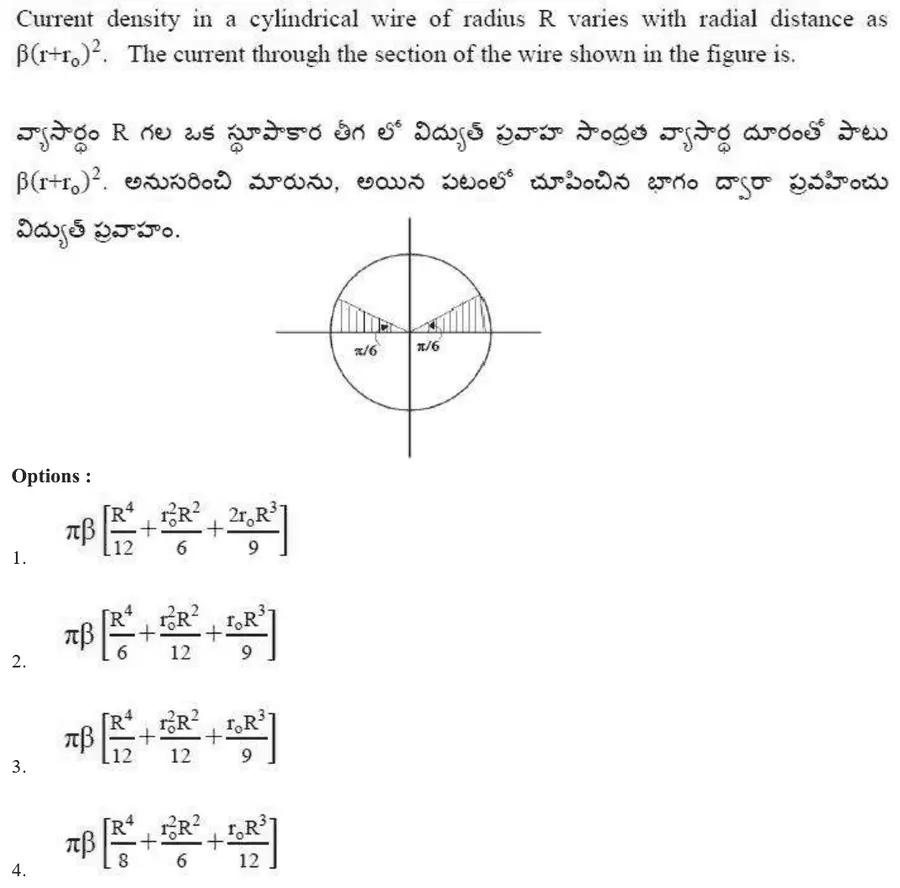
Current density in a cylindrical wire of radius R varies with radial distance as $\beta(r+r_o)^2$. The current through the section of the wire shown in the figure is. (see the figure above)
An electron takes $40\times10^3$ s to drift from one end of a metal wire of length 2 m to its other end. The area of cross-section of the wire is $4\ \mathrm{mm^2}$ and it is carrying a current of 1.6 A. The number density of free electrons in the metal wire is
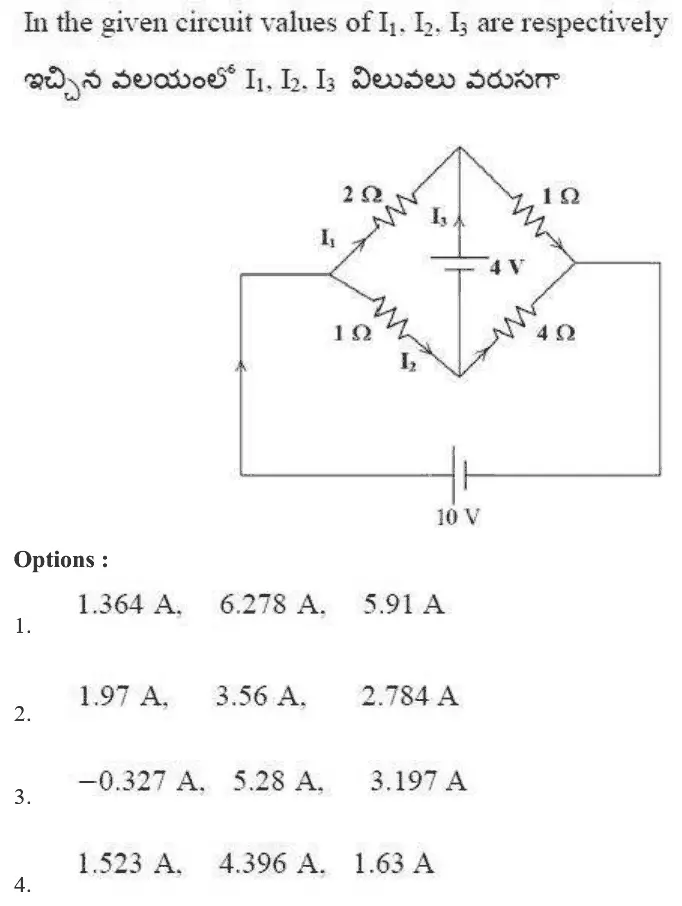
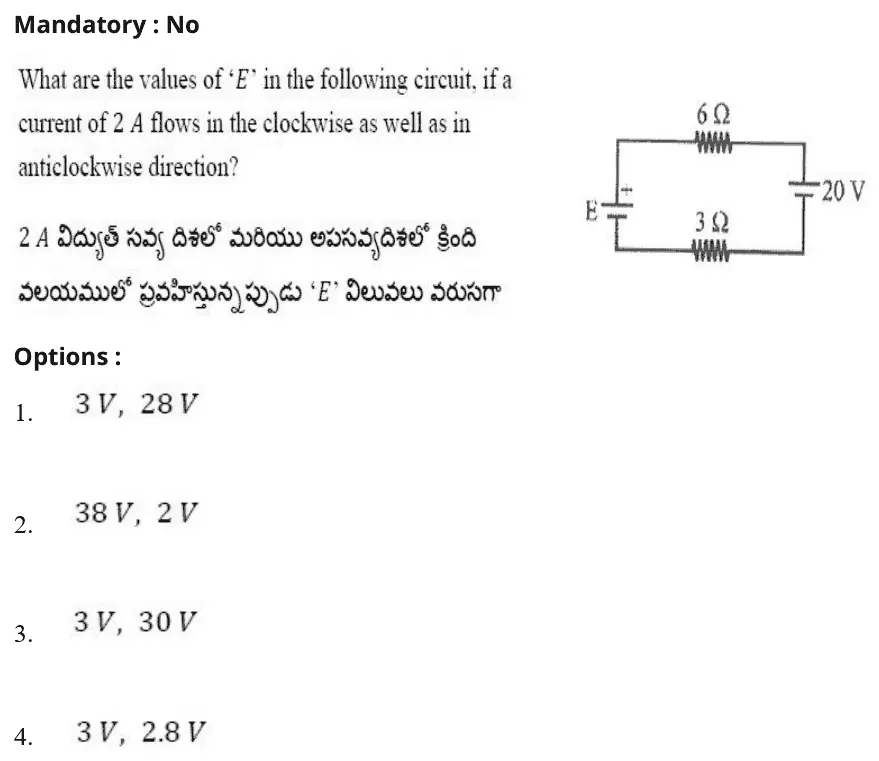
What are the values of 'E' in the following circuit, if a current of 2 $A$ flows in the clockwise as well as in anticlockwise direction? (see the figure above)
A silver wire of length $3\ \mathrm{m}$ and of cross-sectional area $6.14 \times 10^{-6}\ \mathrm{m^2}$ carries a current of $6\ \mathrm{A}$. Atomic weight and density of silver are 108 and $10500\ \mathrm{kg.m^{-3}}$ respectively. A silver atom contributes one free electron for conduction. Avogadro number is $6.023 \times 10^{23}$ / mole. Drift velocity of electrons in silver is, close to ______
A galvanometer may be converted into ammeter or a voltmeter. In which of the following cases the resistance of the devices so obtained will be largest?
A galvanometer of resistance $40\ \Omega$ gives a deflection of 10 divisions per $m\,A$. There are 50 divisions on the scale. Maximum current that can pass through it when a shunt resistance of $2\ \Omega$ is connected is ______
In a potentiometer experiment the balancing with a cell is at length 250 $cm$. In shunting the cell with a resistance of 2 $\Omega$, the balancing length becomes 125 $cm$. The internal resistance of the cell is
A cell of emf $1.8\ volts$ gives a current of $17\ A$ when directly connected to an ammeter of resistance $0.06\ \Omega$. Internal resistance of the cell is ______
A wire, 10 m long, has a resistance of 40 $\Omega$. It is connected in series with a resistance box of resistance R and a 2 V storage cell. If the potential gradient along the wire is 0.1 m V/cm, the value of R is :
Consider a wire of length L with a resistance of $5\,\Omega$. Applying an external force, the wire is elongated such that its length becomes 3 L. Assuming the resistivity and density of the material is unchanged, the resistance of the elongated wire is,
A cylindrical metallic wire is stretched to increase its length. If the resistance of the wire is increased by 4 % then the percentage increase in its length is
A galvanometer coil has a resistance of 10 $\Omega$ and the meter shows full scale deflection for a current of 2 mA. What resistance needs to be connected to convert the meter into a voltmeter of range 0 to 18 V?
A voltmeter of resistance $R$ is to be used to measure the potential difference across a resistance '$r$'. In which case the reading will be nearest to that in the absence of voltmeter?
Two wires of equal diameters, lengths $l_1, l_2$ and having resistivities $S_1, S_2$ respectively are joined in series. The equivalent resistivity of the combination is ______
The external diameter of $5\ \mathrm{m}$ long hollow tube is $0.1\ \mathrm{m}$ and thickness of its wall is $0.005\ \mathrm{m}$. If $\rho = 1.7\times10^{-8}\ \Omega\,\mathrm{m}$, its resistance will be ______
A copper wire of radius $0.1\ \mathrm{mm}$ and resistance $2\ \mathrm{k\Omega}$ is connected across a power supply of $40\ \mathrm{V}$. The number of electrons transferred per second between the supply and the wire at one end is
The wire of potentiometer has resistance $4\ \Omega$ and length $1\ \mathrm{m}$. It is connected to a cell of e.m.f. $2\ \mathrm{V}$ and internal resistance $1\ \Omega$. The current flowing through the potentiometer wire is ______
Resistance of a tungsten wire at $150^{\circ}\mathrm{C}$ is $133\,\Omega$. Its temperature coefficient of resistance is $0.0045\,^{\circ}\mathrm{C}^{-1}$. The resistance of this wire at $500^{\circ}\mathrm{C}$ is
A resistor of resistance 'R' is connected between the terminals of a cell of emf 'E' and internal resistance 'r'. If 'I' is the current through the circuit. The terminal potential difference of the cell is given by
In a Potentiometer experiment the balancing length with a cell is 560 $cm$. when an external resistance of 10 $\Omega$ is connected in parallel to the cell, the balancing length changes by 60 cm. Find the internal resistance of the cell.
In a meter bridge the resistances R and S are such that the null point is found at a distance of 40 cm from one end. If a resistance of 10 $\Omega$ is connected in parallel with shunt S, then the null point occurs at 90 cm from the same end. The values of the two resistances R and S respectively are:
In a meter bridge the balancing length from the left end is found to be 25 cm. The value of the unknown resistance is : (Assume: Standard resistance of $1\ \Omega$ is in the right gap)
A conducting wire of cross-sectional area 1 cm$^2$ has $3 \times 10^{23}$ charge carriers per m$^3$. If wire carries a current of 24 mA, then drift velocity of carriers is
Four $4\,\Omega$ resistors are connected together along the edges of a square. A $12\,\mathrm{V}$ battery with internal resistance of $2\,\Omega$ is connected across a pair of the diagonally opposite corners of the square. The power dissipated in the circuit is
A conductor of length 100 cm and area of cross section $1\ \mathrm{mm^2}$ carries a current of 5A. If the resistivity of the material of the conductor is $3.0\times10^{-8}\ \Omega\,\mathrm{m}$, then the electric field across the conductor is
A moving coil Galvanometer of resistance $100\ \Omega$ is used as an ammeter using a resistance $0.1\ \Omega$. The maximum deflection current in the Galvanometer is $100\ \mu$A. Find the minimum current in the circuit so that ammeter shows maximum deflection?
A cylindrical wire P has resistance 10 $\Omega$. A second wire Q has length and diameter half that of P. If the material of both the wires is same, then resistance of wire Q is
A circular wire has current density $J = \left(2 \times 10^{10}\ \frac{\mathrm{A}}{\mathrm{m^2}}\right) r^2$ where r is the radial distance, out of the wire radius is 2 mm. The end-to-end potential applied to the wire is 50 V. How much energy (in joule) is converted to thermal energy in 100 s?
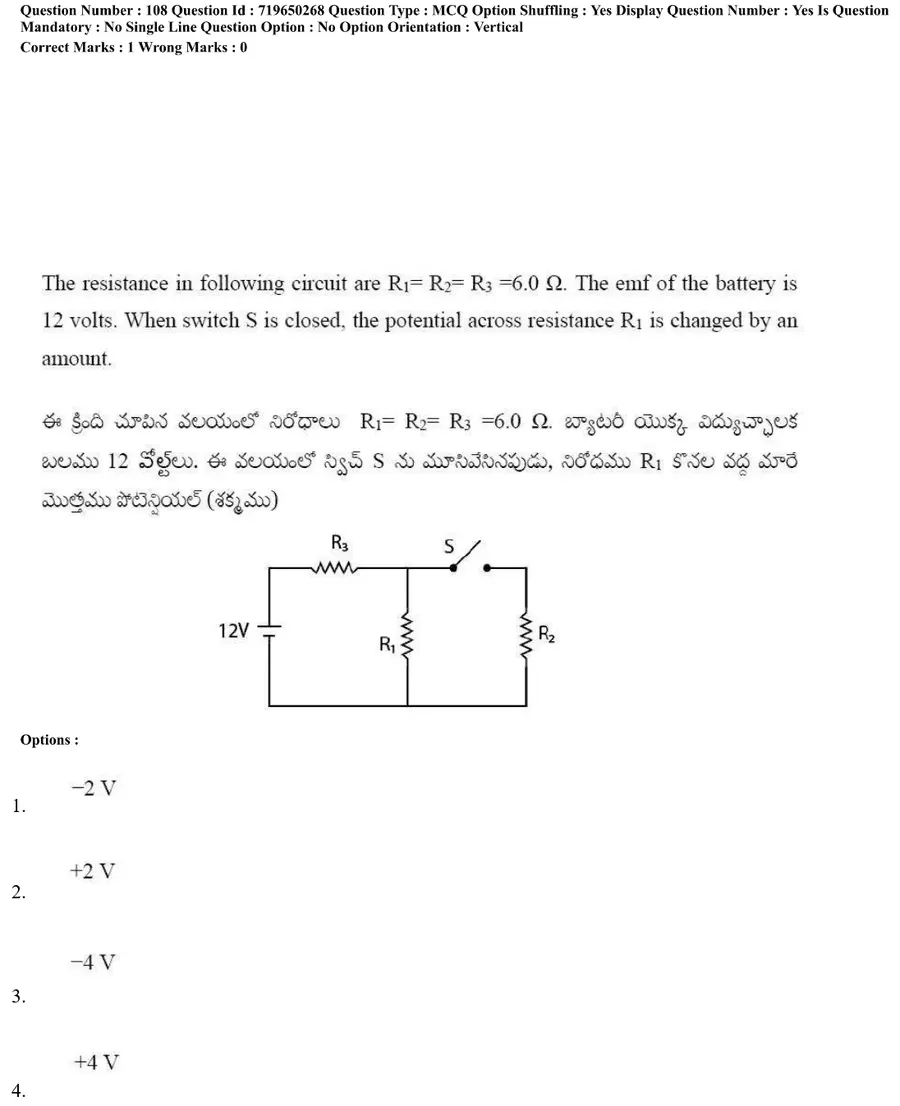
The resistance in following circuit are $R_1 = R_2 = R_3 = 6.0\ \Omega$. The emf of the battery is 12 volts. When switch S is closed, the potential across resistance $R_1$ is changed by an amount. (see the figure above)
In a meter bridge two gaps in the metallic strip are connected by $3\Omega$ and $9\Omega$ resistors. What should be the value of shunt that needs to be added to $9\Omega$ resistor to shift balancing point by 25 cm?
The resistance of a device component decreases as the current through it increases and it is described by the relation $R = \frac{0.2\,I}{I-4}$ where I is the current. Determine the minimum power delivered. (Assume $I > 4$)
A 100 W tungsten light bulb has a resistance of 250 $\Omega$ when it as turned ON and 25 $\Omega$ when turned OFF. The ambient room temperature is 25 °C. Find the temperature of the filament when the bulb is turned ON : (Let $\alpha_{tungsten} = 4.5 \times 10^{-3}$/ °C)
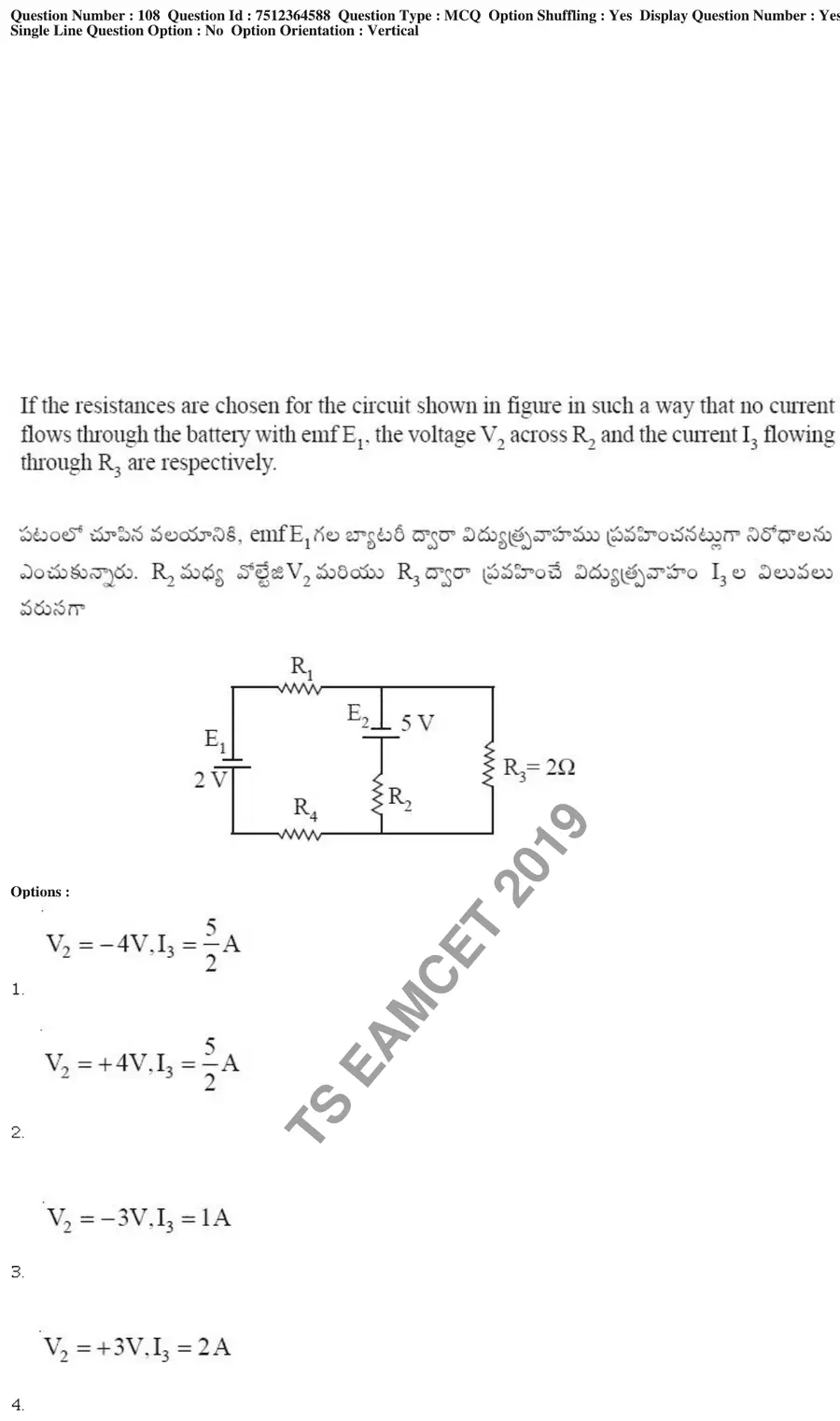
If the resistances are chosen for the circuit shown in figure in such a way that no current flows through the battery with emf $E_1$, the voltage $V_2$ across $R_2$ and the current $I_3$ flowing through $R_3$ are respectively. (see the figure above)
When subjected to a voltage of 10 V, the current through a resistor at a temperature of 40 $^\circ$C is 0.1 A. The temperature coefficient of resistance of the material of the resistor is $2 \times 10^{-4}$ $^\circ$C$^{-1}$. The temperature of the resistor in $^\circ$C when the current drops to 0.098 A is
Estimate the magnitude of current that passes through a wire, if 0.1 mol of electrons flow through it in 40 min. (Assume Avagadro number = $6 \times 10^{23}$)
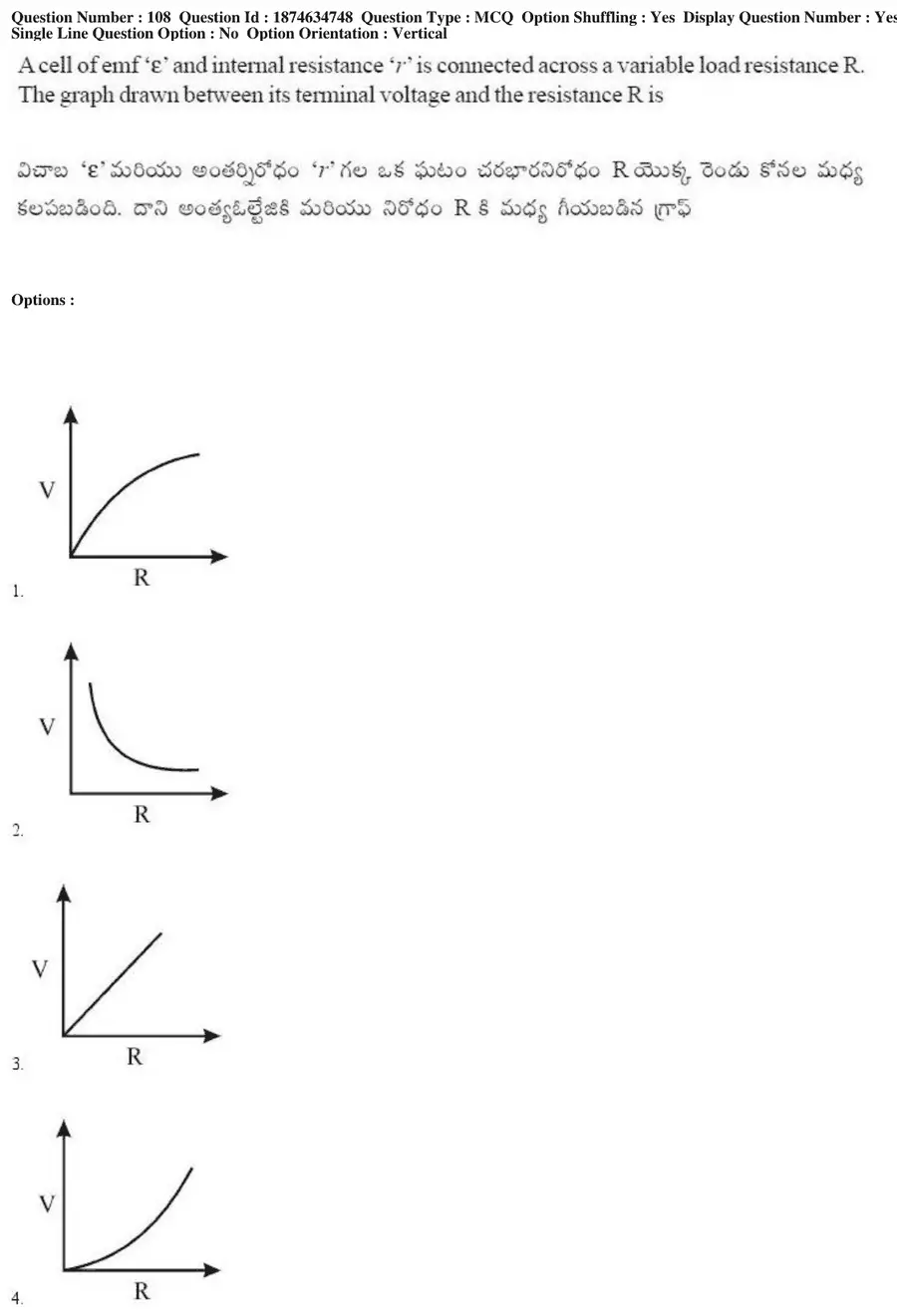
A cell of emf '$\varepsilon$' and internal resistance '$r$' is connected across a variable load resistance R. The graph drawn between its terminal voltage and the resistance R is
The question as printed in the paper.
A
see figure V vs R: curve from the origin rising concavely (steep at first, flattening toward a plateau)
B
see figure V vs R: curve starting high on the V axis (not at the origin), falling steeply then flattening, convex decreasing, staying above the R axis
C
see figure V vs R: straight line from the origin, rising linearly
D
see figure V vs R: curve from the origin rising with increasing slope (convex upward)
In a meter bridge if the left and right gaps are connected with $2\ \Omega$ and $3\ \Omega$ resistances respectively then the bridge is balanced. The resistance to be connected with $3\ \Omega$ resistance to get the balancing point at midpoint of the bridge wire is
The length of a potentiometer wire is '$l$'. A cell of emf 'E' is balanced at a length $\left(\dfrac{l}{3}\right)$ from positive end of the wire. If the length of the wire is increased by $\left(\dfrac{l}{2}\right)$, the distance at which the same cell gives the balancing point is (cell in the primary is ideal and no series resistance is present in the primary circuit)
'$n$' identical resistances are taken in which $\dfrac{n}{2}$ resistors are joined in series in the left gap and the remaining $\dfrac{n}{2}$ resistances are joined in parallel in the right gap of a metre bridge. Balancing length in cm is
A $500\ \mathrm{W}$ heater is designed to operate at $200\ \mathrm{V}$ potential difference. If it is connected across $160\ \mathrm{V}$ line, the heat it will produce in 20 minute is
Assertion (A): When a wire of aluminium and another wire of silicon are heated from room temperature to $80\,^\circ\mathrm{C}$, the conductivity of aluminium increases and that of silicon decreases. Reason (R): Aluminium has positive temperature coefficient of resistivity and silicon has negative temperature coefficient of resistivity.
A
Both (A) and (R) are correct and (R) is the correct explanation of (A)
B
Both (A) and (R) are correct but (R) is not the correct explanation of (A)
A galvanometer of resistance 'G' $\Omega$, is shunted by a resistance 'S' $\Omega$. To keep the main current in the circuit unchanged, the resistance to be connected in series with the galvanometer is
The ratio of heats generated through shunt and galvanometer is 7:5 when they are connected to make an ammeter. If the resistance of the galvanometer is 112 $\Omega$ then the resistance of the shunt is
If only $\frac{1}{51}^{\mathrm{th}}$ of the main current is to be passed through a galvanometer then the shunt required is $R_1$ and if only $\frac{1}{11}^{\mathrm{th}}$ of the main voltage is to be developed across the galvanometer, then the resistance required is $R_2$. Then $\frac{R_2}{R_1} =$
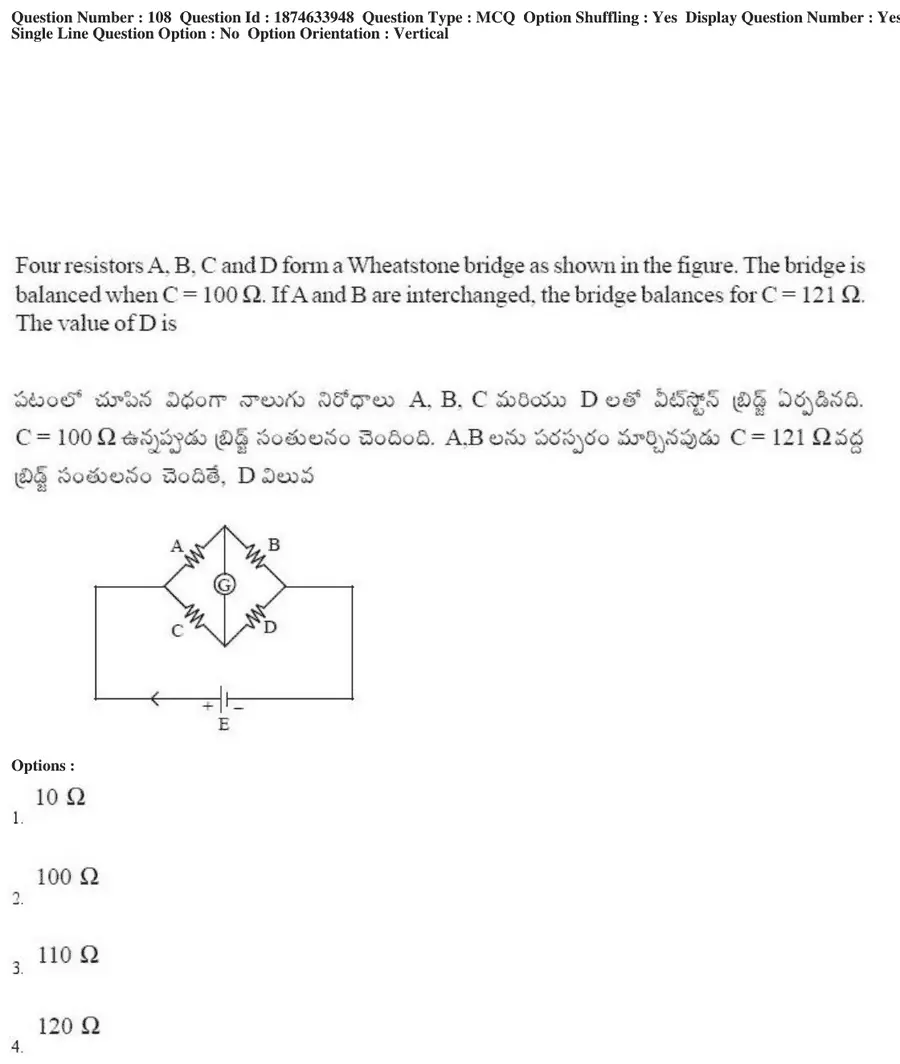
Four resistors A, B, C and D form a Wheatstone bridge as shown in the figure. The bridge is balanced when $\mathrm{C = 100\ \Omega}$. If A and B are interchanged, the bridge balances for $\mathrm{C = 121\ \Omega}$. The value of D is (see the figure above)
The emfs of three cells connected in parallel are $E_1 = 5V$, $E_2 = 8V$ and $E_3 = 10V$ and their internal resistances are $R_1 = 1\Omega$, $R_2 = 2\Omega$ and $R_3 = 3\Omega$ respectively. By changing $E_3$ to $E_{3N}$ the equivalent emf is doubled, then $E_{3N}$ in $V$ is
A cell of emf 10V and internal resistance 3 $\Omega$ is connected in parallel with another cell of emf 7 $V$ and internal resistance $\frac{3}{5}\Omega$ such that their positive terminals are joined together and so are their negative terminals. Their positive terminals are joined with the negative terminal and their negative terminal is joined with the positive terminal of a third cell of emf 20 V with internal resistance 2 $\Omega$. The combination can be replaced by a battery of emf $E$ and internal resistance $r$; then the values of E and $r$ are respectively
A battery with internal resistance of $4\ \Omega$ is connected to a circuit consisting three resistances $R$, $2R$ and $4R$ (see following figure). If the power generated in the circuit is highest, then the magnitude of $R$ must be
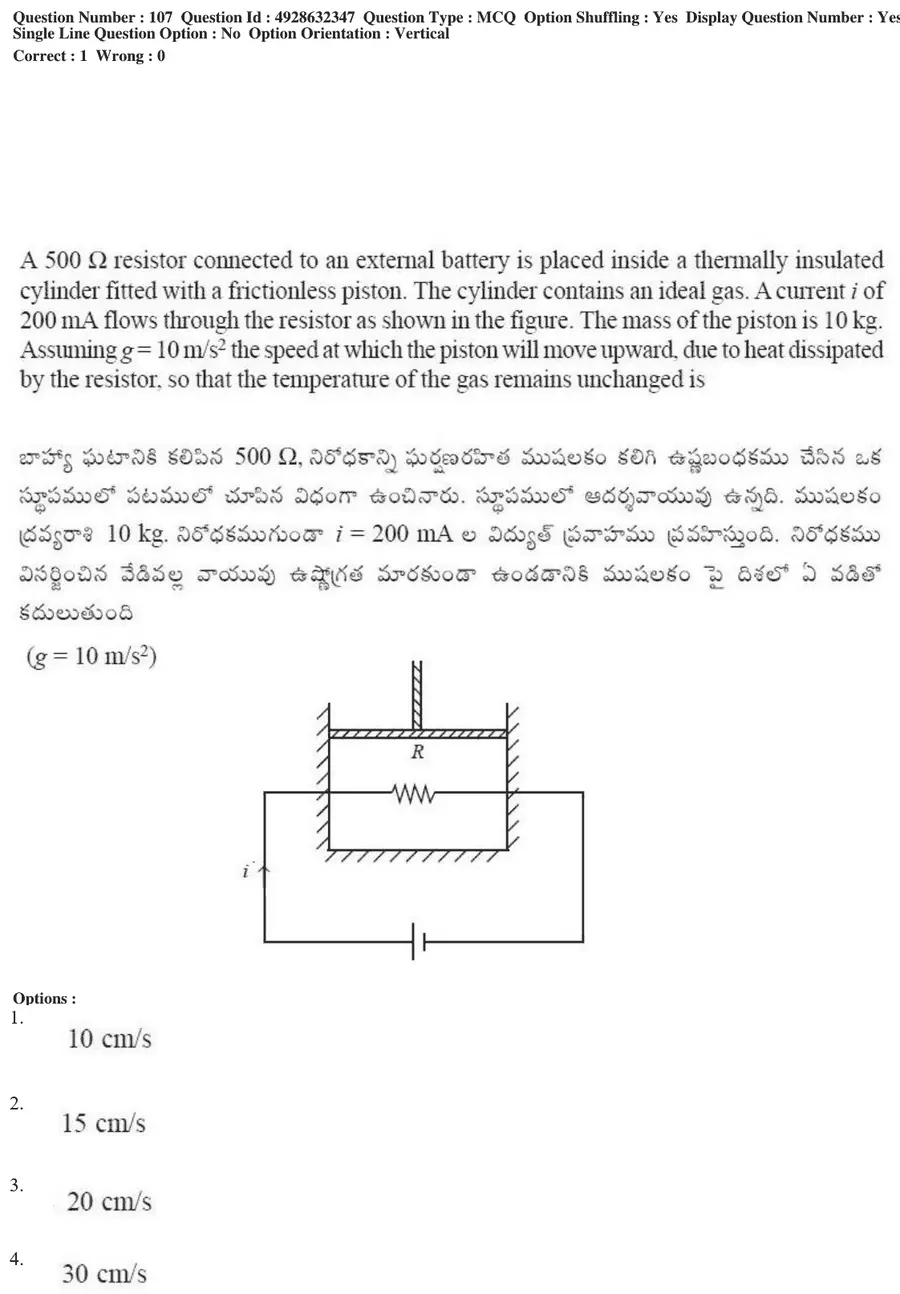
A $500\ \Omega$ resistor connected to an external battery is placed inside a thermally insulated cylinder fitted with a frictionless piston. The cylinder contains an ideal gas. A current $i$ of $200\ \mathrm{mA}$ flows through the resistor as shown in the figure. The mass of the piston is $10\ \mathrm{kg}$. Assuming $g = 10\ \mathrm{m/s^2}$ the speed at which the piston will move upward, due to heat dissipated by the resistor, so that the temperature of the gas remains unchanged is (see the figure above)
A cylindrical shape resistance is connected to a battery with emf $5V$. The resistance per unit length varies as $\rho(x) = \rho_0\left(\dfrac{x}{L}\right)^\alpha$ where $\rho_0$ and $\alpha$ are constants and $x$ is the distance from one end of the resistor. The magnitude of product $\rho_0 L$ is $10\ \Omega$, where $L$ is the length of the resistor. If the thermal power generated by the resistor is $20\ \mathrm{W}$, then the value of $\alpha$ is
Consider the following two circuits [A]: 20 bulbs are connected in series to a power supply line [B]: 20 bulbs identical to [A] are connected in a parallel circuit to an identical power supply line Identify which of the following is not true
A
If one bulb in [A] blows out all others will stop glowing
B
Bulbs in [A] glow brighter since the current flowing in [A] is higher
C
If one bulb in [B] blows, other bulbs will still glow
D
Bulbs in [B] have the highest voltage across each bulb
A tapered bar of length $L$ and end diameters $D_1$ and $D_2$ is made of a material of electrical resistivity $\rho$. The electrical resistance of the bar is
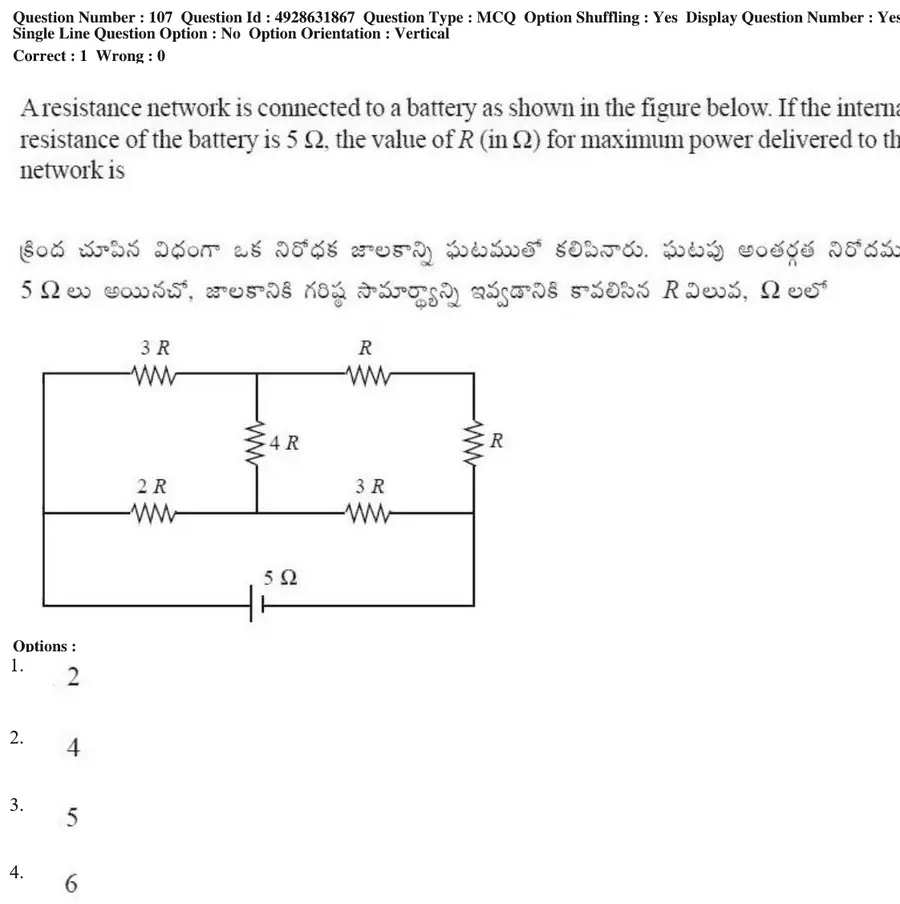
A resistance network is connected to a battery as shown in the figure below. If the internal resistance of the battery is 5 $\Omega$, the value of $R$ (in $\Omega$) for maximum power delivered to the network is (see the figure above)
A fuse wire of radius 0.2 mm blows off with a current of 5 A. The fuse wire of same material but of radius 0.3 mm will blow off with a current of ___________
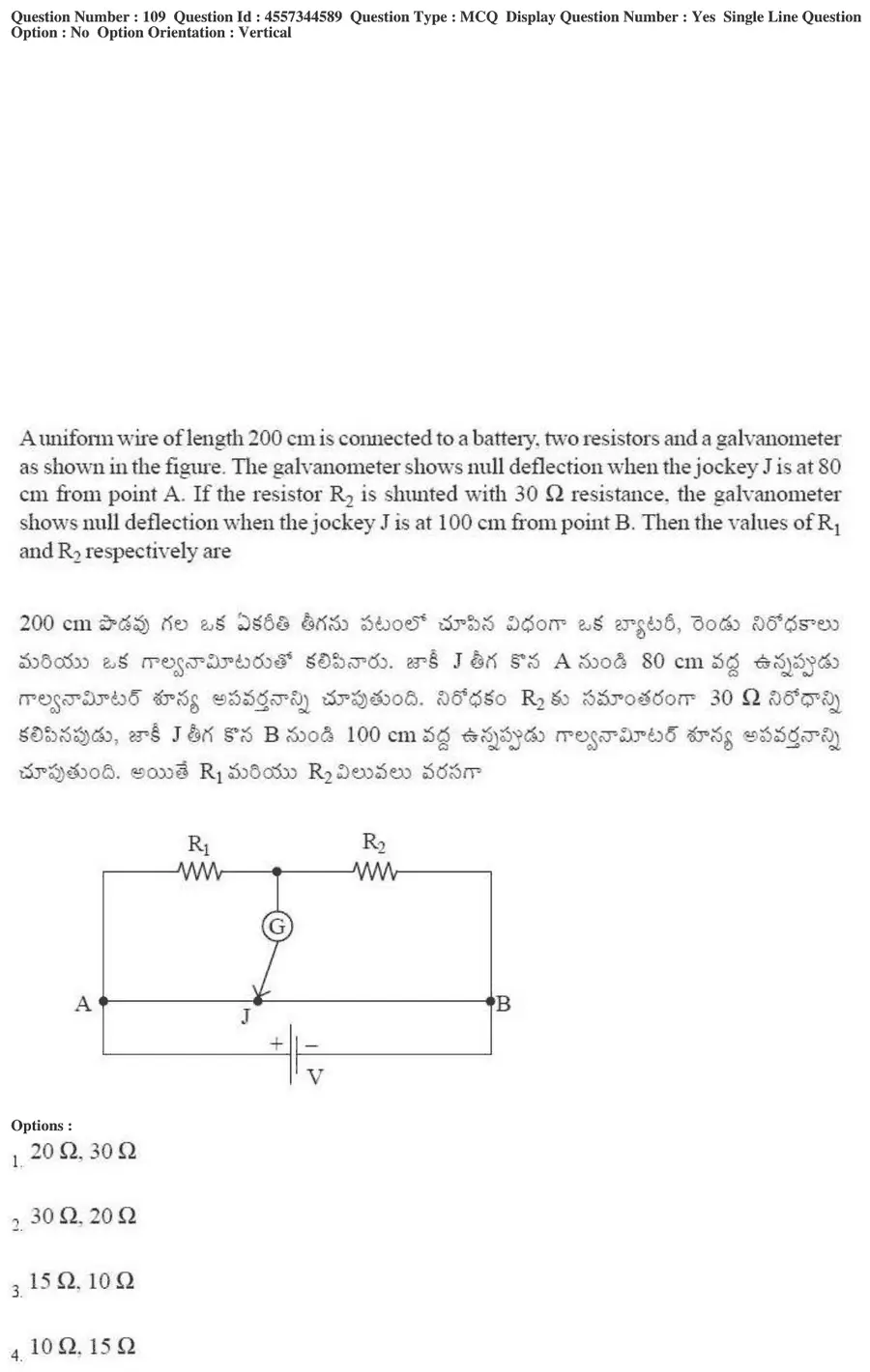
A uniform wire of length $200\ \mathrm{cm}$ is connected to a battery, two resistors and a galvanometer as shown in the figure. The galvanometer shows null deflection when the jockey J is at 80 cm from point A. If the resistor $R_2$ is shunted with $30\ \Omega$ resistance, the galvanometer shows null deflection when the jockey J is at 100 cm from point B. Then the values of $R_1$ and $R_2$ respectively are (see the figure above)
The sensitivity of a galvanometer is 60 div/A. When a shunt is used, its sensitivity becomes 10 div/A. If the resistance of the galvanometer is $20\ \Omega$, then the value of shunt used is
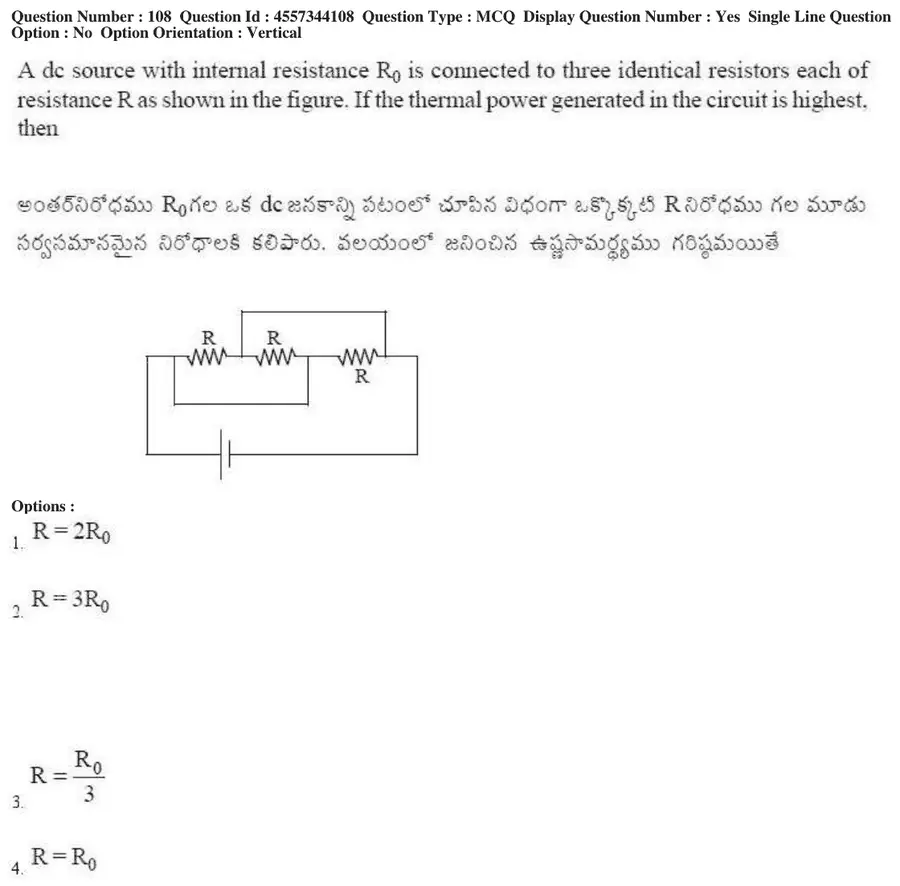
A dc source with internal resistance $\mathrm{R_0}$ is connected to three identical resistors each of resistance R as shown in the figure. If the thermal power generated in the circuit is highest, then (see the figure above)
In a potentiometer, a wire of length 10 m having resistance 50 $\Omega$ is used. A battery of 5 V and a resistor of 450 $\Omega$ are connected in series to the wire. If an unknown battery of emf 'E' balances the potentiometer at 450 cm, then the value of E is
Current Electricity stands as the second most heavily tested chapter across all of physics in Class 12. In the papers we hold for AP and TS EAPCET between 2022 and 2026, this unit contributed 159 questions across 77 papers. That gives an average frequency of 2.1 questions per paper, claiming 5.2% of all physics questions in that recent window. Taking the full historical record from 2010 to 2026 into account, Current Electricity delivered 288 questions across 149 papers, maintaining an average of 1.9 questions per paper and a 4.8% subject share. Across the earlier testing period from 2010 to 2021, our archive contains 129 questions across 72 papers (4.5% share). In the last three exam years from 2024 to 2026, the chapter supplied 96 questions across 46 papers, registering a 5.2% share. Comparing the last three years to early papers, the chapter's share of the subject is up, while compared to the recent five-year window it is about the same.
State-level distributions demonstrate perfectly uniform weighting between the two regional boards. From 2022 to 2026, AP EAPCET papers in our set contributed 99 questions across 48 papers (2.1 per paper, 5.2% share). Over the identical timeframe, TS EAPCET contributed 60 questions across 29 papers in our set (2.1 per paper, 5.2% share). In our recent records, every paper from 2022 onwards featured problems from this topic, with zero years missed since 2022. The chapter ranks 2nd of 28 physics chapters by question share between 2022 and 2026. Sittings in both 2025 and 2026 tied as the busiest exam cycles in our collection, each supplying 34 questions across 16 papers.
Most-asked topics
Questions distribute across four major syllabus divisions:
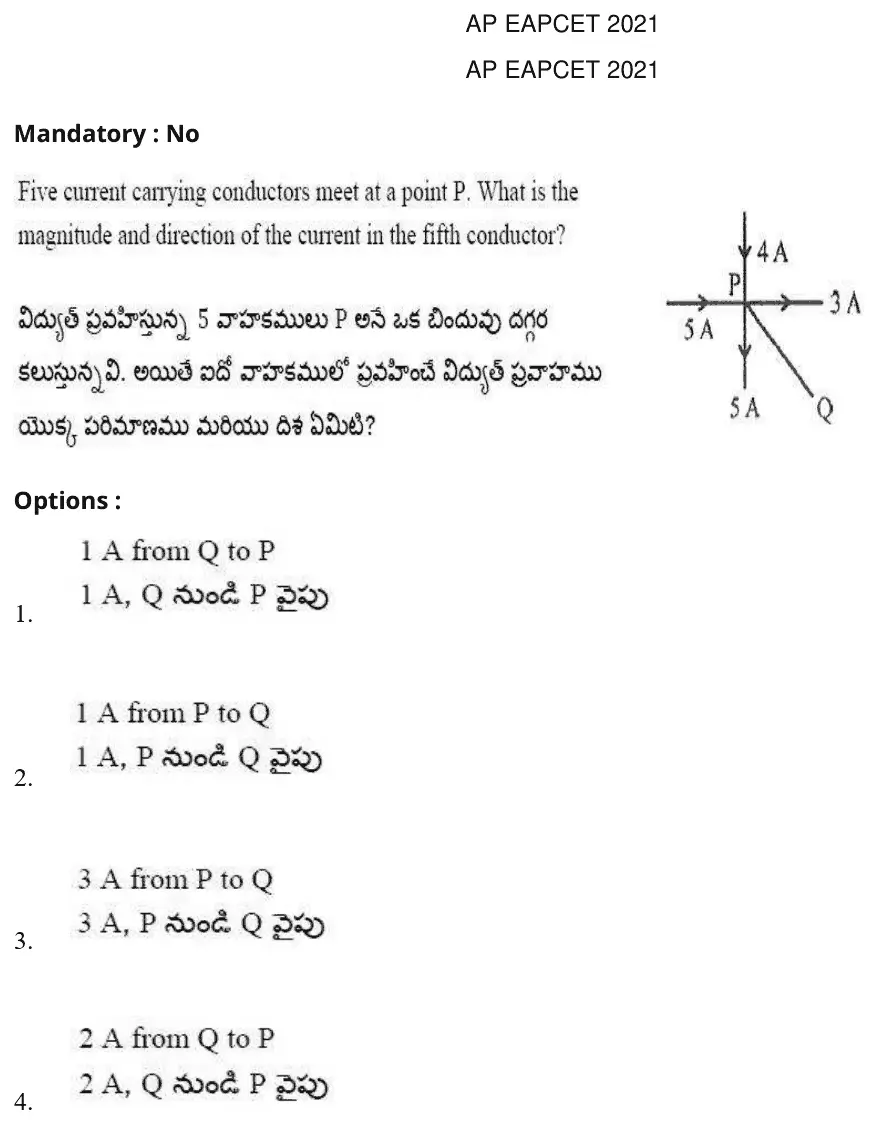
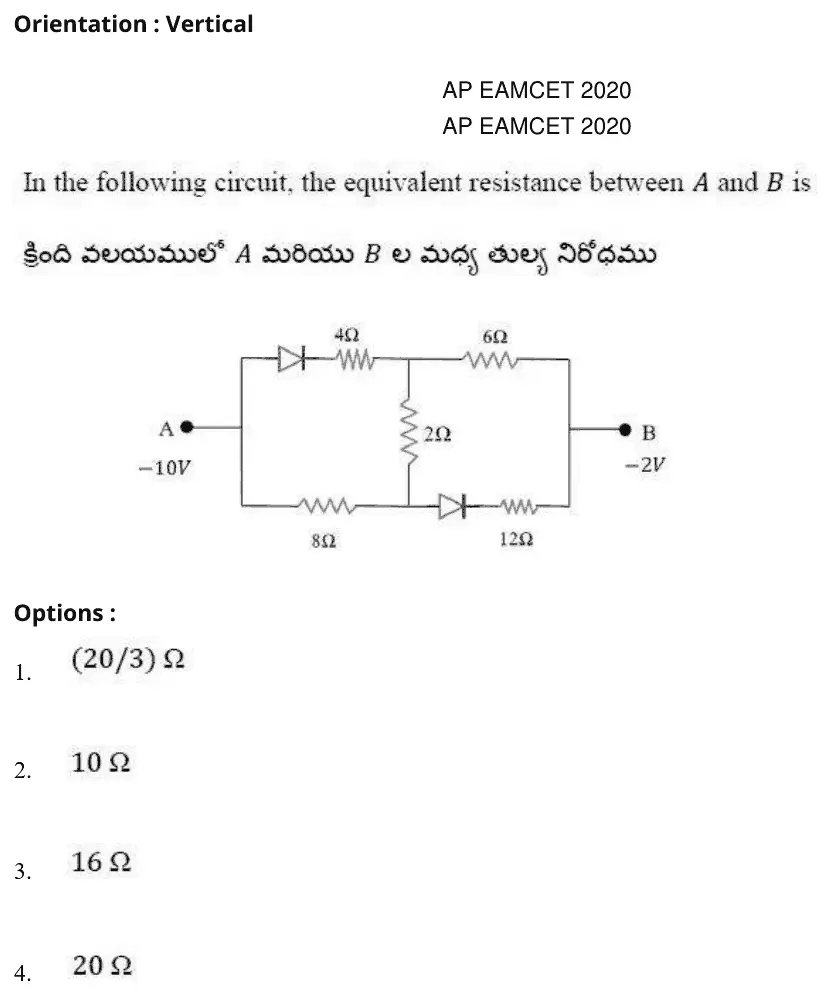
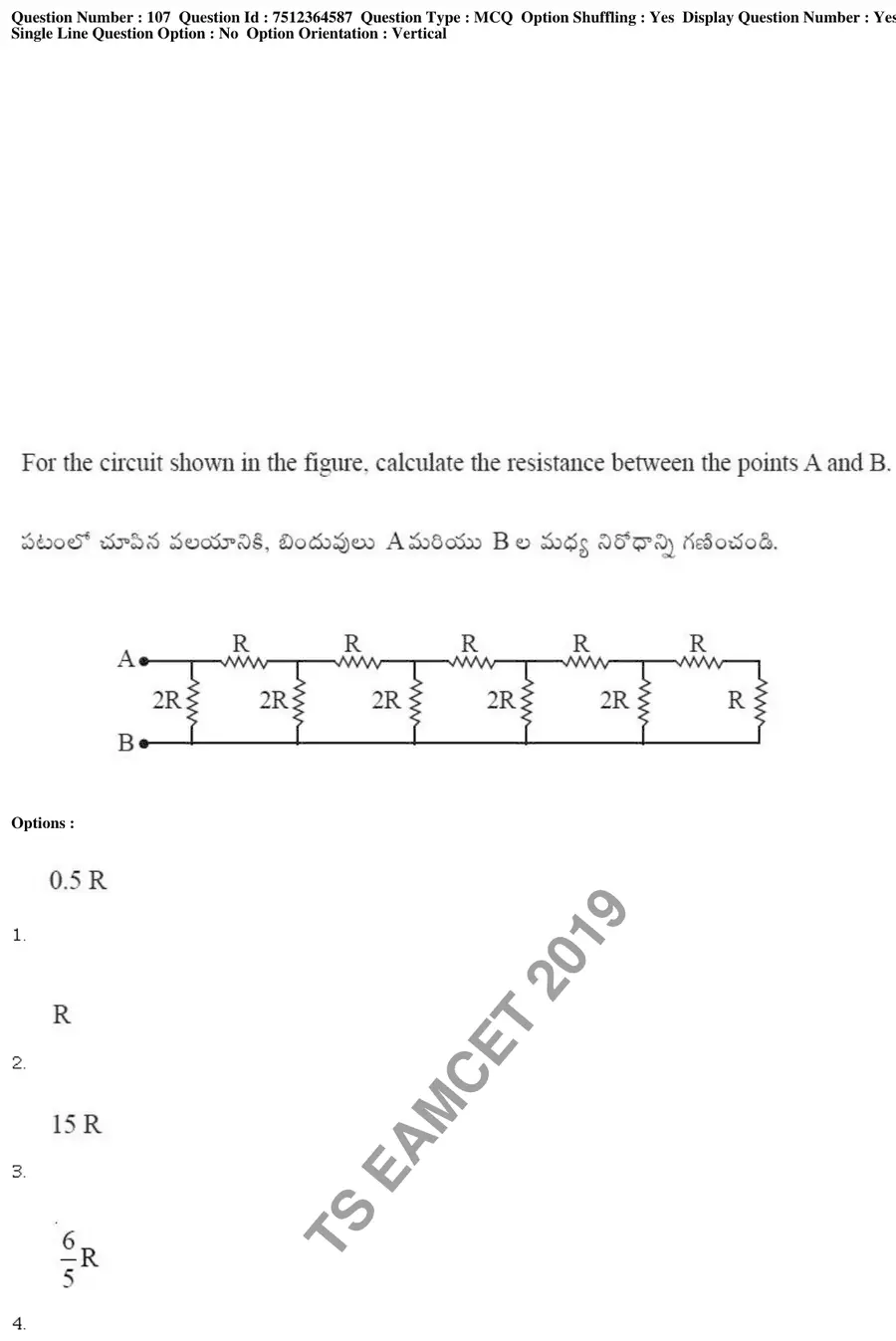
Circuits & Kirchhoff's Laws: This dominant section brought 59 questions in the recent five-year span, contributing to 106 questions across all years in our archive. It tests loop and junction rules, complex resistor ladders, symmetry reductions, and grouping of non-identical cells in series or parallel.
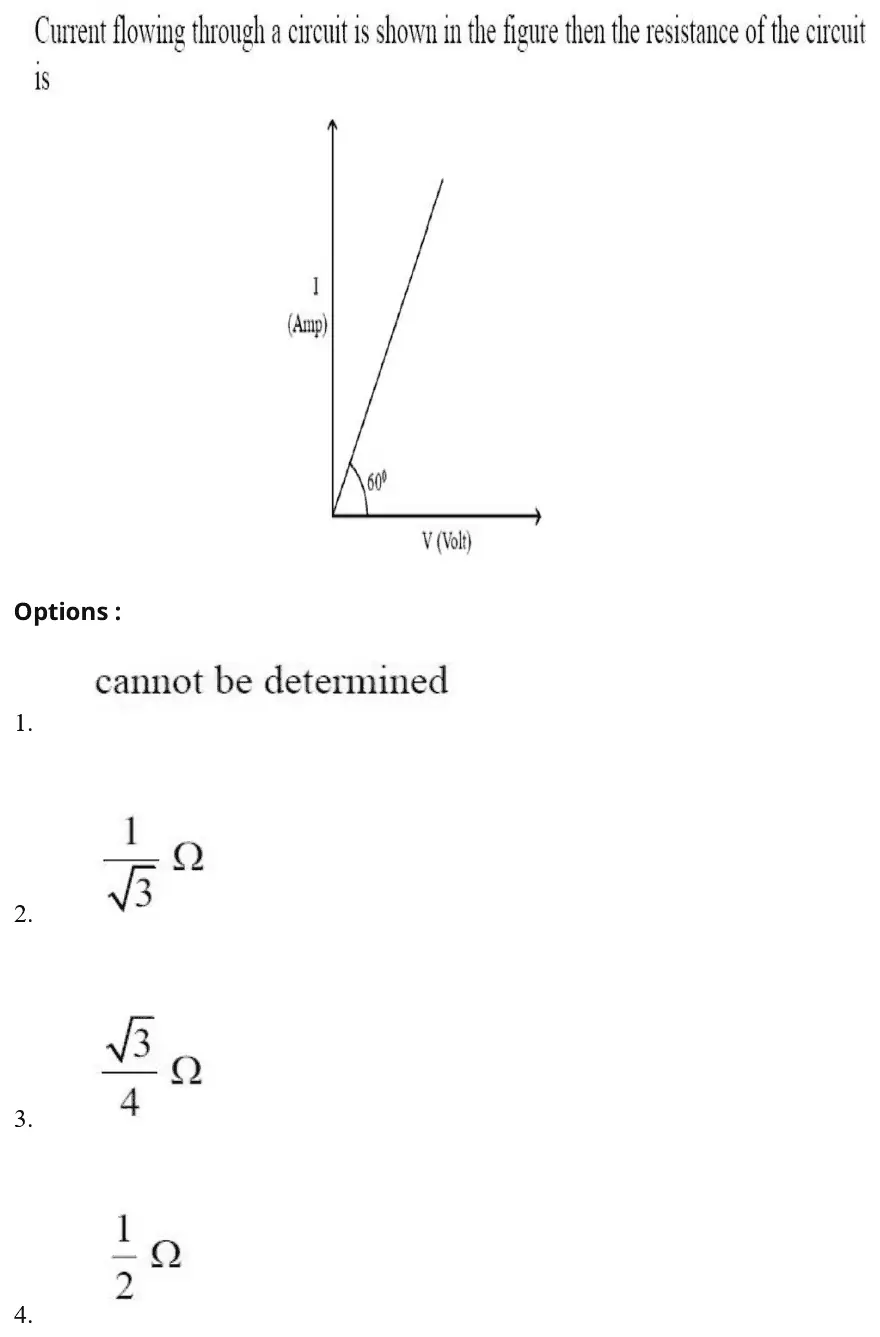
Current & Resistance: Recent papers supplied 52 questions, out of 85 questions in the complete record. Key concepts cover drift velocity, microscopic Ohm's law, temperature dependence of resistivity, colour coding, and wire stretching.
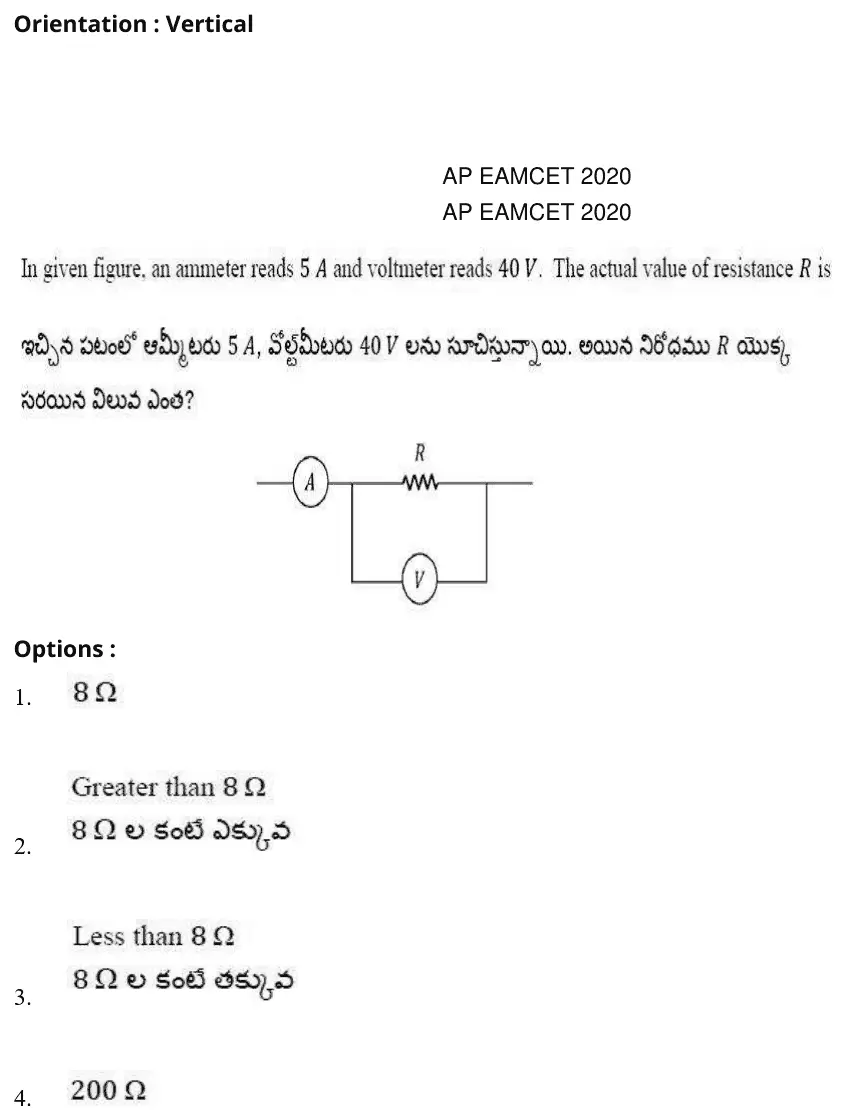
Measuring Instruments: A block of 35 questions appeared between 2022 and 2026, out of 70 questions overall. Topics include Wheatstone bridge conditions, meter bridge balance shifts, potentiometer comparisons of cell emfs and internal resistances, and galvanometer conversions into ammeters and voltmeters.
Heating Effect & Power: Examiners set 13 questions recently, out of 27 questions in the entire archive. It evaluates Joule's heating law, maximum power transfer theorem, bulb ratings in series-parallel combinations, and power dissipated in external load resistances.
What the questions look like
Circuit analysis is the mainstay of the chapter. A standard problem presents a multi-loop circuit powered by two or three batteries with internal resistances, asking students to find the branch current or the potential difference between two labeled nodes using Kirchhoff's rules. Another common pattern stretches a cylindrical conducting wire so that its length increases by a given small percentage or factor, requiring students to calculate the new resistance using volume conservation where resistance scales with length squared.
Laboratory instrument setups recur continuously. Meter bridge questions regularly report that the null balance point shifts along the wire when an unknown shunt resistance is placed in parallel or series with one arm, requiring students to deduce the unknown resistance. Potentiometer questions ask for balancing lengths when comparing two secondary cells individually or in series aiding and opposing configurations.
Start by mastering microscopic and macroscopic conduction formulas. Electric current is I = n A e v_d, where drift speed is v_d = e E τ / m. Resistance is R = ρ L / A. When a uniform wire of resistance R is drawn out to n times its initial length without changing its total mass or density, its cross-sectional area drops to A / n, so its new resistance becomes n² R.
Next, master cell grouping and power output. When a real cell of emf E and internal resistance r is connected across external load resistance R, current is I = E / (R + r), and power delivered to the load is P = I² R = E² R / (R + r)². Power output peaks when R = r by the maximum power transfer theorem, yielding P_max = E² / (four r). When two distinct load resistors R₁ and R₂ develop identical power from the same cell, the cell's internal resistance is r = √(R₁ R₂).
Finally, review instrument balancing conditions. For a Wheatstone bridge, null deflection occurs when P / Q = R / S. For a potentiometer wire of length L holding potential gradient k, emf of a test cell is E = k l_balance. When cells of emf E₁ and E₂ are connected aiding and opposing, their balancing lengths l₁ and l₂ satisfy the direct ratio E₁ / E₂ = (l₁ + l₂) / (l₁ - l₂).
Frequently asked questions
How many questions come from Current Electricity in each paper?
In the papers we hold from 2022 to 2026, Current Electricity appeared in every single paper across both AP and TS EAPCET, averaging 2.1 questions per shift in both states.
What is the condition for maximum power transfer from a battery?
A battery delivers maximum electrical power to an external load when the external load resistance equals the internal resistance of the battery.
Does stretching a wire double its resistance if length doubles?
No. Because the material volume remains constant, doubling the length reduces the cross-sectional area to half, causing the resistance to increase by a factor of four.
Where can I find worked solutions for EAPCET Current Electricity questions?
Step-by-step solutions for each one are in the EdLoop EAPCET app.