Work, Energy & Power: AP & TS EAPCET PYQs 2010–2026
Every Work, Energy & Power question from past AP EAPCET and TS EAPCET papers, with options and answers. Newest first.
307questions
144papers covered
4.7%of Physics questions, 2022–2026
2010–2026years
Guide at a glance
Work, Energy & Power ranks among the most influential chapters in Class 11 Physics, providing methods that simplify complex dynamical questions. In the papers we hold from 2022 to 2026, it delivered 146 questions in 77 papers, averaging 1.9 questions per paper.
A block of mass 2 kg, moving along $X$-axis on a horizontal surface with a speed of $4\ ms^{-1}$ enters a rough surface from $x = 0.5$ m to $x = 1.5$ m. The retarding force on this rough surface is related to distance by $\mathrm{F} = -12x$ N. The speed of the block as it just crosses the rough surface is
A Ball ‘A’ collides with another identical ball ‘B’ which is at rest. After collision, if the velocity of the ball ‘B’ becomes two times of final velocity of the ball ‘A’, then the coefficient of restitution is
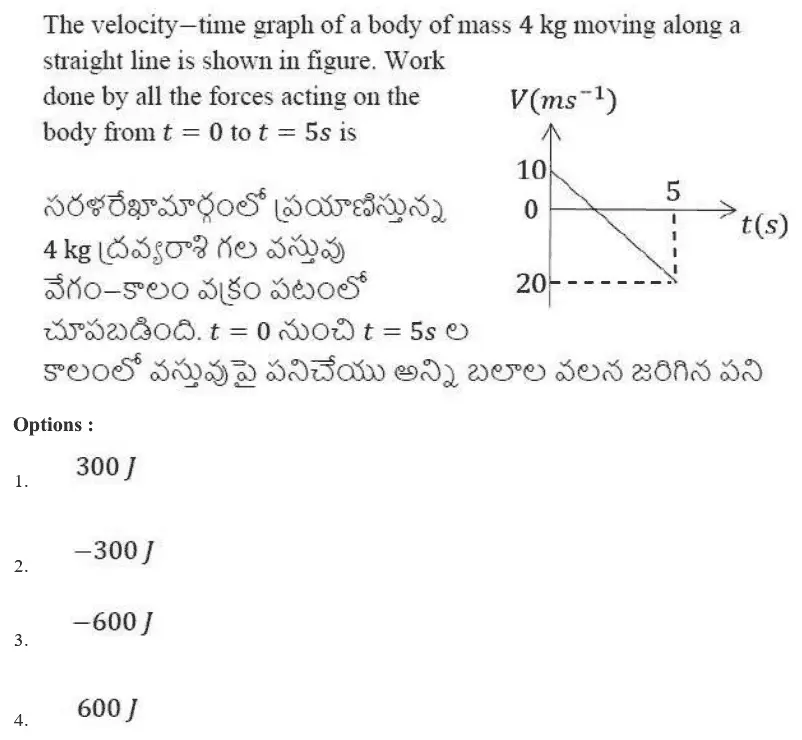
The velocity–time graph of a body of mass 4 kg moving along a straight line is shown in figure. Work done by all the forces acting on the body from $t = 0$ to $t = 5s$ is
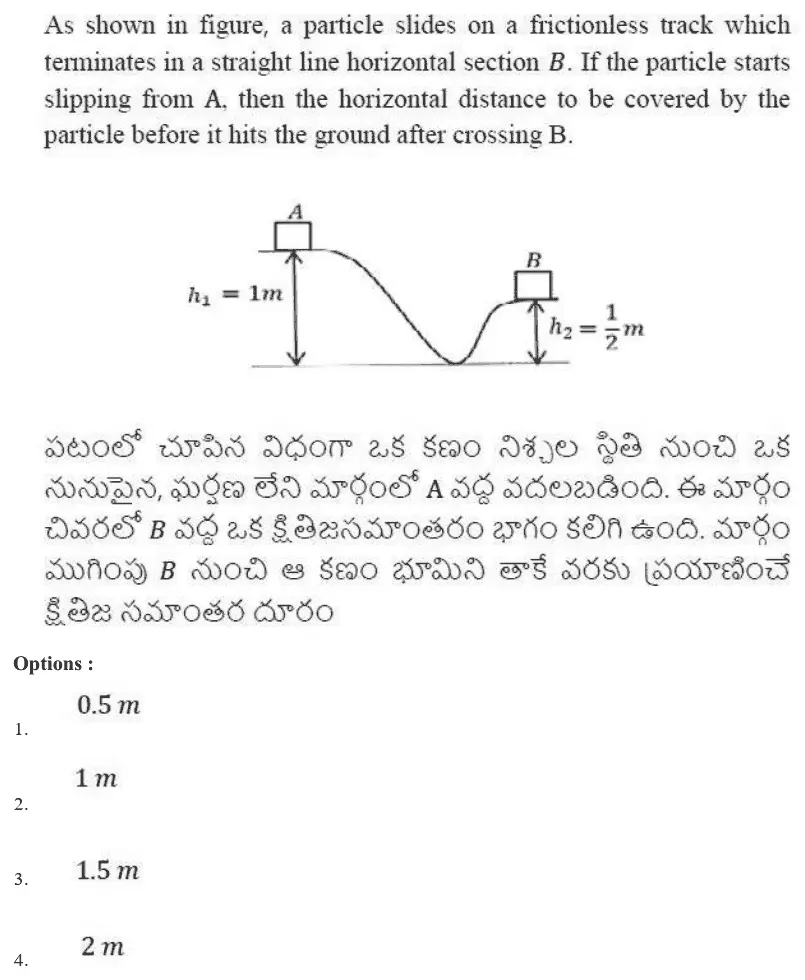
As shown in figure, a particle slides on a frictionless track which terminates in a straight line horizontal section $B$. If the particle starts slipping from A, then the horizontal distance to be covered by the particle before it hits the ground after crossing B.
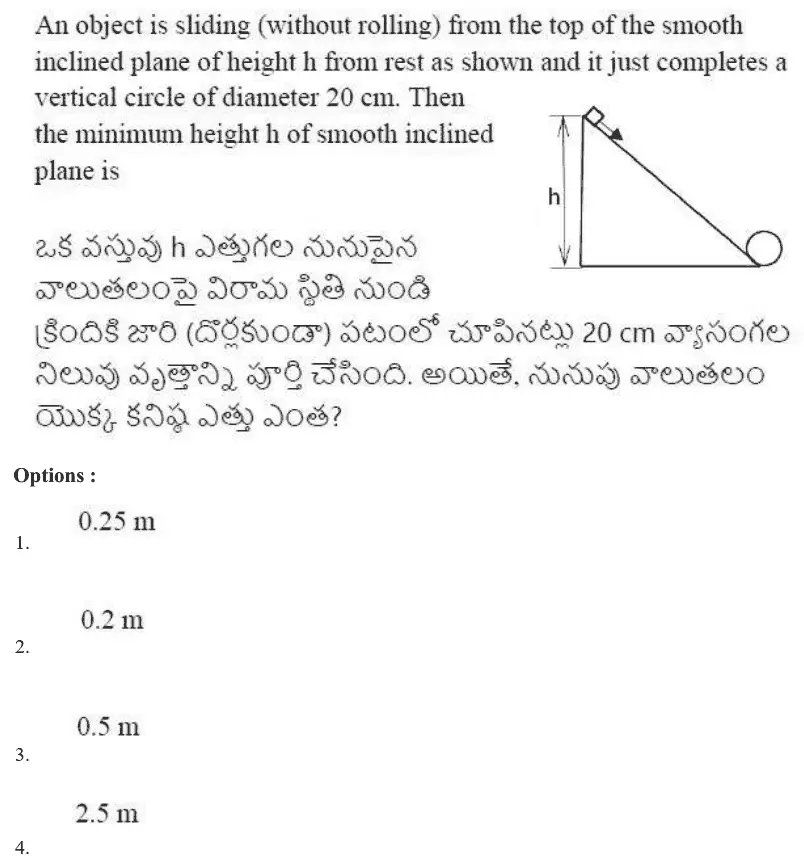
An object is sliding (without rolling) from the top of the smooth inclined plane of height h from rest as shown and it just completes a vertical circle of diameter 20 cm. Then the minimum height h of smooth inclined plane is
A body of mass 2 kg is thrown vertically upwards from the ground level with kinetic energy of 240 J. The kinetic energy of the body will become half at a height of ($\mathrm{g = 10\ ms^{-2}}$)
A moving block having mass m, collides with another stationary block of mass 5m. After collision, the block with mass m comes to rest. If the initial velocity of block with mass m is V, then the value of coefficient of restitution is
$5\ kg$ block pushed by $100\ N$ over $10\ m$ on a plane. If the coefficient of friction between the block and plane is 0.2. The final kinetic energy of the block is ____ $(g = 10 ms^{-2})$
A massless spring with a spring constant $k$ is fixed at its upper end. A block of mass $M$ is attached to the lower end of the spring and released from rest in its unstretched position. The maximum elongation of the spring is
A body of mass $5$ kg is projected vertically upwards from a point X from the ground with an initial speed of $20\ \mathrm{ms^{-1}}$. It rises to a point Y where its kinetic energy is reduced to $400$ J. If the body experiences a constant air resistance of $10$ N throughout its motion, then the vertical distance between X and Y is (Acceleration due to gravity $= 10\ ms^{-2}$)
Three balls A, B and C of equal mass are moving in the same order along the same straight line on a smooth horizontal surface. Initially, ball A moves towards right with a velocity of $6\ ms^{-1}$, ball B moves towards left with a velocity of $4\ ms^{-1}$ and ball C moves towards right with a velocity of $3\ ms^{-1}$. If the coefficient of restitution between any two balls is 0.8, then the relative velocity of balls B and C after collision is
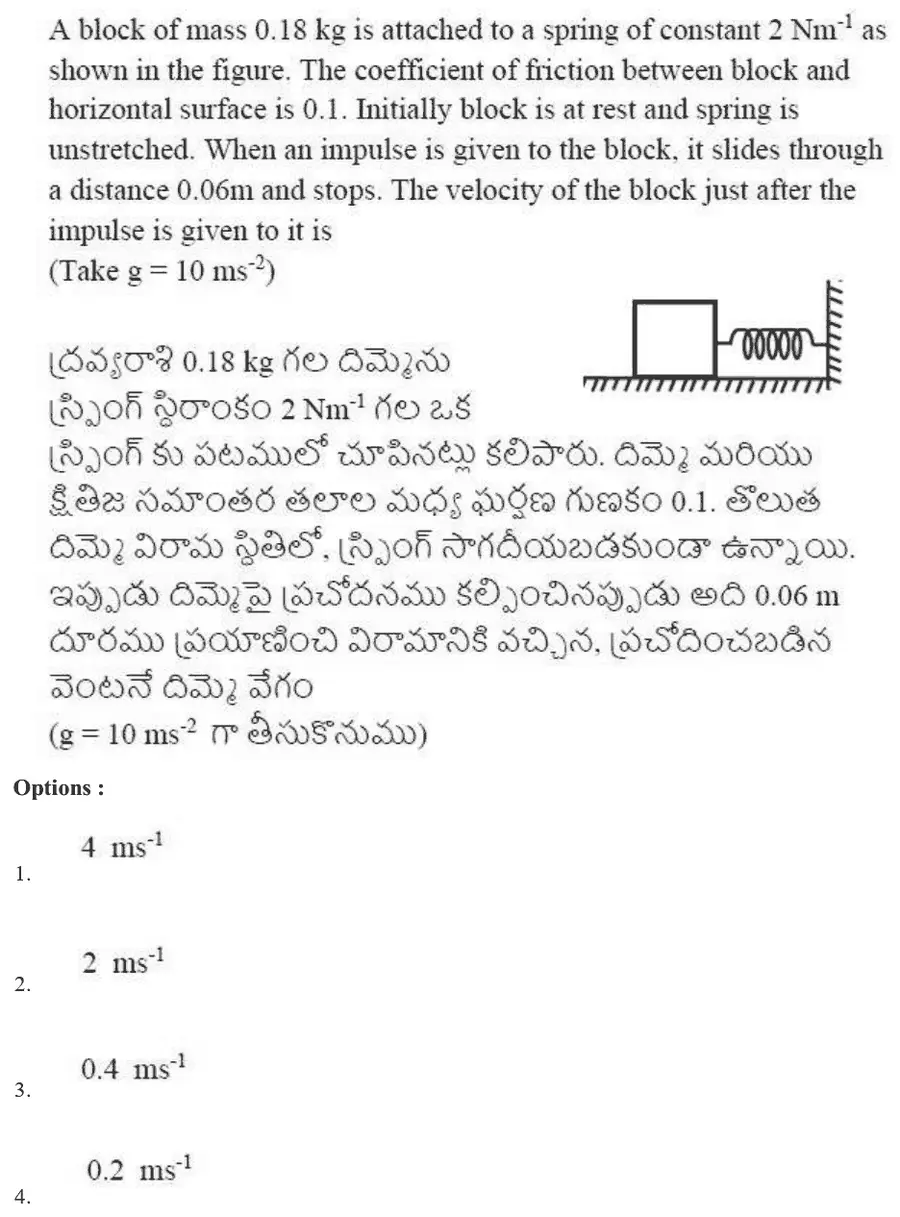
A block of mass 0.18 kg is attached to a spring of constant $2\ \mathrm{Nm^{-1}}$ as shown in the figure. The coefficient of friction between block and horizontal surface is 0.1. Initially block is at rest and spring is unstretched. When an impulse is given to the block, it slides through a distance 0.06m and stops. The velocity of the block just after the impulse is given to it is (Take $g = 10\ \mathrm{ms^{-2}}$)
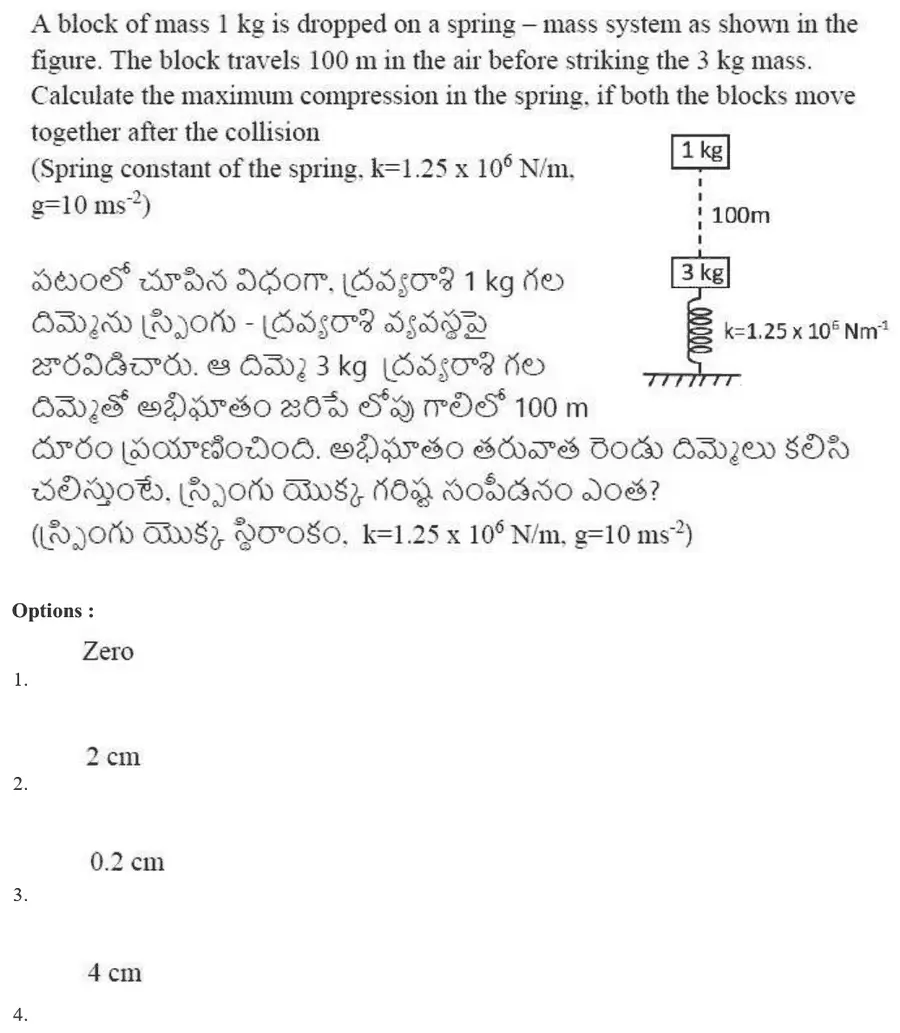
A block of mass 1 kg is dropped on a spring – mass system as shown in the figure. The block travels 100 m in the air before striking the 3 kg mass. Calculate the maximum compression in the spring, if both the blocks move together after the collision (Spring constant of the spring, k=1.25 x $10^6$ N/m, g=10 ms$^{-2}$)
A motor of efficiency 80% lifts water from a tank and delivers it from the end of a pipe which is 3.2 m vertically above the level from which water is drawn. If the cross-sectional area of the pipe is $12\,\mathrm{cm}^2$ and water leaves the end of the pipe at a speed of $6\ \mathrm{m\ s^{-1}}$, then the power of the motor is (acceleration due to gravity = $10\ \mathrm{m\ s^{-2}}$)
A ball of mass $M$ moving with a velocity of $4\ \mathrm{m\ s^{-1}}$ collides with another ball of mass $2M$ moving in the same direction. If the coefficient of restitution between the two balls is 0.35 and the velocity of the heavier ball after collision is $2.9\ \mathrm{m\ s^{-1}}$, then the initial velocity of the heavier ball is
If the ratio of the potential and kinetic energies of a body of mass 3 kg thrown vertically upwards at a height of 40 m is 2:3, then the kinetic energy of the body at a height of 65 m is (Acceleration due to gravity = 10 $ms^{-2}$)
If a force of $\left(6\sqrt{3}\,\hat{i}-4\sqrt{2}\,\hat{j}\right)\mathrm{N}$ acts on a body of mass 3.7 kg and displaces the body by $\left(2\sqrt{3}\,\hat{i}\right)\mathrm{m}$, then the work done by the force is
A ball P in motion collides with another ball Q of same mass at rest. If the coefficient of restitution between the two balls is 0.2, then the ratio of the velocities of the two balls P and Q after collision is
If the work done to double the velocity of a body from $15\ \mathrm{ms^{-1}}$ is K times the work done to double its velocity from $10\ \mathrm{ms^{-1}}$, then the value of K is
A steel solid sphere of diameter 2 cm collides head-on elastically with another steel solid sphere of radius 2 cm at rest. The fraction of the initial kinetic energy of the smaller sphere transferred to the larger sphere during collision is
The force acting on a particle in x-direction is $(3+2x)$ N, where 'x' is displacement of the particle in metre. The work to be done in displacing the particle from $x=1.5$ m to $x=3.5$ m is
A ball of mass $5\ \mathrm{kg}$ moving with a kinetic energy of $90\ \mathrm{J}$ collides head-on with another ball of mass $4\ \mathrm{kg}$ at rest. If the relative velocity of separation between the two balls after collision is $3\ \mathrm{ms^{-1}}$, then the loss of kinetic energy due to the collision is
A ball of mass 0.5 kg is dropped freely from a point A which is at a height of 10 m from the ground. Between second and third collisions with the ground, the linear momentum of the ball becomes zero at a point B. If the coefficient of restitution between the ball and the ground is 0.5, then the percentage loss of the potential energy of the ball when it reaches point B is
A tank of height 5 m is completely filled with water and a cube of side 1 cm and density $1.5\,\mathrm{g\,cm^{-3}}$ is placed at the bottom of the tank. The work to be done to lift the cube at the bottom to a height of 15 m above the surface of the water is (Neglect the side of the cube when compared with the height and take acceleration due to gravity $=10\,\mathrm{ms^{-2}}$ )
Two brass spheres approaching each other with the same speed collide head-on elastically. After collision, if one of the spheres of radius R comes to rest, then the radius of the other sphere is
The power P (in watt) acting on a body of mass 2 kg is given by $4.5P = 8t^2 + 14t + 9$, where 't' is time in second. If the body starts from rest at $t=0$, then the velocity of the body at time $t=3s$ is
A body P of mass 1.5 kg moving with a velocity of $10\ \mathrm{ms^{-1}}$ makes a one-dimensional elastic collision with another body Q at rest. If the ratio of the velocities of the bodies P and Q after collision is 1:3, then the velocity of the centre of mass of the system of the two bodies is
If a force $\left(3\hat{i}+2\hat{j}+5\hat{k}\right)$ N acting on a body displaces it through $\left(2\hat{i}+2\hat{j}+1\hat{k}\right)$m, then the work done by the force on the body is
A body is projected vertically upwards with a velocity of $20\ \mathrm{m\,s^{-1}}$. If the potential energy of the body at a height of $5\ \mathrm{m}$ from the ground is $100\ \mathrm{J}$, then the kinetic energy of the body at a height of $10\ \mathrm{m}$ from the ground is (Acceleration due to gravity $= 10\ \mathrm{m\,s^{-2}}$)
A body falls freely on to a hard horizontal surface. If the coefficient of restitution between the surface and the body is 0.8, then the ratio of the maximum height to which the body rises after second impact and the initial height of the body is
If a position dependent force $(3x^2 - 2x + 7)\,\mathrm{N}$ acting on a body of mass $2\ \mathrm{kg}$ displaces it from $x = 0\ \mathrm{m}$ to $x = 5\ \mathrm{m}$, then the work done by the force is
A body of mass 'm' moving along a straight line collides with a stationary body of mass '2m'. After collision if the two bodies move together with the same velocity, then the fraction of kinetic energy lost in the process is
If a constant force of $(2\hat{i}+3\hat{j}+4\hat{k})$ N acting on a body of mass 5 kg displaces it from $(3\hat{i}-4\hat{k})$ m to $(2\hat{i}+2\hat{j}+3\hat{k})$ m, then the work done by the force on the body is
A motor can pump 7560 kg of water per hour from a well of depth 100 m. If the efficiency of the pump is 70%, then power of the pump is (Acceleration due to gravity = $10\ \mathrm{m\ s^{-2}}$)
Two bodies A and B of masses 1.5 kg and 3 kg are moving with velocities $20\ \mathrm{m\ s^{-1}}$ and $15\ \mathrm{m\ s^{-1}}$ respectively. If the same retarding force is applied on the two bodies, then the ratio of the distances travelled by the bodies A and B before they come to rest is
A body moving along a straight line collides another body of same mass moving in the same direction with half of the velocity of the first body. If the coefficient of restitution between the two bodies is 0.5, then the ratio of the velocities of the two bodies after collision is (treat the collision as one dimensional)
A car of mass $2000\ \mathrm{kg}$ is accelerating from rest. If its engine is supplying constant power of $10\ \mathrm{kW}$, then the velocity of the car at a time of $10\ \mathrm{s}$ is
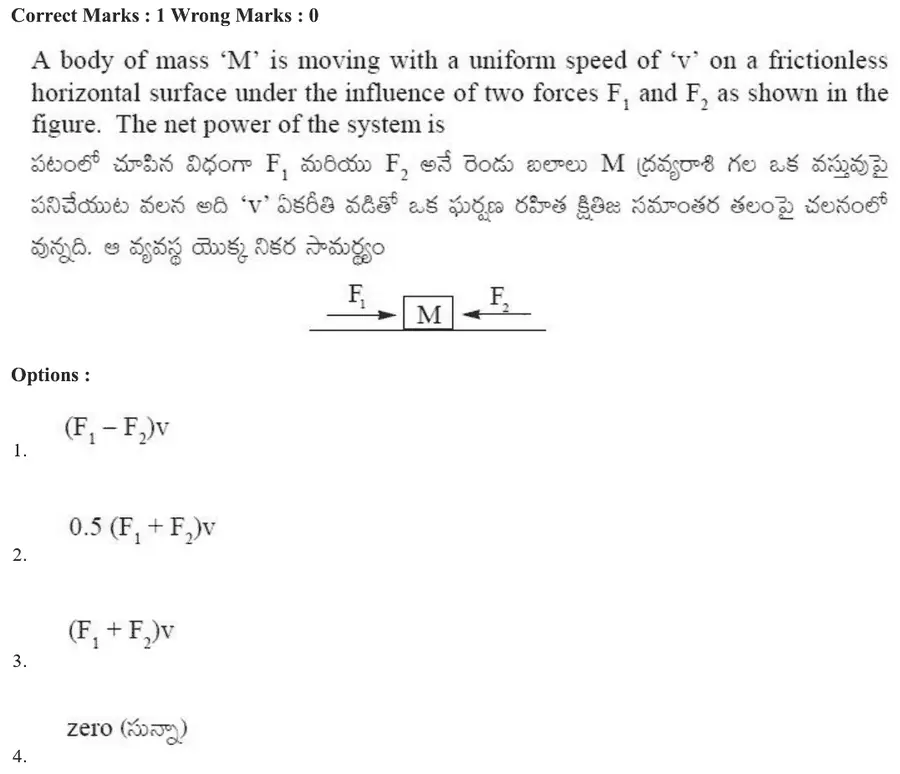
A body of mass ‘M’ is moving with a uniform speed of ‘v’ on a frictionless horizontal surface under the influence of two forces $F_1$ and $F_2$ as shown in the figure. The net power of the system is
A circular well of diameter $2\ \mathrm{m}$ has water upto the ground level. If the bottom of the well is at a depth of $14\ \mathrm{m}$, the time taken in seconds to empty the well using a $1.4\ \mathrm{kW}$ motor is (Acceleration due to gravity $= 10\ \mathrm{m\,s^{-2}}$)
A train of mass $10^6$ kg is moving at a constant speed of 108 kmph. If the frictional force acting on it is 0.5 N per 100 kg, then the power of the train is
A body is moving along a straight line under the influence of a constant power source. If the relation between the displacement (s) of the body and time (t) is $s \propto t^x$, then $x =$
Two bodies A and B of masses 20 kg and 5 kg respectively are at rest. Due to the action of a force of 40 N separately, if the two bodies acquire equal kinetic energies in times $t_A$ and $t_B$ respectively, then $t_A : t_B =$
A crane of efficiency $80\%$ is used to lift 8000 kg of coal from a mine of depth 108 m. If the time taken by the crane to lift the coal is one hour, then the power of the crane (in kW) is
(Acceleration due to gravity $= 10\ \mathrm{m\,s^{-2}}$)
The power required for an engine to maintain a constant speed of $50\ \mathrm{m\,s^{-1}}$ for a train of mass $3 \times 10^{6}\ \mathrm{kg}$ on rough rails is (The coefficient of kinetic friction between the rails and wheels of the train is 0.05 and acceleration due to gravity $= 10\ \mathrm{m\,s^{-2}}$)
The linear momentum of a body of mass $8$ kg is $24\ \mathrm{kg\ m\ s^{-1}}$. If a constant force of $24$ N acts on the body in the direction of motion of the body for a time of $3$ s, then the increase in the kinetic energy of the body is
A person holds a ball of mass $0.25$ kg in his hand and throws it, so that it leaves his hand with a speed of $12\ \mathrm{m\,s^{-1}}$. In this process, if his hand moved through a distance of $0.9$ m, then the net force acted on the ball is
The bob of a simple pendulum of length 200 cm is released from horizontal position. If 10% of its initial energy is lost due to air resistance, then the speed of bob at the mean position is (Acceleration due to gravity = $10\ \mathrm{m\,s^{-2}}$)
A steel sphere of radius 1.2 cm collides a second steel sphere at rest. If the collision is elastic and after the collision the first sphere continues to move in its initial direction with a velocity of $\frac{7}{9}$ times its initial velocity, then the radius of the second sphere is
A particle of mass 8 $\mu$g in motion collides with another stationary particle of mass 4 $\mu$g. If the collision is perfectly elastic and one dimensional, the ratio of their de Broglie wavelengths after collision is
A horizontal force of $10\ \mathrm{N}$ is applied on a block of mass $1.5\ \mathrm{kg}$ which is initially at rest on a rough horizontal surface. The work done by the applied force in a time of $6\ \mathrm{s}$ from the beginning of the motion is
(Acceleration due to gravity $=10\ \mathrm{ms^{-2}}$; the coefficient of kinetic friction between the block and the surface is $0.2$)
A ball is allowed to fall freely from a height of 42 m from the ground. If the coefficient of restitution between the ball and the ground is 0.4, then the total distance travelled by the ball before it comes to rest is
A body of mass $0.5$ kg is supplied with a power ‘P’ (in watt) which varies with time ‘t’ (in second) as $P = 3t^2 + 3$. If the velocity of the body at time $t = 0$ is zero, then the velocity of the body at time $t = 3\,\mathrm{s}$ is
A body of mass 500 g is falling from rest from a height of 3.2 m from the ground. If the body reaches the ground with a velocity of $6\,\mathrm{ms^{-1}}$, then the energy lost by the body due to air resistance is (Acceleration due to gravity = $10\,\mathrm{ms^{-2}}$)
A body of mass 'm' moving with a velocity of 'v' collides head on with another body of mass '2m' at rest. If the coefficient of restitution between the two bodies is 'e', then the ratio of the velocities of the two bodies after collision is
A particle of mass '$m$' at rest on a rough horizontal surface with a coefficient of friction '$\mu$' is given a velocity '$u$'. The average power imparted by friction before it stops
The average power generated by a 90 kg mountain climber who climbs a summit of height 600 m in 90 minutes is (Acceleration due to gravity = $10\ \mathrm{ms^{-2}}$)
A body of mass 30 kg moving with a velocity $20\ \mathrm{ms^{-1}}$ undergoes one dimensional elastic collision with another ball of same mass moving in the opposite direction with a velocity of $30\ \mathrm{ms^{-1}}$. After collision the velocities of first and second bodies respectively are
A force of $(4\bar{i} + 2\bar{j} + \bar{k})$ N is acting on a particle of mass 2 kg displaces the particle from a position of $(2\bar{i} + 2\bar{j} + \bar{k})$ m to a position of $(4\bar{i} + 3\bar{j} + 2\bar{k})$ m. The work done by the force on the particle in joules is
A spring of spring constant $200\ \mathrm{Nm^{-1}}$ is initially stretched by 10 cm from the unstretched position. The work to be done to stretch the spring further by another 10 cm is
A ball falls freely from rest from a height of $6.25$ m on to a hard horizontal surface. If the ball reaches a height of $81$ cm after second bounce from the surface, the coefficient of restitution is
A machine with efficiency 2/3 used 12 J of energy in lifting 2 kg block through certain height and it is allowed to fall through the same. The velocity while it reach the ground is
Two bodies A and B of masses $2m$ and $m$ are projected vertically upwards from the ground with velocities $u$ and $2u$ respectively. The ratio of the kinetic energy of body A and the potential energy of body B at a height equal to half of the maximum height reached by body A is
A body of mass $2\ \mathrm{kg}$ collides head on with another body of mass $4\ \mathrm{kg}$. If the relative velocities of the bodies before and after collision are $10\ \mathrm{ms^{-1}}$ and $4\ \mathrm{ms^{-1}}$ respectively, the loss of kinetic energy of the system due to the collision is
Two objects having masses 1:4 ratio are at rest. When both of them are subjected to same force separately, they achieved same kinetic energy during times $t_1$ and $t_2$ respectively. Then ratio of $\frac{t_2}{t_1}$ is
An object of mass ‘m’ is projected with an initial velocity ‘u’ with an angle of ‘θ’ with the horizontal. The average power delivered by gravity in reaching the highest point.
A ball falls freely from rest on to a hard horizontal floor and repeatedly bounces. If the velocity of the ball just before the first bounce is $7\ \mathrm{ms^{-1}}$ and the coefficient of restitution is 0.75, the total distance travelled by the ball before it comes to rest is (acceleration due to gravity=$10\ \mathrm{ms^{-2}}$)
A spring of $5 \times 10^{3}\ \mathrm{Nm^{-1}}$ spring constant is stretched initially by 10 cm from unstretched position. The work required to stretch it further by another 10 cm is
A constant force of $(8\hat{i}-2\hat{j}+6\hat{k})$ N acting on a body of mass 2 kg displaces the body from $(2\hat{i}+3\hat{j}-4\hat{k})$ m to $(4\hat{i}-3\hat{j}+6\hat{k})$ m. The work done in the process is
A ball ‘A’ of mass 1.2 kg moving with a velocity of $8.4\,\mathrm{ms^{-1}}$ makes one dimensional elastic collision with a ball ‘B’ of mass 3.6 kg at rest. The percentage of kinetic energy transferred by ball ‘A’ to ball ‘B’ is
A body thrown vertically upwards from the ground reaches a maximum height 'h'. The ratio of the kinetic and potential energies of the body at a height 40% of h from the ground is
A ball of mass 1.2 kg moving with a velocity of $12\ \mathrm{ms^{-1}}$ makes one dimensional collision with another stationary ball of mass 1.2 kg. If the coefficient of restitution is $\frac{1}{\sqrt{2}}$, then the ratio of the total kinetic energy of the balls after collision and the initial kinetic energy is
A ball P of mass $0.5$ kg moving with a velocity of $10\ \mathrm{ms^{-1}}$ collides with another ball Q of mass $1$ kg at rest. If the coefficient of restitution is $0.4$, the ratio of the velocities of the balls P and Q after the collision is
A block of mass 0.5 kg is at rest on a horizontal table. The coefficient of kinetic friction between the table and the block is 0.2. If a horizontal force of 5 N is applied on the block, the kinetic energy of the block in a time of 4 s is
(Acceleration due to gravity $=10\ \mathrm{ms^{-2}}$)
The sphere A of mass m moving with a constant velocity hits another sphere B of mass 2m at rest. If the coefficient of restitution is 0.4, the ratio of the velocities of the spheres A and B after collision is
A ball is dropped from some height and after first collision with the ground if it reaches $\frac{3}{4}^{\mathrm{th}}$ of its original height, then the % loss of its energy
A bullet of mass $20\ \mathrm{g}$ moving with $500\ \mathrm{ms^{-1}}$ is pierced $1\ \mathrm{cm}$ into a wooden block, then the retarding force experienced by the bullet is
A motor boat is moving in a river with velocity $\vec{v} = 7\hat{i}+2\hat{j}-5\hat{k}\,\mathrm{ms^{-1}}$. If the flow of water offers resistive force $\vec{F} = 9\hat{i}+3\hat{j}-3\hat{k}$ N, then the power of the boat is
A ball of mass $10\ \mathrm{g}$ is allowed to fall down from $10\ \mathrm{m}$ height. After collision with the ground if $50\%$ of its energy is lost, then the height reached by the ball is
A freely falling body has attained a velocity of $2\ \mathrm{ms^{-1}}$. Now, if the weight of the body is opposed by upward air resistance, then the total distance travelled before stopping is
A ball of mass $10\ \mathrm{g}$ moving with $4\ \mathrm{ms^{-1}}$ collides with another ball of same mass at rest. If 0.2 is the coefficient of restitution of the collision, then the ratio of the velocity of first ball to that of the second ball is
A car of mass 1000 kg having a velocity of 10 $\mathrm{ms^{-1}}$ collides a horizontally mounted spring. If the spring constant is 4000 $\mathrm{Nm^{-1}}$, then the maximum compression of the spring is
A machine gun fires 300 bullets per minute each with a velocity of 500 $\mathrm{ms^{-1}}$. If the mass of each bullet is 4 g, the power of the machine gun is
A body falls freely from a height of 100 m on to the ground and rebounds to a maximum height of 36 m after collision. The coefficient of restitution between ground and the body is
A block of steel of mass 2 kg slides down a rough inclined plane of inclination of $\sin^{-1}\left(\frac{3}{5}\right)$ at a constant speed. The temperature of the block as it slides through 80 cm, assuming that the mechanical energy lost is used to increase the temperature of the block is nearly
(Specific heat capacity of steel = 420 $\mathrm{Jkg^{-1}K^{-1}}$ and Acceleration due to gravity = 10 $\mathrm{ms^{-2}}$)
A body of mass 2 kg is moving with a constant acceleration of $\left(2\hat{i}+3\hat{j}-\hat{k}\right)\ \mathrm{ms^{-2}}$. If the displacement made by the body is $\left(3\hat{i}-\hat{j}+2\hat{k}\right)$ m then the work done is
An engine is dragging a mass of 5000 kg with a velocity of $5\ \mathrm{ms^{-1}}$ along a smooth inclined plane of inclination 1 in 50. Then the power of the engine is
A ball falls freely from a height h on a rigid horizontal plane. If the coefficient of restitution is e, then the total distance travelled by the ball before hitting the plane second time is
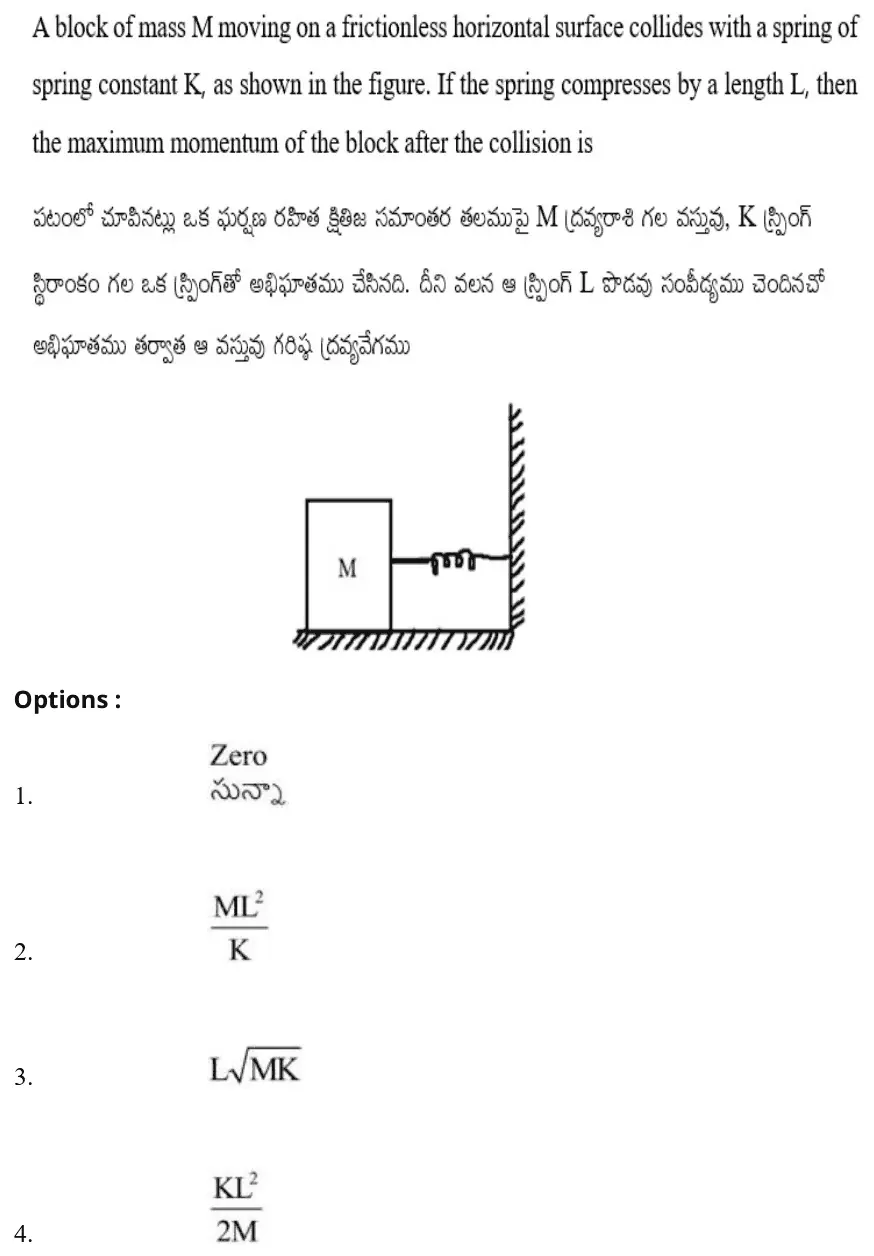
A block of mass M moving on a frictionless horizontal surface collides with a spring of spring constant K, as shown in the figure. If the spring compresses by a length L, then the maximum momentum of the block after the collision is
A body falls freely from a height ‘h’ on a fixed horizontal plane and rebounds. If ‘e’ is the coefficient of restitution, the total distance travelled before it comes to rest is
A body of mass 3 kg is moving under the action of a force which causes a displacement of $\left(\frac{t^3}{3}\right)$ m, where 't' is time in seconds. The work done by the force in first 2 seconds is
The displacement 's' of a body of mass 3 kg under the action of a force is given by $s = \frac{t^3}{3}$, where 's' is in metres and 't' is in seconds. The work done by the force in the first two seconds is
A body of mass 6 kg is moving with a uniform velocity $4\ \mathrm{ms^{-1}}$. Its velocity changes to $6\ \mathrm{ms^{-1}}$ when a force of 12 N acts on it. Then its displacement is
Statement (I) : The slope of kinetic energy-displacement curve of a body in motion will be directly proportional to its acceleration. Statement (II) : From a height of 15 m a ball is projected vertically upwards with a velocity of 30 m/s. If the ball rises to the same height after hitting the ground, the loss of its energy on hitting the ground is 30 %. Statement (III) : The velocity acquired by a body of mass 'm' after travelling a fixed distance from rest under the action of a constant force is directly proportional to mass 'm'. Which of the following is correct?
A
Statements I, II, III are true
B
Statements I, III are true, but statement II is false
C
Statement I is true, but statements II and III are false
D
Statements I, II are true, but statement III is false
A boat of mass 1000 kg goes from rest to speed 20.0 m/s in 5.0 s. The water exerts a constant drag force and the acceleration of the boat is constant. If the average power required by the boat is 45000 W, then the magnitude of the drag force is
A pump on the ground floor of a building can pump up water to fill a tank of volume $36\ \mathrm{m^3}$ in 30 min. If the tank is 50 m above the ground, and the electric power consumed by the pump is 40 kW, the efficiency of the pump is (Use $g=10\ \mathrm{m/s^2}$ and density of water = $1000\ \mathrm{Kg/m^3}$)
A ball of mass 1 kg moves in a straight line with velocity $v=cx^{\alpha}$, where $c=1$ (SI unit) and $\alpha$ is a constant. If the work done by the net force during its displacement from $x=0$ to $x=4\,m$ is 128 J, then the $\alpha$ is
Assertion(A): In an elastic collision of two billiard balls, both kinetic energy and linear momentum remain conserved.
Reason (R) : During the collision of the balls, as the collision is elastic there is no exchange of energy. Therefore, both energy and momentum are conserved.
The correct option among the following is
A
(A) is true, (R) is true and (R) is the correct explanation for (A)
B
(A) is true, (R) is true but (R) is not the correct explanation for (A)
Particle A moving with a velocity $v=10$ m/s experienced a head on collision with a stationary particle B of the same mass. As a result of collision, the kinetic energy of the system decreased by 1%. The speed of particle A after collision is
The potential energy of an object is $U(x)=(5x^{2}-4x^{3})\ \mathrm{J}$, where x is the position in meter. The position at which the force becomes zero is
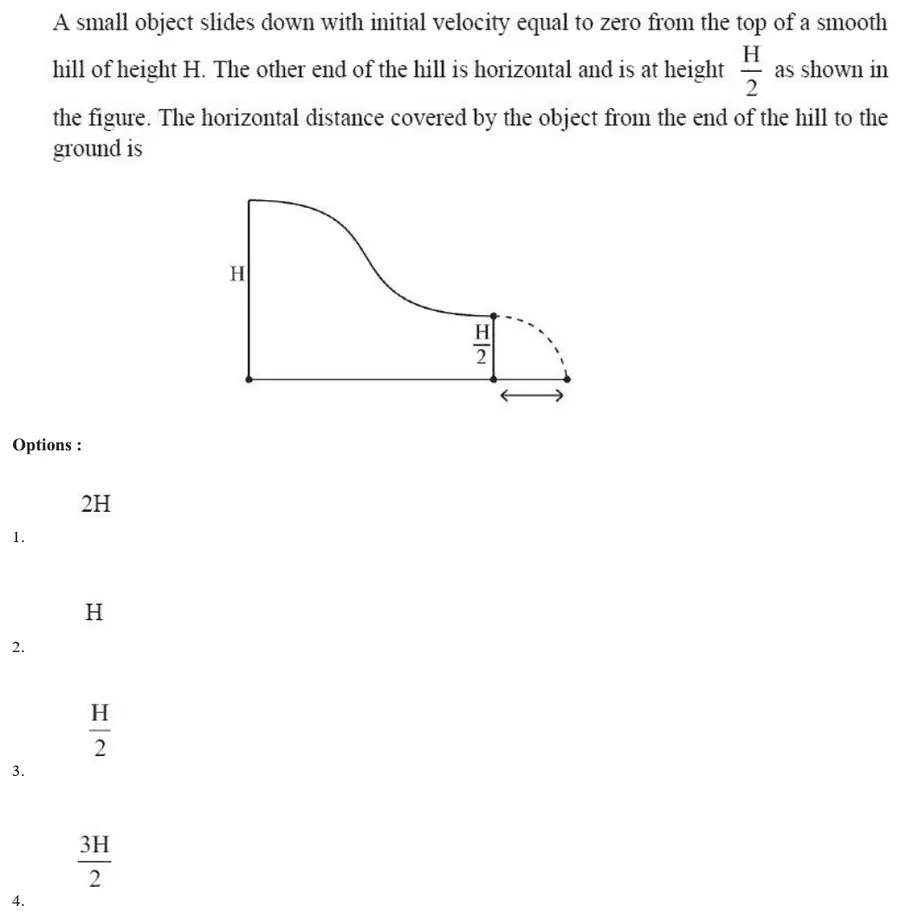
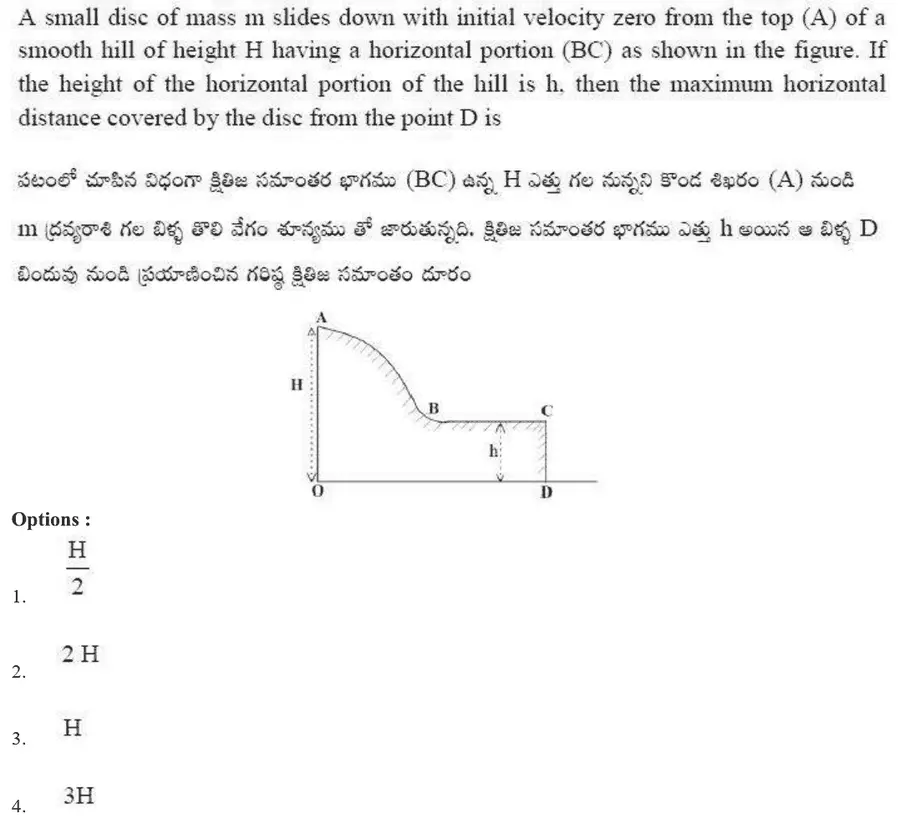
A small object slides down with initial velocity equal to zero from the top of a smooth hill of height H. The other end of the hill is horizontal and is at height $\frac{H}{2}$ as shown in the figure. The horizontal distance covered by the object from the end of the hill to the ground is (see the figure above)
A moving particle collides with a stationary particle of mass $\frac{1}{n}$ times the mass of moving particle, the fraction of its kinetic energy transferred to the stationary particle is
A block of mass 2 kg is pulled at a constant speed with a taut rope along a frictionless plane that is inclined at $30^\circ$. Then the work done by the tension in the rope in pulling it a distance 4 m along the inclined plane in joule is (acceleration due to gravity $= 10\ \mathrm{m\,s^{-2}}$)
A 1 kg box placed at the origin starts sliding along x-axis under the action of a force $\vec{F} = F\hat{i}$. Its acceleration as a function of x is given by $a(x) = \beta.x$ where $\beta = 5\ \mathrm{s^{-2}}$. The work done by $\vec{F}$ in moving the box from $x = 2$ cm to $x = 5$ cm in joule is
A system consists of two springs connected is series and each having the spring constant $10\ \mathrm{Nm^{-1}}$. The minimum work required to stretch this system by 1 cm in erg is
A cannon ball is fired from the top of a 55 m high cliff with an initial speed of $50\ \mathrm{m\,s^{-1}}$. The speed of the cannon ball while hitting the ground in $\mathrm{m\,s^{-1}}$ (acceleration due to gravity = $10\ \mathrm{ms^{-2}}$)
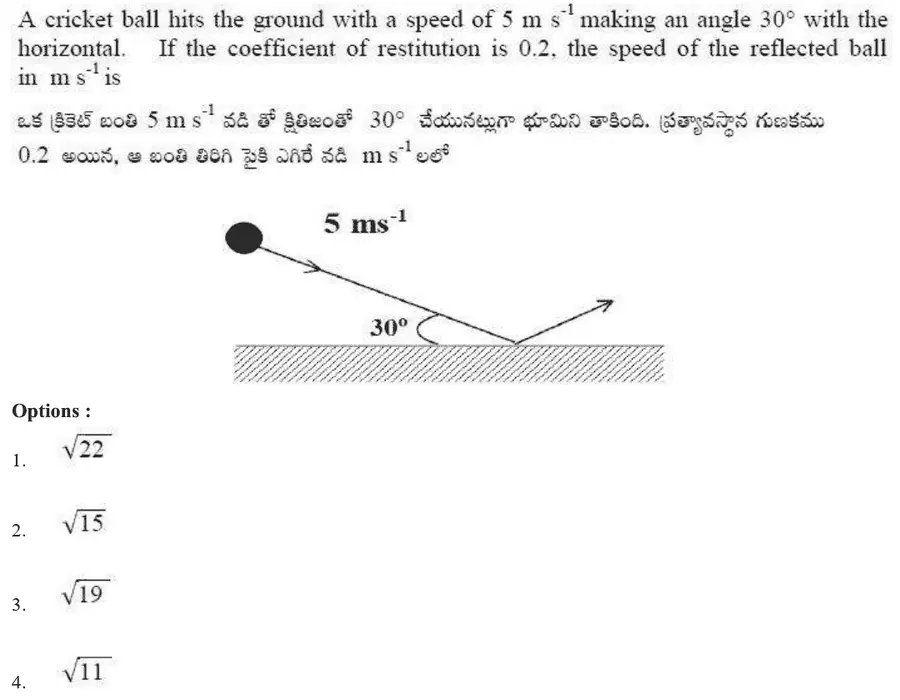
A cricket ball hits the ground with a speed of $5\ \mathrm{m\,s^{-1}}$ making an angle $30^\circ$ with the horizontal. If the coefficient of restitution is 0.2, the speed of the reflected ball in $\mathrm{m\,s^{-1}}$ is (see the figure above)
A bar of mass m resting on a smooth horizontal plane starts moving due to a constant force F. In the process of its rectilinear motion the angle $\theta$ between the direction of this force and the horizontal varies as $\theta = kx$, where k is a constant and x is the distance traversed by the bar from its initial position. The velocity (v) of the bar as a function of the angle $\theta$ is
A lift raises 50 passengers each having average weight 600 N to a height of 100 m at a constant speed in time T. If the average power of 15 kW is required by the lift, then the value of T in seconds is
Two wooden blocks of mass $M_1$ and $M_2$ rest on a frictionless table. A bullet of mass m is fired at $M_1$ with speed v which embedded in it and the two together finally collide with $M_2$. Find the velocity of $M_2$ after collision. [Ignore any energy loss and treat the problem to be one dimensional]
An object of mass 20 kg. is displayed (sic) by $x = 5t^2$ m (here t is time) by the application of a force. Then the ratio of the work done in times 3 s and 5 s is
A force of 10 N acting at an angle on a particle produces a displacement of $(3\hat{i} - 4\hat{j})$ m. Due to this force, if the kinetic energy of the particle is decreased by 25 joule, then the angle between the force and the displacement is
A force of 5 N acts on a body initially at rest. If the instantaneous power due to the force at the end of the third second (t = 3 s) is 5 W, then the mass of the body is
A small disc of mass m slides down with initial velocity zero from the top (A) of a smooth hill of height H having a horizontal portion (BC) as shown in the figure. If the height of the horizontal portion of the hill is h, then the maximum horizontal distance covered by the disc from the point D is (see the figure above)
A block of mass 50 kg is pulled at a constant speed of $4\ \mathrm{m\,s^{-1}}$ across a horizontal floor by an applied force of 500 N directed $30^\circ$ above the horizontal. The rate at which the force does work on the block in watt is
A force $\vec{F} = 4\hat{i} - 15\hat{j}$ N, acts on a body resulting in a displacement of $6\hat{i}$. If the body had a kinetic energy of 7 joules at the beginning of the displacement, the kinetic energy at the end of the displacement is
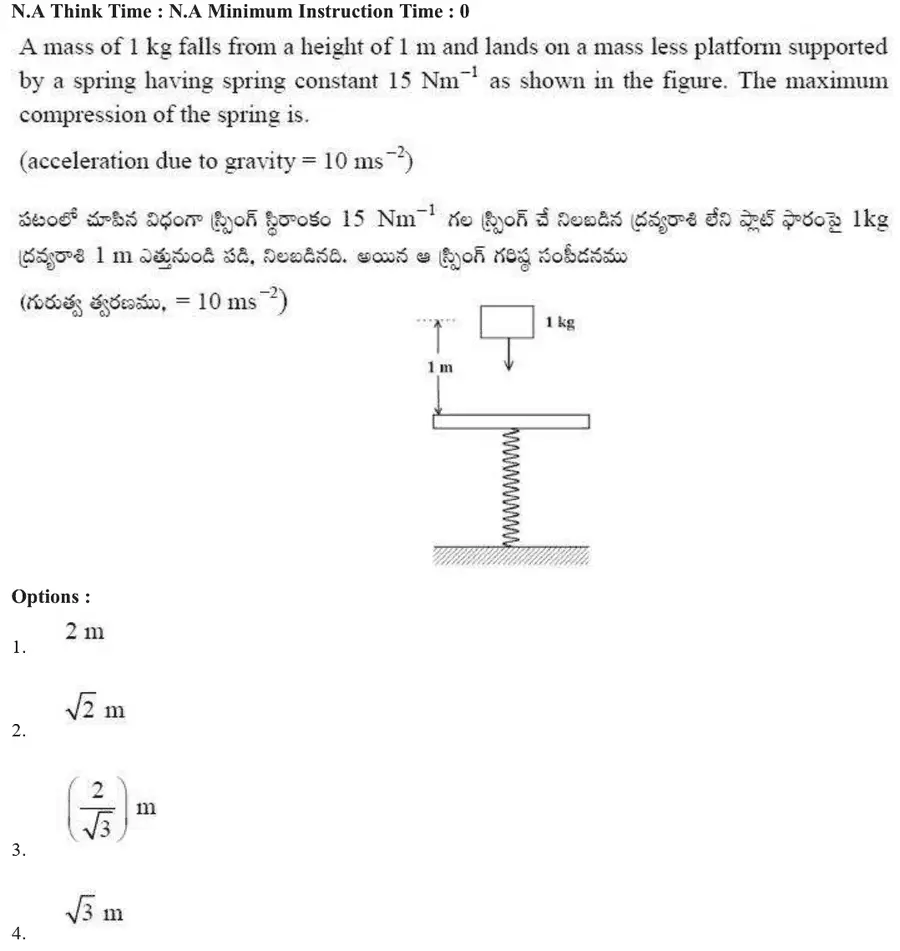
A mass of 1 kg falls from a height of 1 m and lands on a mass less platform supported by a spring having spring constant 15 $\mathrm{Nm^{-1}}$ as shown in the figure. The maximum compression of the spring is. (acceleration due to gravity = 10 $\mathrm{ms^{-2}}$) (see the figure above)
A bead of mass 400 g is moving along a straight line under a force that delivers a constant power 1.2 W to the bead. If the bead is initially at rest, the speed it attains after 6 sec in $\mathrm{ms^{-1}}$
A ball of mass 300 g is dropped from a height 10 m above a sandy ground. On reaching the ground, it penetrates through a distance 1.5 m in sand and finally stops. The average resistance offered by the sand to oppose the motion is (acceleration due to gravity = $10\ \mathrm{ms^{-2}}$)
Two balls A and B, of masses M and 2M respectively collide each other. If the ball A moves with a speed of $150\ \mathrm{ms^{-1}}$ and collides with ball B, moving with speed v in the opposite direction. After collision if ball A comes to rest and the coefficient of restitution is 1 (one), then the speed of the ball B before it collides with ball A is
A body of mass 2.5 $kg$ is thrown vertically upwards with a kinetic energy of 500 J. The height at which the kinetic energy of the body reduces to 50% of its original value is _____ ($g = 10\ \mathrm{m.s^{-2}}$)
A body of mass $0.15\ \mathrm{kg}$ moving with a velocity of $15\ \mathrm{m.s^{-1}}$ comes to rest when it hits a spring that is fixed at another end. If the force constant of the spring is $1500\ \mathrm{N.m^{-1}}$, the compression in the spring is ______
Assertion (A): In an elastic collision of two billiard balls, the total K.E. is conserved during the short time of collision of the balls (i.e. when they are in contact). Reason (R): Energy spent against friction does not follow the law of conservation of energy.
A
Both A and R are true and R is a correct explanation for A
B
Both A and R are true but R is not a correct explanation for A
A bullet of mass $30\,\mathrm{g}$ moving with $700\,\mathrm{m.s^{-1}}$ collides with a block of mass $4\,\mathrm{kg}$ hanging by a string of length $0.4\,\mathrm{m}$. After collision, the block rises to a height of $0.2\,\mathrm{m}$. Then find the velocity of the bullet when it comes out of the block ________
A body of mass $3\,\mathrm{kg}$ is moving with a velocity of $8\,\mathrm{m.s^{-1}}$ collides head on with another body of mass $1\,\mathrm{kg}$, moving in the opposite direction with a velocity of $4\,\mathrm{m.s^{-1}}$. After the collision, if the two bodies stick together and move, they move with a common velocity ____
A car moving at a speed 'v' is stopped by a retarding force 'F' in a distance 's'. If the retarding force were $3F$, the car will be stopped in a distance ______
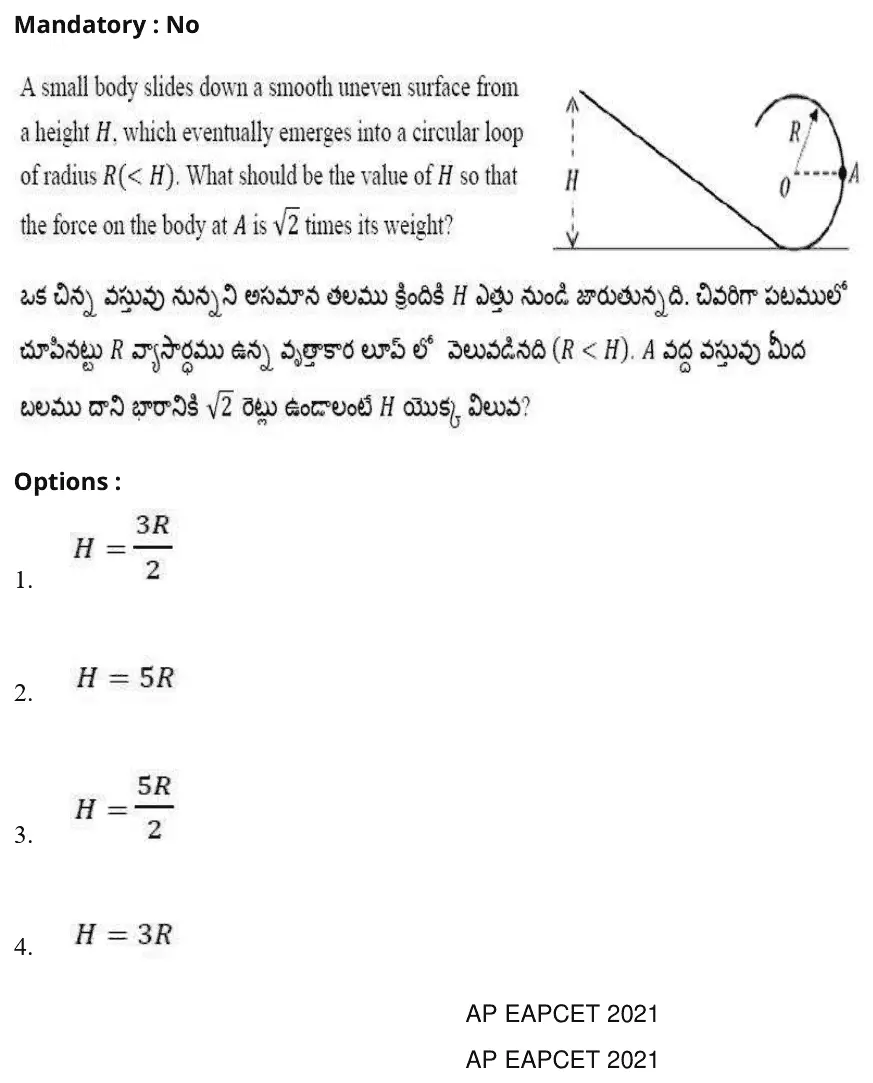
A small body slides down a smooth uneven surface from a height $H$, which eventually emerges into a circular loop of radius $R (< H)$. What should be the value of $H$ so that the force on the body at $A$ is $\sqrt{2}$ times its weight? (see the figure above)
A body of mass $M$ is dropped from a height $h$ on a sand floor. If the body penetrates $x$ $cm$ into the sand, the average resistance offered by the sand to the body is ______
A bob of a pendulum of length 0.5 $m$ has a speed of $6\ ms^{-1}$ at its lowest point. Find the speed of the bob when the string of the pendulum makes $60^\circ$ with the vertical. (take g = $10\ ms^{-2}$)
When a force $\vec{F} = 17 - 2x + 6x^2\ \mathrm{N}$ acts on a body of mass $2\ \mathrm{kg}$ and displaces it from $x = 0\ \mathrm{m}$ to $x = 8\ \mathrm{m}$, the work done is ______.
A uniform chain has a mass 'm' and length 'l'. It is held on a frictionless table with one-sixth of its length hanging over the edge. The work done in just pulling the hanging part back on the table is:
Water is falling on the blades of a turbine from a height of $25\ m$. $3 \times 10^{3}\ kg$ of water pours on the blade per minute. If the whole of energy is transferred to the turbine, power delivered is:
A metal ball of mass $2\ kg$ moving with a velocity of $36\ kmph$ has a head on collision with a stationary ball of mass $3\ kg$. After the collision, if both balls move together, the loss in kinetic energy due to collision is ______
A body of mass $8\ kg$, under the action of a force, is displaced according to the equation $s = \dfrac{t^2}{4}\ m$, where 't' is the time. Find the work done by the force in the first 4 seconds.
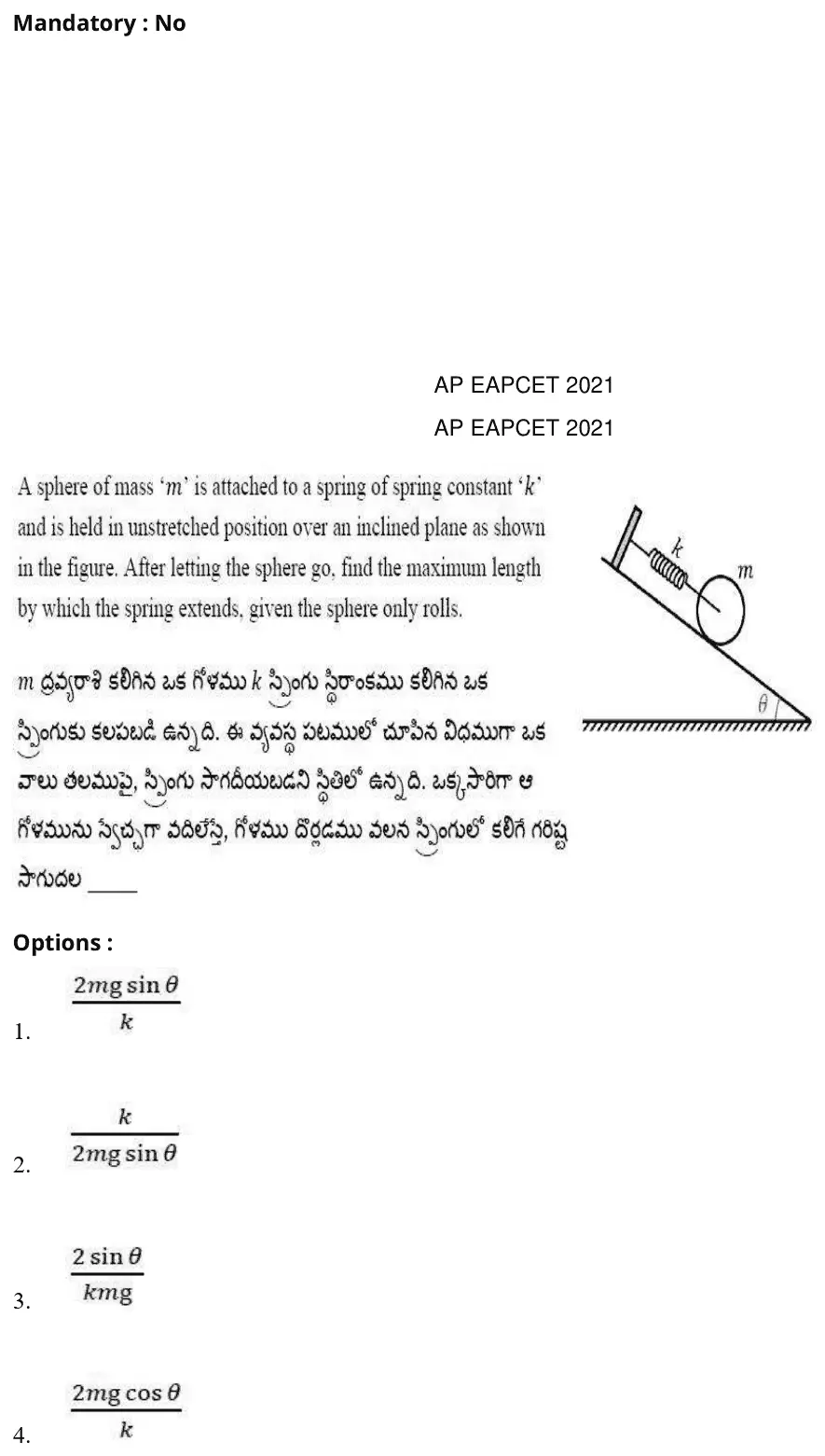
A sphere of mass 'm' is attached to a spring of spring constant 'k' and is held in unstretched position over an inclined plane as shown in the figure. After letting the sphere go, find the maximum length by which the spring extends, given the sphere only rolls. (see the figure above)
A bullet of mass m enters a wooden block of length L at a speed $v_1$ and emerges out of block with a speed $v_2$. If $\overline{F}$ is the average force which impeded its motion through the wooden block then correct statement is (Assume uniform deceleration inside the block)
If the average terminal velocity of rain drop is 2 ms$^{-1}$, then the energy transferred by rain to each square meter of the surface at a place which receives 100 cm of rain in a year is
A horizontal force $\vec{F}=(g-x^2)\hat{i}$ N acts on a wooden block resting on a horizontal smooth surface. The work done to move the block from x = 0 to x = 3 m (in Joule) is (use g = 10 m/s$^2$):
A force acts on a body of mass $15\ \mathrm{kg}$, initially at rest. If the instantaneous power due to the force at the end of the third second is $5\ \mathrm{W}$ then the instantaneous power (in W) at the end of the fourth second will be
A ball of mass $2\ \mathrm{kg}$ is moving in $xy$ plane with a potential energy given as $U=(12x+16y)\ \mathrm{J}$, $x$ and $y$ being in metre. Assume the initial position of the ball at $t=0$ is at origin $(0,0)$ and it is moving with a velocity of $(15\hat{i}+20\hat{j})\ \mathrm{m/s}$. Then identify the correct statement.
A
The path of the ball is parabolic
B
The direction of motion of the ball initially at $t=0$ is parallel to the direction of acceleration
C
The speed of the ball at $t=2\mathrm{s}$ is $5\ \mathrm{m/s}$
D
The magnitude of acceleration of the ball is $8\ \mathrm{m/s^2}$
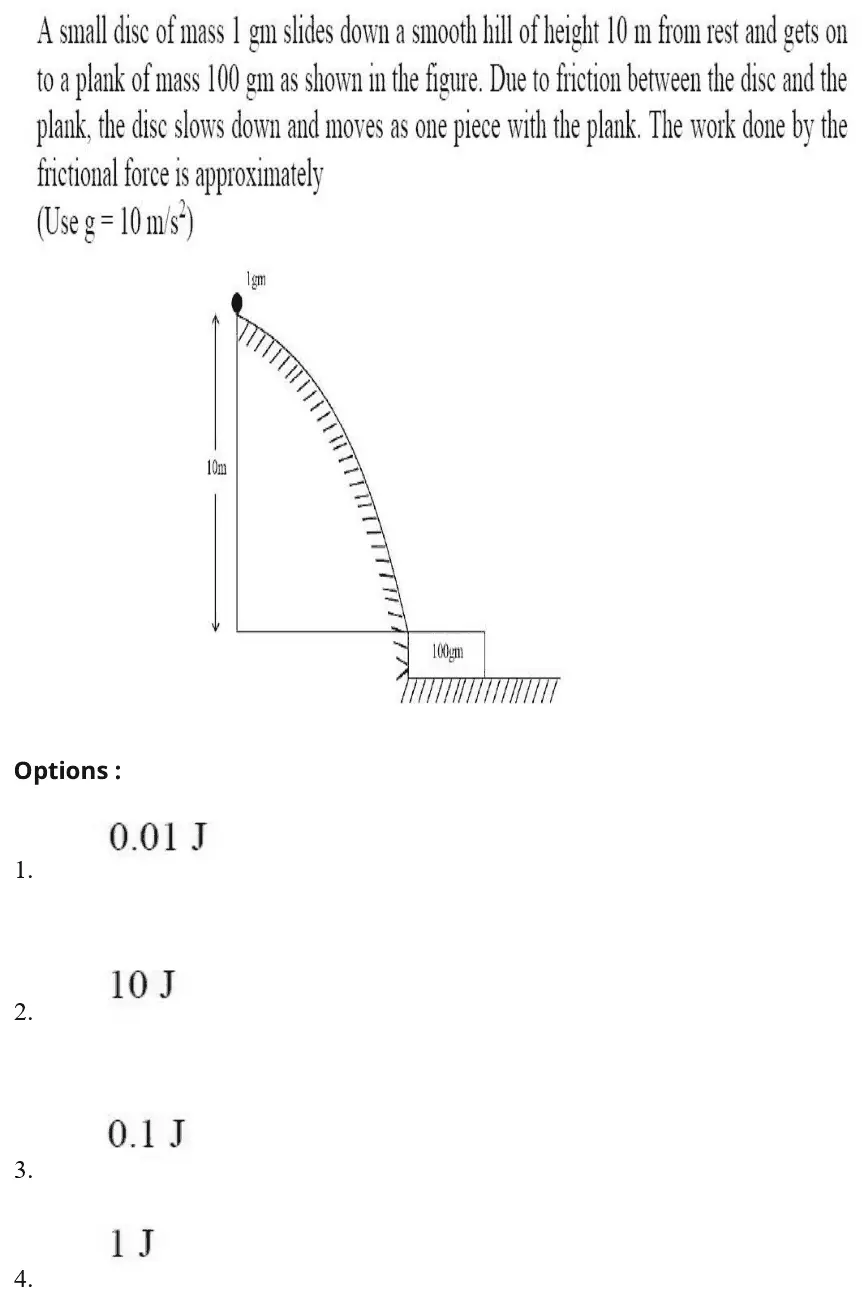
A small disc of mass $1\ \mathrm{gm}$ slides down a smooth hill of height $10\ \mathrm{m}$ from rest and gets on to a plank of mass $100\ \mathrm{gm}$ as shown in the figure. Due to friction between the disc and the plank, the disc slows down and moves as one piece with the plank. The work done by the frictional force is approximately (Use $g=10\ \mathrm{m/s^2}$) (see the figure above)
A small block of mass 200 g is placed on a horizontal slab at a height of 2 m above the floor. The block is pressed against a horizontal spring fixed at one end to compress the spring through 10.0 cm. Upon releasing, the block moves horizontally till it leaves the spring. Calculate the horizontal distance covered by the block after leaving the slab and just before hitting the ground. The spring constant is 50 N/m. (Assume $g = 10\ \mathrm{m/s^2}$).
A water pump rated 600 W, has an efficiency of 95 %. If it is used to raise water through vertical distance of 60 m. The volume of water drawn in 20 minutes, is [Use density of water = 1000 kg m$^{-3}$, g = 10 m/s$^2$]
Ball P of mass m moving with velocity 'v' collides with another ball Q of mass 2 m, at rest. If $v_P$ and $v_Q$ are the final velocities of P and Q respectively, after collision, then (Assume the coefficient of restitution is $\frac{1}{3}$)
The potential energy of a particle in a central field has the form $U(r) = \frac{1}{r^2} - \frac{1}{r}$, where 'r' is the distance from the centre of the field. The magnitude of the maximum attractive force in Newton is
Consider a rocket is being fired. The kinetic energy of the rocket is increased by 16 times where as its total mass is reduced by half through the burning of fuel. The factor by which its momentum increases is
Water is pumped steadily out of a flooded basement, at the speed of 10 m/s through a hose (tube) of radius 1 cm, passing through a window 3 m above the water level. The power of the pump is (Assume $g = 10\ \mathrm{m/s^2}$, density of water = $1000\ \mathrm{kg/m^3}$)
Consider a small block sliding down an inclined plane of inclination 30° with the horizontal. The coefficient of friction is $\mu = \dfrac{2}{3}x$, where x is the distance (in meter) through which the mass slides down. The distance covered by the mass before it stops is
Brakes stop a train in a certain distance $x$. If the force of these brakes is reduced to one fourth of its original force, the train needs ______ the original distance $x$ to stop.
$(60\,\hat{i} + 15\,\hat{j} - 3\,\hat{k})\ N$ force produces a velocity $(2\,\hat{i} - 4\,\hat{j} + 5\,\hat{k})$ in a particle. The value of power at that time will be ______
A uniform chain of mass 'M' and length 'L' is lying on a smooth horizontal table, with half of its length hanging down. The work done is pulling the entire chain up the table is
A steel ball of radius $2\ \mathrm{cm}$ is at rest on a frictionless surface. Another steel ball of radius $4\ \mathrm{cm}$ moving with velocity of $81\ \mathrm{cm.s^{-1}}$ collides elastically with the ball which is at rest. After collision the ball with radius of $2\ \mathrm{cm}$ moves with speed of ______
A bullet of mass 'm' and velocity 'v' when fired at a sand bag of mass 'M', suspended by a string, gets embedded into the bag. The loss of kinetic energy in this process is
A bullet of mass $0.01\ \mathrm{kg}$ travelling at a speed of $500\ \mathrm{m.s^{-1}}$ strikes a block of mass $2\ \mathrm{kg}$ which is suspended by a string of length $5\ \mathrm{m}$. The centre of gravity of the block is found to rise a vertical distance of $0.1\ \mathrm{m}$. What is the speed of the bullet after it emerges from the block?
An electric motor exerts a force of 50 $\mathrm{N}$ on a cable and pulls it through 60 $\mathrm{m}$ in 1 minute. The power supplied by the motor is ______
Two balls $X$ ($2\ \mathrm{kg}$) and $Y$ ($4\ \mathrm{kg}$) approach each other with equal speeds of $10\ \mathrm{m.s^{-1}}$. If the collision is perfectly elastic, the new velocities of $X$ and $Y$ balls are respectively
The power utilized when a force of $(2\hat{i} + 3\hat{j} + 4\hat{k})\ \mathrm{N}$ acts on a body for $4$ seconds, producing a displacement of $(3\hat{i} + 4\hat{j} + 5\hat{k})\ \mathrm{m}$, is ______
When a moving body collides with a stationary body, of $n$ times its mass, then the amount of kinetic energy transferred to the stationary body is ________
A particle is moving an $x$-axis has potential energy $U = 2 - 20x + 5x^{2}\,\mathrm{J}$ along $x$-axis. The particle is released at $x = -3$. The maximum value of $x$ will be ($x$ is in meters and $U$ is in joules)
A machine which is 70% efficient raises a $10\ kg$ body through a certain distance and spends $100\ \mathrm{J}$ energy. The body is then released. On reaching the ground, the kinetic energy of the body will be
A cyclist comes to a skidding stop in 10 $\mathrm{m}$. During this process, the force on the cycle due to the road is 200 $\mathrm{N}$ and is directly opposite to the motion. How much work does the road do on the cycle?
A force $\vec{F} = (5\hat{i} + 4\hat{j})\ \mathrm{N}$ acts on a body and produces a displacement $\vec{S} = (6\hat{i} - 5\hat{j} + 3\hat{k})\ \mathrm{m}$. The work done by the force is ______
A block of mass m placed on a rough horizontal plane is pulled by a constant power P. The coefficient of friction between the block and the surface is $\mu$. The maximum velocity of the block will be
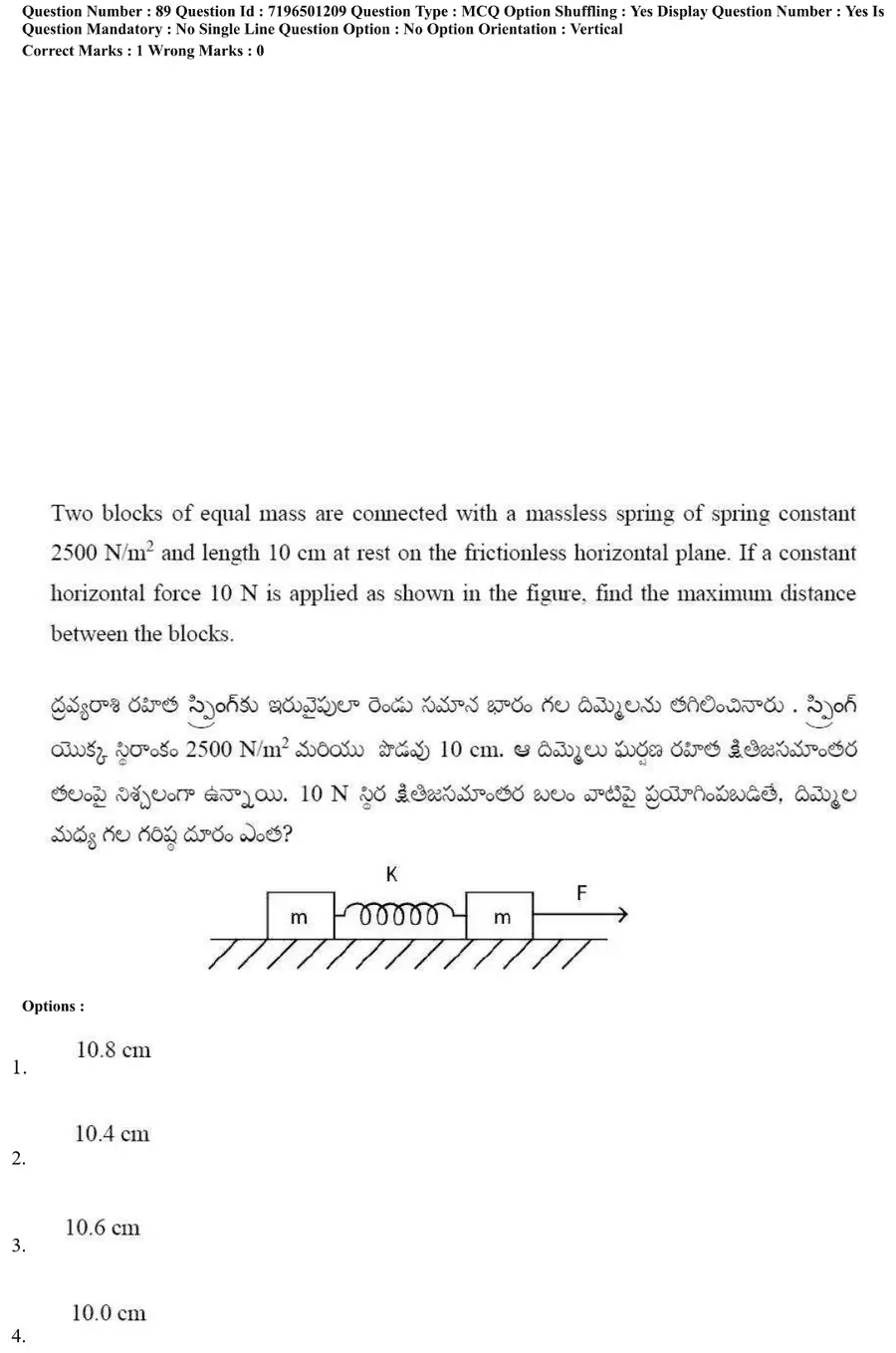
Two blocks of equal mass are connected with a massless spring of spring constant 2500 N/m$^2$ (sic) and length 10 cm at rest on the frictionless horizontal plane. If a constant horizontal force 10 N is applied as shown in the figure, find the maximum distance between the blocks. (see the figure above)
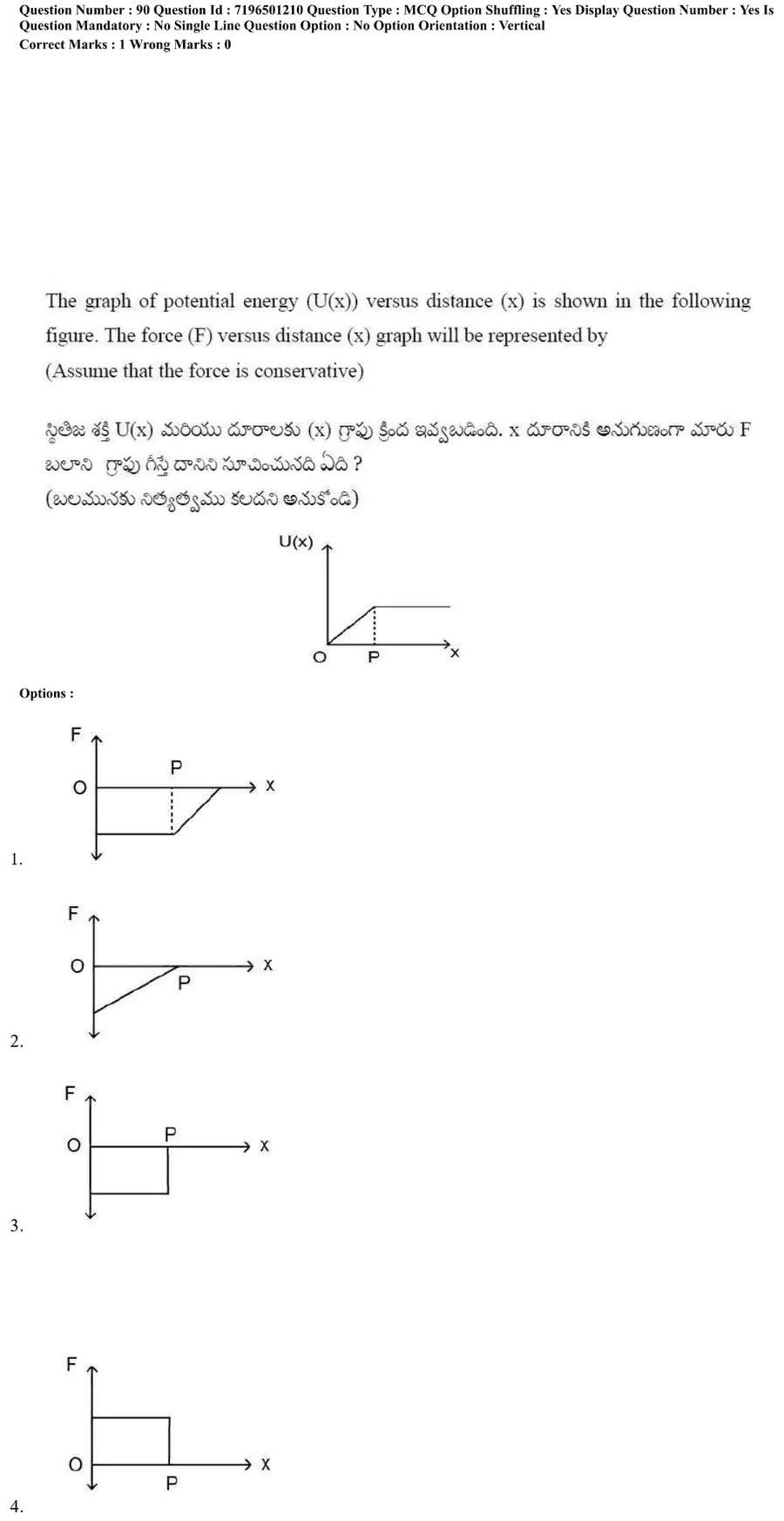
The graph of potential energy ($U(x)$) versus distance ($x$) is shown in the following figure. The force ($F$) versus distance ($x$) graph will be represented by (Assume that the force is conservative) (see the figure above)
The question as printed in the paper.
A
see figure F vs x: constant negative F from the F axis to x=P (dotted vertical at P), then a slanted straight segment rising from there up to F=0 beyond P, zero after.
B
see figure F vs x: a straight line starting at negative F on the F axis and rising linearly to F=0 at P; P labelled below the line.
C
see figure F vs x: constant negative F from the F axis to x=P, then a vertical jump to F=0 at P and zero beyond; P labelled above the axis.
D
see figure F vs x: constant positive F from the F axis to x=P, then drops vertically to F=0 at P; P labelled below the axis.
A moving body with a mass $m_1$ and velocity u strikes a stationary body of mass $m_2$. The masses $m_1$ and $m_2$ should be in the ratio $\frac{m_1}{m_2}$ so as to decrease the velocity of the first body to $\frac{2u}{3}$ and giving a velocity of $v$ to $m_2$ assuming a perfectly elastic impact. Then the ratio $\frac{m_1}{m_2}$ is
A force acts on a 30 gm particle in such a way that the position of the particle as a function of time is given by $x = \alpha\, t^2$, where x is in metre, t is in seconds and $\alpha = 1\ (\mathrm{m/s^2})$. The work done during the first 4 seconds is
A force of 4 N acts on a 10 Kg body initially at rest. Let $W_1$ is work done by force during $0 \le t \le 1$s. Likewise $W_2$ is the work done by force during $1 \le t \le 2$s, where t is time. The ratio $\dfrac{W_2}{W_1}$ is
An elevator of mass 500 kg is ascending upwards with a constant acceleration a = 2 m/s$^2$. What is the work done by the tension in the elevator cable during its climb by 12 m? (Take g = 10 m/s$^2$)
A planet is moving in an elliptical orbit round the sun. The work done on the planet by the gravitational force of the sun: (a) is zero in no part of the motion (b) is zero in some parts of the orbit (c) is zero in one complete revolution (d) is zero in any small part of the orbit
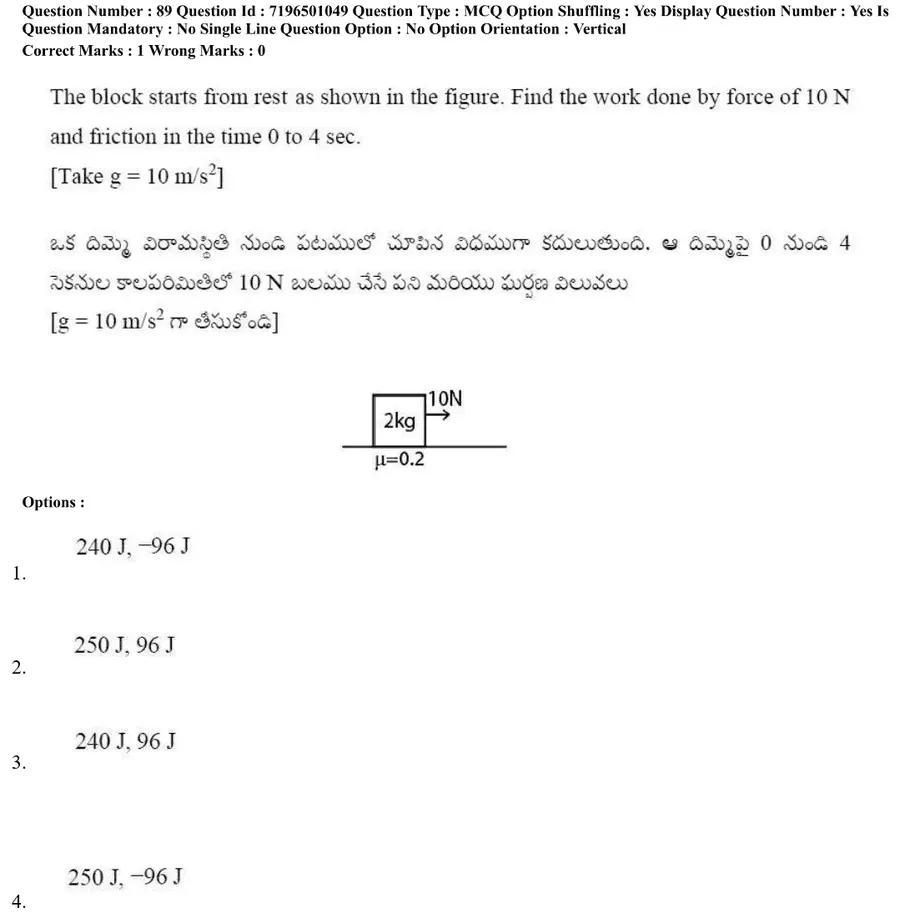
The block starts from rest as shown in the figure. Find the work done by force of 10 N and friction in the time 0 to 4 sec. [Take $g = 10\ \mathrm{m/s^2}$] (see the figure above)
Under action of force, a 2 kg body moves such that its position x as function of time t is given by $x = \alpha t^2/2$ where x is in meters, t is in seconds and $\alpha = 1\ \mathrm{m/s^2}$. The work done by the force in the first two seconds is
A force acts on a body of mass 10 kg, resulting in its displacement given as $x = \left(\frac{t^3}{25}\right)\ m$ where t is the time in seconds. The work done by the force in 5 seconds is
A bullet of mass 25 g moves horizontally at a speed of 250 m/s is fired into a wooden block of mass 1 kg suspended by a long string. The bullet crosses the block and emerges on the other side. If the centre of the mass of the block rises through a height of 20 cm. The speed of the bullet as it emerges from the block is (Take $g = 10\ \mathrm{m/s^2}$)
A force $\vec{F} = (2\hat{i} + 4\hat{j})$ N is applied on an object of mass $M$. What is the work done by this force in moving the object horizontally along the x-axis by 3 m is
A ball of mass m = 1 Kg is thrown from the top of a building with initial velocity $\vec{v}$ = (20 m/s) $\hat{i}$ + (24 m/s) $\hat{j}$ at time t = 0 s. The change in the potential energy of the ball between t = 0 and t = 6s, if the ball does not hit the ground (Assume g = 10 m/s$^2$)
A particle of mass $m_1$ collides with a particle of $m_2$ at rest. After the elastic collision, the two particles moves at an angle of $90^0$ with respect to each other. The ratio $\frac{m_2}{m_1}$ is
A block of mass 100 g moving at a speed of 2 m/s compresses a spring through a distance 2 cm before its speed is halved. Find the spring constant of the spring
A bullet of mass $m$ moving horizontally with speed $v_0$ hits a wooden block of mass $M$ that is suspended from a massless string. The bullet gets lodged into the block and comes into halt. If the block-bullet combine swings to a maximum height $h$, then how much of the initial kinetic energy of the bullet is lost in the collision?
A
$\frac{1}{2} m v_0^2 \left(\frac{M}{m+M}\right)$
B
$\frac{1}{2} m v_0^2 \left(\frac{M+m}{M}\right)$
C
$\frac{1}{2} m v_0^2 \left(\frac{M^2}{(m+M)^2}\right)$
D
$\frac{1}{2} m v_0^2 \left(\frac{(M+m)^2}{M^2}\right)$
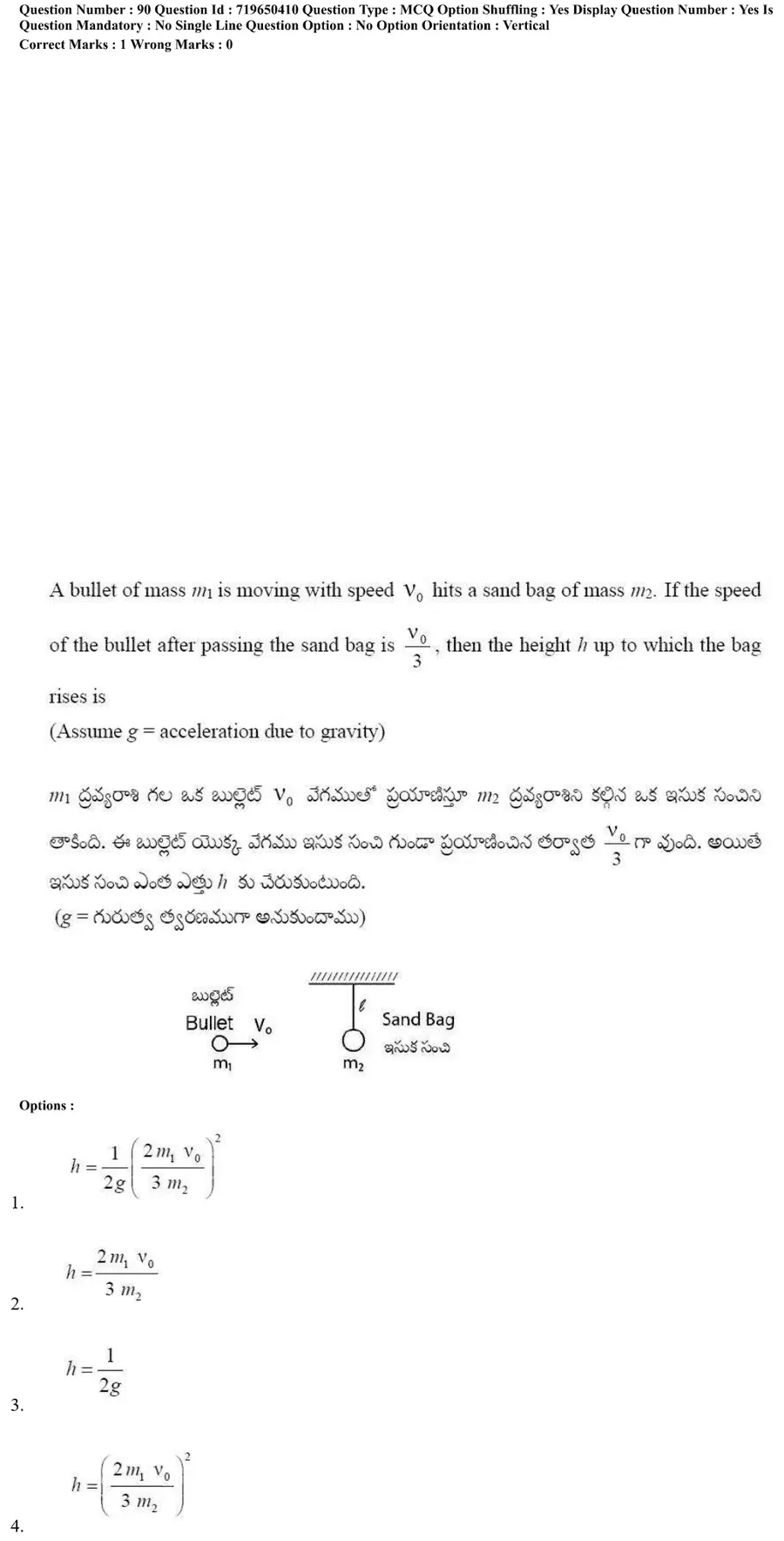
A bullet of mass $m_1$ is moving with speed $v_0$ hits a sand bag of mass $m_2$. If the speed of the bullet after passing the sand bag is $\dfrac{v_0}{3}$, then the height $h$ up to which the bag rises is (Assume g = acceleration due to gravity) (see the figure above)
A ball of mass 2 g released from the top of an inclined plane describes a circular motion of radius 20 cm in the vertical plane upon reaching the bottom. The minimum height of the inclined plane is:
A bouncing ball of mass 200 g falls from height of 5 m on to a horizontal ground. After every impact with the ground the velocity of the ball decreases by $\left(\frac{1}{2}\right)$ times. The total momentum, the ball imparts on to the ground after 3 impacts is (Let $g = 10$ m/s$^2$)
A metal chain of mass 2 kg and length 90 cm over hangs a table with 60 cm on the table. How much work needs to be done to put the hanging part of the chain back on the table. (Let $g = 10$ m/s$^2$)
Ball A of mass 50 gm and speed 10 m/s collides with ball B of mass 10 gm and speed 15 m/s travelling in opposite direction with each other. Determine the final speed of ball B if the coefficient of restitution is $\frac{2}{5}$.
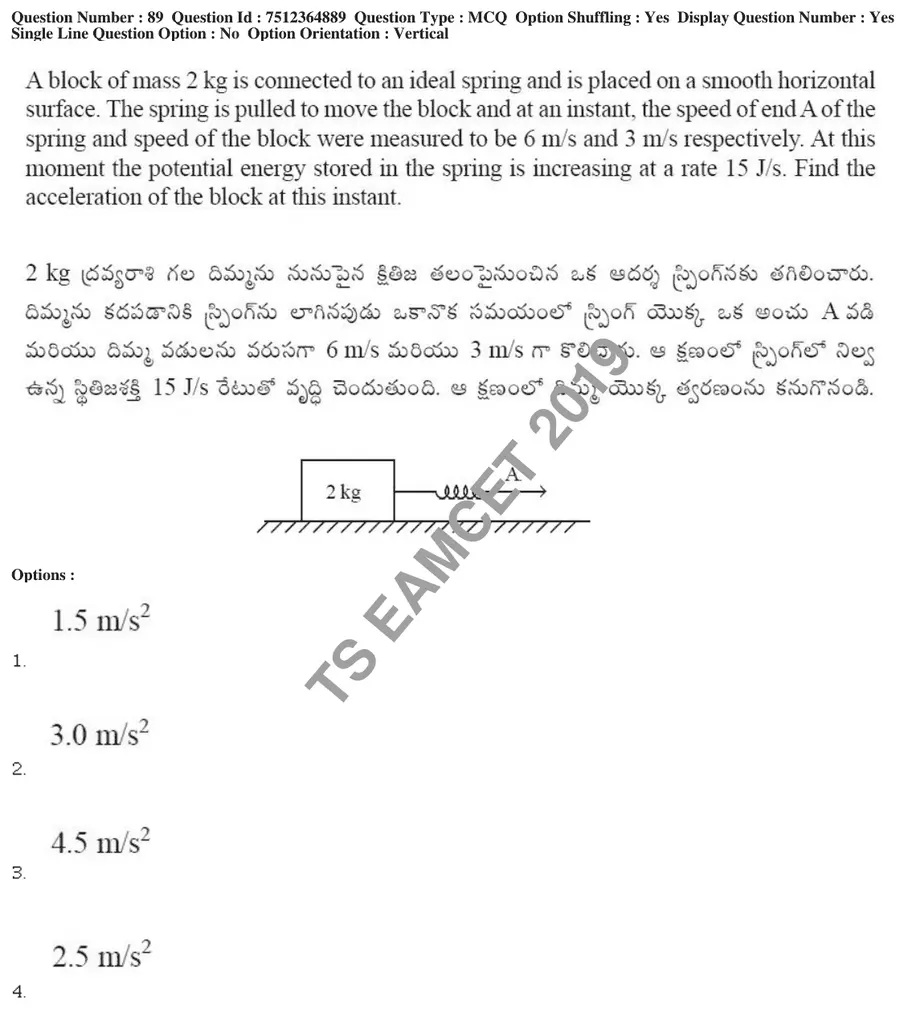
A block of mass 2 kg is connected to an ideal spring and is placed on a smooth horizontal surface. The spring is pulled to move the block and at an instant, the speed of end A of the spring and speed of the block were measured to be 6 m/s and 3 m/s respectively. At this moment the potential energy stored in the spring is increasing at a rate 15 J/s. Find the acceleration of the block at this instant. (see the figure above)
A box of mass 3 kg moves on a horizontal frictionless table and collides with another box of mass 3 kg initially at rest on the edge of the table at height 1 m. The speed of the moving box just before the collision is 4 m/s. The two boxes stick together and fall from the table. The kinetic energy just before the boxes strike the floor is (Assume $g = 10\ \mathrm{m/s^2}$)
A ball of mass 2 kg is thrown from a tall building with velocity $\vec{v} = (20\ \mathrm{m/s})\hat{i} + (24\ \mathrm{m/s})\hat{j}$ at time $t = 0$ s. Change in the potential energy of the ball after $t = 8$ s is (The ball is assumed to be in air during its motion between 0 s and 8 s, $\hat{i}$ is along the horizontal and $\hat{j}$ is along the vertical direction, let $g = 10\ \mathrm{m/s^2}$)
A bar of mass $m$ resting on a smooth horizontal plane starts moving due to force $|\vec{F}| = \dfrac{mg}{9}$. The magnitude of the force remains constant with time. The force vector makes an angle $\theta$ with the horizontal which varies with the distance covered as $\theta = Cx$. If the constant $C = 10\left(\dfrac{\mathrm{radian}}{\mathrm{meter}}\right)$, then the speed of the bar, when $\theta$ becomes equal to $30^\circ$ for the first time, is (Assume g = 10 m/s$^2$)
A mass of 2 kg, initially at a height of 1.2 m above an uncompressed spring with spring constant $2\times10^4$ N/m, is released from rest to fall on the spring. Taking the acceleration due to gravity as 10 m/s$^2$ and neglecting the air resistance, the compression of the spring in mm is
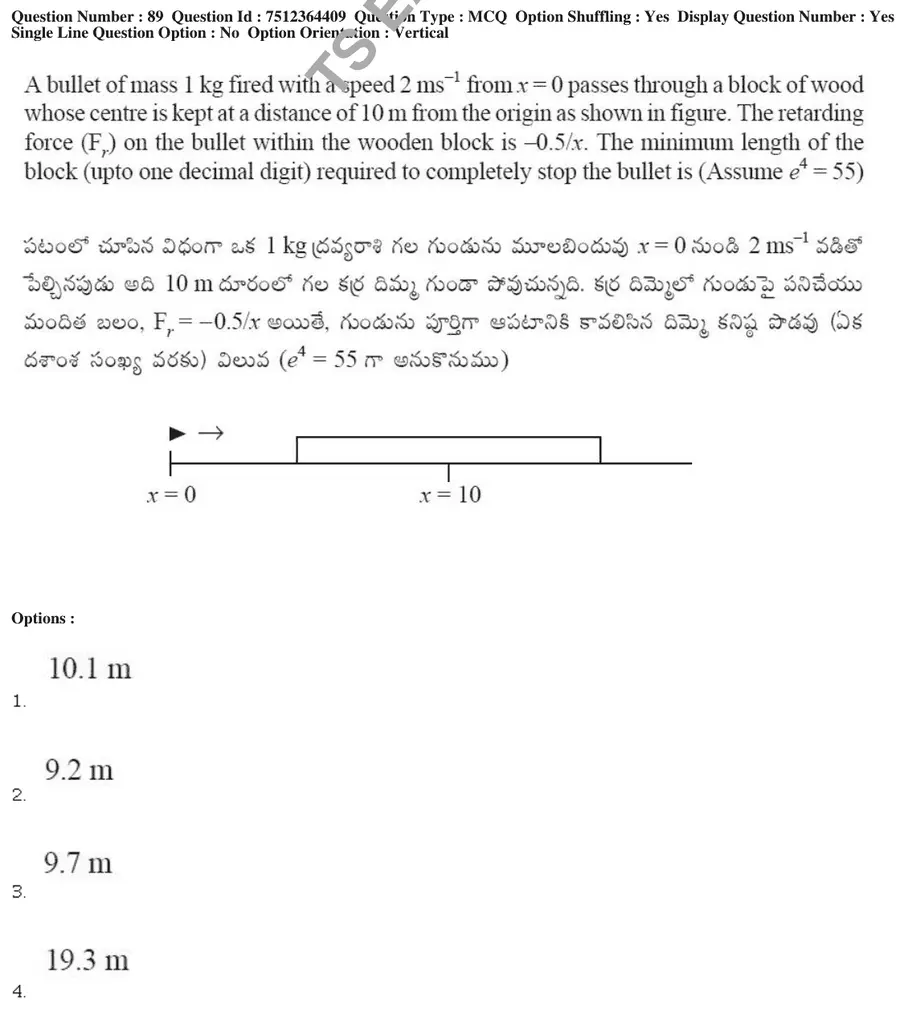
A bullet of mass 1 kg fired with a speed $2\ \mathrm{ms^{-1}}$ from $x=0$ passes through a block of wood whose centre is kept at a distance of 10 m from the origin as shown in figure. The retarding force ($F_r$) on the bullet within the wooden block is $-0.5/x$. The minimum length of the block (upto one decimal digit) required to completely stop the bullet is (Assume $e^4 = 55$) (see the figure above)
A constant power of 7 watt is applied on a toy car of mass $15\ \mathrm{kg}$. The distance travelled by the car when its velocity increases from $3\ \mathrm{ms^{-1}}$ to $5\ \mathrm{ms^{-1}}$ is
A body A moving with momentum 'P' collides one dimensionally with another stationary body B of same mass. During impact, A gives impulse 'J' to B. Then which of the following is/are correct? a) The total momentum of A and B is 'P' before and after impact and (P - J) during the impact. b) During the impact, B gives impulse of magnitude J to A. c) The coefficient of restitution is $\left[\frac{2J}{P}-1\right]$ d) The coefficient of restitution is $\left[\frac{2J}{P}+1\right]$
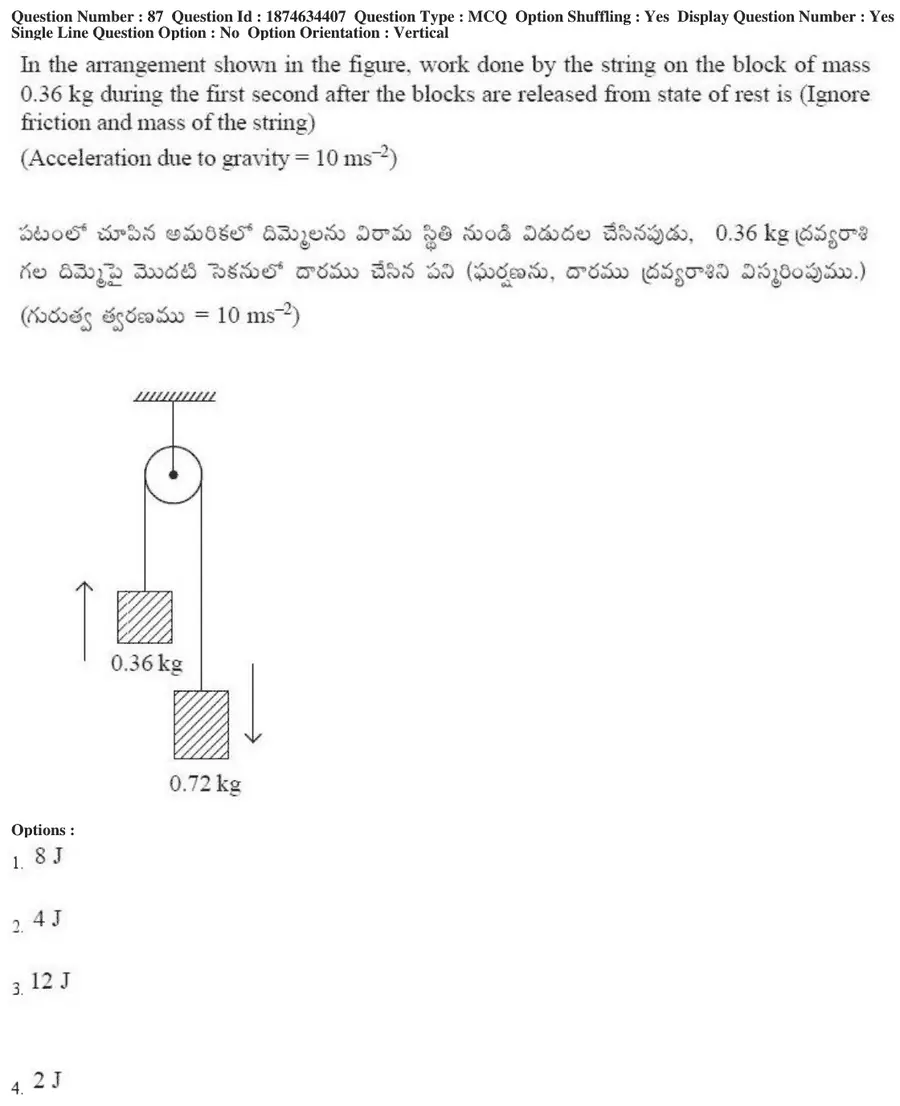
In the arrangement shown in the figure, work done by the string on the block of mass 0.36 kg during the first second after the blocks are released from state of rest is (Ignore friction and mass of the string) (Acceleration due to gravity $= 10\ \mathrm{ms^{-2}}$) (see the figure above)
A man who is running has half the kinetic energy of a boy of half his mass. The man speeds up by $1\ \mathrm{ms^{-1}}$ and then has the same kinetic energy as the boy. The initial speed of the boy is
A ball dropped from a building of height $12\ \mathrm{m}$ falls on a slab of $1\ \mathrm{m}$ height from the ground and makes a perfect elastic collision. Later the ball falls on a wooden table of height $0.5\ \mathrm{m}$, makes inelastic collision and falls on the ground. If the coefficient of restitution between the ball and the table is 0.5, then the velocity of the ball while touching the ground is about (Acceleration due to gravity $= 10\ \mathrm{ms^{-2}}$)
A motor pumps a liquid of density $\rho$ through a pipe of cross sectional area A. If the liquid moves with a speed v in this pipe, then the rate of kinetic energy imparted to the liquid is proportional to
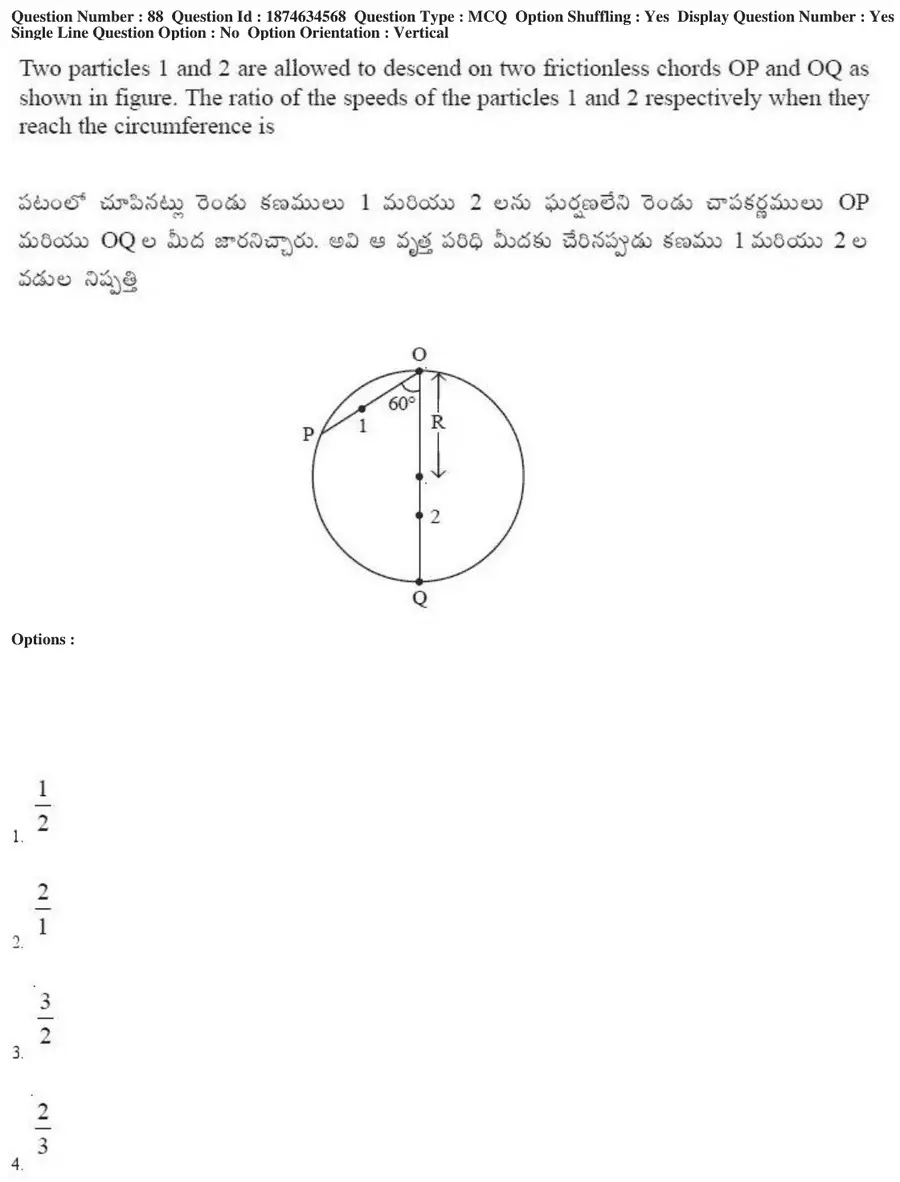
Two particles 1 and 2 are allowed to descend on two frictionless chords OP and OQ as shown in figure. The ratio of the speeds of the particles 1 and 2 respectively when they reach the circumference is (see the figure above)
Potential energy of a body of mass 1 kg free to move along X-axis is given by $U(x) = \left(\frac{x^2}{2} - x\right)\,\mathrm{J}$. If the total mechanical energy of the body is 2 J, then the maximum speed of the body is (Assume only conservative force acts on the body)
A cylindrical well of radius 2.5 m has water upto a height of 14 m from the bottom. If the water level is at a depth of 6 m from the top of the well, then the time taken in minutes to empty the well using a motor of 10 HP is approximately (Acceleration due to gravity = $10\,\mathrm{ms^{-2}}$)
Assertion (A): The work done by the electrostatic force is zero when a point charge moves in a circular path around another charge. Reason (R): The dot product of force and displacement vectors gives work done.
A
Both (A) and (R) are correct and (R) is the correct explanation of (A)
B
Both (A) and (R) are correct but (R) is not the correct explanation of (A)
Work, Energy & Power ranks among the most influential chapters in Class 11 Physics, providing methods that simplify complex dynamical questions. In the papers we hold from 2022 to 2026, it delivered 146 questions in 77 papers, averaging 1.9 questions per paper. Across that recent stretch, it featured in 73 of the 77 papers. That strong frequency places it as the 4th largest of 28 Physics chapters by question share, making up 4.7% of all Physics questions asked in those five years.
Looking over the entire 2010 to 2026 archive, our dataset includes 307 questions from 144 of the 149 papers, averaging 2.1 questions per paper and claiming 5.2% of the subject. In the early period from 2010 to 2021, the chapter had an even higher presence with 161 questions in 72 papers (appearing in 71 papers, 2.2 per paper, 5.6% share). Over the last three exam years from 2024 to 2026, it accounted for 88 questions in 46 papers (appearing in 43 papers, 1.9 per paper, 4.8% share). Comparing the early era to the last three years, the chapter's share of Physics has fallen, whereas comparing the recent five-year baseline to the last three years, it has stayed about the same. Every year since 2022 has produced questions from this unit.
Between 2022 and 2026, the two states recorded steady distributions: AP EAPCET papers carried 100 questions across 48 papers (appearing in 48 papers, 2.1 per paper, 5.2% share), while TS EAPCET papers featured 46 questions across 29 papers (appearing in 25 papers, 1.6 per paper, 4.0% share).
Most-asked topics
During the 2022 to 2026 cycle, questions distributed across four central topics:
Energy & Conservation: 52 questions. Across the entire 2010 to 2026 archive, this topic leads with 113 questions.
Collisions: 39 questions recently, with 87 questions in the complete collection.
Power: 29 questions in the recent window, totalling 54 questions overall.
Work: 26 questions recently, and 53 questions across all papers.
Every topic appeared in 2026 papers, meaning students should balance their preparation between energy methods, collision mechanics, and pump or engine power calculations.
What the questions look like
Energy conservation problems frequently track vertical motion under gravity or compressed spring systems. Common scenarios examine a body thrown vertically where potential and kinetic energy ratios are given at one height to find speeds at another altitude. Another common format involves vertical circular loops, requiring students to find the minimum launch speed at the lowest point or calculate string tension at the top and bottom.
Collision problems cover both one-dimensional and two-dimensional interactions. In head-on elastic collisions, questions often involve identical or differing masses where one body comes to rest, asking for the mass ratio or the percentage loss of kinetic energy in inelastic encounters. Problems with spheres of the same density but different radii require relating mass to radius cubed before applying conservation of linear momentum.
Work calculations frequently involve variable forces expressed as functions of position, demanding integration of force over displacement. Questions also examine work done against buoyancy when pulling objects out of water tanks. Power questions center on water pumps lifting water from wells, vehicle engines maintaining velocity against air resistance, and constant power sources accelerating vehicles over time.
Questions to try first
The following questions from 2026 council papers illustrate key exam patterns:
Master the work-energy theorem as your primary tool, recognizing that the net work done by all forces equals the change in kinetic energy. This theorem bypasses intermediate acceleration steps and proves far faster than force balances in non-uniform motion.
For collision problems, set up conservation of linear momentum along each axis first, followed by the coefficient of restitution formula. Memorize the standard velocity formulas for elastic head-on collisions, especially the special cases where one mass is much larger than the other or when colliding masses are equal.
For power questions, distinguish between instantaneous power (force times velocity) and average power (work done divided by total elapsed time). Pay close attention to efficiency percentages in water pump questions, ensuring you correctly distinguish output power delivered to the fluid from electrical input power drawn by the motor.
Frequently asked questions
How often does Work, Energy & Power come up in EAPCET?
In the papers we hold from 2022 to 2026, the chapter contributed 146 questions across 77 papers, averaging roughly 1.9 questions per paper and appearing in 73 of those 77 papers. It ranks 4th among all 28 Physics chapters by question share.
What are the most heavily tested topics in this chapter?
Energy and conservation principles (52 questions) and collisions (39 questions) make up the largest portion of questions in the recent five-year cycle from 2022 to 2026.
How do question numbers split between AP and TS papers?
In our 2022 to 2026 collection, AP EAPCET featured 100 questions across 48 papers (2.1 per paper, 5.2% share), while TS EAPCET featured 46 questions across 29 papers (1.6 per paper, 4.0% share).
Where can I see the solutions?
Every question on this page opens with its options and answer. Step-by-step solutions for each one are in the EdLoop EAPCET app.