Every Electrostatics question from past AP EAPCET and TS EAPCET papers, with options and answers. Newest first.
277questions
146papers covered
4.3%of Physics questions, 2022–2026
2010–2026years
Guide at a glance
Electrostatics opens the Class 12 physics syllabus as a high-volume foundational chapter. In our archive of AP and TS EAPCET papers from 2022 to 2026, Electrostatics contributed 133 questions across 77 papers.
Two large circular metal plates each of radius 50 cm carrying equal and unlike charges are parallel to each other. If the electric field between the plates is $720\ \mathrm{NC^{-1}}$, then the magnitude of charge on any one plate is
$1\mu C, -1\mu C$ charges are placed at a distance of $5\ cm$ in forming a dipole. The amount of torque required to place this dipole perpendicular to an electric field of $3 \times 10^5 NC^{-1}$ is given by
A particle of charge ‘q’ and mass ‘m’ starts moving from the origin under the action of electric field, $\vec{E} = E_0\hat{i}$ with a velocity $v = v_0\hat{j}$. The time taken to increase its velocity to $\frac{\sqrt{5}}{2}v_0$ is
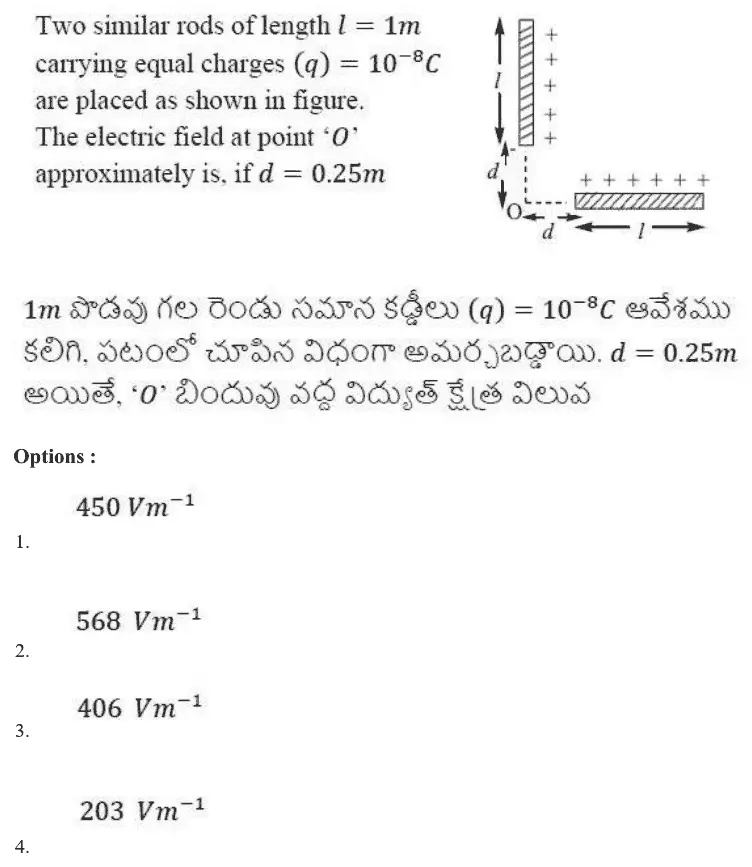
Two similar rods of length $l = 1m$ carrying equal charges $(q) = 10^{-8}C$ are placed as shown in figure. The electric field at point '$O$' approximately is, if $d = 0.25m$
The work done to keep three charges $2 \times 10^{-5}$ C, $3 \times 10^{-5}$ C, $4 \times 10^{-5}$ C at vertices of an equivalent triangle of side 10 cm is
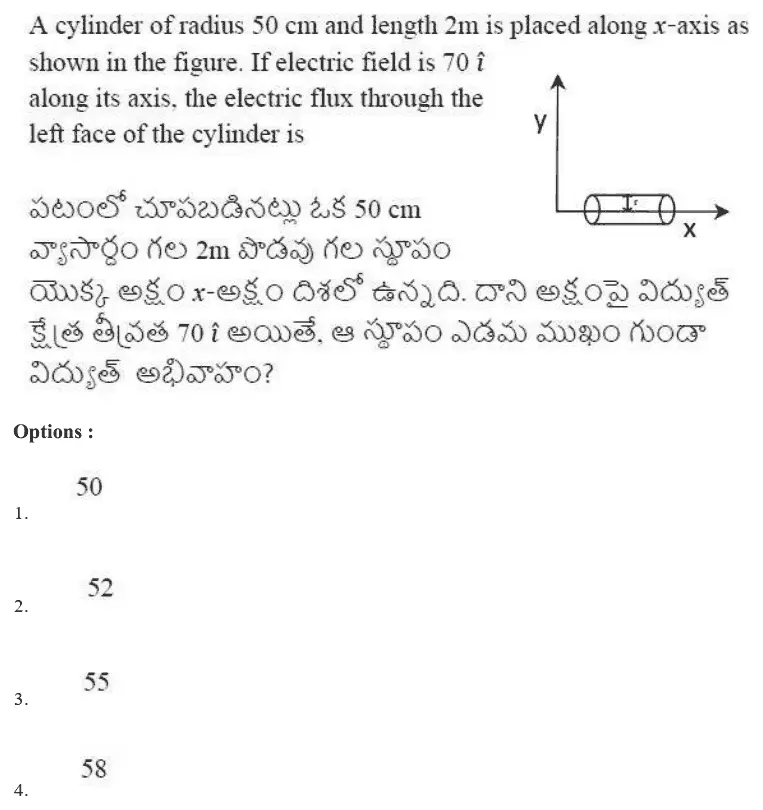
A cylinder of radius 50 cm and length 2m is placed along $x$-axis as shown in the figure. If electric field is $70\,\hat{\imath}$ along its axis, the electric flux through the left face of the cylinder is
Find the potential difference $V_P - V_Q$ between the points P(-1,2,0) and Q(2,0,3) in a uniform electric field $\bar{E} = (3\,\hat{i} + 4\,\hat{j} + 5\,\hat{k})\ \mathrm{NC^{-1}}$
Two electric charges $+3.2 \times 10^{-19}$ C and $-3.2 \times 10^{-19}$ C are placed 2.4 Å apart form an electric dipole. It is placed in uniform electric field of intensity $4 \times 10^{5}$ V/m. The work done to rotate the electric dipole from the equilibrium position by $180^{0}$ is
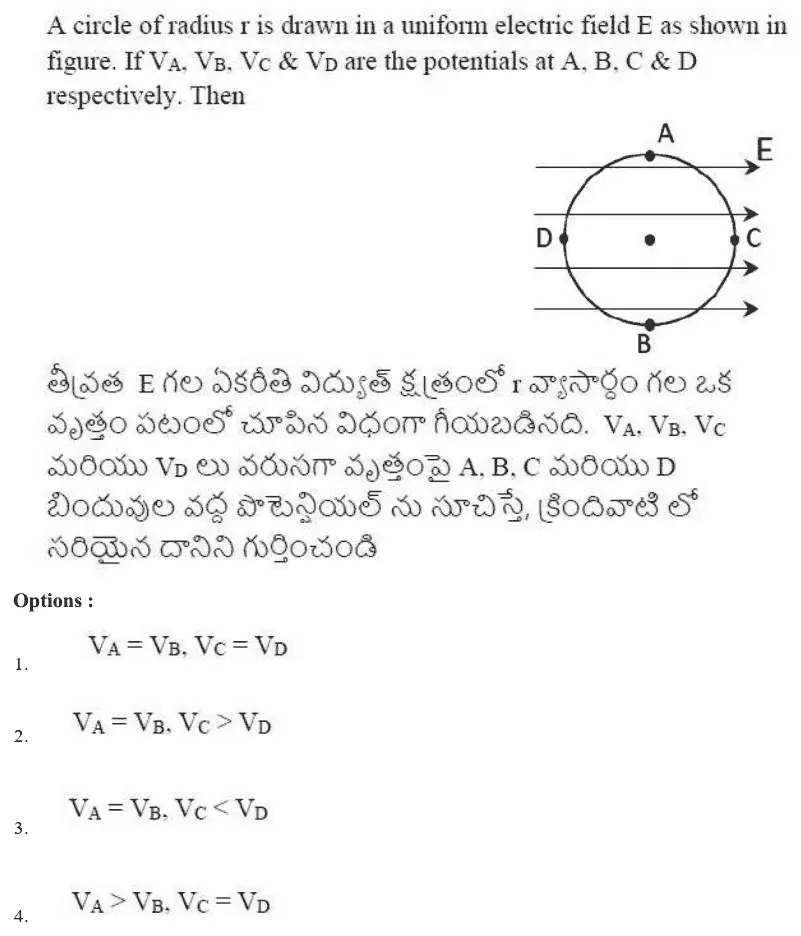
A circle of radius r is drawn in a uniform electric field E as shown in figure. If $V_A$, $V_B$, $V_C$ & $V_D$ are the potentials at A, B, C & D respectively. Then
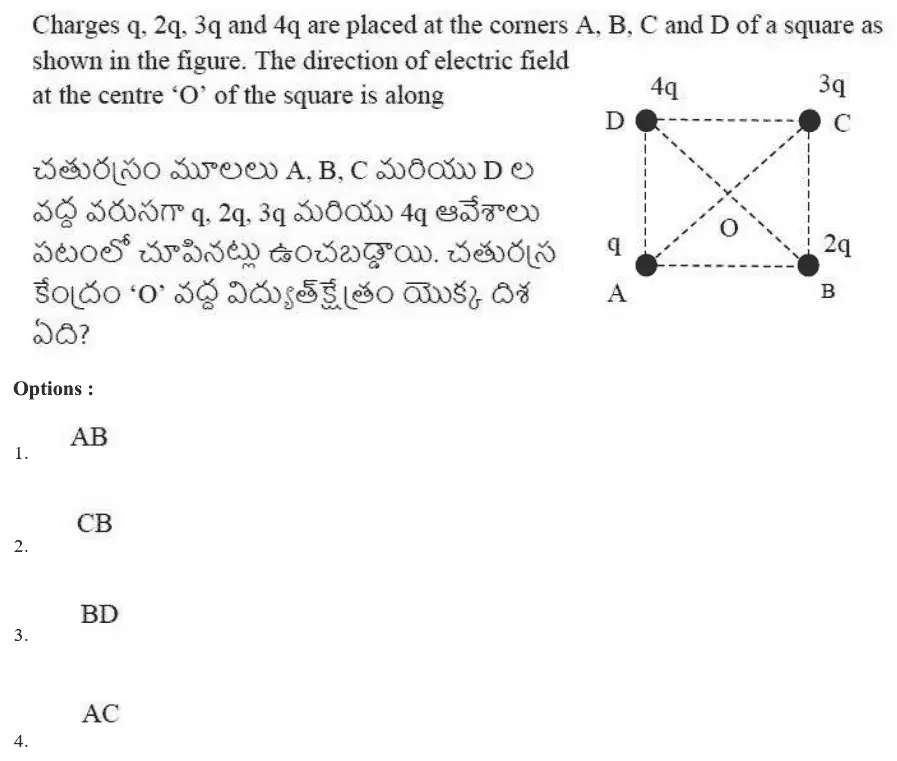
Charges q, 2q, 3q and 4q are placed at the corners A, B, C and D of a square as shown in the figure. The direction of electric field at the centre ‘O’ of the square is along
The electrical potential at a point ‘A’ in an electric field $300\ \mathrm{NC^{-1}}$ is $900\ \mathrm{V}$. Now find the work done in moving $1\ \mu\mathrm{C}$ charge from point ‘A’ to $10\mathrm{m}$ is
Two point charges, $+2\ \mu\mathrm{C}$ and $-2\ \mu\mathrm{C}$, are fixed respectively at points A and B, separated by 4 m in air. A point P is located such that it is 3 m from $+2\ \mu\mathrm{C}$ and 5 m from $-2\ \mu\mathrm{C}$. What is the electric potential at point P? Take $k = 9 \times 10^9\ \mathrm{N\ m^2\ C^{-2}}$
Two identical balls each of mass $\frac{40}{3}g$ carry equal and opposite charge. They are suspended from a horizontal plate by silk threads each of length $1\ m$ with a separation of $1.5\ m$ between points of suspension. At equilibrium, if the distance between the balls is $30\ cm$ then, magnitude of charge on each ball is (Acceleration due to gravity = $10\ ms^{-2}$)
A conducting sphere of radius 4cm is charged such that it has a potential of 5V on its surface. Then the potential at a point which is at a depth of 1cm from its surface is
Two point charges $Q$ and $-4Q$ are separated by a distance $r$. If electric field at the location of $Q$ is $\vec{E}$, then the field at the location of $-4Q$ is
If two positive charges each of $20\ \mu\mathrm{C}$ are placed at the two vertices of an equilateral triangle of side $50\ \mathrm{cm}$ and a third positive charge of $10\sqrt{3}\ \mu\mathrm{C}$ is placed at the centroid of the triangle, then the electrostatic potential energy of the system of three charges is
A spherical rubber balloon has the electric charges uniformly distributed over its surface. If the balloon is inflated further, the electric intensity E on the surface
A charge ‘$Q$’ is distributed on concentric hollow spheres of radii $r$ and $R$, $(R > r)$ such that their surface charge densities are same. The potential at their centre is
Two point charges $-2Q$ and $Q$ are located at $(-3a, 0)$ and $(3a, 0)$ in the $X-Y$ plane. The locus of all points in the $X-Y$ plane where electric potential is zero to these charges is
The spheres A, B and C have radii R, R and 2R respectively. Initially A has a charge $-Q$, B is neutral and C is positively charged with a surface charge density equal to that of A. If the three spheres are placed in contact with each other and later separated, then the charges on the three spheres A, B and C respectively are
A long charged cylinder of linear charge density $\lambda$ is surrounded by a hollow coaxial conducting cylinder. The magnitude of electric field in the space between the two cylinders at a distance R from the common axis of the cylinders is
Two metallic spherical shells A and B of radii 3 cm and 4 cm are given electric charges 20 $\mu$C and 40 $\mu$C respectively. If the shells are arranged concentrically, then the ratio of the surface charge densities on the outer surfaces of the shells A and B is
At a distance of 20 cm from the centre of a charged conducting sphere of radius 10 cm, the electric field due to the sphere is $9000\,\mathrm{NC^{-1}}$. If an electric charge of 3 μC is placed at a distance of 30 cm from the centre of the sphere, then the electrostatic force acting on the charge is
In an isosceles right angled triangle ABC, the length of the two equal sides AB and AC is 10 cm. If three charges $+5\ \mu\mathrm{C}$, $+20\ \mu\mathrm{C}$ and $+20\ \mu\mathrm{C}$ are placed at the three vertices A, B and C of the triangle respectively, then the net electrostatic force acting on a particle of charge $+2\ \mu\mathrm{C}$ placed at the midpoint of the hypotenuse BC is
An electron is moving in a stable circular orbit of radius 0.1 m around a thin infinitely long positively charged straight wire. If orbital velocity of the electron around the wire is $4\times10^{7}\ \mathrm{ms^{-1}}$, then linear charge density of the wire is nearly
Two charges $+6\ \mu\mathrm{C}$ and $-3\ \mu\mathrm{C}$ are placed at points $(-2.7\ \mathrm{cm}, 0)$ and $(2.7\ \mathrm{cm}, 0)$ respectively in an external electric field of $1.8r^{-2}\times10^{5}\ \mathrm{NC^{-1}}$, where 'r' is the distance of a charge from the origin. Then the net electrostatic energy of the system of the two charges is
If two particles A and B of charges $1.6\times10^{-19}\,\mathrm{C}$ and $3.2\times10^{-19}\,\mathrm{C}$ respectively are separated by a distance of 3 cm in air, then the magnitude of electrostatic force on particle A due to particle B is
If four charges $+12$ nC, $-20$ nC, $+32$ nC and $-15$ nC are arranged at the four vertices of a square of side $\sqrt{2}\,\mathrm{m}$, then the net electric potential at the centre of the square due to these four charges is
An electric dipole with dipole moment $2\times10^{-10}$ C m is aligned at an angle $30^\circ$ with the direction of uniform electric field of $10^4$ N C$^{-1}$. The magnitude of the torque acting on the dipole is
An electric charge $10^{-3}\ \mu\mathrm{C}$ is placed at the origin of x-y plane. The potential difference between points A and B located at $\left(\sqrt{2}\,\mathrm{m},\sqrt{2}\,\mathrm{m}\right)$ and $(2\,\mathrm{m},0\,\mathrm{m})$ respectively is
The force between two conducting spheres of same radius having charges $+8\ \mu\mathrm{C}$ and $-4\ \mu\mathrm{C}$ separated by some distance in air is F. If the spheres are connected by a conducting wire and after some time the wire is removed, then the magnitude of the force between the two conducting spheres is
In space the electric potential varies as $V = 20|\vec{r}|$ volt, where $\vec{r} = x\hat{i} + y\hat{j} + z\hat{k}$ is the position vector. Then electric field in (N C$^{-1}$) at the point (4 m, 3 m, −5 m) is
The sum of two point positive charges separated by a distance of 1.5 m in air is 25 $\mu$C. If the electrostatic force between the two charges is 0.6 N, then the difference between the two charges is
A particle of mass 0.2 g and charge 2 C is released from rest in a uniform electric field of $20\ \mathrm{N\ C^{-1}}$. The kinetic energy of the particle after moving a distance of 20 cm is
A solid of mass 1 kg has $6 \times 10^{24}$ atoms. If one electron is removed from every one atom of $0.005\%$ of the atoms, then the charge gained by the solid is
In a region, the electric field is given by $\vec{E} = \left(3\hat{i} + 5\hat{j} + 7\hat{k}\right)\,\mathrm{N\,C^{-1}}$. The electric flux through a surface of area $3\ \mathrm{m^2}$ in yz plane is (in SI units)
Two charged conducting spheres of radii 5 cm and 10 cm have equal surface charge densities. If the electric field on the surface of the smaller sphere is E, then the electric field on the surface of the larger sphere is
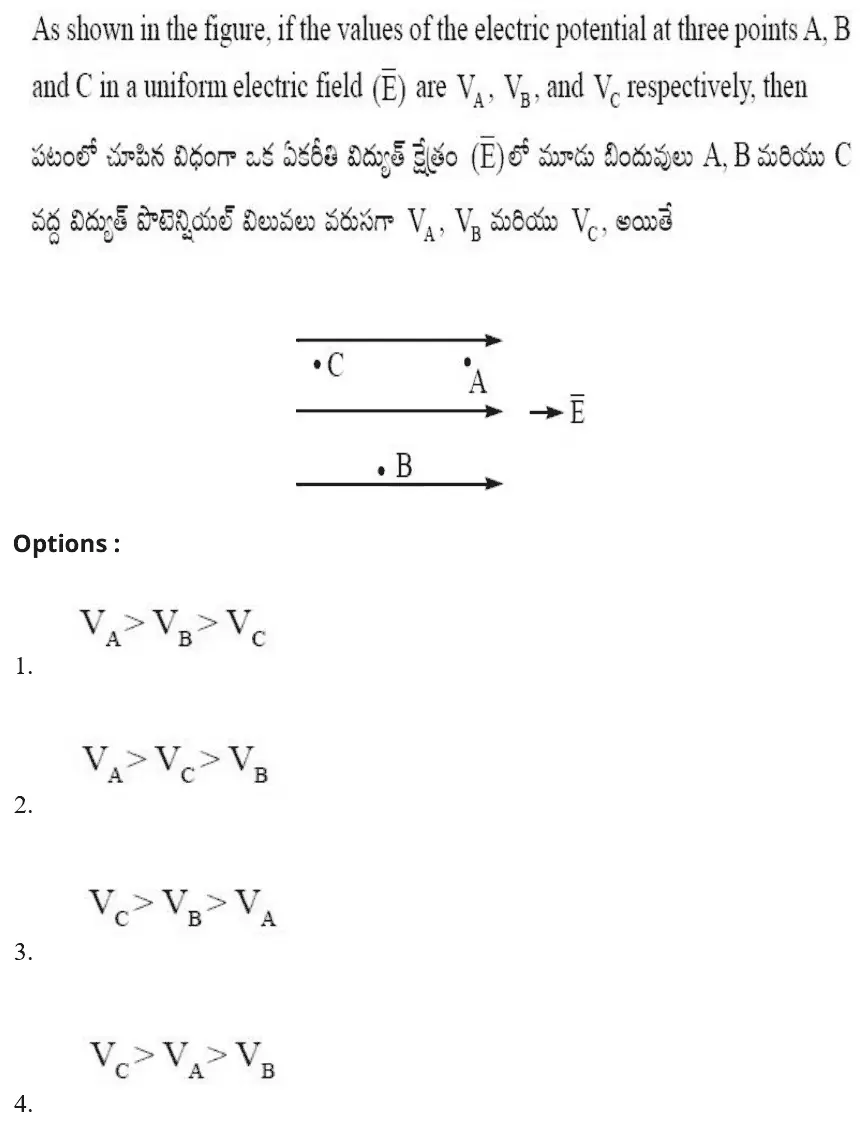
As shown in the figure, if the values of the electric potential at three points A, B and C in a uniform electric field ($\bar{E}$) are $V_A$, $V_B$, and $V_C$ respectively, then
The force between two point charges kept with a separation of 9 cm in air is 98 N. If a dielectric slab of constant 4, thickness 6 cm and another dielectric slab of constant 9, thickness 3 cm are introduced between the two charges, then the new force becomes
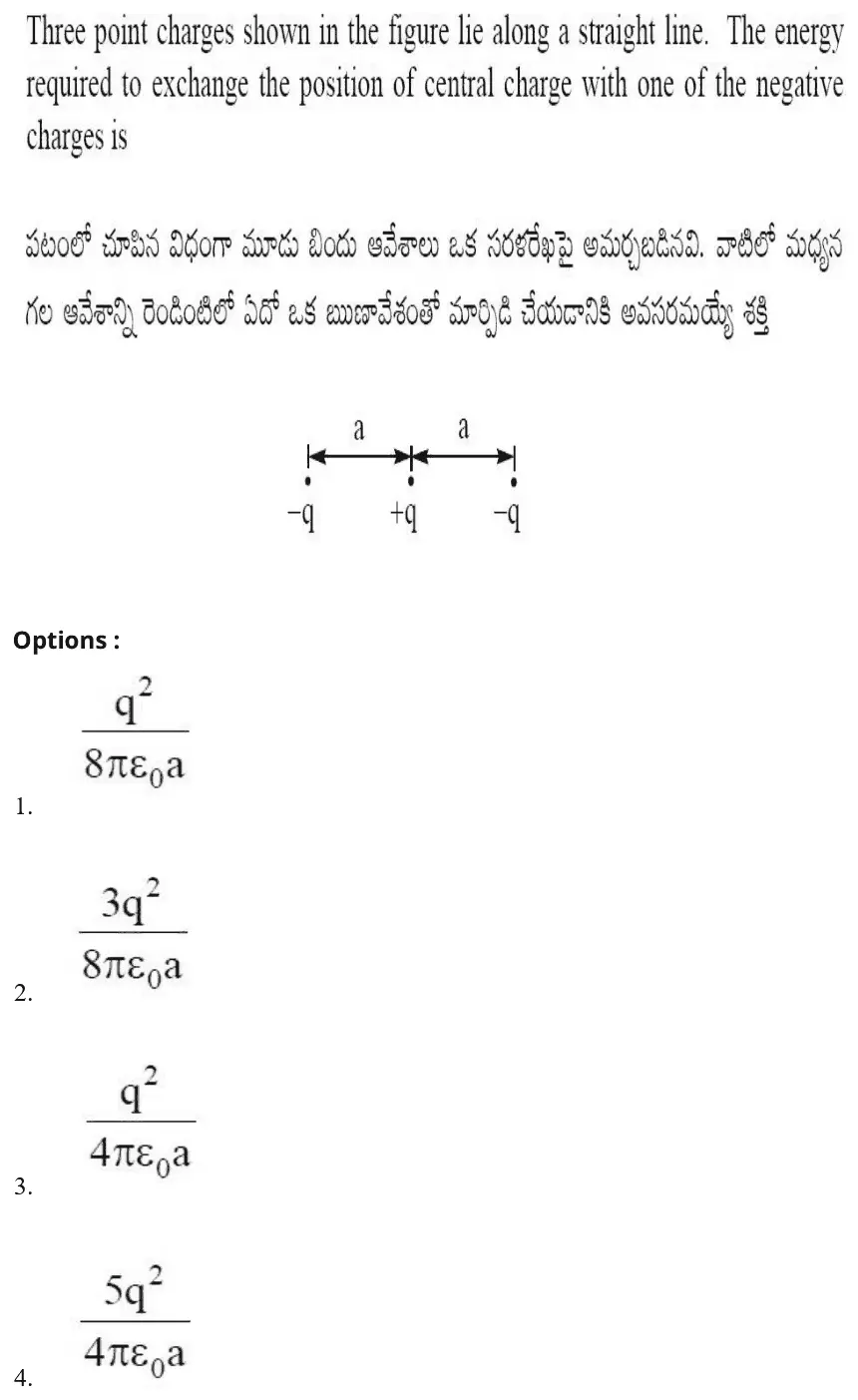
Three point charges shown in the figure lie along a straight line. The energy required to exchange the position of central charge with one of the negative charges is
Three particles of each charge q are placed at the vertices of an equilateral triangle of side L. The work to be done to decrease the side of the triangle to $\frac{L}{2}$ is
If 27 charged water droplets, each of radius $10^{-3}$ m and charge $10^{-12}$ C coalesce to form a single big spherical drop, then the potential of the big drop is
The electric field due to an infinitely long thin straight wire with uniform linear charge density of $2.5\times10^{-7}\,\mathrm{C\,m^{-1}}$ at a radial distance of $x$ from the wire is $7.5\times10^{4}\,\mathrm{NC^{-1}}$. Then $x=$
The electrostatic force between two charges kept in air is F. If 30% of the space between the charges is filled with a medium, then the electrostatic force between the charges becomes $\frac{F}{2.56}$. The dielectric constant of the medium is
Four electric charges $2\ \mu\mathrm{C}$, Q, $4\ \mu\mathrm{C}$ and $12\ \mu\mathrm{C}$ are placed on $x$-axis at distances $x = 0$, $1\ \mathrm{cm}$, $2\ \mathrm{cm}$ and $4\ \mathrm{cm}$ respectively. If the net force acting on the charge at origin is zero, then Q =
If a particle of mass 10 mg and charge 2 $\mu$C at rest is subjected to a uniform electric field of potential difference 160 V, then the velocity acquired by the particle is
An alpha particle and a proton are accelerated from rest in a uniform electric field. The ratio of the times taken by proton and alpha particle to attain equal displacements is
A thin spherical shell of radius R and surface charge density $\sigma$ is placed in a cube of side 5R with their centers coinciding. The electric flux through one face of the cube is ($\varepsilon_0$ = Permittivity of free space)
An electron and a positron enter a uniform electric field E perpendicular to it with equal speeds at the same time. The distance of separation between them in the direction of the field after a time ‘t’ is
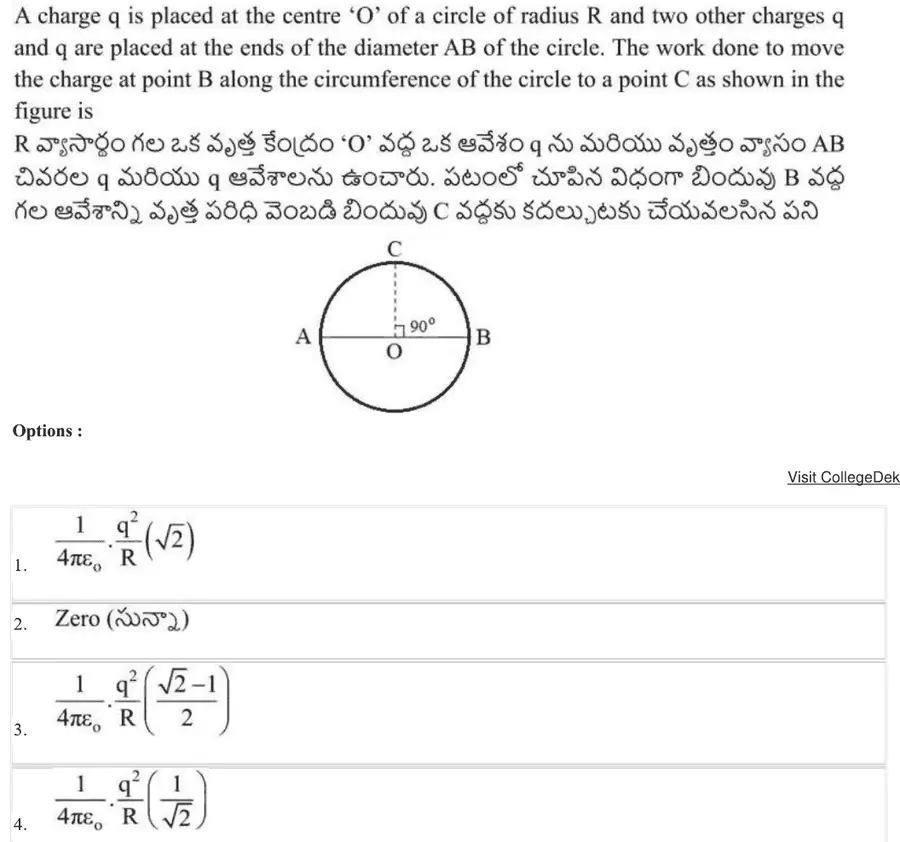
A charge q is placed at the centre ‘O’ of a circle of radius R and two other charges q and q are placed at the ends of the diameter AB of the circle. The work done to move the charge at point B along the circumference of the circle to a point C as shown in the figure is
A particle of mass $0.5\ \mathrm{g}$ and charge $10\ \mu\mathrm{C}$ is subjected to a uniform electric field of $8\ \mathrm{NC^{-1}}$. If the particle is initially at rest, the velocity of the particle after a time of $5$ seconds is
125 identical charged small spheres coalesce to form a big charged sphere. If the electric potential on each small sphere is 60 mV, then the electric potential on the bigger sphere formed is
Two particles of charges $4\ \mathrm{nC}$ and $Q$ are kept in air with a separation of $10\ \mathrm{cm}$ between them. If the electrostatic potential energy of the system is $1.8\ \mu\mathrm{J}$, then $Q =$
A neutral ammonia ($\mathrm{NH_3}$) in its vapour state has an electric dipole moment of magnitude $5 \times 10^{-30}$ C-m. How far apart are the molecules centres of positive and negative charge.
If four charges $q_1 = +1 \times 10^{-8}$ C, $q_2 = -2 \times 10^{-8}$ C, $q_3 = +3 \times 10^{-8}$ C, and $q_4 = +2 \times 10^{-8}$ C are kept at the four corners of a square of side 1 m, then the electric potential at the centre of the square is
Two charges $5$ nC and $-2$ nC are placed at points $(5\text{ cm}, 0, 0)$ and $(23\text{ cm}, 0, 0)$ in a region of space where there is no other external field. The electrostatic potential energy of this charge system is
Three equal electric charges of each charge ‘q’ are placed at the vertices of an equilateral triangle of side of length ‘L’, then potential energy of the system is
Two spheres A & B of radii 4 cm & 6 cm are given charges of $80\ \mu\mathrm{C}$ & $40\ \mu\mathrm{C}$ respectively. If they are connected by a fine wire, the amount of charge flowing from one to the other is
Three point charges $+q, +2q$ and $+4q$ are placed along a straight line such that the charge $+2q$ lies at equidistant from the other two charges. The ratio of the net electrostatic force on charges $+q$ and $+4q$ is
A particle of mass 2 g and charge $6\ \mu\mathrm{C}$ is accelerated from rest through a potential difference of 60 V. The speed acquired by the particle is
Two particles of equal mass 'm' and equal charge 'q' are separated by a distance of $16cm$. They do not experience any force. The value of $\frac{q}{m}$ is ______ (if 'G' is the universal gravitational constant and 'g' is the acceleration due to gravity).
Two point charges $+6\ \mu\mathrm{C}$ and $+10\ \mu\mathrm{C}$ kept at certain distance repel each other with a force of $30\ \mathrm{N}$. If each charge is given an additional charge of $-8\ \mu\mathrm{C}$, the two charges
In a region, the electric field is $(30\bar{i} + 40\bar{j})\ \mathrm{NC^{-1}}$. If the electric potential at the origin is zero, the electric potential at the point $(1\ \mathrm{m}, 2\ \mathrm{m})$ is
The electric flux due to an electric field $\vec{E} = (8\hat{i} + 13\hat{j})\ \mathrm{NC^{-1}}$ through an area $3\ \mathrm{m^2}$ lying in the XZ plane is
Two point charges $-10\ \mu\mathrm{C}$ and $+5\ \mu\mathrm{C}$ are situated on X-axis at $x=0$ and $x=\sqrt{2}\ \mathrm{m}$. The point along the X-axis where the electric field becomes zero is
A proton and an '$\alpha$' particle are both accelerated from rest in a uniform electric field. The ratio of works done by the electric field on the proton and the $\alpha$-particle in a given time is
Two positive point charges are separated by a distance of 4 m in air. If the sum of the two charges is $36\ \mu\mathrm{C}$ and the electrostatic force between them is 0.18 N, then the bigger charge is
Two point charges of magnitudes $-8\ \mu\mathrm{C}$ and $+32\ \mu\mathrm{C}$ are separated by a distance of $15\ \mathrm{cm}$ in air. The position of the point from $-8\ \mu\mathrm{C}$ charge at which the resultant electric field becomes zero is
A uniformly charged conducting sphere of 2.4 m diameter has a surface charge density of $80.0\ \mu\mathrm{C\,m^{-2}}$. The charge on the sphere is nearly
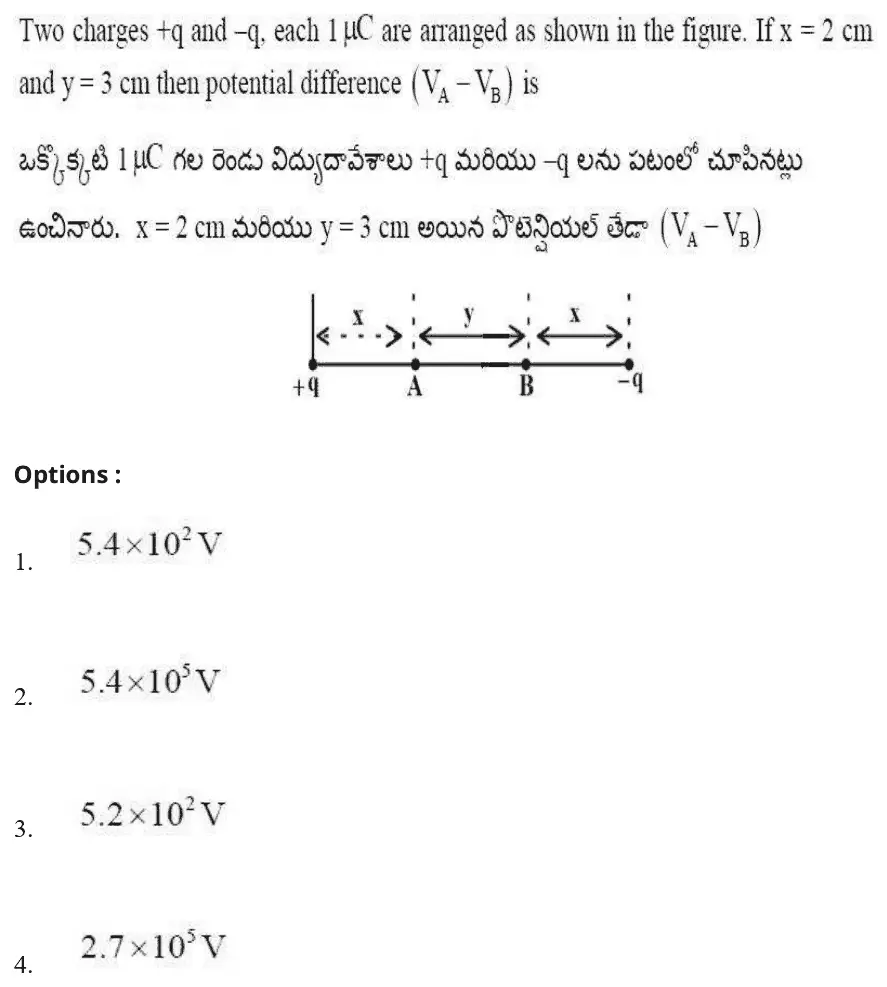
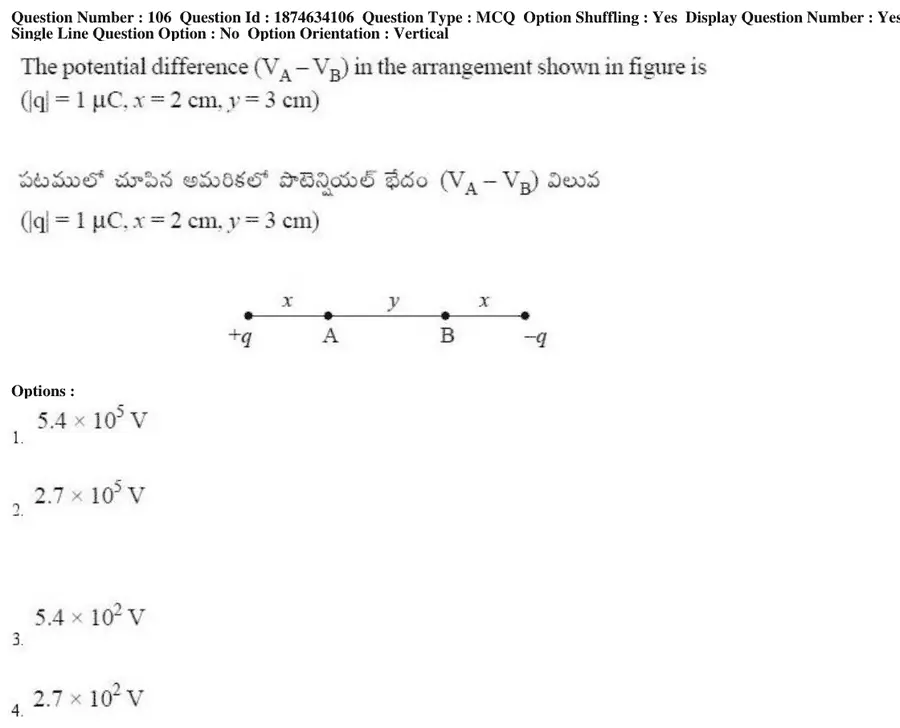
Two charges +q and −q, each $1\,\mu\mathrm{C}$ are arranged as shown in the figure. If x = 2 cm and y = 3 cm then potential difference $(V_A - V_B)$ is
Three point charges $1\ \mathrm{C}$, $2\ \mathrm{C}$ and $3\ \mathrm{C}$ are placed at the corners of an equilateral triangle of side one metre. The work done to move these charges to the corners of another equilateral triangle of side $0.5\ \mathrm{m}$ is
An electron of charge ‘e’ is moving round the nucleus of a hydrogen atom in a circular orbit of radius ‘r’. The coulomb force $\vec{F}$ between the two is
In a region, the intensity of an electric field is given by $\vec{E}=\left(2\hat{i}+3\hat{j}+\hat{k}\right)\,\mathrm{NC^{-1}}$. The electric flux through a surface of area $10\hat{i}\ \mathrm{m^2}$ in the region is
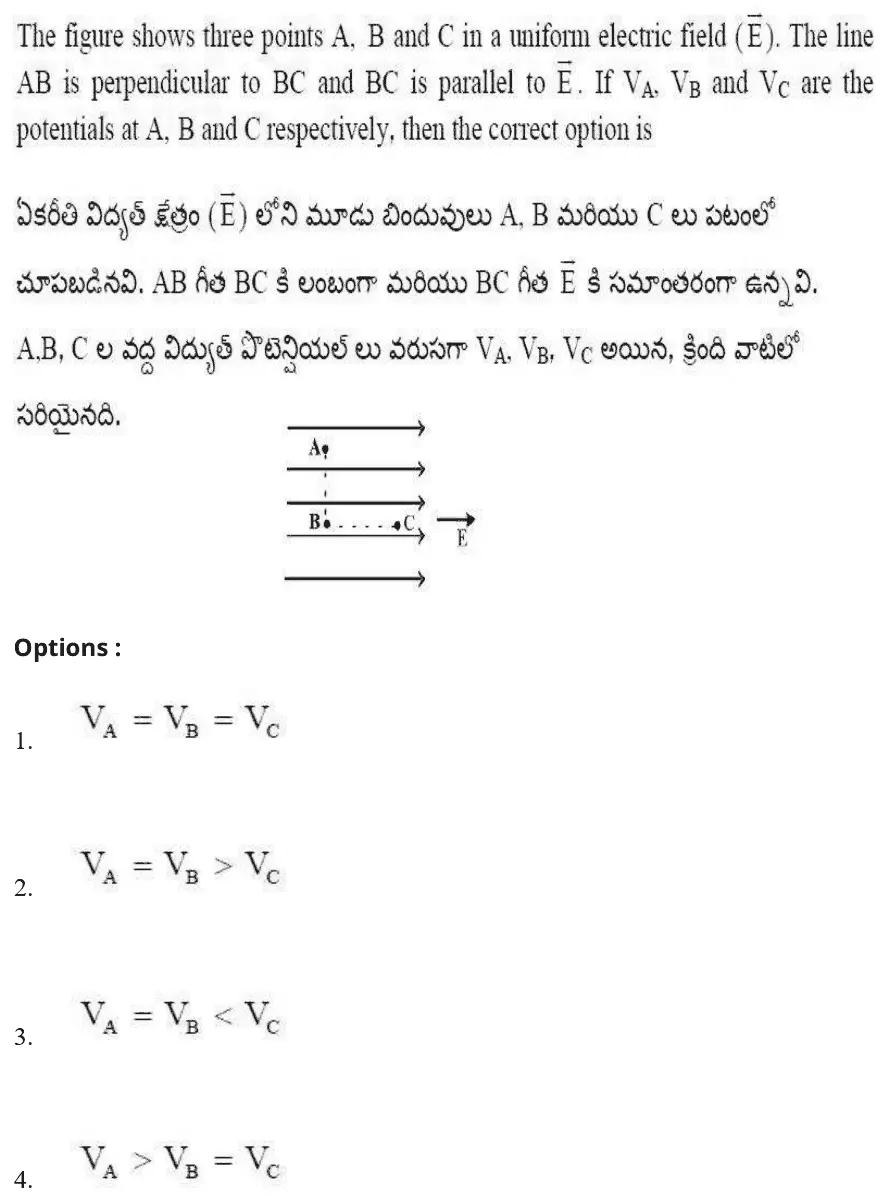
The figure shows three points A, B and C in a uniform electric field ($\vec{E}$). The line AB is perpendicular to BC and BC is parallel to $\vec{E}$. If $V_A$, $V_B$ and $V_C$ are the potentials at A, B and C respectively, then the correct option is
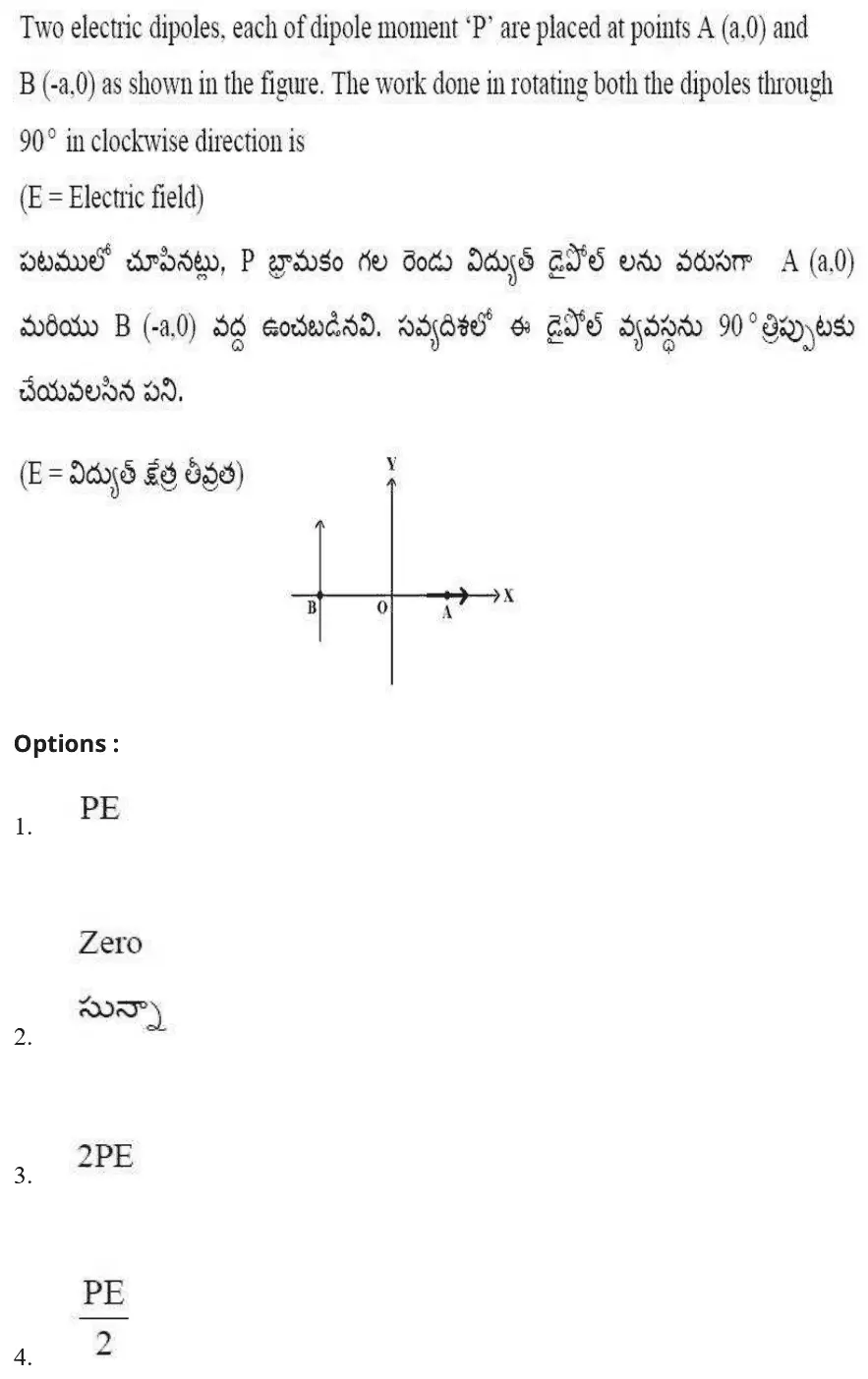
Two electric dipoles, each of dipole moment ‘P’ are placed at points A (a,0) and B (-a,0) as shown in the figure. The work done in rotating both the dipoles through $90^\circ$ in clockwise direction is
The electric field ($\vec{E}$ in $\mathrm{NC^{-1}}$) in a region is given by $\vec{E}=3\hat{i}+5\hat{i}$. The net electric flux through a square area of side 2 m parallel to y – z plane is
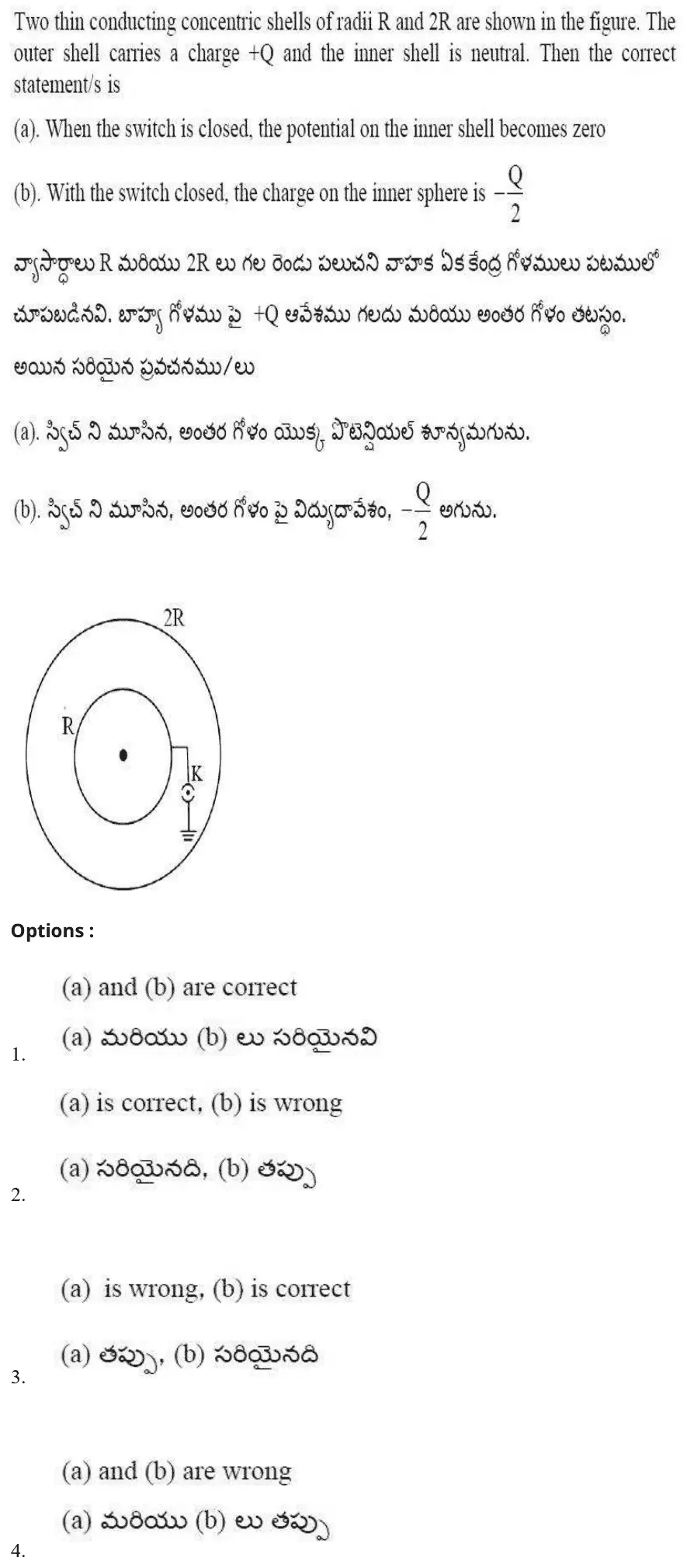
Two thin conducting concentric shells of radii R and 2R are shown in the figure. The outer shell carries a charge +Q and the inner shell is neutral. Then the correct statement/s is
(a). When the switch is closed, the potential on the inner shell becomes zero
(b). With the switch closed, the charge on the inner sphere is $-\dfrac{Q}{2}$
The net electric flux due to a uniform electric field of $3\times10^{3}\hat{i}\ \mathrm{NC^{-1}}$ through a cube of side 20 cm oriented such that its faces are parallel to the coordinate planes is
A block of mass ‘m’ and charge ‘q’ is connected to a point ‘O’ with an inextensible string. This system is on a horizontal table. An electric field (E) is applied perpendicular to the string and in the plane of the horizontal table. The tension in the string when it becomes parallel to the electric field is
If the electric potential at a point on the surface of a hollow conducting sphere of radius R is V, then the electric potential at a point which is at distance $\frac{R}{3}$ from the centre of the sphere is
A hollow spherical shell of radius r has a uniform charge density $\sigma$. It is kept in a cube of edge 3r such that the centres of the cube and the shell coincide. Then the electric flux coming out of one face of a cube is
Two electric charges $+2\mu\mathrm{C}$ and $-4\mu\mathrm{C}$ are separated by a distance 3 m in air. At a point P located on the line joining the two charges and in between them, the electric potential is zero. Then the electric field at a point P (in $\mathrm{NC^{-1}}$) is
A clock dial has point charges $-q, -2q, -3q, \ldots\ldots\ldots -12q$ at the positions of the corresponding numbers on the dial respectively. The time at which the hour's hand points the direction of the net electric field at the centre of the dial is (Assume clock hands do not influence the net electric field)
The electric field and electric potential at a point due to a point charge are $500\ \mathrm{NC^{-1}}$ and $30\ \mathrm{V}$ respectively, then the magnitude of the charge is
Two charges are $+10\,\mu C$ and $-10\,\mu C$ are separated by 10 cm. The magnitude of force acting on another charge $5\,\mu C$ placed at the midpoint of the line joining the two charges will be [Use $\dfrac{1}{4\pi\varepsilon_0} = 9 \times 10^{9}$ in SI unit ]
A sphere '1' with radius R has charge q. Sphere '2' with radius 3R is far from sphere '1' and is initially uncharged. If the two spheres are now connected with a thin conducting wire, then the ratio $\dfrac{\sigma_1}{\sigma_2}$ of the surface charge densities is
A small block of mass 5 g and charge $5\ \mu$C is placed on insulated, frictionless, inclined plane of angle $60^\circ$. An electric field is applied parallel to the inclined plane. If the block remains at rest then the magnitude of electric field is (Take $g=10\ \mathrm{m/s^2}$)
Two metal spheres have their radii in the ratio of 4 : 7. They are put in contact and a charge $8.8\times10^{-7}\mathrm{C}$ is given to the system. Then they are separated so that each can exert no influence on the other. The potential due to the smaller sphere at 60 m from it in Volt is
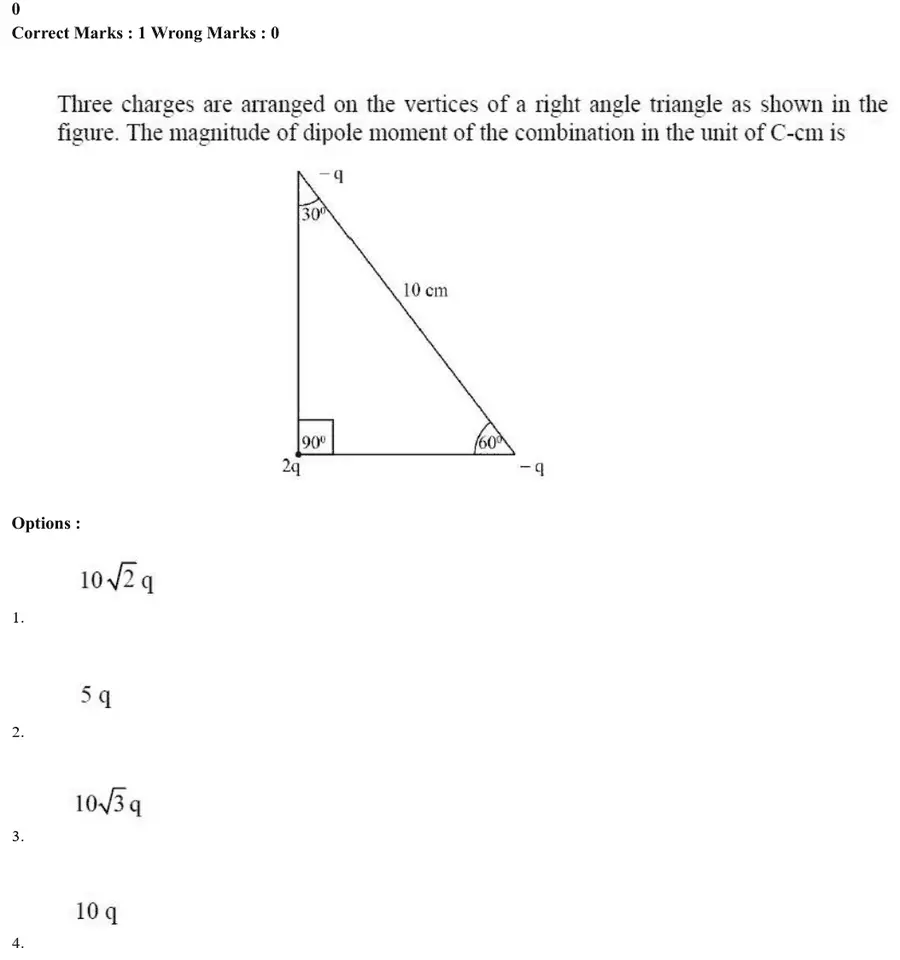
Three charges are arranged on the vertices of a right angle triangle as shown in the figure. The magnitude of dipole moment of the combination in the unit of C-cm is (see the figure above)
A particle of mass m and charge q travelling with a velocity $v$ along the x - axis enters a uniform electric field $\vec{\mathrm{E}}$ directed along the y - axis. What will be the trajectory of the particle?
$6\mu C$ charge is placed at the centre of a cube. What will be the electric flux at each face of the cube? $\left[\text{Take }\frac{1}{4\pi\epsilon_{o}}=9\times10^{9}\ Nm^{2}C^{-2}\right]$
There are two thin wire rings, each of radius R, whose axes coincide. The charges of the rings are q and $-$ q. The magnitude of potential difference between the centres of the rings separated by a distance $\sqrt{3}\,R$ is
An electron is released from a distance of 4 m from a stationary point charge 20 nC. What will be the speed of the electron when it is 2 m away from the point charge? [Charge of electron = $1.6\times10^{-19}$ C, mass of electron = $9\times10^{-31}$ kg, $\dfrac{1}{4\pi\varepsilon_{0}}=9\times10^{9}$ S.I unit ]
A large metal plate has a surface charge density of $8.85\times10^{-6}$ C/m$^{2}$. An electron having initial kinetic energy of $8\times10^{-17}J$ is moving towards the center of the plate. If the electron stops just before reaching the plate then the initial distance between the electron and the plate is [Take $\varepsilon_{0}=8.85\times10^{-12}$ C$^{2}$/Nm$^{2}$]
A large charged plane having surface charge density $4.9 \times 10^{-6}\ \mathrm{C\,m^{-2}}$ lies in the x-y plane. A circular plane of radius of 1 cm is lying completely in the region where x, y and z coordinates are all positive. When the plane's normal makes an angle $60^\circ$ with the z-axis, the electric flux through the circular plane is $\left(\frac{1}{4\pi\varepsilon_0} = 9\times10^{9}\ \mathrm{Nm^2C^{-2}}\right)$
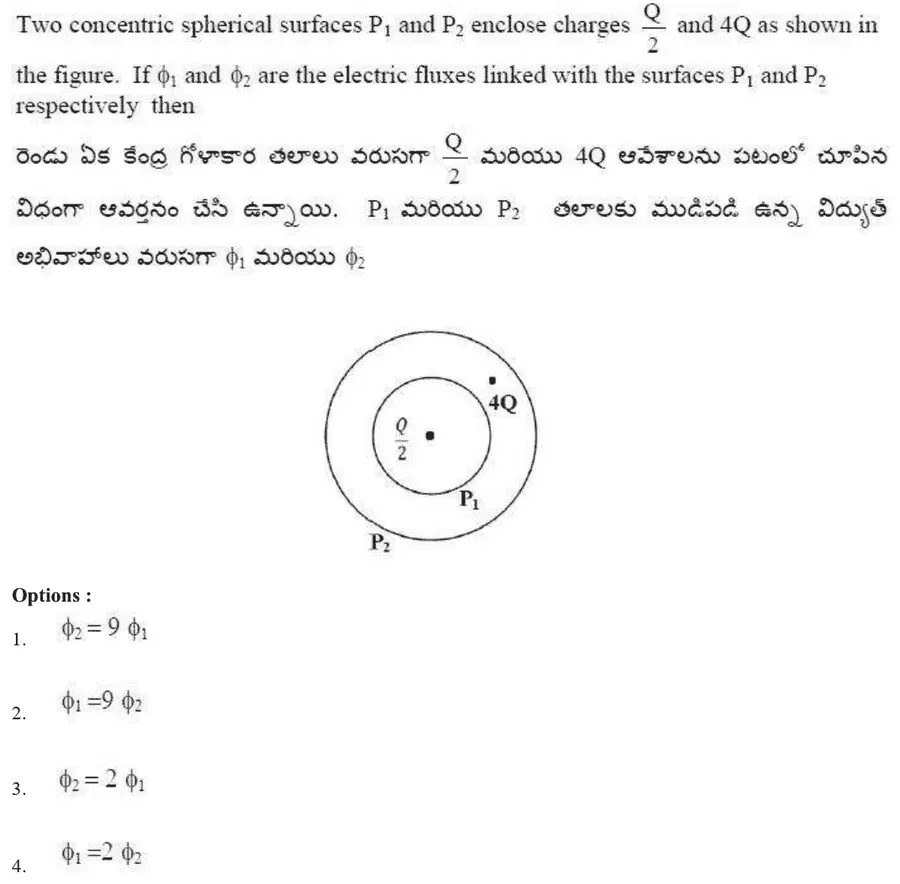
Two concentric spherical surfaces $P_1$ and $P_2$ enclose charges $\dfrac{Q}{2}$ and $4Q$ as shown in the figure. If $\phi_1$ and $\phi_2$ are the electric fluxes linked with the surfaces $P_1$ and $P_2$ respectively then (see the figure above)
Three charges $+5q$, Q and $-2q$ are kept along a straight line in the same order such that, $+5q$ and $-2q$ charges are at a distance of $\dfrac{2r}{3}$ and $\dfrac{r}{3}$ from the charge Q respectively. If the net force on the charge $-2q$ is zero, then Q is
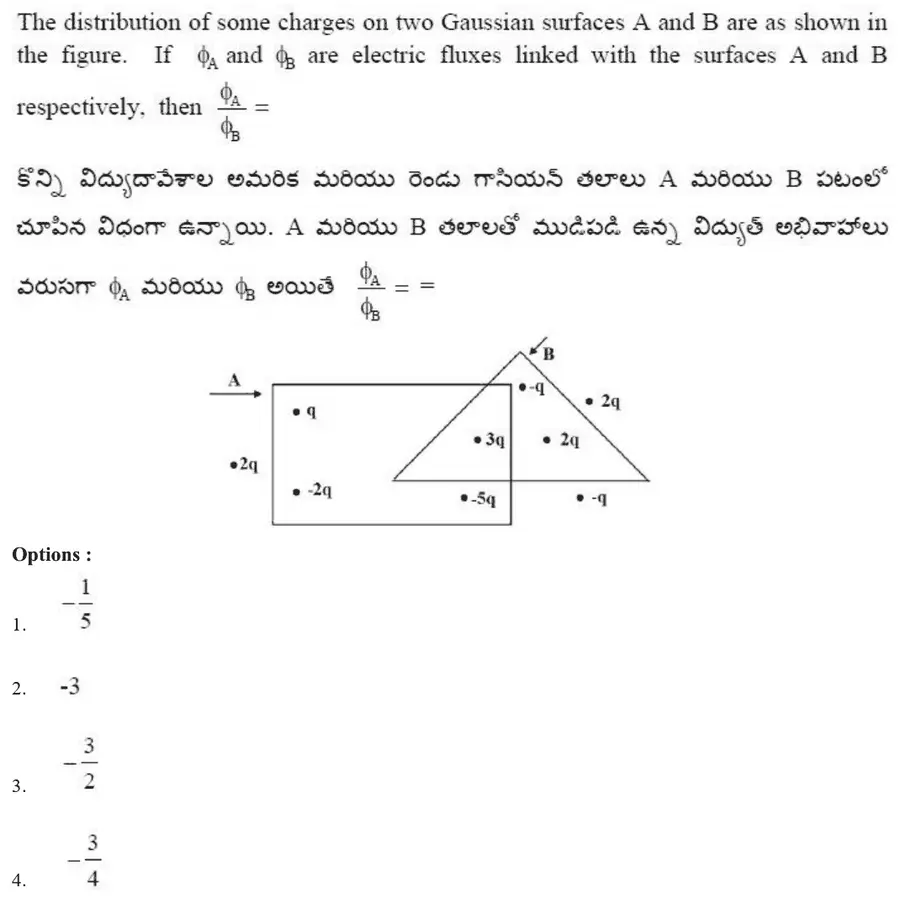
The distribution of some charges on two Gaussian surfaces A and B are as shown in the figure. If $\phi_A$ and $\phi_B$ are electric fluxes linked with the surfaces A and B respectively, then $\frac{\phi_A}{\phi_B}$ = (see the figure above)
A wire of length L has a charge Q distributed uniformly along its length. The wire is bent in the shape of a semicircle. The magnitude of the electric field at the centre of curvature of the semicircle is
Let $V_1$ be the potential at the center of the square of side 1 m when the charges at the 4 corners are 2 C each. If the same charges are placed at the corners of a square of side 2 m, then the potential at the center of this square is $V_2$. The value of $\frac{V_2}{V_1}$ is
An infinite non-conducting sheet has a surface charge density of $7\times10^{-7}\ \mathrm{C\,m^{-2}}$ on one side. The distance between equipotential surfaces whose potentials differ by 19.8 V, will be (Take $\frac{1}{4\pi\varepsilon_o} = 9\times10^{9}$ SI units)
Four charges, each charge q coloumb are placed at points $(-1,0,0)$, $(1,0,0)$, $(0,-1,0)$ and $(0,1,0)$ in the x y - plane. The distances along the axes are measured in meters. The magnitude of the electric field at the point z = 1 m on the z - axis is
A large number of positive charges each of magnitude q are placed along the x-axis at the origin and at every 1 cm distance in both the directions. The electric flux through a spherical surface of radius 2.5 cm centered at the origin is
The electric field in a region of space is given as $\vec{E} = (5\ \mathrm{NC^{-1}})\,x\,\hat{i}$. Consider point A on the y-axis at $y = 5$ m and point B on the axis at $x = 2$ m. If the potentials at points A and B are $V_A$ and $V_B$ respectively, then $(V_B - V_A)$ is
A charge Q is to be divided between two objects. The values of the charges on the objects so that the electrostatic force between them will be maximum is
Electric potential due to a space is given by $\phi(x, y, z) = \phi_o\frac{x_o}{x}$; when $x_o = 5\ \mathrm{m}$ and $\phi_o = 8\ \mathrm{V}$. Find the electric field at (10 m, 5 m, 5 m)
An electric dipole with dipole moment $5 \times 10^{-7}$ C m is in the electric field of $2 \times 10^{4}\ \mathrm{NC^{-1}}$ at an angle of 60° with the direction of the electric field. The torque acting on the dipole is
A solid sphere of radius R carries a positive charge Q distributed uniformly throughout its volume. A very thin hole is drilled through it's center. A particle of mass m and charge $-q$ performs simple harmonic motion about the center of the sphere in this hole. The frequency of oscillation is
Assertion (A): In a region of constant potential, the electric field is zero and there can be no charge inside the region. Reason (R): According to Gauss law, charge inside the region should be zero if electric field is zero.
A
Both (A) and (R) are true; (R) is correct explanation of (A)
B
Both (A) and (R) are true; (R) is not correct explanation of (A)
Statement (A): Inside a charged hollow metal sphere, E=0, V$\neq$0. (E - electric field, V - electric potential) Statement (B): The work done in moving a positive charge on an equipotential surface is zero. Statement (C): When two like charges are brought closer, their mutual electrostatic potential energy will increase.
Two insulated charged metallic spheres 'P' and 'Q' of negligible radii have their centres separated by a distance of $60\ \mathrm{cm}$. The mutual force of electrostatic repulsion if the charge on each is $6 \times 10^{-7}\ \mathrm{C}$ is ______
Two charges $+80\,\mu\mathrm{C}$ and $+20\,\mu\mathrm{C}$ are separated by a distance in air. An unknown third charge $q$ is placed at the centre of the line joining the two charges. If the charges are in equilibrium, then $q$ = ______
A circular plate sheet of radius $10\ \mathrm{cm}$ is placed in a uniform electric field of $2\sqrt{3} \times 10^5\ \mathrm{N.C^{-1}}$, making an angle of $60^\circ$ with the field. Then find the electric flux through the sheet.
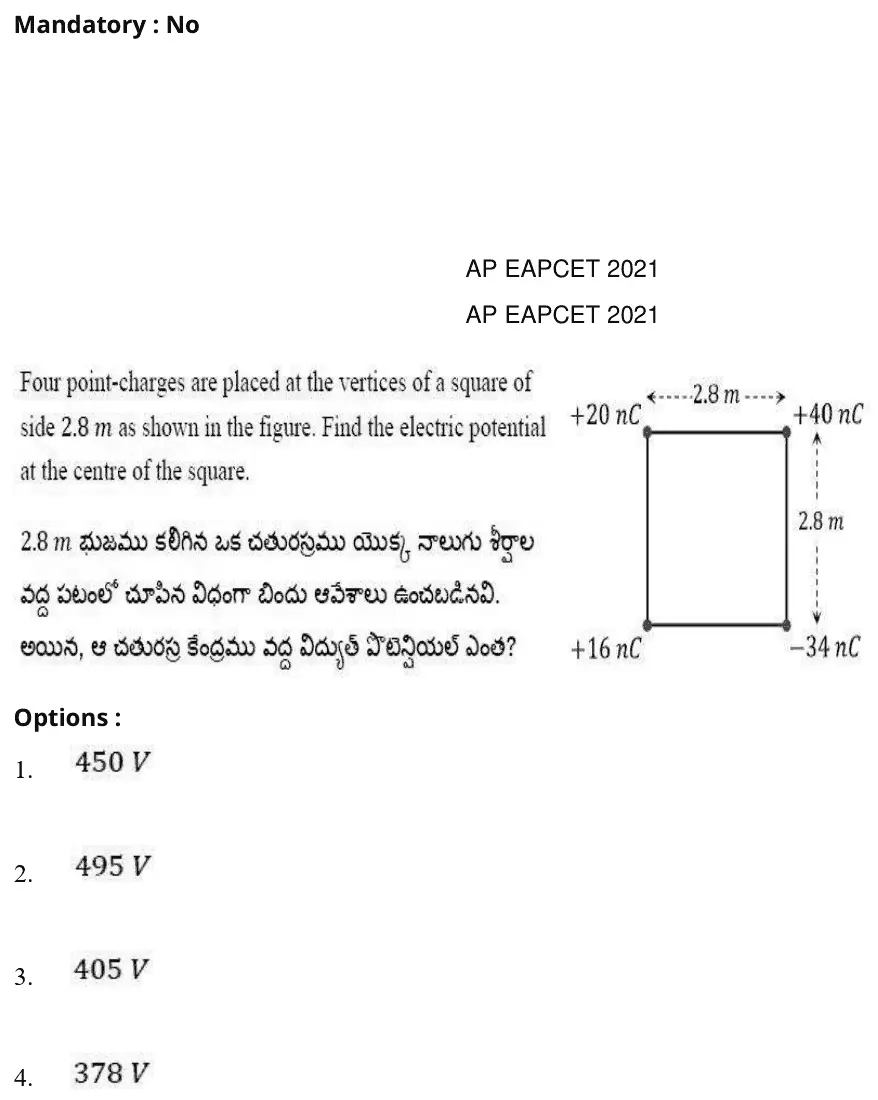
Four point-charges are placed at the vertices of a square of side $\sqrt{2}\ \mathrm{m}$ (about $1.41\ \mathrm{m}$) as shown in the figure. Find the electric potential at the centre of the square. (see the figure above)
An $100\ eV$ electron is fired directly towards a large metal plate having surface charge density $-2 \times 10^{-6}\ cm^{-2}$. The distance from where the electron be projected so that it just fails to strike the plate is ______
A unit positive charge has to be brought from infinity to a midpoint between two charges $20\ \mu C$ and $10\ \mu C$ separated by a distance of $50\ m$. How much work will be required?
Two opposite charges each of magnitude $500\ \mu c$ are $10\ cm$ apart. Find electric field intensity at a distance of $25\ cm$ from the midpoint on axial line of the dipole.
Two electric dipoles of moments $p$ and $27p$ are placed in opposite direction on a line at a distance of 24 $cm$. The electric field will be zero at a point between the dipoles whose distance from the dipole of moment $p$ is
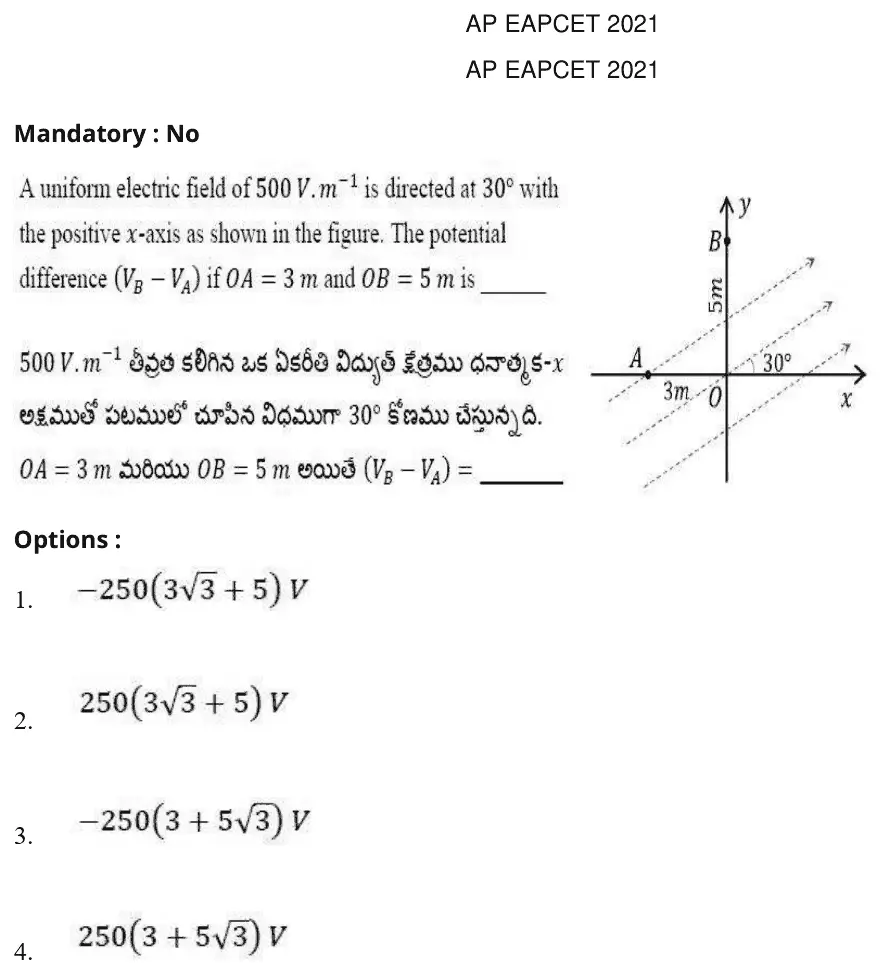
A uniform electric field of 500 $V.m^{-1}$ is directed at $30^\circ$ with the positive $x$-axis as shown in the figure. The potential difference $(V_B - V_A)$ if $OA = 3\ m$ and $OB = 5\ m$ is ______ (see the figure above)
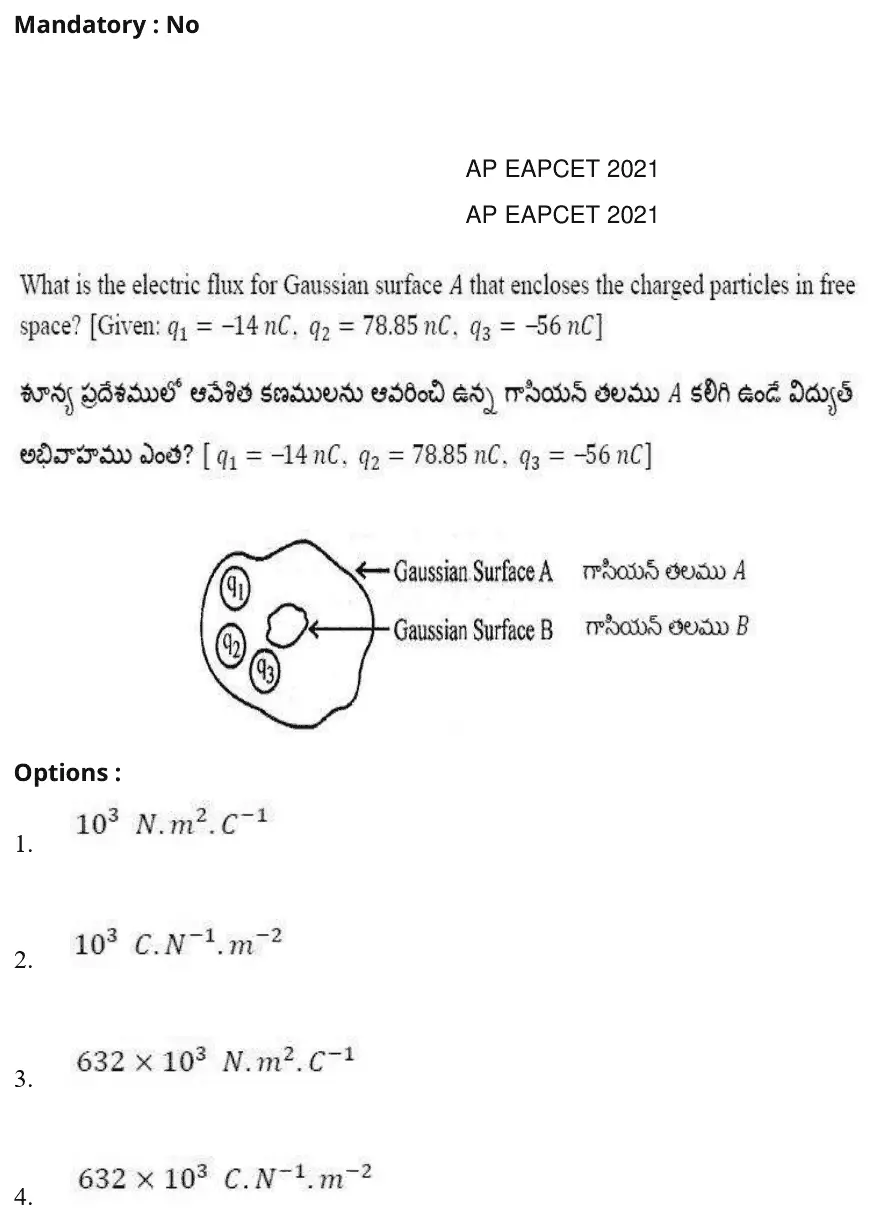
What is the electric flux for Gaussian surface A that encloses the charged particles in free space? [Given: $q_1 = -14\ \mathrm{nC}$, $q_2 = 78.85\ \mathrm{nC}$, $q_3 = -56\ \mathrm{nC}$] (see the figure above)
Two charges $8\ \mu C$ each are placed at the corners A and B of an equilateral triangle of side $0.2\ \mathrm{m}$ in air. The electric potential at the third corner C is ______.
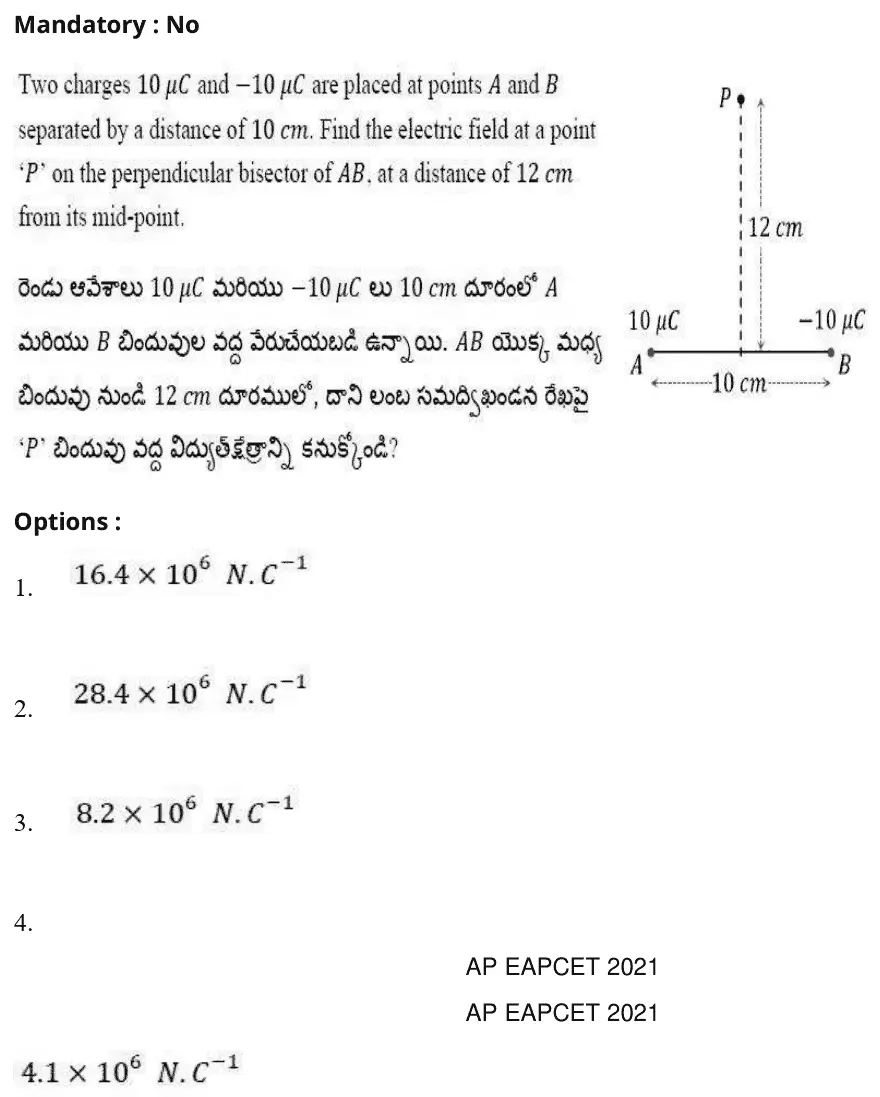
Two charges $10\ \mu\mathrm{C}$ and $-10\ \mu\mathrm{C}$ are placed at points $A$ and $B$ separated by a distance of $10\ \mathrm{cm}$. Find the electric field at a point 'P' on the perpendicular bisector of $AB$, at a distance of $12\ \mathrm{cm}$ from its mid-point. (see the figure above)
Which statement(s) among the following are incorrect: (i) A negative test charge experiences a force opposite to the direction of the field. (ii) The tangent drawn to a line of force represents the direction of electric field. (iii) The electric field lines never intersect. (iv) The electric field lines form a closed loop.
A thin non - conducting ring of radius r has a linear charge density $\lambda=\lambda_0\cos\phi$, where $\lambda_0$ is a constant and $\phi$ is the azimuthal angle. The magnitude of the electric field strength at the centre of the ring is:
A circular wire-loop of radius $1\ \mathrm{cm}$ carries a total charge $1\times10^{-6}\ \mathrm{C}$ distributed uniformly over its length. If $0.01\,\%$ of its length (circumference) is cut-off, then the electric field at the centre of the loop due to the remaining wire is (Take $\dfrac{1}{4\pi\varepsilon_0}=9\times10^{9}$ SI unit)
A hollow metal sphere of radius $15\ \mathrm{cm}$ is charged such that potential on its surface is $20\ \mathrm{V}$. Then the potential at the centre of sphere is
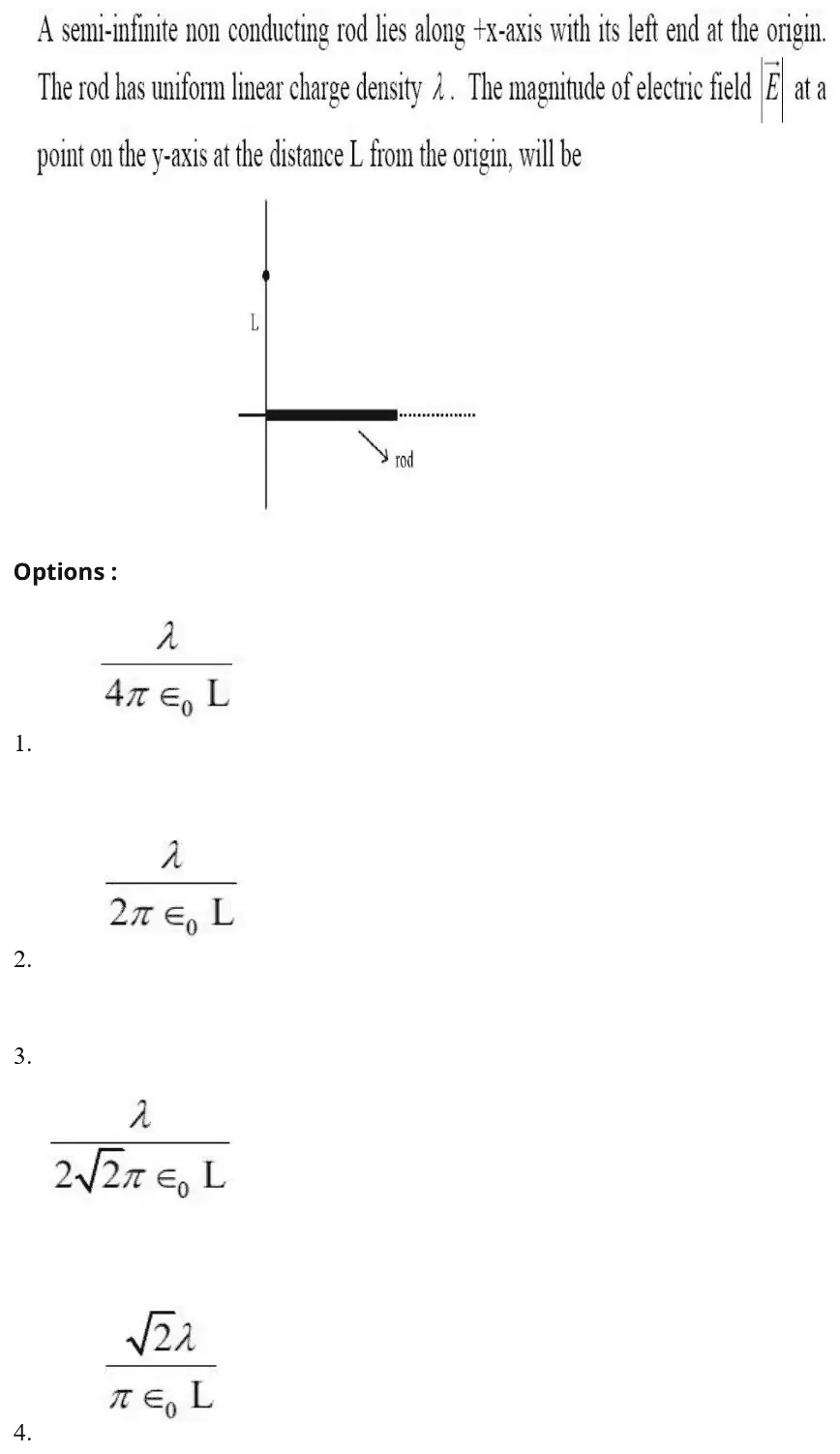
A semi-infinite non conducting rod lies along +x-axis with its left end at the origin. The rod has uniform linear charge density $\lambda$. The magnitude of electric field $|\vec{E}|$ at a point on the y-axis at the distance L from the origin, will be (see the figure above)
A particle of mass $m$ and charge $q$ is thrown perpendicular to an electric field of intensity $E$ with an initial velocity $v$. The particle moves a distance $x$ perpendicular to the field and a distance $y$ along the direction of the field. If $y = \alpha x^2$ then the $\alpha$ is given by
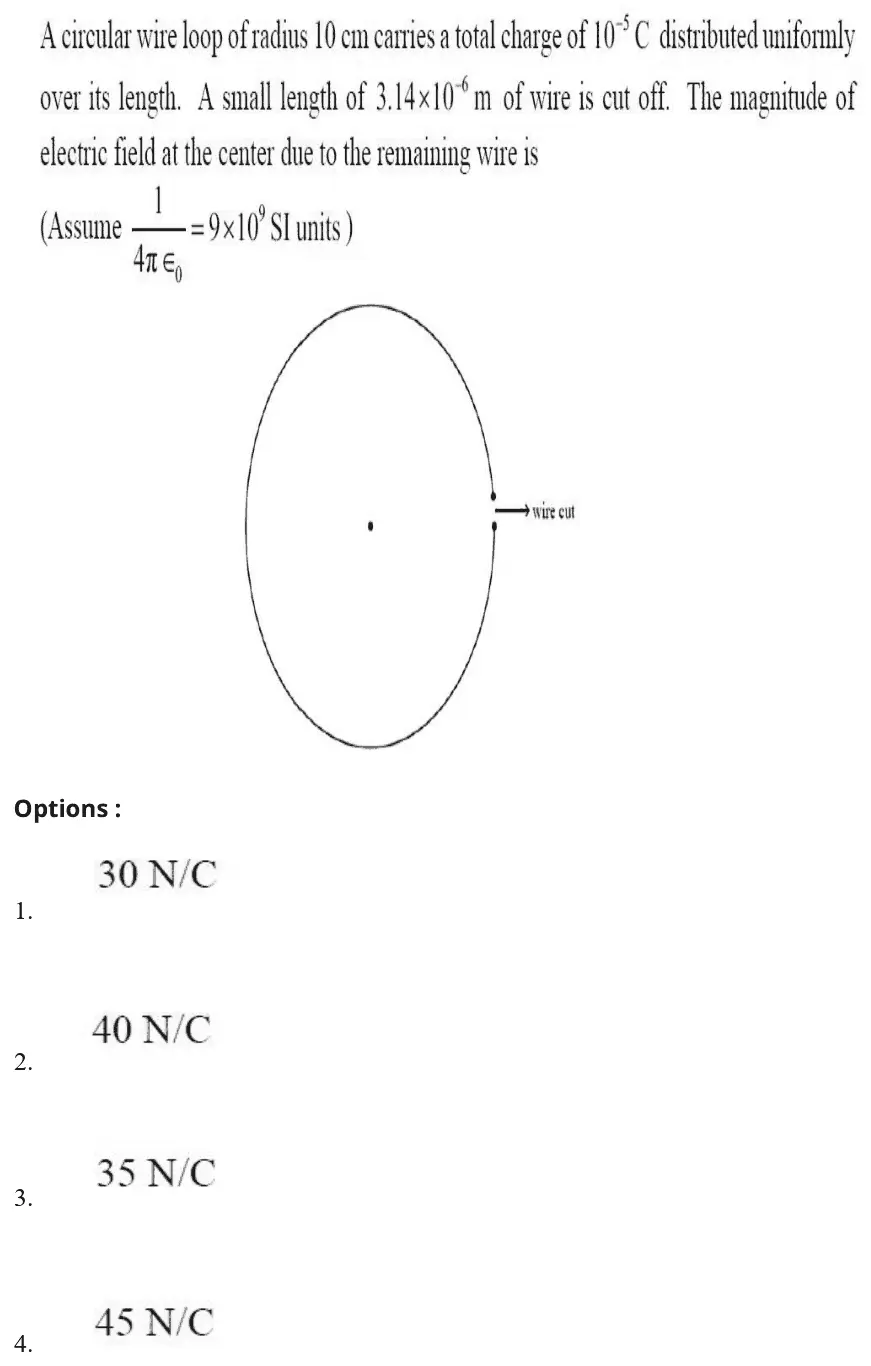
A circular wire loop of radius 10 cm carries a total charge of $10^{-5}$ C distributed uniformly over its length. A small length of $3.14\times10^{-6}$ m of wire is cut off. The magnitude of electric field at the center due to the remaining wire is (Assume $\frac{1}{4\pi\epsilon_0} = 9\times10^9$ SI units) (see the figure above)
Two infinitely long thin straight wires having uniform linear charge densities $2\lambda$ and $3\lambda$ are arranged parallel to each other at a distance R apart. The intensity at a point midway between them is
If a charged spherical conductor of radius $10\ cm$ has potential $V$ at a point distant $5\ cm$ from its centre, then the potential at a point distant $15\ cm$ from the centre will be ______
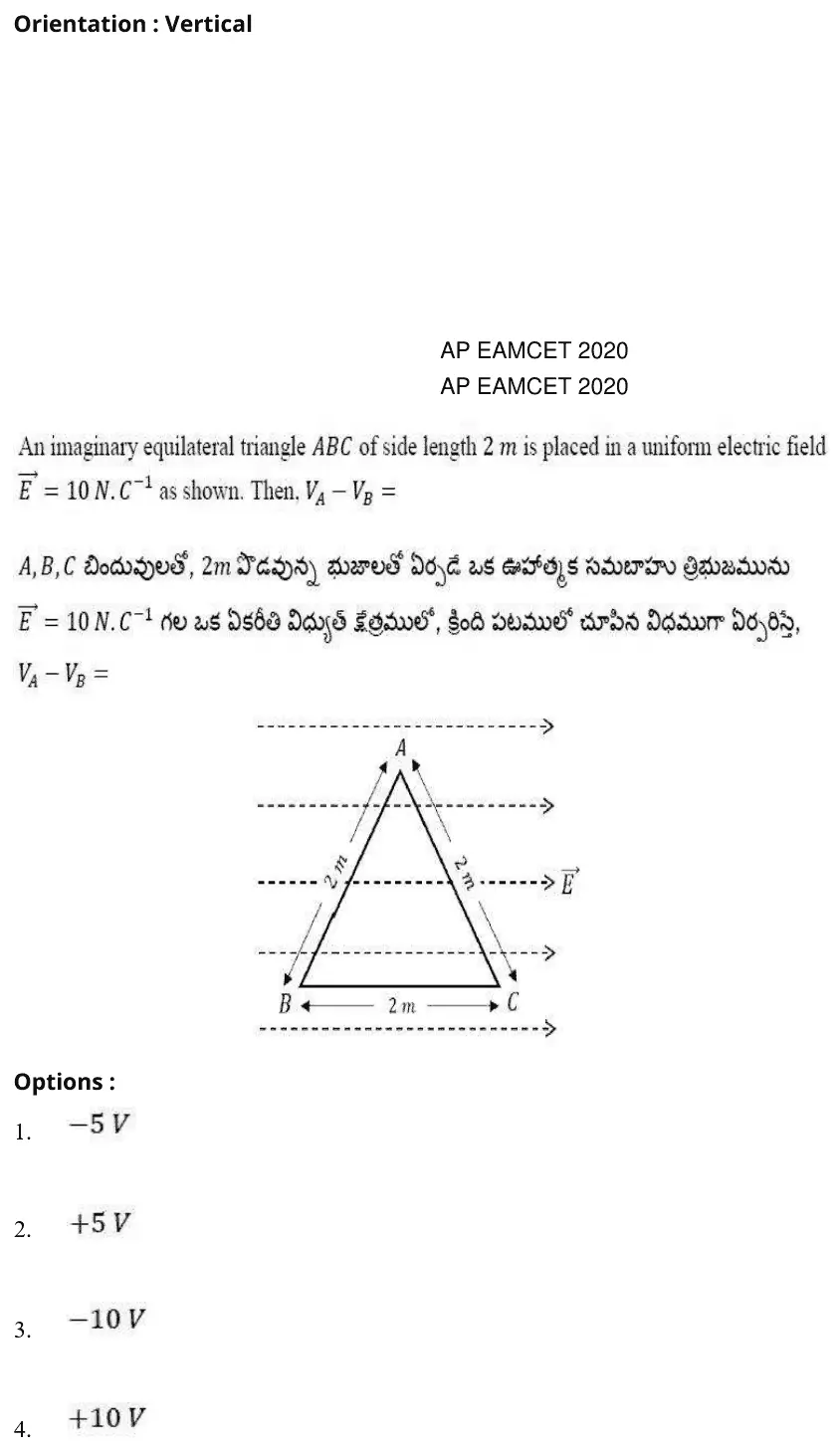
An imaginary equilateral triangle $ABC$ of side length $2\ \mathrm{m}$ is placed in a uniform electric field $\vec{E} = 10\ \mathrm{N.C^{-1}}$ as shown. Then, $V_A - V_B =$ (see the figure above)
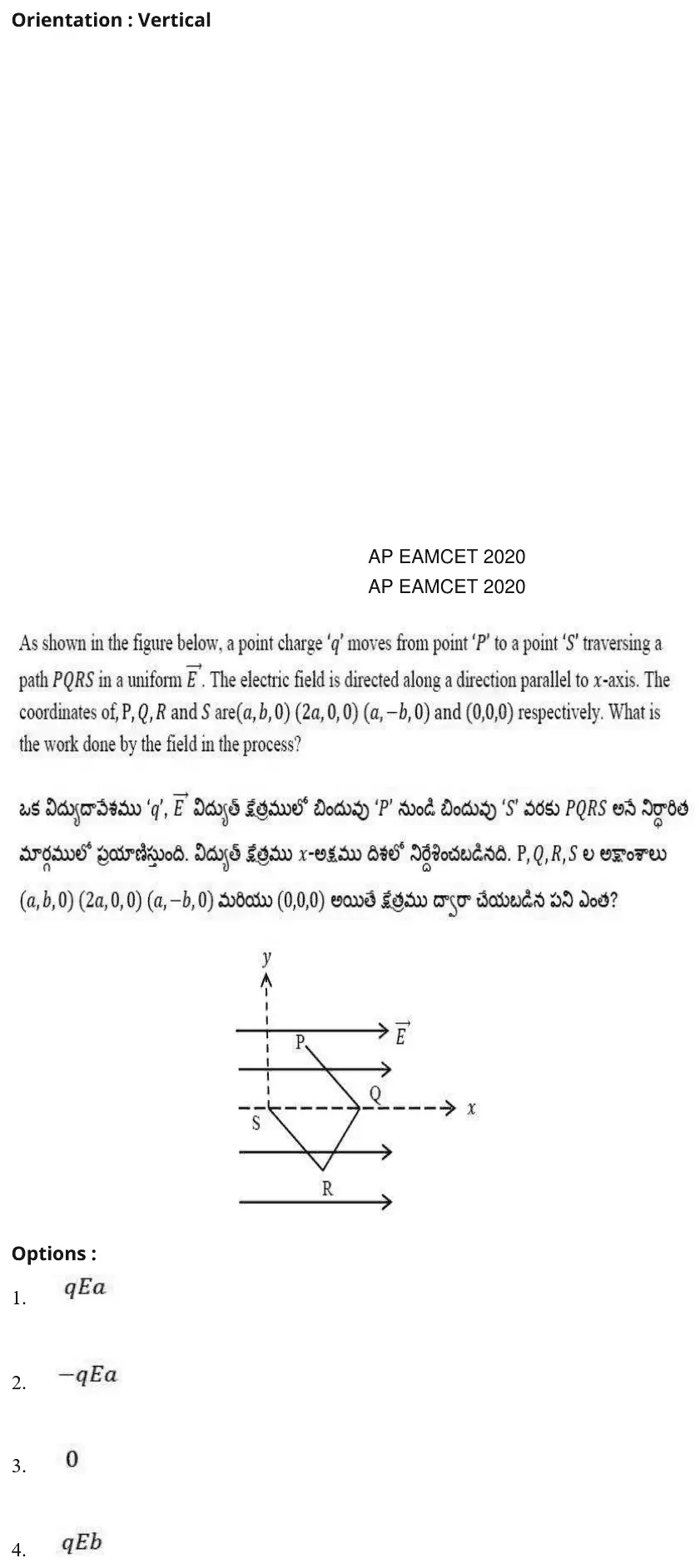
As shown in the figure below, a point charge 'q' moves from point 'P' to a point 'S' traversing a path $PQRS$ in a uniform $\vec{E}$. The electric field is directed along a direction parallel to $x$-axis. The coordinates of, $P, Q, R$ and $S$ are $(a,b,0)$ $(2a,0,0)$ $(a,-b,0)$ and $(0,0,0)$ respectively. What is the work done by the field in the process? (see the figure above)
When a $5\ \mathrm{C}$ charge is kept in a uniform electric field, a force of $5000\ \mathrm{N}$ acts on it. Find the potential difference between two points in that field, separated by a distance of $1\mathrm{cm}$.
An infinite line charge produces a field of $9 \times 10^{4}$ $\mathrm{N.C^{-1}}$ at a distance of 2 $\mathrm{cm}$. its linear charge density is ______
When a charge of 20 C is taken from one point to another separated by a distance of 0.2 $\mathrm{m}$, work of 2 J is required to be done. What is the potential difference between the two points?
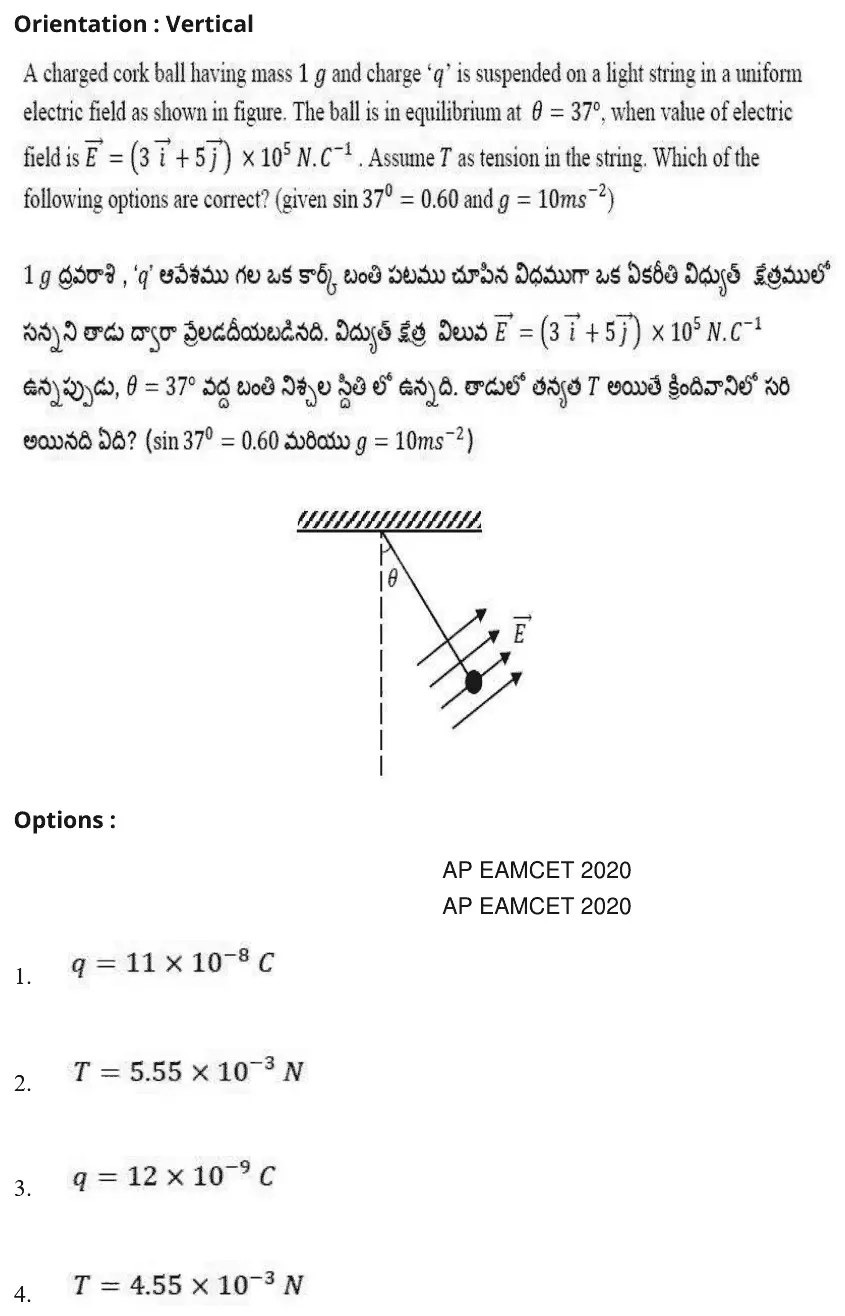
A charged cork ball having mass $1\ \mathrm{g}$ and charge 'q' is suspended on a light string in a uniform electric field as shown in figure. The ball is in equilibrium at $\theta = 37^\circ$, when value of electric field is $\vec{E} = (3\,\hat{i} + 5\,\hat{j}) \times 10^5\ \mathrm{N.C^{-1}}$. Assume $T$ as tension in the string. Which of the following options are correct? (given $\sin 37^\circ = 0.60$ and $g = 10\ \mathrm{ms^{-2}}$) (see the figure above)
An electric dipole with dipole moment 'p' is placed with its axis at $30^\circ$ to a uniform electric field. The work done in rotating the dipole to a position where its axis is perpendicular to the field is
Three charges $4q, Q$ and $q$ are placed at positions $0, l/2$ and $l$ respectively along a straight line. If the resultant force on $q$ is zero, then $Q$ is equal to ______
The electric potential on the surface of a charged spherical conductor of radius $5\ \mathrm{cm}$ is $200\ \mathrm{V}$. Work done in moving a charge of $+5\ \mathrm{C}$ from a point $A$ to another point $B$ situated at distances of $15\ \mathrm{cm}$ and $10\ \mathrm{cm}$ respectively from the centre of the sphere is ______
Two opposite and equal charges each of magnitude $4\times 10^{-8}\ C$ form a dipole. Their separation is $2\times 10^{-2}\ cm$. When this dipole is placed in an external electric field $4\times 10^{8}\ N.C^{-1}$, the value of maximum torque and the work done in rotating it through $180^\circ$ respectively, will be
Five point charges $^1/_\pi, ^2/_\pi, ^3/_\pi, ^4/_\pi$ and $^{-5}/_\pi$ nano-Coulomb are located inside a pyramid. The total electric flux through the surface of the pyramid is
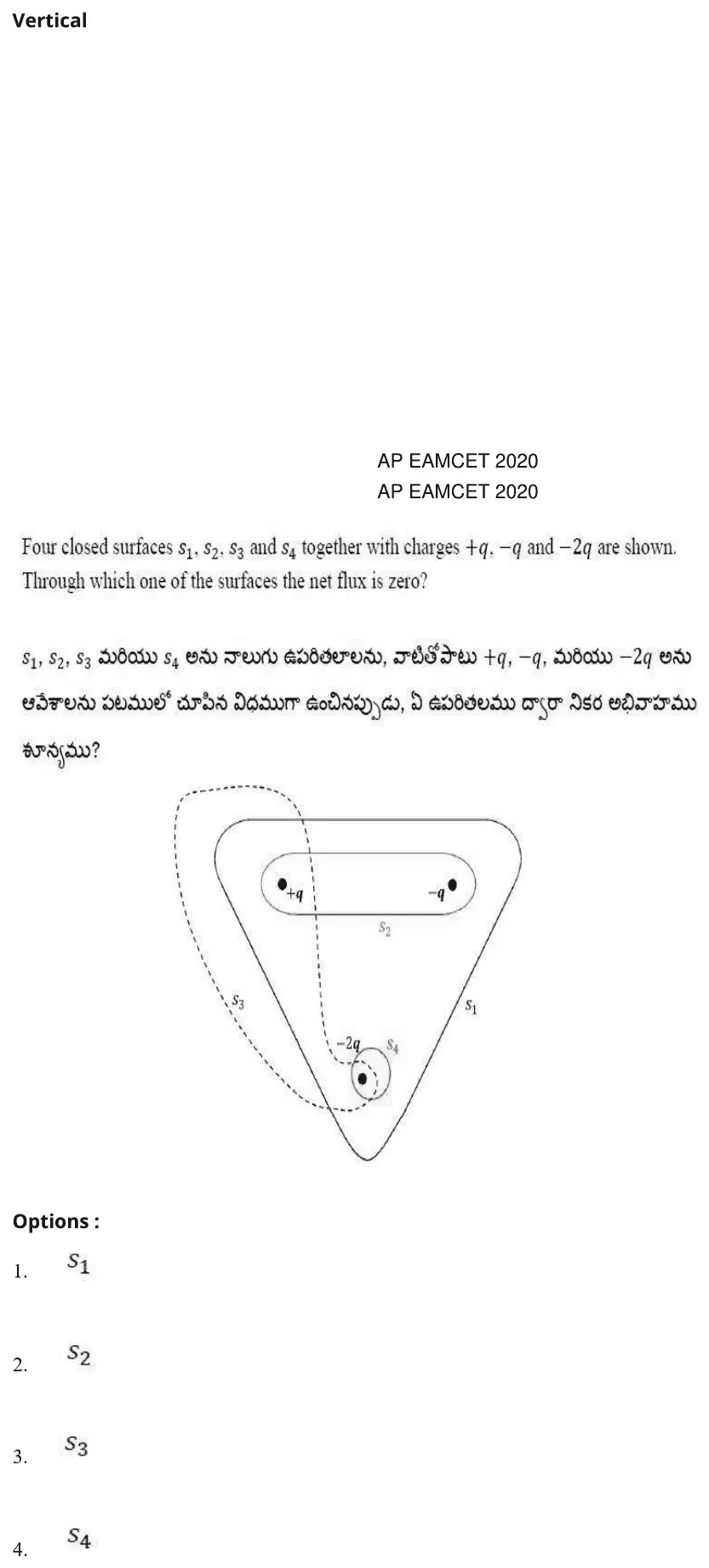
Four closed surfaces $s_1, s_2, s_3$ and $s_4$ together with charges $+q, -q$ and $-2q$ are shown. Through which one of the surfaces the net flux is zero? (see the figure above)
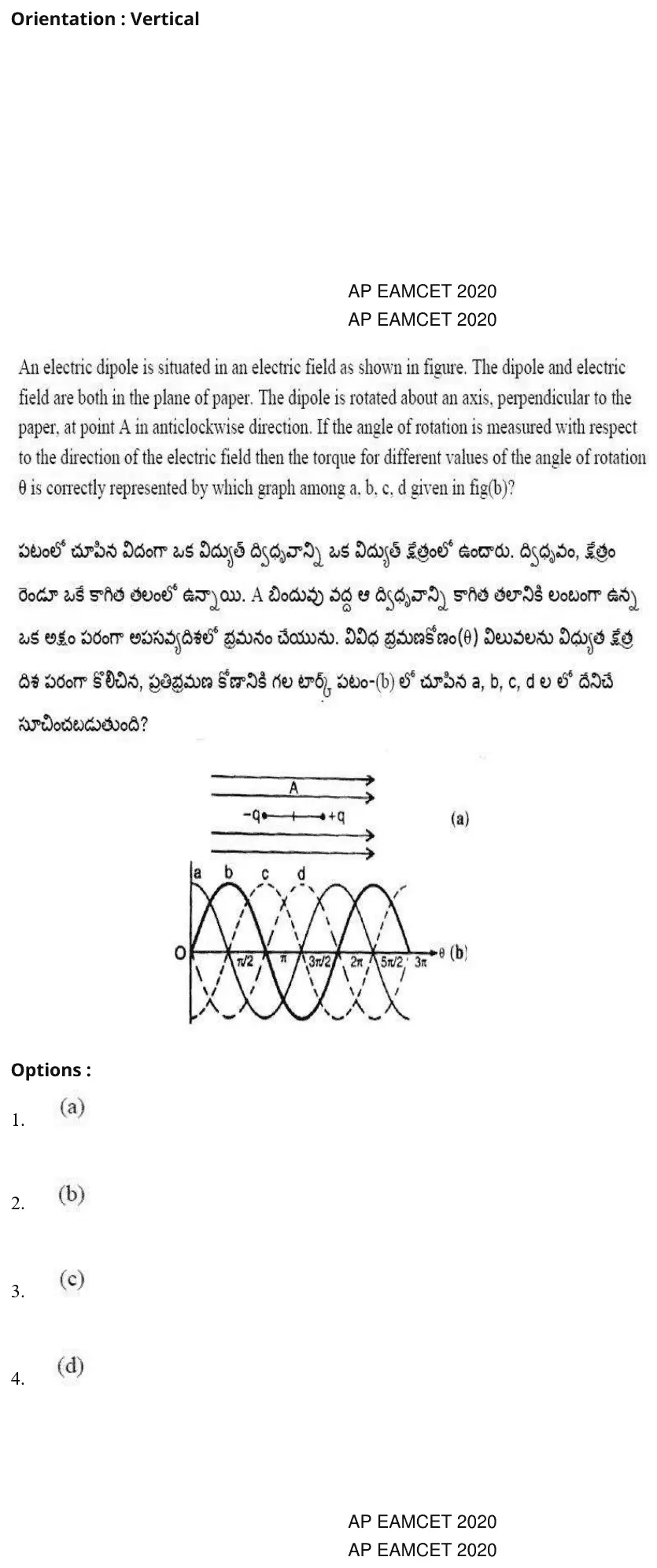
An electric dipole is situated in an electric field as shown in figure. The dipole and electric field are both in the plane of paper. The dipole is rotated about an axis, perpendicular to the paper, at point A in anticlockwise direction. If the angle of rotation is measured with respect to the direction of the electric field then the torque for different values of the angle of rotation $\theta$ is correctly represented by which graph among a, b, c, d given in fig(b)? (see the figure above)
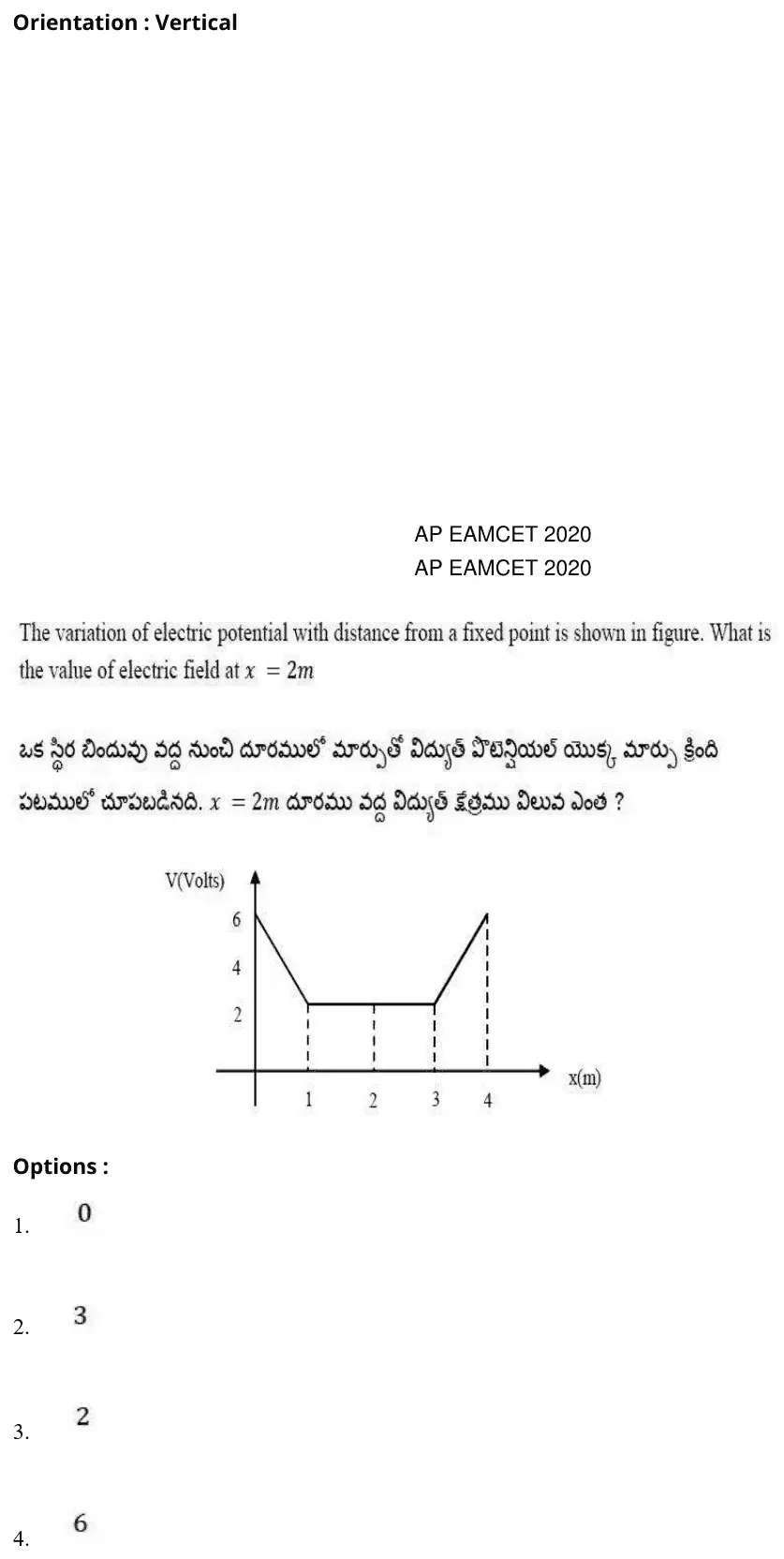
The variation of electric potential with distance from a fixed point is shown in figure. What is the value of electric field at $x = 2m$ (see the figure above)
Answer: (B) according to Gauss's law, if a closed surface encloses no charge, electric field must vanish everywhere on the surface· Official TGCHE final key
In a regular polygon of 10 sides, each corner is at a distance R from the centre. Identical charges are placed at 9 corners. At the centre, the magnitude of electric field is E and the potential is V. The ratio $\dfrac{V}{E}$ is
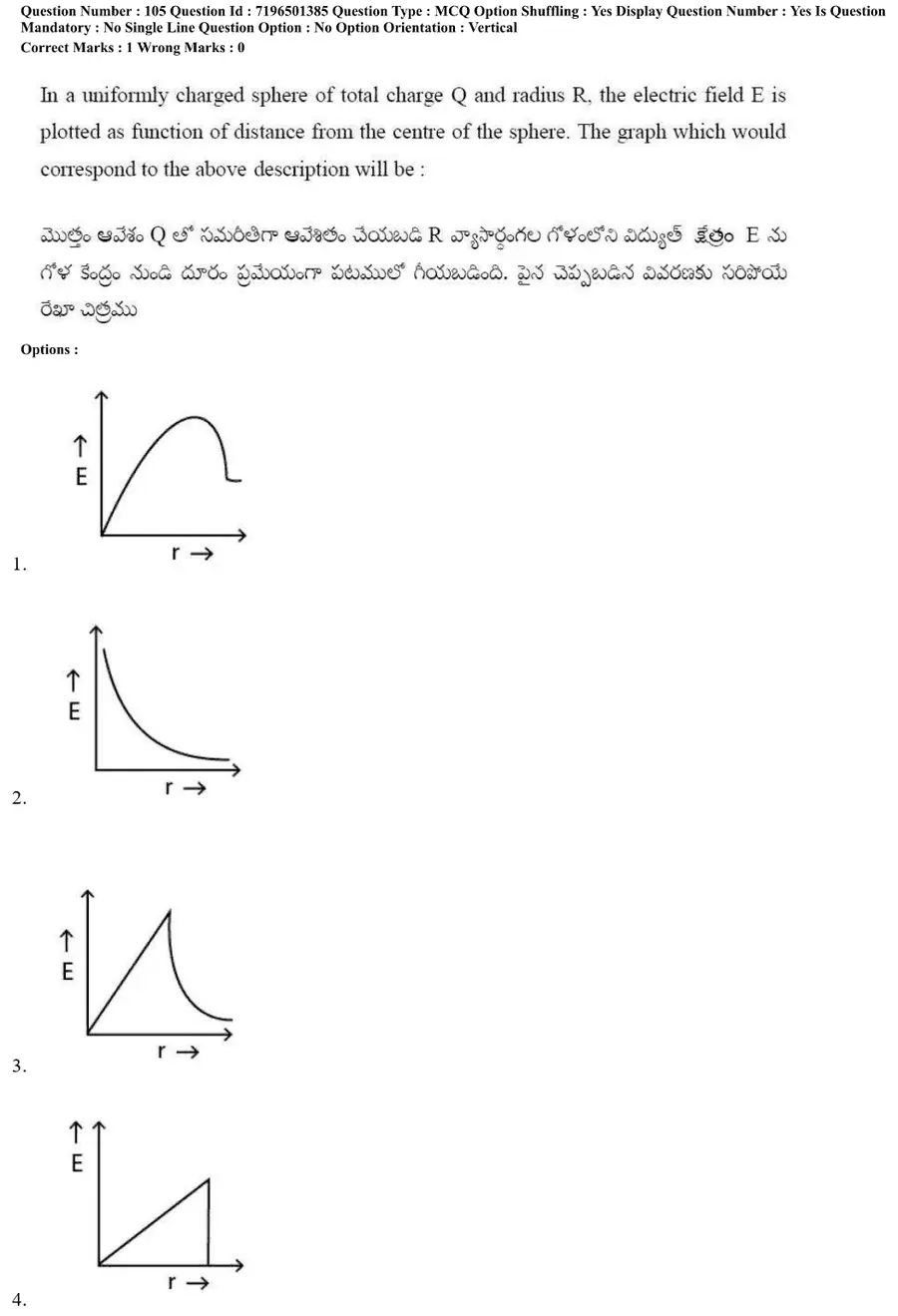
In a uniformly charged sphere of total charge Q and radius R, the electric field E is plotted as function of distance from the centre of the sphere. The graph which would correspond to the above description will be :
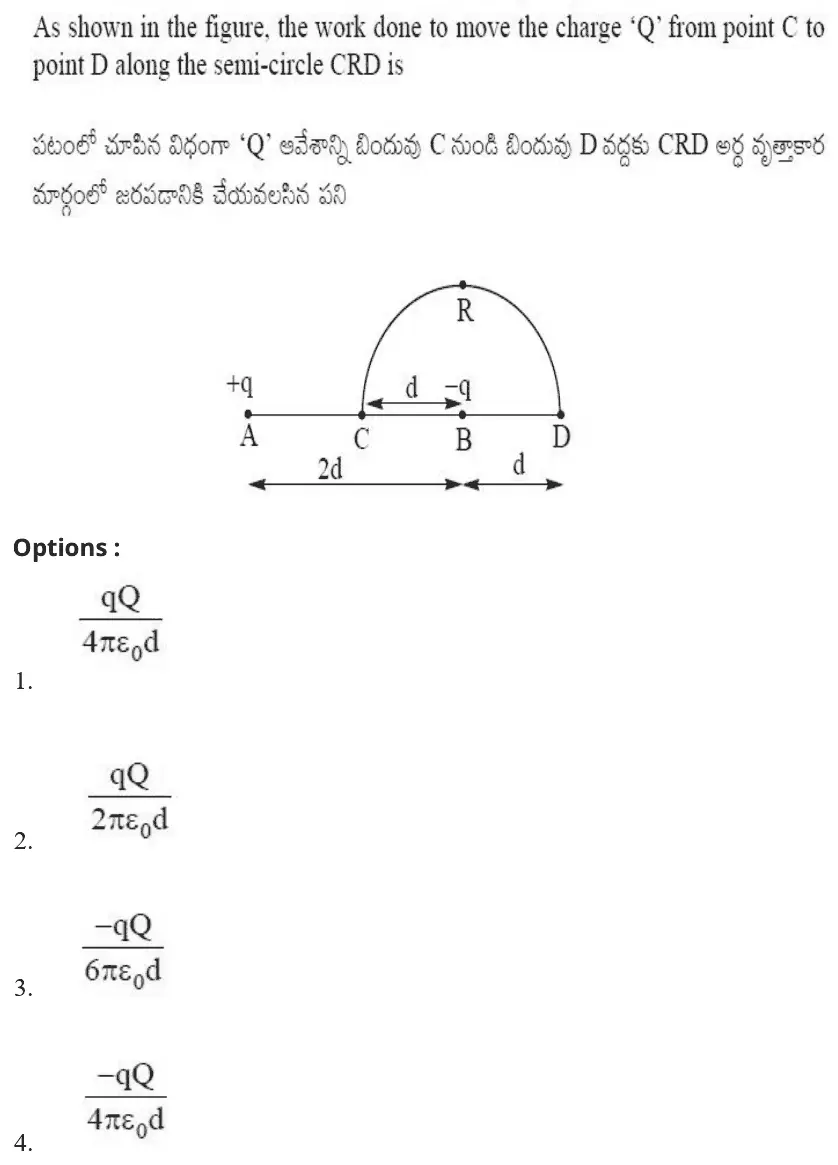
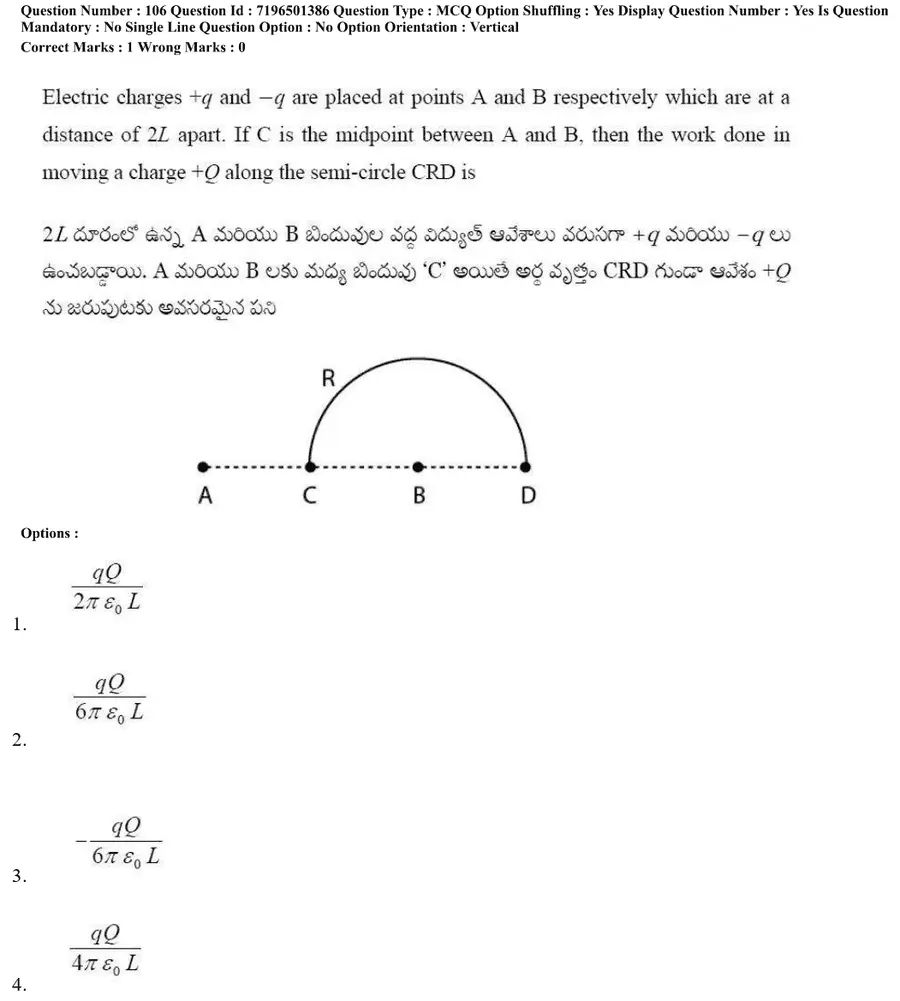
Electric charges $+q$ and $-q$ are placed at points A and B respectively which are at a distance of $2L$ apart. If C is the midpoint between A and B, then the work done in moving a charge $+Q$ along the semi-circle CRD is (see the figure above)
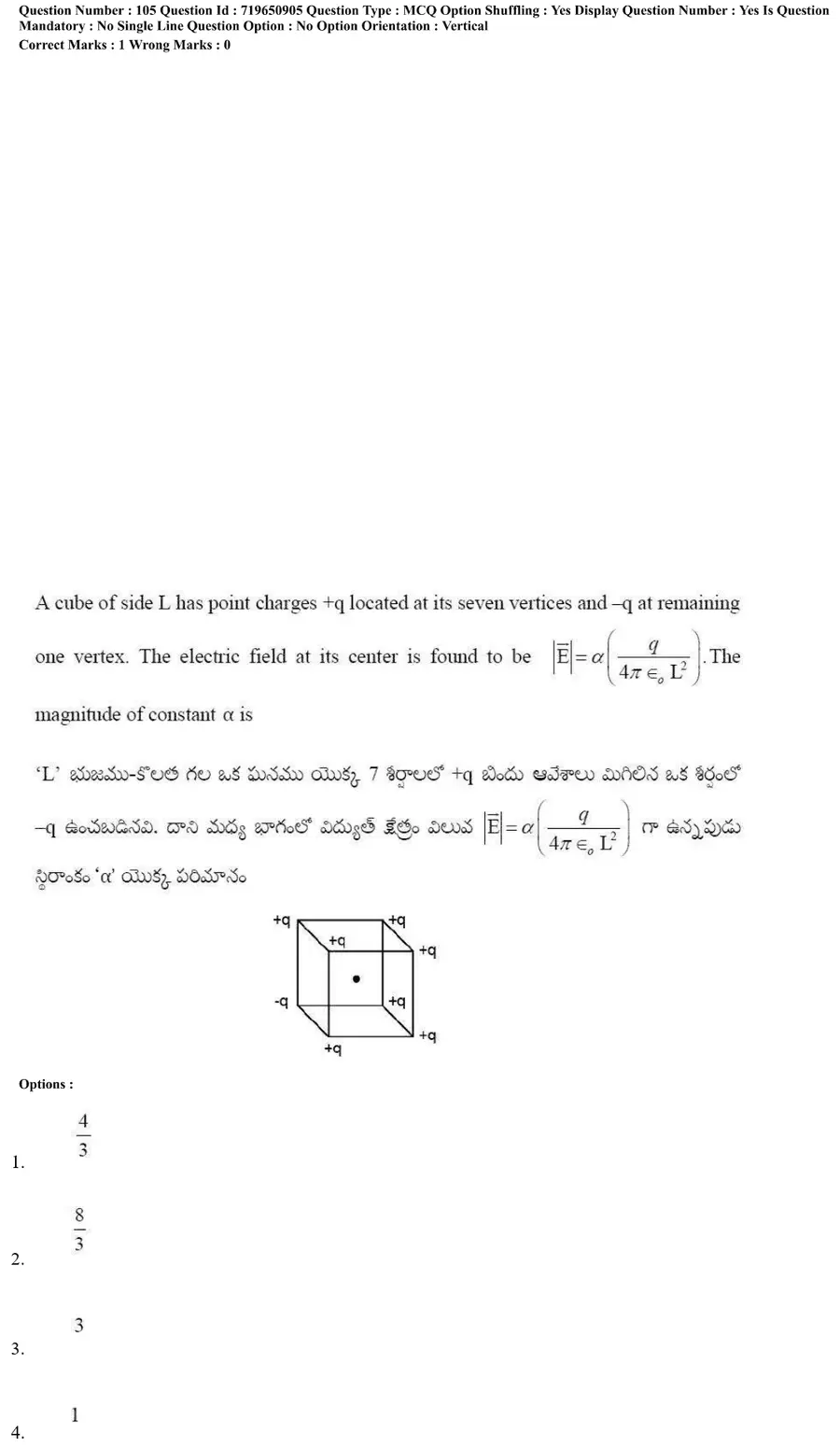
A cube of side L has point charges +q located at its seven vertices and $-$q at remaining one vertex. The electric field at its center is found to be $|\vec{E}| = \alpha\left(\dfrac{q}{4\pi\epsilon_o L^2}\right)$. The magnitude of constant $\alpha$ is (see the figure above)
The electric flux from a cube of edge $l$ is $\phi$ in an enclosed charge. If the edge of the cube is made $\frac{2}{3}\ell$ and the charge enclosed in the cube is doubled, then the electric flux value will be
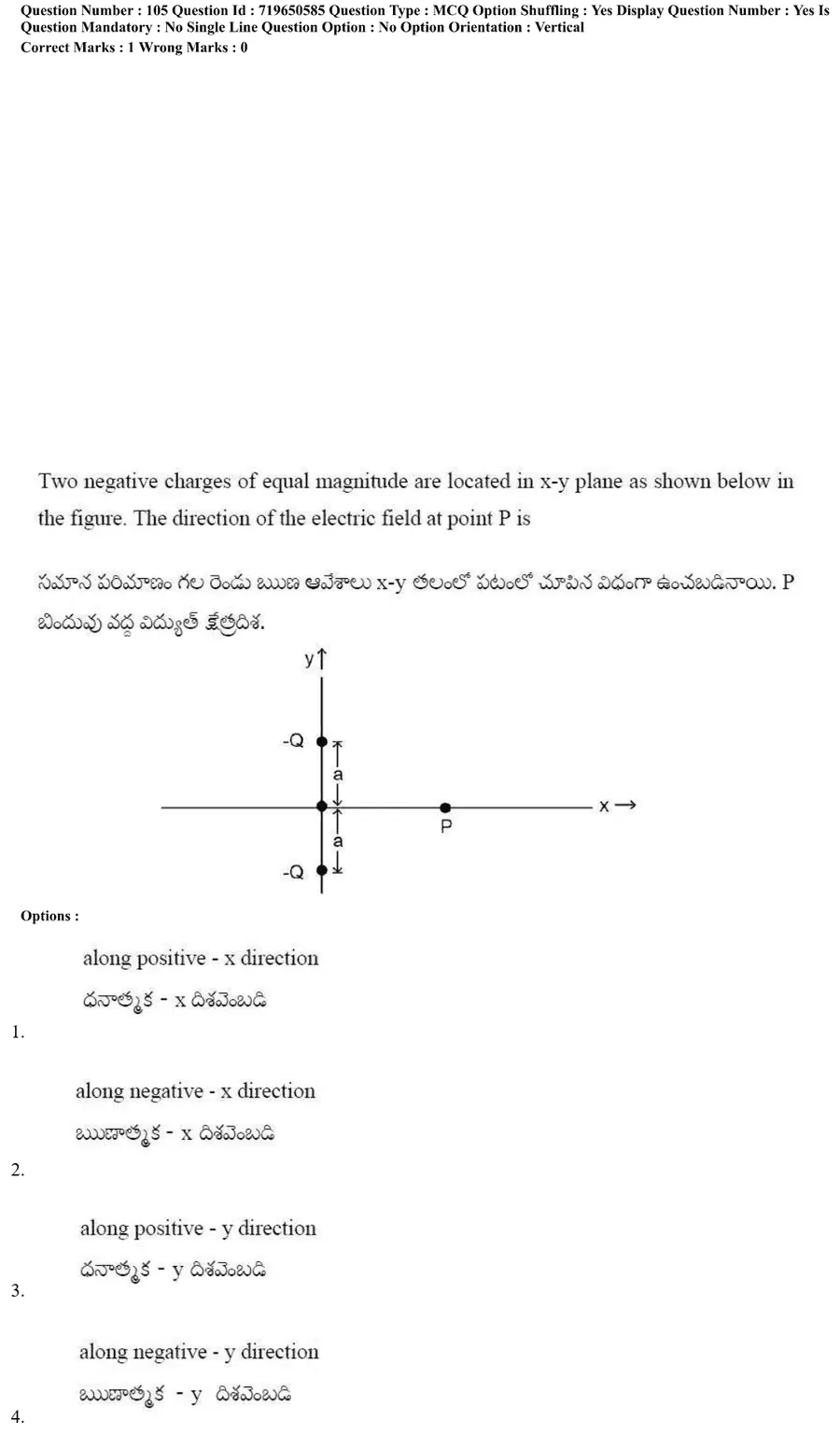
Two negative charges of equal magnitude are located in x-y plane as shown below in the figure. The direction of the electric field at point P is (see the figure above)
An infinite non-conducting sheet has a surface charge density $2\times10^{-7}\,\mathrm{C/m^2}$ on one side. The distance between two equipotential surfaces whose potential differ by 90 V is: (Assume $\frac{1}{4\pi\epsilon_0} = 9\times10^{9}\,\frac{\mathrm{Nm^2}}{\mathrm{C^2}}$)
A particle of mass $2 \times 10^{-6}$ kg with a charge $5 \times 10^{-6}$ C is hanging in air above a similarly charged conducting surface. The charge density of the surface is (Assume $\epsilon_0 = 8.85 \times 10^{-12}\ \mathrm{C^2 N^{-1} M^{-2}}$ and $g = 10\ \mathrm{m/s^2}$)
The electrostatic potential inside a charged spherical ball is given by $\Phi=ar^{2}+b$, where $r$ is the distance from the centre and $a, b$ are constant. Then the charge density inside the ball is ($\varepsilon_0$ = Permittivity in free space)
A thin metallic spherical shell of radius $r$ contains a charge $Q$ on its surface. A point charge $q_1$ is placed at the centre of shell and another charge $q_2$ is placed outside the shell at a distance $x$ from the centre. Then the forces on charges $q_1$ and $q_2$ respectively are:
A spherical volume contains a uniformly distributed charge of density $1.0 \times 10^{-6}$ C/m$^3$. Find the electrical field (in N/C) at a point inside the volume at a distance 1 mm from the centre. (Let $\frac{1}{4\pi\epsilon_o} = 9 \times 10^{9}\ \mathrm{Nm^2C^{-2}}$)
A non-conducting solid sphere has radius R and uniform charge density. A spherical cavity of radius $R/4$ is hollowed out of the sphere. The distance between center of sphere and center of cavity is $R/2$. If the charge of the sphere is Q after the creation of the cavity and the magnitude of electric field at the center of the cavity is $E = K\left(\dfrac{Q}{4\pi\epsilon_0 R^2}\right)$, determine the approximate value of K
A spherical drop of liquid carrying charge Q has potential $V_0$ at its surface. If two drops of same charge and radius combine to form a single spherical drop, then the potential at the surface of new drop is (Assume $V = 0$ at infinity)
Two small conducting balls of identical mass 20 g and identical charge $10^{-10}$ C hang from non conducting threads of length L = 300 cm. If the equilibrium separation of balls is $x$ and $x \ll L$, then the magnitude of $x$ is (Assume $4\pi\epsilon_0 = \frac{1}{9 \times 10^9}$ F/m and g = 10 m/s$^2$)
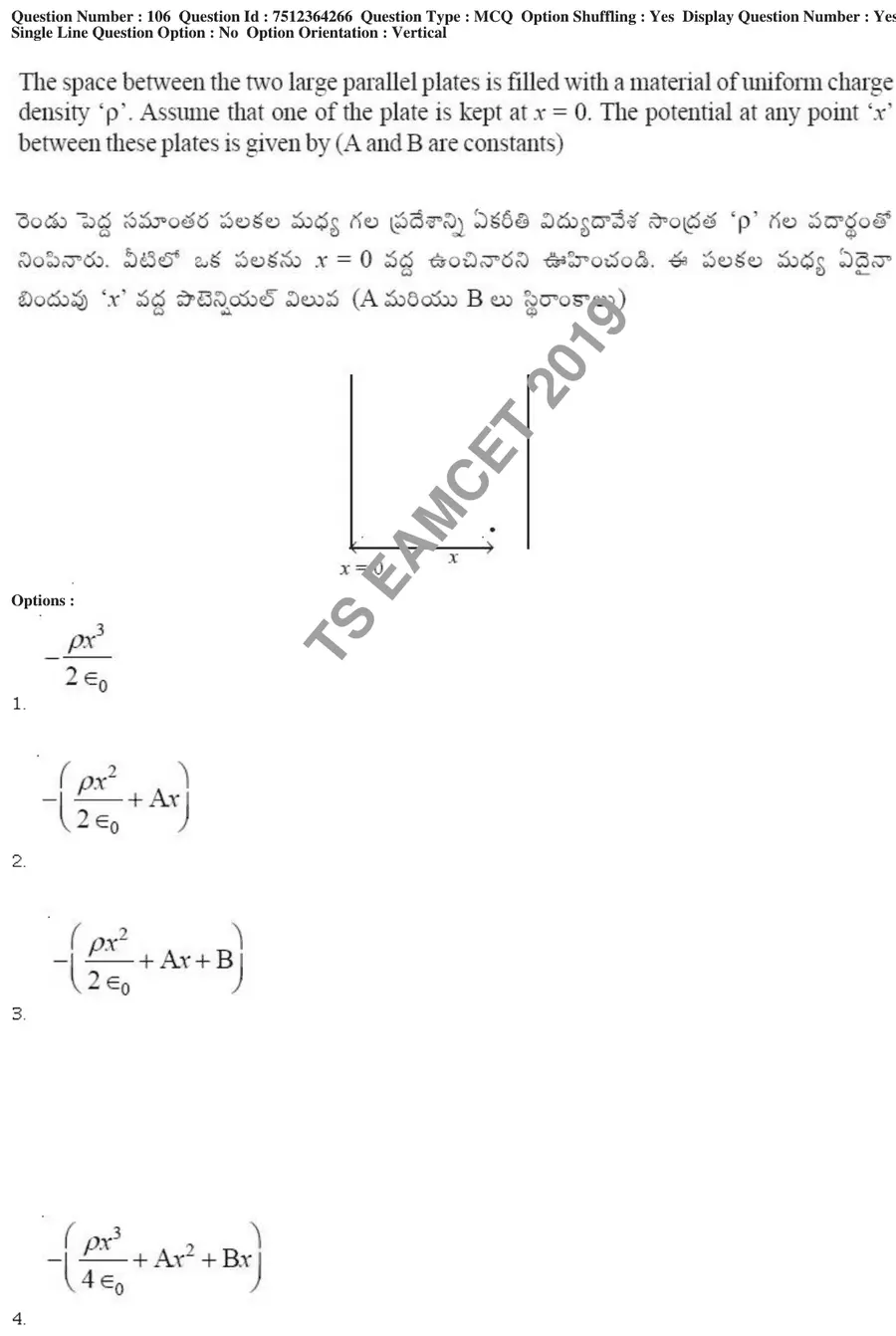
The space between the two large parallel plates is filled with a material of uniform charge density '$\rho$'. Assume that one of the plate is kept at $x = 0$. The potential at any point '$x$' between these plates is given by (A and B are constants) (see the figure above)
An infinite line of charge with uniform line charge density of 1 C/m is placed along the $y$-axis. A charge of 1 C is placed on the $x$-axis at a distance of $d$ = 3 m from the origin. At what distance ($r$) from the origin on the $x$-axis, the total electric field is zero. (Assume $0 < r < d$)
Two particles with charges $+3.72\ \mu\mathrm{C}$ and $+1.86\ \mu\mathrm{C}$ are some distance apart. If 20% of charge is transferred from first particle to second particle then electrostatic force between them is
ABC is a right angled triangle in which $AB = 3\ \mathrm{cm}$, $BC = 4\ \mathrm{cm}$ and right angle is at B. Three charges $+15\ \mu\mathrm{C}$, $+12\ \mu\mathrm{C}$ and $-20\ \mu\mathrm{C}$ are placed respectively at A, B and C. The force acting on charge at B is
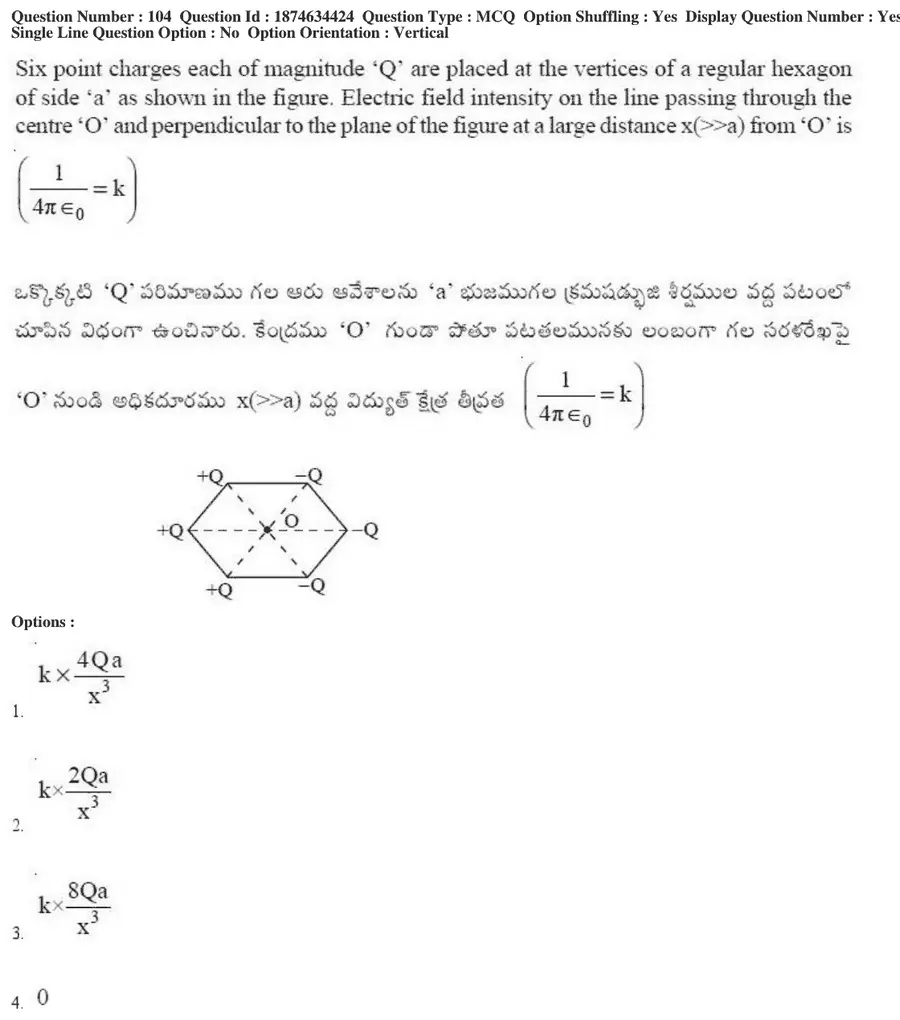
Six point charges each of magnitude 'Q' are placed at the vertices of a regular hexagon of side 'a' as shown in the figure. Electric field intensity on the line passing through the centre 'O' and perpendicular to the plane of the figure at a large distance $x(\gg a)$ from 'O' is $\left(\dfrac{1}{4\pi\epsilon_0} = k\right)$ (see the figure above)
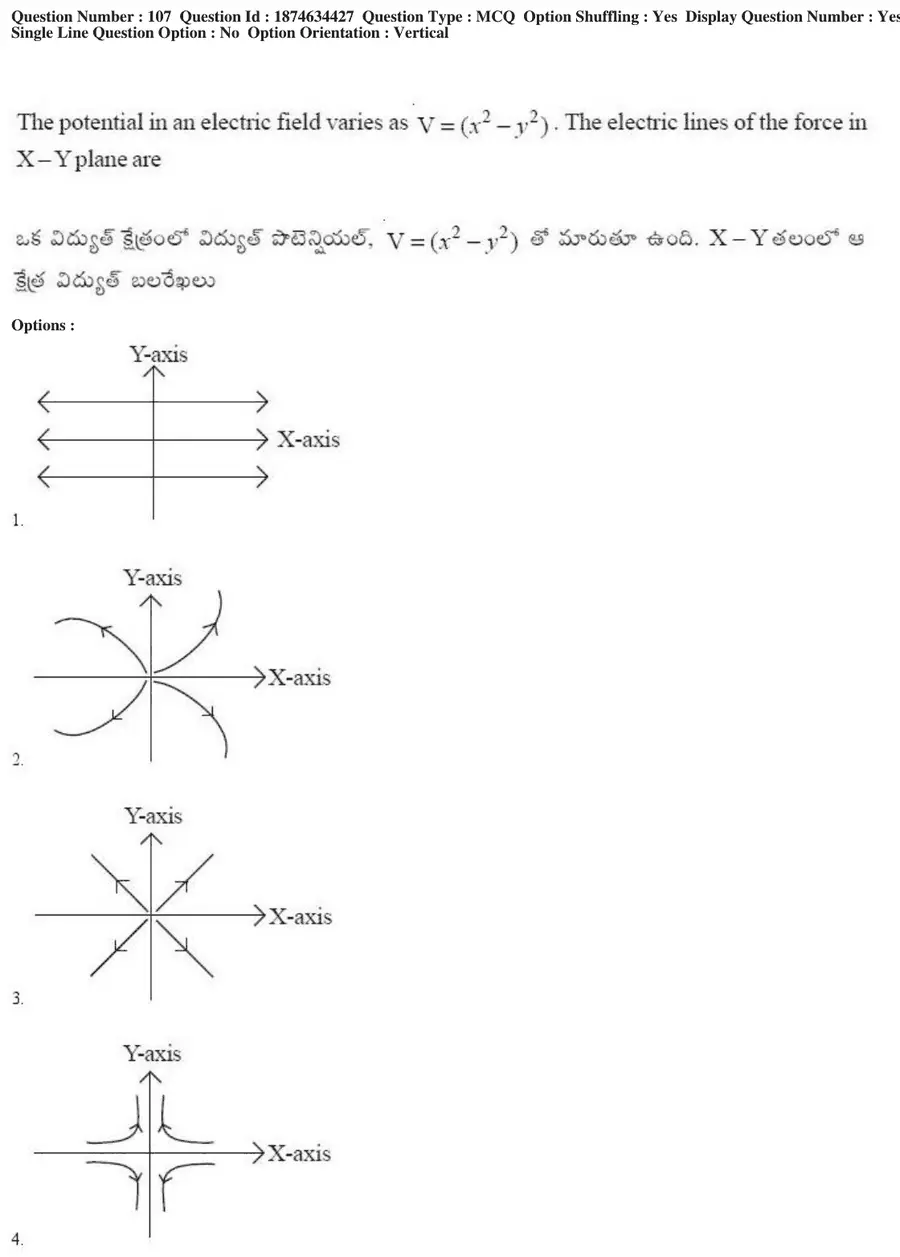
The potential in an electric field varies as $V = (x^{2} - y^{2})$. The electric lines of the force in X-Y plane are
The question as printed in the paper.
A
see figure three parallel horizontal lines, each with arrowheads at both ends, crossing the Y-axis (X and Y axes labelled)
B
see figure four separate curved lines, one in each quadrant, starting near the origin and curving outward (upper-right curve bending up with arrow outward; upper-left curving up-left with arrow outward; lower-left and lower-right likewise with arrows outward), axes labelled
C
see figure two straight diagonal lines crossing at the origin (an X shape), with arrowheads pointing outward on all four ends (diagonals at 45 degrees), axes labelled
D
see figure four hyperbola-like curves, one in each quadrant, hugging the Y-axis (nearly vertical away from the origin, flaring toward the X direction near the axis); arrows on the upper pair point upward, on the lower pair point downward (arrowhead directions least sure), axes labelled
A dipole has two charges $+1\ \mu\mathrm{C}$ and $-1\ \mu\mathrm{C}$ and each of mass $1\ \mathrm{kg}$. The separation between the charges is $1\ \mathrm{m}$. An electric field $20 \times 10^3\ \mathrm{Vm^{-1}}$ is applied on the dipole. If the dipole is deflected through $2^\circ$ from equilibrium position, then the time taken by it to come to equilibrium position again is
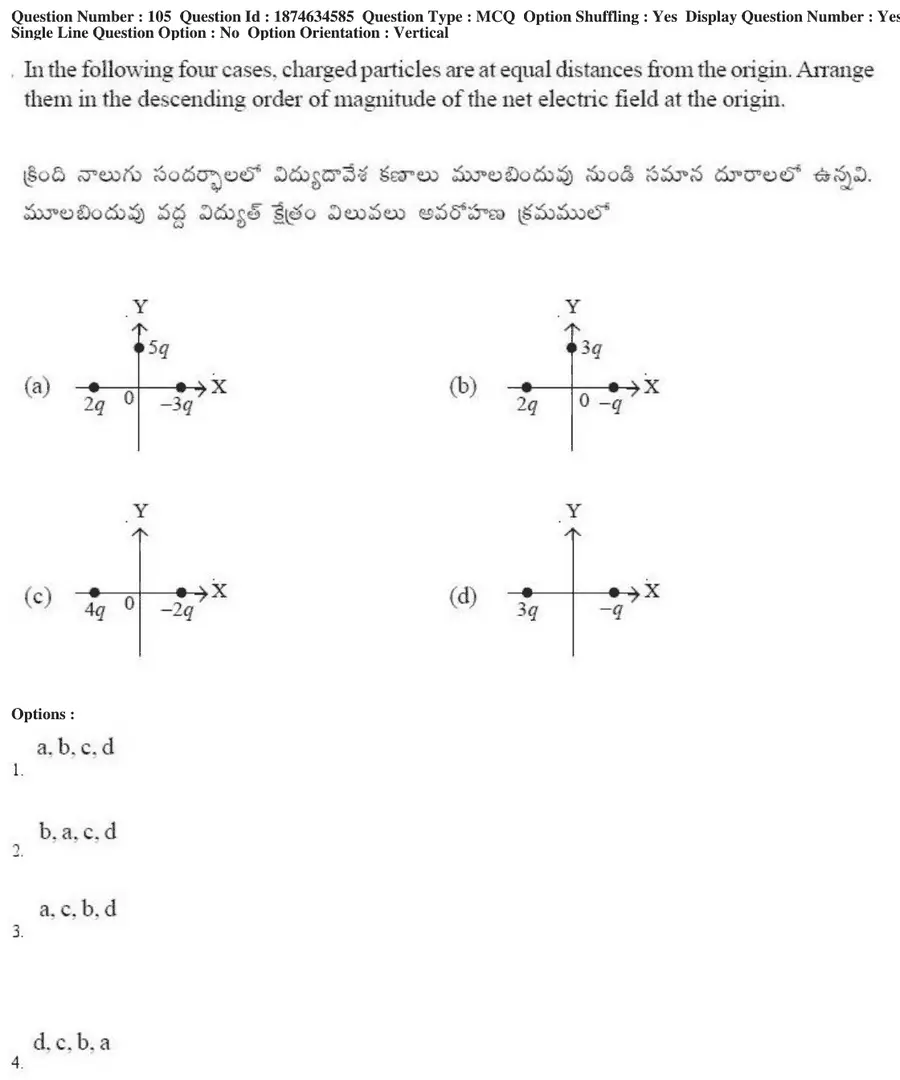
In the following four cases, charged particles are at equal distances from the origin. Arrange them in the descending order of magnitude of the net electric field at the origin. (see the figure above)
A charge '5 C' is placed at the centre of shell of radius $r = 3\ \mathrm{m}$ and having charge '5 C'. The potential at a point $\frac{r}{2}$ distance from the centre of the shell will be
The electric field intensity at a point on the axis of an electric dipole in air is $4\,\mathrm{NC^{-1}}$. Then the electric field intensity at a point on the equitorial line which is at a distance equal to twice the distance on the axial line and if the dipole is in a medium of dielectric constant 4 is
Two small spheres of each charge 'q', mass 'm' and material density 'd' are suspended from a fixed point with the help of inextensible light thread. When the spheres are in air, the angle between the threads is $90^\circ$. When the spheres are suspended in a liquid of density $\frac{2}{3}$ d, the angle between the threads is $60^\circ$. The value of dielectric constant of the liquid is
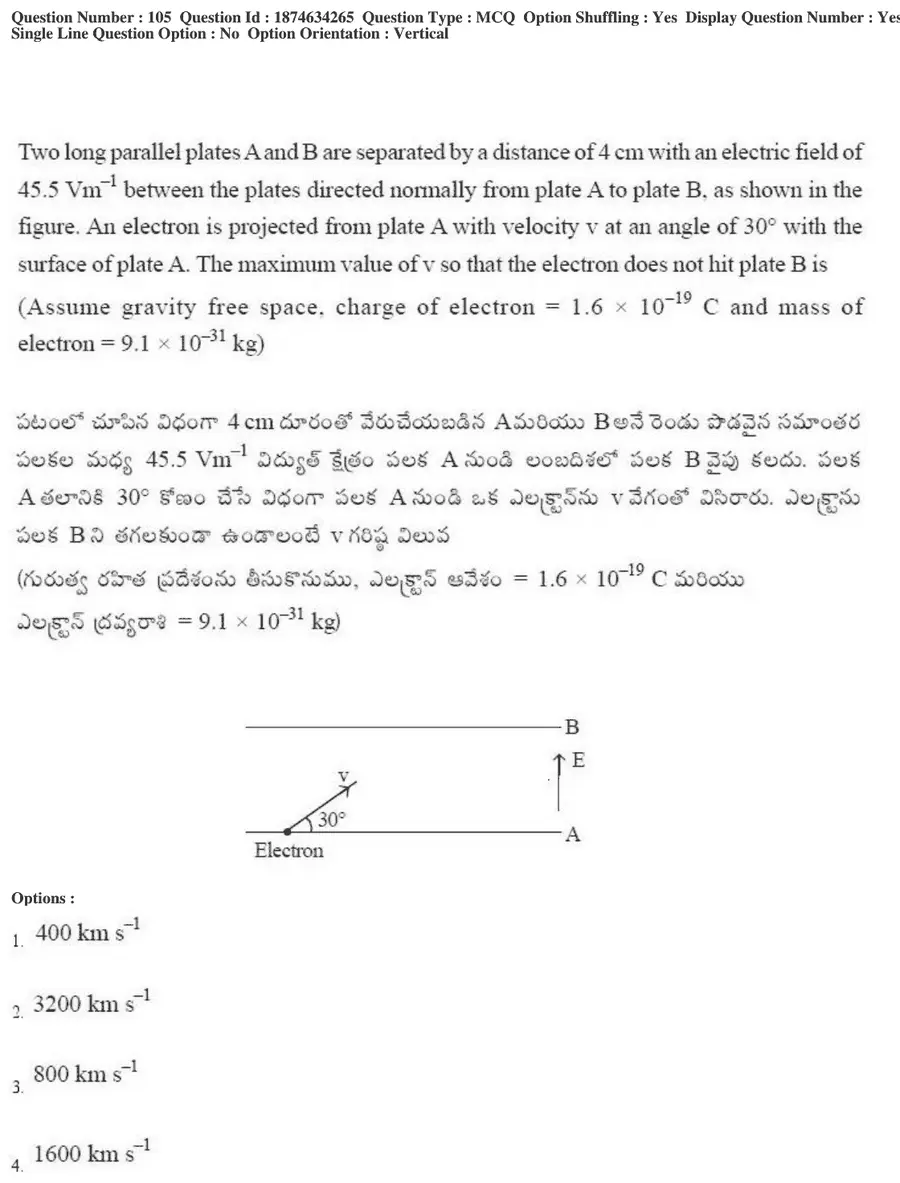
Two long parallel plates A and B are separated by a distance of 4 cm with an electric field of $45.5\ \mathrm{Vm^{-1}}$ between the plates directed normally from plate A to plate B, as shown in the figure. An electron is projected from plate A with velocity v at an angle of $30^\circ$ with the surface of plate A. The maximum value of v so that the electron does not hit plate B is (Assume gravity free space, charge of electron $= 1.6\times10^{-19}\ \mathrm{C}$ and mass of electron $= 9.1\times10^{-31}\ \mathrm{kg}$) (see the figure above)
Three point charges of 2 mC each are kept at the vertices of an equilateral triangle of side 50 cm. If the system is supplied energy at the rate of 2 kW, the time taken to move one of the charges to the mid point of the line joining the other two charges is
Two identical charged spheres separated by a distance repel each other with a force F. If 10% of electrons are thransferred (sic) from one sphere to the other then the force between them becomes
Three charges of each magnitude 100 $\mu$C are placed at the corners A, B and C of an equilateral triangle of side 4 m. If the charges at A and C are positive and the charge at point B is negative, then the magnitude of total force acting on charge at 'C' and angle made by it with $\overrightarrow{AC}$ are
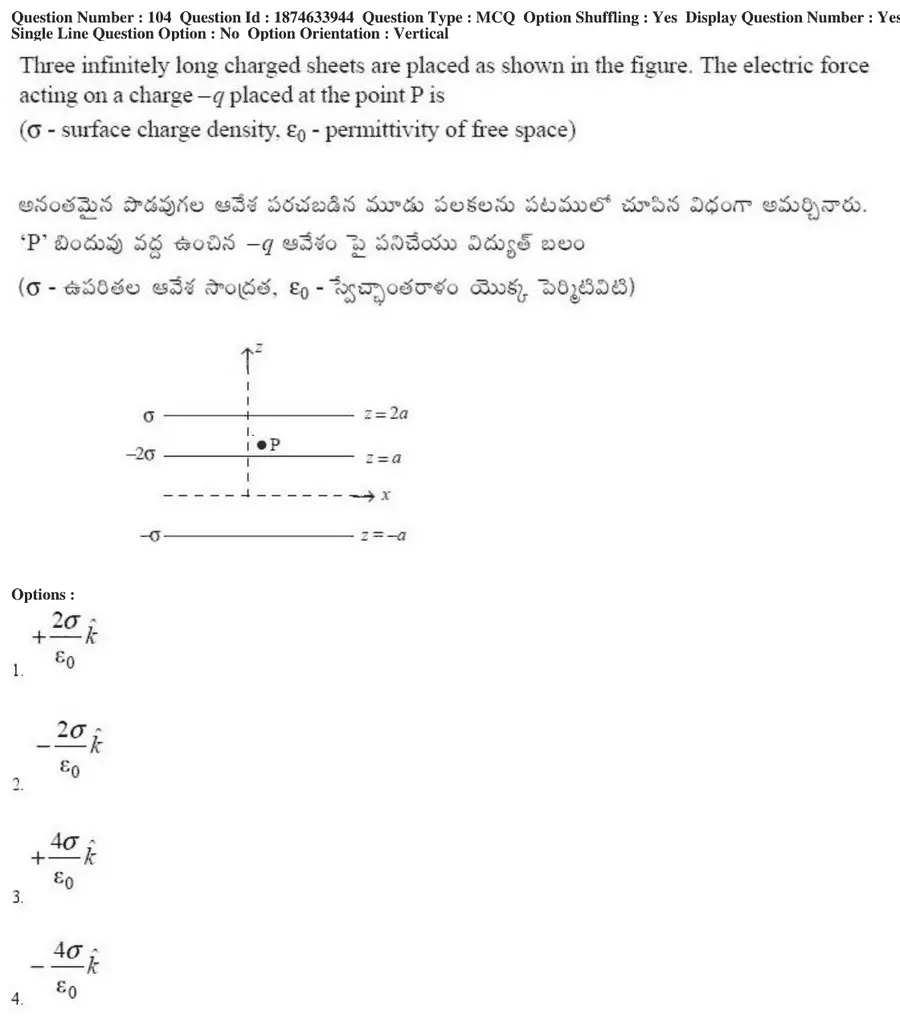
Three infinitely long charged sheets are placed as shown in the figure. The electric force acting on a charge $-q$ placed at the point P is ($\sigma$ - surface charge density, $\varepsilon_0$ - permittivity of free space) (see the figure above)
The potential difference between two points $\mathrm{A}(2, 1, 0)\mathrm{m}$ and $\mathrm{B}(0, 2, 4)\mathrm{m}$ in an electric field $(x\hat{i} - 2y\hat{j} + z\hat{k})\ \mathrm{Vm^{-1}}$ is
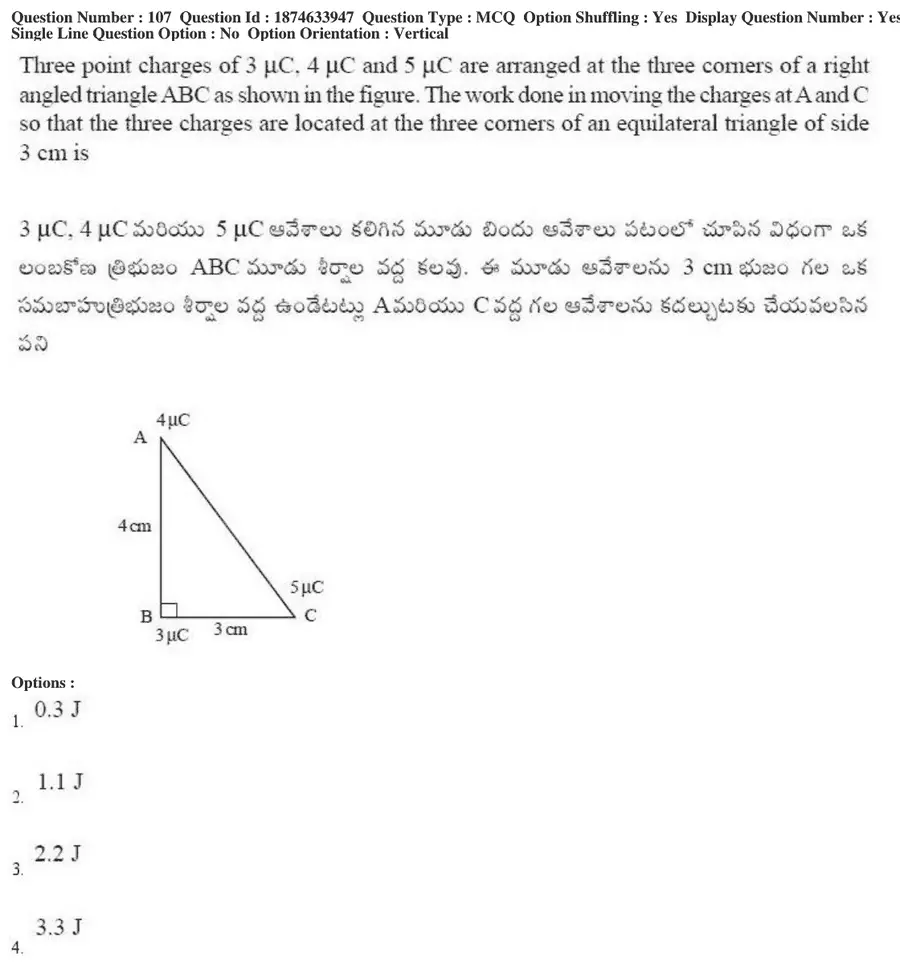
Three point charges of $3\ \mu\mathrm{C}$, $4\ \mu\mathrm{C}$ and $5\ \mu\mathrm{C}$ are arranged at the three corners of a right angled triangle ABC as shown in the figure. The work done in moving the charges at A and C so that the three charges are located at the three corners of an equilateral triangle of side 3 cm is (see the figure above)
A solid sphere of radius $r_1 = 1$ cm carries charge distributed uniformly over it with density $\rho_1 = -3\ \mathrm{C/cm^3}$. It is surrounded by a concentric spherical shell of radius $r_2 = 2$ cm carrying uniform charge density $\rho_2 = \dfrac{1}{2}\ \mathrm{C/cm^2}$. If $E_d$ denotes the magnitude of the electric field at distance $d$ from the common centre of the spheres, then
A
$E_d = \dfrac{1}{3\varepsilon_o d^2},\quad d \le 1\,\mathrm{cm}$
B
$E_d = \dfrac{1}{\varepsilon_o d^2},\quad d \le 1\,\mathrm{cm}$
C
$E_d = \dfrac{d}{3\varepsilon_o},\quad d \le 1\,\mathrm{cm}$
D
$E_d = \dfrac{d}{\varepsilon_o},\quad d \le 1\,\mathrm{cm}$
Two isolated, concentric, conducting spherical shells have radii $R$ and $2R$ and uniform charges $q$ and $2q$ respectively. If $V_1$ and $V_2$ are potentials at points located at distances $3R$ and $\dfrac{R}{2}$, respectively, from the center of shells, then the ratio $\left(\dfrac{V_2}{V_1}\right)$ will be
A thin spherical shell encloses a concentric solid sphere. The radius of the shell is $(0.06)^{\frac{1}{2}}\ \mathrm{m}$ and its surface charge density is $-10^{-6}\ \mathrm{C/m^2}$. The radius of the solid sphere is $(0.01)^{\frac{1}{3}}\ \mathrm{m}$ and its volumetric charge density is $3 \times 10^{-5}\ \mathrm{C/m^3}$. $\epsilon_0$ is the permittivity of free space in $\mathrm{C^2/Nm^2}$. The electric flux through a spherical surface concentric with the spherical shell and of radius greater than that of the shell, in $Vm$, is
A conducting sphere $S_1$ of radius $r_1$ is connected by a conducting wire to another conducting sphere $S_2$ of radius $r_2$ where $r_1 = 3\ \mathrm{cm}$ and $r_2 = 2\ \mathrm{cm}$. Before they are connected, $S_1$ carries charge of 10 units. The electric potential at the point which is at a distance $4\ \mathrm{cm}$ from the centre of $S_1$ and a distance $3\ \mathrm{cm}$ from the centre of $S_2$ is
A point charge of 50 $\mu$C is placed in the $XY$ plane at a location with radius vector $\vec{r_0} = 2\hat{i} + 3\hat{j}$ m. The electric field strength and its magnitude at a point with radius vector $\vec{r} = 8\hat{i} - 5\hat{j}$ m is ($\epsilon_0 = 8.85\times10^{-12}$ C$^2$ / N-m$^2$)
The volume charge density in a spherical ball of radius $R$ varies with distance $r$ from the centre as $\rho(r)=\rho_0\left[1-\left(\frac{r}{R}\right)^3\right]$ where $\rho_0$ is a constant. The radius at which the field would be maximum is
The potential $\phi(x,y)$ of an electrostatic field $\vec{E}=a(y\hat{i}+x\hat{j})$ is [$a$ is a constant and $\hat{i}$ and $\hat{j}$ are unit vectors along X and Y axes]
Two charged particles each of mass 9.8 g and charges $+20\ \mu\mathrm{C}$ and $-20\ \mu\mathrm{C}$ are attached to the two ends of a massless and rigid uniform non-conducting rod of length 50 cm. This arrangement is held in a uniform electric field of $12.1\ \mathrm{NC^{-1}}$ such that the rod makes a very small angle with the field direction. If the rod is set free, the minimum time needed for the rod to become parallel to the direction of the electric field is ________ seconds.
Two charged particles of masses in the ratio 1 : 3 have charges in reciprocal ratio as their masses. They are placed in a uniform electric field and allowed to move. The ratio of their kinetic energies is
Two point charges $-5\mu\mathrm{C}$ and $+5\mu\mathrm{C}$ are placed at A and B respectively on a straight line separated by 5 cm. At a point C if the resultant field is parallel to the line joining the points A and B then
Match the following List-I with the List-II List - I A) Gauss's law B) Faraday's law C) Ampere's law D) Kirchhoff's law List - II I) Surface charge density II) Electric charge and energy conservation III) Change in magnetic flux IV) Change in electric flux V) Total electric flux The correct answer is
Two equally charged metal spheres A and B repel each other with a force of $4\times10^{-5}$ N. Another identical uncharged sphere C is touched to A and then placed at the mid point of the line joining the spheres A and B. The net electric force on the sphere C is
Four positive point charges +q are kept at the four corners of a square of side 'l'. The net electric field at the midpoint of any one side of the square is ______ (take $\frac{1}{4\pi\epsilon_0} = k$)
A Van de Graff generator has a spherical metal shell as an electrode which is at a potential $15\times10^{6}$ V. If the dielectric strength of the surrounding medium is $5\times10^{7}\ \mathrm{Vm^{-1}}$ then the diameter of the shell is
A proton and an $\alpha$ - particle start from rest in a uniform electric field. The ratio of times taken by them to travel the same distance in the field is ______
Two charged balls moving in the same direction with same velocity v are placed in an electric field. After some time, one ball moves with velocity $\dfrac{v}{2}$ at an angle of $60^\circ$ with the initial direction and the other ball moves at right angles to the initial direction with a velocity v'. Then the value of v' is
Electric field vector in a region is given by $\vec{E} = (3\hat{i} + 4y\hat{j})\ \mathrm{Vm^{-1}}$. The potential at the origin is zero. Then the potential at a point (2,1) m is
Two point charges are kept in air with a separation between them. The force between them is $F_1$, if half of the space between the charges is filled with a dielectric of dielectric constant 4 and the force between them is $F_2$, if $\frac{1}{3}$rd of the space between the charges is filled with dielectric of dielectric constant 9. Then $\frac{F_1}{F_2}$ is
The electric field due to a short electric dipole at a distance 'r' on the axial line from its mid point is x times the electric field at a distance 2r on the equitorial line from the mid point of the dipole. Then the value of x is
A point charge 'q' is placed at origin. Let $\vec{E}_A$, $\vec{E}_B$ and $\vec{E}_C$ be the electric fields at three points A(1, 2, 3), B(1, 1, $-1$) and C(2, 2, 2) respectively due to the charge 'q'. Then the relation between them is a) $\vec{E}_A\perp\vec{E}_B$ b) $\vec{E}_A\parallel\vec{E}_C$ c) $|\vec{E}_B|=4|\vec{E}_C|$ d) $|\vec{E}_B|=8|\vec{E}_C|$
An electric dipole consists of two particles each of mass 1 kg separated by 1 m carrying charges $1\,\mu\mathrm{C}$ and $-1\,\mu\mathrm{C}$ respectively. It is in equilibrium in a uniform electric field of $2\times10^{4}\ \mathrm{Vm^{-1}}$. If it is deflected by a small angle $2^\circ$, minimum time taken by it to come back again to the mean position is (in seconds)
A positive charge 'Q' is placed on a conducting spherical shell with inner radius $R_1$ and outer radius $R_2$. A particle with charge 'q' is placed at the center of the spherical cavity. The magnitude of the electric field at a point in the cavity, a distance 'r' from center is
An infinitely long thin straight wire has uniform linear charge density of $\dfrac{1}{3}\ \mathrm{Cm^{-1}}$. Then the magnitude of the force acting on a charge $3\,\mu\mathrm{C}$ situated at a point of 18 cm away from the wire is $\left(\dfrac{1}{4\pi\epsilon_0}=9\times10^9\ \mathrm{Nm^2C^{-2}}\right)$
An electrostatic paint sprayer has a metal sphere of diameter 18 cm and at a potential of 25 kV. If it sprays paint droplets, the charge on the metal sphere is
Electrostatics opens the Class 12 physics syllabus as a high-volume foundational chapter. In our archive of AP and TS EAPCET papers from 2022 to 2026, Electrostatics contributed 133 questions across 77 papers. That gives an average frequency of 1.7 questions per paper, claiming 4.3% of all physics questions in that recent window. Looking over the complete historical span from 2010 to 2026, Electrostatics produced 277 questions across 149 papers, maintaining an average of 1.9 questions per paper and a 4.6% subject share. Across the earlier testing period from 2010 to 2021, our archive contains 144 questions across 72 papers (5.0% share). Over the last three exam years from 2024 to 2026, the chapter delivered 79 questions across 46 papers, holding a 4.3% share. The share of the subject in the last three years compared to early papers is down, while compared to the recent five-year window it is about the same.
State-wise tallies show steady testing in both regions, with higher density in Andhra Pradesh. Between 2022 and 2026, AP EAPCET papers in our set contributed 93 questions across 48 papers, averaging 1.9 questions per paper and taking 4.8% of the AP physics section. TS EAPCET delivered 40 questions across 29 papers in our set, averaging 1.4 questions per paper and claiming 3.4% of TS physics questions. Electrostatics has appeared every year since 2022 and featured in every paper across both states in the recent five-year window. The chapter ranks 8th of 28 physics chapters by question share between 2022 and 2026. The busiest single sitting in our collection was 2020, with 35 questions across 18 papers.
Most-asked topics
Questions distribute across six distinct syllabus areas:
Electric Potential: This primary section brought 44 questions in the recent five-year period, contributing to 86 questions across the full archive. Key concepts test scalar potential from point charges, potential energy of charge systems, equipotential surfaces, and work done moving charges.
Gauss's Law: Recent examinations supplied 30 questions, out of 57 questions in the complete record. It covers electric flux through closed geometries, cylindrical charge distributions, infinite plane sheets, and concentric spherical shells.
Electric Field: A block of 21 questions appeared between 2022 and 2026, out of 48 questions across all years in our archive. Questions evaluate field vectors from discrete point arrays, neutral points, and trajectories of charged particles in uniform fields.
Charge & Coulomb's Law: Examiners set 20 questions recently, out of 45 questions overall. Topics include Coulomb's inverse-square law, vector superposition of electrostatic forces, and equilibrium of suspended pith balls.
Conductors: Recent papers featured 10 questions, bringing the all-time count to 18 questions. It tests induced surface charges, cavity shielding, grounding, and concentric conducting shells.
Electric Dipole: A focused pool of 8 questions appeared recently, out of 23 questions across the entire archive. It tests axial and equatorial fields, torque in uniform fields, and potential energy of dipoles.
What the questions look like
Equipotential surfaces and zero-potential locations appear repeatedly. A standard problem gives two charges of opposite signs and unequal magnitudes placed along an axis and asks for the geometric locus or specific points where the net electrostatic potential drops to zero. Another frequent setup asks for the work required to assemble three or four identical charges at the vertices of an equilateral triangle or square.
Gauss's law problems frequently combine electrostatics with orbital dynamics. For example, an electron or charged particle orbits an infinitely long line charge of uniform linear density, requiring students to equate electrostatic attraction with centripetal force. In spherical conductor problems, examiners place charges on nested concentric metallic shells and ask for outer surface charge densities or the electric potential on intermediate surfaces before and after grounding.
Start by mastering Coulomb's law and vector superposition. For charges in a medium of dielectric constant K, the electrostatic force is reduced by a factor of K. When resolving equilibrium of two identical charged spheres suspended by light strings of length L making angle θ with the vertical, set tan θ = F_e / (m g). For small angles where tan θ ≈ sin θ = x / (two L), separation distance x scales as the cube root of charge squared.
Next, practise electric potential and field relations. Remember that electric field is the negative spatial gradient of electric potential, E = - dV/dr. For discrete point charges, potential is a scalar sum V = Σ (q_i / (four π ε_zero r_i)), requiring no vector resolution. Work done by an external agent moving charge q from point A to point B without acceleration is W_ext = q (V_B - V_A).
Finally, master Gauss's law applications. For an infinite line of linear charge density λ, the radial field is E = λ / (two π ε_zero r). For an infinite non-conducting sheet of surface charge density σ, the uniform field is E = σ / (two ε_zero). For a conducting or non-conducting spherical shell of radius R carrying charge Q, the field outside is identical to a point charge, while the field inside a conducting shell vanishes completely, maintaining constant potential throughout the interior cavity.
Frequently asked questions
Does Electrostatics appear in every paper?
Yes. In the papers we hold from 2022 to 2026, Electrostatics was asked in every single paper across both AP and TS EAPCET, with AP shifts averaging nearly two questions each.
Is electric potential a scalar or vector quantity?
Electric potential is a scalar quantity, so multiple contributions add algebraically with their proper signs rather than through vector components.
What is the electric field inside a charged spherical conducting shell?
The electrostatic field inside a hollow or solid charged conducting shell is strictly zero in electrostatic equilibrium, meaning the potential everywhere inside equals the surface potential.
Where can I find worked solutions for EAPCET Electrostatics questions?
Step-by-step solutions for each one are in the EdLoop EAPCET app.