Thermal Properties of Matter: AP & TS EAPCET PYQs 2010–2026
Every Thermal Properties of Matter question from past AP EAPCET and TS EAPCET papers, with options and answers. Newest first.
255questions
142papers covered
3.7%of Physics questions, 2022–2026
2010–2026years
Guide at a glance
Thermal Properties of Matter is a core component of heat and thermodynamics in Class 11 physics. In the papers we hold for AP and TS EAPCET between 2022 and 2026, the chapter accounted for 114 questions across 77 papers.
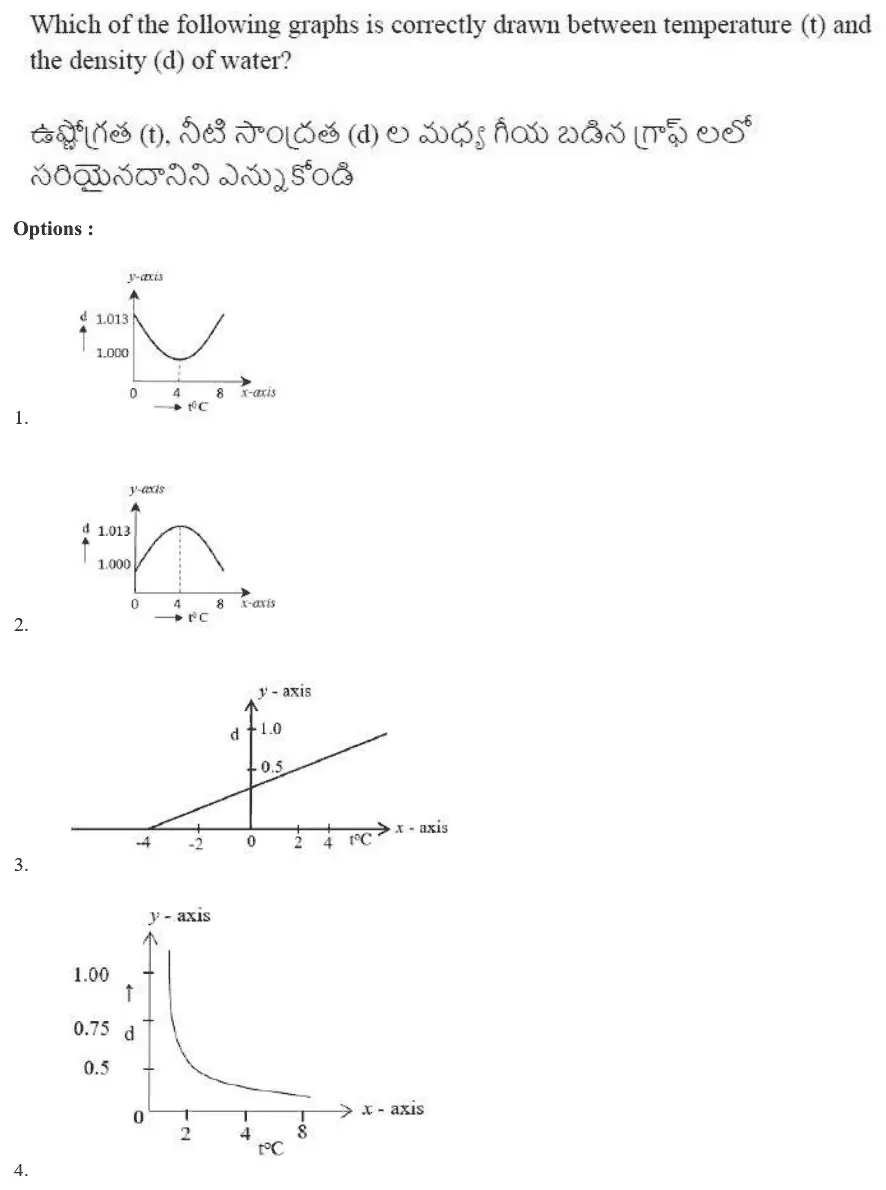
Which of the following graphs is correctly drawn between temperature (t) and the density (d) of water?
The question as printed in the paper.
A
see figure Graph with x-axis t°C (marks 0, 4, 8) and y-axis d (marks 1.000 and 1.013). A U-shaped curve with its minimum at t = 4, just above 1.000, rising on both sides toward 1.013 and above. A dashed vertical line at t = 4.
B
see figure Graph with x-axis t°C (marks 0, 4, 8) and y-axis d (marks 1.000 and 1.013). An inverted-U curve with its maximum at t = 4, above 1.013, falling on both sides. A dashed vertical line at t = 4.
C
see figure Graph with x-axis t°C (marks -4, -2, 0, 2, 4) and y-axis d (marks 0.5 and 1.0). A straight line with positive slope starting on the x-axis at t = -4 (horizontal line along the x-axis to the left of -4), crossing the y-axis at about 0.4 to 0.5 and continuing upward to the right.
D
see figure Graph with x-axis t°C (marks 2, 4, 8) and y-axis d (marks 0.5, 0.75, 1.00). A decreasing curve, very steep near t slightly above 0 at the top (above 1.00), then flattening out toward large t, like a hyperbola, ending near t = 8 at a low value.
Two metal rods A and B have lengths in the ratio 1:2, thermal conductivities in the ratio 1:2 and cross sectional areas in the ratio 1:4. The ends of the two rods are maintained between same temperature difference, then the ratio of heat currents $\left(\frac{H_A}{H_B}\right)$ is
A body cools from $80^\circ\mathrm{C}$ to $50^\circ\mathrm{C}$ in 5 min. Calculate the time it takes to cool from $60^\circ\mathrm{C}$ to $30^\circ\mathrm{C}$, if the surrounding temperature is $20^\circ\mathrm{C}$
A spherical perfect black body of radius $10\ cm$ is maintained at $727^\circ\mathrm{C}$. The total power radiated from it is (approximately) Stefan-Boltzmann constant, $\sigma = 5.67 \times 10^{-8}\ Wm^{-2}K^{-4}$
Two semicircular rods AB and CD each of radius of curvature 14 cm and a straight rod BC of length 22 cm are connected in series. The three rods have equal area of cross-section and the thermal conductivities of the materials of the rods AB, BC and CD are in the ratio 1:2:3. In steady state, if the temperature difference between the ends of the middle rod BC is 30°C, then the temperature difference between the ends of the rods AB and CD are respectively
If the temperature of a steel solid sphere of mass 4 kg and radius 5 cm is increased by $10^\circ\mathrm{C}$, then the increase in the moment of inertia of the sphere about its diameter is (Coefficient of linear expansion of steel = $1.2 \times 10^{-5}\ K^{-1}$)
A geyser heats water flowing at the rate of 3.0 liters per minute from $27^\circ\mathrm{C}$ to $77^\circ\mathrm{C}$. If the geyser operates on a gas burner and if its heat of combustion is $4.0 \times 10^{4}\ \mathrm{Jg^{-1}}$, the rate of combustion of the fuel per minute is
A beaker contains 200 gm of water. The heat capacity of the beaker is equal to that of 20 gm of water. The initial temperature of water in the beaker is $20^0\mathrm{C}$. If 440 gm of hot water at $92^0\mathrm{C}$ is poured in it, the final temperature (neglecting radiation loss) will be nearest to
Hot water cools from $60^0\mathrm{C}$ to $50^0\mathrm{C}$ in the first 10 min and to $42^0\mathrm{C}$ in the next 10 min. Then the temperature of the surroundings is
Heat energy released by water of mass $3\ kg$ when it is cooled by $20^\circ\mathrm{C}$ is (specific heat capacity of water $= 4200\ \mathrm{J}\ kg^{-1}K^{-1}$)
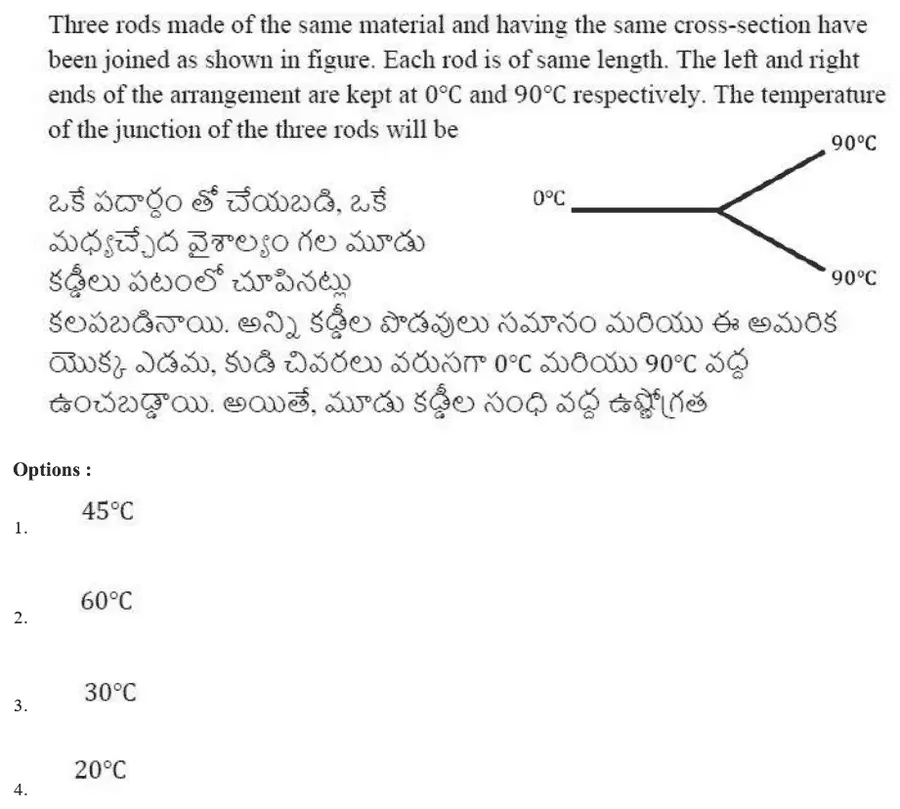
Three rods made of the same material and having the same cross-section have been joined as shown in figure. Each rod is of same length. The left and right ends of the arrangement are kept at $0^\circ\mathrm{C}$ and $90^\circ\mathrm{C}$ respectively. The temperature of the junction of the three rods will be
Two rods made of metals A and B , each of length 20cm expand by 0.075cm and 0.045cm respectively, when heated from 0°C to 100°C. A composite rod of same length is made with a portion of metal A and remaining with B expands by 0.060cm for same rise of temperature. Then the portion of composite rod made of A has initial length
A blackened platinum wire of surface area $10^{-5}\ m^2$ is maintained at temperature of 3000K. At what rate the wire is loosing energy [Stefen $-$ Boltzman constant $\sigma = 5.67 \times 10^{-8}\ W\ m^{-2}K^{-4}$]
An earthen pitcher containing $9.5\ kg$ of water loses one gram of water per minute due to evaporation. If water equivalent of pitcher is $0.5\ kg$. The time required to cool the water in pitcher from $30^\circ\mathrm{C}$ to $28^\circ\mathrm{C}$ is (Neglect radiation effect and Take latent heat of vaporization $500\ cal\ g^{-1}$)
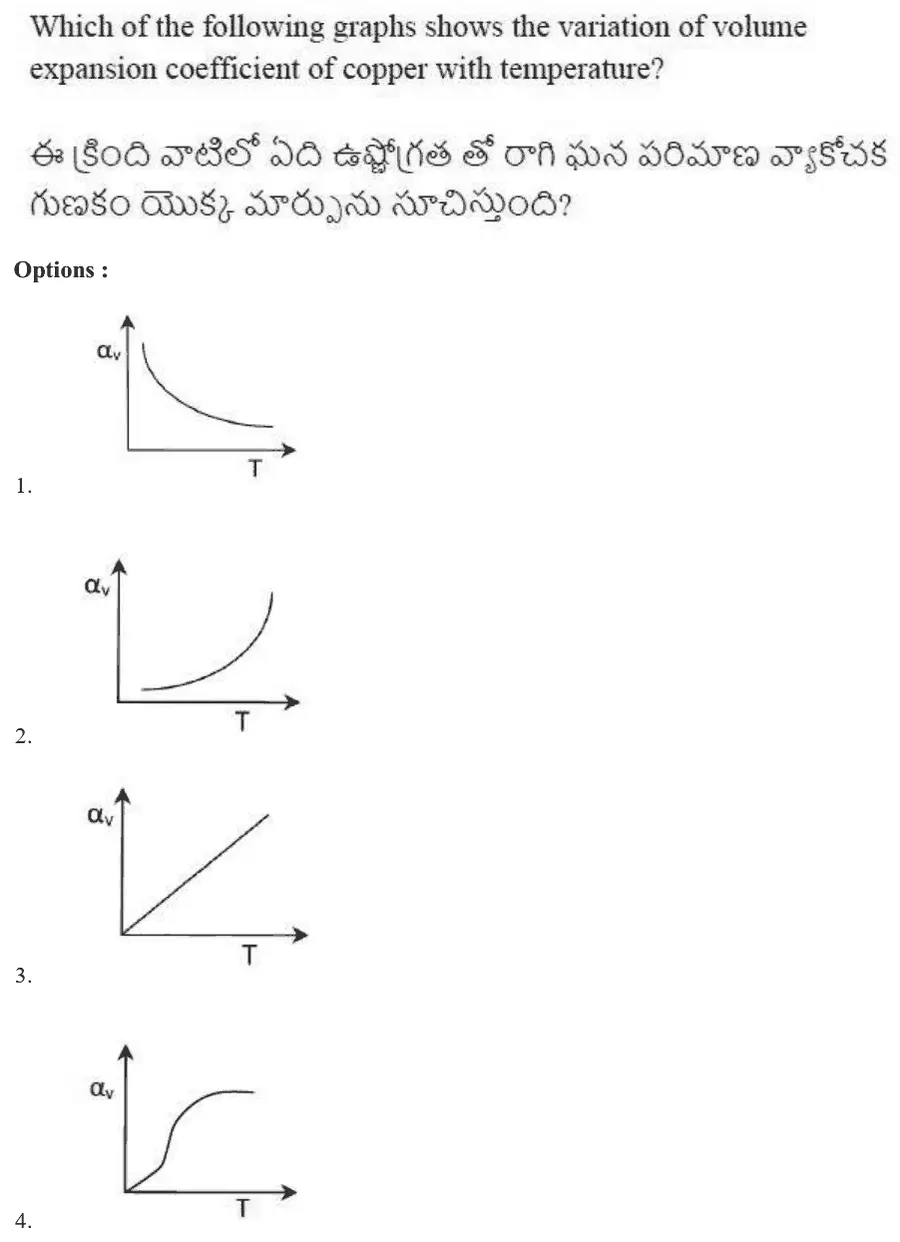
Which of the following graphs shows the variation of volume expansion coefficient of copper with temperature?
The question as printed in the paper.
A
see figure Graph of $\alpha_v$ (vertical axis) versus $T$ (horizontal axis): a curve starting high near the vertical axis and decreasing with decreasing slope, flattening out toward the right.
B
see figure Graph of $\alpha_v$ versus $T$: a curve starting at a low value, nearly flat, then rising increasingly steeply toward the right.
C
see figure Graph of $\alpha_v$ versus $T$: a straight line from the origin rising linearly with positive slope.
D
see figure Graph of $\alpha_v$ versus $T$: a curve starting at the origin, rising slowly, then rising steeply (S-shaped) and flattening to a constant plateau at higher T.
Two rods A and B of lengths in ratio of $1 : 2$ have thermal conductivities in $1 : 2$ ratio and cross sectional areas in $1 : 4$ ratio. The temperature difference between the ends of two rods is same. Then the ratio of heat currents is $(H_A : H_B)$
How much should the temperature of a metal ring of diameter $100\ cm$ to be raised in order to fit it on a wooden disc of diameter $100.6\ cm$ [coefficient of linear expansion of metal $= 12 \times 10^{-6}\ ^\circ\mathrm{C}^{-1}$]
If $Q_1$ is the heat required to convert 2 g of ice at a temperature of $0\ ^\circ\mathrm{C}$ to water at a temperature of $40\ ^\circ\mathrm{C}$ and $Q_2$ is the heat required to convert 4 g of ice at a temperature of $0\ ^\circ\mathrm{C}$ to water at a temperature of $80\ ^\circ\mathrm{C}$, then $Q_1 : Q_2 =$
(Latent heat of fusion of ice $= 80\ \mathrm{cal\,g^{-1}}$ and specific heat capacity of water $= 1\ \mathrm{cal\,g^{-1}\,^\circ C^{-1}}$)
Two rectangular metal boxes A and B having same dimensions are made of different materials of thermal conductivities $180\,\mathrm{W\,m^{-1}\,K^{-1}}$ and $270\,\mathrm{W\,m^{-1}\,K^{-1}}$ respectively. The two boxes are completely filled with ice and are placed in identical surroundings. If the time taken by the ice in box A to completely melt is 21 minutes, then the time taken in minutes for half of the mass of ice in box B to melt is
Ice of mass $80$ g at a temperature of $-10\ ^\circ\mathrm{C}$ is mixed with water of mass $100$ g at a temperature of $20\ ^\circ\mathrm{C}$. The ratio of the masses of ice and water in the mixture in equilibrium is (Latent heat of fusion of ice $= 80\ \mathrm{cal\,g^{-1}}$, specific heat capacities of water and ice are $1\ \mathrm{cal\,g^{-1}\,^\circ C^{-1}}$ and $0.5\ \mathrm{cal\,g^{-1}\,^\circ C^{-1}}$ respectively)
If the numerical value of the temperature of a body on Fahrenheit scale is 80 more than its numerical value on Celsius scale, then the temperature of the body is
If $t_1$ is time taken for a body to cool from temperature of $80\ ^\circ\mathrm{C}$ to $75\ ^\circ\mathrm{C}$ and $t_2$ is time taken to cool from $75\ ^\circ\mathrm{C}$ to $70\ ^\circ\mathrm{C}$, then $t_1 : t_2 =$ (Temperature of surroundings $= 30\ ^\circ\mathrm{C}$)
Steam at a temperature of 100 °C is passed into water of mass 90 g such that the temperature of the water increases from 20 °C to 40 °C. Then the total mass of the water at 40 °C is
An iron rod of mass 2 kg and length 1.5 m is supplied 18.4 kJ of heat. If the specific heat capacity of iron is $460\,\mathrm{J\,kg^{-1}\,K^{-1}}$ and its coefficient of linear expansion is $1.2\times10^{-5}\,^\circ\mathrm{C^{-1}}$, then the increase in the length of the rod is
The emissivities of the surfaces of two spheres P and Q of radii 2R and 3R are 0.35 and 0.7 respectively. The ratio of the powers radiated by the spheres P and Q is 9:8. If the wavelength at which sphere P emits radiations of maximum intensity is 4000 Å, then the wavelength at which sphere Q emits radiations of maximum intensity is
Water of mass 3 kg in a kettle of mass 1 kg at an initial temperature of 30 °C is heated by a heater of power 2 kW. When the lid of the kettle is open, heat is lost at a constant rate of 250 $\mathrm{J\,s^{-1}}$. If the specific heat capacity of the material of the kettle is half of the specific heat capacity of water, then the time required in minutes to increase the temperature of the water to 80 °C with the lid of the kettle open is
(Specific heat capacity of water = 4200 $\mathrm{J\,kg^{-1}\,K^{-1}}$)
Two spherical black bodies A and B of equal radii are at absolute temperatures 2T and 3T respectively. If the absolute temperature of the surroundings is T, then the ratio of the radiant powers emitted by the bodies A and B is
A rectangular slab consists of two cubes of copper and brass of equal sides having thermal conductivities in the ratio $4:1$. If the free face of brass is at $0\ ^\circ\mathrm{C}$ and that of copper is at $100\ ^\circ\mathrm{C}$, then the temperature of their interface is
If some heat is given to a metal of mass 100 g, its temperature rises by 20 °C. If the same heat is given to 20 g of water, the change in its temperature (in °C) is (The ratio of specific heat capacities of metal and water is 1 : 10)
If a body cools from a temperature of $62\ ^\circ\mathrm{C}$ to $50\ ^\circ\mathrm{C}$ in 10 minutes and to $42\ ^\circ\mathrm{C}$ in the next 10 minutes, then the temperature of the surroundings is
A wire of length 0.5 m and area of cross-section $4\times10^{-6}\ \mathrm{m^2}$ at a temperature of 100°C is suspended vertically by fixing its upper end to the ceiling. The wire is then cooled to 0 °C, but is prevented from contracting, by attaching a mass at the lower end. If the mass of the wire is negligible, then the value of the mass attached to the wire is [Young's modulus of material of the wire = $10^{11}\ \mathrm{N\,m^{-2}}$; coefficient of linear expansion of the material of the wire = $10^{-5}\ \mathrm{K^{-1}}$ and acceleration due to gravity = $10\ \mathrm{m\,s^{-2}}$]
The temperature of water of mass $100\ \mathrm{g}$ is rasied from $24\ ^\circ\mathrm{C}$ to $90\ ^\circ\mathrm{C}$ by adding steam to it. The mass of the steam added is (Latent heat of steam $= 540\ \mathrm{cal\ g^{-1}}$ and specific heat capacity of water $= 1\ \mathrm{cal\ g^{-1}\ ^\circ C^{-1}}$)
Steam at $100\ ^\circ\mathrm{C}$ is passed into $114\ \mathrm{g}$ of water at $30\ ^\circ\mathrm{C}$. The mass of water present in the mixture when the temperature of the water becomes $70\ ^\circ\mathrm{C}$ is (Latent heat of steam $= 540\ \mathrm{cal\ g^{-1}}$; specific heat capacity of water $= 1\ \mathrm{cal\ g^{-1}\ ^\circ C^{-1}}$)
A small quantity of water of mass 'm' at temperature $\theta$ °C is mixed with a large mass 'M' of ice which is at its melting point. If 's' is specific heat capacity of water and 'L' is the Latent heat of fusion of ice, then the mass of ice melted is
If the wavelengths of maximum intensity of radiation emitted by two black bodies A and B are $0.5\ \mu\mathrm{m}$ and $0.1\ \mathrm{mm}$ respectively, then ratio of the temperatures of the bodies A and B is
The temperature of a body shown by a faulty Celsius thermometer is $49\ ^\circ\mathrm{C}$ and by a correct Fahrenheit thermometer is $122\ ^\circ\mathrm{F}$. The correction to be applied to the faulty thermometer is
A metal metre scale that is accurate up to 0.5 mm is made at a temperature of $25^\circ\mathrm{C}$. The range of temperatures within which it can be used is (Coefficient of linear expansion of the metal $=10^{-5}\,/^\circ\mathrm{C}$)
A rectangular ice box of total surface area of 1000 $\mathrm{cm^2}$ initially contains 1.5 kg of ice at 0 °C. If the thickness of the walls of the box is 2 mm and the temperature outside the box is 42 °C, then the mass of the ice remaining in the box after 160 minutes is (Thermal conductivity of the material of the box $=10^{-2}\ \mathrm{Wm^{-1}K^{-1}}$ and latent heat of the fusion of ice $=336\times10^{3}\ \mathrm{Jkg^{-1}}$)
The length of a metal rod is 20 cm and its area of cross-section is $4\ \mathrm{cm^2}$. If one end of the rod is kept at a temperature of $100\ ^\circ\mathrm{C}$ and the other end is kept in ice at $0\ ^\circ\mathrm{C}$, then the mass of the ice melted in 7 minutes is
(Thermal conductivity of the metal $=90\ \mathrm{Wm^{-1}K^{-1}}$ and
latent heat of fusion of ice $=336\times10^{3}\ \mathrm{J\,kg^{-1}}$)
The heat required to convert 8 g of ice at a temperature of $-20\ ^\circ\mathrm{C}$ to steam at $100\ ^\circ\mathrm{C}$ is [Specific heat capacity of ice $= 2100\,\mathrm{J\,kg^{-1}\,K^{-1}}$, specific heat capacity of water $= 4200\,\mathrm{J\,kg^{-1}\,K^{-1}}$, latent heat of fusion of ice $= 336\times10^{3}\ \mathrm{J\,kg^{-1}}$ and latent heat of steam $= 2.268\times10^{6}\ \mathrm{J\,kg^{-1}}$]
A body cools from a temperature of 60 °C to 50 °C in 10 minutes and 50 °C to 40 °C in 15 minutes. The time taken in minutes for the body to cool from 40 °C to 30 °C is
A metal ball of mass $100\ \mathrm{g}$ at $20\ ^\circ\mathrm{C}$ is dropped in $200\ \mathrm{ml}$ of water at $80^\circ\mathrm{C}$. If the resultant temperature is $70\ ^\circ\mathrm{C}$, then the ratio of specific heat of the metal to that of water is
Water of mass m at $30\,^\circ\mathrm{C}$ is mixed with $5\,\mathrm{g}$ of ice at $-20\,^\circ\mathrm{C}$. If the resultant temperature of the mixture is $6\,^\circ\mathrm{C}$, then the value of m is (specific heat capacity of ice $= 0.5\,\mathrm{cal\,g^{-1}\,^\circ C^{-1}}$, specific heat capacity of water $=1\,\mathrm{cal\,g^{-1}\,^\circ C^{-1}}$ and latent heat of fusion of ice $= 80\,\mathrm{cal\,g^{-1}}$)
A slab consists of two identical plates of copper and brass. The free face of the brass is at $0\ ^\circ\mathrm{C}$ and that of copper at $100\ ^\circ\mathrm{C}$. If the thermal conductivities of brass and copper are in the ratio 1:4, then the temperature of interface is
A metal block is made from a mixture of 2.4 kg of aluminium, 1.6 kg of brass and 0.8 kg of copper. The metal block is initially at $20^\circ$ c. If the heat supplied to the metal block is 44.4 calories, find the final temperature of the block if specific heats of aluminium, brass and copper are $0.216, 0.0917, 0.0931$ cal. $\mathrm{kg^{-1}\,^\circ C^{-1}}$ respectively.
The temperature difference across two cylindrical rods A and B of same material and same mass are $40\ ^\circ\mathrm{C}$ and $60\ ^\circ\mathrm{C}$ respectively. In steady state, if the rates of flow of heat through the rods A and B are in the ratio $3:8$, the ratio of the lengths of the rods A and B is
The length of a metal bar is 20 cm and the area of cross section is $4 \times 10^{-4}\mathrm{m}^2$. If one end of the rod is kept in ice at $0^\circ\mathrm{C}$ and the other end is kept in steam at $100^\circ\mathrm{C}$, the mass of ice melted in one minute is 5 g. The thermal conductivity of the metal in $\mathrm{Wm^{-1}K^{-1}}$ is
A pendulum clock loses 10.8 seconds a day when the temperature is $38\,^\circ\mathrm{C}$ and gains 10.8 seconds a day when the temperature is $18\,^\circ\mathrm{C}$. The coefficient of linear expansion of the metal of the pendulum clock is
A liquid cools from a temperature of 368 K to 358 K in 22 minutes. In the same room, the same liquid takes 12.5 minutes to cool from 358 K to 353 K. The room temperature is
$37$ g of ice at $0\,^\circ\mathrm{C}$ temperature is mixed with $74$ g of water at $70\,^\circ\mathrm{C}$ temperature. The resultant temperature is (Specific heat capacity of water $=1\ \mathrm{cal\ g^{-1}\ ^\circ C^{-1}}$ and latent heat of fusion of ice $=80\ \mathrm{cal\ g^{-1}}$)
The thickness of a uniform rectangular metal plate is 5 mm and the area of each surface is $5\,\mathrm{cm}^2$. In steady state, the temperature difference between the two surfaces of the plate is $14\,^\circ\mathrm{C}$. If the heat flowing through the plate in one second from one surface to the other surface is 42 J, then the thermal conductivity of the metal is
Steam of mass 60 g at a temperature $100\ ^\circ\mathrm{C}$ is mixed with water of mass 360 g at a temperature $40\ ^\circ\mathrm{C}$. The ratio of the masses of steam and water in equilibrium is (Latent heat of steam is $540\ \mathrm{cal\ g^{-1}}$ and specific heat capacity of water is $1\ \mathrm{cal\ g^{-1}\ ^\circ C^{-1}}$)
The temperature difference between the ends of two cylindrical rods A and B of the same material is $2:3$. In steady state the ratio of the rates of flow of heat through the rods A and B is $5:9$. If the radii of the rods A and B are in the ratio $1:2$, then the ratio of lengths of the rods A and B is
The temperatures of equal masses of three different liquids A, B and C are 15 $^\circ$C, 24 $^\circ$C and 30 $^\circ$C respectively. The resultant temperature when liquids A and B are mixed is 20 $^\circ$C and when liquids B and C are mixed is 26 $^\circ$C. Then the ratio of specific heat capacities of the liquids A, B and C is
When 54 g of ice at $-20\,^\circ\mathrm{C}$ is mixed with 25 g of steam at $100\,^\circ\mathrm{C}$, then the final mixture at thermal equilibrium contains
A
20 g water at $100\,^\circ\mathrm{C}$
B
73 g water at $100\,^\circ\mathrm{C}$ and 6 g steam at $100\,^\circ\mathrm{C}$
C
8 g steam at $100\,^\circ\mathrm{C}$ and 12 g water at $0\,^\circ\mathrm{C}$
A steel ball of mass 200 g falls freely from a height of 20 m and bounces to a height of 10.8 m from the ground. If the energy lost in this process is absorbed by the ball, the rise in its temperature is
($g = 10\ \mathrm{ms^{-2}}$, specific heat capacity of steel is $460\ \mathrm{Jkg^{-1}K^{-1}}$)
A steel tape of 300 cm length is graduated at 27 °C. The length of a steel rod measured using the tape is found to be 110 cm at 50 °C. The actual length of steel rod at 50 °C is
The emissivity of a perfect black body is increased to 16 times by increasing its temperature. If the initial temperature is T, then final temperature of that black body is
If the ratio of densities of two substances is 5:6 and the ratio of their specific heat capacities is 3:5, then the ratio of heat energies required per unit volume so that the two substances can have same temperature rise is
A blacksmith fixes circular iron frame on the wooden wheel of a bullock cart. The diameter of wooden wheel and circular iron frame are 5.012 m and 5 m respectively at 27 °C. The temperature (in °C) to which the iron ring must be heated so as to fit the wooden wheel is (Coefficient of linear expansion of iron = $1.2\times10^{-5}\ {}^\circ\mathrm{C}^{-1}$)
The temperature of 100 g of water is to be raised from $24\,^\circ\mathrm{C}$ to $90\,^\circ\mathrm{C}$ by adding steam at $100\,^\circ\mathrm{C}$ to it. The mass of the steam required in this process is (latent heat of steam is $540\ \mathrm{cal\,g^{-1}}$)
The length of a metal rod at $30\ ^\circ\mathrm{C}$ is 30 cm. If its temperature is raised to $105\ ^\circ\mathrm{C}$, its length is increased by 0.027 cm. Then the coefficient of linear expansion of the metal is
Two objects made of the same material have masses ‘m’ and ‘2m’ and are at temperatures ‘2T’ and ‘T’ respectively. When heat ‘Q’ is supplied to the object of mass ‘2m’, its temperature raises to ‘2T’. If the same heat is supplied to the object of mass ‘m’, its temperature raises to
On a new temperature scale, the melting point of ice is 20 °X and the boiling point of water is 110 °X. A temperature of 40 °C would be indicated on this new temperature scale as
Two rods of same area of cross-section have lengths L and 2L and coefficients of linear expansions $2\alpha$ and $\alpha$ respectively. If they are welded to form a composite rod of length 3L then the coefficient of linear expansion of the composite rod is
Two metal rods A and B each of length 50 cm and diameter 4.0 mm are joined together at temperature 30 $^\circ$C. What is the change in length of the combined rod at 230 $^\circ$C ? [Given linear expansion coefficients of rods A and B are respectively, $2.0 \times 10^{-5}/^\circ$C and $1.0 \times 10^{-5}/^\circ$C]
Find the difference in temperature between the water at the top and the bottom of 20 m high waterfall assuming 10 % of the energy of fall is spent in heating the water [Use specific heat capacity of water = 4000 J kg$^{-1}$ k$^{-1}$ and g = 10 m/s$^2$]
A circular copper ring at $30\ ^\circ$C has a hole with an area of $9.98\ \mathrm{cm^2}$. It is made to slip onto a steel rod of cross-sectional area of $10\ \mathrm{cm^2}$, by raising the temperature of both ring and rod simultaneously by an amount $\Delta T$. If the coefficient of linear expansion of copper and steel are $17\times10^{-6}/^\circ$C and $11\times10^{-6}/^\circ$C, then minimum value of $\Delta T$ should be
Statement I : A device in which heat measurement can be made is called calorimeter. Statement II : Skating is possible on snow due to the formation of water below the skates. Water is formed due to the increase of temperature and ice melts. Statement III: Two bodies at different temperature are mixed in a calorimeter. Total internal energy of the two bodies remains conserved. Which of the following is correct?
A
Statements I, II and III are true
B
Statements I is true, but statements II and III are false
C
Both statements I and II are true, but statement III is false
D
Both statements I, III are true, but statement II is false
A piece of metal has a weight of 49 gm in air and 39 gm in a liquid of density $1.2\times10^3$ kg/m$^3$ kept at 32 $^\circ$C. When the temperature of the liquid is raised to 42 $^\circ$C the metal piece has a weight of 40 gm. If the density of the liquid at 42 $^\circ$C is $1.0\times10^3$ kg/m$^3$, then the coefficient of linear expansion of the metal is
A metal cooking pot has a base area of 0.2 m$^2$ and thickness 2.0 cm. It boils water at a rate of 3.0 kg/min when placed on a hot plate. The temperature of the part of the hot plate in contact with the pot is approximately [Thermal conductivity of metal is 120 Js$^{-1}$m$^{-1}$K$^{-1}$, heat of vaporisation of water is $2\times10^6$ J / kg]
176 grams of $\mathrm{CO_{2}}$ can change its temperature from $0^{\circ}$C to $30^{\circ}$C by absorbing 3600 joules of thermal energy. Molar specific heat of $\mathrm{CO_{2}}$ in $\mathrm{J.mol^{-1}\,K^{-1}}$ is
A solution consists of ether and 5.0 g of water at $0\,^{\circ}$C. If the ether evaporates completely to freeze the water, then the mass of the ether in the solution is
Find the ratio of the length of a steel rod and a copper rod if the steel rod is 4 cm longer than the copper rod at any temperature. [The coefficient of linear expansion for steel and copper are $1.1\times10^{-5}/^{\circ}\mathrm{C}$ and $1.7\times10^{-5}/^{\circ}\mathrm{C}$ respectively]
An object cools from $100^{\circ}\mathrm{C}$ to $40^{\circ}\mathrm{C}$ in 10 minutes, when the surrounding temperature is $10^{\circ}\mathrm{C}$. Then the time taken by the object to cool from $70^{\circ}\mathrm{C}$ to $20^{\circ}\mathrm{C}$ is [Take $\ln2=0.7,\ln3=1.1,\ln6=1.8$]
A hole of diameter 5 cm is drilled in a metal sheet at $30^{\circ}$C. The linear expansion of metal is $2\times10^{-5}\ K^{-1}$. The diameter of the hole when the temperature is raised to $230^{\circ}$C, is equal to
A metal cube absorbs 2100.0 J of heat when its temperature is raised by $2\ ^{\circ}$C. If the specific heat of the metal is 900 J kg$^{-1}$ K$^{-1}$, then the mass of the cube is
The change in density of mercury, when it is heated from $10\ ^\circ\mathrm{C}$ to $60\ ^\circ\mathrm{C}$ is (The coefficient of volume expansion of mercury is $18.2\times10^{-5}\ \mathrm{K^{-1}}$)
A small electric heater is used to heat 200 g of water. The time required to bring all this water from $40\ ^\circ\mathrm{C}$ to $100\ ^\circ\mathrm{C}$ is 200 s. If specific heat of the water is $4200\ \mathrm{J\,kg^{-1}K^{-1}}$ then the power supplied by the heater is
The coefficient of volume expansion of a material is $5 \times 10^{-4}\ {}^\circ\mathrm{C}^{-1}$. The fractional change in its density for a $40\ {}^0$C rise in temperature is nearly
Assertion (A): When a uniform metallic rod rotating about perpendicular bisector with constant angular speed is heated uniformly to raise its temperature slightly, its speed of rotation increases. Reason (R) : When a metal rod is heated uniformly to raise its temperature slightly its moment of inertia increases.
A
(A) and (R) are true and R is correct explanation of A.
B
(A) and (R) are true but (R) is not correct explanation of A
A metal block of mass 3.3 kg is heated to a temperature of $400\ ^\circ$C and then block is placed on a large ice block. The specific heat of the metal is $0.4\ \mathrm{J\,g^{-1}\,K^{-1}}$ and heat of fusion of water is $330\ \mathrm{J\,g^{-1}}$. The maximum amount of ice that can melt is
5 g of ice at $-30\ ^\circ\mathrm{C}$ and 20 g of water at $35\ ^\circ\mathrm{C}$ are mixed together in a calorimeter. The final temperature of the mixture is (Neglect heat capacity of the calorimeter, specific heat capacity of ice $= 0.5\ \mathrm{cal\,g^{-1}\,^\circ C^{-1}}$ and latent heat of fusion of ice $= 80\ \mathrm{cal\,g^{-1}}$ and specific heat capacity of water $= 1\ \mathrm{cal\,g^{-1}\,^\circ C^{-1}}$)
An iron sphere having diameter D and mass M is immersed in hot water so that the temperature of the sphere increases by $\delta T$. If $\alpha$ is the coefficient of linear expansion of the iron then the change in the surface area of the sphere is
A sphere of surface area 4 $\mathrm{m^2}$ at temperature 400 K and having emissivity 0.5 is located in an environment of temperature 200 K. The net rate of energy exchange of the sphere is (Stefan Boltzmann constant $\sigma = 5.67 \times 10^{-8}\ \mathrm{Wm^{-2}\,K^{4}}$)
A metal tape is calibrated at 25 °C. On a cold day when the temperature is -15 °C, the percentage error in the measurement of length is (Coefficient of linear expansion of metal = $1\times10^{-5}\ \mathrm{^\circ C^{-1}}$)
A wall has two layers A and B, each made of different materials. Both layers are of same thickness. But, the thermal conductivity of material A is twice that of B. If, in the steady state, the temperature difference across the wall is $24\,^\circ\mathrm{C}$, then the temperature difference across the layer B is:
A body cools down from $52.5\ ^\circ\mathrm{C}$ to $47.5\ ^\circ\mathrm{C}$ in 5 minutes and from $47.5\ ^\circ\mathrm{C}$ to $42.5\ ^\circ\mathrm{C}$ in 7.5 minute. Then the temperature of the surroundings is ______
Two plates of same area are placed in contact. Their thickness as well as their thermal conductivities are in the ratio $2 : 3$. The outer surface of one plate is maintained at $10\ ^\circ\mathrm{C}$ and that of the other at $0\ ^\circ\mathrm{C}$. Temperature at the common surface is ______
When a meter rod made of silver at $0\ ^\circ C$ is heated to $100\ ^\circ C$, its length increased by $0.19\ cm$. Then find the coefficient of volume expansion of the silver.
50 $g$ of copper is heated to increase its temperature by 10 $^\circ$C. If the same quantity of heat is given to 10 $g$ of water, the rise in temperature is ______ (specific heat of $Cu$ = 420 $J.kg^{-1}.^\circ C^{-1}$ and specific heat of water is 4200 $J.kg^{-1}.^\circ C^{-1}$)
Match the following? Column I (i) Conversion of liquid into solid is (ii) Conversion of liquid into vapor is (iii) Conversion of solid into vapor directly is (iv) Melting of ice caused by pressure is Column II (a) Regelation (b) Sublimation (c) Fusion (d) Vaporization
A glass vessel of volume $V_o$ is completely filled with a liquid and its temperature is raised by $\Delta T$. What volume of the liquid will flow over, if the coefficient of linear expansion of glass is $\alpha_g$ and coefficient of volume expansion of the liquid is $\gamma_L$
In a steady state, the temperature at the end $A$ and end $B$ of a $20\ cm$ long rod $AB$ are $100\ ^\circ$C and $0\ ^\circ$C. The temperature of a point, $9\ cm$ from $A$ is ______
If two rods of lengths $L$ and $2L$, having coefficients of linear expansion $\alpha$ and $2\alpha$ respectively are connected end-to-end, then find the average coefficient of linear expansion of the composite rod.
A cylinder has a piston at temperature of $30\ ^\circ$C. There is all round clearance of $0.08\ mm$ between the piston and cylinder wall if internal diameter of the cylinder is $15\ cm$. What is the temperature at which piston will fit into the cylinder exactly? ($\alpha_p = 1.6 \times 10^{-5}/^\circ$C and $\alpha_c = 1.2 \times 10^{-5}/^\circ$C)
Match the following? A) Ratio of change in time period of a simple pendulum with temperature to its original time period B) Ratio of the value of a length to its scale reading C) Reciprocal of coefficient of volume expansion for an ideal gas of constant pressure D) $\dfrac{F}{YA} =$ I) $\alpha\Delta T$ II) $T$ III) $(1 + \alpha\Delta T)$ IV) $\dfrac{1}{2}\alpha\Delta T$
The moment of inertia I of uniform rod about a perpendicular bisector increases to I + $\Delta$I, if the temperature is increased slightly by $\Delta$T. If the coefficient of linear expansion is $\alpha$ then $\frac{\Delta I}{I}$ is (Assume $\frac{\Delta T}{T}\ll 1$)
The radiated power of a body at $400\ \mathrm{K}$ is $1000\ \mathrm{W}$. If the temperature is raised to $800\ \mathrm{K}$, what would be the radiated power of the body?
A metal ball of mass $1\ \mathrm{kg}$ is heated using a $40\ \mathrm{W}$ heater in a room at $30^\circ\mathrm{C}$. The temperature of the ball becomes steady at $70^\circ\mathrm{C}$. Assuming Newton's law of cooling, the rate of loss of heat to the surrounding when the ball is at $40^\circ\mathrm{C}$ is
A body cools from $70\ ^\circ\mathrm{C}$ to $40\ ^\circ\mathrm{C}$ in 5 min. Calculate the time it takes to cool from $60\ ^\circ\mathrm{C}$ to $40\ ^\circ\mathrm{C}$. The temperature of the surrounding is $20\ ^\circ\mathrm{C}$.
Two rods whose lengths are $l_1$ and $l_2$ with heat conductivity co-efficients $k_1$ and $k_2$ are placed end to end. The heat conductivity coefficient of a uniform rod of length $l_1 + l_2$ whose conductivity is same as that of the system of these two rods is
A metal ball initially at pressure of $10^{5}\ \mathrm{P_a}$ is heated from $20\,^\circ\mathrm{C}$ to $127\,^\circ\mathrm{C}$ keeping its volume constant. The coefficient of linear expansion of metal is $10^{-5}\,^\circ\mathrm{C}^{-1}$ and bulk modulus of metal is $2 \times 10^{11}\ \mathrm{N/m^2}$. The pressure inside the ball becomes
Two spheres of same material and radii 5 m and 2 m are at temperature 2000 K and 2500 K respectively. The ratio of energies radiated by them per second is
A body takes 10 minutes to cool from $60\ ^\circ C$ to $50\ ^\circ C$. The temperature of same body after next 10 minutes will be ______ (If the temperature of surroundings is $25\ ^\circ C$)
A $10\ kW$ drilling machine is used to drill a bore in an aluminium block of mass $25\ kg$. If the machine is on for 3 minutes and 50% of the heat liberated is taken up by the block, then the raise in temperature of the block is ______ (specific heat of aluminium is $900\ J\,kg^{-1}K^{-1}$)
Cylindrical rod of copper of length 2 $\mathrm{m}$ and cross-sectional area 2 $\mathrm{cm^2}$ is insulated at its curved surface. The one end of rod is maintained in steam chamber and other is maintained in ice at 0 °C. The thermal conductivity of copper is 386 $\mathrm{J.s^{-1}.m^{-1}.°C^{-1}}$). Find the temperature at a point which is at a distance of 120 $\mathrm{cm}$ from the colder end.
The wavelength of maximum emitted energy ($\lambda_m$) of a body at 700 $\mathrm{K}$ is 4.08 $\mu\mathrm{m}$. If the temperature of the body is raised to 1400 $\mathrm{K}$. $\lambda_m$ =
The rate of radiation of a black body at $0\ ^\circ\mathrm{C}$ is $E\ \mathrm{J.s^{-1}}$. The rate of radiation of the black body at $273\ ^\circ\mathrm{C}$ will be
A steel wire of length $20\ \mathrm{cm}$ and area of cross section $1\ \mathrm{mm^2}$ is tied rigidly at both the ends. When the temperature of the wire is changed from $40\ ^\circ\mathrm{C}$ to $20\ ^\circ\mathrm{C}$, find the change in its tension. Given, the coefficient of linear expansion for steel is $1.1 \times 10^{-5}\ \mathrm{K^{-1}}$ and young's modulus of steel is $2.0 \times 10^{11}\ \mathrm{N.m^{-2}}$.
A body at $3000\,K$ emits maximum energy at a wavelength of $9660\,\mathrm{\AA}$. If the sun emits maximum energy at a wavelength of $4950\,\mathrm{\AA}$, what would be the temperature of the sun?
A rectangular metal plate $8\,\mathrm{cm} \times 4\,\mathrm{cm}$ at $127^\circ C$ emits $E\,\mathrm{J.s^{-1}}$. If both length and breadth are halved and the temperature is raised to $327^\circ C$, the rate of emission is
If 60% of the kinetic energy of water falling from $210\,\mathrm{m}$ high water fall is converted into heat, the raise in temperature of water at the bottom of the falls is nearly ______ (specific heat of water $= 4.2 \times 10^{3}\,\mathrm{J\,kg^{-1}\,K^{-1}}$)
$300\ \mathrm{g}$ of water at $25\ ^\circ\mathrm{C}$ is added to $100\ \mathrm{g}$ of ice at $0\ ^\circ\mathrm{C}$. The find temperature of mixture will be
The temperature of a body is measured both in $^\circ$C and $^\circ$F. A graph is plotted with $^\circ$F on $x$-axis and $^\circ$C on $y$-axis. Then the cosine of angle between the graph and the $x$-axis is ______
$5kg$ of water at $20°C$ is added to $10kg$ of water at $60°C$. Neglecting heat capacity of vessel and other losses, the resultant temperature will be nearly
1 $kg$ of steam at $150\ °C$ is passed from a steam chamber in to a copper coil immersed in 20 litres of water. The steam condenses in the coil and is returned to the steam chamber as water at $90\ °C$. Latent heat of steam is $540\ cal.g^{-1}$, specific heat of the steam is $1\ cal.g^{-1}.°C^{-1}$. Then, the rise in temperature of water is ______
A calorimeter contains $0.5\ kg$ of water at $30\ °C$. When $0.3\ kg$ of water at $60\ °C$ is added to it, the resulting temperature is found to be $40\ °C$. The water equivalent of the calorimeter is
Find the stress developed inside a tooth cavity filled with copper when hot tea at temperature of 57 $^\circ\mathrm{C}$ is drunk. You can take body (tooth) temperature to be 37 $^\circ\mathrm{C}$ and $\alpha = 1.7 \times 10^{-5}\ ^\circ\mathrm{C}^{-1}$, Bulk modulus for copper $B = 140 \times 10^{9}\ \mathrm{N.m^{-2}}$.
Assertion (A): A thermos bottle consists of a double walled glass vessel with the space between the two walls evacuated so that the heat transfer between the contents of the bottle and outside is minimised. Reason(R) : The vaccum between the two walls inhibits the heat transfer by radiation mechanism. The correct option among the following is
A
(A) is true, (R) is true and (R) is the correct explanation for (A)
B
(A) is true, (R) is true but (R) is not the correct explanation for (A)
How much heat energy is supplied when 5 kg of water at 20 $^\circ$C is brought to its boiling point? (Assume specific heat of water = 4.2 $J/g\,^\circ$C)
A heating element of mass 100 g and having specific heat of 1 J/(g $^\circ$C) is exposed to surrounding air at 27 $^\circ$C. The element attains a steady state temperature of 127 $^\circ$C while absorbing 100 W of electric power. If the power is switched off, then approximate time taken by the element to cool down to 126 $^\circ$C will be (Neglect radiation)
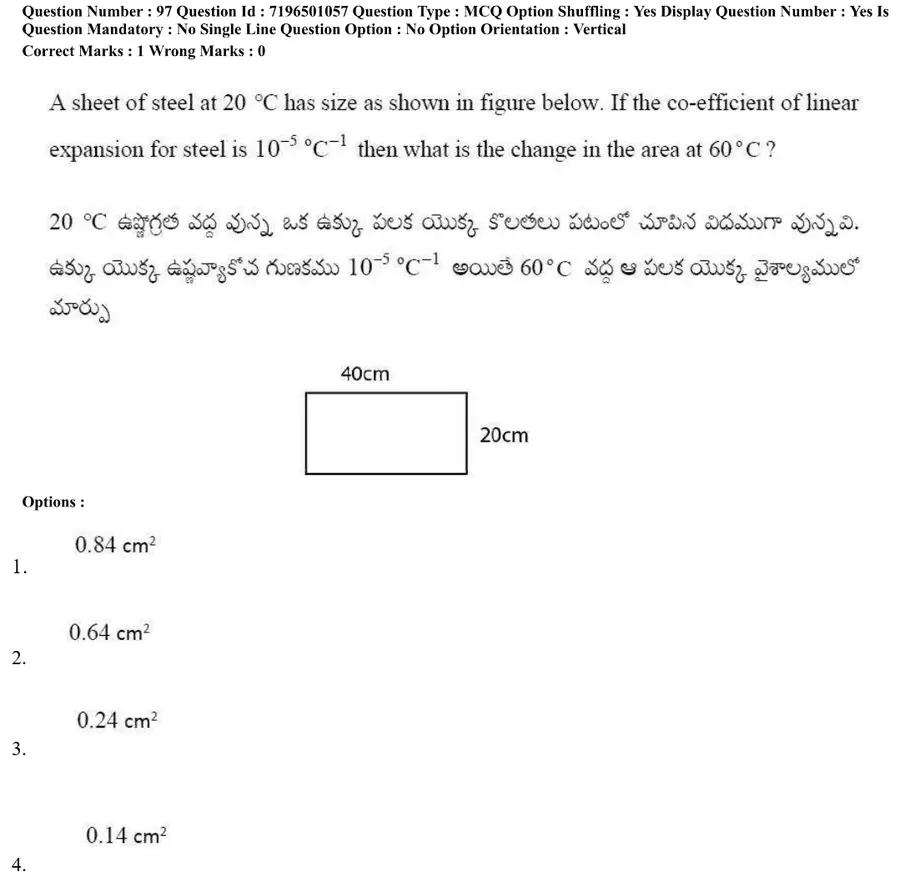
A sheet of steel at $20\ ^\circ\mathrm{C}$ has size as shown in figure below. If the co-efficient of linear expansion for steel is $10^{-5}\ ^\circ\mathrm{C}^{-1}$ then what is the change in the area at $60\ ^\circ\mathrm{C}$ ? (see the figure above)
Different materials of two identical long bars A and B are coated with wax and have their one end immersed in a hot oil bath. When the steady state is reached, the lengths for which wax melt are $l_A$ and $l_B$. If $k_A$ and $k_B$ are thermal conductivities of materials, then
A composite slab is prepared with two different materials A and B. The relation between their coefficient of thermal conductivity and thickness is given as $K_A=\frac{K_B}{2}$ and $X_A=2X_B$ respectively. If the temperature of faces of A and B are 75 °C and 50 °C respectively, what will be the temperature of common surface?
A solid of 2 kg mass absorbs 50 kJ when its temperature is raised from 20 $^\circ$C to 70 $^\circ$C. The specific heat capacity of this solid in unit of J/kg $^\circ$C is
A solid cylinder of radius $r_1$=2.5 cm, length $\ell_1$ =5.0 cm and temperature 40 $^\circ$C is suspended in an environment of temperature 60 $^\circ$C. The thermal radiation transfer rate for cylinder is 1.0 Watt. If the cylinder is stretched until its radius becomes $r_2$ = 0.50 cm, the thermal radiation transfer rate is changed to :
A steel rod at 25 °C is observed to be 1 m long when measured by another metal scale which is correct at 0 °C. The exact length of steel rod at 0 °C is ($\alpha_{\mathrm{steel}} = 12 \times 10^{-6}/^\circ\mathrm{C}$, $\alpha_{\mathrm{metal}} = 20 \times 10^{-6}/^\circ\mathrm{C}$)
Latent heat of vaporisation of water is $22.6 \times 10^5\ \mathrm{J/kg}$. The amount of heat needed to convert 100 kg of water into vapor at 100 °C is
How much thermal energy is required to change a 40 g ice cube from solid at $-10^\circ$C to steam at $110^\circ$C. [Assume latent heat of fusion for water = 80 kcal / kg, specific heat of water = 1 k cal / kg $^\circ$C, specific heat of Ice =0.5 kcal/kg $^\circ$C, specific heat of steam =0.48 kcal / kg $^\circ$C, latent heat of vaporisation of water= 540 kcal / kg $^\circ$C]
The temperature of a body is increased from $T_1 = 127$ °C to $T_2 = 227$ °C. The ambient temperature is 27 °C. The energies emitted per second by the body at $T_1$ and $T_2$ are $E_1$ and $E_2$ respectively. The ratio $\frac{E_2}{E_1}$ is
Two thin metallic spherical shells of radii 20 cm and 30 cm, respectively are placed with their centres coinciding. A material of thermal conductivity $\alpha$ is filled in the space between the shells. The inner shell is maintained at 300 K and the outer shell at 310 K. If the rate at which heat flows radially through the material is 40 W, find the value of $\alpha$ (in units of $\mathrm{J\,s^{-1}\,m^{-1}\,K^{-1}}$) :
The wavelength of the radiation emitted by a black body is 1 mm and the Wien's constant is $3 \times 10^{-3}\ \mathrm{m\text{-}K}$. Then the temperature of the black body will be
A hot body placed in air cools down to a lower temperature. The rate of decrease of temperature is proportional to temperature difference from the surrounding. The body loses 60% and 80% of maximum heat it can loose in time $t_1$ and $t_2$ respectively. The ratio $t_2/t_1$ will be :
A cup of coffee cools from 150 $^\circ$F to 144 $^\circ$F in 1 min in a room at 72 $^\circ$F. How much time will the coffee take to cool from 110 $^\circ$F to 104 $^\circ$F in the same room?
The area of a circular copper coin increases by 0.4% when its temperature is raised by 100 $^\circ$C. The coefficient of linear expansion of the coin is
A 210 W heater is used to heat 100 g water. The time required to raise the temperature of this water from 25 $^\circ$C to 100 $^\circ$C (specific heat capacity of water = 4200 J/kg-$^\circ$C)
Statement A : Convection involves flow of matter within a fluid due to unequal temperatures of its parts. Statement B : A hot bar placed under a running tap water loses heat due to effect of convection within water. Statement C : Heat transfer always involves temperature difference between two systems. Identify the correct option.
A body cools from $70\ ^\circ\mathrm{C}$ to $40\ ^\circ\mathrm{C}$ in 5 minutes. Calculate the time it takes to cool from $60\ ^\circ\mathrm{C}$ to $30\ ^\circ\mathrm{C}$. The temperature of the surroundings is $20\ ^\circ\mathrm{C}$.
A uniform metal bar of length $10\ \mathrm{m}$ with a crack at its midpoint is clamped between two rigid supports. The bar buckles upward due to a temperature rise of $40\ ^\circ\mathrm{C}$. If the coefficient of linear expansion of the metal is $25\times10^{-6}\ ^\circ\mathrm{C^{-1}}$, the maximum displacement of the mid point of the bar is
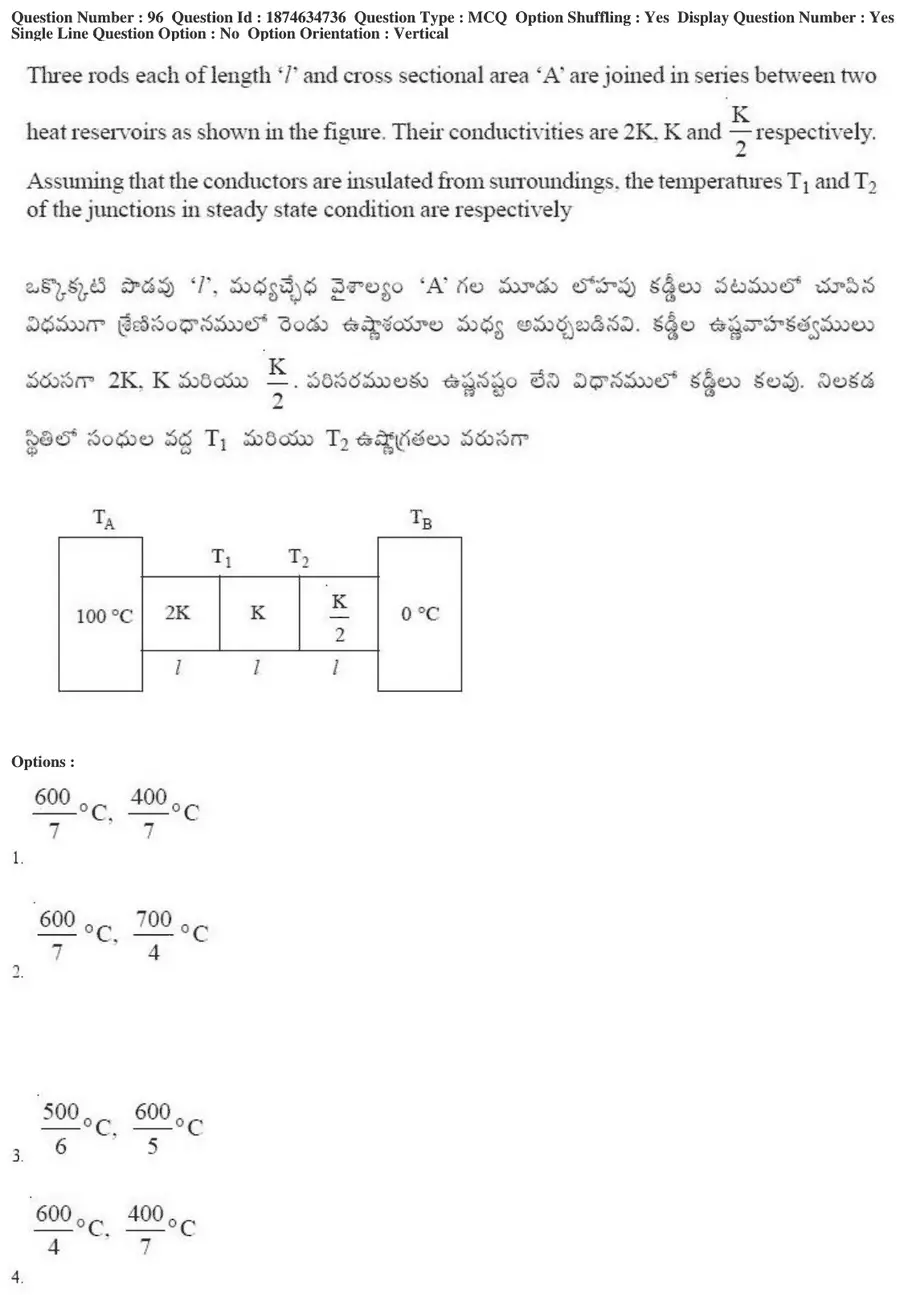
Three rods each of length '$l$' and cross sectional area 'A' are joined in series between two heat reservoirs as shown in the figure. Their conductivities are $2K$, $K$ and $\frac{K}{2}$ respectively. Assuming that the conductors are insulated from surroundings, the temperatures $T_1$ and $T_2$ of the junctions in steady state condition are respectively (see the figure above)
Two metallic spheres P and Q made of same material have same smoothness but the weight of P is 8 times that of Q. If the two are heated to same temperature and left to cool, then the ratio of rate of cooling of Q to that of P is
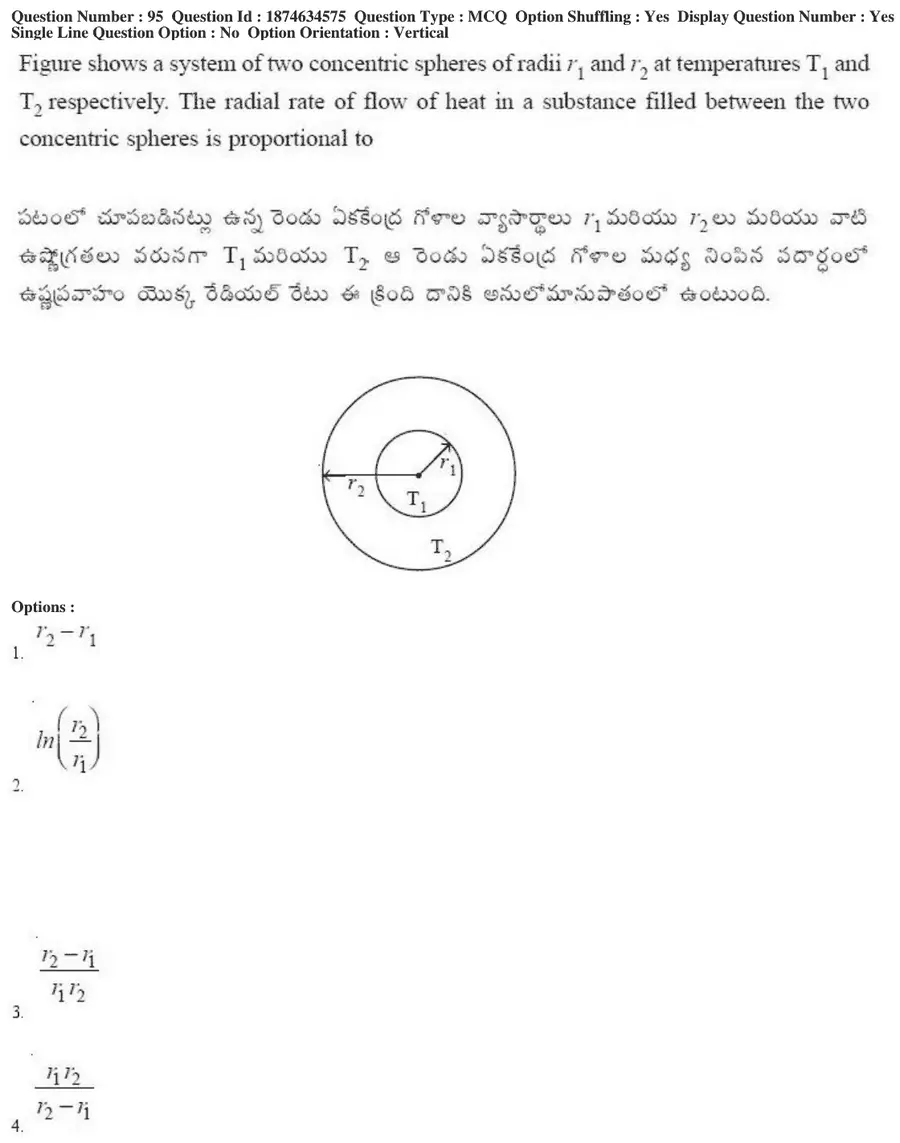
Figure shows a system of two concentric spheres of radii $r_1$ and $r_2$ at temperatures $T_1$ and $T_2$ respectively. The radial rate of flow of heat in a substance filled between the two concentric spheres is proportional to (see the figure above)
A composite bar of uniform cross section is made of $25\ \mathrm{cm}$ of Copper, $10\ \mathrm{cm}$ of Nickel and $15\ \mathrm{cm}$ of Aluminium with perfect thermal contacts. The free copper end of the rod is at $100\ ^\circ\mathrm{C}$ and the free Aluminium end is at $0\ ^\circ\mathrm{C}$. If $K_{\mathrm{Cu}} = 2\,K_{\mathrm{Al}}$ and $K_{\mathrm{Al}} = 3\,K_{\mathrm{Ni}}$, then the temperatures of Cu-Ni and Ni-Al junctions are respectively (Assume no loss of heat occurs from the sides of the rod, K-thermal conductivity)
The specific heat capacities of three liquids A, B and C are in the ratio 1:2:3 and the masses of the liquids are in the ratio 1:1:1. The temperatures of the liquids A, B and C are $15\ ^\circ\mathrm{C}$, $30\ ^\circ\mathrm{C}$ and $45\ ^\circ\mathrm{C}$ respectively. Then match the resultant temperature of the mixture given in list-II with the corresponding mixture given in list-I. List-I A) Mixture of liquids A and B B) Mixture of liquids B and C C) Mixture of liquids C and A D) Mixture of liquids A, B and C List-II I) $25\ ^\circ\mathrm{C}$ II) $35\ ^\circ\mathrm{C}$ III) $37.5\ ^\circ\mathrm{C}$ IV) $39\ ^\circ\mathrm{C}$ The correct answer is
Electrical energy costs 25 paisa per kilowatt hour. Assuming that no energy is wasted, the cost of heating $4.6\ \mathrm{kg}$ of water from $25\ ^\circ\mathrm{C}$ to the boiling point is
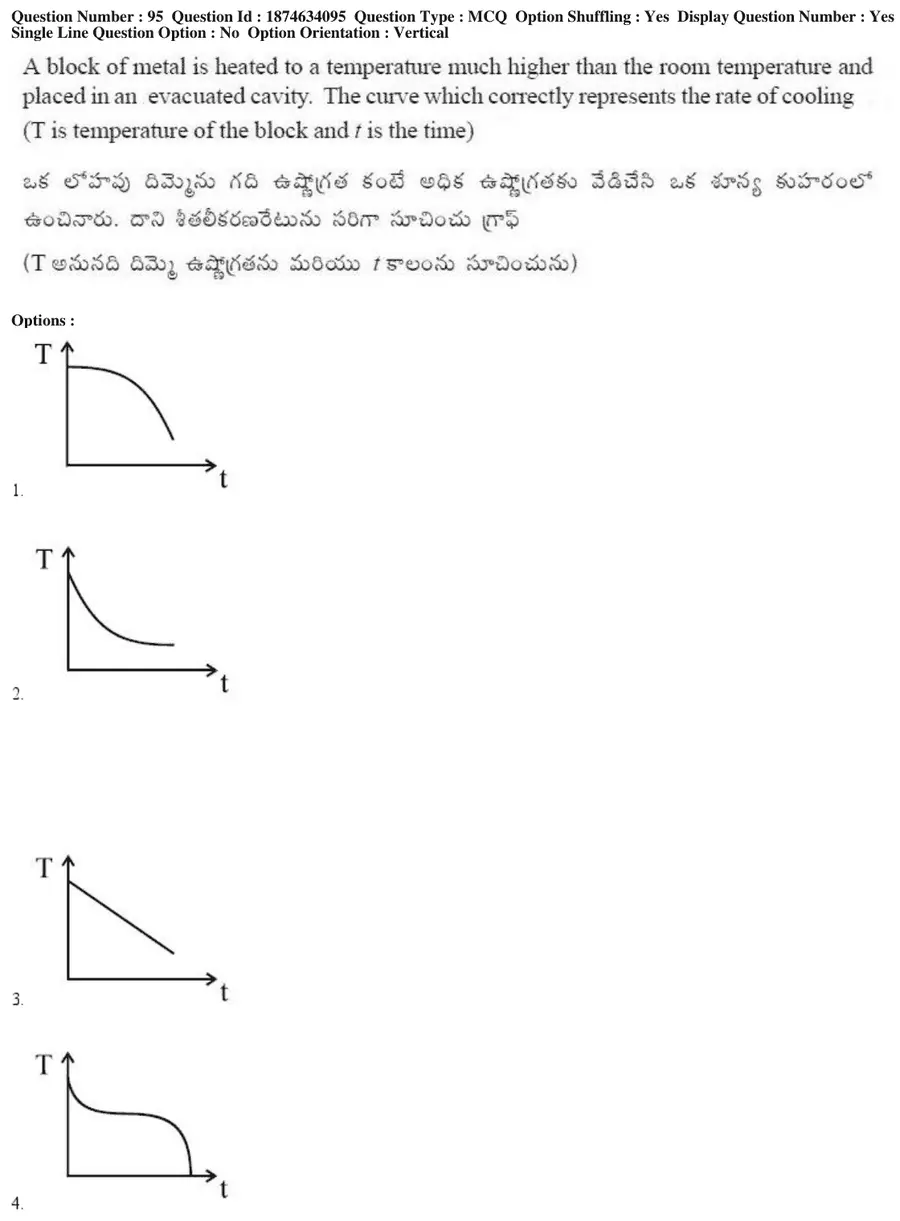
A block of metal is heated to a temperature much higher than the room temperature and placed in an evacuated cavity. The curve which correctly represents the rate of cooling (T is temperature of the block and $t$ is the time)
The question as printed in the paper.
A
see figure T vs t: starts at a high value with a flat top, then curves downward ever more steeply (concave down, falling toward the t-axis, not reaching it within the drawing)
B
see figure T vs t: decreasing curve, steep at first, flattening to a horizontal asymptote above the t-axis (exponential decay)
C
see figure T vs t: straight line sloping down from the T-axis, ending above the t-axis
D
see figure T vs t: sharp initial fall, then a long nearly flat plateau, then a steep drop reaching the t-axis at the right end
A solid copper sphere of density $\rho$, specific heat capacity C and radius r is initially at 200 K. It is suspended inside a chamber whose walls are at 0 K. The time required (in $\mu$s) for the temperature of the sphere to drop to 100 K is ($\sigma$ is Stefan's constant and all the quantities are in SI units)
A hammer of mass 200 kg strikes a steel block of mass 200 g with a velocity $8\,\mathrm{ms^{-1}}$. If 23% of the energy is utilized to heat the steel block, the rise in temperature of the block is (specific heat capacity of steel = $460\,\mathrm{J\,kg^{-1}\,K^{-1}}$)
The walls of a closed cubical box of edge 60 cm are made of material of thickness 1 mm and thermal conductivity $4 \times 10^{-4}\,\mathrm{cal\,s^{-1}\,cm^{-1}\,^\circ C^{-1}}$. The interior of the box is maintained $1000\,^\circ\mathrm{C}$ above the outside temperature by a heater placed inside the box and connected across 400 V DC supply. The resistance of the heater is
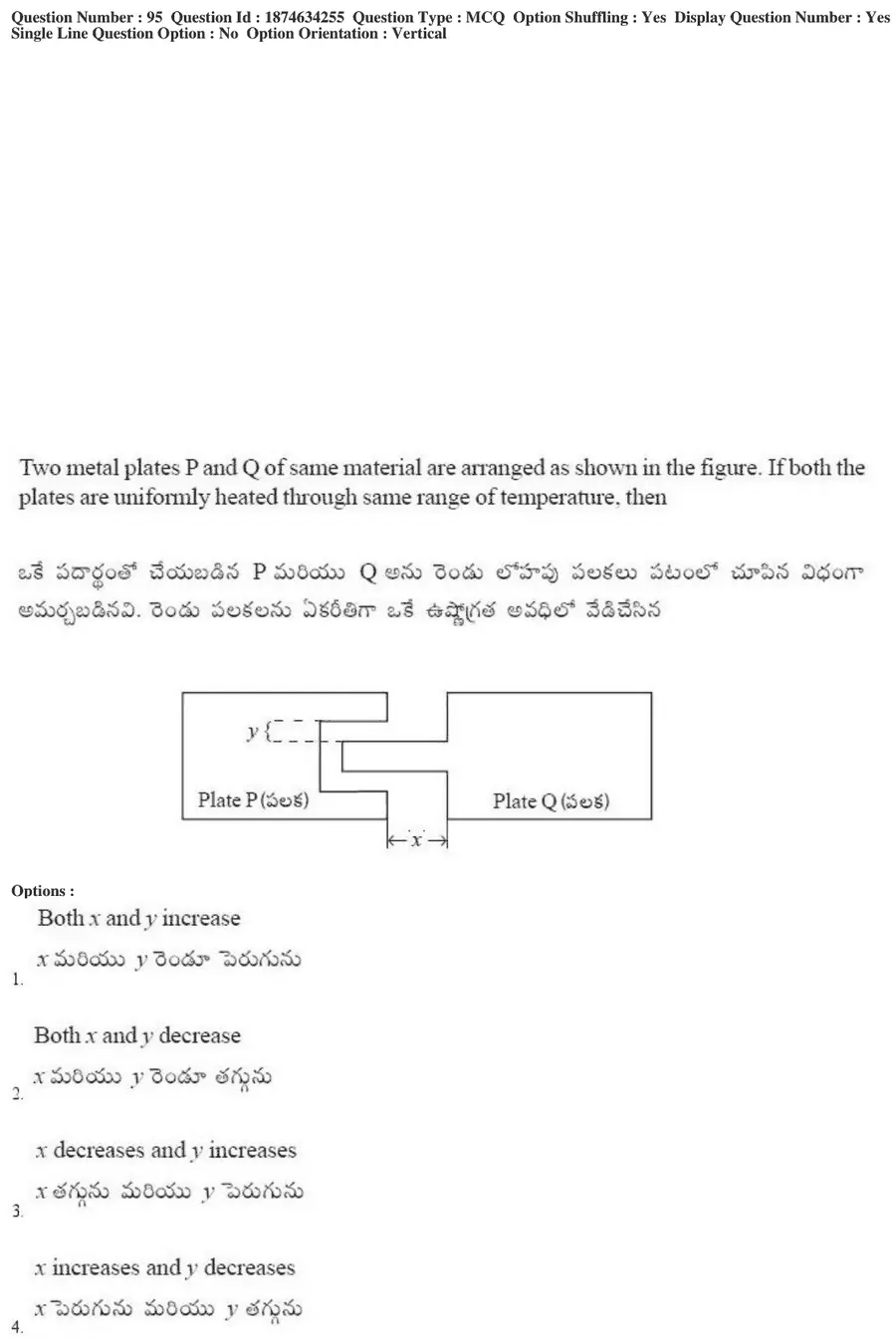
Two metal plates P and Q of same material are arranged as shown in the figure. If both the plates are uniformly heated through same range of temperature, then (see the figure above)
A liquid of mass 250 g is kept warm in a vessel using an electric heater. The liquid is maintained at $57\ ^\circ\mathrm{C}$ when the power supplied by the heater is 30 W and surrounding temperature is $27\ ^\circ\mathrm{C}$. As the heater is switched off, it took 10 s time for the temperature of the liquid to fall from $47\ ^\circ\mathrm{C}$ to $46.9\ ^\circ\mathrm{C}$. The specific heat capacity of the liquid is
The focal length of a spherical mirror made of steel is 150 cm. If the temperature of the mirror increases by 200 K, its focal length becomes (coefficient of linear expansion of steel $= 12 \times 10^{-6}\ {}^\circ\mathrm{C^{-1}}$)
A metal rod of length 10 cm and area of cross section $2.8 \times 10^{-4}\ \mathrm{m^{2}}$ is covered with a non-conducting substance. One end of it is maintained at $80\ ^\circ\mathrm{C}$, while the other end is put in ice at $0\ ^\circ\mathrm{C}$. It is found that 20 g of ice melts in 5 min. The thermal conductivity of the metal in $\mathrm{J\,s^{-1}\,m^{-1}\,K^{-1}}$ is (Latent heat of ice is $80\ \mathrm{cal\,g^{-1}}$)
The densities of wood and benzene at $0\,^\circ\mathrm{C}$ are $880\ \mathrm{kg\,m^{-3}}$ and $900\ \mathrm{kg\,m^{-3}}$ respectively. The coefficient of volume expansion is $1.2\times10^{-3}\,^\circ\mathrm{C^{-1}}$ for wood and $1.5\times10^{-3}\,^\circ\mathrm{C^{-1}}$ for benzene. Then the temperature at which a piece of wood just sinks in benzene is
A window used to thermally insulate a room from outside consists of two parallel glass sheets each of area $2.6\ \mathrm{m^2}$ and thickness 1 cm separated by 5 cm thick stagnant air. In the steady state, the room-glass interface is at $18\,^\circ\mathrm{C}$ and the glass-outdoor interface is at $-2\,^\circ\mathrm{C}$. If the thermal conductivities of glass and air are respectively $0.8\ \mathrm{Wm^{-1}K^{-1}}$ and $0.08\ \mathrm{Wm^{-1}K^{-1}}$, the rate of flow of heat through the window is
The resistance of a thermometer is 100 $\Omega$ at the triple point of water (273 K) and is 300 $\Omega$ at the melting point of gold ($\sim$ 873 K). The temperature at which the resistance of the thermometer is 200 $\Omega$ is
An electric heater with constant heat supply rate is used to convert a certain amount of liquid ammonia to saturated vapour at high pressure. The heater takes 14 minutes to bring the liquid at $15\,^\circ\mathrm{C}$ to the boiling point of $50\,^\circ\mathrm{C}$ and 92 minutes to convert the liquid at the boiling point wholly to vapour. If the specific heat capacity of liquid ammonia is 4.9 kJ/kg K, the latent heat of vaporization of ammonia in kJ/kg is
An Aluminium rod of length 1 m and a steel rod of length 2 m both having same cross-sectional area, are soldered together end-to-end. The thermal conductivity of aluminium rod and steel rod is $200\ \mathrm{J\,s^{-1}m^{-1}K^{-1}}$ and $50\ \mathrm{J\,s^{-1}m^{-1}K^{-1}}$ respectively. The temperatures of the free ends are maintained at 300 K and 500 K. What is the temperature of the junction
The pressure to be applied to the ends of a steel cylinder to keep its length constant upon raising its temperature by $100\ ^\circ\mathrm{C}$ is (Thermal expansion coefficient, $\alpha = 11 \times 10^{-6}$ /K, Young's Modulus $= 200\ \mathrm{GPa}$)
A glass beaker contains $200\ \mathrm{gm}$ of carbonated water initially at $20\ ^\circ\mathrm{C}$. How much ice should be added to obtain the final temperature of $0\ ^\circ\mathrm{C}$ with all ice melted, if the initial temperature of ice is $-10\ ^\circ\mathrm{C}$. Neglect heat capacity of glass [Use : $C_{\mathrm{water}} = 4190\ \mathrm{J/kg\,^\circ C}$, $C_{\mathrm{ice}} = 2100\ \mathrm{J/kg\,^\circ C}$, $L_F = 3.34 \times 10^5\ \mathrm{J/kg}$]
Heat loss takes place from a body maintained at a temperature of $400\ ^\circ\mathrm{C}$ to the surrounding air at $30\ ^\circ\mathrm{C}$ by convection and to the surrounding surfaces at $30\ ^\circ\mathrm{C}$ by radiation. The Newton's cooling coefficient is $20\ \mathrm{W/m^2\,K}$ and the Stefan-Boltzmann constant is $5.67 \times 10^{-8}\ \mathrm{W/m^2\,K^4}$. If the rate of heat loss by convection is equal to the rate of heat loss by radiation, the emissivity of the body surface is
A container is filled with liquid that cools from $100\,^\circ\mathrm{C}$ to $70\,^\circ\mathrm{C}$ in 5 min, when kept at room temperature of $30\,^\circ\mathrm{C}$. The time that it must have taken to cool down to $80\,^\circ\mathrm{C}$ from its initial temperature approximately is
A metal sphere immersed in water weighs $W_1$ at $0\,^\circ\mathrm{C}$ and $W_2$ at $50\,^\circ\mathrm{C}$. The coefficient of cubical expansion of the metal is less than that of water. Then
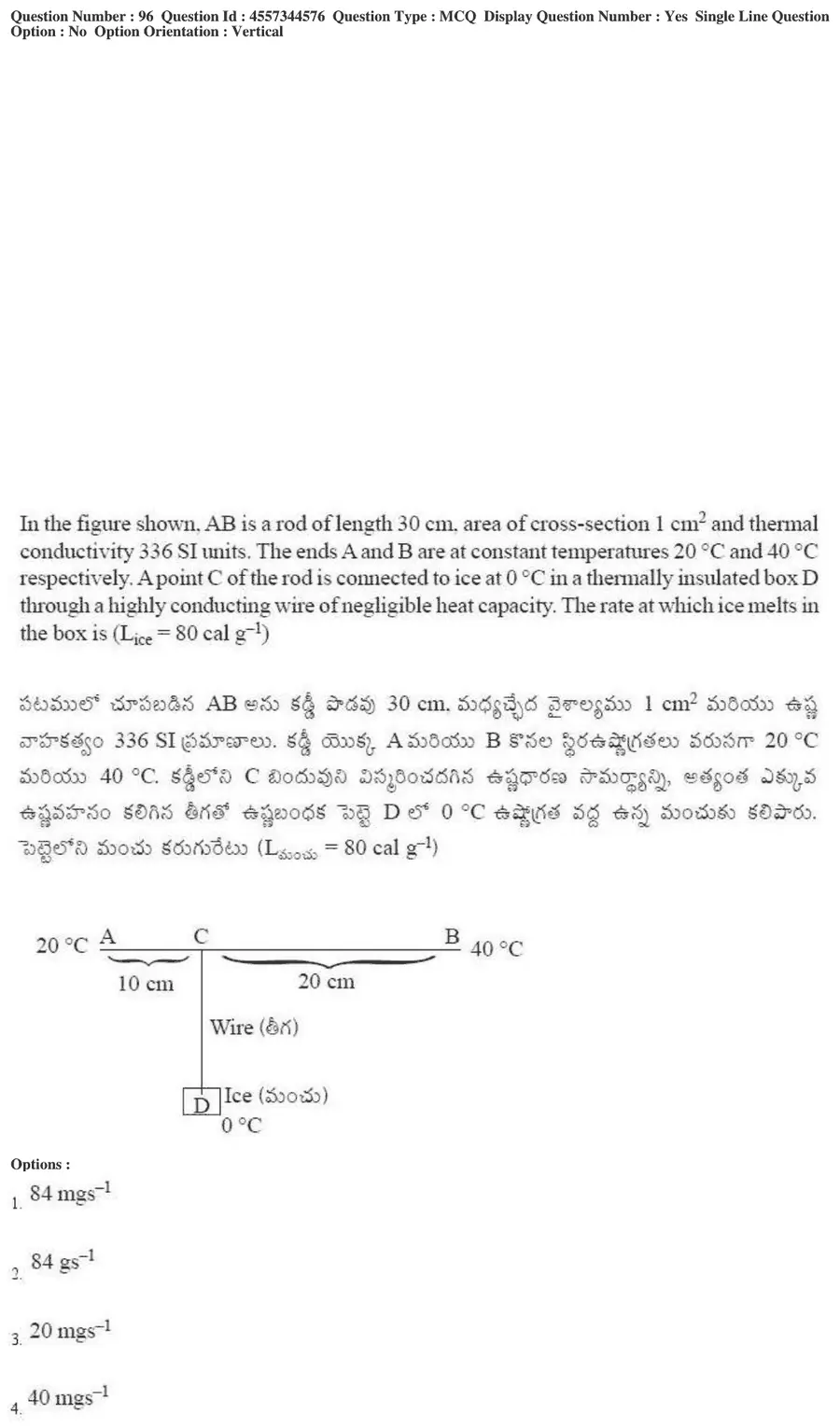
In the figure shown, AB is a rod of length $30\ \mathrm{cm}$, area of cross-section $1\ \mathrm{cm^2}$ and thermal conductivity 336 SI units. The ends A and B are at constant temperatures $20\ ^\circ\mathrm{C}$ and $40\ ^\circ\mathrm{C}$ respectively. A point C of the rod is connected to ice at $0\ ^\circ\mathrm{C}$ in a thermally insulated box D through a highly conducting wire of negligible heat capacity. The rate at which ice melts in the box is ($L_{\mathrm{ice}} = 80\ \mathrm{cal\,g^{-1}}$) (see the figure above)
The time taken for a calorimeter containing 75 g of water at $62\ ^\circ\mathrm{C}$ to cool to $58\ ^\circ\mathrm{C}$ is 9 minutes. When the calorimeter contains 105 g of water, it takes 12 minutes to cool from $62\ ^\circ\mathrm{C}$ to $58\ ^\circ\mathrm{C}$. The water equivalent of the calorimeter is ______
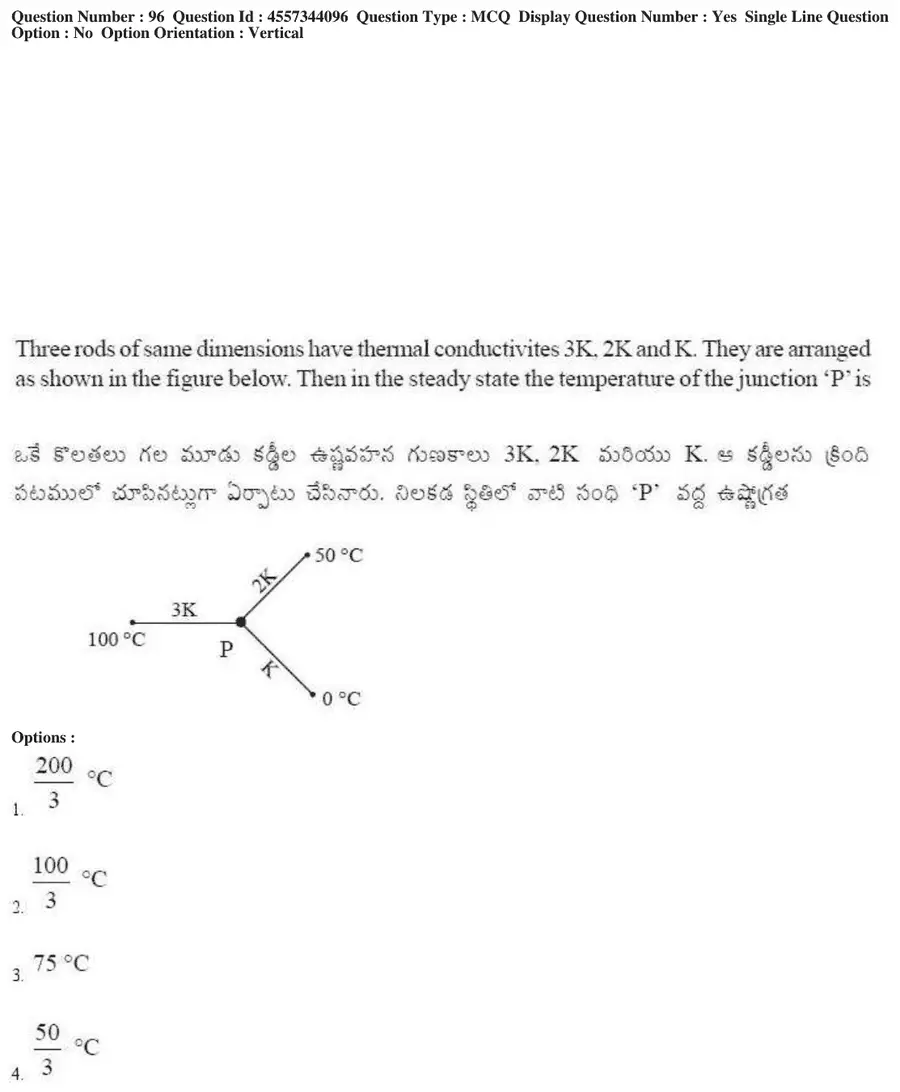
Three rods of same dimensions have thermal conductivites 3K, 2K and K. They are arranged as shown in the figure below. Then in the steady state the temperature of the junction 'P' is (see the figure above)
Steam at $100\ ^\circ\mathrm{C}$ is passed into $1\ \mathrm{kg}$ of water contained in a calorimeter at $9\ ^\circ\mathrm{C}$ till the temperature of water and calorimeter is increased to $90\ ^\circ\mathrm{C}$. The mass of the steam condensed is nearly (Water equivalent of calorimeter $= 0.1\ \mathrm{kg}$ Specific heat of water $= 1\ \mathrm{calg^{-1}\,^\circ C^{-1}}$ Latent heat of vapourisation $= 540\ \mathrm{calg^{-1}}$)
Three very large plates of same area are kept parallel and close to each other. They are considered as ideal black surfaces and have very high thermal conductivity. First and third plates are maintained at absolute temperatures 2T and 3T respectively. Temperature of the middle plate in steady state is
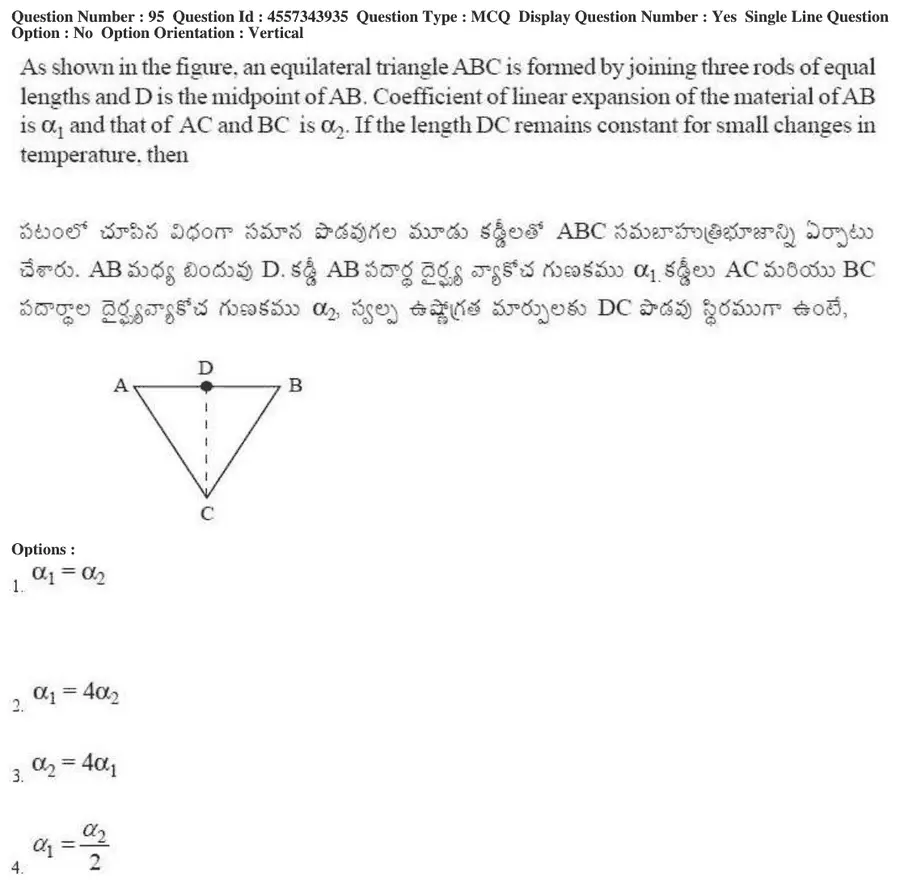
As shown in the figure, an equilateral triangle ABC is formed by joining three rods of equal lengths and D is the midpoint of AB. Coefficient of linear expansion of the material of AB is $\alpha_1$ and that of AC and BC is $\alpha_2$. If the length DC remains constant for small changes in temperature, then (see the figure above)
Match the following List - I with List - II. List - I A) When ice melts into water B) When water changes into steam C) Melting point of ice D) Boiling point of water List - II I) Volume increases II) Volume decreases III) Increases with increase of pressure IV) Decreases with increase in pressure The correct answer is
A metre scale made of steel reads accurately at $25\,^\circ$C. Suppose in an experiment an accuracy of 0.06 mm in 1 m is required, the range of temperature in which the experiment can be performed with this metre scale is (coefficient of linear expansion of steel is $11\times10^{-6}/^\circ$C)
A thermocol box has a total wall area (including the lid) of $1.0\,\mathrm{m^2}$ and wall thickness of 3 cm. It is filled with ice at $0\,^\circ$C. If the average temperature outside the box is $30\,^\circ$C throughout the day, the amount of ice that melts in one day is [ use $K_{\mathrm{thermocol}} = 0.03\,\mathrm{W/m\,K}$, $L_{\mathrm{fusion(ice)}} = 3.00\times10^{5}\,\mathrm{J/kg}$ ]
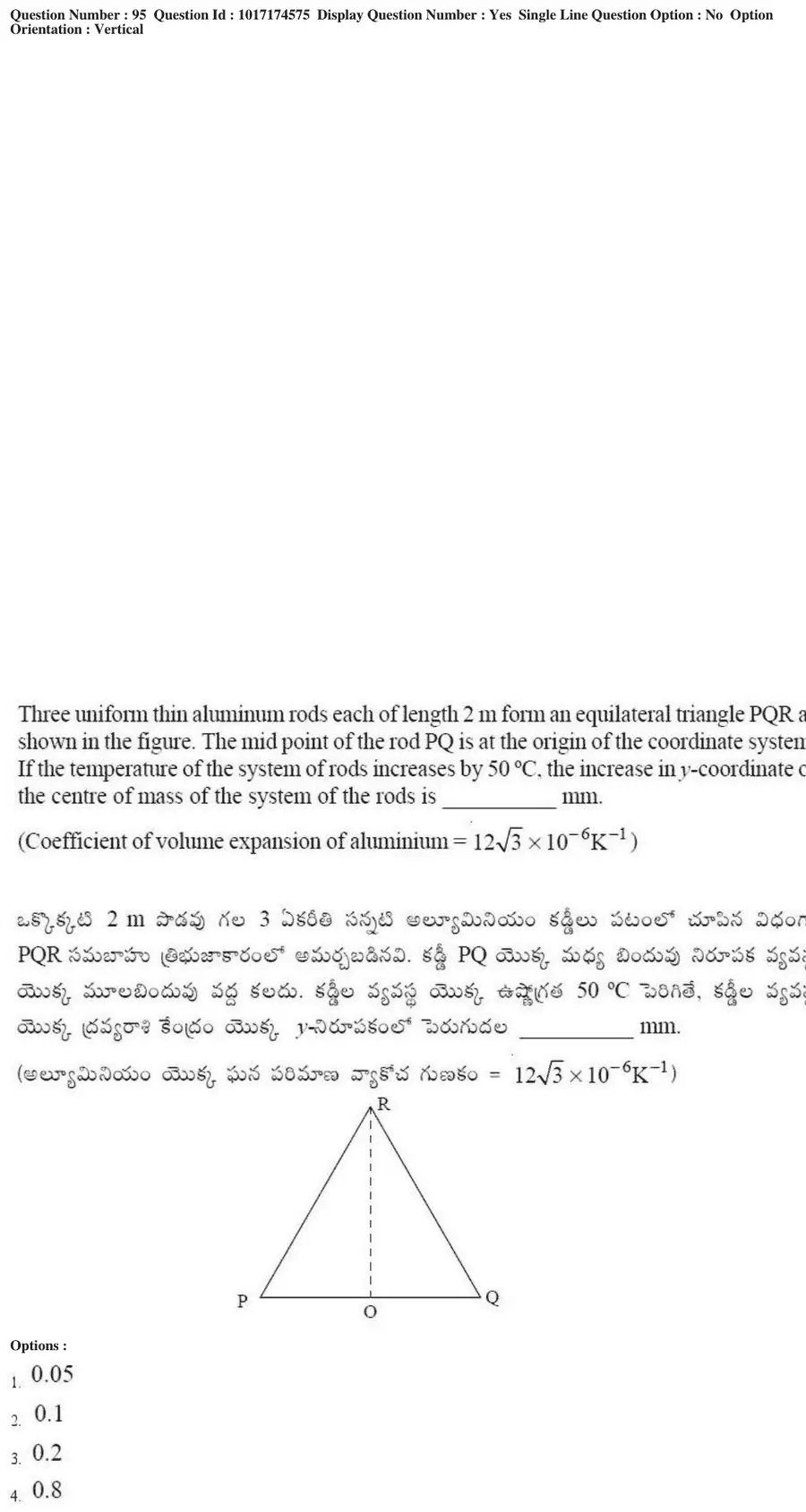
Three uniform thin aluminum rods each of length 2 m form an equilateral triangle PQR as shown in the figure. The mid point of the rod PQ is at the origin of the coordinate system. If the temperature of the system of rods increases by $50\,^\circ\mathrm{C}$, the increase in y-coordinate of the centre of mass of the system of the rods is ______ mm. (Coefficient of volume expansion of aluminium $= 12\sqrt{3}\times10^{-6}\,\mathrm{K^{-1}}$) (see the figure above)
A wall is made of equally thick layers 'P' and 'Q' of different materials. Thermal conductivity of 'Q' is half of that of the 'P'. In the steady state, if the temperature difference across the wall is 24 $^\circ$C, then the temperature difference across the layer 'P' is ______
If equal masses of 10 liquids of specific heats s, 2s, 3s, ........ 10s at temperatures $10\ ^\circ\mathrm{C}$, $20\ ^\circ\mathrm{C}$, $30\ ^\circ\mathrm{C}$, ..... $100\ ^\circ\mathrm{C}$ respectively are mixed, the resultant temperature of the mixture is ______
Two closed containers of same dimensions made of different materials are completely filled with ice. The ice in the first container takes 20 minutes and that in the second container takes 10 minutes, respectively for complete melting. The ratio of the thermal conductivities of the materials of the two containers is ______.
A pellet of mass ‘m’ and specific heat capacity ‘c’ fired from an air gun hits a steel plate with speed ‘v’. During the impact, 50% of the pellet’s kinetic energy is converted to thermal energy in it. The rise in the temperature of the pellet is
A hail stone of mass 42 g falls from a height 1.8 km and if its entire potential energy is converted into latent heat, the mass of the hail stone on reaching the ground is ($\mathrm{g}=10\ \mathrm{ms^{-2}}$, $\mathrm{L_{ice}}=3.36\times10^{5}\ \mathrm{J\,kg^{-1}}$)
One end of a uniform metal rod of length 100 cm is placed in ice and the other end is placed in boiling water. A point of the rod which is at a distance of 60 cm from the ice end is maintained at a constant temperature of $325\ ^\circ\mathrm{C}$. If 2 g of water is converted into steam per second, the mass of ice melted per second in steady state is (Latent heat of steam = 6.75 times latent heat of fusion of ice)
If a 4 kg of ice is inside a closed cubical thermocol box of side length 20 cm and wall thickness 4 cm then the mass of the ice remaining after 10 hours is nearly (The out side temperature = $50\ ^\circ\mathrm{C}$ co-efficient of thermal conductivity of thermocol = $0.01\ \mathrm{Js^{-1}m^{-1}\,^\circ C^{-1}}$ Latent heat of fusion of ice = $335\times10^3\ \mathrm{J\,kg^{-1}}$)
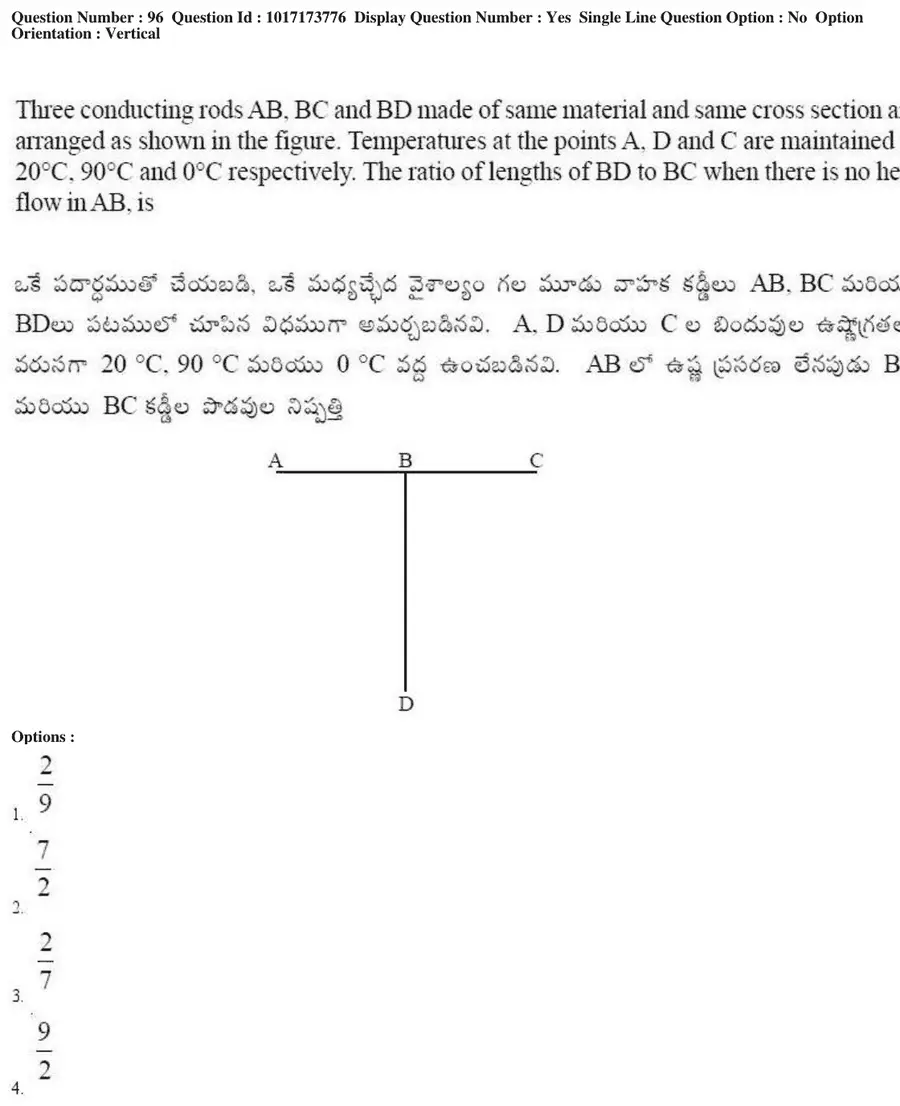
Three conducting rods AB, BC and BD made of same material and same cross section are arranged as shown in the figure. Temperatures at the points A, D and C are maintained at $20^\circ\mathrm{C}$, $90^\circ\mathrm{C}$ and $0^\circ\mathrm{C}$ respectively. The ratio of lengths of BD to BC when there is no heat flow in AB, is (see the figure above)
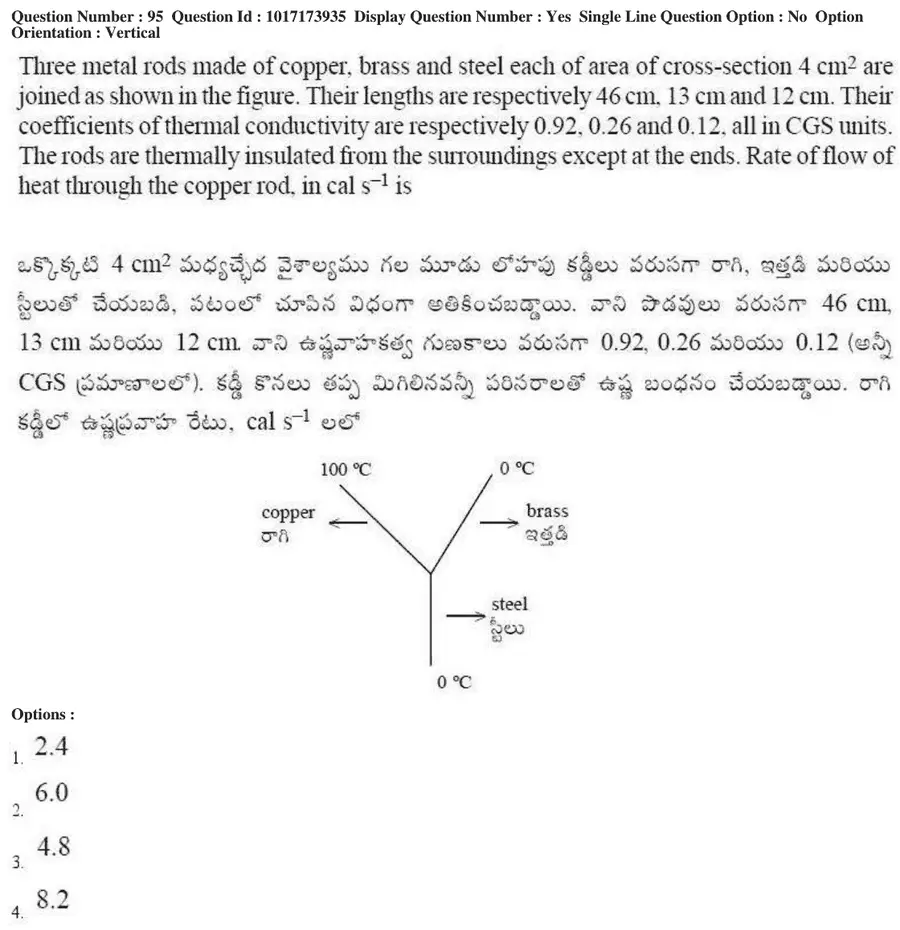
Three metal rods made of copper, brass and steel each of area of cross-section $4\ \mathrm{cm^2}$ are joined as shown in the figure. Their lengths are respectively 46 cm, 13 cm and 12 cm. Their coefficients of thermal conductivity are respectively 0.92, 0.26 and 0.12, all in CGS units. The rods are thermally insulated from the surroundings except at the ends. Rate of flow of heat through the copper rod, in $\mathrm{cal\ s^{-1}}$ is (see the figure above)
A slab of stone area $3600\ \mathrm{cm^2}$ and thickness 10 cm is exposed on the lower surface to steam at $100^\circ$C. A block of ice at $0^\circ$C rests on upper surface of the slab. In one hour 4.8 kg of ice is melted. The thermal conductivity of the stone in $\mathrm{Js^{-1}m^{-1}k^{-1}}$ is (Latent heat of ice $= 3.36\times10^5$ J/kg)
The surface of a black body is at a temperature $727^\circ$C and its cross section is $1\ \mathrm{m^2}$. Heat radiated from this surface in one minute in Joules is (Stefan's constant $= 5.7\times10^{-8}\ \mathrm{W/m^2/k^4}$)
A hunter fired a metallic bullet of mass 'm' kg from a gun towards an obstacle and it just melts when it is stopped by the obstacle. The initial temperature of the bullet is 300 K. If $\dfrac{1}{4}^{th}$ of heat is absorbed by the obstacle, then the minimum velocity of the bullet is [Melting point of bullet = 600 K, Specific heat of bullet = $0.03\ \mathrm{cal\,g^{-1}\,^\circ C^{-1}}$, Latent heat of fusion of bullet = $6\ \mathrm{cal\,g^{-1}}$]
'M' kg of water at 't' $^\circ$C is divided into two parts so that one part of mass 'm' kg when converted into ice at $0^\circ$C would release enough heat to vapourise the other part, then $\dfrac{m}{M}$ is equal to [Specific heat of water = $1\ \mathrm{cal\,g^{-1}\,^\circ C^{-1}}$, Latent heat of fusion of ice = $80\ \mathrm{cal\,g^{-1}}$, Latent heat of steam = $540\ \mathrm{cal\,g^{-1}}$]
A steam at $100^\circ$C is passed into 1 kg of water contained in a calorimeter of water equivalent 0.2 kg at $9^\circ$C, till the temperature of the calorimeter and water in it is increased to $90^\circ$C. The mass of steam condensed in kg is nearly (sp. heat of water = 1 cal/g-$^\circ$C, Latent heat of vaporisation = 540 cal/g)
A very small hole in an electric furnace is used for heating metals. The hole nearly acts as a black body. The area of the hole is 200 $\mathrm{mm}^2$. To keep a metal at $727^\circ$C, heat energy flowing through this hole per sec, in joules is ($\sigma = 5.67 \times 10^{-8}\ \mathrm{Wm^{-2}k^{-4}}$)
A glass flask of volume one litre is filled completely with mercury at $0^\circ\mathrm{C}$. The flask is now heated to $100^\circ\mathrm{C}$. Coefficient of volume expansion of mercury is $1.82\times10^{-4}/^\circ\mathrm{C}$ and coefficient of linear expansion of glass is $0.1\times10^{-4}/^\circ\mathrm{C}$. During this process, amount of mercury which overflows is
Two bodies A and B of equal surface area have thermal emissivities of 0.01 and 0.81 respectively. The two bodies are radiating energy at the same rate. Maximum energy is radiated from the two bodies A and B at wavelengths $\lambda_A$ and $\lambda_B$ respectively. Difference in these two wavelengths is 1 $\mu$m. If the temperature of the body A is 5802 K, then value of $\lambda_B$ is
The ends of an element of zinc wire are kept at a small temperature difference $\Delta T$ and a small current (I) is passed through the wire. Then, the heat developed per unit time
A
is proportional to $\Delta T$ and I
B
is proportional to $I^3$ and $\Delta T$
C
is proportional to Thomson coefficient of the metal
When a liquid is heated in copper vessel its coefficient of apparent expansion is $6 \times 10^{-6}/^\circ\mathrm{C}$. When the same liquid is heated in a steel vessel its coefficient of apparent expansion is $24 \times 10^{-6}/^\circ\mathrm{C}$. If coefficient of linear expansion for copper is $18 \times 10^{-6}/^\circ\mathrm{C}$, the coefficient of linear expansion for steel is
When the temperature of a body increases from T to T + $\Delta$T, its moment of inertia increases from I to I + $\Delta$I. If $\alpha$ is the coefficient of linear expansion of the material of the body, then $\frac{\Delta I}{I}$ is (neglect higher orders of $\alpha$)
Power radiated by a black body at temperature $T_1$ is P and it radiates maximum energy at a wavelength $\lambda_1$. If the temperature of the black body is changed from $T_1$ to $T_2$, it radiates maximum energy at a wavelength $\frac{\lambda_1}{2}$. The power radiated at $T_2$ is
Two slabs A and B of different materials but of the same thickness are joined end to end to form a composite slab. The thermal conductivities of A and B are '$k_1$' and '$k_2$' respectively. A steady temperature difference of $12^\circ\mathrm{C}$ is maintained across the composite slab. If $k_1 = \frac{k_2}{2}$, the temperature difference across slab A is :
The thermo e.m.f. of a hypothetical thermocouple varies with the temperature $\theta$ of hot junction as $E = a\theta + b\theta^{2}$ in volts, where the ratio $a/b$ is $700^{\circ}$C. If the cold junction is kept at $0^{\circ}$C, then the neutral temperature is :
A
$700^{\circ}$C
B
$1400^{\circ}$C
C
$390^{\circ}$C
D
no neutral temperature is possible for this thermocouple
How to prepare Thermal Properties of Matter for EAPCET
How often it comes up
Thermal Properties of Matter is a core component of heat and thermodynamics in Class 11 physics. In the papers we hold for AP and TS EAPCET between 2022 and 2026, the chapter accounted for 114 questions across 77 papers. That gives an average frequency of 1.5 questions per paper, making up 3.7% of all physics questions in that recent window. Taking in all years in our archive from 2010 to 2026, Thermal Properties of Matter contributed 255 questions across 149 papers, maintaining an average of 1.7 questions per paper and a 4.3% subject share. During the earlier period from 2010 to 2021, our archive contains 141 questions across 72 papers, representing 2.0 questions per paper and a 4.9% share. Across the last three exam years from 2024 to 2026, the chapter delivered 67 questions across 46 papers, holding a 3.6% share. The share of the subject in the last three years compared to early papers is down, while compared to the recent five-year window it is about the same.
State-wise breakdowns show that TS EAPCET papers examine this topic more heavily than AP papers. From 2022 to 2026, AP EAPCET papers in our set provided 58 questions across 48 papers, with 44 papers containing at least one question (1.2 per paper, 3.0% share). Over the same period, TS EAPCET contributed 56 questions across 29 papers in our set, with all 29 papers featuring questions from the chapter (1.9 per paper, 4.8% share). Thermal Properties of Matter has appeared every year since 2022, though across all 77 recent papers in our collection, four AP papers omitted it, meaning it did not feature in all 77 sittings. It ranks 11th of 28 physics chapters by question share between 2022 and 2026. The busiest single sitting in our collection was 2020, which saw 35 questions across 18 papers.
Most-asked topics
Questions distribute across four major areas:
Calorimetry: 50 questions in the recent 2022–2026 period and 86 questions across all years in our archive. Key concepts test specific heat capacity, latent heat of fusion and vaporisation, principle of mixtures, water equivalent, and temperature scales.
Thermal Expansion: 28 questions between 2022 and 2026 and 64 questions across all years. This area covers linear, superficial, and cubical expansion of solids, apparent expansion of liquids in vessels, bimetallic strips, and anomalous expansion of water.
Radiation: 22 questions in the recent period and 60 questions across all years. Topics include Stefan-Boltzmann law, Wien's displacement law, Newton's law of cooling, and blackbody emission spectra.
Conduction: 14 questions between 2022 and 2026 and 45 questions across all years. It tests steady-state heat current, thermal conductivity, equivalent conductivity of rods in series or parallel, and temperature of junctions.
What the questions look like
Calorimetry questions typically involve mixing ice, water, and steam inside a container of known heat capacity. You must determine the equilibrium temperature and the final mass of each phase present. Watch out for incomplete melting where final temperature remains at the melting point. Thermometer calibration questions also show up, where a faulty scale with non-standard ice and steam points must be converted to standard Celsius or Fahrenheit readings.
In heat transfer, radiation problems heavily favour Newton's law of cooling in its approximate average-temperature form, asking for the time required to cool between two temperatures under specified ambient conditions. Conduction problems test composite cylindrical or rectangular slabs connected either end-to-end or side-by-side, requiring the interface temperature or effective thermal resistance.
Start by mastering temperature conversion scales. Set up the invariant linear relation (Reading - Lower Fixed Point) / (Upper Fixed Point - Lower Fixed Point) = constant. Use this ratio directly for custom scales, faulty mercury thermometers, and resistance thermometers.
In calorimetry, write the conservation of heat energy clearly: heat lost by warmer components equals heat gained by cooler components. Always verify whether latent heat requirements can be satisfied by the sensible heat released before assuming complete phase conversion.
For thermal expansion, remember the standard relationships between coefficients: superficial expansion coefficient β equals two times linear expansion coefficient α, and volume expansion coefficient γ equals three times α for isotropic solids. For liquid in a flask, the apparent volume expansion coefficient equals real volume expansion coefficient minus vessel expansion coefficient.
Finally, review the laws of radiation and cooling. For Stefan's law, radiated power scales with the fourth power of absolute temperature T. For Newton's law of cooling, use the standard difference approximation: rate of temperature drop (T_initial - T_final) / t = k [(T_initial + T_final) / two - T_surrounding].
Frequently asked questions
How many questions come from Thermal Properties of Matter on average?
In the papers we hold from 2022 to 2026, the chapter averages 1.5 questions per paper across both states, with TS papers averaging 1.9 questions per paper.
What is the most common mistake in Calorimetry questions?
Students often assume that all ice will melt or all steam will condense. Always calculate the heat required for the phase change separately and compare it against the heat available from cooling.
Is Newton's law of cooling asked frequently in EAPCET?
Yes, Newton's law of cooling appears regularly in both AP and TS papers, usually requiring two cooling intervals to solve for cooling constant and time.
Where can I find worked solutions for EAPCET Thermal Properties of Matter questions?
Step-by-step solutions for each one are in the EdLoop EAPCET app.