EdLoop PYQs · free, no ads · questions and answers here, step-by-step solutions in the EdLoop app
PYQs · free, no adsOpen on the web (app.edloop.in)Get EdLoop – free on Google Play
PhysicsKinetic Theory of Gases

Kinetic Theory of Gases: AP & TS EAPCET PYQs 2011–2026

Every Kinetic Theory of Gases question from past AP EAPCET and TS EAPCET papers, with options and answers. Newest first.

163questions
132papers covered
3%of Physics questions, 2022–2026
2011–2026years

Guide at a glance

Kinetic Theory of Gases forms an essential quantitative bridge between molecular mechanics and thermodynamics in Class 11 physics. In the papers we hold for AP and TS EAPCET from 2022 to 2026, the chapter contributed 92 questions across 77 papers.

Most asked sub-topics

Degrees of Freedom & Specific Heats60
Gas Laws & Kinetic Model56
Molecular Speeds47

Practise these in EdLoop

Attempt every Kinetic Theory of Gases question timed, see the step-by-step solution and track what you get wrong. Free.

Start practice

All questions

163 questions
1AP EAPCET 2026 · 18 May · Shift 1MCQOpen question page ↗

The translational kinetic energy of the molecule of 22 grams of $\mathrm{CO_2}$ at $27^\circ\mathrm{C}$ is
(Universal gas constant $R = 8.314\, J\, mol^{-1}\, {}^\circ\mathrm{C}^{-1}$)

  • A

    1870.6 J

  • B

    164.7 J

  • C

    2000 J

  • D

    2200 J

3AP EAPCET 2026 · 18 May · Shift 2MCQOpen question page ↗

The ratio of velocity of sound to the $rms$ velocity of gas molecules in a diatomic gas is

  • A

    $\sqrt{9/5}$

  • B

    $\sqrt{5/9}$

  • C

    $\sqrt{7/15}$

  • D

    $\sqrt{15/7}$

4AP EAPCET 2026 · 15 May · Shift 1MCQOpen question page ↗

The approximate temperature at which the $rms$ speed of Nitrogen gas molecule is $500\ ms^{-1}$
Gas constant $R = 8.314\ J\ mol^{-1}K^{-1}$,
Mass number of Nitrogen $= 28$

  • A

    $280\ K$

  • B

    $300\ K$

  • C

    $350\ K$

  • D

    $250\ K$

5AP EAPCET 2026 · 15 May · Shift 2MCQOpen question page ↗

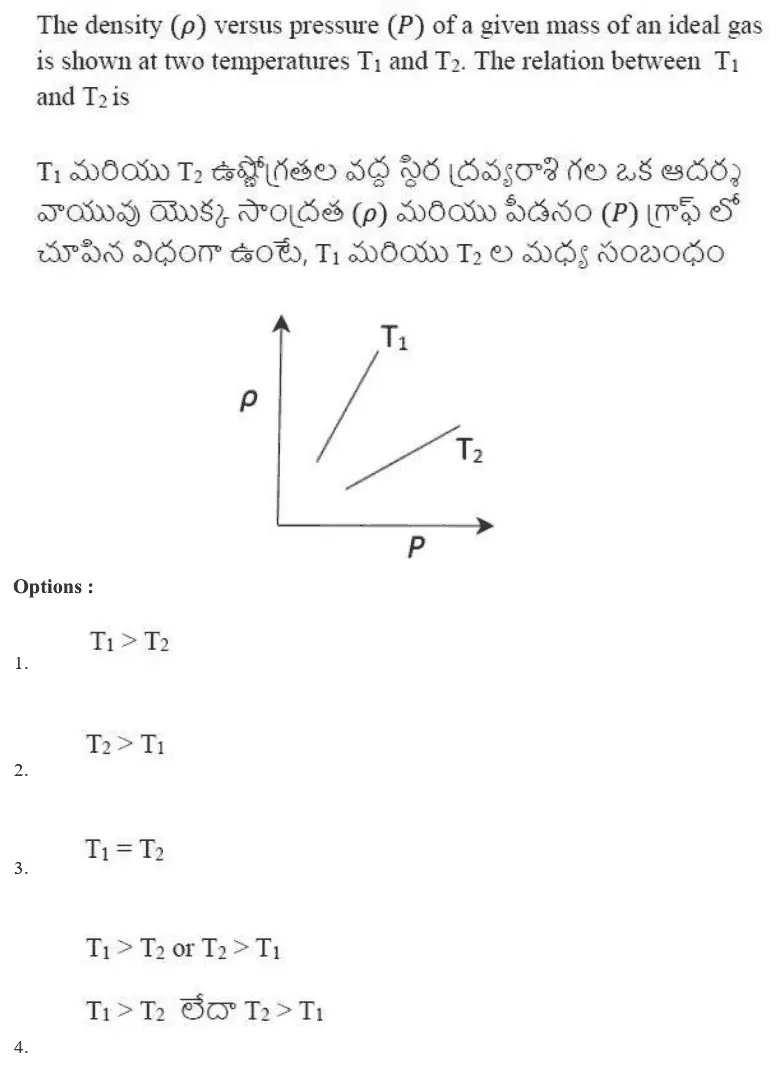
The density ($\rho$) versus pressure ($P$) of a given mass of an ideal gas is shown at two temperatures $T_1$ and $T_2$. The relation between $T_1$ and $T_2$ is

(see the figure above)

The question and its figure as printed in AP EAPCET 2026 15th May 2026 Shift 2.
The question as printed in the paper.
  • A

    $T_1 > T_2$

  • B

    $T_2 > T_1$

  • C

    $T_1 = T_2$

  • D

    $T_1 > T_2$ or $T_2 > T_1$

6AP EAPCET 2026 · 14 May · Shift 1MCQOpen question page ↗

The temperature at which the $rms$ speed of hydrogen molecules is equal to that of oxygen molecules at $47^\circ\mathrm{C}$ is

  • A

    $20\ K$

  • B

    $80\ K$

  • C

    $73\ K$

  • D

    $3\ K$

7AP EAPCET 2026 · 14 May · Shift 2MCQOpen question page ↗

An ideal gas is expanding such that $P^2T$ = constant. The coefficient of volume expansion of the gas is
(P- Pressure, T- temperature of the gas)

  • A

    $\frac{1}{T}$

  • B

    $\frac{2}{T}$

  • C

    $\frac{3}{T}$

  • D

    $\frac{3}{2T}$

8AP EAPCET 2026 · 14 May · Shift 2MCQOpen question page ↗

Two moles of Helium are mixed with ‘n’ moles of Hydrogen. The rms speed of the gas molecules in the mixture is $\sqrt{2}$ times the speed of sound in the mixture. The value of ‘n’ is

  • A

    1

  • B

    3

  • C

    2

  • D

    3/2

9AP EAPCET 2026 · 13 May · Shift 1MCQOpen question page ↗

The rms speed of oxygen molecule at some temperature is $150\ \mathrm{ms^{-1}}$. Then the rms speed of hydrogen molecule at the same temperature is

  • A

    $400\ \mathrm{ms^{-1}}$

  • B

    $600\ \mathrm{ms^{-1}}$

  • C

    $200\ \mathrm{ms^{-1}}$

  • D

    $800\ \mathrm{ms^{-1}}$

10AP EAPCET 2026 · 13 May · Shift 2MCQOpen question page ↗

The Mean free path of a gas molecule, whose diameter is $2 \times 10^{-10}$ m is $1.6 \times 10^{-7}$ m. Calculate the mean free path of another gas molecule whose diameter is $4 \times 10^{-10}$ m (under the same conditions)

  • A

    $0.4 \times 10^{-7}$ m

  • B

    $0.8 \times 10^{-7}$ m

  • C

    $6.4 \times 10^{-7}$ m

  • D

    $1.6 \times 10^{-7}$ m

11AP EAPCET 2026 · 12 May · Shift 1MCQOpen question page ↗

An ideal gas of density '$\rho$' is enclosed in a vessel of volume $V$ at $0^\circ\mathrm{C}$ temperature and $p_0$ atmospheric pressure. If the pressure inside the vessel decreased by $\Delta p$ due to a leakage. The mass of the leaked out gas is

  • A

    $V.\rho.p_0$

  • B

    $V\rho/p_0$

  • C

    $V\Delta\rho/p$

  • D

    $\dfrac{V.\rho.\Delta p}{p_0}$

12AP EAPCET 2026 · 12 May · Shift 1MCQOpen question page ↗

If the ratio of specific heats of a gas is 1.4, then the gas is

  • A

    Monoatomic

  • B

    Diatomic

  • C

    Triatomic

  • D

    Polyatomic

13AP EAPCET 2026 · 12 May · Shift 1MCQOpen question page ↗

A vessel contains a mixture of nitrogen of mass 7 g and carbondioxide of mass 11 g at a temperature 290 K and pressure 1 atm. The density of the mixture is

  • A

    $1.1\ \mathrm{g\,L^{-1}}$

  • B

    $1.2\ \mathrm{g\,L^{-1}}$

  • C

    $1.515\ \mathrm{g\,L^{-1}}$

  • D

    $1.6\ \mathrm{g\,L^{-1}}$

14AP EAPCET 2026 · 12 May · Shift 2MCQOpen question page ↗

If the temperature of 3 moles of helium gas is increased by 2K, then the change in the internal energy of helium gas is

  • A

    70.0 J

  • B

    68.2 J

  • C

    74.8 J

  • D

    78.2 J

15TS EAPCET 2026 · 11 May · Shift 1MCQOpen question page ↗

If the average kinetic energy of the molecules of a gas at a temperature of 30 °C is U, then the temperature at which the average kinetic energy of the molecules of the gas becomes 2U is

  • A

    939 °C

  • B

    303 °C

  • C

    333 °C

  • D

    60 °C

16TS EAPCET 2026 · 11 May · Shift 2MCQOpen question page ↗

An air bubble rises from the bottom of a lake of depth 37 m. The temperature of the lake is constant from the bottom to the top and atmospheric pressure is equal to the pressure 10 m of water column. The percentage increase in the volume of the bubble when it rises from a depth of 20 m to a depth of 15 m is

  • A

    25

  • B

    10

  • C

    20

  • D

    30

17TS EAPCET 2026 · 11 May · Shift 2MCQOpen question page ↗

If the molar specific heat of a rigid diatomic gas at constant pressure is C, then the molar specific heat of a monoatomic gas at constant volume is

  • A

    $\frac{2C}{5}$

  • B

    $\frac{3C}{5}$

  • C

    $\frac{5C}{7}$

  • D

    $\frac{3C}{7}$

18TS EAPCET 2026 · 10 May · Shift 1MCQOpen question page ↗

The ratio of rms speeds of helium gas molecules at a temperature of $127\ ^\circ\mathrm{C}$ and oxygen gas molecules at a temperature of $527\ ^\circ\mathrm{C}$ is
(Molar masses of helium and oxygen gases are 4 and 32 respectively)

  • A

    $\sqrt{2}:1$

  • B

    $4:1$

  • C

    $2:1$

  • D

    $\sqrt{8}:1$

19TS EAPCET 2026 · 10 May · Shift 2MCQOpen question page ↗

The thermodynamic variable on which the average kinetic energy of a gas molecule depends is

  • A

    Temperature

  • B

    Pressure

  • C

    Volume

  • D

    Density

20TS EAPCET 2026 · 9 May · Shift 1MCQOpen question page ↗

A vessel of volume 2000 cc is filled with 5 moles of an ideal gas at a temperature of $127\,^\circ\mathrm{C}$. The total kinetic energy of the gas in the vessel is
(R – Universal gas constant)

  • A

    $6000R$

  • B

    $3000R$

  • C

    $1000R$

  • D

    $1500R$

21TS EAPCET 2026 · 9 May · Shift 2MCQOpen question page ↗

5 moles of monoatomic gas and one mole of rigid diatomic gas are mixed. The internal energy (in kJ) of the gaseous mixture at a temperature of 127 °C is

(Universal gas constant $= 8.31\ \mathrm{J\,mol^{-1}\,K^{-1}}$)

  • A

    66.48

  • B

    49.86

  • C

    16.62

  • D

    33.24

22AP EAPCET 2025 · 27 May · Shift 1MCQOpen question page ↗

If a gaseous mixture consists of 3 moles of oxygen and 4 moles of argon at an absolute temperature T, then the total internal energy of the mixture is (neglect vibrational modes and R - Universal gas constant)

  • A

    11RT

  • B

    12.5RT

  • C

    13.5RT

  • D

    15.5RT

23AP EAPCET 2025 · 26 May · Shift 1MCQOpen question page ↗

To increase the rms speed of gas molecules by 25%, the percentage increase in absolute temperature of the gas is to be

  • A

    42.75

  • B

    56.25

  • C

    36.75

  • D

    18.25

24AP EAPCET 2025 · 26 May · Shift 2MCQOpen question page ↗

If the ratio of universal gas constant and specific heat capacity at constant volume of a gas is given by 0.67, then the gas is

  • A

    monoatomic

  • B

    diatomic

  • C

    polyatomic

  • D

    a mixture of diatomic and polyatomic gases

25AP EAPCET 2025 · 26 May · Shift 2MCQOpen question page ↗

The internal energy of 4 moles of a monoatomic gas at a temperature of 77 °C is

(R - Universal gas constant)

  • A

    $1500R$

  • B

    $1800R$

  • C

    $2100R$

  • D

    $3500R$

26AP EAPCET 2025 · 26 May · Shift 2MCQOpen question page ↗

If the rms speed of the molecules of a diatomic gas at a temperature of 322 K is 2000 m s$^{-1}$, then the gas is

(Universal gas constant = 8.31 J mol$^{-1}$ K$^{-1}$)

  • A

    hydrogen

  • B

    nitrogen

  • C

    oxygen

  • D

    chlorine

27AP EAPCET 2025 · 24 May · Shift 1MCQOpen question page ↗

In a water tank, an air bubble rises from the bottom to the top surface of the water. If the depth of the water in the tank is 7.28 m and atmospheric pressure is 10 m of water, then the ratio of the radii of the bubble at the bottom of the tank and at the top surface of the water is
(Temperature of the water in the tank is constant)

  • A

    2 : 3

  • B

    5 : 6

  • C

    3 : 4

  • D

    4 : 5

28AP EAPCET 2025 · 24 May · Shift 1MCQOpen question page ↗

In a container of volume $16.62\ \mathrm{m^3}$ at $0\ ^\circ\mathrm{C}$ temperature, 2 moles of oxygen, 5 moles of nitrogen and 3 moles of hydrogen are present, then the pressure in the container is
(Universal gas constant = $8.31\ \mathrm{J\ mol^{-1}\ K^{-1}}$)

  • A

    1570 Pa

  • B

    1270 Pa

  • C

    1365 Pa

  • D

    2270 Pa

29AP EAPCET 2025 · 23 May · Shift 1MCQOpen question page ↗

The internal energy of one mole of a rigid diatomic gas at absolute temperature T is

  • A

    $3RT$

  • B

    $\frac{5}{2}RT$

  • C

    $\frac{3}{2}RT$

  • D

    $\frac{1}{2}RT$

30AP EAPCET 2025 · 23 May · Shift 2MCQOpen question page ↗

If the internal energy of 3 moles of a gas at a temperature of $27\ ^\circ\mathrm{C}$ is $2250R$, then the number of degrees of freedom of the gas is
($R$ - Universal gas constant)

  • A

    3

  • B

    5

  • C

    4

  • D

    6

31AP EAPCET 2025 · 22 May · Shift 1MCQOpen question page ↗

If the ratio of specific heats of a gas at constant pressure and at constant volume is $\gamma$, then the number of degrees of freedom of the rigid molecules of the gas is

  • A

    $\frac{3\gamma-1}{2\gamma-1}$

  • B

    $\frac{2}{\gamma-1}$

  • C

    $\frac{9}{2}(\gamma-1)$

  • D

    $\frac{25}{2}(\gamma-1)$

32AP EAPCET 2025 · 22 May · Shift 2MCQOpen question page ↗

If the degrees of freedom of a gas molecule is 6, then the total internal energy of the gas molecule at a temperature of 47 °C (in eV) is

(Boltzmann constant = $1.38 \times 10^{-23}$ J K$^{-1}$)

  • A

    $414 \times 10^{-4}$

  • B

    $828 \times 10^{-4}$

  • C

    $927 \times 10^{-4}$

  • D

    $572 \times 10^{-4}$

33AP EAPCET 2025 · 21 May · Shift 1MCQOpen question page ↗

If 2 moles of an ideal monoatomic gas at a temperature of $27\ ^\circ\mathrm{C}$ is mixed with 4 moles of another ideal monoatomic gas at a temperature of $327\ ^\circ\mathrm{C}$, then the temperature of mixture of the two gases is

  • A

    $300\ ^\circ\mathrm{C}$

  • B

    $227\ ^\circ\mathrm{C}$

  • C

    $233\ ^\circ\mathrm{C}$

  • D

    $327\ ^\circ\mathrm{C}$

34AP EAPCET 2025 · 21 May · Shift 2MCQOpen question page ↗

A gaseous mixture consists of 2 moles of oxygen and 4 moles of argon at an absolute temperature T. Neglecting all vibrational modes, the total internal energy of the mixture of the gases is

  • A

    $4RT$

  • B

    $15RT$

  • C

    $9RT$

  • D

    $11RT$

35AP EAPCET 2025 · 21 May · Shift 2MCQOpen question page ↗

The average translational kinetic energy of the oxygen molecules at a temperature of $127\ ^\circ\mathrm{C}$ is

(Boltzmann constant $= 1.38 \times 10^{-23}\ \mathrm{J\,K^{-1}}$)

  • A

    $4.07 \times 10^{-21}\ \mathrm{J}$

  • B

    $2.07 \times 10^{-21}\ \mathrm{J}$

  • C

    $8.28 \times 10^{-21}\ \mathrm{J}$

  • D

    $8.00 \times 10^{-21}\ \mathrm{J}$

36TS EAPCET 2025 · 4 May · Shift 1MCQOpen question page ↗

If the temperature of a gas is increased from $127\ ^\circ\mathrm{C}$ to $527\ ^\circ\mathrm{C}$, then the rms speed of the gas molecules

  • A

    increases by 4 times

  • B

    becomes $\sqrt{2}$ times

  • C

    becomes half

  • D

    decreases by $\sqrt{2}$ times

37TS EAPCET 2025 · 4 May · Shift 2MCQOpen question page ↗

The ratio of the average translational kinetic energies of hydrogen and oxygen at the same temperature is

  • A

    $1:8$

  • B

    $1:4$

  • C

    $1:1$

  • D

    $1:6$

38TS EAPCET 2025 · 3 May · Shift 1MCQOpen question page ↗

An air bubble rises from the bottom to the top of a water tank in which the temperature of the water is uniform. The surface area of the bubble at the top of the tank is 125% more than its surface area at the bottom of the tank. If the atmospheric pressure is equal to the pressure of 10 m water column, then the depth of water in the tank is

  • A

    16.25 m

  • B

    27 m

  • C

    19 m

  • D

    23.75 m

39TS EAPCET 2025 · 3 May · Shift 1MCQOpen question page ↗

The pressure of a mixture of 64 g of oxygen, 28 g of nitrogen and 132 g of carbon dioxide gases in a closed vessel is P. Under isothermal conditions if entire oxygen is removed from the vessel, the pressure of the mixture of remaining two gases is

  • A

    $P$

  • B

    $\frac{3P}{2}$

  • C

    $\frac{P}{3}$

  • D

    $\frac{2P}{3}$

40TS EAPCET 2025 · 3 May · Shift 2MCQOpen question page ↗

If the rms speed of the molecules of a gas at a temperature of $77\ ^\circ\mathrm{C}$ is $50\,\mathrm{ms^{-1}}$, then the rms speed of the same gas molecules at a temperature of $150.5\ ^\circ\mathrm{C}$ is

  • A

    $65\ \mathrm{ms^{-1}}$

  • B

    $35\ \mathrm{ms^{-1}}$

  • C

    $55\ \mathrm{ms^{-1}}$

  • D

    $45\ \mathrm{ms^{-1}}$

41TS EAPCET 2025 · 2 May · Shift 1MCQOpen question page ↗

The molar specific heat of a monoatomic gas at constant pressure is

(Universal gas constant $=8.3\,\mathrm{J\,mol^{-1}\,K^{-1}}$)

  • A

    $24.9\,\mathrm{J\,mol^{-1}\,K^{-1}}$

  • B

    $20.75\,\mathrm{J\,mol^{-1}\,K^{-1}}$

  • C

    $41.5\,\mathrm{J\,mol^{-1}\,K^{-1}}$

  • D

    $16.6\,\mathrm{J\,mol^{-1}\,K^{-1}}$

42TS EAPCET 2025 · 2 May · Shift 2MCQOpen question page ↗

When the temperature of a gas in a closed vessel is increased by 2.4 °C, its pressure increases by 0.5%. The initial temperature of the gas is

  • A

    120 °C

  • B

    240 °C

  • C

    480 °C

  • D

    207 °C

43TS EAPCET 2025 · 2 May · Shift 2MCQOpen question page ↗

If the heat required to increase the rms speed of 4 moles of a diatomic gas from v to $\sqrt{3}\mathrm{v}$ is 83.1 kJ, then the initial temperature of the gas is

(Universal gas constant $=8.31\,\mathrm{J\,mol^{-1}\,K^{-1}}$)

  • A

    $377\ ^\circ\mathrm{C}$

  • B

    $327\ ^\circ\mathrm{C}$

  • C

    $227\ ^\circ\mathrm{C}$

  • D

    $277\ ^\circ\mathrm{C}$

44AP EAPCET 2024 · 23 May · Shift 1MCQOpen question page ↗

The ratio of the molar specific heat capacities of monatomic and diatomic gases at constant pressure is

  • A

    $1:7$

  • B

    $5:7$

  • C

    $3:7$

  • D

    $2:7$

45AP EAPCET 2024 · 22 May · Shift 1MCQOpen question page ↗

The ratio of kinetic energy of a diatomic gas molecule at a high temperature to that of NTP is

  • A

    $3/2$

  • B

    $5/3$

  • C

    $5/7$

  • D

    $7/5$

46AP EAPCET 2024 · 22 May · Shift 2MCQOpen question page ↗

The total internal energy of 2 moles of a monatomic gas at a temperature $27\,^\circ\mathrm{C}$ is U. The total internal energy of 3 moles of a diatomic gas at a temperature $127\,^\circ\mathrm{C}$ is

  • A

    $U$

  • B

    $\frac{10U}{3}$

  • C

    $2U$

  • D

    $\frac{2U}{3}$

47AP EAPCET 2024 · 21 May · Shift 1MCQOpen question page ↗

A monoatomic gas of $n$-moles is heated from temperature $T_1$ to $T_2$ under two different conditions. (i) at constant volume and (ii) at constant pressure. The change in internal energy of the gas is

  • A

    More when heated at constant volume

  • B

    More when heated at constant pressure

  • C

    Same in both the cases

  • D

    Zero in both the cases

48AP EAPCET 2024 · 21 May · Shift 1MCQOpen question page ↗

A poly atomic gas with $n$ degrees of freedom has a mean kinetic energy per molecule given by (if $N$ is Avogadro's number)

  • A

    $\frac{nKT}{N}$

  • B

    $\frac{nKT}{2N}$

  • C

    $\frac{nKT}{2}$

  • D

    $\frac{3KT}{2}$

49AP EAPCET 2024 · 21 May · Shift 2MCQOpen question page ↗

Match the following ($f$ is number of degrees of freedom)

Gases$\frac{C_P}{C_V}$ value
AMonoatomicI$\frac{4+f}{3+f}$
BDiatomic (rigid)II5/3
CDiatomic (non-rigid)III7/5
DPolyatomicIV9/7
  • A

    A-III, B-IV, C-I, D-II

  • B

    A-II, B-I, C-III, D-IV

  • C

    A-IV, B-III, C-I, D-II

  • D

    A-II, B-III, C-IV, D-I

50AP EAPCET 2024 · 20 May · Shift 1MCQOpen question page ↗

When the temperature of a gas is raised from $27\ ^\circ\mathrm{C}$ to $90\ ^\circ\mathrm{C}$, the increase in the $rms$ velocity of the gas molecules is

  • A

    $10\ \%$

  • B

    $15\ \%$

  • C

    $20\ \%$

  • D

    $17.5\ \%$

51AP EAPCET 2024 · 20 May · Shift 2MCQOpen question page ↗

An ideal gas is kept in a cylinder of volume $3\ \mathrm{m^3}$ at a pressure of $3 \times 10^5\ \mathrm{Pa}$. The energy of the gas is

  • A

    $13.5 \times 10^6\ \mathrm{J}$

  • B

    $1.35 \times 10^5\ \mathrm{J}$

  • C

    $13.5 \times 10^5\ \mathrm{J}$

  • D

    $135 \times 10^6\ \mathrm{J}$

52AP EAPCET 2024 · 19 May · Shift 2MCQOpen question page ↗

One mole of a gas having $\gamma = \frac{7}{5}$ is mixed with one mole of a gas having $\gamma = \frac{4}{3}$. The value of $\gamma$ for the mixture is ($\gamma$ is the ratio of the specific heats of the gas)

  • A

    $\frac{5}{11}$

  • B

    $\frac{11}{15}$

  • C

    $\frac{15}{11}$

  • D

    $\frac{5}{13}$

53AP EAPCET 2024 · 19 May · Shift 2MCQOpen question page ↗

The rms velocity of a gas molecule of mass ‘$m$’ at a given temperature is proportional to

  • A

    $m^{0}$

  • B

    $m$

  • C

    $\sqrt{m}$

  • D

    $1/\sqrt{m}$

54AP EAPCET 2024 · 18 May · Shift 1MCQOpen question page ↗

The molar specific heat capacity of a diatomic gas at constant pressure is C. The molar specific heat capacity of a monoatomic gas at constant volume is

  • A

    $\frac{2C}{7}$

  • B

    $\frac{3C}{7}$

  • C

    $\frac{C}{7}$

  • D

    $\frac{4C}{7}$

55TS EAPCET 2024 · 11 May · Shift 1MCQOpen question page ↗

At a pressure P and temperature $127\ ^\circ\mathrm{C}$, a vessel contains 21 g of a gas. A small hole is made into the vessel so that the gas in it leaks out. At a pressure of $\frac{2P}{3}$ and a temperature of $t\ ^\circ\mathrm{C}$, the mass of the gas leaked out is 5 g. Then $t =$

  • A

    $273\ ^\circ\mathrm{C}$

  • B

    $77\ ^\circ\mathrm{C}$

  • C

    $350\ ^\circ\mathrm{C}$

  • D

    $87\ ^\circ\mathrm{C}$

56TS EAPCET 2024 · 10 May · Shift 1MCQOpen question page ↗

A vessel contains hydrogen and nitrogen gases in the ratio $2:3$ by mass. If the temperature of the mixture of the gases is $30\,^\circ\mathrm{C}$, then the ratio of the average kinetic energies per molecule of hydrogen and nitrogen gases is
(Molecular mass of hydrogen $= 2$ and molecular mass of nitrogen $= 28$)

  • A

    $3:7$

  • B

    $2:3$

  • C

    $1:1$

  • D

    $1:14$

57TS EAPCET 2024 · 10 May · Shift 2MCQOpen question page ↗

The temperature at which the rms speed of oxygen molecules is 75% of rms speed of nitrogen molecules at a temperature of 287 °C is

  • A

    87 °C

  • B

    127 °C

  • C

    227 °C

  • D

    360 °C

58TS EAPCET 2024 · 9 May · Shift 1MCQOpen question page ↗

The total internal energy of 4 moles of a diatomic gas at a temperature of $27\,^\circ\mathrm{C}$ is

(Universal gas constant $= 8.31\ \mathrm{J\ mol^{-1}\ K^{-1}}$)

  • A

    13.47 kJ

  • B

    4.98 kJ

  • C

    24.93 kJ

  • D

    14.96 kJ

59TS EAPCET 2024 · 9 May · Shift 2MCQOpen question page ↗

If the temperature of a gas is increased from $27\ ^\circ\mathrm{C}$ to $159\ ^\circ\mathrm{C}$, the increase in the rms speed of the gas molecules is

  • A

    142%

  • B

    71%

  • C

    80%

  • D

    20%

60AP EAPCET 2023 · 19 May · Shift 1MCQOpen question page ↗

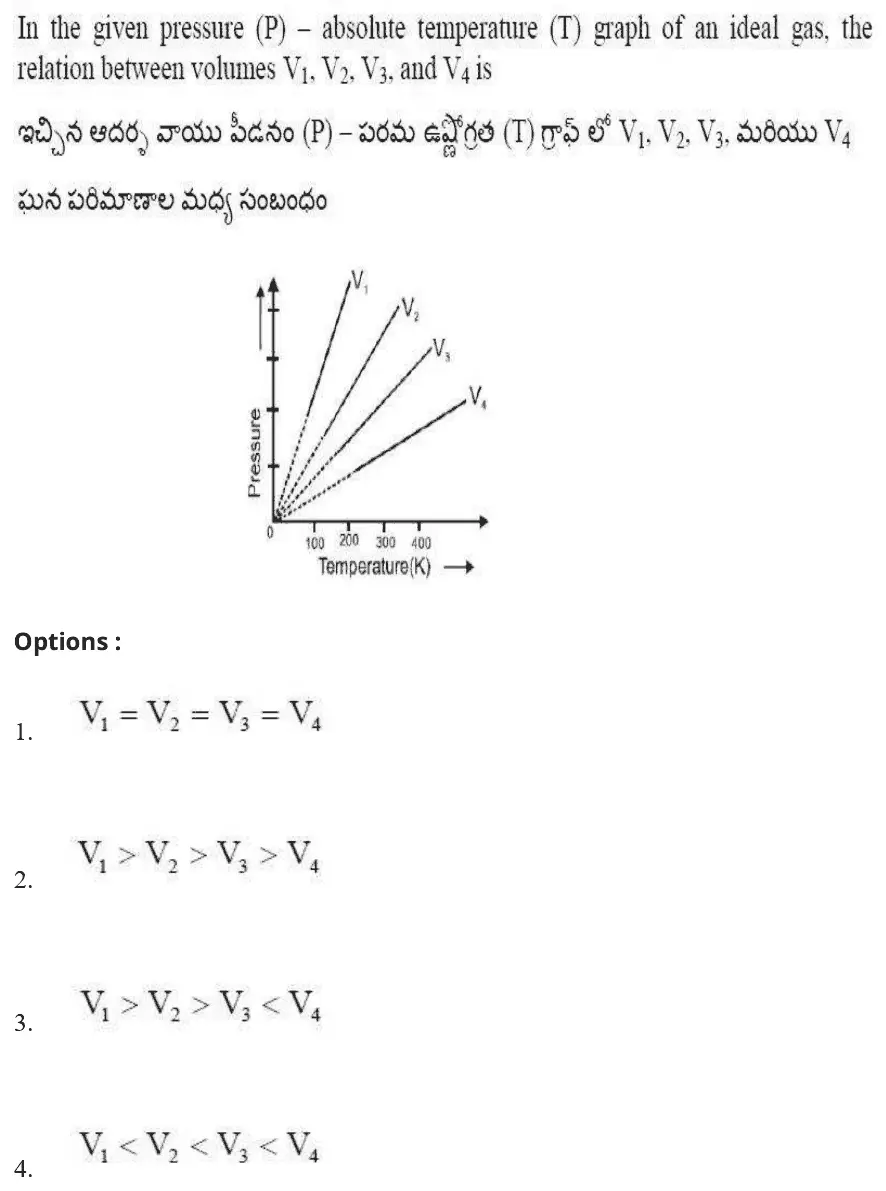
In the given pressure (P) – absolute temperature (T) graph of an ideal gas, the relation between volumes $V_1, V_2, V_3,$ and $V_4$ is

(see the figure above)

The question and its figure as printed in AP EAPCET 2023 19th May 2023 Shift 1.
The question as printed in the paper.
  • A

    $V_1 = V_2 = V_3 = V_4$

  • B

    $V_1 > V_2 > V_3 > V_4$

  • C

    $V_1 > V_2 > V_3 < V_4$

  • D

    $V_1 < V_2 < V_3 < V_4$

61AP EAPCET 2023 · 18 May · Shift 1MCQOpen question page ↗

A mixture of gasses consists of 16 g of Helium and 16 g of Oxygen. The ratio of specific heats of the mixture is nearly

  • A

    1.33

  • B

    1.4

  • C

    1.56

  • D

    1.62

62AP EAPCET 2023 · 18 May · Shift 1MCQOpen question page ↗

If the pressure of a gas increases by 2% at constant volume, then its temperature

  • A

    increases by 2%

  • B

    decreases by 2%

  • C

    does not change

  • D

    decreases by 1%

63AP EAPCET 2023 · 18 May · Shift 2MCQOpen question page ↗

The energy (in eV) possessed by a neon atom at $77\,^\circ\mathrm{C}$ is

(Boltzmann constant, $K_B = 1.38 \times 10^{-23}\ \mathrm{J\,K^{-1}}$)

  • A

    $1.32\times10^{-3}$

  • B

    $3.20\times10^{-4}$

  • C

    $4.52\times10^{-2}$

  • D

    $3.88\times10^{-2}$

64AP EAPCET 2023 · 17 May · Shift 1MCQOpen question page ↗

If the rms speeds of helium and oxygen are equal, then the ratio of the temperatures of helium and oxygen is

  • A

    1:8

  • B

    2:1

  • C

    1:4

  • D

    4:1

65AP EAPCET 2023 · 17 May · Shift 2MCQOpen question page ↗

A vessel that can withstand a pressure of 100 atm is filled with hydrogen at $27\ ^\circ\mathrm{C}$ up to a pressure of 20 atm. If the vessel is heated, then the temperature at which it explodes is

  • A

    $500\ \mathrm{K}$

  • B

    $1000\ \mathrm{K}$

  • C

    $1500\ \mathrm{K}$

  • D

    $2000\ \mathrm{K}$

66AP EAPCET 2023 · 17 May · Shift 2MCQOpen question page ↗

If the average kinetic energy of a gas molecule at $27\,^\circ\mathrm{C}$ is $3.3 \times 10^{-20}$ J, then the average kinetic energy of the gas molecules at $127\,^\circ\mathrm{C}$ is

  • A

    $15\times10^{-20}$ J

  • B

    $0.68\times10^{-20}$ J

  • C

    $4.4\times10^{-20}$ J

  • D

    $10.3\times10^{-21}$ J

67AP EAPCET 2023 · 16 May · Shift 1MCQOpen question page ↗

For the given concentration, if the ratio of the diameters of the molecules of two gases is $1 : 2$, then the ratio of their mean free paths is

  • A

    $4 : 1$

  • B

    $2 : 1$

  • C

    $1 : 1$

  • D

    $1 : 2$

68AP EAPCET 2023 · 16 May · Shift 2MCQOpen question page ↗

The relation between the pressure (P), volume (V) and average kinetic energy (E) of a gas is

  • A

    $P = \frac{E}{2V}$

  • B

    $P = \frac{3E}{2V}$

  • C

    $P = \frac{E}{3V}$

  • D

    $P = \frac{2E}{3V}$

69AP EAPCET 2023 · 15 May · Shift 1MCQOpen question page ↗

A vessel of volume 10 liters is filled with $\mathrm{H_2}$ gas. The total average translational kinetic energy of its molecules is $4.5\times10^{5}$ J. The pressure of hydrogen in the vessel is

  • A

    $3\times10^{6}\ \mathrm{Nm^{-2}}$

  • B

    $30\times10^{6}\ \mathrm{Nm^{-2}}$

  • C

    $30\times10^{4}\ \mathrm{Nm^{-2}}$

  • D

    $3\times10^{4}\ \mathrm{Nm^{-2}}$

70AP EAPCET 2023 · 15 May · Shift 2MCQOpen question page ↗

The specific heat capacity of a monatomic gas at constant volume is x% of its specific heat capacity at constant pressure. Then x =

  • A

    40

  • B

    50

  • C

    60

  • D

    75

72TS EAPCET 2023 · 14 May · Shift 1MCQOpen question page ↗

N molecules each of mass m of gas A and 2N molecules each of mass 2m of gas B are contained in a vessel which is maintained at a temperature T. The mean square velocity of the molecules of gas B is denoted by $V_2^2$ and the mean square of the x-component velocity of the molecules of gas A is denoted by $V_1^2$, then $\frac{V_1}{V_2}$ is

  • A

    2

  • B

    1

  • C

    $\frac{2}{3}$

  • D

    $\sqrt{\frac{2}{3}}$

73TS EAPCET 2023 · 14 May · Shift 2MCQOpen question page ↗

If the temperature of a gas is increased from $27^\circ\mathrm{C}$ to $159^\circ\mathrm{C}$, then the percentage increase in the rms speed of the gas molecules is

  • A

    5

  • B

    10

  • C

    15

  • D

    20

74TS EAPCET 2023 · 13 May · Shift 1MCQOpen question page ↗

Air is filled at 60 °C in a vessel of open mouth. The vessel is heated to a temperature t °C so that $\frac{1}{4}^{\text{th}}$ of the air is escaped from the vessel. Assuming air as ideal gas and the volume of the vessel remaining constant, then the value of ‘t’ is

  • A

    80 °C

  • B

    171 °C

  • C

    333 °C

  • D

    444 °C

75TS EAPCET 2023 · 13 May · Shift 2MCQOpen question page ↗

The average energy possessed by an oscillator at a temperature 300 K is
(Boltzmann constant = $1.38\times10^{-23}\ \mathrm{JK^{-1}}$)

  • A

    $2.14 \times 10^{-2}\ \mathrm{J}$

  • B

    $2.07 \times 10^{-19}\ \mathrm{J}$

  • C

    $4.14 \times 10^{-21}\ \mathrm{J}$

  • D

    $4.6 \times 10^{-21}\ \mathrm{J}$

76TS EAPCET 2023 · 12 May · Shift 1MCQOpen question page ↗

Ratio of translational degrees of freedom to rotational degrees of freedom of a polyatomic linear gas molecule is

  • A

    1:1

  • B

    1:2

  • C

    2:3

  • D

    3:2

77TS EAPCET 2023 · 12 May · Shift 2MCQOpen question page ↗

For a given mass of a gas at constant temperature, the volume and the pressure are V and P respectively. Then the slope of the graph drawn between $\log_e V$ on X-axis and $\log_e P$ on Y-axis is

  • A

    1

  • B

    -1

  • C

    Zero

  • D

    Infinity

78TS EAPCET 2022 · 19 Jul · Shift 1MCQOpen question page ↗

At what temperature, an oxygen molecule has the same r.m.s velocity as the hydrogen molecule has at 20 K?

  • A

    $160$ K

  • B

    $320$ K

  • C

    $293$ K

  • D

    $347$ K

79TS EAPCET 2022 · 19 Jul · Shift 2MCQOpen question page ↗

At what temperature is the root mean square (rms) speed of Neon gas atoms is equal to the rms speed of Helium gas atom at $-33\,^{\circ}$C?
(atomic mass of Ne = 20.2 u, and that of He = 4.0 u)

  • A

    1208 K

  • B

    1210 K

  • C

    1212 K

  • D

    1220 K

80TS EAPCET 2022 · 18 Jul · Shift 1MCQOpen question page ↗

If the root mean square (rms) speed of nitrogen molecules at room temperature is 100 m/s, then the rms speed of Helium molecule at the same temperature is

  • A

    $100\sqrt{7}\ \mathrm{m/s}$

  • B

    $350\ \mathrm{m/s}$

  • C

    $50\sqrt{14}\ \mathrm{m/s}$

  • D

    $100\ \mathrm{m/s}$

81TS EAPCET 2022 · 18 Jul · Shift 2MCQOpen question page ↗

Statement (I) : Gas thermometers are less sensitive than liquid thermometers.
Statement (II) : The ratio of universal gas constant and avagadro’s number is called Boltzman’s constant.
Statement (III) : The density of a given mass of a gas at constant pressure is inversely proportional to its absolute temperature.
The correct option among the following is

  • A

    Statements I, II, III are true.

  • B

    Statements I, II are true, but statement III is false.

  • C

    Statements II, III are true, but statement I is false.

  • D

    Statements I, II, III are false.

82AP EAPCET 2022 · 8 Jul · Shift 1MCQOpen question page ↗

Two boxes are at the same temperature. The first box contains gas with molecular mass $m_1$ and rms speed $v_1$. The second box contains gas with molecular mass $m_2$ and average speed $v_2$. If $v_1 = 1.5\,v_2$, then $\frac{m_1}{m_2}$ is

  • A

    $1.25$

  • B

    $0.74$

  • C

    $0.52$

  • D

    $0.26$

83AP EAPCET 2022 · 8 Jul · Shift 2MCQOpen question page ↗

The temperature at which the r.m.s velocity of a gas triples to its r.m.s. velocity at $0\ ^\circ\mathrm{C}$ is

  • A

    $2184\ \mathrm{K}$

  • B

    $2184\ ^\circ\mathrm{C}$

  • C

    $2100\ ^\circ\mathrm{C}$

  • D

    $2100\ \mathrm{K}$

84AP EAPCET 2022 · 7 Jul · Shift 1MCQOpen question page ↗

A gaseous mixture consists of 4 g oxygen and 4 g of helium. The ratio $\dfrac{C_P}{C_V}$ of mixture is ($C_P$ and $C_V$ are molar specific heats of the mixture at constant pressure and at constant volume respectively).

  • A

    $\dfrac{29}{13}$

  • B

    $\dfrac{47}{18}$

  • C

    $\dfrac{47}{29}$

  • D

    $\dfrac{18}{13}$

85AP EAPCET 2022 · 7 Jul · Shift 1MCQOpen question page ↗

The volume of a gas at $30\ {}^\circ$C temperature and 760 mm of Hg pressure is 100 cc. Then its volume at the same temperature and 400 mm of Hg is

  • A

    $190$ cc

  • B

    $210$ cc

  • C

    $150$ cc

  • D

    $120$ cc

86AP EAPCET 2022 · 7 Jul · Shift 2MCQOpen question page ↗

A vessel contains 3 moles of He, 1 mole of Ar, 5 moles of $\mathrm{N_2}$ and 3 moles of $\mathrm{H_2}$. If the vibrational modes are ignored, the total internal energy of the system of gases is

  • A

    20 RT

  • B

    26 RT

  • C

    25 RT

  • D

    30 RT

87AP EAPCET 2022 · 6 Jul · Shift 2MCQOpen question page ↗

A container of 10 L is filled with an ideal gas at a temperature of $27\ ^\circ$C at a pressure 12 atm. The volume of the container is reduced to 6 L and the temperature of the gas in increased by $30\ ^\circ$C, then the final pressure of the gas is

  • A

    $22\ \mathrm{atm}$

  • B

    $20\ \mathrm{atm}$

  • C

    $11\ \mathrm{atm}$

  • D

    $9\ \mathrm{atm}$

88AP EAPCET 2022 · 6 Jul · Shift 2MCQOpen question page ↗

Assertion (A) : When an ideal gas is compressed adiabatically its temperature and the average kinetic energy of the gas molecules increase.
Reason (R) : The kinetic energy increases because of collisions of molecules with moving parts of wall only.

  • A

    (A) and (R) are true and (R) is correct explanation of (A)

  • B

    (A) and (R) are true but (R) is not correct explanation of (A)

  • C

    (A) is true and (R) is false

  • D

    (A) is false and (R) is true

90AP EAPCET 2022 · 5 Jul · Shift 2MCQOpen question page ↗

The rms speed of oxygen and room temperature is about $500\ \mathrm{ms^{-1}}$. The rms speed of hydrogen at the same temperature is about

  • A

    $125\ \mathrm{m\,s^{-1}}$

  • B

    $2000\ \mathrm{m\,s^{-1}}$

  • C

    $8000\ \mathrm{m\,s^{-1}}$

  • D

    $500\ \mathrm{m\,s^{-1}}$

92AP EAPCET 2022 · 4 Jul · Shift 2MCQOpen question page ↗

In non-rigid diatomic molecule with an additional vibrational mode

  • A

    $81C_v^2=49C_P^2$

  • B

    $49C_v^2=25C_P^2$

  • C

    $49C_v^2=81C_P^2$

  • D

    $25C_v^2=49C_P^2$

93AP EAMCET 2021 · 5 Oct · Shift 1MCQOpen question page ↗

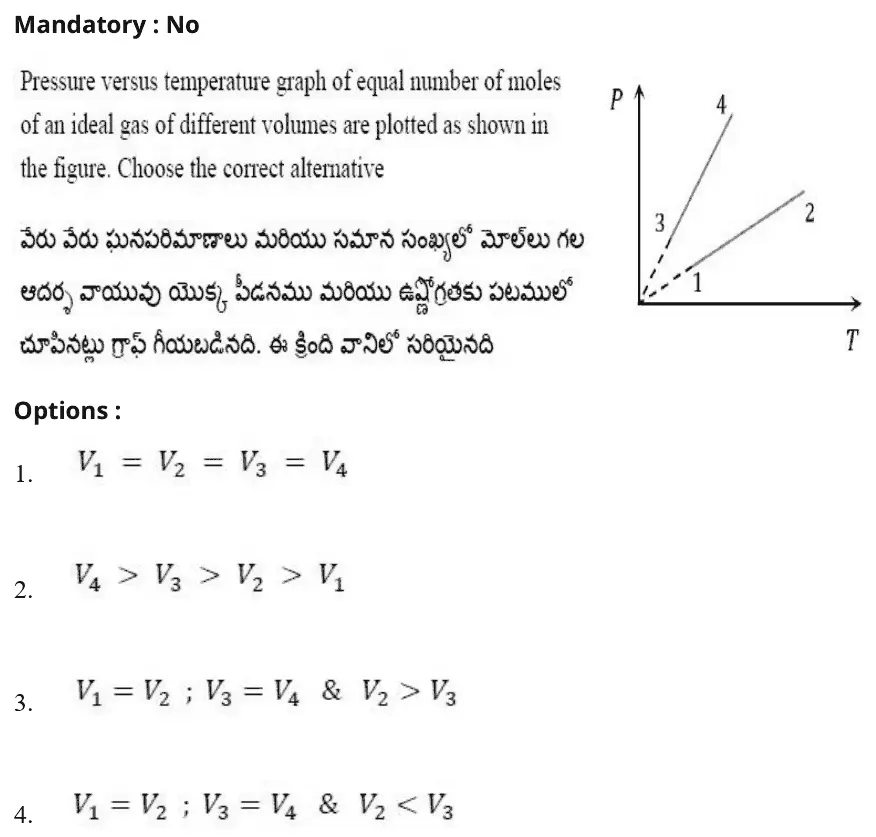
Pressure versus temperature graph of equal number of moles of an ideal gas of different volumes are plotted as shown in the figure. Choose the correct alternative
(see the figure above)

The question and its figure as printed in AP EAPCET 2021 5th Oct 2021 Shift 1.
The question as printed in the paper.
  • A

    $V_1 = V_2 = V_3 = V_4$

  • B

    $V_4 > V_3 > V_2 > V_1$

  • C

    $V_1 = V_2 ;\ V_3 = V_4\ \&\ V_2 > V_3$

  • D

    $V_1 = V_2 ;\ V_3 = V_4\ \&\ V_2 < V_3$

94AP EAMCET 2021 · 25 Aug · Shift 2MCQOpen question page ↗

A vessel has $6\,\mathrm{g}$ of oxygen at pressure 'P' and temperature $400\,\mathrm{K}$. A small hole is made in it so that oxygen leaks out. How much oxygen has leaked out if the final pressure is $\frac{P}{2}$ and final temperature is $300\,\mathrm{K}$ ?

  • A

    $5\,\mathrm{g}$

  • B

    $4\,\mathrm{g}$

  • C

    $2\,\mathrm{g}$

  • D

    $3\,\mathrm{g}$

95AP EAMCET 2021 · 24 Aug · Shift 1MCQOpen question page ↗

If $\alpha$ and $\beta$ be the volume and pressure coefficients respectively of an ideal gas, then

  • A

    $\alpha = \beta$

  • B

    $\alpha > \beta$

  • C

    $2\alpha = \beta$

  • D

    $\alpha < \beta$

97AP EAMCET 2021 · 23 Aug · Shift 1MCQOpen question page ↗

The respective speeds of the five molecules are $1, 2, 3, 4$ and $5\ \mathrm{km.s^{-1}}$. Then the ratio of their RMS velocity and the average velocity will be ______

  • A

    $\sqrt{11} : 3$

  • B

    $3 : \sqrt{11}$

  • C

    $1 : 2$

  • D

    $3 : 4$

98AP EAMCET 2021 · 23 Aug · Shift 2MCQOpen question page ↗

One mole of a gas at a pressure 2 $Pa$ and temperature 27 $^\circ$C is heated till both pressure and volume are doubled. What is the temperature of the gas?

  • A

    300 $K$

  • B

    600 $K$

  • C

    900 $K$

  • D

    1200 $K$

99AP EAMCET 2021 · 20 Aug · Shift 1MCQOpen question page ↗

The pressure of a gas is proportional to

  • A

    The sum of kinetic and potential energies

  • B

    Potential energy

  • C

    Kinetic energy

  • D

    None of the above

100AP EAMCET 2021 · 20 Aug · Shift 2MCQOpen question page ↗

When the temperature of an ideal gas is increased from $27\ ^\circ\mathrm{C}$ to $127\ ^\circ\mathrm{C}$, calculate the percentage increase in its $\mathrm{v}_{rms}$.

  • A

    $37\ \%$

  • B

    $11\ \%$

  • C

    $33\ \%$

  • D

    $15.5\ \%$

101AP EAMCET 2021 · 19 Aug · Shift 1MCQOpen question page ↗

A balloon contains $1500\ m^3$ of $He$ at $27\ ^\circ$C and 4 atmospheric pressure. the volume of $He$ at $-3\ ^\circ$C temperature and 2 atmospheric pressure will be ______

  • A

    $1500\ m^3$

  • B

    $1700\ m^3$

  • C

    $1900\ m^3$

  • D

    $2700\ m^3$

102AP EAMCET 2021 · 19 Aug · Shift 2MCQOpen question page ↗

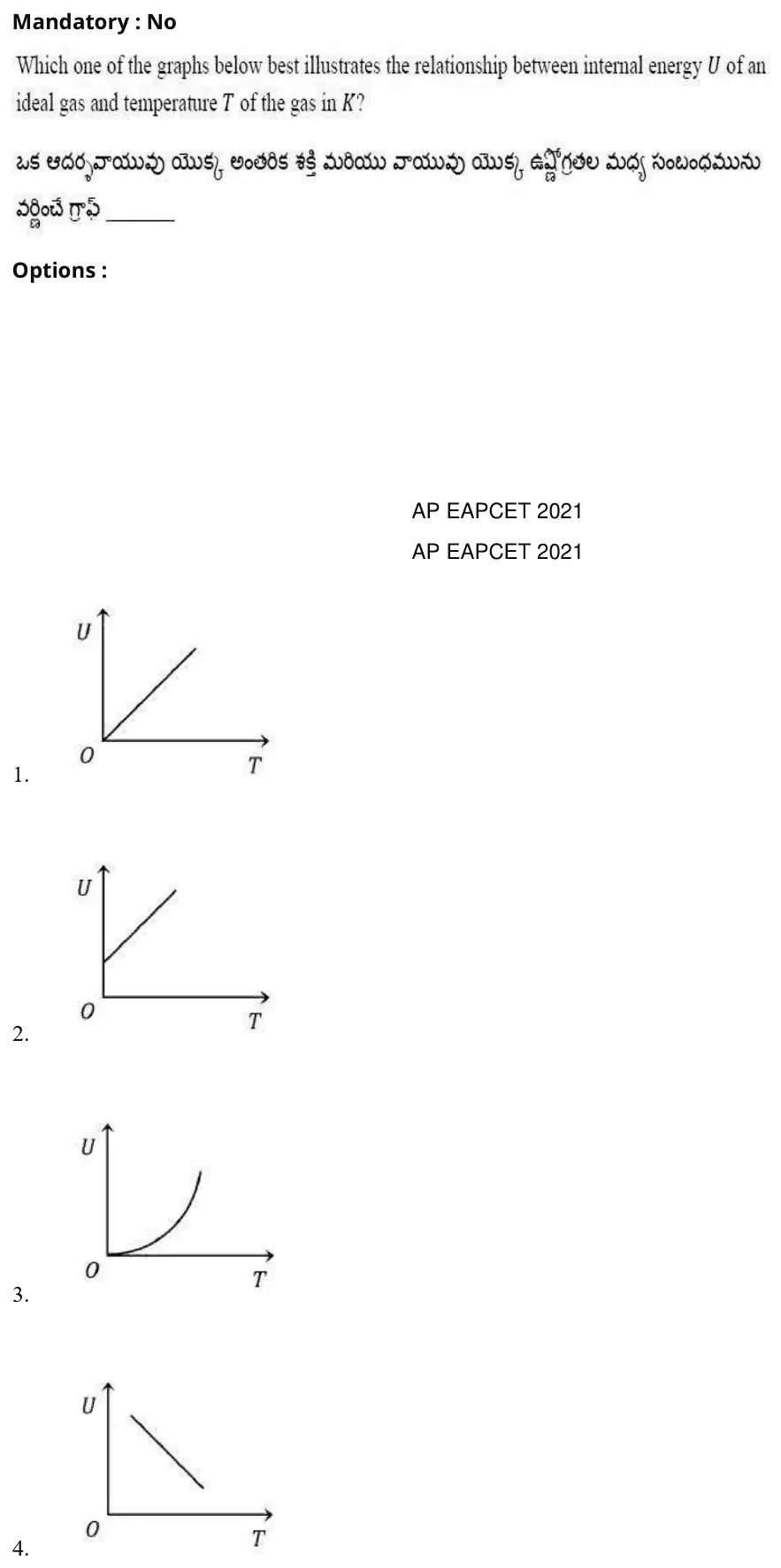
Which one of the graphs below best illustrates the relationship between internal energy $U$ of an ideal gas and temperature $T$ of the gas in $K$?

The question and its figure as printed in AP EAPCET 2021 19th Aug 2021 Shift 2. Option 1: U vs T: straight line rising from the origin Option 2: U vs T: straight line rising, starting from a positive U-intercept above the origin Option 3: U vs T: curve from the origin, concave up (rising increasingly steeply) Option 4: U vs T: straight line falling with T, starting above the axis
The question as printed in the paper.
  • A

    see figure U vs T: straight line rising from the origin

  • B

    see figure U vs T: straight line rising, starting from a positive U-intercept above the origin

  • C

    see figure U vs T: curve from the origin, concave up (rising increasingly steeply)

  • D

    see figure U vs T: straight line falling with T, starting above the axis

103AP EAMCET 2021 · 19 Aug · Shift 2MCQOpen question page ↗

A vessel has $6\ \mathrm{g}$ of oxygen at pressure $P$ and temperature $400\ \mathrm{K}$. A small hole is made in it so that oxygen leaks out. How much oxygen leaks out if the final pressure is $\dfrac{P}{2}$ and temperature is $300\ \mathrm{K}$?

  • A

    $5\ \mathrm{g}$

  • B

    $4\ \mathrm{g}$

  • C

    $2\ \mathrm{g}$

  • D

    $3\ \mathrm{g}$

104TS EAMCET 2021 · 6 Aug · Shift 1MCQOpen question page ↗

A molecule is travelling in air at 300 K and 1 atm, and the radius of the molecule is $0.6\times10^{-10}$ m. Calculate the approx. mean free path of the molecule. (the number density is $2.44\times10^{25}$ molecules / $m^3$)

  • A

    $\frac{0.2}{\pi}\times10^{-5}$ m

  • B

    $\frac{0.3}{\pi}\times10^{-5}$ m

  • C

    $\frac{0.4}{\pi}\times10^{-5}$ m

  • D

    $\frac{0.1}{\pi}\times10^{-5}$ m

105TS EAMCET 2021 · 6 Aug · Shift 2MCQOpen question page ↗

A cylinder consists of a gas mixture of Helium and Oxygen. If the mass of Helium is $4\ \mathrm{gm}$ and the mass of oxygen is $32\ \mathrm{gm}$, then the ratio of specific heat of the mixture $(C_p/C_v)$

  • A

    $2/3$

  • B

    $3/2$

  • C

    $1/2$

  • D

    $1/3$

106TS EAMCET 2021 · 6 Aug · Shift 2MCQOpen question page ↗

The temperature at which the r.m.s speed of molecules in hydrogen gas will be double of its initial value at $27^\circ\mathrm{C}$ is

  • A

    $300^\circ\mathrm{C}$

  • B

    $1473^\circ\mathrm{C}$

  • C

    $927^\circ\mathrm{C}$

  • D

    $546^\circ\mathrm{C}$

107TS EAMCET 2021 · 5 Aug · Shift 1MCQOpen question page ↗

Consider an ideal gas in a closed container at 300 K. The container is then heated so that the average velocity of a particles of the gas increases by a factor of 4. What would be the final temperature?

  • A

    $4500\ ^\circ\mathrm{C}$

  • B

    $4527\ ^\circ\mathrm{C}$

  • C

    $4617\ ^\circ\mathrm{C}$

  • D

    $4600\ ^\circ\mathrm{C}$

108TS EAMCET 2021 · 5 Aug · Shift 1MCQOpen question page ↗

The mean free path for a gas at temperature 300 K and pressure 600 torr is $10^{-7}$ m. The mean free path of the gas at a temperature 400 K and pressure 200 torr will be

  • A

    $2.5\times10^{-8}$ m

  • B

    $4.4\times10^{-8}$ m

  • C

    $3.3\times10^{-8}$ m

  • D

    $4\times10^{-7}$ m

109TS EAMCET 2021 · 5 Aug · Shift 2MCQOpen question page ↗

Two non-reactive monoatomic ideal gases have their atomic masses in the ratio 3 : 4. The ratio of their partial pressures when enclosed in a vessel kept at a constant temperature is 2 : 3. The ratio of their densities is

  • A

    1.1

  • B

    2.0

  • C

    0.9

  • D

    0.5

110TS EAMCET 2021 · 4 Aug · Shift 1MCQOpen question page ↗

As per kinetic theory of gases which of the following statements is / are true?
a) Temperature of a gas is a measure of average kinetic energy of a molecule
b) Temperature of a gas depends on the nature of the gas
c) Heavier molecule has lower average speed
d) Lighter molecule has lower average speed

  • A

    a & b are true

  • B

    b & c are true

  • C

    a & c are true

  • D

    b & d are true

111AP EAMCET 2020 · 7 Oct · Shift 1MCQOpen question page ↗

If the $rms$ velocity of a perfect gas at $27\ ^\circ$C is $500\ m.s^{-1}$, the same at $927\ ^\circ$C will be ______

  • A

    $5000\ m.s^{-1}$

  • B

    $2000\ m.s^{-1}$

  • C

    $1000\ m.s^{-1}$

  • D

    $3000\ m.s^{-1}$

112AP EAMCET 2020 · 22 Sep · Shift 1MCQOpen question page ↗

Pressure of a gas of constant volume at $20\,^\circ\mathrm{C}$ is $90\ \mathrm{cm}$ of Hg. At what temperature the pressure would change to $75\ \mathrm{cm}$ of Hg.

  • A

    $233.2\,^\circ\mathrm{C}$

  • B

    $-28.8\,^\circ\mathrm{C}$

  • C

    $-24.2\,^\circ\mathrm{C}$

  • D

    $28.8\,^\circ\mathrm{C}$

113AP EAMCET 2020 · 22 Sep · Shift 1MCQOpen question page ↗

A light container having a diatomic gas enclosed with in is moving with velocity 'V'. Mass of the gas is 'M' and number of moles is 'n'. The kinetic energy of gas w.r.t ground is

  • A

    $\frac{1}{2}MV^2 + \frac{3}{2}nRT$

  • B

    $\frac{1}{2}MV^2$

  • C

    $\frac{1}{2}MV^2 + \frac{5}{2}nRT$

  • D

    $\frac{5}{2}nRT$

114AP EAMCET 2020 · 21 Sep · Shift 2MCQOpen question page ↗

The ratio of the adiabatic to isothermal elasticities of a triatomic (non - linear) gas is ______

  • A

    $3:4$

  • B

    $1:2$

  • C

    $4:3$

  • D

    $5:3$

115AP EAMCET 2020 · 21 Sep · Shift 2MCQOpen question page ↗

A vessel contains mixture of hydrogen and oxygen gasses in the ratio of their masses equal to $1:5$. The ratio of mean kinetic energies of the two gasses is:

  • A

    $1:1$

  • B

    $1:16$

  • C

    $16:5$

  • D

    $5:16$

116AP EAMCET 2020 · 18 Sep · Shift 1MCQOpen question page ↗

The average kinetic energy of $\mathrm{H_2}$ molecules at $300\,\mathrm{K}$ is $E$. At the same temperature the average kinetic energy of $\mathrm{O_2}$ molecule is

  • A

    $E$

  • B

    $\frac{E}{4}$

  • C

    $\frac{E}{16}$

  • D

    $16E$

117AP EAMCET 2020 · 17 Sep · Shift 1MCQOpen question page ↗

A gas volume $251\ cm^3$ at $20\ °C$ and pressure 78 $cm$ of Hg. Find its volume at N.T.P.

  • A

    $420\ cm^3$

  • B

    $440\ cm^3$

  • C

    $240\ cm^3$

  • D

    $100\ cm^3$

118AP EAMCET 2020 · 17 Sep · Shift 2MCQOpen question page ↗

Two vessels A and B contain oxygen. The volume of B is twice that of A, the pressure of B is thrice that of A and the temperature of B is half of that of A. Then find the ratio of number of molecules of oxygen in vessels A and B.

  • A

    $1:3$

  • B

    $1:12$

  • C

    $3:4$

  • D

    $1:6$

119AP EAMCET 2020 · 17 Sep · Shift 2MCQOpen question page ↗

The ratio of specific heats at constant pressure and at constant volume is '$\gamma$'. To find out the degree of freedom, the expression is ______

  • A

    $f = \dfrac{2}{\gamma-1}$

  • B

    $f = \dfrac{\gamma+1}{2}$

  • C

    $f = \dfrac{2}{\gamma+1}$

  • D

    $f = \dfrac{1}{\gamma+1}$

120TS EAMCET 2020 · 14 Sep · Shift 1MCQOpen question page ↗

Mean free path of molecules in a polyatomic gas is independent of

  • A

    number density of the molecules

  • B

    volume of the molecule

  • C

    Temperature of the gas

  • D

    Gas constant R

121TS EAMCET 2020 · 14 Sep · Shift 2MCQOpen question page ↗

All gases deviate from gas laws at

  • A

    Low pressure and high temperature

  • B

    High pressure and low temperature

  • C

    Low pressure and low temperature

  • D

    High pressure and high temperature

122TS EAMCET 2020 · 11 Sep · Shift 1MCQOpen question page ↗

An ideal gas at temperature T, pressure P occupies a volume V. If its temperature is halved and pressure doubled, what is its new volume?

  • A

    $\dfrac{V}{4}$

  • B

    $\dfrac{V}{2}$

  • C

    V

  • D

    2V

123TS EAMCET 2020 · 10 Sep · Shift 1MCQOpen question page ↗

If a gas has $n$ degrees of freedom, then the ratio of $\frac{C_p}{C_v}$ is

  • A

    $\frac{n+2}{n}$

  • B

    $\frac{2n+1}{n}$

  • C

    $\frac{n+2}{2n}$

  • D

    $\frac{n+4}{2n}$

125TS EAMCET 2020 · 9 Sep · Shift 1MCQOpen question page ↗

Two vessels separately contain two ideal gases A and B at the same temperature. The pressure of gas A is three times the pressure of gas B. Under these conditions, the density of gas A is found to be two times the density of B. The ratio of molecular weights of gas A and B, i.e. $\frac{M_A}{M_B}$ is

  • A

    $\frac{2}{3}$

  • B

    $\frac{3}{2}$

  • C

    $\frac{3}{4}$

  • D

    $\frac{4}{3}$

126TS EAMCET 2020 · 9 Sep · Shift 2MCQOpen question page ↗

In an ideal gas if the masses of all molecules are doubled and their speeds are halved, then the ratio of initial and final pressures of the gas is

  • A

    2:1

  • B

    1:2

  • C

    4:1

  • D

    1:4

127TS EAMCET 2019 · 6 May · Shift 1MCQOpen question page ↗

Consider an ideal gas at pressure P, volume V and temperature T. The mean free path for molecules of the gas is L. If the radius of gas molecules, as well as pressure, volume and temperature of the gas are doubled, then the mean free path will be

  • A

    $\frac{5L}{2}$

  • B

    $\frac{L}{4}$

  • C

    $\frac{L}{8}$

  • D

    $2L$

128TS EAMCET 2019 · 4 May · Shift 1MCQOpen question page ↗

An ideal gas in a closed container is heated so that the final rms speed of the gas particles increases by 2 times the initial rms speed. If the initial gas temperature is 27 °C, then the final temperature of the ideal gas is

  • A

    $1200\ ^\circ\mathrm{C}$

  • B

    $927\ ^\circ\mathrm{C}$

  • C

    $827\ ^\circ\mathrm{C}$

  • D

    $1473\ ^\circ\mathrm{C}$

129TS EAMCET 2019 · 4 May · Shift 2MCQOpen question page ↗

A vessel of volume $V$ contains ideal gas having mass density $\rho$ at temperature $T$ and pressure $P$. After a portion of the gas is let out, the pressure in the vessel is decreased by $\Delta P$. The mass of the released gas is

  • A

    $\rho V\,\Delta P/P$

  • B

    $\frac{\Delta P}{P}$

  • C

    $\frac{\rho}{P}$

  • D

    $(\rho V)^2\,\Delta P/P$

130TS EAMCET 2019 · 4 May · Shift 2MCQOpen question page ↗

A thermally insulated vessel containing monoatomic gas is moving with a speed of 30 m/s. If the vessel suddenly stops, the increase in gas temperature is (Molar mass of gas $= 83$ g/mol and $R = 8.3$ J/K-mol)

  • A

    1 K

  • B

    3 K

  • C

    4 K

  • D

    6 K

131TS EAMCET 2019 · 3 May · Shift 1MCQOpen question page ↗

Two gases A and B are contained in two separate, but otherwise identical containers. Gas A consists of monoatomic molecules, each with atomic mass of 4 $u$ whereas, Gas B consists of rigid diatomic molecules, each with atomic mass of 20 $u$. If Gas A is kept at 27 $^\circ$C, at what temperature should Gas B be kept so that both have the same r.m.s. speed?

  • A

    27 $^\circ$C

  • B

    54 $^\circ$C

  • C

    270 $^\circ$C

  • D

    627 $^\circ$C

132TS EAMCET 2019 · 3 May · Shift 2MCQOpen question page ↗

An ideal gas is placed in a tank at $27\ ^\circ\mathrm{C}$. The pressure is initially 600 kPa. One fourth of the gas is then released from the tank and thermal equilibrium is established. What will be the pressure if the temperature is $327\ ^\circ\mathrm{C}$?

  • A

    900 kPa

  • B

    1000 kPa

  • C

    1050 kPa

  • D

    1250 kPa

133AP EAMCET 2019 · 23 Apr · Shift 1MCQOpen question page ↗

Three closed vessels A, B and C are at the same temperature 'T' and contain gases. Vessel A contains only $\mathrm{O_2}$, B contains only $\mathrm{N_2}$ and C contains a mixture of equal quantities of $\mathrm{O_2}$ and $\mathrm{N_2}$. If the rms speed of $\mathrm{O_2}$ molecules in vessel 'A' is $v_1$ and that of $\mathrm{N_2}$ molecules in vessel 'B' is $v_2$ then the rms speed of $\mathrm{O_2}$ molecules in vessel 'C' is

  • A

    $\left(\frac{v_1+v_2}{2}\right)$

  • B

    $v_1$

  • C

    $(v_1v_2)^{\frac{1}{2}}$

  • D

    $\frac{v_1}{2}$

134AP EAMCET 2019 · 22 Apr · Shift 1MCQOpen question page ↗

Under standard conditions, the density of a gas is $\dfrac{1400}{1089}\ \mathrm{kg\,m^{-3}}$ and the speed of sound propagation in it is $330\ \mathrm{ms^{-1}}$, then the number of degrees of freedom of the gas molecules is

  • A

    2

  • B

    7

  • C

    5

  • D

    3

135AP EAMCET 2019 · 22 Apr · Shift 2MCQOpen question page ↗

The y-components of velocities of the molecules of a gas are $-7, -6, -5, -4, -3, -2, -1, 0, +1, +2, +3, +4, +5, +6, +7\ \mathrm{ms^{-1}}$ then the rms velocity is

  • A

    $\sqrt{\frac{56}{3}}\ \mathrm{ms^{-1}}$

  • B

    $\sqrt{\frac{28}{3}}\ \mathrm{ms^{-1}}$

  • C

    $\sqrt{\frac{112}{3}}\ \mathrm{ms^{-1}}$

  • D

    $\sqrt{\frac{84}{3}}\ \mathrm{ms^{-1}}$

136AP EAMCET 2019 · 21 Apr · Shift 1MCQOpen question page ↗

At a temperature of 314 K and a pressure of 100 kPa, the speed of sound in a gas is $1380\,\mathrm{ms^{-1}}$. The radius of each gas molecule is 0.5 Å. The frequency of sound at which the wavelength of sound wave in the gas becomes equal to the mean free path of the gas molecules is (Boltzmann Constant = $1.38 \times 10^{-23}\,\mathrm{JK^{-1}}$)

  • A

    1000 MHz

  • B

    $1000\sqrt{2}$ MHz

  • C

    $\frac{1000}{\sqrt{2}}$ MHz

  • D

    500 MHz

137AP EAMCET 2019 · 21 Apr · Shift 2MCQOpen question page ↗

The amount of heat that must be supplied to 35 g of oxygen at room temperature to raise its temperature by $80\ ^\circ\mathrm{C}$ at constant volume is
(molecular mass of oxygen is 32 and $\mathrm{R} = 8.3\ \mathrm{J\,mol^{-1}\,K^{-1}}$)

  • A

    2.84 kJ

  • B

    1.68 kJ

  • C

    1.81 kJ

  • D

    2.88 kJ

138AP EAMCET 2019 · 21 Apr · Shift 2MCQOpen question page ↗

For a gas the value of $\frac{R}{C_v} = 0.4$, so the gas is
(R - Universal gas constant)

  • A

    monoatomic

  • B

    diatomic

  • C

    triatomic

  • D

    polyatomic

139AP EAMCET 2019 · 20 Apr · Shift 1MCQOpen question page ↗

The average translational kinetic energy of a molecule in a gas becomes equal to 0.69 eV at a temperature about
[Boltzmann constant $= 1.38 \times 10^{-23}\ \mathrm{J\,K^{-1}}$]

  • A

    $3370\ ^\circ\mathrm{C}$

  • B

    $3388\ ^\circ\mathrm{C}$

  • C

    $5333\ ^\circ\mathrm{C}$

  • D

    $5060\ ^\circ\mathrm{C}$

140AP EAMCET 2019 · 20 Apr · Shift 2MCQOpen question page ↗

If the speed of sound in a mixture of 2 moles of Helium and 2 moles of Hydrogen at temperature $\frac{972}{5}\ \mathrm{K}$ is $\mathrm{n}\times100\ \mathrm{ms^{-1}}$, then the value of n is (Take $\mathrm{R} = \frac{25}{3}\ \mathrm{Jmol^{-1}K^{-1}}$)

  • A

    $9$

  • B

    $10$

  • C

    $100$

  • D

    $90$

141TS EAMCET 2018 · 7 May · Shift 1MCQOpen question page ↗

A vessel of volume $V$ contains a mixture of ideal gases at temperature $T$. The gas mixture contains $n_1$, $n_2$ and $n_3$ moles of three gases. Assuming ideal gas system, the pressure of the mixture is

  • A

    $\frac{(n_1+n_2+n_3)RT}{V}$

  • B

    $\frac{(n_1 n_2 n_3)RT}{V}$

  • C

    $\frac{RT}{V(n_1+n_2+n_3)}$

  • D

    $\frac{RT}{V(n_1 n_2 n_3)}$

142TS EAMCET 2018 · 7 May · Shift 1MCQOpen question page ↗

A polyatomic gas has $f$ vibrational degrees of freedom. The ratio of the specific heat at constant pressure to that at constant volume will be

  • A

    $\frac{4+f}{3+f}$

  • B

    $\frac{4-f}{3-f}$

  • C

    $\frac{3+f}{4+f}$

  • D

    $\frac{3-f}{4-f}$

143TS EAMCET 2018 · 5 May · Shift 1MCQOpen question page ↗

A gas mixture contains $n_1$ moles of a monoatomic gas and $n_2$ moles of gas of rigid diatomic molecules. Each molecule in monoatomic and diatomic gas has 3 and 5 degrees of freedom respectively. If the adiabatic exponent $\left(\dfrac{C_p}{C_v}\right)$ for this gas mixture is 1.5, then the ratio $\dfrac{n_1}{n_2}$ will be

  • A

    1

  • B

    1.5

  • C

    2

  • D

    2.5

144TS EAMCET 2018 · 5 May · Shift 2MCQOpen question page ↗

The root mean square (rms) velocity of an ideal gas at a temperature $T$ is v. If the temperature is increased to $4T$, the rms velocity of the gas is

  • A

    $\sqrt{3}\ \mathrm{v}$

  • B

    $\sqrt{2}\ \mathrm{v}$

  • C

    $2\ \mathrm{v}$

  • D

    $3\ \mathrm{v}$

145TS EAMCET 2018 · 4 May · Shift 1MCQOpen question page ↗

The internal energy of the air, in a room of volume $V$, at temperature $T$ and with outside pressure $P$ increasing linearly with time, varies as

  • A

    increases linearly

  • B

    increases exponentially

  • C

    decreases linearly

  • D

    remains constant

146TS EAMCET 2018 · 4 May · Shift 2MCQOpen question page ↗

In a cubic container of inner side length 10 cm, nitrogen gas of 100 kPa pressure is maintained at 300 K. If the pressure inside the gas is increased to 300 kPa by adding oxygen gas, the ratio of number of $\mathrm{N_2}$ to $\mathrm{O_2}$ molecules in the container is

  • A

    0.5

  • B

    3.0

  • C

    1.5

  • D

    0.33

147AP EAMCET 2018 · 24 Apr · Shift 1MCQOpen question page ↗

The ratio of the speed of sound in a monatomic gas at $27\,^\circ\mathrm{C}$ and rms speed of the molecules of the same gas at a temperature of $127\,^\circ\mathrm{C}$ is ________

  • A

    $1 : 2$

  • B

    $\sqrt{5} : \sqrt{12}$

  • C

    $3 : 4$

  • D

    $\sqrt{13} : \sqrt{17}$

148AP EAMCET 2018 · 24 Apr · Shift 2MCQOpen question page ↗

A gaseous mixture has 2 moles of oxygen and 4 moles of Argon at a temperature T. Neglecting all vibrational modes of the molecules, the total internal energy of the system is ______
(R-Universal gas constant)

  • A

    $4RT$

  • B

    $15RT$

  • C

    $9RT$

  • D

    $11RT$

149AP EAMCET 2018 · 23 Apr · Shift 1MCQOpen question page ↗

Tyre of a bicycle has volume $2\times10^{-3}\ \mathrm{m^3}$. Initially the tube is filled 75% of its volume by air at atmospheric pressure $10^{5}\ \mathrm{Nm^{-2}}$. When a rider is on the bicycle, the area of contact of tyre with road is $24\times10^{-4}\ \mathrm{m^2}$. The mass of rider with bicycle is 120 kg. If a pump delivers a volume $500\ \mathrm{cm^3}$ of air in each stroke then the number of strokes required to inflate the tyre is ($g = 10\ \mathrm{ms^{-2}}$)

  • A

    10

  • B

    11

  • C

    21

  • D

    20

150AP EAMCET 2018 · 23 Apr · Shift 1MCQOpen question page ↗

A diatomic gas consisting of rigid molecules is at a temperature of $87\ ^\circ\mathrm{C}$. If the moment of inertia of the rotating diatomic rigid molecule is $2.76\times10^{-39}\ \mathrm{gcm^2}$ then the rms angular speed of the molecule is (Boltzmann constant = $1.38\times10^{-23}\ \mathrm{JK^{-1}}$)

  • A

    $6\times10^{12}\ \mathrm{rads^{-1}}$

  • B

    $3\times10^{12}\ \mathrm{rads^{-1}}$

  • C

    $6\times10^{13}\ \mathrm{rads^{-1}}$

  • D

    $3\times10^{13}\ \mathrm{rads^{-1}}$

151AP EAMCET 2018 · 23 Apr · Shift 2MCQOpen question page ↗

The rms speed of oxygen molecule at a certain temperature is $600\ \mathrm{ms^{-1}}$. If the temperature is doubled and oxygen molecule dissociates into atomic oxygen atoms, the new rms speed is

  • A

    $120\ \mathrm{ms^{-1}}$

  • B

    $150\ \mathrm{ms^{-1}}$

  • C

    $1200\ \mathrm{ms^{-1}}$

  • D

    $600\ \mathrm{ms^{-1}}$

152AP EAMCET 2018 · 22 Apr · Shift 1MCQOpen question page ↗

For a molecule of an ideal gas, the number density is $2\sqrt{2}\times10^{8}\ \mathrm{cm^{-3}}$ and the mean free path is $\frac{10^{-2}}{\pi}\ \mathrm{cm}$. The diameter of the gas molecule is

  • A

    $5\times10^{-4}\ \mathrm{cm}$

  • B

    $0.5\times10^{-4}\ \mathrm{cm}$

  • C

    $2.5\times10^{-4}\ \mathrm{cm}$

  • D

    $4\times10^{-4}\ \mathrm{cm}$

153AP EAMCET 2018 · 22 Apr · Shift 2MCQOpen question page ↗

The absolute temperature at which the rms speed of a hydrogen molecule is equal to its escape speed from the Moon's surface is (radius of Moon is R, g is acceleration due to gravity on Moon's surface, m is mass of hydrogen molecule and k is Boltzmann constant)

  • A

    $\frac{mgR}{2k}$

  • B

    $\frac{2mgR}{k}$

  • C

    $\frac{3mgR}{2k}$

  • D

    $\frac{2mgR}{3k}$

154AP EAMCET 2017 · 26 Apr · Shift 1MCQOpen question page ↗

If the average translational kinetic energy of a molecule in a gas is equal to the kinetic energy of an electron accelerating from rest through 10 volt, then the temperature of the gas molecule is (Boltzmann constant $= 1.38\times10^{-23}\ \mathrm{JK^{-1}}$)

  • A

    $73.7\ \mathrm{K}$

  • B

    $77.3\times10^{3}\ \mathrm{K}$

  • C

    $7.73\times10^{3}\ \mathrm{K}$

  • D

    $730\ \mathrm{K}$

155AP EAMCET 2017 · 26 Apr · Shift 2MCQOpen question page ↗

If $v_1$ is the speed of sound in a diatomic gas at 273 °C and $v_2$ is the r.m.s. speed of its molecules at 273 K, then $\dfrac{v_1}{v_2} =$

  • A

    $\sqrt{\dfrac{15}{14}}$

  • B

    $\sqrt{\dfrac{14}{15}}$

  • C

    $\sqrt{\dfrac{7}{8}}$

  • D

    $\sqrt{\dfrac{8}{7}}$

156AP EAMCET 2017 · 25 Apr · Shift 1MCQOpen question page ↗

A mixture of two non-reactive ideal gases is enclosed in a vessel consisting of one mole of a monatomic gas ‘A’ and ‘n’ moles of diatomic gas ‘B’ at a temperature ‘T’. If the adiabatic constant of the gaseous mixture is $\dfrac{13}{9}$, then the value of ‘n’ is

  • A

    5

  • B

    2

  • C

    4

  • D

    3

157AP EAMCET 2017 · 25 Apr · Shift 1MCQOpen question page ↗

The rms speed of oxygen molecule at a certain absolute temperature is ‘v’. If the absolute temperature is doubled and the oxygen molecules dissociate into atomic oxygen, then the rms speed would be

  • A

    $v$

  • B

    $\sqrt{2}\,v$

  • C

    $2v$

  • D

    $2\sqrt{2}\,v$

158AP EAMCET 2017 · 25 Apr · Shift 2MCQOpen question page ↗

The total random kinetic energy of 1 g of helium at 100 K will be ($R=8.3\ \mathrm{J\,mol^{-1}K^{-1}}$)

  • A

    $622.50\ \mathrm{J}$

  • B

    $311.25\ \mathrm{J}$

  • C

    $155.62\ \mathrm{J}$

  • D

    $415.00\ \mathrm{J}$

159AP EAMCET 2017 · 24 Apr · Shift 2MCQOpen question page ↗

Assertion (A) : The temperature of a gas is a result of the kinetic energy of its molecules.
Reason (R) : Due to kinetic energy, the molecules collide with each other to produce thermal energy

  • A

    Both (A) and (R) are true and (R) is the correct explanation of (A)

  • B

    Both (A) and (R) are true but (R) is not the correct explanation of (A)

  • C

    (A) is true but (R) is false

  • D

    (A) is false but (R) is true

160AP EAMCET 2017 · 24 Apr · Shift 2MCQOpen question page ↗

The average translational kinetic energy of $\mathrm{O_2}$ molecules at a particular temperature is 0.048 eV. The average translational kinetic energy of equal number of $\mathrm{N_2}$ molecules at the same temperature is (in eV)

  • A

    0.016

  • B

    0.032

  • C

    0.048

  • D

    0.768

161TS EAMCET 2016 · 15 May · OfflineMCQOpen question page ↗

Uranium has two isotopes of masses 235 and 238 units. If both of them are present in Uranium hexafluoride gas, find the percentage ratio of difference in rms velocities of two isotopes to the rms velocity of heavier isotope.

  • A

    1.64

  • B

    0.064

  • C

    0.64

  • D

    6.4

162AP EAMCET 2016 · 29 Apr · OfflineMCQOpen question page ↗

A cylinder of fixed capacity 67.2 litres contains helium gas at STP. The amount of heat needed to rise the temperature of the gas in the cylinder by $20\ ^\circ$C is ($R = 8.31\ \mathrm{J\ mol^{-1}K^{-1}}$)

  • A

    748 J

  • B

    374 J

  • C

    1000 J

  • D

    500 J

163AP EAMCET 2011 · 8 May · OfflineMCQOpen question page ↗

An insulated cylindrical vessel filled with an insulated piston of negligible weight and negligible thickness at the mid point of the vessel. The cylinder contains a gas at $0^\circ\mathrm{C}$. When the gas is heated to $100^\circ\mathrm{C}$, the piston moves through a length of 5 cm. Length of the cylindrical vessel in cm is :

  • A

    13.65

  • B

    27.3

  • C

    38.6

  • D

    64.6

How to prepare Kinetic Theory of Gases for EAPCET

How often it comes up

Kinetic Theory of Gases forms an essential quantitative bridge between molecular mechanics and thermodynamics in Class 11 physics. In the papers we hold for AP and TS EAPCET from 2022 to 2026, the chapter contributed 92 questions across 77 papers. That gives an average frequency of 1.2 questions per paper, accounting for 3.0% of all physics questions in that recent window. Looking across all years in our archive from 2010 to 2026, Kinetic Theory of Gases yielded 163 questions across 149 papers, maintaining an average of 1.1 questions per paper and a 2.7% subject share. Across the earlier window from 2010 to 2021, our archive contains 71 questions across 72 papers (2.5% share). In the last three exam years from 2024 to 2026, the chapter supplied 59 questions across 46 papers, registering a 3.2% share. Comparing the last three years to early papers, the chapter's share of the subject is up, while compared to the recent five-year window it is about the same.

State-level distributions reflect active presence in both examination streams. AP EAPCET papers between 2022 and 2026 delivered 62 questions across 48 papers in our set, with 47 papers including at least one question (1.3 per paper, 3.2% share). Over the same timeframe, TS EAPCET provided 30 questions across 29 papers in our set, with 27 papers containing questions (1.0 per paper, 2.6% share). Kinetic Theory of Gases has appeared every year since 2022, though across all 77 recent papers in our collection, three papers missed it, so it was not present in all 77 sittings. The chapter ranks 17th of 28 physics chapters by question share between 2022 and 2026. The busiest single sitting in our collection was 2025, which featured 22 questions across 16 papers.

Most-asked topics

Questions group into three main theoretical themes:

  • Degrees of Freedom & Specific Heats: 39 questions were asked between 2022 and 2026, contributing to an all-time archive total of 60 questions. This leading area tests equipartition of energy, degrees of freedom for monoatomic, diatomic, and polyatomic molecules, molar heat capacities C_v and C_p, and equivalent ratios for gaseous mixtures.
  • Gas Laws & Kinetic Model: Recent papers contributed 29 questions, out of 56 questions across all years in our archive. It tests the ideal gas equation P V = n R T, gas escape from rigid containers, Dalton's law of partial pressures, pressure exerted by molecular bombardment, and mean free path.
  • Molecular Speeds: A steady pool of 24 questions appeared in the recent five-year window, out of 47 questions across the entire archive. This section focuses on root-mean-square speed, average speed, most probable speed, and their dependence on absolute temperature and molar mass.

What the questions look like

A signature numerical question gives two different gases at distinct temperatures and asks for the ratio of their root-mean-square molecular speeds. For example, comparing helium at a moderate temperature with oxygen at a elevated temperature requires evaluating the square root of (T₁ M₂ / T₂ M₁). Another frequent variant asks for the temperature at which the rms speed of one gas equals the rms speed or most probable speed of another.

Problems on gas mixtures are equally common. Students are given specified mole numbers of two gases, such as helium and oxygen, and must determine the mixture's effective molar heat capacity C_v, equivalent specific heat ratio γ, or internal energy. Container escape problems also feature regularly, asking for the mass or fraction of gas expelled when a rigid cylinder experiences a measured pressure drop at constant temperature.

Questions to try first

How to practise it

Start by memorizing the fundamental molecular speeds and their proportionality: v_rms = √(3 R T / M), average speed v_avg, and v_mp = √(2 R T / M). Notice that all three speeds scale directly with √(T / M). The order of speeds follows v_mp < v_avg < v_rms, which helps to quickly verify ratio problems.

Next, master the equipartition theorem. Each degree of freedom contributes (1/2) k_B T of translational or rotational kinetic energy per molecule, and (1/2) R T of internal energy per mole. For a monoatomic gas with three degrees of freedom, C_v = (3/2) R and C_p = (5/2) R, giving γ = 5/3. For a rigid diatomic gas with five degrees of freedom, C_v = (5/2) R and C_p = (7/2) R, giving γ = 7/5 = 1.4.

For mixtures containing n₁ moles of gas 1 and n₂ moles of gas 2, always compute C_v(mix) = (n₁ C_v1 + n₂ C_v2) / (n₁ + n₂) first. Then find C_p(mix) = C_v(mix) + R, and finally compute γ(mix) = C_p(mix) / C_v(mix). Avoid taking a weighted average of γ directly, as γ is a non-linear ratio.

Finally, review the mean free path formula λ = 1 / (√2 n π d²), where n is the number density of molecules and d is molecular diameter. Note how λ varies inversely with pressure at constant temperature.

Frequently asked questions

How many questions come from Kinetic Theory of Gases in each exam?

The chapter averages 1.2 questions per paper in the papers we hold from 2022 to 2026, meaning most shifts carry at least one question from this topic.

What is the most common error in mixture calculations?

A frequent mistake is averaging the ratio of specific heats γ directly instead of averaging the molar heat capacities C_v and C_p. Always compute the weighted C_v and add R to obtain the correct mixture ratio.

How does root-mean-square speed change if gas pressure doubles at constant temperature?

At constant temperature, the rms speed remains unchanged because v_rms depends solely on absolute temperature and molar mass, not on pressure.

Where can I find worked solutions for EAPCET Kinetic Theory of Gases questions?

Step-by-step solutions for each one are in the EdLoop EAPCET app.

Get EdLoop – freeOpen on the web