Every Thermodynamics question from past AP EAPCET and TS EAPCET papers, with options and answers. Newest first.
285questions
148papers covered
4.7%of Physics questions, 2022–2026
2010–2026years
Guide at a glance
Thermodynamics is one of the heaviest chapters in Class 11 physics across both Andhra Pradesh and Telangana engineering entrance exams. In the papers we hold for AP and TS EAPCET between 2022 and 2026, the chapter contributed 144 questions across 77 papers.
The pressure $P_1$ and density $d_1$ of a diatomic gas change to $P_2$ and $d_2$ during an adiabatic operation. Find the value of $\frac{P_1}{P_2}$, if $\frac{d_2}{d_1} = 32$
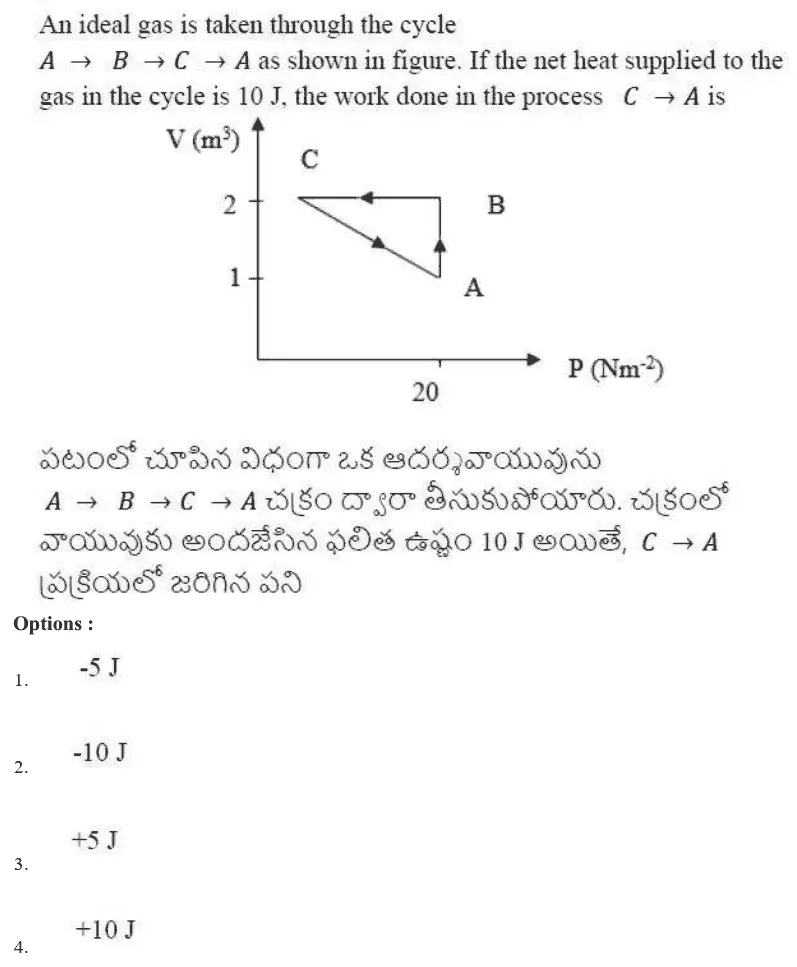
An ideal gas is taken through the cycle $A \rightarrow B \rightarrow C \rightarrow A$ as shown in figure. If the net heat supplied to the gas in the cycle is 10 J, the work done in the process $C \rightarrow A$ is
The pressure and density of a diatomic gas $\left(\gamma = \frac{7}{5}\right)$ change adiabatically from $(p, d)$ to $(p^1, d^1)$. If $\frac{d^1}{d} = 32$, then $\frac{p^1}{p}$ should be
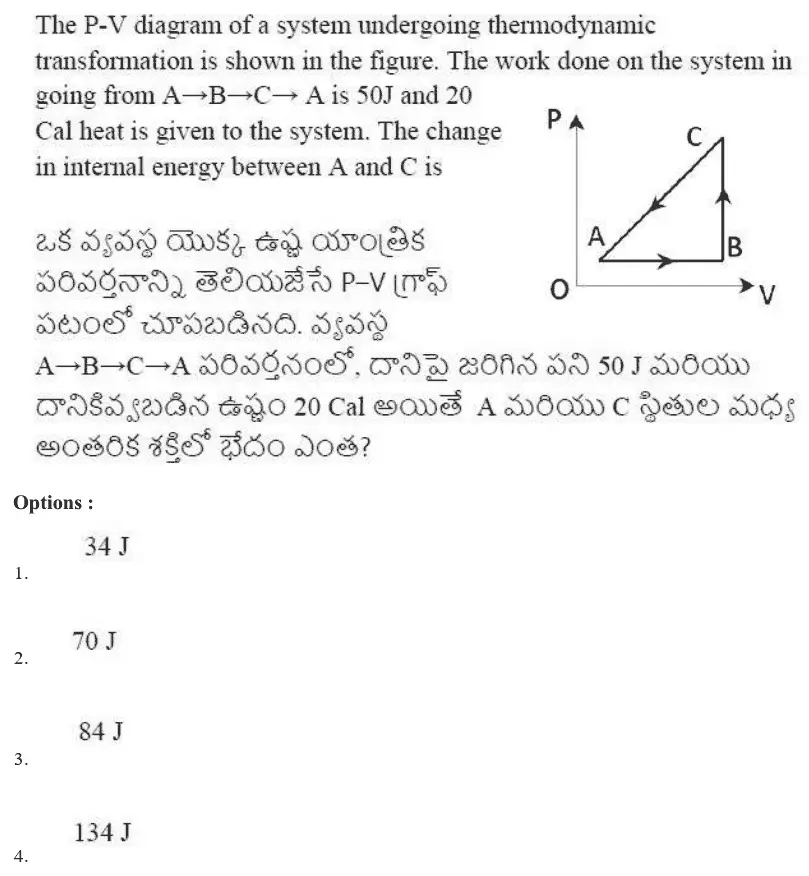
The P-V diagram of a system undergoing thermodynamic transformation is shown in the figure. The work done on the system in going from A→B→C→ A is 50J and 20 Cal heat is given to the system. The change in internal energy between A and C is
The coefficient of performance of a refrigerator is 5. If the inside temperature of freezer is $-20^0\mathrm{C}$, then the temperature of the surroundings to which it rejects heat is (approximately)
Two gases ‘$A$’ and ‘$B$’ are initially at same pressure, volume and temperature. If ‘$A$’ is compressed isothermally and ‘$B$’ adiabatically to half of the initial volume, then the final pressure of ‘$A$’ is
Assertion (A): When 1 $g$ of ice melts at constant temperature at a pressure of 1 $atm$, the increase in internal energy is greater than 80 $cal$ (Latent heat of fusion of ice = 80 cal g$^{-1}$)
Reason (R): During melting of ice, work is done on the ice
Choose the correct option from the following
A
Both A and R are true. R is the correct explanation of A
B
Both A and R are true, but R is not the correct explanation of A
The efficiency of Carnot engine is 50% and temperature of sink is 500 K. Keeping the source temperature constant, the required sink temperature to raise the efficiency of the engine to 60% is
A Carnot engine of 50% efficiency takes heat from a source of 400 K. To change efficiency to 70% without changing the sink temperature, the new temperature of source should be (nearer to)
An electric heater supplies heat to a system at a rate of 100 W. If system performs work at rate of 75 joules per second. The rate of increase of internal energy is
A Carnot heat engine receives 300 J of heat from the source and rejects 150 J to sink. If source and sink are at $227^\circ\mathrm{C}$ and T K, then T is
Equal amounts of a diatomic ideal gas are contained in two separate cylinders, P and Q. Cylinder P has a movable piston, while cylinder Q has a fixed piston. Both gases are initially at 273 K, and the same amount of heat is supplied to each. If the gas in cylinder P shows a temperature rise of 20 K, then the increase in temperature of the gas in cylinder Q is
The temperatures of source and sink of a Carnot heat engine are $127\ ^\circ\mathrm{C}$ and $27\ ^\circ\mathrm{C}$ respectively. If the working substance of the engine is 2 moles of a rigid diatomic gas, then the decrease in the internal energy of the substance during adiabatic expansion process is (Universal gas constant $= 8.31\ \mathrm{J\,mol^{-1}\,K^{-1}}$)
At a constant pressure of $2\times10^{5}\ \mathrm{N\,m^{-2}}$, if the volume of 4 moles of a monoatomic gas changes from 1000 cc to 1500 cc, then the change in internal energy of the gas is
When 70 J of heat is supplied to a rigid diatomic gas at a constant pressure P, the change in the volume of the gas is $\Delta V$. If the same amount of heat is supplied to a monoatomic gas at the same constant pressure P, then the change in volume of the monoatomic gas is
At constant pressure, if equal amounts of heat are supplied to a monoatomic gas and a rigid diatomic gas, then the ratio of the changes in the internal energies of the monoatomic and diatomic gases is
A Carnot’s heat engine operates between the temperatures $33\ ^\circ\mathrm{C}$ and $133\ ^\circ\mathrm{C}$. The relation between the absolute temperature (T) and volume (V) of the working substance during adiabatic expansion is $T\sqrt{V}=$ constant. The work done by 10 moles of the working substance during adiabatic expansion process is (R – Universal gas constant)
The efficiency of a Carnot's heat engine is $\frac{1}{3}$. If the temperature of the source is decreased by $50\ ^\circ\mathrm{C}$ and the temperature of the sink is increased by $25\ ^\circ\mathrm{C}$, the efficiency of the engine becomes $\frac{3}{16}$. The initial temperature of the sink is
The change in internal energy of given mass of a gas, when its volume changes from V to 3V at constant pressure P is ($\gamma$ - Ratio of the specific heat capacities of the gas)
A monatomic gas at a pressure of 100 kPa expands adiabatically such that its final volume becomes 8 times its initial volume. If the work done during the process is 180 J, then the initial volume of the gas is
The ratio of the efficiencies of two Carnot engines A and B is 1.25 and the temperature difference between the source and the sink is same in both the engines. The ratio of the absolute temperature of the sources of the engines A and B is
The heat supplied to a gas at a constant pressure of $5\times10^5$ Pa is 1000 kJ. If the volume of gas changes from $1\ \mathrm{m^3}$ to $2.5\ \mathrm{m^3}$, then the change in internal energy of the gas is
If 5.6 litres of a monoatomic gas at STP is adiabatically compressed to 0.7 litres, then the work done on the gas is nearly (R - Universal gas constant)
When 80 J of heat is supplied to a gas at constant pressure, if the work done by the gas is 20 J, then the ratio of the specific heat capacities of the gas is
A refrigerator of coefficient of performance 5 that extracts heat from the cooling compartment at the rate of 250 J per cycle is placed in a room. The heat released per cycle to the room by the refrigerator is
In a Carnot engine, if the work done during isothermal expansion is 25% more than the work done during isothermal compression, then the efficiency of the engine is
The work done to increase the volume of 2 moles of an ideal gas from V to 2V at a constant temperature T is W. The work to be done to increase the volume of 2 moles of the same gas from 2V to 4V at the same constant temperature T is
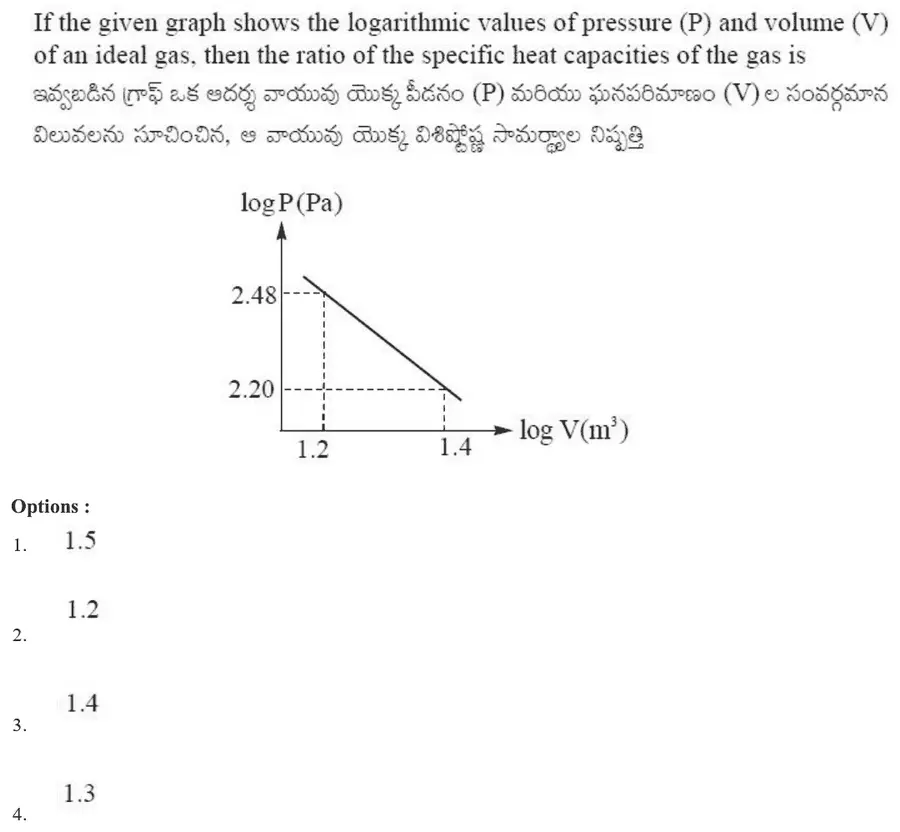
If the given graph shows the logarithmic values of pressure (P) and volume (V) of an ideal gas, then the ratio of the specific heat capacities of the gas is
In a Carnot engine, if the absolute temperature of the source is 25% more than the absolute temperature of the sink, then the efficiency of the engine is
If a heat engine and a refrigerator are working between the same two temperatures $T_1$ and $T_2$ ($T_1 > T_2$), then the ratio of efficiency of heat engine to coefficient of performance of refrigerator is
A Carnot heat engine absorbs 600 J of heat from a source at a temperature of 127 °C and rejects 400 J of heat to a sink in each cycle. The temperature of the sink is
Water of mass $5\ \mathrm{kg}$ in a closed vessel is at a temperature of $20\ ^\circ\mathrm{C}$. If the temperature of the water when heated for a time of 10 minutes becomes $30\ ^\circ\mathrm{C}$, then the increase in the internal energy of the water is
(Specific heat capacity of water $= 4200\ \mathrm{J\,kg^{-1}\,K^{-1}}$)
A Carnot engine A working between temperatures 600 K and T ($<$ 600 K) and another Carnot engine B working between temperatures T ($>$ 400 K) and 400 K are connected in series. If the work done by both the engines is same, then T =
A Carnot engine having efficiency 60% receives heat from a source at a temperature 600 K. For the same sink temperature, to increase its efficiency to 80%, the temperature of the source is
A Carnot engine uses diatomic gas as a working substance. During the adiabatic expansion part of the cycle, if the volume of the gas becomes 32 times its initial volume, then the efficiency of the engine is
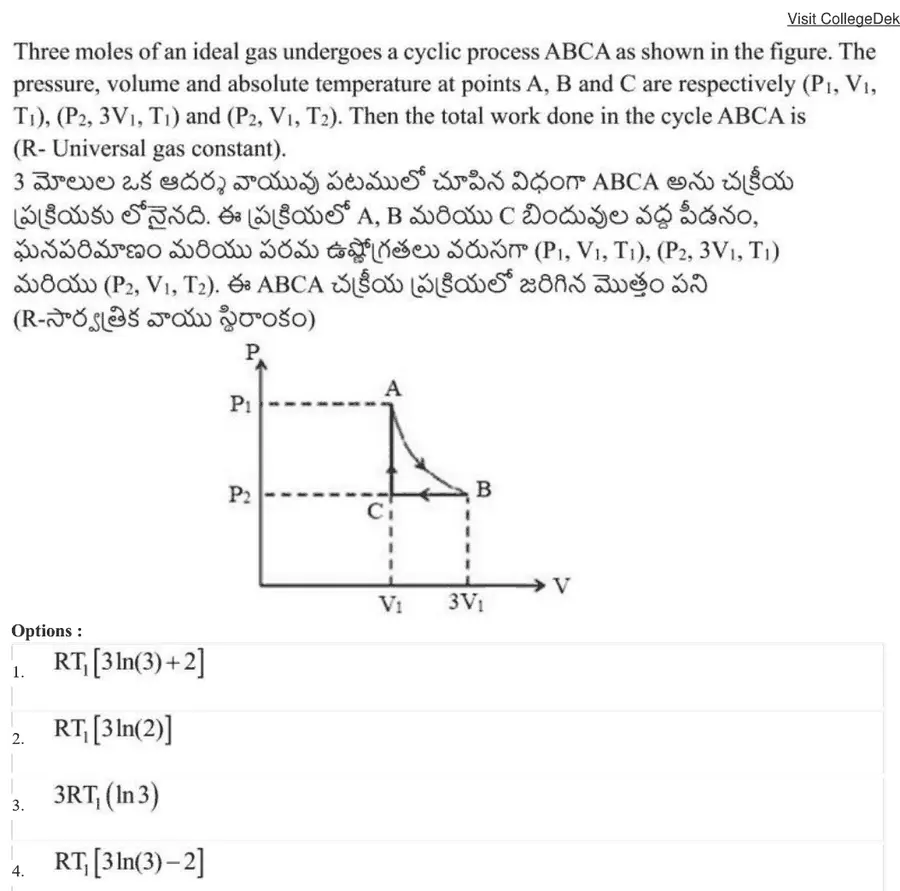
Three moles of an ideal gas undergoes a cyclic process ABCA as shown in the figure. The pressure, volume and absolute temperature at points A, B and C are respectively $(P_1, V_1, T_1)$, $(P_2, 3V_1, T_1)$ and $(P_2, V_1, T_2)$. Then the total work done in the cycle ABCA is (R- Universal gas constant).
At constant pressure, equal amounts of heat are supplied to a monatomic gas and a diatomic gas separately. The ratio of the increases in internal energies of the two gases is
Two moles of a gas at a temperature of $327\ ^\circ\mathrm{C}$ expands adiabatically such that its volume increases by 700%. If the ratio of the specific heat capacities of the gas is $\frac{4}{3}$, then the work done by the gas is (Universal gas constant $=8.3\,\mathrm{J\,mol^{-1}\,K^{-1}}$)
A gas is suddenly compressed such that its absolute temperature is doubled. If the ratio of the specific heat capacities of the gas is 1.5, then the percentage decrease in the volume of the gas is
When 2 moles of a monatomic gas expands adiabatically from a temperature of $80^\circ\mathrm{C}$ to $50^\circ\mathrm{C}$, the work done is W. The work done when 3 moles of a diatomic gas expands adiabatically from $50^\circ\mathrm{C}$ to $20^\circ\mathrm{C}$, is
If the ratio of the absolute temperature of the sink and source of a Carnot engine is changed from $2:3$ to $3:4$, the efficiency of the engine changes by
The efficiency of a heat engine that works between the temperatures where Celsius-Fahrenheit scales coincides and Kelvin-Fahrenheit scales coincides is (approximately)
Initially the pressure of 1 mole of an ideal gas is $10^5\,\mathrm{Nm^{-2}}$ and its volume is 16 litre. When it is adiabatically compressed, its final volume is 2 litre. Work done on the gas is [molar specific heat at constant volume $= \frac{3R}{2}$]
Two ideal gases A and B of same number of moles expand at constant temperatures $T_1$ and $T_2$ respectively such that the pressure of gas A decreases by 50 % and the pressure of gas B decreases by 75 %. If the work done by both the gases is same, then $T_1:T_2$
The efficiency of a Carnot heat engine is $25\ \%$ and the temperature of its source is $127\ ^\circ\mathrm{C}$. Without changing the temperature of the source, if absolute temperature of the sink is decreased by $10\ \%$, the efficiency of the engine is
In a Carnot engine, when the temperatures are $T_2 = 0°C$ and $T_1 = 200°C$, its efficiency is $\eta_1$ and when the temperatures are $T_1 = 0°C$ and $T_2 = -200°C$, its efficiency is $\eta_2$. Then the value of $\frac{\eta_1}{\eta_2}$ is
An ideal gas is found to obey $PV^{\frac{3}{2}}$ = constant during an adiabatic process. If such a gas initially at a temperature T is adiabatically compressed to $\frac{1}{4}^{th}$ of its volume, then its final temperature is
The efficiency of a Carnot engine found to increase from 25% to 40% on increasing the temperature ($T_1$) of source alone through 100 K. The temperature ($T_2$) of the sink is given by
The efficiency of a Carnot cycle is $\frac{1}{6}$. By lowering the temperature of sink by 65 K, it increases to $\frac{1}{3}$. The initial and final temperature of the sink are
In a cold storage, ice melts at the rate of 2 kg per hour when the external temperature is 20 °C. The minimum power output of the motor used to drive the refrigerator which just prevents the ice from melting is (latent heat of fusion of ice = 80 cal $\mathrm{g^{-1}}$)
A certain volume of a gas at 300 K expands adiabatically until its volume is doubled. The resultant fall in temperature of the gas is nearly (The ratio of the specific heats of the gas = 1.5)
The efficiency of a Carnot's engine is 25%, when the temperature of sink is 300 K. The increase in the temperature of source required for the efficiency to become 50% is
An ideal heat engine operates in Carnot cycle between 127 °C and 27 °C. It absorbs $5 \times 10^4$ cal of heat at higher temperature. Amount of heat converted to work is
A Carnot heat engine has an efficiency of 10 %. If the same engine is worked backward to obtain a refrigerator, then the coefficient of performance of the refrigerator is
The work done by an ideal gas of 2 moles in increasing its volume from V to 2V at constant temperature T is W. The work done by an ideal gas of 4 moles in increasing its volume from V to 8V at constant temperature $\frac{T}{2}$ is
For a gas in a thermodynamic process, the relation between internal energy (U), the pressure (P) and the volume (V) is $U=3+1.5PV$. The ratio of the specific heat capacities of the gas at constant volume and constant pressure is
The ratio of the specific heat capacities of a gas is 1.5. When the gas undergoes an adiabatic process, its volume is doubled and pressure becomes $P_1$. When the gas undergoes isothermal process, its volume is doubled and pressure becomes $P_2$. If $P_1 = P_2$, the ratio of the initial pressures of the gas when it undergoes adiabatic and isothermal processes is
When $Q_1$ amount of heat is supplied to a monatomic gas, the work done by the gas is W. When $Q_2$ amount of heat is supplied to a diatomic gas, the work done by the gas is 2W. Then $Q_1 : Q_2 =$
The efficiency of a reversible heat engine working between two temperatures is 50%. The coefficient of performance of a refrigerator working between the same two temperatures but in reverse direction is
If dQ, dU and dW are heat energy absorbed, change in internal energy and external work done respectively by a diatomic gas at constant pressure, then dW : dU : dQ is
A gas of mass ‘m’ and molecular weight ‘M’ is flowing in an insulated tube with a velocity ‘2V’. If the flow of the gas is suddenly stopped and all the kinetic energy is utilized to compress the gas, the increase in the temperature of the gas is
($\gamma$ is ratio of specific heats, R is universal gas constant)
A gas is expanded from an initial state to a final state along a path that consists of (a) an isothermal expansion doing 40 J work, (b) an adiabatic expansion doing W work, (c) an isothermal expansion doing 30 J work. If the total change in the internal energy of the gas is $-$ 20 J, the work done by the gas during the adiabatic expansion W =
A diatomic gas has an initial internal energy of 80 cal. A work of 18 cal is done on the gas and the gas releases heat energy of 42 J. The final internal energy of the gas is
Three moles of a gas at a temperature ‘T’ is heated to thrice its volume by keeping the pressure constant. If ‘γ’ is the ratio of specific heats, then the increase in internal energy of the gas is
When a monatomic gas expands at constant pressure, the percentages of heat supplied that is used to do external work and to increase its internal energy are respectively
2 moles of a monatomic gas requires heat energy Q to be heated from $30\ ^\circ\mathrm{C}$ to $40\ ^\circ\mathrm{C}$ at constant volume. The heat energy required to raise the temperature of 4 moles of a diatomic gas from $28\ ^\circ\mathrm{C}$ to $33\ ^\circ\mathrm{C}$ at constant volume is
The temperature of the sink of a Carnot's engine is 300 K and the efficiency of the engine is 0.25. If the temperature of the source of the engine is increased by 100 K, the efficiency of the engine increases by
A monatomic gas of volume ‘V’ and pressure ‘P’ expands isothermally to a volume ‘27V’ and then compressed adiabatically to a volume ‘V’. The final pressure of the gas is
Two moles of a triatomic gas $\left(\gamma=\frac{4}{3}\right)$ at temperature $327^\circ\mathrm{C}$ expands adiabatically such that its volume becomes 8 times its initial volume. Later the temperature of the gas is doubled in an isochoric process. The total work done in the two processes is (R – universal gas constant)
Two identical containers A and B with frictionless pistons contain the same ideal gas at the same temperature and same volume V. The mass of the gas in A is $m_A$ and that in B is $m_B$. The gas in each cylinder is now allowed to expand isothermally to the same final volume 2V. The changes in the pressures of the gases in A and B are found to be $2\Delta P$ and $3\Delta P$ respectively. Then the relation between $m_A$ and $m_B$ is
When some amount of heat energy is supplied to a monatomic gas, the percentage of heat energy used for increasing the internal energy of the gas $(\gamma = 5/3)$ is
An ideal gas at $127\ ^\circ\mathrm{C}$ is compressed suddenly to $\frac{8}{27}$ of its initial volume. If $\gamma = \frac{5}{3}$ for an ideal gas, then rise in its temperature is
An insulating cylinder contains 4 moles of an ideal diatomic gas. When a heat Q is supplied to it, 2 moles of the gas molecules dissociate. If the temperature of the gas remains constant, then the value of Q is
Assertion (A): The zeroth law of thermodynamics leads to the concept of temperature. Reason (R) : The zeroth law states that two systems in thermal equilibrium with a third system are in thermal equilibrium with each other. The correct option among the following is
A
(A) is true, (R) is true and (R) is the correct explanation for (A)
B
(A) is true, (R) is true but (R) is not the correct explanation for (A)
When a gas expands adiabatically, its volume is doubled while its absolute temperature is decreased by a factor of 2. The value of the adiabatic constant is
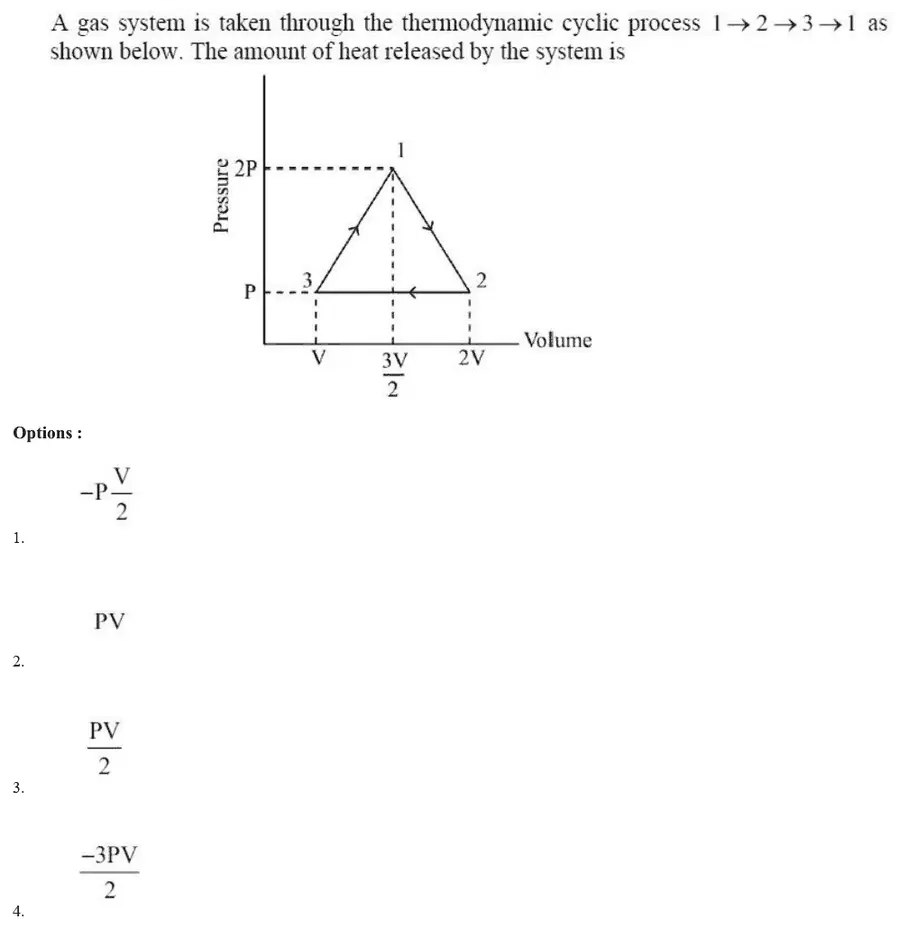
A gas system is taken through the thermodynamic cyclic process $1\to2\to3\to1$ as shown below. The amount of heat released by the system is (see the figure above)
An ideal gas at pressure P is enclosed in a container that is placed in a reservoir at temperature T. If the volume of the gas is increased to two times its original value, then the new pressure $P'=$ ______ P
A quantity of monoatomic gas undergoes a process in which pressure is changed linearly with volume. The pressure and volume are changed from initial value ($\mathrm{P_o}$, $\mathrm{V_o}$) to final value ($3\mathrm{P_o}$, $3\mathrm{V_o}$). The heat absorbed by the gas during the process is
An ideal gas having initial pressure P, volume V and temperature T is allowed to expand adiabatically until its volume becomes 4V, while its temperature falls to $\dfrac{T}{2}$. If the work done by the gas during the expansion is $\alpha$PV, the value of $\alpha$ is
Assertion(A) : Heat and work are modes of energy transfer to a system resulting in change in its internal energy. Reason(R) : Heat and work in thermodynamics are state variables. The correct option among the following is
A
(A) is true, (R) is true and (R)is the correct explanation for (A)
B
(A) is true, (R) is true but (R) is not the correct explanation for (A)
An ideal gas at pressure $P_{0}$ undergoes an isothermal expansion until its volume is 8.0 times its initial volume. The gas is slowly and adiabatically compressed back to its original volume. If the adiabatic constant of the gas is $\gamma=4/3$, then the ratio of the average kinetic energy per molecule in this final state to that in the initial state is
1.00 kg of liquid water at $100\ ^{\circ}\mathrm{C}$ undergoes a phase change into steam at $100\ ^{\circ}\mathrm{C}$ at 1.0 atm (take it to be $1.00\times10^{5}$ Pa). The initial volume of the liquid water was $1.00\times10^{-3}\ \mathrm{m^{3}}$ which is changed to $2.001\ \mathrm{m^{3}}$ of steam. Find the change in the internal energy of the system. [Use heat of vaporization $\simeq2000\ \mathrm{kJ/kg}$]
Temperature of a cold reservoir of a Carnot engine is $127\ ^\circ\mathrm{C}$. If the efficiency of the Carnot engine is 20%, then the temperature of the hot reservoir is
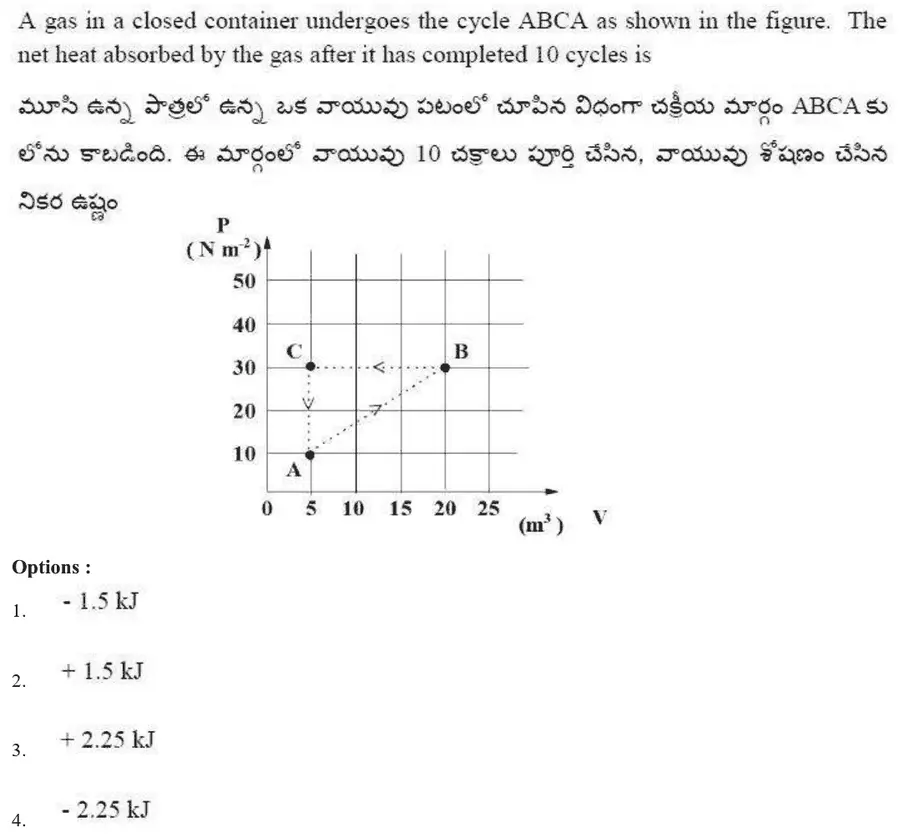
A gas in a closed container undergoes the cycle ABCA as shown in the figure. The net heat absorbed by the gas after it has completed 10 cycles is (see the figure above)
An ideal gas has specific heat capacity at constant pressure $\dfrac{11}{10}R$. If one mole of this ideal gas at $125\ ^\circ\mathrm{C}$ does 83 J of work adiabatically, then the final temperature of the gas would be (Universal gas constant, $R = 8.3\ \mathrm{J\,K^{-1}mol^{-1}}$)
As ideal monatomic gas of 1.5 moles is heated at a constant pressure 2 atm so that its temperature increases from $30\ ^\circ\mathrm{C}$ to $130\ ^\circ\mathrm{C}$. Work done by the gas is (Universal gas constant = $8.3\ \mathrm{J\,mol^{-1}K^{-1}}$)
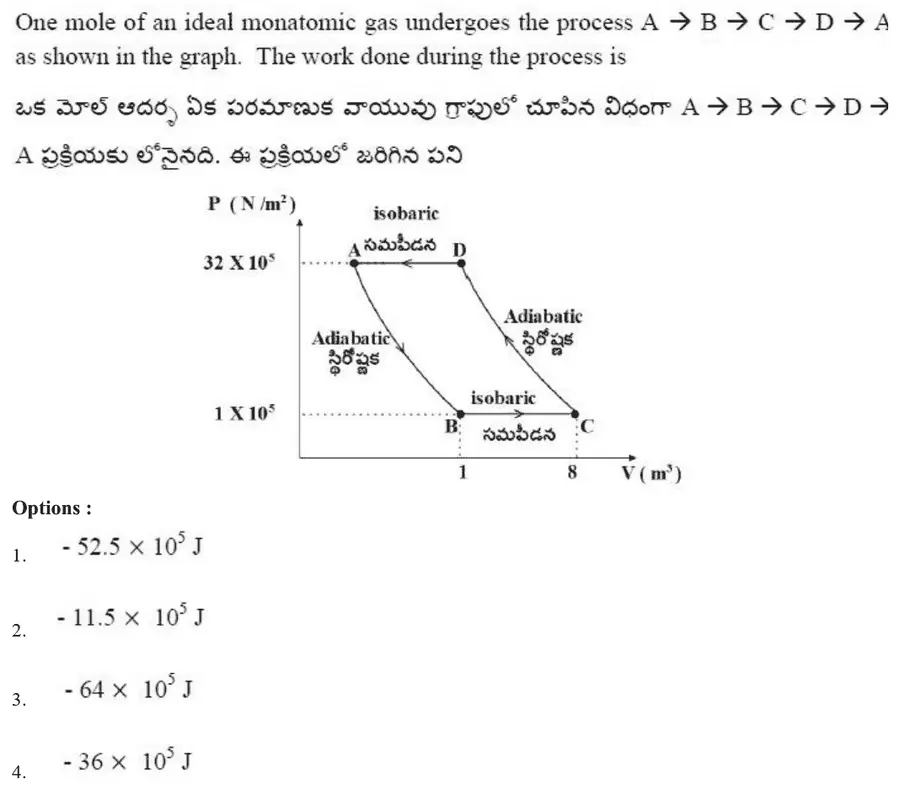
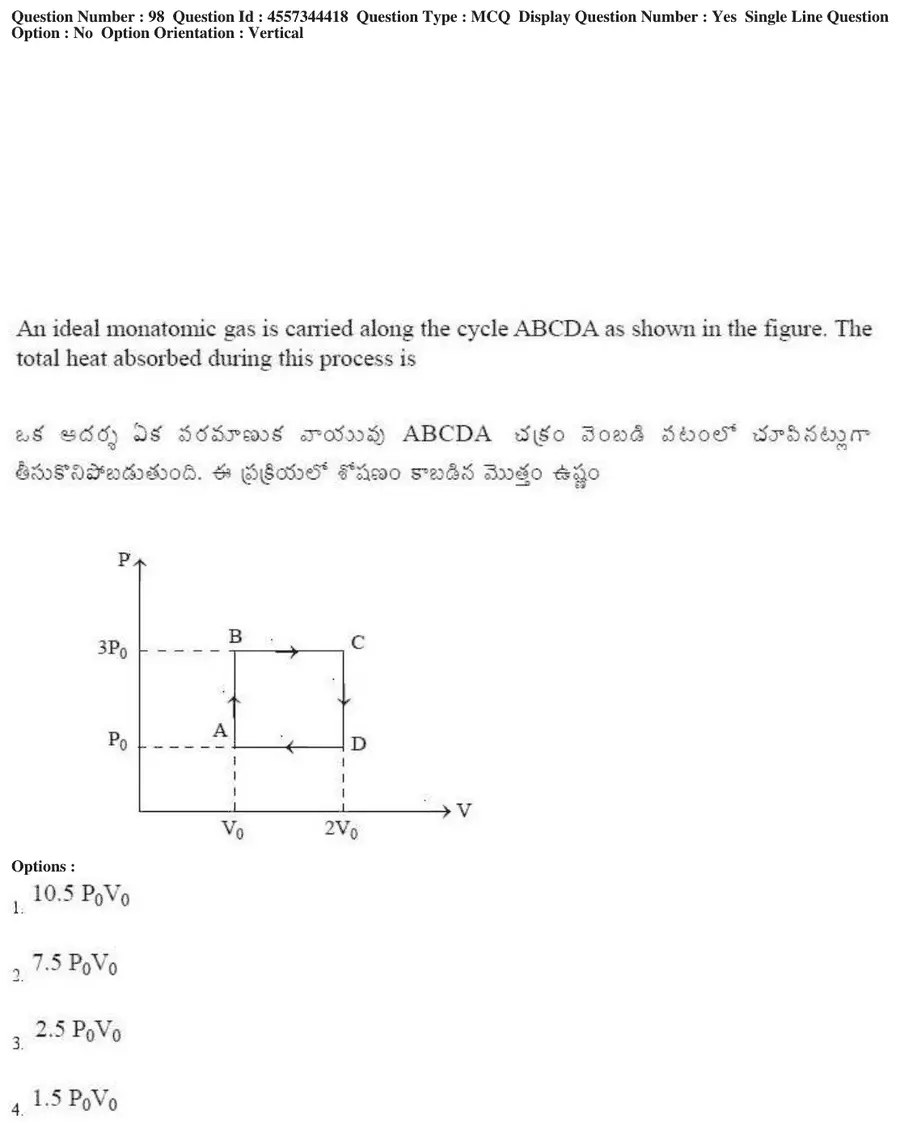
One mole of an ideal monatomic gas undergoes the process $A \to B \to C \to D \to A$ as shown in the graph. The work done during the process is (see the figure above)
A monatomic gas ($\gamma = \frac{5}{3}$, printed as r) at a pressure of 4 atm is compressed adiabatically so that its temperature rises from $27\ ^\circ\mathrm{C}$ to $327\ ^\circ\mathrm{C}$. The pressure of the gas in its final state is
The change in the internal energy of 3 moles of a gas heated at constant volume from $20\ ^\circ\mathrm{C}$ to $40\ ^\circ\mathrm{C}$ is 1080 J. The molar specific heat of the gas at constant volume in $\mathrm{J\,mol^{-1}\,K^{-1}}$ is
A gas at $37\ ^\circ\mathrm{C}$ is compressed adiabatically to half of its volume, then the final temperature of the gas is (Ratio of specific heat capacities of the gas is 1.5)
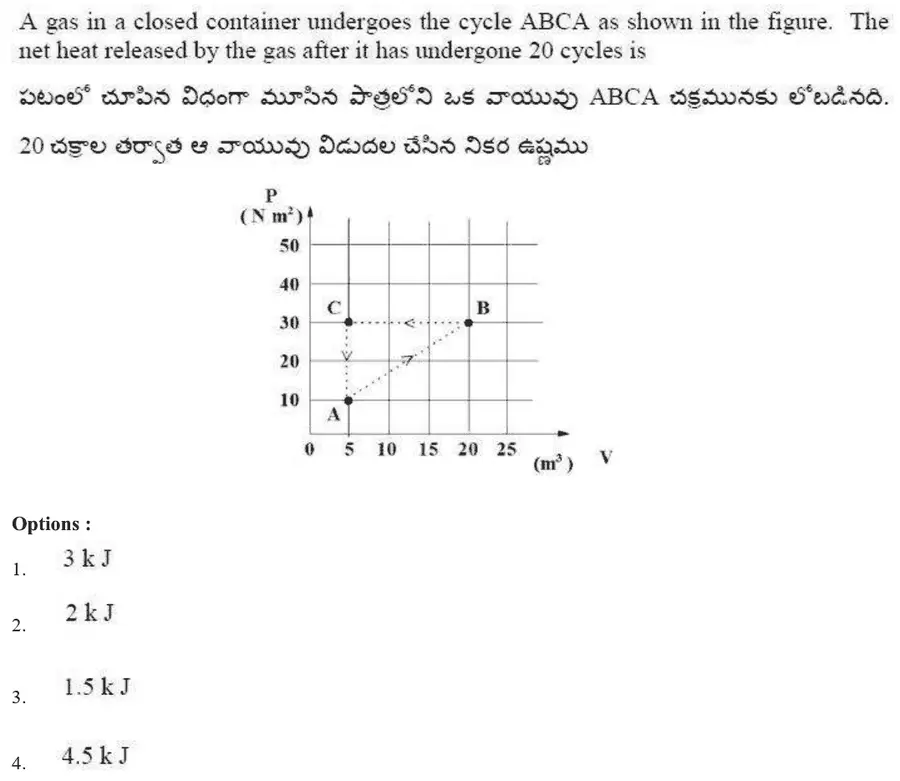
A gas in a closed container undergoes the cycle ABCA as shown in the figure. The net heat released by the gas after it has undergone 20 cycles is (see the figure above)
A vessel containing nitrogen gas is supplied a heat of 498 J, so as to raise the temperature of the gas by $40\ ^\circ$C at constant pressure. The mass of nitrogen gas in the vessel is (Molecular mass of nitrogen = 28 g; Universal gas constant = $8.3\ \mathrm{J\,mol^{-1}K^{-1}}$)
An ideal monatomic gas expands at constant pressure. The work done by the gas on its environment is 200 J, then the heat absorbed by the gas during the process is
The slopes of the isothermal and adiabatic p - v graphs of a gas are by $S_I$ and $S_A$ respectively. If the heat capacity ratio of the gas is $\frac{3}{2}$, then $\frac{S_I}{S_A} =$
A Carnot engine operates between a source and a sink. The efficiency of the engine is 40 % and the temperature of the sink is 27 °C. If the efficiency is to be increased to 50 % then the temperature of the source must the increased by
A car engine has a power of 20 kW. The car makes a roundtrip of 1 hour. If the thermal efficiency of the engine is 40 % and the ambient temperature is 300 K. The energy generated by fuel combustion is
A gas is expanded from an initial state to a final state along a path on a P-V diagram. The path consists of (i) an isothermal expansion of work 50 J, (ii) an adiabatic expansion and (iii) an isothermal expansion of work 20 J. If the internal energy of gas is changed by $-30$ J, then the work done by gas during adiabatic expansion is
The temperature of the sink of a Carnot engine is 250 K. In order to increase the efficiency of the Carnot engine from 25 % to 50 %, the temperature of the source should be increased by
An electric refrigerator extracts 2000 calories from ice trays. If the coefficient of performance is 5, then the work done by the motor is ______ calories
Find the ratio of $\frac{\Delta Q}{\Delta W}$ in an isobaric process, if the ratio of molar specific heat capacities of the gas used is $\frac{C_P}{C_V} = \gamma$
A given system undergoes a change in which the work done by the system equals the decrease in its internal energy. The system must have undergone an ______
Three designs are proposed for an engine which is to operate between $500\ K$ and $300\ K$. Design A claims to produce $150\ \mathrm{J}$ of work per $1000\ \mathrm{J}$ of heat input, design B $450\ \mathrm{J}$ of work per $1000\ \mathrm{J}$ and design C $300\ \mathrm{J}$ of work per $1000\ \mathrm{J}$. Which of the designs would you choose?
A Carnot engine having an efficiency $1/5$ as a heat engine, is used as a refrigerator. If the work done on the system is $50\ \mathrm{J}$, the amount of energy absorbed from the reservoir at lower temperature is ______
A Carnot engine whose efficiency is $40\ \%$ takes in heat from source maintained at a temperature of $500\ K$. It is desired to have an engine of efficiency $60\ \%$. Then, the intake temperature for the same exhaust (sink) temperature must be ______
In a thermodynamic process the pressure of a fixed mass of a gas is changed in such a manner that the gas released 30 joules of heat and 18 joules of work was done on the gas. If the initial internal energy of the gas was 60 joules, the final internal energy will be:
Match the following? Column-I | Column-II a) Ratio of $\Delta Q/\Delta U$ in an isobaric process | i) $\frac{T_1}{(T_1 - T_2)}$ b) Ratio of $\Delta Q/\Delta W$ in an isobaric process | ii) $\frac{T_2}{(T_1 - T_2)}$ c) Coefficient of performance of a refrigerator | iii) $\frac{\gamma}{\gamma - 1}$ d) Coefficient of performance of a heat pump | iv) $\gamma$
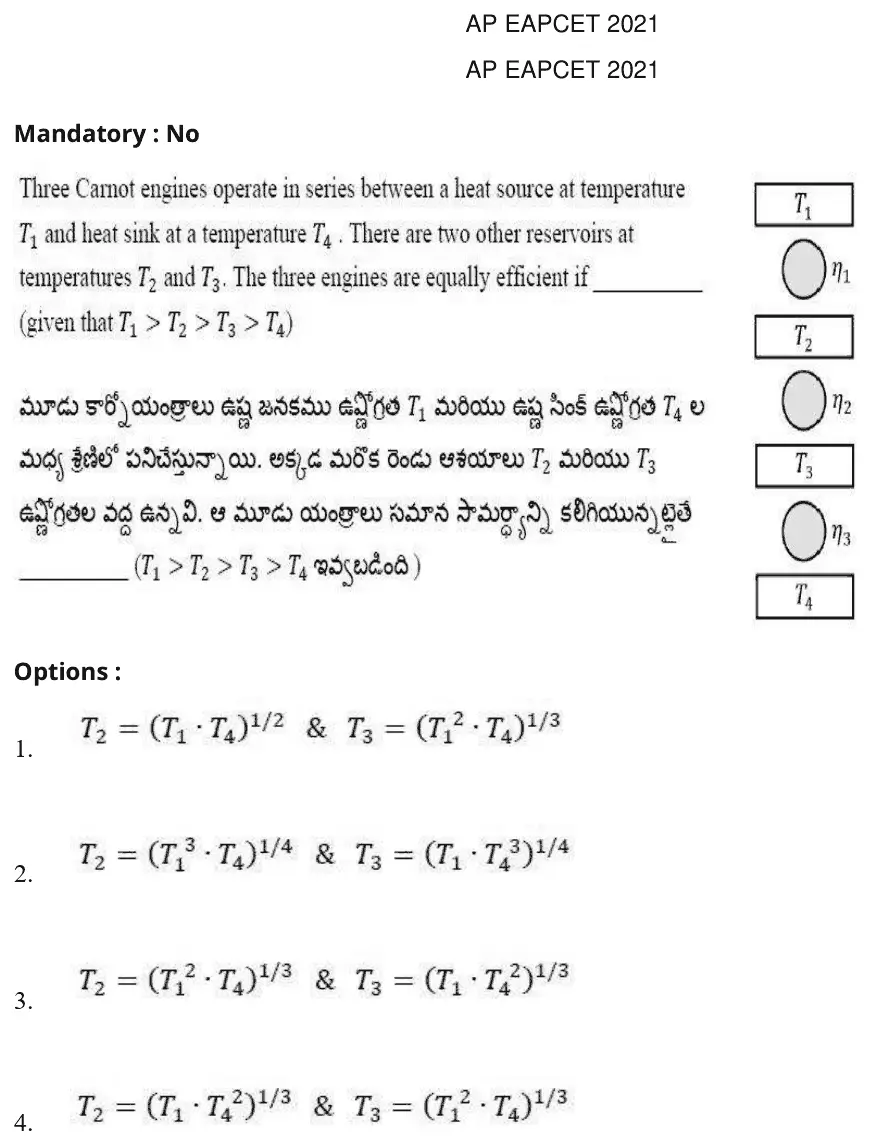
Three Carnot engines operate in series between a heat source at temperature $T_1$ and heat sink at a temperature $T_4$. There are two other reservoirs at temperatures $T_2$ and $T_3$. The three engines are equally efficient if ______ (given that $T_1 > T_2 > T_3 > T_4$) (see the figure above)
Two containers $A$ and $B$ contain equal volumes of an identical gas at the same pressure and temperature. The gas in container $A$ is compressed to half its original volume isothermally, while the gas in container $B$ is compressed to half its original volume adiabatically. The ratio of the final pressure of gas in container $B$ to that of gas in container $A$ is ______
A Carnot engine whose heat sink is at $27\ ^\circ\mathrm{C}$ has an efficieny (sic) of $40\ \%$. By how much should its source temperature be changed so as to increase its efficiency to $60\ \%$?
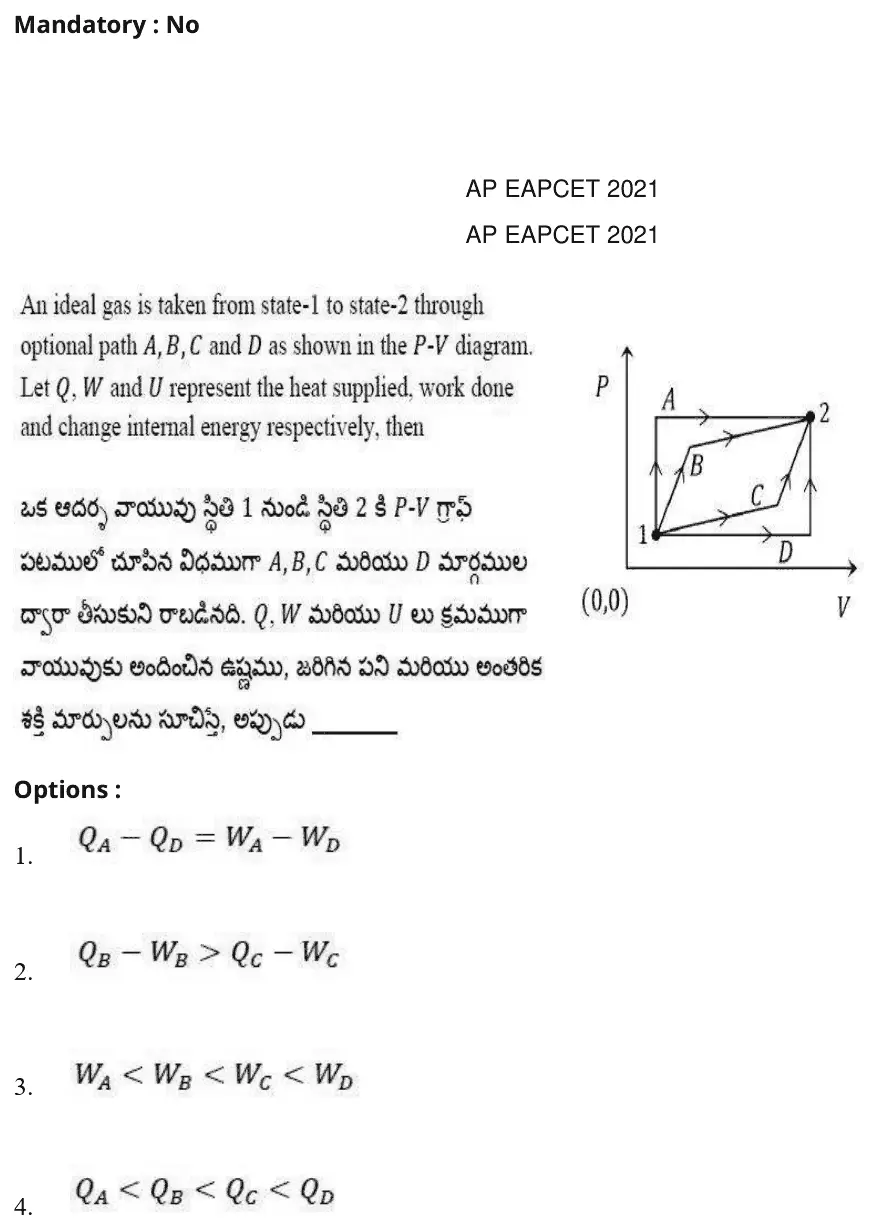
An ideal gas is taken from state-1 to state-2 through optional path $A, B, C$ and $D$ as shown in the $P$-$V$ diagram. Let $Q$, $W$ and $U$ represent the heat supplied, work done and change internal energy respectively, then (see the figure above)
A system is taken from state-A to state-B along two different paths. The heat absorbed and work done by the system along these two paths are $Q_1, Q_2$ and $W_1, W_2$ respectively, then ____
A refrigerator with coefficient of performance $0.25$ releases $250\ \mathrm{J}$ of heat to a hot reservoir. The work done on the working substance is ______
An ideal Carnot engine whose efficiency is 50%, receives heat at 500 K. If the efficiency is to be 60%, the intake temperature for the same exhaust temperature is
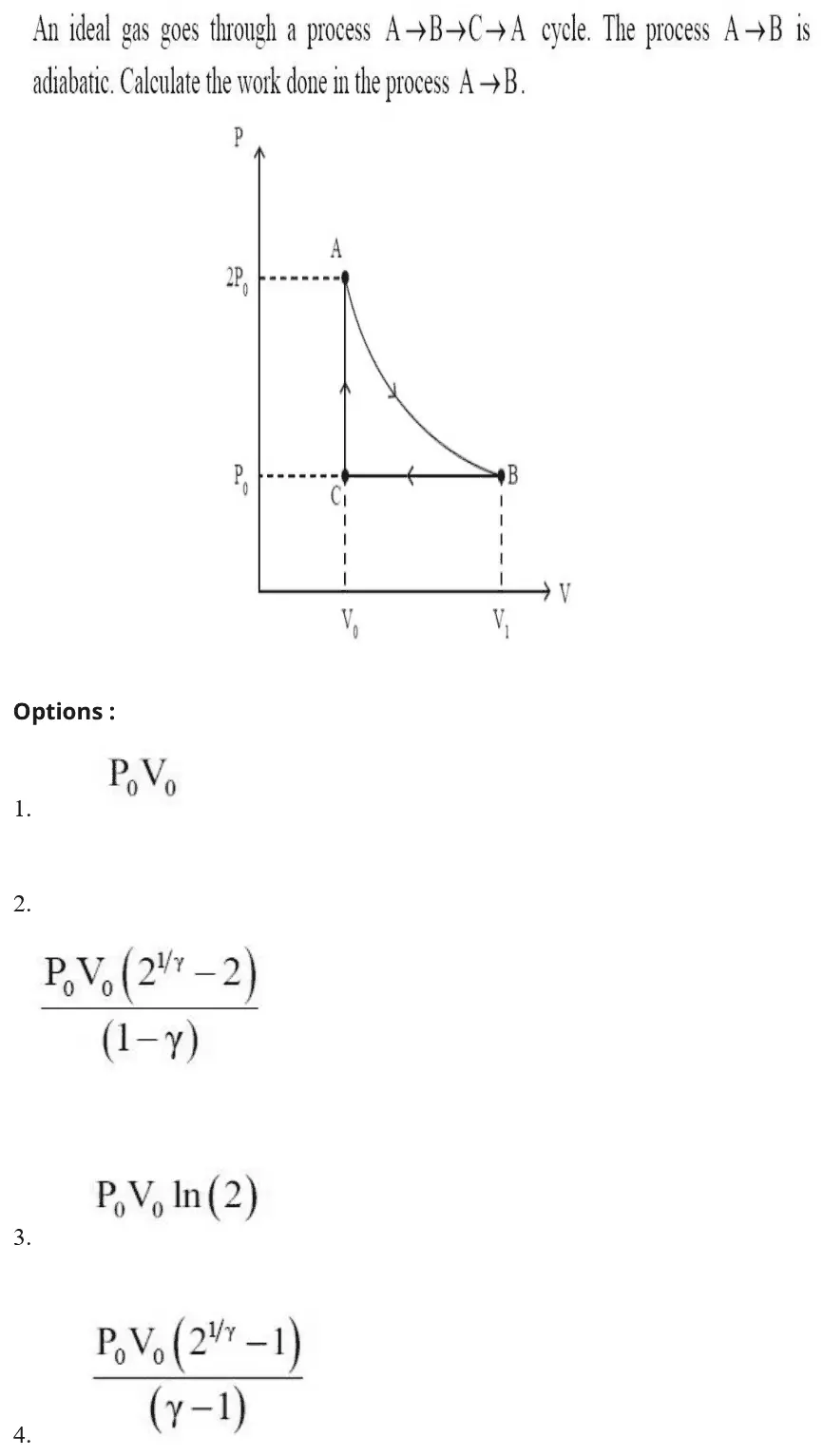
An ideal gas goes through a process $A\to B\to C\to A$ cycle. The process $A\to B$ is adiabatic. Calculate the work done in the process $A\to B$. (see the figure above)
An ideal gas undergoes an adiabatic process. If the pressure of the gas is reduced by 0.1 % then the volume is changed by (Given $r=\frac{C_p}{C_v}=5/3$)
The carnot heat engine have an efficiency of 50 %. The temperature of sink is maintained at 500 K. To increase the efficiency upto 80 %, the increment in the source temperature is
An ideal monoatomic gas of volume V is adiabatically expanded to a volume 3 V at 27 °C. The final temperature in Kelvins is (use $\frac{C_P}{C_V} = \frac{5}{3}$)
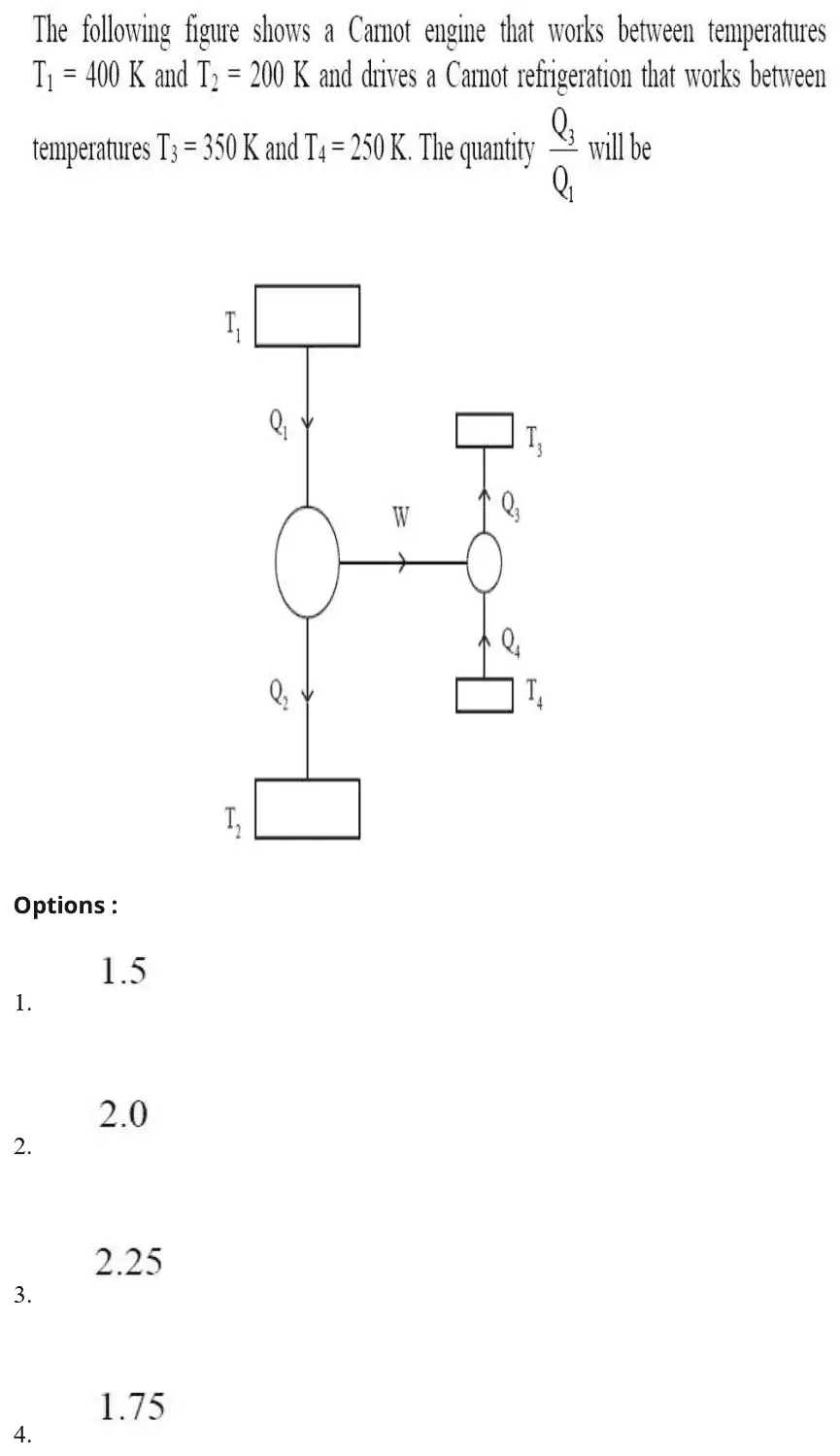
The following figure shows a Carnot engine that works between temperatures $T_1$ = 400 K and $T_2$ = 200 K and drives a Carnot refrigeration that works between temperatures $T_3$ = 350 K and $T_4$ = 250 K. The quantity $\frac{Q_3}{Q_1}$ will be (see the figure above)
Consider a two stage Carnot engine. In the first stage heat $Q_1$ is absorbed at temperature T and heat $Q_2$ is expelled at temperature $\alpha T$ (where $\alpha<1$). In the second stage heat $Q_2$ is absorbed at temperature $\alpha T$ and heat $Q_3$ is expelled at temperature $\beta T$ ($\beta<\alpha$). The efficiency of the Carnot engine will be
A diatomic gas of volume $2\ \mathrm{m^3}$ at a pressure $2\times10^5\ \mathrm{N/m^2}$ is compressed adiabatically to a volume $0.5\ \mathrm{m^3}$. The work done in this process is. [ Use $4^{1.4} = 6.96$]
500 g of water is heated from $30\,^\circ\mathrm{C}$ to $90\,^\circ\mathrm{C}$. What is the change in its internal energy? (Specific heat of water is $4184\ \mathrm{J\,kg^{-1}K^{-1}}$)
A tyre pumped to a pressure of 2 atmosphere, suddenly bursts. If the temperature of air before expansion is $T$ then the air temperature after the tyre busts is (Assume the expansion is adiabatic and adiabatic constant $\gamma = \dfrac{3}{2}$)
A gas container A is in thermal equilibrium with another gas of the same mass in container B. If we denote the corresponding pressures and volumes by the suffixes A and B, then which of the following statement is most likely to be true.
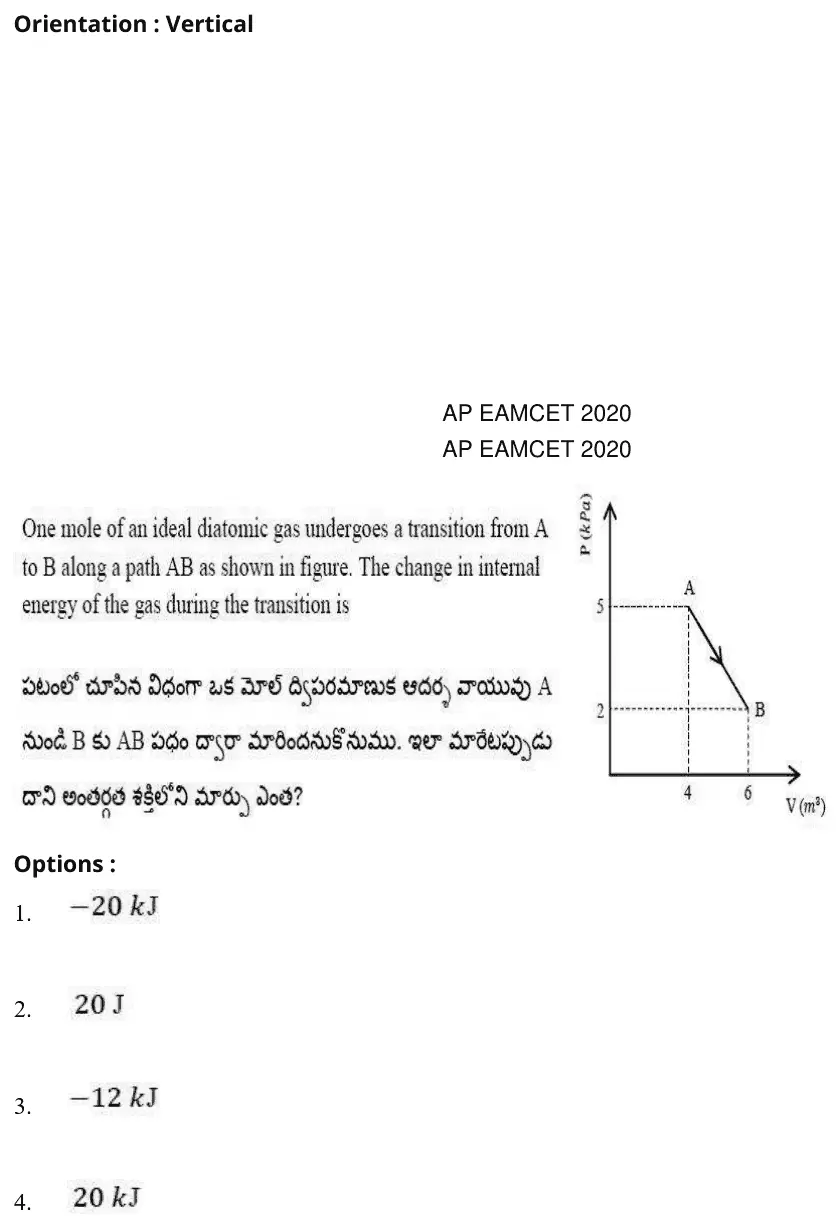
One mole of an ideal diatomic gas undergoes a transition from A to B along a path AB as shown in figure. The change in internal energy of the gas during the transition is (see the figure above)
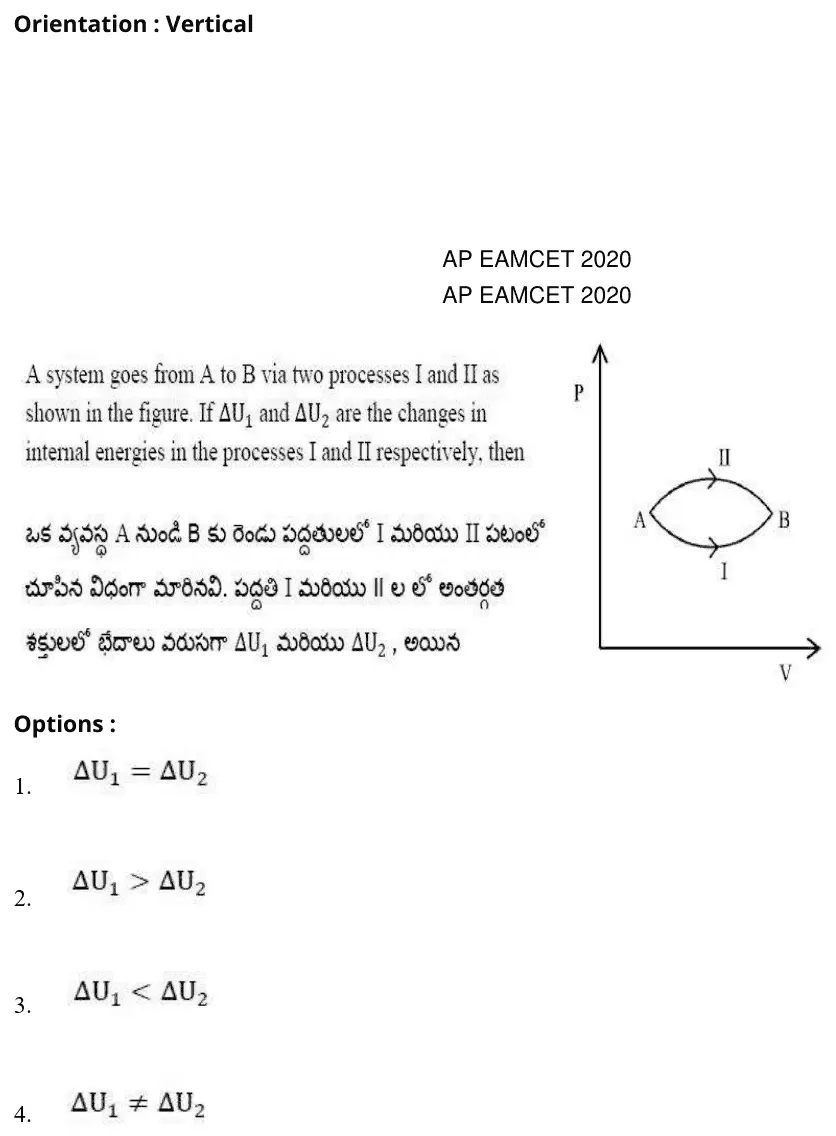
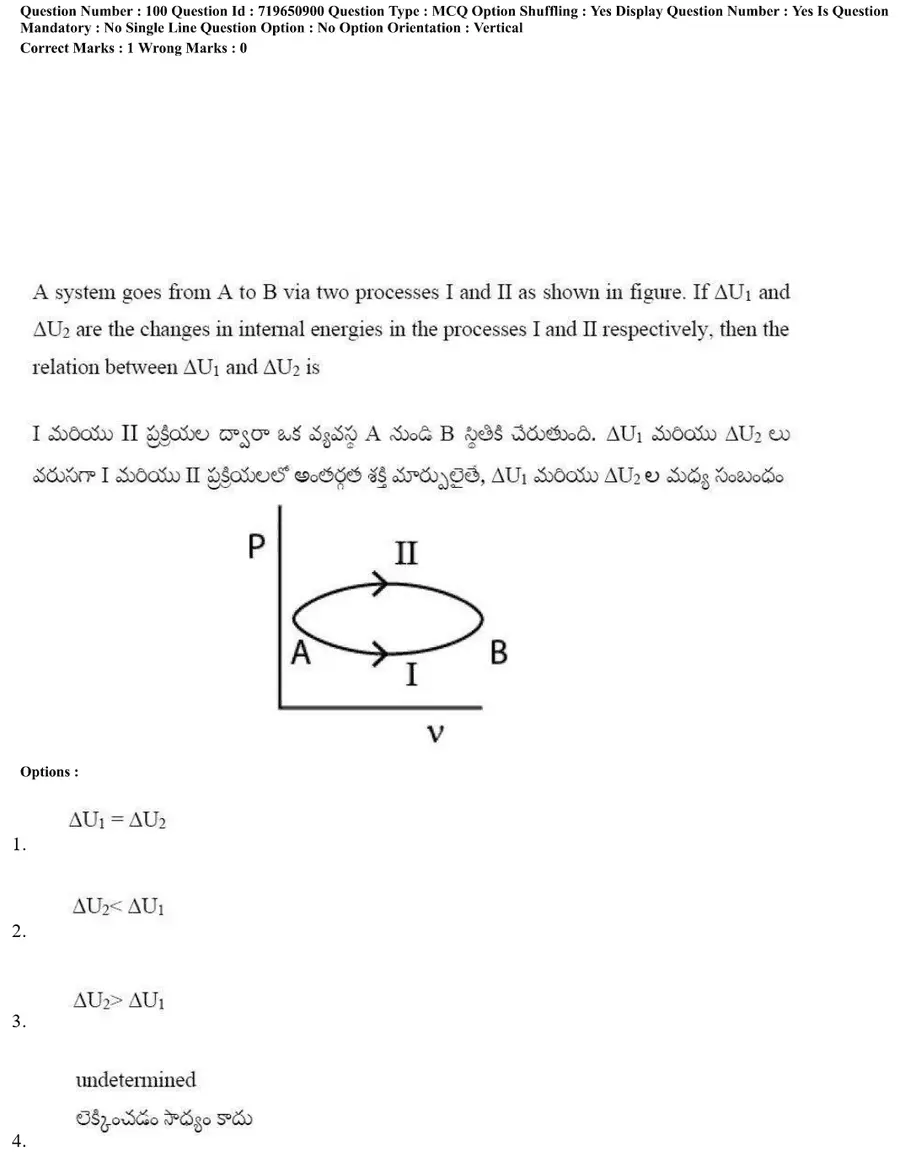
A system goes from A to B via two processes I and II as shown in the figure. If $\Delta U_1$ and $\Delta U_2$ are the changes in internal energies in the processes I and II respectively, then (see the figure above)
An electrical refrigerator with $\beta = 5$ extracts $5000\ \mathrm{J}$ from the contents of the refrigerator. During this process, find the electrical energy utilized by its motor.
A Carnot engine takes $3\times10^6$ calories of heat from reservoir at $627\,^\circ\mathrm{C}$ and gives it to a sink at $27\,^\circ\mathrm{C}$. The work done by the engine is
A Carnot's engine has an efficiency of 25% when its sink is at 27°C. If it has to be increased to 40%, what should be the temperature of the sink keeping the temperature of the source constant?
The efficiency of an ideal Carnot engine working between temperatures $T_1$ and $T_2$ is 1/3. If the temperature of the sink is reduced by 40%, then its efficiency will be
In a thermodynamic process pressure of a fixed mass of a gas is changed in such a manner that the gas releases $30\ \mathrm{J}$ of heat and $10\ \mathrm{J}$ of work was done on the gas. If the initial internal energy of the gas was $30\ \mathrm{J}$, then the final internal energy will be
A gas is compressed from a volume of $2\ \mathrm{m^3}$ to a volume of $1\ \mathrm{m^3}$ at a constant pressure of $100\ \mathrm{N.m^{-2}}$. Then it is heated at constant volume by supplying $150\ \mathrm{J}$ of energy. As a result, the internal energy of the gas ______
306 J of heat is required to raise the temperature of 2 moles of an ideal gas at constant pressure from $25\,^\circ C$ to $35\,^\circ C$. The amount of heat required to raise the temperature of the same gas through the same range at constant volume is
An ideal Carnot's engine with an efficiency of 30% operates between a source and a sink. If the temperature of the source is 500 $\mathrm{K}$, that of the sink is ______
A Carnot engine $C_1$ operates between temperature $T_1$ and $T_2$ ($T_1 > T_2$). A second Carnot engine $C_2$ uses all the heat rejected by the engine $C_1$ and operates between temperature $T_2$ and $T_3$ (where $T_2 > T_3$). The efficiency of this combined ($C_1$ and $C_2$ together) engine is
A carnot engine whose efficiency is 40%, receives heat at 500 K. If the efficiency is to be 50%, the source temperature for the same exhaust temperature is
A system goes from A to B via two processes I and II as shown in figure. If $\Delta U_1$ and $\Delta U_2$ are the changes in internal energies in the processes I and II respectively, then the relation between $\Delta U_1$ and $\Delta U_2$ is (see the figure above)
A gas is at constant pressure $4\times10^{5}\ N/m^{2}$. When a heat energy of 2000 J is supplied to the gas, its volume changes by $3\times10^{-3}\ m^{3}$. What is the increase in its internal energy?
The specific heat of helium at constant volume is $12.6\ \mathrm{J\,mol^{-1}K^{-1}}$. The specific heat of helium at constant pressure in $\mathrm{J\,mol^{-1}K^{-1}}$ is approximately (Assume the universal gas constant $R = 8.314\ \mathrm{J\,mol^{-1}K^{-1}}$)
Work done on heating one mole of monoatomic gas adiabatically through 20°C is W. Then the work done on heating 6 moles of rigid diatomic gas through the same change in temperature
Five moles of an ideal gas has pressure $P_o$, volume $V_o$ and temperature $T_o$. The gas is expanded to volume $3V_o$ along a path so that the pressure P is changed as function of volume V as $P = P_o(V/V_o)$. The pressure is then reduced to $P_o$ maintaining the volume constant. The gas undergoes an isobaric compression till the volume & temperature become $V_o$ & $T_o$ respectively. The total work done by the gas during the entire process is
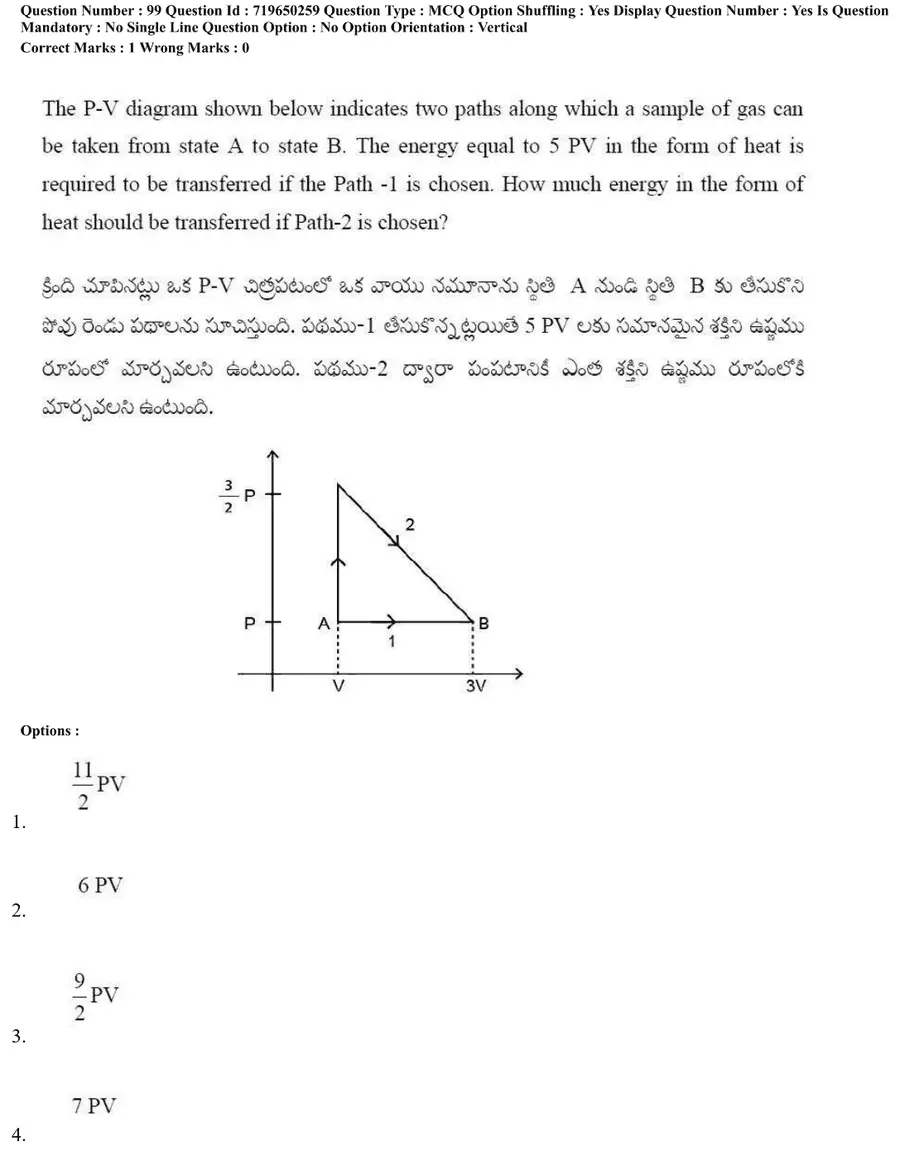
The P-V diagram shown below indicates two paths along which a sample of gas can be taken from state A to state B. The energy equal to 5 PV in the form of heat is required to be transferred if the Path -1 is chosen. How much energy in the form of heat should be transferred if Path-2 is chosen? (see the figure above)
A Carnot engine with efficiency $\eta$ operates between two heat reservoirs with temperatures $T_1$ and $T_2$ where $T_1 > T_2$. If only $T_1$ is changed by 0.4%, the change in efficiency is $\Delta\eta_1$, whereas if only $T_2$ is changed by 0.2%, the efficiency is changed by $\Delta\eta_2$. The ratio $\frac{\Delta\eta_1}{\Delta\eta_2}$ is approximately
An ideal gas at initial temperature $T_0$ and initial volume $V_0$ is expanded adiabatically to a volume $2V_0$. The gas is then expanded isothermally to a volume $5V_0$ and thereafter compressed adiabatically so that the temperature of the gas becomes again $T_0$. If the final volume of the gas is $\alpha V_0$, then the value of constant $\alpha$ is
One mole of nitrogen gas being initially at a temperature of $T_0 = 300$ K is adiabatically compressed to increase its pressure 10 times. The final gas temperature after compression is (Assume nitrogen gas molecules as rigid diatomic and $100^{1/7} = 1.9$)
One mole of ideal gas goes through a process $PV^3$ = constant, where P and V are pressure and volume respectively. Let W be the work done by the gas as its temperature is increased by $\Delta T$. The value of $|W|$ is (R is the universal gas constant)
Two heat engines X and Y of same efficiency are connected in series in such a way that the sink of X works as source of Y. X receives heat at $900\ \mathrm{K}$ and rejects some heat to its sink at $T\ \mathrm{K}$ and in turn Y rejects heat to its sink at $400\ \mathrm{K}$, then the temperature T is
The specific heat capacities of an ideal gas at constant pressure and at constant volume are $620\ \mathrm{Jkg^{-1}K^{-1}}$ and $420\ \mathrm{Jkg^{-1}K^{-1}}$ respectively. The density of the gas at STP is approximately
Which of the following statements is correct regarding P-V graph? a) Slope of P-V graph in an isothermal process is $-\dfrac{P}{V}$ b) Slope of P-V graph in an adiabatic process is $-\dfrac{P}{V}$ c) Slope of P-V graph in an isochoric process is $-\dfrac{\gamma P}{V}$ d) Slope of P-V graph in an isobaric process is zero
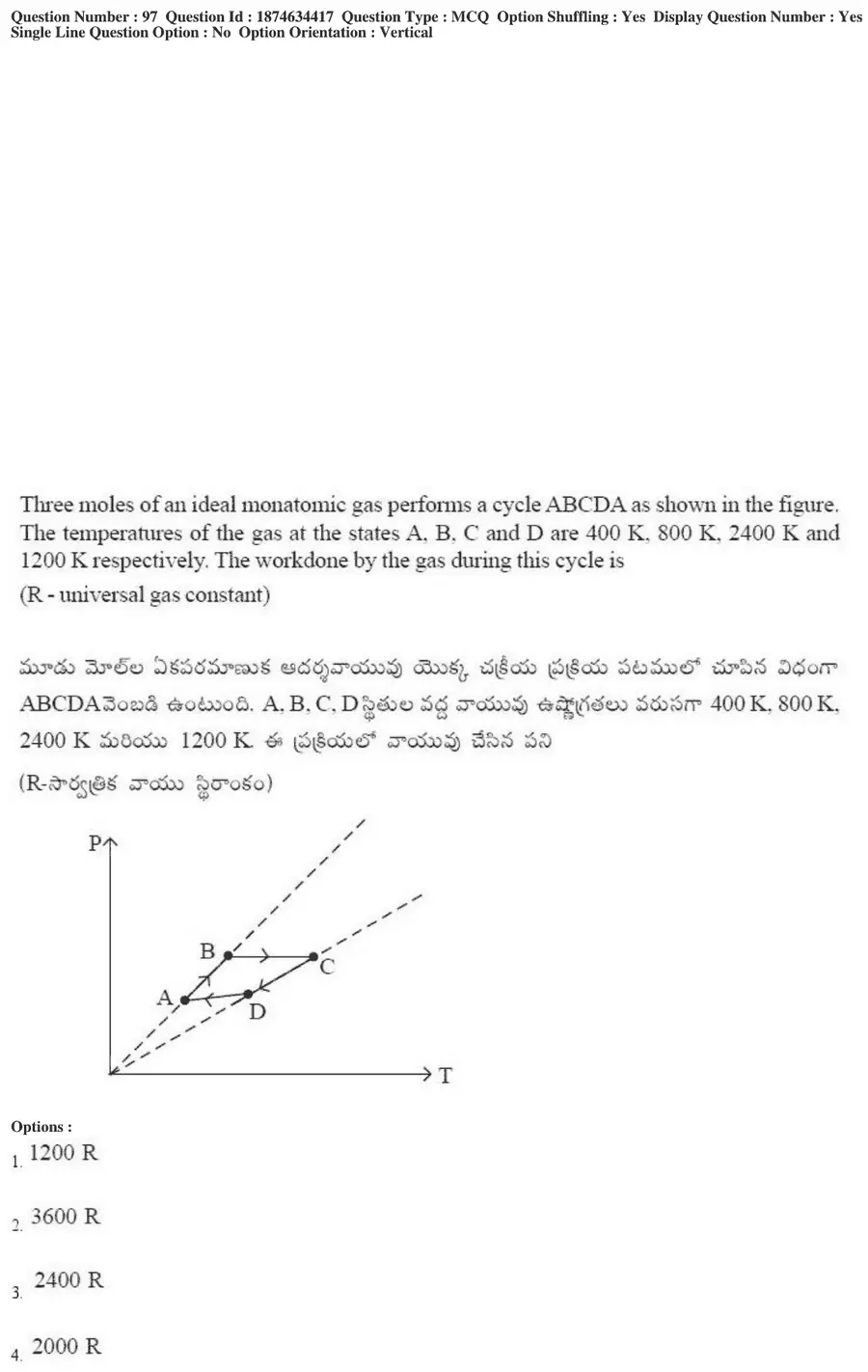
Three moles of an ideal monatomic gas performs a cycle ABCDA as shown in the figure. The temperatures of the gas at the states A, B, C and D are 400 K, 800 K, 2400 K and 1200 K respectively. The workdone by the gas during this cycle is (R - universal gas constant) (see the figure above)
An insulated system contains 4 moles of an ideal diatomic gas at temperature T. When a heat 'Q' is supplied to the gas, 2 moles of the gas is dissociated into atoms and the temperature remained constant. Then the relation between Q and T is (R - Universal gas constant)
A gas ($\gamma = 1.5$) undergoes a cycle of adiabatic, isobaric and isochoric processes in an order. If the volume of the gas is doubled in the adiabatic process then the efficiency of the cycle is approximately
Match the temperatures of the source and sink ($T_1$ and $T_2$ respectively) of a Carnot heat engine given in List-I with the corresponding efficiencies given in List-II. List-I A) $T_1 = 500\,\mathrm{K}, T_2 = 300\,\mathrm{K}$ B) $T_1 = 500\,\mathrm{K}, T_2 = 350\,\mathrm{K}$ C) $T_1 = 800\,\mathrm{K}, T_2 = 400\,\mathrm{K}$ D) $T_1 = 450\,\mathrm{K}, T_2 = 360\,\mathrm{K}$ List-II I) 0.2 II) 0.3 III) 0.4 IV) 0.5 The correct answer is
A Carnot engine of efficiency 40%, takes heat from a source maintained at a temperature of 500 K. It is desired to have an engine of efficiency 60%. Then, the source temperature for the same sink temperature must be
A gas expands with temperature according to the relation $V = kT^{2/3}$, where $k$ is a constant. Work done when the temperature changes by 60 K is (R-Universal gas constant)
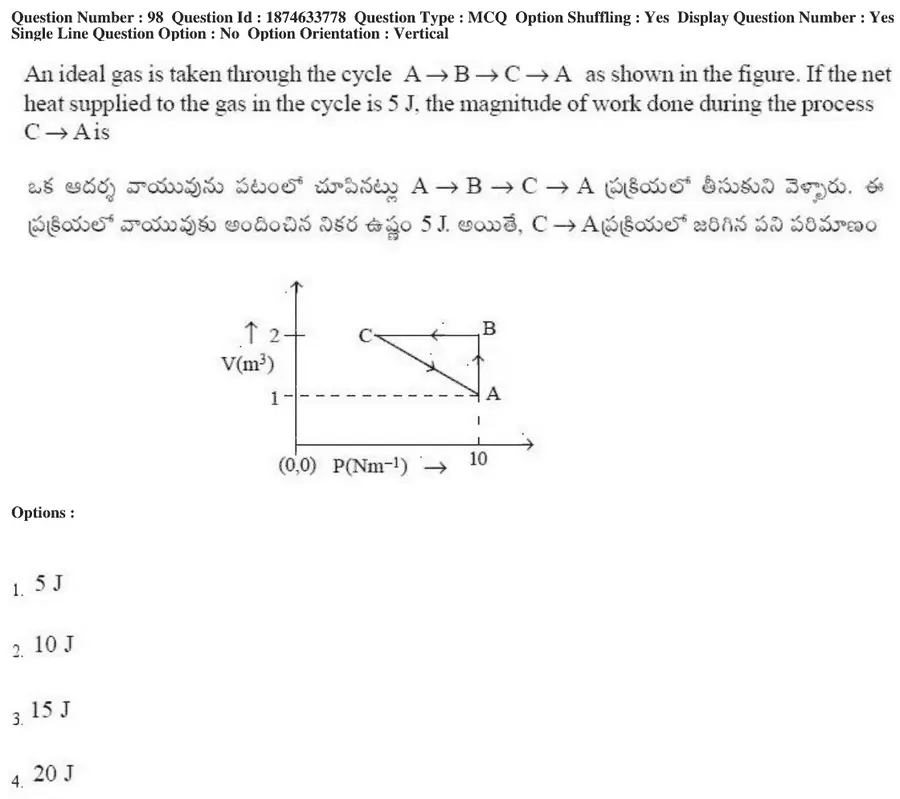
An ideal gas is taken through the cycle $A \to B \to C \to A$ as shown in the figure. If the net heat supplied to the gas in the cycle is 5 J, the magnitude of work done during the process $C \to A$ is (see the figure above)
Five moles of Hydrogen gas initially at STP is compressed adiabatically so that its temperature becomes 673 K. The increase in internal energy of the gas is ($\mathrm{R = 8.3\ Jmol^{-1}K^{-1}}$, $\gamma = 1.4$ for diatomic gas)
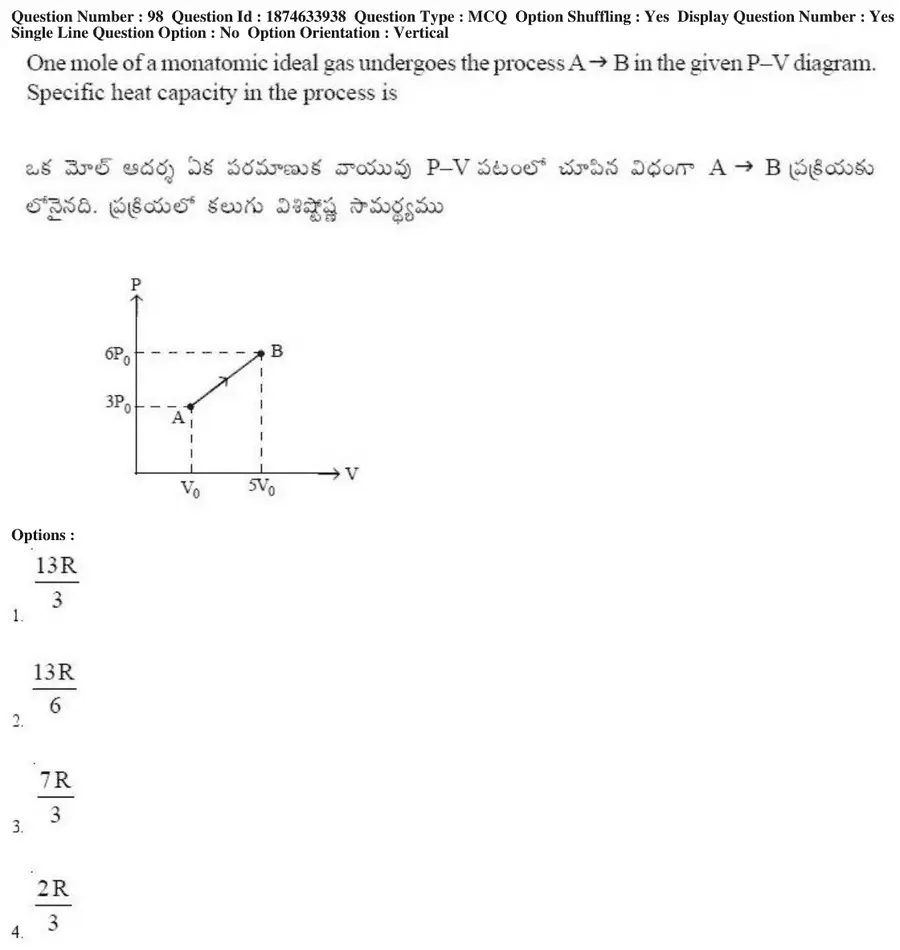
One mole of a monatomic ideal gas undergoes the process $\mathrm{A \to B}$ in the given P-V diagram. Specific heat capacity in the process is (see the figure above)
A diesel engine has a compression ratio of 20 : 1. If the initial pressure is $1\times10^5$ Pa and the initial volume of the cylinder is $1\times10^{-3}\ \mathrm{m^3}$, how much work does the gas do during the compression? (Assume the process as adiabatic) ($C_v = 20.8$ J/mol K , $\gamma_{air} = 1.4$, $(20)^{1.4} = 66.3$)
One mole of the ideal gas goes through the process $P = P_0\left[1-\alpha\left(\dfrac{V}{V_0}\right)^3\right]$, where $P$ and $V$ are pressure and volume, $P_0$, $V_0$ and $\alpha$ are constants. If the maximum attainable temperature of the gas is $\left(\dfrac{3}{4}\right)\dfrac{P_0V_0}{R}$, then the value of $\alpha$ is :
A Carnot engine absorbs heat from a reservoir maintained at temperature $1000\ K$. The engine rejects heat to a reservoir whose temperature is $T$. If the magnitude of absorbed heat is $400\ J$ and work performed is $300\ J$, then the value of $T$ is
The mean kinetic energy of monoatomic gas molecules under standard conditions is $\langle E_1 \rangle$. If the gas is compressed adiabatically 8 times to its initial volume, the mean kinetic energy of gas molecules changes to $\langle E_2 \rangle$. The ratio $\dfrac{\langle E_2 \rangle}{\langle E_1 \rangle}$ is
A one mole of ideal gas goes through a process in which pressure $P$ varies with volume $V$ as $P = 3 - 9\left(\frac{V}{V_0}\right)^{2}$, where $V_0$ is a constant. The maximum attainable temperature by the ideal gas during this process is (All quantities are in SI units and R is gas constant)
The efficiency of carnot engine is $\eta$ when its hot and cold reservoirs are maintained at temperature $T_1$ and $T_2$, respectively. To increase the efficiency to $1.5\,\eta$, the increase in temperature ($\Delta T$) of the hot reservoir by keeping the cold one constant at $T_2$ is
An ideal gas has molar heat capacity $C_v$ at constant volume. The gas undergoes a process wherein the temperature changes as $T=T_0(1+\alpha V^2)$, where T and V are temperature and volume respectively, $T_0$ and $\alpha$ are positive constants. The molar heat capacity C of the gas is given as $C=C_v+Rf(V)$, where $f(V)$ is a function of volume. The expression for $f(V)$ is
An ideal gas in a cylinder is compressed adiabatically to one-third of its original volume. A work of 45 J is done on the gas by the process. The change in internal energy of the gas and the heat flowed into the gas, respectively are
A reversible Carnot heat engine converts $\dfrac{1}{4}$th of its input heat into work. When the temperature of the sink is reduced by 50 K, its efficiency becomes $33\dfrac{1}{3}\%$. The initial temperatures of the source and the sink respectively are
$2.8\ \mathrm{g}$ of nitrogen gas is in a vessel at a temperature $127\ ^\circ\mathrm{C}$. The amount of heat energy required to increase the rms speed of the nitrogen molecules by 41.4% is ______ ($R = 8.31\ \mathrm{J\,mol^{-1}K^{-1}}$)
Thermodynamics is one of the heaviest chapters in Class 11 physics across both Andhra Pradesh and Telangana engineering entrance exams. In the papers we hold for AP and TS EAPCET between 2022 and 2026, the chapter contributed 144 questions across 77 papers. That yields an average of 1.9 questions per paper, making up 4.7% of all physics questions in that recent window. Taking into account all years in our archive from 2010 to 2026, Thermodynamics delivered 285 questions across 149 papers, maintaining an average of 1.9 questions per paper and a 4.8% subject share. During the earlier period from 2010 to 2021, our archive records 141 questions across 72 papers, representing 2.0 questions per paper and a 4.9% share. Across the last three exam years from 2024 to 2026, the chapter provided 86 questions across 46 papers, holding a 4.7% share. Longer-term comparisons show that the subject share from 2024 to 2026 is about the same when compared with the early 2010–2021 papers, and about the same when measured against the recent 2022–2026 five-year span.
State-wise data reveals an interesting divergence in weighting. Between 2022 and 2026, AP EAPCET papers in our set contributed 106 questions across 48 papers, averaging 2.2 questions per paper and claiming 5.5% of all AP physics questions. Over the same period, TS EAPCET contributed 38 questions across 29 papers in our set, averaging 1.3 questions per paper and accounting for 3.3% of TS physics questions. Thermodynamics has appeared every year since 2022 and featured in every paper across both states in the recent five-year window. The chapter ranks 5th of 28 physics chapters by question share between 2022 and 2026. The busiest single sitting in our collection was 2021, which produced 42 questions across 17 papers.
Most-asked topics
Questions fall into three syllabus divisions:
First Law & Processes: 98 questions were asked between 2022 and 2026, contributing to an all-time archive total of 187 questions. It tests the first law relation ΔQ = ΔU + ΔW, work done in isobaric, isochoric, isothermal, and adiabatic processes, polytropic expansions, and cyclic paths on indicator diagrams.
Second Law & Engines: Recent sittings yielded 41 questions, while our complete dataset contains 87 questions. Key concepts include Carnot engine efficiency, heat absorbed and rejected, coefficient of performance of refrigerators, and Kelvin-Planck and Clausius statements.
Basics & Zeroth Law: A smaller pool of 5 questions appeared recently, out of 11 questions across the entire collection. It tests the zeroth law of thermodynamics, thermal equilibrium, and distinctions between extensive and intensive thermodynamic variables.
What the questions look like
The majority of questions require numerical calculation rooted in specific heat ratios and state changes. A common pattern provides an ideal gas expanding under constant pressure and asks for the fraction of supplied heat that converts into mechanical work versus internal energy. For a diatomic gas where the ratio of specific heats is seven-fifths, students must quickly recognize that internal energy change receives five-sevenths of the total heat supplied, with work done consuming two-sevenths.
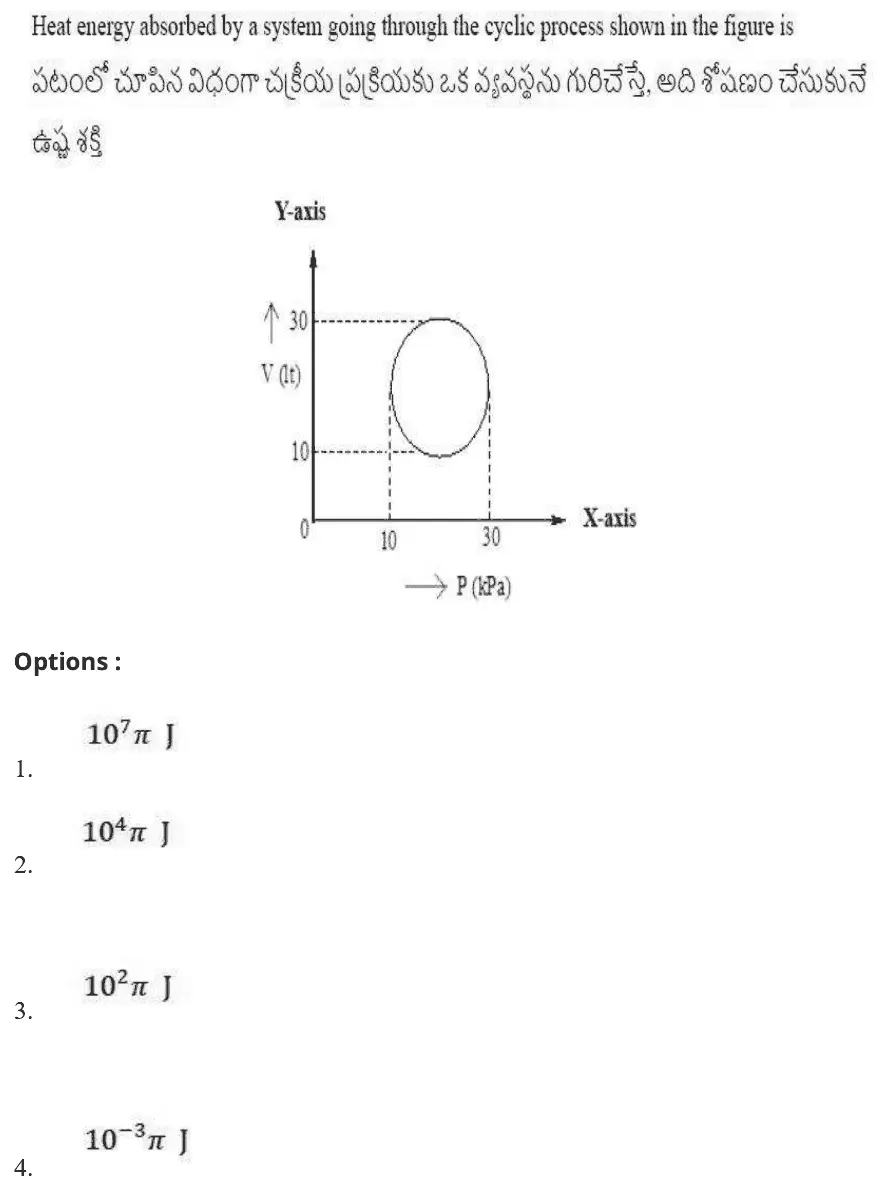
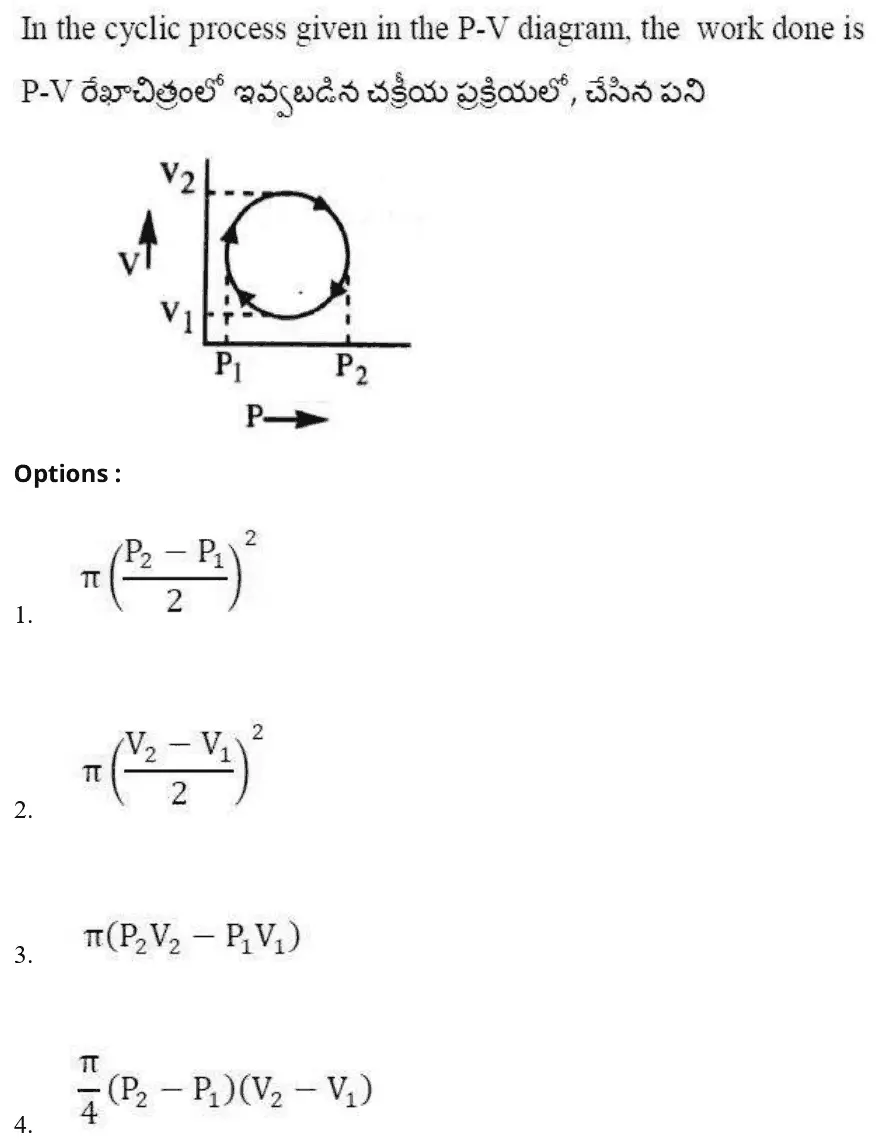
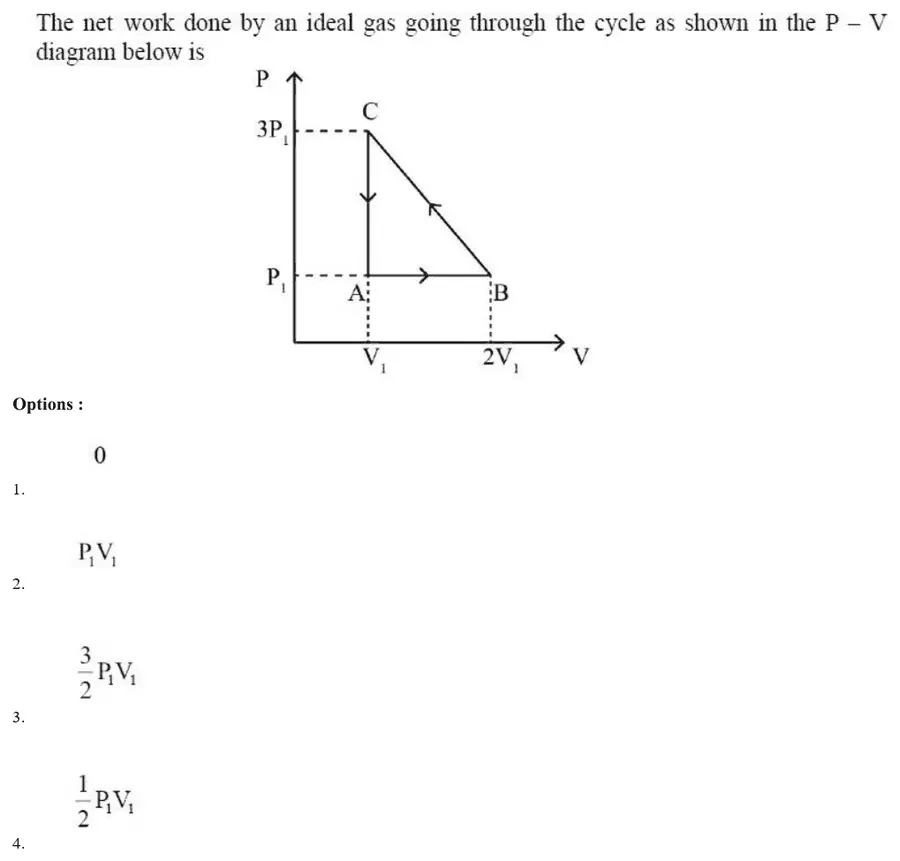
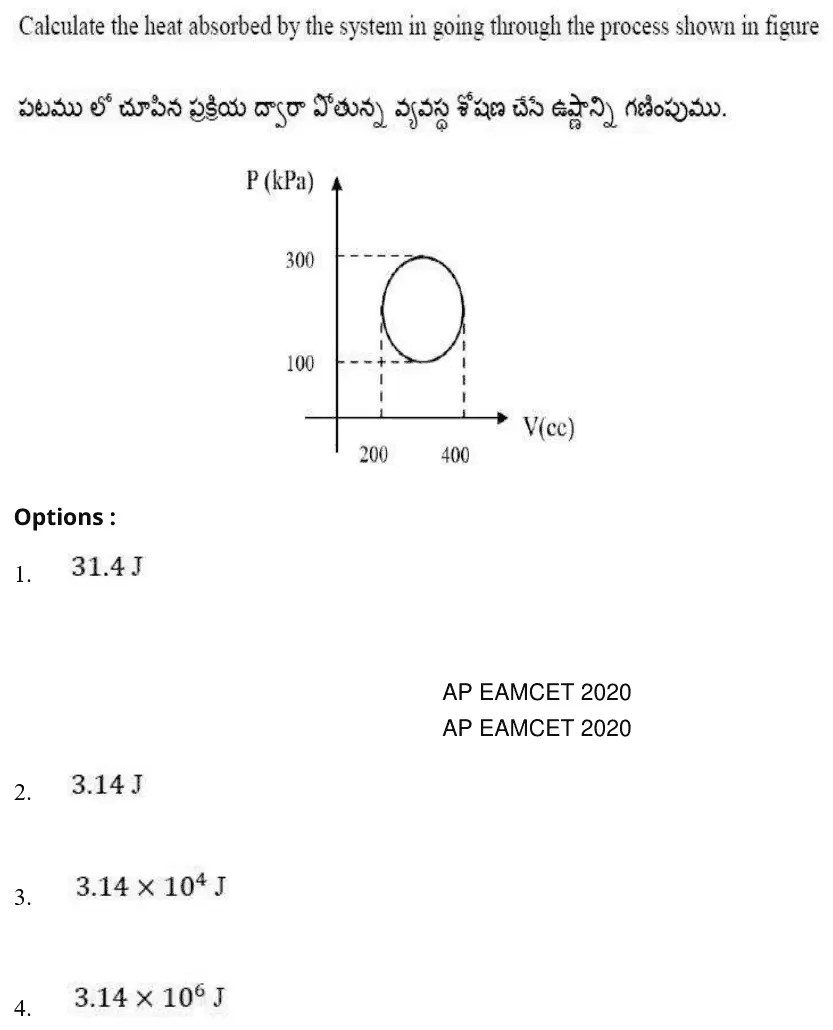
Carnot cycle calculations form another staple. Questions regularly supply an initial operating efficiency alongside the sink temperature, then ask how much the source temperature must increase to raise efficiency by a specified percentage. P-V indicator diagrams frequently depict closed clockwise or anticlockwise cycles made of rectangular, triangular, or elliptic paths, requiring students to calculate net work from enclosed geometric area.
Start by mastering the sign conventions and work expressions for every standard thermodynamic path. For an isothermal expansion at temperature T, work done is n R T ln(V₂ / V₁). For an adiabatic expansion following P V^γ = constant, work done is (P₁ V₁ - P₂ V₂) / (γ - 1) = n R (T₁ - T₂) / (γ - 1). Notice that internal energy change ΔU depends solely on initial and final temperatures via n C_v ΔT, regardless of whether the path is reversible, irreversible, or polytropic.
Next, focus on heat engine and refrigerator relationships. For a Carnot engine operating between source temperature T₁ and sink temperature T₂, efficiency is η = 1 - (T₂ / T₁) = W / Q₁. For a domestic refrigerator operating between the same two thermal reservoirs, coefficient of performance is β = Q₂ / W = T₂ / (T₁ - T₂). Connect them through the standard identity η β = 1 - η.
Finally, practise cyclic processes on P-V diagrams. Remember that clockwise cycles represent heat engines producing positive net work, while anticlockwise cycles represent refrigerators or heat pumps requiring external work input.
Frequently asked questions
Does Thermodynamics appear in every paper?
Yes. In the papers we hold from 2022 to 2026, Thermodynamics appeared in every single paper across both AP and TS EAPCET, averaging nearly two questions per shift.
What is the most frequently tested formula in Thermodynamics?
The Carnot engine efficiency relation η = 1 - (T₂ / T₁) and the first law relation ΔQ = n C_p ΔT = n C_v ΔT + P ΔV appear more often than any other formula in the chapter.
What is the difference between intensive and extensive variables?
Intensive variables like pressure, temperature, and density do not depend on the size or mass of the system, whereas extensive variables like internal energy, entropy, volume, and total heat capacity scale with system size.
Where can I find worked solutions for EAPCET Thermodynamics questions?
Step-by-step solutions for each one are in the EdLoop EAPCET app.