Every Elasticity question from past AP EAPCET and TS EAPCET papers, with options and answers. Newest first.
149questions
137papers covered
2.5%of Physics questions, 2022–2026
2010–2026years
Guide at a glance
Class 11 mechanics includes Elasticity as a compact, dependable unit. In the papers we hold for AP and TS EAPCET from 2022 to 2026, the chapter contributed 77 questions across 77 papers.
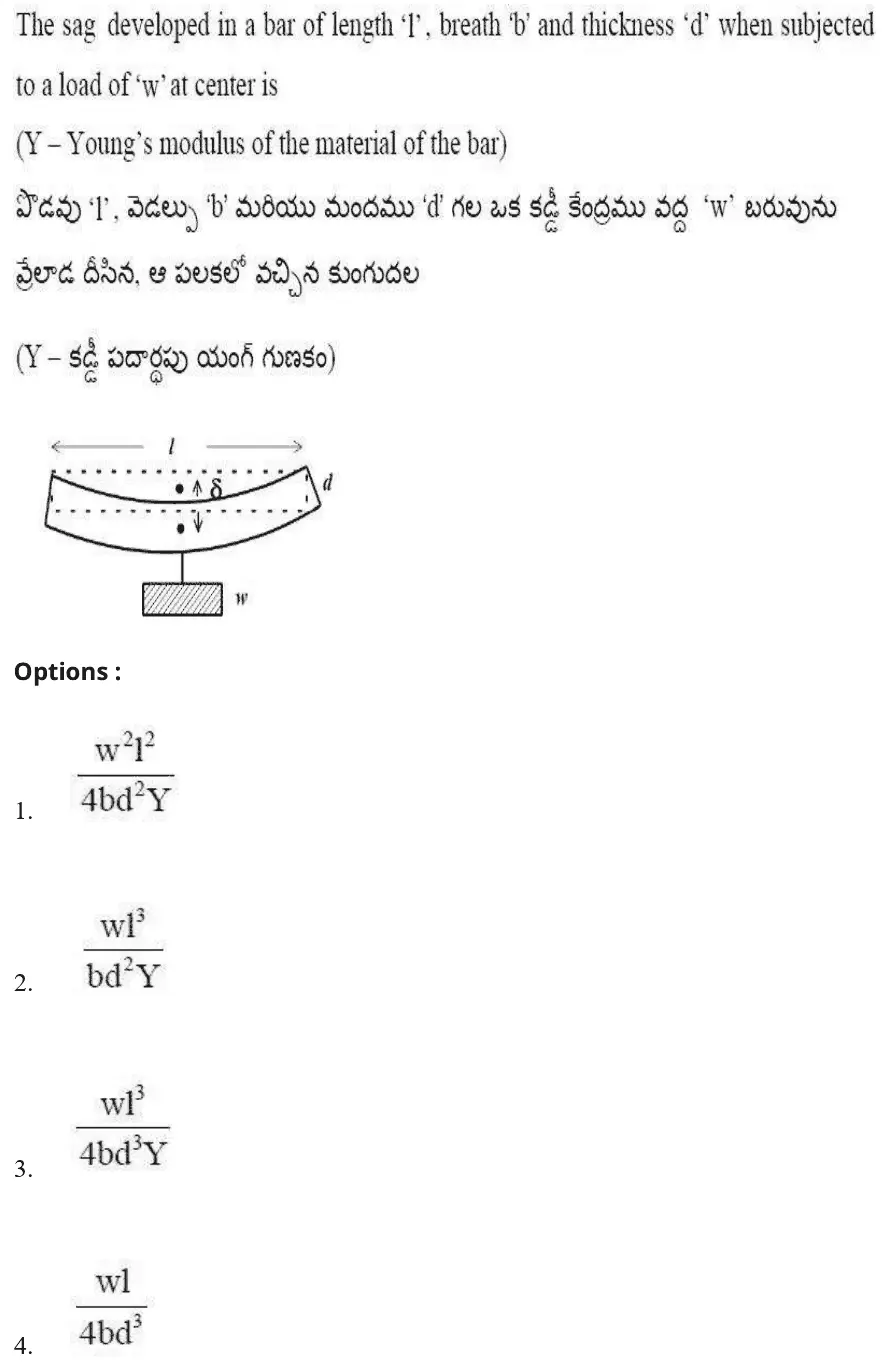
When a uniform bar of length ‘$l$’ breadth ‘$b$’ and thickness ‘$d$’ was supported by rigid supports near the ends and loaded at the center by a vehicle of mass $M$, it sags the bar by an amount δ is (Young’s modulus of material is $Y$)
A uniform metal wire is suspended from a rigid ceiling and a solid sphere is attached to the second end of the wire. If the radius of the sphere is doubled and then immersed in a liquid whose density is 60% of the density of the material of the sphere, then the percentage increase in the elongation of the wire is
A wire of weight $W$ and area of cross-section $A$ elongates under its own weight. If $Y$ is the Young's modulus and $\sigma$ is the Poisson's ratio of the material of the wire, then the fractional change in the radius of the wire is
When a wire of length ‘L’ and radius ‘r’, fixed at one end is stretched by a force F, the increase in its length is ‘$x$’. If another wire made of same material of length ‘2L’ and radius ‘2r’ is stretched by force ‘2F’, the increase in its length will be
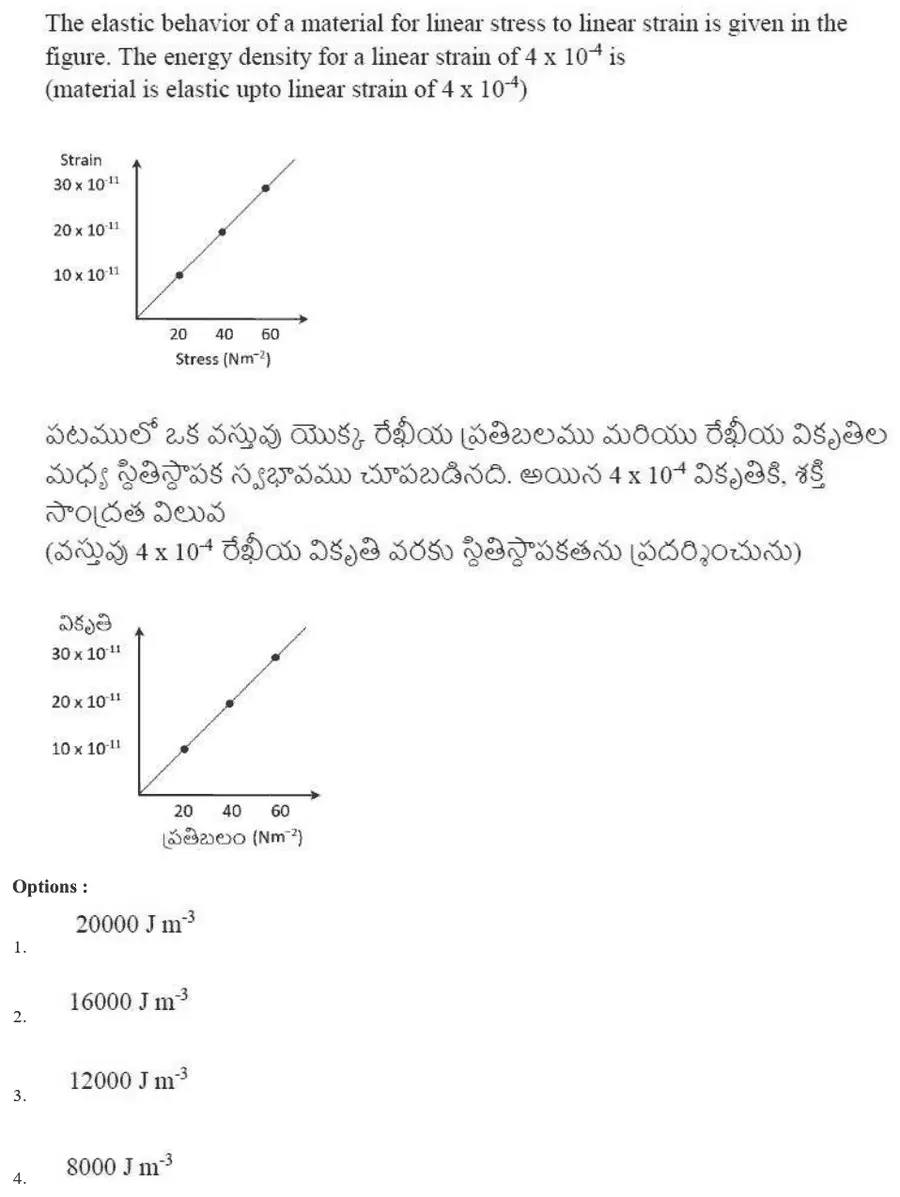
The elastic behavior of a material for linear stress to linear strain is given in the figure. The energy density for a linear strain of $4 \times 10^{-4}$ is (material is elastic upto linear strain of $4 \times 10^{-4}$)
The pressure applied on a cube from all sides is ‘$P$’. In order to keep its volume constant, the temperature of cube is to be raised by (The Bulk modulus and the coefficient of volume expansion of the material of the cube are $\beta$ and $\alpha$ respectively)
A copper wire of negligible mass, length $1\ m$ and area of cross-section $10^{-6}m^2$ is kept on a smooth horizontal table. One end of the wire is fixed and other end of the wire attached with a ball of mass $1\ kg$. If the ball and wire are rotating with $20\ \mathrm{rad\ s^{-1}}$, an elongation of $10^{-3}m$ is observed in the wire, find its Young's modulus
A rubber hose $50\ cm$ long and internal diameter $1\ cm$ is stretched to $60\ cm$. The internal diameter of stretched hose is (Poisson's ratio of the rubber $\sigma = 0.5$)
A book of dimension $4\ \mathrm{cm} \times 1.5\ \mathrm{cm} \times 10\ \mathrm{cm}$ is kept in a way that the $10\ \mathrm{cm}$ edge is vertical. A horizontal force of $3\ \mathrm{N}$ is applied at the top face. If the shear modulus of the book is $2\times10^{5}\ \mathrm{Nm^{-2}}$, then the horizontal displacement of the top face will be
A metal wire can withstand a maximum tension of 80 N. If the wire is cut into four parts of equal length, then each part can withstand a maximum tension of
A wire P of length L made of a material of density D and Young's modulus Y elongates by 2.0 mm under its own weight. If another wire Q made of material of density $\frac{2D}{3}$ and Young's modulus $\frac{3Y}{4}$ elongates by 1.0 mm under its own weight, then the length of the wire Q is
When a load is attached at the midpoint of a steel bar A of length 80 cm, breadth 2.5 cm and thickness 2 mm, it sags by 1.2 mm. If the same load is attached at the midpoint of another steel bar B of length 120 cm, breadth 3 cm and thickness 3 mm, the bar B sags by (In both the cases, the bars are supported at the two ends)
A wire of length 100 cm is made of a material of Young's modulus $1.6\times10^{11}\ \mathrm{Nm^{-2}}$. If the work done in stretching this wire by 0.1 cm is 2 J, then the area of cross-section of the wire (in $10^{-5}\ \mathrm{m^2}$) is
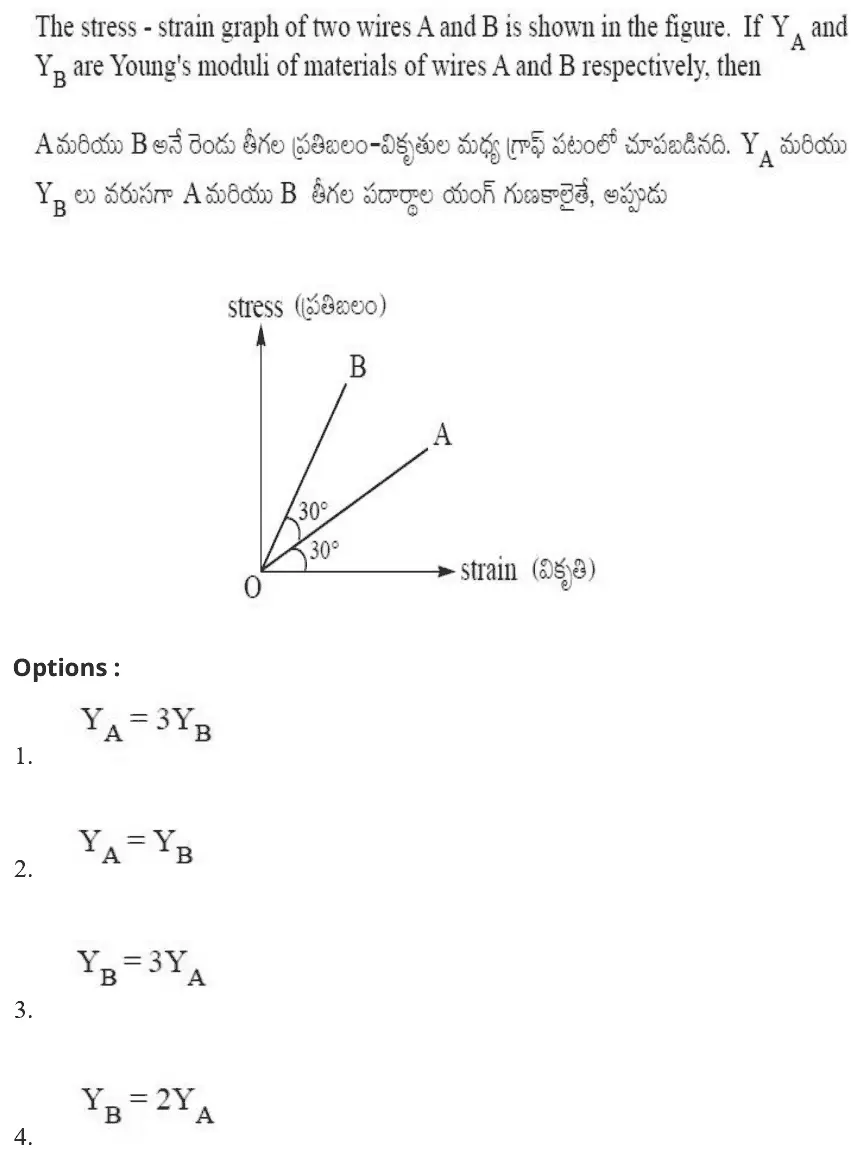
The stress - strain graph of two wires A and B is shown in the figure. If $Y_A$ and $Y_B$ are Young's moduli of materials of wires A and B respectively, then
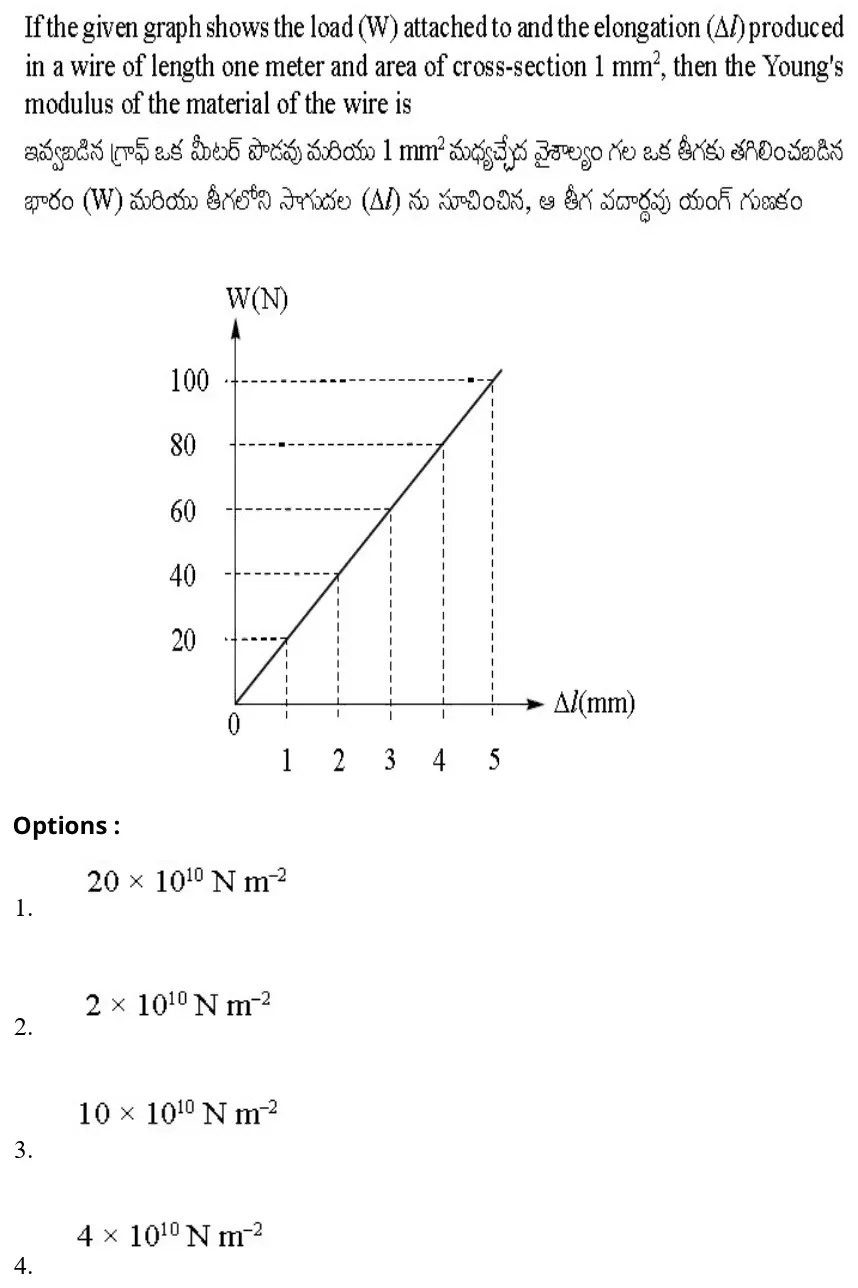
If the given graph shows the load (W) attached to and the elongation ($\Delta l$) produced in a wire of length one meter and area of cross-section $1\ \mathrm{mm}^2$, then the Young's modulus of the material of the wire is
A wire is stretched 1 mm by a force F. If a second wire of same material, same length and 4 times the diameter of the first wire is stretched by the same force F, then the elongation of the second wire is
If the pressure on a body is increased from 200 kPa to 250 kPa, the volume of the body decreases by 0.25%. The compressibility of the material of the body is (in $\mathrm{m^2\,N^{-1}}$)
If the longitudinal strain of a stretched wire is 0.2 % and the Poisson's ratio of the material of the wire is 0.3, then the volume strain of the wire is
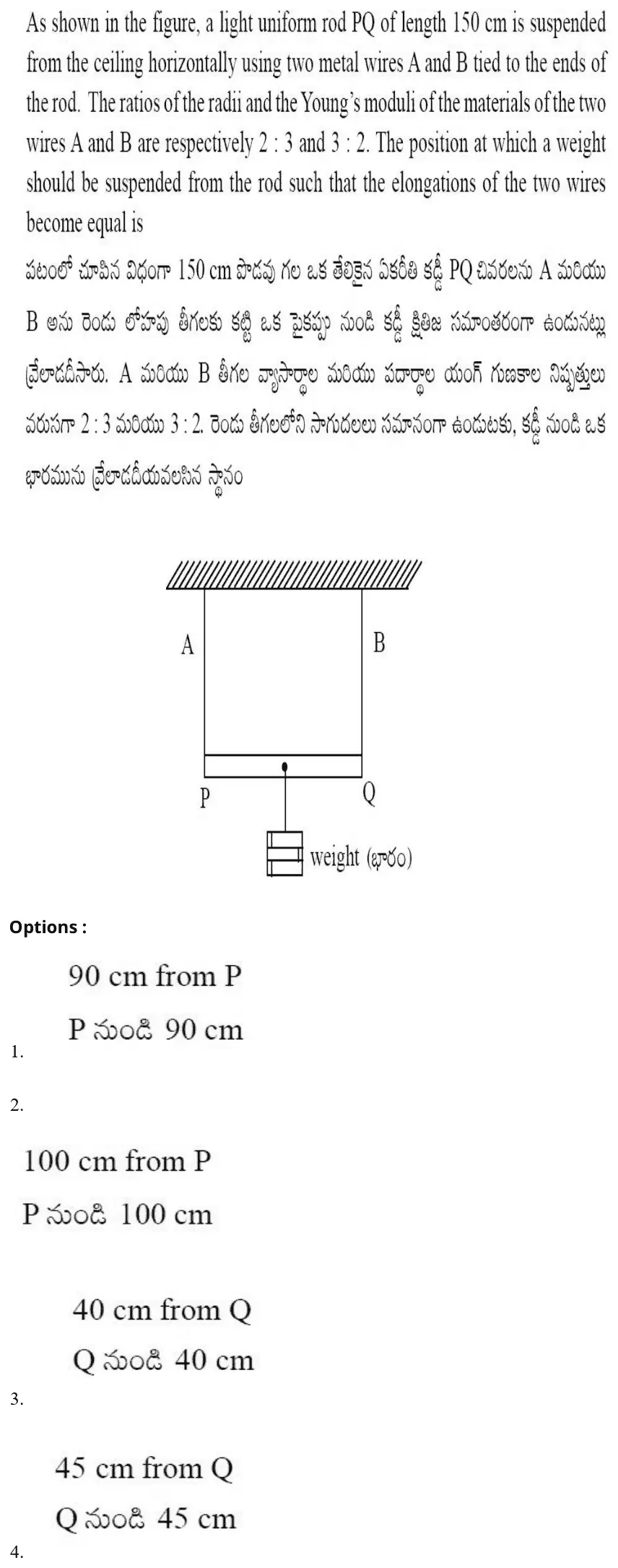
As shown in the figure, a light uniform rod PQ of length 150 cm is suspended from the ceiling horizontally using two metal wires A and B tied to the ends of the rod. The ratios of the radii and the Young's moduli of the materials of the two wires A and B are respectively $2 : 3$ and $3 : 2$. The position at which a weight should be suspended from the rod such that the elongations of the two wires become equal is
When a wire of length ‘L’ clamped at one end is pulled by a force ‘F’ from the other end, its length increases by ‘L’. If the radius of the wire and the applied force were halved, then the increase in its length is
When a sphere is taken to the bottom of a sea of depth 1 km, it contracts in volume by 0.01%, then the bulk modulus of the material of the sphere is (Acceleration due to gravity = $10\ \mathrm{m\,s^{-2}}$)
A steel rod with a circular cross-section of diameter 1cm and another steel rod with a square cross-section of side 1cm have equal mass. If the two rods are subjected to same tension, the ratio of the elongations of the two rods is
A metal rod of area of cross-section $3\,\mathrm{cm}^2$ is stretched along its length by applying a force of $9\times10^{4}\ \mathrm{N}$. If the Young's modulus of the material of the rod is $2\times10^{11}\ \mathrm{Nm^{-2}}$, the energy stored per unit volume in the stretched rod is
The Young's modulus and Poisson's ratio of a material are respectively Y and $\sigma$. The force required to decrease the area of cross-section of a wire made of this material by $\Delta A$ is
If a brass sphere of radius 36 cm is submerged in a lake at a depth where the pressure is $10^{7}$ Pa, then the change in the radius of the sphere is (Bulk modulus of brass = 60 GPa)
Two wires A and B made of same material and areas of cross-section in the ratio $1:2$ are stretched by same force. If the masses of the wires A and B are in the ratio $2:3$, then the ratio of the elongations of the wires A and B is
The work done on a wire of volume of $2\ \mathrm{cm^3}$ is $16 \times 10^2$ J. If the young's modulus of the material of the wire is $4 \times 10^{12}\ \mathrm{Nm^{-2}}$. Then the strain produced in the wire is
A wire of length 100 cm and area of cross-section $2\ \mathrm{mm}^2$ is stretched by two forces of each 440 N applied at the ends of the wire in opposite directions along the length of the wire. If the elongation of the wire is 2 mm, the Young's modulus of the material of the wire is
A 4 kg stone attached at the end of a steel wire is being whirled at a constant speed $12\ \mathrm{ms^{-1}}$ in a horizontal circle. The wire is 4 m long with a diameter 2.0 mm and young's modules of the steel is $2 \times 10^{11}\ \mathrm{Nm^{-2}}$. The strain in the wire is.
When the load applied to a wire is increased from 5 kg wt to 8 kg wt, the elongation of the wire increases from 1 mm to 1.8 mm. The work done during the elongation of the wire is (Acceleration due to gravity = $10\ \mathrm{ms^{-2}}$)
Depth of a river is 100 m. Magnitude of compressibility of the water is $0.5 \times 10^{-9}\ \mathrm{N^{-1}m^2}$. The fractional compression in water at the bottom of the river is
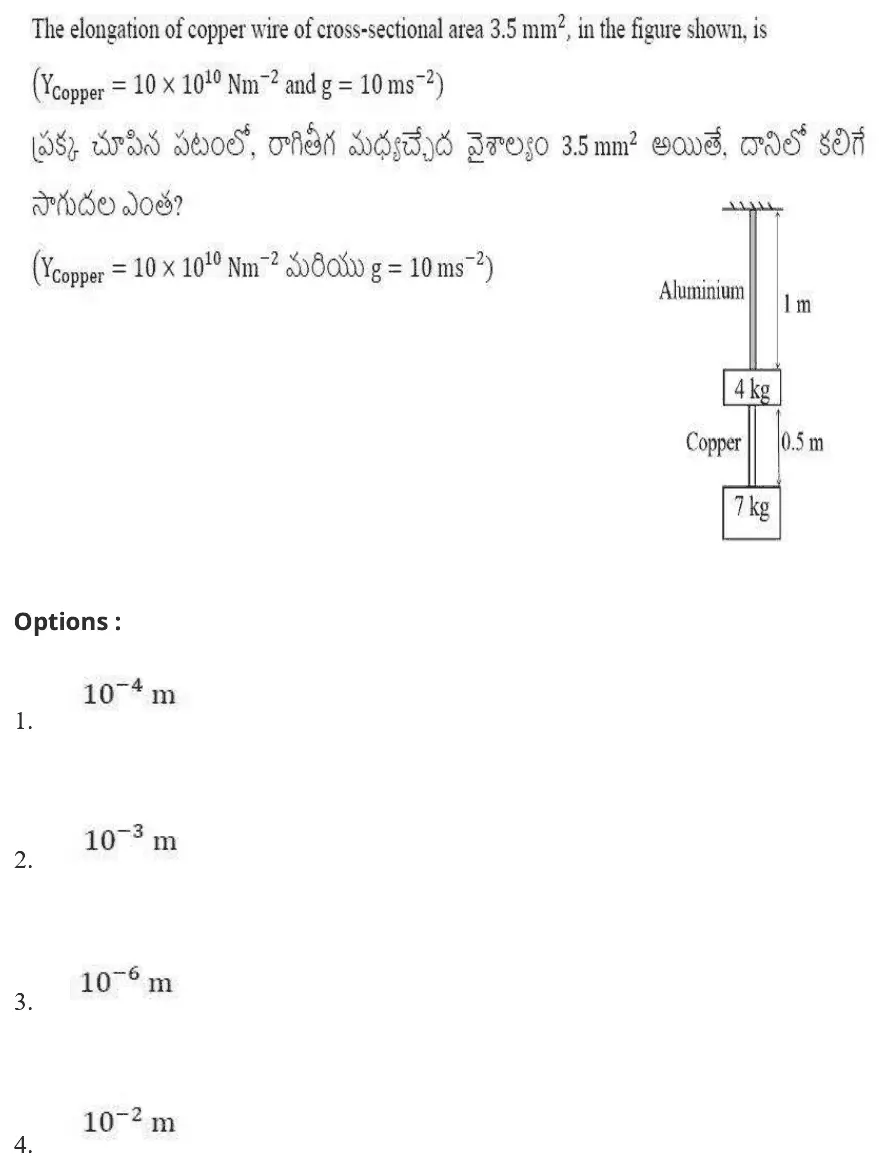
(Accelaration due to gravity = $10\ \mathrm{ms^{-2}}$)
If the work done in stretching a wire by 1 mm is 2 J, the work necessary for stretching another wire of same material but with double radius of cross section and half the length by 1 mm is
Two copper wires A and B of lengths in the ratio $1:2$ and diameters in the ratio $3:2$ are stretched by forces in the ratio $3:1$. The ratio of the elastic potential energies stored per unit volume in the wires A and B is
A simple pendulum is made of a metal wire of length ‘L’, area of cross-section ‘A’, material of Young’s modulus ‘Y’ and a bob of mass ‘m’. This pendulum is hung in a bus moving with a uniform speed ‘V’ on a horizontal circular road of radius ‘R’. The elongation in the wire is
A block of mass 2 kg is tied to one end of a 2 m long metal wire of $1.0\ \mathrm{mm}^2$ area of cross-section and rotated in a vertical circle such that the tension in the wire is zero at the highest point. If the maximum elongation in the wire is 2 mm, the Young's modulus of the metal is
(Acceleration due to gravity $=10\ \mathrm{ms^{-2}}$)
A wire of cross-sectional area $10^{-6}$ $\mathrm{m^2}$ is elongated by 0.1 % when the tension in it is 1000 N. The Young's modulus of the material of the wire is (Assume radius of the wire is constant)
A steel wire of length 3 m and a copper wire of length 2.2 m are connected end to end. When the combination is stretched by a force, the net elongation is 1.05 mm. If the area of cross-section of each wire is $6\ \mathrm{mm^2}$, then the load applied is
(Young's moduli of steel and copper are respectively $2\times10^{11}\ \mathrm{Nm^{-2}}$ and $1.1\times10^{11}\ \mathrm{Nm^{-2}}$)
If the length of a string is ‘P’ when the tension in it is 6 N and its length is ‘Q’ when the tension in it is 8 N, then the original length of the string is
A metal wire with circular cross section and length one metre is pulled with tensile force of 1000 N on each side. For the wire to be stretched not more than 0.25 cm, the minimum diameter of the wire required is
(Young's modulus of the metal $=10^{11}$ Pa, take $\sqrt{\pi}=1.77$)
A cylindrical rod made of aluminum has length 1 meter and diameter of 10 cm. The rod is subjected to a tensile force of 100 kN. The elongation in the rod is
A rectangular metallic block of dimensions $40\ \mathrm{mm} \times 20\ \mathrm{mm}$ when pulled with a tension of $50\ \mathrm{kN}$ undergoes only elastic deformation. The strain in the block is
(The shear modulus of the material of the block is $40\times10^{9}\ \mathrm{Nm^{-2}}$)
The maximum possible height of a mountain on earth is approximately
(elastic limit of mountain rock $= 30\times10^{7}\,\mathrm{Nm^{-2}}$, average density of mountain rock $= 3\times10^{3}\,\mathrm{kgm^{-3}}$, $g = 10\,\mathrm{ms^{-2}}$)
A spherical ball of volume $2000\ \mathrm{cm^3}$ is subjected to a hydraulic pressure of 15 atm. If the change in volume is $5\times10^{-2}\ \mathrm{cm^3}$, the bulk modulus of the material of the spherical ball is
The ratio of the areas of cross sections of three wires is 1:2:3 and the ratio of the Young's modulii of their materials is 3:2:1. If the three wires are of same length and same stretching force is applied to the three wires, then the ratio of the elongations of the three wires is
The lengths of four wires A, B, C and D made of same material are 1 m, 2 m, 3 m and 4 m respectively. The radii of the wires A, B, C and D are 0.2 mm, 0.4 mm, 0.6 mm and 0.8 mm respectively. For the same applied tension, the elongation is more in the wire
Two wires A and B of same length, same radius and same Young’s modulus are heated to same range of temperatures. If the coefficient of linear expansion of A is $\frac{3}{2}$ times that of B, then the ratio of the thermal stresses produced in the two wires A and B is
One end of a steel rod of radius 10.0 mm and length 50.0 cm is clamped on a horizontal table. The other end of the rod is pulled with a force of magnitude $10.0 \times \pi$ kN. This force is uniform across the flat surface of the rod and is perpendicular to it. The change in the length of the rod due to this applied force is (Use Young's modulus = $2.0 \times 10^{11}$ N/m$^2$)
What is the work done in stretching a uniform metal wire of length from 2 m to 2.004 m with an area of cross section $10^{-6}\ \mathrm{m^2}$ ? [Young's modulus of the wire = $2\times10^{11}\ \mathrm{N/m^2}$]
An object of mass 15 kg is attached to the end of a metal wire of unstretched length 1.0 m. The object is then whirled in a vertical circle with an angular velocity of 4 rad / s at the bottom of the circle. If the cross sectional area of the wire is 0.05 cm$^2$ and Young's modulus of metal is $2\times10^{11}\ N/m^2$, then the elongation of the wire when the mass is at the lowest point of its path (Take $g=10\ m/s^2$)
Two wires of same length having radius of 2 mm and 1.5 mm respectively are loaded with same weights. Extension of the second wire is double than that of the first wire. What is the ratio of the Young's modulus of the first wire to that of the second wire?
Match the following Column-I A) Shear modulus B) Shearing stress C) Elastic fatigue D) Modulus of elasticity Column-II I) Resistance to change in volume II) Proportionality constant III) Tangential stress IV) Temporary loss of elastic property V) Resistance to change against deformation force The correct match is
A swimming pool has a depth of 22 m and area 700 m$^{2}$. Calculate fractional change $\frac{\Delta v}{v}$ of water at the bottom of the swimming pool. Given that the bulk modulus of water is $2.2\times10^{9}$ Nm$^{-2}$, g = 10 m/s$^{2}$, and density of water 1000 kg/m$^{3}$.
A rubber band catapult has initial length 2 cm and cross-sectional area $5\ \mathrm{mm}^2$. It is stretched by 2 cm and then released to project a stone of mass of 20 g. The Velocity of projected stone is (Young's modulus of rubber = $5 \times 10^8\ \mathrm{Nm^{-2}}$)
Two wires made of same material are clamped rigidly at one end and pulled by the same force on the other end. The length and the radius of the first wire are three times those of the second wire. If x is the increase in the length of the first wire, then the increase in the length of the second wire is
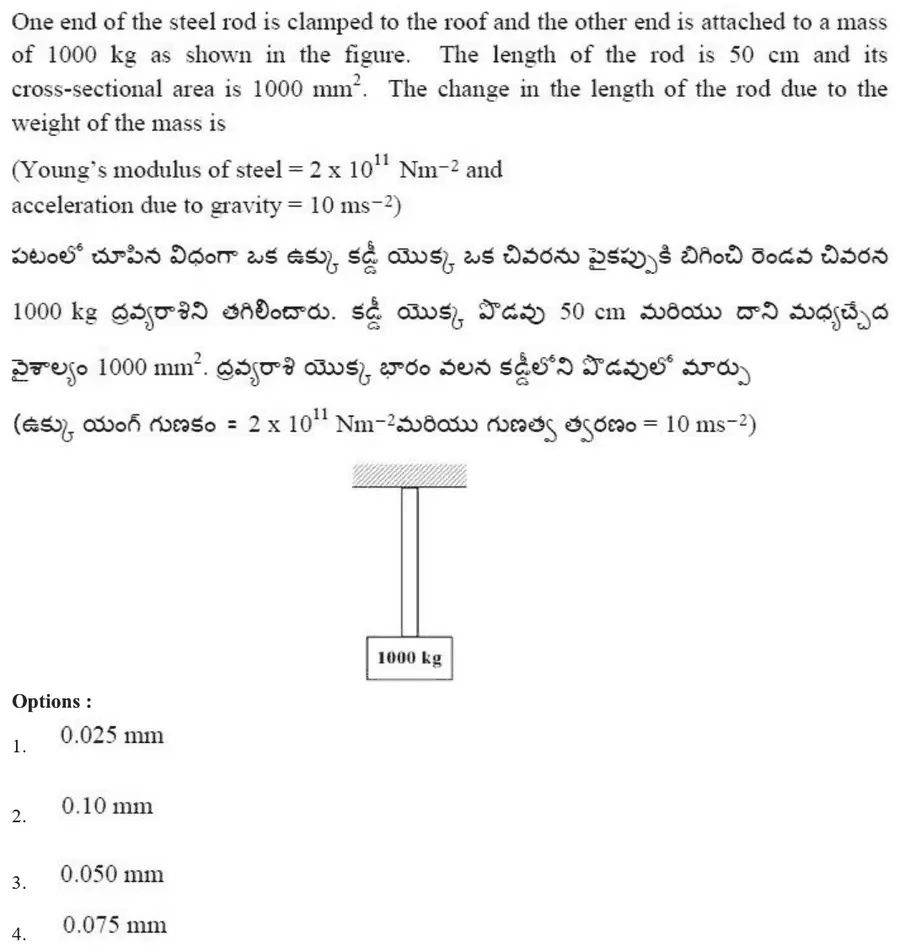
One end of the steel rod is clamped to the roof and the other end is attached to a mass of 1000 kg as shown in the figure. The length of the rod is 50 cm and its cross-sectional area is $1000\ \mathrm{mm^2}$. The change in the length of the rod due to the weight of the mass is (Young's modulus of steel = $2 \times 10^{11}\ \mathrm{Nm^{-2}}$ and acceleration due to gravity = $10\ \mathrm{ms^{-2}}$) (see the figure above)
The elastic limit of a metal is $\frac{400}{\pi}$ MPa. If a rod of this metal is to support a 484 N load without exceeding its elastic limit, the minimum diameter of the rod is
Statement (A) : For an ideal liquid, the bulk modulus is infinite and the shear modulus is zero. Statement (B) : The volume contraction of a metal cube of bulk modulus 140 GPa, 10 cm on a edge, when subjected to a hydraulic pressure of $7\times10^6$ Pa is $-0.05\ \mathrm{m^3}$. Statement (C) : A spiral spring is stretched by a weight attached to it. The strain is tensile.
Two wires A and B of same cross-section are connected end to end. When same tension is created in both wires, the elongation in B wire is twice the elongation in A wire. If $L_A$ and $L_B$ are the initial lengths of the wires A and B respectively, then (Young's modulus of material of wire A $= 2\times10^{11}\ \mathrm{Nm^{-2}}$ and Young's modulus of material of wire B $= 1.1\times10^{11}\ \mathrm{Nm^{-2}}$).
A copper wire of length 2.4 m and an aluminum wire of length 0.7 m, both having diameter 2 mm, are connected end to end. When stretched by a load, the obtained elongation is found to be 0.6 mm. The applied load is
(Young's modulus of copper = $1.2 \times 10^{11}\ \mathrm{Nm^{-2}}$ and Young's modulus of aluminum = $0.7 \times 10^{11}\ \mathrm{Nm^{-2}}$)
The length of a rod under longitudinal tension $T_1$ is $L_1$ and that under longitudinal tension $T_2$ is $L_2$. What is the actual length of the rod, in the absence of tensions?
When a $8\ \mathrm{m}$ long wire is stretched by a load of $10\ \mathrm{kg.wt}$, it is elongated by $1.5\ \mathrm{mm}$. The energy stored in the wire in this process is ______ ($g = 10\ \mathrm{m.s^{-2}}$)
A body of mass $10\ \mathrm{kg}$ is attached to a wire of $0.3\ \mathrm{m}$ length. The breaking stress is $4.8 \times 10^7\ \mathrm{N.m^{-2}}$. The area of cross-section from the wire is $10^{-6}\ \mathrm{m^2}$. The maximum angular velocity with which it can be rotated in a horizontal circle is ______.
The Youngs modulus of a rubber string of length $12\ cm$ and density $1.5\ \mathrm{kg.m^{-3}}$ is $5 \times 10^{8}\ \mathrm{N.m^{-2}}$. When this string is suspended vertically, the increase in its length due to its own weight is ______. (take g = $10\ \mathrm{m.s^{-2}}$)
Young's modulus of a wire is $2 \times 10^{11}\ \mathrm{N.m^{-2}}$. If an external stretching force of $2 \times 10^{11}\ \mathrm{N}$ is applied to a wire of length $L$, the final length of the wire is ______ (cross-section = unity)
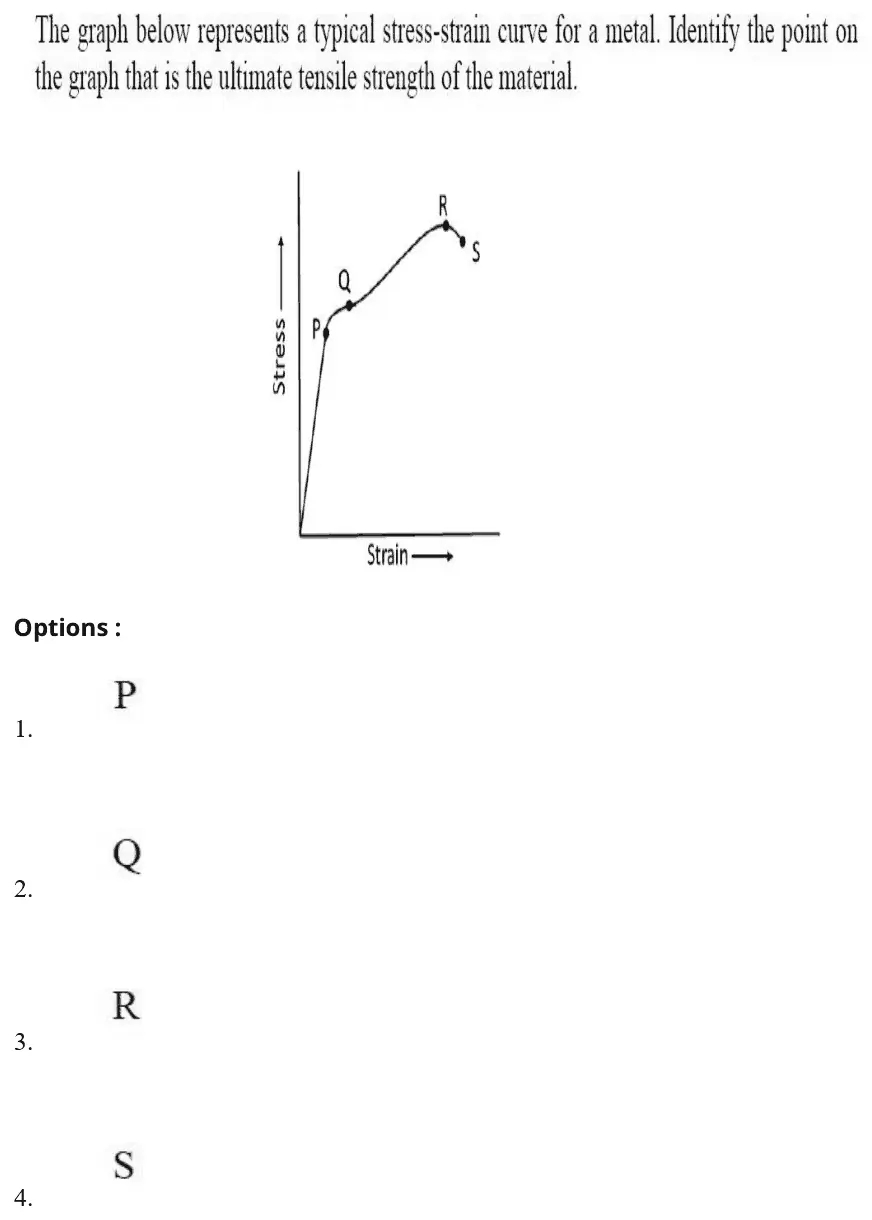
The graph below represents a typical stress-strain curve for a metal. Identify the point on the graph that is the ultimate tensile strength of the material. (see the figure above)
Two springs of force constants $K_1$ and $K_2$ are loaded with weights $W_1$ and $W_2$ respectively. Assume that length of each string is increased by same amount. If $K_1 = 2\,K_2$, then the ratio $\frac{W_2}{W_1}$ is
Consider a fluid in a container. Let the density of the fluid at the surface and at depth H be $\rho_0$ and $\rho$ respectively. The bulk modulus of the fluid is $B_0$. If $\rho = \frac{\rho_0}{1+\alpha\rho_0 gH}$ then the constant $\alpha$ is $\left(\text{Assume } \frac{\rho-\rho_0}{\rho_0} \ll 1\right)$
Consider a rod of length 1.0 m with a cross-sectional area of $0.50\ \mathrm{cm^2}$. The rod supports a 500-kg platform that hangs attached to the rod's lower end. What is elongation of the rod under the stress ignoring the weight of the rod? Consider the Young's modulus to be $10^{11}$ Pa and $g = 10\ \mathrm{m/s^2}$.
The length of a metal wire is L, when it is subjected to tension T. If the tension is increased to $T + \Delta T$, the length becomes $L + \Delta L$. The natural length of the wire is
A steel wire and a copper wire are joined end to end having equal cross section. The elongation of two wires are found to be equal under tension. What is the ratio of the length of the steel to the length of copper wire? (Young modulus of steel = $2.0 \times 10^{11}\ \mathrm{Nm^{-2}}$ and Young modulus of copper = $1.1 \times 10^{11}\ \mathrm{Nm^{-2}}$)
Two different wires made with same material have their radii in the ratio $1:2$. Even their lengths are in the ratio $1:2$. On subjecting to different loads, if the extensions produced are equal, find the ratio of the loads applied?
A wire of length $1\ \mathrm{m}$ and radius $2\ \mathrm{mm}$ is vertically clamped. The lower end is twisted through an angle of $45^\circ$. The angle of shear is ______
A material has Poisson's ratio $0.50$. If a uniform rod made of this material suffers a longitudinal strain of $2\times10^{-3}$, then the percentage change in volume is ______
If a pressure of $8 \times 10^{8}\ \mathrm{N.m^{-2}}$ is applied to a lead block so that its volume reduces by $20\%$. The Bulk modulus of lead block is ______
What should be the diameter of a copper wire ($Y = 12 \times 10^{10}\,\mathrm{N.m^{-2}}$) of length $5\,\mathrm{m}$ to produce the same elongation produced by a $5\,\mathrm{m}$ long aluminum wire ($Y = 7 \times 10^{10}\,\mathrm{N.m^{-2}}$) of diameter $3\,\mathrm{mm}$ with the same $40\,\mathrm{kg}$ mass?
A 3 $m$ long steel wire is stretched to increase its length by 0.3 $cm$. Poission's ratio for steel is 0.26. The lateral strain produced in the wire is
When a weight of 10 $\mathrm{kg}$ is suspended from a copper wire of length 3 $\mathrm{m}$ and diameter 0.4 $\mathrm{mm}$, its length increases by 2.4 $\mathrm{cm}$. If the diameter of the wire is doubled, then the extension in its length will be ______
Two metal wires A and B have length L and 3 L respectively. The radius of cross-sectional circular area of wire A and B are R and 2R respectively. These wires are joined end to end along their axis. When one end of the combined system is fixed and other end is pulled with a constant force F, the elongation in both the wires is equal. If $Y_A$ and $Y_B$ are Youngs modulus of wire A and B, then $Y_B/Y_A$ is
A steel rod has a radius of 10 mm and a length of 1 m. A 80 kN force stretches it along its length. If the Young's modulus of the rod is $2\times10^{11}$ N/m$^2$, then the change in length is
A slab of side 50 cm and thickness 10 cm is subject to a shearing force of $10^5$ N on its narrow edge. If the lower edge is riveted to the floor and upper edge is displaced by 0.2 mm, then shear modulus of the material of the slab is
The length of a metal wire is found to be $L_1$ and $L_2$ when the tension of $T_1$ and $T_2$ are applied to it respectively. The natural length of the wire is
The average depth of an oil well is 2000 m. If the bulk modulus of oil is $8\times10^{8}$ N/m$^2$ and the density of oil is 1500 kg/m$^3$. The fractional compression at the bottom of the well is (take g=10 m/s$^2$)
A copper wire and an aluminium wire have lengths in the ratio 5:2, diameters in the ratio 4:3 and forces applied in the ratio 4:5. Find the ratio of increase in length of the copper wire to that of aluminium wire. (Let $Y_{Cu} = 1.1 \times 10^{11}\ \mathrm{Nm^{-2}}$, $Y_{Al} = 0.7 \times 10^{11}\ \mathrm{Nm^{-2}}$)
A horizontal aluminium rod of diameter 4 cm projects 6 cm from a wall. An object of mass $400\pi\ \mathrm{kg}$ is suspended from the end of the rod. The shear modulus of aluminium is $3 \times 10^{10}\ \mathrm{N/m^{2}}$. The vertical deflection of the end of the rod is (Let $g = 10\ \mathrm{m/s^{2}}$)
A uniform rod of length L is rotated in a horizontal plane about a vertical axis through one of its ends. The angular speed of rotation is $\omega$. Find increase in length of the rod, if $\rho$ and Y are the density and Young's modulus of the rod respectively
A copper wire of cross-sectional area $0.01\ \mathrm{cm^2}$ is under a tension of 22 N. Find the percentage change in the cross-sectional area (Young's modulus of copper $= 1.1\times10^{11}\ \mathrm{N/m^2}$ and Poisson ratio $= 0.32$)
A uniform wire of length $10\ \mathrm{m}$ and diameter $0.6\ \mathrm{mm}$ is stretched by $6\ \mathrm{mm}$ with certain force. If the Poisson's ratio of the material of the wire is 0.3, then the change in diameter of the wire is
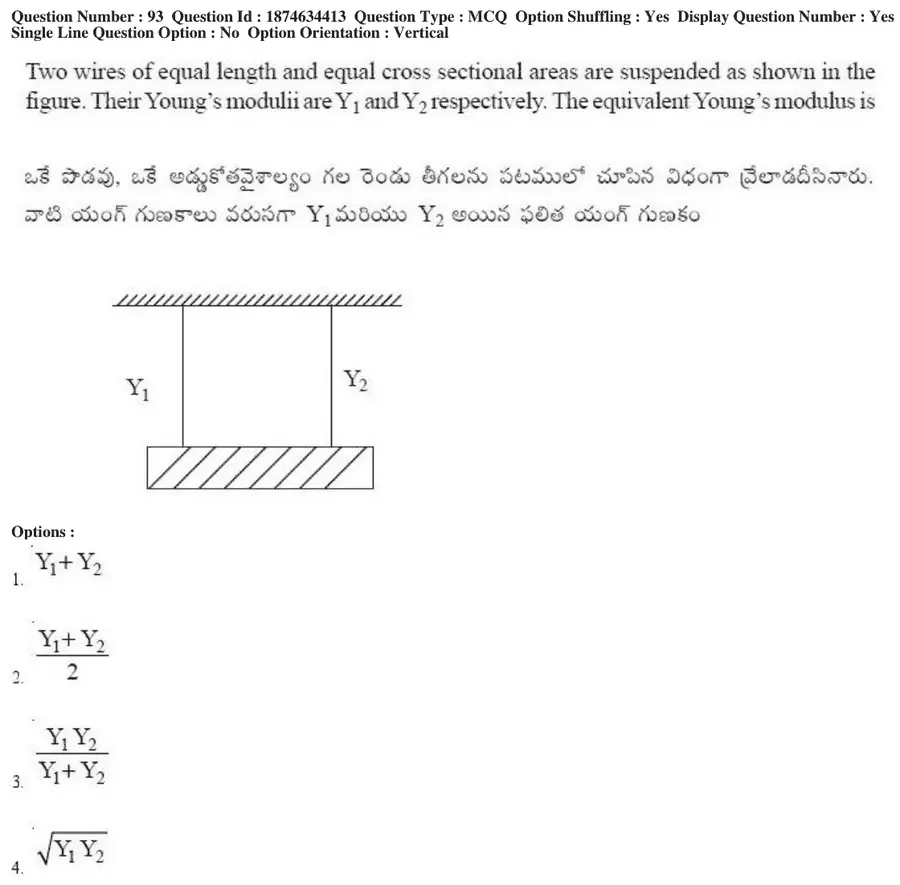
Two wires of equal length and equal cross sectional areas are suspended as shown in the figure. Their Young's modulii are $\mathrm{Y_1}$ and $\mathrm{Y_2}$ respectively. The equivalent Young's modulus is (see the figure above)
The area of cross-section of steel wire is $0.1\ \mathrm{cm^2}$ and Young's modulus of steel is $2 \times 10^{11}\ \mathrm{N\,m^{-2}}$. The force required to stretch by $0.1\%$ of its length is
The following four wires are made of the same material. If same tension is applied to each, the wire having largest extension is a) length 0.5 m, diameter 0.5 mm b) length 1 m, diameter 1 mm c) length 2 m, diameter 2 mm d) length 3 m, diameter 3 mm
A solid copper cube of 7 cm edge is subjected to a hydraulic pressure of 8000 kPa. The volume contraction of the copper cube is (Bulk modulus of copper $= 140$ GPa)
A one metre steel wire of negligible mass and area of cross-section $0.01\ \mathrm{cm^2}$ is kept on a smooth horizontal table with one end fixed. A ball of mass 1 kg is attached to the other end. The ball and the wire are rotating with an angular velocity of $\omega$. If the elongation of the wire is 2 mm, then $\omega$ is (Young's modulus of steel = $2\times10^{11}\ \mathrm{Nm^{-2}}$)
Young's modulus experiment is performed on a steel wire of 1 m length and 8 mm diameter. The mass required to be added in the experiment to produce 5 mm elongation of the wire is ($Y_{steel} = 2\times10^9\ \mathrm{Nm^{-2}}$, $g = 10\ \mathrm{m/s^2}$)
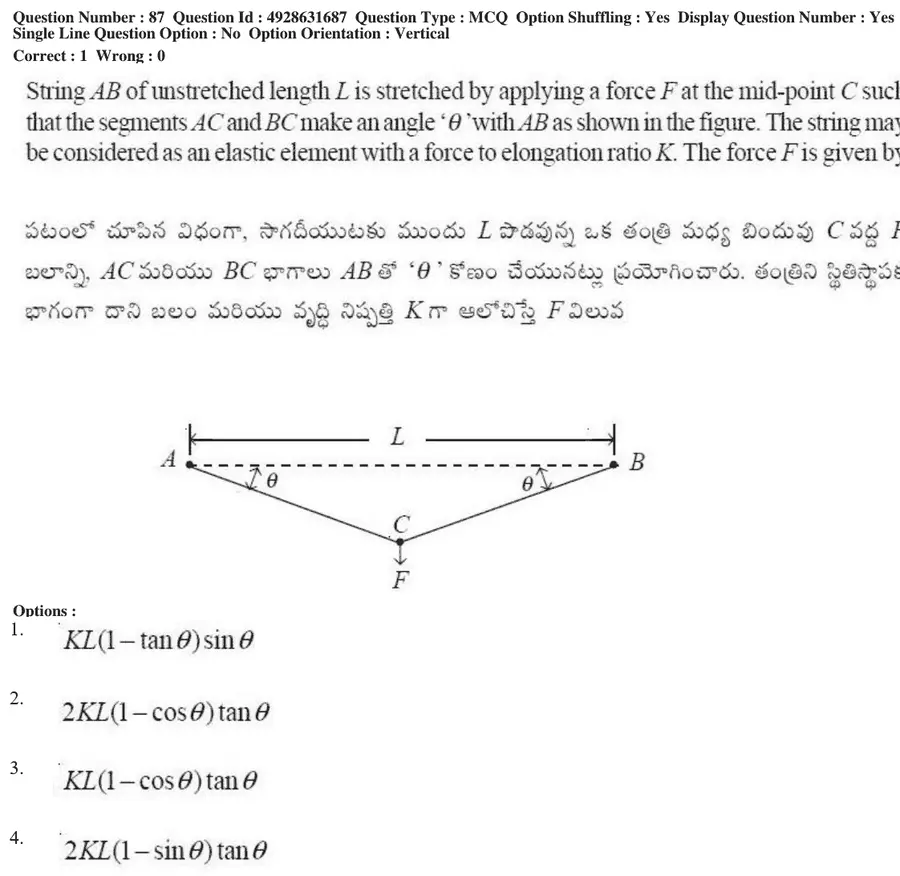
String $AB$ of unstretched length $L$ is stretched by applying a force $F$ at the mid-point $C$ such that the segments $AC$ and $BC$ make an angle '$\theta$' with $AB$ as shown in the figure. The string may be considered as an elastic element with a force to elongation ratio $K$. The force $F$ is given by (see the figure above)
A steel rod has radius 50 mm and length 2 m. It is stretched along its length with a force of 400 kN. This causes an elongation of 0.5 mm. Find the (approximate) Young's modulus of steel from this information.
In a tensile test on a metal bar of diameter 0.015 m and length 0.2 m, the relation between the load and elongation within the proportional limit is found to be $F = 97.2\times10^{6}\,(\Delta L)$ where $F$ is the load in N and $\Delta L$ is the elongation in m. The Young's modulus of the material in GPa is
A copper wire of cross-sectional area $0.01\ \mathrm{cm^2}$ is under a tension of 22 N. The decrease in the cross-sectional area is (Young modulus $= 1.1\times10^{11}\ \mathrm{Nm^{-2}}$, Poisson's ratio = 0.32)
For a material, the ratio of Young's modulus to rigidity modulus is 2.8. If some force is applied on a wire made of this material, its cross-sectional area decreases by 2%. The percentage change in its length is ______
A rubber cube of side 5 cm has one face fixed while a tangential force 1800 N is applied on its opposite face. If modulus of rigidity of rubber is $2.4\times10^{6}\ \mathrm{Nm^{-2}}$ then the lateral displacement of the strained face is ______
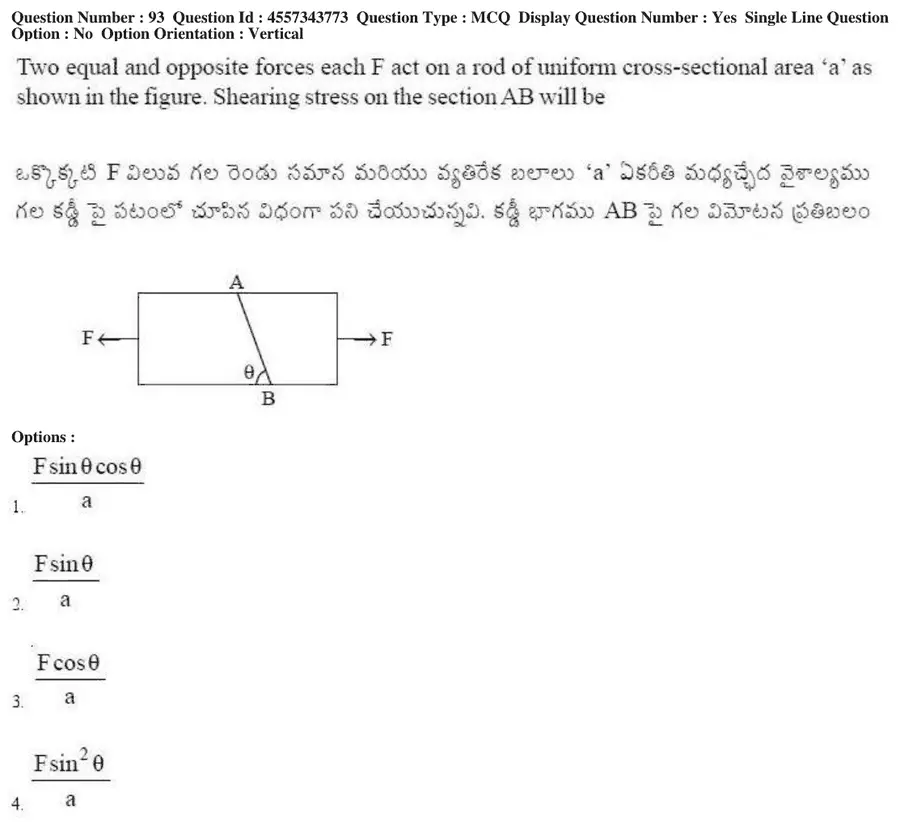
Two equal and opposite forces each F act on a rod of uniform cross-sectional area 'a' as shown in the figure. Shearing stress on the section AB will be (see the figure above)
A sphere of mass 2 kg and diameter 4.5 cm is attached to the lower end of a steel wire of 2 m length and area of cross section $0.24\times10^{-6}\ \mathrm{m^{2}}$. The wire is suspended from 205 cm high ceiling of a room. When the system is made to oscillate as a simple pendulum, the sphere just grazes the floor at its lowest position. The velocity of the sphere at the lowest position is (Young's modulus of steel $=2\times10^{11}\ \mathrm{Nm^{-2}}$ and acceleration due to gravity $=10\ \mathrm{ms^{-2}}$)
The Young's modulus of a material is $2\times10^{11}\,\mathrm{N/m^2}$ and its elastic limit is $1\times10^{8}\,\mathrm{N/m^2}$. For a wire of 1 m length of this material, the maximum elongation achievable is
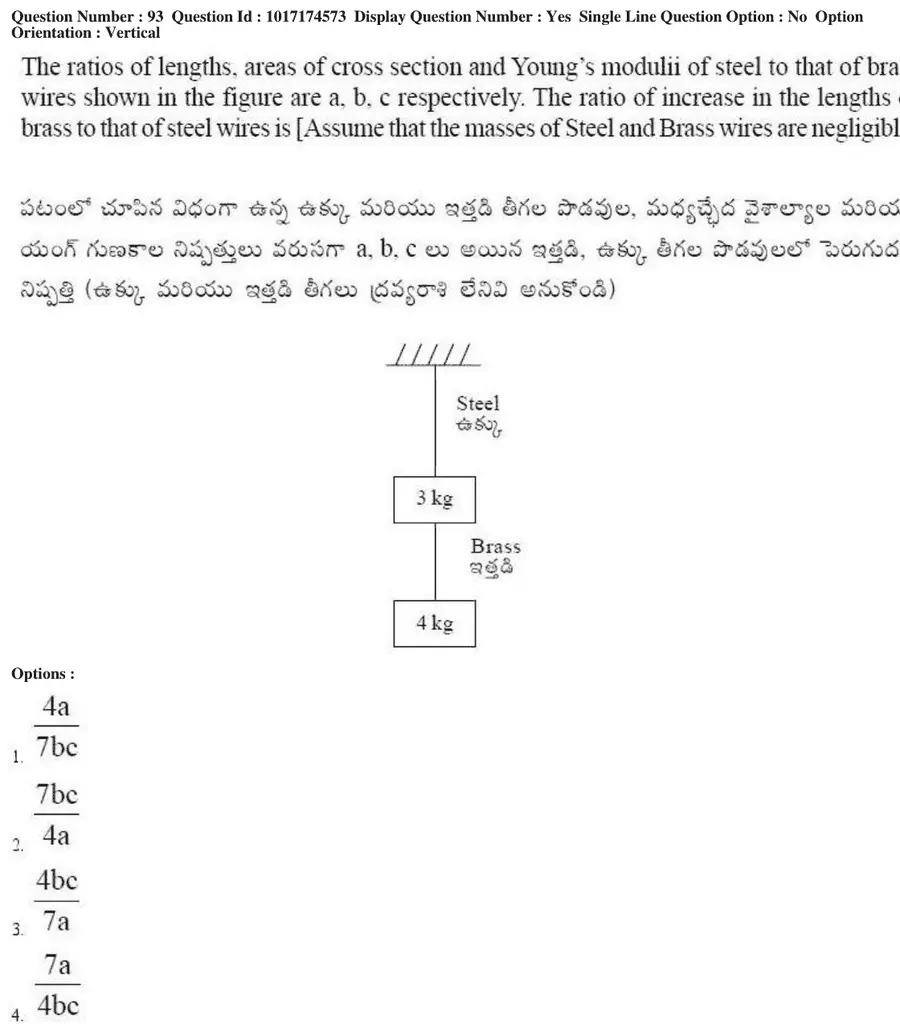
The ratios of lengths, areas of cross section and Young's modulii of steel to that of brass wires shown in the figure are a, b, c respectively. The ratio of increase in the lengths of brass to that of steel wires is [Assume that the masses of Steel and Brass wires are negligible] (see the figure above)
One end of a steel wire of radius 'r' is fixed to a ceiling and a load of 3 kg is attached to the free end of the wire. Another wire made of copper of radius '2r' is attached to the bottom of 3 kg load and a 2 kg load is attached to the free end of the copper wire. The ratio of longitudinal strains produced in copper and steel wires is (Young modulus of steel $= 20 \times 10^{10}\ \mathrm{Nm^{-2}}$) (Young modulus of copper $= 12 \times 10^{10}\ \mathrm{Nm^{-2}}$)
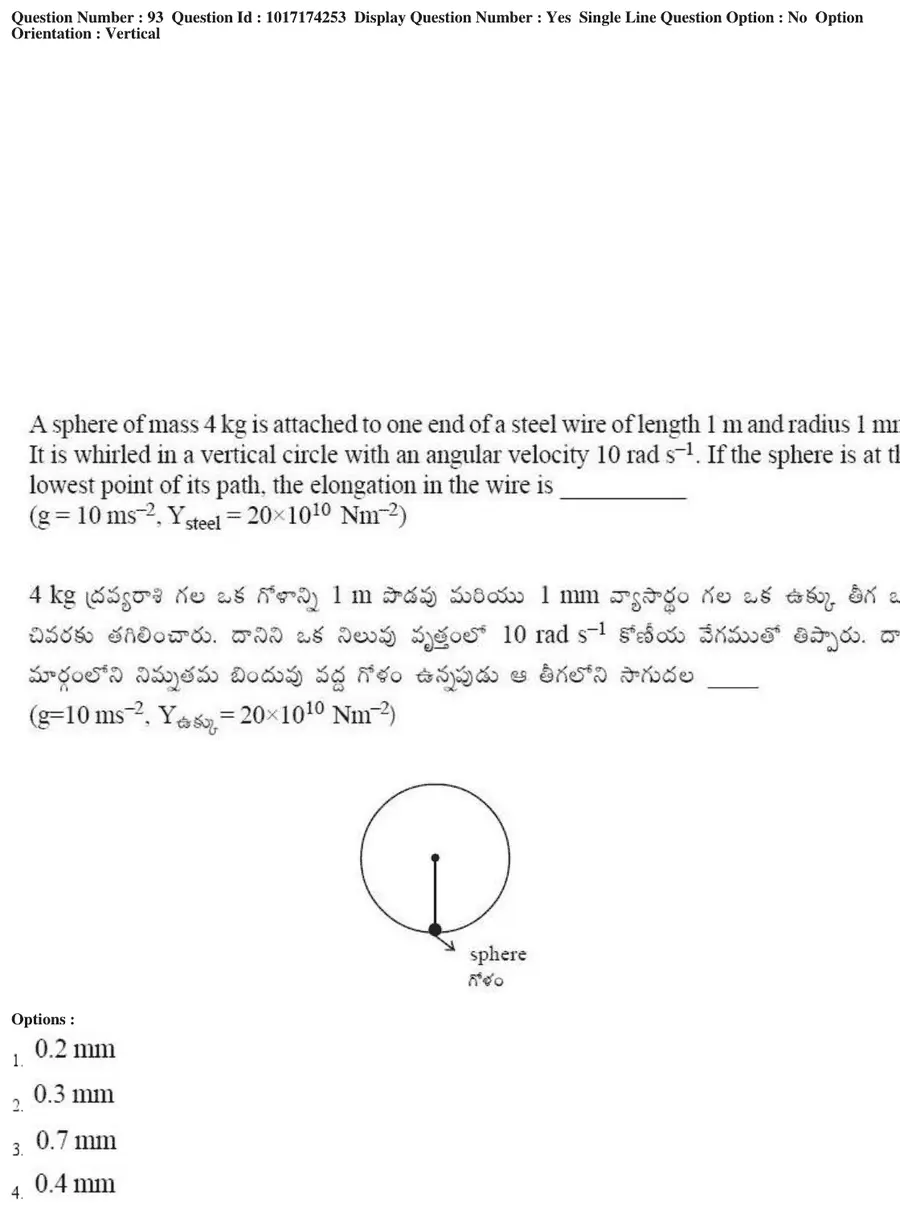
A sphere of mass 4 kg is attached to one end of a steel wire of length 1 m and radius 1 mm. It is whirled in a vertical circle with an angular velocity 10 rad s$^{-1}$. If the sphere is at the lowest point of its path, the elongation in the wire is ______ ($\mathrm{g}=10\ \mathrm{ms^{-2}}$, $\mathrm{Y_{steel}}=20\times10^{10}\ \mathrm{Nm^{-2}}$) (see the figure above)
Assertion (A): When a spring is cut into two equal parts, spring constant of each piece is twice that of the original spring. Reason (R): Spring constant is inversely proportional to length of the spring.
A
(A), (R) are true : (R) is the correct explanation of (A)
B
(A), (R) are true : (R) is not the correct explanation of (A)
A material has a Poisson's ratio 0.5. If a uniform rod of this material suffers a longitudinal strain of $2\times10^{-3}$, then the percentage change in its volume is
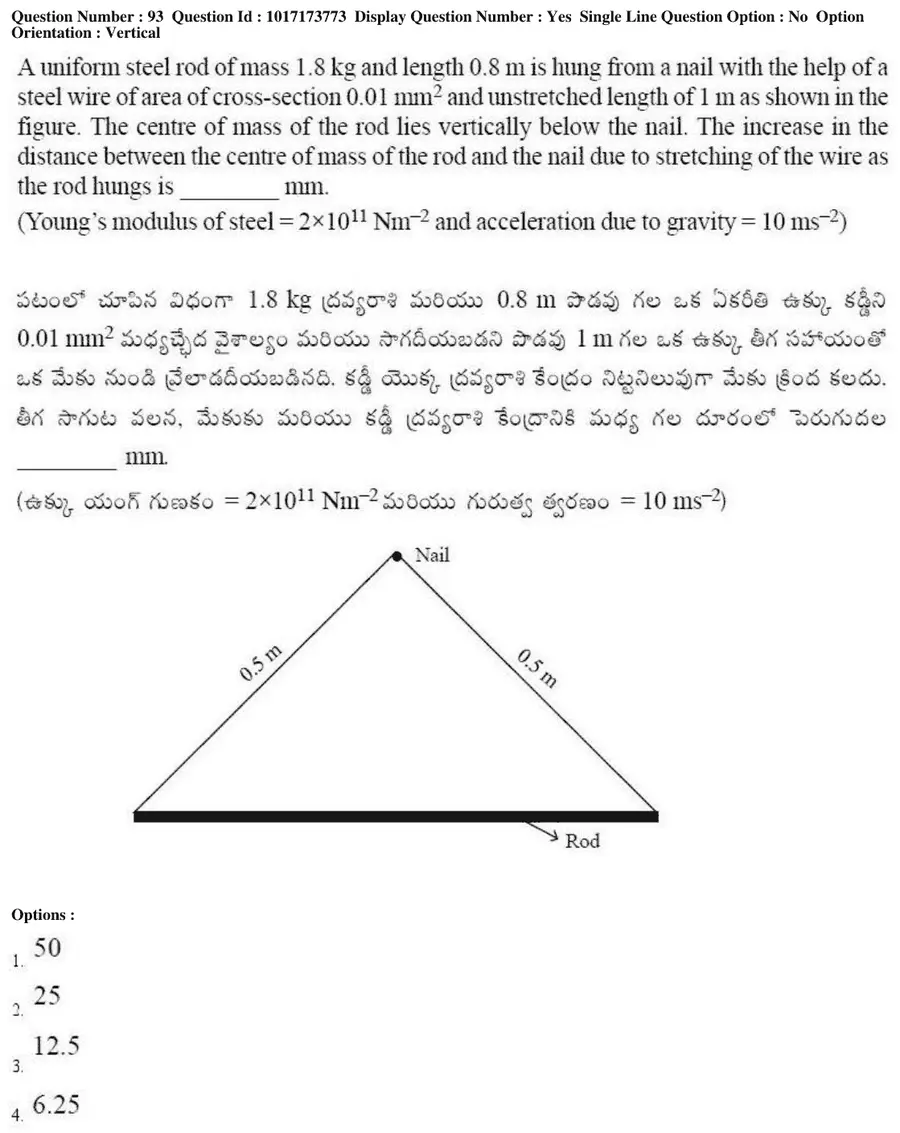
A uniform steel rod of mass 1.8 kg and length 0.8 m is hung from a nail with the help of a steel wire of area of cross-section $0.01\ \mathrm{mm^2}$ and unstretched length of 1 m as shown in the figure. The centre of mass of the rod lies vertically below the nail. The increase in the distance between the centre of mass of the rod and the nail due to stretching of the wire as the rod hungs is ______ mm. (Young's modulus of steel $=2\times10^{11}\ \mathrm{Nm^{-2}}$ and acceleration due to gravity $=10\ \mathrm{ms^{-2}}$) (see the figure above)
A 500 g ball is attached to one end of an aluminum wire of area of cross-section 0.5 mm$^2$ and an unstretched length of 1.4 m. The other end of the wire is fixed to the top of a vertical pole. The ball rotates about the pole in a horizontal plane such that the angle between the wire and the horizontal is $30^\circ$. The increase in the length of the wire is ______ mm. (Young's modulus of aluminum $=0.7\times10^{11}\ \mathrm{Nm^{-2}}$ and acceleration due to gravity $=10\ \mathrm{ms^{-2}}$)
When a load of 80 N is suspended from a string, its length is 101 mm. If a load of 100 N is suspended, its length is 102 mm. If a load of 160 N is suspended from it, then length of the string is (Assume the area of cross-section unchanged)
Two wires of the same material and length but diameters in the ratio 1 : 2 are stretched by the same force. The elastic potential energy per unit volume for the two wires when stretched by the same force will be in the ratio
A tension of 20 N is applied to a copper wire of cross sectional area $0.01\ \mathrm{cm^2}$, Young's Modulus of copper is $1.1\times10^{11}\ \mathrm{N/m^2}$ and Poisson's ratio is 0.32. The decrease in cross sectional area of the wire is
A tension of 22 N is applied to a copper wire of cross-sectional area $0.02\ \mathrm{cm^2}$ Young's modulus of copper is $1.1 \times 10^{11}\ \mathrm{N/m^2}$ and Poisson's ratio 0.32. The decrease in cross sectional area will be
Two blocks of masses 1 kg and 2 kg are connected by a metal wire going over a smooth pulley. The breaking stress of metal is $\frac{40}{3\pi}\times 10^{6}\ \mathrm{Nm^{-2}}$. What should be the minimum radius of wire used if it should not break ? ($g = 10\ \mathrm{ms^{-2}}$)
Match the following : List I A) Hooke's law B) Shearing strain C) Bulk strain D) Elastic Fatigue List II I) Tangential strain II) Temporary loss of elastic property III) Elastic limit IV) 3 times the linear strain
Answer: (C) A-III, B-I, C-IV, D-II· Official APSCHE final key
How to prepare Elasticity for EAPCET
How often it comes up
Class 11 mechanics includes Elasticity as a compact, dependable unit. In the papers we hold for AP and TS EAPCET from 2022 to 2026, the chapter contributed 77 questions across 77 papers. That yields an average of 1.0 question per paper, accounting for 2.5% of all physics questions in that recent window. Looking across all years in our archive from 2010 to 2026, Elasticity brought 149 questions across 149 papers, maintaining an average of 1.0 question per paper and a 2.5% subject share. Across the earlier window from 2010 to 2021, our archive records 72 questions across 72 papers (2.5% share). In the last three exam years from 2024 to 2026, it provided 47 questions across 46 papers, holding a 2.6% share. The share of the subject in the last three years compared to early papers is about the same, and compared to the recent five-year window it is also about the same.
State-wise patterns in the recent window reveal steady inclusion on both sides of the border. AP EAPCET papers from 2022 to 2026 contributed 49 questions across 48 papers in our set, with 45 papers containing at least one question and a 2.6% share of physics. TS EAPCET contributed 28 questions across 29 papers in our set, with 28 papers featuring the topic and a 2.4% share. Elasticity has appeared every year since 2022, though with 73 out of 77 recent papers carrying a question, it was absent from four sittings. It ranks 22nd of 28 physics chapters by question share between 2022 and 2026. The busiest single sitting in our collection was 2020, with 22 questions across 18 papers.
Most-asked topics
Questions in Elasticity fall into two clear syllabus areas:
Stress, Strain & Moduli: 58 questions in the recent 2022–2026 period and 119 questions across all years in our archive. This dominant area covers Hooke's law, Young's modulus, bulk modulus, shear modulus, Poisson's ratio, and the interpretation of tensile stress-strain curves.
Elastic Energy & Applications: 19 questions between 2022 and 2026 and 30 questions across all years. It tests the work done in stretching or compressing a wire, strain energy density per unit volume, thermal stress in clamped rods, and composite wire systems.
What the questions look like
Numerical problems are largely direct algebraic evaluations. A frequent pattern asks for the elongation of a suspended wire under its own weight or carrying a hanging mass, often comparing two wires of different lengths, radii, or materials. Another recurring setup connects Young's modulus with dynamic situations, such as a wire whirling a mass in a horizontal circle or experiencing sudden tension.
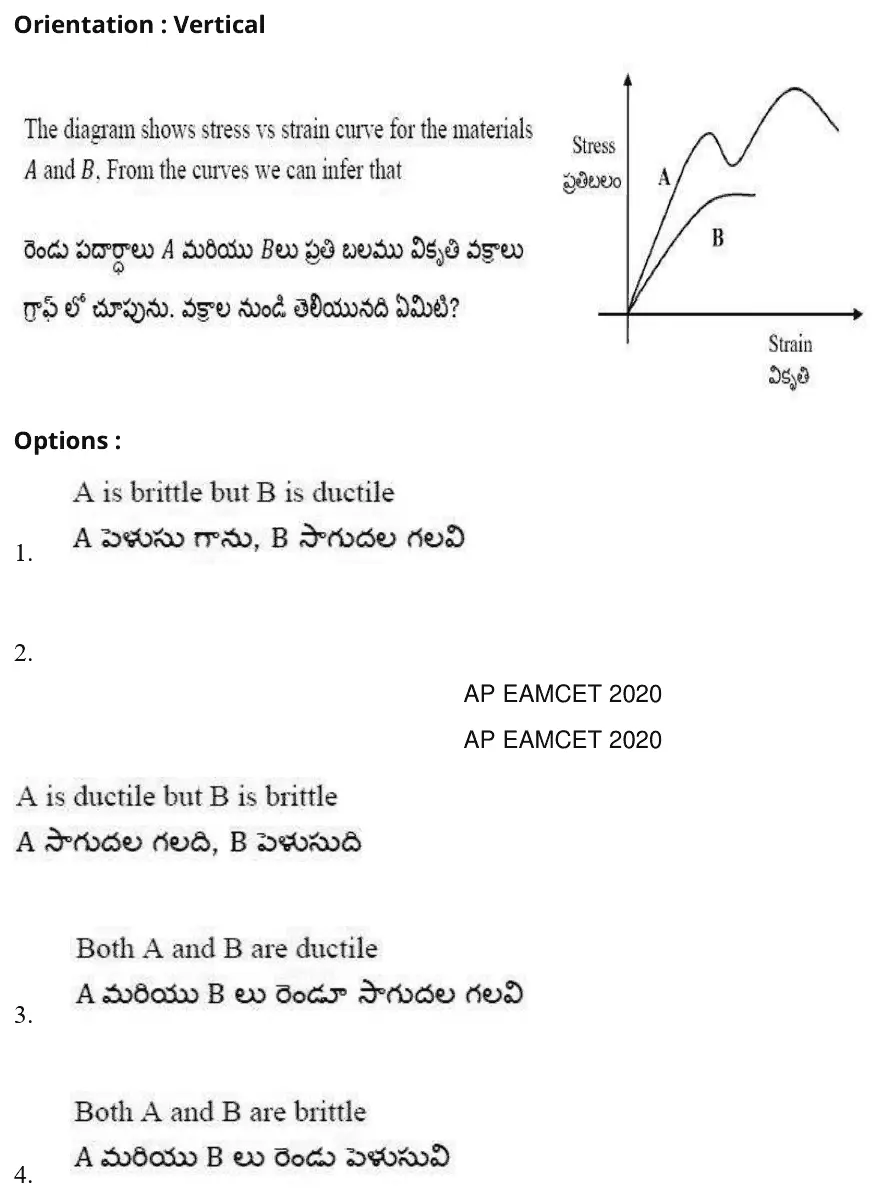
Poisson's ratio questions appear regularly in both state exams. Examiners give the fractional change in length or longitudinal strain along with Poisson's ratio to ask for the resulting lateral strain, the fractional change in diameter, or the volumetric strain. You must remember the volumetric strain formula ΔV/V = (ΔL/L)(1 - 2σ) and recognise when lateral contraction reduces or increases total volume. Theoretical questions test ductile versus brittle materials, the distinction between proportional limit and yield point, and the work done represented by the area beneath a force-extension curve.
Start by mastering the three primary elastic moduli: Young's modulus Y = (F L) / (A ΔL), shear modulus η = (F / A) / θ, and bulk modulus B = - ΔP / (ΔV / V). Make sure you can write each modulus in terms of wire dimensions, particularly noting that cross-sectional area involves radius squared, meaning doubling the wire diameter cuts elongation by a factor of four for identical loads.
Next, practise strain energy calculations. The total energy stored in a stretched wire is U = (1/2) F ΔL, while energy per unit volume is (1/2) × stress × strain = (1/2) Y (strain)². Notice that work done by the stretching weight mg is mg ΔL, of which exactly half is stored as elastic strain energy and the remaining half is dissipated as heat.
Finally, work through thermal stress and composite wire arrangements. When a rod fixed rigidly between two immovable walls undergoes a temperature drop or rise ΔT, the thermal strain is α ΔT, generating an internal thermal stress of Y α ΔT and an exerted force of Y A α ΔT.
Frequently asked questions
How many questions come from Elasticity in a typical paper?
Most shifts carry exactly one question from Elasticity, reflecting its average of 1.0 question per paper in the papers we hold. Out of 77 papers between 2022 and 2026, 73 papers included a problem from the chapter.
Which formula is tested most often in Elasticity?
The formula for elongation of a stretched wire, ΔL = F L / (A Y), together with the strain energy density formula (1/2) × stress × strain, appears more often than any other relationship in the chapter.
Is Poisson's ratio asked in EAPCET?
Yes, Poisson's ratio is tested frequently in both AP and TS papers. Questions usually ask for the lateral contraction or the fractional change in volume when a cylinder or wire is stretched.
Where can I find worked solutions for EAPCET Elasticity questions?
Step-by-step solutions for each one are in the EdLoop EAPCET app.