A Car travels first half of the distance with a velocity ‘$V$’ and second half of the distance with a velocity ‘$3V$’, then the average velocity is
- A
$2.0\,V$
- B
$3.0\,V$
- C
$4.0\,V$
- D
$1.5\,V$
Answer: (D) $1.5\,V$ · The council's preliminary key
 PYQs · free, no adsOpen on the web (app.edloop.in)Get EdLoop – free on Google Play
Every Kinematics question from past AP EAPCET and TS EAPCET papers, with options and answers. Newest first.
Kinematics stands as the single heaviest chapter in EAPCET Physics. Across the papers we hold from 2022 to 2026, it produced 229 questions in 77 papers, averaging 3.0 questions per paper.
Attempt every Kinematics question timed, see the step-by-step solution and track what you get wrong. Free.
A Car travels first half of the distance with a velocity ‘$V$’ and second half of the distance with a velocity ‘$3V$’, then the average velocity is
$2.0\,V$
$3.0\,V$
$4.0\,V$
$1.5\,V$
Rain is falling vertically with a speed of $2\ ms^{-1}$. A boy from rest starts moving with a constant acceleration of $2\ ms^{-2}$ along a straight road holding umbrella. For the rain to be always parallel to the axis of umbrella, the rate at which the angle of axis of umbrella with the vertical should be changed with time ‘$t$’ is
$\frac{1+t^2}{t^3}$
$\frac{1}{1+t^2}$
$\frac{t^2}{1+t^4}$
$\frac{t}{1+t^3}$
A cricketer can throw a ball with a speed of $V_0$. If he throws the ball, while running with a speed $V_0$ , at an angle ‘$\alpha$’ with the horizontal, then the range of the ball will be maximum when ‘$\alpha$’ is
$45^\circ$
$30^\circ$
$60^\circ$
$53^\circ$
A velocity-time graph is drawn for two different objects. They make $30^0$ and $45^0$ with the time axis. Then the ratio of their accelerations, $a_1 : a_2$ is
$1 : 2$
$2 : 3$
$\sqrt{3} : 1$
$1 : \sqrt{3}$
An object is projected with an angle of $60^0$ with horizontal with a velocity V. During the path, when it makes $30^0$ with horizontal, its velocity becomes $10\ \mathrm{ms^{-1}}$, then V is
$10\sqrt{3}\ \mathrm{ms^{-1}}$
$\sqrt{30}\ \mathrm{ms^{-1}}$
$3\sqrt{10}\ \mathrm{ms^{-1}}$
$\sqrt{3}\ \mathrm{ms^{-1}}$
Two bodies projected with same velocity at different angles attain same range. If the time of flights of the bodies are $T_1$ and $T_2$ respectively, then $\frac{T_1}{T_2}$ is
$\mathrm{Tan}\,\theta$
$\mathrm{Tan}^2\,\theta$
$\cot\theta$
$\cot^2\theta$
The three graphs represent acceleration Vs time for objects that have positive velocity at time $t_1$. Which graphs show the objects that move with increasing velocity for the entire time interval between $t_1$ and $t_2$?
(see the figure above)
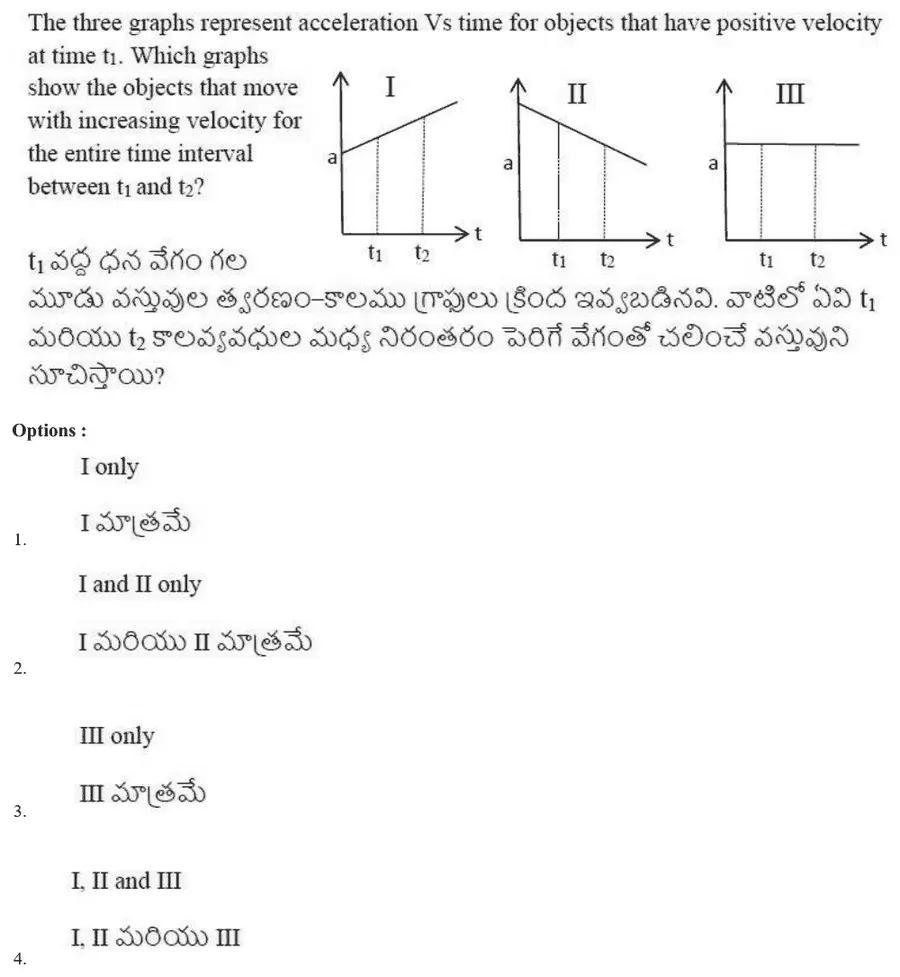
I only
I and II only
III only
I, II and III
Two objects A and B are projected with same velocity at angles $\theta$ and $90-\theta$ respectively with the horizontal. Then the ratio of maximum heights they reached, $\frac{H_A}{H_B}$ is
$\mathrm{Tan}\,\theta$
$\mathrm{Tan}^2\,\theta$
$2\,\mathrm{Tan}\,\theta$
$\mathrm{Cot}^2\,\theta$
A particle has initial velocity $2\hat{i} + 3\hat{j}\ ms^{-1}$ and acceleration $0.8\hat{i} + 0.6\hat{j}\ ms^{-2}$. Its velocity after 5 sec is (in $ms^{-1}$ )
$6\sqrt{2}$
$6$
$7\sqrt{2}$
$7$
Acceleration varies as $a = 6t$, starting from rest, velocity after $t = 2\ s$
$6\ ms^{-1}$
$12\ ms^{-1}$
$18\ ms^{-1}$
$24\ ms^{-1}$
A projectile is projected from a moving truck. Its range depends on
Truck velocity only
Projectile velocity with respect to truck only
Projectile velocity with respect to ground
Projectile mass
An object is projected from the top of a tower of height ‘$H$’ at angle $\theta$ with horizontal. It strikes the ground at $P$ lying at a distance $D$ from the foot of the tower. Calculate the maximum height attained by the object
(see the figure above)
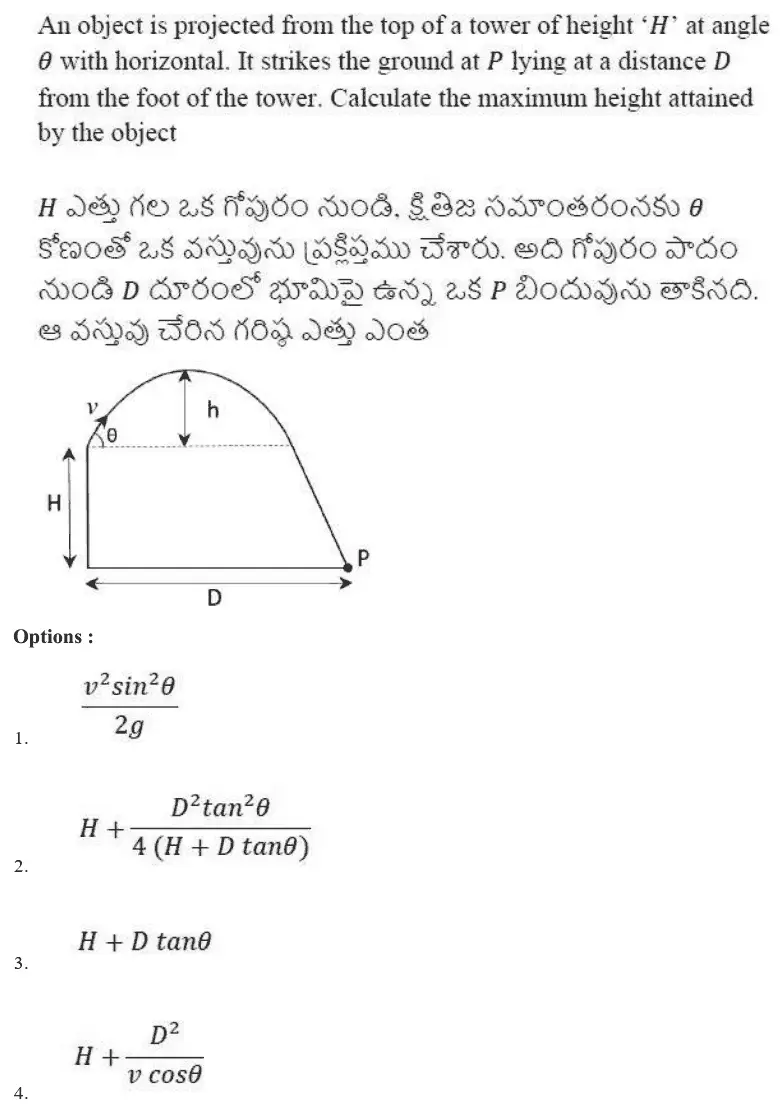
$\dfrac{v^2 \sin^2\theta}{2g}$
$H + \dfrac{D^2 \tan^2\theta}{4(H + D\tan\theta)}$
$H + D\tan\theta$
$H + \dfrac{D^2}{v\cos\theta}$
A body is falling freely under gravity from a height of 200 m. The total displacement of the body during the second half-second, fourth half-second and sixth half-second of its motion is
(acceleration due to gravity = $10\ \mathrm{m\,s^{-2}}$)
26.25 m
32.50 m
37.25 m
42.25 m
If the minimum velocity of a projectile during its motion is $40\ ms^{-1}$ and the ratio of its vertical and horizontal displacements at a time of 2s is 1:2, then the angle of projection of the projectile is (Acceleration due to gravity = $10\ ms^{-2}$)
$\sin^{-1}(0.6)$
$\cos^{-1}(0.6)$
$\tan^{-1}(0.6)$
$\sec^{-1}(0.6)$
A body is projected with a velocity of $15\sqrt{3}\ \mathrm{ms^{-1}}$ at an angle of $60^0$ with the horizontal and another body is projected simultaneously from the same point in the same vertical plane with a velocity of 40 $ms^{-1}$ at an angle of $30^0$ with the horizontal. The time at which the velocity vector of the two bodies will be in the same direction is (Acceleration due to gravity = 10 $ms^{-2}$)
3.2 s
2.4 s
1.2 s
3.6 s
A balloon is raising vertically upwards with a velocity of $10\ ms^{-1}$. When the balloon is at a height of 40 m from the ground, a stone is dropped from it. The time taken by the stone to reach the ground is
(Acceleration due to gravity = $10\ ms^{-2}$)
10 s
6 s
8 s
4 s
A swimmer can swim at $5\ ms^{-1}$ in still water. River flows at $3\ ms^{-1}$. To cross the river in shortest time, the angle with respect to perpendicular to the flow is
$0^\circ$
$sin^{-1}(3/5)$
$tan^{-1}(3/5)$
$90^\circ$
If $a = -kv$ represents the variation of acceleration of a particle with velocity, time taken to reduce the velocity from $v$ to $v/2$ is
$\frac{\ln 2}{k}$
$\frac{1}{2k}$
$\frac{\ln 2}{2k}$
$\frac{2}{k}$
Cars X and Y begin the race simultaneously with velocities $8\ \mathrm{ms^{-1}}$ and $4\ \mathrm{ms^{-1}}$, moving in a straight line with uniform accelerations $2\ \mathrm{ms^{-2}}$ and $4\ \mathrm{ms^{-2}}$ respectively. If they reach final point at the same instant, then the length of the path is
$24\ \mathrm{m}$
$48\ \mathrm{m}$
$32\ \mathrm{m}$
$16\ \mathrm{m}$
A projectile is thrown into space so that it attains a maximum possible range of 200 m. Taking the point of projection as origin, the coordinates of the point where the velocity of projectile is minimum is
$(100, 50)$
$(200, 100)$
$(100, 200)$
$(50, 100)$
A bike race is conducted on a circular track of radius 60 m. If the slowest bike, weighing 120 kg, moved around the track at a constant speed of 108 kmph, then the time taken by it to complete one lap and its acceleration are respectively
$3.49$ s, $1.11\ \mathrm{ms^{-2}}$
$12.56$ s, $15\ \mathrm{ms^{-2}}$
$3.49$ s, $0\ \mathrm{ms^{-2}}$
$2$ s, $9.8\ \mathrm{ms^{-2}}$
A body travels 100 m in the $n^{\mathrm{th}}$ second and 125 m in the $(n+3)^{\mathrm{th}}$ second. Then the acceleration of body is
$8.33\ \mathrm{ms^{-2}}$
$7.21\ \mathrm{ms^{-2}}$
$6.0\ \mathrm{ms^{-2}}$
$2.5\ \mathrm{ms^{-2}}$
The resultant magnitude of two vectors is equal to magnitude of both the vectors separately, then the angle between the two vectors is
$60^\circ$
$80^\circ$
$120^\circ$
$45^\circ$
A ball is projected upwards from the top of a tower with a velocity $50\ ms^{-1}$ making an angle $30^\circ$ with the horizontal. The height of tower is $70\ m$. After how many seconds from the instant of throwing, will the ball reach the ground? ($g = 10\ ms^{-2}$)
$7\ s$
$9\ s$
$5\ s$
$2\ s$
If $t = Px^2 + Qx$ is the relation between time $(t)$ and distance $(x)$, where $P$and $Q$ are constants, the acceleration is
$\dfrac{2P}{x+Q}$
$\dfrac{-2P}{(2Px+Q)^3}$
$(2Px+Q)^3$
$-2P(2Px+Q)^3$
Two bodies are projected from the same point at angles $15^\circ$ and $45^\circ$ with respect to the horizontal. If they attain the same horizontal range, the ratio of their initial velocities
$1 : \sqrt{2}$
$\sqrt{2} : 1$
$1 : 2$
$2 : 1$
To a person going towards east in a car with a velocity of 25 kmph, a train appears to move towards north with a velocity of $25\sqrt{3}$ kmph. The actual velocity of the train will be
25 kmph
50 kmph
5 kmph
53 kmph
A motorist completes half revolution on a circular path of 60 m radius in one minute. His average speed
$1\ ms^{-1}$
$2\ ms^{-1}$
$3.14\ ms^{-1}$
$4.14\ ms^{-1}$
If the vertical displacement of a body projected at an angle with the horizontal during the first second of its motion is 15 m, then the maximum height reached by it is
(acceleration due to gravity = $10\ \mathrm{ms^{-2}}$)
80 m
60 m
40 m
20 m
If the resultant of three vectors $\overline{A} = -\hat{i} + 2\hat{j} + 3\hat{k}$, $\overline{B} = -2\hat{i} - \hat{j} - 4\hat{k}$ and $\overline{C}$ is a vector in the positive $z$ -direction with a magnitude of 2 units, then the vector $\overline{C} =$
$3\hat{i} - \hat{j} + 3\hat{k}$
$3\hat{i} - 2\hat{j} - 3\hat{k}$
$2\hat{i} - 3\hat{j} + 2\hat{k}$
$2\hat{i} + 3\hat{j} - 2\hat{k}$
Two balls P and Q are thrown vertically upwards simultaneously from the ground with velocities $20\ \mathrm{ms^{-1}}$ and $35\ \mathrm{ms^{-1}}$ respectively. The distance between the two balls when the velocity of the ball P becomes zero is
(Acceleration due to gravity $= 10\ \mathrm{ms^{-2}}$)
30 m
20 m
50 m
70 m
If a body is projected from the ground at an angle of $45^\circ$ with the horizontal, then the ratio of the velocities of the body at maximum height and at half of the maximum height is
$\sqrt{3}:\sqrt{7}$
$\sqrt{2}:\sqrt{3}$
$\sqrt{2}:\sqrt{5}$
$\sqrt{3}:\sqrt{5}$
A boy can swim with a speed of 18 kmph in still water. If the speed of the water in a river is 10.8 kmph, then the average speed of the boy in travelling downstream for a distance of 120 m and upstream for a distance of 90 m in the river is
$3\ \mathrm{ms^{-1}}$
$3.5\ \mathrm{ms^{-1}}$
$4\ \mathrm{ms^{-1}}$
$4.5\ \mathrm{ms^{-1}}$
A body is projected from a point which is at a height of 5 m from the ground with a velocity of $28\ \mathrm{ms^{-1}}$ at an angle of $30^\circ$ above the horizontal. The horizontal distance travelled by the body when it reaches a point which is at a height of 2 m from the ground is
(Acceleration due to gravity $=10\ \mathrm{ms^{-2}}$)
$126\sqrt{3}$ m
$21\sqrt{3}$ m
$42\sqrt{3}$ m
$28\sqrt{3}$ m
For a body thrown vertically upwards from the ground, if the time interval between the two instances when the body is at a height of 60 m is 4 s, then the maximum height reached by the body is
(Acceleration due to gravity $=10\ \mathrm{ms^{-2}}$)
150 m
90 m
120 m
80 m
A stone of mass 10 g is attached to a string of length 80 cm and is rotated in a horizontal circle at height of 'h' from the ground with a centripetal acceleration of $125\,\mathrm{ms^{-2}}$. At a moment the string breaks and the stone strikes the ground at a horizontal distance of 10 m. Then the value of 'h' is (Acceleration due to gravity $= 10\,\mathrm{ms^{-2}}$)
10 m
5 m
15 m
20 m
A body is allowed to fall freely from a height of 120 m from the ground and at the same moment another ball is thrown vertically upwards from the ground such that it reaches a maximum height of 180 m. The time taken for the two bodies to meet is
(Acceleration due to gravity $=10\ \mathrm{ms^{-2}}$)
$5\ \mathrm{s}$
$4\ \mathrm{s}$
$2\ \mathrm{s}$
$3\ \mathrm{s}$
The time taken by a projectile to reach the maximum height is 4 s. If the horizontal distance between the positions of the projectile at times 3 s and 5 s is 60 m, then its velocity of projection is
(Acceleration due to gravity $=10\ \mathrm{ms^{-2}}$)
$50\ \mathrm{ms^{-1}}$
$35\ \mathrm{ms^{-1}}$
$40\ \mathrm{ms^{-1}}$
$30\ \mathrm{ms^{-1}}$
The time taken by a body projected vertically upwards from the ground to reach 75% of the maximum height it can reach is 2 s. The ratio of the kinetic energy of the body at a time $t=2$ s and the potential energy of the body at a time $t=3$ s is
(Acceleration due to gravity $=10\ \mathrm{ms^{-2}}$)
$2:15$
$4:15$
$2:5$
$4:5$
Two trains A and B are moving in the same direction with velocities $V_A$ and $V_B$ respectively and a third train C is moving in opposite direction to A and B. If velocity of C with respect to B is twice the velocity of A with respect to B, then the velocity of A with respect to C is
$3(V_A - V_B)$
$2(V_A - V_B)$
$\frac{(V_A - V_B)}{3}$
$\frac{(V_A - V_B)}{2}$
A flag on a boat at rest is fluttering in the south-east direction when the wind is blowing at a speed of 72 kmph. If the boat starts moving towards south with a speed of $36\sqrt{2}$ kmph, then the direction of the flag on the boat is
South
West
North
East
A body is thrown vertically upwards from the surface of the earth with a velocity of $60\ \mathrm{ms^{-1}}$. The ratio of the displacements of the body during first, second and third seconds of its upward motion is
(Acceleration due to gravity $=10\ \mathrm{ms^{-2}}$)
$1:3:5$
$11:9:7$
$1:1:1$
$1:2:3$
If the minimum velocity of a projectile is $15\ \mathrm{ms^{-1}}$ and the maximum height reached by it is $20\ \mathrm{m}$, then the velocity of projection of the projectile is
(Acceleration due to gravity $= 10\ \mathrm{ms^{-2}}$)
$35\ \mathrm{ms^{-1}}$
$30\ \mathrm{ms^{-1}}$
$20\ \mathrm{ms^{-1}}$
$25\ \mathrm{ms^{-1}}$
If the displacement (s in metre) of a moving particle in terms of time (t in second) is $s = t^3 - 6t^2 + 18t + 9$, then the minimum velocity attained by the particle is
$29\ \mathrm{m\,s^{-1}}$
$5\ \mathrm{m\,s^{-1}}$
$6\ \mathrm{m\,s^{-1}}$
$12\ \mathrm{m\,s^{-1}}$
If two bodies A and B are projected with same velocity but with different angles $\theta_1$ and $\theta_2$ respectively with the horizontal such that both will have same range, then the ratio of times of flight of the bodies A and B is
$\sin \theta_2$
$\sin \theta_1$
$\tan \theta_2$
$\tan \theta_1$
A ball projected vertically upwards with a velocity 'v' passes through a point P in its upward journey in a time of 'x' seconds. From there, the time in which the ball again passes through the same point P is
$\frac{v}{2g}$
$\frac{2v}{g} - x$
$\frac{v}{2g} - x$
$2\left(\frac{v}{g} - x\right)$
Three vectors each of magnitude $3\sqrt{1.5}$ units are acting at a point. If the angle between any two vectors is $\frac{\pi}{3}$, then the magnitude of the resultant vector of the three vectors is
$9\sqrt{3}$ units
9 units
$\sqrt{6}$ units
3 units
A vector perpendicular to the vector $(4\hat{i}-3\hat{j})$ is
$4\hat{i}+3\hat{j}$
$6\hat{i}$
$3\hat{i}-4\hat{j}$
$7\hat{k}$
The displacement (x) and time (t) graph of a particle moving along a straight line is shown in the figure. The average velocity of the particle in the time of 10 s is
(see the figure above)
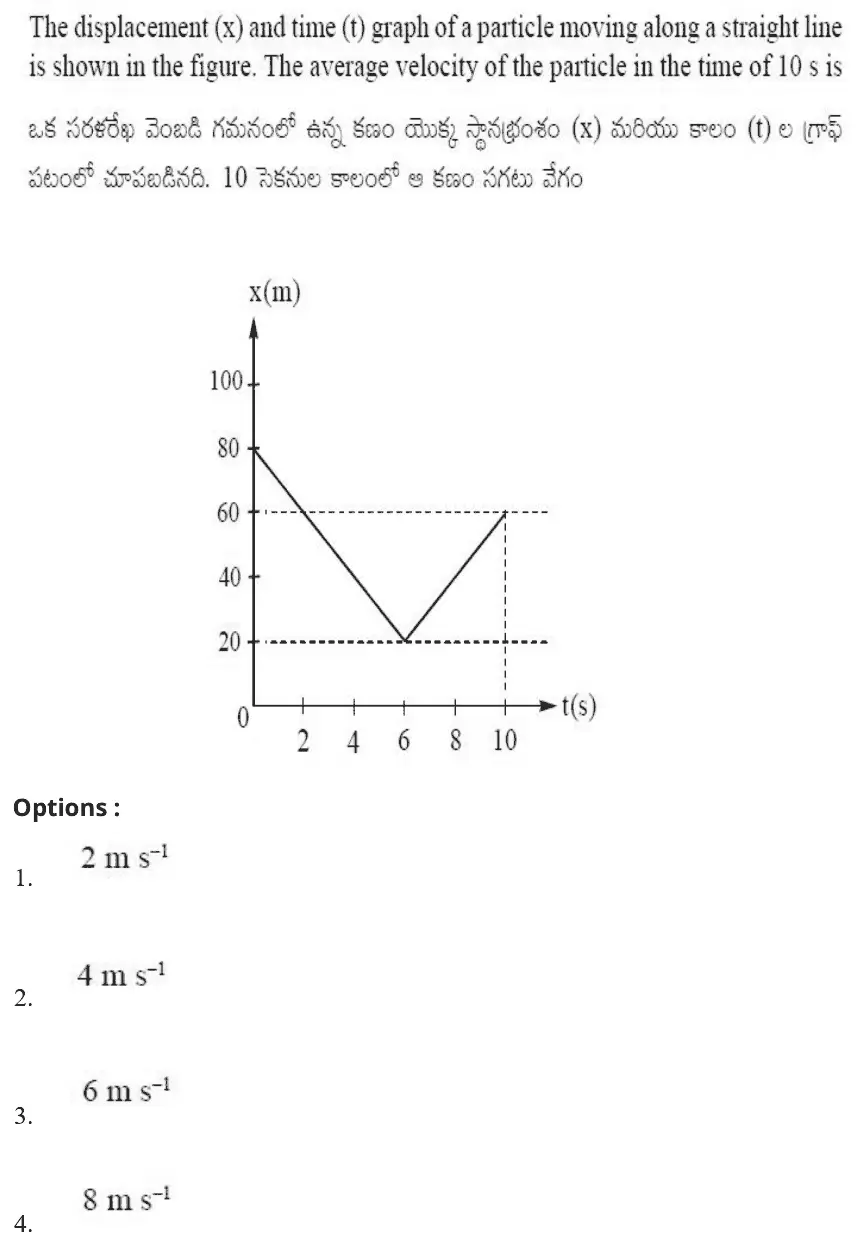
$2\ \mathrm{m\,s^{-1}}$
$4\ \mathrm{m\,s^{-1}}$
$6\ \mathrm{m\,s^{-1}}$
$8\ \mathrm{m\,s^{-1}}$
If the horizontal range of a body projected with a velocity 'u' is 3 times the maximum height reached by it, then the range of the body is
(g - acceleration due to gravity)
$\frac{2u^2}{3g}$
$\frac{4u^2}{5g}$
$\frac{12u^2}{13g}$
$\frac{24u^2}{25g}$
If the velocity at the maximum height of a projectile projected at an angle of $45^\circ$ is $20\ \mathrm{m\ s^{-1}}$, then the maximum height reached by the projectile is (Acceleration due to gravity $= 10\ \mathrm{m\ s^{-2}}$)
$10\ \mathrm{m}$
$20\ \mathrm{m}$
$30\ \mathrm{m}$
$40\ \mathrm{m}$
A body starts from rest with uniform acceleration and its velocity at a time of 'n' seconds is 'v'. The total displacement of the body in the $n^{th}$ and $(n-1)^{th}$ seconds of its motion is
$\frac{v(n+1)}{n}$
$\frac{2v(n+1)}{n}$
$\frac{2v(n-1)}{n}$
$\frac{v(n-1)}{n}$
If the range of a body projected with a velocity of $60\ \mathrm{m\,s^{-1}}$ is $180\sqrt{3}\ \mathrm{m}$, then the angle of projection of the body is
(Acceleration due to gravity = $10\ \mathrm{m\,s^{-2}}$)
$30^\circ$ or $60^\circ$
$37^\circ$ or $53^\circ$
$20^\circ$ or $70^\circ$
$15^\circ$ or $75^\circ$
If the height of a projectile at a time of 2 s from the beginning of motion is 60 m, then the time of flight of the projectile is
(Acceleration due to gravity = $10\ \mathrm{m\ s^{-2}}$)
12 s
4 s
6 s
8 s
If the distance travelled by a freely falling body in the last but one second of its motion is 5 m, then the last second is
(Acceleration due to gravity = $10\ \mathrm{m\ s^{-2}}$)
$1^{\mathrm{st}}$
$2^{\mathrm{nd}}$
$3^{\mathrm{rd}}$
$4^{\mathrm{th}}$
The angle of projection of a projectile whose path is shown in the given figure is
(see the figure above)
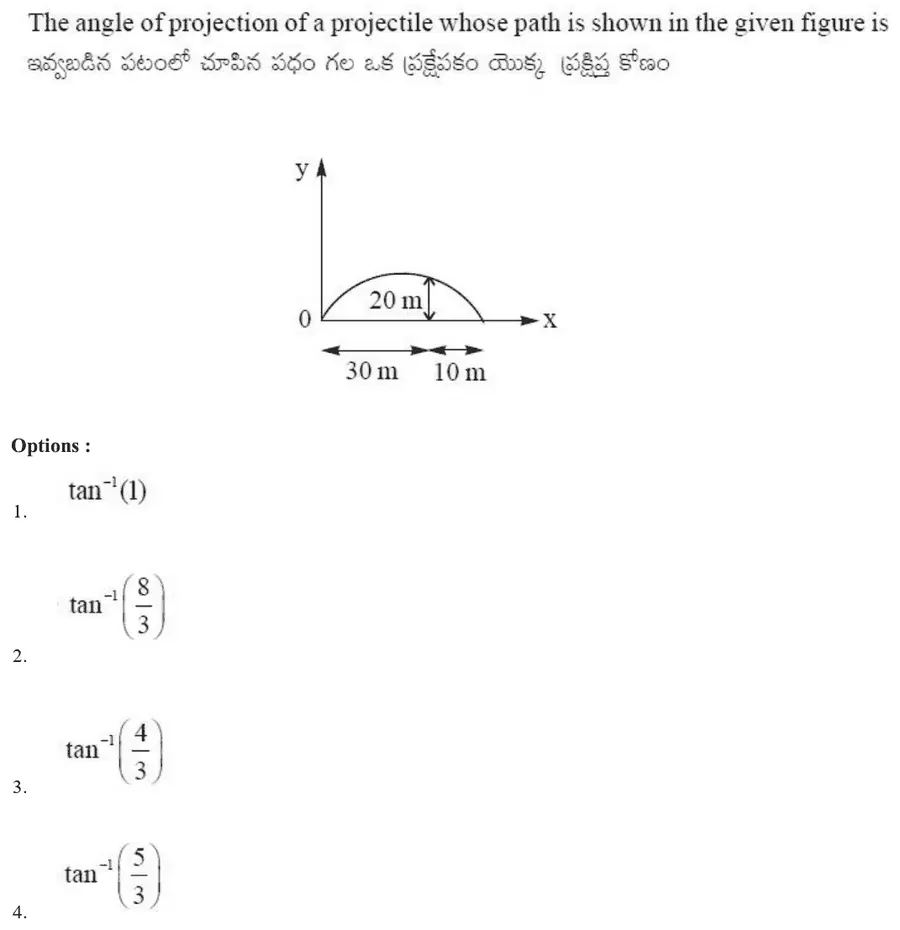
$\tan^{-1}(1)$
$\tan^{-1}\left(\frac{8}{3}\right)$
$\tan^{-1}\left(\frac{4}{3}\right)$
$\tan^{-1}\left(\frac{5}{3}\right)$
If the equation of motion of a projectile is $y = Ax - Bx^2$, then the ratio of the maximum height reached and the range of the projectile is
$\frac{A}{4}$
$\frac{A}{B}$
$\frac{B}{4}$
$\frac{A^2}{B}$
If a stone thrown vertically upwards from a bridge with an initial velocity of $5\ \mathrm{m\ s^{-1}}$, strikes the water below the bridge in a time of 3 s, then the height of the bridge above the water surface is
(Acceleration due to gravity = $10\ \mathrm{m\ s^{-2}}$)
10 m
26 m
30 m
18 m
If $\alpha$, $\beta$ and $\gamma$ are the angles made by a vector with x, y and z axes respectively, then $\sin^2\alpha + \sin^2\beta =$
$\sin^2\gamma$
$\cos^2\gamma$
$1+\cos^2\gamma$
$1+\sin^2\gamma$
A particle moving along a straight line covers the first half of the distance with a speed of $3\ \mathrm{m\ s^{-1}}$, the other half of the distance is covered in two equal time intervals with speeds of $4.5\ \mathrm{m\ s^{-1}}$ and $7.5\ \mathrm{m\ s^{-1}}$ respectively, then the average speed of particle during the motion is
$4.0\ \mathrm{m\ s^{-1}}$
$5.0\ \mathrm{m\ s^{-1}}$
$5.5\ \mathrm{m\ s^{-1}}$
$4.8\ \mathrm{m\ s^{-1}}$
The ratio of the displacements of a freely falling body during second and fifth seconds of its motion is
$1:1$
$2:5$
$4:25$
$1:3$
The magnitudes of two vectors are A and B (A>B). If the maximum resultant magnitude of the two vectors is ‘n’ times their minimum resultant magnitude, then $\frac{A}{B}=$
$\frac{n}{n-1}$
$\frac{n+1}{n}$
$\frac{n^2+1}{n-1}$
$\frac{n+1}{n-1}$
A particle crossing the origin at time $t=0$, moves in the xy-plane with a constant acceleration 'a' in y-direction. If the equation of motion of the particle is $y=bx^2$ (where b is a constant), then its velocity component in the x-direction is
$\sqrt{\frac{2b}{a}}$
$\sqrt{\frac{a}{2b}}$
$\sqrt{\frac{a}{b}}$
$\sqrt{\frac{b}{a}}$
A body is projected at an angle of $60^\circ$ with the horizontal. If the initial kinetic energy of the body is X, then its kinetic energy at the highest point is
$X$
$2X$
$\frac{X}{2}$
$\frac{X}{4}$
If the displacement 'x' of a body in motion in terms of time 't' is given by $x = A\sin(\omega t + \theta)$, then the minimum time at which the displacement becomes maximum is
$\left[\dfrac{\pi}{2\omega} - \dfrac{\theta}{\omega}\right]$
$\left[\dfrac{2\omega}{\pi} - \dfrac{\omega}{\theta}\right]$
$\left[\dfrac{\pi}{\omega} - \dfrac{1}{\omega}\right]$
$\left[\dfrac{\omega}{\pi} - \dfrac{\omega}{\pi^2}\right]$
If the magnitude of a vector $\bar{p}$ is 25 units and its y-component is 7 units, then its x-component is
24 units
18 units
32 units
16 units
The height of ceiling in an auditorium is 30 m. A ball is thrown with a speed of $30\ \mathrm{m\,s^{-1}}$ from the entrance such that it just moves very near to the ceiling without touching it and then it reaches the ground at the end of the auditorium. Then the length of auditorium is
[Acceleration due to gravity = $10\ \mathrm{m\,s^{-2}}$]
$60\sqrt{2}$ m
$30\sqrt{2}$ m
$70\sqrt{2}$ m
$100\sqrt{2}$ m
If a car travels 40% of the total distance with a speed $v_1$ and the remaining distance with a speed $v_2$, then average speed of the car is
$\frac{1}{2}\sqrt{v_1 v_2}$
$\frac{v_1 + v_2}{2}$
$\frac{2 v_1 v_2}{v_1 + v_2}$
$\frac{5 v_1 v_2}{3 v_1 + 2 v_2}$
If bullets are fired in all possible directions from same point with equal velocity of $10\ \mathrm{m\ s^{-1}}$ and with an angle of projection $45^\circ$, then the area covered by the bullets on the ground is nearly
(Acceleration due to gravity $10\ \mathrm{m\ s^{-2}}$)
$628\ \mathrm{m^2}$
$314\ \mathrm{m^2}$
$157\ \mathrm{m^2}$
$79\ \mathrm{m^2}$
A ball is projected from a point with a speed $V_0$ at certain angle with the horizontal. From the same point and at the same instant, a person starts running with a constant speed $0.5V_0$ to catch the ball. If the person catches the ball after some time, then the angle of projection of the ball is
$60^0$
$30^0$
$45^0$
$53^0$
If a ball projected vertically upwards with certain intitial velocity from the ground crosses a point at a height of 25 m twice in a time interval of 4 s, then the initial velocity of the ball is
(Acceleration due to gravity = 10 m s$^{-2}$)
$20\ \mathrm{m\,s^{-1}}$
$30\ \mathrm{m\,s^{-1}}$
$40\ \mathrm{m\,s^{-1}}$
$25\ \mathrm{m\,s^{-1}}$
A car is moving with a velocity of $4\ \mathrm{m\,s^{-1}}$ towards east. After a time of $4\ \mathrm{s}$, if it is heading north-east with a velocity of $4\sqrt{2}\ \mathrm{m\,s^{-1}}$, then the average velocity of the car is
$2\sqrt{5}\ \mathrm{ms^{-1}}$
$3\sqrt{5}\ \mathrm{ms^{-1}}$
$4\sqrt{3}\ \mathrm{ms^{-1}}$
$5\sqrt{3}\ \mathrm{ms^{-1}}$
Ratio of angular velocity of hour hand of a watch and the angular velocity of rotation of earth is
$1:1$
$2:1$
$4:1$
$1:2$
The relation between the displacement 'x' (in metre) and the time 't' (in second) of a particle is $t = 2x^2 + 3x$. If the displacement of the particle is 25 cm from the origin $(x = 0)$, then the acceleration of the particle is
$+\dfrac{1}{16}\ \mathrm{ms^{-2}}$
$-\dfrac{1}{16}\ \mathrm{ms^{-2}}$
$+\dfrac{1}{8}\ \mathrm{ms^{-2}}$
$-\dfrac{1}{8}\ \mathrm{ms^{-2}}$
A body projected at certain angle ($\neq 90^\circ$) from the ground crosses a point in its path at a time of 2.3 s and from there it reaches the ground after a time of 5.7 s. The maximum height reached by the body is
(Acceleration due to gravity $=10\ \mathrm{ms^{-2}}$)
80 m
120 m
40 m
160 m
For a particle moving along a straight line path, the displacements in third and fifth seconds of its motion are 10 m and 18 m respectively. The speed of the particle at time $t=4\,\mathrm{s}$ is
$32\ \mathrm{ms^{-1}}$
$8\ \mathrm{ms^{-1}}$
$12\ \mathrm{ms^{-1}}$
$16\ \mathrm{ms^{-1}}$
The vertical displacement ($y$ in metre) of a projectile in terms of its horizontal displacement ($x$ in metre) is given by $y=\left(\sqrt{3}x-0.2x^{2}\right)$. The time of flight of the projectile is
(Acceleration due to gravity $=10\ \mathrm{ms^{-2}}$)
$5\sqrt{3}\,\mathrm{s}$
$\sqrt{3}\,\mathrm{s}$
$0.2\,\mathrm{s}$
$0.2\sqrt{3}\,\mathrm{s}$
A particle initially at rest is moving along a straight line with an acceleration of $2\,\mathrm{ms^{-2}}$. At a time of 3 s after the beginning of motion, the direction of acceleration is reversed. The time from the beginning of the motion in which the particle returns to its initial position is
$(3+\sqrt{3})\,\mathrm{s}$
$(2+\sqrt{2})\,\mathrm{s}$
$3(2+\sqrt{2})\,\mathrm{s}$
$2(3+\sqrt{3})\,\mathrm{s}$
If a body projected with a velocity of $19.6\,\mathrm{ms^{-1}}$ reaches a maximum height of $9.8$ m, then the range of the projectile is
(Neglect air resistance)
$19.6\,\mathrm{m}$
$39.2\,\mathrm{m}$
$78.4\,\mathrm{m}$
$9.8\,\mathrm{m}$
A person wearing a parachute jumps off a plane from a height of $2$ km from the ground and falls freely for $20$ m before his parachute opens. After his parachute opens if he continues to move uniformly with the velocity attained due to his freefall, the total time taken by the person to reach the ground is
(Acceleration due to gravity $=10\ \mathrm{ms^{-2}}$)
$99$ s
$100$ s
$101$ s
$102$ s
A ball projected at an angle of $45^\circ$ with the horizontal crosses two points at equal heights separated by a distance at times 2 s and 8 s respectively. The horizontal distance between the two points is
(Acceleration due to gravity $=10\ \mathrm{ms^{-2}}$)
300 m
400 m
500 m
600 m
Due to the presence of air resistance, if a body dropped from a height of 20 m reaches the ground with a speed of $18\,\mathrm{ms^{-1}}$, then the time taken by the body to reach the ground is nearly
1.8 s
2.2 s
2 s
2.5 s
The driver of a bus moving with a velocity of 72 kmph observes a boy walking across the road at a distance of 50 m in front of the bus and decelerates the bus at $5\ \mathrm{ms^{-2}}$ by applying brakes and is just able to avoid an accident. The reaction time of the driver is
4 s
3.5 s
0.5 s
4.5 s
A helicopter flying horizontally with a velocity of 288 kmph drops a bomb. If the line joining the point of dropping the bomb, and the point where bomb hits the ground makes an angle $45^\circ$ with the horizontal, then the height at which the bomb was dropped is (Acceleration due to gravity = $10\ \mathrm{ms^{-2}}$)
1320 m
1280 m
320 m
640 m
The initial and final velocities of a body projected vertically from the ground are $20\ \mathrm{ms^{-1}}$ and $18\ \mathrm{ms^{-1}}$ respectively. The maximum height reached by the body is (Acceleration due to gravity = $10\ \mathrm{ms^{-2}}$)
20 m
16.2 m
19 m
18.1 m
A particle is acted upon by a force of constant magnitude such that its velocity and acceleration are always perpendicular to each other, then its
linear momentum is constant
kinetic energy is constant
velocity is constant
acceleration is constant
The ratio of times taken by a freely falling body to travel first 5m, second 5m, third 5m distances is
$1:\sqrt{2}:\sqrt{3}$
$1:\sqrt{2-1}:\sqrt{3-2}$
$1:\sqrt{3}:\sqrt{5}$
$1:\sqrt{2}-1:\sqrt{3}-\sqrt{2}$
Two bodies are projected from the same point with the same initial velocity ‘u’ making angles ‘θ’ and $(90^\circ-\theta)$ with the horizontal in opposite directions. The horizontal distance between their positions when the bodies are at their maximum heights is
$\frac{u^2}{2g}(\sin^2\theta-\cos^2\theta)$
$\frac{u^2\sin 2\theta}{2g}$
$\frac{u^2}{g}$
$\frac{u^2\sin 2(90^\circ-\theta)}{g}$
If the component of the vector $\vec{A}$ along the vector $\vec{B}$ is twice the component of $\vec{B}$ along $\vec{A}$, then the ratio of magnitudes of vectors $\vec{A}$ and $\vec{B}$ is
1:2
3:2
2:1
3:1
A body projected vertically up with an initial speed of $10\,\mathrm{ms^{-1}}$ reaches the point of projection after sometime with a speed of $8\,\mathrm{ms^{-1}}$. The maximum height reached by the body is
(Acceleration due to gravity $=10\ \mathrm{ms^{-2}}$)
5 m
3.2 m
4.1 m
4.5 m
A diving board is at a height of $'h'$ from the water surface. A swimmer standing on this board thrown a stone vertically upward with a velocity $16\ \mathrm{ms^{-1}}$. It reaches the water surface in a time of $5\ \mathrm{s}$. In the next $0.2\mathrm{s}$, the diver can hear the sound from water surface. The speed of sound is (acceleration due to gravity $g = 10\ \mathrm{ms^{-2}}$)
$450\ \mathrm{ms^{-1}}$
$225\ \mathrm{ms^{-1}}$
$200\ \mathrm{ms^{-1}}$
$275\ \mathrm{ms^{-1}}$
Path of projectile is given by the equation $Y = Px - Qx^2$, match the following accordingly (acceleration due to gravity=g)
| a | Range | i | $\frac{P}{Q}$ |
| b | Maximum height | ii | $P$ |
| c | Time of flight | iii | $\frac{P^2}{4Q}$ |
| d | Tangent of projection | iv | $\left(\sqrt{\frac{2}{gQ}}\right)P$ |
a-i, b-iii, c-iv, d-ii
a-i, b-iii, c-ii, d-iv
a-iii, b-i, c-iv, d-ii
a-iv, b-ii, c-iii, d-i
A bowling machine placed at a height h above the earth surface releases different balls with different angles but with same velocity $10\sqrt{3}\ \mathrm{ms^{-1}}$. All these balls landing velocities make angles $30^\circ$ or more with horizontal. Then the height 'h' (in meters)
(acceleration due to gravity = $10\ \mathrm{m\,s^{-2}}$)
15
12
10
5
A person walks up a stalled escalator in 90s. When standing on the same moving escalator, he reached in 60s. The time it would take him to walk up the moving escalator will be.
36 s
72 s
18 s
27 s
A body thrown vertically upwards from the ground reaches a maximum height ‘H’. The ratio of the velocities of the body at heights $\frac{3H}{4}$ and $\frac{8H}{9}$ from the ground is
$4:9$
$27:32$
$3:2$
$3:8$
The angle made by the resultant vector of two vectors $2\bar{i} + 3\bar{j} + 4\bar{k}$ and $2\bar{i} - 7\bar{j} - 4\bar{k}$ with x-axis is
$60^\circ$
$45^\circ$
$90^\circ$
$120^\circ$
The relation between the horizontal displacement x (in metre) and the vertical displacement y (in metre) of a projectile is $y = 3x - 0.8x^2$. The time of flight of the projectile is (Acceleration due to gravity = $10\ \mathrm{ms^{-2}}$)
1.5 s
3 s
2 s
2.5 s
A 100 kg gun fires a ball of 1 kg horizontally from a cliff of height 500 m. It falls on the ground at a distance of 400 m from the bottom of the cliff. The recoil velocity of the gun is (Acceleration due to gravity = $10\ \mathrm{ms^{-2}}$)
$0.6\ \mathrm{ms^{-1}}$
$0.8\ \mathrm{ms^{-1}}$
$0.2\ \mathrm{ms^{-1}}$
$0.4\ \mathrm{ms^{-1}}$
A boy weighing $50$ kg finished long jump at a distance of $8$ m. Considering that he moved along a parabolic path and his angle of jump is $45^\circ$, his initial $KE$ is
$960$ J
$1560$ J
$2460$ J
$1960$ J
A particle starts from rest and moves in a straight line. It travels a distance 2L with uniform acceleration and then moves with a constant velocity a further distance of L. Finally, it comes to rest after moving a distance of 3L under uniform retardation. Then the ratio of average speed to the maximum speed $\left(\frac{\overline{V}}{V_m}\right)$ of the particle is
$\frac{6}{11}$
$\frac{7}{11}$
$\frac{5}{11}$
$\frac{2}{11}$
A boy throws a ball with a velocity '$V_o$' at an angle '$\alpha$' to the ground. At the same time he starts running with uniform velocity to catch the ball before it hits the ground. To achieve this, he should run with a velocity of
$V_o \cos \alpha$
$V_o \sin \alpha$
$V_o \tan \alpha$
$\sqrt{V_o^{\,2} \tan \alpha}$
A ball at point 'O' is at a horizontal distance of 7 m from a wall. On the wall a target is set at point 'C'. If the ball is thrown from 'O' at an angle $37^\circ$ with horizontal aiming the target 'C'. But it hits the wall at point 'D' which is at a vertical distance '$y_0$' below C. If the initial velocity of the ball is $15\ \mathrm{ms^{-1}}$. Find $y_0$ (given $\cos 37^\circ = \frac{4}{5}$)
(see the figure above)
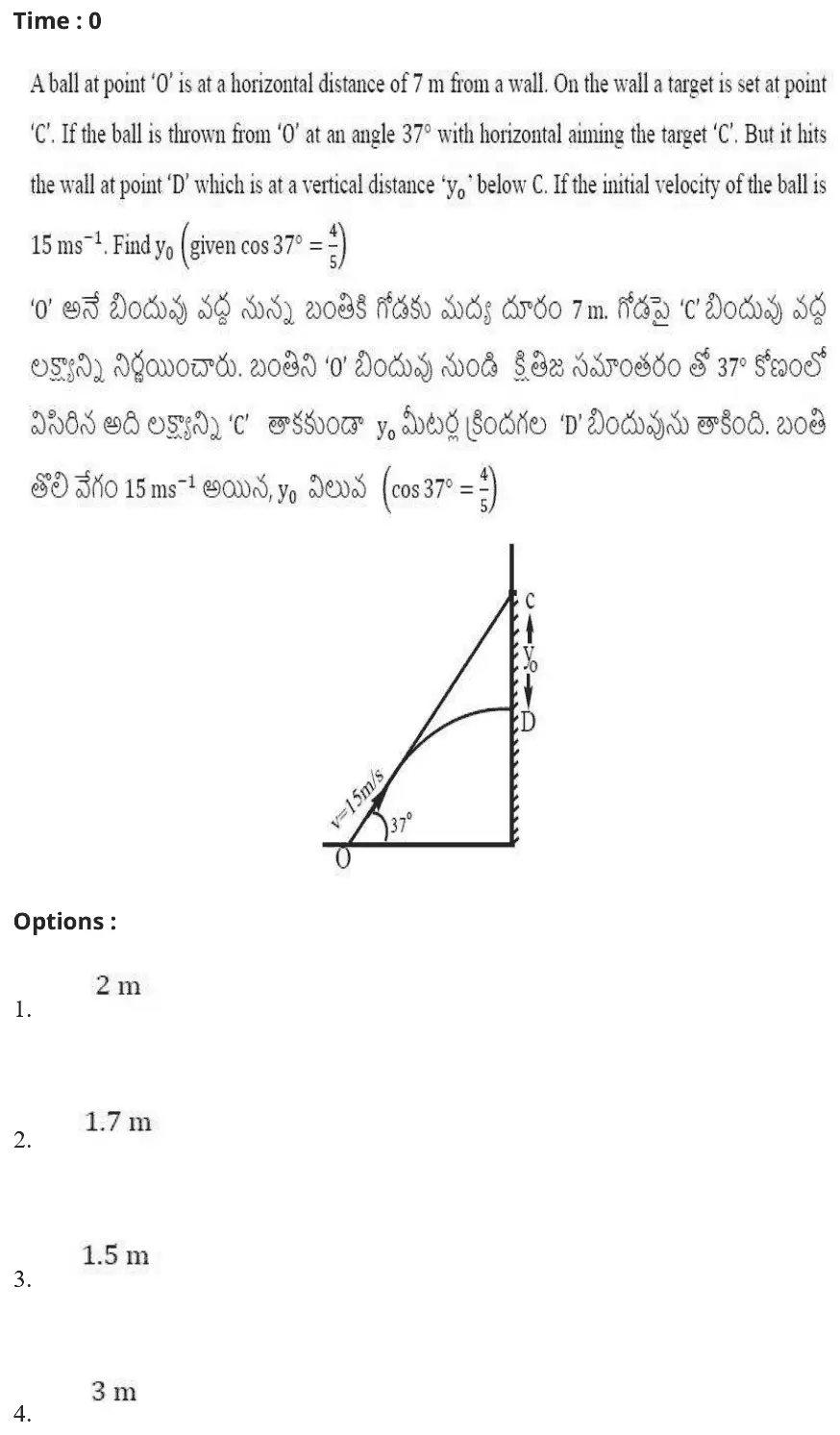
2 m
1.7 m
1.5 m
3 m
An object projected upwards from the foot of a tower. The object crosses the top of the tower twice with an interval of 8 s and the object reaches foot after 16 s. The height of the tower is $[g = 10\ \mathrm{ms^{-2}}]$
220 m
240 m
640 m
80 m
The centripetal acceleration of a particle in uniform circular motion is $18\ \mathrm{ms^{-2}}$. If the radius of the circular path is 50 cm, the change in velocity of the particle in a time of $\frac{\pi}{18}$ s is
$9\ \mathrm{ms^{-1}}$
$2\ \mathrm{ms^{-1}}$
$3\ \mathrm{ms^{-1}}$
$6\ \mathrm{ms^{-1}}$
The horizontal range of a projectile projected at an angle of $45^\circ$ with the horizontal is 50 m. The height of the projectile when its horizontal displacement is 20 m is
18 m
36 m
12 m
24 m
The velocity of a particle is given by the equation $v(x) = 3x^2 - 4x$, where 'x' is the distance covered by the particle. The expression for its acceleration is
$(6x - 4)$
$6(3x^2 - 4x)$
$(3x^2 - 4x)(6x - 4)$
$(6x - 4)^2$
The acceleration of a particle which moves along the positive $x$-axis varies with its position as shown in the figure. If the velocity of the particle is $0.8\ \mathrm{ms^{-1}}$ at $x = 0$, then its velocity at $x = 1.4\ m$ is (in $\mathrm{ms^{-1}}$)
(see the figure above)
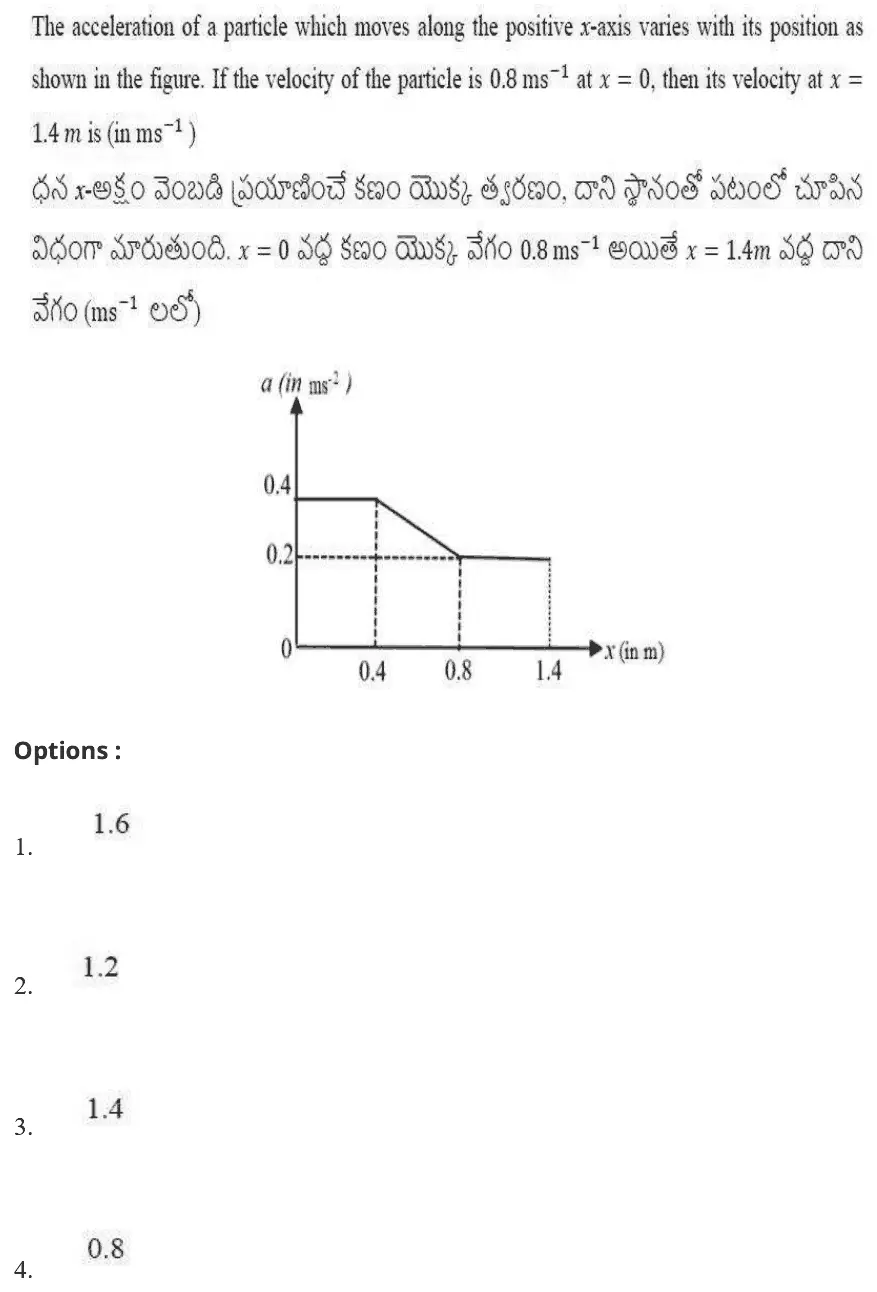
1.6
1.2
1.4
0.8
The maximum height attained by projectile is increased by 10% by keeping the angle of projection constant. What is the percentage increase in the time of flight?
5 %
10 %
20 %
40 %
A body starting from rest moving with an acceleration of $\frac{5}{4}$ $\mathrm{ms^{-2}}$. The distance travelled by the body in the third second is:
$\frac{15}{8}$ m
$\frac{25}{8}$ m
$\frac{25}{4}$ m
$\frac{12}{7}$ m
A projectile can have the same range (R) for two angles of projection. Their initial velocities are same. If $T_1$ and $T_2$ are times of flight in two cases, then the product of two times of flight is directly proportional to
$\frac{1}{R}$
$R^3$
$R^2$
$R$
If $|\overline{P}+\overline{Q}| = |\overline{P}| = |\overline{Q}|$ then the angle between $\overline{P}$ and $\overline{Q}$ is
$0^\circ$
$120^\circ$
$60^\circ$
$90^\circ$
The relation between time 't' and displacement 'x' is $t = \alpha x^2 + \beta x$ where $\alpha$ and $\beta$ are constants. If 'v' is the velocity, the retardation is
$2\alpha v^3 \beta^2$
$2\alpha\beta v^3$
$-2\beta v^3$
$2\alpha v^3$
If two stones are projected at angle '$\theta$' and $(90 - \theta)$ respectively with horizontal with a speed of $20\ \mathrm{ms^{-1}}$. If second stone rises 10 m higher than the first stone, then the angle of projection '$\theta$' is (acceleration due to gravity = $10\ \mathrm{ms^{-2}}$)
$45^\circ$
$30^\circ$
$60^\circ$
$20^\circ$
A particle revolving in a circular path travels the first half of the circumference in 4 s and the next half in 2 s. What is its average angular velocity?
$4\pi/9$ rad/s
$\pi/6$ rad/s
$2\pi/3$ rad/s
$\pi/3$ rad/s
A car travelling at 80 kmph can be stopped at a distance of 60 m by applying brakes. If the same car travels at 160 kmph and the same braking force is applied, the stopping distance is
240 m
170 m
360 m
480 m
A 2 kg ball thrown vertically upward and another 3 kg ball projected with certain angle ($\theta \neq 90$) both will have same time of flight, then the ratio of their maximum heights is
$2 : 3$
$3 : 2$
$\sqrt{3} : 2$
$1 : 1$
In a sport event a disc is thrown such that it reaches its maximum range of 80 m, the distance travelled in first 3 s is ($\mathrm{g = 10 ms^{-2}}$)
80 m
60 m
72 m
74 m
An object is projected such that it has to attain maximum range, another body is projected to reach maximum height. If both the objects reached the same maximum height, then the ratio initial velocities
$2:1$
$\sqrt{2}:1$
$1:\sqrt{2}$
$1:2$
A ball is projected at an angle of $45^\circ$ with the horizontal. It passes through a wall of height 'h' at a horizontal distance $d_1$ from the point of projection and strikes the ground at a distance $d_1 + d_2$ from the point of projection, then 'h' is
$h = \dfrac{2d_1 d_2}{d_1 + d_2}$
$h = \dfrac{d_1 d_2}{d_1 + d_2}$
$h = \dfrac{\sqrt{2}\, d_1 d_2}{d_1 + d_2}$
$h = \dfrac{d_1 d_2}{2(d_1 + d_2)}$
One second after projection, a projectile is travelling in a direction inclined at $45^\circ$ to horizontal. After two more seconds it is travelling horizontally. Then the magnitude of velocity of the projectile is ($g = 10\ ms^{-2}$)
$10\sqrt{13}\ \mathrm{ms^{-1}}$
$11\ \mathrm{ms^{-1}}$
$10\sqrt{2}\ \mathrm{ms^{-1}}$
$20\ \mathrm{ms^{-1}}$
The position $x$ (in metre) of a particle moving along a straight line is given by $x=t^3-12t+3$, where 't' is time (in second). The acceleration of the particle when its velocity becomes $15\,\mathrm{ms^{-1}}$ is
$15\,\mathrm{ms^{-2}}$
$24\,\mathrm{ms^{-2}}$
$18\,\mathrm{ms^{-2}}$
$12\,\mathrm{ms^{-2}}$
The maximum horizontal range of a ball projected from the ground is 32 m. If the ball is thrown with the same speed horizontally from the top of a tower of height 25 m, the maximum horizontal distance covered by the ball is
(Acceleration due to gravity $=10\ \mathrm{ms^{-2}}$)
40 m
57 m
60 m
75 m
A body moving with uniform acceleration, travels a distance of 25 m in the fourth second and 37 m in the sixth second. The distance covered by the body in the next two seconds is
63 m
84 m
49 m
92 m
A body is projected from the ground at an angle of $\tan^{-1}(\sqrt{7})$ with the horizontal. At half of the maximum height, the speed of the body is ‘n’ times the speed of projection. The value of ‘n’ is
$2$
$\frac{1}{2}$
$\frac{4}{3}$
$\frac{3}{4}$
The relation between the current i (in ampere) in a conductor and the time t (in second) is $i = 12t + 9t^2$. The charge passing through the conductor between the times $t = 2\ \mathrm{s}$ and $t = 10\ \mathrm{s}$ is
3720 C
3648 C
3600 C
3552 C
A body is thrown vertically upwards with a velocity of $35\ \mathrm{ms^{-1}}$ from the ground. The ratio of the speeds of the body at times $3\ \mathrm{s}$ and $4\ \mathrm{s}$ of its motion is
(Acceleration due to gravity $= 10\ \mathrm{ms^{-2}}$)
$3:4$
$1:1$
$2:1$
$3:2$
From a height of 'h' above the ground, a ball is projected up at an angle $30^\circ$ with the horizontal. If the ball strikes the ground with a speed of 1.25 times its initial speed of $40\ \mathrm{ms^{-1}}$, the value of 'h' is
(acceleration due to gravity = $10\ \mathrm{ms^{-2}}$)
75 m
60 m
30 m
45 m
A body is falling freely from the top of a tower of height 125 m. The distance covered by the body during the last second of its motion is $x$ % of the height of the tower. Then $x$ is
(Acceleration due to gravity $=10\ \mathrm{ms^{-2}}$)
9
36
25
49
A body P is projected at an angle of $30^\circ$ with the horizontal and another body Q is projected at angle of $30^\circ$ with the vertical. If the ratio of the horizontal ranges of the bodies P and Q is $1:2$, then the ratio of the maximum heights reached by the bodies P and Q is
$1:4$
$1:6$
$2:3$
$1:1$
A stone is thrown vertically up from the top end of a window of height 1.8 m with a velocity of $8\ \mathrm{ms^{-1}}$. The time taken by the stone to cross the window during its downward journey is
(Acceleration due to gravity $= 10\ \mathrm{ms^{-2}}$)
0.8 s
1.6 s
1.0 s
0.2 s
A cannon placed on a cliff at a height of 375 m fires a cannon ball with a velocity of $100\ \mathrm{ms^{-1}}$ at an angle of $30^\circ$ above the horizontal. The horizontal distance between the cannon and the target is
(Acceleration due to gravity $= 10\ \mathrm{ms^{-2}}$)
$750\sqrt{3}\ \mathrm{m}$
$500\sqrt{3}\ \mathrm{m}$
$250\sqrt{3}\ \mathrm{m}$
$750\ \mathrm{m}$
The velocity (v) of a particle starting from rest increases linearly with time (t) as $v = 4t$, where $v$ is in $\mathrm{ms^{-1}}$ and $t$ is in second. The distance covered by the particle in the first 4 seconds is
16 m
32 m
8 m
64 m
The time taken by a boat to travel upstream to a certain distance and return back is 14 hours. If the velocity of boat in still water is $35\ \mathrm{kmh^{-1}}$ and velocity of the stream is $5\ \mathrm{kmh^{-1}}$, the distance travelled by the boat before it returns is
100 km
240 km
120 km
180 km
If the angle between two unit vectors $\vec{A}$ and $\vec{B}$ is $\theta$, then $|\vec{A}+\vec{B}|$ is
$2\cos\dfrac{\theta}{2}$
$2\sin\dfrac{\theta}{2}$
$0$
$\cos\dfrac{\theta}{2}$
If the engine of a long train moving with constant acceleration crosses a tree with velocity ‘u’ and the last compartment of the train crosses the same tree with velocity ‘v’, then the velocity with which the middle compartment crosses the same tree is
$\dfrac{(v+u)}{2}$
$\dfrac{2uv}{(u+v)}$
$\sqrt{\dfrac{(v^2+u^2)}{2}}$
$\sqrt{2(u^2+v^2)}$
A swimmer wants to cross a river which is flowing at a speed ‘v’. If the swimmer can swim in still water at speed ‘V’, the direction he should swim to cross the river in least time is
Along the flow of river
Opposite to the flow of river
Perpendicular to the flow of river
$45^\circ$ to the flow of river
The resultant magnitude of two vectors of same magnitude is equal to magnitude of either. The angle between the two vectors is
$30^\circ$
$60^\circ$
$90^\circ$
$120^\circ$
A car is travelling at $30\ \mathrm{ms^{-1}}$ speed on a circular road of radius $300\ \mathrm{m}$. If its speed is increasing at the rate of $4\ \mathrm{ms^{-2}}$, then its acceleration is
$2.7\ \mathrm{ms^{-2}}$
$3\ \mathrm{ms^{-2}}$
$4\ \mathrm{ms^{-2}}$
$5\ \mathrm{ms^{-2}}$
Which of the following statements is true regarding the vector product of two vectors?
The vector product of two vectors changes sign under reflection.
Vector product is commutative.
Vector product of two parallel vectors is a null vector.
Vector product of two vectors is a scalar.
Among the following, velocity (v) – time (t) graph representing the motion of a vertically projected body is
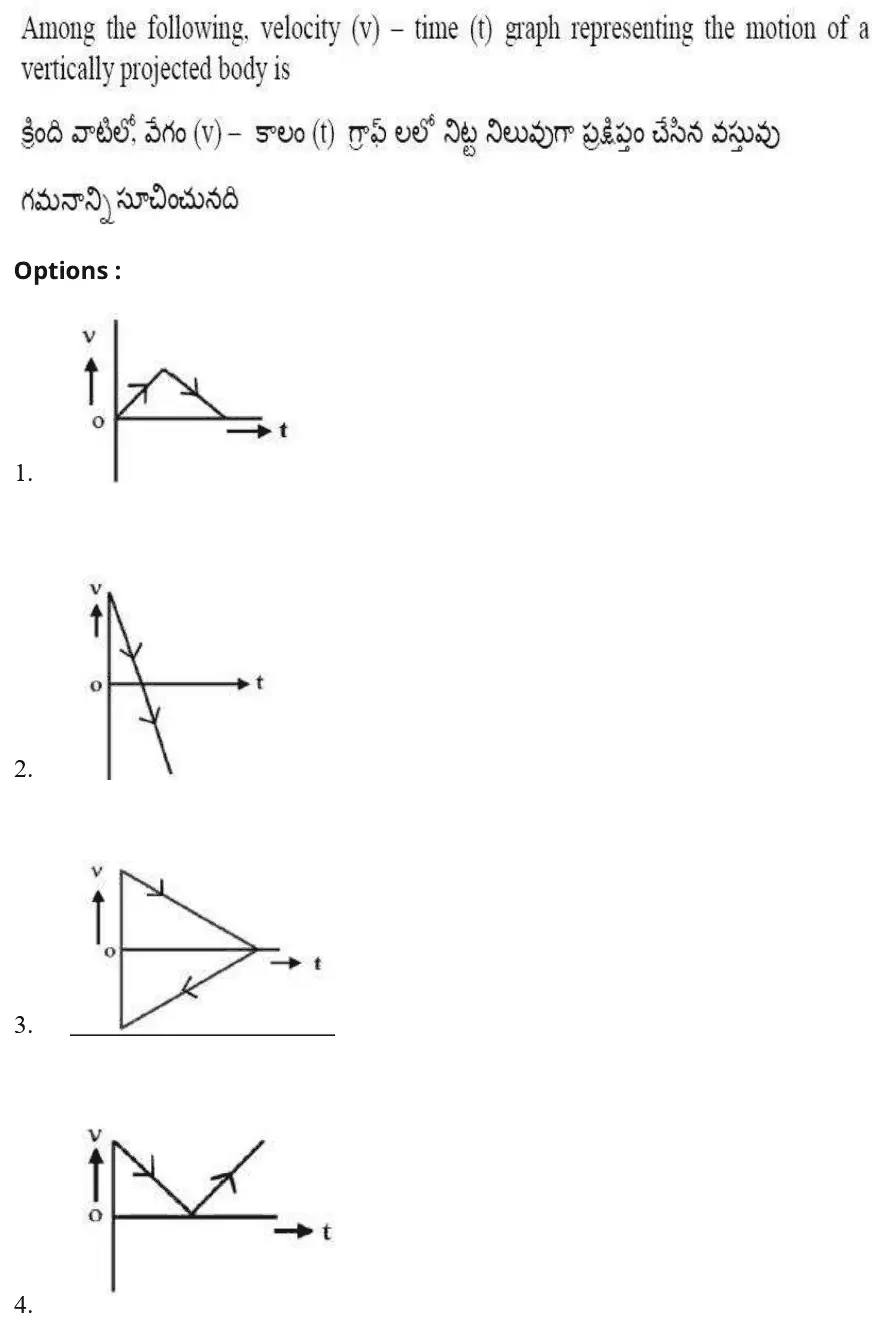
see figure v-t graph: a line starting at the v-axis slightly above the t-axis rises with positive slope, reaches a peak, then falls with negative slope and meets the t-axis (arrows along the lines); the whole graph lies above the t-axis.
see figure v-t graph: a single straight line with negative slope, starting at positive v on the v-axis, crossing the t-axis and continuing into negative v (arrows pointing down along the line).
see figure v-t graph: a triangle shape. A line starts at a high positive v on the v-axis and slopes down to the t-axis at the right apex; another line starts at a negative v on the v-axis and slopes up to the same apex on the t-axis (arrows shown on both lines).
see figure v-t graph: a V shape above the t-axis. A line starts at positive v on the v-axis and falls with negative slope to touch the t-axis, then rises with positive slope back up to positive v (arrows on both lines).
The resultant of two vectors $\vec{A}$ and $\vec{B}$ is perpendicular to vector $\vec{A}$ and the resultant magnitude is equal to half of the magnitude of $\vec{B}$, then the angle between $\vec{A}$ and $\vec{B}$ is
$30^\circ$
$60^\circ$
$150^\circ$
$120^\circ$
At any instant ‘t’ the vertical distance ‘Y’ and horizontal distance ‘X’ of a projectile are given by $2Y = 6t - gt^2$ and $X = 4t$. The initial velocity of projectile is
(X and Y are in metre and t is in second)
$3\ \mathrm{ms^{-1}}$
$4\ \mathrm{ms^{-1}}$
$5\ \mathrm{ms^{-1}}$
$6\ \mathrm{ms^{-1}}$
If a person moving along a straight line path covers first half distance with velocity ‘$V_1$’ and the next half distance with velocity ‘$V_2$’, then the average velocity of the person is
$\frac{V_1+V_2}{2}$
$\frac{(V_1+V_2)}{2\sqrt{V_1V_2}}$
$\frac{2}{\frac{1}{V_1}+\frac{1}{V_2}}$
$\frac{V_1V_2}{V_1+V_2}$
A body is moving with a uniform speed of $20\ \mathrm{ms^{-1}}$ on a horizontal circle. The change in velocity of the body in half revolution is
$20\ \mathrm{ms^{-1}}$
$10\ \mathrm{ms^{-1}}$
$40\ \mathrm{ms^{-1}}$
$\frac{20}{\sqrt{2}}\ \mathrm{ms^{-1}}$
A person walks up a stalled escalator in 80 sec. When standing on the same escalator, now moving, he is carried up in 20 s. The time taken by him to walk up the moving escalator is
4 s
8 s
12 s
16 s
A car moving with uniform acceleration covers the distance of 200 m in first 2 seconds and the distance of 220 m in next 4 seconds. The velocity of the car after 7 seconds is
$10\ \mathrm{ms^{-1}}$
$20\ \mathrm{ms^{-1}}$
$15\ \mathrm{ms^{-1}}$
$30\ \mathrm{ms^{-1}}$
A flywheel is rotating at a rate of 150 rev/minute. If it slows at constant retardation of $\pi$ rads$^{-2}$, then the time required for the wheel to come to rest is
2.5 s
5 s
4 s
6 s
A force, $\vec{F}=\left(4\hat{i}+3\hat{j}-5\hat{k}\right)\mathrm{N}$ is acting on a body making an angle $\theta$ with the horizontal. Then the angle '$\theta$' is
$\cos^{-1}\left(\dfrac{2\sqrt{2}}{5}\right)$
$\cos^{-1}\left(\dfrac{\sqrt{2}}{5}\right)$
$\cos^{-1}\left(\dfrac{5\sqrt{2}}{9}\right)$
$\cos^{-1}\left(\dfrac{3}{5\sqrt{2}}\right)$
If the velocity of a particle moving along a straight line with uniform acceleration, is given by $V=\left(\sqrt{196-16X}\right)\ \mathrm{ms^{-1}}$, then its acceleration is
( x is displacement of the particle)
$8\ \mathrm{ms^{-2}}$
$14\ \mathrm{ms^{-2}}$
$-8\ \mathrm{ms^{-2}}$
$-16\ \mathrm{ms^{-2}}$
The sum of the magnitudes of two vectors acting at a point is 18 and the magnitude of their resultant is 12. If the resultant is at $90^\circ$ with the vector of smaller magnitude, then the magnitudes of the vectors are
5, 13
2, 16
6, 12
8, 10
Two bodies of masses ‘$m_1$’ and ‘$m_2$’ are dropped from two different heights $h_1$ and $h_2$ respectively. The ratio of the times taken by the two masses to touch the ground is (neglect air resistance)
$\frac{h_1}{h_2}$
$\frac{m_1 h_1}{m_2 h_2}$
$\frac{m_1 h_2}{m_2 h_1}$
$\sqrt{\frac{h_1}{h_2}}$
The time of flight of a vertically projected stone is 8 s. The position of the stone after 6 s from the ground is
(Acceleration due to gravity = $10\ \mathrm{ms^{-2}}$)
20 m
60 m
75 m
40 m
A stone thrown with velocity ‘u’ at angles ‘θ’ and (90°-θ) with the horizontal reaches to maximum heights $H_1$ and $H_2$ respectively. Its horizontal range is
$4\sqrt{H_1H_2}$
$2\,H_1H_2$
$2\sqrt{H_1H_2}$
$4\sqrt{\dfrac{H_1}{H_2}}$
Two vectors of same magnitude act at a point. Twice the product of the magnitudes of two vectors is equal to the square of the magnitude of their resultant.The angle between the two vectors is
$60^\circ$
$30^\circ$
$90^\circ$
$120^\circ$
A truck moving with a constant velocity $12\ \mathrm{ms^{-1}}$ crosses a car moving from rest with uniform acceleration $2\ \mathrm{ms^{-2}}$. The distance the car has to travel from the starting point to cross the truck again is
$50\ \mathrm{m}$
$60\ \mathrm{m}$
$144\ \mathrm{m}$
$120\ \mathrm{m}$
If $\vec{F}=(4\hat{i}-10\hat{j})\,\mathrm{N}$ and $\vec{r}=(-5\hat{i}-3\hat{j})\,\mathrm{m}$, then $(\vec{r}\times\vec{F})$ is
$(-20\hat{i}+3\hat{j})\,\mathrm{Nm}$
$62\hat{k}\,\mathrm{Nm}$
$10\sqrt{13}\,\mathrm{Nm}$
$38\,\mathrm{Nm}$
Two forces whose magnitudes are in the ratio 5:3 are acting at a point at an angle $60^\circ$ simultaneously. If the resultant of the two forces is 35 N, then the magnitudes of two forces respectively are
3N, 5N
25 N, 9N
25 N, 15 N
12 N, 20 N
The acceleration of a vertically projected body at its highest reaching position is
0
Equal to acceleration due to gravity at the place
Infinity
$-1\ \mathrm{ms^{-2}}$
A player can throw a ball to a maximum horizontal distance of 80 m. If he throws the ball vertically with the same velocity, then the maximum height reached by the ball is
160 m
60 m
20 m
40 m
The velocity of a particle having magnitude of 10 ms$^{-1}$ in the direction of $60^0$ with positive X-axis is
$5\hat{i}-5\sqrt{3}\hat{j}$
$5\sqrt{3}\hat{i}-5\hat{j}$
$5\sqrt{3}\hat{i}+5\hat{j}$
$5\hat{i}+5\sqrt{3}\hat{j}$
The displacement-time graphs of two moving particles make angles of $30^\circ$ and $45^\circ$ with the time axis. The ratio of their velocities is
(see the figure above)
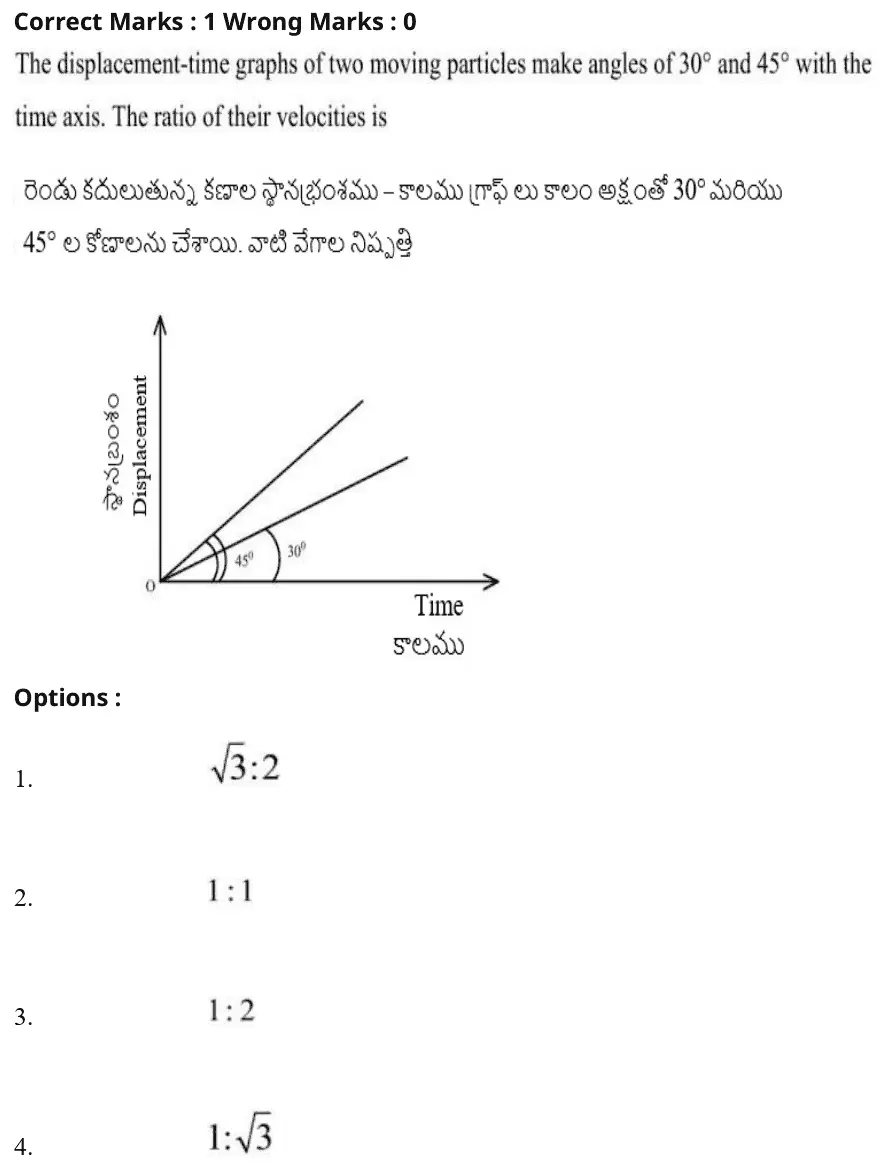
$\sqrt{3}:2$
$1:1$
$1:2$
$1:\sqrt{3}$
A projectile is given an initial velocity of $\hat{i}+2\hat{j}\ \mathrm{ms^{-1}}$. The cartesian equation of its path is
($x$ and $y$ are in metres and $g=10\ \mathrm{ms^{-1}}$)
$y=x-5x^2$
$y=2x-5x^2$
$y=2x-15x^2$
$y=2x-25x^2$
The angle between force $\vec{F} = 3\hat{i}+4\hat{j}-5\hat{k}$ and displacement $\vec{d} = 5\hat{i}+4\hat{j}+3\hat{k}$ is
$\cos^{-1}(0.16)$
$\cos^{-1}(0.32)$
$\cos^{-1}(0.24)$
$\cos^{-1}(0.64)$
A body starts from rest with uniform acceleration. If its velocity after $n^{th}$ second (last second) is ‘V’ then its displacement in the last two seconds is
$\dfrac{2V(n+1)}{n}$
$\dfrac{V(n+1)}{n}$
$\dfrac{V(n-1)}{n}$
$\dfrac{2V(n-1)}{n}$
A stone projected from the ground with a velocity $50\ \mathrm{ms^{-1}}$ at an angle of $30^\circ$ with the horizontal crosses a wall after a time of 3 s. Then the horizontal distance beyond the wall that the stone strikes the ground is
(acceleration due to gravity $= 10\ \mathrm{ms^{-2}}$)
90.2 m
89.6 m
86.6 m
70.2 m
A bird flies with a velocity $(t-2)\ \mathrm{ms^{-1}}$ along a straight line, where t is the time in seconds. The distance covered by it in a time of 4 seconds is
$2\ \mathrm{m}$
$4\ \mathrm{m}$
$6\ \mathrm{m}$
$8\ \mathrm{m}$
A car is travelling with linear velocity ‘V’ on a circular road of radius ‘r’. If its velocity is increasing at a rate of ‘$a$’ $\mathrm{ms^{-2}}$, then the resultant acceleration will be
$\sqrt{\left(\frac{V^2}{r^2}-a^2\right)}$
$\sqrt{\left(\frac{V^4}{r^2}+a^2\right)}$
$\sqrt{\left(\frac{V^4}{r^2}-a^2\right)}$
$\sqrt{\left(\frac{V^2}{r^2}+a^2\right)}$
The relation between time $t$ and distance $x$ of a particle is $t = ax^2+bx$, where $a$ *and* $b$ are constants. If $v$ is the velocity of the particle, then its acceleration is
$-2abv^2$
$2bv^3$
$-2av^3$
$2av^2$
A bomb is dropped on an enemy post on the ground by an aeroplane flying horizontally with a velocity of $60\ \mathrm{kmh^{-1}}$ at a height of $490\ \mathrm{m}$. At the time of dropping the bomb, the horizontal distance of the aeroplane from the enemy post so that the bomb hits the target is
$\left(\frac{400}{3}\right)\mathrm{m}$
$\left(\frac{500}{3}\right)\mathrm{m}$
$\left(\frac{1700}{3}\right)\mathrm{m}$
$498\ \mathrm{m}$
The angular speed of a particle moving in a circular path is doubled. Then, the centripetal acceleration of the particle is
4 times the initial centripetal acceleration
halved
doubled
unchanged
The ratio of the displacements of a freely falling body during first, second and third seconds of its motion is
$1:1:1$
$1:3:5$
$1:2:3$
$1:4:9$
A person walks in such a way that he covers equal distance in each step. The person takes 2 steps forward towards east, then takes a right turn and walks 4 steps towards south, then takes a right turn and walks 6 steps towards west and then takes a right turn and walks further. The direction of his final position after a total of 20 steps walk with respect to his initial position is
North-West
$60^\circ$ West of South
$60^\circ$ South of West
South-East
A ball projected up passes the same height H at 2 s and 10 s. The value of H is [Use g = 9.8 m/s$^2$]
102 m
100 m
98 m
9.8 m
Two towns X and Y are connected by a regular bus service. A bus leaves in either direction at every $t = T$ minutes. A man moving with some speed in the direction X to Y finds that a bus goes past him every $t = t_1$ minutes in the direction of his motion, and every $t = t_2$ minutes in the opposite direction. Then $T$ is given by
$\dfrac{2t_1 t_2}{t_1 + t_2}$
$\dfrac{(t_1 - t_2)t_1}{t_1 + t_2}$
$\dfrac{2t_2(t_1 + t_2)}{|t_1 - t_2|}$
$\dfrac{t_1 t_2}{|t_1 - t_2|}$
Statement (I) : An object subjected to velocities $\vec{v_1}$ and $\vec{v_2}$ has a resultant velocity with magnitude $|\vec{v}| = |\vec{v_1}| + |\vec{v_2}|$.
Statement (II) : The magnitude of displacement is either less or equal to the path length of an object between two points.
Statement (III) : The instantaneous acceleration is the limiting value of the average acceleration as the time interval approaches zero.
Which of the following is correct?
Statements I, II, III are true
Statements I, II are true, but statement III is false
Statements II, III are true, but statement I is false
Statements I, II, III are false
For a projectile if $\alpha$ is the angle of projection, $R$ is the range, $h$ is the maximum height, $T$ is the time of flight then
$\tan\alpha = \dfrac{R}{2h},\ h = \dfrac{gT^2}{8}$
$\tan\alpha = \dfrac{R}{4h},\ h = \dfrac{gT^2}{8}$
$\tan\alpha = \dfrac{4h}{R},\ h = \dfrac{gT^2}{8}$
$\tan\alpha = \dfrac{4h}{R},\ h = \dfrac{gT^2}{4}$
A car starts at time $t=0$ from an initial speed of $10\ \mathrm{m/s}$ and accelerates uniformly with $2\ \mathrm{m/s^2}$ on a straight road for time $0\le t\le 10s$. Let $S_1$ and $S_2$ be the distance covered by the car in time $3\le t\le 4s$ and $4\le t\le 5s$ respectively. The ratio $\dfrac{S_2}{S_1}$ is
1
$\dfrac{19}{17}$
$\dfrac{9}{7}$
$\dfrac{5}{3}$
Particle A (which was located at the origin at time t = 0) is moving along the x – axis with a constant speed of 1 m/s. Location of particle B which is moving along the y – axis is given by $y=ct^2$, where $c=1\ \mathrm{m/s^2}$. Find the speed of particle A relative to particle B at t = 1 sec.
$\sqrt{5}$ m/s
2 m/s
1 m/s
0 m/s
A particle is moving in xy – plane as $\vec{x}=(4t+t^2)\hat{i},\ \vec{y}=\left(2t+\dfrac{t^2}{2}\right)\hat{j}$ where $\vec{x}$ & $\vec{y}$ are displacements measured along x and y axes respectively in meters and t in seconds. What is the velocity of the particle?
$\vec{v}=(4+t)\hat{i}+(2+t)\hat{j}$
$\vec{v}=(4+2t)\hat{i}+(2+t)\hat{j}$
$\vec{v}=(4+2t)\hat{i}+\left(2+\dfrac{t}{2}\right)\hat{j}$
$\vec{v}=(4+t)\hat{i}+\left(2+\dfrac{t}{2}\right)\hat{j}$
The surface of a hill inclined at an angle $30^\circ$ to the horizontal. A stone is thrown from the summit of the hill (point A) at an initial speed 10 m/s at angle $60^\circ$ to the vertical. If the stone strikes the hill at point B as shown in the figure, the distance between A and B is
(Take $g=10\ \mathrm{m/s^2}$)
(see the figure above)
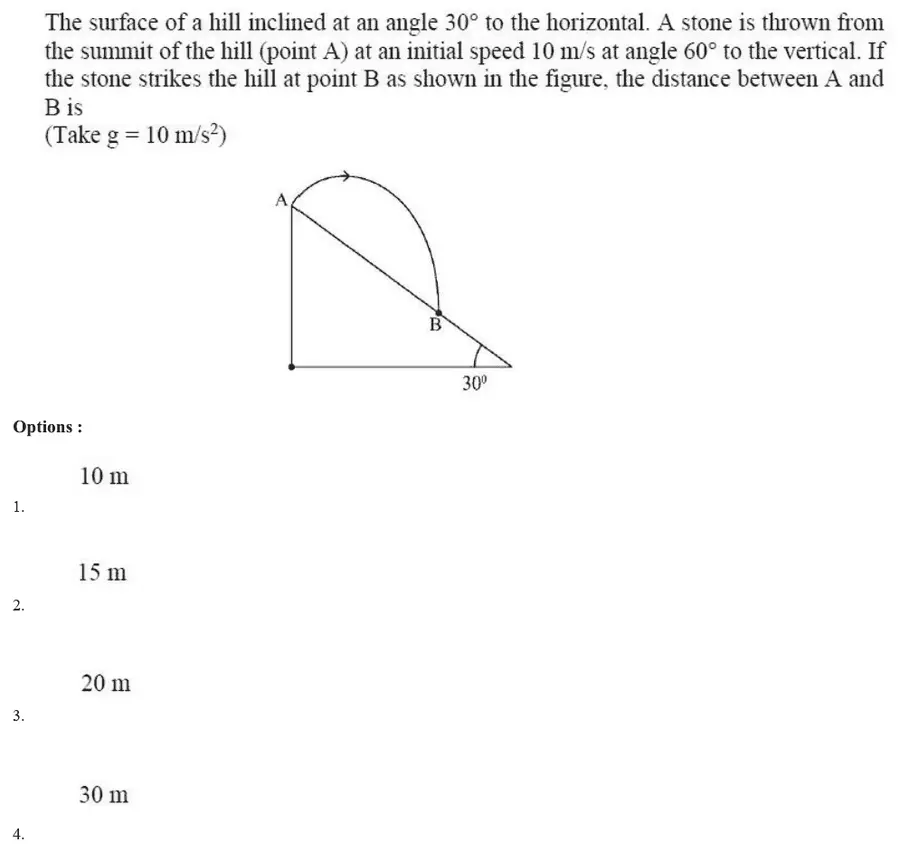
10 m
15 m
20 m
30 m
A cyclist is riding with a speed of 36 km/h. As he approaches a circular turn on the road of radius 50 m, he applies brakes and reduces his speed at the constant rate of 0.5 m/s every second. The magnitude and direction of the net acceleration of the cyclist on the circular turn respectively are
$\dfrac{\sqrt{3}}{2}\ \mathrm{m/s^2},\ \mathrm{Tan}^{-1}(4)$
$\dfrac{\sqrt{3}}{2}\ \mathrm{m/s^2},\ \mathrm{Tan}^{-1}\left(\dfrac{1}{4}\right)$
$\sqrt{17}\ \mathrm{m/s^2},\ \mathrm{Tan}^{-1}\left(\dfrac{1}{4}\right)$
$\dfrac{\sqrt{17}}{2}\ \mathrm{m/s^2},\ \mathrm{Tan}^{-1}(4)$
A particle moves along a straight line such that its displacement 'x' varies with time 't' as $x=\alpha t^3+\beta t^2+\gamma$, where $\alpha,\beta,\gamma$ are constants. $\mathrm{V_1}$ is the average velocity of the particle during its journey between $t=1\,\mathrm{s}$ and $t=3\,\mathrm{s}$. $\mathrm{V_2}$ is the instantaneous velocity of the particle at $t=3\,\mathrm{s}$. The ratio $\dfrac{\mathrm{V_1}}{\mathrm{V_2}}$ is
$\dfrac{27\alpha+9\beta}{26\alpha+6\beta}$
$\dfrac{9\alpha+3\beta}{18\alpha+4\beta}$
$\dfrac{13\alpha+4\beta}{27\alpha+6\beta}$
$\dfrac{26\alpha+8\beta}{9\alpha+3\beta}$
A man walking along a straight line with a velocity 6 km/h encounters rain falling vertically down with a velocity $6\sqrt{3}$ km/h. At what angle the man should hold his umbrella so that he can protect himself from rain
$30^\circ$ with respect to ground
$30^\circ$ with respect to vertical
$45^\circ$ with respect to ground
$60^\circ$ with respect to vertical
A merry - go - round rotating at a constant angular speed completes 9 rotations in 18 seconds. What is its angular speed?
$\pi/2$ rad/s
$\pi$ rad/s
$2\pi$ rad/s
$3\pi$ rad/s
A rocket moves straight upward with zero initial velocity and with an acceleration $20\ \mathrm{m/s^{2}}$. It runs out of fuel and stops accelerating at the end of $5^{\text{th}}$ sec. It reaches a maximum height and falls back to the earth. The speed when it hits the ground is (Take $g=10\ \mathrm{m/s^{2}}$)
$100\sqrt{2}\ \mathrm{m/s}$
$150\sqrt{3}\ \mathrm{m/s}$
$50\sqrt{6}\ \mathrm{m/s}$
$75\ \mathrm{m/s}$
Two cars, at a certain instant, are 50 km apart on a line running from south to north. The one farther north is moving west at 25 km/hr. The other is moving towards north at 25 km/hr. How long do they take to reach their distance of closest approach?
30 min
60 min
85 min
90 min
A particle initially at origin starts moving in xy-plane has velocity component $\vec{V}=(6+2t)\hat{i}+\left(4+2\sqrt{3}t\right)\hat{j}$ m/s. Acceleration of the particle in $\mathrm{m/s^{2}}$ is [x, y are measured in meters, t in seconds, respectively]
$(6+2t)\hat{i}+\left(4+2\sqrt{3}t\right)\hat{j}$
$(6+2t)\hat{i}+2\sqrt{3}\,\hat{j}$
$2\hat{i}+2\sqrt{3}\,\hat{j}$
$2\hat{i}+2\sqrt{3}\,\hat{k}$
A bullet is fired at time $t=0$ with velocity $20\ m/s$ and at an initial angle of $30^{\circ}$ with the horizontal. The tan angle between the displacement vector and the horizontal after time $0.1\,s$ is (Assume $g=10\ m/s^{2}$)
$\frac{38}{20\sqrt{3}}$
$\frac{19}{20\sqrt{3}}$
$\frac{19}{20}$
$\frac{19\sqrt{3}}{20}$
A body starts from the rest and acquires a velocity of 10 m/s in 2s. What is the acceleration of the body and the distance travelled
$5\ \mathrm{m/s^{2}}$ and $10\ \mathrm{m}$
$5\ \mathrm{m/s^{2}}$ and $5\ \mathrm{m}$
$5\ \mathrm{m/s^{2}}$ and $6\ \mathrm{m}$
$6\ \mathrm{m/s^{2}}$ and $5\ \mathrm{m}$
A bullet fired into a target losses one-third of its velocity after travelling a distance $x$ meter into the target. If the bullet comes to rest by travelling a further distance $x'$, then the ratio $\dfrac{x'}{x}$ is
$\dfrac{2}{3}$
$\dfrac{1}{3}$
$\dfrac{4}{5}$
$\dfrac{4}{9}$
An ant starts from the origin and crawls 10 cm along the x - axis and then 20 cm along the y - axis. The dot product of the ant's displacement vector with the position vector of a point that makes $45^{\circ}$ with the x - axis and has a magnitude of $\sqrt{2}$ cm is
$30\ \mathrm{cm}$
$30\sqrt{2}\ \mathrm{cm}$
$\dfrac{30}{\sqrt{2}}\ \mathrm{cm}$
$15\ \mathrm{cm}$
A projectile is launched with an initial speed of 40 m/s at an angle $30^{\circ}$ above the ground. The projectile lands on a hillside 2.0 s later. The net displacement from where the projectile was launched to where it hits the target is
(Take g = 10 m/s$^{2}$)
$20\sqrt{3}\ \mathrm{m}$
$30\sqrt{2}\ \mathrm{m}$
$40\ \mathrm{m}$
$20\sqrt{13}\ \mathrm{m}$
A particle starts from rest. Its acceleration (a) versus time (t) is as shown in the figure. The maximum speed of the particle will be
(see the figure above)
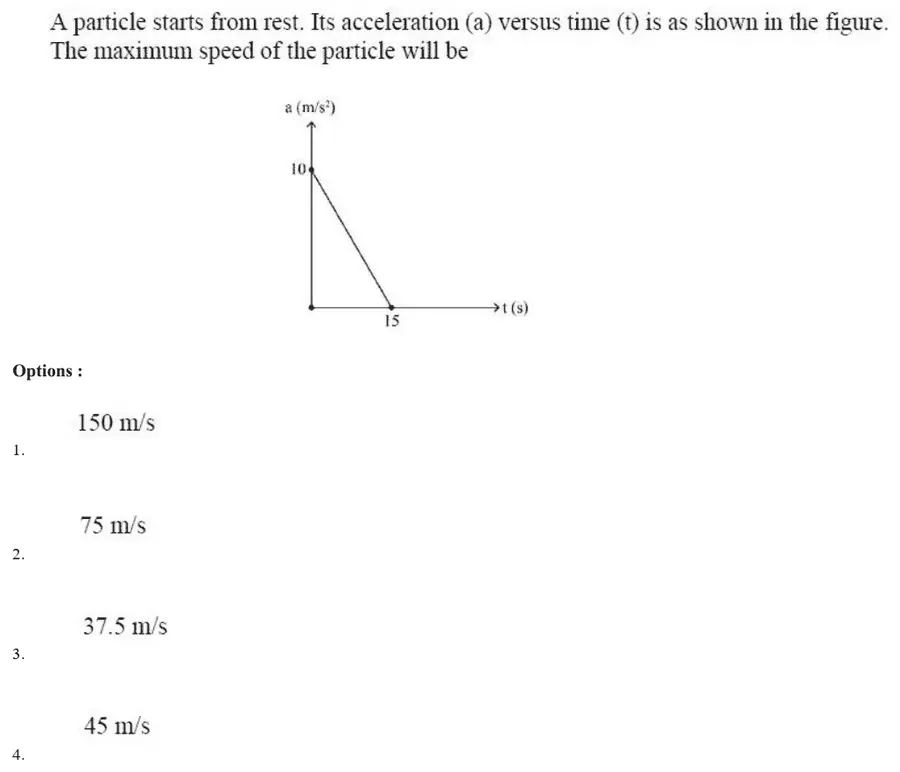
150 m/s
75 m/s
37.5 m/s
45 m/s
Assertion(A): The zero velocity of a particle at any instant always implies zero acceleration at that instant
Reason(R) : A body is momentarily at rest when reverses its direction of motion.
The correct option among the following is
(A) is true, (R) is true and (R) is the correct explanation for (A)
(A) is true, (R) is true but (R) is not the correct explanation for (A)
(A) is true but (R) is false
(A) is false but (R) is true
A river has a steady speed of ‘v’. A man swims upstream at a distance of ‘d’ and swims back to the starting point in total time ‘t’. The man can swim at a speed of ‘2v’ in still water. If the time taken by the man in still water is’t$_{0}$’ to complete the same length of swim, then $\frac{t}{t_{0}}$ is
$\frac{1}{2}$
$\frac{3}{2}$
$\frac{3}{4}$
$\frac{4}{3}$
A projectile is given an initial velocity of $(3\hat{i}+4\hat{j})\,m/s$ where, $\hat{i}$ is along the ground and $\hat{j}$ is along the vertical. Assuming g = 10 m/s$^{2}$, if the equation of its trajectory can be written as $\frac{1}{9}\left[\beta x+\gamma x^{2}\right]$, then the value of $\gamma$ is
$-8$
$-5$
$-6$
$-12$
The correct position (x) – time (t) graph for a particle moving with negative acceleration is
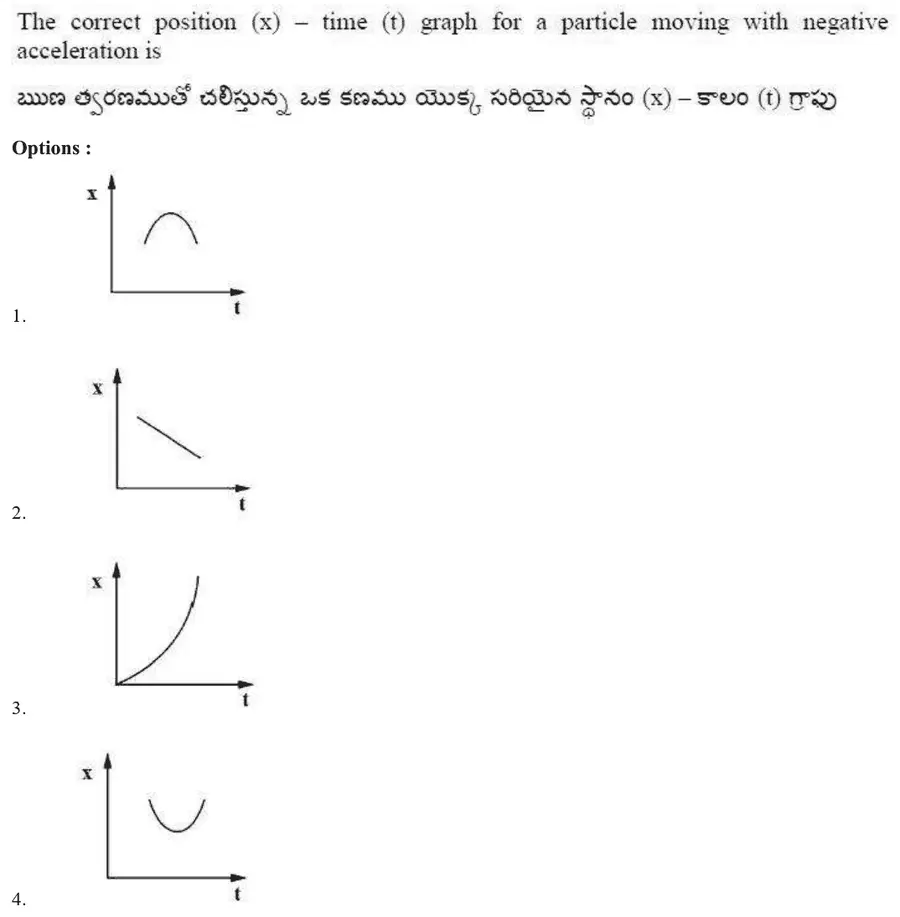
see figure x–t graph: an inverted-parabola arc (concave down, rising to a peak then falling), floating clear of the axes
see figure x–t graph: a straight line sloping downward
see figure x–t graph: a curve starting at the origin and rising with increasing slope (concave up, steepening)
see figure x–t graph: an upright-parabola arc (concave up, falling to a minimum then rising), floating clear of the axes
A ball is thrown upward from the top of a building at angle of $30^\circ$ to the horizontal with an initial speed of $15\ \mathrm{ms^{-1}}$. If the ball hits the ground after 3 s, then the height of building is
(acceleration due to gravity $= 10\ \mathrm{m\,s^{-2}}$)
$30\ \mathrm{m}$
$12.5\ \mathrm{m}$
$25.5\ \mathrm{m}$
$22.5\ \mathrm{m}$
A particle moving in $x - y$ plane starts from the origin at $t = 0$ with an initial velocity $(-\hat{i} + \hat{j})\ \mathrm{ms^{-1}}$ and undergoes an acceleration of $(6\hat{i} + 4\hat{j})\ \mathrm{ms^{-2}}$. It's displacement after 2 s is
$17.32\ \mathrm{m}$
$14.14\ \mathrm{m}$
$12.42\ \mathrm{m}$
$10\ \mathrm{m}$
A ball is dropped from a tower of height 80 m. The time it takes to cover the last 50% of its fall is
(acceleration due to gravity = $10\ \mathrm{ms^{-2}}$)
$2\sqrt{2}\ \mathrm{s}$
$1.17\ \mathrm{s}$
$4\ \mathrm{s}$
$2.0\ \mathrm{s}$
A vector $\vec{P}$ directed along the x-axis is added to vector $\vec{Q}$ which has a magnitude of 10 m. The resultant vector is directed along the y-axis, with a magnitude that is 2 times that of $\vec{P}$. The magnitude of $\vec{P}$ is
$\sqrt{10}\ \mathrm{m}$
$5\sqrt{2}\ \mathrm{m}$
$6\ \mathrm{m}$
$2\sqrt{5}\ \mathrm{m}$
In the projectile motion of an object, the object reaches its maximum height where its speed is half of initial speed. Then the ratio between range and maximum height of projectile is
$4\sqrt{3}$
$\dfrac{\sqrt{3}}{4}$
$\dfrac{4}{\sqrt{3}}$
$\dfrac{2}{\sqrt{3}}$
A biker travels $\dfrac{1}{3}$ of the distance L with speed $v_1$ and $\dfrac{2}{3}$ of the distance with speed $v_2$. Then the average speed is
$\dfrac{v_1 v_2}{v_1 + v_2}$
$\dfrac{3v_1 v_2}{2v_1 + v_2}$
$\dfrac{3v_1 v_2}{v_1 + 2v_2}$
$\dfrac{v_1 + v_2}{v_1 v_2}$
A ball is projected from ground into the air. At the height of 5 m, its velocity is $\vec{V} = (5\hat{i} + 5\hat{j})\ \mathrm{m\,s^{-1}}$. The maximum height reached by the ball is (Acceleration due to gravity = $10\ \mathrm{m\,s^{-2}}$)
$8.75$ m
$5.50$ m
$6.25$ m
$10$ m
A particle is moving along x-axis with velocity $v = e^{-\beta x}$. At time $t = 0$, the particle is located at $x = 0$. The displacement of the particle as function of time is
$e^{-\beta t}$
$\dfrac{1}{\beta}e^{(1-\beta t)}$
$\dfrac{1}{\beta}\log[1 - \beta t]$
$\dfrac{1}{\beta}\log[1 + \beta t]$
A car is moving along a straight line is brought to a stop within a distance of 200 m and in time 10 s. The initial speed of the car is
$25\ \mathrm{m\,s^{-1}}$
$50\ \mathrm{m\,s^{-1}}$
$75\ \mathrm{m\,s^{-1}}$
$40\ \mathrm{m\,s^{-1}}$
A ball is thrown upward from the top of a building at an angle of $30^\circ$ to the horizontal and with an initial speed of $20\ \mathrm{m\,s^{-1}}$. If the ball strikes the ground after 3 s, then the height of the building is
(acceleration due to gravity = $10\ \mathrm{m\,s^{-2}}$)
10 m
15 m
20 m
25 m
A particle is moving on a circular path with a constant speed v. It's change of velocity as it moves from A to B in the figure is
(see the figure above)
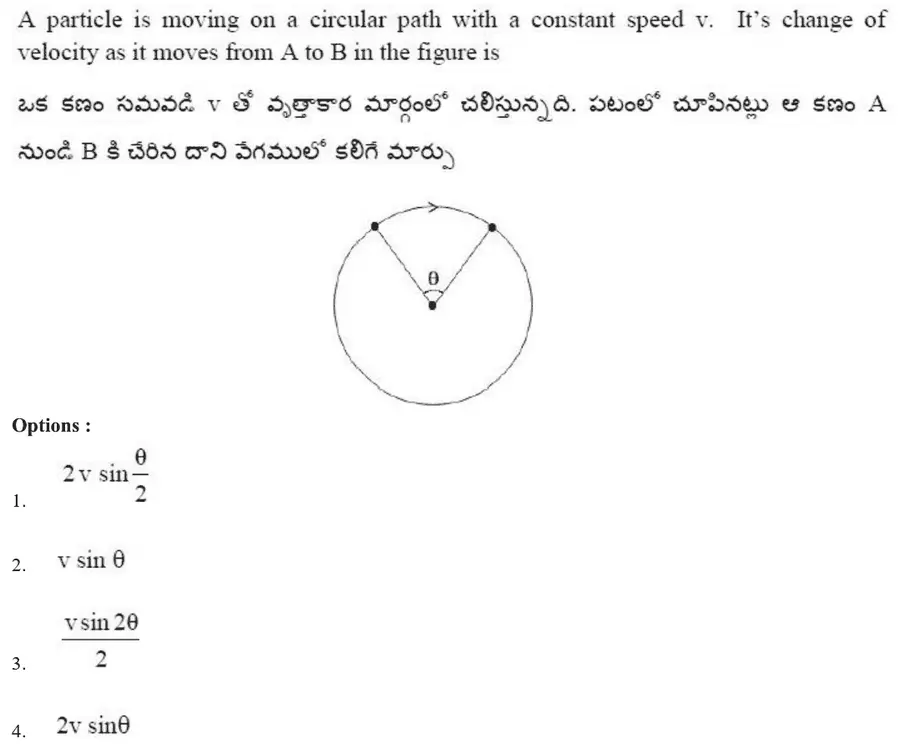
$2v\sin\frac{\theta}{2}$
$v\sin\theta$
$\frac{v\sin 2\theta}{2}$
$2v\sin\theta$
A particle moves along a straight line along the $x$ - axis. Its position ($x$) versus time ($t$) graph is shown in the figure [$x$ in meters and $t$ in seconds]. It's average speed during this motion is
(see the figure above)
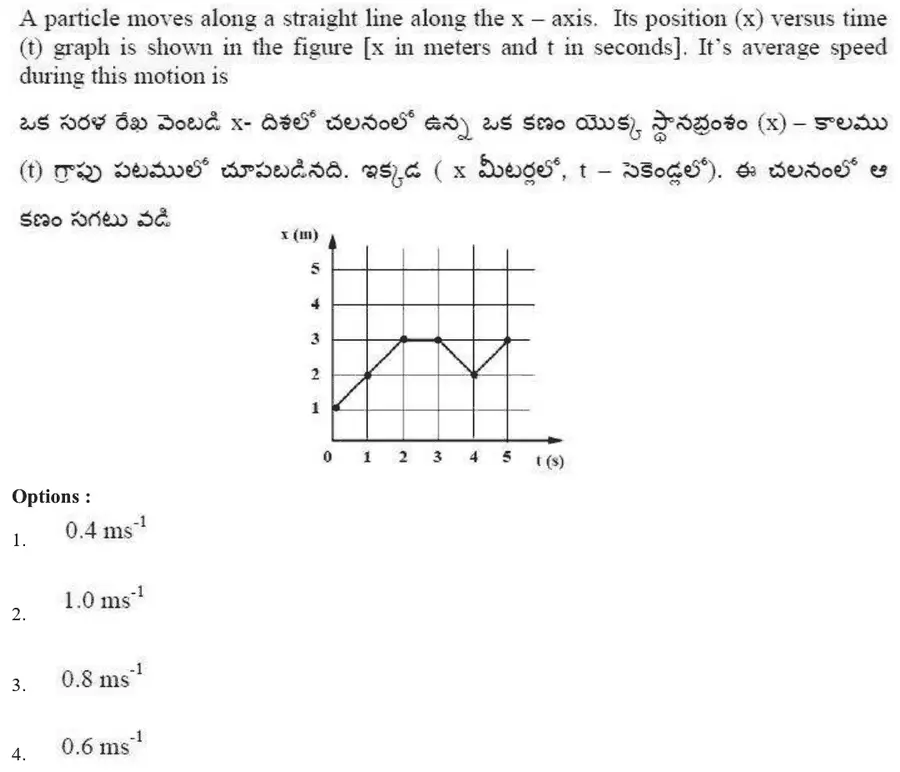
$0.4\ \mathrm{ms^{-1}}$
$1.0\ \mathrm{ms^{-1}}$
$0.8\ \mathrm{ms^{-1}}$
$0.6\ \mathrm{ms^{-1}}$
In a sports competition, a javelin is thrown at an angle $45^\circ$, which recorded a range of 90 m. The maximum height reached by the javelin is
(Neglect air resistance and acceleration due to gravity = $10\ \mathrm{ms^{-2}}$ )
45 m
30 m
22.5 m
$30\sqrt{2}$ m
The equation for the trajectory of a projectile is $y = \left(\frac{x}{\sqrt{3}} - \frac{x^2}{60}\right)$ m. The velocity of projection of the projectile is
(Acceleration due to gravity = $10\ \mathrm{ms^{-2}}$ )
$8\ \mathrm{ms^{-1}}$
$40\ \mathrm{ms^{-1}}$
$16\ \mathrm{ms^{-1}}$
$20\ \mathrm{ms^{-1}}$
A body of mass 0.6 kg is moving along a circular path of radius 1 m. If the body moves with $\frac{900}{\pi}$ revolutions per minute, its kinetic energy is
120 J
270 J
360 J
240 J
Two position vectors are given by $\vec{r_1} = (1, 1, 1)$ and $\vec{r_2} = (1, -1, 1)$. The unit vector in the direction of $\vec{r_1} \times \vec{r_2}$
$\frac{\hat{i}}{\sqrt{2}} - \frac{\hat{k}}{\sqrt{2}}$
$-\frac{\hat{i}}{\sqrt{2}} - \frac{\hat{k}}{\sqrt{2}}$
$\frac{\hat{i}}{\sqrt{2}} + \frac{\hat{k}}{\sqrt{2}}$
$-\frac{\hat{i}}{\sqrt{2}} + \frac{\hat{k}}{\sqrt{2}}$
A ball is thrown upward from the ground with an initial speed of V. At the same instant, another ball is dropped from a building of height 20 m. If the balls are at the same height after 0.8 s, then the magnitude of V is
(Take acceleration due to gravity = $10\ \mathrm{ms^{-2}}$)
$15\ \mathrm{ms^{-1}}$
$25\ \mathrm{ms^{-1}}$
$12.5\ \mathrm{ms^{-1}}$
$18.5\ \mathrm{ms^{-1}}$
In a hypothetical ring shaped satellite rotating in space, artificial gravity can be achieved using centripetal force. If the satellite has a radius 10 m, then to achieve centripetal acceleration at a point on circumference as $10\ \mathrm{ms^{-2}}$, its angular speed is
$1\ \mathrm{rad\ s^{-1}}$
$10\ \mathrm{rad\ s^{-1}}$
$1\ \mathrm{revolution\ s^{-1}}$
$10\ \mathrm{revolution\ s^{-1}}$
A player kicks a foot ball at an angle $30^\circ$ with the horizontal with an initial speed $30\ \mathrm{ms^{-1}}$. A second player standing at a distance of $21\sqrt{3}$ m from the first and in the direction of kick, starts running to catch the ball, at the same instant as kicked by first player. The minimum speed of second player to catch the ball before it hits the ground is
(Take acceleration due to gravity = $10\ \mathrm{ms^{-2}}$)
$10\ \mathrm{ms^{-1}}$
$8\ \mathrm{ms^{-1}}$
$8\sqrt{3}\ \mathrm{ms^{-1}}$
$15\sqrt{3}\ \mathrm{ms^{-1}}$
A student is at a distance 16 m from a bus when the bus begins to move with a constant acceleration of $9\ \mathrm{m\,s^{-2}}$. The minimum velocity with which the student should run towards the bus so as the catch it is $\alpha\sqrt{2}\ \mathrm{m\,s^{-1}}$. The value of $\alpha$ is
10
12
15
20
The component of a vector $\vec{P} = 3\hat{i} + 4\hat{j}$ along the direction $(\hat{i} + 2\hat{j})$ is
$\frac{8}{\sqrt{5}}$
$\frac{11}{\sqrt{5}}$
$\frac{11}{2}$
$\sqrt{10}$
A projectile is launched from the ground, such that it hits a target on the ground which is 90 m away. The minimum velocity of projectile to hit the target is (acceleration due to gravity $= 10\ \mathrm{ms^{-2}}$)
$10\ \mathrm{m\,s^{-1}}$
$16\ \mathrm{m\,s^{-1}}$
$60\ \mathrm{m\,s^{-1}}$
$30\ \mathrm{m\,s^{-1}}$
If two vectors $\vec{A}$ and $\vec{B}$ are mutually perpendicular, then the component of $\vec{A} \cdot \vec{B}$ along the direction of $\vec{A} + \vec{B}$ is
$\sqrt{|\bar{A}|^2 + |\bar{B}|^2}$
$\sqrt{|\bar{A}|^2 - |\bar{B}|^2}$
$\frac{|\bar{A}|^2 - |\bar{B}|^2}{\sqrt{|\bar{A}|^2 + |\bar{B}|^2}}$
$\frac{|\bar{A}|^2 + |\bar{B}|^2}{\sqrt{|\bar{A}|^2 - |\bar{B}|^2}}$
The dot product of unit vectors $\hat{n}_1$ and $\hat{n}_2$ that are parallel to $5\hat{i} + 12\hat{j}$ and $3\hat{i} + 4\hat{j}$ respectively is
$\frac{63}{65}$
$63$
$\frac{63}{4225}$
$\frac{63}{845}$
A sphere rolls down from the top of an inclined plane which makes an angle $30^\circ$ with the edge of a horizontal roof of a house. If the highest and lowest points of the inclined plane are 8.75 m and 3.75 m respectively from the ground then the horizontal distance from the lower edge of the roof at which the sphere hits the ground is
(acceleration due to gravity = $10\ \mathrm{m\,s^{-2}}$)
$5\ \mathrm{m}$
$5\sqrt{3}\ \mathrm{m}$
$\frac{5\sqrt{3}}{2}\ \mathrm{m}$
$10\ \mathrm{m}$
A car covers a distance at speed of 60 $\mathrm{km\,h^{-1}}$. It returns and comes back to the original point moving at a speed of V. If the average speed for the round trip is 48 $\mathrm{km\,h^{-1}}$, then the magnitude of V is
40 $\mathrm{km\,h^{-1}}$
36 $\mathrm{km\,h^{-1}}$
44 $\mathrm{km\,h^{-1}}$
32 $\mathrm{km\,h^{-1}}$
A car travels with a speed of 40 $\mathrm{km\,h^{-1}}$. Rain drops are falling at a constant speed vertically. The traces of the rain on the side windows of the car make an angle of 30° with the vertical. The magnitude of the velocity of the rain with respect to the car is
$40\sqrt{3}\ \mathrm{km\,h^{-1}}$
$\dfrac{40}{\sqrt{3}}\ \mathrm{km\,h^{-1}}$
80 $\mathrm{km\,h^{-1}}$
$\dfrac{80}{\sqrt{3}}\ \mathrm{km\,h^{-1}}$
A projectile with speed 50 $\mathrm{ms^{-1}}$ is thrown at an angle of 60° with the horizontal. The maximum height that can be reached is
(acceleration due to gravity = 10 $\mathrm{ms^{-2}}$)
90.75 m
70.00 m
85.00 m
93.75 m
An object moving along x-axis with a uniform acceleration has velocity $\vec{V}=(12\,\mathrm{cm\,s^{-1}})\hat{i}$ at x = 3 cm. After 2 s if it is at x = $-5$ cm, then its acceleration is
$\vec{a}=(-16\,\mathrm{cm\,s^{-2}})\hat{i}$
$\vec{a}=(11\,\mathrm{cm\,s^{-2}})\hat{i}$
$\vec{a}=(-11\,\mathrm{cm\,s^{-2}})\hat{i}$
$\vec{a}=(8\,\mathrm{cm\,s^{-2}})\hat{i}$
A force $\overrightarrow{F_1}$ of magnitude 4 N acts on an object of mass 1 kg, at origin in a direction $30^\circ$ above the positive x - axis. A second force $\overrightarrow{F_2}$ of magnitude 4 N acts on the same object in the direction of the positive y - axis. The magnitude of the acceleration of the object is nearly
$6.9\ \mathrm{ms^{-2}}$
$7.6\ \mathrm{ms^{-2}}$
$4.3\ \mathrm{ms^{-2}}$
$8.0\ \mathrm{ms^{-2}}$
$y=(Pt^2-Qt^3)$ m is the vertical displacement of a ball which is moving in vertical plane. Then the maximum height that the ball can reach is
$\frac{27P^3}{4Q^2}$
$\frac{4Q^2}{27P^3}$
$\frac{4P^3}{27Q^2}$
$\frac{27Q^2}{4P^3}$
Which of the following is not true about vectors $\vec{A}$, $\vec{B}$ and $\vec{C}$?
$(\vec{A}.\vec{A})\ (\vec{B}.\vec{C})$ is a scalar value.
$(\vec{A}\times\vec{B}).\ (\vec{B}\times\vec{C})$ is a scalar value.
$(\vec{A}\times\vec{C})\times\ (\vec{B}\times\vec{C})$ is a scalar value.
$\vec{A}\times(\vec{B}\times\vec{C})$ is a vector value.
A particle is at $x = 0$ when $t = 0$. It moves among $x$-axis with a velocity given by $v = 5\sqrt{x}$. Find the acceleration of this particle ______
$8.5\ \mathrm{m.s^{-2}}$
$12.5\ \mathrm{m.s^{-2}}$
$10.5\ \mathrm{m.s^{-2}}$
$11.5\ \mathrm{m.s^{-2}}$
To reach point-B from point-A, a person travels 500 $m$ North, 400 $m$ East and 200 $m$ South. If the person takes 1200 seconds to reach point-B from point-A, then find the average velocity of the person ________
$\frac{5}{12}\ \mathrm{m.s^{-1}}$
$\frac{5}{20}\ \mathrm{m.s^{-1}}$
$\frac{10}{3}\ \mathrm{m.s^{-1}}$
$\frac{12}{5}\ \mathrm{m.s^{-1}}$
A bomb needs to be dropped by an aero plane while moving with a speed of $200\ \mathrm{m.s^{-1}}$ from a height of $800\ m$ in order to hit a target. The plane must drop the bomb when it is at a distance of ______ from the target? ($g = 10\ \mathrm{m.s^{-2}}$)
$1980\ m$
$1631\ m$
$1908\ m$
$1131\ m$
Two towns $A$ and $B$ are connected by a regular bus service with a bus leaving in either direction every $T$ minutes. A man cycling with a speed of $20\ \mathrm{kmph}$ from $A$ to $B$ notices that a bus travelling in the direction of his motion goes past him every 18 minutes and every 6 minutes he notices a bus travelling in the opposite direction go past him. Assuming that the busses travel with a constant speed, find $T$ and the constant speed of the busses.
$\frac{2}{27}\ \mathrm{hr}$ & $38\ \mathrm{kmph}$
$\frac{5}{8}\ \mathrm{hr}$ & $40\ \mathrm{kmph}$
$\frac{3}{20}\ \mathrm{hr}$ & $40\ \mathrm{kmph}$
$\frac{2}{3}\ \mathrm{hr}$ & $28\ \mathrm{kmph}$
A ball is thrown at $30^\circ$ with horizontal from the top of roof $20\ \mathrm{m}$ high with a speed of $13\ \mathrm{m.s^{-1}}$. At what distance from the throwing point will the ball, once again be at a height of $20\ \mathrm{m}$ from the ground? ($g = 10\ \mathrm{m.s^{-2}}$)
$10.2\ \mathrm{m}$
$14.6\ \mathrm{m}$
$18.6\ \mathrm{m}$
$9.8\ \mathrm{m}$
Acceleration of a body whose displacement follows the equation $3s = 9t + 5t^2$ is ______
$\frac{5}{3}$
$\frac{14}{3}$
$\frac{10}{3}$
$\frac{19}{3}$
When a body moves with a constant speed along a circle __________
No acceleration is produced on the body
No work is done on it
Its velocity remains constant
No force acts on the body
A train travels from city-A to city-B with a constant speed of $18\ \mathrm{m.s^{-1}}$ and returns back to city-A with a constant speed of $36\ \mathrm{m.s^{-1}}$. Find its average speed during the journey.
$\frac{72}{5}\ \mathrm{m.s^{-1}}$
$\frac{36}{3}\ \mathrm{m.s^{-1}}$
$\frac{72}{3}\ \mathrm{m.s^{-1}}$
$\frac{36}{5}\ \mathrm{m.s^{-1}}$
From the top of a tower $19.6\ \mathrm{m}$ high, a ball is thrown horizontally. If the line joining the point of projection to the point where it hits the ground makes an angle of $45°$ with the horizontal, then the initial velocity of the ball is ______
$9.8\ \mathrm{m.s^{-1}}$
$4.9\ \mathrm{m.s^{-1}}$
$14.7\ \mathrm{m.s^{-1}}$
$2.8\ \mathrm{m.s^{-1}}$
Find the angle between the vectors $\vec{A} = 2\hat{i} + 4\hat{j} + 4\hat{k}$ and $\vec{B} = 4\hat{i} + 2\hat{j} - 4\hat{k}$.
$0°$
$45°$
$60°$
$90°$
The slope of velocity – time graph for motion with uniform velocity is equal to:
Initial velocity
Final velocity
Zero
Constant velocity
If the equation of motion of a projectile is given by $y = 12x - \frac{3}{4}x^{2}$ and its horizontal component of velocity is $3\ m.s^{-1}$, then find its range. ($g = 10\ m.s^{-2}$)
$12.4\ m$
$21.6\ m$
$30.6\ m$
$36.0\ m$
The velocity of a particle is given by $v = 2t^2 - 8t + 15\ \mathrm{m.s^{-1}}$. Find its instantaneous acceleration at $t = 5\ s$.
$18\ \mathrm{m.s^{-2}}$
$20\ \mathrm{m.s^{-2}}$
$5\ \mathrm{m.s^{-2}}$
$12\ \mathrm{m.s^{-2}}$
When a particle moved from point $A(2,2,3)$ to point $B(6,6,9)$, its displacement vector is ______
$4\hat{i} + 4\hat{j} + 6\hat{k}$
$8\hat{i} + 8\hat{j} + 12\hat{k}$
$4\hat{i} + 8\hat{j} + 6\hat{k}$
$8\hat{i} + 4\hat{j} + 6\hat{k}$
A car is moving with a speed of $30\ \mathrm{m.s^{-1}}$ on a circular path of radius $500\ m$. If its speed is increasing at the rate of $2\ \mathrm{m.s^{-2}}$, then find its acceleration?
$2.0\ \mathrm{m.s^{-2}}$
$1.8\ \mathrm{m.s^{-2}}$
$9.8\ \mathrm{m.s^{-2}}$
$2.7\ \mathrm{m.s^{-2}}$
If a 100 $m$ long train needs 7.2 seconds to cross an object moving in a direction opposite to the train's direction with a speed of 5 $kmph$, then find the velocity of the train ______
40 $kmph$
25 $kmph$
45 $kmph$
20 $kmph$
For the resultant of two vectors $\vec{A}$ and $\vec{B}$ to maximum, the angle between them should be ____
$180^\circ$
$0^\circ$
$90^\circ$
$60^\circ$
The displacement of a particle starting from rest at $t = 0$ is given by $s = 9t^2 - 2t^3$. The time in seconds at which the particle will attain zero velocity is ______.
$8\ \mathrm{s}$
$6\ \mathrm{s}$
$4\ \mathrm{s}$
$3\ \mathrm{s}$
The range of a projectile is $100\ \mathrm{m}$. Its kinetic energy will be maximum after covering a distance of:
$25\ \mathrm{m}$
$50\ \mathrm{m}$
$75\ \mathrm{m}$
$100\ \mathrm{m}$
Two cars A and B are moving with a velocity of $30\ \mathrm{kmph}$ in the same direction. They are separated by $10\ \mathrm{km}$. The speed of another car C moving in the opposite direction, if it meets these two cars at an interval of eight minutes is ______.
$45\ \mathrm{kmph}$
$40\ \mathrm{kmph}$
$15\ \mathrm{kmph}$
$30\ \mathrm{kmph}$
A rifle bullet loses $\left(\frac{1}{25}\right)^{th}$ of its velocity in passing through a plank. The least number of such planks required just to stop the bullet is ______.
$5$
$10$
$11$
$13$
Kinematics stands as the single heaviest chapter in EAPCET Physics. Across the papers we hold from 2022 to 2026, it produced 229 questions in 77 papers, averaging 3.0 questions per paper. Remarkably, the chapter appeared in every paper in that five-year window (77 out of 77 papers). It holds the 1st rank among all 28 Physics chapters by question share, representing 7.4% of every Physics question asked over these sessions.
Across the wider 2010 to 2026 archive, our set contains 463 questions from all 149 papers, maintaining an average of 3.1 questions per paper and a 7.8% share of the subject. In the early testing era from 2010 to 2021, kinematics carried an even higher weight with 234 questions in 72 papers (appearing in 72 papers, 3.3 per paper, 8.1% share). During the recent three-year period from 2024 to 2026, it provided 131 questions in 46 papers (appearing in 46 papers, 2.8 per paper, 7.1% share). Comparing the early era to the last three years, the chapter's share has fallen, whereas comparing the full recent window to the last three years, it has stayed about the same. Every year since 2022 has delivered multiple kinematics questions in every shift.
The chapter features prominently in both states. From 2022 to 2026, AP EAPCET papers included 149 questions across 48 papers (appearing in 48 papers, 3.1 per paper, 7.8% share), while TS EAPCET papers included 80 questions across 29 papers (appearing in 29 papers, 2.8 per paper, 6.9% share). It is part of the Class 11 Intermediate syllabus and establishes the foundational framework for mechanics.
In the papers we hold from 2022 to 2026, questions split into five main topic branches:
All five areas were tested in 2026, showing that students must prepare each aspect of linear and planar motion thoroughly.
Straight-line motion problems regularly test non-uniform acceleration through calculus relationships where acceleration depends on velocity or position. Another regular set-up involves multi-stage journeys where an object accelerates uniformly from rest, cruises at constant velocity, and finally decelerates to a stop. Questions frequently ask for average speed over intervals involving varying speeds or segmented displacements.
Projectile motion problems emphasize oblique projection from ground level as well as horizontal projection from an elevated height. Typical calculations involve finding the trajectory equation, time of flight, horizontal range, and the velocity vector at a specific instant or altitude. A recurring scenario asks for the speed of a projectile when its velocity vector becomes perpendicular to the initial launch direction.
Vector problems test dot and cross products, angle determination between vectors, and component resolution along specified directions. You will frequently be asked to find a unit vector perpendicular to two given vectors or determine an unknown component given the magnitude of the resultant.
Relative motion questions center on river-boat crossing problems, rain-umbrella orientation, and two vehicles overtaking or approaching each other on parallel tracks.
These five questions from 2026 council papers illustrate key kinematics formats:
Start with basic vector algebra, ensuring you can quickly calculate scalar and vector products and find projections of one vector onto another. Because vectors underpin planar motion, speed here pays dividends across subsequent topics.
Next, focus on one-dimensional motion under constant acceleration, mastering the standard kinematic relations along with the nth-second displacement formula. Practise drawing and interpreting displacement-time and velocity-time graphs, as graphical questions appear regularly and can be answered rapidly by reading slopes and areas.
For projectile motion, break every vector into horizontal and vertical components immediately. Work through problems where projectiles land on inclined planes or are fired horizontally from cliffs. For relative velocity, adopt a standard vector subtraction approach for rain and river-boat situations rather than relying on intuitive shortcuts that often lead to sign errors.
Between 2022 and 2026 in the papers we hold, Kinematics contributed 229 questions across 77 papers, averaging 3.0 questions per paper and appearing in every paper. It ranks 1st among all 28 Physics chapters by question share.
Motion in a Straight Line with 82 questions and Projectile Motion with 76 questions together account for the vast majority of kinematics problems asked between 2022 and 2026.
Both state tests emphasize the chapter heavily. From 2022 to 2026 in our set, AP EAPCET included 149 questions in 48 papers (3.1 per paper, 7.8% share), while TS EAPCET included 80 questions in 29 papers (2.8 per paper, 6.9% share).
Every question on this page opens with its options and answer. Step-by-step solutions for each one are in the EdLoop EAPCET app.