Every Rotational Motion question from past AP EAPCET and TS EAPCET papers, with options and answers. Newest first.
284questions
143papers covered
4.4%of Physics questions, 2022–2026
2010–2026years
Guide at a glance
Rotational Motion holds a steady place across state entrance tests in Andhra Pradesh and Telangana. Across the papers we hold from 2022 to 2026, it contributed 135 questions in 77 papers, which comes out to roughly 1.8 questions per paper.
The moment of inertia of a rod about an axis passing through its centre and perpendicular to its length is $\frac{1}{12}\mathrm{ML^2}$, where M is the mass and L is the length of the rod. The rod is bent in the middle, so that the two halves make an angle of $60^0$. The moment of inertia of the bent rod about the same axis would be
Three bodies A, B, and C of masses 2 kg, 3 kg, and 5 kg respectively are projected simultaneously with the same speed from the roof of a tower. The body A is thrown vertically upwards, body B is thrown vertically downwards and body C is projected horizontally. The acceleration of the centre of mass of the system of three bodies is (Acceleration due to gravity $= 10\ \mathrm{m\ s^{-2}}$)
If the moment of inertia of solid sphere of mass 2 kg and radius 10 cm about its tangent is I, then the moment of inertia of a uniform disc of mass 3.5 kg and radius 20 cm about its diameter is
$I_1$ represents moment of inertia of a thin, uniform rod about an axis perpendicular to its length and passing through its centre of mass. The same rod is bent into the shape of a ring. If $I_2$ is moment of inertia of ring about an axis that is tangent to the ring and perpendicular to its plane, then $\frac{I_1}{I_2} =$
A particle is moving in a circular path with constant angular velocity. Its initial angular momentum is $L$. If the radius of the circle is tripled by keeping angular velocity same, the new angular momentum is
A particle executes uniform circular motion with an angular momentum $L$. Its kinetic energy is doubled and the angular frequency is halved, then its angular momentum becomes
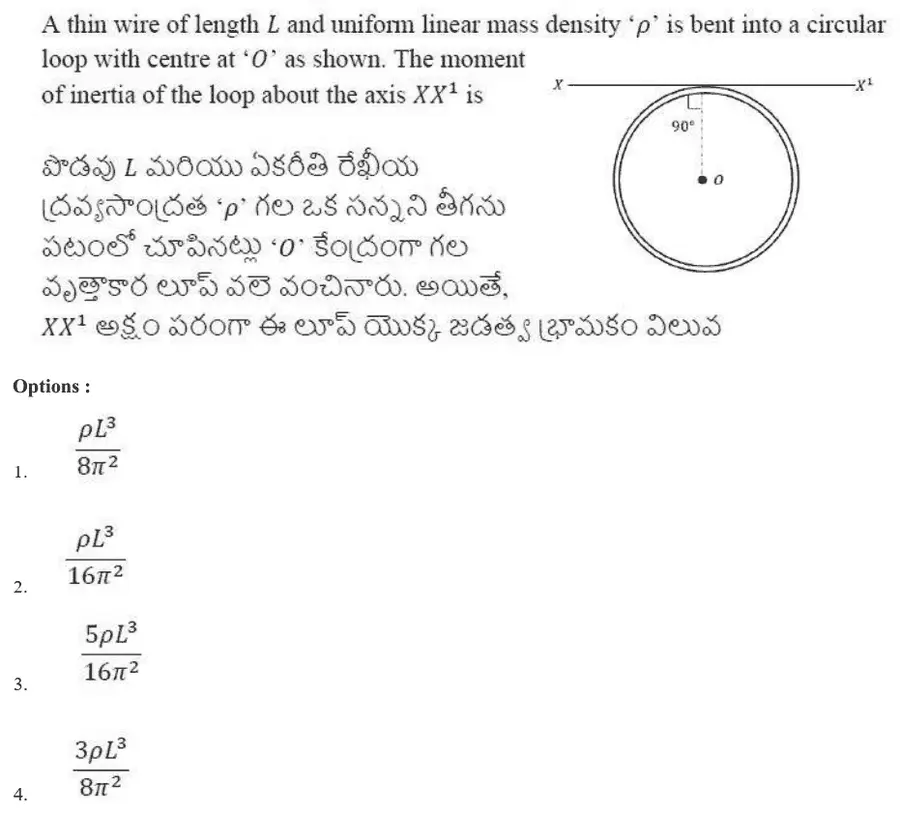
A thin wire of length $L$ and uniform linear mass density ‘$\rho$’ is bent into a circular loop with centre at ‘$O$’ as shown. The moment of inertia of the loop about the axis $XX^1$ is
If three particles of masses $2m$, $m$ and $4m$ are moving in three mutually perpendicular directions with velocities $3\ ms^{-1}$, $4\ ms^{-1}$ and $3\ ms^{-1}$ respectively, then the magnitude of the velocity of the center of mass of the system of three particles is
The acceleration of a uniform disc rolling down an inclined plane of length 1.75 m is 1/3 times the acceleration due to gravity. If a solid sphere is rolling down from the top of the same inclined plane, then the velocity with which it reaches the bottom of the plane is
Two particles A and B initially at rest move towards each other under a mutual force of attraction. At the instant, the speed of A is V and the speed of B is 2V, find the speed of centre of mass of the system, if the masses of A and B are in the ratio of 2 : 1
A body A is projected with a velocity of $40\ ms^{-1}$ at an angle of $60^0$ with the horizontal. At some other time, another body B is thrown vertically upwards with a velocity of $40\sqrt{3}\ \mathrm{ms^{-1}}$ such that it collides body A at a height of 60 m. If the velocity of centre of mass of the system of the two bodies after collision is $20\ ms^{-1}$, then the ratio of the masses of the bodies A and B is (Acceleration due to gravity = $10\ ms^{-2}$)
A ring of mass 1.5 kg and radius 35 cm is rolling without slipping on a horizontal floor. If the translational kinetic energy of the ring is 100 J, then its rotational kinetic energy is
A torque ‘$T$’ produces angular acceleration $\alpha$ in a circular disc. If radius of disc is doubled keeping the mass constant, angular acceleration becomes
A body P of mass 3 kg at rest is dropped from a height of 250 m from the ground. At the same moment another body Q of mass 2 kg is thrown vertically upwards from the ground with a velocity of $50\ \mathrm{ms^{-1}}$. Both the bodies travel along the same straight line in opposite directions. The velocity of body Q when the centre of mass of the system of the bodies P and Q reaches the maximum height is
(Acceleration due to gravity $=10\ \mathrm{ms^{-2}}$)
If the kinetic energy of a solid sphere when it rolls without slipping is 700 J, then its kinetic energy when it slips without rolling with same velocity is
Two solid spheres of radii 10 cm and 5 cm are in contact with each other. If the density of the material of the smaller sphere is twice the density of the material of the larger sphere, then the distance of the centre of mass of the system of the two spheres from the centre of the smaller sphere is
If a solid sphere of mass $2\ \mathrm{kg}$ is rolling without slipping on a surface with a velocity of $10\ \mathrm{ms^{-1}}$, then the total kinetic energy of the sphere is
Four particles P, Q, R and S of masses m, m, m and 2m respectively are kept at the four corners of a square of side $\sqrt{2}\,\mathrm{m}$. The distance of centre of mass of the system of particles from the particle S is
A wire of length L and mass 100 g is bent in the form of a circular ring. If the moment of inertia of the ring about its diameter is $98\times10^{-5}\ \mathrm{kg\,m^2}$, then the value of L is
Two bodies A and B of masses 2 kg and 3 kg respectively are moving along the same straight line such that the linear momentum of body A is greater than the linear momentum of body B. The velocity of centre of mass of the system of the two bodies when they are moving in the same direction is 9 times the velocity of centre of mass when they are moving in opposite directions. The ratio of the velocities of the bodies A and B is
The radius of gyration of a solid sphere of mass M and radius R about its diameter is K. The radius of gyration of a uniform circular disc of mass 2M and radius $\frac{R}{2}$ about its diameter is
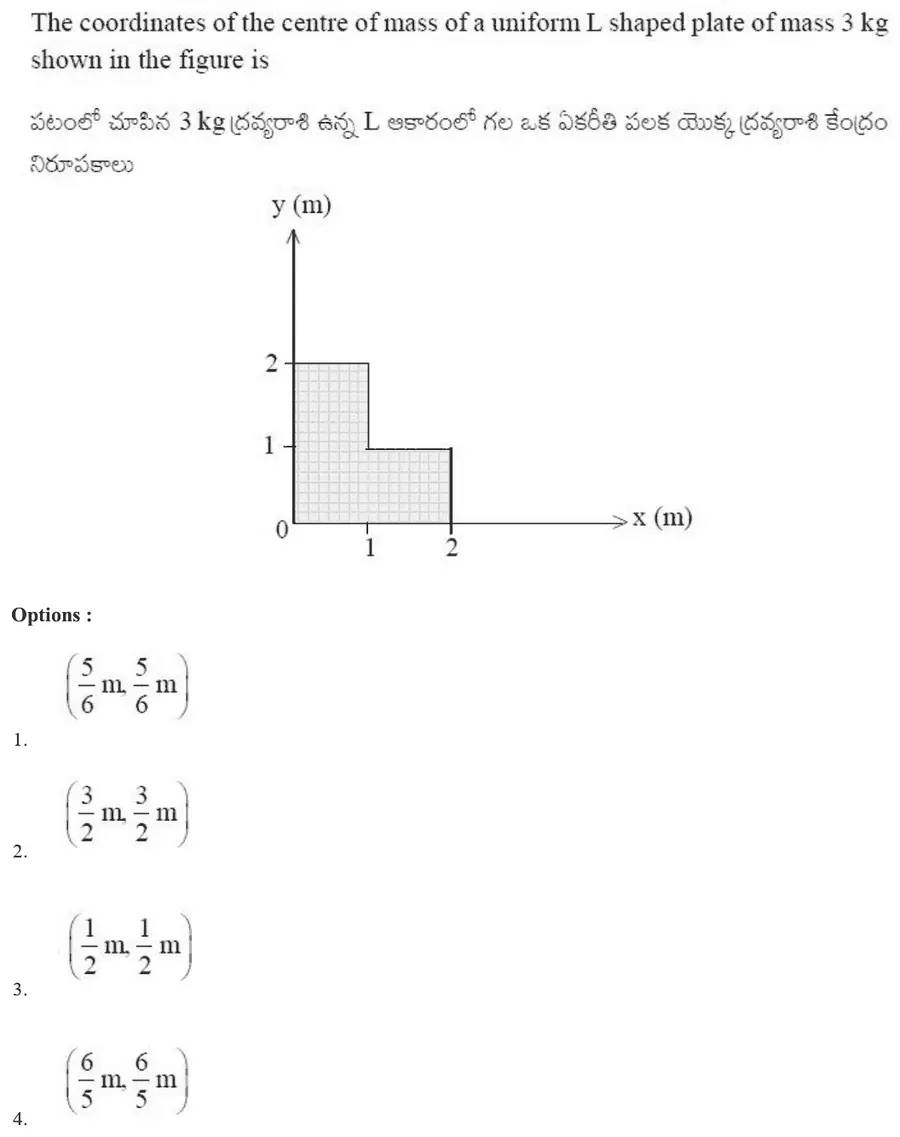
The shift (in metre) in center of mass when the largest possible equilateral triangular plate is removed from a uniform square plate of side 2 m with one of their sides coinciding is
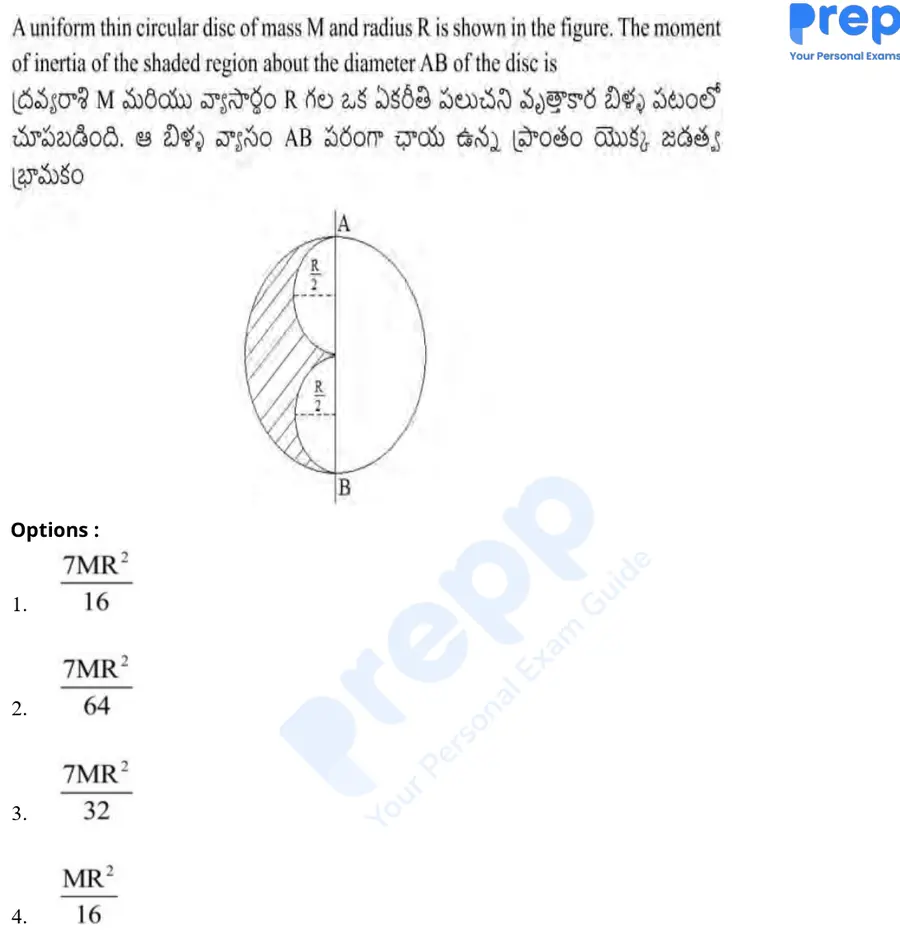
A uniform thin circular disc of mass M and radius R is shown in the figure. The moment of inertia of the shaded region about the diameter AB of the disc is
A solid sphere rolls down without slipping on an inclined plane of angle of inclination $30^\circ$. If the angle of inclination of the plane is increased to $45^\circ$, then the percentage increase in the acceleration of the sphere is nearly
Two bodies of masses M and 4M initially at rest, start moving towards each other due to their mutual attraction. The velocity of their centre of mass when the first body attains a velocity $v_0$ is
The angular velocity of a body changes from $6$ rad $\mathrm{s^{-1}}$ to $21$ rad $\mathrm{s^{-1}}$ in a time of $1.5$ s. If the moment of inertia of the body is $100$ g $\mathrm{m^2}$, then the rate of change of angular momentum of the body is
A body of mass 2 kg is moving towards north with a velocity of 20 m s$^{-1}$ and another body of mass 3 kg is moving towards east with a velocity of 10 m s$^{-1}$. The magnitude of the velocity of the centre of mass of the system of the two bodies is
A circular disc of diameter $0.8$ m and mass $4$ kg is rolling on a smooth horizontal plane. If $2.56$ N m torque is acting on the disc, then its angular acceleration is
A solid sphere and a solid cylinder have same mass and same radius. The ratio of the moment of inertia of the solid sphere about its diameter and the moment of inertia of the solid cylinder about its axis is
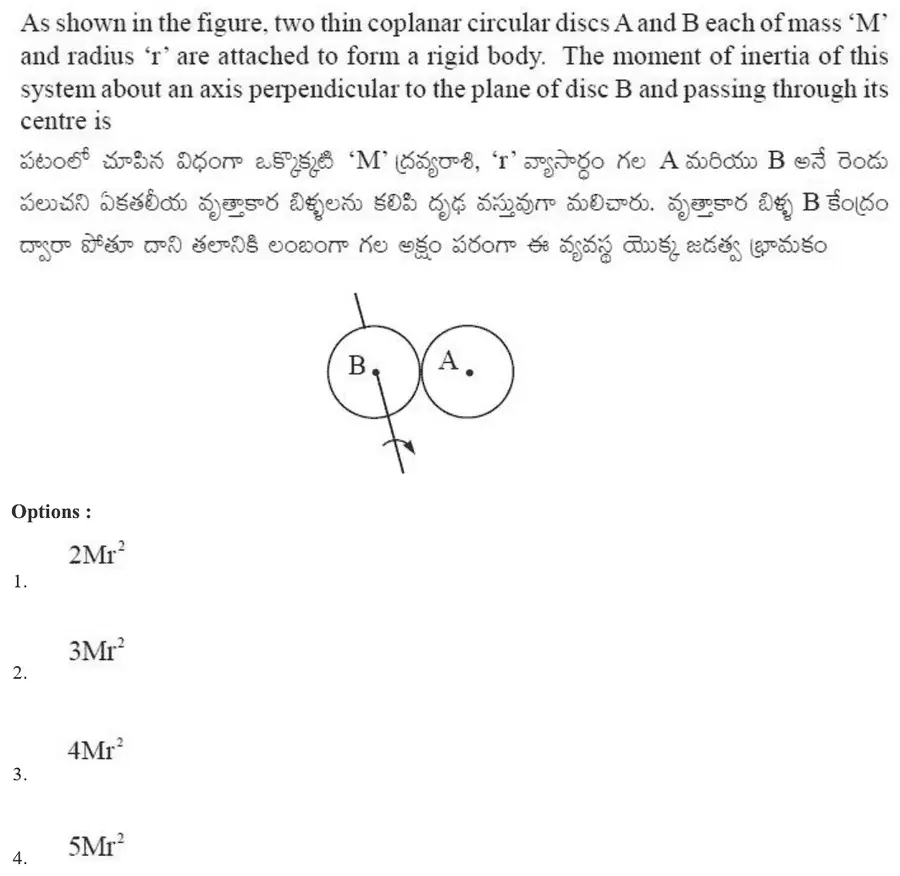
As shown in the figure, two thin coplanar circular discs A and B each of mass 'M' and radius 'r' are attached to form a rigid body. The moment of inertia of this system about an axis perpendicular to the plane of disc B and passing through its centre is
A thin circular ring and a circular disc of equal mass are rolling without sliding. If their linear velocities are equal and the total kinetic energy of the disc is 6 J, then the total kinetic energy of the ring is
A circular disc of mass 20 kg and radius 1 m is rotating about an axis passing through its center and perpendicular to its plane with an angular velocity of $2\ \mathrm{rad\ s^{-1}}$. Then the rotational kinetic energy of the disc is
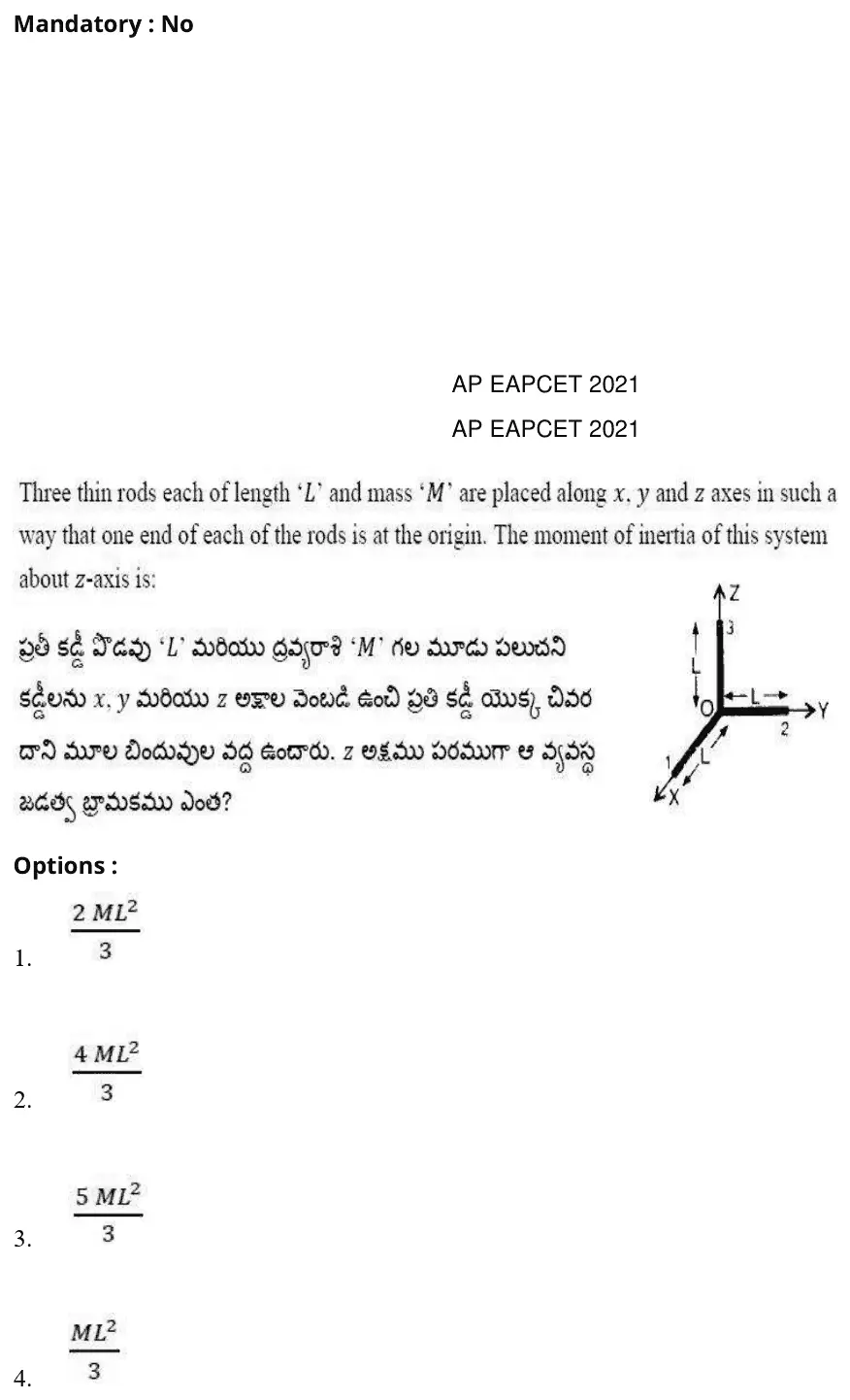
Three thin uniform rods each of mass M and length L are placed along the three axes of a cartesian coordinate system with one end of all the rods at origin. The moment of inertia of the system of the rods about z-axis is
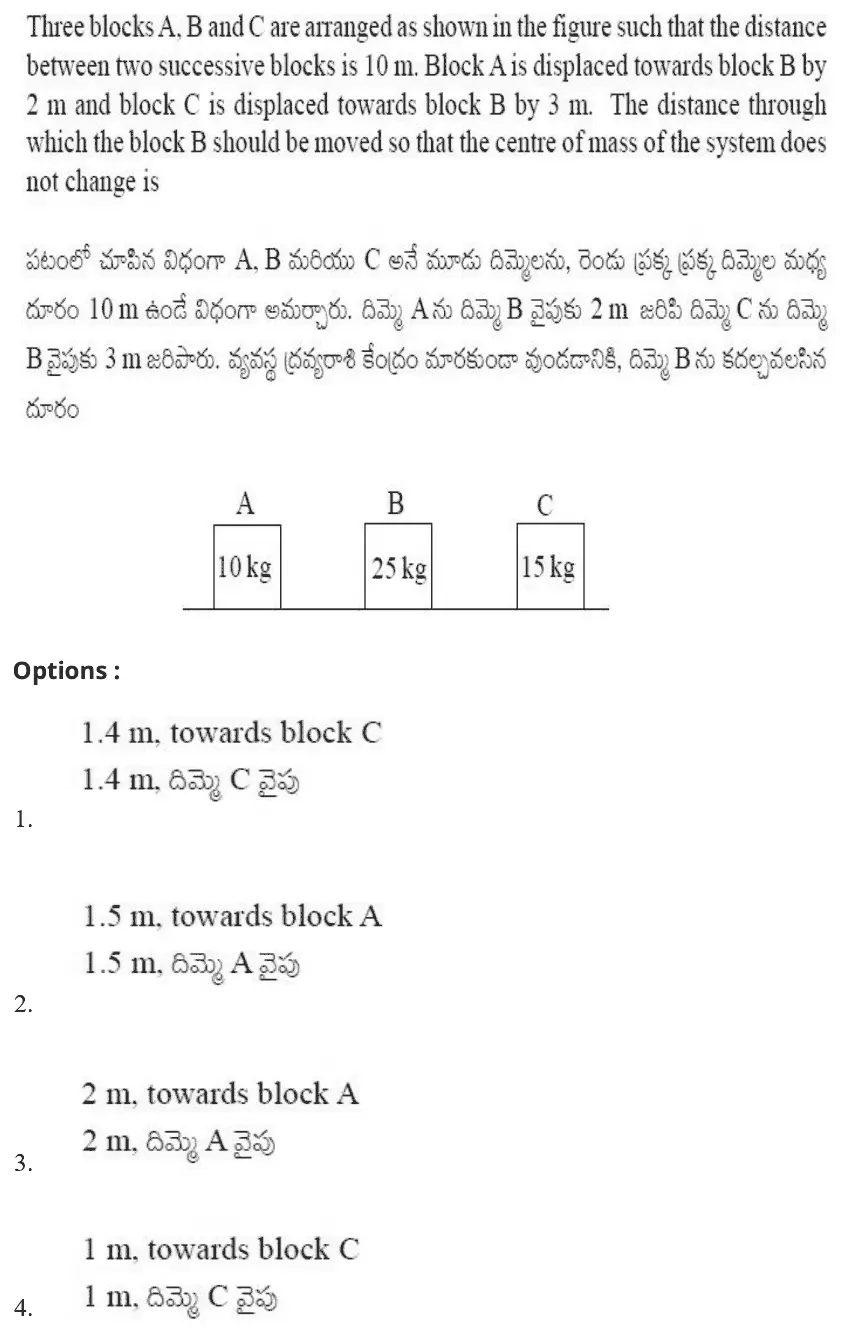
Three blocks A, B and C are arranged as shown in the figure such that the distance between two successive blocks is 10 m. Block A is displaced towards block B by 2 m and block C is displaced towards block B by 3 m. The distance through which the block B should be moved so that the centre of mass of the system does not change is
A solid sphere of mass $4\ \mathrm{kg}$ and radius $28\ \mathrm{cm}$ is on an inclined plane. If the acceleration of the sphere when it rolls down without sliding is $3.5\ \mathrm{m\,s^{-2}}$, then the acceleration of the sphere when it slides down without rolling is
If the radius of gyration of a thin circular ring about an axis passing through its centre and perpendicular to its plane is $10\sqrt{2}$ cm, then its radius of gyration about its diameter is
If a wheel starting from rest is rotating with an angular acceleration of $\pi$ rad s$^{-2}$, then the number of rotations made by the wheel in the first 6 seconds time is
If two bodies of masses $2\ \mathrm{kg}$ and $3\ \mathrm{kg}$ are moving at right angles with velocities $20\ \mathrm{m\,s^{-1}}$ and $10\ \mathrm{m\,s^{-1}}$ respectively, then the velocity of the centre of mass of the system of the two bodies is
A thin uniform wire of mass ‘m’ and linear density ‘ρ’ is bent in the form of a circular ring. The moment of inertia of the ring about a tangent parallel to its diameter is
A solid sphere and a thin uniform circular disc of same radius are rolling down an inclined plane without slipping. If the acceleration of the sphere is $3\ \mathrm{ms^{-2}}$, then the acceleration of the disc is
A solid sphere of mass 2 kg and radius 0.5 m is rolling without slipping on a horizontal surface. The ratio of the rotational and translational kinetic energies of the sphere is
If the length of a thin uniform rod is ‘L’ and the radius of gyration of the rod about an axis perpendicular to its length and passing through one end is K, then K : L =
A thin uniform circular disc of mass $\frac{10}{\pi^2}$ kg and radius 2 m is rotating about an axis passing through its centre and perpendicular to its plane. The work done to increase the angular speed of the disc from 90 rev/min to 120 rev/min is
A solid cylinder of mass 2 kg, length 40 cm and radius 10 cm is placed in contact with a solid sphere of mass 0.5 kg and radius 10 cm such that the centres of the two bodies lie along the geometrical axis of the cylinder. The distance of the centre of mass of the system of two bodies from the centre of the sphere is
A balance is made using a uniform metre scale of mass 100 g and two plates each of mass 200 g fixed at the two ends of the scale and the balance is pivoted at 45 cm mark of the scale. The error when 300 g weight is placed in the plate at 0 cm to weigh vegetables placed in the plate at 100 cm is
The ratio of radii of gyration of a thin circular ring and a circular disc of same radius about a tangential axis in their own planes is $\sqrt{12} : \sqrt{K}$. The value of K is
If the moment of inertia of a uniform solid cylinder about the axis of the cylinder is $\frac{1}{n}$ times its moment of inertia about an axis passing through its midpoint and perpendicular to its length, then the ratio of the length and radius of the cylinder is
Two blocks of masses in the ratio $m:n$ are connected by a light inextensible string passing over a frictionless fixed pulley. If the system of the blocks is released from rest, then the acceleration of the centre of mass of the system of the blocks is (g - acceleration due to gravity)
If the moment of inertia of a thin circular ring about an axis passing through its edge and perpendicular to its plane is I, then the moment of inertia of the ring about its diameter is
The moment of inertia of a solid sphere about its diameter is $20\ \mathrm{kg\,m^2}$. The moment of inertia of a thin spherical shell having the same mass and radius about its diameter is
One ring, one solid sphere and one solid cylinder are rolling down on same inclined plane starting from rest. The radius of all the three are equal. The object reaches down with maximum velocity is
A uniform metal solid sphere is rotating with angular speed $\omega_0$ about diameter. If the temperature is raised by 50 °C, the angular speed will be
The moment of inertia of a rod about an axis passing through its centre and perpendicular to its length is $\frac{1}{12} ML^2$, where $M$ is the mass and $L$ is the length of the rod. The rod is bent in the middle so that the two halves make an angle of $60^\circ$. The moment of inertia of the bent rod about the same axis would be
A uniform rod of length ‘2L’ is placed with one end in contact with the earth and is then inclined at an angle $\alpha$ to the horizontal and allowed to fall without slipping at contact point. When it becomes horizontal, its angular velocity will be
A ring and a disc of same mass and same diameter are rolling without slipping. Their linear velocities are same, then the ratio of their kinetic energy is
The masses of a solid cylinder and a hollow cylinder are 3.2 kg and 1.6 kg respectively. Both the solid cylinder and hollow cylinder start from rest from the top of an inclined plane and roll down without slipping. If both the cylinders have equal radius and the acceleration of the solid cylinder is $4\ \mathrm{ms^{-2}}$, the acceleration of the hollow cylinder is
A solid sphere of mass $50$ kg and radius $20$ cm is rotating about its diameter with an angular velocity of $420$ rpm. The angular momentum of the sphere is
Three particles of each mass ‘m’ are kept at the three vertices of an equilateral triangle of side ‘l’. The moment of inertia of system of the particles about any side of the triangle is
A wooden plank of mass $90$ kg and length $3.3$ m is floating on still water. A girl of mass $20$ Kg walks from one end to the other end of the plank. The distance through which the plank moves is
A solid cylinder rolls down an inclined plane without slipping. If the translational kinetic energy of the cylinder is 140 J, the total kinetic energy of the cylinder is
Two blocks of masses $m$ and $2m$ are connected by a massless string which passes over a fixed frictionless pulley. If the system of blocks is released from rest, the speed of the centre of mass of the system of two blocks after a time of 5.4 s is
(Acceleration due to gravity = $10\ \mathrm{ms^{-2}}$)
The moments of inertia of a solid cylinder and a hollow cylinder of same mass and same radius about the axes of the cylinders are $\mathrm{I_1}$ and $\mathrm{I_2}$. The relation between $\mathrm{I_1}$ and $\mathrm{I_2}$ is
A wheel of angular speed 600 rev/min is made to slow down at a rate of 2 rad $\mathrm{s^{-2}}$. The number of revolutions made by the wheel before coming to rest is
A metre scale is balanced on a knife edge at its centre. When two coins, each of mass 9 g are kept one above the other at the 10 cm mark, the scale is found to be balanced at 35 cm. The mass of the metre scale is
A body of mass ‘m’ and radius ‘r’ rolling horizontally with a velocity ‘V’, rolls up an inclined plane to a vertical height $\frac{V^2}{g}$. The body is
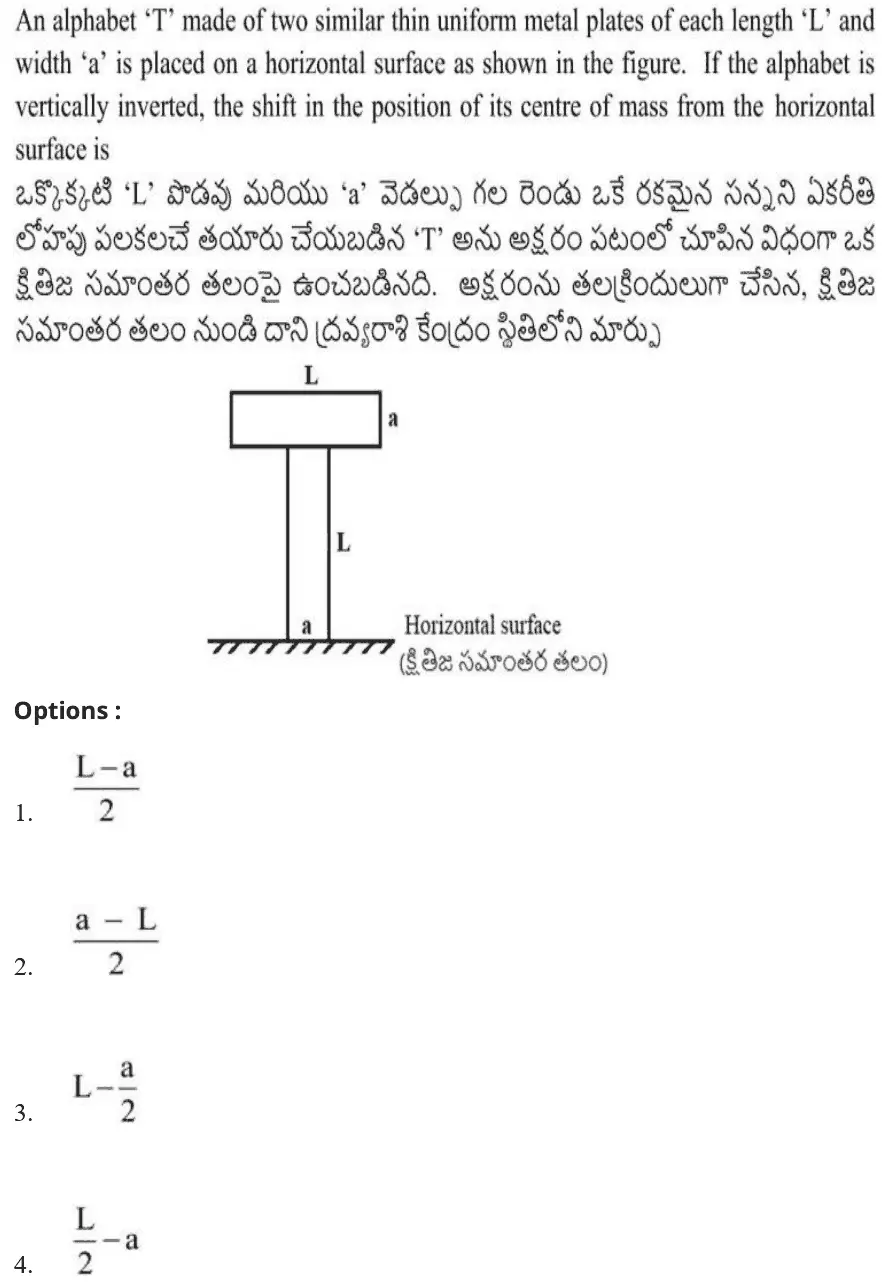
An alphabet ‘T’ made of two similar thin uniform metal plates of each length ‘L’ and width ‘a’ is placed on a horizontal surface as shown in the figure. If the alphabet is vertically inverted, the shift in the position of its centre of mass from the horizontal surface is
A solid sphere and a disc of same mass ‘M’ and radius ‘R’ are kept such that their curved surfaces are in contact and their centers lie along the same horizontal line. The moment of inertia of the two body system about an axis passing through their point of contact and perpendicular to the plane of the disc is
A circular plate of radius r is removed from a uniform circular plate P of radius 4r to form a hole. If the distance between the centre of the hole formed and the centre of the plate P is 2r, then the distance of the centre of mass of the remaining portion from the centre of the plate P is
A hollow cylinder and a solid cylinder initially at rest at the top of an inclined plane are rolling down without slipping. If the time taken by the hollow cylinder to reach the bottom of the inclined plane is 2 s, the time taken by the solid cylinder to reach the bottom of the inclined plane is
A solid sphere rolls down without slipping from the top of an inclined plane of height 28 m and angle of inclination $30^\circ$. The velocity of the sphere, when it reaches the bottom of the plane is
(Acceleration due to gravity $=10\ \mathrm{ms^{-2}}$)
Four identical particles each of mass ‘m’ are kept at the four corners of a square of side ‘a’. If one of the particles is removed, the shift in the position of the centre of mass is
A thin uniform wire of mass ‘m’ and linear mass density ‘ρ’ is bent in the form of a circular loop. The moment of inertia of the loop about its diameter is
Three particles A, B and C of masses m, 2m and 3m are moving towards north, south and east respectively. If the velocities of the particles A, B and C are $6\ \mathrm{ms^{-1}}$, $12\ \mathrm{ms^{-1}}$ and $8\ \mathrm{ms^{-1}}$ respectively, then the velocity of the centre of mass of the system of particles is
A solid sphere of mass $2$ kg is rolling without slipping on a horizontal surface with a velocity $5\ \mathrm{ms^{-1}}$. The rotational kinetic energy of the sphere is
A solid sphere and a solid cylinder roll down without slipping along an inclined plane. If they start from rest from the top of the inclined plane, the ratio of the velocities of the solid sphere and solid cylinder when they reach the bottom of the inclined plane is
Answer: (D) For two particles of different masses, the centre of mass of the particles is nearer to the particle of lesser mass.· The council's preliminary key
A particle of mass $10\ \mathrm{g}$ is moving towards east with a velocity of $10\ \mathrm{ms^{-1}}$ and another particle of mass $15\ \mathrm{g}$ is moving towards north with a velocity of $5\ \mathrm{ms^{-1}}$. The magnitude of the velocity of the centre of mass of the system of the two particles is
Two bodies of masses 12 kg and 6 kg are projected simultaneously with velocities $15\ \mathrm{ms^{-1}}$ and $20\ \mathrm{ms^{-1}}$ respectively from the top of a tower of height 25 m. The body of mass 12 kg is projected vertically upwards and the body of mass 6 kg is projected horizontally. The maximum height reached by the centre of mass of the system of two bodies from the ground
A body rotating with uniform acceleration about its geometrical axis makes 8 rotations in the first 2 seconds. The number of rotations the body makes in the next 3 seconds is
A solid sphere is pushed on a horizontal surface such that it slides with a speed $3.5\ \mathrm{ms^{-1}}$ initially without rolling. The sphere will start rolling without slipping when its velocity becomes
A spherical portion A of radius R is removed from a solid sphere B of radius 2R such that the centre of the removed portion is same as the centre of the sphere B. The ratio of the moments of inertia of the remaining spherical shell and the solid sphere B about the axes passing through their diameters is
A circular disc of moment of inertia $3.5\ \mathrm{kg\,m^2}$ is rotating with angular speed $30\ \mathrm{rad\,s^{-1}}$ about an axis passing through its centre and perpendicular to its plane. The torque required to stop the disc in 5 seconds is
A circular plate A of radius $1.5r$ is removed from one edge of a uniform circular plate B of radius $2r$. The distance of centre of mass of the remaining portion from the centre of the plate B is
The angular momentum of a solid cylinder rotating about its geometric axis with angular speed $40\ \mathrm{rad\ s^{-1}}$ is $2\ \mathrm{kg\ m^2\ s^{-1}}$. If the radius of the cylinder is 10 cm, the mass of the cylinder is
Three particles of each mass 'm' are kept at the three vertices of an equilateral triangle. If $I_1$ is the moment of inertia of the system of the particles about an axis along one side of the triangle and $I_2$ is the moment of inertia of the system of the particles about an axis along the perpendicular bisector of a side, then $I_1 : I_2$ is
Two particles of masses $1\ \mathrm{g}$ and $2\ \mathrm{g}$ move towards each other with velocities $10\ \mathrm{ms^{-1}}$ and $20\ \mathrm{ms^{-1}}$ respectively. The velocity of the centre of mass of the system of the two particles is
A force of $(2\hat{i}+3\hat{j}+4\hat{k})\,\mathrm{N}$ acts on a particle whose position vector with respect to the origin of the coordinate system is $(6\hat{i}+b\hat{j}+12\hat{k})\,\mathrm{m}$. If the angular momentum of the body is constant, the value of 'b' is
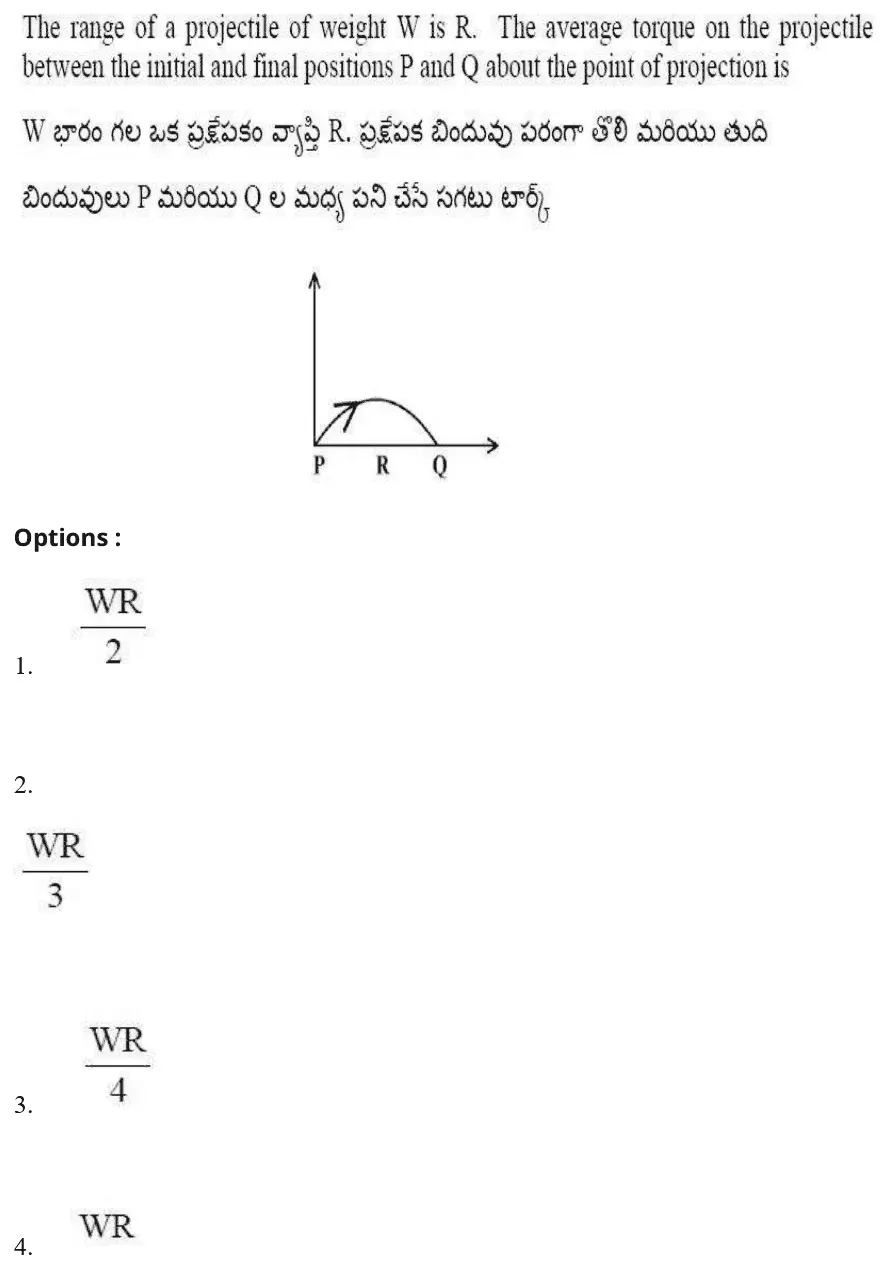
The range of a projectile of weight W is R. The average torque on the projectile between the initial and final positions P and Q about the point of projection is
The angular speed of a rigid body rotating about a fixed axis is $(8-2t)$ rad s$^{-1}$. The angle through which the body rotates before it comes to rest is
A particle performs uniform circular motion with an angular momentum L. If the frequency of the particle's motion is doubled and its kinetic energy is halved, then its angular momentum becomes
A body is rolling without slipping on a horizontal plane. If the rotational kinetic energy of the body is 50 % of its total kinetic energy, then the body is
Two blocks of masses 2 kg and 1 kg are tied to the ends of a string which passes over a light frictionless pulley. The blocks are held at rest at the same horizontal level and then released suddenly. The distance traversed by their centre of mass in 2 seconds is
(acceleration due to gravity = $10\ \mathrm{ms^{-2}}$)
A system consists of two particles of masses $m_1$ and $m_2$. If the particle of mass $m_1$ is moved towards the centre of mass through a distance d, then the distance the second particle should be moved, so as to keep the centre of mass at the same position is
Moon revolves around the earth in an orbit of radius R with time period of revolution T. It also rotates about its own axis with a time period T. If mass of the moon is M and its radius is ‘r’, the total kinetic energy of the moon is
A solid spherical ball is rolled up an inclined plane of angle of inclination 30$^\circ$ with an initial speed of 4 m/s at the bottom of the inclination. How far will the ball go up the plane. (Use g = 10 m/s$^2$)
A wheel of radius with 0.5 m and a moment of inertia of 10 kg.m$^2$ is rotating freely at an angular speed of 70 rev/min. The wheel can be stopped in 5.0 s by pressing a wet cloth against the rim and exerting a radially inward force of 88 N. The coefficient of kinetic friction between the wheel and wet cloth is
A metre stick is balanced on a knife edge at its centre. When four coins, each of mass 2g are put one on top of the other at 10.0 cm mark, the stick it found to be balanced at 46.0 cm mark. The mass of the metre stick is
A solid cylinder of mass m and radius R rolls down an inclined plane of height 30 m without slipping. The speed of its centre of mass when the cylinder reaches the bottom is [ use g = 10 m/s$^{2}$]
The moment of inertia of a thin uniform rectangular plate of mass 'm', having length 'a' and width 'b' about an axis perpendicular to the plane of the plate and passing through one of its vertices is
A circular portion of radius $R_2$ has been removed from one edge of a circular disc of radius $R_1$. The correct expression for the centre of mass for the remaining portion of the disc is
If the earth suddenly shrinks to $\dfrac{1}{64}$ of its original volume, while keeping the same mass, then the duration of the day will be [Assume earth is a perfect sphere]
A wheel is rotating freely at some angular speed. A second wheel initially at rest and with thrice the rotational inertia of the first, is suddenly coupled to the first wheel. The fraction of the original rotational kinetic energy lost is
A uniform rod of length 60 cm is placed with one end in contact with the horizontal table and is then inclined at an angle $30^\circ$ to the horizontal and allowed to fall. The angular velocity of the rod when it becomes horizontal is (acceleration due to gravity = $10\ \mathrm{m\,s^{-2}}$)
A wheel undergoes a constant acceleration starting form (sic) rest at t = 0. The angular velocity of the wheel is $3.14\ \frac{\mathrm{rad}}{\mathrm{sec}}$ when t = 2 s. The accelerator is abruptly ceased at t = 20 s. The number of revolutions, wheel makes in the interval t = 0 to t = 40 s is
A fan is rotating with an angular speed 300 rpm. The fan is switched off, and it takes 80 s to come to rest. Assuming constant angular deceleration, the number of revolutions made by the fan before it comes to rest is
Masses $m$, $\left(\dfrac{1}{2}\right)\dfrac{1}{2}m$, $\left(\dfrac{1}{2}\right)^2\dfrac{1}{3}m$, ....., $\left(\dfrac{1}{2}\right)^{N-1}\dfrac{1}{N}m$, .... $\infty$ are placed at x = 1, 2, 3,...N, ... $\infty$ respectively. If the total mass is M then the centre of mass of the system is
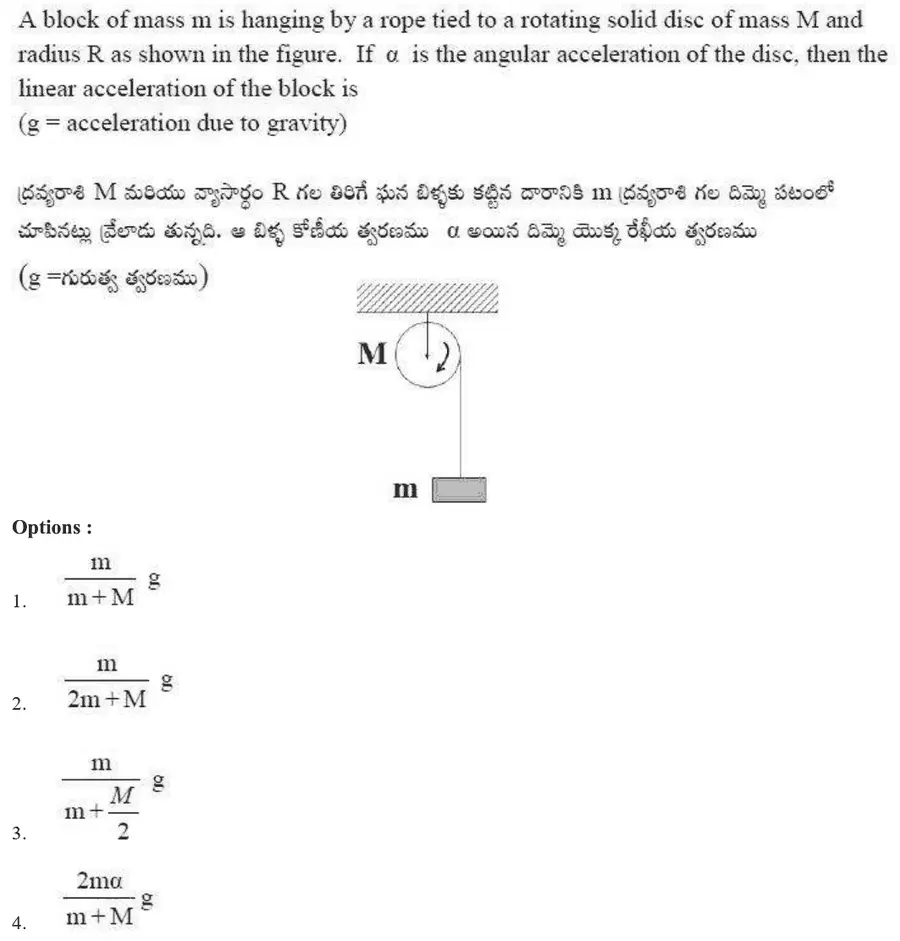
A block of mass m is hanging by a rope tied to a rotating solid disc of mass M and radius R as shown in the figure. If $\alpha$ is the angular acceleration of the disc, then the linear acceleration of the block is (g = acceleration due to gravity) (see the figure above)
The angular momentum of a wheel having a rotational inertia of $0.2\ \mathrm{kg\,m^2}$ about its symmetric axis decreases from 4 to $2\ \mathrm{kg\,m^2\,s^{-1}}$ in 4 s. The average power of the wheel is
Masses $m\left(\dfrac{1}{3}\right)^{N}\dfrac{1}{N}$ are placed at x=N, when N = 2,3,4, $\ldots\infty$. If the total mass of the system is M, then the centre of mass is
Consider a disc of radius R and mass M. A hole of radius $\dfrac{R}{3}$ is created in the disk such that the center of the hole is $\dfrac{R}{3}$ away from centre of the disk. The moment of inertia of the system along the axis perpendicular to the disc passing through the centre of the disc is
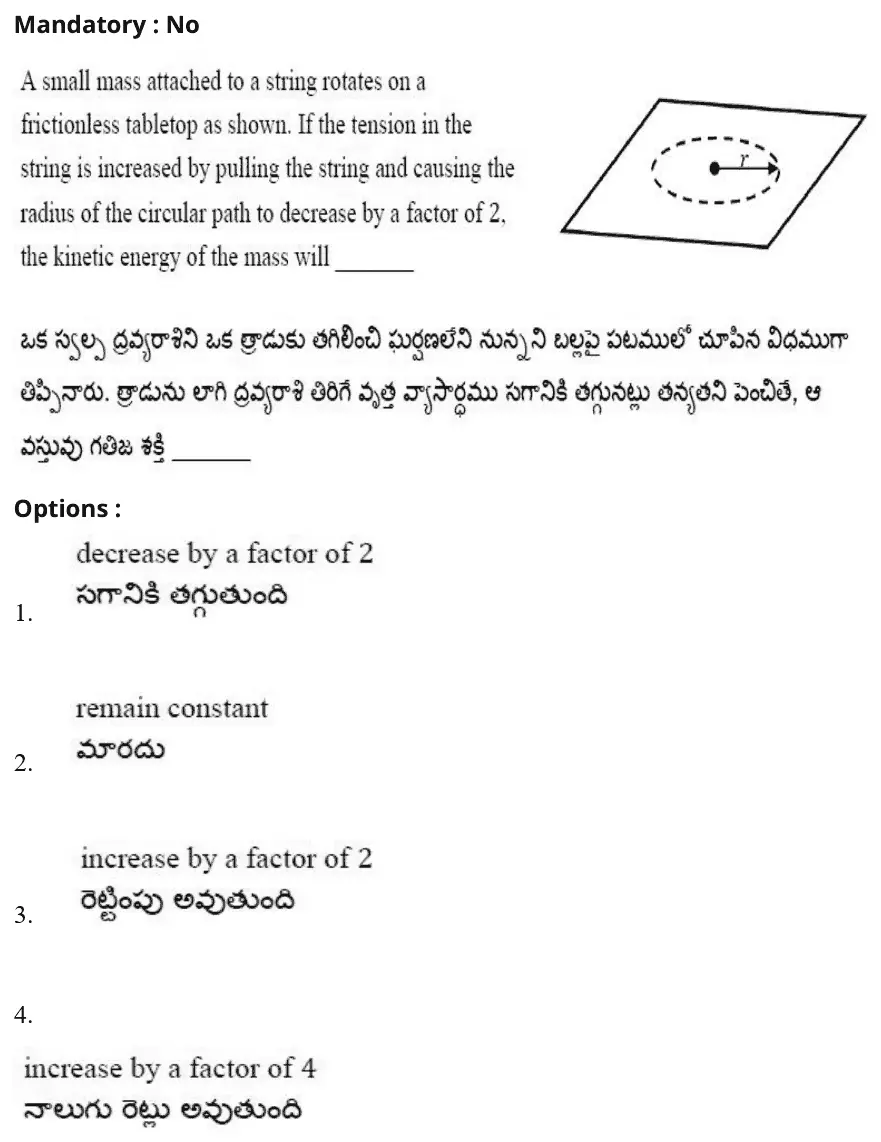
A small mass attached to a string rotates on a frictionless tabletop as shown. If the tension in the string is increased by pulling the string and causing the radius of the circular path to decrease by a factor of 2, the kinetic energy of the mass will ______ (see the figure above)
A uniform disc of radius 'a' and mass 'm' is rotating freely with an angular speed of '$\omega$' in a horizontal plane about a smooth fixed vertical axis passing through its center. A particle, also of mass 'm' is suddenly attached to the rim of the disc and starts to rotate with it. The new angular speed of this system is ______
The moment of inertia of a thin rod of mass 'M' and length 'L' about an axis passing through a point at a distance $\frac{L}{4}$ from its center and perpendicular to its length is ______
Moment of inertia of a disc of radius 'R' about a diametric axis is $25\,\mathrm{kg.m^2}$. The moment of inertia of the disc about a parallel axis at a distance 'R/2' from the centre is ______
Three thin rods each of length 'L' and mass 'M' are placed along $x$, $y$ and $z$ axes in such a way that one end of each of the rods is at the origin. The moment of inertia of this system about $z$-axis is: (see the figure above)
A thin rod of mass 'm' and length '2l' is made to rotate about an axis passing through its centre and perpendicular to it. Its angular velocity changes from 0 to $\omega$ in time 't'. What is the torque acting on the rod?
A flywheel having moment of inertia $10\ \mathrm{kg.m^2}$ is rotating at $50\ \mathrm{rad.s^{-1}}$. What amount of work needs to be done in order to bring this flywheel to rest in 10 seconds?
The distance between the carbon atom and the oxygen atom in a carbon monoxide molecule is $1.1\ \mathrm{\AA}$. Given, mass of carbon atom is $12\ a.m.u$ and mass of oxygen atom is $16\ a.m.u$. Calculate the position of the centre of mass of the carbon monoxide molecule.
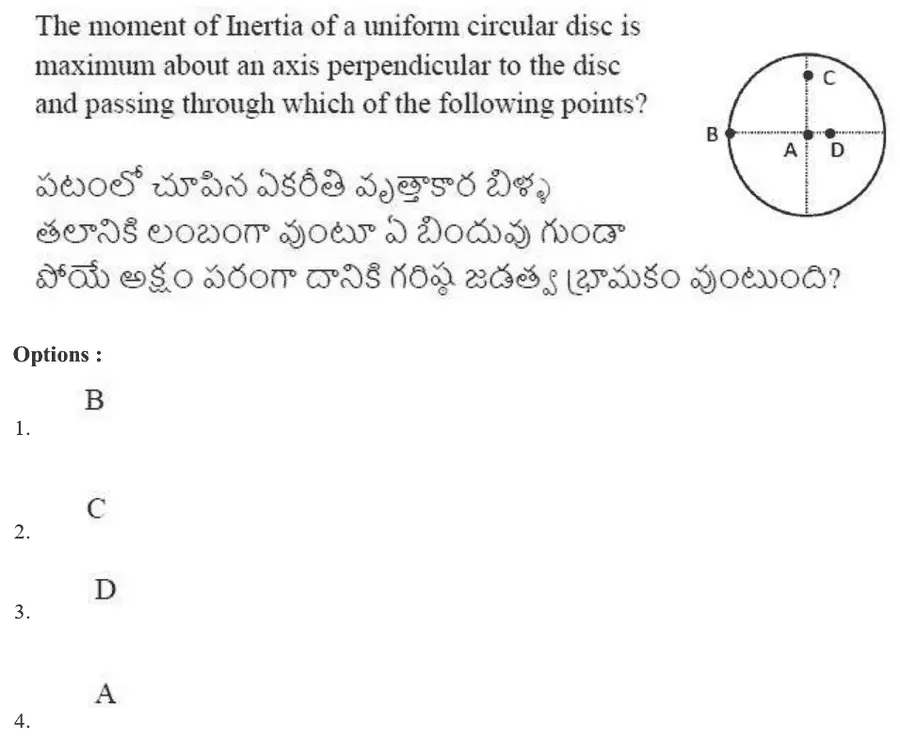
A circular disc is to be made by using equal masses of aluminium and iron. To get maximum moment of inertia, about its geometrical axis, it should be prepared in a way that
A
Aluminium is at the interior and the iron surrounding it
B
Iron is at the interior and the aluminium surrounding it
C
Aluminium and iron are used in alternate layers
D
Aluminium and iron discs should be kept one above the other
The moment of inertia of a body about a certain axis is $1.2\ kg.m^{2}$. Initially, the body is at rest. In order to produce rotational kinetic energy of 1800 J, an angular acceleration of $30\ rad.s^{-2}$ must be applied about the given axis for a duration of ______ seconds.
A wheel having moment of inertia $40\ \mathrm{kg.m^2}$ about its axis, rotates at $50\ rpm$. The angular retardation required to stop this wheel in 90 seconds is ______ $\mathrm{rad.s^{-2}}$
Three point-masses $m_1$, $m_2$ and $m_3$ are located at the vertices of an equilateral triangle, having each side of length 'L'. The moment of inertia of the system about an axis along an altitude of the triangle passing through $m_1$ is given by
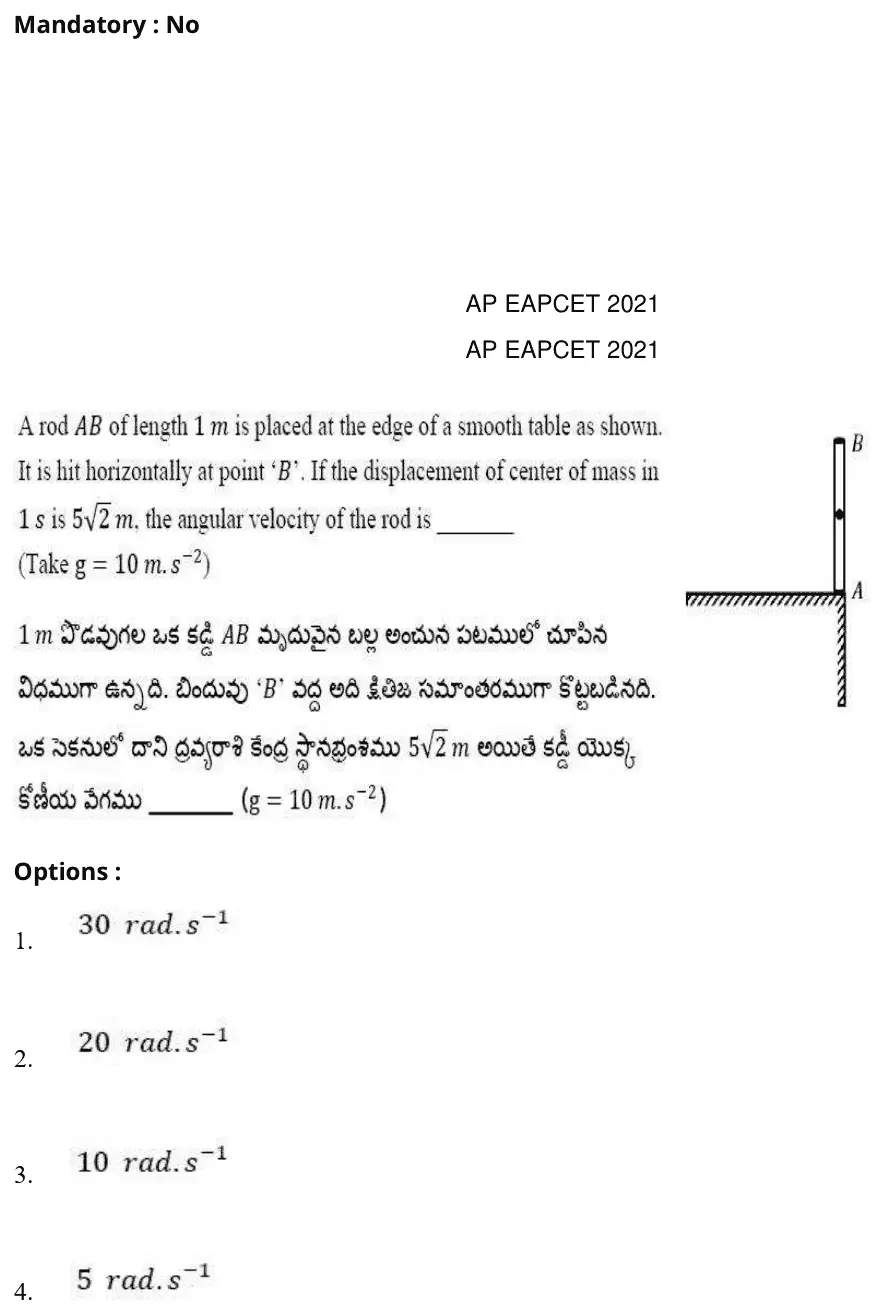
A rod $AB$ of length $1\ m$ is placed at the edge of a smooth table as shown. It is hit horizontally at point 'B'. If the displacement of center of mass in $1\ s$ is $5\sqrt{2}\ m$, the angular velocity of the rod is ______ (Take $g = 10\ \mathrm{m.s^{-2}}$) (see the figure above)
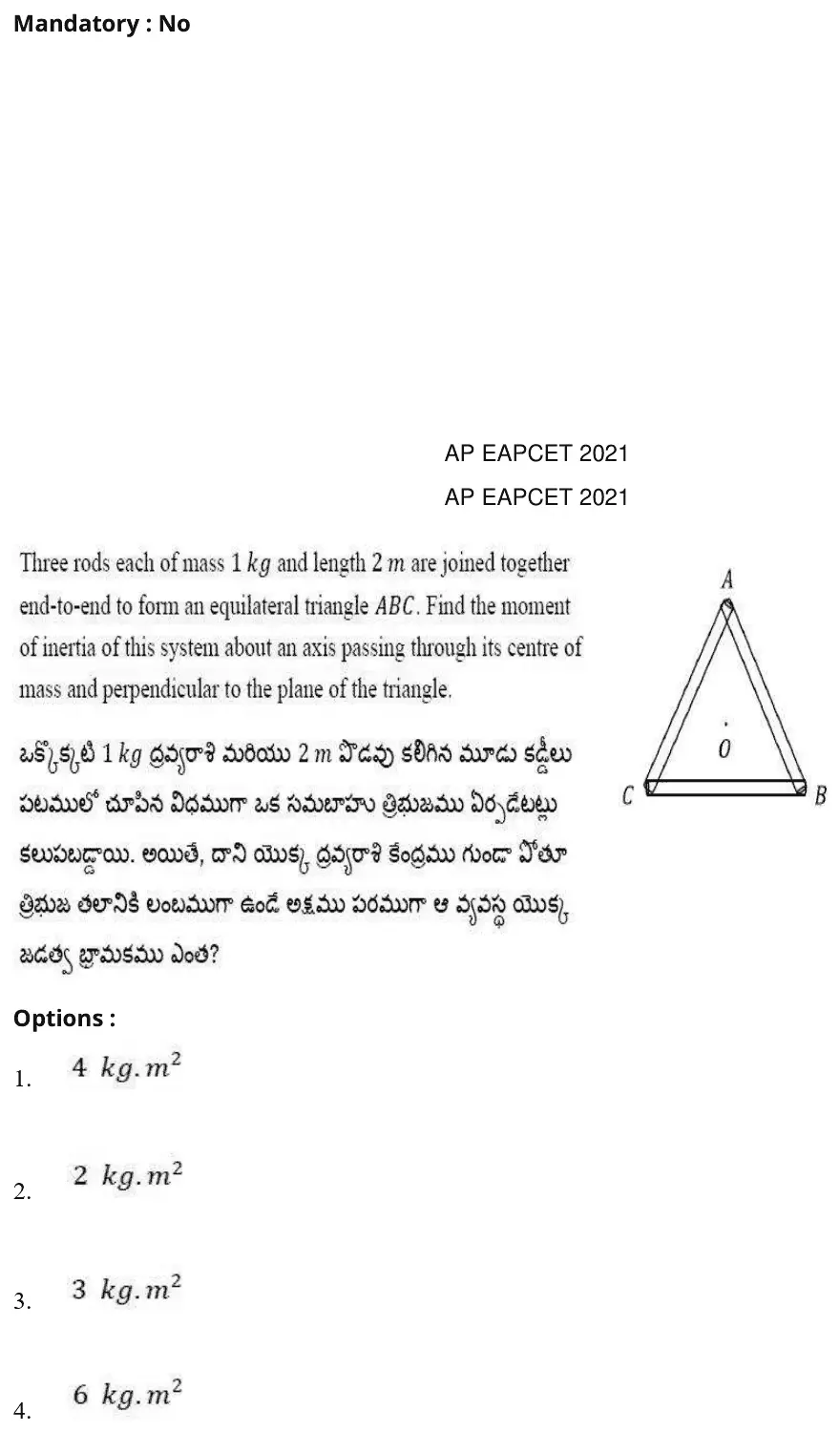
Three rods each of mass $1\ kg$ and length $2\ m$ are joined together end-to-end to form an equilateral triangle $ABC$. Find the moment of inertia of this system about an axis passing through its centre of mass and perpendicular to the plane of the triangle. (see the figure above)
A disc of mass 4 $kg$ and radius 0.4 $m$ is rotating with angular velocity $30\ rad.s^{-1}$. When two point-masses, each 0.25 $kg$, are attached on the periphery of the disc, at diametrically opposite points, its angular velocity becomes ______
If rotational inertia parameter of a body rolling down a rough inclined plane (of inclination $\theta$ and height $h$) without slipping is given by $\beta = I_{CM}/MR^2$, then time taken by the body to reach the bottom of the inclined plane is given by ______
A sphere and a hollow cylinder without slipping, roll down two separate inclined planes A and B respectively. They cover same distance in a given duration. If the angle of inclination of plane A is $30^\circ$, then and the angle of inclination of plane B must be ______ (approximately).
Four spheres each of diameter '$2a$' and mass '$m$' are placed in a way that their centers lie on the four corners of a square of side '$b$'. Moment of inertia of the system about an axis along one of the sides of the square is ______.
If an energy of $684\ \mathrm{J}$ is needed to increase the speed of a fly wheel from $180\ \mathrm{rpm}$ to $360\ \mathrm{rpm}$, then find its moment of inertia.
Two fly wheels A and B are mounted side by side with frictionless bearings on a common shaft. Their moments of inertia about the shaft are $5.0\ kg.m^2$ and $20.0\ kg.m^2$ respectively. Wheel A is made to rotate at 10 revolution per second. Wheel B, initially stationary, is now coupled to A with the help of a clutch. The rotation speed of the wheels will become
A particle of mass 'm' is projected with a velocity 'u' making an angle '$\theta$' with the horizontal. The magnitude of angular momentum of the projectile about the point of projection when the particle is at its maximum height is ______
A girl of mass 'M' stands on the rim of a friction less merry-go-round, of radius 'R' and rotational inertia 'I', that is not moving. She throws a rock of mass 'm' horizontally in a direction that is tangent to the outer edge of the merry-go-round. The speed of the rock, relative to the ground is 'v'. Afterwards, the linear speed of the girl is ______
A 750 kg boat is 10 m long and is floating without motion on still water. A man of mass 80 kg is at one end and if he runs to another end of the boat and stops, the displacement of boat is
A
1.8 m in the direction of displacement of man
B
0.96 m in the direction of opposite to the displacement of man
C
0.96 m in the direction of displacement of the man
D
1.8 m in the direction opposite to displacement of man
A wheel of mass 20 kg and radius 30 cm is rotating at an angular speed of 80 rev/min when the motor is turned off. Neglecting the friction at the axis, calculate the force that must be applied tangentially to the wheel to bring it to rest in 5 revolutions.
Three bodies a ring, a solid cylinder and a solid sphere roll down an inclined plane without slipping. They start from rest. Which of the bodies reaches bottom of plane with minimum velocity?
A wheel undergoes a constant angular acceleration from time t = 0 to t = 20 s and thereafter angular acceleration is zero. If angular velocity at t = 2 s is found to be 5 rad/s, then the number of revolutions made by the wheel in time interval t = 0 s to t = 50 s is
A circular hoop of radius 50 cm and mass 1 kg rotating with an angular velocity $\omega_0$ is placed on a rough horizontal surface. The initial velocity of the centre of the hoop is zero. Let 'v' be the velocity of the centre of the hoop when it ceases to slip. The ratio $v/\omega_0$ will be
A rigid body of mass M and radius R rolls without slipping on an inclined plane of inclination $\theta$, under gravity. Match the type of body Column I with magnitude of the force of friction Column II. Column I A) For ring B) For solid sphere C) For solid cylinder D) For hallow cylinder Column II I) $\frac{Mg\sin\theta}{2.5}$ II) $\frac{Mg\sin\theta}{3}$ III) $\frac{Mg\sin\theta}{3.5}$ IV) $\frac{Mg\sin\theta}{2}$
A small disc of mass 500 gm and radius 5 cm rolls down an inclined plane without slipping. Speed of its center of mass when it reaches the bottom of the incline plane depends on
A
mass & radius
B
mass & height of the incline
C
height of the incline
D
height of the incline and acceleration due to gravity
A thin uniform rod of mass 1 kg and length 1 m is hanged at one end to the ground floor. It originally stands vertically and allowed to fall to the ground. If the rod hits the ground with angular speed $\omega$ then the correct statement is (Assume $g = 10\ \mathrm{m/s^2}$)
If the radius of a sphere is doubled by keeping its mass constant, compare the moment of inertia of the old sphere with that of the new sphere, about any diameter.
Kinetic energy of rotation of a flywheel of radius $2\ \mathrm{m}$, mass $8\ \mathrm{kg}$ and angular speed $4\ \mathrm{rad.s^{-1}}$ about an axis perpendicular to its plane and passing through its center is
A uniform solid sphere of radius 'R' and radius of gyration 'K' about an axis passing through the centre of mass, is rolling without slipping. Then the fraction of total energy associated with its rotation will be ______
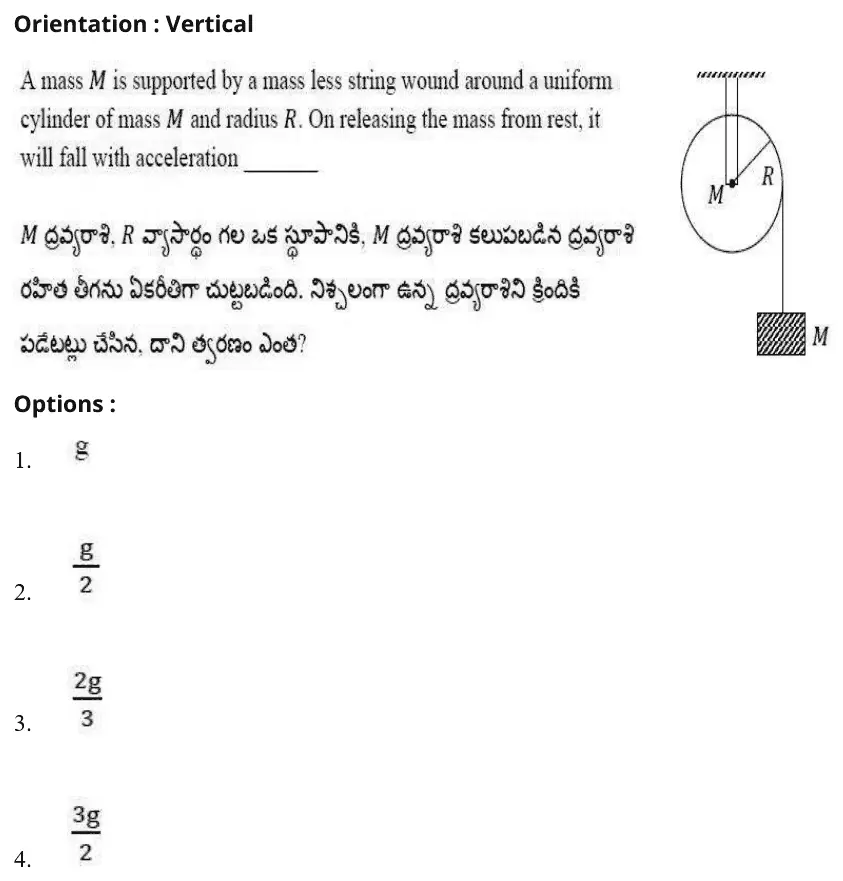
A mass $M$ is supported by a mass less string wound around a uniform cylinder of mass $M$ and radius $R$. On releasing the mass from rest, it will fall with acceleration ______ (see the figure above)
A 20 $\mathrm{kg}$ flywheel in the form of a uniform circular disc, 1 $\mathrm{m}$ in diameter. is making 120 $\mathrm{rpm}$. What is its angular momentum?
The moment of inertia of a rectangular plate of mass $M$, length $L$ and breadth $B$, about an axis passing through its centre and perpendicular to its plane is ______
A body of mass $5\ \mathrm{kg}$ acquires an acceleration of $10\ \mathrm{rad.s^{-2}}$ due to an applied torque of $2\ \mathrm{Nm}$. Its radius of gyration is ______
A solid cylinder of mass 'M' and radius 'R' rolls down an inclined plane of length 'L' and height 'h', without slipping. Find the speed of its centre of mass when the cylinder reaches its bottom?
A uniform circular disc has radius 'r'. A square portion of diagonal 'r' is cut from it. The centre of mass of the remaining disc from the centre of disc is
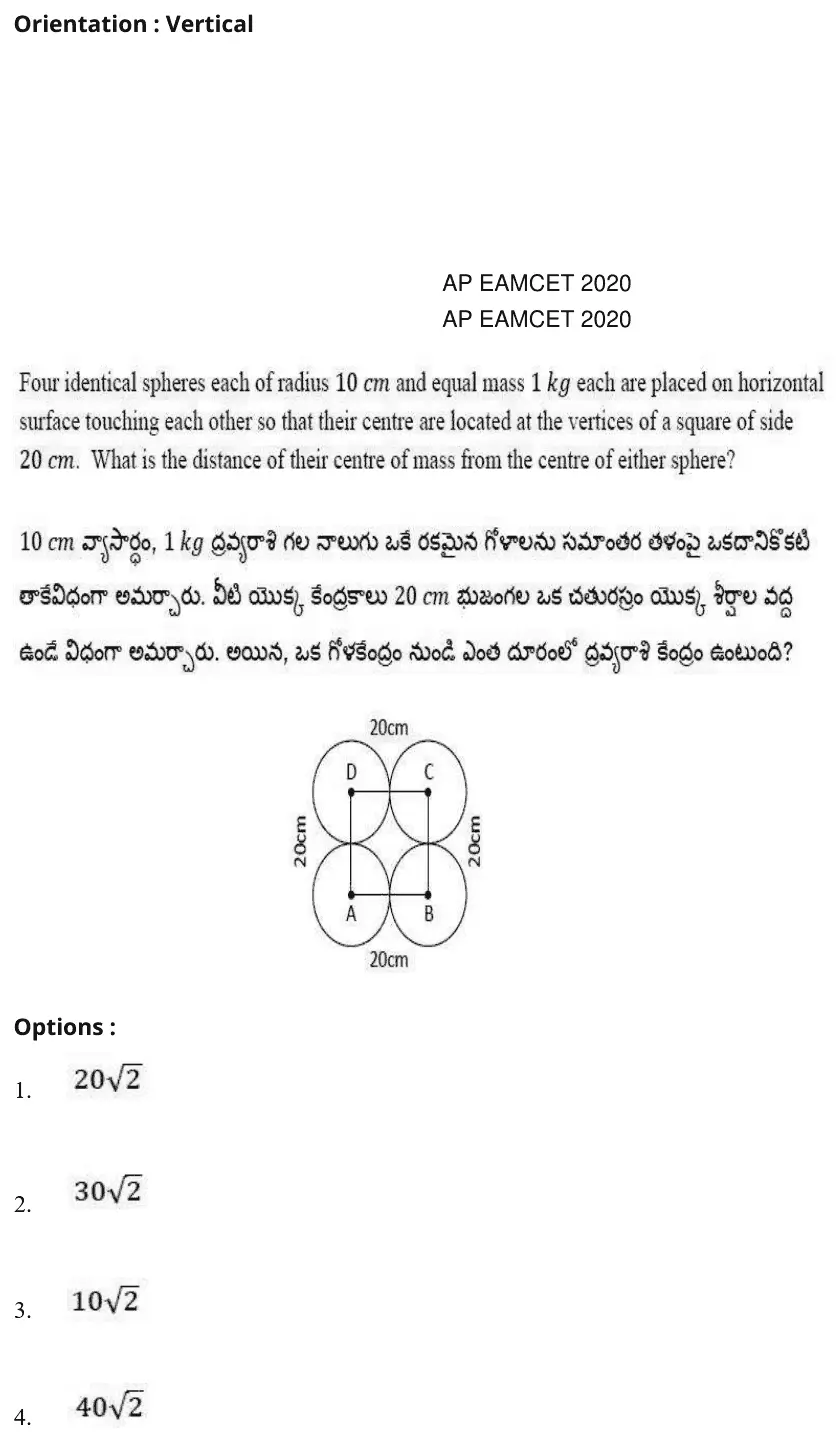
Four identical spheres each of radius $10\,\mathrm{cm}$ and equal mass $1\,\mathrm{kg}$ each are placed on horizontal surface touching each other so that their centre are located at the vertices of a square of side $20\,\mathrm{cm}$. What is the distance of their centre of mass from the centre of either sphere? (see the figure above)
The center of a wheel rolling on a plane surface moves with a speed $V_o$. A particle on the rim of the wheel at the same level as the center will be moving at a speed ________
At high altitude, a body explodes which is at rest into two equal fragments with one fragment receiving horizontal velocity of $10\,\mathrm{m.s^{-1}}$. Time taken by the two radius vectors connecting point of explosion to fragments to make $90^{\circ}$ is
A mass 'm' is in rest on an inclined plane of mass 'M' which is further resting on a smooth horizontal plane. Now, if the mass 'm' starts moving under gravity, the position of center of mass of system will
A
Remain unchanged
B
Change along the horizontal direction
C
Move down in vertical direction
D
Move down in the vertical direction and changes along the horizontal
A light meter rod has two-point masses each of $2\ \mathrm{kg}$ fixed at its ends. If the system rotates about its centre of mass with an angular speed of $0.5\ \mathrm{rad.s^{-1}}$, its rotational K.E. is
Four-point masses, each of mass $M$, are placed at the corners of a square of side $L$. The moment of inertia of the system about one of its diagonals is
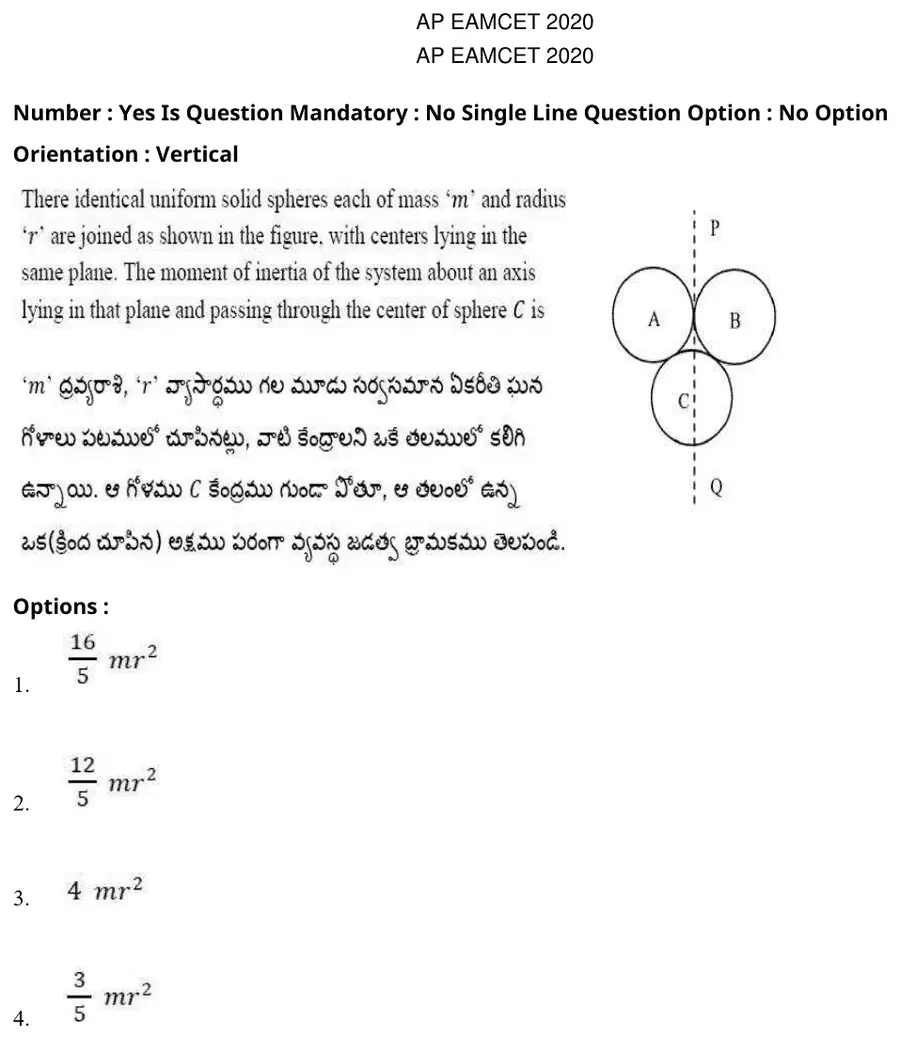
There identical uniform solid spheres each of mass 'm' and radius 'r' are joined as shown in the figure, with centers lying in the same plane. The moment of inertia of the system about an axis lying in that plane and passing through the center of sphere C is (see the figure above)
A disc of moment of inertia $I_1$ is rotating with an angular velocity $w_1$. Another disc of moment of inertia $I_2$ which is not rotating, is gently put on the first disc. The angular speed of the system will be ______
A straight rod of length L is made of a material having mass per unit length $m(x)=\lambda\,|x|$, where $x$ is measured from the centre of rod. The moment of inertia about an axis perpendicular to the rod and passing through one end of the rod will be, $L = 1\,\mathrm{m}$ and $\lambda = 16\,\mathrm{kg/m^2}$
Consider a uniform horizontal solid cylinder of mass 10 kg such that its length is 9 times its radius. Let the radius be 40 cm. Calculate the moment of inertia of the cylinder about a line passing through its edge and perpendicular to its axis
A solid sphere of mass 2 kg rolls on a smooth horizontal surface at 10 m/s. It then rolls up a smooth inclined plane of inclination $30^0$ with the horizontal. The height attained by the sphere before it stops is [Take g as 10 m /sec$^2$]
A rod of length L revolves in a horizontal plane about the axis passing through its center and perpendicular to its length. The angular velocity of the rod is $\omega$. If A is the area of cross-section of the rod and $\rho$ is its density, then the rotational kinetic energy of the rod is
Consider a thin metal strip of mass 1 kg and length 5m. Calculate its moment of inertia about an axis perpendicular to strip and located at 100 cm on strip from one of its end. (Assume the breadth as the strip is negligible)
A solid cylinder is released from rest from the top of an inclined plane of inclination $30^\circ$ and length 60 cm. If the cylinder rolls without slipping, then the speed when it reaches the bottom is
A circular hole of radius 3 cm is cut out from a uniform circular disc of radius 6 cm. The centre of the hole is at 3 cm, from the centre of the original disc. The distance of centre of gravity of the resulting flat body from the centre of the original disc is:
A solid sphere and a solid cylinder, each of mass M and radius R are rolling with a linear speed on a flat surface without slipping. Let $L_1$ be magnitude of the angular momentum of the sphere with respect to a fixed point along the path of the sphere. Likewise $L_2$ be the magnitude of angular momentum of the cylinder with respect to the same fixed point along its path. The ratio $\frac{L_1}{L_2}$ is
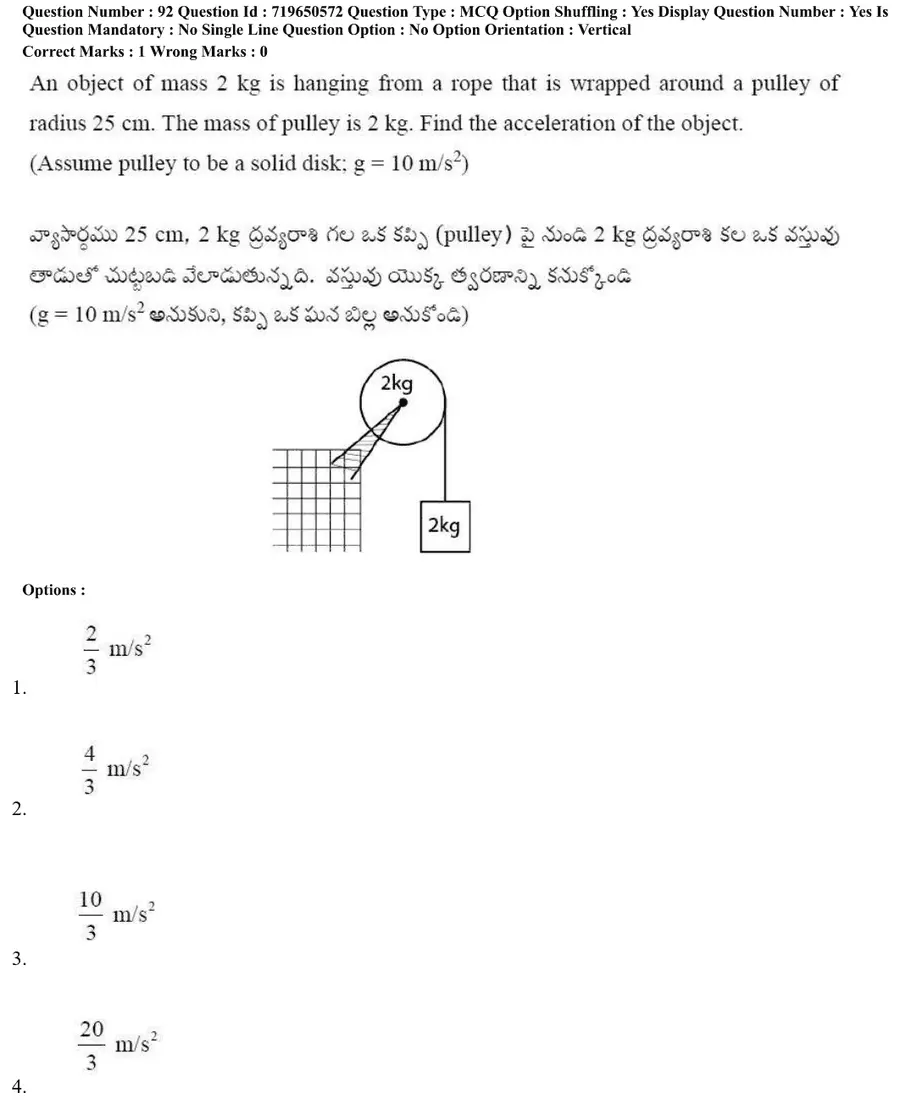
An object of mass 2 kg is hanging from a rope that is wrapped around a pulley of radius 25 cm. The mass of pulley is 2 kg. Find the acceleration of the object. (Assume pulley to be a solid disk; g = 10 m/$s^2$) (see the figure above)
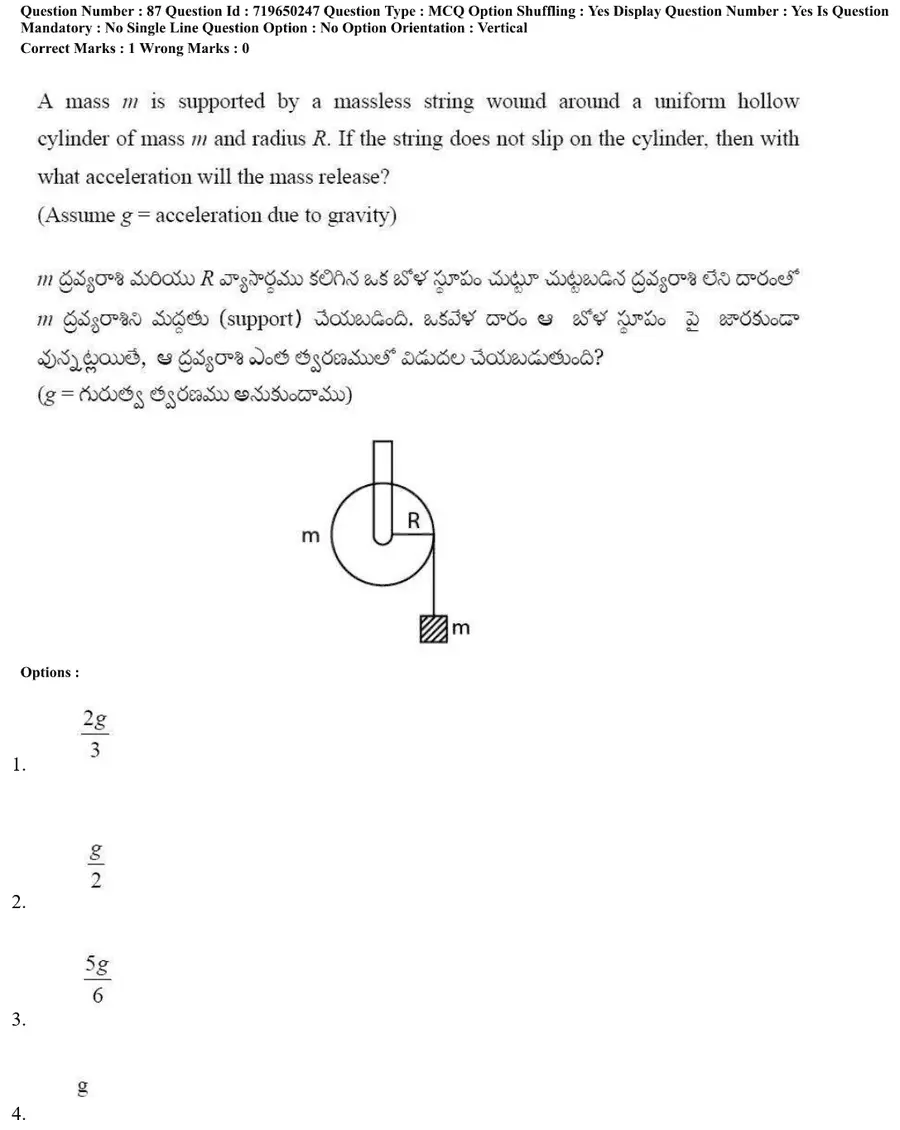
A mass $m$ is supported by a massless string wound around a uniform hollow cylinder of mass $m$ and radius $R$. If the string does not slip on the cylinder, then with what acceleration will the mass release? (Assume $g$ = acceleration due to gravity) (see the figure above)
A ball of mass 100 g is dropped at time t = 0. A second ball of mass 200 g is dropped from the same point at t = 0.2 s. The distance between the center of mass of two balls and the release point at t = 0.4 s is: (Assume $g = 10\ \mathrm{m/s^2}$)
A ball of mass $M$ moving with a speed of 2 m/s hits another ball of mass 1 kg moving in the same direction with a speed of 1 m/s. If the kinetic energy of center of mass is $\frac{4}{3}$ Joule, then the magnitude of $M$ is
From a uniform circular disc of radius 2 cm (its centre of mass is at 'O') a circular portion of radius 1 cm is removed such that the shift in centre of mass is maximum. The disc is now rotated by an angle $\theta$ about an axis perpendicular to its plane and passing through 'O'. If the magnitude of displacement of new centre of mass is $\dfrac{1}{\sqrt{3}}$ cm, then the $\theta$ is
The distance between Sun and Earth is $1.6 \times 10^{11}$ m and the radius of Earth is $6.4 \times 10^{6}$ m. The ratio of the angular momentum of Earth around the Sun to the angular momentum around its own axis is approximately : (Assume Earth as a solid sphere with uniform mass density and rotates around the Sun in a circular path)
A body rotates about a stationary axis. If the angular deceleration is proportional to square root of angular speed, then the mean angular speed of the body, given $\omega_0$ as the initial angular speed, is
A uniform sphere of radius R and mass $m$ is placed on an inclined plane which makes an angle $45^\circ$ to the horizontal. For which of the following value of coefficient of friction, the sphere rolls without slipping
A circular ring of mass 10 kg rolls along a horizontal floor. The center of mass of the ring has a speed 1.5 m/s. The work required to stop the ring is
Three balls A, B and C of masses 50 g, 100 g and 150 g respectively are placed at the vertices of an equilateral triangle. The length of each side is 1 m. If A is placed at (0, 0) and B is placed at (1, 0) m, find the coordinates $(x, y)$ for the centre of mass of this system of balls
Three bodies, a ring, a solid disc and a solid sphere roll down the same inclined plane without slipping. The radii of the bodies are identical and they start from rest. If $V_S$, $V_R$ and $V_D$ are the speeds of the sphere, ring and disc respectively when they reach the bottom, then the correct option is
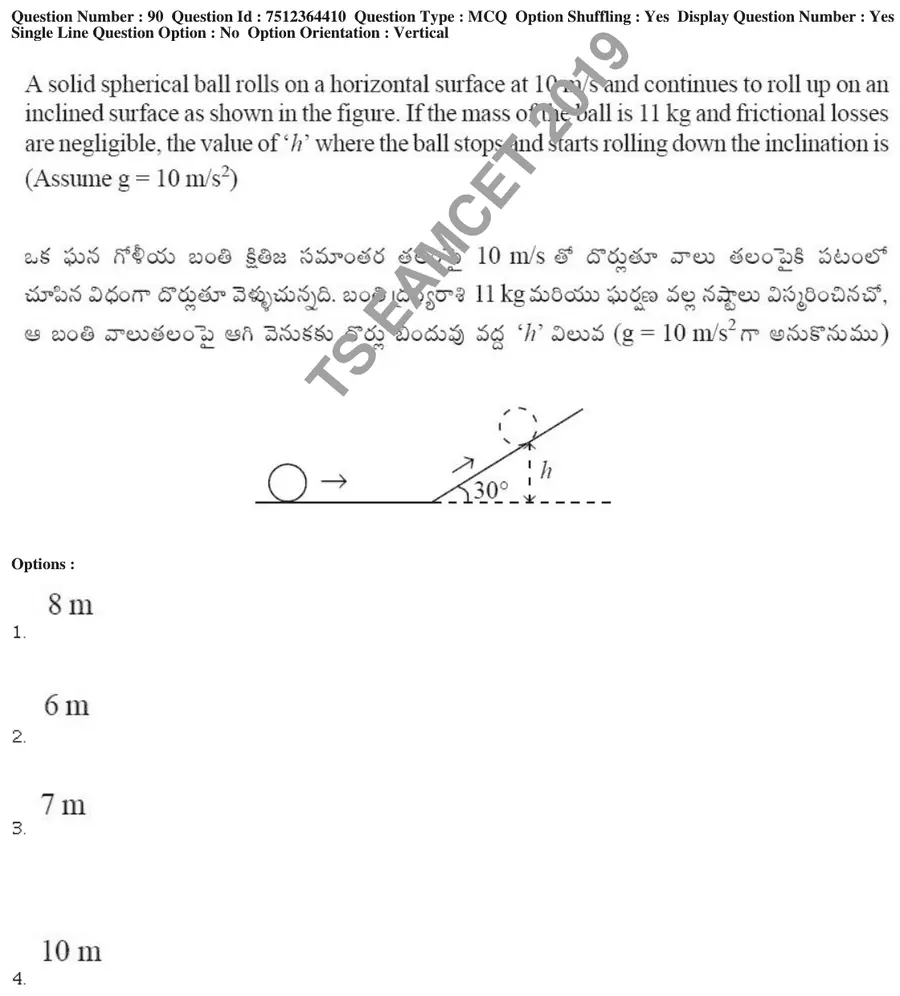
A solid spherical ball rolls on a horizontal surface at 10 m/s and continues to roll up on an inclined surface as shown in the figure. If the mass of the ball is 11 kg and frictional losses are negligible, the value of 'h' where the ball stops and starts rolling down the inclination is (Assume g = 10 m/s$^2$) (see the figure above)
A long slender rod is welded to a thin circular disc of diameter 0.5 m at a point on its circumference. The rod is in the same plane as that of the disc and forms a tangent to the disc. The radius of gyration of the disc about the rod (in m) is
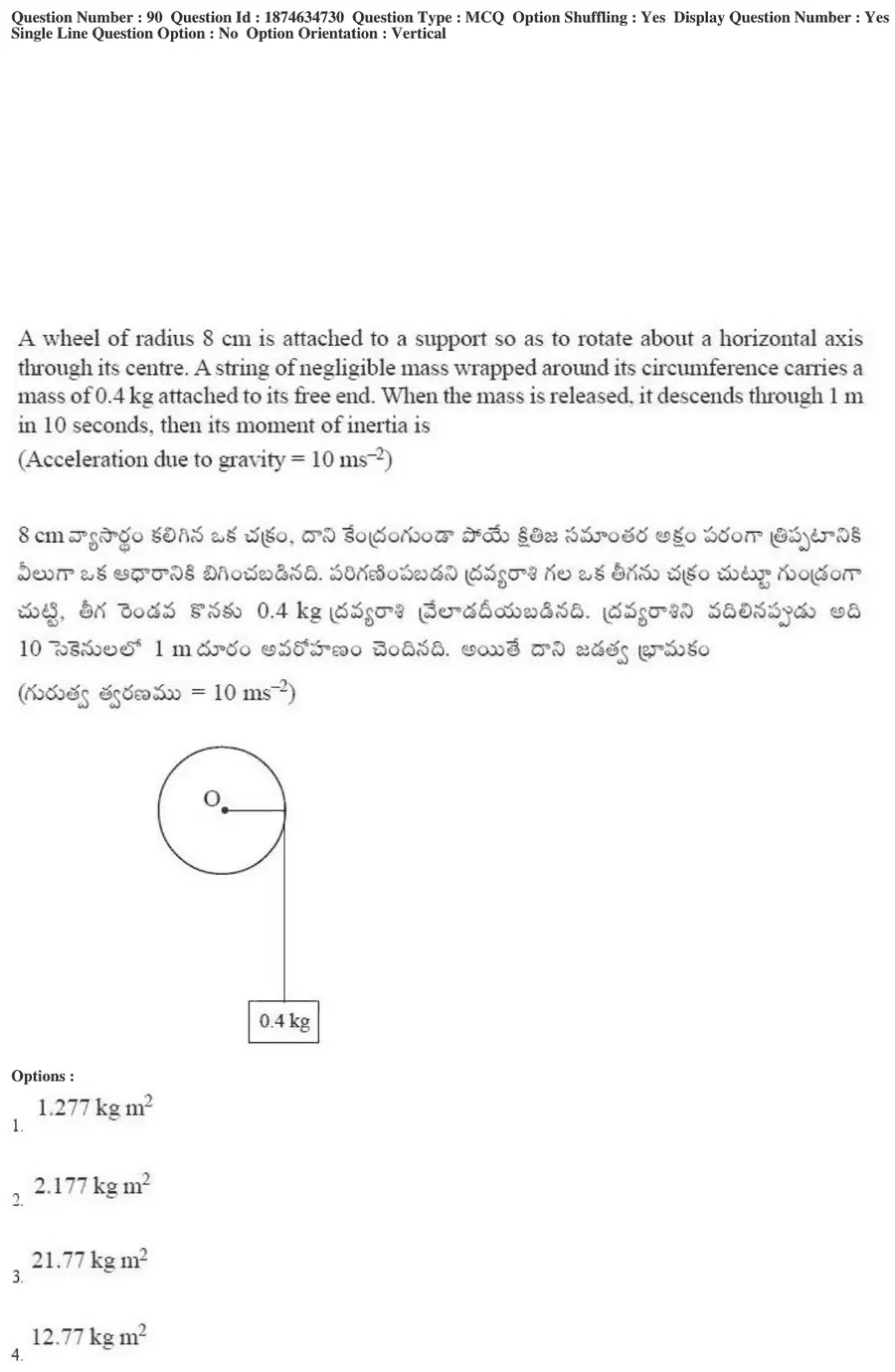
A wheel of radius $8\ \mathrm{cm}$ is attached to a support so as to rotate about a horizontal axis through its centre. A string of negligible mass wrapped around its circumference carries a mass of $0.4\ \mathrm{kg}$ attached to its free end. When the mass is released, it descends through $1\ \mathrm{m}$ in 10 seconds, then its moment of inertia is (Acceleration due to gravity $= 10\ \mathrm{ms^{-2}}$) (see the figure above)
A solid sphere rolls down without slipping on a smooth inclined plane of inclination $\mathrm{Sin}^{-1}(0.42)$. If the acceleration due to gravity is $10\ \mathrm{ms^{-2}}$, the acceleration of the rolling sphere is
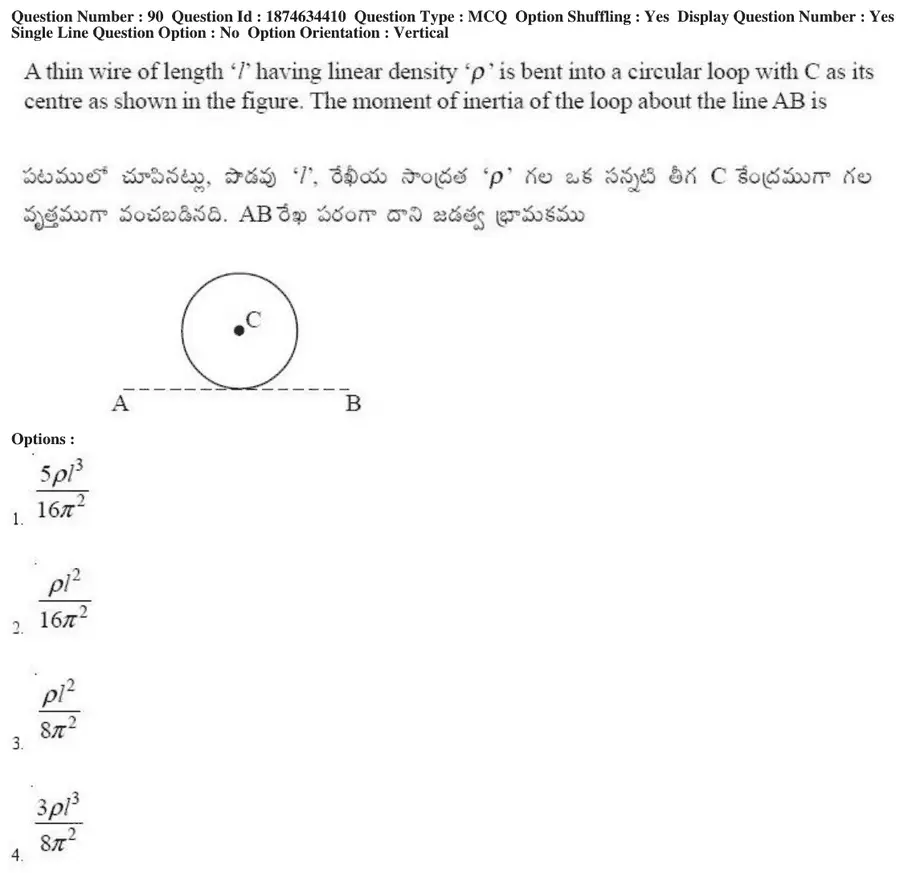
A thin wire of length 'l' having linear density '$\rho$' is bent into a circular loop with C as its centre as shown in the figure. The moment of inertia of the loop about the line AB is (see the figure above)
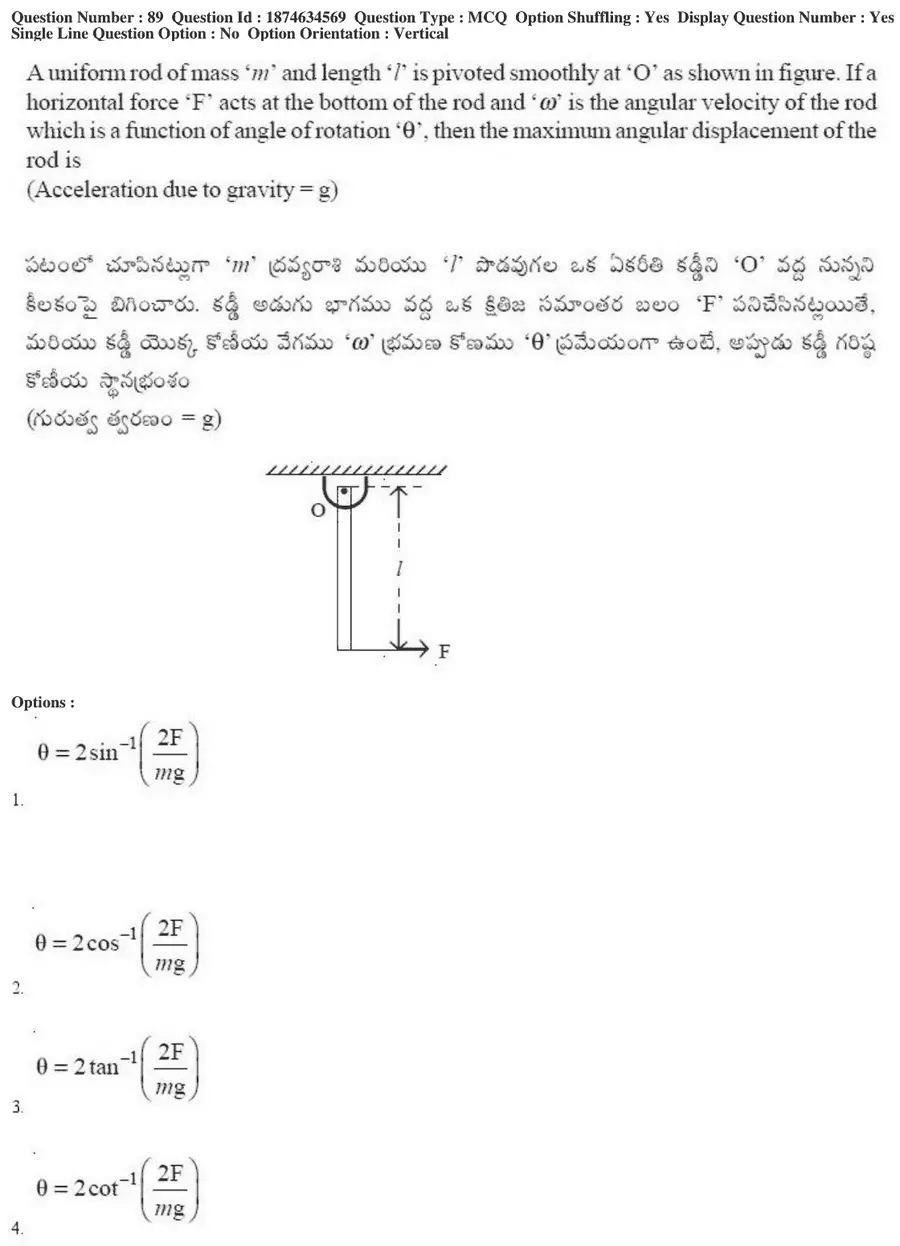
A uniform rod of mass '$m$' and length '$l$' is pivoted smoothly at 'O' as shown in figure. If a horizontal force 'F' acts at the bottom of the rod and '$\omega$' is the angular velocity of the rod which is a function of angle of rotation '$\theta$', then the maximum angular displacement of the rod is (Acceleration due to gravity $= g$) (see the figure above)
An electric motor of power $75\ \mathrm{W}$ rotates a flywheel of moment of inertia $0.36\ \mathrm{kg\,m^2}$ at a constant rate of $100\ \mathrm{rad\,s^{-1}}$. If the power is switched off, the time taken for the wheel to come to rest is
A fly wheel of mass 1 kg and radius vector $(2\hat{i} + \hat{j} + 2\hat{k})\,\mathrm{m}$ is at rest. When a force $(3\hat{i} + 2\hat{j} - 4\hat{k})\,\mathrm{N}$ acts on it tangentially, it can rotate freely. Then its angular velocity after 4.5 s is
Three identical spheres each of diameter $2\sqrt{3}\,\mathrm{m}$ are kept on a horizontal surface such that each sphere touches the other two spheres. If one of the spheres is removed, then the shift in the position of the centre of mass of the system is
A wheel having moment of inertia $2\ \mathrm{kg\,m^2}$ about its axis, rotates at 50 rpm about the same axis. The torque required to stop the wheel in one minute is
The angular retardation of a rotating flywheel is proportional to the angle through which it rotates. If its kinetic energy gets reduced by $\Delta\mathrm{E}$ while it rotates through an angle '$\theta$', then
A solid sphere of mass 100 kg and radius 10 m moving in a space becomes a circular disc of radius 20 m in one hour. Then the rate of change of moment of inertia in the process is
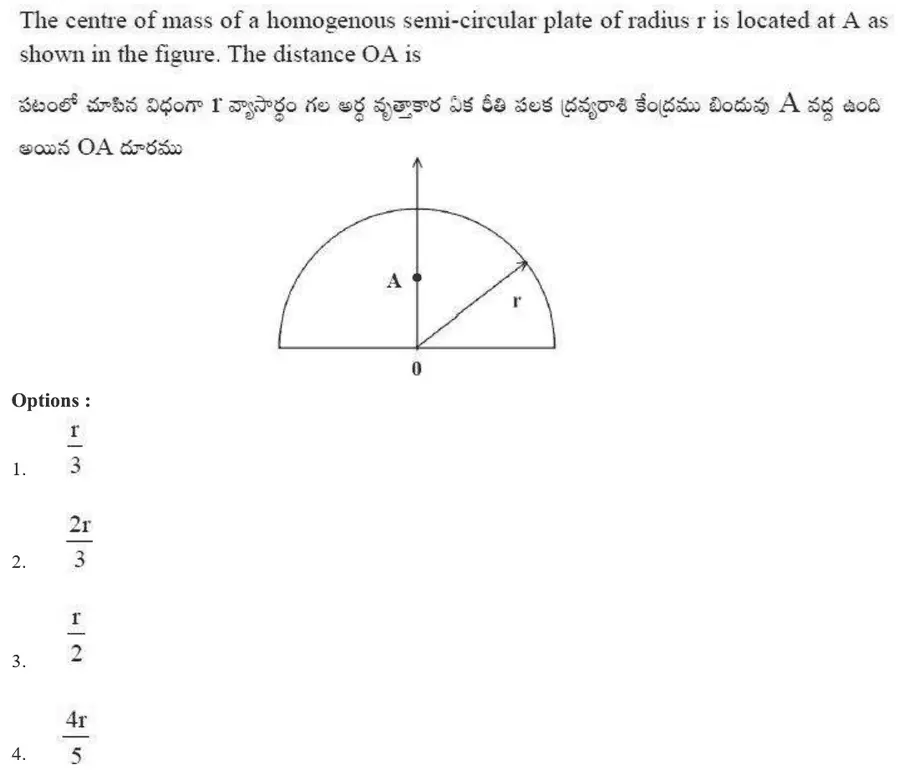
A semicircular plate of mass 'm' has radius 'r' and centre 'c'. The centre of mass of the plate is at a distance 'x' from its centre 'c'. Its moment of inertia about an axis passing through its centre of mass and perpendicular to its plane is
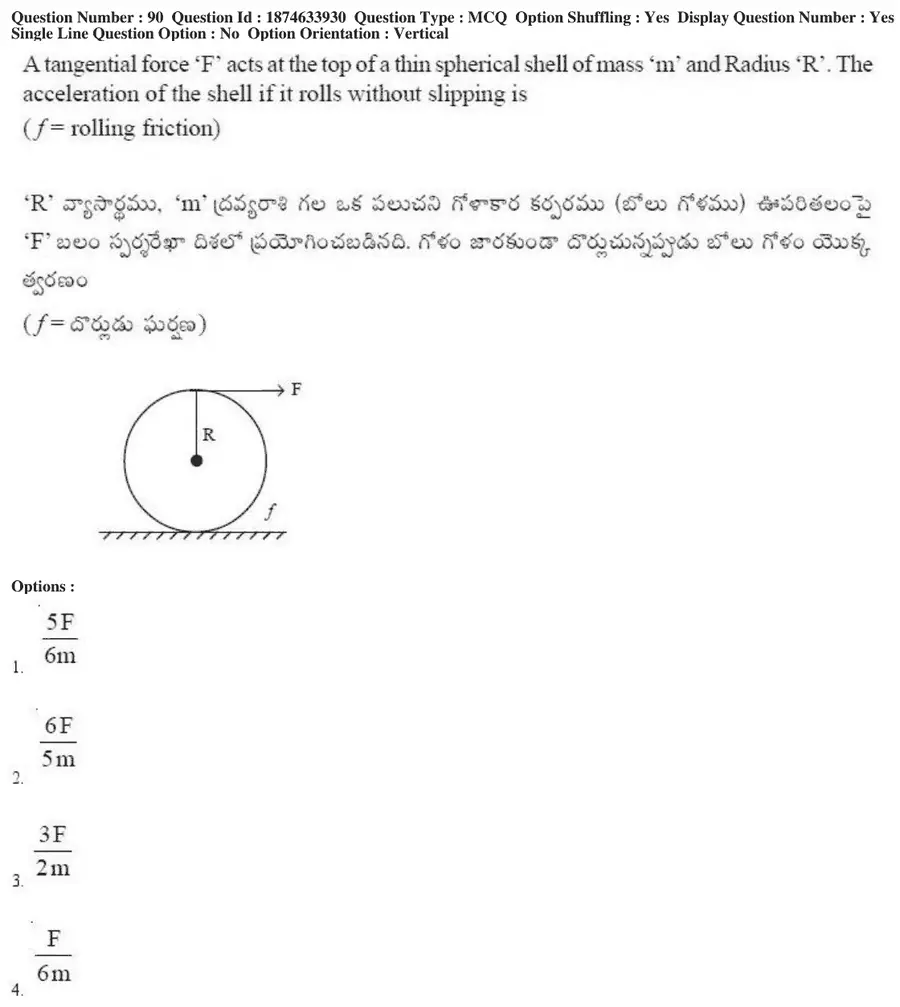
A tangential force 'F' acts at the top of a thin spherical shell of mass 'm' and Radius 'R'. The acceleration of the shell if it rolls without slipping is ($f$ = rolling friction) (see the figure above)
Consider a sphere of mass $M$ and radius $R$ centered at origin. The density of material of the sphere is $\rho = Ar^{\alpha}$, where $r$ is the radial distance, $\alpha$ and $A$ are constants. If the moment of inertia of the sphere about the axis passing through center is $\frac{4}{7}MR^2$, the value of $\alpha$ is
A 30 kg boy stands at the far edge of a floating plank whose near edge is against the shore of a river. The plank is 10 m long and weighs 10 kg. If the boy walks to the near edge of the plank, how far from the shore does the plank move
A uniform cylinder of radius 1 m, mass 1 kg spins about its axis with an angular velocity of 20 rad/sec. At certain moment the cylinder is placed into a corner as shown in the figure. The coefficient of friction between the horizontal wall and the cylinder is $\mu$, where as the vertical wall is frictionless. If the number of rounds made by the cylinder is 5 before it stops, the value of $\mu$ is: (Acceleration due to gravity $g = 10\ \mathrm{m/sec^2}$)
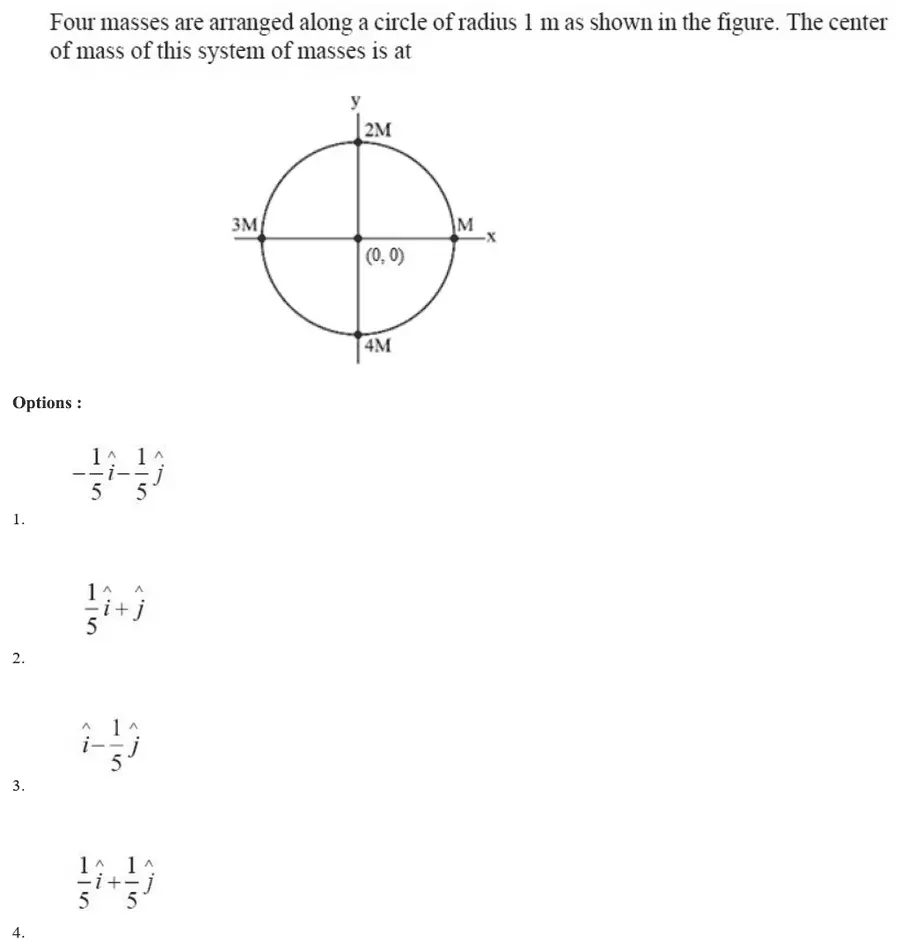
The masses and positions (in rectangular coordinates) of four particles are as follows: $1\ \mathrm{kg}$ at $(a, a)$, $2\ \mathrm{kg}$ at $(-a, a)$, $3\ \mathrm{kg}$ at $(-a, -a)$ and $4\ \mathrm{kg}$ at $(a, -a)$. The position vector of the centre of mass of the system of four particles is
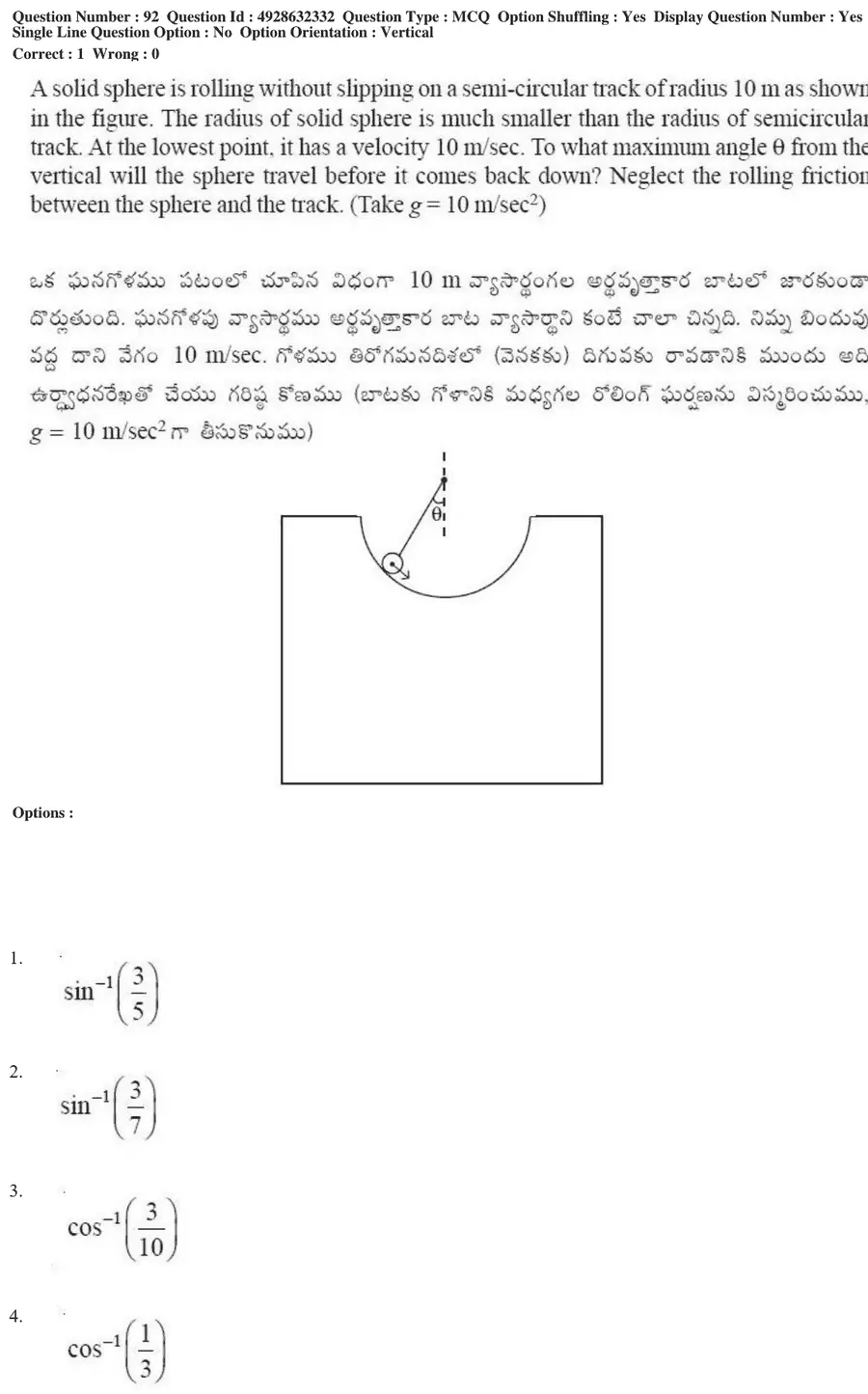
A solid sphere is rolling without slipping on a semi-circular track of radius $10\ \mathrm{m}$ as shown in the figure. The radius of solid sphere is much smaller than the radius of semicircular track. At the lowest point, it has a velocity $10\ \mathrm{m/sec}$. To what maximum angle $\theta$ from the vertical will the sphere travel before it comes back down? Neglect the rolling friction between the sphere and the track. (Take $g = 10\ \mathrm{m/sec^2}$) (see the figure above)
A solid sphere of radius $R$ makes a perfect rolling down on a plane which is inclined to the horizontal axis at an angle $\theta$. If the radius of gyration is '$k$', then its acceleration is
A uniform disk of mass 100 kg and radius 2 m is rotating at 1 rad/s about a perpendicular axis passing through its center. A boy of mass 60 kg, standing at the center of the disk suddenly jumps to a point which is 1 m from the center of the disk. The final angular velocity of the boy (in rad/s) is
A force $\vec{F}_1 = A\,\hat{j}$ is applied to a point whose radius vector $\vec{r}_1 = a\,\hat{i}$ while a force $\vec{F}_2 = B\,\hat{i}$ is applied to the point whose radius vector $\vec{r}_2 = b\,\hat{j}$. Both the radius vectors are determined relative to the origin of the coordinate axes 'O'. The moment of the force relative to 'O' is
A circular disc of radius 'R' is removed from one end of a bigger circular disc of radius '2R'. The centre of mass of the new disc is at a distance '$\alpha$R' from the centre of the bigger disc. The value of '$\alpha$' is
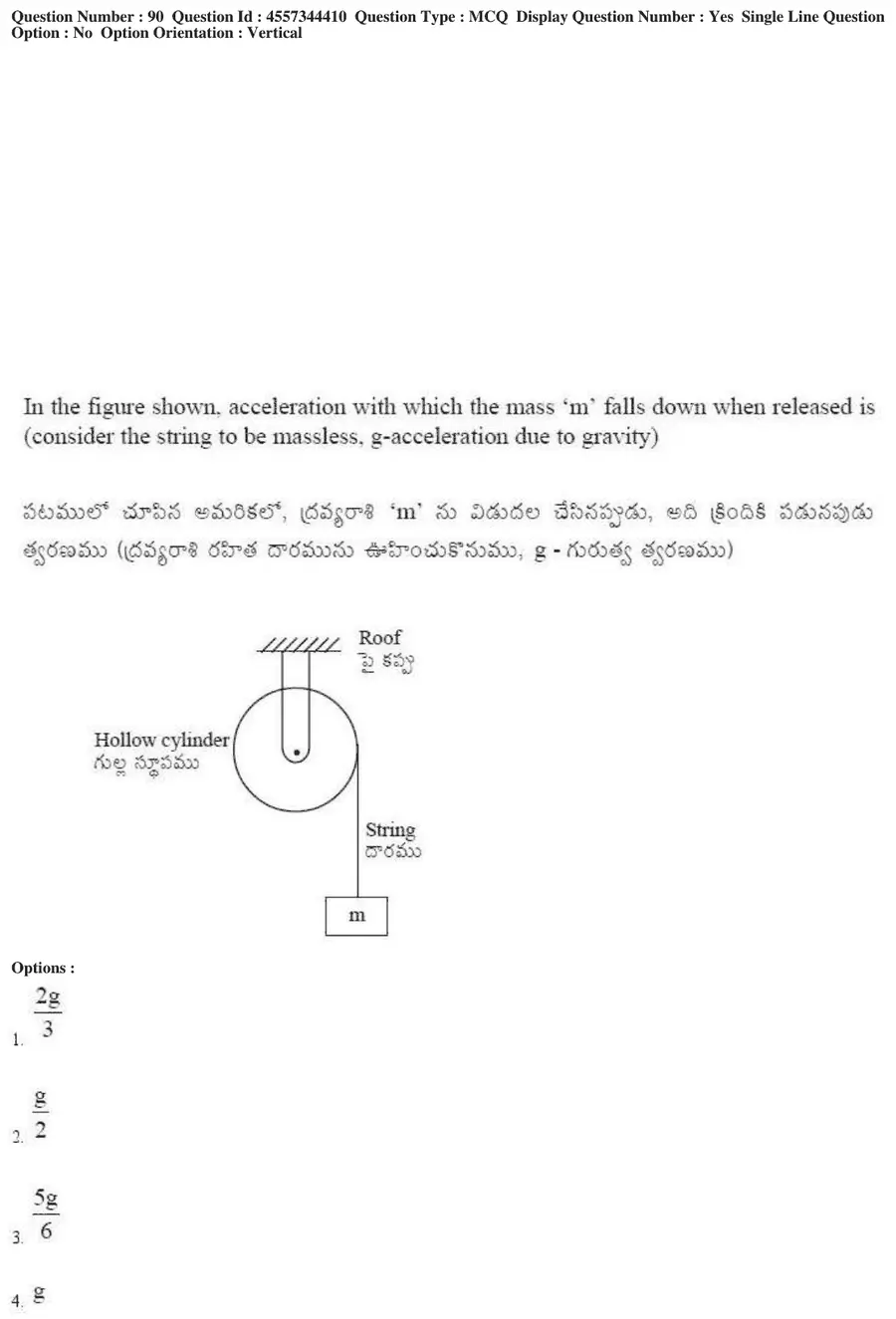
In the figure shown, acceleration with which the mass 'm' falls down when released is (consider the string to be massless, g-acceleration due to gravity) (see the figure above)
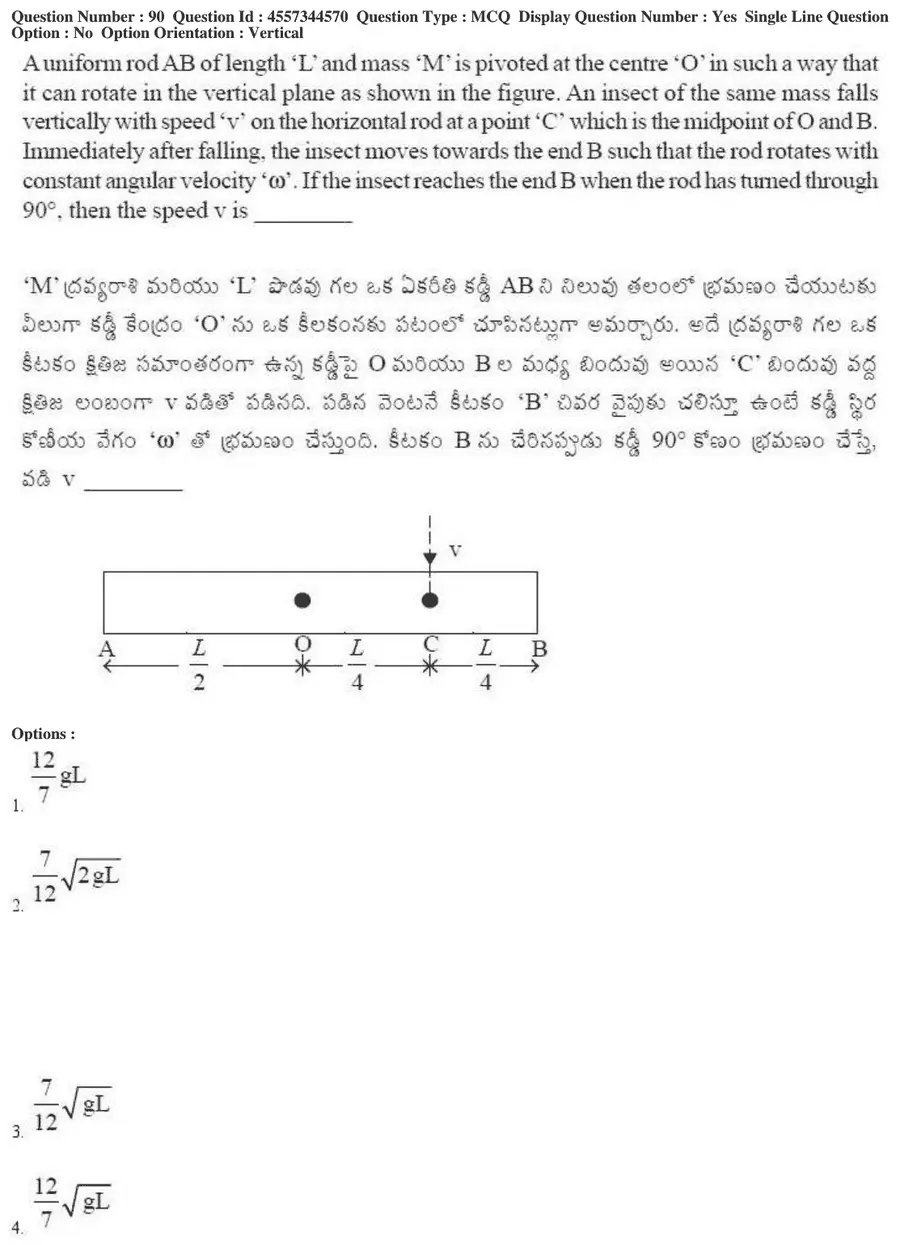
A uniform rod AB of length 'L' and mass 'M' is pivoted at the centre 'O' in such a way that it can rotate in the vertical plane as shown in the figure. An insect of the same mass falls vertically with speed 'v' on the horizontal rod at a point 'C' which is the midpoint of O and B. Immediately after falling, the insect moves towards the end B such that the rod rotates with constant angular velocity '$\omega$'. If the insect reaches the end B when the rod has turned through $90^\circ$, then the speed v is ______ (see the figure above)
A solid sphere of lithium is rotating with angular frequency '$\omega$' about an axis passing through its diameter. If its temperature is raised by $50\ ^\circ\mathrm{C}$ then its new angular frequency is ($\alpha_{\mathrm{lithium}} = 60\times10^{-5}\ ^\circ\mathrm{C}^{-1}$)
A particle of mass 4M which is initially at rest explodes into three pieces of masses M, M and 2M. The equal masses move along X- and Y- axes with velocities $4\ \mathrm{ms^{-1}}$ and $6\ \mathrm{ms^{-1}}$ respectively. The magnitude of the velocity of the heavier mass is
The moment of inertia of a body about a given axis is $12\ \mathrm{kgm^2}$. Initially the body is at rest. In order to produce a rotational kinetic energy of 15000 J, an angular acceleration of $10\ \mathrm{rads^{-2}}$ must be applied about that axis for a duration of ______
A light rope is wound around a hollow cylinder of mass 4 kg and radius 40 cm. If the rope is pulled with a force of 40 N, it's angular acceleration is ______
Rotational Motion holds a steady place across state entrance tests in Andhra Pradesh and Telangana. Across the papers we hold from 2022 to 2026, it contributed 135 questions in 77 papers, which comes out to roughly 1.8 questions per paper. During this recent five-year stretch, questions from the chapter appeared in 75 of those 77 papers. That places it as the 7th largest of 28 Physics chapters by share of questions, accounting for 4.4% of all Physics problems asked in that period.
Taking a longer view across the papers we hold from 2010 to 2026, the archive contains 284 questions from 143 of the 149 papers, averaging 1.9 questions per paper and making up 4.8% of the subject. In the earlier testing era from 2010 to 2021, the chapter had a slightly stronger presence at 5.2% of Physics (149 questions in 72 papers). Over the last three exam years from 2024 to 2026, its weight has been 4.7% with 87 questions in 46 papers. Compared to the early years, the chapter's share has fallen, while compared to the full 2022 to 2026 window it has stayed about the same. Every year since 2022 has included problems from this chapter.
Looking at the two states separately between 2022 and 2026, AP EAPCET featured 87 questions across 48 papers (appearing in 47 papers, 1.8 per paper, 4.5% share), while TS EAPCET included 48 questions across 29 papers (appearing in 28 papers, 1.7 per paper, 4.1% share). The chapter is part of the Class 11 Intermediate syllabus and builds heavily on Newtonian dynamics and work-energy principles.
Most-asked topics
In the papers we hold from 2022 to 2026, questions split across five key topic areas:
Centre of Mass: 37 questions. Over the entire 2010 to 2026 archive, this topic accounts for 67 questions and stands as the most frequent question area in recent papers.
Moment of Inertia: 32 questions recently, with 64 questions across the full archive. Standard geometries and axis theorems dominate here.
Rolling Motion: 30 questions recently, and 59 questions across all years in our collection.
Torque & Angular Momentum: 20 questions in the recent window, totalling 44 questions across the complete archive.
Rotational Dynamics: 16 questions in recent papers, and 50 questions across the entire dataset.
Every single one of these five areas appeared in 2026 papers, meaning students cannot afford to overlook any part of the chapter.
What the questions look like
Centre of mass problems frequently test symmetric objects with portions removed. You will encounter square sheets with triangles cut out, circular discs with circular holes, or sets of point masses arranged on the vertices of a polygon. Solving these requires applying mass-weighted coordinate formulas rather than long derivations. Another common variety examines two-body systems subjected to internal gravitational attraction or explosions, where the centre of mass remains unaccelerated because external forces are absent.
Moment of inertia questions focus primarily on thin rods, circular hoops, discs, cylinders, and solid or hollow spheres. Examiners often ask for the moment of inertia about unusual axes, such as a tangent in the plane of a ring or an axis through one corner of a plate, requiring careful application of the parallel axis or perpendicular axis theorems. You will also see composite objects formed by joining or bending rods.
Rolling motion problems usually combine energy conservation with rotational kinematics. Standard set-ups ask for the linear speed or acceleration of a body descending an inclined plane without slipping, or compare which among a ring, disc, and sphere reaches the bottom first.
Rotational dynamics questions involve applying torque equals moment of inertia times angular acceleration. These often feature hanging masses connected to cord-wrapped cylinders, or rotating wheels brought to rest by frictional couples.
Questions to try first
Here are five questions from 2026 council papers illustrating different styles across both states:
Begin by mastering centre of mass calculations for discrete particles and simple composite shapes with cut-outs. Ensure you understand how internal forces do not change the velocity of the centre of mass, as this concept yields quick marks on conceptual questions.
Next, memorize the standard moments of inertia for fundamental bodies like rods, rings, discs, and spheres. Practise using the parallel and perpendicular axis theorems until you can determine the moment of inertia about any given line without hesitation.
Once rotational inertia is solid, move on to torque and angular momentum. Work on conservation of angular momentum problems where a rotating system alters its geometry, such as a person walking on a revolving platform or an object undergoing contraction. Finally, study pure rolling on an incline by relating translational and rotational kinetic energies.
Working through the previous years' questions below year by year will help you become comfortable with the phrasing and style used in the official council papers.
Frequently asked questions
How many questions come from Rotational Motion in EAPCET?
In the papers we hold from 2022 to 2026, Rotational Motion provided 135 questions in 77 papers, averaging around 1.8 questions per paper. It appeared in 75 of those 77 papers and ranks 7th among all 28 Physics chapters by question share.
Which topic in Rotational Motion has the highest weightage?
Between 2022 and 2026, Centre of Mass was the most frequently asked topic with 37 questions, followed closely by Moment of Inertia with 32 questions and Rolling Motion with 30 questions.
Is Rotational Motion asked equally in AP and TS exams?
Both state tests ask it regularly. From 2022 to 2026 in our set, AP EAPCET had 87 questions in 48 papers (1.8 per paper), while TS EAPCET had 48 questions in 29 papers (1.7 per paper).
Where can I see the solutions?
Every question on this page opens with its options and answer. Step-by-step solutions for each one are in the EdLoop EAPCET app.