The type of radioactive decay that involves the emission of a positron is
- A
$\alpha$ decay
- B
$\beta^{+}$ decay
- C
$\beta^{-}$ decay
- D
$\gamma$ decay
Answer: (B) $\beta^{+}$ decay · The council's preliminary key
 PYQs · free, no adsOpen on the web (app.edloop.in)Get EdLoop – free on Google Play
Every Nuclei question from past AP EAPCET and TS EAPCET papers, with options and answers. Newest first.
Nuclear physics occupies an active position in Class 12 modern physics for regional entrance exams. Across the AP and TS EAPCET papers held in our archive between 2022 and 2026, Nuclei contributed 101 questions across 77 papers.
Attempt every Nuclei question timed, see the step-by-step solution and track what you get wrong. Free.
The type of radioactive decay that involves the emission of a positron is
$\alpha$ decay
$\beta^{+}$ decay
$\beta^{-}$ decay
$\gamma$ decay
Energy released in the fission of a single $_{92}\mathrm{U}^{235}$ nucleus is 200 MeV. The fission rate of $_{92}\mathrm{U}^{235}$ fueled reactor operating at a power level of 5W is
$1.56 \times 10^{10}\ \mathrm{s^{-1}}$
$1.56 \times 10^{11}\ \mathrm{s^{-1}}$
$1.56 \times 10^{16}\ \mathrm{s^{-1}}$
$1.56 \times 10^{-17}\ \mathrm{s^{-1}}$
The radioactivity of a certain radioactive element drops to 1/64 of its initial value in 30 sec. Its half-life is
2 Sec
4 Sec
5 Sec
6 Sec
The range of strong nuclear force is in the order of
Infinity
$\sim 10^{-16}\ m$
Zero
$\sim 10^{-15}\ m$
During the decay of an unstable nucleus, if its neutron number and mass number decrease by 5 and 12 respectively, then the particles released in the decay are
One alpha particle and six positrons
One alpha particle and six electrons
Three alpha particles and one positron
Three alpha particles and one electron
The half-life of a certain radio isotope is 4 minutes. The number of radioactive nuclei at a given instant of time is $10^6$. Then the number of radioactive nuclei left 2 minutes later would be
$\frac{10^6}{2}$
$10^3$
$\frac{10^6}{\sqrt{2}}$
$\sqrt{2} \times 10^6$
If the radius of a nucleus having 13 protons and 14 neutrons is 3.6 fm, then the ratio of the volume to surface area of nucleus having 53 protons and 72 neutrons is
12 fm
3 fm
6 fm
2 fm
Binding energy per nucleon of deuteron and Helium nuclei are 1.1 MeV and 7 MeV respectively. If a single Helium nucleus was formed by adding two Deuterons, the energy released is
23.6 MeV
32.4 MeV
28.6 MeV
13.6 MeV
The activities of a sample of radioactive material are $A_1$ and $A_2$ at times $t_1$ and $t_2$ respectively ($t_2 > t_1$). If its mean life time is $T$, then
$A_2 = A_1 e^{(t_2-t_1)/T}$
$A_2 = A_1 e^{(t_1-t_2)/T}$
$A_2 = A_1 e^{(t_1-t_2)T}$
$A_2 = A_1 e^{(t_2-t_1)T}$
What is the energy released in the following fission reaction?
$^{236}_{z}U \rightarrow {}^{117}_{a}X + {}^{117}_{(z-a)}Y + 2\left({}^{1}_{0}n\right)$
Given that the binding energy per nucleon of X and Y is 8.8 MeV and that of $^{236}_{z}U$ is 7.5 MeV
256.4 MeV
248.6 MeV
274.2 MeV
289.2 MeV
If a thorium nucleus of mass number 232 and atomic number 90 emits six alpha particles and four $\beta^-$ particles, then the ratio of the number of protons and the number of neutrons in the resulting final nucleus is
$39 : 65$
$41 : 63$
$41 : 104$
$63 : 104$
If the mean life of a radioactive substance is $\frac{20}{\ln(4)}$ minutes, then the ratio of the number of atoms remaining undecayed and the number of atoms decayed of the substance at a time of 30 minutes is
$3:8$
$7:8$
$1:7$
$1:8$
If a graph is drawn between the binding energy per nucleon and the mass number of nucleus, then the mass number of the nucleus for which the binding energy per nucleon has a maximum value is
56
35
106
115
In β-decay, when a proton converts into a neutron, the particles emitted are
Electron, neutrino
Positron, neutrino
Positron, antineutrino
Electron, antineutrino
The number of disintegrations per year of 15.3 mg sample of $^{60}_{27}\mathrm{Co}$ is
(Mean life of $^{60}_{27}\mathrm{Co}$ is 7.65 years and Avogadro's number $= 6.024\times10^{23}\ \mathrm{mol^{-1}}$)
$3624\times10^{16}$
$798\times10^{15}$
$2008\times10^{16}$
$1258\times10^{16}$
The range of the weak nuclear force is of the order of
$10^{26}\ \text{Å}$
$10^{-6}\ \text{Å}$
$10^{18}\ \text{Å}$
$10^{-2}\ \text{Å}$
If the activities of a radioactive substance at times $t=0$ and $t=3T$ are A and B respectively, then the activity of the substance at a time $t=9T$ is
$\frac{A^3}{B^2}$
$\frac{A^2}{B}$
$\frac{B^2}{A}$
$\frac{B^3}{A^2}$
If the masses of proton and neutron are $m_p$ and $m_n$ respectively, the experimental masses of ${}_2\mathrm{He}^4$ and ${}_8\mathrm{O}^{16}$ nuclei are $M_1$ and $M_2$ respectively, then
$M_2 = 8(m_p + m_n)$
$M_2 < 8(m_p + m_n)$
$M_1 = 2(m_p + m_n)$
$M_1 > 2(m_p + m_n)$
Law of conservation of mass was regarded as another basic conservation law of nature until the advent of
Bose-Einstein statistics
Theory of relativity
Chandrasekhar limit
Uncertainty principle
The number of alpha and beta decays occurred when $_{92}\mathrm{U}^{238}$ element changes to $_{82}\mathrm{Pb}^{206}$ element are respectively
8, 3
8, 6
4, 6
4, 3
If a radioactive substance decays by 40 % and 70 % in 10 and 30 minutes respectively, then the time taken for the substance to decay by 50 % (in minutes) is
20
16
18
22
If the nuclear force between a proton and a neutron is attractive, then the distance between them can be
0.12 fm
$10^{-3}$ fm
1.1 fm
0.3 fm
If the radius of ${}_{13}\mathrm{Al}^{27}$ nucleus is 3.6 fm, then the number of neutrons in a nucleus of atomic number 29 and radius 4.8 fm is
64
35
42
49
If the binding energy per nucleon of deuteron $(_1\mathrm{H}^2)$ is 1.15 MeV and an $\alpha$-particle has a binding energy of 7.1 MeV per nucleon, then the energy released per nucleon in the given reaction is
$$_1\mathrm{H}^2 + {}_1\mathrm{H}^2 \rightarrow {}_2\mathrm{He}^4 + Q$$
23.8 MeV
26.1 MeV
5.95 MeV
28.9 MeV
If the half-life of a radioactive material is 10 years, then the percentage of the material decayed in 30 years is
87.5
78.5
58.7
85.7
If the surface areas of two nucleii are in the ratio $9 : 49$, then the ratio of their mass numbers is
$27 : 343$
$9 : 49$
$3 : 7$
$49 : 81$
The half life of a radioactive substance is 10 minutes. If $\mathrm{n_1}$ and $\mathrm{n_2}$ are the number of atoms decayed in 20 and 30 minutes respectively, then $\mathrm{n_1 : n_2}$ =
$7 : 8$
$1 : 2$
$6 : 7$
$3 : 4$
The ratio of the orders of the spacings of nuclear energy levels and atomic energy levels is
$10^{3}$
$10^{6}$
$10^{9}$
$10^{12}$
The density (in $\mathrm{kg\ m^{-3}}$) of nuclear matter is of the order of
$10^{21}$
$10^{17}$
$10^{12}$
$10^{8}$
If the time taken for a radioactive substance to decay 8% to 77% is 12 minutes, then the half life of the substance in minutes is
24
18
12
6
Each nuclear fission of $^{235}\mathrm{U}$ releases 200 MeV of energy. If a reactor generates 1 MW power, then the rate of fission in the reactor is
$3.125 \times 10^{6}$
$3.125 \times 10^{8}$
$3.125 \times 10^{10}$
$3.125 \times 10^{16}$
An element X of a half-life of $1.4 \times 10^9$ years decays to form another stable element Y. A sample is taken from a rock that contains both X and Y in the ratio $1:7$. If at the time of formation of the rock, Y was not present in the sample, then the age of the rock in years is
$4.2 \times 10^9$
$1.4 \times 10^9$
$0.35 \times 10^9$
$2.8 \times 10^9$
If the half-life of a radioactive element is 12.5 hours, then the time taken to disintegrate 256 g of the substance into 1 g is (in hours)
12.5
25
37.5
100
If 87.5% of atoms of a radioactive element decay in 6 days, then the fraction of atoms of the element that decay in 8 days is
$\frac{1}{8}$
$\frac{7}{8}$
$\frac{1}{16}$
$\frac{15}{16}$
If the ratio of the mass numbers of two nuclei is 27:125, then the ratio of their surface areas is
3:5
9:25
27: 125
1:1
When an element $^{232}_{90}\mathrm{Th}$ decays into $^{208}_{82}\mathrm{Pb}$, the number of $\alpha$ and $\beta^{-}$ particles emitted respectively are
4, 8
8, 2
6, 2
6, 4
During the disintegration of a radioactive nucleus of mass number 208 at rest, two alpha particles each with kinetic energy E are emitted. The total kinetic energy of the emitted alpha particles and the daughter nucleus after the disintegration is
$\frac{51E}{25}$
$\frac{51E}{50}$
$\frac{52E}{25}$
$\frac{26E}{25}$
A radioactive material of half-life 2.5 hours emits radiation that is 32 times the safe maximum level. The time (in hours) after which the material can be handled safely is
10
25
5
12.5
If the number of uranium nuclei required per hour to produce a power of 64 kW is $7.2\times10^{18}$, then the energy released per fission is
$0.64\times10^{-10}$ J
$3.2\times10^{-13}$ J
$0.32\times10^{-10}$ J
$3.2\times10^{-10}$ J
If a radioactive substance decays 10% in every 16 hours, then the percentage of the radioactive substance that remains after 2 days is
82.2
18.8
27.1
72.9
If a nucleus P converts into a nucleus Q by the decay of one alpha particle and two $\beta^{-}$ particles, then the nuclei P and Q are
Isotopes
Isobars
Isotones
Isomers
The average energy of a neutron produced in the fission of $^{235}_{92}\mathrm{U}$ is
$160\times10^{-13}\ \mathrm{J}$
$320\times10^{-15}\ \mathrm{J}$
$320\times10^{-13}\ \mathrm{J}$
$160\times10^{-15}\ \mathrm{J}$
If 96.875% of a radioactive substance decays in 10 days, then the half life of the substance is (in days)
10
5
4
2
In $\beta^-$ decay, a neutron transforms into a proton within the nucleus according to the equation:
$\text{neutron} \rightarrow \text{proton} + \beta^- + x$
In this equation the particle represented by '$x$' is
Neutrino
Anti neutrino
Positron
Meson
Two radioactive substances A and B have same number of initial nuclei. If the half-lives of A and B are 1.5 days and 4.5 days respectively, then the ratio of the number of nuclei remaining in A and B after 9 days is
1:16
1:1
1:4
1:8
In a nuclear reactor, the fuel is consumed at the rate of $1 \times 10^{-3}\ \mathrm{gs^{-1}}$. The power generated in kW is
$9 \times 10^{14}$
$9 \times 10^{7}$
$9 \times 10^{8}$
$9 \times 10^{12}$
The half-life period of a radioactive element A is 62 years. It decays into another stable element B. An archaeologist found a sample in which A and B are in $1 : 15$ ratio. The age of the sample is
248 years
186 years
124 years
310 years
Which physical quantity is measured in barn
Radius of the nuclei
Pressure in a liquid drop
Scattering cross-section
Rate of flow of liquid
If the energy released per fission of a ${}_{92}^{235}\mathrm{U}$ nucleus is 200 MeV, the energy released in the fission of 0.1 kg of ${}_{92}^{235}\mathrm{U}$ in kilowatt – hour is.
$22.8 \times 10^{5}$
$22.8 \times 10^{7}$
$11.4 \times 10^{5}$
$820 \times 10^{10}$
The surface areas of two nuclei are in the ratio $9 : 25$. The mass numbers of the nuclei are in the ratio
$27 : 125$
$9 : 25$
$3 : 5$
$1 : 1$
A nucleus with atomic mass number 'A' produces another nucleus by loosing 2 alpha particles. The volume of the new nucleus is 60 times that of the alpha particle. The atomic mass number A of the original nucleus is
228
238
248
244
One mole of radium has an activity of $\frac{1}{3.7}$ kilo curie. Its decay constant is
(Avagadro number = $6 \times 10^{23}\ \mathrm{mol^{-1}}$)
$\frac{1}{6} \times 10^{-10}\ \mathrm{s^{-1}}$
$10^{-10}\ \mathrm{s^{-1}}$
$10^{-11}\ \mathrm{s^{-1}}$
$10^{-8}\ \mathrm{s^{-1}}$
The decrease in each day in the Uranium mass of the material in a Uranium reactor operating at a power of 12 MW is (Energy released in one $_{92}\mathrm{U}^{235}$ fission is about 200 MeV)
$12.64 \times 10^{-2}$ kg
$11.50 \times 10^{-2}$ g
$12.64$ kg
$12.64$ g
A mixture consists of two radioactive materials $A_1$ and $A_2$ with half lives of $20\,\mathrm{s}$ and $10\,\mathrm{s}$ respectively. Initially the mixture has $40\,\mathrm{g}$ of $A_1$ and $160\,\mathrm{g}$ of $A_2$. The amount of the two in the mixture will become equal after
$60\,\mathrm{s}$
$80\,\mathrm{s}$
$20\,\mathrm{s}$
$40\,\mathrm{s}$
If the ratio of the radii of nuclei ${}_{52}\mathrm{X}^{\mathrm{A}}$ and ${}_{13}\mathrm{Al}^{27}$ is 5:3, then the number of neutrons in the nucleus X is
52
63
27
73
Half-life periods of two nuclei A and B are T and 2T respectively. Initially A and B have same number of nuclei. After a time of 4T, the ratio of the remaining number of nuclei of A and B is
$1:16$
$1:4$
$1:1$
$1:2$
The operation of a nuclear reactor is said to be critical when the value of neutron multiplication factor K is
$K = 0$
$K > 1$
$K = 1$
$0 < K < 1$
An $\alpha$ – particle of energy ‘E’ is liberated during the decay of a nucleus of mass number 236. The total energy released in this process is
$58\,\mathrm{E}$
$59\,\mathrm{E}$
$\dfrac{58\mathrm{E}}{59}$
$\dfrac{59\mathrm{E}}{58}$
After the decay of a single '$\beta$' particle, the parent and daughter nuclei are
isotopes
isobars
isomers
isotones
A ${}_{92}\mathrm{U}^{238}$ nucleus decays to a ${}_{82}\mathrm{Pb}^{214}$ nucleus. The number of $\alpha$ and $\beta^{-}$ particles emitted are
6 and 2
3 and 3
2 and 6
3 and 4
The half-life of a radioactive substance is 12 minutes. The time gap between 28% decay and 82% decay of the radioactive substance is
6 minutes
18 minutes
12 minutes
24 minutes
An element consists of a mixture of three isotopes A, B and C of masses $m_1$, $m_2$ and $m_3$ respectively. If the relative abundances of the three isotopes A, B and C is in the ratio 2:3:5, the average mass of the element is
$0.2m_1 + 0.3m_2 + 0.5m_3$
$2m_1 + 3m_2 + 5m_3$
$0.4m_1 + 0.6m_2 + m_3$
$4m_1 + 6m_2 + 10m_3$
The half lives of two radioactive materials A and B are respectively T and 2T. If the ratio of the initial masses of the materials A and B is $8:1$, then the time after which the ratio of the masses of the materials A and B becomes $4:1$ is
2T
T
4T
8T
The energy released by the fission of one uranium nucleus is 200 MeV. The number of fissions per second required to produce 128 W power is
$6 \times 10^{12}$
$8 \times 10^{12}$
$2 \times 10^{12}$
$4 \times 10^{12}$
The process that mainly takes place in stars to produce energy
nuclear fission
nuclear fusion
ionization
annihilation
A radioactive decay forms an isotope of the original nucleus with the emission of the following particles
one $\alpha-$ and four $\beta-$ particles
one $\alpha-$ and one $\beta-$ particles
one $\alpha-$ and two $\beta-$ particles
four $\alpha-$ and one $\beta-$ particles
The following is not used as a nuclear fuel.
uranium
thorium
plutonium
titanium
A radioactive material whose half life period is 2 years weighs 1 g and is stored in the laboratory for 4 years. Then the amount of remaining radioactive material is
0.5 g
0.125 g
0.25 g
0.0625 g
Positron is the antiparticle of
proton
electron
neutron
photon
The nucleus having highest binding energy per nucleon is
$^{16}_{8}\mathrm{O}$
$^{56}_{26}\mathrm{Fe}$
$^{208}_{84}\mathrm{Pb}$
$^{4}_{2}\mathrm{He}$
The relation between the mean life time $\tau$ and the half life time $T_{1/2}$ of a radioactive substance is
$T_{1/2} = \tau \log_e 2$
$T_{1/2} = \tau \log_{10} 2$
$T_{1/2} = \tau$
$T_{1/2} = 2\tau \log_e 2$
The radius of the nucleus of an atom whose mass number is 125 is
$1\times10^{-15}\,\mathrm{m}$
$6\times10^{-15}\,\mathrm{m}$
$10\times10^{-15}\,\mathrm{m}$
$16\times10^{-15}\,\mathrm{m}$
The half-life period of element X is same as the mean life time of element Y. Assume initially X and Y have same number of atoms. Then
Initially X and Y have same decay rates
Always X and Y decay at same rate
Y decays faster than X
X decays faster than Y
Heavy water is used as moderator in nuclear reactor because
It controls the energy released in the reactor
It absorbs neutrons and stops chain reaction
It cools the reactor faster
It slows down the fast moving neutrons
Energy released in the fission of a single uranium nucleus is 200 MeV. Then the number of fissions per second to produce 5 mW power is
$1.56 \times 10^{8}$
$1.56 \times 10^{13}$
$3.12 \times 10^{8}$
$3.12 \times 10^{13}$
Half-life of a radioactive substance A is two times the half-life of another radioactive substance B. Initially the number of nuclei of A and B are $N_A$ and $N_B$ respectively. After three half-lives of A, the number of nuclei of both are equal. Then $\frac{N_A}{N_B}$ is
$\frac{1}{3}$
$\frac{1}{4}$
$\frac{1}{6}$
$\frac{1}{8}$
$\alpha$-decay of a parent nucleus X results in a daughter nucleus Y. If $m_x$, $m_y$ and $m_\alpha$ are the masses of the parent nucleus, the daughter nucleus and the $\alpha$ - particle respectively, then the net kinetic energy gained in the process is
$(m_x + m_\alpha - m_y)c^2$
$(m_x - m_y - m_\alpha)c^2$
$(m_x + m_y + m_\alpha)c^2$
$(m_x + m_y - m_\alpha)c^2$
In the nuclear fission of one nucleus of $\mathrm{U^{235}}$ the energy released is 188 MeV. The energy released in the nuclear fission of 235 g of $\mathrm{U^{235}}$ is nearly
(Avogadro number = $6.02\times10^{23}\ \mathrm{mol^{-1}}$)
$28.8\times10^{12}$ J
$23.5\times10^{12}$ J
$36.2\times10^{12}$ J
$18.11\times10^{12}$ J
The radius of a nucleus of mass number 27 is R. Which of the following is true about a nucleus whose radius is 2R?
It is stable in nature
Its mass number is 54
It is likely to undergo fission reaction
It is likely to undergo fusion reaction
The nucleus $^{120}_{50}\mathrm{X}$ undergoes the series of reactions given below:
$^{A}_{Z}\mathrm{X} \xrightarrow{\alpha\text{-decay}} \mathrm{P} \xrightarrow{\beta^{-}\text{-decay}} \mathrm{Q} \xrightarrow{\alpha\text{-decay}} \mathrm{R}$
The number of neutrons in the nucleus R is
$A-5$
$A-Z-5$
$A-9$
$A-Z-4$
The energy equivalent to a mass of 1 kg is
$9\times10^{13}$ J
$9\times10^{9}$ J
$9\times10^{16}$ J
$9\times10^{6}$ J
If S is the surface area of a nucleus of mass number A, then
$S \propto A$
$S \propto A^{1/3}$
$S \propto A^{2}$
$S \propto A^{2/3}$
In the following nuclear reaction X is
$$_{13}\mathrm{Al}^{27} + {}_{2}\mathrm{He}^{4} \rightarrow {}_{0}\mathrm{n}^{1} + \mathrm{X}$$
$_{15}\mathrm{P}^{31}$
$_{14}\mathrm{Si}^{30}$
$_{15}\mathrm{P}^{30}$
$_{15}\mathrm{Si}^{31}$
Nuclear fission and fusion can be explained on the basis of
Einstein's theory of relativity
Einstein specific heat equation
Einstein mass-energy equation
Einstein photoelectric equation
Estimate the approximate volume of aluminium nucleus (A = 27) Use $\left(R_0 \simeq 1.0 \times 10^{-15}\,\mathrm{m},\ \pi \simeq 3\right)$
$1 \times 10^{-13} \left(\mathrm{\mathring{A}}\right)^{3}$
$1 \times 10^{-10} \left(\mathrm{\mathring{A}}\right)^{3}$
$1 \times 10^{-15} \left(\mathrm{\mathring{A}}\right)^{3}$
$1 \times 10^{-17} \left(\mathrm{\mathring{A}}\right)^{3}$
What will be the energy released in joule, in the process of fission by 1 mg of ${}^{240}_{92}\mathrm{U}$. Assume energy release per fission is 200 MeV.
[use Avogadro's number as $6\times10^{23}$ and $1\mathrm{eV}=1.6\times10^{-19}$ J]
$6.2\times10^7$ J
$7.0\times10^7$ J
$8.0\times10^7$ J
$8.2\times10^7$ J
The radius and mass number of nucleus '1' is $\mathrm{R_1}$ and $\mathrm{A_1}$ respectively. The radius and mass number of nucleus '2' is $\mathrm{R_2}$ and $\mathrm{A_2}$ respectively. If $\mathrm{A_2}$ is larger than $\mathrm{A_1}$ by 2%, then $\mathrm{R_2}$ is larger than $\mathrm{R_1}$ by
$\dfrac{2}{3}\%$
$1\%$
$8\%$
$\dfrac{3}{2}\%$
The range of the nuclear force is
$10^{-18}\,\mathrm{m}$
$10^{-16}\,\mathrm{m}$
$10^{-15}\,\mathrm{m}$
$10^{-13}\,\mathrm{m}$
What is the mass number of the nucleus having radius equal to $\frac{1}{3}$ of that of $^{189}\mathrm{Os}$ ?
20
7
12
14
As the mass number A increases, which of the following quantities related to a nucleus does not change?
mass
volume
density
binding energy
Consider a nucleus ${}^{60}_{30}\mathrm{X}$. It’s approximate density is
(Take 1 amu=$1.6\times10^{-27}$ kg, $R_{o}=1.2\times10^{-15}$ m.)
$1.2\times10^{18}$ kg/m$^{3}$
$8.5\times10^{19}$ kg/m$^{3}$
$3.3\times10^{16}$ kg/m$^{3}$
$2.2\times10^{17}$ kg/m$^{3}$
A nucleus has mass number $A_1$ and volume $V_1$. Another nucleus has mass number $A_2$ and volume $V_2$. If the relation between the mass numbers is $A_2 = 3A_1$, then $\frac{V_1}{V_2} =$
$3^{1/3}$
$\left(\frac{1}{3}\right)^{1/3}$
$\frac{1}{3}$
$\frac{1}{\sqrt{3}}$
A radioactive element A converts into another stable element B. Half life of A is 1.5 hrs. After time t the ratio of atoms of A and B is found to be 1 : 8, then t in hours is
$6$
$8$
Between 3 to 4.5
Between 4.5 to 6
The correct statement of the following is
The Q - value of a nuclear process is the difference between final and initial kinetic energies.
The nuclear mass is always higher than the total mass of its constituents
Nuclides with same number of neutrons in the nucleus are known as isotopes.
In nuclear fusion, a heavy nucleus breaks into two smaller fragments.
A radioactive element of mass 1 kg after N years is left with only 125 g. If the half life of the element is 12.5 y, then the value of N is
37.5 years.
25.0 years.
50.0 years.
75.0 years.
The half life of a radioactive nuclide is
Half the time needed for a sample to complete decay.
Half the time a sample can be kept before it starts to decay.
The time needed for half a sample to decay.
The time needed for the rest of a sample to decay one half of it has already decayed.
A radioactive substance has a half life of $10^8$ years and an activity of $10^4$ Bq. The number of atoms of this substance present is
$9.1\times10^{19}$
$6.7\times10^{8}$
$4.5\times10^{19}$
$5\times10^{20}$
Choose the correct statement of the following
The nuclear density in general, is independent of mass number A.
The radius of a nucleus is directly proportional to the mass number A of the nucleus.
The binding energy of a nucleus is inversely proportional to its mass defect .
Energy is absorbed when heavy nuclei undergo transmutation into light nuclei .
An ancient discovery found a sample, where 75% of the original carbon ($\mathrm{C^{14}}$) remains. Then the age of the sample is ($T_{1/2}(\mathrm{C^{14}}) = 5730$ years, $\ln 0.5 = -0.7$, $\ln(0.75) = -0.3$)
2300 years
2456 years
2546 years
3456 years
The graph of $\ln\left(\dfrac{R}{R_o}\right)$ versus $\ln$ A is
where R is radius of a nucleus, A is its mass number, and $R_o$ is constant
A straight line
A circle of radius R
A parabola
An ellipse
The radius of an atomic nucleus of mass number 64 is 4.8 fermi. Then the mass number of another atomic nucleus of radius 6 fermi is
$64$
$81$
$100$
$125$
A star initially has $10^{42}$ deuterons. It produces energy via the following process: ${}_1H^2 + {}_1H^2 \longrightarrow {}_1H^3 + p$ and ${}_1H^2 + {}_1H^3 \longrightarrow {}_2He^4 + n$. If the average power radiated by the star is $10^{22}\ W$, the deuteron supply of the star will be exhausted in a time which is of the order of ________. Given masses of nuclei of $H^2$ is 2.014 $amu$, $He^4$ is 4.001 $amu$, $m(p)$ is 1.007 $amu$ and $m(n)$ is 1.008 $amu$
$10^{12}\ s$
$10^{28}\ s$
$10^{16}\ s$
$10^{8}\ s$
$1\ \mathrm{amu}$ is ______
$931\ \mathrm{KeV}$
$931\ \mathrm{eV}$
$931\ \mathrm{MeV}$
$9.31\ \mathrm{MeV}$
Fusion reaction is initiated with the help of ______
Low temperature
High temperature
Neutron
Any particle
Which of the following values is the correct order of nuclear density?
$5 \times 10^5\ kg.m^{-3}$
$9 \times 10^{10}\ kg.m^{-3}$
$3 \times 10^{21}\ kg.m^{-3}$
$2 \times 10^{17}\ kg.m^{-3}$
Which of the following nuclear reactions is possible?
${}_{5}\mathrm{B}^{10} + {}_{2}\mathrm{He}^{4} \longrightarrow {}_{7}\mathrm{N}^{13} + {}_{1}\mathrm{H}^{1}$
${}_{11}\mathrm{Na}^{24} + {}_{1}\mathrm{H}^{1} \longrightarrow {}_{10}\mathrm{Ne}^{20} + {}_{2}\mathrm{He}^{4}$
${}_{93}\mathrm{Np}^{239} \longrightarrow {}_{94}\mathrm{Pu}^{239} + \beta^{-} + \gamma^{-}$
${}_{7}\mathrm{N}^{11} + {}_{1}\mathrm{H}^{1} \longrightarrow {}_{6}\mathrm{C}^{12} + \beta^{-} + \gamma^{-}$
Which of the following statement is correct?
The rest mass of the stable nucleus is less than the sum of the rest masses of its separated nucleons
The rest mass of the stable nucleus is greater than the sum of the rest masses of its separated nucleons
In nuclear fission, energy is released by fusion is of two nuclei of medium mass (approximate 100amu)
In nuclear fission, energy is released by fragmentation is very low atomic mass nucleus
Which one of the following statement is correct?
The mass of the nucleus must be less than the sum of the masses of the constituent neutrons and protons.
The mass of the nucleus must be equal to the sum of the masses of the constituent neutrons and protons.
The mass of the nucleus must be greater than the sum of the masses of the constituent neutrons and protons.
The mass of the nucleus must be equal to only the masses of the constituent neutrons or protons.
The physics behind fusion test reactor is:
Newton's law of motion
Trapping and cooling of atoms by laser beams and magnetic fields
Magnetic confinement of plasma
Motion of charged particles in electromagnetic fields
The mass number and the volume of a nucleus is M and V respectively. If the mass number is increased to 2 M then the volume is changed to
4V
$\frac{V}{2}$
2V
8V
If 5 mg of $^{235}$U is completely destroyed in an atom bomb, then approximate total energy released is
(given that the energy released per fission is 200 MeV)
$4\times10^8$ J
$6\times10^9$ J
$5\times10^7$ J
$3\times10^{10}$ J
In a nuclear reactor, the main purpose of the moderator is to
Initiate the fission process by giving away its neutron
Slow down the fast neutrons
Cool down the excess of heat generated in the reactor
Absorb excess of neutrons and control the reaction rate
The mass number of an iodine nucleus and a polonium nucleus is 125 and 216 respectively. The ratio of radius of iodine nucleus to that of polonium nucleus is
$5:6$
$6:5$
$7:6$
$5:7$
The distance between two nucleons for which the potential energy is minimum, is
$0.2\ \mathrm{fm}$
$0.6\ \mathrm{fm}$
$0.8\ \mathrm{fm}$
$0.1\ \mathrm{fm}$
The half-life of a radioactive sample is 20 days this means that
the substance completely disintegrates in 40 days
the substance completely disintegrates in 80 days
1/8 part of the substance disintegrates in 60 days
7/8 part of the substance disintegrates in 60 days
${}^{232}_{90}\mathrm{Th}$ emits $6\alpha$ and $4\beta$ particles and gets converted into a lead. The mass number and atomic number of lead is ______
$208,\ 82$
$82,\ 208$
$210,\ 82$
$210,\ 84$
The binding energy of a nucleus is equivalent to
The mass of nucleus
The mass of proton
The mass of neutron
The mass defect of nucleus
If 75% of a radioactive sample disintegrates in 16 days, the half-life of the radioactive sample is ______ days
6
4
8
12
The half-life of a radioactive sample is $T$. The fraction of the initial mass of the sample that decays in an interval $T/2$ is
$\frac{1}{\sqrt{2}}$
$\sqrt{2}$
$\frac{(\sqrt{2}-1)}{\sqrt{2}}$
$\frac{(\sqrt{2}+1)}{\sqrt{2}}$
In the Uranium radioactive series, the initial nucleus is $^{238}_{92}U$ and final nucleus is $^{206}_{82}Pb$. When the Uranium nucleus decays to Lead, the number of $\alpha$ particles emitted is ______ and the number of $\beta$ particles emitted is ______
$6, 8$
$8, 6$
$16, 6$
$32, 2$
In the nuclear reaction ${}^{11}_{6}C \longrightarrow {}^{11}_{5}B + \beta + X$, $X$ stands for
a neutron
an electron
a neutrino
an antineutrino
A radioactive sample has an activity $A$ in air. If the sample is kept inside water then its activity $A'$ ______
becomes less than $A$
becomes more than $A$
is same as $A$
will be less than or equal to $A$ depending on the density of water
Half life of radioactive sample is 24 hours. If a newly prepared radioactive sample shows 4 times the allowed and safe value of radio activity, the minimum time after which one can work safely with the source is
48 hours
96 hours
8 hours
72 hours
The half life of a radioactive isotope is 30 hours. How long will it take to get reduced to 12.5% of its initial amount?
120 hours
90 hours
60 hours
50 hours
A radioactive element which can decay by two processes, has half-life $t_1$ for first process and half $-$ life $t_2$ for second process. Let $\langle t\rangle$ be the effective average $-$ life of this element. The correct statement is
$\langle t\rangle < \dfrac{t_1 t_2}{t_1 + t_2}$
$\langle t\rangle = \dfrac{t_1 t_2}{t_1 + t_2}$
$\langle t\rangle > \dfrac{t_1 t_2}{t_1 + t_2}$
$\langle t\rangle = \ln 2\left(\dfrac{t_1 + t_2}{t_1 t_2}\right)$
The binding energy (B.E) per nucleon for an element is 7.14 MeV. If the B.E of element is 28.6 MeV then the number of nucleons in the element is
$4$
$8$
$16$
$32$
The nuclear forces are ______
long range repulsive forces
long range attractive forces
short range attractive forces
short range repulsive forces
Alpha rays emitted from a radioactive substance are
negatively charged particles
doubly ionized helium atoms
ionized hydrogen nuclei
uncharged particles
The half-life of a radioactive sample is 5 seconds. If the initial mass of the sample is 60 grams then the time required to reduce the sample to 7.5 grams is:
15 secs
75 secs
7.5 secs
10 secs
The scientific principle that forms the basis of the tokamak technology is
Controlled nuclear fission
Motion of charged particles in electromagnetic fields
Magnetic confinement of plasma
Superconductivity
What is the binding energy of ${}^{29}_{14}\mathrm{Si}$ whose atomic mass is 28.976495 u
Mass of proton = 1.007276 u
Mass of neutron = 1.008664 u
(Neglect the electron mass) (Assume 1 u = 931.5 MeV)
$237.84\ \mathrm{MeV}$
$421.72\ \mathrm{MeV}$
$387.21\ \mathrm{MeV}$
$116.35\ \mathrm{MeV}$
A radioactive source has a halflife of 6h. A freshly prepared sample of the same exhibits radioactivity 32 times the permissible safe value. The minimum time after which it would be possible to work safely with the source is
30 h
24 h
18 h
12 h
Two radioactive materials $R_1$ and $R_2$ have decay constants $6\lambda$ and $\lambda$, respectively. The half life of $R_2$ is $1.4 \times 10^{17}$ s. Initially they contain some number of nuclei. The time at which the ratio of the remaining nuclei of $R_2$ to that of $R_1$ will be 'e' is : (Let $ln\ 2 = 0.7$)
$2 \times 10^{16}$ s
$4 \times 10^{16}$ s
$3 \times 10^{16}$ s
$5 \times 10^{16}$ s
A radioactive nucleus can decay in two different processes with half life 0.7 hr. and 0.3 hr. The effective average life of the nucleus in minutes approximately is (Let $\ln 2 = 0.7$)
$14$
$18$
$24$
$26$
The half life of neutron is 693 seconds. What fraction of neutrons will decay when a beam of neutrons, having kinetic energy 0.084 eV, travells a distance of 1 km? (mass of neutron $= 1.68 \times 10^{-27}$ kg, and $\ln 2 = 0.693$)
$60 \times 10^{-5}$
$15 \times 10^{-5}$
$25 \times 10^{-5}$
$50 \times 10^{-5}$
An alloy is composed of two radioactive materials A and B having equal weight. The half life of A and B are 10 yrs and 20 yrs respectively. After a time '$t$', the alloy was found to consist of $\left(\frac{1}{e}\right)$ kg of 'A' and 1 kg of B. If the atomic weight of A and B are same, then the value of '$t$' is (Assume $\ln 2 = 0.7$)
$\left(\frac{200}{7}\right)$ yrs
$\left(\frac{10}{7}\right)$ yrs
7 yrs
70 yrs
In one average life time of a radioactive nuclei,
more than half the active nuclei decay
half the active nuclei decay
less than half the active nuclei decay
all the nuclei decay
The energy released when one nucleus of ${}_{92}\mathrm{U}^{235}$ undergoes fission is $188\ \mathrm{MeV}$. The energy released when $100\ \mathrm{g}$ of ${}_{92}\mathrm{U}^{235}$ undergoes fission is
$3.55\times10^{12}\ \mathrm{J}$
$7.71\times10^{12}\ \mathrm{J}$
$3.55\times10^{13}\ \mathrm{J}$
$7.71\times10^{13}\ \mathrm{J}$
A radioactive substance of half life 138.6 days is placed in a box. After $n$ days only 20% of the substance is present, then the value of 'n' is ($\ln(5) = 1.61$)
693
138.6
277.2
322
Assertion (A) : Fragments produced in the fission of ${}_{92}\mathrm{U}^{235}$ are radioactive
Reason (R) : The fragments in the fission of ${}^{235}\mathrm{U}$ have a proton to neutron ratio of 2.5
Both (A) and (R) are correct and (R) is the correct explanation of (A)
Both (A) and (R) are correct but (R) is not the correct explanation of (A)
(A) is correct but (R) is not correct
(A) is not correct but (R) is correct
The rate of disintegration of a radioactive sample is 'R' and the number of atoms present at any time '$t$' is 'N'. When $\frac{R}{N}$ is taken along Y-axis and '$t$' is taken along X-axis, the correct graph is
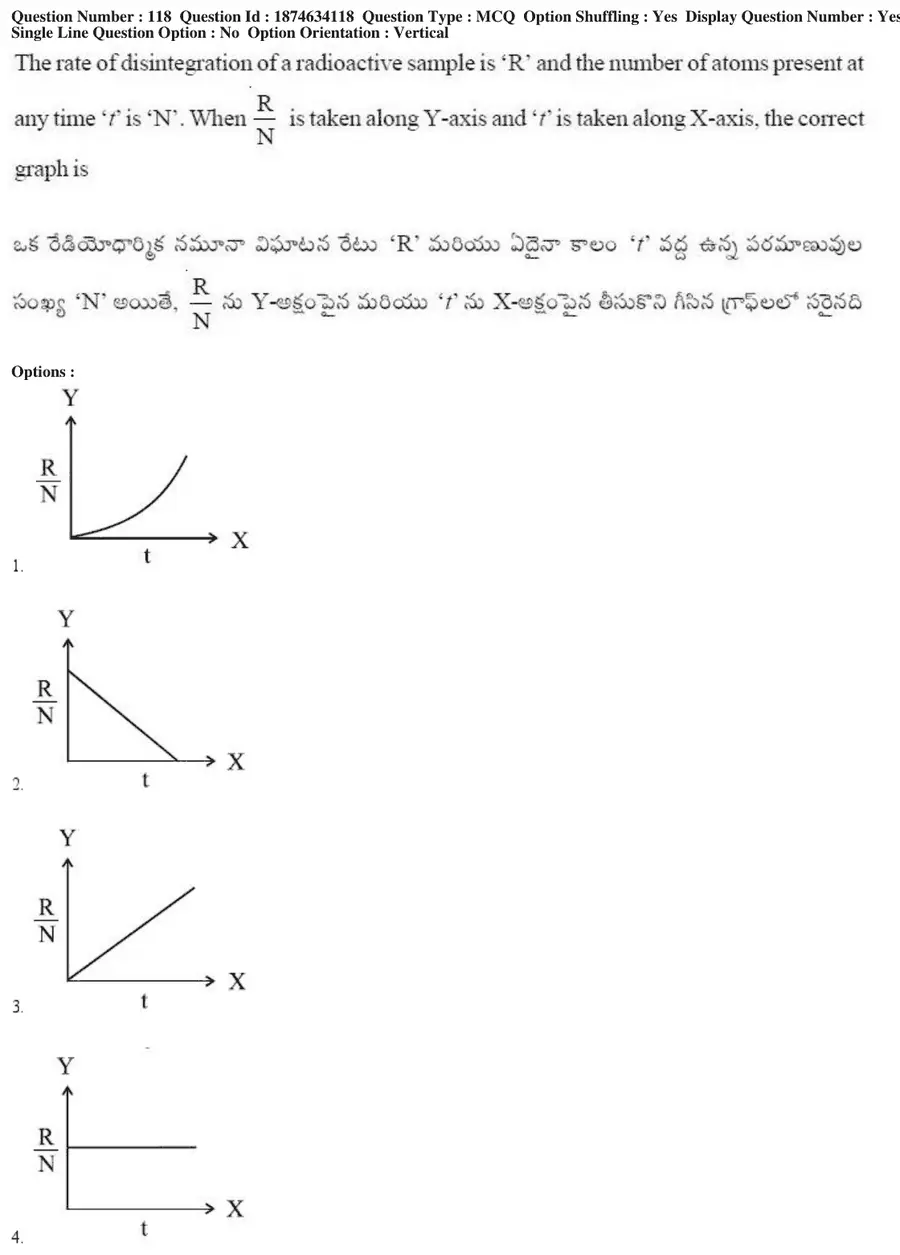
see figure Y = R/N vs X = t: curve starting at the origin and rising with increasing slope (convex, exponential-like growth)
see figure Y = R/N vs X = t: straight line starting high on the Y-axis and falling to the X-axis
see figure Y = R/N vs X = t: straight line rising from the origin
see figure Y = R/N vs X = t: horizontal straight line at a constant height above the X-axis
If the binding energy of $\mathrm{N^{14}}$ is 7.5 MeV per nucleon and that of $\mathrm{N^{15}}$ is 7.7 MeV per nucleon, then the energy required to remove a neutron from $\mathrm{N^{15}}$ is
5.25 MeV
0.2 MeV
10.5 MeV
0.4 MeV
In a nuclear reactor the activity of a radioactive substance is 2000/s. If the mean life of the products is 50 minutes, then in the steady power generation, the number of radio nuclides is
$12 \times 10^5$
$60 \times 10^5$
$90 \times 10^5$
$15 \times 10^5$
Half-life of a radioactive substance is 18 minutes. The time interval between its 20% decay and 80% decay in minutes is
$6$
$9$
$18$
$36$
A tokamak fusion test reactor works on :
Bombardmant of thermal neutrons with Uranium-235 (sic)
Magnetic confinement of plasma
Electric discharge under high voltage bias
Acceleration of charged particles in electromagnetic fields
Consider a radioactive nuclide which follow decay rate given by $A(t) = A_0 2^{-(t/t_0)}$, where $A(t)$ is the fraction of radioactive material remaining after time 't' from the initial $A_0$ at zero time. Let $A_1$ be the fraction of original activity which remains after 120 hours. Likewise $A_2$ is the fraction of original activity remaining after 200 hours. If $\frac{A_1}{A_2} = 16$, then the half life ($t_0$) will be
10 hours
20 hours
40 hours
60 hours
The half-life of ${}^{209}_{84}P_o$ is 103 years. The time it takes for 100 g sample of ${}^{209}_{84}P_o$ to decay to 3.125 g is
3296 years
$103\sqrt{2}$ years
1648 years
515 years
A nucleus of Deuteron or Deuterium is a bound atomic system best described by
Composed of a proton and a neutron
Spherical shaped
Contains more than two nucleons
Proton and neutron are bound by electrostatic forces
In uranium radioactive series, initial nucleus ${}^{238}_{92}\mathrm{U}$ decays to final nucleus ${}^{206}_{82}\mathrm{U}$. In this process the number of $\alpha$-particles and $\beta$-particles emitted are
$8$ and $3$
$16$ and $6$
$16$ and $3$
$8$ and $6$
An active nucleus decays to one-third ($\frac{1}{3}$) in 20 Hrs. The fraction of original activity remaining after 80 Hrs is
$\frac{1}{16}$
$\frac{1}{81}$
$\frac{1}{36}$
$\frac{1}{54}$
A radioactive element 'X' converts into another stable element 'Y'. Half life of X is 2 hours. Initially only X is present. After a time 't', if the ratio of atoms of X to Y is 1 : 4 then the value of 't' is
2 hours
4 hours
Between 4 hours and 6 hours
6 hours
Activity of a radioactive sample is $R_1$ at a time $t_1$ and $R_2$ at a time $t_2$. Its half life period is T. The number of atoms that have disintegrated in the time interval $(t_2 - t_1)$ is equal to $\frac{n(R_1 - R_2)T}{\ln 4}$. Then 'n' is equal to
2
1
4
$\frac{1}{2}$
The number of half lives elapsed before 93.75% of a radioactive sample has decayed, is
6
4
2
8
If $200\ \mathrm{MeV}$ of energy is released in the fission of one nucleus of $^{235}_{92}\mathrm{U}$, the number of nuclei that must undergo fission to release an energy of $1000\ \mathrm{J}$ is
$3.125\times10^{13}$
$6.25\times10^{13}$
$12.5\times10^{13}$
$3.125\times10^{14}$
The half life of $^{238}_{92}\mathrm{U}$ against $\alpha$-decay is $13.86\times10^{16}$ s. The activity of 1 g sample of $^{238}_{92}\mathrm{U}$ is ______
$1.26\times10^{4}\ \mathrm{s^{-1}}$
$1.26\times10^{-4}\ \mathrm{s^{-1}}$
$12.6\times10^{4}\ \mathrm{s^{-1}}$
$12.6\times10^{-4}\ \mathrm{s^{-1}}$
Which of the following is emitted when ${}^{239}_{94}\mathrm{Pu}$ decays into ${}^{235}_{92}\mathrm{U}$ ?
Gamma Ray
Neutron
Electron
Alpha particle
The half life of a stream of radioactive particles moving along a straight path with a constant kinetic energy of 4 eV is 1 minute. The percentage of particles which decay before travelling a distance of 3.6 km is ______ .
(Mass of the radioactive particles $=3.2\times10^{-21}\ \mathrm{kg}$ and charge of the electron $=1.6\times10^{-19}\ \mathrm{C}$)
37.5
87.5
75
175
A heavy nucleus having mass number 200 gets disintegrated into two small fragments of mass numbers 80 and 120. If binding energy per nucleon for parent atom is 6.5 MeV and for daughter nuclei is 7 MeV and 8 MeV respectively, then the energy released in the decay will be
$200\ \mathrm{MeV}$
$120\ \mathrm{MeV}$
$220\ \mathrm{MeV}$
$180\ \mathrm{MeV}$
In the nuclear fusion reaction $_1\mathrm{H}^2+{}_1\mathrm{H}^3\rightarrow{}_2\mathrm{He}^4+\mathrm{n}$, if the repulsive potential energy between the two nuclei is $2.07\times10^{-14}$ J, then the temperature at which the gases must be heated to initiate the reaction is (Boltzmann constant = $1.38\times10^{-23}\ \mathrm{JK^{-1}}$)
$10^{9}\ \mathrm{K}$
$10^{7}\ \mathrm{K}$
$10^{5}\ \mathrm{K}$
$10^{12}\ \mathrm{K}$
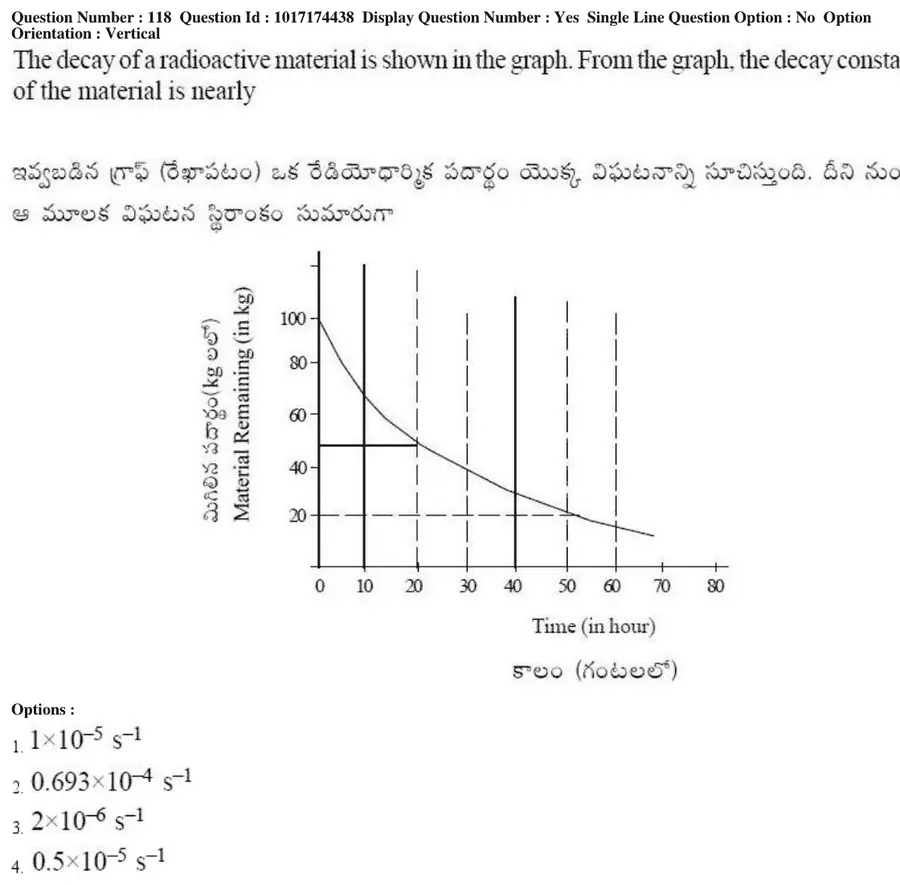
The decay of a radioactive material is shown in the graph. From the graph, the decay constant of the material is nearly
(see the figure above)
$1\times10^{-5}\ \mathrm{s^{-1}}$
$0.693\times10^{-4}\ \mathrm{s^{-1}}$
$2\times10^{-6}\ \mathrm{s^{-1}}$
$0.5\times10^{-5}\ \mathrm{s^{-1}}$
Two radioactive materials $Y_1$ and $Y_2$ initially contain same number of nuclei. Their decay constants are $9\lambda\ \mathrm{s^{-1}}$ and $6\lambda\ \mathrm{s^{-1}}$ respectively. The time after which the ratio of number of undecayed nuclei of $Y_1$ and $Y_2$ becomes $\dfrac{1}{e}$ is
$\dfrac{1}{3\lambda}$ s
$\dfrac{1}{15\lambda}$ s
$\dfrac{1}{10\lambda}$ s
$\dfrac{1}{8\lambda}$ s
In the fusion reaction, $_1\mathrm{H}^2+{}_1\mathrm{H}^2\rightarrow{}_2\mathrm{He}^4+Q$, Q is energy released. If 'c' is the speed of light and 'm' is the mass of each deuterium nucleus then the mass of helium nucleus formed is
$2m+\frac{Q}{c^2}$
$\frac{Q}{mc^2}$
$m+\frac{Q}{c^2}$
$2m-\frac{Q}{c^2}$
A certain radioactive element disintegrates with a decay constant of $7.9\times10^{-10}$/sec. At a given instant of time, if the activity of the sample is equal to $55.3\times10^{11}$ disintegration/sec, then number of nuclei at that instant of time
$7.0\times10^{21}$
$4.27\times10^{13}$
$4.27\times10^{3}$
$6\times10^{23}$
The radius of germanium (Ge) nuclide is measured to be twice the radius of ${}^{9}_{4}\mathrm{Be}$. The number of nucleons in Ge will be
72
73
74
75
If the radius of a nucleus with mass number 125 is 1.5 Fermi, then radius of a nucleus with mass number 64 is
0.48 Fermi
0.96 Fermi
1.92 Fermi
1.2 Fermi
The radius of $_{72}\mathrm{Te}^{125}$ nucleus is 6 fermi. The radius of $_{13}\mathrm{Al}^{27}$ nucleus in meters is
$3.6 \times 10^{-12}$ m
$3.6 \times 10^{-15}$ m
$7.2 \times 10^{-8}$ m
$7.2 \times 10^{-15}$ m
A $\mathrm{U}^{235}$ nuclear reactor generates energy at a rate of $3.70 \times 10^7$ J/s. Each fission liberates 185 MeV useful energy. If the reactor has to operate for $144 \times 10^4$ seconds, then, the mass of the fuel needed is (Assume Avogadro's number $= 6 \times 10^{23}$ mol$^{-1}$, 1 eV $= 1.6 \times 10^{-19}$ J)
70.5 kg
0.705 kg
13.1 kg
1.31 kg
The half life of $\mathrm{Ra^{226}}$ is 1620 years. Then the number of atoms decay in one second in 1 gm of radium (Avogadro number = $6.023 \times 10^{23}$)
$4.23 \times 10^9$
$3.16 \times 10^{10}$
$3.61 \times 10^{10}$
$2.16 \times 10^{10}$
The half life of a radioactive element is 10 hours. The fraction of initial radioactivity of the element that will remain after 40 hours is
$\frac{1}{2}$
$\frac{1}{16}$
$\frac{1}{8}$
$\frac{1}{4}$
If 200 MeV of energy is released in the fission of one nucleus of ${}^{235}_{92}\mathrm{U}$, the number of nuclei that must undergo fission to release an energy of 1000 J is :
$3.125 \times 10^{13}$
$6.25 \times 10^{13}$
$12.5 \times 10^{13}$
$3.125 \times 10^{14}$
Nuclear physics occupies an active position in Class 12 modern physics for regional entrance exams. Across the AP and TS EAPCET papers held in our archive between 2022 and 2026, Nuclei contributed 101 questions across 77 papers. This corresponds to an average rate of 1.3 questions per sitting, representing 3.3% of the physics questions in that five-year span. Taking the full historical archive from 2010 to 2026 into account, the chapter delivered 170 questions across 149 papers, maintaining an average of 1.1 questions per paper and a 2.9% subject share. During the early segment from 2010 to 2021, our database shows 69 questions in 72 papers (2.4% share). For the three most recent testing years from 2024 to 2026, the topic supplied 64 questions across 46 papers, registering a 3.5% share. The share of the subject in the last three years compared to early papers is up, while compared to the recent five-year window it is about the same.
State-wise records show that Telangana examinations weight this topic almost twice as heavily as Andhra Pradesh. Between 2022 and 2026, AP EAPCET papers in our set contributed 47 questions across 48 papers, with 44 papers containing questions (1.0 per paper, 2.4% share). TS EAPCET contributed 54 questions across 29 papers in our set, with all 29 papers carrying questions (1.9 per paper, 4.7% share). Nuclei has appeared every year since 2022, though across all 77 recent papers in our collection, four AP papers omitted it, meaning it did not feature in all 77 sittings. By volume of questions between 2022 and 2026, the chapter stands 16th of 28 physics chapters. Sittings in 2026 were the busiest in our archive, delivering 23 questions across 16 papers.
Questions distribute across three major themes:
Radioactive decay chains and half-life arithmetic are standard staples. A classic question examines the radioactive transmutation of a heavy parent nucleus into a stable daughter, such as uranium-238 decaying into lead-206, asking students to determine the exact number of alpha and beta particles emitted by balancing mass and charge numbers. Another common setup provides the decay activity at two successive time intervals and asks for the half-life or the sample's mean life.
Binding energy calculations represent the other major category. Students are given binding energy per nucleon for a heavy fissile nucleus and its intermediate fission fragments, requiring them to compute the total net energy released per fission event. Nuclear structure problems regularly ask students to verify that nuclear matter density is constant across the periodic table, or ask at what inter-nucleon separation distance the strong nuclear force changes from strongly repulsive to powerfully attractive.
Start by mastering radioactive decay kinetics. The rate of decay is dN/dt = - λ N, where activity is A = λ N. The half-life is T_half = ln two / λ = zero point six nine three / λ. The mean life is τ = 1 / λ. The fraction of initial nuclei remaining undecayed after n half-lives is N / N_zero = (1/two)^n, where n = t / T_half. When two radioactive isotopes with decay constants λ₁ and λ₂ decay simultaneously, effective decay constant is λ_eff = λ₁ + λ₂.
Next, study nuclear dimensions and binding energy. Nuclear radius scales with mass number A as R = R_zero A^(one third), where constant R_zero is approximately one point two fermi. Because volume scales linearly with A, nuclear matter density ρ = M / V is strictly independent of mass number A. Mass defect for a nucleus of Z protons and (A - Z) neutrons is Δm = [Z m_p + (A - Z) m_n] - M_nucleus. Total binding energy is E_b = Δm c² = Δm × nine hundred thirty-one point five MeV.
Finally, master reaction energetics. In any nuclear reaction A + a → B + b, the disintegration energy is Q = [m_reactants - m_products] c² = [E_b(products) - E_b(reactants)]. An exothermic reaction exhibits positive Q value, releasing kinetic energy, while an endothermic reaction requires threshold incident kinetic energy.
Yes. Although radioactivity was deleted from certain national exams, it remains an active, heavily tested topic in both AP and TS EAPCET papers.
Because nuclear radius scales with the cube root of mass number A, nuclear volume is directly proportional to A. Since nuclear mass also scales directly with A, the ratio of mass to volume remains constant for all nuclei.
The half-life of a radioactive substance is related to its mean life τ by the logarithmic factor T_half = τ ln two, which equals approximately zero point six nine three times τ.
Step-by-step solutions for each one are in the EdLoop EAPCET app.